The Broad Ax
Saturday, March 19, 1921
Chicago, Illinois
Page text (machine-generated)
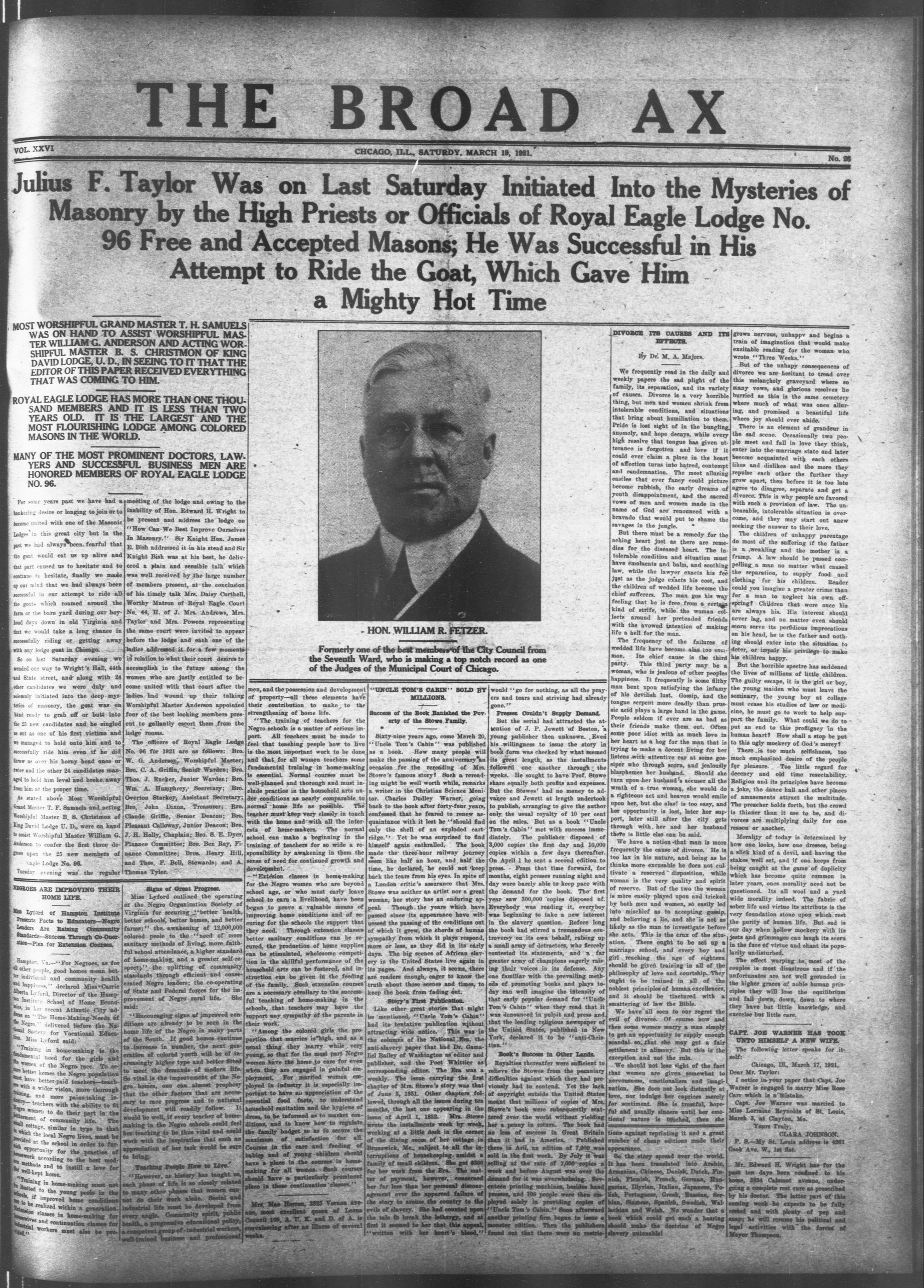
Julius F. Taylor Was on Last Saturday Initiated Into the Mysteries of Masonry by the High Priests or Officials of Royal Eagle Lodge No. 96 Free and Accepted Masons; He Was Successful in His Attempt to Ride the Goat, Which Gave Him a Mighty Hot Time
MOST WORSHIPFUL GRAND MASTER T. H. SAMUELS WAS ON HAND TO ASSIST WORSHIPFUL MASTER WILLIAM G. ANDERSON AND ACTING WORSHIPFUL MASTER B. S. CHRISTMON OF KING DAVID LODGE, U. D., IN SEEING TO IT THAT THE EDITOR OF THIS PAPER RECEIVED EVERYTHING THAT WAS COMING TO HIM.
ROYAL EAGLE LODGE HAS MORE THAN ONE THOUSAND MEMBERS AND IT IS LESS THAN TWO YEARS OLD. IT IS THE LARGEST AND THE MOST FLOURISHING LODGE AMONG COLORED MASONS IN THE WORLD.
MANY OF THE MOST PROMINENT DOCTORS, LAWYERS AND SUCCESSFUL BUSINESS MEN ARE HONORED MEMBERS OF ROYAL EAGLE LODGE NO. 96.
For some years past we have had a hankering desire or longing to join or to become united with one of the Masonic Lodges in this great city but in the past we had always been. fearful that the goat would eat us up alive and that part caused us to hesitate and to continue to hesitate, finally we made up our mind that we had always been successful in our attempt to ride all the goats which roamed around the farm or the barn yard during our boyhood days down in old Virginia and that we would take a long chance in successfully riding or getting away with any lodge goat in Chicago.
So on last Saturday evening we wended our way to Wright's Hall, 44th and State street, and along with 24 other candidates we were duly and solemnly initiated into the deep mysteries of masonry, the goat was on hand ready to grab or butt into the 25 new candidates and he singled out as one of his first victims and we managed to hold onto him and to successfully ride him even if he did throw us over his horny head once or twice and the other 24 candidates managed to hold him level and broke away from him at the proper time.
As stated above Most Worshipful Grand Master T. F. Samuels and acting Worshipful Master B. S. Christmon of King David Lodge U. D., were on hand to assist Worshipful Master William G. Anderson to confer the first three degrees upon the 25 new members of Tangle Lodge No. 96.
Tuesday evening was the regular
Hampton, Va.—"For Negroes, as for all other people, good homes mean better individual and community health and happiness," declared Miss*Garrie Alberta Leford, Director of the Hampster Institute School of Home Economics, in her recent Atlantic City address on "The Home-Making: Needs of the Negro." delivered before the National Society for Vocational Education. Miss Leford said:
"Training in home-making is the fundamental need for the girls and the women of the Negro race. To secure better homes the Negro population must have better-paid teachers—teachers with a wider vision, more thorough training, and more pain-taking industry—teachers with the ability to fit Negro women to do their part in the settlement of community life. The small cottage, similar in type to that in the local Negro lives, must be provided at the school in order to furnish opportunity for the practice of homework according to the best modern methods and to instill a love for the well-kept home.
"Training in home-making must not be limited to the young people in the schools, if improved home conditions can be realized within a generation. Extension classes in home-making for ourselves and continuation classes for industrial workers must also be provided."
THE BROAD AX
meeting of the lodge and owing to the inability of Hon. Edward H. Wright to be present and address the lodge on "How Can-We Best Improve Ourselfs In Masonry." Sir Knight Hon. James E. Bish addressed the in his stead and Sir Knight Bish was at his best, he delivered a plain and sensible talk which was well received by the large number of members present, at the conclusion of his timely talk Mrs. Daisy Corthell, Worthy Matron of Royal Eagle Court No. 44, H of J. H. Andrews, Mrs. Taylor and Mrs. Powers representing the same court were invited to appear before the lodge and each one of the ladies addressed it for a few moments in relation to what their court desires to accomplish in the future among the women who are justly entitled to be united with that court after the ladies had wound up their talking Worshipful Master Anderson appointed four of the best looking members present to gallantly escort them from the lodge rooms.
The officers of Royal Eagle Lodge No. 96 for 1921 are as follows: Bro. W. G. Anderson, Worshipful Master; Bro. C. A. Griffin, Senior Warden; Bro. Thos. J. Rucker, Junior Warden; Bro. Wm. A. Humphrey, Secretary; Bro. Overton Starkey, Assistant Secretary; Bro. John Dixon, Treasurer; Bro. Claude Griffie, Senior Deacon; Bro. Pleasant Calloway, Junior Deacon; Bro. J. H. Holly, Chaplain; Bro. S. E. Dyer, Finance Committee; Bro. Ben Ray, Finance Committee; Bros. Henry Hill, and Thos. F. Bell, Stewards; and A. Thomas Tyler.
Signs of Great Progress.
Miss Lyford outlined the operating or the Negro Organization Society of Virginia for securing "better health, better schools, better homes, and better farms;" the awakening of 12,000,000 colored peole to the "need of more sanitary methods of living; more faithful school attendance, a higher standard of home-making, and a greater self-respect;" the uplifting of community standards through efficient and consequent Negro leaders; the co-operating of State and Federal forces for the improvement of Negro rural life. She said:
"Encouraging signs of improved conditions are already to be seen in the home life of the Negro in many parts of the South. If good homes continue to increase in number, the next generation of colored youth will be of increasingly higher type and better fitted to meet the demands of modern life. So vital is the improvement of the Negro homes, one can almost prophecy that the other factors that are necessary to race progress and to national development will readily follow. It would be well, if every teacher of home-making in the Negro schools could her teaching to be thus vital and could work with the inspiration that such an appreciation of her task would be sure to bring.
Teaching People How to Live."
"However, or history has taught us, each phase of life is so closely related to many other phases that women cannot do their work alone. Social and industrial life must be developed from every angle. Community spirit, public education, a progressive educational policy, a competent group of industrial workers, well-trained business and professional."
[Name]
Formerly one of the best members of the City Council from the Seventh Ward, who is making a top notch record as one of the Judges of the Municipal Court of Chicago.
men, and the possession and development of property—all these elements have their contribution to make to the strengthening of home life.
"The training of teachers for the Negro schools is a matter of serious import. All teachers must be made to feel that teaching people how to live is the most important work to be done and that for all women teachers some fundamental training in home-making is essential. Normal courses must be well-planned and thorough and must include practice in the household arts under conditions as nearly comparable to normal home life as possible. The teacher must keep very closely in touch with the home and with all the interests of home-makers. The normal school can make a beginning in the training of teachers for so wide a responsibility by awakening in them the sense of need for continued growth and development.
"Extension classes in home-making for the Negro women who are beyond school age, or who must early leave school to earn a livelihood, have been begun to prove a valuable means of improving home conditions and of securing for the schools the support that they need. Through extension classes better sanitary conditions can be secured, the production of home supplies can be stimulated, wholesome competition in the skilful performance of the household arts can be fostered, and instruction can be given in the feeding of the children. Such extension courses are a necessary corollary to the successful teaching of home-making in the schools, that teachers may have the support any sympathy of the parents in their work.
"Among the colored girls the proportion that marries is high, and as a usual thing they marry while very young, so that for the most part Negro women have the home to care for even when they are engaged in gainful employment. For married women employed in industry it is especially important to have an appreciation of the essential food facts, to understand household sanitation and the hygiene of dress, to be informed as to market conditions, and to know how to regulate the family budget so as to secure the maximum of satisfaction for all. Courses in the care and feeding of babies and of young children should have a place in the courses in home-making for all women. Such courses should have a particularly prominent place in these continuation classes."
Mrs. Mac Herron, 3825 Vernon avenue, most excellent queen of Leona Council 109, A. U. K. and D. of A. is convalescing after an illness of several weeks.
"UNCLE TOM'S CABIN" SOLD BY MILLIONS.
Success of the Book Banked the Poverty of the Stowe Family.
Sixty-nine years ago, come March 20, "Uncle Tom's Cabin" was published as a book. How many people will make the passing of the anniversary an occasion for the receding of Mrs. Stowe's famous story! Such a rereading might be well worth while, remarks a writer in the Christian Science Monitor. Charles Dudley Warner, going back to the book after forty-four years, confessed that he feared to renew acquaintance with it lest he "should find only the shell of an exploded cartridge." Yet he was surprised to find himself again enthralled. The book made the three-hour railway journey seem like half an hour, and half the time, he declared, he could not keep back the tears from his eyes. In spite of a London critic's assurance that Mrs. Stowe was neither an artist nor a great woman, her story has an enduring appeal. Though the years which have passed since its appearance have witnessed the passing of the conditions out of which it grew, the chords of human sympathy from which it plays respond, more or less, as they did in its early days. The big scenes of African slavery in the United States live again in its pages. And always, it seems, there are readers enough, eager to know the truth about those scenes and times, to keep the book from fading out.
Story's First Publication.
Like other great stories that might be mentioned, "Uncle Tom's Cahis" had its tentative publication without attracting wide notice. This was in the columns of the National Ern, the anti-slavery paper that had Dr. Gamaliel Bailey of Washington as editor and publisher, and the Poet Whittier as corresponding editor. The Ern was a weekly. The issue carrying the first chapter of Mrs. Stowe's story was that of June 5, 1851. Other chapters followed, through all the issues during ten months, the last one appearing in the issue of April 1, 1852. Mrs. Stowe wrote the installments week by week, working at a little desk in the corner of the dining room of her cottage in Brunswick, Me, subject to all the interruptions of housekeeping amid a family of small children. She got $300 for her work from the Ern. The matter of payment, however, concerned her far less than her personal discouragement to the apparent failure of the story to arouse the country to the evils of slavery. She had counted upon the tale to break the lethargy, and at first it seemed to her that this appeal, "written with her heart's blood."
would "go for nothing, as all the prayers and tears and striving had already gone."
Presses Couldn't Supply Demand.
But the serial had attracted the attention of J. P. Jewett of Boston, a young publisher then unknown. Even his willingness to issue the story in book form was checked by what seemed its great length, as the installments followed one another through the weeks. He sought to have Prof. Stowe share equally both profits and expenses. But the Stowes' had no money to advance and Jewett at length undertook to publish, arranging to give the author only the usual royalty of 10 per cent on the sales. But as a book "Uuncle Tom's Cabin" met with success immediately. The publisher disposed of 3,000 copies the first day and 10,000 copies within a few days thereafter. On April 1 he sent a second edition to press. From that time forward, for months, eight presses running night and day were barely able to keep pace with the demand for the book. The first year saw 300,000 copies disposed of. Everybody was reading it, everybody was beginning to take a new interest in the slavery question. Before long the book had stirred a tremendous controversy on its own behalf, raising up a small army of detractors, who fiercely contested its statements, and a far greater army of champions eagerly raising their voices in its defense. Any one familiar with the prevailing methods of promoting books and plays today can well imagine the intensity of that early popular demand for "Uuncle Tom's Cabin" when they read that it was denounced in pulpit and press and that the leading religious newspaper of the United States, published in New York, declared it to be "anti-Christian."
Royalties thereafter were sufficient to relieve the Stowes from the penniary difficulties against which they had previously had to contend. Yet the lack of copyright outside the United States meant that millions of copies of Mrs. Stowe's book were subsequently scattered over the world without yielding her a penny in return. The book had no less of success in Great Britain than it had in America. Published there in Aril, an edition of 7,000 was sold in the first week. By July it was selling at the rate of 1,000 copies a week and before August was over the demand for it was overwhelming. Seventeen printing machines, besides hand presses, and 100 people were then employed solely in providing copies of "Uncle Tom's Cabin." Soon afterward another printing firm began to issue a monster edition. Then the publishers found out that there were no restricte
By Dr. M. A. Majors.
We frequently read in the daily and weekly papers the sad plight of the family, its separation, and its variety of causes. Divorce is a very horrible thing, but men and women shrink from intolerable conditions, and situations that bring about humiliation to them. Pride is lost sight of it in the bungeing anomaly, and hope decays, while every high resolve that tongue has given utterance is forgotten and love if it could ever claim a place in the heart of affection turns into hatred, contempt and condemnation. The most alluring castles that ever fancy could picture become rubbish, the early dreams of youth disappointment, and the sacred vows of men and women made in the name of God are renounced with a bravado that would put to shame the savages in the jungle.
But there must be a remedy for the aching heart just as there are remedies for the diseased heart. The intolerable condition and situation must have emolients and balm, and soothing law, while the lawver exacts his fee just as the judge exacts his cost, and the children of wedded life become the chief sufferers. The man gos his way feeling that he is free from a certain kind of strife, while the woman collects around her pretended friends with the avowed intention of making life a hell for the man.
The frequency of the failures of wedded life have become alas too common. Its chief cause is the third party. This third party may be a woman, who is jealous of other peoples happiness. It frequently is some filthy man bent upon satisfying the infamy of his devilish lust. Gossip, and the tongue serpent more deadly than prussic acid plays a large hand in the game. People seldom if ever are as bad as their friends make them out. Often some poor idiot with as much love in her heart as a hog for the man that is trying to make a decent living for her listens with attentive ear at some gossip who through scorn, and jealously blasphes her husband. Should she turn upon her husband's accuser all the wrath of a true woman, she would do a righteous act and heaven would smile upon her, but she alas! is too easy, and her opportunity is lost, later her support, later still after the city gets through with her and her husband there is little else can be said.
We have a notion that man is more frequently the cause of divorce. He is too lax in his nature, and being as he thinks more excusable he does not cultivate a reserved disposition, while woman is the very quality and spirit of reserve. But of the two the woman is more easily played upon and tricked by both men and women, so easily led into mischief as to accepting gossip and believing a lie, and she is not as likely as the man to investigate before she acts. This is the crux of the situation. There ought to be set up a marriage school, and every boy and girl reaching the age of eighteen should be given training in all of the philosophy of love and courtship. They ought to be trained in all of the noblest principles of human excellences, and it should be tinctured with a smattering of law the Bible.
We have all seen to our regret the evil of divorce. Of course now and then some women marry a man simply to get an opportunity to supply enough scandal so that she may get a fair settlement in alimony. But this is the exception and not the rule.
We should not lose sight of the fact that women are given somewhat to nervousness, emotionalism and imagination. She does not look distantly at love, nor indulge her caprices merely for sentiment. She is trustful, hopeful and usually sincere until her emotional nature is touched, then she tions against reprinting it and a great number of cheap editions made their appearance.
So the story spread over the world. It has been translated into Arabic, Armenian, Chinese, Danish, Dutch, Finnish, Flemish, French, German, Hungarian, Illyrian, Italian, Japanese, Polish, Portuguese, Greek, Russian, Serbian, Slavic, Spanish, Swedish, Wallachian and Welsh. No wonder that a book which could get such a hearing should make the doctrine of Negro slavery unenable!
grows nervous, unhappy and begins a train of imagination that would make excitable reading for the woman who wrote "Three Weeks." But of the unhappy consequences of divorce we are hesitant to tread over this melancholy graveyard where so many vows, and glorious resolves lie buried as this is the same cemetery where much of what was once alluring, and promised a beautiful life where joy should ever abide. There is an element of grandeur in the sad scene. Occasionally two people meet and fall in love they think, enter into the marriage state and later become acquainted with each others likes and dislikes and the more they repulse each other the further they grow apart, then before it is too late agree to disagree, separate and get a divorce. This is why people are favored with such a provision of law. The unbearable, intolerable situation is overcome, and they may start out anew seeking the answer to their love.
The children of unhappy parentage do most of the suffering if the father is a. weakling and the mother is a frump. A law should be passed compelling a man no matter what caused the separation, to supply food and clothing for his children. Reader could you imagine a greater crime than for a man to neglect his own offspring? Children that were once his are always his. His interest should never lag, and no matter even should seorn serve its peridious imprecations on his head, he is the father and nothing should enter into the situation to deter, or impair his privilege to make his children happy.
But the horrible spectre has saddened the lives of millions of little children. The guilty escape, it is the girl or boy, the young maiden who must leave the seminary, the young boy at college must cease his studies of law or medicine, he must go to work to help support the family. What could we do to put an end to this profligacy in the human heart? How shall a stop be put to this ugly mockery of God's merey? There is too much selfishness, too much emphasized desire of the people for pleasure. Too little regard for decency and old time reusability. Religion and its principles have become a joke, the dance hall and other places of amusements attract the multitude. The preacher holds forth, but the crowd is thinner than it use to be, and divorces are multiplying daily for one reason or another.
Morality of today is determined by how one looks, how one dresses, being a slick kind of a devil, and having the stakes well set, and if one keeps from being caught at the game of duplicity which has become quite common in later years, one morality need not be questioned. Its all wool and a yard wide morality indeed. The fabric of sober life and virtue its attribute is the very foundation stone upon which rest the purity of human life. But sad is our day when hollow mockery with its jests and grimmages can laugh its scorn in the face of virtue and chant its popularity undisturbed.
The effect warping to most of the couples is most disastrous and if the unfortunate are not well grounded in the higher graces of noble human principles they will lose the equilibrium and fall down, down, down to where they have but little knowledge, and exercise but little care.
CAPT. JOE WARNER HAS TOOK UNTO HIMSELF A NEW WIFE.
The following letter speaks for it-self:
Chicago, Ill., March 17, 1921.
Dear Mr. Taylor:
I notice in your paper that Capt. Joe
Warner is engaged to marry Miss Rose
Carr which is a mistake.
Capt. Joe Warner was married to
Miss Lorrine Reynolds of St. Louis,
March 3, at Clayton, Mo.
Yours Truly,
In this city since July 15th, 1899, without missing one single issue. Republicans, Democrats, Catholics, Protestants, Single Taxers, Priests, infidels or anyone else can have their say as long as their language is proper and responsibility is fixed. The Broad Ax is a newspaper whose platform is broad enough for all, ever claiming the editorial right to speak its own mind. Local communications will receive attention. Write only on one side of the paper.
Advertising rates made known on application.
THE BROAD AX
6206 So. Elizabeth St, Chicago, Ill.
Phone Wenworth 2597
JULIUS F. TAYLOR
Editor and Publisher
Associate Editor
DR. M, A. MAJORS
4700 South State Street
Phone Drexel 1416
MARCH 19, 1921.
VOL. XXVI. No. 26.
Entered as Second-Class Matter, Aug.
19, 1902, at the Post Office at Chicago,
III. Under Act of March 8, 1879.
THE AWAKENING
By Dr. M. A. Majors.
The rapid progress we are making has got the world astir. There seems to be some kind of concerted fear that at some early date the Negro will become aggressive and in some way that is not known decide to exercise his God given rights. The daily papers are making the fact all the more emphasized by their spirit of antagonism, and wholesale attacks upon the race. A few days ago the Chicago Tribune had for headlines "Negro This and That." The Herald Examiner had headlines, "Yard Negroes Accept Cvt in Wages." Race hate seems to be more intense, while a peculiar behavior on the part of white people is obvious.
In another part of the country a white man is holding up the conduct of his wife with a colored man of wealth, but the Tribune won't publish this legal row in the courts because it is just a glimpse of the condition in the Southland between whites and blacks that it would not have to become generally known. It is all very well for the white race to bluster about its superiority, but in publishing to the world the inferiority of this race and that race it ought to remember that the man is always lower in the moral scale than the woman he consorts with no matter what color or race they are a part.
To all intents and purposes the day of the awakening has come, and in the same proportion the Negro is getting his eyes open, the white man is getting
```markdown
```
1.
HON. CLAYTON F. SMITH.
As City Treasurer through his constructive for the city over $2,446,000 in interest, which more than was earned under any previous adm 1919 the Chicago American, Herald-Examiner, ning Post and the Journal all endorsed him for the Daily News said: "In the office of the Cit displayed marked executive ability and grown capacity to render public service; honest, capa gent. Mr. Smith's record as City Treasurer has commended by members of the City Council."
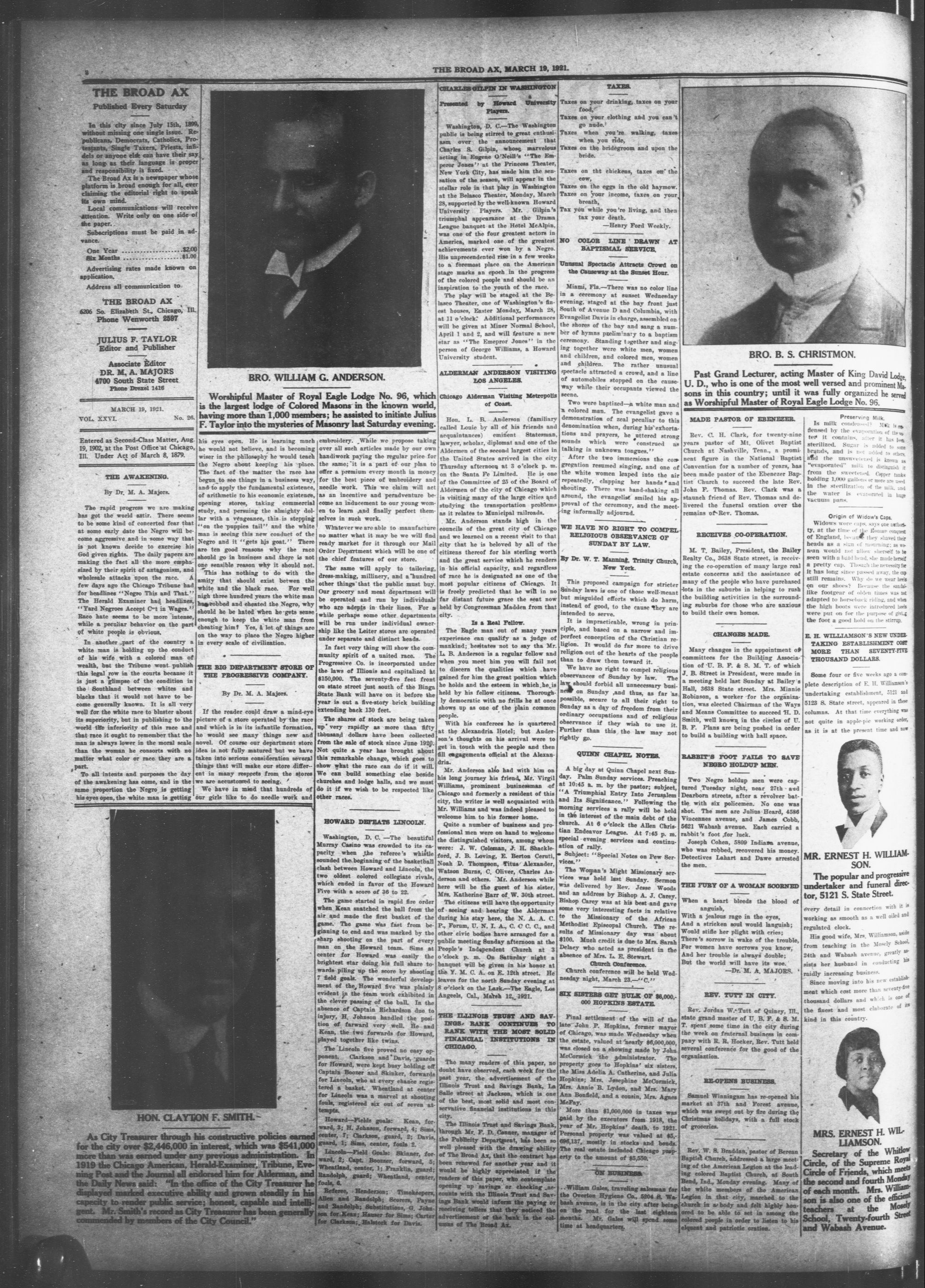
As City Treasurer through his constructive policies earned for the city over $2,446,000 in interest, which was $541,000 more than was earned under any previous administration. In 1919 the Chicago American, Herald-Examiner, Tribune, Evening Post and the Journal all endorsed him for Alderman, and the Daily News said: "In the office of the City Treasurer he displayed marked executive ability and grown steadily in his capacity to render public service; honest, capable and intelligent. Mr. Smith's record as City Treasurer has been generally commended by members of the City Council."
1910
Worshipful Master of Roy is the largest lodge of Colore having more than 1,000 memb F. Taylor into the mysteries of
Worshipful Master of Royal Eagle Lodge No. 96, which is the largest lodge of Colored Masons in the known world, having more than 1,000 members; he assisted to initiate Julius F. Taylor into the mysteries of Masonry last Saturday evening.
his eyes open. He is learning much he would not believe, and is becoming wiser in the philosophy he would teach the Negro about keeping his place. The fact of the matter the race has begun to see things in a business way, and to apply the fundamental existence, of arithmetic to his economic existence, opening stores, taking commercial study, and persisting the almighty dollar with a vengeance, this is stepping "on the puppies tail" and the white man is seeing this new conduct of the Negro and it "gets his goat." There are ten good reasons why the race should go in business and there is not one sensible reason why it should not. This has nothing to do with the amity that should exist between the white and the black race. For well nigh three hundred years the white man has robbed and cheated the Negro, why should he be hated when he gets sense enough to keep the white man from cheating him? Yes, a lot of things are on the way to place the Negro higher in every scale of civilization.
embroidery. While we propose taking over all such articles made by our own handiwork paying the regular price for the same; it is a part of our plan to offer a premium every month in money for the best piece of embroidery and needle work. This we claim will act as an incentive and peradventure become an inducement to our young women to learn, and finally perfect themselves in such work.
Whatever we are able to manufacture no matter what it may be we will find ready market for it through our Mail Order Department which will be one of the chief features of our store.
The same will apply to tailoring, dress-making, millinery, and a hundred other things that the public must buy. Our grocery and meat department will be operated and run by individuals who are adepts in their lines. For a while perhaps some other departments will be run under individual ownership like the Leiter stores are operated under separate and distinct heads.
THE RIG DEPARTMENT STORE OF
THE PROGRESSIVE COMPANY
If the reader could draw a mind-cycle picture of a store operated by the race and which is in its infantile formation, he would see many things new and novel. Of course our department store idea is not fully matured but we have taken into serious consideration several things that will make our store different in many respects from the stores we are accustomed to seeing.
We have in mind that hundreds of our girls like to do needle work and
1.
this constructive policies earned an interest, which was $541,000 any previous administration. In Herald-Examiner, Tribune, Eventordsed him for Alderman, and a office of the City Treasurer he utility and grown steadily in his office; honest, capable and intellibility Treasurer has been generally the City Council."
BRO. WILLIAM G. ANDERSON.
The Master of Royal Eagle Lodge No. 96, which is lodge of Colored Masons in the known world, more than 1,000 members; he assisted to initiate Julius to the mysteries of Masonry last Saturday evening.
He is learning much believe, and is becoming philosophy he would teach at keeping his place. The matter the race hasings in a business way, fundamental existence, his economic existence, taking commercializing the almighty dolceance, this is stepping its tail" and the white his new conduct of the gets his goat." There reasons why the race business and there is not reason why it should not. going to do with the would exist between the black race. For well red years the white man cheated the Negro, why when he gets sense the white man from Yes, a lot of things are place the Negro higher
embroidery. While we propose taking over all such articles made by our own handwork paying the regular price for the same; it is a part of our plan to offer a premium every month in money for the best piece of embroidery and needle work. This we claim will act as an incentive and peradventure become an inducement to our young women and finally perfect themselves in such work.
Whatever we are able to manufacture no matter what it may be we will find ready market for it through our Mail Order Department which will be one of the chief features of our store.
The same will apply to tailoring, dress-making, millinery, and a hundred other things that the public must buy. Our grocery and meat department will be operated and run by individuals who are adepts in their lines. For a while perhaps some other departments will be run under individual ownership like the Leiter stores are operated under separate and distinct heads.
In fact very thing will show the community spirit of a united race. The Progressive Co. is incorporated under the laws of Illinois and capitalized at $150,000. The seventy-five feet front on state street just south of the Binga State Bank will have on it before the year is out a five-story brick building extending back 130 feet. The shares of stock are being taken up very rapidly as more than fifty thousand dollars have been collected from the sale of stock since June 1920. Not quite a year has brought about this remarkable change, which goes to show what the race can do if it will. We can build something else beside churches and lodge halls, and we must do it if we wish to be respected like other races.
HOWARD DEFEATS LINCOLN
Washington, D. C. —The beautiful Murray Casino was crowded to its capacity when the referee's whistle sounded the beginning of the basketball clash between Howard and Lincoln, the two oldest colored collegiate rivals, which ended in favor of the Howard Five with a score of 36 to 22.
The game started in rapid fire order when Kean snatched the ball from the air and made the first basket of the game. The game was fast from beginning to end and was marked by the sharp shooting on the part of every man on the Howard team. Sims at center for Howard was easily the brightest star doing his full share towards piling up the score by shooting 7 field goals. The wonderful development of the Howard five was plainly evident in the team work exhibited in the clever passing of the ball. In the absence of Captain Richardson due to injury, H. Johnson handled the position of forward very well. He and Kean, the two forwards for Howard, played together like twins.
The Lincoln five proved no easy opponent, Clarkson and Davis, guards for Howard, were kept busy holding off Captain Boozer and Skinner, forwards for Lincoln, who at every chance registered a basket. Wheatland at center for Lincoln was a marvel at shooting foul, registered six out of seven attempts.
Howard—Fields goals: Kean, forward, 2; H. Johnson, forward, 4; Sims, center, 7; Clarkson, guard, 2; Davis, guard, 1; Sims, center, foul, 2.
Lincoln—Field Goals: Skinner, forward, 2; Capt. Boozer, forward, 5; Wheatland, center, 1; Franklin, guard; Randolph, guard; Wheatland, center, foul, 6.
Referee, Henderson; Timekeeper, Allen and Randolph; Scorns, Payne and Randolph; Substitutions, G. Johnson for Kean; Hauser for Sims; Carter for Clarkson; Halstork for Davis.
THE BROAD AX. MARCH 19, 1921.
Washington, D. C.—The Washington public is being stirred to great enthusiasm as over the announcement that Charles S. Gilpin, whose marvelous acting in Eugene O'Neill's "The Emperor Jones" at the Princess Theater New York City, has made him the sensation of the season, will appear in the stellar role in that play in Washington at the Belasco Theater, Monday, March 28, supported by the well-known University Players. Mr. Gilpin's triumphal appearance at the Drama League banquet at the Hotel McAlpin, was one of the four greatest actors in America, marked one of the greatest achievements ever won by a Negro. His unprecedented rise in a few weeks to a foremost place on the American stage marks an epoch in the progress of the colored people and should be an inspiration to the youth of the race.
The play will be staged at the Belasco Theater, one of Washington's finest houses, Easter Monday, March 28, at 11 o'clock. Additional performances will be given at Miner Normal School April 1 and 2, and will feature a new star as "The Emepror Jones" in the person of George Williams, a Howard University student.
ALDERMAN ANDERSON VISITING LOS ANGELES.
Chicago Alderman Visiting Metropolis of Coast.
Hon. L. B. Anderson (familiar called Louie by all of his friends and acquaintances) eminent Statesman, lawyer, diplomat and one of the Aldermen of the second largest cities in the United States arrived in the city Thursday afternoon at 3 o'clock p. m. on the Santa Fe Limited. He is one of the Committee of 25 of the Board of Aldermen of the city of Chicago which is visiting many of the large cities and studying the transportation problems as it relates to Municipal railroads.
Mr. Anderson stands high in the councils of the great city of Chicago and we learned on a recent visit to that city that he is beloved by all of the citizens thereof for his sterling worth and the great service which he renders in his official capacity, and regardless of race he is designated as one of the most popular citizens of Chicago. It is freely predicted that he will in no far distant future grace the seat now held by Congressman Madden from that city.
Is a Real Fellow.
The Eagle man' out of many years experience can qualify as a judge of mankind; hesitates not to say that Mr. L. B. Anderson is a regular fellow and when you meet him you will fail not to discern the qualities which have gained for him the great position which he holds and the esteem in which he is held by his fellow citizens. Thoroughly democratic with no frills he at once shows up as one of the plain common people. With his conferees he is quartered at the Alexandria Hotel; but Anderson's thoughts on his arrival were to get in touch with the people and then fill engagements official at the Alexandria. Mr. Anderson also had with him on his long journey his friend, Mr. Virgil Williams, prominent businessman of Chicago and formerly a resident of this city, the writer is well acquainted with Mr. Williams and was indeed pleased to welcome him to his former home.
Quite a number of business and professional men were on hand to welcome the distinguished visitors, among whom were: J. W. Coleman, J. H. Shackleford, J. B. Loving, E. Berton Cerutti, Noah D. Thompson, Titus Alexander, Watson Burns, C. Oliver, Charles Anderson and others. Mr. Anderson while here will be the guest of his sister, Mrs. Katherine Barr of W. 30th street. The citizens will have the opportunity of seeing and hearing the Alderman during his stay here, the N. A. A. C. P., Forum, U. N. I. A., C. C C. C., and other civic bodies have arranged for a public meeting Sunday afternoon at the People's Independent Church at 3 o'clock p. m. On Saturday night a banquet will be given in his honor at the Y. M. C. A. on E. 12th street. He leaves for the north Sunday evening at 8 o'clock on the Lark—The Eagle, Los Angeles, Cal., March 12, 1921.
THE ILINOIS TRUST AND SAVINGS, BANK CONTINUES TO RANK WITH THE MOST SOLID FINANCIAL INSTITUTIONS IN CHICAGO.
The many readers of this paper, no doubt have observed, each week for the past year, the advertisement of the Illinois Trust and Savings Bank. La Salle street at Jackson, which is one of the best, most solid and most conservative financial institutions in this city. The Illinois Trust and Savings Bank, through Mr. F. D. Conner, manager of the Publicity Department, has been so well pleased with the drawing ability of The Broad Ax, that the contract has been renewed for another year and it would be highly appreciated if the readers of this paper, who contemplate opening up savings or checking accounts with the Illinois Trust and Savings Bank would inform the paying or receiving tellers that they noticed the advertisement of the bank in the columns of The Broad Ax.
Tax you while you're living, and then
tax your death.
NO COLOR LINE DRAWN AT BAPTISMAL SERVICE.
Unusual Spectacle Attracts Crowd on the Causeway at the Sunset Hour.
Miami, Fla.—There was no color line in a ceremony at sunset Wednesday evening, staged at the bay front just South of Avenue D and Columbia, with Evangelist Davis in charge, assembled on the shores of the bay and sang a number of hymns preliminary to a baptism ceremony. Standing together and singing together were white men, women and children, and colored men, women and children. The rather unusual spectacle attracted a crowd, and a line of automobiles stopped on the causeway while their occupants viewed the scene.
Two were baptized—a white man and a colored man. The evangelist gave a demonstration of zeal peculiar to this denomination when, during his exhortations and prayers, he uttered strong sounds which were construed as talking in unknown tongues."
After the two immusions the congregation resumed singing, and one of the white women leaped into the air repeatedly, clapping her hands and shouting. There was hand-shaking all around, the evangelist smiled his approval of the ceremony, and the meeting informally adjournd.
WE HAVE NO RIGHT TO COMPEL RELIGIOUS OBSERVANCE OF SUNDAY BY LAW.
By Dr. W. T. Manning, Trinity Church New York.
This proposed campaign for stricter Sunday laws is one of those well-meant but misguided efforts which do harm, instead of good, to the cause they are intended to serve.
It is impracticable, wrong in principle, and based on a narrow and imperfect conception of the Christian religion. It would do far more to drive religion out of the hearts of the people than to draw them toward it.
We have no right to compel religious observances of Sunday by law. The law should forbid all unnecessary business on Sunday, and thus, as far as possible, secure to all their right to Sunday as a day of freedom from their ordinary occupations and of religious observance if they wish to use it. Further than this the law may not rightly go.
QUINN CHAPEL NOTES
A big day at Quinn Chapel next Sunday. Palm Sunday services. Preaching at 10:45 a. m. by the pastor; subject, "A Triumphal Entry Into Jerusalem and Its Significance." Following the morning services a rally will be held in the interest of the main debt of the church. At 6 o'clock the Allen Christian Endeavor League. At 7:45 p. m. special evening services and continuation of rally.
Subject: "Special Notes on Pew Services."
The Woman's Might Missionary services was held last Sunday. Sermon was delivered by Rev. Jesse Woods and an address by Bishop A. J. Carey. Bishop Carey was at his best and gave some very interesting facts in relative to the Missionary of the African Methodist Episcopal Church. The results of Missionary day was about $100. Much credit is due to Mrs. Sarah Delacy who acted as president in the absence of Mrs. L. E. Stewart.
Church Conference.
Church conference will be held Wednesday night, March 23.—"C."
SIX SISTERS GET BULK OF $6,000,
000 HOPKINS ESTATE.
Final settlement of the will of the late John P. Hopkins, former mayor of Chicago, was made Wednesday when the estate, valued at nearly $60,000,000, was closed on a showing made by John McCormick the administrator. The property goes to Hopkins' six sisters, the Miss Adelia A. Catherine, and Julia Hopkins; Mrs. Josephine McCormick; Mrs. Annie B. Lydon, and Mrs. Mary Ann Bonfield, and a cousin, Mrs. Agnes McPay.
More than $1,000,000 in taxes was paid by the executors from 1918, the year of Mr. Hopkins' death, to 1921. Personal property was valued at $5,668,137, mostly in stocks and bonds. The real estate included Chicago property to the amount of $5,550.
..William Gales, traveling salesman for the Overton Hygiene Co., 5204 S. Wabash avenue, is in the city after being on the road for the last eighteen months. Mr. Gales will spend some time at headquarters.
[Image of a man in a suit with a tie].
BRO. B. S. CHRISTMONS Past Grand Lecturer, acting Master of K U. D., who is one of the most well versed and sons in this country; until it was fully org as Worshipful Master of Royal Eagle Lodge
Past Grand Lecturer, acting Master of King David Lodge U. D., who is one of the most well versed and prominent Masons in this country; until it was fully organized he served as Worshipful Master of Royal Eagle Lodge No. 96.
MADE PASTOR OF EBENEZER.
Rev. C. H. Clark, for twenty-nine years pastor of Mt. Olivet Baptist Church at Nashville, Tenn., a prominent figure in the National Baptist Convention for a number of years, has been made pastor of the Ebenezer Baptist Church to succeed the late Rev. John F. Thomas. Rev. Clark was a staunch friend of Rev. Thomas and delivered the funeral oration over the remains of Rev. Thomas.
RECEIVES CO-OPERATION
M. T. Bailey, President, the Bailey Realty Co., 3638 State street, is receiving the co-operation of many large real estate concerns and the assistance of many of the people who have purchased lots in the suburbs in helping to rush the building activities in the surrounding suburbs for those who are anxious to build their own homes.
Many changes in the appointment of committees for the Building Association of U. B. F. & S. M. T. of which J. B. Street is President, were made in a meeting held last Sunday at Bailey's Hall, 3638 State street. Mrs. Minnie Robinson, a worker for the organization, was elected Chairman of the Ways and Means Committee to succeed H. D. Smith, well known in the circles of U. B. F. Plans are being pushed in order to build a building with hall space.
RABBIT'S FOOT FAILS TO SAVE
NBEGO HOLDUP MEN.
Two Negro holdup men were captured Tuesday night, near 27th and Dearborn streets, after a revolver battle with six policemen. No one was shot. The men are Julius Heard, 4586 Vincennes avenue, and James Cobb, 5621 Wabash avenue. Each carried a rabbit's foot, for luck.
Joseph Cohen, 5809 Indian avenue, who was robbed, recovered his money. Detectives Lahart and Dawdar arrested the men.
THE FURY OF A WOMAN SCORNED
When a heart bleeds the blood of anguish,
With a jealous rage in the eyes,
And a stricken soul would languish;
Would stifle her plight with cries;
There's sorrow in wake of the trouble,
For women have sorrows you know,
And her trouble is always double;
But the world will have its woe.
REV. TUTT IN CITY.
Rev. Jordan W. Tutt of Quiney, III,
state grand master of U. B. F. & S. M.
T. spent some time in the city during
the week on fraternal business in company with R. R. Hocker, Rev. Tutt held several conference for the good of the organization.
RE-OPENS BUSINESS
Samuel Winningam has re-opened his market at 37th and Forest avenue, which was swept out by fire during the Christmas holidays, with a full stock of groceries.
Rev, W. S. Braddan, pastor of Berean Baptist Church, addressed a large meeting of the American Legion at the leading colored Baptist Church, at South Bend, Ind., Monday evening. Many of the white members of the American Legion in that city, marched to the church in as body and felt highly honored to be able to set in among the colored people in order to listen to his elquent and patriotic oration.
CHANGES MADE
Is milk condensed? Milk is condensed by the evaporation of the water it contains, after it has been sterilized. Sugar is added to some brands, and is not added to others and the unsweetened is known as "evaporated" milk to distinguish it from the sweetened. Copper tanks holding 1,000 gallons or more are used in the sterilization of the milk, and the water is evaporated in huge vacuum pans.
Origin of Widow's Cane
Wildows were caps, says one authority, at the time of the Roman compact of England, because they shaved their heads as a sign of mourning; as woman would not allow herself to be seen with a hold head, she made herself a pretty cap. Though the necessity for it has long since passed away, the cap still remains. Why do we wear heels on our shoes? Because the sunlike footgear of olden times was not adapted to horseback riding, and the high boots were introduced heels were put on for the purpose of giving the foot a good hold on the stirrup.
E. H. WILLIAMSON'S NEW UNDERTAKING ESTABLISHMENT COST MORE THAN SEVENTY-FIVE THOUSAND DOLLARS.
Some four or five weeks ago a complete description of E. H. Williamson's undertaking establishment, 5121 and 5123 B. State street, appeared in these columns. At that time everything was not quite in apple-pie working order, as it is at the present time and now
MR. ERNEST H. WILLIAM
SON.
The popular and progressive undertaker and funeral director, 5121 S. State Street. every detail in connection with it is working as smooth as a well oiled and regulated clock. His good wife, Mrs. Williamson, aside from teaching in the Mosley School, 24th and Wabash avenue, greatly assists her hueband in conducting his raidly increasing business. Since moving into his new establishment which cost more than seventy-five thousand dollars and which is one of the finest and most elaborate of his kind in this country.
MRS. ERNEST H. WILLIAMSON. Secretary of the Whitlow Circle, of the Supreme Royal Circle of Friends, which meets the second and fourth Monday of each month. Mrs. Williamson is also one of the efficient teachers at the Mosely School, Twenty-fourth Street and Wabash Avenue.
PETER B.
PETER
20TH ANNIVERSARY
IN MEMORIAM OF
POWER COLLEGE HERIX
MILITARY ACADEMY
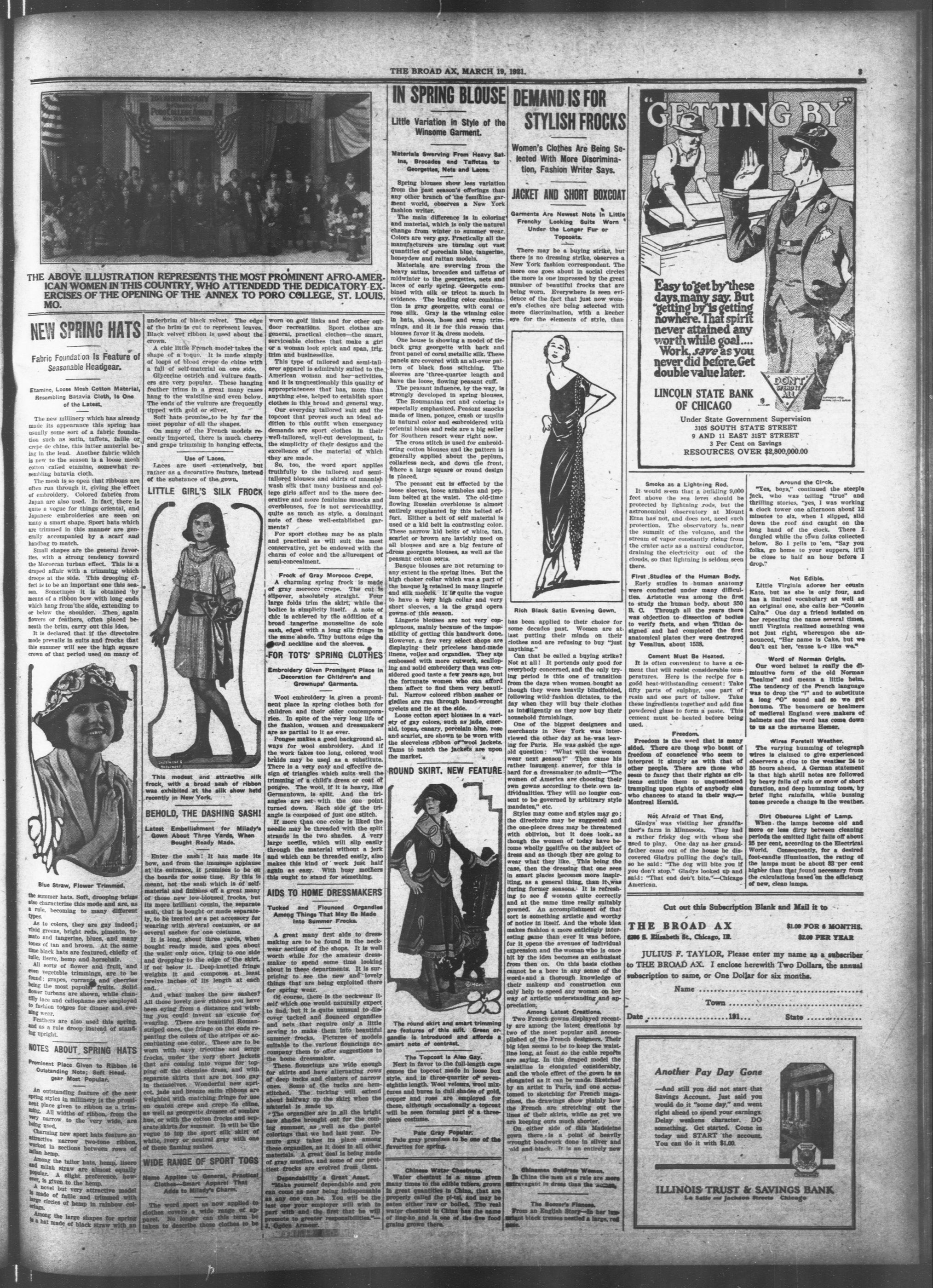
THE ABOVE ILLUSTRATION REPRESENTS THE MOST PROMINENT AFRO-AMERICAN WOMEN IN THIS COUNTRY, WHO ATTENDEDD THE DEDICATORY EXERCISES OF THE OPENING OF THE ANNEX TO PORO COLLEGE, ST. LOUIS, MO.
Fabric Foundation Is Feature of Seasonable Headgear.
Etamine, Loose Mesh Cotton Material, Resembling Batavia Cloth, Is One of the Latest.
The new millinery which has already made its appearance this spring has usually some sort of a fabric foundation such as satin, taffeta, faille or crepe de chine, this latter material being in the lead. Another fabric which is new to the season is a loose mesh cotton called etamine, somewhat resembling batavia cloth.
The mesh is so open that ribbons are often run through it, giving the effect of embroidery. Colored fabrics from Japan are also used. In fact, there is quite a vogue for things oriental, and Japanese embroideries are seen on many a smart shape. Sport hats which are trimmed in this manner are generally accompanied by a scarf and handbag to match.
Small shapes are the general favorites, with a strong tendency toward the Moroccan turban effect. This is a draped affair with a trimming which droops at the side. This drooping effect is to be an important one this season. Sometimes it is obtained by means of a ribbon bow with long ends which hang from the side, extending to or below the shoulder. Then again flowers or feathers, often placed beneath the arm, carry out this idea.
It is declared that if the directorel mode prevails in suits and frocks that this summer will see the high square crown of that period used on many of
A.
Blue Straw, Flower Trimmed,
the summer hats, Soft, drooping brings
also characterize this mode and are, as a rule, becoming to many different types.
As to colors, they are gay indeed;
vivid greens, bright reds, plimento, tomato and tangerine, blues, and many tones of tan and brown. At the same time black hats are featured, chiefly of tulle, lisse, hemp and horsehair.
All sorts of flower and fruit, and even vegetable trimmings, are to be found; grapes, currants and cherries being the most popular fruits. Solid flower turbans are shown, while chun- tily lace and cellophane are employed to fashion tophanes for dinner and evening wear.
Feathers are also used this spring, and as a rule droop instead of standing upright.
Prominent Place Given to Ribbon Is
Outstanding Note: Soft Head.
gear Most Popular.
An outstanding feature of the new
styling styles in millinery is the promi-
nent place given to ribbon as a trim-
ming. All widths of ribbon, from the
very narrow to the very wide, are
being used.
Charming new sport hats feature an
attractive narrow two-tone ribbon
worked in sections between rows of
milan hemp.
Among the tailor hats, hemp, lisere
and milan straw are almost equally
popular. A slight preference, however,
is given to the hemp.
A novel but very attractive model
is made of faille and trimmed with
large circles of hemp in rainbow col-
orings.
Among the large shapes for spring
is a hat made of black straw with an
underbrim of black velvet. The edge of the brim is cut to represent leaves. Black velvet ribbon is used about the crown.
A chic little French model takes the shape of a toque. It is made simply of loops of blood crepe de chine with a fall of self-material on one side. Glycerine ostrich and vulture feathers are very popular. These hanging feather trims in a great many cases hang to the waistline and even below. The ends of the vulture are frequently tipped with gold or silver.
Soft hats promise to be by far the most popular of all the shapes.
On many of the French models recently imported, there is much cherry and grape trimming in hanging effects.
Use of Laces.
Laces are used extensively, but rather as a decorative feature, instead of the substance of the gown. LITTLE GIRL'S SILK FROCK
UNDERWEAR &
UNDERWEAR
This modest and attractive silk frock, with a broad sash of ribbon was exhibited at the silk show held recently in New York.
BEHOLD, THE DASHING SASH!
Latest Embellishment for Milady's Gown About Three Yards, When Bought Ready Made.
Enter the sash! It has made its bow, and from the immense applause at its entrance, it promises to be on the boards for some time. By this is meant, not the sash which is of self-material and finishes off a great many of those new low-bloured frocks, but its more brilliant cousin, the separate sash, that is bought or made separately, to be treated as a pet accessory for wearing with several costumes, or as several sashes for one costume.
It is long, about three yards, when bought ready made, and goes about the waist only once, tying to one side and dropping to the edge of the skirt, if not below it. Deep-knotted fringe weights it and composes at least twelve inches of its length at each end.
And what makes the new sashes? All those lovely new ribbons you have been eying from a distance and wishing you could invent an excuse for wearing. There are beautiful Roman-striped ones, the fringe on the ends repeating the colors of the stripes or accentuating one color. These are to be worn with navy tricotine and serge frocks, under the very short jackets that are coming into vogue for topping off the chemise dress, and with separate skirts that are not too gay in themselves. Wonderful new apricot, jade and bronze satin ribbons are weighted with matching fringe for use on canton crepe and crepe de chine, as well as georgette dresses of sombre hue, or with the cotton frocks and separate skirts for summer. It will be the vogue to top the sport silk skirt of white, ivory or neutral gray with one of these fanning sashes.
The word sport as now applied to clothes covers a wide range of apparel. No longer can this term be taken to describe these clothes to be
worn on golf links and for other outdoor recreations. Sport clothes are general, practical clothes—the smart, serviceable clothes that make a girl or a woman look spick and span, trig. trim and businesslike.
This type of tailored and semi-tailor apparel is admirably suited to the American woman and her activities, and it is questionably this quality of appropriateness that has, more than anything else, helped to establish sport clothes in this broad and general way.
Our everyday tailored suit and the topcoat that proves such an ideal addition to this outfit when emergency demands are sport clothes in their well-tailored, well-cut development, in the simplicity of their designs and the excellence of the material of which they are made.
So, too, the word sport applies truthfully to the tailored and semi-tailored blouses and shirts of mannish wash silk that many business and college girls affect and to the more decorative and more feminine smocks and overblouses, for is not serviceability, quite as much as style, a dominant note of these well-established garments?
For sport clothes may be as plain and practical as will suit the most conservative, yet be endowed with the charm of color and the allurement of semi-concealment.
Frock of Gray Morocco Crepe.
A charming spring frock is made of gray morocco crepe. The cut is slipover, absolutely straight. Four large folds trim the skirt, while the bodice is simplicity itself. A note of chic is achieved by the addition of a broad tangerine moussele de sole sash, edged with a long silk fringe in the same shade. Thy buttons edge the cord neckline and the sleeves.
-FOR TOTS' SPRING CLOTHES
Embroidery Given Prominent Place in .Decoration for Children's and Grownups' Garmenta.
Wool embroidery is given a prominent place in spring clothes both for children and their older contemporaries. In spite of the very long life of the fashion, women and dressmakers are as partial to it as ever.
Pongee makes a good background always for wool embroidery. And if the work takes too long, colored wool braids may be used as a substitute. There is a very easy and effective design of triangles which suits well the trimming of a child's dress or coat of poodle. The wool, if it is heavy, like Germentown, is split. And the triangles are set with the one point turned down. Each side of the triangle is composed of just one snitch.
If more than one color is liked the needle may be threaded with the split strands in the two shades. A very large needle, which will slip easily through the material without a jerk and which can be threaded easily, also makes this kind of work just half again as easy. With busy mothers this ought to stand for something.
AIDS TO HOME DRESSMAKERS
Tucked and Flounced Organdies Among Things That May Be Made Into Summer Frocks.
A great many first aids to dressmaking are to be found in the neckwear sections of the shops. It is well worth while for the amateur dressmaker to spend some time looking about in these departments. It is surprising to see the new and lovely things that are being exploited there for spring wear.
Of course, there is the neckwear itself which one would naturally expect to find, but it is quite unusual to discover tucked and flounced organdies and nets that require only a little sewing to make them into beautiful summer frocks. Pictures of models suitable to the various flouncing accompanies them to offer suggestions to the home dressmaker.
These fondlings are wide enough for skirts and have alternating rows of deep tucks and clusters of narrow ones. Some of the tucks are hemstitched. The tucking will extend about halfway up the skirt when the material is made up.
* The organdles are in all the bright new shades brought out for the coming summer, as well as the parcel colorings that we had last year. Demure gray takes its place among these organdles, as it does in all other materials. A great deal is being made of gray muslins, and some of our prettiest frocks are evolved from them.
Dependability a Great Asset
"Make yourself dependable and you can come as near being indispensable as any one can be. You will be the last one your employer will wish to part with and the first that he will promote to greater responsibilities."—J. Ogden Armour.
THE BROAD AX. MARCH 19. 1821.
IN SPRING BLOUSE
Materials Swerving From Heavy Satins, Brocades and Taffetas to Georgettes, Nets and Laces.
Spring blouses show less variation from the past season's offerings than any other branch of the feminine garment world, observes a New York fashion writer.
The main difference is in coloring and material, which is only the natural change from winter to summer wear. Colors are very gay. Practically all the manufacturers are turning out vast quantities of porcelain blue, tangerine, honeydew and rattan types.
Materials are swerving from the heavy satins, brocades and taffetas of midwinter to the georgettes, nets and laces of early spring. Georgette combined with silk or tricot is much in evidence. The leading color combination is gray georgette, with coral or rose silk. Gray is the winning color in hats, shoes, hose and wrap trimmings, and it is for this reason that blouses favor it in dress models.
One house is showing a model of tieback gray georgette with back and front panel of coral metallic silk. These panels are covered with an all-over pattern of black floss stitching. The sleeves are three-quarter length and have the loose, flowing peasant cuff.
The peasant influence, by the way, is strongly developed in spring blouses.
strongly developed in spring blouses. The Roumanian cut and coloring is especially emphasized. Peasant smocks made of linen, pongee, crash or muslin in natural color and embroidered with oriental blues and reds are a big seller for Southern resort wear right now.
The cross stitch is used for embroidering cotton blouses and the pattern is generally applied about the peplum, collarless neck, and down the front, where a large square or round design is placed.
The peasant cut is effected by the loose sleeves, loose armholes and peplum belted at the waist. The old-time flowing Russian overblouse is almost entirely supplanted by this belted effect. Either a belt of a material is used or a kid belt in contrasting color. These narrow kid bells of white, tan, scarlet or brown are lavishly used on all blouses and are a big feature of dress georgette blouses, as well as the peasant cotton sorts.
Basque blouses are not returning to any extent in the spring lines. But the high choker collar which was a part of the basque is retained in many lingerie and silk models. It is quite the vogue to have a very high collar and very short sleeves, a la the grand opera gowns of this season.
Lingerie blouses are not very conspicuous, mainly because of the impossibility of getting this handwork done. However, a few very select shops are displaying their priceless hand-made linens, voles and organdies. They are embossed with more cutwork, scalloping and solid embroidery than was considered good taste a few years ago, but the fortunate women who can afford them affect to find them very beautiful. Narrow colored ribbon sashes or girdles are run through hand-wrought evelets and tie at the side.
Loose cotton sport blouses in a variety of gay colors, such as jade, emerald, toop, canary, porcelain blue, rose and scarlet, are shown to be worn with the sleeveless ribbon of wool jackets. Tams to match the jackets are upon the market.
ROUND SKIRT, NEW FEATURE
Henri
The round skirt and smart trimming are features of this suit. Green organdie is introduced and affords a smart note of contrast.
The Topcoat is Also Gay.
Next in favor to the full-length cape comes the topcoat made in loose box style, and in three-quarter of seven-eighths length. Wool velours, wool mixtures and burs in dull shades of gold, copper and rose are employed for these, although occasionally a topcoat will be seen forming part of a three-piece costume.
Pale Gray Popular.
Pale gray promises to be one of the favorites for spring.
Chinese Water Chestnuts.
Water chestnut is a name given many times to the edible tubers, grown in great quantities in China, that are properly called the pi-tal, and may be eaten either raw or boiled. The real water chestnut in China has the name of ling-ko and is one of the five food grains grown there.
DEMAND IS FOR STYLISH FROCKS
Women's Clothes Are Being Selected With More Discrimination, Fashion Writer Says.
There may be a buying strike, but there is no dressing strike, observes a New York fashion correspondent. The more one goes about in social circles the more is one impressed by the great number of beautiful frocks that are being worn. Everywhere is seen evidence of the fact that just now women's clothes are being selected with more discrimination, with a keeher eye for the elements of style, than
A
Rich Black Satin Evening Gown. has been applied to their choice for some decades past. Women are at last putting their minds on their clothes and are refusing to buy "just anything."
Can that be called a buying strike? Not at all! It portends only good for everybody concerned, and the only trying period is this one of transition from the days when women bought as though they were heavily blindfolded, following wild fashion dictates, to the day when they will buy their clothes as intelligently as they now buy their household furnishings.
One of the biggest designers and merchants in New York was interviewed the other day as he was leaving for Paris. He was asked the age-old question: "What will the women wear next season?" Then came his rather insulting answer, for this is hard for a dressmaker to admit—The women of America are choosing their own gowns according to their own individualities. They will no longer consent to be governed by arbitrary style mandates." etc.
Styles may come and styles may go; the directoire may be suggested and the one-piece dress may be threatened with oblivion, but it does look as though the women of today have become wholly positive on the subject of dress and as though they are going to wear what they like. This being the case, then the dressing that one sees in smart places becomes more inspiriting, as a general thing, than it was during former seasons. It is refreshing to see a woman quite correctly and at the same time really suitably gowned. An accomplishment of that sort is something artistic and worthy of notice in itself. And the whole idea makes fashion a more enticing interesting game than ever it was before, for it opens the avenues of individual expression and the woman who is once hit by the idea becomes an enthusiast from then on. On this basis clothes cannot be a bore in any sense of the words and a thorough knowledge of their makeup and construction can only help to speed any woman on her way of artistic understanding and appreciation.
Among Latest Creations.
Two French gowns displayed recently are among the latest creations by two of the most popular and accomplished of the French designers. Their big idea seems to be to keep the waistline long, at least so the cable reports are saying. In this draped model the waistline is elongated considerably, and the whole effect of the gown is as elongated as it can be made. Sketched by an artist in Paris, and one accounted to sketching for French magazines, the drawings show plainly how the French are stretching out the lines of their skirts, while as yet we are keeping ours much shorter.
On either side of this Madeleine gown there is a point of heavily wrought beadwork done in silver and gold and black. It is an entirely new
"GETTING BY"
Easy to 'get by' these days, many say. But "getting by' is getting nowhere. That spirit never attained any worth while goal.... Work, save as you never did before. Get double value later.
LINCOLN STATE BANK OF CHICAGO
Under State Government Supervision
3105 SOUTH STATE STREET
9 AND 11 EAST 31ST STREET
3 Per Cent on Savings
RESOURCES OVER $2,800,000.00
JULIUS F. TAYLOR. Please enter my name as a subscriber to THE BROAD AX. I enclose herewith Two Dollars, the annual subscription to same, or One Dollar for six months.
Smoke as a Lightning Rod.
It would seem that a building 9,000 feet above the sea lever should be protected by lightning rods, but the astronomical observatory at Mount Etna has not, and does not, need such protection. The observatory is, near the summit of the volcano, and the stream of vapor constantly rising from the crater acts as a natural conductor, draining the electricity out of the clouds, so that lightning is seldom seen there.
First, Studies of the Human Body.
Early studies in human anatomy were conducted under many difficulties. Aristotle was among the first to study the human body, about 350 B. C. Through all the years there was objection to dissection of bodies to verify facts, and when Titian designed and had completed the first anatomical plates they were destroyed by Vesalius, about 1538.
Cement Must Be Heated.
Cement must be heated.
It is often convenient to have a cement that will resist considerable temperatures. Here is the recipe for a good heat-withstanding cement: Take fifty parts of sulphur, one part of resin and one part of tallow. Take these ingredients together and add fine powdered glass to form a paste. This cement must be heated before being used.
Freedom
Freedom is the word that is many sided. There are those who boast of freedom of conscience who seem to interpret it simply as with that of other people. There are those who seem to fancy that their rights as citizens entitle them to unquestioned trampling upon rights of anybody else who chances to stand in their way.—Montreal Herald.
Not Afraid of That End.
Gladys' was visiting her grandfather's farm in Minnesota. They had a rather frisky dog with whom she used to play. One day as her grandfather came out of the house he discovered Gladys pulling the dog's tail, so he said: "The dog will bite you if you don't stop." Gladys looked up and said: "That end don't bite."—Chicago American.
THE BROAD AX
6206 S. Elizabeth St., Chicago, Ill.
JULIUS F. TAYLOR, Please ent
to THE BROAD AX. I enclose herew
subscription to same, or One Dollar for
Name ...
Town ...
Date .....191...
Another Pay Day Gone
And still you did not start that Savings Account. Just said you would do it "some day," and went right ahead to spend your earnings. Delay weakens character. Do something. Get started. Come in today and START the account. You can do it with $1.00.
ILLINOIS TRUST & S
La Salle and Jackson St
"Yes, boys," continued the stepple jack, who was telling "true" and thrilling stories, "yes, I was working a clock tower one afternoon about 12 minutes to six, when I slipped, slid down the roof and caught on the long hand of the clock. There I dangled while the down folks collected below. So I yells to 'em, "Say you folks, go home to your supers, you'll be close to half an hour before I drop."
Not Edible.
Little Virginia adores her cousin Kate, but as she is only four, and has a limited vocabulary as well as an original one, she calls her "Cousin Cake." One day a friend insisted on her repeating the name several times, until Virginia realized something was not just right, whereupon she announced, "Her name is Cake, but we don't eat her, 'cause b--like we."
Word of Norman Origin.
Our word helmet is really the diminutive form of the old Norman "healme" and means a little helm. The tendency of the French language was to drop the "i" and to substitute a long "O" sound and so we got heaume. The beaumers or healmers of medieval England were makers of helmets and the word has come down to us as the surname Homer.
Wirea Forstell Weather.
The varying humming of telegraph wires is claimed to give experienced observers a clue to the weather 24 to 35 hours ahead. A German statement is that high shrill notes are followed by heavy falls of rain or snow of short duration, and deep humming tones, by brief light rainfalls, while buzzing tones precede a change in the weather.
Dirt Obstructions Light of Lamp
Dirt Obscures Light or Lamp. When the lamps become old and more or less dirty between cleaning periods the emitted light falls off about 35 per cent, according to the Electrical World. Consequently, for a desired foot-candle illumination, the rating of the lamps must be about 33 per cent higher than that found necessary from the calculations based on the efficiency of new, clean lamps.
$1.00 FOR 6 MONTHS.
$2.00 PER YEAR
FROM THIS DATE ONWARD
THE BROAD AX CAN ALWAYS
BE POUND ON SALE AT THE
POLLOWING NEWS STANDS:
Edward Felix, Notions, Cigars and
News Stand, 3002 S. Dearborn street.
George W. Boyd, News Stand,
Laundry Office and Shoe Shining
Parlora, 3620 S. State street.
Mrs. L Myers, Notion Store,
Laundry Office and News Stand, 5012
S. State street.
Thomas Bell, News Stand, Ice
Cream Parlora and Laundry Office,
17 W. 53rd street, near State.
Mrs. Moses Ratcliff, President of
the Willing Workers' Club, of St.
Catherine A. M. E. Zion Church, 3739
Mimwood avenue.
HOWARD UNI
WASHINGTON
J. STANLEY DURKEE, A. M.
EMMETT J. SCOTT, A.M., LL.
Collegiate and Professors
Junior College, covering the Freshman leading to the Senior Colleges.
Senior College, consisting of the School, Journalism, and Commerce and Fine degrees. A. B. or B. S.; A. B. or B. S.nalism; B. S. in Commerce.
School of Applied Science, four year course, C. E.; B. S. in E. E. B. S. in M. E. in Agriculture, and B. S. in Household.
School of Music, four year course, giving
School of Religion, three year course, giving ploma and Correspondence Course.
School of Law, three year evening course.
School of Medicine, including Medical, leges. Four year course for Medical years for Pharmaceutical students.
M. D., D. D. S., Phar. C.
Students may enter for Collegiate Week quarter.
REGISTRATION:
Autumn Quarter.....Spring
Winter Quarter.....Spring
Spring Quarter.....1
For Catalog and Information write
DWIGHT O. W. HOLM
Howard University,
Wm. Jo
Established 1851
DEALER II
Groceries and
HOME MADE SAUSAGE
VEGETABLES AND FRUIT
We are as near you as your telephone prompt attention.
Phone Boulevard
3636 South State Street
"Admired By
Envied By"
J. STANLEY DURKEE, A. M., Ph. D., President EMMETT J. SCOTT, A. M., LL.D., Secretary-Treasurer
Junior College, covering the Freshman and Sophomore years, and leading to the Senior Colleges.
Senior College, consisting of the Schools of Liberal Arts, Education, Journalism, and Commerce and Finance, granting respectively the degrees. A. B. or B. S.; A. B. or B. S. in Education; B. S. in Journalism; B. S. in Commerce.
School of Applied Science, four year course, giving degree, B. S. in C. E.; B. S. in E. E. B. S. in M. E. B. S. in Architecture; B. S. in Agriculture, and B. S. in Household Economics.
School of Medicine, including Medical, Dental, Pharmaceutical Colleges. Four year course for Medical and Dental Students; three years for Pharmaceutical students. Following degrees given: M. D., D. D. S., Phar. C.
Students may enter for Collegiate Work at the beginning of any quarter.
REGISTRATION:
Autumn Quarter.....September 27 to 29, 1929
Winter Quarter.....January 8, 1921
Spring Quarter.....March 10 and 21, 1921
For Catalog and Information write
DWIGHT O. W. HO_MES, Registrar
Howard University,
Washington, D. C.
Groceries and Meats
HOME MADE SAUSAGE A SPECIALTY
VEGETABLES AND FRUITS IN SEASON
We are as near you as your telephone, and all calls receive prompt attention.
Phone Boulevard 1812
A.
OTHER FAMOUS
EXELENTO SKIN
BRAUTIFIER
Good for all skin conditions. Acts immediately and almost instantaneously
on dark and yellow skin, whitening
and removing all pigment and blemis.
Price 45s.
R. T. Kirby, Shoe Shining, Hat Cleaning Parlor and News Stand, 20
E. 35th street, near L Station.
F. Bishop, Cigara, Tobacco and
News Stand, 8 W. 27th street, near
State.
A. D. Hayea, Cigara, Tobacco, Notion,
Stationery and News Stand,
3640 S. State street.
Dodson's Shoe Shining Parlora and
News Stand, Southwest corner 35th
and State streets.
News items left with any of the above news agents prior to Wednesday mornings of each week, will find their way into the columns of The Broad Ax.
Long, straight, silky hair can be yours if you want it. We have letters from thousands of satisfied users of EXELENTO QUININE POMADE. You, too, can have beautiful, luxuriant hair that will make you "admired by every man and envied by every woman."
EXELENTO will do for you what it has done for others. It is a truly marvelous preparation that removes dandruff, keeps the scalp clean and sweet, softens the hair, and makes it long, straight and beautiful.
PHONE MAIN 324
A. D. GASH
ATTORNEY AT LAW
118 N. La Salle Street
CHICAGO
Residence
*3342 Calumet Ave.
Telephone
Douglas 1275
JAMES G. COTTER
ATTORNEY AT LAW
145 NORTH CLARK STREET
SUITE 407
Telephone Central 8354
CHICAGO
Formerly
Assistant Attorney General
State of Illinois
Rea. 3646 Grand Boul.
Doug. 4397
J. GRAY LUCAS
ATTORNEY-AT-LAW
129 E-31ST STREET
Suite 16-17
Phone: Douglas 6361
CHICAGO
F. Dunn, J. B. McCahey,
Trustees
Tel: Oakland 1552, 1551, 1550
JOHN J. DUNN
Established 1877
WHOLESALE AND RETAIL
COAL
Fifty-First and Federal Streets
CHICAGO
Fine Country Unappreciated.
The most singular plateau in the world is in the island of Papua. The plateau is elevated 0,000 feet above the sea, and there are summits towering 5,000 feet higher, but the close proximity of the equator has covered the great plain with luxurant vegetation. The climate is a perpetual May, birds sing in every bush and the only animals are a few marsupials, such as ground kangaroos and opossums. Yet this lovely region is literally deserted. The million Papuans live in the sweltering coast jungles and only occasionally stray to the uplands.
Arabs Long on Handshaking.
When friendly Arabs meet their salutation is almost grotesque, for they shake hands seven or eight times, and sometimes repeatedly kiss each other.
Life Calls for One's Best.
To make a success of life you must be always at it with your eye on the job. Diversion will stimulate far more intensive effort, but the effort itself must have no diverting influence. "This one thing I do," says the apostle, and in doing it he wins. Keep your eye on the ball and put your best into the game.
Beware of Apologizing.
Apologizing—a very desperate habit—one is rarely cured. Apologizing is only egotism wrong side out. Nine times out of ten, the first thing a man's companion knows of his short-comings is from his apology—Olivus Wendell Holmes.
Man and Woman"..... hair can be yours if you ers from thousands of satis- NTO QUININE POMADE. beautiful, luxuriant hair that d by every man and envied
THE BROAD AX, MARCH 19, 1921.
West En
Ashland S
CAPITAL AND SU
1610 West 63rd Street
West Englewood
Hland State Bank
CAPITAL AND SURPLUS $300,000.00
63rd Street
Comparative Statement of Deposits
November 18, 1912, $836,605.23
November 17, 1914, $912,005.69
November 17, 1916, $1,132,750.72
November 18, 1918, $1,284,084.24
November 17, 1919, $2,359,636.62
November 15, 1920, $3,224,633.09
OFFICERS
JOHN BAIN. President
MICHAEL MAISEL, Vice President
EDW. C. BARRY, Cashier
W. MERLE FISHER, Assistant
ARTHUR C. UTESCH, As
OFFICERS
W. President
AEL MAISEL, Vice President
DW. C. BARRY, Cashier
W. MERLE FISHER, Assistant
ARTHUR C. UTESCH, Ar
JOHN BAIN. President
MICHAEL MAISEL, Vice President
EDW. C. BARRY, Cashier
W. MERLE FISHER, Assistant Cashier
ARTHUR C. UTESCH, Asst. Cashier.
Squeaking Shoes a Good Omen.
Theatrical people have many superstitions and they cling to the profession closely, one being if an actor's shoes squeak, ever so little, as he makes the first entrance, he is assured of a welcome from the audience.
TELEPHONE D
GEORGE F. HA
REAL EST
Up-to-Date or Modern
and Stores
3101 COTTAGE
Corner 31st St
TELEPHONE DOUGLAS 1
AGE F. HARDING
REAL ESTATE
ate or Modern Houses, Apart
and Stores to Rent
COTTAGE GROVE
Corner 31st Street, Chicago
Up-to-Date or Modern Houses, Apartments and Stores to Rent
Office Phone: Douglas 6285
KERSEY, McGOWAN
CHICAGO'S REPRESENT
UNDER TA
Finest Establishment
GEO. T. KERSEY D. A. McGO
Preprieto
3515 INDIANA AVENUE
KEY, McGOWAN AND MORSE
CHICAGO'S REPRESENTATIVE
UNDERTAKERS
finest Establishment in the U. S.
KEY D. A. McGOWAN WM. J. N.
Preprietors
NA AVENUE CHICAGO
GEO. T. KERSEY D. A. McGOWAN WM. J. MORSELL Preprieters
Notary Public
Phones: Office Main 4135; Residence,
4531 Champlain Avenue.
Phone: Kewood 5611
ATTORNEY AND COUNSELOR AT LAW
Suite 708.—184 W. Washington St.
CHICAGO
Acidence 8885-Prairie Ave.
Phone Douglas 9128
Phones: Main 3017 Auto 82-896
A. L. WILLIAMS
ATTORNEY AND
COUNSELOR AT LAW
Suite 708 Fireside Building
84 W. Washington Street
CHICAGO
Telephone Oakland 344
E. K. CALDWELL
Represent to
C. E. KREYSSLER
DRUGGIST
5087 South State Street Near Blvd St.
Not On The Corner CHICAGO
Residence, 1263 Macallister Place
Tol. monroe 2114
MILES J. DEVINE
ATTORNEY AT LAW
SUITE 818-320 SHAPER BK.
Clark and Washington Streets
Phone Central 1809
CHICAGO
Phones Douglas 6302 and Douglas 653
Nights call Douglas 7078
Mission Esther Place
since 2014
DEVINE
AT LAW
SHAPER BLL.
Longton Streets
final 1899
600
and Douglas 653
Douglas 7078
ODSEV
NICERS
Office President
Cashier, Cashier
FISHER, Assistant Cashier
R C. UTESCH, Asst. Cashier.
The Magic Square.
The origin of the magic square is usually ascribed to the Chinese as the Yih King, an early classic, describes it. The magic square was known to the Hindoes and to the Arabian astrologers.
DOUGLAS 1
HARDING, JR.
RESTATE
Corn Houses, Apartments
to Rent
E GROVE AVE.
Street, Chicago
N AND MORSELL
PRESENTATIVE
TAKERS
sent in the U. S.
FUNERAL DIRECTORS
UNDERTAKER
TRIAGE AT ALL HOURS
ALL NIGHTS AND DAYS
5121 ERNEST H. WILLIAMSON UNDERTAKER
GARAGE
GASOLINE HI.
OPEN DAY & NIGHT
Ernest H. Williamson UNDERTAKER
Day Light Chapel, capacity 200, Outside Ventilation—Organ and Organist Free—
I am as near as your Telephone—I give service at a reasonable price—Distance
immaterial, consult me—I save you wot y, time and money.
5121 & 5123 SOUTH STATE STREET CHICAGO, ILLINOIS
James A. Easton DEALER IN WALL PAPER Decorator House Painter
3504 SOUTH STATE STREET CHICAGO, ILL.
Highest New York Mountain. According to the United States geological survey the highest mountain in the state of New York is Mount Marcy, a peak in the Adirondacks, which rises 5,844 feet above sea level. The average or main elevation of the state, as estimated by the geological survey, is 900 feet.
THE BROADWAY
Mission
d hall
OLT, Propr.
Coloring Arc-Lamp Globea.
The purple color of arc-lamp globes is due to the use of manganese in the glass. The manganese is used to contract the greenish color which comes from ferrous salts in the glass, but the action of light on the manganese only substitutes a purple coloration for a greenish hue.
CHICAGO