The Broad Ax
Saturday, April 9, 1921
Chicago, Illinois
Page text (machine-generated)
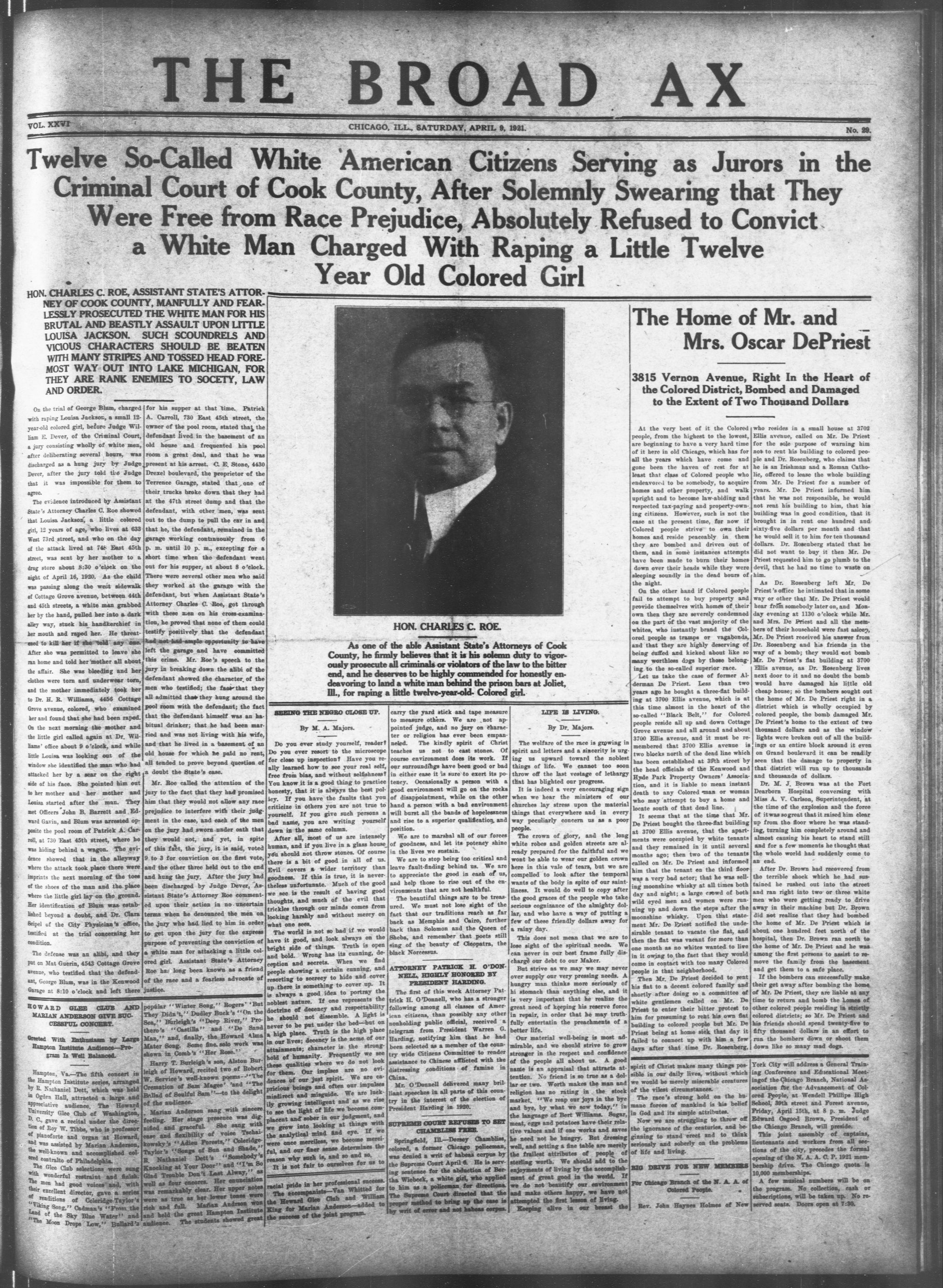
Twelve So-Called White American Citizens Serving as Jurors in the Criminal Court of Cook County, After Solemnly Swearing that They Were Free from Race Prejudice, Absolutely Refused to Convict a White Man Charged With Raping a Little Twelve Year Old Colored Girl
HON. CHARLES C. ROE, ASSISTANT STATE'S ATTORNEY OF COOK COUNTY, MANFULLY AND FEARLESSLY PROSECUTED THE WHITE MAN FOR HIS BRUTAL AND BEASTLY ASSAULT UPON LITTLE LOUISA JACKSON. SUCH SCOUNDRELS AND VICIOUS CHARACTERS SHOULD BE BEATEN WITH MANY STRIPES AND TOSSED HEAD FOREMOST WAY OUT INTO LAKE MICHIGAN, FOR THEY ARE RANK ENEMIES TO SOCETY, LAW AND ORDER.
On the trial of George Blum, charged with raping Louisa Jackson, a small 12-year-old colored girl, before Judge William E. Dever, of the Criminal Court, a jury consisting wholly of white men, after deliberating several hours, was discharged as a hung jury by Judge Dever, after the jury told the Judge that it was impossible for them to agree.
for his supper at that time. Patrick A. Carroll, 730 East 45th street, the owner of the pool room, stated that the defendant lived in the basement of an old house and frequented his pool after deliberating several hours, was discharged as a hung jury by Judge Dever, after the jury told the Judge that it was impossible for them to agree. G. E. Stone, 4430 Drexel boulevard, the proprietor of the Terrence Garage, stated that one of their trucks broke down that they had
The evidence introduced by Assistant State's Attorney Charles G. Roe showed that Louisa Jackson, a little colored girl, 12 years of age, who lives at 633 West 73rd street, and who on the day of the attack lived at 748 East 45th street, was sent by her mother to a drug store about 8:30 o'clock on the night of April 16, 1920. As the child was passing along the west sidewalk of Cottage Grove avenue, between 44th and 45th streets, a white man grabbed her by the hand, pulled her into a dark alley way, stuck his handkerchief in her mouth and raped her. He threatened to kill her if she told any one. After she was permitted to leave she ran home and told her mother all about the affair. She was bleeding and her clothes were torn and underwear torn, and the mother immediately took her to Dr. H. R. Williams, 4456 Cottage Grove avenue, colored, who examined her and found that she had been raped. On the next morning the mother and the little girl called again at Dr. Williams' office about 9 o'clock, and while little Louisa was looking out of the window she identified the man who had attacked her by a scar on the right side of his face. She pointed him out to her mother and her mother and Louisa started after the man. They met Officers John B. Barrett and Edward Gavin, and Blum was arrested opposite the pool room of Patrick A. Carroll, at 730 East 45th street, where he was hiding behind a wagon. The evidence showed that in the alleyway where the attack took place there were imprints the next morning of the toes of the shoes of the man and the place where the little girl lay on the ground. Her identification of Blum was established beyond a doubt, and Dr. Clara Seipel of the City Physician's office, testified at the trial concerning her condition.
The defense was an alibi, and they put on Mat Guerin, 4543 Cottage Grove avenue, who testified that the defendant, George Blum, was in the Kenwood Garage at 8:10 o'clock and left there
HOWARD GLEE CLJE AND MARIAN ANDERSON GIVE SUCCESSFUL CONCERT.
Greeted With Enthusiasm by Large Hampton Institute Audience—Program Is Well Balanced.
Hampton, Va—The fifth concert in the Hampton Institute series, arranged by R. Nathaniel Dett, which was held in Ogden Hall, attracted a large and appreciative audience. The Howard University Glee Club of Washington, D. C., gave a recital under the direction of Roy W. Tibbs, who is professor of pianoforte and organ at Howard, and was assisted by Marian Anderson, the well-known and accomplished colored contralto of Philadelphia.
The Glee Club selections were sung with wonderful restraint and finish. The man had good voices and, with their excellent director, gave a series of renditions of Colderidge-Taylor's "Viking Song," Cadman's "From the Land of the Sky Blue Water" and "The Moon Drops Low." Bulldog:
THE BROAD AX
for his supper at that time. Patrick A. Carroll, 730 East 45th street, the owner of the pool room, stated that the defendant lived in the basement of an old house and frequented his pool room a great deal, and that he was present at his arrest. C. E. Stone, 4430 Drexel boulevard, the proprietor of the Terrence Garage, stated that, one of their trucks broke down that they had at the 47th street dump and that the defendant, with other men, was sent out to the dump to pull the car in and that he, the defendant, remained in the garage working continuously from 6 p. m. until 10 p. m., excepting for a short time when the defendant went out for his supper, at about 8 o'clock. There were several other men who said they worked at the garage with the defendant, but when Assistant State's Attorney Charles C. Roe, got through with these men on his cross-examination, he proved that none of them could testify positively that the defendant had not had ample opportunity to have left the garage and have committed this crime. Mr. Roe's speech to the jury in breaking down the alibi of the defendant showed the character of the men who testified; the fact that they all admitted that they hung around the pool room with the defendant; the fact that the defendant himself was an habitual drinker; that he had been married and was not living with his wife, and that he lived in a basement of an old house for which he paid no rent, all tended to prove beyond question of a doubt the State's case.
Mr. Roe called the attention of the jury to the fact that they had promised him that they would not allow any race prejudice to interfere with their judgment in the case, and each of the men on the jury had sworn under oath that they would not, and yet, in spite of this fact, the jury, it is said, voted 9 to 3 for conviction on the first vote and the other three held out to the end and hung the jury. After the jury had been discharged by Judge Dever, Assistant State's Attorney Roe commented upon their action in no uncertain terms when he denounced the men on the jury who had lied to him in order to get upon the jury for the express purpose of preventing the conviction of a white man for attacking a little colored girl. Assistant State's Attorney Roe has long been known as a friend of the race and a fearless advocate of justice.
popular “Winter Song,” Rogers “But They Didn’t,” Dudley Buck’s “On the Sea,” Burleigh’s “Deep River,” Prothero’s “Castilla,” and “Do Sand Man,” and, finally, the Howard Alma Mater Song. Some fine solo work was shown in Comb’s “Her Rose.”
Harry T. Burleigh’s son, Alston Burleigh of Howard, recited two of Robert W. Service’s well-known poems—“The Cremation of Sam Magee” and “The Ballad of Soulful Sam”—to the delight of the audience.
Marian Anderson sang with sincere feeling. Her stage presence was dignified and graceful. She sang with ease and flexibility of voice Tschaikowsky’s “Adien Forests,” Coleridge-Taylor’s “Songs of Sun and Shade,” R. Nathaniel Dett’s “Somebody Knocking at Your Door” and “I’m So Glad Trouble Don’t Last Alway,” as well as four encores. Her enunciation was remarkably clear. Her upper notes were as true as her lower tones were rich and full. Marian Anderson won and hold the great Hampton Institute audience. The students showed great
[Name]
As one of the able Assistant State's Attorneys of Cook County, he firmly believes that it is his solemn duty to vigorously prosecute all criminals or violators of the law to the bitter end, and he deserves to be highly commended for honestly endeavoring to land a white man behind the prison bars at Joliet, Ill., for raping a little twelve-year-old- Colored girl.
Do you ever study yourself, reader? Do you ever resort to the microscope for close inspection? Have you really learned how to see your real self, free from bias, and without selfishness? You know it is a good thing to practice honesty, that it is always the best policy. If you have the faults that you criticize in others you are not true to yourself. If you give such persons a bad name, you are writing yourself down in the same column.
After all, most of us are intensely human, and if you live in a glass house you should not throw stones. Of course there is a bit of good in all of us. Evil covers a wider territory than goodness. If this is true, it is nevertheless unfortunate. Much of the good we see is the result of having good thoughts, and much of the evil that trickles through our minds comes from looking harshly and without mercy on what we see.
The world is not so bad if we would have it good, and look always on the bright side of things. Truth is open and bold. Wrong has its cunning, deception and secrets. When we find people showing a certain cunning, and resorting to secrecy to hide and cover up there is something to cover up. It is always a good idea to portray the noblest nature. If one represents the doctrine of decency and respectability he should not dissemble. A light is never to be put under the bed—but on a high place. Truth is the high place in our lives; decency is the acme of our attainments; character is the stronghold of humanity. Frequently we see these qualities where we do not look for them. Our impulses are no evidences of our just spirit. We are capricious beings and often our impulses misdirect and misguide. We are luckily growing intelligent and as we rise to see the light of life we become competent and sober in our judgment, and we grew into looking at things with the analytical mind and eye. If we were once mereless, we become merelful, and our finer sense determines the reason why such is, and so and so. It is not fair to ourselves for us to
racial pride in her professional success. The accompaniens—Van Whitted for the Howard Gloe Club and William King for Marian Andersen—added to the success of the joint program.
carry the yard stick and tape measure to measure others. We are not appointed judge, and no jury on character or religion has ever been empanued. The kindly spirit of Christ teaches us not to east stones. Of course environment does its work. If our surroundings have been good or bad in either case it is sure to exert its potency. Occasionally a person with a good environment will go on the rocks of disappointment, while on the other hand a person with a bad environment will burst all the bands of hopelessness and rise to a superior qualification and position.
We are to marshal all of our forces of goodness, and let its potency shine in the lives we sustain.
We are to stop being too critical and leave fault-finding behind us. We are to appreciate the good in each of us, and help those to rise out of the environments that are not healthful.
The beautiful things are to be treasured. We must not lose sight of the fact that our traditions reach as far back as Memphis and Cairo, further back than Solomon and the Queen of Sheba, and remember that poets still sing of the beauty of Cleopatra, the black Norcessus.
ATTORNEY PATRICK H. O'DON
NELL, HIGHLY HONORED BY
PRESIDENT HARDING.
The first of this week Attorney Pattrick H. O'Donnell, who has a stronger following among all classes of American citizens, than possibly any other nonholding public official, received a telegram from President Warren G. Harding, notifying him that he had been selected as a member of the country wide Citizens Committee to render assistance to Chinese afflicted with the distressing conditions of famine in China.
Mr. O'Donnell delivered many brilliant speeches in all parts of this country in the interest of the election of President Harding in 1920.
Springfield, Ill—Dorsey Chamblias, colored, a former Chicago policeman, was denied a writ of habeas corpus by the Supreme Court April 6. He is serving sentence for the abduction of Bortha Wiebeck, a white girl who applied to him as a policeman for directions. The Supreme Court directed that the proper method to bring up the case is by writ of error and not habeas corpus.
The welfare of the race is growing in spirit and letters and a sincerity is urging us upward toward the noblest things of life. We cannot too soon throw off the last vestage of lethargy that has blighted our progress.
It is indeed a very encouraging sign when we hear the ministers of our churches lay stress upon the material things that everywhere and in every way peculiarly concern us as a poor people.
The crown of glory, and the long white robes and golden streets are already prepared for the faithful and we won't be able to wear our golden crown here in this vale of tears, but we are compelled to look after the temporal wants of the body in spite of our saint-liness. It would do well to copy after the good graces of the people who take serious cognizance of the almighty dollar, and who have a way of putting a few of these friendly dollars away for a rainy day.
This does not mean that we are to lose sight of the spiritual needs. We can never in our best frame fully discharged our debt to our Maker.
But strive as we may we may never over supply our very pressing needs. A hungry man thinks more seriously of his stomach than anything else, and it is very important that he realize the great need of keeping his reserve force in repair, in order that he may truthfully entertain the preachments of a better life.
Our material well-being is most admirable, and we should strive to grow stronger in the respect and confidence of the people all about us. A good name is an appraisal that attracts attention. No friend is so true as a dollar or two. Worth makes the man and religion has no rating in the stock market, "We reap our joys in the bye and bye, by what we sow today," in the language of Bert Williams. Sugar, meat, eggs and potatoes have their relative values and if one works and saves he need not be hungry. But dressing well, and setting a fine table are merely the frailest attributes of people of sterling worth. We should add to the enjoyments of living by the accomplishment of great good in the world. If we do not beautify our environment and make others happy, we have not attempted the first lesson of living.
Receiving alive in our breast the
The Home of Mr. and Mrs. Oscar DePriest
3815 Vernon Avenue, Right In the Heart of the Colored District, Bombed and Damaged to the Extent of Two Thousand Dollars
At the very best of it the Colored people, from the highest to the lowest, are beginning to have a very hard time of it here in old Chicago, which has for all the years which have come and gone been the haven of rest for at least that class of Colored people who endeavored to be somebody, to acquire homes and other property, and walk upright and to become law-abiding and respected tax-paying and property-owning citizens. However, such is not the ease at the present time, for now if Colored people strive to own their homes and reside peaceably in them they are bombed and driven out of them, and in some instances attempts have been made to burn their homes down over their heads while they were sleeping soundly in the dead hours of the night.
On the other hand if Colored people fail to attempt to buy property and provide themselves with homes of their own then they are severely condemned on the part of the vast majority of the whites, who instantly brand the Colored people as tramps or vagabonds, and that they are highly deserving of being cuffed and kicked about like so many worthless dogs by those belonging to the so-called super race.
Let us take the case of former Alderman De Priest. Less than two years ago he bought a three-flat building at 3700 Ellis avenue, which is at this time almost in the heart of the so-called "Black Belt," for Colored people reside all up and down Cottage Grove avenue and all around and about 3700 Ellis avenue, and it must be remembered that 3700 Ellis avenue is two blocks north of the dead line which has been established at 39th street by the head officials of the Kenwood and Hyde Park Property Owners' Association, and it is liable to be instant death to any Colored man or woman who may attempt to buy a home and locate south of that dead line.
It seems that at the time that Mr. De Priest bought the three-flat building at 3700 Ellis avenue, that the apartments were occupied by white tenants and they remained in it until several months ago; then two of the tenants called on Mr. De Priest and informed him that the tenant on the third floor was a very bad actor; that he was selling moonshine whisky at all times both day and night; a large crowd of both wild eyed men and women were running up and down the steps after the moonshine whisky. Upon that statement Mr. De Priest notified the undesirable tenant to vacate the flat, and then the flat was vacant for more than one month as no whites wanted to live in it owing to the fact that they would come in contact with too many Colored people in that neighborhood.
Then Mr. De Priest decided to rent his flat to a decent colored family and shortly after doing so a committee of white gentlemen called on Mr. De Priest to enter their bitter protest to him for presuming to rent his own flat building to colored people but Mr. De Priest being at home sick that day it failed to connect up with him a few days after that time Dr. Rosenberg,
spirit of Christ makes many things possible in our daily lives, without which we would be merely miserable creatures of the wilest circumstances.
Now we are struggling to throw off the ignorance of the centuries, and beginning to stand erect and to think seriously and soberly on the problems of life and living.
who resides in a small house at 3709 Ellis avenue, called on Mr. De Priest for the sole purpose of warning him not to rent his building to colored people and Dr. Rosenberg, who claims that he is an Irishman and a Roman Catholic, offered to lease the whole building from Mr. De Priest for a number of years. Mr. De Priest informed him that he was not responsible, he would not rent his building to him, that his building was in good condition, that it brought in in rent one hundred and sixty-five dollars per month and that he would sell it to him for ten thousand dollars. Dr. Rosenberg stated that he did not want to buy it then Mr. De Priest requested him to go plumb to the devil, that he had no time to waste on him.
As Dr. Rosenberg left Mr. De Priest's office he intimated that in some way or other that Mr. De Priest would hear from somebody later on, and Monday evening at 1130 o'clock while Mr. and Mrs. De Priest and all the members of their household were fast salee, Mr. De Priest received his answer from Dr. Rosenberg and his friends in the way of a bomb; they would not bomb Mr. De Priest's flat building at 3700 Ellis avenue, as Dr. Rosenberg lives next door to it and no doubt the bomb would have damaged his little old cheap house; so the bombers sought out the home of Mr. De Priest right in a district which is wholly occupied by colored people, the bomb damaged Mr. De Priest's home to the extent of two thousand dollars and as the window lights were broken out of all the buildings or an entire block around it even on Grand boulevard it can be readily seen that the damage to properly in that district will run up to thousands and thousands of dollars.
Dr. M. J. Brown was at the Fort Dearborn Hospital conversing with Miss A. V. Carlson, Superintendent, at the time of the explosion and the force of it was sogreat that it raised him clear up from the floor where he was standing, turning him completely around and almost causing his heart to stand still and for a few moments he thought that the whole world had suddenly come to an end.
After Dr. Brown had recovered from the terrible shock which he had sustained he rushed out into the street and ran right into two or three white men who were getting ready to drive away in their machine but Dr. Brown did not realize that they had bombed the home of Mr. De Priest which is about one hundred feet north of the hospital, then Dr. Brown ran north to the home of Mr. De Priest and he was among the first persons to assist to remove the family from the basement and get them to a safe place.
If the bombers can successfully make their get away after bombing the home of Mr. De Priest, they are liable at any time to return and bomb the homes of other colored people residing in strictly colored districts; so Mr. De Priest and his friends should spend twenty-five to fifty thousand dollars in an effort to run the bombers down or shoot them down like so many mad dogs.
York City will address a General Training Conference and Educational Meeting of the Chicago Branch, National Association for the Advancement of Colored People, at Wendell Phillips High School, 39th street and Forest avenue, Friday, April 15th, at 8 p.m. Judge Edward Oggood Brown, President of the Chicago Branch, will preside.
This joint assembly of captains, lieutenants and workers from all sections of the city, precedes the formal opening of the N. A. A. C. P. 1921 membership drive. The Chicago quota is 10,000 memberships.
A few musical numbers will be on the program. No collection, cash or subscriptions, will be taken up. No reserved seats. Doors open at 7:30.
In this city since July 15th, 1899, without missing one single issue. Republicans, Democrats, Catholics, Protestants, Single Taxers, Priests, infidels or anyone else can have their say as long as their language is proper and responsibility is fixed. The Broad Ax is a newspaper whose platform is broad enough for all, ever claiming the editorial right to speak its own mind. Local communications will receive attention. Write only on one side of the paper.
Subscriptions must be paid in advance.
One Year .....$2.00
Six Months .....$1.00
Advertising rates made known on application.
Address all communication to
THE BROAD AX
6206 So. Elizabeth St., Chicago, Ill.
Phone Wenworth 2897
Associate Editor
DR. M. A. MAJORS
4700 South State Street
Phone Drexel 1416
APRIL 9, 1921
VOL. XXVI. No. 29
Entered as Second-Class Matter, Aug.
19, 1902, at the Post Office at Chicago,
Ill. Under Act of March 8, 1879.
STATEMENT OF THE OWNEBSHIP
Management, Circulation, Etc., Required by the Act of Congress of August 24, 1912,
Of The Broad Ax, published weekly at Chicago, Ill., for April 1, 1921, State of Illinois, County of Cook, ss.
Before me I a Notary Public in and for the State and county aforesaid personally appeared Julius F. Taylor, who, having been duly sworn according to law, deposes and says that he is owner, Editor and Business Manager of The Broad Ax, and that the following is, to the best of his knowledge and belief, a true statement of the ownership, management (and if a daily paper, the circulation), etc., of the aforesaid publication for the date shown in the above caption, required by the Act of August 24, 1912, embodied in Section 443, Postal Laws and Regulations, printed on the reverse of this form, to-wit:
1. That the names and addresses of the publisher, editor, managing editor, and business managers are:
Publisher, Julius F. Taylor, 6206 S. Elizabeth street, Chicago, Ill.
Editor, Julins F. Taylor, 6206 S. Elizabeth street, Chicago, IL.
Managing Editor, Julius F. Taylor,
6206 S. Elizabeth street, Chicago, IL.
Business Manager, Julius F. Taylor,
6206 S. Elizabeth street, Chicago, IL.
2. That the owners are: (Give names and addresses of individual owners, or, if a corporation, give its name and the names and addresses of stockholders owning or holding 1 per cent or more of the total amount of stock.)
Owner, Julius F. Taylor, 6206 S. Elizabeth street, Chicago, IL.
3. That the known bondholders, mortgagees, and other security holders owning or holding 1 per cent or more of total amount of bonds, mortgages, or other securities are: (If there are none, so state.)
None
4. That the two paragraphs next above, giving the names of the owners, stockholders, and security holders, if any, contain not only the list of stockholders and security holders as they appear upon the books of the company but also, in cases where the stockholder or security holder appears upon the books of the company as trustee or in any other fiduciary relation, the name of the person or corporation for whom such trustee is acting, is given; also that the said two paragraphs contain statements embracing a tenant's full knowledge and belief as to the circumstances and conditions under which stockholders and security holders who do not appear upon the books of the company as trustee, hold stock and securities in a capacity other than that of a bona fide owner; and this affaint has no reason to believe that any other person, association, or corporation has any interest direct or indirect in the said stock, bonds, or other securities than as so stated by him.
JULIUS F. TAYLOR
this 7th day of April, 1921.
(Seal) MICHAEL J. O'MALLEY.
(My commission expires March 8, 1924.
TO HOLD ANNUAL SEMON.
On last Sunday the various lodges of U. B. F. and temples of S. M. T. met in a meeting to make preparation for the annual sermon to be held the fourth Sunday in May.
IN CITY.
Mrs. Mary J. Robinson of Morgan Park spent some time during the week in the city with friends while on business.
[Name not visible]
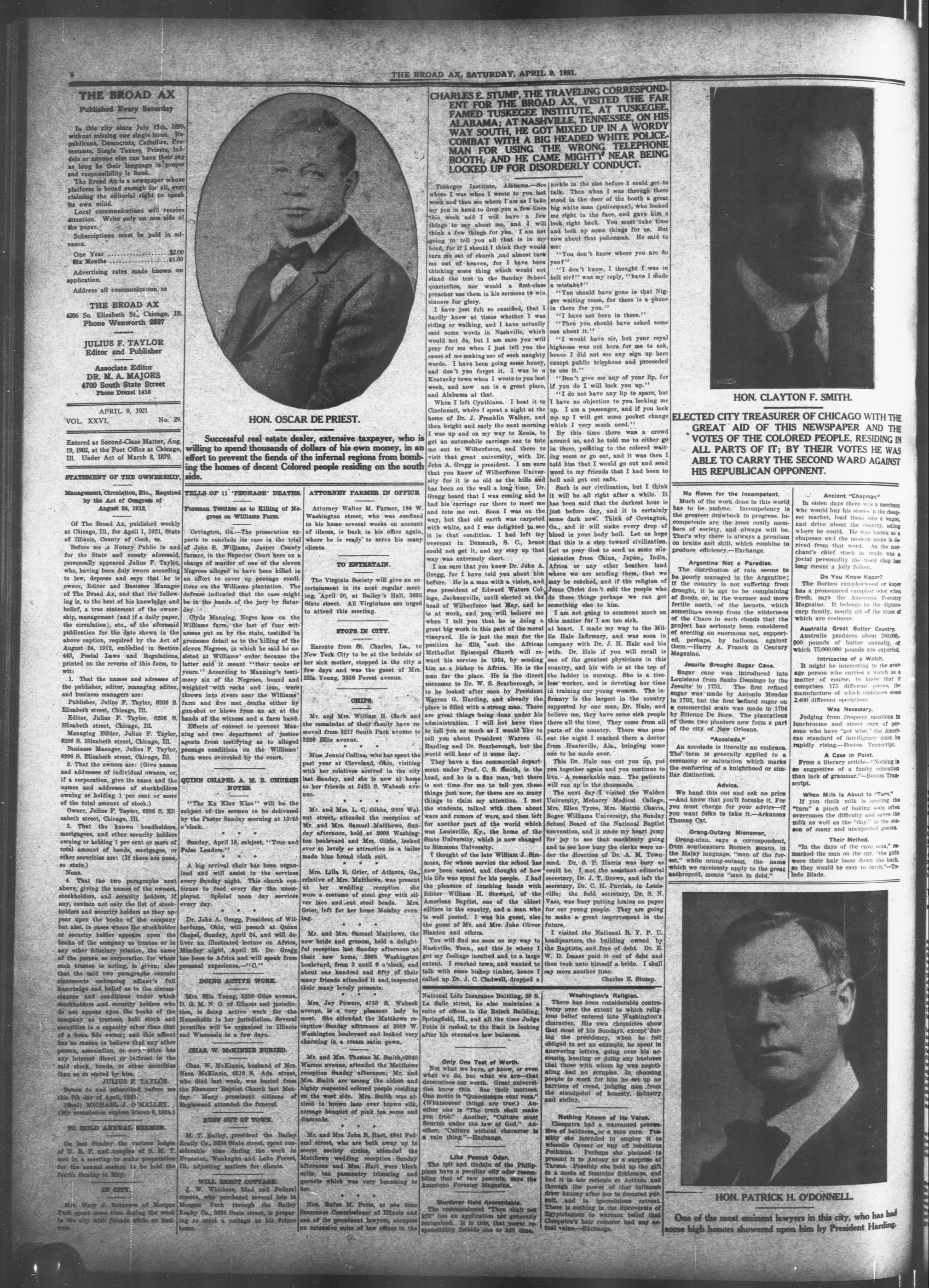
HON. OSCAR DE PRIEST.
Successful real estate desi willing to spend thousands of effort to prevent the fiends of f ing the homes of decent Color side. TELLS OF 11 'PEONAGE' DEATHS.
Successful real estate dealer, extensive taxpayer, who is willing to spend thousands of dollars of his own money, in an effort to prevent the fiends of the infernal regions from bombing the homes of decent Colored people residing on the south side.
Foreman Testifies as to Killing of Negroes on Williams Farm.
Covington, Ga.—The prosecution expects to conclude its case in the trial of John S. Williams, Jasper County farmer, in the Superior Court here on a charge of murder of one of the eleven Negroes alleged to have been killed in an effort to cover up peonage conditions on the Williams plantation. The defense indicated that the case might be in the hands of the jury by Saturday.
Glyde Manning, Negro boss on the Williams farm, the last of four witnesses put on by the state, testified in grocose detail as to the killing of the eleven Negroes, in which he said he assisted at Williams' order because the latter said it meant "their necks or yours." According to Manning's testimony six of the Negroes, bound and weighted with rocks and iron, were thrown into rivers near the Williams' farm and five met deaths either by gun-shot or blows from an ax at the hands of the witness and a farm hand. Efforts of counsel to prevent Manning and two department of justice agents from testifying as to alleged peonage conditions on the Williams' farm were overruled by the court.
QUINN CHAPEL A. M. E. CHURCH NOTES.
"The Ku Klux Klan" will be the subject of the sermon to be delivered by the Pastor Sunday morning at 10:45 o'clock.
Sunday, April 18, subject, "True and False Leaders."
A big revival choir has been organized and will assist in the services every Sunday night. This church continues to feed every day the unemployed. Special noon day services every day.
Dr. John A. Gregg, President of Wilberforce, Ohio, will preach at Quinn Chapel, Sunday, April 24, and will deliver an illustrated lecture on Africa, Monday night, April 25. Dr. Gregg has been in Africa and will speak from personal experience.—"C."
DOING ACTIVE WORK
Mrs. Ella Young, 3556 Giles avenue,
D. G. M. N. G. of Illinois and juridic-
tion, is doing active work for the
Households in her jurisdiction. Several
juveniles will be organized in Illinois
and Wisconsin in a few days.
CHAS W. McKINZIE BURIED.
Chas. W. McKinzie, husband of Mrs. Nora McKinzie, 6218 S. Ada street, who died last week, was buried from the Ebenezer Baptist Church last Monday. Many prominent citizens of Englewood attended the funeral.
BUSY OUT OF TOWN.
M. T. Bailey, president the Bailey Realty Co., 3638 State street, spent considerable time during the week in Evanston, Waukegan and Lake Forest, IL, adjusting matters for clients.
WILL ERECT COTTAGE.
J. W. Whithers, 52nd and Federal streets, who purchased several lots in Morgan Park through the Bailey Realty Co., 3638 State street, is preparing to erect a cottage as his future home.
---
ALTERNEY FARMER. IN OFFICE.
Attorney Walter M. Farmer, 184 W. Washington street, who was confined to his home several weeks on account of illness, is back in his office again where he is ready to serve his many clients.
TO ENTERTAIN
The Virginia Society will give an entertainment in its next regular meeting, April 20, at Bailey's Hall, 3638 State street. All Virginians are urged to attend this meeting.
STOPS IN CITY
Enroute from St. Charles, La., to New York City to be at the bedside of her sick mother, stopped in the city a few days and was the guest of Mrs. Ella Young. 3556 Forest avenue.
Mr. and Mrs. William H. Clark and the remainder of their family have removed from 3217 South Park avenue to 3226 Ellis avenue.
Miss Jennie Collins, who has spent the past year at Cleveland, Ohio, visiting with her relatives arrived in the city last Sunday, and she is now at home to her friends at 5423 S. Wabash avenue.
Mr. and Mrs. L. C. Gibbs, 2008 Walnut street, attended the reception of Mr. and Mrs. Samuel Matthews, Sunday afternoon, held at 2008 Washington boulevard and Mrs. Gibbs, looked ever so lovely or attractive in a tailor made blue broad cloth suit.
Mrs. Lella E. Grier, of Atlanta, Ga.
relative of Mrs. Matthews, was present
at her wedding reception she
wore a costume of steel grey with sil-
ver lace and cut steel beads. Mrs.
Grier, left for her home Monday even-
ing.
Mr. and Mrs. Samuel Matthews, the
new bride and groome, held a delight-
ful reception last Sunday afternoon at
their new home, 2008 Washington
boulevard, from 3 until 6 o'clock, and
about one hundred and fifty of their
many friends attended it and inspected
their many lovely presents.
Mrs. Jay Powers, 4710 S. Wabash
avenue, is a very pleasant lady to
meet. She attended the Matthews
reception Sunday afternoon at 2008 W.
Washington boulevard and looked very
charming in a cream satin gown.
Mr. and Mrs. Thomas M. Smith, 2040 Warren avenue, attended the Matthews reception Sunday afternoon; Mr. and Mrs. Smith are among the oldest and highly respected colored people residing on the west side. Mrs. Smith was attired in brown lace over brown silk, coralage bouquet of pink tea sores and diamonds.
Mr. and Mrs. John B. Hart, 4841 Federal street, who are both away up in secret society circles, attended the Matthews wedding reception Sunday afternoon and Mrs. Hart were black satin, tan pasmentry trimming and garnets which was very becoming to her.
Hon. Burles M. Potts, at one time Insurance Commissioner of Illinois and one of its prominent lawyers, occupies an extensive suite of law offices in the
---
THE BROAD AX. SATURDAY, APRIL 9, 1921
CHIPS
HARLES E. STUMP, THE TRAVELING CORRESPONDENT FOR THE BROAD AX, VISITED THE FAR FAMED TUSKEGEE INSTITUTE, AT TUSKEGEE, ALABAMA; AT NASHVILLE, TENNESSEE, ON HIS WAY SOUTH, HE GOT MIXED UP IN A WORDY COMBAT WITH A BIG HEADED WHITE POLICE-MAN FOR USING THE WRONG TELEPHONE BOOTH, AND HE CAME MIGHTY NEAR BEING LOCKED UP FOR DISORDERLY CONDUCT.
Tunkegue Institute, Alabama—See where I was when I wrote to you last week and then see where I am as I take my pen in hand to drop you a few lines this week and I will have a few things to say about me, and I will think a few things for you. I am not going to tell you all that is in my head, for if I should I think they would turn me out of church, and almost turn me out of heaven, for I have been thinking some thing which would not stand the test in the Sunday School quarterlies, nor would a first-class preacher use them in his sermons to win sinners for glory.
I have just felt so cussified, that I hardly knew at times whether I was riding or walking, and I have actually said some words in Nashville, which would not do, but I am sure you will pray for me when I just tell you the cause of me making use of such naughty words. I have been going some honey, and don't you forget it. I was in a Kentucky town when I wrote to you last week, and now am in a great place, and Alabama at that.
When I left Cynthiana. I beat it to Cincinnati, where I spent a night at the home of Dr. J. Franklin Walker, and then bright and early the next morning I was up and on my way to Xenia, to get an automobile carriage car to tote me out to Wilberforce, and there to visit that great university, with Dr. John A. Gregg is president. I am sure that you know of Wilberforce University for it is as old as the hills and has been on the wall a long time. Dr. Gregg heard that I was coming and he had his carriage car there to meet me and tote me out. Soon I was on the way, but that old earth was carpeted with white, and I was delighted to see it in that condition. I had left my overcoat in Denmark, S. C., hence could not get it, and my stay up that way was extremely short.
I am sure that you know Dr. John A. Gregg, for I have told you about him before. He is a man with a vision, and was president of Edward Waters College, Jacksonville, until elected at the head of Wilberforce last May, and he is at work, and you will believe me when I tell you that he is doing a great big work in this part of the moral vineyard. He is just the man for the position he fills, and the African Methodist Episcopal Church will reward his service in 1924, by sending him as a bishop to Africa. He is the man for the place. He is the direct successor to Dr. W. S. Scarborough, is to be looked after soon by President Warren H. Harding, and already the place is filled with a strong man. There are great things being done under his administration. I will not have time to tell you as much as I would like to tell you about President Warren G. Harding and Dr. Scarborough, but the world will hear of it some day.
They have a fine commercial department under Prof. C. S. Smith, is the head, and he is a fine man, but there is not time for me to tell you these things just now, for there are so many things to claim my attention. I met the students, talked with them about wars and rumors of wars, and then left for another part of the world which was Louisville, Ky., the home of the State University, which is now changed to Simmons University.
I thought of the late William J. Simmons, for whose service the school has now been named, and thought of how his life was spent for his people. I had the pleasure of touching hands with Editor William H. Steward, of the American Baptist, one of the oldest editors in the country, and a man who is well posted. I was his guest, also the guest of Mr. and Mrs. John Oliver Blanton and others.
You will find me soon on my way to Nashville, Tenn., and this is where I got my feelings insulted and to a large extent. I reached town, and wanted to talk with some bishop timber, hence I called up Dr. J. C. Cladwell, dropped a National Life Insurance Building, 29 S. La Salle street, he also maintains a suite of offices in the Belsch Building, Springfield, Ill., and all the time Judge Potts is rushed to the limit in looking after his extensive law business.
Only One Test of Worth.
Only One Test of Worth.
Not what we have, or know, or even what we do, but what we are—that determines our worth. Great universities know this. See their mottoes. One motto is "Quacumique sunt vera." (Whatsoever things are true). Another one is "The truth shall make you free." Another, "Culture must flourish under the law of God." Another, "Culture without character is a vain thing."—Exchange
Murderer Held Accountable.
The commandment "Thou shalt not kill" has an application not generally recognized. It is this that moral responsibility forbids one to kill time.
nickle in the slot before I could get to talk. Then when I was through there stood in the door of the booth a great big white man (policeman), who looked me right in the face, and gave him a look right back. You must take time and look up some things for us. But now about that policeman. He said to me:
"You don't know where you are do you!"
"I don't know, I thought I was in hell sir!" was my reply, "have I made a mistake!"
"You should have gone in that Nigger waiting room, for there is a phone in there for you."
"I have not been in there."
"Then you should have asked some one about it."
"I would have sir, but your royal highness was not here for me to ask, hence I did not see any sign up here except public telephone and proceeded to use it." "Don't give me any of your lip, for if you do, I will look you up."
If you do I will look you up.
"I do not have any lip to spare, but
I have no objection to you locking me up.
I am a passenger, and if you lock
me up I will get some pocket change
which I very much need."
By this time there was a crowd
around us, and he told me to either go
in there, pointing to the colored waiting
room or go out, and it was then I
told him that I would go out and send
word to my friends that I had been to
bell and get out safe.
Such is our civilization, but I think it will be all right after a while. It has been said that the darkest hour is just before day, and it is certainly some dark now. Think of Covington, Ga., and it will make every drop of blood in your body boil. Let us hope that this is a step toward civilization. Let us pray God to send us some missionaries from China, Japan, India, Africa or any other heathen land where we are sending them, that we may be reached, and if the religion of Jesus Christ don't suit the people who do these things perhaps we can get something else to him.
I am not going to comment much on this matter for I am too sick. at heart. I made my way to the Millie Hale Infirmary, and was soon in company with Dr. J. H. Hale and his wife. Dr. Hale if you will recall is one of the greatest physicians in this country, and his wife is at the top of the ladder in nursing. She is a tireless worker, and is devoting her time in training our young women. The infirmary is the largest in the country supported by one man, Dr. Hale, and believe me, they have some sick people there all the time. They come from all parts of the country. There was present the night I reached there a doctor from Huntsville, Ala., bringing some one to be made over. This Dr. Hale can cut you up, put you together again and you continue to live. A remarkable man. The patients will run up in the thousands.
The next day I visited the Walden University, Meharry Medical College Mrs. Ellen Tyree, Mrs. Mattie Chavis Roger Williams University, the Sunday School Board of the National Baptist convention, and it made my heart jump for joy to see that machinery going and to see how busy the clerks were under the direction of Dr. A. M. Townsend. Dr. S. P. Harris was busy as could be. I met the assistant editorial secretary, Dr. J. T. Brown, and left the secretary, Dr. C. H. Parrish, in Louisville; the field secretary, Dr. S. N. Vass, was busy putting brains on paper for our young people. They are going to make a great improvement in the future.
I visited the National B. Y. P. U. headquarters, the building owned by the Baptists, and free of debt. Dr. E. W. D. Isaacs paid it out of debt and then took unto himself a bride. I shall say more another time.
Charles E. Stump.
Washington's Religion.
There has been considerable controversy over the extent to which religious belief entered into Washington's character. His own chronicles show that most of his Sundays, except during the presidency, when he felt obliged to set an example, he spent in answering letters, going over his accounts, hunting or doing any business that those with whom he was negotiating had no scruples. In choosing people to work for him he set up no barriers of creed, judging men from the standpoint of honesty, industry and ability.
Nothing Known of its Value.
Cleopatra had a warranted preventive of baldness, or a sure cure. Possibly she intended to employ it to wheedle Caesar or buy off rebellious Pothinus. Perhaps she planned to present it to Antony as a surprise at Tarsus. Possibly she held up the gift in a mode of feminine fickleness, and had it in her reticule at Actium, and through the power of that talsman drew Antony after her in frenzied pursuit, and in ignominious retreat. There is nothing in the discoveries of Egyptologists to warrant belief that Cleopatra's hair restorer had any actual value—Exchange
1930
HON. CLAYTON F. SMITH.
ELECTED CITY TREASURER
GREAT AID OF THE
VOTES OF THE COLO
ALL PARTS OF IT; E
ABLE TO CARRY THE
HIS REPUBLICAN OPER
ELECTED CITY TREASURER OF CHICAGO WITH THE GREAT AID OF THIS NEWSPAPER AND THE VOTES OF THE COLORED PEOPLE, RESIDING IN ALL PARTS OF IT; BY THEIR VOTES HE WAS ABLE TO CARRY THE SECOND WARD AGAINST HIS REPUBLICAN OPPONENT.
No Room for the Incompetent.
Much of the work done in this world has to be undone. Incompetency is the greatest drawback to progress. Incompetents are the most costly members of society, and always will be.
That's why there is always a premium on brains and skill, which combine to produce efficiency.—Exchange.
Argentina Not a Paradise
The distribution of rain seems to be poorly managed in the Argentine; if the country is not suffering from drought, it is apt to be complaining of floods, or, in the warmer and more fertile north, of the locusts, which sometimes sweep from the wilderness of the Chaco in such clouds that the project has seriously been considered of erecting an enormous net, supported, perhaps, by balloons, against them.-Harry A. Franck in Century Magazine.
Jesuita Brought Sugar Cane
Sugar cane was introduced into Louisiana from Santo Domingo by the Jesuits in 1751. The first refined sugar was made by Antonio Mendez in 1792, but the first refined sugar on a commercial scale was made in 1794 by Ettienne De Bore. The plantations of these two planters now form a part of the city of New Orleans.
"Accolade."
An accolade is literally an embrace. The term is generally applied to a ceremony or salutation which marks the conferring of a knighthood or similar distinction.
Advice.
We hand this out and ask no price
—And know that you'll forsake it. For you must charge for your advice if you want folks to take it.—Arkansas Thomas Cat.
Orang-Outang Mianomer
Orang-utan, says a correspondent from southeastern Borneo, means in the Malay language, "man of the forest," while orang-outang, the name which we carelessly apply to the great anthropoid, means "man in debt."
Ireland.
HON. PATRICK H. O'DONNELL
One of the most eminent lawyers in this city, some high honors showered upon him by Presid
Advice.
ER OF CHICAGO WITH THE
IS NEWSPAPER AND THE
LORED PEOPLE, RESIDING IN
BY THEIR VOTES HE WAS
THE SECOND WARD AGAINST
PONENT.
Ancient "Chapman."
In olden days there was a merchant who would buy his stores in the cheapest market, load them into a wagon, and drive about the country, selling where he could. He was known as a chapman and the modern name is de riven from that word. As the merchant's chief stock in trade was a jovial personality the word chap has long meant a jolly fellow.
Do You Know Kapor?
The Borneo camphorwood or kaper has a pronounced camphor odor when fresh, says the American Forestry Magazine. It belongs to the dipterocarp family, nearly all of the trees of which are resinous.
Australia Great Butter Country.
Australia produces about 200,000,000 pounds of butter annually, of which 75,000,000 pounds are exported.
Intricacies of a Watch
Intrigues or a Watch.
It might be interesting to the average person who carries a watch as a matter of course, to know that it comprises 175 different pieces, the manufacture of which embraces some 2,400 different operations.
Was Necessary.
Judging from frequent mentions in lunchrooms and street cars of persons who have "got wise," the American standard of intelligence must be rapidly rising—Boston Transcript.
A Case in Point
From a literary article—"Nothing is so suggestive of a faulty education than lack of grammar."—Boston Transcript.
When Milk Is About to "Turn."
If you think milk is nearing the "turn" a pinch of baking soda often overcomes the difficulty and saves the milk as well as the "day." in the season of many and unexpected guests.
Their Method.
"In the days of the cave man," remarked the man on the car, "the girls wore their hair loose down the back, so they would be easy to catch."—Toledo Blade.
```markdown
```
ayers in this city, who has had on him by President Harding.
Was Necessary.
Their Method.
Odith Has Made Most Favorable Impression because of Becomingness, Smartness and Comfort.
A new dress creation comes to us from New York—the "tea-dinner gown." Just the garment which roany a woman has wished for and has never found. A new firm of costumers solved the problem and put such a garon on the market.
The "tea-dinner gown" has made a great hit because of its smartness, beginningness, and great comfort—the three requisites every well-dressed woman demands. The "tea-dinner gown" is true to name. It is worn for me in one's own home and is kept on for dinner. If dinner is an informal affair. The American woman will be quick to appreciate this advantage, for at one time or another every woman has had an awkward rush to change from an afternoon to dinner dress. Be not alarmed by the name. The gown absolutely has no resemblance to the old-fashioned "tea gown" (lusbands will not think you in negligence), where lace and ribbons were fluttering adornments. Effer in the new gown is by color, wonderful combinations of materials.
color, line and pattern.
There are three types of "tea-dinner
gowns." One of all chiffon georgette,
the handsome velvet severely plain,
and the combination of a velvet coat
over over a chiffon slip, fashioned
much on straight lines. A gown
which has been greatly admired was
Chinese red chiffon with a coat of
the green chiffon velvet, lined with
BROOKLYN & PARKS
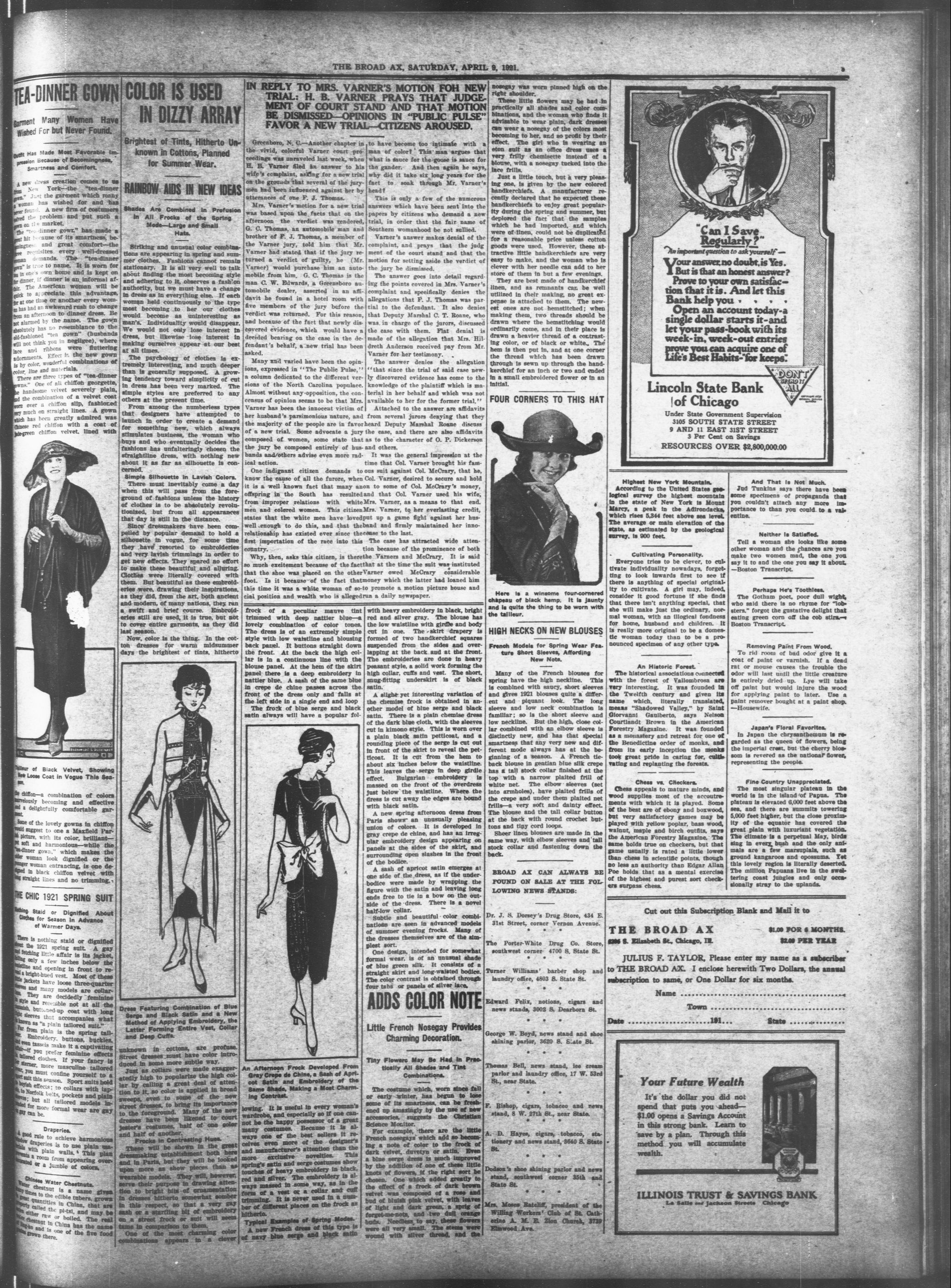
Tallour of Black Velvet, Showing New Loose Coat in Vogue This Season.
the chiffon—a combination of colors marvelously becoming and effective and a delightfully comfortable garment.
Some of the lovely gowns in chiffon would suggest to one a Maxfield Parrish picture, with its color, brilliant—to soft and harmonious—while the "dinner gown," which makes the older woman look dignified or the younger woman entrancing, is one designed in black chiffon velvet with our straight lines and no trimming.
THE CHIC 1921 SPRING SUIT
Nothing Staid or Dignified About Clothes for Season in Advance of Warmer Days.
There is nothing staid or dignified about the 1021 spring suit. A gay and fetching little affair is its jacket, taking only a few inches below the midline and opening in front to reveal a brightened vest. Most of these jacketes have loose three-quarter sleeves and many models are collars. They are decidedly feminine in style and resemble not at all the manish, buttoned-up coat with long sleeves that accompanies what is known as "a plain tailored suit."
from plain is the spring tailor. Embroidery, buttons, buckles, even tassels make it a captivating suit if you prefer feminine effects in tailored clothes. If your fancy is a sterner, more masculine tailored suit, you must confine yourself to a short suit this season. Sport suits hold up burgundy effects; to collars with lapels to Norfolk belts, pockets and plain shirts; but all tailored models intended for more formal wear are gay or gay can be.
Draperies.
A good rule to achieve harmonious window draperies is to use plain materials with plain walls. This plan presents a room from appearing overdressed or a jumble of colors.
Chinese Water Chestnuts.
Water chestnut is a name given
large times to the edible tubers, grown
of great quantities in China, that are
usually called the plstst, and may be
either raw or boiled. The real
name chestnut in China has the name
been bo and is one of the five food
produces grown there.
Brightest of Tints, Hitherto Unknown in Cottons, Planned for Summer Wear.
Shades Are Combined in Profusion
In All Procks of the Spring
Mode—Large and Small
Hats.
Striking and unusual color combinations are appearing in spring and summer clothes. Fashions cannot remain stationary. It is all very well to talk about finding the most becoming style and adhering to it, observes a fashion authority, but we must have a change in dress as in everything else. If each woman held continuously to the type most becoming to her our clothes would become as uninteresting as man's. Individuality would disappear. We would not only lose interest in dress, but likewise lose interest in making ourselves appear at our best at all times.
The psychology of clothes is extremely interesting, and much deeper than is generally supposed. A growing tendency toward simplicity of cut in dress has been very marked. The simple styles are preferred to any others at the present time. From among the numberless types that designers have attempted to launch in order to create a demand for something new, which always stimulates business, the woman who buys and who eventually decides the fashions has unfalteringly chosen the straightline dress, with nothing new about it as far as silhouette is concerned. Simple Silhouette in Lavish Colors. There must inevitably come a day when this will pass from the foreground of fashions unless the history of clothes is to be absolutely revolutionized, but from all appearances that day is still in the distance.
Since dressmakers have been compelled by popular demand to hold a silhouette in vogue, for some time they have resorted to embroideryes and very lavish trimming in order to get new effects. They spared no effort to make these beautiful and alluring. Clothes were literally covered with them. But beautiful as these embroideryes were, drawing their inspirations, as they did, from the art, both ancient and modern, of many nations, they ran a swift and brief course. Embroideryes still are used, it is true, but not to cover entire garments, as they did last season.
Now, color is the thing. In the cotton dresses for warm midsummer days the brightest of tints, hitherto
2
Dress Featuring Combination of Blue
Serge and Black Setin and a New
Method of Applying Embroidery, the
Latter Forming Entire Vest, Collar
and Deep Cuffs.
Just as collars were made exaggeratedly high to popularize the high collar by calling a great deal of attention to it, so color is applied in broad sweeps, even to some of the new street dresses, to bring its importance to the foreground. Many of the new dresses have been likened to court jester's costumes, half of one color and half of another.
Freaks in Centering Hues.
These will be shown in the great dressmaking establishment both here and in Paris, but they will be looked upon more as show pieces than as wearable models. They will, however, serve their purpose in drawing attention to bright bits of ornamentation in dresses litherto somewhat somber in this respect, so that a very gay sash or a starling bit of embroidery on a street frock or suit will seem tame in comparison to them.
One of the most charming color combinations appears in a clever
IN REPLY TO MRS. VARNER'S MOTION FOH NEW TRIAL: H. B. VARNER PRAYS THAT JUDGEMENT OF COURT STAND AND THAT MOTION BE DISMISSED—OPINIONS IN "PUBLIC PULSE" FAVOR A NEW TRIAL—CITIZENS AROUSED.
ical action. time that Col. Varner brought his fam.
One indignant citizen demands to ous suit against Col. McCrary, that he know the cause of all the furore, when Col. Varner, desired to secure and hold it is a well known fact that many anon to some of Col. McCrary's money, offspring in the South has resultedand that Col. Varner used his wife, from improper relations with whiteMrs. Varner, as a means to that end, men and colored women. This citizenMrs. Varner, to her everlasting credit, states that the white men have lovedup up a game fight against her huswell enough to do this, and that theband and firmly maintained her innorelationship has existed ever since the decease to the last. first importation of the race into this The case has attracted wide attenu-country. tion because of the prominence of both Why, then, asks this citizen, is therethe Varners and McCrary. It is said so much excitement because of the factthat at the time the suit was instituted that the shoe was placed on the otherVarner owed McCrary considerable foot. Is it because of the fact thatmoney which the latter had loaned him this time it was a white woman of so-to promote a motion picture house and cial position and wealth who is allegedrun a daily newspaper.
Greenboro, N. C.—Another chapter in the vivid, colorful Varner court proceedings was unraveled last week, when H. B. Varner filled an answer to his wife's complaint, asking for a new trial on the grounds that several of the jurymen had been induced against her by utterances of one P. J. Thomas.
Mrs. Varner's motion for a new trial was based upon the facts that on the afternoon the verdict was rendered, G. C. Thomas, an automobile man and brother of F. J. Thomas, a member of the Varner jury, told him that Mr. Varner had stated that if the jury returned a verdict of guilty, he (Mr. Varner) would purchase him an automobile from him. G. C. Thomas is the man C. W. Edwards, a Greensboro automobile dealer, asserted in an affidavit he found in a hotel room with five members of the jury before the verdict was returned. For this reason, and because of the fact that newly discovered evidence, which would have a decided bearing on the case in the defendant's behalf, a new trial has been asked.
Many and varied have been the opinions, expressed in "The Public Pulse," a column dedicated to the different versions of the North Carolina populace. Almost without any opposition, the consensus of opinion seems to be that Mrs. Varner has been the innocent victim of her husband's parsimonious nature, and the majority of the people are in favor of a new trial. Some advocate a jury composed of women, some state that the jury be composed entirely of husbands and others advise even more radical action.
frock of a peculiar mauve tint trimmed with deep nattier blue—a lovely combination of color tones. The dress is of an extremely simple style with low waistline and blousing back panel. It buttons straight down the front. At the back the high collar is in a continuous line with the blouse panel. At the hem of the skirt panel there is a deep embroidery in nattier blue. A sash of the same blue in crepe de chine passes across the front of the dress only and falls at the left side in a single end and loop. The frock of blue serge and black satin always will have a popular fol-
A
An Afternoon Frock Developed From Gray Crepe de Chine, a Sash of Apricot Satin and Embroidery of the Same Shade, Making a Most Charming Contrast.
lowing. It is useful in every woman's wardrobe, and especially so if one cannot be the happy possessor of a great many costumes. Because it is always one of the best sellers it receives even more of the designer's and manufacturer's attention than the exclusive novelties. This spring's satin and serge costumes show touches of heavy embroidery in black, red and silver. The embroidery is always massed in some way, as in the form of a vest or a collar and cuff trimming. It is never used in a number of different places on the frock as hitherto.
Typical Examples of Spring Modes. A new French dress of this type is of navy blue surge and black satin
to have become too intimate with a man of color? This man argues that what is sauce for the goose is sauce for the gander. And then again he says, why did it take six long years for the fact to take six through Mr. Varner's head?
This is only a few of the numerous answers which have been sent into the papers by citizens who demand a new trial, in order that the fair name of Southern womanhood be not saddled.
Varner's answer makes denial of the complaint, and prays that the judgment of the court stand and that the motion for setting aside the verdict of the jury be dismissed.
The answer goes into detail regarding the points covered in Mrs. Varner's complaint and specifically denies the allegations that F. J. Thomas was partial to the defendant. It also denies that Deputy Marshal C. T. Roane, who was, in charge of the jurors, discussed the case with them. Flat denial is made of the allegation that Mrs. Hilldroth Anderson received pay from Mr. Varner for her testimony.
The answer denies the allegation "that since the trial of said case newly discovered evidence has come to the knowledge of the plaintiff which is material in her behalf and which was not available to her for the former trial."
Attached to the answer are affidavits from several jurors denying that they heard Deputy Marshal Roane discuss the case, and there are also affidavits as to the character of O. P. Dickerson and others.
It was the general impression at the time that Col. Varner brought his famous suit against Col. McCrary, that he, Col. Varner, desired to secure and hold on to some of Col. McCrary's money, and that Col. Varner used his wife, Mrs. Varner, as a means to that end. Mrs. Varner, to her everlasting credit, put up a game fight against her husband and firmly maintained her innocence to the last.
The case has attracted wide attention because of the prominence of both the Varners and McCrary. It is said that at the time the suit was instituted Varner owed McCrary considerable money which the latter had loaned him to promote a motion picture house and run a daily newspaper.
with heavy embroidery in black, bright red and silver gray. The blouse has the low waltseil with girdle and body cut in one. The skirt drapery is formed of two handkerchief squares suspended from the sides and overlapping at the back and at the front. The embroideries are done in heavy peasant style, a solid work forming the high collar, cuffs and vest. The short, smug-fitting underskirt is of black satin.
A alight yet interesting variation of the chemise frock is obtained in another model of blue serge and black satin. There is a plain chemise dress of the dark blue cloth, with the sleeves cut in kimono style. This is worn over a plain black satin petticoat, and a rounding piece of the serge is cut out in front of the skirt to reveal the petticoat. It is cut from the hem to about six inches below the waistline. This leaves the serge in deep girdle effect. Bulgarian embroidery is massed on the front of the overdress just below the waistline. Where the dress is cut away the edges are bound with black satin.
A new spring afternoon dress from Paris shows an unusually pleasing union of colors. It is developed in gray crepe de chine, and has an irregular embroidery design appearing on panels at the sides of the skirt, and surrounding open slashes in the front of the bodice.
A sash of apricot satin emerges at one side of the dress, as if the underbodice were made by wrapping the figure with the satin and leaving long ends free to tie in a bow on the outside of the dress. There is a novel half-low collar. Subtle and beautiful color combinations are seen in advanced models of summer evening frocks. Many of the dresses themselves are of the simplest sort. One design, intended for somewhat formal wear, is of an unusual shade of blue green silk. It consists of a straight skirt and long-waisted bodice. The color contrast is obtained through four tabs, or panels of silver lace.
ADDS COLOR NOTE
Little French Nosegay Provides Charming Decoration.
Tiny Flowers May Be Had in Practically All Shades and Tint Combinations.
The costume which, worn since fall or early winter, has begun to lose some of its smartness, can be freshened up amazingly by the use of new accessories, suggests the Christian Science Monitor.
For example, there are the little French nosegays which add so becoming a note of color to the frock of dark velvet, durvyn or satin. Even a bine surge dress is much improved by the addition of one of these little knots of flowers, if the right sort be chosen. One which added greatly to the effect of a frock of dark brown velvet was composed of a rose and bud of bluish pink velvet, with leaves of light and dark green, a sprig of forget-me-not, and two dull orange buds. Needless to say, these flowers were all very small. The stems were wound with silver thread, and the
nosegay was worn pinned high on the right shoulder. These little flowers may be bad in practically all shades and color combinations, and the woman who finds it advisable to wear plain, dark dresses can wear a nosegay of the colors most becoming to her, and so profit by their effect. The girl who is wearing an eton suit as an office dress uses a very frilly chemisette instead of a blouse, with a nosegay tucked into the lace frills.
Just a little touch, but a very pleasing one, is given by the new colored handkerchiefs. A manufacturer recently declared that he expected these handkerchiefs to enjoy great popularity during the spring and summer, but deplored the fact that the samples which he had imported, and which were of linen, could not be duplicated for a reasonable price unless cotton goods were used. However, these attractive little handkerchiefs are very easy to make, and the woman who is clever with her needle can add to her store of them in but a few exevels.
They are best made of handkerchief linen, and as remnants can be well utilized in their making, no great expense is attached to them. The newest ones are not hemstitched; when making them, two threads should be drawn where the hemstitching would ordinarily come, and in their place is drawn a heavier thread of a contrasting color, or of black or white. The hem is then put in, and at one corner the thread which has been drawn through is sewn up through the handkerchief for an inch or two and ended in a small embroidered flower or in an initial.
FOUR CORNERS TO THIS HAT
J
Here is a winsome four-cornered chapeau of black hemp. It is jaunty and is quite the thing to be worn with the tailleur.
HIGH NECKS ON NEW BLOUSES
French Models for Spring Wear Feature Short Sleeves, Affording New Note.
Many of the French blouses for spring have the high neckline. This is combined with saucy, short sleeves and gives 1921 blouses quite a different and pliant look. The long sleeve and low neck combination is familiar; so is the short sleeve and low neckline. But the high, close collar combined with an elbow sleeve is distinctly new, and has that special smartness that any very new and different mode always has at the beginning of a season. A French tie-back blouse in gentian blue slik crepe has a tall stock collar finished at the top with a narrow plaited frill of white net. The elbow sleeves (set into armboles), have plaited frills of the crepe and under them plaited net frills—a very soft and dainty effect. The blouse and the tall collar button at the back with round crochet buttons and tiny cord loops.
Sheer linen blouses are made in the same way, with elbow sleeves and tall stock collar and fastening down the back.
BROAD AX CAN ALWAYS BE POUND ON SALE AT THE FOLLOWING NEWS STANDS:
Dr. J. S. Dorsey's Drug Store, 434 E
31st Street, corner Vernon Avenue.
"Can I Save Regularly?"
An important question to ask yourself —
Your answer no doubt, is Yes.
But is that an honest answer?
Prove to your own satisfaction that it is. And let this Bank help you.
Open an account today-a single dollar starts it-and let your pass-book with its week-in, week-out entries prove you can acquire one of Life's Best Habits-"for keeps."
DON'T SPEND IT ALL
Lincoln State Bank
of Chicago
Under State Government Supervision
3105 SOUTH STATE STREET
9 AND 11 EAST 31ST STREET
3 Per Cent on Savings
RESOURCES OVER $2,800,000.00
Cut out this Subscription Blank and Mail it to
JULIUS F. TAYLOR, Please enter my name as a subscriber to THE BROAD AX. I enclose herewith Two Dollars, the annual subscription to same, or One Dollar for six months.
Highest New York Mountain. According to the United States geological survey the highest mountain in the state of New York is Mount Marcy, a peak in the Adirondacks, which rises 5,344 feet above sea level. The average or main elevation of the state, as estimated by the geological survey, is 900 feet.
Cultivating Personality.
Everyone tries to be clever, to cultivate individuality nowadays, forgetting to look inwards first to see if there is anything of special originality to cultivate. A girl may, indeed, consider it good fortune if she finds that there isn't anything special, that she will make just the ordinary, normal woman, with an illogical fondness for home, husband and children. It is really more original to be a domestic woman today than to be a pronounced specimen of any other type.
An Historic Forest
The historical associations connected with the forest of Vallombrosa are very interesting. It was founded in the Twelfth century and given its name which, literally translated, means "Shadowed Valley," by Saint Glorvanni Galberto, says Nelson Courtlandt Brown in the American Forestry Magazine. It was founded as a monastery and retreat for one of the Benedictine order of monks, and from its early inception the monks took great pride in caring for, cultivating and replanting the forests.
Chess vs. Clieckara.
Chess appeals to mature minds, and wood supplies most of the accoutrements with which it is played. Some of the best are of ebony and boxwood, but very satisfactory games may be played with yellow poplar, bass wood, walnut, maple and birch outfits, says the American Forestry Magazine. The same holds true on checkers, but that game usually is rated a little lower than chess in scientific points, though no less an authority than Edgar Allan Poe holds that as a mental exercise of the highest and purest sort checkers surpass chess.
Jud Tunkins says there have been some specimens of propaganda that you couldn't attach any more importance to than you could to a valentine.
Neither is Satisfied.
Tell a woman she looks like some other woman and the chances are you make two women mad, the one you say it to and the one you say it about. —Boston Transcript.
Perhaps He's Toothless.
Perhaps Her Foodiest.
The Gotham poet, poor dull wight, who said there is no rhyme for "lobsters." forgust the gorgetal delight that eating green corn off the cob stirs.
Boston Transcript.
Removing Paint From Wood.
To rid room of bad odor give it a coat of paint or varnish. If a dead rat or mouse causes the trouble the odor will last until the little creature is entirely dried up. Lye will take off paint but would injure the wood for applying paint to later. Use a paint remover bought at a paint shop.—Housewife.
Japan's Floral Favorites
In Japan the chrysanthemum is regarded as the queen of flowers, being the imperial crest, but the cherry blossom is revered as the national flower, representing the people.
Fine Country Unappreciated.
Fine Country Unappreciated.
The most singular plateau in the world is in the island of Papua. The plateau is elevated 6,000 feet above the sea, and there are summits towering 5,000 feet higher, but the close proximity of the equator has covered the great plain with luxuriant vegetation. The climate is a perpetual May, birds sing in every bush and the only animals are a few marsupials, such as ground kangaroos and opossums. Yet this lovely region is literally deserted. The million Papuans live in the sweltering coast jungles and only occasionally stray to the uplands.
On Blank and Mall it to
$1.00 FOR 6 MONTHS.
$2.00 PER YEAR.
e enter my name as a subscriber
herewith Two Dollars, the annual
car for six months.
HOWARD UNIVERSITY WASHINGTON, D. C.
J. STANLEY DURKEE, A. M., Ph. D., President EMMETT J. SCOTT, A.M., LL.D., Secretary-Treasure
Collegiate and Professional Schools
Junior College, covering the B
leading to the Senior College
Senior College, consisting of the
Journalism, and Commerce
degrees. A. B. or B. S.; A. B.
nalism; B. S. in Commerce
School of Applied Science, four
C. E.; B. S. in E. E. B. S. in
Agriculture, and B. S. in
School of Music, four year course
School of Religion, three year co-
ploma and Correspondence
School of Law, three year evening
School of Medicine, including M.
leges. Four year course for
years for Pharmaceutical
M. D., D. D. S., Phar. C.
Students may enter for Colleg
REGISTRATION:
Autumn Quarter.....
Winter Quarter.....
Spring Quarter.....
For Catalog and Information
DWIGHT O. W.
Howard University,
Wm.
Establish
DEAL
Groceries
HOME MADE SAU
VEGETABLES AND
We are as near you as you
ceive prompt attention.
Phone Bo
Junior College, covering the Freshman and Sophomore years, and leading to the Senior Colleges.
Senior College, consisting of the Schools of Liberal Arts, Education, Journalism, and Commerce and Finance, granting respectively the degrees. A. B. or B. S.; A. B. or B. S. in Education; B. S. in Journalism; B. S. in Commerce.
School of Applied Science, four year course, giving degree, B. S. in C. E.; B. S. in E. E. B. S. in M. E., B. S. in Architecture; B. S. in Agriculture, and B. S. in Household Economics.
School of Music, four year course, giving degree of Mus. B.
School of Religion, three year course, giving degree of B. D. (Also Diploma and Correspondence Courses.)
School of Law, three year evening course, giving degree of LL.B.
School of Medicine, including Medical, Dental, Pharmaceutical Colleges. Four year course for Medical and Dental Students; three years for Pharmaceutical students. Following degrees given: M. D., D. D. S., Phar. C.
Students may enter for Collegiate Work at the beginning of any quarter.
REGISTRATION:
Autumn Quarter.....September 27 to 29, 1929
Winter Quarter .....January 8, 1929
Spring Quarter .....March 19 and 21, 1929
For Catalog and Information write
DWIGHT O. W. HOLMES, Registrar
Howard University,
Washington, D. C.
Groceries and Meats
HOME MADE SAUSAGE A SPECIALTY
VEGETABLES AND FRUITS IN SEASON
We are as near you as your telephone, and all calls receive prompt attention.
Phone Boulevard 1812
3638 South State Street CHICAGO
Live Electric Plants.
There are in all about 50 species of electrical fish, but the electrical properties of only five or six have been studied in detail. The best known are various species of torpedo, belonging to the skate family found in the Mediterranean and Adriatic seas; the gynnotusf, an eel found in the region of the Orinoco in South America; the malapterurus, the rash or thunderer fish of the Arabs, a native of the Nile, the Niger, Senegal and other African rivers, and various species of skate found in the seas around Great Britain.
Her Description.
A bright ten-year-old girl, whose father was addicted to amateur photography, attended a trial at court the other day for the first time. This was her account of the judge's charge: "The judge made a long speech to the jury of 12 men, and then sent them off into a little dark room to develop."
Dirt Obscures Light of Lamp.
Dirt Obcures Light of Lamp.
When the lamps become old and more or less dirty between cleaning periods the emitted light falls off about 33 per cent, according to the Electrical World. Consequently, for a desired foot-candle illumination, the rating of the lamps must be about 33 per cent higher than that found necessary from the calculations based on the efficiency of new, clean lamps.
Besides, Few Believe.
Jud Tunkin says a man who braces about leaving office poorer than when he entered it merely irritates the bill collectors.
Origin of Widow's Cane
Origin of Widow's Caps.
Widows wore caps, says one authority, at the time of the Roman conquest of England, because they shaved their heads as a sign of mourning; as women would not allow herself to be seen with a bald head, she made herself a pretty cap. Though the necessity for it has long since passed away, the cap still remains. Why do we wear heels on our shoes? Because the sandal-like footwear of olden times was not adapted to horseback riding, and when the high boots were introduced heels were put on for the purpose of giving the foot a good hold on the stirrup.
"Yes, boys," continued the stubble jack, who was telling "true" and thrilling stories, "yes, I was working a clock tower one afternoon about 12 minutes to six, when I slipped, slid down the roof and caught on the long hand of the clock. There I dangled while the town folks collected below. So I yells to 'em. "Say you folks, go home to your suppers, if'll be close to half an hour before I drop."
Capacity for Service.
Capacity for service creates opportunities and multiplies offers of positions. If out of a job, increase your capacity for service instead of hunting a job, and then the job will hunt you. This is true in both the material and spiritual realm.—The Christian Index.
And Make It Snappy.
Postmaster Batavia has received a letter with no name and address on it. He would like for the person it is intended for to please call and get with in five days—Arkansaw Thomas Cat.
Around the Clock
Freshman and Sophomore years, and
degrees.
Our Schools of Liberal Arts, Education,
and Finance, granting respectively the
B. or B. S. in Education; B. S. in Jour-
ce.
Our year course, giving degree, B. S. in
in M. E., B. S. in Architecture; B. S.
in Household Economics.
Course, giving degree of Mus. B.
Course, giving degree of B. D. (Also Di-
c Course, giving degree of LL.B.
Course, giving degree of LL.B.
Medical, Dental, Pharmaceutical Col-
or Medical, Dental Students; three
students. Following degrees given:
Regitate Work at the beginning of any
quarter.
September 27 to 28, 1989
January 8, 1981
March 19 and 21, 1981
On write
W. HOLMES, Registrar
Washington, D. C.
Jones
published 1899
ALER IN
Meats and Meats
LUSAGE A SPECIALTY
AND FRUITS IN SEASON
Our telephone, and all calls re-
Preserving Milk.
Is milk condensed? Mkk is condensed by the evaporation of the water it contains, after it has been sterilized. Sugar is added to some brands, and is not added to others, and the unsweetened is known as "evaporated" milk to distinguish it from the sweetened. Copper tanks holding 1,000 gallons or more are used in the sterilization of the milk, and the water is evaporated in huge vacuum pans.
Smoke as a Lightning Rod.
Smoke as a Lightning Rod. It would seem that a building 9,000 feet above the sea level should be protected by lightning rods, but the astronomical observatory at Mount Etna has not, and does not, need such protection. The observatory is near the summit of the volcano, and the stream of vapor constantly rising from the crater acts as a natural conductor, draining the electricity out of the clouds, so that lightning is seldom seen there.
Oil in North America.
Oil was known to the Indians and used by them for medicinal purposes. It was first obtained from the surface of creeks and as a product of salt wells. Edwin L. Drake drilled the first oil well in the United States in August, 1859, near Oil City, Pa. The first discovery of oil in Canada was made in 1857 near Petrolia, Ont.
Freedom
Freedom is the word that is many sided. There are those who boast of freedom of conscience who seem to interpret it simply as with that of other people. There are those who seem to fancy that their rights as citizens entitle them to unquestioned trampling upon rights of anybody else who chances to stand in their way—Montreal Herald.
Irish Language
The Gaelic language is the original and historical language of the people of Ireland, though most of that country's inhabitants speak English. Gaelic is now taught in the national schools, Catholic parish schools and colleges in Ireland, as well as at Harvard university, Notre Dame university and the Catholic University of America at Washington. There has been a revival of the use of Gaelic through the efforts of the Society for the Preservation of the Gaelic Language.
Fountain jets are really made of rubber. The pure rubber is mixed with sulphur and heated. In a few hours the mixture rises to a heat of three times the boiling point of water. When it has cooled the substance formed is known as vulcanite. Many things besides fountain jets are made from vulcanite, such as combs, buttons and kuffelhandles. It forms a useful substitute for born ivory and jet. A new method has just been discovered for vulcanizing rubber, and this makes such articles much cheaper.
Word's Meaning Changed
Word's Meaning Changed.
Going downstairs etymologically means ascending. The Saxon "dun" meant an upland or hill, and "a-dun" meant a descent. But in the course of time the preposition was omitted and the word "dun" came to mean down.
Best of All Things.
It is a good thing to be rich, and it is a good thing to be strong, but it is a better thing to be loved of many friends—Exchange.
CHICAGO
Freedom.
THE BROAD AX, SATURDAY, APRIL 9, 1921.
SOFT
SILKY
HAIR
At last a reliable hair grower that makes short, kinky hair quickly grow long, soft and silky. Slice, fold and dandelifl, cleans the scalp and feeds the hair roots.
EXELENTO
QUININE POMADE
If your druggist cannot supply you, seal it in stamps or coin for full sine package.
Use EXELENTO SKIN BRAUPTIER, an eminent for dark, mally skin. Used in treatment of skin troubles.
Agents Wanted Everywhere
Write for Particulars
EXELENTO MEDICINE CO., Atlanta, Georgia
PHONE MAIN 2014
A. D. GASH
ATTORNEY AT LAW
118 N. La Salle Street
CHICAGO
Residence Telephone
3342 Calumet Ave. Douglas 1278
JAMES G. COTTER
ATTORNEY AT LAW
145 NORTH CLARK STREET
SUITE 407
Telephone Central 8354
CHICAGO
Formerly
Assistant Attorney General
State of Illinois
Res. 3648 Grand Boul.
Doug. 4397
J. GRAY LUCAS
ATTORNEY-AT-LAW
129 E. 31ST STREET
Suite 18-17
Phone: Douglas 6381
CHICAGO
CHICAGO
F. Dunn, J. B. McCahay,
Trustees
Tel: Oakland 1588, 1551, 1580
JOHN J. DUNN
Established 1877
WHOLESALE AND RETAIL
COAL
Fifty-First and Federal Streets
CHICAGO
Drum With Harmonica.
Drum With Harmonica.
Musicians find the drum an unsatisfactory instrument for lack of harmonic overtones. From India comes the description of a drum the parchment head of which is loaded with an adherent composition containing finely divided iron. Such composition lies in a central circle. Around the edge a second ring-shaped membrane is secured and the effect of the loading is to produce harmonic overtones.
Trout a Cannibal.
Trout a Cannibal.
The trout is cannibalistic, feeding upon its own kind when necessity compels, says the American Forestry Magazine, and in numerous instances when necessity does not compel.
The Trouble.
"Everybody about that bank seems to be catching cold. Is it damp?" "No; but there are so many drafts about it."
Life Calls for One's Best
Life Calls for One's Best.
To make a success of life you must be always at it with your eye on the job. Diversion will stimulate far more intensive effort, but the effort itself must have no diverting influence. "This one thing I do," says the apopte, and in doing it he wins. Keep your eye on the ball and put your best into the game.
Cement Must Be Heated.
Cement must be Heated.
It is often convenient to have a cement that will resist considerable temperatures. Here is the recipe for a good heat-withstanding cement: Take fifty parts of sulphur, one part of resin and one part of tallow. Take these ingredients together and add fine powdered glass to form a paste. This cement must be heated before being used.
First Studies of the Human Body.
Early studies in human anatomy were conducted under many difficulties. Aristotle was among the first to study the human body, about 350 B. C. Through all the years there was objection to dissection of bodies to verify facts, and when Titian designed and had completed the first anatomical plates they were destroyed by Vessilian, about 1538.
```markdown
```
Comparative Statement of Deposits
November 18, 1912, $836,605.23
November 17, 1914, $912,005.69
November 17, 1916, $1,132,750.72
November 18, 1918, $1,284,084.24
November 17, 1919, $2,359,636.62
November 15, 1920, $3,224,633.09
OFF
JOHN BAIN, President
MICHAEL MAISEL, V
EDW. C. BARRY
W. MERLE
ARTHU
AIN, President
HAEL MAISEL, Vice President
EDW. C. BARRY, Cashier
W. MERLE FISHER, Assistant
ARTHUR C. UTESCH, A
JOHN BAIN, President
MICHAEL MAISEL, Vice President
EDW. C. BARRY, Cashier
W. MERLE FISHER, Assistant Cashier
ARTHUR C. UTESCH, Asst. Cashier.
Squeaking Shoes a Good Omen.
Squeaking Shoes a Good Omen.
Theatrical people have many superstitions and they cling to the profession closely, one being if an actor's shoes squeak, ever so little, as he makes the first entrance, he is assured of a welcome from the audience.
TELEPHONE DOUGLAS 1
GEORGE F. H.
REAL
Up-to-Date or Modern
and Store
3101 COTTAGE
Corner 31st S
Office Phone:
KERSEY, McGOWA
CHICAGO'S REP
RGE F. HARDING
REAL ESTATE
Date or Modern Houses, Apartment and Stores to Rent
COTTAGE GROVE
Corner 31st Street, Chicago
Office Phone: Dougins 8285
SEY, McGOWAN AND MORSE
CHICAGO'S REPRESENTATIVE
GEORGE F. HARDING, JR.
Up-to-Date or Modern Houses, Apartments and Stores to Rent
3101 COTTAGE GROVE AVE.
Corner 31st Street, Chicago
KERSEY, McGOWAN AND MORSELL
CHICAGO'S REPRESENTATIVE
UNDERTAKERS
Finest Establishment in the U. S.
GEO. T. KERSEY D. A. McGOWAN WM. J. MOR
Proprietors
3515 INDIANA AVENUE CHICAGO
RSEY D. A. McGOWAN WM. J. B.
Proprietors
ANA AVENUE CHICA
GEO. T. KERSEY D. A. McGOWAN WM. J. MORSELL Proprietors
Notary Public
Phones: Office Main 4153; Residence
4751 Champlain Avenue.
Phone Kenwood 5611
ATTORNEY AND COUNSELOR AT LAW
Suite 708—184 W. Washington St
CHICAGO
Audidence 3888 Prairie Ave.
Phone Douglas 0188
Phones: Main 2017 Auto 83-395
A. L. WILLIAMS
ATTORNEY AND COUNSELOR AT LAW
Suite 708 Firmenich Building
84 W. Washington Street
CHICAGO
Telephone Oakland 286
E. K. CALDWELL
Successor to
C. E. KREYSSLER
DRUGGIST
5887 South State Street Near 51st St.
Not On the Corner CHICAGO
Residence, 1262 Moon River Place
Tem. monroe, IL
MILES J. DEVINE
ATTORNEY AT LAW
SUITE 818-320 REAPER BLK.
Clark and Washington Streets
Phone Central 1269
CHICAGO
Phones Douglas 6302 and Douglas 653
Nights call Douglas 7078
J. S. DORSEY
Reliable
Druggist
Full Line of Fresh Drugs and Tollet
Articles Prescriptions Filled
With Accuracy.
434 East 81st Street
Chicago, Ill.
ORSEY
table
uggist
Drugs and Toilet
Scriptions Filled
accuracy.
Blist Street
icago, Ill.
Ernest
Day Light
I am as no
immaterial
5121 & 5123
NICERS
Prince President
Cashier
FISHER, Assistant Cashier
MR C. UTESCH, Asst. Cashier.
OFFICERS
The Magic Square.
The origin of the magic square is usually ascribed to the Chinese as the Tih King, an early classic, describes it. The magic square was known to the Hindoos and to the Arabian astrologers.
HARDING, JR.
RESTATE
own Houses, Apartments
to Rent
E GROVE AVE.
Street, Chicago
Douglas 8285
N AND MORSELL
PRESENTATIVE
PHONE KENWOOD 455
FUNERAL DIRECTORS
UNDER TAKER
PRIVATE ANGULANCE
AUTOS AT ALL HOURS
ALL DAYS 8:59
5121 ERNEST H. WILLIAMSON UNDERTAKER
GARAGE
GASOLINE OIL
OPEN DAY & NIGHT
Chicago
CHICAGO, ILL.
Phones: Victory 7897, Beverly 2873
James A.
DEALER
mes A. East
DEALER IN
WALL PAPER
Decorator House Painter
Street
2619 State Street
Phone Douglas 8020
The Missi
Billiard Ha
The Mission
Billiard Hall
GEO. W. HOLT, Propr.
3504 SOUTH STATE STREET CHICAGO, ILL.
Dependability a Great Asset.
"Make yourself dependable and you can come as near being indispensable as any one can be. You will be the last one your employer will wish to part with and the first that he will promote to greater responsibilities."—J. Ogden 'Armour
---
THE FORTY-FOURTH STREET
The Cranford Apartment Bldg. 3600 WABASH AVENUE
The finest building ever opened to Colored tenants in Chicago Steam heat, electric lights, tile beeths, marble entrance Phone Main 263 J. W. Casey, Agt. 133 W. Washington St.
Mission d Hall
Beware of Apologizing
Apologizing—a very desperate habit
—one that is rarely cured. Apologizing
is only egotism wrong side out.
Nine times out of ten, the first thing
a man's companion knows of his short-
comings is from his apology—Oliver
Wendell Holmes.
CHICAGO