The Broad Ax
Saturday, June 25, 1921
Chicago, Illinois
Page text (machine-generated)
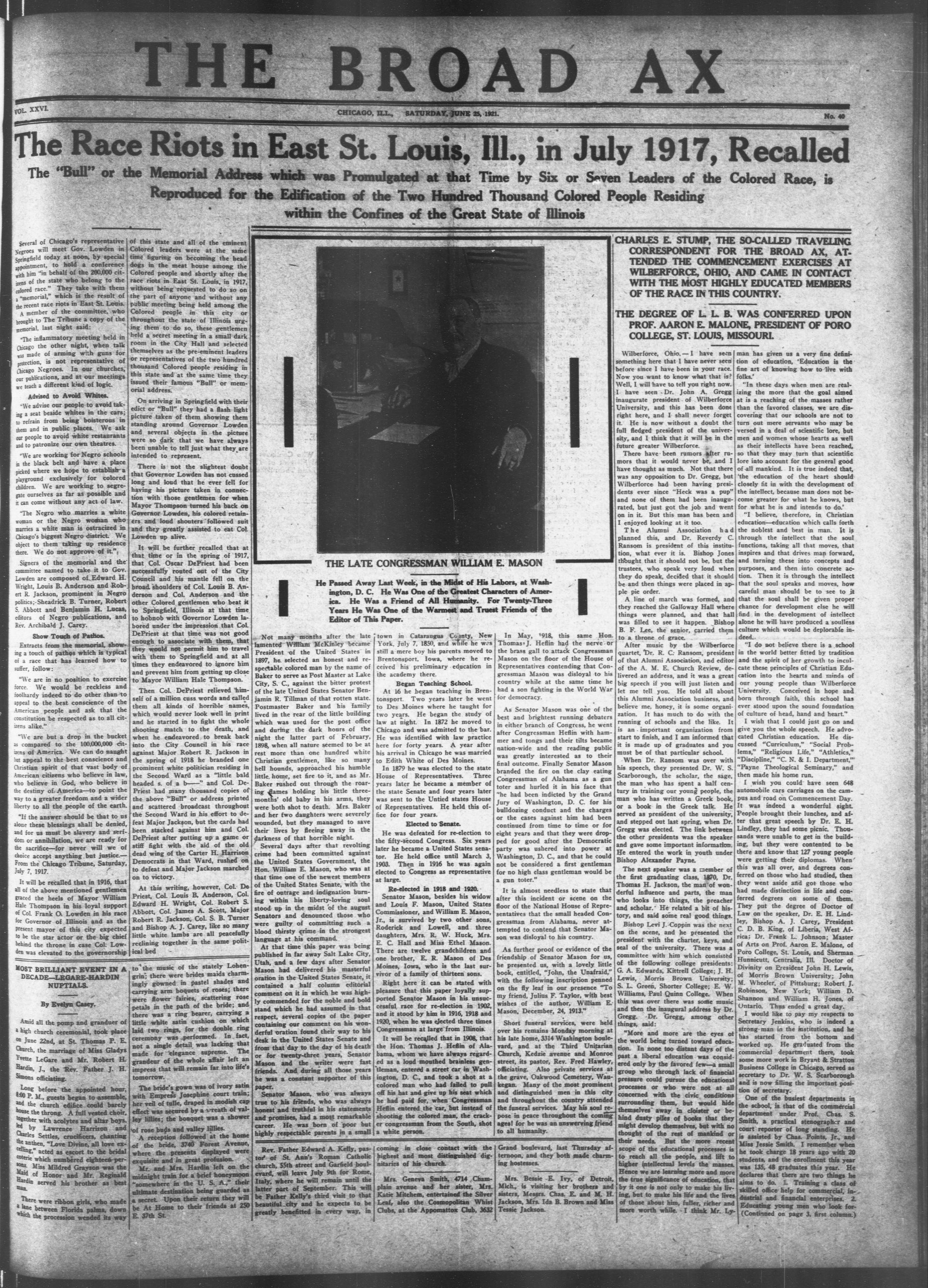
The Race Riots in East St. Louis, Ill., in July 1917, Recalled The "Bull" or the Memorial Address which was Promulgated at that Time by Six or Seven Leaders of the Colored Race, is Reproduced for the Edification of the Two Hundred Thousand Colored People Residing within the Confines of the Great State of Illinois
Several of Chicago's representative Negroes will meet Gov. Lowden in Springfield today at noon, by special appointment, to hold a conference with him "in behalf of the 200,000 citizens of the state who belong to the colored race." They take with them a "memorial," which is the result of the recent race riots in East St. Louis. A member of the committee, who brought to The Tribune a copy of the memorial, last night said:
"The inflammatory meeting held in Chicago the other night, when talk was made of arming with guns for protection, is not representative of Chicago Negroes. In our churches, our publications, and at our meetings we teach a different kind of logic.
Advised to Avoid Whites.
"We advise our people to avoid taking a seat beside whites in the cars; to refrain from being boisterous in them and in public places. We ask our people to avoid white restaurants and to patronize our own theatres.
"We are working for Negro schools in the black belt and have a place picked where we hope to establish a playground exclusively for colored children. We are working to segregate ourselves as far as possible and it can come without any act of law.
"The Negro who marries a white woman or the Negro woman who marries a white man is ostracized in Chicago's biggest Negro district. We object to them taking up residence there. We do not approve of it."
Signers of the memorial and the committee named to take it to Gov. Lowden are composed of Edward H. Wright, Louis B. Anderson and Robert R. Jackson, prominent in Negro politics; Sheadrick B. Turner, Robert S. Abbott and Benjamin H. Lucas, editors of Negro publications, and Rev. Archibald J. Carey.
Show Touch of Pathos
Show Touch of Patios.
Extracts from the memorial, showing a touch of pathos which is typical of a race that has learned how to suffer, follow:
"We are in no position to exercise force. We would be reckless and foolhardy indeed to do other than to appeal to the best conscience of the American people and ask that the constitution be respected as to all citizens alike."
"We are but a drop in the bucket as compared to the 100,000,000 citizens of America. We can do naught but appeal to the best conscience and Christian spirit of that vast body of American citizens who believe in law, who believe in God, who believe in the destiny of America—to point the way to a greater freedom and a wider liberty to all the people of the earth.
"If the answer should be that to us alone these blessings shall be denied, and for us must be slavery and serfdom or annihilation, we are ready for the sacrifice—for never will we of choice accept anything, but justice.—From the Chicago Tribune, Saturday, July 7, 1917.
It will be recalled that in 1916, that all of the above mentioned gentlemen graced the heels of Mayor William Hale Thompson in his loyal support of Col. Frank O. Lowden in his race for Governor of Illinois and as the present mayor of this city expected to be the star actor or the big chief behind the throne in case Col. Lowden was elevated to the governorship
Amid all the pomp and granduer of a high church ceremonial, took place on June 22nd, at St. Thomas P. E. Church, the marriage of Miss Gladys Yvette LeGare and Mr. Robert H. Hardin, J., the Rev. Father J. H. Simons officiating.
Long before the appointed hour, 8:00 P. M., guests began to assemble, and the church edifice could barely house the throng. A full vested choir, together with acolytes and altar boys, led by Lawrence Harrison and Charles Settles, crucifers, chanting the anthem, "Love Divine, all love excelling," acted as escort to the bridal coterie which numbered eighteen persons. Miss Mildred Grayson was the Maid of Honor and Mr. Reginald Hardin served his brother as best man.
There were ribbon girls, who made a lane between Florida palms, down which the procession wended its way
THE BROAD AX
of this state and all of the eminent Colored leaders were at the same time figuring on becoming the head dogs in the meat house among the Colored people and shortly after the race riots in East St. Louis, in 1917, without being requested to do so on the part of anyone and without any public meeting being held among the Colored people in this city or throughout the state of Illinois urging them to do so, these gentlemen held a secret meeting in a small dark room in the City Hall and selected themselves as the pre-eminent leaders or representatives of the two hundred thousand Colored people residing in this state and at the same time they issued their famous "Bull" or memorial address.
On arriving in Springfield with their edict or "Bull" they had a flash light picture taken of them showing them standing around Governor Lowden and several objects in the picture were so dark that we have always been unable to tell just what they are intended to represent.
There is not the slightest doubt that Governor Lowden has not cussed long and loud that he ever fell for having his picture taken in connection with those gentlemen for when Mayor Thompson turned his back on Governor Lowden, his colored retainers and loud shouters followed suit and they greatly assisted to eat Col. Lowden up alive.
It will be further recalled that at that time or in the spring of 1917, that Col. Oscar DePriest had been successfully routed out of the City Council and his mantle fell on the broad shoulders of Col. Louis B. Anderson and Col. Anderson and the other Colored gentlemen who beat it to Springfield, Illinois at that time to hobnob with Governor Lowden labored under the impression that Col. DePriest at that time was not good enough to associate with them, that they would not permit him to travel with them to Springfield and at all times they endeavored to ignore him and prevent him from getting up close to Mayor William Hale Thompson.
Then Col. DePriest relieved himself of a million cuss words and called them all kinds of horrible names, which would never look well in print and he started in to fight the whole shooting match to the death, and when he endeavored to break back into the City Council in his race against Major Robert R. Jackson in the spring of 1918 he branded one prominent white politician residing in the Second Ward as a "little bald headed s. of a b—" and Col. DePriest had many thousand copies of the above "Bull" or address printed and scattered broadcast throughout the Second Ward in his effort to defeat Major Jackson, but the cards had been stacked against him and Col. DePriest after putting up a game or stiff fight with the aid of the old dead wing of the Carter H. Harrison Democrats in that Ward, rushed on to defeat and Major Jackson marched on to victory.
At this writing, however, Col. DePriest, Col. Louis B. Anderson, Col. Edward H. Wright, Col. Robert S. Abbott, Col. James A. Scott, Major Robert R. Jackson, Col. S. B. Turner and Bishop A. J. Carey, like so many little white lambs are all peacefully reclining together in the same political bed
to the music of the stately Lohengrin; there were brides maids charmingly gowned in pastel shades and carrying arm bouquets of roses; there were flower fairies, scattering rose petals in the path of the bride; and there was a ring bearer, carrying a little white satin cushion on which laid two rings, for the double ring ceremony was performed. In fact, not a single detail was lacking that made for elegance supreme. The grandeur of the whole affair left an impress that will remain far into life's tomorrow.
The bride's gown was of ivory satin with Empress Josephine court train; her vell of tulle, draped in modish cap effect was secured by a wreath of valley lillies; the bouquet was a shower of rose buds and valley lillies.
A reception followed at the home of the bride, 3740 Forest Avenue, where the presents displayed were exquisite and in great profusion.
Mr. and Mrs. Hardin left on the midnight train for a brief honeymoon "somewhere in the U. S. A," their ultimate destination being guarded as a secret. Upon their return they will be At Home to their friends at 250 E. 47th St.
1930
THE LATE CONGRESSMAN WILLIAM E. MASON
He Passed Away Last Week, in the Midst of His Labors, at Washington, D.C. He Was One of the Greatest Characters of America. He Was a Friend of All Humanity. For Twenty-Three Years He Was One of the Warmest and Truest Friends of the Editor of This Paper.
Not many months after the late lamented William McKinley became President of the United States in 1897, he selected an honest and respectable colored man by the name of Baker to serve as Post Master at Lake City, S. C., against the bitter protest of the late United States Senator Benjamin R. Tillman of that rotten state. Postmaster Baker and his family lived in the rear of the little building which was used for the post office and during the dark hours of the night the latter part of February, 1898, when all nature seemed to be at rest more than one hundred white Christian gentlemen, like so many hell hounds, approached his humble little home, set fire to it, and as Mr. Baker rushed out through the roaring games holding his little three-months' old baby in his arms, they were both shot to death. Mrs. Baker and her two daughters were severely wounded, but they managed to save their lives by feeling away in the darkness of that horrible night.
Several days after that revolting crime had been committed against the United States Government, the Hon. William E. Mason, who was at that time one of the newest members of the United States Senate, with the fire of outrage and indignation burning within his liberty-loving soul stood up in the midst of the august Senators and denounced those who were guilty of committing such a blood thirsty crime in the strongest language at his command.
At that time this paper was being published in far away Salt Lake City, Utah, and a few days after Senator Mason had delivered his masterful oration in the United States Senate, it contained a half column editorial comment on it in which he was highly commended for the noble and bold stand which he had assumed in that respect, several copies of the paper containing our comment on his wonderful oration found their way to his desk in the United States Senate and from that day to the day of his death or for twenty-three years, Senator Mason and the writer were fast friends. And during all those years he was a constant supporter of this paper.
Senator Mason, who was always true to his friends, who was always honest and truthful in his statements and promises, had a most remarkable career. He was born of poor but highly respectable parents in a small Rev. Father Edward A. Kelly, pastor of St. Ann's Roman Catholic church, 55th street and Garfield boulevard, will leave July 9th for Rome, Italy, where he will remain until the latter part of September. This will be Father Kelly's third visit to that beautiful city and he expects to be greatly benefited in every way, in
town in Cataraugus County, New York, July 7, 1850, and while he was still a mere boy his parents moved to Brentonsport, Iowa, where he received his preliminary education in the academy there.
Began Teaching School.
Began Teaching School. At 16 he began teaching in Brenntonsport. Two years later he went to Des Moines where he taught for two years. He began the study of law at night. In 1872 he moved to Chicago and was admitted to the bar. He was identified with law practice here for forty years. A year after his arrival in Chicago he was married to Edith White of Des Moines. In 1879 he was elected to the state House of Representatives. Three years later he became a member of the state Senate and four years later was sent to the Untied states House of Representatives. He held this office for four years.
Elected to Senate
He was defeated for re-election to the fifty-second Congress. Six years later he became a United States senator. He held office until March 3, 1903. Then in 1916 he was again elected to Congress as representative at large.
Re-elected in 1918 and 1920. Senator Mason, besides his widow and Louis F. Mason, United States Commissioner, and William E. Mason, Jr., is survived by two other sons, Roderick and Lowell, and three daughters, Mrs. R. W. Huck, Mrs. E. C. Hall and Miss Ethel Mason. There are twelve grandchildren and one brother, E. R. Mason of Des Moines, Iowa, who is the last survivor of a family of thirteen sons.
Right here it can be stated with pleasure that this paper loyally supported Senator Mason in his unsuccessful race for re-election in 1902, and it stood by him in 1916, 1918 and 1920, when he was elected three times Congressman at large from Illinois.
It will be recalled that in 1908, that the Hon. Thomas J. Heflin of Alabama, whom we have always regarded as a loud mouthed brainless gentleman, entered a street car in Washington, D. C., and took a shot at a colored man who had failed to pull off his hat and give up his seat which he had paid for, when Congressman Heflin entered the car, but instead of shooting the colored man, the cracker congressman from the South, shot a white person.
Mrs. Geneva Smith, 4714, Champlain avenue and her sister, Mrs. Katie Mitchem, entertained the Silver Leaf, also the Cosmopolitan Whist Clubs, at the Appomattox Club, 3632
In May, 1918, this same Hon Thomas J. Heflin had the nerve on the brass gall to attack Congressman Mason on the floor of the House of Representatives contending that Congressman Mason was disloyal to his country while at the same time he had a son fighting in the World War for democracy.
As Senator Mason was one of the best and brightest running debaters in either branch of Congress, he went after Congressman Heflin with hammer and tongs and theirs became nation-wide and the reading public was greatly interested as to their final outcome. Finally Senator Mason branded the fire on the clay eating Congressman of Alabama as a gun toter and hurled it in his face that "he had been indicted by the Grand Jury of Washington, D. C. for his bulldozing conduct and the charges or the cases against him had been continued from time to time or for eight years and that they were dropped for good after the Democratic party was ushered into power at Washington, D. C., and that he could not be considered a first gentleman for no high class gentleman would be a gun toter."
It is almost needless to state that after this incident or scene on the floor of the National House of Representatives that the small headed Congressman from Alabama, never attempted to contend that Senator Mason was disloyal to his country.
As further proof or evidence of the friendship of Senator Mason for us, he presented us, with a lovely little book, entitled, "John, the Unafraid," with the following inscription penned on the fly leaf in our presence "To my friend, Julius F. Taylor, with best wishes of the author, William E. Mason, December, 24, 1913."
Short funeral services, were held over his remains Monday morning at his late home, 3314 Washington boulevard, and at the Third Unitarian Church, Kedzie avenue and Monroe street, its pastor, Rev. Fred Hawley, officiating. Also private services at the grave, Oakwood Cemetery, Waukegan. Many of the most prominent and distinguished men in this city and throughout the country attended the funeral services. May his soul repose in peace throughout the coming ageal for he was an unswerving friend to all humanity.
Grand boulevard, last Thursday afternoon, and they both made charming hostesses.
Mrs. Bessie E. Ivy, of Detroit, Mich., is visiting her brothers and sisters, Meagrs. Chase, E. and M. H. Jackson, Mrs. Ida B. Brown and Miss Tessie Jackson.
CHARLES E. STUMP, THE SO-CALLED TRAVELING CORRESPONDENT FOR THE BROAD AX, ATTENDED THE COMMENCEMENT EXERCISES AT WILBERFORCE, OHIO, AND CAME IN CONTACT WITH THE MOST HIGHLY EDUCATED MEMBERS OF THE RACE IN THIS COUNTRY.
THE DEGREE OF L. L. B. WAS CONFERRED UPON PROF. AARON E. MALONE, PRESIDENT OF PORO COLLEGE, ST. LOUIS, MISSOURI.
Wilberforce, Ohio. — I have seen something here that I have never seen before since I have been in your race. Now you want to know what that is? Well, I will have to tell you right now. I have seen Dr. John A. Gregg inaugurate president of Wilberforce University, and this has been done right here, and I shall never forget it. He is now without a doubt the full fledged president of the university, and I think that it will be in the future greater Wilberforce.
man has given us a very fine definition of education, 'Education is the fine art of knowing how to live with folks.'
"In these days when men are realizing the more that the goal aimed at is a reaching of the masses rather than the favored classes, we are discovering that our schools are not to turn out mere servants who may be versed in a deal of scientific lore, but men and women whose hearts as well as their intellects have been reached
There have been rumors after rumors that it would never be, and I have thought as much. Not that there was any opposition to Dr. Gregg, but Wilberforce had been having presidents ever since "Heck was a pup" and none of them had been inaugurated, but just got the job and went on in it. But this man has been and I enjoyed looking at it too.
The Alumni Association had planned this, and Dr. Reverdy C. Ransom is president of this institution, what ever it is. Bishop Jones thought that it should not be, but the trustees, who speak very loud when they do speak, decided that it should be and then things were placed in apple pie order.
A line of march was formed, and they reached the Galloway Hall where things were planned, and that hall was filled to see it happen. Bishop B. F. Lee, the senior, carried them to a throne of grace.
After music by the Wilberforce quartet, Dr. R. C. Ransom, president of that Alumni Association, and editor of the A. M. E. Church Review, delivered an address, and it was a great big speech if you will just listen and let me tell you. He told all about this Alumni Association business, and believe me, honey, it is some organization. It has much to do with the running of schools and the like. It is an important organization from start to finish, and I am informed that it is made up of graduates and you must be of that particular school.
When Dr. Ransom was over with his speech, they presented Dr. W. S. Scarborough, the scholar, the sage, the man who has spent a half century in training our young people, the man who has written a Greek book, or a book in the Greek talk. He served as president of the university, and stepped out last spring, when Dr. Gregg was elected. The link between the other presidents was the speaker and gave some important information. He entered the work in youth under Bishop Alexander Payne.
The next speaker was a member of the first graduating class, 1870, Dr. Thomas H. Jackson, the man of wonderful influence and parts, the man who looks into things, the preacher and scholar. He related a bit of history, and said some real good things. Bishop Levi J. Coppin was the next on the scene, and he presented the president with the charter, keys, and seal of the university. There was a committee with him which consisted of the following college presidents: G. A. Edwards, Kittrell College; J. H. Lewis, Morris Brown University; S. L. Green, Shorter College; E. W. Williams, Paul Quinn College. When this was over there was some music and then the inaugural address by Dr. Gregg. Dr. Gregg, among other things, said:
"More and more are the eyes of the world being turned toward education. In none too distant days of the past a liberal education was considered only by the favored few—a small group who through lack of financial pressure could pursue the educational processes or who were not at all concerned with the civic conditions surrounding them, but would hide themselves away in cloister or behind dusty piles of books that they might develop themselves, but with no thought of the rest of mankind or their needs. But the more recent scope of the educational processes is to reach all the people, and lift to higher intellectual levels the masses. Hence we are learning more and more the true significance of education, that by it one is not only to make his living, but to make his life and the lives of those about him, fuller, richer and more worth while. I think Mr. Ly-
man has given us a very fine definition of education, 'Education is the fine art of knowing how to live with folks.' "In these days when men are realizing the more that the goal aimed at is a reaching of the masses rather than the favored classes, we are discovering that our schools are not to turn out mere servants who may be versed in a deal of scientific lore, but men and women whose hearts as well as their intellects have been reached, so that they may turn that scientific lore into account for the general good of all mankind. It is true indeed that, 'the education of the heart should closely fit in with the development of the intellect, because man does not become greater for what he knows, but for what he is and intends to do.'
"I believe, therefore, in Christian education—education which calls forth the noblest and best in man. It is through the intellect that the soul functions, taking all that moves, that inspires and that drives man forward, and turning these into concepts and purposes, and then into concrete action. Then it is through the intellect that the soul speaks and moves, how careful man should be to see to it that the soul shall be given proper chance for development else he will find in the development of intellect alone he will have produced a soulless culture which would be deplorable indeed.
"I do not believe there is a school in the world better fitted by tradition and the spirit of her growth to inculcate these principles of Christian Education into the hearts and minds of our young people than Wilberforce University. Conceived in hope and born through faith, this school has ever stood upon the sound foundation of culture of head, hand and heart."
I wish that I could just go on and give you the whole speech. He advocated Christian education. He discussed "Curriculum," "Social Problems," "Religious Life," "Athletics," "Discipline," "C. N. & I. Department," "Payne Theological Seminary," and then made his home run.
I wish you could have seen 648 automobile cars carriages on the campus and road on Commencement Day. It was indeed a wonderful sight. People brought their lunches, and after that great speech by Dr. E. H. Lindley, they had some picnic. Thousands were unable to get in the building, but they were contented to be and there know that 127 young people were getting their diplomas. When this was all over, and degrees conferred on those who had studied, then they went aside and got those who had made distinction in life and conferred degrees on some of them. They put the degree of Doctor of Law on the speaker, Dr. E. H. Lindley, Bishop A. J. Carey, President C. D. B. King, of Liberia, West Africa; Dr. Frank L. Johnson; Master of Arts on Prof. Aaron E. Malone, of Poro College, St. Louis, and Sherman Hunnicutt, Centralia, III. Doctor of Divinity on President John H. Lewis, of Morris Brown University; John M. Wheeler, of Pittsburg; Robert J. Robinson, New York; William D. Shannon and William H. Jones, of Ontario. Thus ended a great day.
I would like to pay my respects to Secretary Jenkins, who is indeed a strong-man in the institution, and he has started from the bottom and worked up. He graduated from the commercial department there, took some more work in Bryant & Stratton Business College in Chicago, served as secretary to Dr. W. S. Scarborough and is now filling the important position of secretary.
One of the busiest departments in the school, is that of the commercial department under Prof. Chas. S. Smith, a practical stenographer and court reporter of long standing. He is assisted by Chas. Points, Jr., and Miss Jessie Smith. I remember when he took charge 18 years ago with 20 students, and the enrollment this year was 135, 48 graduates this year. He declares that there are two things he aims to do. I. Training a class of skilled office help for commercial, industrial and financial enterprises. 2. Educating young men who look for (Continued on page 3, first column)
THE BROAD AX Published Every Saturday
In this city since July 15th, 1899,
without missing one single issue.
Republicans, Democrats, Catholics, Protestants, Single Taxes, Priests, infidels or anyone else can have their say as long as their language is proper and responsibility is fixed.
The Broad Ax is a newspaper whose platform is broad enough for all, ever claiming the editorial right to speak its own mind.
Local communications will receive attention. Write only on one side of the paper.
Subscriptions must be paid in advance.
One Year ..... $2.00
Six Months ..... $1.00
Advertising rates made known on application.
Address all communication to
THE BROAD AX
6206 So. Elizabeth St., Chicago, Ill.
Phone Wenworth 2597
JULIUS F. TAYLOR
Editor and Publisher
Associate Editor
DR. M. A. MAJORS
4700 South State Street
Phone Drexel 1416
VOL XXVI No. 40
JUNE 25, 1921
Entered as Second-Class Matter, Aug
19, 1902, at the Post Office at Chicago
Ill. Under Act of March 8, 1879.
THE CHEAP NEGRO By Dr. M. A. Majors
Once in a great while one meets here and there some fellow who you'd think was a real man when if the truth was known there is nothing but an empty hulk passing himself off as merely an excuse, instead of the real quality. The old time Negro who used to bow before white folks, and use a contemptuous grin and easy grace to emphasize his inferiority has given place to the young up-to-date Negro who believes in himself, in his God and in his race.
There is really some excuse for the fellow who by heredity is bequeathed a poverty of blood, the elements of which coursed the veins of the father who truckled and stooped to the master and the devilish overseers of slavery days. This kind of Negro flourished in those dark days because he did not possess any manhood, and was pliant in the hands of the people who owned him body and soul. It is a bit out of harmony with the present period of the world's progress to find anybody upholding such a spirit, or putting into practice those debased feelings of inferiority that favor might follow fawning.
The welfare of the Negro race is now to be determined on the principle of sterling manhood. Bowing and stooping, and bending, having that humble spirit to submit freely to the whims of anybody without making a manly protest has cost the race years of humiliation and oceans of tears. Of course our hearts go out to the fellow who is lacking in the manhood to sacrifice position, and favors, to stand up like a map and fight desperately the race's fight to sustain those noble preachments of an oppressed, and too frequently outraged people.
We have the kind we have been describing in and out of the church, in and out of law, in and out of medicine, in and out of the pulp, in and out of business. And this is the kind of skullduggery that has been the chief handicap to the race. God have mercy on us, weighted down with such misfits in high places. We have but too freely charged up to the white race the sin of omission, and commission, feeling that our suffering was attributable to our condition alone, but we have, alas! too often erred; our burden has been all the greater, and harder to bear because we left responsibility in the hands of cowardly puppets, mistaken for big men, who for a mess of pottage bartered away our rights and benefits, slaking a thirst and hunger for their own promotion.
It is such a ply that there are such creatures still alive. The poison ooze of such perfidious vipers have brought almost general stagnation to the entire race. As long as we have the sneak in high places among our group there will be serious trouble to our development, because every low ingrate among them will champion the cause of the white race to our
race derriment.
We are to feel always the power of truth and righteousness, and we are to contend for everything that falls within the lines of our struggle upwards. Sycophants, toadies, white folks worshippers, have been as detrimental to us as the gambier, crook, and immoral reprobate. The sooner we as a people put such ilk in some isolated place where we will not have to suffer the reproach and humiliation augmented by their kind it will be all the better.
We know that some white people disregard us, and look upon us cheaply because they know that there
is a severe shortcoming on the part of some supposedly big Negro in whom we as a people place too much confidence. We have been spurned because too many of that kind have been recreant to their duty, and broke faith too often with their own unfortunate fellows. What are we going to do about it?
LITTLE EDITORIALS
By Dr. M. A. Majors
If life is worth living it is worth loving. Who does not love some one? Or who is not loved by some one? Who is it that is not loved? Or who is it that does not want to be loved? These are questions that are quite as important as food, raiment, and the rest of it.
There are people in the world that take but little stock in what they term a very frivolous matter. The man or woman who at some stage in their lives never felt the thrill of affection in their hearts is dying a living death. A baby's cry, a woman's tears, a mother's anxiety, a father's hopes, a race's bulwark are all wrapped up in this one little word "Love." Yea, very much more than the greatest artist can picture, vastly more than the sharpest intellect can imagine. The great world itself would become stagnant, nature would grow sick, life would be dulled to affliction, and everything we have to hope for would degenerate to chaos.
Love brings the tint of the rose to the maiden's cheek. It brings to the mind and heart of the youth a spirit of achievement. It fires the soul of the human race to look up, and forward. It is the one thing in the world that the world would indeed be very poor without. Chiefly love is the greatest concern of the human race, all other things, no matter what, are veritably insignificant by the side of
We are a very unfortunate race, and we stand condemned it seems by our own undesirables, as well as by the lower strata of the white race. It is becoming quite the custom to hear people say they despise certain corners along State street, and they ascribe as their reason the unfair position men take of commenting in ugly fashion, and showing certain unwelcome tendencies to carry on levity that is not inviting. Of course they have to stand on the corners as goodfellows, meeting their gentlemen friends, while the ladies are waiting for the cross line cars.
We are not to discredit the manners of the old uncle Toma, even if we must pass up their humble conduct. The spirit of the times call for men with heads erect, shoulders straight, giving the chin its rightful poise, but we must not leave out of the equation the good manners of gentlemen. There are some good qualities in these old people who stood so many years as our first line of defense. They have come up through great trials and tribulations, and they are well qualified on many good points it would be well for us to use all through life. We never see them without searching the richest corner of our hearts for some kind of admiration, knowing full well their suffering ages, and the fury they have had to face to live.
"Sam's Message to Bam" is the title of a little book just off the press written by this writer. It tells in rhyme the story of a young Negro who has taken residence in the North. He is writing his friends in the South and giving them some true data on the status of the race. It is a novelty in a class by itself, and will provide an hour of very pleasing amusement. If you are looking for a souvenir to mail to your friends yet below the Mason and Dixon line that will give them the message as to your getting on, we do not know where you can find anything that can equal it, if we do say so ourselves. They are selling for 15 cents, one dozen for one dollar. Address, Novelty Publishing Co., 4700 State street.
WHY DO YOU DRESS FINE?
There is too much fuss made over dress, and how one looks, and not enough on who one is, and what one does. If we are to lose our equilibrium on how one looks, instead of the qualifications that make up the decalogue of character, then all of our preachments should be concentrated on finery, beauty and foolishness.
On the other hand if what one does, and who one is carries weight, and stands sponsor for the decent order, it should not matter so much with us as to how one looks. Alas! Too often people are held up and forced where they do not belong merely on their fine appearance, when they are not good enough to enjoy the society of wildcats.
The chief question with us is, What does one stand for? or, Is he or she a proper person to mingle and associate with respectable people? Using up money that could be applied on the purchase of a home to dress up so people will say you look fine is the rankest nonsense. Anything dressed up of course will leave a fa-
THE BROAD AX, CHICAGO, ILL., SATURDAY, JUNE 25, 1921.
vorable impression, even though it be a false, and misleading sign of well being.
The lowest people in the social scale may be the best dressed, while the highest people in the social scale may dress in such simplicity that they would not attract attention of the poor idiot who places so much distinction on gaudy gloss, and has such little 'sense that he can not see that it takes all he can make to appear like a dude to please the eye of a lot of fools.
CHARLES S. JOHNSON AP-
POINTED DIRECTOR OF
THE NATIONAL URBAN
LEAGUE RESEARCH
BUREAU
Charles S. Johnson, who completes this month his services as Associate Executive Secretary of the Chicago Race Relations Commission, appointed by Governor Lowden of Illinois following the Chicago race riots in 1919, has been appointed Director of the Department of Research and Investigation of the National Urban League. He will begin his duties at the headquarters of the league, 127 East 23rd Street, New York City, on July first. This department under his guidance will accumulate data on Negro progress and achievements which will be placed at the disposal of writers, lecturers and students who desire reliable information on the Negro.
Under Mr. Johnson's direction investigations of social conditions in the cities where league branches are being established will be made so that the programs of improvement may be inaugurated on the basis of a thorough knowledge of the social needs of the community. Mr. Johnson will also advise in the collection and classification of facts about social service agencies, and will record statistics on the social condition of the group showing the improvement secured as a result of these social service activities—this to be worked out thru the branches of the league throutout the country.
Mr. Johnson is a native of Bristol, Virginia, a graduate of Virginia Union University and the University of Chicago. He was Director of the Department of Research and Investigation of the Chicago Urban League for three years, having organized this department. He conducted a special investigation of the Negro migration from the South for the Carnegie Foundation and while Associate Executive Secretary of the Chicago Race Relations Commission directed investigations and supervised a large staff of white and colored investigators, compiled material and wrote sections of the report. The most notable feature of this work is the study of public opinion on the Negro prepared by Mr. Johnson for the commission.
NATIONAL URBAN LEAGUE
SENDS AGENT TO TULSA.
George W. Buckner of St. Louis Is Selected.
The National Urban League, as following the East St. Louis riot, has sent a representative to Tulsa, Oklahoma, in interest of the formation of an inter-racial committee which will remain as a permanent activity to work for larger opportunity and a square deal for the Negro along social lines in Tulsa.
George W. Buckner, Executive Secretary of the St. Louis Urban League, who immediately after the East St. Louis riot and for two years thereafter worked as executive secretary of the East St. Louis Urban League, was dispatched immediately after the Tulsa incident to the scene of the riot. He has reported in part as follows:
"The whole colored area has been wiped out with only a few homes here and there remaining—these owned mostly by white people. Several thousand have left, and the M. K. & T. Railroad is offering half fare to all who wish to leave. The situation here is black beyond description. I am staying on a cot in the basement of the Tulsa Hotel. I will stay here until the situation has been worked out. In the meantime, I will be working along heading to an organization. The city is still guarded and I had to show my telegrams in order to get a permit to remain here."
It is Mr. Buckner's purpose to inaugurate a social welfare program in Tulsa which will tend to remove the causes of friction, enlarge the Negro's industrial opportunity and secure for him a square deal in all phases of community life.
McCormick, S. C—Herbert Quarrels, a Negro charged with attacking a white woman, was lynched here. The Negro was captured by a posse of citizens and, following indentification by the victim, he was forced to climb a tree and was then riddled with bullets.
390 PEC
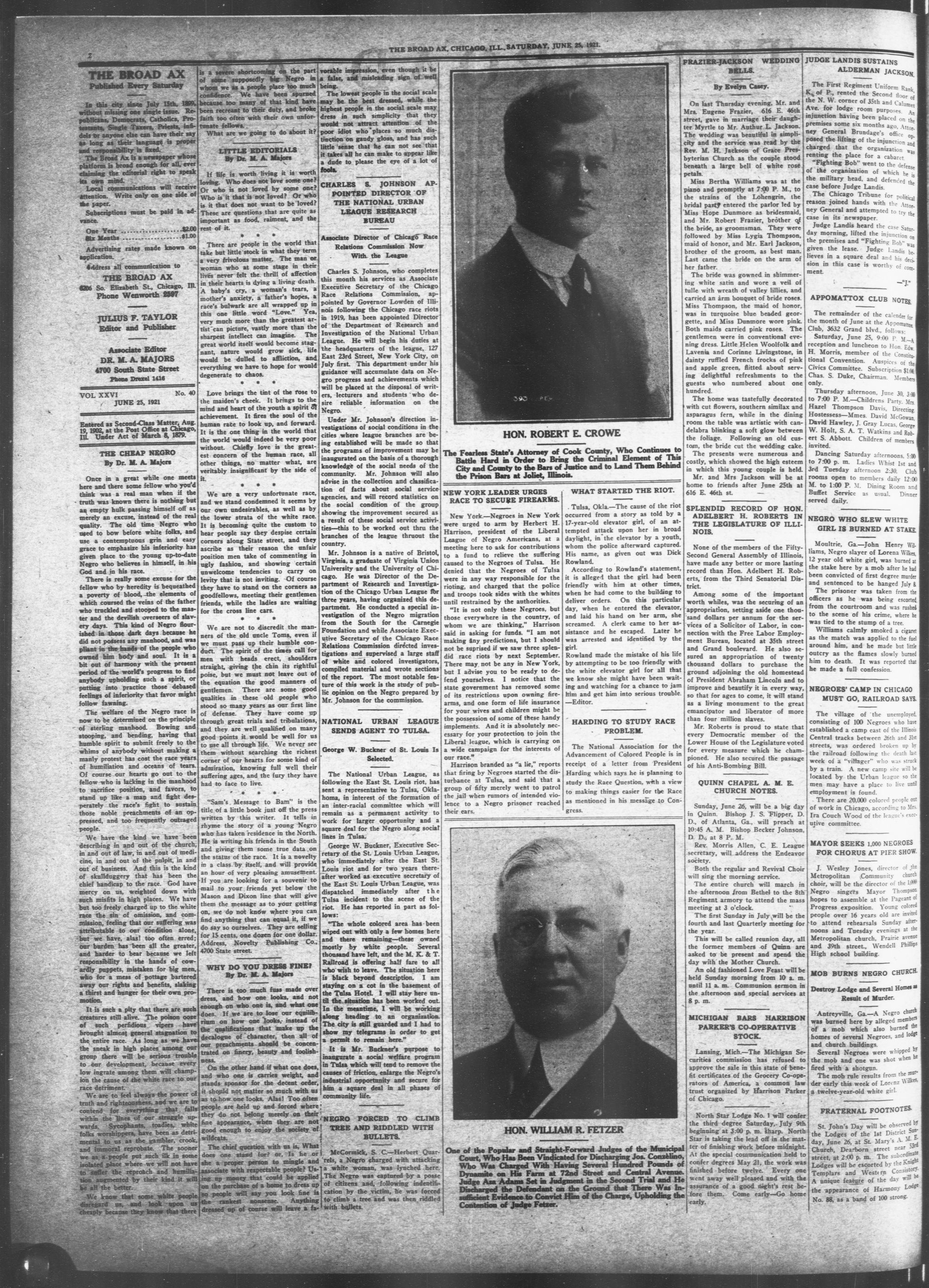
HON. ROBERT E. CROWE
The Fearless State's Attorney of Battle Hard in Order to Brit City and County to the Bars of the Prison Bars at Joliet, Illin
The Fearless State's Attorney of Cook County, Who Continues to Battle Hard in Order to Bring the Criminal Element of This City and County to the Bars of Justice and to Land Them Behind the Prison Bars at Joliet, Illinois.
NEW YORK LEADER URGES RACE TO SECURE FIREARMS.
New York—Negroes in New York were urged to arm by Herbert H. Harrison, president of the Liberal League of Negro Americans, at a meeting here to ask for contributions to a fund to relieve the suffering caused to the Negroes of Tulsa. He denied that the Negroes of Tulsa were in any way responsible for the rioting, and charged that the police and troops took sides with the whites until restrained by the authorities.
"It is not only these Negroes, but those everywhere in the country, of whom we are thinking," Harrison said in asking for funds. "I am not making any predictions, but I should not be suprised if we saw three splendid race riots by next September. There may not be any in New York, but I advise you to be ready to defend yourselves. I notice that the state government has removed some of its restrictions upon owning firearms, and one form of life insurance for your wives and children might be the possession of some of these handy implements. And it is absolutely necessary for your protection to join the Liberal league, which is carrying on a wide campaign for the interests of our race."
Harrison branded as "a lie," reports that firing by Negroes started the disturbance at Tulsa, and said that a group of fifty merely went to patrol the jail when rumors of intended violence to a Negro prisoner reached their ears.
[Name]
[Name]
HON. WILLIAM R. FETZER
One of the Popular and Straight Court, Who Has Been Vindic Who Was Charged With His Dynamite on His Farm at Judge Asa Adams Set in Jud Discharged the Defendant or sufficient Evidence to Convict Contention of Judge Fetzer.
One of the Popular and Straight-Forward Judges of the Municipal Court, Who Has Been Vindicated for Discharging Jos. Conzélino, Who Was Charged With Having Several Hundred Pounds of Dynamite on His Farm at 72nd Street and Central Avenue. Judge Aza Adama Set in Judgment in the Second Trial and He Discharged the Defendant on the Ground that There Was Insufficient Evidence to Convict Him of the Charge, Upholding the Contention of Judge Fetzer.
Cook County, Who Continues to ag the Criminal Element of This Justice and to Land Them Behind his.
WHAT STARTED THE RIOT.
Tulsa, Okla.-The cause of the riot occurred from a story as told by a 17-year-old elevator girl, of an attempted attack upon her in broad daylight, in the elevator by a youth, whom the police afterward captured. His name, as given out was Dick Rowland. According to Rowland's statement, it is alleged that the girl had been friendly with him at other times, when he had come to the building to deliver orders. On this particular day, when he entered the elevator, and laid his hand on her arm, she screamed. A clerk came to her assistance and he escaped. Later he was arrested and identified by the girl.
Rowland made the mistake of his life by attempting to be too friendly with the white elevator girl for all that we know she might have been waiting and watching for a chance to jam him and get him into serious trouble. —Editor.
HARDING TO STUDY RACE
PROBLEM.
The National Association for the Advancement of Colored People is in receipt of a letter from President Harding which says he is planning to study the Race Question, with a view to making things easier for the Race as mentioned in his message to Congress.
1930
Forward Judges of the Municipal Court for Discharging Jos. Conzélino having Several Hundred Pounds of 92nd Street and Central Avenue segment in the Second Trial and He is the Ground that There Was In Him of the Charge, Upholding the
On last Thursday evening, Mr. and Mrs. Eugene Frazier, 616 E. 46th street, gave in marriage their daughter Myrtle to Mr. Arthur L. Jackson. The wedding was beautiful in simplicity and the service was read by the Rev. M. H. Jackson of Grace Presbyterian Church as the couple stood beneath a large bell of white rose petals.
Miss Bertha Williams was at the piano and promptly at 7:00 P. M., to the strains of the Lohengrin, the bridal part entered the parlor led by Miss Hope Dunmore as bridesmaid, and Mr. Robert Frazier, brother of the bride, as groomsman. They were followed by Miss Lygia Thompson, maid of honor, and Mr. Earl Jackson, brother of the groom, as best man. Last came the bride on the arm of her father.
The bride was gowned in shimmering white satin and wore a veil of tulle with wreath of valley lillies, and carried an arm bouquet of bride roses. Miss Thompson, the maid of honor, was in turquoise blue beaded georgette, and Miss Dunmore wore pink. Both maids carried pink roses. The gentlemen were in conventional evening dress. Little Helen Woolfolk and Lavenia and Corinne Livingstone, in dainty ruffled French frocks of pink and apple green, flatted about serving delightful refreshments to the guests who numbered about one hundred.
The home was tastefully decorated with cut flowers, southern similax and asparagus fern, while in the dining room the table was artistic with candelabra blinking a soft glow between the foliage. Following an old custom, the bride cut the wedding cake.
The presents were numerous and costly, which showed the high esteem in which this young couple is held. Mr. and Mrs Jackson will be at home to friends after June 25th at 616 E. 46th st.
SPLENDID RECORD OF HON.
ADELBERT H. ROBERTS IN
THE LEGISLATURE OF ILLINOIS.
None of the members of the Fifty-Second General Assembly of Illinois, have made any better or more lasting record than Hon. Adelbert H. Roberts, from the Third Senatorial District.
Among some of the important worth whiles, was the securing of an appropriation, setting aside one thousand dollars per annum for the services of a Solicitor of Labor, in connection with the Free Labor Employment Bureau, located at 35th street and Grand boulevard. He also secured an appropriation of twenty thousand dollars to purchase the ground adjoining the old homestead of President Abraham Lincoln and to improve and beautify it in every way, so that for ages to come, it will stand as a living monument to the great emancipator and liberator of more than four million slaves.
Mr. Roberts is proud to state that every Democratic member of the Lower House of the Legislature voted for every measure which he championed. He also secured the passage of his Anti-Bombing Bill.
QUINN CHAPEL A. M. E.
CHURCH NOTES.
Sunday, June 26, will be a big day in Quinn. Bishop J. S. Flipper, D. D., of Atlanta, Ga., will preach at 10:45 A. M. Bishop Becker Johnson, D. D. at 8 P. M.
Rev. Morris Allen, C. E. League secretary, will address the Endeavor society.
Both the regular and Revival Choir will sing the morning service.
The entire church will march in the afternoon from Bethel to the 8th Regiment armory to attend the mass meeting at 3 o'clock.
The first Sunday in July will be the fourth and last Quarterly meeting for the year.
This will be called reunion day, all the former members of Quinn are asked to be present and spend the day with the Mother Church.
An old fashioned Love Feast will be held Sunday morning from 10 a. m. until 11 a. m. Communion sermon in the afternoon and special services at 8 p. m.
MICHIGAN BARS HARRISON PARKER'S CO-OPERATIVE STOCK.
Lansing, Mich.—The Michigan Securities commission has refused to approve the sale in this state of benefit certificates of the Grocery Co-operators of America, a common law trust organized by Harrison Parker of Chicago.
North Star Lodge No. 1 will confer the third degree Saturday, July 9th beginning at 3:00 p. m. sharp. North Star is taking the lead off in the matter of finishing work before midnight. At the special communication held to confer degrees May 21, the work was finished before twelve. Every one went away well pleased and with the assurance of a good night's rest before them. Come early—Go home early.
The First Regiment Uniform Rank, K of P, rented the Second floor of the N. W. corner of 35th and Calumet Ave. for lodge room purposes. An injunction having been placed on the premises some six months ago, Attorney General Brundage's office opposed the lifting of the injunction and charged that the organization was renting the place for a cabaret.
"Fighting Bob" went to the defense of the organization of which he is the military head, and defended the case before Judge Landis. The Chicago Tribune for political reason joined hands with the Attorney General and attempted to try the case in its newspaper. Judge Landis heard the case Saturday morning, lifted the injunction on the premises and "Fighting Bob" was given the lease. Judge Landis believes in a square deal and his decision in this case is worthy of comment. -"I."
APPOMATTOX CLUB NOTES
The remainder of the calendar for the month of June at the Appomattox Club, 3632 Grand blvd., follows:
Saturday, June 25, 9:00 P. M.—A reception and luncheon to Hon. Edw. H. Morris, member of the Constitutional Convention. Auspices of the Civies Committee. Subscription $1.00 Chas. S. Duke, Chairman. Members only.
Thursday afternoon, June 30, 3:00 to 7:00 P. M.—Childrens Party, Mrs. Hazel Thompson Davis, Directing Hostessess—Mmes. David McGowan, David Hawley, J. Gray Lucas, George W. Holt, S. A. T. Watkins and Robert S. Abbott. Children of members invited.
Dancing Saturday afternoonno. 5:00
to 7:00 p. m. Ladies Whist 1st and
3rd Tuesday afternoon 2:30. Club
rooms open to members daily 12:00
m. to 1:00 P. M. Dining Room and
Buffet Service as usual. Dinner
served daily.
NEGRO WHO SLEW WHITE
GIRL IS BURNED AT STAKE
Moultric, Ga—John Henry Williams, Negro slayer of Lorena Wilkes, 12 year old white girl, was burned at the stake here by a mob after he had been convicted of first degree murder and sentenced to be hanged July 8. The prisoner was taken from the officers as he was being escorted from the courtroom and was rushed to the scene of his crime, where he was tied to the stump of a tree. Williams calmly smoked a cigarette as the match was applied to the fuel around him, and he made but little outcry as the flames slowly burned him to death. It was reported that he made a full confession.
NEGROES' CAMP IN CHICAGO
MUST GO, RAILROAD SAYS
The village of the unemployed, consisting of 100 Negroes who have established a camp east of the Illinois Central tracks between 26th and 11th streets, was ordered broken up by the railroad following the death last week of a "villager" who was struck by a train. A new camp site will be located by the Urban league so the men may have a place to live until employment is found. There are 20,000 colored people out of work in Chicago, according to Mrs. Ira Couch Wood of the league's executive committee.
MAYOR SEEKS 1,000 NEGROES
FOR CHORUS AT PIER SHOW
J. Wesley Jones, director of the Metropolitan (Community church choir, will be the director of the 1,000 Negro singers Mayor Thompson hopes to assemble at the Pleasant of Progress exposition. Young colored people over 16 years old are invited to attend rehearsals Sunday afternoons and Tuesday evenings at the Metropolitan church, Prairie avenue and 39th street., Wendell Phillips High school building.
MOB BURNS NEGRO CHURCH
Destroy Lodge and Several Homes
Result of Murder.
Antreyville, Ga.—A Negro church was burned here by alleged members of a mob which also burned the homes of several Negroes, and lodge and church buildings.
Several Negroes were whipped by the mob and one was shot when he fired with a shotgun.
The mob rule results from the murder early this week of Lorenz Wilkes, a twelve-year-old white girl.
FRATERNAL FOOTNOTES.
St. John's Day will be observed by the Lodges of the 1st District Sunday, June 26, at St. Mary's A. M. E. Church, Dearborn street near 53rd street, at 2:00 p. m. The subordinate Lodges will be escorted by the Knight Templars and Western Consistory. A unique feature of the day will be the appearance of Harmony Lodge No. 88, as a band of 100 strong.
e "CHARLES E. STUMP...
ee
> (Concluded from page LY
Seeri to becomming
mors of business: <stsblishane
es ince 2
ee work Ee: teachers” © a
pores teachers eee he
Be commercial department is ep
poxsted ail over the country, working
fe the government, bani, tmamranes
ies, secret orders, and one ic
Sep amcrea serving the Standar
3 Company. 1 must stop for this
goo J ill talk about President Ed-
jeards and others in my next,”
1 wast stop long. enough to oe:
pasbie Prof. Aaron E. Maton
spon the recognition he received. He
joa scholar, 3 business man, @ philan-
fgropist, in fact, he is a man of the
poor, and is doing things. Right by
E; sie is that wonderful woman ol
ger race, Mrs. Anne E, Malone: By
$e works they are making the
worid better. They are'preparing tc
fire in the hearts of the people whe
‘gil come after them, *
‘aLLEED TO LOUISVILLE, KY.
Mrs. Bettie Grant, 4548 Sheridan
goad, wae called to the bed side of
fer sick mother at Louisville, Ky.,
Ys Grant is a member of Pilgrim
Coancl A. U. K, & D. of A
MANY VISIT SUBURB.
Mr. and Mrs. Eugene N. Penamon,
Mr and Mrs. Clarence Johnson, M-
[soy Davenport and other persons
yeted Morgan Park Sunday.
VIRGINIAN SOCIETY PRO-
GRESSING.
‘The Virginia Society met at 3638
Sate St, June 15, at which time they
took in 2 number of new members
jot devised a plan to entertain mem-
bers and friends in their July meet-
- :
70 MOVE TO MORGAN PARK.
Mr. and Mrs. Benjamin Sulinger,
325 Federal St, are going to move
fo Morgan Park, and will live on
Bizabeth and 112th Place, until
they erect their home on lots pur-
thased through The Bailey Realty
Co.
‘TO VISIT CITY.
Hon, Wm. H. Fields, National
Grand Master of the Ancient United
Knights and Daughters of Africa is
to visit the city in order to consult
with the head officers concerning the
Grand Council which meets here in
Angust.
MOVE TO SUBURB.
Mr. and Mrs. L. W. Ivy, 3812 Eden
Ave, have moved to Morgan Park,
113846 Throop St.
RETURNS FROM SOUTHERN
ILLINOIS. —
Mrs. Lou Ella Young, 3556 Giles
Ave, returns from Southern Illinois.
Her trip was made im the interest of
the Household of Ruth.
CH. DUKE RETURNS.
Charles H. Duke, Treasurer of the
Pyramil Building aid Loan Associa-
tin, returned to the city after two
weeks vacation at Idlewild, “Mich.
Mr Duke is a civil engineer and
architect, and. is preparing. to build
cottaces im Idlewild.
WILL SERVE RACE.
M T. Bailey, pres, The Bailey
Ralty Co, 3638" State St, can be
foun’ every Sunday at 11ith aid Ra-
cnc Ave, Morgan Park-and is will:
ing to serve members of the race in
eating good lots for their future
home.
VISITING DAUGHTER.
Mrs. James H. Truitt of Harris-
burg, Ill, is visiting the city and is
the guest of her daughter, Mrs. Char-
lowe Vaughn, 4718 Champlain Ave.
ee ®
A DAY IN THE SUBURBS. _
Mrs. Daisy Thomas, 28°E. 44th St.
Spent the day last Sunday ‘with her
friends, Mr. and Mrs. Thornton Hens
— 10844 Glenroy Ave, Morgan
ee oe
Alter several weeks of illoess’ at
Hot Springs, 4 he: Rev. C. H
“a pastor of Ebenezer « Baptist
rch returns. eo.
Bro. W. 1 “Thomias, the efficient
receary of Tye: Lode No 7
sends out a snappy etter #0.
ltis hard to imagiog @ ast
itr aside one, without: carefully. ead>
ing it. Watch for snappy ao
wer of she grat West Si af
Alshed by “WoL? 5 = ey a
ee
Resioned the Wice Presidbney.
The only vice president f
a. John ©. 2
= eae aa oa
‘STYLE FOR -EVENIN 1G GOWNS
Parle Mode ‘Permilia of Broad indi:
widualiem Im Selection of Gar.
< ments for Formal Wear,
From the sprin, ‘-
comes: the repert thet the style for
evening gowns continues to be “eclec-
‘tique.” which ‘being. interpreted . into
‘crude American slang means each fel-
Yow for. himself and each in his own
Sr, hake fs Ee tebe ald ta
‘taver tt gives @ large va-
Fiety from which to make a choice
‘and {t allows that trend toward indi.
Vidualism tn Gress to have full and
unintesrupted sway. The Parisian
esigner this season, it seems, bas ac-
complished every manner of style and
‘bas drawn for his ideas upon every
source ‘of inspiration.
“Polrct, for instance, has done a
grent deal in the Way of Spanish eve-
‘ning gowns which show panniers bulg-
‘tag out over the hips in many and
voluminous folds.” A frequent decol-
ete is termed “The Empress En-
genie.” and when. the sort of gown 1s
cut very low, as it often ts, there are
delicate metal chains used to sip over
the shoulders-and to hold the gown in
Place. At this house, too, there is to
be seen another evening fashion which
@iscloses completely one shoulder and
which bas a point of the draped tab-
tle reaching over the other shoulder,
Heaving the beck quite free from cov.
‘ering. Over the uncovered shoulder
Se acs oes eee
‘Tt ts the evening gown which was
best Uked in Paris during the winter
‘season and which Poiret has seen fit
to repeat, as has also the house of
Madeleine et Madeleine.
‘Madeleine et Madeleine have a fas.
cimating evening gown of metal bro-
cade In Persian colorings. One arm
is left entirely without 2 sleeve of
any sort and the other one is covered
‘with ropes of pearis wound about to
form a sleeve tightly fitting and to
tally transparent.
‘The Oriental Influence dominates
al of the gowns shown by Patou. The
Tobe called “Cleopatra,” as its name
suggests, is wholly Beyptian in char
acter. It has a bett of metal orna-
ments set with carbuncles. Another
termed “Princesse Persane™ ts of tulle
braided in gold, interspersed with
green end gold threads.
FASHION NOTES OF INTEREST
A fine black Ince frock bas ® tunic
‘of black ostrich fringe.
" Pokes and smart bow trimmed. hats
‘sre prominent in the spring showings
Some of the new skirts shown in
Paris are only a “flounce” fastened to
an elongated bodice.
‘Appliques of colored leather are
teen on pumps of patent leather.
Gray and “honeydew,” « shade deep-
@ than apricot, is 2 smart combins-
tion,
‘While many drooping effects are
seen on the spring millinery, eome ex-
tremely high effects are also prom
mest.
Reports from abroad acclaim the
Ceeply fringed shawi as the favored
evening wrap.
Handkerchief draped panels are chic
on a white tulle gown.
Leather, lingerie and colored pique
are seen in French waistcoats and
Dlouses. =
Unique Camisole,
‘White or light-colored silk stock-
ings, worn at the -heels or toes, may
be used for a “dainty camisole” by re-
moving the feet and cutting the upper
parts along the back seam. Use lace
three inches wide for the top of the
camisole, also to join the two pleces
‘of silk together in the back. Ribbon
for shoulder straps helps to "make it
attractive,
CREPE DE CHINE IS POPULAR
Fabric Strongly Featured in French
Capital and Is Expected to
Assert Sway Here.
Crepe de chine st present is ove of
‘the most featured frock fabrics in the
French capital and undoubtedly it will
‘assert its sway in this country. It is
‘also one of the most durabie of lingerie
‘materials and trimmed*with point de
Paris, or Calais lace or tucked in the
|more tailored modes fashions some of
‘the smartest of undergarments,
‘Crepe satin, radium, gros de Londre
‘and georgette are other fabrics, while
‘Qarrickmacross, rose filet and Irish
‘crochet are laces In vogue #3 trim-
‘mings. Besides white and flesh, such
‘shades as raspberry, veptune green
‘hoveydew and jonguil are popular.
‘The Parisian is very partial to the
Jong chemise or princess slip. Some
et these are developed in georgette
‘wich many rom of Patt, others, an
‘trimmed with filet and Calais
‘the lace often being cascaded from
the hips and Graping to the bem.
‘Piaited satin ribbon is used to form
‘the bodice on some of the newest sitpa
‘the skirt usually Deing of georgette
under lace. 2
SF tee
: ee
‘The selection made by ove of the
most charming Parisienne society
girls for her wedding gown: The
skirt wa} shirt, while the long man-
teat de cour was matrelously em
broldere4 in silver thread and dor
dere with « double row of white for.
‘Tals 1s, of course, not the traditional
gown, but the bride thus gowned
made s beautiful picture So, after
‘all, she was right in that case net t
lve up to tradition.
‘Custom Long Kept Up.
Up toa few sears ago» horse, sad
‘Gled apd bridied, stood in the stables
‘of the Vivyadis (Vivian, as it- was
-gpelied ta the old days) of Trelowarres
(Coruwall,. Eng.) ready: for ase nigh!
and dag. For 90). years dorses: bad
‘succeeded cach ether in commemort
lon of the escape ao barsedack of 8
‘Vivian who lived tx ‘the days of the
‘memorebie flood which submerged the
Yand, some say io-1014 and othere ts
‘TSE BROAD AX, CHICAGO, ILL. SATURDAY, JUNE 25, 1921.
Q
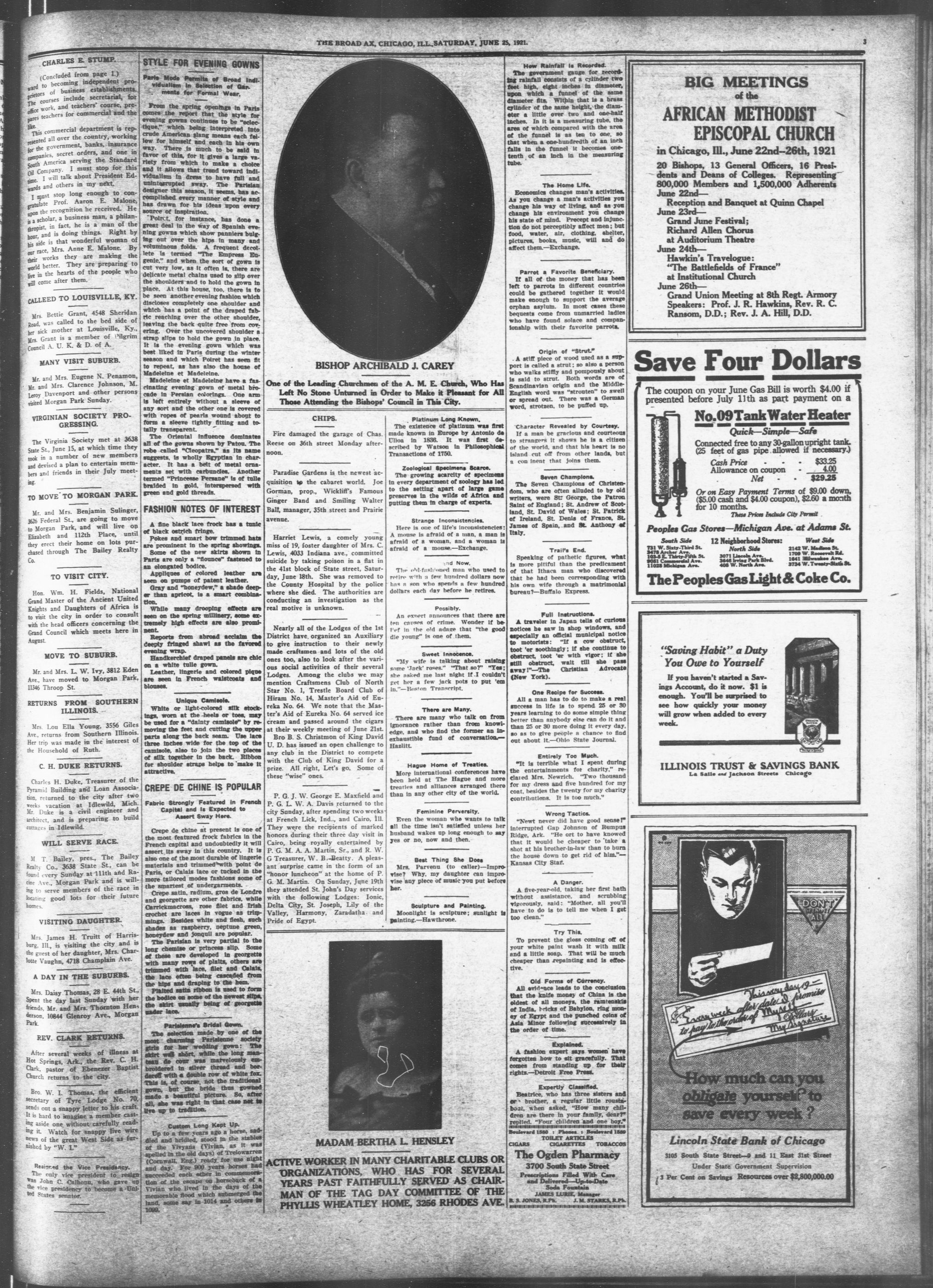
BISHOP ARCHIBALD J. CAREY
One of the Leading Churchmen of the A. M. E. Church, Who Has
"Left No Stone Unturned in Order to Make it Pleasant for Al
Those Attending the Bishops’ Council in This City.
Fire damaged the garage of Chas.
Reese on 36th street Monday after-
noon.
Paradise Gardens is the newest 2c-
quisition tp the cabaret world. Joe
Gorman, prop. Wickliff's Famous
Ginger Band and Smiling Walter
Ball, manager, 35th street and Prairie
avenue.
Harriet Lewis, a comely young
miss of 19, foster daughter of Mrs. C.
Lewis, 4033 Indiana ave, committed
suicide by taking poison in a flat in
the 4ist block of State street, Satur-
day, June 18th. She was removed to
the County Hospital by the police
where she died. The authorities are
conducting an investigation as the
real motive is unknown.
Nearly all of the Lodges of the Ist
District have. organized an Auxiliary
to give instruction to their newly
made craftsmen and lots of the old
‘ones too, also to look after the vari-
ous social activities of their several
Lodges. Among the clubs we may
mention Craftsmens Club of North
Star No. 1, Trestle Board Club of
Hiram No. 14, Master's Aid of Eu-
reka No. 64 We note that the Mas-
ter’s Aid of Eureka No. 64 served ice
ream and passed around the cigars
at their weekly meeting of June Zist
Bro B. S. Christmon of King David
U, D. has issued an open challenge to
any club in the District to compete
with the Club of King David for a
prize. All right, Let's go, Some oi
these “wise” ones. $
P.G. J. W. George E. Maxfield and
P. G. L. W. A. Davis returned to the
city Sunday, after spending two weeks
at French Lick, Ind... and Cairo, Il.
They were the recipients of marked
honors during their three day visit in
Cairo, being royally entertained by
P.G. M. A.A. Martin, Sr. and R. W.
G Treasurer, W. B--Beatty. A pleas-
ant surprise came in the form of an
“honor luncheon” at the home of P.
GM. Martin. On Sunday, June 19th
they attended St. John’s Day services
with the following Lodges: Ionic
Delta City, St. Joseph, Lily of the
Valley, Harmony, Zaradatha. and
Pride of Egypt.
| .
| .
|
| @)
| IN ENN
‘eae od
| GA
MADAM_-BERTHA L. HENSLEY
ACTIVE WORKER IN MANY CHARITABLE CLUBS OR
‘ORGANIZATIONS, WHO HAS FOR SEVERAL
‘YEARS PAST FAITHFULLY SERVED AS CHAIR-
MAN OF THE TAG DAY COMMITTEE OF THE
" PHYLLIS WHEATLEY HOME, 3256 RHODES AVE.
CHIPS.
‘The growing scarcity of specimens
tn every department of zoology has led
to the setting apart of large game
‘preserves in the wilds of Africa and
‘putting them in charge of experts.
Strange Inconsistencies,
Here is one of life's inconsistencies:
‘A mouse Is afraid of man, a man fs
afraid of & woman, and a woman is
afraid of a mouse—Exchange.
nd Now.
‘The oM-fashioned man who wsed to
retire with a few hundred dollars now
has n son who spends a few hundred
dollars each day before he retires.
An exnert announces that there are
ten causes of crime. Wonder if be
Vet in the old adage that “the good
die young” Is one of them.
‘Sweet Innocence.
“sy wife Is talking about raising
some ‘Tack’ roses." “That so?” “Yes;
she asked me last night 1f-T couldn't
get her a few jack pots to put "em
in."—Boston ‘Transcript.
‘There are Many.
‘There are many who talk on from
Ignorance rather than from knowi-
edge, and who find the former an in-
exhaustible fund of conversation—
Haalitt.
Hague Home of Treaties.
‘Morp international conferences have
been held at ‘The Hague and more
treaties and alliances arranged there
than in any other elty of the world.
Feminine Perversity.
Even the woman whe wants to talk
fall the time isn't satisfied unless her
busband wakes up long enough to say
yes or no, now and then.
aid ee
‘Mrs, Parvenu (to caller)—Impro
vise? Why, my daughter can impro
ye ‘any plece of music you put before
Sculpture and Painting.
‘Moonlight is sculpture; sunlight ts
painting —Hawthrone.
Possibly.
"Hew Rainfall te Recorded.
‘The government gauge for record
tng rainfall consists of @ cylinder two
feet high, eight inches tn diameter,
upon which a funnel: of the seme
@iameter fits, Within that is 2 brass
eqlinder of the same height, the diam-
eter a little over two and one-half
inches. In it is 2 measuring tube, the
area of which compared with the area
of the funnel is as ten to one, 20
that when a one-hundredth of an inch
falls in the funnel it becomes one-
tenth of an inch in the measuring
BIG MEETINGS
of the
AFRICAN METHODIST ~
EPISCOPAL CHURCH
in Chicago, Ill., June 22nd—26th, 1921
20 Bishops, 13 General Officers, 16 Presi-
~ dents and Deans of Colleges. Representing™
800,000 Members and 1,500,000 Adherents
ed i
were Banquet at Quinn Chapel
Grand June Festival;
Richard Allen Chorus
at Auditorium Theatre
June 24th—
Hawkin’s Travelogue:
“The Battlefields of France”
at Institutional Church
June 26th—
Grand Union Meeting at 8th Regt. Armory
Speakers: Prof. J. R. Hawkins, Rev. R. C.
Ransom, D.D.; Rev. J. A. Hill, D.D.
‘The Home Life.
- Beonomics changes man’s activities
‘Ag you change & man’s activities you
‘change his way of living, and as you
change his envirooment you change
is state of mind. Precept and injune-
tion do not perceptibly affect men; but
food, water, alr, clothing, shelter,
pictures, books, music, will and do
affect them—Exchange.
Parrot a Favorite Geneficiary.
If all of the money that has been
Jeft to parrots in different countries
could be gathered together it would
make enough to support the average
orphan asylum. In most cases these
bequests come from unmarried ladies
‘who have found solace and compan-
fonship with their favorite parrots,
Save Four Dollars
—
The coupon on your June Gas Bill is worth $4.00 if
presented before July 1Jth as part payment on a
No.09Tank Water Heater
a
Quick—Simple—Safe
Go Sor as see aioe if —s
Allowance on coupon - 4.00
Net - + $29.25
earns iota
‘These Prices Include City Permit
Peoples Gas Stores—Michigan Ave. at Adams St.
cet Seat ein
aa BE So.
The Peoples Gas Light & Coke Co.
Origin of “Strut”
A stlft plece of wood used as a sup
port is called a strat; so also a person
who walks stiffly and pompously about
fs said to strut. Both words are of
Scandinavien origin and the Middle-
English word was “strouten” to swell
or spread out. There was a German
‘word, strotzen, to be puffed up.
—__—_
“Character Revealed by Courtesy. —
If a man be gracious and courteous
to strangers it shows he is a citizen
of the world, and that his heart 1s no
island cut off from other lands, but
‘a con Inent that joins them.
Seven Champions,
‘The Seven Champions of Christen-
dom, who are often alluded to by old
writers, were St: George, the Patron
Saint of England; St. Andrew of Scot-
land, St. David of Wales; St. Patrick
of Ireland, St. Denis of France, St
James of Spain, and St. Anthony ef
Tealy.
Trait's End.
Speaking of pathetic figures, what
fs more pitiful than the predicament
of that Ithaca man who discovered
that he had been corresponding with
his own wife through a matrimonial
bureau?—Buffalo Express.
Full inetructions.
“Saving Habit” a D aa
You Owe to Yourself a
If you haven’t started a Sav- 1 if
ings Account, do it now. $1 is
enough. You'll be surprised to Caer
see how quickly your money jaa
will grow when added to every
Le)
2
ILLINOIS TRUST & SAVINGS BANK
La Satle ew Jackson Streets Chicago
Lee eae can
notices he saw in shop windows, and
‘especially an official municipal notice
‘to motorists: “If a cow obstruct,
toot ‘er soothingly; if she continue to
‘obstruct, toot ‘er with vigor; if she
stim obstruct, wait till she pass
‘away!"—The Christian Advocate
Glew York).
‘One Recipe for Success.
All a man bas to do to make a real
success in life Is to spend 25 or 30
years learning to do some simple thing
better than anybody else can do it and
than 25 or 80 more doing it every day,
0 a8 to give people a chance to find
‘out about it—Ohio State Journal.
Entirely Too Much.
“It ts terrible what I spent during
the entertainments for charity,” re-
dared Mrs. Newrich. “Two thousand
for my dress and five hundred for my
coat, besides the twenty for my charity
contributions. It is too much.”
‘Wrong Tactics.
“Wewt never did have good sense!
interrupted Gap Johnson of Rumpus
Ridge, Ark. “He ort to have knowed
that it would be cheaper to ‘take a
shot at his brother-in-law than to burn
the house down to get rid of him.”—
Kansas City Star.
0 \e wr | rs
= Jen a7 |
Bree ee, CAF as
os er ee
cS Pe
ee dabe V2
I \ aes a ee |
eee
| = Bigicae yoursa eg
pi IN ENO EER Se
Lincoln State Bank of Chicago
305 South State Street—9 and 11 East Sist Street
: ‘Under Staté Government Supervision
eC Per Cent om Savings Resources over $2,800,000.00
A Daneer.
A five-year-old, taking her first bath
without assistance, and scrubbing
vigorously, said: “Mother, all you'll
have to do is to tell me when I get
too clean.”
Try This,
‘To prevent the gloss coming off of
your white paint wash it with milk
and a little soap. That will be much
cheaper than repainting and is effec.
tive.
Old Forms of Carrency.
All evidence leads to the conclusion
that the knife money of China is the
eldest of all moneys, the ramtenskis
of India, bricks of Babylon, ring mon-
ey of Egypt and the punched coins of
Asis Minor following successively in
‘the order of time.
Explainel.
A fashion expert says women’ have
forgotten bow to sit gracefully. That
comes from standing up for thelr
rights—Detroit Free Press.
‘Gienaitad ‘Cietamen
‘Beatrice, who has three sisters and i Sn ieteale wraseceul"ta~
Boat, when asked, “How many chil-| Ps Si gre eg
Gren are there in your family, dear?”| peat BI a, Ef
fed. “Four children ‘and one boy.” be Rta ee ee PE ee
ae Pa AES, Lincoln State Bank of Chicago
The Ogden Pharmacy 3105 South State Street—9 and 11 East Sist Street
3700 South State Street * ‘Under State Government Supervision “
Peet nae [5 Pet Cent on Savings Resources over $2,800,000.00
‘Soda Fountain
JAMES LURIE, Manager 7,
|B. S. JONES, RPE ‘J. M. STARKS, RPh ™
Derr erer Srerneerseneen rere :
May Gilbert Praises
EXELENTO QUININE
POMADE
Says her hair has grown
28 inches long by using
this wonderful hair grower
YOU can have soft, silky hair that can be easily dressed.
EXELENTO has made happy thousands of women who had
coarse, nappy hair. It will do the same for you. If your
hair is brittle and lifeless or if you have dandruff and itching scalp, try a box of EXELENTO QUININE POMADE.
For sale at all drug stores. Price by mail 25c on receipt of stamp or coin.
AGENTS WANTED—Write for Particulars
EXELENTO MEDICINE COMPANY, Atlanta, Georgia
We make EXELENTO SKIN BEAUTIFIER, an倍受大众的 dark, shallow skins,
used in treatment of skin troubles.
HOWARD UNIVERSITY WASHINGTON, D. C.
J. STANLEY DURKEE, A. M., Ph. D., President EMMETT J. SCOTT, A. M., LL.D., Secretary-Treasurer
leading to the Senior
Senior College, consisting of the Schools of Liberal Arts, Education,
Journalism, and Commerce and Finance, granting respectively the
degrees. A. B. or B. S.; A. B. or B. S. in Education; B. S. in Jour-
nial in Commerce.
School of Applied Science, four year course, giving degree, B. S. in C. E.; B. S. in E. E. B. S. in M. E., B. S. in Architecture; B. S. in Agriculture, and B. S. in Household Economics.
School of Music, four year course, giving degree of Mus. B.
School of Religion, three year course, giving degree of B. D. (Also Diploma and Correspondence Courses.)
School of Law, three year evening course, giving degree of LL.B.
School of Medicine, including Medical, Dental, Pharmaceutical Colleges. Four year course for Medical and Dental Students; three years for Pharmaceutical students. Following degrees given: B. D. S. Phar. C.
M, D, D, D, S, Ph. H.
Students may enter for Collegiate Work at the beginning of any quarter.
REGISTRATION:
Autumn Quarter.....September 27 to 29, 1920
Winter Quarter.....January 8, 1921
Spring Quarter.....March 19 and 21, 1921
For Catalog and Information write
DWIGHT O. W. HOLMES, Registrar
Howard University,
Washington, D. C.
TELEPHONE DOUGLAS 1
GEORGE F. H.
REAL K
Up-to-Date or Modern
and Store
3101 COTTAGE
Corner 31st S
Office Phone:
KERSEY, McGOWA
CHICAGO'S RE
AGE F. HARDING
REAL ESTATE
Date or Modern Houses, Ap-
and Stores to Rent
COTTAGE GROVE
Corner 31st Street, Chicago
Office Phone: Douglas 8285
SEY, McGOWAN AND MOR
CHICAGO'S REPRESENTATIVE
Up-to-Date or Modern Houses, Apartments and Stores to Rent
3101 COTTAGE GROVE AVE.
Corner 31st Street, Chicago
KERSEY, McGOWAN AND MORSELL
CHICAGO'S REPRESENTATIVE
UNDERTAKERS
Finest Establishment in the U. S.
GEO. T. KERSEY D. A. McGOWAN WM. J. MO
Preprieters
3515 INDIANA AVENUE CHICAGO
FROM ON AND AFTER THIS DATE
THE
Notary Public
Phones: Office Main 4153
697-734-2222
MERSEY D. A. McGOWAN WM. 3
Proprietors
ANA AVENUE CHI
AFTER THIS DATE
NOTARY
Phones: Office Mail
GEO. T. KERSEY D. A. McGOWAN WM. J. MORSELL Preprieters
BROAD AX CAN ALWAYS BE
FOUND ON SALE AT THE FOLLOWING NEWS STANDS:
Dr. J. S. Dorsey's Drug Store, 434 E.
31st Street, corner Vernon Avenue.
The Porter-White Drug Co. Store,
southwest corner 4700 S. State St.
barber shop and
1803 S. State St.
notions, cigars and
202 S. Dearborn St.
Residence, 1803
Tue. am
MILES J.
ATTORNEY
BARDING, JR.
STATE
In Houses, Apartments
to Rent
GROVE AVE.
Street, Chicago
Douglas 8235
N AND MORSELL
REPRESENTATIVE
Notary Public
Phones: Office Main 4153; Residence,
4751 Champlain Avenue.
Phone Kenwood 5611
Walter M. Farmer
ATTORNEY AND COUN-
SELOR AT LAW
Suite 708—184 W. Washington St.
CHICAGO
Residence, 1868 Massillon Place
Ton. insured, 2714
MILES J. DEVINE
ATTORNEY AT LAW
CHICAGO,ILL
TRAINING NEGRO HOME-MAKERS—MISS LYFORD, OF HAMPTON, ADDRESSES SOUTHERN HOME ECONOMICS ASSOCIATIONS; NEW AND GROWING INTEREST SHOWN IN HOME ECONOMICS EDUCATION.
Nashville, Tenn.—That home-economics education in the colored schools of 14 Southern states is recognized as essential to a well-rounded curriculum and that earnest efforts are being expended to raise the standard of work in colored schools, through more adequate financial support and improved supervision, was the opinion expressed by Miss Carrie Alberta Lyford, director of the Hampton Institute home-economics school, in her recent address on "Home-Economics Education for the Colored Girl," delivered before the Southern Home Economics Association, which met at George Peabody College.
"Courses in home-making in Negro schools," said Miss Lyford, "have been carried on in various parts of the South for more than fifty years, but so scattered have been these efforts to train Negro girls to standards of better living, so lacking in recognition by the State departments of education, and so generally thwarted by the absence of a definite, carefully-arranged well-adapted program that there can be said to have existed no well-defined plan of home-economics education for the Negro girl.
"With the appointment of supervisors of colored rural schools in every Southern state, with the development of recognized home economics departments in the State normal schools for Negroes, with the growth of the home-demonstration work for Negro women under the U. S. Department of Agriculture, and with the establishment of vocational home economics under the Federal Board for Vocational Education, the need for a definite scheme for home-economics education for the Negro girl has become increasingly apparent.
"Negro education along all lines has suffered sorely through lack of organized effort and co-operative endeavor. Home-economics education for the Negro has in no sense been an exception to the prevailing condition, though special interest in some phases of the work, funds for maintenance, and recognition by educators have all been lacking. In many cases cooking schools have been left without stoves, sewing rooms have been without machines; no provision has been made for supplies for cooking or sewing lessons; and State and county officials too frequently have known nothing of existing conditions
Early courses in home-making for Negro girls were largely taught by Northern white women who came South to aid in the establishment of industrial schools which were supported by Northern capital. These scattered industrial schools, however, became centers of development for the Negro communities in which they were established but the fact that they were 'private' institutions deprived them of that wide usefulness, which it is alone possible for well-supported State institutions to exist. Such institutions as Hampton and Tuskegee, which have had a high degree of independence and of freedom from binding conditions, have made possible the development of a type of education that is full of suggestion for vocational schools today.
"The motto of Hampton, 'Learning by Doing,' has stood for making use of all the facilities of daily life for training. Thus, from the first, the girls were carefully trained in various processes of house work, even though no formal courses of home economics were developed. Such training has continued to form an important part of the home-economics education of Hampton girls and of the girls in all the well-conducted industrial schools." Miss Lyford paid warm tribute to the pioneer home-economics work which had been done in Norfolk, Newport News, and other Southern cities during the past twenty-five years. She also commended the valuable work of the State supervisors of rural colored schools and the Jeanes industrial supervising teachers, who aim to improve the Negro girl, her home and her community.
Modern Home-Economics Courses. "The home-economics course," said Miss Lyford, "that does not make the girl a healthier, better-dressed, more industrious, and a more honest girl fails of its first purpose. The girl who has learned to care for and to control herself and to spend her money wisely has received the fundamental training necessary before she can be prepared to take her place as the head of a home or to assume those wider responsibilities which make for better community life. The Negro home will show the results of school training that is effective and only as it does, will the needed improvement in community life be brought to pass.
"Today, because of the recognized changes that are taking place in economic and social conditions, all teachers feel the pressing need of preparing their girls for lives of usefulness, of developing habits of thrift, and of awakening a spirit of responsibility in those upon whom the future welfare of the race is to rest. "All know that the old-time cabin is passing and that the homes of the colored people must be made as sanitary, as attractive, and as inspira-
tional to family life as are the homes of any other civilized race. It is a fact that Negro girls today come from homes that range from the poorest to the best and that they come to their home-economics work with corresponding backgrounds of experience.
"When determining the sort of home-economics course that is to be offered, it is necessary to know very definitely the amount of preparation that the teachers have had and their ability to carry on the work. The limitations in the educational opportunity of the colored people are nowhere more apparent than in the preparation of their teachers. This is particularly true of the teachers of home economics, most of whom have had a meager elementary education, a still more limited secondary education, and a normal training of a few weeks in summer school, or, at best, a few months of practice teaching in conjunction with a secondary course.
"Two-year normal courses are being offered today, but it will be many years before the home-economics teachers who finish such courses will be sufficient in number to supply the demand for teachers of home economics in all the city schools and in the county training schools of the South. Fewer by far are the colored teachers of home economics who have earned a college degree. There is an increasingly large number of young colored women who are completing courses in the colored colleges of the South. Majors, however, in home economics have not been offered in these colleges. At the same time the occasional graduate of a Northern college seldom finds her way back to Southern schools and even then her course may have prepared her inadequately for the conditions which she has to face in her every-day work within and without the classroom.
"For many years to come, home-economics courses must be so planned that they can be effectively taught by teachers who have been trained in the industrial schools. They are capable of doing good work and great numbers of them are doing effective work all over the South. Their work can be strengthened by wise supervision and by increased opportunities for summer-school courses and other forms of advanced study. Probably no class of teachers is more eager for opportunity for self-improvement than these women who are so intimately acquainted with the conditions of their own people and who feel the needs so keenly and their own inadequacy so greatly. The industrial school has given them fundamental training, which every girl needs and without which our home-economics courses will never be successful. This fundamental training in better living is the greatest need of the Negro girl, for upon it the improvement of the home depends."
INTAILOR-MADES
Little Jacket Feature of New Spring Outfits.
Garment Is Jaunty and Winsome Affair of Fairly Straight and Unfitted Lines.
Close beside the spring tailleur of classic lines, and guiltless of braiding or trimming, there appears this spring that perky little dressy suit so unconventional in many ways.
The new little jackets are called by the French "paletots sacs," and they are jaunty little affairs of fairly straight and unfitted lines. They end at just about the waistline, unbelted, but left loose and rippling where they are finished.
Jean Patou shows the paletot sac that is quite short with a wavy line at the bottom that rather slumps toward the back than otherwise. A suit of this type is made of moroccan crepe in very dark blue faced with silk printed in the designs and colors of a cashmere shawl. The little jacket, by the way, is reversible and is well suited in either role to the little one-piece frock that is designed to be worn with it.
Most of these short coats are made to accompany the one-piece dress rather than the separate blouse with its skirt to match the coat. Sometimes, indeed, the coat buttons to the frock instead of being fastened together, as is the time-honored way with coats either long or short. Often the upper section of the dress is made of some lighter material than the lower section which matches the coat, and again the whole frock may be of a heavy silk, while the coat is of some woolen fabric matching it in color. Indeed, at most of the conturiers there are to be seen these two distinct types of street suits for spring—one that is strictly tailored, having a coat that reaches the knees or even below that line, and the other that in some way shows a fanciful little coat or one of the shorter capes.
Telephone Oakland 246
E. K. CALDWELL
Suspect to
C. E. KREYSSLER
DEUGGHT
8007 South State Street Near Sint St.
Not On The Corner CHICAGO
FUNERAL DIRECTORS
UNDERTAKER
PRIVATE ABUILANCE
AUTO AT ALL HOURS
ALL MONTHS 459
5121 ERNEST H. WILLIAMSON UNDERTAKER
GARAGE
GASOLINE, OIL
OPEN BAY & NIGHT
Day Light Chapel, capacity 200, Outside Ventilation—Organ and Organist Free—I am as near as your Telephone—I give service at a reasonable price—Distance immaterial, consult me—I save you wor y, time and money.
PHONE MAIN 2824
A. D. GASH
ATTORNEY AT LAW
118 N. La Salle Street
CHICAGO
Residence 3342 Calumet Ave.
Telephone Douglas 1278
JAMES G. COTTER
ATTORNEY AT LAW
145 NORTH CLARK STREET
SUITE 407
Telephone Central 8384
CHICAGO
Formerly
Assistant Attorney General
State of Illinois
Res. 3848 Grand Bout.
Doug. 4397
J. GRAY LUCAS
129 E. 31ST STREET
Suite 16-17
Phone: Douglas 6351
CHICAGO
F. Dunn, J. R. McCahay,
Trustees
Tel: Oakland 1852, 1851, 1850
JOHN J. DUNN
Established 1877
WHOLESALE AND RETAIL
COAL
Fifty-First and Federal Streets
CHICAGO
Ackdenceon 8885 Franklin Ava.
Phone Douglas 9188
Phones: Main 2017 Auto 88-395
A. L. WILLIAMS
ATTORNEY AND
COUNSELOR AT LAW
Suite 706 Fremont Building
84 W. Washington Street
CHICAGO
PHONE KENWOOD 455
West Englewood Ashland State Bank CAPITAL AND SURPLUS $300,000.00
1610 West 63rd Street
Comparative Statement of Deposit
November 18, 1912, $836,605.23
November 17, 1914, $912,005.69
November 17, 1916, $1,132,750.72
November 18, 1918, $1,284,084.24
November 17, 1919, $2,359,636.62
November 15, 1920, $3,224,633.09
OFFICERS
JOHN BAIN, President
MICHAEL MAISEL, Vice President
EDW. C. BARRY, Cashier
W. MERLE FISHER, Assistant
ARTHUR C. UTESCH,
OFFICERS
N, President
AEL MAISEL, Vice President
DW. C. BARRY, Cashier
W. MERLE FISHER, Assistant
ARTHUR C. UTESCH,
JOHN BAIN, President
MICHAEL MAISEL, Vice President
EDW. C. BARRY, Cashier
W. MERLE FISHER, Assistant Cashier
ARTHUR C. UTESCH, Asst. Cashier.
Another Definition.
A pessimist is one who sees in a simple nothing except the future site for a wrinkle. And an optimist is one who sees in a wrinkle only the dimple that once was there.
Golden Plover a Traveler. The golden plover travels farther than any other bird. It breeds as far north as Labrador, and goes as far south as Brazil.
The Cranford Apartment
3600 WABASH
The finest building ever opened to C
Steam heat, electric lights, tile
Phone Main 263 J. W. Casey, A.
ranford Apartment
3600 WABASH AVENUE
building ever opened to Colored ten-
at, electric lights, tile baths, mar-
63 J. W. Casey, Agt. 133 W
The finest building ever opened to Colored tenants in Chicago. Steam heat, electric lights, tile baths, marble entrance Phone Main 263 J. W. Casey, Agt. 133 W. Washington St.
FUNERAL DIRECTOR
AL DIRECTORS
CERS
Prince President
Cashier
PUSHER, Assistant Cashier
R C. UTESCH, Asst. Cashier.
Sailors Saw Evil in Garlic.
It was an old belief that garlic exercised a baneful influence over the magnetic compass, and sailors when using the compass were not permitted to eat garlic or onions.
First English Girls to Write.
The daughters of John of Gaunt,
duke of Lancaster, were the first Englishwomen who knew how to write.