The Broad Ax
Saturday, November 12, 1921
Chicago, Illinois
Page text (machine-generated)
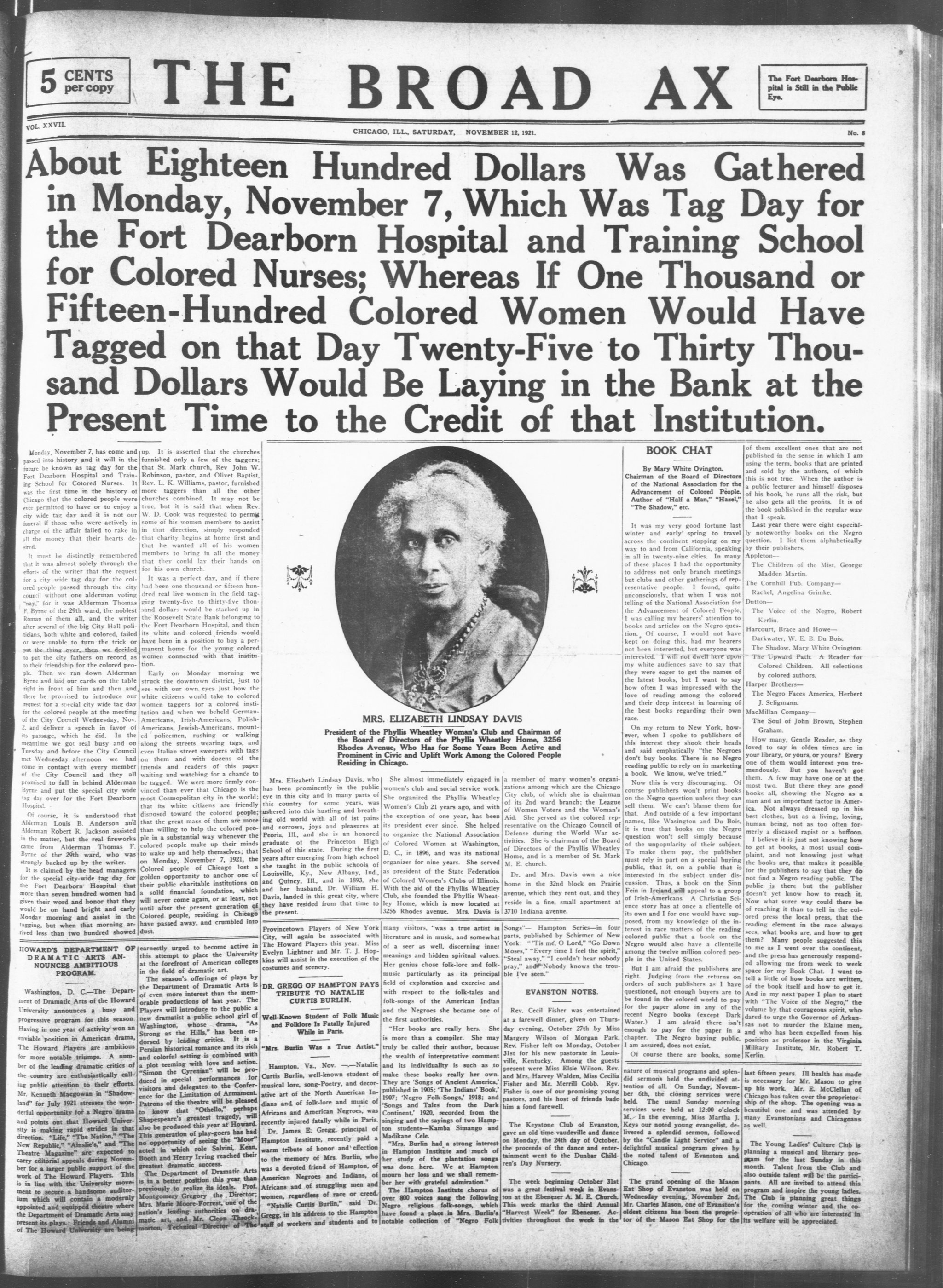
About Eighteen Hundred Dollars Was Gathered in Monday, November 7, Which Was Tag Day for the Fort Dearborn Hospital and Training School for Colored Nurses; Whereas If One Thousand or Fifteen-Hundred Colored Women Would Have Tagged on that Day Twenty-Five to Thirty Thousand Dollars Would Be Laying in the Bank at the Present Time to the Credit of that Institution.
5 CENTS per copy
VOL. XXVII.
About in Mo the F for C Fiftee Tagge sand Prese
Monday, November 7, has come and passed into history and it will in the future be known as tag day for the Fort Dearborn Hospital and Training School for Colored Nurses. It was the first time in the history of Chicago that the colored people were ever permitted to have or to enjoy a city wide tag day and it is not our funeral if those who were actively in charge of the affair failed to rake in all the money that their hearts desired.
It must be distinctly remembered that it was almost solely through the efforts of the writer that the request for a city wide tag day for the colored people passed through the city council without one alderman voting "may," for it was Alderman Thomas F. Byrne of the 29th ward, the noblest Roman of them all, and the writer after several of the big City Hall politicians, both white and colored, failed or were unable to turn the trick or put the thing over, then we decided to put the city fathers on record as to their friendship for the colored people. Then we ran down Alderman Byrne and laid our cards on the table right in front of him and then and there he promised to introduce our request for a special city wide tag day for the colored people at the meeting of the City Council Wednesday, Nov. 2, and deliver a speech in favor of its passage, which he did. In the meantime we got real busy and on Tuesday and before the City Council met Wednesday afternoon we had come in contact with every member of the City Council and they all promised to fall in behind Alderman Byrne and put the special city wide tag day over for the Fort Dearborn Hospital.
Of course, it is understood that Alderman Louis B. Anderson and Alderman Robert R. Jackson assisted in the matter, but the real fireworks came from Alderman Thomas F. Byrne of the 29th ward, who was strongly backed up by the writer. It is claimed by the head managers for the special city-wide tag day for the Fort Dearborn Hospital that more than seven hundred women had given their word and honor that they would be on hand bright and early Monday morning and assist in the tagging, but when that morning arrived less than two hundred showed
HOWARD'S DEPARTMENT OF DRAMATIC ARTS ANNOUNCES AMBITIOUS PROGRAM.
Washington, D. C.-The Department of Dramatic Arts of the Howard University announces a busy and progressive program for this season. Having in one year of activity won an enviable position in American drama. The Howard Players are ambitious for more notable triumps. A number of the leading dramatic critics of the country are enthusiastically calling public attention to their efforts. Mr. Kenneth Macgowan in "Shadowland" for July 1921 stresses the wonderful opportunity for a Negro drama and points out that Howard University is making rapid strides in that direction. "Life," "The Nation," "The New Republic," "Ainslie's," and "The Theatre Magazine" are expected to carry editorial appeals during November for a larger public support of the work of The Howard Players. This is in line with the University movement to secure a handsome auditorium which will contain a modernly appointed and equipped theatre where the Department of Dramatic Arts may present its plays. Friends and Alumni of The Howard University are being
---
THE BROAD AX
up. It is asserted that the churches furnished only a few of the taggers; that St. Mark church, Rev John W. Robinson, pastor, and Olivet Baptist, Rev L. K. Williams, pastor, furnished more taggers than all the other churches combined. It may not be true, but it is said that when Rev W. D. Cook was requested to permit some of his women members to assist in that direction, simply responded that charity begins at home first and that he wanted all of his women members to bring in all the money that they could lay their hands on for his own church.
It was a perfect day, and if there had been one thousand or fifteen hundred real live women in the field tagging twenty-five to thirty-five thousand dollars would be stacked up in the Roosevelt State Bank belonging to the Fort Dearborn Hospital, and then its white and colored friends would have been in a position to buy a permanent home for the young colored women connected with that institution.
Early on Monday morning we struck the downtown district, just to see with our own eyes just how the white citizens would take to colored women taggers for a colored institution and when we beheld German-Americans, Irish-Americans, Polish-Americans, Jewish-Americans, mounted policemen, rushing or walking along the streets wearing tags, and even Italian street sweepers with tags on them and with dozens of the friends and readers of this paper waiting and watching for a chance to be tagged. We were more firmly convinced than ever that Chicago is the most Cosmopolitan city in the world; that its white citizens are friendly disposed toward the colored people; that the great mass of them are more than willing to help the colored people in a substantial way whenever the colored people make up their minds to wake up and help themselves; that on Monday, November 7, 1921, the Colored people of Chicago lost a golden opportunity to anchor one of their public charitable institutions on a solid financial foundation, which will never come again, or at least, not until after the present generation of Colored people, residing in Chicago have passed away, and crumbled into dust.
earnestly urged to become active in this attempt to place the University at the forefront of American colleges in the field of dramatic art.
The season's offerings of plays by the Department of Dramatic Arts is of even more interest than the memorable productions of last year. The Players will introduce to the public a new dramatist a public school girl of Washington, whose drama, "As Strong as the Hills," has been endorsed by leading critics. It is a Persian historical romance and its rich and colorful setting is combined with a plot teeming with love and action. "Simon the Cyrenian" will be produced in special performances for visitors and delegates to the Conference for the Limitation of Armament. Patrons of the theatre will be pleased to know that "Othello," perhaps Shapespeare's greatest tragedy, will also be produced this year at Howard. This generation of play-goers has had no opportunity of seeing the "Moor" acted in which role Salvini, Kean, Booth and Henry Irving reached their greatest dramatic success.
The Department of Dramatic Arts is in a better position this year than previously to realize its ideals. Prof. Montgomery Gregory the Director; Mrs. Marie Moore-Forrest, one of the nation's leading authorities on dramatic art, and Mr. Cleon Throckmorton, Technical Director of The
CHICAGO, ILL., SATURDAY, NOVEMBER 12, 1921.
D
President of the Phyllis Wheatley Woman's Club and Chairman of the Board of Directors of the Phyllis Wheatley Home, 3256 Rhodes Avenue, Who Has for Some Years Been Active and Prominent in Civic and Uplift Work Among the Colored People Residing in Chicago.
Mrs. Elizabeth Lindsay Davis, who has been prominently in the public eye in this city and in many parts of this country for some years, was ushered into this hustling and breathing old world with all of ist pains and sorrows, joys and pleasures at Peoria, Ill., and she is an honored graduate of the Princeton High School of this state. During the first years after emerging from high school she taught in the public schools of Louisville, Ky., New Albany, Ind., and Quincy, Ill., and in 1893, she and her husband, Dr. William H. Davis, landed in this great city, where they have resided from that time to the present.
Provincetown Players of New York City, will again be associated with The Howard Players this year. Miss Evelyn Lightner and Mr. T. J. Hopkins will assist in the execution of the costumes and scenery.
DR. GREGG OF HAMPTON PAYS TRIBUTE TO NATALIE CURTIS BURLIN.
Well-Known Student of Folk Music and Folklore Is Fatally Injured While in Paris.
"Mrs. Burlin Was a True Artist."
Hampton, Va., Nov. —, Natalie Curtis Burlin, well-known student of musical lore, song-Poetry, and decorative art of the North American Indians and of folk-lore and music of Africans and American Negroes, was recently injured fatally while in Paris. Dr. James E. Gregg, principal of Hampton Institute, recently paid a warm tribute of honor and effection to the memory of Mrs. Burlin, who was a devoted friend of Hampton, of American Negroes and Indians, of Africans and of struggling men and women, regardless of race or creed. "Natalie Curtis Burlin," said Dr. Gregg, in his address to the Hampton staff of workers and students and to
MRS. ELIZABETH LINDSAY DAVIS
She almost immediately engaged in women's club and social service work. She organized the Phyllis Wheatley Women's Club 21 years ago, and with the exception of one year, has been its president ever since. She helped to organize the National Association of Colored Women at Washington, D. C., in 1896, and was its national organizer for nine years. She served as president of the State Federation of Colored Women's Clubs of Illinois. With the aid of the Phyllis Wheatley Club, she founded the Phyllis Wheatley Home, which is now located at 3256 Rhodes avenue. Mrs. Davis is many visitors. "was a true artist in literature and in music, and somewhat of a seer as well, discerning inner meanings and hidden spiritual values. Her genius chose folk-lore and folk-music particularly as its principal field of exploration and exercise and with respect to the folk-tales and folk-songs of the American Indian and the Negroes she became one of the first authorities.
"Her books are really hers. She is more than a compiler. She may truly be called their author, because the wealth of interpretative comment and its individuality is such as to make these books really her own. They are 'Songs of Ancient America,' published in 1905; 'The Indians' Book, 1907; 'Negro Folk-Songs,' 1918; and 'Songs and Tales from the Dark Continent,' 1920, recorded from the singing and the sayings of two Hampton students—Kamba Simango and Madikane Cele.
"Mrs. Burlin had a strong interest in Hampton Institute and much of her study of the plantation songs was done here. We at Hampton mourn her loss and we shall remember her with grateful admiration."
The Hampton Institute chorus of over 800 voices sang the following Negro religious folk-songs, which have found a place in Mrs. Burlin's notable collection of "Negro Folk
a member of many women's organizations among which are the Chicago City club, of which she is chairman of its 2nd ward branch; the League of Women Voters and the Woman's Aid. She served as the colored representative on the Chicago Council of Defense during the World War activities. She is chairman of the Board of Directors of the Phyllis Wheatley Home, and is a member of St. Mark M. E. church.
Dr. and Mrs. Davis own a nice home in the 32nd block on Prairie avenue, which they rent out, and they reside in a fine, small apartment at 3710 Indiana avenue.
Songs"—Hampton Series—in four parts, published by Schirmer of New York: "Tis me, O Lord," "Go Down Moses," "Every time I feel the spirit," "Steal away," "I couldn't hear nobody pray," and "Nobody knows the trouble I've seen."
EVANSTON NOTES
Rev. Cecil Fisher was entertained at a farewell dinner, given on Thursday evening, October 27th by Miss Margery Wilson of Morgan Park. Rev. Fisher left on Monday, October 31st for his new pastorate in Louisville, Kentucky. Among the guests present were Miss Elsie Wilson, Rev. and Mrs. Harvey Walden, Mrs. Cecilia Fisher and Mr. Merrill Cobb. Rev. Fisher is one of our promising young pastors, and his host of friends bade him a fond farewell.
The Keystone Club of Evanston, gave an old time vaudeville and dance on Monday, the 24th day of October, the proceeds of the dance and entertainment went to the Dunbar Children's Day Nursery.
The week beginning October 31st was a great festival week in Evanson at the Ebenezer A. M. E. Church. This week marks the third Annual "Harvest Week" for Ebenezer. Activities throughout the week in the
BOOK CHAT
By Mary White Ovington.
Chairman of the Board of Directors of the National Association for the Advancement of Colored People
Author of "Half a Man," "Hazel," "The Shadow," etc.
It was my very good fortune last winter and early spring to travel across the continent stopping on my way to and from California, speaking in all in twenty-nine cities. In many of these places I had the opportunity to address not only branch meetings but clubs and other gatherings of representative people. I found, quite unconsciously, that when I was not telling of the National Association for the Advancement of Colored People, I was calling my hearers' attention to books and articles on the Negro question. Of course, I would not have kept on doing this, had my hearers not been interested, but everyone was interested. I will not dwell here upon my white audiences save to say that they were eager to get the names of the latest books, but I want to say how often I was impressed with the love of reading among the colored and their deep interest in learning of the best books regarding their own race.
On my return to New York, however, when I spoke to publishers of this interest they shook their heads and said emphatically "the Negroes don't buy books. There is no Negro reading public to rely on in marketing a book. We know, we've tried."
Now this is very discouraging. Of course publishers won't print books on the Negro question unless they can sell them. We can't blame them for that. And outside of a few important names, like Wasington and Du Bois, it is true that books on the Negro question won't sell simply because of the unpopularity of their subject. To make them pay, the publisher must rely in part on a special buying public, that it, on a public that is interested in the subject under discussion. Thus, a book on the Sinn Fein in Ireland will appeal to a group of Irish Americans. A Christian Science story has at once a clientelle of its own and I for one would have supposed, from my knowledge of the interest in race matters of the reading colored public that a book on the Negro would also have a clientelle among the twelve million colored people in the United States.
But I am afraid the publishers are right. Judging from the returns on orders of such publishers as I have questioned, not enough buyers are to be found in the colored world to pay for the paper alone in any of the recent Negro books (except Dark Water). I am afraid there isn't enough to pay for the paper in a chapter. The Negro buying public, I am assured, does not exist.
Of course there are books, some nature of musical programs and splendid sermons held the undivided attention of all. On Sunday, November 6th, the closing services were held. The usual Sunday morning services were held at 12:00 o'clock M.. In the evening, Miss Martha J. Keys our noted young evangelist, delivered a splendid sermon, followed by the "Candle Light Service" and a delightful musical program given by the noted talent of Evanston and Chicago.
The grand opening of the Mason Eat Shop of Evanston was held on Wednesday evening, November 2nd. Mr. Charles Mason, one of Evanston's oldest citizens has been the proprietor of the Mason Eat Shop for the
The Fort Dearborn Hospital is Still in the Public Eye.
athered Day for School and Have Thou- k at the uction.
of them excellent ones that are not published in the sense in which I am using the term, books that are printed and sold by the authors, of which this is not true. When the author is a public lecturer and himself disposes of his book, he runs all the risk, but he also gets all the profits. It is of the book published in the regular wav that I speak.
Last year there were eight especially noteworthy books on the Negro question. I list them alphabetically by their publishers.
Appleton—
The Children of the Mist, George Madden Martin.
The Cornhill Pub. Company—
The Voice of the Negro, Robert Kerlin.
Harcourt, Brace and Howe—
Darkwater, W. E. B. Du Bois.
The Shadow, Mary White Ovington.
The Upward Path. A Reader for Colored Children. All selections by colored authors.
Harper Brothers—
The Negro Faces America, Herbert J. Seligmann.
MacMillan Company—
The Soul of John Brown, Stephen Graham.
How many, Gentle Reader, as they loved to say in olden times are in your library, or yours, or yours? Every one of them would interest you tremendously. But you haven't got them. A few may have one or at the most two. But there they are good books all, showing the Negro as a man and an important factor in America. Not always dressed up in his best clothes, but as a living, loving, human being, not as too often formerly a diseased rapist or a buffoon. I believe it is just not knowing how to get at books, a most usual complaint, and not knowing just what the books are, that makes it possible for the publishers to say that they do not find a Negro reading public. The public is there but the publisher doesn't yet know how to reach it. Now what surer way could there be of reaching it than to tell in the colored press the local press, that the reading element in the race always sees, what books are, and how to get them? Many people suggested this to me as I went over the continent, and the press has generously responded allowing me from week to week space for my Book Chat. I want to tell a little of how books are written, of the book itself and how to get it. And in my next paper I plan to start with "The Voice of the Negro," the volume by that courageous spirit, who dared to urge the Governor of Arkansas not to murder the Elaine men, and who has been expelled from his position as professor in the Virginia Military Institute, Mr. Robert T. Kerlin.
last fifteen years. Ill health has made is necessary for Mr. Mason to give up his work. Mr. E. McClellan of Chicago has taken over the proprietorship of the shop. The opening was a beautiful one and was attended by many Evanstonians and Chicagoans as well.
The Young Ladies' Culture Club is planning a musical and literary program for the last Sunday in this month. Talent from the Club and also outside talent will be the participants. All are invited to attend this program and inspire the young ladies. The Club is planning great things for the coming winter and the cooperation of all who are interested in its welfare will be appreciated.
M.
In this city since July 15th, 1899, without missing one single issue. Republicans, Democrats, Catholics, Protestants, Single Taxers, Priests, infidels or anyone else can have their say as long as their language is proper and responsibility is fixed.
The Broad Ax is a newspaper whose platform is broad enough for all, ever claiming the editorial right to speak its own mind.
Local communications will receive attention. Write only on one side of the paper.
Subscriptions must be paid in advance.
One Year ..... $2.00
Mix Months ..... $1.00
Advertising rates made known on application.
*address all communication to
THE BROAD AX
u206 So. Elizabeth St., Chicago, Ill.
Phone Wenworth 2597
JULIUS F. TAYLOR
Editor and Publisher
Associate Editor
DR. M. A. MAJORS
4700 South State Street
Phone Drexel 1416
NOVEMBER 12, 1921.
Vol. XXVII. No. 8
Entered as Second-Class Matter, Aug.
19, 1902, at the Post Office at Chicago,
III. Under Act of March 8, 1879.
DR. SARABOROUGH TO STUDY
NEGRO PROGRESS ON FARMS
Washington. — President Harding has appointed W. S. Saraborough former president of Wilburforce College in Ohio, to a special position in the Department of Agriculture to study the progress of the Negro in agriculture.
ENROUTE TO MICHIGAN
Hon. William H. Fields, St. Louis, Mo., national grand master of A. U. K. & D. of A., after an extended trip through the east and north in interest of A. U. K. & D. of A., passed through the city during the week en route to Bay City, Mich., to instruct the recently organized lodge in that city by Mrs. Eliza Jackson, state grand queen of Illinois.
IMPROVING
Phillip Stratton, 3257 Cottage Grove avenue, is improving at his home under the care of Dr. M. R. Bibb Mr. Stratton was thrown from his wagon while driving near 13th street Nov. 7th in trying to avoid an automobile.
ANOTHER SERIES OPENED.
Another series has been opened by the Pyramid Building & Loan Association with offices at 3539 S. State street, of which George H. Jackson is president. A representative from the association will speak Sunday at every church, calling the attention of the people to the great good which this association is doing for the Race.
11
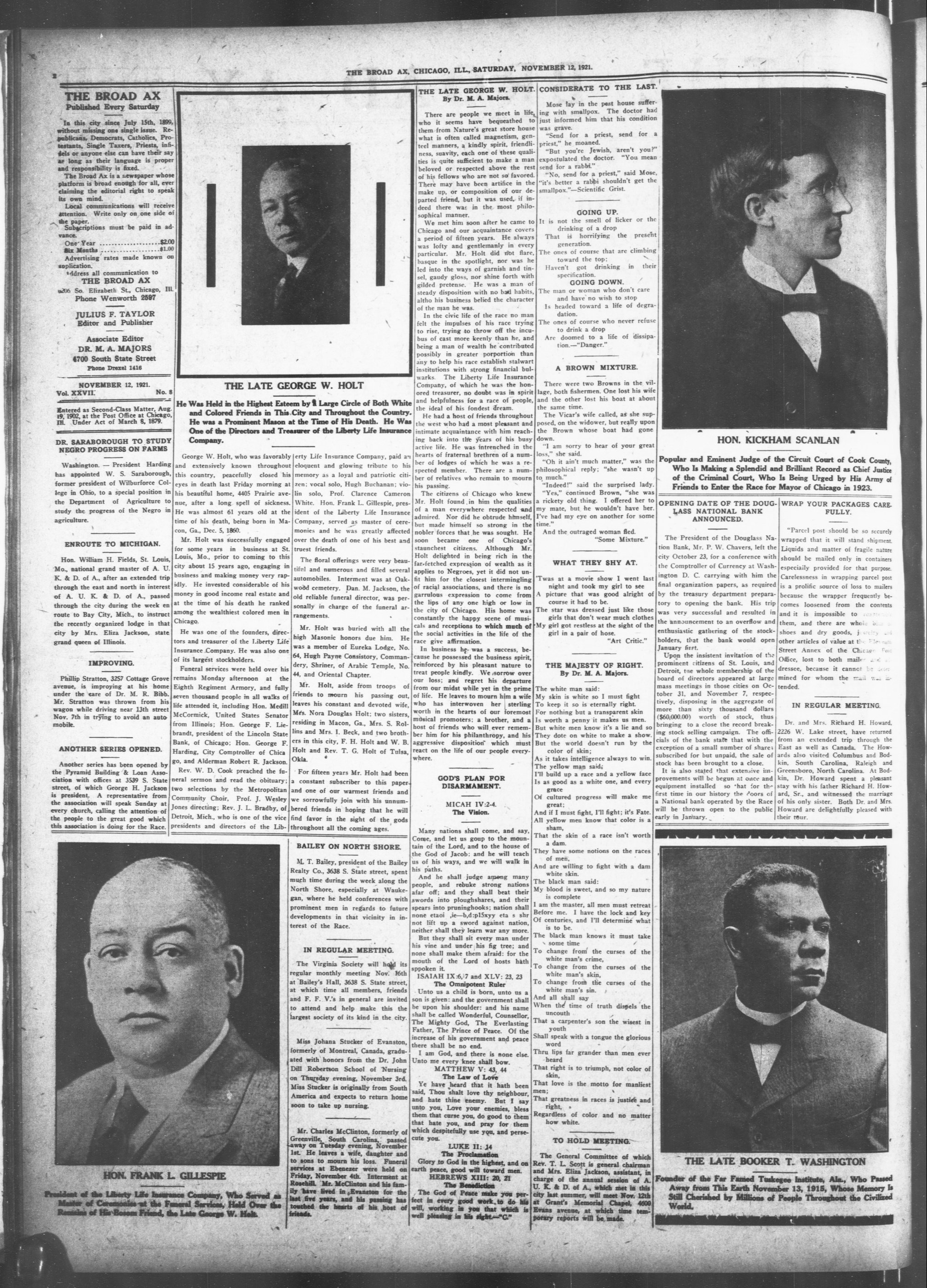
THE LATE GEORGE W. HOLT
He Was Held in the Highest Este and Colored Friends in This He was a Prominent Mason a One of the Directors and Tree Company.
He Was Held in the Highest Esteem by Large Circle of Both White and Colored Friends in This City and Throughout the Country. He was a Prominent Mason at the Time of His Death. He Was One of the Directors and Treasurer of the Liberty Life Insurance Company.
George W. Holt, who was favorably and extensively known throughout this country, peacefully closed his eyes in death last Friday morning at his beautiful home, 4405 Prairie avenue, after a long spell of sickness. He was almost 61 years old at the time of his death, being born in Macon, Ga., Dec. 5, 1860.erty Life Insurance Company, paid an eloquent and glowing tribute to his memory as a loyal and patriotic citizen; vocal solo, Hugh Buchanan; violin solo, Prof. Clarence Cameron White. Hon. Frank L. Gillespie, president of the Liberty Life Insurance Company, served as master of ceremonies and he was greatly affected
Mr. Holt was successfully engaged for some years in business at St. Louis, Mo., prior to coming to this city about 15 years ago, engaging in business and making money very rapidly. He invested considerable of his money in good income real estate and at the time of his death he ranked among the wealthiest colored men in Chicago.
He was one of the founders, directors and treasurer of the Liberty Life Insurance Company. He was also one of its largest stockholders.
Funeral services were held over his remains Monday afternoon at the Eighth Regiment Armory, and fully seven thousand people in all walks of life attended it, including Hon. Medill McCormick, United States Senator from Illinois; Hon. George F. Liebrandt, president of the Lincoln State Bank, of Chicago; Hon. George F. Harding, City Comptroller of Chicago, and Alderman Robert R. Jackson. Rev. W. D. Cook preached the funeral sermon and read the obituary; two selections by the Metropolitan Community Choir, Prof. J. Wesley Jones directing; Rev. J. L. Bradby, of Detroit, Mich., who is one of the vice presidents and directors of the Lib-
---
eem by Large Circle of Both White City and Throughout the Country at the Time of His Death. He Was Treasurer of the Liberty Life Insurance Company, paid an eloquent and glowing tribute to his memory as a loyal and patriotic citizen; vocal solo, Hugh Buchanan; violin solo, Prof. Clarence Cameron. White. Hon. Frank L. Gillespie, president of the Liberty Life Insurance Company, served as master of ceremonies and he was greatly affected over the death of one of his best and truest friends.
The floral offerings were very beautiful and numerous and filled several automobiles. Interment was at Oakwood cemetery. Dan M. Jackson, the old reliable funeral director, was personally in charge of the funeral arrangements.
Mr. Holt was buried with all the high Masonic honors due him. He was a member of Eureka Lodge, No. 64, Hugh Payne Consistory, Commandery, Shriner, of Arabic Temple, No. 44, and Oriental Chapter.
Mr. Holt, aside from troops of friends to mourn his passing out, leaves his constant and devoted wife, Mrs. Nora Douglas Holt; two sisters, residing in Macon, Ga., Mrs. S. Rollins and Mrs. I. Beck, and two brothers in this city, F. H. Holt and W. B. Holt and Rev. T. G. Holt of Tulsa, Okla.
For fifteen years Mr. Holt had been a constant subscriber to this paper and one of our warmest friends and we sorrowfully join with his unnumbered friends in hoping that he will find favor in the sight of the gods throughout all the coming ages.
BAILEY ON NORTH SHORE.
M. T. Bailey, president of the Bailey Realty Co., 3638 S. State street, spent much time during the week along the North Shore, especially at Waukegan, where he held conferences with prominent men in regards to future developments in that vicinity in interest of the Race.
IN REGULAR MEETING
The Virginia Society will hold its regular monthly meeting Nov. 16th at Bailey's Hall, 3638 S. State street, at which time all members, friends and F. F. V.'s in general are invited to attend and help make this the largest society of its kind in the city.
Miss Johana Stucker of Evanston, formerly of Montreal, Canada, graduated with honors from the Dr. John Dill Robertson School of Nursing on Thursday evening, November 3rd. Miss Stucker is originally from South America and expects to return home soon to take up nursing.
Mr. Charles McClinton, formerly of Greenville, South Carolina, passed away on Tuesday evening, November 1st. He leaves a wife, daughter and to sons to mourn his loss. Funeral services at Ebenezer were held on Friday, November 4th. Interment at Rosehill. Mr. McClinton and his family have lived in Evanston for the last five years, and his passing has touched the hearts of his host of friends.
THE BROAD AX, CHICAGO, ILL., SATURDAY, NOVEMBER 12, 1921
There are people we meet in life, who it seems have bequeathed to them from Nature's great store house what is often called magnetism, genteel manners, a kindly spirit, friendliness, suavity, each one of these qualities is quite sufficient to make a man beloved or respected above the rest of his fellows who are not so favored. There may have been artifice in the make up, or composition of our departed friend, but it was used, if indeed there was in the most philosophical manner.
We met him soon after he came to Chicago and our acquaintance covers a period of fifteen years. He always was lofty and gentlemanly in every particular. Mr. Holt did not flare, basque in the spotlight, nor was he led into the ways of garnish and tinsel, gaudy gloss, nor shine forth with gilded pretense. He was a man of steady disposition with no bad habits, altho his business belied the character of the man he was.
In the civic life of the race no man felt the impulses of his race trying to rise, trying to throw off the incubus of cast more keenly than he, and being a man of wealth he contributed possibly in greater porportion than any to help his race establish stalwart institutions with strong financial bulwarks. The Liberty Life Insurance Company, of which he was the honored treasurer, no doubt was in spirit and helpfulness for a race of people, the ideal of his fondest dream.
He had a host of friends throughout the west who had a most pleasant and intimate acquaintance with him reaching back into the years of his busy active life. He was intrenched in the hearts of fraternal brethren of a number of lodges of which he was a respected member. There are a number of relatives who remain to mourn his passing.
The citizens of Chicago who knew Mr. Holt found, in him the qualities of a man everywhere respected and admired. Nor did he obtrude himself, but made himself so strong in the nobler forces that he was sought. He soon became one of Chicago's staunchest citizens. Although Mr. Holt delighted in being rich in the far-fetched expression of wealth as it applies to Negroes, yet it did not unfit him for the closest intermingling of racial associations, and there is no garrulous expression to come from the lips of any one high or low in the city of Chicago. His home was constantly the happy scene of musicals and receptions to which much of the social activities in the life of the race give affirmation.
In business he was a success, because he possessed the business spirit, reinforced by his pleasant nature to treat people kindly. We sorrow over our loss; and regret his departure from our midst while yet in the prime of life. He leaves to mourn him a wife who has interwoven her sterling worth in the hearts of our foremost musical promoters; a brother, and a host of friends who will ever remember him for his philanthropy, and his aggressive disposition which must react on the life of our people everywhere.
GOD'S PLAN FOR DISARMAMENT.
MICAH IV:2-4.
The Vision.
Many nations shall come, and say
Come, and let us goup to the mount-
tain of the Lord, and to the house of
the God of Jacob: and he will teach
us of his ways, and we will walk in
his paths.
And he shall judge among many
people, and rebuke strong nations
afar off; and they shall beat their
swords into ploughshares, and their
spears into pruninghooks; nation shall
none etaoi jie,-b:d:p15xyy eta shr
not lift up a sword against nation,
neither shall they learn war any more.
But they shall sit every man under
his vine and under his fig tree; and
none shall make them afraid: for the
mouth of the Lord of hosts hath
spoken it.
ISAIAH IX,6,7 and XLV: 23, 23
The Omnipotent Ruler
Unto us a child is born, unto us a son is given: and the government shall be upon his shoulder: and his name shall be called Wonderful, Counsellor The Mighty God, The Everlasting Father, The Prince of Peace. Of the increase of his government and peace there shall be no end.
I am God, and there is none else. Unto me every knee shall bow.
Ye have heard that it hath been said, Thou shalt love thy neighbour, and hate hate enemy. But I say unto you, Love your enemies, bless them that curse you, do good to them that hate you, and pray for them which despitefully use you, and persecute you.
LUKE II: 14
Glory to God in the highest, and on earth peace, good will toward men.
HEBREWS XIII: 20, 21
The Benediction
The God of Peace make you perfect in every good work to do his will, working in you that which is well pleasing in his sight—"G."
Mose lay in the pest house suffering with smallpox. The doctor had just informed him that his condition was grave.
"Send for a priest, send for a priest," he moaned.
"But you're Jewish, aren't you?" expostulated the doctor. "You mean send for a rabbi."
"No, send for a priest," said Mose, "it's better a rabbi shouldn't get the smallpox."—Scientific Grist.
GOING UP.
It is not the smell of licker or the drinking of a drop
That is horrifying the present generation.
The ones of course that are climbing toward the top;
The man or woman who don't care and have no wish to stop
Is headed toward a life of degradation.
The ones of course who never refuse to drink a drop
Are doomed to a life of dissipation—"Danger."
A BROWN MIXTURE
There were two Brown's in the village, both fisherman. One lost his wife and the other lost his boat at about the same time.
The Vicar's wife called, as she supposed, on the widower, but really upon the Brown whose boat had gone down.
"I am sorry to hear of your great loss," she said.
"Oh it ain't much matter," was the philosophical reply; "she wasn't up to much."
"Indeed!" said the surprised lady. "Yes," continued Brown, "she was a rickety old thing. I offered her to my mate, but he wouldn't have her. I've had my eye on another for some time."
And the outraged woman fled. "Some Mixture."
WHAT THEY SHY AT.
Twas at a movie show I went last night and took my girl to see
A picture that was good alright of course it had to be.
The star was dressed just like those girls that don't wear much clothes
My girl got restless at the sight of the girl in a pair of hose.
THE MAJESTY OF RIGHT.
By Dr. M. A. Majors.
The white man said:
My skin is white so I must fight
To keep it so is eternally right.
For nothing but a transparent skin
Is worth a penny it makes us men.
But white men know it's a lie and so
They dote on white to make a show
But the world doesn't run by the
I'll build up a race and a yellow face
Is as good as a white one, and every
grace
Of cultured progress will make me
great;
And if I must fight, I'll fight; it's Fate.
All yellow men know that color is a
sham
They have some notions on the races of men.
And are willing to fight with a dam white skin.
The black man said:
My blood is sweet, and so my nature is complete
I am the master, all men must retreat
Before me. I have the lock and key
Of centuries, and I'll determine what
is to be.
The black man knows it must take
some time
To change from the curses of the
white man's crime,
To change from the curses of the
white man's skin,
To change from the curses of the
white man's sin.
And all shall say
When the time of truth dispels the
uncouth
That a carpenter's son the wisest in youth
Shall speak with a tongue the glorious word
Thru lips far grander than men ever heard
That right is to triumph, not color of skin,
That love is the motto for manliest men;
That greatness in races is justice and right,
Regardless of color and no matter how white.
TO HOLD MEETING
The General Committee of which Rev. T. L. Scott is general chairman and Mrs. Eliza Jackson, assistant, in charge of the annual session of A. U. K. & D. of A., which met in this city last summer, will meet Nov. 12th at Grant's Memorial Chapel, 4600 Erans avenue, at which time temporary reports will be made.
[Name not visible in the image]
HON. KICKHAM SCANLAN
Popular and Eminent Judge of the Who Is Making a Splendid act of the Criminal Court, Who Friends to Enter the Race for
OPENING DATE OF THE DOUGH LASS NATIONAL BANK ANNOUNCED.
Popular and Eminent Judge of the Circuit Court of Cook County, Who Is Making a Splendid and Brilliant Record as Chief Justice of the Criminal Court, Who Is Being Urged by His Army of Friends to Enter the Race for Mayor of Chicago in 1923.
The President of the Douglass Nation Bank, Mr. P. W. Chavers, left the city October 23, for a conference with the Comptroller of Currency at Washington D. C. carrying with him the final organization papers, as required by the treasury department preparatory to opening the bank. His trip was very successful and resulted in the announcement to an overflow and enthusiastic gathering of the stockholders, that the bank would open January first.
Upon the insistent invitation of the prominent citizens of St. Louis, and Detroit, the whole membership of the board of directors appeared at large mass meetings in those cities on October 31, and November 7, respectively, disposing in the aggregate of more than sixty thousand dollars ($60,000.00) worth of stock, thus bringing to a close the record breaking stock selling campaign. The officials of the bank state that with the exception of a small number of shares subscribed for but unpaid, the sale of stock has been brought to a close. It is also stated that extensive improvements will be begun at once and equipment installed so that for the first time in our history the doors of a National bank operated by the Race will be thrown open to the public early in January.
---
THE BOSTON EDITOR
THE LATE BOOKER T. WASHINGTON Founder of the Far Famed Tuskegee Institute, Ala., Who Passed Away from This Earth November 13, 1915, Whose Memory Is Still Cherished by Millions of People Throughout the Civilized World.
The Circuit Court of Cook County,
and Brilliant Record as Chief Justice
Is Being Urged by His Army of
Mayor of Chicago in 1923.
WRAP YOUR PACKAGES CARE-
FULLY.
"Parcel post should be so securely wrapped that it will stand shipment. Liquids and matter of fragile nature should be mailed only in containers especially provided for that purpose. Carelessness in wrapping parcel post is a prolific source of loss to mailers because the wrapper frequently becomes loosened from the contents and it is impossible to restrain them, and there are whole bits of shoes and dry goods, jewelry and other articles of value at the Elephant Street Annex of the Chicago Post Office, lost to both mailers and dressee, because it cannot be determined for whom the mail was intended.
IN REGULAR MEETING
Dr. and Mrs. Richard H. Howard, 2226 W. Lake street, have returned from an extended trip through the East as well as Canada. The Howards also visited Columbus and Bodkin, South Carolina, Raleigh and Greensboro, North Carolina. At Bodkin, Dr. Howard spent a pleasant stay with his father Richard H. Howard, Sr., and witnessed the marriage of his only sister. Both Dr. and Mrs. Howard are delightfully pleased with their tour.
ee ae i
eed : |
| . at mae
a ; 4
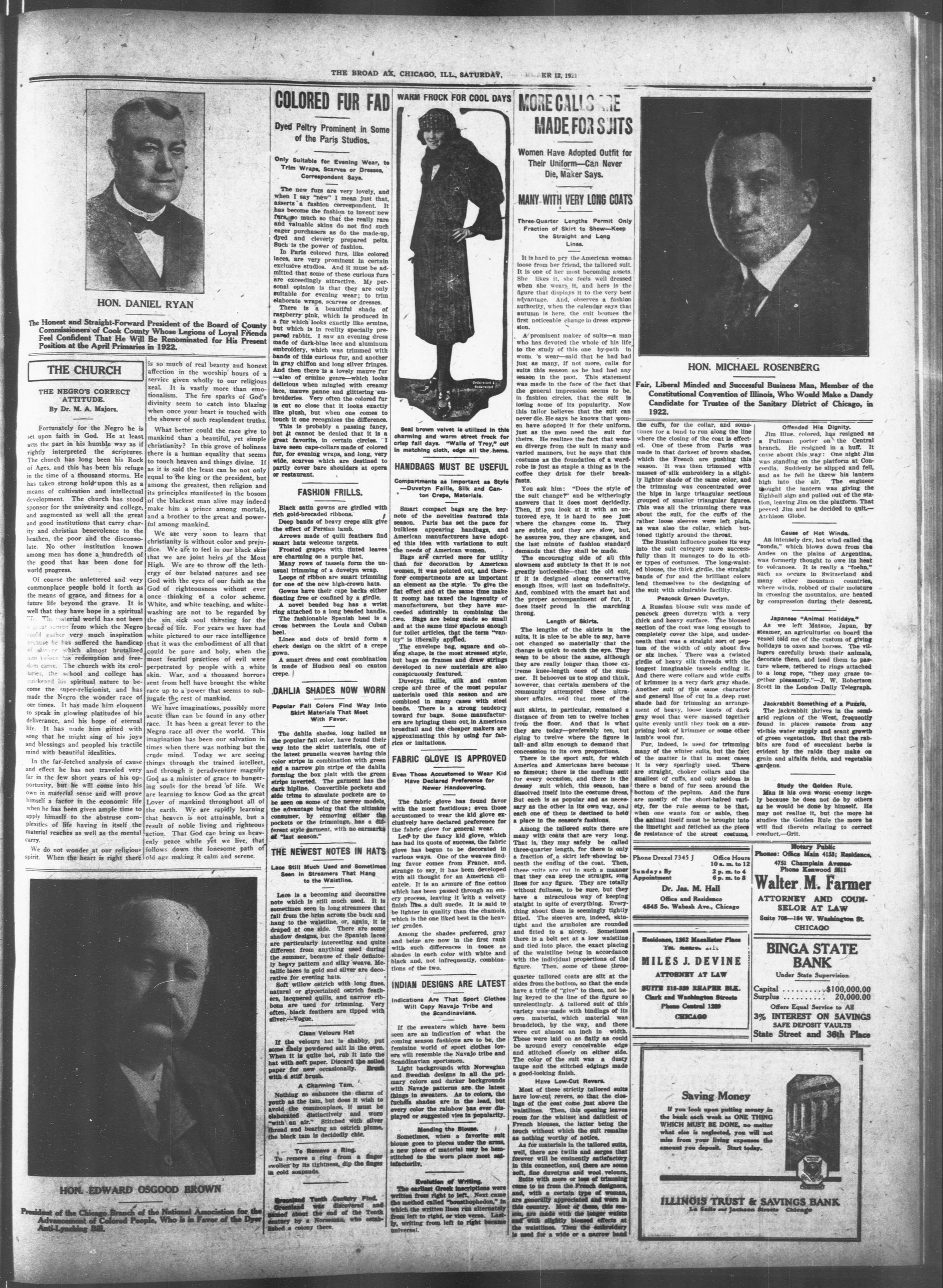
HON. DANIEL RYAN
gy sess erates een bef sae
Feel Confident That He Will Be Renominated for fit Proms
Position at the April Primaries in 1922.
THE CHURCH
THE NEGRO’S CORRECT
ATTITUDE.
By Dr. M. A. Majors.
Fortunately for the Negro he is
set upon faith in God. He at least
acts the part in his humble way as if
rightly interpreted the scriptures
The church has long been his Rock
of Ages, and this has been his refuge
in the time of a thousand storms. He
has taken strong hold-upon this as a
means of cultivation and intellectual
development. The church has stood
sponsor for the university and college,
and augmented as well all the great
and good institutions that carry char-
ity and christian benevolence to the
heathen, the poor and the disconso-
late. No other institution known
among men has done a hundredth of
the good that has been done for
‘world progress.
Of course the unlettered and very
commonplace people hold it forth as
the means of grace, and fitness for a
futere life beyond the grave. It is
well that they have hope in a spiritual
“tT oaterial world has not been
+> ..vrce from which the Negro
4 eather very much inspiration
use he has suffered the handicap
s which almost brutalized
came. The chureh with its crol-
ures, the school and college has
vkened itis spiritual mature to be-
come the super-religionist, and has
made the Negro the wonder race of
our times. It has made him eloquent
to speak in glowing platitudes of his
deliverance, and his hope of eternal
life. It has made him gifted with
song that he might sing of his joys
and blessings and peopled his tractile
mind with beautiful idealities.
In the far-fetched analysis of cause
and effect he has not traveled very
far in the few short years of his op-
vortunity, but he will come into his
own in material sense and will prove
himself a factor in the economic life
when he fias been given ample time to
apply himself to the abstruse com-
plexities of fe having in itself the
material reaches as well as the mental
carry,
We do not wonder at our religious
spirit. When the heart is right there
a
Piette Speen tek tom ara bee
is so much of real beauty and honest
affection in the worship hours of a
service given wholly to our religious
zeal. It is vastly more than emo-
tionalism. The fire sparks of God's
divinity seem to catch into blazing
when once your heart is touched with
the shower of such resplendent truths.
| What better could the race give to
mankind than a beautiful, yet simple
christianity? In this grove of holiness
there is a human equality that seems
to touch heaven and things divine. If
as it is said the least can be not only
equal to the king or the president, but
among the greatest, then religion and
its principles manifested in the bosom
of the blackest man alive may indeed
make him a prince among mortals,
and a brother to the great and power-
ful among mankind.
We axe very soon to learn that
christianity is without color and preju-
dice. We afe to fee! in our black skim
that we are joint heirs pf the Most
High. We ate to throw off the leth-
ergy of Our belated natures and see
God with the eyes of our faith as the
God of righteousness without ever
once thinking of a color scheme.
White, and white teaching, and white-
washing are not to be regarded by
the sin sick soul thirsting for the
bread of life. For years we have had
white pictured to our race intelligence
that it was the embodiment of all that
could be pure and holy, when the
most fearful practices of evil were
perpetrated by people with a white
skin. War, and a thousand horrors
sent from hell have brought the white
race up to a’power that seems to sub-
jugate the rest of mankind.
We have imaginations, possibly more
acute than can be found in any other
race. It has been a great lever to the
Negro race all over the world. This
imagination has been our salvation in
times when there was nothing but the
crude mind. Today we are seeing
things through the trained intellect,
and through it peradventure magnify
God as a minister of grace to hunger-
ing souls for the bread ‘of life. We
are learning to know God as the great
Lover of mankind throughout all of
the earth. We are rapidly learning
that heaven is not attainable, but a
result of noble living and righteous
action. That God can bring us heav-
enly peace while yet we live, that
jollows down the lonesome path
old age making it calm and serene.
Rel
Sa
Pea es
BR
see
FOr Bey
ieee
se he
a ae es
eae NS.
re ated
es tee
Pes
ei hee 8S
:
rs
‘ 4
THE BROAD AX, CHICAGO, ILL, SATURDAY, Ss oBR 2, 1921
——————
COLORED FUR FAD, w™™ fcr Foncnee oes) MODE GL)
Re hace MADER
of the Paris Studios, =| —
—— } Women Have Ador
oe for Evening Wear, te Their Uniform—
ona a Die, Maker
The new furs are very lovely, and
when I say “new” I mean just that,
asserts “a fashion correspondent. It
has become the fashion to Invent new
. much so that the really rare
one
eager purchasers as do the made-up,
yea and cleverly prepared pelts,
Such is the power of fashion.
In Paris colored furs, Uke colored
laces, are very prominent in certain
exclusive studios. And it must be ad-
mitted that some of these curious furs
‘are exceedingly attractive. My per-
sonal opinion is that they are only
suitable for evening wear; to trim
@aborate wraps, scarves or dresses.
There ts @ beautiful shade of
raspberry pink, which is produced in
‘8 fur which looks exactly like ermine,
but which is in reality specially pre-
pared rabbit. I saw an evening dress
made of dark-blue lace and aluminum
embroidery, which was trimmed with
bands of this curious fur, and another
im gray chiffon and long silver fringes.
And then there is a lovely mauve fur
—also of ermine genre—which looks
delicious when mingied with creamy
lace, mauve panne and glittering ‘em-
brolderies. Very often the colored fur
ls cut so close that It looks exactly
Wke plush, but when one comes to
touch it one recognizes the difference.
‘This is probably s passing fancy,
but gt cannot be denied that it is a
great favorite, in certain circles. I
have seen cape-collars made of colored
tur, for evening wraps, and long, very
wide, scarves which are destined to
partly cover bare shoulders at opera
or restaurant. 7
FASHION FRILLS.
Black satin gowns are girdled with
ich gold-brocaded ribbons. ,
Deep bands of heavy crepe silk give
the effect of Persian lamb.
Arrows made of quill feathers find
mart hats welcome targets.
Frosted grapes with tinted leaves
‘are charming on a purple hat.
Many rows of tassels form the un-
usual trimming of a duvetyn wrap.
‘Loops of ribbon are smart trimming
for one of the new high-crown hats.
Gowns have their cape backs either
floating free or confined by a girdle.
‘A novel beaded bag has a wrist
ring attached to a long beaded handle.
‘The fashionable Spanish heel is
cross between the Louls and Cuban
heel.
Lines and dots of braid form a
check design on the skirt of a crepe
gown.
‘A smart dress and coat combination
is made of Hudson seal on canton
crepe. |
DAHLIA SHADES NOW WORN
Popular Fall Colors Find Way Into
‘Skirt Materials That Meet
‘With Favor.
‘The dahlia shades, long hatled as
the popular fall color, have found thelr
way into the skirt materials, one of
the latest prunella weaves having this
color stripe in combination with green
and « narrow pin stripe of the dahila
forming the box plait with the green
stripe inverted. The garment has the
dark hipline. Convertible pockets and
ide trims to simulate pockets are to
be seen on some of the newer models,
the advantage being thet the ultimate
consumer, by removing, either the
pockets or the trimmings, has «
ferent style garment, ith no earmarks
ot “ast season.”
THE NEWEST NOTES IN HATS
Lace Still Much Used and Sometimes
‘Seen in Streamers That Hang
‘te the Waistline.
Lace is a becoming and decorative
note which is still much used. It is
sometimes seen in long streamers that
‘fail from the brim across the back and
hang to the waistline, or, again, it is
raped at one side. There are some
shadow designs, but the Spanish laces
are particularly interesting and quite
@ifferent from anything used during
the summer, because of their definite-
ly begvy pattern and silky weave. Me-
tallic laces in gold and silver are deco-
rative for evening hats ‘
‘Soft willow ostrich with long fines,
natural or glycerinizéd ostrich feath-
ers, lacquered quills, and narrow rib-
bons are used for trimming. Very
often, black feathers are tipped with
silver —Vogue.
Clean Velours Hat
It the yelours bat is- shabby, put
some fibely powdered salt in the oven.
‘When it is quite hot, rub it into the
hat with soft puper. Discard the solled
paper for new occasionally. Brash
with 4 stiff brash.
A Charming Tam. '
Nothing so enbances the charm of
youth as the tam, but does 1 wish t0
‘Avoid the commonplace, if must be
saat ‘@atinctively and wore
‘en air.” Stitched with silver
‘avd bearing an ostrich plume,
‘Diack tam is decidedly chi.
——$——
Fe Oi ee ls |
To remove a ring from a Ginger
ewalier by Tes tightness, dip the Hager
im cold soapsnds.
a SS SS
*) ‘wis Gistovered and
iat et St
‘by a Norseman, whe estab-
ished « colony there.
WARM FROCK FOR COOL DAYS:
= ,
Seal brown veivet is utilized In thie
charming and warm street frock for
crisp fall days. “Walle of Troy,” cut
In matching cloth, edge all the heme.
HANDBAGS MUST BE USEFUL
Compartments as Important as Style
—Duvetyn Faille, Silk and Can-
. ton Crepe, Materials.
Smart compact bags are the. key-
note of the novelties featured this
season. Paris has set the pace for
bulkiess appearing handbags, and
American manufacturers have adopt-
ed this idea with variations to suit
the needs of American women.
Bags aré carried more for utility
thah for decoration by American
‘women, it was pointed out, and there.
fore compartments are as important
an clement as the style. To give the
fiat effect and at the same time make
tt roomy has taxed the ingenuity of
manufacturers, but they have suc-
ceeded admirably in combining the
two, Bags are being made 20 small
‘and at the same time spacious enough
igen berm sages
ity” is Uberally
‘The envelope bag. square and ob-
\ng shape, is the most stressed style,
but bags om frames and draw strings
developed in new materials are also
conspicuously featured.
Duvetyn faille, silk and canton
crepe aré three of the most popular
materials used this season and are
combined in many cases with steel
beads. There is a strong tendency
toward fur bags. Some manufactur-
ers are byinging them out, in American
broadtail and the cheaper makers are
approximating this by using fur fab-
ries or imitations,
FABRIC GLOVE IS APPROVED
Even Those Accustomed to Wear Kid
Have Declared Preference tor
Newer Handcovering.
‘The fabric glove has found favor
with the most fastidious; even those
accustomed to wear the kid glove ex-
clusively have declared preference for
the fabric glove for general wear.
Le@ by the fancy kid glove, which
has had its quote of success, the fabric
glove has begun to be decorated in
various ways. One of the weaves find-
ing favor comes from France, and.
strange to say, it has been developed
with all thought for an American clt-
entele. It is an armure of fine cotton
which has been passed through an em-
ery process, leaving it with a velvety
finish Tike.a dull suede. It is said to
be lighter in quality than the chamols,
which Is the one liked best in the heav-
fer grades.
‘Among the shades preferred, gray
and belze are now In the first rank
with such differences in tenes as
shades in each color with white and
black and, not infrequently, combina-
tions of the two.
INDIAN DESIGNS ARE LATEST
Indications Are That Sport Clothes
‘Will Copy Navajo Tribe and
the Scandinavian. | *
If the sweaters which have been
seen are an Indication of what the
coming season fashions are to be, the
feminine world of sport clothes lov-
ers will resemble the Navajo tribe and
Scandinavian sportsmen.
Light backgrounds with Norwegian
and Swedish designs in all the pri-
mary colors and darker backgrounds
with Navajo patterns are. the latest
things in sweaters. As to colors, the
fuchila shades are in the lead, but
‘every color the rainbow bas ever dis-
played or suggested vies in popularity.
fa tea
Mending the Blows. =}
Sometimes, when 2 favorite sult
blouse goes to pleces under the arms,
‘a new plece of material may be hem-
stitched to the worn place most saf-
tatactority.
Evelution of Writing ~~
‘The earliest Greek inscriptions were
‘written from right to left... Next came
Be metnod called “ponatbophedon,” tn
‘which the written lives ran
ae por
‘writing trom left to
@etecmiel. ied
MORECAL!S (iE
MADE FOR STS
‘Women Have Adopted Outfit for
Their Uniform—Can Never
Die, Maker Says.
MAN TH VERY ons coATs
meee enn en
the eames Leng
we kes Ht, me NS wes Gomee
when she wears It, and hers is the
figure that displays It to the very best
advantage. And, observes a fashion
authority, when the calendar says that
autumn is here, the sult bcomes the
first noticeable change in dress expres-
| ston. ‘
|. A’prominent maker of sults—a man
“who has devoted the whole of his life
to the study of this one by-path tn
wom 's wear—said that he had had
| Just as many, if not more, calls for
‘sults this season as he had had any
season in the past. This statement
was made in the face of the fact that
the general impression seems to be,
in fashion circles, that the silt ts
losing some of its popularity. Now
this tallor believes that the salt can
never die. He says he knows that yo-
gn have adopted it for thelr uniform,
Just as the men need the sult for
‘theirs, He realizes the fact that wom-
en diverge from the sult in many and
varied manners, but he says that this
“costume as the foundation of a ward-
‘robe fs just as staple thing as is the
coffee they drink for thelr break-
fasts,
You ask him: “Does the style of
the sult change?” and he witheringly
answers that It does most decidedly.
Then, tf you look at it with an un-
tutored eye, it is hard to see just
where the changes come in. They
are subtle, and they are slow, but,
he assures you, they are changes, and
the Inst minute of fashion standard
demands that they shall be made. —
‘The encouraging side of all this
slowness and subtlety is that it is not
greatly noticeable—that the old sult,
if It ts designed along conservative
enough lines, will last on indefinitely.
And, combined with the smart hat and
the proper accompaniment of fur, It
does itself proud in the marching
throng.
Length of Skirts.
‘The lengths of the skirts in the
suits, it is nice to be able to say, have
not changed so materially: that the
change is quick to catch the eye. They
seem to be about the same, although
they are really longer than those ex-
treme knee-length ones of the sum
mer. It behooves us to stop and think,
aowever, that certain members of the
community attempted these ultra-
short affairs. and that most of the
sult skirts, in particular, remained a
distance of from ten to twelve inches
from the floor. And that Is what
they are today—preferably ten, but
riging to twelve where the figure is
tall-and silm enough to demand that
concession to Its own proportions.
‘There is the sport suit, for which
America and Americans have become
t0 famous; there is the medium suit
for every occasion, and there is the
dressy sult which, this season, has
Aissolved Itself Into the costume dress,
But each is as popular and as neces-
sary as the other in its own way, and
each one of them is destined to hold
a place in the season’s fashions,
Among the tailored sults there are
many with coats that are very long.
That is, they may safely be called
three-quarter length, for there 1s only
# fraction ofa skirt left-showing be-
neath the ending of the coat. Then,
there <nits are cut in such a manner
that they can Keep the straigat, song
Mines for any figure. They are totally
without fullness, to be sure, but they
have a miraculous way of keeping
staight in spite of everything. Every-
thing about them is seemingly tightly
fitted. ‘The sleeves are, indeed, skin-
tight and the armholes are rounded
and fitted to a nicety. Sometimes
there is a belt set at a low waistline
and tied into place, the exact placing
of the waistline being in accordance
with the individual proportions of the
figure. Then, some of these three-
quarter taflored conts are slit at the
sides from the bottom, so that the ends
have a trifle of “give” to them, not be-
Ing keyed to the line of the figure so
unrelentingly. 4 tailored suit of this
variety was’made with bindings of its
own material, which material was
broadcloth, by the way, and these
were cut almost an inch in width.
These were laid on as fiatly as could
be around every conceivable edge
and stitched closely on either side.
The color of the sult was a dusty
taupe and the stitched edgings made
& good-looking finish.
Have LowCut Revers.
‘Most of these strictly tailored suits
have low-cut revers, so that the clos
ings of che enat cotse Junt above the
waistlines. ‘Then, this
voom for the whltet nat gales
French bicuses, the latter being the
touch without which the suit remains
as nothing worthy of notice,
‘As for materials in the tailored suita,
well, there are twills and ‘that |
focever will be eminently satietactory
tn this connection, ang there are some:
soft, fine éuvetyas and wool.
a ypeped: ofr md
soa wih : type of women,
. with waists
peed fof a ra ,
ot
‘
ere “HON. MICHAEL ROSENBERG ;
Fair, Liberal Minded and Successful Business Man, Member of the
Constitutional Convention of Illinois, Who Would Make a Dandy
Candidate for Trustee of the Sanitary District of Chicago, in
1922.
Ge com, Ser the colar, ane Ne
‘umes for a band to run along the line
where the closing of the coat is effect-
ed. One of these from Paris was
made in that darkest of brown shades,
which the French are pushing this
season. ‘It was then trimmed with
masses of silk embroidery in a slight-
ly lighter shade of the same color, and
the trimming was concentrated over
the hips in large triangular sections
grouped of smaller triangular figures
‘This was all the trimming there was
about the suit, for the cuffs of the
rather loose sleeves were left plain,
a8 was also the collar, which but-
toned tightly around the throat.
‘The Russian influence pushes its way
into the suit category more success-
fully than it manages to do in oth-
er types of costumes. The long-walst-
ed blouse, the thick girdle, the straight
bands of fur and the brilliant colors
Tend themselves to the designing of
the suit with admirable facility.
Peacock Green Duvetyn.
A Russian blouse sult was made of
peacock green duvetyn with a very
thick and heavy surface. The bloused
section of the coat was long enough to
completely cover the hips, and under-
neath that was straight sort of pep-
tum of the width of only about five
or six inches. There was a twisted
girdle of heavy silk threads with the
longest imaginable tassels ending it.
And there were collars and wide cuffs
of krimmer in a very dark gray shade.
Anather sult of is samme character
and general line of cut In a deep rust
shade had for trimming an arrange-
ment of heavy, looe knots of dark
gray wool that were massed together
quite evenly until they took on @ sur-
prising look of krimmer or some other
lamb’s wool fur.
Fur, indeed, is used for trimming
many of the winter suits, but the faet
of the matter is that in most cases
It is very sparingly used. There
are straight, choker collars and the
smallest of cuffs, and only seldom is
there a band of fur seen around the
bottom of the peplum. And the furs
are mostly of the short-haired vari-
ety, for the rule seems to be that,
when one wants fox or sable, then
the animal itself must be brought into
the lmetight and fetiched as the plece
de resistance of the street costume
Phone Drexel 7345 J Office Hours
10a. m.to12
Sundays By Zp.mtos
Appointment 6p.mtos
Dr. Jas. M. Halll
Office and Residence
4545 So. Wabash Ave., Chicago
once, 1262 Macalis
‘Tee menre. «11.
MILES J. DEVINE
ATTORNEY AT LAW
‘SUITE 318-399 REAPER BLK.
Clark and Washington Streets
Pheme Central 1289
cacao
‘
Saving M a |
If you look upon putting money in { 2
the bank each week as ONE THING ||
WHICH MUST BE DONE, no matter
what cleo is neglected, you will mot [isa
miss from your living expenses the is
amount you deposit. Start today.
ILLINOIS TRUST & SAVINGS BANK
i ont Jochson so Chicago
Offended His Dignity.
Jim Biue.. colored, has resigned ss
@ Pullman porter onthe Central
branch. He resigned in a huff. It
eame aboat this way: One night Jim
was standing on the platform at Con-
cordla. Suddenly he slipped and fell,
‘and as he fell he threw his lantern
high into the alr. The engineer
thought the Iantern was giving the
Righball sign and pulled out of the sta-
tlon, leaving Jim on the platform. That
peeved Jim and he decided to quit—
Atchison Globe.
Cause of Hot Winds.
An intensely dry, hot wind ealled the
“zonda,” which blows down from the
Andes on the plains of Argentina,
was formerly thought to owe its heat
to volcanoes. It is really a “foeha,”
such us occurs in Switzerland and
many other mountan countries,
where winds, robbed of their moisture
in crossing the mountains, are heated
by compression during their descent,
Japanese “Animal Holidays.”
As we left Matsue, Japan, by
steamer, an agriculturist on board the
Vessel told me of the custom of giving
holidays to oxen and horses. The vil-
lagers carefully brush thelr animals,
decorate them, and lead them-to pas:
ture where, tethered to rings attached
to a long rope, “they may graze to-
gether pleasantly.”—J. W. Robertson
Scott In the London Daily Telegraph.
Jackrabbit Something of a Puszie.
‘The jackrabbit phrives in the semi
arid regions of the West, frequently
found in places remote from any
‘visible water supply and scant grewth
of green vegetation. But that the rab-
bits are fond of succulent herbs is
evident by the raids they make on
grin and alfalfa fields, and vegetable
gardens
made the Gaiden Role.
‘Man i his own worst enemy large
ly because he does not do by others
as he would be done by himself. He
may not realize it, but the more be
studies the Golden Rule the more he
will find therein relating to correct
ae
Phones: Office Main 4153; Residence,
a
4751 Champlain =
Walter M. Farmer
ATTORNEY AMD COUN-
SELOR AT LAW
CHICAGO
BINGA STATE
Under State Supervision
Capital .........$100,000.00
Surplus .......... 20,000.00
Offers Equal Service to All
3% INTEREST ON SAVINGS
‘SAFE DEPOSIT VAULTS
State Street and 36th Place
A
have soft, silky hair that can
do has made happy thousands
by hair. It will do the same
and lifeless or if you have da-
box of EXELENTO QUINI
drug stores. Price by mail 25c on receipt
AGENTS WANTED—Write for Parti-
EXELENTO SKIN BEAUTIFIER, an ointment for
used in treatment of akin troubles.
This very day
this week after date 8
may to the order of
My S
How much can
mitigate yourself
have every week
In State Bank of Chic
State Street—9 and 11 East 1
Under State Government Supervise
on Savings Resources over $2,
YOU can have soft, silky hair. EXELENTO has made hair coarse, nappy hair. It will hair is brittle and lifeless on scalp, try a box of EXELENTO MEDICINE. We make EXELENTO SKIN BEAUTY used in treaties.
Every week go to pay to the order
How much obligate save ever
Lincoln State B
3105 South State Street—
Under State Gov
3 Per Cent on Savings Re
YOU can have soft, silky hair that can be easily dressed.
EXELENTO has made happy thousands of women who had
coarse, nappy hair. It will do the same for you. If your
hair is brittle and lifeless or if you have dandruff and itching
scalp, try a box of EXELENTO QUININE POMADE.
For sale at all dandruff shops, pay 5%c discount of stamp or coin.
AGENTS WANTED - Write for Particulars.
EXELENTO MEDICINE COMPANY, Atlanta, Georgia
We make EXELENTO SKIN BEAUTIFIER, an ointment for dark, sallow skins,
used in treatment of skin troubles.
DON'T
WEND IT
ALL
This every day 19
every week after date I promise
to pay to the order of
Myself
Dollars
My signature
How much can you
obligate yourself to
save every week?
Lincoln State Bank of Chicago
3105 South State Street-9 and 11 East 31st Street
Under State Government Supervision
3 Per Cent on Savings Resources over $2,800,000.00
TELEPHONE DOUGLAS
GEORGE F.
E F. HARDIN
GEORGE F. HARDING, JR.
REAL ESTATE
Up-to-Date or Moder
and Store
3101 COTTAGE
Corner 31st S
e or Modern Houses,
and Stores to Rent
COTTAGE GROW
ner 31st Street, Chicago
Up-to-Date or Modern Houses, Apartments and Stores to Rent 3101 COTTAGE GROVE AVE. Corner 31st Street, Chicago
Public Opinion Real Ruler.
All free governments, whatever
their name, are in reality governments
by public opinion, and it is on the
quality of this opinion that their prosperity depends.—James Russell Lowell.
One Could Do That.
"It takes nine tailors to make a man." To make him what—a pauper?
—Boston Transcript.
The Harder the Frecher.
Girls, beware of the hard-bolled egg.
He will get fresh.—Minnesota Star.
FROM ON AND AFTER THIS DATE
THE
BROAD AX CAN ALWAYS BE
FOUND ON SALE AT THE FOLLOWING NEWS STANDS:
Dr. J. S. Dorsey's Drug Store, 431 E.
11st Street, corner Vernon Avenue.
The Porter-White Drug Co. store,
southwest corner 4700 S. State St.
BE THIS DATE
ALWAYS BE
AT THE POL-
LANDS:
Gug Store, 431 E.
Eernon Avenue.
Gug Co. store,
100 S. State St.
Dodson's shoe s
stand, southw
State St.
Mrs. Moses Rae
Willing Work
erine A. M.
Elmwood Ave.
Phone Douglas
Nights co
Sicily Greer Praises
EXELENTO QUININE
POMADE
Says her hair was short; coarse and nappy before using this wonderful hair grower.
silky hair that can be easily dressed. Made happy thousands of women who had it will do the same for you. If your less or if you have dandruff and itching EXELENTO QUININE POMADE.
Price by mail 25c on receipt of stamp or coin.
WANTED—Write for Particulars.
CINE COMPANY, Atlanta, Georgia
IN BEAUTIFIER, an ointment for dark, sallow skins, in treatment of skin troubles.
DON'T STAND IT ALL
This very day 9
after date 10 promise
the order of MySEL
Dollary
My Signature
much can you make yourself to every week?
State Bank of Chicago
Street—9 and 11 East 31st Street
Government Supervision
Resources over $2,800,000.00
F. HARDING, JR.
REAL ESTATE
Modern Houses, Apartments
Stores to Rent
AGE GROVE AVE.
1st Street, Chicago
Indian Cotton Cloth. Indian cotton cloth is mentioned by Herodotus, and was known in Arabia in the Seventh century. In Spain cotton was quite extensively grown and manufactured in the Tenth century, but its manufacture was not introduced into other countries until some centuries later.
ed egg. Star.
Actions speak louder than words; therefore criticize by creating new standards, not by finding fault with old ones.
DATE
Dodson's shoe shining parlor and news stand, southwest corner 35th and State St.
Mrs. Moses Ratcliff, president of the Willing Workers' Club of St. Catherine A. M. K. Zion Church. 3726 Elmwood Ava.
PHONES Douglas 6302 and Douglas 653 Nights call Douglas 7078
L S DORSEV
THE BROAD AX, CHICAGO, ILL., SATURDAY, NOVEMBER 12, 1921.
HOWARD UNIVERSITY
WASHINGTON, D.C.
Founded by GENERAL O. O. HOWARD
J. STANLEY DURKEE, A. M., Ph.D., D. D., President
EMMETT J. SCOTT, A. M., LL.D., Secretary-Treasurer
COLLEGIATE AND PROFESSIONAL SCHOOLS
Junior College, covering the Freshman and Sophomore years and leading to the Senior Schools.
Senior Schools, consisting of the Schools of Liberal Arts, Education, Journalism, and Commerce and Finance, granting respectively the degrees, A.B. or B.S., A.B. or B.S. in Education; B.S. in Journalism; B.S. in Commerce and Finance.
School of Applied Science, four year course, granting the degree, B.S. in Civil Engineering, B.S. in Electrical Engineering, B.S. in Mechanical Engineering, B.S. in Architecture, B.S. in Agriculture, and B.S. in Household Economics.
Evening Classes. The work of the Junior College and the Senior Schools may be taken in evening classes with full credit.
School of Music, four year course, granting the degree of Mus. B.
School of Religion, three year course, granting the degree of B.D. and Th. B. Courses are offered also by correspondence.
School of Law, three year course, granting the degree of LL.B.
School of Medicine, including Medical, Dental, Pharmaceutical Colleges. Four year courses for Medical and Dental students; three year course for Pharmaceutical students.
Following degrees granted: M.D., D.D.S., Phar. C.
Students may enter for collegiate work at the beginning of any quarter.
REGISTRATION
Autumn Quarter ... September 28, 29, 30, 1921
Winter Quarter ... January 3, 4, 1922
Spring Quarter ... March 15, 20, 1922
FOR CATALOG AND INFORMATION WRITE
F. D. WILKINSON, Registrar
HOWARD UNIVERSITY
WASHINGTON, D.C.
WOOLEN BRAID USED AS TRIM
Broadway
Black and white braid is effectively used to trim this otherwise severely simple frock.
Velvet Headgear Needs Especial Attention—Each Hat Should Have Box of Its Own.
It is not only the wear that a hat receives that makes it lose its freshness and shape. It is the way the hat is treated when it is not in use that has a good deal to do with this.
Velvet hats are so much in evidence this season that the chances are you have one or will have before many weeks. These need particular care, and will repay you the care you give them. The old-fashioned way was to have a piece of heavy black mourning crepe with which to rub off the dust from velvet, but a velvet brush is easier to handle. A heavy, coarse brush should never be used on velvet. The best time to brush dust from velvet is after you have worn the hat, unless it is damp or spotted with rain. Then you should not use a brush until it has been thoroughly dried.
It is hard in limited quarters to give your hats the right place to repose when not in use, unless you are content to get along with but one or two hats a season. Ideally, each hat should have a box of its own, and even your ordinary hats should be boxed when not in use. Hats that have trimming of the down-drooping variety should not be laid flat in a box but should rest on a little hat block—anything, in fact, that will raise the brim somewhat from the bottom of the box.
A piece of china silk—an old silk handkerchief is good—is useful in caring for your hats. Quilts should be carefully wiped off with it and ostrich feathers may be dusted gently. Any trimming with cresin finish or jet ornaments may be carefully dusted with this silk.
MANY SLEEVES TO ONE FROCK
Generous Supply of Armcoverings Will Permit of Change to Suit Almost Any Occasion.
Imagine traveling about with six pairs of sleeves to one frock. Imagine wearing your sleeve as a shoulder piece for warmth and protection and dropping it in the restaurant or at the card table, leaving the arms exposed as they have been for a year. Imagine appearing in an evening gown of capucine brocade one night with a Greek bodice clasped on the shoulders with ivy leaves done in brilliants, and appearing the next night in the same frock with Doge's sleeves built of metal net and embroidery, banded with fur and touching the floor.
One need not tax the imagination too much. These things are done. One has a box of sleeves or a tiny trunk of them as one has a hat or a shoe trunk. You may travel with two frocks and a full equipment of sleeves, borrowed from the ages and reeking with history.
It may come about, if the fashion lasts long enough, that women will boast of finding a pair of Fourteenth century sleeves in Florence that once belonged to a personage, and another priceless pair which were worn by Catherine of Russia. These will be added to the collection as one now adds pictures and shoe buckles and snuff boxes.
Old Theaters in London.
London still contains two buildings that witnessed the performance of Shakespeare's plays during Shakespeare's life—the Middle Temple hall and the hall of Gray's Inn.
CREPE AND VELVET
CREPE AND VELVET
Favorite Fabrics Beautified by the Use of Lace.
Afternoon Frocks Are Shown Plain and Sometimes With Beads—Side Drapes Used.
Crepe, velvets and brocades are specialities of one manufacturer. Several of their black evening gowns are made up with lace, while afternoon frocks are shown plain and sometimes with beads.
Side drapes of lace, which extend from the shoulder to the hem and form tiny sleeves, characterize a black costume of canton crepe which has inserts of the same lace in straight lines down the front. A navy canton crepe has side drapes formed of squares of double crepe heavily beaded in red. Lines of the same beads outline the collar, cuffs and shoulders.
Three tiers of white crystal beads in long loops cover the entire skirt of a canton crepe gown built on straight lines. One tier of loops covers the walstis, supplemented with bands of designs in the beads. A black chiffon velvet with long bodice straight in front and gathered at the sides, features a curved hem, longer at the sides than in the back and front.
In brocaded-chiffon, two deep turquoise frocks are shown, one with a scalloped tunic over an underskirt of the same color in charmeuse, and the other with the flower design of the brocade on the lower part of the skirt emphasized by blue beads.
A dress with a separate cape is shown in brown canton crepe. The bodice is long longstained and plain with a corded belt and long side panels. The cape is of the same color and also plain, except for the corded border of the wide collar and the bottom.
COLLAR AND POCKETS OF FUR
UNDERWOOD
& FURNEE WOOD
Givet cat collar and two big pockets of the same fur, give a unique touch to this winsome street suit.
Diplomatic Bob.
Bob and I were out sailing when the boat was capsized by a sudden shifting breeze, writes a correspondent of the Chicago Journal. While we were in the water, clinging to the boat, Bot proposed. I remember I said "yes" for fear he would let me drown if I refused. As soon as he had his answer he said "The water is shallow here, so let's not bother righting the boat. We can just walk to shore."
Limited Rule.
"Believe yourself happy and you are happy," says a writer. Unfortunately this rule doesn't work when a man thinks he is wise, for then he is otherwise.—Boston Transcript.
FUNERAL DIRECTORS
UNDER TAKER
PRIVATE ANGULANCE
MOTORS NEAL HOURS
ALL MONDAY 4:55
5121 ERNEST H. WILLIAMSON UNDERTAKER
GARAGE
GASOLINE OIL
OPEN DAY & NIGHT
Ernest H. Williamson UNDERTAKER
Day Light Chapel, capacity 200, Outside Ventilation—Organ and Organist Free—
I am as near as your Telephone—I give service at a reasonable price—Distance
immaterial, consult me—I save you wor y, time and money.
5121 & 5123 SOUTH STATE STREET
CHICAGO, ILLINOIS
118 N. La Salle Street
CHICAGO
Residence Telephone
3342 Calumet Ave. Douglas 1875
Residence Telephone
3342 Calumet Ave. Douglas 1876
JAMES G. COTTER
ATTORNEY AT LAW
145 NORTH CLARK STREET
SUITE 407
Telephone Central 8354
CHICAGO
Formerly
Assistant Attorney General
State of Illinois
Res. 3646 Grand Boul.
Doug. 4397
J. GRAY LUCAS
ATTORNEY-AT-LAW
129 E. 31ST STREET
Suite 16-17
Phone: Douglas 6361
CHICAGO
CHICAGO
F. Dunn, J. B. McCahey,
Trustees
Tel: Oakland 1552, 1551, 1550
JOHN J. DUNN
Established 1877
WHOLESALE AND RETAIL
COAL
Fifty-First and Federal Streets
CHICAGO
Assistance 3885 Prudence Ave.
Phone Douglas 9138
Phones: Main 2017 Auto 32-308
A. L. WILLIAMS
ATTORNEY AND
COUNSELOR AT LAW
Suite 706 Firmenich Building
84 W. Washington Street
CHICAGO
PHONE KENWOOD 455
West Englewood Ashland State Bank
1610 West 63rd Street
Comparative Statement of Deposits
November 18, 1912, $836,605.23
November 17, 1914, $912,005.69
November 17, 1916, $1,132,750.72
November 18, 1918, $1,284,084.24
November 17, 1919, $2,359,636.62
November 15, 1920, $3,224,633.09
OFFICERS
JOHN BAIN. President
MICHAEL MAISEL, Vice President
EDW. C. BARRY, Cashier
W. MERLE FISHER, Assistant
ARTHUR C. UTESCH, As
JOHN BAIN. President
MICHAEL MAISEL, Vice President
EDW. C. BARRY, Cashier
W. MERLE FISHER, Assistant Cashier
ARTHUR C. UTESCH, Asst. Cashier.
Something in This.
If a man has the raw material for being a blamed fool, he cannot blame the fakir for taking advantage of opportunities.—Exchange.
It Always Costs Him a Stroke.
Nothing is more disconcerting to a middle-aged golfer than to be asked by the young lady who is watching him drive off whether he intends to enter the grandfather's tournament.
THE NEW YORK MUSEUM
The finest building ever opened to Colored tenants in Chicago.
Steam heat, electric lights, tile be ths, marble entrance
INCERS
Fence President
Cashier
FISHER, Assistant Cashier
R C. UTESCH, Asst. Cashier.
OFFICERS
Chair Silencera
In rooms where the floor is not covered with a soft carpet the moving of chairs is often the cause of a good deal of noise. The trouble may be remedied in this way: From thick felt cut small rounds to glue on to the feet of the chairs. These can be secured from an old hat or cut from an odd piece of floor covering. The chairs can then be moved about quietly even on the hardest floors.
Chicago