The Broad Ax
Saturday, November 19, 1921
Chicago, Illinois
Page text (machine-generated)
The Christmas or the Holiday Edition of The Broad Ax Will Appear Saturday, December 17. It Will Contain Some Highly Interesting Articles by Eminent Writers. It Will Also Contain Beautiful Half Tone Cuts of Some of the Prominent Citizens of Chicago.
Now Is the Time to Advertise in It, to Secure Special Write-Ups in It, and to Subscribe for It.
ECHOES OF TAG DAY FOR THE FORT DEARBORN HOSPITAL, LESS THAN ONE HUNDRED AND FORTY WOMEN TAGGERS BROUGHT IN ALMOST TWO THOUSAND DOLLARS FOR THAT INSTITUTION.
IF THE SEVEN HUNDRED WOMEN, WHO HAD PROMISED, WOULD HAVE RESPONDED, FIFTEEN TO TWENTY-FIVE THOUSAND DOLLARS WOULD HAVE BEEN PULLED IN ON TAG DAY, ON NOVEMBER
BOOK CHAT--BY MARY WHITE OVINGTON—CHAIRMAN OF THE BOARD OF DIRECTORS OF THE NATIONAL ASSOCIATION FOR THE ADVANCEMENT OF COLORED PEOPLE. AUTHOR OF "HALF A MAN," "HAZEL," "THE SHADOW," ETC.
"THE VOICE OF THE NEGRO" By Robert T. Kerlin
(Published by E. P. Dutton & Co., 681 Fifth Ave., New York City. Price $2.50, postage 12 cents.)
Mr. Robert T. Kerlin, professor at Virginia Military Institute, last June wrote a letter to the Governor of this profession makes no appeal whatsoever. It doesn't touch the question of his demands.
The Administration of Justice
"The discriminations against colored people in regard to arrest, imprisonment, trial and punishment, weigh most heavily upon them. They complain that they are at the mercy
5 CENTS per copy
VOL. XXVII.
The Ch
Ax W
Conta
nent
Tone
Chica
Now Is th
It, and
ECHOES OF TAG D
DEARBORN H
THAN ONE HUN
WOMEN TAGG
ALMOST TWO
LARS FOR THA
IF THE SEVEN H
WHO HAD PR
HAVE RESPON
TWENTY-FIVE
LARS WOULD H
IN ON TAG D
7TH.
The citizens of Chicago seem to be always willing to contribute their mite to aid any worthy cause and that fact was plainly demonstrated on Monday, November 7, tag day for the Fort Dearborn Hospital, for in all parts of the city where the colored lady taggers were in evidence they were treated with the greatest respect and most especially was, that true in the down town district, for in that district many of the lady taggers were rather timid and hundreds of white ladies and gentlemen would walk right to them and deposit money in their boxes without being requested to do so and when darkness settled down over the city, some of their boxes contained as high as $38 without much effort on the part of the taggers. Miss Dorothy L. Love was stationed at the corner of State and Adams streets and Mr. George J. Terrell piloted her up to the offices of the Chicago National Life Insurance Company, and its president, Hon. Thomas Carey, and Mr. T. Frank O'Connell and the other gentlemen present each deposited $1 in her box, and it was filled right up to the top.
Less than 140 women out of the 700 who had promised Mrs. E. L. Davis, manager of the tag day, that they would be on hand bright and early on that day, but they utterly failed to show up and as stated before, if they would have kept their word, fifteen to twenty-five thousand dollars would have been raked in on tag day for the Fort Dearborn Hospital.
The following ladies loyally and unselfishly stood by Mrs. Davis, and they gathered in almost two thousand dollars:
**Chaperons and Taggers**
Chaperons—Mrs. Fannie B. Williams, Mrs. Betty Lambert, Miss H. G. White, Mrs. Irene Moore.
Taggers—Miss Dorothy E. Love, Mrs. Boyd, Mrs. Attress Samis, Miss Ethel Cade, Miss Nellie Gilmore, Miss Alice White, Mrs. Fannie Avant, Mrs. Gertrude Jackson, Mrs. Margaret Woodley, Mrs. Cora B. Coleman, Mrs. Ella Booth, Mrs. Thelmer Henderson, Mrs. Ella D. Hutch-
Atlanta, Ga.—An assistant to the solicitor of this county went before the grand jury here to ask an indictment of Henry Lincoln Johnson, national republican committeeman from
inson, Miss Virginia Clark, Mrs. Robinson, Mrs. Dela Furtrell, Miss Amanda Jones, Miss Volsin, Mrs. Mary Lee Harrison, Miss Willa Hill Miss Kryathyn Jefferson, Mrs. Beaulah Mrs. Letha Hunt, Mrs. Pearl Crampton, Mrs. Josie Jones, Mrs. Jaunita Barton, Mrs. Lydia Reeds, Miss Lillian Ford, Mrs. G. A. Easter, Miss Ethel Mickins, Mrs. Lovonia Hughes, Mrs. Beatrice Willis, Mrs. Eunola Primus, Mrs. Lula Johnson, Mrs. Myrtle Lewis, Mrs. Elnora Simons, Mrs. Sylvia Mills, Mrs. Gertle Moore, Mrs. Chattie Swe, Miss Eva Jackson, Mrs. Emma Ingrim, Miss Lillian Wallace, Mrs. Sallie Jones, Mrs. Estell Combs, Mrs. Elizabeth Duvernory, Mrs. Bessie Ovo, Mrs. Rena Champion, Mrs. Bessie Ovo, Mrs. Rena Baker, Mrs. Leona Barner, Mrs. Springer, Mrs. Wilson, Mrs. E Parker, Mrs. Elnora Green, Mrs. Louise Edwards, Mrs. Mary Richardson, Mrs. Taylor, Mrs. Geneva Stratton, Mrs. Florence Burton, Mrs. Pinkie Bell, Mrs. Ada Horde, Mrs. Lillian Barlow, Miss Nellie Woodward, Mrs. Annie McCorkle, Ms. Salena Morris, Mrs. Sylvia Guess, Miss H. A. Crisp, Miss Lovenia Thomas, Mrs. M. McClure, Mrs. Delia Young, Mrs Alyce Mangham, Miss Mattie Stephens, Mrs. James A. Scott, Mrs. Cole, Mrs. Rhambo, Mrs. Hardeman, Mrs. Ellen Washington, Miss Valjean Morrison, Mrs. Louis Battles, Mrs. Mattie May, Mrs. Minnie Thomas, Mrs. Alice Myers, Mrs. C. O. Seames, Mrs. Hurst, Mrs Gravely, Miss Lyles, Miss Waters, Mrs. Elnora Clayton, Mrs. Alice Johnson, Mrs. Hattie Lee, Mrs. Fannie Johnson, Mrs. Ella Harvey, Mrs. Lena Stewart, Mrs. Mattie Lowe, Mrs. Mamie Black, Mrs. Blanch Southe, Miss Joella Starnes, Miss Ester Booth, Miss S. L. Anderson, Miss Glinnie Taylor, Miss Matie Henry, Miss Jaunita Anderson, Mrs. Bertha L. Roberts, Mrs. Fannie Berry, Mrs. Anna Henson, Mrs. Annie Clark, Mrs. Minnie Mercer, Mrs. Dorothy Miller, Miss Leona Jennings, Mrs. Aline Mangham, Miss Hattie Mitchell, Mrs. Suine Buises, Mrs. Ethel Mayne, Mrs. Mary Green, Mrs. W. J. Wiley, Mrs. Hattie Geiger, Mrs. Era Cradock, Mrs. Sarah Robinson.
Georgia, and who recently was nominated as recorder of deeds of the District of Columbia by President Harding. Charges were made by Benjamin M. Blackburn in response to a request made by telegraph by Senator Thomas Watson, who alleged larceny after trust.
CHICAGO, ILL., SATURDAY, NOVEMBER 19, 1921
Morton
Photo
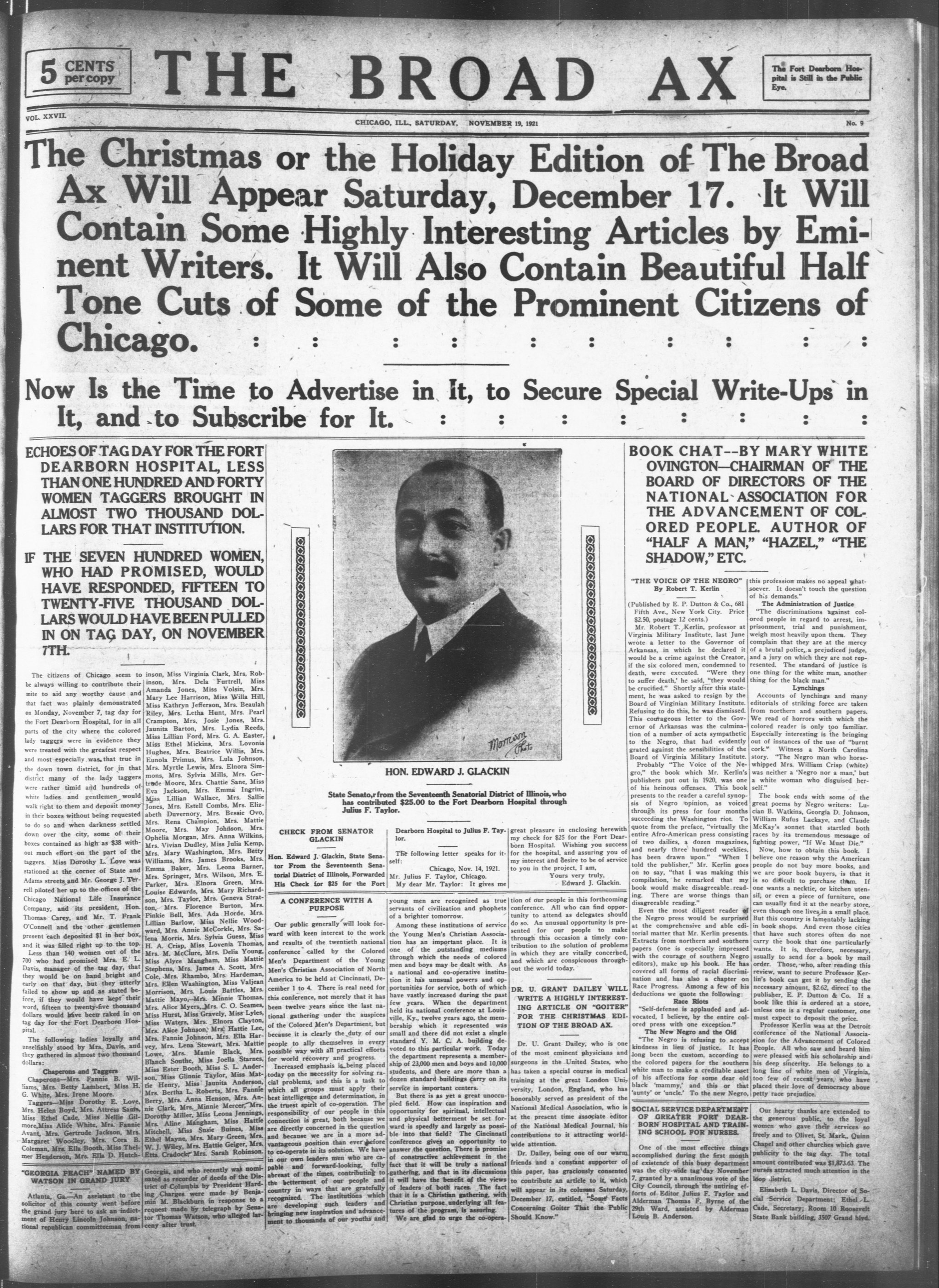
State Senator, r from the Seventeenth Senatorial District of Illinois, who has contributed $25.00 to the Fort Dearborn Hospital through Julius F. Taylor.
CHECK FROM SENATOR
GLACKIN
Hon. Edward J. Glackin, State Senator From the Seventeenth Senatorial District of Illinois, Forwarded His Check for $25 for the Fort
A CONFERENCE WITH A PURPOSE
Our public generally will look forward with keen interest to the work and results of the twentieth national conference called by the Colored Men's Department of the Young Men's Christian Association of North America to be held at Cincinnati, December 1 to 4. There is real need for this conference, not merely that it has been twelve years since the last national gathering under the auspices of the Colored Men's Department, but because it is clearly the duty of our people to ally themselves in every possible way with all practical efforts for world recovery and progress.
Increased emphasis is being placed today on the necessity for solving racial problems, and this is a task to which all groups must apply their best intelligence and determination, in the truest spirit of co-operation. The responsibility of our people in this connection is great, both because we are directly concerned in the question and because we are in a more advantageous position than ever before to co-operate in its solution. We have in our own leaders men who are capable and forward-looking, fully abreast of the times, contributing to the betterment of our people and country in ways that are gratefully recognized. The institutions which are developing such leaders and bringing new inspiration and advancement to thousands of our youths and
HON. EDWARD J. GLACKIN
from the Seventeenth Senatorial District
dated $25.00 to the Fort Dearborn H.
Taylor.
Dearborn Hospital to Julius F. Taylor.
The following letter speaks for it-
self:
Chicago, Nov. 14, 1921.
Mr. Julius F. Taylor, Chicago.
My dear Mr. Taylor: It gives me
young men are recognized as true
servants of civilization and phophets
of a brighter tomorrow.
Among these institutions of service the Young Men's Christian Association has an important place. It is one of the outstanding mediums through which the needs of colored men and boys may be dealt with. As a national and co-operative institution it has unusual powers and opportunities for service, both of which have vastly increased during the past few years. When the department held its national conference at Louisville, Ky., twelve years ago, the membership which it represented was small and there did not exist a single standard Y. M. C. A. building devoted to this particular work. Today the department represents a membership of 23,000 men and boys and 10,000 students, and there are more than a dozen standard buildings carry on its service in important centers.
But there is as yet a great unoccupied field. How can inspiration and opportunity for spiritual, intellectual and physical betterment be set forward is speedily and largely as possible into that field? The Cincinnati conference gives an opportunity to answer the question. There is promise of constructive achievement in the fact that it will be truly a national gathering, and that in its discussions it will have the benefit of the views of leaders of both races. The fact that it is a Christian gathering, with Christian purpose underlying all features of the program, is assuring. We are glad to urge the co-operative
great pleasure in enclosing herewith my check for $25 for the Fort Dearborn Hospital. Wishing you success for the hospital, and assuring you of my interest and desire to be of service to you in the project, I am,
Yours very truly,
Edward J. Glackin.
tion of our people in this forthcoming conference. All who can find opportunity to attend as delegates should do so. An unusual opportunity is presented for our people to make through this occasion a timely contribution to the solution of problems in which they are vitally concerned, and which are conspicuous throughout the world today.
DR. U. GRANT DAILEY WILL WRITE A HIGHLY INTERESTING ARTICLE ON "GOITER" FOR THE CHRISTMAS EDITION OF THE BROAD AX.
Dr. U. Grant Dailey, who is one of the most eminent physicians and surgeons in the United States, who has taken a special course in medical training at the great London University, London, England, who has honorably served as president of the National Medical Association, who is at the present time associate editor of the National Medical Journal, his contributions to it attracting worldwide attention.
Dr. Dailey, being one of our warm friends and a constant supporter of this paper, has graciously consented to contribute an article to it, which will appear in its columns Saturday, December 17, entitled, "Some Facts Concerning Goiter That the Public Should Know."
BOOK CHAT--BY MARY WHITE OVINGTON—CHAIRMAN OF THE BOARD OF DIRECTORS OF THE NATIONAL ASSOCIATION FOR THE ADVANCEMENT OF COL-ORED PEOPLE. AUTHOR OF "HALF A MAN," "HAZEL," "THE SHADOW," ETC.
"THE VOICE OF THE NEGRO" By Robert T. Kerlin
(Published by E. P. Dutton & Co., 681 Fifth Ave., New York City. Price $2.50, postage 12 cents.)
this profession makes no appeal whatsoever. It doesn't touch the question of his demands."
The Administration of Justice
"The discriminations against colored people in regard to arrest, im-
Mr. Robert T., Kerlin, professor at Virginia Military Institute, last June wrote a letter to the Governor of Arkansas, in which he declared it would be a crime against the Creator, if the six colored men, condemned to death, were executed. "Were they to suffer death," he said, "they would be crucified." Shortly after this statement, he was asked to resign by the Board of Virginian Military Institute. Refusing to do this, he was dismissed. This courageous letter to the Governor of Arkansas was the culmination of a number of acts sympathetic to the Negro, that had evidently grated against the sensibilities of the Board of Virginia Military Institute
Probably "The Voice of the Negro," the book which Mr. Kerlin's publishers put out in 1920, was one of his heinous offenses. This book presents to the reader a careful synopsis of Negro opinion, as voiced through its press for four months succeeding the Washington riot. To quote from the preface, "virtually the entire Afro-American press consisting of two dailies, a dozen magazines, and nearly three hundred weeklies, has been drawn upon." "When I told the publisher," Mr. Kerlin goes on to say, "that I was making this compilation, he remarked that my book would make disagreeable reading. There are worse things than disagreeable reading."
Even the most diligent reader of the Negro press would be surprised at the comprehensive and able editorial matter that Mr. Kerlin presents. Extracts from northern and southern papers (one is especially impressed with the courage of southern Negro editors), make up his book. He has covered all forms of racial discrimination and has also a chapter on Race Progress. Among a few of his deductions we quote the following:
**Race Riots**
"Self-defense is applauded and advocated, I believe, by the entire colored press with one exception."
The New Negro and the Old
"The Negro is refusing to accept
kindness in lieu of justice. It has
long been the custom, according to
the colored papers for the southern
white man to make a creditable asset
of his affections for some dear old
black 'mammy', and this or that
'unty' or 'uncle'. To the new Negro.
SOCIAL SERVICE DEPARTMENT
OF GREATER FORT DEAR-
BORN HOSPITAL AND TRAIN-
ING SCHOOL FOR NURSES.
One of the most effective things accomplished during the first month of existence of this busy department was the city-wide tag day November 7, granted by a unanimous vote of the City Council, through the uniting efforts of Editor Julius F. Taylor and Alderman Thomas F. Byrne of the 29th Ward, assisted by Alderman Louis B. Anderson.
The Fort Dearborn Hospital is Still in the Public Eye.
e Broad It Will by Emi- ful Half citizens of
write-Ups in
BY MARY WHITE
HAIRMAN OF THE
RECTORS OF THE
ASSOCIATION FOR
EMENT OF COL-
E. AUTHOR OF
," "HAZEL," "THE
this profession makes no appeal whatsoever. It doesn't touch the question of his demands."
The Administration of Justice
"The discriminations against colored people in regard to arrest, imprisonment, trial and punishment, weigh most heavily upon them. They complain that they are at the mercy of a brutal police, a prejudiced judge, and a jury on which they are not represented. The standard of justice is one thing for the white man, another thing for the black man."
Lynchings
Accounts of lynchings and many editorials of striking force are taken from northern and southern papers. We read of horrors with which the colored reader is only too familiar. Especially interesting is the bringing out of instances of the use of "burnt cork." Witness a North Carolina story. "The Negro man who horse-whipped Mrs. William Crisp (white) was neither a 'Negro nor a man,' but a white woman who disguised herself."
The book ends with some of the great poems by Negro writers: Lucian B. Watkins, Georgia D. Johnson, William Rufus Lackaye, and Claude McKay's sonnet that startled both races by its tremendous message of fighting power, "If We Must Die." Now, how to obtain this book. I believe one reason why the American people do not buy more books, and we are poor book buyers, is that it is so difficult to purchase them. If one wants a necktie, or kitchen utensil, or even a piece of furniture, one can usually find it at the nearby store, even though one lives in a small place. But this country is lamentably lacking in book shops. And even those cities that have such stores often do not carry the book that one particularly wants. It is, therefore, necessary, usually to send for a book by mail order. Those, who, after reading this review, want to secure Professor Kerlin's book can get it by sending the necessary amount, $2.62, direct to the publisher, E. P. Dutton & Co. If a book like this is ordered at a store, unless one is a regular customer, one must expect to deposit the price.
Professor Kerlin was at the Detroit conference of the National Association for the Advancement of Colored People. All who saw and heard him were pleased with his scholarship and his deep sincerity. He belongs to a long line of white men of Virginia, too few of recent years, who have placed their love of democracy above petty race prejudice.
Our hearty thanks are extended to the generous public, to the loyal women who gave their services so freely and to Olivet, St. Mark., Quinn Chapel and other churches which gave publicity to the tag day. The total amount contributed was $1,873.63. The nurses attracted much attention in the loop district.
Elizabeth L. Davis, Director of Social Service Department; Ethel L. Cade, Secretary; Room 10 Roosevelt State Bank building, 3507 Grand blvd.
THE BROAD AX Published Every Saturday
In this city since July 15th, 1899, without missing one single issue. Republicans, Democrats, Catholics, Protestants, Single Taxers, Priests, infidels or anyone else can have their say as long as their language is proper and responsibility is fixed.
The Broad Ax is a newspaper whose platform is broad enough for all, ever claiming the editorial right to speak its own mind.
Local communications will receive attention. Write only on one side of the paper.
Subscriptions must be paid in advance.
One Year ..... $2.00
Six Months ..... $1.00
Advertising rates made known on application.
Address all communication to
THE BROAD AX
4200 So. Elizabeth St, Chicago, Ill.
Phone Wenworth 2897
Associate Editor
DR. M. A. MAJORS
4700 South State Street
Phone Drexel 1416
NOVEMBER 19, 1921.
Vol. XXVII No. 9
Entered as Second-Class Matter, Aug.
19, 1902, at the Post Office at Chicago,
41L. Under Act of March 8, 1879.
CHANGING WORLD; NEGRO
WINS ON DEMOCRAT TICKET
New York—John William Smith, a lawyer, who was elected alderman in the Twenty-first district, Harlem, last Tuesday, is believed to be the only Negro ever elected to public office on the Democratic ticket in the United States. If th writer of the above will simply turn back the pages of history, he will learn that in November, 1895, that James C. Matthews, a colored lawyer who had honorably served as Recorder of Deeds of Washington, D. C., under the first administration of President Grover Cleveland, was nominated in a Democratic convention, and elected Judge of the Recorder's court of Albany, N. Y., defeating his white Republican opponent by ten thousand majority—Editor.
12TH ANNUAL ESSAY CONTEST
DECEMBER 18
Chicago is looking forward with pleasure to the coming of the great 12th annual essay contest, to be held Sunday afternoon, December 18, at 2:30 o'clock, in the beautiful auditorium of Pilgrim Baptist church, 33rd street and Indiana avenue. Eight of the leading literary clubs of the city will participate. Subject: "The Darker Races and the Impending Crisis." Prizes, two diamond rings, known as first and second prizes, donated by the popular jeweler, Dr. Louis Usselmann, 3150 S. State street. B. W. Fitts, founder and manager; Frank W. Henry, Alonzo J. Bowling and Willis N. Huggins, assistants.
STOCKHOLDER AT FIVE MONTHS
William H. Terrell, Jr., is the owner of several shares of stock in the Pyramid Building and Loan Association at the age of five months, and is the youngest member of the association. The Pyramid Building and Loan Association with offices at 3539 S. State street, is doing much good for the race along its lines.
FRED WYCHE IN CITY
Fred D. Wyche, 527 W. Taylor street, Bloomington, Ill., spent much time during the week in the city on business. While here Mr. Wyche visited relatives and friends, among whom was Mrs. W. A. Blackwell, a cousin.
74.
74.
COL. AUGUST W. MILLER
The Popular and Honorable Clerk of the Circuit
County, Who May Become the Thompson Cans
of Chicago in 1923.
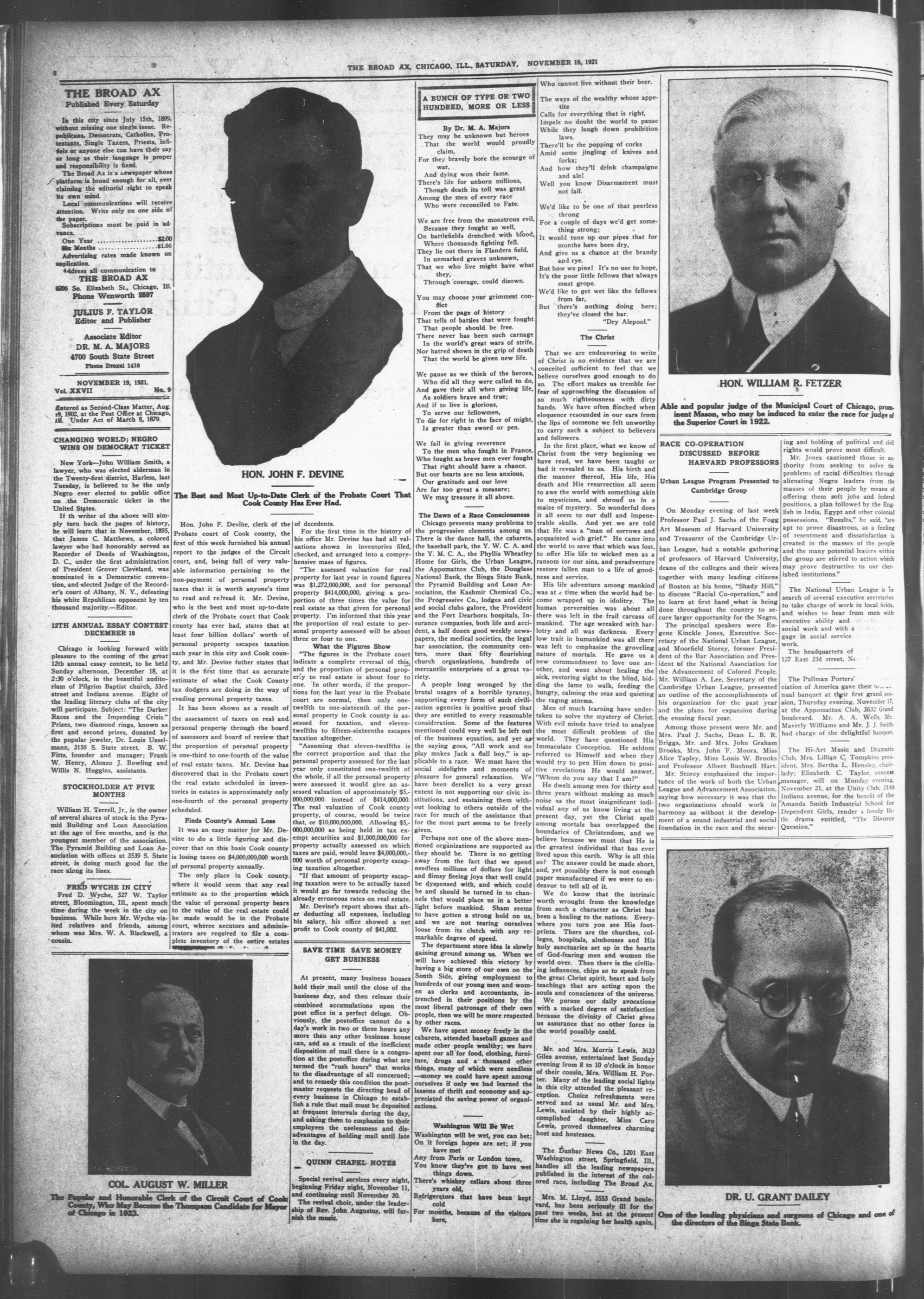
The Best and Most Up-to-Date Clerk of the Probate Court That Cook County Has Ever Had.
Hon. John F. Devine, clerk of the Probate court of Cook county, the first of this week furnished his annual report to the judges of the Circuit court, and, being full of very valuable information pertaining to the non-payment of personal property taxes that it is worth anyone's time to read and re?read it. Mr. Devine, who is the best and most up-to-date clerk of the Probate court that Cook county has ever had, states that at least four billion dollars' worth of personal property escapes taxation each year in this city and Cook county, and Mr. Devine further states that it is the first time that an accurate estimate of what the Cook County tax dodgers are doing in the way of evading personal property taxes.
It has been shown as a result of the assessment of taxes on real and personal property through the board of assessors and board of review that the proportion of personal property is one-third to one-fourth of the value of real estate taxes. Mr. Devine has discovered that in the Probate court the real estate scheduled in inventories in estates is approximately only one-fourth of the personal property scheduled.
Finds County's Annual Loss
It was an easy matter for Mr. Devine to do a little figuring and discover that on this basis Cook county is losing taxes on $4,000,000,000 worth of personal property annually.
The only place in Cook county where it would seem that any real estimate as to the proportion which the value of personal property bears to the value of the real estate could be made would be in the Probate court, where executors and administrators are required to file a complete inventory of the entire estates
1910
Work of the Circuit Court of Cooke
the Thompson Candidate for Mayor
THE BROAD AX, CHICAGO, ILL., SATURDAY, NOVEMBER 19, 1921
For the first time in the history of his office Mr. Devine has had all valuations shown in inventories filed, checked, and arranged into a comprehensive mass of figures.
"The assessed valuation for real property for last year in round figures was $1,272,000,000, and for personal property $414,000,000, giving a proportion of three times the value for real estate as that given for personal property. I'm informed that this year the proportion of real estate to personal property assessed will be about three or four to one.
What the Figures Show
"The figures in the Probate court indicate a complete reversal of this, and the proportion of personal property to real estate is about four to one. In other words, if the proportions for the last year in the Probate court are normal, then only one twelfth to one-sixteenth of the personal property in Cook county is assessed for taxation, and eleventwelfths to fifteen-sixteenth escapes taxation altogether.
"Assuming that eleven-twelfths is the correct proportion and that the personal property assessed for the last year only constituted one-twelfth of the whole, if all the personal property were assessed it would give an assessed valuation of approximately $5,000,000,000 instead of $414,000,000. The real valuation of Cook county property, of course, would be twice that, or $10,000,000,000. Allowing $5,000,000,000 as being held in tax exempt securities and $1,000,000,000 for property actually assessed on which taxes are paid, would leave $4,000,000,000 worth of personal property escaping taxation altogether.
"If that amount of property escaping taxation were to be actually taxed it would go far towards reducing the already erroneous rates on real estate. Mr. Devine's report shows that after deducting all expenses, including his salary, his office showed a net profit to Cook county of $41,002.
SAVE TIME SAVE MONEY
GET BUSINESS
At present, many business houses hold their mail until the close of the business day, and then release their combined accumulations upon the post office in a perfect deluge. Obviously, the postoffice cannot do a day's work in two or three hours any more than any other business house can, and as a result of the inefficient disposition of mail there is a congestion at the postoffice during what are termed the "rush hours" that works to the disadvantage of all concerned; and to remedy this condition the postmaster requests the directing head of every business in Chicago to establish a rule that mail must be deposited at frequent intervals during the day, and asking them to emphasize to their employees the uselessness and disadvantages of holding mail until late in the day.
QUINN CHAPEL NOTES
Special revival services every night, beginning Friday night, November 11, and continuing until November 30. The revival choir, under the leadership of Rev. John Augustus, will furnish the music.
A BUNCH OF TYPE OR TWO HUNDRED, MORE OR LESS
By Dr. M. A. Majors They may be unknown but heroes That the world would proudly claim.
claim,
For they bravely bore the scourge of
war,
And dying won their fame.
There's life for unborn millions,
Though death its toll was great
Among the men of every race
Who were reconciled to Fate.
We are free from the monstrous evil,
Because they fought so well,
On battlefields drenched with bflood,
Where thousands fighting fell.
They lie out there in Flanders field,
In unmarked graves unknown,
That we who live might have what
they.
You may choose your grimmest conflict
From the page of history
That tells of battles that were fought
That people should be free.
That people should be tree.
There never has been such carnage
In the world's great wars of strife,
Nor hatred shown in the grip of death
That the world be given new life.
We pause as we think of the heroes,
Who did all they were called to do,
And gave their all when giving life,
As soldiers brave and true;
And if to live is glorious,
To serve our fellowmen,
To die for right in the face of might,
Is greater than sword or pen.
We fail in giving reverence
To the men who fought in France,
Who fought as brave men ever fought
That right should have a chance.
But our hearts are no less anxious,
Our gratitude and our love
Are far too great a measure;
We may treasure it all above.
The Dawn of a Race Consciousness Chicago presents many problems to the progressive elements among us There is the dance hall, the cabarets, the baseball park, the W. W. C. A. and the Y. M. C. A., the Phyllis Wheatley Home for Girls, the Urban League, the Appomattox Club, the Douglass National Bank, the Binga State Bank, the Pyramid Building and Loan Association, the Kashmir Chemical Co., the Progressive Co., lodges and civic and social clubs galore, the Provident and the Fort Dearborn hospitals, Insurance companies, both life and accident, a half dozen good weekly newspapers, the medical societies, the legal bar association, the community centers, more than fifty flourishing church organizations, hundreds of mercantile enterprises of a great variety.
A people long wronged by the brutal usages of a horrible tyranny, supporting every form of such civilization agencies is positive proof that they are entitled to every reasonable consideration. Some of the features mentioned could very well be left out of the business equation, and yet as the saying goes, "All work and no play makes Jack a full boy," is applicable to a race. We must have the social sidelights and moments of pleasure for general relaxation. We have been derelict to a very great extent in not supporting our civic institutions, and sustaining them without looking to others outside of the race for much of the assistance that for the most part seems to be freely given.
Perhaps not one of the above mentioned organizations are supported as they should be. There is no getting away from the fact that we spend needless millions of dollars for light and filmsy fleeing joys that well could be dyspensed with, and which could be and should be turned in to channels that would place us in a better light before mankind. Sham seems to have gotten a strong hold on us, and we are not tearing ourselves loose from its clutch with any remarkable degree of speed.
The department store idea is slowly gaining ground among us. When we will have achieved this victory by having a big store of our own on the South Side, giving employment to hundreds of our young men and women as clerks and accountants, intrenched in their positions by the most liberal patronage of their own people, then we will be more respected by other races.
We have spent money freely in the cabarets, attended baseball games and made other people wealthy; we have spent our all for food, clothing, furniture, drugs and a thousand other things, many of which were needless—money we could have spent among ourselves if only we had learned the lessons of thrift and economy and appreciated the saving power of organizations.
Washington Will Be Wet
Washington will be wet, you can bet;
On it foreign hopes are set; if you have met
Any from Paris or London town,
You know they've got to have wet things down.
There's whiskey cellars about three years old,
Refrigerators that have been kept cold
For months, because of the visitors here,
Who cannot live without their beer.
The ways of the wealthy whose appetite
We'd like to be one of that peerless
throng
For a couple of days we'd get some-
thing strong;
It would tune up our pipes that for
months have been dry,
And give us a chance at the brandy
and rye.
and rye.
But how we pine! It's no use to hope.
It's the poor little fellows that always
must grope.
We'd like to get wet like the fellows
from far.
The Christ
That we are endeavoring to write of Christ is no evidence that we are conceived sufficient to feel that we believe ourselves good enough to do so. The effort makes us tremble for fear of approaching the discussion of so much righteousness with dirty hands. We have often flinched when eloquence resounded in our ears from the lips of someone we felt unworthy to carry such a subject to believers and followers.
In the first place, what we know of Christ from the very beginning we have read, we have been taught or had it revealed to us. His birth and the manner thereof, His life, His death and His resurrection all seem to awe the world with something akin to mysticism, and shroud us in a maize of mystery. So wonderful does it all seem to our dull and impenetrable skulls. And yet we are told that He was a "man of sorrows and acquainted with grief." He came into the world to save that which was lost, to offer His life to wicked men as a ransom for our sins, and adventure restore fallen man to a life of goodness and service.
His life adventure among mankind was at a time when the world had become wrapped up in idolity. The human perversities was about all there was left in the frail carcass of mankind. The age wreaked with harlotry and all was darkness. Every low trait in humankind was all there was left to emphasize the groveling nature of mortals. He gave us a new commandment to love one another, and went about healing the sick, restoring sight to the blind, bidding the lame to walk, feeding the hungry, calming the seas and quieting the raging storms.
Men of much learning have undertaken to solve the mystery of Christ. With evil minds have tried to analyze the most difficult problem of the world. They have questioned His Immaculate Conception. He seldom referred to Himself and when they would try to pen Him down to positive revelations He would answer, "Whom do you say that I am?" He dwelt among men for thirty and three years without making as much noise as the most insignificant individual any of us know living at the present day, yet the Christ spell among mortals has overlapped the boundaries of Christendom, and we believe because we must that He is the greatest individual that has ever lived upon this earth. Why is all this so? The answer could be made short, and, yet possibly there is not enough paper manufactured if we were to endeavor to tell all of it.
We do know that the intrinsic worth wrought from the knowledge from such a character as Christ has been a healing to the nations. Everywhere you turn you see His footprints. There are the churches, colleges, hospitals, almhouses and His holy sanctuaries set up in the hearts of God-fearing men and women the world over. Then there is the civilizing influences, chips so to speak from the great Christ spirit, heart and holy teachings that are acting upon the souls and consciences of the universe. We pursue our daily avocations with a marked degree of satisfaction because the divinity of Christ gives us assurance that no other force in the world possibly could.
Mr. and Mrs. Morris Lewis, 3633 Giles avenue, entertained last Sunday evening from 8 to 10 o'clock in honor of their cousin, Mrs. William H. Porter. Many of the leading social lights in this city attended the pleasant reception. Choice refreshments were served and as usual Mr. and Mrs. Lewis, assisted by their highly accomplished daughter, Miss Caro Lewis, proved themselves charming host and hostesses.
The Dunbun News Co., 1201 East Washington street, Springfield, Ill., handles all the leading newspapers published in the interest of the colored race, including The Broad Ax.
Mrs. M. Lloyd, 3553 Grand boulevard, has been seriously ill for the past two weeks, but at the present time she is regaining her health again.
[Name]
HON. WILLIAM R. FETZER Able and popular judge of the Municipal Court of inent Mason, who may be induced to enter the Superior Court in 1922.
Able and popular judge of the Municipal Court of Chicago, prominent Mason, who may be induced to enter the race for judge of the Superior Court in 1922.
RACE CO-OPERATION
DISCUSSED BEFORE
HARVARD PROFESSORS
Urban League Program Presented to Cambridge Group
On Monday evening of last week Professor Paul J. Sachs of the Fogg Art Museum of Harvard University and Treasurer of the Cambridge Urban League, had a notable gathering of professors of Harvard University, deans of the colleges and their wives together with many leading citizens of Boston at his home, "Shady Hill," to discuss "Racial Co-operation," and to learn at first hand what is being done throughout the country to secure larger opportunity for the Negro. The principal speakers were Eugene Kinchle Jones, Executive Secretary of the National Urban League, and Moorfield Storey, former President of the Bar Association and President of the National Association for the Advancement of Colored People. Mr. William A. Lee, Secretary of the Cambridge Urban League, presented an outline of the accomplishments of his organization for the past year and the plans for expansion during the ensuing fiscal year.
Among those present were Mr. and Mrs. Paul J. Sachs, Dean L. B. R. Briggs, Mr. and Mrs. John Graham Brooks, Mrs. John F. Moors, Miss Alice Tapley, Miss Louis W. Brooks and Professor Albert Bushnell Hart. Mr. Storey emphasized the importance of the work of both the Urban League and Advancement Association, saying how necessary it was that the two organizations should work in harmony as without it the development of a sound industrial and social foundation in the race and the secur-
```markdown
```
DR. U. GRANT DAILEY
One of the leading physicians and surgeons of the directors of the Binga State Bank.
One of the leading physicians and surgeons of Chicago and one of the directors of the Bingo State Bank.
Municipal Court of Chicago, promuced to enter the race for judge of ing and holding of political and civil rights would prove most difficult.
rights would prove most difficult. Mr. Jones cautioned those in authority from seeking to solve the problems of racial difficulties through alienating Negro leaders from the masses of their people by means of offering them soft jobs and federal positions, a plan followed by the English in India, Egypt and other colonial possessions. "Results" he said, "are apt to prove disastrous, as a feeling of resentment and dissatisfaction is created in the masses of the people and the many potential leaders within the group are stirred to action which may prove destructive to our cherished institutions."
The National Urban League is in search of several executive secretaries to take charge of work in local fields, and wishes to hear from men with executive ability and social work and with a gage in social service work. The headquarters of 127 East 23d street, Ne
ciation of America gave their annual banquet at their first grand session, Thursday evening, November 17, at the Appomattox Club, 3632 Grand boulevard. Mr. A. A. Wells, Mr. Maverly Williams and Mr. J. J. Smith had charge of the delightful banquet.
The Hi-Art Music and Dramatic Club, Mrs. Lillian C. Tompkins president, Mrs. Bertha L. Hensley, chairlady; Elizabeth C. Taylor, concert manager, will on Monday evening, November 21, at the Unity Club, 3140 Indiana avenue, for the benefit of the Amanda Smith Industrial School for Dependent Girls, render a lovely little drama entitled, "The Divorce Question."
A.
surgeons of Chicago and one of Bank.
[Picture of a woman with white hair, wearing a dark dress with a decorative necklace.]
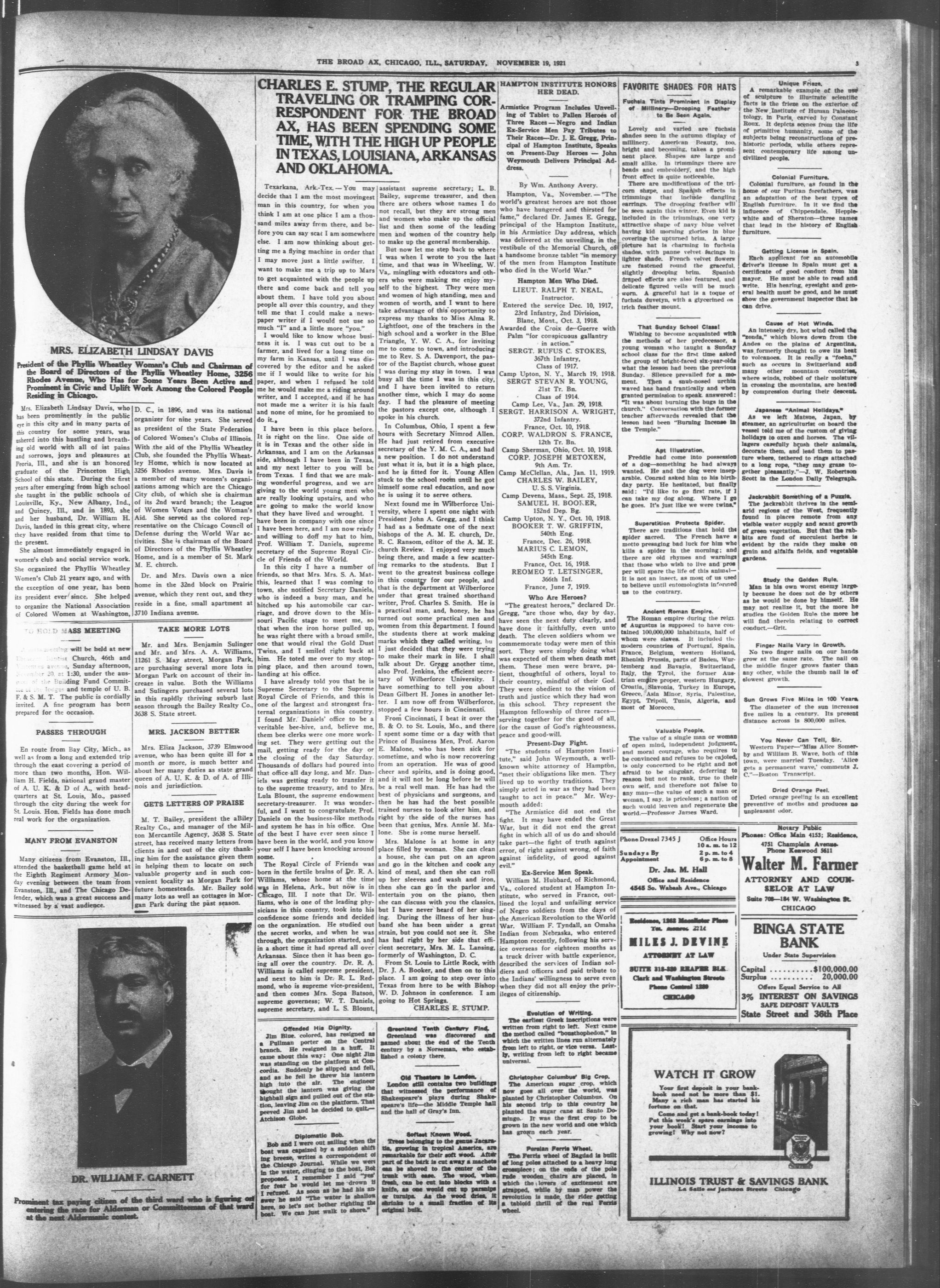
MRS. ELIZABETH LINDSAY DAVIS President of the Phyllis Wheatley Woman's Club and Chairman of the Board of Directors of the Phyllis Wheatley Home, 3256 Rhodes Avenue, Who Has for Some Years Been Active and Prominent in Civic and Uplift Work Among the Colored People Residing in Chicago.
Mrs. Elizabeth Lindsay Davis, who has been prominently in the public eye in this city and in many parts of this country for some years, was ushered into this hustling and breathing old world with all of 1st pains and sorrows, joys and pleasures at Peoria, Ill., and she is an honored graduate of the Princeton High School of this state. During the first years after emerging from high school she taught in the public schools of Louisville, Ky., New Albany, Ind., and Quincy, Ill., and in 1893, she and her husband, Dr. William H. Davis, landed in this great city, where they have resided from that time to the present.
She almost immediately engaged in women's club and social service work. She organized the Phyllis Wheatley Women's Club 21 years ago, and with the exception of one year, has been its president ever since. She helped to organize the National Association of Colored Women at Washington,
Attendees meeting will be held at new
Broadway Baptist Church, 46th and
Vincentia avenue, Sunday afternoon,
November 20, at 1:30, under the auspice
of the Building Fund Committee
of the lodges and temple of U. B.
F. & S. M. T. The public is cordially
invited. A fine program has been
prepared for the occasion.
PASSES THROUGH
En route from Bay City, Mich., as well as from a long and extended trip through the east covering a period of more than two months, Hon. William H. Fields, national grand master of A. U. K. & D of A., with headquarters at St. Louis, Mo., passed through the city during the week for St. Louis. Hon. Fields has done much real work for the organization.
MANY FROM EVANSTON
Many citizens from Evanston, III, attended the basketball game held at the Eighth Regiment Armory Monday evening between the team from Evanston, III, and The Chicago Defender, which was a great success and witnessed by a vast audience.
M. A. B.
DR. WILLIAM F. GARNETT
D. C., in 1896, and was its national organizer for nine years. She served as president of the State Federation of Colored Women's Clubs of Illinois. With the aid of the Phyllis Wheatley Club, she founded the Phyllis Wheatley Home, which is now located at 3256 Rhodes avenue. Mrs. Davis is a member of many women's organizations among which are the Chicago City club, of which she is chairman of its 2nd ward branch; the League of Women Voters and the Woman's Aid. She served as the colored representative on the Chicago Council of Defense during the World War activities. She is chairman of the Board of Directors of the Phyllis Wheatley Home, and is a member of St. Mark M. E. church.
Dr. and Mrs. Davis own a nice home in the 32nd block on Prairie avenue, which they rent out, and they reside in a fine, small apartment at 3120 Indiana avenue.
TAKE MORE LOTS
Mr. and Mrs. Benjamin Sulinger and Mr. and Mrs. A. A. Williams, 11261 S. May street, Morgan Park are purchasing several more lots in Morgan Park on account of their increase in value. Both the Williams and Sulingers purchased several lots in this rapidly thriving suburb last season through the Bailey Realty Co. 3638 S. State street.
MRS. JACKSON BETTER
Mrs. Eliza Jackson, 3739 Elmwood avenue, who has been quite ill for a month or more, is much better and about her many duties as state grand queen of A. U. K. & D. of A. of Illinois and jurisdiction.
GETS LETTERS OF PRAISE
M. T. Bailey, president the aBiley Realty Co., and manager of the Milton Mercantile Agency, 3638 S. State street, has received many letters from clients in and out of the city thank him for the assistance given them in helping them to locate on such valuable property and in such convenient locality as Morgan Park for future homesteads. Mr. Bailey sold many lots as well as cottages in Morgan Park during the past season.
THE BROAD AX, CHICAGO, ILL., SATURDAY, NOVEMBER 19, 1921
CHARLES E. STUMP, THE REGULAR TRAVELING OR TRAMPING CORRESPONDENT FOR THE BROAD AX, HAS BEEN SPENDING SOME TIME, WITH THE HIGH UP PEOPLE IN TEXAS, LOUISIANA, ARKANSAS AND OKLAHOMA.
Texarkana, Ark.-Tex. — You may decide that I am the most movingest man in this country, for when you think I am at one place I am a thousand miles away from there, and before you can say scat I am somewhere else. I am now thinking about getting me a flying machine in order that I may move just a little swifter. I want to make me a trip up to Mars to get acquainted with the people up there and come back and tell you about them. I have told you about people all over this country, and they tell me that I could make a newspaper writer if I would not use so much "I" and a little more "you." I would like to know whose business it is. I was cut out to be a farmer, and lived for a long time on my farm in Kansas, until I was discovered by the editor and he asked me if I would like to write for his paper, and when I refused he told me he would make me a riding around writer, and I accepted, and if he has not made me a writer it is his fault and none of mine, for he promised to do it.
I have been in this place before.
It is right on the line. One side of
it is in Texas and the other side in
Arkansas, and I am on the Arkansas
side, although I have been in Texas,
and my next letter to you will be
from Texas. I find that we are making
wonderful progress, and we are
giving to the world young men who
are really looking upstairs, and who
are going to make the world know
that they have lived and wrought. I
have been in company with one since
I have been here, and I am now ready
and willing to doff my hat to him,
Prof. William T. Daniels, supreme
secretary of the Supreme Royal Circle
of Friends of the World.
In this city I have a number of friends, so that Mrs. Mrs. S. A. Matthi, learned that I was coming to town, she notified Secretary Daniels, who is indeed a busy man, and he hitched up his automobile car carriage, and drove down to the Missouri Pacific stage to meet me, so that when the iron horse pulled up, he was right there with a broad smile, one that would rival the Gold Dust Twins, and I smiled right back at him. He toted me over to my stopping place, and then around town, landing at his office.
I have already told you that he is Supreme Secretary to the Supreme Royal Circle of Friends, and this is one of the largest and strongest fraternal organizations in this country. I found Mr. Daniels' office to be a veritable bee-hive, and, believe me, them bee clerks were one more working set. They were getting out the mail, getting ready for the day or the closing of the day Saturday. Thousands of dollars had poured into that office all day long, and Mr. Daniels was getting ready to transfer it to the supreme treasury, and to Mrs. Lula Blount, the supreme endowment secretary-treasurer. It was wonderful, and I want to congratulate Prof Daniels on the business-like methods and system he has in his office. One of the best I have ever seen since I have been in the world, and you know your self I have been knocking around some.
The Royal Circle of Friends was born in the fertile brains of Dr. R. A. Williams, whose home at the time was in Helena, Ark, but now is in Chicago, Ill. I note that Dr. Williams, who is one of the leading physicians in this country, took into his confidence some friends and decided on the organization. He studied out the secret works, and when he was through, the organization started, and in a short time it had spread all over Arkansas. Since then it has been going all over the country. Dr. R. A. Williams is called supreme president, and next to him is Dr. R. L. Redmond, who is supreme vice-president, and then comes Mrs. Sopa Batson, supreme governess; W. T. Daniels, supreme secretary, and L. S. Blount
Offended His Dignity.
Jim Blue, colored, has resigned as a Pullman porter on the Central branch. He resigned in a huff. It came about this way: One night Jim was standing on the platform at Concordia. Suddenly he slipped and fell, and as he fell he threw his lantern high into the air. The engineer thought the lantern was giving the highball sign and pulled out of the station, leaving Jim on the platform. That peeved Jim and he decided to quit—Archison Globe.
Diplomatic Bob.
Bob and I were out sailing when the boat was capsized by a sudden shifting breeze, writes a correspondent of the Chicago Journal. While we went in the water, clinging to the boat, Bob proposed. I remember I said "yes" for fear he would let me drown if I refused. As soon as he had his answer he said "The water is shallow here, so let's not bother righting the boat. We can just walk to shore."
assistant supreme secretary; L. B. Bailey, supreme treasurer, and then there are others whose names I do not recall, but they are strong men and women who make up the official list and then some of the leading men and women of the country help to make up the general membership.
But now let me step back to where I was when I wrote to you the last time, and that was in Wheeling, W. Va., mingling with educators and others who were making me enjoy myself to the highest. They were men and women of high standing, men and women of worth, and I want to here take advantage of this opportunity to express my thanks to Miss Alma R. Lightfoot, one of the teachers in the high school and a worker in the Blue Triangle, Y. W. C. A., for inviting me to come to town, and introducing me to Rev. S. A. Davenport, the pastor of the Baptist church, whose guest I was during my stay in town. I was busy all the time I was in this city, and I have been invited to return another time, which I may do some day. I had the pleasure of meeting the pastors except one, although I spoke in his church.
In Columbus, Ohio, I spent a few hours with Secretary Nimrod Allen. He had just retired from executive secretary of the Y. M. C. A., and had a new position. I do not understand just what it is, but it is a high place, and he is fitted for it. Young Allen stuck to the school room until he got himself some real education, and now he is using it to serve others.
Next found me in Wilberforce University, where I spent one night with President John A. Gregg, and I think I had as a bedmate one of the next bishops of the A. M. E. church, Dr. R. C. Ransom, editor of the A. M. E. church Review. I enjoyed very much being there, and made a few scattering remarks to the students. But I went to the greatest business college in this country for our people, and that is the department at Wilberforce under that great trained shorthand writer, Prof. Charles S. Smith. He is a practical man, and, honey, he has turned out some practical men and women from this department. I found the students there at work making marks which they called writing, but I just decided that they were trying to make their mark in life. I shall talk about Dr. Gregg another time, also Prof. Jenkins, the efficient secretary of Wilberforce University. I have something to tell you about Dean Gilbert H. Jones in another letter. I am now off from Wilberforce, stopped a few hours in Cincinnati.
From Cincinnati, I beat it over the B. & O. to St. Louis, Mo., and there I spent some time or a day with that Prince of Business Men, Prof. Aaron E. Malone, who has been sick for sometime, and who is now recovering from an operation. He was of good cheer and spirits, and is doing good, and it will not be long before he will be a real well man. He has had the best of physicians and surgeons, and then he has had the best possible trained nurses to look after him, and right by the side of the nurses has been that genius, Mrs. Annie M. Malone. She is some nurse herself.
Mrs. Malone is at home in any place filled by woman. She can clean a house, she can put on an apron and go in the kitchen and cook any kind of meal, and then she can roll up her sleeves and wash and iron, then she can go in the parlor and entertain you on the piano, then she can discuss with you the classics, but I have never heard of her singing. During the illness of her husband she has been under a great strain, but you could not see it. She has had right by her side that efficient secretary, Mrs. M. L. Lansing, formerly of Washington, D. C. From St. Louis to Little Rock, with Dr. J. A. Booker, and then on to this place. I am going to step over into Texas from here to be with Bishop W. D. Johnson in conference. I am going to Hot Springs.
CHARLES E. STUMP.
Greenland Tenth Century Find, Greenland was discovered and named about the end of the Tenth century by a Norseman, who established a colony there.
Old Theaters in London.
On the streets in London still contains two buildings that witnessed the performance of Shakespeare's plays during Shakespeare's life—the Middle Temple hall and the hall of Gray's Inn.
Softest Known Wood.
borest known wood.
Trees belonging to the genus Jacarita, growing in tropical America, are remarkable for their soft wood. After part of the bark is cut away a machete can be shoved to the center of the trunk with ease. The wood, when fresh, can be cut into blocks with a knife, as one would cut up parapants or turnips. As the wood dries, it shrinks to a small fraction of its original bulk.
HAMPTON INSTITUTE HONORS
HER DEAD.
Armistice Program Includes Unveiling of Tablet to Fallen Heroes of Three Races — Negro and Indian Ex-Service Men Pay Tributes to Their Races—Dr. J. E. Gregg, Principal of Hampton Institute, Speaks on Present-Day Heroes — John Weymouth Delivers Principal Address.
By Wm. Anthony Avery
Hampton, Va., November. — "The world's greatest heroes are not those who have hungered and thirsted for fame," declared Dr. James E. Gregg, principal of the Hampton Institute, in his Armistice Day address, which was delivered at the unveiling, in the vestibule of the Memorial Church, of a handsome bronze tablet "in memory of the men from Hampton Institute who died in the World War."
Hampton Men Who Died.
Hampton Men Who Died.
LIEUT. RALPH T. NEAL,
Instructor.
Entered the service Dec. 10, 1917,
23rd Infantry, 2nd Division,
Blanc, Mont, Oct. 3, 1918.
Awarded the Croix de-Guerre with
Palm "for conspicuous gallantry
in action."
SERGT. RUFUS C. STOKES,
367th Infantry,
Class of 1917.
Camp Upton, N. Y., March 19, 1918
SERGT STEVAN R. YOUNG,
21st Tr. Bn.
Class of 1914.
Camp Lee, Va., Jan. 29, 1918.
SERGT. HARRISON A. WRIGHT
372nd Infantry.
France, Oct. 10, 1918.
CORP. WALDRON S. FRANCE,
12th Tr. Bn.
Camp Sherman, Ohio, Oct. 10, 1918.
CORP. JOSEPH METOXEN,
9th Am. Tr.
Camp McClellan, Ala., Jan. 11, 1919
CHARLES W. BAILEY,
U. S. S. Virginia.
Camp Devens, Mass, Sept. 25, 1918.
SAMUEL H. BOOKER,
152nd Dep. Bg.
Camp Upton, N. Y., Oct. 10, 1918.
BOOKER T. W. GRIFFIN,
540th Eng.
France, Dec. 26, 1918.
MARIUS C. LEMON,
545th Eng.
France, Oct. 16, 1918.
REOMEO T. LETSINGER,
366th Inf.
Who Are Heroes?
"The greatest heroes," declared Dr. Gregg, "are those who, day by day, have seen the next duty clearly, and have done it faithfully, even unto death. The eleven soldiers whom we commemorate today were men of this sort. They were simply doing what was expected of them when death met them. These men were brave, patient, thoughtful of others, loyal to their country, mindful of their God. They were obedient to the vision of truth and justice which they had won in this school. They represent the Hampton fellowship of three races—serving together for the good of all, for the cause of God's righteousness, peace and good-will.
Present-Day Fight.
"The students of Hampton Institute," said John Weymouth, a well-known white attorney of Hampton, "met their obligations like men. They lived up to worthy traditions. They simply acted in war as they had been taught to act in peace." Mr. Weymouth added:
"The Armistice did not end the fight. It may have ended the Great War, but it did not end the great fight in which all of us do and should take part—the fight of truth against error, of right against wrong, of faith against infidelity, of good against evil."
Ex-Service Men Speak.
William M. Hubbard, of Richmond, Va., colored student at Hampton Institute, who served in France, outlined the loyal and unfailing service of Negro soldiers from the days of the American Revolution to the World War. William F. Tyndall, an Omaha Indian from Nebraska, who entered Hampton recently, following his service overseas for eighteen months as a truck driver with battle experience, described the services of Indian soldiers and officers and paid tribute to the Indians' willingness to serve even when they did not all enjoy the privileges of citizenship.
Evolution of Writing.
The earliest Greek inscriptions were written from right to left. Next came the method called "bosthaphedon," in which the written lines run alternately from left to right, or vice versa. Lastly, writing from left to right became universal.
Christopher Columbus' Big Crop.
The American sugar crop, which now goes all over the world, was planted by Christopher Columbus. On his second trip to this country he planted the sugar cane at Santo Domingo. It was the first crop to be grown in the new world and one which has grown each year.
Roman Ferris Wheel
Puritan Ferris Wheel.
The Ferris wheel of Bagdad is built of long poles attached to a heavy long crocuspiece; on the ends of the pole rude wooden chairs are placed, in which the lovers of excitement are strapped, while by man power the revolution is made, the rider getting a tabloid thrill of the real Ferris wheel.
ILLINOIS TRUST & SAVINGS BANK
La Salle and Jackson Streets Chicago
FAVORITE SHADES FOR HATS
Fuchsia Tinta Prominent in Display of Millinery—Drooping Feather to Be Seen Again.
Lovely and varied are fuchsia shades seen in the autumn display of millinery. American Beauty, too, bright and becoming, takes a prominent place. Shapes are large and small alike. In trimming there are beads and embroidery, and the high front effect is quite noticeable.
There are modifications of the tricorn shape, and Spanish effects in trimmings that include dangling earrings. The drooping feather will be seen again this winter. Even kid is included in the trimmings, one very attractive shape of navy blue velvet having kid morning glories in blue covering the upturned brim. A large picture hat is charming in fuchsia shades, with pannie velvet facings in lighter shade. French drooping flowers are fastened round the graceful, slightly drooping brim. Spanish draped effects are also featured, and delicate figured vells will be much worn. A graceful hat is a toque of fuchsia duvetyn, with a glycerined osrich feather mount.
That Sunday School Class!
Wishing to become acquainted with the methods of her predecessor, a young woman who taught a Sunday school class for the first time asked the group of bright-faced six-year-olds what the lesson had been the previous Sunday. Silence prevailed for a moment. Then a snub-nosed urchin waved has hand frantically and when granted permission to speak, answered: "It was about burning the bugs in the church." Conversation with the former teacher afterwards revealed that the lesson had been "Burning Incense in the Temple."
Apt Illustration
Freddie had come into possession of a dog—something he had always wanted. He and the dog were inseparable. Corr asked him to his birthday party. He hesitated, but finally said: "I'd like to go first rate, if I can take my dog along. Where I go he goes. It's just like we were twins."
Superstition Protects Spider
There are traditions that hold the spider sacred. The French have a motto presaging bad luck for him who kills a spider in the morning; and there are old rhymes and warnings that those who wish to live and prosper will spare the life of this animal—it is not an insect, as most of us used to believe until entomologists informed us to the contrary.
Ancient Roman Empire.
The Roman empire during the reign, of Augustus is supposed to have contained 100,000,000 inhabitants, half of whom were slaves. It included the modern countries of Portugal, Spain, France, Belgium, western Holland, Rhenish Prussia, parts of Baden, Wurtemberg and Bavaria, Switzerland, Italy, the Tyrol, the former Austrian empire proper, western Hungary, Croatia, Slavonia, Turkey in Europe, Greece, Asia Minor, Syria, Palestine, Egypt, Trilipol, Tunis, Algeria, and most of Morocco.
Valuable People
The value of a single man or woman of open mind, independent judgment, and moral courage, who requires to be convinced and refuses to be cajoled, is only concerned to be right and not afraid to be singular, deferring to reason but not to rank, true to their own self, and therefore not false to any man—the value of such a man or woman, I say, is priceless; a nation of such would leaven and regenerate the world—Professor James Ward.
Phone Drexel 7345 J Office Hours
10 a.m. to 12
Sundays By 2 p.m. to 4
Appointment 6 p.m. to 8
Dr. Jas. M. Hall
Office and Residence
4545 S. Wabash Ave., Chicago
Residence, 1263 MacMillan Place
Ton. montes. 2714
MILES J. DEVINE
ATTORNEY AT LAW
SUITE 318-339 REAPER BLK.
Clark and Washington Streets
Phone Central 1289
CHICAGO
WATCH IT GROW
Your first deposit in your bank book need not be more than $1. Many a rich man has started his fortune on that.
Come and get a bank-book today. Put this week's spare earnings into your book! Start your income to growing! Why not now?
ILLINOIS TRUST & S
La Salle and Jackson Str
Unique Erieze
A remarkable example of the use of sculpture to illustrate scientific facts is the frieze on the exterior of the New Institute of Human Palaeontology, in Paris, carved by Constant Roux. It depicts scenes from the life of primitive humanity, some of the subjects being reconstructions of prehistoric periods, while others represent contemporary life among uncivilized people.
Colonial Furniture
Colonial furniture, as found in the home of our Puritan forefathers, was an adaptation of the best types of English furniture. In it we find the influence of Chippendale. Hepplewhite and of Sheraton—three names that lead in the history of English furniture.
Getting License in Spain
Each applicant for an automobile driver's license in Spain must get a certificate of good conduct from his mayor. He must be able to read and write. His hearing, eyesight and general health must be good, and he must show the government inspector that he can drive.
Cause of Hot Winds
An intensely dry, hot wind called the "zonda," which blows down from the Andes on the plains of Argentina, was formerly thought to owe its heat to volcanoes. It is really a "foehn," such as occurs in Switzerland and many other mountain countries, where winds, robbed of their moisture in crossing the mountains, are heated by compression during their descent.
Japanese "Animal Holiday"
As we left Matsue, Japan, by steamer, an agriculturist on board the vessel told me of the custom of giving holidays to oxen and horses. The villagers carefully brush their animals, decorate where, and lead them to pasture where, tethered to rings attached to a long rope, "they may graze together pleasantly."—J. W. Robertson Scott in the London Daily Telegraph.
Jackrabbit Something of a Puzzle.
Jackrabbit Something or a Puzzle.
The jackrabbit thrives in the semiarid regions of the West, frequently found in places remote from any visible water supply and scant growth of green vegetation. But that the rabbits are fond of succulent herbs is evident by the raids they make on grain and alfalfa fields, and vegetable gardens.
Study the Golden Rule
Man is his own worst enemy largely because he does not do by others as he would be done by himself. He may not realize it, but the more he studies the Golden Rule the more he will find therein relating to correct conduct.—Grit.
Finger Nails Vary in Growth.
No two finger nails on our hands grow at the same rate. The nail on the middle finger grows faster than any other, while the thumb nail is of slowest growth.
Sun Grows Five Miles in 100 Years
The diameter of the sun increases five miles in a century. Its present distance across is 800,000 miles.
You Never Can Tell. Sir.
Western Paper—"Miss Alice Somerby and William B. Wave, both of this town, were married Tuesday. 'Alice gets a permanent wave,' comments J. C."—Boston Transcript.
Dried Orange Peel
Dried orange peel is an excellent preventive of moths and produces no unpleasant odor.
Notary Public
Phones: Office Main 4153; Residence,
4751 Champlain Avenue.
Phone Kenwood 5611
Walter M. Farmer
ATTORNEY AND COUNSELOR AT LAW
Suite 708—184 W. Washington St.
CHICAGO
BINGA STATE BANK
Under State Supervision
Capital $100,000.00
Surplus 20,000.00
Offers Equal Service to All
3% INTEREST ON SAVINGS
SAFE DEPOSIT VAULTS
State Street and 36th Place
MINISTERIO DE LA CONSTRUCCIÓN
DE LAS CIUDADES
DE LA REPUBLICA DE MEXICO
& SAVINGS BANK
n Streets Chicago
May Gilbert Praises
EXELENTO QUININE
POMADE
Says her hair has grown
28 inches long by using
this wonderful hair grower
YOU can have soft, silky hair that can be easily dressed.
EXELENTO has made happy thousands of women who had
coarse, nappy hair. It will do the same for you. If your
hair is brittle and lifeless or if you have dandruff and itching
scalp, try a box of EXELENTO QUININE POMADE.
For sale at all drug stores. Price by mail No on receipt of stamps or coin.
AGENTS WANTED-Write for Particular
EXELENTO MEDICINE COMPANY, Atlanta, Georgia
We make EXELENTO SKIN BRAVITIES an ointment for dark, sallow skins,
used in treatment of skin troubles.
Bank Books oftimes bring about the most amazing developments. Beautiful homes gigantic businesses grow out of them. It is all up to the owner of the book. His willingness to save, his dogged consistency tell the story. Presto change! What will your bank account turn into?
Lincoln State Bank of Ch
3105 South State Street—9 and 11 East
Under State Government Superv
3 Per Cent on Saving* Resources over $
Lincoln State Bank of Ch
3105 South State Street-9 and 11 East
Under State Government Superv
3 Per Cent on Saving Resources over $
Lincoln State Bank of Chicago
3105 South State Street-9 and 11 East 31st Street
Under State Government Supervision
3 Per Cent on Savings Resources over $2,800,000.00
TELEPHONE DOUGLAS
GEORGE F. H
GEORGE F. HARDIN
REAL ESTATE
Up-to-Date or Modern Houses,
and Stores to Rent
3101 COTTAGE GROV
Corner 31st Street, Chicago
Up-to-Date or Modern Houses,
and Stores to Rent
001 COTTAGE GROVE
Corner 31st Street, Chicago
Up-to-Date or Modern Houses, Apartments and Stores to Rent
3101 COTTAGE GROVE AVE.
Corner 31st Street, Chicago
Public Opinion Real Ruler.
All free governments, whatever
their name, are in reality governments
by public opinion, and it is on the
quality of this opinion that their prosperity depends.—James Russell Lowell.
One Could Do That.
"It takes nine tailors to make a can." To make hlm what—a pauper?
—Boston Transcript.
The Harder the Fresher.
Diris, beware of the hard-bolled egg.
we will get fresh.—Minnesota Star.
FROM ON AND AFTER THIS DAY
THE
BROAD AX CAN ALWAYS BE
FOUND ON SALE AT THE POL
LOWING NEWS STANDS:
AND AFTER THIS DATE
THE
AX CAN ALWAYS BE
ON SALE AT THE POL
NG NEWS STANDS:
Dodson's shoe s
stand, southw
State St.
Mrs. Moses Bax
Willing Work
erine A. M.
Bank of Chicago
9 and 11 East 31st Street
Government Supervision
resources over $2,800,000.00
DOUGLAS 1
HARDING, JR.
own Houses, Apartments
to Rent
E GROVE AVE.
street, Chicago
Indian Cotton Cloth.
Indian cotton cloth is mentioned by
Herodotus, and was known in Arabia
in the Seventh century. In Spain cot-
ton was quite extensively grown and
manufactured in the Tenth century,
but its manufacture was not intro-
duced into other countries until some
centuries later.
Proper Criticism.
Actions speak louder than words; therefore criticize by creating new standards, not by finding fault with old ones.
Dodson's shoe shining porter and news stand, southwest corner 35th and State St.
Mrs. Moses Ratcliff, president of the Willing Workers' Club of St. Catherine A. M. E. Zion Church. 3789
Indian Cotton Cloth.
THE BROAD AX. CHICAGO, ILL., SATURDAY, NOVEMBER 19, 1921
HANDBAGS MUST BE USEFUL
Compartmentas as important as Style —Duvetyn Faile, Silk and Canton Crepe, Materials.
Smart compact bags are the keynote of the novelties featured this season. Paris has set the pace for bulkless appearing handbags, and American manufacturers have adopted this idea with variations to suit the needs of American women. Bags are carried more for utility than for decoration by American women, it was pointed out, and therefore compartments are as important an element as the style. To give the flat effect and at the same time make it roomy has taxed the ingenuity of manufacturers, but they have succeeded admirably in combining the two. Bags are being made so small and at the same time spacious enough for toilet articles, that the term "vanity" is liberally applied.
The envelope bag, square and oblong shape, is the most stressed style, but bags on frames and draw strings developed in new materials are also conspicuously featured. Duvetyn faille, silk and canton crepe are three of the most popular materials used this season and are combined in many cases with steel beads. There is a strong tendency toward fur bags. Some manufacturers are bringing them out in American broadtail and the cheaper makers are approximating this by using fur fabrics or imitations.
FABRIC GLOVE IS APPROVED
Even Those Accustomed to Wear Kid Have Declared Preference for Newer Handcovering.
The fabric glove has found favor with the most fastidious; even those accustomed to wear the kid glove exclusively have declared preference for the fabric glove for general wear.
Led by the fancy kid glove, which has had its quota of success, the fabric glove has begun to be decorated in various ways. One of the weaves finding favor comes from France, and, strange to say, it has been developed with all thought for an American clientele. It is an armure of fine cotton which has been passed through an emery process, leaving it with a velvety finish like a dull suede. It is said to be lighter in quality than the chamols, which is the one liked best in the heavier grades.
Among the shades preferred, gray and belize are now in the first rank with such differences in tones as shades in each color with white and black and, not infrequently, combinations of the two.
INDIAN DESIGNS ARE LATEST
Indications Are That Sport Clothes Will Copy Navajo Tribe and the Scandinavians.
If the sweaters which have been seen are an indication of what the coming season fashions are to be, the feminine world of sport clothes lovers will resemble the Navajo tribe and Scandinavian sportsmen.
Light backgrounds with Norwegian and Swedish designs in all the primary colors and darker backgrounds with Navajo patterns are the latest things in sweaters. As to colors, the fuchsia shades are in the lead, but every color the rainbow has ever displayed or suggested vies in popularity.
Mending the Blouse.
Sometimes, when a favorite suit blouse goes to pieces under the arms, a new piece of material may be hemstitched to the worn place most satisfactorily.
Spread of Bathing in Europe.
Spread or Bathing in Europe. Bathing came to Europe as one of the good results of the Crusades. The Knights of the Cross found baths in general use among the Saracens, and seeing what good things they were, on returning from those wars took the initiative for their introduction. In this they were highly successful first in England and from that to other countries. So popular did the bath become that it became customary to have one before ceremonies such as marriage or knighthood, and the people have been ever since learning the value of keeping their skins clean.
Longest Shakespeare Play.
"Lodge is the shakespeare play. Hires is the Shakespeare's plays, with 3,990 lines, and the "Comedy of Errors" the shortest with 1,377 lines.
The Last Piece of Cake.
It is considered bad luck to take the last piece of cake or other food on the plate. This superstition may be traced as far back as the Bible, where the injunction to "leave some for manners" is found in Ecclesiasticus 31:17.
Olive Oil in Babies' Diet.
Dr. E. E. Graham of Philadelphia recommends the addition of olive oil to the diet of babies in their first two years. It is digested well by most infants and supplies them with additional fat.
Arrow Deadly as Bullet.
A mounted Indian or white man with bow and arrows sometimes could kill more buffaloes than a man could kill with a rifle, says the American Forestry Magazine. At close range the arrow was as deadly as the bullet, it made less noise, and arrows could be discharged three or four times as rapidly as bullets from muzzle-loading guns.
Indian Name of Quaint Old City.
The Indians called a strait "Kebec," and the name was given to the site of the present city of Quebec from the peculiar configuration of the St. Lawrence river at that point, for the river there grows narrow and from its deep waters rises the bold height on which the ancient city stands. The French-Canadian still pronounces the name Kebec.
Old Buggy His Court.
A judge of Livingston, N. J., is on record as holding court from the seat of an old buggy. The case was that of a tenant who had disregarded notice to vacate property, so the buggy was drawn up within a short distance of the house in question and the trial proceeded.
English Poetry and Prose
If there is anything in literature as wonderful as English poetry it is English prose. Like the twin pillars of a mighty temple stand those two great books, the Bible of 1611, the Shakespeare of 1623, and no other country can show their equal—George Sampson.
Regiment Proud of Long Service.
Regiment Proud of Long Service.
The Third infantry, the oldest regiment of our army, which dates from 1784, has developed its arms to show its early service in Mexico. One interesting device used by this regiment is a baton crossed with an oldtime bayonet back of the shield. The baton which figures prominently in the regiment's history was made from the flagstaff of the capitol of the City of Mexico and was taken when the city was captured. It is still one of the most highly prized possessions of the regiment.
Electricity and Chinese Demons.
Word has come from Shanghai that employees of the China Electric company recently called in a native priest to drive away the demon in an electric buzz saw which had cut off two of the operator's fingers. After the ceremony the workmen returned to their tasks contentedly. The manager of the plant felt that, despite the superstition displayed, these Chinese workmen were accepting electricity in their own way—North American.
THE NEWEST NOTES IN HATS
Lace Still Much Used and Sometimes Seen in Streamers That Hang to the Waistline.
Lace is a becoming and decorative note which is still much used. It is sometimes seen in long streamers that fall from the brim across the back and hang to the waistline, or, again, it is draped on one side. There are some shadow designs, but the Spanish laces are particularly interesting and quite different from anything used during the summer, because of their definitely heavy pattern and silky weave. Metallic laces in gold and silver are decorative for evening hats.
Soft willow ostrich with long flues, natural or glycerinized nizal feathers, lacquered quills, and narrow ribbons are used for trimming. Very often, black feathers are tipped with silver.—Vogue.
Clean Veloura Hat
If the velours hat is shabby, put some finely powdered salt in the oven. When it is quite hot, rub it into the hat with soft paper. Discard the soiled paper for new occasionally. Brush with a stiff brush.
FUNERAL DIRECTORS
ERNEST H. WILLIAMSON UNDERTAKER
PRIVATE ANGULANCE
AUTOS AT ALL HOURS
ALL AEROWOOD 455
5121 ERNEST H. WILLIAMSON UNDERTAKER
GARAGE
GASOLINE OIL
OPEN DAY & NIGHT
118 N. La Salle Street CHICAGO
Residence Telephone
3342 Calumet Ave. Douglas 1275
JAMES G. COTTER
ATTORNEY AT LAW
145 NORTH CLARK STREET
SUITE 407
Telephone Central 8354
CHICAGO
Formerly
Assistant Attorney General
State of Illinois
Res. 3646 Grand Boul.
Doug. 4397
Doug. 4387
J. GRAY LUCAS
ATTORNEY-AT-LAW
Phone: Douglas 6351
CHICAGO
F. Dunn, J. B. McCahay,
Trustees
Tel: Oakland 1552, 1551, 1550
JOHN J. DUNN
Established 1877
WHOLESALE AND RETAIL
COAL
Fifty-First and Federal Streets
CHICAGO
Assistance 3855 Prairie Ave.
Phone Douglas 9188
Phones: Main 2017 Auto 32-396
A. L. WILLIAMS
ATTORNEY AND
COUNSELOR AT LAW
Suite 706 Firmenich Building
84 W. Washington Street
CHICAGO
PHONE KENWOOD 455
West Englewood Ashland State Bank
Comparative Statement of Deposits
November 18, 1912, $836,605.23
November 17, 1914, $912,005.69
November 17, 1916, $1,132,750.72
November 18, 1918, $1,284,084.24
November 17, 1919, $2,359,636.62
November 15, 1920, $3,224,633.09
OFFICE
JOHN BAIN, President
MICHAEL MAISEL, VP
EDW. C. BARRY
W. MERLE R
ARTHU
N. President
AEL MAISEL, Vice President
DW. C. BARRY, Cashier
W. MERLE FISHER, Assistant
ARTHUR C. UTESCH, As
JOHN BAIN, President
MICHAEL MAISEL, Vice President
EDW. C. BARRY, Cashier
W. MERLE FISHER, Assistant Cashier
ARTHUR C. UTESCH, Asst. Cashier
Something in This.
If a man has the raw material for being a blamed fool, he cannot blame the fakir for taking advantage of opportunities.—Exchange.
It Always Costs Him a Stroke.
Nothing is more disconcerting to a middle-aged golfer than to be asked by the young lady who is watching him drive off whether he intends to enter the grandfather's tournament.
The Cranford A
3600 WABAS
The finest building; ever opened
Steam heat, electric lights, t
Phone Main 263 J. W. Casey
anford Apartment
600 WABASH AVENUE
edin; ever opened to Colored tenants,
electric lights, tile baths, marble
J. W. Casey, Agt. 133 W. W.
THE BROADWAY
The Cranford Apartment Bldg. 3600 WABASH AVENUE
The finest building ever opened to Colored tenants in Chicago Steam heat, electric lights, tile baths, marble entrance Phone Main 263 J. W. Casey, Agt. 133 W. Washington St
OUR NEW HOME FUNERAL DIRECT
L DIRECTORS
PACERS
Prince President
Cashier
FISHER, Assistant Cashier
R C. UTESCH, Asst. Cashier.
OFFICERS
Chair Silencers
In rooms where the floor is not covered with a soft carpet the moving of chairs is often the cause of a good dean of noise. The trouble may be remedied in this way: From thick felt cut small rounds to glue on to the feet of the chairs. These can be secured from an old hat or cut from an odd piece of floor covering. The chairs can then be moved about quietly even on the hardest floors.