The Broad Ax
Saturday, December 24, 1921
Chicago, Illinois
Page text (machine-generated)
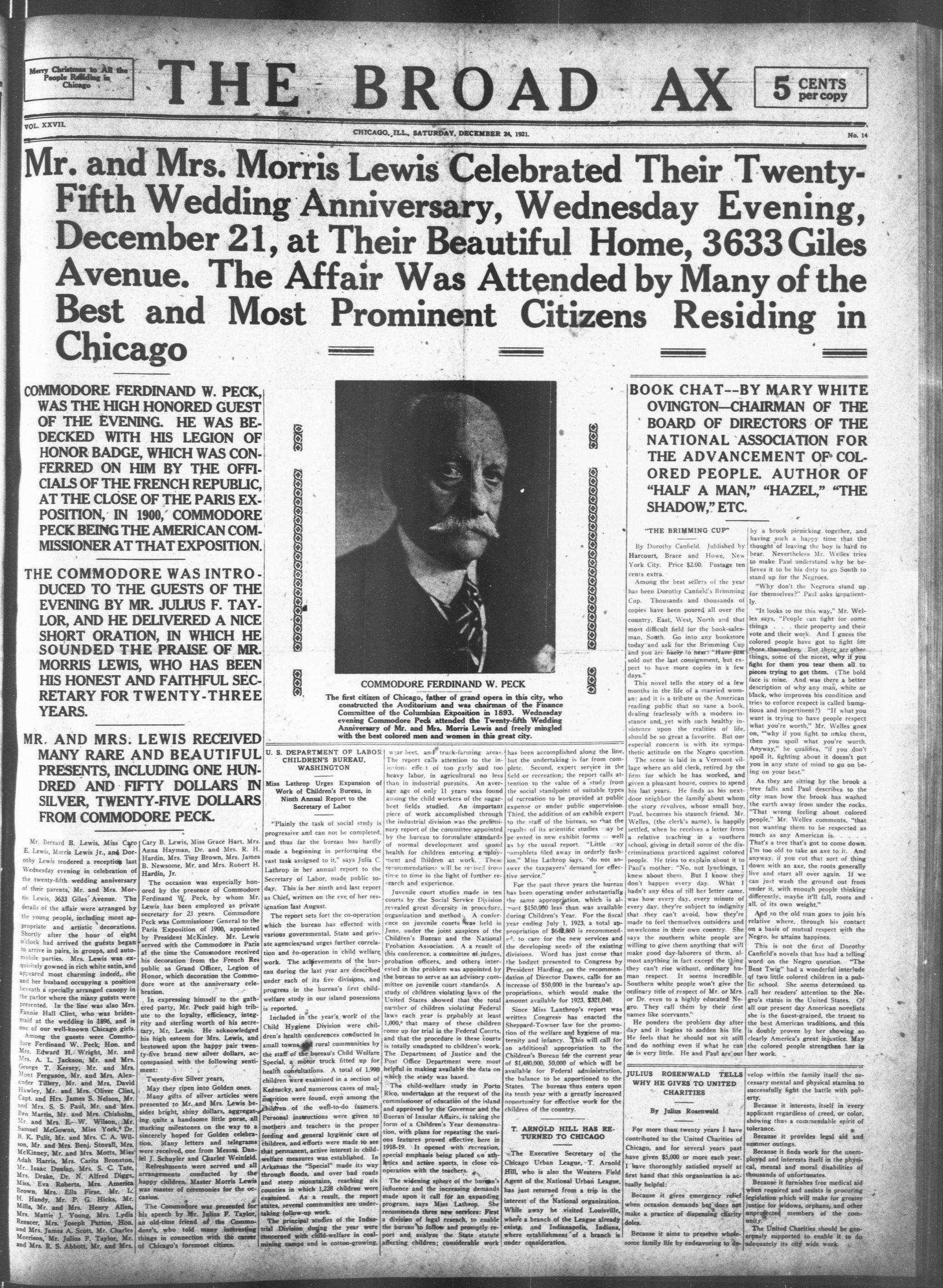
Mr. and Mrs. Morris Lewis Celebrated Their Twenty Fifth Wedding Anniversary, Wednesday Evening, December 21, at Their Beautiful Home, 3633 Giles Avenue. The Affair Was Attended by Many of the Best and Most Prominent Citizens Residing in Chicago
COMMODORE FERDINAND W. PECK, WAS THE HIGH HONORED GUEST OF THE EVENING. HE WAS BEDECKED WITH HIS LEGION OF HONOR BADGE, WHICH WAS CONFERRED ON HIM BY THE OFFICIALS OF THE FRENCH REPUBLIC, AT THE CLOSE OF THE PARIS EXPOSITION, IN 1900, COMMODORE PECK BEING THE AMERICAN COMMISSIONER AT THAT EXPOSITION.
THE COMMODORE WAS INTRODUCED TO THE GUESTS OF THE EVENING BY MR. JULIUS F. TAYLOR, AND HE DELIVERED A NICE SHORT ORATION, IN WHICH HE SOUNDED THE PRAISE OF MR. MORRIS LEWIS, WHO HAS BEEN HIS HONEST AND FAITHFUL SECRETARY FOR TWENTY-THREE YEARS.
MR. AND MRS. LEWIS RECEIVED MANY RARE AND BEAUTIFUL PRESENTS, INCLUDING ONE HUNDRED AND FIFTY DOLLARS IN SILVER, TWENTY-FIVE DOLLARS FROM COMMODORE PECK.
Merry Christmas to All the People Reading in Chicago
Mr. and Fifth Deceased Avenues Best Chicago
COMMODORE FELT WAS THE HIGH OF THE EVENT DECKED WITH HONOR BADGE FERRED ON HCIALS OF THE AT THE CLOSE POSITION, IN PECK BEING THE MISSIONER AT
THE COMMODORE DUCED TO THE EVENING BY MORLOR, AND HE IS SHORT ORATIED SOUNDED THE MORRIS LEWIS HIS HONEST AT RETARY FOR YEARS.
MR. AND MRS. MANY RARE A PRESENTS, INC DRED AND FI SILVER, TWENTY FROM COMMOD
Mr. Bernard B. Lewis, Miss Caro E. Lewis, Morris Lewis Jr., and Dorothy Lewis tendered a reception last Wednesday evening in celebration of the twenty-fifth wedding anniversary of their parents, Mr. and Mrs. Morris Lewis, 3633 Giles Avenue. The details of the affair were arranged by the young people, including most appropriate and artistic decorations. Shortly after the hour of eight o'clock had arrived the guests began to arrive in pairs, in groups, and automobile parties. Mrs. Lewis was exquisitely gowned in rich white satin, and appeared most charming indeed, she and her husband occupying a position beneath a specially arranged canopy in the parlor where the many guests were presented. In the line was also Mrs. Fannie Hall Clint, who was bridesmaid at the wedding in 1896, and is one of our well-known Chicago girls.
Among the guests were Commodore Ferdinand W. Peck, Hon. and Mrs. Edward H. Wright, Mr. and Mrs. A. L. Jackson, Mr. and Mrs. George T. Kersey, Mr. and Mrs. Mont Ferguson, Mr. and Mrs. Alexander Tillery, Mr. and Mrs. David Hawley, Mr. and Mrs. Oliver Clint, Capt. and Hrs. James S. Nelson, Mr. and Mrs. S. S. Paul, Mr. and Mrs. Ben Martin, Mr. and Mrs. Chisholm, Mr. and Mrs. E.-W. Wilson, Mr. Samuel McGowan, Miss York, Dr. B. K. Palit, Mr. and Mrs. C. A. Wilson, Mr. and Mrs. Benj. Stovall, Mrs. McKinney, Mr. and Mrs. Motts, Miss Adah Harris, Mrs. Carita Bronston, Mr. Isaac Dunlap, Mrs. S. C. Tate, Mrs. Drake, Dr. N. Alfred Diggs, Miss, Eva Roberts, Mrs. America Brown, Mrs. Ella Firse, Mr. L. H. Handy, Mr. P. G. Hicks, Mr. Mills, Mr. and Mrs. Henry Allen, Mrs. Mattie J. Young, Mrs. Lydia Rescester, Mrs. Joseph Patton, Hon. and Mrs. James A. Scott, Mr. Charles Morrison, Mr. Julius F. Taylor, Mr. and Mrs. R. S. Abbott, Mr. and Mrs.
THE BROAD AX
Cary B. Lewis, Miss Grace Hart, Mrs Anna Hayman, Dr. and Mrs. R. H. Hardin, Mrs. Tiny Brown, Mrs. James B. Newsome, Mr. and Mrs. Robert H. Hardin, Jr.
The occasion was especially honored by the presence of Commodore Ferdinand W. Peck, by whom Mr. Lewis has been employed as private secretary for 23 years. Commodore Peck was Commissioner General to the Paris Exposition of 1900, appointed by President McKinley. Mr. Lewis served with the Commodore in Paris at the time the Commodore received his decoration from the French Republic as Grand Officer, Legion of Honor, which decoration the Commodore wore at the anniversary celebration.
In expressing himself to the gathered party, Mr. Peck paid high tribute to the loyalty, efficiency, integrity and sterling worth of his secretary, Mr. Lewis. He acknowledged his high esteem for Mrs. Lewis, and bestowed upon the happy pair twenty-five brand new silver dollars, accompanied with the following sentiment:
May they ripen into Golden ones. Many gifts of silver articles were presented to Mr. and Mrs. Lewis besides bright, shiny dollars, aggregating quite a handsome little purse, all marking milestones on the way to a sincerely hoped for Golden celebration. Many letters and telegrams were received, one from Messa. Daniel J. Schuyler and Charles Weinfeld. Refreshments were served and all arrangements conducted by the happy children. Master Morris Lewis was master of ceremonies for the occasion. The Commodore was presented for his speech by Mr. Julius F. Taylor, an old-time friend of the Commodore, who told many interesting things in connection with the career of Chicago's foremost citizen.
CHICAGO, ILL., SATURDAY, DECEMBER 24, 1921.
The first citizen of Chicago, father of grand opera in this city, who constructed the Auditorium and was chairman of the Finance Committee of the Columbian Exposition in 1893. Wednesday evening Commodore Peck attended the Twenty-fifth Wedding Anniversary of Mr. and Mrs. Morris Lewis and freely mingled with the best colored men and women in this great city.
```markdown
```
```markdown
```
U. S. DEPARTMENT OF LABOR CHILDREN'S BUREAU, WASHINGTON
Miss Lathrop Urges Expansion of Work of Children's Bureau, in Ninth Annual Report to the Secretary of Labor
"Plainly the task of social study is progressive and can not be completed, and thus far the bureau has hardly made a beginning in performing the vast task assigned to it," says Julia C. Lathrop in her annual report to the Secretary of Labor, made public today. This is her ninth and last report as Chief, written on the eve of her resignation last August.
The report sets fort the co-operation which the bureau has effected with various governmental, State and private agencies, and urges further correlation and co-operation in child welfare work. The achievements of the bureau during the last year are described under each of its five divisions, and progress in the bureau's first child-welfare study in our island possessions is reported.
Included in the year's work of the Child Hygiene Division were children's health conferences conducted in small towns and rural communities by the staff of the bureau's Child Welfare Special, a motor truck fitted up for health consultations. A total of 1,990 children were examined in a section of Kentucky, and numerous cases of malnutrition were found, even among the children of the well-to-do farmers. Personal instructions were given to mothers and teachers in the proper feeding and general hygienic care of children, and efforts were made to see that permanent, active interest in child-welfare measures was established. In Arkansas the "Special" made its way through floods, and over bad roads and steep mountains, reaching six counties in which 1,228 children were examined. As a result, the report states, several communities are undertaking follow-up work.
The principal studies of the Industrial Division during the year were concerned with child-welfare in co-limining camps and in cotton-growing.
COMMODORE FERDINAND W. PECK
uolar beet, and truck-farming areas. The report calls attention to the iniutions effect of too early and too heavy labor, in agricultural no less than in industrial pursuits. An average age of only 11 years was found among the child workers of the sugarbeet fields studied. An important piece of work accomplished through the industrial division was the preliminary report of the committee appointed by the bureau to formulate standards of normal development and sound health for children entering employment and children at work. These recommendations will be revised from time to time in the light of further research and experience.
Juvenile court studies made in ten courts by the Social Service Division revealed great diversity in procedure, organization and method. A conference on juvenile courts was held in June, under the joint auspices of the Children's Bureau and the National Probation Association. A a result of this conference, a committee of judges, probation officers, and others interested in the problem was appointed by the bureau to serve as an advisory committee on juvenile court standards. A study of children violating laws of the United States showed that the total number of children violating Federal laws each year is probably at least 1,000,* that many of these children come up for trial in the Federal Courts, and that the procedure in these courts is totally unadapted to children's work. The Department of Justice and the Post Office Department were most helpful in making available the data on which the study was based.
The child-welfare study in Porto Rico, undertaken at the request of the commissioner of education of the island and approved by the Governor and the Buerau of Insular Affairs, is taking the form of a Children's Year demonstration, with plans for repeating the various features proved effective here in 1918-19. It opened with recreation, special emphasis being placed on athletics and active sports, in close cooperation with the teachers.
The widening sphere of the bureau's influence and the increasing demands made upon it call for an expanding program, says Miss Lathrop. She recommends three new services: First a division of legal research, to enable the bureau to follow and promptly report and analyze the State statute affecting children; considerable work
has been accomplished along the line but the undertaking is far from complete. Second, expert service in the field or recreation; the report calls attention to the value of a study from the social standpoint of suitable types of recreation to be provided at public expense or under public supervision. Third, the addition of an exhibit expert to the staff of the bureau, so that the results of its scientific studies may be peated in new exhibit forms as well as by the usual report. "Little may phanthels filed away in orderly fashion." Miss Lathrop says, "do not answer the taxpayers' demand for effective service."
For the past three years the bureau has been operating under substantially the same appropriation, which is almost $150,000 less than was available during Children's Year. For the fiscal year ending July 1, 1923, a total appropriation of $642,860 is recommended, to care for the new services and the developing needs of the existing divisions. Word has just come that the budget presented to Congress by President Harding, on the recommendation of Director Dawes, calls for an increase of $50,000 in the bureau's appropriations, which would make the amount available for 1923. $321,040.
Since Miss Lanthrop's report was written Congress has enacted the Sheppard-Towner law for the promotion of the welfare and hygiene of maternity and infancy. This will call for an additional appropriation to the Children's Bureau for the current year of $1,480,000, 50,000 of which will be available for Federal administration, the balance to be apportioned to the States. The bureau thus enters upon its tenth year with a greatly increased opportunity for effective work for the children of the country.
T. ARNOLD HILL HAS RETURNED TO CHICAGO
The Executive Secretary of the Chicago Urban League, T. Arnold Hill, who is also the Western Field Agent of the National Urban League, has just returned from a trip in the interest of the National organization. While away he visited Louisville, where a branch of the League already exists, and Indianapolis, Indiana, where establishment of a branch is under consideration.
BOOK CHAT--BY MARY WHITE OVINGTON—CHAIRMAN OF THE BOARD OF DIRECTORS OF THE NATIONAL ASSOCIATION FOR THE ADVANCEMENT OF COL-ORED PEOPLE. AUTHOR OF "HALF A MAN," "HAZEL," "THE SHADOW," ETC.
"THE BRIMMING CUP"
By Dorothy Canfield. Published by Harcourt, Brace and Howe, New York City. Price $2.00. Postage ten cents extra.
by a brook picnicking together, and having such a happy time that the thought of leaving the boy is hard to bear. Nevertheless Mr. Welles tries to make Paul understand why he believes it to be his duty to go South to
Among the best sellers of the year has been Dorothy Canfield's Brimming Cup. Thousands and thousands of copies have been poured all over the country, East, West, North and that most difficult field for the book-salesman. South. Go into any bookstore today and ask for the Brimming Cup and you are likely to hear: "Have just sold out the last consignment, but expect to have more copies in a few days."
This novel tells the story of a few months in the life of a married woman: and it is a tribute to the American reading public that so sane a book dealing fearlessly with a modern instance and yet with such healthy insistence upon the realities of life should be so great a favorite. But our especial concern is with its sympathetic attitude on the Negro question. The scene is laid in a Vermont village where an old clerk, retired by the firm for which he has worked, and given a pleasant house, comes to spend his last years. He finds as his next door neighbor the family about whom the story revolves, whose small boy Paul, becomes his staunch friend. Mr Welles, (the clerk's name), is happily settled, when he receives a letter from a relative teaching in a southern school, giving in detail some of the discriminations practiced against colored people. He tries to explain about it to Paul's mother: "No, not lynchings, I knew about them. But I know they don't happen every day. What I hadn't any idea of till her letter came, how is every day, every minute of every day, they're subject to indignity that they can't avoid, how they're made to feel themselves outsiders and unwelcome in their own country. She says the southern white people are willing to give them anything that will make good day-laborers of them, almost anything in fact except the thing they can't rise without, ordinary human respect. It seems incredible. Southern white people won't give the ordinary title of respect of Mr. or Mrs. or Dr. even to a highly educated Negro. They call them by their first names like lccervants."
He ponders the problem day after day and it begins to sadden his life. He feels that he should not sit still and do nothing even if what he can do is very little. He and Paul are out
JULIUS ROSENWALD TELLS
WHY HE GIVES TO UNITED
CHARITIES
For more than twenty years I have contributed to the United Charities of Chicago, and for several years past have given $5,000 or more each year. I have thoroughly satisfied myself at first hand that this organization is actually helpful:
Because it gives emergency relief when occasion demands but does not make a practice of dispensing charity doles.
Because it aims to preserve wholesome family life by endeavoring to de-
5 CENTS per copy
Twenty-
evening,
133 Giles
any of the
riding in
BY MARY WHITE
HAIRMAN OF THE
DIRECTORS OF THE
ASSOCIATION FOR
CEMENT OF COL-
LE. AUTHOR OF
N," "HAZEL," "THE
by a brook picnicking together, and having such a happy time that the thought of leaving the boy is hard to bear. Nevertheless Mr. Welles tries to make Paul understand why he believes it to be his duty to go South to stand up for the Negroes.
"Why don't the Negroes stand up for themselves?" Paul asks inpatiently.
"It looks to me this way," Mr. Welles says, "People can fight for some things . . . their property and their vote and their work. And I guess the colored people have got to fight for those themselves. But there are other things, some of the nicest, why if you fight for them you tear them all to pieces trying to get them. (The bold face is mine. And was there a better description of why any man, white or black, improves his condition and tries to enforce respect is called bumpious and impertinent?) "If what you want is trying to have people respect what you're worth," Mr. Welles goes on, "why if you fight to make them, then you spoil what you're worth. Anyway," he qualifies, "if you don't spoil it, fighting about it doesn't put you in any state of mind to go on being on your best."
As they are sitting by the brook a tree falls and Paul describes to the city man how the brook has washed the earth away from under the rocks. "That wrong feeling about colored people," Mr. Welles comments, "that not wanting them to be respected as much as any American is. That's a tree that's got to come down. I'm too old to take an axe to it. And anyway, if you cut that sort of thing down with an axe, the roots generally live and start all over again. If we can just wash the ground out from under it, with enough people thinking differently, maybe it'll fall, roots and all, of its own weight."
And so the old man goes to join his relative where, through his contact on a basis of mutual respect with the Negro, he attains happiness.
This is not the first of Dorothy Canfield's novels that has had a telling word on the Negro question. "The Bent Twig" had a wonderful interlude of two little colored children in a public school. She seems determined to call her readers' attention to the Negro's status in the United States. Of all our present day American novelists she is the finest-grained, the truest to the best American traditions, and this is doubly proven by her showing so clearly America's great injustice. May the colored people strengthen her in her work.
velop within the family itself the necessary mental and physical stamina to successfully fight the battle with poverty.
Because it interests, itself in every applicant regardless of creed, or color, showing thus a commendable spirit of tolerance.
Because it provides legal aid and summer outings.
Because it finds work for the unemployed and interests itself in the physical, mental and moral disabilities of thousands of unfortunate.
Because it furnishes free medical aid when required and assists in procuring legislation which will make for greater justice for widows, orphans, and other unprotected members of the community. The United Charities should be generously supported to enable it to do adequately its city wide work.
THE BROAD AX
Published Every Saturday
In this city since July 15th, 1899,
without missing one single issue. Republicans, Democrats, Catholics, Protestants, Single Taxers, Priests, infidels or anyone else can have their say as long as their language is proper and responsibility is fixed.
The Broad Ax is a newspaper whose platform is broad enough for all, even claiming the editorial right to speak its own mind.
Local communications will receive attention. Write only on one side of the paper.
Subscriptions must be paid in ad-
One Year ..... $2.00
Six Months ..... $1.00
Advertising rates made known on application.
Address all communication to ...
1206 So, Elizabeth St., Chicago, Ill.
THE BROAD AX
JULIUS F. TAYLOR
Editor and Publisher
Associate Editor
DR. M. A. MAJORS
4700 South State Street
Phone Drexel 1416
intered as Second-Class Matter, Aug.
19, 1902, at the Post Office at Chicago,
11. Under Act of March. 8, 1879.
Memphis, Tenn.-The Commercial Appeal of December 20th carries an editorial in opposition to the Dyer Anti-Lynching Bill, in which it rehearses the old familiar bromides of its viciousness and supposed unconstitutionality, and then goes on to say:
"It would be an encouragement to crime because it puts an insurance upon criminals. We do not believe that the people of this great country will consent to confer a monetary reward upon those evil members of society who violate the laws so heinously that they arouse the mob spirit."
Evidently, the much perturbed editor wants to say that Negroes would commit crimes, in order to be lynched, thereby making $10,000 available to their dependents. But that would sound a little too absurd, so he talked in verbose, round about language under the equivocal heading: "Insurance for Criminals."
New Orleans, La.—The McDonogh No. 35, High School, situated at South Rampart and Gird streets, set the highest mark in the Junior Red Cross membership campaign, with a score of 100 per cent of enrollment. The principal and teachers of this Negro school are credited with prodigious efforts to obtain this mark, and are highly gratified.
New Orleans, La—The New Orleans Times-Picayne is sponsoring a fund to get toys for Negro children of the city. At last report the total amount raised was $1,309.78, which was said to be not enough by far. The paper appealed for additional generosity from the public so that every poor Negro child might be reached. "for it is a pitiful thing to think that some children must be disappointed."
Barmstable, Mass.—The three Negro men who barely missed lynching evil in the South, but somehow the mobs generally seem to get the better of the authorities. But a new method is now to be given a trial here. The tree near the county jail on which two persons have died in the last year was recently ordered cut down. The authorities seem to think that if lynching trees are cut down that will have a deterent effect on mobs. After every lynching now, it is supposed the tree will be cut down. It would be more logical to cut down all the trees and telegraph poles in Texas and Georgia. This would prevent many lynchings, as there would be none to hang people to. There are two objections to the latter plan: One is, it is too expensive, and the other, it would not prevent shooting and burning. But at any rate, an interested public will watch the effect of the Texas experiment. It will succeed if the Texans regard a tree as of more value than respect for law or a Negro's life.
DEATH OF S. LAING WILLIAMS
Wednesday evening Attorney S.
Laing Williams, who had for many
years been one of the prominent lawyers
in this city, passed away at his
home at 4203 St. Lawrence ave. He
was 63 years old and had been ill two
weeks. He never recovered from injuries incurred more than a year ago in an automobile accident.
Mr. Williams leaves his constant
and devoted wife, Mrs. F. B. Williams, and many friends to mourn his death.
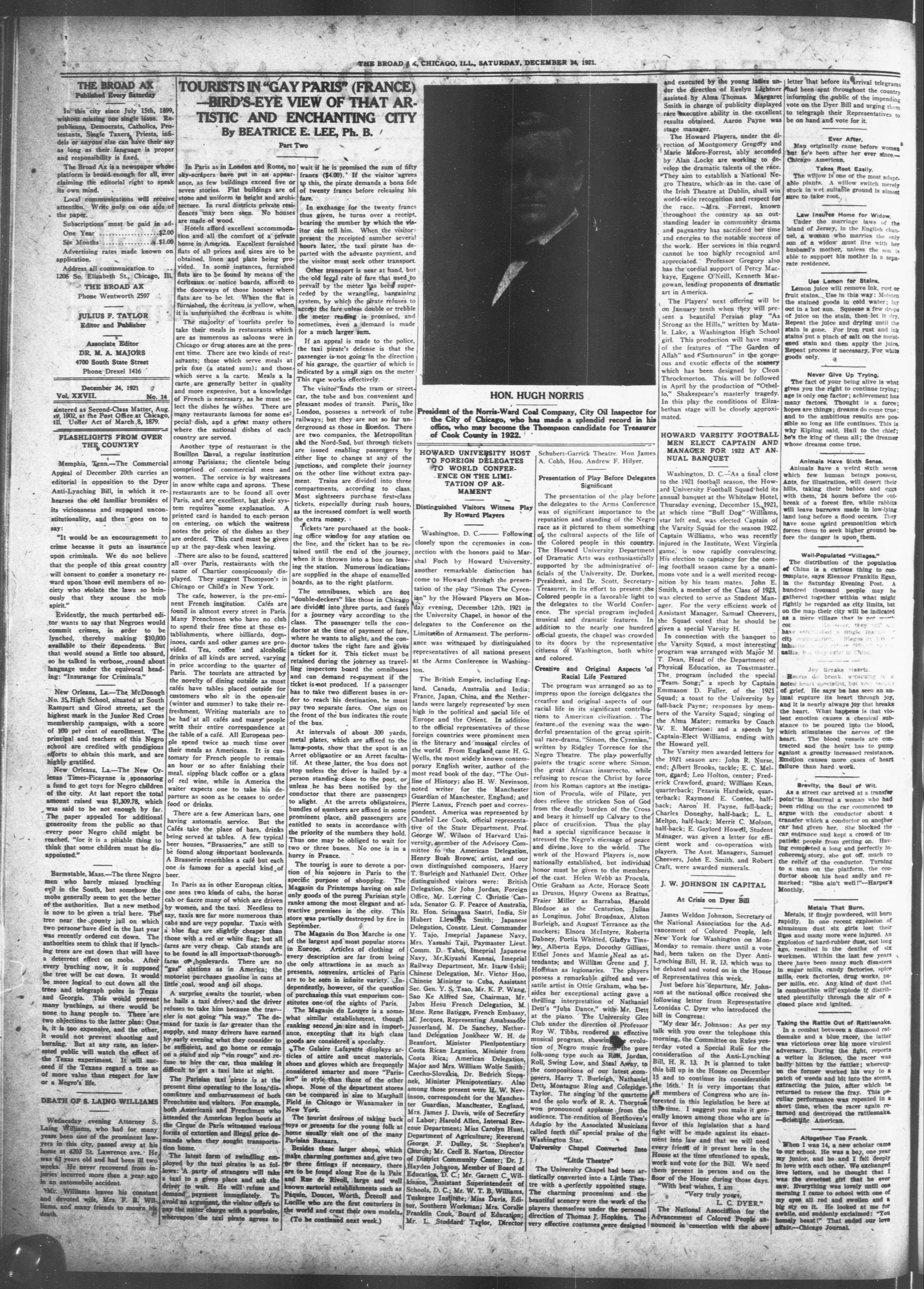
TOURISTS IN "GAY PARIS" (FRANCE) BIRD'S-EYE VIEW OF THAT ARTISTIC AND ENCHANTING CITY By BEATRICE E. LEE, Ph. B.
In Paris as in London and Rome, no sky-scrapers have put in an appearance, as few buildings exceed five or seven stories. Flat buildings are of stone and uniform in height and architecture. In rural districts private residences may been seen. No houses are made of wood.
Hotels afford excellent accommodation and all the comfort of a private home in America. Excellent furnished flats of all prices and sizes are to be obtained, linen and plate being provided. In some instances, furnished flats are to be found by means of the ecriteaux or notice boards, affixed to the doorways of those houses where flats are to be let. When the flat is furnished, the ecriteau is yellow, when it is unfurnished the ecriteau is white. The majority of tourists prefer to take their meals in restaurants which are as numerous as saloons were in Chicago or drug stores are at the present time. There are two kinds of restaurants; those which serve meals at prix fixe (a stated sum); and those which serve a la carte. Meals a la carte are generally better in quality and more expensive, but a knowledge of French is necessary, as he must select the dishes he wishes. There are many restaurants famous for some especial dish, and a great many others where the national dishes of each country are served.
Another type of restaurant is the Bouillon Daval, a regular institution among Parisians; the clientele being comprised of commercial men and women. The service is by waitresses in snow white caps and aprons. These restaurants are to be found all over Paris, and are excellent, but their system requires some explanation. A printed card is handed to each person on entering, on which the waitress notes the price of the dishes as they are ordered. This card must be given up at the pay-desk when leaving. There are also to be found, scattered all over Paris, restaurants with the name of Chartier conspicuously displayed. They suggest Thompson's in Chicago or Child's in New York.
The cafe, however, is the pre-eminent French institution. Cafés are found in almost every street in Paris Many Frenchmen who have no club to spend their free time at these establishments, where billiards, dominoes, cards and other games are provided. Tea, coffee and alcoholic drinks of all kinds are served, varying in price according to the quarter of Paris. The tourists are attracted by the novelty of dining outside as most cafés have tables placed outside for customers who sit in the open-air (winter and summer) to take their refreshment. Writing materials are to be had at all cafés and many people write their entire correspondence at the table of a cafe. All European people spend twice as much time over their meals as Americans. It is customary for French people to remain an hour or so after finishing their meal, sipping black coffee or a glass of red wine, while in America the waiter expects one to take his departure as soon as he ceases to order food or drinks.
There are a few American bars, one having automatic service. But the Cafés take the place of bars, drinks being served at tables. A few typical beer houses, "Brassieres," are still to be found along important boulevards. A Brassieres resembles a café but each one is famous for a special kind of beer.
In Paris as in other European cities, one sees two kinds of cabs, the horse cab or façade many of which are driven by women, and the taxi. Needless to say, taxis are far more numerous than cabs and are very popular. Taxis with a blue flag are slightly cheaper than those with a red or white flag; but all fares are very cheap. Cab stands to be found in all important thoroughfares or boulevards. There are no "gas" stations as in America; the motorist purchases gasoline in cans at little coal, wood and oil shops.
A surprise awaits the tourist, when he hails a taxi driver, and the driver refuses to take him because the traveler is not going "his way." The demand for taxis is far greater than the supply, and many drivers have earned by early evening what they consider to be sufficient, and go home or remain on a stand and sip "vin rouge" and refuse to hire the car, thus making it difficult to get a taxi late at night. The Parisian taxi pirate is at the present time operating to the loss/discomfiture and embarrassment of both Frenchmen and visitors. For example, both Americans and Frenchmen who attended the American legion bouts at the Cirque de Paris witnessed various forms of extortion and illegal price demands when they sought transportation home.
The latest form of swindling employed by the taxi pirates is as follows: A party of strangers will take a taxi to a given place and ask the driver to wait. He will refuse and demand payment immediately. To avoid an argument, the visitor offers to pay the meter charge with a pourboire, whereupon the taxi pirate agrees to
THE BROAD A.4, CHICAGO, ILL., SATURDAY, DECEMBER 24, 1921.
wait if he is promised the sum of fifty francs ($4.00). If the visitor agrees to this, the pirate demands a bona fide of twenty francs before releasing his fare.
In exchange for the twenty francs thus given, he turns over a receipt, bearing the number by which the visitor can tell him. When the visitor present the receipted number several hours later, the taxi pirate has departed with the advance payment, and the visitor must seek other transport.
Other transport is near at hand, but the old legal rate of fare that used to prevail by the meter has been superceded by the wrangling, bargaining system, by which the pirate refuses to accept the fare unless double or treble the meter reading is promised, and sometimes, even a demand is made for a much larger sum.
If an appeal is made to the police, the taxi pirate's defense is that the passenger is not going in the direction of his garage, the quartier of which is indicated by a small sign on the meter This ruse works effectively.
The visitor finds the tram or street car, the tube and bus convenient and pleasant modes of transit. Paris, like London, possesses a network of tube railways; but they are not so far underground as those in London. There are two companies, the Metropolitan and the Nord-Sud, but through tickets are issued enabling passengers by either line to change at any of the junctions, and complete their journey on the other line without extra payment. Trains are divided into three compartments, according to class. Most sightseers purchase first-class tickets, especially during rush hours, as the increased comfort is well worth the extra money.
Tickets are purchased at the booking office window for any station on the line, and the ticket has to be retained until the end of the journey, when it is thrown into a box on leaving the station. Numerous indications are supplied in the shape of enamelled boards, as to the right platform.
The omnibuses, which are not "double-deckers" like those in Chicago are divided into three parts, and fares for a journey vary according to the class. The passenger tells the conductor at the time of payment of fare, where he wants to alight, and the conductor takes the right fare and gives a ticket for it. This ticket must be retained during the journey as travelling inspectors board the omnibuses and can demand re-payment if the ticket is not produced. If a passenger has to take two different buses in order to reach his destination, he must pay two separate fares. One sign on the front of the bus indicates the route of the bus.
At intervals of about 300 yards, metal plates, which are affixed to the lamp-posts, show that the spot is an Arret obligatoire or an Arret facultatif. At these latter, the bus does not stop unless the driver is hailed by a person standing close to the post, or unless he has been notified by the conductor that there are passengers to alight. At the arrets obligatoires, bundles of numbers are affixed in some prominent place, and passengers are entitled to seats in accordance with the priority of the numbers they hold. Thus one may be obliged to wait for two or three buses. No one is in a hurry in France.
The tourist is sure to devote a portion of his sojourn in Paris to the specific purpose of shopping. The Magasin du Printempes having on sale only goods of the purest Parisian style ranks among the most elegant and attractive premises in the city. This store was partially destroyed by fire in September. The Magasin du Bon Marche is one of the largest and most popular stores in Europe. Articles of clothing of every description are far from being the only attractions in as much as presents, souvenirs, articles of Paris are to be seen in infinite variety. Independently, however, of the question of purchasing this vast emporium constitutes one of the sights of Paris. The Magasin du Louvre is a somewhat similar establishment, though ranking second in size and in importance, excepting that its high class goods are considered a specialty.
The Galaire Lafayette displays articles of attire and uncut materials, shoes and gloves which are frequently considered smarter and more "Parisien" in style than those of the other shops. None of the department stores can be compared in size to Marshall Field in Chicago or Wanamaker in New York.
The tourist desirous of taking back toys or presents for the young folk at home usually visit one of the many Parisian Bazaars.
Besides these larger shops, which make charming costumes and give two or three fittings if necessary, there are to be found along Rue de la Paix and Rue de Rivoli, large and well known sartorial establishments such as Paquin, Doucet, Worth, Drecoll and Lucille who are the first couturiers in the world and creat their own models. (To be continued next week.)
[Name]
HON. HUGH NORRIS
President of the Norris-Ward Coal Company, City Oil Inspector for the City of Chicago, who has made a splendid record in his office, who may become the Thompson candidate for Treasurer of Cook County in 1922.
HOWARD UNIVERSITY HOST TO FOREIGN DELEGATES TO WORLD CONFERENCE ON THE LIMITATION OF ARMAMENT
Distinguished Visitors Witness Play By Howard Players
Schubert-Garrick Theatre. Hon James A. Cobb, Hou. Andrew F. Hilyer.
Presentation of Play Before Delegates Significant
The presentation of the play before the delegates to the Arms Conference was of significant importance to the
Washington, D. C. Following closely upon the ceremonies in connection with the honors paid to Marshal Foch by Howard University, another remarkable distinction has come to Howard through the presentation of the play "Simon The Cyrenian" by the Howard Players on Monday evening, December 12th, 1921 in the University Chapel, in honor of the delegates to the Conference on the Limitation of Armament. The performance was witnessed by distinguished representatives of all nations present at the Arms Conference in Washington.
The British Empire, including England, Canada, Australia and India, France, Japan, China, and the Netherlands were largely represented by men high in the political and social life of Europe and the Orient. In addition to the official representatives of these foreign countries were prominent men in the literary and 'musical circles of the world. From England came H. G. Wells, the most widely known contemporary English writer, author of the most read book of the day, "The Outline of History; also H. W. Nevinson noted writer for the Manchester Guardian of Manchester, England; and Pierre Lanux, French poet and correspondent. America was represented by Charles Lee Cook, official representative of the State Department. Prof. George W. Wilson of Harvard University, member of the Advisory Committee to the American Delegation, Henry Bush Brown, artist, and our distinguished composers, Harry T. Burleigh and Nathaniel Dett. Other distinguished visitors were: British Delegation, Sir John Lordan, Foreign Office, Mr. Lorring C. Christie Canada, Senator G. F. Pearce of Australia, Rt. Hon. Srinayasa Sasstri, India, Sir Hubert Llewln Smith; Japanese Delegation, Conn. Llewln Lieut. Commander Y. Tajo, Imperial Japanese Navy, Mrs. Yasuhi Taji, Paymaster Lieut. Comm. D. Tahei, Imperial Japanese Navy, Mr. Kiyashi Kannai, Imperial Railway Department, Mr. Itaro Ishii, Chinese Delegation, Mr. Victor Hoo, Chinese Minister to Cuba, Assistant Sec. Gen. Y. S. Tsao, Mr. K. P. Wang, Sao Ke Alfred Sze, Chairman, Mr. Jabm He French Delegation, M. Mme. Rene Batigie, French Embassy, M. Jecques, Representing Ambassador Jusserland, M. De Sanchey, Netherland Delegation Jonkheer W. H. de Beaufort, Minister Plenipotentiary Costa Rican Legation, Minister from Costa Rica; American Delegation, Major and Mrs. William Wolfe Smith; Czecho-Slovakia, Dr. Bedrich Stepanek, Minister Plenipotentiary. Also among those present were H. W. Nevin, correspondent for the Manchester Guardian, Manchester, England, Mrs. James J. Davis, wife of Secretary of Labor, Harold Allen, Internal Revenue Department; Miss Carolyn Hunt, Department of Agriculture; Reverend George F. Dulley, St. Stephen's Church; Mr. Cecil B. Norton, Director of Church; District Community Center; Dr. J. Hayden Johnson, Member of Board of Education, D. C.; Mr. Garnett C. Wilkinson, Assistant Superintendent of Schools, D. C.; Mr. W. T. B. Williams, Tuskegee Institute; Miss Davis, Editor, Southern Workman; Mrs. Coralie Franklin Cook, Board of Education; Mr. L. Stoddard Taylor, Director
Schubert-Garrick Theatre. Hon James A. Cobb, Hou. Andrew F. Hilyer.
Presentation of Play Before Delegates Significant
The presentation of the play before the delegates to the Arms Conference was of significant importance to the reputation and standing of the Negro race as it pictured to them something of the cultural aspects of the life of the Colored people in this country. The Howard University Department of Dramatic Arts was enthusiastically supported by the administrative officials of the University, Dr. Durkee, President, and Dr. Scott, Secretary-Treasurer, in its effort to present the Colored people in a favorable light to the delegates to the World Conference. The special program included musical and dramatic features. In addition to the nearly one hundred official guests, the chapel was crowded to its doors by the representative citizens of Washington, both white and colored.
Creative and Original Aspects 'of Racial Life Featured
The program was arranged so as to impress upon the foreign delegates the creative and original aspects of our racial life in its significant contributions to American civilization. The feature of the evening was the wonderful presentation of the great spiritual race-drama, "Simon, the Cyranian, written by Ridgley Torrence for the Negro Theatre. The play powerfully paints the tragic scene where Simon the great African insurrection, while refusing to rescue the Christ by force from his Roman captors at the installation of Procula, wife of Pilate, yet does relieve the stricken Son of God from the deadly burden of the Cross and bears it himself up Calvary to the place of crucifixion. Thus the play had a special significance because it stressed the Negro's message of peace and divine, love to the world. The work of the Howard Players is now nationally established, but individual honor must be given to the members of the cast. Helen Webb as Procula, Ottie Graham as Acte, Horace Scott as Drusus, Henry Owens as Brattus, Fraier Miller as Barrabas, Harold Bledsoe as the Centurion, Julian as Longinus, John Broadnax, Alston Burleigh, and August Terrance as the mockers; Elnora McIntyre, Roberta Dabney, Portia Whittyre, Gladys Tinsley, Alberta Epps, Dorothy Gilliam, Ethel Jones and Mamie Neal as attendants; and William Greene and J. Hoffman as legionaries. The players possess a remarkable gifted and versatile artist in Ottie Graham, who besides her exceptional acting gave a thrilling interpretation of Nathaniel Dett's "Juba Dance," with Mr. Dett at the piano. The University Glee Club under the direction of Professor Roy W. Tibbs, rendered an effective musical program, showing the evolution of Negro music from the pure folk-song type such as Roll, Jordan, Roll, Swing Low, and Steal Away, to the compositions of our latest composers, Harry T. Burleigh, Nathaniel Dett, Montague Ring and Coleidge-Taylor. The singing of the quartette and the solo work of R. A. Thorngton won pronounced applause from the audience. The rendition of Beethoven's Adagio by the Associated Musicians called forth the special praise of the Washington Star.
"Little Theatre"
The University Chapel had been artistically converted into a Little Theatre with a perfectly appointed stage. The charming procenium and the beautiful scenery were the work of the players themselves under the personal direction of Thomas J. Hopkins. The very effective costumes were designed
and executed by the young ladies under the direction of Evelyn Lightner assisted by Alma Thomas. Margaret Smith in charge of publicity displayed rare executive ability in the excellent results obtained. Aaron Payne was stage manager.
The Howard Players, under the direction of Montgomery Gregory and Marie Moore-Forrest, ably seconded by Alan Locke are working to develop the dramatic talents of the race. They aim to establish a National Negro Theatre, which-as in the case of the Irish Theatre at Dublin, shall win world-wide recognition and respect for the race. Mrs. Forrest, known throughout the country as an outstanding leader in community drama and pageantry has sacrificed her time and energies to the notable success of the work. Her services in this regard cannot be too highly recognized and appreciated. Professor Gregory also has the cordial support of Percy Mackaye, Engene O'Neill, Kenneth Macgowan, leading proponents of dramatic art in America.
The Players' next offering will be on January tenth when they will present a beautiful Persian play "As Strong as the Hills," written by Matale Lake, a Washington High School girl. This production will have many of the features of "The Garden of Allah" and "Sumnurun" in the gorgeous and exotic effects of the scenery which has been designed by Cleon Throckmorton. This will be followed in April by the production of "Othello," Shakespeare's masterly tragedy. In this play the conditions of Elizabethan stage will be closely approximated.
HOWARD VARSITY FOOTBALL
MEN ELECT CAPTAIN AND
MANAGER FOR 1922 AT ANNUAL BANQUET
Washington, D. C.—As a final close to the 1921 football season, the Howard University Football Squad held its annual banquet at the Whitelaw Hotel Thursday evening, December 15, 1921, at which time "Bull Dog" Williams, star left end, was elected Captain of the Varsity Squad for the season 1922. Captain Williams, who was recently injured in the Institute, West Virginia game, is now rapidly convalescing. His election to captaincy for the coming football season came by a unanimous vote and is a well merited recognition by his team mates. John E. Smith, a member of the Class of 1923, was elected to serve as Student Manager. For the very efficient work of Assistant Manager, Samuel Cheevers, the Squad voted that he should be given a special Varsity H.
In connection with the banquet to the Varsity Squad, a most interesting program was arranged with Major M. T. Dean, Head of the Department of Physical Education, as Toastmaster. The program included the special "Team. Song;" a speech by Captain Emmason D. Fuller, of the 1921 Squad; a toast to the University by full-back Payne; responses by members of the Varsity Squad; singing of the Alma Mater; remarks by Coach W. E. Morrison; and a speech by Captain-Elect Williams, ending with the Howard vell.
The Varsity men awarded letters for the 1921 season are: John R. Nurse; end; Albert Brooks, tackle; E. C. Melton, guard; Leo Holton, center; Frederick Crawford, guard; William Kean, quarterback; Pezavia Hardwick, quarterback; Raymond E. Contee, half-back; Aaron H. Payne, full-back; Charles Doneghy, half-back; L. L. Melton, half-back; Merrit C. Molson, half-back; E. Gaylord Howell, Student Manager, was given a letter for efficient work and co-operation with players. The Asst. Managers, Samuel Cheevers, John E. Smith, and Robert Crew, were awarded numerals.
J. W. JOHNSON IN CAPITAL
At Crisis on Dyer Bill
James Weldon Johnson. Secretary of the National Association for the Advancement of Colored People, left New York for Washington on Mon Monday to remain, there until a vote had been taken on the Dyer Anti-Lynching Bill, H. R. 13, which was to be debated and voted on in the House of Representatives this week.
Just before his departure, Mr. Johnson at the national office received the following letter from Representative Leonidas C. Dyer who introduced the bill in Congress:
"My dear Mr. Johnson: As per my talk with you over the telephone this morning, the Committee on Rules yesterday voted a Special Rule for the consideration of the Anti-Lynching Bill. H. R. 13. It is planned to take this bill up in the House on December 15 and to continue its consideration the 16th. It is very important that all members of Congress who are interested in this legislation be here at this time. I suggest you make it generally known among those who are in favor of this legislation that a hard fight will be made against its enactment into law and that we will need every friend of it present here in the House at the time mentioned to speak, work and vote for the Bill. We need them present in person and on the floor of the House during those days. "With best wishes, I am
L. C. DYER"
The National Association for the Advancement of Colored People announced in connection with the above
letter that before its arrival telegrams had been sent throughout the country informing the public of the impending vote on the Dyer Bill and urging them to telegraph their Representatives to be on hand and vote for it.
Ever After.
Map originally came before woman but he's been after her ever since—Chicago American.
Takes Root Easily.
The willow is one of the most adaptable plants. A willow switch merely stuck in wet suitable ground is almost sure to take root.
Law Insures Home for Widow
Under the marriage laws of the island of Jersey, in the English channel, a woman who marries the only son of a widow must live with her husband's mother, unless the son is able to support his mother in a separate residence.
Use Lemon for Stains
Lemon juice will remove ink, rust or fruit stains. Use in this way: Moisten the stained goods in cold water; lay out in a hot sun. Squeeze a few drops of juice on the stain, then let it dry. Repeat the juice and drying until the stain is gone. For iron rust and ink stains put a pinch of salt on the moistened stain and then apply the juice. Repeat process if necessary. For white goods only.
Never Give Up Trying.
The fact of your being alive is what gives you the right to continue trying; age is only one factor; achievement has many factors. Thought is a force; hopes are things; dreams do come true; and to the ambitious results are possible so long as life continues. This is why Kipling said, Hail to the chief; he's the king of them all; the dreamer whose dreams come true.
Animals Have Sixth Sense.
Animals have a weird sixth sense which few human beings possess. Ants, for illustration, will desert their hills, taking their babies and eggs with them, 24 hours before the outbreak of a forest fire, while rabbits will leave burrows made in low-lying land long before a flood occurs. They have some weird premonition which forces them to seek higher ground before the danger is upon them.
Well-Populated "Villages."
The distribution of the population of China is a curious thing to contemplate, says Eleanor Franklin Egan, in the Saturday Evening Post. A hundred thousand people may be gathered together within what might rightly be regarded as city limits, but on the map their city will be indicated as a mere village that is not much cor. ower, they will have established a single reach city organization. Illegas or 100 inhabitants may be differed in nallise, but they exist in China.
Joy Breake Hearts
Bears do break according to a noted animal specialist, but very few of grief. He says he has seen an animal rupture its heart through joy, and it is nearly always joy that breaks the heart. What happens is that violent emotion causes a chemical substance to be poured into the blood, which stimulates the nerves of the heart. The blood vessels are contracted and the heart has to pump against a greatly increased resistance. Emotion causes more cases of heart failure than hard work.
Brevity, the Soul of
As a street car arrived at a transfer point in Montreal a woman who had been riding on the car commenced to argue with the conductor about a transfer which a conductor on another car had given her. She blocked the car entrance and kept a crowd of impatient people from getting on. Having competed a long and perfectly incoherent story, she got off, much to the relief of the conductor. Turning to a man on the platform, the conductor shook his head sadly and remarked: "She ain't well!"—Harper's Monthly.
Metals That Burn
Metals, if finely powdered, will burn rapidly. In one recent explosion of aluminum dust six girls lost their lyges and many more were injured. An explosion of hard-rubber dust, not long ago, resulted in the deaths of six workmen. Within the last few years there have been many such disasters in sugar mills, candy factories, spice mills, cork factories, drug works, paper mills, etc. Any kind of dust that in combustible will explode if distributed plentifully through the air of a closed place and ignited.
Taking the Rattle Out of Rattlesnake.
Taking the Rattle Out of Rattlesnake
In a combat between a diamond rattlesnake and a blue racer, the latter was victorious over his more virulent adversary. During the fight, reports a writer in Science, the racer was badly bitten by the rattler; whereupon the former worked his way to a patch of weeds and bit into the stems, extracting the juice, after which he returned to renew the fray. This peculiar performance was repeated in a short time, when the racer again returned and destroyed the rattlesnake—Scientific American.
Altogether Too Frank
When I was 14, a new scholar came to our school. He was a boy, one year my junior, and he and I fell deeply in love with each other. We exchanged love letters, and he thought that I was the sweetest girl that he ever saw. Everything was lovely until one morning I came to school with one of my eyes all red and swollen and a big sty on it. He looked at me for awhile, and suddenly exclaimed: "You homely beast!" That ended our love affair.-Chicago Journal.
107
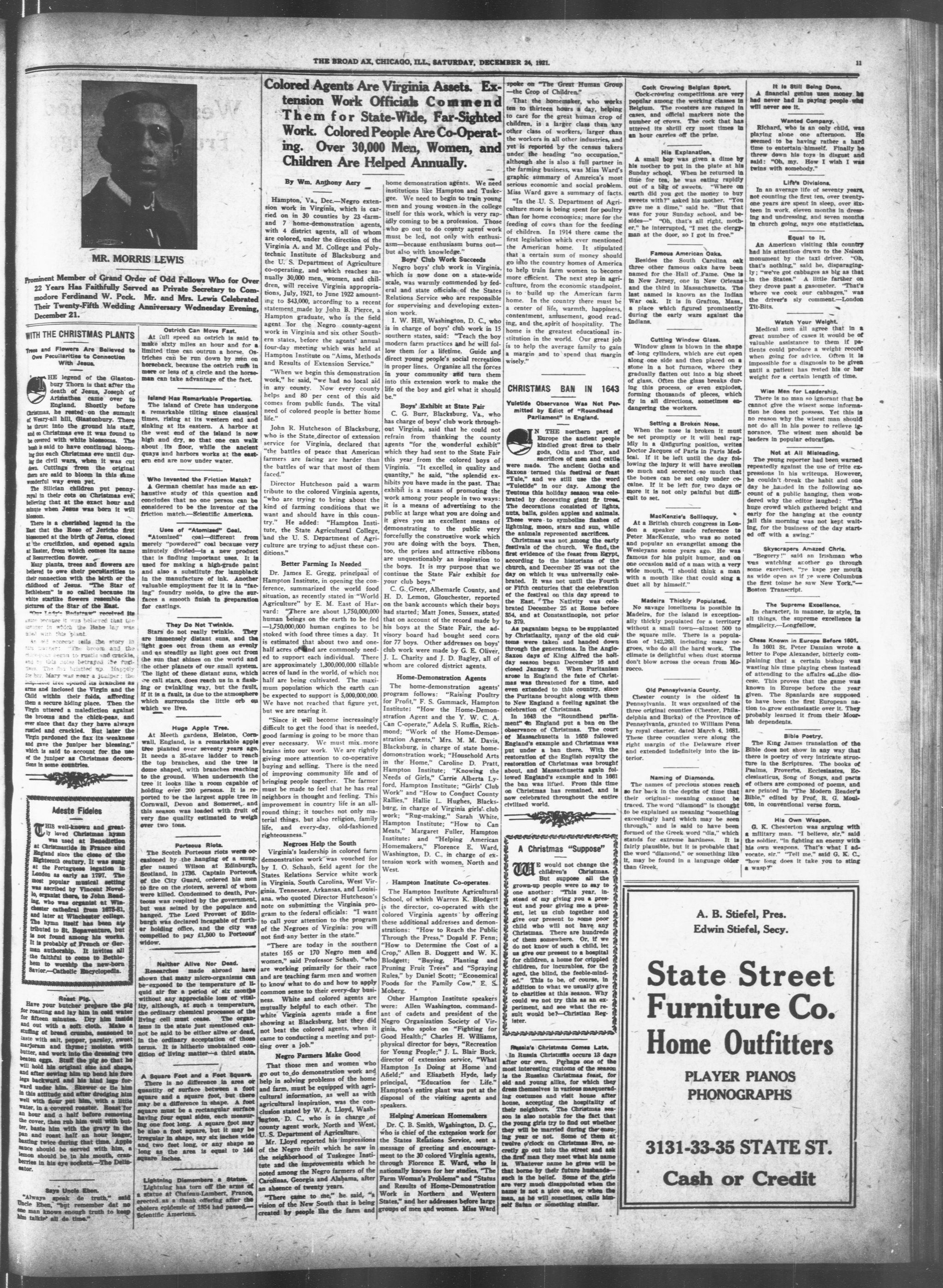
MR. MORRIS LEWIS Prominent Member of Grand Order of Odd Fellows Who for Over 22 Years Has Faithfully Served as Private Secretary to Commodore Ferdinand W. Peck. Mr. and Mrs. Lewis Celebrated Their Twenty-Fifth Wedding Anniversary Wednesday Evening, December 21.
WITH THE CHRISTMAS PLANTS
Trees and Flowers Are Believed to Owe Peculiarities to Connection With Jesus.
HE legend of the Glastonbury Thorn is that after the death of Jesus, Joseph of Arimathea came over to England. Shortly before Christmas, he rested on the summit of Weary-all hill, Glastonbury. There he thrust into the ground his staff, and on Christmas eve it was found to be covered with white blossoms. The brush is said to have continued blooming thus each Christmas eve until during the civil wars, when it was cut down. Cuttings from the original them are said to bloom in this same wonderful way even yet.
The Silician children put penny-royal in their cots on Christmas eve, believing that at the exact hour and minute when Jesus was born it will blossom.
There is a cherished legend in the East that the Rose of Jericho first blossomed at the birth of Jesus, closed at the crucifixion, and opened again at Easter, from which comes its name of Resurrection flower.
Many plants, trees and flowers are believed to owe their peculiarities to their connection with the birth or the childhood of Jesus. "The Star of Bethlehem" is so called because its white starlike flowers resemble the pictures of the Star of the East.
"Our Lady's Bodstaff" received its name because it was believed that the sower in which the Babe lay was used with the plant.
An old account tells the story in the matter: the broom and the chisel begin to rustle and crackle, and this noise betrayed the furtive. The fire bristled up. Happily for her, Mary was near a juniper, the impatient tree opened its branches as arms and inclosed the Virgin and the Child within their folds, affording them a secure hiding place. Then the Virgin uttered a malediction against the brooms and the chick-peas, and ever since that day they have always rustled and crackled. But later the Virgin pardoned the flax its weakness and gave the juniper her blessing," which is to account for the use of the juniper as Christmas decorations in some countries.
THIS well-known and greatly loved Christmas hymn was used at Benediction at Christmaside in France and England since the close of the Eighteenth century. It was sung at the Portuguese legation in London as early as 1797. The most popular musical setting was ascribed by Vincent Novello, organist there, to John Reading, who was organist at Winchester cathedral from 1673-81, and later at Winchester college. The hymn itself has been attributed to St. Bopaventure, but is not found among his works. It is probably of French or German authorship. It invites all the faithful to come to Bethlehem to worship the new-born Savior. -Catholic Encyclopedia.
---
Have your butcher prepare the pig for roasting and lay him in cold water for fifteen minutes. Dry him inside and out with a soft cloth. Make a stuffing of bread crumbs, seasoned to taste with salt, pepper, parsley, marjoram and thyme; moisten with butter, and work into the dressing two beaten eggs. Stuff the pig so that he will hold his original size and shape, and after sowing him up bend his fore legs backward and his hind legs forward under him. Skewer or the him in this attitude and after dredging him well with flour put him, with a little water, in a covered rooster. Roast for an hour and a half before removing the cover, then rub him well with butter, baste him with the gravity in the pan and roast an hour longer, basting twice during that time. Apple sauce should be served with him, a lemon should be in his mouth, cranberries in his eye sockets—The Deli-ator.
"Always speak de truth," said Uncle Eben, "but remember that no one man knows enough truth to keep him talking all of time."
T
Roast Plg.
Order of Odd Fellows Who for Overvived as Private Secretary to Com. Mr. and Mrs. Lewis Celebrated Anniversary Wednesday Evening
Ostrich Can Move Fast
At full speed an ostrich is said to make sixty miles an hour and for a limited time can outrun a horse. Ostrichs can be run down by men on horseback, because the ostrich runs in more or less of a circle and the horseman can take advantage of the fact.
Island Has Remarkable Properties.
The island of Crete has undergone a remarkable tilting since classical times, rising at its western end and sinking at its eastern. A harbor at the west end of the island is now high and dry, so that one can walk about its floor, while the ancient quays and harbors works at the eastern end are now under water.
Who invented the Friction Match?
A German chemist has made an exhaustive study of this question and concludes that no one person can be considered to be the inventor of the friction match. -Scientific American.
Uses of "Atomized" Coal.
"Atomized" coal—different from merely "powdered" coal because very minutely divided—is a new product that is finding important uses. It is used for making a high-grade paint and also a substitute for lampblack in the manufacture of ink. Another valuable employment for it is in "facing" foundry molds, to give the surfaces a smooth finish in preparation for castings.
They Do Not Twinkle
Stars do not really twinkle. They are immensely distant suns, and the light goes out from them as evenly and as steadily as light goes out from the sun that shines on the world and the other planets of our small system. The light of these distant suns, which we call stars, does reach us in a flashing or twinkling way, but the fault, if it is a fault, is due to the atmosphere which surrounds the little orb out which we live.
Huge Apple Tree.
At Meeth gardens, Helston, Cornwall, England, is a remarkable apple tree planted over seventy years ago. It needs a 35-stave ladder to reach the top branches, and the tree is dome shaped, with branches reaching to the ground. When underneath the tree it looks like a room capable of holding over 200 persons. It is reported to be the largest apple tree in Cornwall, Devon and Somerset, and this season was loaded with fruit of very fine quality estimated to weigh over two tons.
The Scotch Porteous riots were occasioned by the hanging of a smuggler named Wilson at Edinburgh, Scotland, in 1736. Captain Porteous of the City Guard, ordered his men to fire on the rolters, several of whom were killed. Condemned to death, Porteous was respited by the government, but was seized by the populace and hanged. The Lord Provost of Edinburgh was declared incapable of further holding office, and the city was compelled to pay £1,500 to Porteous' widow.
Neither Alive Nor Dead.
Researchers made abroad have shown that many micro-organisms can be exposed to the temperature of liquid air for a period of six months without any appreciable loss of vitality, although, at such a temperature, the ordinary chemical processes of the living cell must cease. The organisms in the state just mentioned cannot be said to be either alive or dead, in the ordinary acceptance of those terms. It is hitherto unobtained condition of living matter—a third state.
A Square Foot and a Foot Square. There is no difference in area of quantity of surface between a foot square and a square foot, but there may be a difference in shape. A foot square must be a rectangular surface having four equal sides, each measuring one foot long. A square foot may be also a foot square, but it may be irregular in shape, say six inches wide and two feet long, or any shape so long as the area is equal to 144 square inches.
Lightning Dismembers a Statue. Lightning has torn off the arms of a statue at Chateau-Lambert, France, erected as a thank offering after the cholera epidemic of 1854 had passed. Scientific American.
Porteous Riete
Colored Agents Are Virginia Assets. Extension Work Officials Commend Them for State-Wide, Far-Sighted Work. Colored People Are Co-Operating. Over 30,000 Men, Women, and Children Are Helped Annually. By Wm. Anthony Aery home demonstration agents. We need spoke on "The Crop of That the hten to thirteen to care for the children, is a other class of the workers in yet is reported under the he although she the farming bu graphic sum serious economic
Hampton, Va., Dec.—Negro extension work in Virginia, which is carried in on 30 counties by 23 farm- and 7 home-demonstration agents with 4 district agents, all of whom are colored, under the direction of the Virginia A. and M. College and Polytechnic Institute of Blacksburg and the U. S. Department of Agriculture co-operating, and which reaches annually 30,000 men, women, and children, will receive Virginia appropriations, July, 1921, to June 1922 amounting to $43,000, according to a recent statement made by John B. Pierce, a Hampton graduate, who is the field agent for the Negro county-agent work in Virginia and six other Southern states, before the agents' annual four-day meeting which was held at Hampton Institute on "Aims, Methods and Results of Extension Service."
"When we begin this demonstration work," he said, "we had no local aid in any county. Now every county helps and 80 per cent of this aid comes from public funds. The vital need of colored people is better home life."
John R. Hutcheson of Blacksburg, who is the State director of extension service for Virginia, declared that "the battles of peace that American farmers are facing are harder than the battles of war that most of them faced."
Director Hutcheson paid a warm tribute to the colored Virginia agents, "who are trying to bring about the kind of farming conditions that we want and should have in this country." He added: "Hampton Institute, the State Agricultural College, and the U. S. Department of Agriculture are trying to adjust these conditions."
Better Farming Is Needed
Dr. James E. Gregg, principal of Hampton Institute, in opening the conference, summarized the world food situation, as recently stated in "World Agriculture" by E. M. East of Harvard: "There are about 1,750,000,000 human beings on the earth to be fed—1,750,000,000 human engines to be stoked with food three times a day. It is estimated that about two and one-half acres of land are commonly needed to support each individual. There are approximately 1,300,000,000 tillable acres of land in the world, of which now half are being cultivated. The maximum population which the earth can be expected to support is 5,000,000,000. We have not reached that figure yet, but we are nearing it.
"Since it will become increasingly difficult to get the food that is needed, good farming is going to be more than ever necessary. We must mix more brains into our work. We are rightly giving more attention to co-operative buying and selling. There is the need of improving community life and of bringing people together. The farmer must be made to feel that he has real neighbors in thought and feeling. This improvement in country life is an all-round thing; it touches not only material things, but also religion, family life, and every-day, old-fashioned righteousness."
Negroes Help the South
Virginia's leadership in colored farm demonstration work was vouched for by I. O. Schaub, field agent for the States Relations Service white work in Virginia, South Carolina, West Virginia, Tennessee, Arkansas, and Louisiana, who quoted Director Hutcheson's note on submitting the Virginia program to the federal officials: "I want to call your attention to the program of the Negroes of Virginia: you will not find any better in the state."
"There are today in the southern states 165 or 170 Negro men and women," said Professor Schaub, "who are working primarily for their race and are teaching farm men and women to know what to do and how to apply common sense to their every-day business. White and colored agents are mutually helpful to each other. The white Virginia agents made a fine showing at Blacksburg, but they did not beat the colored agents, when it came to conducting a meeting and putting over a job."
Negro Farmers Make Good
That those men and women who go out to do demonstration work and help in solving problems of the home and farm, must be equipped with agricultural information, as well as with agricultural inspiration, was the conclusion stated by W. A. Lloyd, Washington, D. C., who is in charge of county agent work, North and West, U. S. Department of Agriculture. Mr. Lloyd reported his impressions of the Negro thrift which he saw in the neighborhood of Tuskegee Institute and the improvements which he noted among the Negro farmers of the Carolinas, Georgia and Alabama, after an absence of twenty years. "There came to me," he said, "a vision of the New South that is being created by people like the farm and
Russia's Christmas Comes Late. In Russia Christmas occurs 13 days after our own. Perhaps one of the most interesting customs of the season is the Russian Christmas feast, for old and young alike, for which they dress themselves in various masquerading costumes and visit house after house, accepting the hospitality of their neighbors. The Christmas season is also notable for the fact that the young girls try to find out whether they will be married during the ensuing year or not. Some of them at twelve o'clock on Christmas Eve, secretly go into the street and ask the first man they meet what his name is. Whatever name he gives will be that borne by their future husbands—such is the belief. Some of the girls are very much disappointed when the name is not a nice one, or when the man, as he will sometimes, calls himself Satan or something similar.
home demonstration agents. We need institutions like Hampton and Tuskegee. We need to begin to train young men and young women in the college itself for this work, which is very rapidly coming to be a profession. Those who go out to do county agent work must be led, not only with enthusiasm—because enthusiasm burns out—but also with knowledge."
Boys' Club Work Succeeds
Negro boys' club work in Virginia, which is now done on a state-wide scale, was warmly commended by federal and state officials of the States Relations Service who are responsible for supervising and developing extension work.
I. W. Hill, Washington, D. C., who is in charge of boys' club work in 15 southern states, said: "Teach the boy modern farm practices and he will follow them for a lifetime. Guide and direct young people's social recreation in proper lines. Organize all the forces in your community and turn them into this extension work to make the life of the boy and girl what it should be."
Bovs' Exhibit at State Fair
BOYS EXHIBIT at State Fair
C. G. Burr, Blacksburg, Va., who has charge of boys' club work throughout Virginia, said that he could not refrain from thanking the county agents "for the wonderful exhibit" which they had sent to the State Fair this year from the colored boys of Virginia. "It excelled in quality and quantity," he said, "the splendid exhibits you have made in the past. That exhibit is a means of promoting the work among your people in two ways: it is a means of advertising to the public at large what you are doing and it gives you an excellent means of demonstrating to the public very forcefully the constructive work which you are doing with the boys. Then, too, the prizes and attractive ribbons are unquestionably an inspiration to the boys. It is my purpose that we continue the State Fair exhibit for your club boys."
C. G. Greer, Albemarle County, and H. D. Lemon, Gloucester, reported on the bank accounts which their boys had started; Matt Jones, Sussex, stated that on account of the record made by his boys at the State Fair, the advisory board had bought seed corn for 77 boys. Other addresses on boys' club work were made by G. E. Oliver, J. L. Charity and J. D. Bagley, all of whom are colored district agents.
Home-Demonstration Agents
The home-demonstration agents' program follows: "Raising Poultry for Profit," F. S. Gammack, Hampton Institute; "How the Home-Demonstration Agent and the Y. W. C. A. Can C-operate," Adela S. Ruffin, Richmond; "Work of the Home-Demonstration Agents," Mrs. M. M. Davis, Blacksburg, in charge of state home-demonstration work; "Household Arts in the Home," Caroline D. Pratt, Hampton Institute; "Knowing the Needs of Girls," Carrie Alberta Lyford, Hampton Institute; "Girls' Club Work" and "How to Conduct County Rallies," Hallie L. Hughes, Blacksburg, in charge of Virginia girls' club work; "Rug-making," Sarah White, Hampton Institute; "How to Can Meats," Margaret Fuller, Hampton Institute; and "Helping American Homemakers," Florence E. Ward, Washington, D. C., in charge of extension work with women, North and West.
Hampton Institute Co-operates
The Hampton Institute Agricultural School, of which Warren K. Blodgett is the director, co-operated with the colored Virginia agents by offering these additional addresses and demonstrations: "How to Reach the Public Through the Press," Dopald F. Fenn; "How to Determine the Cost of a Crop," Allen B. Doggett and W. K. Blodgett; "Buying, Planting and Pruning Fruit Trees" and "Spraying Rules," by Daniel Scott; "Economical Foods for the Family Cow," E. S. Moberg.
Other Hampton Institute speakers were: Allen Washington, commandant of cadets and president of the Negro Organization Society of Virginia, who spoke on "Fighting for Good Health;" Charles H. Williams, physical director for boys, "Recreation for Young People;" J. L. Blair Buck, director of extension service, "What Hampton Is Doing at Home and Afield;" and Eliazbeth Hyde, lady principal, "Education for Life." Hampton's entire plant was put at the disposal of the visiting agents and speakers.
Helping American Homemakers
Dr. C. B. Smith, Washington, D. C., who is chief of the extension work for the States Relations Service, sent a message of greeting and encouragement to the 30 colored Virginia agents, through Florence E. Ward, who is nationally known for her studies, "The Farm Woman's Problems" and "Status and Results of Home-Demonstration Work in Northern and Western States," and her addresses before large groups of men and women. Miss Ward
spoke on "The Great Human Group — the Crop of Children."
That the homemaker, who works ten to thirteen hours a day, helping to care for the great human crop of children, is a larger class than any other class of workers, larger than the workers in all other industries, and yet is reported by the census takers under the heading "no occupation," although she is also a full partner in the farming business, was Miss Ward's graphic summary of Amreica's most serious economic and social problem. Miss Ward gave a summary of facts. "In the U. S. Department of Agriculture more is being spent for poultry than for home economics; more for the feeding of cows than for the feeding of children. In 1914 there came the first legislation which ever mentioned the American home. It stipulated that a certain sum of money should go into the country homes of America to help train farm women to become more efficient. The next step in agriculture, from the economic standpoint, is to build up the American farm home. In the country there must be a center of life, warmth, happiness, contentment, amusement, good reading, and the spirit of hospitality. The home is the greatest educational institution in the world. Our great job is to help the average family to gain a margin and to spend that margin wisely."
CHRISTMAS BAN IN 1643
Yuletide Observance Was Not Permitted by Edict of "Roundhead Parliament" in England.
N THE northern part of Europe the ancient people kindled great fires to their gods, Odin and Thor, and
IN THE northern part of Europe the ancient people kindled great fires to their gods, Odin and Thor, and sacrifices of men and cats were made. The ancient Goths and Saxons termed this festival or feast "Tule," and we still use the word "Yuletide" in our day. Among the Teutons this holiday season was celebrated by decorating giant fir trees. The decorations consisted of lights, nuts, balls, golden apples and animals. These were to symbolize flashes of lightning, moon, stars and sun, while the animals sacrificed sacrifices.
Christmas was not among the early festivals of the church. We find, the first evidence of the feast from Egypt, according to the historians of the church, and December 25 was not the day on which it was universally celebrated. It was not until the Fourth or Fifth centuries that the celebration of the festival on this day spread to the East. The Nativity was celebrated December 25 at Rome before 354, and at Constantinople, not prior to 379.
As paganism began to be supplanted by Christianity, many of the old customs were taken and handed down through the generations. In the Anglo-Saxon days of King Alfred the holiday season began December 16 and closed January 6. When Puritanism arose in England the fate of Christmas was threatened for a time, and even extended to this country, since the Puritans brought along with them to New England a feeling against the celebration of Christmas.
In 1648 the "Roundhead parlement" on England put a ban on the observance of Christmas. The court of Massachusetts in 1659 followed England's example and Christmas was put under a ban there. With the restoration of the English royalty the restoration of Christmas was brought about, and Massachusetts again followed England's example and in 1661 the ban was lifted. From this time on Christmas has remained, and is now celebrated throughout the entire civilized world.
WE would not change the children's Christmas.
But suppose all the grown-up people were to say to one another: "This year, instead of my giving you a present and your giving me a present, let us club together and give our present to some poor child who will not have any Christmas. There are hundreds of them somewhere. Or, if we do not know of such a child, let us give our present to a hospital for children, a home for crippled children, for incurables, for the aged, the blind, the feeble-minded." This to be, of course, in addition to what we usually give to charities at this season. Why could we not try this as an experiment, and see what the result would be?—Christian Register.
Russia's Christmas Comes Late
A. B. Stiefel, Pres.
Edwin Stiefel, Secy.
State Street
Furniture Co.
Home Outfitters
PLAYER PIANOS
PHONOGRAPHS
3131-33-35 STATE ST.
Cash or Credit
Cock Crowing Belgian Sport
Cock Crowing Belgian Sport. Cock-crowing competitions are very popular among the working classes in Belgium. The roosters are ranged in cases, and official markers note the number of crows. The cock that has uttered its shrill cry most times in an hour carries off the prize.
His Explanation.
A small boy was given a dime by his mother to put in the plate at his Sunday school. When he returned in time for tea, he was eating rapidly out of a big of sweets. "Where on earth did you get the money to buy sweets with?" asked his mother. "You gave me a dime," said he. "But that was for your Sunday school, and besides—" "Oh, that's all right, mother," he interrupted, "I met the clergyman at the door, so I got in free."
Famous American Oaks
Besides the South Carolina oak three other famous oaks have been named for the Hall of Fame. One is in New Jersey, one in New Orleans and the third in Massachusetts. The last named is known as the Indian War oak. It is in Grafton, Mass., a place which figured prominently during the early wars against the Indians.
Cutting Window Glass
Window glass is blown in the shape of long cylinders, which are cut open along one side and then placed on a stone in a hot furnace, where they gradually flatten out into a big sheet of glass. Often the glass breaks during this process, or even explodes, forming thousands of pieces, which fly in all directions, sometimes endangering the workers.
Setting a Broken Noose.
When the nose is broken it must be set promptly or it will heal rapidly in a disgusting position, writes Doctor Jacques of Paris in Paris Medical. If it be left until the day following the injury it will have swollen so much and secreted so much that the bones can be set only under cocaine. If it be left for two days or more it is not only painful but difficult to set.
MacKenzie's Soliloquy
At a British church congress in London a speaker made reference to Peter MacKenzie, who was so noted and popular an evangelist among the Wesleyans some years ago. He was famous for his pulpit humor, and on one occasion said of a man with a very wide mouth, "I should think a man with a mouth like that could sing a duet all by himself."
Madeira Thickly Populated
No savage loneliness is possible in Madeira, for the island is exceptionally thickly populated for a territory without a small town—almost 500 to the square mile. There is a population of 142,263, including many negroes, who do all the hard work. The climate is delightful when dust storms don't blow across the ocean from Morocco.
Old Pennsylvania County.
Chester county is the oldest in Pennsylvanian. It was organized of the three original counties (Chester, Philadelphia and Bucks) of the Province of Pennsylvania, granted to William Penn by royal charter, dated March 4, 1681. These three counties were along the right margin of the Delaware river and extended indefinitely into the interior.
Naming of Diamonds
The names of precious stones reach so far back in the depths of time that their original-meaning cannot be traced. The word "diamond" is thought to be explained as meaning "something exceedingly hard which may be seen through," and is said to have been formed of the Greek word "dia," which stands for extreme hardness. It is fairly plausible, but it is probable that the word "diamond," or something like it, may be found in a language older than Greek.
11
It Is Still Being Done.
A financial genius uses money, he
had never in paying people who
will never see it.
Wanted Company.
Richard, who is is an only child, was playing alone one afternoon. He seemed to be having rather a hard time to entertain-himself. Finally he threw down his toys in disgust and sald: "Oh, my. How I wish I was twins with somebody."
Life's Divisions
In an average life of seventy years, not counting the first ten, over twenty-one years are spent in sleep, over sixteen in work, eleven months in dressing and undressing, and seven months in church going, says one statistician.
Equal to It.
An American visiting this country had his attention drawn to the Nelson monument by the taxi driver. "Oh, that's nothing," said he, disparagingly; "we've got cabbages as big as in the States." A little farther on they drove past a gasometer. "That's where we cook our cabbages," was the driver's sly comment—London Tit-Bits.
Watch Your Weight
Medical men all agree that in a great number of cases it would be of valuable assistance to them if patients could produce a weight record when going for advice. Often it is impossible for a diagnosis to be given until a patient has rested his or her weight for a certain length of time.
Wise Men for Leadership
There is no man so ignorant that he cannot give the wisest some information he does not possess. Yet this is no reason why the wisest man should not do all in his power to relieve ignorance. The wisest men should be leaders in popular education.
Not at All Misleading
The young reporter had been warned repeatedly against the use of trite expressions in his writings. However, he couldn't break the habit and one day he handed in the following account of a public hanging, then wondered why the editor laughed: "The huge crowd which gathered bright and early for the hanging at the county fall this morning was not kept waiting, for the business of the day started off with a swing."
Skyscrapers Amazed Chris
"Begorry!" said an Irishman who was watching another go through some exercises, "we kape yer mouth as wide open as if ye were Columbus the first tome he saw New York."—Boston Transcript.
The Supreme Excellence
In character, in manner, in style, in all things, the supreme excellence is simplicity.—Longfellow.
Chess Known in Europe Before 1601.
In 1601 St. Peter Damian wrote a letter to Pope Alexander, bitterly complaining that a certain bishop was wasting his time playing chess instead of attending to the affairs of the diocese. This proves that the game was known in Europe before the year given. The Spaniards are supposed to have been the first European nation to grow enthusiastic over it. They probably learned it from their Moorish dependents.
Bible Poetry.
The King James translation of the Bible does not show in any way that there is poetry of very intricate structure in the Scriptures. The books of Psalms, Proverbs, Ecclesiastes, Ecclesiasticus, Song of Songs, and parts of others are composed of poems, and are printed in "The Modern Reader's Bible," edited by Prof. R. G. Moulton, in conventional verse form.
His Own Weapon.
G. K. Chesterton was arguing with a military man. "I believe, sir," said the soldier. "in fighting an enemy with his own weapons. That's what I advocate, sir." "Tell me," said G. K. C. "how long does it take you to sting a wasp?"
ILLINOIS TRUST & SAVINGS BANK La Salle and Jackson Streets Chicago
TELEPHONE DOUGLAS 1
GEORGE F.
GE F. HARDING, JR.
GEORGE F. HARDING, JR.
REAL ESTATE
Up-to-Date or Me
and S
3101 COTTA
Corner 31s
Ph
FURN
Brass and Wood
Refrigerator
Hardw
HENRY
2515-19
JAS. B. McCAHEY, President
FRANK J. DUNN, Vice-President
ESTA
JOHN
CO
or Modern Houses, Apartments and Stores to Rent
COTTAGE GROVE AVE.
ner 31st Street, Chicago
Up-to-Date or Modern Houses, Apartments and Stores to Rent 3101 COTTAGE GROVE AVE. Corner 31st Street, Chicago
FURNITURE
Hard Wood Beds, Electric Washers,
Figerators, Stoves, Paint, Oil,
Hardware, Linoleum
NRY STUCKART
2515-19 ARCHER AVE.
President
Vice-President
PHILIP J. DUNN, Secretary
H. X. COMERFORD, Treasurer
FURNITURE
Brass and Wood Beds, Electric Washers, Refrigerators, Stoves, Paint, Oil, Hardware, Linoleum HENRY STUCKART 2515-19 ARCHER AVE.
JAS. B. McCAHEY, President PHILIP J. DUNN, Secretary
FRANK J. DUNN, Vice-President H. X. COMERFORD, Treasurer
ESTABLISHED 1877
JOHN J. DUNN
COAL CO.
Telephone Oakland 1550
A. L. WILLIAMS
ATTORNEY AND
COUNSELOR AT LAW
Suite 706 Firmenich Building
184 W. Washington St.
CHICAGO
Telephone Central 1239
7% Bonds May Be Bought On the Instalment Plan
Any 7% First Mortgage Real Estate Gold Bond offered by this bank may be purchased on instalments.
LINCOLN
OF O
Under State Gov
31st and South
Telephone
OLN STATE BANK
OF CHICAGO
State Government Supervision
and South State Streets
Telephone Victory 4500
Phone Main 2017
Residence 3655 Prairie Ave.
Phone Douglas 9133
[Signature]
Phone Yards 27
ESTABLISHED 1877
CHICAGO
Residence, 1262 Macalister Place
Telephone Monroe 2714
ATTORNEY AT LAW
Suite 318-320 Reaper Block
Clark and Washington Sts.
CHICAGO
PERHAPS the most obvious advantage to be obtained by buying bonds on easy payments is the opportunity to save small sums systematically with a high interest return. Ten dollars a month or more will make an initial payment on a Lincoln Bond which pays 7% interest from the date of the first payment.
The instalment plan is a boon also to the investor who is following the trend of interest rates and knows that it is uncertain how much longer sum-secured 7% First Mortgage bonds will be available. The instalment plan enables him to "tie up" more good bonds paying a high interest rate than he would be in a position to purchase outright.
Let us send you, without obligation, details of this plan, and information concerning our approved 70% First Mortgage Bonds. Write for Circular 14.
THE BROAD AX, CHICAGO, ILL. SATURDAY, DECEMBER 24, 1921
Christmas SAVINGS CLUB
The Club will continue for 50 weeks when checks will be mailed to all members for the amount of their deposits with 3% interest added where payments have been made according to schedule.
Join our Christmas Savings Club and solve the Christmas financial problem for next year.
Payments may be made in varying sums according to the accompanying schedule:
CLASS 5—First week 5c, second week 10c. Increase each weekly payment $5c and receive in $50 $63.75 weeks.
CLASS 5.A—First week $2.50, second payment $2.45. Decrease each weekly payment $60 $63.75 weeks.
CLASS 10—First week 10c, second week 20c. Increase each weekly payment $10c and receive $127.50 weeks.
CLASS 10.A—First week $5.00, second week $4.90. Decrease each weekly payment $10c and $127.50 receive in $50 weeks.
CLASS 50—Pay $50c straight each week for $50 weeks and receive receive $25.00 Class 100—Pay $1.00 straight each week for $50 weeks and receive receive $50.00 Class 200—Pay $2.00 straight each week for $50 weeks and receive $100.00 Class 500—Pay $5.00 straight each week for $50 weeks and receive receive receive SPECIAL CLASS—Join this class by receiving to pay any certain amount each week for $5 weeks, and receive at the end of $5 weeks the full amount deposited.
Plus 3% Interest for Prompt Payment
CLASS 5-A: First week $2.50, second week $2.45. Decrease each weekly payment 5c and receive in $63.75
50 weeks.
CLASS 10-First week 10, second week 20c. Increase each weekly payment 10c and receive in $127.50
50 weeks.
CLASS 10-A: First week $5.00, second week $4.90. Decrease each weekly payment 10c and receive in $127.50
50 weeks.
Plus 3% Interest for Prompt Payment
ALEXANDER FLOWER, President
SAMUEL F. FLOWER, Vice-President
CHAS. H. IR
BERNARD B. FREUD,
BERNARD B. FREUD,
Roosevelt
Capital and Surv
GRAND BOULEVARD AT
Telephone Douglas 2
JOHN McGIL
Surety Bonds—C
Our interest in a client's we
payment of premium. We
helpful service to patrons
Representing Assets
105 South La
ROSEVELT State Bank
Capital and Surplus $130,000.00
AND BOULEVARD AT THIRTY-FIFTH ST.
phone Douglas 2260 CHI
JOHN McGILLEN & CO.
Security Bonds—Casualty Insurance
interest in a client's welfare doesn't cease
at of premium. We frequently have
service to patrons in general business
representing Assets Over Eleven Million
105 South La Salle Street
Roosevelt State Bank
Capital and Surplus $130,000.00
GRAND BOULEVARD AT THIRTY-FIFTH STREET
Telephone Douglas 2260 CHICAGO
JOHN McGILLEN & CO.
Surety Bonds-Casualty Insurance Our interest in a client's welfare doesn't cease with the payment of premium. We frequently have been of helpful service to patrons in general business lines. Representing Assets Over Eleven Millions
Phone Central 4287
Telephone Kenwood 1233
J. B. CLITH
REAL E
B. CLITHERO & CO
REAL ESTATE
Renting, Insurance, Mortgage Loans
7 West 51st Street
public CH
WM. JONES
WM. J
Established
DEALER
GROCERIES
VEGETABLES AND
HOME-MADE SAUS
We are as near you as your t
prompt attention.
Phone Boulet
Established 1899
DEALER IN
GROCERIES and MEATS
VEGETABLES AND FRUITS IN SEASON
HOME-MADE SAUSAGE A SPECIALTY
as near you as your telephone, and all call
attention.
Phone Boulevard 1812
We are as near you as your telephone, and all calls receive prompt attention.
Phone Boulevard 1812
3636 South State Street CHICAGO
TELEPHONES
Office: DOUGLAS 9054
Residence: DOUGLAS 470
Hours: 11 A. M. to 1 P. M.; 4 to 6;
8 to 9 P. M.
3102 INDIANA AVENUE
CHICAGO
HOWARD U.
WASHING
Founded by GENER
HOWARD UNIVERSITY
WASHINGTON, D.C.
Founded by GENERAL O. O. HOWARD
HOWARD UNIVERSITY
WASHINGTON, D.C.
Founded by GENERAL O. O. HOWARD
J. STANLEY DURKEE, A. M. Ph.D., D. D., President
EMMETT J. SCOTT, A. M. LL. D., Secretary-Treasurer
COLLEGIATE AND PROFESSIONAL SCHOOL
Junior College, covering the Freshman and Sophomore years and
the Senior Schools.
Senior Schools, consisting of the Schools of Liberal Arts, Education
im, and Commerce and Finance, granting respectively
A.B. or B. S., A.B. or B. S. in Education; B. S. in
B. S. in Commerce and Finance.
School of Applied Science, four year course, granting the dea
in Civil Engineering, B. S. in Electrical Engineering
Mechanical Engineering, B. S. in Architecture, B. S. in A
and B. S. in Household Economics.
Evening Classes. The work of the Junior College and the Sen
may be taken in evening classes with full credit.
School of Music, four year course, granting the degree of Mus. B.
School of Religion, three year course, granting the degrees of
Th. B. Courses are offered also by correspondence.
COLLEGIATE AND PROFESSIONAL SCHOOL
College, covering the Freshman and Sophomore years and
the Senior Schools.
Schools, consisting of the Schools of Liberal Arts, Education
imm., and Commerce and Finance, granting respectively the
A.B. or B.S. A.B. or B.S. in Education; B. S. in J.
B.S. in Commerce and Finance.
Of Applied Science, four year course, granting the degree
in Civil Engineering, B. S. in Electrical Engineering,
Mechanical Engineering, B. S. in Architecture, B. S. in A.
and B. S. in Household Economics.
Classes. The work of the Junior College and the Senior
may be taken in evening classes with full credit.
Of Music, four year course, granting the degree of Mus. B.
Of Religion, three year course, granting the degrees of B.
Th. B. Courses are offered also by correspondence.
Junior College, covering the Freshman and Sophomore years and leading to the Senior Schools.
Senior Schools, consisting of the Schools of Liberal Arts, Education, Journalism, and Commerce and Finance, granting respectively the degrees, A.B. or B.S. A.B. or B.S. in Education; B.S. in Journalism; B.S. in Commerce and Finance.
School of Applied Science, four year course, granting the degree, B.S. in Civil Engineering, B.S. in Electrical Engineering, B.S. in Mechanical Engineering, B.S. in Architecture, B.S. in Agriculture, and B.S. in Household Economics.
Evening Classes. The work of the Junior College and the Senior Schools may be taken in evening classes with full credit.
School of Music, four year course, granting the degree of Mus. B.
School of Religion, three year course, granting the degrees of B.D. and Th. B. Courses are offered also by correspondence.
School of Law, three year course, granting the degree of Ll. B.
School of Medicine, including Medical, Dental, Pharmaceutical Colleges. Four year courses for Medical and Dental students; three year course for Pharmaceutical students.
REGISTRATION Annual Quarter September 28, 29, 30, 1921
March 1, 1922 April 1, 1923 May 1, 1924 June 1, 1925
Spring Quarter March 18, 1926
Notary Public
ERO & CO.
STATE
ONES
1899
IN
and MEATS
FRUITS IN SEASON
AGE A SPECIALTY
phone, and all calls receive
rd 1812
Phone Douglas 6636
DR. FRED C. CADE
PHYSICIAN AND SURGEON
Attending Surgeon Fort Dearborn
Hospital
Lours: 11 to 1 P. M.; 3 to 5 P. M.
7 to 9 P. M.; Sunday: 2 to 4 P. M.
035 PRAIRIE AVENUE CHICAGO
UNIVERSITY
ON, D. C.
O. O. HOWARD
PROFESSIONAL SCHOOLS
in and Sophomore years and leading to
schools of Liberal Arts, Education, Journal-
ance, granting respectively the degrees,
S. in Education; B. S. in Journalism;
nce.
year course, granting the degree, B. S.
S. in Electrical Engineering, B. S. in
S. in Architecture, B. S. in Agriculture.
CHICAGO
CHICAGO
CHICAGO
FUNERAL DIRECTORS
FUNERAL WILLIAMSON
UNDERTAKER
PRIVATE AMBULANCE
AUTO AS NIL HOURS
ALL MONDAY 459
5121 ERNEST II. WILLIAMSON UNDERTAKER
GARAGE
GASOLINE OIL
OPEN DAY & NIGHT
Ernest H. Williamson UNDERTAKER
Day Light Chapel, capacity 200, Outside Ventilation—Organ and Organist Free—I am as near as your Telephone—I give service at a reasonable price—Distance immaterial, consult me—I save you wor y, time and money.
PHONE MAIN 2214
A. D. GASH
ATTORNEY AT LAW
118 N. La Salle Street
CHICAGO
Residence Telephone
3342 Calumet Ave. Douglas 1278
JAMES G. COTTER
ATTORNEY AT LAW
145 NORTH CLARK STREET
SUITE 407
Telephone Central 8354
CHICAGO
Formerly
Assistant Attorney General
State of Illinois
Res. 3648 Grand Boul.
Doug. 4397
J. GRAY LUCAS
ATTORNEY-AT-LAW
129 E. 31ST STREET
Suite 16-17
Phone: Douglas 6351
CHICAGO
Phone Victory 5703
Dr. Geo. W. Hardeman
PHYSICIAN AND SURGEON
Vice-President Fort Dearborn Hospital
Office Hours: 10 to 12 A. M.; 2 to 5
and 7 to 9 P. M.
Sundays by Appointment
3334 S. STATE ST. CHICAGO
BINGA STATE
BANK
Under State Supervision
Capital ..... $100,000.00
Surplus ..... 20,000.00
Offers Equal Service to All
3% INTEREST ON SAVINGS
SAFE DEPOSIT VAULTS
State Street and 36th Place
PHONE KENWOOD 455
West Englewood Trust & Savings Bank
Capital, Surplus and Undivided Profits, $500,000.00
John Bain, President
Michael Maisel, Vice-Pres.
Edw. C. Barry, Cashier
The Cranford A
3600 WA AS
The finest building ever op ed
Steam heat, electric lights,
Phone Main 263 J. W. Casey
OFFICERS
A. President
Maisel, Vice-Pres.
Barry, Cashier
Arthur C. Utesch, Ass.
W. Merle Fisher, Ass.
and Tru
Granford Apartment
3600 WA ASH AVENUE
building ever opened to Colored tenants in
heat, electric lights, tile baths, marble en
263 J. W. Casey, Agt. 133 W. Wa
OFFICERS
John Bain, President Arthur C. Utesch, Asst. Cashier
Michael Maisel, Vice-Pres. W. Merle Fisher, Asst. Cashier
Edw. C. Barry, Cashier and Trust Officer
The Cranford Apartment Bldg.
The finest building ever opened to Colored tenants in Chicago Steam heat, electric lights, tile baths, marble entrance Phone Main 263 J. W. Casey, Agt. 133 W. Washington St
OUR NEW HOME FUNERAL DIRECT
AL DIRECTORS
UNDERTAKER
GAS
AIR
MOTORS AT ALL JOURS
ALL NEW WORKS 450
WILAMSON UNDERTAK
mson UNDERTAK
side Ventilation—Organ and Organist Free—live service at a reasonable price—Distance wor y, time and money.
---
CHICAGO
CERS
Arthur C. Utesch, Asst. Cash
W. Merle Fisher, Asst. Cash
and Trust Office
Department Bldg.
ASH AVENUE
to Colored tenants in Chicago
tile baths, marble entrance
, Agt. 133 W. Washington
GARAGE
GASOLINE OIL
OPEN DAY & BIG
GARAGE
and Organist Free—
reasonable price—Distance
y.
CHICAGO, ILLINOIS
```markdown
```
```markdown
```