The Broad Ax
Saturday, December 31, 1921
Chicago, Illinois
Page text (machine-generated)
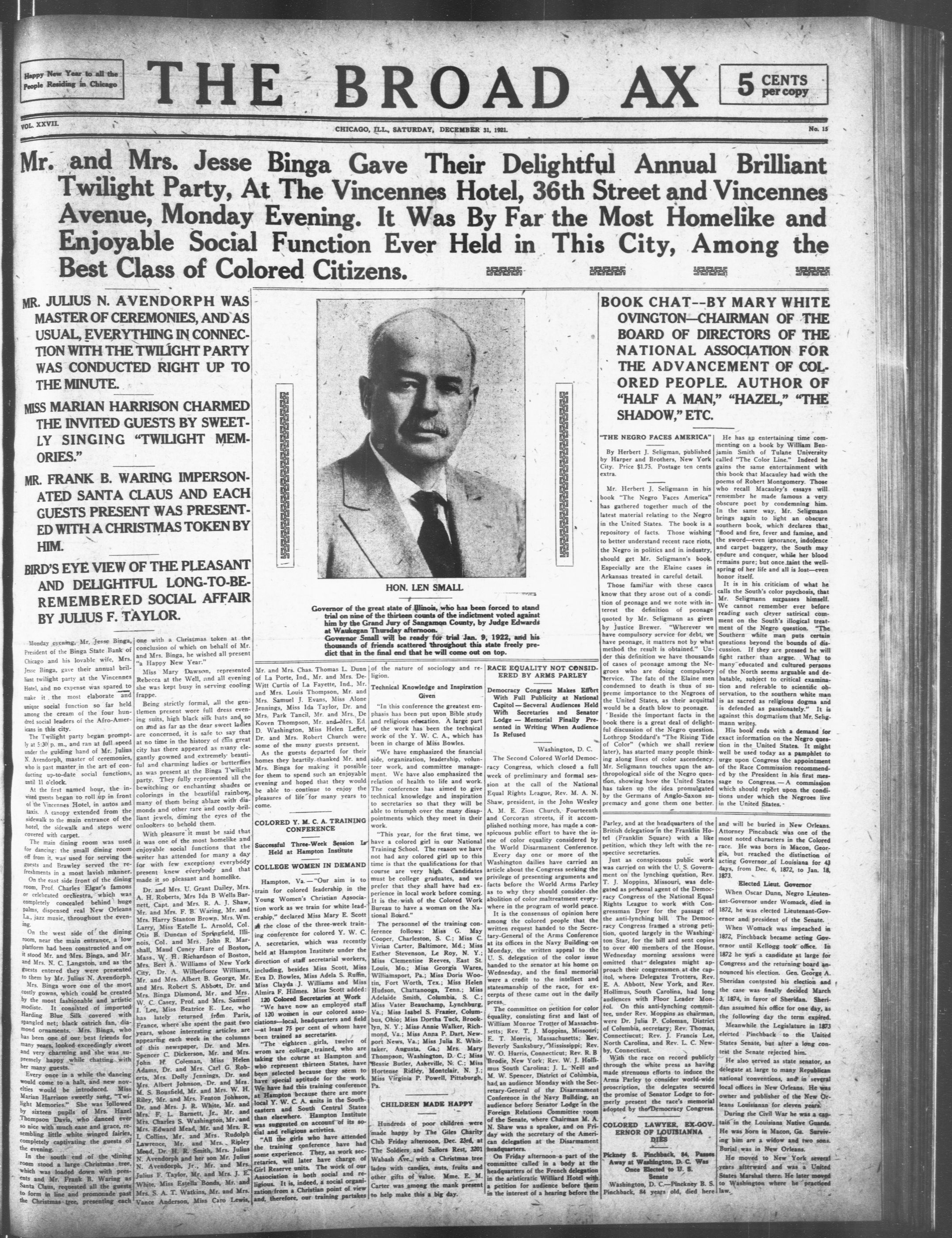
Mr. and Mrs. Jesse Binga Gave Their Delightful Annual Brilliant Twilight Party, At The Vincennes Hotel, 36th Street and Vincennes Avenue, Monday Evening. It Was By Far the Most Homelike and Enjoyable Social Function Ever Held in This City, Among the Best Class of Colored Citizens.
MR. JULIUS N. AVENDORPH WAS MASTER OF CEREMONIES, AND AS USUAL, EVERYTHING IN CONNECTION WITH THE TWILIGHT PARTY WAS CONDUCTED RIGHT UP TO THE MINUTE.
MISS MARIAN HARRISON CHARMED THE INVITED GUESTS BY SWEETLY SINGING "TWILIGHT MEMORIES."
MR. FRANK B. WARING IMPERSONATED SANTA CLAUS AND EACH GUESTS PRESENT WAS PRESENTED WITH A CHRISTMAS TOKEN BY HIM.
BIRD'S EYE VIEW OF THE PLEASANT AND DELIGHTFUL LONG-TO-BE-REMEMBERED SOCIAL AFFAIR BY JULIUS F. TAYLOR.
Happy New Year to all the People Residing in Chicago
Mr. and M. Twilight Avenue Enjoy Best C.
MR. JULIUS N. A. MASTER OF CEL USUAL, EVERY TION WITH THE WAS CONDUCT THE MINUTE.
MISS MARIAN HA THE INVITED G LY SINGING ORIES."
MR. FRANK B. W A TED SANTA G GUESTS PRESENT ED WITH A CHR HIM.
BIRD'S EYE VIEW AND DELIGHT REMEMBERED BY JULIUS F. T
Monday evening, Mr. Jesse Binga, President of the Binga State Bank of Chicago and his lovable wife, Mrs. Jesse Binga, gave their annual brilliant twilight party at the Vincennes Hotel, and no expense was spared to make it the most elaborate and unique social function so far held among the cream of the four hundred social leaders of the Afro-Americans in this city.
The Twilight party began promptly at 5:30 p. m., and ran at full speed under the guiding hand of Mr. Julius N. Avendorph, master of ceremonies, who is past master in the art of conducting up-to-date social functions, until 11 o'clock.
At the first named hour, the invited guests began to roll up in front of the Vincennes Hotel, in autos and taxis. A canopy extended from the sidewalk to the main entrance of the hotel, the sidewalk and steps were covered with carpet.
The main dining room was used for dancing; the small dining room off from it, was used for serving the guests and Brawley served the refreshments in a most lavish manner. On the east side front of the dining room, Prof. Charles Elgar's famous or celebrated orchestra, which was completely concealed behind huge palms, dispensed real New Orleans La., jazz music, throughout the evening.
On the west side of the dining room, near the main entrance, a low platform had been constructed and on it stood Mr. and Mrs. Binga, and Mr. and Mrs. N. C. Langston, and as the guests entered they were presented to them by Mr. Julius N. Avendorph. Mrs. Binga wore one of the most costly gowns, which could be created by the most fashionable and artistic modiste. It consisted of imported Harding Blue Silk covered with spangled net; black ostrich fan, diamond ornaments. Mrs. Binga, who has been one of our best friends for many years, looked exceedingly sweet and very charming and she was supremely happy while chatting with her many guests.
Every once in a while the dancing would come to a halt, and new novelties would be introduced. Miss Marian Harrison sweetly sang, "Twilight Memories." She was followed by sixteen pupils of Mrs. Hazel Thompson Davis, who danced ever so with nice much ease and grace, resembling little white winged fairies, completely captivating the guests of the evening.
In the south end of the dining room stood a large Christmas tree, which was loaded down with presents and Mr. Frank B. Waring as Santa Claus, requested all the guests to form in line and promonade past the Christmas tree, presenting each
THE BROAD AX
one with a Christmas token at the conclusion of which on behalf of Mr. and Mrs. Binga, he wished all present "a Happy New Year."
Miss Mary Dawson, represented Rebecca at the Well, and all evening she was kept busy in serving cooling frappe.
Being strictly formal, all the gentlemen present wore full dress evening suits, high black silk hats and so on and as far as the dear sweet ladies are concerned, it is safe to say that at no time in the history of this great city has there appeared as many elegantly gowned and extremely beautiful and charming ladies or butterflies as was present at the Binga Twilight party. They fully represented all the bewitching or enchanting shades or colorings in the beautiful rainbow, many of them being ablaze with diamonds and other rare and costly brilliant jewels, diming the eyes of the onlookers to behold them.
With pleasure it must be said that it was one of the most homelike and enjoyable social functions that the writer has attended for many a day for with few exceptions everybody present knew everybody and that made it so pleasant and homelike.
Dr. and Mrs. U. Grant Dailey, Mrs. A. H. Roberts, Mrs Ida B Wells Barnett, Capt, and Mrs. R. A. J. Shaw, Mr. and Mrs. F. B. Waring, Mr. and Mrs. Harry Stanton Brown, Mrs. Wm Larry, Miss Estelle L. Arnold, Col. Otis B. Duncan of Springfield, Illinois, Col. and Mrs. John R. Marshall, Maud Cuney Hare of Boston, Mass. W. H. Richardson of Boston, Mrs. Bert A. Williams of New York City, Dr. A. Wilberforce Williams, Mr. and Mrs. Albert B. George, Mr. and Mrs. Robert S. Abbott, Dr. and Mrs. Binga Dismond, and Mrs. W. C. Casey, Prof. and Mrs. Samuel I. Lee, Miss Beatrice E. Lee, who has lately returned from Paris, France, where she spent the past two years, whose interesting articles are appearing each week in the columns of this newspaper, Dr. and Mrs. Spencer C. Dickerson, Mr. and Mrs. John H. Coleman, Miss Helen Adams, Dr. and Mrs. Carl G. Roberts, Mrs. Dolly Jennings, Dr. and Mrs. Albert Johnson, Dr. and Mrs. M. S. Bousfield, Mr. and Mrs. W. H. Riley, Mr. and Mrs. Fenton Johnson, Dr. and Mrs. J. R. White, Mr. and Mrs. F. L. Barnett, Jr., Mr. and Mrs. Charles S. Washington, Mr. and Mrs. Edward Mead, Mr. and Mrs. R. L. Collins, Mr. and Mrs. Rudolph Lawrence, Mr. and Mrs. Ripley Mead, Dr. H. R. Smith, Mrs. Julius N. Avendorph and her son Mr. Julius N. Avendotph, Jr., Mr. and Mrs. Julius F. Taylor, Mr. and Mrs. J. E. White, Miss Estella Bonds, Mr. and Mrs. S. A. T. Watkins, Mrs. Vance Anderson, Miss Caro Lewis,
CHICAGO, ILL., SATURDAY, DECEMBER 31, 1921.
M.
Governor of the great state of Illinois, who has been forced to stand trial on nine of the thirteen counts of the indictment voted against him by the Grand Jury of Sangamon County, by Judge Edwards at Waukegan Thursday afternoon. Governor Small will be ready for trial Jan. 9, 1922, and his thousands of friends scattered throughout this state freely predict that in the final end that he will come out on top.
---
Mr. and Mrs. Chas. Thomas L. Dunn of La Porte, Ind., Mr. and Mrs. De-Witt Curtis of La Fayette, Ind., Mr. and Mrs. Louis Thompson, Mr. and Mrs. Samuel J. Evans, Miss Alone Jennings, Miss Ida Taylor, Dr. and Mrs. Park Tancil, Mr. and Mrs. De Koven Thompson, Mr. and Mrs. Ed. D. Washington, Miss Helen Leftet, Dr. and Mrs. Robert Church were some of the many guests present. As the guests departed for their homes they heartily thanked Mr. and Mrs. Binga for making it possible for them to spend such an enjoyable evening and hoped that they would be able to continue to enjoy the pleasures of life for many years to come.
COLORED Y. M. C. A. TRAINING
CONFERENCE
Successful Three-Week Session In Held at Hampton Institute
COLLEGE WOMEN IN DEMAND
Hampton, Va. — "Our aim is to train for colored leadership in the Young Women's Christian Association work as we train for white leadership," declared Miss Mary E. Scott at the close of the three-week training conference for colored Y. W. C. A. secretaries, which was recently held at Hampton Institute under the direction of staff secretarial workers, including, besides Miss Scott, Miss Eva D. Bowles, Miss Adela S. Ruffin, Miss Clayda J. Williams and Miss Almira F. Hilmes. Miss Scott added: 120 Colored Secretaries at Work
"We have now an employed staff of 120 women in our colored associations—local, headquarters and field—at least 75 per cent of whom have been trained as secretaries.
"The eighteen girls, twelve of wom are college, trained, who are taking the course at Hampton and who represent thirteen States, have been selected because they seem to have special aptitude for the work. We have had this training conference at Hampton because there are more local Y. W. C. A. units in the Southeastern and South Central States than elsewhere. Hampton Institute was suggested on account of its social and religious activities.
"All the girls who have attended the training conference have had some experience. They, as work retirements, will later have charge of Girl Reserve units. The work of our Association is both social and religious. It is, indeed, a social organization/from a Christian point of view and therefore, our training partakes
HON. LEN SMALL
great state of Illinois, who has been of the thirteen counts of the indictment grand Jury of Sangamon County, by Thursday afternoon.
mall will be ready for trial Jan. 9 friends scattered throughout this the final end that he will come out of the nature of sociology and religion.
Technical Knowledge and Inspiration Given
"In this conference the greatest emphasis has been put upon Bible study and religious education. A large part of the work has been the technical work of the Y. W. C. A., which has been in charge of Miss Bowles.
"We have emphasized the financial side, organization, leadership, volunteer work, and committee management. We have also emphasized the relation of health to life and work. The conference has aimed to give technical knowledge and inspiration to secretaries so that they will be able to triumph over the many disappointments which they meet in their work.
"This year, for the first time, we have a colored girl in our National Training School. The reason we have not had any colored girl up to this time is that the qualifications for that course are very high. Candidates must be college graduates, and we prefer that they shall have had experience in local work before coming. It is the wish of the Colored Work Bureau to have a woman on the National Board."
The personnel of the training conference follows: Miss G. May Cooper, Charleston, S. C.; Miss C. Vivian Carter, Baltimore, Md.; Miss Ester Stevenson, Le Roy, N. Y.; Miss Clementine Reeves, East St Louis, Mo.; Miss Georgia Wares, Williamport, Pa.; Miss Doris Wootin, Fort Worth, Tex.; Miss Helen Hudson, Chattanooga, Tenn.; Miss Adelaide Smith, Columbia, S. C.; Miss Vater Beauchamp, Lynchburg Va.; Miss Isabel S. Frazier, Columbus, Ohio; Miss Dortha Tuck, Brooklyn, N. Y.; Miss Annie Walker, Richmond, Va.; Miss Anna P. Dart, Newport News, Va.; Miss Julia E. Whitaker, Augusta, Ga.; Mrs. Mary Thompson, Washington, D. C.; Miss Bessie Butler, Asheville, N. C.; Miss Hortense Ridley, Montclair, N. J.; Miss Virginia P. Powell, Pittsburgh, Pa.
CHILDREN MADE HAPPY
Hundreds of poor children were made happy by The Giles Charity Club Friday afternoon, Dec. 23rd, at The Soldiers and Sailors Rest, 3201 Wabash Ave., with a Christmas tree laden with candies, nuts, fruits and other gifts of value. Mme. E. M. Carter was among the mank present to help make this a big day.
---
RACE EQUALITY NOT CONSIDERED BY ARMS PARLEY
Democracy Congress Makes Effort With Full Publicity at National Capitol — Several Audiences Held With Secretaries and Senator Lodge — Memorial Finally Presented in Writing When Audience Is Refused
The Second Colored World Democracy Congress, which closed a full week of preliminary and formal session at the call of the National Equal Rights League, Rev. M. A. N. Shaw, president, in the John Wesley A. M. E. Zion Church, Fourteenth and Corcoran streets, if it accomplished nothing more, has made a conspicuous public effort to have the issue of color equality considered by the World Disarmament Conference. Every day one or more of the Washington dailies have carried an article about the Congress seeking the privilege of presenting arguments and facts before the World Arms Parley as to why they should consider the abolition of color mattreatment everywhere in the program of world peace. It is the consensus of opinion here among the colored people that the written request handed to the Secretary-General of the Arms Conference at its offices in the Navy Building on Monday, the written appeal to the U. S. delegation of the color issue handed to the senator at his home on Wednesday, and the final memorial were a credit to the intellect and statesmanship of the race, for excerpts of these came out in the daily press.
The committee on petition for color equality, consisting first and last of William Monroe Trotter of Massachusetts; Rev. T. J. Moppins, Missouri; E. T. Morris, Massachusetts; Rev. Beverly Sanksbury, Mississippi; Rev. W. O. Harris, Connecticut; Rev. R. B Brodie, New York; Rev. W. J. Holmus South Carolina; J. L. Neill and M. W. Spencer, District of Columbia, had an audience Monday with the Secretary-General of the Disarmament Conference in the Navy Building, an audience before Senator Lodge in the Foreign Relations Committee room of the Senate, where Chairman M. A. M. Shaw was a speaker, and on Friday with the secretary of the American delegation at the Disarmament headquarters.
On Friday afternoon—a part of the committee called in a body at the headquarters of the French delegation in the aristocratic Williard Hotel with a petition for audience before them in the interest of a hearing before the
BOOK CHAT--BY MARY WHITE OVINGTON—CHAIRMAN OF THE BOARD OF DIRECTORS OF THE NATIONAL ASSOCIATION FOR THE ADVANCEMENT OF COL-ORED PEOPLE. AUTHOR OF "HALF A MAN," "HAZEL," "THE SHADOW," ETC.
"THE NEGRO FACES AMERICA"
By Herbert J. Seligman, published by Harper and Brothers, New York City. Price $1.75. Postage ten cents extra.
He has an entertaining time commenting on a book by William Benjamin Smith of Tulane University called "The Color Line." Indeed he gains the same entertainment with this book that Macaulay had with the
Mr. Herbert J. Seligmann in his book "The Negro Faces America" has gathered together much of the latest material relating to the Negro in the United States. The book is a repository of facts. Those wishing to better understand recent race riots, the Negro in politics and in industry, should get Mr. Seligmann's book. Especially are the Elaine cases in Arkansas treated in careful detail.
Those familiar with these cases know that they arose out of a condition of peonage and we note with interest the definition of peonage quoted by Mr. Seligmann as given by Justice Brewer. "Wherever we have compulsory service for debt, we have peonage, it matters not by what method the result is obtained." Under this definition we have thousands of cases of peonage among the Negroes who are doing compulsory service. The fate of the Elaine men condemned to death is thus of supreme importance to the Negroes of the United States, as their acquittal would be a death blow to peonage.
Beside the important facts in the book there is a great deal of delightful discussion of the Negro question. Lothrop Stoddard's "The Rising Tide of Color" (which we shall review later), has started many people thinking along lines of color ascendency. Mr. Seligmann touches upon the anthropological side of the Negro question, showing how the United States has taken up the idea promulgated by the Germans of Anglo-Saxon supremacy and gone them one better.
Parley, and at the headquarters of the British delegation in the Franklin Hotel (Franklin Square) with a like petition, which they left with the respective secretaries.
Just as conspicuous public work was carried on the lynching question, Rev. T. J. Moppins, Missouri, was delegated as personal agent of the Democracy Congress of the National Equal Rights League to work with Congressman Dyer for the passage of the anti-lynching bill. The Democracy Congress framed a strong petition, quoted largely in the Washington Star, for the bill and sent copies to over 400 members of the House. Wednesday morning sessions were omitted that delegates might approach their congressmen at the capitol, where Delegates Trotters, Rev E. A Abbott, New York, and Rev Hollimus, South Carolina, had long audiences with Floor Leader Monfol. On this anti-lynching committee, under Rev. Moppins as chairman were Dr. Julia P. Coleman, District of Columbia, secretary; Rev. Thomas Connecticut; Rev. J. Francis Lee, North Carolina, and Rev. L. C. Newby, Connecticut.
With the race on record publicly through the white press as having made strenuous efforts to induce the Arms Parley to consider world-wide proscription, the delegates secured the promise of Senator Lodge to formerly present the race's memorial adopted by the Democracy Congress.
Washington, D. C.-Pinekney B. S. to Pinchback, 84 years old, died here law
5 CENTS per copy
No. 15
Brilliant Vincennes
melike and
mong the
BY MARY WHITE
HAIRMAN OF THE
RECTORS OF THE
ASSOCIATION FOR
CEMENT OF COL-
E. AUTHOR OF
,” “HAZEL,” “THE
No.15
He has ap entertaining time commenting on a book by William Benjamin Smith of Tulane University called "The Color Line." Indeed he gains the same entertainment with this book that Macauley had with the poems of Robert Montgomery. Those who recall Macauley's essays will remember he made famous a very obscure poet by condemning him. In the same way, Mr. Seligmann brings again to light an obscure southern book, which declares that "flood and fire, fever and famine, and the sword—even ignorance, indolence and carpet baggery, the South may endure and conquer, while her blood remains pure; but once taint the wellspring of her life and all is lost—even honor itself.
It is in his criticism of what he calls the South's color psychosis, that Mr. Seligmann surpasses himself. We cannot remember ever before reading such clever satirical comment on the South's illogical treatment of the Negro question. "The Southern white man puts certain questions beyond the bounds of discussion. If they are pressed he will fight rather than argue. What to many educated and cultured persons of the North seems arguable and debatable, subject to critical examination and referable to scientific observation, to the southern white man is as sacred as religious dogma and is defended as passionately." It is against this dogmatism that Mr. Seligmann writes.
His book ends with a demand for exact information on the Negro question in the United States. It might well be used today as a pamphlet to urge upon Congress the appointment of the Race Commission recommended by the President in his first message to Congress. — A commission which should report upon the conditions under which the Negroes live in the United States.
and will be buried in New Orleans. Attorney Pincback was one of the most noted characters in the Colored race. He was born in Macon, Georgia, but reached the distinction of acting Governor of Louisiana for 43 days, from Dec. 6, 1872, to Jan. 18, 1873.
Elected Lieut. Governor
Elected Lieut. Governor
When Oscar Dunn, Negro Lieutenant-Governor under Womack, died in 1872, he was elected Lieutenant-Governor and president of the Senate.
When Womack was impeached in 1872, Pinchback became acting Governor until Kellogg took office. In 1872 he was a candidate at large for Congress and the returning board announced his election. Gen. George A. Sheridan contested his election and the case was finally decided March 3, 1874, in favor of Sheridan. Sheridan assumed his office for one day, as the following day the term expired.
Meanwhile the Legislature in 1873 elected Pinchback to the United States Senate, but after a long contest the Senate rejected him.
He also served as state senator, as delegate at large to many Republican national conventions, and in several local offices in New Orleans. He was owner and publisher of the New Orleans Louisianan for eleven years.
During the Civil War he was a captain in the Louisiana Native Guards. He was born in Macon, Ga. Surviving him are a widow and two sons. Burial was in New Orleans.
He moved to New York several years afterward and was a United States Marshal there. He later moved to Washington where he practiced law.
THE BROAD AX Published Every Saturday
In this city since July 15th, 1899, without missing one single issue. Republicans, Democrats, Catholics, Protestants, Single Taxers, Priests, infidels or anyone else can have their say as long as their language is proper and responsibility is fixed.
The Broad Ax is a newspaper whose platform is broad enough for all, ever claiming the editorial right to speak its own mind.
Local communications will receive attention. Write only on one side of the paper.
Subscriptions must be paid in ad- One Year .....$2.00
Six Months .....$1.00
Advertising rates made known on application.
Address all communication to ..... 1206 So. Elizabeth St., Chicago, Ill.
JULIUS F. TAYLOR
Editor and Publisher
Associate Editor
DR. M. A. MAJORS
4700 South State Street
Phone Drexel 1416
Entered as Second-Class Matter, Aug. 1902 at the Post Office at Chicago, Ill. Under Act of March 8, 1879.
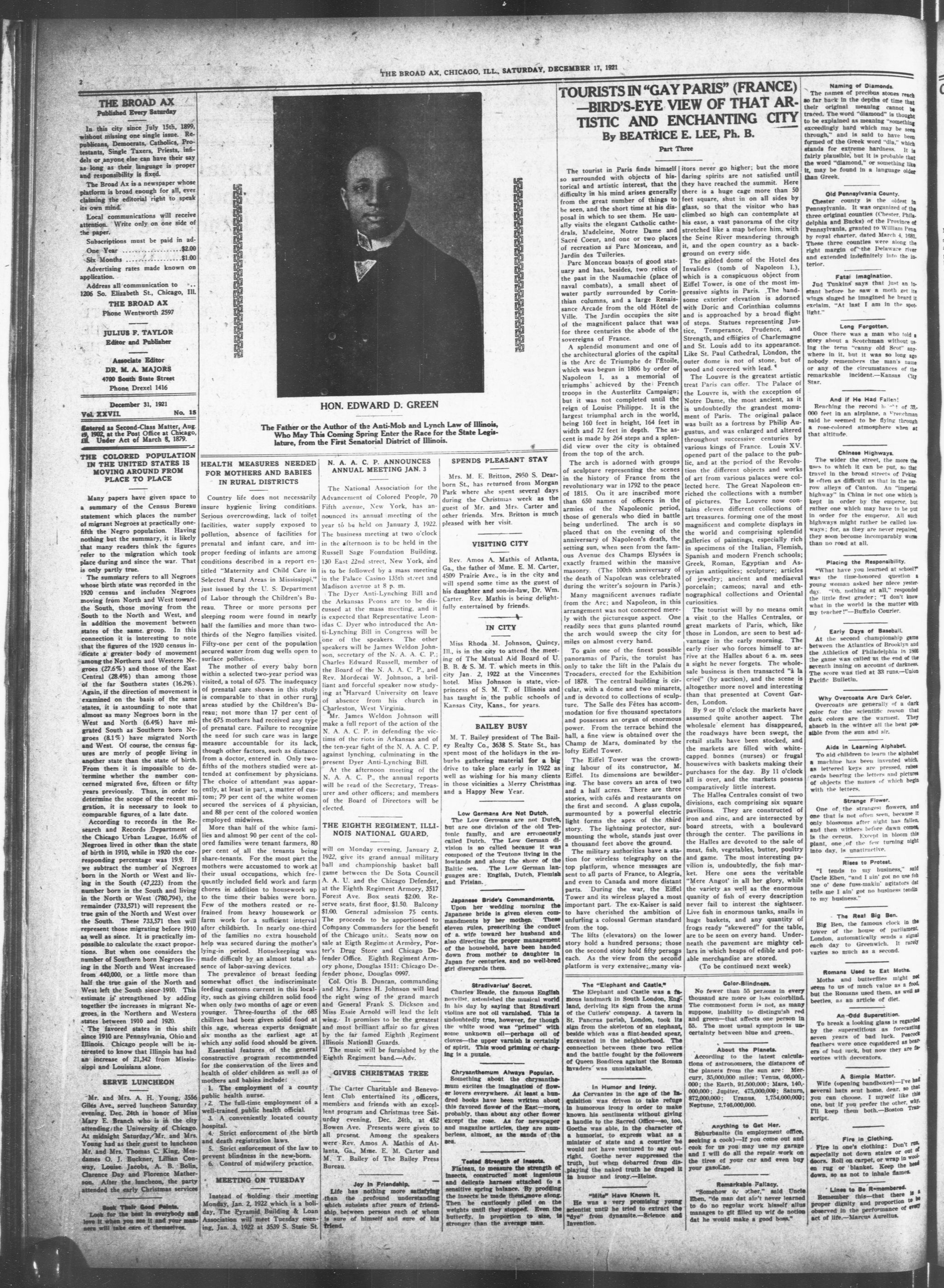
THE COLORED POPULATION IN THE UNITED STATES IS MOVING AROUND FROM PLACE TO PLACE
Many papers have given space to a summary of the Census Bureau statement which places the number of migrant Negroes at practically one-fifth the Negro population. Having nothing but the summary, it is likely that many readers think the figures refer to the migration which took place during and since the war. That is only partly true.
The summary refers to all Negroes whose birth state was recorded in the 1920 census and includes Negroes moving from North and West toward the South, those moving from the South to the North and West, and in addition the movement between states of the same group. In this connection it is interesting to note that the figures of the 1920 census indicate a greater body of movement among the Northern and Western Negroes (27.6%) and those of the East Central (28.4%) than among those of the far Southern states (16.2%). Again, if the direction of movement is examined on the basis of the same states, it is astounding to note that almost as many Negroes born in the West and North (6.4%) have migrated South as Southern born Negroes (8.1%) have migrated North and West. Of course, the census figures are merly of people living in another state than the state of birth From them it is impossible to determine whether the number concerned migrated five, fifteen or fifty years previously. Thus, in order to determine the scope of the recent migration, it is necessary to look to comparable figures of a late date.
According to records in the Research and Records Department of the Chicago Urban League, 16.6% of Negroes lived in other than the state of birth in 1910, while in 1920 the corresponding percentage was 19.9. If we subtract the number of Negroes born in the North or West and living in the South (47,223) from the number born in the South and living in the North or West (780,794), the remainder (733,571) will represent the true gain of the North and West over the South. These 733,571 then will represent those migrating before 1910 as well as since. It is practically impossible to calculate the exact proportions. But when one considers the number of Southern born Negroes living in the North and West increased from 440,000, or a little more than half the true gain of the North and West left the South since 1910. This estimate is strengthened by adding together the increases in migrant Negroes, in the Northern and Western states between 1910 and 1920.
The favored states in this shift since 1910 are Pennsylvania, Ohio and Illinois. Chicago people will be interested to know that Illinois has had an increase of 21,342 from Mississippi and Louisiana alone.
SERVE LUNCHEON
Mr. and Mrs. A. H. Young, 3556 Giles Ave., served luncheon Saturday evening, Dec. 24th in honor of Miss Mary E. Branch who is in the city attending the University of Chicago. At midnight Saturday,/Mr. and Mrs. Young had as their guest to luncheon Mr. and Mrs. Thomas C. King, Mesdames O. J. Buckner, Lillian Conway, Louise Jacobs, A. B. Bolin, Clarence Day and Florence Matherson. After the luncheon, the party attended the early Christmas services
Book Their Good Points.
Look for the best in everybody and love it when you see it and your manners will take care of themselves.
[Portrait of a man in formal attire, facing forward, with a neutral expression. The background is plain and dark, emphasizing the subject.]
The Father or the Author of the Anti-Mob and Lynch Law of Illinois, Who May This Coming Spring Enter the Race for the State Legislature, from the First Senatorial District of Illinois.
HEALTH MEASURES NEEDED FOR MOTHERS AND BABIES IN DURAL DISTRICTS
Country life does not necessarily insure hygienic living conditions. Serious overcrowding, lack of toilet facilities, water supply exposed to pollution, absence of facilities for prenatal and infant care, and improper feeding of infants are among conditions described in a report entitled "Maternity and Child Care in Selected Rural Areas in Mississippi," just issued by the U. S. Department of Labor through the Children's Bureau. Three or more persons per sleeping room were found in nearly half the families and more than two-thirds of the Negro families visited Fifty-one per cent of the population secured water from dug wells open to surface pollution.
The mother of every baby born within a selected two-year period was visited, a total of 675. The inadequacy of prenatal care shown in this study is comparable to that in other rural areas studied by the Children's Bureau; not more than 17 per cent of the 675 mothers had received any type of prenatal care. Failure to recognize the need for such care was in large measure accountable for its lack, though other factors, such as distance from a doctor, entered in. Only two-fifths of the mothers studied were attended at confinement by physicians. The choice of attendant was apparently, at least in part, a matter of custom; 79 per cent of the white women secured the services of a physician, and 88 per cent of the colored women employed midwives.
More than half of the white families and almost 90 per cent of the colored families were tenant farmers, 80 per cent of all the tenants being share-tenants. For the most part the mothers were accustomed to work at their usual occupations, which frequently included field work and farm chores in addition to housework up to the time their babies were born. Few of the mothers rested or refrained from heavy housework or farm work for a sufficient interval after childbirth. In nearly one-third of the families no extra household help was secured during the mother's lying-in period. Housekeeping was made difficult by an almost total absence of labor-saving devices.
The prevalence of breast feeding somewhat offset the indiscriminate feeding customs current in this locality, such as giving children solid food when only two months of age or even younger. Three-fourths of the 685 chillen had been given solid food at this age, whereas experts designate six months as the earliest age at which any solid food should be given. Essential features of the general constructive program recommended for the conservation of the lives and health of older children as well as of mothers and babies include:
1. The employment of a county public health nurse.
4. Strict enforcement of the birth and death registration laws.
5. Strict enforcement of the law to prevent blindness in the new-born.
6. Control of midwifery practice.
MEETING ON TUESDAY
Instead of holding their meeting Monday, Jan. 2, 1922 which is a holiday, The Pyramid Building & Loan Association will meet Tuesday evening, Jan. 3, 1922 at 8:539 S. State St.
THE BROAD AX, CHICAGO, ILL., SATURDAY, DECEMBER 17, 1921
HON. EDWARD D. GREEN
N. A. A. C. P. ANNOUNCES ANNUAL MEETING JAN. 3.
The National Association for the Advancement of Colored People, 70 Fifth avenue, New York, has announced its annual meeting of the year to be held on January 3, 1922. The business meeting at two o'clock in the afternoon is to be held in the Russell Sage Foundation Building, 130 East 22nd street, New York, and is to be followed by a mass meeting in the Palace Casino 135th street and Madison avenue at 8 p. m. The Dyer Anti-Lynching Bill and the Arkansas Peons are to be discussed at the mass meeting, and it is expected that Representative Leonidas C. Dyer who introduced the Anti-Lynching Bill in Congress will be one of the speakers. The other speakers will be James Weldon Johnson, secretary of the N. A. A. C. P., Charles Edward Russell, member of the Board of the N. A. A. C. P., and Rev. Mordecai W. Johnson, a brilliant and forceful speaker now studying at Harvard University on leave of absence from his church in Charleston, West Virginia.
Mr. James Weldon Johnson will make a full report of the action of the N. A. A. C. P. in defending the victims of the riots in Arkansas and of the ten-year fight of the N. A. A. C. P. against lynching, culminating in the present Dyer Anti-Lynching Bill. At the afternoon meeting of the N. A. A. C. P., the annual reports will be read of the Secretary, Treasurer and other officers; and members of the Board of Directors will be elected.
THE EIGHTH REGIMENT, ILLI
NOIS, NATIONAL GUARD.
will on Monday evening, January 2, 1922, give its grand annual military ball and championship basket ball game between the De Sota Council A. A. U. and the Chicago Defender, at the Eighth Regiment Armory, 3517 Forest Ave. Box seats $2.00. Reserve seats, first floor, $1.50. Balcony $1.00. General admission 75 cents. The proceeds to be apportioned to Company Commanders for the benefit of the Chicago units. Seats now on sale at Eighth Regiment at Armory, Porter's Drug Store and Chicago Defender Office. Eighth Regiment Armory phone, Douglas 1511: Chicago Defender phone, Douglas 0997. Col. Otis B. Duncan, commanding and Mrs. James H. Johnson will lead the right wing of the grand march and General Frank S. Dickson and Miss Essie Arnold will lead the left wing. It promises to be the greatest and most brilliant affair so far given by the far famed Eighth Regiment Illinois National Guards. The music will be furnished by the Eighth Regiment band—Adv.
GIVES CHRISTMAS TREE
The Carter Charitable and Benevolent Club entertained its officers, members and friends with an excellent program and Christmas tree Saturday evening, Dec. 24th, at 452 Bowen Ave. Presents were given to all present. Among the speakers were Rev. Amos A. Mathis of Atlanta, Ga., Mme. E. M. Carter and M. T. Bailey of The Bailey Press Bureau.
Joy Ja Friendship
Life has nothing more satisfying than the profound understanding which subsists after years of friendship, between persons each of whom is sure of himself and sure of his friend.
SPENDS PLEASANT STAY
Mrs. M. E. Britton, 2950 S. Dearborn St., has returned from Morgan Park where she spent several days during the Christmas week as the guest of Mr. and Mrs. Carter and other friends. Mrs. Britton is much pleased with her visit.
VISITING CITY
Rev. Amos A. Mathis of Atlanta, Ga., the father of Mme. E. M. Carter, 4509 Prairie Ave., is in the city and will spend some time as the guest of his daughter and son-in-law, Dr. Wm Carter. Rev. Mathis is being delightfully entertained by friends.
IN CITY
Miss Rhoda M. Johnson, Quincy, Ill., in the city to attend the meeting of The Mutual Aid Board of U. B. B. & S. M. T. which meets in this city Jan. 2, 1922 at the Vincennes hotel. Miss Johnson is state, vice-princess of S. M. T. of Illinois and has taught in the public schools of Kansas City, Kans., for years.
BAILEY BUSY
M. T. Bailey president of The Bailey Realty Co., 3638 S. State St., has spent most of the holidays in the suburbs gathering material for a big drive to take place early in 1922 as well as wishing for his many clients in those vicinities a Merry Christmas and a Happy New Year.
Low Germans Are Not Dutch. The Low Germans are not Dutch, but are one division of the old Teutonic family, and are erroneously called Dutch. The Low German division is so called because it was composed of the Teutons living in the lowlands and along the shore of the Baltic sea. The Low German languages are: English, Dutch, Flemish and Frisian.
Japanese Bride's Commandments.
Japan.
Upon her wedding morning the Japanese bride is given eleven commandments by her mother. These eleven rules, prescribing the conduct of a wife toward her husband and also directing the proper management of the household, have been handed down from mother to daughter in Japan for centuries, and no well-bred girl disregards them.
Stradivarius' Secret
Charles Reade, the famous English novelist, astonished the musical world in his day by saying that Stravilari voltols are not oil varnished. This is undoubtedly true, however, for though the white wood was "primed" with some unknown oil—perhaps oil of cloves—the upper varnish is certainly of spirit. This wood priming or charging is a puzzle.
Chrysanthemum Always Popular.
Something about the chrysanthemum excites the imagination of flower lovers everywhere. At least a hundred books have been written about this favored flower of the East—more probably, than about any other flower except the rose. As for newspaper and magazine articles, they are numberless, almost, as the sands of the sea.
Tested Strength of Insects
Flateau, to measure the strength of insects, constructed most ingenious and delicate harness attached to a sensitive spring balance. By prodding the insects he made them move along. Then he cautiously piled on the weights until they stopped. Even the butterfly, in proportion to size, is stronger than the average man.
TOURISTS IN "GAY PARIS" (FRANCE) BIRD'S-EYE VIEW OF THAT ARTISTIC AND ENCHANTING CITY By BEATRICE E. LEE, Ph. B.
Part Three
The tourist in Paris finds himself so surrounded with objects of historical and artistic interest, that the difficulty in his mind arises generally from the great number of things to be seen, and the short time at his disposal in which to see them. He usually visits the elegant Catholic cathedrals, Madeleine, Notre Dame and Sacré Coeur, and one or two places of recreation as Parc Monceau, and Jardin des Tuileries.
Parc Monceau boasts of good statuary and has, besides, two relieds of the past in the Naumachie (place of naval combats), a small sheet of water partly surrounded by Corinthian columns, and a large Renaissance Arcade from the old Hôtel de Ville. The Jardin occupies the site of the magnificent palace that was for three centuries the abode of the sovereigns of France.
A splendid monument and one of the architectural glories of the capital is the Arc de Triumphe de l'Etoile, which was begun in 1806 by order of Napoleon I, as a memorial of triumphs achieved by the French troops in the Austerlitz Campaign; but it was not completed until the reign of Louise Philippe. It is the largest triumphal arch in the world, being 160 feet in height, 164 feet in width and 72 feet in depth. The ascent is made by 264 steps and a splendid view over the city is obtained from the top of the arch.
The arch is adorned with groups of sculpture representing the scenes in the history of France from the revolutionary war in 1792 to the peace of 1815. On it are inscribed more than 650 names of officers in the armies of the Napoleonic period, those of generals who died in battle being underlined. The arch is so placed that on the evening of the anniversary of Napoleon's death, the setting sun, when seen from the famous Avenue des Champs Elysées is exactly framed within the massive masonry. (The 100th anniversary of the death of Napoleon was celebrated during the writer's sojourn in Paris.)
Many magnificent avenues radiate from the Arc; and Napoleon, in this arrangement was not concerned merely with the picturesque aspect. One readily sees that guns planted round the arch would sweep the city for miles on almost every hand.
To gain one of the finest possible panoramas of Paris, the toruist has only to take the lift in the Palais du Trocaders, erected for the Exhibition of 1878. The central building is circular, with a dome and two minaret, and is devoted to collections of sculpture. The Salle des Fetes has accommodation for five thousand spectators and possesses an organ of enormous power. From the terrace behind the hall, a fine view is obtained over the Champ de Mars, dominated by the lofty Eiffel Tower.
The Eiffel Tower was the crowning labour of its constructor, M. Eiffel. Its dimensions are bewildering. The base covers an area of two and a half acres. There are three stories, with cafés and restaurants on the first and second. A glass cupola, surmounted by a powerful electric light forms the apex of the third story. The lightning protector, surmounting the whole, stands just over a thousand feet above the ground.
The military authorities have a station for wireless telegraphy on the top platform, whence messages are sent to all parts of France, to Alegria, and even to Canada and more distant parts. During the war, the Eiffel Tower and its wireless played a most important part. The ex-Kaiser is said to have cherished the ambition of unfurling a colossal German standard from the top.
The lifts (elevators) on the lower story hold a hundred persons; those on the second story hold fifty persons each. As the view from the second platform is very extensive; many vis-
The "Elephant and Castle"
The Elephant and Castle was a famous landmark in South London, England, deriving its sign from the arms of the Cutters' company. A tavern in St. Pancras parish, London, took its sign from the skeleton of an elephant, beside which was a flint-headed spear, excavated in the neighborhood. The connection between these two relics and the battle fought by the followers of Queen Boadicea against the Roman invaders was unmistakable.
In Humor and Irony
As Cervantes in the age of the Inquisition was driven to take refuge in humorous irony in order to make known his sentiments without giving a handle to the Sacred Office—so, too, Goethe was able, in the character of a humorist, to express what as a minister of state and a courrier he would not have ventured to say outright. Goethe never suppressed the truth, but when debarred from displaying the naked truth he draped it in humor and irony—Heine.
"Wite" Have Known It.
He wrote a very promising young scientist until he tried to extract the "dye" from dynamite.—Science and invention.
itors never go higher; but the more daring spirits are not satisfied until they have reached the summit. Here there is a huge cage more than 50 feet square, shut in on all sides by glass, so that the visitor who has climbed so high can contemplate at his ease, a vast panorama of the city stretched like a map before him, with the Seine River meandering through it, and the open country as a background on every side.
The gilded dome of the Hotel des Invalides (tomb of Napoleon I.), which is a conspicuous object from Eiffel Tower, is one of the most impressive sights in Paris. The handsome exterior elevation is adorned with Doric and Corinthian columns and is approached by a broad flight of steps. Statues representing Justice, Temperance, Prudence, and Strength, and effigies of Charlemagne and St. Louis add to its appearance. Like St. Paul Cathedral, London, the outer dome is not of stone, but of wood and covered with lead.
The Louvre is the greatest artistic treat Paris can offer. The Palace of the Louvre is, with the exception of Notre Dame, the most ancient, as it is undoubtedly the grandest monument of Paris. The original palace was built as a fortress by Philip Augustus, and was enlarged and altered throughout successive centuries by various kings of France. Louis XV. opened part of the palace to the public, and at the period of the Revolution the different objects and works of art from various palaces were collected here. The Great Napoleon enriched the collections with a number of pictures. The Louvre now contains eleven different collections of art treasures, forming one of the most magnificent and complete displays in the world and comprising splendid galleries of paintings, especially rich in specimens of the Italian, Flemish, Spanish and modern French schools; Greek, Roman, Egyptian and Assyrian antiquities; sculpture; articles of jewelry; ancient and mediaeval porcelain; cameos; naval and ethnographical collections and Oriental curiosities.
The tourist will by no means omit a visit to the Halles Centrales, or great markets of Paris, which, like those in London, are seen to best advantage in the early morning. The early riser who forces himself to arrive at the Halles about 6 a.m. m. sees a sight he never forgets. The wholesale business is then transacted "à la crie" (by auction), and the scene is altogether more novel and interesting than that presented at Covent Garden, London.
By 9 or 10 o'clock the markets have assumed quite another aspect. The wholesale element has disappeared, the roadways have been swept, the retail stalls have been stocked, and the markets are filled with white-capped bonnes (nurses) or frugal housewives with baskets making their purchases for the day. By 11 o'clock all is over, and the markets possess comparatively little interest.
The Halles Centrales consist of two divisions, each comprising six square pavilions. They are constructed of iron and zinc, and are intersected by board streets, with a boulevard through the center. The pavilions in the Halles are devoted to the sale of meat, fish, vegetables, butter, poultry and game. The most interesting pavilion is, undoubtedly, the fish market. Here one sees the veritable "Mere Angot" in all her glory, while the variety as well as the enormous quantity of fish of every description never fail to interest the sightseer. Live fish in enormous tanks, snails in huge baskets, and any quantity of frogs ready "skewered" for the table, are to be seen on every hand. Underneath the pavement are mighty cellars in which heaps of edible and potable merchandise are stored. (To be continued next week)
Color-Blindness
No fewer than 55 persons in every thousand are more or less colorblind. The commonest form is not, as many suppose, inability to distinguish red and green—that affects one person in 55. The most usual symptom is uncertainty between blue and green.
About the Planets
According to the latest calculations of astronomers, the distances of the planets from the sun are: Mercury, 35,000,000 miles; Venus, 66,000,000; the Earth, 91,500,000; Mars, 140,000,000; Jupiter, 475,000; Saturn, 872,000,000; Uranus, 1,754,000,000; Neptune, 2,746,000,000
Anything to Get Her.
Suburbanite (In employment office, seeking a cook) If you come out and cook for us you may use my garage and I will do all the repair-work on the tires of your car and even buy your gasoLne.
Remarkable. Faltacy.
"Somehow or other," said Uncle Eben. "de man dat aln't never learned to do no regular work hiself allus manages to git filled up wif de notion dat he would make a good boss."
Naming of Diamonds
The names of precious stones reach so far back in the depths of time that their original meaning cannot be traced. The word "diamond" is thought to be explained as meaning "something exceedingly hard which may be seen through," and is said to have been formed of the Greek word "dia," which stands for extreme hardness. It is fairly plausible, but it is probable that the word "diamond," or something like it, may be found in a language older than Greek.
Old Pennsylvania County
Chester county is the oldest in Pennsylvania. It was organized of the three original counties (Chester, Philadelphia and Bucks) of the Province of Pennsylvania, granted to William Penn by royal charter, dated March 4, 1681. These three counties were along the right margin of the Delaware river and extended indefinitely into the interior.
Fatal Imagination.
Jud Tunkins says that just an instant before he saw a moth get its wings singed he imagined he heard it exclaim, "At last I am in the spotlight."
Long Forgotten
Once there was a man who told a story about a Scotchman without using the term "canny old Scot" anywhere in it, but it was so long ago nobody remembers the man's name or any of the circumstances of the remarkable incident.—Kansas City Star.
And If He Had Failed
Reaching the record height of 33,000 feet in an airplane, a Frenchman said he seemed to be flying through a rose-colored atmosphere when at that altitude.
Chinese Highways
The wider the street, the more the uses to which it can be put, so that travel in the broad streets of Peking is often as difficult as that in the narrow alleys of Cauton. An "imperial highway" in China is not one which is kept in order by the emperor, but rather one which may have to be put in order for the emperor. All such highways might rather be called lowways; for, as they are never repaired, they soon become incomparably worse than no road at all.
Placing the Responsibility
"What have you learned at school?" was the time-honored question a young woman asked her niece yesterday. "Oh, nothing at all," responded the little first grader; "I don't know what in the world is the matter with my teacher!" -Buffalo Courier.
Early Days of Baseball
At the second championship game between the Atlantics of Brooklyn and the Athletics of Philadelphia in 1886 the game was called at the end of the seventh inning on account of darkness. The score was tied at 33 runs.—Union Pacific Bulletin.
---
Why Overcoats are Dark Color.
Overcoats are generally of a dark color for the scientific reason that dark colors are the warmest. They absorb in the winter all the heat possible from the sun and air.
Aids in Learning Alphabet
To aid children to learn the alphabet a machine has been invented which as lettered keys are pressed, raises cards bearing the letters and pictures of objects the names of which begin with the letters.
Strange Flower.
One of the strangest flowers, and one that is not often seen, because it only blossoms after night has fallen, and then withers before dawn comes is the cereus. Except in bloom this plant, one of the few turning night into day is unattractive.
Rise to Protest
"I tends to my business," said Uncle Ebien, "and I am'i got not use of one o'se fuss-makin' agitators sat tells me I am'i got no business tendin' to my business."
The Real Big Ben
Big Ben, the famous clock in the tower of the house of parliament, London, automatically sends a signal each day to Greenwich. It rarely varies so much as a second.
Remains Used to Eat Moths
Moths and butterflies might not seem to us of much value as a food, but the Romans used them, as well as beetles as an article of diet.
An-Odd Superstition
To break a looking glass is regarded by the superstitious as forecasting seven years of bad luck. Peacock feathers were once considered as bearers of bad luck, but now they are far more with decorators.
4. Simple Matter
A Simple Matter.
Wife (opening bandboxes)—I've had several hats sent home, dear, so that you can choose, yourself like this, but if you prefer the other, why? I'll keep them both—Boston Transcorp.
Fire in Clothing.
Fire in one's clothing: Don't run, especially not down stairs or out of doors. Roll on carpet, or wrap in woolen rug or blanket. Keep the head down, so as not to inhale flames.
Lines to Be Remembered.
Remember this—that there is a proper dignity and proportion to be observed in the performance of every act of life.—Marcus Aurellus.
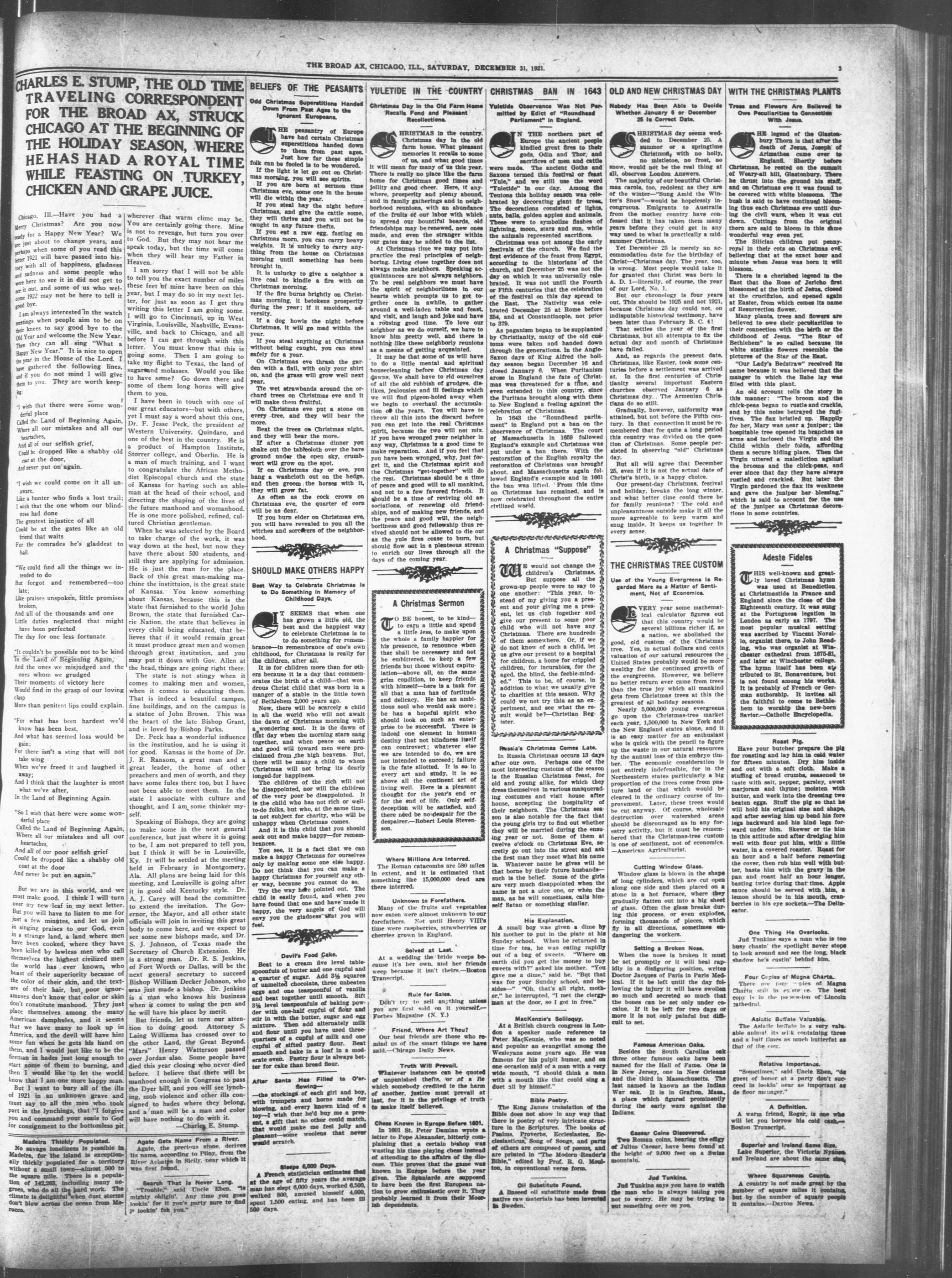
CHARLES E. STUMP, THE OLD TIME TRAVELING CORRESPONDENT FOR THE BROAD AX, STRUCK CHICAGO AT THE BEGINNING OF THE HOLIDAY SEASON, WHERE HE HAS HAD A ROYAL TIME WHILE FEASTING ON TURKEY, CHICKEN AND GRAPE JUICE.
Chicago, Ill.—Have you had a Merry Christmas? Are you now ready for a Happy New Year? We are just about to change years, and perhaps when some of you read this letter 1921 will have passed into history with all of happiness, gladness and sadness and some people who were here to see it in did not get to see it out, and some of us who welcome 1922 may not be here to tell it good bye.
I am always interested in the watch meetings when people aim to be on their knees to say good bye to the Old Year and welcome the New Year. Then they can all sing "What a Happy New Year." It is nice to open the year in the House of the Lord. I have gathered the following lines, and if you do not mind I will give them to you. They are worth keeping.
"I wish that there were some wonderful place
Called the Land of Beginning Again,
Where all our mistakes and all our heartaches,
And all of our selfish grief,
Could be dropped like a shabby old coat at the door,
And never put on again.
"I wish we could come on it all unaware,
Like a hunter who finds a lost trail;
I wish that the one whom our blindness had done
The greatest injustice of all
Could be at the gates like an old friend that waits
For the comrades he's gladdest to hail.
"We could find all the things we intended to do
But forgot and remembered—too late;
Like praises unspoken, little promises broken,
And all of the thousands and one
Little duties neglected that might have been perfected
The day for one less fortunate.
"It couldn't be possible not to be kind
In the Land of Beginning Again,
And the ones we misjudged and the ones whom we grudged
Their moments of victory here
Would find in the grasp of our loving clasp
More than penitent lips could explain
"For what has been hardest we'd know has been best,
And what has seemed loss would be gain;
For there isn't a sting that will not take wing
When we've freed it and laughed it away;
And I think that the laughter is most what we've after,
In the Land of Beginning Again.
"So I wish that here were some wonderful place
Called the Land of Beginning Again,
Where all our mistakes and all our heartaches,
And all of our poor selfish grief
And never be put on again."
But we are in this world, and we must make good. I think I will turn over my new leaf in my next letter. But you will have to listen to me for just a few minutes, and let us join in singing praises to our God, even in a strange land, a land where men have been cooked, where they have been killed by lawless men who call themselves the highest civilized men the world has ever known, who boast of their superiority because of the color of their skin, and the texture of their hair, but poor ignorances don't know that color or skin don't constitute manhood. They just place themselves among the many American damphuiles, and it seems that we have many to look up in America, and the devil will have him some fun when he gets his hand on them, and I would just like to be the fireman in hades just long enough to start some of them to burning, and then I would like to let the world know that I am one more happy man.
But I want to bury all of the ills of 1921 in an unknown grave and must say to all the men who took part in the lynchings, that "I forgive you and command your souls to God for consignment to the bottomless pit
Madeira Thickly Populated.
No savage loneliness is possible in Madeira, for the island is exceptionally thickly populated for a territory without a small town—almost 500 to the square mile. There is a population of 142,203, including many negroes, who do all the hard work. The climate is delightful when dust storms don't blow across the ocean from Morocco.
Odd Christmas Superstitions Handed Down From Past Ages to the Ignorant Europeans.
folk can be fooled is to be wondered.
If the light is let go out on Christmas morning, you will see spirits.
If you are born at sermon time Christmas eve, some one in the house will die within the year.
If you steal hay the night before Christmas, and give the cattle some, they will thrive and you will not be caught in any future thefts.
If you eat a raw egg, fasting on Christmas morn, you can carry heavy weights. It is unlucky to carry anything from the house on Christmas morning until something has been brought in.
It is unlucky to give a neighbor a live coal to kindle a fire with on Christmas morning.
If the fire burns brightly on Christmas morning, it betokens prosperity during the year; it smolders, adversity.
If a dog howls the night before Christmas, it will go mad within the year.
If you steal anything at Christmas without being caught, you can steal safely for a year.
On Christmas eve thrash the garden with a fall, with only your shirt on, and the grass will grow well next year.
The wet strawbands around the orchard trees on Christmas eve and it will make them fruitful.
On Christmas eve put a stone on every tree, and they will bear the more.
Beat the trees on Christmas night, and they will bear the more.
If after a Christmas dinner you shake out the tabcloth over the bare ground under the open sky, crumbwort will grow on the spot.
If on Christmas day or eve, you hang a washeloth out on the hedge, and then groom the horses with it, they will grow fat.
A French statistician estimates that at the age of fifty years the average man has slept 6,000 days, worked 6,500, walked 800, amused himself 4,000, spent 1,500 eating, and has been ill 11,500 days.
wherever that warm clime may be. You are certainly going there. Mine is not to revenge, but turn you over to God. But they may not hear me speak today, but the time will come when they will hear my Father in Heaven.
I am sorry that I will not be able to tell you the exact number of miles these feet of mine have been on this year, but I may do so in my next letter, for just as soon as I get thru writing this letter I am going some. I will go to Cincinnati, up in West Virginia, Louisville, Nashville, Evansville, and back to Chicago, and all before I can get through with this letter. You must know that this is going some. Then I am going to take my flight to Texas, the land of sugar and molasses. Would you like to have some? Go down there and some of them long horns will give them to you.
I have been in touch with one of our great educators—but with others, yet I must say a word about this one, Dr. F. Jesse Peck, the president of Western University, Quindaro, and one of the best in the country. He is a product of Hampton Institute, Storrer college, and Oberlin. He is a man of much training, and I want to congratulate the African Methodist Episcopal church and the state of Kansas for having such an able man at the head of their school, and directing the shaping of the lives of the future manhood and womanhood. He is one more polished, refined, cultured Christian gentleman.
When he was selected by the Board to take charge of the work, it was way down at the heel, but now they have there about 500 students, and still they are applying for admission. He is just the man for the place. Back of this great man-making machine the institution, is the great state of Kansas. You know something about Kansas, because this is the state that furnished to the world John Brown, the state that furnished Carrie Nation, the state that believes in every child being educated, that believes that if it would remain great it must produce great men and women through great institution, and you may put it down with Gov. Allen at the head things are going right there.
The state is not stingy when it comes to making men and women, when it comes to educating them. That is indeed a beautiful campus, fine buildings, and on the campus is a statue of John Brown. This was the heart of the late Bishop Grant, and is loved by Bishop Parks. Dr. Peck has a wonderful influence in the institution, and he is using it for good. Kansas is the home of Dr. J. R. Ransom, a great man and a great leader, the home of other preachers and men of worth, and they have some fules there too, but I have not been able to meet them. In the state I associate with culture and thought, and I am some thinker myself.
Speaking of Bishops, they are going to make some in the next general conference, but just where it is going to be, I am not prepared to tell you, but I think it will be in Louisville, Ky. It will be settled at the meeting held in February in Montgomery, Ala. All plans are being laid for this meeting, and Louisville is going after it in good old Kentucky style. Dr. A. J. Carey will head the committee to extend the invitation. The Governor, the Mayor, and all other state officials will join in inviting this great body to come here, and we expect to see some new bishops made, and Dr. S. J. Johnson, of Texas made the Secretary of Church Extension. He is a strong man. Dr. R. S. Jenkins, of Fort Worth or Dallas, will be the next general secretary to succeed Bishop William Decker Johnson, who was just made a bishop. Dr. Jenkins is a man who knows his business when it comes to using the pen and he will have his place by merit.
But friends, let us turn our attention to doing good. Attorney S. Laing Williams has crossed over to the other Land, the Great Beyond, "Mars" Henry Watterson passed over Jordan also. Some people have died this year closing who never died before. I believe that there will be manhood enough in Congress to pass the Dyer bill, and you will see lynching, mob violence and other ills caused to hades where they belong, and a man will be a man and color will have nothing to do with it.
—Charles E. Stump.
Agate Gets Name From a River.
Agate, the precious stone, derives its name, according to Pliny, from the River Aciates in Sicily, near which it was first found.
Search That Is Never Long.
“Trouble,” said Uncle EbEN, “is mighty obligin’. Any time you goes lookin’ for it you’s purty sure to find it lookin’ foh you.”
THE BROAD AX, CHICAGO, ILL., SATURDAY, DECEMBER 31, 1921
T
HE peasantry of Europe have had certain Christmas superstitions handed down to them from past age
As often as the cock crows on Christmas eve, the quarter of corn will be as dear.
If you burn elder on Christmas eve, you will have revealed to you all the witches and sorcerers of the neighborhood.
SHOULD MAKE OTHERS HAPPY
Best Way to Celebrate Christmas In To Do Something in Memory of Childhood Days.
T SEEMS that when one has grown a little old, the best and the happiest way to celebrate Christmas is to do something for remembrance—in remembrance of one's own childhood, for Christmas is really for the children, after all.
It is for children more than for others because it is a day that commemorates the birth of a child—that wondrous Christ child that was born in a manger of a stable in the little town of Bethlehem 2,000 years ago.
Now, there will be scarcely a child in all the world who will not await the dawn of Christmas morning with a wondering soul. It is the dawn of that day when the morning stars sang together, and when peace on earth and good will toward men were proclaimed from the high heavens. But, there will be many a child to whom Christmas will not bring its dearly loved-for happiness.
The children of the rich will not be disappointed, nor will the children of the very poor be disappointed. It is the child who has not rich or well-to-do folks, but who, at the same time, is not subject for charity, who will be unhappy when Christmas comes.
And it is this child that you should seek out and make happy—for remembrances.
You see, it is a fact that we can make a happy Christmas for ourselves only by making one else happy. Do not think that you can make a happy Christmas for yourself any other way, because you cannot do so.
Try the way here pointed out. The child is easily found, and when you have found that one and have made it happy, the very angels of God will envy you the gladness that you will feel.
Devil's Food Cake.
Beat to a cream five level tablespoonfuls of butter and one cupful and a quarter of sugar. Add 3½ squares of unmelted chocolate, three unbeaten eggs and one teaspoonful of vanilla and beat together until smooth. Sift 3½ level teaspoonfuls of baking powder with one-half cupful of flour and stir in with the butter, sugar and egg mixture. Then add alternately milk and flour until you have used three-quarters of a cupful of milk and one cupful of sifted pastry flour. Beat smooth and bake in a loaf in a moderate oven. Pastry flour is always better for cake than bread flour.
After Santa Has Filled to O'er-flowing
—the stockings of each girl and boy,
with trumpets and horns made for blowing,
and every known kind of a toy. I wish that he'd buy me a present, a gift that no other could match,
that would make me feel jolly and pleasant—some woolens that never would scratch.
Sleeps 6,000 Days.
were made. The ancient Goths and Saxons termed this festival or feast "Tule," and we still use the word "Uyetide" in our day. Among the Teutons this holiday season was celebrated by decorating giant fir trees. The decorations consisted of lights, nuts, balls, golden apples and animals. These were to symbolize flashes of lightning, moon, stars and sun, while the animals represented sacrifices. Christmas was not among the early festivals of the church. We find the first evidence of the feast from Egypt, according to the historians of the church, and December 25 was not the day on which it was universally celebrated. It was not until the Fourth or Fifth centuries that the celebration of the festival on this day spread to the East. The Nativity was celebrated December 25 at Rome before 354, and at Constantinople, not prior to 879.
As paganism began to be supplanted by Christianity, many of the old customs were taken and handed down through the generations. In the Anglo-Saxon days of King Alfred the holiday season began December 16 and closed January 6. When Puritanism arose in England the fate of Christmas was threatened for a time, and even extended to this country, since the Puritans brought along with them to New England a feeling against the celebration of Christmas.
YULETIDE IN THE COUNTRY
Christmas Day in the Old Farm Home
Recalls Fond and Pleaseant
Recollections.
HRISTMAS in the country.
Christmas day in the old farm home. What pleasant memories it recalls to some of us and what good times
HRISTMAS in the country.
Christmas day in the old farm home. What pleasant memories it recalls to some of us, and what good times it will mean for many of us this year.
There is really no place like the farm home for Christmas good times and jollity and good cheer. Here, it anywhere, prosperity and plenty abound, and in family gatherings and in neighborhood reunions, with an abundance of the fruits of our labor with which to spread our bountiful boards, old friendships may be renewed, new ones made, and even the stranger within our gates may be added to the list.
At Christmas time we may put into practice the real principles of邻boring. Living close together does not always make neighbors. Speaking acquaintances are not always neighbors. To be real neighbors we must have the spirit of neighborliness in our hearts which prompts us to get together once in awhile, to gather around a well-laden table and feast, and visit, and laugh and joke and have a robing good time. To love our neighbor as we do ourselves, we have to know him pretty well, and there is nothing like these neighborly reunions as a means of getting acquainted.
It may be that some of us will have to do a little mental and spiritual housecleaning before Christmas day dawns. We shall have to rid ourselves of all the old rubbish of grudges, dislikes, jealousies and ill feelings which we will find pigeon-holled away when we begin to overhaul the accumulation of the years. You will have to throw all this into the discard before you can get into the real Christmas spirit, because the two will not mix. If you have wronged your neighbor in any way, Christmas is a good time to make preparation. And if you feel that you have been wronged, why, just forget it, and the Christmas spirit and the Christmas "get-together" will do the rest. Christmas should be a time of peace and good will to all mankind, and not to a few favored friends. It should be a time of reviving old associations, of renewing old friendships, and of making new friends, and the peace and good will, the neighborless and good fellowship thus revived should not be allowed to die out as the yule fires cease to burn, but should flow out in a plenteous stream to enrich our lives through all the days of the coming year.
---
A Christmas Sermon
TO BE honest, to be kind—earn a little and spend a little less, to make upon the whole a family happier for his presence, to renounce when that shall be necessary and not be embittered, to keep a few friends but those without capitulation—above all, on the same grim condition, to keep friends with himself—here is a task for all that a man has of fortitude and delicacy. He has an ambitious soul who would ask more; he has a hopeful spirit who should look on such an enterprise to be successful. There is indeed one element in human destiny that not blindness itself can controvert; whatever else we are intended to do, we are not intended to succeed; failure is the fate allotted. It is so in every art and study, it is so above all the continent art of living well. Here is a pleasant thought for the year's end or for the end of life. Only self-deception will be satisfied, and there need be no despair for the despair.—Robert Louis Stevenson.
```markdown
```
Where Millions Are Interred
The Roman catacombs are 180 miles in extent, and it is estimated that something like 15,000,000 dead are there interred.
Unknown to Forefathers
Many of the fruits and vegetables now eaten were almost unknown to our forefathers. Not until Henry VIII's time were raspberries, strawberries or cherries grown in England.
Solved at Last.
At a wedding the 'bride weeps because it's her own, and her friends weep because it isn't theirs.—Boston Transcript.
Don't try to sell anything unless you are first sold on it yourself. Forbes Magazine (N. Y.)
Friend Where Art Thou?
Our best friends are those who remind us of the smart things we have said.-Chicago Daily News.
Truth Will Prevail.
Whatever instances can be quoted of unpunished thefts, or of a lie which somebody credited to the harm of another, justice must prevail at last, for it is the privilege of truth to make itself believed.
Chess Known in Europe Before 1601.
In 1601 St. Peter Damian wrote a letter to Pope Alexander, bitterly complaining that a certain bishop was wasting his time playing chess instead of attending to the affairs of the diocese. This proves that the game was known in Europe before the year given. The Spaniards are supposed to have been the first European nation to grow enthusiastic over it. They probably learned it from their Mourish dependents.
The majority of our beautiful Christmas carols, too, redolent as they are of the winter-"Sung Amid the Winter's Snow"-would be hopelessly incongruous. Emigrants to Australia from the mother country have confessed that it has taken them many years before they could get in any way used to what is practically a midsummer Christmas.
Yet December 25 is merely an accommodation date for the birthday of Christ-Christmas day. The year, too, is wrong. Most people would take it for granted that Christ was born in D. A. 1—literally, of course, the year of our Lord. No. 1.
And, as regards the present date, Christmas, like Easter, took some centuries before a settlement was arrived at. In the first centuries of Christianity several important Eastern churches observed January 6 as Christmas day. The Armenian Christians do so still.
CHRISTMAS BAN IN 1643
Yuletide Observance Was Not Permitted by Edict of "Roundhead Parliament" in England.
I
N THE northern part of Europe the ancient people kindled great fires to their gods, Odin and Thor, and sacrifices of men and cattle
In 1643 the "Roundhead parlement" in England put a ban on the observance of Christmas. The court of Massachusetts in 1659 followed England's example and Christmas was put under a ban there. With the restoration of the English royalty the restoration of Christmas was brought about, and Massachusetts again followed England's example and in 1663 the ban was lifted. From this time on Christmas has remained, and is now celebrated throughout the entire civilized world.
WE would not change the children's Christmas. But suppose all the grown-up people were to say to one another: "This year, instead of my giving you a present and your giving me a present, let us club together and give our present to some poor child who will not have any Christmas. There are hundreds of them somewhere. Or, if we do not know of such a child, let us give our present to a hospital for children, a home for crippled children, for incurables, for the aged, the blind, the feeble-minded." This to be, of course, in addition to what we usually give to charities at this season. Why could we not try this as an experiment, and see what the result would be?—Christian Register.
```markdown
```
Russia's Christmas Comes Late.
Russia's Christmas Lace.
In Russia Christmas occurs 13 days after our own. Perhaps one of the most interesting customs of the season is the Russian Christmas feast, for old and young alike, for which they dress themselves in various masquerading costumes and visit house after house, accepting the hospitality of their neighbors. The Christmas season is also notable for the fact that the young girls try to find out whether they will be married during the ensuing year or not. Some of them at twelve o'clock on Christmas Eve, secretly go out into the street and ask the first man they meet what his name is. Whatever name he gives will be that borne by their future husbands—such is the belief. Some of the girls are very much disappointed when the name is not a nice one, or when the man, as he will sometimes, calls himself Satan or something similar.
His Explanation.
A small boy was given a dime by his mother to put in the plate at his Sunday school. When he returned in time for tea, he was eating rapidly out of a bag of sweets. "Where on earth did you get the money to buy sweets with?" asked his mother. "You gave me a dime," said he. "But that was for your Sunday school, and besides—" "Oh, that's all right, mother," he interrupted. "I met the clergyman at the door, so I got in free."
MacKenzie's Soliloquy
At a British church congress in London a speaker made reference to Peter MacKenzie, who was so noted and popular an evangelist among the Wesleyans some years ago. He was famous for his pulpit humor, and on one occasion said of a man with a very wide mouth, "I should think a man with a mouth like that could sing a duet all by himself."
Bible Poetry
The King James translation of the Bible does not show in any way that there is poetry of very intricate structure in the Scriptures. The books of Psalms, Proverbs, Ecclesiastes, Ecclesiasticus, Song of Songs, and parts of others are composed of poems, and are printed in "The Modern-Reader's Bible," edited by Prof. R. G. Moulton, in conventional verse form.
Oil Substitute Found
A Inseed oil substitute made from native raw materials has been invented in Sweden.
OLD AND NEW CHRISTMAS DAY
Nobody Has Been Able to Decide Whether January 6 or December 25 Is Correct Date.
HRISTMAS day seems wedded to December 25. A summer or a springtime Christmas, with no holly, no mistletoe, no frost, no
HRISTMAS day seems wedded to December 25. A summer or a springtime Christmas, with no holly, no mistletoe, no frost, no snow, would not be the real thing at all, observes London Answers.
But our chronology is four years out. This should be 1925 and not 1921, because Christmas day could not, on indisputable historical testimony, have been later than February B. C. 41. That settles the year of the first Christmas, but all attempts to fix the actual day and month of Christmas have failed.
Gradually, however, uniformity was attained, but not before the Fifth century. In that connection it must be remembered that for quite a long period this country was divided on the question of Christmas. Some people persisted in observing "old" Christmas day.
But all will agree that December 25, even if it is not the actual date of Christ's birth, is a happy choice.
Our present-day Christmas, festival and holiday, breaks the long winter, and what better time could there be for family reunions? The cold and unpleasantness outside make it all the more agreeable to keep warm and snug inside. It keeps us together in every sense.
THE CHRISTMAS TREE CUSTOM
Use of the Young Evergreens is Regarded More as a Matter of Sentiment, Not of Economics.
VERY year some mathematicical calculator figures out that this country would be several billions richer if, as
VERY year some mathematical calculator figures out that this country would be several billions richer if, as a nation, we abolished the good, old custom of the Christmas tree. Yes, in actual dollars and cents valuation of our natural resources the United States probably would be more wealthy for the continued growth of the evergreens. However, we believe no better return ever came from trees than the true joy which all mankind gets from Christmas trees at this the greatest of all holiday seasons.
Nearly 5,000,000 young evergreens go upon the Christmas-tree market each year, 1,500,000 in New York and the New England states alone, and it is an easy matter for an enthusiast who is quick with the pencil to figure up the waste in our natural resources by the annual loss of this embryo timber. The economic consideration is not entirely indefensible, for in the Northeastern states particularly a big proportion of the trees come from pasture land or that which would be cleared in the ordinary course of improvement. Later, these trees would be cut anyway. Of course, wholesale destruction over watershed areas should be discouraged as in any forestry activity, but it must be remembered that the Christmas-tree custom is one of sentiment, not of economics. American Agriculturist.
Cutting Window Glass
Window glass is blown in the shape of long cylinders, which are cut open along one side and then placed on a stone in a hot furnace, where they gradually flatten out into a big sheet of glass. Often the glass breaks during this process, or even explodes, forming thousands of pieces, which fly in all directions, sometimes endangering the workers.
Setting a Broken Nose
When the nose is broken it must be set promptly or it will heal rapidly in a disfiguring position, writes Doctor Jacques of Paris in Paris Medical. If it be left until the day following the injury it will have swollen so much and secreted so much that the bones can be set only under cocaine. If it be left for two days or more it is not only painful but difficult to set.
Famous American Oake
Besides the South Carolina oak three other famous oaks have been named for the Hall of Fame. One is in New Jersey, one in New Orleans and the third in Massachusetts. The last named is known as the Indian War oak. It is in Grafton, Mass., a place which figured prominently during the early wars against the Indians.
Two Roman coins, bearing the edilg of Julius Caesar, have been found at the height of 9,000 feet on a Swiss mountain.
Jud Tunkina.
Jud Tunkins says you have to watch the man who is always telling you not to worry. He may be trying to put something over on you.
WITH THE CHRISTMAS PLANTS
Trees and Flowers Are Believed to
Owe Peculiarities to Connection
With Jesus.
HE legend of the Glaston-
bury Thorn is that after the
death of Jesus, Joseph of
Arimathea came over to
England. Shortly before
HE legend of the Glastonbury Thorn is that after the death of Jesus, Joseph of Arimathea came over to England. Shortly before Christmas, he rested on the summit of Weary-all hill, Glastonbury. There he thrust into the ground his staff, and on Christmas eve it was found to be covered with white blossoms. The bush is said to have continued blooming thus each Christmas eve until during the civil wars, when it was cut down. Cuttings from the original thorn are said to bloom in this same wonderful way even yet. The Silician children put pennyroyal in their cots on Christmas eve, believing that at the exact hour and minute when Jesus was born it will blossom. There is a cherished legend in the East that the Rose of Jericho first blossomed at the birth of Jesus, closed at the crucifixion, and opened again at Easter, from which comes its name of Resurrection flower.
Many plants, trees and flowers are believed to owe their peculiarities to their connection with the birth or the childhood of Jesus. "The Star of Bethlehem" is so called because its white starlike flowers resemble the pictures of the Star of the East. "Our Lady's Bedstraw" received its name because it was believed that the manger in which the Babe lay was filled with this plant.
An old account tells the story in this manner: "The broom and the chick-peas began to rustle and crackle, and by this noise betrayed the fugitives. The flax bristled up. Happily for her, Mary was near a juniper; the hospitable tree opened its branches as arms and inclosed the Virgin and the Child within their folds, affording them a secure hiding place. Then the Virgin uttered a malediction against the brooms and the chick-peas, and ever since that day they have always rustled and crackled. But later the Virgin pardoned the flax its weakness and gave the juniper her blessing," which is said to account for the use of the juniper as Christmas decorations in some countries.
Adeste Fideles
THIS well-known and greatly loved Christmas hymn was used at Benediction at Christmasmide in France and England since the close of the Eighteenth century. It was sung at the Portuguese legation in London as early as 1797. The most popular musical setting was ascribed by Vincent Novello, organist there, to John Reading, who was organist at Winschester cathedral from 1675-81, and later at Winchester college. The hymn itself has been attributed to St. Bonaventure, but is not found among his works. It is probably of French or German authorship. It invites all the faithful to come to Bethlehem to worship the new-born Savior.—Catholic Encyclopedia.
Roast Pig.
Have your butcher prepare the pig for roasting and lay him in cold water for fifteen minutes. Dry him inside and out with a soft cloth. Make a stuffing of bread crumbs, seasoned to taste with salt, pepper, parsley, sweet marjoram and thyme; moisten with butter, and work into the dressing two beaten eggs. Stuff the pig so that he will hold his original size and shape, and after sewing him up bend his fore legs backward and his hind legs forward under him. Skewer or tie him in this attitude and after dredging him well with flour put him, with a little water, in a covered roaster. Bqast for an hour and a half before removing the cover, then rub him well with butter, baste him with the gravity in the pan and roast half an hour longer, basting twice during that time. Apple sauce should be served with him, a lemon should be in his mouth, cranberries in his eye sockets.—The Deli-eater.
One Thing He Overlooks.
Jud Tunkins says a man who is too busy chasin' the spotlight never stops to look around and see the long, black shadow he's castin' behind him.
Four Copies of Magna Charta.
There are four copies of Magna Charta still in exste ce. The best copy is in the possession of Lincoln cathedral.
Asiatic Buffalo Valuable.
The Asiatic buffalo is a very valuable animal its milk contains three and a half times as much butterfat as that of the cow.
"Sometimes," said Uncle Eben, "de guest of honor at a party don't succeed in lookin' near as important as de floor manager."
A Definition.
A warm friend, Roger, is one who will let you borrow his cold cash—Boston Transcript.
Superior and Ireland Same Size.
Lake Superior, the Victoria Nyansa and Ireland are about the same size.
Where Squarenesse Counts.
A country is not made great by the number of square miles it contains, but by the number of square people it contains—Dayton News.
ILLINOIS TRUST & SAVINGS BANK La Salle and Jackson Streets Chicago
TELEPHONE DOUGLAS 1
GEORGE F. HARDING, JE
REAL ESTATE
Up-to-Date or Modern Houses, Apartments and Stores to Rent
001 COTTAGE GROVE AVENUE
Corner 31st Street, Chicago
Phone Yards 27
FURNITURE
Brass and Wood Beds, Electric Washers, Refrigerators, Stoves, Paint, Oil, Hardware, Linoleum
HENRY STUCKART
2515-19 ARCHER AVE.
B. McCAHEY, President
K. J. DUNN, Vice-President
PHILIP J. DUNN, Secretary
H. X. COMERFORD, Treasurer
ESTABLISHED 1877
JOHN J. DUNN
COAL CO.
Telephone Oakland 1550
Federal Street
CHICAGO
GEORGE F. HARDING, JR.
REAL ESTATE
Up-to-Date or Modern Houses, Apartments and Stores to Rent
3101 COTTAGE GROVE AVE.
Corner 31st Street, Chicago
FURNITURE
Brass and Wood Beds, Electric Washers, Refrigerators, Stoves, Paint, Oil, Hardware, Linoleum HENRY STUCKART 2515-19 ARCHER AVE.
JAS, B. McCAHEY, President PHILIP J. DUNN, Secretary
FRANK J. DUNN, Vice-President H. X. COMERFORD, Treasurer
ESTABLISHED 1877
CHICAGO
Telephone Central 1239
% Bonds
DERHAPS the most obvious
7% Bonds May Be Bought On the Instalment Plan
PERHAPS the most obvious advantage to be obtained by buying bonds on easy payments is the opportunity to save small sums systematically with a high interest return. Ten dollars a month or more will make an initial payment on a Lincoln Bond which pays 7% interest from the date of the first payment.
The instalment plan is a boon also to the investor who is following the trend of interest rates and knows that it is uncertain how much longer well-secured 7% First Mortgage bonds will be available. The instalment plan enables him to "tie up" more good bonds paying a high interest rate than he would be in a position to purchase outright.
Any 7% First Mortgage Real Estate Gold Bond offered by this bank may be purchased on instalments.
Let us send you, without obligation, details of this plan, and information concerning our approved 7% First Mortgage Bonds. Write for Circular 14.
LINCOLN STATE BANK
OF CHICAGO
Under State Government Supervision
31st and South State Streets
Telephone Victory 4500
GEORGE F.
REAL
Up-to-Date or Me
and S
3101 COTTA
Corner 31e
FURN
Brass and Wood
Refrigerators
Hardwa
HENRY
2515-19
JAS, B. McCAHEY, President
FRANK J. DUNN, Vice-President
ESTA
JOHN
CO
Telephon
5100 Federal Street
Phone Main 2017
A. L. WILLIAMS
ATTORNEY AND
COUNSELOR AT LAW
Suite 706 Firmenich Building
184 W. Washington St.
CHICAGO
Residence 3655 Prairie Ave.
Phone Douglas 8133
7% Bonds
?
DOUGLAB 1
BARDING, JR.
STATE
Houses, Apartments
to Rent
GROVE AVE.
Street, Chicago
Rd 27
TURE
Electric Washers,
Lives, Paint, Oil,
Linoleum
BUCKART
HER AVE.
PHILIP J. DUNN, Secretary
H. X. COMERFORD, Treasurer
D 1877
DUNN
CO.
Island 1550
CHICAGO
Residence, 1262 Macalister Place
Telephone Monroe 2714
MILES J. DEVINE
ATTORNEY AT LAW
Suite 318-320 Reaper Block
Clark and Washington Sts.
CHICAGO
Telephone Central 1239
THE BROAD AX, CHICAGO, ILL., SATURDAY, DECEMBER 31, 1921.
A. B. Stiefel, Pres.
Edwin Stiefel, Secy.
State Furniture Home
State Street Furniture Co. Home Outfitters PLAYER PIANOS PHONOGRAPHS
3131-33-2
Cash
3131-33-35 STATE ST. Cash or Credit
JOHN McGILLEN & CO.
Surety Bonds—Casualty Insurance Our interest in a client's welfare doesn't cease with the payment of premium. We frequently have been of helpful service to patrons in general business lines. Representing Assets Over Eleven Millions 105 South La Salle Street Phone Central 4287 CHICAGO
Surety Bonds
Our interest in a client's payment of premiums. helpful service to pay
Representing As
105 South
Phone Central 4287
Telephone Kenwood 1233
J. B. CLIT
REAL
Renting, Insur
7 W
Notary Public
Surety Bonds—Casualty Insurance
for interest in a client's welfare doesn't cease with the
payment of premium. We frequently have been
helpful service to patrons in general business line.
Representing Assets Over Eleven Millions
105 South La Salle Street
Phone Central 4287 CHICAGO
Phone Kenwood 1233
J. B. CLITHERO & CO.
REAL ESTATE
Renting, Insurance, Mortgage Loans
7 West 51st Street
Public ChICAGO
WM. JONES
GROCERIES and MEATS
VEGETABLES AND FRUITS IN SEASON
HOME-MADE SAUSAGE A SPECIALTY
We are as near you as your telephone, and all calls prompt attention.
Phone Boulevard 1812
8636 South State Street CHIC
We are as near you as your telephone, and all calls receive prompt attention.
Phone Boulevard 1812
636 South State Street CHICAGO
TELEPHONES
Office: DOUGLAS 9054
Residence: DOUGLAS 470
R. BENJ. R. BLUITT
Hrs: 11 A. M. to 1 P. M.; 4 to 6;
8 to 9 P. M.
3102 INDIANA AVENUE
CHICAGO
Phone Douglas 6636
DR. FRED C. CAL
PHYSICIAN AND SURGEON
Attending Surgeon Fort Deer
Hospital
Hours: 11 to 1 P. M.; 3 to 5
7 to 9 P. M.; Sunday: 2 to 4
3035 PRAIRIE AVENUE CH
BENJ. R. BLUITT
11 A. M. to 1 P. M.; 4 to 6;
8 to 9 P. M.
02 INDIANA AVENUE
CHICAGO
PHYSICIAN AND SURGEON
Attending Surgeon Fort Dear
Hospital
Hours: 11 to 1 P. M.; 3 to 5
7 to 9 P. M.; Sunday: 2 to 4
3035 PRAIRIE AVENUE CH
HOWARD, UNIVERSITY
WASHINGTON, D.C.
Founded by GENERAL O. O. HOWARD
J. STANLEY DURIE
EMMETT J. SCOTT
COLLEGIATE ANNO
Junior College, covering the
the Senior Schools.
Senior Schools, consisting of
itm, and Commerce
A. B. or B. S., A.
B. S. in Commerce
School of Applied Science
in Civil Engineers
Mechanical Engine
and B. S. in House
Evening Classes. The wo
may be taken in ev
School of Music, four year
School of Religion, three
Th. B. Courses as
School of Law, three year
J. STANLEY DURKEE, A. M., Ph.D., D. D., President
EMMETT J. SCOTT, A. M., LL. D., Secretary-Treasurer
COLLEGIATE AND PROFESSIONAL SCHOOLS
Senior College, covering the Freshman and Sophomore years and leading
the Senior Schools.
Senior Schools, consisting of the Schools of Liberal Arts, Education, Journ
ism, and Commerce and Finance, granting respectively the degree
A. B. or B. S., A. B. or B. S. in Education; B. S. in Journalis
B. S. in Commerce and Finance.
School of Applied Science, four year course, granting the degree, B. S.
in Civil Engineering, B. S. in Electrical Engineering, B. S.
Mechanical Engineering, B. S. in Architecture, B. S. in Agriculture
and B. S. in Household Economics.
Evening Classes. The work of the Junior College and the Senior School
may be taken in evening classes with full credit.
School of Music, four year course, granting the degree of Mus. B.
School of Religion, three year course, granting the degree of B. D. or
Th. B. Courses are offered also by correspondence.
School of Law, three year course, granting the degree of LL. B.
FUNERAL DIRECTORS
ERNEST H. WILLIAMSON UNDERTAKER
GARAGE
GASOLINE OIL
OPEN DAY & NIGHT
Day Light Chapel, capacity 200, Outside Ventilation—Organ and Organist Free—I am as near as your Telephone—I give service at a reasonable price—Distance immaterial, consult me—I save you wor y, time and money.
A. D. GASH
ATTORNEY AT LAW
118 N. La Salle Street
CHICAGO
Residence Telephone
3342 Calumet Ave. Douglas 1276
JAMES G. COTTER
ATTORNEY AT LAW
145 NORTH CLARK STREET
SUITE 407
Telephone Central 8364
CHICAGO
Formerly
Assistant Attorney General
State of Illinois
Res. 3646 Grand Boul.
Doug. 4397
J. GRAY LUCAS
ATTORNEY-AT-LAW
129 E. 31ST STREET
Sulte 16-17
Phone: Douglas 6351
CHICAGO
Phone Victory 5703
Dr. Geo. W. Hardeman
PHYSICIAN AND SURGEON
Vice-President Fort Dearborn Hospital
Office Hours: 10 to 12 A. M.; 2 to 5
and 7 to 9 P. M.
Sundays by Appointment
3334 S. STATE ST. CHICAGO
BINGA STATE BANK Under State Supervision
Capital $100,000.00
Surplus 20,000.00
Offers Equal Service to All
3% INTEREST ON SAVINGS
SAFE DEPOSIT VAULTS
State Street and 36th Place
PHONE KENWOOD 455
West Englewood Trust & Savings Bank
CHIC
CHICAGO
Capital, Surplus and Undivided
Profits, $500,000.00
John Bain, President
Michael Maisel, Vice-Pres.
Edw. C. Barry, Cashier
The Cranford A
3600 WA AS
The finest building ever op ed
Steam heat, electric lights,
Phone Main 263 J. W. Casey
OFFICERS
John Bain, President
Michael Maisel, Vice-Pres.
Lw. C. Barry, Cashier
Arthur C. Utesch, Asst. Cashier
W. Merle Fisher, Asst. Cashier
and Trust Office
The Cranford Apartment Bldg
3600 WA^ASH AVENUE
fineest building ever opened to Colored tenants in Chicago
team heat, electric lights, tile baths, marble entrance
Main 263
J. W. Casey, Agt.
133 W. Washington
John Bain, President Arthur C. Utesch, Asst. Cashier Michael Maisel, Vice-Pres. W. Merle Fisher, Asst. Cashier Edw. C. Barry, Cashier and Trust Officer
THE BROADWAY
FUNERAL DIRECT
GENERAL DIRECTORS