The Broad Ax
Saturday, January 7, 1922
Chicago, Illinois
Page text (machine-generated)
THE BROAD AX 5 CENTS per copy
TOURISTS IN "GAY PARIS" (FRANCE) BIRD'S-EYE VIEW OF THAT ARTISTIC AND ENCHANTING CITY By BEATRICE E. LEE, Ph. B. PART IV
Read The Broad Ax and be happy
VOL. XXVIL
Paris has the reputation of being the city of gaiety, but there is little variety in the matter of evening amusement. The public balls are an essentially Parisian feature, and curiosity leads large numbers of sightseers to attend. On fete nights, such as the mid-lenten celebration, "Mi Careme," the populace gives itself up to dancing and merriment. But this kind of entertainment does not appeal to everyone. On the other hand, Parisians are justly proud of their theatres, which are regarded as much more important institutions than in England or America. The French capital prides itself upon presenting the very best in every department of dramatic art. The various theatres have their specialties in the style of entertainment offered.
Coming to the French theatre after years of Broadway presents many contrasts. The bad system of selling tickets when one sometimes stands in line for a half hour while the polite lady in the box office is writing cabalistic numbers and signs upon your "billets" (tickets); the complication of changing your tickets if you don't buy in advance; the clamoring of the "vestiaire" to take your hat, stick or wrap; the insistence of the "oureuse" (usher) for her "pourboire" even when you have found the seat yourself; the extra france or two for the program, which gives away the story of the play, and never reveals where the scenes are laid; the tips necessary to wash your hands or powder your nose during the intermission made interminable to encourage the bar (there are no suburban trains to catch here); the terrible ventilation; the fear of fire, with little chance for escape because of the "strapotins" which fill the aisles, and the boxes which snugly embrace the amphitheatre—all these are subjects of sharp comment to yourself.
But after the first few weeks, one tries to do what the average Frenchman does—admits it is an impossible system, badly organized, and then philosophically accepts it because it always has existed. Nobody seems to lose his temper and the theatres are always full.
As in America, the theatres are open every evening with the exception of the opera, where the performances are limited to three or at most four evenings in the week. If tickets are secured beforehand, there is an additional fee for booking in advance. At all theatres the "droit des pauvres," a ten per cent tax for the benefit of the poor is also added to the cost of the ticket as well as a war tax proportionate to the cost of the seat. At the doors of the theatre, too, one finds "touts" or scalpers who offer excellent seats even when they are unobtainable at the booking office of the theatre itself.
The "claque" is an institution which at once amuses and annoys the American playgoer. It consists of a body of men organized and drilled to applaud by signal from the leader. They are sometimes paid, but are more often recruited from a neighboring cafe. The audience applauds very little; an actor must be very well known to receive an ovation or a curtain call. Acts are not dressed as in America, where thousands of dollars are spent
JAMES WELDON JOHNSON,
SECRETARY OF THE NATIONAL ASSOCIATION FOR
THE ADVANCEMENT OF COLLORED PEOPLE, LOUDLY
SOUNDS THE PRAISES OF
THE BROAD AX
The following letter speaks for it self:
New York City, Dec. 31, 1921.
To Julius F. Taylor, Cricago, Ill.
My Dear Editor:
The National Association for the Advancement of Colored People sends you its greetings for the New Year. We deeply appreciate the cooperation you gave during the year 1921, and your vital help in realizing our aims.
To take but one case, the nationwide sentiment roused in favor of the Dyer Anti-Lynching Bill is due largely to the unremitting co-operation and the space which editors generously gave. To the exposure of injustice and the praise of honest achievement your columns have often been given during the year.
The National Association for the Advancement of Colored People acknowledges its indebtedness to you at this time and pledges its efforts to the furtherance of realistic discussion and to the casting of light where light is needed.
We shall be glad at all times to receive suggestions for the betterment of our press service, which we hope
on gorgeous costumes and magnificent scenic effects. Spectacular pieces do not seem to appeal to the majority of Parisian playgoers; the only theatre maintaining the traditions of this style of entertainment is the Chatelet. The tourist who expects something finer than he can see in New York is always disappointed. The Parisian public prefers modern comedy, and the tourist and provincial element is insufficient to maintain costly modern spectacular drama.
High-class comedy is the strongest feature of the Parisian stage. When it comes to comedy—light, delicate effects, where a word is caressed into a dozen meanings—here the French actor is supreme. Unimportant trifles become vivid with life, however limited in scope they may be.
One is sometimes led to believe that it is because France boasts such brilliant comedians that the dramatists are inspired to write so many trifling comedies which acting alone carries. That is undoubtedly why this particular type fails when transplanted to America—the need a Victor Boucher, a Raimu or a Charlotte Lyses to make them live for us.
In no city in the world can such refined and cultured acting be witnessed as at the Odeon, which produces classical drama and is termed the Second Theatre Francais; the Gymnase which produces modern comedy, and the Theatre Francais, the classical theatre of Paris, where are performed the masterpieces of Corneille Moliere and Racine. Generally, however, the program is composed in part of more modern productions by such dramatists as Dumas, Sardon, Paul Hervieu, Brieux and Curiel. This theatre has always been considered the school of dramatic art, and as an institution, dates back to the seventeenth century, when Moliere was director.
The triangle is still the sceptre of the French theatre. But how they can manipulate it! Perhaps authors are right in claiming there is nothing more interesting than the relation of men and women with the eternal third to lend excitement to the view. It is generally very personal and not feministic or economic, although in plays like "L'Eternal Masculin" and "Le Scandale de Deauville" one senses "au fond," a sharp social comment. Among the programs of fifty plays one finds a scant dozen which portray a different selection of subject.
What is a more fundamental criticism, however, is that as one sees French life at close range one gets the impression that these plays—even the more serious ones—do not really interpret or reveal the larger aspects of the life about, for it is certainly broader and more varied than its theatre. The novel more closely approximates it.
Then, too, the theatre of France is the theatre of Paris. With only a few exceptions, the plays all deal with Paris of fine gowns and chic women, and not that other industrious Paris one learns to love in watching the people. It is the boulevards and salons always. Scarcely a play this year has touched on provincial life, which has such a mine for the French novelists.
(To be continued next week.)
to continue and develop during 1922. In the coming year we invite you to work with us even more powerfully for the common aims we represent.
Very truly yours,
James W. Johnson,
Secretary.
MR. AND MRS. JULIUS F. TAYLOR RECEIVED MANY BEAUTIFUL CHRISTMAS CARDS FROM THEIR NUMEROUS FRIENDS
During the holiday season the following friends forwarded beautiful Christmas cards to Mr. and Mrs. Julius F. Taylor: Prof. and Mrs. Aaron E. Malone of Poro College, St Louis, Mo.; Mr. and Mrs. David M. Manson, Mr. and Mrs. W. H. Montgomery, Mrs Lottie Carter, Mr. and Mrs. Sandy W. Trice, Mr. and Mrs. Harris B. Gaines, Dr. and Mrs. M. A. Majors, Prof. and Mrs. Robert R. Moton, Tuskegee Institute, Alabama; Mrs. Lucile Corbin, Mr. M. T. Bailey, Dr. and Mrs. W. H. Davis, Mrs. Martha B. Anderson, Col. and Mrs. John R. Marshall and Miss Essie Arnold, Attorney A. L. Williams.
The above tokens of friendship on the part of our friends were highly appreciated.
Monday evening the members of the Appomattox Club, 3632 Grand boulevard, held a delightful reception and dance in its parlors.
CHICAGO, ILL., SATURDAY, JANUARY 7, 1922.
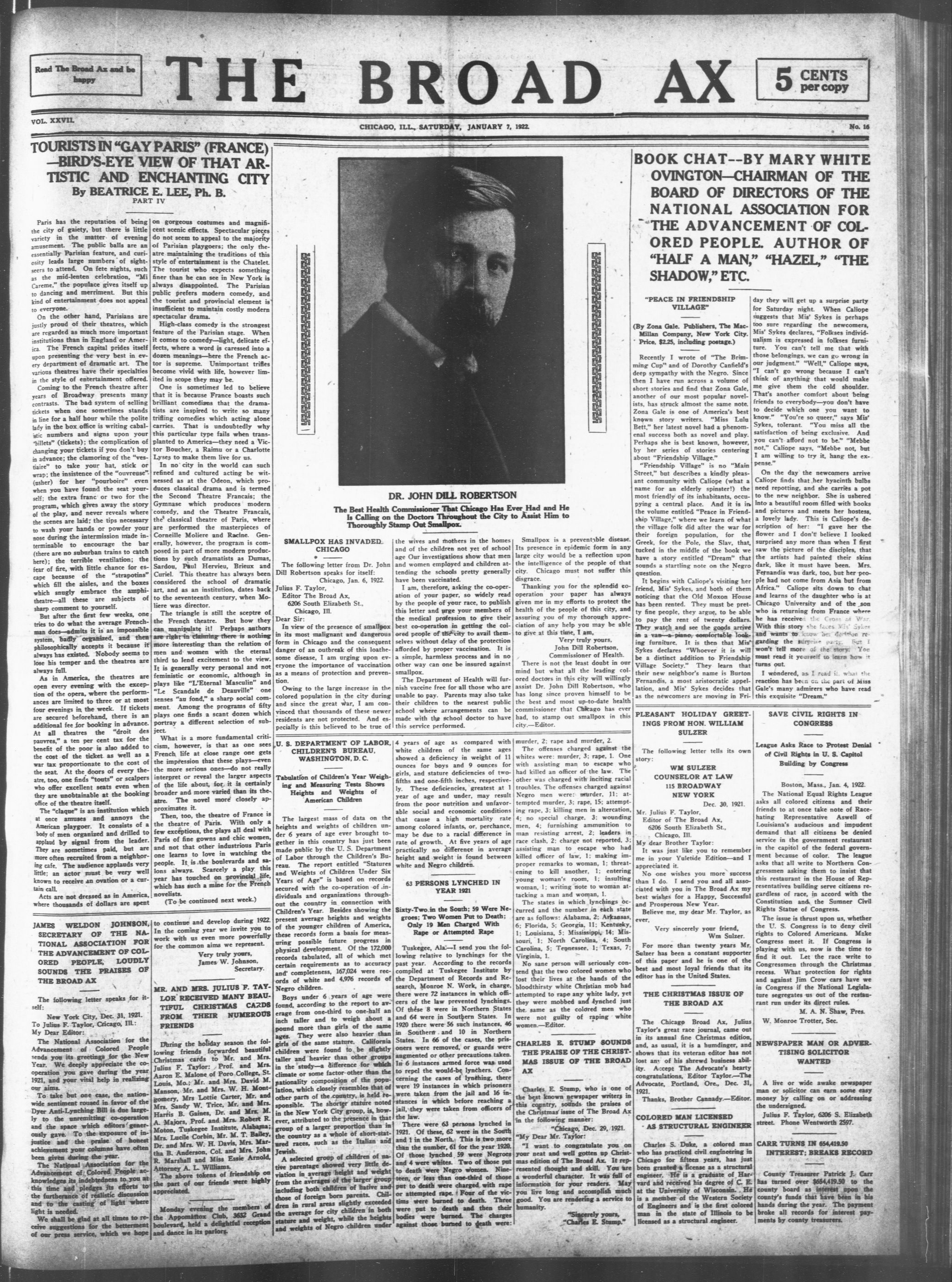
The Best Health Commissioner That Chicago Has Ever Had and He Is Calling on the Doctors Throughout the City to Assist Him to Thoroughly Stamp Out Smallpox.
SMALLPOX HAS INVADED
CHICAGO
The following letter from Dr. John Dill Robertson speaks for itself:
6206 South Elizabeth St.
In view of the presence of smallpox in its most malignant and dangerous form in Chicago and the consequent danger of an outbreak of this loathsome disease, I am urging upon everyone the importance of vaccination as a means of protection and prevention.
Owing to the large increase in the colored population in the city during and since the great war, I am convinced that thousands of these newer residents are not protected. And especially is this believed to be true of
U. S. DEPARTMENT OF LABOR CHILDREN'S BUREAU WASHINGTON, D.C.
Tabulation of Children's Year Weighing and Measuring Tests Shows Heights and Weights of American Children
The largest mass of data on the heights and weights of children under 6 years of age ever brought together in this country has just been made public by the U. S. Department of Labor through the Children's Bureau. The report entitled "Statues and Weights of Children Under Six Years of Age" is based on records secured with the co-operation of individuals and organizations throughout the country in connection with Children's Year. Besides showing the present average heights and weights of the younger children of America, these records form a basis for measuring possible future progress in physical development. Of the 172,000 records tabulated, all of which met certain requirements as to accuracy and completeness, 167,024 were records of white and 4,976 records of Negro children.
Boys under 6 years of age were found, according to the report to average from one-third to one-half an inch taller and to weigh about a pound more than girls of the same ages. They were also heavier than girls of the same stature. California children were found to be slightly taller and heavier than other groups in the study—a difference for which climate or some factor other than the nationality composition of the population, which closely resembles that of other parts of the country, is held responsible. The shorter stature noted in the New York City group, is, however, attributed to the presence in that group of a larger proportion than in the country as a whole of short-statured races, such as the Italian and Jewish.
A selected group of children of native parentage showed very little deviation in average height and weight from the averages of the larger group including both children of native and those of foreign born parents. Children in rural areas slightly exceeded the average for city children in both stature and weight, while the heights and weights of Negro children under
the wives and mothers in the homes and of the children not yet of school age Our investigations show that men and women employed and children attending the schools pretty generally have been vaccinated.
I am, therefore, asking the co-operation of your paper, so widely read by the people of your race, to publish this letter and urge your members of the medical profession to give their best co-operation in getting the colored people of the city to avail themselves without delay of the protection afforded by proper vaccination. It is a simple, harmless process and in no other way can one be insured against smallpox.
The Department of Health will furnish vaccine free for all those who are unable to pay. Parents may also take their children to the nearest public school where arrangements can be made with the school doctor to have this service performed.
4 years of age as compared with white children of the same ages showed a deficiency in weight of 11 ounces for boys and 9 ounces for girls, and stature deficiencies of two-fifths and one-fifth inches, respectively. These deficiencies, greatest at 1 year of age and under, may result from the poor nutrition and unfavorable social and economic conditions that cause a high mortality rate among colored infants, or, perchance, may be due to a racial difference in rate of growth. At five years of age practically no difference in average height and weight is found between white and Negro children.
63 PERSONS LYNCHED IN YEAR 1921
Sixty-Two in the South; 59 Were Ne
ngroes; Two Women Put to Death;
Only 19 Men Charged With
Rape or Attempted Rape
Tuskegee, Ala.—I send you the following relative to lynchings for the past year. According to the records compiled at Tuskegee Institute by the Department of Records and Research, Monroe N. Work, in charge, there were 72 instances in which officers of the law prevented lynchings. Of these 8 were in Northern States and 64 were in Southern States. In 1920 there were 56 such instances, 46 in Southern and 10 in Northern States. In 66 of the cases, the prisoners were removed, or guards were augmented or other precautions taken. In 6 instances armed force was used to repel the would-be lynchers. Concerning the cases of lynchings, there were 19 instances in which prisoners were taken from the jail and 16 instances in which before reaching a jail, they were taken from officers of the law.
There were 63 persons lynched in 1921. Of these, 62 were in the South and 1 in the North. This is two more than the number, 61 for the year 1920. Of those lynched, 59 were Negroes and 4 were whites. Two of those put to death were Negro women. Nineteen, or less than one-third of those put to death were charged with rape or attempted rape. Four of the victims were burned to death. Three were put to death and then their bodies were burned. The charges against those burned to death were:
Smallpox is a preventable disease. Its presence in epidemic form in any large city would be a reflection upon the intelligence of the people of that city. Chicago must not suffer this disgrace. Thanking you for the splendid cooperation your paper has always given me in my efforts to protect the health of the people of this city, and assuring you of my thorough appreciation of any help you may be able to give at this time. I am.
There is not the least doubt in our mind but what all the leading colored doctors in this city will willingly assist Dr. John Dill Robertson, who has long since proven himself to be the best and most up-to-date health commissioner that Chicago has ever had, to stamp out smallpox in this city.—Editor.
murder, 2; rape and murder, 2.
The offenses charged against the whites were: murder, 3; rape, 1. One with assisting man to escape who had killed an officer of the law. The other was charged with inciting racial troubles. The offenses charged against Negro men were: murder, 11; attempted murder, 3; rape, 15; attempting rape, 3; killing men in altercation, 4; no special charge, 3; wounding men, 4; furnishing ammunition to man resisting arrest, 2; leaders in race clash, 2; charge not reported, 3; assisting man to escape who had killed officer of law, 1; making improper remarks to woman, 1; threatening to kill another, 1; entering young woman's room, 1; insulting woman, 1; writing note to woman attacking a man and woman, 1.
The states in which lynchings occurred and the number in each state are as follows: Alabama, 2; Arkansas, 6; Florida, 5; Georgia, 11; Kentucky, 1; Louisiana, 5; Mississippi, 14; Missouri, 1; North Carolina, 4; South Carolina, 5; Tennessee, 1; Texas, 7; Virginia, 1.
No sane person will seriously contend that the two colored women who lost their lives at the hands of the bloodthirsty white Christian mob had attempted to rape any white lady, yet they were mobbed and lynched just the same as the colored men who were not guilty of raping white women.—Editor.
CHARLES E. STUMP SOUNDS
THE PRAISE OF THE CHRISTMAS ISSUE OF THE BROAD AX
Charles E. Stump, who is one of the best known newspaper writers in this country, sounds the praises of the Christmas issue of The Broad Ax in the following manner:
"Chicago, Dec. 29, 1921.
'My Dear Mr. Taylor:
"I want to congratulate you on your neat and well gotten up Christmas edition of The Broad Ax. It represented thought and skill. You are a wonderful character. It was full of information for your readers. May you live long and accomplish much good. You are rendering a service to humanity.
BOOK CHAT--BY MARY WHITE OVINGTON-CHAIRMAN OF THE BOARD OF DIRECTORS OF THE NATIONAL ASSOCIATION FOR THE ADVANCEMENT OF COL- ORED PEOPLE. AUTHOR OF "HALF A MAN," "HAZEL," "THE SHADOW."ETC.
"PEACE IN FRIENDSHIP VILLAGE"
(By Zona Gale. Publishers, The MacMillan Company, New York City. Price, $2.25, including postage).
Recently I wrote of "The Brimming Cup" and of Dorothy Canfield's deep sympathy with the Negro. Since then I have run across a volume of short stories and find that Zona Gale, another of our most popular novelists, has struck almost the same note. Zona Gale is one of America's best known story writers. "Miss Lulu Bett," her latest novel had a phenomenal success both as novel and play. Perhaps she is best known, however, by her series of stories centering about "Friendship Village."
"Friendship Village" is no "Main Street," but describes a kindly pleasant community with Caliope (what a name for an elderly spinster!) the most friendly of its inhabitants, occupying a central place. And it is in the volume entitled "Peace in Friendship Village," where we learn of what the village folk did after the war for their foreign population, for the Greek, for the Pole, the Slav, that, tucked in the middle of the book we have a story entitled "Dream" that sounds a startling note on the Negro question.
It begins with Caliope's visiting her friend, Mis' Sykes, and both of them noticing that the Old Moxon House has been rented. They must be pretty fine people, they argue, to be able to pay the rent of twenty dollars. They watch and see the goods arrive in a van—a piano, comfortable looking furniture. It is then that Mis' Sykes declares "Whoever it will be a distinct addition to Friendship Village Society." They learn that their new neighbor's name is Burton Fernandis, a most aristocratic appellation, and Mis' Sykes decides that as the newcomers are moving in Fri
PLEASANT HOLIDAY GREET-
INGS FROM HON. WILLIAM
SULZER
The following letter tells its own story:
WM SULZER
COUNSELOR AT LAW
115 BROADWAY
NEW YORK
Dec. 30, 1921.
Mr. Julius F. Taylor,
Editor of The Broad Ax,
6206 South Elizabeth St.,
Chicago, Ill.
My dear Brother Taylor:
It was just like you to remember me in your Yuletide Edition—and I appreciated it.
No one wishes you more success than I do. I send you and all associated with you in The Broad Ax my best wishes for a Happy, Successful and Prosperous New Year.
Believe me, my dear Mr. Taylor, as ever.
Very sincerely your friend,
Wm Sulzer.
For more than twenty years Mr. Sulzer has been a constant supporter of this paper and he is one of the best and most loyal friends that its editor has in the United States.
THE CHRISTMAS ISSUE OF
THE BROAD AX
The Chicago Broad Ax, Julius Taylor's great race journal, came out in its annual fine Christmas edition, and, as usual, it is a humdinger, and shows that its veteran editor has not lost any of his shrewd business ability. Accept The Advocate's hearty congratulations, Editor Taylor.—The Advocate, Portland, Ore., Dec. 31, 1921.
COLORED MAN LICENSED
AS STRUCTURAL ENGINEER
Charles S. Duke, a colored man who has practiced civil engineering in Chicago for fifteen years, has just been granted a license as a structural engineer. He is a graduate of Harvard and received his degree of C. E. at the University of Wisconsin. He is a member of the Western Society of Engineers and is the first colored man in the state of Illinois to be licensed as a structural engineer.
day they will get up a surprise party for Saturday night. When Calliope suggests that Mis' Sykes is perhaps too sure regarding the newcomers, Mis' Sykes declares, "Folkes individualism is expressed in folkses furniture. You can't tell me that with those belongings, we can go wrong in our judgment." "Well," Calliope says, "I can't go wrong because I can't think of anything that would make me give them the cold shoulder. That's another comfort about being friends to everybody—you don't have to decide which one you want to know." "You're so queer," says Mis' Sykes, tolerant. "You miss all the satisfaction of being exclusive. And you can't afford not to be." "Mebbe not," Caliope says, "Mebbe not, but I am willing to try it, hang the expense."
On the day the newcomers arrive Caliope finds that her hyacinth bulbs need repotting, and she carries a pot to the new neighbor. She is ushered into a beautiful room filled with books and pictures and meets her hostess, a lovely lady. This is Caliope's description of her: "I gave her the flower and I don't believe I looked surprised any more than when I first saw the picture of the disciples, that the artists had painted their skins dark, like it must have been. Mrs. Fernandis was dark, too, but her people had not come from Asia but from Africa." Caliope sits down to chat and learns of the daughter who is at Chicago University and of the son who is returning from France where he has received the Cross of War. With this story she faces Misty Sylves and wants to know her decision regarding the surprise party. But I won't tell more of the story. You must read it yourself to learn how it turns out.
I wondered, as I read it, what the reaction has been on the part of Miss Gale's many admirers who have read this exquisite "Dream."
SAVE CIVIL RIGHTS IN
CONGRESS
League Asks Race to Protest Denial of Civil Rights in U. S. Capitol Building by Congress
Boston, Mass., Jan. 4, 1922.
The National Equal Rights League asks all colored citizens and their friends to at once take note of Race-hating Representative Aswell of Louisiana's audacious and impudent demand that all citizens be denied service in the government restaurant in the capitol of the federal government because of color. The league asks that all write to Northern Congressmen asking them to insist that this restaurant in the House of Representatives building serve citizens regardless of race, in accord with the Constitution and the Sumner Civil Rights Statue of Congress.
The issue is thrust upon us, whether the U. S. Congress is to deny civil rights to Colored Americans. Make Congress meet it. If Congress is playing with us, now is the time to find it out. Let the race write to Congressmen through the Christmas recess. What protection for rights and against Jim Crow cars have we in Congress if the National Legislature segregates us out of the restaurant run under its direct rules.
M. A. N. Shaw, Pres.
W. Monroe Trotter, Sec.
NEWSPAPER MAN OR ADVER
TISING SOLICITOR
WANTED
A live or wide awake newspaper man or solicitor can earn some easy money by calling on or addressing the undersigned.
Julius F. Taylor, 6206 S. Elizabeth street. Phone Wentworth 2597.
CARR TURNS IN 654.419.50
County Treasurer Patrick J. Carr has turned over $654,419.50 to the county board as interest upon the county's funds that have been in his hands during the year. The payment broke all records for interest payments by county treasurers.
THE BROAD AX
Published Every Saturday
In this city since July 15th, 1899, without missing one single issue, Republicans, Democrats, Catholics, Protestants, Single Taxes, Priests, infidels or anyone else can have their say as long as their language is proper and responsibility is fixed.
The Broad Ax is a newspaper whose platform is broad enough for all, ever claiming the editorial right to speak its own mind.
Local communications will receive attention. Write only on one side of the paper.
Subscriptions must be paid in ad-One Year .....$2.00
Six Months .....$1.00
Advertising rates made known on application.
Address all communication to .....1206 So. Elizabeth St., Chicago, Ill.
JULIUS F. TAYLOR
Editor and Publisher
Associate Editor
DR. M. A. MAJORS
4700 South State Street
Phone Drexel 1416
Entered as Second-Class Matter, Aug
19, 1902, at the Post Office at Chicago
Ill. Under Act of March 8, 1879.
PAY CLOSE ATTENTION TO
YOUR CHILDREN
The Doctor's Dream
Chicago, Jan. 4, 1922.
To the Editor:
Dear Sir—Dreams are wonderful things, aren't they? Let me tell you about one I had last night.
In my dream I read in one of the morning newspapers a full page advertisement signed by one of the alleged notorious murderers of men, women and children. In this advertisement this chap issued solemn warning to the people of Chicago that between the dates of January 1 and January 8, 1922, and each week thereafter until further notice, he intends murdering seven children—children that today are happy, rollicking youngsters—celebrating their first, or second, or seventh Christmas
According to the advertisement, this murderer intends to give these kiddies only one chance to escape the fate he has ordained for them. About a week, maybe only two or three days before he selects the seven victims, he is going to visit about one hundred families. In each family he is going to mark one child. / I do not recall just now of what the warning mark consisted, whether it was a black mark on the forehead, or a red mark on the cheek, or a sore throat, or just what it was. Anyway, it was to be sufficiently distinctive to be recognizable. The seven victims selected for sacrifice were to come from the group of one hundred families who were given this special warning.
In my dream I walked out into the street. The excitement was intense. Everywhere one saw excited groups of parents begging and pleading with the policemen to come to their homes to protect their children from the terrible death awaiting them. As soon as these parents had noted the warning mark on their own child, they were consumed with a terrible fear that their own child was to be one of the selected victims—one of the seven children to be put to death in the first week of the New Year.
And then I picked up the paper, read the whole advertisement again very carefully. I found that the warning sign to be placed on the one hundred children consisted of a sore throat, a little fever, maybe some vomiting, perhaps a slight difficulty in breathing, some discharge from the nose, may be a grayish white membrane in the throat. And the name at the bottom of the page was DIPHTHERIA.
Now, Mr. Editor, do you suppose that the hundred fathers and mothers who see these warning signs in their children this week will be as much concerned about protecting their youngsters as were the parents in my dream who thought some individual was going to torture and maim and kill their children?
Or do you suppose that seven of these one hundred families are going to "take a chance," as has been the case in the past, and disregard the warning? For the records of the Health Department show that seven parents out of each one hundred families warned by sore throats have not given their children even an ordinary chance by calling the doctor promptly. I wonder who the seven victims are to be. Maybe someone we know.
Lightning Dismisses a Statue.
Lightning has lots of the arms of a statue at Chateau-Lambert. France erected as a thank offering after the cholera epidemic of 1854 had passed—Scientific American.
XOC
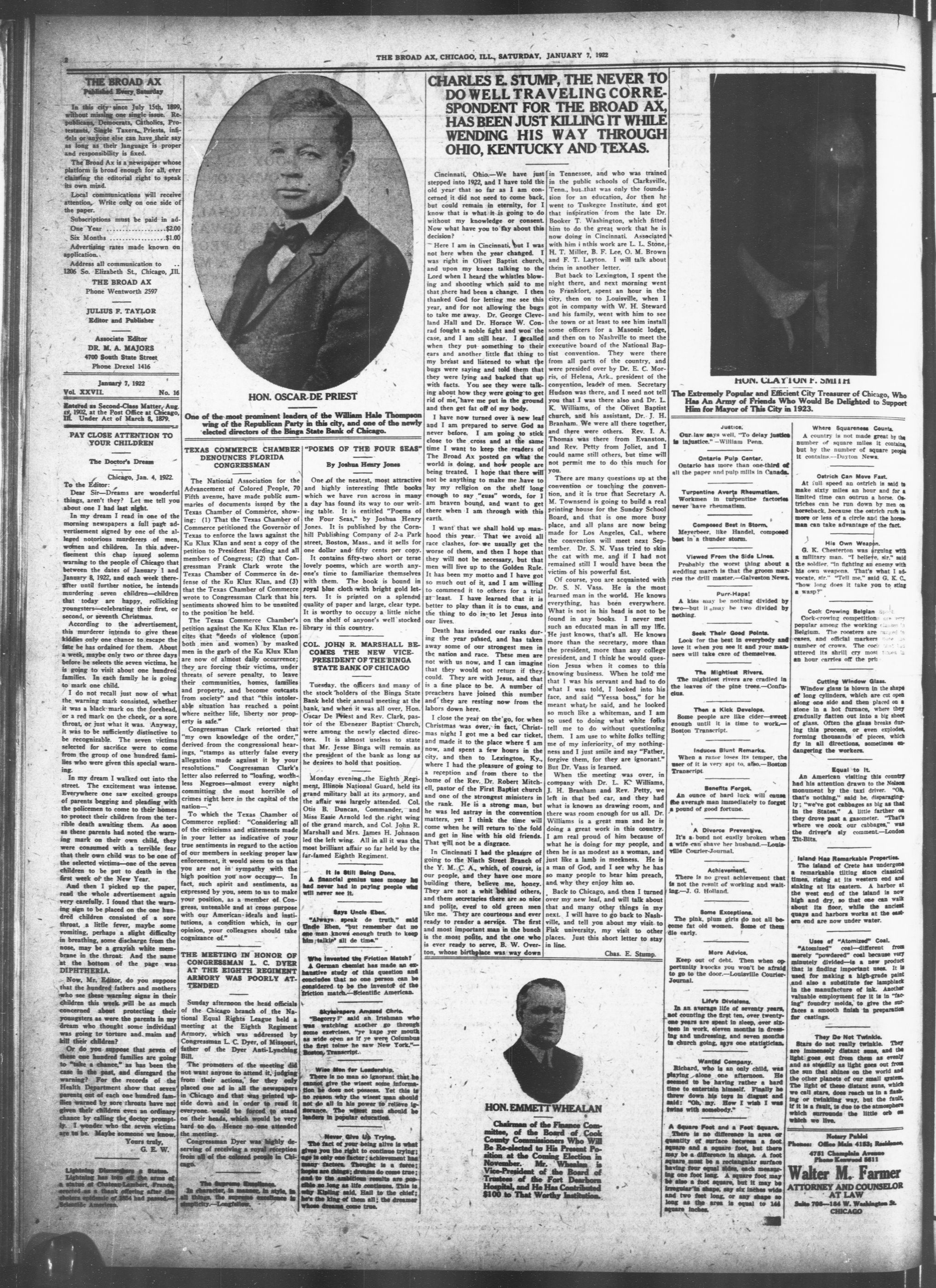
HON. OSCAR DE PRIEST
One of the most prominent leaders of the William Hale Thompson wing of the Republican Party in this city, and one of the newly elected directors of the Binga State Bank of Chicago.
TEXAS COMMERCE CHAMBER | "POEMS OF THE FOUR SEAS"
The National Association for the Advancement of Colored People, 70 Fifth avenue, have made public summaries of documents issued by the Texas Chamber of Commerce, showing: (1) That the Texas Chamber of Commerce petitioned the Governor of Texas to enforce the laws against the Ku Klux Klan and sent a copy of the petition to President Harding and all members of Congress; (2) that Congressman Frank Clark wrote the Texas Chamber of Commerce in defense of the Ku Klux Klan, and (3) that the Texas Chamber of Commerce wrote to Congressman Clark that his sentiments showed him to be unsuited to the position he held.
The Texas Commerce Chamber's petition against the Ku Klux Klan recites that "deeds of violence (upon both men and women) by masked men in the garb of the Ku Klux Klan are now of almost daily occurrence; they are forcing their victims, under threats of severe penalty, to leave their communities, homes, families and property, and become outcasts from society" and that "this intolerable situation has reached a point where neither life, liberty nor property is safe."
Congressman Clark retorted that "my own knowledge of the order," derived from the congressional hearings, "stamps as utterly false every allegation made against it by your resolutions." Congressman Clark's letter also referred to "loafing, worthless Negroes—almost every night committing the most horrible of crimes right here in the capital of the nation—"
To which the Texas Chamber of Commerce replied: "Considering all of the criticisms and statements made in your letter as indicative of your true sentiments in regard to the action of our members in seeking proper law enforcement, it would seem to us that you are not in sympathy with the high position you now occupy—. In fact, such spirit and sentiments, as expressed by you, seem to us to make your position, as a member of Congress, untenable and at cross purpose with our American ideals and institutions, a condition which, in our opinion, your colleagues should take cognizance of."
THE MEETING IN HONOR OF CONGRESSMAN L. C. DYER AT THE EIGHTH REGIMENT ARMORY WAS POORLY ATTENDED
Sunday afternoon the head officials of the Chicago branch of the National Equal Rights League held a meeting at the Eighth Regiment Armory, which was addressed by Congressman L. C. Dyer, of Missouri, father of the Dyer Anti-Lynching Bill.
The promoters of the meeting did not want anyone to attend it, judging from their actions, for they only placed one ad in all the newspapers in Chicago and that was printed upside down and in order to read it everyone would be forced to stand on their heads, which would be very hard to do. Hence no one attended the meeting.
Congressman Dyer was highly deserving of receiving a royal reception from all of the colored people in Chicago.
The Supreme Excellence.
In character, in manner, in style, in all things, the supreme excellence is simplicity—Longfellow.
era of the William Hale Thompson
y in this city, and one of the newly
a State Bank of Chicago.
"POEMS OF THE FOUR SEAS"
By Joshua Henry Jones
One of the neatest, most attractive and highly interesting little books which we have run across in many a day has found its way to our writing table. It is entitled "Poems of the Four Seas," by Joshua Henry Jones. It is published by the Cornhill Publishing Company of 2-a Park street, Boston, Mass., and it sells for one dollar and fifty cents per copy. It contains fifty-two short or terse lovely poems, which are worth anyone's time to familiarize themselves with them. The book is bound in royal blue cloth with bright gold letters. It is printed on a splendid quality of paper and large, clear type. It is worthy to occupy a little niche on the shelf of anyone's well stocked library in this country.
COL. JOHN R. MARSHALL BE COMES THE NEW VICE-PRESIDENT OF THE BINGA STATE BANK OF CHICAGO.
Tuesday, the officers and many of the stock holders of the Binga State Bank held their annual meeting at the bank, and when it was all over, Hon. Oscar De Priest and Rev. Clark, pastor of the Ebenezer Baptist Church, were among the newly elected directors. It is almost useless to state that Mr. Jesse Binga will remain as the president of the bank as long as he desires to hold that position.
Monday evening the Eighth Regiment, Hilinois National Guard, held its grand military ball at its armory, and the affair was largely attended. Col. Otis B. Duncan, Commander, and Miss Essie Arnold led the right wing of the grand march, and Col. John R. Marshall and Mrs. Mrs. H. Johnson led the left wing. All in all it was the most brilliant affair so far held by the far-famed Eighth Regiment.
A financial genius uses money he had never had in paying people who will never see it.
Sava Uncle Ebon
"Always speak de truth," said Unde Eben, "but remember dat no one man knows enough truth to keep him talkin' all de time."
Who invented the Friction Match?
A German chemist has made an exhaustive study of this question and concludes that no one person can be considered to be the inventor of the friction match—Scientific American.
Skydancer Amazed Chris
"Begogow" I did an Irishman who was not matching another go through some execlesies, "ye kape yer mouth as wide open as if ye were Columbus the first tolme he saw New York"—Boston, Transcript.
Wise Man for Leadership.
There is no man so ignorant that he cannot give the wisest some information he does not possess. Yet this is no reason why the wisest man should not do all in his power to relieve ignorance. The wisest men should be leaders in popular education.
The fact of your being alive is what gives you the right to continue trying; age is only one factor; achievement has many factors. Thought is a force; hopes are things; drama do come true; and to the ambition results are possible no long as life continues. This is why Kipling said, Hall to the chief; he's the king of them all; the dreamer whose dreams come true.
THE BROAD AX, CHICAGO, ILL, SATURDAY, JANUARY 7, 1922
CHARLES E. STUMP, THE NEVER TO DO WELL TRAVELING CORRESPONDENT FOR THE BROAD AX, HAS BEEN JUST KILLING IT WHILE WENDING HIS WAY THROUGH OHIO, KENTUCKY AND TEXAS.
Cincinnati, Ohio—We have just stepped into 1922, and I have told the old year that so far as I am concerned it did not need to come back, but could remain in eternity, for I know that is what it is going to do without my knowledge or consent. Now what have you to say about this decision?
Here I am in Cincinnati, but I was not here when the year changed. I was right in Olivet Baptist church, and upon my knees talking to the Lord when I heard the whistles blowing and shooting which said to me that there had been a change. I then thanked God for letting me see this year, and for not allowing the bugs to take me away. Dr. George Cleveland Hall and Dr. Horace W. Conrad fought a noble fight and won the case, and I am still hear. I called when they put something to their ears and another little flat thing to my breast and listened to what the bugs were saying and told them that they were lying and backed that up with facts. You see they were talking about how they were going to get rid of me, have me put in the ground and then get fat off of my body.
I have now turned over a new leaf and I am prepared to serve God as never before. I am going to stick close to the cross and at the same time I want to keep the readers of The Broad Ax posted on what the world is doing, and how people are being treated. I hope that there will not be anything to make me have to lay my religion on the shelf long enough to say "euss" words, for I am heaven bound, and want to get there when I am through with this earth.
I want that we shall hold up manhood this year. That we avoid all race clashes, for we usually get the worse of them, and then I hope that they will not be necessary, but that men will live up to the Golden Rule. It has been my motto and I have got so much out of it, and I am willing to commend it to others for a trial at least. I have learned that it is better to play than it is to cuss, and the thing to do is to let Jesus into our lives.
Death has invaded our ranks during the year passed, and has taken away some of our strongest men in the nation and race. These men are not with us now, and I can imagine that they would not return if they could. They are with Jesus, and that is a fine place to be. A number of preachers have joined this number and they are resting now from the labors down here.
I close the year on the go, for when Christmas was over, in fact, Christmas night I got me a bed car ticket, and made it to the place where I am now, and spent a few hours in the city, and then to Lexington, Ky., where I had the pleasure of going to a reception and from there to the home of the Rev. Dr. Robert Mitchell, pastor of the First Baptist church and one of the strongest ministers in the rank. He is a strong man, but he was led astray in the convention matters, yet I think the time will come when he will return to the fold and get in line with his old friends. That will not be a disgrace.
In Cincinnati I had the pleasure of going to the Ninth Street Branch of the Y. M. C. A., which, of course, is our people, and they have one more building there, believe me, honey. They are not a whit behind others, and them secretaries there are so nice and polite, even to old green men like me. They are courteous and ever ready to render a service. The first and most important man in the bunch is the most polite, and the one who is ever ready to serve, B. W. Overton, whose birthplace was way down
1910
HON. EW T. BROWN
HON. EMMETT WHEALAN
Chairman of the Finance Committee, of the Board of Cook County Commissioners Who Will Be Re-elected to His Present Position at the Coming Election in November. Mr. Whealan is Vice-President of the Board of Trustees of the Fort Dearborn Hospital, and He Has Contributed $100 to That Worthy Institution.
in Tennessee, and who was trained in the public schools of Clarksville, Tenn., but that was only the foundation for an education, for then he went to Tuskegee Institute, and got that inspiration from the late Dr. Booker T. Washington, which fitted him to do the great work that he is now doing in Cincinnati. Associated with him i nthis work are L. L. Stone, H. T. Miller, B. F. Lee, O. M. Brown and F. T. Layton. I will talk about them in another letter.
But back to Lexington, I spent the night there, and next morning went to Frankfort, spent an hour in the city, then on to Louisville, when I got in company with W. H. Steward and his family, went with him to see the town or at least to see him install some officers for a Masonic lodge, and then on to Nashville to meet the executive board of the National Baptist convention. They were there from all parts of the country, and were presided over by Dr. E. C. Morris, of Helena, Ark., president of the convention, leader of men. Secretary Hudson was there, and I need not tell you that I was there also and Dr. L. K. Williams, of the Olivet Baptist church, and his assistant, Dr. J. H. Branham. We were all there together, and there were others. Rev. I. A. Thomas was there from Evanston, and Rev. Petty from Joliet, and I could name still others, but time will not permit me to do this much for you.
There are many questions up at the convention or touching the convention, and it is true that Secretary A. M. Townsend is going to build a real printing house for the Sunday School Board, and that is one more busy place, and all plans are now being made for Los Angeles, Cal., where the convention will meet next September. Dr. S. N. Vass tried to skin the cat with me, and if I had not remained still I would have been the victim of his powerful fist.
Of course, you are acquainted with Dr. S. N. Vass. He is the most learned man in the world. He knows everything, has been everywhere. What is not in his head not to be found in any books. I never met such an educated man in all my life. He just knows, that's all. He knows more than the secretary, more than the president, more than any college president, and I think he would question Jesus when it comes to this knowing business. When he told me that I was his servant and had to do what I was told, I looked into his face, and said "Yessa boss," for he meant what he said, and he looked so much like a whitened, and I am so used to doing what white folks tell me to do without questioning them. I am use to white folks telling me of my inferiority, of my nothingness and I just smile and say "Father, forgive them, for they are ignorant." But Dr. Vass is learned.
When the meeting was over, in company with Dr. L. K. Williams, J. H. Branham and Rev. Petty, we left in that bed car, and they had what is known as drawing room, and there was room enough for us all. Dr. Williams is a great man and he is doing a great work in this country. I am real proud of him because of what he is doing for my people, and then he is as modest as a woman, and just like a lamb in meekness. He is a man of God, and I see why he has so many people to hear him preach, and why they enjoy him so.
Back to Chicago, and then I turned over my new leaf, and will talk about that and many other things in my next. I will have to go back to Nashville, and tell you about my visit to Fisk university, my visit to other places. Just this short letter to stay in line.
A
```markdown
```
Chas. E. Stump.
10
HUN. CLAYTON F. SMITH
The Extremely Popular and Efficient Has An Army of Friends Who Him for Mayor of This City in
The Extremely Popular and Efficient City Treasurer of Chicago, Who Has An Army of Friends Who Would Be Delighted to Support Him for Mayor of This City in 1923.
Our law says well, "To delay justice in injustice." - William Penn.
Ontario Pulp Center.
Ontario has more than one-third of all the paper and pulp mills in Canada.
Turpentine Averts Rheumatism.
Workmen in turpentine factories never have rheumatism.
Composed Best in Storm.
Meyerbeer, like Handel, composed best in a thunder storm.
Viewed From the Side Lines.
Probably the worst thing about a wedding march is that the groom marries the drill master - Galveston News.
Purr-Haps!
A kiss may be nothing divided by two—but it may be two divided by nothing.
Seek Their Good Points.
Look for the best in everybody and love it when you see it and your manners will take care of themselves.
The Mightiest Rivers.
The mightiest rivers are cradled in the leaves of the pine trees.—Confucius.
Then a Kick Develops.
Some people are like cider—sweet enough until it is time to work.—Boston Transcript.
Induces Blunt Remarks.
When a razor loses its temper, the user of it is very apt to, also.—Boston Transcript.
Benefits Forgot.
An ounce of hard luck will cause
the average man immediately to forget
a pound of good fortune.
A Divorce Preventive.
It's a bond not easily broken when
a wife can shave her husband—Louis-
ville Courier-Journal.
There is no great achievement that is not the result of working and wait ing.-J. G. Holland.
The pink, plum girls do not all become fat old women. Some of them die early.
Keep out of debt. Then when op-
portunity knocks you won't be afraid
to go to the door.—Louisville Courier-
Journal.
In an average life of seventy years, not counting the first ten, over twenty-one years are spent in sleep, over sixteen in work, eleven months in dressing and undressing, and seven months in church going, says one statistician.
Wanted Company.
Richard, who is an only child, was playing alone one afternoon. He seemed to be having rather a hard time to entertain himself. Finally he threw down his toys in disgust and said: "Oh, my. How I wish I was twins with somebody."
A Square Foot and a Foot Square. There is no difference in area or quantity of surface between a foot square and a square foot, but there may be a difference in shape. A foot square must be a rectangular surface having four equal sides, each measuring one foot long. A square foot may be also a foot square, but it may be irregular in shape, say six inches wide and two feet long, or any shape so long as the area is equal to 144 square inches.
Achievement
Some Exceptions
Life's Divisions
Wantid Company
Client City Treasurer of Chicago, Who
Who Would Be Delighted to Support
in 1923.
Where Squareness Counts.
A country is not made great by the
number of square miles it contains,
but by the number of square people
it contains.—Duyton News.
Ostrich Can Move Fast
At full speed an ostrich is said to make sixty miles an hour and for a limited time can outrun a horse. Ostrichs can be run down by men on horseback, because the ostrich runs in more or less of a circle and the horseman can take advantage of the fact.
G. K. Chesterton was arguing with a military man. "I believe, sir," said the soldier. "in fighting an enemy with his own weapons. That's what I advocate, sir." "Tell me," said G. K. C., "how long does it take you to sting a wasp?"
Cook-crowing competition popular among the working Belgium. The roosters are cases, and official markers number of crows. The cock uttered its shrill cry most an hour carries off the prb
Cutting Window Glass
Window glass is blown in the shape of long cylinders, which are cut open along one side and then placed on a stone in a hot furnace, where they gradually flatten out into a big sheet of glass. Often the glass breaks during this process, or even explodes, forming thousands of pieces, which fly in all directions, sometimes endangering the workers.
An American visiting this country had his attention drawn to the Nelson monument by the taxi driver. "Oh, that's nothing," said he, disparagingly; "we've got cabbages as big as that in the States." A little farther on they drove past a gasometer. "That's where we cook our cabbages," was the driver's sly comment—London Tit-Bita.
Island Has Remarkable Properties
The island of Crete has undergone a remarkable tilting since classical times, rising at its western end and sinking at its eastern. A harbor at the west end of the island is now high and dry, so that one can walk about its floor, while the ancient quays and harbors works at the eastern end are now under water.
Uses of "Atomized" Coal
"Atomized" coal—different from merely "powdered" coal because very minutely divided—is a new product that is finding important use. It is used for making a high-grade paint and also a substitute for lampblack in the manufacture of ink. Another valuable employment for it is in "incing" foundry molds, to give the surfaces a smooth finish in preparation for castings.
They Do Not Twinkle
Stars do not really twinkle. They are immensely distant suns, and the light goes out from them as evenly and as steadily as light goes out from the sun that shines on the world and the other planets of our small system. The light of these distant suns, which we call stars, does reach us in a flashing or twinkling way, but the fault, if it is a fault, is due to the atmosphere which surrounds the little orb as which we live.
Notary Public
Phones: Office Main 4183; Residence,
4751 Champlain Avenue
Phone Kenwood 6511
Walter M. Farmer
ATTORNEY AND COUNSELOR
AT LAW
Suite 708—184 W. Washington St.
CHICAGO
---
Equal to It.
Life Insurance Co
Public Life Insurance Company
Capital, $500,000 sets Over $800,
Capital, $500,000 Assets Over $800,000
The Company of Endowments
of the Strongest, Aggressive and Progress Life Insurance Companies in the World
tection for All the Fam
men Insured at Same Rates as
Forms of Life Insurance Policies Issued From 1 to 70 Years of
DRAFT
Policies Industri
One of the Strongest, Aggressive and Progressive Life Insurance Companies in the World Protection for All the Family Women Insured at Same Rates as Men All Forms of Life Insurance Policies Issued From 1 to 70 Years of Age
Officers and Board of Directors
ALFRED CLOVER, General Manager
Chairman Board of Directors
LOUIS NAROWETZ, President FRED H. WELSCH, Vice President
J. W. SINGLETON, Secretary
A. L. LINDER, Vice President WM. F. SCHAARE, M. D., Medical Director
M. J. ST. GEORGE, General Counsel
C. A. HAINES, M. D. DAVID M. HAINES C. H. JESPERSON
C. W. KUHN JAMES H. BLAIR, M. D.
A. L. WILLIAMS JAMES R. WHITE, M. D. JOSEPH DAMIANI, M. D.
AND OVER FIVE THOUSAND OTHER STOCKHOLDERS
rd Your Future Safeguard Your for Your Policy, Any Amount, From $100 minutes You Can Afford to Pay. Address the Com
Apply Now for Your Policy, Any Amount, From $100 to $100,000, at Rates You Can Afford to Pay. Address the Company
One of the Life I
Protect
Women
All Forms of
Ordinary Policies Contain Total and Permanent Disability and Double Indemnity Benefits
SPECIAL ANNUAL RENEWABLE TERM POLICIES FOR POLICEMEN, FIREMEN AND FEDERAL EMPLOYEES
Safeguard You Apply Now for Y
THE BROAD AX, CHICAGO, ILL, SATURDAY, JANUARY 7, 1922
INCORPORATED AS A STOCK COMPANY UNDER THE LAWS OF THE STATE OF ILLINOIS
On Every Ordinary Policy Issued for Full Amount Due Beneficiary
Children's Special Endowment Policies Issued From Age 1 Next Birthday to Age 12, Policy Payable at Age 21
Progressive World
Family
as Men
Years of Age
Industrial Policies Are in Immediate Benefit From Date of Issue and Contain All Modern Up-to-date Privileges
SPECIAL
ANNUAL
RENEWABLE
TERM POLICIES
FOR
POLICEMEN,
FIREMEN
AND
FEDERAL
EMPLOYEES
Your Family n $100 to $100,00
Save a Little Each Day
We want to help you to be-
come financially successful, and
for this purpose place our en-
tire service at your disposal.
Your savings are safe here.
Come in today—start with $1.
ILLINOIS TRUST & SAVINGS BANK
La Salle and Jackson Streets Chicago
REAL ESTATE
Up-to-Date or Modern Houses, Apartments
and Stores to Rent
3101 COTTAGE GROVE AVE.
Corner 31st Street, Chicago
MILES J. DEVINE
ATTORNEY AT LAW
Suite 318-320 Reaper Block
Clark and Washington Sts.
CHICAGO
Telephone Central 1239
7% Bonds May Be Bought On the Instalment Plan
PERHAPS the most obvious advantage to be obtained by buying bonds on easy payments is the opportunity to save small sums systematically with a high interest return. Ten dollars a month or more will make an initial payment on a Lincoln Bond which pays 7% interest from the date of the first payment.
The instalment plan is a boon also to the investor who is following the trend of interest rates and knows that it is uncertain how much longer well-secured 7% First Mortgage bonds will be available. The instalment plan enables him to "tie up" more good bonds paying a high interest rate than he would be in a position to purchase outright.
Any 7% First Mortgage Real Estate Gold Bond offered by this bank may be purchased on instalments.
Let us send you, without obligation, details of this plan, and information concerning our approval 7% First Mortgage Bonds. Written for Circular 14.
LINCOLN STATE BANK
OF CHICAGO
Under State Government Supervision
31st and South State Streets
Telephone Victory 4500
THE BROAD AX, CHICAGO, ILL, SATURDAY, JANUARY 7, 1922
A. B. Stiefel, Pres.
Edwin Stiefel, Secy.
PLAYER PIANOS PHONOGRAPHS
3131-33-
Cash
JOHN Mc
Surety Bond
Our interest in a client
payment of premium
helpful service to pay
Representing A
105 South
Phone Central 4287
31-33-35 STATE
Cash or Credit
JOHN McGILLEN & CO.
Pretty Bonds—Casualty Insurance
rest in a client's welfare doesn't cease
of premium. We frequently have
service to patrons in general busi-
presenting Assets Over Eleven Milli-
lion
105 South La Salle Street
Central 4287
JOHN McGILLEN & CO.
Surety Bonds—Casualty Insurance
Our interest in a client's welfare doesn't cease with the payment of premium. We frequently have been of helpful service to patrons in general business lines.
Representing Assets Over Eleven Millions
105 South La Salle Street
Phone Central 4287 CHICAGO
Telephone Kenwood 1233
J. B. CLITT
REA
Renting, Insu
7 W
Notary Public
B. CLITHERO & CO
REAL ESTATE
Renting, Insurance, Mortgage Loans
7 West 51st Street
WM. JONES
GROCERIE
VEGETABLES A
HOME-MADE S
We are as near you as you
prompt attention.
Phone
3636 South State Street
Established 1899
DEALER IN
GROCERIES and MEATS
VEGETABLES AND FRUITS IN SEASON
HOME-MADE SAUSAGE A SPECIALT
near you as your telephone, and all calls
ention.
Phone Boulevard 1812
State Street C H
GROCERIES and MEATS
VEGETABLES AND FRUITS IN SEASON
HOME-MADE SAUSAGE A SPECIALTY
We are as near you as your telephone, and all calls receive prompt attention.
Phone Boulevard 1812
3636 South State Street CHICAGO
TELEPHONES
Office: DOUGLAS 9054
Residence: DOUGLAS 470
R. BENJ. R. BLU
Rs: 11 A. M. to 1 P. M.; 4
8 to 9 P. M.
3102 INDIANA AVENUE
CHICAGO
HOWARD
R. R. BLUITT
1 to 1 P. M.; 4 to 6;
9 P. M.
ANA AVENUE
MICAGO
PHYSICIAN AND
Attending Surgeon Fo
Hospital
Hours: 11 to 1 P. M.;
7 to 9 P. M.; Sunday:
3035 PRAIRIE AVENUE
OWARD UNIVERSITY
WASHINGTON, D.C.
Founded by GENERAL O. O. HOWARD
STANLEY DURKEE, A. M., Ph. D., D. D., President
MATTET J. SCOTT, A. M., M.D.
FUNERAL DIRECTORS
5121 ERNEST H. WILLIAMSON UNDERTAKER
GARAGE
GASOLINE OIL
OPEN DAY & NIGHT
Ernest H. Williamson UNDERTAKER
Day Light Chapel, capacity 200, Outside Ventilation—Organ and Organist Free—
I am as near as your Telephone—I give service at a reasonable price—Distance
immaterial, consult me—I save you worry, time and money.
5121 & 5123 SOUTH STATE STREET
CHICAGO, ILLINOIS
A. D. GASH
ATTORNEY AT LAW
118 N. La Salle Street
CHICAGO
Residence Telephone
3342 Calumet Ave. Douglas 1275
JAMES G. COTTER
ATTORNEY AT LAW
145 NORTH CLARK STREET
SUITE 407
Telephone Central 8384
CHICAGO
Formerty
Assistant Attorney General
State of Illinois
Res. 3646 Grand Boul.
Doug. 4897
J. GRAY LUCAS
ATTORNEY-AT-LAW
129 E. 31ST STREET
Suite 16-17
Phone: Douglas 6381
CHICAGO
Phone Victory 5703
Dr. Geo. W. Hardeman
PHYSICIAN AND SURGEON
Vice-President Fort Dearborn Hospital
Office Hours: 10 to 12 A. M.; 2 to 5
and 7 to 9 P. M.
Sundays by Appointment
3334 S. STATE ST. CHICAGO
BINGA STATE BANK Under State Supervision
Capital $100,000.00
Surplus 20,000.00
Offers Equal Service to All
3% INTEREST ON SAVINGS
SAFE DEPOSIT VAULTS
State Street and 36th Place
West Englewood Trust & Savings Bank CHICAGO
Capital, Surplus and Undivided Profits, $500,000.00
John Bain, President
Michael Maisel, Vice-Pres.
Edw. C. Barry, Cashier
The Cranford A
3600 WABAS
The finest building ever opened
Steam heat, electric lights,
Phone Main 263 J. W. Casey
OFFICERS
H. President
Maisel, Vice-Pres.
Barry, Cashier
Arthur C. Utesch, Assst.
W. Merle Fisher, Assst.
and Trust
Cranford Apartment L
3600 WABASH AVENUE
building ever opened to Colored tenants in
sat, electric lights, tile baths, marble ent
63 J. W. Casey, Agt. 133 W. Wash
1
The Cranford Apartment Bldg.
FUNERAL DIRECT
AL DIRECTORS