The Broad Ax
Saturday, January 21, 1922
Chicago, Illinois
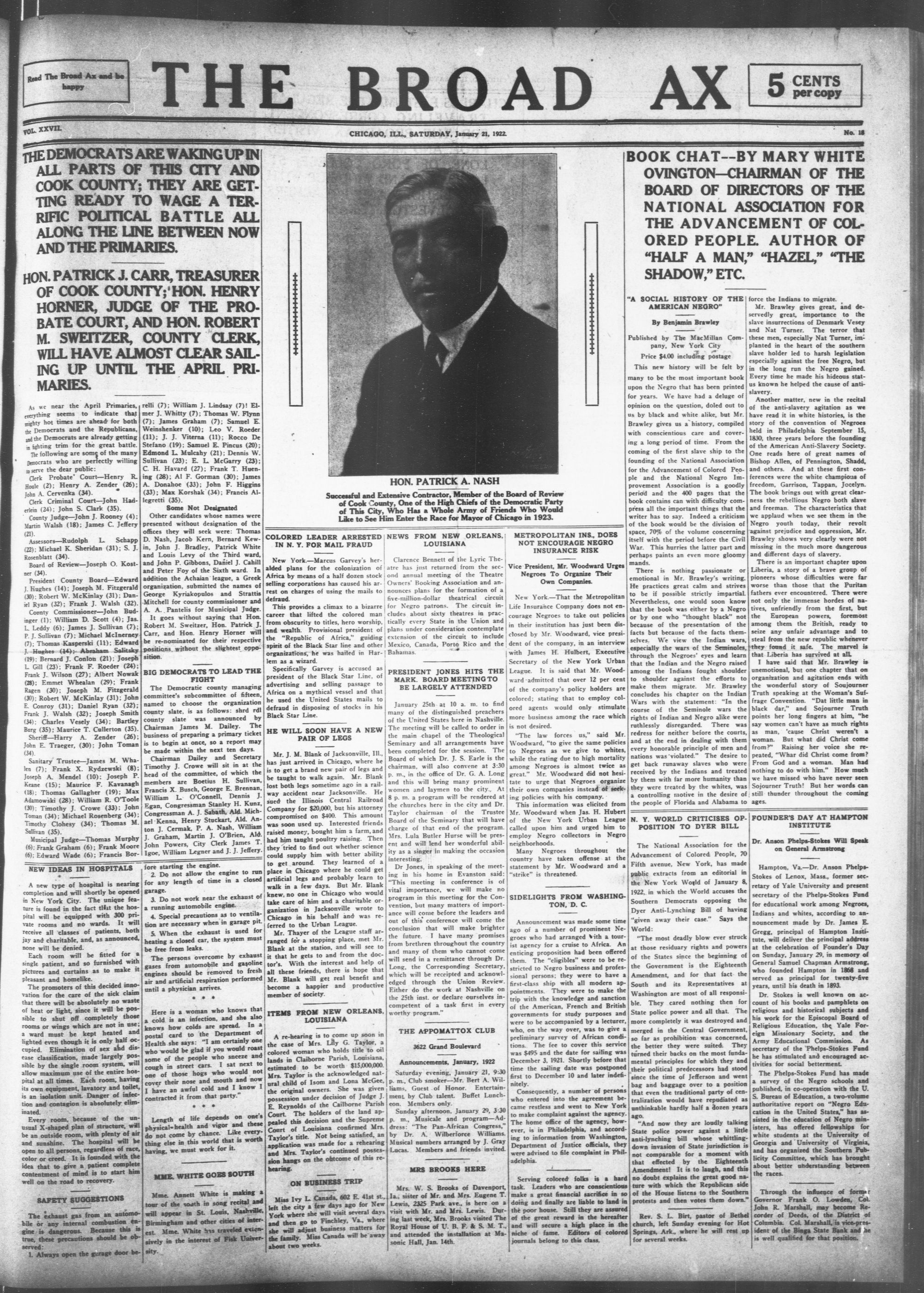
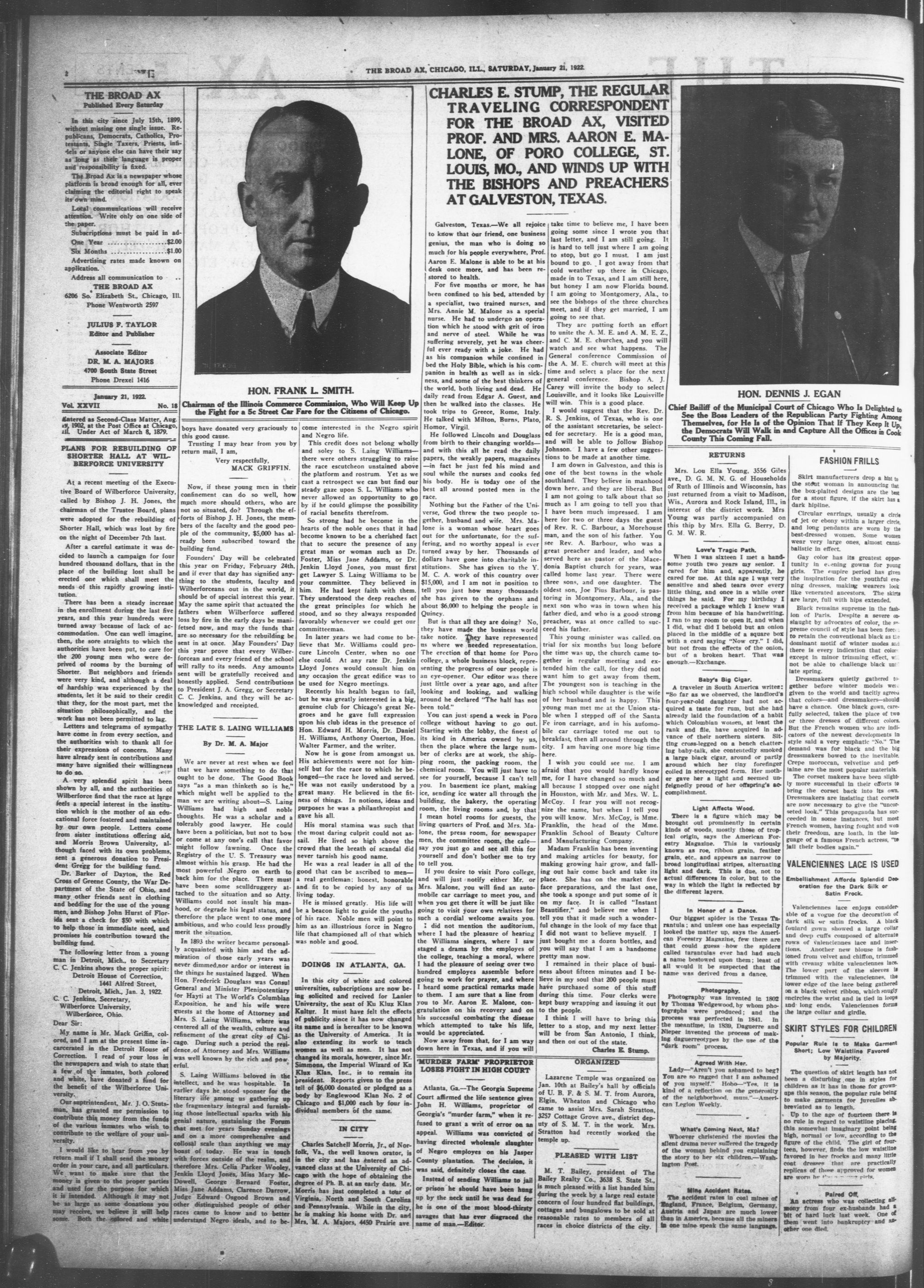
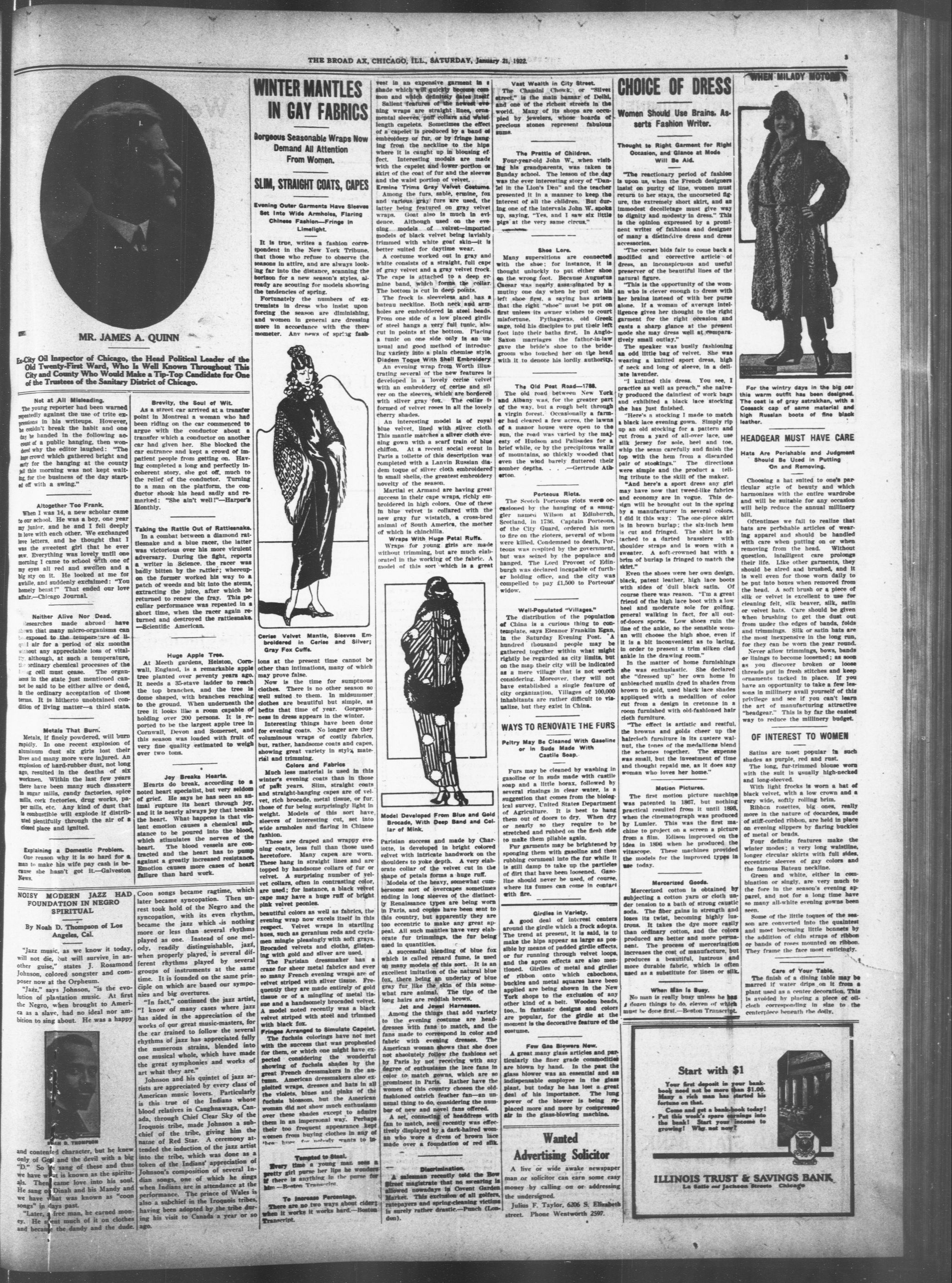
Page text (machine-generated)
THE DEMOCRATS ARE WAKING UP IN ALL PARTS OF THIS CITY AND COOK COUNTY; THEY ARE GETTING READY TO WAGE A TERRIFIC POLITICAL BATTLE ALL ALONG THE LINE BETWEEN NOW AND THE PRIMARIES.
HON. PATRICK J. CARR, TREASURER OF COOK COUNTY; HON. HENRY HORNER, JUDGE OF THE PROBATE COURT, AND HON. ROBERT M. SWEITZER, COUNTY CLERK, WILL HAVE ALMOST CLEAR SAILING UP UNTIL THE APRIL PRIMARIES.
Read The Broad Ax and be happy
VOL. XXVII.
THE DEMOCRATS A
ALL PARTS OF
COOK COUNTY;
TING READY T
RIFIC POLITICAL
ALONG THE LIN
AND THE PRIMA
HON. PATRICK J. C.
OF COOK COUN
HORNER, JUDG
BATE COURT, A
M. SWEITZER,
WILL HAVE ALM
ING UP UNTIL
MARIES.
As we near the April Primaries, everything seems to indicate that mighty hot times are ahead for both the Democrats and the Republicans, and the Democrats are already getting in fighting trim for the great battle. The following are some of the many Democrats who are perfectly willing to serve the dear public: Clerk Probate' Court—Henry R. Houle (2); Henry A. Zender (26); John A. Cervenka (34). Clerk Criminal Court—John Hardiein (24); John S. Clark (35).
erlen (24), John G. Cain (24), County Judge—John J. Rooney (4); Martin Walsh (18); James C. Jeffery (21).
Assessors—Rudolph L. Schapp (22); Michael K. Sheridan (31); S. J. Rosenblatt (34).
Board of Review—Joseph O. Kostner (34).
President County Board—Edward J. Hughes (14); Joseph M. Fitzgerald (30); Robert W. McKinlay (31); Daniel Ryan (32); Frank J. Walsh (32).
County Commissioner—John Budinger (1); William D. Scott (4); Jas. L. Leddy (6); James J. Sullivan (7); P. J. Sullivan (7); Michael Mclnerney (7); Thomas Kasperski (11); Edward J. Hughes (14); Abraham Saliksy (19); Bernard J. Conlon (21); Joseph L. Gill (23); Frank F. Roeder (24);
Frank J. Wilson (27); Albert Nowak (28); Emmet Whealan (29); Frank Ragen (30); Joseph M. Fitzgerald (30); Robert W. McKinlay (31); John E. Conroy (31); Daniel Ryan (32);
Frank J. Walsh (32); Joseph Smith (34); Charles Vesely (34); Bartley Burg (35); Maurice T. Cullerton (35); Sheriff—Harry A. Zender (26);
John E. Traeger (30); John Toman (34).
Sanitary Trustee—James M. Whalen (7); Frank X. Rydzewski (8); Joseph A. Mendel (10); Joseph P. Keane (15); Maurice F. Kavanagh (18); Thomas Gallagher (19); Max Adamowski (28); William R. O'Toole (30); Timothy J. Crowe (33); John Toman (34); Michael Rosenberg (34); Timothy Clohesy (34); Thomas M. Sallivan (35).
Municipal Judge—Thomas Murphy (6); Frank Graham (6); Frank Moore (6); Edward Wade (6); Francis Bor-
NEW IDEAS IN HOSPITALS
A new type of hospital is nearing completion and will shortly be opened in New York City. The unique feature is found in the fact that the hospital will be equipped with 300 private rooms and no wards. It will receive all classes of patients, both jay and charitable, and, as announced, none will be denied.
Each room will be fitted for a single patient, and so furnished with pictures and curtains as to make it pleasant and homelike.
The promoters of this decided innovation for the care of the sick claim that there will be absolutely no waste of heat or light, since it will be possible to shut off completely those rooms or wings which are not in use; a ward must be kept heated and lighted even though it is only half occupied. Elimination of sex ahd disease classification, made largely possible by the single room system, will allow maximum use of the entire hospital at all times. Each room, having its own equipment, lavatory and toilet, is an isolation unit. Danger of infection and contagion is absolutely eliminated.
Every room, because of the unusual X-shaped plan of structure, will be an outside room, with plenty of air and sunshine. The hospital will be open to all persons, regardless of race, color or creed. It is founded with the idea that to give a patient complete contentment of mind is to start him well on the road to recovery.
SAFETY SUGGESTIONS
The exhaust gas from an automobile or any internal combustion engine is dangerous. Because this is true, these precautions should be observed.
relli (7); William J. Lindsay (7)! Elmer J. Whitty (7); Thomas W. Flynn (7); James Graham (7); Samuel E. Weinshenker (10); Leo V. Roeder (1); J. V. Viterna (11); Roeder D. Stefano (19); Samuel E. Pincus (20); Edmond L. Mulcahy (21); Dennis W. Sullivan (23); E. L. McGarry (23); C. H. Havard (27); Frank T. Huening (28); Al F. Gorman (30); James A. Donahoe (33); John F. Higgins (33); Max Korshak (34); Francis Allegretti (35)
Some Not Designated
Other candidates whose names were presented without designation of the offices they will seek were: Thomas D. Nash, Jacob Kern, Bernard Kewin, John J. Bradley, Patrick White and Louis Levy of the Third ward, and John P. Gibbons, Daniel J. Cahill and Peter Foy of the Sixth ward. In addition the Achaian league, a Greek organization, submitted the names of George Kyriakopulos and Stratitis Mitchell for county commissioner and A. A. Pantelis for Municipal Judge. It goes without saying that Hon. Robert M. Sweitzer, Hon. Patrick J. Carr, and Hon. Henry Horner will be re-nominated for their respective positions without the slightest opposition.
BIG DEMOCRATS TO LEAD THE FIGHT
The Democratic county managing committee's subcommittee of fifteen, named to choose the organization county slate, is as follows: shrd rd1 county slate was announced by Chairman James M. Dailey. The business of preparing a primary ticket is to begin at once, so a report may be made within the next ten days. Chairman Dailey and Secretary Timothy J. Crowe will sit in at the head of the committee, of which the members are Boetius H. Sullivan, Francis X. Busch, George E. Brennan, William L. O'Connell, Dennis J. Egan, Congressman Stanley H. Kunz, Congressman A. J. Sabath, Ald. Michael Kenna, Henry Stuckart, Ald. Anton J. Cermak, P. A. Nash, William J. Graham, Martin J. O'Brien, Ald. John Powers, City Clerk James T. Igoe, William Legner and J. J. Jeffery.
fore starting the engine.
2. Do not allow the engine to run for any length of time in a closed garage.
3. Do not work near the exhaust of a running automobile engine.
4. Special precautions as to ventilation are necessary when in garage pit.
5. When the exhaust is used for heating a closed car, the system must be free from leaks.
The persons overcome by exhaust gases from automobile and gasoline engines should be removed to fresh air and artificial respiration performed until a physician arrives.
Here is a woman who knows that a cold is an infection, and she also knows how colds are spread. In a postal card to the Department of Health she says: "I am certainly one who would be glad if you would roast some of the people who sneeze and cough in street cars. I sat next to one of those hogs who would not cover their nose and mouth and now I have an awful cold and I know I contracted it from that party."
* * *
Length of life depends on one's physical-health and vigor and these do not come by chance. Like everything else in this world that is worth having, we must work for it.
MME, WHITE GOES SOUTH
Mme. Annett White is making a tour of the sooth in song recital and will appear in St. Louis, Nashville, Birmingham and other cities of interest. Mme. White has traveled extensively in the interest of Fisk University.
CHICAGO, ILL., SATURDAY, January 21, 1922.
M. J. H. W.
Successful and Extensive Contractor, Member of the Board of Review of Cook County, One of the High Chiefs of the Democratic Party of This City, Who Has a Whole Army of Friends Who Would Like to See Him Enter the Race for Mayor of Chicago in 1923.
New York—Marcus Garvey's heralded plans for the colonization of Africa by means of a half dozen stock selling corporations has caused his arrest on charges of using the mails to defraud.
This provides a climax to a bizarre career that lifted the colored man from obscurity to titles, hero worship, and wealth. Provisional president of the "Republic of Africa," guiding spirit of the Black Star line and other organizations, he was hailed in Harlem as a wizard.
Specifically Garvey is accused as president of the Black Star Line, of advertising and selling passage to Africa on a mythical vessel and that he used the United States mails to defraud in disposing of stocks in his Black Star Line.
HE WILL SOON HAVE A NEW
PAIR OF LEGS
Mr. J. M. Blank of Jacksonville, Ill., has just arrived in Chicago, where he is to get a brand new pair of legs and be taught to walk again. Mr. Blank lost both legs sometime ago in a railway accident near Jacksonville. He sued the Illinois Central Railroad Company for $20,000, but his attorney compromised on $400. This amount was soon used up. Interested friends raised money, bought him a farm, and had him taught poultry raising. Then they tried to find out whether science could supply him with better ability to get around. They learned of a place in Chicago where he could get artificial legs and probably learn to walk in a few days. But Mr. Blank knew, no one in Chicago who would take care of him and a charitable organization in Jacksonville wrote to Chicago in his behalf and was referred to the Urban League.
Mr. Thayer of the League staff arranged for a stopping place, met Mr. Blank at the station, and will see to it that he gets to and from the doctor's. With the interest and help of all these friends, there is hope that Mr. Blank will get real benefit and become a happier and productive member of society.
ITEMS FROM NEW ORLEANS
LOUISIANA
A re-hearing is to come up soon in the case of Mrs. Lily G. Taylor, a colored woman who holds title to oil lands in Claiborne Parish, Louisiana, estimated to be worth $15,000,000. Mrs. Taylor is the acknowledged natural child of Isom and Lona McGee, the original owners. She was given possession under decision of Judge J. E. Reynolds of the Claiborne Parish Court. The holders of the land appealed this decision and the Supreme Court of Louisiana confirmed Mrs. Taylor's title. Not being satisfied, an application was made for a rehearing and Mrs. Taylor's continued possession hangs on the ohtcome of this rehearing.
ON BUSINESS TRIP
Miss Ivy L. Canada, 602 F. 41st st. left the city a few days ago for New York where she will visit several days and then go to Finchley, Va., where she will adjust business matters for the family. Miss Canada will be away about two weeks.
HON. PATRICK A. NASH
Extensive Contractor, Member of the
City, One of the High Chiefs of the I
Who Has a Whole Army of Frien
im Enter the Race for Mayor of Chi
NEWS FROM NEW ORLEANS,
LOUISIANA
Clarence Bennett of the Lyric
Theatre has just returned from the
second annual meeting of the Theatre
Owners' Booking Association and
announces plans for the formation of
a five-million-dollar theatrical circuit
for Negro patrons. The circuit includes
about sixty theatres in practically every State in the Union and
plans under consideration contemplate
extension of the circuit to include
Mexico, Canada, Porto Rico and the
Bahamas.
PRESIDENT JONES HITS THE
MARK. BOARD MEETING TO
BE LARGELY ATTENDED
January 25th at 10 a. m. to find many of the distinguished preachers of the United States here in Nashville. The meeting will be called to order in the main chapel of the Theological Seminary and all arrangements have been completed for the session. The Board of which Dr. J. S. Earle is the chairman, will also convene at 3:30 p. m., in the office of Dr. G. A. Long and this will bring many prominent women and laymen to the city. At 8 p. m. a program will be rendered at the churches here in the city and Dr. Taylor chairman of the Trustee Board of the Seminary that will have charge of that end of the program Mrs. Lula Butler Hurse will be present and will lend her wonderful ability as a singer in making the occasion interesting.
Dr Jones, in speaking of the meeting in his home in Evanston said: "This meeting in conference is of vital importance, we will make no program in this meeting for the Convention, but many matters of importance will come before the leaders and out of this conference will come the conclusion that will make brighter the future. I have many promises from brethren throughout the country and many of them who cannot come will send in a remittance through Dr. Long, the Corresponding Secretary, which will be received and acknowledged through the Union Review. Either do the work at Nashville on the 25th inst. or declare ourselves incompetent of a task first in every worthy program."
THE APPOMATTOX CLUB
Saturday evening, January 21, 9:30 p.m., Club smoker—Mr. Bert A. Williams, Guest of Honor. Entertainment, by Club talent. Buffet Luncheon. Members only.
Sunday afternoon, January 29, 3:30 p.m., Musicale and program-Address: "The Pan-African Congress," by Dr. A. Wilberlore Williams. Musical numbers arranged by J. Gray Lucas. Members and friends invited.
MRS BROOKS HERE
Mrs. W. S. Brooks of Davenport, Ia., sister of Mr. and Mrs. Eugene T. Lewis, 2325 Park ave., is here on a visit with Mr. and Mrs. Lewis. During last week, Mrs. Brooks visited The Royal House of U. B. F. & S. M. T., and attended the installation at Masonic Hall, Jan. 14th.
METROPOLITAN INS., DOES
NOT ENCOURAGE NEGRO
INSURANCE RISK
Vice President, Mr. Woodward Urge Negroes To Organize Their Own Companies.
New York—That the Metropolitan Life Insurance Company does not encourage Negroes to take out policies in their institution has just been disclosed by Mr. Woodward, vice president of the company, in an interview with James H. Hulbert, Executive Secretary of the New York Urban League. It is said that Mr. Woodward admitted that over 12 per cent of the company's policy holders are colored; stating that to employ colored agents would only stimulate more business among the race which is not desired.
"The law forces us," said Mr. Woodward, "to give the same policies to Negroes as we give to whites, while the rating due to high mortality among Negroes is almost twice as great." Mr. Woodward did not hesitate to urge that Negroes organize their own companies instead of seeking policies with his company.
This information was elicited from Mr. Woodward when Jas. H. Hubert of the New York Urban League called upon him and urged him to employ Negro collectors in Negro neighborhoods.
Many Negroes throughout the country have taken offense at the statement by Mr. Woodward and a "strike" is threatened.
SIDELIGHTS FROM WASHINGTON. D. C.
Announcement was made some time ago of a number of prominent Negroes who had arranged with a tourist agency for a cruise to Africa. An enticing proposition had been offered them. The "eligibles" were to be restricted to Negro business and professional persons; they were to have a first-class ship with all modern appointments. They were to make the trip with the knowledge and sanction of the American, French and British governments for study purposes and were to be accompanied by a lecturer, who, on the way over, was to give a preliminary survey of African conditions. The fee to cover this service was $495 and the date for sailing was December 3, 1921. Shortly before that time the sailing date was postponed first to December 10 and later indefinitely.
Consequently, a number of persons who entered into the agreement became restless and went to New York to make complaint against the agency. The home office of the agency, however, is in Philadelphia, and according to information from Washington, Department of Justice officials, they were advised to file complaint in Philadelphia.
Serving colored folks is a hard task. Leaders who are conscientious make a great financial sacrifice in so doing and finally are liable to land in the poor house. Still they are assured of the great reward in the hereafter and will secure a high place in the niche of fame. Editors of colored journals belong to this class.
BOOK CHAT--BY MARY WHITE OVINGTON—CHAIRMAN OF THE BOARD OF DIRECTORS OF THE NATIONAL ASSOCIATION FOR THE ADVANCEMENT OF COLORED PEOPLE. AUTHOR OF "HALF A MAN," "HAZEL," "THE SHADOW," ETC.
"A SOCIAL HISTORY OF AMERICAN NEGRO"
By Benjamin Brawley
Published by The MacMillan Company, New York City
Price $4.00 including postage
This new history will be felt by many to be the most important book upon the Negro that has been printed for years. We have had a deluge of opinion on the question, doled out to us by black and white alike, but Mr. Brawley gives us a history, compiled with conscientious care and covering a long period of time. From the coming of the first slave ship to the founding of the National Association for the Advancement of Colored People and the National Negro Improvement Association is a goodly period and the 400 pages that the book contains can with difficulty compress all the important things that the writer has to say. Indeed a criticism of the book would be the division of space, 70% of the volume concerning itself with the period before the Civil War. This hurries the latter part and perhaps paints an even more gloomy mands.
There is nothing passionate or emotional in Mr. Brawley's writing. He practices great calm and strives to be if possible strictly impartial. Nevertheless, one would soon know that the book was either by a Negro or by one who "thought black" not because of the presentation of the facts but because of the facts themselves. We view the Indian wars, especially the wars of the Seminoles, through the Negroes' eyes and learn that the Indian and the Negro raised among the Indians fought shoulder to shoulder against the efforts to make them migrate. Mr. Brawley concludes his chapter on the Indian Wars with the statement: "In the course of the Seminole wars the rights of Indian and Negro alike were ruthlessly disregarded. There was redress for neither before the courts, and at the end in dealing with them every honorable principle of men and nations was 'violated.' The desire to get back runaway slaves who were received by the Indians and treated by them with far more humanity than they were treated by the whites, was a controlling motive in the desire of the people of Florida and Alabama to
N. Y. WORLD CRITICISES OP
POSITION TO DYER BILL
The National Association for the Advancement of Colored People, 70 Fifth avenue, New York, has made public extracts from an editorial in the New York World of January 8, 1922, in which the World accuses the Southern Democrats opposing the Dyer Anti-Lynching Bill of having "given away their case." Says the World:
"The most deadly blow ever struck at those residuary rights and powers of the States since the beginning of the Government is the Eighteenth Amendment, and for that fact the South and its Representatives at Washington are most of all responsible. They cared nothing then for State police power and all that. The more completely it was destroyed and merged in the Central Government, so far as prohibition was concerned, the better they were suited. They turned their backs on the most fundamental principles for which they and their political predecessors had stood since the time of Jefferson and went bag and baggage over to a position that even the traditional party of centralization would have repudiated an unthinkable hardly half a dozen years ago.
"And now they are loudly talking State police power against a little anti-lynching bill whose whitling-down invasion of State jurisdiction is not comparable for a moment with that effected by the Eighteenth Amendment! It is to laugh, and this nature explains the great good nature with which the Republican side of the House listens to the Southern protests and then votes them down."
Rev. S. L. Birt, pastor of Bethel church, left Sunday evening for Hot Springs, Ark., where he will rest up for several weeks.
5 CENTS per copy
No. 18
BY MARY WHITE
HAIRMAN OF THE
RECTORS OF THE
ASSOCIATION FOR
AGEMENT OF COL-
LE. AUTHOR OF
"HAZEL," "THE
force the Indians to migrate.
No.18
Mr. Brawley gives great, and deservedly great, importance to the slave insurrections of Denmark Vesey and Nat Turner. The terror that these men, especially Nat Turner, implanted in the heart of the southern slave holder led to harsh legislation especially against the free Negro, but in the long run the Negro gained. Every time he made his hideous status known he helped the cause of anti-slavery.
Another matter, new in the recital of the anti-slavery agitation as we have read it in white histories, is the story of the convention of Negroes held in Philadelphia September 15, 1830, three years before the founding of the American Anti-Slavery Society. One reads here of great names of Bishop Allen, of Pennington, Shadd, and others. And at these first conferences were the white champions of freedom, Garrison, Tappan, Joecelyn. The book brings out with great clearness the rebellious Negro both slave and freeman. The characteristics that we applaud when we see them in the Negro youth today, their revolt against prejudice and oppression, Mr. Brawley shows very clearly were not missing in the much more dangerous and different days of slavery.
There is an important chapter upon Liberia, a story of a brave group of pioneers whose difficulties were far worse than those that the Puritan fathers ever encountered. There were not only the immense hordes of natives, unfriendly from the first, but the European powers, foremost among them the British, ready to seize any unfair advantage and to steal from the new republic whenever they found it safe. The marvel is that Liberia has survived at all.
I have said that Mr. Brawley is unemotional, but one chapter that on organization and agitation ends with the wonderful story of Soujourner Truth speaking at the Woman's Suffrage Convention. "Dat little man in black dar," and Sojourner Truth points her long fingers at him, "he say women can't have as much rights as man, 'cause Christ weren't a woman. But what did Christ come from?" Raising her voice she repeated, "Whar did Christ come from? From God and a woman. Man had nothing to do with him." How much we have missed who have never seen Sojourner Truth! But her words can still thunder throughout the coming ages.
FOUNDER'S DAY AT HAMPTON
INSTITUTE
Dr. Anson Fhelps-Stokes Will Speak on General Armstrong
Hampton, Va.-Dr. Anson Phelps-Stokes of Lenox, Mass., former secretary of Yale University and present secretary of the Phelps-Stokes Fund for educational work among Negroes, Indians and whites, according to announcement made by Dr. James E. Gregg, principal of Hampton Institute, will deliver the principal address at the celebration of Founder's Day on Sunday, January 29, in memory of General Samuel Chapman Armstrong, who founded Hampton in 1868 and served as principal for twenty-five years, until his death in 1893. Dr. Stokes is well known on account of his books and pamphlets on religious and historical subjects and his work for the Episcopal Board of Religious Education, the Yale Foreign Missionary Society, and the Army Educational Commission. As secretary of the Phelps-Stokes Fund he has stimulated and encouraged activities for social betterment.
The Phelps-Stokes Fund has made a survey of the Negro schools and published, in co-operation with the U. S. Bureau of Education, a two-volume authoritative report on "Negro Education in the United States," has assisted in the education of Negro ministers, has offered fellowships for white students at the University of Georgia and University of Virginia, and has organized the Southern Publicity Committee, which has brought about better understanding between the races.
Through the influence of former Governor Frank O. Lowden, Col. John R. Marshall, may become Recorder of Deeds, of the District of Columbia. Col. Marshall, is vice-president of the Binga State Bank and he is well qualified for that position.
THE BROAD AX
Published Every Saturday
In this city since July 15th, 1899,
without missing one single issue.
Republicans, Democrats, Catholics,
Protestants, Single Taxers, Priests,
infidels or anyone else can have their say
as long as their language is proper
and responsibility is fixed.
The Broad Ax is a newspaper whose
platform is broad enough for all, ever
claiming the editorial right to speak
its own mind.
Local communications will receive
attention. Write only on one side of
the paper.
Subscriptions must be paid in ad-
One Year .....$2.00
Six Months .....$1.00
Advertising rates made known on
application.
Address all communication to ...
THE BROAD AX
6206 So. Elizabeth St., Chicago, Ill Phone Wentworth 2597
Associate Editor
DR. M. A. MAJORS
4700 South State Street
Phone Drexel 1416
Entered as Second-Class Matter, Aug. 19, 1902, at the Post Office at Chicago ill. Under Act of March 8, 1879.
PLANS FOR REBUILDING OF SHORTER HALL AT WILBERFORCE UNIVERSITY
At a recent meeting of the Executive Board of Wilberforce University, called by Bishop J. H. Jones, the chairman of the Trustee Board, plans were adopted for the rebuilding of Shorter Hall, which was lost by fire on the night of December 7 last.
After a careful estimate it was decided to launch a campaign for four hundred thousand dollars, that in the place of the building lost shall be erected one which shall meet the needs of this rapidly growing institution.
There has been a steady increase in the enrollment during the last five years, and this year hundreds were turned away because of lack of accommodation. One can well imagine, then, the sore straights to which the authorities have been put, to care for the 200 young men who were deprived of rooms by the burning of Shorter. But neighbors and friends were very kind, and although a deal of hardship was experienced by the students, let it be said to their credit that they, for the most part, met the situation philosophically, and the work has not been permitted to lag. Letters and telegrams of sympathy have come in from every section, and the authorities wish to thank all for their expressions of concern. Many have already sent in contributions and many have signified their willingness to do so.
A very splendid spirit has been shown by all, and the authorities of Wilberforce find that the race at large feels a special interest in the institution which is the mother of an educational force fostered and maintained by our own people. Letters come from sister institutions offering aid, and Morris Brown University, although faced with its own problems, sent a generous donation to President Gregg for the building fund. Dr. Barker of Dayton, the Red Cross of Greene County, the War Department of the State of Ohio, and many other friends sent in clothing and bedding for the use of the young men, and Bishop John Hurst of Florida sent a check for $50 with which to help those in immediate need, and promises his contribution toward the building fund.
The following letter from a young man in Detroit, Mich., to Secretary C. C. Jenkins shows the proper spirit: Detroit House of Correction, 1441 Alfred Street, Detroit, Mich., Jan. 3, 1922. C. C. Jenkins, Secretary, Wilberforce University, Wilberforce, Ohio. Dear Sir: My name is Mr. Mack Griffin, colored, and I am at the present time incarcerated in the Detroit House of Correction. I read of your loss in the newspapers and wish to state that a few of the inmates, both colored and white, have donated a fund for the benefit of the Wilberforce University.
Our suprintendent, Mr. J. O. Stutsman, has granted me permission to contribute this money from the funds of the various inmates who wish to contribute to the welfare of your university.
I would like to hear from you by return mail if I shall send the money order in your care, and all particulars. We want to make sure that the money is given to the proper parties and used for the purpose for which it is intended. Although it may not be as large as some donations you may receive, we believe it will help some. Both the colored and white
71 DE 2023
Chairman of the Illinois Commerce Commission, Who Will Keep Up the Fight for a 5c Street Car Fare for the Citizens of Chicago.
boys have donated graciously to this good cause.
Trusting I may hear from you by return mail, I am.
come interested in the Negro spirit and Negro life.
This credit does not belong wholly and soley to S. Laing Williams-
Now, if these young men in their confinement can do so well, how much more should others, who are not so situated, do? Through the efforts of Bishop J. H. Jones, the members of the faculty and the good people of the community, $5,000 has already been subscribed toward the building fund.
Founders' Day will be celebrated this year on Friday, February 24th and if ever that day has signified anything to the students, faculty and Wilberforceans out in the world, it should be of special interest this year. May the same spirit that actuated the fathers when Wilberforce suffered loss by fire in the early days be manifested now, and may the funds that are so necessary for the rebuilding be sent in at once. May Founders' Day this year prove that every Wilberforcean and every friend of the school will rally to its needs. Any amounts sent will be gratefully received and honestly applied. Send contributions to President J. A. Gregg, or Secretary C. C. Jenkins, and they will be acknowledged and received.
THE LATE S. LAING WILLIAMS
By Dr. M. A. Major
We are never at rest when we feel that we have something to do that ought to be done. The Good Book says "as a man thinketh so is he," which might well be applied to the man we are writing about—S. Laing Williams had high and noble thoughts. He was a scholar and a tolerably good lawyer. He could have been a politician, but not to bow or come at any one's call that favor might follow fawning. Once the Registry of the U. S. Treasury was almost within his grasp. He had the most powerful Negro on earth to back him for the place. There must have been some sculdlruggery attached to the situation and so Atty. Williams could not insult his manhood, or degrade his legal status, and therefore the place went to one more ambitious, and who could less proudly merit the situation.
In 1893 the writer became personally acquainted with him and the admiration of those early years was never dimmed, nor ardor or interest in the things he sustained lagged. When Hon. Frederick Douglass was Concul General and Minister Plenipotentiary for Hayti at The World's Columbian Exposition, he and his wife were guests at the home of Attorney and Mrs. S. Laing Williams, where was centered all of the wealth, culture and refinement of the great city of Chicago. During such a period the residence of Attorney and Mrs. Williams was well known by the rich and powerful.
S. Laing Williams beloved in the intellect, and he was hospitable. In earlier days he stood sponsor for the literary life among us gathering up the fragmentary integral and furnishing those intellectual sparks with his genial nature, sustaining the Forum that met for years Sunday evenings and on a more comprehensive and colossal scale than anything we may boast of today. He was in touch with forces outside of the realm, and therefore Mrs. Celia Parker Wooley, Jenkins Lloyd Jones, Miss Mary McDowell, George Bernard Foster, Miss Jane Addams, Clarence Darrow, Judge Edward Osgood Brown and other distinguished people of other races came to know and to better understand Negro ideals, and to be-
THE BROAD AX, CHICAGO, ILL., SATURDAY, January 21, 1922
come interested in the Negro spirit and Negro life.
This credit does not belong wholly and soley to S. Laing Williams—there were others struggling to raise the race escutcheon unstained above the platform and rostrum. Yet as we cast a retrospect we can but find our steady gaze upon S. L. Williams who never allowed an opportunity to go by if he could glimpse the possibility of racial benefits therefrom.
So strong had he become in the hearts of the noble ones that it had become known to be a cherished fact that to secure the presence of any great man or woman such as Dr. Foster, Miss Jane Addams, or Dr. Jenkin Lloyd Jones, you must first get Lawyer S. Laing Williams to be your committee. They believed in him. He had kept faith with them. They understood the deep reaches of the great principles for which he stood, and so they always responded favorably whenever we could get our committeeman.
In later years we had come to believe that Mr. Williams could procure Lincoln Center, when no one else could. At any rate Dr. Jenkin Lloyd Jones would consult him on any occasion the great edifice was to be used for Negro meetings.
Recently his health began to fail, but he was greatly interested in a big, genuine club for Chicago's great Negroes and he gave full expression upon his club ideas in the presence of Hon. Edward H. Morris, Dr. Daniel H. Williams, Anthony Onerton, Hon. Walter Farmer, and the writer.
Now he is gone from amongst us. His achievements were not for himself but for the race to which he belonged—the race he loved and served. He was not easily understood by a great many. He believed in the fitness of things. In notions, ideas and purposes he was a philanthropist and gave his all.
His moral stamina was such that the most daring culprit could not assail. He lived so high above the crowd that the breath of scandal did never tarnish his good name.
He was a real leader in all of the good that can be ascribed to men—a real gentleman: honest, honorable and fit to be copied by any of us living today.
He is missed greatly. His life will be a beacon light to guide the youths of his race. Noble men will point to him as an illustrious force in Negro life that championed all of that which was noble and good.
DOINGS IN ATLANTA, GA.
In this city of white and colored universities, subscriptions are now being solicited and received for Lanier University, the seat of Ku Klux Klan Kultur. It must have felt the effects of publicity since it has now changed its name and is hereafter to be known as the University of America. It is also extending its work to teach women as well as men. It has not changed its morals, however, since Mr. Simmons, the Imperial Wizard of Ku Klux Klan, Inc., is to remain its president. Reports given to the press tell of $6,000 donated or pledged as a body by Englewood Klan No. 2 of Chicago and $1,000 each by four individual members of the same.
IN CITY
Charles Satchell Morris, Jr., of Norfolk, Va., the well known orator, is in the city and has entered an advanced class at the University of Chicago with the hope of obtaining the degree of Ph. B. at an early date. Mr. Morris has just completed a tour of Virginia, North and South Carolina and Pennsylvania. While in the city, he is making his home with Dr. and Mrs. M. A. Majors, 4450 Prairie ave
CHARLES E. STUMP, THE REGULAR TRAVELING CORRESPONDENT FOR THE BROAD AX, VISITED PROF. AND MRS. AARON E. MALONE, OF PORO COLLEGE, ST. LOUIS, MO., AND WINDS UP WITH THE BISHOPS AND PREACHERS AT GALVESTON, TEXAS.
Galveston, Texas.—We all rejoice to know that our friend, one business genius, the man who is doing so much for his people everywhere, Prof. Aaron E. Malone is able to be at his desk once more, and has been restored to health.
For five months or more, he has been confined to his bed, attended by a specialist, two trained nurses, and Mrs. Annie M. Malone as a special nurse. He had to undergo an operation which he stood with grit of iron and nerve of steel. While he was suffering severely, yet he was cheerful ever ready with a joke. He had as his companion while confined in bed the Holy Bible, which is his companion in health as well as in sickness, and some of the best thinkers of the world, both living and dead. He daily read from Edgar A. Guest, and then he walked into the classes. He took trips to Greece, Rome, Italy. He talked with Milton, Burns, Plato, Homor, Virgil.
He followed Lincoln and Douglass from birth to their changing worlds—and with all this he read the daily papers, the weakly papers, magazines—in fact he just fed his mind and soul while the nurses and cooks fed his body. He is today one of the best all around posted men in the race.
Nothing but the Father of the Universe, God threw the two people together, husband and wife. Mrs. Malone is a woman whose heart goes out for the unfortunate, for the suffering, and no worthy appeal is ever turned away by her. Thousands of dollars have gone into charitable institutions. She has given to the Y. M. C. A. work of this country over $15,000, and I am not in position to tell you just how many thousands she has given to the orphans and about $6,000 to helping the people in Quincy.
But is that all they are doing? No, they have made the business world take notice. They have represented us where we needed representation. The erection of that home for Poro college, a whole business block, representing the progress of our people is an eye-opener. Our editor was there just little over a year ago, and after looking and looking, and walking around he declared "The half has not been told."
You can just spend a week in Poro college without having to go out. Starting with the lobby, the finest of its kind in America owned by us, then the place where the large number of clerks are at work, the shipping room, the packing room, the chemical room. You will just have to see for yourself, because I can't tell you. In basement ice plant, making ice, sending ice water all through the building, the bakery, the operating room, the living rooms and, by that I mean hotel rooms for guests, the living quarters of Prof. and Mrs. Malone, the press room, for newspaper men, the committee room, the cafe—say you just go and see all this for yourself and don't bother me to try to tell you.
If you desire to visit Poro college and will just notify either Mr. or Mrs. Malone, you will find an automobile car carriage to meet you, and when you get there it will be just like going to visit your own relatives for such a cordial welcome awaits you. I did not mention the auditorium, where I had the pleasure of hearing the Williams singers, where I saw staged a drama by the employees of the college, teaching a moral, where I had the pleasure of seeing over two hundred employees assemble before going to work for prayer, and where I heard some practical remarks made to them. I am sure that a line from you to Mr. Aaron E. Malone, congratulation on his recovery and on his successful combating the disease which attempted to take his life, would be appreciated.
Now away from that, for I am way down here in Texas, and if you will
MURDER FARM' PROPRIETOR
LOSES FIGHT IN HIGH COURT
Atlanta, Ga.—The Georgia Supreme Court affirmed the life sentence given John H. Williams, proprietor of Georgia's "murder farm," when it refused to grant a writ of error on an appeal. Williams was convicted of having directed wholesale slaughter of Negro employees on his Jasper County plantation. The decision, it was said, definitely closes the case. Instead of sending Williams to jail or prison he should have been hung up by the neck until he was dead for he is one of the most blood-thirsty savages that has ever disgraced the name of man—Editor.
take time to believe me, I have been going some since I wrote you that last letter, and I am still going. It is hard to tell just where I am going to stop, but go I must. I am just bound to go. I got away from that cold weather up there in Chicago, made in to Texas, and I am still here, but honey I am now Florida bound. I am going to Montgomery, Ala., to see the bishops of the three churches meet, and if they get married, I am going to see that.
They are putting forth an effort to unite the A. M. E. and A. M. E. Z., and C. M. E. churches, and you will watch and see what happens. The General conference Commission of the A. M. E. church will meet at this time and select a place for the next general conference. Bishop A. J. Carey will invite the body to select Louisville, and it looks like Louisville will win. This is a good place.
I would suggest that the Rev. Dr. R. S. Jenkins, of Texas, who is one of the assistant secretaries, be selected for secretary. He is a good man, and will be able to follow Bishop Johnson. I have a few other suggestions to be made at another time.
I am down in Galveston, and this is one of the best towns in the whole southland. They believe in manhood down here, and they are liberal. But I am not going to talk about that so much as I am going to tell you that I have been much impressed. I am here for two or three days the guest of Rev. R. C. Barbour, a morehouse man, and the son of his father. You see Rev. A. Barbour, who was a great preacher and leader, and who served here as pastor of the Macedonia Baptist church for years, was called home last year. There were three sons, and one daughter. The oldest son, Joe Pius Barbour, is pastoring in Montgomery, Ala., and the next son who was in town when his father died, and who is a good strong preacher, was at once called to succeed his father.
This young minister was called on trial for six months but long before the time was up, the church came together in regular meeting and extended him the call, for they did not want him to get away from them. The youngest son is teaching in the high school while daughter is the wife of her husband and is happy. This young man met me at the Union stable when I stepped off of the Santa Fe iron carriage, and in his automobile car carriage toted me out to breakfast, then all around through the city. I am having one more big time here.
I wish you could see me. I am afraid that you would hardly know me, for I have changed so much and all because I stopped over one night in Houston, with Mr. and Mrs. W. L. McCoy. I fear you will not recognize the name, but when I tell you you will know. Mrs. McCoy, is Mme. Franklin, the head of the Mme. Franklin School of Beauty Culture and Manufacturing Company.
Madam Franklin has been inventing and making articles for beauty, for making growing hair grow, and falling out hair come back and take its place. She has on the market five face preparations, and the last one, she took a sponge and put some of it on my face. It is called "Instant Beautifier," and believe me when I tell you that it made such a wonderful change in the look of my face that I did not want to believe myself. I just bought me a dozen bottles, and you will say that I am a handsome pretty man now.
I remained in their place of business about fifteen minutes and I believe in my soul that 200 people must have purchased some of this stuff during this time. Four clerks were kept busy wrapping and issuing it out to the people.
I think I will have to bring this letter to a stop, and my next letter will be from San Antonio, I think, and then on out of the state.
Charles E. Stump.
ORGANIZED
Lazarene Temple was organized on Jan. 10th at Bailey's hall by officials of U. B. F. & S. M. T. from Aurora, Elgin, Wheaton and Chicago who came to assist Mrs. Sarah Stratton, 3257 Cottage Grove ave., district deputy of S. M. T. in the work. Mrs. Stratton had recently worked the temple up.
PLEASED WITH LIST
M. T. Bailey, president of The Bailey Realty Co., 3638 S. State St. is much pleased with a list handed him during the week by a large real estate concern of four hundred flat buildings, cottages and bungalows to be sold at reasonable rates to members of all races in choice districts of the city.
PETER H. HARRIS
HON. DENNIS J. EGAN
Chief Bailiff of the Municipal Court See the Boss Leaders of the Themseveles, for He Is of the the Democrats Will Walk in a County This Coming Fall.
RETURNS
Chief Bailiff of the Municipal Court of Chicago Who Is Delighted to See the Boss Leaders of the Republican Party Fighting Among Themselves, for He Is of the Opinion That If They Keep It Up, the Democrats Will Walk in and Capture All the Offices in Cook County This Coming Fall.
Mrs. Lou Ella Young, 3556 Giles ave, D. G. M. N. G. of Households of Ruth of Illinois and Wisconsin, has just returned from a visit to Madison, Wis., Aurora and Rock Island, Ill., in interest of the district work. Mrs Young was partly accompanied on this trip by Mrs. Ella G. Berry, D. G. M. W. R.
When I was sixteen I met a handsome youth two years my senior. I cared for him and, apparently, he cared for me. At this age I was very sensitive and shed tears over every little thing, and once in a while over things he said. For my birthday I received a package which I knew was from him because of his handwriting. I ran to my room to open it, and when I did, what did I behold but an onion placed in the middle of a square box with a card saying "Now cry." I did, but not from the effects of the onion, but of a broken heart. That was enough—Exchange.
A traveler in South America writes: "So far as we observed, the landlord's four-year-old daughter had not acquired a taste for rum, but she had already laid the foundation of a habit which Colombian women, at least the rank and file, have acquired in advance of their northern sisters. Sitting cross-legged on a bench chattering baby-talk, she contentedly smoked a large black cigar, around or partly around which her tiny forefinger coiled in stereotyped form. Her mother gave her a light and seemed unfeelingly proud of her offspring's accomplishment.
There is a figure which may be brought out prominently in certain kinds of woods, mostly those of tropical origin, says the American Forestry Magazine. This is variously known as roe, ribbon grain, feather grain, etc, and appears as narrow to broad longitudinal stripes, alternating light and dark. This is due, not to actual differences in color, but to the way in which the light is reflected by the different layers.
Our biggest spider is the Texas Tarantula; and unless one has especially looked the matter up, says the American Forestry Magazine, few there are that could guess how the spiders called tarantulas ever had had such a name bestowed upon them; least of all would it be suspected that the name was derived from a dance.
Photography was invented in 1802 by Thomas Wedgewood, by whom photographs were produced; and the process was perfected in 1841. In the meantime, in 1839, Daguerre and Nieper invented the process of making daguerreotypes by the use of the "dark room" process.
Lady—"Aren't you ashamed to beg? You are so ragged that I am ashamed of you myself." Hobo—"Yes, it is kind of a reflection on the generosity of the neighborhood, mum."—American Legion Weekly.
What's Coming Next, Ma?
Whoever christened the movies the silent drama never suffered the tragedy of the woman behind you explaining the story to her six children.—Washington Post.
The accident rates in coal mines of England, France, Belgium, Germany, Austria and Japan are much lower than in America, because all the miners in one mine speak the same language.
RETURNS
Love's Tragic Path
Baby's Big Cigar
Light Affects Wood
In Honor of a Dance
Photography
Agreed With Her
Mine Accident Rates.
Court of Chicago Who Is Delighted to the Republican Party Fighting Among the Opinion That If They Keep It Up and Capture All the Offices in Cooke
FASHION FRILLS
Skirt manufacturers drop a hint to the stout woman in announcing that the box-plaited designs are the best for a stout figure, if the skirt has a dark hipline.
Circular earrings, usually a circle of jet or ebony within a larger circle, and long pendant are worn by the best-dressed women. Some women wear very large ones, almost cannibalistic in effect.
Gay color has its greatest opportunity in evening gowns for young girls. The empire period has given the inspiration for the youthful evening dresses, making wearers look like venerated ancestors. The skirts are large, full with hips extended.
Black remains supreme in the fashion of Paris. Despite a severe slaughter by advocates of color, the supreme council of style has been forced to retain the conventional black as the dominant motif of winter modes and there is every indication that colors except in minor trimming effect, will not be able to challenge black until late spring.
Dressmakers quietly gathered together before winter models were given to the world and tacitly agreed that colors—and dressmakers—should have a chance. One black gown, carefully selected, takes the place of two or three dresses of different colors. But the French women who are indicators of the newest developments in style said a very emphatic "No." The demand was for black and the big dressmakers bowed to the inevitable. Crepe moroccan, velvetine and perlaine are the most popular materials.
The corset makers have been slightly more successful in their efforts to bring the corset back into its own. Dressmakers are insisting that corsets are now necessary to give the "uncorseted look." This propaganda has succeeded in some instances, but most French women, having fought and won their freedom, are loath, in the language of a famous French actress, "to fall their bodies again."
VALENCIENNES LACE IS USED
Embellishment Affords Splendid Decoration for the Dark Silk or Satin Frock.
Valenciennes lace enjoys considerable of a vogue for the decoration of dark silk or satin frocks. A black foulard gown showed a large collar and deep cuffs composed of alternate rows of valenciennes lace and insertions. Another new blouse is fashioned from velvet and chiffon, trimmed with creamy white valenciennes lace. The lower part of the sleeves is trimmed with the valenciennes, the lower edge of the lace being gathered on a black velvet ribbon, which slyly encircles the wrist and is tied in loops and long ends. Valenciennes forms the large collar and girdle.
SKIRT STYLES FOR CHILDREN
Popular Rule is to Make Garment Short; Low Waistline Favored by Majority.
The question of skirt length has not been a disturbing one in styles for children as it has in those for grown-ups this season, the popular rule being to make garments for juveniles abbreviated as to length.
Up to the age of fourteen there is no rule in regard to waistline placing, this somewhat imaginary point being high, normal or low, according to the figure of the child. The girl of fourteen, however, finds the low waistline favored in her frocks and many little coat dresses that are practically replicas of those approved for women are worn by the young girls.
An actress who was collecting almony from four ex-husbands had a bit of hard luck last week. One of them went into bankruptcy and another one died.
MR. JAMES A. QUINN
MR. JAMES A. QUINN
Ex-City Oil Inspector of Chicago, the Head Poll Old Twenty-First Ward, Who Is Well Know City and County Who Would Make a Tip-Top of the Trustees of the Sanitary District of Chi
Ex-City Oil Inspector of Chicago, the Head Political Leader of the Old Twenty-First Ward, Who Is Well Known Throughout This City and County Who Would Make a Tip-Top Candidate for One of the Trustees of the Sanitary District of Chicago.
Not at All Misleading.
The young reporter had been warned repeatedly against the use of trite expressions in his writeups. However, he couldn't break the habit and one day he handed in the following account of a public hanging, then wondered why the editor laughed: "The huge crowd which gathered bright and early for the hanging at the county fall this morning was not kept waiting, for the business of the day started off with a swing."
Altogether Too Frank
When I was 14, a new scholar came to our school. He was a boy, one year my junior, and he and I fell deeply in love with each other. We exchanged love letters, and he thought that I was the sweetest girl that he ever saw. Everything was lovely until one morning I came to school with one of my eyes all red and swollen and a big sty on it. He looked at me for awhile, and suddenly exclaimed: "You homely beast!" That ended our love affair—Chicago Journal.
Neither Alive Nor Dead.
researchers made abroad have shown that many micro-organisms can be exposed to the temperature of liquid air for a period of six months without any appreciable loss of vitality, although, at such a temperature, the ordinary chemical processes of the living cell must cease. The organisms in the state just mentioned cannot be said to be either alive or dead, in the ordinary acceptance of those terms. It is hitherto unobtained condition of living matter—a third state.
Metals That Burn?
Metals, if finely powdered, will burn rapidly. In one recent explosion of aluminum dust six girls lost their lives and many more were injured. An explosion of hard-rubber dust, not long ago, resulted in the deaths of six workmen. Within the last few years there have been many such disasters in sugar mills, cork factories, spice mills, cork factories, drug works, paper mills, etc. Any kind of dust that is combustible will explode if distributed plenitively through the air of a closed place and ignited.
Explaining a Domestic Problem.
One reason why it is so hard for a man to make his wife pay cash is because she hasn't got it.-Galveston News.
NOISY MODERN JAZZ HAD FOUNDATION IN NEGRO SPIRITUAL
By Noah D. Thompson of Los Angeles, Cal.
"Jazz music, as we know it today, will not die, but will survive in another guise," states J. Rosamond Johnson, colored songster and composer now at the Orpheum.
"Jazz," says Johnson, "is the evolution of plantation music. At first the Negro, when brought to America as a slave, had no ideal nor ambition to sing about. He was a happy
BRAH D. THOMPSON
and contented character, but he knew only of God and the devil with a big "D." So he sang of these and thus we have what is known as the spirituals. Then came love into his soul. He sang of Dinah and his Mandy and we have what was known as "coon songs" in days past.
"Later, a free man, he earned money. He spent much of it on clothes and became the dandy and the dude.
Brevity, the Soul of Wit.
As a street car arrived at a transfer point in Montreal a woman who had been riding on the car commenced to argue with the conductor about a transfer which a conductor on another car had given her. She blocked the car entrance and kept a crowd of impatient people from getting on. Having completed a long and perfectly incoherent story, she got off, much to the relief of the conductor. Turning to a man on the platform, the conductor shook his head sadly and remarked: "She ain't well!"—Harper's Monthly.
Taking the Rattle Out of Rattlesnake.
In a combat between a diamond rattlesnake and a blue racer, the latter was victorious over his more virulent adversary. During the fight, reports a writer in Science. the racer was badly bitten by the rafter; whereupon the former worked his way to a patch of weeds and bit into the stems, extracting the juice, after which he returned to renew the fray. This peculiar performance was repeated in a short time, when the racer again returned and destroyed the rattlesnake. Scientific American.
At Meeth gardens, Helston, Cornwall, England, is a remarkable apple tree planted over seventy years ago. It needs a 35-stave ladder to reach the top branches, and the tree is dome shaped, with branches reaching to the ground. When underneath the tree it looks like a room capable of holding over 200 persons. It is reported to be the largest apple tree in Cornwall, Devon and Somerset, and this season was loaded with fruit of very fine quality estimated to weigh over two tons.
Hearts do break, according to a noted heart specialist, but very seldom of grief. He says he has seen an animal rupture its heart through joy, and it is nearly always joy that breaks the heart. What happens is that violent emotion causes a chemical substance to be poured into the blood, which stimulates the nerves of the heart. The blood vessels are contracted and the heart has to pump against a greatly increased resistance. Emotion causes more cases of heart failure than hard work.
Coon songs became ragtime, which later became copnation. Then unrest took hold of the Negro and the syncapation, with its even rhythm, became the jazz which is nothing more or less than several rhythms played as one. Instead of one melody, readily distinguisheable, jazz when properly played, is several different rhythms played by several groups of instruments at the same time. It is founded on the same principle on which are based our symposies and big overtures.
"In fact," continued the jazz artist, "I know of many cases where jazz has aided in the appreciation of the works of our great music-masters, for the ear trained to follow the several rhythms of jazz has appreciated fully the numerous strains, blended into one musical whole, which have made the great symphonies and works of art what they are."
Johnson and his quintet of jazz artists are appreciated by every class of American music lovers. Particularly is this true of the Indians whose blood relatives in Cauhnnawaga, Canada, through Chief Clear Sky of the Iroquois tribe, made Johnson a subchief of the tribe, giving him the name of Red Star. A ceremony attended the induction of the jazz artist into the tribe, which was done as a token of the Indians' appreciation of Johnson's composition of several Indian songs, one of which he sings when Indians are in attendance at the performance. The prince of Wales is also a subchief in the Iroquois tribes, having been adopted by the tribe during his visit to Canada a year or so
Huge Apple Tree.
Joy Breaks Heartz.
THE BROAD AX, CHICAGO, ILL., SATURDAY, January 21, 1922.
WINTER MANTLES IN GAY FABRICS
Borgeous Seasonable Wraps Now Demand All Attention From Women.
SLIM, STRAIGHT COATS, CAPES
Evening Outer Garments Have Sleeves
Set Into Wide Armholes, Flaring
Chinese Fashion—Fringe in
Limelight.
It is true, writes a fashion correspondent in the New York Tribune, that those who refuse to observe the seasons in attire, and are always looking far into the distance, scanning the horizon for a new season's styles, already are scouting for models showing the tendencies of spring.
Fortunately the numbers of extremists in dress who insist upon forcing the season are diminishing, and women in general are dressing more in accordance with the thermometer. Any news of spring fash
```markdown
```
Cerise Velvet Mantle, Sleeves Embroidered in Cerise and Silver; Gray Fox Cuffs.
lons at the present time cannot be other than intimations, many of which may prove false.
Now is the time for sumptuous clothes. There is no other season so well suited to them. In midsummer clothes are beautiful but simple, as befits that time of year. Gorgeousness in dress appears in the winter.
Interesting things have been done for evening coats. No longer are they voluminous wraps of costly fabrics, but, rather, handsome coats and capes, showing great variety in style, material and trimming.
Colors and Fabrics
Much less material is used in this winter's evening coats than in those of past years. Slim, straight coats and straight-hanging capes are of velvet, rich brocade, metal tissue, or fur. those of fur being surprisingly light in weight. Models of this sort have sleeves of interesting cut, set into wide armholes and flaring in Chinese fashion. These are draped and wrappy evening coats, less full than those used heretofore. Many capes are worn. These hang in straight lines and are topped by handsome collars of fur or velvet. A surprising number of velvet collars, often in contrasting color, are used; for instance, a black velvet cape may have a huge ruff of bright pink velvet peonies.
beautiful colors as well as fabrics, the evening wrap now excels itself in this respect. Velvet wraps in startling hues, such as geranium reds and cyclamen mingle pleasingly with soft grays. Brocaded velvents and cloths, glistening with gold and silver are used. The Parisian dressmaker has a craze for sheer metal fabrics and ever so many French evening wraps are of velvet striped with silver tissue. Frequently they are made entirely of gold tissue or of a mingling of metal tissue and a handsomely brocaded velvet. A model noted recently was a black velvet striped with steel and trimmed with black for.
Fringes Arranged to Simulate Capelet.
The fuchsia colorings have not met with the success that was prophesied for them, or which one might have expected considering the wonderful showing of fuchsia shades by the great French dressmakers in the autumn. American dressmakers also exploited wraps, dresses and hats in all the violets, blues and pinks of the fuchsia blossom, but the American woman did not show much enthusiasm over these shades except to admire them in an impersonal way. Perhaps their too frequent appearance kept women from buying clothes in any of these hues for nobody wants to in
Tempted to Steal.
Every time a young man sets a pretty girl purse her lips he wonders if there is anything in the purse for him—Boston Transcript.
To increase Percentage.
There are no two ways about cider;
when it works it works hard.—Boston
Transcript.
vest in an expensive garment in a shade which will quickly become common and which definitely dates itself. Sallent features of the newest evening wraps are straight lines, ornamental sleeves puff collars and waist length caplets. Sometimes the effect of a caplet is produced by a band of embroidery or fur, or by fringe hanging from the neckline to the hips where it is caught up in blousing effect. Interesting models are made with the caplet and lower portion or skirt of the coat of fur and the sleeves and the waist portion of velvet.
Ermine Trims Gray Velvet Costume
Among the furs, sable, ermine, fox and various gray furs are used, the latter being featured on gray velvet wraps. Goat also is much in evidence. Although used on the evening models of velvet—imported models of black velvet being lavishly trimmed with white goat skin—it is better suited for daytime wear.
A costume worked out in gray and white consists of a straight, full cape of gray velvet and a gray velvet frock. The cape is attached to a deep emine band, which forms the collar. The bottom is cut in deep points.
The frock is sleeveless and has a armate neckline. Both neck and armholes are embroidered in steel beads. From one side of a low placed girdle of steel hangs a very full tunic, also in points at the bottom. Placing a tunic on one side only is an unusual and good method of introducing variety into a plain chemise style.
Diadem Touge With Shell Embroidery
An evening wrap from Worth illustrating several of the new features is developed in a lovely cerise velvet with an embroidery of cerise and silver on the sleeves, which are bordered with silver gray fox. The collar is formed of velvet roses in all the lovely cherry shades.
An interesting model is of royal blue velvet, lined with silver cloth. This mantle matches a silver cloth evening gown with a scarf train of blue chiffon. At a recent social event in Paris a toilete of this description was completed with a Lavin Russian diadem toque of silver cloth embroidered in small shells, the greatest embroidery novelty of the season.
Martial et Armand are having great success in their cape wraps, richly embroidered in high colors. One of these in blue velvet is collared with the new gray wrist fur wistache, a cross-bred animal of South America, the mother of which is chinchilla.
Wraps With Huge Petal Ruffs.
Wraps for young girls are made without trimming, but are much elaborated in the working of the fabric. A model of this sort which is a great
```markdown
```
Model Developed From Blue and Gold Brocade, With Deep Band and Cellar of Mink.
Model Developed From Blue and Gold Brocade, With Deep Band and Collar of Mink.
Parisian success and made by Charlotte, is developed in bright colored velvet with intricate handwork on the shoulders to yoke depth. A very elaborate collar of the velvet cut in the shape of petals forms a huge ruff. Models of the heavy, somewhat cumbersome sort of overcapes sometimes ending in long sleeves of the distinctly Renaissance types are being worn in Paris, and copies have been sent to this country, but apparently they are too eccentric to make any great appeal. All such mantles have very elaborate fur trimmings, the fur being used in quantities.
A successful blending of blue fox which is called renard fume, is used on many models of this sort. It is an excellent limitation of the natural blue fox, there being an underlay of blue gray fur like the skin of this somewhat rare animal. The tips of the long hairs are reddish brown. Jet and Jewel Harnesses. Among the things that add variety to the evening costume are head-dresses with fans to match, and the fans made to correspond in color and fabric with evening dresses. The American woman shows that she does not absolutely follow the fashions set by Paris by not receiving with any degree of enthusiasm the lace fans in color to match gowns, which are so prominent in Paris. Hather have the women of this country chosen the old-fashioned ostrich feather fan—an unusual thing to do, considering the number of new and novel fans offered.
A set, consisting of headdress with fan to match, seen recently was effectively displayed by a dark-haired woman who wore a dress of brown lace made over a foundation of red silk.
A salesman recently told the Bow Street magistrate that no sweating is allowed nowadays in Covent Garden Market. This exclusion of all golfers, ratepayers and spring-cleaning victims is surely rather drastic—Punch (London)
Vast Wealth in City Street.
The Chandni Chowk, or "Silver street," is the main bazaar of Delhi, and one of the richest streets in the world. Many of its shops are occupied by jewelers, whose hoards of precious stones represent fabulous sums.
The Prattle of Children.
Four-year-old John W. when visiting his grandparents, was taken to Sunday school. The lesson of the day was the ever interesting story of "Daniel in the Lion's Den" and the teacher presented it in a manner to keep the interest of all the children. But during one of the intervals John W. spoke up, saying, "Yes, and I saw six little pigs at the very same circus."
Shee Lore.
Many superstitions are connected with the shoe; for instance, it is thought unlucky to put either shoe on the wrong foot. Because Augustus Caesar was nearly assassinated by a mutiny one day when he put on his left shoe first, a saying has arisen that the right "shoe" must be put on first unless its owner wishes to court misfortune. Pythagoras, old Greek sage, told his disciples to put their left foot into their baths first. In Anglo-Saxon marriages the father-in-law gave the bride's shoe to the bridegroom who touched her on the head with it to denote his lordly authority.
The Old Post Road—1788.
The old road between New York and Albany was, for the greater part of the way, but a rough belt through a virgin forest. Occasionally a farmer had cleared a few acres, the lawns of a manor house were open to the sun, the road was varied by the majesty of Hudson and Palisades for a brief while, or by the precipitous walls of mountains, so thickly wooded that even the wind barely fluttered their somber depths. . . .—Gertrude Atherton.
Porteous Riots
The Scotch Porteous riots were occasioned by the hanging of a smugger named Wilson at Edinburgh Scotland, in 1736. Captain Porteous of the City Guard, ordered his men to fire on the rolters, several of whom were killed. Condemned to death, Porteous was resplited by the government but was seized by the populace and hanged. The Lord Provost of Edinburgh was declared incapable of further holding office, and the city was compelled to pay £1,500 to Porteous widow.
Well-Populated "Villages."
The distribution of the population of China is a curious thing to contemplate, says Eleanor Franklin Egan, in the Saturday Evening Post. A hundred thousand people may be gathered together within what might rightly be regarded as city limits, but on the map their city will be indicated as a mere village that is not worth considering. Moreover, they will not have established a single feature of city organization. Villages of 100,000 inhabitants are rather difficult to visualize, but they exist in China.
WAYS TO RENOVATE THE FURS
Peltry May Be Cleaned With Gasoline or in Suds Made With Castile Soap.
Furs may be cleaned by washing in gasoline or in suds made with castile soap and a little borax, followed by several rinsings in clear water, is a suggestion that comes from the biological survey, United States Department of Agriculture. It is best to hang them out of doors to dry. When dry or nearly so they require to be stretched and rubbed on the flesh side to make them pliable again.
Fur garments may be brightened by sponging them with gasoline and then rubbing cornmeal into the fur while it is still damp to take up the particles of dirt that have been loosened. Gasoline should never be used, of course, where its fumes can come in contact with fire.
Girdles in Variety.
A good deal of interest centers around the girdle which a frock adopts. The trend at present, it is said, is to make the hips appear as large as possible by means of padded girdle effects, or fur running through velvet loops, and the apron effects are also mentioned. Girdles of metal and girdles of ribbon onto which cabochons, buckles and metal squares have been applied are being shown in the New York shops to the exclusion of any other kind of a belt. Wooden beads, too, in fantastic designs and colors are popular, for the girdle at the moment is the decorative feature of the costume.
Few Gas Blowers New.
A great many glass articles and particularly the finer grade commodities are blown by hand. In the past the glass blower was an essential and an indispensable employee in the glass plant, but today he has lost a great deal of his importance. The lung power of the blower is being replaced more and more by compressed air in the glass-blowing machine.
Wanted
Advertising Solicitor
A live or wide awake newspaper man or solicitor can earn some easy money by calling on or addressing the undersigned.
Julius F. Taylor, 6206 S. Elizabeth street. Phone Wentworth 2597.
---
Start with $1
Your first deposit in your bank-book need not be more than $1.00. Many a rich man has started his fortune on that.
Come and get a bank-book today!
Put this week's spare earnings into the bank! Start your income to growing! Why not now?
ILLINOIS TRUST & SAVINGS BANK
La Salle and Jackson Streets Chicago
CHOICE OF DRESS
Women Should Use Brains, Asserts Fashion Writer.
Thought to Right Garment for Right Occasion, and Glance at Mode Will Be Aid.
"The reactionary period of fashion is upon us, when the French designers insist on purity of line, women must return to her stays, the uncorseted figure, the extremely short skirt, and an immodest decolletage must give way to dignity and modesty in dress." This is the opinion expressed by a prominent writer of fashions and designer of many a distinctive dress and dress accessories.
"The corset bids fair to come back a modified and corrective article of dress, an inconspicuous and useful preserver of the beautiful lines of the natural figure.
"This is the opportunity of the woman who is clever enough to dress with her brains instead of with her purse alone. If a woman of average intelligence gives her thought to the right garment for the right occasion and casts a sharp glance at the present mode she may dress well at comparatively small outlay." The speaker was busily fashioning an odd little bag of velvet. She was wearing a knitted sport dress, high of neck and long of sleeve, in a delicate lavender. "I knitted this dress. You see, I practice as well as preach," she naively produced the daintiest of work bags and exhibited a black lace stocking she has just finished.
"Here's a stocking I made to match a black lace evening gown. Simply rip up an old stocking for a pattern and cut from a cut of all-over lace, use silk jersey for sole, heel and toe, whip the seam carefully and finish the top with the hem from a discarded pair of stockings." The directions were simple and the product a telling tribute to the skill of the maker. "And here's a sport dress any girl may have now that tweed-like fabrics and economy are in vogue. This design will be brought out in the spring by a manufacturer in several colors. I did it this way: The one-piece skirt is in brown burlap; the six-inch hem is cut and fringed. The shirt is attached to a darted brassiere with shoulder straps and is worn with a sweater. A soft-crowned hat with a brim of burlap is fringed to match the skirt."
Even the shoes were her own design, black, patent leather, high lace boots with sides of dull black satin. Of course there was reason. "I'm a great friend of the high lace boot with a low heel and moderate sole for golfing, general walking in fact, for all out-of-doors sports. Low shoes ruin the line of the ankle, so the sensible woman will choose the high shoe, even if it is a bit inconvenient as to lacing, in order to present a trim silken clad ankle in the drawing room."
In the matter of home furnishings she was enthusiastic. She declared she "dressed up" her own home in unbleached muslin dyed in shades from brown to gold, used black lace shades appliqued with a medallion of color cut from a design in cretonne in a room furnished with old-fashioned hair cloth furniture.
"The effect is artistic and restful, the browns and golds cheer up the haircloth furniture in its ustere walnut, the tones of the medallions blend the schemes together. The expense was small, but the investment of time and thought repaid me, as it does any woman who loves her home."
Motion Pictures
The first motion picture machine was patented in 1867, but nothing practical resulted from it until 1868, when the cinematograph was produced by Lumier. This was the first machine to project on a screen a picture from a film. Edison improved on the idea in 1868 when he produced the vitascop. These machines provided the models for the improved types in use today.
Mercerized Goods
Mercerized cotton is obtained by subjecting a cotton yarn or cloth under tension to a bath of strong caustic soda. The fiber gains in strength and loses its twist, becoming highly lustrous. It takes the dye more easily than ordinary cotton, and the colors produced are better and more permanent. The process of mercerization increases the cost of manufacture, but produces a beautiful, lustrous and more durable fabric, which is often used as a substitute for linen or silk.
When Man Is Busy
No man is really busy unless he has
a dozen things to do, eleven of which
must be done first.—Boston Transcript.
OVER MILLEDY MOTORI
For the wintry days in the big car this warm outfit has been designed. The coat is of gray astrakhan, with a Cossack cap of same material and high Russian boots of fine black leather.
HEADGEAR MUST HAVE CARE
Hats Are Perishable and Judgment Should Be Used in Putting On and Removing.
Choosing a hat suited to one's particular style of beauty and which harmonizes with the entire wardrobe and will be suitable for any occasion will help reduce the annual millinery bill.
Oftentimes we fail to realize that hats are perishable articles of wearing apparel and should be handled with care when putting on or when removing from the head. Without question, intelligent care prolongs their life. Like other garments, they should be aired and brushed, and it is well even for those worn dally to be put into boxes when removed from the head. A soft brush or a piece of silk or velvet is excellent to use for cleaning felt, silk beaver, silk, satin or velvet hats. Care should be given when brushing to get the dust out from under the edges of bands, folds and trimmings. Silk or satin hats are the most inexpensive in the long run, for they can be worn the year round.
Never allow trimming, bows, bands or linings to become loosened; as soon as you discover broken or loose threads put in fresh stitches and keep ornaments tacked in place. If you have an opportunity to take a few lessons in millinery avail yourself of this privilege and see if you can't learn the art of manufacturing attractive "headgear." This is by far the easiest way to reduce the millinery budget.
OF INTEREST TO WOMEN
Satins are most popular in such shades as purple, red and rust.
The long, fur-trimmed blouse worn with the suit is usually high-necked and long-sleeved.
With light frocks is worn a hat of black velvet, with a low crown and a very wide, softly rolling brim.
Ribbon rosettes, big ones, really more in the nature of docards, made of stiff-corded ribbon, are held in place on evening slippers by faring buckles of metal or beads.
Four definite features make the winter modes; a very long waistline, longer circular skirts with full sides, eccentric sleeves of gay colors and the famous Bateau neckline.
Green and white, either in combination or singly, are very much to the fore in the season's evening apparel, and not for a long time have so many all-white evening gowns been seen.
Some of the little toques of the season are converted into the quintest and most becoming little bonnets by the addition of chin straps of ribbon or hands of roses mounted on ribbon. They frame the face most enticingly.
Care of Your Table.
The finish of a dining table may be marred if water drips on it from a plant used as a center decoration. This is avoided by pluing a piece of oilcloth corresponding in size to the centerpiece beneath the dolly.
the soft, silky hair that can be easily dressed. It has made happy thousands of women who had hair. It will do the same for you. If your hair lifeless or if you have dandruff and itching of EXELENTO QUININE POMADE. LINGER stores. by mail on receipt of stamps or coin. GENTS WANTED—Write for Particulars. MEDICINE COMPANY, Atlanta, Georgia. EXELENTO SKIN BEAUTIFIER, an ointment for dark, sallow skins, used in treatment of skin troubles.
YOU can have soft, silky hair that can be easily dressed.
EXELENTO has made happy thousands of women who had coarse, nappy hair. It will do the same for you. If your hair is brittle and lifeless or if you have dandruff and itching scalp, try a box of EXELENTO QUININE POMADE.
For sale at all drug stores, buy a small bottle of stamps or coins.
WANTED--Write for Particulars.
EXELENTO MEDICINE COMPANY, Atlanta, Georgia
We make EXELENTO SKIN BEAUTIFIER, an ointment for dark, shallow skins, used in treatment of skin troubles.
TELEPHONE DOUGLAS 1
GEORGE F.
GE F. HARDING, JR.
GEORGE F. HARDING, JR.
REAL ESTATE
Up-to-Date or Me
and S
3101 COTTA
Corner 31s
Phon
FURN
Brass and Wood
Refrigerators,
Hardwa
HENRY
2515-19 A
JAS. B. McCAHEY, President
FRANK J. DUNN, Vice-President
ESTABLISHED
or Modern Houses, Apartments
and Stores to Rent
COTTAGE GROVE AVE.
Inner 31st Street, Chicago
Phone Yards 27
FURNITURE
Wood Beds, Electric Washers,
Operators, Stoves, Paint, Oil,
Hardware, Linoleum
HIRY STUCKART
2515-19 ARCHER AVE.
President PHILIP J. DUNN, Secretary
Vice-President H. X. COMERFORD, Treasurer
ESTABLISHED 1877
Up-to-Date or Modern Houses, Apartments and Stores to Rent
3101 COTTAGE GROVE AVE.
Corner 31st Street, Chicago
Brass and Wood Beds, Electric Washers, Refrigerators, Stoves, Paint, Oil, Hardware, Linoleum
HENRY STUCKART
2515-19 ARCHER AVE.
JAS. B. McCAHEY, President PHILIP J. DUNN, Secretary
FRANK J. DUNN, Vice-President H. X. COMERFORD, Treasurer
ESTABLISHED 1877
JOHN J. DUNN
COAL CO.
Telephone Oakland 1550
5100 Federal Street CHICAGO
A. L. WILLIAMS
ATTORNEY AND
COUNSELOR AT LAW
Suite 706 Firmenich Building
184 W. Washington St.
CHICAGO
7% Bonds May Be Bought On the Instalment Plan
```markdown
```
LINCOLN
OF O
Under State Gov
31st and South
Telephone
OLN STATE BANK
OF CHICAGO
State Government Supervision
and South State Streets
telephone Victory 4500
LINCOLN STATE BANK OF CHICAGO Under State Government Supervision 31st and South State Streets Telephone Victory 4500
5100 Federal Street
Phone Main 2017
Residence 3655 Prairie Ave.
Phone Douglas 9133
```markdown
```
Says her hair was short, coarse and nappy before using this wonderful hair grower.
CHICAGO
Residence, 1262 Macalister Place
Telephone Monroe 2714
MILES J. DEVINE
ATTORNEY AT LAW
Suite 318-320 Reaper Block
Clark and Washington Sts.
CHICAGO
Telephone Central 1239
PERHAPS the most obvious advantage to be obtained by buying bonds on easy payments is the opportunity to save small sums systematically with a high interest return. Ten dollars a month or more will make an initial payment on a Lincoln Bond which pays 7% interest from the date of the first payment.
The instalment plan is a boon also to the investor who is following the trend of interest rates and knows that it is uncertain how much longer well-secured 7% First Mortgage bonds will be available. The instalment plan enables him to "tie up" more good bonds paying a high interest rate than he would be in a position to purchase outright.
Any 7% First Mortgage Real Estate Gold Bond offered by this bank may be purchased on instalments.
let us send you, without obligation, details of this plan, and information concerning our approved 7% First Mortgage Bundle. Write for Circular 16.
THE BROAD AX, CHICAGO, ILL., SATURDAY, January 21, 1922.
JOHN McGILLEN & CO.
Our interest in a client's welfare doesn't cease with the payment of premium. We frequently have been of helpful service to patrons in general business lines. Representing Assets Over Eleven Millions
Telephone Kenwood 1233
J. B. CLITH
REAL ESTATE
Renting, Insurance
7 West
Renting, Insurance, Mortgage Loans
7 West 51st Street
WM. J
Establish
DEALS
GROCERIES
VEGETABLES AND
HOME-MADE SAUS
We are as near you as your
prompt attention.
Phone Boule
3636 South State Street
GROCERIES and MEATS
VEGETABLES AND FRUITS IN SEASON
HOME-MADE SAUSAGE A SPECIALTY
We are as near you as your telephone, and all calls receive prompt attention.
Phone Boulevard 1812
3636 South State Street CHICAGO
TELEPHONES
Office: DOUGLAS 9054
Residence: DOUGLAS 470
DR. BENJ. R. BLUITT
Hours: 11 A. M. to 1 P. M.; 4 to 6;
8 to 9 P. M.
3102 INDIANA AVENUE
CHICAGO
Notary Publici
Phones: Office Main 4153; Residence,
4751 Champlain Avenue
Phone Kenwood 5611
Walter M. Farmer
ATTORNEY AND COUNSELOR
AT LAW
Suite 708—184 W. Washington St.
CHICAGO
HOWARD U. WASHINGTON
Founded by GENEVA
J. STANLEY DURLEE J.
EMMETT J. SCOTT, A. M.
COLEGIATE AND PRO
Junior College, covering the Freshman
the Senior Schools.
Senior Schools, consisting of the S-
im, and Commerce and L.
A. B. or B. S., A. B. or
B. S. in Commerce and B.
School of Applied Science, four
in Civil Engineering, B.
Mechanical Engineering,
and B. S. in Household.
Evening Classes. The work of the
may be taken in evening w.
School of Music, four year course,
School of Religion, three year course,
Th. B. Courses are offered.
School of Law, three year course,
School of Medicine, including M.
Four year courses for Medi-
for Pharmaceutical students.
Following degrees granted.
Students may enter for collegiate w.
Autumn Quarter . . .
Spring Quarter . . .
REGISTRATION . . .
Quarter . . .
FOR CATALOG AND INFORMATION
F. D. WILKIN
HOWARD UNIVERSITY
WASHINGTON, D.C.
Founded by GENERAL O. O. HOWARD
J. STANLEY DURKEE, A. M., Ph.D., D. D., President
EMMETT J. SCOTT, A. M., LL D., Secretary-Treasurer
COLLEGIATE AND PROFESSIONAL SCHOOLS
Junior College, covering the Freshman and Sophomore years and leading to the Senior Schools.
Senior Schools, consisting of the Schools of Liberal Arts, Education, Journalism, and Commerce and Finance, granting respectively the degrees, A. B. or B. S., A. B. or B. S. in Education; B. S. in Journalism; B. S. in Commerce and Finance.
School of Applied Science, four year course, granting the degree, B. S. in Civil Engineering, B. S. in Electrical Engineering, B. S. in Mechanical Engineering, B. S. in Architecture, B. S. in Agriculture, and B. S. in Household Economics.
Evening Classes. The work of the Junior College and the Senior Schools may be taken in evening classes with full credit.
School of Music, four year course, granting the degree of Mus. B.
School of Religion, three year course, granting the degrees of B. D. and Th. B. Courses are offered also by correspondence.
School of Law, three year course, granting the degree of LL.B.
School of Medicine, including Medical, Dental, Pharmaceutical Colleges.
Four year courses for Medical and Dental students; three year course
for Pharmaceutical students.
REGISTRATION Autumn Quarter September 28, 29, 30, 1921
Spring Quarter March 18, 20, 1927
"Did the sr-major go this way, sentence?" "I don't know, corporal." "Well, keep your eyes open. What do you think you're here for?" "Here for? Two perishing hours!"—Calcutta Looker-On.
Much, in a Name.
A rose by any other name may smell as sweet, but—there is a lovely rambler rose known as "Lady Gay." This flower was originally named "Amelia Jenkins," but no one bought it or troubled to cultivate it. Under its new name it has met with wide popularity.
Uncle Eben's Comfort.
"When I goes to church," said Uncle Eben, "I has de comfort of knowin' dat even if I don't understan' de sermon, 'aout o' mischief foh de time bels.'
The Opportunity
In this world the one thing supremely worth having is the opportunity to do worthily a piece of work, the doing of which is of vital consequence to the welfare of mankind.—Roosevelt.
Notary Public
HOWARD UNIVERSITY
HERO & CO.
ESTATE
e, Mortgage Loans
51st Street
JONES
ed 1899
ER IN
and MEATS
FRUITS IN SEASON
AGE A SPECIALTY
telephone, and all calls receive
ward 1812
CHICAGO
Phone Douglas 6636
DR. FRED C. CADE
PHYSICIAN AND SURGEON
Attending Surgeon Fort Dearborn
Hospital
Hours: 11 to 1 P. M.; 3 to 5 P. M.; 7 to 9 P. M.; Sunday: 2 to 4 P. M.
3035 PRAIRIE AVENUE CHICAGO
Uses of "Atomized" Coal.
"Atomized" coal—different from merely "powdered" coal because very minutely divided—is a new product that is finding important uses. It is used for making a high-grade paint and also a substitute for lamphack in the manufacture of ink. Another valuable employment for it is in "facing" foundry molds, to give the surfaces a smooth finish in preparation for castings.
UNIVERSITY
BUTTON, D.C.
ALO. O. HOWARD
M. M., Ph.D., D.D., President
L.L. D., Secretary-Treasurer
PROFESSIONAL SCHOOLS
man and Sophomore years and leading to
schools of Liberal Arts, Education, Journal-
inance, granting respectively the degrees,
B.S. in Education; B. S. in Journalism;
finance.
year course, granting the degree, B. S.
S. in Electrical Engineering, B. S. in
S. in Architecture, B. S. in Agriculture,
economics.
the Junior College and the Senior Schools
classes with full credit.
granting the degree of Mus. B.
course, granting the degrees of B.D. and
also by correspondence.
granting the degree of LL.B.
medical, Dental, Pharmaceutical Colleges.
and Dental students; three year course
M. D., D.D. S., Phar. C.
work at the beginning of any quarter.
September 28, 29, 30, 1921
January 3, 4, 1922
March 16, 20, 1922
WRITE
ON: Register
Lens-Distance View.
Looking from one lofty mountain range across to another, enormous distances may be spanned. The record is said to be between Mount Sparta, in Mexico, and the Sierra Madre, the two ranges being about two hundred miles apart.
Exceptions.
An astronomer says that the term "fixed," as applied to stars, is a misnomer. Still, we know some stars that are mighty well fixed.—Boston Transcript.
Living Room Important.
A living room of all rooms in the home is the most important, and one writer says: "Fornishing a living room is like starting out on a voyage of discovery." This room should be furnished with thought for the need and comfort of each individual member of the family. Give to the master of the household a comfortable fireside chair, a table beside that chair on which he can place a paper, magazine, book or any other things that he may wish there; give him his own reading lamp and a comfortable stool in front of his chair.
CHICAGO
CHICAGO
WASHINGTON, D. C.
FUNERAL DIRECTORS
ERNEST WILLIAMSON
UNDERTAKER
PRIVATE ANNUAL LAND
MOTORS AT ALL HOURS
ALL MENWORDS ARE
5121 ERNEST H. WILLIAMSON UNDERTAK
GARAGE
GASOLINE OIL
OPEN DAY & NIGHT
Day Light Chapel, capacity 800, Outside Ventilation—Organ and Organist Free—I am as near as your Telephone—I give service at a reasonable price—Distance immaterial, consult me—I save you wor y, time and money.
PHONE MAIN 2314
A. D. GASH
ATTORNEY AT LAW
118 N. La Salle Street
CHICAGO
Residence Telephone
3348 Calumet Ave. Douglas 1275
JAMES G. COTTER
ATTORNEY AT LAW
145 NORTH CLARK STREET
SUITE 407
Telephone Central 8364
CHICAGO
Formerly
Assistant Attorney General
State of Illinois
Res. 3046 Grand Boul.
Doug. 4397
J. GRAY LUCAS
ATTORNEY-AT-LAW
129 E. 31ST STREET
Suite 16-17
Phone: Douglas 8381
CHICAGO
Phone Victory 5703
Dr. Geo. W. Hardeman
PHYSICIAN AND SURGEON
Vice-President Fort Dearborn Hospital
Office Hours: 10 to 12 A. M.; 2 to 5
and 7 to 9 P. M.
Sundays by Appointment
3334 S. STATE ST. CHICAGO
BINGA STATE BANK Under State Supervision
Capital $100,000.00
Surplus 20,000.00
Offers Equal Service to All
3% INTEREST ON SAVINGS
SAFE DEPOSIT VAULTS
State Street and 36th Place
PHONE KENWOOD 455
West Englewood Trust & Savings Bank
Capital, Surplus and Undivide Profits, $500,000.00
Capital, Surplus and Undivided Profits, $500,000.00
John Bain, President
Michael Maisel, Vice-Pres.
Edw. C. Barry, Cashier
The Cranford A
ranford Apartment
The Cranford Apartment Bldg.
3600 WABASH AVENUE
The finest building ever opened to Colored tenants
Steam heat, electric lights, tile baths, marble
buildin g ever op ed to Colored tenants
heat, electric lights, tile baths, marble
263 J. W. Casey, Agt. 133 W. W.
The finest building ever op ed to Colored tenants in Chicago Steam heat, electric lights, tile baths, marble entrance
OUR NEW HOME FUNERAL DIRECT
AL DIRECTORS
WILLIAMSON UNDERTAKER
FREESTAND AND GUILD RICE
OVERS ALL DOORS
ALL NIGHTS 455
WILLIAMSON UNDERTAKER
mson UNDERTAKER
de Ventilation—Organ and Organist Fre-
ive service at a reasonable price—Dista-
vor y, time and money.
---
Phone Main 263
CHICAGO
OFFICERS
Arthur C. Utesch, Asst. Cashier
W. Merle Fisher, Asst. Cashier
and Trust Officer
Apartment Bldg
and Colored tenants in Chicago
tile baths, marble entrance
y, Agt. 133 W. Washington S
NDERTAK
GARAGE
GASOLINE OIL
OPEN DAY & NIGHT
NDERTAKER
Fun and Organist Free—
reasonable price—Distance
ey.
CHICAGO, ILLINOIS
```markdown
```
*