The Broad Ax
Saturday, May 20, 1922
Chicago, Illinois
Page text (machine-generated)
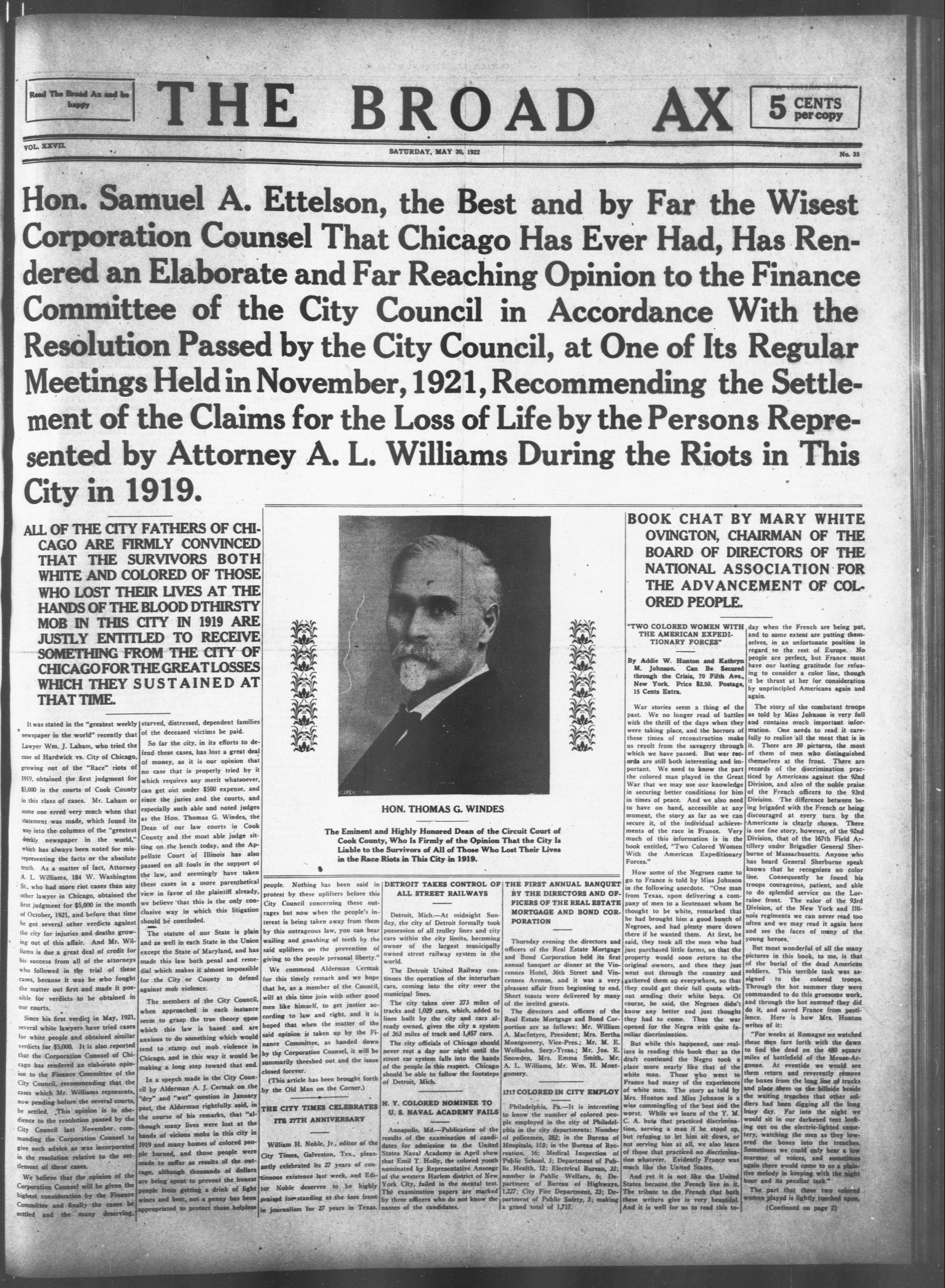
Hon. Samuel A. Ettelson, the Best and by Far the Wisest Corporation Counsel That Chicago Has Ever Had, Has Rendered an Elaborate and Far Reaching Opinion to the Finance Committee of the City Council in Accordance With the Resolution Passed by the City Council, at One of Its Regular Meetings Held in November, 1921, Recommending the Settlement of the Claims for the Loss of Life by the Persons Represented by Attorney A. L. Williams During the Riots in This City in 1919.
ALL OF THE CITY FATHERS OF CHICAGO ARE FIRMLY CONVINCED THAT THE SURVIVORS BOTH WHITE AND COLORED OF THOSE WHO LOST THEIR LIVES AT THE HANDS OF THE BLOOD DTHIRSTY MOB IN THIS CITY IN 1919 ARE JUSTLY ENTITLED TO RECEIVE SOMETHING FROM THE CITY OF CHICAGO FOR THE GREAT LOSSES WHICH THEY SUSTAINED AT THAT TIME.
It was stated in the "greatest weekly newspaper in the world" recently that Lawyer Wm. J. Laham, who tried the case of Hardwick vs. City of Chicago, growing out of the "Race" riots of 1919, obtained the first judgment for $5,000 in the courts of Cook County in this class of cases. Mr. Laham or some one erred very much when that statement was made, which found its way into the columns of the "greatest weekly newspaper in the world," which has always been noted for misrepresenting the facts or the absolute truth. As a matter of fact, Attorney A. L. Williams, 184 W. Washington St., who had more riot cases than any other lawyer in Chicago, obtained the first judgment for $5,000 in the month of October, 1921, and before that time he got several other verdicts against the city for injuries and deaths growing out of this affair. And Mr. Williams is due a great deal of credit for his success from all of the attorneys who followed in the trial of these cases, because it was he who fought the matter out first and made it possible for verdicts to be obtained in our courts.
Since his first verdict in May, 1921, several white lawyers have tried cases for white people and obtained similar verdicts for $5,000. It is also reported that the Corporation Counsel of Chicago has rendered an elaborate opinion to the Finance Committee of the City Council, recommending that the cases which Mr. Williams represents, now pending before the several courts, be settled. This opinion is in obedience to the resolution passed by the City Council last November, commanding the Corporation Counsel to give such advice as was incorporated in the resolution relative to the settlement of these cases.
We believe that the opinion of the Corporation Counsel will be given the highest consideration by the Finance Committee and finally the cases be settled and the many deserving,
So far the city, in its efforts to defend these cases, has lost a great deal of money, as it is our opinion that no case that is properly tried by it which requires any merit whatsoever, can get out under $500 expense, and since the juries and the courts, and especially such able and noted judges as the Hon. Thomas G. Windes, the Dean of our law courts in Cook County and the most able judge sitting on the bench today, and the Appellate Court of Illinois has also passed on all fouls in the support of the law, and seemingly have taken these cases in a more parenthetical view in favor of the plaintiff already, we believe that this is the only conclusive way in which this litigation should be concluded.
The statute of our State is plain and as well in each State in the Union except the State of Maryland, and has made this law both penal and remedial which makes it almost impossible for the City or County to defend against mob violence.
The members of the City Council when approached in each instance seem to grasp the true theory upon which this law is based and are anxious to do something which would tend to stamp out mob violence in Chicago, and in this way it would be making a long step toward that end.
In a speech made in the City Council by Alderman A. J. Cermak on the "dry" and "wet" question in January past, the Alderman rightfully said, in the course of his remarks, that "although many lives were lost at the hands of vicious mobs in this city in 1919 and many homes of colored people burned, and those people were made to suffer as results of the outrage, although thousands of dollars are being spent to prevent the honest people from getting a drink of light wines and beer, not a penny has been appropriated to protect these helpless
JPEU 101
The Eminent and Highly Honored Dean of the Circuit Court of Cook County, Who Is Firmly of the Opinion That the City Is Liable to the Survivors of All of Those Who Lost Their Lives in the Race Riots in This City in 1919.
```markdown
```
(This article has been brought forth by the Old Man on the Corner.)
THE CITY TIMES CELEBRATES ITS 27TH ANNIVERSARY
William H. Noble, Jr., editor of the City Times, Galveston, Tex., pleasantly celebrated its 27 years of continuous existence last week, and Editor Noble deserves to be highly praised for standing at the fore front in journalism for 27 years in Texas.
SATURDAY, MAY 20, 1922
, the Best
at Chicago
ear Reaching
Council in
City Coun
er, 1921, R
e Loss of I
Williams
HON. THOMAS G. WINDES
and Highly Honored Dean of the C
ity, Who Is Firmly of the Opinion T
he Survivors of All of Those Who L
Riots in This City in 1919.
DETROIT TAKES CONTROL OF
ALL STREET RAILWAYS
Detroit, Mich.—At midnight Sunday, the city of Detroit formally took possession of all trolley lines and city cars within the city limits, becoming owner of the largest municipally owned street railway system in the world.
The Detroit United Railway continues the operation of the interurban cars, coming into the city over the municipal lines.
The city takes over 273 miles of tracks and 1,029 cars, which, added to lines built by the city and cars already owned, gives the city a system of 363 miles of track and 1,457 cars.
The city officials of Chicago should never rest a day nor night until the street car system falls into the hands of the people in this respect. Chicago should be able to follow the footsteps of Detroit, Mich.
N. Y. COLORED NOMINEE TO
U. S. NAVAL ACADEMY FAILS
Annapolis, Md.—Publication of the results of the examination of candidates for admission to the United States Naval Academy in April show that Emil T. Holly, the colored youth nominated by Representative Ansorge of the western Harlem district of New York City, failed in the mental test. The examination papers are marked by three officers who do not know the names of the candidates.
```markdown
```
THE FIRST ANNUAL BANQUET BY THE DIRECTORS AND OFFICERS OF THE REAL ESTATE MORTGAGE AND BOND CORPORATION
Thursday evening the directors and officers of the Real Estate Mortgage and Bond Corporation held its first annual banquet or dinner at the Vincennes Hotel, 36th Street and Vincennes Avenue, and it was a very pleasant affair from beginning to end. Short toasts were delivered by many of the invited guests.
The directors and officers of the Real Estate Mortgage and Bond Corporation are as follows: Mr. William A. MacIntyre, President; Mrs. Bertha Montgomery, Vice-Pres.; Mr. M. E. Wolfsohn, Secy-Treas.; Mr. Jos. E. Snowden, Mrs. Emma Smith, Mr. A. L. Williams, Mr. Wm. H. Montgomery.
1717 COLORED IN CITY EMPLOY
Philadelphia, Pa. - It is interesting to know the number of colored people employed in the city of Philadelphia in the city departments: Number of policemen, 282; in the Bureau of Hospitals, 143; in the Bureau of Recreation, 16; Medical Inspection of Public School, 3; Department of Public Health, 12; Electrical Bureau, 32; number in Public Welfare, 6; Department of Bureau of Highways, 1,227; City Fire Department, 23; Department of Public Safety, 3; making a grand total of 1,717.
BOOK CHAT BY MARY WHITE OVINGTON, CHAIRMAN OF THE BOARD OF DIRECTORS OF THE NATIONAL ASSOCIATION FOR THE ADVANCEMENT OF COLORED PEOPLE.
"TWO COLORED WOMEN WITH THE AMERICAN EXPEDITIONARY FORCES"
By Addie W. Hunton and Kathryn M. Johnson. Can Be Secured through the Crisis, 70 Fifth Ave., New York. Price $2.50. Postage, 15 Cents Extra.
War stories seem a thing of the past. We no longer read of battles with the thrill of the days when they were taking place, and the horrors of these times of reconstruction make us revolt from the savagery through which we have passed. But war records are still both interesting and important. We need to know the part the colored man played in the Great War that we may use our knowledge in securing better conditions for him in times of peace. And we also need to have on hand, accessible at any moment, the story as far as we can secure it, of the individual achievements of the race in France. Very much of this information is in the book entitled, "Two Colored Women With the American Expeditionary Forces."
How some of the Negroes came to go to France is told by Miss Johnson in the following anecdote. "One man from Texas, upon delivering a company of men to a lieutenant whom he thought to be white, remarked that he had brought him a good bunch of Negroes, and had plenty more down there if he wanted them. At first, he said, they took all the men who had just purchased little farms, so that the property would soon return to the original owners, and then they just went out through the country and gathered them up everywhere, so that they could get their full quota without sending their white boys. Of course, he said, the Negroes didn't know any better and just thought they had to come. Thus the war opened for the Negro with quite familiar discrimination.
But while this happened, one realizes in reading this book that as the draft continued the Negro took a place more nearly like that of the white man. Those who went to France had many of the experiences of white men. The story as told by Mrs. Hunton and Miss Johnson is a wise commingling of the best and the worst. While we learn of the Y. M. C. A. huts that practiced discrimination, serving a man if he stood up, but refusing to let him sit down, or not serving him at all, we also learn of those that practiced no discrimination whatever. Evidently France was much like the United States. And yet it is not like the United States because the French live in it. The tribute to the French that both these writers give is very beautiful. And it is well for us to read this to-
5 CENTS per copy
The Wisest Has Ren-
Finance With the
Regular
the Settle-
has Repre-
s in This
BY MARY WHITE
HAIRMAN OF THE
RECTORS OF THE
ASSOCIATION FOR
ACEMENT OF COL-
day when the French are being put, and to some extent are putting themselves, in an unfortunate position in regard to the rest of Europe. No people are perfect, but France must have our lasting gratitude for refusing to consider a color line, though it be thrust at her for consideration by unprincipled Americans again and again.
The story of the combatant troops as told by Miss Johnson is very full and contains much important information. One needs to read it carefully to realize all the meat that is in it. There are 39 pictures, the most of them of men who distinguished themselves at the front. There are records of the discrimination practiced by Americans against the 92nd Division, and also of the noble praise of the French officers to the 93rd Division. The difference between being brigaded with the French or being discouraged at every turn by the Americans is clearly shown. There is one fine story, however, of the 92nd Division, that of the 167th Field Artillery under Brigadier General Sherburne of Massachusetts. Anyone who has heard General Sherburne speak knows that he recognizes no color line. Consequently he found his troops courageous, patient, and able to do splendid service on the Lorraine front. The valor of the 93rd Division, of the New York and Illinois regiments we can never read too often and we may read it again here and see the faces of many of the young heroes.
But most wonderful of all the many pictures in this book, to me, is that of the burial of the dead American soldiers. This terrible task was assigned to the colored troops. Through the hot summer they were commanded to do this gruesome work, and through the hot summer they did do it, and saved France from pestilence. Here is how Mrs. Hunton writes of it:
"For weeks at Romagne we watched these men fare forth with the dawn to find the dead on the 480 square miles of battlefield of the Meuse-Argonne. At eventide we would see them return and reverently remove the boxes from the long line of trucks and place them on the hillside beside the waiting treches that other soldiers had been digging all the long busy day. Far into the night we would sit in our darkened tent looking out on the electric-lighted cemetery, watching the men as they lowered the boxes into the trenches. Sometimes we could only hear a low murmur of voices, and sometimes again there would come to us a plaintive melody in keeping with the night hour and its peculiar task."
The part that these two colored women played is lightly toned upon,
(Continued on page 2)
THE BROAD AX
Published Every Saturday
In this city since July 15th, 1899, without missing one single issue. Republicans, Democrats, Catholics, Protestants, Single Taxers, Priests, infidels or anyone else can have their say as long as their language is proper and responsibility is fixed.
The Broad Ax is a newspaper whose platform is broad enough for all, ever claiming the editorial right to speak its own mind.
Local communications will receive attention. Write only on one side of the paper.
Subscriptions must be paid in ad-
One Year .....$2.00
Six Months .....$1.00
Advertising rates made known on application.
Address all communication to ...
THE BROAD AX
6206 So. Elizabeth St, Chicago, Ill.
Phone Wentworth 2597
JULIUS P. TAYLOR
Editor and Publisher
Associate Editor
DR. M. A. MAJORS
4700 South State Street
Phone Drexel 1416
May 20, 1922
Vol. XXVII. No. 35
Entered as Second-Class Matter, Aug.
19, 1992, at the Pest Office at Chicago,
19. Under 'Act of March 8, 1879.
(Concluded from page 1)
BOOK CHAT
but one feels it throughout the whole book. How utterly unregarding they were of their own comfort, of their health or their natural feelings when they must face discrimination. The work of the few women of the colored race who were permitted to go to France deserves all praise. The book is profusely illustrated and has an excellent index. Every name, every regiment, is paged and the reader eager to know what his or her boy did can find it out at once. And how many must want to know. We believe the book will have a host of readers.
HEALTHY TEETH AN ASSET
It is now pretty generally recognized by medical men that there is a very distinct relationship between common dental diseases and the general health of an individual.
Dr. Russell W. Bunting of the University of Michigan, discussing the subject of "Teeth and Health," tells us that it has been observed that many people who are in poor general health are found to have diseased teeth. Also that after diseased teeth have been removed in most cases the systemic ailment disappears.
Specific affections of the heart, kidneys, skin, nerves, joints and bodily tissues are commonly associated with dental disturbances. In many cases patients who have suffered for years with chronic affections and general ill health show a marked improvement in their condition after the diseased teeth have been removed.
According to Dr. Bunting the dental diseases which are most often dangerous to the individual naturally fall into two groups: First, those which produce abscesses at the ends of the roots of the teeth, and second, those diseases of the gums and supporting tissues about the teeth, so-called pyorrhea. And of these, the first group is the more important. Abcesses occur only about the roots of dead teeth and never on those which have a living pulp or nerve. They may produce pain and swelling and break through the gum with a discharge of pus, or they may be inconspicuous, producing no pain or swelling and remain for years in a quiescent state without the patient being aware of their presence. Also infectious organisms which they contain may enter the blodp stream and spread throughout the body to produce specific diseases in distant parts.
The second type of dental disease and which is generally known as pyorrhea begins at the gum line and progressively destroys the tissues which attach the teeth to the surrounding bone; but both abscesses and pyorrhea, when firmly established, offer many serious difficulties to their treatment and cure.
The most common dental infection is decay of the teeth. It consists of a dissolution of the tooth substances by acids arising from fermentation of foodstuffs, notably starches and sugars, which are retained between the teeth and about them. If the mouth is kept clean and free from sugar and starches, there will be little or no decay of the teeth. And because this is true, Dr. Bunting tells us that dental decay, therefore, is very largely a filth disease resulting from the neglect of proper care of the mouth. Then he very pertinently adds: "If dental
M.
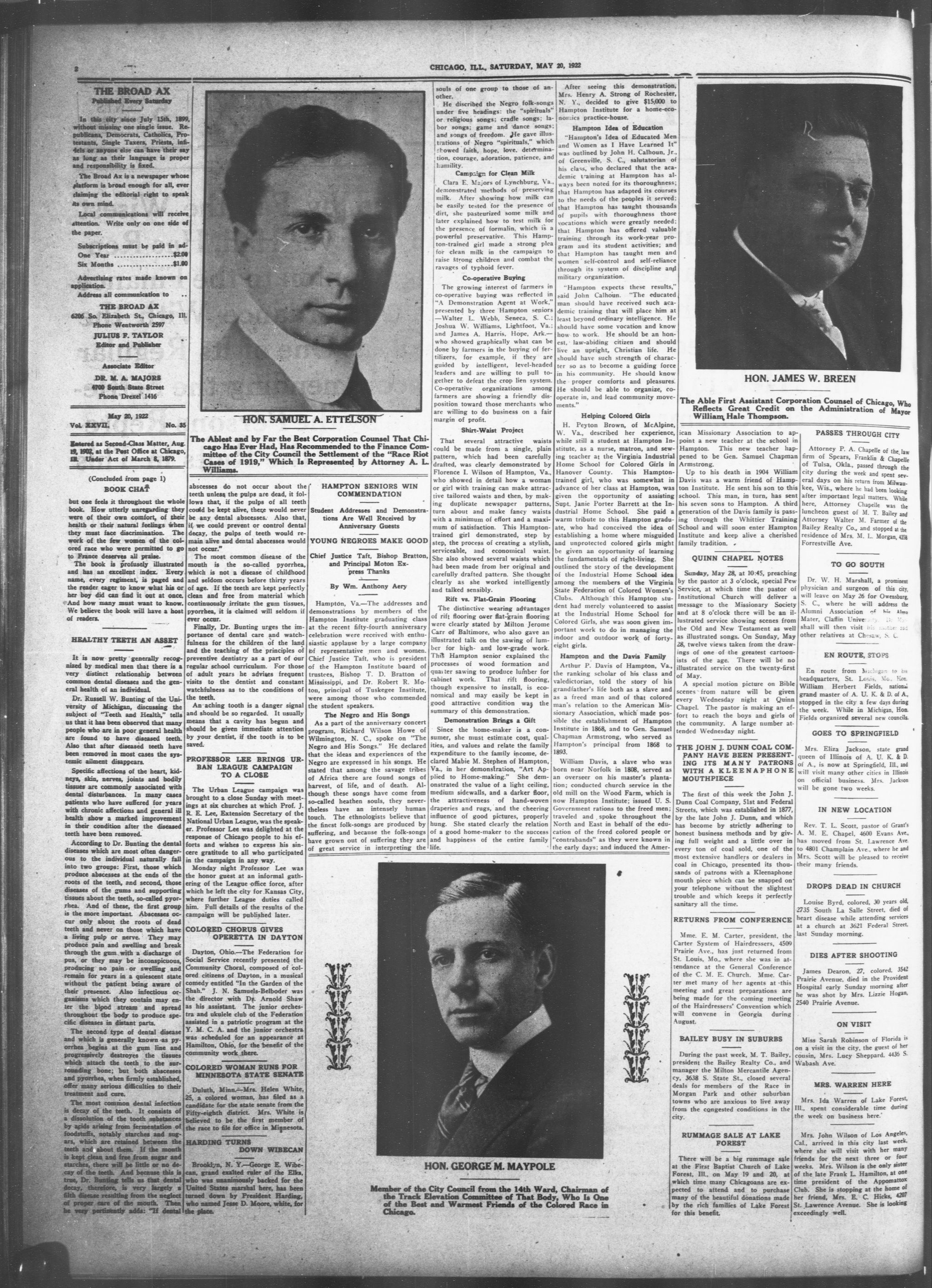
HON. SAMUEL A. ETTELSON
The Ablest and by Far the Best Corporation Counsel That Chicago Has Ever Had, Has Recommended to the Finance Committee of the City Council the Settlement of the "Race Riot Cases of 1919," Which Is Represented by Attorney A. L. Williams.
abscesses do not occur about the teeth unless the pulps are dead, it follows that, if the pulps of all teeth could be kept alive, there would never be any dental abscesses. Also that, if we could prevent or control dental decay, the pulps of teeth would remain alive and dental abscesses would not occur.
HAMPTON SENIORS WIN COMMENDATION
Student Addresses and Demonstractions Are Well Received by Anniversary Guests
YOUNG NEGROES MAKE GOOD
The most common disease of the mouth is the so-called pyorrhea, which is not a disease of childhood and seldom occurs before thirty years of age. If the teeth are kept perfectly clean and free from material which continuously irritate the gum tissues, pyorrhea, it is claimed will seldom if ever occur.
Finally, Dr. Bunting urges the importance of dental care and watchfulness for the children of the land and the teaching of the principles of preventive dentistry as a part of our regular school curriculum. For those of adult years he advises frequent visits to the dentist and constant watchfulness as to the conditions of the teeth.
An aching tooth is a danger signal and should be so regarded. It usually means that a cavity has begun and should be given immediate attention by your dentist, if the tooth is to be saved.
PROFESSOR LEE BRINGS UR
BAN LEAGUE CAMPAIGN
TO A CLOSE
The Urban League campaign was brought to a close Sunday with meetings at six churches at which Prof. J. R. E. Lee, Extension Secretary of the National Urban League, was the speaker. Professor Lee was delighted at the response of Chicago people to his efforts and wishes to express his sincere gratitude to all who participated in the campaign in any way. Monday night Professor Lee was the honor guest at an informal gathering of the League office force, after which he left the city for Kansas City, where further League duties called him. Full details of the results of the campaign will be published later.
COLORED CHORUS GIVES
Dayton, Ohio.—The Federation for Social Service recently presented the Community Choral, composed of colored citizens of Dayton, in a musical comedy entitled "In the Garden of the Shah." J. N. Samuels-Belboder was the director with Dr. Arnold Shaw as his assistant. The junior orchestra and ukulele club of the Federation assisted in a patriotic program at the Y. M. C. A. and the junior orchestra was scheduled for an appearance at Hamilton, Ohio, for the benefit of the community work there.
COLORED WOMAN RUNS FOR
MINNESOTA STATE SENATE
Duluth, Minn.—Mrs. Helen White, 25, a colored woman, has filed as a candidate for the state senate from the Fifty-eighth district. Mrs. White is believed to be the first member of the race to file for office in Minnesota.
HARDING TURNS
DOWN WIBECAN
Brooklyn, N. Y.—George E. Wibecan, grand exalted ruler of the Elks, who was unanimously backed for the United States marshal here, has been turned down by President Harding, who named Jesse D. Moore, white, for the place.
at Corporation Counsel That Chi recommended to the Finance Com the Settlement of the "Race Riio Represented by Attorney A. L
HAMPTON SENIORS WIN
COMMENDATION
Student Addresses and Demonstra
tions Are Well Received by
Anniversary Guests
YOUNG NEGROES MAKE GOOD
Chief Justice Taft, Bishop Bratton
and Principal Moton Ex
press Thanks
Hampton, Va.—The addresses and demonstrations by members of the Hampton Institute graduating class at the recent fifty-fourth anniversary celebration were received with enthusiastic applause by a large company of representative men and women. Chief Justice Tait, who is president of the Hampton Institute board of trustees, Bishop T. D. Bratton of Mississippi, and Dr. Robert R. Moton, principal of Tuskegee Institute, were among those who commended the student speakers.
The Negro and His Songs
The Negro and His Songs As a part of the anniversary concert program, Richard Wilson Howe of Wilmington, N. C., spoke on "The Negro and His Songs." He declared that the ideas and experiences of the Negro are expressed in his songs. He stated that among the savage tribes of Africa there are found songs of harvest, of life, and of death. Although these songs have come from so-called heathen souls, they nevertheless have an intensely human touch. The ethnologists believe that the finest folk-songs are produced by suffering, and because the folk-songs have grown out of suffering they are of great service in interpreting the
---
D
Member of the City Council from the 14th Ward, Chairman of the Track Elevation Committee of That Body, Who Is One of the Best and Warmest Friends of the Colored Race in Chicago.
CHICAGO, ILL. SATURDAY, MAY 20, 1922
M.
The City Council from the 14th Ward, Chairs Elevation Committee of That Body, Who and Warmest Friends of the Colored People
souls of one group to those of another.
He described the Negro folk-songs under five headings: the "spirituals" or religious songs; cradle songs; labor songs; game and dance songs and songs of freedom. He gave illustrations of Negro "spirituals," which showed faith, hope, love, determination, courage, adoration, patience, and humility.
Campaign for Clean Milk
Clara E. Majors of Lynchburg, Va. demonstrated methods of preserving milk. After showing how milk can be easily tested for the presence of dirt, she pasteurized some milk and later explained how to test milk for the presence of formalin, which is a powerful preservative. This Hampton-trained girl made a strong plea for clean milk in the campaign to raise strong children and combat the ravages of typhoid fever.
Co-operative Buying
The growing interest of farmers in co-operative buying was reflected in "A Demonstration Agent at Work," presented by three Hampton seniors—Walter L. Webb, Seneca, S. C.; Joshua W. Williams, Lightfoot, Va.; and James A. Harris, Hope, Ark. who showed graphically what can be done by farmers in the buying of fertilizers, for example, if they are guided by intelligent, level-headed leaders and are willing to pull together to defeat the crop lien system. Co-operative organizations among farmers are showing a friendly disposition toward those merchants who are willing to do business on a fair margin of profit.
Shirt-Waist Project
That several attractive waists could be made from a single, plain pattern, which had been carefully drafted, was clearly demonstrated by Florence I. Wilson of Hampton, Va. who showed in detail how a woman or girl with training can make attractive tailored waists and then, by making duplicate newspaper patterns, turn about and make fancy waists with a minimum of effort and a maximum of satisfaction. This Hampton-trained girl demonstrated, step by step, the process of creating a stylish, serviceable, and economical waist. She also showed several waists which had been made from her original and carefully drafted pattern. She thought clearly as she worked intelligently and talked sensibly.
Rift vs. Flat-Grain Flooring
Rift vs. Flat-Grain Flooring
The distinctive wearing advantages of rift flooring over flat-grain flooring were clearly stated by Milton Jerome Carr of Baltimore, who also gave an illustrated talk on the sawing of lumber for high- and low-grade work. This Hampton senior explained the processes of wood formation and quater sawing to produce lumber for cabinet work. That rift flooring, though expensive to install, is economical and may easily be kept in good attractive condition was the summary of this demonstration.
Demonstration Brings a Gift
Since the home-maker is a consumer, she must estimate cost, qualities, and values and relate the family expenditure to the family income, declared Mabie M. Stephen of Hampton, Va., in her demonstration, "Art Applied to Home-making." She demonstrated the value of a light ceiling, medium sidewalls, and a darker floor, the attractiveness of hand-woven draperies and rugs, and the cheering influence of good pictures, properly hung. She stated clearly the relation of a good home-maker to the success and happiness of the entire family life.
HON. GEORGE M. MAYPOLE
After seeing this demonstration,
Mrs. Henry A. Strong of Rochester,
N. Y., decided to give $15,000 to
Hampton Institute for a home-econ-
nics practice-house.
Hampton Idea of Education
"Hampton's Idea of Educated Men and Women as I Have Learned It" was outlined by John H. Calboun, Jr., of Greenville, S. C., salutatorian of his class, who declared that the academic training at Hampton has always been noted for its thoroughness; that Hampton has adapted its courses to the needs of the peoples it served; that Hampton has taught thousands of pupils with thoroughness those vocations which were greatly needed; that Hampton has offered valuable training through its work-year program and its student activities; and that Hampton has taught men and women self-control and self-reliance through its system of discipline and military organization.
"Hampton expects these results," said John Calhoun. "The educated man should have received such academic training that will place him at least beyond ordinary intelligence. He should have some vocation and know how to work. He should be an honest, law-abiding citizen and should live an upright, Christian life. He should have such strength of character so as to become a guiding force in his community. He should know the proper comforts and pleasures. He should be able to organize, cooperate in, and lead community movements."
Helping Colored Girls
H. Peyton Brown, of McAlpine W. Va., described her experience while still a student at Hampton Institute, as a nurse, matron, and sewing teacher at the Virginia Industrial Home School for Colored Girls in Hanover County. This Hampton-trained girl, who was somewhat in advance of her class at Hampton, was given the opportunity of assisting Supt. Janie Porter Barrett at the Industrial Home School. She paid a warm tribute to this Hampton graduate, who had conceived the idea of establishing a home where misguided and unprotected colored girls might be given an opportunity of learning the fundamentals of right-living. She outlined the story of the development of the Industrial Home School idea among the members of the Virginia State Federation of Colored Women's Clubs. Although this Hampton student had merely volunteered to assist at the Industrial Home School for Colored Girls, she was soon given important work to do in managing the indoor and outdoor work of forty-eight girls.
Hampton and the Davis Family
Arthur P. Davis of Hampton, Va., the ranking scholar of his class and valedictorian, told the story of his grandfather's life both as a slave and as a freed man and of that colored man's relation to the American Missionary Association, which made possible the establishment of Hampton Institute in 1868, and to Gen. Samuel Chapman armstrong, who served as Hampton's principal from 1868 to 1893.
William Davis, a slave who was born near Norfolk in 1808, served as an overseer on his master's plantation; conducted church service in the old mill on the Wood Farm, which is now Hampton Institute; issued U. S. Government rations to the freed men; traveled and spoke throughout the North and East in behalf of the education of the freed colored people or "contrabands" as they were known in the early days; and induced the Amer-
```markdown
```
R
HON. JAMES W. BREEN
The Able First Assistant Corporation Counsel of Chicago, Who Reflects Great Credit on the Administration of Mayor William Hale Thompson.
ican Missionary Association to appoint a new teacher at the school in Hampton. This new teacher happened to be Gen. Samuel Chapman Armstrong.
Up to his death in 1904 William Davis was a warm friend of Hampton Institute. He sent his son to this school. This man, in turn, has sent his seven sons to Hampton. A third generation of the Davis family is passing through the Whittier Training School and will soon enter Hampton Institute and keep alive a cherished family tradition.
PASSES THROUGH CITY
Attorney P. A. Chapelle of the law firm of Spears, Franklin & Chapelle of Tulsa, Okla., passed through the city during the week and spent several days on his return from Milwaukee, Wis., where he had been looking after important legal matters. While here, Attorney Chapelle was the luncheon guest of M. T. Bailey and Attorney Walter M. Farmer of the Bailey Realty Co., and stopped at the residence of Mrs. M. L. Morgan, 4358 Forrestville Ave.
QUINN CHAPEL NOTES
Sunday, May 28, at 10:45, preaching by the pastor at 3 o'clock, special Pew Service, at which time the pastor of Institutional Church will deliver a message to the Missionary Society and at 8 o'clock there will be an illustrated service showing scenes from the Old and New Testament as well as illustrated songs. On Sunday, May 28, twelve views taken from the drawings of one of the greatest cartoonists of the age. There will be no illustrated service on the twenty-first of May.
A special motion picture on Bible scenes from nature will be given every Wednesday night at Quinn Chapel. The pastor is making an effort to reach the boys and girls of the community. A large number attended Wednesday night.
THE JOHN J. DUNN COAL COMPANY HAVE BEEN PRESENTING ITS MANY PATRONS WITH A KLEENAPHONE MOUTHPIECE
The first of this week the John J. Dunn Coal Company, 51st and Federal Streets, which was established in 1877, by the late John J. Dunn, and which has become by strictly adhering to honest business methods and by giving full weight and a little over in every ton of coal sold, one of the most extensive handlers or dealers in coal in Chicago, presented its thousands of patrons with a Kleenaphone mouth piece which can be snapped on your telephone without the slightest trouble and which keeps it perfectly sanitary all the time.
RETURNS FROM CONFERENCE
Mme. E. M. Carter, president, the Carter System of Hairdressers, 4509 Prairie Ave., has just returned from St. Louis, Mo., where she was in attendance at the General Conference of the C. M. E. Church. Mme. Carter met many of her agents at this meeting and great preparations are being made for the coming meeting of the Hairdressers' Convention which will convene in Georgia during August.
BAILEY BUSY IN SUBURBS
During the past week, M. T. Bailey, president the Bailey Realty Co., and manager the Milton Mercantile Agency, 3638 S. State St., closed several deals for members of the Race in Morgan Park and other suburban towns who are anxious to live away from the congested conditions in the city.
RUMMAGE SALE AT LAKE
FOREST
There will be a big rummage sale at the First Baptist Church of Lake Forest, Ill, on May 19 and 20, at which time many Chicagoans are expected to attend and to purchase many of the beautiful donations made by the rich families of Lake Forest for this benefit.
Corporation Counsel of Chicago, Wha in the Administration of Mayo
PASSES THROUGH CITY
Attorney P. A. Chapelle of the law firm of Spears, Franklin & Chapelle of Tulsa, Okla., passed through the city during the week and spent several days on his return from Milwaukee, Wis., where he had been looking after important legal matters. While here, Attorney Chapelle was the luncheon guest of M. T. Bailey and Attorney Walter M. Farmer of the Bailey Realty Co., and stopped at the residence of Mrs. M. L. Morgan, 4358 Forrestville Ave.
TO GO SOUTH
Dr. W. H. Marshall, a prominent physician and surgeon of this city will leave on May 26 for Owensburg S. C., where he will address the Alumni Association of his Alma Mater, Claflin University. Dr. Marshall will then visit his mother and other relatives at Chesaw, S. C.
EN ROUTE, STOPS
En route from Michigan to his headquarters, St. Louis, Mo. Hon. William Herbert Fields, national grand master of A. U. K. & D. of A. stopped in the city a few days during the week. While in Michigan, Hon. Fields organized several new councils
GOES TO SPRINGFIELD
Mrs. Eliza Jackson, state grand queen of Illinois of A. U. K. & D. of A, is now at Springfield, Ill, and will visit many other cities in Illinois on official business. Mrs. Jackson will be gone two weeks.
IN NEW LOCATION
Rev. T. L. Scott, pastor of Grant's A. M. E. Chapel, 4600 Evans Ave. has moved from St. Lawrence Ave. to 4801 Champlain Ave., where he and Mrs. Scott will be pleased to receive their many friends.
DROPS DEAD IN CHURCH
Louise Byrd, colored, 30 years old, 2735 South La Salle Street, died of heart disease while attending services at a church at 3621 Federal Street, last Sunday morning.
DIES AFTER SHOOTING
James Dearon, 27, colored, 3542 Prairie Avenue, died in the Provident Hospital early Sunday morning after he was shot by Mrs. Lizzie Hogan, 2540 Prairie Avenue.
Miss Sarah Robinson of Florida is on a visit in the city, the guest of her cousin, Mrs. Lucy Sheppard. 4436 S Wabash Ave.
MRS. WARREN HERE
Mrs. Ida Warren of Lake Forest, Ill., spent considerable time during the week on business here.
Mrs. John Wilson of Los Angeles, Cal., arrived in this city last week, where she will visit with her many friends for the next three or four weeks. Mrs. Wilson is the only sister of the late Frank L. Hamilton, at one time president of the Appomattox Club. She is stopping at the home of her friend, Mrs. E. C. Hicks, 4207 St. Lawrence Avenue. She is looking exceedingly well.
ON VISIT
6v12.16
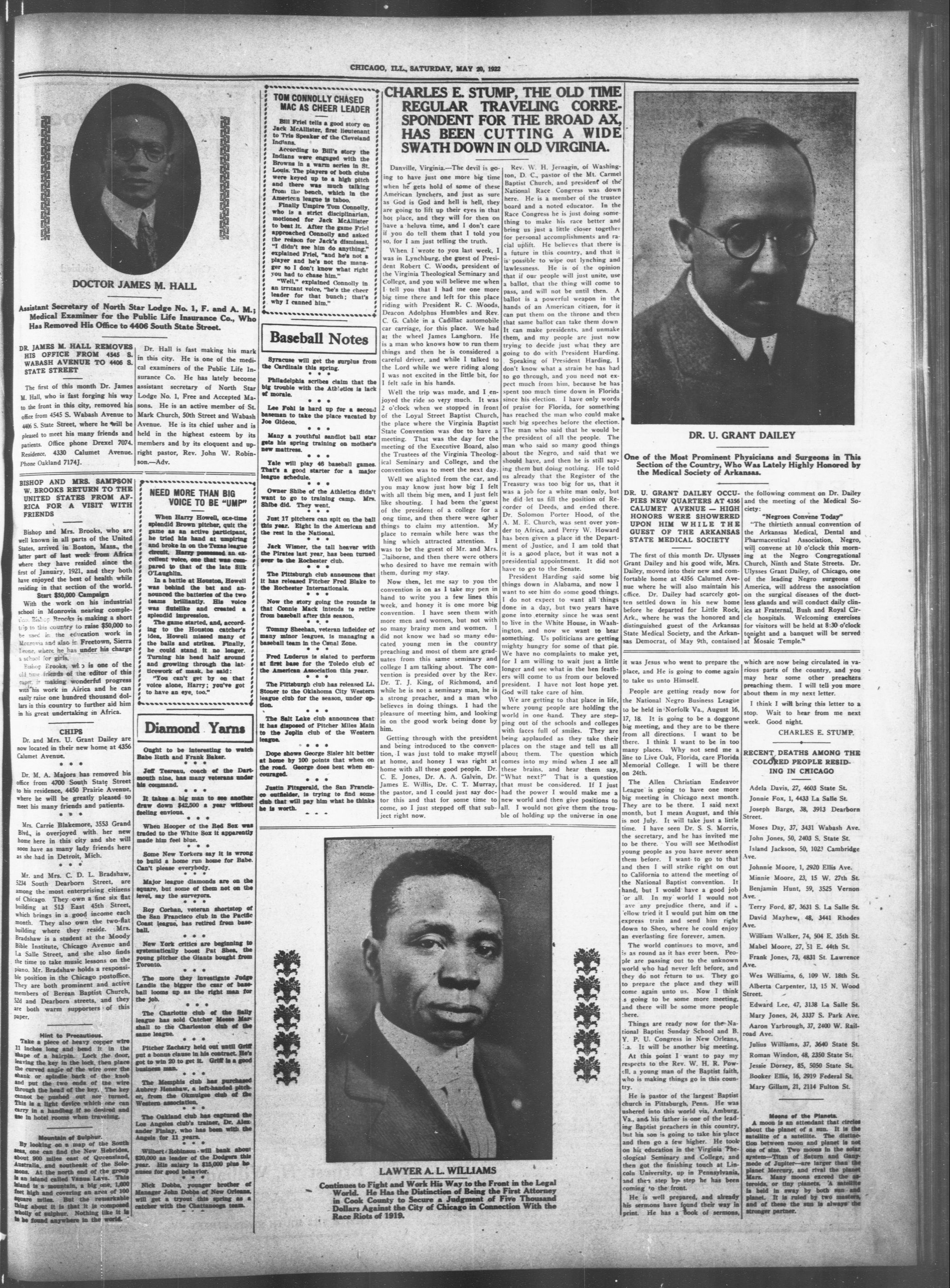
Assistant Secretary of North Star Lodge No. 1, F. and A. M.; Medical Examiner for the Public Life Insurance Co., Who Has Removed His Office to 4406 South State Street.
DR. JAMES M. HALL REMOVES HIS OFFICE FROM 4545 S. WABASH AVENUE TO 4406 S. STATE STREET
The first of this month Dr. James M. Hall, who is fast forging his way to the front in this city, removed his office from 4545 S. Wabash Avenue to 4406 S. State Street, where he will be pleased to meet his many friends and patients. Office phone Drexel 7074, Residence, 4330 Calumet Avenue, Phone Oakland 7174J.
Dr. Hall is fast making his mark in this city. He is one of the medical examiners of the Public Life Insurance Co. He has lately become assistant secretary of North Star Lodge No. 1, Free and Accepted Masons. He is an active member of St. Mark Church, 50th Street and Wabash Avenue. He is its chief usher and is held in the highest esteem by its members and by its eloquent and upright pastor, Rev. John W. Robinson.—Adv.
BISHOP AND MRS. SAMPSON
W. BROOKS RETURN TO THE
UNITED STATES FROM AFRICA FOR A VISIT WITH FRIENDS
Bishop and Mrs. Brooks, who are well known in all parts of the United States, arrived in Boston, Mass., the latter part of last week from Africa where they have resided since the first of January, 1921, and they both have enjoyed the best of health while residing in that section of the world.
Start $50,000 Campaign
With the work on his industrial school in Monrovia nearing completion Bishop Brooks is making a short trip to this country to raise $50,000 to be used in the education work in Monrovia and also in Freetown, Sierra Leone, where he has under his charge a school for girls. Bishop Brooks, who is one of the old time friends of the editor of this paper, is making wonderful progress with his work in Africa and he can easily raise one hundred thousand dollars in this country to further aid him in his great undertaking in Africa.
CHIPS
Dr. and Mrs. U. Grant Dailey are now located in their new home at 4356 Calumet Avenue.
* * *
Dr. M. A. Majors has removed his office from 4700 South State Street to his residence, 4450 Prairie Avenue, where he will be greatly pleased to meet his many friends and patients.
* * *
Mrs. Carrie Blakemore, 3553 Grand Blvd, is overjoyed with her new home here in this city and she will soon have as many lady friends here as she had in Detroit, Mich.
***
Mr. and Mrs. C. D. L. Bradshaw, 5234 South Dearborn Street, are among the most enterprising citizens of Chicago. They own a fine six flat building at 513 East 45th Street, which brings in a good income each month. They also own the two-flat building where they reside. Mrs. Bradshaw is a student at the Moody Bible Institute, Chicago Avenue and La Salle Street, and she also finds the time to take music lessons on the piano. Mr. Bradshaw holds a responsible position in the Chicago postoffice. They are both prominent and active members of Berean Baptist Church, 52d and Dearborn streets, and they are both warm supporters of this paper.
Hint to Precautious
Take a piece of heavy copper wire 11 inches long and bend it in the shape of a hairpin. Lock the door, leaving the key in the lock, then place the curved edge of the wire over the shank or spindle back of the knob and put the two ends of the wire through the head of the key. The key cannot be pushed out nor turned. This is a light device which one can carry in a handbag it so desired and use in hotel rooms when traveling.
Mountain of Sulphur.
By looking on a map of the South seas, one can find the New Hebrides, about 900 miles east of Queensland, Australia, and southeast of the Solomons. At the north end of the group is an island called Venus Lava. This island is a mountain, a big one, 1,000 feet high and covering an area of 100 square miles. But the remarkable thing about it is that it is composed wholly of sulphur. Nothing like it is to be found anywhere in the world.
Dr. Hall is fast making his mark in this city. He is one of the medical examiners of the Public Life Insurance Co. He has lately become assistant secretary of North Star Lodge No. 1, Free and Accepted Masons. He is an active member of St. Mark Church, 50th Street and Wabash Avenue. He is its chief usher and is held in the highest esteem by its members and by its eloquent and upright pastor, Rev. John W. Robinson.—Adv.
NEED MORE THAN BIG VOICE TO BE "UMP"
When Harry Howell, one-time splendid Brown pitcher, quit the game as an active participant, he tried his hand at umplings and broke in on the Texas league circuit. Harry possessed an excellent voice, one that was compared to that of the late Silk O'Laughlin.
In a battle at Houston, Howell was behind the bat and announced the batteries of the two teams brilliantly. His voice was flutelike and created a splendid impression.
The game started, and, according to the Houston catcher's idea, Howell missed many of the balls and strikes. Finally, he could stand it no longer. Turning his head half around and growling through the latticework of mask, he said:
"You can't get by on that voice alone, Harry; you've got to have an eye, too."
```markdown
```
Diamond Yarns
Ought to be interesting to watch
Babe Ruth and Frank Baker.
Jeff Tesrean, coach of the Dart-
mouth nine, has many veterans under
his command.
It takes a big man to see another
draw down $42,500 a year without
feeling envious.
When Hooper of the Red Sox was
traded to the White Sox it apparently
made him feel blue.
Some New Yorkers say it is wrong
to build a home run home for Babe.
Can't please everybody.
Major league diamonds are on the
square, but some of them not on the
level, say the surveyors.
Roy Corhan, veteran shortstop of the San Francisco club in the Pacific Coast league, has retired from baseball.
New York critics are beginning to systematically boost Pat Shea, the young pitcher the Giants bought from Toronto.
The more they investigate Judge Landis the bigger the scar of baseball looms up as the right man for the job.
The Charlotte club of the Sally league has sold Catcher Meese Marshall to the Charleston club of the same league.
Pitcher Zachary held out until Griff put a bonus clause in his contract. He's got to win 20 to get it. Griff is a good business man.
The Memphis club has purchased
Aubrey Henshaw, a left-handed pitcher,
from the Okmulgee club of the
Western association.
The Oakland club has captured the
Los Angeles club's trainer, Dr. Alex
ander Finlay, who has been with the
Angels for 11 years.
Wilbert / Robinson will bank about
$20,000 as leader of the Dodgers this
year. His salary is $15,000 plus he
uses for good behavior.
Nick Dobbs, younger brother of
Manager John Dobbs of New Orleans,
will get a tryout this spring as a
catcher with the Chattanooga team.
CHICAGO, ILL. SATURDAY, MAY 20. 1922
[Name]
Continues to Fight and Work His Way to the Front in the Legal World. He Has the Distinction of Being the First Attorney in Cook County to Secure a Judgment of Five Thousand Dollars Against the City of Chicago in Connection With the Race Riots of 1919.
Continues to Fight and Work His Way to the Front in the Legal World. He Has the Distinction of Being the First Attorney in Cook County to Secure a Judgment of Five Thousand Dollars Against the City of Chicago in Connection With the Race Riots of 1919.
TOM CONNOLLY CHASED
MAC AS CHEER LEADER
Bill Friel tells a good story on Jack McAllister, first lieutenant to Tris Speaker of the Cleveland Indians.
According to Bill's story the Indians were engaged with the Browns in a warm series in St. Louis. The players of both clubs were keyed up to a high pitch and there was much talking from the bench, which in the American league is taboo.
Finally Umpire Tom Connolly, who is a strict disciplinarian, motioned for Jack McAllister to beat it. After the game Friel approached Connolly and asked the reason for Jack's dismissal, "I didn't see him do anything," explained Friel, "and he's not a player and he's not the manager so I don't know what right you had to chase him."
"Well," explained Connolly in an irritant voice, "he's the cheer leader for that bunch; that's why I canned him."
Baseball Notes
Baseball Notes
Syracuse will get the surplus from the Cardinals this spring.
Philadelphia scribes claim that the big trouble with the Athletics is lack of morale.
Lee Fohl is hard up for a second baseman to take the place vacated by Joe Glideon.
Many a youthful sandlot ball star gets his spring training on mother's new mattress.
Yale will play 46 baseball games. That's a good starter for a major league schedule.
Owner Shibe of the Athletics didn't want to go to training camp. Mrs. Shibe did. They went.
Just 17 pitchers can spit on the ball this year. Eight in the American and the rest in the National.
Jack Wisner, the tall heaver with the Pirates last year, has been turned over to the Rochester club.
The Pittsburgh club announces that it has released Pitcher Fred Blake to the Rochester Internationals.
Now the story going the rounds is that Connie Mack intends to retire from baseball after this season.
Tommy Sheehan, veteran infielder of many minor leagues, is managing a baseball team in the Canal Zone.
Fred Luderus is slated to perform at first base for the Toledo club of the American Association this year.
The Pittsburgh club has released LA. Stoner to the Oklahoma City Western league club for the season, under option.
The Salt Lake club announces that it has disposed of Pitcher Miles Main to the Joplin club of the Western league.
Dope shows George Sisler hit better at home by 100 points that when on the road. George does best when encouraged.
Justin Fitzgerald, the San Francisco outfielder, is trying to find some club that will pay him what he thinks he is worth.
CHARLES E. STUMP, THE OLD TIME REGULAR TRAVELING CORRESPONDENT FOR THE BROAD AX, HAS BEEN CUTTING A WIDE SWATH DOWN IN OLD VIRGINIA.
Danville, Virginia.—The devil is going to have just one more big time when he gets hold of some of these American lynchers, and just as sure as God is God and hell is hell, they are going to lift up their eyes in that hot place, and they will for then on have a heluva time, and I don't care if you do tell them that I told you so, for I am just telling the truth.
When I wrote to you last week, I was in Lynchburg, the guest of President Robert C. Woods, president of the Virginia Theological Seminary and College, and you will believe me when I tell you that I had me one more big time there and left for this place riding with President R. C. Woods, Deacon Adolphus Humbles and Rev. C. G. Cable in a Cadillac automobile car carriage, for this place. We had at the wheel James Langhorn. He is a man who knows how to run them things and then he is considered a careful driver, and while I talked to the Lord while we were riding along I was not excited in the little bit, for I felt safe in his hands.
Well the trip was made, and I enjoyed the ride so very much. It was 2 o'clock when we stopped in front of the Loyal Street Baptist Church, the place where the Virginia Baptist State Convention was due to have a meeting. That was the day for the meeting of the Executive Board, also the Trustees of the Virginia Theological Seminary and College, and the convention was to meet the next day. Well we alighted from the car, and you may know just how big I felt with all them big men, and I just felt like shouting. I had been the 'guest of the president of a college for a long time, and then there were other things to claim my attention. My place to remain while here was the thing which attracted attention. I was to be the guest of Mr. and Mrs. Claiborne, and then there were others who desired to have me remain with them, during my stay.
Now then, let me say to you the convention is on as I take my pen in hand to write you a few lines this week, and honey it is one more big convention. I have seen them with more men and women, but not with so many brainy men and women. I did not know we had so many educated young men in the country preaching and most of them are graduates from this same seminary and college I am talking about. The convention is presided over by the Rev. Dr. T. J. King, of Richmond, and while he is not a seminary man, he is a strong preacher, and a man who believes in doing things. I had the pleasure of meeting him, and looking in on the good work being done by him.
Getting through with the president and being introduced to the convention, I was just told to make myself at home, and honey I was right at home with all these good people. Dr C. E. Jones, Dr. A. A. Galvin, Dr James E. Willis, Dr. C. T. Murray, the pastor, and I could just say doctor this and that for some time to come, so I just stepped off that subject right now.
A. E.
LAWYER A. L. WILLIAMS
Right and Work His Way to the Free
Has the Distinction of Being the
County to Secure a Judgment of
Justice the City of Chicago in Connec
of 1919.
Rev. W. H. Jernagin, of Washington, D. C., pastor of the M. Carmel Baptist Church, and president of the National Race Congress was down here. He is a member of the trustee board and a noted educator. In the Race Congress he is just doing something to make his race better and bring us just a little closer together for personal accomplishments and racial uplift. He believes that there is a future in this country, and that it is possible to wipe out lynching and lawlessness. He is of the opinion that if our people will just unite, use a ballot, that the thing will come to pass, and will not be until then. A ballot is a powerful weapon in the hands of an American citizen, for it can put them on the throne and then that same ballot can take them down. It can make presidents, and unmake them, and my people are just now trying to decide just what they are going to do with President Harding.
Speaking of President Harding, I don't know what a strain he has had to go through, and you need not expect much from him, because he has spent too much time down in Florida since his election. I have only words of praise for Florida, for something has reached the man who could make such big speeches before the election. The man who said that he would be the president of all the people. The man who said so many good things about the Negro, and said that we should have, and then he is still saying them but doing nothing. He told us already that the Register of the Treasury was too big for us, that it was a job for a white man only, but he did let us fill the position of Recorder of Deeds, and ended there. Dr. Solomon Porter Hood, of the A. M. E. Church, was sent over yonder to Africa, and Perry W. Howard has been given a place in the Department of Justice, and I am told that it is a good place, but it was not a presidential appointment. It did not have to go to the Senate.
President Harding said some big things down in Alabama, and now I want to see him do some good things. I do not expect to want all things done in a day, but two years have gone into eternity since he was sent to live in the White House, in Washington, and now we want to hear something. Us politicians are getting mighty hungry for some of that pie. We have no complaints to make yet, for I am willing to wait just a longer and see what in the hen feathers will come to us from our beloved president. I have not lost hope yet. God will take care of him.
We are getting to that place in life, where young people are holding the world in one hand. They are stepping out of the schools and colleges with faces full of smiles. They are being applauded as they take their places on the stage and tell us all about them. The question which comes into my mind when I see all these brains, and hear them say, "What next?" That is a question that must be considered. If I just had the power I would make me a new world and then give positions to all. I would not give them the trouble of holding up the universe in one
```markdown
```
M.
DR. U. GRANT DAILEY
One of the Most Prominent Physicians and Surgeons in This Section of the Country, Who Was Lately Highly Honored by the Medical Society of Arkansas.
DR. U. GRANT DAILEY OCCUPIES NEW QUARTERS AT 4356 CALUMET AVENUE — HIGH HONORS WERE SHOWERED UPON HIM WHILE THE GUEST OF THE ARKANSAS STATE MEDICAL SOCIETY
the following comment on Dr. Dailey and the meeting of the Medical Society:
"Negroes Convene Today"
"The thirtieth annual convention of the Arkansas Medical, Dental and Pharmaceutical Association, Negro,
The first of this month Dr. Ulysses Grant Dailey and his good wife, Mrs. Dailey, moved into their new and comfortable home at 4356 Calumet Avenue where he will also maintain his office. Dr. Dailey had scarcely gotten settled down in his new home before he departed for Little Rock, Ark., where he was the honored and distinguished guest of the Arkansas State Medical Society, and the Arkansas Democrat, of May 9th, contained
it was Jesus who went to prepare the place, and He is going to come again to take us unto Himself.
People are getting ready now for the National Negro Business League to be held in Norfolk Va., August 16, 17, 18. It is going to be a doggone big meeting, and they are to be there from all directions. I want to be there. I think I want to be in too many places. Why not send me a line to Live Oak, Florida, care Florida Memorial College. I will be there on 24th.
The Allen Christian Endeavor League is going to have one more big meeting in Chicago next month. They are to be there. I said next month, but I mean August, and this is not July. It will take just a little time. I have seen Dr. S. S. Morris, the secretary, and he has invited me to be there. You will see Methodist young people as you have never seen them before. I want to go to that and then I will strike right on out to California to attend the meeting of the National Baptist convention. It hand, but I would have a good job or all. In my world I would not ave any prejudice there, and if 'ellow tried it I would put him on the express train and send him right down to Sheo, where he could enjoy an everlasting fire forever, amen.
The world continues to move, and is as round as it has ever been. People are passing out to the unknown world who had never left before, and they do not return to us. They go to prepare the place and they will come again unto us. Now I think is going to be some more meeting, and there will be some more people there.
Things are ready now for the National Baptist Sunday School and B. Y. P. U. Congress in New Orleans, Ia. It will be another big meeting.
At this point I want to pay my respects to the Rev. W. H. R. Powell, a young man of the Baptist faith, who is making things go in this country.
He is pastor of the largest Baptist church in Pittsburgh, Penn. He was ushered into this world via, Amburg, Va., and his father is one of the leading Baptist preachers in this country, but his son is going to take his place and then go a few higher. He took on his education in the Virginia Theological Seminary and College, and then got the finishing touch at Lincoln University, up in Pennsylvania, and then step by step he has been coming to the front.
He is well prepared, and already his sermons have found their way in print. He has a book of sermons,
Physicians and Surgeons in This Was Lately Highly Honored by Insas.
the following comment on Dr. Dailey and the meeting of the Medical Society:
"Negroes Convene 'Today'
"The thirteenth annual convention of the Arkansas Medical, Dental and Pharmaceutical Association, Negro, will convene at 10 o'clock this morning at the Negro Congregational Church, Ninth and State Streets. Dr. Ulysses Grant Dailey, of Chicago, one of the leading Negro surgeons of America, will address the association on the surgical diseases of the ductless glands and will conduct daily clinics at Fraternal, Bush and Royal Circle hospitals. Welcoming exercises for visitors will be held at 8:30 o'clock tonight and a banquet will be served at Mosaic Temple."
which are now being circulated in various parts of the country, and you may hear some other preachers preaching them. I will tell you more about them in my next letter.
I think I will bring this letter to a stop. Wait to hear from me next week. Good night.
CHARLES E. STUMP.
RECENT DEATHS AMONG THE COLORED PEOPLE RESIDING IN CHICAGO
Adela Davis, 27, 4603 State St.
Jonnie Fox, 1, 4433 La Salle St.
Joseph Barge, 38, 3913 Dearborn
Street.
Moses Day, 37, 3431 Wabash Ave.
John Jones, 50, 2403 S. State St.
Island Jackson, 50, 1023 Cambridge
Ave.
Johnnie Moore, 1, 2920 Ellis Ave.
Minnie Moore, 23, 15 W. 27th St.
Benjamin Hunt, 59, 3525 Vernon
Ave.
Terry Ford, 87, 3631 S. La Salle St.
David Mayhew, 48, 3441 Rhodes
Ave.
William Walker, 74, 504 E. 35th St.
Mabel Moore, 27, 51 E. 44th St.
Frank Jones, 73, 4831 St. Lawrence Ave.
Wes Williams, 6, 109 W. 18th St.
Alberta Carpenter, 13, 15 N. Wood Street.
Edward Lee, 47, 3138 La Salle St.
Mary Jones, 24, 3337 S. Park Ave.
Aaron Yarbrough, 37, 2400 W. Railroad Ave.
Julius Williams, 37, 3640 State St.
Roman Windon, 48, 2350 State St.
Jessie Dorsey, 85, 5050 State St.
Booker Ellis, 16, 2919 Federal St.
Mary Gillam, 21, 2114 Fulton St.
Meons of the Planet.
Meons of the Planets.
A moon is an attendant that circles about the planet of a sun. It is the satellite of a satellite. The distinction between moon and planet is not one of size. Two moons in the solar system—Titan of Saturn and Ganymede of Jupiter—are larger than the planet Mercury, and rival the planet Mars. Many moons exceed the asteroids, or tiny planets. A satellite is held in sway by both sun and planet. It is ruled by two masters, and of these the sun is always the stronger partner.
be soft, silky hair that can be has made happy thousands of their. It will do the same to and lifeless or if you have da a box of EXELENTO QUICK stores. Price by mail 25¢ on receipt AGENTS WANTED—Write for Partic MEDICINE COMPANY, A EXELENTO SKIN BEAUTIFIER, an ointment for d used in treatment of skin troubles.
YOU can have soft, silky hair that can be easily dressed.
EXELENTO has made happy thousands of women who had coarse, nappy hair. It will do the same for you. If your hair is brittle and lifeless or if you have dandruff and itching scalp, try a box of EXELENTO QUININE POMADE.
For sale at all drug stores. Price by mail 26 on receipt of stamps or coin.
TELEPHONE DOUGLAS 1
GEORGE F.
REAL
Up-to-Date or Me
and S
3101 COTTAC
Cerner 31st
Phone
FURN
Brass and Wood I
Refrigerators,
Hardwa
HENRY
2515-19 A
JAS. B. McCAHEY, President
FRANK J. DUNN, Vice-President
ESTABL
E F. HARDIN
REAL ESTATE
Home or Modern Houses, A
nd Stores to Rent
COTTAGE GROVE
ner 31st Street, Chicago
Phone Yards 27
FURNITURE
Wood Beds, Electric
Operators, Stoves, Paint
Hardware, Linoleum
IRY STUCKA
2515-19 ARCHER AVE.
President PHILIP J.
Office-President H. X. COMER
ESTABLISHED 1877
GEORGE F. HARDING, JR.
REAL ESTATE
Up-to-Date or Modern Houses, Apartments and Stores to Rent
3101 COTTAGE GROVE AVE.
Corner 31st Street, Chicago
Brass and Wood Beds, Electric Washers, Refrigerators, Stoves, Paint, Oil, Hardware, Linoleum
HENRY STUCKART
2515-19 ARCHER AVE.
JAS. B. McCAHEY, President PHILIP J. DUNN, Secretary
FRANK J. DUNN, Vice-President H. X. COMERFORD, Treasurer
ESTABLISHED 1877
JOHN J. DUNN
COAL CO.
Telephone Oakland 1550
5160 Federal Street CHICAGO
Phone Main 2017
Residence, 1262 Macalister Place
Telephone Monroe 2714
reet
A. L. WILLIAMS
ATTORNEY AND
COUNSELOR AT LAW
Suite 706 Firmenich Building
184 W. Washington St.
CHICAGO
Residence 3655 Prairie Ave.
Phone Douglas 9133
BILL is a good substr who, like many up to a short time ago, his money systematically
What Ralph wrote to Bill
BILL is a good substantial citizen who, like many of us, had, up to a short time ago, never saved his money systematically.
He never really thought seriously of investing in bonds until he was married a few years ago. Being inexperienced in financial matters, he wrote several letters to Ralph, an attorney friend of his, who answered all his questions in a very simple and clear manner.
We have just published a booklet called "An Investor's Letters" which contains all of Ralph's and Bill's correspondence. You will find it very interesting and it may clear up some of the questions you have in your own mind about investment matters.
We shall be glad to send "An Investor's Letters," free of charge or obligation to anyone who requests it.
LINCOLN STATE BANK
OF CHICAGO
Under State Government Supervision
31st. and South State Streets
Telephone Victory 4500
Says her hair has grown
28 inches long by using
this wonderful hair grower .
My hair that can be easily dressed
happy thousands of women who hail
will do the same for you. If you
or if you have dandruff and itch
of EXELENTO QUININE POMADE.
Use by mail 2c on receipt of stamps or coin.
TED—Write for Particulate
B COMPANY, Atlanta, Georgia.
TIPPIES, an ointment for dark, shallow skins.
Treatment of skin troubles.
HARDING, JR.
ESTATE
Modern Houses, Apartments
Houses to Rent
GE GROVE AVE.
Street, Chicago
The Yards 27
NITURE
Beds, Electric Washers,
Stoves, Paint, Oil,
Ore, Linoleum
STUCKART
ARCHER AVE.
PHILIP J. DUNN, Secretary
H. X. COMERFORD, Treasurer
ISHED 1877
CHICAGO
Residence, 1262 Macalister Place
Telephone Monroe 2714
MILES J. DEVINE
ATTORNEY AT LAW
Suite 318-320 Reaper Block
Clark and Washington Sts.
CHICAGO
Telephone Central 1239
ILL is a good substantial citizen
who, like many of us, had,
to a short time ago, never saved
money systematically.
Mount the Ladder of Success
You can only be as successful as you are persistent. Once you acquire the savings habit, you start up the ladder of success. Today is the time to begin — tomorrow never comes.
ILLINOIS TRUST & SAV
La Salle and Jackson Streets
& SAVINGS BANK
Jennon Streets Chicago
Office Phones: Main 1612, 1854
W. G. Anderson
ILLINOIS TRUST & SAVINGS BANK
La Salle and Jackson Streets Chicago
[Picture of a man in a suit with a tie].
The biggest day of the baseball year in Pittsburgh will be July 7, when the New York Yankees, featuring Babe Ruth, will play an exhibition against the Pirates.
Morris J. Archdeacon, one of the eight candidates for a berth in the Boston National outfield, is reputed to be the fastest man that ever hauled on a baseball shoe.
The Athletics have three Walkers on the club this year. Tillie plays the outfield and so does Frank, while Johnny is the youngster purchased from the International league.
Connie Mack says he will have a team that will give any club in the American league a real battle if he can develop one more infielder and one outfielder who can crash the apple.
One Eastern critic pleks the five greatest drawing cards in baseball, although his choice is practically the same as that of the other experts. He names Ruth, Cobb, Speaker, Sisler and Hornsby.
"The watchdog of the treasury" was a title first given to Judge William Steele Holman, a United States representative from Indiana. He was elected first in 1856, and with the exception of the Thirty-ninth, Fortynth, Fort-fifth, Fort-sixth and Fifty-fourth congresses, served continuously until his death, April 22, 1897, in Washington. He received the "watchdog" title because of his championship of economy and his opposition to new appropriations and measures which he considered extravagant.
The Cannavallet museum recently received what is said to be the knife of the guillotine used in Paris during the French Revolution and the subsequent Reign of Terror, and which served to decapitate Louis XVI, Marie Antoinette, Robespierre, and thousands of others. It was a gift to the museum from a Belgian collector. The relic is said to have been in the possession of the family of Samson, the famous executioner of the French Revolution, for several generations.
Fifty Thousand Winks a Day.
A nervous person may wink as often, perhaps, as 50,000 times during the 16 waking hours of the day.
---
---
Notary Publci
Phones: Office Main 4153; Residence:
4751 Champlain Avenue
Phone Kenwood 5611
Walter M. Farmer
ATTORNEY AND COUNSELOR
AT LAW
Suite 708—184 W. Washington St.
CHICAGO
Dr. James M. Hall
4406 S. State St. Chicago
Office Phone Drexel 7074
Office Hours: 10 to 12 A. M. 2 to 4 P. M.
6 to 8 P. M. Sundays by Appointment
Res. 4380 Calumet Avenue
Tel. Oakland 7174-J
Jess Tannehill, former big league pitching star, has signed to coach the baseball team of Centre college at Danville, Ky.
And now Babe Ruth thinks he'll pitch for a change. Says he's got about all the change he can get out of home-run swatting.
Babe Ruth says that if Frank Baker can get back his home-run form, he'll furnish him bats from his own private stock of wood.
Pitcher Molly Craft, recently assigned by Washington to Reading, is laid up with a couple of broken ribs, suffered while playing basketball.
Third Baseman Bill Conroy, with St. Joseph last year, will be called in by the Minneapolis owners of the St. Joe club for a trial with the Millers.
"Two meals a day for the Cubs?" says Babe Ruth. "That wouldn't bother me, for I eat my heaviest meal at midnight, which is not in the daytime."
Wesley ("Moose") Englehern, one of Dartmouth's greatest tackles, will coach the team next fall. He was line coach at Boston college last season.
Every baseball rookie is sure to get his name into the newspapers twice during spring training—when he reaches camp and when he is shipped back home.
Commissioner Landis plays no favorites. Having agreed some time since to be present when Cleveland raises its flag he has now promised to attend the pennant celebration at Brooklyn.
An Essay on Frogs
An Essay on Frogs.
The Chicago board of education has caused a classic essay to be immortalized in type. It's about frogs and was written by a young Norwegian. The essay: "What a wonderful bird the frog are! When he stand he sit, almost. When he hop he fly, almost. He ain't got no sense, hardly. He ain't got no tall hardy, either. When he sit he sit on what he ain't got, almost."
. True Sayings.
"The love that causes two hearts to beat as one does not guarantee a continuous performance," wrote the late Edgar Salitus. He also made this true observation: "Life is packed with delights—which the majority of us never enjoy. The world is full of charming people—whom few of us ever meet."
CHICAGO, ILL., SATURDAY, MAY 20, 1922
MERCERIA
MUNICIPALITA
DE
MADRID
Attorney-At-Law
Notary Public
184 W. Washington St., Cor. Wells
Suite 603, Firmenich Bldg.
Residence: 3354 Vernon Avenue
Phone Douglas 6045
CHICAGO
Roy Patterson, veteran pitcher,
never will run down. The Minneapolis
club has brought him back again,
signing the old-timer to coach young twirlers.
Art Wilson, able backstop, well
known as a one-time member of the
Giants, Cubs and Braves, has been sold
by Fred Mitchell to the Columbus
buscl.
Cliff Blankenship, who managed the Spokane team in the Pacific International league, has been signed to manage the Victoria team of that league this year.
...
"Watchdog of the Treasury."
Historic Knife.
FUNERAL DIRECTORS
ERNEST H. WILLIAMSON UNDERTAKER
PRIVATE ACCULIANCE
AUTO AT ALL HOURS
ALL SENIOR ASST.
5121 ERNEST H. WILLIAMSON UNDERTAKER
GARAGE
GASOLINE OIL
OPEN DAY & BIGGIT
Ernest H. Williamson UNDERTAKER Day Light-Chapel, capacity 200, Outside Ventilation-Organ and Organist Free I am as near as your Telephone-I give service at a reasonable price-Distance immaterial, consult me-I save you wor y, time and money. 5121 & 5123 SOUTH STATE STREET CHICAGO, ILLINOIS
A. D. GASH
ATTORNEY AT LAW
118 N. La Salle Street
CHICAGO
Residence Telephone
3342 Calumet Ave. Douglas 1275
JAMES G. COTTER
ATTORNEY AT LAW
145 NORTH CLARK STREET
SUITE 407
Telephone Central 8364
CHICAGO
Formerly
Assistant Attorney General
State of Illinois
Res. 3846 Grand Beul.
Doug. 4897
J. GRAY LUCAS
ATTORNEY-AT-LAW
129 E. 31ST STREET
Suite 16-17
Phone: Douglas 6381
CHICAGO
BINGA STATE
BANK
Under State Supervision
Capital ..... $100,000.00
Surplus ..... 20,000.00
Offers Equal Service to All
3% INTEREST ON SAVINGS
SAFE DEPOSIT VAULTS
State Street and 36th Place
Wanted
Advertising Solicitor
A live or wide awake newspaper man or solicitor can earn some easy money by calling on or addressing the undersigned.
Julius F. Taylor, 6206 S. Elizabeth street. Phone Wentworth 2597.
PHONE KENWOOD 455
West Englewood Trust & Savings Bank
Capital, Surplus and Undivided Profits, $500,000.00
OFFICERS
88
OFFICERS
John Bain, President
Michael Maisel, Vice-Pres.
Edw. C. Barry, Cashier
The Cranford A
Cranford Apartment
The Cranford Apartment Bldg.
3600 WABASH AVENUE
The finest building ever opened to Colored tenants
Steam heat, electric lights, tile baths, marble
Phone Main 263 J. W. Casey, Agt. 133 W. W.
building ever opened to Colored tenants in heat, electric lights, tile baths, marble en 263 J. W. Casey, Agt. 133 W. Wa
The finest building ever opened to Colored tenants in Chicago Steam heat, electric lights, tile baths, marble entrance Phone Main 263 J. W. Casey, Agt. 133 W. Washington St.
OUR NEW HOME FUNERAL DIRECT
AL DIRECTORS
CERS
Arthur C. Utesch, Asst. Cashier
W. Merle Fisher, Asst. Cashier
and Trust Officer
Apartment Bldg
to Colored tenants in Chicago
tile baths, marble entrance
y, Agt. 133 W. Washington St.