The Broad Ax
Saturday, May 27, 1922
Chicago, Illinois
Page text (machine-generated)
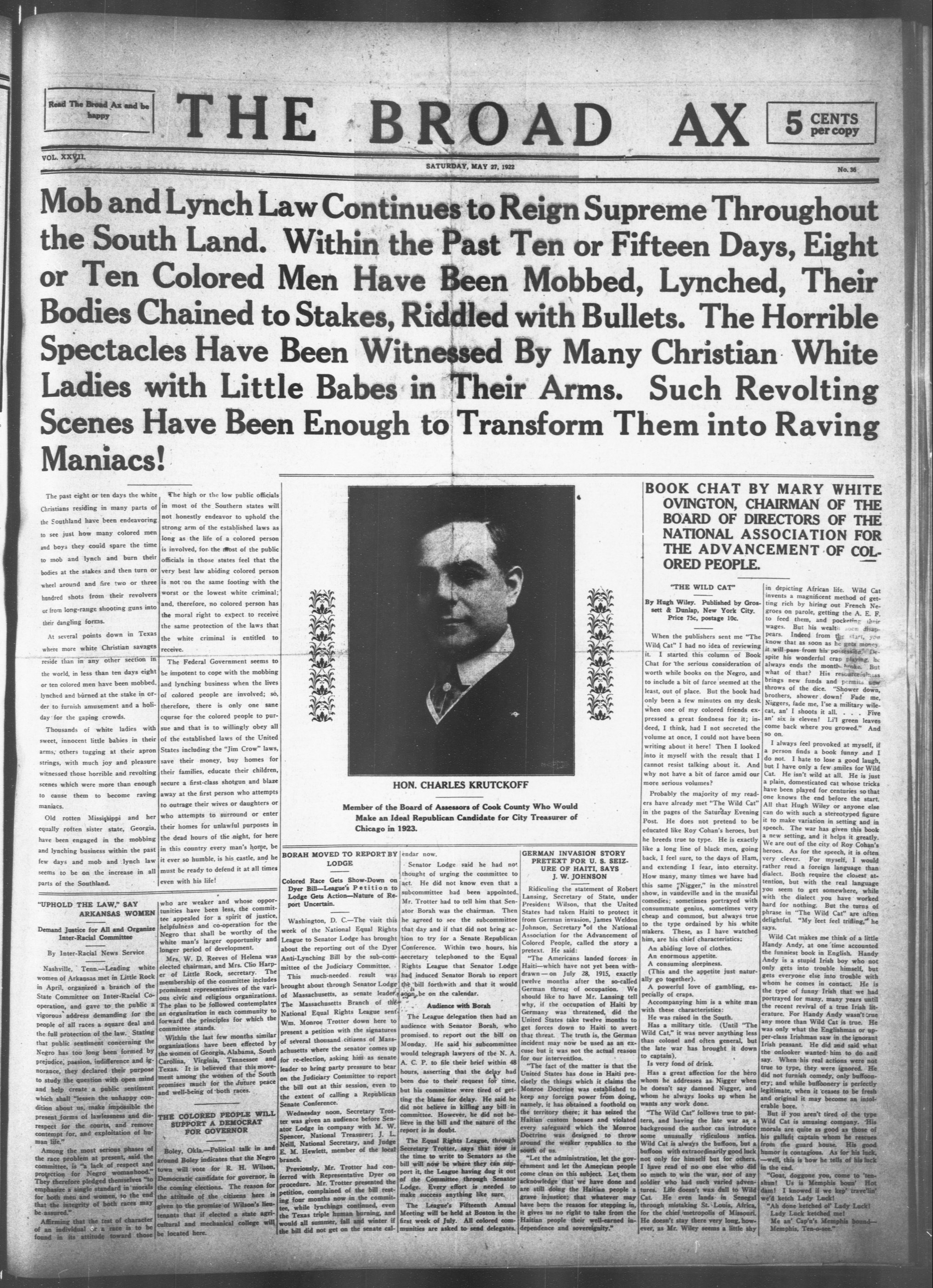
Mob and Lynch Law Continues to Reign Supreme Throughout the South Land. Within the Past Ten or Fifteen Days, Eight or Ten Colored Men Have Been Mobbed, Lynched, Their Bodies Chained to Stakes, Riddled with Bullets. The Horrible Spectacles Have Been Witnessed By Many Christian White Ladies with Little Babes in Their Arms. Such Revolting Scenes Have Been Enough to Transform Them into Raving Maniacs!
Read The Broad Ax and be happy
VOL. XXVII. Mob and the South or Ten Bodies C Spectacle Ladies w Scenes H Maniacs
The past eight or ten days the white Christians residing in many parts of the Southland have been endeavoring to see just how many colored men and boys they could spare the time to mob and lynch and burn their bodies at the stakes and then turn or wheel around and fire two or three hundred shots from their revolvers or from long-range shooting guns into their dangling forms.
At several points down in Texas where more white Christian savages reside than in any other section in the world, in less than ten days eight or ten colored men have been mobbed, lynched and burned at the stake in order to furnish amusement and a holiday for the gaping crowds.
Thousands of white ladies with sweet, innocent little babies in their arms; others tugging at their apron strings, with much joy and pleasure witnessed those horrible and revolting scenes which were more than enough to cause them to become raving maniacs.
Old rotten Mississippi and her equally rotten sister state, Georgia, have been engaged in the mobbing and lynching business within the past few days and mob and lynch law seems to be on the increase in all parts of the Southland.
"UPHOLD THE LAW," SAY
ARKANSAS WOMEN
Demand Justice for All and Organize Inter-Racial Committee
By Inter-Racial News Service
Nashville, Tenn—Leading white women of Arkansas met in Little Rock in April, organized a branch of the State Committee on Inter-Racial Cooperation, and gave to the public a vigorous address demanding for the people of all races a square deal and the full protection of the law. Stating that public sentiment concerning the Negro has too long been formed by prejudice, passion, indifference and ignorance, they declared their purpose to study the question with open mind and help create a public sentiment which shall "lessen the unhappy condition about us, make impossible the present forms of lawlessness and disrespect for the courts, and remove contempt for, and exploitation of human life."
Among the most serious phases of the race problem at present, said the committee, is "a lack of respect and protection for Negro womanhood." They therefore pledged themselves "to emphasize a single standard in morals for both men and women, to the end that the integrity of both races may be assured."
Affirming that the test of character of an individual or a race is to be found in its attitude toward those
The high or the low public officials in most of the Southern states will not honestly endeavor to uphold the strong arm of the established laws as long as the life of a colored person is involved, for the most of the public officials in those states feel that the very best law abiding colored person is not on the same footing with the worst or the lowest white criminal; and, therefore, no colored person has the moral right to expect to receive the same protection of the laws that the white criminal is entitled to receive.
The Federal Government seems to be impotent to cope with the mobbing and lynching business when the lives of colored people are involved; so, therefore, there is only one sane course for the colored people to pursue and that is to willingly obey all of the established laws of the United States including the "Jim Crow" laws, save their money, buy homes for their families, educate their children, secure a first-class shotgun and blaze away at the first person who attempts to outrage their wives or daughters or who attempts to surround or enter their homes for unlawful purposes in the dead hours of the night, for here in this country every man's home, be it ever so humble, is his castle, and he must be ready to defend it at all times even with his life!
who are weaker and whose opportunities have been less, the committee appealed for a spirit of justice, helpfulness and co-operation for the Negro that shall be worthy of the white man's larger opportunity and longer period of development.
Mrs. W. W. D. Reeves of Helena was elected chairman, and Mrs. Clio Harper of Little Rock, secretary. The membership of the committee includes prominent representatives of the various civic and religious organizations. The plan to be followed contemplates an organization in each community to forward the principles for which the committee stands.
Within the last few months similar organizations have been effected by the women of Georgia, Alabama, South Carolina, Virginia, Tennessee and Texas. It is believed that this movement among the women of the South promises much for the future peace and well-being of both races.
THE COLORED PEOPLE WILL
SUPPORT A DEMOCRAT
FOR GOVERNOR
Boley, Okla.-Political talk in and around Boley indicates that the Negro town will vote for R. H. Wilson, Democratic candidate for governor, in the coming elections. The reason for the attitude of the citizens here is given to the promise of Wilson's lieutenants that if elected a state agricultural and mechanical college will be located here.
1918
Member of the Board of Assessors of Cook County Who Would Make an Ideal Republican Candidate for City Treasurer of Chicago in 1923.
```markdown
```
Colored Race Gets Show-Down on Dyer Bill—League's Petition to Lodge Gets Action—Nature of Report Uncertain.
Washington, D. C.—The visit this week of the National Equal Rights League to Senator Lodge has brought about the reporting out of the Dyer Anti-Lynching Bill by the sub-committee of the Judiciary Committee.
This much-needed result was brought about through Senator Lodge of Massachusetts, as senate leader, The Massachusetts Branch of the National Equal Rights League sent Wm. Monroe Trotter down here to present a petition with the signatures of several thousand citizens of Massachusetts where the senator comes up for re-election, asking him as senate leader to bring party pressure to bear on the Judiciary Committee to report the bill out at this session, even to the extent of calling a Republican Senate Conference.
Wednesday noon, Secretary Trotter was given an audience before Senator Lodge in company with M. W. Spencer, National Treasurer; J. L. Neill, National Secretary, and Judge E. M. Hewlett, member of the local branch. Previously, Mr. Trotter had conferred with Representative Dyer on procedure. Mr. Trotter presented the petition, complained of the bill resting four months now in the committee, while lynchings continued, even the Texas triple human burning, and would all summer, fall and winter if the bill did not get on the senate cal-
SATURDAY, MAY 27, 1922
inues to Re
the Past T
ve Been L
, Riddled w
itnessed B
s in Their
h to Trans
HON. CHARLES KRUTCKOFF
The Board of Assessors of Cook County
Ideal Republican Candidate for City
in 1923.
endar now.
Senator Lodge said he had not
thought of urging the committee to
act. He did not know even that a
subcommittee had been appointed.
Mr. Trotter had to tell him that Sen-
ator Borah was the chairman. Then
he agreed to see the subcommittee
that day and if that did not bring ac-
tion to try for a Senate Republican
Conference. Within two hours, his
secretary telephoned to the Equal
Rights League that Senator Lodge
had induced Senator Borah to report
the bill forthwith and that it would
soon be on the calendar.
Audience with Borah
The League delegation then had an audience with Senator Borah, who promised, to report out the bill on Monday. He said his subcommittee would telegraph lawyers of the N. A. A. C. P. to file their brief within 48 hours, asserting that the delay had been due to their request for time, but his committee were tired of getting the blame for delay. He said he did not believe in killing any bill in committee. However, he did not believe in the bill and the nature of the report is in doubt.
The Equal Rights League, through Secretary Trotter, says that now is the time to write to Senators as the bill will now be where they can support it, the League having dug it out of the Committee, through Senator Lodge. Every effort is needed to make success anything like sure.
The League's Fifteenth Annual Meeting will be held at Boston in the first week of July. All colored communities are asked to send delegates.
```markdown
```
GERMAN INVASION STORY
PRETEXT FOR U. S. SEIZ
Ridiculing the statement of Robert Lansing, Secretary of State, under President Wilson, that the United States had taken Haiti to protect it from German invasion, James Weldon Johnson, Secretary of the National Association for the Advancement of Colored People, called the story a pretext. He said:
"The Americans landed forces in Haiti—which have not yet been withdrawn—on July 28, 1915, exactly twelve months after the so-called German threat of occupation. We should like to have Mr. Lansing tell why, if the occupation of Haiti by Germany was threatened, did the United States take twelve months to get forces down to Haiti to avert that threat. The truth is, the German incident may now be used as an excuse but it was not the actual reason for our intervention.
"The fact of the matter is that the United States has done in Haiti precisely the things which it claims the Monroe Doctrine was established to keep any foreign power from doing, namely, it has obtained a foothold on the territory there; it has seized the Haitian custom houses and violated every safeguard which the Monroe Doctrine was designed to throw around the weaker republics to the south of us.
"Let the administration, let the government and let the American people come clean on this subject. Let them acknowledge that we have done and are still doing the Haitian people a grave injustice; that whatever may have been the reason for stepping in, it gives us no right to take from the Haitian people their well-earned independence and sovereignty."
BOOK CHAT BY MARY WHITE OVINGTON, CHAIRMAN OF THE BOARD OF DIRECTORS OF THE NATIONAL ASSOCIATION FOR THE ADVANCEMENT OF COL-ORED PEOPLE.
"THE WILD CAT"
By Hugh Wiley. Published by Grosset & Dunlap, New York City. Price 75c, postage 10c.
in depicting African life. Wild Cat invents a magnificent method of getting rich by hiring out French Negroes on parole, getting the A. E. F. to feed them, and pocketing their
When the publishers sent me "The Wild Cat" I had no idea of reviewing it. I started this column of Book Chat for the serious consideration of worth while books on the Negro, and to include a bit of farce seemed at the least, out of place. But the book had only been a few minutes on my desk when one of my colored friends expressed a great fondness for it; indeed, I think, had I not secreted the volume at once, I could not have been writing about it here! Then I looked into it myself with the result that I cannot resist talking about it. And why not have a bit of farce amid our more serious volumes?
Probably the majority of my readers have already met "The Wild Cat" in the pages of the Saturday Evening Post. He does not pretend to be educated like Roy Cohan's heroes, but he breeds true to type. He is exactly like a long line of black men, going back, I feel sure, to the days of Ham, and extending I fear, into eternity. How many, many times we have had this same "Nigger," in the minstrel show, in vaudeville and in the musical comedies; sometimes portrayed with consummate genius, sometimes very cheap and common, but always true to the type ordained by his white makers. These, as I have watched him, are his chief characteristics:
Accompanying him is a white man with these characteristics:
He was raised in the South.
Has a military title. (Until "The Wild Cat," it was never anything less than colonel and often general, but the late war has brought it down to captain).
Is very fond of drink.
Has a great affection for the hero whom he addresses as Nigger when he doesn't say damned Nigger, and whom he always looks up when he wants any work done.
"The Wild Cat" follows true to pattern, and having the late war as a background the author can introduce some unusually ridiculous antics. Wild Cat is always the buffoon, but a buffoon with extraordinarily good luck not only for himself but for others.
I have read of no one else who did so much to win the war, nor of any soldier who had such varied adventures. Life doesn't wail dull to Wild Cat. He even lands in Senegal through mistaking St. Louis, Africa, for the chief 'metropolis of Missouri. He doesn't stay there very long, however, as Mr. Wiley seems a little shy
5 CENTS per copy
roughout
days, Eight
ed, Their
Horrible
in White
revolting
to Raving
BY MARY WHITE
HAIRMAN OF THE
RECTORS OF THE
ASSOCIATION FOR
ACEMENT OF COL-
in depicting African life. Wild Cat invents a magnificent method of getting rich by hiring out French Negroes on parole, getting the A. E. F. to feed them, and pocketing their wages. But his wealth soon disappears. Indeed from the start, you know that as as soon as he gets money, it will pass from his possession. Despite his wonderful crap playing, he always ends the month broke. But what of that? His resourcefulness brings new funds and permits new throws of the dice. "Shower down, brothers, shower down!" Fade me, Niggers, fade me, l'e a military wilecat, an' I shoots it all. . . . Five an' six is eleven! Lil' green leaves come back where you growed." And so on.
I always feel provoked at myself, if a person finds a book funny and I do not. I hate to lose a good laugh, but I have only a few smiles for Wild Cat. He isn't wild at all. He is just a plain, domesticated cat whose tricks have been played for centuries so that one knows the end before the start. All that Hugh Wiley or anyone else can do with such a stereotyped figure it to make variation in setting and in speech. The war has given this book a new setting, and it helps it greatly. We are out of the city of Roy Cohan's heroes. As for the speech, it is often very clever. For myself, I would rather read a foreign language than dialect. Both require the closest attention, but with the real language you seem to get somewhere, while with the dialect you have worked hard for nothing. But the turns of phrase in "The Wild Cat" are often delightful. "My feet feel trifling," he says.
Wild Cat makes me think of a little Handy Andy, at one time accounted the funniest book in English. Handy Andy is a stupid Irish boy who not only gets into trouble himself, but gets everyone else into trouble with whom he comes in contact. He is the type of funny Irish that we had portrayed for many, many years until the recent revival of a true Irish literature. For Handy Andy wasn't true any more than Wild Cat is true. He was only what the Englishman or upper-class Irishman saw in the ignorant Irish peasant. He did and said what the onlooker wanted him to do and say. When his real actions were not true to type, they were ignored. He did not furnish comedy, only buffoonery; and while buffoonery is perfectly legitimate, when it ceases to be fresh and original it may become an intolerable bore.
But if you aren't tired of the type Wild Cat is amusing company. "His morals are quite as good as those of his gallaf captain whom he rescues from the guard house. His good humor is contagious. As for his luck,—well, this is how he tells of his luck in the end.
"Goat, doggone you, come to 'tenshun! Us is Memphis boun! Hot dam! I knew if we kept 'travel'in we'd ketch Lady Luck!
"Ah done ketched ol' Lady Luck! Lady Luck ketched me! Me an' Cap'n's Memphis bound— Memphis, Ten-o-see."
THE BROAD AX
In this city since July 15th, 1899, without missing one single issue. Republicans, Democrats, Catholics, Protestants, Single Taxers, Priests, infidels or anyone else can have their say as long as their language is proper and responsibility is fixed.
The Broad Ax is a newspaper whose platform is broad enough for all, ever claiming the editorial right to speak its own mind.
Local communications will receive attention. Write only on one side of the paper.
Advertising rates made known on application.
Address all communication to ...
THE BROAD AX
6206 So. Elizabeth St., Chicago, Ill.
Phone Wentworth 2597
JULIUS F. TAYLOR
Editor and Publisher
Associate Editor
DR. M. A. MAJORS
4700 South State Street
Phone Drexel 1416
May 27, 1922
Vol. XXVII. No. 36
Entered as Second-Class Matter, Aug
19, 1902, at the Post Office at Chicago
II. Under Act of March 8, 1879.
MEMORIAL DAY
Memorial Day, May 30, will be observed as a state-wide tribute to the American war dead. Last Tuesday Governor Small issued a proclamation calling upon all communities of the state to observe Memorial Day with appropriate ceremonies. The proclamation: "It is our great privilege at an appointed time each year to join in a national tribute of gratitude and affection to our soldier and sailor dead. The blue-clad heroes of the Civil War, soldiers and sailors of the war with Spain and men of the great armies of the American Expeditionary Force lie in honored graves at home and abroad. They gave their services and their lives for a united country, for humanity, for civilization. We mourn the valiant dead and deplore the great crisis in our national life which required of them the last full measure of devotion; but we have a great national pride in their bravery and patriotism which have preserved to us intact the heritage of free institutions handed down by our fathers to be held as a sacred trust for our children and their children. Their gallant deeds on land and sea have ever maintained unsullied the honor of our great American nation. Their hands have borne aloft and raised high in the heavens our starry banner of freedom as a symbol of courage, purity and justice, and as a promise of liberty to the oppressed people of the earth."
"Whereas, the laws of Illinois provide for the observance of the 30th day of May as a holiday:
"Now, therefore, I, Len Small, governor of Illinois, do hereby appoint and designate Tuesday, the 30th day of May, 1922, to be celebrated throughout the state as Memorial Day, and I ask the co-operation of the people of Illinois with the Grand Army of the Republic, the United Spanish War Veterans, the American Legion, the Veterans of Foreign Wars and their allied organizations in an appropriate observance of the day by garlanding with flowers and decorating with flags the graves of soldiers and sailors; and I further ask that in all communities there be held public memorial services and patriotic exercises in honor of our heroic dead."
THE FORTY-FIRST ANNIVERSARY EXERCISES OF THE TUSKEGEE INSTITUTE, ALABAMA
The writer has been honored with an invitation by the officials of the Tuskegee Institute, Alabama, to attend the Forty-first Anniversary exercises of that far famed institution which began on Monday, May 21, and continued each day up until Thursday evening, May 25.
Dr. Hamilton Holt of New York City preached the commencement sermon and President John M. Gandy, Virginia Normal and Industrial Institute, Petersburg, Va., delivered the annual commencement address.
MISS BAXTER VISITS FRIENDS
Miss Alice Baxter, 420 E. 48th Place, spent several days during the past week with friends at Lake Forrest, Ill., as well as several other Chicagoans who attended the two days' rummage sale at the First Baptist Church.
ZONING FACTS BOILED DOWN
Zoning is not retroactive. Only time can wipe out the mistakes of the past caused by neglecting to plan the city's growth.
Zoning, to the joy of the child, substitutes green grass for the roofs and cement paving.
Zoning demonstrates in rapidly developing areas the economic advantage of preserving open spaces for the future.
Zoning works both ways; it conserves the good in civic growth and restrains the bad.
Zoning prevents the evils of congestion in the crowded old portions of cities from projecting themselves into the newer and more remote quarters as these are built up.
Zoning recognizes the evils of today and avoids repeating them tomorrow.
Zoning, in a city growing up without planning, affords a starting point for the arrangement of terminals, for the design of streets, for suitable provision for recreation and for other elements of city planning.
Until zoning came, the new parts of a city, under uniform building laws, became as congested as the old; now with graded requirements, the new demonstrates to every observer that the old crowded parts are not fit to live in.
EYESIGHT IS PRECIOUS
Who that hath lost his sight would not give a million dollars, if he had so much money, to have his vision restored? And yet, much of the blindness in this country is due to ignorance and neglect.
Many people whose sight is poor and who have ailing eyes neglect to have given proper medical attention until it is too late for medical skill to save them from becoming blind. It happens not infrequently that eye trouble is not in the eye itself, but is due to other ailments. And again poor eyesight may be the cause of illness in other parts of the body. As is well known, many headaches are due to eyestrain and in all such cases a physician or the oculist should be consulted without delay.
But most important of all, perhaps, is the proper care and conservation of the eyes. This in brief means that we should avoid overtaxing the eyes and that we should not work, read or study in a poor or improperly arranged light. Another important point to be remembered is that the light, whether natural or artificial, should not be bright, dazzling or glaring. In fact too much light is as harmful as too little.
Proper care of the eyes means that they should not be overtaxed; that they should not be used in a dim or failing light, nor subjected to a continuous glare, and that, when they become painful, or seem to be weak, watery or inflamed, a skilled physician should be consulted without delay.
What do you contribute to your community that will help to make it a desirable place in which to live? To what extent do you help to make and keep it clean, tidy and attractive and do you co-operate with your neighbors in every movement that has for its purpose, the betterment of neighborhood conditions? Get in touch with the spirit of the times and do your part in making your community a better place to live in this year than it was last.
LILY WHITES IN ORLANDO
FLORIDA
Another attempt to form a "Lilly White" Republican Party in Florida is being made here by the circulation of petitions, on which is printed a "Declaration of Principles." The new party is to be known as the Independent Republican Party of Florida. The preamble to the "Declaration" reads as follows:
"Whereas, the basic theory of our government is predicated upon the existence of two or more active political parties, each differing from the other only in the ways and means for securing the greatest good to the greatest number of people, and
"Whereas, the present political conditions in Florida render it impossible for the existing political parties to function in the manner intended by the framers of the Constitution, and
"Whereas, it is believed that these conditions can be remedied through the formation of an Independent Republican Party, which, while adhering to the great principles of Republicanism and conceding to all people their full rights under the Constitution, will declare its unalterable opposition to the election, or selection, of any person to public office; or, position of public trust, in the State of Florida, who is not a white American citizen."
After these "whereases" follows the "therefore" that the undersigned voters associate themselves to form the Independent Republican Party of Florida.
CHICAGO, ILL., SATURDAY, MAY 27, 1922
One of the He
14th Ward
Enter the R
M. J.
M. H.
of the Head Wheel Horses of the City Coun 14th Ward Who May Be Induced by His Man Enter the Race for City Treasurer of Chicago in
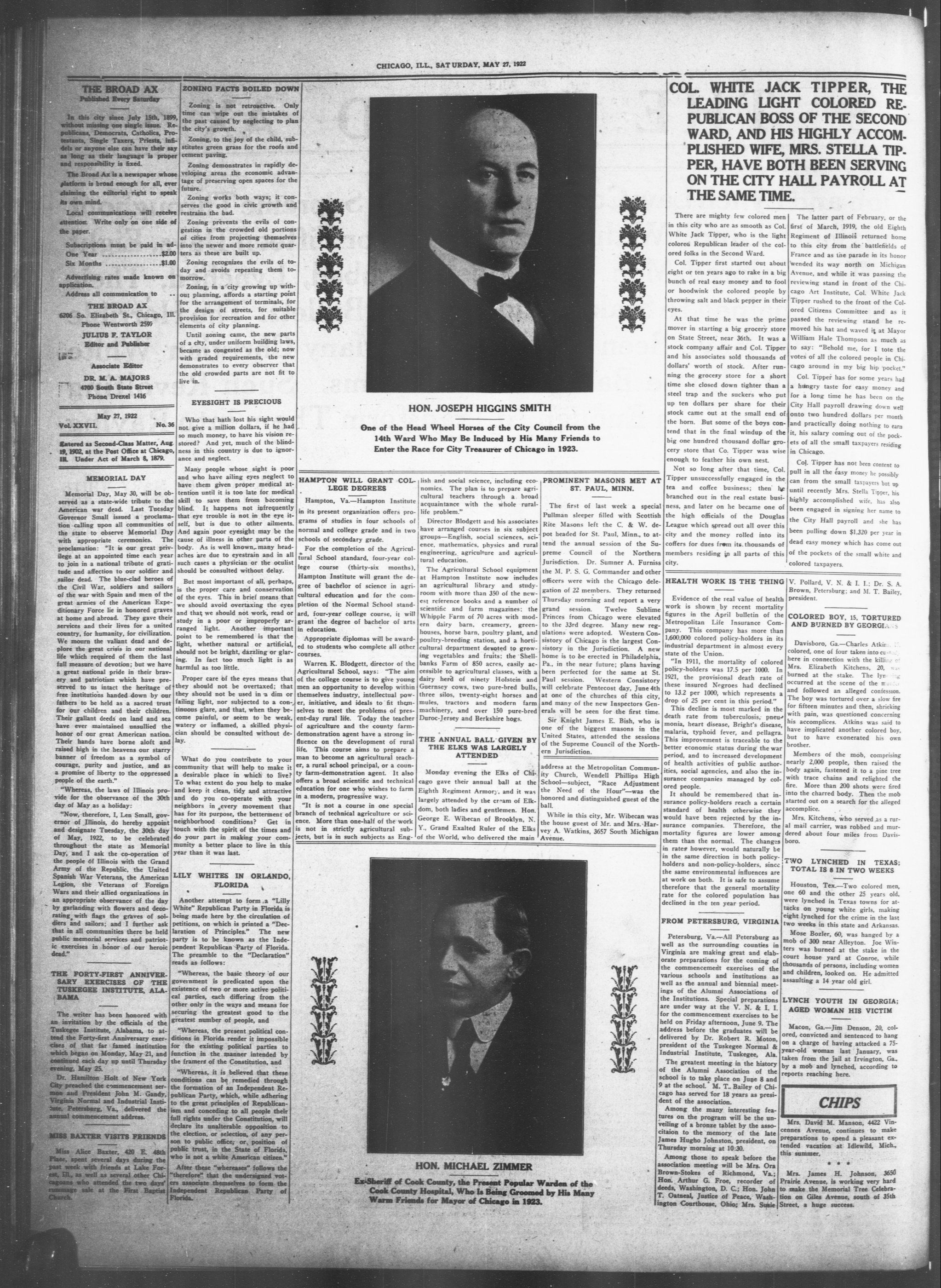
One of the Head Wheel Horses of the City Council from the 14th Ward Who May Be Induced by His Many Friends to Enter the Race for City Treasurer of Chicago in 1923.
HAMPTON WILL GRANT COL
LEGE DEGREES
Hampton, Va.—Hampton Institute in its present organization offers programs of studies in four schools of normal and college grade and in two schools of secondary grade.
For the completion of the Agricultural School standard, four-year college course (thirty-six months), Hampton Institute will grant the degree of bachelor of science in agricultural education and for the completion of the Normal School standard, four-year college course, it will grant the degree of bachelor of arts in education.
Appropriate diplomas will be awarded to students who complete all other courses.
Warren K. Blodgett, director of the Agricultural School, says: "The aim of the college course is to give young men an opportunity to develop within themselves industry, intellectual power, initiative, and ideals to fit themselves to meet the problems of present-day rural life. Today the teacher of agriculture and the county farm-demonstration agent have a strong influence on the development of rural life. This course aims to prepare a man to become an agricultural teacher, a rural school principal, or a county farm-demonstration agent. It also offers a broad scientific and technical education for one who wishes to farm in a modern, progressive way.
"It is not a course in one special branch of technical agriculture or science. More than one-half of the work is not in strictly agricultural subjects, but is in such subjects as Eng-
---
1920
[Name not visible in the image]
Superiff of Cook County, the Present Popular War Cook County Hospital, Who Is Being Groomed by Warm Friends for Mayor of Chicago in 1923.
Ex-Sheriff of Cook County, the Present Popular Warden of the Cook County Hospital, Who Is Being Groomed by His Many Warm Friends for Mayor of Chicago in 1923.
```markdown
```
HON. JOSEPH HIGGINS SMITH
lish and social science, including economics. The plan is to prepare agricultural teachers through a broad acquaintance with the whole rural-life problem."
Director Blodgett and his associates have arranged courses in six subject groups—English, social sciences, science, mathematics, physics and rural engineering, agriculture and agricultural education.
The Agricultural School equipment at Hampton Institute now includes an agricultural library and studyroom with more than 350 of the newest reference books and a number of scientific and farm magazines; the Whipple Farm of 70 acres with modern dairy barn, cremery, greenhouses, horse barn, poultry plant, and poultry-breeding station, and a horticultural department devoted to growing vegetables and fruits; the Shellbanks Farm of 850 acres, easily accessible to agricultural classes, with a dairy herd of ninety Holstein and Guernsey cows, two pure-bred bulls, three silos, twenty-eight horses and mules, tractors and modern farm machinery, and over 150 pure-bred Duroc-Jersey and Berkshire hogs.
THE ANNUAL BALL GIVEN BY THE ELKS WAS LARGELY ATTENDED
Monday evening the Elks of Chicago gave their annual ball at the Eighth Regiment Armory, and it was largely attended by the cream of Elkdom, both ladies and gentlemen. Hon George E. Wibecan of Brooklyn, N. Y., Grand Exalted Ruler of the Elks of the World, who delivered the main
HON. MICHAEL ZIMMER
```markdown
```
PROMINENT MASONS MET AT
ST. PAUL, MINN.
The first of last week a special Pullman sleeper filled with Scottish Rite Masons left the C. & W. dep headed for St. Paul, Minn., to attend the annual session of the Supreme Council of the Northern Jurisdiction. Dr. Sumner A. Furniss the M. P. S. G. Commander and other officers were with the Chicago delegation of 22 members. They returned Thursday morning and report a very grand session. Twelve Sublime Princes from Chicago were elevated to the 33rd degree. Many new regulations were adopted. Western Consistory of Chicago is the largest Consistory in the Jurisdiction. A new home is to be erected in Philadelphia, Pa., in the near future; plans having been perfected for the same at St. Paul session. Western Consistory will celebrate Pentecost day, June 4th at one of the churches of this city, and many of the new Inspectors Generals will be seen for the first time.
Sir Knight James E. Bish, who is one of the biggest masons in the United States, attended the sessions of the Supreme Council of the Northern Jurisdiction.
address at the Metropolitan Community Church, Wendell Phillips High School—subject, "Race Adjustment the Need of the Hour"—was the honored and distinguished guest of the ball.
While in this city, Mr. Wibecan was the house guest of Mr. and Mrs. Harvey A. Watkins, 3657 South Michigan Avenue.
```markdown
```
COL. WHITE JACK TIPPER, THE LEADING LIGHT COLORED REPUBLICAN BOSS OF THE SECOND WARD, AND HIS HIGHLY ACCOMPLISHED WIFE, MRS. STELLA TIPPER, HAVE BOTH BEEN SERVING ON THE CITY HALL PAYROLL AT THE SAME TIME.
There are mighty few colored men in this city who are as smooth as Col. White Jack Tipper, who is the light colored Republican leader of the colored folks in the Second Ward.
Col. Tipper first started out about eight or ten years ago to rake in a big bunch of real easy money and to fool or hoodwink the colored people by throwing salt and black pepper in their eyes.
At that time he was the prime mover in starting a big grocery store on State Street, near 36th. It was a stock company affair and Col. Tipper and his associates sold thousands of dollars' worth of stock. After running the grocery store for a short time she closed down tighter than a steel trap and the suckers who put up ten dollars per share for their stock came out at the small end of the horn. But some of the boys contend that in the final windup of the big one hundred thousand dollar grocery store that Co. Tipper was wise enough to feather his own nest.
Not so long after that time, Col. Tipper unsuccessfully engaged in the tea and coffee business; then he branched out in the real estate business, and later on he became one of the high officials of the Douglas League which spread out all over this city and the money rolled into its coffers for dues from its thousands of members residing in all parts of this city.
HEALTH WORK IS THE THING
Evidence of the real value of health work is shown by recent mortality figures in the April bulletin of the Metropolitan Life Insurance Company. This company has more than 1,600,000 colored policy-holders in its industrial department in almost every state of the Union.
"In 1911, the mortality of colored policy-holders was 17.5 per 1000. In 1921, the provisional death rate of these insured Negroes had declined to 13.2 per 1000, which represents a drop of 25 per cent in this period."
This decline is most marked in the death rate from tuberculosis; pneumonia, heart disease, Bright's disease, malaria, typhoid fever, and pellagra This improvement is traceable to the better economic status during the war period, and to increased development of health activities of public authorities, social agencies, and also the insurance companies managed by colored people.
It should be remembered that insurance policy-holders reach a certain standard of health otherwise they would have been rejected by the insurance companies. Therefore, the mortality figures are lower among them than the normal. The changes in rates however, would naturally be in the same direction in both policy-holders and non-policy-holders, since the same environmental influences are at work on both. It is safe to assume therefore that the general mortality rate for the colored population has declined in the ten year period.
FROM PETERSBURG, VIRGINIA
Petersburg, Va.—All Petersburg as well as the surrounding counties in Virginia are making great and elaborate preparations for the coming of the commencement exercises of the various schools and institutions as well as the annual and biennial meetings of the Alumni Associations of the Institutions. Special preparations are under way at the V. N. & I. I. for the commencement exercises to be held on Friday afternoon, June 9. The address before the graduates will be delivered by Dr. Robert R. Motton, president of the Tuskegee Normal & Industrial Institute, Tuskegee, Ala.
The greatest meeting in the history of the Alumni Association of the school is to take place on June 8 and 9 at the school'. M. T. Bailey of Chicago has served for 18 years as president of the association.
Among the many interesting features on the program will be the unveiling of a bronze tablet by the association to the memory of the late James Hugho Johnston, president, on Thursday morning at 10:30.
Among those to speak before the association meeting will be Mrs. Ora Brown-Stokes of Richmond, Va.; Hon. Arthur G. Froe, recorder of deeds, Washington, D. C.; Hon. John T. Oatmeal, Justice of Peace, Washington Courthouse, Ohio; Mrs. Susie
The latter part of February, or the first of March, 1919, the old Eighth Regiment of Illinois returned home to this city from the battlefields of France and as the parade in its honor wended its way north on Michigan Avenue, and while it was passing the reviewing stand in front of the Chicago Art Institute, Col. White Jack Tipper rushed to the front of the Colored Citizens Committee and as it passed the reviewing stand he removed his hat and waved it at Mayor William Hale Thompson as much as to say: "Behold me, for I tote the votes of all the colored people in Chicago around in my big hip pocket." Col. Tipper has for some years had a hungry taste for easy money and for a long time he has been on the City Hall payroll drawing down well onto two hundred dollars per month and practically doing nothing to earn it, his salary coming out of the pockets of all the small taxpayers residing in Chicago.
Col. Tipper has not been content to pull in all the easy money he possibly can from the small taxpayers but up until recently Mrs. Stella Tipper, his highly accomplished wife, has also been engaged in signing her name to the City Hall payroll and she has been pulling down $1,320 per year in dead easy money which has come out of the pockets of the small white and colored taxpayers.
V. Pollard, V. N. & I. I.; Dr. S. A. Brown, Petersburg; and M. T. Bailey, president.
COLORED BOY, 15, TORTURED AND BURNED BY GEORGIA
Davisboro, Ga.—Charles Atkins. K-colored, one of four taken into custody in connection with the killing of Mrs. Elizabeth Kitchens, 20, was burned at the stake. The lynching occurred at the scene of the murder and followed an alleged confession. The boy was tortured over a slow fire for fifteen minutes and then, shrieking with pain, was questioned concerning his accomplices. Atkins was said to have implicated another colored boy, but to have exonerated his own brother.
Members of the mob, comprising nearly 2,000 people, then raised the body again, fastened it to a pine tree with trace chains and relighted the fire. More than 200 shots were fired into the charred body. Then the mob started out on a search for the alleged accomplice.
Mrs. Kitchens, who served as a rural mail carrier, was robbed and murdered about four miles from Davisboro.
TWO LYNCHED IN TEXAS;
TOTAL IS 8 IN TWO WEEKS
Houston, Tex.—Two colored men, one 60 and the other 25 years old, were lynched in Texas towns for attacks on young white girls, making eight lynched for the crime in the last two weeks in this state and Arkansas.
Mose Bozler, 60, was hanged by a mob of 300 near Alleyton. Joe Winters was burned at the stake in the court house yard at Conroe, while thousands of persons, including women and children, looked on. He admitted assaulting a 14 year old girl.
LYNCH YOUTH IN GEORGIA;
AGED WOMAN HIS VICTIM
Macon, Ga.—Jim Denson, 20, colored, convicted and sentenced to hang on a charge of having attacked a 75-year-old woman last January, was taken from the jail at Irvington, Ga. by a mob and lynched, according to reports reaching here.
CHIPS
Mrs. David M. Manson, 4422 Vincentennes Avenue, continues to make preparations to spend a pleasant extended vacation at Idlewild, Mich., this summer.
* * *
Mrs. James H. Johnson, 3650 Prairie Avenue, is working very hard to make the Memorial Tree Celebration on Giles Avenue, south of 35th Street, a huge success.
[Name]
DOCTOR JAMES M. HALL
Assistant Secretary of North S
Medical Examiner for the,
Has Removed His Office to 4
DR. JAMES M. HALL REMOVES
HIS OFFICE FROM 4545 S
WABASH AVENUE TO 4406 S
STATE STREET
The first of this month Dr. James
M. Hall, who is fast forging his way
to the front in this city, removed his
office from 4545 S. Wabash Avenue to
4406 S. State Street, where he will be
pleased to meet his many friends and
patients. Office phone Drexel 7074
Residence, 4330 Calumet Avenue,
Phone Oakland 7174J.
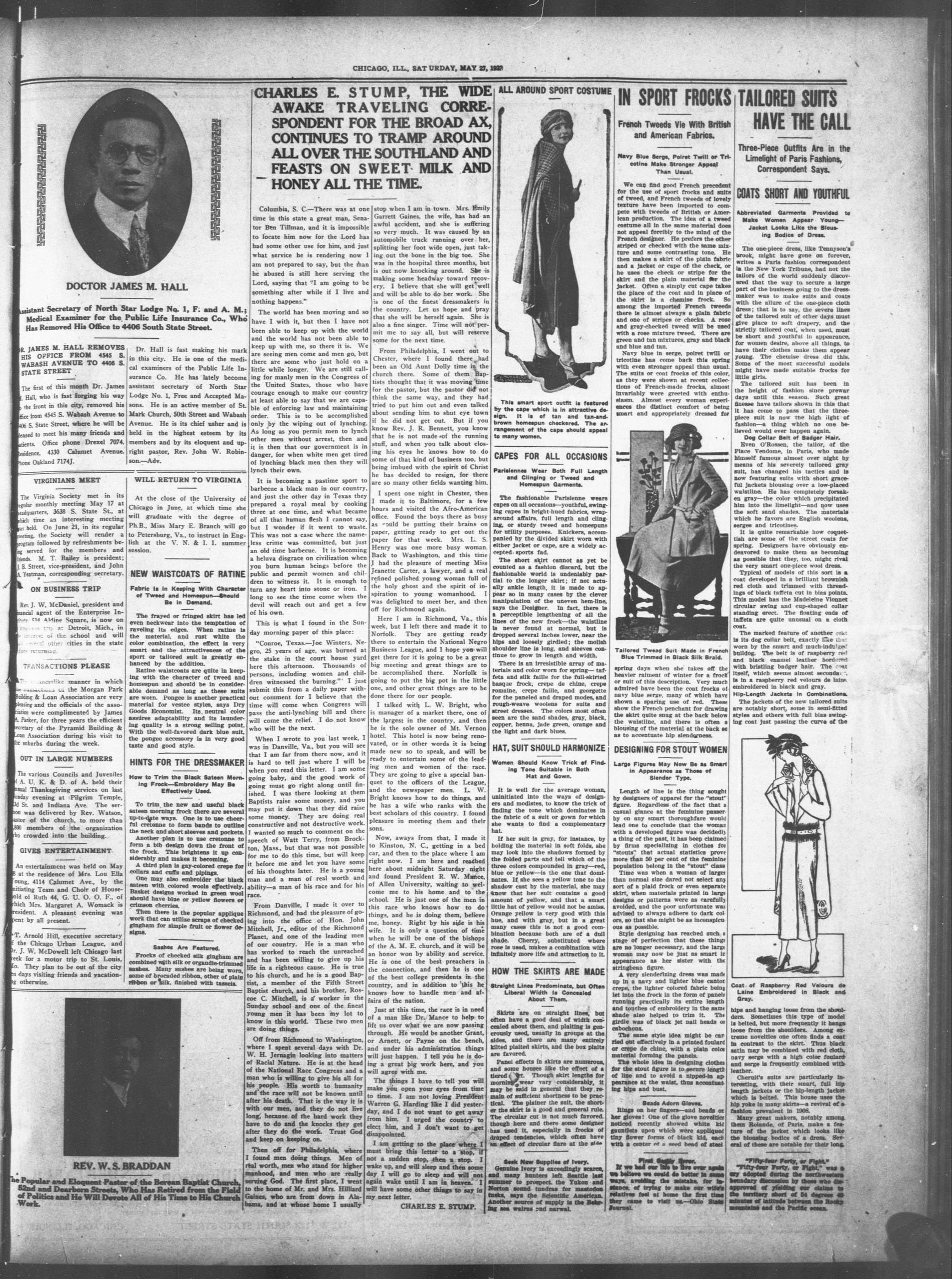
Assistant Secretary of North Star Lodge No. 1, F: and A. M.; Medical Examiner for the Public Life Insurance Co., Who Has Removed His Office to 4406 South State Street.
DR. JAMES M. HALL REMOVES HIS OFFICE FROM 4545 S. WABASH AVENUE TO 4406 S. STATE STREET
The first of this month Dr. James M. Hall, who is fast forging his way to the front in this city, removed his office from 4545 S. Wabash Avenue to 406 S. State Street, where he will be pleased to meet his many friends and patients. Office phone Drexel 7074. Residence, 4330 Calumet Avenue. Phone Oakland 7174J.
Dr. Hall is fast making his mark in this city. He is one of the medical examiners of the Public Life Insurance Co. He has lately become assistant secretary of North Star Lodge No. 1, Free and Accepted Masons. He is an active member of St. Mark Church, 50th Street and Wabash Avenue. He is its chief usher and is held in the highest esteem by its members and by its eloquent and upright pastor, Rev. John W. Robinson.—Adv.
VIRGINIANS MEET
The Virginia Society met in its regular monthly meeting May 17 at headquarters, 3638 S. State St., at which time an interesting meeting was held. On June 21, in its regular meeting, the Society will render a program followed by refreshments being served for the members and friends. M. T. Bailey is president; J.B. Street, vice-president, and John A. Yeatman, corresponding secretary.
ON BUSINESS TRIP
Rev. J. W, McDaniel, president and financial agent of the Enterprise Institute 534 Aldine Square, is now on business trip at Detroit, Mich., in interest of the school and will travel other cities in the state for returning.
TRANSACTIONS PLEASE
Themes like manner in which the transactions of the Morgan Park Building & Loan Association are very pleasing and the officials of the association were complimented by James A. Parker, for three years the efficient secretary of the Pyramid Building & Loan Association during his visit to the suburbs during the week.
OUT IN LARGE NUMBERS
The various Councils and Juveniles of A. U. K. & D. of A. held their Annual Thanksgiving services on last Sunday evening at Pilgrim Temple, Gd St. and Indiana Ave. The sermon was delivered by Rev. Watson, pastor of the church, to more than 800 members of the organization who crowded into the building.
GIVES ENTERTAINMENT
An entertainment was held on May 8 at the residence of Mrs. Lou Ella Young, 4114 Calumet Ave., by the initiating Team and Choir of Household of Ruth 44, G. U. O. O. F., of which Mrs. Margaret A. Womack is president. A pleasant evening was spent by all present.
*T. Arnold Hill, executive secretary of the Chicago Urban League, and Dr. J. W. McDowell left Chicago last week for a motor trip to St. Louis, Mo. They plan to be out of the city ten days visiting friends and vacationing otherwise.
REV. W. S. BRADDAN
The Popular and Eloquent Pastor 52nd and Dearborn Streets, W of Politics and He Will Devote Work.
Popular and Eloquent Pastor of the Borean Baptist Church, 52nd and Dearborn Streets, Who Has Retired from the Field of Politics and He Will Devote All of His Time to His Church Work.
Star Lodge No. 1, F. and A. M.; Public Life Insurance Co., Who 406 South State Street.
Dr. Hall is fast making his mark in this city. He is one of the medical examiners of the Public Life Insurance Co. He has lately become assistant secretary of North Star Lodge No. 1, Free and Accepted Masons. He is an active member of St Mark Church, 50th Street and Wabash Avenue. He is its chief usher and is held in the highest esteem by its members and by its eloquent and upright pastor, Rev. John W. Robinson.—Adv.
WILL RETURN TO VIRGINIA
At the close of the University of Chicago in June, at which time she will graduate with the degree of Ph.B., Miss Mary E. Branch will go to Petersburg, Va., to instruct in English at the V. N. & I. I. summer session.
NEW WAISTCOATS OF RATINE
Fabric is in Keeping With Character of Tweed and Homespun—Should Be in Demand.
The frayed or fringed skirt has led even neckwear to the temptation ofraveling its edges. When ratine is the material, and rust white the color combination, the effect is very smart and the attractiveness of the sport or tailored suit is greatly enhanced by the addition.
Ratine waistcoats are quite in keeping with the character of tweed and homespun and should be in considerable demand as long as these suits are worn. Pongee is another practical material for vestee styles, says Dry Goods Economist. Its neutral color assures adaptability and its laundered quality is a strong selling point. With the well-favored dark blue suit, the pongee accessory is in very good taste and good style.
HINTS FOR THE DRESSMAKER
How to Trim the Black Sateen Morm ing Frock—Embroidery May Be Effectively Used.
To trim the new and useful black sateen morning frock there are several up-to-date ways. One is to use cheerful cretonne to form bands to outline the neck and short sleeves and pockets. Another plan is to use cretonne to form a bib design down the front of the frock. This brightens it up considerably and makes it becoming.
A third plan is gay-colored crepe for collars and cuffs and plipings.
One may also embroider the black sateen with colored wools effectively. Basket designs worked in green wool should have blue or yellow flowers or crimson cherries.
Then there is the popular applique work that can utilize scraps of checked gingham for simple fruit or flower designs.
Sashes Are Featured.
Frocks of checked silk gingham are combined with silk or organdite-trimmed sashes. Many sashes are being worn some of brocaded ribbon, other of plait ribbon or silk, finished with tassels
of the Berean Baptist Church, Who Has Retired from the Field All of His Time to His Church
#
CHARLES E. STUMP, THE WIDE AWAKE TRAVELING CORRESPONDENT FOR THE BROAD AX, CONTINUES TO TRAMP AROUND ALL OVER THE SOUTHLAND AND FEASTS ON SWEET MILK AND HONEY ALL THE TIME.
Columbia, S. C.—There was at one time in this state a great man, Senator Ben Tillman, and it is impossible to locate him now for the Lord has had some other use for him, and just what service he is rendering now I am not prepared to say, but the than he abused is still here serving the Lord, saying that "I am going to be something after while if I live and nothing happens."
The world has been moving and so have I with it, but then I have not been able to keep up with the world and the world has not been able to keep up with me, so there it is. We are seeing men come and men go, but there are some who just hold on a little while longer. We are still calling for manly men in the Congress of the United States, those who have courage enough to make our country at least able to say that we are capable of enforcing law and maintaining order. This is to be accomplished only by the wiping out of lynching. As long as you permit men to lynch other men without arrest, then and it is then that our government is in danger, for when white men get tired of lynching black men then they will lynch their own.
It is becoming a pastime sport to barbecue a black man in our country and just the other day in Texas they prepared a royal meal by cooking three at one time, and what became of all that human flesh I cannot say but I wonder if it went to waste. This was not a case where the nameless crime was committed, but just an old time barbecue. It is becoming a helva disgrace on civilization when you burn human beings before the public and permit women and children to witness it. It is enough to turn any heart into stone or iron. I long to see the time come when the devil will reach out and get a few of his own.
This is what I found in the Sunday morning paper of this place:
"Conroe, Texas.—Joe Winters, Negro, 25 years of age, was burned at the stake in the court house yard here this afternoon. Thousands of persons, including women and children witnessed the burning." I just submit this from a daily paper without comment for I believe that the time will come when Congress will pass the anti-lynching bill and there will come the relief. I do not know who will be the next.
When I wrote to you last week, I was in Danville, Va., but you will see that I am far from there now, and it is hard to tell just where I will be when you read this letter. I am some going baby, and the good work of going must go right along until finished. I was there looking at them Baptists raise some money, and you may put it down that they did raise some money. They are doing real constructive and not destructive work. I wanted so much to comment on the speech of Watt Terry, from Brockton, Mass, but that was not possible for me to do this time, but will keep it before me and let you have some of his thoughts later. He is a young man and a man of real worth and ability—a man of his race and for his race.
From Danville, I made it over to Richmond, and had the pleasure of going into the office of Hon. John Mitchell, Jr., editor of the Richmond Planet, and one of the leading men of our country. He is a man who has worked to reach the unreached and has been willing to give up his life in a righteous cause. He is true to his church, and he is a good Baptist, a member of the Fifth Street Baptist church, and his brother, Roscoe C. Mitchell, is a worker in the Sunday school and one of the finest young men it has been my lot to know in this world. These two men are doing things.
Off from Richmond to Washington, where I spent several days with Dr. W. H. Jernagin looking into matters of Racial Nature. He is at the head of the National Race Congress and a man who is willing to give his all for his people. His worth to humanity and the race will not be known until after his death. That is the way it is with our men, and they do not live long, because of the hard work they have to do and the knocks they get after they do the work. Trust God and keep on keeping on.
Then off for Philadelphia, where I found men doing things. Men of real worth, men who stand for higher manhood, and men who are really serving God. The first place, I went to the home of Mr. and Mrs. Hilliard Gaines, who are from down in Alabama, and at whose home I usually
CHICAGO, ILL., SAT URDAY, MAY 27, 1922
stop when I am in town. Mrs. Emily Garrett Gaines, the wife, has had an awful accident, and she is suffering so very much. It was caused by an automobile truck running over her, splitting her foot wide open, just taking out the bone in the big toe. She was in the hospital three months, but is out now knocking around. She is making some headway toward recovery. I believe that she will get well and will be able to do her work. She is one of the finest dressmakers in the country. Let us hope and pray that she will be herself again. She is also a fine singer. Time will not permit me to say all, but will reserve some for the next time.
From Philadelphia, I went out to Chester, where I found there had been an Old Aunt Dolly time in the church there. Some of them Baptists thought that it was moving time for the pastor, but the pastor did not think the same way, and they had tried to put him out and even talked about sending him to shut eye town if he did not get out. But if you know Rev. J. R. Bennett, you know that he is not made of the running stuff, and when you talk about closing his eyes he knows how to do some of that kind of business too, but being imbued with the spirit of Christ he has decided to resign, for there are so many other fields wanting him,
I spent one night in Chester, then
I made it to Baltimore, for a few
hours and visited the Afro-American
office. Found the boys there as busy
as could be putting their brains on
paper, getting ready to get out the
paper for that week. Mrs. L. S.
Henry was one more busy woman.
Back to Washington, and this time
I had the pleasure of meeting Miss
Jeanette Carter, a lawyer, and a real
refined polished young woman full of
the holy ghost and the spirit of
inspiration to young womanhood. I
was delighted to meet her, and then
off for Richmond again.
Here I am in Richmond, Va., this week, but I left there and made it to Norfolk. They are getting ready there to entertain the National Negro Business League, and I hope you will get there for it is going to be a great big meeting and great things are to be accomplished there. Norfolk is going to put the big pot in the little one, and other great things are to be done there for our people.
I talked with L. W. Bright, who is manager of a market there, one of the largest in the country, and then he is the sole owner of Mt. Vernon hotel. This hotel is now being renovated, or in other words it is being made new so to speak, and will be ready to entertain some of the leading men and women of the race. They are going to give a special banquet to the officers of the League, and the newspaper men. L. W. Bright knows how to do things, and he has a wife who ranks with the best scholars of this country. I found pleasure in meeting them and their sons.
Now, always from that, I made it to Kinston, N. C., getting in a bed car, and then to the place where I am right now. I am here and reached here about midnight Saturday night and found President R. W. Mance, of Allen University, waiting to welcome me to his home and to the school. He is just one of the men in this race who knows how to do things, and he is doing them, believe me, honey. Right by his side is his wife. It is only a question of time when he will be one of the bishops of the A. M. E. church, and it will be an honor won by ability and service. He is one of the best preachers in the connection, and then he is one of the best college presidents in the country, and in addition to this he knows how to handle men and affairs of the nation.
Just at this time, the race is in need of a man like Dr. Mance to help to lift us over what we are now passing through. He would be another Grant, or Arnett, or Payne on the bench, and under his administration things will just happen. I tell you he is doing a great big work here, and you will agree with me.
The things I have to tell you will make you open your eyes from time to time. I am not loving President Warren G. Harding like I did yesterday, and I do not want to get away from him. I urged the country to elect him, and I don't want to get disappointed.
I am getting to the place where I must bring this letter to a stop, if not a sudden stop, then a stop. I wake up, and will sleep and then some day I will go to sleep and will not again wake until I am in heaven. I will have some other things to say in my next letter.
CHARLES E. STUMP.
ALL AROUND SPORT COSTUME
UNDERWARD A LONDON
This smart sport outfit is featured by the cape which is in attractive design. It is of tan and tan-and-brown homespun checkered. The arrangement of the cape should appeal to many women.
CAPES FOR ALL OCCASIONS
Parisiennes Wear Both Full Length and Clinging or Tweed and Homespun Garments.
The fashionable Parisienne wears capes on all occasions—youthful, swinging capes in bright-hued fabrics, wrap-around affairs, full length and clinging, or sturdy tweed and homespun for utility purposes. Knickers, accompanied by the divided skirt worn with either jacket or cape, are a widely accepted sports fad.
The short skirt cannot as yet be counted as a fashion discard, but the fashionable world is undeniably partial to the longer skirt; if not actually ankle length, it is made to appear so in many cases by the clever manipulation of the uneven hem-line, says the Designer. In fact, there is a perceptible lengthening of all the lines of the new frock—the waistline is never found at normal, but is dropped several inches lower, near the hips and loosely girdled; the mollish shoulder line is long, and sleeves continue to grow in length and width.
There is an irresistible array of materials and color worn for spring—tarfeta and silk faille for the full-skirted basque frock, crepe de chine, crepe romaine, crepe faille, and georgette for the paneled and draped modes, and rough-weave woolens for suits and street dresses. The colors most often seen are the sand shades, gray, black, copper, henna, jade green, orange and the light and dark blues.
HAT. SUIT SHOULD HARMONIZE
Women Should Know Trick of Finding Tone Suitable in Both Hat and Gown.
It is well for the average woman, uninitiated into the ways of designers and modistes, to know the trick of finding the tone which dominates in the fabric of a suit or gown for which she wants to find a complementary hat.
If her suit is gray, for instance, by holding the material in soft folds, she may look into the shadows formed by the folded parts and tell which of the three colors compounded in gray-red, blue or yellow—is the one that dominates. If she sees a yellow tone to the shadow cast by the material, she may know that her suit contains a good amount of yellow, and that a smart little hat of yellow would not be amiss.
Orange yellow is very good with this hue, and with gray, but in a great many cases this is not a good combination because both are of a dull shade. Cherry, substituted where rose is used, makes a combination with infinitely more life and attraction to it.
HOW THE SKIRTS ARE MADE
Straight Lines Predominate, but Often Liberal Width Is Concealed About Them.
Skirts are on straight lines, but often have a good deal of width concealed about them, and plaiting is generously used, usually in groups at the sides, and there are many entirely klitted plaited skirts, and the box plaits are favored.
Panel effects in skirts are numerous, and some houses like the effect of a tiered skirt. Though skirt lengths for morning wear vary considerably, it may be said in general that they remain of sufficient shortness to be practical. The plainer the suit, the shorter the skirt is a good and general rule. The circular cut is not much favored, though here and there some designer has used it, especially in frocks of draped tendencies, which often have an effect of circular flare at the side.
Seek New Supplies of Ivory.
Seek New Supplies of Ivory.
Genuine ivory is exceedingly scarce,
and many hunters left Seattle last
summer to prospect the Yukon and
Norton sound tundras for mastodon
tusk, says the Scientific American.
Another source of supply is the Behring
sea walrus and narwal.
IN SPORT FROCKS TAILORED SUITS
Frenoh Tweeds Vie With British and American Fabrics.
Navy Blue Serge, Poiret Twill or Tri cotine Make Stronger Appeal Than Usual.
We can find good French precedent for the use of sport frocks and suits of tweed, and French tweeds of lovely texture have been imported to compete with tweeds of British or American production. The idea of a tweed costume all in the same material does not appeal forebly to the mind of the French designer. He prefers the other striped or checked with the same mixture and some contrasting tone. He then makes a skirt of the plain fabric and a jacket or cape of the check, or he uses the check or stripe for the skirt and the plain material for the jacket. Often a simply cut cape takes the place of the coat and in place of the skirt is a chemise frock. So among the imported French tweeds there is almost always a plain fabric and one of stripes or checks. A rose and gray-checked tweed will be used with a rose mixture tweed. There are green and tan mixtures, gray and black and blue and tan.
Navy blue in serge, polret twill or tricotine has come back this spring with even stronger appeal than usual. The suits or coat frocks of this color, as they were shown at recent collections of French-made frocks, almost invariably were greeted with enthusiasm. Almost every woman experiences the distinct comfort of being smart and appropriately dressed for
CORNELIAS
Tailored Tweed Suit Made in French Blue Trimmed in Black Silk Braid.
spring days when she takes off the heavier ralment of winter for a frock or suit of this description. Very much admired have been the coat frocks of navy blue serge, many of which have shown a sparing use of red. These show the French penchant for drawing the skirt quite smug at the back below the waistline, and there is often a blousing of the material at the back so as to accentuate hip slenderness.
DESIGNING FOR STOUT WOMEN
Large Figures May Now Be as Smart in Appearance as Those of Slender Type.
Length of line is the thing sought by designers of apparel for the "stout" figure. Regardless of the fact that a casual glance at the feminine passby on any smart thoroughfare would lead one to conclude that the woman with a developed figure was decidedly a thing of the past, it has been claimed by firms specializing in clothes for "stouts" that actual statistics prove more than 50 per cent of the feminine population belong in the "stout" class. Time was when a woman of larger than normal size dared not select any sort of a plaid frock or even separate skirt, when materials printed in large designs or patterns were as carefully avoided, and the poor fortunate was advised to always adhere to dark colors, so that she might be as inconspicuous as possible.
Style designing has reached such a stage of perfection that these things are no longer necessary, and the large woman may now be just as smart in appearance as her sister with the stringbean figure.
A very slenderizing dress was made up in a navy and lighter blue cantor crepe, the lighter colored fabric being let into the frock in the form of panels running practically its entire length and touches of embroidery in the same shade also helped to trim it. The girdle was of black jet nail heads or cabochons.
The same style idea might be carried out effectively in a printed foulard or crepe de chine, with a plain color material forming the panels.
The whole idea in designing clothes for the stout figure is to secure length of line and to avoid a nipped-in appearance at the waist, thus accentuating hips and bust.
Beads Adorn Gloves
Rings on her fingers—and beads or her gloves! One of the glove novelists noticed recently showed white kid gunlets upon which were applauded tiny flower forms of black kid, each with a center of a seed bead of steel.
First Gangly Grow.
If we had our like to live over again we believe we could do better in some ways, avoiding the mistake, for instance, of trying to make our wifes relatives feel at home the first time they came to visit us—Ohio State Journal.
TAILORED SUITS HAVE THE CALL
Three-Piece Outfits Are in the Limelight of Paris Fashions, Correspondent Says.
Abbreviated Garmenta Provided to Make Women Appear Young—Jacket Looks Like the Blousing Bodice of Dress.
The one-piece dress, like Tennyson's brook, might have gone on forever, writes a Paris fashion correspondent in the New York Tribune, had not the tailors of the world suddenly discovered that the way to secure a large part of the business going to the dressmaker was to make suits and coats with the allure of the one-piece cloth dress; that is to say, the severe lines of the tailored suit of other days must give place to soft drapery, and the strictly tailored coat, when used, must be short and youthful in appearance, for women desire, above all things, to have their clothes make them appear young. The chemise dress did this. Some of the most successful models might have made suitable frocks for little girls.
The tailored suit has been in the height of fashion since prewar days until this season. Such great finesse have tailors shown in this that it has come to pass that the threepiece suit is now the high light of fashion—a thing which no one believed would ever happen again.
Dog Coulart Belt of Badger Hair.
Even O'Rossen, the tailor, of the Place Vendome, in Paris, who made himself famous almost over night by means of his severely tailored gray suit, has changed his tactics and is now featuring suits with short graceful jackets blossoming over a low-pleated waistline. He has completely forsaken gray—the color which preciated him into the limelight—and now uses the soft sand shades. The materials which he favors are English woolens, serges and tricotines.
It is quite remarkable how coupetish are some of the street coats for spring. Designers have obviously endeavored to make them as becoming as possible that they, too, might rival the very smart one-piece wool dress.
Typical of models of this sort is a coat developed in a brilliant brownish red cloth and trimmed with threadings of black taffeta cut in bias points. This model has the Madeleine Vlonnet circular swing and cup-shaped collar standing erect. The floating ends of taffeta are quite unusual on a cloth coat.
The marked feature of another coat is its dog collar belt, exactly like that worn by the smart and much-indulged buldog. The belt is of raspberry red and black enamel leather bordered with bristling badger hair. The coat itself, which seems almost secondary, is in a raspberry red velours de laine embroidered in black and gray.
Hip-Length Jackets in Combinationa
The jackets of the new tailored suits
are notably short, some in semi-fitted
styles and others with full bias swinging
coat just passing the curve of the
THE FASHION OF THE TWENTIES
Coat of Raspberry Red Veloura de Laine Embroidered in Black and Gray.
hips and hanging loose from the shoulders. Sometimes this type of model is belted, but more frequently it hangs loose from the shoulders. Among extreme novelties one often finds a coat in contrast to the skirt. Thus black satin may be combined with red cloth, navy serge with a high color foulard and serge is frequently combined with leather.
Cheruit's suits are particularly interesting, with their smart, full hip-length jackets or the hip-length jacket which is belted. This house uses the hip yoke in many skirts—a revival of a fashion prevalent in 1908.
Many great makers, notably among them Rolande, of Paris, make a feature of the jacket which looks like the blousing bodice of a dress. Several of these are notable for their long.
"Fifty-four Forty, or Fight."
"Fifty-four Forty, or Fight," was a easy adopted during the northwestern boundary discussion by those who disapproved of yielding our claims to the territory short of 54 degrees 48 minutes of latitude between the Rocky mountains and the Pacific ocean.
we soft, silky hair that can be
has made happy thousands of
hair. It will do the same
and lifeless or if you have dak
of EXELENTO QUININ
rng stores. Price by mail $2c on receipt
AGENTS WANTED—Write for Partic
MEDICINE COMPANY, A
EXELENTO SKIN BEAUTIFIER, an eminent for
used in treatment of skin troubles.
YOU can have soft, silky hair that can be easily dressed.
EXELENTO has made happy thousands of women who had coarse, nappy hair. It will do the same for you. If your hair is brittle and lifeless or if you have dandruff and itching scalp, try a box of EXELENTO QUINNIE POMADE.
For sale at all drug stores. Price by mail on receipt of stamps or coin.
EXELENTO MEDICINE COMPANY, Atlanta, Georgia
We make EXELENTO Scalp Care, a skin care dark, sallow skins, and in treatment of skin troubles.
TELEPHONE DOUGLAS 1
GEORGE F.
GE F. HARDIN REAL ESTATE
Up-to-Date or Mo
and S
3101 COTTA
Corner 31
Phon
FURN
Brass and Wood
Refrigerators,
Hardwa
HENRY
2515-19 A
JAS. B. McCAHEY, President
FRANK J. DUNN, Vice-President
ESTA
or Modern Houses,
and Stores to Rent
COTTAGE GROW
ner 31st Street, Chicago
Phone Yards 27
FURNITU
I Wood Beds, Electric
Lagerators, Stoves, Pain
Hardware, Linoleum
NRY STUCKA
2515-19 ARCHER AVE.
President PHILIP J.
Vice-President H. X. COME
ESTABLISHED 1877
Up-to-Date or Modern Houses, Apartments and Stores to Rent
3101 COTTAGE GROVE AVE.
Corner 31st Street, Chicago
Brass and Wood Beds, Electric Washers, Refrigerators, Stoves, Paint, Oil, Hardware, Linoleum
JAS. B. McCAHEY, President PHILIP J. DUNN, Secretary
FRANK J. DUNN, Vice-President H. X. COMERFORD, Treasurer
ESTABLISHED 1877
JOHN J. DUNN
COAL CO.
Telephone Oakland 1550
5100 Federal Street CHICAGO
Phone Main 2017
Residence, 1262 Macalister Place
Telephone Monroe 2714
street
**************************
A. L. WILLIAMS
ATTORNEY AND
COUNSELOR AT LAW
Suite 706 Firmenich Building
184 W. Washington St.
CHICAGO
Residence 3655 Prairie Ave.
Phone Douglas 9133
BILL is a good subst who, like many up to a short time ago, his money systematical
What Ralph wrote to Bill
BILL is a good substantial citizen who, like many of us, had, up to a short time ago, never saved his money systematically.
He never really thought seriously of investing in bonds until he was married a few years ago. Being in-experienced in financial matters, he wrote several letters to Ralph, an attorney friend of his, who answered all his questions in a very simple and clear manner.
We have just published a booklet called "An Investor's Letters" which contains all of Ralph's and Bill's correspondence. You will find it very interesting and it may clear up some of the questions you have in your own mind about investment matters.
We shall be glad to send "An Investor's Letters" free of charge or obligation to anyone who requests it.
LINCOLN STATE BANK
OF CHICAGO
Under State Government Supervision
31st and South State Streets
Telephone Victory 4500
Says her hair was short, coarse and nappy before using this wonderful hair grower.
kry hair that can be easily dressed happy thousands of women who hail will do the same for you. If you or if you have dandruff and itching LENTO QUININE POMADE. Price by mail £c on receipt of stumps or coin. INTED-Write for Particulars.
E COMPANY, Atlanta, Georgia. MAUTIPHER, an ciment for dark, shallow skins, treatment of skin troubles.
ONE DOUGLAS 1
HARDING, JR.
Modern Houses, Apartments
Stores to Rent
AGE GROVE AVE.
West Street, Chicago
Home Yards 27
NITURE
Beds, Electric Washers,
Stoves, Paint, Oil,
are, Linoleum
STUCKART
SEARCHER AVE.
PHILIP J. DUNN, Secretary
H. X. COMERFORD, Treasurer
BILISHED 1877
Residence, 1282 Macalester Place
Telephone Monroe 2714
MILES J. DEVINE
ATTORNEY AT LAW
Suite 318-320 Reaper Block
Clark and Washington Sts.
CHICAGO
Telephone Central 1239
BILL is a good substantial citizen
who, like many of us, had,
to a short time ago, never saved
money systematically.
CHICAGO
---
Nothing of any importance was ever accomplished without a plan. Things worth while don't happen by chance. The successful saver has a definite aim backed by regularity. $1 will open an account in our bank.
ILLINOIS TRUST & SAV
La Salle and Jackson Streets
& SAVINGS BANK
son Streets Chicago
Office Phones: Main 1612, 1854
W. G. Anderson
Attorney-At-Law
Notary Public
ILLINOIS TRUST & SAVINGS BANK
La Salle and Jackson Streets Chicago
[Name not visible]
Nothing that is admittedly and unmistakably horrible matters very much, because it frightens people into seeking a remedy; the serious horrors are those which seem entirely respectable and normal to respectable and normal men.—Bernard Shaw.
The name Mephistopheles, is from the Greek, and it means "He who loves not light." The name was given to a Satanic personage of the Middle ages, who in the Faust legend is appointed to obey Faust's commands, according to the terms on which the latter has sold his soul to Satan.
Destructive Volcanic Outburst.
Rising to a height of 13,000 feet, only a few miles from Kilauea, is the great volcano of Mauna Loa, which has intermittent eruptions, the last one of great violence beginning in October, 1919, and continuing for five months, the flow coming from a split in the mountain far down upon its flank. The black rolls of treacle lava flowed for miles through the sand flats, forests and bare rock slopes, finally emptying into the sea, where giant clouds of steam rose day and night. Myriads of sea fish were killed by the boiling water.
"George, you should get married," advised the married man. "It is wonderful to have a home waiting for you when you return at night. There is ecstacy in caring for a garden and a lawn; you can raise a dog from a pup, children are adorable and no trouble at all, a wife is an inspiration, and even if she does get suspicious you can always talk her out of it." "I could if I could like you can," said the bachelor, thoughtfully. —Wayside Tales.
"Tommy, dear," said the stem mother, as her son came in from playing; "this is bath night, you know." "Then I think," answered the boy, "I'll go out and get a little dirtier."
---
---
Save for a Purpose Save by a Plan
Notary Publci
Phones: Office Main 4153; Residence:
4751 Champlain Avenue
Phone Kenwood 5611
Walter M. Farmer
ATTORNEY AND COUNSELOR
AT LAW
Suite 708—184 W. Washington St.
CHICAGO
Dr. James M. Hall
Physician and Surgeon
OFFICE
4406 S. State St. Chicago
Office Phone Drexel 7074
Office Hours: 10 to 12 A. M. 2 to 4 P. M.
6 to 8 P. M., Sundays by Appointment
Res. 4330 Calumet Avenue
Tel. Oakland 7174-J
Pimento Valuable Commercially.
When in the month of May, 1492,
Christopher Columbus arrived off the
shores of Jamaica he recorded the fragrance of the spices borne far out to sea by the land breeze. Then as now in the month of May the air is charged with the scent of the plimento tree's blossoms. Both the leaves of the tree and its small, round, dark-colored berries are also heavily scented; the leaves contain oil of eugenol and the berries "all spice" of commerce—forming the one truly indigenous wild product which always has been, and still is, of considerable importance.
Treasure in Sacred Lakes.
It is known that for many centuries the Indians as a religious rite threw immense treasures into the sacred lake of Gustavita, Colombia. Professor Farabee, an American, discloses that pure gold to the value of $600,000,000 to $800,000,000 had been thrown into many other lakes of Central and South America.
Valuable Petroleum.
Variable Petroleum.
It has been said that: every possible necessity of a man's life, except the water he drinks and the air he breathes, may be supplied either directly or indirectly through the use of petroleum products, and even water may be pumped by a gasoline engine.
Admonitory.
Someone says: "In private watch your thoughts; in the family, watch your temper; in company, watch your tongue." That is mighty good advice, and we are not hurting it any when we add, "and in a crowd, watch your watch"—Boston Transcript.
For Preference
A reader mentions the case of a detective, who, after twenty years, remembered the face of a forger, and arrested the man when the crime had almost been forgotten. One would rather have that sort of memory than that sort of face.
Figures in Woeu.
Figures in wood have various sources. These may be grouped in those due to structure, those caused by color variation or pigmentation, and to combination of the two, says the American Forestry Magazine. These again may be classified as normal and abnormal or pathologic. By normal is meant the natural condition of the wood of a sound tree. In the abnormal or pathologic are to be found the peculiar distortions and colorations resulting from disease, the attacks of insects and activities of various agencies not a part of the regular life processes of the trees.
CHICAGO, ILL., SATURDAY, MAY 27, 1922
STRENGTH
FOOTER
184 W. Washington St., Cor. Wells
Suite 603, Firmenich Bldg.
Residence: 3354 Vernon Avenue
Phone Douglas 6045
CHICAGO
Mean Much to Nature Lover.
The bird upon the tree utters the meaning of the wind—a voice of the grass and the wild flower, words of the green leaf; they speak through that slender tone. . . . Nor is it necessary that it should be a song; a few short notes in the sharp spring morning are sufficient to stir the heart—Jeffries.
Mildred had lived all her five eventful years in the city, and so on her first visit to the country everything was strange and interesting to her, but nothing seemed to fascinate her as did drawing water from the open well. While watching one day her dolly slipped from her hand over the top of the curb into the water. As it went out of sight she ran screaming to her mother: "Oh, mamma, mamma; my dolly failed in the—in the faucet."
Really Serious Horrors.
Mephistopheles.
Easy.
PHONE MAIN 2214
A. D. GASH
ATTORNEY AT LAW
118 N. La Salle Street
CHICAGO
Residence Telephone
3342 Calumet Ave. Douglas, 1278
JAMES G. COTTER
ATTORNEY AT LAW
145 NORTH CLARK STREET
SUITE 407
Telephone Central 8364
CHICAGO
Formerly
Assistant Attorney General
State of Illinois
J. GRAY LUCAS
ATTORNEY-AT-LAW
129 E. 31ST STREET
Suite 16-17
Phone: Douglas 8361
BINGA STATE
BANK
Under State Supervision
Capital ..... $100,000.00
Surplus ..... 20,000.00
Offers Equal Service to All
3% INTEREST ON SAVINGS
SAFE DEPOSIT VAULTS
State Street and 36th Place
Wanted Advertising Solicitor
A live or wide awake newspaper man or solicitor can earn some easy money by calling on or addressing the undersigned.
Julius F. Taylor, 6206 S. Elizabeth street. Phone Wentworth 2597.
PHONE KENWOOD 455
FUNERAL DIRECTORS
5121 ERNEST H. WILLIAMSON UNDERTAKER
GARAGE
GASOLINE OIL
OPEN DAY & NIGHT
Ernest H. Williamson UNDERTAKER
Day Light Chapel, capacity 200, Outside Ventilation—Organ and Organist Free—
I am as near as your Telephone—I give service at a reasonable price—Distance
immaterial, consult me—I save you wor y, time and money.
5121 & 5123 SOUTH STATE STREET
CHICAGO, ILLINOIS
Res. $646 Grand Beul.
Doug. 4897
CHICAGO
West Englewood Trust & Savings Bank
Capital, Surplus and Undivided Profits, $500,000.00
John Bain, President Arthur C. Utesch, Asst. Cashier Michael Maisel, Vice-Pres. W. Merle Fisher, Asst. Cashier Edw. C. Barry, Cashier and Trust Officer
THE MIDDLE STREET BUILDING
The finest building ever opened to Colored tenants in Chicago Steam heat, electric lights, tile baths, marble entrance Phone Main 263 J. W. Casey, Agt. 133 W. Washington St