The Broad Ax
Saturday, August 5, 1922
Chicago, Illinois
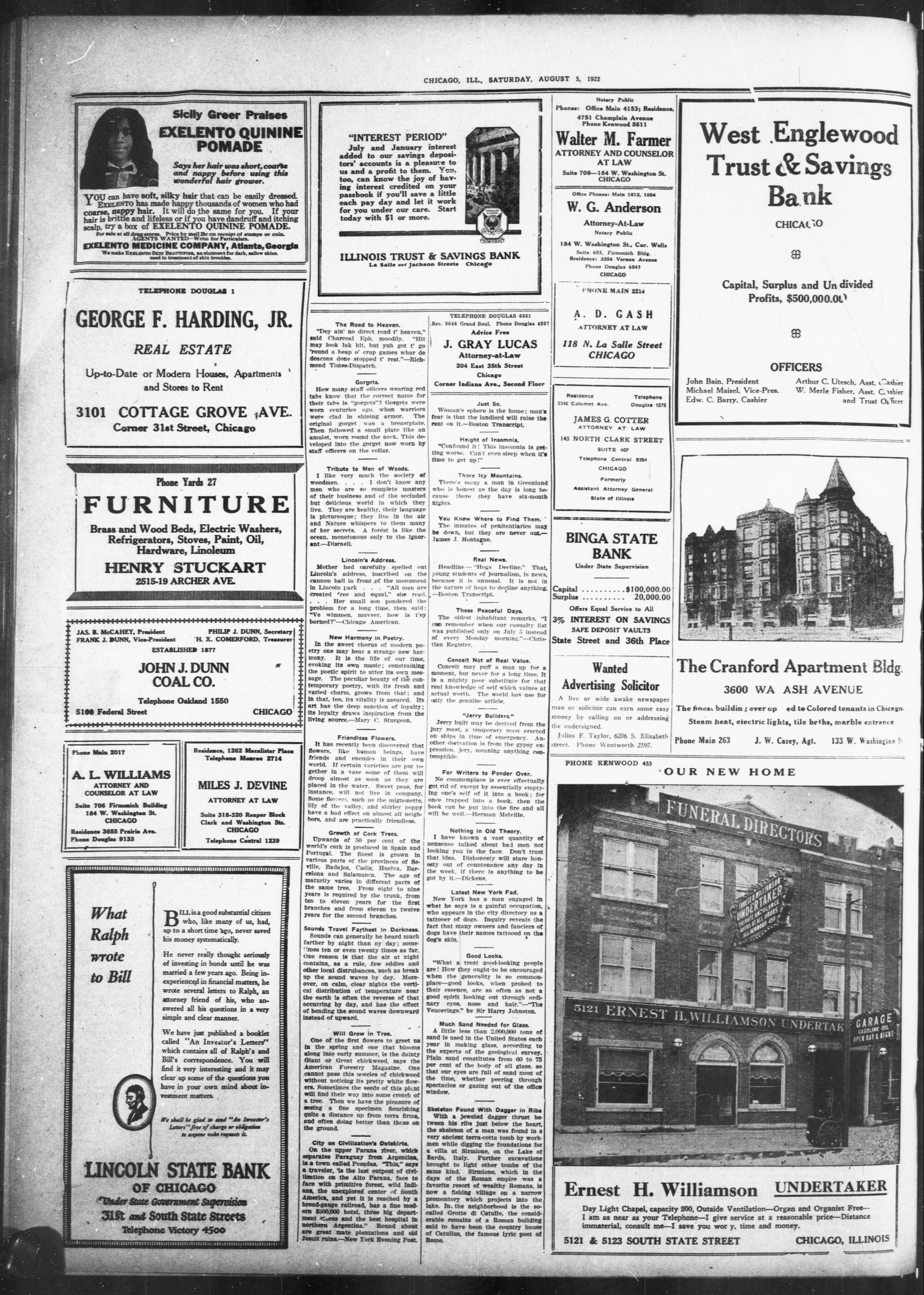
Page text (machine-generated)
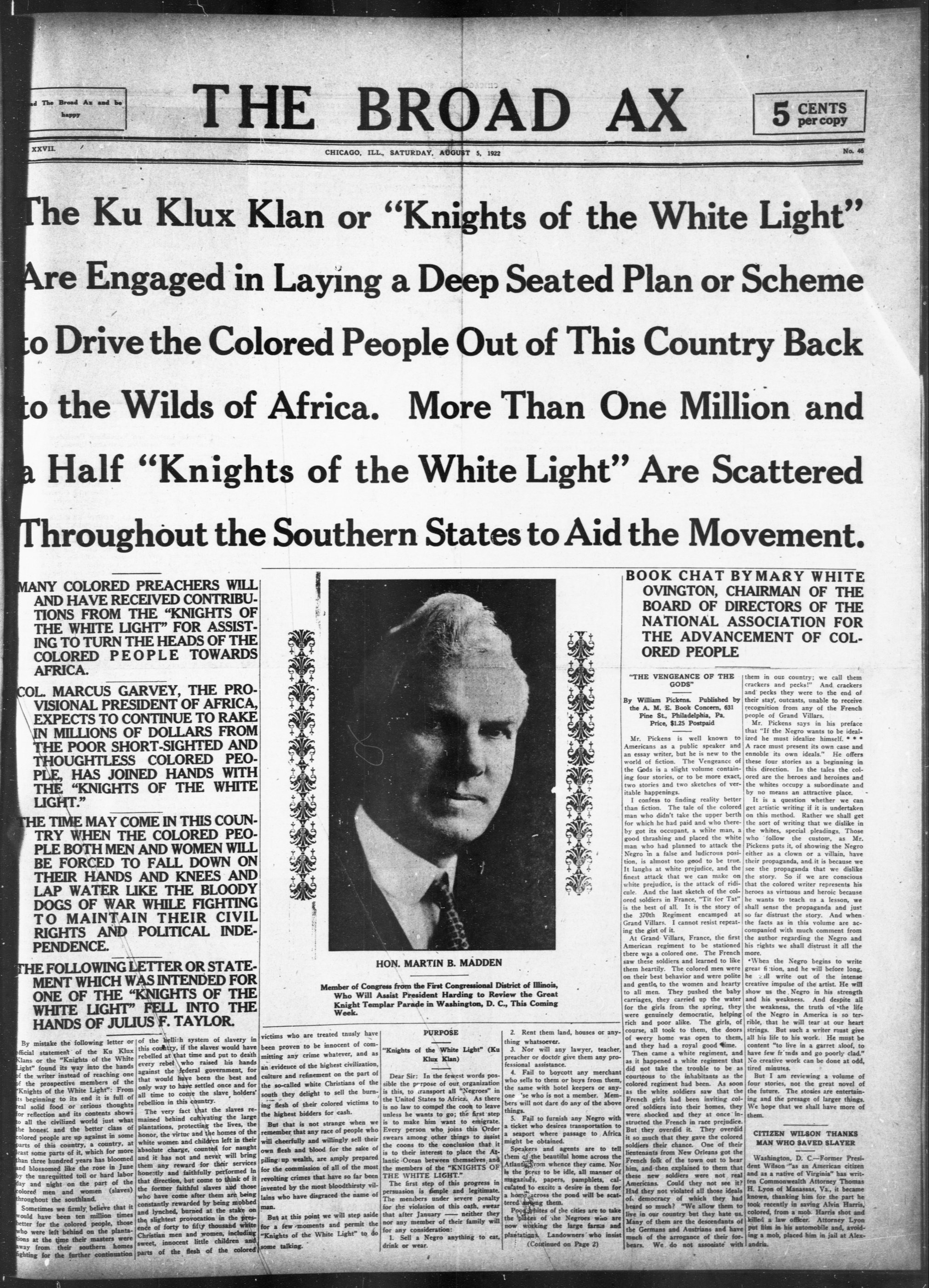
The Ku Klux Klan or "Knights of the White Light" Are Engaged in Laying a Deep Seated Plan or Scheme to Drive the Colored People Out of This Country Back to the Wilds of Africa. More Than One Million and a Half "Knights of the White Light" Are Scattered
MANY COLORED PREACHERS WILL AND HAVE RECEIVED CONTRIBUTIONS FROM THE "KNIGHTS OF THE WHITE LIGHT" FOR ASSISTING TO TURN THE HEADS OF THE COLORED PEOPLE TOWARDS AFRICA.
COL. MARCUS GARVEY, THE PROVISIONAL PRESIDENT OF AFRICA, EXPECTS TO CONTINUE TO RAKE IN MILLIONS OF DOLLARS FROM THE POOR SHORT-SIGHTED AND THOUGHTLESS COLORED PEOPLE, HAS JOINED HANDS WITH THE "KNIGHTS OF THE WHITE LIGHT."
THE TIME MAY COME IN THIS COUNTRY WHEN THE COLORED PEOPLE BOTH MEN AND WOMEN WILL BE FORCED TO FALL DOWN ON THEIR HANDS AND KNEES AND LAP WATER LIKE THE BLOODY DOGS OF WAR WHILE FIGHTING TO MAINTAIN THEIR CIVIL RIGHTS AND POLITICAL INDEPENDENCE.
THE FOLLOWING LETTER OR STATEMENT WHICH WAS INTENDED FOR ONE OF THE "KNIGHTS OF THE WHITE LIGHT" FELL INTO THE HANDS OF JULIUS F. TAYLOR.
By mistake the following letter or official statement of the Ku Klux Klan or the "Knights of the White Light" found its way into the hands of the writer instead of reaching one of the prospective members of the "Knights of the White Light": From its beginning to its end it is full of real solid food or serious thoughts for reflection and its contents shows to all the civilized world just what the honest and the better class of colored people are up against in some parts of this country, a country, at least some parts of it, which for more than three hundred years has bloomed and blossomed like the rose in June by the unrequited toil or hard labor day and night on the part of the colored men and women (slaves) throughout the southland.
Sometimes we firmly believe that it would have been ten million times better for the colored people, those who were left behind on the plantations at the time their masters were away from their southern homes fighting for the further continuation
THE BROAD AX
of the hellish system of slavery in this country, if the slaves would have rebelled at that time and put to death every rebel who raised his hands against the federal government, for that would have been the best and only way to have settled once and for all time to come the slave holders' rebellion in this country.
The very fact that the slaves remained behind cultivating the large plantations, protecting the lives, the honor, the virtue and the homes of the white women and children left in their absolute charge, counted for naught and it has not and never will bring them any reward for their services honestly and faithfully performed in that direction, but come to think of it the former faithful slaves and those who have come after them are being constantly rewarded by being mobbed and lynched, burned at the stake on the slightest provocation in the presence of the fortyth to fifty thousand Christian men and women, including sweet, innocent little children and parts of the flesh of the colored
CHICAGO, ILL., SATURDAY, AUGUST 5, 1922
```markdown
```
Member of Congress from the First Congressional District of Illinois, Who Will Assist President Harding to Review the Great Knight Templar Parade in Washington, D. C., This Coming Week.
```markdown
```
victims who are treated trusly have been proven to be innocent of committing any crime whatever, and as an evidence of the highest civilization, culture and refinement on the part of the so-called white Christians of the south they delight to sell the burning flesh of their colored victims to the highest bidders for cash.
But that is not strange when we remember that any race of people who will cheerfully and willingly sell their own flesh and blood for the sake of piling up wealth, are amply prepared for the commission of all of the most revolting crimes that have so far been invented by the most bloodthirsty villains who have disgraced the name of man.
But at this point we will step aside for a few moments and permit the "Knights of the White Light" to do some talking.
HON. MARTIN B. MADDEN
progress from the First Congressional D
Assist President Harding to Rew
emplar Parade in Washington, D. C.
PURPOSE
"Knights of the White Light" (Ku
Klux Klan)
PURPOSE
Dear Sir: In the fewest words possible the purpose of our organization is this, to transport all "Negroes" in the United States to Africa. As there is no law to compel the coon to leave unless he wants to go; the first step is to make him want to emigrate. Every person who joins this Order swears among other things to assist the coons to the conclusion that it is to their interest to place the Atlantic-Ocean between themselves, and the members of the "KNIGHTS OF THE WHITE LIGHT."
The first step of this progress in persuasion is simple and legitimate. The members under severe penalty for the violation of this oath, swear that after January — neither they nor any member of their family will for any consideration:
1. Sell a Negro anything to eat, drink or wear.
```markdown
```
2. Rent them land, houses or anything whatsoever.
3. Nor will any lawyer, teacher, preacher or doctor give them any professional assistance.
4. Fail to boycott any merchant who sells to them or buys from them, the same with hotel keepers or anyone 'se who is not a member. Members will not dare do any of the above things.
5. Fail to furnish any Negro with a ticket who desires transportation to a seaport where passage to Africa might be obtained.
Speakers and agents are to tell them of the beautiful home across the Atlantic from whence they came. Nor is the press to be idle, all manner of magazines, papers, pamphlets, calculated to excite a desire in them for a home across the pond will be scattered among them.
Pooled whites of the cities are to take the plates of the Negroes who are now working the large farms and plantations. Landowners who insist (Continued on Page 2)
BOOK CHAT BY MARY WHITE OVINGTON, CHAIRMAN OF THE BOARD OF DIRECTORS OF THE NATIONAL ASSOCIATION FOR THE ADVANCEMENT OF COL- ORED PEOPLE
"THE VENGEANCE OF THE GODS"
By William Pickens. Published by the A. M. E. Book Concern, 631 Pine St., Philadelphia, Pa. Price, $1.25 Postpaid
Mr. Pickens is well known to Americans as a public speaker and an essay writer, but he is new to the world of fiction. The Vengeance of the Gods is a slight volume containing four stories, or to be more exact, two stories and two sketches of veritable happenings.
I confess to finding reality better than fiction. The tale of the colored man who didn't take the upper berth for which he had paid and who thereby got its occupant, a white man, a good thrashing and placed the white man who had planned to attack the Negro in a false and ludicrous position, is almost too good to be true. It laughs at white prejudice, and the finest attack that we can make on white prejudice, is the attack of ridicule. And the last sketch of the colored soldiers in France, "Tit for Tat" is the best of all. It is the story of the 370th Regiment encamped at Grand Villars. I cannot resist repeating the gist of it.
At Grand-Villars, France, the first American regiment to be stationed there was a colored one. The French saw these soldiers and learned to like them heartily. The colored men were on their best behavior and were polite and gentle to the women and hearty to all men. They pushed the baby carriages, they carried up the water for the girls from the spring, they were genuinely democratic, helping rich and poor alike. The girls, of course, all took to them, the doors of every home was open to them and they had a royal good time.
Then came a white regiment, and as it happened a white regiment that did not take the trouble to be as courteous to the inhabitants as the colored regiment had been. As soon as the white soldiers saw that the French girls had been invited colored soldiers into their homes, they were shocked and they at once instructed the French in race prejudice. But they overdid it. They overdid it so much that they gave the colored soldiers their chance. One of their lientenants from New Orleans got the French folk of the town out to hear him, and then explained to them that these new soldiers were not real Americans. Could they not see it? Had they not violated all those ideals of democracy of which they had heard so much? "We allow them to live in our country but they hate us. Many of them are the descendants of the Germans and Austrians and have much of the arrogance of their for-bears. We do not associate with
5 CENTS per copy
e Light" Scheme
ry Back
ion and
cattered
vement.
YMARY WHITE
HAIRMAN OF THE
RECTORS OF THE
ASSOCIATION FOR
EMENT OF COL-
them in our country; we call them crackers and pecks!" And crackers and pecks they were to the end of their stay, outcasts, unable to receive recognition from any of the French people of Grand Villars.
Mr. Pickens says in his preface that "If the Negro wants to be idealized he must idealize himself. * * * A race must present its own case and ennoble its own ideals." He offers these four stories as a beginning in this direction. In the tales the colored are the heroes and heroines and the whites occupy a subordinate and by no means an attractive place.
It is a question whether we can get artistic writing if it is undertaken on this method. Rather we shall get the sort of writing that we dislike in the whites, special pleadings. Those who follow the custom, as Mr. Pickens puts it, of showing the Negro either as a clown or a villain, have their propaganda, and it is because we see the propaganda that we dislike the story. So if we are conscious that the colored writer represents his heroes as virtuous and heroic because he wants to teach us a lesson, we shall sense the propaganda and just so far distrust the story. And when the facts in this volume are accompanied with much comment from the author regarding the Negro and his rights we shall distrust it all the more.
*When the Negro begins to write great fiction, and he will before long, he will write out of the intense creative impulse of the artist. He will show us the Negro in his strength and his weakness. And despite all the weakness, the truth of the life of the Negro in America is so terrible, that he will tear at our heart strings. But such a writer must give all his life to his work. He must be content "to live in a garret aloof, to have few frinds and go poorly clad." No creative work can be done at odd, tired minutes.
But I am reviewing a volume of four stories, not the great novel of the future. The stories are entertaining and the presage of larger things. We hope that we shall have more of them.
CITIZEN WILSON THANKS
MAN WHO SAVED SLAYER
Washington, D. C.—Former President Wilson "as an American citizen and as a native of Virginia" has written Commonwealth Attorney Thomas H. Lyon of Manassas, Va., it became known, thanking him for the part he took recently in saving Alvin Harris, colored, from a mob. Harris shot and killed a law officer. Attorney Lyon put him in his automobile and, avoiding a mob, placed him in jail at Alexandria.
THE BROAD AX
Published Every Saturday
In this city since July 15th, 1899,
without missing one single issue. Republicans, Democrats, Catholics, Protestants, Single Taxers, Priests, infidels or anyone else can have their say as long as their language is proper and responsibility is fixed.
The Broad Ax is a newspaper whose platform is broad enough for all, ever claiming the editorial right to speak its own mind.
Local communications will receive attention. Write only on one side of the paper.
Subscriptions must be paid in ad-
due Year .....$2.00
Six Months .....$1.00
Advertising rates made known on application.
Address all communication to ...
THE BROAD AX
6200 do. Elizabeth St., Chicago, Ill.
Phone Wentworth 2597
JULIUS F. TAYLOR
Editor and Publisher
entered as Second-Class Matter, Aug. 19, 1902, at the Post Office at Chicago
ul. Under Act of March 8, 1879.
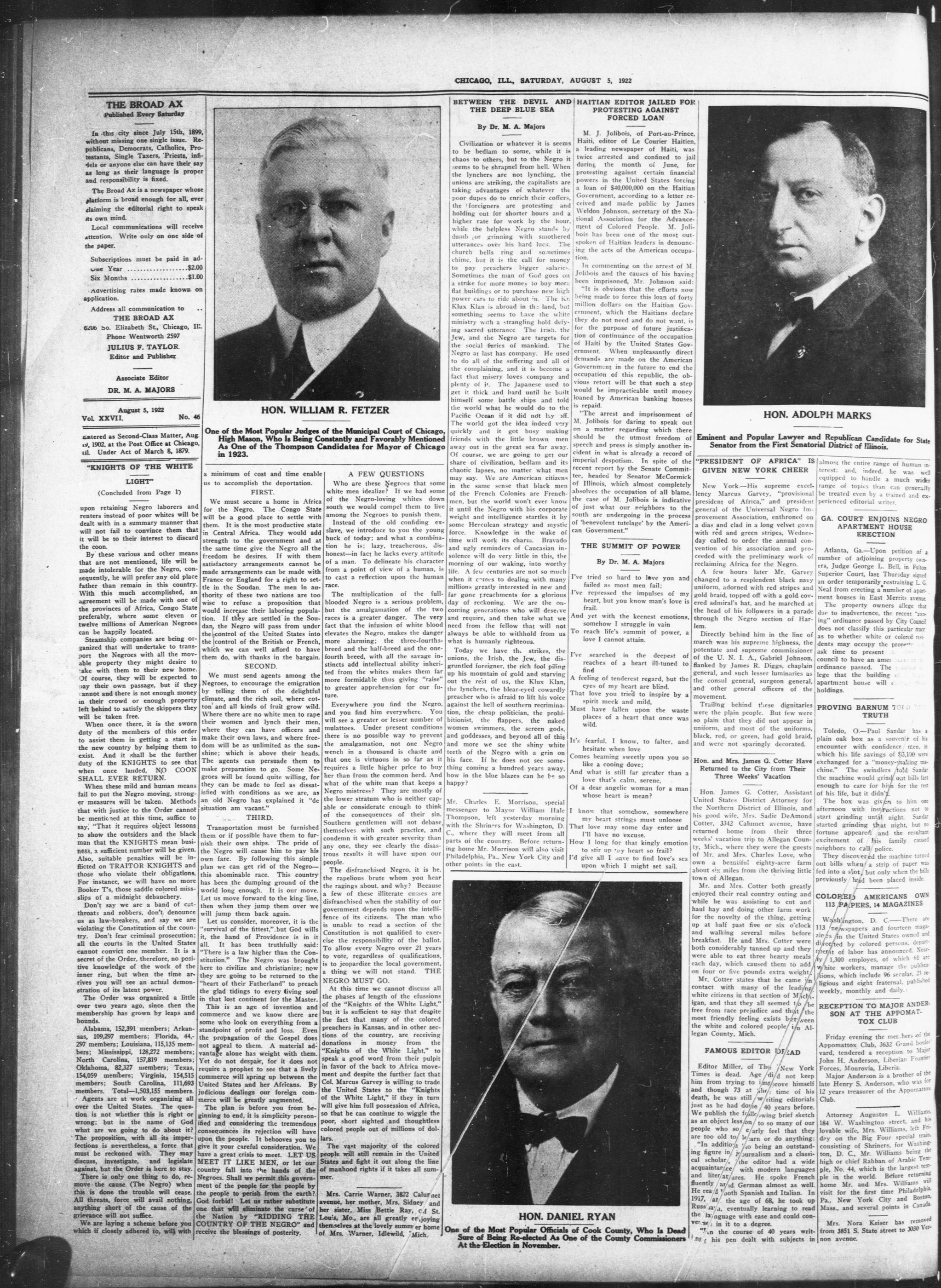
"KNIGHTS OF THE WHITE
(Concluded from Page 1)
upon retaining Negro laborers and renters instead of poor whites will be dealt with in a summary manner that will not fail to convince them that it will be to their interest to discard the coon.
By these various and other means that are not mentioned, life will be made intolerable for the Negro, consequently, he will prefer any old father than remain in this country. With this much accomplished, an agreement will be made with one of the provinces of Africa, Congo State preferably, where some eleven or twelve millions of American Negroes can be happily located.
Steamship companies are being organized that will undertake to transport the Negroes with all the movable property they might desire to take with them to their new home. Of course, they will be expected to pay their own passage, but if they cannot and there is not enough money in their crowd or enough property left behind to satisfy the skippers they will be taken free.
When once there, it is the sworn duty of the members of this order to assist them in getting a start in the new country by helping them to exist. And it shall be the further duty of the KNIGHTS to see that when once landed, NO COON SHALL EVER RETURN.
When these mild and human means fail to put the Negro moving, stronger measures will be taken. Methods that with justice to the Order cannot be menticued at this time, suffice to say, "That it requires object lessons to show the outsiders and the black man that the KNIGHTS mean business, a sufficient number will be given. Also, suitable penalties will be inflicted on TRAITOR KNIGHTS and those who violate their obligations. For instance, we will have no more Booker T's, those saddle colored missilis of a midnight debauchery.
Don't say we are a band of cut-throats and robbers, don't denounce us as law-breakers, and say we are violating the Constitution of the country. Don't fear criminal prosecution; all the courts in the United States cannot convict one member. It is a secret of the Order, therefore, no positive knowledge of the work of the inner ring, but when the time arrives you will see an actual demonstration of its latent power. The Order was organized a little over two years ago, since then the membership has grown by leaps and bounds.
Alabama, 152,391 members; Arkansas, 109,297 members; Florida, 44,297 members; Louisiana, 115,135 members; Mississippi, 128,272 members North Carolina, 157,819 members Oklahoma, 82,327 members; Texas 154,105 members; Virginia, 154,515 members; South Carolina, 111,693 members. Total—1,503,155 members Agents are at work organizing all over the United States. The question is not whether this is right or wrong; but in the name of God what are we going to do about it? The proposition, with all its imperfections is nevertheless, a force that must be reckoned with. They may discuss, investigate, and legislate against, but the Order is here to stay. There is only one thing to do, remove the cause (The Negro) when this is done the trouble will cease. All threats, force will avail nothing, anything short of the cause of the grievance will not suffice.
We are laying a scheme before you which if closely adhered to, will with
[Name]
HON. WILLIAM R. FETZER
One of the Most Popular Judges of the Municipal Court of Chicago, High Mason, Who Is Being Constantly and Favorably Mentioned As One of the Thompson Candidates for Mayor of Chicago in 1923.
a minimum of cost and time enable us to accomplish the deportation.
A FEW QUESTIONS
Who are these Negroes that some
We must secure a home in Africa for the Negro. The Congo State will be a good place to settle with them. It is the most productive state in Central Africa. They would add strength to the government and at the same time give the Negro all the freedom he desires. If with them satisfactory arrangements cannot be made arrangements can be made with France or England for a right to settle in the Soudan. The men in authority of these two nations are too wise to refuse a proposition that would increase their laboring population. If they are settled in the Soudan, the Negro will pass from under the control of the United States into the control of the British or French, which we can well afford to have them do, with thanks in the bargain.
We must send agents among the Negroes, to encourage the emigration by telling them of the delightful climate, and the rich soil, where cotton' and all kinds of fruit grow wild. Where there are no white men to rape their women and lynch their men, where they can have officers and make their own laws, and where freedom will be as unlimited as the sunshine; which is above their heads. The agents can persuade them to make preparation to go. Some Negroes will be found quite willing, for they can be made to feel as dissatisfied with conditions as we are, as an old Negro has explained it "de situation am vacant."
Transportation must be furnished them or if possible have them to furnish their own ships. The pride of the Negro will cause him to pay his own fare. By following this simple plan we can get rid of the Negro—this abominable race. This country has been the dumping ground of the world long enough. It is our move. Let us move forward to the king line, then when they jump them over we will jump them back again.
Let us consider, moreover, it is the "survival of the fittest," but God wills it, the hand of Providence is in it all. It has been truthfully said: "There is a law higher than the Constitution." The Negro was brought here to civilize and christianize; now they are going to be returned to the "heart of their Fatherland" to preach the glad tidings to every living soul in that lost continent for the Master. This is an age of invention and commerce and we know there are some who look on everything from a standpoint of profit and loss. Even the propagation of the Gospel does not appeal to them. A material advantage alone has weight with them. Yet do not despair, for it does not require a prophet to see that a lively commerce will spring up between the United States and her Africans. By judicious dealings our foreign commerce will be greatly augmented.
The plan is before you from beginning to end, it is simplicity personified and considering the tremendous consequences its rejection will have upon the people. It behooves you to give it your careful consideration. We have a great crisis to meet. LET US MEET IT LIKE MEN, or let our country fall into the hands of the Negroes. Shall we permit this government of the people for the people by the people to perish from the earth? God forbid! Let us rather substitute one that will eliminate the curse' of the Nation by "RIDDING THE COUNTRY OF THE NEGRO" and receive the blessings of posterity.
THIRD.
Who are these Negroes that some white men idealize? If we had some of the Negro-loving whites down south we would compel them to live among the Negroes to punish them. Instead of the old confiding ex-slave, we introduce to you the young buck of today; and what a combination he is; lazy, treacherous, dishonest—in fact he lacks every attitude of a man. To delineate his character from a point of view of a human, is to cast a reflection upon the human race.
The multiplication of the full-blooded Negro is a serious problem, but the amalgamation of the two races is a greater danger. The very fact that the infusion of white blood elevates the Negro, makes the danger more alarming; the three-fourths-breed and the half-breed and the one-fourth breed, with all the savage instincts add intellectual ability inherited from the whites makes them far more formidable thus giving "raise" to greater apprehension for our future.
Everywhere you find the Negro and you find him everywhere. You will see a greater or lesser number of mulattoes. Under present conditions there is no possible way to prevent the amalgamation, not one Negro wench in a thousand is chaste and that one is virtuous in so far as it requires a little higher price to buy her than from the common herd. And what of the white man that keeps a Negro mistress? They are mostly of the lower stratum who is neither capable or considerate enough to think of the consequences of their sin. Southern gentlemen will not debase themselves with such practice, and condemn it with greater severity than any one, they see clearly the disastrous results it will have upon our people.
The disfranchised Negro, it is he, the rapelious brute whom you hear the ragings about, and why? Because a few of these illiterate cusses are disfranchised when the stability of our government depends upon the intelligence of its citizens. The man who is unable to read a section of the Constitution is not qualified to exercise the responsibility of the ballot. To allow every Negro over 21 years to vote, regardless of qualifications, is to jeopardize the local government, a thing we will not stand. THE NEGRO MUST GO.
At this time we cannot discuss all the phases at length of the effusions of the "Knights of the White Light," but it is sufficient to say that despite the fact that many of the colored preachers in Kansas, and in other sections of the country, are receiving donations in money from the "Knights of the White Light," to speak a good word from their pulpit in favor of the back to Africa movement and despite the further fact that Col. Marcus Garvey is willing to trade the United States to the "Knights of the White Light," if they in turn will give him full possession of Africa, so that he can continue to wiggle the poor, short sighted and thoughtless colored people out of millions of dollars.
The vast majority of the colored people will still remain in the United States and fight it out along the line of manhood rights if it takes all summer.
Mrs. Carrie Warner, 3822 Calurnet avenue, her mother, Mrs. Sidney and her sister, Miss Bettie Ray, c.f. St. Louis, Mo., are all greatly enjoying themselves at the lovely summ er home of Mrs. Warner, Idlewild, 'Mich.
CHICAGO, ILL. SATURDAY, AUGUST 5, 1922
By Dr. M. A. Majors
Civilization or whatever it is seems to be bedlam to some, while it is chaos to others, but the Negro it seems to be shrapnel from hell. When the lynchers are not lynching, the unions are striking, the capitalists are taking advantages of whatever the poor dupes do to enrich their coffers the foreigners are protesting and holding out for shorter hours and a higher rate for work by the hour while the helpless Negro stands by dumb or grinning with smothered utterances over his hard luck. The church bells ring and sometimes chime, but it is the call for money to pay preachers bigger salaries. Sometimes the man of God goes on a strike for more money to buy more high buildings or to purchase new high power cars to ride about in. The Ku Klux Klan is abroad in the land, but something seems to have the white ministry with a strangling defying sacred utterance. The frish the Jew, and the Negro are targets for the social furies of mankind. The Negro at last has company. He used to do all of the suffering and all of the complaining, and it is become a fact that misery loves company and plenty of it. The Japanese used to get it thick and hard until he built himself some battle ships and told the world what he would do to the Pacific Ocean if it did not lay off. The world got the idea indeed very quickly and it got busy making friends with the little brown men away out in the great sea far away. Of course, we are going to get our share of civilization, bedlam and its chaotic lapses, no matter what men may say. We are American citizens in the same sense that black men of the French Colonies are Frenchmen, but the world won't ever know it until the Negro with his corporate weight and intelligence startles it by some Herculean strategy and mystic force. Knowledge in the wake of time will work its charm. Bravado and ugly reminders of Caucasian insolence will do very little in this, the morning of our waking, into worthy life. A few centuries are not so much when it comes to dealing with many millions greatly interested in new and far gone preachments for a glorious day of reckoning. We are the oncoming generations who will deserve and require, and then take what we need from the fellow that will not always be able to withhold from us what is humanly righteous.
Today we have the strikes, the unions, the Irish, the Jew, the disgruntled foreigner, the rich fool piling up his mountain of gold and starving out the rest of us, the Klux Klan, the lynchers, the blear-eyed cowardly preacher who is afraid to lift his voice against the hell of southern recrimination, the cheap politician, the prohibitionist, the flappers, the naked women swimmers, the screen gods, and goddesses, and beyond all of this and more we see the shiny white teeth of the Negro with a grin on his face. If he does not see something coming a hundred years away, how in the blue blazes can he be so happy?
Mr. Charles E. Morrison, special messenger to Mayor William Hale Thompson, left yesterday morning with the Shriners for Washington, D.C., where they will meet from all parts of the country. Before returning home Mr. Morrison will also visit Philadelphia, Pa., New York City and other points in the east.
W. H.
HON. DANIEL RYAN
One of the Most Popular Officials of Cook Co
Sure of Being Re-elected As One of the Co
At the Election in November.
One of the Most Popular Officials of Cook County, Who Is Dead Sure of Being Re-elected As One of the County Commissioners At the Election in November.
M. J. Jolibois, of Port-au-Prince, Haiti, editor of Le Courier Haitien, a leading newspaper of Haiti, was twice arrested and confined to jail during the month of June, for protesting against certain financial powers in the United States forcing a loan of $40,000,000 on the Haitian Government, according to a letter received and made public by James Weldon Johnson, secretary of the National Association for the Advancement of Colored People. M. Jolibois has been one of the most outspoken of Haitian leaders in denouncing the acts of the American occupation.
In commenting on the arrest of Mr. Jolibois and the causes of his having been imprisoned, Mr. Johnson said: "It is obvious that the efforts now being made to force this loan of forty million dollars on the Haitian Government, which the Haitians declare they do not need and do not want, is for the purpose of future justification of continuance of the occupation of Haiti by the United States Government. When unpleasantly direct demands are made on the American Government in the future to end the occupation of this republic, the obvious retort will be that such a step would be impracticable until money loaned by American banking houses is repaid.
"The arrest and imprisonment of M. Jolibois for daring to speak out on a matter regarding which there should be the utmost freedom of speech and press is simply another incident in what is already a record of imperial despotism. In spite of the recent report by the Senate Committee, headed by Senator McCormick of Illinois, which almost completely absolves the occupation of all blame, the case of M. Jolibois is indicative of just what our neighbors to the south are undergoing in the process of 'benevolent tutelage' by the American Government."
THE SUMMIT OF POWER
By Dr. M. A. Majors
I've tried so hard to love you and failed as most men fail;
I've repressed the impulses of my heart, but you know man's love is frail.
And yet with the keenest emotions, somehow I struggle in vain
To reach life's summit of power, a love I cannot attain.
I've searched in the deepest of reaches of a heart ill-tuned to find
A feeling of tenderest regard, but the eyes of my heart are blind.
That love you tried to inspire by a spirit meek and mild.
Must have fallen upon the waste places of a heart that once was wild.
It's fearful, I know, to falter, and hesitate when love
Comes beaming sweetly upon you so like a cooing dove;
And what is still far greater than a love that's calm, serene.
Of a dear angelic woman for a man whose heart is mean?
I know that somehow, somewhere my heart strings must unloose
That love may some day enter and I'll have no excuse.
How I long for that kingly emotion to stir up my heart so frail?
I'd give all I have to find love's sea upon which I might set sail.
T h a d j W a p a i n c a a a f H 1 0 R
of Cook County, Who Is Dead
one of the County Commissioners
HON. ADOLPH MARKS
Eminent and Popular Lawyer and Republican Candidate for State Senator from the First Senatorial District of Illinois.
"PRESIDENT OF AFRICA" IS GIVEN NEW YORK CHEER New York—His supreme excellency Marcus Garvey, "provisional president of Africa," and president general of the Universal Negro Improvement Association, enthroned on a dias and clad in a long velvet gown with red and green stripes, Wednesday called to order the annual convention of his association and proceeded with the preliminary work of reclaiming Africa for the Negro. A few hours later Mr. Garvey changed to a resplendent black navy uniform, adorned with red stripes and gold braid, topped off with a gold covered admiral's hat, and he marched at the head of his followers in a parade through the Negro section of Harlem.
Directly behind him in the line of march was his supreme highness, the potentate and supreme commissioner of the U. N. I. A., Gabriel Johnson, flanked by James R. Diggs, chaplain general, and such lesser luminaries as the consul general, surgeon general, and other general officers of the movement.
Trailing behind these dignitaries were the plain people. But few were so plain that they did not appear in uniform, and most of the uniforms, black, red, or green, had gold braid, and were not sparingly decorated.
Hon. and Mrs. James G. Cotter Have Returned to the City from Their Three Weeks' Vacation
Hon. James G. Cotter, Assistant United States District Attorney for the Northern District of Illinois, and his good wife, Mrs. Sadie DeAmond Cotter, 3342 Calmet avenue, have returned home from their three weeks' vacation trip to Allegan County, Mich., where they were the guests of Mr. and Mrs. Charles Love, who own a beautiful eighty-acre farm about six miles from the thriving little town of Allegan.
Mr. and Mrs. Cotter both greatly enjoyed their real country outing and while he was assisting to cut and haul hay and doing other farm work for the novelty of the thing, getting up at half past five or six o'clock and walking several miles before breakfast. He and Mrs. Cotter were both considerably tanned and they were able to eat three hearty meals each day, which caused them to add on four or five pounds extra weight. Mr. Cotter states that he came in contact with many of the leading white citizens in that section of Michigan, and that they all seemed to be free from race prejudice and that the most friendly feeling exists between the white and colored people in Allegan County, Mich.
FAMOUS EDITOR JOJAD
Editor Miller, of The New York Times is dead. Age did not keep him from trying to improve himself and though 73 at the time of his death, he was still writing editorials just as he had done 40 years before. We publish the following brief sketch as an object lesson on to so many of our people who so early feel that they are too old to learn or do anything: "In addition to being an outstanding figure in journalism and a classical scholar, the editor had a wide acquaintance with modern languages and literatures. He spoke French fluently and German almost as well. He read 700 Spanish and Italian. In 1917, at the age of 68, he took up Russia, eventually learning to read the language with ease and could converse in it to a degree.
in the course of 40 years writ-
his, his neal dealt with subjects in
almost the entire range of human interest: and, indeed, he was well equipped to handle a much wider range of topics than can generally be treated even by a trained and experienced editorial writer.
GA. COURT ENJOINS NEGRO
APARTMENT HOUSE
ERECTION
Atlanta, Ga.—Upon petition of the number of adjoining property owners, Judge George L. Bell, in Fulton Superior Court, last Thursday signed an order temporarily restraining L. G Neal from erecting a number of apartment houses in East Merrits avenue. The property owners allege that due to inadvertence, the recent "zoning" ordinance passed by City Council does not classify this particular tract as to whether white or colored residents may occupy the property ask time to present council to have an americ ordinance passed. The lege that the building apartment house will holdings.
PROVING BARNUM TOID 7
TRUTH
Toledo, O.-Paul Sandar has a plain oak box as a souvenir of his encounter with confidence men, in which his life savings of $5,100 were exchanged for a "money-making machine." The swindlers told Sandar the machine would grind out bills fast enough to care for him for the rest of his life, but it didn't. The box was given to him one afternoon with instructions not to start grinding until night. Sandar started grinding that night, but no fortune appeared and the resultant excitement of his family caused neighbors to call police. They discovered the machine turned out bills when a strip of paper was fed into a slot, but only when the bills previously had been placed inside.
COLORED AMERICANS OWN
113 PAPERS, 14 MAGAZINES
Washington, D. C.——There are
113 newspapers and fourteen magazine
in the United States owned and
directed by colored persons, department
of labor has announced. Nearby
1,300 employees, of which 61 are
white workers, manage the publications, which include 96 secular, 23 religious and eight fraternal, published weekly, monthly and daily.
RECEPTION TO MAJOR ANDER
SON AT THE APPOMAT-
TOX CLUB
Friday evening the members of the Appomattox Club, 3632 Grand boulevard, tendered a reception to Major John H. Anderson, Liberian Frontier Forces, Monrovia, Liberia.
Major Anderson is a brother of the late Henry S. Anderson, who was for 12 years treasurer of the Appomattox Club.
Attorney Augustus L. Williams 184 W. Washington street, and his lovable wife, Mrs. Williams, left Friday on the Big Four special train, consisting of Shriners, for Washington, D. C., Mr. Williams being high or chief Rabban of Arabic Temple. No. 44, which is the largest temple in the world. Before returning home Mr. and Mrs. Williams will visit for the first time Philadelphia Pa., New York City and Boston, Mass., and several points in Canada.
Mrs. Nora Keiser has removed from 3851 S. State street to 3030 Vernon avenue.
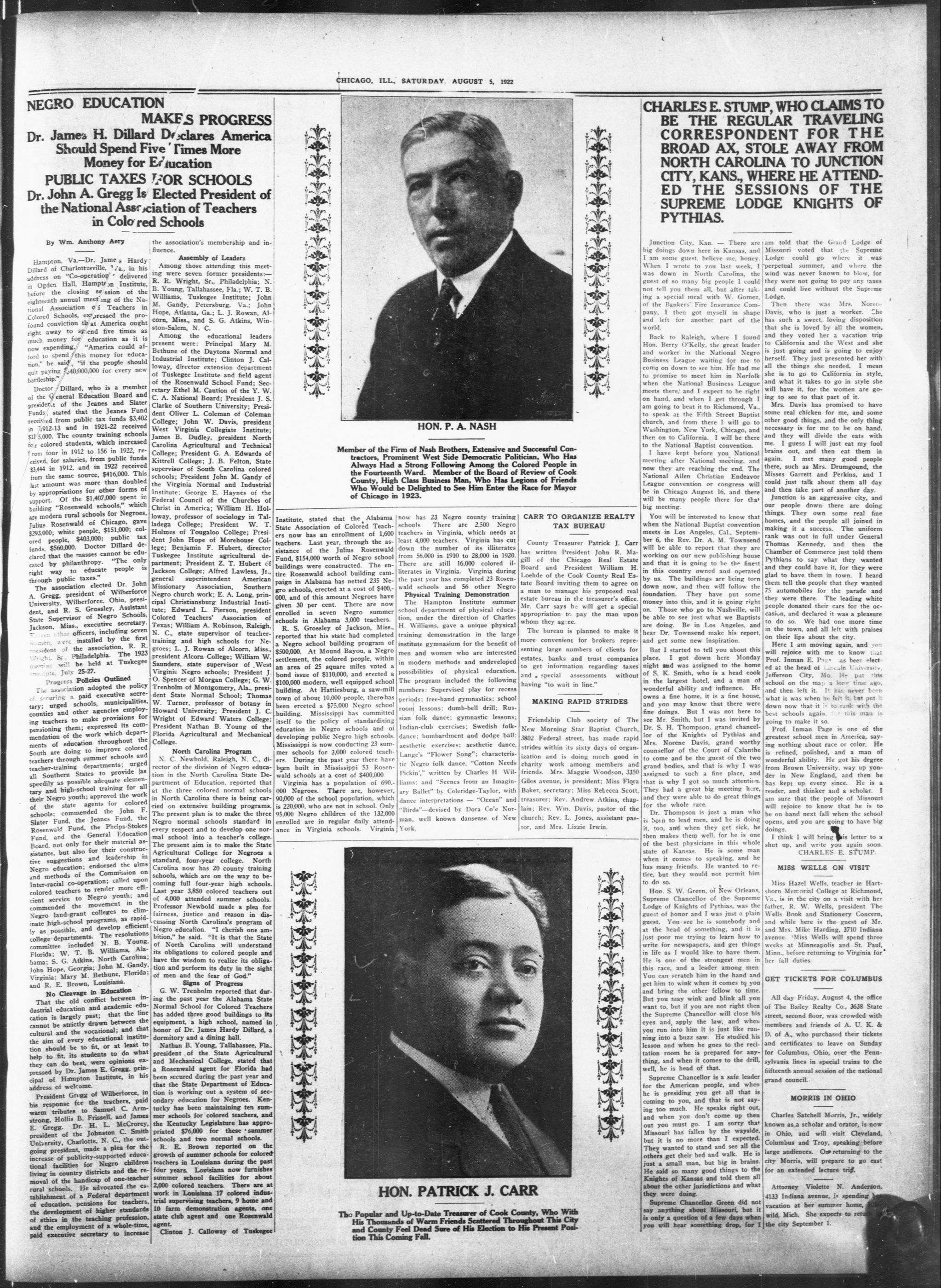
NEGRO EDUCATION : ts
MAKE‘S PROGRESS
Dr. James H. Dillard Dr clares America
Should Spend Five’ Times More
Money for Eriucation
PUBLIC TAXES 770R SCHOOLS
Dr. John A. Gregg Is Elected President of
the National Assr ciation of Teachers
in Colored Schools
By Wm. Anthony Aery the association’s membership and in-
address on “Co-operauoy " dein
ssegden Hall, Hampt’ye Institute,
tefore the closing S€ssion of the
cighteenth annual meet’ing of the Na-
tonal Association ¢{ Teachers in
Colored Schools, extyressed the pro-
found conviction th at America ought
rght away t0 SPiend five times as
much money for education as it is
now expending.’ “America could ai-
ord to spend fthis money for educa-
tion.” he sai@, “if the people should
quit paying $40,000,000 for every new
battleship.”,
Doctor / Dillard, who is a member
of the General Education Board and
presider.t of the Jeanes and Slater
Funds stated that the Jeanes Fund
received from public tax funds $3,402
in 791213 and in 1921-22 received
$115,000. The county training schools
ie colored students, which increased
from four in 1912 to 156 in 1922, re-
ceived, for salaries, from public funds
$3444 in 1912, and im 1922 received
from the same source, $416,000. This
last amount was more than doubled
by appropriations for other forms of
support. Of the $1,407,000 spent ir
building “Rosenwald schools,” which
are modern rural schools for Negroes,
Julius Rosenwald of Chicago, gave
$293,000; white people, $151,000; col-
cored people, $403,000; public tax
fands, $560,000. Doctor Dillard de-
clared that the masses cannot be edu-
fated. by philanthropy. “The only
Fight way to educate people is
through public taxes.”
‘The association elected Dr. John
|A. Gregg, president of Wilberforce
University, Wilberforce, Ohio, presi-
dent, and R. S. Grossley, Assistant
State Supervisor of Negro Schools,
Jackson, Miss., executive secretary.
: wr officers, including seven
cen, vere installed by the first
esident of the association, R. R.
vb. Se, Philadelphia. The 1923
ent wit! be held at Tuskegee
re, July 25-27.
Progress Policies Outlined
The association adopted the policy
ccaring 2 paid executive secre-
tary; urged schools, municipalities
counties and other agencies employ-
fag teachers to make provisions for
pensioning them; expressed its com-
erendation of the work which depart:
iments of education throughout the
South are doing to improve colored
teachers through summer schools and
teacher-training departments; urged
un Southern States to provide fas
speedily as possible adequate elemen-
tary and high-school training for all
their Negro youth; approved the work
Sf the state agents for colored
Schools; commended the John F.
Slater Fund, the Jeanes Fund, the
Rosenwald Fund, the Phelps-Stokes
Fond, and the General Education
Board, not only for their material as
sistance, but also for their construc-
fre suggestions and leadership in
Negro education; endorsed the aims
and methods of the Commission on
Tnter-racial co-operation; called upor
colored teachers to render more eff
Gent service to Negro youth; and
commended the movement in the
Negro land-grant colleges t0 elim.
inate high-school programs, as rapid.
ty as possible, and develop efficien
college departments. The resolution
committee included N. B. Young
Florida; W. T. B Williams, Ala
bama; S. G. Atkins, North Carolina
{ohn Hope, Georgia; Jobn M. Gandy
Virginia; Mary M. Bethune, Florida
and R. E. Brown, Louisiana.
No Cleavage in Education
That the old conflict between in
dustrial education and academic ede
cation is largely past; that the lin
Cannot be strictly drawn between th
cultural and the vocational; and tha
the aim of every educational instite
tion should be to fit, or at least tc
help to fit, its students to do whal
they can do best, were opinions x
pressed by Dr. James E. Gregg, prin:
Gpal of Hampton Institute, in his
address of welcome.
President Gregg of Wilberiorce, i
his response for the teachers, paid
warm tributes to Samuel C. Arm-
strong, Hollis B. Frisell, and James
E. Gregg. Dr. H. L. MeCrorey
president of the Johnston C. ‘Smitt
University, Charlotte, N. C., the out
going president, made a plea for th
increase of publicity-supported educa
tional facilities for Negro childres
living in country districts and the re
moval of the handicap of one-teaches
rural schools. He advocated the ¢s
‘tablishment of a Federal department
of education, pensions for teachers
the development of higher standard:
of ethics im the teaching profession
and the employment of # whole-time
‘paid executive secretary to increase
the association's membership and in-
Buence.
Assembly of Leaders
Among those attending this meet-
ing were seven former presidents:—
R. R. Wright, Sr., Philadelphia; N.
|B. Young, Tallahassee, Fla; W. T. B.
Williams, Tuskegee Institute; John
|M. Gandy, Petersburg, Va; John
Hope, Atlanta, Ga; L. J. Rowan, Al-
(corn, Miss, and S. G. Atkins, Win-
(ston-Salem, N.C.
| Among the educational leaders
|present were: Principal Mary M.
Bethune of the Daytona Normal and
Industrial Institute; Clinton J. Cal-
loway, director extension department
of Tuskegee Institute and field agent
of the Rosenwald School Fund; Sec-
fess Ethel M. Caution of the Y. W.
C. A. National Board; President J. S.
Clarke of Southern University; Presi-
dent Oliver L. Coleman of Coleman
College; John W. Davis, president
West Virginia Collegiate Institute;
James B. Dudley, president North
Carolina Agricultural and Technical
College; President G. A. Edwards of
Kittrell College; J. B. Felton, State
supervisor of South Carolina colored
schools; President John M. Gandy of
the Virginia Normal and Industrial
Institute; George E. Haynes of the
Federal Council of the Churches of
Christ in America; William H. Hol-
loway, professor of sociology in Tal-
ladega College; President W. T.
Holmes of Tougaloo College; Presi-
dent John Hope of Morehouse Col-
lege; Benjamin F. Hubert, director
Tuskegee Institute agricultural de-
partment; President Z. T. Hubert cf
Jackson College; Alired Lawless, Jr,
general superintendent American
Missionary Association, Southern
Negro church work; E. A. Long, prin-
cipal Christiansburg Industrial Insti-
tute; Edward L. Pierson, president
Colored Teachers’ Association of
Texas; William A. Robinson, Raleigh,
N.C, state supervisor of teacher-
training and high schools for Ne-
groes; L. J. Rowan of Alcorn, Miss.,
president Alcorn College; William W.
Saunders, state supervisor of West
Virginie Negro schools; President J.
©. Spencer of Morgan College; G. W.
Trenholm of Montgomery, Ala., presi-
dent State Normal School; Thomas
W. Turner, professor of botany in
Howard University; President J. C.
Wright of Edward Waters College:
President Nathan B. Young of the
Florida Agricultural and Mechanical
College.
North Carolina Program
N. C. Newbold, Raleigh, N. C., di-
rector of the division of Negro educa-
tion in the North Carolina State De-
partment of Education, reported that
at the three colored normal schools
in North Carolina there is being car-
‘ried on extensive building programs.
The present plan is to make the three
Negro normal schools standard in
every respect and to develop one nor-
mal school into a teacher's college.
The present aim is to make the State
Agricultural College for Negroes a
standard, four-year college. North
Carolina now has 20 county training
schools, which are on the way to be-
coming full four-year high schools.
Last year 3,850 colored teachers out
of 4,000 attended summer schools.
Professor Newbold made a plea for
fairness, justice and reason in dis-
‘cussing North Carolina's program of
Negro education. “I cherish one am-
bition,” he said. “It is that the State
of North Carolina will understand
its obligations to colored people and
have the wisdom to realize its obliga-
tion and perform its duty in the sight
‘of men and the fear of God.”
Signs of Progress
G. W. Trenholm reported that dur-
ing the past year the Alabama State
Normal School for Colored Teachers
has added three good buildings to its
equipment, a high school, named in
honor of Dr. James Hardy Dillard, a
dormitory and a dining hall.
‘Nathan B. Young, Tallahassee, Fla.
president .of the State Agricultural
and Mechanical College, stated that
a Rosenwald agent for Florida had
been secured during the past year and
that the State Department of Educa-
tion is working out a system of sec-
ondary education for Negroes. Ken-
tucky has been maintaining ten sum-
mer schools for colored teachers, and
the Kentucky Legislature has appro-
priated $76,000 for these summer
schools and two normal schools.
R. E. Brown reported on the
‘growth of summer schools for colored
teachers in Louisiana during the past
four years. Lovisiana now furnishes
| summer school facilities for about
2,000 colored teachers. There are at
|work in Louisiana 17 colored indus-
| trial supervising teachers, 9 home and
CHICAGO, ILL, SATURDAY. AUGUST 5, 1922
e Ls : /
. 5 . ih
Member of the Firm of Nash Brothers, Extensive and Successful Con-
tractors, Prominent West Side Democratic Politician, Who Has
Always Had a Strong Following Among the Colored People in
the Fourteenth Ward. Member of the Board of Review of Cook
County, High Class Business Man, Who Has Legions of Friends
Who Would be Delighted to See Him Enter the Race for Mayor
of Chicago in 1923.
»)
— x .
we oe
‘The Popular and Up-to-Date Treasurer of Cook County, Who With
His Thousands of Warm Friends Scattered Throughout This City
and County Feel Dead Sure of His Election to Present Posi-
tion This Coming Fall.
-
ia
x
Fin
ae
Wy
Last!
we
- >
a
Ns ll
Institute, stated that the Alabama
State Association of Colored Teach-
ers now has an enrollment of 1,600
teachers. Last year, through the as-
sistance of the Julius Rosenwald
Fund, $154,000 worth of Negro school
buildings were constructed. The en-
tire Rosenwald school building cam-
paign in Alabama has netted 235 Ne-
gro schools, erected at a cost of $400,-
000, and of this amount Negroes have
given 30 per cent. There are now
enrolled in seven Negro summer
schools in Alabama 3,000 teachers.
R. S. Grossley of Jackson, Miss.
reported that his state had completed
a Negro school building program of
$500,000. At Mound Bayou, a Negro
settlement, the colored people, within
an area of 25 square miles voted a
bond issue of $110,000, and erected a
$100,000 modern, well equipped schoo!
building. At Hattiesburg, a saw-mil
town of about 10,000 people, therehas
been erceted a $75,000 Negro schoo!
building. Mississippi has committed
itself to the policy of standardizing
education in Negro schools and oi
developing public Negro high schools
‘Mississippi is now conducting 23 sum-
mer schools for 3,000 colored teach:
‘ers, During the past year there have
bgen built in Mississippi 53 Rosen-
wald schools at a cost of $400,000
Virginia has a population of 690.
000 Negroes. There are, however
90,000 of the school population, which
is 220,000, who are not in school. Only
95,000 Negro children of the 132,000
enrolled are in regular daily attend-
ance in Virginia schools. Virginia
kei
=
i
HON. P. A. NASH
rm of Nash Brothers, Extensive an
ninent West Side Democratic Pol
a Strong Following Among the C
h Ward. Member of the Board of
| Class Business Man, Who Has L.
operat ited to See Him Enter the
1923.
now has 23 Negro county training
schools. There are 2500 Negro
teachers in Virginia, which needs at
least 4,000 teachers. Virginia has cut
down the number of its illiterates
from 56,000 in 1910 to 28,000 in 1920.
There are still 16,000 colored il-
literates in Virginia. Virginia during
the past year has completed 23 Rosen-
wald schools and 56 other Negro
reveal Tasaag
The Hampton Institute summer
school department of physical educa-
tion, under the direction of Charles
H. Williams, gave a unique physical
training demonstration in the large
institute gymnasium for the benefit of
men and women who are interested
in modern methods and undeveloped
possibilities of physical education.
The program included the following
numbers: Supervised play for recess
periods: free-hand gymnastics; school
room lessons; dumb-bell drill; Rus-
sian folk dance; gymnastic lessons;
Indian-club exercises; Swedish folk-
dance; bombardment and dodge ball;
aesthetic exercises: aesthetic dance,
Lange's “Flower Song”; characteris-
tic Negro folk dance, “Cotton Needs
Pickin’,” written by Charles H_ Wil-
fiams: and “Scenes from an Imagin-
ary Ballet” by Coleridge-Taylor, with
dance interpretations — “Ocean” and
“Birds"—devised by Dora Co'e Nor-
man, well known danseuse of New
York.
HON. PATRICK J. CARR
ce
CARR TO ORGANIZE REALTY
TAX BUREAU
County Treasurer Patrick J. Carr
has written President John R. Ma.
gill cf the Chicago Real Estate
Board and President William H.
Lochde of the Cook County Real Es-
tate Board inviting them to agree on
a man to manage his proposed real
estate bureau in the treasurer's office.
Mr. Carr says be will get a special
appropriation to pay the man upon
whom they agzee.
The bureau is planned to make it
more convenient for brokers repre-
senting large numbers of clients for
estates, banks and trust companies
to get information regarding taxes
and , special assessments without
having “to wait in line.”
MAKING RAPID STRIDES
Friendship Club society of The
New Morning Star Baptist Church,
3802 Federal street, has made rapid
strides within its sixty days of organ-
ization and is doing much good in
charity work among members and
friends. Mrs. Maggie Woodson, 3350
Giles avenue, is president; Miss Flora
Baker, secretary; Miss Rebecea Scott,
treasurer; Rev. Andrew Atkins, chap-
lain; Rev. Wm. Davis, pastor of the
church; Rev. L. Jones, assistant pas-
tor, and Mrs. Lizsie Irwia.
x
z
we
£
j
se
? "|
ve
HARLES E. STUMP, WHO CLAIMS TO
BE THE REGULAR TRAVELING
CORRESPONDENT FOR THE
BROAD AX, STOLE AWAY FROM
NORTH CAROLINA TO JUNCTION
CITY, KANS., WHERE HE ATTEND-
ED THE SESSIONS OF THE
SUPREME LODGE KNIGHTS OF
PYTHIAS.
guest of so many big people 1 could
not tell you them all, but after tak-
ing a special meal with W. Gomez,
of the Bankers’ Fire Insurance Com-
pany, I then got myself in shape
and left for amother part of the
world.
Back to Raleigh, where 1 found
Hon. Berry O'Kelly, the great leader
and worker in the National Negro
Business League waiting for me to
‘come on down to see him. He had me
to promise to meet him in Norfolk
when the National Business League
‘Meets there; and I expect to be right
fon hand, and when I get through I
am going to beat it to Richmond, Va.
to speak at the Fifth Street Baptist
church, and from there I will go to
Washington, New York, Chicago, and
then on to California. I will be there
to the National Baptist convention.
T have kept before you National
meeting after National meeting, and
now they are reaching the end. The
National Allen Christian Endeavor
League convention or congress will
be in Chicago August 16, and there
will be many people there for that
big meeting.
‘You will be interested to know that
when the National Baptist convention
meets in Los Angeles, Cal., Septem-
ber 6, the Rev. Dr. A. M. Townsend
will be able to report that they are
working on our new publishing house
and that it is going to he the finest
in this country owned and operated
by us. The buildings are being torn
down now, and then will follow the
foundation. ‘They have put some
Money into this, and it is going right
on. Those who go to Nashville, will
be able to see just what we Baptists
are doing. Be in Los Angeles. and
hear Dr. Townsend make his report,
and get some new inspiration.
But I started to tell you about this
place. I got down here Monday
night and was assigned to the home
of S. K. Smith, who is a head cook
in the largest hotel, and a man of
wonderful ability and influence. He
owns a fine home, it is a fine house,
and you may know that there were
fine doings. But I was not here to
see Mr. Smith, but I was invited by
Dr. S. H. Thompson. grand chancel-
lor of the Knights of Pythias and
Mrs. Norene Davis, grand worthy
counsellor of the Court of Calanthe
to come and be the guest of the two
grand bodies, and that is why I was
assigned to such a fine place, and
that is why T got so much attention
‘They had a great big meeting hore,
and they were able to do great things
for the whole race.
Dr. Thompson is just a man who
is orn to lead men, and he is doing
it, too, amd when they get sick, he
then makes them well, for he is one
of the best physicians in this whole
state of Kansas. He is some man
when it comes to speaking, and he
has many friends. He wanted to re-
tire, but they would not permit him
to do so.
Hon. S. W. Green, of Kew Orieans,
Supreme Chancellor of the Supreme
Lodge of Knights of Pythias, was the
guest of honor and T was just a plain
guest. You-see he is somebody and
at the head of something, and it is
just poor me trying to learn how to
write for newspapers, and get things
in life as I would like to have them.
He is one of the strongest men in
this race, and a leader among men
You can scratch him in the hand and
get him to wink when it comes tq you
and bring the other fellow to time.
But you may wink and blink all you
want to, but if you are not right then
the Supreme Chancellor will close his
eyes and, apply the law, and when
you run into him it is just like run-
ning into a buzz saw. He studied his
lesson and when he goes to the reci-
tation room he is prepared for any-
thing, and when it comes to the drill,
well, he is head of that.
Supreme Chancellor is a safe leader
for the American people, and when
he is presiding you get all that is
coming to you, and that is not say-
ing too much. He speaks right out,
and when you don’t come up then
‘out you must go. I am sorry that
‘Missouri has fallen by the wayside,
but it is no more than I expected.
They wanted to stand and see all the
others get their bed and walk. He is
just a small man, but big in brains.
He said so many good things to the
I f Kansas and told them al!
eet cohen at ws
they. a
ee
| Supreme Chancellor Green did no!
/ ything abo ori, but it
jam told that the Grand Lodge of
‘Missouri voted that the Supreme
Lodge could go where it was
“perpetual summer, and where the
wind was never known to blow, for
‘they were not going to pay any taxes
and could live without the Supreme
Lodge.
Then there was Mrs. Norer
Davis, who is just a worker. “he
has such a sweet, loving disposition
that she is loved by all the women,
‘and they voted her a vacation trip
to California and the West and she
is just going and is going to enjoy
herself. They just presented her with
all the things she needed. I mean
she is to go to California in style,
and what it takes to go in style she
will have it, for the women are go-
ing to see to that part of it.
Mrs. Davis has promised to have
some real chicken for me, and some
other good things, and the only thing
necessary is for me to be on hand.
and they will divide the eats with
me. I guess I will just eat my fool
brains out, and then eat them in
again, I met many good people
there, such as Mrs. Drumgound, the
Misses Garrett and Perkins, and I
could just talk about them all day
and then take part of another day.
Junction is an aggressive city, and
‘our people down there are doing
things. They own some real fine
homes, and the people all joined in
making it a success. The uniform
rank was out in full under General
Thomas Kennedy, and then the
Chamber of Commerce just told them
Pythians to say what they wanted
and they could have it, for they were
glad to have them in town. I heard
them tell the people that they wanted
75 automobiles for the parade and
they were there. The leading white
people donated their cars for the oc-
casivm, and declared it was a pleasure
to do so. We had one more time
in the town, and all left with praises
on their lips about the city.
Here 1 am moving again, and vo"
will rejoice with me to know (at
Prof. Inman E. Ps: as beer elect-
ed at the head of (.pcoln Uuiversity,
Jefferson City, Mo. Me pat ‘iis
school on the mz). a lone time ago,
and then left it. It has mever beer
what it was when he left #, bat pet
down now that it © to rank with the
best schools again. > this man is
going to make it so.
Prof. Inman Page is one of the
greatest school men in America, say-
ing nothing about race or color. He
is refined, polished, and a man of
wonderful ability. He got his degree
from Brown University, way up yon-
der in New England, and then he
has kept up every since. He is a
reader, and thinker and a scholar. I
am sure that the people of Missouri
will rejoice to know that he is to
be on hand next fall when the schoo!
opens, and you are going to have big
doings.
I think I will bring Wais letter to a
shut up, and write you again soon.
CHARLES E. STUMP.
MISS WELLS ON VISIT
Miss Hazel Wells, teacher in Hart-
shorn Memorial College at Richmond,
Va., is in the city on a visit with her
father, R. W. Wells, president The
Wells Book and Stationery Concern,
and while here is the: guest of Mr.
and Mrs. Mike Harding, 3710 Indiana
avenue. ‘Miss Wells will spend three
weeks at Minneapolis and-St. Paul,
Minn., before returning to Virginia for
her fall duties.
GET TICKETS FOR COLUMBUS
Alll day Friday, August 4, the office
of The Bailey Realty Co., 3638 State
street, second floor, was crowded with
members and friends of A. U. K. &
D. of A, who purchased their tickets
and certificates to leave on Sunday
for Columbus, Ohio, over the Pean-
sylvania lines in special trains to the
fifteenth annual session of the national
grand council.
MORRIS IN OHIO
Charles Satchell Morris, Jr., widely
known as. scholar and orator, is now
in Ohio, and will visit Cleveland,
Columbus and Troy, speaking-before
large audiences. Ow returning to the
city Morris, will prepare to go east
for an extended lecture trig. -
| Attorney Violette N. Anderton,
4133 Indiana avenue, is spending
vacation at her summer home,
wild, Mich, She expects to
the city September 1.
NEGRO EDUCATION
MAKF'S PROGRESS
Dr. James H. Dillard De.clares America
Should Spend Five ' Times More
Money for Er jucation
PUBLIC TAXES 770R SCHOOLS
Dr. John A. Gregg Is Elected President of
the National Assr ciation of Teachers
in Colo red Schools
By Wm. Anthony Aery the association's membership and in-
ties oo SOS eee
~ Ogden Hall, Hampttyn Institute,
before the closing s¢ssion of the!
eighteenth annual meet’ing of the Na-
cam) Association @f Teachers in|
Colored Schools, extpressed the pro-
Scand conviction tbat America ought
right away to SPlend five times as,
much money for education as it is,
now expending,’ “America could af-
ford to spend fthis money for educa-
tion,” he said’, “if the people should
quit paying $40,000,000 for every new
battleship.”
Doctor /pitlard, who is a member
of the Genera! Education Board and
presiderit of the Jeanes and Slater
Funds, stated that the Jeanes Fund
received from public tax funds $3,402
in 7912-13 and in 1921-22 received
5113000, The county training schools
for colored students, which increased
fcom four in 1912 to 156 in 1922, re-
ceived, for salaries, from public funds
$3444 in 1912, and in 1922 received
jrom the same source, $416,000. This
kst amount was more than doubled
by appropriations for other forms of
support. Of the $1,407,000 spent in
tullding “Rosenwald schools,” which
are modern rural schools for Negroes,
Jolius Rosenwald of Chicago, gave
$293,000; white people, $151,000; col-
bred people, $403,000; public tax
fands, $560,000. Doctor Dillard de-
clared that the masses cannot be edu-
fated by philanthropy. “The only
fight way to educate people is
‘through public taxes.”
‘The association elected Dr. John
|A. Gregg, president of Wilberforce
University, Wilberforce, Ohio, presi-
dent, and R. S. Grossley, Assistant
State Supervisor of Negro Schools,
Jackson, Miss. executive secretary.
= officers, including seven
vere installed by the first:
dent of the association, R. R
“\. Sc, Philadelphia. The 1923
on will be held at Tuskegee |
te, Juty 25-27.
orogcess Policies Outlined
bu asqociation adopted the policy
cerning 2 paid executive secre-
tary; urged schools, municipalities,
counties and other agencies employ-
fag teachers to make provisions for
pensioning them; expressed its com-
sRendation of the work which depart-
tents of education throughout the
South are doing to improve colored:
teachers through summer schools and
Keacher-training departments; urged
Sh Southern States to provide fas
speedily as possible adequate elemen-
tary and high-school training for all
their Negro youth; approved the work
Sf the state agents for colored
schools; commended the John F.
Slater Fund, the Jeanes Fund, the
Rosenwald Fund, the Phelps-Stokes
Fund, and the General Education
Board, not only for their material as-
sistance, but also for their construc
tive suggestions and leadership in
Negro education; endorsed the aims
and methods of the Commission on
Inter-racial co-operation; called upon
colored teachers to render more effi
Cient service to Negro youth; and
commended the movement in the
Negro land-grant colleges to elim-
inate high-school programs, 2S rapid-
ly as possible, and develop efficient
college departments. The resolutions
committee included N. B. Young,
Florida; W. T. B. Williams, Ala-
bama; S. G. Atkins, North Carolina;
{ohn Hope, Georgia; John M. Gandy,
Virginia; Mary M. Bethune, Florida;
and R. E. Brown, Louisiana.
No Cleavage in Education
‘That the old conflict between in-
dustrial education and academic edu-
cation is largely past; that the line
cannot be strictly drawn between the
cultural and the vocational; and that
the aim of every educational institu-
tion should be to fit, or at least to
help to fit, its students to do what
they can do best, were opinions ¢x-
pressed by Dr. James E. Gregg, prin-
Gpal of Hampton Institute, in his
address of welcome.
President Gregg of Wilberforce, in
his response for the teachers, paid
warm tributes to Samuel C. Arm-
strong, Hollis B. Frissell, ard James
E. Gregg. Dr. H. L. McCrorey,
president of the Jobnston C. Smith
University, Charlotte, N. C., the out-
going president, made a plea for the
increase of publicity-supportee. educa-
tional facilities for Negro children
fiving in country districts and the re-
moval of the handicap of one-teacher
rural schools. He advocated the es
‘tablishment of a Federal depsrtment
‘of education, pensions for teachers,
‘the development of higher standards
of ethics im the teaching profession,
and the employment of a whole-time,
Bac PY irk ee aR REM
the association’s membership and in-
Ca ae eee ee ee
R. R. Wright, Sr. Philadelphia; N.
|B. Young, Tallahassee, Fla.; W. T. B.
Williams, Tuskegee Institute; John
(‘M. Gandy, Petersburg, Va; John
Hope, Atlanta, Ga.; L. J. Rowan, Al-|
corn, Miss, and S. G. Atkins, Win-
‘ston-Salem, N. C.
| Among the educational leaders
[present were: Principal Mary M.
Bethune of the Daytona Normal and
Industrial Institute; Clinton J. Cal-
loway, director extension department
of Tuskegee Institute and field agent
of the Rosenwald School Fund; Sec-
retary Ethel M. Caution of the ¥. W..
C. A. National Board; President J. S.
Clarke of Southern University; Presi-
dent Oliver L. Coleman of Coleman
College; John W. Davis, president
West Virginia Collegiate Institute;
James B. Dudley, president North
Carolina Agricultural and Technical
College; President G. A. Edwards of
Kittrell College; J. B. Felton, State
supervisor of South Carolina colored
schools; President John M. Gandy cf
the Virginia Normal and Industrial
Institute; George E. Haynes of the
Federal Council of the Churches of
Christ in America; William H. Hol-
loway, professor of sociology in Tal-
ladega College; President W. T.
Holmes of Tougaloo College; Presi-
dent John Hope of Morehouse Col-
lege; Benjamin F. Hubert, director
Tuskegee Institute agricultural de-
partment; President Z. T. Hubert of
Jackson College; Alfred Lawless, Jr.,
general superintendent American
Missionary Association, Southern
Negro church work; E. A. Long, prin-
cipal Christiansburg Industrial Insti-
tute; Edward L. Pierson, president
Colored Teachers’ Association of
Texas; William A. Robinson, Raleigh,
N. C,, state supervisor of teacher-
training and high schools for Ne-
groes; L. J. Rowan of Alcorn, Miss.,
president Alcorn College; William W.
Saunders, state supervisor of West
Virginia Negro schools; President J.
©. Spencer of Morgan College; G. W.
Trenholm of Montgomery, Ala., presi-
dent State Normal School; Thomas
W. Turner, professor of botany in
Howard University; President J. C.
Wright of Edward Waters College;
President Nathan B. Young of the
Florida Agricultural and Mechanical
College.
North Carolina Program
N. C. Newbold, Raleigh, N. C., di-
rector of the division of Negro educa-
tion in the North Carolina State De-
partment of Education, reported that
at the three colored normal schools
in North Carolina there is being car-
ried on extensive building programs.
The present plan is to make the three
Negro normal schools standard in
every respect and to develop one nor-
mal school into a teacher's college.
The present aim is to make the State
Agricultural College for Negroes a
standard, four-year college. North
Carolina now has 20 county training
schools, which are on the way to be-
coming full four-year high schools.
Last year 3850 colored teachers out
of 4,000 attended summer schools.
Professor Newbold made a plea for
fairness, justice and reason in dis-
cussing North Carolina's program of
Negro education. “I cherish one am-
bition,” he said. “It is that the State
of North Carolina will understand
its obligations to colored people and
have the wisdom to realize its obliga-
tion and perform its duty in the sight
‘of men and the fear of God.”
Signs of Progress
G. W. Trenholm reported that dur-
ing the past year the Alabama State
Normal School for Colored Teachers
has added three good buildings to its
equipment, a high school, named in
honor of Dr. James Hardy Dillard, a
dormitory and a dining hall.
Nathan B. Young, Tallahassee, Fla.
president of the State Agricultural
and Mechanical College, stated that
a Rosenwald agent for Florida had
been secured during the past year and
that the State Department of Educa-
tion is working out a system of sec-
ondary education for Negroes. Ken-
tucky has been maintaining ten sum-
‘mex schools for colored teachers, and
‘the Kentucky Legislature has appro-
| priated $76,000 for these * summer
schools and two normal schools.
R. E. Brown reported on the
growth of summer schools for colored
}teachers in Louisiana during the past
|four years. Louisiana now furnishes
|summer school facilities for about
2,000 colored teachers. There are at
| work in Louisiana 17 colored indus-
| trial supervising teachers, 9 home and
|10 farm demonstration agents,
agent.
| Clinton J. Calloway of Tuskegee
CHICAGO, ILL, SATURDAY. AUGUST 5, 1922
j ~~ “i E : ;
4 "A
a ves
Member of the Firm of Nash Brothers, Extensive and Successful Con-
tractors, Prominent West Side Democratic Politician, Who Has
Always Had a Strong Following Among the Colored People in
the Fourteenth Ward. Member of the Board of Review of Cook
County, High Class Business Man, Who Has Legions of Friends
Who Would be Delighted to See Him Enter the Race for Mayor
of Chicago in 1923.
* Bs eI
>:
~
The Popular and Up-to-Date Treasurer of Cook County, Who With
His Thousands of Warm Friends Scattered Throughout This City
and County Feel Dead Sure of His Election to His Present Posi-
tion This Coming Fall.
‘*
a!
a
We,
ae
wy
ites!
ea
At
? A?
ee
Institute, stated that the Alabama
State Association of Colored Teach-
ers now has an enrollment of 1,600
teachers. Last year, through the as-
sistance of the Julius Rosenwald
Fund, $154,000 worth of Negro school
buildings were constructed. The en-
tire Rosenwald school building cam-
paign in Alabama has netted 235 Ne-
gro schools, erected at a cost of $400,-
000, and of this amount Negroes have
given 30 per cent. There are now
enrolled in seven Negro summer
schools in Alabama 3,000 teachers.
“R. S. Grossley of Jackson, Miss.
reported that his state had completed
a Negro school building program of
‘$500,000. At Mound Bayou, a Negro
settlement, the colored people, within
an area of 25 square miles voted 3
bond issue of $110,000, and erected a
$100,000 modern, well equipped schoo!
building. At Hattiesburg, a saw-mill
town of about 10,000 people, there has
been erceted a $75,000 Negro schoo!
‘building. Mississippi has committed
itself to the policy of standardizing
education in Negro schools and oi
developing public Negro high schools
Mississippi is now conducting 23 sum-
‘mer schools for 3,000 colored teach-
ers. During the past year there have
been built in Mississippi 53_ Rosen:
wald schools at a cost of $400,000
Virginia has a population of 690.-
000 Negroes. There are, however,
90,000 of the school population, which
is 220,000, who are not in school. Only
95,000 Negro children of the 132,000
enrolled are in regular daily attend-
‘ance in Virginia schools. Virginia
Ns all
ht
as
i
? 5
ca
G
ie
|
‘
4
HON. P. A. NASH
rm of Nash Brothers, Extensive an
ninent West Side Democratic Pol
a Strong Following Among the C
h Ward. Member of the Board of
Class Business Man, Who Has L
eS
now has 23 Negro county training
schools. There are 2500 Negro
teachers in Virginia, which needs at
least 4,000 teachers. Virginia has cut
down the number of its illiterates
from $6,000 in 1910 to 28,000 in 1920.
There are still 16,000 colored il-
literates in Virginia. Virginia during
the past year has completed 23 Rosen-
wald schools and 56 other Negro
Physical Training Demonstration
Tlie Hampton Institute summer
school department of physical educa-
tion, under the direction of Charles
H. Williams, gave a unique physical
training demonstration in the large
institute gymnasium for the benefit of
men and women who are interested
in modern methods and undeveloped
possibilities of physical education
The program included the following
numbers: Supervised play for recess
periods: free-hand gymnastics; schoo
room lessons; dumb-bell drill; Rus
sian folk dance; gymnastic lessons
Indian-club exercises: Swedish folk
dance; bombardment and dodge ball
aesthetic exercises; aesthetic dance
Lange's “Flower Song”; characteris
tic Negro folk dance, “Cotton Need
Pickin’,” written by Charles H_ Wil
Tiams: and “Scenes from an Imagin
ary Ballet” by Coleridge-Taylor, witl
dance interpretations — “Ocean” anc
“Birds’—devised by Dora Cole Nor
man, well known danseuse of New
York.
HON. PATRICK. J. CARR
t
‘atte!
‘ap!
Al
iW
ie!
=
*
Pt
al
cmt
ae)
oe
CARR TC ORGANIZE REALTY
TAX BUREAU
County Treasurer Patrick J. Carr
has written President John R. Ma-
gill of the Chicago Real Estate
Board and President William H.
Loehde of the Cook County Real Es-
tate Board inviting them to agree on
a man to manage his proposed real
estate bureau in the treasurer's office.
Mr. Carr says he will get a special
appropriation to pay the man upon
whom they agree.
The bureau is planned to make it
more convenient for brokers repre-
senting large numbers of clients for
estates, banks and trust companies
to get information regarding taxes
and , special assessments without
having “to wait in line.”
MAKING RAPID STRIDES
Friendship Club society of The
New Morning Star Baptist Church,
3802 Federal street, has made rapid
strides within its sixty days of organ-
ization and is doing much good in
charity work among members and
friends. Mrs. Magzie Woodson, 3330
Giles avenue, is president; Miss Flora
Baker, secretary; Miss Rebecca Scott,
treasurer; Rev. Andrew Atkins, chap-
lain; Rev. Wm. Davis, pastor of the
church; Rev. L. Jones, assistant pas-
tor, and Mrs. Lissie Irwin.
ei
B2
;
|
Fi
‘“HARLES E. STUMP, WHO CLAIMS TO
BE THE REGULAR TRAVELING
CORRESPONDENT FOR THE
BROAD AX, STOLE AWAY FROM
NORTH CAROLINA TO JUNCTION
CITY, KANS., WHERE HE ATTEND-
ED THE SESSIONS OF THE
SUPREME LODGE KNIGHTS OF
PYTHIAS.
big doings down here in Kansas, and
I am some guest. believe me, honey.
When I wrote to you last week, I
was down in North Carolina, the
guest of so many big people I could
not tell you them all, but after tak-
ing a special meal with W. Gomez,
of the Bankers’ Fire Insurance Com-
pany, I then got myself in shape
and left for another part of the
world
Back to Raleigh, where I found
Hon. Berry O'Kelly, the great leader
and worker in the National Negro
Business League waiting for me to
come on down to see him. He had me
to promise to meet him in Norfolk
when the National Business League
meets there; and I expect to be right
‘on hand, and when I get through I
am going to beat it to Richmond, Va,
to speak at the Fifth Street Baptist
church, and from there I will go to
Washington, New York, Chicago, and
then on to California. I will be there
to the National Baptist convention.
I have kept before you National
meeting after National meeting, and
now they are reaching the end. The
National Allen Christian Endeavor
League convention or congress will
be in Chicago August 16, and there
will be many people there for that
big meeting.
You will be interested to know that
when the National Baptist convention
meets in Los Angeles, Cal., Septem-
ber 6, the Rev. Dr. A. M. Townsend
will be able to report that they are
working on our new publishing house
and that it is going to be the finest
in this country owned and operated
by us. The buildings are being torn
down now, and then will follow the
foundation. They have put some
money into this, and it is going right
‘on. Those who go to Nashville, will
be able to see just what we Baptists
are doing. Be in Los Angeles, and
hear Dr. Townsend make his report.
and get some new inspiration.
But I started to tell you about this
place. I got down here Monday
night and was assigned to the home
of S. K. Smith, who is a head cook
in the largest hotel, and a man of
‘wonderful ability and influence. He
‘owns a fine home, it is a fine house,
and you may know that there were
fine doings. But I was not here to
see Mr. Smith, but I was invited by
Dr. S. H. Thompson, grand chancel-
lor of the Knights of Pythias and
Mrs. Norene Davis, grand worthy
counsellor of the Court of Calanthe
to come and be the guest of the two
grand bodies, and that is why I was
‘assigned to such a fine place, and
that is why I got so much attention.
They had a great big meeting here,
and they were able to do great things
for the whole race.
Dr. Thompson is just a man who
is Sorn to lead men, and he is doing
it, too, and when they get sick, he
then makes them well, for he is one
‘of the best physicians in this whole
state of Kansas. He is some man
when it comes to speaking, and he
has many friends. He wanted to re-
tire, but they would not permit him
to do so. =
Hon. S. W. Green, of New Orleans,
Supreme Chancellor of the Supreme
Lodge of Knights of Pythias, was the
guest of honor and I was just a plain
guest. You sec he is somebody and
‘at the head of something, and it is
just poor me trying to learn how to
write for newspapers. and get things
in fife as I would like to have them
He is one of the strongest men in
this race, and a leader among men
You can scratch him in the hand and
get him to wink when it comes to you
land bring the other fellow to time.
But you may wink and blink all you
want to, but if you are not right then
the Supreme Chancellor will close his
eyes and, apply the law, and whe:
you run into him it is just like rut:
ning into a buzz saw. He studied hi
lesson and when he goes to the reci
tation room he is prepared for any:
thing, and when it comes to the drill
well, he is head of that.
Supreme Chancellor is a safe leades
for the American people, and wher
he is presiding you get all that is
coming to you, and that is not say-
ing too much. He speaks right out
and when you don't come up then
‘out you must go. I am sorry that
Missouri has by the wayside,
but it is no than I expected.
They wanted to ‘and see all the
others get their bed and walk. He is
[just a small man, but big in brains
He said so many good things to the
‘Knights of Kansas and told them al
about the other jurisdictions and what
they were doing.
jam told that the Grand Lodge of
|Missouri voted that the Supreme
‘Lodge could go where it was
"perpetual summer, and where the
wind was never known to blow, for
‘they were not going to pay any ‘axes
and could live without the Supreme
Lodge.
Then there was Mrs. Norem
Davis, who is just a worker. She
nes such a sweet, loving disposition
‘that she is loved by all the women,
‘and they voted her a vacation trip
\to California and the West and she
is just going and is going to enjoy
herself. They just presented her with
all the things she needed. I mean
she is to go to California in style,
and what it takes to go in style she
will have it, for the women are go-
ing to see to that part of it.
Mrs. Davis has promised to have
some real chicken for me, and some
other good things, and the only thing
necessary is for me to be on hand.
and they will divide the eats with
me. I guess I will just eat my fool
brains out, and then eat them in
again. I met many good people
there, such as Mrs. Drumgound, the
Misses Garrett and Perkins, and I
could just talk about them all day
and then take part of another day.
Junction is an aggressive city, and
our people down there are doing
things. They own some real fine
homes, and the people all joined in
making it a success. The uniform
rank was out in full under General
‘Thomas Kennedy, and then the
Chamber of Commerce just told them
Pythians to say what they wanted
‘and they could have it, for they were
glad to have them in town. I heard
them tell the people that they wanted
75 automobiles for the parade and
they were there. The leading white
people donated their cars for the oc-
casion, and declared it was a pleasure
to do so. We had one more time
in the town, and all left with praises
jon their lips about the city.
Here I am moving again, and so
will rejoice with me to know (.t
Prof. Inman E. Ps as been etect
ed at the head of (ircvin Uaiversics,
Jefferson City, Mo. He pat ‘its!
school on the may a lore time ago,
and then left it. It has never bere
what it was when ie feft it, bet pet it
down now that it < to rank with the
best schools again. > this man is
going to make it so.
Prof. Inman Page is one of the
greatest school men in America, say-
ing nothing about race or color. He
is refined, polished, and a man of
wonderful ability. He got his degree
from Brown University, way up yon-
der in New England, and then he
has kept up every since. He is a
reader, and thinker and a scholar. I
am sure that the people of Missouri
will rejoice to know that he is to
be on hand next fall when the school
‘opens, and you are going to have big
doings.
I think I will bring this letter to a
shut up, and write you again soon.
CHARLES E. STUMP.
MISS WELLS ON VISIT
Miss Hazel Wells, teacher in Hart-
shorn Memorial College at Richmond,
Va, is in the city on a visit with her
father, R. W. Wells, president The
Wells Book and Stationery Concern,
and while here is the guest of Mr.
and Mrs. Mike Harding, 3710 Indiana
avenue. ‘Miss Wells will spend three
weeks at Minneapolis and St. Paul,
Minn., before returning to Virginia for
her fall duties.
GET TICKETS FOR COLUMBUS
: All day Friday, August 4, the office
of The Bailey Realty Co,, 3638 State
see. second floor, was crowded with
members and friends of A. U. K. &
D. of A, who purchased their tickets
and certificates to leave on Sunday
for Columbus, Ohio, over the F .an-
sylvania lines in special trains to the
fiifteenth annual session ¢« the nati«mal
grand council.
‘MORRIS IN OHIO
Charles Satchell Morris, Jr., widely
known as.a scholar and ofator, is now
in Ohio, and will visit Cleveland,
Columbus and Troy, speaking before
lacge audiences. Owreturning to the
city Morris, will prepare to go cast
for an extended lecture: trig.
—
Attorney Violette N.
4133 Indiana avenue, is -
vacation at her summer home, Idle-
wild, Mich. She expects to return to”
the city September 1.
|
EXELENTO QUININE
POMADE
Says her har oes short, coame
wonderfal hair grower.”
hay silky hair that be easily dressed.
Nee aase happy thousands of women who had
Coe Ea Nicdtea elo en tankeh and aee
Nain try a box of EXELENTO QUININE POMADE.
Pend gre eeepc coe
EXELENTO MEDICINE COMPANY, Atlanta, Georgia
paca tncemeareeeer mcnetineneet oe
> Sepy Beacrorim. an.cntment for dark slow
; TELEPHONE DOUGLAS 1
GEORGE F. HARDING, JR.
REAL ESTATE
Up-to-Date or Modern icace! Apartments '
and Stores to Rent
3101 COTTAGE GROVE ,;AVE.
Corner 31st Street, Chicago
| Phone Yards 27
FURNITURE
Brass and Wood Beds, Electric Washers,
Refrigerators, Stoves, Paint, Oil,
Hardware, Linoleum
HENRY STUCKART
2515-19 ARCHER AVE.
1 )UASHAREEL UU RRSRBOERRUU TURRET EDT EY ARETE UDOT OUND RR
err
JAS. B. McCAHEY, President PHILIP J. DUNN, Secretary :
FRANK J. BUNN, Vice-President ‘H. X. COMERFORD, Treasurer} -
ESTABLISHED 1877 :
JOHN J. DUNN *
COAL CO. 3
Telephone Oakland 1550 :
5100 Federal Street CHICAGO
What ILLis.a good substantial citizen
Beeew acc -
alph «| mie zstortime ao, never wred
R tpl his money systematically. 5
prol He never really thought seriously
te of investing in bonds until he was
2 married a few years ago. Being in-
to Bill experienced in financial matters, he
wrote several letters to Ralph, an
attorney friend of his, who a
swered all his questions in avery
simple and clear manner. B
‘ We have just published a booklet
called “‘An Investor's Leter®”
which contains all of Ralph's and
Bill's correspondence. You will
find it very interesting and it may
clear up some of the questions you
have in your own mind abou in
Vestment matters :
; We shall be glad 2 und “Az Investor's E
Lesters™ free of charge or obligation E
te exyene who request: it. E
~ OF CHICAGO :
_, SASt and South State Streets.
Phone Main 2017
A. L. WILLIAMS
ATTORNEY AND
COUNSELOR AT LAW
Suite 706 Firmenich Building
184 W. Washington St.
CHICAGO
Residence 3655 Prairie Ave.
Phone Douglas 9133
Residence, 1262 Macalister Place
‘Telephone Menree 2714
MILES J. DEVINE
ATTORNEY AT LAW
Suite 318-320 Reaper Block
Clark and Washington Sts.
‘CHICAGO
‘Telephone Central 1239
“INTEREST PERIOD” er
July and January interest Se
added to our savings deposi- 4 Lj
tors’ accounts is a pleasure to ‘ }
us and a profit to them. You. if
too, can know the joy of hev- | f
img interest credited on your Bue
passbook if you'll save a little ow
each pay day and let it work [aq
for you under our care. Start é Pras
today with $1 or more. . oy
i
s
ILLINOIS TRUST & SAVINGS BANK |
La Satle on Jackson Streets Chicago
The Road to Heaven.
“Dey ain’ no direct road t' heaven,”
said Charcoal Eph, moodily. “Hit
may look Tak hit, but yuh got t’ go
‘round « heap o' crap games whar de
deacons done stopped t’ rest.”—Rich-
mond Times-Dispatch.
Gorgets.
How many staff oflicers wearing red
tabs know that the correct nae for
their tabs Is “gurgets"? Gorgets were
worn centuries zo, when warriors
were clad in shining armor. The
original gorget, was a breastplate.
Then followed a small plate like an
‘amulet, worn round the neck. This de
veloped into the gorget now worn by
staff officers on the collar.
Tribute to Men of Woods.
I Ike very much the society of
woodmen. . . . I don't know any
men who are so complete masters
of their business and of the secluded
but delicious world in which they
lve. They are healths, thelr language
is pleturesque; they live In the alr
and Nature whispers to them mang
of her secrets. A forést Is like the
‘ocean, monotonous only to the ignor-
‘ant —Disraeli.
Sieben eee:
Mother had carefully spelled out
Lincoln's address, inscribed on the
cannon ball in front of the monument
fm Lincoin park . . . “All men are
created ‘ree and equal,” she real
+ +. Her small son pondered the
Problem for a long time, then suid:
“Ve wimmen, muvver, how is vey
borned?"—Chicago American,
New Harmony in Poetry.
In the sweet chorus of modern po-
etry one may hear a strange new har-
mony. It is the life of our time,
evoking its own music; constraining
the poetic spirit to utter its own mes-
sage. The peculiar beauty of tht con-
temporary poetry, with its fresh and
varied charm, grows from that: and
im that, too, its vitality is assured. Its
art has the deep sanction of loyalty;
{ts loyalty draws inspiration from the
Uving souree—Mary C. Sturgeon.
Friengless Flowers. |
It has recently been discovered that
flowers, like human beings, have
friends and enemies in their own
world. If certain vurieties are put to-|
gether In a vase some of them will,
droop almost as soon as they are
Placed in the water. Sweet peas, for
Instance, will not live in company. |
Some flowers, such as the mignonette,
My of the valley, and shirley poppy |
have a bad effect on almost all neigh
bors, and are practically friendless. |
Cstet os Cie Sime
Upwards of 5) per cent of the
world’s cork is produced in Spain and
Portugal. The finest is grown in
various parts of the provinces of Se
ville, Badajoz, Cadiz, Huelva, Bar-
celona and Salamanca. The age of
maturity varies in different parts of
the same tree. From eight to nine
years is required by the trunk, from
ten to eleven years for the first
Dranehes and from eleven to twelve
years for the second branches.
Sounds Travel Farthest in Darkness.
Sounds can generally be heard much
farther by night than oy day; some-
“tmes ten or even twenty times as far,
One reason is that the air at night
contains, as a rule, few eddies and
other local distrubances, such as break
up the sound waves by day. More-
over, on calm, clear nights the verti-
cal distribution of temperature near
the earth is often the reverse of that
day, and has the effect
=
instead of upward.
‘win @rew in Tree,
One of the first flowers to greet us
fm the spring and one that blooms
along into early summer, is the dainty
Giant or Great chickweed, says the
American Forestry Magazine. One
cannot pass this ecies of chickweed
without noticing its pretty white flow-
ers. Sometimes the seeds of this plant
will find their way into some croteh of
tree. Then we have the pleasure of
feeing a fine specimen flourishing
quite a distance up from terra firma,
and often doing better than these on
the ground.
City on Civilization’s Outskirts.
On the upper Parana river, which
separates Paraguay from Argentina,
is'a town called Posadas. “This,” says
& traveler, ‘is the last outpost of civi-
Maation on the Alto Parana, face to
face with primitive forest, wild Indl-
ans, the unexplored center af South
America, and yet it is reached by a
broad-gauge railroad, has a fine mod-
erm $900,000 hotel, three big depart-
ment Fures and the best hospital in
northern Argentina.” Round about
are great mate plantations and old
Jesuit ruins—New York Evening Post.
CHICAGO, ILL, SATURDAY, AUGUST 5, 1922
TELEPHONE DOUGLAS 6351
Res, 3646 Grand Boul. Phose Douglas 4307
Advice Free
| J. GRAY LUCAS
Attorney-at-Law
204 East 35th Street
Chicago
Corner Indiana Ave., Second Floor
Just So.
Wounn’s sphere is the home: man's
fear is that the landlord will raise the
Tent on it.—Boston Transcript.
Height of Insomnia,
“Confound it! ‘This insomnia in gee.
ting worse. Can't even sleep when It's
time to get up!
Thoee ley Mountains.
There's meny a man in Greenland
who Is honest as the day is long be
cause there they have six-month
Bights
You Know Where to Find Them. *
The inmates of penitentiaries may.
be down, but they are never out—
James J. Montague.
iia
Headline — “Hogs Decline.” That,
young students of journalism, Is news,
because it ix unusual. It is not in
the nature of hozs to degtine anything.
Boston Transcript.
Those Peaceful Days.
‘The oldest inhabitant remarks, “
can remember when our casualty list
was published only on July 5 instead
of every Monday mornins."—Chris
tian Register.
Conceit Not of Rea! Value.
Conceit: may puff a man up for a
moment, but never for a long time. Tt
Is & mighty poor substitute for that
Teal Knowledge of self which values at
actual worth. ‘The world has use for
| mr the genuine article,
“Jerry Builders.”
Jerry built may he derived from the
Jury mast, a temporary mast erected
fon ships in time of emergency. An-
“other derivation is from the gypsy ex:
‘Pression. Jerr, meaning ansthing com
temptible.
For Writers to Ponder Over.
No commonplace is ever effectually
got rid of, except by essentially empty-
ing one's self of it into a book; for
once trapped into a book, then the
book can he put inte the fire and all
Will be well—Herman Melville.
Methina In Old Theary,
__ 7 have known a vast quantity of
| Bonsense talked about bad men not
looking you in the face. Don't trust
that Idea. Dishonesty will stare hon-
sty out of countenance any day in
the week, if there is anything to be
got by it.—Dickens,
Latest New York Fad.
New York has a man engaged in
what he says is a gainful occupation,
who appears in the city directory as a
tattooer of dogs. Inquiry reveals the
fact that many owners and fanciers of
“dogs have thelr names tattooed on the
dog's skin. Ties
Good Looks.
“What a treat gopd-looking people
are! How they ought:to be encouraged
when the generality is so common-
Dlace—good looks, when probed ta
their essence, are as often as not a
good spirit looking out through ordi-
Bary eyes, nose and hair."—“The
Vencerings.” by Sir Harry Johnston.
Much Sand Needed for Glass.
A lUttle less than 2,000,000 tons of
‘sand is used in the United States each
year in making glass, according to
the experts of the geological survey.
Plain sand constitutes from 60 to 75
per cent of the body of all glass, so
_ our eyes are full of sand most of
time, whether peering through
spectacles or gazing out of the office
window.
‘Skeleton Found With Dagger in Ribs
With a jeweled dagger thrust be
tween his ribs just below the heart,
the skeleton of a man was found in 9
very ancient terra-cotta tomb by work
men while digging the foundations for
@ villa at Sirmione, on the Lake of
Sarda, Italy. Further excavations
brought to light other tombs of the
same kind. Sirmione, which in the
days of the Roman empire was a
favorite resort of wealthy Romans, is
Row a fishing village on a narrow
Promontory which projects into the
lake. In, the neighborhood is the so-
alled Grotte i Catullo, the consid
erable remains of a Roman building
sald to have been the country house
of Catullus, the famous lyric poet of
« rom - oy E
] ea Ae
= oe ee eS is
Ree Treo ae — Sie : : 3 = as
SE Sp 2 ah ee ee
a — i =
See ee oe
eee ee v
ys Se dae oa me 88
Se ra 5 c= fe
| ee ERNEST 1] a - oe
ahs , W P = *s
Bs OO TINE ae
| ee ee er ea os Panto
: ESN a Gee bai
} cL} ON +
| — Reel os
anne TREE NNT
| Ernest H. Williamson UNDERT. AKER
| Day Light Chapel, capacity 200, Outside Ventilation—Organ and Organist Free—
| I am as near as your Telephone—I give service at a reasonable price—Distance
| immaterial, consult me—I save you wor y, time and money. |
| 5121 & 5123 SOUTH STATE STREET CHICAGO, ILLINOIS |
Notary Public
Phones: Office Main 4153; Residence,
4751 Champlain a
Walter M. Farmer
ATTORNEY AND COUNSELOR
AT LAW
Suite 708—184 W. Washington St.
CHICAGO
Office Phones: Main 1612, 1686
W. G. Anderson
Attorney-At-Law
Notary Publie
184 W. Washington St., Cor. Wells
Suite 603, Firmenich Bide.
Residence: 5364, Vereen Avecee
Phone Douglas 6043
‘CHICAGO
PHONE MAIN Bate |
A. D. GASH
ATTORNEY AT LAW .
118 N. La Salle Street
CHICAGO
Residence Telephone
3342 Catumet Ave. Dougias 1275
JAMES G. COTTER
ATTORNEY AT LAW
145 NORTH CLARK STREET
SUITE 407
Telephone Central $354
CHICAGO
| Formerly
Assistant Attorney General
‘State of titinoie
—$$<———____
ee 5 eee
Under State Supervision
ital ..........$100,000.00
— seeeeeeess 20,000.00
Offers Equal Service to All
3% INTEREST ON SAVINGS
SAFE DEPOSIT VAULTS
State Street and 36th Place
Advertising Solicitor
A live or wide awake newspaper
money by calling on or addressing
the undersigned.
Julius F. Taylor, 6206 S. Elizabeth
street. Phone Wentworth 2597.
PHONE KENWOOD 455
West Englewood
e
Trust & Savings
Bank
| CHICAU;O
8
Capital, Surplus and Un divided
Profits, $500,000.0L)
£8
OFFICERS
John Bain, President Arthur C. Utesch, Asst. \Tashier
Michael Maisel, Vice-Pres. 'W. Merle Fisher, Asst. Cashier
Edw. C. Barry, Cashier and Trust Oy Ticer
a
ree - Ce ste
et eu ce Ce eT
eerie 2 Es eae
=n == aS =e om 5
meal
|The Cranford Apartment Bldg.
| 3600 WA ASH AVENUE
ils Geees ackdengenen op ed te Colored tenants in Chicago.
2 Steam heat, electric lights, tile beths, marble entrance
fas | Phone Main 263 J. W. Casey, Agt. 133 W. Washingion §
‘OUR NEW HOME