The Broad Ax
Saturday, August 19, 1922
Chicago, Illinois
Page text (machine-generated)
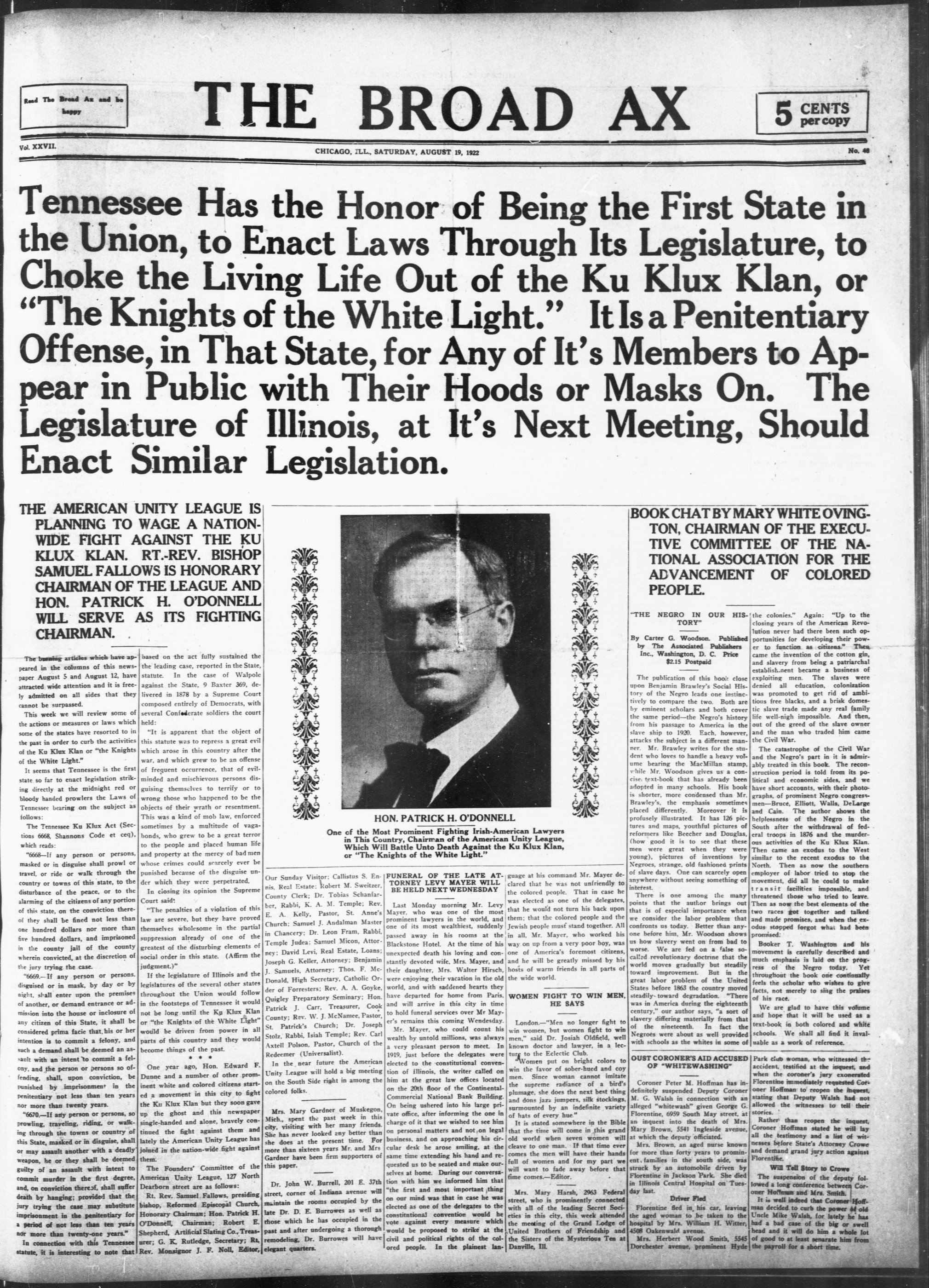
Tennessee Has the Honor of Being the First State in the Union, to Enact Laws Through Its Legislature, to Choke the Living Life Out of the Ku Klux Klan, or "The Knights of the White Light." It Is a Penitentiary Offense, in That State, for Any of It's Members to Appear in Public with Their Hoods or Masks On. The Legislature of Illinois, at It's Next Meeting, Should Enact Similar Legislation.
THE AMERICAN UNITY LEAGUE IS PLANNING TO WAGE A NATIONWIDE FIGHT AGAINST THE KU KLUX KLAN. RT.-REV. BISHOP SAMUEL FALLOWS IS HONORARY CHAIRMAN OF THE LEAGUE AND HON. PATRICK H. O'DONNELL WILL SERVE AS ITS FIGHTING CHAIRMAN.
Read The Broad Ax and be happy
Vol. XXVII.
Tennessee the Uni Choke "The K Offense pear in Legislat Enact S
THE AMERICAN U PLANNING TO WIDE FIGHT A KLUX KLAN. SAMUEL FALLO CHAIRMAN OF HON. PATRICI WILL SERVE A CHAIRMAN.
The burning articles which have appeared in the columns of this newspaper August 5 and August 12, have attracted wide attention and it is freely admitted on all sides that they cannot be surpassed.
This week we will review some of the actions or measures or laws which some of the states have resorted to in the past in order to curb the activities of the Ku Klux Klan or "the Knights of the White Light."
It seems that Tennessee is the first state so far to enact legislation striking directly at the midnight red or bloody handed prowlers the Laws of Tennessee bearing on the subject as follows:
The Tennessee Ku Klux Act (Sections 6668, Shannons Code et ceq), which reads:
"6668—If any person or persons, masked or in disguise prowl or travel, or ride or walk through the country or towns of this state, to the disturbance of the peace, or to the alarming of the citizens of any portion of this state, on the conviction thereof of they shall be fined not less than one hundred dollars nor more than five hundred dollars, and imprisoned in the county jail of the county wherein convicted, at the discretion of the jury trying the case.
"6669—If any person or persons, disguised or in mask, by day or by night, shall enter upon the premises of another, or demand entrance or admission into the house or enclosure of any citizen of this State, it shall be considered prima facie that his or her intention is to commit a felony, and such a demand shall be deemed an assault with an intent to commit a felony, and the person or persons so offending, shall, upon conviction, be punished by imprisonment in the penitentiary not less than ten years nor more than twenty years.
"6670.—If any person or persons, so prowling, traveling, riding, or walking through the towns or country of this State, masked or in disguise, shall or may assault another with a deadly weapon, he or they shall be deemed guilty of an assault with intent to commit murder in the first degree, and, on conviction thereof, shall suffer death by hanging; provided that the jury trying the case may substitute imprisonment in the penitentiary for a period of not less than ten years nor more than twenty-one years." In connection with this Tennessee statute, it is interesting to note that
THE BROAD AX
based on the act fully sustained the the leading case, reported in the State, statute. In the case of Walpole against the State, 9 Baxter 369, delivered in 1878 by a Supreme Court composed entirely of Democrats, with several Confederate soldiers the court held:
"It is apparent that the object of this statute was to repress a great evil which arose in this country after the war, and which grew to be an offense of frequent occurrence, that of evil-minded and mischievous persons disguising themselves to terrify or to wrong those who happened to be the objects of their wrath or resentment. This was a kind of mob law, enforced sometimes by a multitude of vagabonds, who grew to be a great terror to the people and placed human life and property at the mercy of bad men whose crimes could scarcely ever be punished because of the disguise under which they were perpetrated.
In closing its opinion the Supreme Court said:
"The penalties of a violation of this law are severe, but they have proved themselves wholesome in the partial suppression already of one of the greatest of the disturbing elements of social order in this state. (Affirm the judgment.)"
If the legislature of Illinois and the legislatures of the several other states throughout the Union would follow in the footsteps of Tennessee it would not be long until the Ku Klux Klan or "the Knights of the White Light" would be driven from power in all parts of this country and they would become things of the past.
* * *
One year ago, Hon. Edward F. Dunne and a number of other prominent white and colored citizens started a movement in this city to fight the Ku Klux Klan but they soon gave up the ghost and this newspaper single-handed and alone, bravely continued the fight against them and lately the American Unity League has joined in the nation-wide fight against them.
The Founders' Committee of the American Unity League, 127 North Dearborn street are as follows: Rt. Rev. Samuel. Fallows, presiding bishop, Reformed Episcopal Church, Honorary Chairman; Hon. Patrick H. O'Donnell, Chairman; Robert E. Shepherd, Artificial Slating Co., Treasurer; G. K. Rutledge, Secretary; Rt. Rev. Monsignor J. F. Noll, Editor,
CHICAGO, ILL., SATURDAY, AUGUST 19, 1922
M. H.
One of the Most Prominent Fighting Irish-American Lawyers in This Country, Chairman of the American Unity League, Which Will Battle Unto Death Against the Ku Klux Klan, or "The Knights of the White Light."
```markdown
```
Our Sunday Visitor; Callistus S. Ennis, Real Estate; Robert M. Sweitzer, County Clerk; Dr. Tobias Schanfarber, Rabbi, K. A. M. Temple; Rev. E. A. Kelly, Pastor, St. Anne's Church; Samuel J. Andalman Master in Chancery; Dr. Leon Fram, Rabbi, Temple Judea; Samuel Micon, Attorney; David Levi, Real Estate, Loans; Joseph G. Keller, Attorney; Benjamin J. Samuels, Attorney; Thos. F. McDonald, High Secretary, Catholic Order of Forresters; Rev. A. A. Goyke, Quigley Preparatory Seminary; Hon. Patrick J. Carr, Treasurer, Cook County; Rev. W. J. McNamee, Pastor, St. Patrick's Church; Dr. Joseph Stolz, Rabbi, Isiah Temple; Rev. Carl Axtell Polson, Pastor, Church of the Redeemer (Universalist).
In the near future the American Unity League will hold a big meeting on the South Side right in among the colored folks.
Mrs. Mary Gardner of Muskegon, Mich., spent the past week in this city, visiting with her many friends. She has never looked any better than she does at the present time. For more than sixteen years Mr. and Mrs. Gardner have been firm supporters of this paper.
Dr. John W. Burrell, 201 E. 37th street, corner of Indiana avenue will maintain the rooms occupied by the late Dr. D. E. Burrowes as well as those which he has occupied in the past and after undergoing a thorough remodeling, Dr. Burrowes will have elegant quarters.
HON, PATRICK H. O'DONNELL
FUNERAL OF THE LATE AT
TORNEY LEVY MAYER WILL
BE HELD NEXT WEDNESDAY
Last Monday morning Mr. Levy Mayer, who was one of the most prominent lawyers in the world, and one of its most wealthiest, suddenly passed away in his rooms at the Blackstone Hotel. At the time of his unexpected death his loving and constantly devoted wife, Mrs. Mayer, and their daughter, Mrs. Walter Hirsch, were enjoying their vacation in the old world, and with saddened hearts they have departed for home from Paris, and will arrive in this city in time to hold funeral services over Mr Mayer's remains this coming Wendnesday. Mr. Mayer, who could count his wealth by untold millions, was always a very pleasant person to meet. In 1919, just before the delegates were elected to the constitutional convention of Illinois, the writer called on him at the great law offices located on the 20th floor of the Continental-Commercial National Bank Building. On being ushered into his large office, after informing the one in charge of it that we wished to see him on personal matters and not, on legal business, and on approaching his circular desk he arose smiling, at the same time extending his hand and requested us to be seated and make ourselves at home. During our conversation with him we informed him that "the first and most important thing on our mind was that in case he was elected as one of the delegates to the constitutional convention would he vote against every measure which would be proposed to strike at the civil and political rights of the colored people. In the plainest lan-
guage at his command Mr. Mayer declared that he was not unfriendly to the colored people. That in case he was elected as one of the delegates, that he would not turn his back upon them; that the colored people and the Jewish people must stand together. All in all, Mr. Mayer, who worked his way on up from a very poor boy, was one of America's foremost citizens, and he will be greatly missed by his hosts of warm friends in all parts of the wide world.
WOMEN FIGHT TO WIN MEN
HE SAYS
London.—"Men no longer fight to win women, but women fight to win men," said Dr. Josiah Oldfield, well known doctor and lawyer, in a lecture to the Eclectic Club.
"Women put on bright colors to win the favor of sober-hued and coy men. Since woman cannot imitate the supreme radiance of a bird's plumage, she does the next best thing and dons jazz jumpers, silk stockings, surmounted by an indefinite variety of hats of every hue."
It is stated somewhere in the Bible that the time will come in this grand old world when seven women will cleave to one man. If that time ever comes the men will have their hands full of women and for my part we will want to fade away before that time comes. Editor.
Mrs. Mary Harsh, 2963 Federal street, who is prominently connected with all of the leading Secret Societies in this city, this week attended the meeting of the Grand Lodge of United Brothers of Friendship and the Sisters of the Mysterious Ten at Danville, Ill.
BOOK CHAT BY MARY WHITE OVINGTON, CHAIRMAN OF THE EXECUTIVE COMMITTEE OF THE NATIONAL ASSOCIATION FOR THE ADVANCEMENT OF COLORED PEOPLE.
"THE NEGRO IN OUR HISTORY"
By Carter G. Woodson. Published by The Associated Publishers Inc., Washington, D. C. Price $2.15 Postpaid
The publication of this book close upon Benjamin Brawley's Social History of the Negro leads one instinctively to compare the two. Both are by eminent scholars and both cover the same period—the Negro's history from his passage to America in the slave ship to 1920. Each, however, attacks the subject in a different manner. Mr. Brawley writes for the student who loves to handle a heavy volume bearing the MacMillan stamp, while Mr. Woodson gives us a concise text-book that has already been adopted in many schools. His book is shorter, more condensed than Mr. Brawley's, the emphasis sometimes placed differently. Moreover it is profusely illustrated. It has 126 pictures and maps, youthful pictures of reformers like Beecher and Douglas, (how good it is to see that these men were great when they were young), pictures of inventions by Negroes, strange, old fashioned prints of slave days. One can scarcely open anywhere without seeing something of interest.
There is one among the many points that the author brings out that is of especial importance when we consider the labor problem that confronts us today. Better than anyone before him, Mr. Woodson shows us how slavery went on from bad to worse. We are fed on a false so-called revolutionary doctrine that the world moves gradually but steadily toward improvement. But in the great labor problem of the United States before 1863 the country moved steadily—toward degradation. "There was in America during the eighteenth century," our author says, "a sort of slavery differing materially from that of the nineteenth. In fact the Negroes were about as well provided with schools as the whites in some of
OUST CORONER'S AID ACCUSED OF "WHITEWASHING"
Coroner Peter M. Hoffman has indefinitely suspended Deputy Coroner M. G. Walsh in connection with an alleged "whitewash" given George G. Florentine, 6959 South May street, at an inquest into the death of Mrs Mary Brown, 5541 Ingleside avenue, at which the deputy officiated.
Mrs. Brown, an aged nurse known for more than forty years to prominent families in the south side, was struck by an automobile driven by Florentine in Jackson Park. She died in Illinois Central Hospital on Tuesday last.
Driver Fled
Florentine fled in his car, leaving the aged woman to be taken to the hospital by Mrs. William H. Witter, 4508 Oakenwald avenue.
Mrs. Herbert Wood Smith, 5545 Dorchester avenue, prominent Hyde
5 CENTS per copy
State in
nature, to
Klan, or
tentiary
s to Ap-
n. The
Should
ARY WHITE OVING-
N OF THE EXECU-
TEE OF THE NA-
CIATION FOR THE
T OF COLORED
the colonies." Again: "Up to the closing years of the American Revolution never had there been such opportunities for developing their power to function as citizens." Then came the invention of the cotton gin, and slavery from being a patriarchal establish.nent became a business of exploiting men. The slaves were denied all education, colonization was promoted to get rid of ambitious free blacks, and a brisk domestic slave trade made any real family life well-nigh impossible. And then, out of the greed of the slave owner and the man who traded him came the Civil War.
The catastrophe of the Civil War and the Negro's part in it is admirably treated in this book. The reconstruction period is told from its political and economic sides, and we have short accounts, with their photographs, of prominent Negro congressmen—Bruce, Elliott, Walls, DeLarge and Cain. The author shows the helplessness of the Negro in the South after the withdrawal of federal troops in 1876 and the murderous activities of the Ku Klux Klan. Then came an exodus to the West similar to the recent exodus to the North. Then as now the southern employer of labor tried to stop the movement, did all he could to make transit facilities impossible, and threatened those who tried to leave. Then as now the best elements of the two races got together and talked and made promises, and when the exodus stopped forgot what had been promised:
Booker T. Washington and his movement is carefully described and much emphasis is laid on the progress of the Negro today. Yet throughout the book one continually feels the scholar who wishes to give facts, not merely to sing the praises of his race.
We are glad to have this volume and hope that it will be used as a text-book in both colored and white schools. We shall all find it invaluable as a work of reference.
Park club woman, who witnessed the accident, testified at the inquest, and when the coroner's jury exonerated Florentine immediately requested Coroner Hoffman to reopen the inquest, stating that Deputy Walsh had not allowed the witnesses to tell their stories.
Rather than reopen the inquest, Coroner Hoffman stated he will lay all the testimony and a list of witnesses before State's Attorney Crowe and demand grand jury action against Florentine.
Will Tell Story to Crowe
The suspension of the deputy followed a long conference between Coroner Hoffman and Mrs. Smith.
It is well indeed that Coroner Hoffman decided to curb the power of old Uncle Mike Walsh, for lately he has had a bad case of the big or swell head and it will do him a whole lot of good to at least senarate him from the payroll for a short time.
THE BROAD AX
In this city since July 15th 1899, without missing one single issue. Republicans, Democrats, Catholics, Protestants, Single Taxes, Priests, infidels or anyone else can have their say as long as their language is proper and responsibility is fixed.
The Broad Ax is a newspaper whose platform is broad enough for all, ever claiming the editorial right to speak its own mind.
Local communications will receive attention. Write only on one side of the paper.
Subscriptions must be paid in advance Year .....$2.00
Six Months .....$1.00
Advertising rates made known on application.
Address all communication to ...
THE BROAD AX
6200 So. Elizabeth St., Chicago, IL.
Phone Wentworth 2597
JULIUS F. TAYLOR
Editor and Publisher
Associate Editor
DR. M. A. MAJORS
August 19, 1922
Vol. XXVII. No. 48
Entered as Second-Class Matter. Aug. 9, 1902, at the Post Office at Chicago
ill. Under Act of March 8, 1879.
WELL, WHAT ABOUT MORALS?
By Dr. M. A. Majors
The mother used to talk of good behavior to the child, the preacher used to preach about decency and moral sobriety and the teacher used to give fancy descriptions of the good and the bad, lecturers used to paint lucid pictures of the debased reprobates. Now we do not hear about such things any more. Morality is almost a sign post of the decent and respectable past. It is used to make contrasts with the present times and the metaphor used to convey the meaning of whoever is speaking is "That's old fashioned," "You're away behind the times," "That's out of date," "People are not like they were thirty years ago."
First liberty, then license, finally has come privilege. This privilege of the present spells harlotry, the bean brummel of the present spells destruction to homes, death to decency and respectability, and a long train of the coward's footsteps.
The insipid upstart will tell you quickly "You are meaning me." It has no future, never had, doesn't want any and it wouldn't like to be bothered with one. It usually has about as much brains as you would expect to fill a chicken gizzard, and about as much respectability as you would likely to find around Twenty-second street at two in the morning. Chicago is filling up with big eyed, straight haired, yellow and high brown wild women, and who are working the wits overtime, and their artificialities, make ups, bleaches, powders, paints, some grease, and pomades, fine reaimment of all harlotry of the past of which the Bible tells us.
We have even been told that people are not good any more, and then we occasionally hear someone say people never were good, they simply hid their evil, they were careful, and took special pains not to get caught, and they back up their statement with what Christ told His disciples, "There is none good but the Father."
Well, people are different in many respects, but when it comes to sustaining' the highest principles of life people ought to be better in moral sobriety than they were in the past. Everybody is not good, could not expect to be, and besides a great many people believe in certain questionable methods because they have not got the decent fineness, and lack in intelligence that which is required to help them determine the fitness of moral decency. That is the cause of the immorality of the present age. It seems that they ought more to be pitied than censured. We have been asked what credit does one get for being good? What benefit arises from trying to be better than others? "Life is so short I want to have a good time". They do not mean a good time at all, they mean a bad time, a questionable time of privilege, of ugliness, often deathiness, always disgracefulness, whether the fact becomes known or not. Always we have a conscience standing guard presiding over our destiny and that spirit of our better nature condemns that wrong forevermore. As long as the memory can last we are faced by that greater, nobler other self and condemned till we die for the wrong done to the body in which lives a part of the spirit of God.
The character of a person is their strongest or weakest human fortress. A man or woman of strong character are honored, loved, and feared, while on the other hand a person whose character is weak is looked down
86 PEO
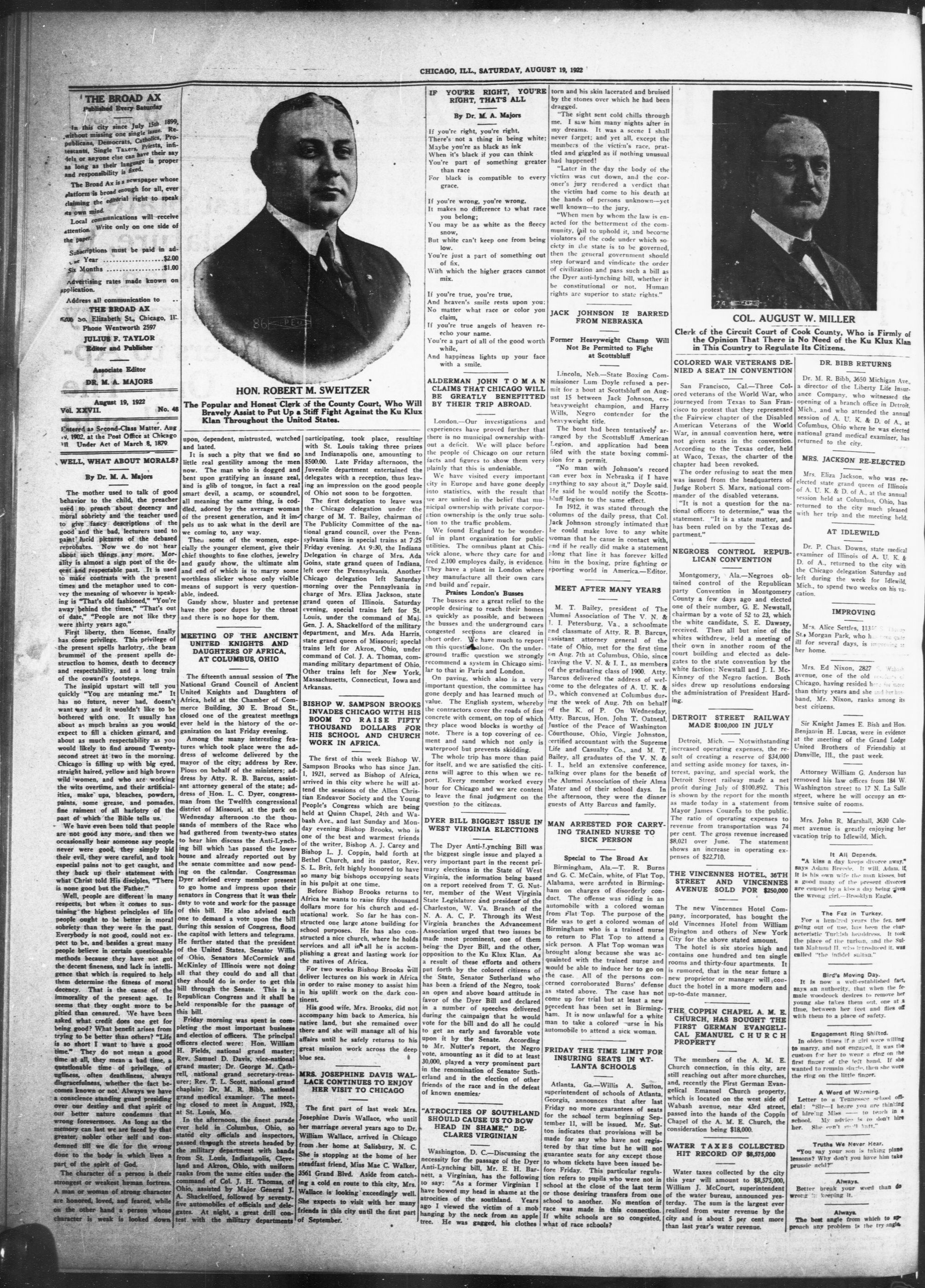
HON. ROBERT M. SWEITZER
upon, dependent, mistrusted, watched and hated.
It is such a pity that we find so little real gentility among the men now. The man who is dogged and bent upon gratifying an insane zeal, and is gib of tongue, in fact a real smart devil, a scamp, or scoundrel, all meaning the same thing, is coddled, adored by the average woman of the present generation, and it impels us to ask what in the devil are we coming to, any way.
Then some of the women, especially the younger element, give their chief thoughts to fine clothes, jewelry and gaudy show, the ultimate aim and end of which is to marry some worthless slicker whose only visible means of support is very questionable, indeed.
Gaudy show, bluster and pretense have the poor dupes by the throat and there is no hope for them.
MEETING OF THE ANCIENT
UNITED KNIGHTS AND
DAUGHTERS OF AFRICA,
AT COLUMBUS, OHIO
The fifteenth annual session of The National Grand Council of Ancient United Knights and Daughters of Africa, held at the Chamber of Commerce Building, 30 E. Broad St., closed one of the greatest meetings ever held in the history of the organization on last Friday evening.
Among the many interesting features which took place were the address of welcome delivered by the mayor of the city; address by Rev Pious on behalf of the ministers; address by Atty. R. B. Barcus, assist ant attorney general of the state; address of Hon. L. C. Dyer, congressman from the Twelfth congressional district of Missouri, at the park on Wednesday afternoon. to the thousands of members of the Race who had gathered from twenty-two states to hear him discuss the Anti-Lynching bill which has passed the lower house and already reported out by the senate committee and now pending on the calendar. Congressman Dyer advised every member present to go home and impress upon their senators in Congress that it was their duty to vote and work for the passage of this bill. He also advised each one to demand a vote upon the bill during this session of Congress, flood the capitol with letters and telegrams. He further stated that the president of the United States, Senator Willis of Ohio, Senators McCormick and McKinley of Illinois were not doing all that they could do and all that they should do in order to get this bill through the Senate. This is a Republican Congress and it shall be held responsible for the passage of this bill.
Friday morning was spent in completing the most important business and election of officers. The principal officers elected were: Hon. William H. Fields, national grand master; Rev. Samuel D. Davis, vice-national grand master; Dr. George M. Cathrell, national grand secretary-treasurer; Rev. T. L. Scott, national grand chaplain; Dr. M. R. Bibb, national grand medical examiner. The meeting closed to meet in August, 1923, at St. Louis, Mo.
In the afternoon, the finest parade ever held in Columbus, Ohio, so stated city officials and inspectors, passed through the streets headed by the military department with bands from St. Louis, Indianapolis, Cleveland and Akron, Ohio, with uniform ranks from the same cities under the command of Col. J. H. Thomas, of Ohio, assisted by Major General J. A. Shackelford, followed by seventy-five automobiles of officials and delegates. At night, a great drill contest with the military departments
participating, took place, resulting with St. Louis taking three prizes and Indianapolis one, amounting to $500.00. Late Friday afternoon, the Juvenile department entertained the delegates with a reception, thus leaving an impression on the good people of Ohio not soon to be forgotten.
The first delegation to leave was the Chicago delegation under the charge of M. T. Bailey, chairman of The Publicity Committee of the national grand council, over the Pennsylvania lines in special trains at 7:25 Friday evening. At 9:30, the Indiana Delegation in charge of Mrs. Ada Goins, state grand queen of Indiana, left over the Pennsylvania. Another Chicago delegation left Saturday morning over the Pennsylvania in charge of Mrs. Eliza Jackson, state grand queen of Illinois. Saturday evening, special trains left for St. Louis, under the command of Maj. Gen. J. A. Shackelford of the military department, and Mrs. Ada Harris, state grand queen of Missouri; special trains left for Akron, Ohio, under command of Col. J. A. Thomas, commanding military department of Ohio. Other trains left for New York, Massachusetts, Connecticut, Iowa and Arkansas.
BISHOP W. SAMPSON BROOKS
INVADES CHICAGO WITH HIS
BOOM TO RAISE FIFTY
THOUSAND DOLLARS FOR
HIS SCHOOL AND CHURCH
WORK IN AFRICA.
The first of this week Bishop W Sampson Brooks who has since Jan 1, 1921, served as Bishop of Africa arrived in this city where he will attend the sessions of the Allen Christian Endeavor Society and the Young People's Congress which are being held at Quinn Chapel, 24th and Wabash Ave., and last Sunday and Monday evening Bishop Brooks, who is one of the best and warmest friends of the writer, Bishop A. J. Carey and Bishop L. J. Coppin, held forth at Bethel Church, and its pastor, Rev. S. L. Brit, felt highly honored to have so many big bishops occupying seats in his pulpit at one time.
Before Bishop Brooks returns to Africa he wants to raise fifty thousand dollars more for his church and educational work. So far he has constructed one large stone building for school purposes. He has also constructed a nice church, where he holds services and all in all he is accomplishing a great and lasting work for the natives of Africa.
For two weeks Bishop Brooks will deliver lectures on his work in Africa in order to raise money to assist him in his uplift work on the dark continent.
His good wife, Mrs. Brooks, did not accompany him back to America, his native land, but she remained over there and she will manage all of his affairs until he safely returns to his great mission work across the deep blue sea.
MRS. JOSEPHINE DAVIS WAL
LACE CONTINUES TO ENJOY
HER VISIT TO CHICAGO
The first part of last week Mrs. Josephine Davis Wallace, who until her marriage several years ago to Dr. William Wallace, arrived in Chicago from her home at Salisbury, N. C. She is stopping at the home of her steadfast friend, Miss Mae C. Walker, 3561 Grand Blvd. Aside from catching a cold en route to this city, Mrs. Wallace is looking exceedingly well. She expects to visit with her many friends in this city until the first part of September.
CHICAGO, ILL., SATURDAY, AUGUST 19, 1922 IF YOU'RE RIGHT, YOU'RE RIGHT, THAT'S ALL torn and hit by the store
By Dr. M. A. Majors
If you're right, you're right,
There's not a thing in being white;
Maybe you're as black as ink
When it's black if you can think
You're part of something greater
than race
For black is compatible to every
grace.
If you're wrong, you're wrong,
It makes no difference to what race
you belong;
You may be as white as the fleecy
snow,
But white can't keep one from being
low.
You're just a part of something out
of fix.
With which the higher graces cannot
mix.
And heaven's smile rests upon you:
No matter what race or color you
claim,
If you're true angels of heaven re-
echo your name.
And happiness lights up your face with a smile.
ALDERMAN JOHN T O M A N
CLAIMS THAT CHICAGO WILL
BE GREATLY BENEFITTED
BY THEIR TRIP ABROAD.
London.—Our investigations and experiences have proved further that there is no municipal ownership without a deficit. We will place before the people of Chicago on our return facts and figures to show them very plainly that this is undeniable. We have visited every important city in Europe and have gone deeply into statistics, with the result that we are united in the belief that municipal ownership with private corporation ownership is the only true solution to the traffic problem. We found England to be wonderful in plant organization for public utilities. The omnibus plant at Chivick alone, where they care for and feed 2,100 employees daily, is evidence. They have a plant in London where they manufacture all their own cars and build and repair.
Praises London's Busses
The busses are a great relief to the people desiring to reach their homes as quickly as possible, and between the busses and the underground cars congested sections are cleared in short order. We have much to report on this question alone. On the underground traffic question we strongly recommend a system in Chicago similar to that in Paris and London. On paving, which also is a very important question, the committee has gone deeply and has learned much of value. The English system, whereby the contractors cover the roads of fine concrete with cement, on top of which they place wood blocks is worthy of note. There is a top covering of cement and sand which not only is waterproof but prevents skidding.
The whole trip has more than paid for itself, and we are satisfied the citizens will agree to this when we report. Every member worked every hour for Chicago and we are content to leave the final judgment on the question to the citizens.
DYER BILL BIGGEST ISSUE IN
WEST VIRGINIA ELECTIONS
The Dyer Anti-Lynching Bill was the biggest single issue and played a very important part in the recent primary elections in the State of West Virginia, the information being based on a report received from T. G. Nutter, member of the West Virginia State Legislature and president of the Charleston, W. Va. Branch of the N. A. A. C. P. Through its West Virginia branches the Advancement Association urged that two issues be made most prominent, one of them being the Dyer Bill, and the other, opposition to the Ku Klux Klan. As a result of these efforts and others put forth by the colored citizens of the State, Senator Sutherland who has been a friend of the Negro, took an open and above board attitude in favor of the Dyer Bill and declared in a number of speeches delivered during the campaign that he would vote for the bill and do all he could to get an early and favorable vote upon it by the Senate. According to Mr. Nutter's report, the Negro vote, amounting as it did to at least 30,000, played a very prominent part in the renomination of Senator Sutherland and in the election of other friends of the race and in the defeat of known enemies:
"ATROCITIES OF SOUTHLAND
SHOULD CAUSE US TO BOW
HEAD IN SHAME," DE-
CLARES VIRGINIAN
Washington, D. C.—Discussing the necessity for the passage of the Dyer Anti-Lynch bill, Mr. E. H. Barnett, a Virginian, has the following to say: "As a former Virginian I have bowed my head in shame at the atrocities of the southland. Years ago I viewed the victim of a mob hanging by the neck from an apple tree. He was gagged, his clothes
torn and his skin lacerated and bruised by the stones over which he had been dragged.
"The sight sent cold chills through me. I saw him many nights after in my dreams. It was a scene I shall never forget; and yet all, except the members of the victim's race, prattled and giggled as if nothing unusual had happened!
"Later in the day the body of the victim was cut down, and the coroner's jury rendered a verdict that the victim had come to his death at the hands of persons unknown—yet well known—to the jury.
"When men by whom the law is enacted for the betterment of the community, fail to uphold it, and become violators of the code under which society in the state is to be governed, then the general government should step forward and vindicate the order of civilization and pass such a bill as the Dyer anti-lyching bill, whether it be constitutional or not. Human rights are superior to state rights."
JACK JOHNSON IS BARRED
FROM NEBRASKA
Former Heavyweight Champ Will Not Be Permitted to Fight at Scottsbluff
Lincoln, Neb.-State Boxing Commissioner Lum Doyle refused a permit for a bout at Scottsbluff on August 15 between Jack Johnson, ex-heavyweight champion, and Harry Wills, Negro contender for the heavyweight title.
The bout had been tentatively arranged by the Scottsbluff American Legion, and application had been filed with the state boxing commission for a permit.
"No man with Johnson's record can ever box in Nebraska if I have anything to say about it," Doyle said. He said he would notify the Scottsbluff legion to the same effect.
In 1912, it was stated through the columns of the daily press, that Col. Jack Johnson strongly intimated that he could make love to any white woman that he came in contact with, and if he really did make a statement along that line it has forever killed him in the boxing, prize fighting or sporting world in America—Editor
MEET AFTER MANY YEARS
M. T. Bailey, president of The Alumni Association of The V. N. & I. I. Petersburg, Va., a schoolmate and classmate of Atty. R. B. Barcus, assistant attorney general of the state of Ohio, met for the first time on Aug. 7th at Columbus, Ohio, since leaving the V. N. & I. I., as members of the graduating class of 1900. Atty. Barcus delivered the address of welcome to the delegates of A. U. K. & D., which convened at Columbus during the week of Aug. 7th on behalf of the K. of P. On Wednesday, Atty. Barcus, Hon. John T. Oatneal, Justice of the Peace of Washington Courthouse, Ohio, Virgine Johnston, certified accountant with the Supreme Life and Casualty Co., and M. T. Bailey, all graduates of the V. N. & I. I., held an extensive conference, talking over plans for the benefit of the Alumni Association of their Alma Mater and of their school days. In the afternoon, they were the dinner guests of Atty Barcus and family.
MAN ARRESTED FOR CARRY
ING TRAINED NURSE TO
SICK PERSON
Special to The Broad Ax
Birmingham, Ala.—T. R. Burns and G. C. McCain, white, of Flat Top, Alabama, were arrested in Birmingham on charges of disorderly conduct. The offense was riding in an automobile with a colored woman from Flat Top. The purpose of the ride was to get a colored woman of Birmingham who is a trained nurse to return to Flat Top to attend a sick person. A Flat Top woman was brought along because she was acquainted with the trained nurse and would be able to induce her to go on the case. All of the persons concerned corroborated Burns' defense as stated above. The case has not come up for trial but at least a new precedent has been set in Birmingham. It is now unlawful for a white man to take a colored "urse in his automobile to attend a sick woman.
FRIDAY THE TIME LIMIT FOR INSURING SEATS IN ATLANTA SCHOOLS
Atlanta, Ga.—Willis A. Sutton superintendent of schools of Atlanta Georgia, announces that after last Friday no more guarantees of seats for the school term beginning September 11, will be issued. Mr. Sutton indicates that provisions will be made for any who have not registered by that time but he will not guarantee seats for any except those to whom tickets have been issued before Friday. This particular regulation refers to pupils who were not in school at the close of the last term or those desiring transfers from one school to another. No mention of race was made in this connection. If white schools are so congested, what of race schools?
74
COL. AUGUST W. MILLER
Clerk of the Circuit Court of Cook County, Who is Firmly of the Opinion That There is No Need of the Ku Klux Klan in This Country to Regulate Its Citizens.
COLORED WAR VETERANS DENIED A SEAT IN CONVENTION
San Francisco, Cal.—Three Colored veterans of the World War, who journeyed from Texas to San Francisco to protest that they represented the Fairview chapter of the Disabled American Veterans of the World War, in annual convention here, were not given seats in the convention. According to the Texas order, held at Waco, Texas, the charter of the chapter had been revoked.
DR. BIBB RETURNS
Dr. M. R. Bibb, 3650 Michigan Ave., a director of the Liberty Life Insurance Company, who witnessed the opening of a branch office in Detroit, Mich., and who attended the annual session of A. U. K. & D. of A., at Columbus, Ohio where he was elected national grand medical examiner, has returned to the city.
MRS. JACKSON RE-ELECTED
The order refusing to seat the men was issued from the headquarters of Judge Robert S. Marx, national commander of the disabled veterans. "It is not a question for the national officers to determine" was the statement. "It is a state matter, and has been ruled on by the Texas department."
NEGROES CONTROL REPUBLICAN CONVENTION
Montgomery, Ala.—Negroes obtained control of the Republican party Convention in Montgomery County a few days ago and elected one of their number, G. E. Newstall, chairman by a vote of 52 to 23, which the white candidate, S. E. Dawsey, received. Then all but nine of the whites withdrew, held a meeting of their own in another room of the court building and elected as delegates to the state convention by the white faction: Newstall and J. I. McKinney of the Negro faction. Both sides drew up resolutions endorsing the administration of President Harding.
DETROIT STREET RAILWAY
MADE $100,000 IN JULY
Detroit, Mich. — Notwithstanding increased operating expenses, the result of creating a reserve of $34,000 and setting aside money for taxes, interest, paving, and special work, the Detroit Street railway made a net profit during July of $100,892. This is shown by the report for the month as made today in a statement from Mayor James Couzeis to the public. The ratio of operating expenses to revenue from transportation was 74 per cent. The gross revenue increased $8,021 over June. The statement shows an increase in operating expenses of $22,710.
THE VINCENNES HOTEL, 36TH
STREET AND VINCENNES
AVENUE SOLD FOR $250,000
The new Vincennes Hotel Company, incorporated, has bought the old Vincennes Hotel from William Byington and others of New York City for the above stated amount. The hotel is six stories high and contains one hundred and ten single rooms and thirty-four apartments. It is rumored, that in the near future a new proprietor or manager will conduct the hotel in a more modern and up-to-date manner.
THE COPPIN CHAPEL A. M. E. CHURCH, HAS BOUGHT THE FIRST GERMAN EVANGELICAL EMANUEL C H U R C H PROPERTY
The members of the A. M. E. Church connection, in this city, are still reaching out after more churches, and, recently the First German Evangelical Emanuel Church property, which is located on the west side of Wabash avenue, near 43rd street, passed into the hands of the Coppin Chapel of the A. M. E. Church, the consideration being $18,000.
WATER TAXES COLLECTED
HIT RECORD OF $8,575.00
Water taxes collected by the city this year will amount to $8,575,000, William J. McCourt, superintendent of the water bureau, announced yesterday. The sum is the largest ever realized from water revenue by the city and is about 5 per cent more than last year's water revenue.
Cook County, Who is Firmly of is No Need of the Ku Klux Klanate Its Citizens.
DR. BIBB RETURNS
Dr. M. R. Bibb, 3650 Michigan Ave., a director of the Liberty Life Insurance Company, who witnessed the opening of a branch office in Detroit, Mich., and who attended the annual session of A. U. K. & D. of A., at Cofumbus, Ohio where he was elected national grand medical examiner, has returned to the city.
MRS. JACKSON RE-ELECTED
Mrs. Eliza Jackson, who was reelected state grand queen of Illinois of A. U. K. & D. of A., at the annual session held at Columbus, Ohio, has returned to the city much pleased with her trip and the meeting held
AT IDLEWILD
Dr. P. Chas. Downs, state medical examiner of Illinois of A. U. K. & D. of A., returned to the city with the Chicago delegation Saturday and left during the week for Idlewild, Mich., to spend two weeks on his vacation.
Mrs. Alice Settles, 113 W. St. Morgan Park, who h
ill for several days, is improving at her home.
Mrs. Ed Nixon, 2827 W. Walsh avenue, one of the old residents of Chicago, having resided here for more than thirty years and she and her husband, Mr. Nixon, ranks among its best citizens.
Sir Knight James E. Bish and Hon. Benjamin H. Lucas, were in evidence at the meeting of the Grand Lodge United Brothers of Friendship at Danville, Ill., the past week.
Attorney William G. Anderson has removed his law offices from 184 W. Washington street to 17 N. La Salle street, where he will occupy an extensive suite of rooms.
Mrs. John R. Marshall, 3630 Calumet avenue is greatly enjoying her vacation trip to Idlewild, Mich.
It All Depends
"A kiss a day keeps divorce away"
says Adam Breedle. It will. Adam. If it is his own wife the man kisses, but a good many of the present divorces are caused by a kiss a day being given the wrong girl.-Brooklyn Eagle.
The Fez in Turkey
For a hundred years the fez, now going out of use, has been the characteristic Turkish headdress. It took the place of the turban, and the Subut Mabuhdul II, who introduced it, was called the "inferior sultan."
Bird's Moving Day
It is now a well-established fact, says an authority, that when the female woodcock desires to remove her young she takes them out, one at a time, between her feet and flies off with them to a place of safety.
Engagement Ring Shifted.
In old times if a girl were willing to marry, and not engaged, it was the custom for her to wear a ring on the first finger of the left hand. If she wanted to remain single, then she wore the ring on the little finger.
4. Word of Warning
Letter to a Tennessee school official: "Sir—I hear you are thinking of bireing Miss — to teach in a school. My advice is to don't hire her. She can't spell it."
"You say your son is taking piano lessons? Why don't you have him take prussie acid?"
Always.
Better break your word than do wrong in keeping it.
Always.
The best angle from which to approach any problem is the try angle.
IMPROVING
A
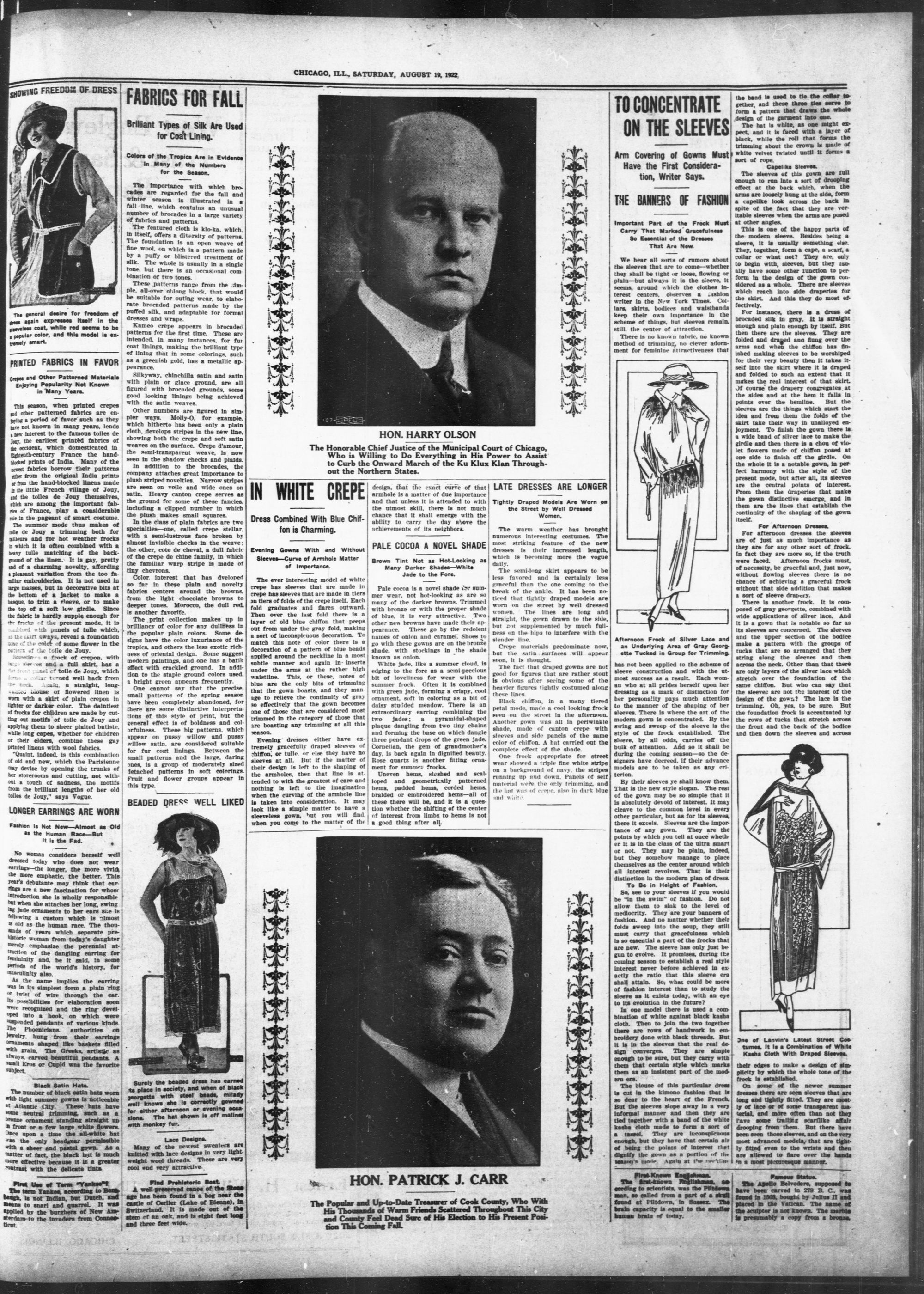
The general desire for freedom of dress again expresses itself in the gleamless coat, while red seems to be a popular color, and this model is extremely smart.
PRINTED FABRICS IN FAVOR
Crepes and Other Patterned Materials Enjoying Popularity Not Known in Many Years.
This season, when printed crepes and other patterned fabrics are enjoying a period of favor such as they have not known in many years, lends a new interest to the famous toile de Jouy, the earliest printed fabrics of the occident, which domesticated in Eighteenth-century France the hand-blocked prints of India. Many of the newest fabrics borrow their patterns either from the original India prints or from the hand-blocked linens made in the little French village of Jouy, and the toile de Jouy themselves, which are among the important fabrics of France, play a considerable role in the pageant of smart costume. The summer mode thus makes of toile de Jouy a trimming both for milleurs and for hot weather frocks in which it is often combined with a heavy tulle matching of the background of the linen. It is gay, pretty and of a charming novelty, affording a pleasant variation from the too familiar embroideries. It is not used in large masses, but in decorative bits at the bottom of a jacket to make a beaquet, to trim a sleeve, or to make the top of a soft low girdle. Since the fabric is hardly supply enough for the frocks of the present mode, it is combined with panels of tulle which, as the skirt sways, reveal a foundation tone of the color of some flower in the pattern of the toile de Jouy.
Sometimes a frock of crepon, with large sleeves and a full skirt, has a fat front panel of tolle de Jouy, which forms a collar turned well back from the neck. Again, a straight, long-sleeved house of flowered linen is worn with a skirt of plain crepon in lighter or darker color. The daintiest of frocks for children are made by cutting out motifs of tolle de Jouy and applying them to sheer plaited batiste, while long capes, whether for children or their elders, combine these gay printed linens with wool fabrics.
"Quaint, indeed, is this combination of old and new, which the Parisienne may devise by opening the trunks of her storerooms and cutting, not without a touch of sadness, the motifs from the brilliant lengths of her old tolle de Jouy," says Vogue.
LONGER EARRINGS ARE WORN
Fashion is Not New—Almost as Old as the Human Race—But It is the Fad.
No woman considers herself well dressed today who does not wear earrings—the longer, the more vivid the more emphatic, the better. This year's debutate may think that earrings are a new fascination for whose introduction she is wholly responsible but when she attaches her long, swing jade ornaments to her ears she is following a custom which is almost as old as the human race. The thousands of years which separate pre-historic woman from today's daughter merely emphasize the perennial attraction of the dangling earring for femininity and, be it said, in some periods of the world's history, for masculinity also.
As the name implies the earring was in its simplest form a plain ring or twist of wire through the ear. Its possibilities for elaboration soon were recognized and the ring developed into a hook, on which were suspended pendants of various kinds. The Phoenicians, authorities on jewelry, hung from their earrings ornaments shaped like baskets filled with grain. The Greeks, artistic as always, carved beautiful pendants. A small Eros or Cupid was the favorite subject.
Black Satin Hats
The number of black satin hats worn with light summer gowns is noticeable at Atlantic City. These hats have some neutral trimming, such as a bronze ornament standing straight up in front or a few large white flowers. Once upon a time the all-white hat was the only headgear permissible with a sheer and pastel gown. As a matter of fact, the black but is much more effective because it is a greater contrast with the delicate tinta.
First Use of Term "Yankee"
The term Yankee, according to Born laugh, is not Indian, but Dutch, and means to snarl and quarrel. It was applied by the burghers of New Amsterdam to the invaders from Connecticut.
FABRICS FOR FALL
Brilliant Types of Silk Are Used for Coat Lining.
Colors of the Tropics Are in Evidence
In Many of the Numbers
for the Season.
The importance with which brocades are regarded for the fall and winter season is illustrated in a fall-line, which contains an unusual number of brocades in a large variety of fabrics and patterns.
The featured cloth is klo-ka, which, in itself, offers a diversity of patterns. The foundation is an open weave of fine wool, on which is a pattern made by a puffy or blistered treatment of silk. The whole is usually in a single tone, but there is an occasional combination of two tones.
These patterns range from the simple, all-over oblong block, that would be suitable for outing wear, to elaborate brocaded patterns made by the puffed silk, and adaptable for formal dresses and wraps.
Kameo crepe appears in brocaded patterns for the first time. These are intended, in many instances, for fur coat linings, making the brilliant type of lining that in some colorings, such as a greenish gold, has a metallic appearance.
Silkyway, chinchilla satin and satin with plain or glace ground, are all figured with brocaded grounds, some good looking linings being achieved with the satin weaves.
Other numbers are figured in simpler ways. Molly-O, for example, which hitherto has been only a plain cloth, develops stripes in the new line, showing both the crepe and soft satin weaves on the surface. Crepe d'amour, the semi-transparent weave, is now seen in the shadow checks and plaids.
In addition to the brocades, the company attaches great importance to plush striped novelties. Narrow stripes are seen on volle and wide ones on satin. Heavy canton crepe serves as the ground for some of these fancies, including a clipped number in which the plush makes small squares.
In the class of plain fabrics are two specialities—one, called crepe stellar, with a semi-lustrous face broken by almost invisible checks in the weave; the other, cote de cheval, a dull fabric of the crepe de chine family, in which the familiar warp stripe is made of tiny chevrons.
Color interest that has developed so far in these plain and novelty fabrics centers around the browns, from the light chocolate browns to deeper tones. Morocco, the dull red, is another favorite.
The print collection makes up in brilliancy of color for any dullness in the popular plain colors. Some designs have the color luxuriance of the tropics, and others the less exotic richness of oriental design. Some suggest modern paintings, and one has a battle effect with crackled ground. In addition to the staple ground colors used, a bright green appears frequently.
One cannot say that the precise, small patterns of the spring season have been completely abandoned, for there are some distinctive interpretations of this style of print, but the general effect is of boldness and colorfulness. These big patterns, which appear on pussy willow and pussy willow satin, are considered suitable for fur cont linings. Between the small patterns and the large, daring ones, is a group of moderately sized detached patterns in soft colorings. Fruit and flower groups appear in this type.
BEADED DRESS WELL LIKED
A
Surely the beaded dress has earned its place in society, and when of black georgette with steel beads, milady well knows she is correctly gowned for either afternoon or evening occasions. The hat shown is off malliner with monkey fur.
Lace Designs.
Many of the newest sweaters are knitted with lace designs in very light weight wool threads. These are very cool and very attractive.
Find Prehistoric Boat.
A well-preserved canoe of the Stone age has been found in a bog near the castle of Celler (Lake of Bienne), in Switzerland. It is made out of the stem of an oak, and is eight feet long and three feet wide.
CHICAGO, ILL., SATURDAY, AUGUST 19, 1922.
107 PEU
The Honorable Chief Justice of the Municipal Court of Chicago, Who is Willing to Do Everything in His Power to Assist to Curb the Onward March of the Ku Klux Klan Throughout the Northern States.
The Popular and Up-to-Date Treasurer of Cook County, Who With His Thousands of Warm Friends Scattered Throughout This City and County Feel Dead Sure of His Election to His Present Position This Coming Fall.
---
IN WHITE CREPE
IN WHITE CREPE
Dress Combined With Blue Chiffon is Charming.
Evening Gowns With and Without Sleeves—Curve of Armhole Matter of Importance.
The ever interesting model of white crepe has sleeves that are made in crepe has sleeves that are made in tiers on tiers of folds of the crepe itself. Each fold graduates and flares outward. Then over the last fold there is a layer of old blue chiffon that peeps out from under the gray fold, making a sort of inconspicuous decoration. To match this note of color there is a decoration of a pattern of blue beads applied around the neckline in a most subtle manner and again in inserts under the arms at the rather high waistline. This, or these, notes of blue are the only bits of trimming that the gown boasts, and they manage to relieve the continuity of gray so effectively that the gown becomes one of those that are considered most trimmed in the category of those that are boasting any trimming at all this season.
Evening dresses either have extremely gracefully draped sleeves of chiffon, or tulle, or else they have no sleeves at all. But if the matter of their design is left to the shaping of the armholes, then that line is attended to with the greatest of care and nothing is left to the imagination when the curving of the armhole line is taken into consideration. It may look like a simple matter to have a sleeveless gown, but you will find, when you come to the matter of the
```markdown
```
design, that the exact curve of that armhole is a matter of due importance and that unless it is attended to with the utmost skill, there is not much chance that it shall emerge with the ability to carry the day above the achievements of its neighbors.
PALE COCOA A NOVEL SHADE
Brown Tint Not as Hot-Looking as Many Darker Shades—White Jade to the Fore.
Pale cocoa is a novel shade for summer wear, not hot-looking as are so many of the darker browns. Trimmed with bronze or with the proper shade of blue, it is very attractive. Two other new browns have made their appearance. These go by the redolent names of onion and caramel. Shoes to go with these gowns are on the bronze shade, with stockings in the shade known as onion.
White jade, like a summer cloud, edging to the fore as a semi-precious bit of loveliness for wear with the summer frock. Often it is combined with green jade, forming a crispy, cool ornament, soft in coloring as a bit of daisy studded meadow. There is an extraordinary carring combining the two jades; a pyramidal-shaped plaque dangling from two tiny chains and forming the base on which dangle three pendant drops of the green jade. Cornelian, the gem of grandmother's day, is back again in dignified beauty. Rose quartz is another fitting ornament for summer frocks.
Uneven hems, slashed and scalloped and geometrically patterned hems, padded hems, corded hems, braided or embroidered hems—all of these there will be, and it is a question whether the shifting of the center of interest from limbs to hems is not a good thing after all.
HON. PATRICK J. CARR
```markdown
```
LATE DRESSES ARE LONGER
Tightly Draped Models Are Worn on the Street by Well Dressed Women.
The warm weather has brought numerous interesting costumes. The most striking feature of the new dresses is their increased length, which is becoming more the vogue daily.
The semi-long skirt appears to be less favored and is certainly less graceful than the one coming to the break of the ankle. It has been noticed that tightly draped models are worn on the street by well dressed women. The lines are long and straight, the gown drawn to the side, but not supplemented by much fullness on the hips to interfere with the slender line.
Crepe materials predominate now, but the satin surfaces will appear soon, it is thought.
The fact that draped gowns are not good for figures that are rather stout is obvious after seeing some of the heavier figures tightly costumed along these lines.
Black chiffon, in a many tiered petal mode, made a cool looking frock seen on the street in the afternoon. Another gown was all in periwinkle shade, made of canton crepe with sleeves and side panels of the same color of chiffon. A hat carried out the complete effect of the shade.
One frock appropriate for street wear showed a triple fine white stripe on a background of navy, the stripes running up and down. Panels of self material were the only trimming, and the hat was of crepe, also in dark blue and white.
---
Arm Covering of Gowns Must Have the First Consideration, Writer Says.
Important Part of the Frock Must Carry That Marked Gracefulness So Essential of the Dresses That Are New.
We hear all sorts of rumors about the sleeves that are to come—whether they shall be tight or loose, flowing or plain—but always it is the sleeve, it seems, around which the clothes interest centers, observes a fashion writer in the New York Times. Collars, skirts, bodices and waltshands keep their own importance in the scheme of things, but sleeves remain still, the center of attraction.
There is no known fabric, no known method of trimming, no clever adornment for feminine attractiveness that
1
Afternoon Frock of Silver Lace and an Underlying Area of Gray Georgette Tucked in Group for Trimming, has not been applied to the scheme of sleeve construction and with the utmost success as a result. Each woman who at all prides herself upon her dressing as a mark of distinction for her personality pays much attention to the manner of the shaping of her sleeves. There is where the art of the modern gown is concentrated. By the swing and sweep of the sleeve is the style of the frock established. The sleeve, by all odds, carries off the bulk of attention. And so it shall be during the coming season—so the designers have decreed, if their advance models are to be taken as any criterion.
By their sleeves ye shall know them. That is the new style slogan. The rest of the gown may be so simple that it is absolutely devoid of interest. It may cleave to the common level in every other particular, but as for its sleeves, there it excels. Sleeves are the importance of any gown. They are the points by which you tell at once whether it is in the class of the ultra smart or not. They may be plain, indeed, but they somehow manage to place themselves as the center around which all interest revolves. That is their distinction in the modern plan of dress.
To be in Height or Fashion.
So, see to your sleeves if you would be "in the swim" of fashion. Do not allow them to sink to the level of mediocrity. They are your banners of fashion. And no matter whether their folds sweep into the soup, they still must carry that gracefulness which is so essential a part of the frocks that are new. The sleeve has only just begun to evolve. It promises, during the coming season to establish a real style interest never before achieved in exactly the ratio that this sleeve era shall attain. So what could be more of fashion interest than to study the sleeve as it exists today, with an eye to its evolution in the future?
In one model there is used a combination of white against black kasha cloth. Then to join the two together there are rows of handwork in embroidery done with black threads. But it is in the sleeves that the real design converges. They are simple enough to be sure, but they carry with them that certain style which marks them as an insistent part of the modern era. The blouse of this particular dress is cut in the kimono fashion that is so dear to the heart of the French. But the sleeves slope away in a very informal manner and then they are tied together with a band of the white kasha cloth made to form a sort of a tassel. They are inconspicuous enough, but they have that certain air of being the points of interest that dignify the gown as a portion of the leason's mode. Again at the section
First-Known Engineerman.
The First-known Engineerman, so cording to scientists, was the Pitdown man, so called from a part of a snail found at Pitdown, in Sussex. The brain capacity is equal to the smaller human brain of today.
the band is used to tie the collar together, and these three ties serve to form a pattern that draws the whole design of the garment into one. The hat is white, as one might expect, and it is faced with a layer of black, while the roll that forms the trimming about the crown is made of white velvet twisted until it forms a sort of rope.
Capelike Sleeves.
The sleeves of this gown are full enough to run into a sort of drooping effect at the back which, when the arms are loosely hung at the side, form a capellike look across the back in spite of the fact that they are veritable sleeves when the arms are posed at other angles.
This is one of the happy parts of the modern sleeve. Besides being a sleeve, it is usually something else. They, together, form a cape, a scarf, a collar or what not? They are, only to begin with, sleeves, but they usually have some other function to perform in the design of the gown considered as a whole. There are sleeves which reach into side draperies for the skirt. And this they do most effectively.
For instance, there is a dress of brocaded silk in gray. It is straight enough and plain enough by itself. But then there are the sleeves. They are folded and draped and flung over the arms and when the chiffon has finished making sleeves to be worshiped for their very beauty then it takes itself into the skirt where it is draped and folded to such an extent that it makes the real interest of that skirt. Of course the drapery congregates at the sides and at the hem it falls in points over the hemline. But the sleeves are the things which start the idea and from them the folds of the skirt take their way in unalloyed enjoyment. To finish the gown there is a wide band of silver lace to make the girdle and then there is a chou of violet flowers made of chiffon posed at one side to finish off the girdle. On the whole it is a notable gown, in perfect harmony with the style of the present mode, but after all, its sleeves are the central points of interest. From them the draperies that make the gown distinctive emerge, and in them are the lines that establish the continuity of the shaping of the gown itself.
For afternoon dresses the sleeves are of just as much importance as they are for any other sort of frock. In fact they are more so, if the truth were faced. Afternoon frocks must, of necessity, be graceful and, just now, without flowing sleeves there is no chance of achieving a graceful frock without that side addition that makes a sort of sleeve dragency.
There is another frock. It is composed of gray georgette, combined with wide applications of silver lace. And it is a gown that is notable so far as its sleeves are concerned. The sleeves and the upper section of the bodice make a pattern with the groups of tucks that are so arranged that they string along the sleeves and then across the neck. Other than that there are only layers of the silver lace which stretch over the foundation of the same chiffon. But who can say that the sleeves are not the interest of the design of the gown? The lace is the trimming. Oh, yes, to be sure. But the foundation frock is accentuated by the rows of tucks that stretch across the front and the back of the bodice and then down the sleeves and across
THE LADY'S DRESS
One of Lanvin's Latest Street Costumes. It is a Combination of White Kasha Cloth With Draped Sleeves. their edges to make a design of simplicity by which the whole tone of the frock is established. On some of the newer summer dresses there are seen sleeves that are long and tightly fitted. They are mostly of lace or of some transparent material, and more often than not they have some trailing scarflike affair drooping from them. But there have been those sleeves, and on the very most advanced models, that are tightly fitted even to the wrists and then are allowed to flare over the hands in a most picturesque manner.
Famous Statue. The Apollo Belvedere, supposed to have been carved in 278 B. C. was found in 1503, bought by Julius II and placed in the Vatican. The name of the sculptor is not known. The marble is presumably a copy from a bronze.
have soft, silky hair that can be easily dressed
has made happy thousands of women who ha
hair. It will do the same for you. If you
and lifeless or if you have dandruff and itching
of EXELENTO QUININE POMADE.
drug stores. Price by mail 25 on receipt of stamp or coin.
AGENTS WANTED-Write for Particulars.
MEDICINE COMPANY, Atlanta, Georgia
EXELENTO SEIN BEAUTIFIER, an ointment for dark, sallow skins,
used in treatment of skin troubles.
YOU can have soft, silky hair that can be easily dressed. EXELENTO has made happy thousands of women who had coarse, mappy hair. It will do the same for you. If your hair is brittle and lifeless or if you have dandruff and itching scalp, try a box of EXELENTO QUININE POMADE. For sale at all drug stores. Price by mail on receipt of stamp or coin. WANT to save WANT to save. EXELENTO MEDICINE COMPANY, Atlanta, Georgia We make EXELENTO Skin Beautifiers, an item for dark, skin oils, used in treatment of skin trouble.
TELEPHONE DOUGLAS 1
GEORGE F.
E F. HARDING, JR.
GEORGE F. HARDING, JR.
REAL ESTATE
Up-to-Date or Mo
and St
3101 COTTAC
Corner 31st
FURN
Brass and Wood I
Refrigerators,
Hardwa
HENRY
2515-19 A
or Modern Houses, Apartments
and Stores to Rent
COTTAGE GROVE AVE.
inner 31st Street, Chicago
Phone Yards 27
FURNITURE
Hard Wood Beds, Electric Washers,
Lagerators, Stoves, Paint, Oil,
Hardware, Linoleum
NRY STUCKART
2515-19 ARCHER AVE.
Up-to-Date or Modern Houses, Apartments and Stores to Rent
3101 COTTAGE GROVE AVE.
Corner 31st Street, Chicago
Brass and Wood Beds, Electric Washers, Refrigerators, Stoves, Paint, Oil, Hardware, Linoleum HENRY STUCKART 2515-19 ARCHER AVE.
JAS. B. McCAHEY, President
FRANK J. DUNN, Vice-President
ESTABLISHED 1677
JOHN J. DUNN
COAL CO.
Telephone Oakland 1550
street CHICAGO
Phone Main 2017
---
A. L. WILLIAMS
ATTORNEY AND
COUNSELOR AT LAW
Suite 706 Firmenich Building
184 W. Washington St.
CHICAGO
Telephone Central 1239
What
Ralph
wrote
to Bill
LINCOLN S
OF CH
"Under State Govern
31st and South
Telephone V
OLN STATE BANK
OF CHICAGO
State Government Supervision
and South State Streets
Telephone Victory 4500
LINCOLN STATE BANK OF CHICAGO Under State Government Supervision 51st and South State Streets Telephone Victory 4500
5100 Federal Street
Residence 3655 Prakris Ava.
Phone Dougies 9133
```markdown
```
Says her hair was short, coarse and nappy before using this wonderful hair grower.
PHILIP J. DUNN, Secretary
H. X. COMERFORD, Treasurer
CHICAGO
Residence, 1282 Macalister Place
Telephone Monroe 2714
MILES J. DEVINE
ATTORNEY AT LAW
Suite 318-320 Reaper Block
Clark and Washington Sts.
CHICAGO
Telephone: Central 1329
BILL is a good substantial citizen who, like many of us, had, up to a short time ago, never saved his money systematically.
He never really thought seriously of investing in bonds until he was married a few years ago. Being in experienced in financial matters, he wrote several letters to Ralph, an attorney friend of his, who answered all his questions in a very simple and clear manner.
We have just published a booklet called "An Investor's Letters" which contains all of Ralph's and Bill's correspondence. You will find it very interesting and it may clear up some of the questions you have in your own mind about investment matters.
We shall be glad to send "do Lawyer's
Letters" "free of charge or obligation
to anyone who requests it.
CHICAGO, ILL. SATURDAY, AUGUST 19, 1922
There's clear, smooth sailing ahead of the family whose every member is taught the value of saving a portion of every dollar they get. These families have few worries. Become a member of the great family of savers who deposit a given sum in our bank each payday. $1 is enough to start.
ILLINOIS TRUST & SAV
La Salle and Jackson Streets
& SAVINGS BANK
Jason Streets Chicago
TELEPHONE DOUGLAS 6351
Res. 8646 Grand Boul. Phone Douglas 4392
Advice Free
J. GRAY LUCAS
Attorney-at-Law
204 East 35th Street
Chicago
ILLINOIS TRUST & SAVINGS BANK
La Salle and Jackson Streets Chicago
No commonplace is ever effectively got rid of, except by essentially empiring one's self of it into a book; for once trapped into a book, then the book can be put into the fire and all will be well—Herman Melley.
I have known a vast quantity of nonsense talked about bad men not looking you in the face. Don't trust that idea. Dishonesty will stare honesty out of countenance any day in the week. If there is anything to be got by it—Dickens.
New York has a man engaged in what he says is a gainful occupation, who appears in the city directory as a tattooer of dogs. Inquiry reveals the fact that many owners and fanciers of dogs have their names tattooed on the dog's skin.
"What a treat good-looking people are! How they ought to be encouraged when the generality is so commonplace—good looks, when probed to their essence, are as often as not a good spirit looking out through ordinary eyes, nose and hair."—The Veneerings," by Sir Harry Johnston.
Much Sand Needed for Glass.
A little less than 2,000,000 tons of sand is used in the United States each year in making glass, according to the experts of the geologic survey. Plain sand constitutes from 60 to 75 per cent of the body of all glass, so that our eyes are full of sand most of the time, whether peering through spectacles or gazing out of the office window.
Skelton Found With Dagger in Ribs
With a jeweled dagger, thrust be between his ribs just below the heart the skeleton of a man was found in a very ancient cotta-toma tomb by workmen while digging the foundations for a villa at Sirmione, on the Lake of Barda, Italy. Further excavations brought to light other tombs of the same kind. Sirmione, which in the days of the Roman empire was a favorite resort of wealthy Romans, is now a fishing village on a narrow promontory which projects into the lake. In the neighborhood is the so-called Grotte di Catullo, the considerable remains of a Roman building said to have been the country house of Catullus, the famous lyric poet of Rome.
---
---
"The Coast Is Clear"
The Road to Heaven.
The Road to Heaven.
"Dey ain' no direct road t' heaven," said Charcoal Eph, moodily. "Hit may look lak hit, but yuh got t' go 'round a heap o' crap games whar de deacons done stopped t' rest."—Richmond Times Dispatch.
Gorgets.
How many staff officers wearing red tabs know that the correct name for their tabs is "gorgets?" Gorgets were worn centuries ago, when warriors were clad in shining armor. The original gorget was a breastplate. Then followed a small plate like an amulet, worn round the neck. This developed into the gorget now worn by staff officers on the collar.
Tribute to Men of Woods
I like very much the society of woodmen. . . . I don't know any men who are so complete masters of their business and of the secluded but delicious world in which they live. They are healthy, their language is picturesque; they live in the air and Nature whispers to them many of her secrets. A forest is like the ocean, monotonous only to the ignorant—Disraell.
Lincoln's Address.
Mother had carefully spelled out Lincoln's address, inscribed on the cannon ball in front of the monument in Lincoln park . . . "All men are created free and equal," she read . . . Her small son pondered the problem for a long time, then said: "We wimmen, muver, how is 'tey borned?'—Chicago American.
New Harmony in Poetry
In the sweet chorus of modern poetry one may hear a strange new harmony. It is the life of our time, evoking its own music; constraining the poetic spirit to utter its own message. The peculiar beauty of the contemporary poetry, with its fresh and varied charm, grows from that; and in that, too, its vitality is assured. Its art has the deep sanction of loyalty; its loyalty draws inspiration from the living source—Mary C. Sturgeon.
Friendless Flowers.
It has recently been discovered that flowers, like human beings, have friends and enemies in their own world. If certain varieties are put together in a vase some of them will droop almost as soon as they are placed in the water. Sweet peas, for instance, will not live in company. Some flowers, such as the mignonette, lily of the valley, and shirley poppy have a bad effect on almost all neighbors, and are practically friendless.
Growth of Cork Trees.
Upwards of 50 per cent of the world's cork is produced in Spain and Portugal. The finest is grown in various parts of the provinces of Seville, Badajoz, Cadiz, Huelva, Barcelona and Salamanca. The age of maturity varies in different parts of the same tree. From eight to nine years is required by the trunk, from ten$^4$ to eleven years for the first branches and from eleven to twelve years for the second branches.
Sounds Travel Farthest in Darkness. Sounds can generally be heard much farther by night than oy day; sometimes ten or even twenty times as far. One reason is that the air at night contains, as a rule, few eddies and other local disturbances, such as break up the sound waves by day. Moreover, on calm, clear nights the vertical distribution of temperature near the earth is often the reverse of that occurring by day, and has the effect of bending the sound waves downward instead of upward.
Will Grow in Tree.
One of the first flowers to greet us in the spring and one that blooms along into early summer, is the dainty Giant or Great chickweed, says the American Forestry Magazine. One cannot pass this species of chickweed without noticing its pretty white flowers. Sometimes the seeds of this plant will find their way into some crotch of a tree. Then we have the pleasure of seeing a fine specimen flourishing quite a distance up from terra firma, and often doing better than those on the ground.
City on Civilization's Outskirts.
On the upper Paraguay river, which separates Paraguay from Argentina, is a town called Posadas, "This" says a traveler, "is the last outpost of civilization on the Alto Paraguay, face to face with primitive forest, wild Indiana, the unexplored center of South America, and yet it is reached by a broad-gauge railroad, has a fine modern $500,000 hotel, three big department stores and the best hospital in northern Argentina." Round about are great plantations and old Jesuit ruins.—New York Evening Post.
PRESIDENT
OF THE
UNITED
STATES
Corner Indiana Ave., Second Floor
Just So.
Woman's sphere is the home; man's fear is that the landlord will raise the rent on it.—Boston Transcript.
Height of Insomnia.
"Confound it! This insomnia is getting worse. Can't even sleep when it's time to get up!"
Those Icy Mountains.
There's many a man in Greenland who is honest as the day is long because there they have six-month nights.
You Know Where to Find Them.
The inmates of penitentiaries may be down, but they are never out—James J. Montague.
Real News.
Headline — "Hogs Decline." That, young students of journalism, is news, because it is unusual. It is not in the nature of hogs to decline anything. —Boston Transcript.
Those Peaceful Days
The oldest inhabitant remarks, "I can remember when our casualty list was published only on July 5 instead of every Monday morning."—Christian Register.
Concait Not of Real Value
Conceit may puff a man up for a moment, but never for a long time. It is a mighty poor substitute for that real knowledge of self which values at actual worth. The world has use for only the genuine article.
"Jerry Builders"
Jerry built may be derived from the jury must, a temporary must erected on ships in time of emergency. Another derivation is from the gypsy expression, jery, meaning anything contemptible.
For Writers to Ponder Over
Nothing-in Old Theory.
Good Looks.
Much Sand Needed for Glass.
FUNERAL DIRECTORS
UNDERTAKER
UNDERTAKER AM CALLANCE
AUTOS OF ALL DURS
ALL HANDWASH ASS
5121 ERNEST H. WILLIAMSON UNDERTAK
GARAGE
GASOLINE OIL
OPEN BAY & NIGHT
Day Light Chapel, capacity 200, Outside Ventilation—Organ and Organist Free I am as near as your Telephone—I give service at a reasonable price—Distance immaterial, consult me—I save you wor y, time and money. 5121 & 5123 SOUTH STATE STREET CHICAGO, ILLINOIS
Notary Public
Phones: Office Main 4153; Residence,
4751 Champlain Avenue
Phone Kenwood 5611
Walter M. Farmer
ATTORNEY AND COUNSELOR
AT LAW
Suite 708—184 W. Washington St.
CHICAGO
Attorney-At-Law
Notary Public
184 W. Washington St., Cor. Wells
Suite 603, Firmenich Bldg.
Residence: 3354 Vernon Avenue
Phone Douglas 6045
CHICAGO
PHONE MAIN 2214
A. D. GASH
ATTORNEY AT LAW
118 N. La Salle Street
CHICAGO
Residence Telephone
3342 Calumet Ave. Douglas 1275
JAMES G. COTTER
ATTORNEY AT LAW
145 NORTH CLARK STREET
SUITE 407
Telephone Central 8354
CHICAGO
Formerly
Assistant Attorney General
State of Illinois
BINGA STATE
BANK
Under State Supervision
Capital ..... $100,000.00
Surplus ..... 20,000.00
Offers Equal Service to All
3% INTEREST ON SAVINGS
SAFE DEPOSIT VAULTS
State Street and 36th Place
Wanted
Advertising Solicitor
A live or wide awake newspaper man or solicitor can earn some easy money by calling on or addressing the undersigned.
Julius F. Taylor, 6206 S. Elizabeth street. Phone Wentworth 2597.
PHONE KENWOOD 455
West Englewood Trust & Savings Bank
CHICAGO
urplus and
its, $500,00
Capital, Surplus and Undivided Profits, $500,000.00
```markdown
```
OFFICERS
John Bain, President Arthur C. Utesch, Asst. Cashier Michael Maisel, Vice-Pres. W. Merle Fisher, Asst. Cashier Edw. C. Barry, Cashier and Trust Officer
The Cranford Apartment Bldg.
The finest building ever opened to Colored tenants in Chicago Steam heat, electric lights, tile baths, marble entrance Phone Main 263 J. W. Casey, Agt. 133 W. Washington S