The Broad Ax
Saturday, September 30, 1922
Chicago, Illinois
Page text (machine-generated)
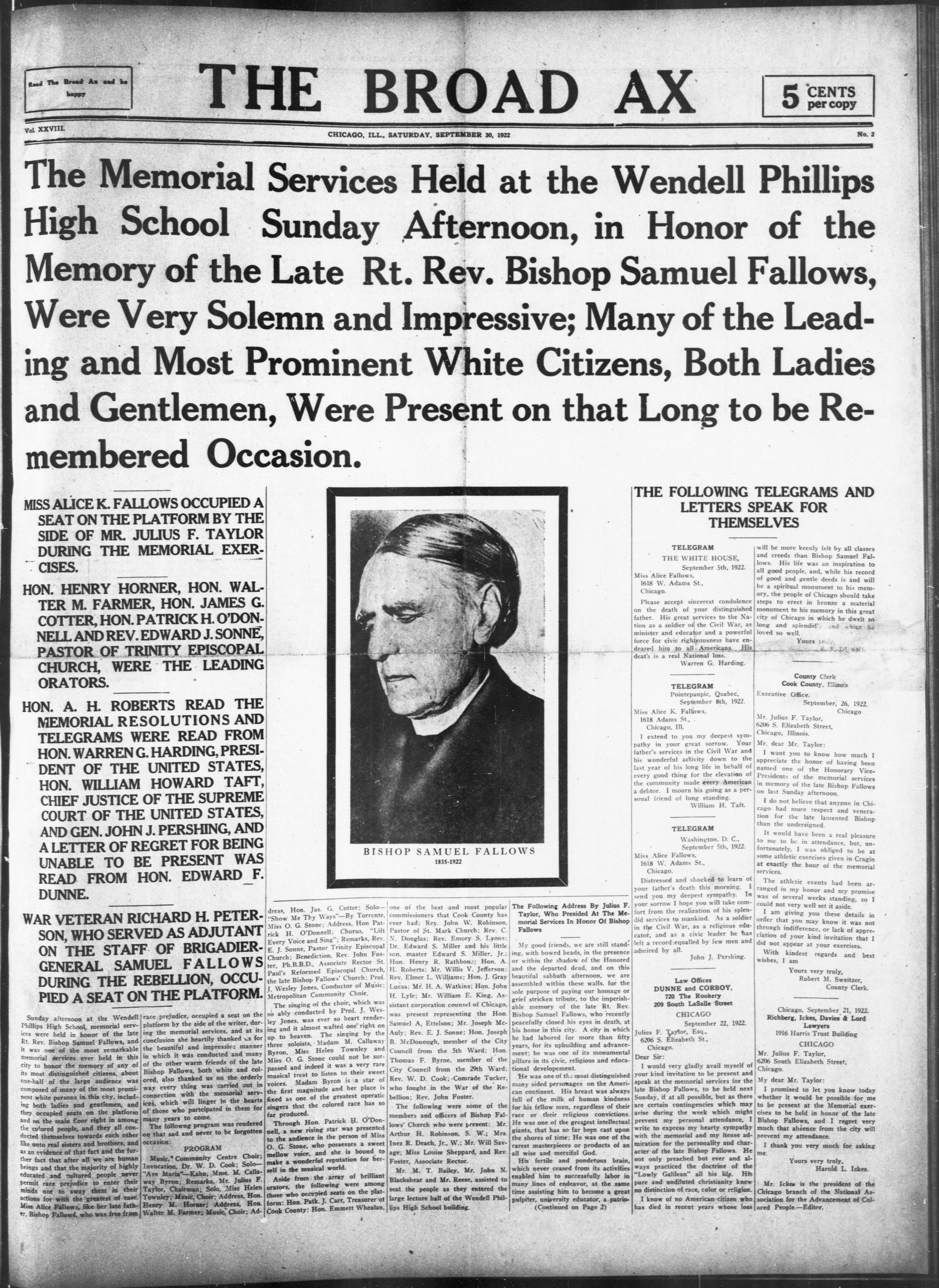
The Memorial Services Held at the Wendell Phillips High School Sunday Afternoon, in Honor of the Memory of the Late Rt. Rev. Bishop Samuel Fallows, Were Very Solemn and Impressive; Many of the Leading and Most Prominent White Citizens, Both Ladies and Gentlemen, Were Present on that Long to be Remembered Occasion.
MISS ALICE K. FALLOWS OCCUPIED A SEAT ON THE PLATFORM BY THE SIDE OF MR. JULIUS F. TAYLOR DURING THE MEMORIAL EXERCISES. HON. HENRY HORNER, HON. WALTER M. FARMER, HON. JAMES G. COTTER, HON. PATRICK H. O'DONNELL AND REV. EDWARD J. SONNE, PASTOR OF TRINITY EPISCOPAL CHURCH, WERE THE LEADING ORATORS.
HON. A. H. ROBERTS READ THE MEMORIAL RESOLUTIONS AND TELEGRAMS WERE READ FROM HON. WARRENG. HARDING, PRESIDENT OF THE UNITED STATES, HON. WILLIAM HOWARD TAFT, CHIEF JUSTICE OF THE SUPREME COURT OF THE UNITED STATES, AND GEN. JOHN J. PERSHING, AND A LETTER OF REGRET FOR BEING UNABLE TO BE PRESENT WAS READ FROM HON. EDWARD F. DUNNE.
WAR VETERAN RICHARD H. PETERSON, WHO SERVED AS ADJUTANT ON THE STAFF OF BRIGADIERGENERAL SAMUEL FALLOWS DURING THE REBELLION, OCCUPIED A SEAT ON THE PLATFORM.
Read The Broad Ax and be happy
The Me
High S
Memory
Were V
ing and
and Gen
member
MISS ALICE K. FALL
SEAT ON THE F
SIDE OF MR. J
DURING THE
CISES.
HON. HENRY HO
TER M. FARME
COTTER, HON. I
NELL AND REV.
PASTOR OF THE
CHURCH, WER
ORATORS.
HON. A. H. ROB
MEMORIAL RE
TELEGRAMS W
HON. WARREN
DENT OF THE
HON. WILLIAM
CHIEF JUSTICE
COURT OF THE
AND GEN. JOHN
A LETTER OF R
UNABLE TO BE
READ FROM
DUNNE.
WAR VETERAN R
SON, WHO SERV
ON THE STAFF
GENERAL SAM
DURING THE R
PIED A SEAT O
Sunday afternoon at the Wendell Phillips High School, memorial services were held in honor of the late Rt. Rev. Bishop Samuel Fallows, and it was one of the most remarkable memorial services ever held in this city to honor the memory of any of its most distinguished citizens, about one-half of the large audience was composed of many of the most prominent white persons in this city, including both ladies and gentlemen, and they occupied seats on the platform and on the main floor right in among the colored people, and they all conducted themselves towards each other like unto real sisters and brothers, and as an evidence of that fact and the further fact that after all we are human beings and that the majority of highly educated and cultured people never permit race prejudice to enter their minds nor to sway them in their actions for with the greatest of case. Miss Alice Fallows, like her late father, Bishop Fallows, who was free from
THE BROAD AX
race prejudice, occupied a seat on the platform by the side of the writer, during the memorial services, and at its conclusion she heartily thanked us for the beautiful and impressive manner in which it was conducted and many of the other warm friends of the late Bishop Fallows, both white and colored, also thanked us on the orderly way every thing was carried out in connection with the memorial services, which will linger in the hearts of those who participated in them for many years to come.
The following program was rendered on that sad and never to be forgotten occasion:
PROGRAM
Music, *Community Centre Choir;
Invocation, Dr. W. D. Cook; Solo—
"Ave Maria"—Kahn, Mme. M. Callaway Byron; Remarks, Mr. Julius F. Taylor, Chairman; Solo, Miss Helen Townley; Music, Choir; Address, Hon. Henry M. Horner; Address, Hon. Walter M. Farmer; Music, Choir; Ad-
CHICAGO, ILL., SATURDAY, SEPTEMBER 30, 1922
BISHOP SAMUEL FALLOWS
1835-1922
dress, Hon. Jas. G. Cotter; Solo—"Show Me Thy Ways"—By Torrine, Miss O. G. B. Stone; Address, Hon Patrick H. O'Donnell; Chorus, "Lift Every Voice and Sing"; Remarks, Rev. E. J. Sonne, Pastor Trinity Episcopal Church; Benediction, Rev. John Foster, Ph.B.B.D., Associate Rector St. Paul's Reformed Episcopal Church, the late Bishop Fallows' Church; Prof. J. Wesley Jones, Conductor of Music; Metropolitan Community Choir.
The singing of the choir, which was so ably conducted by Prof. J. Wesley Jones, was ever so heart rendering and it almost wafted one right up on to heaven. The singing by the three soloists, Madam M. Callaway Byron, Miss Helen Townley and Miss O. G. Stone could not be surpassed and indeed it was a very rare musical treat to listen to their sweet voices. Madam Byron is a star of the first magnitude and her place is fixed as one of the greatest operatic singers that the colored race has so far produced.
Through Hon. Patrick H. O'Donnell, a new rising star was presented to the audience in the person of Miss O. G. Stone, who possesses a sweet mellow voice, and she is bound to make a wonderful reputation for herself in the musical world.
Aside from the array of brilliant orators, the following were among those who occupied seats on the platform: Hon. Patk. J. Carr, Treasurer of Cook County: Hon. Emmett Whealan.
BISHOP SAMUEL FALLOWS 1835-1922
one of the best and most popular commissioners that Cook County has ever had; Rey. John W. Robinson; Pastor of St. Mark Church; Rev. C. N. Douglas; Rev. Emory S. Lyons; Dr. Edward S. Miller and his little son, master Edward S. Miller, Jr.; Hon. Henry R. Rathbons; Hon. A. H. Roberts; Mr. Willis V. Jefferson; Rev. Elmer L. Williams; Hon. J. Gray Lucas; Mr. H. A. Watkins; Hon. John H. Lyle; Mr. William E. King; Assistant corporation counsel of Chicago was present representing the Hon. Samuel A. Ettelson; Mr. Joseph McAuly; Rev. E. J. Sonne; Hon. Joseph B. McDonough, member of the City Council from the 5th Ward; Hon. Thomas F. Byrne, member of the City Council from the 29th Ward; Rev. W. D. Cook; Comrade Tucker, who fought in the War of the Rebellion; Rev. John Foster.
The following were some of the members and officers of Bishop Fallow's Church who were present: Mr. Arthur H. Robinson, S. W.; Mrs. Inez R. Deach, Jr., W.; Mr. Will Savage; Miss Louise Sheppard, and Rev. Foster, Associate Rector.
Mr. M. T. Bailey, Mr. John N. Blackshear and Mr. Reese, assisted to seat the people as they entered the large lecture hall of the Wendell Phillips High School building.
The Following Address By Julius F. Taylor, Who Presided At The Memorial Services In Honor Of Bishop Fallows
My good friends, we are still standing, with bowed heads, in the presence or within the shadow of the Honored and the departed dead, and on this beautiful sabbath afternoon, we are assembled within these walls. for the sole purpose of paying our homage or grief stricken tribute, to the imperishable memory of the late Rt. Rev. Bishop Samuel Fallows, who recently peacefully closed his eyes in death, at his home in this city. A city in which he had labored for more than fifty years, for its upbuilding and advancement; he was one of its monumental pillars in its civic, religious and educational development.
He was one of the most distinguished many sided personages on the American continent. His breast was always full of the milk of human kindness for his fellow men, regardless of their race or their religious convictions. He was one of the greatest intellectual giants, that has so far been cast upon the shores of time; He was one of the rarest masterpieces or products of an all wise and merciful God.
His fertile and ponderous brain, which never ceased from its activities enabled him to successfully labor in many lines of endeavor, at the same time assisting him to become a great pulpiter, university educator, a patrio- (Continued on Page 2)
THE FOLLOWING TELEGRAMS AND LETTERS SPEAK FOR THEMSELVES
TELEGRAM
THE WHITE HOUSE,
September 5th, 1922.
Miss Alice Fallows,
1618 W. Adams St.,
Chicago.
Please accept sincerest condolence on the death of your distinguished father. His great services to the Nation as a soldier of the Civil War, as minister and educator and a powerful force for civic righteousness have endeared him to all Americans. His death is a real National loss.
Warren G. Harding.
TELEGRAM
Pointepaupic, Quebec,
September 8th, 1922.
Miss Alice K. Fallows,
1618 Adams St.,
Chicago, Ill.
I extend to you my deepest sympathy in your great sorrow. Your father's services in the Civil War and his wonderful activity down to the last year of his long life in behalf of every good thing for the elevation of the community made every American a debtor. I mourn his going as a personal friend of long standing.
William H. Taft.
TELEGRAM
Washington, D. C., September 5th, 1922. Miss Alice Fallows, 1618 W. Adams St., Chicago. Distressed and shocked to learn of your father's death this morning. I send you my deepest sympathy. In your sorrow I hope you will take comfort from the realization of his splendid services to mankind. As a soldier in the Civil War, as a religious educator, and as a civic leader he has left a record-equalled by few men and admired by all. John J. Pershing.
Law Offices
DUNNE and CORBOY,
720 The Rookery
209 South LaSalle Street
September 22, 1922.
Julius F. Taylor, Esq.
6206 S. Elizabeth St.
I would very gladly avail myself of your kind invitation to be present and speak at the memorial services for the late Bishop Fallows, to be held next Sunday, if at all possible, but as there are certain contingencies which may arise during the week which might prevent my personal attendance, I write to express my hearty sympathy with the memorial and my itense admiration for the personality and character of the late Bishop Fallows. He not only preached but ever and always practiced the doctrine of the "Lowly Galilean" all his life. His pure and undiluted Christianity knew no distinction of race, color or religion. I know of no American citizen who has died in recent years whose loss
5 CENTS per copy
Phillips of the Fallows, the Lead- in Ladies to be Re- TELEGRAMS AND SPEAK FOR SELVES
will be more keenly felt by all classes and creeds than Bishop Samuel Fallow's. His life was an inspiration to all good people, and, while his record of good and gentle deeds is and will be a spiritual monument to his memory, the people of Chicago should take steps to erect in bronze a material monument to his memory in this great city of Chicago in which he dwelt so long and splendidly and which he loved so well.
County Clerk
Cook County, Illinois
Executive Office
September, 26, 1922.
Chicago
Mr. Julius F. Taylor,
6206 S. Elizabeth Street,
Chicago, Illinois.
Mr. dear Mr. Taylor:
I want you to know how much I appreciate the honor of having been named one of the Honorary Vice-Presidents of the memorial services in memory of the late Bishop Fallows on last Sunday afternoon.
I do not believe that anyone in Chicago had more respect and veneration for the late lamented Bishop than the undersigned.
It would have been a real pleasure to me to be in attendance, but, unfortunately, I was obliged to be at some athletic exercises given in Cragin at exactly the hour of the memorial services.
The athletic events had been arranged in my honor and my promise was of several weeks standing, so I could not very well set it aside.
I am giving you these details in order that you may know it was not through indifference, or lack of appreciation of your kind invitation that I did not appear at your exercises.
With kindest regards and best wishes, I am
Yours very truly,
Robert M. Sweitzer,
County Clerk
Chicago, September 21, 1922.
Richberg, Ickes, Davies & Lord
Lawyers
1916 Harris Trust Building
CHICAGO
Mr. Julius F. Taylor,
6206 South Elizabeth Street,
Chicago.
My dear Mr. Taylor:
I promised to let you know today
whether it would be possible for me
to be present at the Memorial exercises
to be held in honor of the late
Bishop Fallows, and I regret very
much that absence from the city will
prevent my attendance.
I thank you very much for asking me.
Yours very truly,
Harold L. Ickes.
Mr. Ickes is the president of the
Chicago branch of the National
Association for the Advancement of Colored People—Editor.
CHC 101
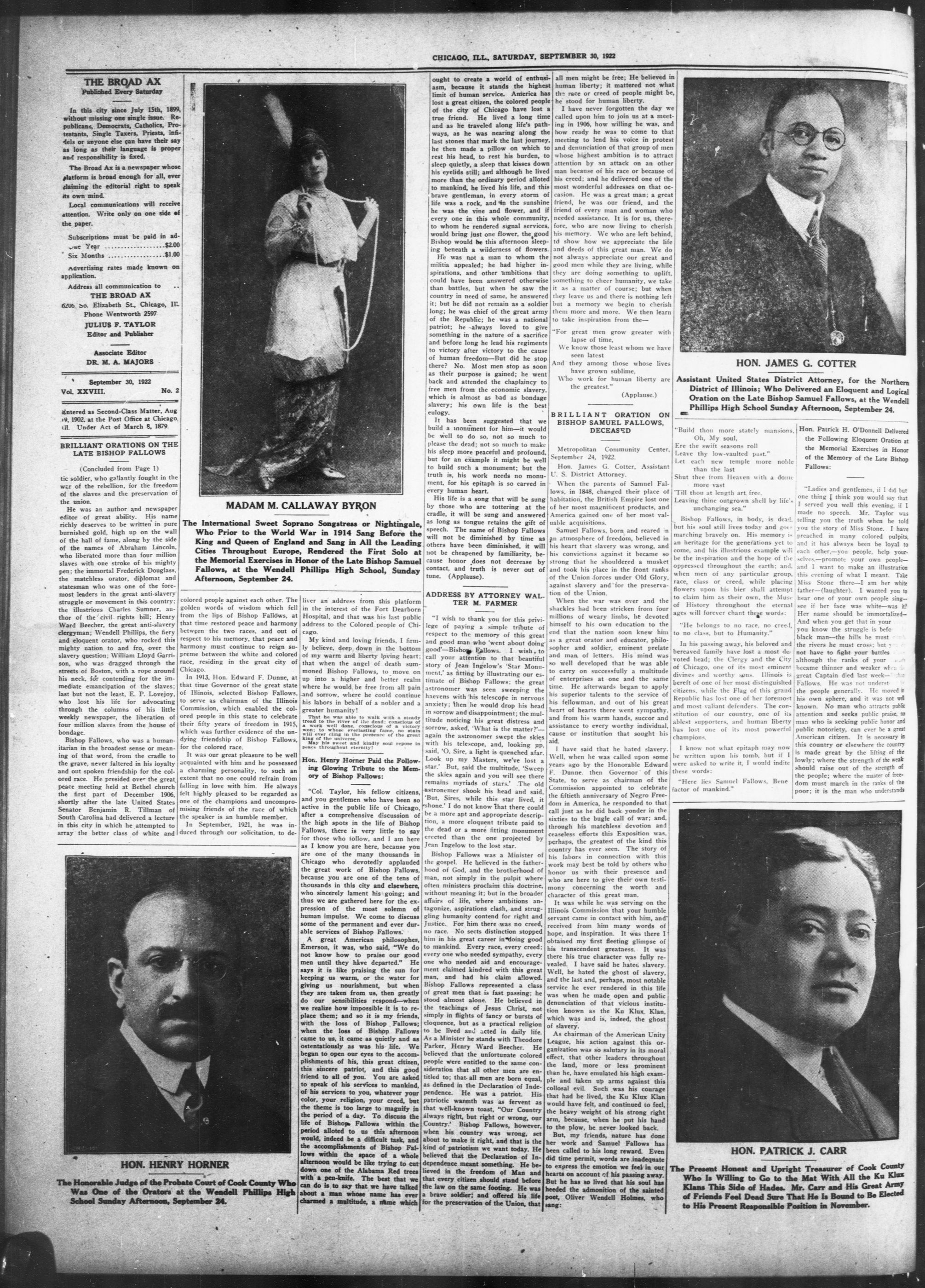
The Honorable Judge of the Probate Court of Cook County Who Was One of the Orators at the Wendell Phillips High School Sunday Afternoon, September 24.
THE BROAD AX
Published Every Saturday
In this city since July 15th, 1899, without missing one single issue. Republicans, Democrats, Catholics, Protestants, Single Taxers, Priests, infidels or anyone else can have their say as long as their language is proper and responsibility is fixed.
The Broad Ax is a newspaper whose platform is broad enough for all, ever claiming the editorial right to speak its own mind.
Local communications will receive attention. Write only on one side of the paper.
Subscriptions must be paid in advance Year .....$2.00
Six Months .....$1.00
Advertising rates made known on application.
Address all communication to
THE BROAD AX
6206, No. Elizabeth St., Chicago, II.
Phone Wentworth 2597
JULIUS F. TAYLOR
Editor and Publisher
Associate Editor
DR. M. A. MAJORS
September 30, 1922
Vol. XXVIII. No. 2
Entered as Second-Class Matter, Aug
9, 1902, at the Post Office at Chicago,
Ul. Under Act of March 8, 1879.
BRILLIANT ORATIONS ON THE
LATE BISHOP FALLOWS
tic soldier, who gallantly fought in the war of the rebellion, for the freedom of the slaves and the preservation of the union
He was an author and newspaper editor of great ability. His name richly deserves to be written in pure burnished gold, high up on the wall of the hall of fame, along by the side of the names of Abraham Lincoln who liberated more than four million slaves with one stroke of his mighty pen; the immortal Frederick Douglass, the matchless orator, diplomat and statesman who was one of the foremost leaders in the great anti-slavery struggle or movement in this country; the illustrious Charles Sumner, author of the civil rights bill; Henry Ward Beecher, the great anti-slavery clergyman; Wendell Phillips, the fiery and eloquent orator, who rocked this mighty nation to and fro, over the slavery question; William Lloyd Garrison, who was dragged through the streets of Boston, with a rope around his neck, for contending for the immediate emancipation of the slaves; last but not the least, E. P. Lovejoy, who lost his life for advocating through the columns of his little weekly newspaper, the liberation of four million slaves from the house of bondage.
Bishop Fallows, who was a humanitarian in the broadest sense or meaning of that word, from the cradle to the grave, never faltered in his joyalty and out spoken friendship for the colored race. He presided over the great peace meeting held at Bethel church the first part of December 1906, shortly after the late United States Senator Benjamin R. Tillman of South Carolina had delivered a lecture in this city in which he attempted to array the better class of white and
---
THE FILM OF "THE MADAME" BY JOHN B. HARRIS, AUGUST 1915.
MADAM M. CALLAWAY BYRON
The International Sweet Soprano Songstress or B Who Prior to the World War in 1914 Sang King and Queen of England and Sang in All Cities Throughout Europe, Rendered the Fife the Memorial Exercises in Honor of the Late Bist Fallows, at the Wendell Phillips High School Afternoon, September 24.
The International Sweet Soprano Songstress or Nightingale, Who Prior to the World War in 1914 Sang Before the King and Queen of England and Sang in All the Leading Cities Throughout Europe, Rendered the First Solo at the Memorial Exercises in Honor of the Late Bishop Samuel Fallows, at the Wendell Phillips High School, Sunday Afternoon, September 24.
colored people against each other. The golden words of wisdom which fell from the lips of Bishop Fallows, at that time restored peace and harmony between the two races, and out of respect to his memory, that peace and harmony must continue to reign supreme between the white and colored race, residing in the great city of Chicago.
liver an address from this platform in the interest of the Fort Dearborn Hospital, and that was his last public address to the Colored people of Chicago.
My kind and loving friends, I firmly believe, deep, down in the bottom of my warm and liberty loving heart; that when the angel of death sum-moned, Bishop Fallows, to
In 1913, Hon. Edward F. Dunne, at that time Governor of the great state of Illinois, selected Bishop Fallows, to serve as chairman of the Illinois Commission, which enabled the colored people in this state to celebrate their fifty years of freedom in 1915, which was further evidence of the undying friendship of Bishop Fallows, for the colored race.
It was our great pleasure to be well acquainted with him and he possessed a charming personality, to such an extent that no one could refrain from falling in love with him. He always felt highly pleased to be regarded as one of the champions and uncompromising friends of the race of which the speaker is an humble member.
In September, 1921, he was induced through our solicitation, to de-
liver an address from this platform in the interest of the Fort Dearborn Hospital, and that was his last public address to the Colored people of Chicago.
My kind and loving friends, I firmly believe, deep, down in the bottom of my warm and liberty loving heart; that when the angel of death summoned the Bishop Fallows, to move on up into a higher and better realm where he would, be free from all pain and sorrow, where he could continue his labors in behalf of a nobler and a greater humanity!
That he was able to walk with a steady tread to the river of the dead; conscious of a work well done, conscious of a victory when overlasting fame, no stain will ever cling in the face of the king of the universe, and kindly soul repose in peace throughout eternity!
Hon. Henry Horner Paid the Following Glowing Tribute to the Memory of Bishop Fallows:
"Col. Taylor, his fellow citizens, and you gentlemen who have been so active in the public life of Chicago, after a comprehensive discussion of the high spots in the life of Bishop Fallows, there is very little to say for those you follow, and I am here as I know you are here, because you are one of the many thousands in Chicago who devotedly applauded the great work of Bishop Fallows, because you are one of the tens of thousands in this city and elsewhere, who sincerely lament his going; and thus we are gathered here for the expression of the most solemn of human impulse. We come to discuss some of the permanent and ever durable services of Bishop Fallows.
A great American philosopher, Emerson, it was, who said, "We do not know how to praise our good men until they have departed." He says it is like praising the sun for keeping us warm, or the water for giving us nourishment, but when they are taken from us, then greatly do our sensibilities respond—when we realize how impossible it is to replace them; and so it is my friends, with the loss of Bishop Fallows; when the loss of Bishop Fallows came to us, it came as quietly and as ostentatiously as was his life. We began to open our eyes to the accomplishments of his, this great, this sincere patriot, and this good friend to all of you. You are asked to speak of his services to mankind, of his services to you, whatever your color, your religion, your creed, but the theme is too large to magnify in the period of a day. To discuss the life of Bishop Fallows within the period allotted to us this afternoon would, indeed be a difficult task, and the accomplishments of Bishop Fallows within the space of a whole afternoon would be like trying to cut down one of the Alabama Red trees with a pen-knife. The best that we can do is to say that we have talked about a man whose name has ever charmed a multitude, a name which
CHICAGO, ILL. SATURDAY, SEPTEMBER 30, 1922
ought to create a world of enthusiasm, because it stands the highest limit of human service. América has lost a great citizen, the colored people of the city of Chicago have lost a true friend. He lived a long time and as he traveled along life's pathways, as he was nearing along the last stones that mark the last journey he then made a pillow on which to rest his head, to rest his burden, to sleep quietly, a sleep that kisses down his eyelids still; and although he lived more than the ordinary period allotted to mankind, he lived his life, and this brave gentleman, in every storm of life was a rock, and in the sunshine he was the vine and flower, and if every one in this whole community, to whom he rendered signal services, would bring just one flower, the good Bishop would be this afternoon sleeping beneath a wilderness of flowers. He was not a man to whom the militia appealed; he had higher inspirations, and other ambitions that could have been answered otherwise than battles, but when he saw the country in need of same, he answered it; but he did not remain as a soldier long; he was chief of the great army of the Republic; he was a national patriot; he always loved to give something in the nature of a sacrifice and before long he lead his regiments to victory after victory to the cause of human freedom—But did he stop there? No. Most men stop as soon as their purpose is gained; he went back and attended the chaplaincy to free men from the economic slavery, which is almost as bad as bondage slavery; his own life is the best eulogy.
It has been suggested that we build a monument for him—it would be well to do so, not so much to please the dead; not so much to make his sleep more peaceful and profound, but for an example it might be well to build such a monument; but the truth is, his work needs no monument, for his epitaph is so carved in every human heart.
His life is a song that will be sung by those who are tootring at the cradle, it will be sung and answered as long as tongue retains the gift of speech. The name of Bishop Fallows will not be diminished by time as others have been diminished, it will not be cheapened by familiarity, because honor does not decrease by contact, and truth is never out of tune. (Applause).
ADDRESS BY ATTORNEY WAL
TER M. FARMER
"I wish to thank you for this privilege of paying a simple tribute of respect to the memory of this great and good man who 'went about doing good'—Bishop Fallows. I wish to call your attention to that beautiful story of Jean Ingelow's 'Star Monument,' as fitting by illustrating our estimate of Bishop Fallows; the great astronomer was seen sweeping the haeens with his telescope in nervous anxiety; then he would drop his head in sorrow and disappointment; the multitude noticing his great distress and sorrow, asked. 'What is the matter?'—again the astronomer swept the skies with his telescope, and, looking up, said, 'O, Sire, a light is quenched an ear. Look up my Masters, we've lost a star.' But, said the multitude, 'Sweep the skies again and you will see there remains myriads of stars.' The old astronomer shook his head and said, 'But, Sires, while this star lived, it shone.' I do not know that there could be a more apt and appropriate description, a more eloquent tribute paid to the dead or a more fitting monument erected than the one projected by Jean Ingelow to the lost star.
Bishop Fallows was a Minister of the gospel. He believed in the fatherhood of God, and the brotherhood of man, not simply in the pulpit where often ministers proclaim this doctrine without meaning it; but in the broader affairs of life, where ambitions antagonize, aspirations clash, and struggling humanity contend for right and Justice. For him there was no creed, no race. No sects distinction stopped him in his great career in doing good to mankind. Every race, every creed; every one who needed sympathy, every one who needed aid and encouragement claimed kindred with this great man, and had his claim allowed. Bishop Fallows represented a class of great men that is fast passing; he stood almost alone. He believed in the teachings of Jesus Christ, not simply in flights of fancy or bursts of eloquence, but as a practical religion to be lived and acted in daily life. As a Minister he stands with Theodore Parker, Henry Ward Beecher. He believed that the unfortunate colored people were entitled to the same consideration that all other men are entitled to; that all men are born equal, as defined in the Declaration of Independence. He was a patriot. His patriotic warmth was as fervent as that well-known toast, "Our Country always right, but right or wrong, our Country.' Bishop Fallows, however, when his country was wrong, set about to make it right, and that is the kind of patriotism we want today. He believed that the Declaration of Independence meant something. He believed in the freedom of Man and that every citizen should stand before the law on the same footing. He was a brave soldier; and offered his life for the preservation of the Union, that
all men might be free; He believed in human liberty; it mattered not what the race or creed of people might be, he stood for human liberty.
I have never forgotten the day we called upon him to join us at a meeting in 1906, how willing he was, and how ready he was to come to that meeting to lend his voice in protest and denunciation of that group of men whose highest ambition is to attract attention by an attack on an other man because of his race or because of his creed; and he delivered one of the most wonderful addresses on that occasion. He was a great man; a great friend, he was our friend, and the friend of every man and woman who needed assistance. It is for us, therefore, who are now living to cherish his memory. We who are left behind, td show how we appreciate the life and deeds of this great man. We do not always appreciate our great and good men while they are living, while they are doing something to uplift, something to cheer humanity, we take it as a matter of course; but when they leave us and there is nothing left but a memory we begin to cherish them more and more. We then learn to take inspiration from the—
"For great men grow greater with
lapse of time.
We know those least whom we have
seen latest
And they among those whose lives
have grown sublime.
Who work for human liberty are
the greatest."
(Applause.)
BRILLIANT ORATION ON BISHOP SAMUEL FALLOWS, DECEASED
Metropolitan Community Center September 24, 1922.
Hon. James G. Cotter, Assistant U. S. District Attorney.
When the parents of Samuel Fallows, in 1848, changed their place of habitation, the British Empire lost one of her most magnificent products, and America gained one of her most valuable acquisitions.
Samuel Fallows, born and reared in an atmosphere of freedom, believed in his heart that slavery was wrong, and his convictions against it became so strong that he shouldered a musket and took his place in the front ranks of the Union forces under Old Glory, against slavery and for the preservation of the Union.
When the war was over and the shackles had been stricken from four millions of weary limbs, he devoted himself to his own education to the end that the nation soon knew him as a great orator and educator, philosopher and soldier, eminent prelate and man of letters. His mind was so well developed that he was able to carry on successfully a multitude of enterprises at one and the same time. He afterwards began to apply his superior talents to the service of his fellowman, and out of his great heart of hearts there went sympathy, and from his warm hands, succor and assistance to every worthy individual, cause or institution that sought his aid.
I have said that he hated slavery Well, when he was called upon some years ago by the Honorable Edward F. Dunne, then Governor' of this State, to serve as chairman of the Commission appointed to celebrate the fiftieth anniversary of Negro Freedom in America, he responded to that call just as he did back yonder in the sixties to the bugle call of war; and, through his matchless devotion and ceaseless efforts this Exposition was, perhaps, the greatest of the kind this country has ever seen. The story of his labors in connection with this work may best be told by others who honor us with their presence and who are here to give their own testimony concerning the worth and character of this great man.
It was while he was serving on the Illinois Commission that your humble servant came in contact with him, and received from him many words of hope, and inspiration. It was there I obtained my first fleeting glimpse of his transcendent greatness. It was there his true character was fully revealed. I have said he hated slavery. Well, he hated the ghost of slavery, and the last and, perhaps, most notable service he ever rendered in this life was when he made open and public denunciation of that vicious institution known as the Ku Klux, Klan, which was and is, indeed, the ghost of slavery.
As chairman of the American Unity League, his action against this organization was so salutary in its moral effect, that other leaders throughout the land, more or less prominent than he, have emulated his high example and taken up arms against this collosal evil. Such was his courage that had he lived, the Ku Klux Klan would have felt, and continued to feel, the heavy weight of his strong right arm, because, when he put his hand to the plow, he never looked back. But, my friends, nature has done her work and Samuel! Fallows has been called to his long reward. Even did time permit, words are inadequate to express the emotion we feel in our hearts on account of his passing away. But he has so lived that his soul has heeded the admonition of the sainted poet, Oliver Wendell Holmes, who sang:
2
HON. JAMES G. COTTER
Assistant United States District District of Illinois; Who De Oration on the Late Bishop Phillips High School Sunda
Assistant United States District Attorney, for the Northern District of Illinois; Who Delivered an Eloquent and Logical Oration on the Late Bishop Samuel Fallows, at the Wendell Phillips High School Sunday Afternoon, September 24.
"Build thou more stately mansions, Oh. My soul.
Hon. Patrick H. O'Donnell Delivered the Following Eloquent Oration
Let each new temple more noble than the last
Shut thee from Heaven with a domo more vast
'Till thou at length art free.
Leaving tine outgrown shell by life's unchanging sea."
Bishop Fallows, in body, is dead, but his soul still lives today and goes marching bravely on. His memory is an heritage for the generations yet to come, and his illustrious example will be the inspiration and the hope of the oppressed throughout the earth; and, when men of any particular group, race, class or creed, while placing flowers upon his bier shall attempt to claim him as their own, the Muse of History throughout the eternal ages will forever chant these words:
"He belongs to no race, no creed, to no class, but to Humanity."
In his passing away, his beloved and bereaved family have lost a most devoted head; the Clergy and the City of Chicago, one of its most eminent divines and worthy sons. Illinois is bereft of one of her most distinguished citizens, while the Flag of this grand Republic has lost one of her foremost and most valiant defenders. The constitution of our country, one of its ablest supporters, and human liberty has lost one of its most powerful champions.
I know not what epitaph may now be written upon his tomb, but if I were asked to write it, I would indicate these words:
"Here lies Samuel Fallows, Bene factor of mankind."
7
HON. PATRICK J. CARR
The Present Honest and Upright Treasurer of Who Is Willing to Go to the Mat With A Klans This Side of Hades. Mr. Carr and a of Friends Feel Dead Sure That He Is Bound to His Present Responsible Position in Novel
The Present Honest and Upright Treasurer of Cook County Who Is Willing to Go to the Mat With All the Ku Klux Klans This Side of Hades. Mr. Carr and His Great Army of Friends Feel Dead Sure That He Is Bound to Be Elected to His Present Responsible Position in November.
ict Attorney, for the Northern
Delivered an Eloquent and Logical
Samuel Fallows, at the Wendell
ly Afternoon, September 24.
Hon. Patrick H. O'Donnell Delivered
the Following Eloquent Oration at
the Memorial Exercises in Honor
of the Memory of the Late Bishop
Fallows:
"Ladies and gentlemen, if I did but one thing I think you would say that I served you well this evening, if I made no speech. Mr. Taylor was telling you the truth when he told you the story of Miss Stone. I have preached in many colored pulpits and it has always been be loyal to each other—you people, help yourselves—promote your own people—and I want to make an illustration this evening of what I meant. Take Miss Stone there—I am her white father—(laughter). I wanted you to hear one of your own people sing—see if her face was white—was it Her name should be immortalized—And when you get that in your you know the struggle is befo black man—the hills he must the rivers he must cross; but you not have to fight your battles although the ranks of your became thinner and weaker when great Captain died last week—the Fallows. He was not underst the people generally. He moved in his own sphere, and it was not well known. No man who attracts public attention and seeks public praise, no man who is seeking public honor and public notoriety, can ever be a great American citizen. It is necessary in this country or elsewhere the country is made great by the lifting of the lowly; where the strength of the weak should raise out of the strength of the people; where the master of freedom must march in the ranks of the poor; it is the man who understands
M.
ight Treasurer of Cook County
e Mat With All the Ku Klux
Mr. Carr and His Great Army
that He Is Bound to Be Elected
position in November.
M.
HON. JAMES H. LAWLEY
Republican Candidate for Re-Election As a Sanitary District of Chicago, Owing to the Honorable Record Which He Has Made in In tion, Entitles Him to Re-Election on Tuesday. Lately Mr. Lawley Secured the Appointment rude Brown, a Bright and Intelligent Young an to a Position in the Rooms of the Boar Cook County.
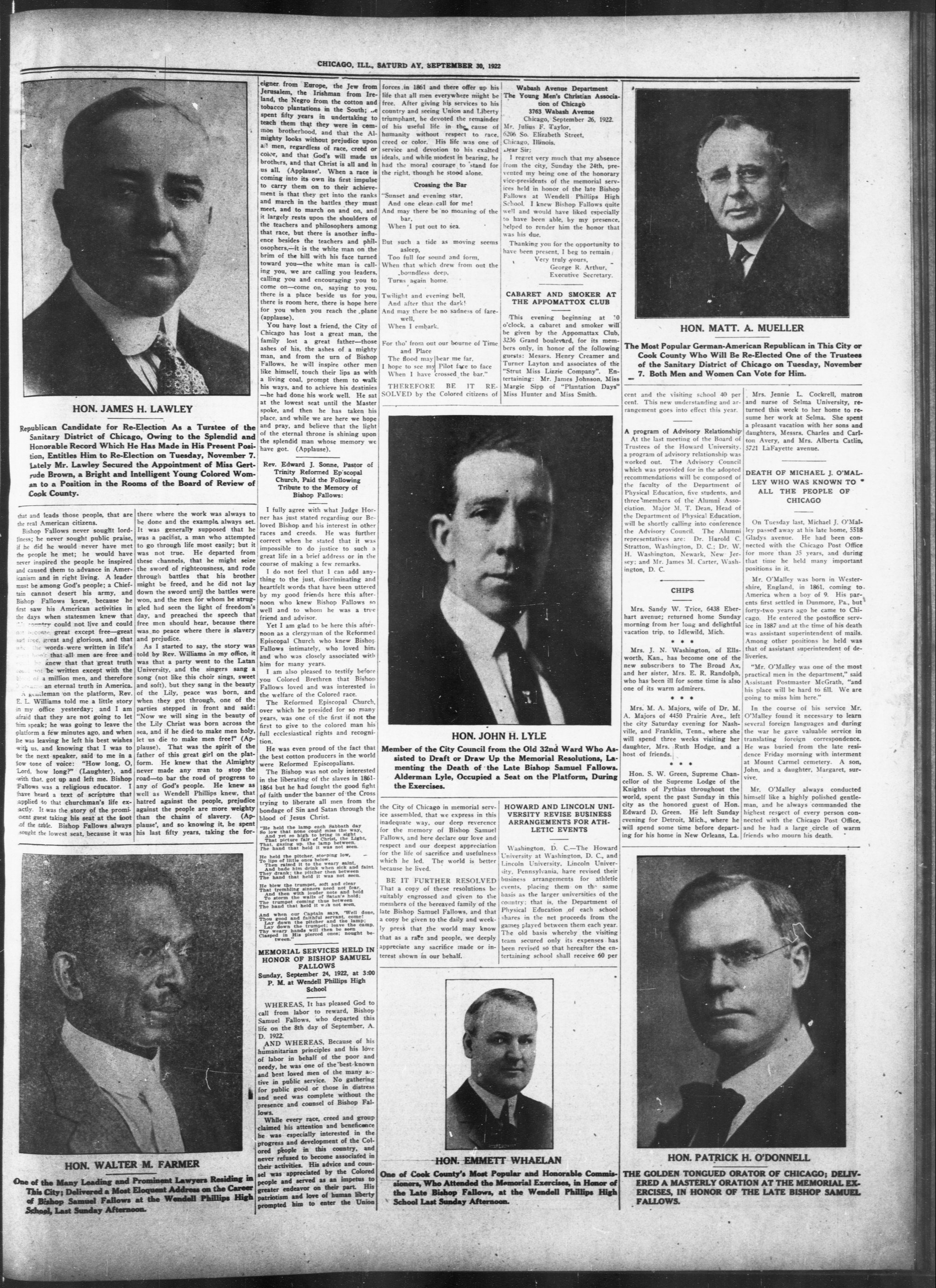
Republican Candidate for Re-Election As a Turstee of the Sanitary District of Chicago, Owing to the Splendid and Honorable Record Which He Has Made in His Present Position, Entitles Him to Re-Election on Tuesday, November 7. Lately Mr. Lawley Secured the Appointment of Miss Gertrude Brown, a Bright and Intelligent Young Colored Woman to a Position in the Rooms of the Board of Review of Cook County.
that and leads those people, that are the real American citizens.
Bishop Fallows never sought lordiness; he never sought public praise; if he did he would never have met the people he met; he would have never inspired the people he inspired and caused them to advance in Americanism and in right living. A leader must be among God's people; a Chieftain cannot desert his army, and Bishop Fallows knew, because he first saw his American activities in the days when statesmen knew that country could not live and could not become great except free—great and free, great and glorious, and that words were written in life's book that all men are free and knew that that great truth could not be written except with the blessing of a million men, and therefore on eternal truth in America.
A gentleman on the platform, Rev E. L. Williams told me a little story in my office yesterday; and I am afraid that they are not going to let him speak; he was going to leave the platform a few minutes ago, and when he was leaving he left his best wishes with us, and knowing that I was to be the next speaker, said to me in a fow tone of voice: "How long, O, Lord, how long?" (Laughter), and with that, got up and left me. Bishop Fallows was a religious educator. I have heard a text of scripture that applied to that churchman's life exactly. It was the story of the prominent guest taking his seat at the foot of the table. Bishop Fallows always sought the lowest seat, because it was
```markdown
```
A.
HON. WALTER M. FARMER
One of the Many Leading and Prominent Lawyer This City; Delivered a Most Eloquent Address of Bishop Samuel Fallows at the Wendell School, Last Sunday Afternoon.
One of the Many Leading and Prominent Lawyers Residing in This City; Delivered a Most Eloquent Address on the Career of Bishop Samuel Fallows at the Wendell Phillips High School, Last Sunday Afternoon.
Election As a Turstee of the go, Owing to the Splendid and he Has Made in His Present Positction on Tuesday, November 7. at the Appointment of Miss Gert-intelligent Young Colored Womoms of the Board of Review of
there where the work was always to be done and the example always set. It was generally supposed that he was a pacifist, a man who attempted to go through life most easily; but it was not true. He departed from these channels, that he might seize the sword of righteousness, and rode through battles that his brother might be freed, and he did not lay down the sword until the battles were won, and the men for whom he struggled had seen the light of freedom's day, and preached the speech that free men should hear, because there was no peace where there is slavery and prejudice.
As I started to say, the story was told by Rev. Williams in my office, it was that a party went to the Latin University, and the singers sang a song (not like this choir sings, sweet and soft), but they sang in the beauty of the Lily, peace was born, and when they got through, one of the parties stepped in front and said: "Now we will sing in the beauty of the Lily Christ was born across the sea, and if he died to make men holy, let us die to make men free!" (Applause). That was the spirit of the father of this great girl on the platform. He knew that the Almighty never made any man to stop the road—to bar the road of progress to any of God's people. He knew as well as Wendell Phillips knew, that hatred against the people, prejudice against the people are more weighty than the chains of slavery. (Applause, and so knowing it, he spent his last fifty years, taking the for-
THE BEST MAN IN THE WORLD
Prominent Lawyers Residing in Eloquent Address on the Career at the Wendell Phillips Highon.
CHICAGO, ILL., SATURD AY, SEPTEMBER 30, 1922
eigner, from Europe, the Jew from Jerusalem, the Irishman from Ireland, the Negro from the cotton and tobacco plantations in the South; he spent fifty years in undertaking to teach them that they were in common brotherhood, and that the Almighty looks without prejudice upon all men, regardless of race, creed or color, and that God's will made us brothers, and that Christ is all and in us all. (Applause'. When a race is coming into its own its first impulse to carry them on to their achievement is that they get into the ranks and march in the battles they must meet, and to march on and on, and it largely rests upon the shoulders of the teachers and philosophers among that race, but there is another influence besides the teachers and philosophers—it is the white man on the brim of the hill with his face turned toward you—the white man is calling you, we are calling you leaders, calling you and encouraging you to come on—come on, saying to you, there is a place beside us for you, there is room here, there is hope here for you when you reach the plane (applause).
You have lost a friend, the City of Chicago has lost a great man, the family lost a great father—those ashes of his, the ashes of a mighty man, and from the urn of Bishop Fallows, he will inspire other men like himself, touch their lips as with a living coal, prompt them to walk his ways, and to achieve his destinies—he had done his work well. He sat at the lowest seat until the Master spoke, and then he has taken his place, and while we are here we hope and pray, and believe that the light of the eternal throne is shining upon the splendid man whose memory we have got. (Applause.)
Rev. Edward J. Sonne, Pastor of Trinity Reformed Ep'scopal Church, Paid the Following Tribute to the Memory of Bishop Fallows:
I fully agree with what Judge Horner has just stated regarding our Beloved Bishop and his interest in other races and creeds. He was further correct when he stated that it was impossible to do justice to such a great life in a brief address or in the course of making a few remarks.
I do not feel that I can add anything to the just, discriminating and heartfelt words that have been uttered by my good friends here this afternoon who knew Bishop Fallows so well and to whom he was a true friend and advisor.
Yet I am glad to be here this afternoon as a clergyman of the Reformed Episcopal Church who knew Bishop Fallows intimately, who loved him and who was closely associated with him for many years.
I am also pleased to testify before you Colored Brethren that Bishop Fallows loved and was interested in the welfare of the Colored race.
The Reformed Episcopal Church, over which he presided for so many years, was one of the first if not the first to give to the colored man his full ecclesiastical rights and recognition.
He was even proud of the fact that the best cotton producers in the world were Reformed Episcopalians.
The Bishop was not only interested in the liberating of the slaves in 1861-1864 but he had fought the good fight of faith under the banner of the Cross trying to liberate all men from the bondage of Sin and Satan through the blood of Jesus Christ.
"He held the lamp each Sabbath day so low in the darkness that it would see you, yet so high to bring in sight. That picture fair of the lamp is bright. The hand that held it the lamp between. The hand that held it was not seen.
He blew the trumpet, soft and clear,
That trembling sinner need fear,
Then the drum note and bold
To seize the walls of Satan's hold;
The trumpet coming thus between
The hands that held it it will not seen.
And then our Captain says, "Well done,
Thou good and faithful servant, come!
Lay down the pitcher and take it,
Lay down the pitcher and leave the camp,
Thy wary hands will then be seen
Chasped in His pierced ones; nought between."
MEMORIAL SERVICES HELD IN
HONOR OF BISHOP SAMUEL
FALLOWS
Sunday, September 24, 1922, at 3:00
P. M. at Wendell Phillips High
School
WHEREAS, It has pleased God to
call from labor to reward, Bishop
Samuel Fallows, who departed this
life on the 8th day of September, A.
D. 1922
AND WHEREAS, Because of his humanitarian principles and his love of labor in behalf of the poor and needy, he was one of the best-known and best loved men of the many active in public service. No gathering for public good or those in distress and need was complete without the presence and counsel of Bishop Fallow.
While every race, creed and group claimed his attention and beneficence he was especially interested in the progress and development of the Colored people in this country, and never refused to become associated in their activities. His advice and counsel was appreciated by the Colored people and served as an impetus to greater endeavor on their part. His patriotism and love of human liberty prompted him to enter the Union
forces in 1861 and there offer up his life that all men everywhere might be free. After giving his services to his country and seeing Union and Liberty triumphant, he devoted the remainder of his useful life in the cause of humanity without respect to race, creed or color. His life was one of service and devotion to his exalted ideals, and while modest in bearing, he had the moral courage to stand for the right, though he stood alone.
Crossing the Bar
And may there be no moaning of the bar
But such a tide as moving seems asleep,
Too full for sound and form,
When that which drew from out the boundless deen
Twilight and evening bell,
And after that the dark!
And may there be no sadness of fare-
well,
When I embark.
For tho' from out our bourne of Time
and Place
The flood may bear me far,
I hope to see my Pilot face to face
When I have crossed the bar."
THEREFORE BE IT RES-
SOLVED by the Colored citizens of
1920
J. B.
HON. JOHN H. LYLE
Member of the City Council from the Old 32
sisted to Draft or Draw Up the Memori
menting the Death of the Late Bishop
Alderman Lyle, Occupied a Seat on the
the Exercises.
Member of the City Council from the Old 32nd Ward Who Assisted to Draft or Draw Up the Memorial Resolutions, Lamenting the Death of the Late Bishop Samuel Fallows. Alderman Lyle, Occupied a Seat on the Platform, During the Exercises.
the City of Chicago in memorial service assembled, that we express in this inadequate way, our deep reverence for the memory of Bishop Samuel Fallows, and here declare our love and respect and our deepest appreciation for the life of sacrifice and usefulness which he led. The world is better because he lived.
HOWARD AND LINCOLN UNIVERSITY REVISE BUSINESS ARRANGEMENTS FOR ATHLETIC EVENTS
Washington, D. C.—The Howard University at Washington, D. C., and Lincoln University, Lincoln Univer-
BE IT FURTHER RESOLVED That a copy of these resolutions be suitably engrossed and given to the members of the bereaved family of the late Bishop Samuel Fallows, and that a copy be given to the daily and weekly press that the world may know that as a race and people, we deeply appreciate any sacrifice made or interest shown in our behalf.
A. B.
HON. EMMETT WHAELAN
One of Cook County's Most Popular and Honou sioners, Who Attended the Memorial Exercise the Late Bishop Fallows, at the Wendell School Last Sunday Afternoon.
One of Cook County's Most Popular and Honorable Commissioners, Who Attended the Memorial Exercises, in Honor of the Late Bishop Fallows, at the Wendell Phillips High School Last Sunday Afternoon.
When I embark.
Wabash Avenue Department
The Young Men's Christian Association
of Chicago
3763 Wabash Avenue
Chicago, September 26, 1922.
Mr. Julius F. Taylor.
I regret very much that my absence from the city, Sunday the 24th, prevented my being one of the honorary vice-presidents of the memorial services held in honor of the late Bishop Fallowes at Wendell Phillips High School. I knew Bishop Fallows quite well and would have liked especially to have been able, by my presence, helped to render him the honor that was his due.
Thanking you for the opportunity to have been present, I beg to remain.
CABARET AND SMOKER AT
THE APPOMATTOX CLUB
This evening beginning at 10 o'clock, a cabaret and smoker will be given by the Appomattax Club, 3236 Grand boulevard, for its members only, in honor of the following guests: Messrs. Henry Creamer and Turner Layton and associates of the "Strut Miss Lizzie Company". Entertaining: Mr. James Johnson, Miss Margie Sipp of "Plantation Days" Miss Hunter and Miss Smith.
1
m the Old 32nd Ward Who As the Memorial Resolutions, La Late Bishop Samuel Fallows. Seat on the Platform, During HOWARD AND LINCOLN UNIVERSITY REVISE BUSINESS ARRANGEMENTS FOR ATH-
LETIC EVENTS
Washington, D. C.-The Howard University at Washington, D. C., and Lincoln University, Lincoln University, Pennsylvania, have revised their business arrangements for athletic events, placing them on the same basis as the larger universities of the country; that is, the Department of Physical Education of each school shares in the net proceeds from the games played between them each year. The old basis whereby the visiting team secured only its expenses has been revised so that hereafter the entertaining school shall receive 60 per
Popular and Honorable Commis-
Memorial Exercises, in Honor of
at the Wendell Phillips High
on.
M. H.
HON. MATT. A. MUELLER
The Most Popular German-American Republican Cook County Who Will Be Re-Elected One of the Sanitary District of Chicago on Tues 7. Both Men and Women Can Vote for Him
The Most Popular German-American Republican in This City or Cook County Who Will Be Re-Elected One of the Trustees of the Sanitary District of Chicago on Tuesday, November 7. Both Men and Women Can Vote for Him. cent and the visiting school 40 per cent. This new understanding and arrangement goes into effect this year. Mrs. Jennie L. Cockrell, matron and nurse of Selma University, returned this week to her home to re-
A program of Advisory Relationship
At the last meeting of the Board of Trustees of the Howard University, a program of advisory relationship was worked out. The Advisory Council which was provided for in the adopted recommendations will be composed of the faculty of the Department of Physical Education, five students, and three members of the Alumni Association. Major M. T. Dean, Head of the Department of Physical Education, will be shortly calling into conference the Advisory Council. The Alumni representatives are: Dr. Harold C. Stratton, Washington, D. C.; Dr. W. H. Washington, Newark, New Jersey; and Mr. James M. Carter, Washington, D. C.
Mrs. Sandy W. Trice, 6438 Eberhart avenue; returned home Sunday morning from her long and delightful vacation trip, to Idlewild, Mich.
* * *
Mrs. J. N. Washington, of Ellsworth, Kan., has become one of the new subscribers to The Broad Ax, and her sister, Mrs. E. R. Randolph, who has been ill for some time is also one of its warm admirers.
* * *
Mrs. M. A. Majors, wife of Dr. M. A. Majors of 4450 Prairie Ave., left the city Saturday evening for Nashville, and Franklin, Tenn., where she will spend three weeks visiting her daughter, Mrs. Ruth Hodge, and a host of friends.
Hon. S. W. Green, Supreme Chancellor of the Supreme Lodge of the Knights of Pythias throughout the world, spent the past Sunday in this city as the honored guest of Hon. Edward D. Green. He left Sunday evening for Detroit, Mich., where he will spend some time before departing for his home in New Orleans, La.
[Image of a man with a serious expression, wearing a suit and tie. The background is plain and light-colored. There are no visible texts or markings.]
---
HON. PATRICK H. O'DONNELLE
THE GOLDEN TONGUED ORATOR OF CHICAGO ERED A MASTERLY ORATION AT THE MELERCISES, IN HONOR OF THE LATE BISHOP FALLOWS.
THE GOLDEN TONGUED ORATOR OF CHICAGO; DELIVERED A MASTERLY ORATION AT THE MEMORIAL EXERCISES, IN HONOR OF THE LATE BISHOP SAMUEL FALLOWS.
THE GOLDEN TONGUED ORATOR OF CHICAGO; DELIVERED A MASTERLY ORATION AT THE MEMORIAL EXERCISES, IN HONOR OF THE LATE BISHOP SAMUEL FALLOWS.
CHIPS
***
***
***
American Republican in This City or Re-Elected One of the Trustees Chicago on Tuesday, November an Vote for Him.
Mrs. Jennie L. Cockrell, matron and nurse of Selma University, returned this week to her home to resume her work at Selma. She spent a pleasant vacation with her sons and daughters, Messrs. Charles and Carlton Avery, and Mrs. Alberta Catlin, 5721 LaFayette avenue.
DEATH OF MICHAEL J. O'MALLEY WHO WAS KNOWN TO ALL THE PEOPLE OF CHICAGO
On Tuesday last, Michael J. O'Malley passed away at his late home, 5518 Gladys avenue. He had been connected with the Chicago Post Office for more than 35 years, and during that time he held many important positions in it.
Mr. O'Malley was born in Westershire, England, in 1861, coming to America when a boy of 9. His parents first settled in Dunmore, Pa., but forty-two years ago he came to Chicago. He entered the postoffice service in 1887 and at the time of his death was assistant superintendent of mails. Among other positions he held was that of assistant superintendent of deliveries.
"Mr. O'Malley was one of the most practical men in the department," said Assistant Postmaster McGrath, "and his place will be hard to fill. We are going to miss him here."
In the course of his service Mr. O'Malley found it necessary to learn several foreign languages and during the war he gave valuable service in translating foreign correspondence. He was buried from the late residence Friday morning with interment at Mount Carmel cemetery. A son, John, and a daughter, Margaret, survive.
Mr. O'Malley always conducted himself like a highly polished gentleman, and he always commanded the highest respect of every person connected with the Chicago Post Office, and he had a large circle of warm friends who mourn his death.
```markdown
```
ATOR OF CHICAGO; DELIVI
ION AT THE MEMORIAL EX
THE LATE BISHOP SAMUEL
A wonderful preparation has been discovered that changes short, coarse hair into long, lovely tresses. It gives the hair a beautiful glossy sheen. It puts glowing health into brittle, hairy strands and lindruff and lice skin. This marvelous preparation is
It has given thousands the beautiful hair which is one of
these kinds of attractions. It has made straight, silky hair
and soft hair.
NTO SKIN BEAUTIFIER, a delightful cream that
it is as aesthetically pleasing and moist as
809 in stamps or coin for full size packages of both
package. Gain the attractive beauty, you soon can
as ROWI
Z COMPANY, Atlanta, Ga.
YWHERE—Write for Particulars
Another marvelous beauty help is EXEKLENTO SKIN BEAUTIFIER, a delightful cream that enhances skin shines and clears up in astonishing manner dark, sallow complexions. If your drugstore cannot find it, go to Ponade and Beautifier, or send 25¢ for single package. Gain the attractive beauty, you soon can have, by getting the EXEKLENTO preparations NOW!
KELENTO MEDICINE COMPANY, Atlanta, Ga
AGENTS WANTED EVERYWHERE—Write for Particulars
MILES J. DEVINE
ATTORNEY AT LAW
Suite 318-320 Reaper Block
Clark and Washington Sts.
CHICAGO
Telephone Central 1239
TELEPHONE DOUGLAS 1
GEORGE F.
E F. HARDIN
E F. HARDING, JR. REAL ESTATE
Up-to-Date or Mo
and S
3101 COTTA
Corner 31s
Phon
FURN
Brass and Wood B
Refrigerators,
Hardware
HENRY S
2515-19 A
or Modern Houses, A
and Stores to Rent
COTTAGE GROVE
ner 31st Street, Chicago
Phone Yards 27
FURNITURE
Wood Beds, Electric W
erators, Stoves, Paint,
Hardware, Linoleum
ERY STUCKAKE
1515-19 ARCHER AVE.
Eern Houses, Apartments
res to Rent
GE GROVE AVE.
Street, Chicago
Yards 27
ITURE
Beds, Electric Washers,
toves, Paint, Oil,
e, Linoleum
TUCKART
CHER AVE.
Up-to-Date or Modern Houses, Apartments and Stores to Rent 3101 COTTAGE GROVE AVE. Corner 31st Street, Chicago
Brass and Wood Beds, Electric Washers, Refrigerators, Stoves, Paint, Oil, Hardware, Linoleum
HENRY STUCKART
2515-19 ARCHER AVE.
The Chicago board of education has caused a classic essay to be immortalized in type. It's about frogs and was written by a young Norwegian. The essay: "What a wonderful bird the frog are! When he stand he sit. almost. When he hop he fly, almost. He ain't got no sense, hardly. He ain't got no tall hardly, either. When he sit he sit on what he ain't got, almost."
TELEPHONE DOUGLAS 6851
J. GRAY LUCAS
Attorney-at-Law
204 East 35th Street
Chicago
Corner Indiana Ave., Second Floor
Statement
RESOURCES
Loans and Discounts ..... $1.
(Visa credit and approved by
our Board of Directors)
Bonds and Securities ......
Stocks
(Lincoln State Safety
Vaults Co.)
RESOURCES
and Discounts..... $1,350,980.10
Resources Directed by
Board of Directors)
and Securities..... 704,824.01
State Safety
Co.)
building and Annex..... 156,076.35
fire and Fixtures..... 24,134.89
Securities..... 10,188.37
Hand and Due from
es..... 564,420.87
RESOURCES
Loans and Discounts ... $1,350,980.10
(Inspected and approved by
Bank of Chicago of Collectors)
Bonds and Securities ... 704,824.01
Stocks ... 20,775.00
(Lincoln State Safety
Vaults Co.)
Bank Building and Annex ... 156,076.35
Furniture and Fixtures ... 24,134.39
Other Resources ... 10,188.37
Cash on Hand and Due from
Banks ... 564,420.87
Total ... $2,831,399.09
LIABILITIES
Capital Stock ... $ 300,000.00
Surplus ... 30,000.00
Undivided Profits ... 26,664.43
Reserved for Taxes and Interest ... 3,125.96
Other Liabilities ... 6,978.63
Deposits ... 2,464,635.07
Total ... $2,831,399.09
Increase in Deposits Since
June 30, 1922
($270,000.00)
This Bank invites you to avail yourself
of its complete facilities.
First Mortgage—Gold Bonds—approved
safe investments—field 7% interest.
Boxes in our completely equipped Safety
Deposit Vaults rent for $4.00 per
year and upwards.
Interest at the rate of 8% is allowed on
all other accounts. Savings Depart-
ments open from 9 a.m. to 8 p.m.
Saturdays.
GEORGE F. LEIBRANDT, President.
CHARLES A. WHITE, Vice-President
GEORG E. CAMBRILLE, Cashier.
L. A. DELAURIER, Asst. Cashier.
ADDISON E. AVERY, Mgr. Bond Dept.
LINCOLN STATE BANK
OF CHICAGO
Under State Government Supervision
31st and South State Streets
Telephone Victory 4500
Phone Main 2017
A. L. WILLIAMS
ATTORNEY AND
COUNSELOR AT LAW
Suite 706 Firmenich Building
184 W. Washington St.
CHICAGO
Residence 3655 Prairie Ave.
Phone Douglas 9133
An Essay on Frogs.
This young lady gives all the credit for her beautiful hair and for her best look in EXELENTO preparations.
CHICAGO, ILL., SATURD AY, SEPTEMBER 30, 1922
Put Money in the Bank Every Pay Day
The systematic saver is the business man of today, and the man of ease in his old age. His thrift has conserved for him the money that paved his way to prosperity. You can save—start now.
ET & SAVINGS BANK
Jackson Streets Chicago
SHORT OR THIN?
break off or fall out? Is it dry and wiry?
you scalp disease, or more than a normal amount
ruff? you should act at once, begin using MADAME
FRANKLIN'S HAIR GROWER. It matters how
your hair Preparations you have tried without
you should not become discouraged and give
are giving my Hair Grower a trial. It has pro-
duced the same for you! I also teach my System by
by person. Write for information and terms
MY SPECIAL GFFER
one desiring to try my wonderful Hair Prepara-
will mail, on request, a SIX WEEKS TRIAL
BENT, on request, a SIX WEEKS TRIAL
BENT, with shampoo, Hair Grower
Oil, with full instruction, how to use the
only $1.10. One trial treatment will con-
duce of its value. Make all orders to
MADAME N. A. FRANKLIN
ILINOIS TRUST & SAVINGS BANK
LA Salle and Jackson Streets Chicago
IS YOUR HAIR SHORT OR THIN?
Does it break off or fall out? Is it dry and wiry? Have you scald disease, or more than a normal amount
If you should act at once, begin using MADAME A. F. FRANKLIN'S HAIR GROWER. It matters not how many Hair Preparations you have tried without up before giving your Hair Grower a trial. It has promoted an abundant hair of hair for thousands and will do the same for you. I also teach my System by person by person and terms today.
MY SPECIAL OFFER
To those desired to try my wonderful Hair Preparations I will mail, on request, a SIX WEEKS' TRIAL of Shampoo of Shampoo of Shampoo of Hair Grower and Pressing Oil with full strength in same, for only $1.10. One trial treatment will convince you of its value. Make all orders to
PHILIP J. DUNN, Secretary
H. X. COMERFORD, Treasurer
PUBLISHED 1877
JAS. B. McCAHEY, President PHILIP J. DUNN, Secretary
FRANK J. DUNN, Vice-President H. X. COMERFORD, Treasurer
ESTABLISHED 1877
JOHN J. DUNN COAL CO.
Telephone Oakland 1550
Valuable Petroleum.
It has been said that every possible necessity of a man's life, except the water he drinks and the air he breathes, may be supplied either directly or indirectly through the use of petroleum products, and even water may be pumped by a gasoline engine.
Mean Much to Nature Lover.
The bird upon the tree utters the meaning of the wind—a voice of the grass and the wild flower, words of the green leaf; they speak through the farm.
On the Farm.
Once the farmer swathed his wheat with the cradle and raked and bound it by hand. Then the horse-drawn reaper appeared, then the McCormick binder, and finally the great mechanical tractors of the present, each of which haul two binders. Once, also, the antiquated fall "resounded from morning to night" on the best of the farms. Then horses were used to tread on the straw, and then came the treadmill thresher, the last of which went out some fifteen years ago. Today tractor threshers do the work.
Figures in wood have various sources. These may be grouped in those due to structure, those caused by color variation or pigmentation, and to combination of the two, says the American Forestry Magazine. These again may be classified as normal and abnormal or pathologic. By normal is meant the natural condition of the wood of a sound tree. In the abnormal or pathologic are to be found the peculiar distortions and colorations resulting from disease, the attacks of insects and activities of various agencies not a part of the regular life processes of the trees.
The Buck Passes the Buck
An Americanization incident of the West is related: A Plute Indian with a stick and white paint raised a dollar bill and passed it on a Chinaman, who paid a gambling debt to an American with it. The American was arrested—New York Morning Telegraph.
Seek New Supplies of Ivory.
Genuine ivory is exceedingly scarse, and many hunters left Seattle last summer to prospect the Yukon and Norton sound tundras for mastodon tusks, says the Scientific American. Another source of supply is the Behring sea walrus and narwal.
Altar Lights Burn 50 Years.
For 50 years seven lights have burned day and night in front of a statue of the Blessed Virgin in one of the Catholic churches in Chicago. These lights commemorate the escape of the edifice from destruction in the great fire of 1871.
The name Mephistopheles, is from the Greek, and it means "He who loves not light." The name was given to a Satanic personage of the Middle ages, who in the Faust legend is appointed to obey Faust's commands, according to the terms on which the latter has sold his soul to Satan.
IN BLANK AND MAIL IT TO
. $1.00 FOR 6 MONTHS
$2.00 PER YEAR
name as a subscriber to THE BROAD
e annual subscriptions to same, or One
JULIUS F. TAYLOR, Please enter my name as a subscriber to THE BROAD AX. I enclose herewith Two Dollars, the annual subscriptions to same, or One Dollar for six months.
ILLINOIS TRUST
La Salle and Jack
IS YOUR HAIR
Order from nearest point
JAS. B. McCAHEY, President
FRANK J. DUNN, Vice-President
ESTABLISHED
Valuable Petroleum.
It has been said that every possible necessity of a man's life, except the water he drinks and the air he breathes, may be supplied either directly or indirectly through the use of petroleum products, and even water may be pumped by a gasoline engine.
Mean Much to Nature Lover.
The bird upon to Nature Lover.
The bird upon the tree utters the meaning of the wind—a voice of the grass and the wild flower, words of the green leaf; they speak through that slender tone. . . . Nor is it necessary that it should be a song; a few short notes in the sharp spring morning are sufficient to stir the heart.—Jeffries.
Really Serious Horrors
Nothing that is admittedly and unmistakably horrible matters very much, because it frightens people into seeking a remedy; the serious horrors are those which seem entirely respectable and normal to respectable and normal men.—Bernard Shaw.
Easy.
"George, you should get married," advised the married man. "It is wonderful to have a home waiting for you when you return at night. There is ecstasy in caring for a garden and a lawn; you can raise a dog from a pup, children are adorable and no trouble at all, a wife is an inspiration, and even if she does get suspicious you can always talk her out of it." "I could if I could like you can." said the bachelor, thoughtfully—Wayside Tales.
Admonitory.
Someone says: "In private watch your thoughts; in the family, watch your temper; in company, watch your tongue." That is mighty good advice, and we are not hurting it any when we add, "and in a crowd, watch your watch."—Boston Transcript.
"Fifty-four Forty, or Fight."
"Fifty-four Forty, or Flight."
"Fifty-four Forty, or Flight," was a very adopted during the northwestern boundary discussion by those who disapproved of yielding our claims to the territory short of 54 degrees 40 minutes of attitude between the Rocky mountains and the Pacific ocean.
Engagement Ring Shifted.
Engagement Ring Shifted.
In olden times if a girl were willing to marry, and not engaged, it was the custom for her to wear a ring on the first finger of the left hand. If she wanted to remain single, then she wore the ring on the little finger.
CUT OUT THIS SUBSCRIPTION
THE BROAD AX
6206 S. Elizabeth Street, Chicago, Ill.
JULIUS F. TAYLOR, Please enter my n
AX. I enclose herewith Two Dollars, the
Dollar for six months.
Name___
Town___
Date___
STREET CITY
MUSEUM
PARKING
Parking lot #101
Dept. S. J. Prairie Ave.
HOUSTON, TEXAS
CHICAGO
Figures in Wood.
Mephistopheles
FUNERAL DIRECTORS
ERNEST H. WILLIAMSON UNDERTAK
GARAGE
GASOLINE OIL
OPEN DAY & NIGHT
Day Light Chapel, capacity 200, Outside Ventilation—Organ and Organist Free—I am as near as your Telephone—I give service at a reasonable price—Distance immaterial, consult me—I save you wor y, time and money.
4751 Champlain Avenue
Phone Kenwood 5611
Walter M. Farmer
ATTORNEY AND COUNSELOR
AT LAW
Suite 708—184 W. Washington St.
CHICAGO
Office Phones: Main 1612, 1854
W. G. Anderson
Attorney-At-Law
Notary Public
184 W. Washington St., Cor. Wells
Suite 603, Firmenich Bldg.
Residence: 3354 Vernon Avenue
Phone Douglas 6045
CHICAGO
PHONE MAIN 2214
A. D. GASH
ATTORNEY AT LAW
118 N. La Salle Street
CHICAGO
Residence Telephone
3342 Calumet Ave. Douglas 1275
JAMES G. COTTER
ATTORNEY AT LAW
145 NORTH CLARK STREET
SUITE 407
Telephone Central 8354
CHICAGO
Formerly
Assistant Attorney General
State of Illinois
BINGA STATE
BANK
Under State Supervision
Capital ..... $100,000.00
Surplus ..... 20,000.00
Offers Equal Service to All
3% INTEREST ON SAVINGS
SAFE DEPOSIT VAULTS
State Street and 36th Place
Wanted
Advertising Solicitor
A live or wide awake newspaper man or solicitor can earn some easy money by calling on or addressing the undersigned.
Julius F. Taylor, 6206 S. Elizabeth street. Phone Wentworth 2597.
PHONE KENWOOD 455
West Englewood Trust & Savings Bank CHICAGO
Capital, Surplus and Undivided Profits, $500,000.00
John Bain, President
Michael Maisel, Vice-Pres.
Edw. C. Barry, Cashier
The Cranford A
3600 WA AS
The finest building ever op ed
Steam heat, electric lights,
Phone Main 263 J. W. Casey
THE FORTY-FOURTH STREET
The Cranford Apartment Bldg
The finest building ever opened to Colored tenants in Chicago Steam heat, electric lights, tile baths, marble entrance Phone Main 263 J. W. Casey, Agt. 133 W. Washington S
OUR NEW HOME
FUNERAL DIRECT
OFFICERS
Arthur C. Utesch, Asst. Cashier
W. Merle Fisher, Asst. Cashier
and Trust Officer
Ed Apartments
A ASH AVENUE
app ed to Colour
ights, tile be th
Casey, Agt.
---
※
```markdown
```