The Broad Ax
Saturday, December 23, 1922
Chicago, Illinois
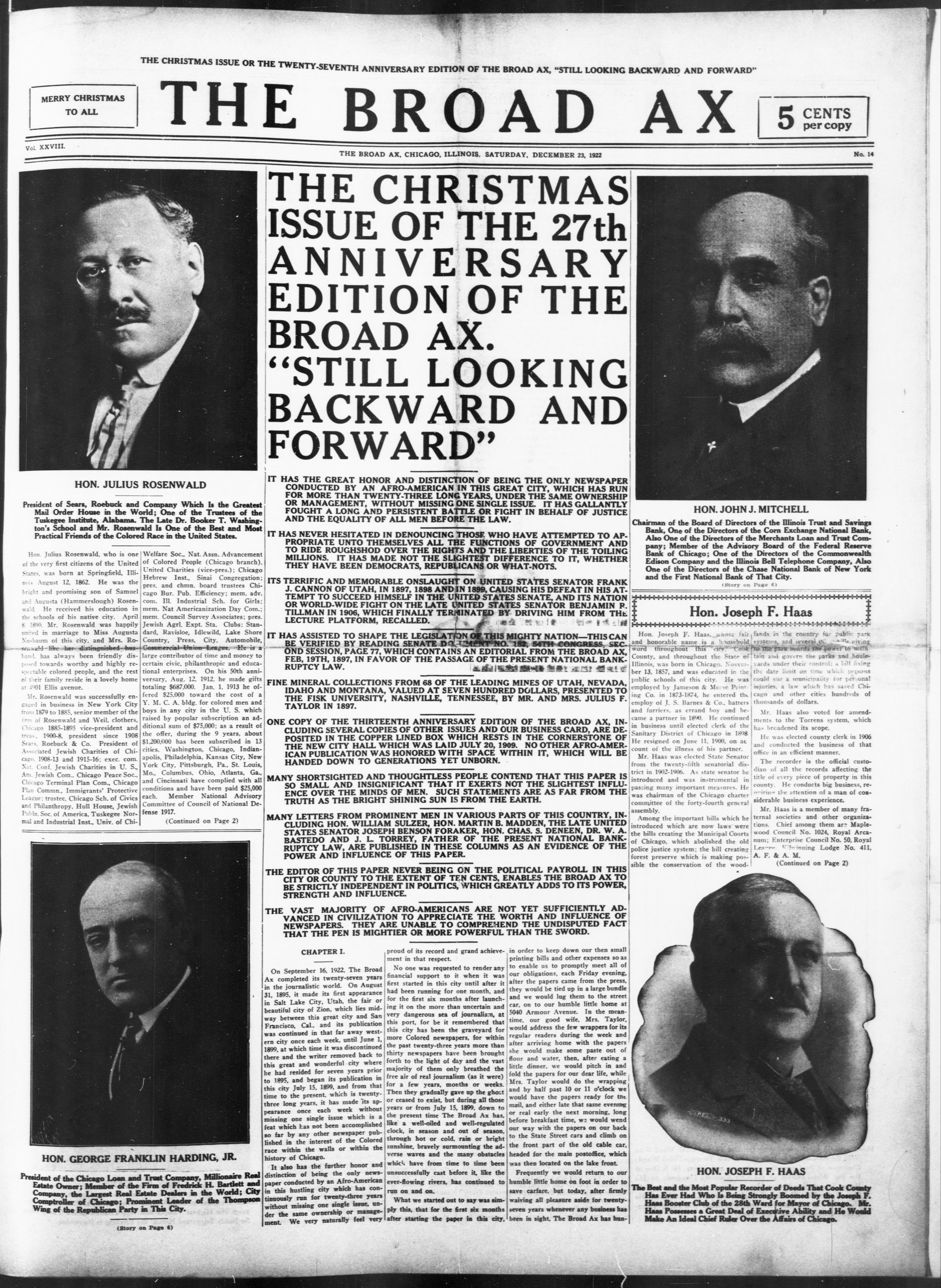
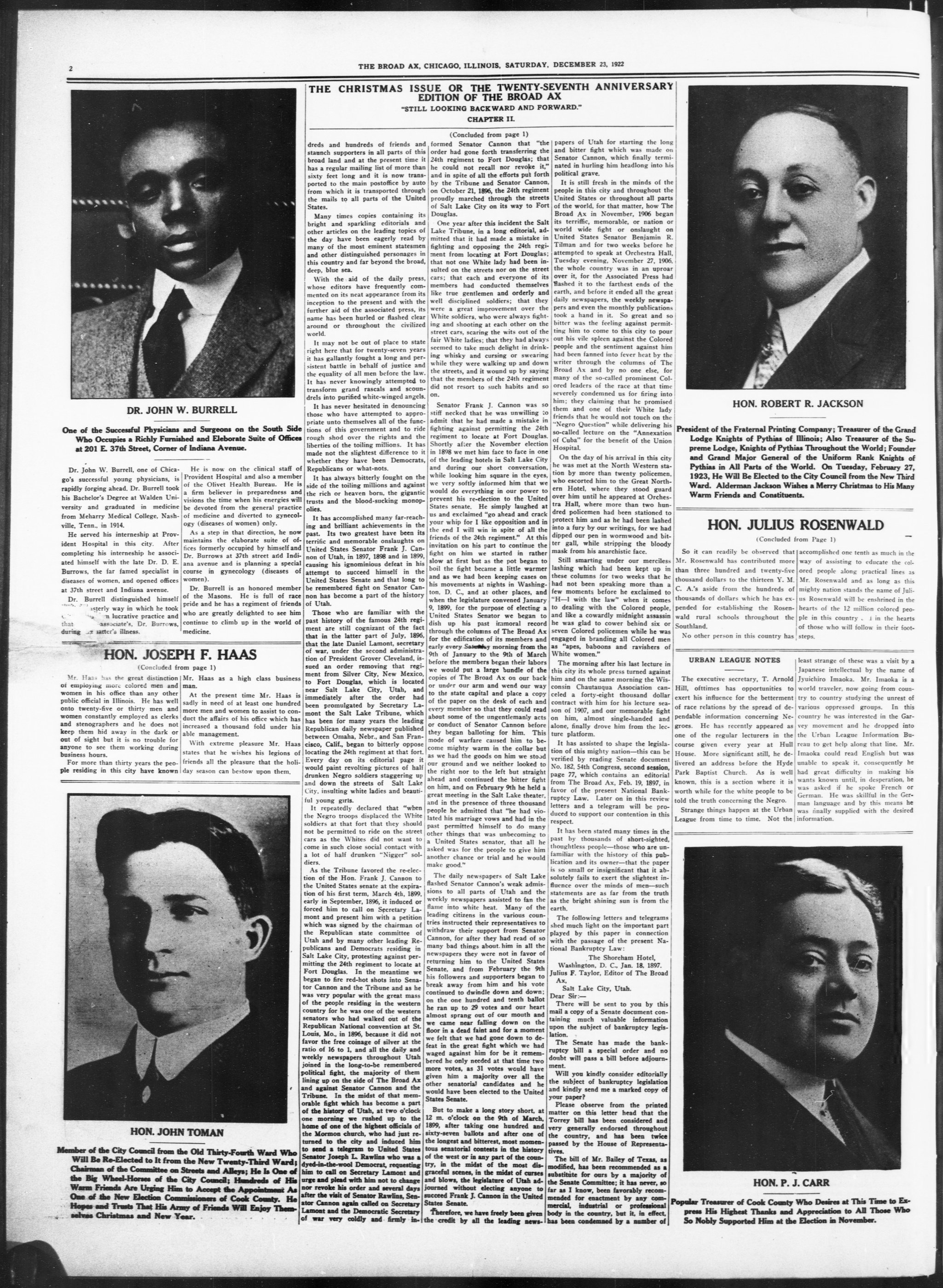
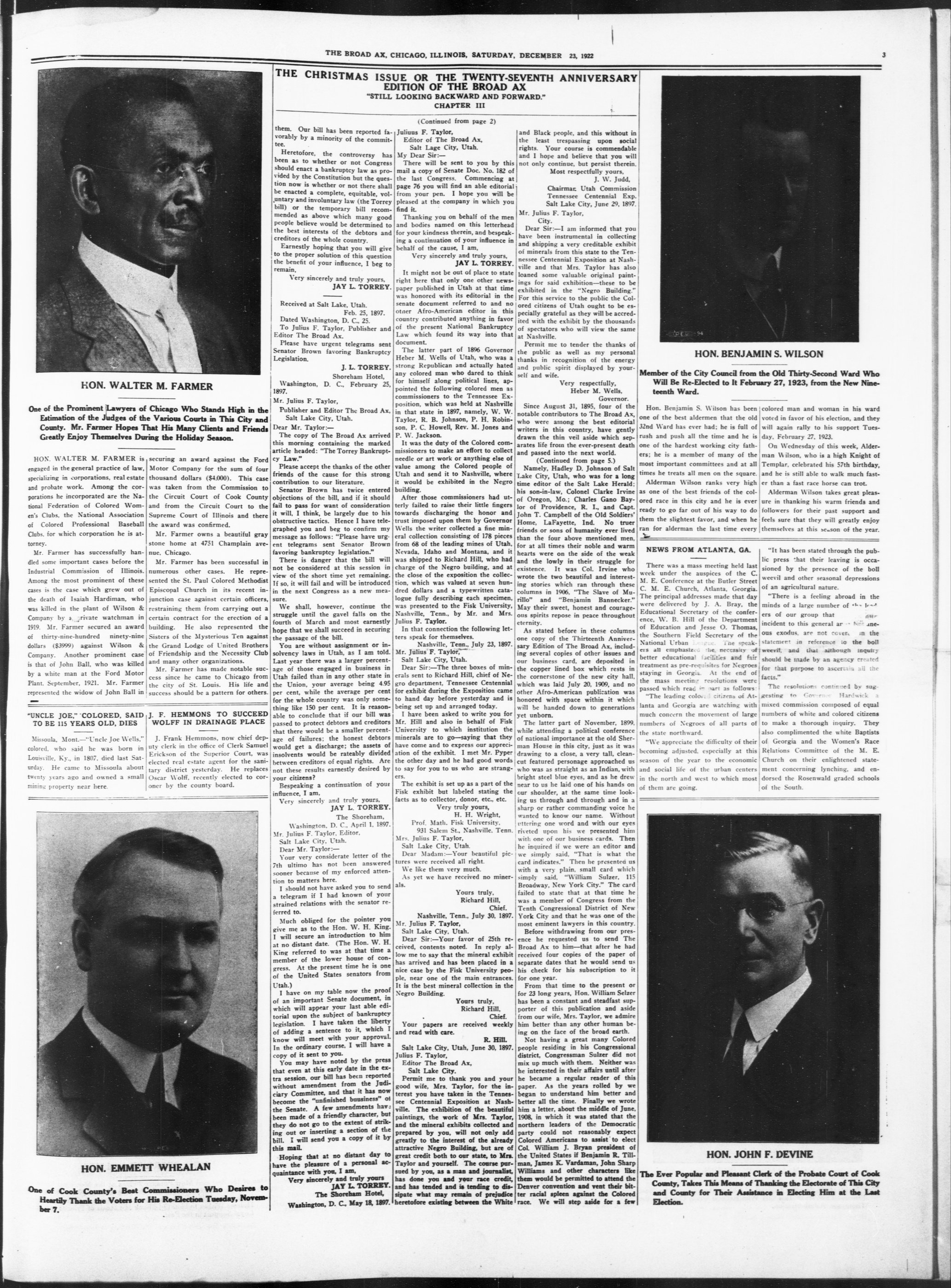
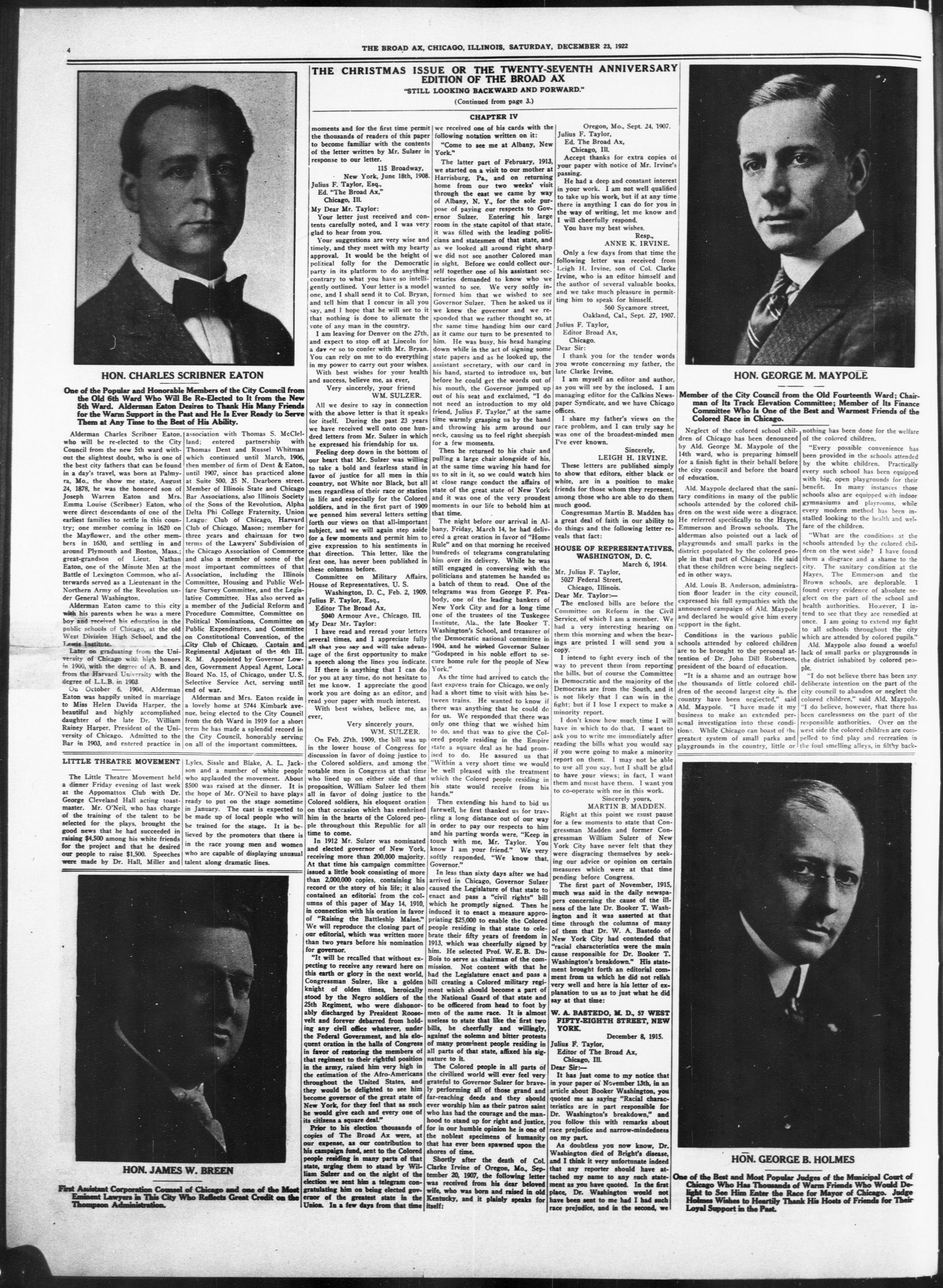
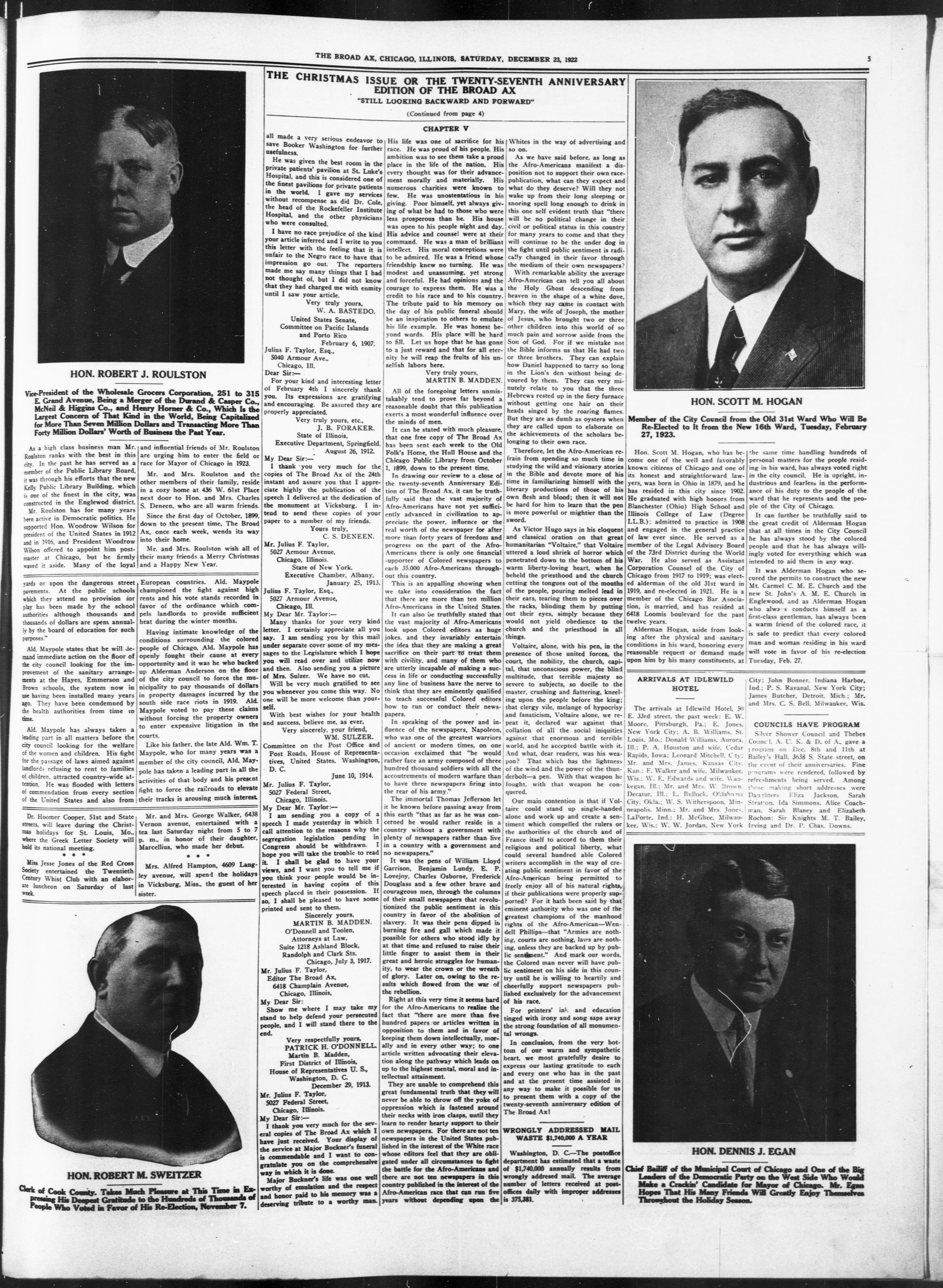
Page text (machine-generated)
MERRY CHRISTMAS
TO ALL
Vol. XXVIII.
1
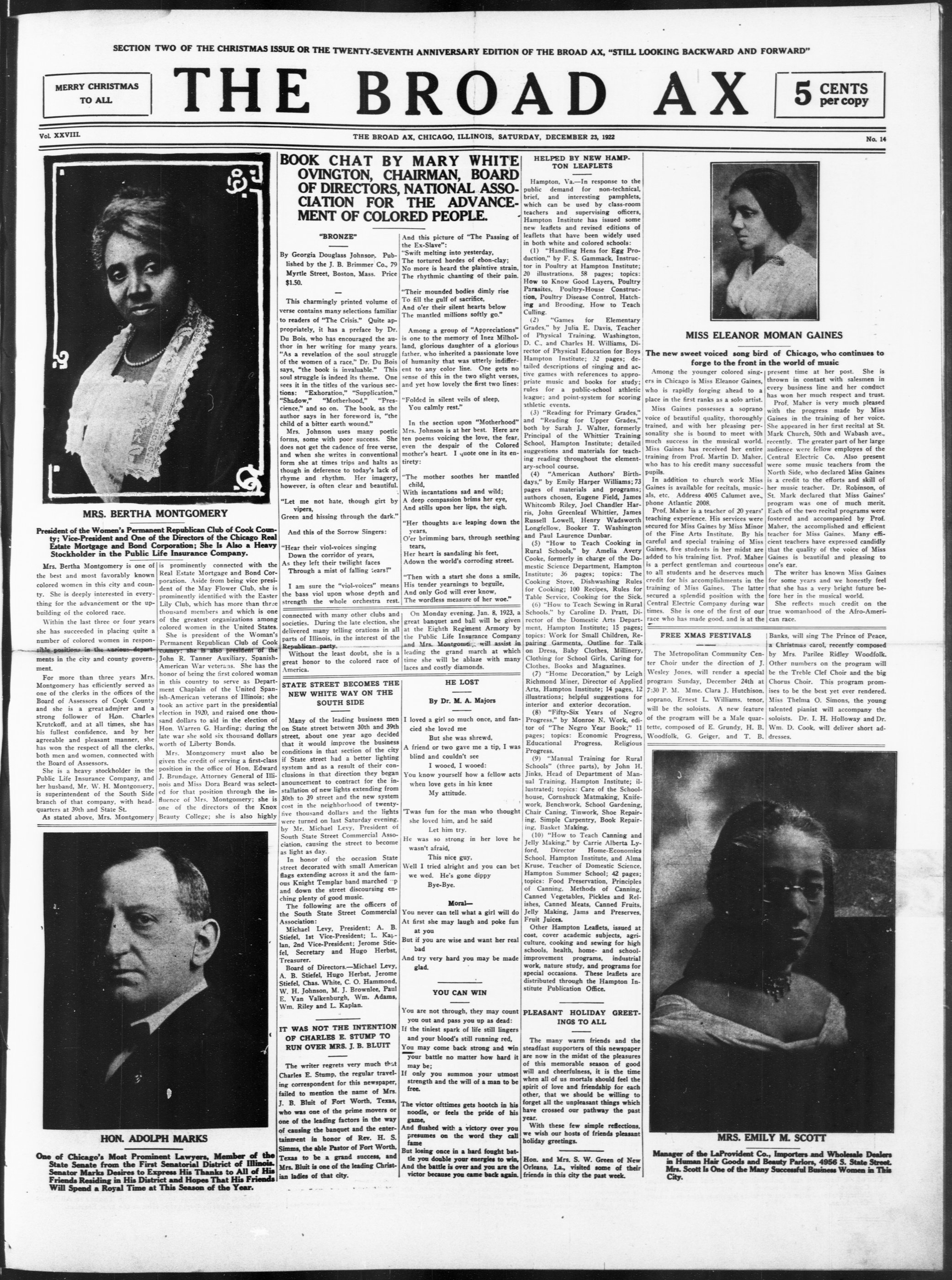
HON. JULIUS ROSENWALD
President of Sears, Roebuck and Company Which Mail Order House in the World; One of the Tuskegee Institute, Alabama. The Late Dr. Bookton's School and Mr. Rosenwald Is One of the Practical Friends of the Colored Race in the Unite
years, Roebuck and Company Which is House in the World; One of the Institute, Alabama. The Late Dr. Bookl and Mr. Rosenwald Is One of the friends of the Colored Race in the United
President of Sears, Roebuck and Company Which Is the Greatest Mail Order House in the World; One of the Trustees of the Tuskegee Institute, Alabama. The Late Dr. Booker T. Washington's School and Mr. Rosenwald Is One of the Best and Most Practical Friends of the Colored Race in the United States.
Hon. Julius Rosenwald, who is one of the very first citizens of the United States, was born at Springfield, Illinois August 12, 1862. He was the bright and promising son of Samuel and Augusta (Hammerslough) Rosenwald. He received his education in the schools of his native city. April 8, 1890. Mr. Rosenwald was happily united in marriage to Miss Augusta Nusbaum of this city, and Mrs. Rosenwald like her distinguished husband, has always been friendly disposed towards worthy and highly respectable colored people, and the rest of their family reside in a lovely home at 4901 Ellis avenue.
Welfare Soc., Nat. Assn. Advancement of Colored People (Chicago branch) United Charities (vice-pres.); Chicago Hebrew Inst., Sinai Congregation; pres. and chmn. board trustees Chicago Bur. Pub. Efficiency; mem. adv com. Ill. Industrial Sch. for Girls; mem. Nat Americanization Day Com.; Council Survey Associates; pres. Jewish Agrl. Expt. Sta. Clubs: Standard, Ravisloe, Idlewild, Lake Shore Country, Press, City, Automobile, Commercial Union League. He is a large contributor of time and money to certain civic, philanthropic and educational enterprises. On his 50th anniversary, Aug. 12, 1912, he made gifts totaling $687,000. Jan. 1, 1913 of his
Mr. Rosenwald was successfully engaged in business in New York City from 1879 to 1885, senior member of the firm of Rosenwald and Weil, clothes, Chicago 1885-1895 vice-president and treas., 1900-8, president since 1908 Sears, Roebuck & Co. President of Associated Jewish Charities of Chicago, 1908-13 and 1915-16; exec. com. Nat. Conf., Jewish Charities in U. S., Am. Jewish Com., Chicago Peace Soc., Chicago Terminal Plan Com., Chicago Plan Comm., Immigrants' Protective League; trustee, Chicago Sch. of Civics and Philanthropy, Hull House, Jewish Publn, Soc. of America, Tuskegee Normal and Industrial Inst., Univ. of Chi-
---
M.
HON. GEORGE FRANKLIN HARDING, JR. President of the Chicago Loan and Trust Company, Millionaire Real Estate Owner; Member of the Firm of Fredrick H. Bartlett and Company, the Largest Real Estate Dealers in the World; City Comptroller of Chicago; Prominent Leader of the Thompson Wing of the Republican Party in This City.
THE BROAD AX
Company Which Is the Greatest world; One of the Trustees of the Late Dr. Booker T. Washing-gald Is One of the Best and Most Race in the United States.
Welfare Soc., Nat. Assn. Advancement of Colored People (Chicago branch). United Charities (vice-pres.). Chicago Hebrew Inst., Sinai Congregation; pres. and chmn. board trustees Chicago Bur. Pub. Efficiency; mem. adv. com. Ill. Industrial Sch. for Girls; mem. Nat Americanization Day Com., mem. Council Survey Associates; pres. Jewish Agrl. Expt. Sta. Clubs: Standard, Ravisloe, Idlewild, Lake Shore Country, Press, City, Automobile, Commercial Union League. He is a large contributor of time and money to certain civic, philanthropic and educational enterprises. On his 50th anniversary, Aug. 12, 1912, he made gifts totaling $687,000. Jan. 1, 1913 he offered $25,000 toward the cost of a Y. M. C. A. bldg. for colored men and boys in any city in the U. S. which raised by popular subscription an additional sum of $75,000; as a result of the offer, during the 9 years, about $1,200,000 has been subscribed in 13 cities, Washington, Chicago, Indianapolis, Philadelphia, Kansas City, New York City, Pittsburgh, Pa., St. Louis, Mo., Columbus, Ohio, Atlanta, Ga., and Cincinnati have complied with all conditions and have been paid $25,000 each. Member National Advisory Committee of Council of National Defense 1917.
(Continued on Page 2)
---
THE BROAD AX, CHICAGO, ILLINOIS, SATURDAY, DECEMBER 23, 1922
THE CHRISTMAS ISSUE OF THE 27th ANNIVERSARY EDITION OF THE BROAD AX. "STILL LOOKING BACKWARD AND FORWARD"
IT HAS THE GREAT HONOR AND DISTINCTION OF BEING THE ONLY NEWSPAPER CONDUCTED BY AN AFRO-AMERICAN IN THIS GREAT CITY, WHICH HAS RUN FOR MORE THAN TWENTY-THREE LONG YEARS, UNDER THE SAME OWNERSHIP OR MANAGEMENT, WITHOUT MISSING ONE SINGLE ISSUE. IT HAS GALLANTLY FOUGHT A LONG AND PERSISTENT BATTLE OR FIGHT IN BEHALF OF JUSTICE AND THE EQUALITY OF ALL MEN BEFORE THE LAW.
IT HAS NEVER HESITATED IN DENOUNCING THOSE WHO HAVE ATTEMPTED TO APPROPRIATE UNTO THEMSELVES ALL THE FUNCTIONS OF GOVERNMENT AND TO RIDE ROUGHSHOD OVER THE RIGHTS AND THE LIBERTIES OF THE TOILING MILLIONS. IT HAS MADE NOT THE SLIGHTEST DIFFERENCE TO IT, WHETHER THEY HAVE BEEN DEMOCRATS, REPUBLICANS OR WHAT-NOTS.
ITS TERRIFIC AND MEMORABLE ONSLAUGHT ON UNITED STATES SENATOR FRANK J. CANNON OF UTAH, IN 1897, 1898 AND IN 1899, CAUSING HIS DEFEAT IN HIS ATTEMPT TO SUCCEED HIMSELF IN THE UNITED STATES SENATE, AND ITS NATION OR WORLD-WIDE FIGHT ON THE LATE UNITED STATES SENATOR BENJAMIN R. TILLMAN IN 1906, WHICH FINALLY TERMINATED BY DRIVING HIM FROM THE LECTURE PLATFORM, RECALLED.
IT HAS ASSISTED TO SHAPE THE LEGISLATION OF THIS MIGHTY NATION—THIS CAN BE VERIFIED BY READING SENATE DOCUMENT NO. 182, 54TH CONGRESS, SECOND SESSION, PAGE 77, WHICH CONTAINS AN EDITORIAL FROM THE BROAD AX, FEB, 19TH, 1897, IN FAVOR OF THE PASSAGE OF THE PRESENT NATIONAL BANK-RUPTCY LAW.
FINE MINERAL COLLECTIONS FROM 68 OF THE LEADING MINES OF UTAH, NEVADA, IDAHO AND MONTANA, VALUED AT SEVEN HUNDRED DOLLARS, PRESENTED TO THE FISK UNIVERSITY, NASHVILLE, TENNESSEE, BY MR. AND MRS. JULIUS F. TAYLOR IN 1897.
ONE COPY OF THE THIRTEENTH ANNIVERSARY EDITION OF THE BROAD AX, INCLUDING SEVERAL COPIES OF OTHER ISSUES AND OUR BUSINESS CARD, ARE DEPOSITED IN THE COPPER LINED BOX WHICH RESTS IN THE CORNERSTONE OF THE NEW CITY HALL WHICH WAS LAID JULY 20, 1909. NO OTHER AFRO-AMERICAN PUBLICATION WAS HONORED WITH SPACE WITHIN IT, WHICH WILL BE HANDED DOWN TO GENERATIONS YET UNBORN.
MANY SHORTSIGHTED AND THOUGHTLESS PEOPLE CONTEND THAT THIS PAPER IS SO SMALL AND INSIGNIFICANT THAT IT EXERTS NOT THE SLIGHTEST INFLUENCE OVER THE MINDS OF MEN. SUCH STATEMENTS ARE AS FAR FROM THE TRUTH AS THE BRIGHT SHINING SUN IS FROM THE EARTH.
MANY LETTERS FROM PROMINENT MEN IN VARIOUS PARTS OF THIS COUNTRY, INCLUDING HON. WILLIAM SULZER, HON. MARTIN B. MADDEN, THE LATE UNITED STATES SENATOR JOSEPH BENSON FORAKER, HON. CHAS. S. DENEEN, DR. W. A. BASTEDO AND J. L. TORREY, FATHER OF THE PRESENT NATIONAL BANKRUPTCY LAW, ARE PUBLISHED IN THESE COLUMNS AS AN EVIDENCE OF THE POWER AND INFLUENCE OF THIS PAPER.
THE EDITOR OF THIS PAPER NEVER BEING ON THE POLITICAL PAYROLL IN THIS CITY OR COUNTY TO THE EXTENT OF TEN CENTS, ENABLES THE BROAD AX TO BE STRICTLY INDEPENDENT IN POLITICS, WHICH GREATLY ADDS TO ITS POWER, STRENGTH AND INFLUENCE.
THE VAST MAJORITY OF AFRO-AMERICANS ARE NOT YET SUFFICIENTLY ADVANCED IN CIVILIZATION TO APPRECIATE THE WORTH AND INFLUENCE OF NEWSPAPERS. THEY ARE UNABLE TO COMPREHEND THE UNDISPUTED FACT THAT THE PEN IS MIGHTIER OR MORE POWERFUL THAN THE SWORD.
CHAPTER I.
On September 16, 1922, The Broad Ax completed its twenty-seven years in the journalistic world. On August 31, 1895, it made its first appearance in Salt Lake City, Utah, the fair or beautiful city of Zion, which lies midway between this great city and San Francisco, Cal., and its publication was continued in that far away western city once each week, until June 1, 1899, at which time it was discontinued there and the writer removed back to this great and wonderful city where he had resided for seven years prior to 1895, and began its publication in this city July 15, 1899, and from that time to the present, which is twenty-three long years, it has made its appearance once each week without missing one single issue which is a feat which has not been accomplished so far by any other newspaper published in the interest of the Colored race within the walls or within the history of Chicago.
It also has the further honor and distinction of being the only newspaper conducted by an Afro-American in this hustling city which has continuously run for twenty-three years without missing one single issue, under the same ownership or management. We very naturally feel very
proud of its record and grand achievement in that respect.
No one was requested to render any financial support to it when it was first started in this city until after it had been running for one month, and for the first six months after launching it on the more than uncertain and very dangerous sea of journalisn: n, at this port, for be it remembered that this city has been the graveyard for more Colored newspapers, for within the past twenty-three years more than thirty newspapers have been brought forth to the light of day and the vast majority of them only breathed the free air of real journalism (as it were) for a few years, months or weeks.
Then they gradually gave up the ghost or ceased to exist, but during all those years or from July 15, 1899, down to the present time The Broad Ax has, like a well-oiled and well-regulated clock, in season and out of season, through hot or cold, rain or bright sunshine, bravely surmounting the adverse waves and the many obstacles which have from time to time been unsuccessfully cast before it, like the ever-flowing rivers, has continued to run on and on.
What we started out to say was simply this, that for the first six months after starting the paper in this city,
in order to keep down our then small printing bills and other expenses so as to enable us to promptly meet all of our obligations, each Friday evening, after the papers came from the press, they would be tied up in a large bundle and we would lug them to the street car, on to our humble little home at 5040 Armour Avenue. In the meantime, our good wife, Mrs. Taylor, would address the few wrappers for its regular readers during the week and after arriving home with the papers she would make some paste out of flour and water, then, after eating a little dinner, we would pitch in and fold the papers for our dear life, while Mrs. Taylor would do the wrapping and by half past 10 or 11 o'clock we would have the papers ready for the mail, and either late that same evening or real early the next morning, long before breakfast time, we would wend our way with the papers on our back to the State Street cars and climb on the front part of the old cable car, headed for the main postoffice, which was then located on the lake front.
Frequently we would return to our humble little home on foot in order to save carfare, but today, after firmly waiving all pleasure aside for twenty-seven years whenever any business has been in sight. The Broad Ax has hun-
[Name not provided]
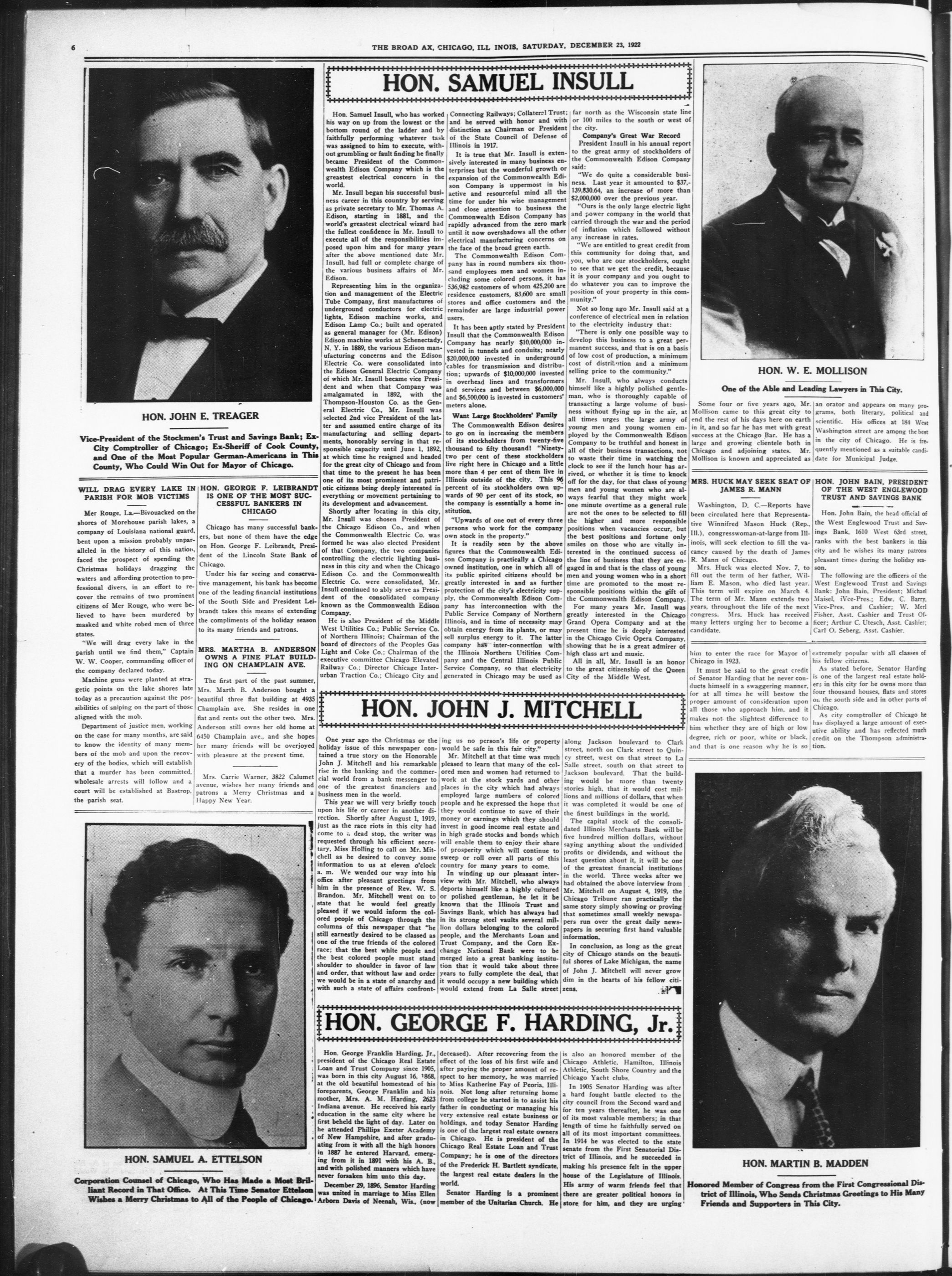
HON, JOHN J. MITCHELL
Chairman of the Board of Director
Bank, One of the Directors of
Also One of the Directors of the
pany; Member of the Advisi
Bank of Chicago; One of the
Edison Company and the Illin
One of the Directors of the c
and the First National Bank o
(Story of
Board of Directors of the Illinois T
of the Directors of the Corn Exchange
the Directors of the Merchants Loan
ber of the Advisory Board of the
Chicago; One of the Directors of the
pany and the Illinois Bell Telephone
Directors of the Chase National Bait
National Bank of That City.
Chairman of the Board of Directors of the Illinois Trust and Savings Bank, One of the Directors of the Corn Exchange National Bank, Also One of the Directors of the Merchants Loan and Trust Company; Member of the Advisory Board of the Federal Reserve Bank of Chicago; One of the Directors of the Commonwealth Edison Company and the Illinois Bell Telephone Company, Also One of the Directors of the Chase National Bank of New York and the First National Bank of That City.
(Story on Page 6)
Hon. Joseph F. Haas
Hon. Joseph F. Haas, whose faith and honorable name is a household word throughout this city. Cook County, and throughout the State of Illinois, was born in Chicago. November 13, 1857, and was educated in the public schools of this city. He was employed by Jameson & Mouse Printing Co. in 1873-1874, he entered the employ of J. S. Barnes & Co., hatters and furriers, as errand boy and became a partner in 1890. He continued in business until elected clerk of the Sanitary District of Chicago in 1898 He resigned on June 11, 1900, on account of the illness of his partner. Mr. Haas was elected State Senator from the twenty-fifth senatorial district in 1902-1906. As state senator he introduced and was instrumental in passing many important measures. He was chairman of the Chicago charter committee of the forty-fourth general assembly. Among the important bills which he introduced which are now laws were the bills creating the Municipal Courts of Chicago, which abolished the old police justice system; the bill creating forest preserve which is making possible the conservation of the wood-
333
PEI 333
333
HON. JOSEPH F. HAAS
The Best and the Most Popular Rea Has Ever Had Who Is Being Haas Booster Club of the 28th Haas Possesses a Great Deal to Make An Ideal Chief Ruler Ov
The Most Popular Recorder of Deeds The
Head Who Is Being Strongly Boomed by
Her Club of the 28th Ward for Mayor or
uses a Great Deal of Executive Ability
Deal Chief Ruler Over the Affairs of C
The Best and the Most Popular Recorder of Deeds That Cook County Has Ever Had Who Is Being Strongly Boomed by the Joseph F. Haas Booster Club of the 28th Ward for Mayor of Chicago. Mr. Haas Possesses a Great Deal of Executive Ability and He Would Make An Ideal Chief Ruler Over the Affairs of Chicago.
The Best and the Most Popular Recorder of Deeds That Cook County Has Ever Had Who Is Being Strongly Boomed by the Joseph F. Haas Booster Club of the 28th Ward for Mayor of Chicago. Mr. Haas Possesses a Great Deal of Executive Ability and He Would Make An Ideal Chief Ruler Over the Affairs of Chicago.
ers of the Illinois Trust and Savings
the Corn Exchange National Bank,
the Merchants Loan and Trust Com-
mary Board of the Federal Reserve
Directors of the Commonwealth
Bell Telephone Company, Also
Chase National Bank of New York
of That City.
Page 6)
tain and govern the parks and boulevards under their control a bill fixing the date limit on time which persons could sue a municipality for personal injuries, a law which has saved Chicago and other cities hundreds of thousands of dollars.
Mr. Haas also voted for amendments to the Torrens system, which has broadened its scope.
He was elected county clerk in 1906 and conducted the business of that office in an efficient manner.
The recorder is the official custodian of all the records affecting the title of every piece of property in this county. He conducts big business, receiving the attention of a man of considerable business experience.
Mr. Haas is a member of many fraternal societies and other organizations. Chief among them are Maplewood Council No. 1024, Royal Arcanum; Enterprise Council No. 50, Royal League, Kilwinning Lodge No. 411, A. F. & A. M. (Continued on Page 2)
C
order of Deeds That Cook County Strongly Boomed by the Joseph F. Ward for Mayor of Chicago. Mr. of Executive Ability and He Would over the Affairs of Chicago.
```markdown
```
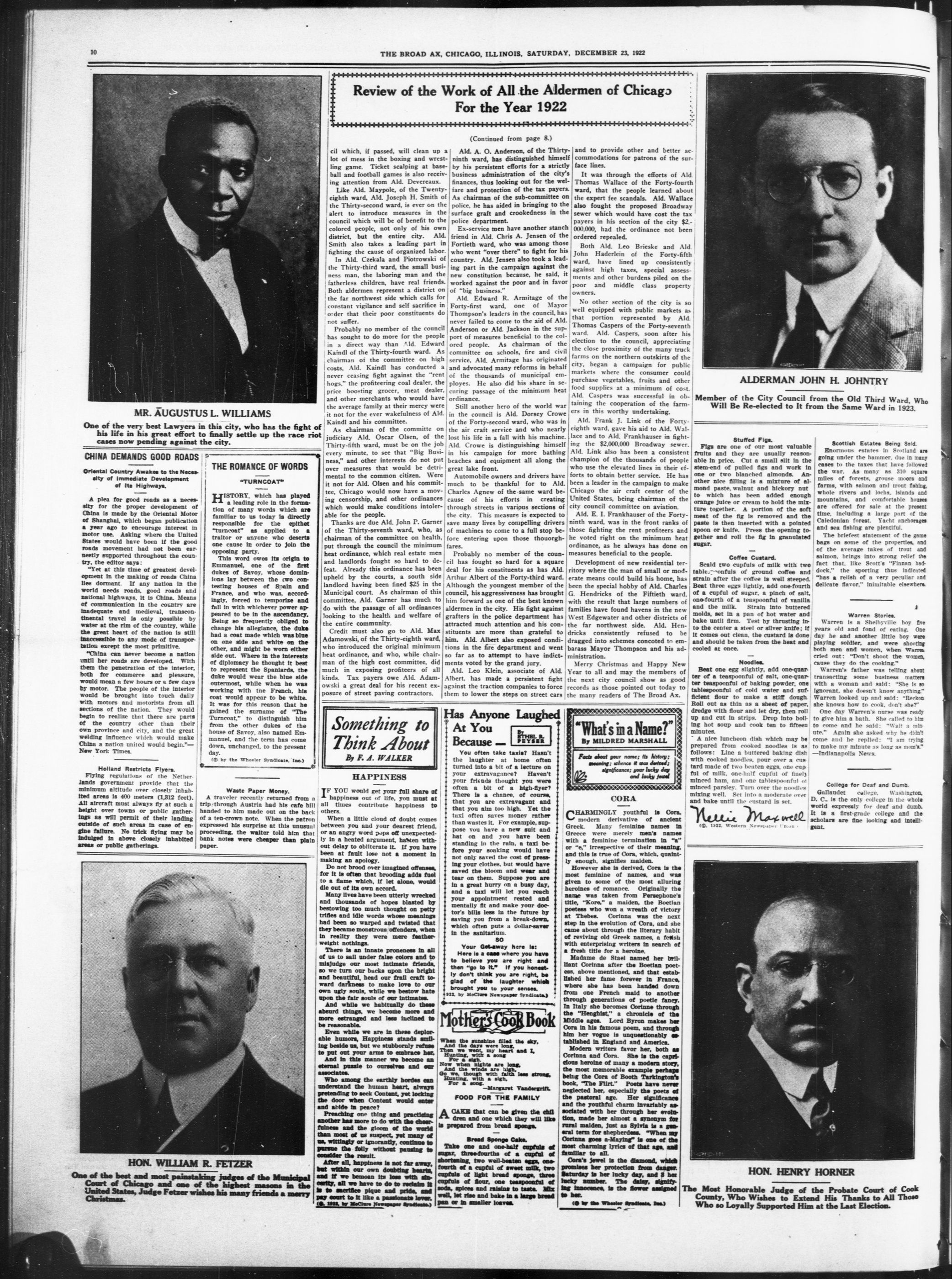
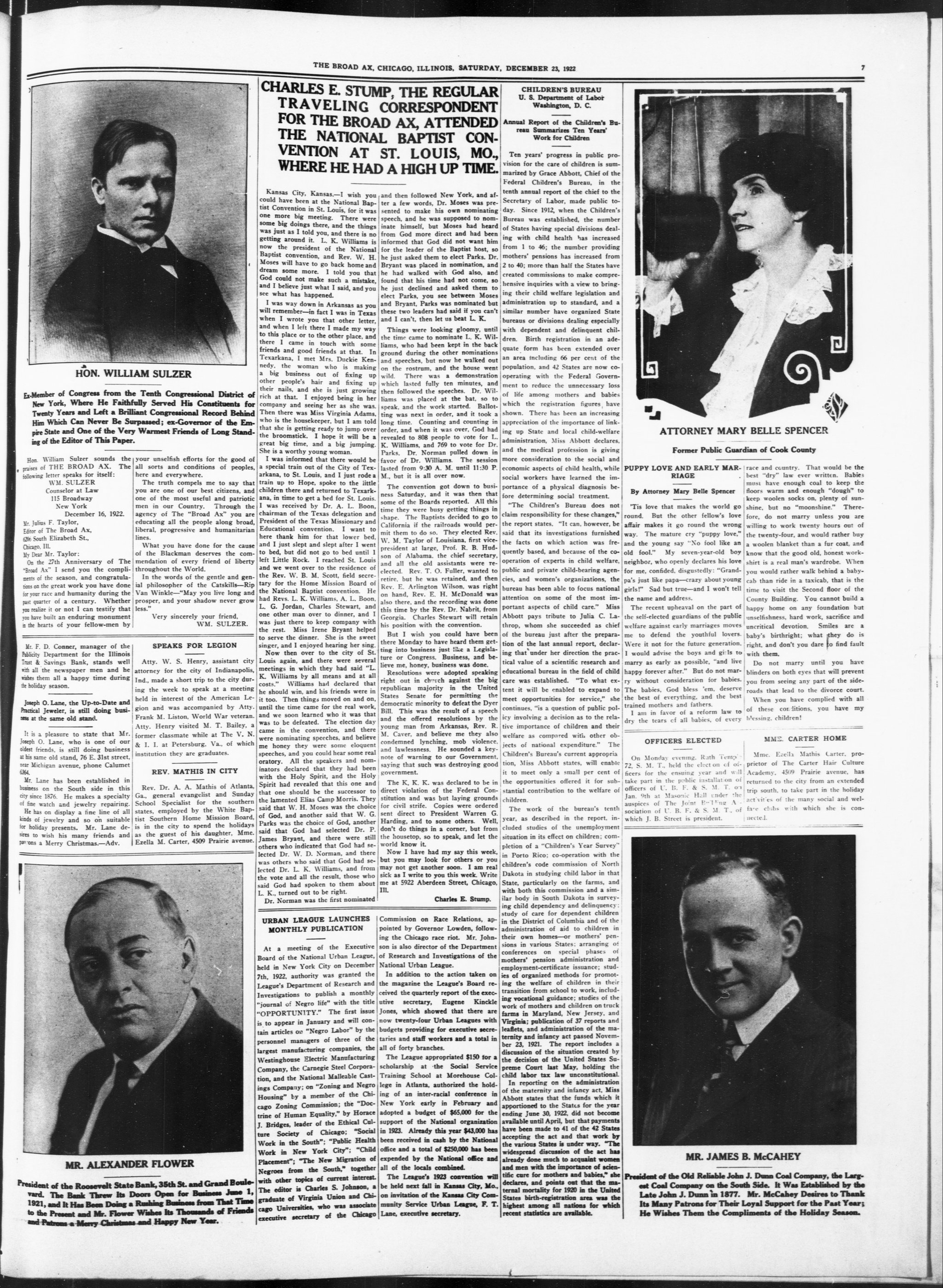
MR. AUGUSTUS L. WILLIAMS One of the very best Lawyers in this city, who has the fight of his life in his great effort to finally settle up the race riot cases now pending against the city.
CHINA DEMANDS GOOD ROADS
Oriental Country Awakes to the Necessity of Immediate Development of Its Highways.
A plea for good roads as a necessity for the proper development of China is made by the Oriental Motor of Shanghai, which began publication a year ago to encourage interest in motor use. Asking where the United States would have been if the good roads movement had not been earnestly supported throughout the country, the editor says:
"Yet at this time of greatest development in the making of roads China lies dormant. If any nation in the world needs roads, good roads and national highways, it is China. Means of communication in the country are inadequate and medieval, transcontinental travel is only possible by water at the rim of the country, while the great heart of the nation is still inaccessible to any mode of transportation except the most primitive.
"China can never become a nation until her roads are developed. With them the penetration of the interior, both for commerce and pleasure, would mean a few hours or a few days by motor. The people of the interior would be brought into touch daily with motors and motorists from all sections of the nation. They would begin to realize that there are parts of the country other than their own province and city, and the great welding influence which would make China a nation united would begin."—New York Times.
Holland Restricts Elves
Flying regulations of the Netherlands government provide that the minimum altitude over closely inhabited areas is 400 meters (1,312 feet). All aircraft must always fly at such a height over towns or public gatherings as will permit of their landing outside of such areas in case of engine failure. No trick flying may be indulged in above closely inhabited areas or public gatherings.
[Name]
[Name]
HON. WILLIAM R. FETZER
One of the best and most painstaking judges of Court of Chicago and one of the highest United States, Judge Fetzer wishes his many Christmas.
One of the best and most painstaking judges of the Municipal Court of Chicago and one of the highest masons in the United States, Judge Fetzer wishes his many friends a merry Christmas.
10
in this city, who has the fight to finally settle up the race rise the city.
THE ROMANCE OF WORDS
"TURNCOAT"
HISTORY, which has played a leading role in the formation of many words which are familiar to us today is directly responsible for the epithet "turncoat" as applied to a traitor or anyone who deserts one cause in order to join the opposing party.
This word owes its origin to Emmanuel, one of the first dukes of Savoy, whose dominions lay between the two contesting houses of Spain and France, and who was, accordingly, forced to temporize and fall in with whichever power appeared to be in the ascendancy. Being so frequently obliged to change his allegiance, the duke had a coat made which was blue on one side and white on the other, and might be worn either side out. Where in the interests of diplomacy he thought it best to represent the Spanards, the duke would wear the blue side outermost, while when he was working with the French, his coat would appear to be white. It was for this reason that he gained the surname of "The Turncoat," to distinguisgh him from the other dukes of the house of Savoy, also named Emmanuel, and the term has come down, unchanged, to the present day.
(® by the Wheeler Syndicate, Inc.)
Waste Paper Money
A traveler recently returned from a trip: through Austria had his cafe bill handed to him made out on the back of a ten-crown note. When the patron expressed his surprise at this unusual proceeding, the waiter told him that bank notes were cheaper than plain paper.
1930
aking judges of the Municipal of the highest masons in theishes his many friends a merry
THE BROAD AX, CHICAGO, ILLINOIS, SATURDAY, DECEMBER 23, 1922
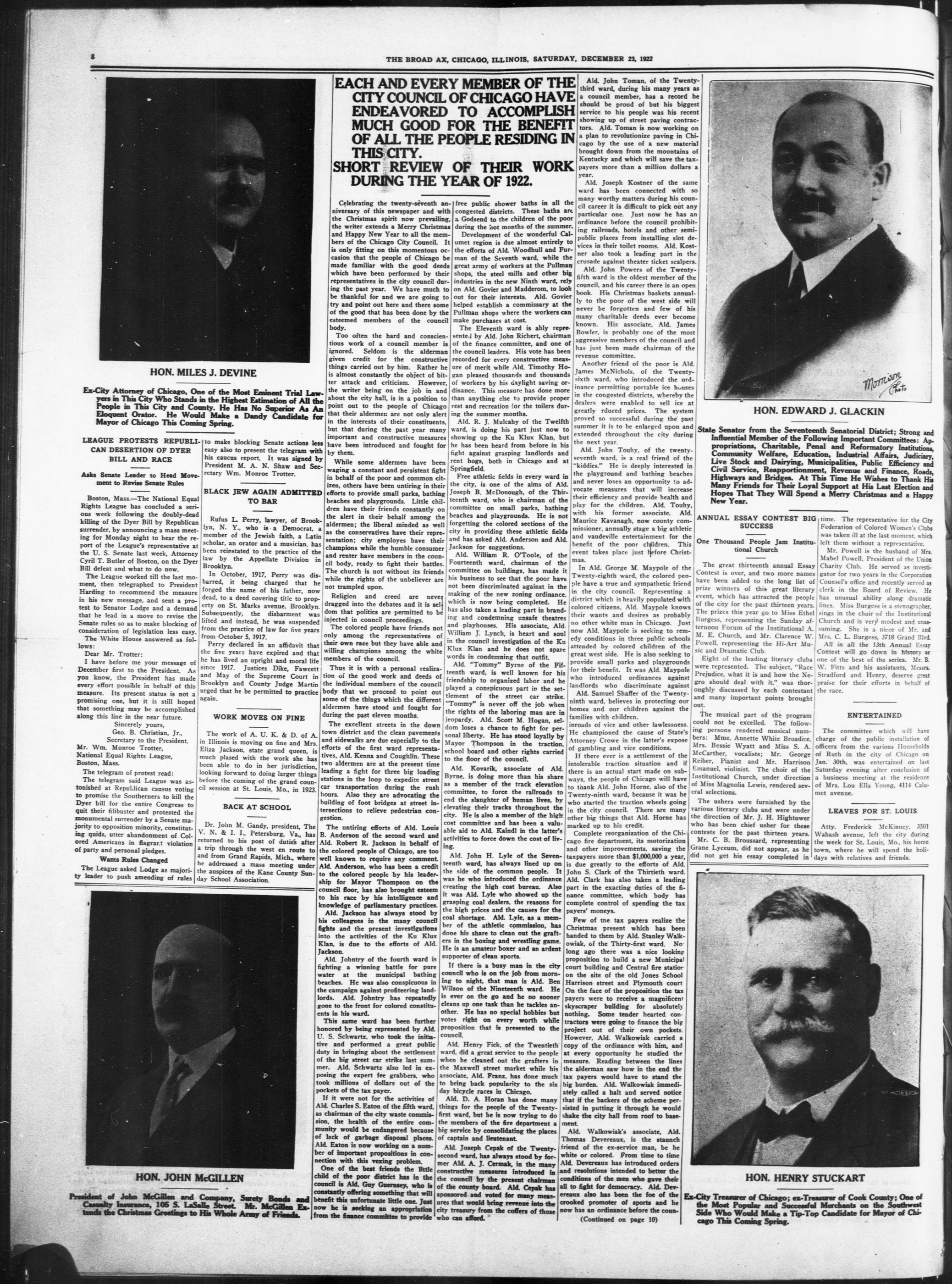
Review of the Work of All the Aldermen of Chicago For the Year 1922
*
cil which, if passed, will clean up a lot of mess in the boxing and wrestling game. Ticket scalping at baseball and football games is also receiving attention from Ald. Devereaux. Like Ald. Maypole, of the Twenty-eighth ward, Ald. Joseph H. Smith of the Third-second ward, is ever on the alert to introduce measures in the council which will be of benefit to the colored people, not only of his own district, but the entire city. Ald. Smith also takes a leading part in fighting the cause of organized labor. In Ald. Czekala and Piotrowski of the Thirty-third ward, the small business man, the laboring man and the fatherless children, have real friends. Both aldermen represent a district on the far northwest side which calls for constant vigilance and self sacrifice in order that their poor constituents do not suffer.
Probably no member of the council has sought to do more for the people in a direct way than Ald. Edward Kaindl of the Thirty-fourth ward. As chairman of the committee on high costs, Ald. Kaindl has conducted a never ceasing fight against the "rent hogs," the profiteering coal dealer, the price boosting grocer, meat dealer, and other merchants who would have the average family at their mercy were it not for the ever wakefulness of Ald. Kaindl and his committee.
As chairman of the committee on judiciary Ald. Oscar Olsen, of the Thirty-fifth ward, must be on the job every minute, to see that "Big Business," and other interests do not put over measures that would be detrimental to the common citizen. Were it not for Ald. Olsen and his committee, Chicago would now have a moving censorship, and other ordinances which would make conditions intolerable for the people.
Thanks are due Ald. John P. Garner of the Thirty-seventh ward, who, as chairman of the committee on health put through the council the minimum heat ordinance, which real estate men and landlords fought so hard to defeat. Already this ordinance has been upheld by the courts, a south side landlord having been fined $25 in the Municipal court. As chairman of this committee, Ald. Garner has much to do with the passage of all ordinances looking to the health and welfare of the entire community. Credit must also go to Ald. Max Adamowski, of the Thirty-eighth ward, who introduced the original minimum heat ordinance, and who, while chairman of the high cost committee, did much in exposing profiteers of all kinds. Tax payers owe Ald. Adamowski a great deal for his recent exposure of street paving contractors.
HAPPINESS
IF YOU would get your full share of happiness out of life, you must at all times contribute happiness to others.
When a little cloud of doubt comes between you and your dearest friend, or an angry word pops off unexpectedly in a heated argument, hasen without delay to obliterate it. If you have been at fault lose not a moment in making an apology.
Do not brood over imagined offenses, for it is often that brooding adds fuel to a flame which, if let alone, would die out of its own accord.
Many lives have been utterly wrecked and thousands of hopes blasted by bestowing too much thought on petty trifles and idle words whose meanings had been so warped and twisted that they became monstrous offenders, when in reality they were mere featherweight nothings.
There is an innate preness in all of us to sail under false colors and to misjudge our most intimate friends, so we turn our backs upon the bright and beautiful, head our frail craft toward darkness to make love to our own ugly souls, while we bestow hate upon the fair souls of our intimates. And while we habitually do these absurd things, we become more and more estranged and less inclined to be reasonable. Even while we are in these deplorable humors, Happiness stands smiling beside us, but we stubbornly refuse to put out your arms to embrace hat. And in this manner we become an eternal puzzle to ourselves and our associates. Who among the earthly hordes can understand the human heart, always pretending to seek Content, yet locking the door when Content would enter and abide in peace?
Preaching one thing and practicing another has more to do with the cheerfulness and the gloom of the world than most of us suspect, yet many of us, wittingly or ignorantly, continue to pursue the folly without pausing to consider the result. After all, happiness is not far away, but within our own doubting hearts, and if we bemoan its loss with sincerity, all we have to do to reclaim it is to sacrifice plque and pride, and pay court to it like a passionate lover. (©, 1982, by McClure Newspaper Syndicate)
(Continued from page 8.)
Ald. A. O. Anderson, of the Thirty-ninth ward, has distinguished himself by his persistent efforts for a strictly business administration of the city's finances, thus looking out for the welfare and protection of the tax payers. As chairman of the sub-committee on police, he has aided in bringing to the surface graft and crookedness in the police department.
Ex-service men have another stanch friend in Ald. Chris A. Jensen of the Fortieth ward, who was among those who went "over there" to fight for his country. Ald. Jensen also took a leading part in the campaign against the new constitution because, he said, it worked against the poor and in favor of "big business."
Ald. Edward R. Armitage of the Forty-first ward, one of Mayor Thompson's leaders in the council, has never failed to come to the aid of Ald. Anderson or Ald. Jackson in the support of measures beneficial to the colored people. As chairman of the committee on schools, fire and civil service, Ald. Armitage has originated and advocated many reforms in behalf of the thousands of municipal employees. He also did his share in securing passage of the minimum heat ordinance.
Still another hero of the world war in the council is Ald. Dorsey Crowe of the Forty-second ward, who was in the air craft service and who nearly lost his life in a fall with his machine. Ald. Crowe is distinguishing himself in his campaign for more bathing beaches and equipment all along the great lake front.
Automobile owners and drivers have much to be thankful for to Ald Charles Agnew of the same ward because of his efforts in creating through streets in various sections of the city. This measure is expected to save many lives by compelling drivers of machines to come to a full stop before entering upon those thouorghares.
Probably no member of the council has fought so hard for a square deal for his constituents as has Ald. Arthur Albert of the Forty-third ward. Although the youngest member of the council, his aggressiveness has brought him forward as one of the best known aldermen in the city. His fight against grafters in the police department has attracted much attention and his constituents are more than grateful to him. Ald. Albert also exposed conditions in the fire department and went so far as to attempt to have indictments voted by the grand jury. Ald. Leo Klein, associate of Ald. Albert, has made a persistent fight against the traction companies to force them to lower the steps on street cars
Has Anyone Laughed
At You
Because —
By
ETHEL R.
PEYSSER
You often take taxis? Hasn't the laughter at home often turned into a bit of a lecture on your extravagance? Haven't your friends thought you were often a bit of a high-flyer? There is a chance, of course, that you are extravagant and that you aim too high. Yet the taxi often saves money rather than wastes it. For example, suppose you have a new suit and hat on and you have been standing in the rain, a taxi before your soaking would have not only saved the cost of pressing your clothes, but would have saved the bloom and wear and tear on them. Suppose you are in a great hurry on a busy day, and a taxi will let you reach your appointment rested and mentally fit and make your doctor's bills less in the future by saving you from a break-down, which often puts a dollar-saver in the sanitarium.
Your Get-away here is:
Here is a case where you have to believe you are right and then "go to it." If you honestly don't think you are right, be glad of the laughter which brought you to your senses. $22. by McClure Newspaper Syndicate. Mother's Cook Book When the sunshine filled the sky, And the days were long. Then we went, my heart and I, Hunting, with a song
A CAKE that can be given the chil dren and one which they will like is prepared from bread sponge.
Bread Sponge Cake.
Take one and one-half cupfuls of sugar, three-fourths of a cupful of shortening, two well-beaten eggs, one-fourth of a cupful of sweet milk, two cupfuls of light bread sponge, three cupfuls of flour, one teaspoon of soda, spices and raisins to taste. Mix well, let rise and bake in a large bread pan or in smaller loaves.
and to provide other and better accommodations for patrons of the surface lines.
It was through the efforts of Ald. Thomas Wallace of the Forty-fourth ward, that the people learned about the expert fee scandals. Ald. Wallace also fought the proposed Broadway sewer which would have cost the tax payers in his section of the city $2,000,000, had the ordinance not been ordered repealed.
Both Ald. Leo Brieske and Ald. John Haderlein of the Forty-fifth ward, have lined up consistently against high taxes, special assessments and other burdens piled on the poor and middle class property owners.
No other section of the city is so well equipped with public markets as that portion represented by Ald. Thomas Caspers of the Forty-seventh ward. Ald. Caspers, soon after his election to the council, appreciating the close proximity of the many truck farms on the northern outskirts of the city, began a campaign for public markets where the consumer could purchase vegetables, fruits and other food supplies at a minimum of cost. Ald. Caspers was successful in obtaining the cooperation of the farmers in this worthy undertaking.
Ald. Frank J. Link of the Forty-eighth ward, gave his aid to Ald. Wallace and to Ald. Frankhauser in fighting the $2,000,000 Broadway sewer. Ald. Link also has been a consistent champion of the thousands of people who use the elevated lines in their efforts to obtain better service. He has been a leader in the campaign to make Chicago the air craft center of the United States, being chairman of the city council committee on aviation. Ald. E. I. Frankhauser of the Fortyninth ward, was in the front ranks of those fighting the rent profiteers and he voted right on the minimum heat ordinance, as he always has done on measures beneficial to the people.
Development of new residential territory where the man of small or moderate means could build his home, has been the special hobby of Ald. Charles G. Hendricks of the Fiftieth ward, with the result that large numbers of families have found havens in the new West Edgewater and other districts of the far northwest side. Ald. Hendricks consistently refused to be dragged into schemes concoted to embarrass Mayor Thompson and his administration.
Merry Christmas and Happy New Year to all and may the members of the next city council show as good records as those pointed out today to the many readers of The Broad Ax.
"What's in a Name?"
By MILDRED MARSHALL
Facts about your name; its history;
meaning; whence it was derived;
significance; your lucky day
and lucky jewel
CORA
CHARMINGLY youthful is Cora, modern derivative of ancient Greek. Many feminine names in Greece were merely men's names with a feminine termination in "a" or "e," irrespective of their meaning, and this is true of Cora, which, qualitably enough, signifies maiden. However she is derived, Cora is the most feminine of names, and was given to some of the most alluring heroines of romance. Originally the name was taken from Persephone's title, "kore," a maiden, the Boetian poetess who wain a wreath of victory at Thebes. Corinna was the next step in the evolution of Cora, and she came about through the literary habit of reviving old Greek names, a fetish with enterprising writers in search of a fresh title for a heroine.
Madame de Stalem named her brilliant Corinna after the Boetian poetess, above mentioned, and that established her fame forever in France, where she has been handed down from one French maid to another through generations of poetic fancy. In Italy she becomes Corinne through the "Henghist," a chronicle of the Middle ages. Lord Byron makes her Cora in his famous poem, and through him her vogue is unquestionably established in England and America.
Modern writers favor her, both as Corinna and Cora. She is the capricious heroine of many a modern story, the most memorable example perhaps being the Cora of Booth Tarkington's book, "The Flirt." Poets have never neglected her, especially the poets of the pastoral age. Her significance and the youthful charm invariably associated with her through her evolution, made her almost a synonym for rural malden, just as Sylvia is a general term for shepherdess. "When my Corinna goes a-Maying" is one of the most charming lyrics of that age, and familiar to all.
Cora's jewel is the diamond, which promises her protection from danger. Saturday is her lucky day, and $ her lucky number. The daisy, signifying innocence, is the flower assigned to her.
(@ by the Wheeler Syndicate, Inc.)
[Name]
ALDERMAN JOHN H. JOHNTRY
Member of the City Council from the Old Third
Will Be Re-elected to It from the Same Ward
Member of the City Council from the Old Third Ward, Who Will Be Re-elected to It from the Same Ward in 1823.
Stuffed Figs.
Figs are one of our most valuable fruits and they are usually reasonable in price. Cut a small slit in the stem-end of pulled figs and work in one or two blanched almonds. Another nice filling is a mixture of almond paste, walnut and hickory nut to which has been added enough orange juice or cream to hold the mixture together. A portion of the soft meat of the fig is removed and the paste is then inserted with a pointed spoon or knife. Press the opening together and roll the fig in granulated sugar.
Coffee Custard
Scald two cupfuls of milk with two tables, onfuls of ground coffee and strain after the coffee is well steeped. Beat three eggs lightly, add one-fourth of a cupful of sugar, a pinch of salt, one-fourth of a teaspoonful of vanilla and the milk. Strain into buttered molds, set in a pan of hot water and bake until firm. Test by thrusting into the center a steel or silver knife; if it comes out clean, the custard is done and should be taken from the heat and cooled at once.
Noodles.
Beat one egg slightly, add one-quarter of a teaspoonful of salt, one-quarter teaspoonful of baking powder, one tablespoonful of cold water and sufficient flour to make a stiff dough Roll out as thin as a sheet of paper, dredge with flour and let dry, then roll up and cut in strips. Drop into boiling hot soup and cook ten to fifteen minutes.
A nice luncheon dish which may be prepared from cooked noodles is as follows: Line a buttered baking dish with cooked noodles, pour over a custard made of two beaten eggs, one cupful of milk, one half cupful of finely minced ham, and one tablespoonful of minced parsley. Turn over the noodles mixing well. Set into a moderate over and bake until the custard is set.
Nessie Maxwell
(© 1922, Western Newspaper, Union)
101
101
HON. HENRY HORNER
The Most Honorable Judge of the Probate
County, Who Wishes to Extend His Tha
Who so Loyally Supported Him at the Last
The Most Honorable Judge of the Probate Court of Cook County, Who Wishes to Extend His Thanks to All Those Who so Loyally Supported Him at the Last Election.
Noodles.
from the Old Third Ward, Who
from the Same Ward in 1923.
Scottish Estates Being Sold.
Enormous estates in Scotland are
going under the hammer, due in many
cases to the taxes that have followed
the war. As many as 310 square
miles of forests, grouse moors and
mills, with salmon and trout fishing,
whole rivers and lochs, islands and
mountains, and comfortable houses
are offered for sale at the present
time, including a large part of the
Caledonian forest. Yacht anchorage
and sea fishing are plentiful.
The briefest statement of the game bags on some of the properties, and of the average takes of trout and salmon, brings into strong relief the fact that, like Scott's "Finnan haddock," the sporting thus indicated "has a relish of a very peculiar and delicate flavor." Inimitable elsewhere.
Warren Stories
Warren is a Shelbyville boy five years old and fond of eating. One day he and another little boy were playing soldier, and were shooting both men and women, when Warren crried out: "Don't shoot the women, cause they do the cooking." Warren's father was telling about transacting some business matters with a woman and said: "She is so ignorant, she doesn't know anything." Warren looked up and said: "Reckon she knows how to cook, don't she?" One day Warren's nurse was ready to give him a bath. She called to him to come and he said: "Wait a minute." Again she asked why he didn't come and he replied: "I am trying to make my minute as long as mom's."—Indianapolis News
College for Deaf and Dumb
Gallaudet college. Washington, D.C. is the only college in the whole world expressly for deaf and dumb. It is a first-grade college and the scholars are fine looking and intelligent.
9
the Probate Court of Cook and His Thanks to All Those at the Last Election.
BISHOP W. SAMPSON BROOKS
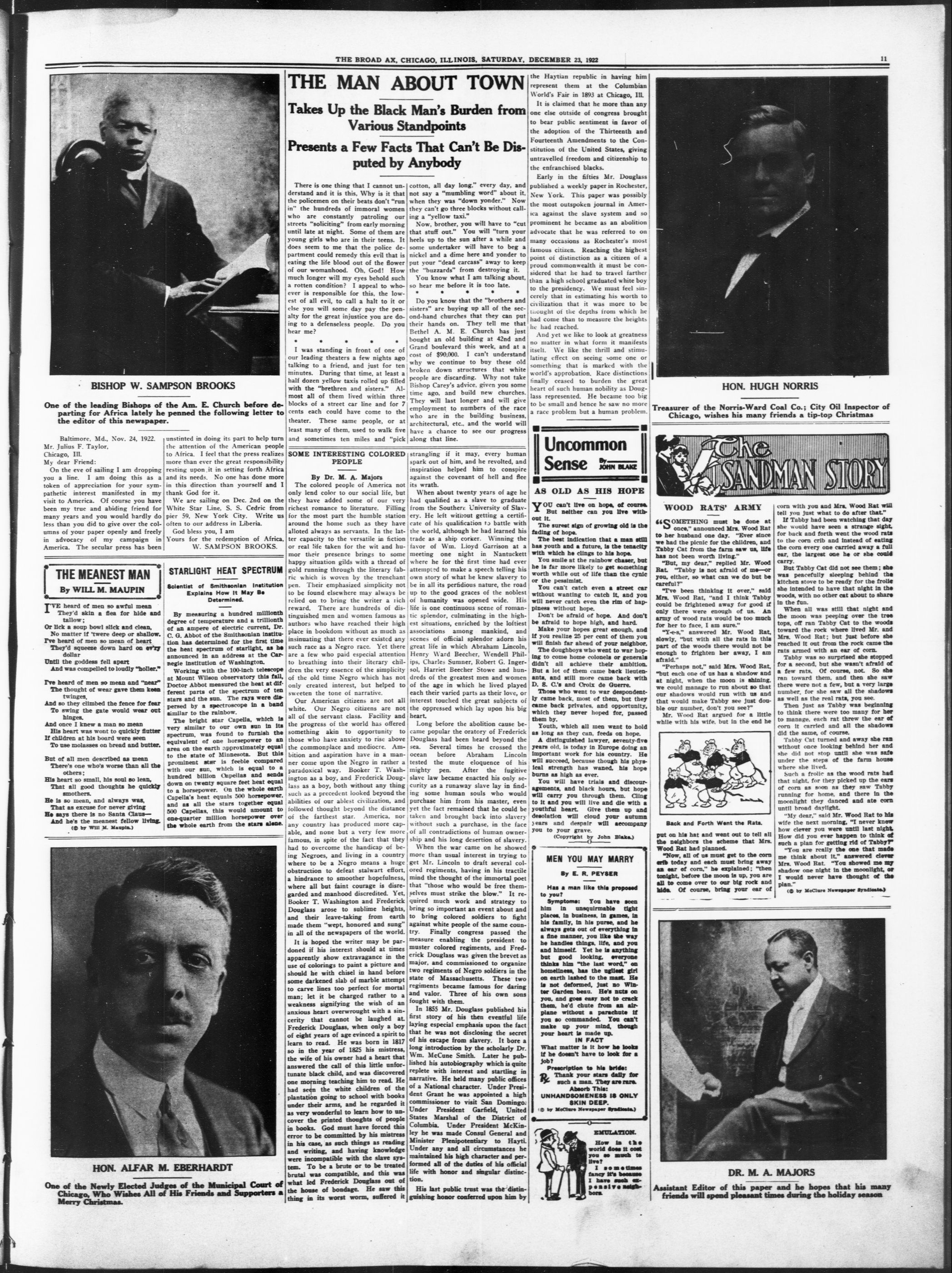
One of the leading Bishops of the Am. E. Church before departing for Africa lately he penned the following letter to the editor of this newspaper.
Baltimore, Md., Nov. 24, 1922.
Mr. Julius F. Taylor, Chicago, Ill.
My dear Friend:
On the eve of sailing I am dropping you a line. I am doing this as a token of appreciation for your sympathetic interest manifested in my visit to America. Of course you have been my true and abiding friend for many years and you would hardly do less than you did to give over the columns of your paper openly and freely in advocacy of my campaign in America. The secular press has been unstinted in doing its part to help turn the attention of the American people to Africa. I feel that the press realizes more than ever the great responsibility resting upon it in setting forth Africa and its needs. No one has done more in this direction than yourself and I thank God for it.
We are sailing on Dec. 2nd on the White Star Line, S. S. Cedric from pier 59, New York City. Write us often to our address in Liberia.
God bless you, I am
Yours for the redemption of Africa,
W. SAMPSON BROOKS.
THE MEANEST MAN
By WILL M. MAUPIN
I'VE heard of men so awful mean
They'd skin a flea for hide and
tallow;
O lick a soup bowl slick and clean,
No matter if 'twere deep or shallow.
I've heard of men so mean of heart
They'd squeeze down hard on every
dollar
Until the goddess fell apart
And was compelled to loudly "holler."
I've heard of men so mean and "near"
The thought of wear gave them keen
twings.
And so they climbed the fence for fear
To swing the gate would wear out
hinges.
And once I knew a man so mean
His heart was wont to quickly flutter
If children at his board were seen
To use molasses on bread and butter.
But of all men described as mean
There's one who's worse than all the
others:
His heart so small, his soul so lean,
That all good thoughts he quickly
smothers.
He is so mean, and always was,
That as excuse for never giving
He says there is no Santa Claus—
And he's the meathest yellow living. (© by Will M. Maupin.)
HON. ALFAR M. EBERHARDT
One of the Newly Elected Judges of the Municipal Chicago, Who Wishes All of His Friends and Merry Christmas.
One of the Newly Elected Judges of the Municipal Court of Chicago, Who Wishes All of His Friends and Supporters a Merry Christmas.
My dear Friend:
unstinted in doing its part to help turn the attention of the American people to Africa. I feel that the press realizes more than ever the great responsibility resting upon it in setting forth Africa and its needs. No one has done more in this direction than yourself and I thank God for it.
We are sailing on Dec. 2nd on the White Star Line, S. S. Cedric from pier 59, New York City. Write us often to our address in Liberia.
God bless you, I am
Yours for the redemption of Africa.
W. SAMPSON BROOKS
STARLIGHT HEAT SPECTRUM
Scientist of Smithsonian Institution Explains How It May Be Determined.
By measuring a hundred millionth degree of temperature and a trillionth of an ampere of electric current, Dr. C. G. Abbot of the Smithsonian institution has determined for the first time the heat spectrum of starlight, as he announced in an address at the Carnegie institution of Washington.
Working with the 100-inch telescope at Mount Wilson observatory this fall, Doctor Abbot measured the heat at different parts of the spectrum of ten stars and the sun. The rays were dispersed by a spectroscope in a band similar to the rainbow.
The bright star Capella, which is very similar to our own sun in its spectrum, was found to furnish the equivalent of one horsepower to an area on the earth approximately equal to the state of Minnesota. But this prominent star is feeble compared with our sun, which is equal to a hundred billion Capellas and sends down on twenty square feet heat equal to a horsepower. On the whole earth Capella's heat equals 500 horsepower, and as all the stars together equal 500 Capellas, this would amount to one-quarter million horsepower over the whole earth from the stars alone.
[Image of a man with a mustache and a suit].
Adges of the Municipal Court of of His Friends and Supporters a
THE BROAD AX. CHICAGO, ILLINOIS, SATURDAY, DECEMBER 23, 1922
THE MAN ABOUT TOWN
Takes Up the Black Man's Burden from Various Standpoints
There is one thing that I cannot understand and it is this. Why is it that the policemen on their beats don't "run in" the hundreds of immoral women who are constantly patrolling our streets "soliciting" from early morning until late at night. Some of them are young girls who are in their teens. It does seem to me that the police department could remedy this evil that is cating the life blood out of the flower of our womanhood. Oh, God! How much longer will my eyes behold such a rotten condition? I appeal to whoever is responsible for this, the lowest of all evil, to call a halt to it or else you will some day pay the penalty for the great injustice you are doing to a defenseless people. Do you hear me?
I was standing in front of one of our leading theaters a few nights ago talking to a friend, and just for ten minutes. During that time, at least a half dozen yellow taxis rolled up filled with the "brethren and sisters." Almost all of them lived within three blocks of a street car line and for 7 cents each could have come to the theater. These same people, or at least many of them, used to walk five and sometimes ten miles and "pick
SOME INTERESTING COLORED
PEOPLE
The colored people of America not only lend color to our social life, but they have added some of our very richest romance to literature. Filling for the most part the humble station around the home such as they have allotted always as servants. In the latter capacity to the versatile in fiction or real life taken for the wit and humor their presence brings to some happy situation gilds with a thread of gold running through the literary fabric which is woven by the trenchant pen. Their emphasized simplicity not to be found elsewhere may always be relied on to bring the writer a rich reward. There are hundreds of distinguished men and women famous as authors who have reached their high place in bookdom without as much as insinuating that there ever existed any such race as a Negro race. Yet there are a few who paid especial attention to breathing into their literary children the very essence of the simplicity of the old time Negro which has not only created interest, but helped to sweeten the tone of narrative.
Our American citizens are not all white. Our Negro citizens are not all of the servant class. Facility and the progress of the world has offered something akin to opportunity to those who have anxiety to rise above the commonplace and mediocre. Ambition and aspiration have in a manner come upon the Negro in rather a paradoxical way. Booker T. Washington as a boy, and Frederick Douglass as a boy, both without any thing such as a precedent looked beyond the abilities of our ablest civilization, and followed thought beyond the distance of the farthest star. America, not any country has produced more capable, and none but a very few more famous, in spite of the fact that they had to overcome the handicap of being Negroes, and living in a country where to be a Negro means a huge obstruction to defeat stalwart effort, a hindrance to smoother hopefulness, where all but faint courage is disregarded and manhood discredited. Yet, Booker T. Washington and Frederick Douglass arose to sublime earth made them "wept, honored and sung" in all of the newspapers of the world.
It is hoped the writer may be pardoned if his interest should at times apparently show extravagance in the use of colorings to paint a picture and the use with chisel in hand before some darkened slab of marble attempt to carve lines too perfect for mortal man; let it be charged rather to a weakness signifying the wish of an anxious heart overwrought with a sincerity that cannot be laughed at. Frederick Douglass, when only a boy of eight years of age evinced a spirit to learn to read. He was born in 1817 so in the year of 1825 his mistress, the wife of his owner had a heart that answered the call of this little fortunate black child, and was discovered one morning teaching him to read. He had seen the white children of the plantation going to school with books under their arms, and he regarded it as very wonderful to learn how to uncover the printed thoughts of people in books. God must have forced this error to be committed by his mistress in his case, as such things as reading and writing, and having knowledge were incompatible with the slave system. To be a brute or to be treated brutal was compatible, and this was what led Frederick Douglass out of the house of bondage. He saw this thing in its worst worm, suffered it
cotton, all day long," every day, and not say a "mumbling word" about it, when they was "down yonder." Now they can't go three blocks without calling a "yellow taxi."
Now, brother, you will have to "cut that stuff out." You will "turn your heels up to the sun after a while and some undertaker will have to beg a nickel and a dime here and yonder to put your "dead carcass" away to keep the "buzzards" from destroying it.
You know what I am talking about, so hear me before it is too late.
Do you know that the "brothers and sisters" are buying up all of the second-hand churches that they can put their hands on. They tell me that Bethel A. M. E. Church has just bought an old building at 42nd and Grand boulevard this week, and at a cost of $90,000. I can't understand why we continue to buy these old broken down structures that white people are discarding. Why not take Bishop Carey's advice, given you some time ago, and build new churches. They will last longer and will give employment to numbers of the race who are in the building business, architectural, etc., and the world will have a chance to see our progress along that line.
strangling if it may, every human spark out of him, and he revolted, and inspiration helped him to conspire against the covenant of hell and flee its wrath.
When about twenty years of age he had qualified as a slave to graduate from the Southern University of Slavery. He left without getting a certificate of his qualification to battle with the world, although he had learned his trade as a ship corker. Winning the favor of Wm. Lloyd Garrison at a meeting one night in Nantuckett where he for the first time had ever attempted to make a speech telling his own story of what he knew slavery to be in all its perfidious nature, the road up to the good graces of the noblest of humanity was opened wide. His life is one continuous scene of romantic splendor, culminating in the highest situations, enriched by the loftiest associations among mankind, and scenes of official splendor adorn his great life in which Abraham Lincoln, Henry Ward Beecher, Wendell Phillips, Charles Sumner, Robert G. Ingersol, Harriet Beecher Stowe and hundreds of the greatest men and women of the age in which he lived played each their varied parts as their love, or interest touched the great subjects of the oppressed which lay upon his big heart.
Long before the abolition cause became popular the oratory of Frederick Douglass had been heard beyond the sea. Several times he crossed the ocean before Abraham Lincoln tested the mute eloquence of his mighty pen. After the fugitive slave law became enacted his only security as a runaway slave lay in finding some human souls who would purchase him from his master, even yet the fact remained that he could be taken and brought back into slavery without such a purchase, in the face of all contradictions of human ownership and his long desertion of slavery.
When the war came on he showed more than usual interest in trying to get Mr. Lincoln to draft several colored regiments, having in his tractile mind the thought of the immortal poet that "those who would be free themselves must strike the blow." It required much work and strategy to bring so important an event about and to bring colored soldiers to fight against white people of the same country. Finally congress passed the measure enabling the president to muster colored regiments, and Frederick Douglass was given the brevet as major, and commissioned to organize two regiments of Negro soldiers in the state of Massachusetts. These two regiments became famous for daring and valor. Three of his own sons fought with them.
In 1855 Mr. Douglass published his first story of his then eventful life laying especial emphasis upon the fact that he was not disclosing the secret of his escape from slavery. It bore a long introduction by the scholarly Dr. Wm. McCune Smith. Later he published his autobiography which is quite replete with interest and startling in narrative. He held many public offices of a National character. Under President Grant he was appointed a high commissioner to visit San Domingo; Under President Garfield, United States Marshal of the District of Columbia. Under President McKinley he was made Consul General and Minister Plenipotentiary to Haytii. Under any and all circumstances he maintained his high character and performed all of the duties of his official life with honor and singular distinction.
His last public trust was the 'distinguishing honor conferred upon him by
the Haytian republic in having him represent them at the Columbian World's Fair in 1893 at Chicago, Ill. It is claimed that he more than any one else outside of congress brought to bear public sentiment in favor of the adoption of the Thirteenth and Fourteenth Amendments to the Constitution of the United States, giving untravelled freedom and citizenship to the enfranchised blacks.
Early in the fifties Mr. Douglass published a weekly paper in Rochester, New York. This paper was possibly the most outspoken journal in America against the slave system and so prominent that he became an abolition advocate that he was referred to on many occasions as Rochester's most famous citizen. Reaching the highest point of distinction as a citizen of a proud commonwealth it must be considered that he had to travel farther than a high school graduated white boy to the presidency. We must feel sincerely that in estimating his worth to civilization that it was more to be thought of the depths from which he had come than to measure the heights he had reached.
And yet we like to look at greatness no matter in what form it manifests itself. We like the thrill and stimulating effect on seeing some one or something that is marked with the world's approbation. Race distinctions finally ceased to burden the great heart of such human nobility as Douglass represented. He became too big to be small and hence he saw no more a race problem but a human problem.
Uncommon Sense By JOHN BLAKE
AS OLD AS HIS HOPE
YOU can't live on hope, of course. But neither can you live without it. The surest sign of growing old is the fading of hope. The best indication that a man still has youth and a future, is the tenacity with which he clings to his hope. You smile at the rainbow chaser, but he is far more likely to get something worth while out of life than the cynic or the pessimist. You can't catch even a street car without wanting to catch it, and you will never catch even the rim of happiness without hope. Don't be afraid of hope. And don't be afraid to hope high, and hard.
Make your hopes great enough, and if you realize 25 per cent of them you will finish far ahead of your neighbor. The doughbys who went to war hoping to come home colonels or generals didn't all achieve their ambition. But a lot of them came back lieutenants, and still more came back with D. S. C's and Croix de Guerre. Those who went to war despondently came back, most of them, but they came back privates, and opportunity, which they never hoped for, passed them by. Youth, which all men want to hold as long as they can, feeds on hope. A distinguished lawyer, seventy-five years old, is today in Europe doing an important work for his country. He will succeed, because though his physical strength has waned, his hope burns as high as ever.
You will have trials and discouragements, and black hours, but hope will carry you through them. Cling to it and you will live and die with a youthful heart. Give them up and desolation will cloud your autumn years and despair will accompany you to your grave.
(Copyright by John Blake.)
MEN YOU MAY MARRY
By E. R. PEYSER
Has a man like this proposed to you?
Symptoms: You have seen him in unsquirmable tight places, in business, in games, in his family, in his purse, and he always gets out of everything in a fine manner, you like the way he handles things, life, and you himself. Yet he is anything but good looking, everyone thinks him "the last word," on homeliness, has the ugliest girl on earth lashed to the mast. He is not deformed, just no Winter Garden beau. He's nets on you, and goes easy not to crack them, he'd chute from an airplane without a parachute if you so commanded. You can't make up your mind, though your heart is made up.
What matter is it how he looks if he doesn't have to look for a job?
A
How in the world does it cost you so much to live?
I see some times fancy it because I have such expensive neighbors.
[Name]
HON. HUGH NORRIS
Treasurer of the Norris-Ward Coal Co.; Cic
Chicago, wishes his many friends a tip
The SANDMAN
Treasurer of the Norris-Ward Coal Co.; City Oil Inspector of Chicago, wishes his many friends a tip-top Christmas
The SANDMAN STORY
WOOD RATS' ARMY
"SOMETHING must be done at once," announced Mrs. Wood Rat to her husband one day. "Ever since we had the picnic for the children, and Tabby Cat from the farm saw us, life has not been worth living."
"But, my dear," replied Mr. Wood Rat. "Tabby is not afraid of me—or you, either, so what can we do but be careful?"
"I've been thinking it over," said Mrs. Wood Rat, "and I think Tabby could be frightened away for good if only there were enough of us. An army of wood rats would be too much for her to face, I am sure."
"T-e-s," answered Mr. Wood Rat, slowly, "but with all the rats in this part of the woods there would not be enough to frighten her away, I am afraid."
"Perhaps not," said Mrs. Wood Rat, "but each one of us has a shadow and at night, when the moon is shining, we could manage to run about so that our shadows would run with us and that would make Tabby see just double our number, don't you see?"
Mr. Wood Rat argued for a little while with his wife, but in the end he
put on his hat and went out to tell all the neighbors the scheme that Mrs. Wood Rat had planned.
"Now, all of us must get to the corn orb today and each must bring away an ear of corn," he explained; "then tonight, before the moon is up, you are all to come over to our big rock and hide. Of course, bring your ear of
```markdown
```
P. E.
DR. M. A. MAJORS Assistant Editor of this paper and he has friends will spend pleasant times during the
Assistant Editor of this paper and he hopes that his many friends will spend pleasant times during the holiday season
Coal Co.; City Oil Inspector of friends a tip-top Christmas
MAN STORY
corn with you and Mrs. Wood Rat will tell you just what to do after that."
If Tabby had been watching that day she would have seen a strange sight, for back and forth went the wood rats to the corn crib and instead of eating the corn every one carried away a full ear, the largest one he or she could carry.
But Tabby Cat did not see them; she was peacefully sleeping behind the kitchen stove to be ready for the frolie she intended to have that night in the woods, with no other cat about to share in the fun.
When all was still that night and the moon was peeping over the tree tops, off ran Tabby Cat to the woods toward the rock where lived Mr. and Mrs. Wood Rat; but just before she reached it out from the rock came the rats armed with an ear of corn.
Tabby was so surprised she stopped for a second, but she wasn't afraid of a few rats. Of course, not. So she ran toward them, and then she saw there were not a few, but a very large number, for she saw all the shadows as well as the real rats, you see.
Then just as Tabby was beginning to think there were too many for her to manage, each rat threw the ear of corn it carried and all the shadows did the same, of course.
Tabby Cat turned and away she ran without once looking behind her and she did not stop until she was safe under the steps of the farm house where she lived.
Such a frolic as the wood rats had that night, for they picked up the ears of corn as soon as they saw Tabby running for home, and there in the moonlight they danced and ate corn until broad daylight.
"My dear," said Mr. Wood Rat to his wife the next morning. "I never knew how clever you were until last night. How did you ever happen to think of such a plan for getting rid of Tabby?" "You are really the one that made me think about it." answered clever Mrs. Wood Rat. "You showed me my shadow one night in the moonlight, or I would never have thought of the plan."
© by McClure Newspaper Syndicate.)
```markdown
```
and he hopes that his many times during the holiday season
11
THE OPENING OF THE BINGA STATE BANK
Mr. and Mrs. Jesse Binga
Mr. and Mrs. Jesse Binga
12
Mr. Jesse Binga, President of the Binga State Bank, was born in Detroit Michigan, coming from one of its oldest and most highly respected families, receiving his common and high school education in the city of his birth; in time he received his early real estate training in the real estate business by assisting his mother and father Mr. William and Mrs. Adelphia Binga; in 1901 Mr. Binga decided to permanently locate in Chicago, and cast his lot with its hustling and enterprising citizens, and the first year after becoming a resident of the Windy City, he became a curbstone broker in garden vegetables, in fact he was a huckster and with his horse and wagon he sold garden truck up and down the streets on the south side, to many of the people who are now occupying many of his houses and stores either owned by him or under his control.
In the winter of 1902 he decided to launch out in the real estate business, and he opened a small office at 3333 S. State street. His capital at that time consisted of a half month's rent three old rickety chairs, a small flat top table, an old worn out stove resting on two legs, and a brick, but being a hustler and full of courage and pluck Mr. Binga began to do business and make money right from the start. On May 1, 1905, he leased the Bates Building, 3635 and 3637 S. State St., where he moved his real estate office and he caused the white tenants to vacate and colored tenants followed after them and from that day to the present time the complexion of the whole neighborhood has changed up and Mr. Binga opened the way for
LESS BLINDNESS IN COUNTRY
Figures Reveal a Gratifying Decrease of Terrible Affliction Throughout the United States.
Imagine, if you can, a city of 120,000 inhabitants, where every single soul is totally blind; where doctor, lawyer, merchant, chief, along with the rich man, poor man, gregarman and thief, are all in the same boat—sightless! America has the makings of just such a city. There are more than 120,000 totally blind people in the United States, and many times that number partly blind. The terrible part of it is that more than 57 per cent of blindness is classed as preventable, a large portion being the result of overstrain.
It is encouraging to note, however that blindness in America has decreased more than 20 per cent since glasses have become more common. Every other country has a far greater percentage of blindness, and they show a yearly increase. Three of every ten Americans wear glasses. Statistics prove that seven of each ten have enough eyestrain to warrant the wearing of correcting lenses. When we realize the relation of good vision to health and happiness, it is hard to understand why so many people neglect their eyes until they are permanently injured. In the first draft of American soldiers in 1917 bad sight caused nearly three times as many rejections as any other physical defect. At the time of the draft 2,510,706 men were examined and 21.68 per cent were rejected because of grossly defective vision—Illustrated World.
"Pardner."
In these days of bonding companies and enormous corporations the old phrase, "His word was as good as his bond," has a homely sound, and little tales of long partnership with never a hard and fast legal instrument naming what is his and what is other's seem like old tales out of the past.
But the other day when Sam Harris and George M. Cohen dissolved their seventen-year-old partnership, they ended a period of agreement in their joint producing business in which no contract ever existed, and yet their business was one where more cantankerous hitches occur than in most. Smooth are the seas when two men, each of whose word goes, do business together.-Christian Science Monitor.
Caribou Swarm in Yukon
Tens of thousands of wild caribou are reported to be swarming over the hills through the suburbs of Dawson, X. T., for a radius of 50 miles. The great herd, which annually treks through the district, is now moving northward. Large herds swimming the Yukon have interfered with the progress of steamers. The herd is so vast that the hunting by men, women and children, who have provided nearly every home with deer meat for the winter, has made no noticeable effect on it.
Lost Souls
A spiritist tells us that people play golf in the life hereafter. If they use the same language while playing it that they do here, we think we know in which division of the hereafter the game is played—James J. Montague
colored people to reside on every street and avenue from State street east to Lake Michigan.
In 1908, Mr. Binga removed his real estate office into the present three-story brick building which was erected according to his instructions which is now occupied by the Binga State Bank, State and 36th Place. Shortly after that time Mr. Binga opened his private bank and safety deposit vaults and he ably conducted his bank from that year until Jan. 3, 1921, at which time it was transformed into the Binga State Bank. President Binga has long since proven himself to be by far the most successful and conservative Afro-American banker in the United States. President Binga and his good wife Mrs. Binga who is one of our warmest lady friends in this city, at the present time pay taxes on more than seven hundred thousand dollars worth of Chicago real estate, their frontage on State street amounts to almost one thousand feet and there are very few persons in this city who owns such a long frontage on that rapidly improving thoroughfare, and Mr. and Mrs. Binga who are a great credit to the Afro-American race, own large blocks of stock in some of the largest and most substantial business concerns in this city.
The officers and directors of the Binga State Bank are as follows: Mr. Jesse Binga, President; Col. John R. Marshall, Vice-president; Mr. C. N. Langston, Cashier. Directors: Jesse Binga, John R. Marshall, Oscar Depriest, W. A. Robinson, R. S. Abott, U. G. Dailley, C. N. Langston, H. R. Smith and Rev. C. H. Clark.
BRUSHES FOR HOUSEHOLD
They May Be Divided Into Three Classes, Which Are Bristle, Hair, and Fiber.
There are two classes of brushes those with backs and those without. These come in bristle, in hair and in fiber. It is fiber and bristles that are of special interest in discussing household needs.
The backless brush has the advantage of being usable in any position and thereby being at least twice as long-lived as the brush whose only working surface is one side. These brushes are marvelously made and the bristles, hair, fiber or fabric (mops) are so fastened in as to make a falling bristle almost an impossibility. These brushes come in every department of house life: toilet, bath, pantry, laundry, clothes, kitchen, halls and walls. The Russian pony gives the best horsehair, and the wild boar gives the most and best bristles. The test for the bristle is that it will not break if bent back and will spring into place again. The hair and bristle when burned give a characteristic hair odor.
The fiber brush, though a cheaper brush, is adapted to things for which the bristle brush is not adapted. The fiber makes a good scrubbing brush, but the bristle would not be stiff enough. Many fibers are made to look like bristle, but the bristle test will save you from a rash purchase. The bristle brush is expensive and so is the brush of camel or badger hair from which painting and shaving brushes are made.
Radium From Bohemia
Government-owned mines at Jachymov, Bohemia, are turning out uranium ore, rich in radium, and the known supply is said to be sufficient for 20 years at the present rate of production; in addition, there are three large mines not yet prospected as to depth. These facts are given out by the Scientific American. Two grams of radium a year are now being produced and net profits to the Czechoslovak republic for the past year were about 3,800,000 crowns. The radium is selling today at 10,000,000 crowns per gram, a crown being now worth about 1.94 cents. While production in the United States is greater in quantity, the Jachymov ores are reputed to be richer in quality.
3633
ВЫКРЫ
Going One Better
One of the brightest "star" in "The Island King" at the Adelphi theater in Nance Lovat. She sings and acts charmingly.
I paid Miss Lovat a visit the other evening, and she asked me if I had "heard this one." I hadn't.
Two kiddies were engaged in a bragging match.
"My mummy gone to the shops to pay some bills," said Joan, proudly.
"My mummy doesn't have to" sneered Doria. "The men come to the house for ours."
Here is another of Miss Lovat's stories.
"George!" murmured the girl, as she nestled close to him, "cigars are nothing but a habit."
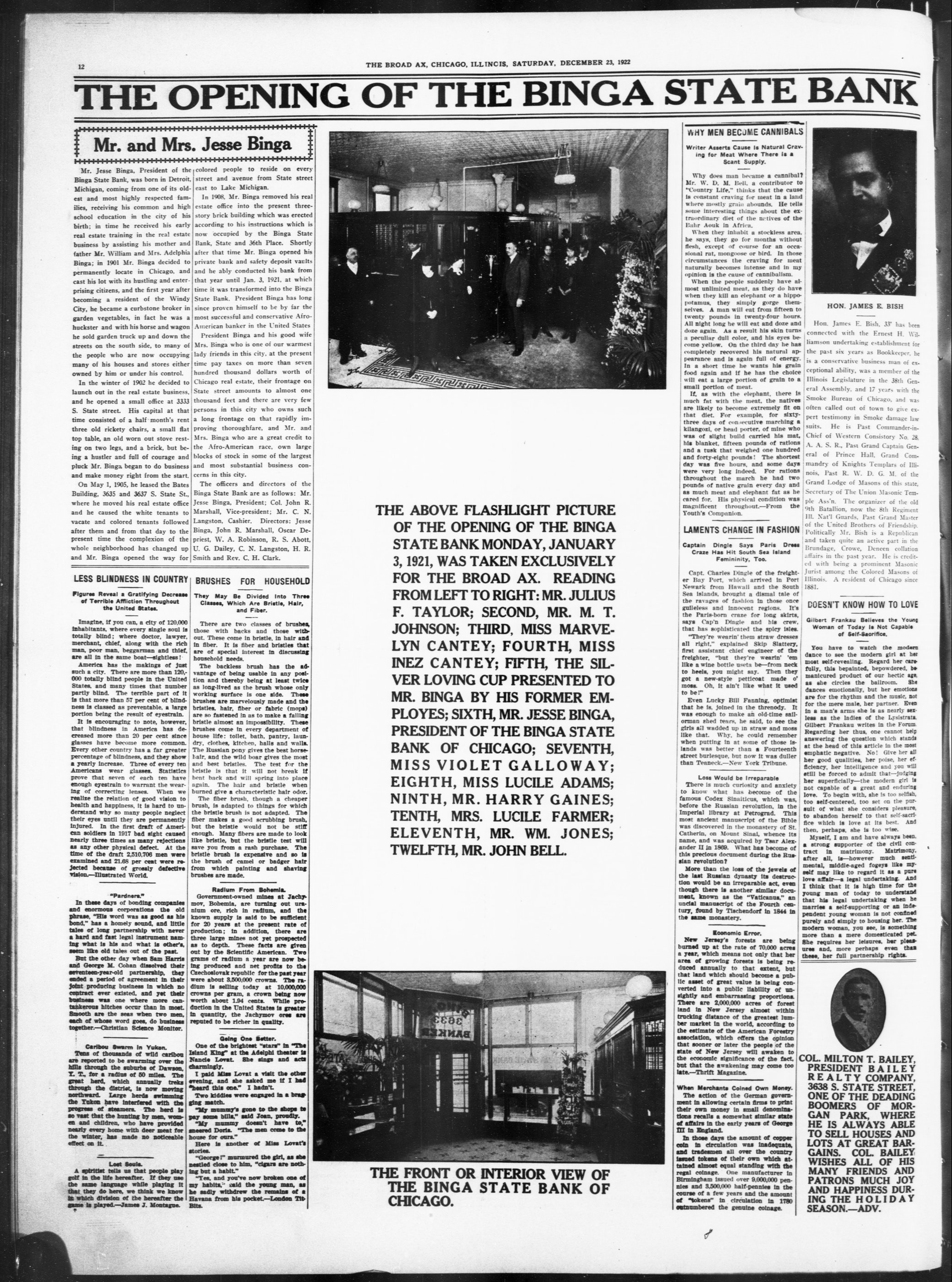
THE FRONT OR INTERIOR VIEW OF THE BINGA STATE BANK OF CHICAGO.
"Yes, and you've now broken one of my habits," said the young man, as he sadly withdrew the remains of a Havana from his pocket—London Tib Bits.
THE BROAD AX, CHICAGO, ILLINCIS, SATURDAY, DECEMBER 23, 1922
WHY MEN BECOME CANNIBALS
THE NEW YORK MUSEUM
Writer Asserts Cause is Natural Craving for Meat Where There is a Scant Supply.
Why does man became a cannibal? Mr. W. D. M. Bell, a contributor to "Country Life," thinks that the cause is constant craving for meat in a land where mostly grain abounds. He tells some interesting things about the extraordinary diet of the natives of the Bahr Aouk in Africa.
When they inhabit a stockless area, he says, they go for months without flesh, except of course for an occasional rat, mongoose or bird. In those circumstances the craving for meat naturally becomes intense and in my opinion is the cause of cannibalism.
When the people suddenly have almost unlimited meat, as they do have when they kill an elephant or a hippopotamus, they simply gorge themselves. A man will eat from fifteen to twenty pounds in twenty-four hours. All night long he will eat and doze and doze again. As a result his skin turns a peculiar dull color, and his eyes become yellow. On the third day he has completely recovered his natural appearance and is again full of energy. In a short time he wants his grain food again and if he has the choice will eat a large portion of grain to a small portion of meat.
If, as with the elephant, there is much fat with the meat, the natives are likely to become extremely fit on that diet. For example, for sixty-three days of consecutive marching a kilangoxi, or head porter, of mine who was of slight build carried his mat, his blanket, fifteen pounds of rations and a tusk that weighed one hundred and forty-eight pounds! The shortest day was five hours, and some days were very long indeed. For rations throughout the march he had two pounds of native grain every day and as much meat and elephant fat as he cared for. His physical condition was magnificent throughout.—From the Youth's Companion.
THE ABOVE FLASHLIGHT PICTURE OF THE OPENING OF THE BINGA STATE BANK MONDAY, JANUARY 3, 1921, WAS TAKEN EXCLUSIVELY FOR THE BROAD AX. READING FROM LEFT TO RIGHT: MR. JULIUS F. TAYLOR; SECOND, MR. M. T. JOHNSON; THIRD, MISS MARVELYN CANTEY; FOURTH, MISS INEZ CANTEY; FIFTH, THE SILVER LOVING CUP PRESENTED TO MR. BINGA BY HIS FORMER EMPLOYES; SIXTH, MR. JESSE BINGA, PRESIDENT OF THE BINGA STATE BANK OF CHICAGO; SEVENTH, MISS VIOLET GALLOWAY; EIGHTH, MISS LUCILE ADAMS; NINTH, MR. HARRY GAINES; TENTH, MRS. LUCILE FARMER; ELEVENTH, MR. WM. JONES; TWELFTH, MR. JOHN BELL.
LAMENTS CHANGE IN FASHION
Captain Dingle Says Paris Dress Craze Has Hit South Sea Island Femininity, Too.
Capt. Charles Dingle of the freight-er Bay Port, which arrived in Port Newark from Hawaii and the South Sea islands, brought a dismal tale of the ravages of fashion in those once gulleless and innocent regions. It's the Paris-born craze for long skirts, says Cap'n Dingle and his crew, that has sophisticated the spicy isles. "They're wearin' them straw dresses all right," explained Skip Slattery, first assistant chief engineer of the freighter, "but they're wearin' 'em like a wine bottle usbe — from neck to heels, you might say. Then they got a new-style petticoat made 'o moss. Oh, it ain't like what it used to be!"
Even Lucky Bill Fanning, optimist that he is, joined in the threnody. It was enough to make an old-time sailorman shed tears, he said, to see the girls all wadded up in straw and moss like that. Why, he could remember when putting in at some of those islands was better than a Fourteenth street burlesque, but now it was duller than Teaneck.—New York Tribune.
Loss Would be Irreparable
There is much curiosity and anxiety to know what has become of the famous Codex Sinaiticus, which was, before the Russian revolution, in the Imperial library at Petrograd. This most ancient manuscript of the Bible was discovered in the monastery of St Catherin, on Mount Sinal, whence its name, and was acquired by Tsar Alexander II in 1869. What has become of this precious document during the Russian revolution?
More than the loss of the jewels of the last Russian dynasty its destruction would be an irreparable act, even though there is another similar document, known as the "Vaticanus," an uncial manuscript of the Fourth century, found by Tischendorf in 1844 in the same monastery.
Economic Error.
New Jersey's forests are being burned up at the rate of 70,000 acres a year, which means not only that her area of growing forests is being reduced annually to that extent, but that land which should become a public asset of great value is being converted into a public liability of unsightly and embarrassing proportions. There are 2,000,000 acres of forest land in New Jersey almost within trucking distance of the greatest lumber market in the world, according to the estimate of the American Forestry association, which offers the opinion that sooner or later the people of the state of New Jersey will awaken to the economic significance of the fact, but that the awakening may come too late.—Thrift Magazine.
When Merchants Coined Own Money.
The action of the German government in allowing certain firms to print their own money in small denominations recalls a somewhat similar state of affairs in the early years of George III in England.
In those days the amount of copper coin in circulation was inadequate, and tradesmen all over the country issued tokens of their own which attained almost equal standing with the regal coinage. One manufacturer in Birmingham issued over 9,000,000 pennies and 3,500,000 half-pennies in the course of a few years and the amount of "tokens" in circulation in 1780 outnumbered the original coinage.
HON. JAMES E. BISH
Hon. James E. Bish, 33' has been connected with the Ernest H. Williamson undertaking establishment for the past six years as Bookkeeper, he is a conservative business man of exceptional ability, was a member of the Illinois Legislature in the 38th General Assembly, and 17 years with the Smoke Bureau of Chicago, and was often called out of town to give expert testimony in Smoke damage law suits. He is Past Commander-in-Chief of Western Consistory No. 28. A. A. S. R., Past Grand Captain General of Prince Hall, Grand Command of Knights Templars of Illinois, Past R. W. D. G. M. of the Grand Lodge of Masons of this state, Secretary of The Union Masonic Temple Ass'n. The organizer of the old 9th Batallion, now the 8th Regiment III. Nat'l Guards, Past Grand Master of the United Brothers of Friendship. Politically Mr. Bish is a Republican and taken quite an active part in the Brundage, Crowe, Deneen collation affairs in the past year. He is credited with being a prominent Masonic Jurist among the Colored Masons of Illinois. A resident of Chicago since 1881.
DOESN'T KNOW HOW TO LOVE
Gilbert Frankau Believes the Young Woman of Today Is Not Capable of Self-Saorifice.
You have to watch the modern dance to see the modern girl at her most self-revealing. Regard her care fully, this bepainted, bepowdered, be manicured product of our hectic age as she circles the ballroom. She dances emotionally, but her emotions are for the rhythm and the music, not for the mere male, her partner. Even in a man's arms she is as nearly sexless as the indies of the Lysistrata. Gilbert Frankau writes in the Forum. Regarding her thus, one cannot help answering the question which stands at the head of this article in the most emphatic negative. No! Give her all her good qualities, her poise, her efficiency, her intelligence and you will still be forced to admit that—judging her superficially—the modern girl is not capable of a great and enduring love. To begin with, she is too selfish, too self-centered, too set on the pursuit of what she considers pleasure, to abandon herself to that self-sacrifice which is love at its best. And then perhaps she is too wise.
Myself, I am and have always been a strong supporter of the civil contract in matrimony. Matrimony, after all, is—however much sentimental, middle-aged fogues like myself may like to regard it as a pure love affair—a legal undertaking. And I think that it is high time for the young man of today to understand that his legal undertaking when he marries a self-supporting or an independent young woman is not confined purely and simply to housing her. The modern woman, you see, is something more than a mere domesticated pet. She requires her lesures, her pleasures and, more perhaps even than these, her full partnership rights.
PETER H. BURGESS
COL. MILTON T. BAILEY, PRESIDENT BAILEY REALTY COMPANY, 3638 S. STATE STREET, ONE OF THE DEADING BOOMERS OF MORGAN PARK, WHERE HE IS ALWAYS ABLE TO SELL HOUSES AND LOTS AT GREAT BARGAINS. COL. BAILEY WISHES ALL OF HIS MANY FRIENDS AND PATRONS MUCH JOY AND HAPPINESS DURING THE HOLIDAY SEASON.—ADV.
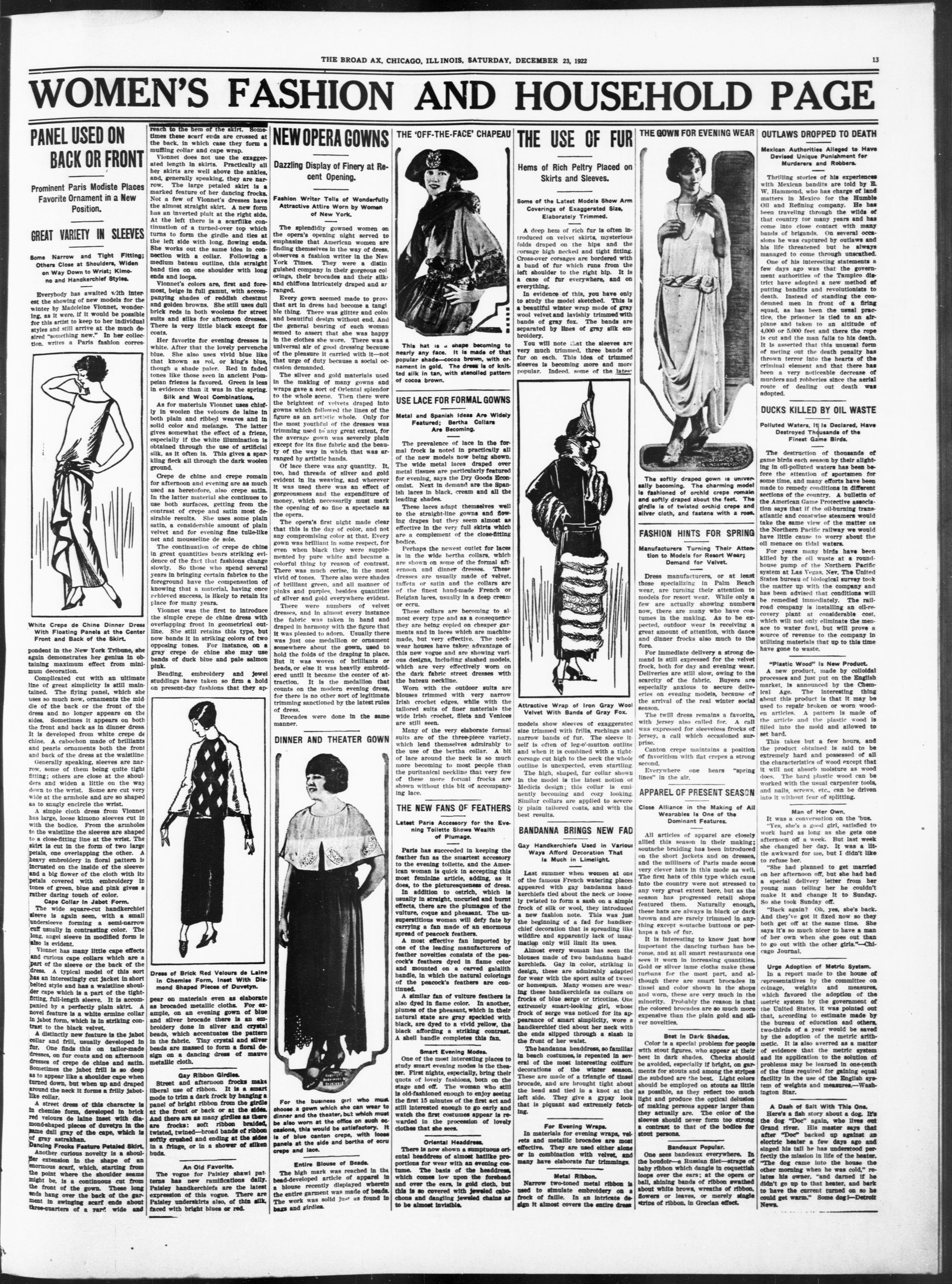
WOMEN'S FASHION AND HOUSEHOLD PAGE
PANEL USED ON BACK OR FRONT
PANEL USED ON BACK OR FRONT
Prominent Paris Modiste Places Favorite Ornament in a New Position.
Some Narrow and Tight Fittings; Others Close at Shoulders, Widen on Way Down to Wrist; Kimo-no and Handkerchief Styles.
Everybody has awaited with interest the showing of new models for the winter by Madelene Vionnet, wondering, as it were, if it would be possible for this artist to keep to her individual styles and still arrive at the much desired "something new." In her collection, writes a Paris fashion corres
...
White Crepe de Chine Dinner Dress With Floating Panels at the Center Front and Back of the Skirt.
White Crepe de Chine Dinner Dress
With Floating Panels at the Center
Front and Back of the Skirt.
pondent in the New York Tribune, she
again demonstrates her genius in ob-
taining maximum effect from mini-
mum decoration.
Complicated cut with an ultimate
line of great simplicity is still main-
tained. The flying panel, which she
uses so much now, ornaments the mid-
die of the back or the front of the
dress and no longer appears on the
sides. Sometimes it appears on both
the front and back as in dinner dress.
It is developed from white crepe de
chine. A cabochoon made of brilliants
and pearls ornaments both the front
and back of the dress at the waistline.
Generally speaking, sleeves are narrow, some of them being quite tight fitting; others are close at the shoulders and widen a little on the way down to the wrist. Some are cut very wide at the armhole and are so shaped as to snugly encircle the wrist. A simple cloth dress from Vlonnet has large, loose kimono sleeves cut in with the bodice. From the armholes to the waistline the sleeves are shaped to a close-fitting line at the wrist. The skirt is cut in the form of two large petals, one overlapping the other. A heavy embroidery in floral pattern is incrusted on the inside of the sleeves and a big flower of the cloth with its petals covered with embroidery in tones of green, blue and pink gives a rather daring touch of color.
Cape Collar in Jabot Form.
The wide square cut-handkerchief sleeve is again seen, with a small undersleeve forming a semi-narrow cuff usually in contrasting color. The long, angel sleeve in modified form is also evident.
Vionnet has many little cape effects and curious cape collars which are a part of the sleeve or the back of the dress. A typical model of this sort has an interestingly cut jacket in short belted style and has a waistline shoulder cape which is a part of the tight-fitting, full-length sleeve. It is accompanied by a perfectly plain skirt.
A novel feature is a whiteermine collar in jabot form, which is in striking contrast to the black velvet.
A distinctly new feature is the jabot collar and frill, usually developed in fur. One finds this on tailor-made dresses, on fur coats and on afternoon dresses of crepe de chine and satin. Sometimes the jabot frill is so deep as to appear like a shoulder cape when turned down, but when up and draped around the neck it forms a frilly jabot-like collar.
A street dress of this character is in chemise form, developed in brick red velours de laine inset with diamond-shaped pieces of duvetyn in the same dull gray of the cape, which is of gray astrakan.
Dancing Frocks Feature Petaled Skirt.
Another curious novelty is a shoulder extension in the shape of an enormous scarf, which, starting from the point where the shoulder seams might be, is a continuous cut from the front of the gown. These long ends hang over the back of the garment in swinging scarf ends about three-quarter of a var. wide and
reach to the hem of the skirt. Sometimes these scarf ends are crossed at the back, in which case they form a muffling collar and cape wrap. Vlionnet does not use the exaggerated length in skirts. Practically all her skirts are well above the ankles, and generally speaking, they are narrow. The large petaled skirt is a marked feature of her dancing frocks. Not a few of Vlionnet's dresses have the almost straight skirt. A new form has an inverted plait at the right side. At the left there is a scarflike continuation of a turned-over top which turns to form the girdle and ties at the left side with long, flowing ends. She works out the same idea in connection with a collar. Following a medium bateau outline, this straight band ties on one shoulder with long ends and loops.
Vlionnet's colors are, first and foremost, beige in full gamut, with accompanying shades of reddish chestnut and golden browns. She still uses dull brick reds in both woolens for street suits and silks for afternoon dresses. There is very little black except for coats.
Her favorite for evening dresses is white. After that the lovely perenne blue. She also uses vivid blue like that known as roi, or king's blue, though a shade paler. Red in faded tones like those seen in ancient Pompeian friezes is favored. Green is less in evidence than it was in the spring.
Silk and Wool Combinations.
As for materials Vlontner uses chiefly in woolen the velours de laine in both plain and ribbed weaves and in solid color and melange. The latter gives somewhat the effect of a frieze, especially if the white illumination is obtained through the use of artificial silk, as it often is. This gives a sparkling fleck all through the dark woolen ground.
Crepe de chine and crepe romain for afternoon and evening are as much used as heretofore, also crepe satin. In the latter material she continues to use both surfaces, getting from the contrast of crepe and satin most desirable results. She uses some plain satin, a considerable amount of plain velvet and for evening fine tulle-like net and mousseuse de sole.
The continuation of crepe de chine in great quantities bears striking evidence of the fact that fashions change slowly. So those who spend several years in bringing certain fabrics to the foreground have the compensation of knowing that a material, having once achieved success, is likely to retain its place for many years.
Vionnet was the first to introduce the simple crepe de chine dress with overlapping front in geometrical outline. She still retains this type, but now bands it in striking colors of two opposing tones. For instance, on a gray crepe de chine she may use bands of duck blue and pale salmon pink.
Bending, embroidery and jewel studdings have taken so firm a hold on present-day fashions that they an-
```markdown
```
Dress of Brick Red Velours de Laine
In Chemise Form, Inset With Diamond Shaped Pieces of Duvety.
Dress of Brick Red Velours de Laine in Chemise Form, Inset With Diamond Shaped Pieces of Duvetyn.
pear on materials even as elaborate as brocaded metallic cloths. For example, on an evening gown of blue and silver brocade there is an embroidery done in silver and crystal beads, which accentrates the pattern in the fabric. Tiny crystal and silver beads are massed to form a floral design on a dancing dress of mauve metallic cloth.
Gay Ribbon Girdles
Street and afternoon frocks make liberal use of ribbon. It is a smart mode to trim a dark frock by hanging a panel of bright ribbon from the girdle at the front or back or at the sides. And there are as many girdles as there are frocks: soft ribbon braided, twisted, twined—broad bands of ribbon softly crushed and ending at the sides in a fringe, or in a shower of silken buds.
An Old Favorite.
The vogue for Paisley shaw pattern has new ramifications daily. Paisley handkerchiefs are the latest expression of this vogue. There are Paisley underskirts also, of thin silk, faced with bright blues or red.
THE BROAD AX. CHICAGO. ILLINOIS. SATURDAY. DECEMBER 23. 1922
NEW OPERAGOWNS
Dazzling Display of Finery at Recent Opening.
Fashion Writer Tells of Wonderfully Attractive Attire Worn by Women of New York.
The splendidly gowned women on the opera's opening night served to emphasize that American women are finding themselves in the way of dress, observes a fashion writer in the New York Times. They were a distinguished company in their gorgeous colorings, their brocades and their silks and chiffons intricately draped and aranged.
Every gown seemed made to prove that art in dress had become a tangible thing. There was glitter and color and beautiful design without end. And the general bearing of each woman seemed to assert that she was happy in the clothes she wore. There was a universal air of good dressing because of the pleasure it carried with it—not that urge of duty because a social occasion demanded.
The silver and gold materials used in the making of many gowns and wraps gave a sort of Oriental splendor to the whole scene. Then there were the brightest of velvets draped into gowns which followed the lines of the figure as an artistic whole. Only for the most youthful of the dresses was trimming used to any great extent, for the average gown was severely plain except for its fine fabric and the beauty of the way in which that was arranged by artistic hands.
Of lace there was any quantity. It, too, had threads of silver and gold evident in its weaving, and wherever it was used there was an effect of gorgeousness and the expenditure of money, which necessarily must mark the opening of so fine a spectacle as the opera.
The opera's first night made clear that this is the day of color, and not any compromising color at that. Every gown was brilliant in some respect, for even when black they were supplemented by pure white and became a colorful thing by reason of contrast. There was much cerise, in the most vivid of tones. There also were shades of brilliant green, and all manner of pinks and purples, besides quantities of silver and gold everywhere evident.
There were numbers of velvet dresses, and in almost every instance the fabric was taken in hand and draped in harmony with the figure that it was pleased to adorn. Usually there was just one medallion or ornament somewhere about the gown, used to hold the folds of the draping in place. But it was woven of brilliants or beads, or else it was heavily embroidered until it became the center of attraction. It is the medallion that counts on the modern evening dress, for there is no other sort of legitimate trimming sanctioned by the latest rules of dress. Brocades were done in the same manner.
DINNER AND THEATER GOWN
GIRL
BENNETT
BLAIR
For the business girl who must choose a gown which she can wear to dinner and the theater, but which must be also worn at the office on such occasions, this would be satisfactory. It is of blue canton crepe, with loose panels at the side and bertha of scrupe and lace.
Entire Blouse of Beads
The high mark was reached in the bead-developed article of apparel in a blouse recently displayed wherein the entire garment was made of beads. The work was solid just as found in bags and girdles.
THE 'OFF-THE-FACE' CHAPEAU
1
This hat is a shape becoming to nearly any face. It is made of that popular shade—cocoa brown, with ornament in gold. The dress is of knitted silk in tan, with stenciled pattern of cocoa brown.
USE LACE FOR FORMAL GOWNS
Metal and Spanish Ideas Are Widely Featured; Bertha Collars Are Becoming.
The prevalence of lace in the formal frock is noted in practically all of the new models now being shown. The wide metal laces draped over metal tissues are particularly featured for evening, says the Dry Goods Economist. Next in demand are the Spanish laces in black, cream and all the leading shades.
These laces adapt themselves well to the straight-line gowns and flowing drapes but they seem almost as effective in the very full skirts which are a complement of the close-fitting bodice.
Perhaps the newest outlet for lace is in the wide bertha collars, which are shown on some of the formal afternoon and dinner dresses. These dresses are usually made of velvet, taffeta or satin and the collars are of the finest hand-made French or Belgian laces, usually in a deep cream or cruz.
These collars are becoming to almost every type and as a consequence they are being copied on cheaper garments and in laces which are machine made, but very effective. The neckwear houses have taken advantage of this new vogue and are showing various designs, including slashed models, which are very effectively worn on the dark fabric street dresses with the bateau neckline.
Worn with the outdoor suits are blouses trimmed with very narrow Irish crochet edges, while with the tailored suits of finer materials the wide Irish crochet, fillets and Venices are still seen.
Many of the very elaborate formal suits are of the three-piece variety, which lend themselves admirably to the use of the bertha collar. A bit of lace around the neck is so much more becoming to most people than the puritanical neckline that very few of these more formal frocks are shown without this bit of accompanying lace.
THE NEW FANS OF FEATHERS
Latest Paris Accessory for the Evening Tollette Shows Wealth of Plumage.
Paris has succeeded in keeping the feather fan as the smartest accessory to the evening toilet, and the American woman is quick in accepting this most feminine article, adding, as it does, to the picturesqueness of dress.
In addition to ostrich, which is usually in straight, uncurled and burnt effects, there are the plumages of the vulture, coque and pheasant. The unsuperstitious woman will defy fate by carrying a fan made of an enormous spread of peacock feathers.
A most effective fan imported by one of the leading manufacturers of feather novelties consists of the peacock's feathers dyed in flame color and mounted on a carved galalith handle, in which the natural colorings of the peacock's feathers are continued.
A similar fan of vulture feathers is also dyed in flame color. In another, plumes of the pheasant, which in their natural state are gray speckled with black, are dyed to a vivid yellow, the black affording a striking contrast. A shell handle completes this fan.
Smart Evening Modes
One of the most interesting places to study smart evening modes is the theater. First nights, especially, bring their quota of lovely fashions, both on the stage and off. The woman who still is old-fashioned enough to enjoy seeing the first 15 minutes of the first act and still interested enough to go early and watch the first costumes appear is rewarded in the procession of lovely clothes that she sees.
Oriental Headdress
There is now shown a sumptuous oriental headdress of almost batlike proportions for wear with an evening costume. The basis of the headdress, which comes low upon the forehead and over the ears, is gold cloth, but this is so covered with jeweled cabochons and dangling jeweled chains as to be almost invisible.
Hems of Rich Peltry Placed on Skirts and Sleeves.
Some of the Latest Models Show Arm Coverings of Exaggerated Size, Elaborately Trimmed.
A deep hem of rich fur is often introduced on velvet skirts, mysterious folds draped on the hips and the corsage high necked and tight fitting. Cross-over corsages are bordered with a band of fur which runs from the left shoulder to the right hip. It is a case of fur everywhere, and on everything.
In evidence of this, you have only to study the model sketched. This is a beautiful winter wrap made of gray wool velvet and lavishy trimmed with bands of gray fox. The bands are separated by lines of gray silk embroidery.
You will note that the sleeves are very much trimmed, three bands of fur on each. This idea of trimmed sleeves is becoming more and more popular. Indeed, some of the latest
```markdown
```
Attractive Wrap of Iron Gray Wood
Velvet With Bands of Gray Fox.
Attractive Wrap of Iron Gray Wool Velvet With Bands of Gray Fox. models show sleeves of exaggerated size trimmed with frills, ruchlings and narrow bands of fur. The sleeve itself is often of leg-o'-mutton outline and when it is combined with a tight-corsage cut high to the neck the whole outline is unexpected, even startling. The high, shaped, fur collar shown in the model is the latest notion of Medicis design; this collar is eminently becoming and cozy looking Similar collars are applied to severe plain tailored coats, and with the best results.
BANDANNA BRINGS NEW FAD
Gay Handkerchiefs Used in Various Ways Afford Decoration That Is Much in Limelight.
Last summer when women at one of the famous French watering places appeared with gay bandanna handkerchiefs tied about the neck or loosely twisted to form a sash on a simple frock of silk or wool, they introduced a new fashion note. This was just the beginning of a fad for handkerchief decoration that is spreading like wildfire and apparently lack of imageation only will limit its uses.
Almost every woman has seen the blouses made of two bandanna handkerchiefs. Gay in color, striking in design, these are admirably adapted for wear with the sport suits of tweed or homespun. Many women are wearing these handkerchiefs as collars on frocks of blue serge or tricotine. One extremely smart-looking girl, whose frock of serge was noticed for its appearance of smart simplicity, wore a handkerchieftied about her neck with the ends slipped through a slash in the front of her walt.
The bandanna headaddress, so familiar in beach costumes, is repeated in several of the most interesting colfur decorations of the winter season. These are made of a triangle of tinsel brocade, and are brought tight about the head and tied in a knot at the left side. They give a gypsy look that is pliant and extremely fetching.
For Evening Wraps
In materials for evening wraps, velvets and metallic brooches are most effective. They are used either alone or in combination with velvet, and many have elaborate fur trimming.
Metal Ribbon.
Narrow two-toned metal ribbon is used to simulate embroidery on a frock of faille. In an intricate design it almost covers the entire dress
THE GOWN FOR EVENING WEAR
UNDERWING
& UNDERWING
The softly draped gown is universally becoming. The charming model is fashioned of orchid crepe romain and softly draped about the feet. The girdle is of twisted orchid crepe and silver cloth, and fastens with a rose.
FASHION HINTS FOR SPRING
Manufacturers Turning Their Attention to Models for Resort Wear; Demand for Velvet.
Dress manufacturers, or at least those specializing in Palm Beach wear, are turning their attention to models for resort wear. While only a few are actually showing numbers now, there are many who have costumes in the making. As to be expected, outdoor wear is receiving a great amount of attention, with dance and dinner frocks also much to the fore.
For immediate delivery a strong demand is still expressed for the velvet frock, both for day and evening wear. Deliveries are still slow, owing to the scarcity of the fabric. Buyers are especially anxious to secure deliveries on evening models, because of the arrival of the real winter social season.
The twill dress remains a favorite with jersey also called for. A call was expressed for sleeveless frocks of jersey, a call which occasioned surprise.
Canton crepe maintains a position of favoritism with flat crepes a strong second.
Everywhere one hears "spring lines" in the air.
APPAREL OF PRESENT SEASON
Close Alliance in the Making of All Wearables Is One of the Dominant Features.
All articles of apparel are closely allied this season in their making; soutache braiding has been introduced on the short jackets and on dresses, and the milliners of Paris made some very clever hats in this mode as well. The first hats of this type which came into the country were not stressed to any very great extent here, but as the season has progressed retail shops featured them. Naturally enough, these hats are always in black or dark brown and are rarely trimmed in anything except soutache buttons or perhaps a tab of fur.
It is interesting to know just how important the dancing turban has become, and at all smart restaurants one sees it worn in increasing quantities. Gold or silver lame cloths make these turbans for the most part, and although there are smart brocades in tinsel and color shown in the shops and worn, these are very much in the minority. Probably the reason is that the colored brocades are so much more expensive than the plain gold and silver novelties.
Best In Dark Shades
Color is a special problem for people with stout figures, who appear at their best in dark shades. Checks should be avoided, especially if bright, on garments for stouts and among the stripes the subdued are the best. Light colors should be employed on stouts as little as possible, as they reflect too much light and produce the optical delusion of making persons appear larger than they actually are. The color of the sleeves should never form too strong a contrast to that of the bodice for stout persons.
Bandeaux Popular.
One sees bandeau everywhere. In the bouddot—a Russian filet—strips of baby ribbon which dangle in coquettish loops over the ears; at the opera or ball, shining bands of ribbon swathed about white brows, wreaths of ribbon, flowers or leaves, or merely single strips of ribbon, in Grecian effect.
13
OUTLAWS DROPPED TO DEATH
Mexican Authorities Alleged to Hava Devised Unique Punishment for Murderers and Robbers.
Thrilling stories of his experiences with Mexican bandits are told by E. W. Hammond, who has charge of land matters in Mexico for the Humble Oil and Refining company. He has been traveling through the wilds of that country for many years and has come into close contact with many bands of brigands. On several occasions he was captured by outlaws and his life threatened but he always managed to come through unscathed. One of his interesting statements a few days ago was that the government authorities of the Tampico district have adopted a new method of putting bandits and revolutionists to death. Instead of standing the condemned men in front of a firing squad, as has been the usual practice, the prisoner is tied to an airplane and taken to an altitude of 4,000 or 5,000 feet and there the rope is cut and the man falls to his death. It is asserted that this unusual form of meting out the death penalty has thrown terror into the hearts of the criminal element and that there has been a very noticeable decrease of murders and robberies since the aerial route of dealing out death was adopted.
DUCKS KILLED BY OIL WASTE
Polluted Waters, It Is Declared, Have Destroyed Thousands of the Finest Game Birds.
The destruction of thousands of game birds each season by their alighting in oil-polluted waters has been before the attention of sportsmen for some time, and many efforts have been made to remedy conditions in different sections of the country. A bulletin of the American Game Protective association says that if the oil-burning transatlantic and coastwise steamers would take the same view of the matter as the Northern Pacific railway we would have little cause to worry about the oil menace on tidal waters.
For years many birds have been killed by the oil waste at a round-house pump of the Northern Pacific system at Las Vegas, Nev. The United States bureau of biological survey took the matter up with the company and has been advised that conditions will be remedied immediately. The railroad company is installing an oil-recovery plant at considerable cost, which will not only eliminate the menace to water fowl, but will prove a source of revenue to the company in utilizing materials that up to this time have gone to waste.
"Plastic Wood" Is New Product
A new product, made by colloidal processes and just put on the English market, is announced by the Chemical Age. The interesting thing about this product is that it may be used to repair broken or worn wooden articles. A pattern is made of the article and the plastic wood is filled into the mold and allowed to set hard.
This takes but a few hours, and the product obtained is said to be extremely hard and possessed of all the characteristics of wood except that it will not absorb moisture as wood does. The hard plastic wood can be worked with the usual carpenter tools, and nails, screws, etc., can be driven into it without fear of splitting.
Man of Her Own
It was a conversation on the 'bus.
"Yes, she's a good girl, satisfied to work hard as long as she gets one afternoon off a week. But last week she changed her day. It was a little awkward for me, but I didn't like to refuse her.
"She had planned to get married on her afternoon off, but she had had a special delivery letter from her young man telling her he couldn't make it and change it to Sunday. So she took Sunday off.
"Back again? Oh, yes, she's back. And they've got it fixed now so they both get off at the same time. She says it's so much nicer to have a man of her own when she goes out than to go out with the other girls."—Chicago Journal.
Urge Adoption of Metric System. In a report made to the house of representatives by the committee on coinage, weights and measures, which favored the adoption of the metric system by the government of the United States, it was pointed out that, according to estimate made by the bureau of education and others, two-thirds of a year would be saved by the adoption of the metric arithmetic. It is also averred as a matter of evidence that the metric system and its application to the solution of problems may be learned in one-tenth of the time required for gaining equal facility in the use of the English system of weights and measures.—Washington Star.
A Dash of Salt With This One
A Dash of Salt With This One.
Here's a fish story about a dog. It's the dog "Doc" again, who lives out Grand river. His master says that after "Doc" backed up against an electric heater a few days ago and singed his tail he has understood perfectly the mission in life of the heater. "The dog came into the house the other morning when he was cold," relates his owner, "and darned if he didn't go up to that heater, and bark to have the current turned on so he could get warm." Some dog—Detroit News.
A MERRY CHRISTMAS AND HAPPY NEW YEAR
"Good-Bye, Old Year!"
GOOD-BYE, Old Year!—the fickle World
Pursues another Flame,
And Time—the ruthless, changing Time—
Will now erase your name.
And yet your younger rival with
His aspect bright and new
Is but an unread version of
The hopes we had in you.
The apple-blossoms of his Spring,
The little seeds that lie
Deep buried in the Heart of Earth,
Will live again—and die.
He, too, will give the warmth of Sun, And days of slanting rain, As he deals out our yearly share Of happiness and pain.
feasts were considered occasions when the spirits of good and evil were in deadly conflict. The moment of midnight on New Year's Eve was always considered a time of special activity for the spirits of evil. In order to overcome them holier and more powerful influences to be invoked. The evil spirits, or geni, as can be gathered from the Icelandic and Anglo-Saxon folklore, and even from words in their dialect, could be overcome by an appeal to the good geni, the hoghmen, or hillmen.
Probably imported from Italy was the superstition that on New Year's Eve the "evil eye" was all the more malignant. Then, too, there was a widespread practice of the "setting of mete or drynek by nights on the benche to fede Allholde or Goblyn." In some of the dialogues of the famous medieval morality play, "Dives and Pauper," we find mention of this and many other New Year's customs intended to counteract the activities of the forces of evil.
Perhaps what contributed most to this general fear of sinister influences was the deep drinking among the people, which continued almost uninterruptedly from Christmas until New Year's day. Up to the Ninth century, except in the Syrian and Coptic churches, New Year's was not celebrated as a special feast day, but was looked upon as merely the octave of Christmas. Therefore the Christmas cheer was continued throughout the entire octave without abatement. It flickered up for the last time on New Year's day, as is clear from the one hundred and ninety-eighth sermon of Augustine, bishop of Hippe.
In England on New Year's Eve the young women went about carrying the "wassall bowl" and singing from door to door certain verses—a custom which had much in common with the hogmany practice in Scotland. Het plint, the strange brew which in that country was carried about in the streets at midnight, was composed of ale, spirits, sugar, nutmeg or cinnamon. It was a powerful potion, the effects of which were almost immediately evident. Ritson in a collection of ancient songs gives us a few song to the quaffings of this "prince of lorems, old or new." One such is:
Notwithstanding the opposition which it has met since the year 1811, when many abuses were discovered in the practice, the custom of hurrying first across the threshold of his sweetheart has been practiced by many a young lad in Angola-Saxon countries. The young lady listened attentively from the time the midnight bells ceased to ring to catch the first footfall on the floor.
14
NEW YEAR'S EVE
Customs and Their Origin; Happenings of Long Ago.
All People's Have Ways of Amusing Themselves on Special Occasions and at Fixed Seasons.
AN OLD philosopher, who was none the less a philosopher for his constant and close observation of men, remarked that we can best judge men's temperament and ideals by watching them at their work and at their play. A keen observer would have very little difficulty in judging Americans by their work. One such has aptly called this country "The Land of the Strenuous Life." Even our sports partake so much of this strenuosity that the medical profession is beginning to warn us of overindulgence in the more violent forms of athletics.
But all peoples have ways of amusing themselves on special occasions and at fired seasons after a manner so well established that it has come to be regarded a kind of ritual, says the New York Herald. This has come down to us from the ages when our forebears first pushed their way out of the dry tablelands of civilization. Even the mighty power of the churches has not been able to brush aside some practices that have their roots deep in paganism.
Old Customs That Continue.
Probably after Halloween and Christmas there is no festival of the year so girt about with long-established customs as New Year's day. Among the best known of these are the auguries drawn from what was called the "Candlesmass bull." In Scotland and other northern countries the term Candlesmass, given to this season of the year, is supposed to have had its origin in religious ceremonies performed by candle light. The candles used were very large and highly ornamented, and were brought in at the midnight hour to the assembled guests, who, since the falling of dusk, had been drinking freely of the wassail bowl. Then, in procession, they marched out into the night, and to their imaginations the passing clouds assumed the shape of a bull. From the rise and fall and general motions of these clouds the near foretold good or bad weather. Sometimes, too, auguries for the future were gathered from the state of the atmosphere on New Year's Eve, and also from the force and character of the wind.
In the imagination of most primitive peoples, especially those of the North, who were forced to battle against the elements of nature for Life and sustenance, the even of great
The big round moon and silver stars That lighted up your skies Will shine upon as many loves In just as many eyes.
And he will bring the fragrant June When crimson roses nod,
And hurry through the Summertime To flaunt the goldenrod.
The painted pathway of his Fall Will be with clouds o'ercast,
Because his Winter footsteps reach The Portal you have passed.
Good-bye, Old Year!—we loved you well;
We found your treasures dear,
But you have died as monarchs die
And so—Long live the Year!
Christmas Cheer Continued.
A jolly wassel bowl,
A wassel of good ale.
Well fare the butler's soul
The wassel of good ale.
Out jolly wassel!
THE BROAD AX, CHICAGO, ILL INOIS, SATURDAY, DECEMBER 23, 1922
old Year!—we loved you well;
your treasures dear,
he died as monarchs die—
Long live the Year!
—Nan Terrell Reed, in N.Y. Times
The welfare of the family, particularly the falrer portion of it, was supposed to depend upon the character of the first comer after the midnight hour had sounded. Great care was taken to exclude all improper persons, especially as the midnight intruder enjoyed the privilege of imprinting a "hearty kiss" on the lips of the expectant lassie.
Bestowing Gifts.
The custom of bestowing gifts has become so inextricably linked with the New Year's celebrations in Paris that New Year's day is still called the Jour d'Estrennes. This custom seems to have had its rise in the conduct of the nobles of the late Middle ages, who were in the habit of bestowing gifts upon their sovereign. Naturally the ruler, not wishing to remain under obligations to them, returned the gift in a princely fashion. In England, however, especially in the time of Queen Elizabeth, this custom became so burdensome that it occasioned general protest among the nobles. "Good Queen Bess" was not slow to indicate just what kind of gifts she expected, or rather exacted. She let it be known also what consequences would follow the withholding of the jewels and the silks which she looked for at the hands of her subjects. She was so niggarly in her own gifts that we can understand how the custom fall into disuse and in the time of George IV was abandoned.
The giving of gifts was also very common among the people. On Christmas, and often on St. Stephen's day, employers, parents and masters presented Christmas boxes to their dependents. It was a form of Christmas charity. On New Year's day, however, gifts were exchanged between friends and acquaintances as a sign of good will. This custom, perhaps, had its origin in the box which was taken aboard every vessel that sailed out of port during the octavus of Christmas and which was not to be opened until the return of the vessel. Contributions were to be dropped into this box, large or small, according as the day had been propitious or otherwise. The person to whom the contents of the box were given was supposed to have a mass said for the mariners who had made the gift. Hence the name of "Christmas boxes," which were given up to and including New Year's day. Each one of these days became known as "boxing day."
JANUARY FIRST DRAWS NEAR
The light and airy manner
He had some weeks ago
Has passed from him completely.
His heart is filled with woe.
For that day is approaching
He great dreads to see,
When Priest Witt will remind him
Of promises that he
Has made—those resolutions
That will be hard to keep,
Requiring such an effort,
Twould make an angel weep.
CHRISTOPHER G. HAZARD
AS WE look into the immediate future and greet a New Year there is one figure that we want to see upon the field of history, the figure of prosperity. It may be that we think that we do see it while we are really gazing upon a mirage. Hope always tells a flattering tale and is ready to be the father of thoughts. Imagination is akin to faith, but requires no real basis. If our optimistic outlook is warranted it is so because we can believe in a prosperity that is to be real because it will be the product and the possession of us all.
Civilization is the sum of co-operative intelligence. All the capital in the world could not mine coal without miners, and all the miners in the world could not do it without capital. Idle wealth has proved no more than accumulated uselessness in eastern countries; men have starved to death in the midst of vast but unappreciated natural resources. While the employment of money and the wise direction of labor have given to the West its immense advantages of social and economic riches and well being.
Russia is perishing under the incubus of a stagnant communism that takes away the incentives of progress, banishes leadership, lives upon past accumulations while they last, and starves afterwards. The interchange of abilities is cut off, the social circulation of necessary differences in people is arrested, the rewards of a genius for affairs are withheld, production is ended and prosperity lynched. It is like a vast body wherein there is no circulation of social life blood.
America has thriven and must thrive upon the largest encouragement of individualism that a true collectivism admits of. When the crew cannot navigate the ship there is no advantage in killing the captain. It isn't necessary to have tyranny in order to have a captain, but society and business must have leaders and governors, and there cannot be two captains on any ship.
After all, men hardly expect to pass for more than they are worth. The real kick in our democracy is against false differences. Ours is the land of a fair chance. It is the home of opportunity. No crust keeps merit down. In an interchange of values every one here has had and must have a chance to make the most of himself.
In doing this he will need and use his fellows. No one ever succeeded yet in being great or prosperous as a hermit. We climb up upon each other. It takes us all to make and to keep civilization. A man owes himself and his fortune to society in a very large degree. Are we not all members of a great and wealthy body politic, wherein no one can live to himself or die without loss to the rest?
Let a dozen men, each man owing his neighbor five dollars, sit in a circle. Let one of these take a five-dollar bill from his pocket and pay his debt to the man next to him. Let this man pay his neighbor and the next man pay his until the bill shall have gone round the circle and returned to the man who started it on its round. This man may return the bill to his pocket with the happy consciousness that he has paid his debt and also received what was due him, and that every other man in the group has the same satisfaction. But if the first man had not started the bill going there would have been no such results. He would then have illustrated Russia, instead of America.
The secret of civilization is the circulation of ability. It is the secret of prosperity. Let every man circulate his worth to society, so shall there be a true communism, also a true capitalism. There is a conundrum which asks why one should prefer a dollar bill to a gold dollar. The answer is, "Because, when you put it into your pocket you double it, and when you take it out you find it in creases." Prosperity progresses as we pass on what we are and have.
A TIMELY RESOLUTION
"Ralph," said his father, "what good resolutions are you going to make for the new year?"
"I'm not going to fight with Frank Ross any more," replied Ralph.
"I'm glad to hear that, my boy," said his father; "but why did you make that resolution?"
"Cause," was the answer, "I always get licked."
COMES AND GOES
The record shows that the old year goes out and the new year comes in regardless of who is looking, so you might as well get your usual sleep.
22
ON NEW YEAR'S EVE in England,
All in the olden day;
The children went a-caroling.
All in the olden way:
And ever as they journey'd on,
This chorus would you hear:
"God send you happy, God send you
happy
Pray God send you a happy New Year!"
Across the fields and meadows
And through the frosty light,
While starry skies
Illumened the wintry night.
The children carolled blithely on,
In chorus sweet and clear:
"God send you happy, God send you
Pray God send you a happy New Year!"*
*Nora Archibald Smith.*
A Rule of Life
THOUGH every day is a new beginning, and so far as our personal experience is concerned a "new year" may start any time, there is something about the ending of December and the first week or so of January that makes even the careless thoughtful. The passing year has brought both joy and sorrow—what may not the next have in store? Where shall we be when the New Year bells fall on our ears again? Who will be with us? Shall we be ill or well? Disquieting questions that disturb our ease and make us inclined to fear.
We have blundered sorely, it may be, in the old year; some of its pages are blurred with regret, or the sombre stains of remorse. And no matter what happiness may have been ours, there is always something we did or left undone which saddens us as we remember. Shall we make the same mistakes once more, leave the same blotted record? Our hearts grow chill, and we turn away, disheartened on the New Year's threshold.
This is quite the wrong spirit in which to face the battle that lies before us. It is right that we should look back to see where we failed, and how. But this once recognized, with our plea for forgiveness—a plea that will never be refused if we are truly sorry—we must lift up our hearts again and set out to slay our enemies. They are within us, not without. Inside our citadel dwells that evil temper, that pride, that indolence, that greed or env which tempts us to desert our colors—to think that the fight is hopeless. Each of us has his own special temptation, and, once we realize the form ours takes, the way lies straight before us.
It's the fashion to smile at New Year resolutions, so often made only to be broken; but they are a definite help if we make them firmly intending to keep them! They will only weaken us if we throw them to a troublesome conscience merely as a sop—something to keep it quiet for the time, until it goes to sleep again. Providing that they be sufficiently elastic to change their form when there is reasonable cause, rules fence in duties that might
be neglected and keep in mind in the forefront of our minds. But to multiply rules is a big mistake, for there is one which, faithfully kept, will make us both blessing and blessed.
The Rule of Love. Just loving our neighbor as we love ourselves; serving him, trusting him, hoping for him. Refraining even under grave provocation from saying what would sting if he said it to us; forgiving him as we would be forgiven; considering him as we would be considered; helping him when he needs it with the thoughtful delicacy which makes help acceptable instead of humbling; respecting his weakness, his prejudice, his infirmity; laughing with him instead of at him; and, should there come a time when sincerity demands, we should say what we know will not please him, taking care to blend truth with charity.
All the "little" rules we make for ourselves come into line with this one. The Rule of Order—oh, how many New Years have we not begun with the resolution that we would not leave our things about, nor lose them, nor hide them away! For we cannot be untidy all to ourselves any more than we can be ill tempered and not spoil someone else's pleasure; and nothing is more upsetting to already weared brains than the fuss and worry of hunting for things which should be ready to hand. The Rule of Punctillousness in little things, that famous "oller of the wheels of life," will make us both polite and punctual, as we must be if we would be pleasant to work with (Judging other people's preferences by our own!) The Rule of Getting-Up-In-Time (this almost deserves all capital!) means, if kept, a great deal more than our own conveniences, since everything we do or leave undone is bound to react on our neighbors.
And even if we often fall to keep, even fitfully, the golden rule which enjoins us to love them as ourselves, every effort we make in this direction brings its own reward, here and now. As we grow into the habit of thinking of people kindly we cease to be annoyed at their peculiarities, and create an atmosphere of good feeling in which they cease to be annoyed at ours. We must always remember that the bearing and forbearing is not needed on our side alone—as Thomas a Kempis said long ago, when we find our neighbor difficult to put up with, we may be sure that he finds it equally difficult to put up with us. There will always be need for self-control and patience; but when we reckon up gain and loss on the eve of 1923, in the measure we have kept the Rule of Love, so one will outweigh the other.
"We turn and look upon the valley of the past year," says Stopford Brooke. "There below are the spots stained by our evil and our fear. But as we look a glow of sunlight breaks upon the past, and in the sunshine is a soft rain falling from heaven. It washes away the stain, and from the purity of the upper sky a voice seems to descend and enter our sobered hearts. 'My child, go forward, abiding in faith, hope, and love, for lo, I am with you always.' . . ."
May the New Year bring us all near each other as children of the same dear Father—Exchange.
NEW YEAR DEMANDS OUR BEST.
When people calmly talk over their troubles there are few of them that cannot be adjusted satisfactorily. It's this suspicion and hate that block progress. Let men learn the real nature of their fellows and there will be a change in their attitude toward them. There's enough good in every man to change the nature of the world. Let's get busy and dig up the noble sentiments and hopes that are buried beneath years of unfair thinking and cheap theories of living. The New Year demands the best we can produce—Grit.
GOOD REASON FOR QUITTING
Bob Fitzsimmons May Have Been Wrong in Judgment Concerning "Gameness" of His Son.
The best story observed in print for some time is told by Joe Vila in the Sun about young Robert Fitzsimmons. Young Fitz is considerably bigger and stronger than his father ever was, he is quick with his hands and with his head, he knows the science of the game. But it seems he can't stand up and take it. Mr. Vila continues:
Ten years ago Old Fitz introduced Young Fitz to a party of friends at the former champion's New Jersey home. The father put on the gloves with his son and the latter surprised the visitors with a dazzling exhibition of science.
"He's very clever, ain't he?" remarked Old Fitz during a rest. "Well, now I'll show you something." Resuming the tilt, Old Fitz suddenly hook d his right to Young Fitz's chin with terrific force. Young Fitz staggered, pulled off his gloves and threw them on the floor, as he walked hurriedly out of the barn.
"He can box well," said the ancient Cornishman, "but he can't take a punch. He ain't game."
"I stopped because I didn't want to lose my temper," explained the kid at the dinner table. "I didn't care to slug the old gent!"—New York Times.
LIGHT ON ANCIENT HISTORY
Discoveries Made in Old Tombs in Syria Reveal Important Fact Not Hitherto Known.
Two tombs about 4,000 years old have been discovered at Bytlos, Syria, by the excavations being carried on under the direction of General Gourd, the French high commissioner, according to the Paris correspondent to The London Times.
The age is established by the discovery in one of them of a harpy; curved sword with a gold handle; a seat of gold on which is engraved the Egyptian sparrow-hawk; a gold scarabaeus ring beautifully carved, and a balm box of obidian mounted in gold and bearing the name of Pharaoh Amenemhat of the twelfth dynasty. This is stated to be the oldest inscription discovered in Syria, and proves that commercial relations between Syria, Greece and Egypt were already active 2,000 years before our era. The first recorded conquest of Syria by Egypt was made my Thoimes (Tethmosis) of the eighteenth dynasty during the Sixteenth century, B. C.
A 22.500-Bubble Stamp
The soviet postal service of Russia has just issued for the benefit of the famished people of the Volg, a postage stamp that, as they say, beats all records.
It is a postage stamp of 22,500 rubles. Stamp collectors will gladly stick it in their albums, the more so since the purchase of this vignette will not ruin them.
In issuing this novelty the soviet posts hastened to establish the "parity" of the modern ruble and the former kopecks that were used in the times of the hated czars.
One kopeck equals 10,000 rubles. This new stamp of 22,500 rubles is therefore worth $2\frac{1}{2}$ kopecks (old style); that is, a few cents.
It is to be added that this stamp is colored flesh tint and mauve and represents a fist clasping a hammer, with banner bearing humanitarian inscriptions.
Popularity of Rubber Heels
Sixty per cent of the shoes manufactured in the United States today are said to be equipped with rubber heels. Shoes for men are more often equipped with rubber heels than shoes for women. It is estimated that 75 per cent of the rubber heels manufactured are for men. The United States census of manufactures of 1920, covering production during 1919, showed that 275,357,204 pairs of leather boots and shoes were manufactured by 1,449 establishments. This was exclusive of slippers and fiber and other footwear not of leather. During the same period the production of rubber heels reached 138,469,799 pairs and 9,777,085 pairs of rubbers and composition fiber soles were manufactured.
Ask Law to Protect American Names.
At the nineteenth annual meeting and reunion of the Reade Society for Genealogical Research, held in this city, resolutions were passed asking that a national act be passed by congress making it unlawful for any person to assume the family surname of any one of colonial, revolutionary or historical fame. It was also voted that for the protection of such names and to avoid confusion, mistakes or fraud, the organization sees, prevent foreigners from taking any colonial or American names which have been made prominent—Boston Globe.
New Control for Autos
Dispensing with the present emergency brake and gear-shift levers in any motor car, the clutch, brakes and gear shifts are controlled by means of pneumatic pressure of from 40 to 65 pounds, obtained from the motor, in a device of recent invention. The apparatus, according to Popular Mechanics Magazine, is mounted on the transmission case in place of its cover, and is operated by means of a small pivoted lever. With the new control it is impossible to strip gears, or to engage the clutch when the brakes are set.
Phone Dearborn*5871
MRS. WARNER
Painless Chiropodist
18 Years' Experience
Phone Douglas 2616
A. B. Stiefel, Pres.
Edwin Stiefel, Secy.
state Street
urniture
ome Outfitte
PLAYER PIANOS PHONOGRAPHS
1-33-35 STATE
CHICAGO
3131-33-35 STATE ST. CHICAGO
Cash or Credit
THE BROAD AX
Published Every Saturday
In this city since July 15th, 1899, without missing one single issue. Republicans, Democrats, Catholics, Protestants, Single Taxers, Priests, infidels or anyone else can have their say as long as their language is proper and responsibility is fixed.
The Broad Ax is a newspaper whose platform is broad enough for all, ever claiming the editorial right to speak its own mind.
Local communications will receive attention. Write only on one side of the paper.
Subscriptions must be paid in advance.
One Year .....$2.00
Six Months .....$1.00
Advertising rates made known on application.
Address all communication to
THE BROAD AX
6200 So. Elizabeth St., Chicago, Ill.
Phone Wentworth 2597
JULIUS F. TAYLOR
Editor and Publisher
Associate Editor
DR. M. A. MAJORS
December 23, 1922
Vol. XXVIII No. 14
entered as Second-Class Matter, Aug.
9, 1902, at the Post Office at Chicago,
Under Act of March 8, 1879.
120 South State St
Opposite P
Phone Des
MRS. W.
Painless C
18 Years'
Residence Phone Douglas 2616
A. B. Stie
State Furniture Home 0
3131-33-35
CHIC
TREE
---
History Accords Low Place to Commodus, Whom Fortune Capriciously Lifted to High Estate.
Commodus was a Roman emperor, notorious for his cruel and voluptuous character. He was endowed with extraordinary strength, and often appeared in imitation of Hercules, dressed in a lion's skin and armed with a club. To display his skill and strength in arms he appeared publicly in the amphitheater. As his opponents were armed with weapons of tin or lead, while he was encased in impenetrable armor, he had naturally an easy victory on every occasion. For his amusement he cut asunder persons, put out their eyes, and mutilated their noses, etc.
Commodus was strangled by the gladiator Narcissus, who was hired to commit the deed by Marcia, the mistress of Commodus, who had plotted with members of his official family, to put him out of the way. When he died the senate declared him an enemy of the state, ordered his statues to be broken to pieces, and his name to be erased from all public inscriptions.—Detroit News.
Searching for Shock.
There are so many instances where speech and hearing have been restored by a severe shock that there is a general notion among deaf and dumb persons that their savation rests in this direction. Consequently they are resorting to airplane trips as a means of restoring their functions. The manager of the air station at Croydon, England, reports that he is besieged with requests from these afflicted persons who are hopeful that an experience in midair might supply the necessary shock. The parents of an afflicted child brought their offspring to the station and made a request that the child be taken aloft with the idea of possibly curing her, but aside from the tonic effect upon the child there was no other result. The child returned to the ground in a very happy frame of mind and was delighted with her experience. It has been suggested that the trip aloft does not have the desired effect for the reason that the various experiences in the air are more or less expected and therefore the element of suddenness and shock are lacking.
Street (Seventh Floor)
Palmer House
Birborn*5871
WARNER
Chiropodist
Experience
CHICAGO
fel, Pres.
Street
ure Co.
utfitters
STATE ST.
AGO
---
CHICAGO
THE BROAD AX, CHICAGO, ILLINOIS, SATURDAY, DECEMBER 23, 1922
15
W
Pretty Helene Chadwick was born in Chadwick, N. Y., where her father was president of the silk mills. She is the granddaughter of Lord Chadwick of England. She was educated in New York and spent all of her life there until 1916 when she heeded the call of the silent drama. In her first picture, as a "movie" star, Miss Chadwick played the part of a rough western girl.
WHAT WE TALK ABOUT
Who think too little and who talk too much-Dryden.
WHAT would seem an indelicate or unsuitable subject for conversation in one age would seem quite proper in another. Our ideas about such things depend very much on the period in which we live. The girl of today would never hesitate to bring up and discuss in a more or less scientific way matters of human interest that our grandmothers would have regarded as too shocking to be spoken of in their own rooms, and then in a whisper. But those grandmothers when they were young would have discussed their petty household problems and gossiped about their servants and their neighbors in a way that the girl of today would regard as unpardonable.
Since the day of its inception, it has constituted the driving power of countless thousands.
"Since the war we talk about anything," a woman said a day or so ago in apology for having brought up a grewsome story at a dinner gathering. Another woman suggested that if our boys have been enduring such frightful experiences as they have we certainly ought not to feel squeamish about talking about these things. As a matter of fact, the boys who have been through the worst do not usually want to dwell very long on such subjects. Doctors and nurses returned from overseas service almost never recall their grewsome experiences in social intercourse, and assuredly it is in very bad form to force upon anyone the ordeal of listening to grewsome or loathsome experiences. But still there are some people who delight in just this sort of thing. They keep members of their families and their hostesses on pins and needles, too, for fear they will say something that is in bad taste.
From Pole to Pole in every country under the sun, men have struggled, slaved, lusted and died for its possession. In New York and London it is the great working force which produces the efforts of mighty interests. Buddhist, Mohammedan, Jew and Christian all pay homage and worship at a common shrine. We know it as-
THE AMERICAN DOLLAR. Hoarded—it remains idle and useless. Squandered—it develops into a treacherous menace. Conserved wisely, harnessed and compelled to work—it produces, creates, inspires.
In one respect we have made rapid strides of late years. We are far less inclined to mar the serenity of a dinner party or other social gathering by violent political discussion.
This much we learned during the first months of the European war, before we had weighed the situation in Europe as a nation and when there were sure to be violently opposed points of view on the whole subject. In Washington society at that time, especially, it was really regarded as most illbred to start a political discussion. People avoided talking about the war in social conversation. It was the only way that people could meet each other and find any kind of comfort or recreation in such intercourse. Our greatest danger now is in taking the joy out of our conversations by talking over the events and conditions of the war. Let's take this in hand the way we took the matter of political differences before the war. Let's make up our minds not to bring up and not to encourage in others subjects that are depressing or nerve racking, save when by discussing them we can effect some good. (C. 1923, by McClure Newspaper Syndicate.)
Financial experts—keen, conservative brains of the commercial world—submit the logical solution: INVEST IN LINCOLN STATE BANK FIRST MORTGAGE 7% GOLD BONDS!
By John Kendrick Banga.
I'M GOING to laugh and sing today
today
an owl scared by bird be gay
Not only for that smiles are good
But truly out of gratitude
For the kindness and goodness upon
The highways I must travel on.
@ by McClure Newspaper Syndicated.
Jno. W. Burrell, M. D.
PHYSICIAN and SURGEON
OFFICE AND RESIDENCE
201 E. 37th St., Cor. Indiana Ave.
CHICAGO
Hours: 11-1, 8-5, 7-9 P. M. Sunday, 1-4, 7-8 P. M.
RE-ELECT
Alderman Scott M. Hogan
(New) 16th Ward
Make a Cross in the square opposite my name on separate
Aldermanic Ballot
ELECTION, TUESDAY, FEB. 27, 1923
Polls Open 6 A. M. to 5 P. M.
Brass and Wood Beds, Electric Washers, Refrigerators, Stoves, Paint, Oil, Hardware, Linoleum HENRY STUCKART 2515-19 ARCHER AVE.
Up-to-Date or Modern Houses, Apartments and Stores to Rent 3101 COTTAGE GROVE AVE. Corner 31st Street, Chicago
Statement of Condition
At Close of Business on Sept. 15th, 1922
RESOURCES
Loans and Discounts ... $1,850,980.10
(Inspected and approved by our Board of Directors)
Bonds and Securities ... 704,824.01
Stocks ... 20,775.00
(Lincoln State Safety Vaults, CA)
Bank Building and Annex ... 156,076.35
Furniture and Fixtures ... 24,134.80
Other Resources ... 10,188.87
Cash on Hand and Due from Banks ... 564,430.87
Total ... $2,831,899.09
LIABILITIES
Capital Stock ... $ 300,000.00
Surplus ... 30,000.00
Undivided Profits ... 26,664.43
Reserved for Taxes and Interest ... 3,125.98
Other Liabilities ... 6,972.62
Deposits ... 2,464,635.07
Total ... $2,831,899.09
Increase in Deposits Since June 30, 1922
($270,000.00)
This Bank invites you to avail yourself of its complete facilities.
First Mortgage—Gold Bonds—approved, safe investments—yield 7% interest.
Boxes in our completely equipped Safety Deposit Vaults rent for $4.00 per year and upward.
Interested in the rate of 8% is allowed on all saving accounts. Savings Departments open from 9 a.m. to 8 p.m. Saturday.
GEORGE F. LEIBRANDT, President.
CHABLES A. WHITE, Vice-President.
GEORGE E. CAMPBELL, Cashier.
L. A. DELAURIER, Asst. Cashier.
ADDISON E. AVERY, Mgr. Bond Dept.
LINCOLN STATE BANK
OF CHICAGO
Under State Government Supervision
31st and South State Streets
Telephone Victory 4500
16
Phone Atlantic 2008
Miss Eleanor Gay
Soprano
Available for Concerts, Recitals, E
met Avenue, Apt. 2
Phone Douglas 5322
B. W. Burrell, M. D. PHYSICIAN and SURGEOLOGIST
OFFICE AND RESIDENCE
St., Cor. Indiana Ave.
Hours: 11-1, 8-5, 7-9 P. M. Sunday, 1-4, 7-8
RE-ELECT
Roman Scott M. B.
(New) 16th Ward
iss in the square opposite my name
Aldermanic Ballot
ELECTION, TUESDAY, FEB. 27, 1992
Polls Open 6 A. M. to 5 P. M.
OFFICE TELEPHONE DOUGLAS 6351
J. GRAY LUCAS
Attorney-at-Law
204 East 35th Street
Chicago
Corner Indiana Ave., Second Floor
Res., 3646 Grand Beul. Tel. Douglas 4397
Phone Yards 27
FURNITURE
Hard Wood Beds, Electric W
rigerators, Stoves, Paint,
Hardware, Linoleum
HENRY STUCKA
2515-19 ARCHER AVE.
TELEPHONE DOUGLAS 1
AGE F. HARDING
REAL ESTATE
ate or Modern Houses, Ap-
and Stores to Rent
COTTAGE GROVE
inner 31st Street, Chicago
Chicago, Ill.
THE BROAD AX, CHICAGO, ILL INOIS, SATURDAY, DECEMBER 23, 1922
You Are Not Spending Your Money When You Bank It Your money in our Bank will eliminate waste, conserve resources, insure safety and — guarantee tomorrow against adversity. "You cannot afford not to save." Open that account today.
ILLINOIS TRUST & SAVING
La Salle and Jackson Streets C
YOUR HAIR SHORT
ILLINOIS TRUST & SAVINGS BANK
La Salle and Jackson Streets Chicago
IS YOUR HAIR SHORT OR THIN?
Does it break off or fall out? Is it dry and wry?
Have you scalp disease, or more than a normal amount of it andndrift?
If so, you should set at once, begin using MADAME N. A. FRANKLIN'S HAIR GROWER. It matters not be many separations you have tried without success, you should become discouraged and give up before giving my Hair Grower a trial. It has promoted an abundant growth of hair for thousands and will do the same for you. I also teach my System by mail or by person. Write for information and terms today.
MY SPECIAL OFFER
To those desiring to try my wonderful Hair Preparations I will deliver to our HIKE WEEKS' TRIAL TREATMENT, consisting of Shampoo, Hair Grower and Pressing Oil, with full instructions how to use the same, for only $1.10. One trial treatment will convince you of its value. Make all orders to
MADAME N. A. FRANKLIN
Dept. B, 3342 So. State St. Dept. B, 805 Prairie Ave. CHICAGO, II L.
JOHN J. DUNN COAL CO.
Telephone Oakland 1550
Christmas
SAVINGS CLUB
In Your Christmas Savings Club
Regular Payments Begin D
11th, 1922. Join Now
Club will continue for 50 weeks, wher
to all members for the amount of the
rest added where payments have been
dule.
our Christmas Savings Club and sol
al problem for next year.
ments may be made in varying sums
anying schedule:
Christmas
CLUB
Savings Club for 1923
Begin December
Join Now!
50 weeks, when checks will be
amount of their deposits with
ents have been made according
Club and solve the Christmas
varying sums according to the
Christmas SAVINGS CLUB
Open Your Christmas Savings Club for 1923 Regular Payments Begin December 11th, 1922. Join Now!
The Club will continue for 50 weeks, when checks will be mailed to all members for the amount of their deposits with 3% interest added where payments have been made according to schedule.
Join our Christmas Savings Club and solve the Christmas financial problem for next year.
Payments may be made in varying sums according to the accompanying schedule:
CLASS 50 — Pay 50c straight each
week for 50 weeks and $25.00
CLASS 100 — Pay $1.00 straight each
week for 50 weeks and $50.00
receive.
CLASS 1000 — Pay $2.00 straight each
week for 50 weeks and $100.00
receive.
CLASS 500 — Pay $5.00 straight each
week for 50 weeks and $250.00
receive.
SPECIAL CLASS — Join this class by
agreeing to pay any certain amount
each week for 50 weeks, and receive
at least $50.00 the full amount deposited.
OSEVELT STATE
Capital and Surplus $130,000
AND BOULEVARD AT THIRTY-FIFTH
Phone Douglas 2260
Jackoff, Pres.
D, Vice-Pres.
State Bank
plus $130,000.00
THIRTY-FIFTH STREET
60 CHICAGO
Roosevelt State Bank
Capital and Surplus $130,000.00
GRAND BOULEVARD AT THIRTY-FIFTH STREET
Telephone Douglas 2260 CHICAGO
Telephone Calumet 805
Norris-Ward Coal
YARDS AT
and South Park, I. C. R. R.
8th and Canal Sts., C. B. & Q. R. R.
Root St., C. R. I. P. R. R.
Roscoe and Racine Aves., C. B.
2556 COTTAGE GROVE AVE., CHI
CUT OUT THIS SUBSCRIPTION BLANK AND MAKE
D Coal Co.
AT
Q. R. R.
R. R.
Mecine Aves., C. M. & St. P. R. R.
VE AVE., CHICAGO
IN BLANK AND MAIL IT TO
26th St. and South Park, I. C. R. R.
18th and Canal Sts., C. B. & Q. R. R.
Root St., C. R. I. P. R. R.
Roscoe and Racine Aves., C. M. & St. P. R. R.
2556 COTTAGE GROVE AVE., CHICAGO
T. TAYLOR, Please enter my name as a subscriber herewith Two Dollars, the annual subscription six montha.
Name
Town
19
JULIUS F. TAYLOR, Please enter my name as a subscriber to THE BROAD AX. I enclose herewith Two Dollars, the annual subscriptions to same, or One Dollar for six months.
ILLINOIS TRUS
La Salle and Jac
IS YOUR HAIR
Hays ye
of f and
If no.
M A F
how ma
success,
up before
moted us
will do
mail or
today.
Order from nearest point
To the
tions I
TRANV
and Pres
same, for
vince yo
Dept. B
JAS. B. McCAHEY, President
FRANK J. DUNN, Vice-President
5100 Federal Street
Christ
SAVING
Open Your Christmas
Regular Payment
11th, 1922
The Club will continue for
mailed to all members for the
3% interest added where pay-
to schedule.
Join our Christmas Saving
financial problem for next ye
Payments may be made in
accompanying schedule:
CLASS 5—First week 5c, second week
10c. Increase each weekly payment
5c and receive in 50 $63.75
weeks.
CLASS 5-A—First week 2.50, second
week $2.45. Decrease each weekly
payment 5c and receive $63.75
in weeks.
CLASS 10—First week 10c, second
week 20c. Increase each weekly
payment 10c and receive $127.50
in 50 weeks.
CLASS 10-A—First week $5.00, sec-
condary payment 10c. Increase
each weekly payment 10c and
receive in 50 weeks.
**Plus 3% Interest** f
ALEXANDER FLOWER, President
SAMUEL F. FLOWER, Vice-President
Roosevelt
Capital and Surge
GRAND BOULEVARD AT
Telephone Douglas 22
Chas. Krutckoff, Pres.
J. E. Ward, Vice-Pres.
Norris-Ward
YARD
26th St. and South Park, I. C. R. H.
18th and Canal Sts., C. B.
Root St., C. R. I. P.
Roscoe and B.
2556 COTTAGE GRO
CUT OUT THE SUBSCRIPT
THE BROAD AX
6206 8. Elizabeth Street, Chicago, Ill.
JULIUS F. TAYLOR, Please enter my
AX. I enclose herewith Two Dollars, a
Dollar for six months.
Name_____
Town_____
Date_____
PRESIDENT
LUNCHER
CHiCAGO
Hugh Norris, Treas.
Kirby Ward, Secy.
FUNERAL DIRECTORS
ERNEST H. WILLIAMSON UNDERTAKER
PAYMENT INSURANCE
MOTOS AT ALL DURES
ALL NEWWOOD 455-7
ERNEST H. WILLIAMSON UNDERTAKER
GARAGE
GASOLINE OIL
OPEN DAY & NIGHT
Day Light Chapel, capacity 200, Outside Ventilation—Organ and Organist Free—I am as near as your Telephone—I give service at a reasonable price—Distance immaterial, consult me—I save you wor y, time and money.
PHONE MAIN 2214
A. D. GASH
ATTORNEY AT LAW
118 N. La Salle Street
CHICAGO
Phone Main 2017
A. L. WILLIAMS
ATTORNEY AND
COUNSELOR AT LAW
Suite 706 Firmenich Building
184 W. Washington St.
CHICAGO
Residence 3655 Prairie Ave.
Phone Douglas 9133
Residence, 1262 Macalister Place
Telephone Monroe 2714
MILES J. DEVINE
ATTORNEY AT LAW
Suite 318-320 Reaper Block
Clark and Washington Sts.
CHICAGO
Telephone Central 1239
Notary Public
Phones: Office Main 4153; Residence,
4751 Champlain Avenue
Phone Kenwood 5611
ATTORNEY AND COUNSELOR
AT LAW
Suite 708—184 W. Washington St.
CHICAGO
BINGA STATE BANK
Under State Supervision
Capital ..... $100,000.00
Surplus ..... 20,000.00
Offers Equal Service to All
3% INTEREST ON SAVINGS
SAFE DEPOSIT VAULTS
State Street and 36th Place
Wanted
Advertising Solicitor
A live or wide awake newspaper man or solicitor can earn some easy money by calling on or addressing the undersigned.
Julius F. Taylor, 6206 S. Elizabeth street. Phone Wentworth 2597.
PHONE KENWOOD 455
West Englewood Trust & Savings Bank
Capital and Surplus, $500,000.00
OFFICERS
President Arthur C. Utesch, Asst. C.
Clerk, Vice-Pres. W. Merle Fisher, Asst. C.
Pay, Cashier and Trust O.
Carl O. Seberg, Asst. Cashier
Commonwealth Edison Company
72 W. ADAMS STREET
PHONE RANDOLPH 1280
Using Electric Shops carry a full line of Electrical
all the Federal Washer on Easy Terms:
Capital and Surplus, $500,000.00
John Bain, President Arthur C. Utsch, Asst. Cashier Michael Maisel, Vice-Pres. W. Merle Fisher, Asst. Cashier Edw. C. Barry, Cashier and Trust Officer Carl O. Seberg, Asst. Cashier
The following Electric Shops carry a full line of Electrical Appliances and sell the Federal Washer on Easy Terms:
Davies Electric Shop.
5400 Fairway Ave.
Burbank, CA 91214
Kayna Park Eire, Shop.
Kayna Park Eire, Shop.
Logan So. Lighting.
2455 Milwaukee Ave.
Milwaukee Ave.
5815 Lawrence Ave.
Mid-West Electrical
Balzai & Baza,
3314 W. 208th St.
1619 W. 421th St.
City Electric Co.
City Electric Co.
Cody Electric Co.
City Electric Co.
W. Madison St.
W. Madison St.
1745 W. Madison St.
1745 W. Madison St.
2549 W. North Ave.
Fritzhal Electric Co.
Fritzhal Electric Co.
Robert B. Garth.
Robert B. Garth.
Lake St.
Hannah Electric Appliance Company
Hannah Electric Appliance
OUR NEW HOME
DIRECTORS
UNDERTAKER
AUTOS AT ALL YOURS
ALL NEWPOUR ASS
MSON UNDERTAKER
GARAGE
GASOLINE DIE
OPEN DAY & NIGHT
on UNDERTAKER
Titilation—Organ and Organist Free—
service at a reasonable price—Distance
time and money.
---
78 W. Adams ST.
428 W. Adams ST.
448 Park Ave.驴
327 Logan Bld.
327 Logan Bld.
3482 W. Roosevelt Rd.
3482 W. Roosevelt Rd.
4484 Wilson Ave.
Lakeland Electric Co.
O. R. Martin.
MARLIN St.
Marve Electric Co.
1504 Mora Ave.
1504 Mora Ave.
550 N. Clark
Panama Electric. Light
Principle Electric Co.
3380 Southeast Ave.
3380 Southeast Ave.
3506 Linolea Ave.
Seller's Electric Shop.
Tip Top Electric. Appliance.
297 Lincoln Ave.
297 Lincoln Ave.
1835 Irving Park.
M. T. Wetmore.
4853 Broadway
NORTHWEST
Art Lama Novelty & Gift
1890 Milwaukee Ave.
6350 S. Haited St.
8911 S. Haited St.
8911 S. Haited St.
4087 Ogden Ave.
4087 Ogden Ave.
4717 Clyde Grove Ave.
Electric Washing
Machines Co.
6318 Clover Grove Ave.
6318 Clover Grove
2612 W. St. Suite
50-52 W. Houghton St.
50-52 W. Houghton St.
Good Housekeeping Ei-
CHICAGO, ILLINOIS
CHICAGO
```markdown
```
```markdown
```
3039 Lincoln Ave.
1002 L. Eckhart Blvd.
1002 L. Eckhart Blvd.
8245 Normal Blvd.
2530 E. 92nd St.
Shop Store
Marks Electric Shop.
2234 W. Chicago Ave.
Electric Shop.
Madea Electric Co.
Electric Shop.
Eller, Miller's Electric Shop.
Litting Shop.
Oden Electric Shop.
Knake Ave.
3202 Oden Ave.
Electric Ave.
4157 W. Madison St.
Electrical
Mall
3148 W. Chicago Ave.
Ave.
Rock Electric Shop
3148 W. Chicago Ave.
Park Blvd. Richmond Electric Co.
CA.
450 Crawford Ave.
Rock Electric Shop
2734 W. Division St.
North Ave.
2734 W. Division St.
3248 W. Milwaukee Electric Co.
1018 Milwaukee Ave.
DR. JOHN W. BURRELL
One of the Successful Physicians Who Occupies a Richly Furni at 201 E. 37th Street, Corner
Successful Physicians and Surgeons on the Occupies a Richly Furnished and Eleborate Su E. 37th Street, Corner of Indiana Avenue.
One of the Successful Physicians and Surgeons on the South Side Who Occupies a Richly Furnished and Eleborate Suite of Offices at 201 E. 37th Street, Corner of Indiana Avenue.
Dr. John W. Burrell, one of Chicago's successful young physicians, is rapidly forging ahead. Dr. Burrell took his Bachelor's Degree at Walden University and graduated in medicine from Meharry Medical College, Nashville, Tenn., in 1914.
He served his internship at Provident Hospital in this city. After completing his internship he associated himself with the late Dr. D. E. Burrows, the far famed specialist in diseases of women, and opened offices at 37th street and Indiana avenue.
He is now on the clinical staff of Provident Hospital and also a member of the Olivet Health Bureau. He is a firm believer in preparedness and visions the time when his energies will be devoted from the general practice of medicine and diverted to gynecology (diseases of women) only.
As a step in that direction, he now maintains the elaborate suite of offices formerly occupied by himself and Dr. Burrows at 37th street and Indiana avenue and is planning a special course in gynecology (diseases of women).
Dr. Burrell is an honored member
Dr. Burrell distinguished himself
literally way in which he took
in lucrative practice and
that associate's, Dr. Burrows,
during a ratter's illness.
HON. JOSEPH F. HAAS
HON. JOSEPH F. HAAS
(Concluded from page 1)
Mr. Haas has the great distinction of employing more colored men and women in his office than any other public official in Illinois. He has well onto twenty-five or thirty men and women constantly employed as clerks and stenographers and he does not keep them hid away in the dark or out of sight but it is no trouble for anyone to see them working during business hours.
For more than thirty years the people residing in this city have known
Mr. Haas man.
At the p sadly in ne more men a duct the increased a able manage
With ex states that friends all day season
1930
1920
1914
HON. JOHN TOMAN
Member of the City Council from the Old Thirtieth Will Be Re-Elected to It from the New Tenth Chairman of the Committee on Streets and in the Big Wheel-Horses of the City Council Warm Friends Are Urging Him to Accept One of the New Election Commissioners of Hopes and Trusts That His Army of Friends selves Christmas and New Year.
the City Council from the Old Thirty-Fourth Re-Elected to It from the New Twenty-Thirte of the Committee on Streets and Alleys; His Wheel-Horses of the City Council; Hundred friends Are Ursging Him to Accept the Appoint the New Election Commissioners of Cook C and Trusts That His Army of Friends Will En Christmas and New Year.
Member of the City Council from the Old Thirty-Fourth Ward Who Will Be Re-Elected to It from the New Twenty-Third Ward; Chairman of the Committee on Streets and Alleys; He Is One of the Big Wheel-Horses of the City Council; Hundreds of His Warm Friends Are Urging Him to Accept the Appointment As One of the New Election Commissioners of Cook County. He Hopes and Trusts That His Army of Friends Will Enjoy Themselves Christmas and New Year.
2
and Surgeons on the South Side shed and Eleborate Suite of Offices of Indiana Avenue.
He is now on the clinical staff of Provident Hospital and also a member of the Olivet Health Bureau. He is a firm believer in preparedness and visions the time when his energies will be devoted from the general practice of medicine and diverted to gynecology (diseases of women) only.
As a step in that direction, he now maintains the elaborate suite of offices formerly occupied by himself and Dr. Burrows at 37th street and Indiana avenue and is planning a special course in gynecology (diseases of women).
Dr. Burrell is an honored member of the Masons. He is full of race pride and he has a regiment of friends who are greatly delighted to see him continue to climb up in the world of medicine.
Mr. Haas as a high class business man. At the present time Mr. Haas is sadly in need of at least one hundred more men and women to assist to conduct the affairs of his office which has increased a thousand fold under his able management. With extreme pleasure Mr. Haas states that he wishes his legions of friends all the pleasure that the holiday season can best upon them.
```markdown
```
The Old Thirty-Fourth Ward Who
the New Twenty-Third Ward;
Streets and Alleys; He Is One of
City Council; Hundreds of His
to Accept the Appointment As
missioners of Cook County. He
amy of Friends Will Enjoy Them-
ear.
THE BROAD AX. CHICAGO, ILLINOIS, SATURDAY, DECEMBER 23, 1922
THE CHRISTMAS ISSUE OR THE TWENTY-SEVENTH ANNIVERSARY EDITION OF THE BROAD AX
"STILL LOOKING BACKWARD AND FORWARD."
dreds and hundreds of friends and staunch supporters in all parts of this broad land and at the present time it has a regular mailing list of more than sixty feet long and it is now transported to the main postoffice by auto from which it is transported through the mails to all parts of the United States.
Many times copies containing its bright and sparkling editorials and other articles on the leading topics of the day have been eagerly read by many of the most eminent statesmen and other distinguished personages in this country and far beyond the broad, deep, blue sea.
With the aid of the daily press, whose editors have frequently commented on its neat appearance from its inception to the present and with the further aid of the associated press, its name has been hurled or flashed clear around or throughout the civilized world.
It may not be out of place to state right here that for twenty-seven years it has gallantly fought a long and persistent battle in behalf of justice and the equality of all men before the law. It has never knowingly attempted to transform grand rascals and scoundrels into purified white-winged angels,
It has never hesitated in denouncing those who have attempted to appropriate unto themselves all of the functions of this government and to ride rough shod over the rights and the liberties of the toiling millions. It has made not the slightest difference to it whether they have been Democrats, Republicans or what-nots.
It has always bitterly fought on the side of the toiling millions and against the rich or heaven born, the gigantic trusts and the blood-sucking monopolies.
It has accomplished many far-reaching and brilliant achievements in the past. Its two greatest have been its terrific and memorable onslaughts on United States Senator Frank J. Cannon of Utah, in 1897, 1898 and in 1899, causing his ignominious defeat in his attempt to succeed himself in the United States Senate and that long to be remembered fight on Senator Cannon has become a part of the history of Utah.
Those who are familiar with the past history of the famous 24th regiment are still cognizant of the fact that in the latter part of July, 1896 that the late Daniel Lamont, secretary of war, under the second administration of President Grover Cleveland, issued an order removing that regiment from Silver City, New Mexico to Fort Douglas, which is located near Salt Lake City, Utah, and immediately after the order had been promulgated by Secretary Lamont the Salt Lake Tribune, which has been for many years the leading Republican daily newspaper published between Omaha, Nebr., and San Francisco, Calif., began to bitterly oppose locating the 24th regiment at that fort. Every day on its editorial page it would paint revolting pictures of half drunken Negro soldiers staggering up and down the streets of Salt Lake City, insulting white ladies and beautiful young girls.
It repeatedly declared that "when the Negro troops displaced the White soldiers at that fort that they should not be permitted to ride on the street cars as the Whites did not want to come in such close social contact with a lot of half drunken "Nigger" soldiers.
As the Tribute favored the re-election of the Hon. Frank J. Cannon to the United States senate at the expiration of his first term, March 4th, 1899 early in September, 1896, it induced or forced him to call on Secretary Lamont and present him with a petition which was signed by the chairman of the Republican state committee of Utah and by many other leading Republicans and Democrats residing in Salt Lake City, protesting against permitting the 24th regiment to locate at Fort Douglas. In the meantime we began to fire red-hot shots into Senator Cannon and the Tribune and as he was very popular with the great mass of the people residing in the western country for he was one of the western senators who had walked out of the Republican National convention at St Louis, Mo., in 1896, because it did not favor the free coinage of silver at the ratio of 16 to 1, and all the daily and weekly newspapers throughout Utah joined in the long-to-be remembered political fight, the majority of them lining up on the side of The Broad Ax and against Senator Cannon and the Tribune. In the midst of that memorable fight which has become a part of the history of Utah, at two o'clock one morning we rushed up to the home of one of the highest officials of the Mormon church, who had just returned to the city and induced him to send a telegram to United States Senator Joseph L. Rawlins who was dyed-in-the-wool Democrat, requesting him to call on Secretary Lamont and urge and plead with him not to change nor revoke his order and several days after the visit of Senator Rawlins, Senator Cannon again called on Secretary Lamont and the Democratic Secretary of war very coldly and firmly in-
CHAPTER II.
(Concluded from page 1)
formed Senator Cannon that "the order had gone forth transferring the 24th regiment to Fort Douglas; that he could not recall nor revoke it," and in spite of all the efforts put forth by the Tribune and Senator Cannon, on October 21, 1896, the 24th regiment proudly marched through the streets of Salt Lake City on its way to Fort Douglas.
One year after this incident the Salt Lake Tribune, in a long editorial, admitted that it had made a mistake in fighting and opposing the 24th regiment from locating at Fort Douglas; that not one White lady had been insulted on the streets nor on the street cars; that each and everyone of its members had conducted themselves like true gentlemen and orderly and well disciplined soldiers; that they were a great improvement over the White soldiers, who were always fighting and shooting at each other on the street cars, scaring the wits out of the fair White ladies; that they had always seemed to take much delight in drinking whisky and cursing or swearing while they were walking up and down the streets, and it wounded up by saying that the members of the 24th regiment did not resort to such habits and so on.
Senator Frank J. Cannon was so stiff neck that he was unwilling to admit that he had made a mistake in fighting against permitting the 24th regiment to locate at Fort Douglas. Shortly after the November election in 1898 we met him face to face in one of the leading hotels in Salt Lake City and during our short conversation while looking him square in the eyes, we very softly informed him that we would do everything in our power to prevent his re-election to the United States senate. He simply laughed at us and exclaimed "go ahead and crack your whip for I like opposition and in the end I will win in spite of all the friends of the 24th regiment." At this invitation on his part to continue the fight on him we started in rather slow at first but as the pot began to boil the became a little warmer and as we had been keeping cases on his movements at nights in Washington, D. C., and at other places, and when the legislature convened for election 19, 899, for the purpose of electing a United States Senator we began to dish up his past immoral record through the columns of the Broad Ax for the edification of the members and early of January to the 9th of March before the members began their labors we would put a large bundle of the copies of the Broad Ax on our back or under our arm and wend our way to the state capital and place a copy of the paper on the desk of each and every member so that they could read about some of the ungentlemanly acts or conduct of Senator Cannon before they began balloting for him. This mode of warfare caused him to become mighty warm in the collar but as we had the goods on him we stood our ground and we neither looked to the right nor to the left but straight ahead and continued the bitter fight on him, and on February 9th he held a great meeting in the Salt Lake theater, and in the presence of three thousand people he admitted that "he had violated his marriage vows and had in the past permitted himself to do many other things that was unbecoming to a United States senator, that all he asked was for the people to give him another chance or trial and he would make good."
The daily newspapers of Salt Lake flashed Senator Cannon's weak admissions to all parts of Utah and the weekly newspapers assisted to fan the flame into white heat. Many of the leading citizens in the various countries instructed their representatives to withdraw their support from Senator Cannon, for after they had read of so many bad things about him in all the newspapers they were not in favor of returning him to the United States Senate, and from February the 9th his followers and supporters began to break away from him and his vote continued to dwindle down and down; on the one hundred and tenth ballot he ran up to 29 votes and our heart almost sprang out of our mouth and we came near falling down on the floor in a dead faint and for a moment we felt that we had gone down to defeat in the great fight which we had waged against him for be it remembered he only needed at that time two more votes, as 31 votes would have given him a majority over all the other senatorial candidates and he would have been elected to the United States Senate.
But to make a long story short, at 12 m. o'clock on the 9th of March, 1899, after taking one hundred and sixty-seven ballots and after one of the longest and bitterest, most momentous senatorial contests in the history of the west or in any part of the country, in the midst of the most disgraceful scenes, in the midst of curses and blows, the legislature of Utah adjourned without electing anyone to succeed Frank J. Cannon in the United States Senate. Therefore, we have freely been given the credit by all the leading news-
papers of Utah for starting the long and bitter fight which was made on Senator Cannon, which finally terminated in hurling him headlong into his political grave.
It is still fresh in the minds of the people in this city and throughout the United States or throughout all parts of the world, for that matter, how The Broad Ax in November, 1906 began its terrific, memorable, or nation or world wide fight or onslaught on United States Senator Benjamin R. Tilman and for two weeks before he attempted to speak at Orchestra Hall, Tuesday evening, November 27, 1906, the whole country was in an uproar over it, for the Associated Press had flashed it to the farthest ends of the earth, and before it ended all the great daily newspapers, the weekly newspapers and even the monthly publications took a hand in it. So great and so bitter was the feeling against permitting him to come to this city to pour out his vile spleen against the Colored people and the sentiment against him had been fanned into fever heat by the writer through the columns of The Broad Ax and by no one else, for many of the so-called prominent Colored leaders of the race at that time severely condemned me for firing into him; they claiming that he promised them and one of their White lady friends that he would not touch on the "Negro Question" while delivering his so-called lecture on the "Annexation of Cuba" for the benefit of the Union Hospital.
On the day of his arrival in this city he was met at the North Western station by more than twenty policemen, who escorted him to the Great Northern Hotel, where they stood guard over him until he appeared at Orchestra Hall, where more than two hundred policemen had been stationed to protect him and as he had been lashed into a fury by our writings, for we had dipped our pen in wormwood and bitter gall, while stripping the bloody mask from his anarchistic face.
Still smarting under our merciless lashing which had been kept up in these columns for two weeks that he had not been speaking more than a few moments before he exclaimed to "H—I with the law" when it comes to dealing with the Colored people, and like a cowardly midnight assassin he was glad to cower behind six or seven Colored policemen while he was engaged in branding all Colored men as "apes, baboons and ravishers of White women."
The morning after his last lecture in this city its whole press turned against him and on the same morning the Wisconsin Chautauqua Association canceled a forty-eight thousand dollar contract with him for his lecture season of 1907, and our memorable fight on him, almost single-handed and alone, finally drove him from the lecture platform.
It has assisted to shape the legislation of this mighty nation—this can be verified by reading Senate document No. 182, 54th Congress, second session, page 77, which contains an editorial from The Broad Ax, Feb. 19, 1897, in favor of the present National Bankruptcy Law. Later on in this review letters and a telegram will be produced to support our content in this respect.
It has been stated many times in the past by thousands of short-sighted, thoughtless people—those who are unfamiliar with the history of this publication and its owner—that the paper is so small or insignificant that it absolutely fails to exert the slightest influence over the minds of men—such statements are as far from the truth as the bright shining sun is from the earth.
The following letters and telegrams shed much light on the important part played by this paper in connection with the passage of the present National Bankruptcy Law:
The Shoreham Hotel, Washington, D. C., Jan. 18, 1897. Julius F. Taylor, Editor of The Broad Ax,
Salt Lake City, Utah.
Dear Sir:—
There will be sent to you by this mail a copy of a Senate document containing much valuable information upon the subject of bankruptcy legislation.
The Senate has made the bankruptcy bill a special order and no doubt will pass a bill before adjournment.
Will you kindly consider editorially the subject of bankruptcy legislation and kindly send me a marked copy of your paper?
Please observe from the printed matter on this letter head that the Torrey bill has been considered and very generally endorsed throughout the country, and has been twice passed by the House of Representatives.
The bill of Mr. Bailey of Texas, as modified, has been recommended as a substitute for ours by a majority of the Senate Committee; it has never, so far as I know, been favorably recommended for enactment by any commercial, industrial or professional body in the country, but it, in effect, has been condemned by a number of
[Name]
HON. ROBERT R. JACKSON
President of the Fraternal Printing Company; Treasurer
Lodge Knights of Pythias of Illinois; Also Treasurer
preme Lodge, Knights of Pythias Throughout the W
and Grand Major General of the Uniform Re
Pythias in All Parts of the World. On Tuesday
1923, He Will Be Elected to the City Council from
Ward. Alderman Jackson Wishes a Merry Christmas
Warm Friends and Constituents.
HON. JULIUS ROSENWA
A Fraternal Printing Company; Treasurer
Rights of Pythias of Illinois; Also Treasurer,
Knights of Pythias Throughout the World;
Major General of the Uniform Rite
All Parts of the World. On Tuesday
Will Be Elected to the City Council from
German Jackson Wishes a Merry Christmas
and Constituents.
N. JULIUS ROSENWA
President of the Fraternal Printing Company; Treasurer of the Grand Lodge Knights of Pythias of Illinois; Also Treasurer of the Supreme Lodge, Knights of Pythias Throughout the World; Founder and Grand Major General of the Uniform Rank Knights of Pythias in All Parts of the World. On Tuesday, February 27, 1923, He Will Be Elected to the City Council from the New Third Ward. Alderman Jackson Wishes a Merry Christmas to His Many Warm Friends and Constituents.
HON. JULIUS ROSENWALD
HON. JULIUS ROSENWALD
(Concluded from Page 1)
So it can readily be observed that Mr. Rosenwald has contributed more than three hundred and twenty-five thousand dollars to the thirteen Y. M. C. A.'s aside from the hundreds of thousands of dollars which he has expended for establishing the Rosenwald rural schools throughout the Southland. No other person in this country has
URBAN LEAGUE NOTES
The executive secretary, T. Arnold Hill, oftimes has opportunities to exert his influence for the betterment of race relations by the spread of dependable information concerning Negroes. He has recently appeared as one of the regular lecturers in the course given every year at Hull House. More significant still, he delivered an address before the Hyde Park Baptist Church. As is well known, this is a section where it is worth while for the white people to be told the truth concerning the Negro.
Strange things happen at the Urban League from time to time. Not the
The image provided is too blurry to accurately recognize any text or graphics. It appears to be a blank or heavily pixelated area with no discernible content.
```markdown
```
[Picture of a man with a dark hair and a suit, facing slightly to the right.]
HON. P. J. CARR
Popular Treasurer of Cook County Who Desi press His Highest Thanks and Apprecia So Nobly Supported Him at the Election
of Cook County Who Desires at This Highest Thanks and Appreciation to All Supported Him at the Election in November
Popular Treasurer of Cook County Who Desires at This Time to Express His Highest Thanks and Appreciation to All Those Who So Nobly Supported Him at the Election in November.
Company; Treasurer of the Grand
Illinois; Also Treasurer of the Su-
glas Throughout the World; Founder
of the Uniform Rank Knights of
World. On Tuesday, February 27,
the City Council from the New Third
ashes a Merry Christmas to His Many
ants.
ROSENWALD
accomplished one tenth as much in the way of assisting to educate the colored people along practical lines as Mr. Rosenwald and as long as this mighty nation stands the name of Julius Rosenwald will be enshrined in the hearts of the 12 million colored people in this country. 4 in the hearts of those who will follow in their foot-steps.
least strange of these was a visit by a Japanese intellectual by the name of Jyuichiro Imaoka. Mr. Imaoka is a world traveler, now going from country to country studying the unrest of various oppressed groups. In this country he was interested in the Garvey movement and he dropped into the Urban League Information Bureau to get help along that line. Mr. Imaoka could read English but was unable to speak it, consequently he had great difficulty in making his wants known until, in desperation, he was asked if he spoke French or German. He was skillful in the German language and by this means he was finally supplied with the desired information.
---
A. B.
One of the Prominent Lawyers of Chicago Who Start Estimation of the Judges of the Various Courts in County. Mr. Farmer Hopes That His Many Clients Greatly Enjoy Themselves During the Holiday So
One of the Prominent Lawyers of Chicago Who Stated Estimation of the Judges of the Various Courts in County. Mr. Farmer Hopes That His Many Clients Greatly Enjoy Themselves During the Holiday Season.
HON. WALTER M. FARMER is engaged in the general practice of law, specializing in corporations, real estate and probate work. Among the corporations he incorporated are the National Federation of Colored Women's Clubs, the National Association of Colored Professional Baseball Clubs, for which corporation he is attorney.
securing an award Motor Company for thousand dollars ($ was taken from the Circuit Court and from the Circuit Supreme Court of the award was confirmed. Mr. Farmer owns stone home at 4755
Mr. Farmer has successfully handled some important cases before the Industrial Commission of Illinois. Among the most prominent of these cases is the case which grew out of the death of Isaiah Hardiman, who was killed in the plant of Wilson & Company by a private watchman in 1919. Mr. Farmer secured an award of thirty-nine-hundred ninety-nine dollars ($3999) against Wilson & Company. Another prominent case is that of John Ball, who was killed by a white man at the Ford Motor Plant. September, 1921. Mr. Farmer represented the widow of John Ball in
"UNCLE JOE," COLORED, SAID J. F. HEMMONS TO SUCCEED
TO BE 115 YEARS OLD, DIES WOLFF IN DRAINAGE PLACE
Missoula, Mont.—"Uncle Joe Wells," colored, who said he was born in Louisville, Ky., in 1807, died last Saturday. He came to Missoula about twenty years ago and owned a small mining property near here.
P. E.
M.
HON. EMMETT WHEALAN
One of Cook County's Best Commissioners W
Heartily Thank the Voters for His Re-Election T
ber 7.
County's Best Commissioners W
bank the Voters for His Re-Election T
One of Cook County's Best Commissioners Who Desires to Heartily Thank the Voters for His Re-Election Tuesday, November 7.
One of Cook County's Best Commissioners Who Desires to Heartily Thank the Voters for His Re-Election Tuesday, November 7.
Of Chicago Who Stands High in the
the Various Courts in This City and
that His Many Clients and Friends
wing the Holiday Season.
securing an award against the Ford
Motor Company for the sum of four
thousand dollars ($4,000). This case
was taken from the Commission to
the Circuit Court of Cook County
and from the Circuit Court to the
Supreme Court of Illinois and there
the award was confirmed.
Mr. Farmer owns a beautiful gray
stone home at 4751 Champlain avenue,
Chicago.
Mr. Farmer has been successful in numerous other cases. He represented the St. Paul Colored Methodist Episcopal Church in its recent injunction case against certain officers, restraining them from carrying out a certain contract for the erection of a building. He also represented the Sisters of the Mysterious Ten against the Grand Lodge of United Brothers of Friendship and the Necessity Club and many other organizations.
Mr. Farmer has made notable success since he came to Chicago from the city of St. Louis. His life and success should be a pattern for others.
J. F. HEMMONS TO SUCCEED WOLFF IN DRAINAGE PLACE
J. Frank Hemmons, now chief deputy clerk in the office of Clerk Samuel Erickson of the Superior Court, was elected real estate agent for the sanitary district yesterday. He replaces Oscar Wolff, recently elected to coronary by the county board.
P.E.
Commissioners Who Desires to His Re-Election Tuesday, Novem-
THE BROAD AX, CHICAGO, ILLINOIS, SATURDAY, DECEMBER 23.1922
THE CHRISTMAS ISSUE OR THE TWENTY-SEVENTH ANNIVERSARY EDITION OF THE BROAD AX
"STILL LOOKING BACKWARD AND FORWARD."
CHAPTER III
them. Our bill has been reported favorably by a minority of the committee.
Heretofore, the controversy has been as to whether or not Congress should enact a bankruptcy law as provided by the Constitution but the question now is whether or not there shall be enacted a complete, equitable, voluntary and involuntary law (the Torrey bill) or the temporary bill recommended as above which many good people believe would be determined to the best interests of the debtors and creditors of the whole country.
Earnestly hoping that you will give to the proper solution of this question the benefit of your influence, I beg to remain.
Very sincerely and truly yours,
JAY L. TORREY.
Received at Salt Lake, Utah.
Dated Washington, D. C., 25.
To Julius F. Taylor, Publisher and
Editor The Broad Ax.
Please have urgent telegrams sent
Senator Brown favoring Bankruptcy
Legislation.
J. L. TORREY.
Shoreham Hotel.
Washington, D. C., February 25, 1897.
Mr. Julius F. Taylor,
Publisher and Editor The Broad Ax,
Salt Lake City, Utah.
Dear Mr. Taylor:—
The copy of The Broad Ax arrived this morning containing the marked article headed: "The Torrey Bankruptcy Law."
Please accept the thanks of the other friends of the cause for this strong contribution to our literature.
Senator Brown has twice entered objections of the bill, and if it should fail to pass for want of consideration it will, I think, be largely due to his obstructive tactics. Hence I have telegraphed you and beq to confirm my message as follows: "Please have urgent telegrams sent Senator Brown favoring bankruptcy legislation."
There is danger that the bill will not be considered at this session in view of the short time yet remaining. If so, it will fail and will be introduced in the next Congress as a new measure.
We shall, however, continue the struggle until the gavel falls on the fourth of March and most earnestly hope that we shall succeed in securing the passage of the bill.
You are without assignment or insolvency laws in Utah, as I am told. Last year there was a larger percentage of those engaged in business in Utah failed than in any other state in the Union, your average being 4.95 per cent, while the average per cent for the whole country was only something like 150 per cent. It is reasonable to conclude that if our bill was passed to protect debtors and creditors that there would be a smaller percentage of failures; the honest debtors would get a discharge; the assets of insolvents would be rateably divided between creditors of equal rights. Are not these results earnestly desired by your citizens?
Bespeaking a continuation of your influence, I am.
Very sincerely and truly yours.
JAY L. TORREY.
The Shoreham,
Washington, D. C., April 1, 1897.
Mr. Julius F. Taylor, Editor,
Salt Lake City, Utah.
Dear Mr. Taylor:—
Your very considerate letter of the
7th ultimo has not been answered
sooner because of my enforced attention
to matters here.
I should not have asked you to send
a telegram if I had known of your
strained relations with the senator
referred to.
Much obliged for the pointer you
give me as to the Hon. W. H. King.
I will secure an introduction to him
at no distant date. (The Hon. W. H.
King referred to was at that time a
member of the lower house of
congress. At the present time he is one
of the United States senators from
Utah.)
I have on my table now the proof of an important Senate document, in which will appear your last able editorial upon the subject of bankruptcy legislation. I have taken the liberty of adding a sentence to it, which I know will meet with your approval. In the ordinary course, I will have a copy of it sent to you.
You may have noted by the press that even at this early date in the extra session, our bill has been reported without amendment from the Judiciary Committee, and that it has now become the "unfinished buusiness" of the Senate. A few amendments have been made of a friendly character, but they do not go to the extent of striking out or inserting a section of the bill. I will send you a copy of it by this mail.
Hoping that at no distant day to have the pleasure of a personal acquaintance with you, I am,
Very sincerely and truly yours
JAY L. TORREY.
The Shoreham Hotel,
Washington, D. C., May 18, 1897
(Continued from page 2)
Juliusus F. Taylor,
Editor of The Broad Ax,
There will be sent to you by this mail a copy of Senate Doc. No. 182 of the last Congress. Commencing at page 76 you will find an able editorial from your pen. I hope you will be pleased at the company in which you find it.
Thanking you on behalf of the men and bodies named on this letterhead for your kindness therein, and bespeaking a continuation of your influence in behalf of the cause, I am,
Very sincerely and truly yours,
JAY L. TORREY.
It might not be out of place to state right here that only one other newspaper published in Utah at that time was honored with its editorial in the senate document referred to and no other Afro-American editor in this country contributed anything in favor of the present National Bankruptcy Law which found its way into that document.
The latter part of 1896 Governor Heber M. Wells of Utah, who was a strong Republican and actually hated any colored man who dared to think for himself along political lines, appointed the following colored men as commissioners to the Tennessee Exposition, which was held at Nashville in that state in 1897, namely, W. W. Taylor, R. B. Johnson, P. H. Robinson, P. C. Howell, Rev. M. Jones and P. W. Jackson.
It was the duty of the Colored commissioners to make an effort to collect needle or art work or anything else of value among the Colored people of Utah and send it to Nashville, where it would be exhibited in the Negro building.
After those commissioners had utterly failed to raise their little fingers towards discharging the honor and trust imposed upon them by Governor Wells the writer collected a fine mineral collection consisting of 178 pieces from 68 of the leading mines of Utah, Nevada, Idaho and Montana, and it was shipped to Richard Hill, who had charge of the Negro building, and at the close of the exposition the collection, which was valued at seven hundred dollars and a typewritten catalogue fully describing each specimen, was presented to the Fisk University, Nashville, Tenn., by Mr. and Mrs. Julius F. Taylor.
In that connection the following letters speak for themselves.
Nashville, Tenn., July 23, 1897.
Mr. Julius F. Taylor,
Dear Sir:—The three boxes of minerals sent to Richard Hill, chief of Negro department, Tennessee Centennial for exhibit during the Exposition came to hand day before yesterday and is being set up and arranged today.
I have been asked to write you for Mr. Hill and also in behalf of Fisk University to which institution the minerals are to go—saying that they have come and to express our appreciation of the exhibit. I met Mr. Pyper the other day and he had good words to say for you to us who are strangers.
The exhibit is set up as a part of the Fisk exhibit but labeled stating the facts as to collector, donor, etc., etc.
Prof. Math. Fisk University.
931 Salem St., Nashville, Tenn
Mrs. Julius F. Taylor,
Salt Lake City, Utah.
Dear Madam: Your beautiful pictures were received all right.
We like them very much. As yet we have received no miner als.
Nashville, Tenn., July 30, 1897.
Mr. Julius F. Taylor,
Salt Lake City, Utah.
Dear Sir.—Your favor of 25th received, contents noted. In reply allow me to say that the mineral exhibit has arrived and has been placed in a nice case by the Fisk University people, near one of the main entrances. It is the best mineral collection in the Negro Building.
Yours truly,
Richard Hill.
Chief.
Your papers are received weekly and read with care.
R. Hill.
Salt Lake City, Utah, June 30, 1897.
Julius F. Taylor,
Editor The Broad Ax,
Salt Lake City.
Permit me to thank you and your good wife, Mrs. Taylor, for the interest you have taken in the Tennessee Centennial Exposition at Nashville. The exhibition of the beautiful paintings, the work of Mrs. Taylor, and the mineral exhibits collected and prepared by you, will not only add greatly to the interest of the already attractive Negro Building, but are of great credit both to our state, to Mrs. Taylor and yourself. The course pursued by you, as a man and journalist, has done you and your race credit, and has tended and is tending to dissipate what may remain of prejudice heretofore existing between the White
and Black people, and this without in the least trespassing upon social rights. Your course is commendable and I hope and believe that you will not only continue, but persist therein.
Chairmar, Utah Commission Tennessee Centennial Exp. Salt Lake City, June 29, 1897. Mr. Julius F. Taylor, City. Dear Sir:I am informed that you have been instrumental in collecting and shipping a very valuable exhibit of minerals from this state to the Tennessee Centennial Exposition at Nashville and that Mrs. Taylor has also loaned some valuable original paintings for said exhibition—these to be exhibited in the "Negro Building." For this service to the public the Colored citizens of Utah ought to be especially grateful as they will be accredited with the exhibit by the thousands of spectators who will view the same at Nashville.
Permit me to tender the thanks of the public as well as my personal thanks in recognition of the energy and public spirit displayed by yourself and wife.
Governor.
Since August 31, 1895, four of the notable contributors to The Broad Ax, who were among the best editorial writers in this country, have gently drawn the thin veil aside which separates life from the ever-present death and passed into the next world.
(Continued from page 5.)
Namely, Hadley D. Johnson of Salt Lake City, Utah, who was for a long time editor of the Salt Lake Herald; his son-in-law, Colonel Clarke Irvine of Oregon, Mo.; Charles Gano Baylor of Providence, R. I., and Capt. John T. Campbell of the Old Soldiers' Home, LaFayette, Ind. No truer friends or sons of humanity ever lived than the four above mentioned men, for at all times their noble and warm hearts were on the side of the weak and the lowly in their struggle for existence. It was Col. Irvine who wrote the two beautiful and interesting stories which ran through these columns in 1906, "The Slave of Murillo" and "Benjamin Bannecker." May their sweet, honest and courageous spirits repose in peace throughout eternity.
As stated before in these columns one copy of the Thirteenth Anniversary Edition of The Broad Ax, including several copies of other issues and our business card, are deposited in the copper lined box which rests in the cornerstone of the new city hall, which was laid July 20, 1909, and no other Afro-American publication was honored with space within it which will be handed down to generations yet unborn.
The latter part of November, 1899, while attending a political conference of national importance at the old Sherman House in this city, just as it was drawing to a close, a very tall, clean-cut featured personage approached us who was as straight as an Indian, with bright steel blue eyes, and as he drew near to us he laid one of his hands on our shoulder, at the same time looking us through and through and in a sharp or rather commanding voice he wanted to know our name. Without uttering one word and with our eyes riveted upon his we presented him with one of our business cards. Then he inquired if we were an editor and we simply said, "That is what the card indicates." Then he presented us with a very plain, small card which simply said, "William Sulzer, 115 Broadway, New York City." The card failed to state that at that time he was a member of Congress from the Tenth Congressional District of New York City and that he was one of the most eminent lawyers in this country.
Before withdrawing from our presence he requested us to send The Broad Ax to him—that after he had received four copies of the paper of separate dates that he would send us his check for his subscription to it for one year.
From that time to the present or for 23 long years, Hon. William Selzer has been a constant and steadfast supporter of this publication and aside from our wife, Mrs. Taylor, we admire him better than any other human being on the face of the broad earth.
Not having a great many Colored people residing in his Congressional district, Congressman Sulzer did not mix up much with them. Neither was he interested in their affairs until after he became a regular reader of this paper. As the years rolled by we began to understand him better and better all the time. Finally we wrote him a letter, about the middle of June, 1908, in which it was stated that the northern leaders of the Democratic party could not reasonably expect Colored Americans to assist to elect Col. William J. Bryan president of the United States if Benjamin R. Tillman, James K. Vardaman, John Sharp Williams and other characters like them would be permitted to attend the Denver convention and vent their bitter racial rage against the Colored race. We will step aside for a few
DEV 94
HON. BENJAMIN S. WILSON
Member of the City Council from the Old Thirty-Sec
Will Be Re-Elected to It February 27, 1923, from
teenth Ward.
Member of the City Council from the Old Thirty-Second Ward Who Will Be Re-Elected to It February 27, 1923, from the New Nineteenth Ward.
Hon. Benjamin S. Wilson has been one of the best aldermen that the old 32nd Ward has ever had; he is full of rush and push all the time and he is one of the hardest working city fathers; he is a member of many of the most important committees and at all times he treats all men on the square. Alderman Wilson ranks very high as one of the best friends of the colored race in this city and he is ever ready to go far out of his way to do them the slightest favor, and when he ran for alderman the last time every
NEWS FROM ATLANTA, GA
There was a mass meeting held last week under the auspices of the C. M. E. Conference at the Butler Street C. M. E. Church, Atlanta, Georgia. The principal addresses made that day were delivered by J. A. Bray, the Educational Secretary of the conference, W. B. Hill of the Department of Education and Jesse O. Thomas, the Southern Field Secretary of the National Urban League. The speakers all emphasized the necessity of better educational facilities and fair treatment as pre-requisites for Negroes staying in Georgia. At the end of the mass meeting resolutions were passed which read in part as follows: "The leading colored citizens of Atlanta and Georgia are watching with much concern the movement of large numbers of Negroes of all parts of the state northward.
"We appreciate the difficulty of their becoming adjusted, especially at this season of the year to the economic and social life of the urban centers in the north and west to which most of them are going.
1930
[Name]
HON. JOHN F. DEVINE
The Ever Popular and Pleasant C
County, Takes This Means of T
and County for Their Assist
Election.
The Ever Popular and Pleasant Clerk of the Probate Court of Cook County, Takes This Means of Thanking the Electorate of This City and County for Their Assistance in Electing Him at the Last Election.
The Ever Popular and Pleasant Clerk of the Probate Court of Cook County, Takes This Means of Thanking the Electorate of This City and County for Their Assistance in Electing Him at the Last Election.
colored man and woman in his ward voted in favor of his election, and they will again rally to his support Tuesday, February 27, 1923.
On Wednesday of this week, Alderman Wilson, who is a high Knight of Templar, celebrated his 57th birthday, and he is still able to walk much faster than a fast race horse can trot.
Alderman Wilson takes great pleasure in thanking his warm friends and followers for their past support and feels sure that they will greatly enjoy themselves at this season of the year.
"It has been stated through the public press that their leaving is occasioned by the presence of the boll weevil and other seasonal depressions of an agricultural nature.
"There is a feeling abroad in the minds of a large number of the leaders of our group that are incident to this general area; numerous exodus, are not covered, in the statement in reference to the boll weevil, and that although inquiry should be made by an agency created for that purpose to ascertain all the facts."
The resolutions continued by suggesting to Governor Hardwick a mixed commission composed of equal numbers of white and colored citizens to make a thorough inquiry. They also complimented the white Baptists of Georgia and the Women's Race Relations Committee of the M. E. Church on their enlightened statement concerning lynching, and endorsed the Rosenwald graded schools of the South.
[Name]
derk of the Probate Court of Cook
thanking the Electorate of This City
ance in Electing Him at the Last
J.
HON. CHARLES SCRIBNER EATON
One of the Popular and Honorable Members of the City Council from the Old 6th Ward Who Will Be Re-Elected to it from the New 5th Ward. Alderman Eaton Desires to Thank His Many Friends for the Warm Support in the Past and He Is Ever Ready to Serve Them at Any Time to the Best of His Ability.
Alderman Charles Scribner Eaton, who will be re-elected to the City Council from the new 5th ward without the slightest doubt, who is one of the best city fathers that can be found in a day's travel, was born at Palmyra, Mo., the show me state, August 24, 1878, he was the honored son of Joseph Warren Eaton and Mrs. Emma Louise (Scribner) Eaton, who were direct descendants of one of the earliest families to settle in this country; one member coming in 1620 on the Mayflower, and the other members in 1630, and settling in and around Plymouth and Boston, Mass.; great-grandson of Lieut. Nathan Eaton, one of the Minute Men at the Battle of Lexington Common, who afterwards served as a Lieutenant in the Northern Army of the Revolution under General Washington.
Alderman Eaton came to this city with his parents when he was a mere boy and received his education in the public schools of Chicago, at the old West Division High School, and the Lewis Institute. Later on graduating from the University of Chicago with high honors in 1900, with the degree of A. B. and from the Harvard University with the degree of L.L.B. in 1903. On October 6. 1904, Alderman Eaton was happily united in marriage to Miss Helen Davida Harper, the beautiful and highly accomplished daughter of the late Dr. William Rainey Harper, President of the University of Chicago. Admitted to the Bar in 1903, and entered practice in
LITTLE THEATRE MOVEMENT
The Little Theatre Movement held a dinner Friday evening of last week at the Appomattox Club with Dr. George Cleveland Hall acting toastmaster. Mr. O'Neil, who has charge of the training of the talent to be selected for the plays, brought the good news that he had succeeded in raising $4,500 among his white friends for the project and that he desired our people to raise $1,500. Speeches were made by Dr. Hall, Miller and
```markdown
```
M. B.
HON. JAMES W. BREEN
First Assistant Corporation Counsel of Chicago and Eminent Lawyers in This City Who Reflects G Thompson Administration.
association with Thomas S. McClelland; entered partnership with Thomas Dent and Russel Whitman which continued until March, 1906, then member of firm of Dent & Eaton, until 1907, since has practiced alone at Suite 500, 35 N. Dearborn street. Member of Illinois State and Chicago Bar Associations, also Illinois Society of the Sons of the Revolution, Alpha Delta Phi College Fraternity, Union League Club of Chicago, Harvard Club of Chicago. Mason; member for three years and chairman for two terms of the Lawyers' Subdivision of the Chicago Association of Commerce and also a member of some of the most important committees of that Association, including the Illinois Committee, Housing and Public Welfare Survey Committee, and the Legislative Committee. Has also served as a member of the Judicial Reform and Procedure Committee, Committee on Political Nominations, Committee on Public Expenditures, and Committee on Constitutional Convention, of the City Club of Chicago. Captain and Regimental Adjutant of the 4th III R. M. Appointed by Governor Lowden, Government Appeal Agent, Local Board No. 15, of Chicago, under U.S. Selective Service Act, serving until end of war.
Alderman and Mrs. Eaton reside in a lovely home at 5744 Kimbark avenue, being elected to the City Council from the 6th Ward in 1919 for a short term he has made a splendid record in the City Council, honorably serving on all of the important committees.
Lyles, Sissle and Blake, A. L. Jackson and a number of white people who applauded the movement. About $500 was raised at the dinner. It is the hope of Mr. O'Neil to have plays ready to put on the stage sometime in January. The cast is expected to be made up of local people who will be trained for the stage. It is believed by the promoters that there is in the race young men and women who are capable of displaying unusual talent along dramatic lines.
1910
of Chicago and one of the Most Who Reflects Great Credit on the
THE BROAD AX, CHICAGO, ILLINOIS, SATURDAY, DECEMBER 23, 1922
THE CHRISTMAS ISSUE OR THE TWENTY-SEVENTH ANNIVERSARY EDITION OF THE BROAD AX
moments and for the first time permit the thousands of readers of this paper to become familiar with the contents of the letter written by Mr. Sulzer in response to our letter. 115 Broadway,
New York, June 18th, 1908
Julius F. Taylor, Esq,
Ed. "The Broad Ax," Chicago, Ill.
My Dear Mr. Taylor:
Your letter just received and contents carefully noted, and I was very glad to hear from you.
Your suggestions are very wise and timely, and they meet with my hearty approval. It would be the height of political folly for the Democratic party in its platform to do anything contrary to what you have so intelligently outlined. Your letter is a model one, and I shall send it to Col. Bryan, and tell him that I concur in all you say, and I hope that he will see to it that nothing is done to alienate the vote of any man in the country.
I am leaving for Denver on the 27th and expect to stop off at Lincoln for a dav or so to confer with Mr. Bryan. You can rely on me to do everything in my power to carry out your wishes. With best wishes for your health and success, believe me, as ever.
Very sincerely, your friend
WM. SULZER
All we desire to say in connection with the above letter is that it speaks for itself. During the past 23 years we have received well onto one hundred letters from Mr. Sulzer in which he expressed his friendship for us.
Feeling deep down in the bottom of our heart that Mr. Sulzer was willing to take a bold and fearless stand in favor of justice for all men in this country, not White nor Black, but all men regardless of their race or station in life and especially for the Colored soldiers, and in the first part of 1909 we penned him several letters setting forth our views on that all-important subject, and we will again step aside for a few moments and permit him to give expression to his sentiments in that direction. This letter, like the first one, has never been published in these columns before.
Committee on Military Affairs
House of Representatives, U. S.
Washington, D. C., Feb. 2, 1909.
Julius F. Taylor, Esq.
Editor The Broad Ax,
5040 Armour Ave., Chicago, Ill.
My Dear Mr. Taylor:
I have read and reread your letters
several times, and I appreciate fully
all that you say and will take advantage
of the first opportunity to make
a speech along the lines you indicate.
If there is anything that I can do
for you at any time, do not hesitate to
let me know. I appreciate the good
work you are doing as an editor, and
read your paper with much interest.
With best wishes, believe me, as
Very sincerely yours,
WM SULZER
On Feb. 27th, 1909, the bill was up in the lower house of Congress for discussion in favor of doing justice to the Colored soldiers, and among the notable men in Congress at that time who lined up on either side of that proposition, William Sulzer led them in all favor of doing justice to the Colored soldiers, his eloquent oration on that occasion which has enshrined him in the hearts of the Colored people throughout this Republic for all time to come.
In 1912 Mr. Sulzer was nominated and elected governor of New York receiving more than 200,000 majority. At that time his campaign committee issued a little book consisting of more than 2,000,000 copies, containing his record or the story of his life; it also contained an editorial from the columns of this paper of May 14, 1910, in connection with his oration in favor of "Raising the Battleship Maine." We will reproduce the closing part of our editorial, which was written more than two years before his nomination for governor.
"It will be recalled that without expecting to receive any reward here on this earth or glory in the next world, Congressman Sulzer, like a golden knight of olden times, heroically stood by the Negro soldiers of the 25th Regiment, who were dishonorably discharged by President Roosevelt and forever debarred from holding any civil office whatever, under the Federal Government, and his eloquent oration in the halls of Congress in favor of restoring the members of that regiment to their rightful position in the army, raised him very high in the estimation of the Afro-Americans throughout the United States, and they would be delighted to see him become governor of the great state of New York, for they feel that as such he would give each and every one of its citizens a square deal."
Prior to his election thousands of copies of The Broad Ax were, at our expense, as our contribution to his campaign fund, sent to the Colored people residing in many parts of that state, urging them to stand by William Sulzer and on the night of the election we sent him a telegram congratulating him on being elected governor of the greatest state in the Union. In a few days from that time
(Continued from page 3.)
CHAPTER IV
we received one of his cards with the following notation written on it: "Come to see me at Albany, New York."
The latter part of February, 1913 we started on a visit to our mother at Harrisburg, Pa., and on returning home from our two weeks' visit through the east we came by way of Albany, N. Y., for the sole purpose of paying our respects to Governor Sulzer. Entering his large room in the state capitol of that state, it was filled with the leading politicians and statesmen of that state, and as we looked all around right sharp we did not see another Colored man in sight. Before we could collect ourselves together one of his assistant secretaries demanded to know who we wanted to see. We very softly informed him that we wished to see Governor Sulzer. Then he asked us if we knew the governor and we responded that we rather thought so, at the same time handing him our card as it came our turn to be presented to him. He was busy, his head hanging down while in the act of signing some state papers and as he looked up, the assistant secretary, with our card in his hand, started to introduce us, but before he could get the words out of his mouth, the Governor jumped up out of his seat and exclaimed, "I do not need an introduction to my old friend, Julius F. Taylor," at the same time warmly grasping us by the hand and throwing his arm around our neck, causing us to feel right sheepish for a few moments.
Then he returned to his chair and pulling a large chair alongside of his, at the same time waving his hand for us to sit in it, so we could watch him at close range conduct the affairs of state of the great state of New York and it was one of the very proustest moments in our life to behold him at that time.
The night before our arrival in Albany, Friday, March 14, he had delivered a great oration in favor of "Home Rule" and on that morning he received hundreds of telegrams congratulating him over its delivery. While he was still engaged in conversing with the politicians and statement he handed us a batch of them to read. One of the telegrams was from George F. Peabody, one of the leading bankers of New York City and for a long time one of the trustees of the Tuskegee Institute, Ala., the late Booker T. Washington's School, and treasurer of the Democratic national committee in 1904, and he wished Governor Sulzer "Godspeed in his noble effort to secure home rule for the people of New York."
As the time had arrived to catch the fast express train for Chicago, we only had a short time to visit with him between trains. He wanted to know if there was anything that he could do for us. We responded that there was only one thing that we wished him to do, and that was to give the Colored people residing in the Empire state a square deal as he had promised to do. He assured us that "Within a very short time we would be well pleased with the treatment which the Colored people residing in his state would receive from his hands."
Then extending his hand to bid us farewell, he first thanked us for traveling a long distance out of our way in order to pay our respects to him and his parting words were, "Keep in touch with me, Mr. Taylor. You know I am your friend." We very softly responded, "We know that, Governor."
In less than sixty days after we had arrived in Chicago, Governor Sulzer caused the Legislature of that state to enact and pass a "civil rights" bill which he promptly signed. Then he induced it to enact a measure appropriating $25,000 to enable the Colored people residing in that state to celebrate their fifty years of freedom in 1913, which was cheerfully signed by him. He selected Prof. W.E.B. DuBois to serve as chairman of the commission. Not content with that he had the Legislature enact and pass a bill creating a Colored military regiment which should become a part of the National Guard of that state and to be officered from head to foot by men of the same race. It is almost useless to state that like the first two bills, he cheerfully and willingly, against the solemn and bitter protests of many prominent people residing in all parts of that state, affixed his signature to it.
The Colored people in all parts of the civilized world will ever feel very grateful to Governor Sulzer for bravely performing all of those grand and far-reaching deeds and they should ever worship him as their patron saint who has had the courage and the manhood to stand up for right and justice, for in our humble opinion he is one of the noblest specimens of humanity that has ever been spawned upon the shores of time.
Shortly after the death of Col Clarke Irvine of Oregon, Mo., September 20, 1907, the following letter was received from his dear beloved wife, who was born and raised in old Kentucky, and it plainly speaks for itself:
Oregon, Mo., Sept. 24, 1907.
Julius F. Taylor,
Ed. The Broad Ax,
Chicago, Ill.
Accept thanks for extra copies of
your paper with notice of Mr. Irvine's
passing.
He had a deep and constant interest
in your work. I am not well qualified
to take up his work, but if at any time
there is anything I can do for you in
the way of writing, let me know and
I will cheerfully respond.
You have my best wishes.
Only a few days from that time the following letter was received from Leigh H. Irvine, son of Col. Clarke Irvine, who is an editor himself and the author of several valuable books, and we take much pleasure in permitting him to speak for himself.
Editor Broad Ax,
Chicago.
Dear Sir:
I thank you for the tender words
you wrote concerning my father, the late Clarke Irvine.
I am myself an editor and author,
as you will see by the inclosed. I am
managing editor for the Calkins News-
paper Syndicate, and we have Chicago
offices.
I share my father's views on the
race problem, and I can truly say he
was one of the broadest-minded men
I've ever known.
These letters are published simply to show that editors, either black or white, are in a position to make friends for those whom they represent among those who are able to do them much good. Congressman Martin B. Madden has a great deal of faith in our ability to do things and the following letter reveals that fact:
HOUSE OF REPRESENTATIVES
WASHINGTON, D. C.
March 6, 1914.
Mr. Julius F. Taylor,
5027 Federal Street,
Chicago, Illinois.
Dear Mr. Taylor:—
The enclosed bills are before the Committee on Reform in the Civil Service, of which I am a member. We had a very interesting hearing on them this morning and when the hearings are printed I will send you a copy.
I intend to fight every inch of the way to prevent them from reporting the bills, but of course the Committee is Democratic and the majority of the Democrats are from the South, and it is not likely that I can win in the fight; but if I lose I expect to make a minority report.
I don't know how much time I will have in which to do that. I want to ask you to write me immediately after reading the bills what you would say if you were going to make a minority report on them. I may not be able to use all you say, but I shall be glad to have your views; in fact, I want them and must have them. I want you to co-operate with me in this work.
Sincerely yours,
MARTIN B MADDEN
Right at this point we must pause for a few moments to state that Congressman Madden and former Congressman William Sulzer of New York City have never felt that they were disgracing themselves by seeking our advice or opinion on certain measures which were at that time pending before Congress.
The first part of November, 1915, much was said in the daily newspapers concerning the cause of the illness of the late Dr. Booker T. Washington and it was asserted at that time through the columns of many of them that Dr. W. A. Bastedo of New York City had contended that "racial characteristics were the main cause responsible for Dr. Booker T. Washington's breakdown." His statement brought forth an editorial comment from us which he did not relish very well and here is his letter of explanation to us as to just what he did say at that time:
W. A. BASTEDO, M. D., 57 WEST FIFTY-EIGHTH STREET, NEW YORK
December 8, 1915.
Julius F. Taylor,
Editor of The Broad Ax,
Chicago, Ill.
Dear Sir:—
It has just come to my notice that in your paper of November 13th, in an article about Booker Washington, you quoted me as saying "Racial characteristics are in part responsible for Dr. Washington's breakdown," and you follow this with remarks about race prejudice and narrow-mindedness on my part.
As doubtless you now know, Dr. Washington died of Bright's disease, and I think it very unfortunate indeed that any reporter should have attached my name to any such statement as you have quoted. In the first place, Dr. Washington would not have been sent to me had I had such race prejudice, and in the second we
Member of the City Council from the Old Fourteenth man of Its Track Elevation Committee; Member Committee Who Is One of the Best and Warmest Colored Race in Chicago.
the City Council from the Old Fourteenth Track Elevation Committee; Member Who Is One of the Best and Warmest Place in Chicago.
Member of the City Council from the Old Fourteenth Ward; Chairman of Its Track Elevation Committee; Member of Its Finance Committee Who Is One of the Best and Warmest Friends of the Colored Race in Chicago.
Neglect of the colored school children of Chicago has been denounced by Ald. George M. Maypole of the 14th ward, who is preparing himself for a finish fight in their behalf before the city council and before the board of education.
Ald. Maypole declared that the sanitary conditions in many of the public schools attended by the colored children on the west side were a disgrace. He referred specifically to the Hayes, Emmerson and Brown schools. The alderman also pointed out a lack of playgrounds and small parks in the district populated by the colored people in that part of Chicago. He said that these children were being neglected in other ways.
Ald. Louis B. Anderson, administration floor leader in the city council expressed his full sympathies with the announced campaign of Ald. Maypole and declared he would give him every support in the fight.
Conditions in the various public schools attended by colored children are to be brought to the personal attention of Dr. John Dill Robertson, president of the board of education.
"It is a shame and an outrage how the thousands of little colored children of the second largest city in the country have been neglected," said Ald. Maypole. "I have made it my business to make an extended personal investigation into these conditions. While Chicago can boast of the greatest system of small parks and playgrounds in the country, little or
1930
M. H.
HON. GEORGE B. HOLMES
One of the Best and Most Popular Judges of the M
Chicago Who Has Thousands of Warm Friends
light to See Him Enter the Race for Mayor of
Holmes Wishes to Heartily Thank His Hosts of
Loyal Support in the Past.
and Most Popular Judges of the Municipality Has Thousands of Warm Friends Who Him Enter the Race for Mayor of Chiles to Heartily Thank His Hosts of Friendship in the Past.
One of the Best and Most Popular Judges of the Municipal Court of Chicago Who Has Thousands of Warm Friends Who Would Delight to See Him Enter the Race for Mayor of Chicago. Judge Holmes Wishes to Heartily Thank His Hosts of Friends for Their Loyal Support in the Past.
at the Old Fourteenth Ward; Chair Committee; Member of Its Finance the Best and Warmest Friends of the nothing has been done for the welfare of the colored children.
"Every possible convenience has been provided in the schools attended by the white children. Practically every such school has been equipped with big, open playgrounds for their benefit. In many instances those schools also are equipped with indoor gymnasiums and playrooms, while every modern method has been installed looking to the health and welfare of the children.
"What are the conditions at the schools attended by the colored children on the west side? I have found them a disgrace and a shame to the city. The sanitary condition at the Hayes, The Emmerson and the Brown schools, are deplorable. I found every evidence of absolute neglect on the part of the school and health authorities. However, I intend to see that they are remedied at once. I am going to extend my fight to all schools throughout the city which are attended by colored pupils." Ald. Maypole also found a woeful lack of small parks or playgrounds in the district inhabited by colored people.
"I do not believe there has been any deliberate intention on the part of the city council to abandon or neglect the colored children," said Ald. Maypole. "I do believe, however, that there has been carelessness on the part of the responsible authorities. Over on the west side the colored children are compelled to find play and recreation in the foul smelling alleys, in fifty back-
THE FEDERAL NATIONAL PARKS AND WATERWAYS AUTHORITY
Judges of the Municipal Court of Warm Friends Who Would Decease for Mayor of Chicago. Judge Bank His Hosts of Friends for Their
1
HON. ROBERT J. ROULSTON
Vice-President of the Wholesale Grocers Corporation E. Grand Avenue, Being a Merger of the Durand McNeil & Higgins Co., and Henry Horner & Co. Largest Concern of That Kind in the World, Be for More Than Seven Million Dollars and Transact Forty Million Dollars' Worth of Business the Past
Vice-President of the Wholesale Grocers Corporation, 251 to 315 E. Grand Avenue, Being a Merger of the Durand & Casper Co., McNeil & Higgins Co., and Henry Horner & Co., Which Is the Largest Concern of That Kind in the World, Being Capitalized for More Than Seven Million Dollars and Transacting More Than Forty Million Dollars' Worth of Business the Past Year.
As a high class business man Mr. Roulston ranks with the best in this city. In the past he has served as a member of the Public Library Board, it was through his efforts that the new Kelly Public Library Building, which is one of the finest in the city, was constructed in the Englewood district. Mr. Roulston has for many years been active in Democratic politics. He supported Hon. Woodrow Wilson for president of the United States in 1912 and in 1916, and President Woodrow Wilson offered to appoint him postmaster at Chicago, but he firmly waved it aside. Many of the loyal and influential friends of Mr. Roulston are urging him to enter the field or race for Mayor of Chicago in 1923.
Mr. and Mrs. Roulston and the other members of their family, reside in a cozy home at 436 W. 61st Place next door to Hon. and Mrs. Charles S. Deneen, who are all warm friends.
Since the first day of October, 1899, down to the present time, The Broad Ax, once each week, wends its way into their home.
Mr. and Mrs. Roulston wish all of their many friends a Merry Christmas and a Happy New Year.
yards or upon the dangerous street pavements. At the public schools which they attend no provision ior play has been made by the school authorities although thousands and thousands of dollars are spent annually by the board of education for such purposes."
Ald. Maypole states that he will demand immediate action on the floor of the city council looking for the improvement of the sanitary arrangements at the Hayes, Emmerson and Brown schools, the system now in use having been installed many years ago. They have been condemned by the health authorities from time to time.
Ald. Maypole has always taken a leading part in all matters before the city council looking for the welfare of the women and children. His fight for the passage of laws aimed against landlords refusing to rent to families of children, attracted country-wide attention. He was flooded with letters of commendation from every section of the United States and also from
Dr. Hoomer Cooper, 51st and State streets, will leave during the Christmas holidays for St. Louis, Mo., where the Greek Letter Society will hold its national meeting.
Miss Jesse Jones of the Red Cross Society entertained the Twentieth Century Whist Club with an elaborate luncheon on Saturday of last week.
```markdown
```
PED
HON. ROBERT M. SWEITZER
Clerk of Cook County. Takes Much Pleasure at The pressing His Deepest Gratitude to the Hundreds of People Who Voted in Favor of His Re-Election,
Clerk of Cook County. Takes Much Pleasure at This Time in Expressing His Deepest Gratitude to the Hundreds of Thousands of People Who Voted in Favor of His Re-Election, November 7.
Grocers Corporation, 251 to 315
merger of the Durand & Casper Co.,
Henry Horner & Co., Which Is the
d in the World, Being Capitalized
Dollars and Transacting More Than
of Business the Past Year.
and influential friends of Mr. Roulston
are urging him to enter the field or
race for Mayor of Chicago in 1923.
Mr. and Mrs. Roulston and the
other members of their family, reside
in a cozy home at 436 W. 61st Place
next door to Hon. and Mrs. Charles
S. Deneen, who are all warm friends.
Since the first day of October, 1899,
down to the present time, The Broad
Ax, once each week, wends its way
into their home.
Mr. and Mrs. Roulston wish all of their many friends a Merry Christmas and a Happy New Year.
European countries. Ald. Maypole championed the fight against high rents and his vote stands recorded in favor of the ordinance which compels landlords to provide sufficient heat during the winter months.
Having intimate knowledge of the conditions surrounding the colored people of Chicago, Ald. Maypole has openly fought their cause at every opportunity and it was he who backed up Alderman Anderson on the floor of the city council to force the municipality to pay thousands of dollars in property damages incurred by the south side race riots in 1919. Ald. Maypole voted to pay these claims without forcing the property owners to enter expensive litigation in the courts.
Like his father, the late Ald. Wm. T. Maypole, who for many years was a member of the city council, Ald. Maypole has taken a leading part in all the activities of that body and his present fight to force the railroads to elevate their tracks is arousing much interest.
Mr. and Mrs. George Walker, 6438
Vernon avenue, entertained with a
tea last Saturday night from 5 to 7
p. m., in honor of their daughter,
Marcellius, who made her debut.
* * *
Mrs. Alfred Hampton, 4609 Langley avenue, will spend the holidays
in Vicksburg, Miss., the guest of her sister.
PEU
ch Pleasure at This Time in Exto the Hundreds of Thousands of His Re-Election, November 7.
THE BROAD AX, CHICAGO, ILLINOIS, SATURDAY, DECEMBER 23, 1922
THE CHRISTMAS ISSUE OR THE TWENTY-SEVENTH ANNIVERSARY EDITION OF THE BROAD AX
"STILL LOOKING BACKWARD AND FORWARD"
all made a very serious endeavor to save Booker Washington for further usefulness.
He was given the best room in the private patients' pavilion at St. Luke's Hospital, and this is considered one of the finest pavilions for private patients in the world. I gave my services without recompense as did Dr. Cole, the head of the Rockefeller Institute Hospital, and the other physicians who were consulted.
I have no race prejudice of the kind your article inferred and I write to you this letter with the feeling that it is unfair to the Negro race to have that impression go out. The reporters made me say many things that I had not thought of, but I did not know that they had charged me with enmity until I saw your article.
Very truly yours,
W. A. BASTEDO.
United States Senate,
Committee on Pacific Islands
and Porto Rico
February 6, 1907.
Julius F. Taylor, Esq.,
For your kind and interesting letter of February 4th I sincerely thank you. Its expressions are gratifying and encouraging. Be assured they are properly appreciated.
Executive Department, Springfield
August 26, 1912.
My Dear Sir:—
I thank you very much for the copies of The Broad Ax of the 24th instant and assure you that I appreciate highly the publication of the speech I delivered at the dedication of the monument at Vicksburg. I intend to send these copies of your paper to a number of my friends.
Yours truly,
C. S. DENEEN.
Mr. Julius F. Taylor,
5027 Armour Avenue,
Chicago, Illinois.
State of New York.
Executive Chamber, Albany,
January 25, 1913.
Julius F. Taylor, Esq.
My Dear Mr. Taylor:—
Many thanks for your very kind letter. I certainly appreciate all you say. I am sending you by this mail under separate cover some of my messages to the Legislature which I hope you will read over and utilize now and then. Also sending you a picture of Mrs. Sulzer. We have no cut.
Will be very much gratified to see you whenever you come this way. No one will be more welcome than yourself.
With best wishes for your health and success, believe me, as ever,
Very sincerely, your friend,
WM. SULZER.
Committee on the Post Office and Post Roads, House of Representatives, United States, Washington, D. C.
Mr. Julius F. Taylor,
5027 Federal Street,
Chicago, Illinois.
My Dear Mr. Taylor:—
I am sending you a copy of a speech I made yesterday in which I call attention to the reasons why the segregation legislation pending in Congress should be withdrawn. I hope you will take the trouble to read it. I shall be glad to have your views, and I want you to tell me if you think your people would be interested in having copies of this speech placed in their possession. If so, I shall be pleased to have some printed and sent to them.
Sincerely yours,
MARTIN B. MADDEN.
O'Donnell and Toolen,
Attorneys at Law,
Suite 1218 Ashland Block,
Randolph and Clark Sts.
Chicago, July 3, 1917.
Mr. Julius F. Taylor,
Editor The Broad Ax,
6418 Champlain Avenue,
Chicago, Illinois.
My Dear Sir:
Show me where I may take my stand to help defend your persecuted people, and I will stand there to the end.
Very respectfully yours,
PATRICK H. O'DONNELL.
Martin B. Madden,
First District of Illinois,
House of Representatives U. S.
Washington, D. C.
December 29, 1913.
Mr. Julius F. Taylor,
5027 Federal Street,
I thank you very much for the several copies of The Broad Ax which I have just received. Your display of the service at Major Buckner's funeral is commendable and I want to congratulate you on the comprehensive way in which it is done.
Major Buckner's life was one well worthy of emulation and the respect and honor paid to his memory was a deserving tribute to a worthy man.
(Continued from page 4)
CHAPTER V
His life was one of sacrifice for his race. He was proud of his people. His ambition was to see them take a proud place in the life of the nation. His every thought was for their advancement morally and materially. His numerous charities were known to few. He was unostentatious in his giving. Poor himself, yet always giving of what he had to those who were less prosperous than he. His house was open to his people night and day. His advice and counsel were at their command. He was a man of brilliant intellect. His moral conceptions were to be admired. He was a friend whose friendship knew no turning. He was modest and unassuming, yet strong and forceful. He had opinions and the courage to express them. He was a credit to his race and to his country. The tribute paid to his memory on the day of his public funeral should be an inspiration to others to emulate his life example. He was honest beyond words. His place will be hard to fill. Let us hope that he has gone to a just reward and that for all eternity he will reap the fruits of his unselfish labors here.
All of the foregoing letters unmistakably tend to prove far beyond a reasonable doubt that this publication exerts a most wonderful influence over the minds of men.
It can be stated with much pleasure, that one free copy of The Broad Ax has been sent each week to the Old Folk's Home, the Hull House and the Chicago Public Library from October 1, 1899, down to the present time.
In drawing our review to a close of the twenty-seventh Anniversary Edition of The Broad Ax, it can be truthfully said that the vast majority of Afro-Americans have not yet sufficiently advanced in civilization to appreciate the power, influence or the real worth of the newspaper for after more than forty years of freedom and progress on the part of the Afro-Americans there is only one financial supporter of Colored newspapers to each 35,000 Afro-Americans throughout this country. This is an appalling showing when we take into consideration the fact that there are more than ten million Afro-Americans in the United States.
It can also be truthfully stated that the vast majority of Afro-Americans look upon Colored editors as huge jokes, and they invariably entertain the idea that they are making a great sacrifice on their part to treat them with civility, and many of them who are utterly incapable of making a success in life or conducting successfully any line of business have the nerve to think that they are eminently qualified to teach successful Colored editors how to run or conduct their newspapers.
In speaking of the power and influence of the newspapers, Napoleon, who was one of the greatest warriors of ancient or modern times, on one occasion exclaimed that "he would rather face an army composed of three hundred thousand soldiers with all the accoutrements of modern warfare than to have three newspapers firing into the rear of his army."
The immortal Thomas Jefferson let it be known before passing away from this earth "that as far as he was concerned he would rather reside in a country without a government with plenty of newspapers rather than live in a country with a government and no newspapers."
It was the pens of William Lloyd Garrison, Benjamin Lundy, E. P. Lovejoy, Charles Osborne, Frederick Douglass and a few other brave and courageous men, through the columns of their small newspapers that revolutionized the public sentiment in this country in favor of the abolition of slavery. It was their pens dipped in burning fire and gall which made it possible for others who stood idly by at that time and refused to raise their little finger to assist them in their great and heroic struggles for humanity, to wear the crown or the wreath of glory. Later on, owing to the results which flowed from the war of the rebellion.
Right at this very time it seems hard for the Afro-Americans to realize the fact that "there are more than five hundred papers or articles written in opposition to them and in favor of keeping them down intellectually, morally and in every other way; to one article written advocating their elevation along the pathway which leads on up to the highest mental, moral and intellectual attainment.
They are unable to comprehend this great fundamental truth that they will never be able to throw off the yoke of oppression which is fastened around their necks with iron clasps, until they learn to render hearty support to their own newspapers. For there are not ten newspapers in the United States published in the interest of the White race whose editors feel that they are obligated under all circumstances to fight the battle for the Afro-Americans and there are not ten newspapers in this country published in the interest of the Afro-American race that can run five years without depending upon the
Whites in the way of advertising and so on.
As we have said before, as long as the Afro-Americans manifest a disposition not to support their own race-publication, what can they expect and what do they deserve? Will they not wake up from their long sleeping or snoring spell long enough to drink in this one self evident truth that "there will be no political change in their civil or political status in this country for many years to come and that they will continue to be the under dog in the fight until public sentiment is radically changed in their favor through the medium of their own newspapers?
With remarkable ability the average Afro-American can tell you all about the Holy Ghost descending from heaven in the shape of a white dove, which they say came in contact with Mary, the wife of Joseph, the mother of Jesus, who brought two or three other children into this world of so much pain and sorrow aside from the Son of God. For if we mistake not the Bible informs us that He had two or three brothers. They can explain how Daniel happened to tarry so long in the Lion's den without being devoured by them. They can very minutely relate to you that the three Hebrews rested up in the fiery furnace without getting one hair on their heads singed by the roaring flames. But they are as dumb as oysters when they are called upon to elaborate on the achievements of the scholars belonging to their own race.
Therefore, let the Afro-American refrain from spending so much time in studying the wild and visionary stories in the Bible and devote more of his time in familiarizing himself with the literary productions of those of his own flesh and blood; then it will not be hard for him to learn that the pen is more powerful or mightier than the sword.
As Victor Hugo says in his eloquent and classical oration on that great humanitarian "Voltaire," that Voltaire uttered a loud shriek of horror which penetrated down to the bottom of his warm liberty-loving heart, when he beheld the priesthood and the church cutting the tongues out of the mouths of the people, pouring melted lead in their ears, tearing them to pieces over the racks, blinding them by putting out their eyes, simply because they would not yield obedience to the church and the priesthood in all things.
Voltaire, alone, with his pen, in the presence of those united forces, the court, the nobility, the church, capital, that unconscious power, the blind multitude, that terrible majesty so severe to subjects, so docile to the master, crushing and flattering, kneeling upon the people before the king; that clergy vile, melange of hypocrisy and fanaticism, Voltaire alone, we repeat it, declared war against that collation of all the social iniquities against that enormous and terrible world, and he accepted battle with it. And what, dear readers, was his weapon? That which has the lightness of the wind and the power of the thunderbolt—a pen. With that weapon he fought, with that weapon he conquered.
Our main contention is that if Voltaire could stand up single-handed alone and work up and create a sentiment which compelled the rulers or the authorities of the church and of France itself to accord to them their religious and political liberty, what could several hundred able Colored writers accomplish in the way of creating public sentiment in favor of the Afro-American being permitted to freely enjoy all of his natural rights, if their publications were properly supported? For it hath been said by that eminent authority who was one of the greatest champions of the manhood rights of the Afro-American—Wendell Phillips—that "Armies are nothing, courts are nothing, lavs are nothing, unless they are backed up by public sentiment." And mark our words, the Colored man never will have public sentiment on his side in this country until he is willing to heartily and cheerfully support newspapers published exclusively for the advancement of his race.
For printers' ink, and education tinged with irony and song saps away the strong foundation of all monumental wrongs.
In conclusion, from the very bottom of our warm and sympathetic heart, we most gratefully desire to express our lasting gratitude to each and every one who has in the past and at the present time assisted in any way to make it possible for us to present them with a copy of the twenty-seventh anniversary edition of The Broad Ax!
WRONLY ADDRESSED MAIL
WASTE $1,740,000 A YEAR
Washington, D. C.-The postoffice department has estimated that a waste of $1,740,000 annually results from wrongly addressed mail. The average number of letters received at post-offices daily with improper addresses is 375,381.
T
HON. SCOTT M. HOGAN
Member of the City Council from Re-Elected to It from the Ne 27,1923.
Member of the City Council from the Old 31st Ward Who Will Be Re-Elected to It from the New 16th Ward, Tuesday, February 27, 1923.
Hon. Scott M. Hogan, who has become one of the well and favorably known citizens of Chicago and one of its honest and straightforward lawyers, was born in Ohio in 1879, and he has resided in this city since 1902. He graduated with high honors from Blanchester (Ohio) High School and Illinois College of Law (Degree LL.B.): admitted to practice in 1908 and engaged in the general practice of law ever since. He served as a member of the Legal Advisory Board of the 73rd District during the World War. He also served as Assistant Corporation Counsel of the City of Chicago from 1917 to 1919; was elected alderman of the old 31st ward in 1919, and re-elected in 1921. He is a member of the Chicago Bar Association, is married, and has resided at 6418 Loomis boulevard for the past twelve years.
Alderman Hogan, aside from looking after the physical and sanitary conditions in his ward, honoring every reasonable request or demand made upon him by his many constituents, at
ARRIVALS AT IDLEWILD
HOTEL
The arrivals at Idlewild Hotel, 50 E. 33rd street, the past week: E. W. Moore, Pittsburgh, Pa.; E. J. Jones, New York City; A. B. Williams, St. Louis, Mo.; D. Donald Williams, Aurora, Ill.; P. A. Houston and wife, Cedar Rapids, Iowa; Leonard Mitchell, City; Mr. and Mrs. James, Kansas City, Kan.; F. Walker and wife, Milwaukee, Wis.; W. E. Edwards and wife, Wankegill, Ill.; Mr. and Mrs. W. Brown, Decatur, Ill.; L. Bullock, Oklahoma City, Okla.; W. S. Witherspoon, Minneapolis, Minn.; Mr. and Mrs. Jones, LaPorte, Ind.; H. McGhee, Milwaukee, Wis.; W. W. Jordan, New York
```markdown
```
```markdown
```
HON. DENNIS J. EGAN
Chief Bailiff of the Municipal Court of Chicago
Leaders of the Democratic Party on the West
Make a Crackin' Candidate for Mayor of O
Hopes That His Many Friends Will Greatly
Throughout the Holiday Season.
Chief Baliff of the Municipal Court of Chicago and One of the Big Leaders of the Democratic Party on the West Side Who Would Make a Crackin' Candidate for Mayor of Chicago. Mr. Egan Hopes That His Many Friends Will Greatly Enjoy Themselves Throughout the Holiday Season.
Chief Baliff of the Municipal Court of Chicago and One of the Big Leaders of the Democratic Party on the West Side Who Would Make a Crackin' Candidate for Mayor of Chicago. Mr. Egan Hopes That His Many Friends Will Greatly Enjoy Themselves Throughout the Holiday Season.
the Old 31st Ward Who Will Be
w 16th Ward, Tuesday, February
the same time handling hundreds of
personal matters for the people resi-
ding in his ward, has always voted right
in the city council. He is upright, in-
dustious and fearless in the perform-
ance of his duty to the people of the
ward that he represents and the people
of the City of Chicago.
It can further be truthfully said to
the great credit of Alderman Hogan
that at all times in the City Council
he has always stood by the colored
people and that he has always wili-
ly voted for everything which was
intended to aid them in any way.
It was Alderman Hogan who secured the permits to construct the new Mt. Carmel C. M. E. Church and the new St. John's A. M. E. E Church in Englewood, and as Alderman Hogan who always conducts himself as a first-class gentleman, has always been a warm friend of the colored race, it is safe to predict that every colored man and woman residing in his ward will vote in favor of his re-election Tuesday, Feb. 27.
City; John Bonner, Indiana Harbor, Ind.; P. S. Ravanal, New York City; James Butcher, Detroit, Mich.; Mr. and Mrs. C. S. Bell, Milwaukee, Wis.
COUNCILS HAVE PROGRAM
COUNCILS HAVE PROGRAM
Silver Shower Council and Thebes
Council I. A. U. K. & D. of A., gave a
program on Dec. 8th and 11th at
Bailey's Hall, 3638 S. State street, on
the event of their anniversaryaries. Fine
programs were rendered, followed by
refreshments being served. Among
those making short addresses were
Daughters Eliza Jackson, Sarah
Stratton, Ida Simmons, Alice Coachman,
Sarah Blaney and Elizabeth
Rochon: Sir Knights M. T. Bailey,
Irving and P. Chas. Downs.
1930
art of Chicago and One of the Big city on the West Side Who Would or Mayor of Chicago. Mr. Egan will Greatly Enjoy Themselves in.
HON. JOHN E. TREAGER
Vice-President of the Stockmene City Comptroller of Chicago and One of the Most Pop County, Who Could Win C
ment of the Stockmen's Trust and Savi
emptroller of Chicago; Ex-Sheriff of
one of the Most Popular German-Amer
Who Could Win Out for Mayor of C
Vice-President of the Stockmen's Trust and Savings Bank; Ex-City Comptroller of Chicago; Ex-Sheriff of Cook County, and One of the Most Popular German-Americans in This County, Who Could Win Out for Mayor of Chicago.
WILL DRAG EVERY LAKE IN
PARISH FOR MOB VICTIMS
Mer Rouge, La.—Bivouacked on the shores of Morehouse parish lakes, a company of Louisiana national guard bent upon a mission probably unparalleled in the history of this nation, faced the prospect of spending the Christmas holidays dragging the waters and affording protection to professional divers, in an effort to recover the remains of two prominent citizens of Mer Rouge, who were believed to have been murdered by masked and white robed men of three states.
"We will drag every lake in the parish until we find them," Captain W. W. Cooper, commanding officer of the company declared today.
Machine guns were planted at stragetic points on the lake shores late today as a precaution against the possibilities of sniping on the part of those aligned with the mob.
Department of justice men, working on the case for many months, are said to know the identity of many members of the mob and upon the recovery of the bodies, which will establish that a murder has been committed, wholesale arrests will follow and a court will be established at Bastrop, the parish seat.
1920
[Name]
M.
HON. SAMUEL A. ETTELSON
Corporation Counsel of Chicago, Who Has Made
liant Record in That Office. At This Time Sen
Wishes a Merry Christmas to All of the People
Counsel of Chicago, Who Has Made Word in That Office. At This Time Send Merry Christmas to All of the People
Corporation Counsel of Chicago, Who Has Made a Most Brilliant Record in That Office. At This Time Senator Ettelson Wishes a Merry Christmas to All of the People of Chicago.
6
HON. GEORGE F. LEIBRANDT
IS ONE OF THE MOST SUC-
CESSFUL BANKERS IN
CHICAGO
Chicago has many successful bank-
ers, but none of them have the edge
on Hon. George F. Leibrandt, President of the Lincoln State Bank of
Chicago.
Under his far seeing and conservative management, his bank has become one of the leading financial institutions of the South Side and President Leibrandt takes this means of extending the compliments of the holiday season to its many friends and patrons.
MRS. MARTHA B. ANDERSON
OWNS A FINE FLAT BUILDING ON CHAMPLAIN AVE.
The first part of the past summer,
Mrs. Marth B. Anderson bought a
beautiful three flat building at 4935
Champlain ave. She resides in one
flat and rents out the other two. Mrs.
Anderson still owns her old home at
6450 Champlain ave., and she hopes
her many friends will be overjoyed
with pleasure at the present time.
Mrs. Carrie Warner, 3822 Calumet
avenue, wishes her many friends and
patrons a Merry Christmas and a
Happy New Year.
10
o, Who Has Made a Most Bril- At This Time Senator Ettelson o All of the People of Chicago.
THE BROAD AX, CHICAGO, ILL. INOIS, SATURDAY, DECEMBER 23, 1922
HON. SAMUEL INSULL
*
HON. JOHN J. MITCHELL
+
HON. GEORGE F. HARDING, Jr.
Hon. Samuel Insull, who has worked his way on up from the lowest or the bottom round of the ladder and by faithfully performing whatever task was assigned to him to execute, without grumbling or fault finding he finally became President of the Commonwealth Edison Company which is the greatest electrical concern in the world.
Mr. Insull began his successful business career in this country by serving as private secretary to Mr. Thomas A. Edison, starting in 1881, and the world's greatest electrical wizard had the fullest confidence in Mr. Insull to execute all of the responsibilities imposed upon him and for many years after the above mentioned date Mr. Insull, had full or complete charge of the various business affairs of Mr. Edison.
Representing him in the organization and management of the Electric Tube Company, first manufactures of underground conductors for electric lights, Edison machine works, and Edison Lamp Co.; built and operated as general manager for (Mr. Edison) Edison machine works at Schenectady, N. Y. in 1889, the various Edison manufacturing concerns and the Edison Electric Co. were consolidated into the Edison General Electric Company of which Mr. Insull became vice President and when that Company was amalgamated in 1892, with the Thompson-Houston Co. as the General Electric Co., Mr. Insull was selected 2nd vice President of the latter and assumed entire charge of its manufacturing and selling departments, honorably serving in that responsible capacity until June 1, 1892, at which time he resigned and headed for the great city of Chicago and from that time to the present he has been one of its most prominent and patriotic citizens being deeply interested in everything or movement pertaining to its development and advancement.
Shortly after locating in this city, Mr. Insull was chosen President of the Chicago Edison Co., and when the Commonwealth Electric Co. was formed he was also elected President of that Company, the two companies controlling the electric lighting business in this city and when the Chicago Edison Co. and the Commonwealth Electric Co. were consolidated, Mr. Insull continued to ably serve as President of the consolidated company known as the Commonwealth Edison Company.
He is also President of the Middle West Utilities Co.; Public Service Co. of Northern Illinois; Chairman of the board of directors of the Peoples Gas Light and Coke Co.; Chairman of the executive committee Chicago Elevated Railway Co.; Director Chicago Interurban Traction Co.; Chicago City and
One year ago the Christmas or the holiday issue of this newspaper contained a true story on the Honorable John J. Mitchell and his remarkable rise in the banking and the commercial world from a bank messenger to one of the greatest financiers and business men in the world.
This year we will very briefly touch upon his life or career in another direction. Shortly after August 1, 1919, just as the race riots in this city had come to a dead stop, the writer was requested through his efficient secretary, Miss Holling to call on Mr. Mitchell as he desired to convey some information to us at eleven o'clock a. m. We wended our way into his office after pleasant greetings from him in the presence of Rev. W. S. Brandon. Mr. Mitchell went on to state that he would feel greatly pleased if we would inform the colored people of Chicago through the columns of this newspaper that "he still earnestly desired to be classed as one of the true friends of the colored race; that the best white people and the best colored people must stand shoulder to shoulder in favor of law and order, that without law and order we would be in a state of anarchy and with such a state of affairs confront-
Hon. George Franklin Harding, Jr., president of the Chicago Real Estate Loan and Trust Company since 1905, was born in this city August 16, 1868, at the old beautiful homestead of his foreparents, George Franklin and his mother, Mrs. A. M. Harding, 2623 Indiana avenue. He received his early education in the same city where he first beheld the light of day. Later on he attended Phillips Exeter Academy of New Hampshire, and after graduating from it with all the high honors in 1887 he entered Harvard, emerging from it in 1891 with his A. B., and with polished manners which have never forsaken him unto this day.
December 29, 1896, Senator Harding was united in marriage to Miss Ellen Arborn Davis of Neenah. Wis. (now
Connecting Railways; Collateral! Trust; and he served with honor and with distinction as Chairman or President of the State Council of Defense of Illinois in 1917.
It is true that Mr. Insull is extensively interested in many business enterprises but the wonderful growth or expansion of the Commonwealth Edison Company is uppermost in his active and resourceful mind all the time for under his wise management and close attention to business the Commonwealth Edison Company has rapidly advanced from the zero mark until it now overshadows all the other electrical manufacturing concerns on the face of the broad green earth.
The Commonwealth Edison Company has in round numbers six thousand employees men and women including some colored persons, it has 536,982 customers of whom 425,200 are residence customers, 83,600 are small stores and office customers and the remainder are large industrial power users.
It has been aptly stated by President Insull that the Commonwealth Edison Company has nearly $10,000,000 invested in tunnels and conduits; nearly $20,000,000 invested in underground cables for transmission and distribution; upwards of $10,000,000 invested in overhead lines and transformers and services and between $6,000,000 and $6,500,000 is invested in customers' meters alone.
Want Large Stockholders' Family
The Commonwealth Edison desires to go on in increasing the members of its stockholders from twenty-five thousand to fifty thousand! "Ninety-two per cent of these stockholders live right here in Chicago and a little more than 4 per cent of them live in Illinois outside of the city. This 96 percent of its stockholders own upwards of 90 per cent of its stock, so the company is essentially a home institution.
"Upwards of one out of every three persons who work for the company own stock in the property."
It is readily seen by the above figures that the Commonwealth Edison Company is practically a Chicago owned institution, one in which all of its public spirited citizens should be greatly interested in and as further protection of the city's electricity supply, the Commonwealth Edison Company has interconnection with the Public Service Company of Northern Illinois, and in time of necessity may obtain energy from its plants, or may sell surplus energy to it. The latter company has inter-connection with the Illinois Northern Utilities Company and the Central Illinois Public Service Company, so that electricity generated in Chicago may be used as
ing us no person's life or property would be safe in this fair city." Mr. Mitchell at that time was much pleased to learn that many of the colored men and women had returned to work at the stock yards and other places in the city which had always employed large numbers of colored people and he expressed the hope that they would continue to save of their money or earnings which they should invest in good income real estate and in high grade stocks and bonds which will enable them to enjoy their share of prosperity which will continue to sweep or roll over all parts of this country for many years to come.
In winding up our pleasant interview with Mr. Mitchell, who always deports himself like a highly cultured or polished gentleman, he let it be known that the Illinois Trust and Savings Bank, which has always had in its strong steel vaults several million dollars belonging to the colored people, and the Merchants Loan and Trust Company, and the Corn Exchange National Bank were to be merged into a great banking institution that it would take about three years to fully complete the deal, that it would occupy a new building which would extend from La Salle street
deceased). After recovering from the effect of the loss of his first wife and after paying the proper amount of respect to her memory, he was married to Miss Katherine Fay of Peoria, Illinois. Not long after returning home from college he started in to assist his father in conducting or managing his very extensive real estate business or holdings, and today Senator Harding is one of the largest real estate owners in Chicago. He is president of the Chicago Real Estate Loan and Trust Company; he is one of the directors of the Frederick H. Bartlett syndicate, the largest real estate dealers in the world. Senator Harding is a prominent member of the Unitarian Church. He
far north as the Wisconsin state line or 100 miles to the south or west of the city.
Company's Great War Record
President Insull in his annual report to the great army of stockholders of the Commonwealth Edison Company said:
"We do quite a considerable business. Last year it amounted to $37,139,830,64, an increase of more than $2,000,000 over the previous year.
"Ours is the only large electric light and power company in the world that carried through the war and the period of inflation which followed without any increase in rates.
"We are entitled to great credit from this community for doing that, and you, who are our stockholders, ought to see that we get the credit, because it is your company and you ought to do whatever you can to improve the position of your property in this community."
Not so long ago Mr. Insull said at a conference of electrical men in relation to the electricity industry that:
"There is only one possible way to develop this business to a great permanent success, and that is on a basis of low cost of production, a minimum cost of distribution and a minimum selling price to the community."
Mr. Insull, who always conducts himself like a highly polished gentleman, who is thoroughly capable of transacting a large volume of business without flying up in the air, at all times urges the large army of young men and young women employed by the Commonwealth Edison Company to be truthful and honest in all of their business transactions, not to waste their time in watching the clock to see if the lunch hour has arrived, or whether it is time to knock off for the day, for that class of young men and young women who are always fearful that they might work one minute overtime as a general rule are not the ones to be selected to fill the higher and more responsible positions when vacancies occur, but the best positions and fortune only smiles on those who are vitally interested in the continued success of the line of business that they are engaged in and that is the class of young men and young women who in a short time are promoted to the most responsible positions within the gift of the Commonwealth Edison Company. For many years Mr. Insull was greatly interested in the Chicago Grand Opera Company and at the present time he is deeply interested in the Chicago Civic Opera Company, showing that he is a great admirer of high class art and music.
All in all, Mr. Insull is an honor to the great citizenship of the Queen City of the Middle West.
along Jackson boulevard to Clark street, north on Clark street to Quincy street, west on that street to La Salle street, south on that street to Jackson boulevard. That the building would be more than twenty stories high, that it would cost millions and millions of dollars, that when it was completed it would be one of the finest buildings in the world.
The capital stock of the consolidated Illinois Merchants Bank will be five hundred million dollars, without saying anything about the undivided profits or dividends, and without the least question about it, it will be one of the greatest financial institutions in the world. Three weeks after we had obtained the above interview from Mr. Mitchell on August 4, 1919, the Chicago Tribune ran practically the same story simply showing or proving that sometimes small weekly newspapers run over the great daily newspapers in securing first hand valuable information.
In conclusion, as long as the great city of Chicago stands on the beautiful shores of Lake Michigan, the name of John J. Mitchell will never grow dim in the hearts of his fellow citizens.
is also an honored member of the Chicago Athletic, Hamilton, Illinois Athletic, South Shore Country and the Chicago Yacht clubs. In 1905 Senator Harding was after a hard fought battle elected to the city council from the Second ward and for ten years thereafter, he was one of its most valuable members; in that length of time he faithfully served on all of its most important committees. In 1914 he was elected to the state senate from the First Senatorial District of Illinois, and he succeeded in making his presence felt in the upper house of the Legislature of Illinois. His army of warm friends feel that there are greater political honors in store for him, and they are urging
M.
HON. W. E. MOLLISON
Some four or five years ago, Mr. Mollison came to this great city to end the rest of his days here on earth in it, and so far he has met with great success at the Chicago Bar. He has a large and growing clientele both in Chicago and adjoining states. Mr. Mollison is known and appreciated as
MRS. HUCK MAY SEEK SEAT OF
JAMES R. MANN
Washington, D. C.—Reports have been circulated here that Representative Winnifred Mason Huck (Rep. III.), congresswoman-at-large from Illinois, will seek election to fill the vacancy caused by the death of James R. Mann of Chicago.
Mrs. Huck was elected Nov. 7, to fill out the term of her father, William E. Mason, who died last year. This term will expire on March 4. The term of Mr. Mann extends two years, throughout the life of the next congress. Mrs. Huck has received many letters urging her to become a candidate.
him to enter the race for Mayor of Chicago in 1923. It must be said to the great credit of Senator Harding that he never conducts himself in a swaggering manner, for at all times he will bestow the proper amount of consideration upon all those who approach him, and it makes not the slightest difference to him whether they are of high or low degree, rich or poor, white or black, and that is one reason why he is so
1
M. J.
M. J.
HON. MARTIN B. MADDEN
Honored Member of Congress from the First Con
trict of Illinois, Who Sends Christmas Greetin
Friends and Supporters in This City.
Number of Congress from the First Connec
inois, Who Sends Christmas Greetings
and Supporters in This City.
Honored Member of Congress from the First Congressional District of Illinois, Who Sends Christmas Greetings to His Many Friends and Supporters in This City.
an orator and appears on many programs, both literary, political and scientific. His offices at 184 West Washington street are among the best in the city of Chicago. He is frequently mentioned as a suitable candidate for Municipal Judge.
HON. JOHN BAIN, PRESIDENT OF THE WEST ENGLEWOOD TRUST AND SAVINGS BANK
Hon. John Bain, the head official of the West Englewood Trust and Savings Bank, 1610 West 63rd street, ranks with the best bankers in this city and he wishes its many patrons pleasant times during the holiday season.
The following are the officers of the West Englewood Trust and Savings Bank: John Bain, President; Michael Maisel, Ivce-Pres.; Edw. C. Barry, Vice-Pres., and Cashier; W. Merl Fisher, Asst. Cashier and Trust Officer; Arthur C. Utsch, Asst. Cashier; Carl O. Seberg, Asst. Cashier.
extremely popular with all classes of his fellow citizens. As stated before, Senator Harding is one of the largest real estate holders in this city for he owns more than four thousand houses, flats and stores on the south side and in other parts of Chicago. As city comptroller of Chicago he has displayed a large amount of executive ability and has reflected much credit on the Thompson administration.
1980
from the First Congressional Dischristmas Greetings to His Many his City.
9
HON. WILLIAM SULZER
Ex-Member of Congress from the Tenth Congress New York, Where He Faithfully Served His Twenty Years and Left a Brilliant Congression Him Which Can Never Be Surpassed; ex-Gov. pire State and One of the Very Warmest Friend of the Editor of This Paper.
Hon. William Sulzer sounds the praises of THE BROAD AX. The following letter speaks for itself:
WM. SULZER
Counselor at Law
115 Broadway
New York
December 16, 1922.
your unselfish effe all sorts and co here and everywh The truth comp you are one of o one of the most men in our Coun agency of The "
of Congress from the Tenth Congress, Where He Faithfully Served His Years and Left a Brilliant Congressions. Can Never Be Surpassed; ex-Gove and One of the Very Warmest Friends Editor of This Paper.
Ex-Member of Congress from the Tenth Congressional District of New York, Where He Faithfully Served His Constituents for Twenty Years and Left a Brilliant Congressional Record Behind Him Which Can Never Be Surpassed; ex-Governor of the Empire State and One of the Very Warmest Friends of Long Standing of the Editor of This Paper.
Mr. Julius F. Taylor,
Editor of The Broad Ax,
6200 South Elizabeth St,
Chicago, Ill.
My Dear Mr. Taylor:
On the 27th Anniversary of The
"Broad Ax" I send you the compliments of the season, and congratulations on the great work you have done for your race and humanity during the past quarter of a century. Whether you realize it or not I can testify that you have built an enduring monument in the hearts of your fellow-men by
Mr. F. D. Conner, manager of the Publicity Department for the Illinois Trust & Savings Bank, stands well with all the newspaper men and he wishes them all a happy time during the holiday season.
Joseph O. Lane, the Up-to-Date and Practical Jeweler, is still doing business at the same old stand.
It is a pleasure to state that Mr. Joseph O. Lane, who is one of our oldest friends, is still doing business at his same old stand, 76 E. 31st street, near Michigan avenue, phone Calumet 6364.
Mr. Lane has been established in business on the South side in this city since 1876. He makes a specialty of fine watch and jewelry repairing.
He has on display a fine line of all kinds of jewelry and so on suitable for holiday presents. Mr. Lane desires to wish his many friends and patrons a Merry Christmas—Adv.
1930
M.
M.
MR. ALEXANDER FLOWER
President of the Roosevelt State Bank, 35th St. and
vard. The Bank Threw Its Doors Open for B
1921, and It Has Been Doing a Rushing Business
to the Present and Mr. Flower Wishes Its Thou
and Patrons a Merry Christmas and Happy New
The Roosevelt State Bank, 35th St. and Bank Threw Its Doors Open for Business It Has Been Doing a Rushing Business and Mr. Flower Wishes Its Thoughts a Merry Christmas and Happy New
President of the Roosevelt State Bank, 35th St. and Grand Boulevard. The Bank Threw Its Doors Open for Business June 1, 1921, and It Has Been Doing a Rushing Business from That Time to the Present and Mr. Flower Wishes Its Thousands of Friends and Patrons a Merry Christmas and Happy New Year.
President of the Roosevelt State Bank, 35th St. and Grand Boulevard. The Bank Threw Its Doors Open for Business June 1, 1921, and It Has Been Doing a Rushing Business from That Time to the Present and Mr. Flower Wishes Its Thousands of Friends and Patrons a Merry Christmas and Happy New Year.
My Dear Mr. Taylor:
The Tenth Congressional District of fully Served His Constituents for giant Congressional Record Behind surpassed; ex-Governor of the Emy Warmest Friends of Long Stand-
your unselfish efforts for the good of all sorts and conditions of peoples, here and everywhere.
The truth compels me to say that you are one of our best citizens, and one of the most useful and patriotic men in our Country. Through the agency of The "Broad Ax" you are educating all the people along broad, liberal, progressive and humanitarian lines.
What you have done for the cause of the Blackman deserves the commendation of every friend of liberty throughout the World.
In the words of the gentle and genial philosopher of the Catskills—Rip Van Winkle—"May you live long and prosper, and your shadow never grow less."
Very sincerely your friend.
WM. SULZER.
SPEAKS FOR LEGION
Atty. W. S. Henry, assistant city attorney for the city of Indianapolis Ind., made a short trip to the city during the week to speak at a meeting held in interest of the American Legion and was accompanied by Atty. Frank M. Liston, World War veteran Atty. Henry visited M. T. Bailey, a former classmate while at The V. N. & I. I. at Petersburg, Va., of which institution they are graduates.
REV. MATHIS IN CITY
Rev. Dr. A. A. Mathis of Atlanta Ga., general evangelist and Sunday School Specialist for the southern states, employed by the White Baptist Southern Home Mission Board is in the city to spend the holidays as the guest of his daughter, Mme Ezella M. Carter, 4509 Prairie avenue
1930
Bank, 35th St. and Grand Boule-Doors Open for Business June 1,
Rushing Business from That Time
Wishes Its Thousands of Friends
s and Happy New Year.
THE BROAD AX, CHICAGO, ILLINOIS, SATURDAY, DECEMBER 23, 1922
CHARLES E. STUMP, THE REGULAR TRAVELING CORRESPONDENT FOR THE BROAD AX, ATTENDED THE NATIONAL BAPTIST CONVENTION AT ST. LOUIS, MO., WHERE HE HAD A HIGH UP TIME.
Kansas City, Kansas.—I wish you could have been at the National Baptist Convention in St. Louis, for it was one more big meeting. There were some big doings there, and the things was just as I told you, and there is no getting around it. L. K. Williams is now the president of the National Baptist convention, and Rev. W. H. Moses will have to go back home and dream some more. I told you that God could not make such a mistake, and I believe just what I said, and you see what has happened.
I was way down in Arkansas as you will remember—in fact I was in Texas when I wrote you that other letter, and when I left there I made my way to this place or to the other place, and there I came in touch with some friends and good friends at that. In Texarkana, I met Mrs. Duckie Kennedy, the woman who is making a big business out of fixing up other people's hair and fixing up their nails, and she is just growing rich at that. I enjoyed being in her company and seeing her as she was. Then there was Miss Virginia Adams, who is the housekeeper, but I am told that she is getting ready to jump over the broomstick. I hope it will be a great big time, and a big jumping. She is a worthy young woman.
I was informed that there would be a special train out of the City of Texarkana, to St. Louis, and I just rode a train up to Hope, spoke to the little children there and returned to Texarkana, in time to get a bed for St. Louis. I was received by Dr. A. L. Boon, chairman of the Texas delegation and President of the Texas Missionary and Educational convention. I want to here thank him for that lower bed, and I just slept and slept after I went to bed, but did not go to bed until I left Little Rock. I reached St. Louis and we went over to the residence of the Rev. W. B. M. Scott, field secretary for the Home Mission Board of the National Baptist convention. He had Revs. L. K. Williams, A. L. Boon, L. G. Jordan, Charles Stewart, and one other man over to dinner, and I was just there to keep company with the rest. Miss Irene Bryant helped to serve the dinner. She is the sweet singer, and I enjoyed hearing her sing.
Now then over to the city of St. Louis again, and there were several meetings in which they had said "L. K. Williams by all means and at all costs." Williams had declared that he should win, and his friends were in it too. Then things moved on and on, until the time came for the real work, and we soon learned who it was that was to be defeated. The election day came in the convention, and there were nominating speeches, and believe me honey they were some eloquent speeches, and you could hear some real oratory. All the speakers and nominators declared that they had been with the Holy Spirit, and the Holy Spirit had revealed that this one and that one should be the successor to the lamented Elias Camp Morris. They said that W. H. Moses was the choice of God, and another said that W. G. Parks was the choice of God, another said that God had selected Dr. P. James Bryant, and there were still others who indicated that God had selected Dr. W. D. Norman, and there was others who said that God had selected Dr. L. K. Williams, and from the vote and all the result, those who said God had spoken to them about L. K. turned out to be right.
Dr. Norman was the first nominated
URBAN LEAGUE LAUNCHES
MONTHLY PUBLICATION
At a meeting of the Executive Board of the National Urban League, held in New York City on December 7, 1922, authority was granted the League's Department of Research and investigations to publish a monthly "journal of Negro life" with the title "OPPORTUNITY." The first issue is to appear in January and will contain articles on "Negro Labor" by the personnel managers of three of the largest manufacturing companies, the Westinghouse Electric Manufacturing Company, the Carnegie Steel Corporation, and the National Malleable Castings Company; on "Zoning and Negro Housing" by a member of the Chicago Zoning Commission; the "Doctrine of Human Equality," by Horace J. Bridges, leader of the Ethical Culture Society of Chicago; "Social Work in the South"; "Public Health Work in New York City"; "Child Placement"; "The New Migration of Negroes from the South," together with other topics of current interest. The editor is Charles S. Johnson, a graduate of Virginia Union and Chicago Universities, who was associate executive secretary of the Chicago
and then followed New York, and after a few words, Dr. Moses was presented to make his own nominating speech, and he was supposed to nominate himself, but Moses had heard from God more direct and had been informed that God did not want him for the leader of the Baptist host, so he just asked them to elect Parks. Dr. Bryant was placed in nomination, and he had walked with God also, and found that his time had not come, so he just declined and asked them to elect Parks, you see between Moses and Bryant, Parks was nominated but these two leaders had said if you can't and I can't, then let us beat L. K.
Things were looking gloomy, until the time came to nominate L. K. Williams, who had been kept in the background during the other nominations and speeches, but now he walked out on the rostrum, and the house went wild. There was a demonstration which lasted fully ten minutes, and then followed the speeches. Dr. Williams was placed at the bat, so to speak, and the work started. Balloting was next in order, and it took a long time. Counting and counting in order, and when it was over, God had revealed to 808 people to vote for L. K. Williams, and 769 to vote for Dr. Parks. Dr. Norman pulled down in favor of Dr. Williams. The session lasted from 9:30 A. M. until 11:30 P. M., but it is all over now.
The convention got down to business Saturday, and it was then that some of the Boards reported. All this time they were busy getting things in shape. The Baptists decided to go to California if the railroads would permit them to do so. They elected Rev. W. M. Taylor of Louisiana, first vicepresident at large, Prof. R. B. Hudson of Alabama, the chief secretary, and all the old assistants were reelected. Rev. T. O. Fuller, wanted to retire, but he was retained, and then Rev. E. Arlington Wilson, was right on hand, Rev. E. H. McDonald was also there, and the recording was done this time by the Rev. Dr. Nabrit, from Georgia. Charles Stewart will retain his position with the convention.
But I wish you could have been there Monday to have heard them getting into business just like a Legislature or Congress. Business, and believe me, honey, business was done. Resolutions were adopted speaking right out in church against the big republican majority in the United States Senate for permitting the democratic minority to defeat the Dyer Bill. This was the result of a speech and the offered resolutions by the young man from Arkansas, Rev. R. M. Caver, and believe me they also condemned lynching, mob violence, and lawlessness. He sounded a keynote of warning to our Government, saying that such was destroying good government.
The K, K. K. was declared to be in direct violation of the Federal Constitution and was but laying grounds for civil strife. Copies were ordered sent direct to President Warren G. Harding, and to some others. Well, don't do things in a corner, but from the housetop, so to speak, and let the world know it.
Now I have had my say this week, but you may look for others or you may not get another soon. I am real sick as I write to you this week. Write me at 5922 Aberdeen Street, Chicago, Ill.
Charles E. Stump.
Commission on Race Relations, appointed by Governor Lowden, following the Chicago race riot. Mr. Johnson is also director of the Department of Research and Investigations of the National Urban League. In addition to the action taken on the magazine the League's Board received the quarterly report of the executive secretary, Eugene Kinckle Jones, which showed that there are now twenty-four Urban Leagues with budgets providing for executive secretaries and staff workers and a total in all of forty branches.
The League appropriated $150 for a scholarship at the Social Service Training School at Morehouse College in Atlanta, authorized the holding of an inter-racial conference in New York early in February and adopted a budget of $65,000 for the support of the National organization in 1923. Already this year $43,000 has been received in cash by the National office and a total of $250,000 has been expended by the National office and all of the locals combined.
The League's 1923 convention will be held next fall in Kansas City, Mo. on invitation of the Kansas City Community Service Urban League, F. T. Lane, executive secretary.
CHILDREN'S BUREAU
U. S. Department of Labor
Washington, D. C.
Annual Report of the Children's Bureau Summarizes Ten Years' Work for Children
Ten years' progress in public provision for the care of children is summarized by Grace Abbott, Chief of the Federal Children's Bureau, in the tenth annual report of the chief to the Secretary of Labor, made public today. Since 1912, when the Children's Bureau was established, the number of States having special divisions dealing with child health has increased from 1 to 46; the number providing mothers' pensions has increased from 2 to 40; more than half the States have created commissions to make comprehensive inquiries with a view to bringing their child welfare legislation and administration up to standard, and a similar number have organized State bureaus or divisions dealing especially with dependent and delinquent children. Birth registration in an adequate form has been extended over an area including 66 per cent of the population, and 42 States are now cooperating with the Federal Government to reduce the unnecessary loss of life among mothers and babies which the registration figures have shown. There has been an increasing appreciation of the importance of linking up State and local child-welfare administration, Miss Abbott declares, and the medical profession is giving more consideration to the social and economic aspects of child health, while social workers have learned the importance of a physical diagnosis before determining social treatment.
"The Children's Bureau does not claim responsibility for these changes," the report states. "It can, however, be said that its investigations furnished the facts on which action was frequently based, and because of the cooperation of experts in child welfare, public and private child-bearing agencies, and women's organizations, the bureau has been able to focus national attention on some of the most important aspects of child care." Miss Abbott pays tribute to Julia C. Lathrop, whom she succeeded as chief of the bureau just after the preparation of the last annual report, declaring that under her direction the practical value of a scientific research and educational bureau in the field of child care was established. "To what extent it will be enabled to expand to meet opportunities for service," she continues, "is a question of public policy involving a decision as to the relative importance of children and their welfare as compared with other objects of national expenditure." The Children's Bureau's current appropriation, Miss Abbott states, will enable it to meet only a small per cent of the opportunities offered it for substantial contribution to the welfare of children.
The work of the bureau's tenth year, as described in the report, included studies of the unemployment situation in its effect on children; completion of a "Children's Year Survey" in Porto Rico; co-operation with the children's code commission of North Dakota in studying child labor in that State, particularly on the farms, and with both this commission and a similar body in South Dakota in surveying child dependency and delinquency; study of care for dependent children in the District of Columbia and of the administration of aid to children in their own homes—or mothers' pensions in various States: arranging of conferences on special phases of mothers' pension administration and employment-certificate issuance; studies of organized methods for promoting the welfare of children in their transition from school to work, including vocational guidance; studies of the work of mothers and children on truck farms in Maryland, New Jersey, and Virginia; publication of 37 reports and leaflets, and administration of the maternity and infancy act passed November 23, 1921. The report includes a discussion of the situation created by the decision of the United States Supreme Court last May, holding the child labor tax law unconstitutional. In reporting on the administration of the maternity and infancy act, Miss Abbott states that the funds which it apportioned to the Stats for the year ending June 30, 1922, did not become available until April, but that payments have been made to 41 of the 42 States accepting the act and that work by the various States is under way. "The widespread discussion of the act has already done much to acquaint women and men with the importance of scientific cure for mothers and babies," she declares, and points out that the maternal mortality for 1920 in the United States birth-registration area was the highest among all nations for which recent statistics are available.
S
ATTORNEY MARY BELLE SPENCER
Former Public Guardian of Cook County
PUPPY LOVE AND EARLY MAR
RIAGE
By Attorney Mary Belle Spencer
"Tis love that makes the world go round. But the other fellow's love affair makes it go round the wrong way. The mature cry "puppy love," and the young say "No fool like an old fool." My seven-year-old boy neighbor, who openly declares his love for me, confided, disgustedly: "Grandpa's just like papa—crazy about young girls!" Sad but true—and I won't tell the name and address.
The recent upheaval on the part of the self-elected guardians of the public welfare against early marriages moves me to defend the youthful lovers. Were it not for the future generation. I would advise the boys and girls to marry as early as possible, "and live happy forever after." But do not marry without consideration for babies. The babies, God bless 'em, deserve the best of everything, and the best trained mothers and fathers.
I am in favor of a reform law to dry the tears of all babies, of every
OFFICERS ELECTED
On Monday evening, Rath Tempel 72, S. M. T., held the election of officers for the ensuing year and will take part in the public installation of officers of U. B. F. & S. M. T. or Jan. 9th at Masonic Hall under the auspices of The Joint B-Clothing Association of U. B. F. & S. M. T., of which J. B. Street is president.
```markdown
```
[Name]
MR. JAMES B. McCAHEY
President of the Old Reliable John
west Coal Company on the South
Late John J. Dunn in 1877.
Its Many Patrons for Their
He Wishes Them the Comp
President of the Old Reliable John J. Dunn Coal Company, the Largest Coal Company on the South Side. It Was Established by the Late John J. Dunn in 1877. Mr. McCahey Desires to Thank Its Many Patrons for Their Loyal Support for the Past Year; He Wishes Them the Compliments of the Holiday Season.
President of the Old Reliable John J. Dunn Coal Company, the Largest Coal Company on the South Side. It Was Established by the Late John J. Dunn in 1877. Mr. McCahey Desires to Thank Its Many Patrons for Their Loyal Support for the Past Year; He Wishes Them the Compliments of the Holiday Season.
race and country. That would be the best "dry" law ever written. Babies must have enough coal to keep the floors warm and enough "dough" to keep woolen socks on, plenty of sunshine, but no "moonshine." Therefore, do not marry unless you are willing to work twenty hours out of the twenty-four, and would rather buy a woolen blanket than a fur coat, and know that the good old, honest work-shirt is a real man's wardrobe. When you would rather walk behind a baby-cab than ride in a taxicab, that is the time to visit the Second floor of the County Building. You cannot build a happy home on any foundation but unselfishness, hard work, sacrifice and uncritical devotion. Smiles are a baby's birthright; what they do is right, and don't you dare to find fault with them.
Do not marry until you have blinders on both eyes that will prevent you from seeing any part of the side-roads that lead to the divorce court. When you have complied with all of these conditions, you have my blessing, children!
MME CARTER HOME
Mme, Ezella Mathis Carter, proprietor of The Carter Hair Culture Academy, 4509 Prairie avenue, has returned to the city from an extended trip south, to take part in the holiday activities of the many social and welfare clubs with which she is connected.
```markdown
```
J. Dunn Coal Company, the Largeth Side. It Was Established by the Mr. McCahey Desires to Thank Loyal Support for the Past Year;iments of the Holiday Season.
7
1910
HON. MILES J. DEVINE
Ex-City Attorney of Chicago, Oyers in This City Who Stands People in This City and Co Eloquent Orator. He Wou Mayor of Chicago This Comi
Ex-City Attorney of Chicago, One of the Most Eminent Trial Lawyers in This City Who Stands in the Highest Estimation of All the People in This City and County. He Has No Superior As An Eloquent Orator. He Would Make a Dandy Candidate for Mayor of Chicago This Coming Spring.
LEAGUE PROTESTS REPUBLI
CAN DESERTION OF DYER
BILL AND RACE
Asks Senate Leader to Head Movement to Revise Senate Rules
Boston, Mass.—The National Equal Rights League has concluded a serious week following the doubly-dead killing of the Dyer Bill by Republican surrender, by announcing a mass meeting for Monday night to hear the report of the League's representative at the U. S. Senate last week, Attorney Cyril T. Butler of Boston, on the Dyer Bill defeat and what to do now.
The League worked till the last moment, then telegraphed to President Harding to recommend the measure in his new message, and sent a protest to Senator Lodge and a demand that he lead in a move to revise the Senate rules so as to make blocking of consideration of legislation less easy.
The White House answered as follows:
Dear Mr. Trotter:
I have before me your message of December first to the President. As you know, the President has made every effort possible in behalf of this measure. Its present status is not a promising one, but it is still hoped that something may be accomplished along this line in the near future.
Sincerely yours,
Geo. B. Christian, Jr..
Secretary to the President.
Mr. Wm. Monroe Trotter,
National Equal Rights League,
Boston, Mass.
The telegram of protest read:
The telegram said League was astonished at Republican causus voting to promise the Southerners to kill the Dyer bill for the entire Congress to quit their filibuster and protested the monumental surrender by a Senate majority to opposition minority, constituting quids, utter abandonment of Colored Americans in flagrant violation of party and personal pledges.
Wants Rules Changed
The League asked Lodge as majority leader to push amending of rules
1910
5
HON. JOHN McGILLEN
President of John McGillen and Company, S.
Casualty Insurance, 105 S. LaSalle Street.
tends the Christmas Greetings to His Whole A
Dear Mr. Trotter:
One of the Most Eminent Trial Lawyers in the Highest Estimation of All the County. He Has No Superior As An Old Make a Dandy Candidate for Spring.
I- to make blocking Senate actions less easy also to present the telegram with his caucus report. It was signed by President M. A. N. Shaw and Secretary Wm. Monroe Trotter.
BLACK JEW AGAIN ADMITTED TO BAR
Rufus L. Perry, lawyer, of Brooklyn, N. Y., who is a Democrat, a member of the Jewish faith, a Latin scholar, an orator and a musician, has been reinstated to the practice of the law by the Appellate Division in Brooklyn.
In October, 1917, Perry was disbarred, it being charged that he forged the name of his father, now dead, to a deed covering title to property on St. Marks avenue, Brooklyn. Subsequently, the disbarment was lifted and instead, he was suspended from the practice of law for five years from October 5, 1917.
Perry declared in an affidavit that the five years have expired and that he has lived an upright and moral life since 1917. Justices Dike, Fawcett and May of the Supreme Court in Brooklyn and County Judge Martin urged that he be permitted to practice again.
WORK MOVES ON FINE
The work of A. U. K. & D. of A. in Illinois is moving on fine and Mrs. Eliza Jackson, state grand queen, is much plased with the work she has been able to do in her jurisdiction, looking forward to doing larger things before the coming of the grand council session at St. Louis, Mo. in 1923.
BACK AT SCHOOL
Dr. John M. Gandy, president, The V. N. & I. I. Petersburg, Va., has returned to his post of duties after a trip through the west en route to and from Grand Rapids, Mich., where he addressed a mass meeting under the auspices of the Kane County Sunday School Association.
Al as si m of AL be ne
Company, Surety Bonds and Salle Street. Mr. McGillen Ex- His Whole Army of Friends.
THE BROAD AX. CHICAGO. ILLINOIS. SATURDAY, DECEMBER 23, 1922
EACH AND EVERY MEMBER OF THE CITY COUNCIL OF CHICAGO HAVE ENDEAVORED TO ACCOMPLISH MUCH GOOD FOR THE BENEFIT OF ALL THE PEOPLE RESIDING IN THIS CITY. SHORT REVIEW OF THEIR WORK DURING THE YEAR OF 1922.
Celebrating the twenty-seventh anniversary of this newspaper and with the Christmas spirit now prevailing, the writer extends a Merry Christmas and Happy New Year to all the members of the Chicago City Council. It is only fitting on this momentous occasion that the people of Chicago be made familiar with the good deeds which have been performed by their representatives in the city council during the past year. We have much to be thankful for and we are going to try and point out here and there some of the good that has been done by the esteemed members of the council body.
Too often the hard and conscientious work of a council member is ignored. Seldom is the alderman given credit for the constructive things carried out by him. Rather he is almost constantly the object of bitter attack and criticism. However, the writer being on the job in and about the city hall, is in a position to point out to the people of Chicago that their aldermen are not only alert in the interests of their constituents, but that during the past year many important and constructive measures have been introduced and fought for by them.
While some aldermen have been waging a constant and persistent fight in behalf of the poor and common citizen, others have been untiring in their efforts to provide small parks, bathing beaches and playgrounds. Little children have their friends constantly on the alert in their behalf among the aldermen; the liberal minded as well as the conservatives have their representation; city employees have their champions while the humble consumer and renter have members in the council body, ready to fight their battles. The church is not without its friends while the rights of the unbeliever are not trampled upon. Religion and creed are never dragged into the debates and it is seldom that politics are permitted to be injected in council proceedings.
The colored people have friends not only among the representatives of their own race but they have able and willing champions among the white members of the council.
Thus it is with a personal realization of the good work and deeds of the individual members of the council body that we proceed to point out some of the things which the different aldermen have stood and fought for during the past eleven months.
The excellent streets in the down town district and the clean pavements and sidewalks are due especially to the efforts of the first ward representatives, Ald. Kenna and Coughlin. These two aldermen are at the present time leading a fight for three big loading stations in the loop to expedite street car transportation during the rush hours. Also they are advocating the building of foot bridges at street intersections to relieve pedestrian congestion.
The untiring efforts of Ald. Louis B. Anderson of the second ward and Ald. Robert R. Jackson in behalf of the colored people of Chicago, are too well known to require any comment. Ald. Anderson, who has been a credit to the colored people by his leadership for Mayor Thompson on the council floor, has also brought esteem to his race by his intelligence and knowledge of parliamentary practices. Ald. Jackson has always stood by his colleagues in the many council fights and the present investigations into the activities of the Ku Klux Klan, is due to the efforts of Ald. Jackson.
Ald. Johntry of the fourth ward is fighting a winning battle for pure water at the municipal bathing beaches. He was also conspicuous in the campaign against profiteering landlords. Ald. Johntry has repeatedly gone to the front for colored constituents in his ward.
This same ward has been further honored by being represented by Ald. U. S. Schwartz, who took the initiative and performed a great public duty in bringing about the settlement of the big street car strike last summer. Ald. Schwartz also led in exposing the expert fee grabbers, who took millions of dollars out of the pockets of the tax payer.
If it were not for the activities of Ald. Charles S. Eaton of the fifth ward as chairman of the city waste commission, the health of the entire community would be endangered because of lack of garbage disposal places. Ald. Eaton is now working on a number of important propositions in connection with this vexing problem.
One of the best friends the Little child of the poor district has in the council is Ald. Guy Guernsey, who is constantly offering something that will benefit this unfortunate little one. Just now he is seeking an appropriation from the finance committee to provide
free public shower baths in all the congested districts. These baths are a Godsend to the children of the poor during the hot months of the summer. Development of the wonderful Calumet region is due almost entirely to the efforts of Ald. Woodhull and Furman of the Seventh ward, while the great army of workers at the Pullman shops, the steel mills and other big industries in the new Ninth ward, rely on Ald. Govier and Madderder, to look out for their interests. Ald. Govier helped establish a commissary at the Pullman shops where the workers can make purchases at cost.
The Eleventh ward is ably represented by Ald. John Richert, chairman of the finance committee, and one of the council leaders. His vote has been recorded for every constructive measure of merit while Ald. Timothy Hogan pleased thousands and thousands of workers by his daylight saving ordinance. This measure has done more than anything else to provide proper rest and recreation for the toilers during the summer months.
Ald. R. J. Mulcahy of the Twelfth ward, is doing his part just now to showing up the Ku Klux Klan, but he has been heard from before in his fight against grasping landlords and rent hogs, both in Chicago and at Springfield.
Free athletic fields in every ward in the city, is one of the aims of Ald. Joseph B. McDonough, of the Thirteenth ward, who is chairman of the committee on small parks, bathing beaches and playgrounds. He is not forgetting the colored sections of the city in providing these athletic fields and has asked Ald. Anderson and Ald. Jackson for suggestions.
Ald. William R. O'Toole, of the Fourteenth ward, chairman of the committee on buildings, has made his business to see that the poor have not been discriminated against in the making of the new zoning ordinance which is now being completed. He has also taken a leading part in branding and condemning unsafe theatres and playhouses. His associate, Ald. William J. Lynch, is heart and soul in the council investigation of the Kuk Klux Klan and he does not spare words in condemning that outfit.
Ald. "Tommy" Byrne of the Fifteenth ward, is well known for his friendship to organized labor and he played a conspicuous part in the settlement of the street car strike. "Tommy" is never off the job when the rights of the laboring man are in jeopardy. Ald. Scott M. Hogan, seldom loses a chance to fight for personal liberty. He has stood loyally by Mayor Thompson in the traction, school board and other rights carried to the floor of the council.
Ald. Kovarik, associate of Ald. Byrne, is doing more than his share as a member of the track elevation committee, to force the railroads to end the slaughter of human lives, by elevating their tracks throughout the city. He is also a member of the high cost committee and has been a valuable aid to Ald. Kaindl in the latter's activities to force down the cost of living.
Ald. John H. Lyle of the Seventeenth ward, has always lined up on the side of the common people. It was he who introduced the ordinance creating the high cost bureau. Also it was Ald. Lyle who showed up the grasping coal dealers, the reasons for the high prices and the causes for the coal shortage. Ald. Lyle, as a member of the athletic commission, has done his share to clean out the grafters in the boxing and wrestling game. He is an amateur boxer and an ardent supporter of clean sports.
If there is a busy man in the city council who is on the job from morning to night, that man is Ald. Ben Wilson of the Nineteenth ward. He is ever on the go and he no sooner cleans up one task than he tackles another. He has no special hobbies but votes right on every worth while proposition that is presented to the council.
Ald. Henry Fick, of the Twentieth ward, did a great service to the people when he cleaned out the grafters in the Maxwell street market while his associate, Ald. Franz, has done much to bring back popularity to the six day bicycle races in Chicago.
Ald. D. A. Horan has done many things for the people of the Twenty-first ward, but he is now trying to do the members of the fire department a big service by consolidating the places of captain and lieutenant.
Ald. Joseph Cepak of the Twenty-second ward, has always stood by former Ald. A. J. Cermak, in the many constructive measures introduced in the council by the present chairman of the county board. Ald. Cepak has sponsored and voted for many measures that would bring revenue into the city treasury from the coffers of those who can afford.
Ald. John Toman, of the Twenty-third ward, during his many years as a council member, has a record he should be proud of but his biggest service to his people was his recent showing up of street paving contractors. Ald. Toman is now working on a plan to revolutionize paving in Chicago by the use of a new material brought down from the mountains of Kentucky and which will save the taxpayers more than a million dollars a year.
Ald. Joseph Kostner of the same ward has been connected with so many worthy matters during his council career it is difficult to pick out any particular one. Just now he has an ordinance before the council prohibiting railroads, hotels and other semipublic places from installing slot devices in their toilet rooms. Ald. Kostner also took a leading part in the crusade against theater ticket scalpers. Ald. John Powers of the Twenty-fifth ward is the oldest member of the council, and his career there is an open book. His Christmas baskets annually to the poor of the west side will never be forgotten and few of his many charitable deeds ever become known. His associate, Ald. James Bowler, is probably one of the most aggressive members of the council and has just been made chairman of the revenue committee.
Another friend of the poor is Ald James McNichols, of the Twenty-six ward, who introduced the ordinance permitting portable ice houses in the congested districts, whereby the dealers were enabled to sell ice at greatly reduced prices. The system proved so successful during the past summer it is to be enlarged upon and extended throughout the city during the next year.
Ald. John Touhy, of the twenty-seventh ward, is a real friend of the "kiddies." He is deeply interested in the playground and bathing beaches and never loses an opportunity to advocate measures that will increase their efficiency and provide health and play for the children. Ald. Touhy, with his former associate, Ald. Maurice Kavanagh, now county commissioner, annually stage a big athletic and vaudeville entertainment for the benefit of the poor children. This event takes place just before Christmas.
In Ald. George M. Maypole of the Twenty-eighth ward, the colored people have a true and sympathetic friend in the city council. Representing a district which is heavily populated with colored citizens, Ald. Maypole knows their wants and desires as probably no other white man in Chicago. Just now Ald. Maypole is seeking to remedy conditions in three public schools attended by colored children of the great west side. He is also seeking to provide small parks and playgrounds for their benefit. It was Ald. Maypole who introduced ordinances against landlords who discriminate against Ald. Samuel Shaffer of the Twenty-ninth ward, believes in protecting our homes and our children against the families with children.
inroads of vice and other lawlessness. He championed the cause of State's Attorney Crowe in the latter's exposure of gambling and vice conditions.
If there ever is a settlement of the intolerable traction situation and if there is an actual start made on subways, the people of Chicago will have to thank Ald. John Horne, also of the Twenty-ninth ward, because it was he who started the traction wheels going in the city council. There are many other big things that Ald. Horne has marked up to his credit.
Complete reorganization of the Chicago fire department, its motorization and other improvements, saving the taxpayers more than $1,000,000 a year, is due greatly to the efforts of Ald. John S. Clark of the Thirtieth ward. Ald. Clark has also taken a leading part in the exacting duties of the finance committee, which body has complete control of spending the tax payers' moneys.
Few of the tax payers realize the Christmas present which has been handed to them by Ald. Stanley Walkowiak, of the Thirty-first ward. No long ago there was a nice looking proposition to build a new Municipal court building and Central fire station on the site of the old Jones School Harrison street and Plymouth court. On the face of the proposition the tax payers were to receive a magnificent skyscraper building for absolutely nothing. Some tender hearted contractors were going to finance the big project out of their own pockets. However, Ald. Walkowiak carried a copy of the ordinance with him, and at every opportunity he studied the measure. Reading between the lines the alderman saw how in the end the tax payers would have to stand the big burden. Ald. Walkowiak immediately called a halt and served notice that if the backers of the scheme persisted in putting it through he would shake the city hall from roof to basement.
Ald. Walkowiak's associate, Ald. Thomas Devereaux, is the staunch friend of the ex-service man, be he white or colored. From time to time Ald. Devereaux has introduced orders and resolutions intended to better the conditions of the men who gave their all to fight for democracy. Ald. Devereaux also has been the foe of the crooked promoter of sports and he now has an ordinance before the coun-
(Continued on page 10)
Morrison
Photo
HON. EDWARD J. GLACKIN
State Senator from the Seventeenth Senatorial District Influential Member of the Following Important Corporations, Charitable, Penal and Reformate Community Welfare, Education, Industrial Affiliate Stock and Dairying, Municipalities, Public Civil Service, Reapportionment, Revenue and F Highways and Bridges. At This Time He Wishes Many Friends for Their Loyal Support at His La Hopes That They Will Spend a Merry Christmas New Year.
er from the Seventeenth Senatorial Distri
tional Member of the Following Important Co
missions, Charitable, Penal and Reformato
ity Welfare, Education, Industrial Affi
ck and Dairying, Municipalities, Public
Service, Reapportionment, Revenue and F
ills and Bridges. At This Time He Wishe
ends for Their Loyal Support at His Lay
hat They Will Spend a Merry Christmas.
State Senator from the Seventeenth Senatorial District; Strong and Influential Member of the Following Important Committees: Appropriations, Charitable, Penal and Reformatory Institutions, Community Welfare, Education, Industrial Affairs, Judiciary, Live Stock and Dairying, Municipalities, Public Efficiency and Civil Service, Reapportionment, Revenue and Finance, Roads, Highways and Bridges. At This Time He Wishes to Thank His Many Friends for Their Loyal Support at His Last Election and Hope That They Will Spend a Merry Christmas and a Happy New Year.
ANNUAL ESSAY CONTEST BIG SUCCESS
One Thousand People Jam Institutional Church
time. The representative for the City Federation of Colored Women's Clubs was taken ill at the last moment, which left them without a representative. Mr. Powell is the husband of Mrs.
The great thirteenth annual Essay Contest is over, and two more names have been added to the long list of prize winners of this great literary event, which has attracted the people of the city for the past thirteen years. The prizes this year go to Miss Ethel Burgess, representing the Sunday afternoon Forum of the Institutional A. M. E. Church, and Mr. Clarence W. Powell, representing the Hi-Art Music and Dramatic Club.
Eight of the leading literary clubs were represented. The subject, "Race Prejudice, what it is and how the Negro should deal with it," was thoroughly discussed by each contestant and many important points brought out.
The musical part of the program could not be excelled. The following persons rendered musical numbers: Mme. Annette White Broadier Mrs. Bessie Wyatt and Miss S. A. McCarther, vocalists; Mr. George Reiber, Pianist and Mr. Harrison Emanuel, violinist. The choir of the Institutional Church, under direction of Miss Magnolia Lewis, rendered several selections.
The ushers were furnished by the various literary clubs and were under the direction of Mr. J. H. Hightower who has been chief usher for these contests for the past thirteen years. Mr. C. B. Broussard, representing Grane Lyceum, did not appear, as he did not get his essay completed in
J.
[Name]
B. E.
HON. HENRY STUCKART
ex-City Treasurer of Chicago; ex-Treasurer of Cook
the Most Popular and Successful Merchants of
Side Who Would Make a Tip-Top Candidate for
cago This Coming Spring.
er of Chicago; ex-Treasurer of Cook Coun pular and Successful Merchants on the Should Make a Tip-Top Candidate for May coming Spring.
Ex-City Treasurer of Chicago; ex-Treasurer of Cook County; One of the Most Popular and Successful Merchants on the Southwest Side Who Would Make a Tip-Top Candidate for Mayor of Chicago This Coming Spring.
Ex-City Treasurer of Chicago; ex-Treasurer of Cook County; One of the Most Popular and Successful Merchants on the Southwest Side Who Would Make a Tip-Top Candidate for Mayor of Chicago This Coming Spring.
enth Senatorial District; Strong and following Important Committees: Appeal and Reformatory Institutions, Industrial Affairs, Judiciary, Municipalities, Public Efficiency and Event, Revenue and Finance, Roads. This Time He Wishes to Thank His Support at His Last Election and a Merry Christmas and a Happy time. The representative for the City Federation of Colored Women's Clubs was taken ill at the last moment, which left them without a representative.
Mr. Powell is the husband of Mrs. Mabel Powell, President of the Union Charity Club. He served as investigator for two years in the Corporation Counsel's office and recently served as clerk in the Board of Review. He has unusual ability along dramatic lines. Miss Burgess is a stenographer, sings in the choir of the Institutional Church and is very modest and unassuming. She is a nice of Mr. and Mrs. C. L. Burgess, 3718 Grand Bldw. All in all the 13th Annual Essay Contest will go down in history as one of the best of the series. Mr. B. W. Fitts and his assistants, Messrs. Stradford and Henry, deserve great praise for their efforts in behalf of the race.
ENTERTAINED
The committee which will have charge of the public installation of officers from the various Households of Ruth in the city of Chicago on Jan. 30th, was entertained on last Saturday evening after conclusion of a business meeting at the residence of Mrs. Lou Ella Young, 4114 Calumet avenue.
LEAVES FOR ST. LOUIS
Atty. Frederick McKinney, 3501 Wabash avenue, left the city during the week for St. Louis, Mo., his home town, where he will spend the holidays with relatives and friends.
167
measurer of Cook County; One of
al Merchants on the Southwest
op Candidate for Mayor of Chi-
SECTION TWO OF THE CHRISTMAS ISSUE OR THE TWENTY-SEVENTH ANNIVERSARY EDITION OF THE BROAD AX. "STILL LOOKING BACKWARD AND FORWARD"
MERRY CHRISTMAS
TO ALL
11
9
အခါ
MRS. BERTHA MONTGOMERY President of the Women's Permanent Republican Club of city; Vice-President and One of the Directors of the Estate Mortgage and Bond Corporation; She Is A Stockholder in the Public Life Insurance Com
the Women's Permanent Republican Club President and One of the Directors of the Mortgage and Bond Corporation; She Is Alder in the Public Life Insurance Com
President of the Women's Permanent Republican Club of Cook County; Vice-President and One of the Directors of the Chicago Real Estate Mortgage and Bond Corporation; She Is Also a Heavy Stockholder in the Public Life Insurance Company.
Mrs. Bertha Montgomery is one of the best and most favorably known colored women in this city and county. She is deeply interested in everything for the advancement or the upbuilding of the colored race. Within the last three or four years she has succeeded in placing quite a number of colored women in responsible positions in the various departments in the city and county government.
For more than three years Mrs. Montgomery has efficiently served as one of the clerks in the offices of the Board of Assessors of Cook County and she is a great admirer and a strong follower of Hon. Charles Krutckoff, and at all times, she has his fullest confidence, and by her agreeable and pleasant manner, she has won the respect of all the clerks, both men and women, connected with the Board of Assessors.
She is a heavy stockholder in the Public Life Insurance Company, and her husband, Mr. W. H. Montgomery, is superintendent of the South Side branch of that company, with headquarters at 39th and State St.
As stated above, Mrs. Montgomery
1930
P. A.
P. A.
HON. ADOLPH MARKS
One of Chicago's Most Prominent Lawyers, State Senate from the First Senatorial De Senator Marks Desires to Express His Thai Friends Residing in His District and Hope Will Spend a Royal Time at This Season
Chicago's Most Prominent Lawyers, Merge mate from the First Senatorial District Marks Desires to Express His Thanks & Residing in His District and Hopes That and a Royal Time at This Season of the
One of Chicago's Most Prominent Lawyers, Member of the State Senate from the First Senatorial District of Illinois. Senator Marks Desires to Express His Thanks to All of His Friends Residing in His District and Hopes That His Friends Will Spend a Royal Time at This Season of the Year.
One of Chicago's Most Prominent Lawyers, Member of the State Senate from the First Senatorial District of Illinois. Senator Marks Desires to Express His Thanks to All of His Friends Residing in His District and Hopes That His Friends Will Spend a Royal Time at This Season of the Year.
Vol. XXVIII
THE BROAD AX
nt Republican Club of Cook Coun-
the Directors of the Chicago Real
Corporation; She Is Also a Heavy
Life Insurance Company.
is prominently connected with the Real Estate Mortgage and Bond Corporation. Aside from being vice president of the May Flower Club, she is prominently identified with the Easter Lily Club, which has more than three thousand members and which is one of the greatest organizations among colored women in the United States. She is president of the Woman's Permanent Republican Club of Cook county; she is also president of the John R. Tanner Auxiliary, Spanish-American War veterans. She has the honor of being the first colored woman in this country to serve as Department Chaplain of the United Spanish-American veterans of Illinois; she took an active part in the presidential election in 1920, and raised one thousand dollars to aid in the election of Hon. Warren G. Harding; during the late war she sold six thousand dollars worth of Liberty Bonds.
Mrs. Montgomery must also be given the credit of serving a first-class position in the office of Hon. Edward J. Brundage, Attorney General of Illinois and Miss Dora Beard was selected for that position through the influence of Mrs. Montgomery; she is one of the directors of the Knox Beauty College; she is also highly
```markdown
```
ment Lawyers, Member of the
Senatorial District of Illinois.
Express His Thanks to All of His
trict and Hopes That His Friends
This Season of the Year.
THE BROAD AX. CHICAGO. ILLINOIS. SATURDAY. DECEMBER 23. 1922
BOOK CHAT BY MARY WHITE OVINGTON, CHAIRMAN, BOARD OF DIRECTORS, NATIONAL ASSOCIATION FOR THE ADVANCEMENT OF COLORED PEOPLE.
"BRONZE"
By Georgia Douglass Johnson, Published by the J. B. Brimmer Co., 79 Myrtle Street, Boston, Mass. Price $1.50.
This charmingly printed volume of verse contains many selections familiar to readers of "The Crisis." Quite appropriately, it has a preface by Dr. Du Bois, who has encouraged the author in her writing for many years. "As a revelation of the soul struggle of the women of a race," Dr. Du Bois says, "the book is invaluable." This soul struggle is indeed its theme. One sees it in the titles of the various sections: "Exhoration," "Supplication," "Shadow," "Motherhood," "Prescience," and so on. The book, as the author says in her foreword is, "the child of a bitter earth wound."
Mrs. Johnson uses many poetic forms, some with poor success. She does not get the cadence of free verse, and when she writes in conventional form she at times trips and halts as though in deference to today's lack of rhyme and rhythm. Her imagery, however, is often clear and beautiful.
"Let me not hate, though girt by vipers, Green and hissing through the dark."
And this of the Sorrow Singers:
"Hear their viol-voices singing Down the corridor of years, As they left their twilight faces Through a mist of falling tears!"
I am sure the "viol-voices" means the bass viol upon whose depth and strength the whole orchestra rest.
connected with many other clubs and societies. During the late election, she delivered many telling orations in all parts of Illinois, in the interest of the Republican party. Without the least doubt, she is a great honor to the colored race of America.
STATE STREET BECOMES THE NEW WHITE WAY ON THE SOUTH SIDE
Many of the leading business men on State street between 30th and 39th street, about one year ago decided that it would improve the business conditions in that section of the city if State street had a better lighting system and as a result of their conclusions in that direction they began announcement to contract for the installation of new lights extending from 30th to 39 street and the new system cost in the neighborhood of twenty-five thousand dollars and the lights were turned on last Saturday evening, by Mr. Michael Levy, President of South State Street Commercial Association, causing the street to become as light as day.
In honor of the occasion State street decorated with small American flags extending across it and the famous Knight Templar band marched p and down the street discoursing enching plenty of good music. The following are the officers of the South State Street Commercial Association: Michael Levy, President; A. B. Stiefel, 1st Vice-President; L. Kajlan, 2nd Vice-President; Jerome Stiefel, Secretary and Hugo Herbst, Treasurer. Board of Directors.—Michael Levy, A. B. Stiefel, Hugo Herbst, Jerome Stiefel, Chas. White, C. O. Hammond, W. H. Johnson, M. J. Brownlee, Paul E. Van Valkenburgh, Wm. Adams, Wm. Riley and L. Kaplan.
IT WAS NOT THE INTENTION OF CHARLES E. STUMP TO RUN OVER MRS. J. B. BLUIT
The writer regrets very much that Charles E. Stump, the regular traveling correspondent for this newspaper, failed to mention the name of Mrs. J. B. Bluit of Fort Worth, Texas, who was one of the prime movers or one of the leading factors in the way of causing the banquet and the entertainment in honor of Rev. H. S. Simms, the able Pastor of Fort Worth, Texas to be a grand success, and Mrs. Bluit is one of the leading Christian ladies of that city.
And this picture of "The Passing of the Ex-Slave": "Swift melting into yesterday, The tortured hordes of ebon-clay; No more is heard the plaintive strain, The rhythmic chanting of their pain.
"Their mounded bodies dimly rise To fill the gulf of sacrifice, And o'er their silent hearts below The mantled millions softly go."
Among a group of "Appreciations" is one to the memory of Inez Milholland, glorious daughter of a glorious father, who inherited a passionate love of humanity that was utterly indifferent to any color line. One gets no sense of this in the two slight verses, and yet how lovely the first two lines:
"Folded in silent veils of sleep,
You calmly rest."
In the section upon "Motherhood" Mrs. Johnson is at her best. Here are ten poems voicing the love, the fear, even the despair of the Colored mother's heart. I quote one in its entirety:
"The mother soothes her mantled child,
With incantations sad and wild;
A deep compassion brims her eye,
And stills upon her lips, the sigh.
"Her thoughts are leaping down the years,
O'er brimming bars, through seething tears,
Her heart is sandaling his feet,
Adown the world's corroding street.
"Then with a start she dons a smile, His tender yearnings to beguile, And only God will ever know, The wordless measure of her woe."
On Monday evening, Jan. 8, 1923, a great banquet and ball will be given at the Eighth Regiment Armory by the Public Life Insurance Company and Mrs. Montgregor will assist in leading the grand march at which time she will be ablaze with many laces and costly diamonds.
HE LOST
By Dr. M. A. Majors
I loved a girl so much once, and fancied she loved me
But she was shrewd,
A friend or two gave me a tip, I was blind and couldn't see
I wooed, I wooed:
You know yourself how a fellow acts
when love gets in his knee
My attitude.
'Twas fun for the man who thought
she loved him, and he said
Let him try.
He was so strong in her love he
wasn't afraid,
This nice guy,
Well I tried alright and you can bet
we wed. He's gone dippy
Bye-Bye.
Moral—
Moral—
You never can tell what a girl will do
At first she may laugh and poke fun
at you
But if you are wise and want her real
bad
And try very hard you may be made
glad.
YOU CAN WIN
You are not through, they may count you out and pass you up as dead:
If the tiniest spark of life still lingers and your blood's still running red,
You may come back strong and win your battle no matter how hard it may be;
If only you summon your utmost strength and the will of a man to be free.
The victor ofttimes gets hootch in his noodle, or feels the pride of his game,
And flushed with a victory over you presumes on the word they call fame
But losing once in a hard fought battle you double your energies to win,
And the battle is over and you are the victor because you came back again.
---
HELPED BY NEW HAMPTON LEAFLETS
Hampton, Va.—In response to the public demand for non-technical, brief, and interesting pamphlets, which can be used by class-room teachers and supervising officers, Hampton Institute has issued some new leaflets and revised editions of leaflets that have been widely used in both white and colored schools: (1) "Handling Hens for Egg Production," by F. S. Gammack, Instructor in Poultry at Hampton Institute; 20 illustrations, 58 pages; topics: How to Know Good Layers, Poultry Parasites, Poultry-House Construction, Poultry Disease Control, Hatching and Brooding, How to Teach Culling.
(2) "Games for Elementary Grades," by Julia E. Davis, Teacher of Physical Training, Washington, D. C., and Charles H. Williams, Director of Physical Education for Boys Hampton Institute; 32 pages; detailed descriptions of singing and active games with references to appropriate music and books for study; rules for a public-school athletic league; and point-system for scoring athletic events. (3) "Reading for Primary Grades," and "Reading for Upper Grades," both by Sarah J. Walter, formerly Principal of the Whittier Training School, Hampton Institute; detailed suggestions and materials for teaching reading throughout the elementary-school course.
(4) "American Authors' Birthdays," by Emily Harper Williams; 73 pages of materials and programs; authors chosen, Eugene Field, James Whitcomb Riley, Joel Chandler Harris, John Greenleaf Whittier, James Russell Lowell, Henry Wadsworth Longfellow, Booker T. Washington and Paul Laurence Dunbar.
(5) "How to Teach Cooking in Rural Schools," by Amelia Avery Cooke, formerly in charge of the Domestic Science Department, Hampton Institute; 36 pages; topics: The Cooking Stove, Diswashing Rules for Cooking; 100 Recipes, Rules for Table Service, Cooking for the Sick. (6) "How to Teach Sewing in Rural Schools," by Caroline D. Pratt, Director of the Domestic Arts Department, Hampton Institute; 15 pages; topics: Work for Small Children, Repairing Garments, Outline for Talk on Dress, Baby Clothes, Millinery Clothing for School Girls, Caring for Clothes, Books and Magazines.
(7) "Home Decoration," by Leigh Richmond Miner, Director of Applied Arts, Hampton Institute; 14 pages, 12 illustrations; helpful suggestions for interior and exterior decoration.
(8) "Fifty-Six Years of Negro Progress," by Monroe N. Work, editor of "The Negro Year Book;" 11 pages; topics: Economic Progress, Educational Progress, Religious Progress.
(9) "Manual Training for Rural Schools" (three parts), by John H. Jinks, Head of Department of Manual Training, Hampton Institute; illustrated; topics: Care of the Schoolhouse, Cornshuck Matmaking, Knifework, Benchwork, School Gardening, Chair Caning, Tinwork, Shoe Repairing, Simple Carpentry, Book Repairing, Basket Making.
(10) "How to Teach Canning and Jelly Making," by Carrie Alberta Lyford, Director Home-Economics School, Hampton Institute, and Alma Kruse, Teacher of Domestic Science, Hampton Summer School; 42 pages; topics: Food Preservation, Principles of Canning, Methods of Canning, Canned Vegetables, Pickles and Relishes, Canned Meats, Canned Fruits, Jelly Making, Jams and Preserves, Fruit Juices.
Other Hampton Leaflets, issued at cost, cover academic subjects, agriculture, cooking and sewing for high schools, health, home- and school-improvement programs, industrial work, nature study, and programs for special occasions. These leaflets are distributed through the Hampton Institute Publication Office.
PLEASANT HOLIDAY GREET
INGS TO ALL
the many warm friends and the steadfast supporters of this newspaper are now in the midst of the pleasures of this memorable season of good will and cheerfulness, it is the time when all of us mortals should feel the spirit of love and friendship for each other, that we should be willing to forget all the unpleasant things which have crossed our pathway the past year.
With these few simple reflections, we wish our hosts of friends pleasant holiday greetings.
Hon. and Mrs. S. W. Green of New Orleans, La., visited some of their friends in this city the past week.
J.
MISS ELEANOR
The new sweet voiced song bird
forge to the front in
MISS ELEANOR MOMAN GAINES
The new sweet voiced song bird of Chicago, who continues to forge to the front in the world of music
Among the younger colored singers in Chicago is Miss Eleanor Gaines, who is rapidly forging ahead to a place in the first ranks as a solo artist. Miss Gaines possesses a soprano voice of beautiful quality, thoroughly trained, and with her pleasing personality she is bound to meet with much success in the musical world. Miss Gaines has received her entire training from Prof. Martin D. Maher, who has to his credit many successful pupils.
In addition to church work Miss Gaines is available for recitals, musicals, etc. Address 4005 Calumet ave, phone Atlantic 2008.
Prof. Maher is a teacher of 20 years' teaching experience. His services were secured for Miss Gaines by Miss Minor of the Fine Arts Institute. By his careful and special training of Miss Gaines, five students in her midst are added to his training list. Prof. Maher is a perfect gentleman and courteous to all students and he deserves much credit for his accomplishments in the training of Miss Gaines. The latter secured a splendid position with the Central Electric Company during war times. She is one of the first of our race who has made good, and is at the
FREE XMAS FESTIVALS
The Metropolitan Community Center Choir under the direction of J. Wesley Jones, will render a special program Sunday, December 24th at 7:30 P. M. Mme. Clara J. Hutchison, soprano, Ernest L. Williams, tenor, will be the soloists. A new feature of the program will be a Male quartette, composed of E. Grundy, H. B. Woodfolk, G. Geiger, and T. B.
```markdown
```
[Picture of a woman with dark hair and glasses, wearing a white dress with a pearl necklace. The background is a blurred, light-colored wall.]
[The image is likely a historical photograph, possibly from the 19th century, given the style of the dress and the quality of the image. The woman's expression is neutral, and she appears to be looking directly at the camera.]
MRS. EMILY M. SCOTT
Manager of the LaProvident Co in Human Hair Goods and Mrs. Scott Is One of the Man City.
Manager of the LaProvident Co., Importers and Wholesale Dealers in Human Hair Goods and Beauty Parlors, 4956 S. State Street. Mrs. Scott Is One of the Many Successful Business Women in This City.
MOMAN GAINES
of Chicago, who continues to
the world of music
present time at her post. She is thrown in contact with salesmen in every business line and her conduct has won her much respect and trust. Prof. Maher is very much pleased with the progress made by Miss Gaines in the training of her voice. She appeared in her first recital at St. Mark Church, 50th and Wabash ave., recently. The greater part of her large audience were fellow employees of the Central Electric Co. Also present were some music teachers from the North Side, who declared Miss Gaines is a credit to the efforts and skill of her music teacher. Dr. Robinson, of St. Mark declared that Miss Gaines' program was one of much merit. Each of the two recital programs were fostered and accompanied by Prof. Maher, the accomplished and efficient teacher for Miss Gaines. Many efficient teachers have expressed candidly that the quality of the voice of Miss Gaines is beautiful and pleasing to one's ear.
The writer has known Miss Gaines for some years and we honestly feel that she has a very bright future before her in the musical world. She reflects much credit on the true womanhood of the Afro-American race.
Banks, will sing The Prince of Peace, a Christmas carol, recently composed by Mrs. Parilee Ridley Woodfolk. Other numbers on the program will be the Treble Clef Choir and the big Chorus Choir. This program promises to be the best yet ever rendered. Miss Thelma O. Simons, the young talented pianist will accompany the soloists. Dr. I. H. Holloway and Dr. Wm. D. Cook, will deliver short addresses.
```markdown
```
o., Importers and Wholesale Dealer Beauty Parlors, 4956 S. State Street City Successful Business Women in This
No.14