The Broad Ax
Saturday, January 20, 1923
Chicago, Illinois
Page text (machine-generated)
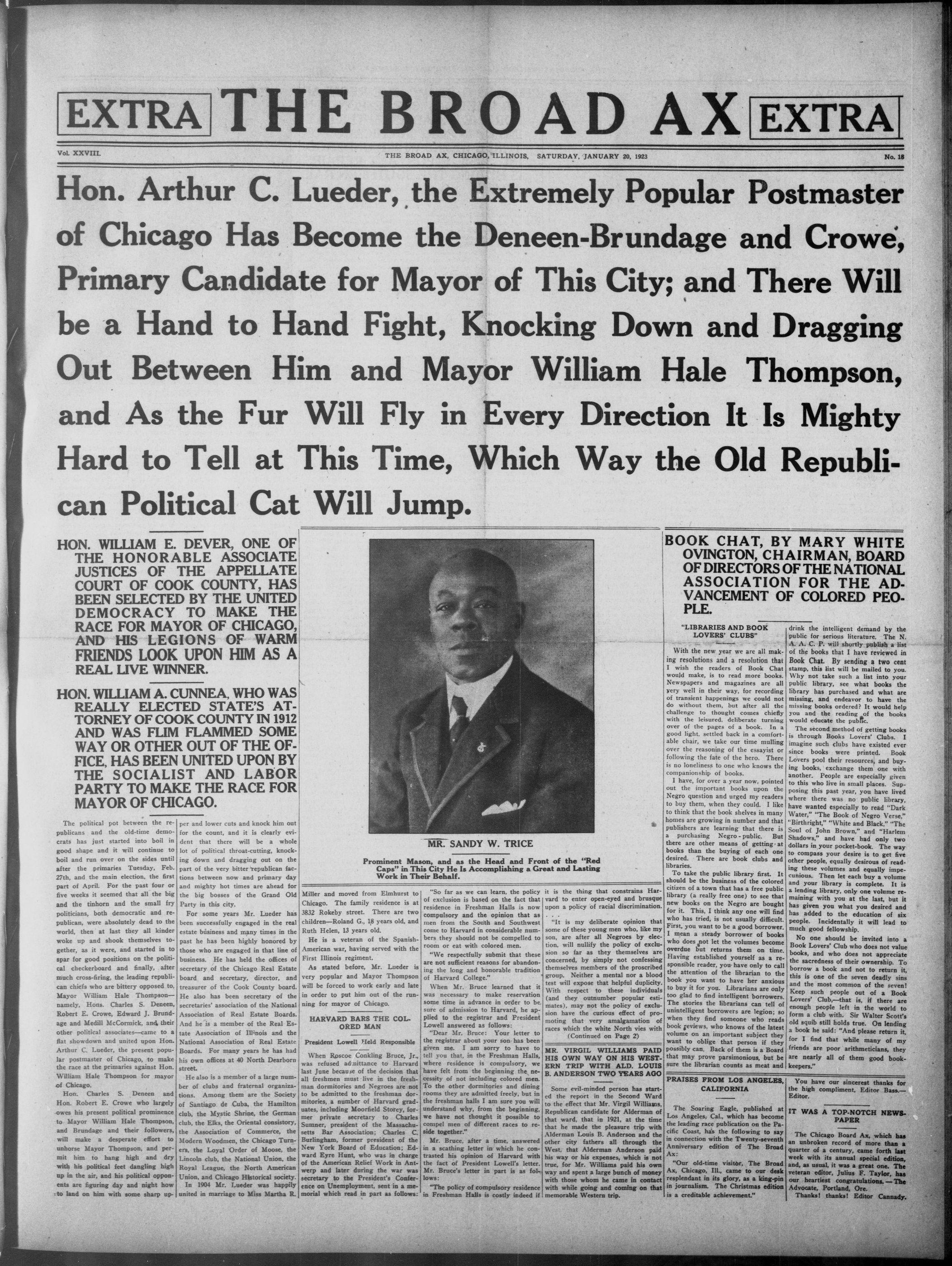
EXTRA THE BROAD AX EXTRA
Hon. Arthur C. Lueder, the Extremely Popular Postmaster of Chicago Has Become the Deneen-Brundage and Crowe, Primary Candidate for Mayor of This City; and There Will be a Hand to Hand Fight, Knocking Down and Dragging Out Between Him and Mayor William Hale Thompson, and As the Fur Will Fly in Every Direction It Is Mighty Hard to Tell at This Time, Which Way the Old Republican Political Cat Will Jump.
HON. WILLIAM E. DEVER, ONE OF THE HONORABLE ASSOCIATE JUSTICES OF THE APPELLATE COURT OF COOK COUNTY, HAS BEEN SELECTED BY THE UNITED DEMOCRACY TO MAKE THE RACE FOR MAYOR OF CHICAGO, AND HIS LEGIONS OF WARM FRIENDS LOOK UPON HIM AS A REAL LIVE WINNER.
HON. WILLIAM A. CUNNEA, WHO WAS REALLY ELECTED STATE'S ATTORNEY OF COOK COUNTY IN 1912 AND WAS FLIM FLAMMED SOME WAY OR OTHER OUT OF THE OFFICE, HAS BEEN UNITED UPON BY THE SOCIALIST AND LABOR PARTY TO MAKE THE RACE FOR MAYOR OF CHICAGO.
The political pot between the republicans and the old-time democrats has just started into boil in good shape and it will continue to boil and run over on the sides until after the primaries Tuesday, Feb. 27th, and the main election, the first part of April. For the past four or five weeks it seemed that all the big and the tinnhorn and the small fry politicians, both democratic and republican, were absolutely dead to the world, then at last they all kinder woke up and shook themselves together, as it were, and started in to spar for good positions on the political checkerboard and finally, after much cross-firing, the leading republican chiefs who are bitterly opposed to, Mayor William Hale Thompson—namely, Hons. Charles S. Deneen, Robert E. Crowe, Edward J. Brundage and Medill McCormick, and their other political associates—came to a flat showdown and united upon Hon. Arthur C. Lueder, the present popular postmaster of Chicago, to make the race at the primaries against Hon. William Hale Thompson for mayor of Chicago.
Hon. Charles S. Deneen and Hon. Robert E. Crowe who largely owes his present political prominence to Mayor William Hale Thompson, and Brundage and their followers, will make a desperate effort to unhorse Mayor Thompson, and permit him to hang high and dry with his political feet dangling high up in the air, and his political opponents are figuring day and night how to land on him with some sharp up-
per and lower cuts and knock him out for the count, and it is clearly evident that there will be a whole lot of political throat-cutting, knocking down and dragging out on the part of the very bitter republican factions between now and primary day and mighty hot times are ahead for the big bosses of the Grand Old Party in this city.
For some years Mr. Lueder has been successfully engaged in the real estate business and many times in the past he has been highly honored by those who are engaged in that line of business. He has held the offices of secretary of the Chicago Real Estate board and secretary, director, and treasurer of the Cook County board. He also has been secretary of the secretaries' association of the National Association of Real Estate Boards. And he is a member of the Real Estate Association of Illinois and the National Association of Real Estate Boards. For many years he has had his own offices at 40 North Dearborn street.
He also is a member of a large number of clubs and fraternal organizations. Among them are the Society of Santiago de Cuba, the Hamilton club, the Mystic Shrine, the German club, the Elks, the Oriental consistory, the Association of Commerce, the Modern Woodmen, the Chicago Turners, the Loyal Order of Moose, the Lincoln club, the National Union, the Royal League, the North American Union, and Chicago Historical society. In 1904 Mr. Lueder was happily united in marriage to Miss Martha R.
THE BROAD AX, CHICAGO, ILLINOIS, SATURDAY, JANUARY 20, 1923
Prominent Mason, and as the Head and Front of the "Red Caps" in This City He Is Accomplishing a Great and Lasting Work in Their Behalf.
Prominent Mason, and as the Head and Front of the "Red Caps" in This City He Is Accomplishing a Great and Lasting Work in Their Behalf.
Miller and moved from Elmhurst to Chicago. The family residence is at 3832 Rokeby street. There are two children—Roland G., 18 years old, and Ruth Helen, 13 years old.
He is a veteran of the Spanish-American war, having served with the First Illinois regiment.
As stated before, Mr. Lueder is very popular and Mayor Thompson will be forced to work early and late in order to put him out of the running for mayor of Chicago.
HARVARD BARS THE COL-
ORED MAN
President Lowell Held Responsible
When Roscoe Conkling Bruce, Jr., was refused admittance to Harvard last June because of the decision that all freshmen must live in the freshman dormitories and Negroes are not to be admitted to the freshman dormitories, a number of Harvard graduates, including Moorfield Storey, former private secretary to Charles Sumner, president of the Massachusetts Bar Association; Charles C. Burlingham, former president of the New York Board of Education; Edward Eyre Hunt, who was in charge of the American Relief Work in Antwerp and later during the war was secretary to the President's Conference on Unemployment, sent in a memorial which read in part as follows:
MR. SANDY W. TRICE
"So far as we can learn, the policy of exclusion is based on the fact that residence in Freshman Halls is now compulsory and the opinion that as men from the South and Southwest come to Harvard in considerable numbers they should not be compelled to room or eat with colored men.
"We respectfully submit that these are not sufficient reasons for abandoning the long and honorable tradition of Harvard College."
When Mr. Bruce learned that it was necessary to make reservation some time in advance in order to be sure of admission to Harvard, he applied to the registrar and President Lowell answered as follows:
"Dear Mr. Bruce: Your letter to the registrar about your son has been given me. I am sorry to have to tell you that, in the Freshman Halls, where residence is compulsory, we have felt from the beginning the necessity of not including colored men. To the other dormitories and dining rooms they are admitted freely, but in the freshman halls I am sure you will understand why, from the beginning, we have not thought it possible to compel men of different races to reside together."
Mr. Bruce, after a time, answered in a scathing letter in which he contrasted his opinion of Harvard with the fact of President Lowell's letter. Mr. Bruce's letter in part is as follows:
"The policy of compulsory residence in Freshman Halls is costly indeed if
it is the thing that constrains Harvard to enter open-eyed and brusque upon a policy of racial discrimination.
"It is my deliberate opinion that some of these young men who, like my son, are after all Negroes by election, will nullify the policy of exclusion so far as they themselves are concerned, by simply not confessing themselves members of the proscribed group. Neither a mental nor a blood test will expose that helpful duplicity With respect to these individuals (and they outnumber popular estimates), may not the policy of exclusion have the curious effect of promoting that very amalgamation of races which the white North vies with (Continued on Page 2)
MR. VIRGIL WILLIAMS PAID
HIS OWN WAY ON HIS WEST
ERN TRIP WITH ALD. LOUIS
B. ANDERSON TWO YEARS AGO
Some evil-minded person has started the report in the Second Ward to the effect that Mr. Virgil Williamus, Republican candidate for Alderman of that ward, that in 1921, at the time that he made the pleasure trip with Alderman Louis B. Anderson and the other city fathers all through the West, that Alderman Anderson paid his way, or his expenses, which is not true, for Mr. Williams paid his own way and spent a large bunch of money with those whom he came in contact with while going and coming on that memorable Western trip.
BOOK CHAT, BY MARY WHITE OVINGTON, CHAIRMAN, BOARD OF DIRECTORS OF THE NATIONAL ASSOCIATION FOR THE ADVANCEMENT OF COLORED PEOPLE.
With the new year we are all making resolutions and a resolution that I wish the readers of Book Chat would make, is to read more books. Newspapers and magazines are all very well in their way, for recording of transient happenings we could not do without them, but after all the challenge to thought comes chiefly with the leisure, deliberate turning over of the pages of a book. In a good light, settled back in a comfortable chair, we take our time mulling over the reasoning of the essayist or following the fate of the hero. There is no loneliness to one who knows the companionship of books.
I have, for over a year now, pointed out the important books upon the Negro question and urged my readers to buy them, when they could. I like to think that the book shelves in many homes are growing in number and that publishers are learning that there is a purchasing Negro-public. But there are other means of getting at books than the buying of each one desired. There are book clubs and libraries.
To take the public library first. It should be the business of the colored citizen of a town that has a free public library (a really free one) to see that new books on the Negro are bought for it. This, I think any one will find who has tried, is not usually difficult. First, you want to be a good borrower. I mean a steady borrower of books who does not let the volumes become overdue but returns them on time. Having established yourself as a responsible reader, you have only to call the attention of the librarian to the book you want to have her anxious to buy it for you. Librarians are only too glad to find intelligent borrowers. The stories the librarians can tell of unintelligent borrowers are legion; so when they find someone who reads book reviews, who knows of the latest volume on an important subject they want to oblige that person if they possibly can. Back of them is a Board that may prove parsimonious, but be sure the librarian counts as meat and
PRAISES FROM LOS ANGELES,
CALIFORNIA
The Soaring Eagle, published at Los Angeles, Cal, which has become the leading race publication on the Pacific Coast, has the following to say in connection with the Twenty-seventh Anniversary edition of The Broad Ax:
"Our old-time visitor, The Broad Ax, Chicago, Ill, came to our desk resplendant in its glory, as a king-pin in journalism. The Christmas edition is a creditable achievement."
drink the intelligent demand by the public for serious literature. The N. A. A. C. P. will shortly publish a list of the books that I have reviewed in Book Chat. By sending a two cent stamp, this list will be mailed to you. Why not take such a list into your public library, see what books the library has purchased and what are missing, and endeavor to have the missing books ordered? It would help you and the reading of the books would educate the public.
The second method of getting books is through Books Lovers' Clubs. I imagine such clubs have existed ever since books were printed. Book Lovers pool their resources, and buying books, exchange them one with another. People are especially given to this who live in small places. Supposing this past year, you have lived where there was no public library, have wanted especially to read "Dark Water," "The Book of Negro Verse," "Birthright," "White and Black," "The Soul of John Brown," and "Harlem Shadows," and have had only two dollars in your pocket-book. The way to compass your desire is to get five other people, equally desirous of reading these volumes and equally imprecuous. Then let each buy a volume and your library is complete. It is a lending library, only one volume remaining with you at the last, but it has given you what you desired and has added to the education of six people. Incidentally it will lead to much good fellowship.
No one should be invited into a Book Lovers' Club who does not value books, and who does not appreciate the sacredness of their ownership. To borrow a book and not to return it, this is one of the seven deadly sins and the most common of the seven! Keep such people out of a Book Lovers' Club—that is, if there are enough people left in the world to form a club with. Sir Walter Scott's old squib still holds true. On lending a book he said: "And please return it, for I find that while many of my friends are poor arithmeticians, they are nearly all of them good book-keepers."
You have our sincerest thanks for the high compliment, Editor Bass.—Editor.
The Chicago Board Ax, which has an unbroken record of more than a quarter of a century, came forth last week with its annual special edition, and, as usual, it was a great one. The veteran editor, Julius F. Taylor, has our heartiest congratulations. — The Advocate, Portland, Ore. Thanks! thanks! Editor, Cannadr
THE BROAD AX
Published Every Saturday
In this city since July 15th, 1899, without missing one single issue. Republicans, Democrats, Catholics, Protestants, Single Taxers, Priests, infidels or anyone else can have their say as long as their language is proper and responsibility is fixed. The Broad Ax is a newspaper whose platform is broad enough for all, even claiming the editorial right to speak its own mind. Local communications will receive attention. Write only on one side of the paper. Subscriptions must be paid in advance.
One Year .....$2.00
Six Months .....$1.00
Advertising rates made known on
application.
Address all communication to
THE BROAD AX
Associate Editor
DR. M. A. MAJORS
January 20, 1923
Vol. XXVIII No. 18
entered as Second-Class Matter, Aug
9, 1902, at the Post Office at Chicago.
44. Under Act of March 8, 1879.
HARVARD BARS THE COLORED MAN
the white South in affecting to dread!
"To proscribe a youth because of his race is a procedure as novel at Harvard until your administration as it is unscientific.
"The differences in racial excellence consist in the comparative numbers of individuals to be found in the higher reaches of the vast curve upward of human quality and serviceability. And to assess the relative values of the several stocks of mankind en masse is, one must concede, an exceedingly delicate and difficult, indeed perilous task."
It remains to be seen what President Lowell's answer to this charge will be. Unquestionably, the responsibility is pretty squarely upon his shoulders.
President Lowell has responded to the letter of Mr. Bruce's in part as follows:
"I am sorry that you do not feel the reasonableness of our position about the freshman dormitories. It is not a departure from the past to refuse to compel white and colored men to room in the same building. We owe to the colored man the same opportunities for education that we do to the white man, but we do not owe to him to force him and the white into social relations that are not or may not be mutually congenial."
Mr. Bruce, who lives at Kendall, Va., is the son of Blanche Kelso Bruce, former registrar of the United States Treasury. He was a member of the class of 1902, won membership in the Phi Beta Kappa and was chosen class orator. The son is preparing to enter Harvard at Phillips Exeter academy.
It seems to be up to President Lowell to prove that he is not worshiping at the feet of southern race prejudice.
LITTLE SIGNS OF PROGRESS
By Dr. M. A. Majors
There are some signs that we are making steady progress. We gather at places in very large numbers to hear a recital. Music says Shakespeare hath charms to soothe the savage breast. But on the chief essentials we also may be found in large numbers sometimes. Whenever a question arises that holds racial interest we will give a large attendance. It is a bit unfortunate that the commercial call does not find us so greatly enthused, and yet there could not possibly be an interest greater than commerce, a thing in which we are lacking. Funerals, weddings, parties dances follow the lead of church interests, in this latter regard we surpass all other races, but in the matters of commercial activities we are the last race in the line of march which is such a great pity. It will for many years come take something greater than thunder and lightning to jar awake to the chief ideal of permanent development and progress.
No matter what can be said to the contrary we are yet following the footsteps of the past shot to pieces by manifestations of hypocrisy and deceit, pretending to carry on certain forms in which there is only emotionalism which takes us no where. A bank, a large store, real estate, life insurances with a sprinkling of little stores are evidences that speak very eloquently the trend of our small effort. We find making money and
83
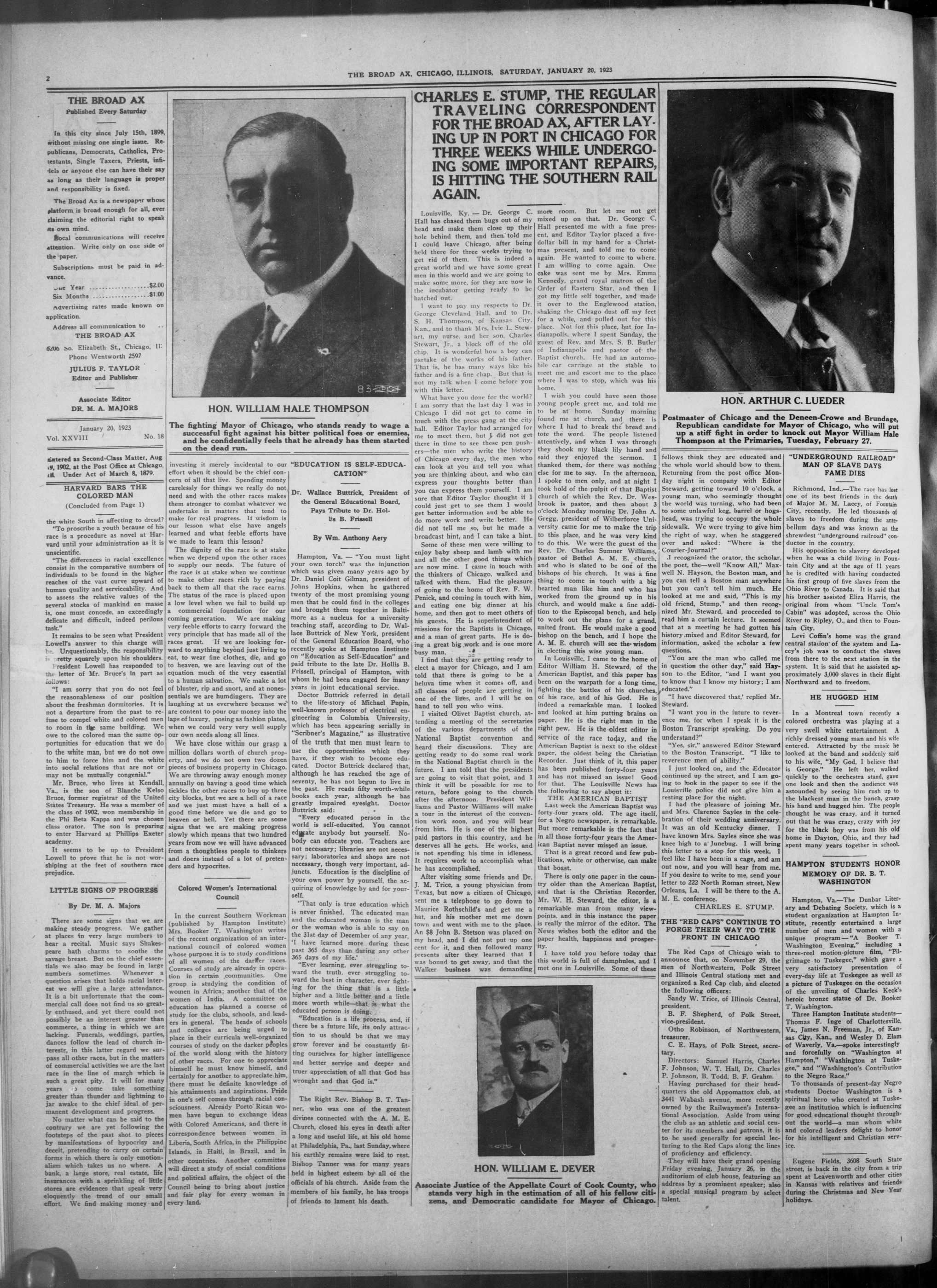
HON. WILLIAM HALE THOMPSON
The fighting Mayor of Chicago, who stands ready to wage a successful fight against his bitter political foes or enemies, and he confidentially feels that he already has them started on the dead run.
investing it merely incidental to our effort when it should be the chief concern of all that live. Spending money carelessly for things we really do not need and with the other races makes them stronger to combat whatever we undertake in matters that tend to make for real progress. If wisdom is our lesson what else have angels learned and what feeble efforts have we made to learn this lesson?
"EDUCATION IS SELF-EDUCA-CATION"
Dr. Wallace Buttrick, President of the General Educational Board, Pays Tribute to Dr. Hollis B. Frissell
By Wm. Anthony Aery
The dignity of the race is at stake when we depend upon the other races to supply our needs. The future of the race is at stake when we continue to make other races rich by paying back to them all that the race earns. The status of the race is placed upon a low level when we fail to build up a commercial foundation for our coming generation. We are making very feeble efforts to carry forward the very principle that has made all of the races great. If we are looking forward to anything beyond just living to eat, to wear fine clothes, die, and go to heaven, we are leaving out of the equation much of the very essential to a human salvation. We make a lot of bluster, rip and snort, and at nonessentials we are humdidgers. They are laughing at us everwhere because we are content to pour our money into the laps of luxury, posing as fashion plates when we could very very well supply our own needs along all lines.
We have close within our grasp a million dollars worth of church property, and we do not own two dozen pieces of business property in Chicago. We are throwing away enough money annually on having a good time which tickles the other races to buy up three city blocks, but we are a hell of a race and we just must have a hell of a good time before we die and go to heaven or hell. Yet there are some signs that we are making progress slowly which means that two hundred years from now we will have advanced from a thoughtless people to thinkers and doers instead of a lot of pretenders and hypocrites.
Colored Women's International Council
In the current Southern Workman (published by Hampton Institute) Mrs. Booker T. Washington writes of the recent organization of an international council of colored women whose purpose it is to study conditions of all women of the darker races. Courses of study are already in operation in certain communities. One group is studying the condition of women in Africa; another that of the women of India. A committee on education has planned a course of study for the clubs, schools, and leaders in general. The heads of schools and colleges are being urged to place in their curricula well-organized courses of study on the darker peoples of the world along with the history of other races. For one to appreciate himself he must know himself, and certainly for another to appreciate him there must be definite knowledge of his attainments and aspirations. Pride in one's self comes through racial consciousness. Already Porto Rican women have begun to exchange ideas with Colored Americans, and there is correspondence between women in Liberia, South Africa, in the Philippine Islands, in Haiti, in Brazil, and in other countries. Another committee will direct a study of social conditions and political affairs, the object of the Council being to bring about justice and fair play for every woman in every land.
THE BROAD AX, CHICAGO, ILLINOIS, SATURDAY, JANUARY 20, 1923
"EDUCATION IS SELF-EDUCA CATION"
Dr. Wallace Buttrick, President o the General Educational Board, Pays Tribute to Dr. Hollis B. Frissell
By Wm. Anthony Aery
Hampton, Va. — "You must light your own torch" was the injunction which was given many years ago by Dr. Daniel Coit Gilman, president of Johns Hopkins, when he gathered twenty of the most promising young men that he could find in the colleges and brought them together in Baltimore as a nucleus for a university teaching staff, according to Dr. Wallace Buttrick of New York, president of the General Education Board, who recently spoke at Hampton Institute on "Education as Self-Education" and paid tribute to the late Dr. Hollis B. Frissell, principal of Hampton, with whom he had been engaged for many years in joint educational service.
Doctor Buttrick referred in detail to the life-story of Michael Pupin, well-known professor of electrical engineering in Columbia University, which has been appearing serially in "Scribner's Magazine," as illustrative of the truth that men must learn to use the opportunities which they have, if they wish to become educated. Doctor Buttrick declared that, although he has reached the age of seventy, he has not begun to live in the past. He reads fifty worth-worth books each year, although he has greatly impaired eyesight. Doctor Buttrick said:
"Every educated person in the world is self-educated. You cannot educate anybody but yourself. Nobody can educate you. Teachers are not necessary; libraries are not necessary; laboratories and shops are not necessary, though very important, adjuncts. Education is the discipline of your own power by yourself, the acquiring of knowledge by and for yourself.
"That only is true education which is never finished. The educated man and the educated woman is the man or the woman who is able to say on the 31st day of December of any year. I have learned more during these past 365 days than during any other 365 days of my life."
"Ever learning, ever struggling toward the truth, ever struggling toward the best in character, ever fighting for the thing that is a little higher and a little better and a little more worth while—that is what the educated person is doing.
"Education is a life process, and, if there be a future life, its only attraction to us should be that we may grow forever and be constantly fitting ourselves for higher intelligence and better service and deeper and truer appreciation of all that God has wrought and that God is."
The Right Rev. Bishop B. T. Tanner, who was one of the greatest divines connected with the A. M. E. Church, closed his eyes in death after a long and useful life, at his old home at Philadelphia, Pa., last Sunday, where his earthly remains were laid to rest. Bishop Tanner was for many years held in highest esteem by all of the officials of his church. Aside from the members of his family, he has troops of friends to lament his death.
CHARLES E. STUMP, THE REGULAR TRAVELING CORRESPONDENT FOR THE BROAD AX, AFTER LAYING UP IN PORT IN CHICAGO FOR THREE WEEKS WHILE UNDERGOING SOME IMPORTANT REPAIRS, IS HITTING THE SOUTHERN RAIL AGAIN.
Louisville, Ky. — Dr. George C. Hall has chased them bugs out of my head and make them close up their hole behind them, and then told me I could leave Chicago, after being held there for three weeks trying to get rid of them. This is indeed a great world and we have some great men in this world and we are going to make some more, for they are now in the incubator getting ready to be hatched out.
I want to pay my respects to Dr. George Cleveland Hall, and to Dr. S. H. Thompson, of Kansas City, Kan., and to thank Mrs. Ivie L. Stewart, my nurse, and her son, Charles Stewart, Jr., a block off of the old chip. It is wonderful how a boy can partake of the works of his father. That is, he has many ways like his father and is a fine chap. But that is not my talk when I come before you with this letter.
What have you done for the world?
I am sorry that the last day I was in Chicago I did not get to come in touch with the press gang at the city hall. Editor Taylor had arranged for me to meet them, but I did not get there in time to see these pen pushers—the men who write the history of Chicago every day, the men who can look at you and tell you what you are thinking about, and who can express your thoughts better than you can express them yourself. I am sure that Editor Taylor thought if I could just get to see them I would get better information and be able to do more work and write better. He did not tell me so, but he made a broadcast hint, and I can take a hint.
Some of these men were willing to enjoy baby sheep and lamb with me and all the other good things which are now mine. I came in touch with the thinkers of Chicago, walked and talked with them. Had the pleasure of going to the home of Rev. F. W. Penick, and coming in touch with him, and eating one big dinner at his home, and then got to meet others of his guests. He is superintendent of missions for the Baptists in Chicago, and a man of great parts. He is doing a great big work and is one more busy man.
I find that they are getting ready to elect a mayor for Chicago, and I am told that there is going to be a heluva time when it comes off, and all classes of people are getting in one of the lines, and I will be on hand to tell you who wins.
I visited Olivet Baptist church, attending a meeting of the secretaries of the various departments of the National Baptist convention and heard their discussions. They are getting ready to do some real work in the National Baptist church in the future. I am told that the presidents are going to visit that point, and I think it will be possible for me to return, before going to the church after the afternoon. President Williams and Pastor Williams will make a tour in the interest of the convention work soon, and you will hear from him. He is one of the highest paid pastors in this country, and he deserves all he gets. He works, and is not spending his time in idleness. It requires work to accomplish what he has accomplished.
After visiting some friends and Dr. J. M. Trice, a young physician from Texas, but now a citizen of Chicago, sent me a telephone to go down to Maurice Rothschild's and get me a hat, and his mother met me down town and went with me to the place. An $$ John B. Stetson was placed on my head, and I did not put up one cent for it, and then followed many presents after they learned that I was bound to get away, and that the Walker business was demanding
T. A. C.
HON. WILLIAM E. DEVER Associate Justice of the Appellate Court of Cook County, who stands very high in the estimation of all of his fellow citizens, and Democratic candidate for Mayor of Chicago.
more room. But let me not get mixed up on that. Dr. George C. Hall presented me with a fine present, and Editor Taylor placed a five-dollar bill in my hand for a Christmas present, and told me to come again. He wanted to come to where. I am willing to come again. One cake was sent me by Mrs. Emma Kennedy, grand royal matron of the Order of Eastern Star, and then I got my little self together, and made it over to the Englewood station, shaking the Chicago dust off my feet for a while, and pulled out for this place. Not for this place, but for Indianapolis, where I spent Sunday, the guest of Rev, and Mrs. S. B. Butler of Indianapolis and pastor of the Baptist church. He had an automobile car carriage at the stable to meet me and escort me to the place where I was to stop, which was his home.
I wish you could have seen those young people greet me, and told me to be at home. Sunday morning found me at church, and there is where I had to break the bread and tote the word. The people listened attentively, and when I was through they shook my black lily hand and said they enjoyed the sermon. I thanked them, for there was nothing else for me to say. In the afternoon, I spoke to men only, and at night I took hold of the pulpit of that Baptist church of which the Rev. Dr. Wesbrook is pastor, and then about 3 o'clock Monday morning Dr. John A. Gregg, president of Wilberforce University came for me to make the trip to this place, and he was very kind to do this. We were the guest of the Rev. Dr. Charles Summer Williams, pastor of Bethel A. M. E. church, and who is slated to be one of the bishops of his church. It was a fine thing to come in touch with a big hearted man like him and who has worked from the ground up in his church, and would make a fine addition to the Episcopal bench, and help to work out the plans for a grand, united front. He would make a good bishop on the bench, and I hope the A. M. E. church will see the wisdom in electing this wise young man.
In Louisville, I came to the home of Editor William H. Steward, of the American Baptist, and this paper has been on the warpath for a long time, fighting the battles of his churches, of his race, and of his God. He is indeed a remarkable man. I looked and looked at him putting brains on paper. He is the right man in the right pew. He is the oldest editor in service of the race, and the American Baptist is next to the oldest paper, the oldest being the Christian Recorder. Just think of it, this paper has been published forty-four years and has not missed an issue! Good for that. The Louisville News has the following to say about it:
THE AMERICAN BAPTIST
Last week the American Baptist was forty-four years old. The age itself, for a Negro newspaper, is remarkable. But more remarkable is the fact that in all those forty-four years the American Baptist never missed an issue.
That is a great record and few publications, white or otherwise, can make that boast.
There is only one paper in the country older than the American Baptist, and that is the Christian Recorder, Mr. W. H. Steward, the editor, is a remarkable man from many viewpoints, and in this instance the paper is really the mirror of the editor. The News wishes both the editor and the paper health, happiness and prosperity.
I have told you before today that this world is full of damphules, and I met one in Louisville. Some of these
HON. ARTHUR C. LUEDER
Postmaster of Chicago and the Deneen-Crowe and Brundage, Republican candidate for Mayor of Chicago, who will put up a stiff fight in order to knock out Mayor William Hale Thompson at the Primaries, Tuesday, February 27.
fellows think they are educated and the whole world should bow to them. Returning from the post office Monday night in company with Editor Steward, getting toward 10 o'clock, a young man, who seemingly thought the world was turning, who had been to some unlawful keg, barrel or hogshead, was trying to occupy the whole sidewalk. We were trying to give him the right of way, when he staggered over and asked: "Where is the Courier-Journal?"
"UNDERGROUND RAILROAD" MAN OF SLAVE DAYS FAME DIES
Richmond, Ind.—The race has lost one of its best friends in the death of Major M. M. Lacey, of Fountain City, recently. He led thousands of slaves to freedom during the antebellum days and was known as the shrewdest "underground railroad" conductor in the country.
His opposition to slavery developed
I recognized the orator, the scholar, the poet, the—well "Know All," Maxwell N. Hayson, the Boston man, and you can tell a Boston man anywhere but you can't tell him much. He looked at me and said, "This is my old friend, Stump," and then recognized Mr. Steward, and proceeded to read him a curtain lecture. It seemed that at a meeting he had gotten his history mixed and Editor Steward, for information, asked the scholar a few questions.
"You are the man who called me in question the other day," said Hayson to the Editor, "and I want you to know that I know my history; I am educated."
"I have discovered that," replied Mr. Steward.
"I want you in the future to reverence me, for when I speak it is the Boston Transcript speaking. Do you understand?" "Yes, sir," answered Editor Steward to the Boston Transcript. "I like to reverence men of ability." I just looked on, and the Educator continued up the street, and I am going to book in the paper to see if the Louisville police did not give him a resting place for the night.
I had the pleasure of joining Mr. and Mrs. Clarence Sayles in the celebration of their wedding anniversary. It was an old Kentucky dinner. I have known Mrs. Sayles since she was knee high to a Junebug. I will bring this letter to a stop for this week. I feel like I have been in a cage, and am out now, and you will hear from me. If you desire to write to me, send your letter to 222 North Roman street, New Orleans, La. I will be there to the A. M. E. conference.
CHARLES E. STUMP.
THE "RED CAPS" CONTINUE TO FORGE THEIR WAY TO THE FRONT IN CHICAGO
The Red Caps of Chicago wish to announce that, on November 29, the men of Northwestern, Polk Street and Illinois Central stations met and organized a Red Cap club, and elected the following officers:
Sandy W. Trice, of Illinois Central, president.
B. F. Shepherd, of Polk Street, vice-president.
Otho Robinson, of Northwestern, treasurer.
C. E. Hays, of Polk Street, secretary.
Directors: Samuel Harris, Charles F. Johnson, W. T. Hall, Dr. Charles P. Johnson, B. Todd, B. F. Grahm.
Having purchased for their headquarters the old Appomattox club, at 3441 Wabash avenue, more recently owned by the Railwaymen's International Association. Aside from using the club as an athletic and social center for its members and patrons, it is to be used generally for special lecturing to the Red Caps along the lines of proficiency and efficiency. They will have their grand opening Friday evening, January 26, in the auditorium of club house, featuring an address by a prominent speaker; also a special musical program by select talent.
"UNDERGROUND RAILROAD"
MAN OF SLAVE DAYS
FAME DIES
Richmond, Ind.,—The race has lost one of its best friends in the death of Major M. M. Lacey, of Fountain City, recently. He led thousands of slaves to freedom during the antebellum days and was known as the shrewdest "underground railroad" conductor in the country.
His opposition to slavery developed when he was a child living in Fountain City and at the age of 11 years he is credited with having conducted his first group of five slaves from the Ohio River to Canada. It is said that his brother assisted Eliza Harris, the original from whom "Uncle Tom's Cabin" was adopted, across the Ohio River to Ripley, O., and then to Fountain City.
Levi Coffin's home was the grand central station of the system and Lacey's job was to conduct the slaves from there to the next station in the system. It is said that he assisted approximately 3,000 slaves in their flight Northward and to freedom.
HE HUGGED HIM
In a Montreal town recently a colored orchestra was playing at a very swell white entertainment. A richly dressed young man and his wife entered. Attracted by the music he looked at the band and suddenly said to his wife, "My God, I believe that is George." He left her, walked quickly to the orchestra stand, gave one look and then the audience was astounded by seeing him rush up to the blackest man in the bunch, grasp his hand and hugged him. The people thought he was crazy, and it turned out that he was crazy, crazy with joy for the black boy was from his old home in Dayton, Ohio, and they had spent many years together in school.
HAMPTON STUDENTS HONOR
MEMORY OF DR. B. T.
WASHINGTON
Hampton, Va.—The Dunbar Literary and Debating Society, which is a student organization at Hampton Institute, recently entertained a large number of men and women with a unique program—"A Booker T. Washington Evening," including a three-reel motion-picture film, "Elligrimage to Tuskegee," which gave a very satisfactory presentation of every-day life at Tuskegee as well as the picture of Tuskegee on the occasion of the unveiling of Charles Keek's heroic bronze statue of Dr. Booken T. Washington.
Three Hampton Institute students—Thomas F. Inge of Charlottesville, Va., James N. Freeman, Jr., of Kansas City, Kan., and Wesley D. Elan of Waverly, Va.—spoke interestingly and forcefully on "Washington at Hampton," "Washington at Tuskegee," and "Washington's Contribution to the Negro Race."
To thousands of present-day Negro students Doctor Washington is a spiritual hero who created at Tuskegee an institution which is influencing for good educational thought throughout the world—a man whom white and colored leaders delight to honor for his intelligent and Christian service.
Eugene Fields, 3608 South State street, is back in the city from a trip spent at Leavenworth and other cities in Kansas with relatives and friends during the Christmas and New Year holidays.
C. W.
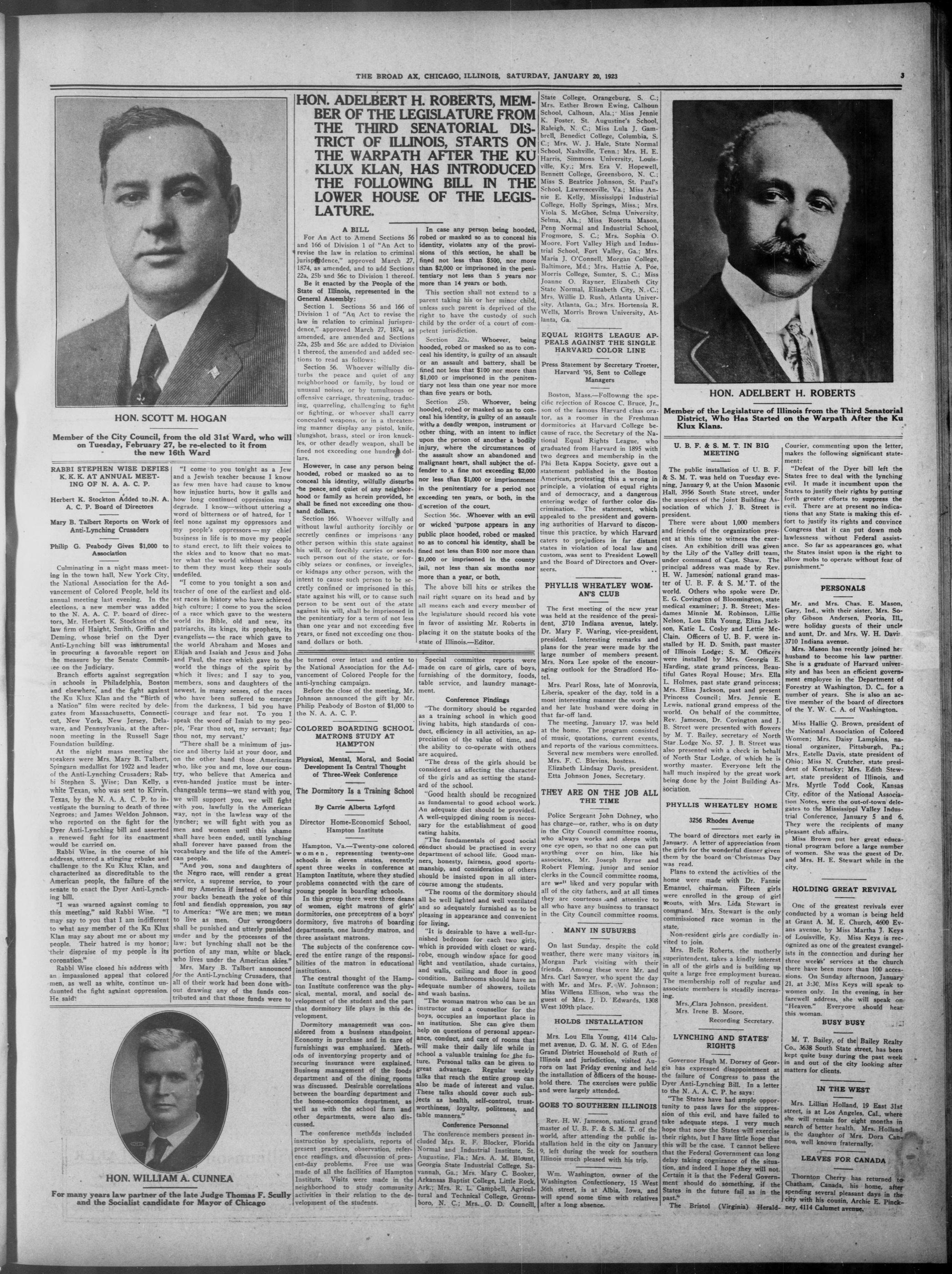
HON. SCOTT M. HOGAN
RABBI STEPHEN WISE DEFIES
K. K. K. AT ANNUAL MEET-
ING OF N. A. A. C. P.
Herbert K. Stockton Added to N. A.
A. C. P. Board of Directors
Mary B. Talbert Reports on Work of
Anti-Lynching Crusaders
Phillip G. Peabody Gives $1,000 to
Association
Culminating in a night mass meet-
ing in the town hall, New York City,
the National Association for the Advancement of Colored People, held its annual meeting last evening. In the elections, a new member was added to the N. A. A. C. P. board of directors, Mr. Herbert K. Stockton of the law firm of Haight, Smith, Griffin and Deming, whose brief on the Dyer Anti-Lynching bill was instrumental in procuring a favorable report on the measure by the Senate Committee on the Judiciary.
Branch efforts against segregation in schools in Philadelphia, Boston and elsewhere, and the fight against the Ku Klux Klan and the "Birth of a Nation" film were recited by delegates from Massachusetts, Connecticut, New York, New Jersey, Delaware, and Pennsylvania, at the afternoon meeting in the Russell Sage Foundation building.
At the night mass meeting the speakers were Mrs. Mary B. Talbert, Spingarn medallist for 1922 and leader of the Anti-Lynching Crusaders; Rabbi Stephen S. Wise; Dan Kelly, a white Texan, who was sent to Kirvin, Texas, by the N. A. A. C. P. to investigate the burning to death of three Negroes; and James Weldon Johnson, who reported on the fight for the Dyer Anti-Lynching bill and asserted a renewed fight for its enactment would be carried on.
Rabbi Wise, in the course of his address, uttered a stinging rebuke and challenge to the Ku Klux Klan, and characterized as discreditable to the American people, the failure of the senate to enact the Dyer Anti-Lynching bill.
"I was warned against coming to this meeting," said Rabbi Wise. "I may say to you that I am indifferent to what any member of the Ku Klux Klan may say about me or about my people. Their hatred is my honor; their dispraise of my people is its coronation."
Rabbi Wise closed his address with an impassioned appeal that colored men, as well as white, continue undaunted the fight against oppression. He said:
foul and fiendish oath to America: "We shall be punished and under and by the law; but lynching portion of any man who lives under the Mrs. Mary B. Wise for the Anti-Lynchman all of their work has out drawing any or distributed and that th
HON. WILLIAM A. CUNNEA For many years law partner of the late Judge Thomas F. Scully and the Socialist candidate for Mayor of Chicago
For many years law partner of the late Judge Thomas F. Scully and the Socialist candidate for Mayor of Chicago
"I come to you tonight as a Jew and a Jewish teacher because I know as few men have had cause to know how injustice hurts, how it galls and how long continued oppression may degrade. I know—without uttering a word of bitterness or of hatred, for I feel none against my oppressors and my people's oppressors—my chief business in life is to move my people to stand erect, to lift their voices to the skies and to know that no matter what the world without may do to them they must keep their souls undefiled.
"I come to you tonight a son and teacher of one of the earliest and oldest races in history who have achieved high culture; I come to you the scion of a race which gave to the western world its Bible, old and new, its patriarchs, its kings, its prophets, its evangelists—the race which gave to the world Abraham and Moses and Elijah and Isaiah and Jesus and John and Paul, the race which gave to the world the things of the spirit by which it lives; and I say to you, members, sons and daughters of the newest, in many senses, of the races who have been suffered to emerge from the darkness, I bid you have courage and fear not. To you I speak the word of Isaiah to my people, 'Fear thou not, my servant; fear thou not, my servant.'
"There shall be a minimum of justice and liberty laid at your door, and on the other hand those Americans who, like you and me, love our country, who believe that America and even-handed justice must be interchangeable terms—we stand with you, we will support you, we will fight with you, lawfully in the American way, not in the lawless way of the lyncher; we will fight with you as men and women until this shame shall have been ended, until lynching shall forever have passed from the vocabulary and the life of the American people.
"And you, sons and daughters of the Negro race, will render a great service, a supreme service, to your and my America if instead of bowing your backs beneath the yoke of this foul and fiendish oppression, you say to America: "We are men; we mean to live as men. Our wrongdoers shall be punished and utterly punished under and by the processes of the law; but lynching shall not be the portion of any man, white or black, who lives under the American skies."
Mrs. Mary B. Talbert announced for the Anti-Lynching Crusaders, that all of their work had been done without drawing any of the funds contributed and that those funds were to
THE BROAD AX, CHICAGO, ILLINOIS, SATURDAY, JANUARY 20. 1923
HON. ADELBERT H. ROBERTS, MEMBER OF THE LEGISLATURE FROM THE THIRD SENATORIAL DISTRICT OF ILLINOIS, STARTS ON THE WARPATH AFTER THE KU KLUX KLAN, HAS INTRODUCED THE FOLLOWING BILL IN THE LOWER HOUSE OF THE LEGISLATURE.
A BILL
For An Act to Amend Sections 56 and 166 of Division 1 of "An Act to revise the law in relation to criminal jurisprudence," approved March 27, 1874, as amended, and to add Sections 22a, 25b and 56c to Division 1 thereof.
Be it enacted by the People of the State of Illinois, represented in the General Assembly:
Section 1. Sections 56 and 166 of Division 1 of "An Act to revise the law in relation to criminal jurisprudence," approved March 27, 1874, as amended, are amended and Sections 22a, 25b and 56c are added to Division 1 thereof, the amended and added sections to read as follows:
Section 56. Whoever wilfully disturbs the peace and quiet of any neighborhood or family, by loud or unusual noises, or by tumultuous or offensive carriage, threatening, traducing, quarreling, challenging to fight or fighting, or whoever shall carry concealed weapons, or in a threatening manner display any pistol, knife, slungshot, brass, steel or iron knuckles, or other deadly weapon, shall be fined not exceeding one hundred dollars.
However, in case any person being hooded, robed or masked so as to conceal his identity, wilfully disturbs the peace, and quiet of any neighborhood or family as herein provided, he shall be fined not exceeding one thousand dollars.
Section 166. Whoever wilfully and without lawful authority forcibly or secretly confines or imprisons any other person within this state against his will, or forcibly carries or sends such person out of the state, or forcibly seizes or confines, or invigles, or kidnaps any other person, with the intent to cause such person to be secretly confined or imprisoned in this state against his will, or to cause such person to be sent out of the state against his will, shall be imprisoned in the penitentiary for a term of not less than one year and not exceeding five years, or fined not exceeding one thousand dollars or both.
be turned over intact and entire to the National Association for the Advancement of Colored People for the anti-lynching campaign.
Before the close of the meeting, Mr. Johnson announced the gift by Mr. Philip Peabody of Boston of $1,000 to the N. A. A. C. P.
COLORED BOARDING SCHOOL
MATRONS STUDY AT
HAMPTON
Physical, Mental, Moral, and Social
Development Is Central Thought
of Three-Week Conference
The Dormitory Is a Training School
By Carrie Alberta Lyford
Director Home-Economic School,
Hampton Institute
Hampton, Va.—Twenty-one colored
women, representing twenty-one
schools in eleven states, recently
spent three weeks in conference at
Hampton Institute, where they studied
problems connected with the care of
young people in boarding schools.
In this group there were three deans of
women, eight matrons of girls' dormitories, one preceptress of a boy's dormitory, five matrons of boarding departments, one laundry matron, and three assistant matrons.
The subjects of the conference covered the entire range of the responsibilities of the matron in educational institutions.
The central thought of the Hampton Institute conference was the physical, mental, moral, and social development of the student and the part that dormitory life plays in this development.
Dormitory management was considered from a business standpoint. Economy in purchase and in care of furnishings was emphasized. Methods of inventorying property and of securing insurance were explained. Business management of the foods department and of the dining rooms was discussed. Desirable correlations between the boarding department and the home-economics department, as well as with the school farm and other departments, were also discussed.
The conference methods included instruction by specialists, reports of present practices, observation, reference readings, and discussion of present-day problems. Free use was made of all the facilities of Hampton Institute. Visits were made in the neighborhood to study community activities in their relation to the development of the students.
In case any person being hooded, robed or masked so as to conceal his identity, violates any of the provisions of this section, he shall be fined not less than $500, nor more than $2,000 or imprisoned in the penitentiary not less than 5 years nor more than 14 years or both.
This section shall not extend to a parent taking his or her minor child, unless such parent is deprived of the right to have the custody of such child by the order of a court of competent jurisdiction.
Section 22a. Whoever, being hooded, robed or masked so as to conceal his identity, is guilty of an assault or an assault and battery, shall be fined not less that $100 nor more than $1,000 or imprisoned in the penitentiary not less than one year nor more than five years or both.
Section 25b. Whoever, being hooded, robed or masked so as to conceal his identity, is guilty of an assault with a deadly weapon, instrument or other thing, with an intent to inflict upon the person of another a bodily injury, where the circumstances of the assault show an abandoned and malignant heart, shall subject the offender to a fine not exceeding $2,000 nor less than $1,000 or imprisonment in the penitentiary for a period not exceeding ten years, or both, in the discretion of the court.
Section 56c. Whoever with an evil or wicked purpose appears in any public place hooded, robed or masked so as to conceal his identity, shall be fined not less than $100 nor more than $1,000 or imprisoned in the county jail, not less than six months nor more than a year, or both.
The above bill hits or strikes the nail right square on its head and by all means each and every member of the legislature should record his vote in favor of assisting Mr. Roberts in placing it on the statute books of the state of Illinois—Editor.
Special committee reports were made on care of girls, care of boys, furnishing of the dormitory, foods, table service, and laundry management
Conference Findings
"The dormitory should be regarded as a training school in which good living habits, high standards of conduct, efficiency in all activities, an appreciation of the value of time, and the ability to co-operate with others are acquired.
"The dress of the girls should be considered as affecting the character of the girls and as setting the standard of the school.
"Good health should be recognized as fundamental to good school work. An adequate diet should be provided. A well-equipped dining room is necessary for the establishment of good eating habits.
"The fundamentals of good social conduct should be practised in every department of school life. Good manners, honesty, fairness, good sportsmanship, and consideration of others should be insisted upon in all intercourse among the students.
"The rooms of the dormitory should all be well lighted and well ventilated and so adequately furnished as to be pleasing in appearance and convenient for living.
"It is desirable to have a well-furnished bedroom for each two girls, which is provided with closet or wardrobe, enough window space for good light and ventilation, shade curtains, and walls, ceiling and floor in good condition. Bathrooms should have an adequate number of showers, toilets and wash basins.
"The woman matron who can be an instructor and a counsellor for the boys, occupies an important place in an institution. She can give them help on questions of personal appearance, conduct, and care of rooms that will make their daily life while in school a valuable training for the future. Personal talks can be given to great advantage. Regular weekly talks that reach the entire group can also be made of interest and value. These talks should cover such subjects as health, self-control, trustworthiness, loyalty, politeness, and table manners."
Conference Personnel
The conference members present included Mrs. R. F. Blocker, Florida Normal and Industrial Institute, St. Augustine, Fla.; Mrs. A. M. Blount, Georgia State Industrial College, Savannah, Ga.; Mrs. Mary C. Booker, Arkansas Baptist College, Little Rock, Ark.; Mrs. R. L. Campbell, Agricultural and Technical College, Greensboro, N. C.; Mrs. O. D. Councill.
State College, Orangeburg, S. C.; Mrs. Esther Brown Ewing, Calhoun School, Calhoun, Ala.; Miss Jennie K. Foster, St. Augustine's School, Raleigh, N. C.; Miss Lula J. Gambrell, Benedict College, Columbia, S.; Mrs. W. W. J. Hale, State Normal School, Nashville, Tenn.; Mrs. H. E. Harris, Simmons University, Louisville, Ky.; Mrs. Era V. Hopewell, Bennett College, Greensboro, N. C.; Miss S. Beatrice Johnson, St. Paul's School, Lawrenceville, Va.; Miss Annie E. Kelly, Mississippi Industrial College, Holly Springs, Miss.; Mrs. Viola S. McGhee, Selma University, Selma, Ala.; Miss Rosetta Mason, Penn Normal and Industrial School, Frogmore, S. C.; Mrs. Sophia O. Moore, Fort Valley High and Industrial School, Fort Valley, Ga.; Mrs. Maria J. O'Connell, Morgan College, Baltimore, Md.; Mrs. Hattie A. Poe, Morris College, Sumter, S. C.; Miss Joanne O. Rayner, Elizabeth City State Normal, Elizabeth City, N. C.; Mrs. Willie D. Rush, Atlanta University, Atlanta, Ga.; Mrs. Hortensia R. Wells, Morris Brown University, Atlanta, Ga.
EQUAL RIGHTS LEAGUE APPEALS AGAINST THE SINGLE HARVARD COLOR LINE
Press Statement by Secretary Trotter Harvard '95, Sent to College Managers
Boston, Mass.—Following the specific rejection of Roscoe C. Bruce, Jr., son of the famous Harvard class orator, as a roofer in the Freshman dormitories at Harvard College because of race, the Secretary of the National Equal Rights League, who graduated from Harvard in 1895 with two degrees and membership in the Phi Beta Kappa Society, gave out a statement published in the Boston American, protesting this a wrong in principle, a violation of equal rights and of democracy, and a dangerous entering wedge of further color discrimination. The statement, which appealed to the president and governing authorities of Harvard to discontinue this practice, by which Harvard caters to prejudices in far distant states in violation of local law and custom, was sent to President Lowell and the Board of Directors and Overseers.
PHYLLIS WHEATLEY WOMAN'S CLUB
The first meeting of the new year was held at the residence of the president, 3710 Indiana avenue, lately. Dr. Mary F. Waring, vice-president, presided. Interesting remarks and plans for the year were made by the large number of members present. Mrs. Nora Lee spoke of the encouraging outlook for the Stradford Hotel. Mrs. Pearl Ross, late of Monrovia, Liberia, speaker of the day, told in a most interesting manner the work she and her late husband were doing in that far-off land. The meeting, January 17, was held at the home. The program consisted of music, quotations, current events, and reports of the various committees. Several new members were enrolled. Mrs. F. C. Blevins, hostess. Elizabeth Lindsay Davis, president. Etta Johnson Jones, Secretary.
THEY ARE ON THE JOB ALL
THE TIME
Police Sergeant John Dohney, who has charge—or, rather, who is on duty in the City Council committee rooms, who always works and sleeps with one eye open, so that no one can put anything over on him, like his associates, Mr. Joseph Byrne and Robert Fleming, junior and senior clerks in the Council committee rooms, are $w^{11}$ liked and very popular with all of the city fathers, and at all times they are courteous—and attentive to all who have any business to transact in the City Council committee rooms.
MANY IN SUBURBS
On last Sunday, despite the cold weather, there were many visitors in Morgan Park visiting with their friends. Among these were Mr. and Mrs. Carl Sawyer, who spent the day with Mr. and Mrs. F. W. Johnson; Miss Willena Ellison, who was the guest of Mrs. J. D. Edwards, 1308 West 109th place.
HOLDS INSTALLATION
Mrs. Lou Ella Young, 4114 Calumet avenue, D. G. M. N. G. of Eden Grand District Household of Ruth of Illinois and jurisdiction, visited Aurora on last Friday evening and held the installation of officers of the household there. The exercises were public and were largely attended.
GOES TO SOUTHERN ILLINOIS
Rev. H. W. Jameson, national grand master of U. B. F. & S. M. T. of the world, after attending the public installation held in the city on January 9, left during the week for southern Illinois much pleased with his trip.
Wm. Washington, owner of the Washington Confectionery, 15 West 36th street, is at Albia, Iowa, and will spend some time with relatives after a long absence.
HON. ADELBERT H. ROBERTS Member of the Legislature of Illinois from the Third Senatorial District, Who Has Started on the Warpath After the Ku Klux Klan.
U. B. F. & S. M. T. IN BIG MEETING
The public installation of U. B. F & S. M. T. was held on Tuesday evening, January 9, at the Union Masonic Hall, 3956 South State street, under the auspices of the Joint Building Association of which J. B. Street is president.
There were about 1,000 members and friends of the organization present at this time to witness the exercises. An exhibition drill was given by the Lily of the Valley drill team, under command of Capt. Shaw. The principal address was made by Rev. H. W. Jameson, national grand master of U. B. F. & S. M. T. of the world. Others who spoke were Dr. E. G. Covington of Bloomington, state medical examiner; J. B. Street; Mesdames Minnie M. Robinson, Lillie Nelson, Lou Ella Young, Eliza Jackson, Katie L. Cosby and Lettie McClain. Officers of U. B. F. were installed by H. D. Smith, past master of Illinois Lodge; S. M. Officers were installed by Mrs. Georgia E. Harding, state grand princess, Beautiful Gates Royal House; Mrs. Ella L. Holmes, past state grand princess; Mrs. Eliza Jackson, past and present Princess Council; Mrs. Jennie E. Lewis, national grand empress of the world. On behalf of the committee, Rev. Jameson, Dr. Covington and B. Street were presented with flowers by M. T. Bailey, secretary of North Star Lodge No. 57. J. B. Street was also presented with a check in behalf of North Star Lodge, of which he is worthy master. Everyone left the hall much inspired by the great work being done by the Joint Building Association.
PHYLLIS WHEATLEY HOME
3256 Rhodes Avenue
The board of directors met early in January. A letter of appreciation from the girls for the wonderful dinner given them by the board on Christmas Day was read.
Plans to extend the activities of the home were made with Dr. Fannie Emanuel, chairman. Fifteen girls were enrolled in the group of girl scouts, with Mrs. Lida Stewart in command. Mrs. Stewart is the only commissioned race woman in the state.
Non-resident girls are cordially invited to join.
Mrs. Belle Roberts, the motherly superintendent, takes a kindly interest in all of the girls and is building up quite a large free employment bureau. The membership roll of regular and associate members is steadily increasing.
Mrs. Clara Johnson, president.
Mrs. Irene B. Moore.
Recording Secretary.
LYNCHING AND STATES'
RIGHTS
Governor Hugh M. Dorsey of Georgia has expressed disappointment at the failure of Congress to pass the Dyer Anti-Lynching Bill. In a letter to the N. A. A. C. P. he says:
"The States have had ample opportunity to pass laws for the suppression of this evil, and have failed to take adequate steps. I very much hope that now the States will exercise their rights, but I have little hope that this will be the case. I cannot believe that the Federal Government can long delay taking cognizance of the situation, and indeed I hope they will not. Certain it is that the Federal Government should do something, if the States in the future fail as in the past."
The Bristol (Virginia) Herald-
Illinois from the Third Senatorial on the Warpath After the Ku
Courier, commenting upon the letter, makes the following significant statement:
"Defeat of the Dyer bill left the States free to deal with the lynching evil. It made it incumbent upon the States to justify their rights by putting forth greater efforts to suppress the evil. There are at present no indications that any State is making this effort to justify its rights and convince Congress that it can put down mob lawlessness without Federal assistance. So far as appearances go, what the States insist upon is the right to allow mobs to operate without fear of punishment."
PERSONALS
Mr. and Mrs. Chas. E. Mason, Gary, Ind., with their sister, Mrs. Sophy Gibson Andersen, Peoria, III., were holiday guests of their uncle and aunt, Dr. and Mrs. W. H. Davin. 3710 Indiana avenue.
Mrs. Mason has recently joined her husband to become his law partner. She is a graduate of Harvard university and has been an efficient government employee in the Department of Forestry at Washington, D. C., for a number of years. She is also an active member of the board of directors of the Y. W. C. A. of Washington.
Miss Hallie Q. Brown, president of the National Association of Colored Women; Mrs. Daisy Lampkins, national organizer, Pittsburgh, Pa.; Mrs. Estelle Davis, state president of Ohio; Miss N. Crutcher, state president of Kentucky; Mrs. Edith Stewart, state president of Illinois, and Mrs. Myrtle Todd Cook, Kansas City, editor of the National Association Notes, were the out-of-town delegates to the Mississippi Valley Industrial Conference, January 5 and 6. They were the recipients of many pleasant club affairs.
Miss Brown put her great educational program before a large number of women. She was the guest of Dr. and Mrs. H. E. Stewart while in the city.
HOLDING GREAT REVIVAL
One of the greatest revivals ever conducted by a woman is being held at Grant A. M. E. Church, 4600 Evans avenue, by Miss Martha J. Keys of Louisville, Ky. Miss Keys is recognized as one of the greatest evangelists in the connection and during her three weeks' services at the church there have been more than 100 accessions. On Sunday afternoon, January 21, at 3:30, Miss Keys will speak to women only. In the evening, in her farewell address, she will speak on "Heaven." Everyone should hear this woman.
BUSY BUSY
M. T. Bailey, of the Bailey Realty Co., 3638 South State street, has been kept quite busy during the past week in and out of the city looking after matters for clients.
IN THE WEST
Mrs. Lillian Holland, 19 East 31st street, is at Los Angeles, Cal., where she will remain for eight months in search of better health. Mrs. Holland is the daughter of Mrs. Dora Cannon, well known fraternally.
LEAVES FOR CANADA
Thornton Cherry has returned to Chatham, Canada, his home, after spending several pleasant days in the city with his cousin, Archie E. Pinckney, 4114 Calumet avenue.
Remarkable Preparation Makes It Easy for Anyone to Quickly Grow Long, Soft, Silky, Lovely Hair.
A wonderful preparation has been discovered that chickens can hat data loosely traces. It gives the beautiful glossy sheen. It puts glowing health into less hair; stops dandruff and itching scalp. This more preparation is
EXELENTO QUININE POMA
It has given thousands the beautiful hair which is on its chief attractions. It has made straight, silkyable for you, you want it to obtain. Exelento QUININE SKIN tightly removes skin blisters and clears up in an actor your drugstrict cannot supply you, send us 50% in starch and we Beautify, we send 50% for single preparation, by getting the EXELENTO preparations NOW!
EXELENTO MEDICINE CO
AGENTS WANTED EVERYWHERE
120 South State Street (C)
Opposite Palmer
ation has been discovered that changes
lonely, lovely tresses. It gives the hair
it puts glowing health into brittle,
ruff and itching scalp. This marvel-
QUININE POMADE
is the beautiful hair which is one of
it has made straight, silky hair
if, to obtain.
beauty help is EXELENTO SKIN BEAUTIFIER,
commis and clears up in an astonishing manner
of supply you, send us $64 in stamp or coin for
or send $25 for single package. Gain the attractive
EXELENTO preparations NOW!
MEDICINE COMPANY,
WANTED EVERYWHERE—Write for
120 South State Street (Seventh Floor,
Opposite Palmer House
A wonderful preparation has been discovered that changes short, coarse hair into long, lovely tresses. It gives the hair a shiny sheen. It puts glowing health into brittle, lifeless hair; stops standerd and itching scalp. This marvelous preparation is
It has given thousands the beautiful hair which is one of their chief attractions. It has made straight, silky hair
ELEGENTO SKIN BEAUTIFIER, a delightful collection up in an astonishing manner dark, shallow colored 650 in stamps or coin for full size package packages. Gain the attractive beauty, your options NOW! ONE COMPANY, Atlanta, VERYWHERE—Write for Particular Estate Street (Seventh Floor) Postite Palmer House
Another marvelous beauty help is EXELENTO SKIN BEAUTIFIER, a delightful cream that quickly removes skin blinches and clears up in an astonishing manner dark, sallow complexion. If your druggist cannot supply it in stamps or coin for full size packages, both of them EXELENTO EXEPSON for single pack. Gain the attractive beauty, you soon can have, by getting the EXEPSON preparations NOW!
EXELENTO MEDICINE COMPANY, Atlanta, Ga.
AGENTS WANTED EVERYWHERE—Write for Particulars
Phone Dearborn 5871
Painless Chiropodist 18 Years' Experience
Residence Phone Douglas 2616
Phone Atlantic 2008 Miss Eleanor
ss Eleanor Gai
eanor Gaines
Miss Eleanor Gaines
Soprano
Available for Concerts, Recitals, Etc.
4005 Calumet Avenue, Apt. 2 Chicag
Phone Yards 27
FURNITURE
Brass and Wood Beds, Elec
Refrigerators, Stoves, L
Hardware, Linol
HENRY STUCK
2515-19 ARCHER
URNITU
and Wood Beds, Electric W
frigerators, Stoves, Paint,
Hardware, Linoleum
HENRY STUCKAN
2515-19 ARCHER AVE.
UNITUR
All Beds, Electric Washer
s, Stoves, Paint, Oil,
ware, Linoleum
STUCKART
0 ARCHER AVE.
FURNITURE
Brass and Wood Beds, Electric Washers,
Refrigerators, Stoves, Paint, Oil,
Hardware, Linoleum
HENRY STUCKART
2515-19 ARCHER AVE.
TELEPHONE DOUGLAS 1
GEORGE F. HARDII
GE F. HARDIN
E F. HARDING, J REAL ESTATE
Up-to-Date or Modern H
and Stores to
3101 COTTAGE O
Corner 31st Street
Statement
of
Loans and B
(Inspected a
our Board
Bonds and S
Stocks ...
Date or Modern Houses, A
and Stores to Rent
COTTAGE GROVE
Corner 31st Street, Chicago
Modern Houses, Apartment Stores to Rent
AGE GROVE AVENUE
First Street, Chicago
Up-to-Date or Modern Houses, Apartments and Stores to Rent 3101 COTTAGE GROVE AVE. Corner 31st Street, Chicago
Loans and Discounts..... $ (Impact of and approved by our Board of Directors.)
Bonds and Securities.....
Stocks ..... (Lincoln State Safety Vaults Co.)
Bank Building and Annex.....
Furniture and Fixtures.....
Other Resources.....
Cash on Hand and Due from Banks
Total ..... $
LIABILITIES
Capital Stock ..... $
Surplus ..... $
Undivided Profits
Reserved for Taxes and Interest
Other Liabilities
Deposits
Total ..... $
Loans and Discounts . . . $1,435,987.70
(Inspected and approved by
on Board of Directors.)
Bonds and Securities . . . 911,614.86
Stocks . . . 11,000.00
(Lincoln State Safety
Vauls Co.)
Bank Building and Annex. $155,804.46
Furniture and Fixtures. 24,428.29
Other Resources. 11,745.17
Canada Hand and Due from
Banks . . . 423,013.60
Total . . . $2,973,140.08
LIABILITIES
Capital Stock . . . $ 300,000.00
Surplus . . . 30,000.00
Undivided Profits . . . 11,556.61
Reserved for Taxes and Inter-
est . . . 8,066.91
Other Liabilities . . . 10,417.87
Deposits . . . 2,613,098.69
Total . . . $2,973,140.08
At
Close of
Business
on
Dec. 29th, 1922
Capital Stock
Supplies ...
Undivided P
Reserved for
ereast
Other Liability
Deposits ...
Total ...
This Bank is
of its con
This Bank invites you to avail yourself of its complete facilities.
First Mortgage Gold Bonds — approved safe investments—yield 7% interest.
Boxes in our completely equipped Safety Deposit Vaults rent for $4.00 per year and upwards.
Interest at the rate of 3% is allowed on all saving accounts. Savings Department accepts from 9 a.m. to 8 p.m. Saturday.
Boxes in our completely equipped Safety Deposit Rentals rent for $4.00 per year and upwards.
Interest at the rate of 3% is allowed on all saving accounts. Savings Departments open from 9 a.m. to 8 p.m.
GEORGE F. LEIRANDT, President CHARLES A. WHITE, Vice-President GEORG E. BELL, Cashier DELAURIER, Assistant ADDISON E. AVERY, Mgr. Bond Dept.
COLN STATE BANK
OF CHICAGO
Under State Government Supervision
St and South State Street
Telephone Victory 4500
STATE BANK
CHICAGO
Government Supervision
South State Streets
The Victory 4500
Condition
Close of
P
UTIFIER, a delightful cream that
manner dark, sallow complexions
can for full size packages of both
the attractive beauty, you soon can
ANY, Atlanta, Ga
Write for Particulars
(ath Floor)
NER
dist
Gaines
URE
Electric Washers,
Paint, Oil,
Burem
KART
AVE.
AS 1
DING, JR.
TE
ases, Apartments
nt
OVE AVE.
Chicago
SOURCES
Assets..... $1,435,987.70
Proved by
Directors.)
Les..... 911,614.86
11,000.00
Safety
Annex..... 155,350.46
Sures..... 24,428.29
11,745.17
Due from
423,013.60
..... $2,973,140.08
HILITIES
$ $800,000.00
30,000.00
11,556.61
and In-
8,066.91
10,417.87
2,613,098.69
..... $2,973,140.08
RESOURCES
Safety equipped Safety
rent for $4.00 per year
of 3% is allowed on
ents. Savings Depart-
m $ 8 a.m. to $ 8 p.m.
E BANK
Supervision
Streets
500
This young lady gives all the credit for her beautiful hair and complexion to EXELENT preparation.
Chicago, Ill.
CHICAGO
THE BROAD AX, CHICAGO, ILLINOIS, SATURDAY, JANUARY 20, 1923
It's not the money you earn, but the money you save—that's the reward for your labor. A savings accounts started now will bring satisfaction and pleasure throughout your life, as the principal and interest grow. Start today in this large bank, where your savings are safe.
ILLINOIS TRUST & SAVINGS
La Salle and Jackson Streets Chicago
& SAVINGS BANK
on Streets Chicago
SHORT OR THIN?
Take off or fall out? Is it dry and wiry?
Hair disease, or more than a normal amount
should act at once, begin using MADAME
MKLINS HAIR GROWER. It matters not
Hair. Presentations you have tried without
should not become discouraged and give
giving my Hair Grower a trial. It has pro-
bably grown of hair for thousands and
name for years my System by
person. Write for information and terms
MY SPECIAL OFFER
Desiring to tip my wonderful Hair Prepara-
mail, on request, a SIX WEEKS' TRIAL
LT., consisting of Shampoo, Hair Grower
Oil, with full instructions how to use the
only $1.10. One trial treatment will con-
lure its value. Make all orders to
MADAME N. A. FRANKLIN
422 So. State St. Dept. B, 805 Prairie Ave.
CHICAGO, ILL.
PHILIP J. DUNN, Secretary
H. X. COMERFORD, Treasurer
HED 1877
I. DUNN
L. CO.
ILINQIS TRUST & SAVINGS BANK
LA Salle and Jackson Streets Chicago
IS YOUR HAIR SHORT OR THIN?
Does it break off or fall out? Is it dry and wry?
Have you scalp disease, or more than a normal amount
If so, you should act at once, begin using MADAME N. A. FRANKLIN'S HAIR GROWER. It matters not how many Hair Preparations you have tried without success, you should not become discouraged and give up. You should not become discouraged and give up. It has promoted an abundant growth of hair for thousands and will do the same for you. I also teach my System by mail or by person. Write for information and terms today.
MY SPECIAL OFFER
To those desiring to try my wonderful Hair Preparations I will mail, on request, a SIX WEEKS' TRIAL TREATMENT, consisting of Shampoo, Hair Grower and Pressing OO with full instructions how to use the products. The treatment will convince you of its value. Make all orders to
MADAME N. A. FRANKLIN
Dept. B, 3342 So. State St. Dept. B, 805 Prairie Ave.
CHICAGO, ILL.
JAS. B. McCAHEY, President PHILIP J. DU
FRANK J. DUNN, Vice-President H. X. COMERFO
ESTABLISHED 1877
JOHN J. DUNN
COAL CO.
Telephone Oakland 1550
---
OFFICE TELEPHONE DOUGLAS 6351
J. GRAY LUCAS
Corner Indiana Ave., Second Floor
Res., 3046 Grand Boul. Tel. Douglas 4397.
RE-ELECT
Alderman Scott M. H
(New) 16th Ward
Make a Cross ☒ in the square opposite my name or
Aldermanic Ballot
RE-ELECT
erman Scott M. Hogan
(New) 16th Ward
cross ☑ in the square opposite my name on separate
Aldermanic Ballot
ELECTION, TUESDAY, FEB. 27, 1923
Polls Open 6 A. M. to 5 P. M.
When Your Hacksaw Breaks.
If the blade in the hacksaw breaks two or three inches from the frame, it can still be utilized. Hold the blade in the flame of a blow torch, or otherwise heat it, and while still warm drill a hole through it; this can be done with a hand - - all. The blade can then be replaced in the adjustable saw frame, a - it will be ready for use.
Doc (after exam.)—"Don't worry about your liver trouble, you can live to be so, enty years with it. And as to the lea'ing heart valve, you can carry that around easily until you are eighty, but the kidney disease, that's worse. It'll surely bring you to the grave inside of a year."
Telephone Calumet 805
Norris-Ward Coal C
YARDS AT
26th St. and South Park, I. C. R. R.
18th and Canal Sts., C. B. & Q. R. R.
Root St., C. R. I. P. R. R.
Roscoe and Racine Aves., C. M.
2556 COTTAGE GROVE AVE., CHIC
d Coal Co.
S AT
R.
& Q. R. R.
R. R. R.
Racine Aves., C. M. & St. P. R. R.
OVE AVE., CHICAGO
2556 COTTAGE GROVE AVE., CHICAGO
CUT OUT THIS SUBSCRIPTION BLANK AND MAIL IT TO
JULIU8 F. TAYLOR, Please enter my name as a subscriber
AX. I enclose herewith Two Dollars, the annual subscription
Dollar for six months.
Name_____
Town_____
Date_____19_____
JULIUS F. TAYLOR, Please enter my name as a subscriber to THE BROAD AX. I enclose herewith Two Dollars, the annual subscriptions to same, or One Dollar for six months.
LEARN TO SAVE
Order from nearest point
5100 Federal Street
Kindness and Light.
Give us to awake with smiles, give us to labor smiling. As the sun lightens the world, so let our loving kindness make bright this house of our habitation.-Robert Louis Stevenson.
Conceit Not of Real Value. Conceit may puff a man up for a moment, but never for a long time. It is a mighty poor substitute for that real knowledge of self which values at actual worth. The world has use for only the genuine article.
Essentials for Happiness.
The grand essentials of happiness are:
Something to do, something to love and something to hope for.
Chas. Krutckoff, Pres.
J. E. Ward, Vice-Pres
THE BROAD AX
6206 B. Elizabeth Street, Chicago, Ill.
STRENGTH
WARFAILS
CHICAGO
Candid Information
Hugh Norris, Treas.
Kirby Ward, Secy.
FUNERAL DIRECTORS
ERNEST H. WILLIAMSON UNDERTAK
GARAGE
GASOLINE OIL
OPEN DAY & NIGHT
Day Light Chapel, capacity 200, Outside Ventilation—Organ and Organist Free—I am as near as your Telephone—I give service at a reasonable price—Distance immaterial, consult me—I save you wor y, time and money. 5121 & 5123 SOUTH STATE STREET CHICAGO, ILLIN
PHONE MAIN 2214
A. D. GASH
ATTORNEY AT LAW
118 N. La Salle Street
CHICAGO
Phone Main 2017
A. L. WILLIAMS
ATTORNEY AND
COUNSELOR AT LAW
Suite 706 Firmenich Building
184 W. Washington St.
CHICAGO
Residence 3655 Prairie Ave.
Phone Douglas 9133
Residence, 1262 Macalister Place
Telephone Monroe 2714
MILES J. DEVINE
ATTORNEY AT LAW
Suite 318-320 Reaper Block
Clark and Washington Sts.
CHICAGO
Telephone Central 1239
Notary Public
Phones: Office Main 4153; Residence,
4751 Champlain Avenue
Phone Kenwood 5611
ATTORNEY AND COUNSELOR
AT LAW
Suite 708—184 W. Washington St.
CHICAGO
BINGA STATE
BANK
Under State Supervision
Capital . . . . . . $100,000.00
Surplus . . . . . . 20,000.00
Offers Equal Service to All
3% INTEREST ON SAVINGS
SAFE DEPOSIT VAULTS
State Street and 36th Place
Wanted
Advertising Solicitor
A live or wide awake newspaper man or solicitor can earn some easy money by calling on or addressing the undersigned.
Julius F. Taylor, 6206 S. Elizabeth street. Phone Wentworth 2597.
PHONE KENWOOD 455
West Englewood Trust & Savings Bank
Capital and Surplus, $500,000.00
John Bain, President Arthur C. Utsch, Asst. Cashier Michael Maisel, Vice-Pres. W. Merle Fisher, Asst. Cashier Edw. C. Barry, Cashier and Trust Officer Carl O. Seberg, Asst. Cashier
The Commonwealth Edison Company
72 W. ADAMS STREET
444 Wilton Ave.
Lakeview Electric Co.,
O. R. Martin.
311 Main St.
Molson Street.
1504 Mora Ave.
1504 Mora Ave.
5300 N. Clark St.
Panama Elec. Light Co.
5300 N. Clark St.
Principle Electric Co.
Ridgway South Ave.
Ridgway South Ave.
5300 Lincoln Ave.
Sailor Electric Shop.
Sailor Electric Shop.
Top Tip Elec. Appliances.
297 Lincoln Ave.
Tilt Top Elec. Appliances.
393 Brindle Park.
M. Wetmore.
M. Wetmore.
488 Broadway
NORTHWEST
Art Class, Novelty & Gift
Store
1890 Milwaukee Ave.
CHICAGO
$ \textcircled{*} $
OFFICERS
President Arthur C. Utesch, Asst. Cashier
L. Vice-Pres. W. Merle Fisher, Asst. Cashier
Cashier and Trust Officer
Carl O. Seberg, Asst. Cashier
Commonwealth Edison Company
72 W. ADAMS STREET
PHONE RANDOLPH 1280
4039 Lincoln Ave.
1479 Irving Park Blvd.
6245 Normal Blvd.
2650 E. 92d St.
E. 92d St.
6350 S. Halted St.
851 S. Halted St.
851 S. Halted St.
4007 Glen Ave. Dr.
4007 Glen Ave.
4717 Cottage Grove Ave.
Davies Electric Shop,
4408 Fullerton Ave.
Nashville, TN 37214
292 N. Kedzie Ave.
Kelvin Park Park Elec.
Shop, Kelvin Park
Logan Sq. Lighting
Shop 2455 Milwaukee Ave.
Lakewood, TN 37214
551 Lawrence Ave.
Mid-West Electrical
Marks Electric Shop,
3216 Chicago Ave.
Chicago Ave.
3233 W. Madison St.
3253 W. Madison St.
1814 W. 39th St.
Odgen Electric Shop,
3216 Chicago Ave.
Bernard O'Hare,
3216 Chicago Ave.
Radiant Electric Shop,
3314 W. Chicago Ave.
3134 W. Chicago Ave.
1137 W. Taylor St.
Richmond Electric Co.,
3216 Chicago Ave.
Rika Electric Shop,
2734 W. Division St.
2734 W. Division St.
3248 W. North Ave.
Symaxnale Electric Co.,
3216 Chicago Ave.
Electric Washing Ma-
chinery 3130, Growve Ave.
3130, Grot. Growve Ave.
Gage Park Electric Shop.
Gage Park Electric Shop.
Gana Electric Shop.
Gana Electric Shop.
Good Housekeeping Elec-
145 E. St. St.
Harper Electric Shop.
Harper Electric Shop.
Ideal Electric & Fixiture
8335 Elsen Ave.
1860 Irving Park Blvd.
1860 Irving Park Blvd.
8717 Olimar Ave.
457 Electric House
1860 Irving Park Blvd.
WEST SIDE
Bazaar & Bazaar St.
Bridgeport Electric Co.
Bridgeport Electric Co.
City Electric Co.
4215 W. 28th St.
4815 W. Madison St.
4815 W. Madison St.
7475 W. Madison St.
DeTambleh EIc. Shop,
EIc. Shop,
Fitzpatrick Electric Co.
Fitzpatrick Electric Co.
Robert B. Garth.
Robert B. Garth.
Home Electric Appliance
Commission
Chicago Ave. Chicago Ave.
Laxington Electric Co.
SOUTH SIDE
721. E. 75th St.
Colliam Electric Co.
4542 S. Halsted St.
1081 E. 75th St.
1081 E. 47th St.
HOME
DIRECTORS
THEN & PHILIP MAYER
UNDERTAKER
PAIRING AN. VILLAGE
AUTOS KEILLE HOURS
ALL AGE/WHOLE AST
AMSON UNDERTAKER
GARAGE
GASOLINE OIL
OPEN DAY & NIGHT
UNDERTAKER
Ventilation-Organ and Organist Free-
service at a reasonable price-Distance
time, time and money.
T CHICAGO, ILLINOIS