The Broad Ax
Saturday, March 3, 1923
Chicago, Illinois
Page text (machine-generated)
EXTRA THE BROAD AX EXTRA
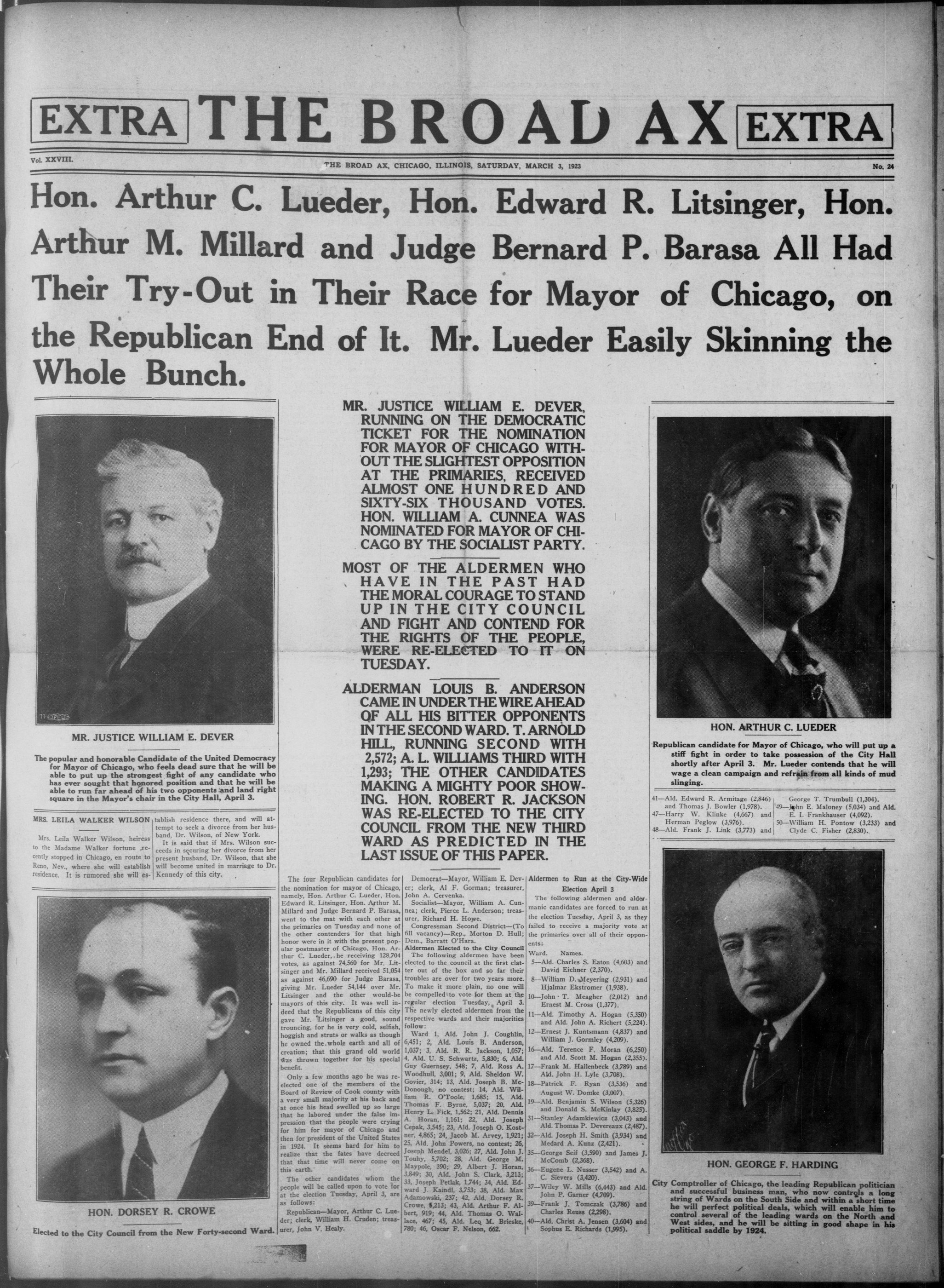
Hon. Arthur C. Lueder, Hon. Edward R. Litsinger, Hon. Arthur M. Millard and Judge Bernard P. Barasa All Had Their Try-Out in Their Race for Mayor of Chicago, on the Republican End of It. Mr. Lueder Easily Skinning the Whole Bunch.
MR. JUSTICE W
The popular and honorable Carr for Mayor of Chicago, wha able to put up the strong has ever sought that hono able to run far ahead of h square in the Mayor's cha
17
MR. JUSTICE WILLIAM E. DEVER
The popular and honorable Candidate of the United Democracy for Mayor of Chicago, who feels dead sure that he will be able to put up the strongest fight of any candidate who has ever sought that honored position and that he will be able to run far ahead of his two opponents and land right square in the Mayor's chair in the City Hall, April 3.
MRS. LEILA WALKER WILSON
Mrs. Leila Walker Wilson, heiress to the Madame Walker fortune recently stopped in Chicago, en route to Reno, Nev., where she will establish residence there, and will attempt to seek a divorce from her husband, Dr. Wilson, of New York.
It is said that if Mrs. Wilson succeeds in securing her divorce from her present husband, Dr. Wilson, that she will become united in marriage to Dr. Kennedy of this city.
```markdown
```
1930
[Name]
HON. DORSEY R. CROWE
Elected to the City Council from the New Forty
City Council from the New Forty
Vol. XXVIII.
tablish residence there, and will attempt to seek a divorce from her husband, Dr. Wilson, of New York. It is said that if Mrs. Wilson succeeds in securing her divorce from her present husband, Dr. Wilson, that she will become united in marriage to Dr. Kennedy of this city.
1930
in the New Forty-second Ward.
THE BROAD AX, CHICAGO, ILLINOIS, SATURDAY, MARCH 3, 1923
MR. JUSTICE WILLIAM E. DEVER, RUNNING ON THE DEMOCRATIC TICKET FOR THE NOMINATION FOR MAYOR OF CHICAGO WITHOUT THE SLIGHTEST OPPOSITION AT THE PRIMARIES, RECEIVED ALMOST ONE HUNDRED AND SIXTY-SIX THOUSAND VOTES. HON. WILLIAM A. CUNNEA WAS NOMINATED FOR MAYOR OF CHICAGO BY THE SOCIALIST PARTY.
MOST OF THE ALDERMEN WHO HAVE IN THE PAST HAD THE MORAL COURAGE TO STAND UP IN THE CITY COUNCIL AND FIGHT AND CONTEND FOR THE RIGHTS OF THE PEOPLE, WERE RE-ELECTED TO IT ON TUESDAY.
ALDERMAN LOUIS B. ANDERSON CAME IN UNDER THE WIRE AHEAD OF ALL HIS BITTER OPPONENTS IN THE SECOND WARD. T. ARNOLD HILL, RUNNING SECOND WITH 2,572; A. L. WILLIAMS THIRD WITH 1,293; THE OTHER CANDIDATES MAKING A MIGHTY POOR SHOWING. HON. ROBERT R. JACKSON WAS RE-ELECTED TO THE CITY COUNCIL FROM THE NEW THIRD WARD AS PREDICTED IN THE LAST ISSUE OF THIS PAPER.
The four Republican candidates for the nomination for mayor of Chicago, namely, Hon. Arthur C. Lueder, Hon. Edward R. Litsinger, Hon. Arthur M. Millard and Judge Bernard P. Barasa, went to the mat with each other at the primaries on Tuesday and none of the other contenders for that high honor were in it with the present popular postmaster of Chicago, Hon. Arthur C. Lueder, he receiving 128,704 votes, as against 74,560 for Mr. Litsinger and Mr. Millard received 51,054 as against 46,690 for Judge Barasa, giving Mr. Lueder 54,144 over Mr. Litsinger and the other would-be mayors of this city. It was well indeed that the Republicans of this city gave Mr. Litsinger a good, sound trouncing, for he is very cold, selfish, hoggish and struts or walks as though he owned the whole earth and all of creation; that this grand old world was thrown together for his special benefit.
Only a few months ago he was reelected one of the members of the Board of Review of Cook county with a very small majority at his back and at once his head swelled up so large that he labored under the false impression that the people were crying for him for mayor of Chicago and then for president of the United States in 1924. It seems hard for him to realize that the fates have decreed that that time will never come on this earth. The other candidates whom the people be called upon to vote for at the election Tuesday, April 3, are as follows:
Republican—Mayor, Arthur C. Lueder; clerk, William H. Cruden; treasurer, John V. Healy.
Democrat—Mayor, William E. Dever; clerk, Al F. Gorman; treasurer, John A. Cervenka.
Socialist—Mayor, William A. Cunnea; clerk, Pierce L. Anderson; treasurer, Richard H. Howe.
Congressman Second District—(To fill vacancy)—Rep., Morton D. Hull; Dem, Barratt O'Hara.
Aldermen Elected to the City Council
The following aldermen have been elected to the council at the first clatter out of the box and so far their troubles are over for two years more.
To make it more plain, no one will be compelled to vote for them at the regular election Tuesday, April 3.
The newly elected aldermen from the respective wards and their majorities follow:
Ward 1, Ald. John J. Coughlin, 6,451; 2, Ald. Louis B. Anderson, 1,037; 3, Ald. R. R. Jackson, 1,057; 4, Ald. U. S. Schwartz, 5,830; 6, Ald. GuYuernsew, 548; 7, Ald. Ross A. Woodhull, 3,001; 9, Ald. Sheldon W. Govier, 314; 13, Ald. Joseph B. McDonough, no contest; 14, Ald. William R. O'Toole, 1,685; 15, Ald. Thomas F. Byrne, 5,037; 20, Ald. Henry L. Fick, 1,562; 21, Ald. Dennis A. Horan, 1,161; 22, Ald. Joseph Cepak, 3,545; 23, Ald. Joseph O. Kostner, 4,865; 24, Jacob M. Arvey, 1,921; 25, Ald. John Powers, no contest; 26, Joseph Mendel, 3,026; 27, Ald. John J. Touhy, 5,702; 28, Ald. George M. Maypole, 390; 29, Albert J. Horan, 3,849; 30, Ald. John S. Clark, 3,213; 33, Joseph Petlak, 1,744; 34, Ald. Edward J. Kaindal, 3,753; 38, Ald. Max Adamsowski, 237; 42, Dorssey R. Crowe, $213; 43, Ald. Arthur F. Albert, 919; 44, Ald. Thomas O. Wallace, 467; 45, Ald. Leq. M. Briesek, 780; 46, Oscar F. Nelson, 662.
Aldermen to Run at the City-Wide
Election April 3
The following aldermen and alder-
manic candidates are forced to run at
the election Tuesday, April 3, as they
failed to receive a majority vote at
the primaries over all of their opponents:
Ward. Names.
5—Ald. Charles S. Eaton (4,603) and
David Eichner (2,370).
8—William D. Meyering (2,931) and
Hjalmar Ekstromer (1,938).
10—John T. Meagher (2,012) and
Ernest M. Cross (1,377).
11—Ald. Timothy A. Hogan (5,350)
and Ald. John A. Richert (5,224).
12—Ernest J. Kuntsmann (4,837) and
William J. Gormley (4,209).
16—Ald. Terence F. Moran (6,250)
and Ald. Scott M. Hogan (2,355).
17—Frank M. Hallenbeck (3,789) and
Ald. John H. Lyle (3,708).
18—Patrick F. Ryan (3,536) and
August W. Donke (3,007).
19—Ald. Benjamin S. Wilson (5,326)
and Donald S. McKinlay (3,825).
31—Stanley Adamkiewicz (3,043) and
Ald. Thomas P. Devereaux (2,487).
32—Ald. Joseph H. Smith (3,934) and
Medard A. Kunz (2,421).
35—George Seif (3,590) and James J. McComb (2,368).
36—Eugene L. Nusser (3,542) and A. C. Sievers (3,420).
37—Wiley W. Mills (6,443) and Ald. John P. Garner (4,709).
39—Frank J. Tomczak (3,786) and Charles Reuss (2,298).
40—Ald. Christ A. Jensen (3,604) and Sophus E. Richards (1,995).
THE FEDERAL GOVERNMENT
HON. ARTHUR C. LUEDER
Republican candidate for Mayor of Chicago, who stiff fight in order to take possession of shortly after April 3. Mr. Lueder content wage a clean campaign and refrain from a slinging.
candidate for Mayor of Chicago, whi
t in order to take possession of
after April 3. Mr. Lueder conten-
clean campaign and refrain from al
Republican candidate for Mayor of Chicago, who will put up a stiff fight in order to take possession of the City Hall shortly after April 3. Mr. Lueder contends that he will wage a clean campaign and refrain from all kinds of mud slinging.
41—Ald. Edward R. Armitage (2,846) and Thomas J. Bowler (1,978).
47—Harry W. Klinke (4,667) and Herman Peglow (3,976).
48—Ald. Frank J. Link (3,773) and George T. Trumbull (1,304).
49—John E. Maloney (5,034) and Ald. E. I. Frankhauser (4,092).
50—William H. Pontow (3,233) and Clyde C. Fisher (2,830).
muffin
mc.
M.
M. W.
HON. GEORGE F. HARDING City Comptroller of Chicago, the leading Republi and successful business man, who now c string of Wards on the South Side and with he will perfect political deals, which will control several of the leading wards on the West sides, and he will be sitting in good political saddle by 1924.
riller of Chicago, the leading Repubc
successful business man, who now
Wards on the South Side and with
perfect political deals, which will
several of the leading wards on
tues, and he will be sitting in good
saddle by 1924.
City Comptroller of Chicago, the leading Republican politician and successful business man, who now controls a long string of Wards on the South Side and within a short time he will perfect political deals, which will enable him to control several of the leading wards on the North and West sides, and he will be sitting in good shape in his political saddle by 1924.
er of Chicago, who will put up a
the possession of the City Hall.
Lueder contends that he will
and refrain from all kinds of mud
George T. Trumbull (1,304).
49—John E. Maloney (5,034) and Ald.
E. I. Frankhauser (4,092).
50—William H. Pontow (3,233) and
Clyde C. Fisher (2,830).
MILLS
he leading Republican politician
man, who now controls a long
with Side and within a short time
deals, which will enable him to
hold wards on the North and
he sitting in good shape in his
THE BROAD AX
Published Every Saturday
an this city since July 15th, 1899, without missing one single issue. Republicans, Democrats, Catholics, Protestants, Single Taxes, Priests, infidels or anyone else can have their say as long as their language is proper and responsibility is fixed.
The Broad Ax is a newspaper whose platform is broad enough for all, ever claiming the editorial right to speak its own mind.
Local communications will receive attention. Write only on one side of the paper.
Subscriptions must be paid in advance.
One Year .....$2.00
Six Months .....$1.00
Advertising rates made known on
application.
Address all communication to ...
THE BROAD AX
€206 So. Elizabeth St., Chicago, Ill.
Phone Wentworth 2597
JULIUS F. TAYLOR
Editor and Publisher
Associate Editor
DR. M. A. MAJORS
March 3, 1923
Vol. XXVII. No. 24
Entered as Second-Class Matter, Aug.
19, 1902, at the Post Office at Chicago.
II. Under Act of March 8, 1879.
JUDGE HENRY M. WALKER
CONTINUES TO MAKE A
SPLENDID RECORD ON
THE MUNICIPAL COURT
In 1920, Hon. Henry M. Walker was elected one of the judges of the Municipal Court of Chicago, and he was assigned to the small claims court, which was at that time two or three thousand untried cases behind and Judge Walker pitched in and by working hard early and late, day and night, that within sixty days from that time he had his docket all cleaned up.
For a short time past Judge Walker has been sitting at the East Chicago Avenue branch of the Municipal Court, where he very successfully measures out justice with an even hand. He has no sympathy for men and women who are slaves to drinking moonshine, nor for members of the Ku Klux Klan, neither has he any patience with men who are brutal in their treatment of their wives and children.
Judge Walker always has heavy fines in store for them or a place reserved for them in the bridewell. It must be said to the credit of Judge Walker that he is fair in his treatment of colored people and all others who violate the laws for the first time, but the second time he may be more severe in dealing out justice to them.
JONES OUT AGAIN
William Jones, the well-known grocer at 3636 State St., is out again following several days of serious illness which confined him to his bed.
1
HON. TERENCE F. MORAN
He Came Mighty Near Winning Out at the Prim day and Feels Sure of His Calling and Elect April 3rd.
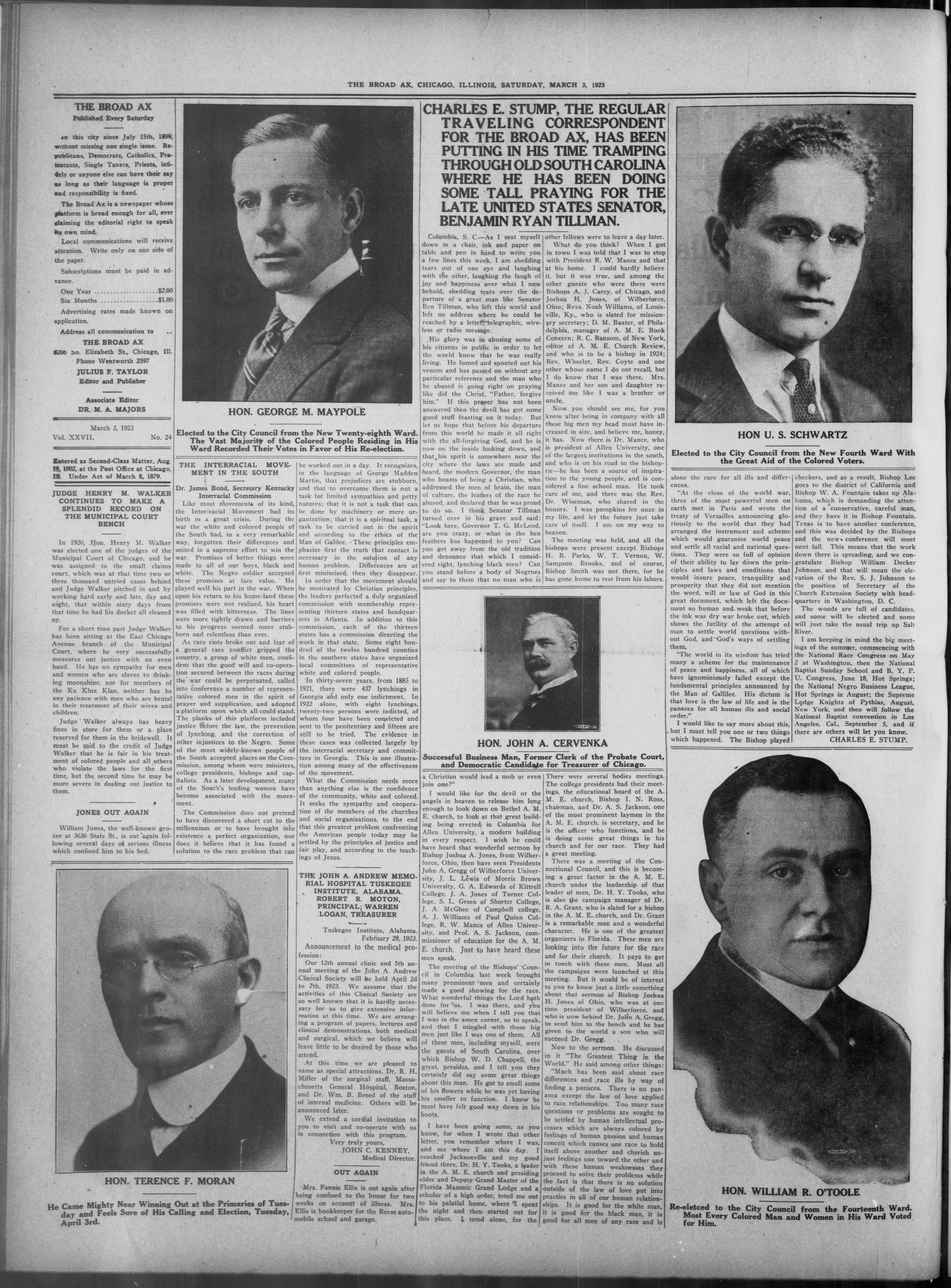
He Came Mighty Near Winning Out at the Primaries of Tuesday and Feels Sure of His Calling and Election, Tuesday, April 3rd.
[Picture of a man in a suit with a tie].
Elected to the City Council from The Vast Majority of the Ward Recorded Their Vote
Elected to the City Council from the New Twenty-eighth Ward. The Vast Majority of the Colored People Residing in His Ward Recorded Their Votes in Favor of His Re-election.
THE INTERRACIAL MOVEMENT IN THE SOUTH
Dr. James Bond, Secretary Kentucky Interacial Commission be worked out in a day. It recognizes in the language of George Madden Martin, that prejudices are stubborn and that to overcome them is not a task for limited sympathies, and petty
Interracial Commission
Like most movements of its kind, the Inter-racial Movement had its birth in a great crisis. During the war the white and colored people of the South had, in a very remarkable way, forgotten their differences and united in a supreme effort to win the war. Promises of better things were made to all of our boys, black and white. The Negro soldier accepted these promises at face value. He played well his part in the war. When upon his return to his home-land these promises were not realized, his heart was filled with bitterness. The lines were more tightly drawn and barriers to his progress seemed more stubborn and relentless than ever.
As race riots broke out and fear of a general race conflict gripped the country, a group of white men, confident that the good will and co-operation secured between the races during the war could be perpetuated, called into conference a number of representative colored men in the spirit of prayer and supplication, and adopted a platform upon which all could stand. The planks of this platform included justice before the law, the prevention of lynching, and the correction of other injustices to the Negro. Some of the most widely-known people of the South accepted places on the Commission, among whom were ministers, college presidents, bishops and capitalists. As a later development, many of the South's leading women have become associated with the movement.
The Commission does not pretend to have discovered a short cut to the millennium or to have brought into existence a perfect organization, nor does it believe that it has found a solution to the race problem that can
THE NEW YORK TIMES
Out at the Primaries of Tues- calling and Election, Tuesday,
HON. GEORGE M. MAYPOLE
be worked out in a day. It recognizes, in the language of George Madden Martin, that prejudices are stubborn, and that to overcome them is not a task for limited sympathies and petty natures; that it is not a task that can be done by machinery or mere organization; that it is a spiritual task, a task to be carried out in the spirit and according to the ethics of the Man of Galilee. These principles emphasize first the truth that contact is necessary in the solution of any human problem. Differences are at first minimized, then they disappear. In order that the movement should be motivated by Christian principles, the leaders perfected a duly organized commission with membership representing thirteen states and headquarters in Atlanta. In addition to this commission, each of the thirteen states has a commission directing the work in that state. Some eight hundred of the twelve hundred counties in the southern states have organized local committees of representative white and colored people.
In thirty-seven years, from 1885 to 1921, there were 437 lynchings in Georgia and only one indictment. In 1922 alone, with eight lynchings, twenty-two persons were indicted, of whom four have been convicted and sent to the penitentiary and fifteen are still to be tried. The evidence in these cases was collected largely by the interracial secretary and committees in Georgia. This is one illustration among many of the effectiveness of the movement.
What the Commission needs more than anything else is the confidence of the community, white and colored. It seeks the sympathy and cooperation of the members of the churches and social organizations, to the end that this greatest problem confronting the American people today may be settled by the principles of justice and fair play, and according to the teachings of Jesus.
THE JOHN A. ANDREW MEMO
RIAL HOSPITAL TUSKEGEE
INSTITUTE, ALABAMA.
ROBERT R. MOTON,
PRINCIPAL; WARREN
LOGAN, TREASURER
Tuskegee Institute, Alabama February 28, 1923 Announcement to the medical profession:
Our 12th annual clinic and 5th annual meeting of the John A. Andrew Clinical Society will be held April 2d to 7th, 1923. We assume that the activities of this Clinical Society are so well known that it is hardly necessary for us to give extensive information at this time. We are arranging a program of papers, lectures and clinical demonstrations, both medical and surgical, which we believe will leave little to be desired by those who attend.
At this time we are pleased to name as special attractions, Dr. R. H. Miller of the surgical staff, Massachusetts General Hospital, Boston, and Dr. Wm. B. Breed of the staff of internal medicine. Others will be announced later.
We extend a cordial invitation to you to visit and co-operate with us in connection with this program.
OUT AGAIN
Mrs. Fannie Ellis is out again after being confined to the house for two weeks on account of illness. Mrs. Ellis is bookkeeper for the Reese automobile school and garage.
THE BROAD AX. CHICAGO. ILLINOIS. SATURDAY. MARCH 3. 1923
CHARLES E. STUMP, THE REGULAR TRAVELING CORRESPONDENT FOR THE BROAD AX, HAS BEEN PUTTING IN HIS TIME TRAMPING THROUGH OLD SOUTH CAROLINA WHERE HE HAS BEEN DOING SOME TALL PRAYING FOR THE LATE UNITED STATES SENATOR, BENJAMIN RYAN TILLMAN.
Columbia, S. C.-As I seat myself down in a chair, ink and paper on table and pen in hand to write you a few lines this week. I am shedding tears out of one eye and laughing with the other, laughing the laugh of joy and happiness over what I now behold, shedding tears over the departure of a great man like Senator Ben Tillman, who left this world and left no address where he could be reached by a letter, telegraphic, wireless or radio message.
His glory was in abusing some of his citizens in public in order to let the world know that he was really living. He fumed and spouted out his venom and has passed on without any particular reference and the man who he abused is going right on praying like did the Christ, "Father, forgive him." If this prayer has not been answered then the devil has got some good stuff feasting on it today. But let us hope that before his departure from this world he made it all right with the all-forgiving God, and he is now on the inside looking down, and that his spirit is somewhere near the city where the laws are made and heard, the modern Governor, the man who boasts of being a Christian, who addressed the men of brain, the man of culture, the leaders of the race he abused, and declared that he was proud to do so. I think Senator Tillman turned over in his grave and said: "Look here, Governor T. G. McLeod, are you crazy, or what in the hen feathers has happened to you? Can you get away from the old tradition and denounce that which I considered right, lynching black men? Can you stand before a body of Negroes and say to them that no man who is
HON. JOHN A. CERVENKA
a Christian would lead a mob or even join one?"
I would like for the devil or the angels in heaven to release him long enough to look down on Bethel A. M. E. church, to look at that great building being erected in Columbia for Allen University, a modern building in every respect. I wish he could have heard that wonderful sermon by Bishop Joshua A. Jones, from Wilberforce, Ohio, then have seen Presidents John A. Gregg of Wilberforce University, J. L. Lewis of Morris Brown University, G. A. Edwards of Kittrell College, J. A. Jones of Turner College, S. L. Green of Shorter College, J. A. McGhee of Campbell college, A. J. Williams of Paul Quinn College, R. W. Mance of Allen University, and Prof. A. S. Jackson, commissioner of education for the A. M. E. church. Just to have heard these men speak.
The meeting of the Bishops' Council in Columbia last week brought many prominent men and certainly made a good showing for the race. What wonderful things the Lord hath done for us. I was there, and you will believe me when I tell you that I was in the amen corner, so to speak, and that I mingled with those big men just like I was one of them. All of these men, including myself, were the guests of South Carolina, over which Bishop W. D. Chappell, the great, presides, and I tell you they certainly did say some great things about this man. He got to smell some of his flowers while he was yet having his smaller to function. I know he must have felt good way down in his boots.
I have been going some, as you know, for when I wrote that other letter, you remember where I was, and see where I am this day. I reached Jacksonville and my good friend there, Dr. H. Y. Tooks, a leader in the A. M. E. church and presiding elder and Deputy Grand Master of the Florida Masonic Grand Lodge and a scholar of a high order, toted me out to his palatial home, where I spent the night and then started out for this place. I toted alone, for the
other fellows were to leave a day later.
What do you think? When I got in town I was told that I was to stop with President R. W. Mance and that at his home. I could hardly believe it, but it was true, and among the other guests who were there were Bishops A. J. Carey, of Chicago, and Joshua H. Jones, of Wilberforce, Ohio; Ohio, Noah Williams, of Louisville, Ky., who is slated for missionary secretary; D. M. Baxter, of Philadelphia, manager of A. M. E. Book Concern; R. C. Ransom, of New York, editor of A. M. E. Church Review, and who is to be a bishop in 1924; Rev. Wheeler, Rev. Coyte and one other whose name I do not recall, but I do know that I was there. Mrs. Mance and her son and daughter received me like I was a brother or orcle.
Now you should see me, for you know after being in company with all these big men my head must have increased in size, and believe me, honey, it has. Now there is Dr. Mance, who is president of Allen University, one of the largest institutions in the south, and who is on his road to the bishopric—he has been a source of inspiration to the young people, and is considered a fine school man. He took care of me, and there was the Rev. Dr. Wiseman, who shared in the honors. I was pumpkins for once in my life, and let the future just take care of itself. I am on my way to heaven.
The meeting was held, and all the bishops were present except Bishops H. B. Parks, W. T. Vernon, W. Sampson Brooks, and of course, Bishop Smith was not there, for he has gone home to rest from his labors.
There were several bodies meetings. The college presidents had their meetings, the educational board of the A. M. E. church, Bishop I. N. Ross, chairman, and Dr. A. S. Jackson, one of the most prominent laymen in the A. M. E. church, is secretary, and he is the officer who functions, and he is doing some great things in his church and for our race. They had a great meeting.
There was a meeting of the Connec-
tional Council, and this is becom-
ing a great factor in the A. M. E.
church under the leadership of that
leader of men, Dr. H. Y. Tooks, who
is also the campaign manager of Dr.
R. A. Grant, who is slated for a bishop
in the A. M. E. church, and Dr. Grant
is a remarkable man and a wonderful
character. He is one of the greatest
organizers in Florida. These men are
looking into the future for the race
and for their church. It pays to get
in touch with these men. Most all
the campaigns were launched at this
meeting. But it would be of interest
to you to know just a little something
about that sermon of Bishop Joshua
H. Jones of Ohio, who was at one
time president of Wilberforce, and
who is now behind Dr. John A. Gregg,
to send him to the bench and he has
given to the world a son who will
succeed Dr. Gregg.
Now to the sermon. He discussed in it "The Greatest Thing in the World." He said among other things: "Much has been said about race differences and race ills by way of finding a panacea. There is no panacea except the law of love applied to race relationships. Too many race questions or problems are sought to be settled by human intellectual processes which are always colored by feelings of human passion and human conceit which causes one race to hold itself above another and cherish unjust feelings one toward the other and with these human weaknesses they proceed to solve their problems while the fact is that there is no solution outside of the law of love put into practice in all of our human relationships. It is good for the white man, it is good for the black man, it is good for all men of any race and is
HON U. S. SCHWARTZ
alone the cure for all ills and differences.
"At the close of the world war, three of the most powerful men on earth met in Paris and wrote the treaty of Versailles announcing gloriously to the world that they had arranged the instrument and scheme which would guarantee world peace and settle all racial and national questions. They were so full of opinion of their ability to lay down the principles and laws and conditions that would insure peace, tranquility and prosperity that they did not mention the word, will or law of God in this great document, which left the document so human and weak that before the ink was dry war broke out, which shows the futility of the attempt of man to settle world questions without God, and God's ways of settling them.
"The world in its wisdom has tried many a scheme for the maintenance of peace and happiness, all of which have ignominiously failed except the fundamental principles announced by the Man of Gallilee. His dictum is that love is the law of life and is the panacea for all human ills and social order."
I would like to say more about this, but I must tell you one or two things which happened. The Bishop played
1920
191
191
HON. WILLIAM R. O'TOOLE
Re-eletced to the City Council from the Four Most Every Colored Man and Women in His for Him.
to the City Council from the Four
ry Colored Man and Women in His
Re-eleeted to the City Council from the Fourteenth Ward. Most Every Colored Man and Women in His Ward Voted for Him.
checkers, and as a result, Bishop Lee goes to the district of California and Bishop W. A. Fountain takes up Alabama, which is demanding the attention of a conservative, careful man, and they have it in Bishop Fountain. Texas is to have another conference, and this was decided by the Bishops and the new conference will meet next fall. This means that the work down there is spreading, and we congratulate Bishop William Decker Johnson, and that will mean the elevation of the Rev. S. J. Johnson to the position of Secretary of the Church Extension Society with headquarters in Washington, D. C. The woods are full of candidates, and some will be elected and some will just take the usual trip up Salt River.
I am keeping in mind the big meetings of the summer, commencing with the National Race Congress on May 2 at Washington, then the National Baptist Sunday School and B. Y. P. U. Congress, June 18, Hot Springs, the National Negro Business League, Hot Springs in August; the Supreme Lodge Knights of Pythias, August, New York, and then will follow the National Baptist convention in Los Angeles, Cal., September 5, and if there are others will let you know. CHARLES E. STUMP.
191
al from the Fourteenth Ward. and Women in His Ward Voted
BOOK CHAT, BY MARY WHITE OVINGTON, CHAIRMAN, BOARD OF DIRECTORS OF THE NATIONAL ASSOCIATION FOR THE ADVANCEMENT OF COLORED PEOPLE.
"PINEY WOODS AND ITS STORY."
By Lawrence C. Jones. Published by The Fleming H. Revell Co., New York City. Price $1.50. Postage 10c extra.
This story follows along the line of a series of autobiographies, headed by the world-famous, "Up From Slavery." It recites the early struggles of an ambitious colored youth for an education and his later success in building up, by slow degrees, a colored school. With Edwards of Alabama, with Holzclaw of Mississippi. Lawrence Jones of Piney Woods has made a very acceptable, interesting story of his life and work.
Mr. Jones' childhood was not one of great privations, but you early see the boy's tenacity of purpose, his determination to put through any job that he undertakes. Among the pictures you have is that of a little boy, going on his newspaper route and finding at its end that a hole in his pocket has left him penniless. It is night, there is a church, festival which he has expected to attend where he will be warm and merry and well fed. But the lost pennies, nickles and dimes must be found. So, borrowing a lantern, he spends hour after hour retracing his route and picking up one of the lost money but fifty-five cents. He goes to bed hungry and cold, but with strengthened will. This will carries him through high school and college where he works his way, and brings him at last to the pinelands of Mississippi, there to start a rural school.
Lawrence Jones was not a southerner going back to the people of his childhood. He was an Iowan, accustomed to the free life of the West, to comradeship with white boys, to that unconscious fellowship that is the kind worth having. He might have made a success in many lines in the North, but the spirit of the pioneer was upon him and he turned to where he felt his people most needed him. His university was Mark Hopkins'—log with a teacher on one end and a scholar on the other. His school began literally this way, out of doors, on logs under trees. Noth-
HAMPTON STUDENTS PRESENT WIDE RANGE OF NEGRO MUSIC
R. Nathaniel Dett Conducts Glee Club and Plays Original Compositions Before Large Audience in Richmond City Auditorium
Richmond, Va.—The Hampton Institute Glee Club of 26 men, with R. Nathaniel Dett, well-known Negro composer and pianist, serving as conductor, recently gave a concert of religious classics, American Negro folksongs and their derivatives, and modern compositions, including the work of such Negro composers as Colebridge-Taylor, Work and Johnson, in the Richmond City Auditorium under the auspices of the Delvers and Big Fifty Clubs of Richmond. The Hampton musicians and singers were given a hearty reception by a large and representative audience. The program follows:
(1) Religious classics: Beside the Manger (ancient carol), Sanctus (Schubert), and From Thy Throne (Gluck), by Hampton Institute Glee Club.
(2) Piano solo, Gavotte in B Minor (Bach), by Gerald B. Wilson.
(3) American Negro Folksongs: Let Us Cheer the Weary Traveler, Daniel Saw the Stone, 'Tis Me, and
Bernard Hume
Midland
HON. JOSEPH O. KOSTNER Re-elected to the City Council from the New Thirty-fourth Ward.
Program
ing could discourage him, and so one building came, and, later, others. Jealousy, that most serious defect in the Negro race, came too, but the majority in the community stood by him, the children flocked to be taught, and the Piney Woods School took its place among the group of noble institutions that have been built, despite discouragement and opposition, despite prejudice and ignorance that would down all but the bravest. The battle-field shows no bravery greater than that of the pioneers in Negro education in the South.
One wishes that a volume like this did not have to be so frankly commercial, so given over to the idea of getting money for Piney Woods. Its optimism, and this is true of all the biographies of which I have spoken, is sometimes forced, and its recital of the names of the board of trustees, of the curriculum and of the successful graduates, is decided in artistic. These books begin so naturally but end like a Saturday Evening Post story, not with an eye to reality but with an eye to the advertisements. To get folk to spend money on anything we must get them in good humor with themselves and the world. Thus Mr. Jones spoils the great moment in the book when he is taken by a mob to be lynched. Instead of giving the story in detail, as he can, he slurs over it, leaving you with the feeling that to have been thrown on a pile of logs, under a tree on which you were to be hung, was a mere unpleasant incident, the important fact being that the mob grew kinder under your oratory and let you off with a collection. He puts this story in the chapter entitled "Messages of Hope." In the same way he says little regarding the shocking lack of public education for the colored children of his state, reminding us again and again of his good white friends. Well, perhaps it's only because we refuse to see life as it really is that we are able to live it at all. There is no such frightful, un-American pessimism as this in "Piney Woods," but a strong faith in God and country coupled with a firm determination to put this faith into a life of daily, active service.
Balm in Gilead, by Hampton Institute Glee Club.
(4) American Negro Folksong Derivatives (Dett): Piano solo, Dance of Desire from "Enchantment" suite (theme based on a Negro melody), by R. Nathaniel Dett, and vocal solos, Zion Nallelujah, Poor Me, and I'm So Glad Trouble Don't Last Alway, by Aubrey W. Pankey, with R. Nathaniel Dett at the piano.
(5) Reading: Between Two Loves (Daly), by Luther T. Purvis.
(6) Modern Compositions: Bedouin Song (Foote) and Old King Cole (Forsythe), and group by Negro composers: Drake's Drum (Coleridge-Taylor), Lullaby (Work), National Negro Anthem (Johnson), and Oh, Hampton (anonymous), by Hampton Institute Glee Club.
R. Nathaniel Dett also played, as special numbers, some of his original compositions. Hampton Institute students sang the solo parts in the American Negro folk songs.
EXPECTED IN CITY
Rev. A. R. Dobbins, pastor of one of the largest churches in St. Louis, Mo., is expected to be in the city to assist in the dedication of New Bethel Church. While here, he will be the guest of his cousins, Mme. Annette White and Mrs. Fanny, Henry, 4427 Prairie Ave.
THE BROAD AX, CHICAGO, ILLINOIS, SATURDAY, MARCH 3, 1923
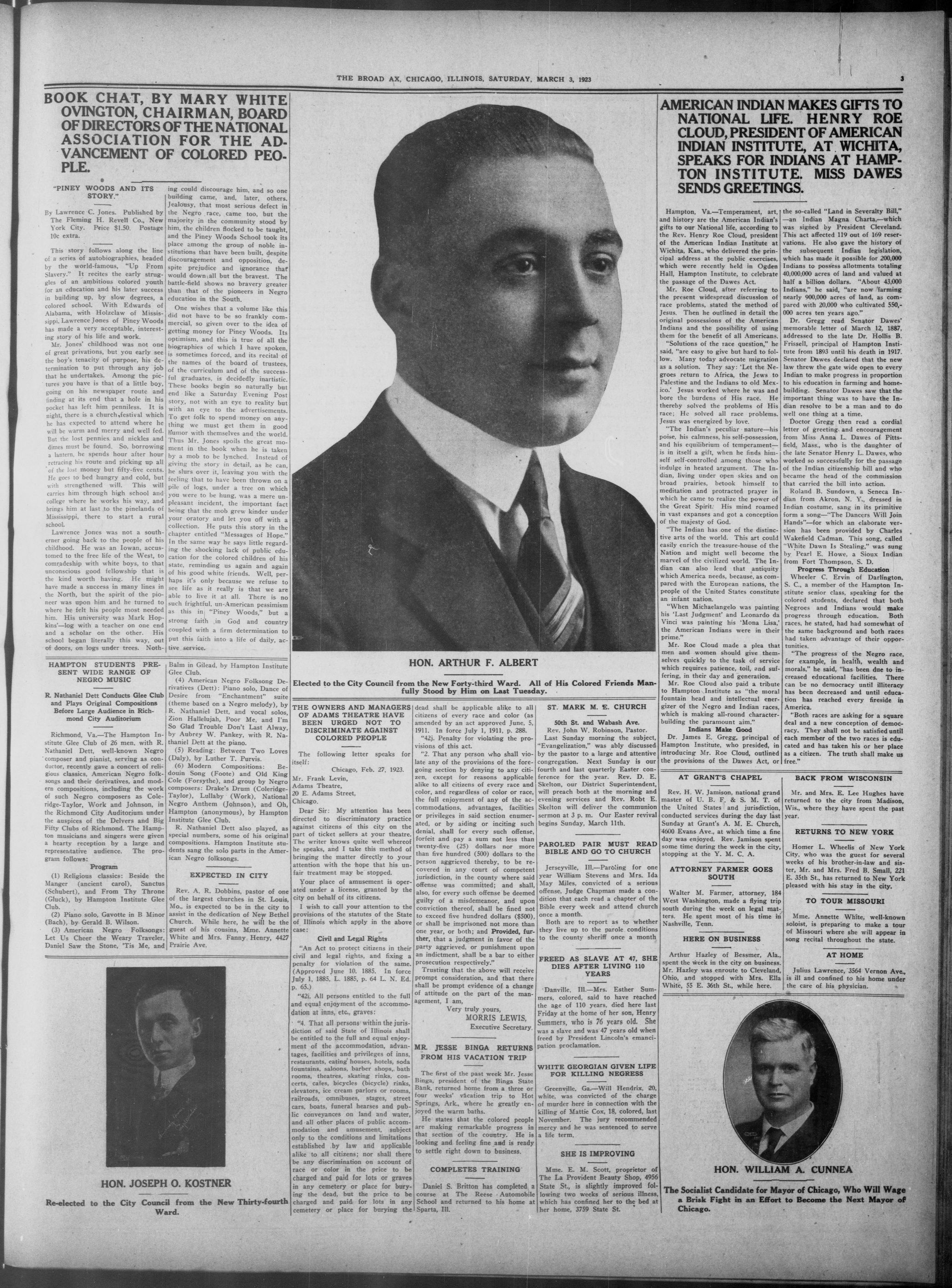
Elected to the City Council from the New Forty-third Ward. All of His Colored Friends Man- fully Stood by Him on Last Tuesday.
THE OWNERS AND MANAGERS OF ADAMS THEATRE HAVE BEEN URGED NOT TO DISCRIMINATE AGAINST COLORED PEOPLE
The following letter speaks for itself:
dead shall be applicable alike to all citizens of every race and color (as amended by an act approved June, 5, 1911. In force July 1, 1911, p. 288. "42]. Penalty for violating the provisions of this act.
"2. That any person who shall violate any of the provisions of the fore-
ST. MARK M. E. CHURCH
50th St. and Wabash Ave. Rev. John W. Robinson, Pastor. Last Sunday morning the subject, "Evangelization," was ably discussed by the pastor to a large and attentive congregation. Next Sunday is our
Chicago, Feb. 27, 1923.
Dear Sir: My attention has been directed to discriminatory practice against citizens of this city on the part of ticket sellers at your theatre. The writer knows quite well whereof he speaks, and I take this method of bringing the matter directly to your attention with the hope that his unfair treatment may be stopped.
Your place of amusement is operated under a license, granted by the city on behalf of its citizens.
I wish to call your attention to the provisions of the statutes of the State of Illinois which apply in the above
Civil and Legal Rights
"An Act to protect citizens in their civil and legal rights, and fixing a penalty for violation of the same. (Approved June 10, 1885. In force July 1, 1885, L. 1885, p. 64 L. N. Ed. p. 65.) "42i. All persons entitled to the full and equal enjoyment of the accommodation at inns, etc., graves:
"4. That all persons within the jurisdiction of said State of Illinois shall be entitled to the full and equal enjoyment of the accommodation, advantages, facilities and privileges of inns, restaurants, eating houses, hotels, soda fountains, saloons, barber shops, bath rooms, theatres, skating rinks, concerts, cafes, bicycles (bicycle) rinks, elevators, ice cream parlors or rooms, railroads, omnibuses, stages, street cars, boats, funeral hearses and public conveyances on land and water, and all other places of public accommodation and amusement, subject only to the conditions and limitations established by law and applicable alike to all citizens; nor shall there be any discrimination on account of race or color in the price to be charged and paid for lots or graves in any cemetery or place for burying the dead, but the price to be charged and paid for lots in any cemetery or place for burying the
HON. ARTHUR F. ALBERT
from the New Forty-third Ward. All
ally Stood by Him on Last Tuesday
S dead shall be applicable alike to all
citizens of every race and color (as
amended by an act approved June, 5,
1911. In force July 1, 1911, p. 288.
"42]. Penalty for violating the pro-
visions of this act.
"2. That any person who shall violate any of the provisions of the foregoing section by denying to any citizen, except for reasons applicable alike to all citizens of every race and color, and regardless of color or race, the full enjoyment of any of the accommodations, advantages, facilities or privileges in said section enumerated, or by aiding or inciting such denial, shall for every such offense, forfeit and pay a sum not less than twenty-five (25) dollars nor more than five hundred (500) dollars to the person aggrieved thereby, to be recovered in any court of competent jurisdiction, in the county where said offense was committed; and shall also, for every such offense be deemed guilty of a misdeanor, and upon conviction thereof, shall be fined not to exceed five hundred dollars ($500) or shall be imprisoned not more than one year, or both; and Provided, further, that a judgment in favor of the party aggrieved, or punishment upon an indictment, shall be a bar to either prosecution respectively."
Trusting that the above will receive prompt consideration, and that there shall be prompt evidence of a change of attitude on the part of the management, I am, Very truly yours.
MR. JESSE BINGA RETURNS
FROM HIS VACATION TRIP
The first of the past week Mr. Jesse Binga, president of the Binga State Bank, returned home from a three or four weeks' vacation trip to Hot Springs, Ark, where he greatly enjoyed the warm baths.
He states that the colored people are making remarkable progress in that section of the country. He is looking and feeling fine and is ready to settle right down to business.
COMPLETES TRAINING
Daniel S. Britton has completed a course at The Reese Automobile School and returned to his home at Sparta, Ill.
ST. MARK M. E. CHURCH
50th St. and Wabash Ave.
Rev. John W. Robinson, Pastor.
Last Sunday morning the subject,
"Evangelization," was ably discussed
by the pastor to a large and attentive
congregation. Next Sunday is our
fourth and last quarterly Easter
conference for the year. Rev. D. E.
Skelton, our District Superintendent,
will preach both at the morning and
evening services and Rev. Robt E
Skelton will deliver the communion
sermon at 3 p. m. Our Easter revival
begins Sunday, March 11th.
PAROLED PAIR MUST READ
BIBLE AND GO TO CHURCH
Jerseyville, Ill.-Paroling for one year William Stevens and Mrs. Ida May Miles, convicted of a serious offense, Judge Chapman made a condition that each read a chapter of the Bible every week and attend church once a month. Both are to report as to whether they live up to the parole conditions to the county sheriff once a month
FREED AS SLAVE AT 47, SHE DIES AFTER LIVING 110 YEARS
Danville, Ill.-Mrs. Esther Summers, colored, said to have reached the age of 110 years, died here last Friday at the home of her son, Henry Summers, who is 76 years old. She was a slave and was 47 years old when freed by President Lincoln's emancipation proclamation.
WHITE GEORGIAN GIVEN LIFE
FOR KILLING NEGRESS
Greenville, Ga.—Will Hendrix, 20, white, was convicted of the charge of murder here in connection with the killing of Mattie Cox, 18, colored, last November. The jury recommended mercy and he was sentenced to serve a life term.
SHE IS IMPROVING
Mme. E. M. Scott, proprietor of The La Provident Beauty Shop, 4956 State St., is slightly improved following two weeks of serious illness, which has confined her to the bed at her home, 3759 State St.
AMERICAN INDIAN MAKES GIFTS TO NATIONAL LIFE. HENRY ROE CLOUD, PRESIDENT OF AMERICAN INDIAN INSTITUTE, AT WICHITA, SPEAKS FOR INDIANS AT HAMPTON INSTITUTE. MISS DAWES SENDS GREETINGS.
Hampton, Va.—Temperament, art, and history are the American Indian's gifts to our National life, according to the Rev. Henry Roe Cloud, president of the American Indian Institute at Wichita, Kan., who delivered the principal address at the public exercises, which were recently held in Ogden Hall, Hampton Institute, to celebrate the passage of the Dawes Act.
Mr. Roe Cloud, after referring to the present widespread discussion of race problems, stated the method of Jesus. Then he outlined in detail the original possessions of the American Indians and the possibility of using them for the benefit of all Americans. "Solutions of the race question," he said, "are easy to give but hard to follow. Many today advocate migration as a solution. They say: 'Let the Negroes return to Africa, the Jews to Palestine and the Indians to old Mexico.' Jesus worked where he was and bore the burdens of His race. He thereby solved the problems of His race; He solved all race problems. Jesus was energized by love.
"The Indian's peculiar nature—his poise, his calmness, his self-possession, and his equilibrium of temperament—is in itself a gift, when he finds himself self-controlled among those who indulge in heated argument. The Indian, living under open skies and on broad prairies, betook himself to meditation and protracted prayer in which he came to realize the power of the Great Spirit: His mind roamed in vast expanses and got a conception of the majesty of God.
"The Indian has one of the distinctive arts of the world. This art could easily enrich the treasure-house of the Nation and might well become the marvel of the civilized world. The Indian can also lend that antiquity which America needs, because, as compared with the European nations, the people of the United States constitute an infant nation.
"When Michaelangelelo was painting his 'Last Judgment' and Leonardo da Vinci was painting his 'Mona Lisa', the American Indians were in their prime."
Mr. Roe Cloud made a plea that men and women should give themselves quickly to the task of service which requires patience, toil, and suffering, in their day and generation.
Mr. Roe Cloud also paid a tribute to Hampton Institute as "the moral fountain head and intellectual energizer of the Negro and Indian races, which is making all-round character-building the paramount aim."
**Indians Make Good**
Dr. James E. Gregg, principal of Hampton Institute, who presided, in introducing Mr. Roe Cloud, outlined the provisions of the Dawes Act, or
AT GRANT'S CHAPEL
Rev. H. W. Jamison, national grand master of U. B. F. & S. M. T. of the United States and jurisdiction, conducted services during the day last Sunday at Grant's A. M. E. Church, 4600 Evans Ave., at which time a fine day was enjoyed. Rev Jamison spent some time during the week in the city, stopping at the Y. M. C. A.
ATTORNEY FARMER GOES
SOUTH
Walter M. Farmer, attorney, 184
Washington, made a flying trip
south during the week on legal m
atters. He spent most of his time in
Nashville. Tenn.
HERE ON BUSINESS
Arthur Hazley of Bessmer, Ala. spent the week in the city on business Mr. Hazley was enroute to Cleveland Ohio, and stopped with Mrs. Ella White, 55 E. 36th St., while here.
HON. WILLIAM A. CUNNEA
The Socialist Candidate for Mayor of Chicago, Who Will Wage a Brisk Fight in an Effort to Become the Next Mayor of Chicago.
the so-called "Land in Severity Bill."
—an Indian Magna Charta, which was signed by President Cleveland. This act affected 119 out of 169 reservations. He also gave the history of the subsequent Indian legislation, which has made it possible for 200,000 Indians to possess allotments totaling 40,000,000 acres of land and valued at half a billion dollars. "About 43,000 Indians," he said, "are now farming nearly 900,000 acres of land, as compared with 20,000 who cultivated 550,000 acres ten years ago."
Dr. Gregg read Senator Dawes' memorable letter of March 12, 1887, addressed to the late Dr. Hollis B. Frissell, principal of Hampton Institute from 1893 until his death in 1917. Senator Dawes declared that the new law threw the gate wide open to every Indian to make progress in proportion to his education in farming and home-building. Senator Dawes saw that the important thing was to have the Indian resolve to be a man and to do well one thing at a time. Doctor Gregg then read a cordial letter of greeting, and encouragement from Miss Anna L. Dawes of Pittsfield, Mass., who is the daughter of the late Senator Henry L. Dawes, who worked so successfully for the passage of the Indian citizenship bill and who became the head of the commission that carried the bill into action.
Roland B. Sundown, a Seneca Indian from Akron, N. Y., dressed in Indian costume, sang in its primitive form a song—"The Dancers Will Join Hands"—for which an elaborate version has been provided by Charles Wakefield Cadman. This song, called "White Dawn Is Stealing," was sung by Pearl E. Howe, a Sioux Indian from Fort Thompson, S. D.
Progress Through Education
Wheeler C. Ervin of Darlington, S. C., a member of the Hampton Institute senior class, speaking for the colored students, declared that both Negroes and Indians would make progress through education. Both races, he stated, had had somewhat of the same background and both races had taken advantage of their opportunities.
"The progress of the Negro race, for example, in health, wealth and morals," he said, "has been due to increased educational facilities. There can be no democracy until illiteracy has been decreased and until education has reached every fireside in America.
"Both races are asking for a square deal and a new conception of democracy. They shall not be satisfied until each member of the two races is educated and has taken his or her place as a citizen. The truth shall make us free."
Mr. and Mrs. E. Lee Hughes have returned to the city from Madison, Wis., where they have spent the past year.
RETURNS TO NEW YORK
Homer L. Wheelis of New York City, who was the guest for several weeks of his brother-in-law and sister, Mr. and Mrs. Fred B. Small, 221 E. 35th St., has returned to New York pleased with his stay in the city.
TO TOUR MISSOURI
Mme. Annette White, well-known soloist, is preparing to make a tour of Missouri where she will appear in song recital throughout the state.
Julius Lawrenee, 3564 Vernon Ave. is ill and confined to his home under the care of his physician.
AT HOME
Be More Beautiful
Remarkable Preparation Makes It Easy For Anyone to Quickly Grow Long, Soft, Silky, Lovely Hair.
A wonderful preparation has been discovered that makes hair into long, low, lovely hair. It puts glowing health into lifeless hair stope dandruff and itching scalp. This our preparation is
EXELENTO QUININE POMO
It has given thousands the beautiful hair which is their chief attractions. It has made straight, silky hair. It is a beautiful and beautiful hair. Another beautiful beauty help is EXELENTO SI QUICKLY removes skin blemishes and clears up in an as if your drugstreet cannot supply you, you send us 80 in Bombs and Bamfistier, ordered 25% for single package have, by getting the EXELENTO preparations NOW
EXELENTO MEDICINE CO AGENTS WANTED EVERYWHERE
on has been discovered that changes
ng, lovely treases. It gives the hair
It puts glowing health into brittle,
ruff and itching scalp. This marvel-
QUININE POMADE
This y credit
the beautiful hair which is one of
it has made straight, silky hair
to obtain.
auty help is EXELENTO SKIN BEAUTIFIER,
mishes and clears up in an astonishing manner
and supply you, send us 50¢ in stamps or coin for fun
or send 25¢ for single package. Gain the attracti
ELENTO preparations NOW!
MEDICINE COMPANY,
VANTED EVERYWHERE—Write f
A wonderful preparation has been discovered that changes short, coarse hair into long, lovely tresses. It gives the hair a beautiful glossy sheen. It puts glowing health into brittle, hairy dandruff and itching scalp. This marvelous preparation is
It has given thousands the beautiful hair which is one of
the most fashionable sections, made straight, silky hair
possible for your hair to cliche.
ELEENTO SKIN BEAUTIFIER, a delightful cream that
rup in an astonishing manner dark, sailow complexions,
and us 564 in stamps or coin for full size packages of both
single package. Gain the attractive beauty, you soon can
cations NOW!
NE COMPANY, Atlanta, Ga.
VERYWHERE- Write for Particulars
Another marvelous beauty help is EXELENTO SKIN BEAUTIFIER, a delightful cream that quickly removes blemishes and clears up any astonishing manner dark, sallow complexions. It is also a great way to enhance your skin's radiance. Pomade and Beautifier, or send 25% for single package. Gain the attractive beauty, you soon can have, by getting the EXELENTO preparations NOW!
EXELENTO MEDICINE COMPANY, Atlanta, Ga.
AGENTS WANTED EVERYWHERE—Write for Particulars
French Revolutionary Leader.
French Revolutionary Leader
Georges Jacques Danton (1759-1794) was one of the leaders of the French Revolution and foremost in organizing and conducting the attack on the Tulleries, and bringing, together with Robespière, royalty to the scaffold. He afterward was condemned by the revolutionary tribunal as an accomplice in a conspiracy for the restoration of the monarchy and was executed.
Measurement Almost Perfect.
Electric pyrometry, as the measurement of temperature by electric means is called, has been so far perfected that it is applicable from near the absolute zero—about 150 degrees Fahrenheit below the ordinary zero—to the temperature of melting platinum, more than 3,000 degrees above zero.
OFFICE TELEPHONE
J. GRAY
Attorney-a
204 East 35th
Chicago
OFFICE TELEPHONE DOUGLAS 6351
J. GRAY LUCAS
Attorney-at-Law
204 East 35th Street
Chicago
OFFICE TELEPHONE DOUGLAS 6351
J. GRAY LUCAS
Attorney-at-Law
204 East 35th Street
Chicago
Corner Indiana Ave., Second Floor
Res., 3646 Grand Boul. Tel. Douglas 4397
Phone Yard
FURNITURE
Brass and Wood Beds,
Refrigerators, Stov
Hardware, I
HENRY ST
2515-19 ARCH
Phone Yards 27
FURNITURE
and Wood Beds, Electric W
refrigerators, Stoves, Paint,
Hardware, Linoleum
HENRY STUCKA
2515-19 ARCHER AVE.
one Yards 27
NITURE
d Beds, Electric Washers,
s, Stoves, Paint, Oil,
ware, Linoleum
STUCKART
9 ARCHER AVE.
Phone Yards 27
FURNITURE
Brass and Wood Beds, Electric Washers,
Refrigerators, Stoves, Paint, Oil,
Hardware, Linoleum
HENRY STUCKART
2515-19 ARCHER AVE.
TELEPHONE DOUGLAS 1
GEORGE F. HA
GE F. HARDIN
GE F. HARDING, JR. REAL ESTATE
Up-to-Date or Modern
and Stores
3101 COTTAGE
Corner 31st St
Statement
of
Loans and
(Inspected
our Bonds
Stocks
(Lincoln)
Date or Modern Houses, A
and Stores to Rent
COTTAGE GROVE
Corner 31st Street, Chicago
RESOURCES
Loans and Discounts.....$
(Inspected and approved by
our Board of Directors.)
Bonds and Securities.....
Stocks.....
(Lincoln State Safety
Vaults Co.)
Bank Building and Annex.
Furniture and Fixtures.
Other Resources
Cash on Hand and Due from
Banks
Total.....$
LIABILITIES
Capital Stock.....$
Surplus
Undrived Profits.....
Reserved for Taxes and Inter-
est
Other Liabilities.....
Deposits
Total.....$
Modern Houses, Apartments
Stores to Rent
AGE GROVE AVE.
1st. Street, Chicago
RESOURCES
Loans and Discounts..... $1,485,987.70
(Impeared and approved by
our Board of Directors.)
Bonds and Securities..... 911,614.86
Stocks..... 11,000.00
(Lincoln State Safety
Vaults Co.)
Bank Building and Annex..... 158,369.46
Furniture and Fixtures..... 24,428.29
Other Resources..... 11,745.17
Cash on Hand and Due from
Banks..... 423,013.60
Total..... $2,973,140.08
LIABILITIES
Capital Stock..... $ 300,000.00
Shipline..... 30,000.00
Undrived Profits..... 11,586.61
Reserved for Taxes and In-
terest..... 9,046.94
Other Liabilities..... 10,417.87
Deposits..... 2,613,088.69
Total..... $2,973,140.08
Up-to-Date or Modern Houses, Apartments and Stores to Rent 3101 COTTAGE GROVE AVE. Corner 31st Street, Chicago
At
Close of
Business
on
Other Rescue
Cash on Hire
Banks . . .
Total . . .
Capital Stock
Surplus
Undivided
Reserved
terrest .
Other Liab
Deposits . . .
Total . .
This Bank invites you to avail yourself of its complete facilities.
A
Interest at the rate of 3% is allowed on all saving accounts. Savings Departments open from 9 a.m. to 8 p.m. Saturday.
GEORGE F. LEIBRANDT, President
CHARLES, M.D., New President
GEORGE S. CAMPBELL, Cashier
L. A. DELAURIER, Asst. Cashier
ADDISON E. AVERY, Mgr. Bond Dept.
COLN STATE BANK
OF CHICAGO
State Government Supervision
and South State Streets
Telephone Victory 4500
GEORGE F. LEIBRANDT, President
CHARLES A. WHITE, Vice-President
GEORGE S. CAMPBELL, Cashier
L. A. DELAURIER, Asst. Cashier
ADDISON E. AVERY, Mgr. Bond Dept.
STATE BANK
CHICAGO
Government Supervision
South State Streets
The Victory 4500
LINCOLN ST
OF CHIC
Under State Government
31st and South St
Telephone Victo
Condition
Close of Business
Dec. 29th, 1922
A
Historic Herb House.
It is not widely known, except to the trade, that Madison, Ind., has the largest and perhaps the oldest herb house in the United States, which has existed since 1854. It collects from various parts of the country and distributes to many parts of the world approximately 100 varieties of leaves and roots known in the business as crude drugs.
As It Seemed to Rick
When Dick's uncle was married the second time he came to Dick's home on his honeymoon. Seeing that congratulations were in order, the boy stepped up to his uncle and, extending his hand, said with great earnestness: "Hello, Uncle Frank! You must like to get married awful well, don't you?" —Chicago Tribune.
This young lady gives all the credit for her beautiful hair and complexion to EXELENT preparation.
THE BROAD AX, CHICAGO, ILLINOIS, SATURDAY, MARCH 3, 1923
sing "one dollar upon
regularly and persist-
t the initial deposit,
regular systematic sav-
velops the real spirit
and character.
IS TRUST & SAVING
Salle and Jackson Streets Chicago
F, President PHILIP
Vice-President H. X. COMP
ESTABLISHED 1877
It's piling "one dollar upon another" regularly and persistently-not the initial deposit, but the regular systematic saving that develops the real spirit of thrift and character.
& SAVINGS BANK
in Streets Chicago
PHILIP J. DUNN, Secretary
H. X. COMERFORD, Treasurer
HED 1877
ILLINOIS TRUST & SAVINGS BANK
La Salle and Jackson Streets Chicago
JAS. B. McCAHEY, President PHILIP J. DUNN, Secretary
FRANK J. DUNN, Vice-President H. X. COMERFORD, Treasurer
ESTABLISHED 1877
JOHN J. DUNN
COAL CO.
Telephone Oakland 1550
0 South State Street (Seventh Fl
Opposite Palmer House
Phone Dearborn 5871
HRS. WARNE
eet (Seventh Floor)
Miller House
arborn 5871
WARNER
120 South State Street (Seventh Floor)
Opposite Palmer House
Phone Dearborn 5871
Painless Chiropodist
Experience
CHICAGO
antic 2008
nor Gaines
rano
certs, Recitals, Etc.
18 Years' Experience
Douglas 2616
Phone Atlantic 2008
Is Eleanor Ga
Soprano
available for Concerts, Recitals, I
t Avenue, Apt. 2
PAILEY
Available for Concerts, Recitals, Etc.
M. T. Bailey, president of the Bailey Realty Co., 3638 State St., has spent considerable time during the past ten days lending every possible assistance to the people who are preparing to erect homes in the suburbs, thus relieving the congested condition in the city and reducing the high rents. Mr. Bailey has worked untiringly along this line for the past two years.
Immense Loss Caused by Rust.
Sir Robert Hatfield says the world loses about $2,500,000,000 a year by the rusting and decaying of iron and steel.
French Have Discarded Word.
Encore, while a French word meaning again, and used by English and American audiences, is not employed by the French in the same sense, they saying bis, which means twice.
Immense Loss Caused by Rust.
Sir Robert Hatfield says the world loses about $2,500,000,000 a year by the rusting and decaying of iron and steel.
French Have Discarded Word. Encore, while a French word meaning again, and used by English and American audiences, is not employed by the French in the same sense, they saying bls, which means twice.
Telephone Calumet 805
Ris-Ward Coal
YARDS AT
In Park, I. C. R. R.
Canal Sts., C. B. & Q. R. R.
St St., C. R. I. P. R. R.
Roscoe and Racine Aves., C.
HOTTAGE GROVE AVE., C.
d Coal Co.
S AT
& Q. R. R.
R. R.
Macine Aves., C. M. & St. P. R. R.
VE AVE., CHICAGO
JULIUS F. TAYLOR, Please enter my name as a subscriber to THE BROAD AX. I enclose herewith Two Dollars, the annual subscriptions to same, or One Dollar for six months.
WHAT IS A "SAVINGS ACCOUNT"
It's piling "one dollar
another" regularly and
ently—not the initial
but the regular systema
ing that develops the re
of thrift and character
ILLINOIS TRUST
La Salle and Jackson
JAS. B. McCAHEY, President
FRANK J. DUNN, Vice-President
ESTABLIS
It's piling "one dollar upon another" regularly and persistently—not the initial deposit, but the regular systematic saving that develops the real spirit of thrift and character.
MILLINOIS TRUST & SAVINGS
La Salle and Jackson Street
M. McCAHEY, President
K. J. DUNN, Vice-President
H. X.
ESTABLISHED 189
5100 Federal Street
120 South State St
Opposite P
Phone Des
MRS. W
120 South State Street (Se
Opposite Palmer Hoe
Phone Dearborn 5
MRS. WAR
18 Years'
Residence Phone Douglas 2616
Phone At
Miss Eleanor
Soppe
Available for Com
4005 Calumet Avenue, Ap
Phone Atlantic 20
Miss Eleanor
Soprano
Available for Concerts, R
Calumet Avenue, Apt. 2
4005 Calumet Avenue, Apt. 2
High Civilization in Yucatan. Yucatan is "the Egypt of America." As early as the beginning of the Christian era the people there built stone structures of excellent masonry, true angles and smooth, vertical faces. They had astronomical observatories, an accurate calendar and a better system of numerals than the Romans.
Another Conference Advised.
Another Conference Advised.
“In a family,” said Unde Eben, where de old folks thinks young folks is too far ahead of de times an’ where de young folks thinks de old folks is too fur behind de times, it looks to me like dar ought to be some kind of a conference wif a view to compromise”
—Washington Evening Star.
And the Last Is the Greatest.
Five great intellectual professions have hitherto existed in every civilized nation; the soldier's, to defend it; the pastor's, to teach it; the physician's, to keep it in health; the lawyer's, to enforce justice, and the merchant's to provide, and all these men, on due occasion, to die for it—John Ruskin.
Chas. Krutckoff, Pres.
J. E. Ward, Vice-Pres.
Norris-Ward
YARD
26th St. and South Park, I. C. R. B.
18th and Canal Sts., C. B.
Root St., C. R. I. P.
Roscoe and B.
2556 COTTAGE GRO
Norris-Ward C
YARDS AT
L. and South Park, I. C. R. R.
18th and Canal Sts., C. B. & Q. R.
Root St., C. R. I. P. R. R.
Roscoe and Racine A
2556 COTTAGE GROVE AV
STRENGTH
WARRIOR
CHICAGO
CHICAGO
Chicago, Ill.
Hugh Norris, Treas.
Kirby Ward, Secy.
FUNERAL DIRECTORS
ERNEST H. WILLIAMSON UNDERTAKER
GARAGE
GASOLINE OIL
OPEN DAY & NIGHT
Day Light Chapel, capacity 200, Outside Ventilation—Organ and Organist Free—I am as near as your Telephone—I give service at a reasonable price—Distance immaterial, consult me—I save you wor y, time and money.
PHONE MAIN 2214
A. D. GASH
ATTORNEY AT LAW
118 N. La Salle Street
CHICAGO
Phone Main 2017
A. L. WILLIAMS
ATTORNEY AND
COUNSELOR AT LAW
Suite 706 Firmenich Building
184 W. Washington St.
CHICAGO
Residence 3655 Prairie Ave.
Phone Douglas 9133
Residence, 1262 Macalister Place
Telephone Monroe 2714
MILES J. DEVINE
ATTORNEY AT LAW
Suite 318-320 Reaper Block
Clark and Washington Sts.
CHICAGO
Telephone Central 1239
Notary Public
Phones: Office Main 4153; Residence,
4751 Champlain Avenue
Phone Kenwood 5611
ATTORNEY AND COUNSELOR
AT LAW
Suite 708 - 184 W. Washington St.
CHICAGO
BINGA STATE BANK
Under State Supervision
Capital ..... $100,000.00
Surplus ..... 20,000.00
Offers Equal Service to All
3% INTEREST ON SAVINGS
SAFE DEPOSIT VAULTS
State Street and 36th Place
Under State Supervision
Capital ..... $100,000.00
Surplus ..... 20,000.00
Offers Equal Service to All
3% INTEREST ON SAVINGS
SAFE DEPOSIT VAULTS
State Street and 36th Place
Wanted
Advertising Solicitor
A live or wide awake newspaper man or solicitor can earn some easy money by calling on or addressing the undersigned.
Julius F. Taylor, 6206 S. Elizabeth street. Phone Wentworth 2597.
PHONE KENWOOD 455
West Englewood Trust & Savings Bank
al and Surplus, $500,00
Capital and Surplus, $500,000.00
President Arthur C. Utesch
Vice-Pres. W. Merle Fisher
Cashier and
Carl O. Seberg, Asst. Cashier
Commonwealth Edison Co.
72 W. ADAMS STREET
John Bain, President Arthur C. Utesch, Asst. Cashier Michael Maisel, Vice-Pres. W. Merle Fisher, Asst. Cashier Edw. C. Barry, Cashier and Trust Officer Carl O. Seberg, Asst. Cashier
The Commonwealth Edison Company
72 W. ADAMS STREET
PHONE RANDOLPH 1380
PHONE RANDOLPH 1280
The following Electric Shops carry a full line of Electrical Appliances and sell the Federal Washer on Easy Terms:
Davies Electric Shop,
De Luxe Electric Shop,
2501 N. Keddie Ave.
Burlington, VT 05420
45130 Fulbright Ave.
Legan Lighting Shop,
Manor Electric Ca.,
Manor Electric Ca.
Mid-West Electrical
Service Co.
Patterson Brothers,
Patterson Brothers,
Park Blvd. Park,
Sage Electric Shop,
6717 Olimated Ave.
5521 W. North Ave.
WEST SIDE
Baldaz & Baza,
Baldaz & Bridgeport Electric Co.
Bridgeport Electric Co.
4125 W. 47th St.
Citigroup
4125 W. 28th St.
Citigroup
4125 W. 28th St.
Madison
4125 Madison
Bo Luxe Light Co.
Bo Luxe Light Co.
DyTamblu's Eire, Shop.
529 W. North Ave.
Ford North Ave.
5857 W. Radionion
Garth.
5857 W. Radionion
Garth.
3001 W. Home Electric Co.
Home Electric Co.
5389 W. Chicago Ave
B. Company
5380 W. Chicago Ave.
Laxington Electric Co.,
719 S. Western Ave.
Coliseum Electric Co.,
5502 S. Haited St.
0. S. Dawan,
1031 E. 47th St.
HOME
OUR NEW HOME
72 W. Adams St.
72 W. Adams St.
448 N. Parkside Ave.
448 N. Parkside Ave.
3827 Logan Blvd.
3827 Logan Blvd.
3452 W. Roosevelt Rd.
NORTH SIDE
Attenborough Ave.
2622 N. Clark St.
Broadway Electric Shop,
2151 B. Collins Ave.
2622 N. Clark St.
Fullerton Electric Shop,
1538 N. Clark St.
Kersten Harbart Electric
1448 Wilen Ave.
Lakeview Electric Co.
4214 Lincoln Ave.
O. M. Kline Ave.
3158 N. Clark St.
Morton Ave.
1504 Morse Ave.
North Shore Electric Co.
3158 Pamana Elec. Light Co.
Pamana Elec. Light Co.
Principle Electric Co.
3306 Southport Ave.
3306 Southport Ave.
3506 Lincoln Ave.
Seller's Electric Shop,
Tip Top Elec. Appliances,
Tip Top Elec. Appliances,
383 Irving Park Blvd.
Milton Ave.
4863 Broadway
NORTHWEST
Art Lenn, Novelty & Art Company,
1900 Milwaukee Ave.
CHICAGO
```markdown
```
```markdown
```
OFFICERS
4039 Lincoln Ave.
4730 Irving Park, Bridg
6245 Normal St.
2950 E. 92nd St.
E. 92nd St.
Marks Electric Shop,
220 Madison Ave.
Marks Electric Ave.
3233 W. Madison St.
3233 W. Madison St.
1811 W. 3238 St.
Odenen Electric Shop,
220 Madison St.
Bernard O'Hare,
220 Madison St.
Radiant Electric Co.
3314 W. Chicago Ave.
1187 W. Taylor St.
Richmond Electric Co.
220 Madison St.
Riaka Electric Shop,
220 Madison St.
2724 W. Division St.
3246 W. North Ave.
220 Madison Ave.
1811 Milwaukee St.
SOUTH SIDE
Berry & Co.
Berry & Co.
Electric Store.
Electric Store.
1732 W. 98th St.
W. 98th St.
Briggs Building Fix-
ment
6350 S. Haledst St.
851 S. Haledst St.
8051 S. Haledst St.
4007 Ogden Ave.
18191 Irving Ave.
471112 Ockitane Grove Ave
Electric Washing Machine
6318 Cot. Grove Ave.
t. Ganoo Electric Shop
6219 W. 514 St.
Ganoo Electric Shop
Good Housekeeping Electric Co.,
1414 E. St.
Harper Electric Shop,
469 S. St.
Idlehill Electric Workshop
L. & H. Electric Co.
2509 Archer Ave.
13253 Brandon Ave.
Linden Electric Shop,
7211 W. 47th St.
Neighborhood Shop,
New City Electric Co.
2418 W. 47th St.
7621 S. Haledst St.
Parma Electric Co.
521 W. W. Electric
Quality Electric Shop
7223 Haledst St.
Stone House Electric
3017 W. 63rd St.
Vincentown Electric Shop
6222 Connecans Ave.
A. Wagner.
1222" E. 5808 St.
West Pellman Electric
West Pellman Electric
Winchester Store Elec.
6709 Stone Island Ave.