The Broad Ax
Saturday, April 28, 1923
Chicago, Illinois
Page text (machine-generated)
EXTRA THE BROAD AX EXTRA
HAMPTON STUDENTS SHOW RELA TION OF EDUCATION TO LIFE. THEY SPEAK ON NEGRO PRESS, NEGRO WOMAN OF TODAY, USE OF PRACTICE-HOUSES, GOOD POSTURE, AND OTHER INTERESTING SUBJECTS.
HAMPTON STUDENT
TION OF EDUC
THEY SPEAK O
NEGRO WOMAN
OF PRACTICE
POSTURE, AN
ESTING SUBJE
Hampton, Va.—That Hampton Institute students recognize the relation of education to life and especially to community service was shown at the recent fifty-fifth anniversary celebration, when members of the class of 1923 gave addresses and demonstrations before large audiences of white and colored citizens.
Negro Press in Evolution
That the Negro press is fast growing into a powerful organ, despite the handicap of inadequate financial support, and that it represents the voice of a race that has valuable contributions to make were statements made by S. Miller' Johnson of Thornton, Ark., who spoke on "The Negro Press in Evolution."
This senior at Hampton Institute declared that the Negro press, while it has criticized the so-called enemies of the race, has not resorted to extremes of sensationalism in discussing the race problem. Negro editors have recorded important events and have written informing editorials on problems of current interest. He stated that Negro periodicals, like all other publications, have been handicapped for the want of trained workers. The Negro press, by keeping readers informed on every-day Negro life, has encouraged race pride. S. Miller Johnson said:
"The Negro press is trying to let the world know definitely how the thinking Negro regards life; what he thinks of American policies; what he thinks are the needs of his people and just how far Americans, white and black, should go in providing for the needs of the Negro race. The Negro press is helping to demonstrate to the world that the colored man is essentially and by force a thinking being."
Training Homemakers Better homemakers and homeeconomics teachers have been trained in recent years through the use of practice-houses, according to Estelle M. Jones of Danville, Ky., who described the methods which have been successfully used at Hampton Institute to link up the work in the school dormitories with the needs of colored homemakers. She also described the plans of the new Institute practice-house, which is now being erected by student tradesmen, near the main dormitory for girls, through the generosity of Mrs. Henry A. Strong of Rochester, N. Y.
This practice-house will contain a living-room with an open fireplace, a dining-room, a kitchen, a laundry, four bedrooms, a bathroom, and two halls. There will be a porch across the front of the house and another across the rear. This cottage will be used at one time by five or six girls and a teacher. The furnishings will be useful and simple. Problems of household management, meal preparation, and nutrition will be emphasized. The house planned for an average family with a moderate income.
Negro Woman of Today That the Negro woman of today, like her mother and grandmother, has bigness of heart, faithfulness to duty, and love of justice toward her fellow-people were opinions expressed by Madeleine R. Smith, member of the Hampton Institute class of 1923, who spoke at the closing session of the fifty-fifth anniversary. She outlined the industrial service of Negro women during the World War. She gave these facts: The champion mail sorter of the United States is a colored woman, who beat the record of 20,610 letters distributed in an eight-hour test. The president of the St. Luke's Bank, Richmond, is a colored woman. Washington, D. C., has two colored policewomen. Negro women restored the Frederick Douglass Memorial Home at Cedar Hill, Washington, D. C. Negro women have engaged in social-welfare work and in a campaign against lynching. They teach children thrift.
Good Posture, Good Health
Methods of teaching children how to maintain good posture, so that they will grow up to be erect, fine-looking men and women, rather than stoop-shouldered, narrow-chested, sluggish persons, were demonstrated by Lillie D. Jones of Williamsburg, Va., who emphasized the importance of having children cultivate the good-posture habit as the best guaranty of good health in later life. She also showed
the serious damage that comes to school children by compelling them to use improperly adjusted desks or by allowing them to become careless of posture during their school hours. She described the exercises which individuals may use to strengthen abdominal, upper-back and feet muscles and thereby improve their posture.
Trade Demonstrations
The all-rolok brick houses, which were built extensively in foreign countries in the eighteenth century, are now being built throughout the United States. Lytle Fields of Lexington, Ky., gave a demonstration in laying an ideal all-rolok lead for a wall. This Hampton-trained bricklayer described the American, English, and Flemish bonds. He emphasized the good points of the all-rolok construction, including economy of materials and time.
The construction of a modern storage battery, made up of three two-volt cells, each one of which was equivalent to one-half horsepower, was described by William E. Lee of Louisville, Ky., who also demonstrated how this type of battery was assembled. He explained in detail the reasons for its unique construction.
Music and Food
A member of the Hampton Institute brass band, James E. Newby of Berkley, Va., described the stages by which he, as a busy tradesman, learned how to master the cornet—an "extra-curricular activity," for this was the title of his anniversary address. He emphasized the value of music in bringing together people in rural districts. He expressed gratitude for the opportunity of receiving musical training. A foamy, ham omelet, prepared and served according to the best home-economics instruction, was the demonstration presented by Evelyn M. Collins of Bridgetown, Va. This Hampton-trained girl also demonstrated how much of the drudgery could be taken out of cooking by having housekeepers pay more attention to the careful planning of their work. As she worked she explained the chemical make-up of ordinary hen eggs.
Agricultural Projects
That agriculture in a general way may be profitably used as a medium of self-education and that agricultural projects in particular, such as caring for hens, pigs, and dairy cows, as well as growing farm crops, may be successfully used as the means of relating men and women to the problems of every-day life were opinions expressed by Harrison D. Jacobs of Pittsfield, Mass., who is a candidate for the Hampton Institute degree of bachelor of science in agricultural education.
The student explained in detail the methods which are used at Hampton Institute to teach men how to prepare themselves for service as farm-demonstration agents, teachers of agriculture, and rural-school principals. "It is just as educative," he said, "to read about the culture of the Irish potato, to handle farm machinery, or to detect the various plant diseases, as it is to read history or geography, study spelling, or solve an example in arithmetic. Projects are the true and most effective ways of educating, because not only are the eyes trained to see and the mind to think, but also the hands are trained to do."
COLOR WAR IN LONDON
A troop of American Negro musical comedy artists, has been employed as a feature at the re-opening of London's famous old Music Hall, The Empire. Another manager has just engaged a band of Negro entertainers for a Revue soon to open here. These two items have started a theatrical war which has become so acute that a cabaret in which Negroes were to appear has indefinitely postponed its opening.
The objection comes from the critics and from the English theatrical profession. It has been based, in part, on a dislike of alien invasion of all kinds, but the color issue has been injected in several issues. Some of the critics go so far as to request the Minister of Labor to prevent any further encouragement of colored theatrical men by prohibiting their entry into the country.
THE BROAD AX, CHICAGO ILLINOIS, SATURDAY, APRIL 28, 1923
333
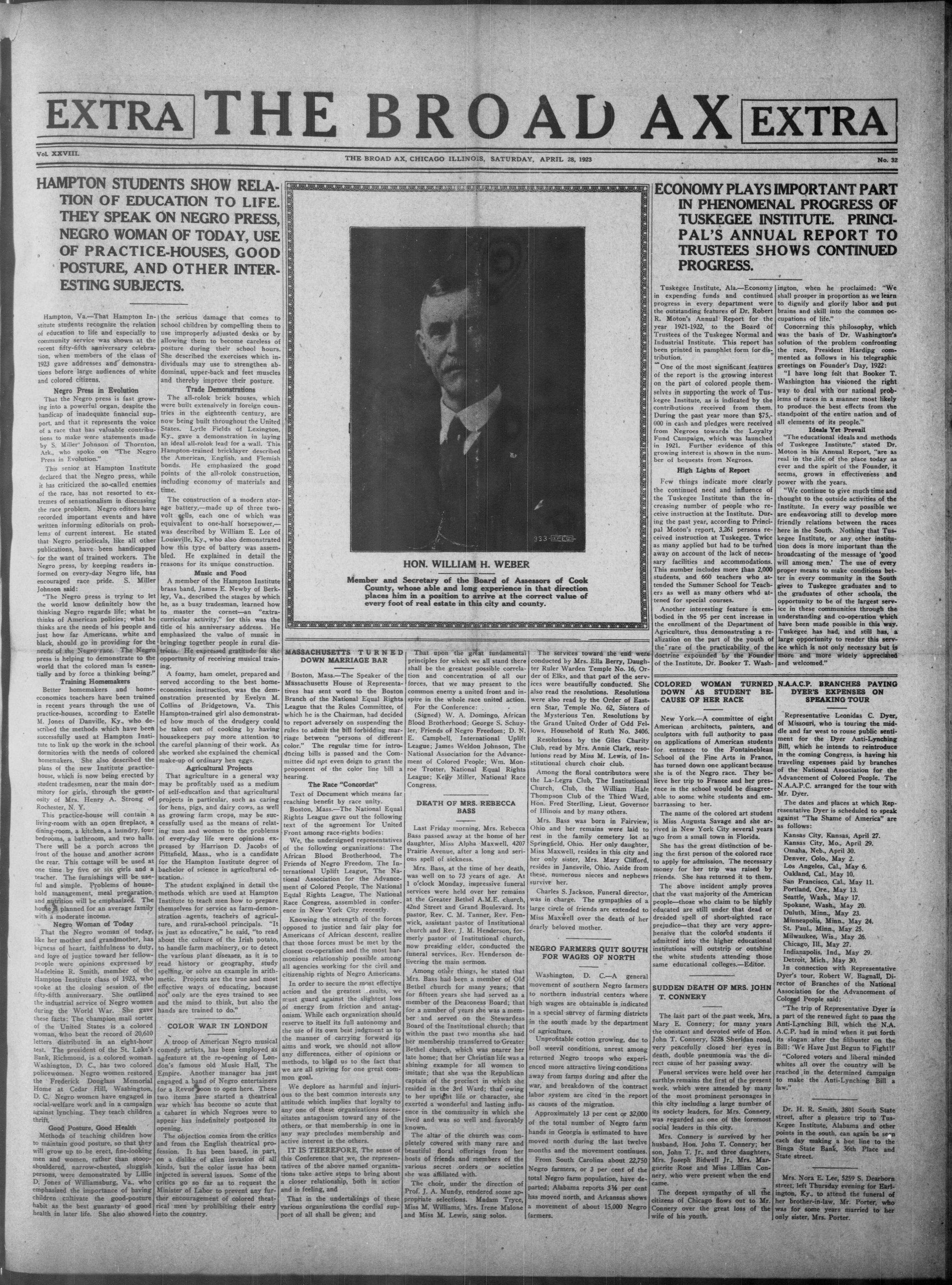
Member and Secretary of the Board of Assessors of Cook County, whose able and long experience in that direction places him in a position to arrive at the correct value of every foot of real estate in this city and county.
MASSACHUSETTS TUR N E D
DOWN MARRIAGE BAR
Boston, Mass.—The Speaker of the Massachusetts House of Representatives has sent word to the Boston Branch of the National Equal Rights League that the Rules Committee, of which he is the Chairman, had decided to report adversely on suspending the rules to admit the bill forbidding marriage between "persons of different color." The regular time for introducing bills is passed and the Committee did not even deign to grant the proponent of the color line bill a hearing.
The Race "Concordat"
Text of Document which means for reaching benefit by race unity. Boston, Mass.-The National Equal Rights League gave out the following text of the agreement for United Front among race-rights bodies: We, the undersigned representatives of the following organizations: The African Blood Brotherhood, The Friends of Negro Freedom, The International Uplift League, The National Association for the Advancement of Colored People, The National Equal Rights League, The National Race Congress, assembled in conference in New York City recently.
Knowing the strength of the forces opposed to justice and fair play for Americans of African descent, realize that those forces must be met by the closest co-operation and the most harmonious relationship possible among all agencies working for the civil and citizenship rights of Negro Americans. In order to secure the most effective action and the greatest results, we must guard against the slightest loss of energy from friction and antagonism. While each organization should reserve to itself its full autonomy and the use of its own best judgment as to the manner of carrying forward its aims and work, we should not allow any differences, either of opinions or methods, to blind us to the fact that we are all striving for one great common goal.
We deplore as harmful and injurious to the best common interests any attitude which implies that loyalty to any one of these organizations necessitates antagonism toward any of the others, or that membership in one in any way precludes membership and active interest in the others.
IT IS THEREFORE, The sense of this Conference that we, the representatives of the above named organizations take active steps to bring about a closer relationship, both in action and in feeling, and That in the undertakings of these various organizations the cordial support of all shall be given; and
HON. WILLIAM H. WEBER
Secretary of the Board of Assis-
whose able and long experience in
m in a position to arrive at the c
t of real estate in this city and cou
That upon the great fundamental
principles for which we all stand there
shall be the greatest possible corolla-
tion and concentration of all our
forces, that we may present to the
common enemy a united front and inspire in the whole race united action.
For the Conference:
(Signed) W. A. Domingo, African Blood Brotherhood; George S. Schuyler, Friends of Negro Freedom; D. N. E. Campbell, International Uplift League; James Weldon Johnson, The National Association for the Advancement of Colored People; Wm. Monroe Trotter, National Equal Rights League; Kelly Miller, National Race Congress.
DEATH OF MRS. REBECCA
BASS
Last Friday morning, Mrs. Rebecca Bass passed away at the home of her daughter, Miss Alpha-Maxwell, 4207 Prairie Avenue, after a long and serious spell of sickness.
Mrs. Bass, at the time of her death, was well on to 73 years of age. At 1 o'clock Monday, impressive funeral services were held over her remains at the Greater Bethel A.M.E. church, 42nd Street and Grand Boulevard. Its pastor, Rev. C. M. Tanner, Rev. Fenwick, assistant pastor of Institutional church and Rev. J. M. Henderson, former pastor of Institutional church, now presiding elder, conducted the funeral services, Rev. Henderson delivering the main sermon.
Among other things, he stated that Mrs. Bass had been a member of Old Bethel church for many years; that for fifteen years she had served as a member of the Deaconess Board; that for a number of years she was a member and served on the Stewardess Board of the Institutional church; that within the past two months she had her membership transferred to Greater Bethel church, which was nearer her late home; that her Christian life was a shining example for all women to imitate; that she was the Republican captain of the precinct in which she resided in the 3rd Ward; that owing to her upright life or character, she exerted a wonderful and lasting influence in the community in which she lived and was so well and favorably known.
The altar of the church was completely covered with many rare and beautiful floral offerings from her hosts of friends and members of the various secret orders or societies she was affiliated with.
The choir, under the direction of Prof. J. A. Mundy, rendered some appropriate selections. Madam Tryce, Miss M. Williams, Mrs. Irene Malone and Miss M. Lewis, sang solos.
---
The services toward the end were conducted by Mrs. Ella Berry, Daughter Ruler Warden Temple No. 16, Order of Elks, and that part of the services were beautifully conducted. She also read the resolutions. Resolutions were also read by the Order of Eastern Star, Temple No. 62, Sisters of the Mysterious Ten. Resolutions by the Grand United Order of Odd Fellows, Household of Ruth No. 3406. Resolutions by the Giles Charity Club, read by Mrs. Annie Clark, resolutions read by Miss M. Lewis, of Institutional church choir club. Among the floral contributors were the La-Legra Club, The Institutional Church, Club, the William Hale Thompson Club of the Third Ward, Hon. Fred Sterling, Lieut. Governor of Illinois and by many others.
Mrs. Bass was born in Fairview, Ohio and her remains were laid to rest in the family cemetery lot at Springfield, Ohio. Her only daughter, Miss Maxwell, resides in this city and her only sister, Mrs. Mary Clifford, resides in Janesville, Ohio. Aside from these, numerous nieces and nephews survive her.
Charles S. Jackson, Funeral director, was in charge. The sympathies of a large circle of friends are extended to Miss Maxwell over the death of her dearly beloved mother.
NEGRO FARMERS QUIT SOUTH
FOR WAGES OF NORTH
Washington, D. C.—A general movement of southern Negro farmers to northern industrial centers where high wages are obtainable is indicated in a special survey of farming districts in the south made by the department of agriculture.
Unprofitable cotton growing, due to boll weevil conditions, unrest among returned Negro troops who experienced more attractive living conditions away from farms during and after the war, and breakdown of the contract labor system are cited in the report as causes of the migration.
Approximately 13 per cent or 32,000 of the total number of Negro farm hands in Georgia is estimated to have moved north during the last twelve months and the movement continues.
From South Carolina about 22,750 Negro farmers, or 3 per cent of the total Negro farm population, have departed; Alabama reports $3 \frac{1}{2}$ per cent has moved north, and Arkansas shows a movement of about 15,000 Negro farmers.
ECONOMY PLAYS IMPORTANT PART IN PHENOMENAL PROGRESS OF TUSKEGEE INSTITUTE. PRINCIPAL'S ANNUAL REPORT TO TRUSTEES SHOWS CONTINUED PROGRESS.
Tuskegee Institute, Ala.—Economy in expending funds and continued progress in every department were the outstanding features of Dr. Robert R. Moton's Annual Report for the year 1921-1922, to the Board of Trustees of the Tuskegee Normal and Industrial Institute. This report has been printed in pamphlet form for distribution.
One of the most significant features of the report is the growing interest on the part of colored people themselves in supporting the work of Tuskegee Institute, as is indicated by the contributions received from them. During the past year more than $75,000 in cash and pledges were received from Negroes towards the Loyalty Fund Campaign, which was launched in 1921. Further evidence of this growing interest is shown in the number of bequests from Negroes.
High Lights of Report
Few things indicate more clearly the continued need and influence of the Tuskegee Institute than the increasing number of people who receive instruction at the Institute. During the past year, according to Principal Moton's report, 3,261 persons received instruction at Tuskegee. Twice as many applied but had to be turned away on account of the lack of necessary facilities and accommodations. This number includes more than 2,000 students, and 660 teachers who attended the Summer School for Teachers as well as many others who attained for special courses.
Another interesting feature is embodied in the 95 per cent increase in the enrollment of the Department of Agriculture, thus demonstrating a realization on the part of the youth of the race of the practicability of the doctrine expounded by the Founder of the Institute Dr. Booker T. Wash
COLORED WOMAN TURNED DOWN AS STUDENT BECAUSE OF HER RACE
New York.—A committee of eight American architects, painters, and sculptors with full authority to pass on applications of American students for entrance to the Fontainebleau School of the Fine Arts in France, has turned down one applicant because she is of the Negro race. They believe her trip to France and her presence in the school would be disagreeable to some white students and embarrassing to her.
The name of the colored art student is Miss Augusta Savage and she arrived in New York City several years ago from a small town in Florida.
She has the great distinction of being the first person of the colored race to apply for admission. The necessary money for her trip was raised by friends. She has returned it to them.
The above incident amply proves that the vast majority of the American people—those who claim to be highly educated are still under that dead or dreaded spell of short-sighted race prejudice—that they are very apprehensive that the colored students if admitted into the higher educational institutions will outstrip or outshine the white students attending those same educational colleges.—Editor.
SUDDEN DEATH OF MRS. JOHN
T. CONNERY
The last part of the past week, Mrs. Mary E. Connery; for many years the constant and devoted wife of Hon. John T. Connery, 5228 Sheridan road, very peacefully closed her eyes in death, double pneumonia was the direct cause of her passing away.
Funeral services were held over her earthly remains the first of the present week, which were attended by many of the most prominent personages in this city including a large number of its society leaders, for Mrs. Connery, was regarded as one of the foremost social leaders in this city.
Mrs. Connery is survived by her husband, Hon. John T. Connery; her son, John T. Jr., and three daughters, Mrs. Joseph Bidwell Jr., Mrs. Marguerite Rose and Miss Lillian Connery, who were present when the end came.
The deepest sympathy of all the citizens of Chicago flows out to Mr. Connery over the great loss of the wife of his youth.
ington, when he proclaimed: "We shall prosper in proportion as we learn to dignify and glorify labor and put brains and skill into the common occupations of life."
Concerning this philosophy, which was the basis of Dr. Washington's solution of the problem confronting the race, President Harding commented as follows in his telegraphic greetings on Founder's Day, 1922: "I have long felt that Booker T. Washington has visioned the right way to deal with our national problems of races in a manner most likely to produce the best effects from the standpoint of the entire nation and of all elements of its people."
Ideals Yet Prevail
"The educational ideals and methods of Tuskegee Institute," stated Dr. Moton in his Annual Report, "are as real in the life of the place today as ever and the spirit of the Founder, it seems, grows in effectiveness and power with the years.
"We continue to give much time and thought to the outside activities of the Institute. In every way possible we are endeavoring still to develop more friendly relations between the races here in the South. Nothing that Tuskegee Institute, or any other institution does is more important than the broadcasting of the message of 'good will among men.' The use of every proper means to make conditions better in every community in the South gives to Tuskegee graduates and to the graduates of other schools, the opportunity to be of the largest service in these communities through the understanding and co-operation which have been made possible in this way Tuskegee has had, and still has, a large opportunity to render this service which is not only necessary but is more and more widely appreciated and welcomed."
Representative Leonidas C. Dyer, of Missouri, who is touring the middle and far west to rouse public sentiment for the Dyer Anti-Lynching Bill, which he intends to reintroduce in the coming Congress, is having his traveling expenses paid by branches of the National Association for the Advancement of Colored People. The N.A.A.P.C. arranged for the tour with Mr. Dyer.
The dates and places at which Representative Dyer is scheduled to speak against "The Shame of America" are as follows:
Kansas City, Kansas, April 27.
Kansas City, Mo., April 29.
Omaha, Neb., April 30.
Denver, Colo., May 2.
Los Angeles, Cal., May 6.
Oakland, Cal., May 10.
San Francisco, Cal., May 11.
Portland, Ore., May 13.
Seattle, Wash., May 17.
Spokane, Wash., May 20.
Duluth, Minn., May 23.
Minneapolis, Minn., May 24.
St. Paul, Minn., May 25.
Milwaukee, Wis., May 26.
Chicago, Ill., May 27.
Indianapolis, Ind., May 29.
Detroit, Mich., May 30.
In connection with Representative Dyer's tour, Robert W. Bagnall, Director of Branches of the National Association for the Advancement of Colored People said:
"The trip of Representative Dyer is a part of the renewed fight to pass the Anti-Lynching Bill, which the N.A. A.C.P. had in mind when it put forth its slogan after the filibuster on the Bill: 'We Have Just Begun to Fight!!' "
"Colored voters and liberal minded whites all over the country will be reached in the determined campaign to make the Anti-Lynching Bill a law."
Dr. H. R. Smith, 3801 South State street, after a pleasure trip to Tuskegee Institute, Alabama and other points in the south, can again be seen each day making a bee line to the Binga State Bank, 36th Place and State street.
Mrs. Nora E. Lee, 5259 S. Dearborn street, left Thursday evening for Earlington, Ky., to attend the funeral of her brother-in-law, Mr. Porter, who was for some years married to her only sister, Mrs. Porter.
THE BROAD AX
Published Every Saturday
In this city since July 15th, 1899, without missing one single issue. Republicans, Democrats, Catholics, Protestants, Single Taxers, Priests, infidels or anyone else can have their say as long as their language is proper and responsibility is fixed. The Broad Ax is a newspaper whose platform is broad enough for all, ever claiming the editorial right to speak its own mind. It is neither Democratic nor Republican. It is strictly or absolutely independent in politics. Local communications will receive attention. Write only on one side of the paper. Subscriptions must be paid in advance.
Advertising rates made known on application.
6206 So.* Elizabeth St., Chicago, III
Phone Wentworth 2597
JULIUS F. TAYLOR
Editor and Publisher
Associate Editor
DR. M. A. MAJORS
406
THE BROOKLYN
MUSEUM OF
ARTS, CULTURE &
THEATRE
Chicago, Ill., April 28, 1923
Vol. XXVIII No. 32
Entered as Second-Class Matter, Aug
19, 1902, at the Post Office at Chicago
18. Under Act of March 8, 1879.
THE RED CAPS CLUB DONATED THIRTY-EIGHT DOLLARS TO THE OLD FOLKS HOME
The entertainment given by the Red Caps last Thursday evening at their club house was an overwhelming success. The Directors and members of the Club wish publicly to thank the Committee of Arrangements for having successfully arranged every detail, for the comfort and pleasure of their patrons. We also thank the patrons for responding so nobly, thereby enabling the committee to realize $154.50 net proceeds for the evening. 25 per cent of said amount was given to the Old Folks Home, amounting to $38.62.
The Directors are pleased to announce also that in four months of our existence we have donated $100.00 to the Pilgrims Baptist Church.
In the month of May we are to have an entertainment and 25 per cent of net receipts will be given to the Y. W. C. A.
Committee of Arrangements: Otho Robinson, Chairman; B. F. Shepherd; B. F. Graham, L. B. Todd, A. A. H. Anderson, Wyatt Edgerton, W. W. Moseley, A. Valentina, R. I. Hodge, Dr. C. P. Johnson.
Sandy W. Trice, Pres.
Note—Red Caps Club House is located at 3441 Wabash Ave.
VIRGINIANS ELECT OFFICERS
The Virginia Society met in its regular monthly meeting on April 18th and elected the officers for the new term at the close of a business meeting and the taking in of several new members. M. T. Bailey was elected president; J. B. Street, vice-president; Mrs. Grace W. Netherland, treasurer; Mrs. Leonora C. Graves, recording secretary; Wm. Taylor, chaplain and Mrs. Hazel Washington, chairman of Refreshment Committee. In its May meeting, on the 16th, installation of officers will be held and an excellent program will be rendered. All Virginians and friends are invited.
TO ADDRESS GREAT MEETING
Atty. Walter M. Farmer has been invited to deliver the principal address before the first reunion of graduates and former students of Lincoln University of Jefferson City, Mo., on May 31st. The invitation was extended by the president of the institute, Prof. Innm E. Page.
IN SUBURBS
Among those who visited Morgan Park last Sunday were Mr. and Mrs. Joe Benson and Messrs. Edward M. Byrd and Edward Robertson who were overlooking the many homes being erected and the many beautiful sites for sale.
PASSES AWAY AFTER BRIEF ILLNESS
Andrew Jackson, the brother of David and Ike Jackson, well known young men of this city, passed away April 20th after a brief illaess. Funeral services were held on April 24th from the residence, 5126 S. State St.
```markdown
```
PUBLISHERS ASK FOR "NEWSPRINT" TO BE NEWSPRINT
New York.—The American Newspaper Publishers' association, in convention, voted Wednesday to urge the treasury department to define "Newsprint paper," placed on the free list by the federal revenue act of 1922, as properly including only "newsprint used in the manufacture of standard newspapers."
The resolution was proposed by the committee on federal laws, of which S. E. Thomanson of The Chicago Tribune is chairman.
Postmaster General Harry New made a plea for greater cooperation by the publishers in preparing single paper packages for the second class mails. Most of the complaints of slow service, he said, were due to careless wrapping.
Paul Patterson of Baltimore, president of the association, made an appeal against "extravagant and wasteful use of newspaper." *
BARKEEP WHOSE BOOZE
KILLED MAN INDICTED
Grand Jury Charges Manslaughter
Chicago's recent campaign of prosecution of "bootleggers" who sell poisoned moonshine that often causes blindness and death bore its first fruit Wednesday, when the grand jury voted an indictment charging manslaughter against Steve Swionder, owner of a saloon at 2201 Clybourn avenue.
Swionder is held responsible in the true bills with the death of John Dompke, a salesman living at 2311 North Greenview avenue. The latter was stricken on March 10, a short time after he went out of Swionder's saloon, where for an hour he drank moonshine served him by the former.
He died in the county hospital on the following morning and a post mortem examination revealed a quantity of moonshine poison in his stomach. The matter was reported to Coroner Oscar Wolff, who at that time was throwing all the resources of his office into a drive on "poison venders" in the form of saloonkeepers. Heretofore no one accused of selling poison moonshine had been tried for manslaughter. State's Attorney Crowe promised Coroner Wolff to take the case to the grand jury at the next session. Subsequently, there have been a number of similar cases reported. It is said more indictments are to be voted within a short time. How any sane person will run the risk of having his life ended by taking a drink of moonshine is much more than we can understand-Editor.
IN BIG RALLY
The Joint Building Association of U. B. F. & S. M. T., of which J. B. Street is president, will hold a big rally Sunday afternoon, April 29th at old Bethel now Allen Chapel A.M.E. Church, 30th and Dearborn Sts., for the purpose of helping to swell the fund with which they expect to erect a building in this city for the organization.
BUSY IN SUBURBS
M. T. Bailey of 3638 State St. $_{i}$ is busily engaged keeping up with the increased business of the Bailey Realty Co., and has added to his force Mrs. Sarah R. Benton, of Morgan Park and David L. Jackson who will assist in the sold of suburban property.
AT WINCHESTER
Mrs. Maggie Hughes, mother of Luther Hughes, 626 E. 38th St., is at Winchester, Tenn., where she was called several days ago on account of the sudden death of her brother, Tony Holder.
VISITS CITY
Miss Nell Dancy of Milwaukee, Wis., visited the city during the past week and spent several days with friends and as the guest of Miss Nancy M. Keeble, 3759 S. State St.
BACK FROM THE FAR WEST
Gene Collins, 11207 Laffin ave, Morgan Park, who has spent the past winter on an extensive tour of the west is back in the city.
VISITING IN TRI-CITIES
Mrs. Ela Thompson-Harris, 1427 W. 109th Place, Morgan Park, is on a visit of several weeks with relatives and friends in the tri-cities, Moline, Davenport and Rock Island.
MUCH IMPROVED
Rev. J. W. McDaniel, president of The Enterprise Institute, 514 Aldine Square, is much improved and able to be out again after being confined to the hospital and his home for ten days.
Mr. Frank B. Waring, 6425 Eberhart avenue, who ranks among the best colored citizens of Chicago and a prominent Knight of Pyathis, has recently arrived home from Hot Springs, Ark. he is looking and feeling some better.
THE BROAD AX, CHICAGO ILLINOIS, SATURDAY, APRIL 28, 1923
[Picture of a man in a suit with a tie].
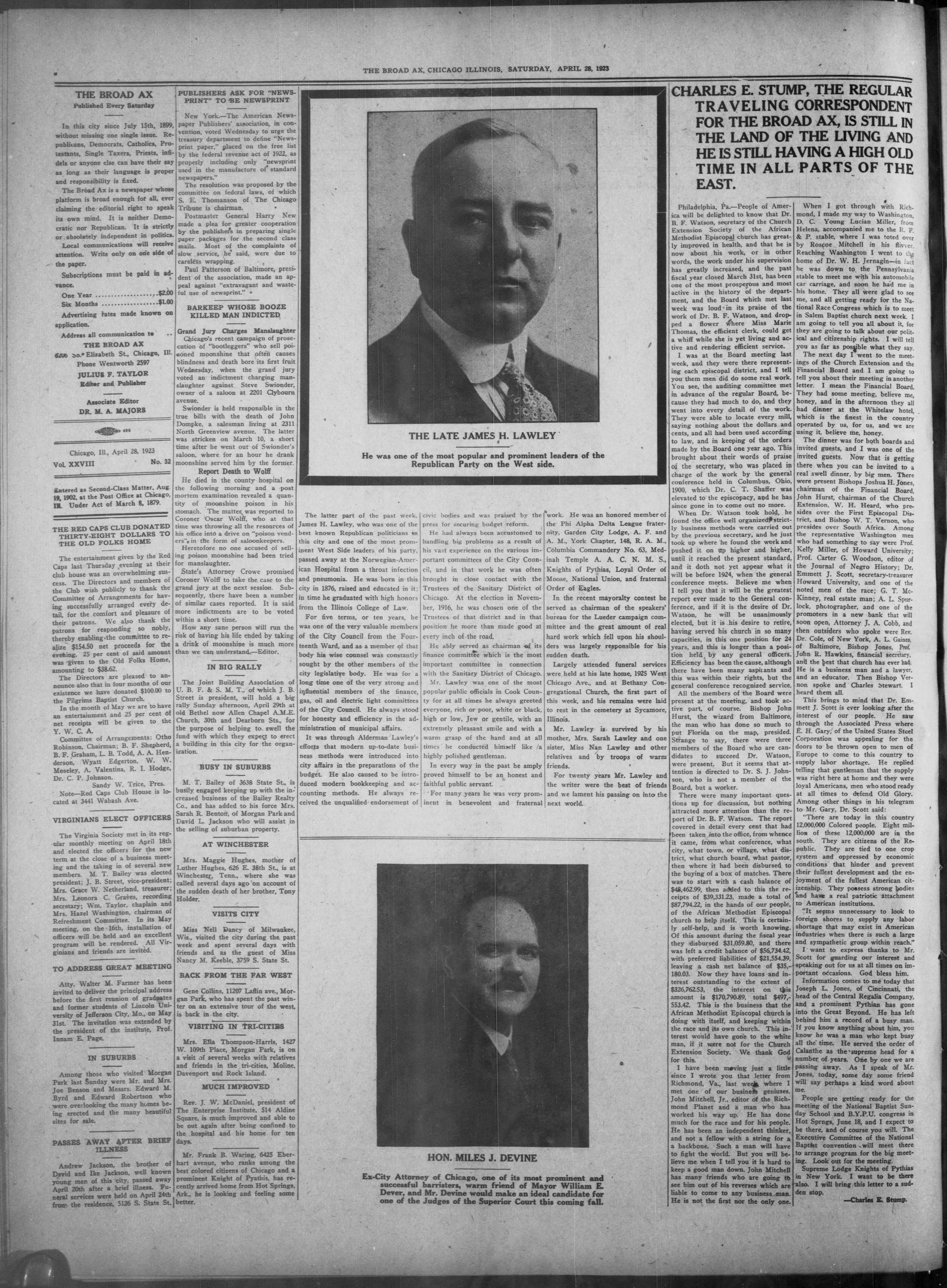
He was one of the most popular and prominent leaders of the Republican Party on the West side.
```markdown
```
Ex-City Attorney of Chicago, one of its most prominent and successful barristers, warm friend of Mayor William E. Dever, and Mr. Devine would make an ideal candidate for one of the Judges of the Superior Court this coming fall.
Ex-City Attorney of Chicago, one of its most prominent and successful barristers, warm friend of Mayor William E. Dever, and Mr. Devine would make an ideal candidate for one of the Judges of the Superior Court this coming fall.
The latter part of the past week, James H. Lawley, who was one of the best known Republican politicians in this city and one of the most prominent West Side leaders of his party, passed away at the Norwegian-American Hospital from a throat infection and pneumonia. He was born in this city in 1876, raised and educated in it; in time he graduated with high honors from the Illinois College of Law.
For five terms, or ten years, he was one of the very valuable members of the City Council from the Fourteenth Ward, and as a member of that body his wise counsel was constantly sought by the other members of the city legislative body. He was for a long time one of the very strong and influential members of the finance, gas, oil and electric light committees of the City Council. He always stood for honesty and efficiency in the administration of municipal affairs.
It was through Alderman 'Lawley's efforts that modern up-to-date business methods were introduced into city affairs in the preparations of the budget. He also caused to be introduced modern bookkeeping and accounting methods. He always received the unqualified endorsement of
press for securing budget reform. He had always been accustomed to handling big problems as a result of his vast experience on the various important committees of the City Council, and in that work he was often brought in close contact with the Trustees of the Sanitary District of Chicago. At the election in November, 1916, he was chosen one of the Trustees of that district and in that position he more than made good at every inch of the road.
He ably served as chairman of its finance committee which is the most important committee in connection with the Sanitary District of Chicago. Mr. Lawley was one of the most popular public officials in Cook County for at all times he always greeted everyone, rich or poor, white or black, high or low, Jew or gentle, with an extremely pleasant smile and with a warm grasp of the hand and at all times he conducted himself like a highly polished gentleman. In every way in the past he amply proved himself to be an honest and faithful public servant. For many years he was very prominent in benevolent and fraternal
```markdown
```
HON. MILES J. DEVINE
ey of Chicago, one of its most
barristers, warm friend of Ms
Mr. Devine would make an ide
Judges of the Superior Court t
work. He was an honored member of the Phi Alpha Delta League fraternity, Garden City Lodge, A. F. and A. M., York Chapter, 148, R. A. M., Columbia Commandery No. 63, Medinah Temple A. A. C. N. M. S, Knights of Pythias, Loyal Order of Moose, National Union, and fraternal Order of Eagles.
In the recent mayoralty contest he served as chairman of the speakers' bureau for the Lueder campaign committee and the great amount of real hard work which fell upon his shoulders was largely responsible for his sudden death.
Largely attended funeral services were held at his late home, 1925 West Chicago Ave., and at Bethany Congregational Church, the first part of this week, and his remains were laid to rest in the cemetery at Sycamore, Illinois.
Mr. Lawley is survived by his mother, Mrs. Sarah Lawley and one sister, Miss Nan Lawley and other relatives and by troops of warm friends.
For twenty years Mr. Lawley and the writer were the best of friends and we lament his passing on into the next world.
CHARLES E. STUMP, THE REGULAR TRAVELING CORRESPONDENT FOR THE BROAD AX, IS STILL IN THE LAND OF THE LIVING AND HE IS STILL HAVING A HIGH OLD TIME IN ALL PARTS OF THE EAST.
Philadelphia, Pa.—People of America will be delighted to know that Dr. B. F. Watson, secretary of the Church Extension Society of the African Methodist Episcopal church has greatly improved in health, and that he is now about his work, or in other words, the work under his supervision has greatly increased, and the past fiscal year closed March 31st, has been one of the most prosperous and most active in the history of the department, and the Board which met last week was loud in its praise of the work of Dr. B. F. Watson, and dropped a flower where Miss Marie Thomas, the efficient clerk, could get a whiff while she is yet living and active and rendering efficient service.
I was at the Board meeting last week, and they were there representing each episcopal district, and I tell you them men did do some real work. You see, the auditing committee met in advance of the regular Board, because they had much to do, and they went into every detail of the work. They were able to locate every mill, saying nothing about the dollars and cents, and all had been used according to law, and in keeping of the orders made by the Board one year ago. This brought about their words of praise of the secretary, who was placed in charge of the work by the general conference held in Columbus, Ohio, 1900, which Dr. C. T. Shaffer was elevated to the episcopacy, and he has since gone in to come out no more.
When Dr. Watson took hold, he found the office well organized, strictly business methods were carried out by the previous secretary, and he just took up where he found the work and pushed it on up higher and higher, until it reached the present standard, and it doth not yet appear what it will be before 1924, when the general conference meets. Believe me when I tell you that it will be the greatest report ever made to the General conference, and if it is the desire of Dr. Watson, he will be unanimously elected, but it is his desire to retire, having served his church in so many capacities, in this one position for 24 years, and this is longer than a position held by any general officers. Efficiency has been the cause, although there have been many aspirants and this was within their rights, but the general conference recognized service. All the members of the Board were present at the meeting, and took active part, of course. Bishop John Hurst, the wizard from Baltimore, the man who has done so much to put Florida on the map, presided. Strange to say, there were three members of the Board who are candidates to succeed Dr. Watson, were present. But it seems that attention is directed to Dr. S. J. Johnson, who is not a member of the Board, but a worker.
There were many important questions up for discussion, but nothing attracted more attention than the report of Dr. B. F. Watson. The report covered in detail every cent that had been taken into the office, from whence it came, from what conference, what city, what town, or village, what district, what church board, what pastor, then where it had been disbursed to the buying of a box of matches. There was to start with a cash balance of $48,462.99, then added to this the receipts of $39,331.23, made a total of $87,794.22, in the hands of our people, of the African Methodist Episcopal church to help itself. This is certainly self-help, and is worth knowing. Of this amount during the fiscal year they disbursed $31,059.80, and there was left a credit balance of $56,734.42 with preferred liabilities of $21,554.39, leaving a cash net balance of $35,180.03. Now they have loans and interest outstanding to the extent of $326,762.53, the interest on this amount is $170,790.89, total $497,553.42. This is the business that the African Methodist Episcopal church is doing with itself, and keeping within the race and its own church. This interest would have gone to the white man, if it were not for the Church Extension Society. We thank God for this.
I have been moving just a little since I wrote you that letter from Richmond, Va., last week where I met one of our business geniuses, John Mitchell, Jr., editor of the Richmond Planet and a man who has worked his way up. He has done much for the race and for his people. He has been an independent thinker, and not a fellow with a string for a a backbone. Such a man will have to fight the world. But you will believe me when I tell you it is hard to keep a good man down. John Mitchell has many friends who are going to see him out of his reverses which are liable to come to any business man. He is not the first nor the only one.
When I got through with Richmond, I made my way to Washington, D. C. Young Lucian Miller, from Helena, accompanied me to the R. F. & P. stable, where I was toged over by Roscoe Mitchell in his fliver, Reaching Washington I went to the home of Dr. W. H. Jernagin—in fact he was down to the Pennsylvania stable to meet me with his automobile car carriage, and soon he had me in his home. They all were glad to see me, and all getting ready for the National Race Congress which is to meet in Salem Baptist church next week. I am going to tell you all about it, for they are going to talk about our political and citizenship rights. I will tell you as far as possible what they say. The next day I went to the meetings of the Church Extension and the Financial Board and I am going to tell you about their meeting in another letter. I mean the Financial Board. They had some meeting, believe me, honey, and in the afternoon they all had dinner at the Whitelaw hotel, which is the finest in the country operated by us, for us, and we are using it, believe me, honey.
The dinner was for both boards and invited guests, and I was one of the invited guests. Now that is getting there when you can be invited to a real swell dinner, by big men. There were present Bishops Joshua H. Jones, chairman of the Financial Board John Hurst, chairman of the Church Extension, W. H. Heard, who presides over the First Episcopal District, and Bishop W. T. Vernon, who presides over South Africa. Among the representative Washington men who had something to say were Prof. Kelly Miller, of Howard University; Prof. Carter G. Woodson, editor of the Journal of Negro History; Dr. Emmett J. Scott, secretary-treasurer Howard University, and one of the noted men of the race; G. T. McKinney, real estate man; A. L. Spurlock, photographer, and one of the promoters in a new bank that will soon open, Attorney J. A. Cobb, and then outsiders who spoke were Rev. Dr. Cole, of New York, A. L. Gaines, of Baltimore, Bishop Jones. Prof. John R. Hawkins, financial secretary, and the best that church has ever had. He is a business man and a lawyer, and an educator. Then Bishop Vernon spoke and Charles Stewart. I heard them all.
This brings to mind that Dr. Emmett J. Scott is ever looking after the interest of our people. He saw through the Associated Press where H. G. Gary, of the United States Steel Corporation was appealing for the doors to be thrown open to men of Europe to come to this country to supply labor shortage. He replied telling that gentleman that the supply was right here at home and they were loyal Americans, men who stood ready at all times to defend Old Glory. Among other things in his telegram to Mr. Gary, Dr. Scott said:
"There are today in this country 12,000,000 Colored people. Eight million of these 12,000,000 are in the south. They are citizens of the Republic. They are tied to one crop system and oppressed by economic conditions that hinder and prevent their fullest development and the enjoyment of the fullest American citizenship. They possess strong bodies and have a real patriotic attachment to American institutions.
"It seems unnecessary to look to foreign shores to supply any labor shortage that may exist in American industries when there is such a large and sympathetic group within reach."
I want to express thanks to Mr. Scott for guarding our interest and speaking out for us at all times on important occasions. God bless him.
Information comes to me today that Joseph L. Jones, of Cincinnati, the head of the Central Regalia Company, and a prominent Pythian has gone into the Great Beyond. He has left behind him a record of a busy man. If you know anything about him, you know he was a man who kept busy all the time. He served the order of Calantha as the 'supreme head for a number of years. One by one we are passing away. As I speak of Mr. Jones, today, some day some friend will say perhaps a kind word about me.
People are getting ready for the meeting of the National Baptist Sunday School and B.Y.P.U. congress in Hot Springs, June 18, and I expect to be there, and of course you will. The Executive Committee of the National Baptist convention will meet there to arrange program for the big meeting. Look out for the meeting. Supreme Lodge Knights of Pythias in New York. I want to be there also. I will bring this letter to a sudden stop.
—Charles E. Stump.
BOOK CHAT BY MARY WHITE OVINGTON, CHAIRMAN OF THE EXECUTIVE COMMITTEE OF THE NATIONAL ASSOCIATION FOR THE ADVANCEMENT OF COL- ORED PEOPLE.
CONCERNING POETRY
Whether it is my own or the publisher's neglect or whether the Negro is not an immediate theme for literature, my book shelf is empty of new volumes to review. I have therefore turned to two small books of verse, each published four years ago, that the Cornhill Company sent to me but that thus far I have not noted. They are "From the Heart of a Folk," by Waverly Turner Carmichael and "Songs of My People," by Charles Bertram Johnson.
I imagine neither made much impression upon the public but they interest me, as does all Negro poetry, for what they represent.
I gain from reading the introduction to his verse that Carmichael had little education, but he enters into the heart of the folk amongst whom he grew up, sturdy, simple-hearted colored men and women in Alabama. He tells, usually in dialect, of their daily doings, their play with their children, their excitement at the church service, their love-making. He speaks with the verity of a child. For some reason no one likes to be called a child, despite the scriptural assurance that tells us that unless we become as little children we shall not enter the Kingdom of Heaven. To some extent is this true of the kingdom of art. We must have the directness and veracity of a child if we are to represent reality not imitation.
The second volume, "Songs of My People," shows from its very title the more sophisticated mind. Negroes are "my people" and the poet tells about them reflectively. Still more he speaks of his own spirit yearnings and voices his persistent optimism. The robin that sings in the rain is his favorite bird. His verse is pleasantly turned and reflects a kindly spirit. I drop these two volumes to pick up a very recent publication by Knopf entitled "A 179 Chinese Poems" translated by Arthur Waley. Here we
Habits of Biblical Times.
As no eating utensils were used at table in Biblical times, washing hands before and after meals was extremely desirable. Because of the dust and the heat of the climate, washing of the feet on entering a house was an act of respect to the host and of refreshment to the traveler. It was an especial act of respect and honor when the act was performed by the master of the house.
His Lucky Day.
On a number of occasions nuggets were found in California by men who were not looking for them. A man sitting on a bowler at Pilot Hill, El Dorado county, was idly chipping it with a small hammer when his eye caught the glint of gold. The bowler yielded $8,000.
Both to Be Condemned.
Pedantry in learning is like hypocrisy in religion, a form of knowledge without the power of it.-Addison.
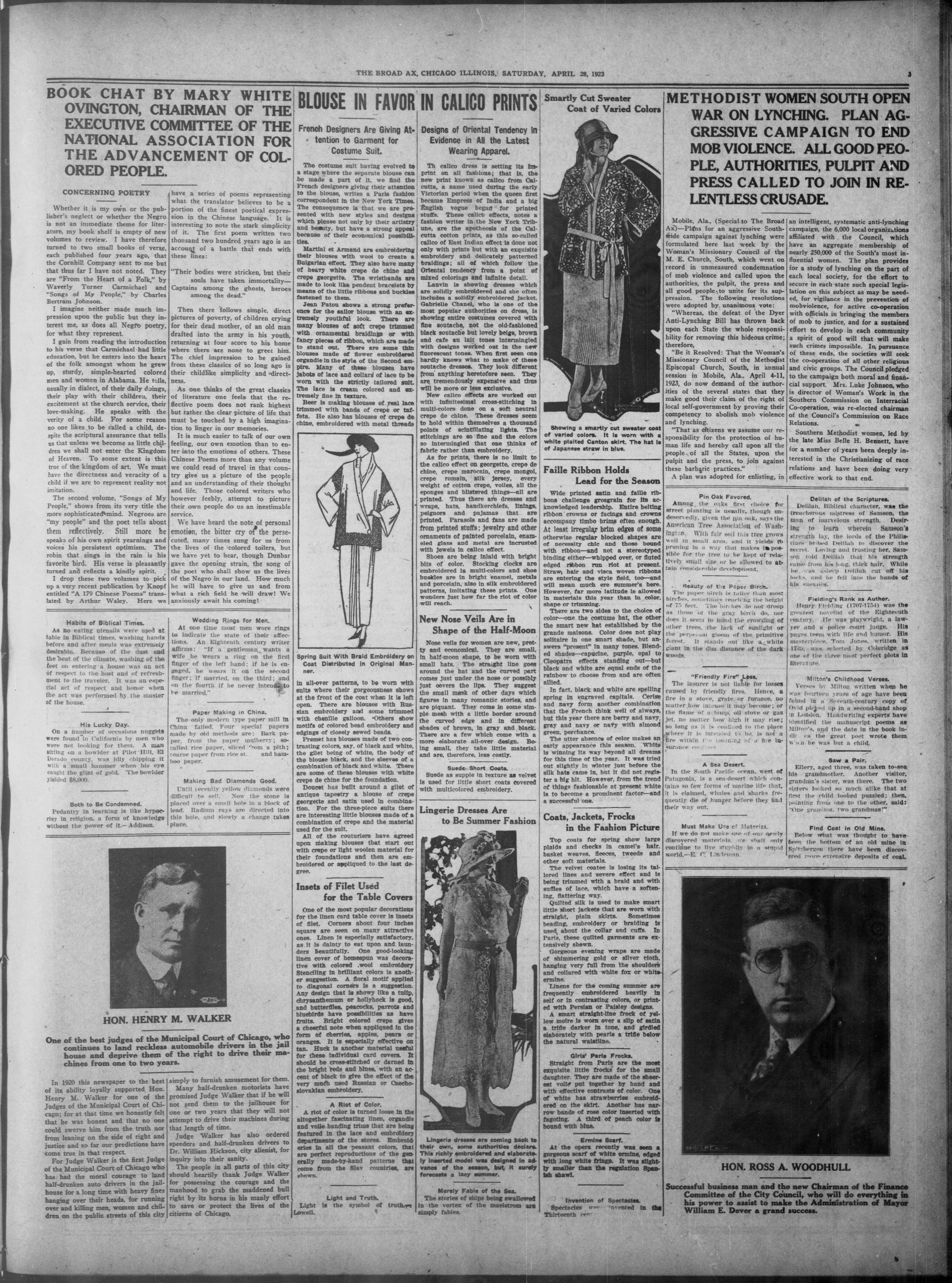
HON. HENRY M. WALKER
One of the best judges of the Municipal Court of Chicago, who continues to land reckless automobile drivers in the jail house and deprive them of the right to drive their machines from one to two years.
In 1920 this newspaper to the best of its ability loyally supported Hon. Henry M. Walker for one of the Judges of the Municipal Court of Chicago; for at that time we honestly felt that he was honest and that no one could swerve him from the truth nor from leaning on the side of right and justice and so far our predictions have come true in that respect.
simply to furnish amusement for them.
Many half-drunken motorists have promised Judge Walker that if he will not send them to the jailhouse for one or two years that they will not attempt to drive their machines during that length of time.
Judge Walker has also ordered speeders and half-drunken drivers to Dr. William Hickson, city alienist, for
For Judge Walker is the first Judge of the Municipal Court of Chicago who has had the moral courage to land half-drunken auto drivers in the jailhouse for a long time with heavy fines hanging over their heads, for running over and killing men, women and children on the public streets of this city
have a series of poems representing what the translator believes to be a portion of the finest poetical expression in the Chinese language. It is interesting to note the stark simplicity of it. The first poem written two thousand two hundred years ago is an account of a battle that ends with these lines:
"Their bodies were stricken, but their souls have taken immortality—Captains among the ghosts, heroes among the dead."
Then there follows simple, direct pictures of poverty, of children crying for their dead mother, of an old man drafted into the army in his youth, returning at four score to his home where there are none to greet him. The chief impression to be gained from these classics of so long ago is their childlike simplicity and directness.
As one thinks of the great classics of literature one feels that the reflective poem does not rank highest but rather the clear picture of life that must be touched by a high imagination to linger in our memories.
It is much easier to talk of our own feeling, our own emotion than to enter into the emotions of others. These Chinese Poems more than any volume we could read of travel in that country give us a picture of the people and an understanding of their thought and life. Those colored writers who however feebly, attempt to picture their own people do us an inestimable service.
We have heard the note of personal emotion, the bitter cry of the persecuted, many times sung for us from the lives of the colored toilers, but we have yet to hear, though Dunbar gave the opening strain, the song of the poet who shall show us the lives of the Negro in our land. How much he will have to give us and from what a rich field he will draw! We anxiously await his coming!
Wedding Rings for Men.
At one time most men wore rings to indicate the state of their affections. An Eighteenth century writer affirms: "If a gentleman wants a wife he wears a ring on the first finger of the left hand; if he is engaged, he wears it on the second finger; if married, on the third; and on the fourth if he never intends to be married."
Paper Making in China.
The only modern type paper mill in China failed. Four special papers made by old methods are: Bark paper, from the paper mulberry; so-called rice paper, sliced "om a pith"; course paper from rice st. and bamboo paper.
Making Bad Diamonds Good
Until recently yellow diamonds were difficult to sell. Now the stone is placed over a small hole in a block of lead. Radium rays are directed into this hole, and slowly a change takes place.
simply to furnish amusement for them. Many half-drunken motorists have promised Judge Walker that if he will not send them to the jailhouse for one or two years that they will not attempt to drive their machines during that length of time. Judge Walker has also ordered speeders and half-drunken drivers to Dr. William Hickson, city alienist, for inquiry into their sanity. The people in all parts of this city should heartily thank Judge Walker for possessing the courage and the manhood to grab the maddened bull right by its horns in his manly effort to save or protect the lives of the citizens of Chicago.
THE BROAD AX, CHICAGO ILLINOIS, SATURDAY, APRIL 28. 1923
BLOUSE IN FAVOR
French Designers Are Giving Attention to Garment for Costume Suit.
The costume suit having evolved to a stage where the separate blouse can be made a part of it, we find the French designers giving their attention to the blouse, writes a Parks fashion correspondent in the New York Times. The consequence is that we are presented with new styles and designs which please not only by their artistry and beauty, but have a strong appeal because of their economical possibilities.
Martial et Armand are embroidering their blouses with wool to create a Bulgarian effect. They also have many of heavy white crepe de chine and crepe georgette. The wristbands are made to look like pendent bracelets by means of the little ribbons and buckles fastened to them.
Jean Patou shows a strong preference for the sailor blouse with an extremely youthful look. There are many blouses of soft crepe trimmed with ornamental braidings or with fancy pieces of ribbon, which are made to stand out. There are some thin blouses made of flower embroidered organdie in the style of the Second empire. Many of these blouses have jabots of lace and collars of lace to be worn with the strictly tailored suit. The lace is cream colored and extremely fine in texture. Beer is making blouses of real lace trimmed with bands of crepe or tafeta. He also has blouses of crepe de chine, embroidered with metal threads
1
Spring Suit With Braid Embroidery on Coat Distributed in Original Manner.
in all-over patterns, to be worn with suits where their gorgeousness shows at the front of the coat when it is left open. There are blouses with Russian embroidery and some trimmed with chanille galloon. Others show motifs of colored bead embroidery and edgings of closely sewed beads.
Premet has blouses made of two contrasting colors, say, of black and white, the gilet being of white, the body of the blouse black, and the sleeves of a combination of black and white. There are some of these blouses with white crepe de chine for the foundation.
Doucet has built around a gilet of antique tapestry a blouse of crepe georgette and satin used in combination. For the three-piece suits there are interesting little blouses made of a combination of crepe and the material used for the suit.
All of the contourers have agreed upon making blossoms that start out with crepe or light woolen material for their foundations and then are embroidered or appliqued to the last degree.
Insets of Filet Used for the Table Covers
One of the most popular decorations for the linen card table cover is insets of filet. Corners about four inches square are seen on many attractive ones. Linen is especially satisfactory, as it is dainty to eat upon and lauders beautifully. One good-looking linen cover of homespun was decorative with colored wool embroidery Stencilling in brilliant colors is another suggestion. A floral motif applied to diagonal corners is a suggestion. Any design that is showy like a tulip, chrysanthemum or hollyhock is good, and butterflies, peacocks, parrots and bluebirds have possibilities as have fruits. Bright colored crepe gives a cheerful note when appliqued in the form of cherries, apples, pears or oranges. It is especially effective on tan. Huck is another material useful for these individual card covers. It should be cross-stitched or darned in the bright reds and blues, with an accent of black to give the effect of the very much used Russian or Czechoslovakian embroidery.
A. Blot of Color.
A riot of color is turned loose in the altogether fascinating linen, organdie and volle banding trims that are being featured in the lace and embroidery departments of the stores. Embroideries in all the peasant colors, that are perfect reproductions of the generally made-by-hand patterns that come from the Slav countries, are shown.
Light and Truth.
Light is the symbol of truth. Lowell.
IN CALICO PRINTS
IN CALICO PRINTS
Designs of Oriental Tendency in Evidence in All the Latest Wearing Apparel.
The calico dress is setting its imprint on all fashions; that is, the new print known as calico from Calcutta, a name used during the early Victorian period when the queen first became Empress of India and a big English vogue began for printed stuff. These calico effects, notes a fashion writer in the New York Tribune, are the apotheosis of the Calcutta cotton prints, as this so-called calico of East Indian effect is done not only with prints but with an exquisite embroidery and delicately patterned braidings; all of which follow the Oriental tendency from a point of mixed colorings and infinite detail.
Lanvin is showing dresses which are solidly embroidered and she often includes a solidly embroidered jacket. Gabrielle Chanel, who is one of the most popular authorities on dress, is showing entire costumes covered with fine soutache, not the old-fashioned black soutache but lovely beige, brown and cafe au lait tones intermingled with designs worked out in the new fluorescent tones. When first seen one hardly knows what to make of these soutache dresses. They look different from anything heretofore seen. They are tremendously expensive and thus will be more or less exclusive. New calico effects are worked out with infinitesimal cross-stitching in multi-colors done on a soft neutral crepe de chine. These dresses seem to hold within themselves a thousand points of scintillating lights. The stitchings are so fine and the colors so intermingled that one thinks of fabric rather than embroidery.
As for prints, there is no limit to the calico effect on georgette, crepe de chine, crepe marocain, crepe mongol, crepe romain, silk jersey, every weight of cotton crepe, volles, all the eponges and blistered things—all are printed. Thus there are dresses and wraps, hats, handkerchiefs, linings, peignors and pajamas that are printed. Parasols and fans are made from printed stuffs; jewelry and other ornaments of painted porcelain, enameled glass and metal are incrusted with jewels in calico effect.
Shoes are being inlaid with bright bits of color. Stocking clocks are embroidered in multi-colors and shoe buckles are in bright enamel, metals and porcelain, also in silk embroidered patterns, imitating these prints. One wonders just how far the riot of color will reach.
New Nose Veils Are in Shape of the Half-Moon
Nose veils for women are new, pretty and economical. They are small, in half-moon shape, to be worn with small hats. The straight line goes around the hat and the curved part comes just under the nose or possibly just covers the lips. They suggest the small mask of other days which figures in many romantic stories, and are piquant. They come in some simple mesh with a little border around the curved edge and in different shades of brown, in gray and black. There are a few which come with a more elaborate all-over design. Being small, they take little material and are, therefore, less costly.
Suede Short Coats.
Suede as supple in texture as velvet is used for little short coats covered with multicolored embroidery.
UNDERWOODS
Lingerie dresses are coming back to their own, some authorities declare. This richly embroidered and elaborately inserted model was designed in advance of the season, but, it surely forecasts a tacy summer.
Merely Fable of the Sea.
The stories of ships being swallowed in the vortex of the maelstrom are simply fables.
UNDERSTITCH
& UNDERSTITCH
Showing a smartly cut sweater coat of varied colors. It is worn with a white plaited Canton skirt. The hat is of Japanese straw in blue.
Faille Ribbon Holds Lead for the Season
Wide printed satin and fallie ribbons challenge gresgrain for its acknowledged leadership. Entire belting ribbon' crowns or facings and crowns accompany timbo brims often enough. At least irregular brim edges of some otherwise regular blocked shapes are of necessity chic and those bound with ribbon—and not a stereotyped binding either—whipped over, or fluted edged ribbon run riot at present. Straw, hair and visca woven ribbons are entering the style field, too—and will mean much ere summer's here. However, far more latitude is allowed in materials this year than in color, shape or trumping.
There are two slides to the choice of color—one the costume hat, the other the smart new hat established by the grande malsons. Color does not play solitaire in one smart shade, but answers "present" in many tones. Blended shades—capucine, purple, opal to Cleopatra effects standing out—but black and white are equal ends of the rainbow to choose from and are often allied.
In fact, black and white are spelling spring in engraved capitals. Cerise and navy form another combination that the French think well of always, but this year there are berry and navy, gray and navy or navy with almond green, perchance.
The utter absence of color makes an early appearance this season. White is winning its way beyond all dreams for this time of the year. It was tried out slightly in winter just before the slik hats came in, but it did not register a big hit. However, from the trend of things fashionable at present white is to become a prominent factor—and a successful one.
Coats, Jackets, Frocks
in the Fashion Picture
Top coats for spring show large plaids and checks in camel's hair. basket weaves, fleeces, tweeds and other soft materials.
The velvet coatte is losing its tailored lines and severe effect and is being trimmed with a braid and with suffles of lace, which have a softening, flattering way.
Quilted silk is used to make smart little short jackets that are worn with straight, plain skirts. Sometimes beading, embroidery or braiding is used about the collar and cuffs. In Paris, these quilted garments are extensively shown.
Gorgeous evening wraps are made of shimmering gold or silver cloth, hanging very full from the shoulders and collared with white fox or white ermine.
Linens for the coming summer are frequently embroidered heavily in self or in contrasting colors, or printed with Persian or Paisley designs. A smart straight-line frock of yellow mohre is worn over a slip of satin a trifle darker in tone, and girdled elaborately with pearls a trifle below the natural waistline.
Girls' Parle Frecks.
Straight from Paris are the most exquisite little frocks for the small daughter. They are made of the sheerest volle put together by hand and with effective contrasts of color. One of white has strawberries embroidered on the skirt. Another has narrow bands of rose color inserted with fagoting. A third of peach color is bound with blue.
Ermina Scarf
At the opera recently was seen a gorgeous scarf of whiteermine, edged with long white fringe. It was slightly smaller than the regulation Spanish shawl.
Invention of Spectacles. Spectacles were invented in the Thirteenth cent.
METHODIST WOMEN SOUTH OPEN WAR ON LYNCHING. PLAN AGGRESSIVE CAMPAIGN TO END MOB VIOLENCE. ALL GOOD PEOPLE, AUTHORITIES, PULPIT AND PRESS CALLED TO JOIN IN RELENTLESS CRUSADE.
Mobile, Ala., (Special to The Broad AX)—Plans for an aggressive Southwide campaign against lynching were formulated here last week by the Woman's Missionary Council of the M. E. Church, South, which went on record in unmeasured condemnation of mob violence and called upon the authorities, the pulpit, the press and all good people, to unite for its suppression. The following resolutions were adopted by unanimous vote: "Whereas, the defeat of the Dyer Anti-Lynching Bill has thrown back upon each State the whole responsibility for removing this hideous crime; therefore
"Be it Resolved: That the Woman's Missionary Council of the Methodist Episcopal Church, South, in annual session in Mobile, Ala., April 4-11, 1923, do now demand of the authorities of the several states that they make good their claim of the right of local self-government by proving their competency to abolish mob violence and lynching.
"That as citizens we assume our responsibility for the protection of human life and hereby call upon all the people of all the States, upon the pulpit and the press, to join against these barbaric practices."
A plan was adopted for enlisting, in
Pin Oak Favored
Among the oaks first choice for street planting is usually, though undeservedly, given the pn oak, says the American Tree Association of Washington. With fair soil this tree grows well in small area, and it yields to pruning in a way that makes it possible for the tree to be kept of relatively small size or be allowed to attain considerable development.
Beauty of the Papua Birch
The paper birch is taller than most birches, sometimes reaching the height of 75 feet. The birches do not droop as those of the gray birch do, nor does it seem to mind the crowding of other trees, the lack of sunlight or the perennial gloom of the primitive forest. It stands out like a white giant in the dim distance of the dark woods.
"Friendly Fire" Loss.
The insurer is not liable for losses caused by friendly fires. Hence, a fire in a stove, grate or furnace, no matter how intense it may become; or the flame of a lamp, oil stove or gas jet, no matter how high it may rise; so long as it is confined to the place where it is intended to be, is not a fire within the meaning of a fire insurance contract.
A Sea Desert.
In the South Pacific ocean, west of Patagonia, is a sea-desert which contains so few forms of marine life that, it is claimed, whales and sharks frequently die of hunger before they find their way out.
If we do not make use of our newly discovered materials, we shall only continue to live sturdy in a stupid world,—E. C. Lindenan.
AN L P E U
PEW
Successful business man and the new Chairman Committee of the City Council, who will do his power to assist to make the Administr William E. Dever a grand success.
Successful business man and the new Chairman of the Finance Committee of the City Council, who will do everything in his power to assist to make the Administration of Mayor William E. Dever a grand success.
Successful business man and the new Chairman of the Finance Committee of the City Council, who will do everything in his power to assist to make the Administration of Mayor William E. Dever a grand success.
an intelligent, systematic anti-lynching campaign, the 6,000 local organizations affiliated with the Council, which have an aggregate membership of nearly 250,000 of the South's most influential women. The plan provides for a study of lynching on the part of each local society, for the effort to secure in each state such special legislation on this subject as may be needed, for vigilance in the prevention of mobviolence, for active co-operation with officials in bringing the members of mob to justice, and for a sustained effort to develop in each community a spirit of good will that will make such crimes impossible. In pursuance of these ends, the societies will seek the co-operation of all other religious and civic groups. The Council pledged to the campaign both moral and financial support. Mrs. Luke Johnson, who is director of Woman's Work in the Southern Commission on Interracial Co-operation, was re-elected chairman of the Council's Commission on Race Relations.
Southern Methodist women, led by the late Miss Belle H. Bennett, have for a number of years been deeply interested in the Christianizing of race relations and have been doing very effective work to that end.
Delilah of the Scriptures.
Delilah or the Scriptures.
Delilah, Biblical character, was the treacherous mistress of Samson, the man of marvelous strength. Desiring to learn wherein Samson's strength lay, the lords of the Philistines brided Delilah to discover the secret. Loving and trusting her, Samson told Delilah that his strength came from his long, thick hair. While he was asleep Delilah cut off his locks, and he fell into the hands of his enemies.
Fielding's Bank as Author
Henry Fielding (1707-1754) was the greatest novelist of the Eighteenth century. He was playwright, a lawyer and a police court judge. His pages teem with life and humor. His masterpiece, Tom Jones, written in 1740, was selected by Coleridge as one of the three most perfect plots in literature.
Milton's Childhood Verses.
Verses by Milton written when he was fourteen years of age have been found in a Seventh-century copy of Ovid picked up in a second-hand shop in London. Handwriting experts have identified the manuscript poems as Milton, and the date in the book indies the great poet wrote them when he was but a child.
Ellery, aged three, was taken to see his grandmother. Another visitor, grandma's sister, was there. The two sisters looked so much alike that at first the child looked puzzled; then, pointing from one to the other, said: "One grandma, two grandma!"
Find Coal in Old Mine.
Below what was thought to have been the bottom of an old mine in Spitzerbergen there have been discovered more extensive deposits of coal.
1910
the new Chairman of the Finance Council, who will do everything in like the Administration of Mayor success.
Saw a Pair.
Remarkable Preparation Makes It Easy For Anyone to Quickly Grow Long, Soft, Silky, Lovely Hair!
A wonderful preparation has been discovered, that makes a beautiful glossy sheen. It puts glowing health into lifelong hair, stops dandruff and itching scalp. This our preparation is
EXELENTO QUININE POM
It has given thousands the beautiful hair which is their chief attraction. It has made straight, silky, polished hair. Another beautiful help is EXELENTO SHI quickly removes skin blemishes and clears up in an as if your drugstreet cannot supply you, send us 50 in Juvenile and Babies, or send 50 by telephone, have, by getting the EXELENTO preparations NOW
EXELENTO MEDICINE CO AGENTS WANTED EVERYWHILE
ion has been discoverer, that changes
hair. It helps it grow. It gives it puffy glowing health into brittle,
ruff and itching scalp. This marvel-
QUININE POMADE
the beautiful hair which is one of
it has made straight, silky hair
k, to obtain.
autumn to EXELENTO SKIN BEAUTIFIER,
minimizes and cleans up in an astonishing manner
supply you, send us 50% in stamps or coin for fun
or send 25% for single package. Gain the attractive
EXELENTO preparations NOW!
MEDICINE COMPANY,
CHANTED EVERYWHERE—Write for
A wonderful preparation has been discovered, that changes short, coarse hair into long, lovely tresses. It gives the hair a beautiful glossy sheen. It puts glowing health into brittle, dandruff and liceching and flicks skin. This marvelous preparation is
It has given thousands the beautiful hair which is one of their chief attractions. It has made straight, silky hair
ELEMENTO SKIN BEAUTIFIER, a delightful cream that
up in an astonishing manner dark, salowl complexion,
and made of stamp or coin for full skin packages of
both single package. Gain the attractive beauty, you soon can.
NOW!
NE COMPANY, Atlanta, Ga.
EVERYWHERE—Write for Particulars
Another marvelous beauty help in EXELENTO SKIN BEAUTIFIER, a delightful cream that quickly removes skin blisters and clears up in an astonishing manner dark, shallow complexions. If your drugstore cannot supply you, send us 606 in stamps or coin for full size packages of both products. Gain the attractive beauty, you soon can have, by getting the EXELENTO preparations NOW!
EXELENTO MEDICINE COMPANY, Atlanta, Ga
AGENTS WANTED EVERYWHERE—Write for Particulars
It is not widely known, except to the trade, that Madison, ind., has the largest and perhaps the oldest herb house in the United States, which has existed since 1854. It collects from various parts of the country and distributes to many parts of the world approximately 100 varieties of leaves and roots known in the business as crude drugs.
As it seemed to be, When Dick's uncle was married the second time he came to Dick's home on his honeymoon. Seeing that congratulations were in order, the boy stepped up to his uncle and, extending his hand, said with great earnestness: "Hello, Uncle Frank! You must like to get married awful well, don't you?" —Chicago Tribune.
TELEPHONE DOUGLAS 6351
RAY LUCAS
Attorney-at-Law
East 35th Street
Chicago
OFFICE TELEPHONE
J. GRAY
Attorney-a
204 East 35th
Chicago
OFFICE TELEPHONE DOUGLAS 6351
J. GRAY LUCAS
Attorney-at-Law
204 East 35th Street
Chicago
Corner Indiana Ave., Second Floor
Res., 3846 Grand Boul. Tel. Douglas 4397
Phone Yard
FURNITURE
Brass and Wood Beds,
Refrigerators, Stov
Hardware, I
HENRY ST
2515-19 ARCH
Phone Yards 27
FURNITURE
And Wood Beds, Electric W
rigerators, Stoves, Paint,
Hardware, Linoleum
HENRY STUCKA
2515-19 ARCHER AVE.
stone Yards 27
NITURE
I Beds, Electric Washers,
rs, Stoves, Paint, Oil,
ware, Linoleum
STUCKART
9 ARCHER AVE.
Brass and Wood Beds, Electric Washers, Refrigerators, Stoves, Paint, Oil, Hardware, Linoleum HENRY STUCKART 2515-19 ARCHER AVE.
GEORGE F. HARDIN
GE F. HARDIN
GE F. HARDING, JR. REAL ESTATE
Up-to-Date or Modern
and Stores
3101 COTTAGE
Corner 31st St
Statement
of
State or Modern Houses, A
and Stores to Rent
COTTAGE GROVE
Corner 31st Street, Chicago
Modern Houses, Apartments
Stores to Rent
AGE GROVE AVE.
East Street, Chicago
RESOURCES
Loans and Discounts.....$1,474,842.62
Bonds and Securities.....930,669.71
Stocks.....11,000.00
Bank Building and Annex.....150,833.52
Furniture and Fixtures.....22,963.55
Other Resources.....89,912.93
Cash on Hand and Due from
Banks.....571,813.48
Total.....$3,200,937.51
LIABILITIES
Capital Stock.....$ 300,000.00
Supplies.....30,000.00
Undivided Profits.....19,609.84
Reserved for Taxes and Inter-
terest.....7,837.06
Other Liabilities.....49,247.04
Deposits.....2,794,194.07
Total.....$3,200,937.51
This Bank invites you to avail yourself
of its complete facilities.
First Mortgage Gold Bonds—approved
safe investments—yield 7% interest.
Boxes in our completely equipped Safety
Deposit Vaults rent for $4.00 per year
and upwards.
Up-to-Date or Modern Houses, Apartments and Stores to Rent
3101 COTTAGE GROVE AVE.
Corner 31st Street, Chicago
Loans and Discounts ... $1
Bonds and Securities ... $1
Stocks ... $1
Bank Building and Annex. ... $1
Furniture and Fixtures ... $1
Other Resources ... $1
Cash on Hand and Due from
Banks ... $1
Total ... $1
LIABILITIES
Capital Stock ... $1
Shares ... $1
Undivided Profits ... $1
Reserved for Taxes and In-
terest ... $1
Other Liabilities ... $1
Deposits ... $1
Total ... $1
This Bank invites you to avail
of its complete facilities.
First Mortgage Gold Bonds
safe investments—yield 75
Boxes in our completely equi-
Deposit Vauls rent for $44
and upwards.
At
Close of
Business
on
April 3, 1923
Increase in Depos-
its from Dec. 29,
1922, to April
3, 1923
$181,095.38
Interest at the rate of 3% is allowed on all saving accounts. Savings Departments open from 9 a.m. to 8 p.m. Saturday.
GEORGE F. LEIBRANDT, President
CHARLES WHITE, Vice-President
GEORGE S. CAMPBELL, Cashier
L. A. DELAURIER, Asst. Cashier
ADDISON E. AVERY, Mgr. Bond Dept.
COLN STATE BANK
OF CHICAGO
New State Government Supervision
t and South State Streets
Telephone Victory 4500
GEORGE F. LEIBRANDT, President
CHARLES A. WHITE, Vice-President
GEORGE S. CAMPBELL, Cashier
L. A. DELAURIER, Assistant Cashier
ADDISON E. AVERY, Mgr. Bond Dept.
STATE BANK
CHICAGO
Government Supervision
South State Streets
The Victory 4500
LINCOLN ST
OF CHIC
Under State Government
31st and South St
Telephone Victo
Historic Herb House.
As It Seemed to Dick.
Condition
A
This young lady gives all the credit for her beautiful hair and may be less to EXELENTO preparations.
French Revolutionary Leader.
Georges Jacques Danton (1753-1794) was one of the leaders of the French Revolution and foremost in organizing and conducting the attack on the Tulleries, and bringing, together with Robespiere, royalty to the scaffold.
He afterward was condemned by the revolutionary tribunal as an accomplice in a conspiracy for the restoration of the monarchy and was executed.
Measurement Almost Perfect.
Electric pyrometry, as the measurement of temperature by electric means is called, has been so far perfected that it is applicable from near the absolute zero—about 70 degrees Fahrenheit below the ordinary zero—to the temperature of melting platinum, more than 3,000 degrees above zero.
RESOURCES
THE BROAD AX. CHICAGO ILLINOIS, SATURDAY, APRIL 28, 1923
JAS. B. McCAHEY, President PHILIP J. DUNN, Secretary FRANK J. DUNN, Vice-President H. X. COMERFORD, Treasurer
JOHN J. DUNN COAL CO.
Telephone Oakland 1550
5100 Federal Street CHICAGO
120 South State Street (Seventh Floor)
Opposite Palmer House
Phone Dearborn 5871
MRS. WARNER
Phone Dearborn 5871
Painless Chiropodist
18 Years' Experience
Residence Phone Douglas 2616
Division of Breeds.
James had heard his parents tell that their new dog was part bulldog and part fox terrier. When some neighbor asked him what kind of a dog he had he answered: "Ott, his head is real fox terrier, but his tail. I guess, is bulldog."
Another Conference Advised.
"In a family," said Uncle EbEN, where de old folks thinks young folks is too far ahead of de times an' where de young folks thinks de old folks is too far behind de times, it looks to me like dar ought to be some kind of a conference wif a view to compromise."
—Washington Evening Star.
And the Last Is the Greatest.
Five great intellectual professions have hitherto existed in every civilized nation; the soldier's, to defend it; the pastor's, to teach it; the physician's, to keep it in health; the lawyer's, to enforce justice, and the merchant's to provide, and all these men. on due occasion, to die for it.—John Ruskin.
Wail Heard in All Ages.
How great a pity that we should not feel for what end we are born into this world, till just as we are leaving it—Walsingham.
Chna, Krutokoff, Pres.
J. E. Ward, Vice-Pres.
Telephone
Norris-War
YARD
26th St. and South Park, I. C. R.
16th and Canal St., C. B.
Root St., C. R. I.
Roscoe and
2556 COTTAGE GRO
2556 COTTAGE GROVE AVE., CHICAGO
CUT OUT THIS SUBSCRIPTION BLANK AND MAIL IT TO
THE BROAD AX
6206 S. Elizabeth Street, Chicago, Ill.
JULIUS P. TAYLOR, Please enter n
AX. I enclose herewith Two Dollars,
Dollar for six months.
Name___
Town___
Date___
JULIUS F. TAYLOR, Please enter my name as a subscriber to THE BROAD AX. I enclose herewith Two Dollars, the annual subscriptions to same, or One Dollar for six months.
Worth Remembering.
Just before going to sleep a bit of imagination regarding achievement possibilities of the morrow will steadily and increasingly bear fruit, particularly if all ideas of difficulty, worry or fear are resolutely ruled out and replaced by those of accomplishment and smiling courage.—Dr. Frederick Pierce.
High Civilization in Yucatan.
High Civilization in Yucatan. Yucatan is "the Egypt of America." As early as the beginning of the Christian era the people there built stone structures of excellent masonry, true angles and smooth, vertical faces. They had astronomical observatories, an accurate calendar and a better system of numerals than the Romans.
First Voyage Across Atlantic.
First Voyage Atlas America
In 1462, the Santa Maria, a Spanish vessel under the command of Christopher Columbus, traversed the ocean in 70 days. Some historians say that the Atlantic between Norway and Greenland was crossed by Norwegian sailors before the year 1000.
Thought for the Day.
Christianity is larger than any definition of it, and is social rather than theoretical.
It is not only difficult to say the right thing in the right place, but, for more difficult still, to leave unsaid the wrong thing at the tempting moment.—Anonymous.
A Thought
Experience CHICAGO
Editorial Woes.
The Osborn Enterprise says that "If a country editor published all the things his subscribers did not like, together with what he liked, someone would be parting him in the face with an old No. 2 shovel before the sun set." Kansas City Star.
Thought for the Day.
The man who can't do a good turn without intending to make it pay is as contemptible as the man who can't receive a favor without suspecting a wrong motive.
Cannot Prey on Small Fish.
The big whalebone whale has so small a throat that it cannot swallow fish of ordinary size. Its food consists of little life forms found in the sea. The toothed whales eat any living thing they can catch.
Immense Loss Caused by Rust.
Sir Robert Hatfield says the world loses about $2,500,000,000 a year by the rusting and decaying of iron and steel.
French Have Discarded Word.
Encore, while a French word meaning again, and used by English and American audiences, is not employed by the French in the same sense, they saying bis, which means twice.
Hard Coal Co.
ORDS AT
R.
& Q. R. R.
P. R. R.
Racine Aves., C. M. & St. P. R. R.
LOVE AVE., CHICAGO
my name as a subscriber to THE BROAD
the annual subscriptions to same, or One
19 State
Pompey's Pillar.
Pompey's Pillar is a beautiful red granite Corinthian column in Alexandria. The inscriptions show it was erected in 302 A. D., in honor of the Emperor Diocletian. No one knows how it came to be called Pompey's, except that he was assassinated in Alexandria 350 years before the date of the column.
Thackeray.
He blew on his pipe, and words came tripping round him like children, like pretty little children who are perfectly drilled for the dance; or came, did he will it, treading in their precedence, like kings, gloomly.—Max Bearbohm.
Effects of Warm Rain.
When a warm rain occurs over a snow-covered region it is not the rain so much as the warm wind that melts the snow. An inch of rain at 50 degrees Fahrenheit could melt only three inches of light new snow or one inch of old snow.
Work Dollar the Better Kind.
"Work is better dank," said Uncle Eben. "De luck dollar is all by itself, but de work dollar tells you dar's plenty more where he come from."—Washington Evening Star.
Lawyers the Greatest Readers.
Lawyers call for more books in the library than other professional men, ministers and doctors the least numbers, according to one librarian.
---
CHICAGO
CHICAGO
Hugh Norris, Treas
Kirby Ward, Sosy.
$1.00 FOR 6 MONTHS
$2.00 PER YEAR
FUNERAL DIRECTORS
UNDERTAKER
PRIVILEGE CULLURE
AUTOS AT ALL HOURS
ALL HERMORDS ASS
ERNEST II. WILLIAMSON UNDERTAKER
GARAGE
GASOLINE OIL
OPEN DAY & NIGHT
Day Light Chapel, capacity 200, Outside Ventilation—Organ and Organist Free—I am as near as your Telephone—I give service at a reasonable price—Distance unmaterial, consult me—I save you wor y, time and money.
PHONE MAIN 2214
A. D. GASH
118 N. La Salle Street CHICAGO
Phone Main 2017
A. L. WILLIAMS
ATTORNEY AND
COUNSELOR AT LAW
Suite 706 Firmenich Building
184 W. Washington St.
CHICAGO
Residence 3655 Prairie Ave.
Phone Douglas 9133
Residence, 1262 Macalister Place
Telephone Monroe 2714
MILES J. DEVINE
ATTORNEY AT LAW
Suite 318-320 Reaper Block
Clark and Washington Sts.
CHICAGO
Telephone Central 1239
Notary Public
Phones: Office Main 4153; Residence,
4751 Champlain Avenue
Phone Kenwood 5611
ATTORNEY AND COUNSELOR
AT LAW
Suite 708—184 W. Washington St.
CHICAGO
BINGA STATE
BANK
Under State Supervision
Capital $100,000.00
Surplus 20,000.00
Offers Equal Service to All
3% INTEREST ON SAVINGS
SAFE DEPOSIT VAULTS
State Street and 36th Place
Wanted
Advertising Solicitor
A live or wide awake newspaper man or solicitor can earn some easy money by calling on or addressing the undersigned.
Julius F. Taylor, 6206 S. Elizabeth street. Phone Wentworth 2597.
PHONE KENWOOD 455
West Englewood Trust & Savings Bank CHICAGO
Capital and Surplus, $500,000.00
The following Electric Shops carry a full line of Electrical Appliances and sell the Federal Washer on Easy Terms:
NORTH SIDE
Atlanta Electric Co.
2622 N. Clark St.
Birmingham Electric Shop.
6215 Broadway
J. B. Collis & Sons.
N. W. Wheeler & Sons.
John I. Elliott & Co.
John A. Elliott & Co.
Fulleron Electric Shop.
3423 N. Halsted St.
Mercer Electric Co.
1488 Wilton Ave.
Lakewood Ave.
4214 Lincoln Ave.
O. 5188 Lincoln Ave.
Mercer Electric Shop.
North Shore Electric Co.
5508 N. Clark St.
Parkersburg Ave.
4709 N. Kedar Ave.
3806 Southport Ave.
Raleigh Electric Co.
5508 N. Clark St.
Seller's Electric Shop.
Tip Top Appliances.
The Top Elec. Appliances.
The Top Elec. Appliances.
M3 Irving Park Brd.
8313 Irving Park Brd.
4863 Broadway
DAVINI Electric Shop.
2408 Fallen Arbor.
2501 N. Kedar Ave.
2601 N. Kedar Ave.
Logan Lighting Site
Logan Lighting Site
Manor Electric Co.
3581 Lawrence Ave.
Mercer Electric Co.
1690 Irving Park Brd.
Sensor Electric Co.
3601 W. North Ave.
WEST SIDE
Balzac & Baza.
Bridgeport Electric Co.
3806 Southport Ave.
City Electric Co.
4218 W. 20th St.
Tip Top Appliances.
Tip Top Appliances.
M3 Irving Park Brd.
4863 Broadway
DAVINI Electric Shop.
2408 Fallen Arbor.
2501 N. Kedar Ave.
2601 N. Kedar Ave.
Logan Lighting Site
Logan Lighting Site
Manor Electric Co.
3581 Lawrence Ave.
Mercer Electric Co.
1690 Irving Park Brd.
Sensor Electric Co.
3601 W. North Ave.
OUR NEW HOME
79 W. Adams St.
449 B. Browne
449 B. Karparks Ave.
3827 Lobban Blvd.
3827 Lobban Blvd.
W. Reseworth Rd.
W. Reseworth Rd.
NORTHWEST
Art Lama, Harvey & GIM
Company.
8100 Avenue Blvd.
3839 Lincoln Ave.
1092 E. 63rd St.
6245 Normal Blvd.
8250 E. 62nd St.
Ode Shop,
Arteson Ave.
Madeleine Shop,
Madeleine Electric Co.
Madeleine Electric Co.
Miller's Electric Shop
Miller's Electric Shop
Ode Shop,
Ode Ave.
3205 Ode Ave.
3205 Ode Ave.
4157 W Madison
Radiant Electric Co.
Radiant Electric Co.
Rox Electric Shop,
Rox Ave.
1187 W Taylor St.
Milbank Blvd.
1450 S. Crawford
Ricks Electric Shop,
Ricks Electric Shop
Soalanding Electric Co.
Soalanding Electric Co.
Szymanak Electric
1019 Milwaukee Ave
SIDE
SOUTH SIDE
6350 S. Halsted St.
12. S. Kedzale Ave.
Broadway, 6350 S. Halsted St.
4097 Ogden Ave.
12. S. Kedzale Ave.
Broadway, 47115. Cortigue Grove Ave.
Electric Washing Mn.
6380 Cot. Grove Ave.
t. Gauley Wash. St.
9. W. St. Wet
Gauley Electric Shop.
Good Housekeeping Elite.
6835 S. Halsted St.
L. & H. Electroic Co.,
2508 Archer Ave.
Aaron Leedy.