The Broad Ax
Saturday, June 2, 1923
Chicago, Illinois
Page text (machine-generated)
EXTRA THE BROAD AX EXTRA
"Bishop Archibald James Carey, the Leading Bishop in Politics of the A. M. E. Church"—Chicago Defender, April 7, 1923. Democrat for Mayor of Chicago Was Loyally Supported by Him. Down in Tennessee This Same Blatant Bishop Stated That "The Worst Republican Is Better Than the Best Democrat."
MAYOR WILLIAM E. DEVER DISPLAYED A LARGE AMOUNT OF RARE WISDOM WHEN HE REFUSED TO APPOINT BISHOP ARCHIBALD JAMES CAREY ONE OF THE MEMBERS OF THE BOARD OF EDUCATION.
DOWN IN OLD TENN. THE SAINTED BISHOP CONTENDS "THAT THE WORST REPUBLICAN IS FAR BETTER THAN THE BEST DEMOCRAT." UP IN CHICAGO THE WORST DEMOCRAT IS BETTER THAN THE BEST REPUBLICAN. IT WOULD SEEM THAT NO ONE CAN UNDERSTAND HIS LOGIC ASIDE FROM HIS METHODIST LORD!
And so Bishop A. J. Carey helped to put the Democrat in office. But isn't it humiliating to members of the A. M. E. Church to have one of its so-called leaders referred to so contemptuously? They said at St. Louis in 1920 at the time he was elected Bishop that through his mighty prowess a statesman and "political adviser" he would keep the Church alive as a potent factor in the affairs of this great government. God help a race or church that must be led by a man as void of character or honor as Bishop A. J. Carey. It is not our purpose in this article to grow bitter, but we do feel free to say that we cannot conceive of anything too low or too mean for the man to do, provided he be given his price in money, or jobs (which he can convert into money), or one other thing which we shall for the present not mention. Be it understood that the writer is solvent, Bishop Carey knows where he lives and what is said here is libelous in the absence of proof.
Bishop Carey and Democracy
The writer believes that the time has come when Negroes should be concerned about the records of men and not the parties to which they belong, and hence we make no complaint where Negroes, believing their interests would be best conserved by the election of a Democrat, are found voting accordingly. For the ignorant, underworld Negro, who with no regard for permanent, personal or racial interest, sells his vote for a few dollars, we have more pity than criticism. But for the so-called "leading Negro," who is willing to sell himself and family and every other Negro's family over into the hands of any "click or clan" for a few dirty dollars, or the "fees" that come from the "say" as to certain political jobs, we have nothing but intense contempt. Of such a type is Bishop A. J. Carey, and it's no uncommon thing behind the doors of the Church to hear him boasting about the money he has made in politics, and the jobs he has filled. The interesting thing about a character of this kind is that his money like that of a saloon-keeper, leaves him about as fast as he gets it.
His Smoke-Screen of "Race Pride"
The two greatest evils the race has to endure are the professional "white-supremacy" politician of the South and the professional black "manhood-rights" politician of the North. They are alike in their want of sincerity, and in the further fact that they have axes
to grind. Before the election at St. Louis, Rev. Carey had been accused of a natural antipathy for men of dark complexion. A few hours before the election who should march into the dining room on the arm of Bishop Carey, and take a seat between him and Mrs. Carey but Rev. Holmes of Atlanta, Georgia, a gentleman so black that the reflection of the parties on either side of him could be seen in his cheeks. The scene proved nothing but the hypocrisy of Rev. Carey.
At the very time that the Defender's "leading bishop in politics of the A. M. E. Church," was making speeches for the Democrat, the city of Nashville was placarded with the picture of this great "race-leader" who by appointment, was to speak on Easter Sunday at St. John's church on the great subject: "Race Pride, Church Pride, Self Pride." Although the Defender says he was "whooping it up" for Dever, his telegram to the pastor stated that HIS WIFE WAS SO ILL HE COULD NOT COME. It wasn't his wife's illness that kept him, but rather the money, or fees from jobs he expected to get from the Dever administration.
His Record in Tennessee
We frankly admit our present disgust is intensified by our recollection of Bishop Carey's contemptible and cowardly conduct in a certain election in Tennessee. After he had bought his election to the Episcopacy, and had been assigned to Tennessee, he made a visit to the District and found us all engaged in a bitter fight to relect Governor Roberts of Tennessee. On several public occasions he heard the men (including Rev. N. W. Williams), shouting the praises of Governor Roberts as the greatest friend to the race that the South had produced since Lincoln. He heard how, under the Constitution of Tennessee, the governors of the State had never had the power to call out the State Militia to protect a prisoner from a mob assembled even in his presence on the Capitol grounds; he heard in detail, and more than once how this man Roberts, a Democrat elected without the votes of Negroes, and who from the viewpoint of politics owed the Negroes nothing, had in the face of bitter opposition literally "rammed" down the throats of a Democratic legislature a bill creating a "State Police Force," amenable to the wishes and orders of the Governor. They had more than once told him how through
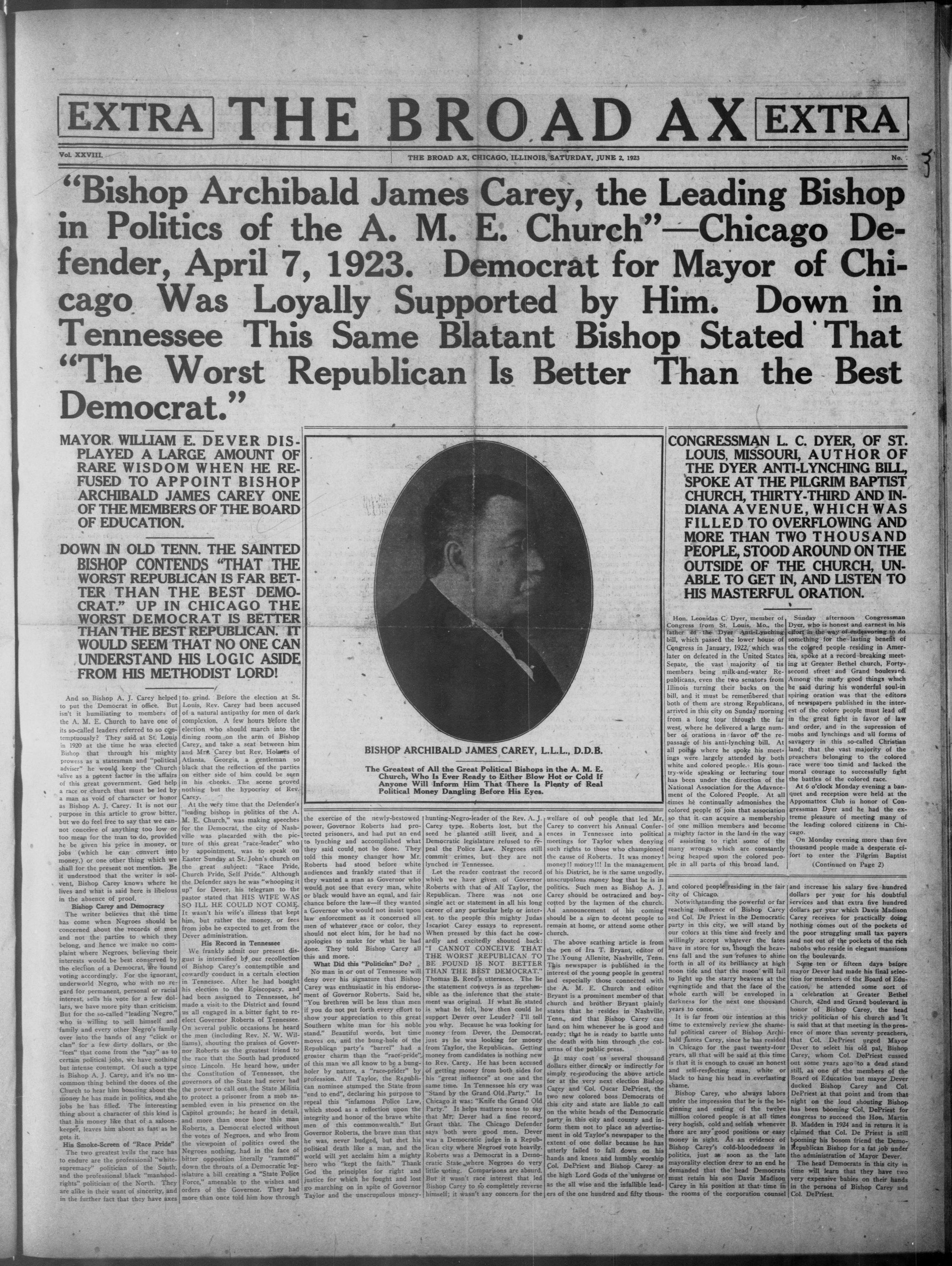
[Portrait of a man in a suit with a tie, facing slightly to the right].
BISHOP ARCHIBALD JAMES CAREY, L.L.L., D.D.B.
The Greatest of All the Great Political Bishops in the A. M. E. Church, Who Is Ever Ready to Either Blow Hot or Cold If Anyone Will Inform Him That There Is Plenty of Real Political Money Dangling Before His Eyes.
the exercise of the newly-bestowed power, Governor Roberts had protected prisoners, and had put an end to lynching and accomplished what they said could, not be done. They told this money changer how Mr. Roberts had stood before white audiences and frankly stated that if they wanted a man as Governor who would not see that every man, white or black would have an equal, and fair chance before the law—if they wanted a Governor who would not insist upon law enforcement as it concerned all men of whatever race or color, they should not elect him, for he had no apologies to make for what he had done. They told Bishop Carey all this and more.
What Did this "Politician" Do?
No man in or out of Tennessee will deny over his signature that Bishop Carey was enthusiastic in his endorsement of Governor Roberts. Said he, "You brethren will be less than men if you do not put forth every effort to show your appreciation to this great Southern white man for his noble stand." Beautiful words, but time moves on, and the bung-hole of the Republican party's "barrel" had a greater charm than the "race-pride" of this man we all know to be a bung-holer by nature, a "race-prider" by profession. Alf Taylor, the Republican nominee stumped the State from "end to end", declaring his purpose to repeal this "infamous Police Law, which stood as a reflection upon the integrity and honor of the brave white men of this commonwealth." But Governor Roberts, the brave man that he was, never budged, but met his political death like a man, and the world will yet acclaim him a mighty hero who "kept the faith." Thank God the principles for right and justice for which he fought and lost go marching on in spite of Governor Taylor and the unscrupulous money-
THE BROAD AX, CHICAGO, ILLINOIS, SATURDAY, JUNE 2, 1923
hunting-Negro-leader of the Rev. A. J. Carey type. Roberts lost, but the seed he planted still lives, and a Democratic legislature refused to repeal the Police Law. Negroes still commit crimes, but they are not lynched in Tennessee.
Let the reader contrast the record which we have given of Governor Roberts with that of Alf Taylor, the Republican. There was not one single act or statement in all his long career of any particular help or interest to the people this mighty Judas Iscariot Carey essays to represent. When pressed by this fact he cowardly and excitedly shouted back: "I CANNOT CONCEIVE THAT THE WORST REPUBLICAN TO BE POUND IS NOT BETTER THAN THE BEST DEMOCRAT." Thomas B. Reed's utterance. The lie the statement conveys is as reprehensible as the inference that the statement was original. If what he stated is what he felt, how then could he support Dever over Leuder? I'll tell you why. Because he was looking for money from Dever, the Democrat, just as he was looking for money from Taylor, the Republican. Getting money from candidates is nothing new to Rev. Carey. He has been accused of getting money from both sides for his "great influence" at one and the same time. In Tennessee his cry was "Stand by the Grand Old Party." In Chicago it was: "Knife the Grand Old Party." It helps matters none to say that Mr. Dever had a fine record. Grant that. The Chicago Defender says both were good men. Dever was a Democratic judge in a Republican city where Negroes vote heavily. Roberts was a Democrat in a Democratic State where Negroes do very little voting. Comparisons are absurd. But it wasn't race interest that led Bishop Carey to so completely reverse himself; it wasn't any concern for the
welfare of our people that led Mr. Carey to convert his Annual Conferences in Tennessee into political meetings for Taylor when denying such rights to those who championed the cause of Roberts. It was money! money! money!!! In the management of his District, he is the same ungodly, unscrupulous money hog that he is in politics. Such men as Bishop A. J. Carey should be ostracized and boycotted by the laymen of the church. An announcement of his coming should be a sign to decent people to remain at home, or attend some other church.
The above scathing article is from the pen of Ira T. Bryant, editor of The Young Allenite, Nashville, Tenn. This newspaper is published in the interest of the young people in general and especially those connected with the A. M. E. Church and editor Bryant is a prominent member of that church and brother Bryant plainly states that he resides in Nashville, Tenn., and that Bishop Carey can land on him whenever he is good and ready; that he is ready to battle unto the death with him through the columns of the public press.
It may cost us several thousand dollars either directly or indirectly for simply re-producing the above article for at the very next election Bishop Carey and Col. Oscar DePriest, the two new colored boss Democrats of this city and state are liable to call on the white heads of the Democratic party in this city and county and inform them not to place an advertisement in old Taylor's newspaper to the extent of one dollar because he has utterly failed to fall down on his hands and knees and humbly worship Col. DePriest and Bishop Carey as the high Lord Gods of the universe or as the all wise and the infallible leaders of the one hundred and fifty thous-
CONGRESSMAN L. C. DYER, OF ST. LOUIS, MISSOURI, AUTHOR OF THE DYER ANTI-LYNCHING BILL, SPOKE AT THE PILGRIM BAPTIST CHURCH, THIRTY-THIRD AND INDIANA AVENUE, WHICH WAS FILLED TO OVERFLOWING AND MORE THAN TWO THOUSAND PEOPLE, STOOD AROUND ON THE OUTSIDE OF THE CHURCH, UNABLE TO GET IN, AND LISTEN TO HIS MASTERFUL ORATION.
Hon. Leonidas C. Dyer, member of Congress from St. Louis, Mo., the father of the Dyer Anti-Lynching bill, which passed the lower house of Congress in January, 1922, which was later on defeated in the United States Senate, the vast majority of tis members being milk-and-water Republicans, even the two senators from Illinois turning their backs on the bill, and it must be remembered that both of them are strong Republicans, arrived in this city on Sunday morning from a long tour through the far west, where he delivered a large number of orations in favor of the repassage of his anti-lynching bill. At all points where he spoke his meetings were largely attended by both white and colored people. His country-wide speaking and lecturing tour has been under the direction of the National Association for the Advancement of the Colored People. At all times he continually admonishes the colored people to join that association so that it can acquire a membership of one million members and become a mighty factor in the land in the way of assisting to right some of the many wrongs which are constantly being heaped upon the colored people in all parts of this broad land.
and colored people residing in the fair city of Chicago.
Notwithstanding the powerful or far reaching influence of Bishop Carey and Col. De Priest in the Democratic party in this city, we will stand by our colors at this time and freely and willingly accept whatever the fates have in store for us, though the heavens fall and the sun refuses to shine forth in all of its brilliance at high noon tide and that the moon will fail to light up the starry heavens at the eveningtide and that the face of the whole earth will be enveloped in darkness for the next one thousand years to come.
It is far from our intention at this time to extensively review the shameful political career of Bishop Archibald James Carey, since he has resided in Chicago for the past twenty-four years, all that will be said at this time is that it is enough to cause an honest and self-respecting man, white or black to hang his head in everlasting shame.
Bishop Carey, who always labors under the impression that he is the beginning and ending of the twelve million colored people is at all times very vogish, cold and selfish whenever there are any good positions or easy money in sight. As an evidence of Bishop Carey's cold-bloodedness in politics, just as soon as the late mayorality election drew to an end he demanded that the head Democrats must retain his son Davis Madison Carey in his position at that time in the rooms of the corporation counsel
Sunday afternoon Congressman Dyer, who is honest and earnest in his effort in the way of endeavoring to do something for the lasting benefit of the colored people residing in America, spoke at a record breaking meeting at Greater Bethel church, Forty-second street and Grand boulevard. Among the many good things which he said during his wonderful soul-in spiring oration was that the editors of newspapers published in the interest of the colore people must lead off in the great fight in favor of law and order, and in the suppression of mobs and lynchings and all forms of savagery in this so-called Christian land; that the vast majority of the preachers belonging to the colored race were too timid and lacked the moral courage to successfully fight the battles of the colored race.
At 6 o'clock Monday evening a banquet and reception were held at the Appomattox Club in honor of Congressman Dyer and he had the extreme pleasure of meeting many of the leading colored citizens in Chicago.
On Monday evening more than five thousand people made a desperate effort to enter the Pilgrim Baptist (Continued on Page 2)
and increase his salary five hundred dollars per year for his doubtful services and that extra five hundred dollars per year which Davis Madison Carey receives for practically doing nothing comes out of the pockets of the poor struggling small tax payers and not out of the pockets of the rich nabobs who reside in elegant mansions on the boulevards.
Some ten or fifteen days before mayor Dever had made his final selection for members of the Board of Education, he attended some sort of a celebration at Greater Bethel Church, 42nd and Grand boulevard in honor of Bishop Carey, the head tricky politician of his church and it is said that at that meeting in the presence of more than seventy preachers, that Col. DePriest urged Mayor Dever to select his old pal, Bishop Carey, whom Col. DePriest cussed out some years ago to a dead stand still, as one of the members of the Board of Education but mayor Dever ducked Bishop Carey and Col. DePriest at that point and from that night on the loud shouting Bishop has been booming Col. DePriest for congress to succeed the Hon. Martin B. Madden in 1924 and in return it is claimed that Col. De Priest is still booming his bosom friend the Demo-Republican Bishop for a fat job under the administration of Mayor Dever. The head Democrats in this city in time will learn that they have two very expensive babies on their hands in the persons of Bishop Carey and Col. DePriest.
THE BROAD AX
In this city since July 15th, 1899, without missing one single issue. Republicans, Democrats, Catholics, Protestants, Single Taxers, Priests, infidels or anyone else can have their say as long as their language is proper and responsibility is fixed.
The Broad Ax is a newspaper whose platform is broad enough for all, ever claiming the editorial right to speak its own mind. It is neither Democratic nor Republican. It is strictly or absolutely independent in politics.
Local communications will receive attention. Write only on one side of the paper.
Subscriptions must be paid in advance.
One Year ..... $2.00
Six Months ..... $1.00
Advertising rates made known on application.
Vol. XXVIII No. 37
Chicago, Ill., June 2, 1923
Entered as Second-Class Matter, Aug.
19, 1902, at the Post Office at Chicago,
11. Under Act of March 8, 1879.
CONGRESSMAN L. C. DYER
DELIVERED A WONDERFUL
OVATION AT THE PIL-
GRIM BAPTIST CHURCH
Church in order to hear Congressman Dyer. The meeting was held in the interest of the National Association for the Advancement of Colored People. It was the BIGGEST DEMONSTRATION OF ITS KIND EVER SEEN IN CHICAGO
Long before 8 o'clock the church was filled and soon the streets in front of it were blocked by more than two thousand people intent on paying tribute to the greatest of all the great champions of human rights. The platform, choir loft, every available seat, nook and cranny, the steps to the church chancel, galleries and back far into the lobby, interested auditors occupied every possible space. It was not only a tribute to Congressman Dyer, not only interest in the great work of the N. A. A. C. P., but a realization on the part of a race that it was necessary to bury petty personalities, factionalism and so forth, produced this great unanimity of spirit in the demonstration. Sprinkled in the audience and on the platform were many white friends.
Before the meeting program began, Fulton Street M. E. Church choir under direction of Mr. Cornelius W. Pierce, rendered a very pleasing concert. The invocation by Rev. Chas Wesley Burton, of Lincoln Memorial Congregational Church, was most appropriate, as was the address of welcome by Rev. S. E. J. Watson, Pastor of the Church, whose doors had been thrown open to the N. A. A. C. P. Dr. Bentley, vice president of the branch, spoke in most appreciative terms in introducing Congressman Dyer. The appeal for the table collection by Rev. W. W. Lucas of the M. E. Church was such that an unprecedented response followed.
Congressman Dyer was at his best. He is a forceful, logical and impressive speaker. For twelve years he has been a member of the House of Representatives from the 9th Missouri district. He has dedicated his life, as did Lincoln, to the belief that this government cannot endure permanently half slave and half free. He pointed out that the same necessity that required a Volstead Act to put effect to the 18th Amendment, was also required in the Dyer Anti-Lynching legislation to put effect to the 14th and 15th Amendments to the Constitution.
With the establishment of a branch office here in Chicago at 3201 S. Wabash avenue, the employment of an executive secretary, and the great impetus given the Association work by the mass meeting Monday night, there should be and will be a new birth to that important work in Chicago. Of the 125,000 colored people in Chicago, at least 10,000 of them should be enrolled as members of this worth while organization.
The table collection was $266.00; the Memberships $463.00; pledges $100.00 making a total of $799.00.
In concluding his wonderful oration Congressman Dyer, who is the second Wendell Phillips come to Judgement, paid his respects to United States Senator William E. Borah of Idaho as follows: "That he is neither a Republican nor Democrat; that he is simply a big mouthful of nothing."
Senator Borah claims to be a red hot Republican, but he worked and
voted against the passage of the Dyer Anti-Lynching Bill in the United States Senate.
Congressman Dyer intimated that he very much regretted to see the electric sign which was hung up in the church which indicated that there are twenty-thousand members of the Ku Klux Klan in Chicago and only one thousand members of the National Association for the Advancement of Colored People in this city.
Congressman Dyer urged the colored people not only in this city but in all parts of this country to wake up and do something for themselves in the way of fighting for their civil and their political rights and that if they will only do so, thousands of white men and women in every part of this land will join hands with them in their great fight for justice and absolute freedom.
WEEK DAY SERMONETTES
"Let us not be weary in well doing; for in due season we shall reap if we faint not." Gal. 6-9.
In recent years the Negro is losing his smile. The disposition grows upon him to think more of his sorrows than his joys; more of the stumbling blocks to his progress than of the stepping stones to success; more of the people who hinder than of those who help. More and more he forgets the counsel of the good hymn, "Count your blessings, name them one by one." It seems well therefore that we reflect upon Paul's advice to the Galatians quoted above. We need to study it for the purpose of getting reasons for continued optimism. For be assured that the only people who have made progress in the past, and the only ones who will advance in the future, are those who keep hopeful. Everything depends upon our facing the future with the smile of hope, and the only way to do this is to heed the injunction of the text—"Be not weary in well doing."
To the Negroes of America this means: Compare the present with the past and see the evidence that the race has done well. And if it has, do not grow bitterly impatient because there are many privileges still denied us. I have long since decided that the Negro is not being hurt by race prejudice. Unpleasant as it is, it serves as discipline in throwing off slavery's greatest handicap—treachery one toward another. The stripes on the Negro's back are not the most cruel marks of slavery. Far more cruel are those divisive marks which are manifested in lack of confidence of one Negro in another and in the unwillingness to pull together for the good of all concerned. To stand well with "Ole Massa" in the days of slavery, Negroes, would betray one another's plans and secrets. This practice for two and a half centuries made disloyalty to his race the Negro's second nature. The seed was so deeply rooted that nothing would develop race consciousness so effectively and speedily as the conditions prevailing in this country since the emancipation. Therefore, instead of losing our smile, let us see in the very injustices which race prejudice has occasioned, the steps by which we climb to race solidarity. If we watch our upward march, we shall not "grow weary in well doing." The text has a promise that should keep us hoping. "For in DUE season ye shall reap." "In DUE season," this means not when man THINKS so, but when God KNOWS we have acquired enough racial solidarity to make the splendid history He intends shall be ours.
That brings the question, what shall that splendid history be? What is the big thing God intends the Negro shall do? In consideration of his traditional optimism and ability to forgive and forget, I am convinced that God made him to teach the world its greatest and most necessary lesson-universal brotherhood. I plead with you, men and women of my race, not to allow the nursing of injuries to so embitter your souls as to unfit the race to perform a work without which this old world shall never be turned right side up and without which the life and ministry of Jesus Christ shall come to naught. "In due season ye shall reap," is the promise upon which we can safely base our hope.
Why? Because (1) God says so. We cannot look into the history of mankind nor the laws of nature without getting abundant proof that God can and will keep His promises to the children of men. (2) *Because seed planted will grow. A recent traveller found seed which had been shut up in the catacombs of Rome for eighteen centuries. They were planted and to everybody's amazement, germinated and grew into most beautiful foliage and flowers. If natural seed did not lose their vitality in eighteen hundred years, what may we not expect of moral and spiritual seed preserved and magnified by the Holy Spirit? "If ye faint not" is the one condition upon which the realization of this promise depends. If we will continue the habit which has kept us hopeful in the past, we shall not faint. We
[Name]
shall keep our optimism and smile if we continue to recognize that the white man's friendship has made possible all the progress the Negro has made. While it is true the white man enslaved us, it is also true that the white man freed us. If the white man deprived us of education and denied us the ballot, white men also have given us education and the ballot. White men lynch us, but white people, even Southerners, are lifting earnest and determined voices against this national disgrace. Oh, yes, if we look for them we can find many reasons for the conviction that the Negro need not go to Africa, or Mexico, or anywhere else. On the contrary, we shall be assured that in the United States he shall reap fullest liberty if he heeds the counsel of our text.
COLORED FARM MEN AND WOMEN TO MEET AT HAMPTON, JUNE 12-14
How Can Rural Life Be Made More Satisfying Will Be Central Theme- Addresses by M. C. Burritt of Cornell; J. R. Hutcheson of Virginia State Agricultural College; A. B. Graham of States Relations Service; and Other Recognized Leaders- Hampton Offers 134 Summer Courses, Including Some in Collegiate Agriculture.
By Anthony Aery
Hampton, Va.—The annual Hampton Institute farmers' conference will begin on June 12 and will continue through June 14, according to an announcement made by Warren K. Blodgett, director of the Hampton Institute Agricultural School.
Among the visiting speakers will be M. C. Burritt, director of extension, New York State College of Agriculture at Cornell University, who will discuss "Self-help and Local Leadership in Working Out Individual and Community Problems;" A. B. Graham, in charge of "division of methods, States Relations Service, Washington, D. C. "What May I Secure from Agricultural Extension Work?" and John R. Hutcheson, State director of extension service for Virginia, "Problems Confronting Farm Men and Women Today."
The program, which has been arranged to help colored farmers and their families live a more satisfying life, will include human interest reports from field workers; addresses by Virginia State extension-service officials; visits to the Institute departments, including Shellbanks Farm which adjoins Langley Flying Field; demonstrations by members of the Agricultural School staff; and round table conferences.
There will also be exhibits of poultry-houses, good- and poor-laying hens, pure-bred cockerels, home-made water-supply systems, labor-saving gas-engines, sanitary toilets, well selected seeds, home-garden products, and materials of interest to women.
Delegates will have the opportunity of seeing motion pictures on agricultural subjects and of hearing the new
THE BROAD AX. CHICAGO, ILLINOIS, SATURDAY, JUNE 2, 1923
"Frisseil Memorial Organ" in Ogden Hall.
Hampton Summer School.
Hampton Institute, beginning on June 19 and extending through August 31, will offer agricultural courses of collegiate grade in animal husbandry, biology, botany, chemistry, farm shop work, and in methods of teaching agriculture. The instructors will include the following staff members of the Hampton Institute Agricultural School; Warren K. Biodgett, director; Eldon E. Moberg, teacher of agronomy and dairying; and Perley F. Skofield, teacher of chemistry. Dr. Thomas W. Turner, professor of botany, Howard University, Washington, D. C., and Russell P. Wolf, teacher of carpentry, Hampton Institute Trade School, will also give courses.
Dr. George P. Phenix, vice principal of Hampton Institute, is the director of the Hampton Summer School, which is offering colored teachers 134 courses in its two sessions of six weeks each. Work will be provided for high-school teachers, physical-education teachers, teachers in county training schools, industrial-supervising teachers, home-economics teachers, and elementary-school teachers.
LOUISIANA PEONAGE UNCOVERED BY NEW ORLEANS N. A. A. C. P.
A report has been made public by the National Association for the Advancement of Colored People, 70 Fifth Avenue, New York City, giving details of the recent Louisiana peonage case exposed through the investigation undertaken by the New Orleans Branch of the N. A. A. C. P.
The victims of the peonage were Mrs. Emma Johnson and her two nine year old daughters, of Picayune, Mississippi, who were enticed to Tangipahoa Parish in Louisiana with the promise of transportation and board and pay of 1 cent for every box of strawberries picked. A labor agent and a colored woman enticed them.
When they had arrived in Ticktaw, Louisiana, they were carried to the strawberry farm of Benjamin Kincheon, 9 miles from the station, and held in a state of slavery, with no sleeping accommodations and poor food, chiefly of corn bread and syrup, and were forced to work from sunrise until sundown. Nezzie Pringle, the woman's brother, found his way to the farm and offered to pay whatever debt his sister and her children owed Kincheon if he would release them, Mr. Kincheon beat Pringle with a club and would have shot him if his wife had not begged him to spare Pringle. The wife hid the revolver, enabling Pringle to escape to New Orleans where he reported the case to the National Association for the Advancement of Colored People.
The Association presented the facts to United States Attorney Burns who ordered Federal Agents to bring the berry pickers on the Kincheon farm to New Orleans for questioning and to arrest the colored woman who had enticed them. These orders were carried out and Mrs. Emma Johnson, her two nine year old daughters, and several other people were brought
before the Federal Courts in New Orleans. This case was handled by Dr. G. W. Lucas, President of the New Orleans Branch, N. A. A. C. P. and by the Grievance Committee of the Branch, composed of Messrs. Jas F. Gayle, F. B. Smith, and Jas. A. Sample.
BIG LAW FIRM MOVES INTO
EXTENSIVE. QUARTERS IN
THE ILLINOIS MERCHANTS
BANK BUILDING.
Recently the great law firm of Schuyler, Ettelson & Weinfeld, the law firm consisting of Hon. Daniel J. Schuyler, Hon. Samuel A. Ettelson and Hon. Charles Weinfeld, removed their law offices from the New York Life Building to the Illinois Merchants' Bank Building, corner Clark and Jackson streets, where they occupy the entire twelfth floor, on the Clark street side.
No law firm in Chicago can surpass this well-known law firm for fine appointments, modern or first clsss quarters in every respect. If their many rooms were stretched out in rotation they would be one block long.
Their library is one of the most extensive in the United States. It contains almost ten thousand volumes, covering every phase of the laws which have been enacted by the various legislative or law-making bodies throughout the world.
BETHSEDA SINGERS UNDER DIRECTION OF MRS. MARTHA B. ANDERSON, WILL RENDER COWEN'S BEAUTIFUL, SPARKLING CANTATA ST. JOHN'S EVE.
On Monday evening, June 4, at Greater Bethel A. M. E. church, 42d street and Grand boulevard, the famous Bethesda singers will render Cowen's beautiful, sparkling cantata, "St. John's Eve," with an augmented chorus of one hundred well-trained voices and with an array of high class soloists.
Ferrell's symphony orchestra will accompany the singing artists. This pleasant musical affair will be under the full direction of Mrs. Martha B. Anderson. It will be for the benefit of Bethesda Baptist church, 38th street and South Wabash avenue, Rev. E. T. Martin, pastor. Admission, 50 cents.
The cantata will begin at 8:30 o'clock. Mr. James E. White is chairman of the committee.—Adv.
THE THIRD WARD REPUBLICAN ORGANIZATION WILL GIVE A GRAND TESTIMONIAL CELERATION IN HONOR OF ALDERMAN ROBERT R. JACKSON.
On Monday evening, June 4, the Third Ward Republican organization, John J. Lupe, president, will give a grand testimonial celebration at the Eighth Regiment Armory, 3517 Giles avenue, in honor of Alderman Robert R. Jackson.
Concert from 8:30 to 9:30 p. m. Presentation at 9:30 p. m. Dancing from 9:45 p. m. to 12 midnight. It
CHARLES E. STUMP, THE REGULAR TRAVELING CORRESPONDENT FOR THE BROAD AX, HAS BEEN VISITING WITH FRIENDS AT BIRMINGHAM, ALABAMA, WHERE HE HAD A ROYAL TIME.
Birmingham, Alabama. — L o o k where I was when I wrote you that other letter and see where I am today when I am writing you this one and then find out where I have been between the two letters and you will at once come to the conclusion that I am one more riding baby, and I think you will be about right.
This is an age where a man can get around if he decides that he is going to do so. For one day, I ate breakfast in Richmond, Va., lunch in Washington, D. C., supper in Philadelphia and spent the night in New York City. Do you consider that going some. I want you to get your business straight with God, and then get where God can use you. If you get to be anybody in this world then you may expect to catch what "Paddy gave the drum." If you don't know what that was then don't ask me for I am not going to tell you. I am no longer using them bad cuss words, but getting ripe for the kingdom of heaven.
I was just thinking about Dr. Robert R. Moton. I notice from where he started and where he has gone, and then I see what he has to go through daily, I just thank God for him and go right on thanking God that my feet are too large to fill his shoes and my head too small to fill his hat. He is one of the greatest American citizens. He has made it from the ground up. There was a time that he was so green and that is the time he reached Hampton, that they had to keep the live stock from eating him for grass. He just worked and worked through Hampton, and continued to work and study until he made his way up.
Now there is one man who is devoting his time for the betterment of his people. There is not one drop of selfish blood in him, but his whole life is to make it for others. He wants to see this race lifted up and he is pleading for this in many a way in places where none of the rest of us can reach, yet he is doing the real work. Here and there some fellow with the running off of the mouth, who desires to be noticed or get his name in the paper will make an attack on Dr. Moton, but he is just as much as a bull frog contending with the cow or horse for physical size.
These fellows reminds me so much of the sun. There are a lot of fellows who are called astronomers, who have been saying that there are spots on the sun, and the sun has never stopped for a minute to deny or affirm the allegations. Thus we find Dr. Motton going right on doing his work, sending forth his best efforts to help humanity. On every side he is getting the devil's home, and if you know where it is then you know what he is getting: He has taken a stand for right, for justice, in connection with the Government hospital that you have heard so much about. There are the white folks who are giving him just particular hot-dogs. These people are contending that white folks should be absolutely in charge of a hospital furnished by the United States Government for my people. This would have been carried out, for Col. Stanley, who had selected all the help he needed and they were all white, guards, laundrymen and women, cooks, watchmen, nurses, physicians—even the men who are to guard the building are white, and my people whose efforts have been to prepare for usefulness and service, must stand aside.
This was about to go through and the time set for the opening, when something dropped, and all work on the hospital stopped. Perhaps the public, those who are now saying mean things about Dr. Moton and calling him everything but a child of God would turn that into praise. The hospital is not opened, and just wait and see the result of all. I wish you could see the man who stopped the work, with just a word or so to speak. I say again wait, and it will come out in good shape. May I say to Dr. Moton for you "We believe in you, Dr. Moton, we believe you will lead us to the place of success. We believe you are working for us, and that you are not going to sell us out for a few pennies.
I think Dr. Moton would die before he would sell out my people. He is a man every inch of him, and I am real proud of him. He has heard it thunder more than one time, and then
is expected that the Armory will be filled by the many friends of the Alderman and Mrs. Jackson.
Charles E. Morrison, special messenger to Mayor William E. Dever, has removed his home from 3710 Prairie Avenue, to 4133 Michigan Avenue, where he will continue to make his home with Mrs. James A. Scott.
he has felt the sting for the slanderers. It is just like an old dog we had when I was a boy, named Juno. She seemingly formed a dislike for the moon, and when the moon would shine she would spend hours barking at it, but one morning we discovered Juno with her head turned up toward the moon dead, but the moon continues to shine. Thus it will be with some of these fellows who attempt to destroy Moton. They will die, but Moton and his efforts for the betterment of mankind will continue to live. He is a sane, conservative safe leader and I am proud of him. Don't bother about what others may say concerning the hospital, you will find that it will turn out all right in due time.
I told you about my trip to New York, Philadelphia, Washington, D.C., Richmond, Va., and from Richmond, I left on the S. A. L, and made it into Atlanta. People were out in large numbers in Atlanta to hear Rev. Dr. L. K. Williams, president of the National Baptist convention. When I got in town and went upstairs to the terminal stable, I heard one one ask "Are you going to hear L. K. tonight at A. D. Williams' church?"
He preached a wonderful sermon and delivered a wonderful address. There were many there including Dr. Carter, of Friendship Baptist church. You see, Dr. Carter has not been a member of the National Baptist convention since that historic Chicago meeting. "If you keep up that kind of speech-making you will soon have all the Baptists together again," Dr. Carter said. There are to be many surprises in the rank of our friends, this fall. Some people who have followed the father, who was a genius, will not follow the son, and will return home.
I had a long talk with Dr. D. W. Cannon, president of the National B. Y. P. U. and Sunday School Congress, who has been sick, but I am glad to say much improved. The Congress will meet June 18, and he will go ahead of time. It is going to be one more great meeting and the people are going to be there from everywhere.
After spending the night in Atlanta, bright and early the next morning I was off for Tuskegee Institute, and had indeed a fine ride. They met me at Chehaw in a automobile car carriage and toted me over to the school. It was commencement time, and it was a wonderful sight to witness 160 young people getting diplomas and certificates. They had earned them and will make good in life. I hope.
I came in touch first with Secretary Holsey, who made me welcome and free. He had my things toed over to my quarters, and then told me that he would be delighted to render any possible service. Then I was in company with Banker Gover, who is another fine man, and his wife soon informed me that she had some chicken dinner for me. Mrs. Kate Gover is considered one of the best proof readers in this country. They tell me that it is just as easy to walk up to the moon as it is for an error to escape her eyes. She is not working just now. She trained under Mr. Burrell, in the National Baptist Publishing Board in Nashville, and has been doing some real work since. I don't know how many years she has been at Tuskegee. She went there Miss Evans, and now see who she is.
Coming back to Secretary Holsey, since the commencement has been pulled off, he is now turning his attention to that great event which is to take place in Hot Springs in August, the National Negro Business League, and if you miss it, you will miss one of the greatest meetings in the history of your life. Many will go from there to the National, or Supreme Lodge in New York. I am going there myself. Editor Porter, of East Tennessee News is going to be there and he is going to make some speech believe me, honey. He did not get to Norfolk, but will get to Hot Springs. The people in the city of Hot Springs are going to put the big pot in the little one. I shall let you know about it from time to time.
You may write to me, 2813 Thomas avenue, Dallas, Texas. I will be there next week to the Grand Lodge Knights of Pythias.
CHARLES E. STUMP.
The Boston Chronicle deserves praise for its stalwart determination to keep President Harding reminded of his Birmingham, Ala., remarks to the black man on the question of voting: "I want to see the time come," said the President, when Negroes will vote for measures and not parties. He may see it next year who knows?
UNDERWOOD
BANQUET
The morning's dusting seems not half so arduous when one is frocked in the red and white damask morning dress shown here.
The morning's dusting seems not half so arduous when one is frocked in the red and white damask morning dress shown here.
One-Piece Garment Is Much in Demand
There is an increasing demand for the one-piece garment among women who dislike bulkiness about the waistline. The one-piece garment has a semi-fitted bodice with gathered drawers attached just below the normal waistline. Gathers or plats are placed over the blips so that the flat back and front effect is achieved.
The costume slip is as important as the frock itself this year. Often they are made with the batteau-shaped necklines and are worn in place of vests or blouses with the jacket suit and sports jackets. When used in place of the blouse, heavy crepes de chine or satin-backed crepes, in colors, navy, brown, Lauvin green, black or white, are popular. Bodices may be embroidered in colors or batiked to resemble the dressy blouse. For sports wear the plaited or tucked fronts are popular.
With the sheer frock the slip is often six inches shorter than the frock itself, allowing a transparent showing of the ankle. For summer wear the costume slip has a shadow-proof hem extending to the hip line. White and flesh sateen slips will be worn with the washable dress.
A pretty underslip was worn at a recent fashion show under a frock of tan georgette. The bodice of the slip was of nile-green georgette and the skirt consisted of bands of pink, green, yellow and lavender georgette hem-stitched together and finely plaited. The rainbow effect subdued by the overgown of tan was obtained.
Yellow and pink are the leading colors for summer nightgowns, many of which are made with battteen-shaped neck lines and long arm slits and with ribbon or string belts.
It is difficult to distinguish the nightgown from the negligee this year, as this garment takes on negligee lines. Even where the shoulder strap effect is used there is usually a detachable lace berta which ties with ribbon in front.
Many of the latest sheer gowns have gone so far as to use long, full sleeves, which are gathered into narrow wrist bands. With the long sleeve arrangement the off-the-shoulder neckline is generally used.
Novelties Found in Bordered Materials
Bordered materials are strong, with many novelties being introduced, such as ten-inch borders of rows of button-holes, deep borders of tiny pompons and borders that look like rows of embroidered arrowheads. All are woven into the fabric.
Crepe is still good, but crepe satin with a shimmering surface is stronger, while there are many printed silks. The designs of the new printed silks are unusual, adapted from old Hindu-Chinols designs or Egyptian and Persian haloglyphics.
Materials with embroidered and printed borders are overwhelmingly in the majority. In cotton and linen fabrics these designs reign supreme.
There is much white patterned in colors, often in strong blues, reds and greens. All over embroidery frequently is seen in cotton fabrics. A novelty in white linen shows a colored border exactly like the border of a fine linen towel.
Predict a Big Demand for Cotton Fabrics
Cotton dresses are making their appearance in larger numbers, and it is predicted that a big cotton season is forthcoming. The lines of sports dresses are also being enlarged for the later selling, a heavy demand for this type being anticipated by the wholesalers as soon as weather conditions about the country become more suitable to outdoor life and to spring and summer sports. The demand from year to year, wholesalers point out, has increased for sports apparel in the spring and summer months, and there is every indication, they say, that this demand will be bigger than ever this season.
Recording Angel *Foot 'Em Up.*
Time is better spent adding to our good deeds than in adding them up.—
Boston Transcript.
DOCTOR JONES OF MON-
MOUTH, ILLINOIS DOES
SOME STEPPING
AROUND
Mr. Julius F. Taylor, Editor,
Chicago, Ill.
Dear Sir:
In looking over the last issue of The Broad Ax I see that the Hon, Harry M. Daugherty, the Republican Attorney General of the United States said before the Supreme Court at Washington, D. C., that this is a white man's country and The Broad Ax says that "the twelve million colored people in the United States should demand President Harding to remove him from his present position but The Broad Ax will never see that come to pass. There is one thing the Republican Party can depend upon the colored voters to do—when ever the party takes snuff the colored voters will do the sneezing. The Republican Party is beginning to use a great deal of snuff for the next Presidential election in 1924 so that the colored voters will not have time to act on the Daugherty case or the lynch bill as the Republican Party is beginning to use so much snuff that it will keep the colored voters continually sneezing until after the Presidential election next year. They are beginning to sing this song to the colored voter for next year. We need thee, ohl we need three, Every hour we need thee. We need thee until after the Presidential election in 1924, then we will not need you any more for a number of days, then we will take the political bridle off and turn you into the political dry pasture to graze.
Yours truly,
Dr. G. W. JONES.
WOULD KEEP WASHINGTON
VOTELESS TO DISFRAN-
CHISE COLORED
Arguing in favor of keeping the District of Columbia and the National Capital voteless, as they are at present, George Ernest Miller of the Washington Journal, writing in the Service Record, urges as one of the reasons for denying the vote to Washington, that there are so many Negroes there. Mr. Miller warns of the danger that the National Association for the Advancement of Colored People would organize 25,000 Negroes in Washington; "They have the disposition and numbers to be the 'balance of power' at the seat of the government and will take advantage of it." Mr. Miller refers to the drive now being conducted by the N. A. A. C. P. for 25,000 members in Washington, and states as his belief that if Washingtonians were given the vote colored people would through their organization control and dictate to the government. In the face of this "danger" Mr. Miller is willing to continue disfranchising the white citizens of Washington, in order not to have to givete the vote to the colored people.
THE FORTY CLUB MEETINGS
The regular monthly meeting of the Forty Club was held Saturday, May 26, 1923, at the Appomattox Club. Mr. Rufus Sampson, Chicago Representative of the Fidelity Investment Association, addressed the members on the subject of "Modern Methods of Finance and Investments."
A series of instructive talks have been arranged by the Program Committee: The Chairman, Mr. Benj. A. Walten, Jr., announced that Mr. Chas. S. Duke, one of the members of the committee on zoning in Chicago, and a Structural Engineer, will address the Members at the June meeting to be held Saturday, June 30, 1923. Attorney Wm. L. Dawson will address the Members on "The Practical Side of the Law," on July 28, 1923.
The officers of the Forty Club are: Dr. H. Reginald Smith, President Mr. Raymond T. Middleton, 1st Vice President. Mr. Henry M. Higgins, 2nd Vice President.
Attorney Macon H. Huggins, Secretary.
Mr. W. A. Mollison, Assistant Secretary.
Mrs. Hester Barnett 3210 Federal St.,
...Recently Gave an Elaborate Birth-
Day Party in Honor of Her
The first of last week, Mrs. Hester Barnett, 3210 Federal street; gave an elaborate birthday party, enabling her mother Mrs. Henrietta Foley, of Hannibal, Mo., to celebrate her 85th birthday and Mr. Byron Webster, son of Mr. Barnett, celebrated his 42nd birthday, at which time they received many beautiful and useful presents. The celebration lasted one week, in order to give the many friends of Mr. and Mrs. Barnett a chance to join in the celebration and to enjoy the good eating.
AT MILWAUKEE
A. E. Pinckney, 4114 Calumet Ave., and Mrs. Florence Masterson, 4731 Prairie Ave., spent Sunday at Milwaukee, Wis., with friends.
THE BROAD AX, CHICAGO, ILLINOIS, SATURDAY, JUNE 2, 1923
Mellott
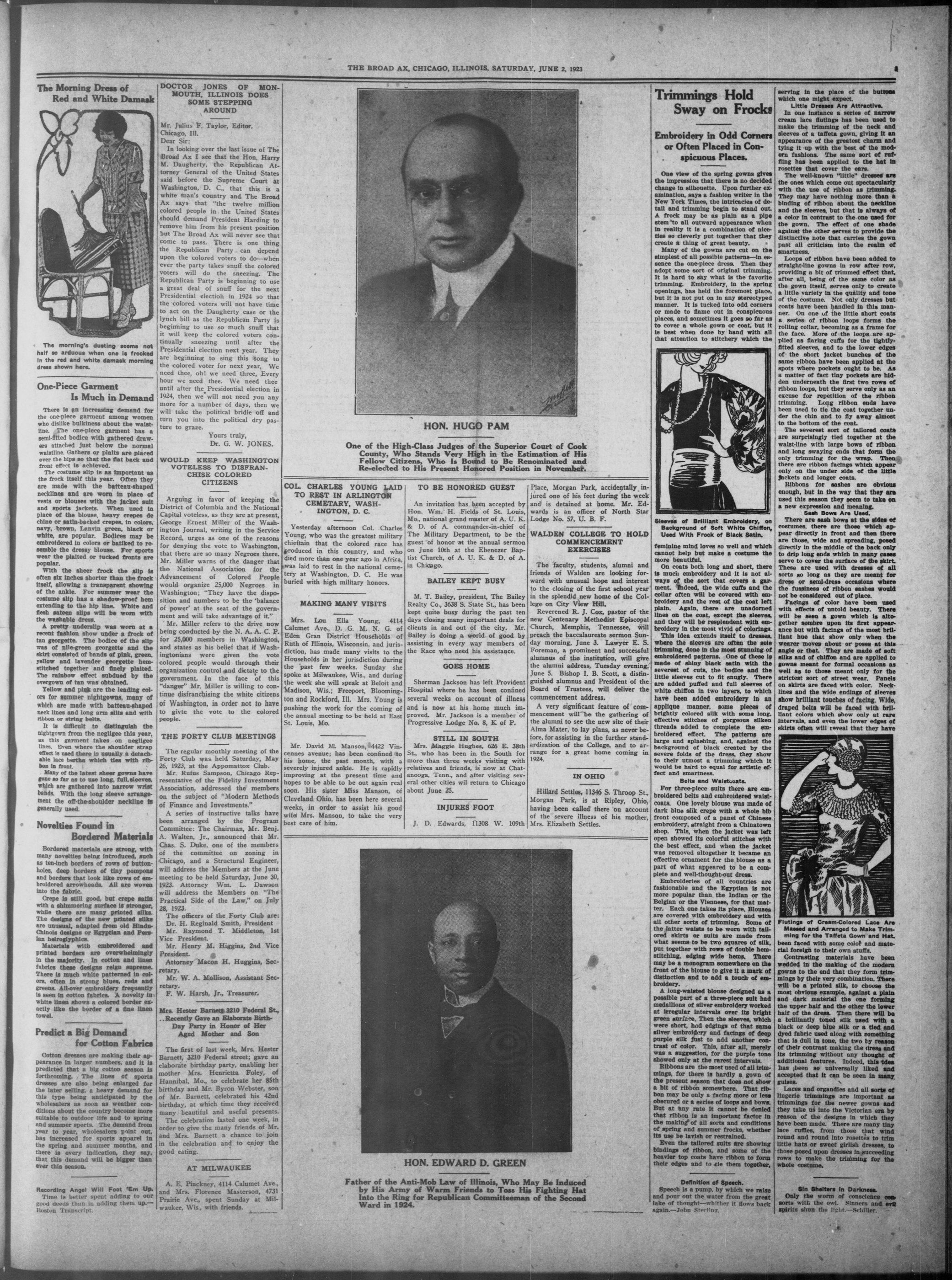
One of the High-Class Judges of the Superior Court of Cook County, Who Stands Very High in the Estimation of His Fellow Citizens, Who Is Bound to Be Renominated and Re-elected to His Present Honored Position in November.
[Name]
Father of the Anti-Mob Law of Illinois, Who May Be Induced by His Army of Warm Friends to Toss His Fighting Hat Into the Ring for Republican Committeeman of the Second Ward in 1924.
Father of the Anti-Mob Law of Illinois, Who May Be Induced by His Army of Warm Friends to Toss His Fighting Hat Into the Ring for Republican Committeeman of the Second Ward in 1924.
COL. CHARLES YOUNG LAID TO REST IN ARLINGTON CEMETARY, WASHINGTON, D. C.
Yesterday afternoon Col. Charles Young, who was the greatest military chieftain that the colored race has produced in this country, and who died more than one year ago in Africa, was laid to rest in the national cemetery at Washington, D. C. He was buried with high military honors.
MAKING MANY VISITS
Mrs. Lou Ella Young, 4114 Calumet Ave., D. G. M. N. G. of Eden Gran District Households of Ruth of Illinois, Wisconsin, and jurisdiction, has made many visits to the Households in her jurisdiction during the past few weeks. Sunday she spoke at Milwaukee, Wis., and during the week she will speak at Beloit and Madison, Wis.; Freeport, Bloomington and Rockford, Ill. Mrs. Young is pushing the work for the coming of the annual meeting to be held at East St. Louis, Mo.
Mr. David M. Manson, 4422 Vincentennes avenue; has been confined to his home, the past month, with a severely injured ankle. He is rapidly improving at the present time and hopes to be able to be out again real soon. His sister Miss Manson, of Cleveland Ohio, has been here several weeks, in order to assist his good wifd Mrs. Manson, to take the very best care of him.
HON. HUGO PAM
high-Class Judges of the Superior who Stands Very High in the Estates, Who Is Bound to Be Re to His Present Honored Position
TO BE HONORED GUEST
An invitation has been accepted by Hon. Wm. H. Fields of St. Louis, Mo., national grand master of A. U. K. & D. of A. commander-in-chief of The Military Department, to be the guest of honor at the annual sermon on June 10th at the Ebenezer Baptist Church, of A. U. K. & D. of A. in Chicago.
BAILEY KEPT BUSY
M. T. Bailey, president, The Bailey Realty Co., 3638 S. State St., has been kept quite busy during the past ten days closing many important deals for clients in and out of the city. Mr. Bailey is doing a world of good by assisting in every way members of the Race who need his assistance.
GOES HOME
Sherman Jackson has left Provident Hospital where he has been confined several weeks on account of illness and is now at his home much improved. Mr. Jackson is a member of Progressive Lodge No. 8, K of P.
STILL IN SOUTH
Mrs. Maggie Hughes, 626 E. 38th St, who has been in the South for more than three weeks visiting with relatives and friends, is now at Chatananooga, Tenn., and after visiting several other cities wil return to Chicago about June 25.
INJURES FOOT
J. D. Edwards, 11308 W. 109th
[Portrait of a man in formal attire, wearing a dark coat and a white shirt with a bow tie. The background is plain and dark, emphasizing the subject.]
HON. EDWARD D. GREEN
Anti-Mob Law of Illinois, Who M
any of Warm Friends to Toss Hi
ing for Republican Committeeman
1924.
Place, Morgan Park, accidentally injured one of his feet during the week and is detained at home. Mr. Edwards is an officer of North Star Lodge No. 57, U. B. F.
WALDEN COLLEGE TO HOLD
COMMENCEMENT
EXERCISES
The faculty, students, alumni and friends of Walden are looking forward with unusual hope and interest to the closing of the first school year in the splendid new home of the College on City View Hill. Reverened R. J. Cox, pastor of the new Centenary Methodist Episcopal Church, Memphis, Tennessee, will preach the baccalaureate sermon Sunday morning, June 3. Lawyer E. S. Foreman, a prominent and successful alumnus of the institution, will give the alumni address, Tuesday evening, June 5. Bishop I. B. Scott, a distinguished alumnus and President of the Board of Trustees, will deliver the commencement address.
A very significant feature of commencement will be the gathering of the alumni to see the new site of their Alma Mater, to lay plans, as never before, for assisting in the further standardization of the College, and to arrange for a great home coming in 1924.
IN OHIO
Hillard Settles, 11346 S. Throop St. Morgan Park, is at Ripley, Ohio, having been called there on account of the severe illness of his mother, Mrs. Elizabeth Settles.
One view of the spring gowns gives the impression that there is no decided change in silhouette. Upon further examination, says a fashion writer in the New York Times, the intricacies of detail and trimming begin to stand out. A frock may be as plain as a pipe stem to all outward appearance when in reality it is a combination of niceties so cleverly put together that they create a thing of great beauty.
Many of the gowns are cut on the simplest of all possible patterns—in essence the one-piece dress. Then they adopt some sort of original trimming. It is hard to say what is the favorite trimming. Embroidery, in the spring openings, has the foremost place, but it is not put on in any stereotyped manner. It is tucked into odd corners or made to flame out in conspicuous places, and sometimes it goes so far as to cover a whole gown or coat, but it is best when done by hand with all that attention to stitchery which the
Sleeves of Brilliant Embroidery, on background of Soft White Chiffon, Used With Frock of Black Satin.
feminine mind loves so well and which cannot help but make a costume the more beautiful.
On coats both long and short, there is much embroidery and it is not always of the sort that covers a garment. Indeed, the wide cuffs and the collar often will be covered with embroidery and the rest of the coat left plain. Again, there are unadorned lines on the coat, except the sleeves, and they will be resplendent with embroidery in the most vivid of colorings.
This idea extends itself to dresses, where the sleeves are often the sole trimming, done in the most stunning of embroidered patterns. One of these is made of shiny black satin with the severest of cuts, the bodice and the little sleeves cut to fit snugly. There are added puffed and full sleeves of white chiffon in two layers, to which have been added embroidery in an applique manner, some pieces of brightly colored silk with some long, effective stitches of gorgeous silken threads added to complete the embroidered effect. The patterns are large and splashing, and, against the background of black created by the severe folds of the dress, they show to their utmost a trimming which it would be hard to equal for artistic effect and smartness.
Belte and Waistcoats
For three-piece suits there are embroidered belts and embroidered waist-coats. One lovely blouse was made of dark blue silk crepe with a whole blib front composed of a panel of Chinese embroidery, straight from a Chinatown shop. This, when the jacket was left open showed its colorful stitches with the best effect, and when the jacket was removed altogether it became an effective ornament for the blouse as a part of what appeared to be a complete and well-thought-out dress.
Embroideries of all countries are fashionable and the Egyptian is not more popular than the Indian or the Belgian or the Viennese, for that matter. Each one takes its place. Blouses are covered with embroidery and with all other sorts of trimming. Some of the latter waists to be worn with tailored skirts or suits are made from what seems to be two squares of silk, put together with rows of double hemstitching, edging wide hems. There may be a monogram somewhere on the front of the blouse to give it a mark of distinction and to add a touch of embroidery.
A long-waisted blouse designed as a possible part of a three-piece suit had medallions of silver embroidery worked at irregular intervals over its bright green surface. Then the sleeves, which were short, had edgings of that same silver embroidery and facings of deep purple silk just to add another contrast of color. This, after all, merely was a suggestion, for the purple tone showed only at the rarest intervals. Ribbons are the most used of all trimmings, for there is hardly a gown of the present season that does not show a bit of ribbon somewhere. That ribbon may be only a facing more or less obscured or a series of loops and bows. But at any rate it cannot be denied that ribbon is an important factor in the making of all sorts and conditions of spring and summer frocks, whether its use be lavish or restrained. Even the tailored suits are showing bindings of ribbon, and some of the heavier top coats have ribbon to form their edges and to tie them together.
Speech is a pump, by which we raise and pour out the water from the great lake of thought—whither it flows back again.—John Sterling.
serving in the place of the buttons which one might expect.
Little Dresses Are Attractive.
In one instance a series of narrow cream lace flutings has been used to make the trimming of the neck and sleeves of a taffeta gown, giving it an appearance of the greatest charm and tying it up with the best of the modern fashions. The same sort of ruffling has been applied to the hat in rosettes that cover the ears.
The well-known "little" dresses are the ones which come out spectacularly with the use of ribbon as trimming. They may have nothing more than a binding of ribbon about the neckline and the sleeves, but that is always of a color in contrast to the one used for the gown. The effect of one shade against the other serves to provide the distinctive note that carries the gown past all criticism into the realm of smartness.
Loops of ribbon have been added to straight-line gowns in row after row, providing a bit of trimmed effect that, after all, being of the same color as the gown itself, serves only to create a little variety in the quality and tone of the costume. Not only dresses but coats have been handled in this manner. On one of the little short coats a series of ribbon loops forms the rolling collar, becoming as a frame for the face. More of the loops are applied as faring cuffs for the tightly-fitted sleeves, and to the lower edges of the short jacket bunches of the same ribbon have been applied at the spots where pockets ought to be. As a matter of fact tiny pockets are hidden underneath the first two rows of ribbon loops, but they serve only as an excuse for repetition of the ribbon trimming. Long ribbon ends have been used to tie the coat together under the chin and to fly away almost to the bottom of the coat.
The severest sort of tailored coats are surprisingly tied together at the waist-line with large bows of ribbon and long swaying ends that form the only trimming for the wrap. Then there are ribbon facings which appear only on the under side of the little jackets and longer coats.
Ribbons for sashes are obvious enough, but in the way that they are used this season they seem to take on a new expression and meaning.
Sash Bows Are Used.
There are sash bows at the sides of costumes, there are those which appear directly in front and then there are those, wide and spreading, posed directly in the middle of the back only to drip long ends which in many cases serve to cover the surface of the skirt.
These are used with dresses of all sorts so long as they are meant for dress or semi-dress occasions where the fussiness of ribbon sashes would not be considered out of place.
Facings of color have been used with effects of untold beauty. There will be seen a gown which is altogether sombre upon its first appearance but with facings of the most brilliant hue that show only when the wearer moves about or poses at this angle or that. They are made of soft silks and of chiffon and are applied to gowns meant for formal occasions as well as to those meant only for the strictest sort of street wear. Panels on skirts are faced with color. Necklines and the wide endings of sleeves show brilliant touches of facing. Wide, draped belts will be faced with brilliant colors which show only at rare intervals, and even the lower edges of skirts often will reveal that they have
A woman in a dress and hat, holding a phone to her ear.
Flutings of Cream-Colored Lace Are Massed and Arranged to Make Trimming for the Taffeta Gown and Hat, been faced with some color and material foreign to their own stuffs.
Contrasting materials have been wedded in the making of the modern gowns to the end that they form trimming by their very combination. There will be a printed silk, to choose the most obvious example, against a plain and dark material the one forming the upper half and the other the lower half of the dress. Then there will be a brilliantly toned silk used with a black or deep blue silk or a tied and dyed fabric used along with something that is dull in tone, the two by reason of their contrast making the dress and its trimming without any thought of additional features. Indeed, this idea has been so universally liked and accepted that it can be seen in many guises.
Laces and organdies and all sorts of lingerie trimmings are important as trimmings for the newer gowns and they take us into the Victorian era by reason of the designs in which they have been made. There are many thy lace ruffles, from those that wind round and round into rosettes to trim little hats or sweet girlish dresses, to those posed upon dresses in succeeding rows to make the trimming for the whole costume.
Sin Shelters in Darkness.
Only the worm of conscience comps with the owl. Sinners and evil spirits shun the light—Schiller.
Your Hair Can Be
A Crown of Beauty
No longer need you wish for beautiful hair. A marvelous preparation has been discovered that quickly changes coarse, homely hair into long, lovely, silky locks, sheen in hair, and stops dandruff and itching scalp. This wonderful preparation is called
QUININE POMADE
It has given thousands the beautiful hair for which they are so much admired.
Another great beauty help is EXELENTO SKIN BEAUTIFIER, a remarkable cream that quickly removes skin blemishes and clears up dark, sallow complexions. If your druggist cannot supply you, send 25c for generous size package of either Pomade or Beautifier.
EXELENTO MEDICINE CO., Atlanta, Ga.
AGENTS WANTED EVERYWHERE
Write For Particulars
OFFICE TELEPHONE
J. GRAY
Attorney
204 East
OFFICE TELEPHONE DOUGLAS 6351
J. GRAY LUCAS
Attorney-at-Law
204 East 35th Street
Chicago
Corner Indiana Ave., Second Floor
Res. 3846 Grand Boul. Tel. Douglas 4397
Phone
FURN
Brass and Wood Be
Refrigerators, S
Hardware
HENRY S
2515-19 A
Phone Yards 27
FURNITURE
And Wood Beds, Electric W
refrigerators, Stoves, Paint,
Hardware, Linoleum
HENRY STUCKA
2515-19 ARCHER AVE.
Brass and Wood Beds, Electric Washers,
Refrigerators, Stoves, Paint, Oil,
Hardware, Linoleum
HENRY STUCKART
2515-19 ARCHER AVE.
TELEPHONE DOUGLAS 1
GEORGE F.
GE F. HARDIN
GEORGE F. HARDING, JR. REAL ESTATE
Up-to-Date or Moder
and Stor
3101 COTTAG
Corner 31st S
Statement
of
state or Modern Houses, A
and Stores to Rent
COTTAGE GROVE
Corner 31st Street, Chicago
Up-to-Date or Modern Houses, Apartments and Stores to Rent
3101 COTTAGE GROVE AVE.
Corner 31st Street, Chicago
At Close of
Depos-
ec. 29,
April
13
This Bank invites you to avail
of its complete facilities.
LINCOLN S
OF CH
Under State Govern
31st and South
Telephone V
COLN STATE BANK
OF CHICAGO
For State Government Supervisio
t and South State Street
Telephone Victory 4500
Condition
Business
Increase in Deposits from Dec. 29,
1922, to April
3, 1923
$181,095.38
LOSES MOTHER
Mike Rothschild, 3638 S. State St., has just received news of the death of his mother, Mrs. Nancy Scott, who passed away at her home at Woodville, Miss. Mrs. Scott is survived by four other sons.
Identified.
In reply to the query, "Who brought gifts to the infant Jesus?" which appeared on the Scripture examination paper of a Skegness school, one pupil appended: "Mr. Frankincense and Mr Myrrh."—Christian Life.
Aged Choristers in London Festival. A feature of a recent musical festival in London was the singing by combined choirs from the mothers' clubs of the metropolis, many of the choristers being more than seventy years of age.
Milwaukee Journal.
Separate Domicile, As It Were. It is better to dwell in the corner of the housetop than with a-brawling woman and in a wide mansion.—Solomon.
Thought for the Day.
Shake hands with the man who is agreeable enough to encourage you in your thinking and disagreeable enough to think harder.
ELEPHONE DOUGLAS 6351
RAY LUCAS
attorney-at-Law
East 35th Street
Chicago
phone Yards 27
NITURE
Bed Beds, Electric Washers,
Stoves, Paint, Oil,
ware, Linoleum
STUCKART
9 ARCHER AVE.
HARDING, JR.
Modern Houses, Apartments Stores to Rent
AGE GROVE AVE.
1st Street, Chicago
RESOURCES
RESOURCES
Loans and Discounts ..... $3,474,842.62
Bonds and Securities ..... $980,689.71
Stocks ..... $1,100,000
Furniture Building and Annex ..... $14,062.52
Furniture and Fixtures ..... $22,963.55
Other Resources ..... $89,912.98
Cash on Hand and Due from
Banks ..... $711,813.48
Total ..... $3,200,937.51
LIABILITIES
Capital Stock . . . $ 300,000.00
Surplus . . . 30,000.00
Undivided Profits . . . 19,609.34
Reserved for Taxes and interest. . . . 7,887.06
Other Liabilities . . . 49,247.04
Deposits . . . 2,794,194.07
Total . . . $3,200,937.51
This Bank invites you to avail yourself of its complete facilities.
First Mortgage Gold Bonds — approved safe investments—yield 7% interest.
Boxes in our completely equipped Safety Deposit Vanilla rent for $4.00 per year and upwards.
Interest at the rate of 3% is allowed on all saving accounts. Savings Departments open from 9 a.m. to 8 p.m. Saturday.
GEORGE F. LEIBRANDT, President
CHARLES A. WHITE, Vice-President
GEORGE F. WHITE, Charles
L. A. DELLAURIER, Asst. Cashier
ADDISON E. AVERY, Mgr. Bond Dept.
STATE BANK
CHICAGO
Government Supervision
South State Streets
the Victory 4500
JAS. B. McCAHEY, President PHILIP J. DUNN, Secretary
FRANK J. DUNN, Vice-President H. X. COMERFORD, Treasurer
ESTABLISHED 1877
JOHN J. DUNN COAL CO.
Telephone Oakland 1550
5100 Federal Street
120 South State St
Opposite Pa
---
Phone Dearborn 5871
Painless Chiropodist
18 Years' Experience
Residence Phone Douglas 2616
Division of Breeds.
James had heard his parents tell that their new dog was part bulldog and part fox terrier. When some neighbor asked him what kind of a dog he had he answered: "Oh, his head is real fox terrier, but his tall, I guess, is bulldog."
Another Conference Advised.
"In a family," said Uncle Ebben, where de old folks thinks young folks is too fur ahead of de times an' where de young folks thinks de old folks is too fur behind de times, it looks to me like dar dought to be some kind of a conference wif a view to compromise."
—Washington Even Star.
And the Last Is the Greatest.
'Five great intellectual professions have hitherto existed in every civilized nation; the soldier's, to defend it; the pastor's, to teach it; the physician's, to keep it in health; the lawyer's, to enforce justice, and the merchant's to provide, and all these men, on due occasion, to die for it.—John Ruskin.
Wail Heard in All Ages.
How great a pity that we should not feel for what end we are born into this world, till just as we are leaving it.—Walsingham.
Telephone
Norris-War
YARD
26th St. and South Park, I. C. R. E.
18th and Canal Sts., C. B.
Root St., C. R. I. E.
Roscoe and
2556 COTTAGE GRO
CUT OUT THIS SUBSCRIPT
Telephone Calumet 805
26th St. and South Park, I. C. R. R.
18th and Canal Sts., C. B. & Q. R. R.
Root St., C. R. I. P. R. R.
Roscoe and Racine Aves., C. M. & St. P. R. R.
2556 COTTAGE GROVE AVE., CHICAGO
CUT OUT THIS SUBSCRIPTION BLANK AND MAIL IT TO
THE BROAD AX
6206 S. Elizabeth Street, Chicago, Ill.
JULIUS P. TAYLOR, Please enter m
AX. I enclose herewith Two Dollars,
Dollar for six months.
Name___
Town___
Date___
JULIUS F. TAYLOR, Please enter my name as a subscriber to THE BROAD AX. I enclose herewith Two Dollars, the annual subscriptions to same, or One Dollar for six months.
Worth Remembering.
Just before going to sleep a bit of imagination regarding achievement possibilities of the morrow will steadily and increasingly bear fruit, particularly if all ideas of difficulty, worry or fear are resolutely ruled out and replaced by those of accomplishment and smiling courage.—Dr. Frederick Pierce.
High Civilization in Yucatan. Yucatan is "the Egypt of America." As early as the beginning of the Christian era the people there built stone structures of excellent masonry, true angles and smooth, vertical faces. They had astronomical observatories, an accurate calendar and a better system of numerals than the Romans.
First Voyage Across Atlantic.
In 1492, the Santa Maria, a Spanish vessel under the command of Christopher Columbus, traversed the ocean in 70 days. Some historians say that the Atlantic between Norway and Greenland was crossed by Norwegian sailors before the year 1000.
I thought for the Day,
Christianity is larger than any definition of it, and is social rather than theoretical.
A Thought
It is not only difficult to say the right thing in the right place, but, the more difficult still, to leave unsaid the wrong thing at the tempting moment.—Anonymous.
Chas. Krutckoff, Pres.
J. M. Ward, Vice-Pres.
THE BROAD AX, CHICAGO, ILLINOIS, SATURDAY, JUNE 2, 1923
Street (Seventh Floor)
Miller House
Birborn 5871
WARNER
Shiropodist
Experience
CHICAGO
The Osborn Enterprise says that "If a country editor published all the things his subscribers did not like, together with what he liked, someone would be parting him in the face with an old No. 2 shovel before the sun set." Kansas City Star.
Thought for the Day.
thought for the Day.
The man who can't do a good turn without intending to make it pay is as contemptible as the man who can't receive a favor without suspecting a wrong motive.
Cannot Prey on Small Fish.
The big whalebone whale has so small a throat that it cannot swallow fish of ordinary size. Its food consists of little life forms found in the sea.
The toothed whales eat any living thing they can catch.
Immense Loss Caused by Rust.
Sir Robert Hatfield says the world loses about $2,500,000,000 a year by the rusting and decaying of iron and steel.
French Have Discarded Word.
Encore, while a French word meaning again, and used by English and American audiences, is not employed by the French in the same sense, they say his bish, which means twice.
rd Coal Co.
BEDS AT
R.
& Q. R. R.
P. R. R.
Racine Aves., C. M. & St. P. R. R.
OVE AVE., CHICAGO
my name as a subscriber to THE BROAD
the annual subscriptions to same, or One
19 State
Pompey's Pillar.
Pompey's Pillar is a beautiful red granite Corinthian column in Alexandria. The inscriptions show it was erected in 302 A. D. in honor of the Emperor Diocletian. No one knows how it came to be called Pompey's, except that he was assassinated in Alexandria 350 years before the date of the column.
Thackeray.
He blew on his pipe, and words came tripping round him like children, like pretty little children who are perfectly drilled for the dance; or came, did he will it, treading in their precedence, like kings, gloomly.—Max Bearbohm.
Effects of Warm Rain.
When a warm rain occurs over a snow-covered region it is not the rain so much as the warm wind that melts the snow. An inch of rain at 50 degrees Fahrenheit could melt only three inches of light new snow or one inch of old snow.
Work Dollar the Better Kind
Work Dollar the Better King.
"Work is better dan luck," said Uncle Eben. "De luck dollar is all by itself, but de work dollar tells you dar's plenty more where he come from."—Washington Evening Star.
Lawyers the Greatest Readers.
Lawyers call for more books in the library than other professional men, ministers and doctors the least numbers, according to one librarian.
CHICAGO
CHICAGO
Hugh Norris, Treas
Kirky Ward, Secy.
$1.00 FOR 6 MONTHS
$2.00 PER YEAR
FUNERAL DIRECTORS
UNDER TAKER
PRIVATE M. SOLARTE
MOTORS AT ALL HOURS
ALL JEWELRY ASS
ERNEST H. WILLIAMSON UNDER TAKER
GARAGE
GASOLINE OIL
OPEN DAY & NIGHT
Day Light Chapel, capacity 200, Outside Ventilation—Organ and Organist Free—I am as near as your Telephone—I give service at a reasonable price—Distance immaterial, consult me—I say you wor y, time and money.
5121 & 5123 SOUTH STATE STREET CHICAGO, ILLINO
PHONE MAIN 2214
A. D. GASH
ATTORNEY AT LAW
118 N. La Salle Street
CHICAGO
Phone Main 2017
A. L. WILLIAMS
ATTORNEY AND
COUNSELOR AT LAW
Suite 706 Firmenich Building
184 W. Washington St.
CHICAGO
Residence 3655 Prairie Ave.
Phone Douglas 9133
Residence, 1262 Macalister Place
Telephone Monroe 2714
MILES J. DEVINE
ATTORNEY AT LAW
Telephone Central 1239
Notary Public
Phones: Office Main 4153; Residence,
4751 Champplain Avenue
Phene Kenwood 5611
Walter M. Farmer
ATTORNEY AND COUNSELOR
AT LAW
Snite 708—184 W. Washington St.
CHICAGO
BINGA STATE
BANK
Under State Supervision
Capital $100,000.00
Surplus 20,000.00
Offers Equal Service to All
3% INTEREST ON SAVINGS
SAFE DEPOSIT VAULTS
State Street and 36th Place
Wanted
Advertising Solicitor
A live or wide awake newspaper man or solicitor can earn some easy money by calling on or addressing the undersigned.
Julius F. Taylor, 6206 S. Elizabeth street. Phone Wentworth 2597.
PHONE KENWOOD 455
West Englewood Trust & Savings Bank
Capital and Surplus, $500,000.00
President Arthur C. Utesch, Asst. Cashier
Vice-Pres. W. Merle Fisher, Asst. Cashier
Cashier and Trust Officer
Carl O. Seberg, Asst. Cashier
Commonwealth Edison Company
72 W. ADAMS STREET
PHONE RANDOLPH 1280
Electric Shops carry a full line of Electrical Ap-
pll the Federal Washer on Easy Terms:
John Bain, President Arthur C. Utesch, Asst. Cashier Michael Maisel, Vice-Pres. W. Merle Fisher, Asst. Cashier Edw. C. Barry, Cashier and Trust Officer Carl O. Seberg, Asst. Cashier
The following Electric Shops carry a full line of Electrical Appliances and sell the Federal Washer on Easy Terms:
Davie Electric Shop,
Da Laure Electric Shop,
Laure Electric Shop,
Kayne Park Electric
Shop, 430 Fulbright Avenue,
Broadway Electric Shop,
Milwaukee Avenue,
Mamar Electric Co.
Manor Electric Co.
Mid-West Electrical
Service Co.
Patterson Brothers,
Patterson Brothers,
Searer Electric Co.
G171 Olimpia Ave,
G171 Olimpia Ave,
5521 W. North Ave.
WEST SIDE
Balzer & Bazn
Bridgeport Electric Co.
Bridgeport Electric Co.
City Electric Co.
4215 W. 20th St.
4215 W. 20th St.
4815 W. Madison St.
1749 W. Madison St.
2549 W. North Ave.
2824 W. Madison Ave.
8837 W. Madison St.
Robert B. Garth.
Robert B. Garth.
Name Electric Appliance
Company,
5358 W. Chicago Ave.
Lexington Electric Co.,
719 S. Western Ave.
OUR NEW HOME
DIRECTORS
FILISH & PHILIPHENA
UNDERTAKER
PAIRTEE AND OLANCE
WIDES AT ALL HOURS
ALL NEWBORN ASST.
AMSON UNDERTAKER
GARAGE
GASOLINE OIL
OPEN DAY & NIGHT
VENTILATION-Organ and Organist Free service at a reasonable price-Distance y, time and money.
ET CHICAGO, ILLINOIS
72 W. Adame St.
4523 Broadway
3827 Logan Blvd.
3271 Logan Blvd.
2543 Madison Blvd.
3432 W. Rosenthal Rd.
NORTH SIDE
Albany Ave. Co.
2622 N. Clark St.
Broadway Electric Shop,
J. B. Collins & Son.
4331 N. Western Ave.
1538 N. Clark St.
Fultenstein Electric Shop,
Kervan Harbour Electric
1446 Willen Ave.
Lakwarke Electric Co.,
O. R. Martin.
3158 N. Clark St.
1504 Morse Ave.
North Shore Electric Co.
Panama Eagle Light Co.
Princole Electric Co.
3306 Southport Ave.
3596 Lincoln Ave.
Seller's Electric Shop,
Tip Top Eagle, Appliances,
3196 Eagle, Appliances,
3196 Eagle, Appliances,
3833 Irving Park Blvd.
M. McKinney Rd.
NORTHWEST
Art Lena, Newerty & Giff
Company.
8900 Milwaukee Ave.
CHICAGO
```markdown
```
OFFICERS
8350 S. Haltedt ST.
12 S. Kedzale St.
4007 Oak Ave.
4007 Ogden Ave.
4075 Cottage Ave.
4175 Cottage Ave.
4379 Lincoln Ave.
4739 Iarp Park Blvd.
6245 Normal Blvd.
2650 E. 9240 St.
E. 9240 St.
Markle Electric Shop,
Maine, ME.
Maade Electric Co.
3233 W. Madison St.
1611 W. 35th St.
Odentic Electric Shop,
Bernard O'Hare,
Bernard O'Hare,
Radiant Electric Co.
3314 W. Chicago Ave
1181 W. Taylor St.
1181 W. Taylor St.
4500 S. Crawford Ave
Riaka Electric Shop,
Riaka Electric Co.
4500 S. Crawford Ave
Spaulding Electric Co.
Spaulding Electric Co.
Szymansk Electric Co.
1081 Millwaukee Ave.
Electronic Washing Mach.
8381 C洛 Grove Ave.
8416 Hickory Ave.
2612 W. 51st St.
Gano Electrical Shop.
Gano Electrical Shop.
Good Housekeeping
Electrical Co.
Harper Electrical Shop.
Harper Electrical Shop.
Ideal Electrical Fixture
Work.
Halsted St. House.
L. & H. Electrical Co.
L. & H. Archer Ave.
Aransas
13533 Brandon Ave.
6031 H. Hooded Shop.
Neighborhood Shop.
New City Electrical Co.
New City Electrical Co.
Odell Electrical Co.
7292 H. Sullivan St.
547 W. 51st St.
Quality Electrical Shop.
Quality Electrical Shop.
Steve Electrical Shop.
3017 W. 63rd St.
Vincennes Electrical Shop.
Vincennes Ave.
A. Wagoner
1227 E. 565th St.
West Pollinator
Street Pollinator
611 W. 126th St.
Windchester Store Electr
6700 Stony Island Ave.
SOUTH SIDE
Barry & Co.
Battery & Co.
Beverly Electric Shop.
1723 W. 98th St.
W. 98th Flat Fixing
Fixure Co.
UNDERTAKER
CHICAGO, ILLINOIS