The Broad Ax
Saturday, June 30, 1923
Chicago, Illinois
Page text (machine-generated)
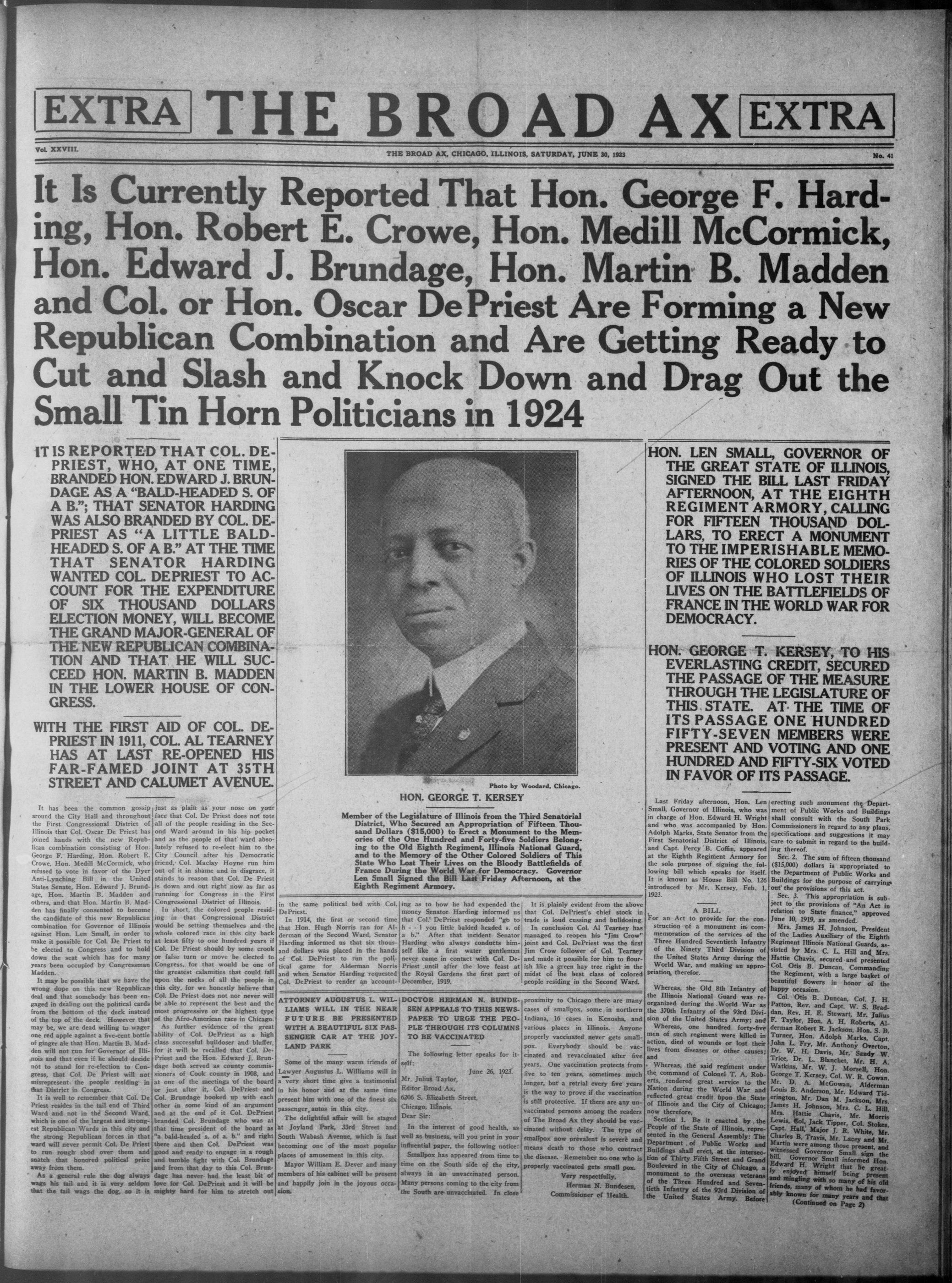
EXTRA THE BROAD AX EXTRA
It Is Currently Reported That Hon. George F. Harding, Hon. Robert E. Crowe, Hon. Medill McCormick, Hon. Edward J. Brundage, Hon. Martin B. Madden and Col. or Hon. Oscar DePriest Are Forming a New Republican Combination and Are Getting Ready to Cut and Slash and Knock Down and Drag Out the Small Tin Horn Politicians in 1924
IT IS REPORTED THAT COL. DEPRIEST, WHO, AT ONE TIME, BRANDED HON. EDWARD J. BRUNDAGE AS A "BALD-HEADED S. OF A B."; THAT SENATOR HARDING WAS ALSO BRANDED BY COL. DEPRIEST AS "A LITTLE BALD-HEADED S. OF A B." AT THE TIME THAT SENATOR HARDING WANTED COL. DEPRIEST TO ACCOUNT FOR THE EXPENDITURE OF SIX THOUSAND DOLLARS ELECTION MONEY, WILL BECOME THE GRAND MAJOR-GENERAL OF THE NEW REPUBLICAN COMBINATION AND THAT HE WILL SUCCEED HON. MARTIN B. MADDEN IN THE LOWER HOUSE OF CONGRESS.
WITH THE FIRST AID OF COL. DEPRIEST IN 1911, COL. AL TEARNEY HAS AT LAST RE-OPENED HIS FAR-FAMED JOINT AT 35TH STREET AND CALUMET AVENUE.
It has been the common gossip around the City Hall and throughout the First Congressional District of Illinois that Col. Oscar De Priest has joined hands with the new Republican combination consisting of Hon. George F. Harding, Hon. Robert E. Crowe, Hon. Medill McCormick, who refused to vote in favor of the Dyer Anti-Lynching Bill in the United States Senate, Hon. Edward J. Brundage, Hon. Martin B. Madden and others, and that Hon. Martin B. Madden has finally consented to become the candidate of this new Republican combination for Governor of Illinois against Hon. Len Small, in order to make it possible for Col. De Priest to be elected to Congress and to hold down the seat which has for many years been occupied by Congressman Madden.
It may be possible that we have the wrong dope on this new Republican deal and that somebody has been engaged in dealing out the political cards from the bottom of the deck instead of the top of the deck. However that may be, we are dead willing to wager one red apple against a five-cent bottle of ginger ale that Hon. Martin B. Madden will not run for Governor of Illinois and that even if he should decide not to stand for re-election to Congress, that Col. De Priest will not misrepresent the people residing in that District in Congress.
It is well to remember that Col. De Priest resides in the tail end of Third Ward and not in the Second Ward, which is one of the largest and strongest Republican Wards in this city and the strong Republican forces in that ward will never permit Col. De Priest to run rough shod over them and snatch that honored political prize away from them.
As a general rule the dog always wags his tail and it is very seldom that the tail wags the dog, so it is
just as plain as your nose on your face that Col. De Priest does not to tote all of the people residing in the Second Ward around in his hip pocket and as the people of that ward absolutely refused to re-elect him to the City Council after his Democratic friend, Col. Maclay Hoyne run him out of it in shame and in disgrace, it stands to reason that Col. De Priest is down and out right now as far as running for Congress in the First Congressional District of Illinois.
In short, the colored people residing in that Congressional District would be setting themselves and the whole colored race in this city back at least fifty to one hundred years if Col. De Priest should by some crook or false turn or move elected to Congress, for that would be one of the greatest calamities that could fall upon the necks of all the people in this city, for we honestly believe that Col. De Priest does not nor never will be able to represent the best and the most progressive or the highest type of the Afro-American race in Chicago. As further evidence of the great ability of Col. DePriest as a high class successful bulldoser and bluffer, for it will be recalled that Col. DePriest and the Hon. Edward J. Brundage both served as county commissioners of Cook county in 1908, and at one of the meetings of the board or just after it, Col. DePriest and Col. Brundage hooked up with each other in some kind of an argument and at the end of it Col. DePriest branded Col. Brundage who was at that time president of the board as "a bald-headed s. of a. b." and right there and then Col. DePriest was good and ready to engage in a rough and tumble fight with Col. Brundage and from that day to this Col. Brundage has never had the least bit of love for Col. DePriest and it will be mighty hard for him to stretch out
[Picture of a man with a bald head, wearing a suit and tie. The background is plain white. The man's face is centered, and he looks directly at the viewer. The image is black and white. There are no visible texts or distinguishing features.]]
Member of the Legislature of Illinois from the Third Senatorial District, Who Secured an Appropriation of Fifteen Thousand Dollars ($15,000) to Erect a Monument to the Memories of the One Hundred and Forty-five Soldiers Belonging to the Old Eighth Regiment, Illinois National Guard, and to the Memory of the Other Colored Soldiers of This State Who Lost Their Lives on the Bloody Battlefields of France During the World War for Democracy. Governor Len Small Signed the Bill Last Friday Afternoon, at the Eighth Regiment Armory.
in the same political bed with Col. DePriest.
In 1914, the first or second time that Hon. Hugh Norris ran for Alderman of the Second Ward, Senator Harding informed us that six thousand and dollars was placed in the hands of Col. DePriest to run the political game for Alderman Norris and when Senator Harding requested Col. DePriest to render an account-
ATTORNEY AUGUSTUS L. WILLIAMS WILL IN THE NEAR FUTURE BE PRESENTED WITH A BEAUTIFUL SIX PASSENGER CAR AT THE JOYLAND PARK
Some of the many warm friends of Lawyer Augustus L. Williams will in a very short time give a testimonial in his honor and at the same time present him with one of the finest six passenger autos in this city.
The delightful affair will be staged at Joyland Park, 33rd Street and South Wabash Avenue, which is fast becoming one of the most popular places of amusement in this city. Mayor William E. Dever and many members of his cabinet will be present and happily join in the joyous occasion.
THE BROAD AX, CHICAGO, ILLINOIS, SATURDAY, JUNE 30, 1923
ing as to how he had expended the money Senator Harding informed us that Col. DePriest responded "go to h - - 1 you little balded headed s. of a b." After that incident Senator Harding who always conducts himself like a first water gentleman never came in contact with Col. DePriest until after the love feast at the Royal Gardens the first part of December, 1919.
DOCTOR HERMAN N. BUNDE-SEN APPEALS TO THIS NEWS-PAPER TO URGE THE PEOPLE THROUGH ITS COLUMNS TO BE VACCINATED
The following letter speaks for itself:
June 26, 1923.
Mr. Julius Taylor,
Editor Broad Ax,
6206 S. Elizabeth Street,
Chicago, Illinois.
Dear Sir:
In the interest of good health, as well as business, will you print in your influential paper, the following notice: Smallpox has appeared from time to time on the South side of the city, always in an unvaccinated person. Many persons coming to the city from the South are unvaccinated. In close
It is plainly evident from the above that Col. DePriest's chief stock in trade is loud cussing and bulldosing. In conclusion Col. Al Tearney has managed to reopen his "Jim Crow" joint and Col. DePriest was the first Jim Crow follower of Col. Tearney and made it possible for him to flourish like a green hay tree right in the midst of the best class of colored people residing in the Second Ward.
proximity to Chicago there are many cases of smallpox, some in northern Indiana, 16 cases in Kenosha, and various places in Illinois. Anyone properly vaccinated never gets smallpox. Everybody should be vaccinated and revaccinated after five years. One vaccination protects from five to ten years, sometimes much longer, but a retrial every five years is the way to prove if the vaccination is still protective. If there are any unvaccinated persons among the readers of The Broad Ax they should be vaccinated without delay. The type of smallpox now prevalent is severe and means death to those who contract the disease. Remember no one who is properly vaccinated gets smallpox.
Very respectfully,
Herman N. Bundesen,
Commissioner of Health.
HON. LEN SMALL, GOVERNOR OF THE GREAT STATE OF ILLINOIS, SIGNED THE BILL LAST FRIDAY AFTERNOON, AT THE EIGHTH REGIMENT ARMORY, CALLING FOR FIFTEEN THOUSAND DOLLARS, TO ERECT A MONUMENT TO THE IMPERISHABLE MEMORIES OF THE COLORED SOLDIERS OF ILLINOIS WHO LOST THEIR LIVES ON THE BATTLEFIELDS OF FRANCE IN THE WORLD WAR FOR DEMOCRACY.
HON. GEORGE T. KERSEY, TO HIS EVERLASTING CREDIT, SECURED THE PASSAGE OF THE MEASURE THROUGH THE LEGISLATURE OF THIS STATE. AT THE TIME OF ITS PASSAGE ONE HUNDRED FIFTY-SEVEN MEMBERS WERE PRESENT AND VOTING AND ONE HUNDRED AND FIFTY-SIX VOTED IN FAVOR OF ITS PASSAGE.
Last Friday afternoon, Hon. Len Small, Governor of Illinois, who was in charge of Hon. Edward H. Wright and who was accompanied by Hon. Adolph Marks, State Senator from the First Senatorial District of Illinois, and Capt. Percy B. Coffin, appeared at the Eighth Regiment Armory for the sole purpose of signing the following bill which speaks for itself. It is known as House Bill No. 126 introduced by Mr. Kersey, Feb. 1, 1923.
A BILL
For an Act to provide for the construction of a monument in commemoration of the services of the Three Hundred Seventieth Infantry of the Ninety Third Division of the United States Army during the World War, and making an appropriation therefor.
Whereas, the Old 8th Infantry of the Illinois National Guard was reorganized during the World War as the 370th Infantry of the 93rd Division of the United States Army; and Whereas, one hundred forty-five men of such regiment were killed in action, died of wounds or lost their lives from diseases or other causes; and Whereas, the said regiment under the command of Colonel T. A. Roberts, rendered great service to the Nation during the World War and reflected great credit upon the State of Illinois and the City of Chicago; now therefore.
Section 1. Be it enacted by, the People of the State of Illinois, represented in the General Assembly: The Department, of Public Works and Buildings shall erect, at the intersection of Thirty Fifth Street and Grand Boulevard in the City of Chicago, a monument to the overseas veterans of the Three Hundred and Seventieth Infantry of the 93rd Division of the United States Army. Before
erecting such monument the Department of Public Works and Buildings shall consult with the South Park Commissioners in regard to any plans, specifications and suggestions it may care to submit in regard to the building thereof.
Sec. 2. The sum of fifteen thousand ($15,000) dollars is appropriated to the Department of Public Works and Buildings for the purpose of carrying out the provisions of this act.
Sec. 3. This appropriation is subject to the provisions of "An Act in relation to State finance," approved June 10, 1919, as amended.
Mrs. James H. Johnson, President of the Ladies Auxiliary of the Eighth Regiment Illinois National Guards, assisted by Mrs. C. L. Hill and Mrs. Hattie Chavis, secured and presented Col. Otis B. Duncan, Commanding the Regiment, with a large basket of beautiful flowers in honor of the happy occasion.
Col. Otis B. Duncan, Col. J. H. Patton, Rev. and Capt. W. S. Braddan, Rev. H. E. Stewart, Mr. Julius F. Taylor, Hon. A. H. Roberts, Alderman Robert R. Jackson, Hon. S. B. Turner, Hon. Adolph Marks, Capt John L. Fry, Mr. Anthony Overton, Dr. W. H. Davis, Mr. Sandy W. Trice, Dr. L. Blanchet, Mr. H. A. Watkins, Mr. W. J. Morsell, Hon. George T. Kersey, Col. W. R. Cowan, Mr. D. A. McGowan, Alderman Louis B. Anderson, Mr. Edward Tiderington, Mr. Dan M. Jackson, Mrs. James H. Johnson, Mrs. C. L. H. Mrs. Hattie Chavis, Mr. Morris Lewis, Col. Jack Tippier, Col. Stokes, Capt Hall, Major J. R. White, Charles B. Travis, Mr. Lacey and Mr. Martin were among those present, and witnessed Governor Small sign the bill, Governor Small informed Hon. Edward H. Wright that he greatly enjoyed himself being present and mingling with so many of his old friends, many of whom he had favorably known for many years and that
THE BROAD AX Published Every Saturday
In this city since July 15th, 1899, without missing one single issue. Republicans, Democrats, Catholics, Protestants, Single Taxers, Priests, infidels or anyone else can have their say as long as their language is proper and responsibility is fixed.
The Broad Ax is a newspaper whose platform is broad enough for all, ever claiming the editorial right to speak its own mind. It is neither Democratic nor Republican. It is strictly or absolutely independent in politics.
Local communications will receive attention. Write only on one side of the paper.
Subscriptions must be paid in advance.
One Year .....$2.00
Six Months .....$1.00
Advertising rates made known on application.
Address all communications to
Associate Editor
DR. M. A. MAJORS
Vol. XXVII No. 41
Chicago, Ill., June 30, 1923
Entered as Second-Class Matter, Aug
19, 1902, at the Post Office at Chicago
11. Under Act of March 8, 1879.
HONORABLE LEN SMALL WAS
GREETED BY MANY OF HIS
FRIENDS AT THE EIGHTH
REGIMENT ARMORY
he was always willing to do anything that he possibly could to add to their happiness. The ink well, the pen with which he signed the bill and the pad which he used in blotting it were presented to Mrs. James H. Johnson.
The following letters speak for themselves:
Chicago, Ill., May 24, 1923.
Hon. Len Small,
Governor of Illinois.
I am writing to ask you to give favorable consideration to Representative Kersey's bill for an appropriation to erect a monument in honor of the 8th Illinois Infantry for its gallant service in the World's War (H. B. No. 126).
I understand you have adopted a policy of economy toward all appropriations, but nevertheless I believe this bill could properly be made an exception to the rule.
The amount appropriated, Fifteen Thousand ($15,000.00), is comparatively small, and the object is worthy in the highest degree.
I hope you can see your way clear to indicate to the Chairman of the House Committee on appropriations your desire that the bill be reported out with the recommendation that it pass.
With best wishes and highest personal regards, I remain
EDWARD H. WRIGHT,
Rep. Committeeman, 2nd Ward.
Springfield, Ill., May 25, 1923.
My dear Friend:
I am in receipt of your letter of yesterday, asking me to give favorable consideration to Representative Kersey's bill for an appropriation to erect a monument in honor of the 8th Illinois Infantry for its gallant service in the World War.
I assured Representative Kersey that I would favor his bill and I have talked with the Chairman of the House Appropriations Committee, Edward Smejkal, in favor of it. While this is the only monument for which I have consented to ask a new appropriation, yet for the reasons which you give I believe we are justified in making this expenditure.
Yours very truly,
LEN SMALL,
Governor of Illinois.
Honorable Edward H. Wright,
112 North LaSalle Street,
Chicago, Illinois.
N. A. A. C. P. NOTES
The Annual Conference, National Association for the Advancement of Colored People, will be held at Kansas City, Kansas, August 29th—September 3rd, 1923. Wonderful speeches will be delivered by prominent men and women on questions of human rights; interesting discussions and reports; conferences on methods and programs. Arrangements are being made for a special train from Chicago to Kansas City and return. For particulars inquire at Chicago Branch, N. A. A. C. P., 3201 South Wabash avenue, telephone V7400.
M.
HON. LEN SMALL
The People's Governor of the Great State of Illinois, Who Freely Mingled With Some of His Many Colored Friends at the Eighth Regiment Armory Last Friday Afternoon.
WEEK DAY SERMONETTES
By Dr. H. T. S. Johnson, Interracial
Secretary for Oklahoma
A COMMAND AND A PROMISE
Matt. 7:7-8—"Ask and it will be
given you; seek and you will find;
knock and the door will be opened to
you."
The Lord Jesus meant these words not only for the people to whom He spoke in that matchless sermon on the Mount, but also for all people everywhere for all time. They seem to be especially applicable to the Negro in the United States because to him so many privileges are denied, advantages hidden and doors closed, that he must continually ask, seek and knock in order to throw off the handicaps of slavery, ignorance and superstition that stand in the way of his coming into his own. Therefore, my prayer is that the Negro in this country will think of the scripture which we consider this week, as coming from the burning heart of Jesus direct to him.
"Ask" is the first command, followed by the promise, "it will be given you." If, as a race, we would regard this command and promise as meant for us, personally, we should not have to get along without so many things that would be ours for the asking. Without intending to overlook or make any excuse for the white man's prejudice against the Negro, it is but fair to say that if we would ask for them, many things denied us now would be given. White men are ready to help us get better accommodations on the railroads. But we are not asking for them. The masses of our colored people, many of them Negroes of wealth and education, suffer the humiliation of the present "jim crow" regulations without a word of complaint. This is so generally true that when an occasional Negro protests and asks for better accommodations, he is looked upon by some as an agitator. Too many of our big men stand in with the conductor and ride at reduced rates. Those who do obligate themselves to the extent that they cannot protest against anything. They are paying too much for the little rebate they get. It is costing them self-respect and the freedom to ask for better treatment on public carriers.
The Corporation Commission is supported by public taxation. The Negro, therefore, contributes to its maintenance. That Commission, I know from personal experience, will investigate every complaint brought before it, without reference to the complexion or race of the complainant. Much could be done toward making better conditions if, in appreciable numbers, we would ask that it be done.
We suffer as a race in many respects because we fail to use our asker. In the matter of parks, play grounds, water, lights, sewer, better school facilities, etc., we lack, not only because of the white man's prejudice but also because we do not ask for relief along these lines. If we ask and in the interest of the Negro child for the things which rightly belong to us, fairminded white men and women will join us in the appeal until it is granted. We know this because of past experiences and because God's word says, "Ask and it will be given you." "Seek and you will find," is the second command, succeeded by a promise. For some things it is only necessary to ask. But for others we must seek. We must seek opportunities, advantages and friendships.
A Great State of Illinois, Who of His Many Colored Friends memory Last Friday Afternoon.
These do not come just for the asking. Let us members of the Negro race, bend our energies towards seeking a remedy for all racial ills. This can best be done through interracial co-operation—the practice of the better element of both races getting together in every community for the express purpose of making local conditions contribute to the well being of all concerned. If we seek patience, self-control, opportunity, privilege, and the abiding influence of the Holy Spirit, they will be found; and with then, an experience of such "peace on earth and good will towards men" as was prophesied by the angels who, announced in song the birth of Jesus, to the gentle shepherds of Judea.
Our text says, also: "Knock and the door will be opened to you." To ask for that which is plainly before us and unquestionably our own; to seek for debatable privileges and hidden friends, is not enough. We must knock at closed doors which keep us from the best things of life until those doors are opened.
We have not space to discuss the many doors upon which it is our privilege to knock. Just let your thinker work and a field of service will open before you calculated to deepen your obligation to God and man, while a vision of accomplishments will rise in view, showing how mightly God can use frail and erring mankind in His program for kingdom building. Remember, "it is always he who asks that receives, he who seeks that finds, and he who knocks, that has the door opened to him."
CHICAGO BRANCH, N. A. A. C. P
(Copy of Telegram)
July 28, 1923.
Hon. Len Small,
Governor,
Springfield, Illinois.
In an effort to stamp out lawlessness and violence under the cloak of secrecy, Executive Committee, Chicago Branch, National Association for the Advancement of Colored People, urges that you give full consideration to House Bill Thirty-two introduced by Representative Adelbert H. Roberts, which recently passed in the Senate and is now before you for signature. As Chief Executive of the State, all loyal American-friends of law and order, urge that you sign the bill and have it become a law.
Harold L. Ickes, President.
Morris Lewis, Secretary.
Dr. Charles E. Bentley,
Vice-President
Dr. A. Wilberforce Williams,
Treasurer.
DEATH OF THE LITTLE SON
OF ALDERMAN AND MRS.
MAYPOLE
Alderman and Mrs. George M. Maypole, 3523 Fulton street, have the deepest sympathy of their hosts of friends, over the loss of their bright little son, George M. Maypole, Jr., who passed away last Wednesday, after a long spell of sickness; at the same time Mrs. Maypole was lying at the point of death, but she is slowly improving now. Funeral services were held over his remains Saturday morning; some of the warm Colored friends of Alderman Maypole attended the services and presented the bereaved family with some beautiful floral offerings. One colored lady, with two little boys, members of the Roman Catholic Church, gently knelt down by the side of his coffin and offered up prayers for the repose of his soul in peace.
```markdown
```
THE BROAD AX, CHICAGO, ILLINOIS, SATURDAY, JUNE 30, 1923
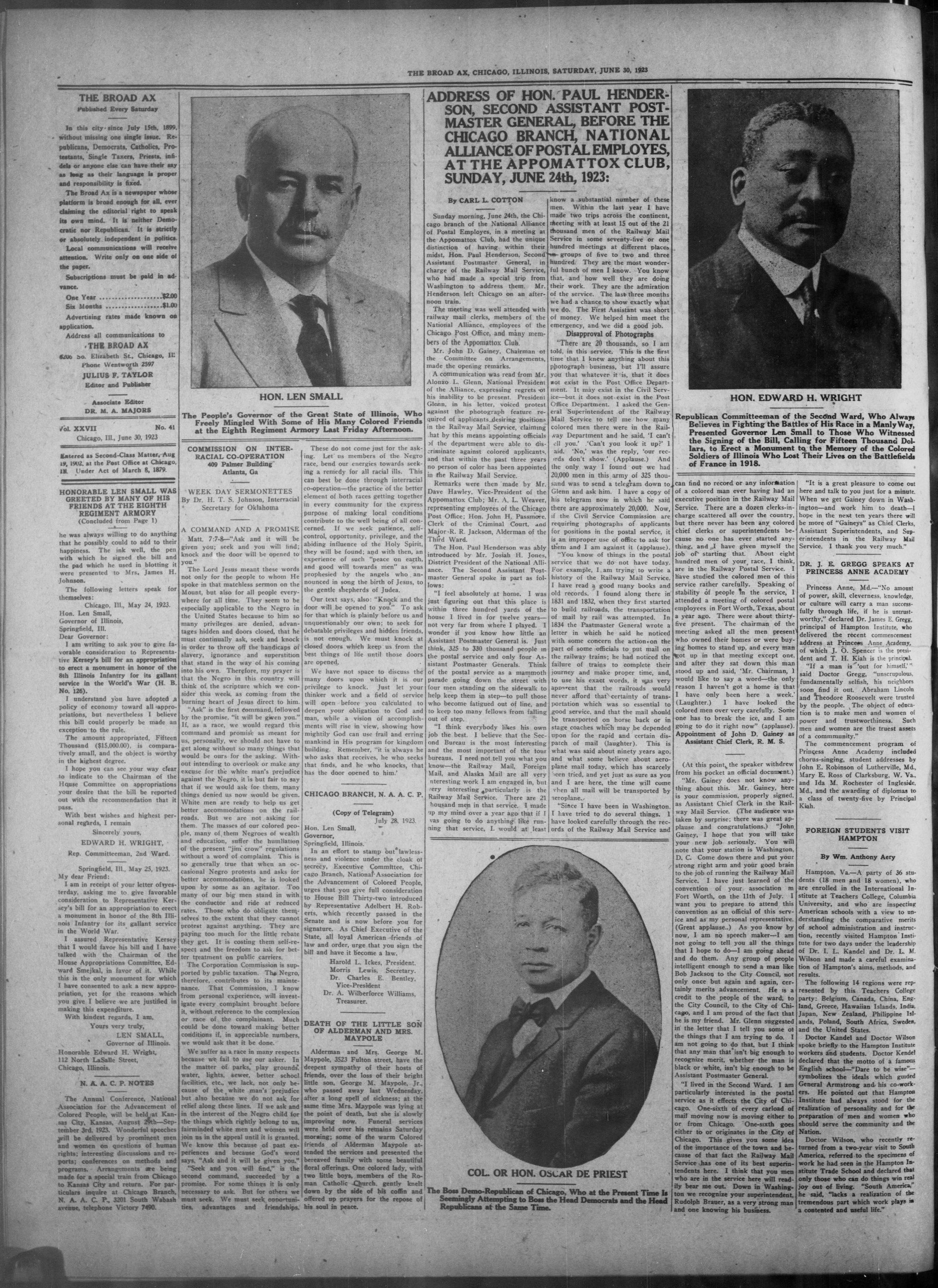
ADDRESS OF HON. PAUL HENDERSON, SECOND ASSISTANT POSTMASTER GENERAL, BEFORE THE CHICAGO BRANCH, NATIONAL ALLIANCE OF POSTAL EMPLOYES, AT THE APPOMATTOX CLUB, SUNDAY, JUNE 24th, 1923:
[Name not visible]
COL. OR HON. OSCAR DE PRIEST The Boss Demo-Republican of Chicago, Who at the Present Time Is Seemingly Attempting to Boss the Head Democrats and the Head Republicans at the Same Time.
The Boss Demo-Republican of Chicago, Who at the Present Time Is Seemingly Attempting to Boss the Head Democrats and the Head Republicans at the Same Time.
By CARL L. COTTON
Sunday morning, June 24th, the Chicago branch of the National Alliance of Postal Employees, in a meeting at the Appomattox Club, had the unique distinction of having within their midst, Hon. Paul Henderson, Second Assistant Postmaster General, in charge of the Railway Mail Service, who had made a special trip from Washington to address them. Mr. Henderson left Chicago on an afternoon train.
The meeting was well attended with railway mail clerks, members of the National Alliance, employees of the Chicago Post Office, and many members of the Appomattox Club.
Mr. John D. Gainey, Chairman of the Committee on Arrangements, made the opening remarks.
A communication was read from Mr. Alonzo L. Glenn, National President of the Alliance, expressing regrets of his inability to be present. President Glenn, in his letter, voiced protest against the photograph feature required of applicants desiring positions in the Railway Mail Service, claiming that by this means appointing officials of the department were able to discriminate against colored applicants, and that within the past three years no person of color has been appointed in the Railway Mail Service.
Remarks were then made by Mr. Dave Hawley, Vice-President of the Appomattox Club; Mr. A. L. Weaver, representing employees of the Chicago Post Office; Hon. John H. Passmore, Clerk of the Criminal Court, and Major-R. R. Jackson, Alderman of the Third Ward.
The Hon. Paul Henderson was ably introduced by Mr. Josiah H. Jones, District President of the National Alliance. The Second Assistant Postmaster General spoke in part as follows:
"I feel absolutely at home. I was just figuring out that this place is within three hundred yards of the house I lived in for twelve years—not very far from where I played. I wonder if you know how little an Assistant Postmaster General is. Just think, 325 to 330 thousand people in the postal service and only four Assistant Postmaster Generals. Think of the postal service as a mammoth parade going down the street with four men standing on the sidewalk to help keep them in step—to pull those who become fatigued out of line, and to keep too many fellows from falling out of step.
"I think everybody likes his own job the best. I believe that the Second Bureau is the most interesting and the most important of the tour bureaus. I need not tell you what you know—the Railway Mail, Foreign Mail, and Alaska Mail are all very interesting work I am engaged in, but very interesting particularly is the Railway Mail Service. There are 21 thousand men in that service. I made up my mind over a year ago that if I was going to do anything like running that service, I would at least
know a substantial number of these men. Within the last year I have made two trips across the continent, meeting with at least 15 out of the 21 thousand men of the Railway Mail Service in some seventy-five or one hundred meetings at different places, groups of five to two and three hundred. They are the most wonderful bunch of men I know. You know that, and how well they are doing their work. They are the admiration of the service. The last three months we had a chance to show exactly what we do. The First Assistant was short of money. We helped him meet the emergency, and we did a good job.
Disapproval of Photographs
“There are 20 thousands, so I am told, in this service. This is the first time that I knew anything about this photograph business, but I’ll assure you that whatever it is, that it does not exist in the Post Office Department. It may exist in the Civil Service—but it does not exist in the Post Office Department. I asked the General Superintendent of the Railway Mail Service to tell me how many colored men there were in the Railway Department and he said, ‘I can’t tell you!’ ‘Can’t you look it up?’ I said, ‘No,’ was the reply, ‘our records don’t show.’ (Applause). And the only way I found out we had 20,000 men in this army of 325 thousand was to send a telegram down to Glenn and ask him. I have a copy of his telegram now in which he said there are approximately 20,000. Now, if the Civil Service Commission are requiring photographs of applicants for positions in the postal service, it is an improper use of office to ask for them and I am against it (applause).
“You know of things in the postal service that we do not have today. For example, I am trying to write a history of the Railway Mail Service. I have read a good many books and old records. I found along there in 1831 and 1832, when they first started to build railroads, the transportation of mail by rail was attempted. In 1834 the Pastmaster General wrote a letter in which he said he noticed with some concern the action on the part of some officials to put mail on the railway trains; he had noticed the failure of trains to complete their journey and make proper time, and, to use his exact words, it was very apparent that the railroads would never afford that certainty of transportation which was so essential to good service, and that the mail should be transported on horse back or in stage coaches which may be depended upon for the rapid and certain dispatch of mail (laughter). This is what was said about ninety years ago, and what some believe about aeroplane mail today, which has scarcely been tried, and yet just as sure as you and I are here, the time will come when all mail will be transported by aeroplane.
"Since I have been in Washington I have tried to do several things. I have looked carefully through the records of the Railway Mail Service and
[Picture of a man in a suit with a tie].
HON. EDWARD H. WRIGHT
Republican Committeeman of the Second Ward, Who Always Believes in Fighting the Battles of His Race in a Manly Way, Presented Governor Len Small to Those Who Witnessed the Signing of the Bill, Calling for Fifteen Thousand Dollars, to Erect a Monument to the Memory of the Colored Soldiers of Illinois Who Lost Their Lives on the Battlefields of France in 1918.
can find no record or any information of a colored man ever having had an executive position in the Railway Mail Service. There are a dozen clerks-in-charge scattered all over the country, but there never has been any colored chief clerks or superintendents because no one has ever started anything, and I have given myself the job of starting that. About eight hundred men of your race, I think, are in the Railway Postal Service. I have studied the colored men of this service rather carefully. Speaking of stability of people in the service, I attended a meeting of colored postal employees in Fort Worth, Texas, about a year ago. There were about thirty-five present. The chairman of the meeting asked all the men present who owned their homes or were buying homes to stand up, and every man got up in that meeting except one, and after they sat down this man stood up and said, 'Mr. Chairman, I would like to say a word—the only reason I haven't got a home is that I have only been here a week. (Laughter.) I have looked the colored men over very carefully. Some one has to break the ice, and I am going to do it right now" (applause). Appointment of John D. Gainey as Assistant Chief Clerk, M. S.
(At this point, the speaker withdrew from his pocket an official document.) "Mr. Gainey does not know anything about this. Mr. Gainey, here is your commission, properly signed, as Assistant Chief Clerk in the Railway Mail Service. (The audience was taken by surprise; there was great applause and congratulations.) "John Gainey, I hope that you will take your new job seriously. You will note that your station is Washington, D.C. Come down there and put your strong right arm and your good brain to the job of running the Railway Mail Service. I have just learned of the convention of your association in Fort Worth, on the 11th of July. I want you to prepare to attend this convention as an official of this service and as my personal representative. (Great applause.) As you know by now, I am no speech maker—I am not going to tell you all the things that I hope to do—I am going ahead and do them. Any group of people intelligent enough to send a man like Bob Jackson to the City Council, not only once but again and again, certainly merits advancement. He is a credit to the people of the ward, to the City Council, to the City of Chicago, and I am proud of the fact that he is my friend. Mr. Glenn suggested in the letter that I tell you some of the things that I am trying to do. I am not going to do that, but I think that any man that isn't big enough to recognize merit, whether the man is black or white, isn't big enough to be Assistant Postmaster General.
"I lived in the Second Ward. I am particularly interested in the postal service as it effects the City of Chicago. One-sixth of every carload of mail moving now is moving either to or from Chicago. One-sixth goes either to or originates in the City of Chicago. This gives you some idea of the importance of the town and because of that fact the Railway Mail Service has one of its best superintendents here. I think that you men who are in the service here will readily bear me out. Down in Washington we recognize your superintendent, Rudolph Brauer, as a very strong man and one knowing his business.
the Second Ward, Who Always titles of His Race in a Manly Way, small to Those Who Witnessed billing for Fifteen Thousand Dollar to the Memory of the Colored at Their Lives on the Battlefields
"It is a great pleasure to come out here and talk to you just for a minute. When we get Gainey down in Washington—and work him to death—hope in the next ten years there will be more of "Gaineys" as Chief Clerks, Assistant Superintendents, and Superintendents in the Railway Mail Service. I thank you very much."
DR. J. E. GREGG SPEAKS AT PRINCESS ANNE ACADEMY
Princess Anne, Md.—"No amount of power, skill, cleverness, knowledge, or culture will carry a man successfully through life, if he is unrustworthy," declared Dr. James E. Gregg, principal of Hampton Institute, who delivered the recent commencement address at Princess Anne Academy, of which J. O. Spencer is the president and T. H. Kiah is the principal. "If a man is 'out for himself,' said Doctor Gregg, "unscrupulous, fundamentally selfish, his neighbors soon find it out. Abraham Lincoln and Theodore Roosevelt were trusted by the people. The object of education is to make men and women o power and trustworthiness. Such men and women are the truest asset of a community."
The commencement program of Princess Anne Academy included chorus-singing, student addresses by John E. Robinson of Lutherville, Md., Mary E. Ross of Clarksburg, W. Va., and Ida M. Rochester of Ingleside, Md., and the awarding of diplomas to a class of twenty-five by Principal Kiah.
FOREIGN STUDENTS VISIT
HAMPTON
By Wm. Anthony Aery
Hampton, Va.—A party of 36 students (18 men and 18 women), who are enrolled in the International Institute at Teachers College, Columbia University, and who are inspecting American schools with a view to understanding the comparative merits of school administration and instruction, recently visited Hampton Institute for two days under the leadership of Dr. I. L. Kandel and Dr. L. M. Wilson and made a careful examination of Hampton's aims, methods, and results.
The following 14 regions were represented by this Teachers College party: Belgium, Canada, China, England, Greece, Hawaiian Islands, India, Japan, New Zealand, Philippine Islands, Poland, South Africa, Sweden, and the United States.
Doctor Kandel and Doctor Wilson spoke briefly to the Hampton Institute workers and students. Doctor Kendel declared that the motto of a famous English school—"Dare to be wise"—symbolizes the ideals which guided General Armstrong and his co-workers. He pointed out that Hampton Institute had always stood for the realization of personality and for the preparation of men and women who should serve the community and the Nation.
Doctor Wilson, who recently returned from a two-year visit to South America, referred to the specimens of work he had seen in the Hampton Institute Trade School and declared that only those who can do things win real joy out of living. "South America," he said, "lacks a realization of the tremendous part which work plays in a contented and useful life."
```markdown
```
323 E IPEI
MR. VIRTUS C. RHOM
One of the Late Leaders of the Old Thompson Political Machine, Who Feels Reasonably Sure That He Will Not Be Convicted for Grafting in Connection With the Board of Education and That He Is Not Guilty of Taking Any Money Which Did Not Belong to Him.
JUNE GRADUATES OF THE NOISE IS NOT PATRIOTISM WENDELL PHILLIPS HIGH SCHOOL.
Four-Year Courses
Claude H. Alexander, *Anthony Bagnulo, William Cecil Bratton, Romeo Burwell, M. Gwendolyn Covington, Lorraine Craig, Irene Vashti Davis, Eunice Katherine Goodwin Amy G. Gordon, Lawrence T. Jackson, Joseph W. Johnson, Leona A. Johnson, Viola Lawrence Jones, *Theodore J. Kuehne, Elizabeth Lake, Geraldine Houston Lawrence, Juanita Ann Luckey, Jordyce White McCoo* *John Mockus, Juanita S. Page, Annie Pierce, James A. Renfro, Roscoe L. Roberts, Lucille S. Roseman, Herman W. Shaw, George Shropshear, H. Kenneth Stewart, *Lorraine Marie Sturtz, Atwood Alonso Trible, Lavinia R. Willis, Margaret Eleanor Woodward* *Denotes white students. Graduates of the Two-Year Steno, Mech, and Art*
Bernice B. Anderson, *Maxine Berman, Edith V. Brown, Dorothy M Carter, Alberta M. Dantignac, Marguerite Elizabeth Echols, Emma V Hilliard, Bertha Mae Hodge, Christine E. Kendell, Lloyd William Lawson, Ola E. Lawson, Ola Minnie Clark, Ruth N. Long, Roosevelt Lyda, Bessie Vendetta McIntosh, James A. Moore, Thelma Mæ Muldrow, Mary H. Prince, Viola J. Smith, Blanche Stokes, Eloise Sutton, Theresea Thompson, Viollettia I. Vandergriff, Esther M. Watkins, Márvin Wooley. *Denotes white student.*
Graduates—Prevocational Department
Elizabeth Adams, Edna Mae Allen
Ruth Bassett, LeRoy Bolden, Ernest
J. Bouie, Amanda B. Brandon, Myrtle
Brent, Marguerite Campbell, Mary
Carr, Roslyn Catlin, Cooie Van Childers, Loretta E. Crowder, Eya M
Dean, A. Russell English, Irene Ewell
Imogene Fitzgerald, Louella Gose
Edward Greene, Mamie L. Griffin
Bernie Hamilton, Beatrice Hampton
Bertha Henderson, Eloise Hicks
Katherine Hunt, Kinzie C. Johnson
Lillian Johnson, Reuben Johnson
Anna E. Jones, Pauline Joyner, Wade
Lindsay, Nanearl McGinnis, Ernest
dean Mack, Edith Miller, James A
Mingo, Walter Moore, Mattie L. Perdue, Mabel Pettus, Harry Wesley
Pollard, Isaac Porter, Cecil Price
Juanita Ross, Wendell Russell, Harriet M. Saulsby, Ozee Sloan, Ernestine Spear, Washington Swift, Marion
Tabor, Altee E. Taylor, Calinda Toler, Sarah E. Travue, Eda Walker, Ruth Elizabeth Washington, Earl D.
Whalen, Malinda Williams, Oscar
Benjamin Willis, Ruth G. Wright,
Roosevelt Wyatt, Juanita Wynn, Rosalie Zellars.
BAILEY ON THE GO
M. T. Bailey, president of The Bailey Realty Co., 3638 S. State St., who has done much good among members of the Race in securing nice locations in Morgan Park and other suburban towns for future homes, is kept on the go trying to accommodate and locate the hundreds of people coming from all parts of the south in suitable homes away from the congested city. If more of the people would locate in the suburbs, conditions would be greatly improved and their health better.
DR. JONES HERE
Dr. E. D. W. Jones of Washington, D. C., prominently known in the A. M. E. Zion Connection, was in the city during the past week in attendance of the Michigan A. M. E. Zion Annual Conference held at St. Catharine's Church.
NOISE IS NOT PATRIOTISM
Fourth of July this year should be a safe and sane and thoroughly patriotic observance of Independence Day. The old-time riot of noise, death, fire and destruction, which was supposed to show patriotism, would be very ruck out of place under present conditions. The country has had enough of powder-burning bombs, and the maimings and burnings which were inevitable with the old-time celebration. They were discontinued during the war, and they should be given up forever.
The Sane Fourth movement has made remarkable progress in the past few years, and this year should see the end of the old absurdity of celebrating the nation's birthday with pistols and crackers, with their inevitable accompaniment of racing ambulances and clanging fire engines. The deaths from Fourth of July casualties, which were 466 in 1903, had been reduced by 1922 to 26, while the injuries, which were 3,983 in the first year, fell last year to 720. Formerly the firemen expected to be kept on the jump all day on the Fourth, but for several years, in Chicago and many other cities where fireworks have been prohibited, the number of alarms has actually been below the daily average. Make the Fourth of July a Festival of Liberty, and not a saturnalia of death, noise and destruction.
AFTER BISHOPRIC
Dr. Henry J. Callis, pastor of the Metropolitan Wesley A. M. E. Zion Church at Washington, D. C., and a candidate for the bishopric, spent the past week in the city in attendance of the Michigan A. M. E. Zion Annual Conference held at St. Catharine's Church. As work for that connection, his record is unparalleled, having pastored successfully churches at Ithaca, Rochester, Syracuse, Elmira and Binghamton, N. Y.; Elizabeth City, N. C.; San Francisco, Calif; Boston, Mass. Indianapolis, Ind.; Chicago, Ill., and Washington, D. C., having raised thousands of dollars for the connection and saved many beautiful edifices and with his great educational qualifications, together with his ability as an orator, there will be no doubt in the most liberal minds but what Dr. Callis will be elected bishop of the A. M. E. Zion Church on the first ballot and will be made to feel proud among the people with whom he once associated. He has been active in all matters of interest to the race in every walk of life and he has the best wishes of his thousands of friends.
HONORS DEPUTY
MacBeth Lodge No. 216, Daughters of Elks of Joliet, Ill., rendered a program followed by a reception in honor of the deputy of Daughters of Elks of Illinois, Dt. Ella L. Holmes, who visited the lodge a few evening ago. MacBeth Lodge was organized by Dt. Holmes and she is pleased with the work being done.
LEAVES FOR VIRGINIA
In company with Mrs. Annie Randall, Mrs. M. E. Branham left the city during the week for Huntington, W. Va., their home. Mrs. Branham is the mother of Mrs. James Poindexter, 3725 Elmwood院, whom she visited for several weeks.
Mrs. Anna Hayman, her mother, Mrs. Joseph Hart, and her sister, Miss Grace Hart, and other members of the family are now located in their new home, at 4829 Prairie avenue.
THE BROAD AX, CHICAGO, ILLINOIS, SATURDAY, JUNE 30, 1923
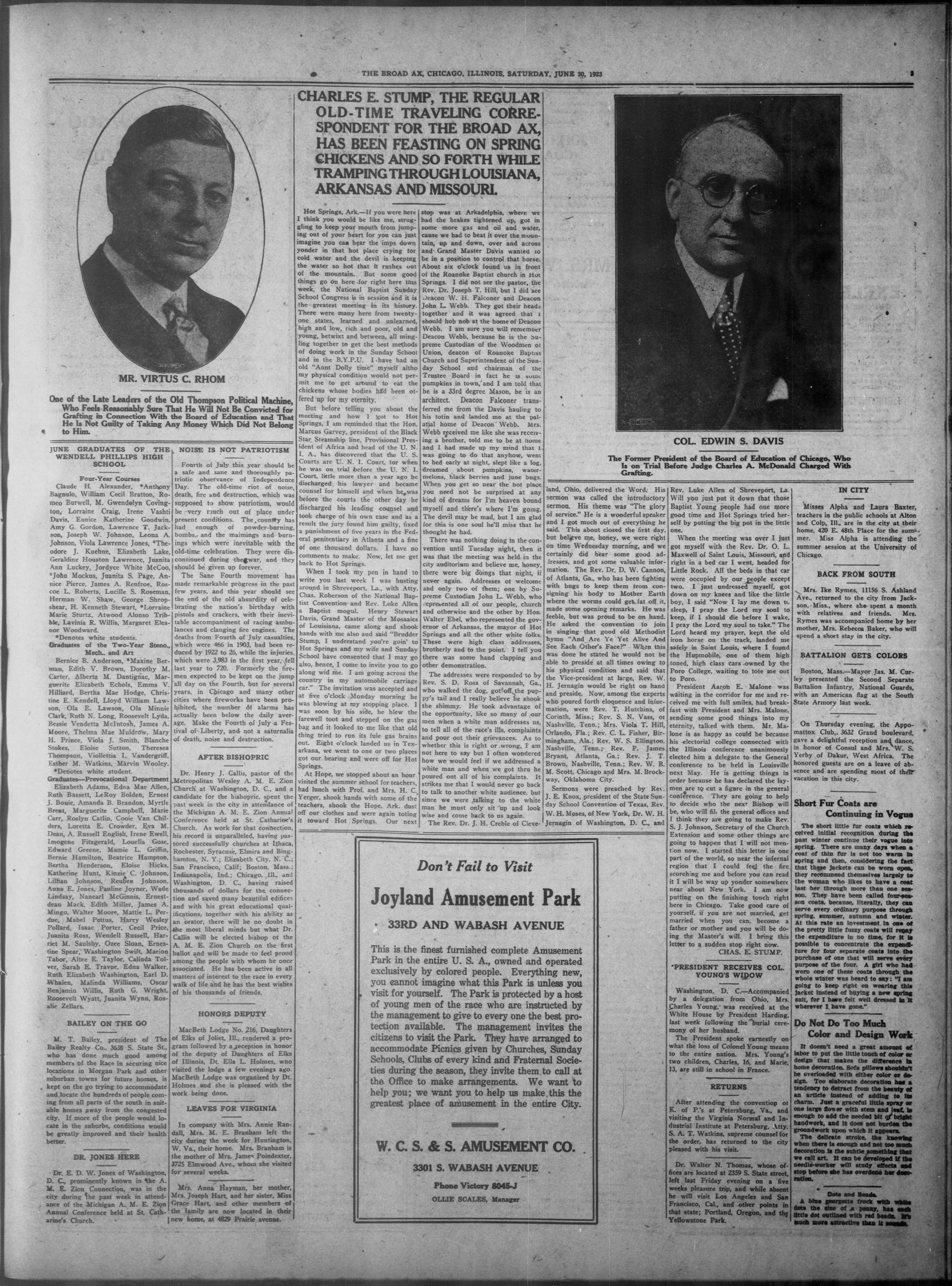
CHARLES E. STUMP, THE REGULAR OLD-TIME TRAVELING CORRESPONDENT FOR THE BROAD AX, HAS BEEN FEASTING ON SPRING CHICKENS AND SO FORTH WHILE TRAMPING THROUGH LOUISIANA, ARKANSAS AND MISSOURI.
Joyland Amusement Park
33RD AND WABASH AVENUE
This is the finest furnished complete Amusement Park in the entire U. S. A., owned and operated exclusively by colored people. Everything new, you cannot imagine what this Park is unless you visit for yourself. The Park is protected by a host of young men of the race who are instructed by the management to give to every one the best protection available. The management invites the citizens to visit the Park. They have arranged to accommodate Picnics given by Churches, Sunday Schools, Clubs of every kind and Fraternal Societies during the season, they invite them to call at the Office to make arrangements. We want to help you; we want you to help us make this the greatest place of amusement in the entire City.
Hot Springs, Ark—If you were here I think you would be like me, struggling to keep your mouth from jumping out of your heart for you can just imagine you can hear the imps down yonder in that hot place crying for cold water and the devil is keeping the water so hot that it rushes out of the mountain. But some good things go on here-for right here this week, the National Baptist Sunday School Congress is in session and it is the greatest meeting in its history. There were many here from twenty-one states, learned and unlearned high and low, rich and poor, old and young, betwixt and between, all mingling together to get the best methods of doing work in the Sunday School and in the B.Y.P.U. I have had an old "Aunt Dolly time" myself altho my physical condition would not permit me to get around to eat the chickens whose bodies had been otfered up for my eternity.
But before telling you about the meeting and how I got to Hot Springs, I am reminded that the Hon. Marcus Garvey, president of the Black Star Steamship line, Provisional President of Africa and head of the U. N. I. A., has discovered that the U. S. Courts are U. N. I. Court, for when he was on trial before the U. N. I. Court, little more than a year ago he discharged, his lawyer and became counsel for himself and when he was before the courts the other day he discharged his leading counsel and took charge of his own case and as a result the jury found him guilty, fixed a punishment of five years in the Federal penitentiary in Atlanta and a fine of one thousand dollars. I have no comments to make. Now, let me get back to Hot Springs.
When I took my pen in hand to write you last week I was busting around in Shreveport, La, with Attty Chas. Roberson of the National Baptist Convention and Rev. Luke Allen a Baptist mogul. Henry Stewart Davis, Grand Master of the Mosaics of Louisiana, came along and shook hands with me also and said "Brudden Stump, I understand you're goin' to Hot Springs and my wife and Sunday School have consented that I may go also, hence, I come to invite you to go along wid me. I am going across the country in my automobile carriage car." The invitation was accepted and at five o'clock Monday morning he was blowing at my stopping place. I was soon by his side, he blew the farewell toot and stepped on the gas bag and it looked to me like that old thing tried to run its fule gas brains out. Eight o'clock landed us in Texarkana, we went to one or two places got our bearing and were off for Hot Springs.
At Hope, we stopped about an hour visited the summer school for teachers, had lunch with Prof. and Mrs. H. C. Yerger, shook hands with some of the teachers, shook the Hope, Ark. dust off our clothes and were again toting it toward Hot Springs. Our next
stop was at Arkadelphia, where we had the brakes tightened up, got in some more gas and oil and water, cause we had to beat it over the mountain, up and down, over and across and Grand Master Davis wanted to be in a position to control that horse. About six o'clock found us in front of the Roanoke Baptist church in Hot Springs. I did not see the pastor, the Rev. Dr. Joseph T. Hill, but I did see Deacon W. H. Falconer and Deacon John L. Webb. They got their heads together and it was agreed that I should hob nob at the home of Deacon Webb. I am sure you will remember Deacon Webb, because he is the Supreme Custodian of the Woodmen of Union, deacon of Roanoke Baptist Church and Superintendent of the Sunday School and chairman of the Trustee Board in fact he is some pumpkins in town, and I am told that he is a 33rd degree Mason, he is an architect. Deacon Falconer transferred me from the Davis hauling to his totin and landed me at the palatial home of Deacon Webb. Mrs. Webb received me like she was receiving a brother, told me to be at home and I had made up my mind that I was going to do that anyhow, went to bed early at night, slept like a log, dreamed about pumpkins, watermelons, black berries and june bugs. When you get so near the hot place you need not be surprised at any kind of dreams for I'm heaven bound myself and there's where I'm going. The devil may be mad, but I am glad for this is one soul he'll miss that he thought he had.
There was nothing doing in the convention until Tuesday night, then it was that the meeting was held in the city auditorium and believe me, honey, there were big doings that night, if never again. Addresses of welcome and only two of them; one by Supreme Custodian John L. Webb, who represented all of our people, church and otherwise and the other by Hon. Walter Ebel, who represented the governor of Arkansas, the mayor of Hot Springs and all the other white folks. These were high class addresses, brotherly and to the point. I tell you there was some hand clapping and other demonstration.
The addresses were responded to by Rev. S. D. Ross of Savannah, Ga., who walked the dog, got off, the puppy's tail and I really believe he shook the shimmy. He took advantage of the opportunity, like so many of our men when a white man addresses us, to tell all of the race's ills, complaints and pour out their grievances. As to whether this is right or wrong, I am not here to say but I often wondered how we would if we addressed a white man and when we got thru he poured out all of his complaints. It strikes me that I would never go back to talk to another white audience, but since we were talking to the white man he must only sit up and look wise and come back to us again.
The Rev. D. L. H. Cook of Clifton
The Rev. Dr. J. H. Creble of Cleve
7. E. B. B.
The Former President of the Board of Education of Chicago, Who Is on Trial Before Judge Charles A. McDonald Charged With Grafting.
land, Ohio, delivered the Word: His sermon was called the introductory sermon. His theme was "The glory of service." He is a wonderful speaker and I got much out of everything he said. This about closed the first day but believe me, honey, we were right on time Wednesday morning, and we certainly did hear some good addresses, and got some valuable information. The Rev. Dr. D. W. Cannon of Atlanta, Ga., who has been fighting with bugs to keep them from consigning his body to Mother Earth where the worms could get fat off it, made some opening remarks. He was feeble, but was proud to be on hand. He asked the convention to join in singing that good old Methodist hymn "And Are Ye Yet Alive And See Each Other's Face?" When this was done he stated he would not be able to preside at all times owing to his physical condition and said that the Vice-president at large, Rev. W. H. Jernagin would be right on hand and preside. Now, among the experts who poured forth eloquence and information, were Rev. T. Hutchins, of Corinth, Miss.; Rev. S. N. Vass, or Nashville, Tenn.; Mrs. Viola T. Hill, Orlando, Fla.; Rev. C. L. Fisher, Birmingham, Al.; Rev. W. S. Elington, Nashville, Tenn.; Rev. P. James Bryant, Atlanta, Ga.; Rev. J. T. Brown, Nashville, Tenn.; Rev. W. B. M. Scott, Chicago and Mrs. M. Brockway, Oklahoma City.
Sermons were preached by Rev J. E. Knox, president of the State Sunday School Convention of Texas, Rev W. H. Moses, of New York, Dr. W. H. Jernagin of Washington, D. C., and
Rev, Luke Allen of Shreveport, La. Will you just put it down that those Baptist Young people had one more good time and Hot Springs tried herself by putting the big pot in the little one.
When the meeting was over I just got myself with the Rev. Dr. O. L. Maxwell of Saint Louis, Missouri, and right in a bed car I went, headed for Little Rock. All the beds in that car were occupied by our people except two. I just undressed myself, got down on my knees and like the little boy, I said "Now I lay me down to sleep, I pray the Lord my soul to keep, if I should die before I wake, I pray the Lord my soul to take." The Lord heard my prayer, kept the old iron horse on the track, landed me safely in Saint Louis, where I found the Hupmobile, one of them high toned, high class cars owned by the Poro College, waiting to tote me out to Poro.
President Aaron E. Malone was waiting in the corridor for me and received me with full smiles, had breakfast with President and Mrs. Malone, sending some good things into my eternity, talked with them. Mr. Malone is as happy as could be because his electorial college connected with the Illinois conference unanimously elected him a delegate to the General conference to be held in Louisville next May. He is getting things in order because he has declared the laymen are to cut a figure in the general conference. They are going to help to decide who the next Bishop will be, who will fil the general offices and I think they are going to make Rev. S. J. Johnson, Secretary of the Church Extension and some other things are going to happen that I will not mention now. I started this letter in one part of the world, so near the infernal region that I could feel the fire scorching me and before you can read it I will be way up yonder somewhere near New York. I am now putting on the finishing touch right here in Chicago. Take good care of yourself, if you are not married, get married when you can, become a father or mother and you will be doing the Master's will. I bring this letter to a sudden stop right now.
CHAS. E. STUMP.
*PRESIDENT RECEIVES COL.
YOUNG'S WIDOW
Washington. D. C.—Accompanied by a delegation from Ohio, Mrs Charles Young; was received at the White House by President Harding last week following the burial ceremony of her husband. The President spoke earnestly on what the loss of Colonel Young means to the entire nation. Mrs. Young's two children, Charles, 16, and Marie, 13, are still in school in France.
RETURNS
After attending the convention of K. of P.'s at Petersburg, Va., and visiting the Virginia Normal and Industrial Institute at Petersburg, Atty. S. A. T. Watkins, supreme counsel for the order, has returned to the city pleased with his visit.
Dr. Walter N. Thomas, whose offices are located at 2359 S. State street, left last Friday evening on a five weeks pleasure trip, and while absent he will visit Los Angeles and San Francisco, Cal., and other points in that state; Portland, Oregon, and the Yellowstone Park.
IN CITY
Misses Alpha and Laura Baxter, teachers in the public schools at Alton and Colp, Ill, are in the city at their home, 420 E. 48th Place for the summer. Miss Alpha is attending the summer session at the University of Chicago.
BACK FROM SOUTH
Mrs. Ike Rymes, 11156 S. Ashland Ave., returned to the city from Jackson. Miss., where she spent a month with relatives and friends. Mrs. Rymes was accompanied home by her mother, Mrs. Rebecca Baker, who will spend a short stay in the city.
BATTALION GETS COLORS
Boston, Mass.—Mayor Jas. M. Curley presented the Second Separate Battalion Infantry, National Guards, with an American flag at the South State Armory last week.
On Thursday evening, the Appomattox Club, 3632 Grand boulevard, gave a delightful reception and dance, in honor of Consul and Mrs. W. S. Yerby of Dakur, West Africa. The honored guests are on a leave of absence and are spending most of their vacation in this city.
Short Fur Coats are
The short little fur coats which received initial recognition during the past winter continue their vogue into spring. There are many days when a coat of thin fur is not too warm in spring and then, considering the fact that those jackets can be worn open, they recommend themselves largely to the woman who likes to have a coat last her through more than one season. They have been called four-season coats, because, literally, they can serve every ordinary purpose through spring, summer, autumn and winter. At this rate an investment in one of the pretty little fuzzy coats will repay the expenditure in no time, for it is possible to concentrate the expenditure for four separate coats into the purchase of one that will serve every purpose of the four. A girl who had worn one of these coats through the whole winter was heard to say: "I am going to keep right on wearing this jacket instead of buying a new spring suit, for I have felt well dressed in it wherever I have gone."
It doesn't need a great amount of labor to put the little touch of color or design that makes the difference in home decoration. Sofa pillows shouldn't be overloaded with either color or design. Too elaborate decoration has a tendency to detract from the beauty of an article instead of adding to its charm. Just a graceful little spray or one large flower with stem and leaf, is enough to add the needed bit of bright handwork, and it does not burden the groundwork upon which it appears.
The delicate stroke, the knowing when there is enough and not too much decoration is the subtle something that we call art. It can be developed if the needle-worker will study effects and stop before she has overdone her decoration.
A blue georgette trock with white dots the size of a penny, has each little dot outlined with red beads. It's much more attractive than it sounds.
Your Hair Can Be A Crown of Beauty
No longer need you wish for beautiful hair. A marvelous preparation has been discovered that quickly changes coarse, homely hair into long, lovely hair that goes beautiful, soft sheen, and stops dandruff and tching scalp. This wonderful preparation is called
It has given thousands the beautiful hair for which they are so much admired.
Another great beauty help is EXELENTO SKIN BEAUTIFIER, a remarkable cream that quickly removes skin blemishes and clears up dark, sallow complexions. If your druggist cannot supply you, send 25c for generous size package of either Pomade or Beautifier.
EXELENTO MEDICINE CO., Atlanta, Ga.
AGENTS WANTED EVERYWHERE
Write For Particulars
OFFICE TELEPHONE
J. GRAY
Attorney
204 East
Chi
OFFICE TELEPHONE DOUGLAS 6351
J. GRAY LUCAS
Attorney-at-Law
204 East 35th Street
Chicago
Corner Indiana Ave., Second Floor
Res. 3648 Grand Boul. Tel. Douglas 4397
Phone
FURN
Brass and Wood Bee
Refrigerators, S
Hardware
HENRY S
2515-19 AR
Phone Yards 27
FURNITURE
And Wood Beds, Electric W
rigerators, Stoves, Paint,
Hardware, Linoleum
HENRY STUCKAN
2515-19 ARCHER AVE.
Brass and Wood Beds, Electric Washers, Refrigerators, Stoves, Paint, Oil, Hardware, Linoleum
TELEPHONE DOUGLAS 1
GEORGE F. H
GE F. HARDING
GEORGE F. HARDING, JR.
REAL ESTATE
Up-to-Date or Modern Houses, Apartments and Stores to Rent
3101 COTTAGE GROVE AVE.
Corner 31st Street, Chicago
State or Modern Houses, Ap-
and Stores to Rent
COTTAGE GROVE
Corner 31st Street, Chicago
Up-to-Date or Modern Houses, Apartments and Stores to Rent 3101 COTTAGE GROVE AVE. Corner 31st Street, Chicago
Loans and Discounts.....$
Bonds and Securities.....
Socks.....
Bank Building and Annex.
Furniture and Fixtures.....
Other Resources.....
Cash on Hand and Due from
Banks
Total .....$
of
Condition
At
Close of
Business
on
April 3, 1923
Increase in Deposits from Dec. 29,
1922, to April
3, 1923
$161,095.38
Business Capital Stock
3, 1923
in Depos-
to April
1923
,095.38
Capital Stock
Surplus
Undivided Profits
Reserved for Taxes and In-
terest.
Other Liabilities
Deposits
Total
This Bank invites you to a
of its complete facilities.
First Mortgage Gold Bond
safe investments—yield
Boxes in our completely equ
Deposit Vaults rent for $
and upwards.
Interest at the rate of $3%
all saving accounts. Sav
ments open from $ a. m
Saturdays.
GEORGE F. LEIBRANDT,
CHARLES A. WHITE, Vie
GEORGE S. CAMPBELL, C
LINCOLN S
OF CH
Under State Govern
31st and South
Telephone V
COLN STATE BANK
OF CHICAGO
State Government Supervisory
St. and South State Street
Telephone Victory 4500
LINCOLN STATE BANK
OF CHICAGO
Under State Government Supervision
31st and South State Streets
Telephone Victory 4500
Statement
Aged Choristers in London Festival.
A feature of a recent musical festival in London was the singing by combined choirs from the mothers' clubs of the metropolis, many of the choristers being more than seventy years of age.
Cheering News for Some-Parents.
Cloth is now made of iron. This will be cheering news to parents who have a large number of strong children. -Milwaukee Journal.
Separate Domicile. As It Were.
It is better to dwell in the corner of the houseport than with a brawling woman and in a wide mansion.—Solomon.
Thought for the Day.
Shake hands with the man who is agreeable enough to encourage you in your thinking and disagreeable enough to make you think harder.
ELEPHONE DOUGLAS 6351
RAY LUCAS
Corney-at-Law
East 35th Street
Chicago
ONE Yards 27
NITURE
Beds, Electric Washers,
S, Stoves, Paint, Oil,
ware, Linoleum
STUCKART
D ARCHER AVE.
HARDING, JR.
Modern Houses, Apartments
Stores to Rent
AGE GROVE AVE.
At Street, Chicago
RESOURCES
Loans and Discounts.....$1,474,842.62
Bonds and Securities.....930,698.71
Stocks.....1,180.00
Bank Building and Annex.....150,383.22
Furniture and Fixtures.....22,963.55
Other Resources.....89,912.93
Cash on Hand and Due from
Banks.....571,818.48
Total.....$3,200,937.51
LIABILITIES
Capital Stock.....$ 300,000.00
Surplus.....30,000.00
Undivided Profits.....19,609.34
Reserved for Taxes and In-
terest.....7,887.06
Other Liabilities.....49,247.04
Deposits.....2,794,154.07
Total.....$3,200,937.51
This Bank invites you to avail yourself
of its complete facilities.
First Mortgage Gold Bonds—approved
safe investments—yield 7% interest.
RESOURCES
LIABILITIES
Boxes in our completely equipped Safety Deposit Vauls rent for $4.00 per year and upwards.
Interest at the rate of 2% is allowed on all saving accounts. Savings Departments open from 9 a.m. to 8 p.m. Saturday.
GEORGE F. LEIBRANDT, President
CHARLES B. CAMPBELL, President
R. A. DELAURIER, Asst. Caballer
ADDISON E. AVERY, Mgr. Bond Dept.
STATE BANK
CHICAGO
Government Supervision
South State Streets
the Victory 4500
JAS B. McCAHEY, President
FRANK J. DUNN, Vice-President
H. K. COMERFORD, Treasurer
Phone Dearborn 5871
Painless Chiropodist
18 Years' Experience
Residence Phone Douglas 2616
18 Years' Experience
James had heard his parents tell that their new dog was part bulldog and part fox terrier. When some neighbor asked him what kind of a dog he had he answered: "Oh, his head is real fox terrier, but his tall, I guess, as buldog."
Another Conference Advised.
"In a family," said Uncle Eben, where de old folks thinks young folks is too fur ahead of de times an' where de young folks thinks de old folks is too fur behind de times, it looks to me like dar ought to be some kind of a conference wif a view to compromise."
—Washington Evening Star.
And the Last Is the Greatest.
Five great intellectual professions have hitherto existed in every civilized nation; the soldier's, to defend it; the pastor's, to teach it; the physician's, to keep it in health; the lawyer's, to enforce justice, and the merchant's to provide, and all these men, on due occasion, to die for it.—John Ruskin.
Wail Heard in All Ages.
How great a pity that we should not feel for what end we are born into this world, till just as we are leaving it.—Walsingham.
Telephone C
Norris-Ward
YARD
26th St. and South Park, I. C. R. R.
18th and Canal Sts., C. B. &
Root St., C. R. I. P.
Roscoe and R.
2556 COTTAGE GRO
CUT OUT THE SUBSCRIBE
26th St. and South Park, I. C. R. R.
18th and Canal Sts., C. B. & Q. R. R.
Root St., C. R. I. P. R. R.
Roscoe and Racine Aves., C. M. & St. P. R. R.
2556 COTTAGE GROVE AVE., CHICAGO
CUT OUT THIS SUBSCRIPTION BLANK AND MAIL IT TO
THE BROAD AX
6206 &. Elizabeth Street, Chicago, Ill.
JULIUS F. TAYLOR, Please enter my
AX. I enclose herewith Two Dollars, the
Dollar for six months.
Name___
Town___
Date___
JULIUS F. TAYLOR, Please enter my name as a subscriber to THE BROAD AX. I enclose herewith Two Dollars, the annual subscriptions to same, or One Dollar for six months.
Worth Remembering.
Just before going to sleep a bit of imagination regarding achievement possibilities of the morrow, will steadily and increasingly bear fruit, particularly if all ideas of difficulty, worry or fear are resolutely ruled out and replaced by those of accomplishment and smiling courage—Dr. Frederick Pierce.
High Civilization in Yucatan.
High Civilization in Yucatan. Yucatan is "the Egypt of America." As early as the beginning of the Christian era the people there built stone structures of excellent masonry, true angles and smooth, vertical faces. They had astronomical observatories, an accurate calendar and a better system of numerals than the Romans.
First Voyage Across Atlantic
First Voyage Across America
In 1492, the Santa Maria, a Spanish vessel under the command of Christopher Columbus, traversed the ocean in 70 days. Some historians say that the Atlantic between Norway and Greenland was crossed by Norwegian sailors before the year 1000.
Thought for the Day.
Christianity is larger than any definition of it, and is social rather than theoretical.
A Thought
It is not only difficult to say the right thing in the right place, but, far more difficult still, to leave unsaid the wrong thing at the tempting moment.—Anonymous.
Chas. Krutckoff, Pres.
J. E. Ward, Vics-Pres.
THE BROAD AX, CHICAGO, ILLINOIS, SATURDAY, JUNE 30, 1923
Street (Seventh Floor)
Limer House
Birborn 5871
WARNER
Chiropodist
Experience
CHICAGO
The Osborn Enterprise says that "if a country editor published all the things his subscribers did not like, together with what he liked, someone would be patting him in the face with an old No. 2 shovel before the sun set." Kansas City Star.
Thought for the Day.
The man who can't do a good turn without intending to make it pay is as contemptible as the man who can't receive a favor without suspecting a wrong motive.
Cannot Prey on Small Fish.
The big whalebone whale has so small a throat that it cannot swallow fish of ordinary size. Its food consists of little life forms found in the sea.
The toothed whales eat any living thing they can catch.
Immense Loss Caused by Rust.
Sir Robert Hattfield says the world loses about $2,500,000,000 a year by the rusting and decaying of iron and steel.
French Have Discarded Word
Encore, while a French word meaning again, and used by English and American audiences, is not employed by the French in the same sense, they say bles, which means twice.
Hard Coal Co.
BEDS AT
R.
& Q. R. R.
P. R. R.
Racine Aves., C. M. & St. P. R. R.
LOVE AVE., CHICAGO
my name as a subscriber to THE BROAD
the annual subscriptions to same, or One
19 State
Pompey's Pillar.
Pompey's Pillar is a beautiful red granite Corinthian column in Alexandria. The inscriptions show it was erected in 302 A. D., in honor of the Emperor Diocletian. No one knows how it came to be called Pompey's, except that he was assassinated in Alexandria 350 years before the date of the column.
Thackeray.
He blew on his pipe, and words came tripping round him like children, like pretty little children who are perfectly drilled for the dance; or came, did he will it, treading in their precedence, like kings, gloomily.—Max Bearbohm
Effects of Warm Rain.
When a warm rain occurs over a snow-covered region it is not the rain so much as the warm wind that melts the snow. An inch of rain at 50 degrees Fahrenheit could melt only three inches of light new snow or one inch of old snow.
Work Dollar the Better Kind
Work Dollar the Better Kins.
"Work is better dan luck," said
Uncle Eben. "De luck dollar is all by
itself, but de work dollar tells you
dar's plenty more where he come
from."—Washington Evening Star.
Lawyers the Greatest Readers.
Lawyers call for more books in the
library than other professional men,
militers and doctors the least num-
bera, according to one librarian.
CHICAGO
CHICAGO
Hugh Norris, Treas.
Kirby Ward, Secy.
$1.00 FOR 6 MONTHS
$2.00 PER YEAR
West Englewood Trust & Savings Bank
John Bain, President Arthur C. Utesch, Asst. Cashier Michael Maisel, Vice-Pres. W. Merle Fisher, Asst. Cashier Edw. C. Barry, Cashier and Trust Officer Carl O. Seberg, Asst. Cashier
The following Electric Shops carry a full line of Electrical Appliances and sell the Federal Washer on Easy Terms:
FUNERAL DIRECTORS
ERNEST H. WILLIAMSON UNDERTAKER
GARAGE
GASOLINE OIL
OPEN DAY & NIGHT
Day Light Chapel, capacity 200, Outside Ventilation—Organ and Organist Free—I am as near as your Telephone—I give service at a reasonable price—Distance immaterial, consult me—I save you wor y, time and money.
A. D. GASH
ATTORNEY AT LAW
118 N. La Salle Street
CHICAGO
Phone Main 2017
A. L. WILLIAMS
ATTORNEY AND
COUNSELOR AT LAW
Suite 706 Firmenich Building
184 W. Washington St.
CHICAGO
Residence 3655 Prairie Ave.
Phone Douglas 9133
Residence, 1262 Macalister Place
Telephone Monroe 2714
MILES J. DEVINE
ATTORNEY AT LAW
Suite 318-320 Renper Block
Clark and Washington Sta.
CHICAGO
Telephone Central 1239
Notary Public
Phones: Office Main 4153; Residence,
4751 Champlain Avenue
Phone Kentwood 5611
ATTORNEY AND COUNSELOR
AT LAW
Suite 708-184 W. Washington St.
CHICAGO
W. Adams St.
Broadway
M. Parkske Ave.
Logan Blvd.
Madison St.
W. Rosewell Rd.
BINGA STATE
BANK
Under State Supervision
Capital $100,000.00
Surplus 20,000.00
Offers Equal Service to All
3% INTEREST ON SAVINGS
SAFE DEPOSIT VAULTS
State Street and 36th Place
Wanted
2822 N. Clark St.
Broadway Electric Shop,
6215 Broadway
J. B. Collins & Son,
6210 Harwood Ave.
John I. Elliott & Co.
1538 N. Clark St.
Fullerton Electric Shop,
Hartlett Ave.
Karsten Harbart Electric Co.
Company.
1438 N. Harlett Ave.
Lakeview Electric Co.
4214 Lincoln Ave.
0100 N. Harlett Ave.
3158 N. Clark St.
Monsieur Electric Shop,
5049 Morr. Ave.
North Shore Electric Co.
6254 Panama Ave. Light Co.
4709 N. Keddle Ave.
Principale Electric Co.
3306 Southeast Ave.
Rae Electric Co.
3500 Lincoln
Sullivan Electric Shore.
Wanted
Advertising Solicitor
A live or wide awake newspaper man or solicitor can earn some easy money by calling on or addressing the undersigned.
Julius F. Taylor, 6206 S. Elizabeth street. Phone Wentworth 2597.
PHONE KENWOOD 455
OUR NEW
FUNERAL
Capital and Surplus, $500,000.00
4379 Lincoln Ave.
4390 Ilyssa Park Bld.
6245 Normal Bld.
2650 E. 8240 St.
E. 8240 St.
Marke Electric Shop,
Meadow Electric Co.
Meadow Electric Co.
Miller's Electric Shop
1611 W. 35th St.
1611 W. 35th St.
2020 Ogden Ave.
Bernard O'Hare
Bernard O'Hare
Radiant Electric Co.
3314 W. Chicago Ave
1183 W. Taylor St.
1183 W. Taylor St.
4590 S. Crawford Ave
Rika Electric Shop,
Spalding Electric Co.
2248 W. North Ave.
2248 W. North Ave.
1018 Milwaukee Ave.
Davies Electric Shop,
De Laure Electric Shop,
De Laure Electric Shop,
Kenya Park Elec. Shop,
4310 Fallon Armor,
4310 Fallon Armor,
2455 Milwaukee Ave.
Manor Electric Co.
Mid-West Electrical
Series Co.
3839 Milwaukee Ave.
Patterson Brothers.
3839 Milwaukee Ave.
Seser Electric Co.
6717 Olimpte
Athletic Stadium
5321 W. North Ave.
Baldaz & Baza
Baldaz & Baza
Bridgeport Electric Co.
1610 W. 471st St.
8125 W. 471st St.
8125 W. 268th St.
8125 W. 268th St.
8125 W. Mediastion St.
7475 W. Mediastion St.
7475 W. Mediastion St.
Tdambella E. Shop, Esco
Fitzhalil Electric Co.
Fitzhalil Electric Co.
Robert B. Garb
Robert B. Garb
Home Electric Appliance
SOUTH SIDE
8350 S. Haledate St.
1. S. Kedzis Ave.
2. 407 Ogden Ave.
407 Ogden Ave.
407 Ogden Ave.
4711yrs Cottage Grove Ave.
Electronic Washing
Machine Co.
6318 Cot Grove Ave.
t. Gatlinburg Ave.
2611 W. St. Slat
301 W. St.
40$ W. 10818
Good Housekeeping Elco-