The Broad Ax
Saturday, November 3, 1923
Chicago, Illinois
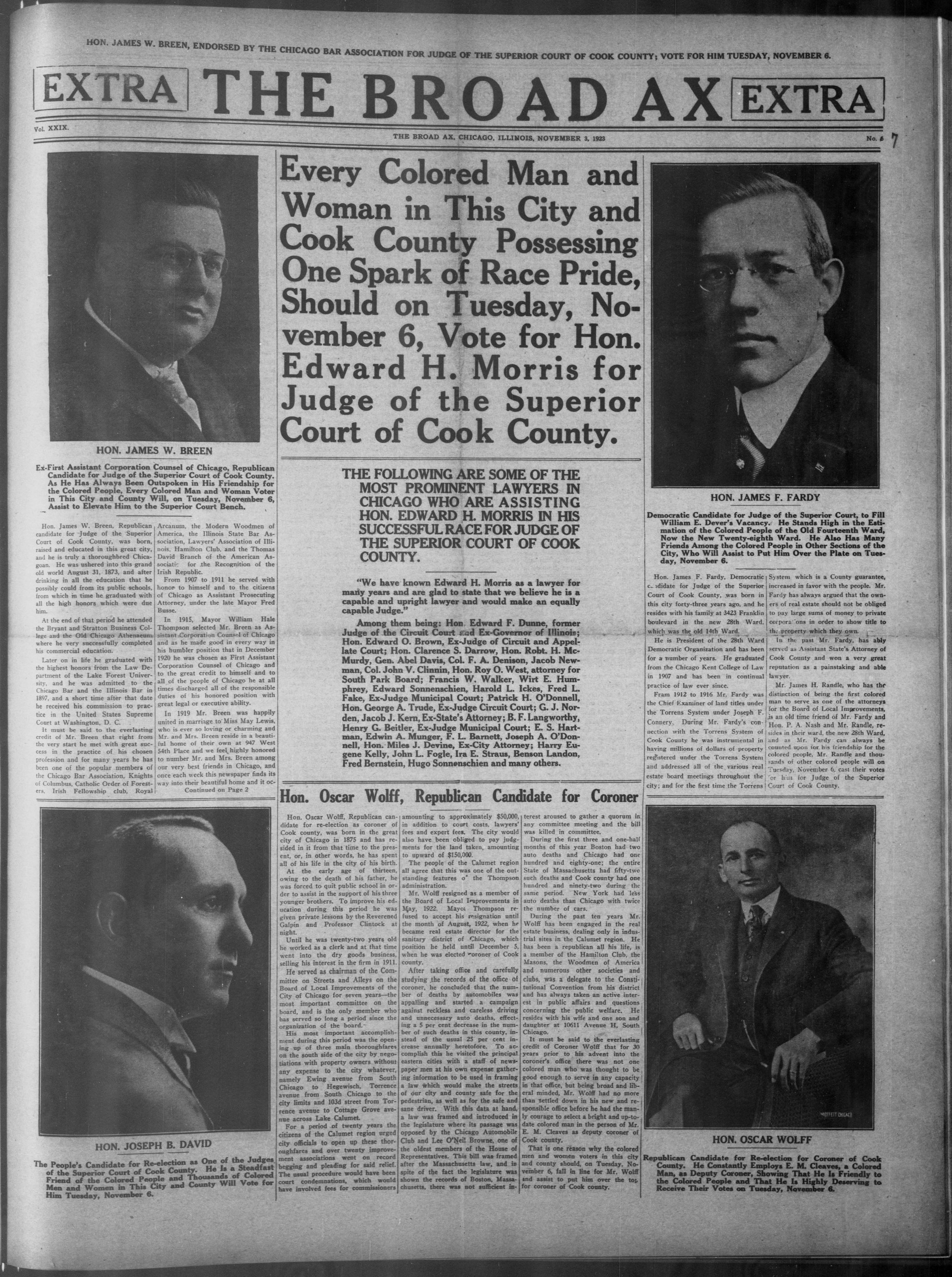
Page text (machine-generated)
EXTRA THE BROAD AX EXTRA
[Name]
HON. JAMES W. BREEN
Ex-First Assistant Corporation Candidate for Judge of the As He Has Always Been O the Colored People, Every in This City and County W Assist to Elevate Him to the
nt Corporation Counsel of Chic
or Judge of the Superior Court
Always Been Outspoken in His
People, Every Colored Man an
and County Will, on Tuesday
Evate Him to the Superior Court
Ex-First Assistant Corporation Counsel of Chicago, Republican Candidate for Judge of the Superior Court of Cook County. As He Has Always Been Outspoken in His Friendship for the Colored People, Every Colored Man and Woman Voter in This City and County Will, on Tuesday, November 6, Assist to Elevate Him to the Superior Court Bench.
Hon. James W. Breen, Republican candidate for Judge of the Superior Court of Cook County, was born, raised and educated in this great city, and he is truly a thoroughbred Chicagoan. He was ushered into this grand old world August 31, 1873, and after drinking in all the education that he possibly could from its public schools, from which in time he graduated with all the high honors which were due him.
At the end of that period he attended the Bryant and Stratton Business College and the Old Chicago Athenaeum where he very successfully completed his commercial education.
Later on in life he graduated with the highest honors from the Law Department of the Lake Forest University, and he was admitted to the Chicago Bar and the Illinois Bar in 1897, and a short time after that date he received his commission to practice in the United States Supreme Court at Washington, D. C.
Arcanum, the Modern Woodmen of America, the Illinois State Bar Association, Lawyers' Association of Illinois, Hamilton Club, and the Thomas David Branch of the American Association for the Recognition of the Irish Republic.
From 1907 to 1911 he served with honor to himself and to the citizens of Chicago as Assistant Prosecuting Attorney, under the late Mayor Fred Busse.
In 1915, Mayor William Hale Thompson selected Mr. Breen as Assistant Corporation Counsel of Chicago and as he made good in every way in his humbler position that in December 1920 he was chosen as First Assistant Corporation Counsel of Chicago and to the great credit to himself and to all of the people of Chicago he at all times discharged all of the responsible duties of his honored position with great legal or executive ability.
In 1919 Mr. Breen was happily united in marriage to Miss May Lewis.
It must be said to the everlasting credit of Mr. Breen that right from the very start he met with great success in the practice of his chosen profession and for many years he has been one of the popular members of the Chicago Bar Association, Knights of Columbus, Catholic Order of Foresters, Irish Fellowship club, Royal
```markdown
```
```markdown
```
HON. JOSEPH B. DAVID
The People's Candidate for Re-election as One of the Superior Court of Cook County. His Friend of the Colored People and Thousand Men and Women in This City and County Him Tuesday, November 6.
Candidate for Re-election as On- Prior Court of Cook County. He the Colored People and Thousa women in This City and County day, November 6.
The People's Candidate for Re-election as One of the Judges of the Superior Court of Cook County. He Is a Steadfast Friend of the Colored People and Thousands of Colored Men and Women in This City and County Will Vote for Him Tuesday, November 6.
Counsel of Chicago, Republican Superior Court of Cook County. Outspoken in His Friendship for Colored Man and Woman Voter Will, on Tuesday, November 6, the Superior Court Bench.
Arcanum, the Modern Woodmen of America, the Illinois State Bar Association, Lawyers' Association of Illinois, Hamilton Club, and the Thomas David Branch of the American Association for the Recognition of the Irish Republic.
From 1907 to 1911 he served with honor to himself and to the citizens of Chicago as Assistant Prosecuting Attorney, under the late Mayor Fred Busse.
In 1915, Mayor William Hale Thompson selected Mr. Breen as Assistant Corporation Counsel of Chicago and as he made good in every way in his humbler position that in December 1920 he was chosen as First Assistant Corporation Counsel of Chicago and to the great credit to himself and to all of the people of Chicago he at all times discharged all of the responsible duties of his honored position with great legal or executive ability.
In 1919 Mr. Breen was happily united in marriage to Miss May Lewis, who is ever so loving or charming and Mr. and Mrs. Breen reside in a beautiful home of their own at 947 West 54th Place and we feel highly honored to number Mr. and Mrs. Breen among our very best friends in Chicago, and once each week this newspaper finds its way into their beautiful home and it oc-Continued on Page 2
Continued on page 2
election as One of the Judges
Look County. He Is a Steadfast
role and Thousands of Colored
City and County Will Vote for
Every Colored Man and Woman in This City and Cook County Possessing One Spark of Race Pride, Should on Tuesday, November 6, Vote for Hon. Edward H. Morris for Judge of the Superior Court of Cook County.
THE FOLLOWING ARE SOME OF THE MOST PROMINENT LAWYERS IN CHICAGO WHO ARE ASSISTING HON. EDWARD H. MORRIS IN HIS SUCCESSFUL RACE FOR JUDGE OF THE SUPERIOR COURT OF COOK COUNTY.
"We have known Edward H. Morris as a lawyer for many years and are glad to state that we believe he is a capable and upright lawyer and would make an equally capable Judge."
Among them being: Hon. Edward F. Dunne, former Judge of the Circuit Court and Ex-Governor of Illinois; Hon. Edward O. Brown, Ex-Judge of Circuit and Appellate Court; Hon. Clarence S. Darrow, Hon. Robt. H. McMurdy, Gen. Abel Davis, Col. F. A. Denison, Jacob Newman, Col. John V. Clinin, Hon. Roy O. West, attorney for South Park Board; Francis W. Walker, Wirt E. Humphrey, Edward Sonnenschien, Harold L. Ickes, Fred L. Fake, Ex-Judge Municipal Court; Patrick H. O'Donnell, Hon. George A. Trude, Ex-Judge Circuit Court; G. J. Norden, Jacob J. Kern, Ex-State's Attorney; B. F. Langworthy, Henry G. Beitler, Ex-Judge Municipal Court; E. S. Hartman, Edwin A. Munger, F. L. Barnett, Joseph A. O'Donnell, Hon. Miles J. Devine, Ex-City Attorney; Harry Eugene Kelly, John L. Fogle, Ira E. Straus, Benson Landon, Fred Bernstein, Hugo Sonnenschien and many others.
Hon. Oscar Wolff, Republican Candidate for Coroner
Hon. Oscar Wolff, Republican candidate for re-election as coroner of Cook county, was born in the great city of Chicago in 1875 and has resided in it from that time to the present, or, in other words, he has spent all of his life in the city of his birth. At the early age of thirteen, owing to the death of his father, he was forced to quit public school in order to assist in the support of his three younger brothers. To improve his education during this period he was given private lessons by the Reverened Galpin and Professor Clintock at night. Until he was twenty-two years old he worked as a clerk and at that time went into the dry goods business, selling his interest in the firm in 1911. He served as chairman of the Committee on Streets and Alleys on the Board of Local Improvements of the City of Chicago for seven years—the most important committee on the board, and is the only member who has served so long a period since the organization of the board.
His most important accomplishment during this period was the opening up of three main thoroughfares on the south side of the city by negotiations with property owners without any expense to the city whatever, namely Ewing avenue from South Chicago to Hgewisch, Torrence avenue from South Chicago to the city limits and 103d street from Torrence avenue to Cottage Grove avenue across Lake Calumet. For a period of twenty years the citizens of the Calumet region urged city officials to open up these thoroughfares and over twenty improvement associations went on record begging and pleading for said relief. The usual procedure would have been court condemnations, which would have involved fees for commissioners
THE BROAD AX, CHICAGO, ILLINOIS, NOVEMBER 3, 1923
amounting to approximately $50,000, in addition to court costs, lawyers' fees and expert fees. The city would also have been obliged to pay judgments for the land taken, amounting to upward of $150,000.
The people of the Calumet region all agree that this was one of the outstanding features of the Thompson administration.
Mr. Wolff resigned as a member of the Board of Local Improvements in May, 1922. Mayot Thompson refused to accept his resignation until the month of August, 1922, when he became real estate director for the sanitary district of Chicago, which position he held until December 5, when he was elected coroner of Cook county.
After taking office and carefully studying the records of the office of coroner, he concluded that the number of deaths by automobiles was appalling and started a campaign against reckless and careless driving and unnecessary auto deaths, effecting a 5 per cent decrease in the number of such deaths in this county, instead of the usual 25 per cent increase annually heretofore. To accomplish this he visited the principal eastern cities with a staff of newspaper men at his own expense gathering information to be used in framing a law which would make the streets of our city and county safe for the pedestrian, as well as for the safe and sane driver. With this data at hand, a law was framed and introduced in the legislature where its passage was opposed by the Chicago Automobile Club and Lee O'Neil Browne, one of the oldest members of the House of Representatives. This bill was framed after the Massachusetts law, and in spite of the fact the legislature was shown the records of Boston, Massachusetts, there was not sufficient in-
terest aroused to gather a quorum in any committee meeting and the bill was killed in committee.
During the first three and one-half months of this year Boston had two auto deaths and Chicago had one hundred and eighty-one; the entire State of Massachusetts had fifty-two such deaths and Cook county had one hundred and ninety-two during the same period. New York had less auto deaths than Chicago with twice the number of cars.
During the past ten years Mr. Wolff has been engaged in the real estate business, dealing only in industrial sites in the Calumet region. He has been a republican all his life, is a member of the Hamilton Club, the Masons, the Woodmen of America and numerous other societies and clubs, was a delegate to the Constitutional Convention from his district and has always taken an active interest in public affairs and questions concerning the public welfare. He resides with his wife and one son and daughter at 10611 Avenue H, South Chicago.
It must be said to the everlasting credit of Coroner Wolff that for 30 years prior to his advent into the coroner's office there was not one colored man who was thought to be good enough to serve in any capacity in that office, but being broad and liberal minded. Mr. Wolff had no more than settled down in his new and responsible office before he had the manly courage to select a bright and up-to-date colored man in the person of Mr. E. M. Cleaves as deputy coroner of Cook county.
That is one reason why the colored men and women voters in this city and county should, on Tuesday, November 6, fall in line for Mr. Wolff and assist to put him over the top for coroner of Cook county.
T
HON. JAMES F. FARDY
Democratic Candidate for Judge of the Super
William E. Dever's Vacancy. He Stands a
mation of the Colored People of the Old E
Now the New Twenty-eighth Ward. He
Friends Among the Colored People in Oth
City, Who Will Assist to Put Him Over the
day, November 6.
Candidate for Judge of the Super
Dever's Vacancy. He Stands as
the Colored People of the Old K
now Twenty-eighth Ward. He
being the Colored People in Oth-
rill Assist to Put Him Over the
Super 6.
Democratic Candidate for Judge of the Superior Court, to Fill William E. Dever's Vacancy. He Stands High in the Estimation of the Colored People of the Old Fourteenth Ward, Now the New Twenty-eighth Ward. He Also Has Many Friends Among the Colored People in Other Sections of the City, Who Will Assist to Put Him Over the Plate on Tuesday, November 6.
Hon. James F. Fardy, Democratic candidate for Judge of the Superior Court of Cook County, was born in this city forty-three years ago, and he resides with his family at 3423 Franklin boulevard in the new 28th Ward, which was the old 14th Ward.
He is President of the 28th Ward Democratic Organization and has been for a number of years. He graduated from the Chicago Kent College of Law in 1907 and has been in continual practice of law ever since.
System which is a County guarantee, increased in favor with the people. Mr. Fardy has always argued that the owners of real estate should not be obliged to pay large sums of money to private corporations in order to show title to the property which they own.
In the past Mr. Fardy has ably served as Assistant State's Attorney of Cook County and won a very great reputation as a painstaking and able lawyer.
Mr. James H. Randle, who has the
Fram 1912 to 1916 Mr. Fardy was the Chief Examiner of land titles under the Torrens System under Joseph F. Connery. During Mr. Fardy's connection with the Torrens System of Cook County he was instrumental in having millions of dollars of property registered under the Torrens System and addressed all of the various real estate board meetings throughout the city; and for the first time the Torrens
M.
M. H.
MORTFETT DHEACB
Republican Candidate for Re-election for the County. He Constantly Employs E. M. C. Man, as Deputy Coroner, Showing That the Colored People and That He Is High Receive Their Votes on Tuesday, Novem
Candidate for Re-election for Constantly Employs E. M. Cloerty Coroner, Showing That He People and That He Is High Votes on Tuesday, November
Republican Candidate for Re-election for Coroner of Cook County. He Constantly Employs E. M. Cleaves, a Colored Man, as Deputy Coroner, Showing That He Is Friendly to the Colored People and That He Is Highly Deserving to Receive Their Votes on Tuesday, November 6.
Republican Candidate for Re-election for Coroner of Cook County. He Constantly Employs E. M. Cleaves, a Colored Man, as Deputy Coroner, Showing That He Is Friendly to the Colored People and That He Is Highly Deserving to Receive Their Votes on Tuesday, November 6.
age of the Superior Court, to Fill
He Stands High in the Estile
of the Old Fourteenth Ward,
th Ward. He Also Has Many
People in Other Sections of the
at Him Over the Plate on Tues-
System which is a County guarantee,
increased in favor with the people. Mr.
Fardy has always argued that the owners of real estate should not be obliged to pay large sums of money to private corporations in order to show title to the property which they own.
In the past Mr. Fardy, has ably served as Assistant State's Attorney of Cook County and won a very great reputation as a painstaking and able lawyer.
Mr. James H. Randle, who has the distinction of being the first colored man to serve as one of the attorneys for the Board of Local Improvements, is an old time friend of Mr. Fardy and Hon. P. A. Nash and Mr. Randle, residues in their ward, the new 28th Ward, and as Mr. Fardy can always be counted upon for his friendship for the colored people, Mr. Randle and thousands of other colored people will on Tuesday, November 6, cast their votes 'or him for Judge of the Superior Court of Cook County.
MOTTEET CHICAGO
selection for Coroner of Cook Colloys E. M. Cleaves, a Colored Bowing That He Is Friendly to that He Is Highly Deserving to day, November 6.
'
1 aay. q
|
j
& |
q
ie Pa
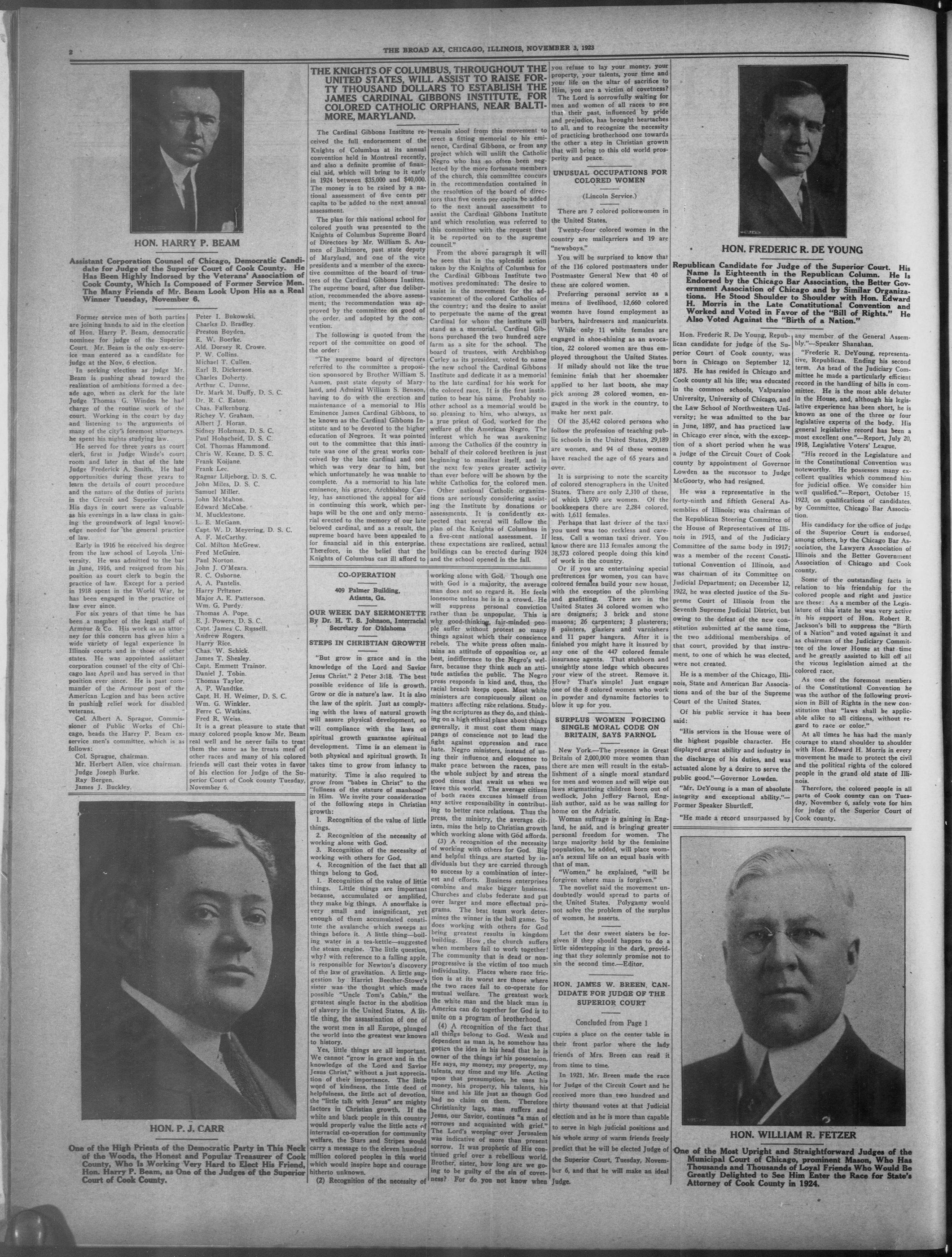
HON. HARRY P. BEAM
Assistant Corporation Counsel of Chicago, Democratic Candi-
date for Judge of the Superior Court of Cook County. He
_ Has Been Highly Indorsed by the Veterans’ Association of
Cook County, Which Is Composed of Former Service Men.
The Many Friends of Mr. Beam Look Upon His as a Real
WWiakas Tetoday, ‘November. 6,
Former service men of both parties
are joining hands to aid in the election
of Hon. Harry P. Beam, democratic
nominee for judge of the Supérior
Court. Mr, Beam is the only ex-serv-
ice ‘man entered as a candidate for
judge at the Nov. 6 election.
In seeking ‘election as judge Mr.
‘Beam is pushing ahead toward the
realization of ambitions formed a dec-
ade ago, when as clerk for the late
Judge Thomas G. Windes he had
charge of the routine work of the
court. Working in the court by day
and listening to the arguments of
many of the city’s foremost attorneys.
he spent his nights studying law.
He served for three years as court
clerk, first in Judge Winde's court
rootn and later in that of the late
Judge Frederick A. Smith. He had
‘opportunities during these years to
learn the details of court procedure
and the nature of the daties of jurists
in the Circuit and Superior Courts.
His days in court were as valuable
as his evenings in a law class in gain-
ing the groundwork of legal know!-
edge needed for “the general practice
of law.
Early in 1916 he received his degree
from the law school of Loyola Uni-
versity. He was admitted to the bar
in Juné, 1916, and resigned from his
Position as court clerk to begin the
practice of law. Except for a period
in 1918 spent in the World War, he
has been engaged in the practice of
Jaw ever since. :
For six years of that time he has
been a — of the legal staff of
Armour & €o. His work as an attor-
ney for this concern has given him a
wide variety of legal experience in
Illinois courts and in’ those of other
states. He was appointed assistant
corporation counsel ‘of the city of Chi-
cago last April and has served in that
position ever since. He is past com-
mander of the Armour post of the
American Legion and has been active
in pushin& relief work for disabled
‘veterans. “
Col. Albert A. Sprague, Commis-
sioner of Public Works of Chi-
ago, heads the Harry P. Beam ex-
service men’s committee, which is as
follows:
Col. Sprague, chairman.
Mr. Herbert Allen, vice chairman.
Judge Joseph Burke.
Ray Bergen.
James J. Buckley.
e 2 ‘
—
; a ie
E ee
ee. ae
ea ie
- £o
: a
a ae
.
a
HON. P. J, CARR
One of the High Priests of the Democratic Party in This Neck
of the Woods, the Honest and Popular Treasurer of Cook
County, Who Is Working Very Hard to Elect His Friend,
ee. on SP One of the Juilgtoat We Sepericr
‘Court of Cook County.
Peter I. Bukowski,
Charles D. Bradley.
Preston Boyden.
E, W. Boerke.
Ald. Dorsey R, Crowe.
P. W. Collins.
Michael T. Cullen.
Earl B. Dickerson.
Charles Doherty.
Arthur C. Dunne,
Dr. Mark M. Duffy, D. S. C.
Dr. R. C. Eaton.
Chas. Fatkenburg. :
Richey V. Graham,
Albert J. Horan,
Sidney Holzman, D. S. C.
Paul Hobscheid, D. S. C.
Col. Thomas Hammond.
Chris ‘W. Keane, D. S.C.
Frank Koijane.
Frank Lee.
Ragnar Liljeborg, D. S.C.
John Miles, D. S. C.
Samuel Miller.
John McMahon.
Edward McCabe. °
M, Mucklestone.
L.E. McGann,
Capt. W. D. Meyering, D. S.C.
AF. McCarthy.
Col. Milton McGrew.
Fred McGuire,
Paul Norton.
John J. O'Meara.
R. C. Osborne.
A. A. Pantelis.
Harry Pritener.
Major A. E. Patterson.
Wm. G. Purdy:
‘Thomas A. Pope.
E, J. Powers, D. S.C.
Capt. James C. Russéll, .
Andrew Rogers, =
Harry Rice.
‘Chas. W. Schick.
James T. Shealey.
Capt. Emmett Trainor.
Daniel J. Tobin.
Thomas Taylor.
ALP, Wandtke,
Capt. H. H. Weimer, D. S.C.
Wm. G. Winkler.
Ferre C. Watkins.
Fred R. Weiss.
It is a great pleasure to state tha
many colored people know Mr. Bear
real well and he never fails to trea
hem the same as he treats men’ o
other races and many of his colore
friends will cast their votes in favo
of his election for Judge of the Su
perior Court of Cook county Tuesdas
November 6. ,
‘THE BROAD AX, CHICAGO, ILLINOIS, NOVEMBER 3, 1923
ee ———___—
——————————————————
THE KNIGHTS OF COLUMBUS, THROUGHOUT THE |» sefuse to
UNITED STATES, WILL ASSIST TO RAISE FOR- |?rovety, you *
TY THOUSAND DOLLARS TO ESTABLISH THE |jr;., aac
JAMES CARDINAL GIBBONS INSTITUTE, FOR) The Lord is s
COLORED CATHOLIC ORPHANS, NEAR BALTI-|men and wome:
MORE. MARYLAND. that their past,
‘The Cardinal Gibbons Institute re-
ceived the full endorsement of the
Knights of Columbus at its annual
convention held in Montreal recently,
and also a definite promise of finan-
cial aid, which will bring to it early
in 1924 between $35,000 and $40,000.
‘The money is to be raised by a na-
tional assessment of five cents per
capita to be added to the next annual
assessment.
‘The plan for this national school for
colored youth was presented to the
Knights of Columbus Supreme Board
of Directors by Mr. William S. Au-
men of Baltimore, past state deputy
of Maryland, and one of the vice
presidents and a member of the execu-
tive committee of the board of trus-
tees of the Cardinal Gibbons Institeu.
The supreme board, after due deliber-
ation, recommended the above assess-
ment; the recommendation was ap-
proved by the committee on good of
the order, and adopted by the con-
vention.
The following is quoted from the
report of the committee on good of
the order:
“The supreme board of directors
referred to the committee a proposi-
tion sponsored by Brother William S.
Aumen, past state deputy of Mary-
land, and Admiral William S. Benson,
having to do with the erection and
maintenance of a memorial to His
Eminence James Cardinal Gibbons, to
be known as the Cardinal Gibbons In-
stitute and to be devoted to the higher
education of Negroes. It was pointed
out to the committee that this insti-
tute was one of the great works con-
ceived by the late cardinal and one
which was very dear to him, but
which unfortunately he was anable to
complete. As a memorial to his late
eminence, his grace, Archbishop Cur-
ley, has sanctioned the appeal for aid
in continuing this work, which per-
haps will be the one and only memo-
rial erected to the memory of our late
beloved cardinal, and as a result, the
‘supreme board have been appealed to
for financial aid in this enterprise.
‘Therefore, in the belief that the
Knights of Columbus can ill afford to
CO-OPERATION
409 Palmer Building,
Atlanta, Ga.
OUR WEEK DAY SERMONETTE
By Dr. H. T. S. Johnson, Interracial
* Secretary for Oklahoma
STEPS IN CHRISTIAN GROWTH
“But grow in grace and in the
knowledge of the Lord and Savior
Jesus Christ.” 2 Peter 3:18. ‘The best
possible evidence of life is growth.
Grow or die is nature’s law. It is also
the law of the spirit. Just as comply-
ing with the laws of natural growth
will assure physical development, so
will compliance with the laws ot
spiritual growth guarantee spiritual
development. Time is an element in
both physical and spiritual growth, I
takes time to grow from infancy to
maturity. Time is also required to
grow from “babes in Christ” to the
“fullness of the stature of manhood”
in Him. We invite your consideration
of the following steps in Christian
growth:
1. Recognition of the value of little
things.
2. Recognition of the necessity o!
working alone with God.
3. Recognition of the necessity o!
working with others for God.
4, Recognition of the fact that all
things belong to God.
1. Recognition of the value of littie
things. Little things are important
because, accumulated or amplified
they make big things, A snowflake is
very small and insignificant, ye
enough of them accumulated consti
tute the avalanche which sweeps al
things before it. A little thing—boil
ing water in a tea-kettle—suggestec
the steam engine. The little question
why? with reference to a falling apple
is responsible for Newton's discovery
of the law of gravitation. A little sug.
gestion by Harriet Beecher-Stowe’
sister was the thought which made
possible “Uncle Tom's Cabin,” the
greatest single factor in the abolitior
of slavery in the United States, A lit.
tle thing, the assassination of one o!
the worst men in all Europe, plunged
the world into the greatest war known
to history.
‘Yes, little things are all important
We cannot “grow in grace and in the
knowledge of the Lord and Savior
Jesus Christ,” without a just apprecia
tion of their importance. The littl
word of kindness, the little deed o
helpfulness, the little act of devotion
factors in Christian growth, If the
white and black people in this country
‘would properly value the little acts of
‘interracial co-operation for community
welfare, the Stars and Stripes would
a message to the eleven hundred
‘million colored peoples in this world
(2) Recognition of the necessity of
aloof from this movement to
erect a fitting memorial to his emi-
nence, Cardinal Gibbons, or from any
project which will unlift the Catholic
Negro who has .¢0 often been neg-
lected by the more fortunate members
‘of the church, this committee concurs
in the recommendation contained in
the resoltttion of the board of direc-
tors that five cents per capita be added
fo the next annual assessment to
assist the Cardinal Gibbons Institute
and which resolution was referred to
this committee with the request that
it be reported on to the supreme
council.”
From the above paragraph it will
‘be seen that in the splendid action
taken by the Knights of Columbus for
the Cardinal Gibbons Institute two
motives predominated: The desire to
assist in the movement for the ad-
vancement of the colored Catholics of
the country; and the desire to assist
to perpetuate the name of the great
Cardinal for whom the institute will
stand as a memorial. Cardinal Gib-
bons purchased the two hundred acre
farm as a site for the school. The
board of trustees, with Archbishop
Curley as its president, voted to name
the new school the Cardinal Gibbons
Institute and dedicate it as a memorial
to the late cardinal for his work for
the colored race. It is the first instit-
tution to bear his name, Probably no
other school as a memorial would be
so. pleasing to him, who always, as
a grue priest of God, wotked for the
‘welfare of the American Negro. The
interest which he was awakening
among the Catholics 6f the country in
behalf of their colored brethren is just
beginning to manifest itself, and in
the next few years greater activity
than ever before will be shown by the
white Catholics for, the colored men.
Other national Catholic organiza-
tions are seriously considering assist-
ing the Institute by donations or
assessments. It is confidently ex-
pected that several will follow the
plan of the Knights of Columbus in
a five-cent national assessment. If
these expectations are realized, actual
buildings can be erected during 1924
and the school opened in the fall,
working alone with God. Though one
with God is a majority, the average
man does not so regard it. He feels
lonesome unless he is in a crowd.. He
will suppress personal conviction
rather than be unpopular, This is
why s00d-thinking, fair-minded peo-
ple suffer without protest so many
things against which their conscience
rebels. The white press often main-
tains an attitude of opposition or, at
best, indifference to the Negro's wel-
fare, because they think such an atti-
tude satisfies the public. The Negro
press responds in kind and, thus, the
racial breach keeps open. Most white
ministers are conspicuously silent on
matters affecting rate relations. Study-
ing the scriptures as they do, and think-
ing ona high ethical plane about things
generally, it must cost them many
Pangs of conscience not to lead the
fight against oppression and race
hate. Negro ministers, instead of us-
ing their influence, and eloquence to
make peace between the races, pass
the whole subject by and stress the
good times that await us when we
leave this world. The average citizen
of both races excuses himself from
any active responsibility in contribut-
ing to better race relations. Thus the
Press, the ministry, the average cit-
izen, miss the help to Christian growth
which working alone with Géd affords.
(3) A recognition of the necessity
of working with others for God. Big
and helpful things are started by in-
dividuals but they are carried through
to success by a combination of inter-
est and efforts. Business enterprises
combine and make bigger business.
Churches and clubs federate and put
over larger and more effectual pro-
grams, The best team work deter-
mines the winner in the ball game. So
does working with others for God
bring greatest results in kingdom
building. How, the church suffers
when members fail to work together!
The community that is dead or non-
Progressive is the victim of too much
individuality. Places where race fric-
tion is at its worst are those where
the two races fail to co-operate for
mutual welfare. The greatest work
the white man and the black man in
America can do together for God is to
‘unite on a program of brotherhood,
(4) A recognition of the fact that
all thilgs belong to God. Weak and
dependent as man is, he somehow has
goticn the idea in his head that he is
owner of the things im his possession.
‘He says, my money, my property, my
talents, my time and my life. Acting
upon that presumption, he uses his
money, his property, his talents, his
time and his life just as though God
had no claim on them. Therefore
Christianity lags, man euffers. and
Jesus, our ee continues “a man of
sorrows and acquainted with grief.”
The Lord's weeping over Jerusalem
was indicative of more than present
‘sorrow. It was prophetic of His con-
ing to be guilty of the sin of covet
ness?. For do. yon not know when
you refuse to lay your monty, your
property, your talents, your time and
your life on the altar of sacrifice to
Him, you are a victim of covetness?
‘The Lord is sorrowfully waiting for
men and women of all races to see
that their past, influenced by pride
and prejudice, has brought heartaches
to all, and to recognize the necessity
of practicing brotherhood one towards
the other a step in Christian growth
that will bring to this old world pros-
perity and peace.
UNUSUAL OCCUPATIONS FOR
COLORED WOMEN
‘Gisetia Secstiey
‘There are 7 colored policewomen in
the United States,
Twenty-four colored women in the
countty are mailearriers and 19 are
“newsboys.”
You will be surprised to know that
of the 116 colored postmasters under
Postmaster General New that 40 of
these are colored women.
Preferting personal service as a
means of livelihood, 12,660 colored
women have found employment as
barbers, hairdressers and manicurists.
While only 11 white females are
engaged in shoe-shining as an avoca-
tion, 22 colored women are thus em-
ployed throughout the United States.
If milady should not like the true
feminine’ finish that her shoemaker
applied to her last boots, she may
pick among 28 colored women, en-
gaged in the work in the country, to
make her next pair.
Of the 35,442 colored persons who
follow the profession of teaching pub-
lic schools in the United States, 29,189
are women, and 94 of these women
have reached the age of 65 years and
over.
It is surprising to note the scarcity
of colored stenographers in the United
States. There are only 2,310 of these,
of which 1,970 are women. Of the
bookkeepers there are 2,284 colored,
with 1,611 females.
Perhaps that last driver of the taxi
you used was too reckless and care-
less. Call a woman taxi driver. You
know there are 113 females among the
38,573 colored people doing this kind
of work in the country.
Or if you are entertaining special
preferences for women, you can have
colored females build your new house,
with the exception of the plumbing
and gasfitting, There are in the
United States 34 colored women who
are designers; 3 brick and stone
masons; 26 carpenters; 3 plasterers;
8 painters, glaziers and: varnishers
and 11 paper hangers. After it is
finished you might have it insured by
any one of the 447 colored female
insurance agents. That stubborn and
unsightly stone ledge which obscures
your view of the street. Remove it.
How? That's simple! Just engage
one of the 8 colored women who work
in powder and dynamite factories to
blow it up for you.
SURPLUS WOMEN FORCING |
SINGLE MORAL CODE ON
BRITAIN, SAYS FARNOL
New York.—The presence in Great
Britain of 2,000,000 more women than
there are men will result in the estab-
lishment of a single moral standard
for men and women and will wipe out
laws stigmatizing children born out of
wedlock, John Jeffery Farnol, Eng-
lish author, said as he was sailing for
home on the Adriatic,
Woman suffrage is gaining in Eng-
land, he said, and is bringing greater
personal freedom for women. The
large majority held by the feminine
population, he added, will place wom-
an’s sexual life on an equal basis with
‘that of man,
“Women,” he explained, “will be
forgiven where man is forgiven.”
The novelist said the movement un-
doubtedly would spread to parts of
the United States, Polygamy would
not solve the problem of the surplus
of women, he asserts.
Let the dear sweet sisters be for-
given if they should happen to do a
little sidestepping in the dark, provid-
ing that they solemnly promise not to
sin the second time—Editor,
HON. JAMES W. BREEN, CAN-
DIDATE FOR JUDGE OF THE
SUPERIOR COURT
Concluded from Page 1
cupies a place on the center table in
their front parlor where the lady
friends of Mrs. Breen can read it
from time to time.
In 1921, Mr. Breen made the race
for Judge of the Circuit Court and he
received more than two hundred and
thirty thousand votes at that Judicial
election and as he is more than capable
to serve in high judicial positions and
his whole army of warm friends freely
predict that he will be elected Judge of
the Superior Court, Tuesday, Novem-
ber 6, and that he will make an ideal
Judge. -
a ee
| Poe
a
4]
’ HON. FREDERIC R. DE YOUNG
Republican Candidate for Judge of the Superior
Name Is Eighteenth in the Republican Colu
Endorsed by the Chicago Bar Association, the
ernment Association of Chicago and by Simila
tions. He Stood Shoulder to Shoulder with H
H. Morris in the Late Constitutional Conv
Worked and Voted in Favor of the “Bill of R
Also Voted Against the “Birth of a Nation.”
Republican Candidate for Judge of the Superior Court. His
Name Is Eighteenth in the Republican Column. He Is
Endorsed by the Chicago Bar Association, the Better Gov-
ernment Association of Chicago and by Similar Organiza-
tions. He Stood Shoulder to Shoulder with Hon. Edward
H, Morris in the Late Constitutional Convention and
Worked and Voted in Favor of the “Bill of Rights.” He
Also Voted Against the “Birth of a Nation.”
Hon. Frederic R. De Young, Repub-
lican candidate for judge of the Sv-
perior Court of Cook county, was
born in Chicago on September 12
1875. He has resided in Chicago and
Cook county all his life; was educated
in the common schools, Valparaiso
University, University of Chicago, and
the Law School of Northwestern Uni-
versity; he was admitted to the bar
in June, 1897, and has practiced law
in Chicago ever since, with the.excep-
tion of a short period when he was
a judge of the Circuit Court of Cook
county by appointment of Governor
Lowden as the successor to Judge
MeGoorty, who had resigned,
He was a representative in the
forty-ninth and fiftieth General As-
semblies of Illinois; was chairman of
the Republican Steering Committee of
the House of Representatives of Illi
nois in 1915, and of the Judiciary
Committee of the same body in 1917;
was a member of the recent Consti-
tutional Convention of Illinois, and
was chairman of its Committee on
Judicial Department; on December 12,
1922, he was elected justice of the Su-
preme Court of Illinois from the
Seventh Supreme Judicial District, but
owing to the defeat of the new con-
stitution submitted at’ the same time,
the two additional memberships. of
that court, provided by that instru-
ment, to one of which he was elected,
were not created.
He is a member of the Chicago, Ii
nois, State and American Bar Associa-
tions and of the bar of the Supreme
Court of the United States.
Of his public Service it has beep
said:
“His services in the House were of
the highest possible character. He
displayed great ability and industry in
the discharge of his duties, and was
‘actuated alone by a desire to serve the
ublic goad" —Garerme Lowden,
Aa ie veane s & en NabSiaG
integrity and exceptional ability.”—
Former Speaker Shurtleff.
| “He made a record unsurpassed by
\2
— ... — 3
-_4 - 8
| i ea ie
fd
HON. WILLIAM R. FETZER
‘One of the Most Upright and Straightforward .
Thousands and Thousands of Lo Ww
Greatly Delighted to See Him the Ra
Attorney of County in 1924.
= AGRE > Seb iE cae oa ie aaa
Dro Snee ie peighe and, Beaiencene eed tedeeacal ioe
las
Thousands and Thousands of Loyal Friends Who Would Be
Greatly Delighted to See Him Enter: the Race for State's
Attorney of Cock County in 1924.
any member of the General Assem-
bly."—Speaker Shanahan,
“Frederic R. DeYoung, representa-
tive, Republican. Ending his second
term. As head of the Judiciary Com-
mittee he made a particularly efficient
record in the handling of bills in com-
mittee. He is the most able debater
in the House, and, although his legis-
lative experience has been short, he is
known as one of the three or four
legislative experts of the body. His
general legislative record has been a
most excellent one.”—Report, July 20,
1918, Legislative Voters’ League,
“His record in the Legislature and
in the Constitutional Convention was
noteworthy. He possesses many ex-
cellent qualities which commend him
for judicial office. We consider him
well qualified.”—Report, October 15,
1923, on qualifications of candidates,
by Committee, Chicago’ Bar Associa-
tion.
His candidacy for the office of judge
of the Superior Court is endorsed,
among others, by the Chicago Bar As-
sociation, the Lawyers Association of
Ilinois and the Better Government
Association of Chicago and Cook
county,
Some of the outstanding facts in
relation to his friendship for the
colored people and right and justice
are these: As a member of the Legis-
lature of this state he was very active
in his support of Hon. Robert R.
Jackson's bill to suppress the “Birth
of a Nation” and voted against it and
as chairman of the Judiciary Commit-
tee of the lower House at that time
and he greatly assisted to kill off all
the vicous legislation aimed at the
colored race,
As one of the foremost members
of the Constitutional Convention he
was the author of the following provi-
sion in Bill of Rights in the new con-
stitution that “laws shall be applic-
able alike to all citizens, without re-
gard to race or color.”
At all times he has had the manly
courage to stand shoulder to shoulder
with Hon. Edward H. Morris in every
movement he made to protect the civil
‘and the political rights of the colored
people in the grand old state of Illi-
nois.
| Therefore, the colored people in all
parts of Cook county can on Tues-
day, November 6, safely vote for him
for judge of the Superior Court of
Cook county,
M.
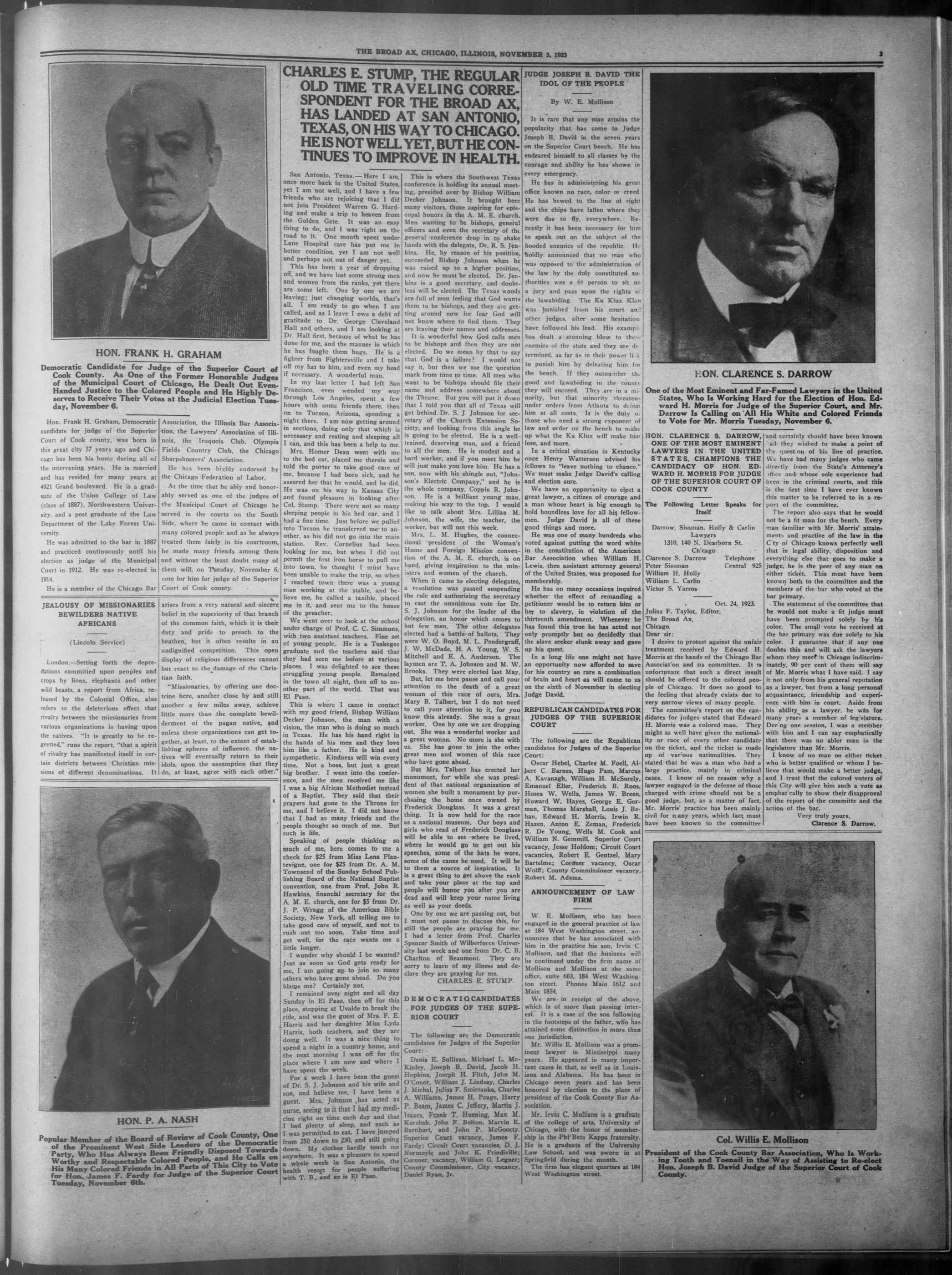
HON. FRANK H. GRAHAM
Democratic Candidate for Judge of the Super Cook County. As One of the Former Horse of the Municipal Court of Chicago, He De Handed Justice to the Colored People and serves to Receive Their Votes at the Judicial day, November 6.
Candidate for Judge of the Superiority. As One of the Former Home Municipal Court of Chicago, He Dejice to the Colored People and Receive Their Votes at the Judicial Nber 6.
Democratic Candidate for Judge of the Superior Court of Cook County. As One of the Former Honorable Judges of the Municipal Court of Chicago, He Dealt Out Even-Handed Justice to the Colored People and He Highly Deserves to Receive Their Votes at the Judicial Election Tuesday, November 6.
Hon. Frank H. Graham, Democratic candidate for judge of the Superior Court of Cook county, was born in this great city 57 years ago and Chicago has been his home during all of the intervening years. He is married and has resided for many years at 4921 Grand boulevard. He is a graduate of the Union College of Law (class of 1887), Northwestern University, and a post graduate of the Law Department of the Lake Forest University.
Association, the Illinois Bar Association, the Lawyers' Association of Illinois, the Iroquois Club, Olympia Fields Country Club, the Chicago Sharpshooters' Association.
He has been highly endorsed by the Chicago Federation of Labor.
At the time that he ably and honorably served as one of the judges of the Municipal Court of Chicago he served in the courts on the South Side, where he came in contact with many colored people and as he always
He was admitted to the bar in 1887 and practiced continuously until his election as judge of the Municipal Court in 1912. He was re-elected in 1914.
He is a member of the Chicago Bar
JEALOUSY OF MISSIONARIES
BEWILDERS NATIVE
AFRICANS
(Lincoln Service)
London.—Setting forth the depredations committed upon peoples and crops by lions, elephants and other wild beasts, a report from Africa, released by the Colonial Office, also refers to the deleterious effect that rivalry between the missionaries from various organizations is having upon the natives. "It is greatly to be regretted," runs the report, "that a spirit of rivalry has manifested itself in certain districts between Christian missions of different denominations. It
```markdown
```
[Name]
910824
HON. P. A. NASH
Popular Member of the Board of the Prominent West Side Party, Who Has Always Be Worthy and Respectable C His Many Colored Friends is for Hon. James F. Fardy f Tuesday, November 6th.
Offer of the Board of Review of Coor
diment West Side Leaders of the
to Has Always Been Friendly Disp
and Respectable Colored People, and
Colored Friends in All Parts of The
James F. Fardy for Judge of the 2
November 6th.
Popular Member of the Board of Review of Cook County, One of the Prominent West Side Leaders of the Democratic Party, Who Has Always Been Friendly Disposed Towards Worthy and Respectable Colored People, and He Calls on His Many Colored Friends in All Parts of This City to Vote for Hon. James F. Fardy for Judge of the Superior Court Tuesday, November 6th.
Judge of the Superior Court of
the Former Honorable Judges
Chicago, He Dealt Out Even-
red People and He Highly Dees
at the Judicial Election Tues-
Association, the Illinois Bar Association,
the Lawyers' Association of Illinois,
the Iroquois Club, Olympia
Fields Country Club, the Chicago
Sharpshooters' Association.
He has been highly endorsed by
the Chicago Federation of Labor.
At the time that he ably and honorably served as one of the judges of the Municipal Court of Chicago he served in the courts on the South Side, where he came in contact with many colored people and as he always treated them fairly in his courtroom, he made many friends among them and without the least doubt many of them will, on Tuesday, November 6, vote for him for judge of the Superior Court of Cook county.
arises from a very natural and sincere belief in the superiority of that branch of the common faith, which it is their duty and pride to preach to the heathen, but it often results in an undignified competition. This open display of religious differences cannot but react to the damage of the Christian faith.
"Missionaries, by offering one doctrine here, another close by and still another a few miles away, achieve little more than the complete bewilderment of the pagan native, and unless these organizations can get together, at least, to the extent of establishing spheres of influence, the natives will eventually return to their idols, upon the assumption that they do, at least, agree with each other."
98 882 D
of Review of Cook County, One
side Leaders of the Democratic
when Friendly Disposed Towards
explored People, and He Calls on
All Parts of This City to Vote
or Judge of the Superior Court
THE BROAD AX, CHICAGO, ILLINOIS, NOVEMBER 3. 1923
CHARLES E. STUMP, THE REGULAR OLD TIME TRAVELING CORRESPONDENT FOR THE BROAD AX, HAS LANDED AT SAN ANTONIO, TEXAS, ON HIS WAY TO CHICAGO. HE IS NOT WELL YET, BUT HE CONTINUES TO IMPROVE IN HEALTH.
San Antonio, Texas.—Here I am, once more back in the United States, yet I am not well, and I have a few friends who are rejoicing that I did not join President Warren G. Harding and make a trip to heaven from the Golden Gate. It was an easy thing to do, and I was right on the road to it. One month spent under Lane Hospital care has put me in better condition, yet I am not well and perhaps not out of danger yet.
This has been a year of dropping off, and we have lost some strong men and women from the ranks, yet there are some left. One by one we are leaving; just changing worlds, that's all. I am ready to go when I am called, and as I leave I owe a debt of gratitude to Dr. George Cleveland Hall and others, and I am looking at Dr. Hall first, because of what he has done for me, and the manner in which he has fought them bugs. He is a fighter from Fightersville and I take off my hat to him, and even my head if necessary. A wonderful man
In my last letter I had left San Francisco, even wended my way through Los Angeles, spent a few hours with some friends there, then on to Tucson, Arizona, spending a night there. I am now getting around in sections, doing only that which is necessary and resting and sleeping all I can, and this has been a help to me. Mrs. Homer Dean went with me to the bed car, placed me therein and told the porter to take good care of me, because I had been sick, and he assured her that he would, and he did. He was on his way to Kansas City and found pleasure in looking after Col. Stump. There were not so many sleeping people in his bed car, and I had a fine time. Just before we pulled into Tucson he transferred me to another, as his did not go into the main station. Rev. Cornelius had been looking for me, but when I did not permit the first iron horse to pull me into town, he thought I must have been unable to make the trip, so when I reached town there was a young man working at the stable, and believe me, he called a taxable, placed me in it, and sent me to the house of the preacher.
We went over to look at the school under charge of Prof. C. C. Simmons with two assistant teachers. Fine set of young people. He is a Tuskegee graduate and the teachers said that they had seen me before at various places. I was delighted to see these struggling young people. Remained in the town all night, then off to another part of the world. That was El Paso.
This is where I came in contact with my good friend, Bishop William Decker Johnson, the man with a vision, the man who is doing so much in Texas. He has his hand right in the hands of his men and they love him like a father. He is kind and sympathetic. Kindness will win every time. Not a boss, but just a great big brother. I went into the conference, and the men received me like I was a big African Methodist instead of a Baptist. They said that their prayers had gone to the Throne for me, and I believe it. I did not know that I had so many friends and the people thought so much of me. But such is life.
Speaking of people thinking so much of me, here comes to me a check for $25 from Miss Lena Plantevigne, one for $25 from Dr. A. M. Townsend of the Sunday School Publishing Board of the National Baptist convention, one from Prof. John R. Hawkins, financial secretary for the A. M. E. church, one for $5 from Dr. J. P. Wragg of the American Bible Society, New York, all telling me to take good care of myself, and not to rush out too soon. Take time and get well, for the race wants me a little longer.
I wonder why should I be wanted? Just as soon as God gets ready for me, I am going up to join so many others who have gone ahead. Do you blame me? Certainly not.
I remained over night and all day Sunday in El Paso, then off for this place, stopping at Uvalde to break the ride, and was the guest of Mrs. F. E. Harris and her daughter Miss Lyda Harris, both teachers, and they are dong well. It was a nice thing to spend a night in a country home, and the next morning I was off for the place where I am now and where I have spent the week.
For a week I have been the guest of Dr. S. J. Johnson and his wife and son, and believe me, I have been a guest. Mrs. Johnson has acted as nurse, see to it that I had my medicine right on time each day and that I had plenty of sleep, and such as I was permitted to eat. I have jumped from 250 down to 230, and still going down. My clothes hardly touch me anywhere. It was a pleasure to spend a whole week in San Antonio, the health resort for people suffering with T. B., and so is El Paso.
This is where the Southwest Texas conference is holding its annual meeting, presided over by Bishop William Decker Johnson. It brought here many visitors, those aspiring for episcopal honors in the A. M. E. church, men wanting to be bishops, general officers and even the secretary of the general conference drop in to shake hands with the delegate, Dr. R. S. Jenkins, He, by reason of his position, succeeded Bishop Johnson when he was raised up to a higher position, and now he must be elected. Dr. Jenkins is a good secretary, and doubtless will be elected. The Texas woods are full of men feeling that God wants them to be bishops, and they are getting around now for fear God will not know where to find them. They are leaving their names and addresses
It is wonderful how God calls men to be bishops and then they are not elected. Do we mean by that to say that God is a failure? I would not say it, but then we use the question mark from time to time. All the men who want to be bishops should file their name and address somewhere about the Throne. But you will put it down that I told you that all of Texas will get behind Dr. S. J. Johnson for secretary of the Church Extension Society, and looking from this angle he is going to be elected. He is a well-trained, deserving man, and a friend to all the men. He is modest and a hard worker, and if you meet him he will just make you love him. He has a son, now with his shingle out, "Johnson's Electric Company," and he is the whole company, Coppin R. Johnson. He is a brilliant young man, making his way to the top. I would like to talk about Mrs. Lillian M. Johnson, the wife, the teacher, the worker, but will not this week.
Mrs. L. M. Hughes, the connectional president of the Woman's Home and Foreign Mission convention of the A. M. E. church, is on hand, giving inspiration to the ministers and women of the church.
When it came to electing delegates, a resolution was passed suspending the rule and authorizing the secretary to cast the unanimous vote for Dr. S. J. Johnson for the leader of the delegation, an honor which comes to but few men. The other delegates elected had a battle of ballots. They were W. O. Boyd, M. L. Pendergraf, J. W. McDade, H. A. Young, W. S. Mitchell and E. A. Anderson. The laymen are T. A. Johnson and M. W. Brooks. They were elected last May
But, let me here pause and call your attention to the death of a great woman of this race of ours, Mrs. Mary B. Talbert, but I do not need to call your attention to it, for you know this already. She was a great worker. One by one we are dropping out. She was a wonderful worker and a great woman. No more is she with us. She has gone to join the other great men and women of this race who have gone ahead.
But Mrs. Talbert has erected her monument, for while she was president of that national organization of women she built a monument by purchasing the home once owned by Frederick Douglass. It was a great thing. It is now held for the race as a national museum. Our boys and girls who read of Frederick Douglass will be able to see where he lived, where he would go to get out his speeches, some of the hats he wore, some of the canes he used. It will be to them a source of inspiration. It is a great thing to get above the rank and take your place at the top and people will honor you after you are dead and will keep your name living as well as your deeds.
One by one we are passing out, but
I must not pause to discuss this, for
still the people are praying for me
I had a letter from Prof. Charles
Spencer Smith of Wilberforce University
last week and one from Dr. C. B.
Charlton of Beaumont. They are
sorry to learn of my illness and declare
they are praying for me.
CHARLES E. STUMP.
DEMOCRATIC CANDIDATES
FOR JUDGES OF THE SUPE-
RIOR COURT
The following are the Democratic candidates for Judges of the Superior Court:
Denis E. Sullivan, Michael L. McKinley, Joseph B. David, Jacob H. Hopkins, Joseph H. Fitch, John M. O'Conot, William J. Lindsay, Charles J. Michal, Julius F. Smietanka, Charles A. Williams, James H. Poage, Harry P. Beam, James C. Jeffery, Martin J. Isaacs, Frank T. Huening, Max M. Korshak, John F. Bolton, Marvin E. Barnhart, and John P. McGoorty. Superior Court vacancies, James F. Fardy; Circuit Court vacancies, D. J. Normoyle and John K. Prindville; Coroner, vacancy, William G. Legner; County Commissioner, City vacancy, Daniel Ryan, Jr.
It is rare that any man attains the popularity that has come to Judge Joseph B. David in the seven years on the Superior Court bench. He has endeared himself to all classes by the courage and ability he has shown in every emergency.
He has in administering his great office known no race, color or creed. He has hewed to the line of right and the chips have fallen where they were due to fly, everywhere. Recently it has been necessary for him to speak out on the subject of the hooded enemies of the republic. He boldly announced that no man who was opposed to the administration of the law by the duly constituted authorities was a fit person to sit on a jury and pass upon the rights of the lawabiding. The Ku Klux Klan was panished from his court and other judges, after some hesitation have followed his lead. His example has dealt a stunning blow to these enemies of the state and they are determined, as far as in their power lies to punish him by defeating him for the bench. If they outnumber the good and lawabiding in the county they will succeed. They are in a minority, but that minority threatens under orders from Atlanta to defeat him at all costs. It is the duty of those who need a strong exponent of law and order on the bench to make up what the Ku Klux will make him lose, and more.
In a critical situation in Kentucky once Henry Watterson advised his fellows to "leave nothing to chance." We must make Judge David's calling and election sure.
We have an opportunity to elect a great lawyer, a citizen of courage and a man whose heart is big enough to hold boundless love for all his fellowmen. Judge David is all of these good things and more.
He was one of many hundreds who voted against putting the word white in the constitution of the American Bar Association when William H. Lewis, then assistant attorney general of the United States, was proposed for membership.
He has on many occasions inquired whether the effect of remanding a petitioner would be to return him or her to slavery, in violation of the thirteenth amendment. Whenever he has found this true he has acted not only promptly but so decidedly that the slave seeker slunk away and gave up his quest.
In a long life one might not have an opportunity now afforded to save for his country so rare a combination of brain and heart as will come to us on the sixth of November in electing Judge David.
REPUBLICAN CANDIDATES FOR
JUDGES OF THE SUPERIOR
COURT
The following are the Republican candidates for Judges of the Superior Court:
Oscar Hebel, Charles M. Foell, Albert C. Barnes, Hugo Pam, Marcus A. Kavanagh, William H. McSurely, Emanuel Eller, Frederick B. Roos, Hosea W. Wells, James W. Breen, Howard W. Hayes, George E. Gorman, Thomas Marshall, Louis J. Behan, Edward H. Morris, Irwin R. Hazen, Anton E. Zeman, Frederick R. De Young, Wells M. Cook and William N. Gemmill. Superior Court vacancy, Jesse Holdom; Circuit Court vacancies, Robert E. Gentzel, Mary Bartelme; Coroner vacancy, Oscar Wolff; County Commissioner vacancy, Robert M. Adams.
ANNOUNCEMENT OF LAW
FIRM
W. E. Mollison, who has been engaged in the general practice of law at 184 West Washington street, announces that he has associated with him in the practice his son, Irvin C. Mollison, and that the business will be continued under the firm name of Mollison and Mollison at the same office, suite 603, 184 West Washington street. Phones Main 1612 and Main 1854.
We are in receipt of the above, which is of more than passing interest. It is a case of the son following in the footsteps of the father, who has attained some distinction in more than one jurisdiction.
Mr. Willis E. Mollison was a prominent lawyer in Mississippi many years. He appeared in many important cases in that, as well as in Louisiana and Alabama. He has been in Chicago seven years and has been honored by election to the place of president of the Cook County Bar Association.
Mr. Irvin C. Mollison is a graduate of the college of arts, University of Chicago, with the honor of membership in the Phi Beta Kappa fraternity. He is a graduate of the University Law School, and was sworn in at Springfield during the month.
The firm has elegant quarters at 184 West Washington street.
W.
HON. CLARENCE S. DARROW
One of the Most Eminent and Far-Famed Lawyers States, Who Is Working Hard for the Election ward H. Morris for Judge of the Superior Co Darrow Is Calling on All His White and Col to Vote for Mr. Morris Tuesday, November 6.
One of the Most Eminent and Far-Famed Lawyers in the United States, Who Is Working Hard for the Election of Hon. Edward H. Morris for Judge of the Superior Court, and Mr. Darrow Is Calling on All His White and Colored Friends to Vote for Mr. Morris Tuesday, November 6.
HON. CLARENCE S. DARROW, ONE OF THE MOST EMINENT LAWYERS IN THE UNITED STATES, CHAMPIONS THE CANDIDACY OF HON. EDWARD H. MORRIS FOR JUDGE OF THE SUPERIOR COURT OF COOK COUNTY and certainly should have been known had they wished to make a point of the question of his line of practice. We have had many judges who came directly from the State's Attorney's office and whose sole experience had been in the criminal courts, and this is the first time I have ever known
Darrow, Sissman, Holly & Carlin
Lawyers
1310, 140 N. Dearborn St.
Chicago
Clarence S. Darrow Telephone
Peter Sissman Central 925
William H. Holly
William L. Carlin
Victor S. Yarros
Oct. 24, 1923.
Julius F. Taylor, Editor,
The Broad Ax,
Chicago.
Dear sir:
I desire to protest against the unfair treatment received by Edward H. Morris at the hands of the Chicago Bar Association and its committee. It is unfortunate that such a direct insult should be offered to the colored people of Chicago. It does no good to the feeling that already exists due to very narrow views of many people. The committee's report on the candidates for judges stated that Edward H. Morris was a colored man. They might as well have given the nationality or race of every other candidate on the ticket, and the ticket is made up of various nationalities. They stated that he was a man who had a large practice, mainly in criminal cases. I know of no reason why a lawyer engaged in the defense of those charged with crime should not be a good judge, but, as a matter of fact, Mr. Morris' practice has been mainly civil for many years, which fact must have been known to the committee
[Image of a man in a suit with a tie and a cap, facing slightly to the right].
M.
Col. Willis E. Mollison
President of the Cook County Bar Associat
ing Tooth and Toenail in the Way of A
Hon. Joseph B. David Judge of the Sup
County.
President of the Cook County Bar Association, Who Is Working Tooth and Toenail in the Way of Assisting to Re-elect Hon. Joseph B. David Judge of the Superior Court of Cook County.
Ar-Famed Lawyers in the United
rd for the Election of Hon. Ed-
of the Superior Court, and Mr.
His White and Colored Friends
today, November 6.
and certainly should have been known
had they wished to make a point of
the question of his line of practice.
We have had many judges who came
directly from the State's Attorney's
office and whose sole experience had
been in the criminal courts, and this
is the first time I have ever known
this matter to be referred to in a re-
port of the committee.
The report also says that he would not be a fit man for the bench. Every man familiar with Mr. Morris' attainments and practice of the law in the City of Chicago knows perfectly well that in legal ability, disposition and everything else that goes to make a judge, he is the peer of any man on either ticket. This must have been known both to the committee and the members of the bar who voted at the bar primary.
The statement of the committee that he would not make a fit judge must have been prompted solely by his color. The small vote he received at the bar primary was due solely to his color. I guarantee that if any one doubts this and will ask the lawyers whom they meet in Chicago indiscriminately, 90 per cent of them will say of Mr. Morris what I have said. I say it not only from his general reputation as a lawyer, but from a long personal acquaintance, friendship and experience with him in court. Aside from his ability as a lawyer, he was for many years a member of legislature. During one session, I was a member with him and I can say emphatically that there was no abler man in the legislature than Mr. Morris.
I know of no man on either ticket who is better qualified or whom I believe that would make a better judge, and I trust that the colored voters of this City will give him such a vote as emphatically to show their disapproval of the report of the committee and the action of the bar.
Very truly yours.
Clarence S. Darrow.
1
Bar Association, Who Is Work- the Way of Assisting to Re-elect of the Superior Court of Cook
feat = ee iS = jee eet sr
a
bao og a ier. oc ae oe
fae es. ee
[s.. 3
is oantl ; oe
a aS
= 4 ae Re
De Ea > |
be i. © ee
Bs 7 ig eas
es ~ a eee
Ree 7 P
J “ : Cs
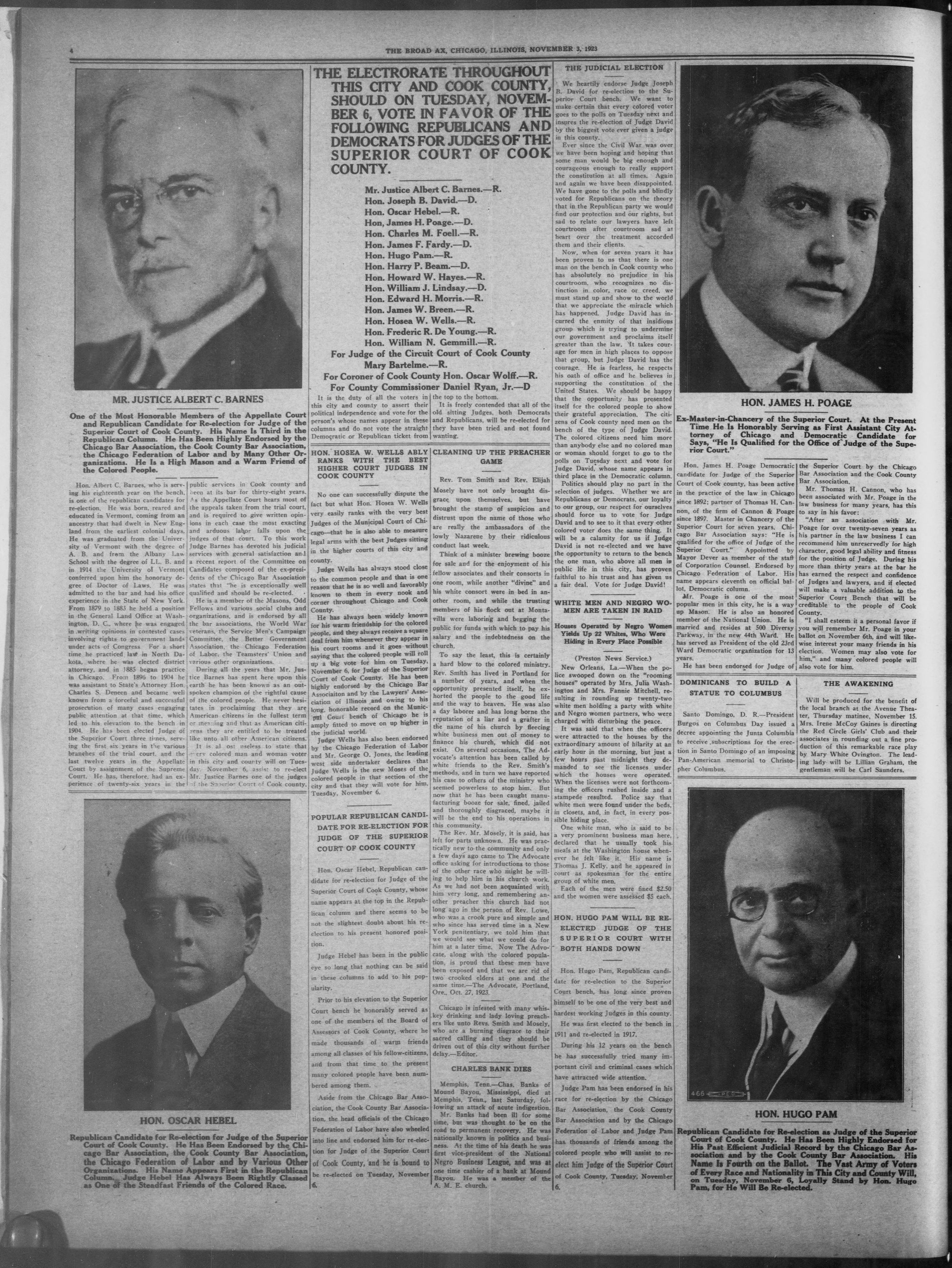
MR. JUSTICE ALBERT C. BARNES
One of the Most Honorable Members of the Appellate Court
and Republican Candidate for Re-election for Judge of the
Superior Court of Cook County. His Name Is Third in the
Republican Column. He Has Been Highly Endorsed by the
Chicago Bar Association, the Cook County Bar Association,
. the Chicago Federation of Labor and by Many Other Or-
ganizations. He Is a High Mason and a Warm Friend of
the Colored People.
Hon. Albert C. Barnes, who is serv-
ing his eighteenth year on the bench,
is one of the republican candidates for
re-election, He was born, reared and
educated in Vermont, coming from an
ancestry that had dwelt in New Eng-
land. from: the earliest colonial days,
He was graduated from the’ Univer:
sity of Vermont with the degree of
A. B. and frem the Albany Law
School with the degree of LL. B. and
in, 1914 the University of Vermont
conferred upon him the honorary de-
gree of Doctor of Laws. He was
admitted to the bar and had his office
experience in.the State of New York.
From 1879 to 1883 he held a position
in the General Land Office at Wash-
ington, D. C,, where fe was engaged
in writing opinions in contested cases
involving tights to government lands
under acts of Congress. For a short
time he practiced law in North Da-
kota, where he: was elected district
attorney, and in 1885 began practice
in Chicago, From 1896 to 194 he
‘was assistant to State's Attorney Hon.
Charles S. Dencen and became well
known from a forceful and successful
Prosecution of many cases engaging
Public attention at that time, which
Jed to his. elevation to the bench in
1904. He bas been elected Judge of
the Superior Court three times, serv-
ing the first six years in the various
branches of the trial court. and the
last twelve years in the Appellate
Court by assignment of the Supreme
Court. He has, therefore, had an ex-
Perience of twenty-six years in the
Bonn
= h(— Ss
22 = a
aw. 2
> “
HON. OSCAR HEBEL
Republican Candidate for Re-election for J of the Superior
Court of Cook County. Tie Hes Beon Eodiorsed by the Cat
Detain: tae toms gps Few as mesons
oo eri lis Sar aie eee he Republican
as One UF the Steadfast Friends of the Colored Race.
|
4
public services in’ Cook county and
been at its bar for thirty-eight years.
As the Appellate Court hears most of
the appeals taken from the trial court,
and is required to give written opin-
ions in each case the most exacting
and arduous lahpr falls upon the
judges of that court. To this work
Judge Barnes has devoted his judicial
services with general satisfaction and
a recent report of the Committee on
Candidates composed of the ex-presi-
dents of the Chicago Bar Association
states that “he is exceptionally. well
qualified and should be re-elected. -
He is.a member of the Masons, Odd
Fellows and various social clubs and
organizations, and is endorsed by all
the bar associations, the World War
veterans, the Service Men's Campaign
Committee, the Better Government
Association, the Chicago Federation
of Labor, the Teamsters’ Union and
various other organizations.
During all the years that Mr. Jus-
tice Barnes has spent here upon this
carth’ he has been known as an out-
spoken champion of the rightful cause
of the colored people. He never hesi-
tates in proclaiming that they are
American citizens in the fullest’ term
or messing and that as American citi
vens they are entitled to be treated
like unto all other American citizens
It is al ost useless to state that
“ery colored man and woman voter
in this city and county will on Tues.
day. November 6, assist. to. re-elect
Mr. Justice Barnes one of the judges
f the Saeerior Conct of Cook county.
THE BROAD AX, CHICAGO, ILLINOIS, NOVEMBER 3, 1923
THE ELECTRORATE THROUGHOUT) 7°"
THIS CITY AND COOK COUNTY, |, "< t"
SHOULD ON TUESDAY, NOVEM- berior Court 1
BER 6, VOTE IN FAVOR OF THE baaagteviase
FOLLOWING REPUBLICANS ANDi ic:
DEMOCRATS FOR JUDGES OF THE |": =="
SUPERIOR COURT OF COOK) «i *:
COUNTY. souragebee ste
Mr. Justice Albert C. Barnes.—R.
Hon. Joseph B. David.—D.
Hon. Oscar Hebel.—R. 5
Hon, James H. Poage.—D.
Hon. Charles M. Foell.—R.
Hon. James F. Fardy.—D.
Hon. Hugo Pam.—R.
Hon. Harry P. Beam.—D.
Hon. Howard W. Hayes.—R.
Hon. William J. Lindsay.—D.
Hon. Edward H. Morris.—R.
Hon. James W. Breen.—R. :
Hon. Hosea W. Wells.—R.
Hon. Frederic R. De Young.—R.
Hon. William N. Gemmill.—R.
For Judge of the Circuit Court of Cook County
Mary Bartelme.—R.
For Coroner of Cook County Hon. Oscar Wolff.—R.
For County Commissioner Daniel Ryan, Jr.—D
It is the duty of all the voters in| the top to the bottom.
this city and county to assert their| It is freely contended that all of
political independence and vote for the|old sitting Judges, both Democr
person’s whose names appear in =e Republicans, will be re-elected
columns and do not vote the straight| they have been tried and not for
Democratic or Republican ticket from | wanting.
HON. HOSEA W. WELLS ABLY
RANKS WITH THE BEST
HIGHER COURT JUDGES IN
COOK COUNTY
No one can successfully dispute the
fact but what Hon. Hosea W. Wells
‘very easily ranks with the very best
Judges of the Municipal Court of Chi-
cago—that he is also able to measure
legal arms with the best Judges sitting
in the higher courts of this city and
county.
Judge Wells has always stood close
‘to the common people and that is one
‘reason that he is so well and favorably
known to them in every nook and
corner throughout Chicago and Cook
County.
He has always been widely known
for his warm friendship for the colored
people, and they always receive a square
deal from him whenever they appear in
his court rooms and it goes. without
saying that the colored people will roll
up a big vote for him on Tuesday,
November 6, for Judge of the Superior
Court of Cook County. He has been
highly endorsed by the Chicago Bar
Associaiton and by the Lawyers’ Asso-
ciation of Illinois and owing to his
Jong, honorable record on the Munic-
‘pal Court bench of Chicago he is
amply fitted to move on up higher in
the judicial world.
Judge Wells has also been endorsed
by the Chicago Federation of Labor
and Mr. George ©. Jones, the leading
west side andertaker declares that
Judge Wells is the new Moses of the
colored people in that section of the
city and that they will vote for him,
‘Tuesday, November 6. i
POPULAR REPUBLICAN CANDI-
DATE FOR RE-ELECTION FOR
JUDGE OF THE SUPERIOR
COURT OF COOK COUNTY
. Hon. Oscar Hebel, Republican can-
didate for re-election for Judge of the
Superior Court of Cook County, whose
mame appears at the top in the Repub-
ican column and there seems to be
not the slightest doubt about his re-
tion.
Judge Hebel has been in the public
éye so long that nothing can be said
in these columns to add to his pop-
ularity.
Prior to his elevation to the Superior
Court bench he honorably served as
one of the members of the Board of
Assessors of Cook County, where he
made thousands of warm friends
among all classes of his fellow-citizens,
and from that time to the present
many colored people have been num-
ered among them, ~ 4
Aside from the Chicago Bar Asso-
ciation, the Cook County Bar Associa.
tion, the head officials of the Chicag
Federation of Labor have also wheeles
into line and endorsed him for re-elec
tion for Judge of the Superior Cour
‘of Cook County, ‘and he is bound t
be re-elected on Tuesday, Novembe
the top to the bottom.
It is freely contended that all of the
‘old. sitting Judges, both Democrats
and Republicans, will be re-elected for
they have been tried and not found
wanting.
CLEANING UP THE PREACHER
GAME
Rev. Tom Smith and Rev. Elijah
Mosely have not only brought dis-
grace upon themselves, but have
brought the stamp of suspicion and
distrust upon the name of those who
are really the ambassadors of the
lowly Nazarene by their ridiculous
conduct last week.
Think of a minister brewing booze
for sale and for the enjoyment of his
fellow associates and their consorts in
‘one room, while another “divine” and
his white consort were in bed in an-
other room, and while the trusting
members of his flock out at Monta-
villa were laboring and begging the
public for funds with which to. pay his
salary and the indebtedness on the
church,
To say the least, this is certainly
a hard blow to the colored ministry.
Rev. Smith has lived in Portland for
a number of years, and when the
‘opportunity presented itself, he ex-
horted the people to the good life
and the way to heaven. He was also
‘a day laborer and has long borne the
reputation of a liar and a grafter in
the name of his church by fleecing
white business men out of money to
finance his church, which did not
exist. On several occasions, The Ad-
yocate’s attention has been called by
white friends to the Rev. Smith’s
methods, and in turn we have reported
his case to others of the ministry who
seemed powerless to stop him. But
now that he has been caught manu-
facturing booze for sale, fined, jailed
and thoroughly disgraced, maybe it
will be the end to his operations in
this community.
The Rev. Mr. Mosely, it is said, has
eft for parts unknown. He was prac-
tically new to-the community and only
a few days ago came to The Advocate
office asking for introductions to those
of the other race who might be will-
ing to help him in his church work.
As we had not been acquainted with
him very long, and remembering an-
other preacher this church had not
long ago in the person. of Rev. Lowe,
who was a crook pure and simple and
who since has served time in a New
York penitentiary, we told him that
we would see what we could do for
him at a later time, Now The Advo-
cate, along with the colored popula-
tion, is prond that these men have
been exposed and that we are rid of
two crooked elders at one and the
same time—The Advocate, Portland,
Ore., Oct, 27, 1923, i
Chicago is infested with many whis-
key drinking and lady loving preach-
ers like unto Revs. Smith and Mosely,
who are a burning disgrace to their
sacred calling and they should be
driven out of this city without further
delay —Editor.
CHARLES BANK DIES
Memphis, Teon—Chas, Banks of
Mound Bayou, Mississippi, died at
Memphis, Tenn, last Saturday, fol-
lowing an attack of acute indigestion.
Mr. Banks had been ill for some
time, but was thought to be on the
toad to permanent recovery. He was
nationally known in politics and busi
ness. At the time of his death he was
first vice-president of the National
Negro Business Leagné, and was at
jone time cashier of a bank at Mound
Bayou. He was @ memiber of the
a shiek
THE JUDICIAL ELECTION
We heartily endorse Judge Joseph
B. David for re-election to the Su-
[perior Court bench. We want to
make certain that every colored voter
‘goes to the polls on Tuesday next and
insures the re-election of Judge David
by the biggest vote ever given a judge
jin this county. ¢
Ever since the Civil War was over
ve have been hoping and hoping that
some man would be big enough and
‘courageous enough to really support
the constitution at all times. Again
and again we have been disappointed.
‘We have gone to the polls and blindly
voted for Republicans on the theory
that in the Republican party we would
find our protection and our rights, but
sad to relate our lawyers have left
courtroom iter courtroom sad at
heart over the treatment accorded
them and their clients. ~
Now, when for seven years it has
been proven to us that there is one
man on the bench in Cook county who
has absolutely no prejudice in his
courtroom. who recognizes no dis-
tinction in. color, race or creed, we
must stand up and show to the world
that we appreciate the miracle which
has happened, Judge David has in-
curred the enmity of that insidious
group which is trying to undermine
‘our government and proclaims itself
greater than the law. Yt takes cour-
age for men in high places to oppose
that group, but Judge David has the
courage. He is fearless, he respects
his oath of office and he believes in
supporting the constitution of the
United States. We should be happy
that the opportunity has presented
itself for the colored people to show
their grateful appreciation, The citi-
zens of Cook county need men on the
bench of the type of Judge David.
The colored citizens need him more
than anybody else and no colored man
or woman should forget to go to the
polls on Tuesday next and vote for
Judge David, whose name appears in
third place in the Democratic column.
Politics should play no part in the
selection of judges. Whether we are
Republicans or Democrats, our loyalty.
to our group, our respect for ourselves
should force us to vote for Judge
David and to see to it that every other
colored voter does the same thing. It
will be a calamity for us if Judge
David is not re-elected and we have
the opportunity to return to the bench
the one man, who above all men in
public life in this city, has proven
faithful to his trust and has given us
a fair deal. Vote for Judge David!
WHITE MEN AND NEGRO WO.
MEN ARE TAKEN IN RAID
Houses Operated by Negro Women
‘Yields Up 22 Whites, Who Were
‘Hiding in Every Place Possible
bila ae tae beltis aor acd
New Orleans, La—When the po-
lice swooped down on the “rooming
houses” operated by Mrs. Julia Wash-
ington and Mrs. Fannie Mitchell, re-
sulting in rounding up twenty-two
white men holding a party with white
and Negro women partners, who were
charged with disturbing the peace.
It was said that when the officer:
were attracted to the houses by the
extraordinary amount of hilarity at an
early hour in the morning, but just a
few hours past midnight they de-
manded to see the licenses under
which the houses were operated.
‘When the licenses were not forthcom-
‘ing the officers rushed inside and 2
‘stampede resulted. Police say that
white men were found under the beds,
‘in closets, and, in fact, in every pos-
sible hiding place.
‘One white man, who is said to be
a very prominent business man here
declared that he usually took his
meals at the Washington house whet-
ever he felt like it, His name is
Thomas J. Kelly, and he appeared in
court “as spokesman for the. entire
group of white men,
Each of the men were fined $2.50
and the women were assessed $5 each.
HON. HUGO PAM WILL BE RE-
ELECTED JUDGE OF THE
SUPERIOR COURT WITH
" BOTH HANDS DOWN
Hon. Hugo Pam, Republican candi-
date for re-election to the Superior
Court bench, ‘has long since proven
himself to be one of the very best and
hardest working Judges in this county.
He was first elected to the bench in
1911 and re-clected in 1917.
During his 12 years on the bench
he has successfully tried many im.
portant civil and criminal cases which
have attracted wide attention.
Judge Pam has been endorsed in hi
race for re-election by the Chica
Bar Association, the Cook Count
Bar Association and by the Chicag
Federation of Labor and Judge Pan
has thousands of friends among thi
colored people who will assist to re
lect him Judge of the Superior Cour
‘of Cook County, Tuesday, Novembe:
Se , * :
a Se
es “ nae
a.
bed Sida 7 — 3
i
HON. JAMES H. POAGE
Ex-Master-in-Chancery of the Superior Court.
Time He Is Honorably Serving as First A:
torney of Chicago and Democratic
Says, “He Is Qualified for the Office of Juc
rior Court.”
Ex-Master-in-Chancery of the Superior Court. At the Present
Time He Is Honorably Seeny as it Assistant City At-
torney of Chicago and tic Candidate for
Says, “He Is Qualified for the Office of Judge of the Supe-
rior Court.”
Hon. James H, Poage Democratic] the Superior Court by the Chicago
candidate for Judge of the Superior} Bar Association and the Cook County
ive| Bar. Association.
ee a. ta, 0 Ga as bee
in the practice of the law in Chicago] heen associated with Mr. Poage fa the
since 1892; partner of Thomas H. Cat-|taw business for many years, has this
non, of the firm of Cannon & Poage|to say in his favor:
since 1897. Master in Chancery of the] “After an association with Mr.
Superior Court for seven years. Chi-|Poage for over twenty-seven years as
cago Bar Association says: “He is|his partner in the law business I can
qualified for the office of Judge of the| recommend him unreservedly for high
Superior Court.” Appointed by | character, good legal ability and fitness
Mayor Dever as member of the staft| for the position of Judge. During his
of Corporation Counsel. Endorsed by} more than thirty years at the bar he
Chicago Federation of Labor. His| has earned the respect and confidence
name appears eleventh on official bal-!of Judges and lawyers, and if elected
lot, Democratic column, [a make a valuable addition to the
‘Mr. Poage is one of the most! Superior Court Bench that will be
popular men in this city, he is a waylereditable to the people of Cook
up Mason. He is also an honored | County.
member of the National Union. He is| “I shall esteem it a personal favor if
married and resides at 500. Diversy| you will remember Mr. Poage in your
Parkway, in the new 44th Ward. He | ballot on November 6th, and will like-
has served as President of the old 23rd| wise interest your many friends in his
Ward Democratic organization for 13] election. Women may also vote for
years. him,” and many ‘colored people will
He has been endorsed for Judge of] also vote for him.
DOMINICANS TO BUILD A
STATUE TO COLUMBUS
Santo Domingo, D. R.—President
Burgos on Columbus Day issued a
decree appointing the Junta Columbia
to receive subscriptions for the erec-
tion in Santo Domingo of an imposing
Pan-American memorial to Christo-
pher Columbus.
| -
——
) oaks
| eS
‘ ee) RY oa
a
| nit A
|
i |
ip rites |
HON. HUGO PAM
Republican Candidate for Re-election as Ju
Court of Cook County. He Has Been I
His Past Efficient Judicial Record by t
Name Is Fourth on the Ballot, v
of Every Race and Nationality im This Ci
on Tuesday, November 6, ‘Sta
| Pam, for He Will Be
Republican Candidate for Re-election as Judge of the Superior
Court of Cook County. He Has Been Highly Endorsed for
His Past Efficient Judicial Record by the Chicago Bar As-
Name Is Fourth on the Ballot, Vast of Voters
of Every Race and Nationality in'This City and Will,
on Tuesday, November 6, Stand by Hon. Hugo
Pam, for He Will Be
THE AWAKENING
Will be produced for the benefit of
the local branch at the Avenue Thea-
ter, Thursday matinee, November 15.
Mrs. Irene McCoy Gaines is directing
the Red Circle Girls’ Club and their
associates in rounding out a fine pro-
duction of this remarkable race play
by Mary White Ovington. The lead-
‘ing lady: will be Lillian Graham, the
gentleman will be Carl Saunders.
[Name]
HON. WILLIAM J. LINDSAY
Master-in-Chancery of the Superior Court of
Former Teacher in the Englewood High Scho
One of the Professors at the Chicago Kent C
and Democratic Candidate for Judge of
Court, Who Has Been Highly Endorsed by
Federation of Labor.
Master-in-Chancery of the Superior Court of Cook County, Former Teacher in the Englewood High School, at Present One of the Professors at the Chicago Kent College of Law, and Democratic Candidate for Judge of the Superior Court, Who Has Been Highly Endorsed by the Chicago Federation of Labor.
Hon. William J. Lindsay, Democratic candidate for judge of the Superior Court of Cook county, has in the past served as one of the efficient teachers in the Englewood High School. He has also served with great distinction as one of the professors at the Chicago Kent College of Law and for some time he has more than ably filled the office of master in chancery of the Superior Court of Cook county.
He has had trial experience in all state and Federal courts.
State Bar Association, American Bar Association, and Art Institute of Chicago. He is a gentleman of fine character and ability.
Mr. Lindsay has been endorsed by the Chicago Federation of Labor, the Chicago Bar Association, the Cook County Bar Association, the Lawyers' Association of Illinois, the Spanish War veterans, the Better Government Association of Chicago and Cook county.
Mr. Lindsay is an honored Mason and a member of the P. B. O. E. He is happily married and resides with
His education, training, experience and temperament qualify him for judge of the Superior Court of Cook county. The Chicago Bar Association report says: "He is a careful lawyer, thorough, conscientious and even tempered. He is qualified for the office of judge of the Superior Court." Mr. Lindsay is a member of the Chicago Bar Association, Illinois
DANIEL RYAN, JR., WHO
FOUGHT ON THE BATTLE-
FIELDS OF FRANCE FOR THE
GLORY AND HONOR OF HIS
COUNTRY, IS SLATED TO
SUCCEED HIS LATE FATHER
AS COUNTY COMMISSIONER
All the old-time and up-to-date
politicians freely admit that everything
seems to indicate that Daniel Ryan,
Jr., who fought for his country on
[Name]
He Has Honorably Served as One of the High-Class Judges of the Superior Court Since 1911 and on Tuesday, November 6 He Will be Re-elected to His Present Honorable Position
Superior Court of Cook County,
Chelwood High School, at Present
the Chicago Kent College of Law,
for Judge of the Superior
highly Endorsed by the Chicago
State Bar Association, American Bar
Association, and Art Institute of Chicago. He is a gentleman of fine character and ability.
Mr. Lindsay has been endorsed by
the Chicago Federation of Labor, the
Chicago Bar Association, the Cook
County Bar Association, the Lawyers'
Association of Illinois, the Spanish
War veterans, the Better Government
Association of Chicago and Cook
county.
Mr. Lindsay is an honored Mason and a member of the P. B. O. E. He is happily married and resides with his lovable wife, Mrs. Lindsay, and the rest of their family at 6138 St. Lawrence avenue. His name is the seventh in the Democratic column. For many years Mr. Lindsay has always had many warm friends among the colored people in all parts of this city, and on Tuesday, November 6, they will freely vote for him for judge of the Superior Court of Cook county.
the bloody battlefields of France, will be elected on Tuesday, November 6, to succeed his late father, Daniel Ryan, Sr., who was well and favorably known in this city and county as one of the county commissioners.
Young Dan, Jr., is a chip off the old block and he has a large army of loyal friends, including the ex-service men, who are successfully plugging for him for county commissioner.
THE BROAD AX, CHICAGO, ILLINOIS, NOVEMBER 3. 1923
MANY OF THE LEADING COLORED PREACHERS IN THIS CITY ARE CALLING ON THE COLORED PEOPLE TO ASSIST TO RE-ELECT HON. JOSEPH B. DAVID JUDGE OF THE SUPERIOR COURT OF COOK COUNTY
Judge Joseph B. David is a candidate for re-election to the bench of the Superior Court of Cook county. Our enemies are determined to defeat him. We must make it our business to re-elect him. No better lawyer ever sat on the bench; no fairer man ever held or sought public office. We recommend Judge David; we believe he is entitled to the vote of every citizen of Cook county, but certainly of every colored citizen and voter.
Judge David has shown during his seven and more years on the bench and as a lawyer before his elevation to his present place of power and responsibility, that he believes in giving every man, whatever his race, color or creed, a square deal and an impartial trial, according to the law of the land.
He is absolutely fearless and vigorously courageous. At all times and under all circumstances he has stood up for the right as he has seen and believed the right. He has shown that he cannot be awed by influence or bought by gain to swerve from the right, regardless of all questions of popularity.
He has made so great a judge that there would be no necessity to call upon you except that his fairness has aroused the enmity of the enemies of good government; and these enemies are our enemies.
MRS. JENNIE JOHNSTON HIGH-
LY ENTERTAINED TWENTY
OF HER LADY FRIENDS AT A
UNIQUE BIRTHDAY PARTY
Saturday afternoon, Mrs. Jennie Johnston, 5423 S. Wabash avenue, royally entertained more than twenty of her lady friends at a pleasant and delightful birthday party.
Her sister, Mrs. Lottie Carter, made an elaborate birthday cake and labeled it Sweet Sixteen and all the ladies present were not supposed to be over sixteen. An elaborate birthday dinner was served, which was greatly enjoyed by all present.
The house and table were beautifully decorated for the eventful occasion and Mrs. Johnston was declared by her guests to be an ideal hostess.
THE ROCHE-BROOKS WEDDING
Mr. A. L. Brooks of 3145 Prairie avenue, Chicago, Illinois, and Mrs. A. M. Roche of Winnipeg, Manitoba, Canada, were joined in wedlock Monday evening, October 22. After the marriage ceremonies the couple departed for Columbus, Ohio, to spend their honeymoon as guests of Mr. and Mrs. A. L. Brooks, Jr., nephew of the bridegroom. Rev. C. H. Clark performed the ceremony.
HON CHARLES M. FOELL IS SLATED FOR RE-ELECTION FOR JUDGE OF THE SUPERIOR COURT
Hon. Charles M. Foell, Republican candidate for re-election as Judge of the Superior Court is just honorably ending his second term. He was first elected in 1911 and re-elected in 1917. Cook County has had in the past many able and brainy Judges but none of her past or present painstaking Judges can or have surpassed Judge Foell, when it comes down to expounding all of the laws of the great State of Illinois. Judge Foell has been endorsed in his race for re-election by the Chicago Bar Association, by the Cook County Bar Association and by the Chicago Federation of Labor.
From April 1, 1906 down to the present time Judge Foell, who is one of our warmest friends in this city has been a constant reader and supporter of this newspaper and we feel confident that on Tuesday, November 6, that he will make a swift home run and land back in the County Building, where he can continue to honorably serve as Judge of the Superior Court.
The fight is ours! We must make up for his losses incurred in his fight for equal and exact justice. Our loyalty to friends must not be questioned. Judge David is the friend of the oppressed; we are oppressed by Judge David's enemies.
The election is November 6; women can vote and they will show their right by voting for their friend.
If you are not registered you can vote by affidavit on the day of election.
Judge David's name is third in the Democratic column.
Justice is above party in this crisis. We must elect this true and tried friend at whatever cost of party.
Signed by: Rev. W. D. Cook, pastor of the People's church; Rev. C. M. Tanner, pastor of Bethel A. M. E. church; Bishop A. D. Hankins, United A. M. E. church; Rev. W. A. Blackwell, pastor of Walters A. M. E. Zion church; Bishop A. J. Carey, bishop of A. M. E. church; Rev. A. J. Bowling, Metropolitan Community Center; Rev. J. B. Redmond, pastor of St. Mark's M. E. church; Rev. T. M. King, pastor of the Rayfield Baptist church; Rev. William S. Braddan pastor of the Berean Baptist church; Rev. David Johnson, pastor of the St Mary's A. M. E. church; Rev. David Tittle, assistant pastor of Olivet Baptist church; Rev. D. H. Harris, pastor of the Shiloh Baptist church; Rev. C. D. Trice, Olivet Baptist church.
TOLEDO PROFESSOR PUTS
"DADS" ON GRILL
His Questionnaire Designed to Learn if Fathers Take Interest in Sons Toledo, Ohio.—Are you 100 per cent dad?
That is the question that Professor Harold E. Williams is asking Toledo fathers in lecture and questionnaire.
Professor Williams is principal of Toledo's new South End school, Libby High, and former principal of Woodward Tech, where he gained the reputation of controlling unruly boys and at the same time gaining their confidence and respect.
In his talks Professor Williams said he had gained much good for the home, the boy and the school through his questionnaire for dads, and that very few could mark themselves 100 per cent.
Here Are Some Questions
The questions contained in it include:
“Your boy is filled with power for good or evil. Are you studying it so that you can wisely direct it?
“It is your privilege to solve your boy's problems. Does he bring them to you? If not, why not?
“How much time do you spend with your boy? Standard, 10 hours per week, one hour equals 1 point.
“Do you participate in your boy's recreation, hilkes, outings, athletics, etc.?
Direct His Reading
“Good books are a blessing; others are a curse. Do you direct your boy's reading? Ever read with him?
"Do you have a plau for training your boy in self-reliance and self-confidence?
"Are you teaching your boy to earn, save and spend wisely?
"The problem of discipline, unless properly handled, often leaves a trail of regret. Do you have a plan?
"Have you observed any special unusual ability which indicates a fitness for any special line of life work?"
It is high time for the "dads" all over this country to become more deeply interested in the welfare of their sons and daughters and prevent them from rushing on the downward road to destruction—Editor.
N. A. A. C. P. FLOWER DAY SUNDAY, NOVEMBER 4
Miss Estelle Arnold, leader of the N. A. A. C. P. Flower Day Committee, has organized her solicitors to go before the public next Sunday dispensing real flowers for the benefit of the local branch. One hundred and fifty workers will be at churches, meeting places and street corners in service for the association. Headquarters will be at the Y. W. C. A. 3541 Indiana avenue, which Mrs. Lawson, executive secretary, has placed at the disposal of the committee. Cartons for the collections have been donated by the Quaker Oats Com-
SOUTHERN EDITORS ON RACE
RELATIONS
CONSTRUCTIVE NEWS FA-
VORED
Findings of Virginia Editorial Confer-
ence Signed by Fifty Others
Atlanta, Ga.—(Special to The Broad Ax.)—Editors of leading daily papers in six of the Southern states have united in a signed statement asking for mutual helpfulness and co-operation between the white and colored races in the South, for adequate educational advantages for colored people, for equality before the law, and for the abatement of mob violence. The paper was drafted in a conference of Virginia editors and has since been signed personally by more than fifty other editors of leading dailies in North and South Carolina, Tennessee, Mississippi and Louisiana. Practically every man to whom it was presented readily attached his name. It is believed, therefore, that with few exceptions, it fairly represents the attitude of the Southern press as a whole. The statement follows:
"In the attainment and maintenance of improved interracial relations in our Southern states we believe that a policy of co-operation between the more thoughtful of both races is fundamental, this being the antithesis of antagonism and polemic discussion.
"Mutual helpfulness between whites and blacks should be encouraged; the better element of both races striving by precept and example to impress the interdependence of peoples living side by side, yet apart.
"The Negroes of the South are largely dependent upon the white press for current news of the day. It would be well if even greater effort was made to publish news of a character which is creditable to the Negro, showing his development as a people along desirable lines. This would stimulate him to try to attain to a higher standard of living.
"We do not believe that education suited to the needs of the individual of any race is harmful. It is a generally accepted fact that in both races if the entire mass were educated, industrial problems would adjust themselves automatically and the less fit of either race would find the work and place for which he was best equipped. It has been authoritatively stated that the Negro demand would absorb all teachers, preachers, physicians and lawyers the schools may turn out.
"The influence of the thoughtful men of both races should be invoked in the effort to establish and assure equality before the law for Negro defendants in all criminal trials.
"Abatement of mob rule and its crimes is an aim to which all good citizens should pledge their support."
"In the harmonious co-operation of the thoughtful and exemplary men and women of both races lies the prospect of larger understanding and better interracial relations."
The conference of editors which drafted the above statement was called by Mr. R. W. Miles, a field representative of the Interracial Commission, by whom it was also brought to the attention of the other signers.
ONE OF THE TRUE FRIENDS OF THE COLORED PEOPLE WILL BE ELEVATED TO THE SUPERIOR COURT BENCH
Hon. William N. Gemmill, Republican candidate for Judge of the Superior Court was born on a farm near Shannon, Ill., in 1860. He was graduated from Cornell College in 1886, and was superintendent of the city schools of Marion and Rochford, Ia., for five years. Then he was graduated from the Northwestern University Law School and was admitted to the bar in 1892. He practiced law with the firm of Gemmill, Barnhart & Foell for fourteen years.
Judge Gemmill was elected to the Municipal Court when that court was created in 1906 and has remained on the bench ever since.
He is a member of Phi Beta Kappa, a Mason and a member of the Methodist Church. He is also a member of the Hamilton and the South Shore Country clubs.
Author of Three Books
He is a Republican trustee of Cornell College and a director of the Better Government Association and several charity and philanthropic organizations.
Judge Gemmill has written three books, all to be published this Fall.
The first deals with the trials of the witches at Salem. All the evidence offered in these trials which heretofore has not been published has been collected. His latest work deals with our forgotten heroes.
He has been endorsed by the Chicago Bar Association, the Cook County Bar Association and by the Chicago Federation of Labor and the Betterment Government Association of Chicago, and on Tuesday, November 6, he will become one of the new Judges of the Superior Court of Cook County.
P. E.
HON. HOWARD W. HAYES
Republican Candidate for Judge of the Superior County. Owing to His Untarnished Record One of the Judges of the Municipal Court Has Been Heartily Endorsed by the Chicago tion and by the Cook County Bar Association to State That He Has Long Since Proven His the Colored People and They Will Remem Their Votes on Tuesday, November 6.
Republican Candidate for Judge of the Superior Court of Cook County. Owing to His Untarnished Record in the Past, As One of the Judges of the Municipal Court of Chicago, He Has Been Heartily Endorsed by the Chicago Bar Association and by the Cook County Bar Association. It Is Useless to State That He Has Long Since Proven His Friendship for the Colored People and They Will Remember Him With Their Votes on Tuesday, November 6.
Hon. Howard W. Hayes, Republican candidate for Judge of the Superior Court is one of the best known and most highly esteemed Judges of the Municipal Court of Chicago. He can be classed as being the friend of everybody, the rich and the poor, the white and the black. The past untarnished record of day, November 6, both men and women can vote for him.
Judge Hayes was born in Steubenville, O., October 30, 1877, where his father was a well-known lawyer for more than a quarter of a century. In the year 1892 his family moved to Chicago. Judge Hayes was educated in the public schools, later attending the University of Michigan, where he
The past unattornished record of Judge Hayes reads like an open book
Judge Hayes' Record
Judge Hayes, who had been a track athlete of some note at the University of Michigan, was admitted to the bar in 1901. From 1907 to 1911 he was one of the principal assistants in the office of Corporation Counsel Edward J. Brundage. He was elected to the Municipal bench in 1916 and was re-elected in 1922.
"He has made a good record as Judge of the Municipal Court, and we regard him as qualified for the office of Judge of the Superior Court," read the report of the Bar Association.
Not so many years ago, Judge Hayes had the honor of becoming united in marriage to Miss Harriet Heneye the highly accomplished and brilliant daughter of former Judge and Mrs. Elbridge Heneye and like his father-in-law Judge Hayes has always been true as blue steel in his friendship for the colored people and he is justly entitled to receive the votes of all the colored people in this city and county at the Judicial Election, Tues-
REV. AND MRS. H. E. STEWART
PLEASANTLY LCELEBRATED
THEIR THIRTIET WEDDING ANNIVERSARY
Tuesday afternoon and evening Rev. and Mrs. H. E. Stewart, 4331 Vincennes avenue, delightfully celebrated their thirtieth wedding anniversary. Their beautiful home was crowded down all afternoon and evening by their hosts of friends. They were the recipients of many lovely presents.
```markdown
```
[Picture of a man in a suit with a bow tie].
HON. WILLIAM N. GEMMILL
Republican Candidate for Judge of the Superior
More Than Twelve Years He Has Very Cred
as One of the Judges of the Municipal Court a
the Courage and the Manhood to Stand by
People During the Race Riots in This City,
Will Bravely Stand by Him Tuesday, November
Republican Candidate for Judge of the Superior Court. For More Than Twelve Years He Has Very Creditably Served as One of the Judges of the Municipal Court and as He Had the Courage and the Manhood to Stand by the Colored People During the Race Riots in This City, in 1919, They Will Bravely Stand by Him Tuesday, November 6.
of the Superior Court of Cook
narmished Record in the Past, As
Municipal Court of Chicago, He
led by the Chicago Bar Associ-
acy Bar Association. It Is Useless
Since Proven His Friendship for
they Will Remember Him With
november 6.
day, November 6, both men and
women can vote for him.
Judge Hayes was born in Steuben-
ville, O., October 30, 1877, where his
father was a well-known lawyer for
more than a quarter of a century. In
the year 1892 his family moved to
Chicago. Judge Hayes was educated in
the public schools, later attending the
University of Michigan, where he
graduated in 1901.
He was captain of a famous Michigan track team and competed in the Olympian games in Paris in 1901. He was at one time holder of the world's indoor record in the half-mile run. Later he became a devotee of golf.
Wrote City Code
Judge Hayes was assistant corporation counsel of Chicago under Edward Brundage from 1907 to 1911, and is one of the authors of the Chicago code of 1911.
He is a former secretary of the Chicago Bar Association, former president of the Legal Club, member of the Illinois and American Bar Associations, the Law Club and the Masonic and Beta Theta Pi fraternities.
For the pest seven years he has been an associate Judge of the Municipal Court. The Bar Association approved his record and announced him as qualified for the Superior bench. He also has been indorsed by the Lawyers' Association, and by the Cook County Bar Association.
PAGEANT AND BALL
A Pageant and Ball for the benefit of the sick and disabled veterans, widows and orphans of the Eighth Regiment was given last Monday evening at the Armory, 35th St. and Giles Ave., under the auspices of the John R. Tanner Camp No. 11, American Legion and G. A. R. Veterans. Many prominent guests, such as Governor Small, Mayor Dever, former Mayor Thompson and others were invited.
THE MAYOR OF BROOKLYN
Age of the Superior Court. For He Has Very Creditably Served Municipal Court and as He Had good to Stand by the Colored lots in This City, in 1919, They Tuesday, November 6.
6
THE BROAD AX Published Every Saturday
In this city since July 15th, 1899 without missing one single issue. Republicans, Democrats, Catholics, Protestants, Single Taxers, Priests, infidels or anyone else can have their say as long as their language is proper and responsibility is fixed. The Broad Ax is a newspaper whose platform is broad enough for all, ever claiming the editorial right to speak its own mind. It is neither Democratic nor Republican. It is strictly or absolutely independent in politics. Local communications will receive attention. Write only on one side of the paper.
Subscriptions must be paid in advance.
One Year .....$2.00
Six Months .....$1.00
Advertising rates made known on application.
Address all communications to
Entered as Second-Class Matter, Aug
19, 1902, at the Post office at Chicago
Ill. Under Act of March 8, 1879.
ACTIVITIES OF CHURCH IN RACE RELATIONS
Urban League News
If the Negro problem is, as some observers say, the acid test of Christianity, at least, there is a beginning in church circles to realize the responsibility. During the year that has just passed there has been great activity among white Christians in matters affecting the Negro. In educational and missionary projects alone over $5,000,000 have been expended. Of this amount Northern Methodists have expended $1,250,000 and Northern Presbyterians over three-fourths of a million.
Not all activity is on the right side of the ledger, however. For the good Christian citizens of North Nashville have protested vigorously against the plan of the Southern Baptists to buy an abandoned Catholic School and transform it into a Baptist Theological Seminary for Negroes. Of course, they did not object to turning over the abandoned school, but they thought that the proposed school should be in a Negro neighborhood. Again, the Tuskegee Committee on Temperance and Social Service of the Methodist Episcopal Church South tried to whitewash the "organized interference" with Tuskegee which had been denounced by Bishop Cannon, following the Ku Klux Klan parade at Tuskegee.
Mr. William Pickens also cautions his readers against expecting too much from the unification of the Northern and Southern branches of the Methodist Episcopal church. He might also have cautioned them against rejoicing prematurely over the decision of the General Assembly of the Presbyterian church making Negroes "eligible" to serve on the four important boards of that church. They were to be appointed "when expedient."
But the recent history of the Catholic church is more encouraging. Mgr. Burke has spoken of the need for colored priests. Pope Benedict XV has issued positive instructions for the ordination of priests of all races. So much for talk. Concrete instances bearing out the talk are the dedication in Mississippi of St. Augustine's Mission House as the first seminary to train Negro priests, and the $40,000 gift by the Knights of Columbus toward the Cardinal Gibbons Institute for similar purposes. It is hoped the latter will be ready for use in the fall of 1924. Wise recognition, this, of the 250,000 Negro Catholics of the United States.
Along with these brighter signs of the times may be cited in conclusion the clear statement of the recent General Unitarian Conference, which resolved:
That this conference puts on record its unqualified condemnation of that evil spirit of intolerance, bigotry and hate, which manifests itself in acts of violence and persecution designed to intimidate or to deprive of their legal rights-any of our fellow human beings, of whatever race, color or creed. We commend to our churches participation in these inter-racial committees which are seeking that better mutual understanding, which is the only way out of the clash of diverse race and conflicting interests.
Due to the movement having for its purpose the transfer of the bones of Gen. James Edward Oglethorpe from England to Georgia, a mass of interesting data concerning the life of the founder of the colony, now the State of Georgia, is being brought to light. An anomaly, disassociated with the name Georgia, is that Oglethorpe was one of the first anti-slavery advocates in England.
NATION-WIDE ENTHUSIASM IN
CAMPAIGN TO FREE HOUSI
TON MARTYRS, SAYS N. A.
New York.—James Weldon Johnson, secretary of the National Association for the Advancement of Colored People, 69 Fifth Avenue, has issued a statement saying that the campaign for the freeing of the 54 members of the 24th Infantry still imprisoned in Leavenworth penitentiary for their share in the Houston riot had met with unprecedentedly enthusiastic response throughout the nation.
"Not only ought we to have the 100,000 signatures with which we hoped to go before President Coolidge, asking him to pardon the 54 members of the 24th Infantry who are still in prison," said Mr. Johnson. "but we ought to have a considerable number above that figure. Hardly a colored newspaper in the country but has spread the news of this campaign to free the Houston martyrs. Churches and fraternal organizations have taken it up and signatures are being obtained by the thousand everywhere. One colored man in New York City took petitions into the offices of the Standard Oil Building, and although those petitions have not yet come in, we are informed that high officers of the Standard Oil Company have signed them.
"I want to say a special word about the work of fraternal organizations. They have been doing yeoman service and their members have been spreading the word about this campaign and turning in large numbers of signatures. The churches, too, have been responding valiantly and there is every indication that the church services on Sunday, November 11, Houston Martyrs Day, will make an impression on the entire nation. It should be remembered that November 11 is also Armistice Day, the day that marked the end of the great war in which colored American soldiers played such an important part.
"Colored Americans have found a stirring task in this campaign and I am glad to say that they are working together in the finest possible spirit. We are looking forward to the time when the fine, upstanding and clean boys in Leavenworth penitentiary will be able to walk out of there free men."
MARY B. TALBERT
Past President N. A. C. W. Board of N. A. A. C. P.
By Mary F. Waring
"When came the word that she had gone, not this my thought that 'Here a journey ends, but rather shall we think of her as radiant with love and love's unending power. Hence, on a new quest starts an eager spirit. No dread, no doubt, but henceforth onward, clearly seeing and perfecting in greater tasks than earth-born thoughts can know. Mary B. Talbert was a great and resourceful woman, a genius. Genius is never explicable; long years of close association failed to disclose the intricate mechanism of her power. She had a charm and attraction unusual in one so fully occupied. A genial smile that awakened the heart to joy of life and an appreciation of the beautiful. She enobled any work she undertook. A woman whose wonderful power of perception and acute analysis gave her power to see clearly and whose great soul had the magnanimity to give the vision to the world.
While taking a woman's tender interest in all things sweet and gentle, yet she had a constructive mind that in its strength and boldness was distinctively masculine. We who knew her best admired her perseverance and loyalty. Her troubles were the weapons with which she won and her opponents often became her stanch supporters.
Mary B. Talbert did not achieve her aims nor carry out her projects without opposition. The path to fame was not flower strewn and some of the scars from the briars left a lasting mark. She was forgiving and generous to a fault. No sacrifice was too great for those she loved. The heritage of her progeny is rich in pleasant memories and the generations yet unborn will learn to cherish the memory of our friend for the deeds that she hath wrought.
Her finished work of the restoration of the Douglass Home at Washington D. C., will stand as a lasting monument. The Spingarn medal, which was so justly awarded her, will go down to her postity, an everlasting reminder of the appreciation and esteem in which she was held by her contemporaries.
In company with her daughter, Mrs. Sarah Mae Kulan, and the undersigned she visited many European countries. She has a beautiful personality and could bring the condition and facts of the American Negroes' relations to the United States in a clear manner to people of any country. The injustices of our people were a heavy problem which
THE BROAD AX, CHICAGO, ILLINOIS, NOVEMBER 3, 1923
she was ever trying to solve. The last letter we received from her was delivered the day of her death It expressed sympathy and love in our great bereavement and hope and trust in Divine wisdom. Each day had its work, so let us "Live our best act our best and think out best today for today is the preparation for tomorrow and eternity."
SOCIAL ITEMS AND OTHER NEWS
By Charles Stewart, Jr.
Mississippi Club Endorses Hon. E. H. Morris for Judge of the Superior Court of Cook County
The Mississippi Club, an organization consisting of several thousand members, held an important meeting at the Community Center, 3201 Wabash Ave., Monday evening, October 29. This club is designed to become one of the most powerful and influential clubs in the city.
Strong and progressive speeches were made by President L. L. Winston, Rev. Crawford, Rev. Weddington, Mr. W. D. Dudley, Mrs. Katie Gaines and Lawyer S. A. Beadle.
Mr. Charles Stewart, Jr. and Miss Louise Bon were guests of the club. Mr. Stewart, reporter for THE BROAD AX, gave an interesting talk on the possibilities of this organization.
The members unanimously endorsed the following candidates for Judges of the Superior Court: Hon. Edward H. Morris, Joseph B. David, and John P. McGoorty, and are urging the people to support them at the polls next Tuesday. This club boasts that it will cast between ten and sixteen hundred votes in the coming election.
ALVERNO SOCIAL CLUB
Mr. William Evans, 6639 Rhodes ave., was the host of the Alverno Social Club last Sunday afternoon. A very interesting meeting was held and it was decided that the next meeting will be held at the home of Mr. Ernest Thomatis.
SIONILLI ADELPHIA GIRLS
Miss Leona Geigler, 509 E. 34th Pl., entertained the Sionilli Adelphia Girls Club, last Sunday afternoon. The meeting proved to be one of exceptional interest as plans were being made as to how the club would divide among the poor, the funds it made from the Masquerade Ball it presented to the public at St. Elizabeth's Hall, 21 E. 41st St., on October 24th. After the plans and many other matters were discussed the club adjourned until Saturday evening when Miss, Irene Samuels, 606 E. 42nd St., entertained at their Whist Tournament.
IMPROVING
Mr. W. H. Liles, 5922 Aberdeen St, has for the past several weeks been ill, suffering with a severe case of la gripe. His attending physician feared pneumonia, but Mr. Liles states that he is now out of danger and is rapidly recovering.
HOPE PRESBYTERIAN CHURCH
The young members of the Hope Presbyterian Church, 61st and Loomis Blvd., conduct their Young People's Meeting each Sunday evening from 7 to 8 o'clock.
On last Sunday a very interesting program was presented as follows: Piano Selection, Miss Ruth French; Reading, Mr. Alphonso Crusor; Vocal Selection, Mrs. Mabel Wright; Reading, Mr. John Walker; Five Minute Sermon, "For the Point of the Pin," Rev. W. Edward Williams.
The Church holds its Sunday morning services at 11 A. M., Sunday School at 12:45 and evening services at 8 P. M. Plans are being made for their ten-day bazaar which is to be held this month. This Bazaar is to feature a baby contest, old fashion spelling contest and many other forms of entertainment. The funds are to aid the church in purchasing a new pipe organ.
DECEASED
At 6 A. M., Friday, October 26,
Miss Gorivia Gant, 14, 6044 S. Elizabeth St., departed this life. Leakage of the heart caused her death.
Services were held at The Englewood Mission Apostolic Faith Church, 61st and Ada Street. She leaves a mother, five brothers, ten sisters, two aunts, and two uncles to mourn her loss. The many friends of the family extend their deepest sympathy to the bereaved mother, owing to the fact that two weeks previous to the death of her daughter, she lost her husband.
THE QUESTIONAIRE
Each week Miss Bond will ask a few questions and the answers will be published the following week. Those desiring honorable mention for submitting correct answers should have all communications reach her by Wednesday of each week. Address all communications to The Question-
aire, 6159 - Loomis Blvd., Chicago Illinois.
1. Name the author of each of the following: "Lorna Doone," "Vanity Fair," "The Woman in White," "Jane Eyre," "Scottish Chiefs," "The Complete Angler," "Last Days of Pompeii," "Pride and Prejudice."
2. Who made the first complete English translation of the scriptures? The second? When and by whom was the first copy of the whole Bible printed?
3. By whom were "Hail Columbia," "The Star Spangled Banner," "Home Sweet Home," "America" written? During what war was "The Star Spangled Manner" written?
4. What well-known American authors were born during the American revolution?
5. Name the author of each of these: "Barbara Frietchie," "Old Ironsides," "The Old Oaken Bucket," "Old Folks at Home," "Songs of the Sieras," "The Vision of Sir Launfal."
COULD ENFORCE PROHIBI
TION BUT NO LAWS FOR
LYNCHING
Washington.—At the exact moment that Senator Carter Glass of Virginia was inweighing against' Congressman Hill of Maryland for violation of the Volstead law, in permitting wine to ferment in his cellar, a Negro named Carter was being taken from the Virginia authorities, near Richmond, to be lynched.
Senator Glass was speaking before the Citizenship Conference, in session here last week and said: "If Congressman Hill was in Virginia I would find an officer who would arrest him if he allowed wine to ferment in his cellar or his parlor, either. In Virginia we teach respect for the law by punishing its violators, and that is why Virginia is a law-abiding community."
If what the senator was saying was literally true, probably Carter, who was accused of attacking a white woman, might have had a trial by a jury in order that the facts could be disclosed, instead of displaying that the Virginians would rather take a life than take a drink.
Powder Puffs' Toll of Swamp
Forty thousand swans are killed each year to supply the world's demand for powder puffs. The best swandown for this purpose comes from Norway, the young birds being hatched out in May or early June and killed the following winter. The price of the commodity has risen so greatly since the war that many new swan farms have been established in Sweden and the Baltic islands.
To Preserve Rope
Copper applied in a solution of oil is now being used instead of tar for preserving marine. Marine pests eat the tar out of the rope and then devour the rope itself, but with the copper-impregnated rope there is no damage resulting from marine pests. The copper bulks less, weighs less and costs less to apply than the tar.
Ocean Swells and Ocean Waves
Ocean swells and Ocean waves
The two words really mean the same thing, but in practical use a distinction is made. Swell is the name given to ocean waves not produced by wind in the locality in which they are met. They are, however, set in motion by storms occurring at a distance.
Flow of Great Rivers
The amount of water deposited by the Mississippi river per minute is 121,500,000 cubic feet. The total discharge of the St. Lawrence is 67,800,000 cubic feet per minute. The area of the basin of the St. Lawrence is 530,000 square miles.
Swore in His Sleep
In Bath, Englani, a policeman said that he heard a torrent of expletives coming from a house, lasting for half an hour. The occupant, brought before the police court, declared that he had been swearing in his sleep.
The first alarm clock made its appearance in 1420, and its owner was a councillor of Milan, Italy. His clock sounded a bell at a stated hour and at the same time a little wxx candle was lighted automatically.
Ship's Starboard.
The starboard side of a ship was at one time the steer-board side, in memory of the Anglo-Saxons who used to steer their boats by putting out an car on the right-hand side of the stern.
A. Coming. Humorist
"Before pens were invented," wrote an English schoolboy, "the pinions of one goose were used to spread the opinions of another."—Boston Transcript.
Have Largest Leaves
Largest leaves in the world are of the Imaj palm, growing on the banks of the Amazon and reaching a height of 50 feet and breadth of 12 feet.
Victory Repeating.
Lot's wife died in looking back; and
hundreds of joy-walkers have shared
ier哭—Boston Herald.
It Depends.
Do you like to have people argue with you? Then, don't argue with others.
Bright Colors in Late Fall Styles
Many Costumes Carry East Indian Note; New Dress With Coat-Top.
Resplendent colors and novelty materials are a feature of the new clothes, writes a Paris fashion correspondent in the New York Tribune. Prominent among the emphatic notes are the Hindo-Chinese effects. One needs only to study the records of the moguls to realize how closely allied are the present-day fashions to their mode of dress. In the Bibliotheque Nationale at Paris is to be found a wonderful collection of hand illuminated and hand-illustrated books, done by Italian artists, which set forth particularly the costume history of the great moguls. The house of Agnes shows in replica many points of the picturesque dress of these people.
One recalls that just prior to the great war Paris fashions went through a period of minaret styles and these Hindo-Chinese effects are from the same source. But in the present-day interpretations fashion has escaped the minaret skirt and it is the coat, or polonaise, that has been adapted—the flaring bell-shaped postillon or basque set onto a close-fitting, long-waisted body. Thus it is the masculine Mogul style that Paris is exploiting for autumn—the coat of the Grand Mogul himself, and not those of the women of his barem.
Any number of costumes bear this East Indian note. At first sight it seems as if it were a two-piece garment, that there was a narrow foundation and over this a flaring coat of three-quarters length. But the new feature is really a dress with a coat top and not a two-piece costume. In a clever manner the flaring tunic and the narrow skirt are attached and one is a complementary part of the other, though they may differ both in color and in material. Sumptuous fabrics are employed for these modes. Or if the fabric is plain it is a brilliant color and often marvelously embroidered and jeweled.
Developed From White Velvet.
One of the most interesting dresses of this sort is a model called Pagode. It is developed from white velvet richly embroidered from white velvet richly embroidered in gold and in black silk. At the edge of the three-quarters length sleeves and the godet tunic is a band of black velvet, and bordering all is a deep band of dark brown fur.
This model is almost exactly like the coats worn by titled rulers during the period of the Grand Moguls. The body is straight and close-fitting, with a low walstline and three-quarter tunic faring widely over a very narrow foundation. The sleeves are long and bell shaped and the neck is collarless. There is an opening down the front of the blouse characteristic of the Oriental garment which slips on over the head.
Another beautiful Hindu model is Korgane. It is developed in red velvet with gold embroidery in an elaborate all-over pattern with deep borders of fur. This silhouette is exactly the same as that of Pagode. Separate coats are cut on these same faring lines. Many of them are made of the new woolen and metal Smryna cloth which bid fair to be
1
Model of Shaded Pink Crepe Geogette Embroidered in Rhinestones on Border of Odd-Shaped Flouces.
immensely popular this winter, replacing to no small extent the elaborately embroidered coatings of the last season.
The Smyrnas are an important group. They are what is known in the trade as the carpet weave, being woven with a looped surface either in an all-over effect or in a brocade or plaid pattern. One lovely design shows a sort of Japanese landscape effect in raised loop pattern on a background of contrasting color. Another Smyrna novelty in plaid pattern imitates in coloring and design the famous clan tartans of Scotland. A third type is a Smyrna brocade, the design of which suggests the foliage of the jungle.
Imitate Hand-LOoW Shawla.
Gashmere patterns, which imitate perfectly old-fashioned hand-loom shawls, are shown in a beautiful series of patterns. One of the best is that
Tilefish Plentiful
Tlefish, related to the codfish, lives over a wide area and in enormous numbers, and is considered excellent eating, but fishery of it has never been developed.
called Chambord. Another interesting one is Radjany and a third Ramayana. All three are in the intricate design of Cashmere and Persia. One wonders how it is possible for a machine to weave with such exquisite and infinite detail. Another cloth which promises to have great, popularity is Marcarillo. This is a sort of velours de laime with a pattern in contrasting color which takes the form of stripes. And along with the craze for these fancy weaves one finds that the autumn silk jersey cloths are being elaborately embroidered all over in varitones.
A great many three-piece suits in which the jacket wrap is three-quarters and seven-eighths length are shown. Many of the dresses are in straight chemise form with the coat in straight, close-fitting style or in the gored, fared effect. The latter is "distinctly newer.
Some of the three-piece suits have long tunic bodies made of metal bro
THE FASHION WEEKLY
An Attractive Dress of White Velvet With Black and Gold Embroidery and Winsome Deep Fur Border.
An Attractive Dress of White Velvet With Black and Gold Embroidery and Winsome Deep Fur Border.
cade or velvet. One wonders if this anticipates the very long overblouse as a possible sequence to this new fashion.
One of these long smocks or tunic blouses is developed from cyclamen velvet with self-tone embroideries.
A black velvet dress which is one of the most showy rhinestone embroidered models is called Conquerante.
The entire back of the corsage is made of a mesh of rhinestones and through the interstices of the jeweled pattern the flesh is revealed.
Embroidered in Rhinestones
Devinette is another beautiful evening dress trimmed with rhinestones. It is developed from black satin, while Magiclennie is a black velvet model, on the skirt of which appears a deep flaring flounce made entirely of rhinestone embroidery. A very young looking model called Petite Fille is in three tones of pink georgette. The skirt is made of three-shaped flouces which, beginning on one side, have straight edge bands finishing in an overlapping end in deep cascading points. These odd-shaped flouces, of which there are three, are each bordered with a band of rhinestone embroidery and there is an interesting rhinestone embroidered motif which trims the side of the skirt and finishes on the bodice in a sort of pocket design. Juno, another lovely creation, is in green, with broad bands of rhinestone embroidery encircling the close-fitting straight-line dress.
One of Callot's newest models developed in a heavy red crepe is trimmed with red suede leather, the leather forming the big cuffs, collar, skirt band and border of the cape-panel back. This present fancy for leather trimmings carries dressmakers to every possible extreme. Everything in leather goes—even trimmings for frall fabrics.
A Callot model well reflects this mode. The suede leather used is almost as supple as the crepe and it adds a distinctly novel touch. Heading the borders of red leather, separating it slightly from the red crepe, are bands of black crepe. The slight line of black is seen at the border of the collar, cuffs and pocket facings of leather.
Rose Descat, the popular Rue Royale milliner, recently sent to one of her smartest customers six small hats made of suede kid, all exactly the same except for the color. There was one in pure white, one in brilliant red, one in vivid emerald green, one in soft beige, one in brown and one all black.
Feathers.
Feathers are to be especially popular on hats. Stiff quills give perkiness to felt and velours sports hats, with the new shaving-brush feather as an attractive alternative. The latter type of pompon is of glycerined ostrich, and is most often seen on hats with melon crowns and rolling brims turned up in front.
No Jewels With Sports Clothes.
Jewels for sports clothes are not done, really. The two things do not go together, that is all. And yet so many of the girls one meets upon the street show carrings or jewelled hats or diamond bracelets or some other incongruous ornament along with their heavy tweeds.
"Most Virtue is Fear."
Seven-tenths of the most reliable virtue is little more than fear. I do not inquire why a man is well-behaved; that he is well-behaved is sufficient.—Ed Howe's Monthly.
V
This winnie frock for business wear is sure to appeal to women. The model was recently displayed at a New York fashion exposition.
This winnie frock for business wear is sure to appeal to women. The model was recently displayed at a New York fashion exposition.
Flowers as Decorative
Feature and Joy-Giver
The joy that flowers can give in the house has never been appreciated quite so thoroughly as it is now. The homes are few, indeed, where flowers do not appear fresh and lovely at such frequent intervals that they seem always present.
No longer is the vase of flowers confined to a formal bouquet for the living-room and a few blossoms for the dining-room table. Hall, porch, sun parlor, breakfast-room and kitchen each has its place for flowers, which vie with those in the other rooms. Of course, flowers are seldom found in every room in the house at one and the same time, but they appear now and then in different rooms as an inspiration to those who remain at home during the day and as a happy note of greeting to the tired home-comer at the close of the day.
Along with this growing feeling for flowers as a decorative feature and joy-giver, it has been discovered that the beauty of even the loveliest blossoms is greatly enhanced by selecting appropriate receptacles and by the proper arrangement and combination of the flowers that are used.
The worst sin one can commit in flower display is to crowd the blossoms tightly into some unsuitable container. An overcrowded vase is as unlovely as an over-dressed woman. It is best to err on the opposite side, if such a thing is possible.
The clever use of a single flower or of a few sprays goes a long way to make up for a scarcity of flowers, which flat and apartment-house dwellers suffer from, unless fresh ones are bought constantly.
Interesting Features
Sallent points of the mode can now be summed up with a certain degree of assurance that the clothes we buy now will be in style for at least six months—and what more can one desire?
There is, for instance, the question of skirts. These for day and street wear are fairly tight and therefore of necessity somewhat short. Evening frocks, if of the period type with wide, full skirts, are angle length. If slim and straight they are not quite so long.
The long sleeve for day frocks is almost the rule, and while in many instances it is tight there seems to be a rapidly increasing tendency to feature the bell sleeve with an under-sleeve of lingerie, lace or silk.
Blouses are loose, with a rather casual line, which ends somewhere from a few inches below the waistline to a point about at the knees.
The wide expanse of neck that has been such a dominant feature of the modes of the summer season has disappeared. Many women who go in for the most extreme styles have taken to high collars, but the general choice inclines toward the Chinese neck, with its straight, upstanding collar. It is extremely smart, but not always becoming. The new three-quarter length coats have been enthusiastically received.
Printed and Plain Gowns
Printed and plain materials combine to make some of the smartest of the new frocks—a mode not only becoming but economical as well, because it lends itself to the use of remnants or the remaking of an old dress. In one instance, the foundation is a straight-line model so simple that it needs practically no making, to which are added applied front and back panels and a cape back that may be left off if one doesn't care for it—though cape-backs are good this year, and for the figure that curves against the mode's decree, such an artifact is well designed. The rolled girdle, too, is used, but one may substitute a narrow belt if one prefers.
Suspicion Cleared Up.
A quack advertises himself as the guy who put "ease" in disease. That, apparently, clears up the long standing suspicion that the quack had been responsible for the "act" in bacteria.
How many of you are going to sing praises about the shorter skirts for street wear? Yes, your number is legion, asserts a fashion writer in the Kansas City Star. And you are right to wish to dress in the way that shows you at your best. Short skirts are certainly for the American girl. She is built to show them off, to demonstrate that they are the only ones eminently suited to the generation that now calls itself youthful.
Well, the fact is that your street skirts can be of all sorts of shortness and show as much of your lower extremities as you deem wise and fit. The tailors of smart street dresses and tailored suits are saying that ten, eleven and twelve inches are the measurements, depending largely upon your height and the general outlines of your individual figure.
All suits are being made short enough for walking, without any restrictions included in their shaping and making. And this is true whether they are parts of costume suits, of tailor-made suits, of street dresses or of coat frocks. The street ruling for the length of skirts is all the same—they must be short and comfortable and good looking in proportion. They must be adjusted to the best uses and needs of the American girl.
But then we come to the dressier clothes—to evening dresses and afternoon frocks for tea, dancing and bridge parties, and any of the other functions that girls find interesting in the latter hours of the day. These skirts are longer and they have a wide latitude, depending upon the girl, her tastes and the type of entertainment which her dress is designed to grace.
Some of them—and this is largely true of formal evening gowns—sweep the floor, in direct contrast to the skirt that the young lady has been wearing all day long. But then the ideas for these gowns are taken from the period styles, and in order to keep them true to type they must be made to touch the ground or tralk along, and no one has the least desire to interrupt the truthfulness of the design nor its relation to the period which has been its inspiration.
Full skirts are long, touching the floor all the way round their manifold widths, and, whether they are edged with lace to make them transparent around their lower edges or whether they carry the thickness of their stiff materials right to the floor, they still retain that quaint and old-fashioned air which fits them into the period designs that are retained so faithfully in their pristine freshness for the modern young miss to wear and make perfect, as shown by the setting off of her strictly straight and modern figure.
The draped dresses for evening—and these are worn by the women of more mature years—are uneven in length, some portions of them hitting the ground and other parts of them escaping that area by many inches. There are panels and trains that trail away, while the draped portion of the gown itself is apt to wend its way high, leaving it to some overhanging area to finish the line and supply the space that it leaves open and free.
THE NEW YORK TIMES
The fox scarf, being given prominence this fall, is either blue, belge or platinum for light shades and silver or pointed for the darker. The model is of platinum.
The Choice of Chokers
The girl who prefers street suits of gray or blue will do well to choose a gray choker. If her choice is black, the choker can be of tan or gray. If she looks best in brown, she is especially fortunate, because she may make her selection of furs from a wide range of brown shades, which are, after all, the most pleasing and the easiest to obtain.
Windsor Chairs
Perhaps the best cann for use in either living room or dining room is that of the Windsor type. These come in various shapes, some with rush seats, and either with or without arms.
Seaweed Extracts
Chinese doctors have been successful in curing certain skin diseases with extracts from seaweed. Experiments in this direction are now being carried out in Paris and other European cities.
for Business Women
The "Jiffy" frock in blue twill, designed for business women, was displayed at a recent fashion show held in New York.
Simple and Smart Togs
In days gone by every child was supposed to go through a period called the awkward age. In reality it was not an awkward age at all, but in those days mothers had not got beyond a certain stereotyped style of youthful dressing and did not understand the possibilities of that age between babyhood and subdeb.
Few things indicate more decidedly the progress of designing than the charming clothes created for the modern child. They are colorful and exquisite, simple and smart, and, above everything else, appropriate. Perhaps the most distinctive feature of these frocks and coats is their individuality.
It does not take long for a mother to decide just what particular color is becoming to her small daughter and whether her type calls for frills and ruffles or for an almost exaggerated slimness and lack of ornamentation.
As always, certain phases of grown-up fashions are repeated in miniature. There is, for instance, the sleeveless frock with its wide frill about the neck and the tight-waisted, full-skirted dress which delights the soul of its small owner because it is so like mother's.
Outdoor garments are made of soft, light-weight wools in tones which set off the lovely coloring of childhood. They have trimming of fur that are suitable to the years of these small persons.
Rich Fabrics Are Used
Gorgeous is the word that best describes the evening modes of the winter. It seems as if the creators of fabrics had surpassed their previous efforts and have given to us such stuffs "as dreams are made of." Rarely has color been handled with such consummate skill and the texture is something to marvel at. On the sheerest of chiffon backgrounds are woven marvelous patterns of metal threads or raised brocaded designs of velvet and chenille. Both Chinese and Persian colors and designs have been reproduced and for those of more conservative tastes there are conventional patterns of wonderful allure.
Metal fabrics, both plain and brocaded, are the medium through which many of the most exclusive houses have interpreted the mode for evening wear. Because of the extreme richness of the fabrics the lines are noticeably simple.
In fact, there is more than a suggestion of the medieval in the straight, unbroken line of some of the new procks of metal brocade.
Chinese Mode Is Given
Strange how the Chinese mode has swept over us by way of Paris. Most of the openings speak of Chinese colors and Chinese feeling, but it has remained for Lanvin to present us with coolie coats developed in all sorts of attractive fabrics the coolie never dreamed about. These she tops with mandarin hats—just to be inconsistent and democratic and altogether femininely French. Since mah jongg has become so popular that special rooms in the houses of enthusiasts are being decorated as a background for play, the Chinese coats and hats ought to have strong attraction for those women who always get the new thing, and get it first.
Latest in Pumps.
The exclusive shops are showing black patent leather pumps, and they haven't a buckle or any other ornamentation. Smart dressers are buying them and they are wearing them with peach-colored stockings. Those who prefer the black hosiery are purchasing the very sheerest type. Of course the sheer black stocking is the choice for very formal wear.
Taking Out Patents
To have an invention protected all over the world it is necessary to take out nearly 70 patents in as many different countries. the estimated cost of which is $25,000.
THE BROAD AX, CHICAGO, ILLINOIS, NOVEMBER 3, 1923
Come what will in the world of fashion, there is no such thing as oblivion for the tailored frock of serge or twill, in navy blue or neutral belge and gray, declares a fashion correspondent in the Kansas City Star. It holds its own season after season, and the remarkable thing is that designers contrive to give it a distinctly new aspect each time it appears.
This year a certain variation in details is noted, with much attention paid to those suggested by the modes of China. This, perhaps, is more in the introduction of color and in touches of embroidery or the application of narrow bands of bright trimming around the neck and down the side, just as one sees in the Chinese coats. It is probably by the clever use of color that navy blue frocks of this season are distinguished from those of last.
In line they are straight and slim, with wrist-length sleeves which are sometimes tight, but quite as often bell-shaped, with dainty undersleeves of net or muslin.
For practical purposes nothing takes the place of a dark blue gown, and with the addition of a well chosen hat, shoes and stockings of correct lines and colors, and a scarf of really good fur, it constitutes a street costume that leaves nothing to be desired in the way of chile and good taste.
Afternoon and dinner gowns of lace and velvet are shown with cape or full-length Jenny sleeves. A striking gown of black velvet has cherry red and gold sleeves.
There is such a youthful charm about the cape frocks and suits that it is not surprising to find them conspicuously featured in every collection of autumn and winter models, particularly among those designed for the school and college girl. One shop known from coast to coast for its youthful clothes which meet every demand of smartness and practicability makes a special point of the capette suit.
It is developed in soft woolens and consists of a frock with a silk top, a wrap-around skirt of wool and a hip-length coat which has a cape extending just over the shoulders. The collar
THE NEW YORKER
Rows of pin tucks vary the straight-line silhouette of the coat dress in navy poiret twill. Bindings are beige crepe.
is often fur and sometimes there are fur cuffs, but the model which has been received most enthusiastically has simply the touch of fur at the neck.
There are also charming little frocks of wool, velvet or velveteen. These have a short, straight or circular cape which snaps onto the shoulders and may be removed when necessary.
In one instance it is fashioned of very dark green wool. The cape is of circular cut and has a collar of gray caracul. On the frock there is a little straight Chinese collar of silver embroidery and this touch of silver is repeated in the faring cuffs.
Warmth and Wool.
Pulled-wool comforters have taken the place, to a great extent, of those made of down. These quilts are very warm and are also very light in weight. They may be bought for varying prices according to the proportion of wool used and also the character of the cover. But it is not necessary to buy these comforters ready-made. The wool may be bought in bats as is cotton. The work of making them up is not at all difficult and takes very little time. Tufting them is quite as practical as quilting and much simpler. One may, then, secure a very inexpensive and durable bed-cover.
Hat of Gray Felt.
A small close-fitting hat of gray felt has two small flowers made of feathers polished upon the right brim. These unusual ornaments are of gray and coral color.
Light Ray Treatment
By treatment with light rays from a carbon are lamp, it is asserted that 96 out of 114 patients at the Finsen institute in Copenhagen have been cured of tuberculosis of the skin.
His letters are those of an accomplished gentleman, in the finer sense of the word; they show his complete urbanity of social habit; they also show his politely alert familiarity with intelligent thought, with fine art and with literature, Greek and Latin. Here, if ever in the whole course of literature, you find yourself in thoroughly good company; and thoroughly good company implies highly trained minds and manners—Barrett Wendell.
Double Window Panea
Double window panes, separated by a distance of two millimeters and joined together at the edges by a specially patented melting process to prevent moisture or dust getting between them, are used to keep out the cold in the place of ordinary double windows. It is said the heat insulation is perfect under these conditions
Leads in All Things
The United States is the first nation in the world to erect a monument to the unknown soldier dead of a foreign land. This memorial, erected by the General Society of the Sons of the Revolution, to the soldiers and sailors of France, is on the campus of St. John's college, Baltimore, Md.
Market for Costumes.
At intervals a steamer leaves London en route to a port on the coast coast of Africa with a cargo of old theatrical costumes. The costumes are imported by traders, who are found all over Africa, and are sold by them to tribes in the interior, the medium of exchange being cattle, curios and animal skins.
A Real Loafer's Paradise
Probably the laziest people in the world are Svatnians, who live in the accessible mountain range between the Black and Caspian seas. They have made no advance toward civilization in 2,500 years. It is their invariable rule to observe holidays four times a week, with saints' days as extras.
Bottle Corks.
In the factories where bottle corks are made, special machines are made which cut the cork into the size desi- cle. The cork refuse and odd pieces left over from this cutting process are not thrown away, but are carefully ground down and mixed with rubber to make floorcloth.
Safe Anyhow
"I say, Tom, we are close to my house. Won't you come in and have a bit of dinner?" "Thanks. But how about your wife?" "Oh, that's all right! If her cooking is successful, she'll be pleased to have another eat it; and if it isn't, I shall."—Boston Evening Transcript
Pig Iron.
Pig iron is so called because the molten metal is run into a long mass with shorter pieces attached to it at right angles. The long pieces are called the sows and the shorter are called the pigs.
Water Spiders
The water spider builds its home under water. It collects air on the surface and conveys it underneath. After many journeys there is sufficient air in the web for the spider to remain below for a considerable time.
Hilarity and Solemity
A harmless biority and a buoyant cheerfulness are not infrequent constituents of genius, and we are never more deceived than when we mistake gravity for greatness, solemnity for science, and pomposity for erudition.
Iron Clothes With Feet
In Calro men employed in the native tailoring shops iron clothes with their feet. A solid block of wood rests on the top of the iron and on this the man places one foot, gulding the iron by means of a long hanote.
Gathering Seaweed
Seaweed from which high-class food gelatin is made is now gathered along the Lower California coast under from one to ten fathoms of water by deep-sea divers equipped with improved diving apparatus
Persian Ruqa.
In Persia each tribe or family makes its rugs of a distinctive design, which is as much thelms as is the tartan of the Scotsman.
Be Content.
Happiness consists, not in possessing much, but in being content with what we possess. He who wants little always has enough.
The Sea.
With all its treacherous, snaky, slaughterous habits, there are people who "love the see." We love to look at it itself.
Cling to Old Friends
Up to middle-age, a man indefatigably seeks new friends. After that he clings affectionately to those he has accumulated.
Very Likely.
Do kings ever have a vacation; or do their grouchy subjects claim it is all that?
Home of Chestnut.
The home of the chestnut is in the Mediterranean region, where chestnut trees have been cultivated from early times.
Water Harder Than Steel.
A thin jet of water may be harder than steel. Several such jets exist at the new turbine station at Fully, Switzerland. The nozzles from which they issue are about $1\frac{1}{2}$ inches in diameter, and the water, the pressure of which is nearly two tons to the square inch, is so rigid that a strong man armed with an iron crowbar would be unable to drive it through the thin jet of water though he tried with all his might.
Origin of Sterling.
Sterling, as-applied to English money, is derived from the Hanseatic league, which had an important house in England. As their land lay "to the east of England," Englishmen called them "Easterlings," and the gold they paid in the course of trade became known as "Easterling motley." Subsequently the expression became sterling.
Potato Met With Suspicion
Potato Met With Suspicion.
When the potato was first introduced into Scotland it met with much opposition. Sermons were preached against it, in which it was declared that, as the potato was not mentioned in the Bible, it must be unfit for Christians to eat. It was even described by one divine as being the forbidden fruit which had caused the fall of Adam.
Siberia Has 625 Million Tons of Coal.
The presence of coal in eastern Siberia has been known for many years and since the construction of the first railways through that region lignite and soft coal mines convenient to transportation have been worked. The total known deposits on the mainland contain some 625 million tons, part of which is hard coal.
Try It.
Difficulties of carrying on a conversation in a moving train or in a subway can be eliminated partly if the person being addressed will close his ears with the finger tips. Without pitching his voice above the ordinary tone, the speaker then may be bearded plainly, despite the conflicting noises.
Seasoning Wood
A process for seasoning wood, which gives results in 20 days which would naturally take several years, is said to have been invented in France and consists of subjugating the wood to the action of a current of air containing ozone.
Snakes Commit Suicide.
Shakes County School.
The bureau of biological survey says that rattlesnakes are susceptible to their own poison and may cause death by biting themselves except when severely injured or infuriated and unable to wreak vengeance on their tormentors.
Cutterfi$ Eng Markings
Butterfly Egg marking. Eggs of the butterfly vary, some being spherical, others conical, turbush-shaped, or cylindrical, says Nature Magazine. The surface of the egg is often beautifully sculptured, the pattern being formed by series of raised or depressed dots or lines.
Baby's Diet.
Baby conferences throughout the country uniformly disclose the fact that malnutrition is the most common alliment among the small children. This condition results not so much from poverty as from a bad choice of diet.
Original Virtue
If we have accepted the doctrine of original sin, we should also accept the doctrine of original virtue. In some natures the will to righteousness is as native as the will to wickedness is in others.
It's a Fact
Bad eyesight is often the cause of criminality, in the opinion of an expert. Yes, some poor fellows have such bad eyes that it is almost impossible for them to tell your property from their own.
Too Brief.
Artist (at work) "—Now, give me your honest opinion of this picture." Visitor (who fancies himself a critic) "It's utterly worthless." Artist (dreaming) "—'e-ees—but give it all the same." -Punch.
Spider Webs Einer Than Silk
Fine us is the filament produced by the silk-worm, that produced by the spider is even more attenuated. If, for instance, a thread of a spider's web measured four miles, it would weigh little more than a grain.
Where Women Wear Pants
In the Balkans, where women tend goats and cattle in the mountains, it is necessary for them to wear trousers; skirts would be too cumbersome among the rocks.
Fish Tenacious of Life
Under healthy conditions, fish may live many years. For example, salmon have been known to survive 100 years, eels 60 years, and carp 100, while pike are said to be even more tenacious of life.
Jap Barbers
Barbers in Japan, in addition to cutting their customer's hair, clean out their ears with a contrivance somewhat like a series of blunt knitting needles padded on the ends with cotton.
Near-Bread.
The South Sea island housewife does not have to make bread. There is a tree in those islands called the bread-fruit tree, the bread of which, when baked in an oven, looks and tastes very much like wheat bread.
VOTE FOR
HARRY P. BEAM
(Assistant Corporation Counsel
DEMOCRATIC CANDIDATE FOR
Judge of the Superior Court
12th Name on Ballot
ELECTION: NOVEMBER 6, 1923
WILLIAM J. LINDSAY
Master in Chancery
DEMOCRATIC CANDIDATE FOR
Judge of the Superior Court
7th Name on Ballot
ELECTION DAY: NOVEMBER 6, 1923
VOTE FOR
FORMER JUDGE
Frank H. Graham
DEMOCRATIC CANDIDATE FOR
Judge of the Superior Court
ELECTION: TUESDAY, NOV. 6, 1923
JAMES W. BREEN
REGULAR REPUBLICAN CANDIDATE
For Judge Superior Court
of Cook County
ELECTION: TUESDAY, NOV. 6, 1923
Frederic R. De Young
REPUBLICAN CANDIDATE FOR
Judge of the Superior Court
ELECTION: TUESDAY, NOV. 6, 1923
18th Name in Republican Column
ENDORSED BY CHICAGO BAR ASSN.
11th Name on Ballot
Judge Albert C. Barnes
of the Superior Court
CANDIDATE FOR RE-ELECTION
NOVEMBER 6, 1923
3rd Name in Republican Column
In Scotland, should a lassie drop her new shoes before they are worn she firmly believes that they will bring her_trouble. To escape that, the shoes are sometimes burned, and sometimes buried.
Nineteen thousand insects are required to make one pound of cochineal dye. Only the bodies of the females are used. They are wingless and each one produces over 1,000 young, which spread over the plants rapidly.
Carrier pigeons normally fly at the rate of about thirty to thirty, six miles an hour, but when "homing" they can reach a speed of sixty miles an hour or more.
Rubber balls dropped to the ground flatten almost into a hemisphere at the moment of impact, but do it so quickly the eye cannot see it.
Talk Sometimes Expensive.
Talk is the most expensive thing that in many cases, so long as there are excellent laws against slander.
What Japanese Eat. Main food of the poor, in Japan consists of groats, barley, millet, buckwheat, beans.
Superstition.
Cochineal Dye.
Carrier Pigeons
Rubber Balls Flatten.
Scarcity Accounted For.
Every day is the Sobath somewhere. The Greeks observe Monday; the Russians, Tuesday; the Assyrians, Wednesday; Egyptians, Thursday; the Turks Friday; the Jews, Saturday, and the Christians, Sunday.
He who loves sports has solved half of the problem of keeping interested every day; and he who doesn't love sports can't by any magic learn what it is that is attractive about them.
Man is essentially thorough in his idea of economic thrift. He always wears out his clothes before adopting the new style.
There must be something wrong with that old axiom about ignorance being bliss—otherwise more people would be happy.
Can't Be Explained.
Philological students are helpless to explain why in parts of the country where "ask" is almost pronounced "alsk," "stamping" is pronounced "stumping."
CLASSIFIED ADVERTISING
MALE HELP
COLORED Men wanted to qualify for sleeping car and train porters. Experience unnecessary. Transportation furnished. Write T. McCaffrev. Supt., St. Louis, Mo.
Can't Convert Him
Sticks to Old Ones.
Old Axiom Wrong
Can't Be Explained
Your Hair Can Be A Crown of Beauty
No longer need you wish for beautiful hair. A marvelous preparation has been discovered that quickly changes coarse, homely hair into long, dandruff, silky locks, sheen, and stops dandruff and itching scalp. This wonderful preparation is called
It has given thousands the beautiful hair for which they are so much admired.
Another great beauty help is EXELENTO SKIN BEAUTIFIER, a remarkable cream that quickly removes skin blemishes and clears up dark, sallow complexions. If your druggist cannot supply you, send 25c for generous size package of either Pomade or Beautifier.
EXELENTO MEDICINE CO., Atlanta, Ga.
AGENTS WANTED EVERYWHERE
Write For Particulars
OFFICE TELEPHONE DOUGLAS 6351
J. GRAY LUCAS
Attorney-at-Law
204 East 35th Street
Chicago
Corner Indiana Ave., Second Floor
Res. 3646 Grand Boul. Tel. Douglas 4387
Anticipated
Speaking of vax
the day before he
tain speech, sent a
to all the papers. O
this paragraph: "H
late and I must clo
no! Go on! Go on!"
is called in invert sizable and forms dried fruit. It conduces and three dextrose, some of the version of saccharin.
Phone Y
FURN
Brass and Wood Bee
Refrigerators, St
Hardware
HENRY ST
2515-19 AR
Phone Yards 27
FURNITURE
Hand Wood Beds, Electric W
refrigerators, Stoves, Paint,
Hardware, Linoleum
HENRY STUCKA
2515-19 ARCHER AVE.
Brass and Wood Beds, Electric Washers, Refrigerators, Stoves, Paint, Oil, Hardware, Linoleum HENRY STUCKART 2515-19 ARCHER AVE.
TELEPHONE DOUGLAS 1
GEORGE F. H
GE F. HARDING REAL ESTATE
Up-to-Date or Modern
and Store
3101 COTTAGEN
Corner 31st S
Statement of
Condition
At
Close of
Business
on
Sept. 14, 1923
Loans
(Impose
our
Bonds
Bank
Furniture
Cash
from
Other
Tot
Capita
Surplus
Undivi
Tot
Date or Modern Houses, A
and Stores to Rent
COTTAGE GROVE
Corner 31st Street, Chicago
Up-to-Date or Modern Houses, Apartments and Stores to Rent
3101 COTTAGE GROVE AVE.
Corner 31st Street, Chicago
Loans and Discounts ... $.
(Inspected and approved by
on Board of Directors)
Bonds and Securities ... $
Bank Building and Annex.
Furniture and Pictures.
Cash on hand and due
from Banks ... $
Other Resources ... $
Total ... $
LIABILITIES
Capital Stock ... $.
Surplus ... $
Unsecured Credits
Reserved for Taxes and
Interest ... $
Other Liabilities ... $
DEPOSITS ... $.
Total ... $
This Bank invites you to avail
of its complete facilities.
State second
In Its
Department
Increase in Deposits from June
30, 1923, to September
14, 1923,
amounted to $304,-813.39
The Lincoln State
Bank had the second
largest gain in its
Savings Department
over all the other
banks in the City of
Chicago
LINCOLN S
OF CHI
Under State Govern
31st and South
Telephone V
COLN STATE BANK
OF CHICAGO
State Government Supervisory
St and South State Street
Telephone Victory 4500
Attorney At Law
17 North La Salle Street
CHICAGO
NOTARY PUBLIC
Suite 560 Watson Bldg.
Office Phones: Dearborn 7094-7095
Res. 3354 Vernon Avenue
Phone Douglas 6045
Stainless Metal Making.
Electroplating with chromium is the new method proposed by Sheffield metallurgists for making stainless metals. Less chromium is required than for stainless alloy, and it is suggested that the thin rustless film should give protection to the bright parts of motors and other objects.
The sugar of fruit is usually an admixture of dextrose and levulose, and is called invert sugar. It is uncrystallizable and forms granular masses in dried fruit. It consists of five parts of levulose and three parts of hydrated dextrose, some of which arises by inversion of saccharine.
Anticipated Applause.
Speaking of vanity, a politician the day before he was to make a certain speech, sent a 41-page report of it to all the papers. On page 30 appeared this paragraph: "But the hour grows late and I must close." (Cries of "No, no! Go on! Go on!")
NITURE
Beds, Electric Washers,
S, Stoves, Paint, Oil,
ware, Linoleum
STUCKART
ARCHER AVE.
HARDING, JR.
Modern Houses, Apartments
Stores to Rent
AGE GROVE AVE.
at Street, Chicago
RESOURCES
Loans and Discounts..... $1,627,079.38
(Inspected and approved by
our Board of Directors)
Bonds and Securities..... 1,047,623.62
Bank Building and Annex..... 150,335.22
Furniture and Pictures..... 22,963.65
Cash on hand and dies
from Banks..... 681,955.17
Other Resources..... 46,541.37
Total..... $3,575,511.31
LIABILITIES
Capital Stock..... $ 300,000.00
Surplus..... 30,000.00
Undivided Profits..... 28,642.48
Reserved for Taxes and
Interest..... 2,715.01
Other Liabilities..... 30,761.13
DEPOSITS..... $3,183,392.69
Total..... $3,575,511.31
This Bank invites you to avail yourself
of its complete facilities.
RESOURCES
First Mortgage Gold Bonds—approved safe investments—yield 7% interest.
Bonds in our completely equiped Safety Deposit Vaults rent for $4.00 per year and upwards.
Interest at the rate of 3% is allowed on all saving accounts. Savings Department from 8 a.m. to 8 p.m. Saturday.
GEORGE P. LEIBRANDT, President
SAVINGS DEPARTMENT
S. G. CAMPLELL, Cashier
L. A. DELAUERI, Assist. Cashier
ADDISON E. AVERY, Mgr. Bond Dept.
STATE BANK
CHICAGO
Government Supervision
South State Streets
The Victory 4500
Invert Sugar
THE BROAD AX, CHICAGO, ILLINOIS, NOVEMBER 3, 1923
JAS. B. McCAHEY, President PHILIP J. DUNN, Secretary
FRANK J. DUNN, Vice-President H. X. COMERFORD, Treasurer
ESTABLISHED 1877
JOHN J. DUNN
COAL CO.
Telephone Oakland 1550
5100 Federal Street CHICAGO
---
120 South State Street (Seventh Floor)
Opposite Palmer House
Phone Dearborn 5871
Painless Chiropodist
18 Years' Experience
Residence Phone Douglas 2616
Telephone Calumet 805
Norris-War
YARL
26th St. and South Park, I. C. R. I.
18th and Canal Sts., C. B.
Rost St., C. R. I. P.
Roscoe and I.
2556 COTTAGE GRO
Hon. Osc
Republican
for
Coroner of C
Election Tuesday
Both Men and Women
26th St. and South Park, I. C. R. R.
18th and Canal Sts., C. B. & Q. R. R.
Root St., C. R. I. P. R. R.
Roscoe and Racine Aves., C. M. & St. P. R. R.
2556 COTTAGE GROVE AVE., CHICAGO
Hon. Oscar Wolff Republican Candidate for
Do You Want to Verify This?
Every human being on the face of the globe is compelled by the demands of Nature to have two parents, four grand-parents, eight great-grandparents, 16 ancestors in the fourth generation back, 32 in the fifth, almost 1,050,000 in the twentieth, and nearly 1,073,000,000 in the thirtieth. The whole number of one's ancestors in the fiftieth generation is 5,382,794,914,214,040—a multitude which no man can number.
Seek Prehistoric City.
Thorn lake, in eastern Oregon, has for years been thought the site of a prehistoric city. In its depths are walls, rising in geometric precision, which bisect the lake bed, and investigation has just been set afoot to learn whether their origin is from a natural cause or the work of man in years gone by.
Why Bables Cry
National war debts are said to incur a financial burden of fifty odd dollars upon every baby born in England and some wag asks if this isn't why babies cry so much. Doubtless it is in those cases where the breadwinner pays so much tax that sufficient food and comfortable clothing for the baby must be foregone.
Title of Admiral.
The title of admiral was first created in France in 1284. A few years later the title was adopted by the English, and the first rear admirals in the United States navy were commissioned in 1862. David Farragut and George Dewey were the only two men in the navy to be appointed admirals.
Revere Bell Destroyed.
Revere Bell Destroyed.
The bell in the Congregational church at Wiscasset, Me., contains fifteen pounds of metal from a bell cast by Paul Revere, which once hung in the church tower. The original church was burned in 1907 and the Revere bell was destroyed in the fire.
Cork Collector.
A Londoner makes a very good living by going the rounds of the hotels and collecting the corks from wine bottles. These he sorts out and returns to the wine merchants concerned, receiving as much as 10 cents each for certain kinds.
Color Problem Solved.
In perfecting a machine for testing the psychology of color, a University of Pennsylvania professor is said to have solved a problem which defied the efforts of scientists for many years.
British State Crown.
The state crown of Great Britain, though it weighs but 2 pounds 7 ounces, is valued at $1,600,000. One enormous sapphire in it is from the signet ring of Edward the Confessor.
Chas, Krutekoff, Pres.
J. E. Ward, Vice-Pres.
Cork Collector
Experience
CHICAGO
d Coal Co.
S AT
& Q. R. R.
R. R.
Macine Aves., C. M. & St. P. R. R.
VE AVE., CHICAGO
Year Wolff
Candidate
for
Cook County
day, November 6
Can Vote for Him
China's Population. About six-seventh of China's population is concentrated on one-third of its area, leaving two-thirds of its 4,000,000 square miles comparatively sparsely populated.
Wild to Go Out.
"I understand the audience went wild when you got up to speak." "Yes. For a time I was afraid some of them would be crushed to death in the exits."
Both Sputter Along
Both Sputter Along.
People who breathe indoor air all the time are like automobile motors that get a poor mixture of gas. Both sputter along in a very unsatisfactory manner.
Seaweed-Coal-Dust Fuel.
Seaweed found on the shores of the Orkney islands contains a certain chemical which, combined with coal dust, makes a successful fuel.
To Weaken Ropes.
The tensile strength of a wet rope is only one-third of the same rope when dry, and a rope saturated with grease or soap is weaker still.
What has become of the old-fashioned hollow laughter exacted by drunken men from those who were afraid of them?
Time for Most Things.
There is a time for saying nothing, a time for saying something, but there is no time in which all things should be said.
Teacher's Highest Work
Highest work done by the public school is the teaching of the beginnings of self-control; more important than the lessons.
A woman is always ready to admit a man's superior intelligence if he will admit that she knows more than he does.
We Daresay.
If a man had as much judgment before thirty as after, there would seldom be a skeleton in his family closet.
Magnifying Happiness.
Give a man 75 per cent of misfortune and he will magnify his 25 per cent of happiness into 100.
Small Cows.
Cows only four feet high, the smallest in the world, are to be found in the South Sea islands.
Cairo, Egypt, now has more newspapers than any other city of its size in the world.
CHICAGO
CHICAGO
Hugh Norris, Treas.
Kirby Ward, Secy.
Fifty-Fifty.
We Daresay.
FUNERAL DIRECTORS
THEATRE WILLIAMSON
UNDERTAKER
PRIVATE AND SERVICE
WHO'S AT ALL HOURS
ALL HERWOOD 435
ERNEST H. WILLIAMSON UNDERTAKER
GARAGE
GASOLINE OIL
OPEN DAY & NIGHT
Day Light Chapel, capacity 200, Outside Ventilation—Organ and Organist Free—I am as near as your Telephone—I give service at a reasonable price—Distance unmaterial, consult me—I save you wor y, time and money.
5121 & 5123 SOUTH STATE STREET CHICAGO, ILLINOIS
PHONE MAIN 2014
A. D. GASH
ATTORNEY AT LAW
118 N. La Salle Street
CHICAGO
Phone Main 2017
A. L. WILLIAMS
ATTORNEY AND
COUNSELOR AT LAW
Suite 706 Firmenich Building
184 W. Washington St.
CHICAGO
Residence 3655 Prairie Ave.
Phone Douglas 0133
Residence, 1262 Macalister Place
Telephone Monroe 2714
MILES J. DEVINE
ATTORNEY AT LAW
Suite 318-320 Reaper Block
Clark and Washington Sts.
CHICAGO
Telephone Central 1239
Notary Public
Phones: Office Main 4153; Residence,
4751 Champlain Avenue
Phone Kenwood 5611
Walter M. Farmer
ATTORNEY AND COUNSELOR
AT LAW
Suite 708—184 W. Washington St.
CHICAGO
BINGA STATE BANK
Under State Supervision
Capital ..... $100,000.00
Surplus ..... 20,000.00
Offers Equal Service to All
3% INTEREST ON SAVINGS
SAFE DEPOSIT VAULTS
State Street and 36th Place
Wanted
Advertising Solicitor
A live or wide awake newspaper man or solicitor can earn some easy money by calling on or addressing the undersigned.
Julius F. Taylor, 6206 S. Elizabeth street. Phone Wentworth 2597.
PHONE KENWOOD 455
West Englewood Trust & Savings Bank
Capital and Surplus, $500,000.00
John Bain, President Arthur C. Utesch, Asst. Cashier Michael Maisel, Vice-Pres. W. Merle Fisher, Asst. Cashier Edw. C. Barry, Cashier and Trust Officer Carl O. Seberg, Asst. Cashier
The following Electric Shops carry a full line of Electrical Appliances and sell the Federal Washer on Easy Terms:
CHICAGO
Rental and Surplus, $500,000
OFFICERS
President Arthur C. Utesch
L. Vice-Pres. W. Merle Fisher
Cashier and
Carl O. Seberg, Asst. Cashier
Commonwealth Edison Co.
72 W. ADAMS STREET
PHONE RANDOLPH 1280
Electric Shops carry a full line
all the Federal Washer on Easy Ter
79 W. Adams St.
428 W. Adams St.
449 B. Patterson Ave.
428 Lonja Bav.
428 Lonja Bav.
428 W. Koevett Rd.
428 W. Koevett Rd.
4639 Lincoln Ave.
4739 Irving Park Blvd.
4825 Normal Blvd.
6245 Normal Bld.
E. 6220 St.
Marka Electric Co., Ave.
Marka Electric Co., Ave.
3233 W. Madison St.
Madison Ave.
1816 W. 39th St.
Ogden Electric Co.
Bernard O'Hare,
Bernard O'Hare,
Radiant Electric Co.
3141 W. Chicago Ave.
1187 W. Taylor St.
Richmond Electric Co.
Rioka Electric Co.
Rioka Electric Co.
Spandish Electric Co.
2248 W. North Ave.
1018 Milwaukee Ave.
Davie Electric Shop,
Davie Electric Shop,
De Luxe Electric Shop,
252 N. Kedie Ave,
252 N. Kedie Ave,
4310 Fullerton Ave,
4310 Fullerton Ave,
5410 Milwaukee Ave,
Mamar Electric Co.
Mamar Electric Co.
Mid-West Electrical
Mid-West Electrical
8323 Elena Ave,
Patterson Brothers,
Patterson Brothers,
8323 Elena Ave,
Senseer Electric Co.
Senseer Electric Co.
817 Olined Ave,
817 Olined Ave,
8821 W. North Ave,
WEST SIDE
Batzel & Baza St.
Batzel St. St.
Bridgeport Electric St.
Bridgeport Electric St.
Electric City St.
6218, 6218.
Coleman St.
4615 W. Madison St.
4615 W. Madison St.
7454 W. Madison St.
7454 W. Madison St.
2540 W. North Ave.
2540 W. North Ave.
8557 W. Madison St.
8557 W. Madison St.
Burge B. Garb
Home Electric Appliance
SOUTH SIDE
Berry A. Co.
Berry St. Berry St.
Electric Baby Shop,
1732 W. 85th St.
Brigham Valley Fix-
ture Co.
3828 Archer Ave.
7138 Shafer Ave.
Calumet Electric Shop,
Calumet St.
Chatham Electric Fix-
ture Co.
7248 Bld. St.
Calumet Co. Elec-
mium Co.
5422 H. St. Hated St.
(1601) E. 47th St.
(1601) E. 47th St.
NORTHWEST
Art Lena Novello & Gift
Company,
1800 Milwaukee Ave.
Company,
5359 W. Chicago Ave.
Laxington Electric Co..
719 S. Western Ave.
OUR NEW HOME
DIRECTORS
6350 S. Halsted St.
6351 S. Halsted St.
6351 S. Halsted St.
4007 Ogden Ave.
4007 Ogden Ave.
4177/6119 Cottage Grove Ave
Electric Washing
Machine Co.
6388 Cot. Grove Ave.
H. Gleason Ave.
2621 W. 51st St.
Gleason Electric
Factory
60-52 G. Good Housekeeping Else-
149 E. 51st St.
Washington Ave.
1465 E. 62nd St.
Ideal Electr. & Fixture
8936 S. Halted St.
Linden Electric Co.
2509 Archer
Annelly Land
Linden Electric Av.
Linden Electric Shop.
1718 W. 62nd St.
2418 W. 47th St.
Neighborhood Shop.
1718 W. 62nd St.
2418 W. 47th St.
Neighborhood Shop.
7021 S. Halted St.
Parnall Electric Co.
2509 Archer
Quality Electric Shop.
7923 S. Halted St.
Vicinnamore Electric Shop.
3017 W. 62nd St.
Vicinnamore Electric Av.
A. Wagner.
1227 E. 35th St.
West Pallinium Electric
611 W. 120th St.
Winchester Store Elec-
6706 Stone Island Av.