The Broad Ax
Saturday, November 10, 1923
Chicago, Illinois
Page text (machine-generated)
EXTRA THE BROAD AX EXTRA
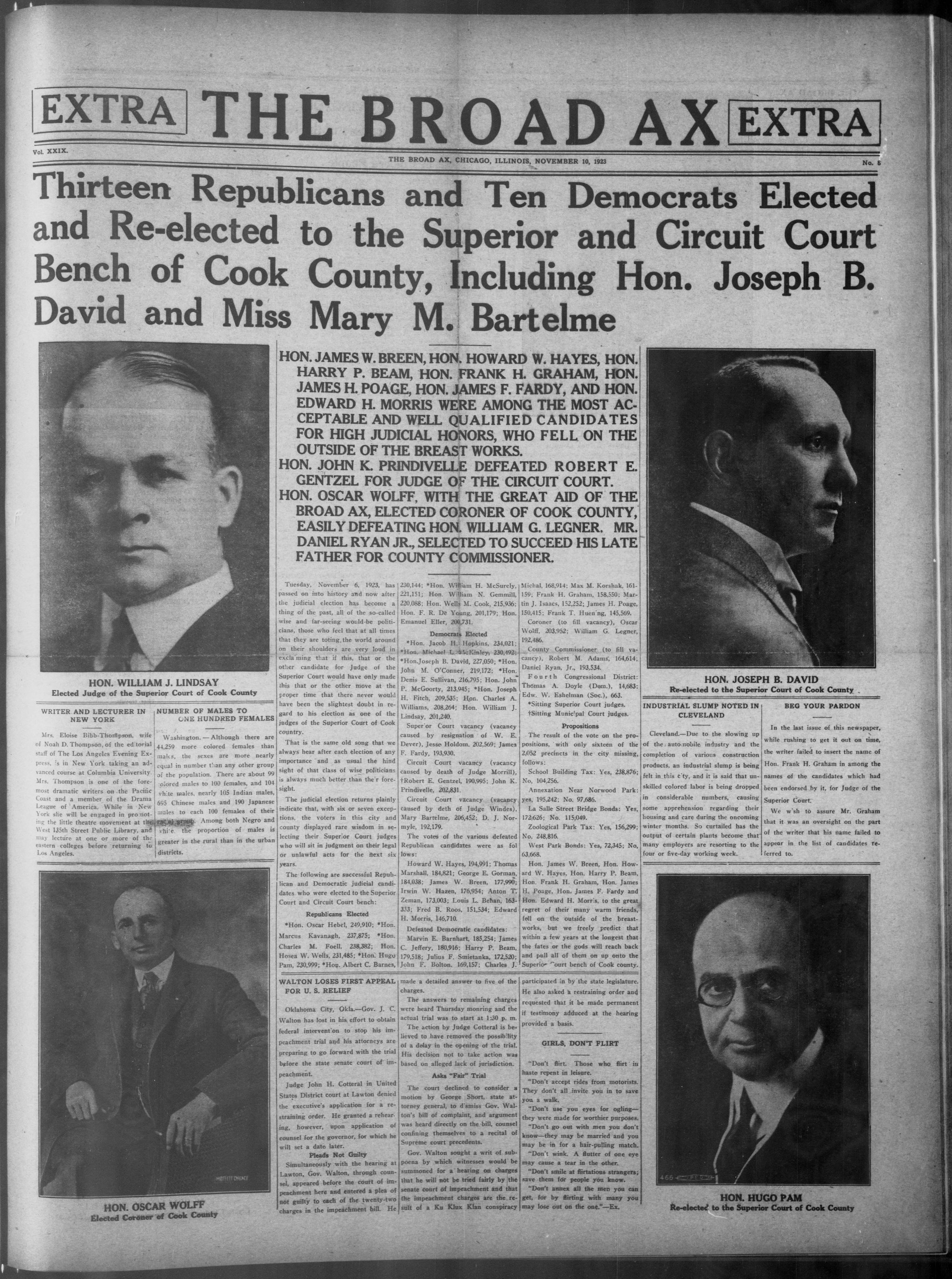
Thirteen Republicans and Ten Democrats Elected and Re-elected to the Superior and Circuit Court Bench of Cook County, Including Hon. Joseph B. David and Miss Mary M. Bartelme
[Name]
HON. WILLIAM J. LINDSAY Elected Judge of the Superior Court of Cook County
WRITER AND LECTURER IN
NEW YORK
Mrs. Eloise Bibb-Thompson, wife of Noah D. Thompson, of the editorial staff of The Los Angeles Evening Express, is in New York taking an advanced course at Columbia University. Mrs. Thompson is one of the foremost dramatic writers on the Pacific Coast and a member of the Drama League of America. While in New York she will be engaged in promoting the little theatre movement at the West 135th Street Public Library, and may lecture at one or more of the eastern colleges before returning to Los Angeles.
1920
1910
MOTLETT CHUACY
HON. OSCAR WOLFF
Elected Coroner of Cook County
---
Washington. - Although there are 44,259 more colored females than males, the sexes are more nearly equal in number than any other group of the population. There are about 99 colored males to 100 females, and 104 white males, nearly 105 Indian males, 695 Chinese males and 190 Japanese males to each 100 females of their racial group. Among both Negro and white, the proportion of males is greater in the rural than in the urban districts.
MORITT DENACY
---
HON. JAMES W. BREEN, HON. HOWARD W. HAYES, HON. HARRY P. BEAM, HON. FRANK H. GRAHAM, HON. JAMES H. POAGE, HON. JAMES F. FARDY, AND HON. EDWARD H. MORRIS WERE AMONG THE MOST ACCEPTABLE AND WELL QUALIFIED CANDIDATES FOR HIGH JUDICIAL HONORS, WHO FELL ON THE OUTSIDE OF THE BREAST WORKS. HON. JOHN K. PRINDIVELLE DEFEATED ROBERT E. GENTZEL FOR JUDGE OF THE CIRCUIT COURT. HON. OSCAR WOLFF, WITH THE GREAT AID OF THE BROAD AX, ELECTED CORONER OF COOK COUNTY, EASILY DEFEATING HON. WILLIAM G. LEGNER. MR. DANIEL RYAN JR., SELECTED TO SUCCEED HIS LATE FATHER FOR COUNTY COMMISSIONER.
Tuesday, November 6, 1923, has passed on into history and now after the judicial election has become a thing of the past, all of the so-called wise and far-scarring would-be politicians, those who feel that at all times that they are toting, the world around on their shoulders are very loud in exclaiming that if this, that or the other candidate for Judge of the Superior Court would have only made this that or the other move at the proper time that there never would have been the slightest doubt in regard to his election as one of the judges of the Superior Court of Cook country.
That is the same old song that we always hear after each election of any importance and as usual the hind sight of that class of wise politicians is always much better than the r fore-sight.
The judicial election returns plainly indicate that, with six or seven exceptions, the voters in this city and county displayed rare wisdom in selecting their Superior Court judges who will sit in judgment on their legal or unlawful acts for the next six years.
The following are successful Republican and Democratic judicial candidates who were elected to the Superior Court and Circuit Court bench:
Republicans Elected
*Hon. Oscar Hebel, 249,910; *Hon. Marcus Kavanagh, 237,875; *Hon. Charles M. Foell, 238,382; Hon. Hosea W. Wells, 231,485; *Hon. Hugo Pam, 230,999; *Hop. Albert C. Barnes,
WALTON LOSES FIRST APPEAL
FOR U. S. RELIEF
Oklahoma City, Okla.-Gov. J. C. Walton has lost in his effort to obtain federal intervention to stop his impeachment trial and his attorneys are preparing to go forward with the trial before the state senate court of impeachment.
Judge John H. Cotteral in United States District court at Lawton denied the executive's application for a restraining order. He granted a rehearing, however, upon application of counsel for the governor, for which he will set a date later.
Pleads Not Guilty
Simultaneously with the hearing at Lawton, Gov. Walton, through counsel, appeared before the court of impeachment here and entered a plea of not guilty to each of the twenty-two charges in the impeachment bill. He
230,144; *Hon. William H. McSurely,
221,151; Hon. William N. Gemmil,
220,088; Hon. Wells M. Cook, 215,936;
Hon. F. R. De Young, 201,179; Hon.
Emanuel Eller, 200,731.
Democrats Elected
*Hon. Jacob H. Hopkins, 234,021;
*Hon. Michael L. J. McKinley, 230,492;
*Hon. Joseph B. David, 227,050; *Hon.
John M. O'Connor, 219,172; *Hon.
Denis E. Sullivan, 216,795; Hon. John
P. McGoorty, 213,945; *Hon. Joseph
H. Fitch, 209,535; Hon. Charles A.
Williams, 208,264; Hon. William J.
Lindsay, 201,240.
Super or Court vacancy (vacancy
caused by resignation of W. E.
Dever), Jesse Holdom, 202,569; James
F. Fardy, 193,930.
Circuit Court vacancy (vacancy
caused by death of Judge Morrill),
†Robert E. Gentzel, 190,995; John K.
Prindivelle, 202,831.
Circuit Court vacancy (vacancy
caused by death of Judge Windes).
Mary Bartelme, 206,452; D. J. Normyle,
192,179.
The votes of the various defeated Republican candidates were as follows:
Howard W. Hayes, 194,991; Thomas Marshall, 184,821; George E. Gorman, 184,038; James W. Breen, 177,990; Irwin W. Hazen, 176,954; Anton T. Zeman, 173,003; Louis L. Behan, 163,333; Fred B. Roos, 151,534; Edward H. Morris, 146,710.
Defeated Democratic candidates:
Marvin E. Barnhart, 185,254; James C. Jeffery, 180,916; Harry P. Beam, 179,518; Julius F. Smietanka, 172,520; John W. Bolton, 169,157; Charles J.
The answers to remaining charges were heard Thursday moning and the actual trial was to start at 1:30 p. m. The action by Judge Cotteral is believed to have removed the possibility of a delay in the opening of the trial. His decision not to take action was based on alleged lack of jurisdiction.
Asks "Fair" Trial
The court declined to consider a motion by George Short, state attorney general, to d'miss Gov. Walton's bill of complaint, and argument was heard directly on the bill, counsel confining themselves to a recital of Supreme court precedents.
Gov. Walton sought a writ of subpoena by which witnesses would be summoned for a hearing on charges that he will not be tried fairly by the senate court of impeachment and that the impeachment charges are the result of a Ku Klux Klan conspiracy
Michal, 168,914; Max M. Korshak, 161-159; Frank H. Graham, 158,550; Martin J. Isaacs, 152,252; James H. Poage, 150,415; Frank T. Huen'ng, 145,569. Coroner (to fill vacancy), Oscar Wolff, 203,952; William G. Legner, 192,486. County Commissioner (to fill vacancy), Robert M. Adams, 164,614; Daniel Ryan, Jr., 193,534.
*Sitting Superior Court judges.
†Sitting Municipal Court judges.
Propositions
The result of the vote on the propositions, with only sixteen of the 2,052 precincts in the city missing, follows:
School Building Tax: Yes, 238,876;
No, 104,256.
Annexation Near Norwood Park:
yes, 195,242; No, 97,686.
Zoological Park Tax: Yes, 156,299; No, 248,816.
West Park Bonds: Yes, 72,345; No, 63,668.
Hon. James W. Breen, Hon. Howard W. Hayes, Hon. Harry P. Beam, Hon. Frank H. Graham, Hon. James H. Poage, Hon. James F. Fardy and Hon. Edward H. Morris, to the great regret of their many warm friends, fell on the outside of the breastworks, but we freely predict that within a few years at the longest that the fates or the gods will reach back and pull all of them on up onto the Superior Court bench of Cook county.
participated in by the state legislature.
He also asked a restraining order and requested that it be made permanent if testimony adduced at the hearing provided a basis.
GIRLS, DON'T FLIRT
"Don't flirt. Those who flirt in haste repent in leisure.
"Don't accept rides from motorists. They don't all invite you in to save you a walk.
"Don't use you eyes for ogling—they were made for worthier purposes.
"Don't go out with men you don't know—they may be married and you may be in for a hair-pulling match.
"Don't wink. A flutter of one eye may cause a tear in the other.
"Don't smile at flirtations strangers; save them for people you know.
"Don't annex all the men you can get, for by flirting with many you may lose out on the one."-Ex.
M.
466
HON. HUGO PAM Re-elected to the Superior Court of Cook County
INDUSTRIAL SLUMP NOTED IN CLEVELAND
Cleveland.—Due to the slowing up of the automobile industry and the completion of various construction products, an industrial slump is being felt in this city, and it is said that unskilled colored labor is being dropped in considerable numbers, causing some apprehension regarding their housing and care during the oncoming winter months. So curtailed has the output of certain plants become that many employers are resorting to the four or five-day working week.
In the last issue of this newspaper, while rushing to get it out on time, the writer failed to insert the name of Hon. Frank H. Graham in among the names of the candidates which had been endorsed by it, for Judge of the Superior Court. We w'ish to assure Mr. Graham that it was an oversight on the part of the writer that his name failed to appear in the list of candidates referred to.
[Name]
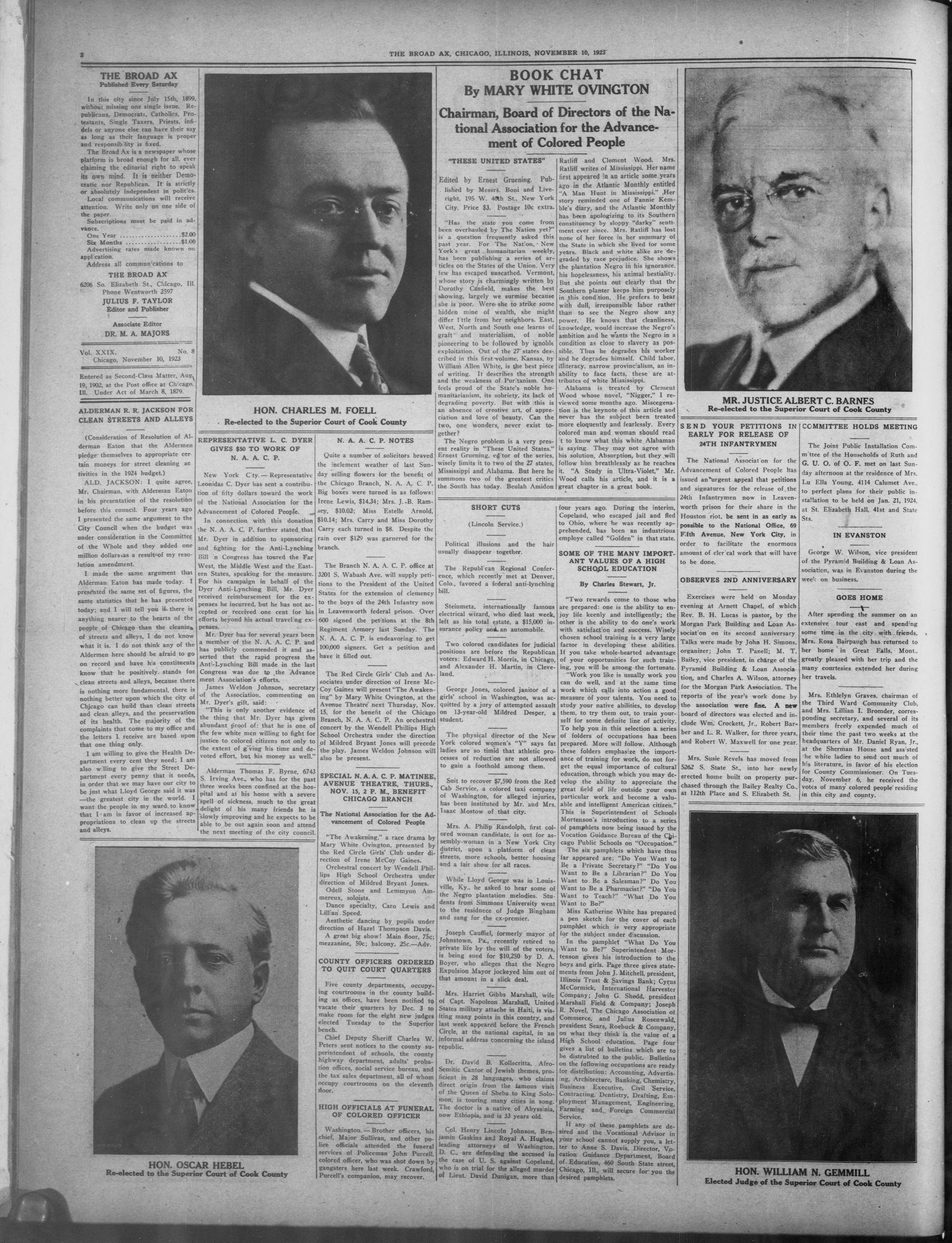
HON. OSCAR HEBEL Re-elected to the Superior Court of Cook County
THE BROAD AX
Published Every Saturday
In this city since July 15th, 1899, without missing one single issue, Republicans, Democrats, Catholics, Protestants, Single Taxes, Priests, infidels or anyone else can have their say as long as their language is proper and responsiblity is fixed.
The Broad Ax is a newspaper whose platform is broad enough for all, ever claiming the editorial right to speak its own mind. It is neither Democratic nor Republican. It is strictly or absolutely independent in politics. Local communications will receive attention. Write only on one side of the paper.
Subscriptions must be paid in advance.
One Year ..... $2.00
Six Months ..... $1.00
Advertising rates made known on application.
Address all communications to
THE PROGRAM
Vol. XXIX. No. 8
Chicago, November 10, 1923
Entered as Second-Class Matter, Aug.
19, 1902, at the Post office at Chicago.
III. Under Act of March 18, 1879.
ALDERMAN R. R. JACKSON FOR
CLEAN STREETS AND ALLEYS
(Consideration of Resolution of Alderman Eaton that the Aldermen pledge themselves to appropriate certain moneys for street cleaning activities in the 1924 budget.) ALD. JACKSON: I quite agree, Mr. Chairman, with Alderman Eaton in his presentation of the resolution before this council. Four years ago I presented the same argument to the City Council when the budget was under consideration in the Committee of the Whole and they added one million dollars as a result of my resolution amendment.
I made the same argument that Alderman Eaton has made today. I presented the same set of figures, the same statistics that he has presented today; and I will tell you if there is anything nearer to the hearts of the people of Chicago than the cleaning of streets and alleys, I do not know what it is. I do not think any of the Aldermen here should be afraid to go on record and have his constituents know that he positively stands for clean streets and alleys, because there is nothing more fundamental, there is nothing better upon which the city of Chicago can build than clean streets and clean alleys, and the preservation of its health. The majority of the complaints that come to my office and the letters I receive are based upon that one thing only.
I am willing to give the Health Department every cent they need; I am also willing to give the Street Department every penny that it needs, in order that we may have our city to be just what Lloyd George said it was—the greatest city in the world. I want the people in my ward to know that I am in favor of increased appropriations to clean up the streets and alleys.
[Name]
HON. CHARLES M. FOELL
Re-elected to the Superior Court of Cook County
REPRESENTATIVE L. C. DYER
GIVES $50 TO WORK OF
N. A. A. C. P. NOTE
New York City. — Representative Leonidas C. Dyer has sent a contribution of fifty dollars toward the work of the National Association for the Advancement of Colored People.
In connection with this donation the N. A. A. C. P. further stated that Mr. Dyer in addition to sponsoring and fighting for the Anti-Lynching Bill in Congress has toured the Far West, the Middle West and the Eastern States, speaking for the measure. For his campaign in behalf of the Dyer Anti-Lynching Bill, Mr. Dyer received reimbursement for the expenses he incurred, but he has not accepted or received one cent for his efforts beyond his actual traveling expenses.
Mr. Dyer has for several years been a member of the N. A. A. C. P. and has publicly commended it and asserted that the rapid progress the Anti-Lynching Bill made in the last Congress was due to the Advance ment Association's efforts.
James Weldon Johnson, secretary of the Association, commenting on Mr. Dyer's gift, said:
"This is only another evidence of the thing that Mr. Dyer has given abundant proof of: that he is one of the few white men willing to fight for justice to colored citizens not only to the extent of giving his time and devoted effort, but his money as well."
Alderman Thomas F. Byrne, 6743 S. Irving Ave., who has for the past three weeks been confined at the hospital and at his home with a severe spell of sickness, much to the great delight of his many friends he is slowly improving and he expects to be able to be out again soon and attend the next meeting of the city council.
THE BROAD AX, CHICAGO, ILLINOIS, NOVEMBER 10, 1923
N. A. A. C. P. NOTES
Quite a number of solicitors braved the inclement weather of last Sunday selling flowers for the benefit of the Chicago Branch, N. A. A. C. P. Big boxes were turned in as follows: Irene Lewis, $14.34; Mrs. J.-B. Ramsey, $10.02; Miss Estelle Arnold, $10.14; Mrs. Carry and Miss Dorothy Carry each turned in $8. Despite the rain over $129 was garnered for the branch.
The Branch N. A. A. C. P. office at 3201 S. Wabash Ave. will supply petitions to the President of the United States for the extension of clemency to the boys of the 24th Infantry now in Leavenworth federal prison. Over 600 signed the petitions at the 8th Regiment Armory last Sunday. The N. A. A. C. P. is endeavoring to get 100,000 signers. Get a petition and have it filled out.
The Red Circle Girls' Club and Associates under direction of Irene McCoy Gaines will present "The Awakening" by Mary Owington, at the Avenue Theatre next Thursday, Nov. 15, for the benefit of the Chicago Branch, N. A. A. C. P. An orchestral concert by the Wendell Phillips High School Orchestra under the direction of Mildred Bryant Jones will precede the play. James Weldon Johnson will also be present.
SPECIAL N. A. A. C. P. MATINEE
AVENUE THEATRE, THURS.
NOV. 15, 2 P. M., BENEFIT
CHICAGO BRANCH
The National Association for the Advancement of Colored People
"The Awakening," a race drama by Mary White Ovington, presented by the Red Circle Girls' Club under direction of Irene McCoy Gaines.
Orchestral concert by Wendell Phillips High School Orchestra under direction of Mildred Bryant Jones.
Odell Stone and Lemmyon Amereux, soloists.
Dance specialty, Caro Lewis and Lillian Speed.
A aesthetic dancing by pupils under direction of Hazel Thompson Davis.
A great big show! Main floor, 75c; mezzanine, 50c; balcony, 25c.-Adv.
COUNTY OFFICERS ORDERED
TO QUIT COURT QUARTERS
Five county departments, occupying courtrooms in the county building as offices, have been notified to vacate their quarters by Dec. 3 to make room for the eight new judges elected Tuesday to the Superior bench.
Chief Deputy Sheriff Charles W. Peters sent notices to the county superintendent of schools, the county highway department, adults' probation offices, social service bureau, and the tax sales department, all of whom occupy courtrooms on the eleventh floor.
HIGH OFFICIALS AT FUNERAL
OF COLORED OFFICER
Washington. — Brother officers, his chief, Major Sullivan, and other police officials attended the funeral services of Policeman John Purcell colored officer, who was shot down by gangsters here last week. Crawford Purcell's companion, may recover.
BOOK CHAT By MARY WHITE OVINGTON Chairman, Board of Directors of the National Association for the Advancement of Colored People
"THESE UNITED STATES"
Edited by Ernest Gruening. Published by Messrs. Boni and Live-
right, 195 W. 40th St., New York
City. Price $3. Postage 10c extra.
"Has the state you come from been overhaulied by The Nation yet?" is a question frequently asked this past year. For The Nation, New York's great humanitarian weekly, has been publishing a series of articles on the States of the Union. Very few has escaped unscathed. Vermont, whose story is charmingly written by Dorothy Canfield, makes the best showing, largely we surmise because she is poor. Were she to strike some hidden mine of wealth, she might differ little from her neighbors. East, West, North and South one learns of graft and materialism, of noble pioneering to be followed by ignoble exploitation. Out of the 27 states described in this first volume, Kansas, by William Allen White, is the best piece of writing. It describes the strength and the weakness of Puritanism. One feels proud of the State's noble humanitarianism, its sobriety, its lack of degrading poverty. But with this is an absence of creative art, of appreciation and love of beauty. Can the two, one wonders, never exist together?
The Negro problem is a very present reality in "These United States." Ernest Gruening, editor of the series, wisely limits it to two of the 27 states, Mississippi and Alabama. But here he summons two of the greatest critics the South has today. Beulah Amidon
SHORT CUTS
Political illusions and the hair usually disappear together.
The Republcan Regional Conference, which recently met at Denver, Colo., favored a federal anti-lynching bill.
Steinmetz, internationally famous electrical wizard, who died last week, left as his total estate, a $15,000 insurance policy and an automobile.
Two colored candidates for judicial positions are before the Republican voters: Edward H. Morris, in Chicago and Alexander H. Martin, in Cleveland.
George Jones, colored janitor of a girls' school in Washington, was acquitted by a jury of attempted assault on 13-year-old Mildred Desper, a student.
The physical director of the New York colored women's "Y" says fat ladies are so timid that athletic processes of reduction are not allowed to gain a foothold among them.
Suit to recover $7,590 from the Red Cab Service, a colored taxi company of Washington, for alleged injuries, has been instituted by Mr. and Mrs. Isaac Mostow of that city.
Mrs. A. Philip Randolph, first colored woman candidate, is out for assembly-woman in a New York City district, upon a platform of clean streets, more schools, better housing and a fair show for all races.
While Lloyd George was in Louisville, Ky., he asked to hear some of the Negro plantation melodies. Students from Simmons University went to the residence of Judge Bingham and sang for the cx-premier.
Joseph Cauffiel, formerly mayor of Johnstown, Pa., recently retired to private life by the will of the voters, is being sued for the $10,250 by D. A. Boyer, who alleges that the Negro Expulsion Mayor jockeyed him out of that amount in a slick deal.
Mrs. Harriet Gibbs Marshall, wife of Capt. Napoleon Marshall, United States military attache in Haiti, is visiting many points in this country, and last week appeared before the French Circle, at the national capital, in an informal address concerning the island republic.
Dr. David B. Kollscritta, Afro-Semitic Cantor of Jewish themes, proficient in 28 languages, who claims direct origin from the famous visit of the Queen of Sheba to King Solomon, is touring many cities in song. The doctor is a native of Abyssinia, now Ethiopia, and is 33 years old.
Col. Henry Lincoln Johnson, Benjamin Gaskins and Royal A. Hughes, leading attorneys of Washington, D. C., are defending the accused in the case of U. S. against Copeland, who is on trial for the alleged murder of Lieut. David Dunigan, more than
Ratliff and Clement Wood. Mrs. Ratliff writes of Mississippi. Her name first appeared in an article some years ago in the Atlantic Monthly entitled "A Man Hunt in Mississippi." Her story reminded one of Fannie Kemble's diary, and the Atlantic Monthly has been apologizing to its Southern constituency by sloppy "darky" sentiment ever since. Mrs. Ratliff has lost none of her force in her summary of the State in which she lived for some years. Black and white alike are degraded by race prejudice. She shows the plantation Negro in his ignorance, his hopelessness, his animal bestiality. But she points out clearly that the Southern planter keeps him purposely in this condition. He prefers to bear with dull, irresponsible labor rather than to see the Negro show any power. He knows that cleanliness, knowledge, would increase the Negro's ambition and he wants the Negro in a condition as close to slavery as possible. Thus he degrades his worker and he degrades himself. Child labor, illiteracy, narrow provincialism, an inability to face facts, these are attributes of white Mississippi.
Alabama is treated by Clement Wood whose novel, "Nigger," I reviewed some months ago. Miscegenation is the keynote of this article and never has the subject been treated more eloquently and fearlessly. Every colored man and woman should read it to know what this white Alabaman is saying. They may not agree with his solution, Absorption, but they will follow him breathlessly as he reaches it. "A Study in Ultra-Violet," Mr. Wood calls his article, and it is a great chapter in a great book.
four years ago. During the interim, Copeland, who escaped jail and fled to Ohio, where he was recently apprehended, has been an industrious employee called "Golden" in that state.
SOME OF THE MANY IMPORT
ANT VALUES OF A HIGH
SCHOOL EDUCATION
By Charles Stewart, Jr.
"Two rewards come to those who are prepared: one is the ability to enjoy life keenly and intelligently; the other is the ability to do one's work with satisfaction and success. Wisely chosen school training is a very large factor in developing these abilities. If you take whole-hearted advantage of your opportunities for such training, you will be among the fortunate
"Work you like is usually work you can do well, and at the same time work which calls into action a good measure of your talents. You need to study your native abilities, to develop them, to try them out, to train yourself for some definite line of activity. To help you in this selection a series of folders of occupations has been prepared. More will follow. Although these folders emphasize the importance of training for work, do not forget the equal importance of cultural education, through which you may develop the ability to appreciate the great field of life outside your own particular work and become a valuable and intelligent American citizen." This is Superintendent of Schools Mortents's introduction to a series of pamphlets now being issued by the Vocation Guidance Bureau of the Chicago Public Schools on "Occupation."
The six pamphlets which have thus far appeared are: "Do You Want to Be a Private Secretary?" "Do You Want to Be a Librarian?" Do You Want to Be a Salesman?" Do You Want to Be a Pharmacist?" "Do You Want to Teach?" "What Do You Want to Be?"
Miss Katherine White has prepared a pen sketch for the cover of each pamphlet which is very appropriate for the subject under discussion.
In the pamphlet "What Do You Want to Be?" Superintendent Mortenson gives his introduction to the boys and girls. Page three gives statements from John J. Mitchell, president, Illinois Trust & Savings Bank; Cyrus McCormick, International Harvester Company; John G. Shedd, president Marshall Field & Company; Joseph R. Novel, The Chicago Association of Commerce, and Julius Rosenwald, president Sears, Roebuck & Company, on what they think is the value of a High School education. Page four gives a list of bulletins which are to be distributed to the public. Bulletins on the following occupations are ready for distribution: Accounting, Advertising, Architecture, Banking, Chemistry, Business Executive, Civil Service, Contracting, Dentistry, Drafting, Employment Management, Engineering, Farming and Foreign Commercial Service.
If any of these pamphlets are desired and the Vocational Advisor in your school cannot supply you, a letter to Anne S. Davis, Director, Vocation Guidance Department, Board of Education, 460 South State street, Chicago, Ill., will secure for you the desired pamphlets.
MR. JUSTICE ALBERT C. BARNES Re-elected to the Superior Court of Cook County
W. H.
HON. WILLIAM N. GEMMILL Elected Judge of the Superior Court of Cook County
The National Association for the Advancement of Colored People has issued an urgent appeal that petitions and signatures for the release of the 24th Infantrymen now in Leavenworth prison for their share in the Houston riot, be sent in as early as possible to the National Office, 69 Fifth Avenue, New York City, in order to facilitate the enormous amount of clerical work that will have to be done.
OBSERVES 2ND ANNIVERSARY
Exercises were held on Monday evening at Arnett Chapel, of which Rev. B. H. Lucas is pastor, by the Morgan Park Building and Loan Association on its second anniversary. Talks were made by John H. Simons, organizer; John T. Panell; M. T. Bailey, vice president, in charge of the Pyramid Building & Loan Association, and Charles A. Wilson, attorney for the Morgan Park Association. The reports of the year's work done by the association were fine. A new board of directors was elected and include Wm. Crockett, Jr., Robert Barber and L. R. Walker, for three years and Robert W. Maxwell for one year
Mrs. Susie Revels has moved from 5262 S. State St., into her newly erected home built on property purchased through the Bailey Realty Co. at 112th Place and S. Elizabeth St.
CCMMITTEE HOLDS MEETING
The Joint Public Installation Committee of the Households of Ruth and G. U. O. of O. F. met on last Sunday afternoon at the residence of Mrs. Lu Ella Young, 4114 Calumet Ave., to perfect plans for their public installation to be held on Jan. 21, 1924, at St. Elizabeth Hall, 41st and State Sts.
IN EVANSTON
George W. Wilson, vice president of the Pyramid Building & Loan Association, was in Evanston during the week on business.
GOES HOME
After spending the summer on an extensive tour east and spending some time in the city with friends, Mrs. Rosa Bairpaugh has returned to her home in Great Falls, Mont., greatly pleased with her trip and the many courtesies extended her during her travels.
Mrs. Ethellyn Graves, chairman of the Third Ward Community Club, and Mrs. Lillian I. Bromder, corresponding secretary, and several of its members freely expended much of their time the past two weeks at the headquarters of Mr. Daniel Ryan, Jr., at the Sherman House and assisted the white ladies to send out much of his literature, in favor of his election for County Commissioner. On Tuesday, November 6, he received the votes of many colored people residing in this city and county.
AMERICAN EDUCATION WEEK
By Charles Stewart, Jr.
On September 26, last, President Calvin Coolidge issued a proclamation declaring the week of November 18-24 as American Education Week. All churches, schools, labor organizations, fraternal bodies and clubs are specially urged to co-operate with this movement.
In his proclamation he states, "We have observed the evidences of a broadening vision of the whole educational system. This has included a recognition that education must not end with the period of school attendance, but must be given every encouragement thereafter. To this end the night schools of the cities, the moonlight schools of the southern Appalachian countries, the extension work of the colleges and universities, the provision for teaching technical, agricultural and mechanical arts, have marked out the path to a broader and more widely diffused national culture. To insure permanence and continuing improvements of such an educational policy, there must be the fullest public realization of its absolute necessity. Every American citizen is entitled to a liberal education. Without this there is no guarantee for the permanence of free institutions, no hope of perpetuating self-government. Despotism finds its chief support in ignorance. Knowledge and freedom go hand in hand.
"In order that the people of the nation may think of these things, it is desirable that there should be an annual observance of Education Week. Now, therefore, I, Calvin Coelidge, President of the United States, do hereby proclaim the week beginning on the eighteenth of November, next, as National Education Week, and urge its observance through the country," etc.
I would suggest that your organization arrange for special program this week. Through the combined efforts of the American Legion, the National Education Association and the United States Bureau of Education, a program for each day has been arranged. If they convene on the day designated in the program it is urged that special attention be given to the subject for that day. Their program reads as follows:
For God and Country
Sunday, November 18, 1923.
1. Education in the home.
2. Education in the school.
3. Education in the church.
Slogans:
A Godly nation cannot fail. Ministers of all denominations are urged to preach a sermon on education, either morning or evening. All communities are urged to hold mass meetings.
American Constitution Day
Monday, November 19, 1923.
1. Life, liberty and justice.
2. How the Constitution guarantees these.
3. Revolutionists and radicals a menace to these guarantees.
4. Security and opportunity.
Slogans:
Ballots not bullets.
Visit the schools today.
Patriotism Day
Tuesday, November 20, 1923.
1. The flag—the emblem of the nation.
2. Help the immigrants and aliens to become Americans.
3. Take an active interest in governmental affairs.
4. Music influence upon the nation.
Slogans:
Visit the schools today.
America first.
School and Teacher Day
Wednesday, November 21, 1923.
1. The necessity of schools.
2. The teacher as a nation builder.
3. The school influence on the coming generation.
4. School needs in the community.
5. The school as a productive institution.
Slogans:
Visit the schools today.
Better trained and better paid teachers, more adequate buildings.
Illiteracy Day
Thursday, November 22, 1923.
1. Illiteracy—a menace to our nation.
2. An American's duty toward the uneducated.
3. Let every citizen teach one illiterate.
4. No immigration until illiterary among native and foreign born is removed.
Slogans:
No illiteracy by 1927—It can be done.
Visit the schools today.
Community Day
Friday, November 23, 1923.
1. Equality of opportunity in education for every American boy and girl.
2. Rural schools—city schools—colleges.
3. A public library for every community.
4. Children today—citizens tomorrow.
Slogans:
Visit the schools today.
An equal chance for all children.
A square deal for the country boy and girl.
2. Physical education and hygiene.
3. The great out-of-doors.
4. The country's need in conservation and development of forests, soil, roads and other resources.
Slogans:
A sick body makes a sick mind.
Playgrounds in every community.
Athletes all.
HOPE PRESBYTERIAN
CHURCH
Hope Presbyterian church contemplates on building a community plant as an addition to their church.
A gymnasium, reading room, shows, and baths are among the divers commodities planned for this community house. Miss Alpha Bratton conducts a community music class on Thursday evening and Community Girls Club meets on Friday evenings.
Major N. Clark Smith conducts an instrumental music class on Wednesday evening from 6:30 to 8 P. M. These with Boy Scouts on Monday evenings and the Community Forum are open to the benefit of the community.
SIONILLI ADELPHIA GIRLS
The Sionill Adelphia Girls Whist Tournament was entertained by Miss Irene Samuels last Saturday evening. Miss Katie Pitts will entertain the next Whist Tournament November 17. The regular Sionill Adelphia meeting will be entertained by the chaperon, Miss Helen Thomas, 537 E. 42nd St., November 11.
AT MT. OLIVE BAPTIST
CHURCH
Mr. L. L. Winston and Attorney Elam H. Johnson, president and vice president of the Mississippi Club, addressed a large and appreciative crowd at Mt. Olive Baptist church last Monday evening for the benefit of the West Side Agency and Loan Corporation, 1135 West 14th St.
SHILOH BAPTIST CHURCH
Shiloh Baptist church choir, 62nd and May Sts., presented to the community and public last Tuesday evening, a musical entertainment. Rev. D. H. Harris, pastor, opened the concert with an invocation.
The program follows: March, "The Matinee," Industrial Triangle Band; March, "The Hippodrome," Band Selection; Selection, the Choir; Overture, "Magneta," Band; Select Reading, Mrs. Pearl Adams; Solo, Mr. Walter Half; Solo, Miss Sady Rolls; Selection, "Fort Gay," by the Band. At the close of the program Rev. Harris made some very interesting remarks with regards to the appreciation of the wonderful band which is conducted by Maj. N. Clark Smith.
ALVERNO SOCIAL CLUB
The Alverno Social Club proved their skill as whist players last Monday evening at the Appomattox Club, 3632 Grand Blvd., when they defeated their foremost rivals, the Sigma Psi Chi Fraternity. This club was only allowed to score two five point games against the first team of their visitors. The Alverno team scored eleven points against the former's first and second team. The personnel of the Alverno first team, Malcolm McDonald and Francis Cook, Jr.; second team, Ernest Thomatis and Augustus Geddes. Sigma Psi Chi first team, Lucius Clay and Theodore Eggleston; second team, Arthur Turnbull and Harold Washington.
THE QUESTIONNAIRE
Each week Miss Bond will ask a few questions and the answers will be published the following week. Those desiring honorable mention for submitting correct answers should have all communications reach her by Wednesday of each week. Address all communications to The Questionnaire, 6159 Loomis Blvd., Chicago, Ill.
THE BROAD AX, CHICAGO, ILLINOIS, NOVEMBER 10, 1923
1. When, for whom, and by whom was America named?
2. Who won the battle of Fort Duquesne? Name the English commander.
3. Give an important event of March 17, 1776.
4. For what is Horace Greeley noted? When was he a candidate for president of the United States?
5. At what time was slavery rendered illegal in Upper Canada? Lower Canada? Was this earlier or later than the abolition of slavery throughout the British dominions?
Answers to Last Week's Questions
1. "Lorna Doone," R. D. Blackmore; "Vanity Fair," Wm. M. Thackeray; "The Woman in White," Wilkie Collins; "Jane Eyre," Charlotte Bronte; "Scottish Chiefs," Jane Porter; "The Compleat Angler," Izaak Walton; "Last Days of Pompeii," Edward Bulwer Lytton; "Pride and Prejudice," Jane Austen.
2. John Wyclif made the first complete English translation of the scriptures. The second was made by William Tyndale. In 1535, Miles Coverdale published the first printed copy of the whole Bible.
3. "Hail Columbia," Joseph Hopkinson; "The Star Spangled Banner," Francis Scott Key; "Home Sweet Home." John Howard Payne; "America," Samuel Francis Smith. "The Star Spangled Banner" was written during the Civil War.
4. The American authors born during the American Revolution: Lyman Beecher, Joseph Story, James Kirkle Paulding, William E. Channing, Francis Scott Key, John James Audubon, Thomas Hart Benton, Washington Irving.
5. "Barbara Prietchie," John G. Whittier; "Old Ironsides," Oliver Wendell Holmes; "The Old Oaken Buckett, Samuel Woodworth; "Old Folks at Home," Stephen Collins Foster; "Songs of the Sierras," Joaquin Miller; "The Vision of Sir Launfal," James Russell Lowell.
ARMISTICE BALL AND RECEPTION
On Monday evening, November 12, the Louise D. Marshall Auxiliary of the Eighth Regiment Infantry, Illinois National Guard, will give an Armistice Ball and Reception in honor of the Eighth Regiment Infantry, Illinois National Guard at the Eight Regiment Armory, Thirty-fifth St. and Giles Ave. Presentation of Service Bars, by Gen. Milton J. Foreman. Band concert. Dancing. Admission, 50 cents. Committee: Mrs. James H. Johnson, the president, Miss Estelle L. Arnold, chairman, Mesdames James F. Lawson, Rufus M. Stokes, Clinton L. Hill S. A. McGowan, Spencer C. Dickerson, Matthew R. Johnson and James C. Hall.
HANDLING SOUTHERN BUSINESS
M. T. Bailey, manager, the Milton Mercantile Agency, 3638 State St., has closed several important deals during the past week for clients in the south who are moving north.
GOES TO TUSKEGEE
Washington. — James I. Mitchell Portsmouth, Va., has been appointed superintendent of buildings and grounds for the Veterans' Hospital at Tuskegee. He was backed by Executive Secretary Slemp.
Harrisburg, Pa.—Governor Pinchot has received a broad-brimmed felt hat, worn by Governor Neff, of Texas, which he says that he will wear in honor of the Texan.
SEVERELY INJURED
Mrs. Dovie Wright Jordan of 7 N. Garrison Ave., St. Louis, Mo., and attendant of the convention of Mine. C. J. Walker's Agents held in the city Nov. 1 and 2 were severely injured and is now confined to her bed at the home of Mrs. S. Puckett, 4543 Indiana Ave.
LEAVES FOR ATLANTA
Mrs. Jennie Parker left for her home in Atlanta, Ga., during the week after spending several pleasant weeks in the city with her daughters, Mesdames Ella M. Glanton, 4517 St. Lawrence Ave., and Anna Lee Roberts, 1254 W. 109th St. Morgan Park, and other relatives and friends.
CHIP
Mr. and Mrs. Henry (Teenan) Jones have removed from 6529 S. Aberdeen St. to 3816 Grand Blvd., where they will be pleased to meet their many friends.
CHARLES E. STUMP, THE REGULAR OLD TIME TRAVELING CORRESPONDENT FOR THE BROAD AX, HAS LANDED AT HOUSTON, TEX., ON HIS WAY TO OLD CHICAGO.
Houston, Texas.—Although I have been sick, the world has never stopped for a moment to see whether I was dead or still living, but has gone right on, and I guess this is what should have been done, for I cannot afford to stop the world just because I am sick, and will not do so today. I am not well, but have improved just a little, yet I continue to stop and go to bed, and so many seem to be anxious about me.
But let me stop talking about myself, to remind you that another one of our great men has gone from us, and this time it is Charles Banks, of Mound Bayou, Miss., first vice president of the National Negro Business League, and the man who really brought Mound Bayou to the attention of the world. He devoted his heart to the cause, and was a man of the race as well of affairs.
I have known him for a long time. It was my pleasure to meet him in 1896, when with Bishop Derrick I was in conference at Clarksdale. I went to town early one morning, and he was the one who met the people coming to the conference. We had a little tilt, but from that time became good friends. He was engaged in business there, and was doing well. Later he went down to Mound Bayou, believing that it was possible to put that place on the map, and he soon became an important factor in the town. He established the Bank of Mound Bayou, and was instrumental in bringing many things into the city. He built an oil mill there at a cost of one hundred thousand dollars, and it will ever stand as a monument to the man whose life was spent for his people.
There came into his life some domestic affairs; and he has spent much of his time of late years in Memphis. I was indeed sorry when I saw in the Houston Informer that he had crossed over, and I said just one more gone ahead. One by one we are dropping out in all walks of life.
I saw Mr. Banks at the last session of the National Negro Business League and then he was feeble, but I did not realize that it would be the last time I would have the pleasure of shaking his hands. We can never tell, for I think of how near the brink I have been. I am now waiting for the summons to come to me and when it comes, I will fold my arms and cross over, for it is all right with me.
Here I am in Houston this week, but honey, I have been in bed all the week. The people are certainly trying to help me get well, and some of them want me to continue to live down here for a little longer, and they are doing all in their power to help me take the much needed rest. They are doing it in a way that counts, or in a tangible way, for just this week comes a letter from Bishop John Hurst, of the African Methodist Episcopal church, sending me $10, and he was in Florida; another from Dr. L. K. Williams, of Olivet Baptist church, and president of the National Baptist convention, sending $10 to "Brother Charley"; one from J. M. Avery, of Durham, N. C., sending me just $50, and J. H. Branham, assistant pastor of Olivet, Chicago, sending along $5. I did not realize that people thought so much of me, and were so anxious about my health.
I have a letter from Mr. and Mrs. W. H. Falconer, Hot Springs, inviting me to come right on there and let them take care of me, and Miss B. C. Ford, who is a clerk in the office of the Woodmen of Union, says that she will be the nurse. But why talk about myself in this letter when you want to know something else.
As I told you in another letter before this I went to San Antonio, a health place, and was the guest of Rev. and Mrs. S. J. Johnson, and believe me, they were kind to me, nursed me, saw that I got my mediqs 'say me 'say me 'say me no us
as I could eat. I have told you about Rev. Johnson before, he is the man who is to succeed Dr. Benjamin Franklin Watson as secretary of the Church Extension, and he is fitted for the place. He has a fine home in the city, and I am real proud of him and of what he has done.
There was a conference in session in San Antonio; the Southwest Texas conference, presided over by Bishop Will'am Decker Johnson, and at the same time the General Baptist convention met in the same city, presided over by Bishop L. L. Campbell. Two strong bodies, and brought to that city a large number of real visitors as well as those who were directly interested in the meeting. I looked in on both of them. Had a cordial reception from Bishop Johnson and his ministers, but Bishop Campbell was too busy to give me a cordial reception. Well, he had many things to do, and after he had closed one session, he said that he saw me in the house and that I was his friend, and he was glad to see me, but I did not get in touch with the convention per se. They had many problems to consider and had so many big men of their own coming, such as President J. E. Woods, from Kentucky, Henry Allen Boyd from Nashville, Tenn.; Cora Jordan White from Nashville; the Rev. Dr. Madison, from Norfolk, Va., and a fellow from the National Baptist convention, could not find a place there exactly.
It was Friday, I saw him a second time, and he said to me that I should have sent him a letter or telegram that I was going to be in town, for he would have been glad to have had me write up the convention, and he could have given me plenty of money for so doing. I did not reply, but just looked wise, and that was as well as looking otherwise.
Now is the time that all of our people who are interested in recognition of the race, should turn attention to the appointment made by the late President Warren G. Harding to Hon. Walter Cohen, of New Orleans, for I believe he should be confirmed by the Senate and if necessary President Coolidge should send his name in again. We will be called on next year to help to elect a president and some senators, and let us note the men who do not stand with us. We have votes enough north and east to count for something. So many men and women who will have been up there long enough to get their hands on that little piece of paper. I am sure they will use it to advantage, and I am not saying how it will be, nor am I making any threats about this, that or the other. When the time comes I am going to speak right out in church.
I had a letter recently from Miss Anna L. Crisp, a public stenographer and court reporter in Chicago, commending the work of Charles Stewart, Jr., saying that he was truly the son of his father. I have had the pleasure of meeting his father on several occasions, and I hope he will measure up to the, work of the old man. Charles Stewart is somewhere now in the country, and I imagine I see him with his Remington making his way to some meeting or something else.
I am not at all in good shape yet, and I hope you will continue to pray for me that they will not let the bugs get me. Dr. George Cleveland Hall is praying and working, and he is a bug finder, one of the best in America. The world will some day know his worth and value.
I may have something to tell you in my next letter about Houston. You will remember Houston. We had some soldiers here once, and by the way, there is being circulated a petition to be sent to the President asking him to let the soldiers out of the federal penitentiary. I hope you will sign one if you have not yet done so. The National Association has sent it out after a visit to Leavenworth. I shall say more about it in another letter.
The Arkansas Baptist state convention meets in Helena, November 14, and I am going to try to get there.
Charles E. Stump
Particular interest is centering around the various Patou models, writes a Paris fashion correspondent in the New York Tribune. There is no avoiding the fact that Jean Patou has drawn to him the interest of the American importer. This is largely because he is a business man as well as an artist and not only makes beautiful clothes but knows how to present them and sell them. This designer makes a most unusual and at the same time a most emphatic use of the flare. Practically every garment in his line has the flare cut somewhere, either in front, at the back or on the side. The flare is so discreet, however, that it is barely noticeable. Thus it takes nothing from the straight silhouette, but rather emphasizes while softening the slender line of the body.
Paton divides woman's day into its various component parts. He overlocks no hour in the day when he may enhance the charms of the fashionable woman with beautiful clothes. There are delightful sports things, dresses for tennis, for golf, for mountain climbing, for shooting, as to make one feel that it actually is a complement to the dress. Then for snowy days and for languald southern ones. There are coats and wraps for flying, for rain and for traveling.
He shows smart little tailored suits and blouses for the morning promenade, for shopping, for the races and for restaurant de jeuner—three-piece suits of infinite variety from the standpoint of color and trimming. He features the ensemble consisting of dress and coat, the coat sometimes matching exactly and again contrasting in just such a way. There are tailored dresses for both morning and afternoon wear and an enchanting series of dancing dresses and tea frocks.
Beautiful Tea Gowns.
Not overlooking the woman who often remains at home for tea he has made most beautiful costumes d'interieur and tea gowns. Many of the latter will serve beautifully for intimate dinner dresses—what the French term diner chez-sol. Every imaginable thing for informal as well as elaborate evening functions has been thought out by Faton, including the gorgeous evening costume, where the dress and the coat match or are brought into harmony through similarity in color, material or trimming.
As a source of inspiration for many of his trimmings, Paton has turned to Chinese, Persian and Hindu-Chinese gowns. He has had special materials woven for him by the Societe France. He has a series of beautiful patterns which he puts out under the name of Tapisserie a Beyruth. Another lovely material which comes in all colors is an embroidered satin called Ecran Persan. Still another is an embroidered metal brocade which is named Lame Persan and Lame Indus and a beautiful series of embroidered patterns called Fleurs de Japan. There is also a lovely brocade which he puts out under the name Laque Coromande, which is a very dull crepe on one side and on the other a satin of high luster.
Use of Double-Faced Fabrics.
He does all kinds of interesting things with this two-surfaced silk. A model typical of Patou n's new silhou
THE FASHION WEEKLY
Coat of Broadoloth Worked by an Ap-
plique Pattern of Tiny Cornucopia
Cut From Same Material. Trimmed
With Brown Fur.
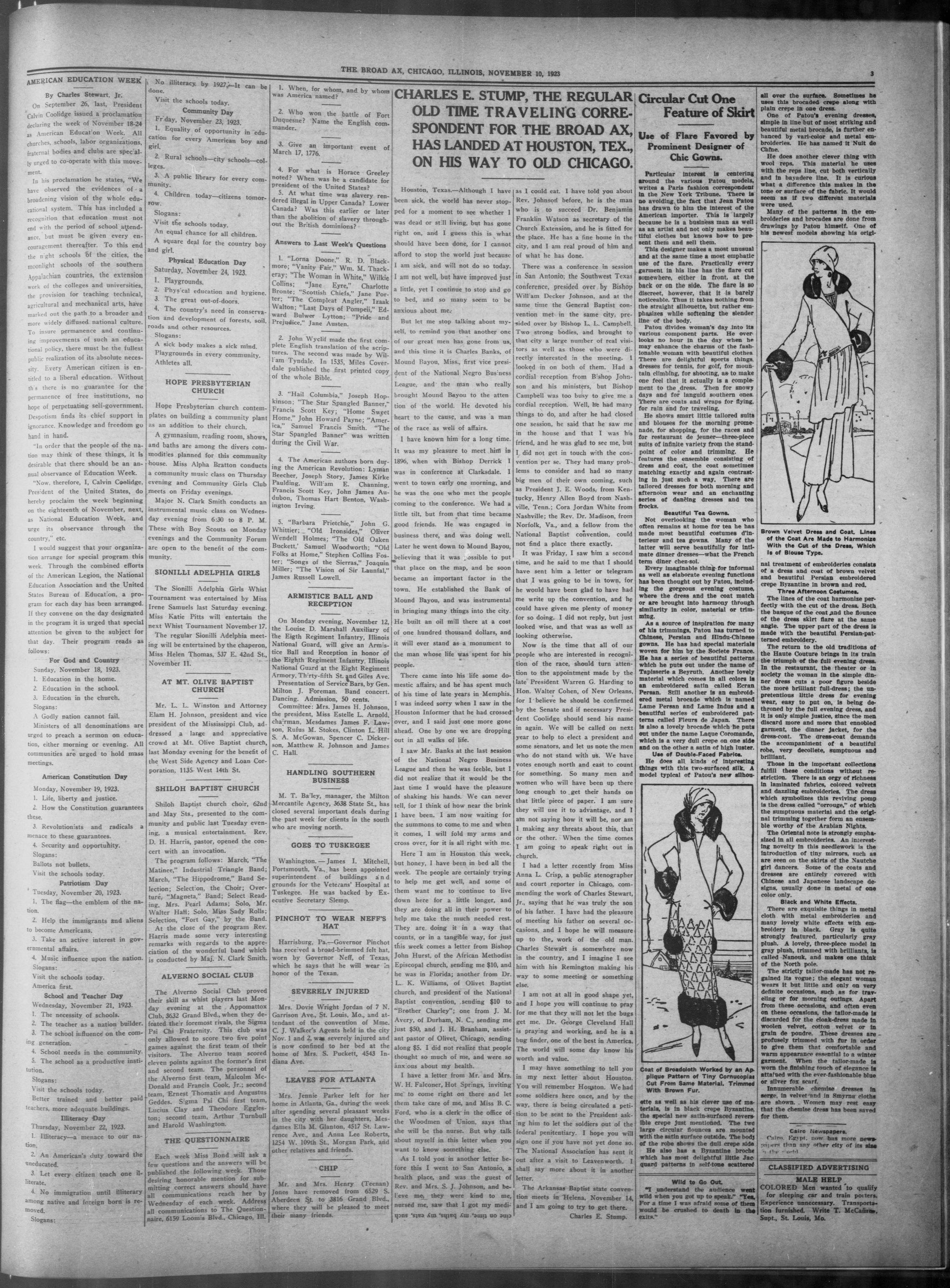
Coat of Broadcloth Worked by an Aplique Pattern of Tiny Cornucopias Cut From Same Material. Trimmed With Brown Fur.
ette as well as his clever use of materials, is in black crepe Byzantine, the special new satin-surfaced reversible crepe just mentioned. The two large circular dounces are mounted with the satin surface outside. The body of the robe shows the dull crepe side. He also has a Byzantine broche which has most delightful little Jacquard patterns in self-tone fabric.
Wild to Go Out.
"I understand the audience went wild when you got up to speak." "Yes. For a time I was afraid some of them would be crushed to death in the exits."
all over the surface. Sometimes he uses this brocaded crepe along with plain crepe in one dress. One of Patou's evening dresses, simple in line but of most striking and beautiful metal brocade, is further enhanced by vari-color and metal embroideries. He has named it Nuit de Chhue. He does another clever thing with wool reps. This material he uses with the reps line, cut both vertically and in bayadere line. It is curious what a difference this makes in the tone or surface of the fabric. It would seem as if two different materials were used. Many of the patterns in the embroideries and brocades are done from drawings by Patou himself. One of his newest models showing his origi-
THE FASHION WEEKLY
Brown Velvet Dress and Coat, Lines of the Coat Are Made to Harmonize With the Cut of the Dress, Which Is of Blouse Type.
Brown Velvet Dress and Coat, Lines of the Coat Are Made to Harmonize With the Cut of the Dress, Which Is of Blouse Type.
nal treatment of embroideries consists of a dress and coat of brown velvet and beautiful Persian embroidered crepe Byzantine in brown and red.
Three Afternoon Costumes.
The lines of the coat harmonize perfectly with the cut of the dress. Both the basque of the coat and the flounce of the dress skirt flare at the same angle. The upper part of the dress is made with the beautiful Persian-patterned embroidery.
The return to the old traditions of the Haute Couture brings in its train the triumph of the full evening dress. In the restaurant, the theater or in society the woman in the simple dinner dress cuts a poor figure beside the more brilliant full-dress; the unpretentious little dress for evening wear, easy to put on, is being dethroned by the full evening dress, and it is only simple justice, since the men discard more and more that ennobled garment, the dinner jacket, for the dress-coat. The dress-coat demands the accompaniment of a beautiful robe, very decollete, sumptuous and brilliant.
Those in the important collections fulfill these conditions without restriction. There is an orgy of richness in laminated fabrics, colored velvets and dazzling embroideries. The dress which symbolizes this reviving pomp is the dress called "orrouge," of which the sumptuous material and the original trimming together form an ensemble worthy of the Arabian Nights.
The Oriental note is strongly emphasized in all embroideries. An interesting novelty in this needlework is the introduction of tiny mirrors, such as are seen on the skirts of the Nautte girl dancers. Some of the coats and dresses are entirely covered with Chinese and Japanese landscape designs, usually done in metal of one color only.
Black and White Effects.
There are exquisite things in metal cloth with metal embroideries and many lovely white effects with embroidery in black. Gray is quite strongly featured, particularly gray plush. A lovely, three-piece model in gray plush, trimmed with brilliants, is called Nanouk, and makes one think of the North pole.
The strictly tailor-made has not regained its vogue; the elegant woman wears it but little and only on very definite occasions, such as for traveling or for morning outings. Apart from these occasions, and often even on these occasions, the tailor-made is discarded for the cloak-dress made in woolen velvet, cotton velvet or in grain de poudre. These dresses are profusely trimmed with fur in order to give them that comfortable and warm appearance essential to a winter garment. When the tailor-made is worn the finishing touch of elegance is attained with the ever-fashionable blue or silver fox scarf.
Innumerable chemise dresses in
serge in velvet and in Smyrna cloths
are shown. Women may rest easy
that the chemise dress has been saved
for them.
Cairo Newspapers.
Cairo, Egypt, now has more news-
papers than any other city of its size
in the world.
CLASSIFIED ADVERTISING
COLORED Men wanted to qualify for sleeping car and train porters. Experience unnecessary. Transportation furnished. Write T. McCaffrey, Supt., St. Louis, Mo.
Your Hair Can Be
A Crown of Beauty
No longer need you wish for beautiful hair. A marvelous preparation has been discovered that quickly changes coarse, homely hair into long, tight, silky locks, softening the hair sheen, and stops dandruff and itching scalp. This wonderful preparation is called
It has given thousands the beautiful hair for which they are so much admired.
Another great beauty help is EXELENTO SKIN BEAUTIFIER, a remarkable cream that quickly removes skin blemishes and clears up dark, sallow complexions. If your druggist cannot supply you, send 25c for generous size package of either Pomade or Beautifier.
EXELENTO MEDICINE CO., Atlanta, Ga.
AGENTS WANTED EVERYWHERE
Write For Particulars
OFFICE TELEPHON
J. GRAY
Attorney
204 East 5th
OFFICE TELEPHONE DOUGLAS 8351
J. GRAY LUCAS
Attorney-at-Law
204 East 35th Street
Chicago
Corner Indiana Ave., Second Floor
Res. 3846 Grand Boul. Tel. Douglas 4397
Phone W
FURN
Brass and Wood Bee
Refrigerators, SC
Hardware
HENRY ST
2515-19 AR
Phone Yards 27
FURNITURE
And Wood Beds, Electric W
refrigerators, Stoves, Paint,
Hardware, Linoleum
HENRY STUCKA
2515-19 ARCHER AVE.
Brass and Wood Beds, Electric Washers, Refrigerators, Stoves, Paint, Oil, Hardware, Linoleum HENRY STUCKART 2515-19 ARCHER AVE.
TELEPHONE DOUGLAS
GEORGE F. H
REAL
Up to Date or Modern
and Store
3101 COTTAGE
Corner 31st S
AGE F. HARDIN
REAL ESTATE
Date or Modern Houses, A
and Stores to Rent
COTTAGE GROVE
Corner 31st Street, Chicago
Up to Date or Modern Houses, Apartments and Stores to Rent
3101 COTTAGE GROVE AVE.
Corner 31st Street, Chicago
At
Close of
Business
on
Sept. 14, 1923
Increase in Deposits from June
30, 1923, to September 14, 1923,
amounted to $304,813.39
The Lincoln State Bank had the second
largest gain in its Savings Department
over all the other banks in the City of
Ohio.
A
LINCOLN S
OF CHI
Under State Govern
31st and South
Telephone V
COLN STATE BAY
OF CHICAGO
Under State Government Supervis
St and South State Streets
Telephone Victory 4500
LINCOLN STATE BANK OF CHICAGO Under State Government Supervision 31st and South State Streets Telephone Victory 4500
Statement
of Condition
Suite 560 Watson Bldg.
Office Phone: Dearborn 7094-7098
Res. 3354 Vernon Avenue
Phone Douglas 6045
Disease germs are tiny, little organisms that have to eat to live no less than human beings. That's why they die so quickly in dry, clean places.
Few White Cats.
It is bad luck for a black cat to cross your path, of course; it is good luck for a white cat to cross it; but there are so few white cats
Know Good Men.
A great love of books is something like a personal introduction to the great and good mer of all past times.
"Better the day, better the deed."
"Maybe so, but I find my golf on Sunday mornings doesn't bear out that statement."
When Man Criticizes.
As a man grows to realize the limitations of his ability, it makes him sharply critical of that of others.
LEPHONE DOUGLAS 6351
RAY LUCAS
torney-at-Law
East 35th Street
NITURE
Beds, Electric Washers,
S, Stoves, Paint, Oil,
ware, Linoleum
STUCKART
D ARCHER AVE.
HARDING, JR.
REAL ESTATE
Modern Houses, Apartments
Stores to Rent
AGE GROVE AVE.
West Street, Chicago
RESOURCES
RESOURCES
Loans and Discounts..... $1,627,079.88
(Inspected and approved by
our Banks and Directors)
Bank Building and Security
1,047,632.62
Bank Building and Annex. 180,355.22
Furniture and Fixtures. 22,963.65
Cash and Collections. 681,968.17
from Banks. 681,968.17
Other Resources. 45,541.37
Total. $3,576,611.81
Capital Stock ..... $ 300,000.00
Surplus ..... 30,000.00
Undivided Profits ..... 28,642.48
Reserved for Taxes and
Interest ..... 2,715.01
Other Liabilities ..... 30,765.13
DEPOSITS ..... $2,183,392.09
Total ..... $8,575,511.51
This Bank invites you to avail yourself of its complete facilities.
First Mortgage Gold Bond—approved safe investments—yield 7% interest.
Boxes in our completely equipped Safety Deposit Vanits rent for $4.00 per year and upwards.
Interest at the rate of 8% is allowed on all saving accounts. Savings Departments open from 0 a.m. to 8 p.m. Saturday.
GEORGE P. LEIBRANDT, President
CHARLES A. WHITE. Vice-President
JEFFERSON C. OAKLEY.
U.A. DELAURIER, Asst. Cashier
ADDISON E. AVERY, Mgr. Bond Depk
NEW STATE BANK
CHICAGO
Government Supervision
South State Streets
The Victory 4500
Disease Germs.
The Exception
THE BROAD AX, CHICAGO, ILLINOIS, NOVEMBER 10, 1923
Supreme Royal Circle of Friends of the World
(Incorporated)
EFFITS
..... $7 per week
..... $300.00
..... 60.00
pops, Little Rock, Hot Springs.
when needed.
members.
O MONTHLY DUES
$1.25. Pays Everything.
Not Supreme Lodge Taxes.)
AND ASSETS
8,000 in Chicago.)
Hospitals, $30,000 in Liberty Bonds.
e and Cash in Banks.
another information write or call on
S. Supreme President
+ Supreme Supervisor
NUE, CHICAGO, ILL.
OFFICERS
1—Sick and Accident Benefits ..... $7 per week
2—Burial and Death Benefits ..... $300.00
3—Monument ..... 60.00
4—Free Treatment in Hospitals, Memphis, Little Rock, Hot Springs.
5—Maintenance in Old Folk's Home when needed.
6—Orphans' Home for Children of Members.
JOINING FEE AND MONTHLY DUES
1—Joining Fee, $3.50; Monthly Dues, $1.25. Pays Everything.
(No Extra Assessments. No Supreme Lodge Taxes.)
MEMBERSHIP ASSISTS
1—Membership, 112,000. Book $300 in Chicago.
2—Assets, $701,600, including three Hospitals, $30,000 in Liberty Bonds.
Balance in Real Estate and Cash in Banks.
Organizers wanted everywhere. For further information write or call of
DR. R. A. WILLIAMS, Supreme President
DR. D. J. WILLIAMS, Supreme Supervisor
3817 INDIANA AVENUE, CHICAGO, ILL.
PHILIP J. DUNN, Secretary
H. X. COMERFORD, Treasurer
HED 1877
I. DUNN
L CO.
Telephone Oakland 1550
Street (Seventh Floor)
Hamer House
Birborn 5871
WARNER
Thiopodist
Experience
CHICAGO
---
Phone Dearborn 5871
18 Years' Experience
Salt Water Freezss.
Salt water does freeze, and the resulting ice is virtually free from salt.
The freezing point is 27 degrees Fahrenheit.
People who "don't care for the conventionalities" may interest you; but maybe they'd better choose the life of a recluse.
A safe which automatically chloro-forms a burglar when he attempts to open it has been put on the market by an Austrian firm.
Generally.
A man repeats the story of his "tight pinch" adventure more than once because he thinks folks have forgotten it—and generally they have.
Sometimes.
True friendship is something that will 'weather through two weeks' camping out.
works both ways.
Most of our troubles are those that never happened, truly; and less happily, also, a good many of our joys.
An Ohio judge sentenced a man who had attempted suicide to spend twenty-four hours in the morgue.
Give Without Ostentation.
That which is given with pride and ostentation is rather an ambition than a bounty.—Seneca.
Note on Cooking.
How to make an oyster loaf: Don't sit on one being the whole works in oyster stew.
Poor Mutt.
No one looks so bored in a limousine as the alredale on the front seat.
Difference in Tongues.
Such difference there is in tongues that the same figure which roughens one gives majesty to another.
Silver in 269 B. C.
was first coined in Rome in
1814 when Fabius Pictor set up
Not a Bit.
A feeble idea in rhyme doesn't
sound any more impressive than in
prose.
Lookout for Self.
Love thy neighbor as thyself, but
there is no exhortation to love thy-
self any the less.
Valuable Accomplishments.
To hold one's tongue is a valuable
accomplishment; next best alternative
is self-sought segregation.
We'll Bits, What?
A "kuppah kawfee" is what one
gets in the unpretentious wayside
restaurant; but what is it?
A pessimist is sometimes ashamed of himself; but an optimist never is more's the pity.
Chicago
Supreme Attorney
G. H. WARREN
Supreme Treasurer
SCIPIO A. JONES
Supreme Attorney
JAS. B. McCAHEY, President
FRANK J. DUNN, Vice-President
ESTABLISH
JOHN J.
COA
Telephone O
5100 Federal Street
120 South State St
Opposite P
Phone Des
MRS. W
Painless C
18 Years'
Residence Phone Douglas 2616
Ignorance to Blame.
Ignorance to Blame.
Many a bad debt owes its birth more to ignorance and indifference than to wilful intent to defraud. To oppose or neglect vaccination and cleanly habits is to invite ill health and financial distress.
Don't Be Overfond.
Do not be overfond of anything or consider that for your interest which inclines you to any practice which will not bear the light or permit you to look the world in the face.
Pump Peat From Bogs.
Pump Peat From Bogs.
In Finland hydraulic mining is being successfully used to obtain peat from bogs, the plastic mass resulting being pumped to yards, where it is dried.
Schools to Use Pictures.
The British imperial education conference has started an investigation of the possibilities of using motion pictures in ordinary routine work of school classrooms.
Hits Their Savings.
Hits Their Savings.
Most men like to make a few miles on the primrose trail at s-me time in their lives, which interferes greatly with savings bank accounts.
No One Flawless.
Every one has his flaws and weaknesses, but what an absurd thing it is to pass over all the valuable parts of a man and fix our attention on his infirmities!
Run No Risks.
There are all kinds of ways of being unpopular; one of the most effective is to get the habit of handing people long clippings with a request to read them.
Have a Care.
Isn't it a dreadful mistake to argue persistently with a man until you convert him to your opinion and then snortly after change your opinion? Be careful.
Macaws.
Macaws, a kind of parrot, native to South America, can break with their beaks nuts which resist attacks with a hammer.
Honesty of Friends.
Most men believe in the honesty of their fellows until after they have indorsed a few notes for friends.
Iceland Producing Wool.
Wool is an important agricultural export of Iceland, much of it being woven into blankets in America.
True.
Law never kills a vice; it only scotches it. The only vice annihilator is moral regeneration.
Some Comfort.
It is a homely man's comfort to feel that he isn't conspicuous among his fellows on account of it.
Avoid Passion.
He submits to be seen through a microscope who suffers himself to be caught in a passion.
SUPPRISE ROUGE CROTTE OF TROUVES
OF THE WORLD
DR. O. L. MOODY
Holmes M. BLOUNT
Boyle L. BLOUNT-BEYAN
Lloyd S. BLOUNT-BEYAN
Forrest City
General Manager
Secretary
D. ODM
Brinkley
Supreme Lecturer
Chicago
Supreme Commander
CHICAGO
CHICAGO
Doubtless.
Poetic Justice.
Note on Cooking
Not a Bit.
We'll Bits. What?
Sometimes.
FUNERAL DIRECTORS
UNDERTAKER
PRIVATE AMUSEMENTS
MUTES AT NIL HOUSES
ALL NEWBOUR 459
ERNEST H. WILLIAMSON UNDERTAKER
GARAGE
GASOLINE OIL
OPEN DAY & NIGHT
Day Light Chapel, capacity 200, Outside Ventilation—Organ and Organist Free—I am as near as your Telephone—I give service at a reasonable price—Distance immaterial, consult me—I save you wor y, time and money.
A. D. GASH
ATTORNEY AT LAW
118 N. La Salle Street
CHICAGO
Phone Main 2017
A. L. WILLIAMS
ATTORNEY AND
COUNSELOR AT LAW
Suite 706 Firmenich Building
184 W. Washington St.
CHICAGO
Residence 3655 Prairie Ave.
Phone Douglas 9133
Residence, 1262 Maalister Place
Telephone Monroe 2714
ATTORNEY AT LAW
Suite 318-320 Reaper Block
Clark and Washington Sts.
CHICAGO
Telephone Central 1239
Notary Public
Phones: Office Main 4153; Residence,
4751 Champlain Avenue
Phone Kenwood 5611
ATTORNEY AND COUNSELOR
AT LAW
Suite 708 - 184 W. Washington St.
CHICAGO
BINGA STATE
Under State Supervision
Capital ..... $100,000.00
Surplus ..... 20,000.00
Offers Equal Service to All
3% INTEREST ON SAVINGS
SAFE DEPOSIT VAULTS
State Street and 36th Place
Wanted
Advertising Solicitor
A live or wide awake newspaper man or solicitor can earn some easy money by calling on or addressing the undersigned.
Julius F. Taylor, 6206 S. Elizabeth street. Phone Wentworth 2597.
PHONE KENWOOD 455
West Englewood Trust & Savings Bank
CHICAGO
```markdown
```
Capital and Surplus, $500,000.00
OFFICERS
President Arthur C. Utesch, Asst. Cashier
L, Vice-Pres. W. Merle Fisher, Asst. Cashier
Cashier and Trust Officer
Carl O. Seberg, Asst. Cashier
Commonwealth Edison Company
72 W. ADAMS STREET
PHONE RANDOLPH 1280
Electric Shops carry a full line of Electrical Appliances the Federal Washer on Easy Terms:
John Bain, President Arthur C. Utesch, Asst. Cashier Michael Maisel, Vice-Pres. W. Merle Fisher, Asst. Cashier Edw. C. Barry, Cashier and Trust Officer Carl O. Seberg, Asst. Cashier
The following Electric Shops carry a full line of Electrical Appliances and sell the Federal Washer on Easy Terms:
72. W. Adams St.
4523 Broadway
448. N. Parkside Ave.
2443 Madison Ave.
2543 Madison Ave.
4309 Lincoln Ave.
3839 Irving Park Blvd.
1002 E. 63rd St.
1002 E. 63rd St.
2950 E. 92nd St.
6350 S. Hallet St.
Keddie Ave.
Hallet Ave.
831 S. Hallet St.
Hallet Ave.
8189 Hallet Park Blvd.
72 W. Adams St.
4523 Browns Ave.
4523 Browns Ave.
1421 L鸟燕 L鸟燕
1421 L鸟燕
1421 R. Rosewell Rd.
8350 S. Halted St.
8250 S. Kedzale St.
4007 Gden Ave.
4007 Gden Ave.
4174 Cottage Hill
4174 Cottage Hill
Davis Electric Shop,
3408 Fulbright Aeron.
Middle Ave, 3408 Fulbright
Aeron. N. Keddie, Ave.
Kaiven Park Eileen, Shop,
Kaiven Park Sq. Lighting
Logan 254, Millwaukee Ave.
545 Millwaukee Ave.
861 Lilburn Ave.
Mid-West Electrical
Marke Electric Shop,
2324 M. Chicago Ave.
2588 M. Chicago Ave.
3233 M. Madison St.
3533 M. Madison St.
4308 M. W30th St.
Odgen Electric Shop,
2324 M. Chicago Ave.
Bernard O'Hara,
M. Chicago Ave.
Radiant Electric Co.
3814 M. Chicago Ave.
1187 M. Taylor St.
W Taylor St.
Richmond Electric Co.
2324 M. Chicago Ave.
Rikke Electric Shop,
2324 M. Chicago Ave.
Szauldige Electric Co.
3248 M. North Ave.
1081 Milwaukee Ave.
Electriek Wagheng Ma-
cheng Grow. College, Grow.
Avenue 20, W13 St. 2002,
W13 St. 2002, W13 St.
2002, W13 St.
50-82 W 11th St.
50-82 W 11th St.
NORTH SIDE
Atlas Co.,
Broadway Broadway,
6218 Broadway,
6218 Broadway,
6218 N. Western Ave.
Joliet Elliott Co.
4831 N. Elliott Co.
Fulton Eastern Eagle
Fulton Eastern Eagle
Kersten Hartbart Eagle
454. E51. Stl St.
Harbor Electric 8ho.
43d Stl St.
1404 Electric &
Works.
Furniture
8338 Elston Aw.
1800 Irving Park Blvd.
1900 Irving Park Blvd.
5711 Olimar Ct.
Ave. 1000
2000 North Ave.
Northeast Ave.
1446 Wilmons Ave.
Lakeview Electric Co.,
O. R. Martin St.
O. R. Martin St.
Morse Electric Shop.
1504 Morne Ave.
Morse Electric Co.
5583 N. Clark St.
5583 N. Clark St.
4799 N. Keddoe Ave.
Principle Electric Co.
Principle Electric Co.
Ras Electric Co.
Ras Electric Co.
Sulser's Electric Shop.
617 Sedgebrush
617 Sedgebrush
Titford Appliances,
Titford Appliances,
2917 Lincoln Ave.
Titford Appliances,
383 Irving Park Blvd.
Morse Electric Co.
4863 Broadway
8636 S. Maitsted St.
8636 S. Maitsted Co.
2509 Ampley Ave.
1253 Brushwood Ave.
Linden Electric Shop.
Linden Electric Shop.
Neighborhood Shed
1715 W. Grd St.
2418 W. 47th St.
2418 W. 47th St.
2021 B. Maitsted St.
Parallel Electric Co.
Quality Electric Shop.
7923 S. Maitsted St.
Steven Electric Shop.
Steven Electric Shop.
Vicennes Electric Shop
7988 Vicennes Ave.
WEST SIDE
Balzac & Baza St.
Bridgeton St.
Bridgeport Co. St.
Bridgeport Co. St.
4718 St.
4718 W.
4215 W., 2608 St.
4615 W., Wadson St.
4615 W., Wadson St.
4715 W., Wadson St.
Dettiehals Eto., Shop.
Shops.
Fitzahl Co. St.
Fitzahl Co. St.
Robert B. Gardner
Robert B. Gardner
Name Eto Appliance
COMPANY
Name Eto Appliance
COMPANY
Lexington Eto. Co.
Lexington Eto. Co.
SOUTH SIDE
Berry A. Co.
Berry St. St.
Beverly Electric Shop.
/1732 Electric Light Fix-
ture.
Brighton Lighting Fix-
ture.
8368 Archer Ave.
8368 Archer Ave.
7233 Chicago Ave.
Calumet Electric Shop.
Calumet Ave.
Chatham Electric Fix-
ture Co.
Columbo Electric Co.
8422 S. Haited St.
Columbo Electric Co.
1831 E. 4720 St.
1222 E. 850th St.
West Palladium Electric
Shop.
1200th St.
1200th St.
Winston-Salem Electric
Shop.
6765 Stone Island Arb
NORTHWEST
Art Lark, Newly &
Art Company,
1800 Milwaukee Ave.
OUR NEW HOME
DIRECTORS
UNDERTAKER
PAYMENT AND SERVICE
NOTES AT ALL HOURS
ALL NORTHWEST
AMSON UNDERTAKER
GARAGE
GASOLINE OIL
OPEN DAY & NIGHT
son UNDERTAKER
Ventilation—Organ and Organist Free—
service at a reasonable price—Distance
time and money.
CHICAGO, ILLINOIS