The Broad Ax
Saturday, December 29, 1923
Chicago, Illinois
Page text (machine-generated)
EXTRA THE BROAD AX EXTRA
Banker and Mrs. Jesse Binga, Who Still Holds Her Position as the Reigning Social Queen of the Four Hundred Leaders of High Society Among the Afro-Americans in Chicago, Gave Their Annual Elaborate and Brilliant Twilight Party Christmas Evening.
THE DELIGHTFUL AND LONG TO BE REMEMBERED SOCIAL FUNCTION, WAS HELD AT THE BEAUTIFUL ST. ELIZABETH ASSEMBLY HALL, 24 E. 41ST STREET.
THE RECEIVING PARTY CONSISTED OF MR. AND MRS. JESSE BINGA, MRS. IRENE COLE HUNTON, MRS. KATHERINE QUAKER AND DR. EDWARD CHESTNUTT.
MRS. BINGA WAS COSTUMED IN A GOWN OF WONDERFUL CREATION WHICH WAS IMPORTED THROUGH MARSHALL FIELD AND COMPANY, FROM WORTH, THE CELEBRATED COSTUMER OF PARIS, FRANCE, AND IT WAS PERFECT IN FIT AND GENERAL OUTLINES. MRS. BINGA WAS ABLAZE WITH DIAMONDS AND OTHER RARE AND COSTLY JEWELS.
PROF. DAVID PEYTON'S SELECT ORCHESTRA FURNISHED THE CLASSICAL AND UP-TO-DATE DANCING MUSIC FOR THE HIGHLY ENJOYABLE OCCASION.
MISS ABBIE MITCHELL, THE GREATEST EMOTIONAL ACTRESS THAT THE AFRO-AMERICAN RACE HAS EVER PRODUCED IN THIS COUNTRY, SANG "TWILIGHT" AND "BABY" AND SHE WAS THE STAR ATTRACTION OF THE EVENING. PANORAMA VIEW OF THE TWILIGHT PARTY
Tuesday evening, December 25th, Christmas, Mr. Jesse Binga, Banker and his estimable wife, Mrs. Binga, gave their annual Twilight party at St. Elizabeth's Assembly Hall, 24 E. 41st Street. It was the most elaborate social affair in every particular so far given by them; promptly at half past five o'clock everything was in readiness for the most delightful and pleasant time that had ever been enjoyed by the members of the high social lights residing in this fair city. St. Elizabeth's Assembly Hall was elaborately and beautifully decorated in French art and fancy, which reflected all the features of the Christmas spirit. The Binga's monogram shown very brightly, which was suspended from the center of the ceiling of the hall. On the west side of the hall was located "The House of Music," in which Professor Dave Peyton's Celebrated Orchestra was concealed behind many lovely palms; which discoursed the most enchanting
music and which caused everyone to feel young again and full of life. At the north end stood the Christmas tree loaded down with toys, many stockings hung from the fire place, containing candy and other good things to eat; a beautiful Spanish floor lamp brightly illuminated stood near the tree; Santa Claus, Mr. William H. Thomas, also stood near the tree ready and waiting to dispense his favors of the evening. All the windows on either side of the hall were decorated with small Christmas trees and red bells connected with green and red cords encircled the room. In the southeast corner was located "The Rose Arbor Fountain," where the punch was served by Miss Billie Lawson; Miss Viola Lyons, they both were dressed in peach color gowns trimmed in ruffles. "The Palm Alcove," was located in the extreme southwest end where the receiving party stood, palms were placed all around it. The receiving party con-
sisted of Mr. and Mrs. Jesse Binga; Dr. Edward Chestnut; Miss Katherine Quaker, Detroit; Mrs. Irene Cole Hunton, Detroit; Mrs. Binga was costumed in a rich and very costly evening gown, which was imported through Marshall Field & Company from Worth, the great costumer of Paris, France, and it fitted her form in every way to perfection, it was a brocade silver cloth with designs of French silver leaves richly embroidered all hand work, diamond jewels, consisted of a large diamond lavallier and American Beauty roses, and an elaborately coiffed head, she never did look as charming and as pleasant as she did on this occasion. She bestowed very pleasing and charming smiles upon more than four hundred ladies and gentlemen, who greeted her during the progress of the Twilight party. Miss Katherine Quaker, Detroit, wore a canary chiffon trimmed in gold and silver cloth, head dress of gold leaves, beautiful jewels; Mrs. Irene Cole Hunton, Detroit, wore old rose chiffon trimmed in silver cloth, beautiful jewels; Mr. Binga and Dr. Chestnut were attired in conventional evening dress suits as were the other gentlemen attending the social function. Miss Gwendolyn Bowles presented the guests to the receiving party as they entered the room, no one else could have exceeded her graceful manner as well as she conducted herself in her line of service, she wore a page costume, flame red frock coat and white trousers of silk, head adorned in curls.
Among the first features on the program was "Just A Song At Twilight," and another song entitled "Baby" rendered by Miss Abbie Mitchell, who is one of the most emotional actresses in this country. During the twilight hour, she wore a costume of gold cloth, beautiful jewels, and an elaborate coiffed head. She was heartily applauded at the conclusion of her two classical songs. Another attractive feature of the program was furnished by the pupils of Mrs. Hazel Thompson Davis' Dancing Academy. Mrs. Davis, the instructor, was beautifully dressed in a flaming red velvet gown trimmed in gold cloth, pearl necklace, and diamond jewels. Her pupils names were: Miss Virginia Carter, and Miss Gwendolyn Bowles were the pages, they led the Grand March Prof. Robert Hardin had charge of training the pages for the fancy marching; Miss Nanneen Joyce rendered a toe dance; Miss Freda Fay Minge, costume of tulip colors, and a toe dancer received an encore at the end of her dancing. Miss Hortense Popp, a toe dancer; Miss Nanneen Joyce and company in a dance, "Italian Gardens" was very much appreciated by all; Miss Hortense Popp, Miss Beatrice Brown; Miss Marion Jackson, Miss Marcia Wilson, Miss Doris O'Neal, Miss Carita Anderson, Miss Verla Dotson, Miss Lucille Moore, Miss Mary Withers, Miss Alice Williams, Miss Nelmatilda Ritchie, Miss Evelyn Ferguson, Miss Freda Fay Minge, Miss Rose O'Neal, Miss Ruth Maxwell.
Col. and Mrs. Franklin A. Denison,
Dr. and Mrs. A. Wilberforce Williams
and their niece, Miss Elizabeth Nelly,
THE BROAD AX, CHICAGO, ILLINOIS DECEMBER 29, 1923
Mr. and Mrs. Julius F. Taylor, Mr. and Mrs. W. H. Eaves, Dr. and Mrs. Santos, Dr. and Mrs. E. L. Parker, Mrs. Martha B. Anderson, Miss Anna Bonds, Dr. and Mrs. F. W. Willis, Mr. T. Edgar Gray, the Misses Schurlock and Mr. Francis Cook, Mr. and Mrs. Morris Lewis, Mr. Thompson, Dr. and Mrs. Albert C. Johnson, Mrs. Dolly Jennings and her mother, Mrs. Smith, Miss Lo D. Donds, Mr. Wm. J. Kelly, Mr. Shaw, Capt. and Mrs. William T. Jefferson, Mr. and Mrs. Alva L. Bates, Dr. Wilson, Mr. and Mrs. Samuel Evans, Dr. and Mrs. Thorne, Dr. Fannie Emanuel, Mr. and Mrs. R. S. Abbott, Mrs. Tanner, Mr. D. A. Gant, Mr. and Mrs. Cary B. Lewis and their house guest, Miss D. H. Christburg, of Oklahoma City, Oklahoma, Dr. and Mrs. R. R. Church, Mr. and Mrs. Harry Stanton Brown, Mr. and Mrs. David A. McGowan and their guest, Miss Dean of Columbus, Ohio, Mr. and Mrs. N. C. Langston, Mrs. 'Taylor, Mr. Tube, Mr. and Mrs. David Rudolph Lawrence, Miss Julia Mosby, Mr. and Mrs. Charles Collins, Mr. and Mrs. Robert J. Collins, Mr. and Mrs. Joseph B. Crum and their daughter, Miss Doris Crum, M. and Mrs. Vance Anderson, Mr. John Turner, Mr. and Mrs. John B. French, Mr. Hugh Buchanan, Dr. Virgil Cooke, his mother, Mrs. Cooke and his sister, Miss Cooke, Mrs. James S. Nelson, Dr. and Mrs. Harry W. Garnes, Mrs. James F. Lawson, Mr. Abe Jones, Evanson, Ill, Mr. Isaac Dunlap, Mr. and Mrs. Fenton Johnson, Madam M. Callaway Byron, her daughter, Miss Nellie Byron, Mrs. Nora Lee, Mr. George R. Arthur, Mr. and Mrs. J. H. Sherives, Mrs. Hattie Chavis, Capt. and Mrs. N. Clark Smith, Mr. and Mrs. Albert B. George, Capt. and Mrs. W. S. Braddan, Capt. and Mrs. R. A. J. Shaw, Mrs. Florence Cole Talbert, Capt. and Mrs. James R. White, Hon. and Mrs. A. H. Roberts, Mrs. L. W. Cummings, Dr. and Mrs. Robert H. Hardin, Mr. and Mrs. Robert H. Hardin, Jr., Mrs. J. C. Cabell, Mr. and Mrs. Macon Huggins, Mr. and Mrs. Wm. C. Casey, Dr. and Mrs. Spencer C. Dickerson, Mr. and Mrs. Edward Mead, Mr. and Mrs. W. H. Riley, Mr. William Robinson, Col. and Mrs. John R. Marshall, Mr. W. H. King, Irene Taylor of Washington, D. C., Mr. H. B. Woods, Mr. Anderson T. Stokes, and Miss Beatrice Lee, Mr. and Mrs. Nathan C. Caldwell, Mr. and Mrs. F. A. Hackley, Dr. and Mrs. C. V. Dudley, Dr. H. C. Hines, Mr. H. D. Shaw, Dr. and Mrs. U. Grant Dailey, Dr. and Mrs. Herbert T. Turner, Mrs. Jessie DePriest, Mrs. George T. Kersey.
The following were among the most richly and elegantly costumed ladies who attended the delightful twilight party:
Miss Bessie Kyle, silver brocade cloth, jewels, coiffed head; Miss Leona Denison, blue changeable silk gown, trimmed in dainty ribbons; Miss Louise Lewis, Cincinnati, wore many jewels and a changeable color old rose gown, cousin of Miss Renfroe; Miss Cecela Roane, braided gold cloth, beautifully designed, black ostrich fan; Mrs. Wilson Jones, georgette, chiffon of blue and pink over metal; Mrs. L. W. Cummings, black Spanish gown, jet jewelry; Miss Francis Baker, beaded blue tulle, white ostrich fan; Miss Adele Collins, light blue silk gown with pearl girdle, necklace and head dress; Mrs. Martina B. Anderson, geranium red velvet gown, a bunch of silver grapes at the side, black ostrich fan; Mrs. J. H. Collins, lovely beaded orchid, pearl necklace; Miss W. A. Henderson, brown crepe de chine, iridescent beads; Mrs. Harry E. Arnold, beaded gray chiffon; Mrs. A. W. Williams, cannon crepe embroidered; Mrs. Hattie Chavis, gray and light blue chiffon; Mrs. George T. Kersey, peach pink satin, trimmed in silver lace
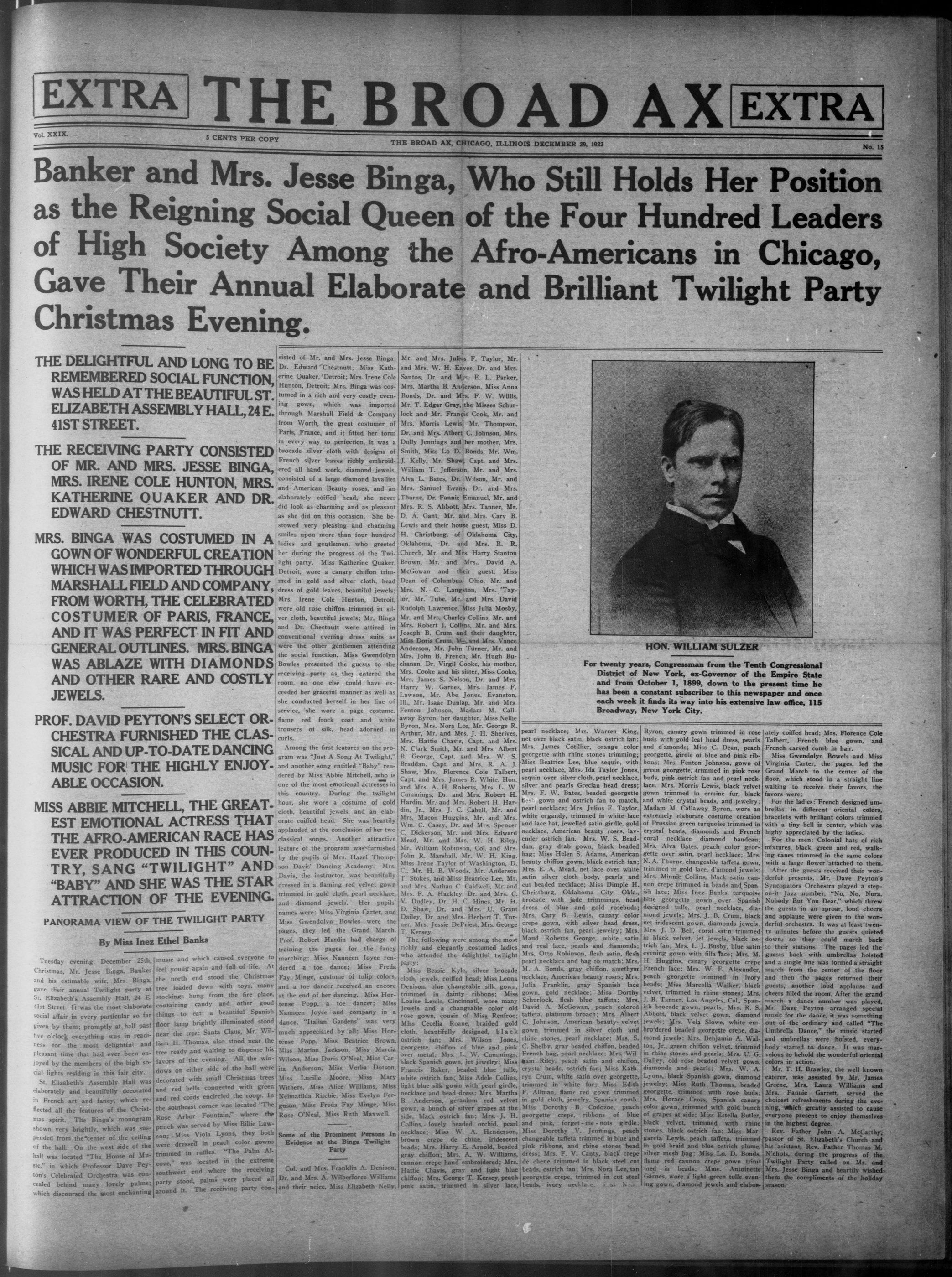
For twenty years, Congressman from the Tenth Congressional District of New York, ex-Governor of the Empire State and from October 1, 1899, down to the present time he has been a constant subscriber to this newspaper and once each week it finds its way into his extensive law office, 115 Broadway, New York City.
pearl necklace; Mrs. Warren King, net over black satin, black ostrich fan; Mrs. James Cotillier, orange color georgette with rhine stones trimming; Miss Beatrice Lee, blue sequin, with pearl necklace, Mrs. Ida Taylor Jones, sequin over silver cloth, pearl necklace, silver and pearls Grecian head dress; Mrs. F. W. Bates, beaded georgette flesh gown and ostrich fan to match, pearl necklace; Mrs. Julius F. Taylor, white organdy, trimmed in white lace and lace hat, jewelled satin girdle, gold necklace, American beauty roses, lavender ostrich fan. Mrs. W. S. Braddan, gray drab gown, black beaded bag; Miss Helen S. Adams, American beauty chiffon gown, black ostrich fan; Mrs. E. A. Mead, net lace over white satin silver cloth body, pearls and cut beaded necklace; Miss Dimple H. Christburg, Oklahoma City, Okla., brocade with jade trimmings, head dress of blue and gold rosebuds; Mrs. Cary B. Lewis, gold cuseurs; Mrs. Maud Roberts George, white satin and real lace, pearls and diamonds; Mrs. Otto Robinson, flesh satin, flesh pearl necklace and match; Mrs. M. A. Bonds, gray chiffon, amethyst necklace, American gray Spanish roses; Mrs. David A. McGowan, peach colored taffetta, platinum broach; Mrs. Albert C. Johnson, American beauty velvet gown trimmed in silver cloth and rhine stones, pearl necklace; Mrs. S. C. Shelby, gray beaded chiffon, beaded French bag, peach necklace; Mrs. William Riley, peach satin and chiffon, crystal beads, ostrich fan; Miss Kathryn Crum, white satin over georgette, trimmed in white fur; Mrs. Edith F. Allman, flame red gown trimmed in gold cloth, jewelry, Spanish comb; Miss Dorothy B. Codozoe, peach georgette crepe, ribbons of blue and pink, forget-me-nots girdle; Miss Dorothy V. Jennings, peach changeable taffeta trimmed in blue and pink ribbons, and rhine stones head dress; Mrs. F. V. Cany, black crepe de chenrein trimmed in black cut steel beads, ostrich fan; Mrs. Nora Lee, tan georgette crepe, trimmed in cut steel beads, ivory necklace; Mrs. Nora Lee,
HON. WILLIAM SULZER
Byron, canary gown trimmed in rose buds with gold leaf head dress, pearls and d amonds; Mrs. C. Dean, peach georgette, girdle of blue and pink ribbons; Mrs. Fenton Johnson, gown of green georgette, trimmed in pink rose buds, pink ostrich fan and pearl necklace. Mrs. Morris Lewis, black velvet gown trimmed in ermine fur, black and white crystal beads, and jewelry; Madam M. Callaway Byron, wore an extremely elaborate costume creation of Prussian green turquoise trimmed in crystal beads, diamonds and French coral necklace diamond bandeau; Mrs. Alva Bates, peach color georgette over satin, pearl necklace; Mrs. N. A. Thorne, changeable taffeta gown, trimmed in gold lace, d amond jewels; Mrs. Minnie Collins, black satin cannon crepe trimmed in beads and Spanish lace; Mrs. Inez Banks, turquoise blue georgette gown over Spanish designed tulle, pearl necklace, diamond jewels; Mrs. J. B. Crum, black net iridescent gown, diamonds jewels. Mrs. J. D. Bell, coral satin trimmed in black velvet, jet jewels, black ostrich fan; Mrs. L. J. Busy, blue satin evening gown with fila tails; Mrs. M. H. Huggins, canary georgette crepe lace; Mrs. W. E. Alexander, peach georgette trimmed in ivory beads; Miss Marcelia Walker, black velvet, trimmed in rille stones; Mrs. J. B. Tanner, Los Angeles, Cal. Spanish brocade gown, pearls; Mrs. R. S. Abbott, black velvet gown, diamond jewels; Mrs. Vela Slowe, white embroidered beaded georgette crepe, diamond jewels; Mrs. Benjamin A. Walton, Jr., green chiffon velvet, trimmed in rille stones and pearls; Mrs. U. G. Dailey, old rose beaded velvet gown, diamonds and pearls; Mrs. W. A. Lyons, black Spanish gown, diamond jewelry; Mrs Ruth Thomas, beaded georgette, trimmed with rose buds; Mrs. Horace Cross, Spanish canary color gown, trimmed with gold bunch of grapes at side; Miss Estella Butler, black velvet, trimmed with rinite stones, black ostrich fan; Miss Margareta Lewis, peach taffeta, trimmed in gold braid and blue ostrich plume, silver mesh bag; Miss Lo. D. Bonds, flame red cannon crepe gown trimmed in beads; Mme. Antoinette Garnes, wore a light green tulle evening gown, d amond jewels and elabor
ately coiffed head; Mrs. Florence Cole Talbert, French blue gown, and French carved comb in hair. Miss Gwendolyn Bowles and Miss Virginia Carter, the pages, led the Grand March to the center of the floor, which stood in a straight line waiting to receive their favors, the favors were: For the ladies: French designed umbrellas in different oriental colors, bracelets with brilliant colors trimmed with a tiny bell in center, which was highly appreciated by the ladies.
For the men: Colonial hats of rich mixtures, black, green and red, walking canes trimmed in the same colors with a large flower attached to them. After the guests received their wonderful presents, Mr. Dave Peyton's Syncopators Orchestra played a step-on it Jazz number, "No, No, Nora, Nobody But You Dear," which threw the guests in an upoar, loud cheers and applause were given to the wonderful orchestra. It was at least twenty minutes before the guests quieted down; so they could march back to their stations. The pages led the guests back with umbrellas hoisted and a single line was formed a straight march from the center of the floor and then the pages returned their guests, another loud applause and cheers filled the room. After the grand march a dance number was played, Mr. Dave Peyton arranged special music for the dance, it was something out of the ordinary and called "The Umbrella Dance," the music started and umbrellas were hoisted, everybody started to dance. It was marvelous to behold the wonderful oriental colors in action.
Mr. T. H. Brawley, the well known caterer, was assisted by Mr. James Greene, Mrs. Laura Williams and Mrs. Fannie Garrett, served the choicest refreshments during the evening, which greatly assisted to cause everyone present to enjoy themselves in the highest degree.
Rev. Father John A. McCarthy, pastor of St. Elizabeth's Church and his assistant, Rev. Father Thomas M. Nchols, during the progress of the Twilight Party called on Mr. and Mrs. Jesse Binga and heartily wished them the compliments of the holiday season.
THE BROAD AX
Published Every Saturday
In this city since July 15th, 1899, without missing one single issue. Republicans, Democrats, Catholics, Protestants, Single Taxers, Priests, infidels or anyone else can have their say as long as their language is proper and responsibility is fixed.
The Broad Ax is a newspaper whose platform is broad enough for all, ever claiming the editorial right to speak its own mind. It is neither Democratic nor Republican. It is strictly or absolutely independent in politics. Local communications will receive attention. Write only on one side of the paper.
Subscriptions must be paid in advance.
One Year .....$2.00
Six Months .....$1.00
Advertising rates made known on application.
Address all communications to
THE BROAD AX
6206 So. Elizabeth St., Chicago, Ill.
Phone Wentworth 2597
JULIUS F. TAYLOR
Editor and Publisher
Associate Editor
DR. M. A. MAJORS
Vol. XXIX No. 15
Chicago, December 29, 1923
Entered as Second-Class Matter, Aug.
19, 1902, at the Post office at Chicago,
Ill. Under Act of March 8, 1879.
TWENTY-SIX LYNCHINGS IN
1923 AS AGAINST 61
DURING 1922
Decline in Mob Murders Laid to Agitation for Federal Law and Migration
Mississippi and Florida Lead With Five Each
New York—Sharp decline in the number of lynchings in the United States during the year 1923, the figure being 26 as against 61 in 1922, was laid to the agitation for a federal antilynching law and to the northward migration of Negroes, as stated by James Weldon Johnson, Secretary of the National Association for the Advancement of Colored People, 69 Fifth Avenue, New York, recently.
Mississippi and Florida lead the list of lynching states with 5 mob murders each. Georgia is second with 4 Oklahoma is third with 3. Arkansas, Alabama and Texas have 2 each. Other states in which one lynching occurred are: Louisiana, Missouri and Virginia.
Only 7 out of the 26 persons were charged with assault upon women, and in the case of one of the seven, the janitor of the University of Missouri, grave doubt was subsequently cast upon the guilt of the mob's victim. Other offenses for which lynchings occurred include: mistaken identity, aiding in escape, associating with white women, being in an automobile accident, remaining in a town where Negroes were not wanted and frightening white children by walking harmlessly along a country road. Two of the victims of lynching mobs were white men. One colored woman was lynched in Pickens, Mississippi.
"Two main causes brought about the decline in lynching in 1923," said Mr. Johnson. "First was the agitation on the floor of Congress, and throughout the country, for a federal anti-lynching bill, the measure introduced by Mr. Dyer passing the last House of Representatives by a vote of 230 to 119. The second main cause was the northward migration of Negroes by the hundreds of thousands. This has borne in on the South that lynching will have to be stopped if the best labor the South can get for its plantations and industries is to be retained. Prospects for the enactment of the Dyer Anti-Lynching Bill in the present Congress are excellent, in the light of President Coolidge's anti-lynching pronouncement in his message to Congress. It is to be hoped that in a very few years the crime of lynching will have been completely wiped out in America."
BAPTIST WOMEN CONGRESS MEETS
The Baptist Women Congress of Illinois and jurisdiction of which Mrs. Katie L. Cosby is president, met on December 20 at the Union Baptist Church, 1742 Fulton Street. A great meeting was held, the election of officers and the entertaining of the session by Rev, and Mrs. Royal and the committee in charge. Mrs. Cosby, conspicuous since the days of Mrs Eva Hooper, in the circles of the congress, was re-elected president, as was most of the officers. Revs. A. L. Harris, J. W. Carter, E. P. Jones and others took part in the meeting.
```markdown
```
"SIDELIGHTS ON NEGRO SOLDIERS" CHARLES H. WILLIAMS OF HAMPTON INSTITUTE TELLS STRAIGHTFORWARD STORY OF SERVICE OF 400,000 AMERICAN NEGRO SOLDIERS—RACE WINS RECOGNITION FOR PATRIOTISM, EFFICIENCY, COURAGE-NEGRO OFFICERS MAKE GOOD.
BY WM. ANTHONY AERY
Hampton, Va.—The loyal and effective service of 400,000 American Negro soldiers throughout the World War, the excellent qualities of leadership shown by the 1,000 Negro officers who "saw things through" in France, the uniring and cheerful work of the Negro stevedores in laying the groundwork for combatant troops, the successful efforts which were made by white and colored welfare workers to improve the conditions of Negro soldiers in and near their camps, and the records of Negro combatant troops—this story has been told simply and in a straightforward manner by Charles H. Williams, director of physical education for boys at Hampton Institute, in "Sidelights on Negro Soldiers," a 250-page book recently published by B. J. Brimmer Company of Boston.
Benjamin Brawley, Raleigh, N. C. professor of English at Shaw University, has written the introduction, which states the problem that the Negro in uniform had to face in America and in France. This problem was a highly complex one and for its solution there was required the co-operation of many agencies.
Facts Bring Results
Charles H. Williams, because of his long experience in executive work and his insight into Negro character, was selected as a special investigator of conditions among Negro soldiers. With the approval and co-operation of the Secretary of War and the Adjutant General of the Army of the United States, he spent a total of eighteen months in the United States and in France visiting those places in which Negro troops were stationed, with a view to getting facts and making recommendations for improving their welfare.
"Sidelights on Negro Soldiers" gives in well-arranged order the specific information which is needed to show how American Negroes met the call to the colors; how they fared in their camps; how the Negro officers were trained, in spite of the numerous obstacles which were placed in their way; how the Germans attempted to influence the Negroes to turn against the United States; how the Negro troops suffered in France from systematic propaganda against them; how the problems arising from camp followers, especially women, were met and solved; how the "Y" and other welfare organizations ministered to the needs of Negro soldiers, usually with great success; how the stevedores "carried on" amid hardships and numerous discouragements; how the well-known 92d and 93d Divisions were organized and trained; and how the Negro units played their part in helping to win the World War.
The concluding chapter, "Home Fires," tells the story of what was accomplished by the Negro soldier, who won recognition on account of merit and who showed his fellow
THE QUESTIONNAIRE
By Miss Louise Bond
Each week Miss Bond will ask a few questions and the answers will be published the following week. Those desiring honorable mention for submitting correct answers should have all communications reach her by Wednesday of each week. Address all communications to The Questionnaire, 6159 Loomis Blvd., Chicago, Ill.
1. Mention five well known works of Everett Hale.
2. Name two of Pope's poems. Which of his classics did he translate?
3. Mention some writing by George Meredith. Where was he educated?
4. Who wrote the "History of Plymouth?" To what date does it extend?
Answers to Last Week's Questions
1. The Rosetta Stone is found at Rosetta in the delta of the Nile. It contains equivalent inscriptions in hieroglyphics and in Greek letters. The meaning of the Greek text being known, the hieroglyphics were translated.
2. Rameses II was probably the Pharaoh who oppressed the Hebrews, and the exodus may have occurred under his successor, Meneptah or Merenptah.
3. Caesar, after taking Alexandria conquered Egypt.
4. Apis was one of the Egyptian gods worshipped under the form of an ox. In Egyptian mythology, Osiris is said to have been the son of Jupiter, and to have ruled first over the Argives, and afterwards to have become king of the Egyptians. His wife was Iss, who by many is said to be the
THE BROAD AX, CHICAGO, ILLINOIS DECEMBER 29, 1923
white soldiers that he had an unfaithful belief in God and faith enough to believe that great good would come out of many evils and hardships. Prayer a Power in War "One night," says Charles H. Williams, "before they went over the top six boys were in a dug-out. After talking things over, one suggested that they say the Lord's Prayer Only one knew it; but while a game of dice was going on in another corner, the little group knelt and repeated the words, gathering strength for the attack that was to come before the new day. Hearing a slight noise toward the close, they turned and saw that a major had come into the dug-out. 'Let's say it again, boys,' he said, 'it gives me more courage, too.' Then they knelt again and the officer joined with them in the prayer."
"Sidelights on Negro Soldiers," according to Newton D. Baker, former Secretary of War in President Wilson's cabinet, "shows the presence of the race question and of some of the prejudices and discriminations which grow out of it, but it also shows performance of high duty by the Negroes of America. Negroes who read this book will be proud of the record it contains, and even more zealous to raise the race by adhering to the ideals exemplified by its soldiers. White men who read this book will sympathize with the struggle of the Negroes for a full opportunity at self-development, and will realize the service the race has rendered in a great emergency and may be called upon to render again in some future crisis."
In the method of presentation no attempt has been made to gloss over evils that existed. No attempt is made to be harshly critical. The truth is stated in kindness but with incisiveness and with important facts and figures.
Men Are Drawn Together
Men Are Drawn Together Americans who wish to know what Negro soldiers actually did and patiently suffered, in order to help win the world struggle for democracy, will find in this concise, interesting book an opportunity to secure information which could only be gathered by a thoughtful, courageous man who had visited the Negro soldiers in many sections of the United States and France—and always with an open mind.
As men and women study the results of the World War, they discover for example, that just as 400,000 American Negroes received a new outlook on life on account of their war experiences, so citizens of the United States and other countries received a new insight into the capabilities of American Negroes by studying their loyal, intelligence service.
Men who fought side by side through the World War will find in this small book an opportunity to study the problems which they have in common and the forces of right- cousness and good will which draw them together as American citizens.
same with the Io, the daughter of Inachus. Horus was the Egyptian god of the sun, and was also worshipped in Greece and at Rome.
5. One derivation for the name Egypt is that it expresses the Hebrew for "the land of oppression." Another is that it was named for Egyptus, once ruler of this country.
BEG YOUR PARDON
It was stated in the last issue of this newspaper that Miss Louise Bond, who furnishes the questionnaire for this paper was 15 years old, but the party furnishing the writer with that information, for some cause or other, utterly failed to state that Miss Bond is well advanced in her second year at the Englewood High School and that she is right up to the minute in all her studies.
GOES TO TENNESSEE
George W. Wilson, 4846 South State Street, second vice president of the Pyramid Building & Loan Association, is in Memphis, Tenn., his old home town, where he was called several days ago on account of the severe illness of a near relative. This is the first visit Mr. Wilson has made to Memphis in 30 years, and he will remain over the holidays with relatives and old acquaintances.
The various lodges and temples of U. B. F. & S. M. T. will hold a public installation of officers on January 2 at People's Movement Club, 3140 Indiana Avenue, under the auspices of the Joint Building Association of U. B. F. & S. M. T. of which J. B. Street is president. M. T Bailey will act as master of ceremonies. The public is welcome.
Chairman, Board of Directors of the National Association for the Advancement of Colored People.
AN ORINANCE INTRODUCED BY ALDERMAN ROBERT R. JACKSON RECOMMENDED FOR PASSAGE BY THE COMMITTEE ON JUDICIARY, WITHOUT A DISSENTING VOTE, AT THE LAST MEETING OF THE CITY COUNCIL.
The following city ordinance has been farthered by Alderman Robert R. Jackson and his important measure will become a part of the new laws of this city.
Elevated Railroads: Installation of Traffic Danger Lights and Painting of Columns Located in Street Driveways, Etc.
Be it ordained by the City Council of the City of Chicago:
Section 1. Safeguards against Collision with Posts. Every person, firm, company or corporation owning or operating any steam or elevated railway whose tracks are elevated within the City, shall, and he or he is hereby required to paint or stripe of uniform color and design from its base to its top, every post, pillar or support, located at a point or turn in the street where vehicular trafic may be endangered by collision therewith, and at night there shall be displayed a light of sufficient illuminating power to be visible in the direction from which vehicles approach at a distance of 200 feet, on an arm or bracket ex-
BOOK
By Mary Wh
Chairman, Board of
tional Association
ment of Col
"CANE"
"CANE"
By Jean Toomer. Published by Messrs. Boni & Liveright, 61 West 48th St., New York City. Price $2. Postage 10 Cents Extra
Artemus Ward used to say with great solemnity, after a pause in his lecture, "Time passes on. You may not have noticed it, but time passes on. It's a kind of way time has." Those of us who were brought up on Dickens and George Elliott, to whom "Tom Jones" was the limit of wickedness in fiction, certainly see the passage of time when reading one of the new expressionists. If a Victorian heroine fell from virtue it took two volumes to show her punishment and remorse, with a last chapter in which she stood in a twilight peace. And even, Fielding, when Sophia was thrown from her horse, was careful to refrain from telling us point blank that she showed her legs. But today! Why, in "Cane," virtue is not routed, she never enters on the scene. And as for minding talking about legs! Well, here's a bit of description:
"Night, soft belly of a pregnant Negress throbs evenly through the South. Night throbs a womb song to the South. Cane and cotton fields, pine forests, cypress swamps, saw mills and factories are fecund at hen touch. Night's womb song sets them singing."
Waldo Frank has written a foreword to "Cane" in which he says: "A poet has arisen among our American youth who has known how to turn the essences and materials of his Southland into the essences and materials of literature * * * * who writes not as a Southerner, not as a rebel against Southerners, not as an apologist or priest or critic; who writes as a poet.
N. A. A. C. P. NOTES
Annual election of Executive Committee and officers of Chicago Branch, N. A. A. C. P., was held last Sunday. An exhaustive report was made by the local secretary and an interesting address was delivered by Dr. A. Wilberforce Williams, Treasurer of the branch. The following Executive Committee was elected: President, Harold L. Ickes; Vice President, Dr. Charles E. Bentley; Secretary, Morris Lewis; Treasurer, Dr. A. Wilberforce Williams, Mrs. Irvin Rosenfels, Dr. Spencer C. Dickerson, Miss Jane Addams, George R. Arthur, Miss Mary McDowell, Charles A. Wilson, Mrs. James F. Porter, Dr. Carl G. Roberts, A. L. Weaver, Judge Robert McMurdy, Mrs. E. H. Carry, Willoughby G. Walling, R. S. Abbott.
A midnight performance of the awakening, N. A. A. C. P. race drama, by Mary White Ovington, will be presented by the Red Circle Service Club, under direction of Irene McCoy Gaines, Thursday, Jan. 3, 1924, at 11 p. m., at the Avenue Theatre, for the benefit of the Chicago Branch, N. A. A. C. P. Seats, 50c, 75c and $1.00 The branch is desirous of receiving at once reports from all solicitors who have memberships and money to turn in. It also requests payment of pledges, etc., due the branch, before the end of the year. Office, 3201 South Wabash Avenue. The local secretary is taking up the case of the dismissal of young Ellis Reid from Englewood High School Reid's record is such that the alleged charges are absurd and without proper foundation.
---
tending from such post, pillar or support, or suspended from the super-structure of the railroad, all of which shall be done in such manner as shall be approved by the Commissioner of Public Works. In the event that any such person, firm, company or corporation owning, leasing or operating any steam or elevated railway shall fail or neglect to paint and illuminate such posts, pillars or supports as herein required, then the City Council at its election, may cause the work to be done at the expense of such person, firm, company or corporation shall be liable to any pay the City of Chicago the whole cost and expense thereof.
Section 2. Any person, firm, company or corporation owning or operating any steam or elevated railway company within the City of Chicago that shall by himself or itself, or by or through any of his or its agents, servants or employees, or any other person, violate, fail or neglect to observe any of the provisions of the preceding section, shall be fined not less than ten dollars nor more than one hundred dollars and each day during which any post, pillar or support shall be permitted to remain unpainted and without light after the first conviction, shall constitute a separate and distinct offense.
Section 3. This ordinance shall be in full force and effect from and after its passage and due publication.
The fashioning of beauty is ever foremost in his inspiration."
This is what Frank says of the author of "Cane." I think the most of us will find the book uneven, at times obscure, at other times the better for a little more obscurity. A vaudeville, its publishers call it, and it is a series of short sketches, bits of verse ending with one fairly long story, "Kabnis," much the best thing in the volume, "Kabnis" is a northern Negro who goes to teach in one of the missionary schools of the South. This much of the sketch is autobiographical. He has no taste for missionary ways, and hates the mawkish atmosphere of the place. There is a great picture at the end of an old black man, sightless, inarticulate, representing the days of slavery, of a restless youth, and of two lewd women, all far down in the cellar of an old building, on a Southern night. The past is gone, there is no future.
"Cane" should be read without thought of any story, just for the beauty of some of the lines. Here is a tongue-tied lover in the presence of h's mistress: "But words is like the spots on dice; no matter how yo fumbles em, there's times when they jes won't come. I dunno why. Seem. like the love I feel fo yo dne stole my tongue." And this: "I used to love that girl. And sometimes when the moon is thick an I hear dogs barking an some old woman fetches out her song, an th winds seem like th Lord made them for t fetch an carry the smell o pine an cane, an there ain't no big job on foot, I sometimes get to thinkin' that I still do." We want to drop our prejudices when we read "Cane" and we shall find-in it a book, if not fulfillment of great promise.
COLORED CLAN GETS
CORPORATION CHARTER
Austin, Tex-The Colored Clan, with headquarters at San Antonio, whose members plan a nation-wide organization, was granted a charter by the secretary of state last Thursday. Purposes recited in the application for charter are concerted charity, "encouraging the study, respect for and upholding of the law of this state and the United States."
RETURN FROM NASHVILLE
Rev. Chas. H. Clark, pastor of Ebenezer Baptist Church, and Rev. D. P. Jones have returned from Nashville, Tenn., where they were in attendance at the board meeting of the National Baptist Convention. Plans were made for the financial success of the convention which will meet in Chicago, September, 1924.
VIRGINIANS HAVE PROGRAM
In the final meeting of the year the Virginia Society held December 19 at regular headquarters, 3638 State St. a fine literary and musical program was rendered. Those taking part were Little Esther Blake; Atty Jas. M. Baker, Mrs. Minnie M. Robinson, David L. Jackson and others. Virginians and their friends are always welcome to these meetings at the above address the third Wednesday evening in each month.
COL. CHARLES E. STUMP, THE REGULAR TRAVELING CORRESPONDENT FOR THE BROAD AX BREEZED INTO THIS BIG TOWN LAST FRIDAY EVENING; ATTENDED SUNDAY AND CHRISTMAS MORNING CHURCH SERVICES AT OLIVET BAPTIST CHURCH.
Here I am in Chicago, and I have had an Old Aunt Dolly Time enjoying Christmas and strutting Miss Lizzie, and when you read this letter, I will be on my way down in Florida, but I am going via Cincinnati, Richmond, Roanoke, Norfolk, Lynchburg, Winston-Salem, N. C., and will land right in Florida, but it may be necessary for me to make a trip to Washington, D. C., to see what the President said to Dr. W. H. Jernagin.
Do you remember when and where I was when I took the pen in my lily black hand to say a few words to you the other time, and do you see where I am when I wrote to you this time? Well, I have been going some, but not so fast, because the bugs are after me again and I dropped in here to have Dr. George Cleveland Hall look me over, and see what the bugs were talking about before I went down in Florida, and he is going to be down in Florida for his health and we will look each other over often.
You will recall that I spent a day in New Orleans, La., and it was a nice stop over there, because Miss Enola E. Porch, certainly did do something to make me enjoy myself. I have been to see friends and they have been to see me. I am proud to say that Miss Porch's mother had a turkey as large as my stomach, and turned me in on it, and honey one more time I enjoyed some turkey, for that is among the few things I am allowed to eat. I just ate and ate until I wanted no more of it at that time. Miss Grace Porch, who is attending New Orleans College, had a few things to say, but let me tell you she is some eater herself, and she knows the game in good shape. I am so delighted to be able to say these few things to you.
I had the pleasure of coming in touch with the Rev. B. G. Dawson, the proud and hard working preacher, the man who is just going to work his way into the Episcopal bench of his church. He is making friends as he goes over the country and is indeed an active polished minister of the A. M. E. church. From New Orleans I rode to Montgomery, stopped off for a few hours, and then made it on down the road to other parts of the world. It was indeed a source of pleasure to have made this trip to Montgomery, and from there to Nashville, Tenn.
I am sure you want to know what I saw in Nashville. I had the pleasure of meeting that great worker, Prof. Ira T. Bryant, of Nashville, secretary of the A. M. E. Sunday School Union. He is one of the hard workers in the race, but the people say that at times he has the running off at the pen, and when he gets one of the spells on him he writes right and left and sometimes slays as he goes. He is well posted on the things which are going on in his church, and he speaks right out. Well, I am not going to say much about him; but I do know that Bishop W. W. Beckett, said that he was going to step on the gas and put Bryant in his place, but there was something wrong with his spark plugs, and he stopped his car parked and he has not been able to get it to run since. I could name a few others who tried their hands and stopped.
I was met by a representative of the Sunday School Publishing Board of the National Baptist convention, and after looking around, he toted me over to the home of Dr. J. C. Caldwell, who has since jumped over the broomstick and is now pastor in Ashland, Kentucky. This is a good place and they certainly have a good man for pastor. He is doing good work, and we will hear from him at Ashland. I have not seen him since he has taken unto himself a bride, but it has happened and I hope to see them when I pass through.
Now, about this Sunday School building, I talked with Dr. Caldwell went to call on his intended wife talked with her, and extended congratulations in advance, and she told me that there would always be a place in her home for me, and both of them would have a warm spot in their hearts for me, and I desire to thank them for this, and do so right now. He, toted me back to see Dr. J. H Hale, that wonderful cutting doctor, the man who can cut you open, put you together again and you continue to live. He can take out parts, and still let you go on living. He is a wonderful man and a Christian man at that.
Next landed me at the home of Dr. and Mrs. A. M. Townsend, and both of them made me happy, and as happy as happy could be. I was ready and willing to join the Junebugs because I was so very happy. The night was spent in this palace, or home and then the next morning Secretary
Townsend got up himself hitched up his automobile car carriage and tooted me over to the stable where I got on the iron horse for Louisville, and in going to this stable he drove by where they were putting up that $350,000 home for the publishing plant and the Sunday School Department. The steel was up to the second story and I just fell on my hands and knees and thanked God for the wonderful work being done. We are doing things in this world and the eyes of the world are on the eyes of us Baptists. We want them to continue to be on us and we are going to consider them from Missouri and just show them that we can do more than talk and write.
Off for Louisville, where I spent a night, at the home of William H. Steward, editor of the American Baptist. He is a great man and is doing great things in Kentucky. I was delighted with this trip and then off to Frankfort, Kentucky in company with some other friends. I met Bishop Clement and two other men to Frankfort to see the Governor of Kentucky and lay before him some things which would be helpful to Kentucky and the race of which they were members.
When I stopped off in Frankfort, Prof. F. M. Woods, president of the state school met me at the stable, and had his car. I tell you this is some hilly town. This is where I am told Charles Stewart was born and I don't wonder that he is so full of knots and a hillybilly. Up to the school they had assembled and heard Bishop Clement make a speech, and then I made a few scattering remarks myself, and it was dll I could do to keep my mouth from jumping out of my heart. But no jumping took place. The students clapped their hands and I just thought then I had said something. It is a great thing to be able to mingle with educated people whether you are one or not.
I called to see Clifton Stewart, the brother to his two brothers. He is in poor health, but happy, because he has recently joined the church and declares that he is heaven bound.
I had the pleasure of meeting Miss Martha E. Williams, who is one of the leading women of our country and who is doing something. She was a victim of an automobile car carriage accident last year and they thought at one time she was going right on to heaven, but the Lord hath spared her because she was a good woman and her life has been a life of service. It just brought her a little closer to the throne. She is living that way too, I am here to tell you.
Now here I am on my way to heaven, for from Frankfort I made my way to Cincinnati and then on to Chicago, Ill, where I had the pleasure of taking in Christmas. This has been a great Christmas and the people were determined that I should eat turkey if nothing else, for Rev. V. M. Townsend sent me a great big one, and then came one from Rev. Dr. Winn, of Terrell, Texas, one from Rev. S. D. Butler, the man who is bound to be a bishop in the A. M. E. church, from Texas; Bishop William Decker Johnson sent one, and Dr. R. R. Moton sent along one, and then came one from Rev. S. J. Johnson, the man I have been telling you about. All of this and then Mrs. Elrene Falconer sent me some sox, and then Mrs. Emma Kennedy wanted my feet protected and she sent a pair of fine silks. I tell you I am just going to strut Miss Lizzie Strut, and there will be a glorious time in this country. I am happy and really happy now. I cannot begin to name the people who me fine Christmas cards, and other things are coming. I am indebted to the Phelps of Pasadena, California, for the fine bandana sent to me for use, and honey, I am going to use it for who shall last the longest. I had the pleasure of going to church to Olivet Baptist last Sunday and heard Charles Stewart preach, and now I have seen that writing son of his. He is doing some real fine work. I want to express my thanks to the Eastern and Western Clergy Bureau, for the fine fountain pen which they presented me with, and at the same time thank Prof. W. H. McCoy, of the Madam Franklin Beauty Culture parlor for a fine pen. I am just in it. The world continues to move and I am moving right along with it. I will have so many more things to say to you.
I am going to have other things to say. I want to talk about President Coolidge and other things in another letter. I am not even talking any church politics this year. The end of the year is just over the fence, and I am going to turn over a new leaf next year, and I want you to see what I wrtte on the pages.
CHARLES E. STUMP.
Chronology
of the
Year 1923
Compiled by E. W. PICKARD
INTERNATIONAL
Jan. 1—Turkey reported mobilizing
their forces against Constantin-
ople. Mosul and other cities
Jan. 2-Allied premiers met in Paris and British and French plans for reparations were submitted. Jan. 4-Conference of allied premiers in disagreement France prepared for isolated action to collect from Germany.
Jan. 9—Reparations committee declarations delivered by the British memorial voting in negative. French began move on European adopted passive resistance program. Jan. 10—Germany, formally notified by the Ruhr, protested to allied officers and withdrew its ambassadors from France. Belgium, agreed to pause conference decided Mostems in Greece must be moved to Turkey and Christians in Turkey to
Lithuanian irregulars occupied the
Memel district, besieging the city.
Jan. 13—Reichstach, by vote of 283 to
Chancellor Cuno's "moral
ask of France."
Lithuania seized Memel, announcing the revolt was only against the administration and the German currency.
Jan. 16 — Reparations commission seized Germany in default in material fallen.
Jan. 15 — Germany ordered all state employees to refuse to obey the French. The German arbitration court insurgated in Paris.
Jan. 20 — French arrested many German and seized funds in Relichbank branches.
Jan. 23 — France ordered the Ruhr isolated from the rest of Germany. The British and Turks split on Mosul question in Lausanne conference.
Jan. 24 — American army of occupation for some months.
Jan. 26 — Reparations commission voted Germany in general default.
Jan. 26 — Ruhr from Germany completed.
Jan. 29—Hundreds of German officials deported from Ruhr and Rhineland. Hundreds of Ruhr customers and shut off all shipments of coal to anoccupied Germany. A submitted peace treaty to Turkey has been signed. British accepted American terms for funding of war debt. Hungary accepted League of Nations plan to settle their boundary dispute. Germany guaranteed loan of $100,000,000 to Austria. Feb. 1—General Allen ordered by Rhineland relations with Ruhrland commission.
Feb. 4—Turks at Lausanne refused to sign peace treaty, rejecting 20 per cent of the clauses, and Lord Curson denounced. French occupied Goddelau in Hesse. Chancellor Cuno appointed a dictator to ration and fix prices in the Ruhr. French demand that he agree in writing to sign peace treaty as submitted, and Lausanne conference broke up. Warships to leave Smyrna, but were defied. Italy ratified the Washington treaties. Central American conference in Washington ended successfully. 18 councils of Lithuania massacred Awarded to Lithuania. Feb. 17—Poles and Lithuanians began battle near Orany. French ordered their warships out of Smyrna harbor, as courtesy to Turkish government. Lithuania and Poland agreed on a truce.
March 19—United States agreed to accept payment of $250,000,000 for expenses of Rhine army, in 12 installments. March 25—President of Chile, in welcoming delegates to Pan-American conference, urged alleviation of "armed peace conditions and war on alcohols." March 26—Socialists of England, France, Italy, Belgium and Germany, in conference in Berlin, devised repara-
March 80—German mine owners re-
quire to pay coal tax levied by the
French.
March 31—Eleven Krupp workers killed in clash with French troops at Algeria.
April 2—Turks agreed to resume hostilities.
April 22—League of Nations council approved lean of $120,000,000 to Austria.
resumed. Russia excluded.
May 1—Count Krupp von Bohlen und Halbach, head of Krupp works, arrested by French as responsible for fatal fight in Krupp works.
Krupp's German made new reparations offer of $7,300,000 with many conditions.
British government served ten-day
Moscow demanding compliance with the
Moscow demanding compliance with the
May 23—Russia yielded to British demands.
May 25—Four European powers yielded on all points made by the United States and signed agreement for arms of costs of American army on the Rhine.
May 26—Turks and Greeks at Lausanne reached agreement on reparations.
Juna 1—Germany asked new reparations conference on total sum, affirmed annuities of 1,500,000,000 gold marks.
June 18—World court began second session in The Hague.
July 12—French withdrew Saar ordinances of March 7, to which England objected.
June 27—Pope issued letter condemning French police in the Ruhr.
June 29—Ten Belgian soldiers killed by bomb in the Ruhr; French and Belgians took severe sanctions.
July 3—Pope urged Germany to cease sabotage and satisfy her obligations.
July 3—League of Nations council
—Krupp's signed working agreement with French.
July 4—Agreement on all points reached by Tomas and allies.
July 7—French chamber of deputies approved Washington naval limitation treaty.
May 12—Great Britain invited France and Britain, in reply to Germany's latest reputation, to French troops of occupation advanced to Lemberg, Barmen and Elberfeld.
—Premier Polincare of France,
in speech and most of the demands
made by British minister on German
reparations.
—and Turks agreed on
terms of treaty, leaving oil concessions.
20—British draft of treaty to
Germany submitted to allies and United
States.
24—Turks and allies signed
peace treaty of Lausanne.
Britain 5-Great Britain and France agree to guarantee pact against unprovoked aggression, to lead to reduction of armaments. United States and Turkey signed treaties on commerce and on extradition, at Lausanne. Great Britain handed to France and made note declaring Ruhr occupation illegal and insisting on impartial reparations in declaring France must pay enough of the cost her to enable Britain to pay America. United States-Mexico commissioned cooperation. Aug. 17-Ratifications of four-pact and naval reduction treaty negotiated in Washington conference formally exchange agreements.
France offered to reduce reparations claims on Germany in proportion to the amounts of its debt. United States and Great Britain. Aug. 21—France's reply to British demand delivered to Great Britain; offered little help. Aug. 28—Italy demanded from Greece abject apology and reparations for murder of Italian military commissioner. Aug. 30—Greece accepted some of Italy's demands and rejected others. Aug. 31—Italy, declaring Greece's reply unsatisfactory, unsatisfied Corfu and landed on Samos and other Aegean islands. Greece appealed to League of Nations. Mexico formally recognized by the United States. Sept. 4—Mussolini declared Italy was drawn from League of Nations if it landed on arbitrating the Ito-Ko Greek affair.
Premier Poincaré of France announced Germany must settle reparations question before an economic accord could be resched.
Sept. 16—Italy appointed Gen. Giardino, military governor of Flume.
Sept. 24—Chancellor Stresemann of Germany formally announced official abandonment of passive resistance in the Italian informed Jugo-Slavia it intended to keep Flume. It would consecrate Corporu forlu Greece paid 50,000,000 lire indemnity. Sept. 25—Council of ambassadors ordered Greece to pay indemnity to Italy.
Oct. 19—Chancellor Stresemann announces Germany would pay no more resources. Oct. 24—Germany asked allies for reparations. Oct. 28—France accepted British plan for appointment by the reparations commission to fix German capacity to pay.
Oct. 28—Premier Poincaré announced France would not permit reduction of exports of experts nor abandon the guarantee.
Oct. 30—Great Britain accepted France's receptions on reparations based on experts.
Nov. 4—Poincaré said France would not yield on reparations unless her secretary de债务
Nov. 5—China refused to pay Boxer indemnity to France.
Nov. 9—United States refused to participate in the reparation of Germany's capacity to pay because of French restrictions.
Nov. 10—France proposed appointment of experts committee to investigate Germany's resources and capacity to pay during the next three years.
Nov. 11—He announced he would repudiate treaty of Versailles and abandon the Ruhr and Rhineland to the French.
Nov. 12—Great Britain accord as to demands on Germany concerning former crown prince and resumption of military control commissions, and sent mild notes to
Beynon
$23—Industrial magnates of the Ruhr an J Rhineland signed treaty with t: French for resumption of work and payments.
Dec. 4—France began restoring the Ruhr to German rule.
Dec. 7—C. H. Griffis and two others sentenced to prison on Bergdahl court for attaining Bergdahl.com. Dec. 1—New treaty of friendship and commerce signed by U. S. and Germany. Dec. 10—Council of League of Nations. Dec. 11—President Coolidge announced he approved of the declaration. Dec. 12—The German equities authorized by reparations commission. Dec. 13—Tangier open port convention. Dec. 14.
FOREIGN
Jan. 14—President Obregon of Mexico ordered expulsion of Mexicanate governor
Joseph Gomez, an American foreigner.
Feb. 14—Italian Fascist ordered all Fear Masons to leave its ranks.
Great Britain cut $37,000,000 out of navy plans.
Chinese) president's plea for peace met with renewal of fighting in several
province March 20—Labor party in British par- demanded end of capitalism
March 26- Twenty thousand farm laborers of Norfolk county, England, sturch
bishopship Zeplink of Roman Catholic church condemned to death by Russian supreme court for revolutionary activity.
11- Mgr. Butchkavich, Roman Catholic vicar general, executed at Monocow for revolutionary activity Archbishop Zeplink's sentenced common imprisonment for ten years.
Rumania prohibited all Roman Catholic congregations.
April 6- Swedish cabinet headed by
and due
April 14—Great plot of Irish repub-
lians to kill British officials and wreck
London uncovered
April 27—De Valera ordered the Irish
THE BROAD AX, CHICAGO, ILLINOIS DECEMBER 29.1923
republicans to cease hostilities and to negotiate peace with the Free State
May 6- Chinese bandwrecked the Peking-Shanghai express and kidnapped many foreign passengers, including 14 demanding one million dollars' ransom.
...ay 8- Chinese government ordered that all demands of bandits who kidnapped foreigners should be complied with.
May 9- Irish Free State announced rejection of De Valera's peace offer.
May 10- Bonar Law rescinded as prime minister of Great Britain.
May 22- Stanley Rowlatt appointed British prime minister.
Communist strike and riots in the Rue de la Paix increased in violence.
May 27- Polish cabinet resigned; Witto made premier.
Boulamboully's peasant government in nigeria overthrown in almost bloodless revolution; Professor Zankoff mads more
June 14--Ll Yuan-hung resigned as president of China.
Stamboulsky captured and killed in Bulgarian village.
June 22—Manitoba voters killed president in law, substituting sale by government
July 15—Mussolini clinched his grip on power by forcing parliament to pass his electorate plan.
20- Gen. Francoise Villa, noted ex-chief, rebels and bandits, slain from ambush.
22—Belleau Wood, in France
dedicated memorial to Americans
who died there.
Aug. 5—Chancellor Cuno presented to Aug. 8 his rescue plan for Germany, including a military evacuation on a gold value basis and a heavy levy on industries.
Aug. 5—Chancellor Cuno and the German government resigned. The Stresemann undertook to form new cabinet, the first coalition majority government of Germany's history.
Aug. 15—Essex de Valera arrested by Irish Free State.
Aug. 27—German cabinet demanded $100,000,000 from the industrialists.
Aug. 27—Irish government party won in elections.
Aug. 28—Admiral Yamamoto made president of Japan, succeeding the late Baron Kato K.
Sept. 12—Spanish army revolted against the cabinet.
Sept. 14—Spanish cabinet resigned; directorate established under presidency of Gen. Primo Rivera, leader of the solution. Sept. 14—William Coagrove re-elected president of Irish Free State. Sept. 23—King Boris dissolved Bulgaria and proclaimed a state of sage because of Communist and peasant uprisings.
Sept. 26—Germany officially abandoned passive resistance in the Ruhr. Mr. Hirsch was the representative von Kahr as dictator of the state. Sept. 27—President Ebert appointed the minister Gessier military dictator of Germany in the Ruhr declared a general strike.
Last vestige of civil rule abolished
municipal governments be-
line dissolved
Oct. 4—Revolution started in northern Portugal.
General Marshal Tsao-Kun elected president of China.
German Socialists yielded to Stresse.
Oct. 3 - Rechting, by heavy major
cancellor Stressmann vote
of confidence.
Oct. 10—France refused to negotiate with the United States in the Ruhr, preferring to deal with the industrial barons. Panic on Berlin bourses, the mark going to 7,000,000,000
Oct. 13- Reichsstat confirmed Chancellor Stresemann as dictator.
Oct. 14- Saxony and Thuringia defied Stresemann.
Oct. 21- Rhineland republic set up in Nuremberg; movement spread to other cities.
Oct. 23- Communists fought bloody battle with police in Hamburg; 48 separatists ousted from several cities.
Oct. 29—Chancellor Stresemsman ousted the Saxon cabinet.
Angora assembly proclaimed Turkey a republic and elected Mustapha Kemal president.
Turkey — Iamet Pasha made premier of Turkey.
Bavarian monarchists mobilized for much of war in Turkey.
Nov. 1 — Krupp signed Ruhr accord with French.
Nov. 2 — Socialists quit German cabins and Stresemann assumed dictatorial power.
Nov. 3 — Hitler and Ludendorff tried to overthrow Bavarian government by royalist coup. See Seelwasser preme military dictator of Germany by President Ebert.
Nov. 4 — Bavarian Fascist suppressed and Ludendorff arrested.
Nov. 10 — Former Prince Ferdinand Stresemann.
Nov. 12 — Adolf Hirter arrested.
Nov. 20 — Rhineland separatists captured Mainz.
Nov. 25 — Mobs from Upper Silesian towns looted and burned estates of rich farmers who refused to sell food; many knives.
Nov. 23 — German Chancellor Stresemann and his cabinet, denied a vote of confidence, resigned.
Nov. 25 — Dr. Heinrich Albert made chancellor of Germany.
Nov. 27 — Falling to form a ministry, Dr. Heinrich resigned as German chancellor.
Nov. 28—Matthes, head of Rhineland republic, ousted by assasins, calling to form German cabinet. Dr. Wilhelm Marx, Catholic leader, was made chancellor. Dec. 4—Germany completed negotiation for loan loan to support her new currency. Dec. 4—Many German manufacturers arrested and faxed fraudulent government decided to retain office until meeting of new parliament. Dec. 16—Liberals won in Greek elections. Dec. 17—The Greek government informed King George it considered it advisable for him to leave Greece until the regime rested best benefiting the country. Dec. 18—King and queen of Greece went to Rumania. Dec. 19—King and queen papal consistory opened in the Vatican.
DOMESTIC
Jan. 2—Secretary of the Interior Fall announced his retirement from the cabinet on March 4.
Jan. 3—President Harding vetoes the Bursum bill for larger pensions.
Jan. 6—Senate requested the Preal-
Jan. 11—Ira Nelson Morrix, minister to Sweden, resigned.
Jan. 15—Harry Pratt Judson, president of University of Chicago, resigned:
E. DeW. Burton selected to succeed
bill.
Jan. 19- Senate passed the agricul-
tural credits bill.
In Herrin mass mase-
sure, he acquitted.
Jan. 28—House passed resolution for constitutional amendment prohibiting further issuance of tax-exempt securities. Jan. 24—Federal Judge E. T. Sanford nominated by President Obama to be Supreme court to succeed Justice Pitney. Jan. 25—House voted, 204 to 77, to approve report of judicial委理 giving Attorney General Daugherty power of health in impeachment investigation. Jan. 29—Robert Wooda BILL nominated as minister to Sweden. Jan. 28—House passed the rural credit bill. Jan. 27—Last American troops from Germany landed at Savannah. Feb. 9—House passed British debt funding bill. E. Mont Kelly resigned as governor of Ohio. Feb. 19—Senate confirmed appointment of Senator Poindexter as ambassador to Peru. Feb. 18—Senate confirmed appointment of Senator Poindexter as ambassador to Peru. Feb. 18—Senate ruled a Hindu cannot be naturalized.
Feb. 27—President Harding appointed Hubert Work secretary of the interior and Harry S. New postmaster general, effective March 4.
Brig. Gen. Frank T. Hines appointed director of the veterans bureau. In 1933—Ship subady bill killed in senate. Mondell of Wyoming appointed member of War Finance corporation and Treasurer of Iowa governor of Porto Rico. March 1—House passed rural credit bill. Senate requested President to urge Senate to limit production of halftorming drugs.
March 4—Congress adjourned after Democratic filibuster tied up legislation.
March 5—President and Mrs. Harding and party started for vacation in Florida.
March 7—Wisconsin senate, 26 to 4, defeated bill to abolish National guard.
March 10—United States debt commission arranged to fund Finland's $9,000,000 war debt.
March 14—Charles F. Cramer, general counsel, filled self on eve of senate investigation.
March 17—Attorney General Daugherty President Harding was candidate for president, filled, and 54 others convicted of liquor conspiracy.
March 25—Judge W. E. Dever, Democrat, elected mayor of Chicago.
April 6—Defendants in Herrin (III) mine massacre case again acquitted. President Harding returned from vacation in Florida.
April 13—Government began suit to
Mrs. A. W. Cook, president of the
Mrs. A. W. Cook, of Pittsburgh, Pa.
Mrs. A. W. Cook, general-of D. A.
April 24—Mr. Committed the administration to world court
committed the administration to world court
April 38—Supreme court, in 7 to 2 cases, ordered liquor into American ports, but overruled Daugherty opinion that the court cannot sell liquor outside territorial limits.
May 2—Charles E. Ruthenberg, noted radical, was found guilty of violating the law.
the Michigan anti-syndicalism law.
the Michigan anti-syndicalism law.
Lieutenants MacReady and Kelly made
nonstop flight from Hempstead, N. Y.
to San Diego, CAL.
The York legislature
repealed state prohibition law.
May 5—E. H. Cunningham of Iowa
and E. J. Jones of Delaware reserve board,
and E. J. Jones of Delaware reserve board,
of farm loan board.
May 11—Frank McMamany of Wash-
tahla, member of inter-
state commerce commission.
May 21—William R. Day resigned as chief of mixed claims commission; Judge R. B. Parker of Texas appointed to succeed him.
June 4—United States Supreme court declared unconstitutional state laws against the teaching of foreign languages in schools.
Convention of Shriners opened in Washington. June 11—Supreme court held Kansas court was without power to regulate wages in packing houses. June 20—President Harding started on his trip to the West and Alaska. Sentences of 24 men imprisoned for obstructing conduct of war commuted.
June 26—Interstate commerce commission abolished "assigned job" prac
cumption.
July 1—R. W. Bowden resigned as
Arizona State University's president.
July 4—Convention of radians opened
in Chicago.
July 16—President Harding sailed
from Tacoma for Alaska.
July 7—Army balloon won national contest. Lieutenant Roth and Null, pilot, led mission in Lake Erie. Commission reported in favor of government supervision of mines but against government ownership. President Harding landed at Juneau, Alaska. July 16—Magnus Johnson, Farm-Labor leader after controversy with Governor General. July 28—President Harding taken ill. July 29—President Harding worse; California program canceled. July 38—President Harding taken gravely ill with broncho-pneumonia. Aug. 2—President Harding, died suddenly in San Antonio. President Coolidge took oath as President at Plymouth, Vt. and went to Washington. President train started from San Francisco for Washington. Aug. 8—State funeral services for President held in the capitol, Washington. Aug. 10—Warren G. Harding's body is placed in Marion; memorial services in all Marion.
Coal commission summoned heads of
antracit; operators and miners to con-
firm
Aug. 14—Ex-Congressman B. Cascow
appointed secretary to
President Goulden to
President Goulden.
Aug. 15—Powerful bootlegging ring of Savannah, Ga. broken up by 84 ar-
ticles.
Aug. 29—Governor Pinchot offered compromise plan to avert anthracite strike.
Aug. 30—Savage riot in Perth Amboy
mob attacked Klu Klux
Klan meeting
F. E. Scooby, director of the mint
Aug. 31—Anthracite miners and
operators not satisfied with Pinchot plan
and strike begins, but negotiations con-
tinue.
Sept. 2—American relief measures for Japan earthquake victims started on Sept. 2. Sept. 2—G. A. R. in annual parade in illiwaukee. Sept. 2—G. M. Saltzgaber of Vanwert, Q.lected commander-in-chief of G. A. R.
Sept. 28—Under orders from Governor Rick Snyder, Oklahoma prevented the meeting of the house of representatives in special session. Oklahoma proclaimed indefinite postponement of special election which was to be held on Nov. 1. Governor Moore should meet to investigate his actions.
11- Governor Walton of Oklahoma appointed a special election opposition to special election F. October but called new election for December 6.
12- Oklahoma voted decisively in favor of constitutional amendment authorizing itself to consider impeachment charges against state officials.
13- Governor Harvey, ambassador to England, announced.
14- Oklahoma legislature met for impeachment of Gov. Jack Walton.
15- John R. Quinn of California elected commander of American Legion.
16- Governor Walton legislature voted to impeach Governor Walton and the senate suspended him from office.
17- Former United States Senator Frank B. Kellogg named ambassador.
18- Nov. 13- United States Supreme court decided aliens can be prohibited by states from owning land, provided there is treaty stipulation to the contrary.
Robert J. Grant of Denver made director of the mint. Robert J. Harram Johnson formally declared himself a candidate for Republican presidential nomination. Governor Walton of Oklahoma found himself at court of impeachment and ousted from office. Nov. 21—Dr. Frederick A. Cook, fake Nov. 21—Dr. Robert A. Cook, fake stock frauds and sentenced to prison. Nov. 24—Former Governor Walton of Oklahoma indicted on criminal charges. Nov. 24—Former Governor Walton of Indiana indicted for embezzlement. Dec. 3—Sixth-eighth congress met to break agreement. Republcan bloc prevented President Obama from entering Indiana. Dec. 4—In South Dakota state proposal conventions the Republcan insurgent Addoo, and Farmer-Laborists favored LaFollette for presidential candidates. Dec. 5—House organized, Speaker
Dec. 12—Republican national committee selected Cleveland as place and June 10 as date for national convention.
Dec. 13—Conference of representation of state using states opened at Harrisonburg, Pa. Dec. 15—President Coolidge ordered bombing of imprisoned violators of war laws. Dec. 17—W. G. McAdobe formally announced for Democratic presidential nomination
DISASTERS
N. M., entombed and killed 120 men.
Explosion in mine near Cumberland,
B. Feb. killed 120 men.
B. Feb. killed 120 men-two patients and
three attendants killed in inasylum
killed in Ward and Nerds.
March killed Fifteen inmates killed in
blast at Aristia, W. Va.
March killed Fifteen inmates killed in
fifty Greek soldiers drowned when transport
Alexandre sank.
Spring, TN
May 17—Severe earthquake at Quito,
Ecuador.
June 15—Reports received of earthquake in Persia in which 6,000 peril. June 17—More earthquakes in Persia; 3,000 killed. June 18—Mt. Etna in violent eruption; several towns destroyed Aug. 14—Explosion in coal mine at
Aug. 21—Million dollars' damage done by flood in Arkansas valley, Colorado.
Sept. 1—Earthquakes and resultant fire destroyed most of Tokyo and Yokohama and other cities; 225,000 killed.
Sept. 15—Typhoon and floods killed 5,000 in Japan. Weather blocks of Berkeley, Cal., destroyed by fire. Sept. 13—Three balloons destroyed by lightning in Gordon Bennett cup race kills 100. Bostonists killed, including two Americans.
Sept. 27—Fort persons killed when Burlington train plunged into river at Locke. Nov. 6—Twenty-seven miners killed by gas explosion in West Virginia. Dec. 1—Nearly 500 killed by bursting of dam near Bergamo, Italy. Dec. 1—Five men injured in wreck of Twentieth Century train at Forsyth, N. Y.
INDUSTRIAL
Jan. 8—Erie railway signed new wage agreement with shop crafts work-
gan City Fullman plant struck in protest against employment of negroes. The company, packer merger formally completed. April 9 - Steel industry raised wages of common labor 11 per cent and added 10 per cent to payroll. April 18 - Chicago packing house employees and building trades workers given raise to pay. Aug. 21 - Pennsylvania railroad gave shopmen $4,000,000 pay raise. Aug. 2 - Elbert H. Gary announced immediate elimination of the 12-hour steel industry and adjustment of wages. Aug. 21 - Anthracite operators and miners receive wage negotiations. August 1 - Typical wage order ordered by federal trade commission to discontinue practices which the commission declared would enable employ-ment of black workers in standard prices for commercial printing.
Aug. 24—Governor Pinchot selected
a bridge to handle the anthracite
problem.
Aug 25—Compromise plan to settle
between the two sides
Aug 31—Anthractite strike officially
announced
sept. 8—Miners and operators agreed on resumption of mining on September 8. Oct. 9—American Federation of Labor, in convention at Portland, Ore. On Oct. 10—American labor party and also against the recognition of soviet Russian government.
Oct. 11—Samuel Gompers re-elected president of A. F. of I.
Dec. 3—Federal railway labor board increased wages of maintenance of vay roads reached separate agreements. Dec. 5—Railway labor board increased prices of contractors. Dec. 11—Rock is railway renewed wage agreement with engineers.
NECROLOGY
Jan. $—W. T. Whiting, Wisconsin paper mill magnate, at Stevens Point, WI. Rev. Mrs. Cora L. V. Richmond, noted Spiritualist, in Chicago.
Jan. 11—Constantine, former king of Greece
W. M. Moore, financier, in New York
Jan. 13—Congressman Nestor Montano of New Mexico.
Alexandre Ribot, French statesman.
Alexandre Ribot, English philoso-
pher and historian.
Jan. 31—Henry Clews, New York bachelor.
Feb. 6—E. E. Barnard, astronomer of the University of Chicago.
Feb. 10—Former Senator J. A. Hemeway of Indiana.
Feb. 15—W. M. Menkan, discoverer of the X-ray, in Munich.
Judge Martin A. Knapp of Federal Court of Appeals.
Feb. 21—Rev. C. D. Williams, bishop of Michigan.
Feb. 22—Mrs. John A. Logan.
George R. Peck, noted lawyer and attorney.
Feb. 24—Charlemagne Tower, former ambassador to Russia and Germany.
Feb. 26—Former United States Senator John C. Calhoun of California.
March 1—Congressman W. Bourke Cockran of New York.
2-William G. Beale, promi-
nence banker, March 3—Oregon, Smith, Chicago
banker, March 6—Charles D. Norton, New
banker, Chancellor, R. B. Law
March 26—Mme. Sarah Bernhardt in Paris.
March 27—Congressman John R. Tyson of Alabama
way man, in New York.
Gerald A. Yule, Wisconsin financier,
at Harvard.
April 11—John G. Rodgera, vice president of Pennsylvanian railroad.
April 11—H. Taken former head of United States Bank.
April 14—Bishop G. Mott Williams of the Episcopal diocese of Europe.
April 17—Rt. Rev. Daniel S. Tuttle, pastor of Episcopal church in United States Bank.
Dr. Rev. G. C. Houghton, pastor of "Little Church Around the Corner" New York city.
April 22—Sen. Gen. Frank D. Baldwin in Denver.
April 28—United States Senator Knute Nelson of Minnesota.
April 30—Emerson Hough, American man.
May 11—Brig. Gen. H. M. Robert, au-
tuit of Robert's Rules of Order, at
Hornell on 11.
May 20—Dr. Florens Ziegfeld, vice-
leader in musical education, in
May 28—Joseph W. Folk, former gov-
ernor of Missouri.
May 28—Kitchin, congress-
man from North Carolina.
June 10—Louis Vaud (Pierre Llot)
famous French writer.
June 10—Louis Vaud (Pierre Llot)
famous French writer.
Maurice Hewlett, English novellist.
June 11—John and president
International Typographer un-
died.
June 22—Edward R. Potter, noted
American sculptor.
June 23—Rev. James Ryan, bishop
of Alten, Ill.
June 9—William R. Day, former as-
sistant justice of United States
Supreme Court.
June 10—Helen Robinson, writer
and politician and Colorado first wom-
an senator.
June 11—Luther W. Mott of Oswego
N. Y.
June 11—Albert Chevallier, English
author.
June 12—United States senator
William P. Dillingham of Vermont.
June 12—Messler, leader of
Y. M. C. A., in Chicago.
June 16—Louis Couperus, Dutch nov-
elist.
John M. Siddall, editor American
Magazine.
July 30—Sir Charles Hawtrey, English actor.
Aug. 2—Warren Gamalel Harding, President of the United States.
Aug. 9—Randall Parrish, author, in Peoria, Ill.
Aug. 10—Juaquin Sorolla, Spaniab painter.
Aug. 17—Marie Wainwright, actress, in Scranton, Pa.
Aug. 23—Baron Kato, premier of Japan.
Kate Douglas Wiggin, American author.
Aug. 31—Thomas Mosher, publisher in Portland, Me.
Sept. 7—Edward Payson Dutton, publisher of New York.
William R. Thayer, American author and journalist.
Sept. 15—Dr. C. F. Millspaugh, botanist, in Chicago.
Sept. 18—Paul J. Rainey, explorer and hunter, at sea.
Sept. 19—Max Bohm, American art
Sept. 22—Account M. Morley, Bridge
sept. 28—Edwin G. Cooley, educator
in Chicago
Sept. 28—Dr. Bois Sidis, psychop
theologist, at Portsmouth, N. H
Oct. 26—Dr. C. P. Steinmell, fami
electrician, at Schecteday, N. Y
Oct. 26—Dr. G. Cooley, former
minister of Great Britain
Nov. 2—G. R. Huntington, preside
of the Soo railway.
Nov. 2—G. R. Cooley, former g
ormer and congressman from Mazz
chsetts.
Nov. 13—Clifford Thorne, noted at
torney
Nov. 17—Anthony Canninelli, former
United States commissioner of immig
ration.
Nov. 18—George C. Taylor, preside
American Railway Express company, in
New York
Nov. 24 - Frederick Dixon, former
editor of Canadian Science Monitor.
Dec. 1 - Earl of Loreburn, former
British lord chancellor.
O. A. Owenn, veteran newspaper
editor of Loreburn.
Dec. 5 - Sir William MacKenzie, Can-
adian railway magnate.
Bishop James Atkins of M. E. Church,
South.
Dec. 6 - Edward O. Brown, eminent
Chicago attorney.
Dec. 10 - Baron Shaughnessy, Canada-
dian railway magnate.
Dec. 12 - R. Rathom, editor
Providence Journal.
William A. Pinkerton, famous detec-
tive.
Dec. 18 - Lawrence Sperry, American
avigator, drowned in English channel.
Ex-Congressman Ben T. Cable of
Broad Island, U.S.
Dec. 19 - Harold N. Moyer, noted
alienist, in Chicago.
Dec. 18 - Edna Dean Proctor, author
and post.
---
J. W. Johnson Arranges With President Coolidge for Formal Presentation
With 94,729 signatures affixed to the N.A.A.C.P. petition for the release of the imprisoned members of the 24th Infantry, and the certainty that the total number will exceed the goal of 100,000 originally set, James Weldon Johnson, Secretary of the National Association for the Advancement of Colored People went to Washington and interviewed President Coolidge to arrange for formal presentation of the petition.
On his return to New York from Washington on last Thursday, Mr. Johnson said:
"The President received me cordially and listened with interest to my recital of the facts preceding and following the so-called Houston riot. I told him we were about ready to present the petition asking pardon of the 54 members of the 24th Infantry still imprisoned in Leavenworth penitentiary for their share in the Houston riot of 1917. Furthermore, I talked, while in Washington, with Senator Arthur Capper, a member of the N.A. A.C.P. National Board, and with Senator Charles Curtis. Both of these Senators have written the President strong letters urging the release of the men.
"The N.A.A.C.P. intends to invite a representative delegation to participate in the presentation of the N.A.A.C.P. petition. So far as practicable all organizations, fraternal orders and other bodies, who have interested themselves in this campaign, will be invited to send a representative. As soon as the definite date has been arranged with President Coolidge the details will be made public. Meanwhile, the colored people of America are to be congratulated on the strength of this united effort they have made."
THOUSANDS EAGER TO HEAR
ROOSEVELT AND DYER
SPEAK
Platform Seats Being Snapped Up for N.A.A.C.P. Annual Mass Meeting
Widespread interest throughout Harlem is being manifested in the Annual Mass Meeting on the afternoon of Sunday, January 6, of the National Association for the Advancement of Colored People, at which the chief speakers are to be Theodore Roosevelt, Assistant Secretary of the Navy, and Representative Leonidas C. Dyer, of Missouri, sponsor of the federal anti-lynching bill bearing his name. Invitations to sit on the platform are being quickly accepted and it is expected that the Renaissance Casino, at which the meeting is to be held, will be filled to its capacity of 3,000. Cut-of-town delegates have accepted invitations to attend the meeting.
In case of too great a crowd the N.A.A.C.P. will endeavor to arrange the speakers to address those who are unable to gain admission. All those intending to come to the meeting are urged to come early. In view of the great crowd expected, the doors of the Renaissance Casino will be opened at 3 o'clock. The meeting is scheduled to begin at 3:30. At this meeting James Weldon Johnson, Secretary of the N.A.A.C.P. will not only give an account of the work accomplished by the Association during the year, but will unfold the plans for a nation-wide effort to enact the Dyer Anti-Lynchling Bill into law in the present session of Congress.
LOST AND FOUND
Found: Small pocket book containing a small amount of change and a door key, in the ladies dressing room, at St. Elizabeth's Assembly Hall, the night of the twilight party. Call by phone Douglas 2139, ask for Miss Banks.
BAILEY EXTENDS THANKS
M. T. Bailey, 3638 State Street, of the Bailey Realty Co., and Milton Mercantile Agency, a member of the National Negro Press Association, feels thankful to his thousand of friends throughout the United States and jurisdiction for the great co-operation he received during 1923 and he looks forward to a greater and more successful career in 1924 for all parties concerned.
CLASSIFIED ADVERTISING
COLORED Men wanted to qualify for sleeping car and train porters. Experience unnecessary. Transportation furnished. Write T. McCaifre Supt. St. Louis, Mo.
W. G. Anderson
Attorney At Law
17 North La Salle Street
CHICAGO
NOTARY PUBLIC
Suite 560 Watson Bldg.
Office Phones: Dearborn 7084-7095
Res. 3354 Vernon Avenue
Phone Douglas 0045
Christmas SAVINGS CLUB
Open Your Christmas Savings Club for 1924 Regular Payments Begin December 11th, 1923. Join Now! The Club will continue for 50 weeks, when checks will be mailed to all members for the amount of their deposits with 3% interest added where payments have been made according to schedule.
Join our Christmas Savings Club and solve the Christmas financial problem for next year.
GLASS 5—First week 6c, second week
10c. Increase each weekly payment
5c and receive in 50 weeks.
$63.75
weeks.
GLASS 5-A First week $2.50, second
week $2.50. Increase each weekly
payment 5c and receive $63.75
in 50 weeks.
GLASS 10—First week 10c, second
week 20c. Increase each weekly
payment 10c and receive
in 50 weeks ... $127.50
GLASS 10-A—First week 50c, second
week $2.50. Increase each
weekly payment 10c and
receive in 50 weeks ... $127.50
Plus 3% Interest for Prompt Payment
ALEXANDER FLOWER, President JAMES PERKINS, Cashier
SAMUEL F. FLOWER, Vice-President THOMAS E. BREEN, Asst. Cashier
Plus 3% Interest for
ALEXANDER FLOWER, President
SAMUEL F. FLOWER, Vice-President
Roosevelt
Capital and Sur-
GRAND BOULEVARD AT
Telephone Douglas 22
OFFICE TELEPHON
J. GRAY
Plus 3% Interest for Prompt Payment
RER FLOWER, President
R. FLOWER, Vice-President
JAMES PERKINS, Cash
THOMAS E. BREEN, A.
Rosevelt State Bank
Capital and Surplus $130,000,000
DLED BOULEVARD AT THIRTY-FIFTH ST.
Phone Douglas 2260 CHI
OFFICE TELEPHONE DOUGLAS 6351
J. GRAY LUCAS
Capital and Surplus $130,000.00
GRAND BOULEVARD AT THIRTY-FIFTH STREET
Telephone Douglas 2260 CHICAGO
Attorney-at-Law
204 East 35th Street
Chicago
Corner Indiana Ave., Second Floor
Res., 3846 Grand Beul. Tel. Douglas 4397
JAS. B. McCAHEY, President
FRANK J. DUNN, Vice-President
PHILIP J. D
H. X. COMERF
ESTABLISHED 1877
CAHEY, President PHILIP J. DUNN
DUNN, Vice-President H. X. COMERFORD,
ESTABLISHED 1877
JAS. B. McCAHEY, President PHILIP J. DUNN, Secretary
FRANK J. DUNN, Vice-President H. X. COMERFORD, Treasurer
ESTABLISHED 1877
JOHN J. DUNN
COAL CO.
Telephone Oakland 1550
5100 Federal Street CHICAGO
Telephone Oakland 1550
Federal Street C1
Telephone Oakland 1550
5100 Federal Street CHICAGO
TELEPHONE DOUGLAS 1
GEORGE F. H.
REAL
Up-to-Date or Modern
and Store
3101 COTTAGEN
Corner 31st S
Join
The
Christmas S
of
Lincoln S
of CL
31st AND ST
On December 10, 1923
$150,000.00 to the memb
ings Club for 1923.
If you are not one of
to join the 1924 club m
next year.
Lincoln S
of CL
GEORGE F. HARDING,
REAL ESTATE
No-Date or Modern Houses, Apartments and Stores to Rent
COTTAGE GROVE
Corner 31st Street, Chicago
Join Now!
The 1924 Christmas Savings Club of the Lincoln State Bank of Chicago
31st AND STATE STREET
On December 10, 1923, we will pay our $100.00 to the members of our Christmas club for 1923.
You are not one of the lucky ones down in the 1924 club now. Be PREPARED to wear.
Lincoln State Bank of Chicago
GEORGE F. HARDING, JR.
Up-to-Date or Modern Houses, Apartments and Stores to Rent
3101 COTTAGE GROVE AVE.
Corner 31st Street, Chicago
On December 10, 1923, we will pay out over $150,000.00 to the members of our Christmas Savings Club for 1923.
If you are not one of the lucky ones don't fail to join the 1924 club now. Be PREPARED for next year.
Resources Over $3,700,000.00
Under State-Government Supervision
Do It Now!
TELEPHONE VICTORY 4500
---
For Prompt Payment
JAMES PERKINS, Cashier
THOMAS E. BREEN, Asst. Cashier
State Bank
plus $130,000.00
THIRTY-FIFTH STREET
260 CHICAGO
JE DOUGLAS 6851
LUCAS
PHILIP J. DUNN, Secretary
H. X. COMERFORD, Treasurer
HED 1877
okland 1550
CHICAGO
++++++++++++++++++++++++++++++++++++++++++++
HARDING, JR.
RESTATE
Brown Houses, Apartments
to Rent
E GROVE AVE.
Street, Chicago
Now!
1924
Savings Club
the
State Bank
Chicago
STATE STREET
18, we will pay out over
ers of our Christmas Sav-
the lucky ones don't fail
now. Be PREPARED for
State Bank
Chicago
```markdown
```
Supreme Royal Circle of Friends of the World
BENEFITS
1-Sick and Accident Benefits.....$7 per
2-Burial and Death Benefits.....$30
3-Monument.....$1
4-Tree Treatment in Hospitals, Memphis, Little Rock, Hot Springs.
5-Maintenance in Old Folk's Home when needed.
6-Orphans' Home for Children of Members.
JOINING FEE AND MONTHLY DUES
1-Joining Fee, $3.50; Monthly Dues, $1.25. Pay Everything.
(No Extra Assessments, No Supreme Lodge Taxes.)
MEMBERSHIP AND ASSETS
1-Membership, 112,000. (More than 8,000 in Chicago).
2-Assets, $701,600.00, including three Hospitals, $30,000 in Liberty Bond
Balance in Real Estate and Cash in banks.
Organizers wanted everywhere. For further information write or call on
DR. R. A. WILLIAMS, Supreme President
DR. D. J. WILLIAMS, Supreme Supervisor
3517 INDIANA AVENUE, CHICAGO, ILL.
SUPREME OFFICERS
DR. R. A. WILLIAMS
Chicago
Supreme President
W. T. DANIELS
Texasians
Supreme Secretary
DR. D. J. WILLIAMS
Chicago
Supreme Medical Examiner
WM. R. KING
Chicago
Supreme Attorney
G. H. WARREN
Newport
Supreme Treasurer
SCIPIO A. JONES
Little Rock
Supreme Attorney
DR. O. L. MOODY
Helena
LULA S. BLOUNT-BRYAN
Forest City
General Endowment Secr.
DR. S. S. ODOM
Brinkley
CHAS. L. BRYANT
Chicago
Supreme Comm
BENEFITS
1—Sick and Accident Benefits $7 per week
2—Burial and Death Benefits $300.00
3—Newsroom $0.00
4—Free Treatment in Hospitals, Memphis, Little Rock, Hot Springs.
5—Maintenance in Old Fashion Home when needed.
6—Children's Hospital
BINGA STATE BANK of Chicago
STATE STREET AND 36TH PLACE
How To Protect Yourself
Open a Savings Account now in a bank operated by your own group where your money is absolutely safe.
Make it a practice to deposit to your credit e pay day that portion of your wages you do actually need for living expenses.
Open a Savings Account now in a bank operated by your own group where your money is absolutely safe.
Make it a practice to deposit to your credit each pay day that portion of your wages you do not actually need for living expenses.
JOIN OUR 1924 XMAS SAVING CLUB Argument on Where to Save Binga State Ban
Binga State Bank
AFFILIATED MEMBER OF CHICAGO CLEARING HOUSE
Make It Your Bank
A BANK YOU CAN DEPEND UPON
A Million Dollars Behind Your Account
We Are Waiting to See You
LET US TELL YOU WHAT
SYSTEMATIC SAVING WILL DO
Crowe Brothers & Compa Real Estate, First Mortgage Loans Renting and Insurance
Properties Handled or Managed for Non-Residen
755 N. Dearborn Street
CHICAGO ILLINO
755 N. Dearborn Street
CHICAGO ILLINOIS
Chas. Krutckoff, Pres. Hugh Norris, J. E. Ward, Vice-Pres. Kirby Ward, Telephone Calumet 805 Norris-Ward Coal C YARDS AT 26th St. and South Park, I. C. R. R. 18th and Canal Sts., C. B. & Q. R. R. Root St, C. R. I. & P. R. R. Roscoe and Pacific Aves., C. M. & St. P.
Norris-Ward Coal Co.
26th St. and South Park, I. C. R. R.
18th and Canal Sts., C. B. & Q. R. R.
Root St, C. R. I. & P. R. R.
Roscoe and Pacific Aves., C. M. & St. P. R. R.
2556 COTTAGE GROVE AVENUE
CHICAGO
THE BROAD AX, CHICAGO, ILLINOIS DECEMBER 29, 1923
$7 per week
$300.00
$6.00
Hot Springs.
JES
everything.
(ge Taxes.)
no.)
300 in Liberty Bonds.
banks.
on write or call on
president
supervisor
ILL.
R. O. L. MOODY
Supreme Chaplain
S. BLOUNT-BRYANT
Forrest City
Endowment Secretary
R. S. S. ODOM
Supreme Lecturer
HAS. L. BRYANT
Supreme Commander
BANK
H PLACE
If
a bank operated
day is absolutely
your credit each
es you do not
Bank
2 Company
Non-Residents
street
ILLINOIS
Hugh Norris, Treas.
Kirby Ward, Seey.
bal Co.
R.
M. & St. P. R. R.
PHONE SUPERIOR 1872
SURVIVE RYAL CIRCLE OF FRIENDS
OF THE WORLD
FUNERAL DIRECTORS
UNDERTAKER
PRIVATE ANCILLANCE
WITH AT ALL HOURS
ALL HERWOOD 455
ERNEST H. WILLIAMSON UNDERTAKER
GARAGE
GASOLINE OIL
OPEN DAY & NIGHT
PHONE MAIN 2214
A. D. GASH
ATTORNEY AT LAW
118 N. La Salle Street
CHICAGO
Phone Main 2017
A. L. WILLIAMS
ATTORNEY AND
COUNSELOR AT LAW
Suite 706 Firmenich Building
184 W. Washington St.
CHICAGO
Residence 3655 Prairie Ave.
Phone Douglas 9133
Residence, 1262 Macallister Place
Telephone Monroe 2714
MILES J. DEVINE
ATTORNEY AT LAW
Suite 318-320 Reaper Block
Clark and Washington St.
CHICAGO
Telephone Central 1239
Notary Public
Phones: Office Main 4153; Residence,
4751 Champlain Avenue
Phone Kenwood 5611
Walter M. Farmer
ATTORNEY AND COUNSELOR
AT LAW
Suite 708—184 W. Washington St.
CHICAGO
BINGA STATE
Under State Supervision
Capital ..... $100,000.00
Surplus ..... 20,000.00
Offers Equal Service to All
3% INTEREST ON SAVINGS
SAFE DEPOSIT VAULTS
State Street and 36th Place
Wanted
Advertising Solicitor
A live or wide awake newspaper man or solicitor can earn some easy money by calling on or addressing he undersigned.
Julius F. Taylor, 6206 S. Elizabeth street. Phone Wentworth 2597.
PHONE KENWOOD 455
JOHN BAIN
President
MICHAEL MAISEL
Vice-President
EDW. C. BARRY
Vice-Pren. and Cashier
W. MERLE FISHER
Asst. Cash, and Trust Officer
ARTHUR C. UTESCH
Asst. Cashier
CARL O. SEERG
Asst. Cashier
N. E. Corner 63rd and Marshfield Ave., Chicago, Ill. Telephone Republic 5000
Capital and Surplus $700,000.00
DIRECTORS
DIRECTORS
SCHWEDER
AEL MAISEL
C UERY
WETZEL
V. H. BUHLIG
W. MERLE FISHER
ARTHUR C. UTESCH
CAM. BRANCA
WM. BLUEMER
ROBT. C. KING
J. F. JENSEN
HUGO S. HERTEL
WM. P. KNOCHE
GNO. HERMANN
JOHN PAIN
Dr. Adena C. E. Minott's Great Book
How To Be Beautiful
And Keep Beautiful'
Is Ready for Distribution
The most practical, concise and clearly written book of the times. Written in simple language, yet deep enough to interest advanced minds. It furnishes something for all to follow and learn from. One item alone the book may be worth the saving of your complexion to you. A single suggestion in it may be worth to you any times the cost of the book. It may change theire course of your life for good.
Contains Priceless Information
for Both Men and Women
Dr. Adena C. E. Mi
"How To Be
And Keep
Is Ready for
The most practical, concise and
the times. Written in si-
enough to interest advanced
thing for all to follow and lea
in the book may be worth the
to you. A single suggestion
many times the cost of the
entire course of your life for
Contains Pricele
for Both Men
Affiliated Member Chicago Clearing House Ass'n.
The most practical, concise and clearly written book of the times. Written in simple language, yet deep enough to interest advanced minds. It furnishes something for all to follow and learn from. One item alone in the book may be worth the saving of your complexion to you. A single suggestion in it may be worth to you many times the cost of the book. It may change the entire course of your life for good.
A book for the beautiful woman and the woman who would become beautiful
On Sale at All Book Stores, $2.00; by Mail, $2.10
Address all communications to the
CLIO SCHOOL
246 West 129th Street (Suit
6 West 129th Street (Suite 14), NEW YORK CITY
246 West 129th Street (Suite 14), NEW YORK CITY
OUR NEW HOME
FUNERAL DIRECT
ERAL DIRECTORS
E. L. SCHWEDER
MICHAEL MAISEL
GEO. WETZEL
DR. W. H. BULKH
J. F. JENSEN
HUGO S. HERTEL
GEO. HERRMANN
JOBN HAIN