The Broad Ax
Saturday, April 19, 1924
Chicago, Illinois
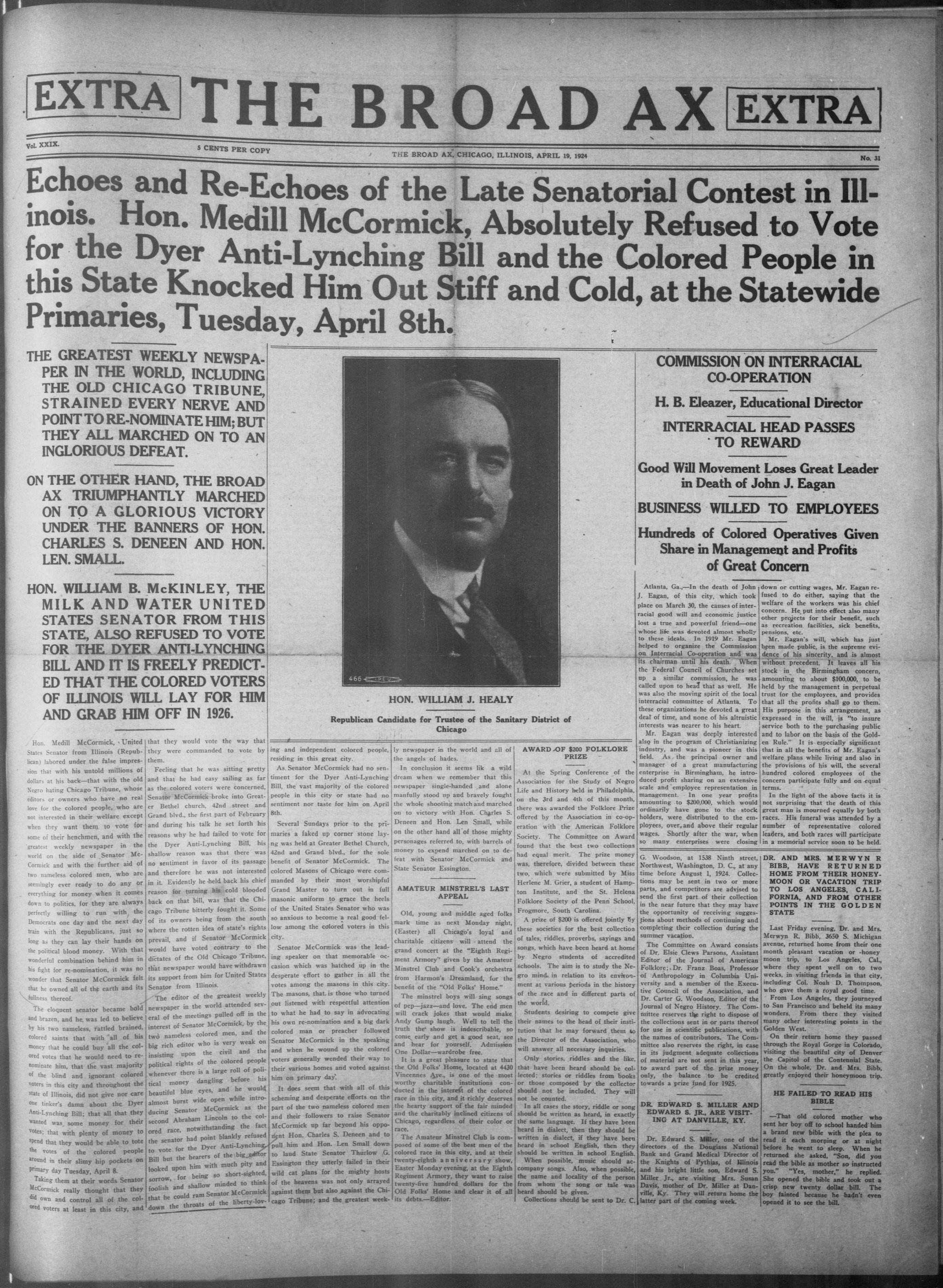
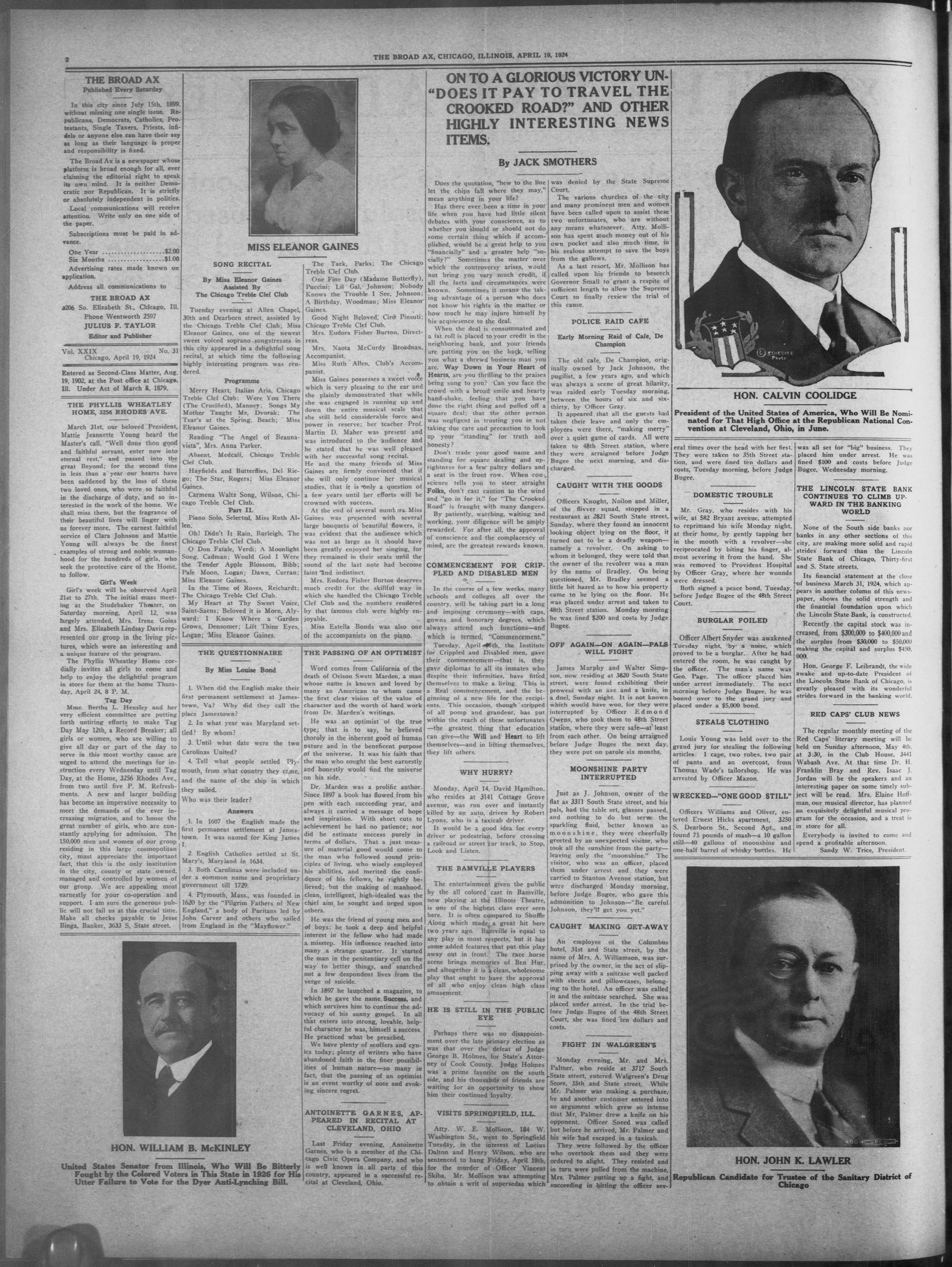
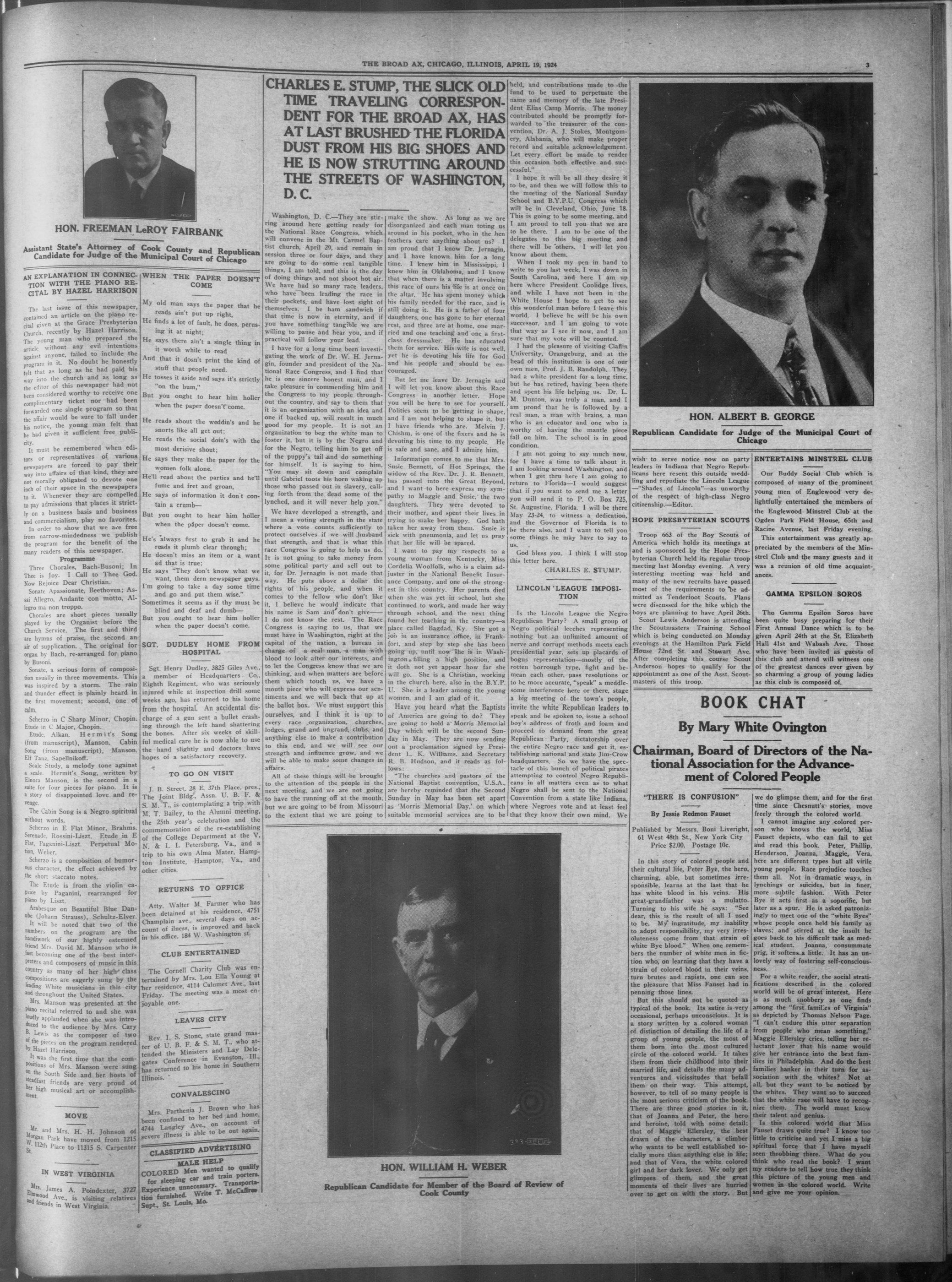
Page text (machine-generated)
EXTRA THE BROAD AX EXTRA
Echoes and Re-Echoes of the Late Senatorial Contest in Illinois. Hon. Medill McCormick, Absolutely Refused to Vote for the Dyer Anti-Lynching Bill and the Colored People in this State Knocked Him Out Stiff and Cold, at the Statewide Primaries, Tuesday, April 8th.
THE GREATEST WEEKLY NEWSPAPER IN THE WORLD, INCLUDING THE OLD CHICAGO TRIBUNE, STRAINED EVERY NERVE AND POINT TO RE-NOMINATE HIM; BUT THEY ALL MARCHED ON TO AN INGLORIOUS DEFEAT.
ON THE OTHER HAND, THE BROAD AX TRIUMPHANTLY MARCHED ON TO A GLORIOUS VICTORY UNDER THE BANNERS OF HON. CHARLES S. DENEEN AND HON. LEN. SMALL.
HON. WILLIAM B. McKINLEY, THE MILK AND WATER UNITED STATES SENATOR FROM THIS STATE, ALSO REFUSED TO VOTE FOR THE DYER ANTI-LYNCHING BILL AND IT IS FREELY PREDICTED THAT THE COLORED VOTERS OF ILLINOIS WILL LAY FOR HIM AND GRAB HIM OFF IN 1926.
Hon. Medill McCormick, United States Senator from Illinois (Republican) labored under the false impression that with his untold millions of dollars at his back—that with the old Negro hating Chicago Tribune, whose editors or owners who have no real love for the colored people, who are not interested in their welfare except when they want them to vote for some of their henchmen, and with the greatest weekly newspaper in the world on the side of Senator McCormick and with the further aid of two nameless colored men, who are seemingly ever ready to do any or everything for money when it comes down to politics, for they are always perfectly willing to run with the Democrats one day and the next day train with the Republicans, just so long as they can lay their hands on the political blood money. With that wonderful combination behind him in his fight for re-nomination, it was no wonder that Senator McCormick felt that he owned all of the earth and its fullness thereof.
The eloquent senator became bold and brazen, and he, was led to believe by his two nameless, rattled brained, colored saints that with all of his money that he could buy all the colored votes that he would need to renominate him, that the vast majority of the blind and ignorant colored voters in this city and throughout the state of Illinois, did not give nor care one tinker's damn about the Dyer Anti-Lynching Bill; that all that they wanted was some money for their votes; that with plenty of money to spend that they would be able to tote the votes of the colored people around in their slimy hip pockets on primary day Tuesday, April 8.
Taking them at their words Senator McCormick really thought that they did own and control all of the colored voters at least in this city, and
5 CENTS PER COPY
and Re-E-
on. Medi-
Oyer Ant-
e Knocke-
es, Tuesday
WEEKLY NEWSPA-
ORLD, INCLUDING
CAGO TRIBUNE,
EVERY NERVE AND
DOMINATE HIM; BUT
ARCHED ON TO AN
FEAT.
LAND, THE BROAD
ANTLY MARCHED
ORIOUS VICTORY
ANNERS OF HON.
EENEEN AND HON.
McKINLEY, THE
WATER UNITED
VOTOR FROM THIS
REFUSED TO VOTE
OR ANTI-LYNCHING
FREELY PREDICT-
COLORED VOTERS
ILL LAY FOR HIM
OFF IN 1926.
that they would vote the way that they were commanded to vote by them.
Feeling that he was sitting pretty and that he had easy sailing as far as the colored voters were concerned, Senator McCormick broke into Greater Bethel church, 42nd street and Grand blvd., the first part of February and during his talk he set forth his reasons why he had failed to vote for the Dyer Anti-Lynching Bill, his shallow reason was that there was no sentiment in favor of its passage and therefore he was not interested in it. Evidently he held back his chief reason for turning his cold blooded back on that bill, was that the Chicago Tribune bitterly fought it. Some of its owners being from the south where the rotten idea of state's rights prevail, and if Senator McCormick would have voted contrary to the dictates of the Old Chicago Tribune, that newspaper would have withdrawn its support from him for United States Senator from Illinois.
The editor of the greatest weekly newspaper in the world attended several of the meetings pulled off in the interest of Senator McCormick, by the two nameless colored men, and the big rich editor who is very weak on insisting upon the civil and the political rights of the colored people whenever there is a large roll of political money dangling before his beautiful blue eyes, and he would almost burst wide open while introducing Senator McCormick as the second Abraham Lincoln to the colored race, notwithstanding the fact the senator had point blankly refused to vote for the Dyer Anti-Lynching. Bill but the hearers of the big editor looked upon him with much pity and sorrow, for being so short-sighted, foolish and shallow minded to think that he could ram Senator McCormick down the throats of the liberty-lov-
down
466 BEU
ing and independent colored people, residing in this great city.
As. Senator McCormick had no sentiment for the Dyer Anti-Lynching Bill, the vast majority of the colored people in this city or state had no sentiment nor taste for him on April 8th.
Several Sundays prior to the primaries a faked up corner stone laying was held at Greater Bethel Church, 42nd and Grand blvd., for the sole benefit of Senator McCormick. The colored Masons of Chicago were commanded by their most worshipful Grand Master to turn out in full masonic uniform to grace the heels of the United States Senator who was so anxious to become a real good fellow among the colored voters in this city.
Senator McCormick was the leading speaker on that memorable occasion which was hatched up in the desperate effort to gather in all the votes among the masons in this city. The masons, that, is those who turned out listened with respectful attention to what he had to say in advocating his own re-nomination and a big dark colored man or preacher followed Senator McCormick in the speaking and when he wound up the colored voters generally wended their way to their various homes and voted against him on primary day'.
It does seem that with all of this scheming and desperate efforts on the part of the two nameless colored men and their followers to raise Senator McCormick up far beyond his opponent Hon. Charles S. Deneen and to pull him and Hon. Len Small down to laud State Senator Thirlow G. Essington they utterly failed in their wild cat plans for the mighty hosts of the heavens was not only arrayed against them but also against the Chicago Tribune; and the greatest week
---
ly newspaper in the world and all of the angels of hades.
In conclusion it seems lik a wild dream when we remember that this newspaper single-handed and alone manfully stood up and bravely fought the whole shooting match and marched on to victory with Hon. Charles S. Deneen and Hon. Len Small, while on the other hand all of those mighty personages referred to, with barrels of money to expend marched on to defeat with Senator McCormick and State Senator Essington.
AMATEUR MINSTREL'S LAST
APPEAL
Old, young and middle aged folks mark time as next Monday night, (Easter) all Chicago's loyal and charitable citizens will attend the grand concert at the "Eighth Regiment Armory" given by the Amateur Stmrel Club and Cook's orchestra from Harmon's Dreamland, for the benefit of the "Old Folks' Home."
The minstrel boys will sing songs of pep—jazz—and love. The end men will crack jokes that would make Andy Gump laugh. Well to tell the truth the show is indescribable, so come early and get a good seat, see and hear for yourself. Admission One Dollar—wardrobe free.
It is a great pleasure to state that the Old Folks' Home, located at 4430 Vincennes Aye, is one of the most worthy charitable institutions conducted in the interest of the colored race in this city, and it richly deserves the hearty support of the fair minded and the charitably inclined citizens of Chicago, regardless of their color or race.
The Amateur Minstrel Club is composed of some of the best men of the colored race in this city, and at their twenty-eighth anniversary show, Easter Monday evening, at the Eighth Regiment Armory, they want to raise twenty-five hundred dollars for the Old Folks' Home and clear it of all its debts.-Editor
AWARD-OF $200 FOLKLORE
PRIZE
At the Spring Conference of the Association for the Study of Negro Life and History held in Philadelphia, on the 3rd and 4th of this month, there was awarded the Folklore Prize offered by the Association in co-operation with the American Folklore Society. The Committee on Award found that the best two collections had equal merit. The prize money was, therefore, divided between these two, which were submitted by Miss Herlene M. Grier, a student of Hampton Institute, and the St. Helena Folklore Society of the Penn School, Frogmore, South Carolina.
A prize of $200 is offered jointly by these societies for the best collection of tales, riddles, proverbs, sayings and songs, which have been heard at home by Negro students of accredited schools. The aim is to study the Negro mind, in relation to its environment at various periods in the history of the race and in different parts of the world.
Students desiring to compete give their names to the head of their institution that he may forward them to the Director of the Association, who will answer all necessary inquiries.
Only stories, riddles and the like that have been heard should be collected; stories or riddles from books or those composed by the collector should not be included. They will not be counted.
In all cases the story, riddle or song should be written as heard, in exactly the same language. If they have been heard in dialect, then they should be written in dialect, if they have been heard in school English, then they should be written in school English.
When possible, music should accompany songs. Also, when possible, the name and locality of the person from whom the song or tale was heard should be given.
Collections should be given.
COMMISSION ON INTERRACIAL CO-OPERATION
H. B. Eleazer, Educational Director
Good Will Movement Loses Great Leader in Death of John J. Eagan
BUSINESS WILLED TO EMPLOYEES
Hundreds of Colored Operatives Given Share in Management and Profits of Great Concern
Atlanta, Ga.,—In the death of John J. Eagan, of this city, which took place on March 30, the causes of interracial good will and economic justice lost a true and powerful friend—one whose life was devoted almost wholly to these ideals. In 1919 Mr. Eagan helped to organize the Commission on Interracial Co-operation and was its chairman until his death. When the Federal Council of Churches set up a similar commission, he was called upon to head that as well. He was also the moving spirit of the local interracial committee of Atlanta. To these organizations he devoted a great deal of time, and none of his altruistic interests was nearer to his heart.
down or cutting wages, Mr. Eagan refused to do either, saying that the welfare of the workers was his chief concern. He put into effect also many other projects for their benefit, such as recreation facilities, sick benefits, pensions, etc.
Mr. Eagan's will, which has just been made public, is the supreme evidence of his sincerity, and is almost without precedent. It leaves all his stock in the Birmingham concern, amounting to about $100,000, to be held by the management in perpetual trust for the employees, and provides that all the profits shall go to them. His purpose in this arrangement, as expressed in the will, is "to insure service both to the purchasing public
Mr. Eagan was deeply interested also in the program of Christianizing industry, and was a pioneer in this field. As the principal owner and manager of a great manufacturing enterprise in Birmingham, he introduced profit sharing on an extensive scale and employee representation in management. In one year profits amounting to $200,000, which would ordinarily have gone to the stock holders, were distributed to the employees, over, and above their regular wages. Shortly after the war, when so many enterprises were closing
G. Woodson, at 1538 Ninth street, Northwest, Washington, D. C., at any time before August 1, 1924. Collections may be sent in two or more parts, and competitors are advised to send the first part of their collection in the near future that they may have the opportunity of receiving suggestions about methods of continuing and completing their collection during the summer vacation.
The Committee on Award consists of Dr. Elsie Clews Parsons, Assistant Editor of the Journal of American Folklore; Dr. Franz Boas, Professor of Anthropology in Columbia University and a member of the Executive Council of the Association, and Dr. Carter G. Woodson, Editor of the Journal of Negro History. The Committee reserves the right to dispose of the collections sent in or parts thereof for use in scientific publications, with the names of contributors. The Committee also reserves the right, in case in its judgment adequate collections of material are not sent in this year, to award part of the prize money only, the balance to be credited towards a prize fund for 1925.
DR. EDWARD S. MILLER AND EDWARD S. JR., ARE VISITING AT DANVILLE, KY.
Dr. Edward S. Miller, one of the directors of the Douglass National Bank and Grand Medical Director of the Knights of Pythias, of Illinois and his bright little son, Edward S. Miller Jr., are visiting Mrs. Susan Davis, mother of Dr. Miller at Danville, Ky. They will return home the latter part of the coming week.
down or cutting wages, Mr. Eagan refused to do either, saying that the welfare of the workers was his chief concern. He put into effect also many other projects for their benefit, such as recreation facilities, sick benefits, pensions, etc.
Mr. Eagan's will, which has just been made public, is the supreme evidence of his sincerity, and is almost without precedent. It leaves all his stock in the Birmingham concern, amounting to about $100,000, to be held by the management in perpetual trust for the employees, and provides that all the profits shall go to them. His purpose in this arrangement, as expressed in the will, is "to insure service both to the purchasing public and to labor on the basis of the Golden Rule." It is especially significant that in all the benefits of Mr. Eagan's welfare plans while living and also in the provisions of his will, the several hundred colored employees of the concern participate fully and on equal terms.
In the light of the above facts it is not surprising that the death of this great man is mourned equally by both races. His funeral was attended by a number of representative colored leaders, and both races will participate in a memorial service soon to be held.
DR. AND MRS. MERWYN R BIBB, HAVE RETURNED HOME FROM THEIR HONEYMOON OR VACATION TRIP TO LOS ANGELES, CALIFORNIA, AND FROM OTHER POINTS IN THE GOLDEN STATE
Last Friday evening, Dr. and Mrs. Merwyn R. Bibb, 3650 S. Michigan avenue, returned home from their one month pleasant vacation or -honey moon trip, to Los Angeles, Cal., where they spent well on to two weeks, in visiting friends in that city, including Col. Noah D. Thompson, who gave them a royal good time.
From Los Angeles, they journeyed to San Francisco and beheld its many wonders. From there they visited many other interesting points in the Golden West.
On their return home they passed through the Royal Gorge in Colorado, visiting the beautiful city of Denver the Capitol of the Contennial State. On the whole, Dr. and Mrs. Bibb, greatly enjoyed their honeymoon trip.
—That old colored mother who sent her boy off to school handed him a brand new book with the plea to read it each morning or at night before he went to sleep. When he returned she asked, "Son, did you read the bible as mother so instructed you." "Yes, mother," he replied. She opened the bible and took out a crisp new twenty dollar bill. The boy fainted because he hadn't even opened it to see the bill.
THE BROAD AX
Published Every Saturday
In this city since July 15th, 1899, without missing one single issue. Republicans, Democrats, Catholics, Protestants, Single Taxers, Priests, infidels or anyone else can have their say as long as their language is proper and responsibility is fixed.
The Broad Ax is a newspaper whose platform is broad enough for all, ever claiming the editorial right to speak its own mind. It is neither Democratic nor Republican. It is strictly or absolutely independent in politics.
Local communications will receive attention. Write only on one side of the paper.
Subscriptions must be paid in advance.
Address all communications to
THE BROAD AX
s206 So. Elizabeth St., Chicago, Ill
Editor and Publisher
Entered as Second-Class Matter, Aug. 19, 1902, at the Post office at Chicago. Ill. Under Act of March 8, 1879.
THE PHYLLIIS WHEATLEY
HOME, 3256 RHODES AVE.
March 31st, our beloved President, Mattie Jeannette Young heard the Master's call, "Well done thou good and faithful servant, enter now into eternal rest," and passed into the great Beyond; for the second time in less than a year our hearts have been saddened by the loss of these two loved ones, who were so faithful in the discharge of duty, and so interested in the work of the home. We shall miss them, but the fragrance of their beautiful lives will linger with us forever more. The earnest faithful service of Clara Johnson and Mattie Young will always be the finest examples of strong and noble womanhood for the hundreds of girls, who seek the protective care of the Home, to follow.
Girl's Week
Girl's week will be observed April 21st to 27th. The initial mass meeting at the Studebaker Theater, on Saturday morning, April 12, was largely attended, Mrs. Irene Goins and Mrs. Elizabeth Lindsay Davis represented our group in the living pictures, which were an interesting and a unique feature of the program. The Phyllis Wheatley Home cordially invites all girls to come and help to enjoy the delightful program in store for them at the home Thursday, April 24, 8 P. M.
Mme. Bertha L. Hensley and her very efficient committee are putting forth untiring efforts to make Tag Day May 12th, a Record Breaker; all girls or women, who are willing to give all day or part of the day to serve in this most worthy cause are urged to attend the meetings for instruction every Wednesday until Tag Day, at the Home, 3256 Rhodes Ave., from two until five P. M. Refreshments. A new and larger building has become an imperative necessity to meet the demands of the ever increasing migration, and to house the great number of girls, who are constantly applying for admission. The 150,000 men and women of our group residing in this large cosmopolitan city, must appreciate the important fact, that this is the only institution in the city, county or state owned, managed and controlled by women of our group. We are appealing most earnestly for your co-operation and support. I am sure the generous public will not fail us at this crucial time. Make all checks payable to Jesse Binga, Banker, 3633 S, State street.
[Picture of a man in a suit and tie].
HON. WILLIAM B. McKINLEY United States Senator from Illinois, Who Will Be Bitterly Fought by the Colored Voters in This State in 1926 for His Utter Failure to Vote for the Dyer Anti-Lynching Bill.
Tag Day
SONG RECITAL
The Chicago Treble Clef Club
Tuesday evening at Allen Chapel 30th and Dearborn street, assisted by the Chicago Treble Clef Club; Miss Eleanor Gaines, one of the newest sweet voiced soprano-songstresses in this city appeared in a delightful song recital, at which time the following highly interesting program was rendered.
Programme
Merry Heart, Italian Aria, Chicago Treble Clef Club; Were You There (The Crucified), Manney; Songs My Mother Taught Me, Dvorak; The Tear's at the Spring, Beach; Miss Eleanor Gaines.
Reading "The Angel of Beauna-vista", Mrs. Anna Parker.
Absent, Medcalf, Chicago Treble Clef Club.
Hayfields and Butterflies, Del Riego; The Star, Rogers; Miss Eleanor Gaines.
Carmena Waltz Song, Wilson, Chicago Treble Clef Club.
**Part II.**
Piano Solo, Selected, Miss Ruth Allen.
Oh! Didn't It Rain, Burleigh, The Chicago Treble Clef Club.
O Don Fatale, Verdi; A Moonlight Song, Cadman; Would God I Were the Tender Apple Blossom, Bibb; Pale Moon, Logan; Dawn, Curran; Miss Eleanor Gaines.
In the Time of Roses, Reichardt; The Chicago Treble Clef Club.
My Heart at Thy Sweet Voice, Saint-Saens; Beloved it is Morn, Alyward; I Know Where a Garden Grows, Densomer; Lift Thine Eyes, Logan; Miss Eleanor Gaines.
THE QUESTIONNAIRE
By Miss Louise Bond
1. When did the English make their first permanent settlement at Jamestown, Va? Why did they call the place Jamestown?
2. In what year was Maryland settled? By whom?
3. Until what date were the two Carolinas United?
4. Tell what people settled Plymouth, from what country they came, and the name of the ship in which they sailed.
Who was their leader?
Answers
1. In 1607 the English made the first permanent settlement at Jamestown. It was named for King James I.
2. English Catholics settled at St Mary's, Maryland in 1634.
3. Both Carolinas were included under a common name and proprietary government till 1729.
4. Plymouth, Mass., was founded in 1620 by the "Pilgrim Fathers of New England," a body of Puritans led by John Carver and others who sailed from England in the "Mayflower."
MISS ELEANOR GAINES
Programme
The Tack, Parks; The Chicago Treble Clef Club.
One Fine Day (Madame Butterfly);
Puccini; Lil Gal, Johnson; Nobody Knows the Trouble I See, Johnson; A Birthday, Woodman; Miss Eleanor Gaines.
Good Night Beloved, Ciro Pinsuti; Chicago Treble Clef Club.
Mrs. Eudora Fisher Burton, Directress.
Mrs. Naota McCurdy Broadnax Accompanist.
Miss Ruth Allen, Club's Accompanist.
Miss Gaines possesses a sweet voice which is very pleasing to the ear and she plainly demonstrated that while she was engaged in running up and down the entire musical scale that she still held considerable force and power in reserve; her teacher Prof. Martin D. Maher was present and was introduced to the audience and he stated that he was well pleased with her successful song recital. He and the many friends of Miss Gaines are firmly convinced that if she will only continue her musical studies, that it is only a question of a few years until her efforts will be crowned with success.
At the end of several numbers Miss Gaines was presented with several large bouquets of beautiful flowers, it was evident that the audience which was not as large as it should have been greatly enjoyed her singing, for they remained in their seats until the sound of the last note had become faint and indistinct.
Mrs. Eudora Fisher Burton deserves much credit for the skillful way in which she handled the Chicago Treble Clet Club and the numbers rendered by that famous club were highly enjoyable.
Miss Estella Bonds was also one of the accompanists on the piano.
THE PASSING OF AN OPTIMIST
Word comes from California of the death of Orison Swett Marden, a man whose name is known and loved by many an American to whom came the first clear vision of the value of character and the worth of hard work from Dr. Marden's writings.
He was an optimist of the true type; that is to say, he believed thoroly in the inherent good of human nature and in the beneficent purpose of the universe. It was his faith that the man who sought the best earnestly and honestly would find the universe on his side.
Dr. Marden was a prolific author. Since 1897 a book has flowed from his pen with each succeeding year, and always it carried a message of hope and inspiration. With short cuts to achievement he had no patience; nor did he estimate success purely in terms of dollars. That a just measure of material good would come to the man who followed sound principles of living, who wisely employed his abilities, and merited the confidence of his fellows, he rightly believed; but the making of manhood, clean, intelligent, high-idealed was the chief aim, he sought and urged upon others.
He was the friend of young men and of boys; he took a deep and helpful interest in the fellow who had made a misstep. His influence reached into many a strange quarter. It started the man in the penitentiary cell on the way to better things, and snatched not a few despondent lives from the verge of suicide.
In 1897 he launched a magazine, to which he gave the name Success, and which survives him to continue the advocacy of his sunny gospel. In all that enters into strong, lovable, helpful character he was, himself a success. He practiced what he preached.
We have plenty of scoffers and cynics today; plenty of writers who have abandoned faith in the finer possibilities of human nature—so many in fact, that the passing of an optimist is an event worthy of note and evoking sincere regret.
ANTOINETTE GARNES, AP
PEARED IN RECITAL AT
CLEVELAND, OHIO
Last Friday evening, Antoinette Garnes, who is a member of the Chicago Civic Opera Company, and who is well known in all parts of this country, appeared in a successful recital at Cleveland, Ohio.
THE BROAD AX. CHICAGO, ILLINOIS, APRIL 19, 1924
ON TO A GLORIOUS VICTORY UNDOES IT PAY TO TRAVEL THE CROOKED ROAD?" AND OTHER HIGHLY INTERESTING NEWS ITEMS.
By JACK SMOTHERS
Does the quotation, "hew to the line let the chips fall where they may," mean anything in your life?
Has there ever been a time in your life when you have had little silent debates with your conscience, as to whether you should or should not do some certain thing which if accomplished, would be a great help to you "financially" and a greater help "socially?" Sometimes the matter over which the controversy arises, would not bring you very much credit, if all the facts and circumstances were known. Sometimes it means the taking advantage of a person who does not know his rights in the matter or how much he may injure himself by his acquiescence to the deal.
When the deal is consummated and a fat roll is placed to your credit in the neighboring bank, and your friends are patting you on the back, telling you what a shrewd business man you are Way Down in Your Heart of Hearts, are you thrilling to the praises being sung to you? Can you face the crowd with a broad smile and hearty hand-shake, feeling that you have done the right thing and pulled off a square deal; that the other person was negligent in trusting you in not taking due care and precaution to look up your "standing" for truth and honesty?
Don't trade your good name and standing for square dealing and uprightness for a few paltry dollars and a seat in the front row. When conscience tells you to steer straight Folks, don't cast caution to the wind and "go in for it," for "The Crooked Road" is fraught with many dangers. By patiently, watching, waiting and working, your diligence will be amply rewarded. For after all, the approval of conscience and the complacency of mind, are the greatest rewards known.
COMMENCEMENT FOR CRIPPED AND DISABLED MEN
In the course of a few weeks, many schools and colleges all over the country, will be taking part in a long and imposing ceremony—with caps, gowns and honorary degrees, which always attend such functions—and which is termed, "Commencement."
Tuesday, April 10th, the Institute for Crippled and Disabled men, gave their commencement—that is, they gave diplomas to all its inmates who despite their infirmities, have fitted themselves to make a living. This is a Real commencement, and the beginning of a new life for the recipients. This occasion, though stripped of all pomp and grandeur, has put within the reach of these unfortunate—the greatest thing that education can give—the Will and Heart to lift themselves—and in lifting themselves, they lift others.
Monday, April 14, David Hamilton, who resides at 3141 Cottage Grove avenue, was run over and instantly killed by an auto, driven by Robert Lyons, who is a taxicab driver. It would be a good idea for every driver or pedestrian, before crossing a railroad or street car track, to Stop, Look and Listen.
THE BAMVILLE PLAYERS
The entertainment given the public by the all colored cast in Bamville, now playing at the Illinois Theatre, is one of the highest class ever seen here. It is often compared to Shuffle Along which made a great hit here two years ago. Bamville is equal to any play in most respects, but it has some added features that put this play away out in front. The race horse scene brings memories of Ben Hur, and altogether it is a clean, wholesome play that ought to have the approval of all who enjoy clean high class amusement.
HE IS STILL IN THE PUBLIC
EYE
Perhaps there was no disappointment over the late primary election as was that over the defeat of Judge George B. Holmes, for State's Attorney of Cook County. Judge Holmes was a prime favorite on the south side, and his thousands of friends are waiting for an opportunity to show him their continued loyalty.
VISITS SPRINGFIELD, ILL.
Atty. W. E. Mollison, 184 W. Washington St., went to Springfield Tuesday, in the interest of Lucius Dalton and Henry Wilson, who are sentenced to hang Friday, April 18th, for the murder of Officer Vincent Skiba. Mr. Mollison was attempting to obtain a writ of supersedes which
WHY HURRY?
was denied by the State Supreme Court.
The various churches of the city and many prominent men and women have been called upon to assist these two unfortunates, who are without any means whatsoever. Atty. Mollison has spent much money out of his own pocket and also much time, in his zealous attempt to save the boys from the gallows.
As a last resort, Mr. Mollison has called upon his friends to beseech Governor Small to grant a respite of sufficient length to allow the Supreme Court to finally review the trial of this cause.
POLICE RAID CAFE
Early Morning Raid of Cafe, De Champion
The old cafe, De Champion, originally owned by Jack Johnson, the pugilist, a few years ago, and which was always a scene of great hilarity, was raided early Tuesday morning, between the hours of six and six-thirty, by Officer Gray. It appeared that all the guests had taken their leave and only the employees were there, "making merry" over a quiet game of cards. All were taken to 48th Street station, where they were arraigned before Judge Bugeen the next morning, and discharged.
CAUGHT WITH THE GOODS
Officers Knoght, Noilon and Miller, of the flivver squad, stopped in a restaurant at 2821 South State street, Sunday, where they found an innocent looking object lying on the floor, it turned out to be a deadly weapon—namely a revolver. On asking to whom it belonged, they were told that the owner of the revolver was a man by the name of Bradley. On being questioned, Mr. Bradley seemed a little bit hazed as to how his property came to be lying on the floor. He was placed under arrest and taken to 48th Street station. Monday morning he was fined $200 and costs by Judge Bugee.
OFF AGAIN-ON AGAIN-PALS
WILL FIGHT
James Murphy and Walter Simpson, now residing at 3820 South State street, were found exhibiting their prowess with an axe and a knife, in a duel, Sunday night. It is not known which would have won, for they were interrupted by Officer Edmond Owens, who took them to 48th Street station, where they were safe—at least from each other. On being arraigned before Judge Buge the next day, they were put on parole six months.
MOONSHINE PARTY
INTERRUPTED
Just as J. Johnson, owner of the flat as 3311 South State street, and his pals, had the table set, glasses passed, and nothing to do but serve the sparkling fluid, better known as moonshine, they were cheerfully greeted by an unexpected visitor, who took all the sunshine from the party—leaving only the "moonshine." The visitor, who was an officer, placed them under arrest and they were carried to Stanton Avenue station, but were discharged Monday morning, before Judge Bugee, who gave this admonition to Johnson—"Be careful Johnson, they'll get you yet."
CAUGHT MAKING GET-AWAY
An employee of the Columbus hotel, 31st and State street, by the name of Mrs. A. Williamson, was surprised by the owner, in the act of slipping away with a suitcase well packed with sheets and pillowcases, belonging to the hotel. An officer was called in and the suitcase searched. She was placed under arrest. In the trial before Judge Bugee of the 48th Street Court, she was fined ten dollars and costs.
FIGHT IN WALGREEN'S
Monday evening, Mr. and Mrs. Palmer, who reside at 3717 South State street, entered Walgreen's Drug Store, 35th and State street. While Mr. Palmer was making a purchase, he and another customer entered into an argument which grew so intense that Mr. Palmer drew a knife on his opponent. Officer Sneed was called but before he arrived, Mr. Palmer and his wife had escaped in a taxicab. They were followed by the officer who overtook them and they were ordered to alight. They resisted and in turn were pulled from the machine, Mrs. Palmer putting up a fight, and succeeding in hitting the officer sev-
SCHERVE
Photo
HON. CALVIN COOLIDGE
President of the United States nated for That High Office event at Cleveland, Ohio
President of the United States of America, Who Will Be Nominated for That High Office at the Republican National Convention at Cleveland, Ohio, in June.
eral times over the head with her first. They were taken to 35th Street station, and were fined ten dollars and costs, Tuesday morning, before Judge Bugee.
was all set for "big" business. They placed him under arrest. He was fined $100 and costs before Judge Bugee, Wednesday morning.
DOMESTIC TROUBLE
Mr. Gray, who resides with his wife, at 582 Bryant avenue, attempted to reprimand his wife Monday night, at their home, by gently tapping her in the mouth with a revolver—she reciprocated by biting his finger, almost severing it from the hand. She was removed to Provident Hospital by Officer Gray, where her wounds were dressed.
Both signed a peace bond. Tuesday, before Judge Bugge of the 48th Street Court.
BURGLAR FOILED
Officer Albert Snyder was awakened Tuesday night, by a noise, which proved to be a burglar. After he had entered the room, he was caught by the officer. The man's name was Geo. Page. The officer placed him under arrest immediately. The next morning before Judge Buge, he was bound over to the grand jury and placed under a $5,000 bond.
STEALS CLOTHING
Louis Young was held over to the grand jury for stealing the following articles: I cape, two robes, two pair of pants and an overcoat, from Thomas Wade's tailorshop. He was arrested by Officer Mazon.
WRECKED—"ONE GOOD STILL"
Officers Williams and Oliver, entered Ernest Hicks apartment, 3250 S. Dearborn St, Second Apt, and found 75 pounds of mash—a 10 gallon still—40 gallons of moonshine and one-half barrel of whisky bottles. He
```markdown
```
495
HON. JOHN K. LAWLER
Republican Candidate for Trustee of the San
Chicago
Republican Candidate for Trustee of the Sanitary District of Chicago
of America, Who Will Be Nomi-
at the Republican National Con-
in June.
was all set for "big" business. They
placed him under arrest. He was
fined $100 and costs before Judge
Bugee, Wednesday morning.
THE LINCOLN STATE BANK
CONTINUES TO CLIMB UP-
WARD IN THE BANKING
None of the South side banks nor banks in any other sections of this city, are making more solid and rapid strides forward than the Lincoln State Bank of Chicago, Thirty-first and S. State streets.
Its financial statement at the close of business March 31, 1924, which appears in another column of this newspaper, shows the solid strength and the financial foundation upon which the Lincoln State Bank, is constructed.
Recently the capital stock was increased, from $300,000 to $400,000 and the surplus from $30,000 to $50,000 making the capital and surplus $450,000.
Hon. George F. Leibrandt, the wide awake and up-to-date President of the Lincoln State Bank of Chicago, is greatly pleased with its wonderful strides forward in the banking world.
RED CAPS' CLUB NEWS
The regular monthly meeting of the Red Caps' literary meeting will be held on Sunday afternoon, May 4th, at 3:30, in the Club House, 3441 Wabash Ave. At that time Dr. H. Franklin Bray and Rev. Isaac J. Jordan will be the speakers and an interesting paper on some timely subject will be read. Mrs. Elaine Hoffman, our musical director, has planned an exquisitely delightful musical program for the occasion, and a treat is in store for all.
Everybody is invited to come and spend a profitable afternoon.
Sandy W. Trice, President.
466 BEU
tee of the Sanitary District of Chicago
M. J. ZINC
HON. FREEMAN LeROY FAIRBANK
Assistant State's Attorney of Cook County and Republican Candidate for Judge of the Municipal Court of Chicago AN EXPLANATION IN CONNECTION WITH THE PIANO RECITAL BY HAZEL HARRISON WHEN THE PAPER DOESN'T COME
The last issue of this newspaper, contained an article on the piano recital given at the Grace Presbyterian Church, recently by Hazel Harrison. The young man who prepared the article without any evil intentions against anyone, failed to include the program in it. No doubt he honestly felt that as long as he had paid his way into the church and as long as the editor of this newspaper had not been considered worthy to receive one complimentary ticket nor had been forwarded one single program so that the affair would be sure to fall under his notice, the young man felt that he had given it sufficient free publicity.
It must be remembered when editors or representatives of various newspapers are forced to pay their way into affairs of that kind, they are not morally obligated to devote one inch of their space in the newspapers to it. Whenever they are compelled to pay admissions that places it strictly on a business basis and business and commercialism, play no favorites. In order to show that we are free from narrow-mindedness we publish the program for the benefit of the many readers of this newspaper.
Programme
Three Chorales, Bach-Busoni; In Thee is Joy. I Call to Thee God. Now Rejoice Dear Christian.
Sonate Apassionate, Beethoven; Assai Allegro, Andante con motto, Allegro ma non troppo.
Chorales are short pieces usually played by the Organist before the Church Service. The first and third are hymns of praise, the second an air of supplication. The original for organ by Bach, re-arranged for piano by Busoni.
Sonate, a serious form of composition usually in three movements. This was inspired by a storm. The rain and thunder effect is plainly heard in the first movement; second, one of calm.
Scherzo in C Sharp Minor, Chopin.
Etude in C Major, Chopin.
Etude, Alkan, Hermit's Song (from manuscript), Manson, Cabin Song (from manuscript), Manson, Elf Tanz, Sapellinikoff.
Scale Study, a melody tone against a scale. Hermit's Song, written by Elnora Manson, is the second in a suite for four pieces for piano. It is a story of disappointed love and revenge.
The Cabin Song is a Negro spiritual without words.
Scherzo in E Flat Minor, Brahms.
Serenade, Rossini-Liszt. Etude in E Flat, Paganini-Liszt. Perpetual Motion, Weber.
Scherzo is a composition of humorous character, the effect achieved by the short staccato notes.
The Etude is from the violin caprice by Paganini, rearranged for piano by Liszt.
Arabesque on Beautiful Blue Danube (Johann Strauss), Schultz-Elver. It will be noted that two of the numbers on the program are the handwork of our highly esteemed friend Mrs. David M. Manson who is fast becoming one of the best interpreters and composers of music in this country as many of her high class compositions are eagerly sung by the leading White musicians in this city and throughout the United States.
Mrs. Manson was presented at the piano recital referred to and she was loudly applauded when she was introduced to the audience by Mrs. Cary B. Lewis as the composer of two of the pieces on the program rendered by Hazel Harrison
It was the first time that the compositions of Mrs. Manson were sung on the South Side and her hosts of steadfast friends are very proud of her high musical art or accomplishment.
Mr. and Mrs. H. H. Johnson of Morgan Park have moved from 1215 W. 112th Place to 11315 S. Carpenter St.
IN WEST VIRGINIA
Mrs. James A. Poindexter, 3727 Elmwood Ave., is visiting relatives and friends in West Virginia.
Programme
MOVE
LEROY FAIRBANK
Cook County and Republican Municipal Court of Chicago
WHEN THE PAPER DOESN'T COME
My old man says the paper that he reads ain't put up right,
He says there ain't a single thing in it worth while to read
And that it doesn't print the kind of stuff that people need.
He tosses it aside and says it's strictly "on the bum,"
But you ought to hear him holler when the paper doesn't come.
He reads about the weddin's and he snorts like all get out;
He reads the social doin's with the most derisive shout;
He says they make the paper for the women folk alone.
He'll read about the parties and he'll fume and fret and groan.
He says of information it don't contain a crumb—
But you ought to hear him holler when the paper doesn't come.
He's always first to grab it and he reads it plumb clear through;
He doesn't miss an item or a want ad that is true;
He says "They don't know what we want, them dern newspaper guys.
I'm going to take a day some time and go and put them wise."
Sometimes it seems as if thy must be blind and deaf and dumb—
But you ought to hear him holler when the paper doesn't come.
SGT. DUDLEY HOME FROM HOSPITAL
Sgt. Henry Dudley, 3825 Giles Ave., a member of Headquarters Co. Eighth Regiment, who was seriously injured while at inspection drill some weeks ago, has returned to his home from the hospital. An accidental discharge of a gun sent a bullet crashing through the left hand shattering the bones. After six weeks of skillful medical care he is now able to use the hand slightly and doctors have hopes of a satisfactory recovery.
TO GO ON VISIT
J. B. Street, 28 E. 37th Place, pres,
The Joint Bldg., Assn. U. B. F. &
S. M. T., is contemplating a trip with
M. T. Bailey, to the Alumni meeting,
the 25th year's celebration and the
commemoration of the re-establishing of
the College Department at the V.
N. & I. I. Petersburg, Va., and a
a trip to his own Alma Mater, Hampton
Institute, Hampton, Va., and
other cities.
RETURNS TO OFFICE
Atty. Walter M. Farmer who has been detained at his residence, 4751 Champlain ave., several days on account of illness, is improved and back in his office, 184 W. Washington st.
CLUB ENTERTAINED
The Cornell Charity Club was entertained by Mrs. Lou Ella Young at her residence, 4114 Calumet Ave., last Friday. The meeting was a most enjoyable one.
Rev. I. S. Stone, state grand master of U. B. F. & S. M. T., who attended the Ministers and Lay Delegates Conference in Evanston, III. has returned to his home in Southern Illinois.
CONVALESCING
Mrs. Parthenia J. Brown who has been confined to her bed and home, 4744 Langley Ave., on account of severe illness is able to be out again.
CLASSIFIED ADVERTISING
MALE HELP
COLORED Men wanted to qualify
for sleeping car and train portera.
Experience unnecessary. Transportation furnished. Write T. McCaffre
Supt., St. Louis, Mo.
LEAVES CITY
CHARLES E. STUMP, THE SLICK OLD TIME TRAVELING CORRESPONDENT FOR THE BROAD AX, HAS AT LAST BRUSHED THE FLORIDA DUST FROM HIS BIG SHOES AND HE IS NOW STRUTTING AROUND THE STREETS OF WASHINGTON, D.C.
323
Republican Candidate for Member of the Board of Review of Cook County
Washington, D. C.—They are stirring around here getting ready for the National Race Congress, which will convene in the Mt. Carmel Baptist church, April 29, and remain in session three or four days, and they are going to do some real tangible things. I am told, and this is the day of doing things and not shoot hot air. We have had so many race leaders, who have been leading the race in their pockets, and have lost sight of themselves. I be ham sandwich if that time is now in eternity, and if you have something tangible we are willing to pause and hear you, and if practical will follow your lead.
I have for a long time been investigating the work of Dr. W. H. Jernagin, founder and president of the National Race Congress, and I find that he is one sincere honest man, and I take pleasure in commending him and the Congress to my people throughout the country, and say to them that it is an organization with an idea and one if backed up, will result in much good for my people. It is not an organization to beg the white man to foster it, but it is by the Negro and for the Negro, telling him to get off of the puppy's tail and do something for himself. It is saying to him, "You may sit down and complain until Gabriel tots his horn waking up those who passed out in slavery, calling forth from the dead some of the lynched, and it will never help you."
We have developed a strength, and I mean a voting strength in the state where a vote counts sufficiently to protect ourselves if we will husband that strength, and that is what this race Congress is going to help us do. It is not going to take money from some political party and sell out to it, for Dr. Jernagin is not made that way. He puts above a dollar the rights of his people, and when it comes to the fellow who don't like it, I believe he would indicate that his name is Sam and don't give——I do not know the rest. The Race Congress is saying to us, that we must have in Washington, right at the capital of the nation, a bureau in charge of a real-man, a man with blood to look after our interests, and to let the Congress know that we are thinking, and when matters are before them which touch us, we have a mouth piece who will express our sentiments and we will back that up at the ballot box. We must support this ourselves, and I think it is up to every race organization, churches, lodges, grand and ungrand, clubs, and anything else to make a contribution to this end, and we will see our strength and influence grow, and we will be able to make some changes in affairs.
All of these things will be brought to the attention of the people in the next meeting, and we are not going to have the running off at the mouth, but we are going to be from Missouri to the extent that we are going to
THE BROAD AX, CHICAGO, ILLINOIS, APRIL 19. 1924
make the show. As long as we are disorganized and each man toting us around in his pocket, who in the heathen feathers care anything about us? I am proud that I know Dr. Jernagin, and I have known him for a long time. I knew him in Mississippi. I knew him in Oklahoma, and I know that when there is a matter involving this race of ours his life is at once on the altar. He has spent money which his family needed for the race, and is still doing it. He is a father of four daughters, one has gone to her eternal rest, and three are at home, one married and one teaching and one a first-class dressmaker. He has educated them for service. His wife is not well yet he is devoting his life for God and his people and should be encouraged.
But let me leave Dr. Jernagin and I will let you know about this Race Congress in another letter. Hope you will be here to see for yourself. Politics seem to be getting in shape, and I am not helping to shape it, but I have friends who are. Melvin J. Chishm, is one of the fixers and he is devoting his time to my people. He is safe and sane, and I admire him. Information comes to me that Mrs. Susie Bennett, of Hot Springs, the widow of the Rev. Dr. J. R. Bennett, has passed into the Great Beyond, and I want to here express my sympathy to Maggie and Susie; the two daughters. They were devoted to their mother, and spent their lives in trying to make her happy. God hath taken her away from them. Susie is sick with pneumonia, and let us pray that her life will be spared.
I want to pay my respects to a young woman from Kentucky, Miss Cordelia Woolfolk, who is a claim adjuster in the National Benefit Insurance Company, and one of the strongest in this country. Her parents died when she was yet in school, but she continued to work, and made her way through school, and the next thing found her teaching in the country—a place called Bagdad, Ky. She got a job in an insurance office, in Frankfort, and step by step she has been going up, until now she is in Washington filling a high position, and it doth not yet appear how far she will go. She is a Christian, working in the church here, also in the B.Y.P. U. She is a leader among the young women, and I am glad of it.
Have you heard what the Baptists of America are going to do? They are going to hold a Morris Memorial Day which will be the second Sunday in May. They are now sending out a proclamation signed by President L. K. Williams, and Secretary R. B. Hudson, and it reads as follows:
"The churches and pastors of the National Baptist convention, U.S.A. are hereby reminded that the Second Sunday in May has been set apart as 'Morris Memorial Day,' on which suitable memorial services are to be
M. H.
HON. WILLIAM H. WEBER
Candidate for Member of the Board
Cook County
held, and contributions made to the fund to be used to perpetuate the name and memory of the late President Elias Camp Morris. The money contributed should be promptly forwarded to the treasurer of the convention, Dr. A. J. Stokes, Montgomery, Alabama, who will make proper record and suitable acknowledgement. Let every effort be made to render this occasion both effective and successful."
I hope it will be all they desire it to be, and then we will follow this to the meeting of the National Sunday School and B.Y.P.U. Congress which will be in Cleveland, Ohio, June 18. This is going to be some meeting, and I am proud to tell you that we are to be there. I am to be one of the delegates to this big meeting and there will be others. I will let you know about them.
When I took my pen in hand to write to you last week, I was down in South Carolina, and here I am up here where President Coolidge lives, and while I have not been in the White House I hope to get to see this wonderful man before I leave this world. I believe he will be his own successor, and I am going to vote that way as I see it now, and I am sure that my vote will be counted.
I had the pleasure of visiting Claflin University, Orangeburg, and at the head of this institution is one of our own men, Prof. J. B. Randolph. They had a white president for a long time, but he has retired, having been there and spent his life helping us. Dr. L. M. Dunton, was truly a man, and I am proud that he is followed by a real man, a man with brains, a man who is an educator and one who is worthy of having the mantle piece fall on him. The school is in good condition.
I am not going to say much now, for I have a time to talk about it. I am looking around Washington, and when I get thru here I am going to return to Florida—I would suggest that if you want to send me a letter you will send it to P. O. Box 725, St. Augustine, Florida. I will be there May 23-24, to witness a dedication, and the Governor of Florida is to be there also, and I want to tell you some things he may have to say to us.
God bless you. I think I will stop this letter here.
CHARLES E. STUMP.
LINCOLN LEAGUE IMPOSITION
Is the Lincoln League the Negro Republican Party? A small group of Negro political leeches representing nothing but an unlimited amount of nerve and corrupt methods meets each presidential year, sets up placards of bogus representation—mostly of the rotten borough type, fight and bemean each other, pass resolutions or to be more accurate, "speak" a meddle-some interference here or there, stage a big meeting of the town's people, invite the white Republican leaders to speak and be spoken to, issue a school boy's address of froth and foam and proceed to demand from the great Republican Party, dictatorship over the entire Negro race and get it, establishing national and state Jim-Crow headquarters. So we have the spectacle of this bunch of political pirates attempting to control Negro Republicans in all matters even as to what Negro shall be sent to the National Convention from a state like Indiana, where Negroes vote and at least feel that they know their own mind. We
[Name]
HON. ALBERT B. GEORGE
Republican Candidate for Judge of the Municipal Court of Chicago
wish to serve notice now on party leaders in Indiana that Negro Republicans here resent this outside meddling and repudiate the Lincoln League —"Shades of Lincoln"—as unworthy of the respect of high-class Negro citizenship.—Editor.
ENTERTAINS MINSTREL CLUB
Our Buddy Social Club which is composed of many of the prominent young men of Englewood very delightfully entertained the members of
HOPE PRESBYTERIAN SCOUTS
Troop 663 of the Boy Scouts of America which holds its meetings at and is sponsored by the Hope Presbyterian Church held its regular troop meeting last Monday evening. A very interesting meeting was held and many of the new recruits have passed most of the requirements to be admitted as Tenderfoot Scouts. Plans were discussed for the hike which the boys are planning to have April 26th. Scout Lewis Anderson is attending the Scoutmasters Training School which is being conducted on Monday evenings at the Hamilton Park Field House 72nd St. and Stewart Ave. After completing this course Scout Anderson hopes to qualify for the appointment as one of the Asst. Scoutmasters of this troop.
By Mary White Ovington
Chairman, Board of tional Association ment of Col
Chairman, Board of Directors of the National Association for the Advancement of Colored People
"THERE IS CONFUSION"
Published by Messrs. Boni Liveright, 61 West 48th St., New York City Price $2.00. Postage 10c.
In this story of colored people and their cultural life, Peter Bye, the hero, charming, able, but sometimes irresponsible, learns at the last that he has white blood in his veins. His great-grandfather was a mulatto. Turning to his wife he says: "See dear, this is the result of all I used to be. My ingratitude, my inability to adopt responsibility, my very irresoluteness come from that strain of white Bye blood." When one remembers the number of white men in fiction who, on learning that they have a strain of colored blood in their veins, turn brutes and rapists, one can see the pleasure that Miss Fauset had in penning those lines.
But this should not be quoted as typical of the book. Its satire is very occasional, perhaps unconscious. It is a story written by a colored woman of distinction of detailing the life of a group of young people, the most of them born into the most cultured circle of the colored world. It takes them from their childhood into their married life, and details the many adventures and vicissitudes that befall them on their way. This attempt, however, to tell of so many people is the most serious criticism of the book. There are three good stories in it, that of Joanna and Peter, the hero and heroine, told with some detail, that of Maggie Ellersley, the best drawn of the characters, a climber who wants to be well established socially more than anything else in life; and that of Vera, the white colored girl and her dark lover. We only get glimpses of them, and the great moments of their lives are hurried over to get on with the story. But
---
ENTERTAINS MINSTREL CLUB
Our Buddy Social Club which is composed of many of the prominent young men of Englewood very delightfully entertained the members of the Englewood Minstrel Club at the Ogden Park Field House, 65th and Racine Avenue, last Friday evening. This entertainment was greatly appreciated by the members of the Minstrel Club and the many guests and it was a reunion of old time acquaintances.
GAMMA EPSILON SOROS
The Gamma Epsilon Soros have been quite busy preparing for their First Annual Dance which is to be given April 24th at the St. Elizabeth Hall 41st and Wabash Ave. Those who have been invited as guests of this club and attend will witness one of the greatest dances ever given by so charming a group of young ladies as this club is composed of.
Directors of the Na n for the Advance- lored People
we do glimpse them, and for the first time since Chesnutt's stories, move freely through the colored world.
I cannot imagine any colored person who knows the world, Miss Fauset depicts, who can fail to get and read this book. Peter, Phillip, Henderson, Joanna, Maggie, Vera, here are different types but all virile young people. Race prejudice touches them all. Not in dramatic ways, in lynchings or suicides, but in finer, more subtle fashion. With Peter Bye it acts first as a soporific, but later as a spur. He is asked patronizingly to meet one of the "white Byes" whose people once held his family as slaves; and stirred at the insult he goes back to his difficult task as medical student. Joanna, consummate prig, it softens a little. It has an unlovely way of fostering self-consciousness.
For a white reader, the social stratifications described in the colored world will be of great interest. Here is as much snobbery as one finds among the "first families of Virginia" as depicted by Thomas Nelson Page. "I can't endure this utter separation from people who mean something," Maggie Ellersley cries, telling her reluctant lover that his name would give her entrance into the best families in Philadelphia. And do the best families hanker in their turn for association with the whites? Not at all, but they want to be noticed by the whites. They want so to succeed that the white race will have to recognize them. The world must know their talent and genius.
Is this colored world that Miss Fauset draws quite true? I know too little to criticise and yet I miss a big spiritual force that I have myself seen throbbing there. What do you think who read the book? I want my readers to tell how true they think this picture of the young men and women in the colored world. Write and give me your opinion.
The Commonwealth Edison Company
72 W. ADAMS STREET
PHONE RANDOLPH 1280
ule following Electric Shops carry a fll lige of Electrical Ap
St te t RESOURCES: '
atemeni Loans and Discounts ..... .#1,764,223.65
Cina Seared i
Se ica: MEET
of Ported pcan UST
Se an at ser hae
eel aeeat
Condition deed 5, 5 aE
—-— LIABILITIES
Coola Seach sass. 8 annie
Sse eet
At the Renerved for Taxes and'in- 1
ose asia coc) HERR
Close of Serer oS gapmeneas
eet cs pod ocaapNONOOR
Business wens
‘The Bank tn at wel
is us Bee er dea
Mortgage Gold Bonds — approved
Ge toes ‘Wiinte tnvestmects =~ yield 1% tonerest.
Mort, Beale TST ME Tae a
ee
uteri wnat 6 scaod c
all savings accounts, Eariogs Depart-
eee Gee Ge eek oe
=
GEORGE ¥, LEIBRANDT, President
ean”, env ertdcat,
SEARS otuienis Gan
MAURICE tt WOLPE Asst Cashier
: ADDISON E. AVERY, Bist, Bool Deve,
+
‘ :
Beautiful Girl
Reveals Secret
Once: hair was anything but}
long and ky soft as it is now,
my complexion was sallow,
‘and there were often unsightly
pimples on my face.
One — T beard of Exelento
Quinine for the hair and
rg eg
purchaoad imme-
made my hair grow long, soft and
fine, and gave it a delightful
Because of the fect ‘won?
derful results I barter ee Ex-|
elento Quinine Pomade, I purchas-
‘ed a jarof Exelento Skin Beauti-
fer. Tt changed my sallow com-
plexion to a clear, lovely skin,
glowing with health. For pim-
— and other skin blemishes, it}
‘no equal,
If I am as beautiful as people
say, it is all due to Exelentoprep-
arations. Exelento Quinine Po-
made and Exelento Skin Beauti-
fier may be obtained for only 25¢
at saont dre stores, or will be
sent postpaid upon receipt of,
price by
EXELENTO MEDICINE CO., Atlanta, Ga.
AGENTS WANTED EVERTWHERE
Wek Far Partenas
‘ |W.G. Anderson
Attorney At Law
17 North La Salle Street
: CHICAGO
NOTARY PUBLIC
Suite 560 Watson Bldg.
= nate en
Se
Phone Douglas 6045
The Commonweali
72 W. ADA
PHONE RAN
ples UNTO Sas Fotern! Was
Hae. 86a
3 Boogewns
a Erle an.
Bes w.
NORTH SIDE
Oise Fetectee mee
oat Peon Ae
ee
eet
Nis ‘ai an
eee
aan
SE
Beet,
rr
‘een me Since a
Ste Brenceay
4.8. Gotitas & Sen,
Soe
. 1888 'N, Clark St.
ae
ee
a
3158 N. Clark St.
Sone
faa
fae
en
aces
eee
ieee
cecere
ae
G35) 25
ee
"4083 Breaduay
mast se
sens te
ieee
are Se
Sere
Re
Opa, aioe
oabe tae ae
"5y W. Madinn SE
=e tee
eng, Sects Aoptiane
Sree
Siaps oe, oe
Revealed
at Last!
C2
eauty
Of fecrers
ies pon
=
‘May Be Yours:
ics oe sf So
How to Be Beautiful and
Keep Youthful
tert k eee
Begin Today to Grow Younger— to
CR ee
See eee
ie
Sere ee
bist foe cnats postage’ Money beck if
Bot’ satiated. Edition atrictiy Umited.
kale
CLIO SCHOOL
a teen
New York City
Where Leprosy Started.
Leprosy bad its origin in Centra!
Africa and thence it spread to Asia.
‘The hordes of the army of Darius
brought -it to Burope and ‘it was
taken to the Americas as an accom-
paniment of negro slavery, according
@o a writer in the London Quarterly
Review.
‘A Young Wag.
Father was explaining a not unusual
winter sight “Yon see, my son, the
‘water in the river is so much warmer
than the alr that the vapor rises from
It” “1 guess," said Jobnny, “I'd be
warm, too, if Td run as far as that
river has."—Boston Transcript.
Hardly Believable.
No one would believe that there
was once as much excitement about
croquet as there is about mah jongg
—but there was.
Cost of Looking Pretty.
‘The annual cales of talcum powder,
cold cream, rouge, lipsticks and totlet
powder amount to $750,000,000, or:
‘about $15 for every woman in America.
of Electrical Ap
aie. “ott Rie.
Hien,
Se
eee,
Seat e
Sitee
(ete Pa
ee ae
iy ae
oo, ta ae
rats
Sy Wi ee ae
amare
SPE oe
cos
et. fe
ee SeP ran re
“=, Do
f Chicage Ave,
aoe.
orn
seen
page Tos
re oe
soe
ey Gare
eee
sourm sto
ont 8 Bw
oe
ee
ins es Be
e
ok, Domes
‘THE BROAD AX, CHICAGO, ILLINOIS, APRIL 19, 1924
aM ARS WEA
UE INR ANRC TAT ORY y Si NMI RS VES iN aay
BES et Tale AanAGe TRAIT E
WAGES ONE -
SOT TR RE OR
Ne ea se
pe ) a
R\ )) iV NE y bo a
\/ Wi), Sek” ,
\ Ke Ps x
iii Reasonable Prices, &< 4
DH rs.
i WV WO
ti bs | \ Sa
i We Hi Calls Promptly Answered ~~ Ni
i b AYE \ 7 5 Ch
DEE AIA, » aii
eB hee ii t sy
oie iy” a Ne aye? SS NB
ve Wea Pogo Vitec wg
4 BAe prea tein PA ys
eA iow en toads) Sa?
i LA se
7 @ NN
& —— : rE ~\
A > -
HIGH CLASS FLEET OF bry ry
Gimningham } fares
3 CARS FOR ALL OCCAISIONS a
KENWOOD 0455
5121-23-25. SOUTH STATE STREET :
Where Realization
Beats Anticipation
One of the most delightful experi-
‘ences that I know comes to me when-
ever I leave the city and~plunge for
‘a time Into the wilderness. It does
‘Rot matter how prosaic the transition ;
T may stumble, laden with baggage,
to a hot and crowded train, in which
stodgy men are forever bowed over
the sporting page and tired women are
scolding peevish children and scat-
tered fragments of their too generous
lunches cover the floor; the train may
snort and fume its tedious way
through leagues of suburban ugliness.
All that does not matter, I cam shut
my eyes with the sense of a blessed
release, for I know that at the end of
the journey there is tranquillity, writes
William Chase Greene in the North
American Review, Long before I have
actually reached the bills I can feel
the breath of the pine forest, I can
feel the coolness of that first dip in
the lake closing about me; already 1
am standing’ at the edge of a cliff,
watching the cloud shadows on the
distant range.
‘The peculiar delight of the adven-
ture, however, is that realization al-
‘ways surpasses anticipation. ‘That dlp
in the lake is always more deliciously
coo! than I had imagined; the still-
ness of the mountain side, the broken
chorus of bird notes, the hushed voice
of a hidden waterfall, the whiteness
of the forest flowers, always overcome
me with a new surprise. ‘Ihe very
sense of remoteness, though eagerly
expected, "seems unexpected.
Most Violent Storms
Occur in United States
‘The most violent storms known any-
where occur in the Interior of the
North American continent, especially
in the middle western United States,
and most frequently in late spring
and summer. Their most conspicuous
feature is a whirling black cloud hang-
ing from a mass of dark storm clouds.
‘This cloud may be funnel shaped
or balloon shaped, or lke the trunk
of a huge elephant, It is really a wa-
terspout on land, though larger than
the marine waterspout. It sweeps
over a’path averaging a quarter of a
mile in width and about twenty-five
miles in length. Wherever it touches
the earth it accomplishes surpassing
feats of devastation,
In comparison with the area cov-
ered by a cyclone one of these storms
is of insignificant size. It 1s, in fact,
@ purely local affair. Hence, at any
given place in the United States such
a storm is an exceedingly rare event,
though throughout the country several
such storms occur every year, These
storms are!known to meteorologists as
“tornadoes.” In popular parlance
they are almost universally, but in-
correctly described as “cyclones."—
Detroit News.
Memorabilia of Famous
Novelist Given Museum
All the memorabilia of George Sand,
which were inherited by the grand-
daughter of the great novelist, Aurore
Carnayalet museum.
Letters, manuscripts of novels and
numerous articles of extrinsic worth
all are now on view In a part of the
building called the “Musee George
Sand," and the many- admirers of
George Sand, most of whom apparent-
ly haven't read her voluminous ro-
mances, are tripping out to the Car
navalet.
However, the article most charac-
teristic of dhe author of “La Petite
Fadette,” a big black cigar, isn’t in
the collection, miuth to the disappoint-
ment of the visitors and also of the
museum attendants, who are constant-
ly being asked> “whereabouts the
cigars are.”
Aurore Sand has come into the pub-
lic eye not only because of her gift
to the Carnayalet but also because
she has just written a novel, “En-
carnacion.” The first book to appear
under her own name, ft has been re-
Geived with considerable approval by
the critics, who do not hesitate to
say Aurore has inherited some of her
grandmother's genlus—New York
‘Tribune.
Webster's Life Policy
Had Odd Restrictions
An interesting relic recently shown
was the life insurance policy issued
September 20, 1844, to Daniel Web-
ster. It was for $5,000, which was
considered a large sum in those days,
and carried a premium of $208. ‘The
policy mentions certain restrictive
clauses. If Daniel wanted to visit a
large city, Washington included, or
Journey west of the Mississippi river,
he had to get permission of the com-
pany and pay extra.
But Webster did not go into the
wilds west of the Mississippi. He
never had much use for that country,
anyhow. The idea of the insurance
company in imposing the lmitations
was that smallpox was likely to be
epidemic in the large cities, while the
Indians were the hazard of the West.
Webster was also advised that if he
died in a duel, was hanged or killed
in a raid upon ang city or Indian tribe
there would be no money for the
widow.—Detroit News,
OFFICE TELEPHONE DOUGLAS 6351
J. GRAY LUCAS
Attorney-at-Law
204 East 35th Street
Chicago
Corner Indiana Ave., Second Floor
dias bone cued hake oak tlecoans ate
Pmoorm MAIN 384
A. D. GASH
ATTORNEY aT LAW
118 N. La Salle Street
CHICAGO
OFFICERS
JOHN. BAIN EDW. ©. BARRY. ARTHUR ©. ures;
gee, |S ae ARS
West Englewood
e
Trust and Savings Bank
N. E. Corner 63rd and Marshfield Ave., Chicago, Ill.
Telephone Republic 5000
Capital and Surplus $700,000.00
DIRECTORS
a ee ee
tie. Seow eee
Affiliated Member Chicago Clearing House Ass'n. |
Phone Main 2017
A. L. WILLIAMS
ATTORNEY AND
COUNSELOR AT LAW
Suite 706 Firmenich Building
184 W. Washington St.
‘CHICAGO
Residence 3685 Prairie Ave.
Phone Douglas 9133
Residence, 1262 Macalister Place
Telephone Momres 2714
MILES J. DEVINE
ATTORNEY AT LAW
Suite 318-320 Reaper Block
Clark and Washington Sts.
CHICAGO
Telephone Central 1239
TELEPHONE DOUGLAS 1 peo
GEORGE F. HARDING, JR.
REAL ESTATE
Up-to-Date or Modern Houses, Apartments
and Stores to Rent
3101 COTTAGE GROVE AVE.
Corner 31st Street, Chicago
Notary Pubite
ee
Phone Kenwood 5611
Walter M. Farmer
ATTORNEY AND COUNSELOR
AT LAW
‘Suite 708—184 W. Washington St.
CHICAGO
BINGA STATE
BANK
Under State Supervision
Capital ..........$100,000.00
Surplus ........... 20,000.00
@ffers Equal Service te All
3% INTEREST ON SAVINGS
SAFE DEPOSIT VAULTS
State Street and 36th Place
EEE HEE Hit
JAS. B. McCAHEY, President PHILIP J. DUNN, Secretary
FRANK J. DUNN, Vice-President H. X. COMERFORD, Treasurer ‘
ESTABLISHED 1877 ‘
JOHN J. DUNN :
COAL CO.
Telephone Oakland 1550
; 5100 Federal Street CHICAGO |
PHONE SUPERIOR 1872
Crowe Brothers & Company
Real Estate, First Mortgage Loans
Renting and Insurance
Properties Handled or Managed for Non-Residents
755 N. Dearborn Street
CHICAGO ILLINOIS
Chas. Krutckoff, Pres. Hugh Norris, Treas.
J. E. Ward, Vice-Pres. Kirby Ward, Secy.
Telephone Calumet 805
: : A
Norris-Ward Coal Co.
e rae
26th St. and South Park, I. C. R. R.
18th and Canal Sts., C. B. & Q. R. R.
Root St, C. R. 1. & P.R.R. :
Roscoe and Pacific Aves., C. M. & St. P. R. R-
2556 COTTAGE GROVE AVENUE
CHICAGO