The Broad Ax
Saturday, May 24, 1924
Chicago, Illinois
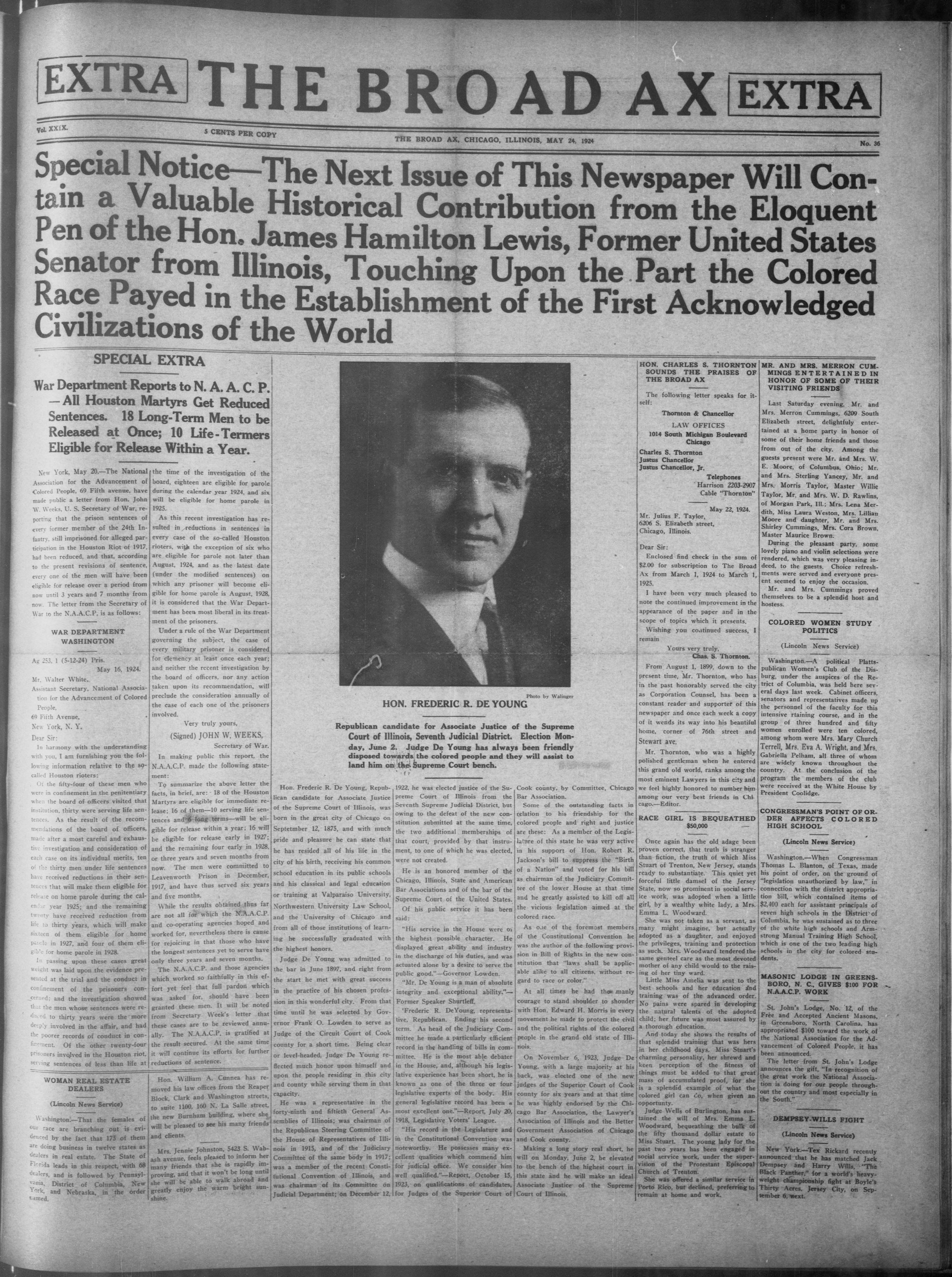
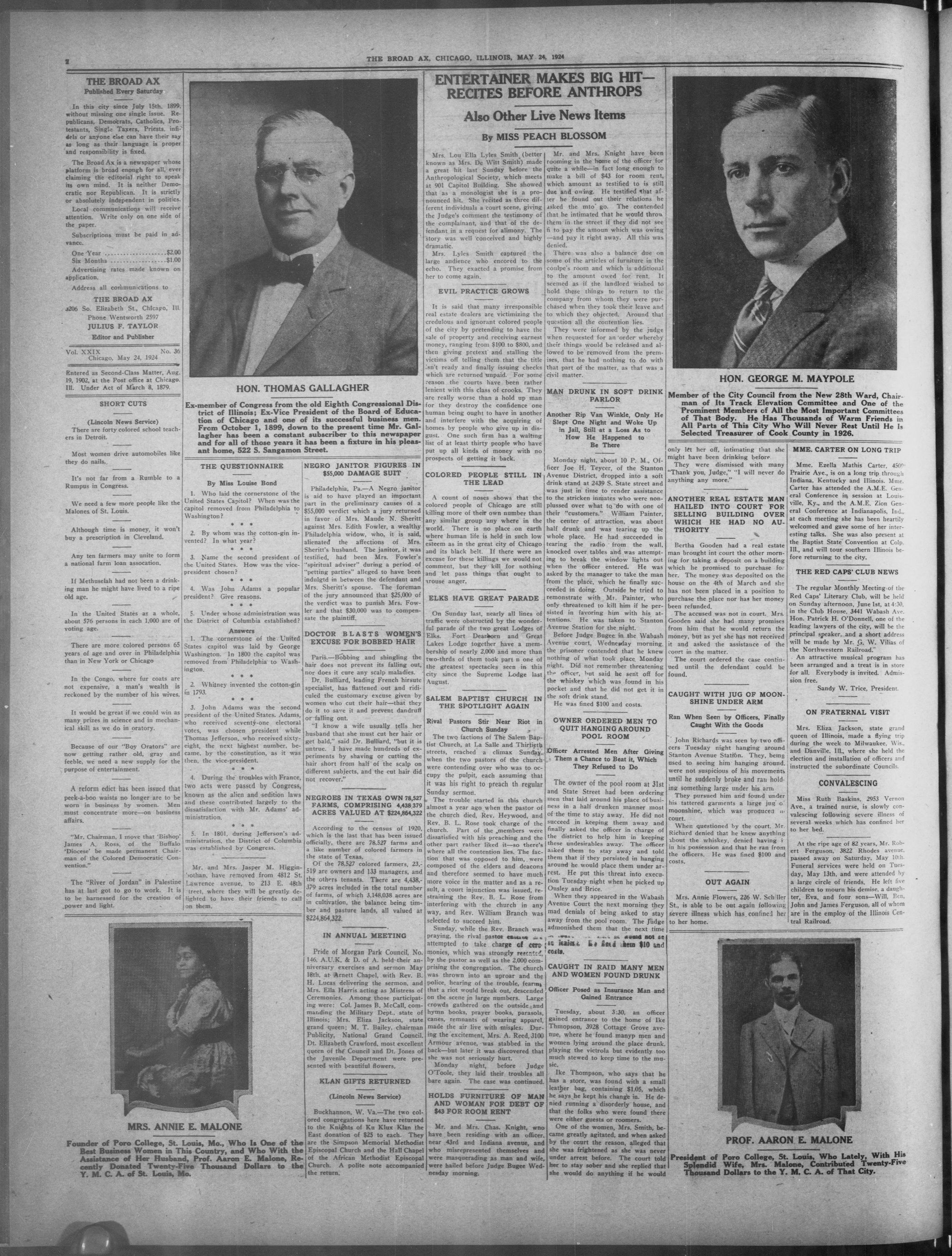
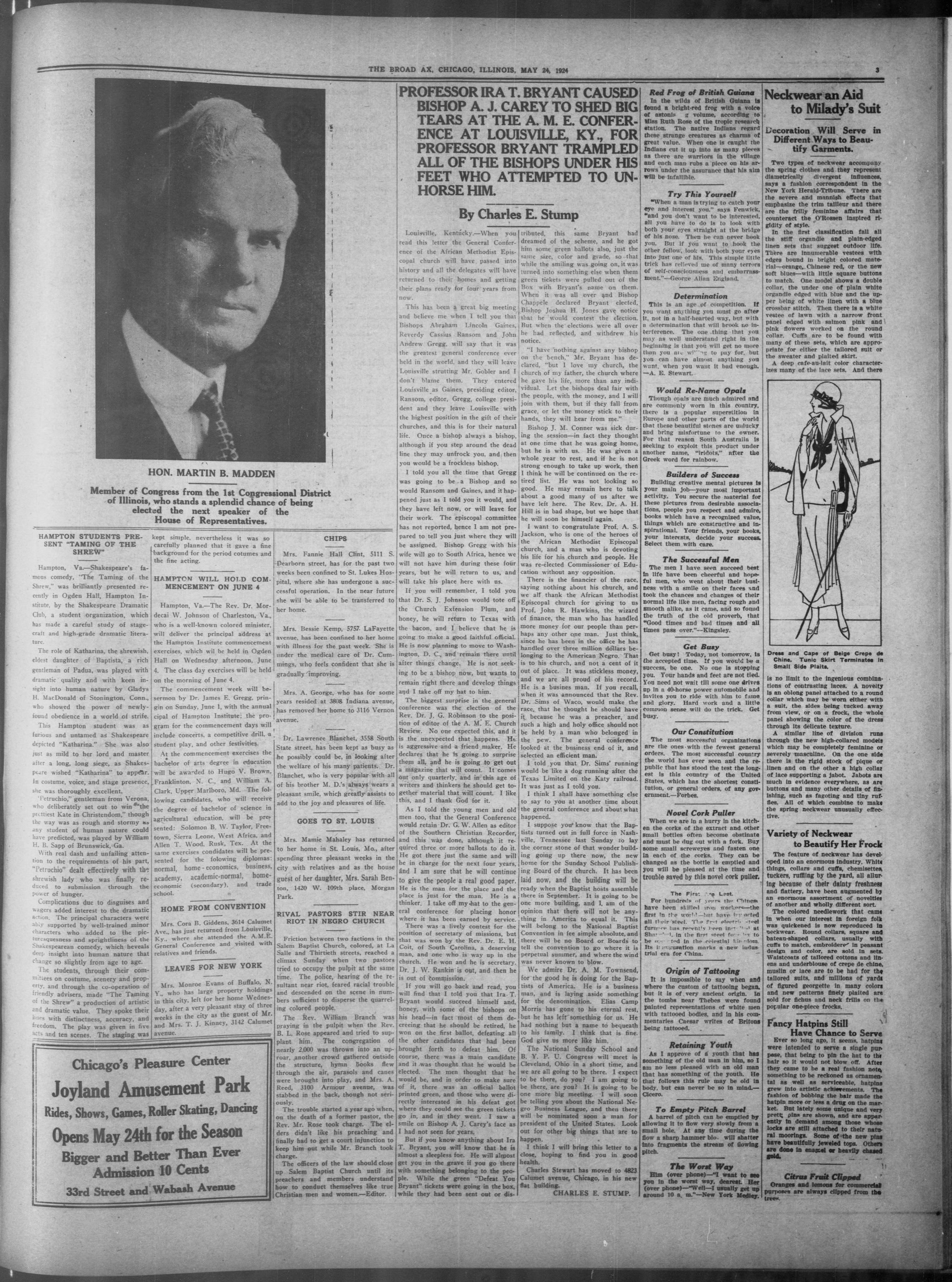
Page text (machine-generated)
EXTRA THE BROAD AX EXTRA
Special NoticeThe Next Issue of This Newspaper Will Contain a Valuable Historical Contribution from the Eloquent Pen of the Hon. James Hamilton Lewis, Former United States Senator from Illinois, Touching Upon the Part the Colored Race Payed in the Establishment of the First Acknowledged Civilizations of the World
SPECIAL EXTRA
War Department Rea All Houston M Sentences. 18 L Released at One Eligible for Relea
War Department Reports to N. A. A. C. P. — All Houston Martyrs Get Reduced Sentences. 18 Long-Term Men to be Released at Once; 10 Life-Termers Eligible for Release Within a Year.
New York, May 20.—The National Association for the Advancement of Colored People, 69 Fifth avenue, have made public a letter from Hon. John W. Weeks, U. S. Secretary of War, reporting that the prison sentences of every former member of the 24th Infantry, still imprisoned for alleged participation in the Houston Riot of 1917, had been reduced, and that, according to the present revisions of sentence, every one of the men will have been eligible for release over a period from now until 3 years and 7 months from now. The letter from the Secretary of War to the N.A.A.C.P. is as follows:
the time of the investigation of the board, eighteen are eligible for parole during the calendar year 1924, and six will be eligible for home parole in 1925.
As this recent investigation has resulted in reductions in sentences in every case of the so-called Houston rioters, with the exception of six who are eligible for parole not later than August, 1924, and as the latest date (under the modified sentences) on which any prisoner will become eligible for home parole is August, 1928, it is considered that the War Department has been most liberal in its treat-
WAR DEPARTMENT
WASHINGTON
Ag 253, 1 (5-12-24) Pris.
May 16, 1924.
Mr. Walter White,
Assistant Secretary, National Association for the Advancement of Colored People,
69 Fifth Avenue,
New York, N. Y.
Dear Sir:
In harmony with the understanding with you, I am furnishing you the following information relative to the so-called Houston riots:
Of the fifty-four of these men who were in confinement in the penitentiary when the board of officers visited that institution, thirty were serving life sentences. As the result of the recommendations of the board of officers, made after a most careful and exhaustive investigation and consideration of each case on its individual merits, ten of the thirty men under life sentences have received reductions in their sentences that will make them eligible for release on home parole during the calendar year 1925; and the remaining twenty have received reduction from life to thirty years, which will make sixteen of them eligible for home parole in 1927, and four of them eligible for home parole in 1928.
In passing upon these cases great weight was laid upon the evidence presented at the trial and the conduct in confinement of the prisoners concerned; and the investigation showed that the men whose sentences were reduced to thirty years were the more deeply involved in the affair, and had the poorer records of conduct in confinement. Of the other twenty-four prisoners involved in the Houston riot, serving sentences of less than life at
WOMAN REAL ESTATE
DEALERS
(Lincoln News Service)
Washington'-That the females of our race are branching out is evidenced by the fact that 175 of them are doing business in twelve states as dealers in real estate. The State of Florida leads in this respect, with 68 dealers, and is followed by Pennsylvania, District of Columbia, New York, and Nebraska, in the order named.
sports to N. A. A. C. P. Martyrs Get Reduced long-Term Men to be ce; 10 Life-Termers use Within a Year.
the time of the investigation of the board, eighteen are eligible for parole during the calendar year 1924, and six will be eligible for home parole in 1925.
As this recent investigation has resulted in reductions in sentences in every case of the so-called Houston rioters, with the exception of six who are eligible for parole not later than August, 1924, and as the latest date (under the modified sentences) on which any prisoner will become eligible for home parole is August, 1928, it is considered that the War Department has been most liberal in its treatment of the prisoners.
Under a rule of the War Department governing the subject, the case of every military prisoner is considered for clemency at least once each year; and neither the recent investigation by the board of officers, nor any action taken upon its recommendation, will preclude the consideration annually of the case of each one of the prisoners involved.
Very truly yours,
(Signed) JOHN W, WEEKS,
Secretary of War.
In making public this report, the N.A.A.C.P. made the following statement:
To summarize the above letter the facts, in brief, are: 18 of the Houston Martyrs are eligible for immediate release; 16 of them—10 serving life sentences and 6 long terms—will be eligible for release within a year; 16 will be eligible for release early in 1927; and the remaining four early in 1928, or three years and seven months from now. The men were committed to Leavenworth Prison in December, 1917, and have thus served six years and five months.
While the results obtained thus far are not all for which the N.A.A.C.P. and co-operating agencies hoped and worked for, nevertheless there is cause for rejoicing in that those who have the longest sentences yet to serve have only three years and seven months.
The N.A.A.C.P. and those agencies which worked so faithfully in this effort yet feel that full pardon which was asked for, should have been granted these men. It will be noted from Secretary Week's letter that these cases are to be reviewed annually. The N.A.A.C.P. is gratified at the result secured. At the same time it will continue its efforts for further reductions of sentence.
Hon. William A. Cunnea has removed his law offices from the Reaper Block, Clark and Washington streets, to suite 1100, 160 N. La Salle street, the new Burnham building, where she will be pleased to see his many friends and clients.
Mrs. Jennie Johnston, 5423 S. Wabash avenue, feels pleased to inform her many friends that she is rapidly improving, and that it won't be long until she will be able to walk abroad and greatly enjoy the warm bright sunshine.
[Name]
Republican candidate for Associate Justice of the Supreme Court of Illinois, Seventh Judicial District. Election Monday, June 2. Judge De Young has always been friendly disposed towards the colored people and they will assist to land him on the Supreme Court bench.
Hon. Frederic R. De Young, Republican candidate for Associate Justice of the Supreme Court of Illinois, was born in the great city of Chicago on September 12, 1875, and with much pride and pleasure he can state that he has resided all of his life in the city of his birth, receiving his common school education in its public schools and his classical and legal education or training at Valparaiso University, Northwestern University Law School, and the University of Chicago and from all of those institutions of learning he successfully graduated with the highest honors.
Judge De Young was admitted to the bar in June 1897, and right from the start he met with great success in the practice of his chosen profession in this wonderful city. From that time until he was selected by Governor Frank O. Lowden to serve as Judge of the Circuit Court of Cook county for a short time. Being clear or level-headed, Judge De Young reflected much honor upon himself and upon the people residing in this city and county while serving them in that capacity.
He was a representative in the forty-ninth and fifteenth General Assemblies of Illinois; was chairman of the Republican Steering Committee of the House of Representatives of Illinois in 1915, and of the Judiciary Committee of the same body in 1917; was a member of the recent Constitutional Convention of Illinois, and was chairman of its Committee on Judicial Department; on December 12,
THE BROAD AX, CHICAGO, ILLINOIS, MAY 24, 1924
HON. FREDERIC R. DE YOUNG Photo by Walinger
1922, he was elected justice of the Supreme Court of Illinois from the Seventh Supreme Judicial District, but owing to the defeat of the new constitution submitted at the same time, the two additional memberships of that court, provided by that instrument, to one of which he was elected, were not created.
He is an honored member of the Chicago, Illinois, State and American Bar Associations and of the bar of the Supreme Court of the United States.
Of his public service it has been said:
"His service in the House were on the highest possible character. He displayed great ability and industry in the discharge of his duties, and was actuated alone by a desire to serve the public good."—Governor Lowden.
"Mr. De Young is a man of absolute integrity and exceptional ability."—Former Speaker Shurtleff.
"Frederic R. DeYoung, representative, Republican. Ending his second term. As head of the Judiciary Committee he made a particularly efficient record in the handling of bills in committee. He is the most able debater in the House, and, although his legislative experience has been short, he is known as one of the three or four legislative experts of the body. His general legislative record has been a most excellent one."—Report, July 20, 1918, Legislative Voters' League.
"His record in the Legislature and in the Constitutional Convention was noteworthy. He possesses many excellent qualities which commend him for judicial office. We consider him well qualified."—Report, October 15, 1923, on qualifications of candidates, for Judges of the Superior Court of
Cook county, by Committee, Chicago Bar Association.
Some of the outstanding facts in relation to his friendship for the colored people and right and justice are these: As a member of the Legislature of this state he was very active in his support of Hon. Robert R. Jackson's bill to suppress the "Birth of a Nation" and voted for his bill as chairman of the Judiciary Committee of the lower House at that time and he greatly assisted to kill off all the vicious legislation aimed at the colored race.
As o.oe of the foremost members of the Constitutional Convention he was the author of the following provision in Bill of Rights in the new constitution that "laws shall be applicable alike to all citizens, without regard to race or color."
At all times he had the manly courage to stand shoulder to shoulder with Hon. Edward H. Morris in every movement he made to protect the civil and the political rights of the colored people in the grand old state of Illinois.
On November 6, 1923, Judge De Young, with a large majority at his back, was elected one of the new judges of the Superior Court of Cook county for six years and at that time he was highly endorsed by the Chicago Bar Association, the Lawyer's Association of Illinois and the Better Government Association of Chicago and Cook county.
Making a long story real short, he will on Monday, June 2, be elevated to the bench of the highest court in this state and he will make an ideal Associate Justice of the Supreme Court of Illinois.
HON. CHARLES S. THORNTON
SOUNDS THE PRAISES OF
THE BROAD AX
The following letter speaks for it-
self:
Charles S. Thornton
Justus Chancellor
Justus Chancellor, Jr.
Telephones
Harrison 2203-2907
Cable "Thornton"
May 22, 1924.
Mr. Julius F. Taylor,
6206 S. Elizabeth street,
Chicago, Illinois.
Enclosed find check in the sum of $2.00 for subscription to The Broad Ax from March 1, 1924 to March 1, 1925.
I have been very much pleased to note the continued improvement in the appearance of the paper and in the scope of topics which it presents.
Wishing you continued success, I remain
Yours very truly.
Chas. S. Thornton.
From August 1, 1899, down to the present time, Mr. Thornton, who has in the past honorably served the city as Corporation Counsel, has been a constant reader and supporter of this newspaper and once each week a copy of it wends its way into his beautiful home, corner of 76th street and Stewart ave.
Mr. Thornton, who was a highly polished gentleman when he entered this grand old world, ranks among the most eminent Lawyers in this city and we feel highly honored to number him among our very best friends in Chicago.—Editor.
Once again has the old adage been proven correct, that truth is stranger than fiction, the truth of which Miss Stuart of Trenton, New Jersey, stands ready to substantiate. This quiet yet forceful little damsel of the Jersey State, now so prominent in social service work, was adopted when a little girl, by a wealthy white lady, a Mrs. Emma L. Woodward.
She was not taken as a servant, as many might imagine, but actually adopted as a daughter, and enjoyed the privileges, training and protection as such. Mrs. Woodward tendered the same genteel care as the most devoted mother of any child would to the raising of her tiny ward.
Little Miss Amelia was sent to the best schools and her education and training was of the advanced order. No pains were spared in developing the natural talents of the adopted child; her future was most assured by a thorough education.
And today she shows the results of that splendid training that was her in her childhood days. Miss Stuart's charming personality, her shrewd and keen perception of the fitness of things must be added to that great mass of accumulated proof, for she is a splendid example of what the colored girl can do, when given an opportunity.
Judge Wells of Burlington, has sustained the will of Mrs. Emma L. Woodward, bequeathing the bulk of the fifty thousand dollar estate to Miss Stuart. The young lady for the past two years has been engaged in social service work, under the supervision of the Protestant Episcopal Church of Trenton.
She was offered a similar service in Porto Rico, but declined, preferring to remain at home and work.
MR. AND MRS. MERRON CUMMINGS ENTERTAINED IN HONOR OF SOME OF THEIR VISITING FRIENDS
Last Saturday evening, Mr. and Mrs. Merron Cummings, 6209 South Elizabeth street, delightfully entertained at a home party in honor of some of their home friends and those from out of the city. Among the guests present were Mr. and Mrs. W. E. Moore, of Columbus, Ohio; Mr. and Mrs. Sterling Yancey, Mr. and Mrs. Morris Taylor, Master Willie Taylor, Mr. and Mrs. W. D. Rawlins, of Morgan Park, Ill.; Mrs. Lena Merdith, Miss Laura Weston, Mrs. Lillian Moore and daughter, Mr. and Mrs. Shirley Cummings, Mrs. Cora Brown, Master Maurice Brown:
During the pleasant party, some lovely piano and violin selections were rendered, which was very pleasing indeed, to the guests. Choice refreshments were served and everyone present seemed to enjoy the occasion.
Mr. and Mrs. Cummings proved themselves to be a splendid host and hostess.
COLORED WOMEN STUDY POLITICS
(Lincoln News Service)
Washington.—A political Platts-publican Women's Club of the Disburg, under the auspices of the Retrict of Columbia, was held here several days last week. Cabinet officers, senators and representatives made up the personnel of the faculty for this intensive training course, and in the group of three hundred and fifty women enrolled were ten colored, among whom were Mrs. Mary Church Terrell, Mrs. Eva A. Wright, and Mrs. Gabriella Pelham, all three of whom are widely known throughout the country. At the conclusion of the program the members of the club were received at the White House by President Coolidge.
CONGRESSMAN'S POINT OF ORDER AFFECTS COLORED HIGH SCHOOL
Washington.—When Congressman Thomas L. Blanton, of Texas, made his point of order, on the ground of "legislation unauthorized by law," in connection with the district appropriation bill, which contained items of $2,400 each for assistant principals of seven high schools in the District of Columbia, he was sustained as to three of the white high schools and Armstrong Manual Training High School, which is one of the two leading high schools in the city for colored students.
MASONIC LODGE IN GREENS-
BORO, N. C., GIVES $100 FOR
N.A.A.C.P. WORK
St. John's Lodge, No. 12, of the Free and Accepted Ancient Masons, in Greensboro, North Carolina, has appropriated $100 toward the work of the National Association for the Advancement of Colored People, it has been announced.
The letter from St. John's Lodge announces the gift, "In recognition of the great work the National Association is doing for our people throughout the country and most especially in the South."
New York--Tex Rickard recently announced that he has matched Jack Dempsey and Harry Wills, "The Black Panther," for a world's heavyweight championship fight at Boyle's Thirty Acres, Jersey City, on September 6, next.
THE BROAD AX Published Every Saturday
In this city since July 15th, 1899, without missing one single issue. Republicans, Democrats, Catholics, Protestants, Single Taxers, Priests, infidels or anyone else can have their say as long as their language is proper and responsibility is fixed.
The Broad Ax is a newspaper whose platform is broad enough for all, ever claiming the editorial right to speak its own mind. It is neither Democratic nor Republican. It is strictly or absolutely independent in politics.
Local communications will receive attention. Write only on one side of the paper.
Subscriptions must be paid in advance.
One Year .....$2.00
Six Months .....$1.00
Advertising rates made known on
application.
Address all communications to
THE BROAD AX
4206 So. Elizabeth St. Chicago, Ill.
Vol. XXIX No. 36
Chicago, May 24, 1924
Entered as Second-Class Matter, Aug.
19, 1902, at the Post office at Chicago
III. Under Act of March 8, 1879.
SHORT CUTS
(Lincoln News Service)
There are forty colored school teachers in Detroit.
Most women drive automobiles like they do nails.
It's not far from a Rumble to a Rumpus in Congress.
We need a few more people like the Malones of St. Louis.
Although time is money, it won't buy a prescription in Cleveland.
Any ten farmers may unite to form a national farm loan association.
If Methuselah had not been a drinking man he might have lived to a ripe old age.
In the United States as a whole, about 576 persons in each 1,000 are of voting age.
There are more colored persons 65 years of age and over in Philadelphia than in New York or Chicago.
In the Congo, where fur coats are not expensive, a man's wealth is reckoned by the number of his wives.
It would be great if we could win as many prizes in science and in mechanical skill as we do in oratory.
Because of our "Boy Orators" are now getting rather old, gray and feeble, we need a new supply for the purpose of entertainment.
A reform edict has been issued that peek-a-boo waists no longer are to be worn in business by women. Men must concentrate more—on business affairs.
"Mr. Chairman, I move that 'Bishop' James A. Ross, of the Buffalo 'Diocese' be made permanent Chairman of the Colored Democratic Convention."
The "River of Jordan" in Palestine has at last got to go to work. It is to be harnessed for the creation of power and light.
[Image of a woman in a traditional dress, seated in a meditative pose with her hands resting on her knees.]
MRS. ANNIE E. MALONE
Founder of Poro College, St. Best Business Women in The Assistance of Her Husband cently Donated Twenty-F Y. M. C. A. of St. Louis, M
ounder of Poro College, St. Louis, Mo., Who Is One of the Best Business Women in This Country, and Who With the Assistance of Her Husband, Prof. Aaron E. Malone, Recently Donated Twenty-Five Thousand Dollars to the Y. M. C. A. of St. Louis, Mo.
[Name]
Ex-member of Congress from the trict of Illinois; Ex-Vice Prition of Chicago and one of From October 1, 1899, dow lagher has been a constant and for all of those years it ant home, 522 S. Sangamon
Ex-member of Congress from the old Eighth Congressional District of Illinois; Ex-Vice President of the Board of Education of Chicago and one of its successful business men. From October 1, 1899, down to the present time Mr. Gallagher has been a constant subscriber to this newspaper and for all of those years it has been a fixture in his pleasant home, 522 S. Sangamon Street.
THE QUESTIONNAIRE
By Miss Louise Bond
1. Who laid the cornerstone of the United States Capitol? When was the capitol removed from Philadelphia to Washington?
* * *
2. By whom was the cotton-gin invented? In what year?
* * *
3. Name the second president of the United States. How was the vice-president chosen?
* * *
4. Was John Adams a popular president? Give reasons.
* * *
5. Under whose administration was the District of Columbia established? Answers
1. The cornerstone of the United States capitol was laid by George Washington. In 1800 the capitol was removed from Philadelphia to Washington.
* * *
2. Whitney invented the cotton-gin in 1793.
* * *
3. John Adams was the second president of the United States. Adams, who received seventy-one electoral votes, was chosen president while Thomas Jefferson, who received sixty-eight, the next highest number, became, by the constitution, as it was then, the vice-president.
4. During the troubles with France, two acts were passed by Congress, known as the alien and sedition laws and these contributed largely to the dissatisfaction with Mr. Adams' administration.
5. In 1801, during Jefferson's administration, the District of Columbia was established by Congress.
Mr. and Mrs. Jasper M. Higginbothan, have removed from 4812 St Lawrence avenue, to 213 E. 48th street, where they will be greatly delighted to have their friends to call on them.
Louis, Mo., Who Is One of the this Country, and Who With the id, Prof. Aaron E. Malone, Re five Thousand Dollars to the Mo.
HON. THOMAS GALLAGHER
of Congress from the old Eighth Congressional Dis-
liniois; Ex-Vice President of the Board of Educa-
chicago and one of its successful business men.
October 1, 1899, down to the present time Mr. Gal-
ls been a constant subscriber to this newspaper
of those years it has been a fixture in his pleas-
522 S. Sangamon Street.
NEGRO JANITOR FIGURES IN
$55,000 DAMAGE SUIT
Philadelphia, Pa.—A Negro janitor is aid to have played an important part in the preliminary causes of a $55,000 verdict which a jury returned in favor of Mrs. Maude N. Sheritt against Mrs. Edith Fowler, a wealthy Philadelphia widow, who, it is said, alienated the affections of Mrs. Sheritt's husband. The janitor, it was testified, had been Mrs. Fowler's "spiritual adviser" during a period of "petting parties" alleged to have been indulged in between the defendant and Mrs. Sheritt's spouse. The foreman of the jury announced that $25,000 of the verdict was to punish Mrs. Fowler and that $30,000 was to compensate the plaintiff.
DOCTOR BLASTS WOMEN'S
EXCUSE FOR BOBBED HAIR
Paris.—Bobbing and shingling the hair does not prevent its falling out, nor does it cure any scalp maladies. Dr. Bulliard, leading French hirsute specialist, has flattened out and ridiculed the customary excuse given by women who cut their hair—that they do it to save it and prevent dandruff or falling out. "I know a wife usually tells her husband that she must cut her hair or get bald," said Dr. Bulliard, "but it is untrue. I have made hundreds of experiments by shaving or cutting the hair short from half of the scalp on different subjects, and the cut hair did not recover."
NEGROES IN TEXAS OWN 78,527
FARMS, COMPRISING 4,438,379
ACRES VALUED AT $224,864,322
According to the census of 1920, which is the last that has been issued officially, there are 78,527 farms and a like number of colored farmers in the state of Texas. Of the 78,527 colored farmers, 23,519 are owners and 133 managers, and the others tenants. There are 4,438,379 acres included in the total number of farms, of which 3,148,038 acres are in cultivation, the balance being timber and pasture lands, all valued at $224,864,322.
IN ANNUAL MEETING
Pride of Morgan Park Council, No. 146, A.U.K. & D. of A. held their anniversary exercises and sermon May 18th, at Arnett Chapel, with Rev B. H. Lucas delivering the sermon, and Mrs. Ella Harris acting as Mistress of Ceremonies. Among those participating were: Col James B. McCall, commanding the Military Dept., state of Illinois; Mrs. Eliza Jackson, state grand queen; M. T. Bailey, chairman Publicity, National Grand Council Dt. Elizabeth Crawford, most excellent queen of the Council and Dt. Jones of the Juvenile Department were presented with beautiful flowers.
KLAN GIFTS RETURNED
(Lincoln News Service)
Buckhannon, W. Va.—The two colored congregations here have returned to the Knights of Ku Klux Klan the East donation of $25 to each. They are the Simpson Memorial Methodist Episcopal Church and the Hall Chapel of the African Methodist Episcopal Church. A polite note accompanied the return.
THE BROAD AX, CHICAGO, ILLINOIS, MAY 24, 1924
ENTERTAINER MAKES BIG HIT RECITES BEFORE ANTHROPS
Also Other Live News Items
By MISS PEACH BLOSSOM
Mrs. Lou Ella Lyles Smith (better known as Mrs. De Witt Smith) made a great hit last Sunday before the Anthropological Society, which meets at 901 Capitol Building. She showed that as a monologist she is a pronounced hit. She recited as three different individuals a court scene, giving the Judge's comment the testimony of the complainant, and that of the defendant in a request for alimony. The story was well conceived and highly dramatic.
Mrs. Lyles Smith captured the large audience who enceded to the echo. They exacted a promise from her to come again.
Mr. and Mrs. Jrooming in the home quite a while—in fact make a bill of $ which amount as a due and owing. Her he found out asked the mto go that he intimated them in the street to pay the amount—and pay it right a denied.
There was also some of the articles coulpe's room and to the amount o
EVIL PRACTICE GROWS
It is said that many irresponsible real estate dealers are victimizing the credulous and ignorant colored people of the city by pretending to have the sale of property and receiving earnest money, ranging from $100 to $800, and then giving pretext and stalling the victims off telling them that the title isn't ready and finally issuing checks which are returned unpaid. For some reason the courts have been rather lenient with this class of crooks. They are really worse than a hold up man for they destroy the confidence one human being ought to have in another and interfere with the acquiring of homes by people who give up in disgust. One such firm has a waiting list of at least thirty people who have put up all kinds of money with no prospects of getting it back.
COLORED PEOPLE STILL IN
THE LEAD
A count of noses shows that the colored people of Chicago are still killing more of their own number than any similar group any where in the world. There is no place on earth where human life is held in such low esteem as in the great city of Chicago and its black belt. If there were an excuse for these killings we would not comment, but they kill for nothing and let pass things that ought to arouse anger.
ELKS HAVE GREAT PARADE
On Sunday last, nearly all lines of traffic were obstructed by the wonderful parade of the two great Lodges of Elks. Fort Dearborn and Great Lakes Lodge together have a membership of nearly 2,000 and more than two-thirds of them took part n one of the greatest spectacles seen in this city since the Supreme Lodge last August.
SALEM BAPSTAT CHURCH IN
THE SPOTLIGHT AGAIN
Rival Pastors Stir Near Riot in Church Sunday
The two factions of The Salem Baptist Church, at La Salle and Thirlieth streets, reached a climax Sunday, when the two pastors of the church were contending over who was to occupy the pulpit, each assuming that it was his right to preach the regular Sunday sermon.
The trouble started in this church almost a year ago when the pastor of the church died, Rev. Heywood, and Rev. B. L. Rose took charge of the church. Part of the members were dissatisfied with his preaching and the other part rather liked it—so there's where all the contention lies. The faction that was opposed to him, were composed of the elders and deacons and therefore seemed to have much more voice in the matter and as a result, a court injunction was issued, restraining the Rev. B. L. Rose from interfering with the church in any way, and Rev. William Branch was selected to succeed him.
Sunday, while the Rev. Branch was praying, the rival pastor enlisted to attempt to take charge of ceremonies, which was strongly resented by the pastor as well as the 2,000 comprising the congregation. The church was thrown into an uproar and the police, hearing of the trouble, fears that a riot would break out, descended on the scene in large numbers. Large crowds gathered on the outside and hymn books, prayer books, parasols, canes, remnants of wearing apparel, made the air live with missiles. During the excitement, Mrs. A. Reed, 3100 Armour avenue, was stabbed in the back—but later it was discovered that she was not seriously hurt. Monday night, before Judge O'Toole, they laid their troubles all bare again. The case was continued
HOLDS FURNITURE OF MAN
AND WOMAN FOR DEBT OF
$43 FOR ROOM RENT
Mr. and Mrs. Chas. Knight, who
have been residing with an officer,
near 43rd and Indiana avenue, and
who misrepresented themselves and
were masquerading as man and wife,
were hailed before Judge Bugee Wednesday morning.
Mr. and Mrs. Knight have been rooming in the home of the officer for quite a while—in fact long enough to make a bill of $43 for room rent, which amount as testified to is still due and owing. He testified that after he found out their relations he asked the mto go. The contended that he intimated that he would throw them in the street if they did not see fi to pay the amount which was owing—and pay it right away. All this was denied. There was also a balance due on some of the articles of furniture in the coulpe's room and which is additional to the amount owed for rent. It seemed as if the landlord wished to hold these things to return to the company from whom they were purchased when they took their leave and to which they objected. Around that question all the contention lies.
They were informed by the judge when requested for an order whereby their things would be released and allowed to be removed from the premises, that he had nothing to do with that part of the matter, as that was a civil matter.
MAN DRUNK IN SOFT DRINK
PARLOR
Another Rip Van Winkle, Only He Slept One Night and Woke Up in Jail, Still at a Loss As to How He Happened to Be There
Monday night, about 10 P. M., Officer Joe H. Teycer, of the Stanton Avenue District, dropped into a soft drink stand at 2439 S. State street and was just in time to render assistance to the stricken inmates who were nonplussed over what to do with one of their "customers". William Painter, the center of attraction, was about half drunk and was tearing up the whole place. He had succeeded in tearing the radio from the wall, knocked over tables and was attempting to break the window lights out when the officer entered. He was asked by the manager to take the man from the place, which he finally succeeded in doing. Outside he tried to remonstrate with Mr. Painter, who only threatened to kill him if he persisted in favoring him with his attentions. He was taken to Stanton Avenue Station for the night.
Before Judge Bugee in the Wabash Avenue court, Wednesday morning, the prisoner contended that he knew nothing of what took place Monday night. Did not remember threatening the officer, but said he sent off for the whiskey which was found in his pocket and that he did not get it in the soft drink stand. He was fined $100 and costs.
OWNER ORDERED MEN TO
QUIT HANGING AROUND
POOL ROOM
Officer Arrested Men After Giving Them a Chance to Beat it, Which They Refused to Do
The owner of the pool room at 31st and State Street had been ordering men that laid around his place of business in a half drunken manner most of the time to stay away. He did not succeed in keeping them away and finally asked the officer in charge of the district to help him in keeping these undesirables away. The officer asked them to stay away and told them that if they persisted in hanging around he would place them under arrest. He put this threat into execution Tuesday night when he picked up Ousley and Brice.
When they appeared in the Wabash Avenue Court the next morning they mad denials of being asked to stay away from the pool room. The judge admonished them that the next time
CAUGHT IN RAID MANY MEN
AND WOMEN FOUND DRUNK
Officer Posed as Insurance Man and Gained Entrance
Tuesday, about 3:30, an officer gained entrance to the home of Ike Thmpson, 3928 Cottage Grove avenue, where he found many men and women lying around the place drunk, playing the victrola but evidently too much stewed to keep time to the music.
Ike Thompson, who says that he has a store, was found with a small leather bag, containing $1.05, which he says he kept his change in. He denied running a disorderly house, and that the folks who were found there were either guests or roomers.
One of the women, Mrs. Smith, became greatly agitated, and when asked by the court the reason, alleged that she was frightened as she was never under arrest before. The court told her to stay sober and she replied that she would do anything if he would
HON. GEORGE M. MAYPOLE
Member of the City Council from the New 28th man of Its Track Elevation Committee and Prominent Members of All the Most Important of That Body. He Has Thousands of War All Parts of This City Who Will Never Res Selected Treasurer of Cook County in 1926.
Member of the City Council from the New 28th Ward, Chairman of Its Track Elevation Committee and One of the Prominent Members of All the Most Important Committees of That Body. He Has Thousands of Warm Friends in All Parts of This City Who Will Never Rest Until He Is Selected Treasure of Cook County in 1926.
only let her off, intimating that she might have been drinking before. They were dismissed with many "Thank you, Judge," "I will never do anything any more."
MME. CARTER ON LONG TRIP
Mme. Ezella Mathis Carter, 4500 Prairie Aye., is on a long trip through Indiana, Kentucky and Illinois. Mme
ANOTHER REAL ESTATE MAN
HAILED INTO COURT FOR
SELLING BUILDING OVER
WHICH HE HAD NO AU-
THORITY
Bertha Gooden had a real estate man brought int court the other morning for taking a deposit on a building which he promised to purchase for her. The money was deposited on the house on the 4th of March and she has not been placed in a position to purchase the place nor has her money been refunded.
The accused was not in court. Mrs. Gooden said she had many promises from him that he would return the money, but as yet she has not received it and asked the assistance of the court in the matter.
The court ordered the case continued until the defendant could be found.
CAUGHT WITH JUG OF MOON
SHINE UNDER ARM
Ran When Seen by Officers, Finally
Caught With the Goods
John Richards was seen by two officers Tuesday night hanging around Stanton Avenue Station. They, being used to seeing him hanging around were not suspicious of his movements until he suddenly broke and ran holding something large under his arm.
mhe something large under his arm
They pursued him and found under
his tattered garments a large jug of
moonshine, which was produced
in court.
When questioned by the court, Mr.
Richard denied that he knew anything
about the whiskey, denied having
in his possession and that he ran from
the officers. He was fined $100 and
costs.
OUT AGAIN
Mrs. Annie Flowers, 226 W. Schiller St., is able to be out again following severe illness which has confined her to her home.
[Name]
PROF. AARON E. MALONE
President of Poro College, St. Louis, Who Late
Splendid Wife, Mrs. Malone, Contributed
Thousand Dollars to the Y. M. C. A. of That
President of Poro College, St. Louis, Who Lately, With His Splendid Wife, Mrs. Malone, Contributed Twenty-Five Thousand Dollars to the Y. M. C. A. of That City.
President of Poro College, St. Louis, Who Lately, With His Splendid Wife, Mrs. Malone, Contributed Twenty-Five Thousand Dollars to the Y. M. C. A. of That City.
from the New 28th Ward, Chair-
ron Committee and One of the
the Most Important Committees
thousands of Warm Friends in
to Will Never Rest Until He Is
County in 1926.
MME. CARTER ON LONG TRIP
Mmc, Ezella Mathis Carter, 4500 Prairie Ave., is on a long trip through Indiana, Kentucky and Illinois. Mmc. Carter has attended the A.M.E. General Conference in session at Louisville, Ky., and the A.M.E. Zion General Conference at Indianapolis, Ind., at each meeting she has been heartily welcomed and gave some of her interesting talks. She was also present at the Baptist State Convention at Colp, Ill., and will tour southern Illinois before returning to the city.
THE RED CAPS' CLUB NEWS
The regular Monthly Meeting of the Red Caps' Literary Club, will be held on Sunday afternoon, June 1st, at 4:30, in the Club House, 3441 Wabash Ave. Hon. Patrick H. O'Donnell, one of the leading lawyers of the city, will be the principal speaker, and a short address will be made by Mr. G. W. Vilias of the Northwestern Railroad. An attractive musical program has been arranged and a treat is in store for all. Everybody is invited. Admission free. Sandy W. Trice, President.
ON FRATERNAL VISIT
Mrs. Eliza Jackson, state grand queen of Illinois, made a flying trip during the week to Milwaukee, Wis. and Danville, Ill., where she held the election and installation of officers and instructed the subordinate Councils.
CONVALESCING
Miss Ruth Baskins, 2953 Vernon Ave, a trained nurse, is slowly convalescing following severe illness of several weeks which has confined her to her bed.
At the ripe age of 82 years, Mr. Robert Ferguson, 3822 Rhodes avenue passed away on Saturday, May 10th. Funeral services were held on Tuesday, May 13th, and were attended by a large circle of friends. He left five children to mourn his demise, a daughter, Eva, and four sons-Will, Ben John and James Ferguson, all of whom are in the employ of the Illinois Central Railroad.
A. Louis, Who Lately, With His None, Contributed Twenty-Five M. C. A. of That City.
M.
Member of Congress from the 1st Congressional District of Illinois, who stands a splendid chance of being elected the next speaker of the
Chicago's Pleasure Center
Joyland Amusement Park
Rides, Shows, Games, Roller Skating, Dancing
Opens May 24th for the Season
Bigger and Better Than Ever
Admission 10 Cents
33rd Street and Wabash Avenue
HAMPTON STUDENTS PRESENT "TAMING OF THE SHREW"
Hampton, Va.—Shakespeare's famous comedy, "The Taming of the Shrew," was brilliantly presented recently in Ogden Hall, Hampton Institute, by the Shakespeare Dramatic Club, a student organization, which has made a careful study of stagecraft and high-grade dramatic literature.
The role of Katharina, the shrewish, eldest daughter of Baptista, a rich gentleman of Padua, was played with dramatic quality and with keen insight into human nature by Gladys H. MacDonald of Stonington, Conn., who showed the power of newly-found obedience in a world of strife.
This Hampton student was as furious and untamed as Shakespeare depicted "Katharina." She was also just as mild to her lord and master after a long, long siege, as Shakespeare wished "Katharina" to appear. In costume, voice, and stage presence, she was thoroughly excellent. "Petruchio," gentleman from Verona, who deliberately set out to win "the prettiest Kate in Christendom," though the way was as rough and stormy as any student of human nature could have predicted, was played by William H. B. Sapp of Brunswick, Ga. With real dash and unfailing attention to the requirements of his part, "Petruchio" dealt effectively with the shrewish lady who was finally reduced to submission through the power of hunger.
Complications due to disguises and wagers added interest to the dramatic action. The principal characters were ably supported by well-trained minor characters who added to the picturesqueness and sprightness of the Shakespearean comedy, which heveals deep insight into human nature that change so slightly from age to age. The students, through their committees on costume, scenery and property, and through the co-operation of friendly advisers, made "The Taming of the Shrew" a production of artistic and dramatic value. They spoke their lines with distinctness, accuracy, and freedom. The play was given in five acts and ten scenes. The staging was
House of Representatives. kept simple, nevertheless it was so carefully planned that it gave a fine background for the period cotumes and the fine acting.
HAMPTON WILL HOLD COM
MENCEMENT ON JUNE 4
Hampton, Va.—The Rev. Dr. Mordecai W. Johnson of Charleston, Va., who is a well-known colored minister, will deliver the principal address at the Hampton Institute commencement exercises, which will be held in Ogden Hall on Wednesday afternoon, June 4. The class day exercises will be held on the morning of June 4.
The commencement week will besermon by Dr. James E. Gregg, pringin on Sunday, June 1, with the annual cipal of Hampton Institute; the program for the commencement days will include concerts, a competitive drill, a student play, and other festivities.
At the commencement exercises the bachelor of arts degree in education will be awarded to Hugo V. Brown, Franklinton, N. C., and William A. Clark, Upper Marlboro, Md. The following candidates, who will receive the degree of bachelor of science in agricultural education, will be presented: Solomon B. W. Taylor, Free-town, Sierra Leone, West Africa, and Allen T. Wood, Rusk, Tex. At the same exercises candidates will be presented for the following diplomas: normal, home-economics, business academy, academic-normal, home-economic (secondary), and trade school.
HOME FROM CONVENTION
Mrs. Cora B. Giddens, 3614 Calumet Ave., has just returned from Louisville, Ky., where she attended the A.M.E. General Conference and visited with relatives and friends.
LEAVES FOR NEW YORK
Mrs. Monroe Evans of Buffalo, N.Y., who has large property holdings in this city, left for her home Wednesday, after a very pleasant stay of three weeks in the city as the guest of Mr. and Mrs. T. J. Kinney, 3142 Calumet avenue.
THE BROAD AX, CHICAGO, ILLINOIS, MAY 24, 1924
Mrs. Fannie Hall Clint, 5111 St. Dearborn street, has for the past two weeks been confined to St. Lukes Hospital, where she has undergone a successful operation. In the near future she will be able to be transferred to her home.
Mrs. Bessie Kemp, 5757 LaFayette avenue, has been confined to her home with illness for the past week. She is under the medical care of Dr. Cummings, who feels confident that she is gradually improving.
Mrs. A. George, who has for some years resided at 3808 Indiana avenue, has removed her home to 3116 Vernon avenue.
Dr. Lawrence Blanchet, 3558 South State street, has been kept as busy as he possibly could be, in looking after the welfare of his many patients. Dr Blanchet, who is very popular with all of his brother M. D.'s always wears a pleasant smile, which greatly assists to add to the joy and pleasures of life.
GOES TO ST. LOUIS
Mrs. Mamie Mahaley has returned to her home in St. Louis, Mo., after spending three pleasant weeks in the city with relatives and as the house guest of her daughter, Mrs. Sarah Benton, 1420 W. 109th place, Morgan Park.
RIVAL PASTORS STIR NEAP
RIOT IN NEGRO CHURCH
Friction between two factions in the Salem Baptist Church, colored, at La Salle and Thirtieth streets, reached a climax Sunday when two pastors tried to occupy the pulpit at the same time. The police, hearing of the resultant near riot, feared racial trouble and descended on the scene in numbers sufficient to disperse the quarrelling colored people.
The Rev. William Branch was praying in the pulpit when the Rev. B. L. Rose appeared and tried to supplant him. The congregation of nearly 2,000 was thrown into an uproar, another crowd gathered outside the structure, hymn books flew through the air, parasols and canes were brought into play, and Mrs. A. Reed, 3100 Armour avenue, was stabbed in the back, though not seriously.
The trouble started a year ago when, on the death of a former pastor, the Rev. Mr. Rose took charge. The elders didn't like his preaching and finally had to get a court injunction to keep him out while Mr. Branch took charge.
The officers of the law should close up Salem Baptist Church until its preachers and members understand how to conduct themselves like true Christian men and women.—Editor.
ROFESSOR IRA T. BRYANT CAUSED BISHOP A. J. CAREY TO SHED BIG TEARS AT THE A. M. E. CONFERENCE AT LOUISVILLE, KY., FOR PROFESSOR BRYANT TRAMPLED ALL OF THE BISHOPS UNDER HIS FEET WHO ATTEMPTED TO UNHORSE HIM.
By Charles E. Stump
Louisville, Kentucky-When you read this letter the General Conference of the African Methodist Episcopal church will have, passed into history and all the delegates will have returned to their homes and getting their plans ready for four years from now.
This has been a great big meeting and believe me when I tell you that Bishops Abraham Lincoln Gaines, Reverdy Cassius Ransom and John Andrew Gregg, will say that it was the greatest general conference ever held in the world, and they will leave Louisville strutting Mr. Gobler and I don't blame them. They entered Louisville as Gaines, presiding editor, Ransom, editor, Gregg, college president and they leave Louisville with the highest position in the gift of their churches, and this is for their natural life. Once a bishop always a bishop, although if you step around the dead line they may unfrock you, and then you would be a frockless bishop.
I told you all the time that Gregg was going to be a Bishop and so would Ransom and Gaines, and it happened just as I told you it would, and they have left now, or will leave for their work. The episcopal committee has not reported, hence I am not prepared to tell you just where they will be assigned. Bishop Gregg with his wife will go to South Africa, hence we will not have him during these four years, but he will return to us, and will take his place here with us.
If you will remember, I told you that Dr. S. J. Johnson would tote off the Church Extension Plum, and honey, he will return to Texas with the bacon, and I believe that he is going to make a good faithful official. He is now planning to move to Washington, D. C., and remain there until after things change. He is not seeking to be a bishop now, but wants to remain right there and develop things and I take off my hat to him.
The biggest surprise in the general conference was the election of the Rev. Dr. J. G. Robinson to the position of editor of the A. M. E. Church Review. No one expected this, and it is the unexpected that happens. He is aggressive and a friend maker. He declares that he is going to surprise them all, and he is going to get out a magazine that will count. It comes out only quarterly, and in this age of writers and thinkers he should get together material that will count. I like this, and I thank God for it.
As I told the young men and old men too, that the General Conference would retain Dr. G. W. Allen as editor of the Southern Christian Recorder, and this was done, although it required three or more ballots to do it. He got there just the same and will he in charge for the next four years, and I am sure that he will continue to give the people a real good paper. He is the man for the place and the place is just for the man. He is a thinker. I take off my hat to the general conference for placing honor where it has been earned by service. There was a lively contest for the position of secretary of missions, but that was won by the Rev. Dr. E. H. Coit, of South Carolina, a deserving man, and one who is way up in the church. He won and he is secretary, Dr. J. W. Rankin is out, and then he is out of commission.
If you will go back and read, you will find that I told you that Ira T. Bryant would succeed himself and, honey, with some of the bishops on his head—in fact most of them decreeing that he should be retired, he won on the first ballot, defeating all the other candidates that had been brought forth to defeat him. Of course, there was a main candidate and it was thought that he would be elected. The men thought that he would be, and in order to make sure of it, there was an official ballot printed green, and those who were directly interested in his defeat got where they could see the green tickets go in, and in they went. I saw a smile on Bishop A. J. Carey's face as I had not seen for years.
But if you know anything about Ira T. Bryant, you will know that he is almost a steepleless foe. He will almost get you in the grave if you go there with something belonging to the people. While the green "Defeat You Bryant" tickets were going in the box, while they had been sent out or dis-
tributed, this same Bryant had dreamed of the scheme, and he got him some green ballots also, just the same size, color and grade, so that while the smiling was going on, it was turned into something else when them green tickets were pulled out of the Box with Bryant's name on them. When it was all over and Bishop Chappele declared Bryant elected, Bishop Joshua H. Jones gave notice that he would contest the election. But when the elections were all over he had reflected, and withdrew his notice.
"I have nothing against any bishop on the bench," Mr. Bryant has declared, "but I love my church, the church of my father, the church where he gave his life, more than any individual. Let the bishops deal fair with the people, with the money, and I will join with them, but if they fall from grace, or let the money stick to their hands, they will hear from me."
Bishop J. M. Conner was sick during the session—in fact they thought at one time that he was going home, but he is with us. He was given a whole year to rest, and if he is not strong enough to take up work, then I think he will be continued on the retired list. He was not looking so good. He may remain here to talk about a good many of us after we have left here. The Rev. Dr. A. H. Hill is in bad shape, but we hope that he will soon be himself again.
I want to congratulate Prof. A. S. Jackson, who is one of the heroes of the African Methodist Episcopal church, and a man who is devoting his life for his church and people. He was re-elected Commissioner of Education without any opposition.
There is the financier of the race, saying nothing about his church, and we all thank the African Methodist Episcopal church for giving to us Prof. John R. Hawkins, the wizard of finance, the man who has handled more money for our people than perhaps any other one man. Just think, since he has been in the office he has handled over three million dollars belonging to the American Negro. That is to his church, and not a cent of it out of place. It was stickless money, and we are all proud of his record. He is a business man. If you recall, when it was announced that the Rev. Dr. Sims of Waco, would make the race, that he thought he should have it because he was a preacher, and such a high and holy office should not be held by a man who belonged in the pew. The general conference looked at the business end of it, and selected an efficient man.
I told you that Dr. Sims' running would be like a dog running after the Texas Limited on the Katy railroad. It was just as I told you.
I think I shall have something else to say to you at another time about the general conference and about what happened.
I suppose you know that the Baptists turned out in full force in Nashville, Tennessee last Sunday to lay the corner stone of that wonder building going up there now, the new home for the Sunday School Publishing Board of the church. It has been laid now, and the building will be ready when the Baptist hosts assemble there in September. It is going to be one more building, and I, am of the opinion that there will not be anything in America to equal it. This will belong to the National Baptist Convention in fee simple absolute, and there will be no Board or Boards to tell the convention to go where it is perpetual summer, and where the wind was never known to blow.
We admire Dr. A. M. Townsend, for the good he is doing for the Baptists of America. He is a business man, and is laying aside something for the denomination. Elias Camp Morris has gone to his eternal rest, but he has left something for us. He had nothing but a name to bequeath to his family. I think that is fine. God give us more like him.
The National Sunday School and B. Y. P. U. Congress will meet in Cleveland, Ohio in a short time, and we are all going to be there. I expect to be there, do you? I am going to be there, are you? It is going to be one more big meeting. I will soon be telling you about the National Negro Business League, and then there will be nominated soon a man for president of the United States. Look out for other big things that are to happen.
I think I will bring this letter to a close, hoping to find you in good health. Charles Stewart has moved to 4823 Calumet avenue, Chicago, in his new flat building.
CHARLES E. STUMP.
Red Frog of British Guiana
In the wilds of British Guiana is found a bright-red frog with a voice of astonis g volume, according to Miss Ruth Rose of the tropic research station. The native Indians regard these strange creatures as charms of great value. When one is caught the Indians cut it up into as many pieces as there are warriors in the village and each man rubs a piece on his arrows under the assurance that his aim will be infallible.
Try This Yourself
"When a man is trying to catch your eye and interest you," says Fenwick, "and you don't want to be interested, all you have to do is to look with both your eyes straight at the bridge of his nose. Then he can never hook you. But if you want to hook the other fellow, look with both your eyes into just one of his. This simple little trick has relieved me of many terrors of self-consciousness and embarrassment." - George Allan England.
Determination
This is an age of competition. If you want anything you must go after it, not in a half-hearted way, but with a determination that will brook no interference. The one thing that you may as well understand right in the beginning is that you will get no more than you are willing to pay for, but you can have almost anything you want, when you want it bad enough. —A. E. Stewart.
Would Re-Name Opals
Though opals are much admired and are commonly worn in this country, there is a popular superstition in Europe and other parts of the world that these beautiful stones are unlucky and bring misfortune to the owner. For that reason South Australia is seeking to exploit this product under another name, "iridots," after the Greek word for rainbow.
Builders of Success
Building creative mental pictures is your main job—your most important activity. You secure the material for these pictures from desirable associations, people you respect and admire, books which have a recognized value, things which are constructive and inspirational. Your friends, your books, your interests, decide your success. Select them with care.
The Successful Men
The men I have seen succeed best in life have been cheerful and hopeful men, who went about their business with a smile on their faces and took the chances and changes of their normal life like men, facing rough and smooth alike, as it came, and so found the truth of the old proverb, that "Good times and bad times and all times pass over."—Kinglesy.
Get Busy
Get busy! Today, not tomorrow, is the accepted time. If you would be a success, be one. No one is stopping you. Your hands and feet are not tied. You need not wait till some one drives up in a 40-horse power automobile and invites you to ride with him to fame and glory. Hard work and a little common sense will do the trick. Get busy!
Our Constitution
The most successful organizations are the ones with the fewest general orders. The most successful country the world has ever seen and the republic that has stood the test the longest is this country of the United States, which has the shortest constitution, or general orders, of any government.—Forbes.
Novel Cork Puller
When we are in a hurry in the kitchen the corks of the extract and other small bottles often become obstinate and must be dug out with a fork. Buy some small screweyes and fasten one in each of the corks. They can be changed as the bottle is emptied and you will be pleased at the time and trouble saved by this novel cork puller.
The First Last
For hundreds of years the Chinese have been skilled iron workers—the first in the world—but have worked all their steel. The first electric steel furnace has recently been instituted at Shaoxing, in the first steel factory to be installed in the celestial kingdom. Its inauguration marks a new industrial era for China.
Origin of Tattooing
It is impossible to say when and where the custom of tattooing began, but it is of very ancient origin. In the tombs near Thebes were found painted representations of white men with tattooed bodies, and in his commentaries Caesar writes of Britons being tattooed.
Retaining Youth
As I approve of a youth that has something of the old man in him, so I am no less pleased with an old man that has something of the youth. He that follows this rule may be old in body, but can never be so in mind.—Cicero.
To Empty Pitch Barrel
A barrel of pitch can be emptied by allowing it to flow very slowly from a small hole. At any time during the flow a sharp hammer blo. will shatter into fragments the stream of flowing pitch.
The Worst Way
Him (over phone)—"I want to see you in the worst way, dearest. Her (over phone)—"Well—I usually get up around 10 a. m."—New York Medley.
3
Neckwear an Aid to Milady's Suit
Two types of neckwear accompany the spring clothes and they represent diametrically divergent influences, says a fashion correspondent in the New York Herald-Tribune. There are the severe and mannish effects that emphasize the trim tallierl and there are the frilly feminine affairs that counteract the O'Rossen inspired rlididity of style.
In the first classification fall all the stiff organdle and plain-edged linen sets that suggest outdoor life. There are innumerable vestees with edges bound in bright colored material—orange, Chinese red, or the new blues—with little square buttons to match. One model shows a double collar, the under one of plain white organdle edged with blue and the upper being of white linen with a blue crossbar stitch. Then there is a white veste of lawn with a narrow front panel edged with salmon pink and pink flowers worked on the round collar. Cuffs are to be found with many of these sets, which are appropriate for either the tailored suit or the sweater and plaited skirt. A deep cafe-au-lait color characterizes many of the lace sets. And there
A
Dress and Cape of Beige Crepe de Chine. Tunic Skirt Terminates in Small Side Plaits.
is no limit to the ingenious combinations of contrasting laces. A novelty is an oblong panel attached to a round collar which may be worn either with a suit, the sides being tucked away from view, or on a frock, the whole panel showing the color of the dress through its delicate texture.
A similar line of division runs through the new high-collared models which may be completely feminine or severely masculine. On the one side there is the rigid stock of pique or linen and on the other a high collar of lace supporting a jabot. Jabots are much in evidence everywhere, as are buttons and many other details of finishing, such as fagoting and tiny ruffles. All of which combine to make the spring neckwear unusually effective.
Variety of Neckwear
The feature of neckwear has developed into an enormous industry. White things, collars and cuffs, chemisettes, tuckers, ruffling by the yard, all alluring because of their dainty freshness and flattery, have been augmented by an enormous assortment of novelties of another and wholly different sort.
The colored needlework that came in when our interest in foreign folk was quickened is now reproduced in neckwear. Round collars, square and bateen-shaped collars, usually with cuffs to match, embroidered in peasant design and color, are sold in sets. Waistcooks of tailored cottonies and linens and underblouse of crepe de chine, muslin or lace are to be had for the tailored suits, and millions of yards of figured georgette in many colors and new patterns finely plaited are sold for fuchsia and neck frills on the popular one-piece frocks.
Fancy Hatpins Still
Have Chance to Serve
Ever so long ago, it seems, hatpins were intended to serve a single purpose, that being to pin the hat to the hair so it would not blow off. After they came to be a real fashion note, something to be reckoned as ornamental as well as serviceable, hatpins grew into artistic achievements. The fashion of bobbing the hair made the hatpin more or less a drug on the market. But lately some unique and very pretty pins are shown, and are apparently in demand among those whose locks are still attached to their natural moorings. Some of the new pins have beautifully jeweled tops. Others are done in enamel or heavily chased gold.
Citrus Fruit Clipped Oranges and lemons for commercial purposes are always clipped from the trees
Hot Radio-Active Water Furnished by the Government For All Baths. Sanitarium has 10 Rooms, Diet and Operating Rooms Hotel has 56 Rooms; Telephone, Hot and Cold Running Water in Every Room. Rates $1 to $3 per day
LINCOLN STATE BANK OF CHICAGO Under State Government Supervision 31st and South State Streets Telephone Victory 4500
Once my hair was anything but long and silky soft as it is now, and my complexion, was salow, and unignightly pimples on my face.
One day I heard of Exelento Quinine Pomade for the hair and purchased a jar. Almost immediately it stopped all dandruff, made my hair grow long, soft and fine, and gave it a delightful sheen. Because of the perfectly wondrous pomade I obtained from Exelento Quinine Pomade I purchased a jar of Exelento Skin Beautifier. It changed my sallow complexion to a clear, lovely skin, glowing with health. For pimples and other skin blemishes, it has no equal. If I am as beautiful as people say, it is all due to Exelento preparations. Exelento Quinine Pomade and Exelento Skin Beautifier may be obtained for only 25% at most drug stores, or will be postpaid upon receipt of price by the EXELENTO MEDICINE CO., Atlanta, Ga. AGENTS WANTED EVERYWHERE Write For Particulars
OFFICE TELEPHONE DOUGLAS 6351
J. GRAY LUCAS
Attorney-at-Law
204 East 38th Street
Chicago
Corner Indiana Ave., Second Floor
Rea., 3046 Grand Beul. Tel. Douglas 4397
THE BROADWAY
Hot Radio-Active Water Furniture For All Baths. Sanitarium has 100
Hotel has 56 Rooms; Telephone Water in Every Room. Rates
BATH RA
21 Baths . . . $13.00—100
21 Baths to Pythians and
JAS. B. McCAHEY, President
FRANK J. DUNN, Vice-President
ESTABLISHED
JOHN J. COAL
Telephone Oak
5100 Federal Street
Statement of Condition
At the Close of Business on March 31, 1924
O
LINCOLN ST
OF CHIC
*Under State Government
31st and South S
Telephone Vict
Revealed at Last!
Beauty Secrets
Now the Youth and
Beauty Secrets of
Society's "400"
May Be Yours
Begin today to Grow Young—to acquire the powerful appearance and beauty that makes you admired and enriched by all. Write immediately for this wonderful treatise. Send no money—simply pay the postage £7.00 on delivery plus a few cents postage. Money back if not satisfied. Edition strictly limited. WRITE US TODAY.
CLIO SCHOOL
Suite 14, 246 W, 129th St.
New York City
Where Leprosy Started.
Leprosy had its origin in Central Africa and thence it spread to Asia.
The hordes of the army of Darius brought it to Europe and it was taken to the Americas as an accompaniment of negro slavery, according to a writer in the London Quarterly Review.
W. G. Anderson
Attorney At Law
17 North La Salle Street
CHICAGO
NOTARY PUBLIC
Suite 560 Watson Bldg.
Office Phones: Bearborn 7094-7095
Res. 3364 Vernon Avenue
Phone Douglas 6045
Pythian Bath House
and Sanitarium
Knights of Pythias of N. A., S. A., E., A., A. and A.
(Operating Under Supervision of U. S. Government)
415½ Malvern Avenue Hot Springs Nat. Park, Ark.
Furnished by the Government
10 Rooms, Diet and Operating Rooms
None, Hot and Cold Running
rates $1 to $3 per day
RATES:
10 Baths $6.50
Colantheans $8.50
THE BROAD AX, CHICAGO, ILLINOIS, MAY 24, 1924
ERNEST
WILLIAMSON
UNDERTAKER
Quality Service
Reasonable Prices
Calls Promptly Answered
Day or Night
HIGH CLASS FLEET OF
Cunningham
CARS FOR ALL OCCAISIONS
KENWOOD 0455
5121-23-25. SOUTH STATE STREET
Charles C.
Dawson
HEART INTEREST
WAS HER THEME
JANET sat in the cheerless room and her eyes overflowed in hopeless tears. She could not write home for money—the little sheltering home of her parents was now a memory only—an aching memory of the time when Janie had not been alone. The city had seemed so promising; she knew she might have made her way in business had not that foolish, dominating urge forced her to write. "Write!" Janie whispered the word contemptuously. Who was she, that she had fancied she might succeed where others worthy had failed? And yet, where had she read—that success is a fickle dame, smiling when least expected. And the editor of the Glenville Star had so praised her stories. One had run on in the village paper until Janie herself scarcely knew where to end it. Her friends had eagerly bought the Star, interested to learn the fate of Janie's heroine.
She had a small legacy to start with in the city, and had moved when the stories failed to sell, to a less pleasant location; then on farther-down to the dingy house, where now the rent of the cheerless room was due. She decided to put behind her the dream that had long beckoned; to go out in the morning to seek work—any work, for she was untrained in business. Wiping the tears from wistful eyes, Janile amply picked up an evening paper, an interesting headline caught her attention:
"Mary Manners' Council Chamber"—Mary Manners, pictured in a side cut, was very attractive herself, apparently able to advise in questions of the heart. Janie read on enthralled. Janie's thoughts went back to Joel, in the village; Joel, who had been so true, who had frowned upon her dream of a career, had tried to discourage her from it, and had offered in place his honest heart and solitary home. Joel lived alone since his father, the last of the parents to survive, was also gone. Janie had not stopped to consider the possibility of love where Joel was concerned; if she had stopped she was afraid it might have interfered with her enthusiasm in the career. So she turned from Joel's discouragement indignantly and went her determined way to the city. Joel, in injured pride, perhaps in hopelessness, had not written—while Janie told herself that he was but part of a past—forgotten.
But Joel's discouraging prophecy had indeed come true. Here she was, stranded in a friendless city. Impulsively she took up her pencil, wrote
pages, cut her elusion down to the accustomed length of column letters—Janie had told in her loneliness and heart-burning the story of her discarded love, and her failure in the career which had falsely lured her. She signed the letter "J. A." for Jane Anderson, which had to be written out in full at the top of the manuscript, for Mary Manners' identification.
Some way, the outpouring of her grievous problem had strangely comforted Janie. She slept so refreshingly that she was out early the following morning answering an advertisement for "help wanted" that she had read in the same newspaper. The doctor's wife happened to be very busy that morning, with the cook just left and no new mald engaged—so Janie was hired on the spot, to admit patients and to answer doctor's telephone, at a modest wage. She found, however, that after a substantial dinner at the doctor's house she could do with little supper—so the rent might be ready for the cheerless room.
Upon the bleakest night of Janie's return from the office she found a long envelope awaiting her; before the gas grate she read the letter inclosed. The letter was from Mary Manners, and it told her, like the unraveling of a fairy tale, that she, Janie Anderson, had won the newspaper prize offered for the best letter in heart interest submitted to the "Council Chamber." The letter inclosing the ten-dollar prize said Miss Mary Manners, who was about to be married, was so pleased with Janie's remarkable epilite that, looking for a successor to carry on her column, she wished to see Janie Anderson in person.
Breathtlessly Janie ran to the news stand to procure the paper, turned to the "Council Chamber." Yes, it was there, her name published in full, as prize winner. There were none in the city who read, probably, who would consider the problem a true case, but just a clever effort to win a literary prize. But there was one, reading in his lonely village home who would know the story to be true; know now that Janie regretted the love discarded; know, too, that here now lay a promise of her career in writing. She had not considered the possibility of having her name published. Janie's cheeks grew very pink as she thought of Joel. Her untidy landlady climbed the stairs. "A telephone message for you, Miss Anderson," she said. "Long distance."
It was Joel's voice. "I found you at last, Janie," he said, "after reading your letter to the paper. You are on your way to success—your story was sympathetically told—but—I wish—I wonder if you might be persuaded to come back here—to visit my sister, while we talk things over. Oh, Janie, how will you decide your problem?"
Janie's happy laughter answered. "I have no problem, Joel," she said. "I --am coming home-- to stay."
118 N. La Salle Street CHICAGO
West Englewood Trust and Savings Bank N. E. Corner 63rd and Marshfield Ave., Chicago, Ill. Telephone Republic 5000
Phone Main 2017
A. L. WILLIAMS
ATTORNEY AND
COUNSELOR AT LAW
Suite 706 Firmenich Building
184 W. Washington St.
CHICAGO
Residence 3685 Prairie Ave.
Phone Douglas 9133
Capital and Surplus $700,000.00
Residencia, 1262 Macallister Places
Telephone Monroe 2714
MILES J. DEVINE
ATTORNEY AT LAW
Suite 318-320 Reaper Block
Clark and Washington Sts.
CHICAGO
Telephone Central 1239
Notary Public
Phones: Office Main 4153; Residence
4751 Champlain Avenue
Phone Kenwood 5611
Walter M. Farmer
ATTORNEY AND COUNSELOR
AT LAW
Suite 708—184 W. Washington St.
CHICAGO
BINGA STATE BANK
Up-to-Date or Modern Houses, Apartments and Stores to Rent
Under State Supervision
Capital ..... $100,000.00
Surplus ..... 20,000.00
Offers Equal Service to All
3% INTEREST ON SAVINGS
SAFE DEPOSIT VAULTS
State Street and 36th Place
3101 COTTAGE GROVE AVE. Corner 31st Street, Chicago
7
Chas. Krutckoff, Pres. Hugh Norris, Treas.
J. E. Ward, Vice-Pres. Kirby Ward, Secy.
Telephone Calumet 805
Norris-Ward Coal Co.
YARDS AT
26th St. and South Park, I. C. R. R.
18th and Canal Sts., C. B. & Q. R. R.
Root St, C. R. I. & P. R. R.
Roscoe and Pacific Aves., C. M. & St. P. R. R.
2556 COTTAGE GROVE AVENUE
CHICAGO