The Broad Ax
Saturday, August 23, 1924
Chicago, Illinois
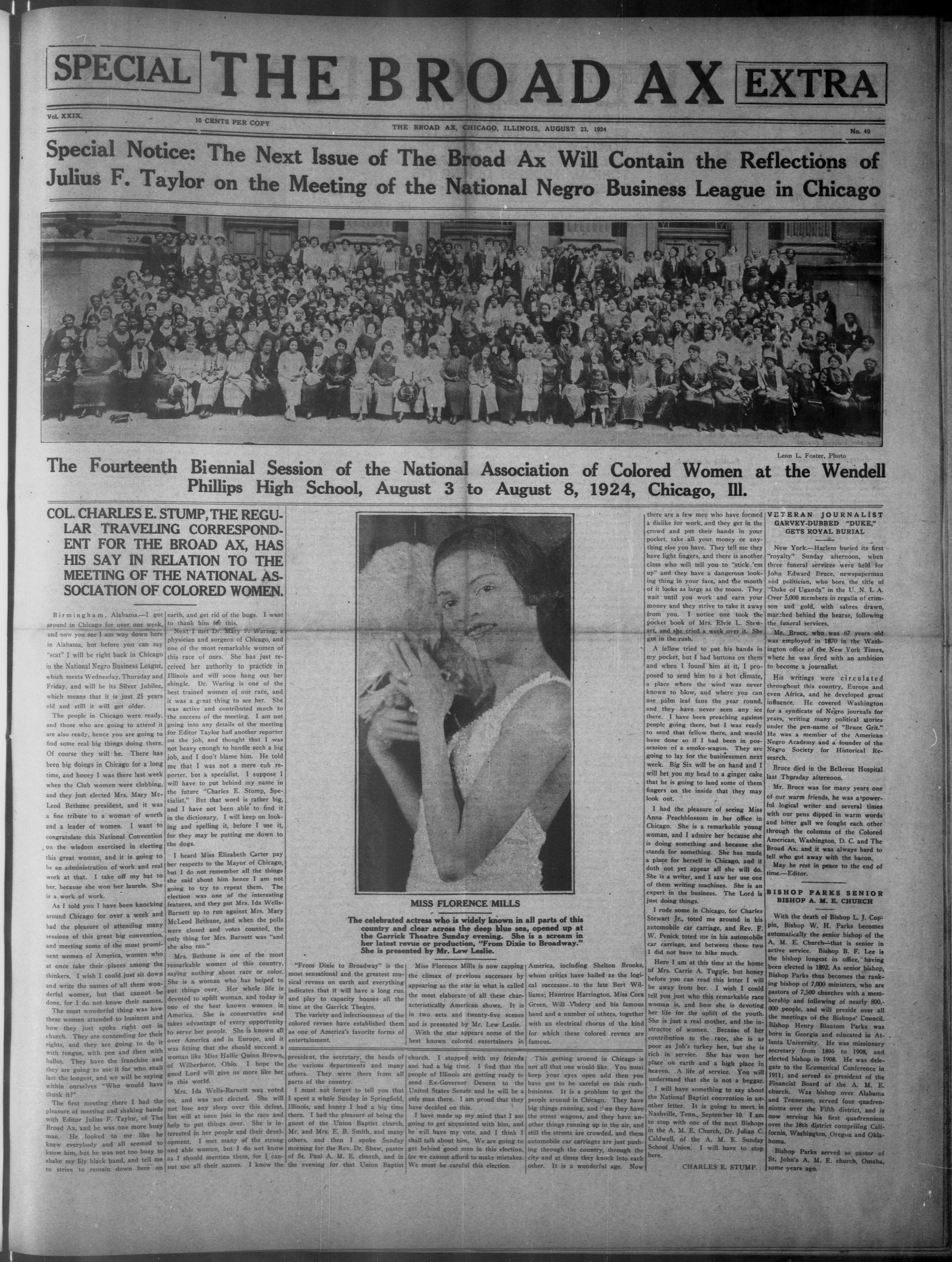
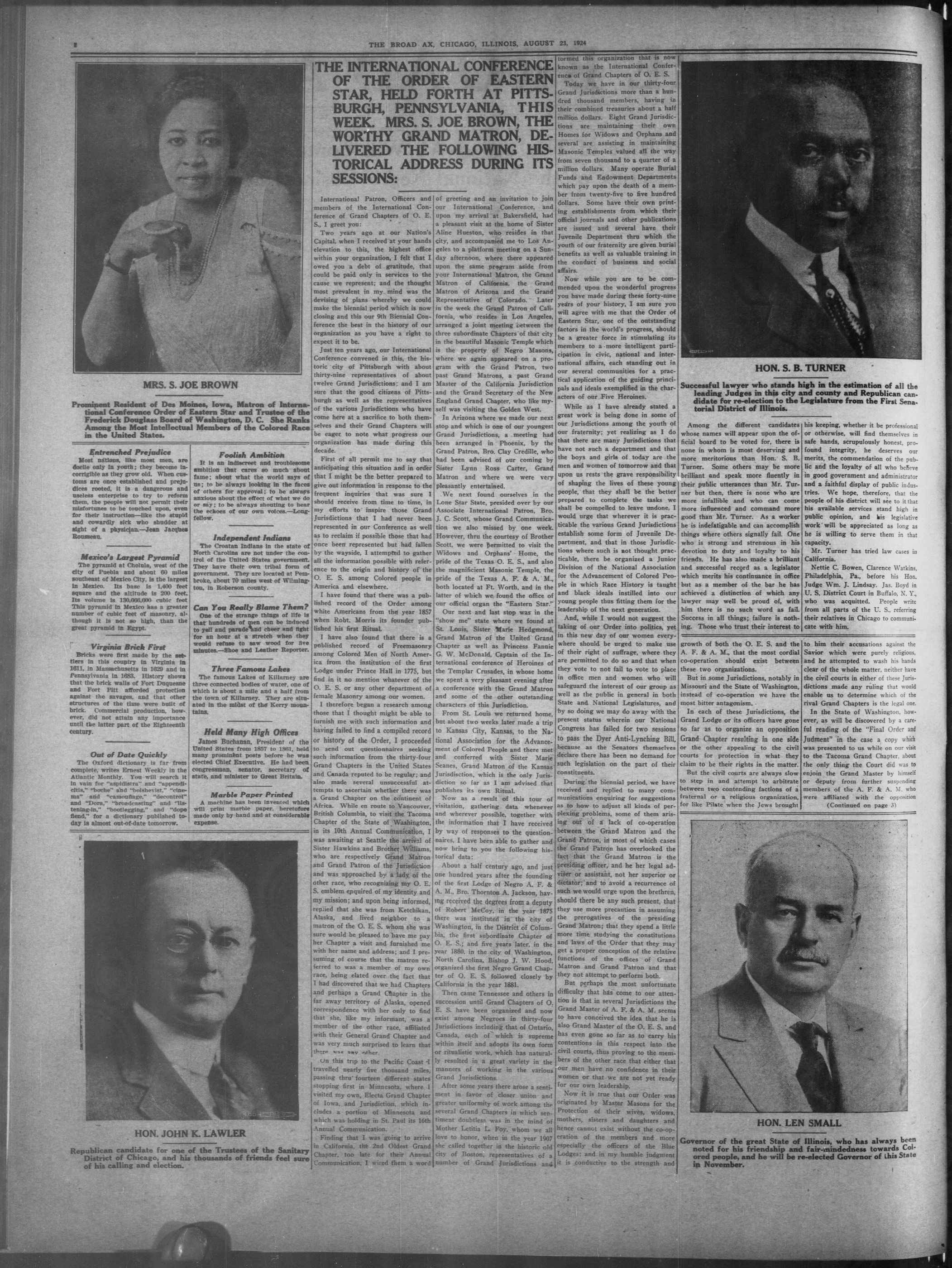
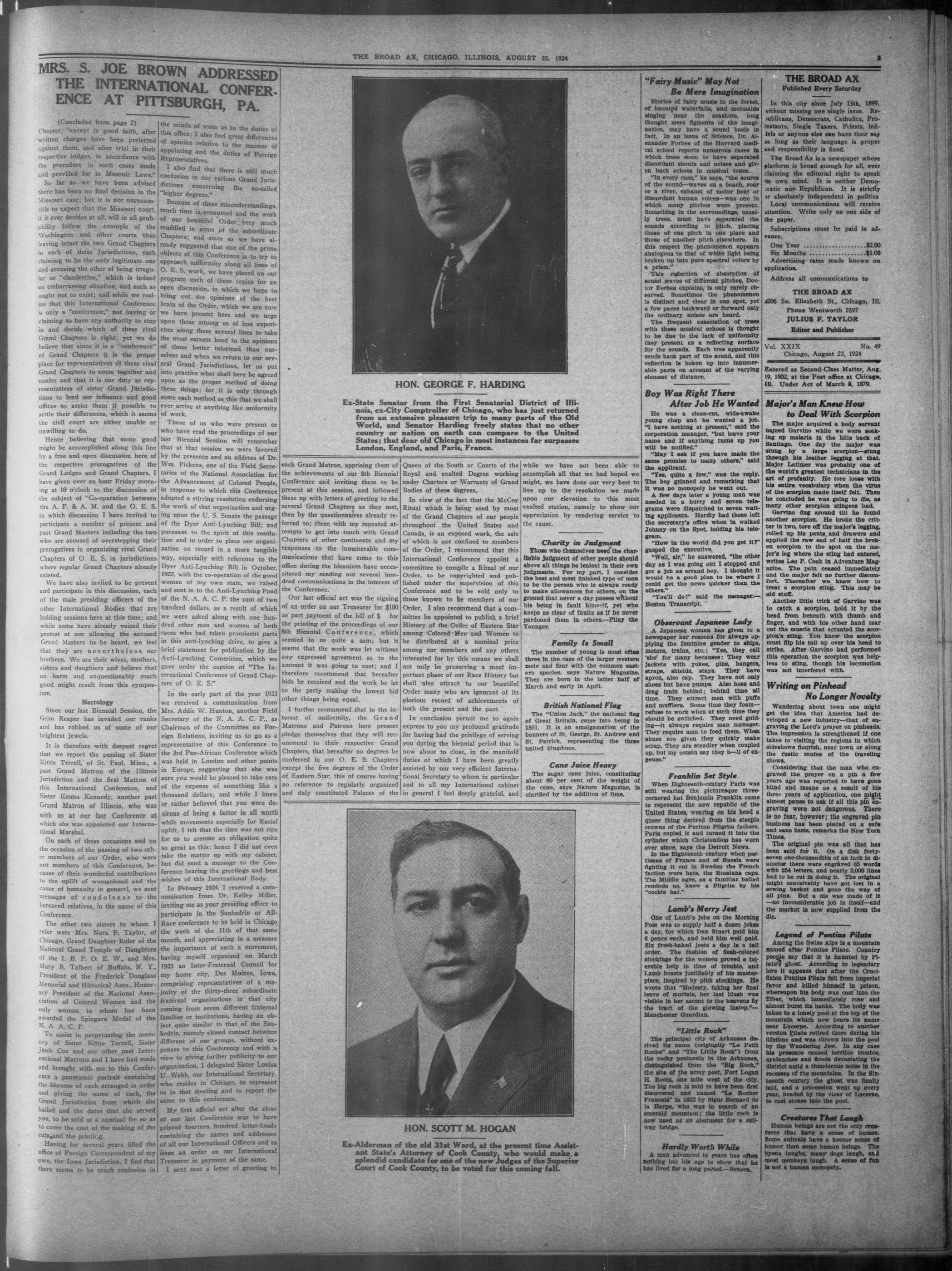
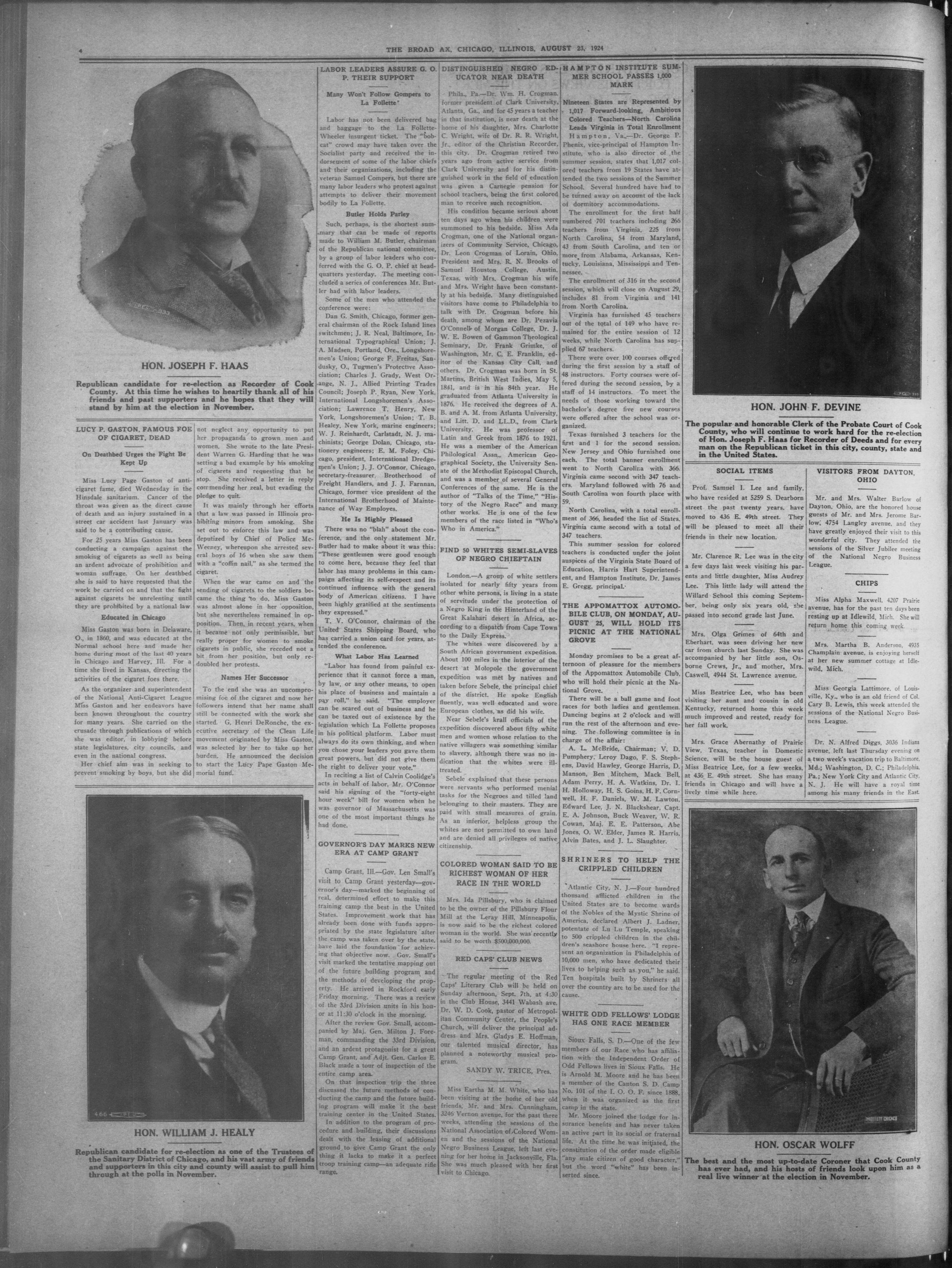
Page text (machine-generated)
SPECIAL THE BROAD AX EXTRA
Special Notice: The Next Issue of The Broad Ax Will Contain the Reflections of Julius F. Taylor on the Meeting of the National Negro Business League in Chicago
THE WOMEN'S SOCIETY OF NEW YORK
The Fourteenth Biennial Session of the National Association of Colored Women at the Wendell Phillips High School, August 3 to August 8, 1924, Chicago, Ill.
COL. CHARLESE E. STUMP, THE REGULAR TRAVELING CORRESPONDENT FOR THE BROAD AX, HAS HIS SAY IN RELATION TO THE MEETING OF THE NATIONAL ASSOCIATION OF COLORED WOMEN.
Birmingham, Alabama. I got around in Chicago for over one week, and now you see I am way down here in Alabama, but before you can say "scat" I will be right back in Chicago in the National Negro Business League, which meets Wednesday, Thursday and Friday, and will be its Silver Jubilee, which means that it is just 25 years old and still it will get older.
The people in Chicago were ready, and those who are going to attend it are also ready, hence you are going to find some real big things doing there. Of course they will be. There has been big doings in Chicago for a long time, and honey I was there last week when the Club women were clubbing, and they just elected Mrs. Mary McLeod Bethune president, and it was a fine tribute to a woman of worth and a leader of women. I want to congratulate this National Convention on the wisdom exercised in electing this great woman, and it is going to be an administration of work and real work at that. I take off my hat to her, because she won her laurels. She is a work of work.
As I told you I have been knocking around Chicago for over a week and had the pleasure of attending many sessions of this great big convention, and meeting some of the most prominent women of America, women who at once take their places among the thinkers. I wish I could just sit down and write the names of all them wonderful women, but that cannot be done, for I do not know their names. The most wonderful thing was how these women attended to business and how they just spoke right out in church. They are contending for their rights, and they are going to do it with tongue, with pen and then with ballot. They have the franchise and they are going to use it for who last the longest, and we will be saying within ourselves "Who would have think it?"
The first meeting there I had the pleasure of meeting and shaking hands with Editor Julius F. Taylor, of The Broad Ax, and he was one more busy man. He looked to me like he knew everybody and all seemed to know him, but he was not too busy to shake my lily black hand, and tell me to strive to remain down here on
10 CENTS PER COPY
ICE: The Next
Taylor on the
th Biennial Se
Phillips High
STUMP, THE REGU-
NG CORRESPOND-
BROAD AX, HAS
ELATION TO THE
THE NATIONAL AS-
COLORED WOMEN.
Next I met Dr. Mary F. Waring, a physician and surgeon of Chicago, and one of the most remarkable women of this race of ours. She has just received her authority to practice in Illinois and will soon hang out her shingle. Dr. Waring is one of the best trained women of our race, and it was a great thing to see her. She was active and contributed much to the success of the meeting. I am not going into any details of the meeting for Editor Taylor had another reporter on the job, and thought that I was not heavy enough to handle such a big job, and I don't blame him. He told me that I was not a mere cub reporter, but a specialist. I suppose I will have to put behind my name in the future "Charles E. Stump, Specialist." But that word is rather big, and I have not been able to find it in the dictionary. I will keep on looking and spelling it, before I use it, for they may be putting me down to the dogs.
I heard Miss Elizabeth Carter pay her respects to the Mayor of Chicago, but I do not remember all the things she said about him hence I am not going to try to repeat them. The election was one of the interesting features, and they put Mrs. Ida Wells-Barnett up to run against Mrs. Mary McLeod Bethune, and when the polls were closed and votes counted, the only thing for Mrs. Barnett was "and she also ran."
Mrs. Bethune is one of the most remarkable women of this country, saying nothing about race or color. She is a woman who has helped to put things over. Her whole life is devoted to uplift woman, and today is one of the best known women in America. She is conservative and takes advantage of every opportunity to serve her people. She is known all over America and in Europe, and it was fitting that she should succeed a woman like Miss Hallie Quinn Brown, of Wilberforce, Ohio. I hope the good Lord will give us more like her in this world.
Mrs. Ida Wells-Barnett was voted on, and was not elected. She will not lose any sleep over this defeat, but will at once join in the race and help to put things over. She is interested in her people and their development. I met many of the strong and able women, but I do not know as I should mention them, for I cannot use all their names. I know the
THE BALLET
The celebrated actress who is widely known in all parts of this country and clear across the deep blue sea, opened up at the Garrick Theatre Sunday evening. She is a scream in her latest revue or production, "From Dixie to Broadway." She is presented by Mr. Lew Leslie.
"From Dixie to Broadway" is the most sensational and the greatest musical revues on earth and everything indicates that it will have a long run and play to capacity houses all the time at the Garrick Theatre. The variety and infectiousness of the colored revues have established them as one of America's favorite forms of entertainment.
president, the secretary, the heads of the various departments and many others. They were there from all parts of the country.
I must not forget to tell you that I spent a whole Sunday in Springfield, Illinois, and honey I had a big time there. I had the pleasure of being the guest of the Union Baptist church, Mr. and Mrs. E. B. Smith, and many others, and then I spoke Sunday morning for the Rev. Dr. Shaw, pastor of St. Paul A. M. E. church, and in the evening for that Union Baptist
MISS FLORENCE MILLS
actress who is widely known in
clear across the deep blue sea
Theatre Sunday evening. She
sue or production, "From Dixie
led by Mr. Lew Leslie.
Miss Florence Mills is now capping the climax of previous successes by appearing as the star in what is called the most elaborate of all these characteristically American shows. It is in two acts and twenty-five scenes and is presented by Mr. Lew Leslie.
With the star appears some of the best known colored entertainers in church. I stopped with my friends and had a big time. I find that the people of Illinois are getting ready to send Ex-Governor Deneen to the United States Senate and he will be a safe man there. I am proud that they have decided on this.
I have made up my mind that I am going to get acquainted with him, and he will have my vote, and I think I shall talk about him. We are going to get behind good men in this election, for we cannot afford to make mistakes. We must be careful this election.
---
America, including Shelton Brooks, whom critics have hailed as the logical successor to the late Bert Williams; Hamtree Harrington, Miss Cora Green, Will Vodery and his famous band and a number of others, together with an electrical chorus of the kind for which these colored revues are famous.
This getting around in Chicago is not all that one would like. You must keep your eyes open and then you have got to be careful on this rush-business. It is a problem to get the people around in Chicago. They have big things running, and then they have the street wagons, and they have another things running up in the air, and still the streets are crowded, and them automobile car carriages are just pushing through the country, through the city and at times they knock into each other. It is a wonderful age. Now
there are a few men who have formed a dislike for work, and they get in the crowd and put their hands in your pocket, take all your money or anything else you have. They tell me they have light fingers, and there is another class who will tell you to "stick 'em up" and they have a dangerous looking thing in your face, and the mouth of it looks as large as the moon. They wait until you work and earn your money and they strive to take it away from you. I notice one took the pocket book of Mrs. Elvie L. Stewart, and she cried a week over it. She got in the rush.
A fellow tried to put his hands in my pocket, but I had buttons on them and when I found him at it, I proposed to send him to a hot climate, a place where the wind was never known to blow, and where you can use palm leaf fans the year round, and they have never seen any ice there. I have been preaching against people going there, but I was ready to send that fellow there, and would have done so if I had been in possession of a smoke-wagon. They are going to lay for the businessmen next week. Big Six will be on hand and I will let you my head to a ginger cake that he is going to land some of them fingers on the inside that they may look out.
I had the pleasure of seeing Miss Anna Peachblossom in her office in Chicago. She is a remarkable young woman, and I admire her because she is doing something and because she stands for something. She has made a place for herself in Chicago, and it doth not yet appear all she will do. She is a writer, and I saw her use one of them writing machines. She is an expert in the business. The Lord is just doing things.
I rode some in Chicago, for Charles Stewart Jr., toted me around in his automobile car carriage, and Rev. F. W. Penick toted me in his automobile car carriage, and between these two I did not have to hike much.
Here I am at this time at the home of Mrs. Carrie A. Tuggle, but honey before you can read this letter I will be away from her. I wish I could tell you just who this remarkable race woman is, and how she is devoting her life for the uplift of the youth. She is just a real mother, and the instructor of women. Because of her contribution to the race, she is as poor as Job's turkey hen, but she is rich in service. She has won her place on earth and a high place in heaven. A life of service. You will understand that she is not a beggar. I will have something to say about the National Baptist convention in another letter. It is going to meet in Nashville, Tenn., September 10. I am to stop with one of the next Bishop in the A. M. E. Church, Dr. Julian C. Caldwell, of the A. M. E. Sunday School Union. I will have to stop here.
VETERAN JOURNALIST GARVEY-DUBBED "DUKE," GETS ROYAL BURIAL
New York—Harlem buried its first "royalty" Sunday afternoon, when three funeral services were held for John Edward Bruce, newspaperman and politician, who bore the title of "Duke of Uganda" in the U. N. L. A. Over 5,000 members in regalia of crimson and gold, with sabres drawn, marched behind the hearse, following the funeral services.
Mr. Bruce, who was 67 years old was employed in 1870 in the Washington office of the New York Times, where he was fired with an ambition to become a journalist.
His writings were circulated throughout this country, Europe and even Africa, and he developed great influence. He covered Washington for a syndicate of Negro journals for years, writing many political stories under the pen-name of "Bruce Grit." He was a member of the American Negro Academy and a founder of the Negro Society for Historical Research.
Bruce died in the Bellevue Hospital last Thursday afternoon.
Mr. Bruce was for many years one of our warm friends, he was a powerful logical writer and several times with our pens dipped in warm words and bitter gall we fought each other through the columns of the Colored American, Washington, D. C. and The Broad Ax, and it was always hard to tell who got away with the bacon.
May he rest in peace to the end of time.—Editor.
BISHOP PARKS SENIOR
BISHOP A. M. E. CHURCH
With the death of Bishop L. J. Coppin, Bishop W. H. Parks becomes automatically the senior bishop of the A. M. E. Church—that is senior in active service. Bishop B. F. Lee is the bishop longest in office, having been elected in 1892. As senior bishop, Bishop Parks thus becomes the ranking bishop of 7,000 ministers, who are pastors of 7,500 churches with a membership and following of nearly 800,000 people, and will preside over all the meetings of the Bishops' Council. Bishop Henry Blantom Parks was born in Georgia and educated in Atlanta University. He was missionary secretary from 1896 to 1908, and elected bishop in 1908. He was delegate to the Ecumenical Conference in 1911; and served as president of the Financial Board of the A. M. E. church. Was bishop over Alabama and Tennessee, served four quadrennium over the Fifth district, and is now serving his first quadrennium over the 18th district comprising California, Washington, Oregon and Oklahoma.
Bishop Parks served as pastor of St. John's A. M. E. church, Omaha, some years ago.
Mrs.
Prominent Resident of Des Moines, Iowa, Matron of International Conference Order of Eastern Star and Trustee of the Frederick Douglass Board of Washington, D.C. She Ranks Among the Most Intellectual Members of the Colored Race in the United States.
Entrenched Prejudice
Most nations, like most men, are docile only in youth; they become incorrigible as they grow old. When customs are once established and prejudices rooted, it is a dangerous and useless enterprise to try to reform them, the people will not permit their misfortunes to be touched upon, even for their instruction—like the stupid and cowardly sick who shudder at sight of a physician—Jean Jacques Rousseau.
Mexico's Largest Pyramid
Mexico's Largest Pyramid The pyramid at Cholule, west of the city of Puebla and about 60 miles southeast of Mexico City, is the largest in Mexico. Its base is 1,400 feet square and the altitude is 200 feet. Its volume is 130,066,000 cubic feet This pyramid in Mexico has a greater number of cubic feet of masonry, although it is not so high, than the great pyramid in Egypt.
Virginia Brick First
Bricks were first made by the settlers in this country in Virginia in 1611, in Massachusetts in 1629 and in Pennsylvania in 1883. History shows that the brick walls of Fort Duquesne and Fort Pitt afforded protection against the savages, and that other structures of the time were built of brick. Commercial production, however, did not attain any importance until the latter part of the Eighteenth century.
Out of Date Quickly
The Oxford dictionary is far from complete, writes Ernest Weekly in the Atlantic Monthly. You will search it in vain for "aspidistra" and "appendicitis," "boche" and "bolshiste," "cinema" and "camoufage," "decontrol" and "Dora," "broadcasting" and "listening-in," "boootlegging," and "dope flend," for a dictionary published today is almost out-of-date tomorrow.
1
1
465
HON. JOHN K. LAWLER
Republican candidate for one District of Chicago, and his of his calling and election.
Republican candidate for one of the Trustees of the Sanitary District of Chicago, and his thousands of friends feel sure of his calling and election.
Foolish Ambition
It is an indiscreet and troublesome ambition that cares so much about fame; about what the world says of us; to be always looking in the faces of others for approval; to be always anxious about the effect of what we do or say; to be always shouting to hear the eckoes of our own voices.—Long, fellow.
Independent Indians
The Croatan Indians in the state of North Carolina are not under the control of the United States government. They have their own tribal form of government. They are located at Pembroke, about 70 miles west of Wilmington, in Roberson county.
Can You Really Blame Them?
One of the strange things of life is that hundreds of men can be induced to yell and parade and cheer and fight for an hour at a stretch when they would refuse to saw wood for five minutes.—Shoe and Leather Reporter.
Three Famous Lakes
The famous Lakes of Killarney are three connected bodies of water, one of which is about a mile and a half from the town of Killarney. They are situated in the midst of the Kerry mountains.
Held Many High Offices
James Buchanan, President of the United States from 1837 to 1861, held many prominent posts before he was elected Chief Executive. He had been congressman, senator, secretary of state, and minister to Great Britain.
Marble Paper Printed
A machine has been invented which will print marble paper, heretofore made only by hand and at considerable expense.
186 186
of the Trustees of the Sanitary thousands of friends feel sure
THE BROAD AX, CHICAGO, ILLINOIS, AUGUST 23, 1924
THE INTERNATIONAL CONFERENCE OF THE ORDER OF EASTERN STAR, HELD FORTH AT PITTSBURGH, PENNSYLVANIA, THIS WEEK. MRS. S. JOE BROWN, THE WORTHY GRAND MATRON, DELIVERED THE FOLLOWING HISTORICAL ADDRESS DURING ITS SESSIONS:
International Patron, Officers and members of the International Conference of Grand Chapters of O. E. S., I greet you:
Two years ago at our Nation's Capital, when I received at your hands elevation to this, the highest office within your organization, I felt that I owed you a debt of gratitude, that could be paid only in services to the cause we represent; and the thought most prevalent in my mind was the devising of plans whereby we could make the biennial period which is now closing and this our 9th Biennial Conference the best in the history of our organization as you have a right to expect it to be.
Just ten years ago, our International Conference convened in this, the historic city of Pittsburgh with about thirty-nine representatives of about twelve Grand Jurisdictions; and I am sure that the good citizens of Pittsburgh as well as the representatives of the various Jurisdictions who have come here at a sacrifice to both themselves and their Grand Chapters will be eager, to note what progress our organization has made during this decade.
First of all permit me to say that anticipating this situation and in order that I might be the better prepared to give out information in response to the frequent inquiries that was sure I should receive from time to time, in my efforts to inspire those Grand Jurisdictions that I had never been represented in our Conference as well as to reclaim if possible those that had once been represented but had fallen by the wayside, I attempted to gather all the information possible with reference to the origin and history of the O. E. S. among Colored people in America and elsewhere.
I have found that there was a published record of the Order among white Americans from the year 1857 when Robt. Morris its founder published his first Ritual.
I have also found that there is a published record of Freemasonry among Colored Men of North America from the institution of the first Lodge under Prince Hall in 1775, but find in it no mention whatever of the O. E. S. or any other department of female Masonry among our women.
I therefore began a research among those that I thought might be able to furnish me with such information and having failed to find a compiled record or history of the Order, I proceeded to send out questionnaires seeking such information from the thirty-four Grand Chapters in the United States and Canada reputed to be regular; and also made several unsuccessful attempts to ascertain whether there was a Grand Chapter on the continent of Africa. While en route to Vancouver, British Patron of the Jurisdiction and was approached by a lady of the other race, who recognizing my O. E. S. emblem enquired of my identity and my mission; and upon being informed, replied that she was from Ketchikan, Alaska, and lived neighbor to a matron of the O. E. S. whom she was sure would be pleased to have me pay her Chapter a visit and furnished me with her name and address; and I presuming of course that the matron referred to was a member of my own race, being elated over the fact that I had discovered that we had Chapters and perhaps a Grand Chapter in the far away territory of Alaska, opened correspondence with her only to find that she, like my informant, was a member of the other race, affiliated with their General Grand Chapter and was very much surprised to learn that there was any other.
On this trip to the Pacific Coast I travelled nearly five thousand miles, passing thru fourteen different states stopping first in Minnesota, where I visited my own, Electa Grand Chapter of Iowa, and Jurisdiction, which includes a portion of Minnesota and which was holding in St. Paul its 16th Annual Communication.
Finding that I was going to arrive in California, the 2nd Oldest Grand Chapter, too late for their Annual Communication, I wired them a word
of greeting and an invitation to join our International Conference, and upon my arrival at Bakersfield, had a pleasant visit at the home of Sister Aline Hueston, who resides in that city, and accompanied me to Los Angeles to a platform meeting on a Sunday afternoon, where there appeared upon the same program aside from your International Matron, the Grand Matron of California, the Grand Matron of Arizona and the Grand Representative of Colorado. Later in the week the Grand Patron of California, who resides in Los Angeles, arranged a joint meeting between the three subordinate Chapters of that city in the beautiful Masonic Temple which is the property of Negro Masons, where we again appeared on a program with the Grand Patron, two past Grand Matrons, a past Grand Master of the California Jurisdiction and the Grand Secretary of the New England Grand Chapter, who like myself was visiting the Golden West.
In Arizona where we made our next stop and which is one of our youngest Grand Jurisdictions, a meeting had been arranged in Phoenix, by the Grand Patron, Bro. Clay Credille, who had been advised of our coming by Sister Lynn Ross Carter, Grand Matron and where we were very pleasantly entertained.
We next found ourselves in the Lone Star State, presided over by our Associate International Patron, Broj J. C. Scott, whose Grand Communication we also missed by one week. However, thru the courtesy of Brother Scott, we were permitted to visit the Widows and Orphans' Home, the pride of the Texas O. E. S., and also the magnificent Masonic Temple, the pride of the Texas A. F. & A. M., both located at Ft. Worth, and in the latter of which we found the office of our official organ the "Eastern Star." Our next and last stop was in the "show me" state where we found at St. Louis, Sister Marie Hedgmond, Grand Matron of the United Grand Chapter as well as Princess Fannie G. W. McDonald, Captain of the International conference of Heroines of the Templar Crusades, in whose home we spent a very pleasant evening after a conference with the Grand Matron and some of the other outstanding characters of this Jurisdiction.
From St. Louis we returned home, but about two weeks later made a trip to Kansas City, Kansas, to the National Association for the Advancement of Colored People and there met and conferred with Sister Marie Seanes, Grand Matron of the Kansas Jurisdiction, which is the only Jurisdiction so far as I am advised that publishes its own Ritual. Now as a result of this tour of visitation, gathering data whenever and wherever possible, together with the information that I have received by way of responses to the questionnaires, I have been able to gather and now bring to you the following historical data:
About a half century ago, and just one hundred years after the founding of the first Lodge of Negro A. F. & A. M. Bro. Thornton A. Jackson, having received the degrees from a deputy of Robert McCoy, in the year 1875 there was instituted in the city of Washington, in the District of Columbia, the first subordinate Chapter of O. E. S.; and five years later, in the year 1880, in the city of Washington, North Carolina, Bishop J. W. Wood organized the first Negro Grand Chapter of O. E. S. followed closely by California in the year 1881.
Then came Tennessee and others in succession until Grand Chapters of O. E. S. have been organized and now exist among Negroes in thirty-four Jurisdictions including that of Ontario, Canada, each of which is supreme within itself and adopts its own form or ritualistic work, which has naturally resulted in a great variety in the manners of working in the various Grand Jurisdictions.
After some years there arose a sentiment in favor of closer union and greater uniformity of work among the several Grand Chapters in which sentiment doubtless was in the mind of Mother Letitia L. Foy, whom we all love to honor, when in the year 1907 she called together in the historic old city of Boston, representatives of a number of Grand Jurisdictions and
formed this organization that is now known as the International Conference of Grand Chapters of O. E. S. Today we have in our thirty-four Grand Jurisdictions more than a hundred thousand members, having in their combined treasuries about a half million dollars. Eight Grand Jurisdictions are maintaining their own Homes for Widows and Orphans and several are assisting in maintaining Masonic Temples valued all the way from seven thousand to a quarter of a million dollars. Many operate Burial Funds and Endowment Departments which pay upon the death of a member from twenty-five to five hundred dollars. Some have their own printing establishments from which their official journals and other publications are issued and several have their Juvenile Department thru which the youth of our fraternity are given burial benefits as well as valuable training in the conduct of business and social affairs.
Now while you are to be commended upon the wonderful progress you have made during these forty-nine years of your history, I am sure you will agree with me that the Order of Eastern Star, one of the outstanding factors in the world's progress, should be a greater force in stimulating its members to a more intelligent participation in civic, national and international affairs, each standing out in our several communities for a practical application of the guiding principals and ideals exemplified in the characters of our Five Heroines.
While as I have already stated a great work is being done in some of our Jurisdictions among the youth of our fraternity; yet realizing as I do that there are many Jurisdictions that have not such a department and that the boys and girls of today are the men and women of tomorrow and that upon us rests the grave responsibility of shaping the lives of these young people, that they shall be the better prepared to complete the tasks we shall be compelled to leave undone, I would urge that wherever it is practicable the various Grand Jurisdictions establish some form of Juvenile Department, and that in those Jurisdictions where such is not thought practicable, there be organized a Junior Division of the National Association for the Advancement of Colored People in which Race History is taught and black ideals instilled into our young people thus fitting them for the leadership of the next generation.
And, while I would not suggest the taking of our Order into politics, yet in this new day of our women everywhere should be urged to make use of their right of suffrage, where they are permitted to do so and that when they vote to not fail to vote to place in office men and women who will safeguard the interest of our group as well as the public in general in both State and National Legislatures, and by so doing we may do away with the present status wherein our National Congress has failed for two sessions to pass the Dyer Anti-Lynching Bill, because as the Senators themselves declare there has been no demand for such legislation on the part of their constituents.
During the biennial period, we have received and replied to many communications enquiring for suggestions as to how to adjust all kinds of perplexing problems, some of them arising out of a lack of co-operation between the Grand Matron and the Grand Patron, in most of which cases the Grand Patron has overlooked the fact that the Grand Matron is the presiding officer, and he her legal adviser or assistant, not her superior or dictator; and to avoid a recurrence of such we would urge upon the brethren, should there be any such present, that they use more precaution in assuming the prerogatives of the presiding Grand Matron; that they spend a little more time studying the constitutions and laws of the Order that they may get a proper conception of the relative functions of the offices of Grand Matron and Grand Patron and that they not attempt to perform both.
But perhaps the most unfortunate difficulty that has come to our attention is that in several Jurisdictions the Grand Master of A. F. & A. M. seems to have conceived the idea that he is also Grand Master of the O. E. S. and has even gone so far as to carry his contentions in this respect into the civil courts, thus proving to the members of the other race that either that our men have no confidence in their women or that we are not yet ready for our own leadership.
Now it is true that our Order was originated by Master Masons for the Protection of their wives, widows, mothers, sisters and daughters and hence cannot exist without the co-operation of the members and more especially the officers of the Blue Lodges; and in my humble judgment it is conductive to the strength and
C. J. C. K.
HON. S. B. TURNER
Successful lawyer who stands high in the e leading Judges in this city and county didate for re-election to the Legislature torial District of Illinois.
Successful lawyer who stands high in the estimation of all the leading Judges in this city and county and Republican candidate for re-election to the Legislature from the First Senatorial District of Illinois.
Among the different candidates whose names will appear upon the official board to be voted for, there is none in whom is most deserving and more meritorious than Hon. S. B. Turner. Some others may be more brilliant and speak more fluently in their public utterances than Mr. Turner but then, there is none who are more infallible and who can come more influenced and command more good than Mr. Turner. As a worker he is indefatigable and can accomplish things where others signally fail. One who is strong and strenuous in his devotion to duty and loyalty to his friends. He has also made a brilliant and successful record as a legislator which merits his continuance in office but as a member of the bar he has achieved a distinction of which any lawyer may well be proud of, with him there is no such word as fail. Success in all things; failure is nothing. Those who trust their interest to
growth of both the O. E. S. and the A. F. & A. M., that the most cordial co-operation should exist between these two organizations.
But in some Jurisdictions, notably in Missouri and the State of Washington, instead of co-operation we have the most bitter antagonism.
In each of these Jurisdictions, the Grand Lodge or its officers have gone so far as to organize an opposition Grand Chapter resulting in one side or the other appealing to the civil courts for protection in what they claim to be their rights in the matter.
But the civil courts are always slow to step in and attempt to arbitrate between two contending factions of a fraternal or a religious organization, for like Pilate when the Jews brought
```markdown
```
M.
Governor of the great State of Illinois, was noted for his friendship and fair-minded people, and he will be re-elected in November.
Governor of the great State of Illinois, who has always been noted for his friendship and fair-mindedness towards Colored people, and he will be re-elected Governor of this State in November.
high in the estimation of all the and county and Republican can-Legislature from the First Sena- his keeping, whether it be professional or otherwise, will find themselves in safe hands, scrupulously honest, profound integrity, he deserves our merits, the commendation of the public and the loyalty of all who believe in good government and administrator and a faithful display of public industries. We hope, therefore, that the people of his district will see to it that his available services stand high in public opinion, and his legislative work will be appreciated as long as he is willing to serve them in that capacity.
Mr. Turner has tried law cases in California.
Nettie C. Bowen, Clarence Watkins, Philadelphia, Pa., before his Hon. Judge Wm. J. Lindsay. Jas. Boyd in U. S. District Court in Buffalo, N. Y., who was acquitted. People write from all parts of the U. S., referring their relatives in Chicago to communicate with him.
to him their accusations against the Savior which were purely religious, and he attempted to wash his hands clear of the whole matter, neither have the civil courts in either of these Jurisdictions made any ruling that would enable us to determine which of the rival Grand Chapters is the legal one. In the State of Washington, however, as will be discovered by a careful reading of the "Final Order and Judgment" in the case a copy which was presented to us while on our visit to the Tacoma Grand Chapter, about the only thing the Court did was to enjoin the Grand Master by himself or deputy from further suspending members of the A. F. & A. M. who were affiliated with the opposition (Continued on page 3)
1930
Illinois, who has always been fair-mindedness towards Colle-elected Governor of this State
MRS. S. JOE BROWN ADDRESSED THE INTERNATIONAL CONFERENCE AT PITTSBURGH, PA.
(Concluded from page 2) Chapter, "except in good faith, after written charges have been preferred against them, and after trial in their respective lodges, in accordance with the procedure in such cases made and provided for in Masonic Laws"
So far as we have been advised there has been no final decision in the Missouri case; but it is not unreasonable to expect that the Missouri court, if it ever decides at all, will in all probability follow the example of the Washington and other courts thus leaving intact the two Grand Chapters in each of these Jurisdictions, each claiming to be the only legitimate one and accusing the other of being irregular or "clandestine," which is indeed an embarrassing situation, and such as ought not to exist; and while we realize that this International Conference is only a "conference," not having or claiming to have any authority to step in and decide which of these rival Grand Chapters is right; yet we do believe that since it is a "conference" of Grand Chapters it is the proper place for representatives of these rival Grand Chapters to come together and confer and that it is our duty as representatives of sister Grand Jurisdictions to lend our influence and good offices to assist them if possible to settle their differences, which it seems the civil court are either unable or unwilling to do.
Hence believing that some good might be accomplished along this line by a free and open discussion here of the respective prerogatives of the Grand Lodges and Grand Chapters, I have given over an hour Friday morning at 10 o'clock to the discussion of the subject of "Co-operation between the A. F. & A. M. and the O. E. S. in which discussion I have invited to participate a number of present and past Grand Masters including the two who are accused of overstepping their prerogatives in organizing rival Grand Chapters of O. E. S. in jurisdictions where regular Grand Chapters already existed.
We have also invited to be present and participate in this discussion, each of the male presiding officers of the other International Bodies that are holding sessions here at this time; and while some have already voiced their protest at our allowing the accused Grand Masters to be heard, we feel that they are nevertheless our brethren. We are their wives, mothers, sisters and daughters and believe that no harm and unquestionably much good might result from this symposium.
Necrology
Since our last Biennial Session, the Grim Reaper has invaded our ranks and has robbed us of some of our brightest jewels.
It is therefore with deepest regret that we report the passing of Sister Kittie Terrell, of St. Paul, Minn., a past Grand Matron of the Illinois Jurisdiction and the first Matron of this International Conference, and Sister Emma Kennedy, another past Grand Matron of Illinois, who was with us at our last Conference at which she was appointed our International Marshal.
On each of these occasions and on the occasion of the passing of two other members of our Order, who were not members of this Conference, because of their wonderful contributions to the uplift of womanhood and the cause of humanity in general, we sent messages of condolence to the bereaved relatives, in the name of this Conference.
The other two sisters to whom I refer were Mrs. Nora P. Taylor, of Chicago, Grand Daughter Ruler of the National Grand Temple of Daughters of the I. B. P. O. E. W., and Mrs. Mary B. Talbert of Buffalo, N. Y., President of the Frederick Douglass Memorial and Historical Assn., Honorary President of the National Association of Colored Women and the only woman to whom has been awarded the Spingarn Medal of the N. A. A. C. P.
To assist in perpetuating the memory of Sister Kittle Terrell, Sister Janie Cox and our other past International Matrons and I have had made and brought with me to this Conference a panoramic portrait containing the likeness of each arranged in order and giving the name of each, the Grand Jurisdiction from which she hailed and the dates that she served you, to be sold at a nominal fee so as to cover the cost of the making of the cuts and the printing.
Having for several years filled the office of Foreign Correspondent of my own, the Iowa Jurisdiction, I find that there seems to be much confusion in
the minds of some as to the duties of this office; I also find great differences of opinion relative to the manner of appointing and the duties of Foreign Representatives. I also find that there is still much confusion in our various Grand Jurisdictions concerning the so-called "higher degrees."
Because of these misunderstandings, much time is consumed and the work of our beautiful Order very much muddled in some of the subordinate Chapters; and since as we have already suggested that one of the prime objects of this Conference is to try to approach uniformity along all lines of O. E. S. work, we have placed on our program each of these topics for an open discussion, in which we hope to bring out the opinions of the best brain of the Order, which we are sure we have present here and we urge upon those among us of less experience along these several lines to take the most earnest heed to the opinions of those better informed than ourselves and when we return to our several Grand Jurisdictions, let us put into practice what shall here be agreed upon as the proper method of doing these things; for it is only through some such method as this that we shall ever arrive at anything like uniformity of work.
Those of us who were present or who have read the proceedings of our last Biennial Session will remember that at that session we were favored by the presence and an address of Dr. Wm. Pickens, one of the Field Secretaries of the National Association for the Advancement of Colored People, in response to which this Conference adopted a stirring resolution endorsing the work of that organization and urging upon the U. S. Senate the passage of the Dyer Anti-Lynching Bill; and pursuant to the spirit of this resolution and in order to place our organization on record in a more tangible way, especially with reference to the Dyer Anti-Lynching Bill in October, 1922, with the co-operation of the good women of my own state, we raised and sent in to the Anti-Lynching Fund of the N. A. A. C. P. the sum of two hundred dollars, as a result of which we were asked along with one hundred other men and women of both races who had taken prominent parts in this anti-lynching drive, to give a brief statement for publication by the Anti-Lynching Committee, which we gave under the caption of "The International Conference of Grand Chapters of O. E. S."
In the early part of the year 1923 we received a communication from Mrs. Addie W. Hunton, another Field Secretary of the N. A. A. C. P., as Chairman of the Committee on Foreign Relations, inviting us to go as a representative of this Conference to the 3rd Pan-African Conference which was held in London and other points in Europe, suggesting that she was sure you would be pleased to take care of the expense of something like a thousand dollars; and while I knew or rather believed that you were desirous of being a factor in all worth while movements especially for Racial uplift, I felt that the time was not ripe for us to assume an obligation quite so great as this; hence I did not even take the matter up with my cabinet, but did send a message to the Conference bearing the greetings and best wishes of this International Body.
In February 1924, I received a communication from Dr. Kelley Miller, inviting me as your presiding officer to participate in the Sanhedrin or All-Race conference to be held in Chicago the week of the 11th of that same month, and appreciating in a measure the importance of such a movement, having myself organized on March 1923 an Inter-Fraternal Council for my home city, Des Moines, Iowa, comprising representatives of a majority of the thirty-three subordinate fraternal organizations in that city coming from seven different fraternal families or institutions, having an object quite similar to that of the Sanhedrin, namely closed contact between different of our groups, without expenses to this Conference and with a view to giving further publicity to our organization, I delegated Sister Louisa U. Webb, our International Secretary, who resides in Chicago, to represent us in that meeting and to report the same to this conference.
My first official act after the close of our last Conference was to have printed fourteen hundred letter-heads containing the names and addresses of all our International Officers and to issue an order on our International Treasurer in payment of the same. I next sent a letter of greeting to
THE BROAD AX, CHICAGO, ILLINOIS, AUGUST 23. 1924
M. H.
Ex-State Senator from the First Senatorial District of Illinois, ex-City Comptroller of Chicago, who has just returned from an extensive pleasure trip to many parts of the Old World, and Senator Harding freely states that no other country or nation on earth can compare to the United States; that dear old Chicago in most instances far surpasses London, England, and Paris, France.
[Name]
Ex-Alderman of the old 31st Ward, at the present time Assistant State's Attorney of Cook County, who would make a splendid candidate for one of the new Judges of the Superior Court of Cook County, to be voted for this coming fall.
Ex-Alderman of the old 31st Ward, at the present time Assistant State's Attorney of Cook County, who would make a splendid candidate for one of the new Judges of the Superior Court of Cook County, to be voted for this coming fall.
each Grand Matron, appraising them of the achievements of our 8th Biennial Conference and inviting them to be present at this session, and followed these up with letters of greeting to the several Grand Chapters as they met, then by the questionnaires already referred to; these with my repeated attempts to get into touch with Grand Chapters of other continents and my responses to the innumerable communications that have come to this office during the biennium have necessitated my sending out several hundred communications in the interest of the Conference.
Our last official act was the signing of an order on our Treasurer for $100 as part payment of the bill of $ for the printing of the proceedings of our 8th Biennial Conference, which seemed to us quite a sum; but it seems that the work was let without any expressed agreement as to the amount it was going to cost; and I therefore recommend that hereafter bids be received and the work be let to the party making the lowest bid other things being equal.
I further recommend that in the interest of uniformity, the Grand Matrons and Patrons here present pledge themselves that they will recommend to their respective Grand Chapters, that hereafter no degrees be conferred in our O. E. S. Chapters except the five degrees of the Order of Eastern Star, this of course having no reference to regularly organized and duly constituted Palaces of the
HON. GEORGE F. HARDING
Sculptor from the First Senatorial Duty Comptroller of Chicago, who has extensive pleasure trip to many parishes and Senator Harding freely states that nation on earth can compare to that dear old Chicago in most instances England, and Paris, France.
In view of the fact that the McCoy Ritual which is being used by most of the Grand Chapters of our people throughout the United States and Canada, is an exposed work, the sale of which is not confined to members of the Order, I recommend that this International Conference appoint a committee to compile a Ritual of our Order, to be copyrighted and published under the supervision of this Conference and to be sold only to those known to be members of our Order. I also recommend that a committee be appointed to publish a brief History of the Order of Eastern Star among Colored Men and Women to be distributed at a nominal price among our members and any others interested for by this means we shall not only be preserving a most important phase of our Race History but shall also attract to our beautiful Order many who are ignorant of its glorious record of achievements of both the present and the past.
In conclusion permit me to again express to you my profound gratitude for having had the privilege of serving you during the biennial period that is now about to close, in the manifold duties of which I have been greatly assisted by our very efficient International Secretary to whom in particular and to all my International cabinet in general I feel deeply grateful, and
PETER M. BURGESS
HON. SCOTT M. HOGAN
of the old 31st Ward, at the presen
ts Attorney of Cook County, who w
candidate for one of the new Judges
of Cook County, to be voted for this com
while we have not been able to accomplish all that we had hoped we might, we have done our very best to live up to the resolution we made upon our elevation to this most exalted station, namely to show our appreciation by rendering service to the cause.
Charity in Judgment
Those who themselves need the charitable judgment of other people should above all things be lenient in their own judgments. For my part, I consider the best and most finished type of man to be the person who is always ready to make allowances for others, on the ground that never a day passes without his being in fault himself, yet who keeps as clear of faults as if he never pardoned them in others—Pliny the Younger.
Family Is Small
The number of young is most often three in the case of the larger western mole and four with the common eastern species, says Nature Magazine. They are born in the latter half of March and early in April.
British National Flag
The "Union Jack," the national flag of Great Britain, came into being in 1801. It is an amalgamation of the banners of St. George, St. Andrew and St. Patrick, representing the three united kingdoms.
Cane Juice Heavy
The sugar cane juice, constituting about 80 per cent of the weight of the cane, says Nature Magazine, is clarified by the addition of lime.
"Fairy Music" May Not
Stories of fairy music in the forest, of haunted waterfalls, and mermaids singing near the seashore, long thought mere figments of the imagination, may have a sound basis in fact. In an issue of Science, Dr. Alexander Forbes of the Harvard medical school reports numerous cases in which trees seem to have separated discordant shouts and noises and given back echoes in musical tones.
"In every case," he says, "the source of the sound—waves on a beach, roar or a river, exhaust of motor boat or discordant human voices—was one in which many pitches were present. Something in the surroundings, usually trees, must have separated the sounds according to pitch, placing those of one pitch in one place and those of another pitch elsewhere. In this respect the phenomenon appears analogous to that of white light being broken up into pure spectral colors by a prism."
This reflection of absorption of sound waves of different pitches, Doctor Forbes explains, is only rarely observed. Sometimes the phenomenon is distinct and clear in one spot, yet a few paces backward or forward only the ordinary noises are heard. The frequent association of trees with these musical echoes is thought to be due to the lack of uniformity they present as a reflecting surface for the sounds. Each tree apparently sends back part of the sound, and this reflection is boken up into innumerable parts on account of the varying element of distance.
He was a clean-cut, wilde-awake young chap and he wanted a job. "I have nothing at present," said the corporation manager, "but leave your name and if anything turns up you will be notified."
"May I ask if you have made the same promise to many others," said the applicant.
"Yes, quite a few," was the reply. The boy grinned and remarking that it was no monopoly he went out.
A few days later a young man was needed in a hurry and seven telegrams were dispatched to seven waiting applicants. Hardly had these left the secretary's office when in walked Johnny on the Spot, holding his telegram.
"How in the world did you get it?" gasped the executive.
"Well, sir," he answered, "the other day as I was going out I stopped and got a job as errand boy. I thought it would be a good plan to be where I could get the news quicker than the others."
"You'll do!" said the manager.—Boston Transcript.
Observant Japanese Lady
A Japanese woman has given to a newspaper her reasons for always applying the feminine gender to ships, motors, trains, etc.: "Yes, they call she' for many because: They wear jackets with yokes, pins, hangers, straps, shields, stays. They have apron, also cap. They have not only shoes but have pumps. Also hose and drag train behind; behind time all time. They attract men with puffs and mufflers. Some time they foam—refuse to work when at such time they should be switched. They need guiding—it always require man manager. They require man to feed them. When abuse are given they quickly make scrap. They are steadier when coupled up, but my cousin say they h—ll of expense."
Franklin Set Style
When Eighteenth-century Paris was still wearing the picturesque three-cornered hat Benjamin Franklin came to represent the new republic of the United States, wearing on his head a queer thing derived from the steepe crown of the Puritan Pilgrim fathers. Paris copied it and turned it into the cylinder which Christendom has worn ever since, says the Detroit News. In the Eighteenth century when partisans of France and of Russia were fighting it out in Sweden the French faction wore hats, the Russians caps. The Middle ages, as a familiar ballad reminds us, knew a Pilgrim by his "cockle hat."
Lamb's Merry Jest
One of Lamb's jobs on the Morning Post was to supply half a dozen jokes a day, for which Dan Stuart paid him 6 pence each, and held him well paid. Six fresh-baked jests a day is a tall order. The fashion of flesh-colored stockings for the women proved a tolerable help in time of trouble, and Lamb boasts justifiably of his masterpiece, inspired by pink stockings. He wrote that "Modesty, taking her final leave of mortals, her last blush was visible in her ascent to the heavens by the tract of the glowing inatep."—Manchester Guardian.
"Little Rock"
The principal city of Arkansas derived its name (originally "Le Petit Roche" and "The Little Rock") from the rocky peninsula in the Arkansas, distinguished from the "Big Rock," the site of the army post, Fort Logan H. Roots, one mile west of the city. The big rock is said to have been first discovered and named "Le Rocher Francais" in 1822 by Sigur Bernard de la Harpe, who was in search of an emerald mountain; the little rock is now used as an abutment for a railway bridge.
Hardly Worth While
Hardly Worth White
A man advanced in years has often
nothing but his age to show that he
has lived for a long period. -Seneca
THE BROAD AX
Published Every Saturday
In this city since July 15th, 1899, without missing one single issue. Republicans, Democrats, Catholics, Protestants, Single Taxers, Priests, infilts or anyone else can have their say as long as their language is proper and responsibility is fixed. The Broad Ax is a newspaper whose platform is broad enough for all, ever claiming the editorial right to speak its own mind. It is neither Democratic nor Republican. It is strictly or absolutely independent in politics Local communications will receive attention. Write only on one side of the paper. Subscriptions must be paid in advance. One Year .....$2.00 Six Months .....$1.00 Advertising rates made known on application.
Address all communications to
THE BROAD AX
4206 So. Elizabeth St., Chicago, Ill.
Phone Wentworth 2597
JULIUS F. TAYLOR
Editor and Publisher
Vol. XXIX No. 49
Chicago, August 23, 1924
Entered as Second-Class Matter, Aug.
19, 1902, at the Post office at Chicago.
Ill. Under Act of March 8, 1879.
Major's Man Knew How
The major acquired a body servant named Garvino while we were soaking up malaria in the hills back of Santiago. One day the major was stung by a large scorpion-stung through his leather legging at that. Major Latimer was probably one of the world's greatest technicians in the art of profanity. He tore loose with his entire vocabulary when the virus of the scorpion made itself felt. Then he concluded he was going to die, as many other scorpion stingees had. Garvino dug around till he found another scorpion. He broke the critter in two, tore off the major's legging, rolled up his pants, and drawers and applied the raw end of half the broken scorpion to the spot on the major's leg where the sting had entered, writes Leo P. Cook in Adventure Magazine. The pain ceased immediately and the major felt no further discomfort. Thereafter we knew how to treat a scorpion sting. This may be old stuff.
Another little trick of Garvin was to catch a scorpion, hold it by the head from beneath with thumb and finger, and with his other hand tear out the muscle that actuated the scorpion's sting. You know the scorpion must flip his tail up over his head to strike. After Garvin had performed this operation the scorpion was helpless to sting, though his locomotion was not interfered with.
Writing on Pinhead
No Longer Novelty
Wandering about town one might get the idea that America had developed a new industry—that of engraving the Lord's prayer on pinheads. The impression is strengthened if one takes to visiting the regions in which sideshows flourish, near town or along the rustic routes of the traveling shows.
Considering that the man who engraved the prayer on a pin a few years ago was reported to have gone blind and insane as a result of his three years of application, one might almost pause to ask if all this pin engraving were not dangerous. There is no fear, however; the engraved pin business has been placed on a safe and sane basis, remarks the New York Times.
The original pin was all that has been said for it. On a disk forty-seven one-thousandths of an inch in diameter there were engraved 63 words with 254 letters, and nearly 2,000 lines had to be cut in doing it. The original might conceivably have got lost in a sewing basket and gone the way of all pins. But a die was made of it—no inconsiderable job in itself—and the market is now supplied from the die.
Legend of Pontius Pilate
Legend of Pontius Pilate
Among the Swiss Alps is a mountain named after Pontius Pilate. Country people say that it is haunted by Pilate's ghost. According to legendary lore it appears that after the Crucifixion Pontius Pilate fell from imperial favor and killed himself in prison, whereupon his body was cast into the Tiber, which immediately rose and almost burst its banks. The body was taken to a lonely pool at the top of the mountain which now bears its name near Lucerne. According to another version Pilate retired there during his lifetime and was thrown into the pool by the Wandering Jaw. In any case his presence caused terrible trouble, anysanches and floods devastating the district amid a thunderous noise in the recesses of the mountains. In the Sixteenth century the ghost was finally said, and a procession went up every year, headed by the vicar of Lucerne, to cast stones into the pool.
Creatures That Laugh
Creatures That Laugh
Human beings are not the only creatures that have a sense of humor. Some animals have a keener sense of humor than some human beings. The hyena laughs, many dogs laugh, and most monkeys laugh. A sense of fun is not a human monopoly.
C. B. BECK 1933
HON. JOSEPH F. HAAS
Republican candidate for ree County. At this time he w friends and past supporters stand by him at the electio
Republican candidate for re-election as Recorder of Cook County. At this time he wishes to heartily thank all of his friends and past supporters and he hopes that they will stand by him at the election in November.
LUCY P. GASTON, FAMOUS FOE OF CIGARET, DEAD not neglect any opportunity to put her propaganda to grown men and
On Deathbed Urges the Fight Be Kept Up
Miss Lucy Page Gaston of anticigarette fame, died Wednesday in the Hinsdale sanitarium. Cancer of the throat was given as the direct cause of death and an injury sustained in a street car accident last January was said to be a contributing cause.
For 25 years Miss Gaston has been conducting a campaign against the smoking of cigarettes as well as being an ardent advocate of prohibition and woman suffrage. On her deathbed she is said to have requested that the work be carried on and that the fight against cigarettes be unrelenting until they are prohibited by a national law.
Educated in Chicago
Miss Gaston was born in Delaware, O., in 1860, and was educated at the Normal school here and made her home during most of the last 40 years in Chicago and Harvey, Ill. For a time she lived in Kansas, directing the activities of the cigaret foes there.
As the organizer and superintendent of the National Anti-Cigaret League Miss Gaston and her endeavors have been known throughout the country for many years. She carried on the crusade through publications of which she was editor, in lobbying before state legislatures, city councils, and even in the national congress.
Her chief aim was in seeking to prevent smoking by boys, but she did
466
4.66
HON. WILLIAM J. HEALY
Republican candidate for re-elect the Sanitary District of Chic and supporters in this city through at the polls in Nov-
Republican candidate for re-election as one of the Trustees of the Sanitary District of Chicago, and his vast army of friends and supporters in this city and county will assist to pull him through at the polls in November.
election as Recorder of Cookhes to heartily thank all of his and he hopes that they will in November.
not neglect any opportunity to put her propaganda to grown men and women. She wrote to the late President Warren G. Harding that he was setting a bad example by his smoking of cigarettes and requesting that he stop. She received a letter in reply commending her zeal, but evading the pledge to quit.
It was mainly through her efforts that a law was passed in Illinois prohibiting minors from smoking. She set out to enforce this law and was deputized by Chief of Police McWeeney, whereupon she arrested several boys of 16 when she saw them with a "coffin nail," as she termed the cigarette.
When the war came on and the sending of cigarettes to the soldiers became the thing to do, Miss Gaston was almost alone in her opposition, but she nevertheless remained in opposition. Then, in recent years, when it became not only permissible, but really proper for women to smoke cigarettes in public, she receded not a bit from her position, but only redoubled her protests.
Names Her Successor
To the end she was an uncompromising foe of the cigaret and now her followers intend that her name shall still be connected with the work she started. G. Henri DeRonche, the executive secretary of the Clean Life movement originated by Miss Gaston, was selected by her to take up her burden. He announced the decision to start the Lucy Pape Gaston Memorial fund.
```markdown
```
section as one of the Trustees of Mago, and his vast army of friends and county will assist to pull him number.
THE BROAD AX. CHICAGO. ILLINOIS. AUGUST 23; 1924
LABOR LEADERS ASSURE G. O
P. THEIR SUPPORT
Many Won't Follow Gompers to La Follette*
Labor has not been delivered bag and baggage to the La Follette Wheeler insurgent ticket. The "bobcat" crowd may have taken over the Socialist party and received the indorsement of some of the labor chiefs and their organizations, including the veteran Samuel Compers, but there are many labor leaders who protest against attempts to deliver their movement bodily to La Follette.
Butler Holds Parley
Such, perhaps, is the shortest summary that can be made of reports made to William M. Butler, chairman of the Republican national committee, by a group of labor leaders who conferred with the G. O. P. chief at headquarters yesterday. The meeting concluded a series of conferences Mr. Butler had with labor leaders.
Some of the men who attended the conference were:
Dan G. Smith, Chicago, former general chairman of the Rock Island lines switchmen; J. R. Neal, Baltimore, International Typographical Union; J. A. Madsen, Portland, Ore., Longshoremen's Union; George F. Freitas, Sandusky, O., Tugmen's Protective Association; Charles J. Grady, West Orange, N. J., Allied Printing Trades Council; Joseph P. Ryan, New York, International Longshoremen's Association; Lawrence T. Henry, New York, Longshoremen's Union; T. B. Healey, New York, marine engineers; W. J. Reinhardt, Carlstadt, N. J. machinists; George Dolan, Chicago, stationery engineers; E. M. Foley, Chicago, president, International Dredgemen's Union; J. J. O'Connor, Chicago, secretary-treasurer, Brotherhood of Freight Handlers, and J. J. Fannan, Chicago, former vice president of the International Brotherhood of Maintenance of Way Employes.
He Is Highly Pleased
There was no "blah" about the conference, and the only statement Mr. Butler had to make about it was this: "These gentlemen were good enough to come here, because they feel that labor has many problems in this campaign affecting its self-respect and its continued influence with the general body of American citizens. I have been highly gratified at the sentiments they expressed."
T. V. O'Connor, chairman of the United States Shipping Board, who has carried a union card for years, attended the conference.
What Labor Has Learned
"Labor has found from painful experience that it cannot force a man by law, or any other means, to open his place of business and maintain a pay roll," he said. "The employer can be scared out of business and he can be taxed out of existence by the legislation which La Follette proposes in his political platform. Labor must always do its own thinking, and when you chose your leaders you gave them great powers, but did not give them the right to deliver your vote."
In reciting a list of Calvin Coolidge's acts in behalf of labor, Mr. O'Connor said his signing of the "forty-eight hour week" bill for women when he was governor of Massachusetts was one of the most important things he had done.
GOVERNOR'S DAY MARKS NEW
ERA AT CAMP GRANT
Camp Grant, Ill.—Gov. Len Small's visit to Camp Grant yesterday—governor's day—marked the beginning of real, determined effort to make this training camp the best in the United States. Improvement work that has already been done with funds appropriated by the state legislature after the camp was taken over by the state, have laid the foundation for achieving that objective now. Gov. Small's visit marked the tentative mapping out of the future building program and the methods of developing the property. He arrived in Rockford early Friday morning. There was a review of the 33rd Division units in his honor at 11:30 o'clock in the morning.
After the review Gov. Small, accompanied by Maj. Gen. Milton J. Foreman, commanding the 33rd Division, and an ardent protagonist for a great Camp Grant, and Adjt. Gen. Carlos E. Black made a tour of inspection of the entire camp area.
On that inspection trip the three discussed the future methods of conducting the camp and the future building program will make it the best training center in the United States.
In addition to the program of procedure and building, their discussions dealt with the leasing of additional ground to give Camp Grant the only thing it lacks to make it a perfect troop training camp—an adequate rifle range.
Phila, Pa.—Dr. Wm. H. Crogman, former president of Clark University, Atlanta, Ga., and for 45 years a teacher in that institution, is near death at the home of his daughter, Mrs. Charlotte C. Wright, wife of Dr. R. R. Wright Jr., editor of the Christian Recorder, this city. Dr. Crogman retired two years ago from active service from Clark University and for his distinguished work in the field of education was given a Carnegie pension for school teachers, being the first colored man to receive such recognition.
His condition became serious about ten days ago when his children were summoned to his bedside. Miss Ada Crogman, one of the National organizers of Community Service, Chicago, Dr. Leon Crogman of Lorain, Ohio, President and Mrs. R. N. Brooks of Samuel Houston College, Austin, Texas, with Mrs. Crogman his wife and Mrs. Wright have been constantly at his bedside. Many distinguished visitors have come to Philadelphia to talk with Dr. Crogman before his death, among whom are Dr. Pezavia O'Connell of Morgan College, Dr. J. W. E. Bowen of Gammon Theological Seminary, Dr. Frank Grimke, of Washington, Mr. C. E. Franklin, editor of the Kansas City Call, and others. Dr. Crogman was born in St. Martins, British West Indies, May 5, 1841, and is in his 84th year. He graduated from Atlanta University in 1876. He received the degrees of A. B. and A. M. from Atlanta University, and Litt. D. and LL.D., from Clark University. He was professor of Latin and Greek from 1876 to 1921. He was a member of the American Philological Assn., American Geographical Society, the University Senate of the Methodist Episcopal Church, and was a member of several General Conferences of the same. He is the author of "Talks of the Time," "History of the Negro Race" and many other works. He is one of the few members of the race listed in "Who's Who in America."
FIND 50 WHITES SEMI-SLAVES
OF NEGRO CHEFTIAW
London.—A group of white settlers isolated for nearly fifty years from other white persons, is living in a state of servitude under the protection of a Negro King in the Hinterland of the Great Kalahari desert in Africa, according to a dispatch from Cape Town to the Daily Express. The whites were discovered by a South African government expedition. About 100 miles in the interior of the desert at Molopole the government expedition was met by natives and taken before Sebele, the principal chief of the district. He spoke English fluently, was well educated and wore European clothes, as did his wife.
Near Sebele's kral officials of the expedition discovered about fifty white men and women whose relation to the native villagers was something similar to slavery, although there was no indication that the whites were ill-treated.
Sebele explained that these persons were servants who performed menial tasks for the Negroes and tilled land belonging to their masters. They are paid with small measures of grain.
As an inferior, helpless group the whites are not permitted to own land and are denied all privileges of native citizenship.
COLORED WOMAN SAID TO BE
RICHEST WOMAN OF HER
RACE IN THE WORLD
Mrs. Ida Pillsbury, who is claimed to be the owner of the Pillsbury Flour Mill at the Leray Hill, Minneapolis, is now said to be the richest colored woman in the world. She was' recently said to be worth $500,000,000.
RED CAPS' CLUB NEWS
The regular meeting of the Red Caps' Literary Club will be held on Sunday afternoon, Sept. 7th, at 4:30 in the Club House, 3441 Wabash ave. Dr. W. D. Cook, pastor of Metropolitan Community Center, the People's Church, will deliver the principal address and Mrs. Gladys E. Hoffman, our talented musical director, has planned a noteworthy musical program.
Miss Eartha M. M. White, who has been visiting at the home of her old friends, Mr. and Mrs. Cunningham, 3246 Vernon avenue, for the past three weeks, attending the sessions of the National Association of Colored Women and the sessions of the National Negro Business League, left last evening for her home in Jacksonville, Fla. She was much pleased with her first visit to Chicago.
HAMPTON INSTITUTE SUMMER SCHOOL PASSES 1,000 MARK
Nineteen States are Represented by 1,017 Forward-looking, Ambitious Colored Teachers—North Carolina Leads Virginia in Total Enrollment Hampton, Va.,—Dr. George P. Phenix, vice-principal of Hampton Institute, who is also director of the summer session, states that 1,017 colored teachers from 19 States have attended the two sessions of the Summer School. Several hundred have had to be turned away on account of the lack of dormitory accommodations.
The enrollment for the first half numbered 701 teachers including 266 teachers from Virginia, 225 from North Carolina, 54 from Maryland, 43 from South Carolina, and ten or more from Alabama, Arkansas, Kentucky, Louisiana, Mississippi and Tennessee.
The enrollment of 316 in the second session, which will close on August 29, includes 81 from Virginia and 141 from North Carolina.
Virginia has furnished 45 teachers out of the total of 149 who have remained for the entire session of 12 weeks, while North Carolina has supplied 67 teachers.
There were over 100 courses offered during the first session by a staff of 48 instructors. Forty courses were offered during the second session, by a staff of 14 instructors. To meet the needs of those working toward the bachelor's degree five new courses were offered after the school was organized. Texas furnished 3 teachers for the first and 1 for the second session. New Jersey and Ohio furnished one each. The total banner enrollment went to North Carolina with 366 Virginia came second with 347 teachers. Maryland followed with 76 and South Carolina won fourth place with 59.
North Carolina, with a total enrollment of 366, headed the list of States. Virginia came second with a total of 347 teachers. This summer session for colored teachers is conducted under the joint auspices of the Virginia State Board of Education, Harris Hart Superintendent, and Hampton Institute, Dr. James E. Gregg, principal.
THE APPOMATTOX AUTOMOBILE CLUB, ON MONDAY, AUGUST 25, WILL HOLD ITS PICNIC AT THE NATIONAL GROVE
Monday promises to be a great afternoon of pleasure for the members of the Appomattox Automobile Club who will hold their picnic at the National Grove.
There will be a ball game and foot races for both ladies and gentlemen. Dancing begins at 2 o'clock and will run the rest of the afternoon and evening. The following committee is in charge of the affair:
A. L. McBride, Chairman; V, D. Pumphery, Leroy Dago, F. S. Stephens, David Hawley, George Harris, D Manson, Ben Mitchem, Mack Bell, Adam Perry, H. A. Watkins, Dr. I. H. Holloway, H. S. Goins, H. F. Cornwell, H. F. Daniels, W. M. Lawton, Edward Lee, J. N. Blackshear, Capt. E. A. Johnson, Buck Weaver, W. R. Cowan, Maj. E. E. Patterson, Abe Jones, O. W. Elder, James R. Harris, Alvin Bates, and J. L. Slaughter.
SHRINERS TO HELP THE
CRIPPLED CHILDREN
Atlantic City, N. J.—Four hundred thousand afflicted children in the United States are to become wards of the Nobles of the Mystic Shrine of America, declared Albert J. Ladner, potentate of Lu Lu Temple, speaking to 500 crippled children in the children's seashore house here. "I represent an organization in Philadelphia of 10,000 men, who have dedicated their lives to helping such as you," he said. Ten hospitals built by Shriners all over the country are to be used for the cause.
WHITE ODD FELLOWS' LODGE
HAS ONE RACE MEMBER
Sioux Falls, S. D.—One of the few members of our Race who has affiliation with the Independent Order of Odd Fellows lives in Sioux Falls. He is Arnold M. Moore and he has been a member of the Canton S. D. Camp No. 101 of the L. O. O. F. since 1888, when it was organized as the first camp in the state.
Mr. Moore joined the lodge for insurance benefits and has never taken an active part in its social or fraternal life. At the time he was initiated, the constitution of the order made eligible "any male citizen of good character," but the word "white" has been inserted since.
333
HON. JOHN F. DEVINE
The popular and honorable Cle County, who will continue of Hon. Joseph F. Haas for man on the Republican tick in the United States. SOCIAL ITEMS
honorable Clerk of the Prob will continue to work hard fh F. Haas for Recorder of De republican ticket in this city, States.
The popular and honorable Clerk of the Probate Court of Cook County, who will continue to work hard for the re-election of Hon. Joseph F. Haas for Recorder of Deeds and for every man on the Republican ticket in this city, county, state and in the United States.
Prof. Samuel I. Lee and family, who have resided at 5259 S. Dearborn street the past twenty years, have moved to 436 E. 49th street. They will be pleased to meet all their friends in their new location.
Mr. Clarence R. Lee was in the city a few days last week visiting his parents and little daughter, Miss Audrey Lee. This little lady will attend the Willard School this coming September, being only six years old, she passed into second grade last June.
Mrs. Olga Grimes of 64th and Eberhart, was seen driving her new car from church last Sunday. She was accompanied by her little son, Osborne Crews, Jr., and mother, Mrs. Caswell, 4944 St. Lawrence avenue.
Miss Beatrice Lee, who has been visiting her aunt and cousin in old Kentucky, returned home this week much improved and rested, ready for her fall work.
Mrs. Grace Abernathy of Prairie View, Texas, teacher in Domestic Science, will be the house guest of Miss Beatrice Lee, for a few weeks, at 436 E. 49th street. She has many friends in Chicago and will have a lively time while here.
M.
M. H.
MORFETT CHICAGO
HON. OSCAR WOLFF
The best and the most up-to-date has ever had, and his hosts real live winner at the elect
The most up-to-date Coroner the , and his hosts of friends loo ner at the election in November
The best and the most up-to-date Coroner that Cook County has ever had, and his hosts of friends look upon him as a real live winner at the election in November.
Work of the Probate Court of Cook
to work hard for the re-election
Recorder of Deeds and for every
set in this city, county, state and
VISITORS FROM DAYTON,
OHIO
Mr. and Mrs. Walter Barlow of
Dayton, Ohio, are the honored
house guests of Mr. and Mrs. Jerome Barlow, 4754 Langley avenue, and they have greatly enjoyed their visit to this wonderful city. They attended the sessions of the Silver Jubilee meeting of the National Negro Business League.
Miss Alpha Maxwell, 4207 Prairie avenue, has for the past ten days been resting up at Idlewild, Mich. She will return home this coming week.
Mrs. Martha B. Anderson, 4935 Champlain avenue, is enjoying herself at her new summer cottage at Idlewild, Mich.
Miss Georgia Littimore, of Louisville, Ky., who is an old friend of Col. Cary B. Lewis, this week attended the sessions of the National Negro Business League.
Dr. N. Alfred Diggs, 3036 Indiana avenue, left last Thursday evening on a two week's vacation trip to Baltimore, Md.; Washington, D. C.; Philadelphia, Pa.; New York City and Atlantic City, N. J. He will have a royal time among his many friends in the East
MISTERY CHICAGE
ate Coroner that Cook County of friends look upon him as a nation in November.
CHIPS
78
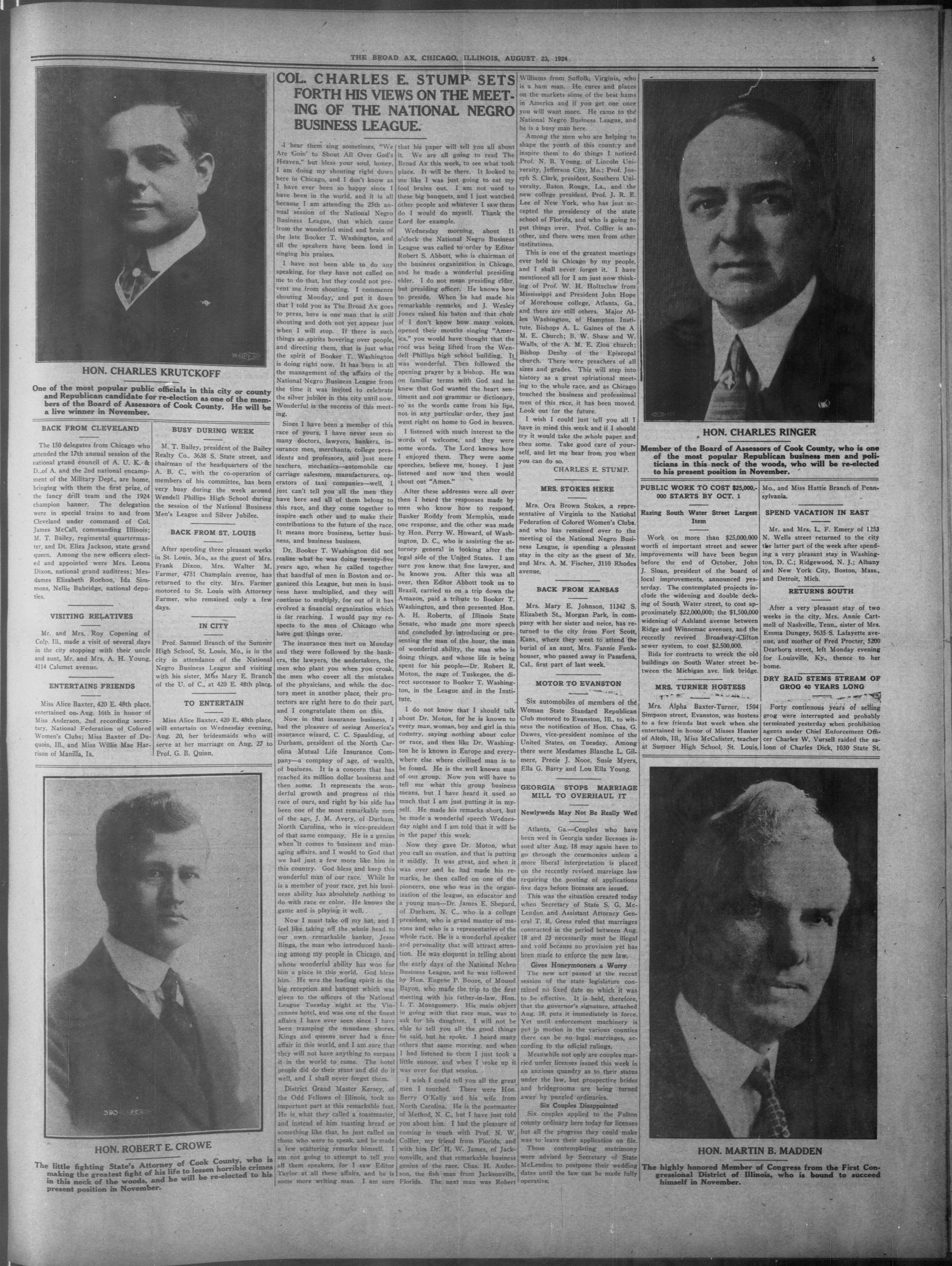
HON. CHARLES KRUTCKOFF One of the most popular public officials in this c and Republican candidate for re-election as one bers of the Board of Assessors of Cook County a live winner in November.
most popular public officials in this c
ublican candidate for re-election as one
the Board of Assessors of Cook County
inner in November.
One of the most popular public officials in this city or county and Republican candidate for re-election as one of the members of the Board of Assessors of Cook County. He will be a live winner in November.
BACK FROM CLEVELAND
The 150 delegates from Chicago who attended the 17th annual session of the national grand council of A. U. K. & D.of A. and the 2nd national encampment of the Military Dept., are home, bringing with them the first prize of the fancy drill team and the 1924 champion banner. The delegation were in special trains to and from Cleveland under command of Col. James McCall, commanding Illinois; M. T. Bailey, regimental quartermaster, and Dt. Eliza Jackson, state grand queen. Among the new officers elected and appointed were Mrs. Leona Dixon, national grand auditress; Mesdames Elizabeth Rochon, Ida Simmons, Nellie Bubridge, national deputies.
VISITING RELATIVES
Mr. and Mrs. Roy Copening of Colp, Ill., made a visit of several days in the city stopping with their uncle and aunt, Mr. and Mrs. A. H. Young, 4114 Calumet avenue.
ENTERTAINS FRIENDS
Miss Alice Baxter, 420 E. 48th place, entertained on Aug. 16th in honor of Miss Anderson, 2nd recording secretary, National Federation of Colored Women's Clubs; Miss Baxter of Duquoin, Ill., and Miss Willie Mae Harrison of Manilla, Ia.
395 PEU
393 PEU
395 P.E.
HON. ROBERT E. CROWE
The little fighting State's Att making the greatest fight of in this neck of the woods, present position in Novemb
ighting State's Attorney of Cook Co the greatest fight of his life to lessen he deck of the woods, and he will be reposition in November.
The little fighting State's Attorney of Cook County, who is making the greatest fight of his life to lessen horrible crimes in this neck of the woods, and he will be re-elected to his present position in November.
officials in this city or county or re-election as one of the members of Cook County. He will be
BUSY DURING WEEK
M. T. Bailey, president of the Bailey Realty Co., 3638 S. State street, and chairman of the headquarters of the A. B. C., with the co-operation of members of his committee, has been very busy during the week around Wendell Phillips High School during the session of the National Business Men's League and Silver Jubilee.
BACK FROM ST. LOUIS
After spending three pleasant weeks in St. Louis, Mo., as the guest of Mrs. Frank Dixon, Mrs. Walter M. Farmer, 4751 Champlain avenue, has returned to the city. Mrs. Farmer motored to St. Louis with Attorney Farmer, who remained only a few days.
Prof. Samuel Branch of the Sumner High School, St. Louis, Mo., is in the city in attendance of the National Negro Business League and visiting with his sister, Miss Mary E. Branch of the U. of C., at 420 E. 48th place.
TO ENTERTAIN
Miss Alice Baxter, 420 E. 48th place will entertain on Wednesday evening Aug. 20, her bridesmaids who will serve at her marriage on Aug. 27 to Prof. G. B. Quinn.
1920
orney of Cook County, who is his life to lessen horrible crimes and he will be re-elected to his er.
IN CITY
THE BROAD AX, CHICAGO, ILLINOIS, AUGUST 23, 1924
COL. CHARLES E. STUMP SETS FORTH HIS VIEWS ON THE MEETING OF THE NATIONAL NEGRO BUSINESS LEAGUE.
I hear them sing sometimes, "We Are Goin' to Shout All Over God's Heaven," but bless your soul, honey, I am doing my shouting right down here in Chicago, and I don't know as I have ever been so happy since I have been in the world, and it is all because I am attending the 25th annual session of the National Negro Business League, that which came from the wonderful mind and brain of the late Booker T. Washington, and all the speakers have been loud in singing his praises.
I have not been able to do any speaking, for they have not called on me to do that, but they could not prevent me from shouting. I commence shouting Monday, and put it down that I told you as The Broad Ax goes to press, here is one man that is still shouting and doth not yet appear just when I will stop. If there is such things as spirits hovering over people, and directing them, that is just what the spirit of Booker T. Washington is doing right now. It has been in all the management of the affairs of the National Negro Business League from the time it was invited to celebrate the silver jubilee in this city until now. Wonderful is the success of this meeting.
Since I have been a member of this race of yours, I have never seen so many doctors, lawyers, bankers, insurance men, merchants, college presidents and professors, and just more teachers, mechanics—automobile car carriage salesmen, manufacturers, operators of taxi companies—well. I just can't tell you all the men they have here and all of them belong to this race, and they come together to inspire each other and to make their contributions to the future of the race. It means more business, better business, and business business.
Dr. Booker T. Washington did not realize what he was doing twenty-five years ago, when he called together that handful of men in Boston and organized this League, but men in business have multiplied, and they will continue to multiply, for out of it has evolved a financial organization which is far reaching. I would pay my respects to the men of Chicago who have put things over.
The insurance men met on Monday and they were followed by the bankers, the lawyers, the undertakers, the men who plant you when you croak, the men who cover all the mistakes of the physicians, and while the doctors meet in another place, their protectors are right here to do their part, and I congratulate them on this.
Now in that insurance business, I had the pleasure of seeing America's insurance wizard, C. C. Spaulding, of Durham, president of the North Carolina Mutual Life Insurance Company—a company of age, of wealth, of business. It is a concern that has reached its million dollar business and then some. It represents the wonderful growth and progress of this race of ours, and right by his side has been one of the most remarkable men of the age, J. M. Avery, of Durham, North Carolina, who is vice-president of that same company. He is a genius when it comes to business and managing affairs, and I would to God that we had just a few more like him in this country. God bless and keep this wonderful man of our race. While he is a member of your race, yet his business ability has absolutely nothing to do with race or color. He knows the game and is playing it well.
Now I must take off my hat, and I feel like taking off the whole head to our own remarkable banker, Jesse Binga, the man who introduced banking among my people in Chicago, and whose wonderful ability has won for him a place in this world. God bless him. He was the leading spirit in the big reception and banquet which was given to the officers of the National League Tuesday night at the Vincennes hotel, and was one of the finest affairs I have ever seen since I have been tramping the mundane shores. Kings and queens never had a finer affair in this world, and I am sure that they will not have anything to surpass it in the world to come. The hotel people did do their stunt and did do it well, and I shall never forget them.
District Grand Master Kersey, of the Odd Fellows of Illinois, took an important part at this remarkable feat. He is what they called a toastmaster, and instead of him toasting bread or something like that, he just called on those who were to speak, and he made a few scattering remarks himself. I am not going to attempt to tell you all them speakers, for I saw Editor Taylor at all these affairs, and he is some more writing man. I am sure
that his paper will tell you all about it. We are all going to read The Broad Ax this week, to see what took place. It will be there. It looked to me like I was just going to eat my fool brains out. I am not used to these big banquets, and I just watched other people and whatever I saw them do I would do myself. Thank the Lord for example.
Wednesday morning, about 11 o'clock the National Negro Business League was called to order by Editor Robert S. Abbott, who is chairman of the business organization in Chicago, and he made a wonderful presiding elder. I do not mean presiding elder, but presiding officer. He knows how to preside. When he had made his remarkable remarks, and J. Wesley Jones raised his baton and that chair of I don't know how many voices, opened their mouths singing "America," you would have thought that the roof was being lifted from the Wendell Phillips high school building. It was wonderful. Then followed the opening prayer by a bishop. He was on familiar terms with God and he knew that God wanted the heart sentiment and not grammar or dictionary, so as the words came from his lips, not in any particular order, they just went right on home to God in heaven.
I listened with much interest to the words of welcome, and they were some words. The Lord knows how I enjoyed them. They were some speeches, believe me, honey. I just listened and now and then would shout out "Amen."
After these addresses were all over then I heard the responses made by men who know how to respond. Banker Roddy from Memphis, made one response, and the other was made by Hon. Perry W. Howard, of Washington, D. C., who is assisting the attorney general in looking after the legal side of the United States. I am sure you know that fine lawyer, and he knows you. After this was all over, then Editor Abbott took us to Brazil, carried us on a trip down the Amazon, paid a tribute to Booker T. Washington, and then presented Hon. A. H. Roberts, of Illinois State Senate, who made one more speech and concluded by introducing or presenting the man of the hour, the man of wonderful ability, the man who is doing things, and whose life is being spent for his people—Dr. Robert R. Moton, the sage of Tuskegee, the direct successor to Booker T. Washington, in the League and in the Institute.
I do not know that I should talk about Dr. Moton, for he is known to every man, woman, boy and girl in this country, saying nothing about color or race, and then like Dr. Washington he is known in Europe and everywhere else where civilized man is to be found. He is the well known man of our group. Now you will have to tell me what this group business means, but I have heard it used so much that I am just putting it in my self. He made his remarks short, but he made a wonderful speech Wednesday night and I am told that it will be in the paper this week.
Now they gave Dr. Moton, what you call an ovation, and that is putting it mildly. It was great, and when it was over and he had made his remarks, he then called on one of the pioneers, one who was in the organization of the league, an educator and a young man—Dr. James E. Shepard, of Durham, N. C., who is a college president, who is grand master of masons and who is a representative of the whole race. He is a wonderful speaker and personality that will attract attention. He was eloquent in telling about the early days of the National Nebro Business League, and he was followed by Hon. Engene P. Booze, of Mound Bayou, who made the trip to the first meeting with his father-in-law, Hon. I. T. Montgomery. His main object in going with that race man, was to ask for his daughter. I will not be able to tell you all the good things he said, but he spoke. I heard many others that same morning, and when I had listened to them I just took a little snooze, and when I woke up it was over for that session.
I wish I could tell you all the great men I touched. There were Hon. Berry O'Kelly and his wife from North Carolina. He is the postmaster of Method, N. C., but I have just told you about him. I had the pleasure of coming in touch with Prof. N. W. Collier, my friend from Florida, and with him Dr. H. W. James, of Jacksonville, and that remarkable business genius of the race, Chas. H. Anderson, the fish man from Jacksonville, Florida. The next man was Robert
Williams from Suffolk, Virginia, who is a ham man. He cures and places on the markets some of the best hams in America and if you get one once you will want more. He came to the National Negro Business League, and he is a busy man here.
Among the men who are helping to shape the youth of this country and inspire them to do things I noticed Prof. N. B. Young, of Lincoln University, Jefferson City, Mo.; Prof. Joseph S. Clark, president, Southern University, Baton Rouge, La., and the new college president, Prof. J. R. E. Lee of New York, who has just accepted the presidency of the state school of Florida, and who is going to put things over. Prof. Collier is another, and there were men from other institutions.
This is one of the greatest meetings ever held in Chicago by my people, and I shall never forget it. I have mentioned all for I am just now thinking of Prof. W. H. Holtzclaw from Mississippi and President John Hope of Morehouse college, Atlanta, Ga., and there are still others. Major Allen Washington, of Hampton Institute, Bishops A. L. Gaines of the A. M. E. Church; B. W. Shaw and W. Walls, of the A. M. E. Zion church; Bishop Denby of the Episcopal church. There were preachers of all sizes and grades. This will step into history as a great spirational meeting to the whole race, and as Chicago touched the business and professional men of this race, it has been moved. Look out for the future.
I wish I could just tell you all I have in mind this week and if I should try it would take the whole paper and then some. Take good care of yourself, and let me hear from you when you can do so.
CHARLES E. STUMP
MRS. STOKES HERE
Mrs. Ora Brown Stokes, a representative of Virginia to the National Federation of Colored Women's Clubs, and who has remained over to the meeting of the National Negro Business League, is spending a pleasant stay in the city as the guest of Mr. and Mrs. A. M. Fischer, 3110 Rhodes avenue.
BACK FROM KANSAS
Mrs. Mary E. Johnson, 11342 S. Elizabeth St., Morgan Park, in company with her sister and niece, has returned to the city from Fort Scott Kans, where they went to attend the burial of an aunt, Mrs. Fannie Funkhouser, who passed away in Pasadena Cal, first part of last week.
MOTOR TO EVANSTON
Six automobiles of members of the Woman State Standard Republican Club motored to Evanston, Ill., to witness the notification of Hon. Chas. G. Dawes, vice-president nominee of the United States, on Tuesday. Among there were Mesdames Blanche L. Gilmere, Precie J. Nooo, Susie Myers, Ella G. Barry and Lou Ella Young.
GEORGIA STOPS MARRIAGE
MILL TO OVERHAIL IT
Newlyweds May Not Be Really Wed
Atlanta, Ga.—Couples who have been wed in Georgia under licenses issued after Aug. 18 may again have to go through the ceremonies unless a more liberal interpretation is placed on the recently revised marriage law requiring the posting of applications five days before licenses are issued.
This was the situation created today when Secretary of State S. G. McLendon and Assistant Attorney General T. R. Gress ruled that marriages contracted in the period between Aug. 18 and 23 necessarily must be illegal and void because no provision yet has been made to enforce the new law.
Gives Honeymooners a Worry
The new act passed at the recent session of the state legislature contained no fixed date on which it was to be effective. It is held, therefore, that the governor's signature, attached Aug. 18, puts it immediately in force. Yet until enforcement machinery is put in motion in the various counties there can be no legal marriages, according to the official rulings.
Meanwhile not only are couples married under licenses issued this week in an anxious quandry as to their status under the law, but prospective brides and bridegrooms are being turned away by puzzled ordinaries.
Six Couples Disappointed
Six couples applied to the Fulton county ordinary here today for licenses but all the progress they could make was to leave their application on file. Those contemplating matrimony were advised by Secretary of State McLendon to postpone their wedding dates until the law can be made fully operative.
104
Member of the Board of Assessors of Cook Co of the most popular Republican business ticians in this-neck of the woods, who w to his present position in November.
the Board of Assessors of Cook Court most popular Republican business this neck of the woods, who willent position in November.
Member of the Board of Assessors of Cook County, who is one of the most popular Republican business men and politicians in this neck of the woods, who will be re-elected to his present position in November.
PUBLIC WORK TO COST $25,000.-
000 STARTS BY OCT. 1
Razing South Water Street Largest Item
Mo., and Miss Hattie Branch of Penn-
sylvania.
SPEND VACATION IN EAST
Work on more than $25,000,000 worth of important street and sewer improvements will have been begun before the end of October, John J. Sloan, president of the board of local improvements, announced yesterday. The contemplated projects include the widening and double decking of South Water street, to cost approximately $22,000,000; the $1,500,000 widening of Ashland avenue between Ridge and Winnemac avenues, and the recently revived Broadway-Cifton sewer system, to cost $2,500,000.
Bids for contracts to wreck the old buildings on South Water street between the Michigan ave. link bridge
MRS. TURNER HOSTESS
Mrs. Alpha Baxter-Turner, 1504 Simpson street, Evanston, was hostess to a few friends last week when she entertained in honor of Misses Hunter of Altoh, Ill, Miss McCallister, teacher at Sumner High School, St. Louis.
The image provided does not contain any text. It appears to be a close-up of a person's face, but no facial features or expressions are visible.
M.
M.
HON. MARTIN B. MADDEN
The highly honored Member of Congress from gressional District of Illinois, who is bour himself in November.
honored Member of Congress from the District of Illinois, who is bourn in November.
The highly honored Member of Congress from the First Congressional District of Illinois, who is bound to succeed himself in November.
ors of Cook County, who is one publican business men and poli-
woods, who will be re-elected
vember.
Mo., and Miss Hattie Branch of Penns-
ylania.
SPEND VACATION IN EAST
Mr, and Mrs, L. F. Emery of 1253 N. Wells street returned to the city the latter part of the week after spending a very pleasant stay in Washington, D. C.; Ridgewood, N. J.; Albany and New York City, Boston, Mass., and Detroit. Mich.
RETURNS SOUTH
After a very pleasant stay of two weeks in the city, Mrs. Annie Cartmell of Nashville, Tenn., sister of Mrs. Emma Dungey, 5635 S. Lafayette avenue, and mother of Fred Procter, 5200 Dearborn street, left Monday evening for Louisville, Ky., thence to her home.
DRY RAID STEMS STREAM OF GROG 40 YEARS LONG
Forty continuous years of selling grog were interrupted and probably terminated yesterday when prohibition agents under Chief Enforcement Officer Charles W. Vursell raided the saloon of Charles Dick. 1030 State St.
M.
of Congress from the First Con- ois, who is bound to succeed
TOMMY G. BROWN
BROOKLYN & LONDON
Crystal plaited chiffon, beneath all-over embroidery in gold color, is used to make this charming afternoon gown, ornamented with girdle and rosette of white beads.
To Dress and Look Cool
on Sultry Summer Days
Life nowadays is altogether too much fussed-up. We all admit it. But you have no idea how, taking your courage in hand, you can pull off the silly old outer coverings, and get at something tolerably simple. Just for one example, observes a writer in the Woman's Home Companion: If your hair is hot and heavy on your head and hard to keep in order, cut some of it out. Don't be afraid. Maybe your husband does admire it. He doesn't have to take care of it.
The first thing to do if you have long heavy hair is to shorten it. What's the use of carrying around a lot of old hair, anyway? It just wads up in a bunch on your head and acts like a warming pan. But if your hair grows thickly on your head, shortening doesn't cool you off very much. My suggestion then is that you have some one thin it out for you carefully, much as you'd think out the cut-row row in the early summer. Cut small pieces out close to the scalp in several places, being careful to take it from underneath where the cut-out regions will be well concealed by your coiffure. Don't cut the hair that grows low on the neck.
Delightfully refreshing for hot weather, too, are the scented hair lotions which have all the cooling virtues of toilet water but are especially adapted for the hair. A few drops on your scalp around the edges of the hair seem to take away that hot, damp feeling.
Baths are one thing that you can't very well cut down in hot weather. But any day, you know, you can save enough putterling or worry time for one good bath. And what a boon a bathhtub is in hot weather—a bathhtub filled without skimming, and smelling like a lemon meringue all on account of a handful of verveine bath salts. Falling a tub, however, one can still be cool. A hand basin of water, an ordinary wash cloth, and a spoonful of toilet water makes a sponge bath that takes off several degrees of heat. And just an ordinary air bath, sans clothes, is a wonderful freshener. It's a very good thing, especially in summer, to remove your clothes for a little while each day, and let your pores get a good, deep breath of air.
Lace Mitts Take Place
in Fashions of Summer
Like a remnant of summer from the fashions of olden times are the pretty lace mitts that have suddenly become the last word in summer styles. Of course, old ladies have always worn mitts, and the more conservative shops have continued to humor their fancy and retain their patronage. But the revival of mitts had a definite starting point in an English wedding at which the bride wore long mitts of exquisite white lace and the bridesmaids shorter mitts of silk in an open lace pattern, of a delicate shade of maize, matching their gowns.
This summary suggestion has been repeated in the costumes at some recent weddings in fashionable society this side of the water, the mitts being usually of elbow length and always matching the costume. They are shown in many lovely shades, in stripes and other openwork patterns; in plain colors of glove silk, black or white, and some are stitched with bright contrasts. One of the chotest styles is a glove of lacy silk of one color trimmed at the wrist with a wee plaiting of ribbon, piped with scarlet, blue, black or green. The black and white combinations are especially smart.
Red Much in Favor
Everywhere one sees much red used,
not only for hats but for entire frocks.
Sports frocks of red crepe de chine or
flat crepe are most attractive and, as a
rule, have a scarf of the same material.
Some of the newer scarfs are made of
crepe in a solid color with a wide border
of a contrasting shade at each end.
With a frock of white crepe de chine
there was a scarf of white with an extremely wide band of red.
Windsor Castle Old Abode
Windsor castle is built on land which
William I acquired from the abbot of
Westminster.
The newest prank of fashion, writes an authority, is to use combinations which are more or less considered out of season or are very unusual. For instance, black satin was used for an afternoon frock where organdie and summer ermine shared the trimming honors. The organdie was white and embroidered. It formed a deep hem effect on the skirt. The edges of the organdie were scalloped and the scallops were appliqued to the fur. Although the combination sounds curious, the effect was nevertheless most charming.
The vogue of the tunic overblouse is being enthusiastically adapted by a great number of women as the most logical solution to the blouse and skirt problem. We believe there isn't any woman who either looks well dressed or feels well dressed in a separate skirt and blouse, but let her don one of those unbelted tunic blouses which come well down over the knees and are made of such attractive silks, and we are sure she will be agreeably surprised at the truly smart appearance its simple lines will give her. Besides improving one's appearance, there is economy in possessing several of these tunics, for they can be worn with the skirt of an old suit. The skirt of last year's suit which has become shiny in the back or slightly worn can be brought out of one's wardrobe and put to very good use in this way.
In Paris they are wearing these tunics very long, only two or three inches of the skirt being visible in some instances. The skirts are short, very narrow, sometimes plaited and sometimes plain.
Flouces and tiers cut to accentuate rather than detract from the much-destrived slim line occupy such an important position in the mode that one cannot pass them by without some recognition. The cut of tiers is invariably circular, for in this way any fullness or bunchness can be avoided as they can be applied without fullness. Crisscross tunics which look like one layer of fabric were wrapped about the figure in one direction, and another layer lapped in the opposite direction is another oddity that has been seen several times.
Flannel coat in white, powder blue and all the high shades without any linings in them and very simply tailored are being worn at smart resorts with sports frocks of crepe de chine. Some are braid-bound, some are plipped with contrasting flannel, while others depend entirely upon their unrelieved simplicity for smartness. One of the two models being worn most is the wrap-around, which is devoid of fastening and is held in position by the wearer.
Here is a very serviceable frock for a young girl. The one on the right can be worn indoors and the one on the left uses for outdoors. The little jumper is made separately so that it can easily be slipped on or off at will.
Chic Frocks for Girls.
The frock is made of cloth. The upper part is quite long, well below the hips. The short skirt is plaited. A little stitching in colored wool finishes the armholes and neck of this almost sleeveless frock. The jumper can be made of thin silk and lined, or of a heavy, unlined silk or velvet. A wide band of embroidery in bright colors is sewed to the bottom of the jumper. Folds of silk of a color that will harmonize with the colors in the embroidery finish the wide neck and armholes.
Powder-Puff Bags Are
in Form of Tiny Doll
A novelty in powder-puff bags has appeared. It is in the form of a tiny doll, a clown with jolly face, its trousers tied at the ankles. In each of the trousers legs is a little powder puff, one for white and one for rouge, and through an opening at the back of the little clown one finds a compact containing a reserve cosmetic supply. In some of the trousers containers in New York are shown lipstick containers, lovely bits of French enamels, coral, jade, onyx, gold and platinum, banded and circled with rhinestones just the size of a cigarette holder. They are dainty jeweled trifles to carry in one's porte-monnaie or pocket.
Not Matter of Principle
Not Matter of Principle
Honesty is the best policy, but he
who acts on that principle is not an
honest man—Bishop Whately.
THE BROAD AX CHICAGO, ILLINOIS, AUGUST 23; 1924
THE LADY IN THE DRESS
Fresh and Lovely as a 'Morning Glory Is a Dress in Pale Shades of Rose and Orchid Over a Slip of Flesh-Colored Crepe—One of the Late Styles in Chiffon Printed in Garden-Flower 'Pattern Is Introduced in A Midsummer Gown.
Fresh and Lovely as a 'Morning Glory Is a Dress in Pale Shades of Rose and Orchid Over a Slip of Flesh-Colored Crepe—One of the Late Styles in Chiffon Printed in Garden-Flower 'Pattern Is Introduced in A Midsummer Gown.
Dainty Fabric Is in Milady's Favor
Organdie, Dotted Swiss, Muslin and Other Materials, Fashion Leaders.
There was once a homely saying that in France the rustle of a petticoat meant silk, in other countries starch. That, says a fashion writer in the New York Times, was before the days when silk petticoats, silk frocks and stockings became as common as they had once been rare, and before people of a sturder standard and those of lighter type had been harmonized by cosmopolitan fashions. This popular notion has since swept French and American styles to a similar conclusion, which is that muslin frocks belong to Americans, and that they are out of date, their crisp frilliness dimmed by the luster of French silk and tissues.
The muslin frock in all its sheer freeness and its many variants has been for generations the American woman's charming own, dainty, coquettish, eternally feminine; and many a woman of fashion of the older regime has regretted that her granddaughter could not know the pleasure of dressing in flowered "French" organelle, dotted swiss, book muslin, or the smooth, cool linen lawns. They were the accepted summer dress, as much for town as for country wear.
The muslin frock disappeared with the muslin girl. Athletics, the motorcar, sports, life in the open, made demand for simpler lines, more substantial fabrics and much of the homespun idea for day wear. Once the new silhouette was established, the picture changed, and the muslin girl became the tailored girl, mannish, severe, dashing, "top style" for the vigorous day, and the chiffon girl for the evening.
Flannels, twills, heavy linens and loose-woven silks, treated much as the tailor employs stuffs for men's wear, have been for a dozen years the proper thing for informal occasions, while for dressy times all the newest weaves in starchless volles, crepes, chiffons, marquettes, silks, satins and brocades were required. The ruffled muslin passed with the erinoline, the floppy leghorn, lace mitts and long curls. The new version is a picture of slim body, athletic limb, curveless bodice and classic draperies.
The American vision was lost and the Parisian pattern was copied to all of the extremes, with many extravagant indulgences in exotic phases of foreign influence. All of the effect of satiety has been experienced within a season, and gradually but unmistakably the quiet styles in dress and accessories have been coming into view. Costume affairs in fashionable society and exhibitions of artistic costuming in studios and in the theater have recalled to the older and shown to the younger generation the beauty, the romance and the tradition in dress characteristic of ourselves, and courteries have been alert in responding to the suggestion.
Winsome New Materials.
Winsome New Materials.
No season within merchants' memory has brought out a greater number of original styles in new materials. The woman who is able to gratify her desire in this summer's wardrobe has a bewildering collection from which to choose. Simplicity more simple than ever before is the keynote, especially in the handsomest evening gowns seen at smart affairs on the other side, the conspicuous attraction being in the goods of the dress. Trimming on these formal gowns is of exceptional richness; ostrich, which retains its intense popularity, and metal lace and embroidery, each sparingly and effectively used on flat surfaces.
The frock that answers the purpose of the old-time sheer muslin is of crepe, designated by many names—voile, printed silk, marquette, chiffon in ever so many grades—all of which have been seen in the early season'
Duty's Attributes
Duty only frowns when you flee from it; follow it, and it smiles upon you.—Elizabeth, Queen of Rumania.
models. These are built for the most part on incomplex plans, though the latest importations illustrate many new features, indicating quite plainly the direction in which the fashion tide will set at the opening of the coming season.
The printed crepes and silks are very modish in the straight tunic over a close skirt of contrasting color, or outlined with a band of plain goods. This model, for which the woman of the slender silhouette has a passion, is particularly happy when done in the silks of bold pattern, notably the conventional palm leaf and the other designs that are among this year's novelties.
In the draped models there is a following of whims and moods, with the fullness drawn forward to the front, to be caught directly in the middle front, hanging lower than the hem of the gown, and with flouces, straight or circular; godets, scarf draperies, sashes, girdles and plaited or faring skirts. Apparently several styles, greatly diversified, are being presented, as if to sense in advance the popular choice and establish a mode.
All of these and other designs are attractively shown in models of much originality and style, demonstrating the values of the new materials. For the one-piece or funnic frock for morning and all-day utility the eponge in cotton or silk of a mixture, made in checks, stripes and plain goods, is a novelty that has taken rather strongly. Ratine, in silk, cotton or silk and wool, is another new weave, rough in finish, loosely woven and smart, especially when it is made into a sports or beach frock.
Rich Formal Gowne.
In the more formal gowns the embroidered silks and flat crepes, embroidered solid, are exceedingly handsome, and are so costly that one such creation in a wardrobe is cherished and reserved for gala occasions. Bengaline, all silk, or silk and wool, is another revival of an old-time favorite, of which some stunning French models are built, with simplicity of lines, soft, scant drapery and a splash, a band or motif of colorful needlework. These are charming in the gentle shades, beige, maize, gray, powder blue, against which the crewels so much used in peasant embroidery make a striking note.
Reverting to the sheer frock, the up-to-date version of the organdie, there are new volles of gossamer lightness, on which are printed the most enchanting patterns of flowers, butterflies, birds and many another fantasy. These have something of the sheer beauty of organdie but lack stiffness and may be beautifully draped or founced, though the elaborate designs are shown to best advantage when they are gathered or slightly draped.
The qualifying appellation of "chiffon" is attached to many of the latest types of thin dress goods. There are chiffon volle, crepe chiffon, chiffon cloth and chiffon. Some are printed in delicate, beautifully colored pattern; some are plain or shaded in rainbow tints or gradations of one color.
Flock dot muslin is really a dotted swiss, woven in many "wash colors," and the English prints are the real novelty of the year. These are in prim, modest patterns, invariably small and geometric, in black and white, gray and white, violet or blue and white, scarlet and belge. Their being hand-blocked is a guarantee of the durability of their colors.
The craze for hand-blocked, indelibly printed cottons is well illustrated in the India prints, which are sold by the yard and might easily be mistaken for curtains or bed coverings. They are oriental in pattern and riotous in colors blended and assorted with the canny skill of an ancient art. Some of these are reproductions of the printed spreads and happings which several of the more important shops have imported, and they are unique and amusing as dress makings.
In at least a score of years there has not been more beauty and artistic value in dress materials and design than this season has presented.
Writings That Live
More solid things do not show the complexion of the times so well as ballads and libel—John Sheldon.
Bright Colors Feature of Interesting Dress Materials Now Worn.
Printed crepes of every type imaginable are being worn in Paris. A simple crepe de chine trock set forth in several shades of green and gray on a darker green ground is popular for summer wear. The whole garment is very plain and semi-tailored, a one-piece frock with a narrow belt of leather. The bodice opens at the front to form a shallow, tailored collar turning back from the V-shaped decouletage. Ball buttons in antique silver give a touch of elegance to the modest little garment. The clasp on the leather belt is likewise of wrought silver to match. The band trimming on the bodice, sleeves and skirt is of plain green crepe. A scarf of similar crepe in one tone may be worn with the frock.
An interesting and unusual gown is exceedingly smart and quite new in
1
One-Piece Frock is Liked.
conception. It is of black crepe de chine, bordered with white organdie and most cleverly draped at the front of the skirt. The whole frock is cut on the bliss and the vast amount of fullness which forms the drapery at the front is gathered beneath a kid belt at hunter's green embossed with gold.
Hose and Shoes Must Be
Smart to Match Skirts
Skirts are shorter than ever in Paris, according to a fashion authority recently returned, and woe to the woman who does not give careful consideration to her feet and ankles, for they cannot be camouflaged.
"There never was a time when shoes and hostelry were so important as they are now," the same authority declared.
"Long ago, when our grandmothers wore white and pale-colored hose, their skirts were long. When the short skirts first came into vogue the hose were black or a dark brown to match the shoes. Now the skirts are at least ten inches from the ground and the stockings are in shades of beige or nude or gray. They are very smart, but very conspicuous.
"The new full-fashioned silk and fiber hose are very satisfactory for summer dresses. They fit the ankles and are shimmery and pretty. Care must be taken to wear the right kind of shoes with each gown. The trim-tailored shoes a woman wears with her serge frock are impossible with her patent leather or satin or thin kid shoes with high heels.
"It is careful attention to these details that makes a woman look smart, and it is much more important to have one's clothes smart than becoming. It is not always possible to be both, and the wise woman chooses to be smart."
Imitation Jewelry Is
Attractive in Her Hair
The fad for imitation jewelry is reflected in the beautiful ornaments for the hair, in girdles and motifs designed to be worn with the latest models in evening dress in the coming months. They are made of net, studded closely with rhinestones, pearls or colored stones. Some of the bandaux are so wide as almost to cover the hair; they are brilliantly jeweled, matching sparkling eyes, and are artistic, after an oriental type.
Girdles, ornaments, long-fringed tassels and motifs for applique are all of this kind and are much worn. The latest combs are lovely. The antique combs of the Spanish shape that had such a vogue during the winter, ivory and shell especially, are less seen now than the smaller shapes set with stones.
The rhinstone combs are far the most popular, and the low wide sort is quite the newest. These combs have an appeal for women who still have their tresses attached. For the one with bobbled locks there are the prettiest flattering slender fillets, as well as the wide swath bandedaux.
Gates Long in Building
The huge gates of Henry VII's chapel
in Westminster abbey are believed to
have taken 18 years to make.
Please enter my name as a subscriber to THE BROAD AX. I inclose herewith Two Dollars, the annual subscriptions to same, or One Dollar for six months.
KAPPA
CORRECTION & COMMUNICATION
Here is a winnieous two-piece suit for summer wear. It is made of soft white canton crepe, bordered with dull green, a popular combination this season.
Beads in Quantity and
A sense of humor is needed to appreciate the quantity and variety of necklaces and other baubles that are now displayed in every place where things pertaining to women's dress are sold. They resemble most amusingly the button strings of our early childhood days and the marbles that in the springtime add so much to the happiness of little boys.
Millions of strings of beads, some of crystal and semi-precious in character, but most of them just glass, add to the decorative layout of the shops, big and little, and are worn without apology for their cheapness by women of taste and fashion.
Of course there are people of influence who resist the temptation to deck themselves after the manner of Indian squaws, and who follow the fashion by wearing strings of fine stones and beads made of the genuine article; and some decline to wear anything in the way of a necklace other than their pearls or the other precious stones in their jewelry for evening dress.
The astonishing thing about some of the latest styles in necklaces, in both the long strings and the choker, is the size and weight of the beads. The marvel is that any but an Amazon is able to wear them and smile. "Beads" the size of a robin's egg or a prize "chiney" in the game of marbles, made of rock crystal, clear, or of one of the many pretty colored kiltations, weigh like a chain of rocks and would be burdensome if they were not the last word in the mode.
Deauville Scarf Brings
Many Fashions to Surface
The Deauville scarf started more fashions than the different ways of wearing the printed square of silk. Imitations of it are shown in much the same patterns, to be worn as ties and sashes, as hat trimming and now as head kerchiefs. The newest covering for the head for out of doors, on the beach, the tennis court or the motor road is a square of printed silk or crepe knotted about the head.
A fetching kerchief is made of a square of gay Scotch plaid bordered with plain green crepe, and the kerchief is put on the head bandanna fashion, with knotted ends in front and behind. Another manner of wearing the kerchief is as an Indian turban, which is particularly pretty and becoming in printed flowery chiffons.
georgettes and crepes. These beach caps, as they are called, are much liked in place of the little hats, being lighter and more comfortable. The scarf devotee will be able to revel in many kinds of colors of scarfs by availing herself of the opportunity to buy them by the yard. Printed crepe de chine, crepe chiffon and the lightest quality of chiffon printed in flower and conventional patterns in gay colors on light tinted grounds—gray, beige, flesh, blue, green or white—are to be bought in scarf length. They require only to be hemmed at the ends, and make a stylish scarf for a reasonable price.
Chinese Novelties Are
Featured in City Shops
Many of the engaging novelties are of the Chinese type, and as the appreciation of them grows more and more beautiful things are shown. In an exclusive shop is a dazzling display of chains, pendants and earrings in crystals, clear and tinted, and in delicate flower-like designs. A garland of blossoms made of jade, turquoise, pearl and coral, taken from a Chinese hairpin, is attached as a pendant to a slender gold neck chain.
Another shop, long known as a bazaar of genuine oriental antiques, has among its finest bits curious and lovely old buckles, one of rose quartz, pale green jade and dull gold. There is a buckle, too, of white jade with a crystal tinted like frozen emeralds and traced with gold. These and other interesting pieces have greatly increased the vogue of jade, which is especially charming with summer dress.
England's Tobacco
England always takes the best of the Havana tobacco and allows the rest of the world to get along with the leavings. An English importer of Havana who has been in the trade for 30 years says there are 100,000 cigar smokers in England, and that those islands consume 28,000,000 Havana cigars in a year—say $10,000,000 worth. This importer put the number of other sorts of cigars smoked in Britain at 400,000,000.
Through the Needle's Eye
It is a fact that there is in the wall of Jerusalem a small gateway built for the use of pedestrians and known by a name which is translated as "The Needle's Eye." Through this gate it is quite possible for a small under-nourished camel, divested of all its equipment, harness, etc., by kneeling, to work its way, though not without difficulty. The gate is still in existence.
War and Disputes
What Tully says of war may be applied to disputing—it should be always so managed as to remember that the only true end of it is peace; but generally true disputants are like true sportsmen, their whole delight is in the pursuit; and a disputant no more cares for the truth than the sportsman for the hare.-Pope.
When Newly Painted
To prevent windows sticking the thing to remember is that for two or three days after the frames are painted each window should be opened and rup up and down two or three times a day. Unless this is done the windows are almost certain to stick.
Simon's Shoes
Are Good Shoes
24 East 31st Street
Notice for Special Meeting of Stockholders of Public Life Insurance Company to Elect a Board of Directors
The undersigned stockholders of the PUBLIC LIFE INSURANCE COMPANY in pursuance of the provisions meeting by the holders of not less than one-fifth (1-5) of the outstanding shares of capital stock of said corporation, ber, A. D. 1924, at the office of the company, 1400 Washington Boulevard, Chicago, Illinois, for the purpose of electing a Board of Directors for said corporation.
Whereas it appears from the records that about two hundred and seventy-five (275) stockholders were present at said meeting; and
Whereas it appears from the records as made by the Secretary of said PUBLIC LIFE INSURANCE COMPANY, that about 5:30 P. M. of that day, said Proxy Committee reported that they were unable to complete the checking of the proxies which had been filed with the Secretary of the PUBLIC LIFE INSURANCE COMPANY; that they had been successful in checking in alphabetical order only down to the letter "H"; that the Chairman of the meeting then called the meeting to order; immediately after which a motion was made to adjourn the meeting to another day and give the Proxy Committee an opportunity to complete its work; that the Chairman ruled the question "out of order," and refused to put the question; that a motion was then made to "appeal from the decision of the chair"; that the chairman of the meeting refused to put said motion to a vote of those present; that one of the stockholders then put the question for the adjournment of the meeting, which carried, and
Whereas by virtue of the authority granted by the Statute of the State of Illinois, and the By-laws of the PUB- ment and the attorney-general of the State of Illinois, December 16, 1918, the incorporators completed the organ- vember 21, 1919, for the purpose of electing the first board of directors, and at said meeting of stockholders, all by an unanimous vote; and also on the 5th day of May, 1920, the authorized officers deposited with the in- issued which would permit the Company to transact the business of life insurance; and
Whereas in dehance of the By-laws, which state that before an election can be held it must be known that a majority of the shares of stock outstanding of the Company, shall be represented, either in person or by proxy, in order to constitute a quorum, and in dehance of the fact that the meeting was adjourned and the Proxy Committee had not made its report, and without the knowledge of a quorum being present, which could only be had from the report made and approved of the Proxy Committee, Maximilian J. St. George and a few others proceeded unlawfully to hold an election of a Board of Directors to suit themselves: now therefore
consisting of not less than five (5) nor more than fifteen (15) members; and
Whereas in compliance with said Articles of incorporation, the first Board of Directors of said Company adopted By-laws, and in said By-laws it appears that the first (1st) Tuesday of February of each year is the day named when said Board of Directors is required to be elected; and
Whereas on Tuesday, the 5th day of February, 1924, being the first Tuesday of February, 1924, the annual meeting of the stockholders was called to be held at the Home Office of the PUBLIC LIFE INSURANCE COMPANY, 1400 West Washington Boulevard, Chicago, Illinois, for the purpose of electing a Board of Directors for G. Borges and A. L. Linder, which Committee was instructed to check proxies, that had previously been filled with the Secretary of the PUBLIC LIFE INSURANCE COMPANY; in order to ascertain how many shares of stock were represented by the stockholders personally present at said meeting, and if a quorum, or majority of number of shares of stock issued by the PUBLIC LIFE INSURANCE COMPANY were represented either in person or by proxy at said meeting, and report their findings to the stockholders present, and
Whereas immediately after the Proxy Committee had been appointed upon motion duly made and carried, the meeting was adjourned, to permit the Proxy Committee to complete its work, and make its report to the stockholders there assembled; and
Be It Further Resolved that all of said stockholders be earnestly requested to attend said meeting Which Notice is Hereby Given, This 15th Day of August, 1924, Being Thirty (30) Days Prior to September 16th, 1924, the Time Set for the Meeting.
TAKE HEED OF THIS LETTER-YOU WILL NOT REGRET IT The Property of 4,500 Stockholders Should be Protected for 4,500 Stockholders
Stockholders Are Invited to Attend the Meetings Which Will Be Held Every Wednesday Night During This Campaign at the Office at 108 South La Salle Street
Many hundreds of stockholders of the PUBLIC LIFE INSURANCE COMPANY, upon learning the present unfortunate condition of the Company, have decided to change this condition in the only manner possible for them to do—to elect a new Board of Directors.
They, accordingly have prepared a petition which includes the signatures of several hundred stockholders, representing about 125,000 shares.
The reason this petition holds the signatures of only this number is that those stockholders who did the work of securing the required number of signatures were limited in time and could not interview all the stockholders.
No doubt the reason your signature is not in the list is because no one has had an opportunity to explain to you the true condition of affairs and the reason why an election of a Board of Directors is necessary.
Every stockholder wants the Company kept in a good, healthy condition. He should immediately resent in the most unmistakable way any attempt on the part of any man or group of men to squeeze out the thousands of small stockholders, to their great loss.
to their great loss.
A year or two ago, every one was agreed that our stock was worth $10.00 a share. At this time, after $1½ years, the stock has been quoted at less than 50c
Stockholders Are Invited to Attend the Meetings WH
Please sign a
Public Life Insur
Stockholders Pro
108 Sou
Suite No. 525
THE BROAD AX. CHICAGO. ILLINOIS. AUGUST 23. 1924
per share on La Salle street. This should not mislead you, however, for if they are willing to pay this price, the stock must be worth much more.
It is true the Company has received many hard knocks during the past two years but, fortunately for the stockholders, these terrible blows need not prove fatal, for those who built it so strongly and so well have so far been able to foil every attempt which has been made to sell out the business of the Company.
For this reason, the stockholders are now preparing to replace the present board by this election.
If you want your Company to live and continue as a going concern, a change must be made without delay, no time must be lost, action must be quick and decisive.
Please understand: this plan is fostered and undertaken by stockholders who want the Company to live, who want the Company to grow, who want the Company to thrive and prosper.
We, as stockholders, are making this appeal to you. It is not yet too late. Some of us have awakened to the truth, and many more will wake up and help in the reconstruction work and put the Company back where it rightfully belongs and was before, among the best in the world. To repeat, it is not yet too late. It can be done. It will be done, if you will only take heed to this warning.
and mail to Insurance Company
It is sent to you by hundreds of men and women who have investigated the facts, who are willing to take rate books and work. Let's reorganize the Districts where the organization is now completely destroyed, and put these faithful workers back in their splendid offices, re-establish the Advisory Board, and forget all the hard things that have been said.
Our splendid Home Office Building is now worth about $100,000 more than was paid for it. It should be used for what it was intended to be—the Home of the greatest Life Insurance Company in the State, if not in the world. It was built on honor. You and the thousands of other stockholders have paid for it, and appreciated it. Why not make it the home of men and women who aspire to complete that which it was built for, to play the game honestly, doing the most good for the most people.
As stockholders, we are asking you to take heed to this letter. After reading it you will understand why we have been fighting and must keep on fighting for the preservation of the Company.
It can be done. It must be done.
The proxy card attached below will be the means of doing it, please sign it and return it right away.
STOCKHOLDERS' PROXY CARD
Know All Men by these Presents, That the undersigned being a stockholder of the PUBLIC LIFE INSURANCE COMPANY, a corporation organized under and by virtue of the Laws of the State of Illinois, hereby constitutes and appoints, Alfred Clover, Joseph Baumruk, A. L. Williams, Paul Beich, Charles Wylie, D. D. S., Dr. C. L. McDonnell, Kirsch, Dr. J. R. White, W. S. Morehead, Dr. A. Zilligen, James Garland, M. J. Harbeck, Dr. David G. Roy, Dr. Otto Konzelman, H. G. Price, D. D. S., and Edward Miller, or either one of the them their appointee or appointees, the lawful proxies or proxy or attorneys or attorney of the undersigned for and in the name place and stead of the undersigned to vote upon all the shares of stock of the undersigned in the PUBLIC LIFE INSURANCE COMPANY at any election of the stockholders of the PUBLIC LIFE INSURANCE COMPANY for Directors or other purposes occurring within eleven months from date hereof; and also to vote on any and all matters and questions which may be presented and considered at any annual or special meeting of the stockholders of said Company occurring within such period as fully and with like effect as the undersigned might or could have done if personally present and voting thereafter hereby ratifying all that said attorneys may do in my place, name and stead. A majority of said attorneys or acting as shall be present and shall act at the meeting (or if only one shall be present then that one) shall have and may exercise all the powers of said attorney or attorneys hereunder.
The undersigned hereby expressly revokes, cancels and annuls any and all other proxies hereof signed or given to any other person or persons.
In Witness Whereof, the undersigned has hereunto set his or her hand and seal this.....
Statement of Condition
At the Close of Business on June 30, 1924
RESOURCES
Loans and Discounts... $1,880,722.36
(Inspected and approved by our Board of Directors.)
Bonds and Securities... 1,152,140.82
Bank Bldg. and Amuers... 145,819.98
Furniture and Fixtures... 20,761.60
Cash on hand and due from Banks... 481,849.51
Other Resources... 37,105.00
Total... $3,725,899.45
LIABILITIES
Capital Stock... $ 400,000.00
Surplus... 50,000.00
Undivided Profits... 34,114.55
Reserved for Taxes and Interest... 17,140.29
Other Liabilities... 40,028.27
DEPOSITS... 3,184,616.14
Total... $3,725,899.45
This Bank invites you to avail yourself of its complete facilities.
First Mortgage Gold Bonds—approved safe investments—yield 7% interest.
Boxes in our completely equipped Safety Deposit Vaults rent for $4.00 per year and upwards.
Interest at the rate of 8% is allowed on all savings accounts. Savings Department open from 9 a.m. to 8 p.m. Saturdays.
George F. Leibrandt... President
Charles A. White... Vice-President
George S. Campbell... Cashier
L. A. DeLaurier... Asst. Cashier
Maurice H. Wolpe... Asst. Cashier
Addison E. Avery... Mgr. Bond Dept.
LINCOLN STATE BANK
OF CHICAGO
Under State Government Supervision
31st and South State Streets
Telephone Victory 4500
Corner Indiana Ave., Second Floor
3846, Grand Boul. Tel. 4897
888-222-2222
1
Family Watch
Family Watch
A man in St. Louis has a watch on which the numerals of the face have been replaced with tiny photographs of the members of his family. He himself is 1 o'clock, his wife is 2 o'clock, his oldest child is 3 o'clock, and the other figures are covered by the pictures of the remainder of his ten children, 12 o'clock being the baby of the family.
Time
The world's first clock was in the tower of San Eustorgio in Milan, Italy. It was placed there in the year 1309. That's a long time to us who live only a few years, but a short time in the long history of humanity. The invention of the clock was the birth of industrial slavery.—Chicago Post.
Red Cross Protected
THE BROAD AX, CHICAGO, ILLINOIS, AUGUST 23, 1924
Ale Once Labeled Poison
Years age in the merry days of the English tavern there was a turmoil among radicals over the "poisoning" of the ale drunk by the common people. The trouble was caused when some one learned that in making ale sulphuric acid, made from Spanish pyrites, was used and that this contained arsenic. It was a tempest in a teapot, however, because it would have taken five barrels of ale to contain enough arsenic to hurt one individual.
Just What Is Beauty?
Beauty cannot be described, since what seems beautiful to one may be plain to another. Ben Jonson's "most beautiful face" had to possess simplicity crowned by flowing hair and a sweet neglect; Spenser would have eyes like sapphires, teeth like pearls, and a forehead like ivory; Rogers insisted on archness and mirth. Every lover thinks his girl is beautiful.
Paper Currency
PaperCurrency
It has been computed that the cost to the United States of making a $1 bill is about as great as to make a $20 or a $10,000 bill. The expense is 1.3 cents each. The length of service varies in direct ratio to the value of the note. The $1 bill lasts little more than a year, it is estimated, a $10 bill lasts about four years, while a $10,000 bill obviously, seldom wears out.
Now We Know
A correspondent, signing herself Elizabeth, writes to us and asks: "Can you tell me why it is that more girls marry in June than in any other month of the year?" No, Elizabeth, we cannot tell you, except perhaps it is that the grooms do not have to start their weided life by buying coal.—Brooklyn Standard-Union.
The Ugliest
There are curious birds in Africa and the most beautiful birds in the world are to be found there. We have seen them preserved in museum cases, and alive in zoological gardens. But Africa has also what is probably the very ugliest bird there is in the shoe-bill, a large wading bird.
Luxuries Are Comparative
When two prisoners were asked to name their reward for submitting to blood transfusions at Sing Sing, one asked for stewed chicken and the other for a bowl of spaghetti. The transfusion was made in an effort to save the life of a fellow prisoner.
Chicago's Wonder Amusement Park Rides, Shows, Games, Music, Dancing, Roller Skating
GEORGE F. HARDING, JR.
REAL ESTATE
Up-to-Date or Modern Houses, Apartments and Stores to Rent
3101 COTTAGE GROVE AVE.
Corner 31st Street, Chicago
Constitutional rights are those that can't be denied you if you have a lawyer of sufficient reputation.—Duluth Herald.
ERNEST
WILLIAMSON
UNDERTAKER
Quality Service
Reasonable Prices
Calls Promptly Answered
Day or Night
HIGH CLASS FLEET OF
Cunningham
CARS FOR ALL OCCAISIONS
KENWOOD 0455
5121-23-25. SOUTH STATE STREET