The Broad Ax
Saturday, November 15, 1924
Chicago, Illinois
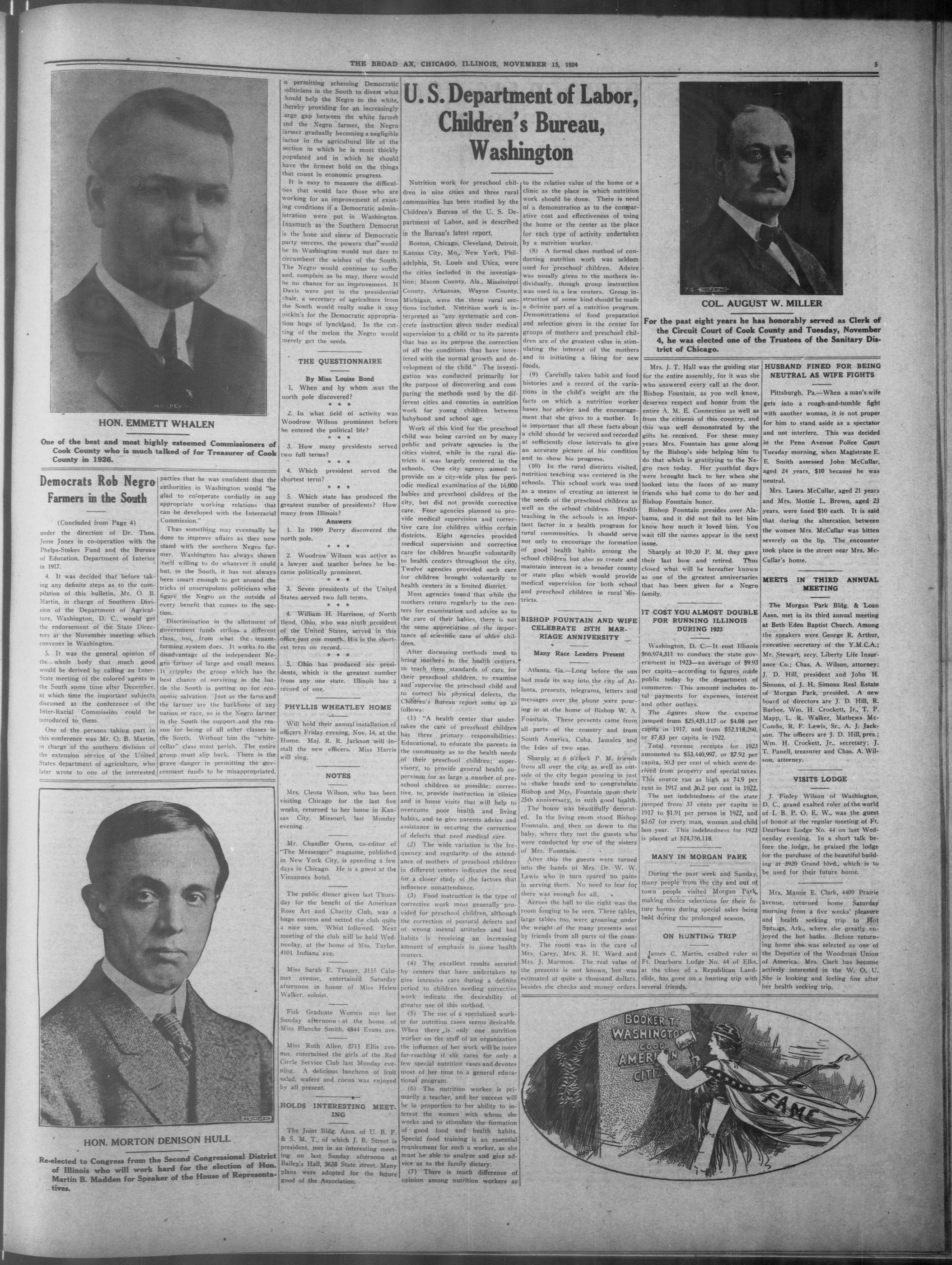
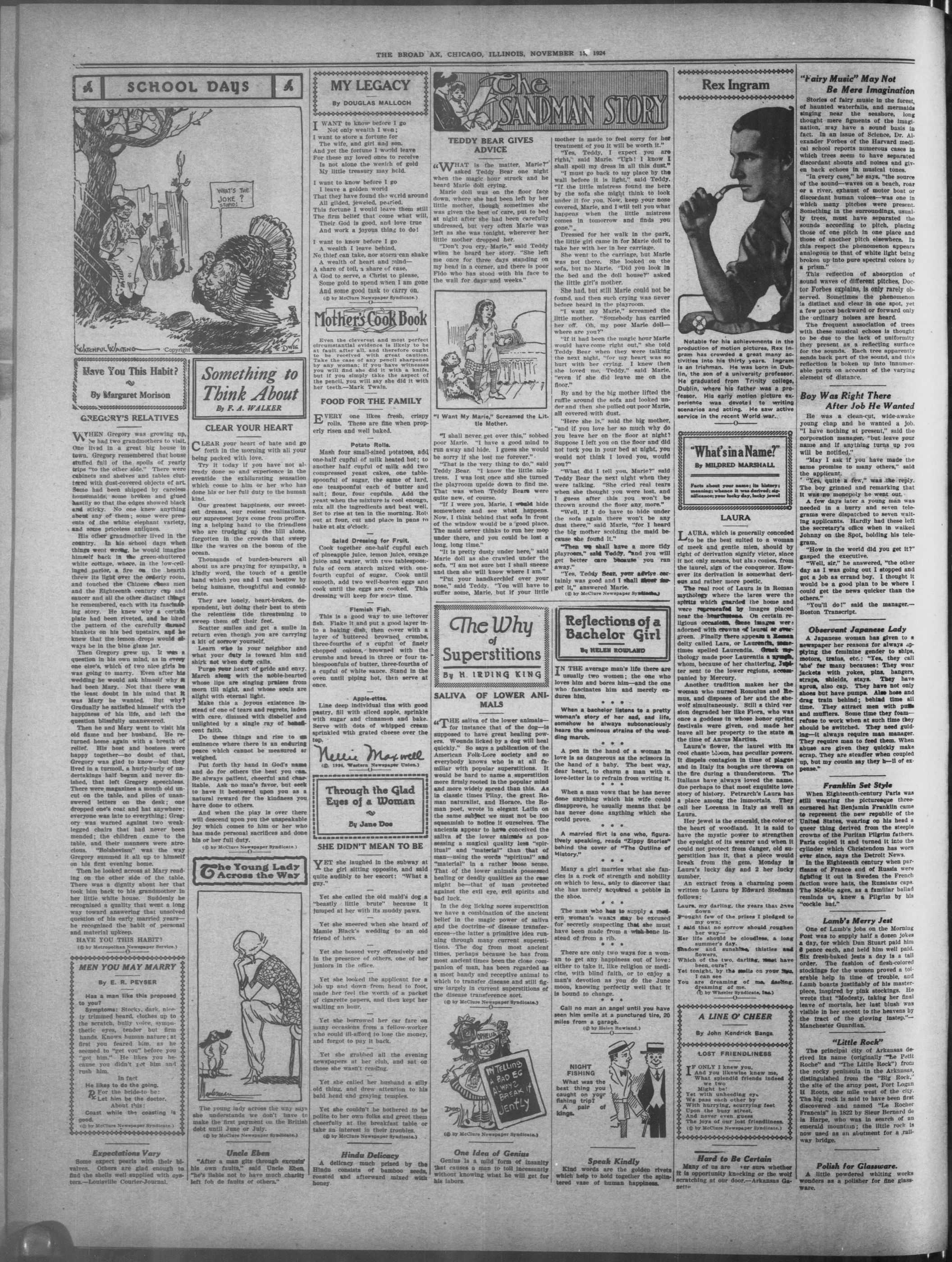
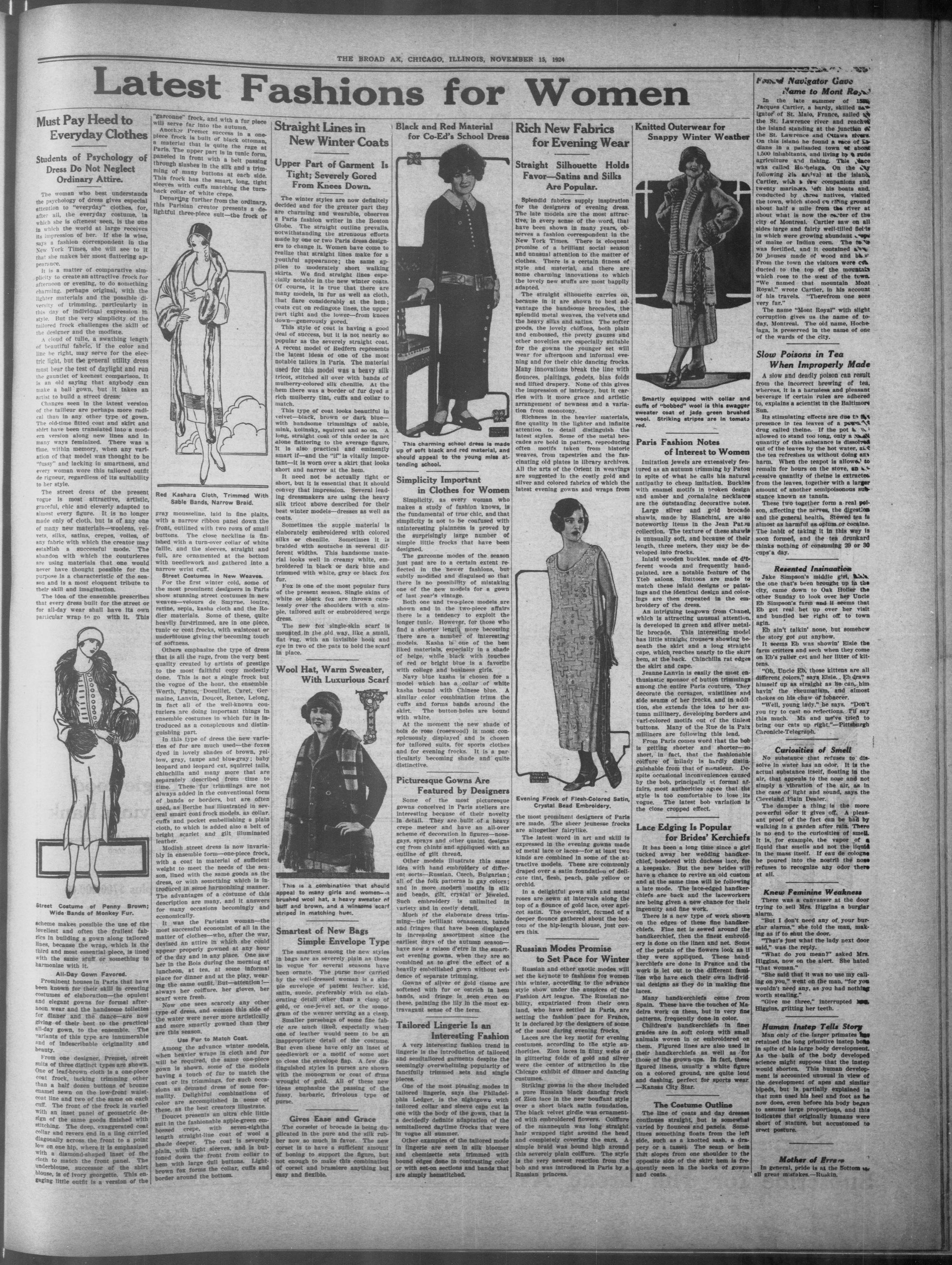
Page text (machine-generated)
Echoes and Re-echoes of the Late Presidential Election. President Calvin Coolidge Secured Three Hundred and Eighty-Two Votes in the Electoral College and Possibly More. It Was Hog Killing Time for the Grand Old Party.
SOCIETY NEWS PUBLISHED FREE
Vol. XXX.
Echoes and
President
Eighty-Tw
It Was He
HON. MARTIN B. MAD
THE RACE FOR SPEE
HOUSE OF REPRI
AND HE LOOKS
WINNER TO HIS AR
FRIENDS AND SUPP
HON. GEORGE T. KERS
ED FOR RE-ELECT
LEGISLATURE FROM
SENATORIAL DISTRI
NOIS.
HON. MARTIN B. MADDEN ENTERS THE RACE FOR SPEAKER OF THE HOUSE OF REPRESENTATIVES AND HE LOOKS LIKE A LIVE WINNER TO HIS ARMY OF WARM FRIENDS AND SUPPORTERS.
HON. GEORGE T. KERSEY, DEFEATED FOR RE-ELECTION TO THE LEGISLATURE FROM THE THIRD SENATORIAL DISTRICT OF ILLINOIS.
---
No one residing in any part of the United States can recall the time when the Republican party completely routed the Democratic party, as it did at the late Presidential election. The victory was so great that in some of the states they are still engaged in counting the votes. The majorities rolled up in some of the states for President Coolidge are simply astounding; for example, New York state rolled up more than one million majority for him, many of the other states gave him from three hundred and fifty thousand to seven hundred thousand and his vast majority over Hon. John W. Davis in all parts of the country will reach almost twenty million majority.
The election returns simply indicates that the great bulk of the American people had implicit confidence in the honesty and straightforwardness on the part of President Coolidge, the little silent commander in chief of the American people, and that they wanted nothing to do with wild-eyed and long-haired statesmen in any manner, shape or form.
With the ushering in of the administration of President Coolidge on March 4, 1925, the whole country will enter upon a long reign of prosperity and peace, which will cause this fair land to make mighty strides forward and become the rightful leader of all of the great nations on the face of the earth'.
Still being within the shadows of the greatest political upheaval that has ever occurred in this country, the col-
LOVELORN WIDOW FALLS
FOR A SCHEMING ROGUE
Baltimore, Md.—Thomas Robertson almost got away with a slick plan to fleece an unsuspecting widow, Mrs Anna King, out of her money and failed only because his marriage to her was found to be a fake. He had already succeeded in spending $300 of her life earnings when the discovery was made.
The alleged marriage was performed several months ago by a man whom Mrs. King said she thought was a minister, but who, Robertson admitted, was a friend he hired to tie the knot.
A Fast Worker
Robertson played his "beat game" in real movie fashion. He learned that Mrs. King, was a widow 49 years old with a fat bank account, where-upon he began to woo her ardently. Love letters, presents, gay nights out and other diversions helped Robertson in his plans until the lovelovel Mrs. King decided to accept the dapper young suitor.
Another factor in his favor was that he was young and handsome, around 26 years of age.
Fakes Ceremony
Mrs. King said that Robertson
THE BROAD AX
ored people should greatly rejoice and feel exceedingly glad that they unitedly joined hands and almost solidly marched under the victorious banner of the Republican party and for four years more with the aid of the colored voters, this government will not fall into the hands of the Negro-hating element who are now in the saddle throughout the Southern States. In this connection it is pleasing to state that Hon. Martin B. Madden has finally made up his mind to enter the race for Speaker of the House of Representatives and he should win out in that contest for in every way he is well fitted to discharge all the duties of that high, important and responsible position and if elected Speaker of the House, at all times he would be on hand to assist to uphold the hands of President Coolidge.
More power to Hon. Martin B. Madden. May his tribe continue to increase in the halls of Congress and throughout this great nation.
In conclusion it is very much regretted that Hon. George T. Kersey fell on the outside of the breast works in his race for re-election to the Legislature from the Third Senatorial District of Illinois. It is freely contended that some of the friends and workers for Mr. Kersey traded him off and sold him out for money on the day of election and the chances are that he will demand a recount of all the ballots cast in the Third Senatorial District and that some parties may land in the jail house before he is through with them.
showed her a license and stated that he had secured a minister to perform the ceremony. The time arrived and the supposed ceremony took place. Robertson refused to divulge the name of the minister who performed the ceremony, but the pair passed through the usual honeymoon and started housekeeping.
It was some weeks later, when Robertson began taking stock of her belongings that the friction which ended in her appeal to the police department began.
$250 Pocket Money
Insisting that she draw from her bank account money, Robertson persuaded Mrs. King to secure $250 which he was to use as pocket money. When this amount was gone he asked for more, and here is where the trouble began. But the straw that broke the camel's back and exposed the fake set up by Robertson, was when he took a $45 coat, belonging to his "wife" and put it in pawn.
She then appealed to the police and had him arrested. An investigation which followed brought out the fact that although they had enjoyed their honeymoon, she was not Mrs. Thomas Robertson at all, but just the same Mrs. Anna King. Robertson was held under $1,000
THE BROAD AX, CHICAGO, ILLINOIS, NOVEMBER 15, 1924
November 1858 - November 1915
THE LATE DR. BOOKER T. WASHINGTON He was the founder of the far-famed Tuskegee Institute, Alabama, which has become the greatest industrial educational institutions in the world and when he closed his eyes in death in November, 1915. He was universally loved by all the people throughout the civilized world.
ball for the action of the Criminal Court.
MADDEN OPENS HIS FIGHT
FOR SPEAKERSHIP
Washington, D. C.—The fight over the speakership of the new House of Representatives got under way here, when Representative Martin B. Madden of Illinois, chairman of the House appropriations committee, announced that he was a candidate for Speaker. Representative Nicholas Longworth of Ohio, is also expected to be a candidate.
Substantial support of President Coolidge in the national house of Representatives was claimed at the headquarters of the Republican national committee, in the Wrigley Building. This claim was based on a table compiled from reports received indicating that the new house will have 250 Republican Representatives out of 435 congressional districts.
Of the 250 Republicans, however, ten from Wisconsin, and several in other states, although running on the G.O.P. ticket, may be classed as La Follette Republicans or independents. According to Secretary Earl Venable of the national Republican congressional committee, La Follette Republicans in the house will not exceed at the very outset fifteen, leaving the so-called regulars or administration supporters with 235 as compared to 200 which he claims is all that a coalition of Democrats and Progressives could muster.
G.O.P. Recoups 1922 Losses
The administration has recouped many of the losses sustained in the 1922 congressional election in the Coolidge landslide, it was pointed out.
In Connecticut the table shows one seat lost two years ago was regained.
A gain of one in Delaware, formerly represented by a Democrat is recorded, while Illinois returns thus far shows a gain of 2, with three seats lost in 1922 in Indiana recouped for the administration forces.
The Republicans lost one seat in Maryland, however, with no change in Massachusetts, where three Democrats will hold on to their congressional seats. Missouri records a gain of one Republican, Nevada one, New Hampshire a gain of one.
Claim 4 in New Jersey
Perhaps the biggest gain hoped for by the Republicans is in Pennsylvania, where six seats in the House lost in 1922 have been recaptured, while Ohio discloses a net G.O.P. gain of two congressmen. Oregon adds one to the administration list in M. E. Crumpacker, a son of the late "Representative Crumpacker, who served for many years from Indiana. In New York State officials at Republican national headquarters see twenty-one out of forty-three Republican House members with one or two still in doubt. Twenty are claimed out of Illinois, twenty-seven representatives with a possibility of twenty-two, including one or two doubtful contests, one of which involves the Rainey-Shaw race. West Virginia, home state of the defeated Democratic candidate, with John W. Davis, is credited by the Republicans with having increased its House reliance from two seats to five out of a total representation of six.
McAODOO KNIFED DAVIS, DEM
OCRAT CHARGE IN EAST
Nominee Won Bare 10 Per Cent of Western Votes
New York.-The final count of votes cast last Tuesday gives the Democratic party barely 10 per cent of the total in some states and proves that in large districts west of the Mississippi there is almost no party left. It shows, too, that John W. Davis' vote was smallest in those western states where William G. McAdoo is strongest. The cleavage of the party into hostile groups in its national convention here last June was maintained at the polls, leaders declare. There are three of these sectional groups—the solid south, the conservative east and the progressive west.
Says McAdoo Swings Knife
In practically all McAdoo states in the west, Davis ran second to La Follette. In some instances the Democratic party appears barely to have retained its place on the ballot by polling the required 10 per cent of the total vote. Leaders here charge openly that the McAdoo machine, which voted for him through more than 100 ballots in the national convention deliberately knifed Davis.
The bitterness engendered in the national convention has been increased by the results of the election. Eastern chiefs are charging not only that McAdoo did nothing himself to help the ticket, but that his field agents in all states cast their influence for La Follette and deserted their own ticket.
Point to McAdoo States
All through the McAdoo states the Republican vote held approximately the same proportion as in other states, but the Davis vote was relatively smaller than in other states, even in
Crime And Scandal In Newspapers
It is impossible not to do a lot of thinking if you are a reader of the Negro newspapers of the country, some of which have grown to be large and influential in the same way that most of the newspapers published by other race groups have; that is, by pandering to the lowest animal of the largest number in a given locality rather than to the highest; by measuring success by the receipts in the business department rather than by good moral results from the teaching of the editorial department, the two departments often working together for a financial showing, however much public opinion may be corrupted. This is the sort of greed that would skin a flea for its tallow and spend the proceeds in luxurious and riotous living, corrupting the public morality by the horrible example of such reckless use of making and spending money.
ing.
Resenting charges and insinuations that Tammany traded Davis for Al Smith in New York on election day, the leaders here point out that the La Follette vote accounts fully for the discrepancy in the national and state ticket votes. They compare the vote in the east to that in the McAdoo states as proof that if there was Democratic treachery it was not in New York.
Hon. John W. Davis and his bunch of roughnecks trimmed Mr. McAdoo to a dead standstill at the Democratic National Convention held in New York City during the past summer and Col. McAdoo trimmed Messrs. Davis and Bryan at the election in November.—Editor.
HON. ALBERT B. GEORGE WILL
BE TENDBRED A BANQUET
AT THE APPOMATTOX CLUB
BY THE COOK COUNTY BAR
ASSOCIATION
Friday evening, November 21, Attorney C. J. Waring, president of the Cook County Bar Association and its members will give a banquet at the Appomattox Club, 3692 Grand boulevard, in honor of Hon. Albert B. George, newly elected judge of the Municipal Court of Chicago.
On that happy, history-making occasion, the Cook County Bar Association will present Mr. George with a beautiful floral design.
Hon. Harry Olson, the Hon. Chief Justice of the Municipal Court of Chicago, and the other newly elected Municipal Court judges, running on the same ticket with Mr. George, will be the special guests of honor.
CLERGY JOINS IN FIGHT ON A COLORED TENANT
Washington, D. C.—A mass meeting of white property owners in the Eckington and Bloomingdale sections was held Wednesday night at 8 o'clock in St. Martin's Parish hall, North Capitol and T streets, to raise funds to fight in court the right of a Negro to tenant a home at 69 T street, northwest. Pastors of five churches, one Catholic and four Protestant, addressed the meeting, as well as officers of the Eckington and Bloomingdale Citizens association. It is said the property was sold with the understanding the new tenants would be white.
SUBSCRIBE FOR THE BROAD AX
Election. Hundred and possibly More. Party. And Scandal newspapers
The newspapers are the most influential educators in the race and national life. Editors have a more direct appeal to the masses than the preachers, and are having more influence in shaping the morality of the nation. Our newspaper are following the policy of the white newspaper of magnifying crime and scandal for revenue only at the expense of the morals of their readers. We are fed up on columns of crimes of violence, sexology and intemperance, when most of it should be dismissed with a paragraph or left entirely with the police and the courts.
We believe in magnifying all that is highest and best and in minimizing all that is lowest and vilest in human life.—Negro World.
Will Brother Abbott please stand up and do some tall praying right now?
MR. CHARLES PICKETT, THE WELL KNOWN SILENT POLITICIAN OF ILLINOIS
One of the best and well known colored Republican politicians of Illinois is Mr. Charles Pickett, who is highly connected up with the big politicians in Washington, D. C., as well as with the headline politicians in Illinois. He was one of the main cogs in connection with the Republican State committee of Illinois with headquarters at the Congress hotel and very few persons knew any more about the powers that be and their movements than Mr. Pickett, Col. Frank L. Smith, chairman of the Republican State Committee of Illinois, also chairman of the Illinois Commerce Commission, regards Mr. Pickett as one of his most valuable aids or lieutenants; that he is trustworthy and at all times absolutely reliable. In the near future Mr. Pickett will depart for his home near Washington, D. C., which is well presided over by his good wife, Mrs. Pickett.
JACK JOHNSON FORFEITS $25
BOND FOR SPEEDING
The $25 bond deposited by Jack Johnson, colored, former heavyweight champion of the world, was declared forfeited Wednesday when he failed to appear before Justice Frank A. McKee in Oak Park to answer to a charge of speeding. Col. Johnson was arrested a week ago, driving his car at thirty-five miles an hour in Oak Park.
Col. Johnson should be muzzled at once before he has a chance to run over as many old men, women and children as he did when he resided in this city prior to his running away from Chicago in 1913.
THE SEVENTH ANNUAL "SUBSCRIPTION TEA" GIVEN BY THE CORNELL CHARITY CLUB
Thursday evening, November 29, from 7 to 12, the seventh annual "Subscription Tea" will be given by the Cornell Charity Club at the beautiful home of Mrs. C. M. Smith, 4812 Vincennes ave., at which time an excellent program will be rendered. Mrs. N. Violet Cunningham, president; Mrs. Maud Towles, chairman; Mrs. Alice Coachman, secretary.
THE BROAD AX
Published Every Saturday
In this city since July 15th, 1899, without missing one single issue. Republicans, Democrats, Catholics, Protestants, Single Taxers, Priests, infidels or anyone else can have their say as long as their language is proper and responsibility is fixed. The Broad Ax is a newspaper whose platform is broad enough for all, even claiming the editorial right to speak its own mind. It is neither Democratic nor Republican. It is strictly or absolutely independent in politics. Local communications will receive attention. Write only on one side of the paper.
Subscriptions must be paid in advance.
One Year .....$2.00
Six Months .....$1.00
Advertising rates made known on application.
Address all communications to
THE BROAD AX
a206 So. Elizabeth St., Chicago, Ill.
Phone Wentworth 2597
JULIUS F. TAYLOR
Editor and Publisher
Vol. XXX No. 9
Chicago, November 15, 1924
Entered as Second-Class Matter, Aug
19, 1902, at the Post office at Chicago
11. Under Act of March 8, 1879.
Cave That Furnished
Solomon's cave, an old quarry from which the stone was taken to build Solomon's temple, is situated just outside of Jerusalem, in the hills of Judea. All that is left of the temple is the idea embodied in a model of it. On its site stands the Mosque of Omar. But the cave remains unchanged, its walls echoing voices from out the ages and bearing testimony to the foundation of a grand and glorious temple which symbolized as well as dated the foundation of the Masonic lodge, says a writer in the Christian Science Monitor.
In the early days the laws of religion and philosophy and those of architecture were very closely united in thought, and it was held that these laws were secrets to be known only to the few. The working tools of the builder became emblems of moral truth and the arts and crafts were secrets jealously guarded. There must have been a secret order of architects who built the Temple of Solomon, and who opened friendly commercial relations with foreign nations, making of the organization an international fraternity. Great material help was given by Hiram I of Tyre and the society of Phoenician architects in the construction of the temple.
When Diocletian began his reign he determined to destroy Christianity and began the persecution of all religious secret orders. For a time the builders, owing to their value and services to the state, were exempt from these laws of suppression and enjoyed special privileges, but gradually they were forced into more and more secrecy, taking refuge in caves and secluded places to hold their meetings.
Evamy Victim of Act
In 1904, after the St. Louis exposition, one of the African pygmies exhibited there was stranded in New York his way home. He finally got a job in a Coney Island restaurant, but soon lost it, and was near starvation when a person interested in his plight asked Dr. W. T. Hornaday, curator of the zoo, to give him work, says the Boston Transcript. The pygmy was set to work cleaning and tending the monkey cage, and later was promoted to the bear cage. He was happy and cheerful, but so slow that it took him half a day to clean the cage. It was not long before he became an object of greater interest than either the bears or monkeys, and an ingenious person conceived the idea of placing a sign on the front of the cage during the hours he spent there, announcing that he was a specimen of homo sapiens.
The fellow was not left untroubled long, however, for the New York Times learned of the practice and started righteous agitation against such indignity to a poor pygmy—and thus to the human race—and quickly interested the negro welfare societies. At their protest he was discharged and, after wandering southward from one ill treatment to another, he committed suicide.
Japanese Clever
The Javanese natives have a great love for music. Some of their musical instruments are very ingenious in appearance and pleasant to listen to. One of them, which is called a gamelan, is a sort of native orchestra, composed chiefly of gongs sounded in various cadences so as to produce a very sweet melody, with an accompaniment of wind and string instruments. A bamboo instrument called the anklung is also very popular. This is shaken by
hand and gives forth a sprightly rhythm of which the natives are very fond. The music is played in the open air and is frequently the accompaniment to entertainments at which the age-old stories of the island are told. The Javanese also excel in work in copper and gold, although, having none of their own, they have to import their raw materials.
Immensity of Waters
Stars the Imagination
Picture a place of inky darkness and intense cold; a region to which the rays of the sun never have penetrated; a barren waste seemingly unending, bereft of vegetation and air, with oozy slopes inhabited by queer, crawling creatures; a place where no man could exist for an instant, where no work of man could be placed without being crushed to shapeless uselessness under a weight greater than all the mountains of the earth.
Most of our globe is like that, for that is the bottom of the sea, as pictured by modern science, writes Raymond J. Brown in the Popular Science Monthly.
In round numbers the earth's surface consists of 57,000,000 square miles of land and 140,000,000 square miles of water. These figures, however, give a bague idea of the real immensity of the vast, marvelous sea.
The average depth of sea is five times greater than the average height of land above sea level over the whole earth, the average depth of the sea being more than two and one-half miles, while the average height of land is half a mile. If Mount Everest, tallest mountain on earth, five and one-half miles high, were dropped into one of the deepest parts of the ocean, its summit would be submerged by more than half a mile. In fact, if all the land could be leveled off flush with the sea, and all the debris dumped in the water, the sea could scarcely be changed at all. There still would be an ocean one and three-fourths miles deep.
Once Malevolent. Now
Made to Serve Mankind
Some of the most useful of the gifts of science were first revealed to mankind in a malevolent rather than a benevolent aspect, London Tit-Bit observes. But even the most destructive agencies may in the course of time be brought into the constructive service of the human race. Steel, man's most useful metal, made its appearance in the form of swords and spearheads for the killing of man. Now we employ it for the skeletons of skyscrapers and steamships. Petroleum was first employed as "Greek fire" for setting ships ablaze. Now it is employed, among other things, as fuel for the propulsion of ships.
Many of our modern medicines were used by savages for poisoning their arrow points. Strychnine and aconite had this ill-omened origin. Another arrow poison, obtained by the savages from cassava juice, is hydrocyanic acid, which in the hands of the modern metallurgist extracts nine-tenths of the gold supply of the world.
Arsenic, which during the Renaissance was the fashionable means of poisoning people, is now used for the more laudable purpose of poisoning plant pests and the parasites of man.
Boaster "Taken Down"
On a football field a man with a loud voice was boasting to a party of admiring youngsters of the doughy deeds he had done on the football field in days gone by. Suddenly he turned his attention to the band.
"Ah! he observed, "those fellows play decently, but they've fallen off terribly since I was a member of the band.
"What!" ejaculated sze of his hearers. "You played with that lot?" "Certainly," was the reply; "I was with them for years."
The crowd roared and the boastful one hastily retired on learning that the band in question was composed of harmless inmates of the local lunatic asylum—Edinburgh Scottsman.
Best Way to Use Phone
Telephone companies for many years have reiterated the advice that users should talk directly into the transmitter, but recent tests have for the first time set forth in concrete terms the result of disobeying the injunction. It was found that to talk with the lips six inches from the transmitter was equivalent to inserting another 200 miles of line between the speaker and the listener. The best results were obtained, the tests disclosed, when the mouth was only a half inch from the transmitter and facing directly into it, thus avoiding deflection of sound waves—Popular Mechanics Magazine.
Hogs Followed Owner
Hogs usually are neither intelligent nor companionable, but like other animals they do not always run true to type. In moving from one farm to another, perhaps ten miles away, Mr. Turner, a farmer of the Kentucky hills, decided, writes a contributor to the Youth's Companion, to leave his herd of forty swine in an open field at his old home until the following morning when he would return for them. Next morning he was up early in his new house, making preparations for the arduous task of driving before him over rough mountain roads two score hogs, any or all of which might prove refractory. But when he emerged from the house into the front yard imagine his astonishment at seeing his hogs, all forty of them, standing before him at the gate!
Were the hogs so much attached to their owner that they followed him to his new home? Or did they follow the trail of the farmer's cattle? The owner and all the neighbors, too, were completely mystified.
THE BROAD AX. CHICAGO, ILLINOIS, NOVEMBER 15, 1924
1930
Active Candidate for Speaker of the House of Representatives and it Looks as Though He is a Real Live Winner
Good Stories Golfers Tell of Royal Game
In 1921 on the course at Kirkfield, Ontario, P. McGregor and H. Dowie were all-square going to the home hole in the final, and when they reached the green McGregor needed to sink a long putt to win the match. He played the ball cleverly, but it rolled around the lip of the hole. It seemed to have stopped, when a large grasshopper landed squarely on the core and caused it to drop into the hole and decide the match in favor of McGregor. Crows and sea-gulls frequently carry off golf balls, sometimes dropping the ball actually on the green, a stroke of fortune for the player, and it is quite a common incident a cow swallowing a golf ball. A golfer at Newark in May, 1907, drove the ball into the river. The ball struck a trout two pounds in weight and killed it.
The Montreal yarn about the squirrel that stole and hid sixty-odd golf balls against a hard Canadian winter is more than matched by a report from E. R. Dickover, American consul at Kobe, Japan. In commenting on the increasing popularity of gold in Japan, Consul Dickover tells solemnly of the crows that infest the links of the Miko club and make away with the balls, even those sticking to the fairways.—Golfers' Magazine.
Mirage Produced by
The mirage is an optical illusion in which images of distant objects are seen as if inverte1 or raised in the air, says the Detroit News. This phenomenon was first explained by a Frenchman who went with Napoleon on his first expedition in Egypt, where mirrors are very common.
The phenomenon is due to the rays of light being changed in their direction when passing through colder or hotter strata of air. Layers of air in contact with the surface of deserts become greatly expanded and rarefied, while those immediately above remain denser, thus causing the light rays to be bent upward. However, over water the condition is just the reverse. The layers above are warmer than those next to the water. When an object appears to be lifted above its real position in the phenomenon it is called looming. In the case of looming the reflection is from the sky while in ordinary mirage it is from the earth. Mirages are common in Egypt, Persia, Turkestan, California, Nevada and Alaska.
Tarring Once Legal Penalty
Tarring and feathering was once a legal punishment. It was introduced into England by Richard I, who, before setting out on the Third crusade, in 1180, established this penalty to discourage robbery among blym
Famous Old Highland Town
Famous Old Highland Town
Crieff was greatly beloved by Charles Reade, who said: "The habitable globe possesses no more delightful spot than Crieff."
But the district is not only charming; it is also of hoary antiquity. Stone and bronze instruments, records of a bygone age, have been found there. Muthill, three miles from Crieff, is the site where the Roman legions under Agricola defeated the British leader, Galgaucus, and thirty thousand men. The earls palatine of Strathearn, "tenders of the Celtic party in Scotland—tribal kings in their own right," held courts at Crieff from the earliest time of which we have any record, but modern Crieff may be said to date its rise from the opening of the first railway in 1856.—London Post.
Climbing a Tall Smokestack
Cumbling a Tail Smokestack
When a huge steel smokestack of a power house needed painting and it was found rather difficult to arrange a tackle to hand up a man, the fireman made a parachute that fitted singly inside of the stack. He attached a string to the parachute and allowed the draft in the stack to carry it up. A small rope was next tied to the string and pulled up, and finally a rope strong enough to hold the tackle, which was arranged to hoist up the painter.—Popular Mechanics Magazine.
"To Walk Spanish"
To make a person "walk Spanish" is to make him come up to time, or to make him act under compulsion. It refers to the old sport among boys in which one boy seizes another by the collar and the seat of the trousers and forces him along on tiptoe. Hence, by extension, it means to walk gingerly. Apparently the expression originally referred to the manner in which the Spanish phraes used to handle their prisoners while starting them out on the plank.—Exchange
Mahogany in Hawaii
Hawaii supports, on its several islands, an aggregate timber stand covering slightly more than 1,000,000 acres. They are tropical forests, with considerable mesquite. The commercial value of the woods is not great, koa, or Hawaiian mahogany, being the most valuable, says the Forestry Almanac of the American Tree association. Aila lehua is a valuable wood for protecting watersheds and is the dominant wood in the native forest.
Juicy Fruits Valuable
Juicy fruits are the best and most wholesome of the raw foods, and while they provide little in the way of starch, fat or protein, so large is their content of organic mineral salts that we may now justly call them nature's perfect sugar-coated pills.
Bees Work Selves to Death
Bees Work Selves to Death
Honeybees turn on the heat in their apartment houses at 57 degrees Fahrenheit, says the Journal of Pharmacy. When it gets that cold, they form a compact spherical cluster.
Bees on the inside of the ball become active and walk, wiggle and beat their wings to generate heat. The outer shell of the cluster is made up of bees that cuddle and stay still. They furnish the insulation which prevents the escape of heat so effectively that there may be 75 degrees difference between the inside and the outside only four and one-half inches away.
Thousands of dollars are lost to American beekeepers every year, however, by bees working themselves to death in keeping warm this way.
"Chameleon Lakes"
It is well known that the water of many lakes exhibits characteristic colors, Lake Geneva, at the western end of Switzerland, is blue, while Lake Constance, at the eastern end of that country, is green. Blueness implies purity, since the natural color of water is blue. A green lake has its water slightly clouded with impurities.
It is said that green lakes sometimes become absolutely colorless for a time, and it has been found that this sudden change of hue is due to the washing into the lakes of mud colored red by oxide of iron. Red is complementary to green, and the result of the mixture is that the green color of the water becomes for the time being neutralized.
Negative Beauty
Perhaps the most to be aimed at in domestic architecture is negative beauty, a condition of things which invites or suggests beauty to those who are capable of the sentiment, because a house, truly viewed, is but a setting, a background, and is not to be pushed to the front and made much of for its own sake. It is for shelter, for comfort, for health and hospitality, to eat and sleep in, to be born in and to die in, and it is to accord in appearance with homely everyday usages, and with natural, universal objects and scenes. John Burroughs.
Few Houses in Cities
When the small boy saw a colt, while on a summer outing, he said ruefully, "Who pulled his rockers off?" It will soon become necessary for illustrators to include the horse and cow in the animal book from which the average child gets his knowledge of the world about him, since not one youngster in a thousand sees a horse in the city. When a child comes to the word "carriage" in a story, it must be explained to him as chariot and litter or howdah are explained, since he never sees one, unless it be in the motion pictures.
RADIO
(Edited by G. Douglas Wardrop, Editor of Radio Merchandising.)
By RALPH BATTHER
The honeycomb coil must be tapped as near the center as possible, in construction of the radio frequency unit known as the "clarifier" described last week. Careful inspection of the sides of the coil should be made and the approximate center turn located. This turn should be pulled out very slightly and a lead soldered on.
The photographs and circuit diagram indicate the best way to assemble the parts, and indicate much better the constructional details than can be done in a short description.
tube are stopped by touching the grid terminal of the circuit with the finger. The stabilizing condenser is adjusted so that no plucking noise or click is heard when grid terminal is touched with the finger. When the stabilizing condenser is once adjusted (and the adjustment is not difficult to obtain since the setting is not a critical on if the device is properly constructed, it ordinarily need never be touched again.
In order that tuning be made earl the "clarifier" tuning dial may be calibrated against the receiving se-
The turns on the tuning collar may be wound in either direction and if desired the size and shape of this collar need not be exactly that shown, but the portion connected across the tuning condenser should have an inductance of approximately .250 millhenry if for any reason the shape must be changed.
An extra binding post is furnished, connected directly to the grid, to enable the use of a very short antenna if a long one is not available.
The output coll is completely enclosed in a case to prevent damage to the leads, and to prevent the "B" battery from being short-circuited. Since this coll case is somewhat difficult to construct, the builder of this unit should take particular palms to provide suitable connections to this coll which are protected from breakage. Carefully wrapping the terminals with tape will ordinarily be sufficient. If a spider-web coll having about 80 turns of wire with a tap on the middle turn is more convenient it may be used instead of the honeycomb coll. A good coll may be made with two wires wound in parallel on spider-web frame, each winding having 40 turns of wire. The outer end of one winding should connect to the inner end of the other and to the center tap. A flexible two conductor cord should be provided to connect the output coll with the rest of the circuit.
The center tap of the output coll is connected with a flexible cord to the plus terminal of the B battery, which should have the voltage recommended for the tube to be provided, for amplifier use. This coll may be laid on top or inside the cabinet of the main receiver whichever is nearest the grid coll of the detector tube.
It is to be noted that no ground connections are necessary on this
S
Top View of the Interior of the Clarifier.
unit since the regular ground is to be left on the receiver itself. The antenna is disconnected from the receiver and connected to this circuit.
the antenna and ground binding posts on the receiver are to be connected together on single circuit receivers such as the Grebe CR-9 or CR-14. On double circuit receivers these posts may be connected together also, if it is found by experiment that there is an improvement by so doing.
It remains to be shown how the balanced output circuit of this tube is adjusted and how the "dialfer" is to be used in practical cases. After the connections have been made to this device, the tube is turned on to normal brilliance. The receiving set is adjusted to a low wave-length, such as about 300 meters and a pair of receivers or loud speaker connected as usual. The antenna and ground binding posts on the receiver are connected together. The balance in the radio frequency tube is obtained by adjusting the small variable condenser. This adjustment can be made in several ways.
Set the receiver dial to receive signals from some broadcasting station. When the tuning condenser is swung around it will at some position be in tune also with the incoming signals. If the "clarifier" tube is oscillating, the pitch of the notes received will change as its tuning condenser is swung in and out of tune. If this tube is not oscillating the intensity of the signal will change but not the pitch. Since it is desired to stop all oscillations in this tube the small stabilizing condenser is adjusted until the intensity only is changed, when the tuning condenser is varied. Another method consists of utilizing the feature that all oscillations in a
Neptune Calling
A professional diver broadcast from the bottom of the ocean off Atlantic City a description of the wrecks he encountered nine fathoms down.
tube are stopped by touching the grid terminal of the circuit with the finger. The stabilizing condenser is adjusted so that no plucking noise or click is heard when grid terminal is touched with the finger. When the stabilizing condenser is once adjusted (and this adjustment is not difficult to obtain since the setting is not a critical one if the device is properly constructed), it ordinarily need never be touched again.
In order that tuning be made easy the "clarifier" tuning dial may be calibrated against the receiving set and then later both it and the receiver may be calibrated for various wavelengths by jotting down the positions where each station is found. It may be calibrated against the receiving set by coupling the output coil near the grid tuning condenser in the "clarifier" one or two clicks will be heard in the receivers when the two circuits are in tune with each other. If the construction has been properly carried out it will be found that the adjust-
View of the Interior of the Clarifier
ment required for a particular wavelength is constant from day to day. It will be found that the signal intensity is greatly improved since the device seems to be a particularly efficient radio frequency amplifier.
Although one tuning dial has been added it will be found that tuning is much easier than before. This is due to the fact that the adjustments of a single circuit receiver often change from time to time depending on the position of the tickler coll or plate variometer and changes in antenna constants. In this new plan the resistance in the grid circuit of the detector tube in much lower than the antenna resistance is no longer included, therefore, regeneration is much easier controlled and is not as critical as before. The lower resistance in the grid circuit of the detector tube increases selectivity remarkably. Tests have shown it very much superior to double circuit regenerative receivers in this matter. A wave trap or filter is not needed since this radio frequency unit will do the work instead. There should be no necessity for receiving any signals on zero beat method so the quality of the received signals is also improved and there need be no squeals in the receivers or loud speaker. All these items are conducive to greater distance reception, so the device seems well worth while, even if the receiver radiation item is not considered.
To Use House Lighting
Circuit for an Aerial
The lighting circuit in your house can be used effectively as an aerial for receiving purposes by using one wire of the line. The accompanying illustration shows one simple method by which this can be done. A third wire is twisted around the lamp cord and one end of it is attached to the aerial binding post of the receiving set. The effect is the same as a direct connection, as the third wire forms a condenser. The rubber insulation on the wires acts as the dielectric and the two wires in close proximity to each other as the plates of the condenser. The capacity of the arrangement may
Electric light socket
Insulated wire
In ground
By Twisting a Separate Piece of Insulated Wire Around Lamp Cord and Attaching Its End to the Aerial Blinding Post of a Receiving Set, the Lighting Circuit Can Be Used for an Aerial.
be increased or decreased by twisting or untwisting more or less wire around the lamp cord. The correct amount of wire to use can only be determined by experiment.
Use Two Rheostats
In using compression type rheostats it may be found inconvenient to turn the knobs so much to light the tubes. There are two ways of eliminating this. Either use a battery switch or place a wire wound rheostat in parallel to the compression one. By so doing it is possible to use the wire wound rheostat on local stations and to use the finer control on distant stations.
Largest Museum
The British museum, in London, which includes the British Museum of Natural History, is undoubtedly the largest institution of this kind.
[Name]
Newly elected Judge of the Municipal Court will be tendered a banquet Friday evening at the Ahhamattox Club.
A Judge of the Municipal Court or undered a banquet Friday evening chamattox Club.
Newly elected Judge of the Municipal Court of Chicago who will be tendered a banquet Friday evening, November 21, at the Ahamattox Club.
Arsenal Unearthed
Twenty-two rusting and rotting muzzle-loading muskets and several copper sabers were unearthed in a sandstone cave on a small island ten miles from the mainland by Emerson Wray, a blue fox farmer. The weapons are believed to have been hidden by a landing party of Russians who acted as hijackers against sealers in the early days of Alaska's Asiatic history.
"Adrenalin Type"
There are certain men and women who surprise others by their power apparently to endure and perform beyond the ordinary capacity. Scientists are of the opinion that these people are able to draw stored energy from certain glands, and they are sufficiently numerous to constitute a type to which the name "adrenalin type" has been given.
Popular Proverb
The expression, "Out of the frying pan into the fire," means that in trying to extricate yourself from one evil, you fell into a greater. The ancient Greeks used to say, "Out of the smoke, into the flame," and the French say, "Tombre de la poele dans la bralise," that is, to fall from the stove into the hot coals.
Believe Tobacco Necessity
Spanish beggars do not think it necessary to conceal their cigar when asking for alms. Smoking is considered as necessary as breathing to every human being out of the cradle.
Many Jewels Mined
One million carats of rubies, 64,000 carats of sapphires and 29,000 carats of spinels were produced by one mining company in Burma last year.
```markdown
```
```markdown
```
334
HON. JAMES A. KEARNS
Clerk of the Municipal Court of Chicago who
at the banquet in honor of Hon. Albert B
Ahhamattox Club Friday evening, Novemb
Municipal Court of Chicago who bequet in honor of Hon. Albert Baxo Club Friday evening, November
Clerk of the Municipal Court of Chicago who will be present at the banquet in honor of Hon. Albert B. George at the Akhamattox Club Friday evening, November 21.
Clerk of the Municipal Court of Chicago who will be present at the banquet in honor of Hon. Albert B. George at the Akhamattox Club Friday evening, November 21.
municipal Court of Chicago who Friday evening, November 21,
Linoleum Polish
An excellent polish and preservative for linoleum can be made as follows: Dissolve one ounce of shellac in one pint of methylated spirits and apply with a soft cloth. The shellac must be thoroughly dissolved by allowing the mixture to stand covered up for a few hours. Linoleum thus treated will preserve its color for many years.
Crow Eats Insects
Birds are chiefly valuable to us because they kill insects, says Nature Magazine. The crow is no exception to this rule. About a fifth of the adult crow's annual food is taken from the insect world, its share of insects being made up largely of species found on or near the ground.
Being One's Own Boss
Being One's Own Boss
"De man dat succeeds in bein' his own boas," und Uncle Eben, "in liable to find he's picked his outse de hardest kind of a taskmaster."—Washington Star.
Hottest Known Flame
The hottest flame known to scientists is said to be about 80,000 degrees. Astronomers hope to make use of it in determining the causes of the lights that are thrown off by the stars.
Or Even Less
A Chicago mechanic put a car to
together in 48 minutes, but a fool can
take one apart in three seconds.—
American Lumberman.
Uncle Pennywise Save:
I wish I knew what a dy likes to eat. I'd provide a side dish for him. As it is he samples everything and sticks to nothing.—Atlanta Constitution.
334
of Chicago who will be present
of Hon. Albert B. George at the
evening, November 21.
THE BROAD AX, CHICAGO, ILLINOIS, NOVEMBER 15. 1924
COL. CHARLES E. STUMP, THE REGULAR TRAVELING CORRESPONDENT FOR THE BROAD AX, STILL CONTINUES TO TRAMP AROUND IN ALL PARTS OF THIS COUNTRY.
Here I am back in Chicago, but honey, I will be on the wings before you can read this letter, and I will be a few miles away. I have been the most comingest into Chicago man you have seen for years, and I will be the most goingest outest man, but then that's nothing.
Since I wrote you that other letter I have been going some. I got myself together, loaded on the iron horse and made it to the city of Cleveland, and I tell you I had one more time there. Reaching town Saturday morning, I found the Rev. Dr. Mack T. Williams awaiting me in his automobile car carriage, and toted me up to his house. He wanted me to remain there, because he had prepared a chicken dinner for me, and chicken I had to eat.
Rev. W. H. Moses was there striving to chase the devil out of the people, and I congratulated him on the effort. He is some preacher, and can do more stunts in the pulpit than "Billy" Sunday ever dreamed of, but he is simply "Willie Moses," and advertising himself. I like to see a man trying to make a name for himself and not trying to be some other fellow. He is right there with the goods, and when he comes around the devil gets mad, for he is sure to lose some souls. This minister stands in a class alone. He has made his own little world, and he is operating in it.
Believe me when I tell you I had some work to do there. After I was through with the eating business, then bag and baggage, feet and stomach, were all loaded into that same automobile car carriage, and I was soon off for my palatial quarters, because already, I had been assured by Dr. and Mrs. E. J. Gregg that I would be welcome to their home. You see, it is nice to stop with a first-class doctor, and that is just what Dr. Gregg is. One of the very best in Cleveland and then he has some home. He lives in what they call an exclusive residential part of the city, where the big bugs live. Bishop Philips lives up there, and Dr. Gregg and that is the extent of us, and I was there while in Cleveland.
Dr. Gregg came into the world via Tennessee, and it was a pleasure for him to come. His wife is a native of Mississippi and is the sister of Hon. Eugene Booze, and Mrs. Charles Banks. From this you see I was in good company. Mrs. Banks was visiting the town, and they did give me an Old Aunt Dolly time. I now thank them.
Did you hear me over the radio, Sunday? I was at WHK. I wish I could have heard myself. I spoke Sunday morning, Sunday afternoon, and then in the evening at that radio business. It was a great big thing for me. I got much out of it. I will not be able to tell you all about Cleveland.
Honey, I got in one of them bed cars, when I left Cleveland and went into Buffalo, a place I had not visited, but I remember passing through one or two times. I was not there long before I was in touch with people I
Scientist Had Big Job
Yung, a French entomologist, has killed the ants in five hills by means of a poisonous gas and undertaken the prodigious labor of counting the dead. The result showed that in the smallest hill there were nearly 18,000 ants; in the largest, 94,000, and so man would dare to estimate how many ants "got away"—that is, how many were absent from the hills on business or pleasure at the time when the scientist entered upon his tremendous task.
Chinese Civilization Ancient
When the people in almost all of Europe were still wearing skins for clothes the Chinese were a highly cultured people. While Europe was just getting acquainted with the crudest of tools, Chinese artisans were using highly developed implements for skilled work, thus showing that the Chinese civilization is one of the very ancient.
Careless Letter Writers
Careless Letter Writers
It is said that 200,000,000 pieces of mail yearly receive "directory service," which means that postal employee must take time from the regular handling and dispatching of mail in the endeavor to provide correct addresses. This service costs approximately $500 daily in the city of New York alone.
Latter Hane Greater Part
Latter Hours Greats Part
A king or a prince becomes by accident a part of history. A poet or an artist becomes by nature and necessity a part of universal humanity.
—Mrs. Anna Jameson.
knew. For instance there was Mrs. Lambert Y. Ewing, the wife of her husband. She used to be Miss Kate Willis, in Frankfort, Ky., and was one of the teachers there, and her husband was born right in the same place. He went East, married, and when he lost his wife, he went back to Frankfort on a visit, saw this fine young woman, and like that fellow who had a wrestling match with an angel, would not let her go until she said "Yes, I will be your bride." 'S'e has a fine home and they are doing well.'
I spoke in one of the churches there, and I spoke right out, and had the approval of the people who heard me. I may step back to the city and tell you something later. The people are getting in line there, and are not giving much attention to the other fellows.
In my next letter I want to talk to you about the country. From Toledo I made my way to Cleveland, Ohio, and I here pause to say to you that Hon. Charles Cottrell, the man who was in Chicago four years ago helping to call the attention of America to Warren G. Harding, who went to heaven from California as president of the United States. He is now in a critical condition, but we are praying that his life will be spared to us many years. He is a wonderful man and a great character. We need him. I found that Mrs. Ova Lewis-Brooks is the nurse, and she is from Texas. She is doing well in Cleveland.
Have you ever been to a birthday dinner? Have you ever seen a cake with candles on it representing every year you have been in the world? Well, I have been to such a dinner. Reaching Chicago and going to the home of Mrs. Elvie L. Stewart, she told me that she had been invited to a dinner, and her husband, who had just reached town, was going, and she invited me to take the trip. I accepted the invitation.
Do you know Sergeant J. S. Glent? He is one of the men on the police force who have been promoted from the ranks a few steps higher. He had his get born day celebrated. He is a little out, in a place called Morgan Park, 11301 Bishop street. He did not try to have all Chicago there, but just a few of his close friends, and even at that he had to go down in his jeans to prepare such an elaborate dinner. His wife is some cook, believe me, honey. In the bunch I met Dr. and Mrs. E. F. Johnson, Dr. and Mrs. A. H. Stith, Attorney and Mrs. P. H. Aash, Rev. and Mrs. B. H. Lucas and of course Charles Stewart and wife were there.
I suppose I will not take the time to tell you all the good things they served. It was simply manners. I did eat. Mr. Glenn has made a record as a Chicago policeman and he has been in this world ever since he entered.
I called at the home of Dr. and Mrs. Walker. Mrs. Walker is the daughter of the late Bishop Lampton. I met her sisters, Misses E. D. and Ethel Lampton, and will talk about them all in another letter.
CHARLES E. STUMP.
Of Venetian Origin
The word "flasco," meaning a fallace, is an Italian word and originally meant a flask. Venetian glassblowers were very keen craftsmen, and one of them detected the smallest flaw in his handwork, he turned it into a flasco or comma flask, and so the word came to be applied to any kind of failure.
How Wood Is Bent
The forest service says that in bending wood the steam process is best. Wood that is used for this purpose is usually hickory and ash. A straight piece of the wood is steamed thoroughly in lyeed steam, then bent over any kind of shape to suit the purpose and clamped down until it is dried.
Loving Couples
Whilst eight lamps were being driven along the busiest thorughfare of Dolgellay, England, they made for the open door of the offices of the superintendent registrar of marriages, entered in couples, and were only ejected with difficulty. Eventually they came out again in couples.
Life Without Friendship
It is like taking the sun out of the world to bereave human life of friendship, than which the immortal gods have given man nothing better, nothing more gladdening.—Cicero.
119. Ants are being used by the Texas man to drive pests from fruit trees.
(© 1924, Western Newspaper Union)
SALLIE turned her bright eyes toward Miss Loretta. Sallie had come over to spend the afternoon with her friend. It must have been the attraction of dissimilarity which drew these two together. Sallie, young, gay and modern, loved the older woman.
"How she ever managed to keep sweet through all those years she was held in bondage, literally, to that querulous invalid father," young Sallie remarked to her mother, "is more than I can comprehend. I would have been tearing my hair—or his. Then when Jasper Lawson did die Loretta went on being faithful to that gay lover of hers, who has 'kept company' with her since she was able to buy his first tree cream sodas. Oh, Aunt Tilly has told me how Bob Saunders used to hang around Loretta's porch until she could get her father to bed and have the wild excitement of accompanying Bob to our village soda palace. As he was then anticipating a term at college, and saving accordingly, it was Loretta's money that bought the soda.
"When does Bob come again?" the young visitor now asked her friend. The lovely eyes of Miss Loretta shone. "He will be in Stanford this Monday," she said, "but I shall not see him until Tuesday evening. You see, Bob is bringing Mr. Webster, the auditor of his company, and he feels that he must make the trip as enjoyable as possible. So there is to be a dance over at the Stanford club on Monday night. Bob will take Mr. Webster there—"
Sallie frowned. "Why do you not go with them?" she questioned. Loretta's soft laughter answered. "Why, my dear, you know I cannot dance. I have not even an appropriate gown. In Stanford we need so little in the way of dress. At the Country club they dress very gaily.
"I know." Sallie's reply was brief,
"I go 'there often." She gazed at her
friend with speculative eyes; then,
with diplomacy which did her credit,
Sallie made a suggestion. "You really
ought to manage a party frock or
two, for Bob's sake, Loretta, so that
he might feel free to ask you to those
places. Worth making an effort, isn't
it, to please him in this?"
Sallie paused, watching the effect
of her planning. "I could teach you
the new dance steps, Loretta, right
here in your sitting room. I have
dad bring over the victrola. It would
be such fun!"
Miss Loretta stared, flushing a be-
coming pink. "But, Sallie," she objected
faintly. "Bob has never mentioned
a disappointment in me; he
said he liked to think of me sitting at
home, being just true—sewing—waiting."
Sallie's smile was misleading. "Bob is going to be surprised," she returned. "He likes you as you are, of course; but now he is going to be ever so proud of you before his friends; he's got to be. Leave it to me, Loretta; am I not successful with my own adoring swains?"
Miss Loretta dimpled. "There is no disputing that, Sallie. But my dress? And could I learn to dance at all presently before the club affair?"
"You will learn almost in a night," Sallie prophesied! "you are so graceful. We can wear each other's frocks very well, as far as size is concerned. So, when I am in the city tomorrow buying my own finery for that dance, I can select yours. You shall drive over to the club with mother, dad and I on Monday night and meet Bob and his friend there, as a glorious surprise."
And it was, later, Sallie who led the unsuspecting Bob to his unfamiliar but decidedly charming betrothed, on the memorable evening of the Stanford club dance. He did not appear to be appreciably impressed. The frown of discovery lingered on his handsome brow as he led Loretta to a secluded seat after his first dance and promised to come for her again. Sallie, returning from a whirl with the distinguished Mr. Webster, presented him to Miss Loretta, and left the two together. From that time on, throughout the happy evening, Mr. Webster and Loretta continued in each other's companionship, dancing or strolling about the flower-decked halls.
Bob spoke to Sallie; his tone was fretful. "I don't know what has got into Loretta; she's mighty different all at once. When I asked for another dance she informed me that Webster had all but the last."
"You must not blame Loretta." Sallie comforted. "She does not understand dancing etiquette, and Mr. Webster just wrote up all her dances. He is completely charmed with Loretta; just told me he thought her the rarest sweet being he had ever seen."
"Webster?" Bob's question was sharp. "Why, Webster is a favorite among the most delightful women everywhere."
Sallie nodded. "But Loretta is unusual. Wait until she has been about a bit, Bob; you'll have to hurry to get a look in."
Bob gazed in new fascination toward the graceful figure of his heretofore neglected fiancée, then, possessively, he made his way to her side. And about that time the distinguished Mr. Webster was begging of the smiling Sallie:
"Now that I have done my duty in attendance upon your fair friend am I to have your promised reward of the last dance upon your program—the last and the best of them all," added Mr. Webster fervently.
Human Race Improving
Human Race Improving Boys and girls nowadays are better in health, intelligence and physical strength than in any previous generation
M. B.
Member of Congress from the Third Congressio Illinois, who desires to see Hon. Martin B. M speaker of the House of Representatives.
congress from the Third Congressio who desires to see Hon. Martin B. M of the House of Representatives.
Member of Congress from the Third Congressional District of Illinois, who desires to see Hon. Martin B. Madden elected speaker of the House of Representatives.
Game of Croquet Old
There are no authentic data regarding the origin of the game of croquet, which was a favorite of kings some 200 years ago. Some writers say that it was evolved from the game paille-malle, which was played in Languedoc as early as the Thirteenth century.
The Meal-Tub Plot
England was upset in 1679 by the discovery of a conspiracy against Protestants by one Dangerfield. It was called the meal-tub plot, because the papers were kept in a meal tub. It proved a hoax.
The Uses of Wood
Wood was once confined to a few primary uses, such as for making spears, canoes, bows, arrows, firewood and houses. It is now employed for 108 different purposes. Wood fiber is used in many industries.
Another Use for Horse
In Russia, there are several farms where horses are bred especially for making violin bows from their hair.—Popular Mechanics Magazine.
Information Lacking
A man in New York has just come back after forty years and claimed his wife. The report does not state whether he managed to match the ribbon or not—Passing Show, London.
Seemingly Nothing New
An Egyptian archeologist recently discovered a bunk used on the Nile boats 4,000 years ago. This bunk differs very little from the stateroom berths of modern liners.
1920
M.
M.
HON. JOHN H. LYLE
One of the newly elected Jud Chicago who will be one Albert George banquet.
newly elected Judges of the Muni who will be one of the guests of George banquet.
One of the newly elected Judges of the Municipal Court of Chicago who will be one of the guests of honor at the Albert George banquet.
Third Congressional District of Hon. Martin B. Madden elected representatives.
Egotism
Fastidiousness is only another word for egotism; and all men who know not where to look for truth save in the narrow wall of self find their own image at the bottom and mistake it for what they are seeking.-Lowell.
About Six Feet Under
A wild ride in an auto ended in a flower-bed, says a news dispatch from Hawarden. More frequently they end under flower-beds.—Cherokee (iowa) Chief.
Necessary Article
"A physician says we eat too much salt. He's probably right," postcards E. C. "We have to take nearly everything with a pinch of it nowadays"—Boston Transcript.
The Rainbow
The goads made a bridge from earth to heaven which is called Bifrost (tremling way). Thou must have seen it; perhaps thou callest it the Bow in Heaven? It has three colors.—Bishop Snorro Sturleson.
Odd Writing Material
Bladebones of sheep were used by the Arabs as material on which to write when paper was unknown and many famous sayings have been found on these remarkable "paper substitutes."
Makes End Seem Far O#
There is no man so decrepit, whilst he has Methuselah before him, who does not think he has twenty years of life in his body — Montagne.
```markdown
```
ges of the Municipal Court of
of the guests of honor at the
Egotism
[Picture of a man in a suit with a tie].
HON. ANTON J. CERMAK
President of the Board of Com
cessful real estate dealer,
all classes of his fellow citi
real constructive work or
lasting benefit to all the citi
$4,500,000 PLAN FOR NEW COUN
TY JAIL SUBMITTED
President of the Board of Commissioners of Cook County, successful real estate dealer, who is extremely popular with all classes of his fellow citizens who is planning to do some real constructive work or improvement which will be of lasting benefit to all the citizens of Chicago.
Solution of Cook county's jail problem, at a cost to the taxpayers of $4,500,000, was suggested yesterday in the report of a citizens' committee appointed to study the question last February by Anton J. Cermak, president of the county board. The committee is headed by Joseph R. Noel, president of the Noel State bank. The report was submitted to the general commission named to study the county's need for new buildings. After consideration by the commission the plan will be reported to the board.
Five Steps in Plan
The steps in the plan are as follows:
1. Sale of the city owned site on which the present dilapidated jail and criminal court buildings now stand.
2. Purchase by the county from the city of the buildings and the sixty-two acres of land at the house of correction, California boulevard and 26th street. The buildings now are adaptable to the uses of a county jail. The estimated purchase price is $1,750,000.
3. Expenditure by the county of
DIVORCES IN U. S. INCREASE
FASTER THAN MARRIAGES
Washington, D. C.-Divorces showed a more rapid rate in increase than marriages last year, census bureau statistics announced today showing the number of divorces were 11 per cent more than in 1922, while the number of marriages were only 84 per cent larger than the previous year. Marriages numbered 1,223,825, as compared with 1,129,045 in 1922, while divorces granted numbered 165,139 against 148,815. Nebraska was the only state in which there was a marked decrease in marriages, it being about 25 per cent. Census bureau officials explained that was due, to some extent, to an
[Image of a man with a serious expression, wearing a suit and tie. The background is plain and light-colored. No text is visible in the image.]
[Name]
HON. PATRICK H. O'DONNELLI
One of the most eloquent and greatest Irish-Amer in the United States who is strongly in favor liam Hale Thompson for Mayor of Chicago in
One of the most eloquent and greatest Irish-American lawyers in the United States who is strongly in favor of Hon. William Hale Thompson for Mayor of Chicago in 1927.
missioners of Cook County, suc- who is extremely popular with zens who is planning to do some improvement which will be of zizens of Chicago.
$250,000 for new and necessary facili- at the house of correction.
4. Erection of a new criminal courts building on the Bridewell property to cost $2,500,000.
5. Erection by the city of a new house of correction on the municip- ally owned site at Archer avenue and Joliet road.
Bar Schemes Turned Down
The committee did not approve the suggestion made by the Chicago Bar association that the site directly west of the present county building and city hall be purchased for $9,000,000 and a county building erected at a cost of $28,000,000. Nor did they approve the bar association's scheme of building a skyscraper jail on the site of the present building.
The chief objection to the committee's suggestion, as stated in the report, is that the Bridewell site is extremely inconvenient of access by judges, and particularly by lawyers who will be compelled to spend much of their time making the trip to and from their loop offices to attend criminal trials.
The committee recommends that the project be submitted to a referendum vote at the February election.
amendment to the marriage law in 1923 requiring the posting of an application for marriage licenses for ten days before the license is issued.
Decrease in the number of marriages was shown for Delaware, District of Columbia, Michigan, and Nebraska. Decrease in the number of divorces was recorded for Arkansas, Delaware, District of Columbia, Georgia, Nebraska, and New Jersey, while South Carolina had none, all laws permitting divorce there having been repealed.
Cards have been issued for a reception given in honor of the marriage of Miss Vivian Annette Judge to Mr. Chas. L. Fisher, Jr., Friday evening, Nov. 14, at 5220 Federal st.
```markdown
```
greatest Irish-American lawyers strongly in favor of Hon. Wil- ayor of Chicago in 1927.
THE BROAD AX, CHICAGO, ILLINOIS, NOVEMBER 15, 1924
DEMOCRATS ROB NEGRO FARMERS IN THE SOUTH
Students in the old "ag" classes at Tuskegee and Hampton learned to sing with gusty might that mighty boast, "A farmer, a farmer, a farmer's life for me; if I could live a farmer's life, how happy I would be;" but there is great room to question whether they have found the happiness on the farms in the South since they left these institutions that they were expecting to find.
Instead they have found problems in sanitation, housing, marketing, and co-operation that have taught them that the farmer's life there is anything but the happy picture they were taught to believe it was. And that doesn't mean that it shouldn't be. Nor does it mean that those good old souls who sent the adventurous young men out to till the soil and thereby help solve the "race problem" were not altogether sincere in their teachings. Rather it means that they did not know anything about the forces that would obtrude themselves and work actively to make the Negro farmer's lot a hard one.
Agriculture in most of the South is not agriculture. It is just plain farming. Almost any farmer in the section where the Democrats make lynching a pastime is a pioneer. So long have the fertile fields been innocuous and unkept in some sections that the great worry of many tillers of the soil, so-called, is not the tilling, but the getting ready to till, clearing as it were. They are farmers down that way, haven't learned a whole lot about the new-fangled things that make it possible for a 'man to become an agriculturist or what they call that back-sliding Republican, Roscoe Bruce, a "gentleman farmer." They are not so run over with Ford automobiles and modern plumbing. You have to go to loway to get that.
Lots of white southerners have been coming north, sort o' following the Negro in the last decade. What they have seen in the north and west has rather opened their eyes. They have learned that in very truth the South is far behind. Not only does her industry lag and grow dusty, her farms just don't have them. Where American agriculture should be its brightest, it is the farthest back. Some of the "best citizens" in the South have got busy to try to better this condition. They want to pull their section of the country out of the mud. The first thing these considerate whites did was to interest the federal government, a Republican administration. Agitation was carried on for a long time, politics always takes a long time, until the Republicans at the North decided to help the Democrats of the South. A bill, called the Smith-Lever Act, was passed by congress. This bill provided help for the southern farmer.
The idea was this: Farming in the South was ignorant. The farmers, white and black, did not know what they were doing. They had been asleep. It was figured that something ought to be done in a hurry. There was not time to send a lot of southerns', white or black, to school. The men who were working the farms must be taught, must be brought up to date. This meant that the schools must be sent to them, that teachers must be hired and sent to certain districts to instruct in the science of farming. Of course, most of the farmers in the South are Negro. In any move, therefore, to improve the condition of that section, it would be understood that at least a proportionate share of whatever aid was given the section, should be meted to these black tillers of the soil who, though they knew more than the whites down there about bugs and cotton, did not know as much as the agriculturists in loway.
There was this much more to that Smith-Lever Act. The federal government agreed to give the states financial aid in spreading the gospel of scientific farming. Then the state was to do what it could, the counties and so on. Of course, most of the Negroes in the South are Republicans. But they are farmers, too. The whites, Democrats, came to them and told them what it would mean in the development of their birthplace. The Negro listened and rightfully figured that here was something which, if it came off, would "materially benefit him. These Negroes who have power as Republicans in the
South got busy. They told the Republicans at Washington that here was just the thing in the Smith-Lever Bill that the Negro was looking for, that it was a good thing and that they wanted the Republicans in congress, that the South, backward as it is, should be helped this much.
The bill was passed and Negro leaders sat down to watch the Negro farmers learn the new way of doing things. Home demonstration agents, field agents, county agents, et cetera, were peppered among the white farmers of the South. Every now and then a colored member of that official family would find his way through to those who needed him. But the Negroes learned that they were not getting anywhere near what they should. An investigation was made and it was discovered that what the Republicans had done to help the South, had done in Washington, was being nullified by the Democratics, nullified in the South. The Negro was not getting his share of the cake. He wasn't getting anywhere near it. The secretary of agriculture looked into the matter and reported that where the Negro was getting any help wonderful results were forthcoming, but for some reason or other, there wasn't enough help coming.
In each of fifteen states where the federal government has provided help, it is found that the Negro is being deprived of his share. In the states enumerated below state aid is also added to the bounty which the white farmer gets in the form of loans, teaching and other help. The figures in the table below show, first, what the Negro farmer ought to get, second what he gets.
Alabama ..... $112,434 ..... $56,217
Arkansas ..... 61,020 ..... 30,510
Florida ..... 29,920 ..... 14,960
Georgia ..... 141,780 ..... 70,890
Kentucky ..... 27,890 ..... 13,945
Louisiana ..... 74,764 ..... 37,382
Maryland ..... 17,812 ..... 8,906
Mississippi ..... 137,180 ..... 34,886
Missouri ..... 16,266 ..... 8,133
N. Carolina ..... 92,438 ..... 46,219
Oklahoma ..... 16,428 ..... 23,300
S. Carolina ..... 108,968 ..... 54,484
Tennessee ..... 55,198 ..... 27,599
Texas ..... 77,718 ..... 38,859
Virginia ..... 77,740 ..... 38,870
W. Virginia ..... 9,676 ..... 4,838
None of these funds for the several years they have been available have been shared by the Negro work. In addition to the above, funds of various amounts have been appropriated by many of the counties of the state, none of which have been shared by Negro work.
The Negro in the South is not happy when he takes into consideration this condition. He sees in it another one of the binding Jim Crowisms of the Democratic South. This one, he figures, will strike home. To train the white farmer and leave the Negro farmer ignorant; to aid the white farmer financially and leave the Negro farmer indigent, is to aid one group of citizens to become independent at the expense of another which steadily becomes dependent and finds itself eventually in the muck heap. It is for that reason that the Negroes who have had their eyes opened have got busy to see what can be done to defeat the South in what is its evident purpose today. Maybe a change of
heart can be had. Maybe when the Negro tells the South that he is on to the steal the white man is pulling enough 'best people' will be found to destroy the evil.
One influential man who has given considerable study to the situation has suggested that an effort can be made to interest some philanthropist in Negro agriculture just as Mr. Rosenwald interested himself in Negro Education. He believes that if Hampton of Tuskegee were to establish a fund, a plan could be worked out on the "dollar for dollar" plan from counties, states and the federal government whereby the Negro farmer might come into his own.
In a letter to one of the leading Negroes of the South this observer writes:
"I think the time is quite ripe for such a move, for if, after eighteen years of conscientious effort on the part of the Federal and State Governments, through its Negro agents, sufficient sentiment has not been created to warrant a direct appeal for this kind of rural education among Negroes, then it would appear that we are on the "wrong track." There are at present about 300 Negro men and women agents employed in the Extension work in the 15 Southern States, at approximately a total expenditure of $408,000 per annum. According to law this amount should be $816,000.
"The Negro exodus is still going on, and many substantial Negro farmers are leaving in such a manner as to, for the time being, terribly demoralize agriculture. Needless to say, a remedy for this condition is being sought. The Negro farm and home demonstration agents, by reason of the nature of their work, get very close to the rural problem, and therefore are important factors in the composition of any program that may be adopted. The effect which the agents now at work have had in stabilizing the Negro farmers among whom they serve, is self-evident.
"A glance at the attached United States map will show, however, that the number of agents employed to do this kind of work is too small to reach and influence the masses of Negroes of these States. Now that the Federal Government has been appealed to by the South and the cotton interests in the North, to help work out a plan to check, in some way, this wholesale movement of southern labor, the time seems very opportune to call on the Federal and State Governments for a substantial increase in the number of Negro workers for the next fiscal year. For Alabama I beg to suggest that an additional appropriation of $71,000 per annum be requested for the next five years. Such an increase would enable the promotion of a few meritorious agents now employed, and increase the force of Negro workers from 27 to 71, placing home demonstration agents in all of the counties now occupied by men agents which now have no women agents, as follows: Lee, Macon, Bullock, Tallapoosa, Elmore, Lowndes, Dallas, Marengo, Greene, Sumter, Concueh, Limestone, Colbert and Randolph, (Randolph might be omitted because of scant Negro population); add a man and woman agent in the following counties: Russell, Wilcox, Perry, Hale, Choctaw, Monroe, Mobile, Washington, Butler, Pike, Henry, Chamber, Coosa, Talladega, and Pickens. This would stimulate agriculture among Negroes in Alabama, setting a precedent for the whole South as nothing else could possibly do at this time, and would serve as a counter-balance to many existing conditions, the cause of wholesale unrest and migration.
"From their very beginning, Tuskegee and Hampton Institute, have occupied exceedingly strategic positions in the educational development of the South; their methods being copied quite as much, if not more, by the whites than by the colored schools. I am not sure that your attention has been called to the rapid strides being made, and systematic effort put forth by the southern white A. & M. Colleges in utilizing the Extension Service System in getting a firmer hold and establishing more direct relationship between their institutes and the rural South. It would seem highly significant that the two above named institutions should strive to maintain their positions of supremacy along their peculiar lines—Tuskegee and Hampton have set the pace thus far—if they will take the next step of inaugurating a method by which the States of Alabama and Virginia (especially Alabama because of the low rate of land ownership by Negroes as compared with Virginia) can at least double their present force of Negro agents, there is little doubt that the other States will fall in line and do the same thing. I call your attention to the attached copy of an
KYRON
HON. CHARLES V. BARRETT
Member of the Board of Review of Cook County most popular Republicans in this city, who an ideal Republican candidate for Mayor of 1927.
Member of the Board of Review of Cook County, one of the most popular Republicans in this city, who would make an ideal Republican candidate for Mayor of Chicago in 1927.
editorial which recently appeared in the Commercial Appeal and which was reprinted in the Montgomery Advertiser. Governor Patterson states in brief what I am trying to say in detail. The whole South is today marking time, waiting for somebody to come on the scene and suggest an economic remedy for its present state of affairs. All kinds of organizations have come into existence; Farm Bureaus, Farm Loans, Cotton Associations, Farmers' Unions, etc., most of which are patterned after those operating in other sections. Most of these organizations have fallen short of their purpose because in most instances the Negro, who comprises a large part of the farming population, is left out almost entirely.
"Dr. Wallace A. Buttrick, of the General Education Board, said of the Negro work many years ago. 'This may not be a school, but this is education, perhaps the most effective in the world.' This statement was made by him when the General Education Board assumed the salaries of the Negro agents and the Department of Agriculture was putting up $1.00 per annum.
"It is encouraging to note how the colored people themselves are becoming interested in this kind of education, in this and other states. I hand you herewith copies of letters from interested parties, which are self-explanatory. Your attention is called especially to the ones from Dr. R. T. Pollard, Salem, Alabama; Mr. James A. Dooley, principal; Southern Normal School, Brewton, Alabama; and the one from the principal of a denominational school at Marion, Alabama. The colored people at Athens, Alabama, dugged themselves to raise
100
C. E. L. C. 1979
HON. S. B. TURNER
Re-elected to the Legislature ffr of Illinois who will loyally during the coming sessions
Re-elected to the Legislature from the First Senatorial District of Illinois who will loyally stand by Governor Len Small during the coming sessions of the Legislature of Illinois.
Re-elected to the Legislature from the First Senatorial District of Illinois who will loyally stand by Governor Len Small during the coming sessions of the Legislature of Illinois.
new of Cook County, one of the in this city, who would make date for Mayor of Chicago in $300.00 to be applied to securing a home demonstration agent for that county, but to date we have not been able to get State or Federal funds to match this local aid. I am sure others will do as much, and more if some way can be worked out to subsidize Negro Extension Service. Once this is done there will not be any great difficulty in getting Congress and the State legislatures to take it over as was true in the beginning, eighteen years ago."
The writer of the foregoing letter is supposed to have written further to one of the secretaries of the commission on race relations of the Federal Council of Churches "wondering if the Commission on Interracial Cooperation would be interested in putting a proposition of this kind (the 'dollar for dollar' plan) before the Southern states."
A conference was arranged and held in the office of the Interracial Commission at Atlanta, Ga., in which it was decided:
1. That the Inter-Racial Commission would be furnished with certain material denoting the progress in Extension Work among Negroes.
2. That the Commission will launch a Southern-wide publicity campaign through the colored and white papers, setting forth some of the good effects of Negro Extension Work.
3. It was the consensus of opinion of those present at the conference that now is the opportune time to begin collecting all available data, past and present, on Negro Extension Work in the United States, said data to form the basis for a special publication or bulletin, similar to bulletins 38 or 39 on Negro Education compiled (Continued on Page 5)
[Image of a man in a suit with a tie].
from the First Senatorial District stand by Governor Len Small of the Legislature of Illinois.
PEV
HON. EMMETT WHALEN
One of the best and most highly esteemed O
Cook County who is much talked of for Tr
County in 1926.
the best and most highly esteemed Comm county who is much talked of for Treasu in 1926.
One of the best and most highly esteemed Commissioners of Cook County who is much talked of for Treasurer of Cook County in 1926.
Democrats Rob Negro Farmers in the South
(Concluded from Page 4) under the direction of Dr. Thos, Jesse Jones in co-operation with the Phelps-Stokes Fund and the Bureau of Education, Department of Interior in 1917. 4. It was decided that before taking any definite steps as to the compilation of this bulletin, Mr. O. B. Martin, in charge of Southern Division of the Department of Agriculture, Washington, D. C., would get the endorsement of the State Directors at the November meeting which convenes in Washington.
5. It was the general opinion of the whole body that much good would be derived by calling an Inter-State meeting of the colored agents in the South some time after December, at which time the important subjects discussed at the conference of the Inter-Racial Commission could be introduced to them.
One of the persons taking part in this conference was Mr. O. B. Martin, in charge of the southern division of the extension service of the United States department of agriculture, who later wrote to one of the interested
```markdown
```
M.
98
Re-elected to Congress from the Second Congressi of Illinois who will work hard for the elect Martin B. Madden for Speaker of the House of tives.
2. Congress from the Second Congress this who will work hard for the elect
3. Madden for Speaker of the House of
Re-elected to Congress from the Second Congressional District of Illinois who will work hard for the election of Hon. Martin B. Madden for Speaker of the House of Representatives
only esteemed Commissioners of talked of for Treasurer of Cook parties that he was confident that the authorities in Washington would "be glad to co-operate cordially in any appropriate working relations that can be developed with the Interracial Commission."
Thus something may eventually be done to improve affairs as they now stand with the southern Negro farmer. Washington has always shown itself willing to do whatever it could but, in the South, it has not always been smart enough to get around the tricks of unscrupulous politicians who figure the Negro on the outside of every benefit that comes to the section.
Discrimination in the allotment of government funds strikes a different class, too, from what the tenant-farming system does. It works to the disadvantage of the independent Negro farmer of large and small means. It cripples the group which has the best chance of surviving in the battle the South is putting up for economic salvation. Just as the farm and the farmer are the backbone of any nation or race, so is the Negro farmer in the South the support, and the reason for being of all other classes in the South. Without him the "white-cellar" class must perish. The entire group must slip back. There is the grave danger in permitting the government funds to be misappropriated.
98
The Second Congressional District hard for the election of Hon. Maker of the House of Representa-
THE BROAD AX, CHICAGO, ILLINOIS, NOVEMBER 15. 1924
n permitting scheming Democratic politicians in the South to divert what should help the Negro to the white, thereby providing for an increasingly large gap between the white farmer and the Negro farmer, the Negro farmer gradually becoming a negligible factor in the agricultural life of the section in which he is most thickly populated and in which he should have the firmest hold on the things
that count in economic progress. It is easy to measure the difficulties that would face those who are working for an improvement of existing conditions if a Democratic administration were put in Washington. Inasmuch as the Southern Democrat is the bone and sinew of Democratic party success, the powers that would be in Washington would not dare to circumbent the wishes of the South. The Negro would continue to suffer and, complain as he may, there would be no chance for an improvement. If Davis were put in the presidential chair, a secretary of agriculture from the South would really make it easy pickin's for the Democratic appropriation hogs of lynchland. In the cutting of the melon the Negro would merely get the seeds.
THE QUESTIONNAIRE
By Miss Louise Bond
1. When and by whom was the north pole discovered?
* * *
2. In what field of activity was Woodrow Wilson prominent before he entered the political life?
3. How many presidents served two full terms?
4. Which president served the shortest term?
5. Which state has produced the greatest number of presidents? How many from Illinois?
Answers
1. In 1909 Perry discovered the north pole.
2. Woodrow Wilson was active as a lawyer and teacher before he became politically prominent.
3. Seven presidents of the United States served two full terms.
4. William H. Harrison, of North Bend, Ohio, who was ninth president of the United States, served in this office just one month. His is the shortest term on record.
* * *
5. Ohio has produced six presidents, which is the greatest number from any one state. Illinois has a record of one.
PHYLLIS WHEATLEY HOME
Will hold their annual installation of officers Friday evening, Nov. 14, at the Home. Maj. R. R. Jackson will install the new officers. Miss Harris will sing.
NOTES
Mrs. Cleota Wilson, who has been visiting Chicago for the last five weeks, returned to her home in Kansas City, Missouri, last Monday evening.
Mr. Chandler Owen, co-editor of "The Messenger" magazine, published in New York City, is spending a few days in Chicago. He is a guest at the Vincennes hotel.
The public dinner given last Thursday for the benefit of the American Rose Art and Charity Club, was a huge success and netted the club quite a nice sum. Whist followed. Next meeting of the club will be held Wednesday, at the home of Mrs. Taylor, 4101 Indiana ave.
Miss Sarah E. Tanner, 3155 Calumet avenue, entertained Saturday afternoon in honor of Miss Helen Walker, soloist.
Fisk Graduate Women met last Sunday afternoon at the home of Miss Blanche Smith, 4844 Evans ave.
Miss Ruth Allen, 3711 Ellis avenue, entertained the girls of the Red Circle Service Club last Monday evening. A delicious luncheon of fruit salad, wafers and cocoa was enjoyed by all present.
The Joint Bldg. Assn. of U. B. F. & S. M. T., of which J. B. Street is president, met in an interesting meeting on last Sunday afternoon at Baileg's Hall, 3638 State street. Many plans were adopted for the future good of the Association.
U.S. Department of Labor, Children's Bureau, Washington
Nutrition work for preschool children in nine cities and three rural communities has been studied by the Children's Bureau of the U. S. Department of Labor, and is described in the Bureau's latest report. Boston, Chicago, Cleveland, Detroit, Kansas City, Mo., New York, Philadelphia, St. Louis and Utica, were the cities included in the investigation; Macon County, Ala., Mississippi County, Arkansas, Wayne County Michigan, were the three rural sections included. Nutrition work is interpreted as "any systematic and concrete instruction given under medical supervision to a child or to its parents that has as its purpose the correction of all the conditions that have interfered with the normal growth and development of the child." The investigation was conducted primarily for the purpose of discovering and comparing the methods used by the different cities and counties in nutrition work for young children between babyhood and school age.
Work of this kind for the preschool child was being carried on by many public and private agencies in the cities visited, while in the rural districts it was largely centered in the schools. One city agency aimed to provide on a city-wide plan for periodic medical examination of the 16,000 babies and preschool children of the city, but did not provide corrective care. Four agencies planned to provide medical supervision and corrective care for children within certain districts. Eight agencies provided medical supervision and corrective care for children brought voluntarily to health centers throughout the city. Twelve agencies provided such care for children brought voluntarily to health centers in a limited district.
Most agencies found that while the mothers return regularly to the centers for examination and advice as to the care of their babies, there is not the same appreciation of the importance of scientific care of older children.
After discussing methods used to bring mothers to the health centers, to teach them standards of care for their preschool children, to examine and supervise the preschool child and to correct his physical defects, the Children's Bureau report sums up as follows:
(1) "A health center that undertakes the care of preschool children has three primary responsibilities: Educational, to educate the parents in the community as to the health needs of their preschool children; supervisory, to provide general health supervision for as large a number of preschool children as possible; corrective, to provide instruction in clinics and in home visits that will help to overcome poor health and living habits, and to give parents advice and assistance in securing the correction of defects that need medical care.
(2) The wide variation in the frequency and regularity of the attendance of mothers of preschool children in different centers indicates the need for a closer study of the factors that influence nonattendance.
(3) Food instruction is the type of corrective work most generally provided for preschool children, although the correction of postural defects and of wrong mental attitudes and bad habits is receiving an increasing amount of emphasis in some health centers.
(4) The excellent results secured by centers that have undertaken to give intensive care during a definite period to children needing corrective work indicate the desirability of greater use of this method.
(5) The use of a specialized worker for nutrition cases seems desirable. When there is only one nutrition worker on the staff of an organization the influence of her work will be more far-reaching if she cares for only a few special nutrition cases and devotes most of her time to a general educational program.
(6) The nutrition worker is primarily a teacher, and her success will be in proportion to her ability to interest the women with whom she works and to stimulate the formation of good food and health habits. Special food training is an essential requirement for such a worker, as she must be able to analyze and give advice as to the family dietary.
(7) There is much difference of opinion among nutrition workers
BOOKER T.
WASHINGTON
GOOD
AMERICAN
CITIZEN
FAME
to the relative value of the home or a clinic as the place in which nutrition work should be done. There is need of a demonstration as to the comparative cost and effectiveness of using the home or the center as the place for each type of activity undertaken by a nutrition worker.
(8) A formal class method of conducting nutrition work was seldom used for preschool children. Advice was usually given to the mothers individually, though group instruction was used in a few centers. Group instruction of some kind should be made a deinite part of a nutrition program. Demonstrations of food preparation and selection given in the center for groups of mothers and preschool children are of the greatest value in stimulating the interest of the mothers and in initiating a liking for new foods.
(9) Carefully taken habit and food histories and a record of the variations in the child's weight are the facts on which a nutrition worker bases her advice and the encouragement that she gives to a mother. It is important that all these facts about a child should be secured and recorded at sufficiently close intervals to give an accurate picture of his condition and to show his progress.
(10) In the rural districts visited, nutrition teaching was centered in the schools. This school work was used as a means of creating an interest in the needs of the preschool children as well as the school children. Health teaching in the schools is an important factor in a health program for rural communities. It should serve not only to encourage the formation of good health habits among the school children but also to create and maintain interest in a broader county or state plan which would provide medical supervision for both school and preschool children in rural districts.
BISHOP FOUNTAIN AND WIFE
CELEBRATE 25TH MAR-
RIAGE ANNIVERSITY
Atlanta, Ga.—Long before the sun had made its way into the city of Atlanta, presents, telegrams, letters and messages over the phone were pouring in at the home of Bishop W. A. Fountain. These presents came from all parts of the country and from South America, Cuba, Jamaica and the Isles of two seas.
Sharply at 6 o'clock P. M. friends from all over the city as well as outside of the city began pouring in just to shake hands and to congratulate Bishop and Mrs. Fountain upon their 25th anniversary, in such good health. The house was beautifully decorated. In the living room stood Bishop Fountain, and then on down to the baby, where they met the guests who were conducted by one of the sisters of Mrs. Fountain. After this the guests were turned into the hands of Mrs. Dr. W. W. Lewis who in turn spared no pains in serving them. No need to fear for there was enough for all.
Across the hall to the right was the room longing to be seen. Three tables, large tables too, were groaning under the weight of the many presents sent by friends from all parts of the country. The room was in the care of Mrs. Carey, Mrs. R. H. Ward and Mrs. J. Marmon. The real value of the presents is not known, but was estimated at quite a thousand dollars, besides the checks and money orders.
WASH AM
74
COL. AUGUST W. MILLER
For the past eight years he has the Circuit Court of Cook 4, he was elected one of the trict of Chicago.
For the past eight years he has honorably served as Clerk of the Circuit Court of Cook County and Tuesday, November 4, he was elected one of the Trustees of the Sanitary District of Chicago.
Mrs. J. T. Hall was the guiding star for the entire assembly, for it was she who answered every call at the door Bishop Fountain, as you well know, deserves respect and honor from the entire A. M. E. Connection as well as from the citizens of this country, and this was well demonstrated by the gifts he received. For these many years Mrs. Fountain has gone along by the Bishop's side helping him to do that which is gratifying to the Negro race today. Her youthful days were brought back to her when she looked into the faces of so many friends who had come to do her and Bishop Fountain honor.
Bishop Fountain presides over Alabama, and it did not fail to let him know how much it loved him. You wait till the names appear in the next issue. Sharply at 10:30 P. M. they gave their last bow and retired. Thus closed what will be hereafter known as one of the greatest anniversaries that has been given for a Negro family.
IT COST YOU ALMOST DOUBLE
FOR RUNNING ILLINOIS
DURING 1923
Washington, D. C.—It cost Illinois $66,974,311 to conduct the state government in 1923—an average of $9.93 per capita—according to figures made public today by the department of commerce. This amount includes total payments for expenses, interest and other outlays.
The figures show the expense jumped from $25,431,117 or $4.08 per capita in 1917, and from $52,118,260 or $7.83 per capita in 1922.
Total revenue receipts for 1923 amounted to $53,440,997, or $7.92 per capita, 50.3 per cent of which were derived from property and special taxes. This source ran as high as 74.9 per cent in 1917 and 36.2 per cent in 1922.
The net indebtedness of the state jumped from 33 cents per capita in 1917 to $1.91 per person in 1922, and $3.67 for every woman and child last year. This indebtedness for 1923 is placed at $24,756,118.
MANY IN MORGAN PARK
During the past week and Sunday, many people from the city and out of town people visited Morgan Park making choice selections for their future homes during special sales being held during the prolonged season.
ON HUNTING TRIP
James C. Martin, exalted ruler of
Ft. Dearborn Lodge No. 44 of Elks,
at the close of a Republican Land-
slide, has gone on a hunting trip with
several friends.
as honorably served as Clerk of County and Tuesday, November
the Trustees of the Sanitary Dis-
HUSBAND FINED FOR BEING NEUTRAL AS WIFE FIGHTS
Pittsburgh, Pa.—When a man's wife gets into a rough-and-tumble fight with another woman, it is not proper for him to stand aside as a spectator and not interfere. This was decided in the Penn Avenue Police Court Tuesday morning, when Magistrate E. E. Smith assessed John McCullar, aged 24 years, $10 because he was neutral.
Mrs. Laura-McCullar, aged 21 years and Mrs. Mottie L. Brown, aged 23 years, were fined $10 each. It is said that during the altercation, between the women Mrs. McCullar was bitten severely on the lip. The encounter took place in the street near Mrs. McCullar's home.
MEETS IN THIRD ANNUAL
MEETING
The Morgan Park Bldg. & Loan Assn. met in its third annual meeting at Beth Eden Baptist Church. Among the speakers were George R. Arthur, executive secretary of the Y.M.C.A.; Mr. Stewart, secy. Liberty Life Insurance Co.; Chas. A. Wilson, attorney; J. D. Hill, president and John H. Simons, of J. H. Simons Real Estate of Morgan Park, presided. A new board of directors are J. D. Hill, R. Barbee, Wm. H. Crockett, Jr., T. P. Mapp, L. R. Walker, Mathews McCombs, R. F. Lewis, Sr., A. J. Jackson. The officers are J. S. Hill, pres.; Wm. H. Crockett, Jr., secretary; J. T. Panell, treasurer and Chas. A. Wilson, attorney.
VISITS LODGE
J. Finley Wilson of Washington, D. C., grand exalted ruler of the world of I. B. P. O. E. W., was the guest of honor at the regular meeting of Ft. Dearborn Lodge No. 44 on last Wednesday evening. In a short talk before the lodge, he praised the lodge for the purchase of the beautiful building at 3920 Grand blvd., which is to be used for their future home.
Mrs. Mamie E. Clark, 4409 Prairie avenue, returned home Saturday morning from a five weeks' pleasure and health seeking trip to Hot Springs, Ark., where she greatly enjoyed the hot baths. Before returning home she was selected as one of the Deputies of the Woodman Union of America. Mrs. Clark has become actively interested in the W. O. U. She is looking and feeling fine after her health seeking trip.
S
WHAT'S THE
JOKE ?
STUPID!
WATCHFUL WAITING
Copyright
DWIG
GREGORY'S RELATIVES
WHEN Gregory was growing up, he had two grandmothers to visit. One lived in a great big house in town. Gregory remembered that house stuffed full of the spoils of yearly trips "to the other side." There were cabinets and shelves and tables cluttered with dust-covered objects of art. Some had been shipped by carless housemasters; some broken and glued hastily so that the edges showed black and sticky. No one knew anything about any of them; some were presents of the white elephant variety, and some priceless antiques.
His other grandmother lived in the country. In his school days when things went wrong, he would imagine himself back in the green-shattered white cottage, where, in the low-cellled parlor, a fire on the hearth threw its light over the orderly room, and touched the Chinese chess men and the Eighteenth century cup and saucer and all the other distinct things he remembered, each with its fascinating story. He knew why a certain plate had been riveted, and he liked the pattern of the carefully dressed blankets on his bed upstairs, and he knew that the lemon drops would always be in the blue glass tar.
Then Gregory grew up. It was a question in his own mind, as in every one else's, which of two nice girls he was going to marry. Even after his wedding he would ask himself why he had been Mary. Not that there was the least doubt in his mind that it was Mary he wanted. But why Gradually he satisfied himself with the happiness of his life, and left the question blissfully unanswered.
Then he and Mary went to visit his old flame and her husband. He returned home again with a breath of relief. His host and hostess were happy together—no doubt of that. Gregory was glad to know—but they lived in a turnoff, a hurly-hurly of undertakings half begun and never finished, that left Gregory speechless. There were magazines a month old uncut on the table, and plies of unanswered letters on the desk; one dropped one's coat and hat anywhere; everyone was into everything; Gregory was warned against two weak-legged chairs that had never been mended; the children came to the table, and their manners were atrocious. "Bolshevism" was the way Gregory summed it all up to himself on his first evening home.
Then he looked across at Mary reading on the other side of the table. There was a dignity about her that took him back to his grandmother in her little white house. Suddenly he recognized a quality that went a long way toward answering that unsolved question of his early married years—he recognized the habit of personal and material upkeep.
HAVE YOU THIS HABIT?
(@ by Metropolitan Newspaper Service.)
Has a man like this proposed to you?
Symptoms: Stocky, dark, nicely trimmed beard, clothes up to the scratch, bully voice, sympathetic eyes, tender but firm hands. Knows human nature; at first you feared him, as he seemed to "get you" before you "got him." He likes you because you didn't get him and rush him.
In fact
He likes to do the going.
For the bride-to-be:
Let him be the doctor.
About this:
Coast while the coasting is good.
Expectations Vary
Some expect pearls with their blavales. Others are glad enough to find the shells well supplied with oysters—Louisville Courier-Journal.
Something to Think About
By F. A. WALKER
CLEAR YOUR HEART
CLEAR your heart of hate and go forth in the morning with all your being packed with love.
Try it today if you have not already done so and experience in the eventide the exhilarating sensation which come to him or her who has done his or her full duty to the human kind.
Our greatest happiness, our sweetest dreams, our rosiest realizations, our supremest joys come from profering a helping hand to the friendless who are trudging up the hill alone, forgotten in the crowds that sweep like the waves on the bosom of the ocean.
Thousands of burden-bearers all about us are praying for sympathy, a kindly word, the touch of a gentle hand which you and I can bestow by being humane, thoughtful and considerate.
They are lonely, heart-broken, despondent, but doing their best to stem the relentless tide threatening to sweep them off their feet.
Scatter smiles and get a smile in return even though you are carrying a kit of sorrow yourself.
Learn who is your neighbor and what your duty is toward him and shirk not when duty calls.
Purge your heart of pride and envy.
March along with the noble-hearted whose lips are singing praises from morn till night, and whose souls are alight with eternal light.
Make this a joyous existence instead of one of tears and regrets, laden with care, dimmed with disbelief and unlighted by a single ray of benedict faith.
Do these things and rise to eminence where there is an enduring peace which cannot be measured or welled.
Put forth thy hand in God's name and do for others the best you can. Be always patient, cheerful and charitable. Ask no man's favor, but seek to have it bestowed upon you as a natural reward for the kindness you have done to others.
And when the play is over there will descend upon you the unspeakable joy which comes to him or her who has made personal sacrifices and done his or her full duty. (© by McClure Newspaper Syndicate.)
The Young Lady
Across the Way
The young lady across the way says she understands we don't have to make the first payment on the British debt until June or July. (@ by McClure Newspaper Syndicate.)
Uncle Eben
"After a man gits through excusin' his own faults," said Uncle Eben, "he's liable not to have much charity left to fob de faults of others."
THE BROAD AX, CHICAGO, ILLINOIS, NOVEMBER 13, 1924
MY LEGACY
I WANT to know before I go
Not only wealth I won;
I want to store a fortune for
The wife, and girl and son.
And yet the fortune I would leave
For my these loved ones to receive
Is not alone the wealth of gold
My little treasury may hold.
All gilded, jeweled, pearied.
This fortune I would leave them still
The firm belief that come what will,
Their God is good, and love true
And work a joyous thing to do!
I want to know before I go
A wealth I leave behind.
No thief can take, nor storm can shake
A wealth of heart and mind—
A share of toll, a share of ease,
A God to serve, a Christ to please,
Some gold to spend when I am gone
And some good task to carry on.
(@ by McClure Newspaper Syndicate.)
Mother's Cook Book
Even the cleverest and most perfect circumstantial evidence is likely to be at fault after all, and therefore ought to be taken into account. Take the case of any pencil sharpened by any woman: if you have witnesses you will and she did it with a knife, and you will not. Take the pencil, you will say she did it with her teeth.—Mark Twain.
FOOD FOR THE FAMILY
EVERY one likes fresh, crispy rolls. These are fine when properly risen and well baked.
Potato Rolls.
Mash four small-sized potatoes, add one-half cupful of milk heated hot; to another half cupful of milk add two compressed yeast cakes, one table-spoonful of sugar, the same of lard, one teaspoonful of each of butter and salt; flour, four cupfuls. Add the yeast when the mixture is cool enough, mix to all the ingredients and beat well. Set to rise at ten in the morning. Roll out at four, cut and place in pans to bake at six o'clock.
Salad Dressing for Fruit.
Cook together one-half cupful each of pineapple juice, lemon juice, orange juice and water, with two tablespoonfuls of corn starch mixed with one-fourth cupful of sugar. Cook until smooth, add two well-beaten eggs and cook until the eggs are cooked. This dressing will keep for some time.
Flemish Fish.
This is a good way to use leftover fish. Flake it and put a good layer in to a baking dish, then cover with a layer of buttered browned crumbs, three-fourths of a cupful of finely chopped onions, browned with the crumbs and bread in three or four tablespoonfuls of butter, three-fourths of a cupful of white sauce. Stand in the oven until piping hot, then serve at once.
Apple-ettes.
Line deep individual tins with good pastry, fill with sliced apple, sprinkle with sugar and clinnamon and bake. Serve with dots of whipped cream sprinkled with grated cheese over the top.
Nessie Maxwell
(© 1994, Western Newspaper Union.)
Through the Glad
Eyes of a Woman
By Jane Doe
SHE DIDN'T MEAN TO BE
YET she laughed in the subway at the girl sitting opposite, and said quite audibly to her escort: "What a guy."
Yet she called the old mald's dog a "beastly little brute" because it jumped at her with its muddy paws.
Yet she sneered when she heard of Mamie Black's wedding to an old friend of hers.
Yet she bossed very offensively and in the presence of others, one of her junior in the office.
Yet she looked the applicant for a job up and down from head to foot, made her feel the worth of a packet of cigarette papers, and then kept her waiting an hour.
Yet she borrowed her car fare on many occasions from a fellow-worker who could ill-afford to lose the money, and forgot to pay it back.
Yet she grabbed all the evening newspapers at her club, and sat on those she wasn't reading.
Yet she called her husband a silly old thing, and drew attention to his bald head and graying temples.
Yet she couldn't be bothered to be polite to her own folks and greet them cheerfully at the breakfast table or take an interest in their troubles.
Hindu Delicacy
A delicacy much prized by the Hindu consists of bamboo seeds, roasted and afterward mixed with honey.
The SANDMAN STORY
TEDDY BEAR GIVES ADVICE
"WHAT is the matter, Marie?" asked Teddy Bear one night when the magic hour struck and he heard Marie doll crying.
Marie doll was on the floor face down, where she had been left by her little mother, though sometimes she was given the best of care, to bed at night after she had been carefully undressed, but very often Marie was left as she was tenight, wherever her little mother dropped her.
"Don't you cry, Marie," said Teddy when he heard her story. "She left me once for three days standing on my head in a corner, and there is poor Fido who has stood with his face to the wall for days and weeks."
"I Want My Marie," Screamed the Little Mother.
"I Want My Marie," Screamed the Little Mother.
"I shall never get over this," sobbed poor Marie. "I have a good mind to run away and hide. I guess she would be sorry if she lost me forever."
"That is the very thing to do," said Teddy Bear. "I know the little mistress. I was lost once and she turned the playroom upside down to find me. That was when Teddy Bears were quite new, of course.
"If I were you, Marie, I would hide somewhere and see what happens. Now, I think behind that sofa in front of the window would be a good place. The maid never thinks to run her mop under there, and you could be lost a long, long time."
"It is pretty dusty under here," said Marie doll as she crawled under the sofa. "I am not sure but I shall sneeze and then she will know where I am."
"Put your handkerchief over your nose," said Teddy. "You will have to suffer some, Marie, but if your little
The Why of Superstitions
By H. IRDING KING
THE saliva of the lower animals—for instance that of the dog is supposed to have great healing powers. Wounds licked by a dog will heal quickly." So says a publication of the American Folk-Lore society and so everybody knows who is at all familiar with popular superstitions. It would be hard to name a superstition more firmly rooted in the popular mind and more widely spread than this. As in classic times Pliny, the great Roman naturalist, and Horace, the Roman poet, wrote in elegant Latin on the same subject we must not be too squeamish to notice it ourselves. The ancients appear to have conceived the saliva of the lower animals as possessing a magical quality less "spiritual" and "material" than that of man—using the words "spiritual" and "material" in a rather loose sense. That of the lower animals possessed healing or deadly qualities as the case might be—that of man protected against the evil eye, evil spirits and bad luck.
In the dog licking sores superstition we have a combination of the ancient belief in the magic power of saliva and the doctrine of disease transferences—the latter a primitive idea running through many current superstitions. The dog from most ancient times, perhaps because he has from most ancient times been the close companion of man, has been regarded as a most handy and receptive animal to which to transfer disease and still figure largely in current superstitions of the disease transference sort. (@ by McClure Newspaper Syndicate.)
OPHELIA
IN TELLING
A BAD EG
AWAY Z
BREAK IT
JENTLY
Genius is a mild form of insanity that causes a man to toll incessantly without knowing what he will get for his labors.
mother is made to feel sorry for her treatment of you it will be worth it."
"Yes, Teddy. I expect you are right," said Marle. "Ugh! I know I shall spoil my dress in all this dust."
right," said Marle. "Ugh! I know I shall spoil my dress in all this dust." "I must go back to my place by the wall before it is light," said Teddy. "If the little mistress found me here by the sofa she might think to look under it for you. Now, keep your nose covered, Marle, and I will tell you what happens when the little mistress comes in tomorrow and finds you gone." Dressed for her walk in the park, the little girl came in for Marle doll to take her with her in her carriage. She went to the carriage, but Marle was not there. She looked on the sofa, but no Marle. "Did you look in the bed and the doll house?" asked the little girl's mother. She had, but still Marle could not be found, and then such crying was never before heard in the playroom. "I want my Marle," screamed the little mother. "Somebody has carried her off. Oh, my poor Marle doll—where are you?"
"If it had been the magic hour Marle would have come right out," she told Teddy Bear when they were talking the next night, "for my heart was so hurt with her crying. I knew then she loved me, Teddy," said Marle, "even if she did leave me on the floor."
By and by the big mother lifted the ruffle around the sofa and looked under and then she pulled out poor Marle, all covered with dust.
"Here she is," said the big mother, "and if you love her so much why do you leave her on the floor at night? Suppose I left you on the floor and did not tuck you in your bed at night, you would not think I loved you, would you?
"What did I tell you, Marle?" said Teddy Bear the next night when they were talking. "She cried real tears when she thought you were lost, and I guess after this you won't be thrown around the floor any more."
"Well, if I do have to hide under the sofa again there won't be any dust there," said Marle, "for I heard the big mother scolding the maid because she found it."
"Then we shall have a more tidy playroom," said Teddy, "and you will get better care because you ran away."
"Yes, Teddy Bear, your advice certainly was good and I shall never forget it," answered Marle.
(© by McClure Newspaper Syndicate)
Reflections of a Bachelor Girl
By HELEN ROULAND
IN THE average man's life there are usually two women; the one who loves him and bores him—and the one who fascinates him and merely endures him.
When a bachelor listens to a pretty woman's story of her sad, sad life, somehow he always subconciously hears the ominous strains of the wedding march.
A pen in the hand of a woman in love is as dangerous as the scissors in the hand of a baby. The best way, dear heart, to charm a man with a love-letter is to refrain from writing it.
When a man vows that he has never done anything which his wife could disapprove, he usually means that he has never done anything which she could prove.
A married flirt is one who, figuratively speaking, reads "Zippy Stories" behind the cover of "The Outline of History."
Many a girl marries what she fancies is a rock of strength and nobility on which to lear, only to discover that she has merely acquired a pebble in the shoe.
The man who has to supply a modern woman's wants may be excused for secretly suspecting that she must have been made from a wishbone instead of from a rib.
There are only two ways for a woman to get any happiness out of love; either to take it, like religion or medicine, with blind faith, or to enjoy a man's devotion as you do the June moon, knowing perfectly well that it is bound to change.
Call no man an angel until you have seen him smile at a punctured tire, 20 miles from a garage.
(@ by Helen Rowland.)
NIGHT
FISHING
What was the best thing you caught on your fishing trip?
A pair of kings.
Kind words are the golden rivets which help to hold together the splintered vase of human hardiness.
A
Notable for his achievements in the production of motion pictures, Rex Ingram has crowded a great many activities into his thirty years. Ingram is an Irishman. He was born in Dublin, the son of a university professor. He graduated from Trinity college, Dublin, where his father was a professor. His early motion picture experience was devoted to writing scenarios and acting. He saw active service in the recent World war.
"What's in a Name?"
By MILDRED MARSHALL
Facts about your name; its history; meaning; whence it was derived; significance; your lucky day, lucky jewel
LAURA
LAURA, which is generally conceded to be the best suited to a woman of meek and gentle mien, should by right of derivation signify victor, since it not only means, but also, comes from the laurel, sign of the conqueror. However its derivation is somewhat devious and rather more poetic.
The real root of Laura is in Roman mythology where the splits which guarded the home and were represented by images placed near the heartstone. On certain religious occasions, these images were adorned with crowns of laurel or overgreen. Finally there appears a Roman deity called Lara, or Laurentia, sometimes spelled Laurendia. Greek mythology made poor Laurentia a myth, whom, because of her chattering, Jupiter sent to the lower regions, accompanied by Mercury.
Another tradition makes her the woman who nursed Romulus and Remus, and disposes of her and the she-wolf simultaneously. Still a third veron sted degraded her like Flora, who was once a goddess in whose honor spring festivals were given, and made her leave all her property to the state at the time of Ancus Martius.
Laura's flower, the laurel with its cool chaste bloom, has peculiar powers. It displaces contagion in time of plague and in Italy its boughs are thrown on the fire during a thunderstorm. The Italians have always loved the name, due perhaps to that most exquisite love story of history. Petrarch's Laura has a place among the immortals. They call her Lorenza in Italy as well as Laura.
Her jewel is the emerald, the color of the heart of woodland. It is said to have the mystic power to strengthen the eyesight of its wearer and when it could not protect from danger, old superstition has it, that a piece would break from the gem. Monday is Laura's lucky day and 2 her lucky number.
An extract from a charming poem written to Laura by Edward Stedman follows:
Laura, my darling, the years that have flown
Fought few of the prizes I pledged to my own;
I said that no sorrow should roughen her way—
Her life should be cloudless, a long summer day.
Window and sunshine, thistles and flowers.
Which of the two, darling, must have been ours?
Yet tonight, by the smile on your face, I can see.
You are dreaming of me, darling, dreaming of me.
(® by Wheeler Syndicate, Inc.)
A LINE O' CHEER
By John Kendrick Bangs.
LOST FRIENDLINESS
IF ONLY I knew you,
And you likewise knew me,
What splendid friends indeed were two,
Might be!
Yet with unheeding eye.
We pass each other by.
With hurrying, scurrying feet
Upon the busy street,
And never even guess
The joys of our lost friendliness.
(® by McClure Newspaper Syndicate.)
Hard to Be Certain
Many of us are ever sure whether it is opportunity knocking or the wolf scratching at our door.—Arkansas Gazette
Stories of fairy music in the forest, of haunted waterfalls, and mermaids singing near the seascape, long thought mere figments of the imagination, may have a sound basis in fact. In an issue of Science, Dr. Alexander Forbes of the Harvard medical school reports numerous cases in which trees seem to have separated discordant shouts and noises and given back echoes in musical tones.
"In every case," he says, "the source of the sound—waves on a beach, roar or a river, exhaust of motor boat or discordant human voices—was one in which many pitches were present. Something in the surroundings, usually trees, must have separated the sounds according to pitch, placing those of one pitch in one place and those of another pitch elsewhere. In this respect the phenomenon appears analogous to that of white light being broken up into pure spectral colors by a prism."
This reflection of absorption of sound waves of different pitches, Doctor Forbes explains, is only rarely observed. Sometimes the phenomenon is distinct and clear in one spot, yet a few paces backward or forward only the ordinary noises are heard.
The frequent association of trees with these musical echoes is thought to be due to the lack of uniformity they present as a reflecting surface for the sounds. Each tree apparently sends back part of the sound, and this reflection is boken up into innumerable parts on account of the varying element of distance.
He was a clean-cut, wide-awake young chap and he wanted a job. "I have nothing at present," said the corporation manager, "but leave your name and if anything turns up you will be notified."
"May I ask if you have made the same promise to many others," said the applicant.
"Yes, quite a few," was the reply. The boy grinned and remarking that it was no monopoly he went out.
A few days later a young man was needed in a burry and seven telegrams were dispatched to seven waiting applicants. Hardly had these left the secretary's office when in walked Johnny on the Spot, holding his telegram.
"How in the world did you get it?" gasped the executive.
"Well, sir," he answered, "the other day as I was going out I stopped and got a job as errand boy. I thought it would be a good plan to be where I could get the news quicker than the others."
"You'll do!" said the manager.—Boston Transcript.
Observant Japanese Lady
A Japanese woman has given to a newspaper her reasons for always applying the feminine gender to ships, motors, trains, etc. "Yes, they call she' for many because: They wear jackets with yokes, pins, hangers, straps, shields, stays. They have apron also cap. They have not only shoes but have pumps. Also hose and drag train behind; behind time all time. They attract men with pumps and muffers. Some time they foam—refuse to work when at such time they should be switched. They need guilding—it always require man manager. They require man to feed them. When abuse are given they quickly make scrap. They are steadier when coupled up, but my cousin say they h—ll of expense."
Franklin Set Style
When Eighteenth-century Paris was still wearing the picturesque three-cornered hat Benjamin Franklin came to represent the new republic of the United States, wearing on his head a queer thing derived from the steeple crowns of the Puritan Pilgrim fathers. Paris coped it and turned it into the cylinder which Christendom has worn ever since, says the Detroit News. In the Eighteenth century when parrisis of France and of Russia were fighting it out in Sweden the French fraction wore hats, the Russians caps. The Middle ages, as a familiar ballad reminds us, knew a Pilgrim by his "cooke hat."
Lamb's Merry Jest
One of Lamb's jobs on the Morning Post was to supply half a dozen jokes a day, for which Dan Stuart paid him $ pence each, and held him well paid. Six fresh-baked jests a day is a tall order. The fashion of flesh-colored stockings for the women proved a tolerable help in time of trouble, and Lamb boasts justifiably of his masterpiece, inspired by pink stockings. He wrote that "Modesty, taking her final leave of mortals, her last blush was visible in her ascent to the heavens by the tract of the glowing instep."—Manchester Guardian.
"Little Rock"
The principal city of Arkansas derived its name (originally "The Petit Roche" and "The Little Rock") from the rocky peninsula in the Arkansas, distinguished from the "Big Rock," the site of the army post, Fort Logan H Roots, one mile west of the city. The big rock is said to have been first discovered and named "Le Roche Francais" in 1822 by Sieur Bernard de la Harpe, who was in search of an emerald mountain; the little rock is now used as an abutment for a railway bridge.
Polish for Glassware.
A little powdered whiting works
wonders as a polisher for fine glass-
ware.
Latest Fashions for Women
Ordinary Attire.
The woman who best understands the psychology of dress gives especial attention to "everyday" clothes, for, after all, the everyday costume, in which she is oftenest seen, is the one in which the world at large receives its impression of her. If she is wise, says a fashion correspondent in the New York Times, she will see to it that she makes her most flattering appearance.
It is a matter of comparative simplicity to create an attractive frock for afternoon or evening, to do something charming, perhaps original, with the lighter materials and the possible diversity of trimming, particularly in this day of individual expression in style. But the very simplicity of the tailored frock challenges the skill of the designer and the modiste.
A cloud of tulle, a swathing length of beautiful fabric, if the color and line be right, may serve for the electric light, but the general utility dress must bear the test of daylight and run the gauntlet of keenest comparison. It is an old saying that anybody can make a ball gown, but it takes an artist to build a street dress:
Changes seen in the latest version of the tailleur are perhaps more radical than in any other type of gown. The old-time fitted coat and skirt and shirt have been translated into a modern version along new lines and in many ways feminized. There was a time, within memory, when any variation of that model was thought to be "fussy" and lacking in smartness, and every woman wore this tailored outfit de rigueur, regardless of its suitability to her style.
The street dress of the present vogue is most attractive, artistic, graceful, chic and cleverly adapted to almost every figure. It is no longer made only of cloth, but is of any one of many new materials—woolens, velvets, silks, satins, crepes, volles, of any fabric with the creator may establish with a successful mode. The abandon with which the curiereries are using materials that one would never have thought possible for the purpose is a characteristic of the season and is a most eloquent tribute to their skill and imagination.
The idea of the ensemble prescribes that every dress built for the street or for all-day wear shall have its own particular wrap to go with it. This
I
Street Costume of Penny Brown; Wide Bands of Monkey Fur. scheme makes possible the use of the loveliest and often the frailest fabrics in building a gown along tallened lines, because the wrap, which is the third and most essential piece, is lined with the same stuff or something to harmonize with it.
All-Day Gown Favored.
Prominent houses in Paris that have been known for their skill in creating costumes of elaboration—the opulent and elegant gowns for formal afternoon wear and the handsome toilettes for dinner and the dance—are now giving of their best to the practical all-day gown, to the ensemble. The variants of this type are innumerable and of indescribable originality and beauty.
From one designer, Premet, street suits of three distinct types are shown. One of leaf-brown cloth is a one-piece coat frock, lacking trimming other than a half dozen buttons of bronze enamel sewn on the low-front waist-coat line and two of the same on each cuff. The front of the frock is varied with an inset panel of geometric design of the same goods finished with stitching. The deep, exaggerated coat collar and revers end in a line carried diagonally across the front to a point low on one hip, where it is emphasized with a diamond-shaped inset of the cloth to match the front panel. The underblouse, successor of the shirt blouse, is of ivory georgette. This engaging little outfit is a version of the
"garconne" frock, and with a fur piece
will serve far into the autumn.
Another Premet success in a one-piece frock is built of black ottoman, a material that is quite the rage at Paris. The upper part is in tunic form, paneled in front with in a belt passing through slushes in the silk and a trimming of many buttons at each side. This frock has the smart, long, tight sleeves with cuffs matching the turnback collar of white crepe.
Departing further from the ordinary, this Parisian creator presents a delightful three-piece suit - the frock of
A
Red Kashara Cloth, Trimmed With Sable Bands, Narrow Braid.
gray moussurell, laid in fine plaits, with a narrow ribbon panel down the front, outlined with two rows of small buttons. The close neckline is finished with a turn-over collar of white fallle, and the sleeves, straight and full, are ornamented at the bottom with needlework and gathered into a narrow wrist cuff.
Street Costumes in New Weaves.
For the first winter cold, some of the most prominent designers in Paris show stunning street costumes in new weaves—velours de Smyrne, loutre, ratine, sepia, kasha cloth and the Rodier materials. Some of these, quite heavily fur-trimmed, are in one piece, tunic or coat frocks, with walstcoat or underblouse giving the becoming touch of softness.
Others emphasize the type of dress that is all the rage, from the very best quality created by artists of prestige to the most faithful copy modestly done. This is not a single frock but the vogue of the hour, the ensemble Worth, Paton, Dooucillet, Caret, Germaine, Lanvin, Doucet, Renee, Lelong, in fact all of the well-known couturiers are doing important things in ensemble costumes in which fur is introduced as a conspicuous and distinguishing part.
In this type of dress the new varieties of fur are much used—the foxes dyed in lovely shades of brown, yellow, gray, taupe and blue-gray; baby leopard and leopard cat, squirrel tails, chinchilla and many more that are separately described from time to time. These fur trimmingse are not always added in the conventional form of bands or borders, but are often used, as Berthe has illustrated in several smart coat frock models, as collar, cuffs and pocket embellishing a plain cloth, to which is added also a belt of bright scarlet and gilt illuminated leather.
Modish street dress is now invariably in ensemble form—one-piece frock, with a coat in material of sufficient weight to meet the needs of the season, lined with the same goods as the dress, or with something which is introduced in some harmonizing manner. The advantages of a costume of this description are many, and it answers for many occasions becoming and economically.
It was the Parisian woman—the most successful economist of all in the matter of clothes—who, after the war, devised an attire in which she could appear properly gowned at any hour of the day and in any place. One saw her in the Bois during the morning at luncheon, at tea, at some informal place for dinner and at the play, wearing the same outfit. But—attention!—always her coiffure, her gloves, her heart were fresh.
Now one sees scarcely any other type of dress, and women this side of the water were never more artistically and more smartly gowned than they are this season.
Use Fur to Match Coat.
Among the advance winter models, when heavier wraps in cloth and fur will be required, the same one-piece gown is shown, some of the models having a touch of fur to match the coat or its trimmings, for such occasions as demand dress of some formality. Delightful combinations of color are accomplished in some of these, as the best creators illustrate.
Doucet presents an ultra chic little suit in the fashionable apple-green embossed crepe, with seven-eighths length straight-line coat of wool a shade deeper. The coat is severely plain, with tight sleeves, and is buttoned down the front from collar to hem with large dull buttons. Light-brown fox forms the collar, cuffs and border around the bottom.
THE BROAD AX, CHICAGO, ILLINOIS, NOVEMBER 15. 1924
The winter styles are now definitely decided and for the greater part they are charming and wearable, observes a Paris fashion writer in the Boston Globe. The straight outline prevails, notwithstanding the strenuous efforts made by one or two Paris dress designers to change it. Women have come to realize that straight lines make for a youthful appearance; the same applies to moderately short walking skirts. We find straight lines especially notable in the new winter coats. Of course, it is true that there are many models, in fur as well as cloth, that flare considerably at the hem; coats cut on redingote legs, the upper part tight and the lower—from knees down—generously gored.
This style of coat is having a good deal of success, but it is not nearly so popular as the severely straight coat. A recent model of Redfern represents the latest ideas of one of the most notable tailors in Paris. The material used for this model was a heavy silk tricolor, stitched all over with bands of mulberry-colored silk chenille. At the hem there was a border of fur dyed a rich mulberry tint, cuffs and collar to match.
This type of coat looks beautiful in velvet—black, brown or dark blue—with bandsome trimmings of sable, mink, kolinsky, squirrel and so on. A long, straight coat of this order is not alone flattering to the average figure, it is also practical and eminently smart if—and the "if" is vitally important—it is worn over a skirt that looks short and narrow at the hem.
It need not be actually tight or short, but it is essential that it should convey that impression. Several leading dressmakers are using the heavy silk tricot above described for their best winter models—dresses as well as coats.
Sometimes the supple material is elaborately embroidered with colored silks or chenille. Sometimes it is braided with soutache in several different widths. This handsome material looks well in creamy white, embroidered in black or dark blue and trimmed with white, gray or black fox fur.
Fox is one of the most popular furs of the present season. Single skins of white or black fox are thrown carelessly over the shoulders with a simple, tailored suit or embroidered serge dress.
The new fox single-skin scarf is mounted in the old way, like a small, flat rug, with an invisible hook and eye in two of the pats to hold the scarf in place.
Wool Hat, Warm Sweater, With Luxurious Scarf
This is a combination that should appeal to many girls and women--a brushed wool hat, a heavy sweater of buff and brown, and a winsome scarf striped in matching hues.
Smartest of New Bags
The smartest among the new styles in bags are as severely plain as those in vogue for several seasons have been ornate. The purse now carried by the well-dressed woman is a simple envelope of patent leather, kid, satin, suede, preferably with no elaborating detail other than a clasp of gold, or one-jewel set, or the monogram of the weaver serving as a clasp. Smaller purse bags of some fine fabric are much liked, especially when one of leather would seem to be an inappropriate detail of the costume. But even these have only an inset of needlework or a motif of some sort to close the envelope flap. A few distinguished styles in purses are shown with the monogram or coat of brus wrought of gold. All of these new ideas emphasize the passing of the fussy, barbaric, frivolous type of purse.
Gives Ease and Grace
The corsetet of brocade is being duplicated in the pure and the silk rubber now so much in favor. The new corset is to have a sufficient amount of boning to support the figure, but not enough to make this combination of corset and brassiere anything but easy and flexible.
MARY
This charming school dress is made up of soft black and red material, and should appeal to the young miss attending school.
Simplicity Important
Simplicity, as every woman who makes a study of fashion knows, is the fundamental of true chic, and that simplicity is not to be confused with uninteresting plainness is proved by the surprisingly large number of simple little frocks that have been designed.
The garonne modes of the season just past are to a certain extent reflected in the newer fashions, but subtly modified and disguised so that there is no possibility of mistaking one of the new models for a gown of last year's vintage.
Both one and two-piece models are shown and in the two-piece affairs there is a tendency to exploit the longer tunic. However, for those who find a shorter length more becoming there are a number of interesting models. Kasha is one of the best liked materials, especially in a shade of beige, while black with touches of red or bright blue is a favorite with college and business girls.
Navy blue kasha is chosen for a model which has a collar of white kasha bound with Chinese blue. A similar color combination trims the cuffs and forms bands around the skirt. The button-holes are bound with white.
At the moment the new shade of bois de rose (rosewood) is most conspicuously displayed and is chosen for tafellored suits, for sports clothes and for evening frocks. It is a particularly becoming shade and quite distinctive.
Picturesque Gowns Are
Featured by Designers
Some of the most picturesque gowns conceived in Paris ateliers are interesting because of their novelty in detail. They are built of a heavy crepe meteor and have an all-over scheme of decoration in figures—nosegays, sprays and other quint designs cut from chintz and appliqued with an outline of gilt thread.
Other models illustrate this same idea with hand embroidery of different sorts—Russian, Czech, Bulgarian; all of the folk patterns in gay colors; and in more modern motifs in silk and beads, gilt, crystal or jeweled.
Such embroidery is unlimited in variety and in costly detail.
Much of the elaborate dress trimming—the brilliant ornaments, bands and fringes that have been displayed in increasing assortment since the earliest days of the autumn season—have now a rale d'etre in the smart evening gowns, when they are so combined as to give the effect of a heavily embellished gown without evidence of separate trimming.
Gowns of silver or gold tissue are softened with fur or ostrich in hem bands, and fringe is seen even on these, painting the lily in the most extravagant sense of the term.
Tailored Lingerie Is an
Interesting Fashion
A very interesting fashion trend in lingerie is the introduction of tailored and semitailored garments despite the seemingly overwhelming popularity of fanciful trimmed sets and single pieces.
One of the most pleasing modes in tailored lingerie, says the Philadelphia Ledger, is the nightgown with tailored collar and sleeve caps cut in one with the body of the gown, that is a decidedly definite adaptation of the semitailored daytime frocks that were in vogue all summer.
Other examples of the tailored mode in lingerie are seen in silk bloomer and chemisette sets trimmed with bound edges done in contrasting color or with set-on sections and bands that are simply hemstitched.
Splendid fabrics supply inspiration for the designers of evening dress. The late models are the most attractive, in every sense of the word, that have been shown in many years, observes a fashion correspondent in the New York Times. There is eloquent promise of a brilliant social season and unusual attention to the matter of clothes. There is a certain fitness of style and material, and there are some charming innovations to which the lovely new stuffs are most happily adapted.
The straight silhouette carries on, because in it are shown to best advantage the handsome brocades, the splendid metal weaves, the velvets and the heavy silks and satins. The softer goods, the lovely chiffons, both plain and embossed, the pretty gauzes and other novelties are especially suitable for the gowns the younger set will wear for afternoon and informal evening and for their chic dancing frocks. Many innovations break the line with flouces, plaitings, godets, blas folds and lifted drapery. None of this gives the impression of intricacy, but it carries with it more grace and artistic arrangement of newness and a variation from monotony.
Richness in the heavier materials, fine quality in the lighter and infinite attention to detail distinguish the latest styles. Some of the metal broaches are bold in pattern, reproducing often motifs taken from historic weaves, from tapestries and the fascinating old plates in library archives. All the arts of the Orient in weavings are suggested in the costly gold and silver and colored fabrics of which the latest evening gowns and wraps from
Copyright
Crown Copyright
Dollswood
Evening Frock of Flesh-Colored Satin,
Crystal Bead Embroidery.
Evening Frock of Flesh-Colored Satin,
Crystal Bead Embroidery.
the most prominent designers of Parls are made. The sheer jeansies frocks are altogether fairylike.
The latest word in art and skill is expressed in the evening gowns made of metal lace or laces—for at least two kinds are combined in some of the attractive models. These are commonly draped over a satin foundation of delicate tint, flesh, peach, pale yellow or orchid.
In a delightful gown silk and metal roses are sewn at intervals along the top of a flounce of gold lace, over apricot satin. The overskirt, formed of a deeper foucher gathered about the bottom of the hip-length blouse, just covers this.
Russian Modes Promise
to Set Face for Winter
Russian and other exotic modes will set the keynote to fashions for women this winter, according to the advance style show under the auspices of the Fashion Art league. The Russian nobility, expatriated from their own land, who have settled in Paris, are setting the fashion pace for France, it is declared by the designers of some of the most daring evening frocks. Laces are the key motif for evening costumes, according to the style authorities. Zion laces in filmy webs or in glittering folds of gold and silver were the center of attraction in the Chicago exhibit of dinner and dancing custumes.
Striking gowns in the show included a pure Russian black dancing frock of Zion lace in the new bourbon style over a short black satin foundation. The black velvet girdle was ornamented with embroidered flowers. Coiffure of the mannequin was long straight hair wrapped tight around the head and completely covering the ears. A simple braid was bound high around this severely plain coiffure. The style is the very newest reaction from the bob and was introduced in Paris by a Russian princess.
E
Smartly equipped with collar and cuffs of "bobbed" wool is this swagger sweater coat of jade green brushed wool. Striking stripes are in tomato red.
Paris Fashion Notes
Imitation jewels are extensively featured as an autumn trimming by Paton in spite of what he calls his natural antipathy to cheap imitation. Buckles with enamel motifs in broken design and amber and cornaline necklaces are the outstanding decorative notes. Large silver and gold brocade shawls, made by Blanchini, are also noteworthy items in the Jean Patou collection. The texture of these shawls is unusually soft, and because of their length, three meters, they may be developed into frocks. Inlaid wooden buckles, made of different woods and frequently hand-painted, are a notable feature of the Yteb salons. Buttons are made to match these inlaid designs or paintings and the identical design and colorings are then repeated in the embroidery of the dress.
An intriguing teagown from Chanel, which is attracting unusual attention, is developed in green and silver metallic brocade. This interesting model has little straight trousers showing beneath the skirt and a long straight cape, which reaches nearly to the skirt hem, at the back. Chinchilla rat edges the skirt and cape.
Jeanne Lainv is easily the most enthusiastic sponsor of button trimmings among the entire Paris couture. They decorate the corsages, waistlines and side seams of her frocks, and in addition, she extends the idea to her autumn millinery, developing borders and vart-colored motifs out of the tiniest buttons. Many of the Rue de la Paix milliners are following this lead.
From Paris comes word that the bob is getting shorter and shorter—so short, in fact, that the fashionable coiffure of milady is hardly distinguishable from that of nonsleur. Despite occasional inconveniences caused by the bob, principally at formal affairs, most authorities agree that the style is too comfortable to lose its vogue. The latest bob variation is the close cropped effect.
Lace Edging Is Popular for Brides' Kerchiefs
It has been a long time since a girl tucked away her wedding handkerchief, bordered with duchess lace, for a keepsake. But the new brides will have a chance to revive an old custom and at the same time will be following a late mode. The lace-edged handkerchiefs are back and the laceworkers are being given a new chance for their ingenuity and fine work.
There is a new type of work shown on the edges of these fine handkerchiefs. Fine net is sewed around the handkerchief, then the finest embroidery is done on the linen and net. Some of the petals of the flowers look as if they were appliqued. These handkerchiefs are done in France and the work is let out to the different families who have each their own individual designs as they do in making fine laces.
Many handkerchiefs come from Spain. These have the touches of Madeira work on them, but in very fine patterns, frequently done in color.
Children's handkerchiefs in finer grades are in soft colors with small animals woven in or embroidered on them. Figured lines are also used in their handkerchiefs as well as for those of the grown-ups. In fact, these figured linens, usually a white figure on a colored ground, are quite loud and dashing, perfect for sports wear.
—Kansas City Star.
The Costume Outline
The line of coats and day dresses continues straight, but is somewhat varied by floures and panels. Sometimes something floats from the left side, such as a knotted sash, a drapery or a tassel. The seam or hem that slopes from one shoulder to the opposite side of the skirt hem is frequently seen in the backs of gowns and coats.
In the late summer of 1528 Jacques Cartier, a hardy, skilled navigator of St. Malo, France, sailed on the St. Lawrence river and reached the island standing at the junction of the St. Lawrence and Ottawa rivers. On this island he found a race of Indians in a palisaded town of about 1,500 inhabitants, and living by trade agriculture and fishing. This race was called Hohelaga. On the following visit the arrival at the island, Cartier, with a few companions and twenty mariners, left his boats and, conducted by three natives, visited the town, which stood coiling ground about half a mile from the river at about what is now the center of the city of Montreal. Cartier saw on all sides large and fairly well-tilled fields in which were growing abundant of maize or Indian corn. The town was fortified, and it contained 50 houses made of wood and bark. From the town the visitors were conducted to the top of the mountain which rose to the west of the town. "We named that mountain Mont Royal," wrote Cartier, in his account of his travels. "Therefrom one sees very far."
The name "Mont Royal" with slight corruption gives us the name of today, Montreal. The old name, Hochelaga, is preserved in the name of one of the wards of the city.
Slow Poisons in Tea When Improperly Made
A slow and deadly poison can result from the incorrect brewing of tea, whereas, it is a harmless and pleasant beverage if certain rules are adhered to, explains a scientist in the Baltimore Sun.
Its stimulating effects are due to the presence in tea leaves of a poison drug called theine. If the pot allowed to stand too long, only a quantity of this substance is dissolved out of the leaves by the hot water, at the tea refreshes us without doing any harm. When the teapot is allowed to remain for hours on the stove, an excessive quantity of theine is extracted from the leaves, together with a larger amount of another semipolious substance known as tannin.
These two together form a real poison, affecting the nerves, the digestion and the general health. Stewed tea is almost as harmful as opium or cocaine.
The habit of taking it in this way is soon formed, and the tea drankard thinks nothing of consuming 20 or 30 cups a day.
Resented Insinuation
Jake Simpson's middle girl, the one that's been brought up in the city, came down to Oak Holler the other Sunday to look over her Uncle Eb Simpson's farm and if seems that Eb got real het up over her visit and bundled her right off to town agin.
Eb ain't talkin' none, but somehow the story got out anyhow.
It seems Eb was showin' Elsie the farm critters and sech when they come on Eb's yeller cat and her litter of kittens.
"Oh, Uncle Eb, those kittens are all different colors," says Elsie. Eb draws himself up as straight as he can, him havin' the rheumatism, and almost chokes on his chaw of tobaccer.
"Well, young lady," he says. "Don't you try to cast no reflections. I'll say this much. Ma and we've tried to bring our cats up right."-Pittsburgh Chronicle Telegraph.
No substance that refuses to dissolve in water has an odor. It is the actual substance itself, floating in the air, that appeals to the nose and not simply a vibration of the air, as in the case of light and sound, says the Cleveland Plain Dealer.
The damper a thing is the more powerful odor it gives off. A pleasant proof of the fact can be had by walking in a garden after rain. There is no end to the curiosities of smell. It is, for example, the vapor of a liquid that smells and not the liquid in the mass itself. If eau de cologne be poured into the nostril the nose refuses to recognize any odor there at all.
Knew Feminine Weakness
There was a canvasser at the door trying to sell Mrs. Higgins a burglar alarm.
"But I don't need any of your burglar alarms," she told the man, making as if to shut the door.
"That's just what the lady next door said," was the reply.
"What do you mean?" asked Mrs. Higgins, now on the alert. She hated "that woman."
"She said that it was no use my calling on you," went on the man, "for you wouldn't need any, as you had nothing worth stealing."
"Give me three," interrupted Higgins, gritting her teeth.
Man only of the larger primates has retained the long primitive instep born in spite of his large body development. As the bulk of the body developed science might suppose that the instep would shorten. This human development is accounted unusual in view of the development of apes and similar blpedes, but is partially explained in that man used his heel and foot as he now does, even before his body began to assume large proportions, and this indicates that originally humans were short of stature, but accustomed to erect posture.
Mother of Errors
In general, pride is at the bottom
all great mistakes.—Huakin.
Ernest Williamson
UNDERTAKER
Charles
C.Dawson
The Cathedral of Chapels
FREE.
Dependable Friendly Service
Very Moderate Prices
AUTOMOBILES FOR ALL OCCASIONS
KENWOOD 0455
5121-5123-5125 South State Street
Subscribe for The Broad A
Subscribe for The Broad Ax
First People in Britain Geologists are not yet agreed when and by whom Britain was first people. Real knowledge began with the two Celtic invasions, that of the Goldels. In the latter part of the Bronze age, and that of the Brythons and Belgae in the iron age. By the time of Julius Caesar all the inhabitants of Britain, except perhaps some tribes in the North, were Celts in speech and customs.
Teeth of Elephants
An elephant has eight teeth, two above and two below on each side. They are huge yellow molars as wide as a man's hand. Over these their food is the queen of steak, the ugliest tongue in the whole animal kingdom. Elephants, like human beings, have two sets of teeth. The milk teeth, whit- are smaller than the permanent molars, fall out when the animals are fourteen years old.
Thoughtful Hotel Men
Greetings to guests and a serviceable sewing kit are combined in a neat card placed on dressers by the management of a New York hotel. The articles are those most likely to be needed for emergency mendings, including two colors of thread and a stout safety pin.—Popular Mechanics Magazine.
Fuel in Food
Sedentary occupations may be compared to a heater with the drafts closed or one in which the fire is simply being held. Therefore, those engaged in sedentary occupation do not require as much food fuel as those engaged in muscular effort, and fruits should have an important place in their diets.—Grit.
Tested by Difficulties
Difficulties show what men are. If they do not overcome them they demonstrate lack of power in one direction or another. If they surmount them, they prove capacity of one kind or another. Difficulties test man as nothing else can—Grit.
Cut out this Subscription Blank and Mail it to
Please enter my name as a subscriber to THE BROAD AX. I inclose herewith Two Dollars, the annual subscriptions to same, or One Dollar for six months.
Monster Crabs
Many of Japan's quaint prints show the crab and fisherman on the beach. The king crabs found mostly off Japanese islands, measure from 3 to 5 feet from tip to tip of their great claws, and there is a record of one monster which measured 19 feet from tip to tip.
Classifying Milton
Julius was a well-brought-up child and when he went to visit Milton who just ran wild and did all the things a boy shouldn't do, he was greatly surprised and he said to his mother: "Why, I don't believe Milton ever does anything but don't."
Willing to Wait
She—"I'm sorry to disappoint you, but I became engaged to Dick last night." He—"Well, how about next week, then?"—Washington Cougar's Paw.
Cane Juice Heavy
The sugar cane juice, constituting about 80 per cent of the weight of the cane, says Nature Magazine, is clarified by the addition of lime.
THE BROAD AX. CHICAGO. ILLINOIS. NOVEMBER 15, 1924
On the island of St. Helena there is a curious and interesting rock called Lot's Wife. It stands erect on the crest of a ridge that runs across the barren and uninhabited part of the island, and it is supposed to be a mass of lava long ago forced up through a crack in the crust. It is nearly or quite 300 feet high and when seen from a distance bears a striking resemblance to a draped human figure of tremendous size.
Saving Bird Life
By equipping a lighthouse with perches, the British Royal Society for the Protection of Birds has reduced the destruction of birds confused by the light from nearly a thousand a night to less than that number a season.
Education
Education is simply the soul of a society as it passes from one generation to another.—G. K. Chesserton.
Life's Component Parts
The bread of life is love; the salt of life is work; the sweetness of life, poesy; the water of life, faith.
$1.00 FOR 6 MONTHS
$2.00 PER YEAR
a subscriber to THE BROAD
ollars, the annual subscriptions
months.
Hot Radio-Active Water Furnished by the Government For All Baths. Sanitarium has 10 Rooms, Diet and Operating Rooms Hotel has 56 Rooms; Telephone, Hot and Cold Running Water in Every Room. Rates $1 to $3 per day BATH RATES:
Statement of Condition
At the Close of Business on Oct. 10, 1924
RESOURCES
Loans and Discounts.....$1,929,166.99
(Inspected and approved by one Board of Directors)
Bonds and Securities.....1,062,132.02
Bank Building and Annex.....153,760.05
Furniture and Fixtures.....20,761.69
Cash on hand and due from Bank.....550,652.83
Other Resources.....66,162.53
Total.....$3,782,636.21
LIABILITIES
Capital Stock.....$ 400,000.00
Surplus.....50,000.00
Undivided Profits.....26,598.68
Reserved for Taxes and Interest.....9,185.64
Other Liabilities.....48,139.07
DEPOSITS.....3,253,712.82
Total.....$3,782,636.21
This Bank invites you to avail yourself of its complete facilities.
First Mortgage Gold Bonds—approved safe investments—yield 7% interest.
Boxes in our completely equipped Safety Deposit Vaults rent for $4.00 per year and upwards.
Interest at the rate of 3% is allowed on all savings accounts. Savings Department open from 9 a.m. to 8 p.m. Saturdays.
George F. Leibrandt.....President
Charles A. White.....Vice-President
George S. Campbell.....Cashier
L. A. Delaurier.....Asst. Cashier
Maurice H. Wolpe.....Asst. Cashier
Addison E. Avery.....Mgr. Bond Dept.
LINCOLN STATE BANK OF CHICAGO Under State Government Supervision 31st and South State Streets Telephone Victory 4500
Made Ocean Rules
Fifty years ago ocean travel was more a mystery to the general public than it is today. This accounted for the custom on the part of steamship managers issuing "rules" or suggestions that eventually became the etiquette of ocean traveling.
All Admire Her Lovely Hair
Few people who meet this beautiful girl know how she obtained the gloriously lovely hair that now makes her admired by all who see her.
She says it was Exelento Quinine Pomade that rid her scalp of all dandruff and made her hair grow long, silky soft, and luxurious. It made her hair fairly glow with life and gave it a pretty, glossy sheen.
She was so delighted with Exelento Quinine Pomade, she tried Exelento Skin Beautifier for sallow complexions and skin bleemishes. She had used this remarkable cream but a short time when her friends began complimenting her on her clear skin and improved appearance.
Anyone who wants lovely hair and a beautiful complexion should immediately purchase Exelento Skin Beautifier. They can be obtained at 25% each from nearly all drug stores, or will be sent postpaid upon receipt of price by the
EXELENTO MEDICINE CO., Atlanta, Ga.
AGENTS WANTED EVERYWHERE
Write For Particulars
Phone Main 2017
A. L. WILLIAMS
ATTORNEY AND
COUNSELOR AT LAW
Suite 706 Firmenich Building
184 W. Washington St.
CHICAGO
Residence 3685 Prairie Ave.
Phone Douglas 9133
THE MIDDLE FLOOR
Hot Radio-Active Water Furniture
For All Baths. Sanitarium has 10
Hotel has 56 Rooms; Telephone
Water in Every Room. Rate
BATH RA
21 Baths . . . $13.00-10
21 Baths to Pythians and
W.G.Anderson
Attorney At Law
17 North La Salle Street
CHICAGO
NOTARY PUBLIC
Suite 560 Watson Bldg.
Office Phones: Dearborn 7094-7098
Res. 3354 Vernon Avenue
Phone Douglas 6045
Residence, 1262 Macalester Place
Telephone Monroe 2714
MILES J. DEVINE
Suite 318-320 Reaper Block
Clark and Washington Sts.
CHICAGO
Telephone Central 1239
Notary Public
Phones: Office Main 4153; Residence,
4751 Champlain Avenue
Phone Kenwood 5611
ATTORNEY AND COUNSELOR
AT LAW
Suite 708—184 W. Washington St.
CHICAGO
PHONE MAIN 2014
A. D. GASH
ATTORNEY AT LAW
118 N. La Salle Street
CHICAGO
OFFICE TELEPHONE DOUGLAS 6351
J. GRAY LUCAS
Attorney-at-Law
204 East 35th Street
Chicago
Corner Indiana Ave., Second Floor
Res., 3646 Grand Beul. Tel. Douglas 439
Pythian Bath House
and Sanitarium
Knights of Pythias of N.
A., S. A., E., A., A. and A.
(Operating Under Supervi-
sion of U. S. Government)
4151/2 Malvern Avenue
Hot Springs Nat. Park, Ark.
Finished by the Government
10 Rooms, Diet and Operating Rooms
One, Hot and Cold Running
tes $1 to $3 per day
RATES:
10 Baths . . . . $6.50
And Calantheans, $8.50
The following Electric Shops carry a full line of Electrical Appliances and sell the Federal Washer on Easy Terms:
26th St. and South Park, I. C. R. R.
18th and Canal Sts., C. B. & Q. R. R.
Root St, C. R. I. & P. R. R.
Roscoe and Pacific Aves., C. M. & St. P. R. R.
2556 COTTAGE GROVE AVENUE
CHICAGO
JAS. B. McCAHEY, President PHILIP J. DUNN, Secretary
FRANK J. DUNN, Vice-President H. X. COMERFORD, Treasurer
ESTABLISHED 1877
JOHN BAIN
President
MICHAEL MAISEL
Vice-President
EDW. G. BARRY
Vice-Pres. and Cashier
W. MERLE FISHER
Asst. Cash. and Trust Officer
Asst. Cashier
CARL O. SEBERG
Asst. Cashier
N. E. Corner 63rd and Marshfield Ave., Chicago, Ill. Telephone Republic 5000
Up-to-Date or Modern Houses, Apartments and Stores to Rent
3101 COTTAGE GROVE AVE.
Corner 31st Street, Chicago
Chas. Krutckoff, Pres.
J. E. Ward, Vice-Pres.
SOUTH SIDE
1619 W. 47th St.
ty Electric Co.
4215 W. 26th St.
dy Electric Co.
4615 W. Madison St.
Luxe Light Co.
1745 W. Madison St.
Tamble's Elie. Shop.
2540 W. North Ave.
itzhal Electric Co.
5657 W. Madison St.
bert B. Garth St.
3011 W. Lake St.
em Electric Appliance
Company.
5359 W. Chicago Ave.
xlington Electric Co.
719 S. Western Ave.
Berry & Co.
813 E. 47th St.
Beverly Electric Shop.
1732 W. 95th St.
Brighton Lighting Fl.
ture Co.
3982 Archer Ave.
Brookline Electric Shop.
7133 S. Chicago A
Calumet Electric She
1115 Michigan Ave.
Chatham Electric Fl.
ture Co.
721 E. 75th St.
Coliseum Electric Co.
5422 S. Haisted St.
O. S. Dawson.
1031 E. 47th St.
Pres.
H
Pres.
K
Telephone Calumet 805
S-Ward Coa
YARDS AT
South Park, I. C. R. R.
Canal Sts., C. B. & Q. R. R.
, C. R. I. & P. R. R.
coe and Pacific Aves., C. M.
COTTAGE GROVE AVE
CHICAGO
President PHILIP J.
Vice-President H. X. COMER
ESTABLISHED 1877
JOHN J. DUNN
COAL CO.
Telephone Oakland 1550
reet
OFFICERS
EDW. C. BARRY
Vice-Pres. and Cashier
W. MERLE FISHER
Ast. Cash. and Trust Officer
First Englewood
and Savings
3rd and Marshfield Ave.
Telephone Republic 5000
and Surplus $700
DIRECTORS
W. MERLE FISHER J.
ARTHUR C. UTESCH HU
CARL HORAUG WI
WM. BLUEMER GE
BOBT. C. KING JQN
Member Chicago Clearing
TELEPHONE DOUGLAS
E F. HARDIN REAL ESTATE or Modern Houses, and Stores to Rent
Electric Washing Machine
610 Grot. Ave. Row
Gage, W. Electric Co.
722 W. Electric Co.
Gano Electric Shop
Gano Electric Shop
Good Housekeeping Electric Co.
Gano Electric Shop
Harper Electric Shop
Harper Electric Shop
L. & H. Electric Co.
Ideal Electric & Fitture Works.
Aron Leedy.
Malted St. L.
L. & H. Electric Co.
1323B Avenue. L.
603.1 N. Malted St.
Neighborhood Shop,
603.1 N. Malted St.
New City Electric Co.
7178 St.
Ogell Electric Shop
7221 S. N. Malted St.
741 W. St. 47
Quality Electric Shop,
741 W. St. 47
Steve Electric Shop,
3017 W. 63rd St.
Vincentine Electric Shop,
Vincentine Ave. A.
W. Aigner,
1227 W.
West Pulliam Store
610 Grot. Ave. Row
611 W. 120th St.
Winchester Store Ele-
cution
6709 Stoney Island Ave.
Hugh Norris, Treas.
Kirby Ward, Secy.