The Broad Ax
Saturday, November 22, 1924
Chicago, Illinois
Page text (machine-generated)
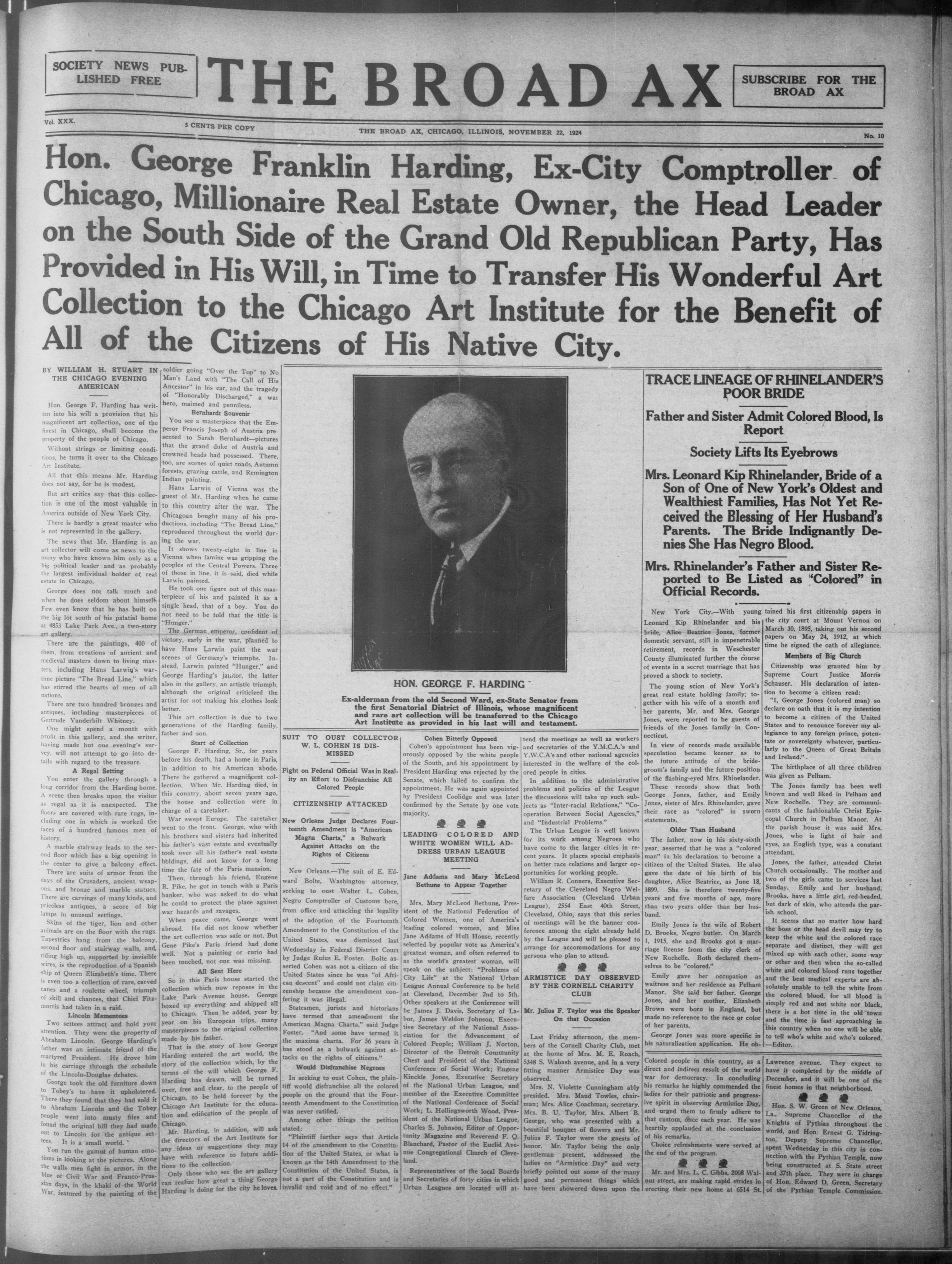
Hon. George Franklin Harding, Ex-City Comptroller of Chicago, Millionaire Real Estate Owner, the Head Leader on the South Side of the Grand Old Republican Party, Has Provided in His Will, in Time to Transfer His Wonderful Art Collection to the Chicago Art Institute for the Benefit of All of the Citizens of His Native City.
SOCIETY NEWS PUBLISHED FREE
Vol. XXX. Hon. Geo Chicago, M on the Sou Provided in Collection All of the
---
Vol. XXX.
BY WILLIAM H. STUART IN
THE CHICAGO EVENING
AMERICAN
Hon. George F. Harding has written into his will a provision that his magnificent art collection, one of the finest in Chicago, shall become the property of the people of Chicago.
Without strings or limiting conditions, he turns it over to the Chicago Art Institute.
All that this means Mr. Harding does not say, for he is modest.
But art critics say that this collection is one of the most valuable in America outside of New York City.
There is hardly a great master who is not represented in the gallery.
The news that Mr. Harding is an art collector will come as news to the many who have known him only as a big political leader and as probably the largest individual holder of real estate in Chicago.
George does not talk much and when he does seldom about himself. Few even know that he has built on the big lot south of his palatial home at 4853 Lake Park Ave., a two-story art gallery.
There are the paintings, 400 of them, from creations of ancient and medieval masters down to living masters, including Hans Larwin's wartime picture "The Bread Line," which has stirred the hearts of men of all nations.
There are two hundred bronzes and antiques, including masterpieces of Gertrude Vanderbilt Whitney.
One might spend a month with profit in this gallery, and the writer, having made but one evening's survey, will not attempt to go into details with regard to the treasure.
A Regal Setting
You enter the gallery through a long corridor from the Harding home. A scene then breaks upon the visitor as regal as it is unexpected. The floors are covered with rare rugs, including one in which is worked the faces of a hundred famous men of history.
A marble stairway leads to the second floor which has a big opening in the center to give a balcony effect.
There are suits of armor from the days of the Crusaders, ancient weapons, and bronze and marble statues. There are carvings of many kinds, and priceless antiques, a score of big lamps in unusual settings.
Skins of the tiger, lion and other animals are on the floor with the rugs. Tapestries hang from the balcony, second floor and stairway walls, and, riding high up, supported by invisible wires, is the reproduction of a Spanish ship of Queen Elizabeth's time. There is even too a collection of rare, carved canes and a roulette wheel, triumph of skill and chances, that Chief Fitzmorris had taken in a raid.
Lincoln Mementoes
Two settees attract and hold your attention. They were the property of Abraham Lincoln. George Harding's father was an intimate friend of the martyred President. He drove him in his carriage through the schedule of the Lincoln-Douglas debates.
George took the old furniture down to Tobey's to have it upholstered. There they found that they had sold it to Abraham Lincoln and the Tobey people went into musty files and found the original bill they had made out to Lincoln for the antique settees. It is a small world.
You run the gamut of human emotions in looking at the pictures. Along the walls men fight in armor, in the blue of Civil War and Franco-Prussian days, in the khaki of the World War, featured by the painting of the
THE BROAD AX
George Fr
, Milliona
South Side
in His W
on to the
he Citize
soldier going "Over the Top" to No Man's Land with "The Call of His Ancestor" in his ear, and the tragedy of "Honorably Discharged," a war hero, maimed and penniless.
Bernhardt Souvenir
You see a masterpiece that the Emperor Francis Joseph of Austria presented to Sarah Bernhardt—pictures that the grand duke of Austria and crowned heads had possessed. There, too, are scenes of quiet roads, Autumn forests, grazing cattle, and Remington Indian painting.
Hans Larwin of Vienna was the guest of Mr. Harding when he came to this country after the war. The Chicagoan bought many of his productions, including "The Bread Line," reproduced throughout the world during the war.
It shows twenty-eight in line in Vienna when famine was gripping the peoples of the Central Powers. Three of those in line, it is said, died while Larwin painted.
He took one figure out of this masterpiece of his and painted it as a single head, that of a boy. You do not need to be told that the title is "Hunger."
The German emperor, confident of victory, early in the war, planned to have Hans Larwin paint the war scenes of Germany's triumphs. Instead, Larwin painted "Hunger," and George Harding's janitor, the latter also in the gallery, an artistic triumph, although the original criticized the artist for not making his clothes look better.
This art collection is due to two generations of the Harding family, father and son.
Start of Collection
George F. Harding, Sr., for years before his death, had a home in Paris, in addition to his American abode. There he gathered a magnificent collection. When Mr. Harding died, in this country, about seven years ago, the house and collection were in charge of a caretaker.
War swept Europe. The caretaker went to the front. George, who with his brothers and sisters had inherited his father's vast estate and eventually took over all his father's real estate holdings, did not know for a long time the fate of the Paris mansion.
Then, through his friend, Eugene R. Pike, he got in touch with a Paris banker, who was asked to do what he could to protect the place against war hazards and ravages.
When peace came, George went abroad. He did not know whether the art collection was safe or not. But Gene Pike's Paris friend had done well. Not a painting or curio had been touched, not one was missing.
All Sent Here
So in this Paris house started the collection which now reposes in the Lake Park Avenue house. George boxed up everything and shipped all to Chicago. Then he added, year by year on his European trips, many masterpieces to the original collection made by his father.
That is the story of how George Harding entered the art world, the story of the collection which, by the terms of the will which George F. Harding has drawn, will be turned over, free and clear, to the people of Chicago, to be held forever by the Chicago Art Institute for the education and edification of the people of Chicago.
Mr. Harding, in addition, will ask the directors of the Art Institute for any ideas or suggestions they may have with reference to future additions to the collection.
Only those who see the art gallery can realize how great a thing George Harding is doing for the city he loves.
---
THE BROAD AX, CHICAGO, ILLINOIS, NOVEMBER 22, 1924
MUFFIN LANE
Ex-alderman from the old Second Ward, ex-State Senator from the first Senatorial District of Illinois, whose magnificent and rare art collection will be transferred to the Chicago Art Institute as provided in his last will and testament.
SUIT TO OUST COLLECTOR
W. L. COHEN IS DISMISSED
Fight on Federal Official Was in Reality an Effort to Disfranchise All Colored People
CITIZENSHIP ATTACKED
New Orleans Judge Declares Four
teenth Amendment is "American
New Orleans.—The suit of E. Edward Bolte, Washington attorney, seeking to oust Walter L. Cohen, Negro Comptroller of Customs here, from office and attacking the legality of the adoption of the Fourteenth Amendment to the Constitution of the United States, was dismissed last Wednesday in Federal District Court by Judge Rufus E. Foster. Bolte asserted Cohen was not a citizen of the United States since he was "of African descent" and could not claim citizenship because the amendment conferring it was illegal.
Statesmen, jurists and historians have termed that amendment the American Magna Charta," said Judge Foster. "And some have termed it the maxima charta. For 56 years it has stood as a bulwark against attacks on the rights of citizens."
Would Disfranchise Negroes
In seeking to oust Cohen, the plaintiff would disfranchise all the colored people on the ground that the Fourteenth Amendment to the Constitution was never ratified.
Among other things the petition stated:
"Plaintiff further says that Article 14 of the amendment to the Constitution of the United States, or what is known as the 14th Amendment to the Constitution of the United States, is not a part of the Constitution and is invalid and void and of no effect."
HON. GEORGE F. HARDING
Cohen Bitterly Opposed
Cohen Bitterly Opposed Cohen's appointment has been vigorously opposed by the white people of the South, and his appointment by President Harding was rejected by the Senate, which failed to confirm the appointment. He was again appointed by President Coolidge and was later confirmed by the Senate by one vote majority.
LEADING COLORED AND
WHITE WOMEN WILL ADDRESS URBAN LEAGUE
MEETING
Jane Addams and Mary McLeod
Bethune to Appear Together
Mrs. Mary McLeod Bethune, President of the National Federation of Colored Women, one of America's leading colored women, and Miss Jane Addams of Hull House, recently selected by popular vote as America's greatest woman, and often referred to as the world's greatest woman, will speak on the subject: "Problems of City Life" at the National Urban League Annual Conference to be held at Cleveland, December 2nd to 5th. Other speakers at the Conference will be James J. Davis, Secretary of Labor, James Weldon Johnson, Executive Secretary of the National Association for the Advancement of Colored People; William J. Norton, Director of the Detroit Community Chest and President of the National Conference of Social Work; Eugene Kinckle Jones, Executive Secretary of the National Urban League, and member of the Executive Committee of the National Conference of Social Work; L. Hollingsworth Wood, President of the National Urban League, Charles S. Johnson, Editor of Opportunity Magazine and Reverend F. Q. Blanchard, Pastor of the Euclid Avenue Congregational Church of Cleveland.
Representatives of the local Boards and Secretaries of forty cities in which Urban Leagues are located will at-
tend the meetings as well as workers and secretaries of the Y.M.C.A.'s and Y.W.C.A.'s and other national agencies interested in the welfare of the colored people in cities.
In addition to the administrative problems and policies of the League the discussions will take up such subjects as "Inter-racial Relations," "Cooperation Between Social Agencies," and "Industrial Problems."
The Urban League is well known for its work among Negroes who have come to the larger cities in recent years. It places special emphasis on better race relations and larger opportunities for working people.
William R. Conners, Executive Secretary of the Cleveland Negro Welfare Association (Cleveland Urban League), 2554 East 40th Street, Cleveland, Ohio, says that this series of meetings will be the banner conference among the eight already held by the League and will be pleased to arrange for accommodations for any persons who plan to attend.
---
Mr. Julius F. Taylor was the Speaker On that Occasion
Last Friday afternoon, the members of the Cornell Charity Club, met at the home of Mrs. M. E. Roach, 5348 S. Wabash avenue, and in a very fitting manner Armistice Day was observed.
Mrs. N. Violette Cunningham ably presided. Mrs. Maud Towles, chairman; Mrs. Alice Coachman, secretary. Mrs. B. U. Taylor, Mrs. Albert B. George, who was presented with a beautiful bouquet of flowers and Mr. Julius F. Taylor were the guests of honor. Mr. Taylor being the only gentleman present, addressed the ladies on "Armistice Day" and very briefly pointed out some of the many good and permanent things which have been showered down upon the
TRACE LINEAGE OF RHINELANDER'S POOR BRIDE Father and Sister Admit Colored Blood, Is Report
Society Lifts Its Eyebrows
Mrs. Leonard Kip Rh
Son of One of Ne
Wealthiest Famil
ceived the Blessin
Parents. The Bri
nies She Has Neg
Mrs. Rhinelander's H
ported to Be List
Official Records.
Mrs. Leonard Kip Rhinelander, Bride of a Son of One of New York's Oldest and Wealthiest Families, Has Not Yet Received the Blessing of Her Husband's Parents. The Bride Indignantly Denies She Has Negro Blood.
Mrs. Rhinelander's Father and Sister Reported to Be Listed as "Colored" in Official Records.
New York City.—With young Leonard Kip Rhinelander and his bride, Alice Beatrice Jones, former domestic servant, still in impenetrable retirement, records in Weschester County illuminated further the course of events in a secret marriage that has proved a shock to society.
tained his first citizenship papers in the city court at Mount Vernon on March 30, 1895, taking out his second papers on May 24, 1912, at which time he signed the oath of allegiance.
Members of Big Church
Citizenship was granted him by Supreme Court Justice Morris
The young sion of New York's great real estate holding family; together with his wife of a month and her parents, Mr. and Mrs. George Jones, were reported to be guests of friends of the Jones family in Connecticut.
In view of records made available speculation became keener as to the future attitude of the bridegroom's family and the future position of the flashing-eyed Mrs. Rhinelander. These records show that both George Jones, father, and Emily Jones, sister of Mrs. Rhinelander, gave their race as "colored" in sworn statements.
Older Than Husband
The father, now in his sixty-sixth year, asserted that he was a "colored man" in his declaration to become a citizen of the United States. He also gave the date of his birth of his daughter, Alice Beatrice, as June 18, 1899. She is therefore twenty-five years and five months of age, more than two years older than her husband.
Emily Jones is the wife of Robert D. Brooks, Negro butler. On March 1, 1915, she and Brooks got a marriage license from the city clerk of New Rochelle. Both declared themselves to be "colored."
Emily gave her occupation as waitress and her residence as Pelham Manor. She said her father, George Jones, and her mother, Elizabeth Brown were born in England, but made no reference to the race or color of her parents.
George Jones was more specific in his naturalization application. He ob-
Colored people in this country, as a direct and indirect result of the world war for democracy. In concluding his remarks he highly commended the ladies for their patriotic and progressive spirit in observing Armistice Day, and urged them to firmly adhere to that custom, once each year. He was heartily applauded at the conclusion of his remarks.
Choice refreshments were served at the end of the program.
Mr. and Mrs. L. C. Gibbs, 2008 Walnut street, are making rapid strides in erecting their new home at 6514 St.
SUBSCRIBE FOR THE BROAD AX
Controller of
Bad Leader
Party, Has
Wonderful Art
Benefit of
AGE OF RHINELANDER'S
DOR BRIDE
or Admit Colored Blood, Is
Report
Up Rhinelander, Bride of a of New York's Oldest and families, Has Not Yet Redressing of Her Husband's Use Bride Indignantly De- Negro Blood.
Her's Father and Sister Ree Listed as "Colored" in words.
young tained his first citizenship papers in the city court at Mount Vernon on March 30, 1895, taking out his second papers on May 24, 1912, at which time he signed the oath of allegiance.
Members of Big Church
that has York's family; tooth and George tests of on Conn. available as to bride-position pelander. It both Emily, gave sworn city-sixth colored come a He also of his June 18, twenty-five, more her hus-
Citizenship was granted him by Supreme Court Justice Morris Schauer. His declaration of intention to become a citizen read:
"I, George Jones (colored man) so declare on oath that my intention to become a citizen of the United States and to renounce forever my allegiance to any foreign prince, potentate or sovereignty whatever, particularly to the Queen of Great Britain and Ireland."
The birthplace of all three children was given as Pelham.
The Jones family has been well known and well liked in Pelham and New Rochelle. They are communicants of the fashionable Christ Episcopal Church in Pelham Manor. At the parish house it was said Mrs. Jones, who is light of hair and eyes, an English type, was a constant attendant.
Jones, the father, attended Christ Church occasionally. The mother and two of the girls came to services last Sunday. Emily and her husband, Brooks, have a little girl, red-headed, but dark of skin, who attends the parish school.
It seems that no matter how hard the boss or the head devil may try to keep the white and the colored race separate and distinct, they will get mixed up with each other, some way or other and then when the so-called white and colored blood runs together and the best medical experts are absolutely unable to tell the white from the colored blood, for all blood is simply red and not white nor black, there is a hot time in the old town and the time is fast approaching in this country when no one will be able to tell who's white and who's colored. —Editor.
Lawrence avenue. They expect to have it completed by the middle of December, and it will be one of the finest homes in that neighborhood.
ce Day, there to
He was inclusion
served at
08 Waltrides in
6514 St.
Hon. S. W. Green of New Orleans, La., Supreme Chancellor of the Knights of Pythias throughout the world, and Hon. Ernest G. Tidrington, Deputy Supreme Chancellor, spent Wednesday in this city in connection with the Pythian Temple, now being constructed at S. State street and 37th place. They were in charge of Hon. Edward D. Green, Secretary of the Pythian Temple Commission.
In this city since July 15th, 1899, without missing one single issue. Republicans, Democrats, Catholics, Protestants, Single Taxes, Priests, infidels or anyone else can have their say as long as their language is proper and responsibility is fixed.
The Broad Ax is a newspaper whose platform is broad enough for all, ever claiming the editorial right to speak its own mind. It is neither Democratic nor Republican. It is strictly or absolutely independent in politics.
Local communications will receive attention. Write only on one side of the paper.
Subscriptions must be paid in advance.
One Year ..... $2.00
Six Months ..... $1.00
Advertising rates made known on application.
Address all communications to
THE BROAD AX
s206 So. Elizabeth St. Chicago, Ill
Vol. XXX No. 10
Chicago, November 22, 1924
Entered as Second-Class Matter, Aug.
19, 1902, at the Post office at Chicago,
Ill. Under Act of March 8, 1879.
COLORED MEN ELECTED TO
THE LEGISLATURE FROM
SEVERAL STATES IN
THE UNION
The following colored men were, at the late election, elected to the legislatures from their respective states: Henry Shields, colored Democrat, defeated his colored Republican opponent and was elected to the New York General Assmbley of New York; Hon. Frederick M. Roberts was re-elected to the Legislature of California from Los Angeles; Hon. J. W. Moore, re-elected to the Legislature from St. Louis, Mo.; Hon. John H. Ryan, re-elected to the Legislature of Washington from Tacoma of that state; two members were re-elected to the Legislature in West Virginia, Hons. Warren B. Douglas and Charles A. Griffin; S. B. Turner and William E. King elected to the Illinois Legislature, and Hon. A. H. Roberts elected to the State Senate from the same state.
---
Jacob Wheaton, father of W. J. Wheaton of San Francisco and the late J. Frank Wheaton of New York and uncle to Horace F. Wheaton of Los Angeles, died at his home at Hagerstown, Maryland. He was born in 1833 on the 14th of February at Middletown in Maryland near his late home. He served with the 54th Massachusetts Regiment during the Civil War and with the late Sergeant Carney of Boston was at all times among the notable figures at the Grand Army meetings, which he attended yearly. During the time of the Under Ground Railroad, his home, which was nine miles from the State line of Pennsylvania, was the last station from which slave refugees made the dash for freedom. Up until the date of his death he kept in touch with affairs and cast his vote on election day. For forty years, as Bailiff, he was in charge of the sessions of the Washington County Grand Jury and signal honors were shown at his funeral by public and private citizens whose respect he commanded.
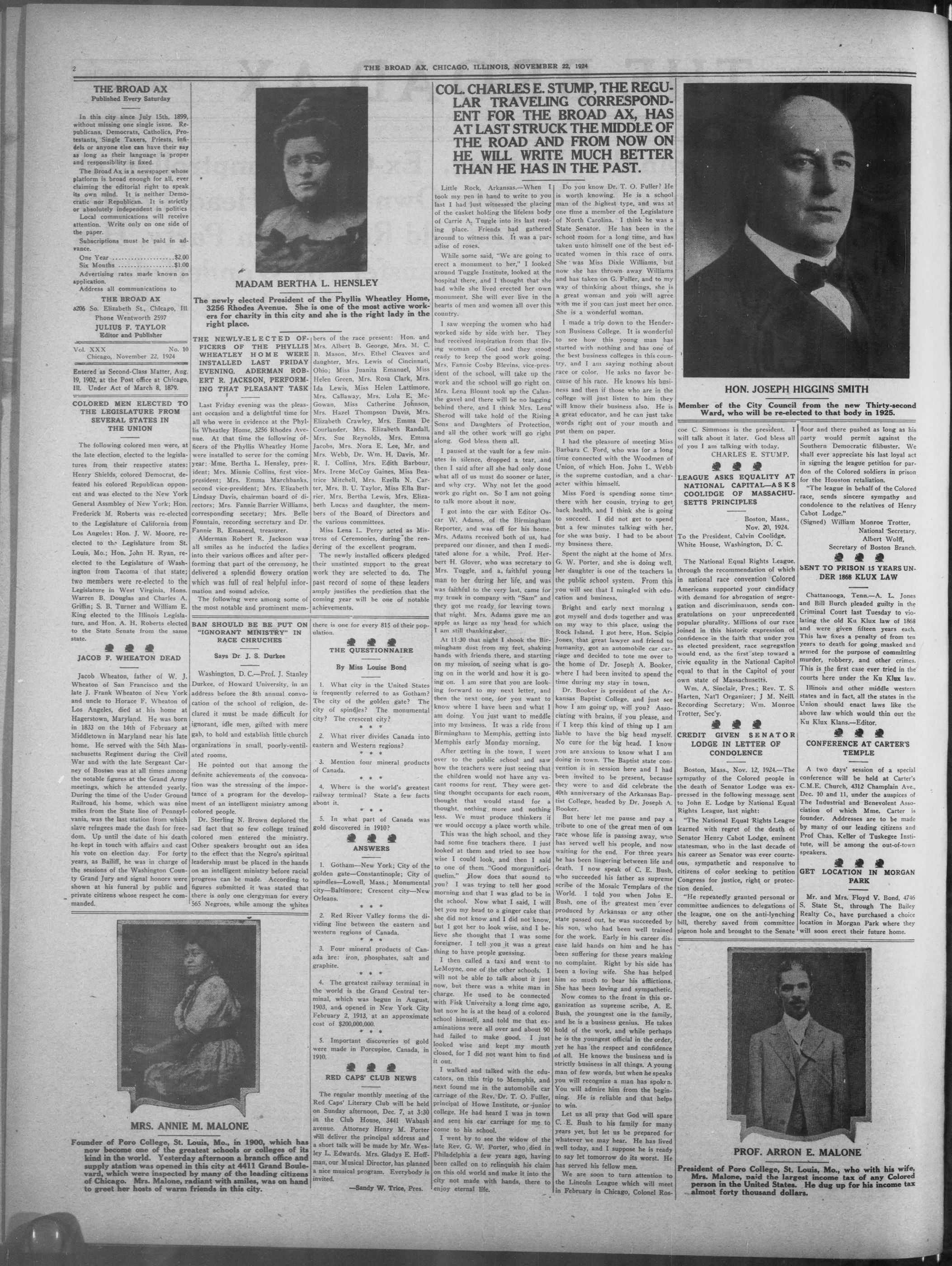
[Image of a woman seated, wearing a dress with a high collar and a belt, with her hands resting on her knees.]
MRS. ANNIE M. MALONE
Founder of Poro College, St. Louis, Mo., in 1900, which has now become one of the greatest schools or colleges of its kind in the world. Yesterday afternoon a branch office and supply station was opened in this city at 4411 Grand Boulevard, which were inspected by many of the leading citizens of Chicago. Mrs. Malone, radiant with smiles, was on hand to greet her hosts of warm friends in this city.
The newly elected President of the Phyllis Wheatley Home, 3256 Rhodes Avenue. She is one of the most active workers for charity in this city and she is the right lady in the right place.
THE NEWLY-ELECTED OFFICERS OF THE PHYLLIS WHEATLEY HOME WERE INSTALLED LAST FRIDAY EVENING. ADERMAN ROBERT R. JACKSON, PERFORMING THAT PLEASANT TASK bers of the race present: Hon. and Mrs. Albert B. George, Mrs. M. C. B. Mason, Mrs. Ethel Cleaves and daughter, Mrs. Lewis of Cincinnati, Ohio; Miss Juanita Emanuel, Miss Helen Green, Mrs. Rosa Clark, Mrs. Ida Lewis, Miss Helen Lattimore,
Last Friday evening was the pleasant occasion and a delightful time for all who were in evidence at the Phyllis Wheatley Home, 3256 Rhodes Avenue. At that time the following officers of the Phyllis Wheatley Home were installed to serve for the coming year: Mme. Bertha L. Hensley, president; Mrs. Minnie Collins, first vice-president; Mrs. Emma Marchbanks, second vice-president; Mrs. Elizabeth Lindsay Davis, chairman board of directors; Mrs. Fannie Barrier Williams, corresponding secretary; Mrs. Belle Fountain, recording secretary and Dr. Fannie B. Emaneul, treasurer.
Alderman Robert R. Jackson was all smiles as he inducted the ladies into their various offices and after performing that part of the ceremony, he delivered a splendid flowery oration which was full of real helpful information and sound advice. The following were among some of the most notable and prominent mem-
BAN SHOULD BE BE PUT ON "IGNORANT MINISTRY" IN RACE CHRUCHES
Savs Dr. J. S. Durkee
Washington, D. C.-Prof. J. Stanley Durkee, of Howard University, in an address before the 8th annual convocation of the school of religion, declared it must be made difficult for ignorant, idle men, gifted with mere gab, to hold and establish little church organizations in small, poorly-ventilated rooms.
He pointed out that among the definite achievements of the convocation was the stressing of the importance of a program for the development of an intelligent ministry among colored people.
Dr. Sterling N. Brown deplored the sad fact that so few college trained colored men entered the ministry. Other speakers brought out an idea to the effect that the Negro's spiritual leadership must be placed in the hands on an intelligent ministry before racial progress can be made. According to figures submitted it was stated that there is only one clergyman for every 565 Negroes, while among the whites
Mary C.
of the Phyllis Wheatley Home, is one of the most active work and she is the right lady in the
bers of the race present: Hon. and Mrs. Albert B. George, Mrs. M. C. B. Bason, Mrs. Ethel Cleaves and daughter, Mrs. Lewis of Cincinnati, Ohio; Miss Juanita Emanuel, Miss Helen Green, Mrs. Rosa Clark, Mrs. Ida Lewis, Miss Helen Lattinmore, Mrs. Callaway, Mrs. Lula E. McGowan, Miss Catherine Johnson, Mrs. Hazel Thompson Davis, Mrs. Elizabeth Crawley, Mrs. Emma De Courlander, Mrs. Elizabeth Randall, Mrs. Sue Reynolds, Mrs. Emma Jacobs, Mrs. Nora E. Lee, Mr. and Mrs. Webb, Dr. Wm. H. Davis, Mr. R. I. Collins, Mrs. Edith Barbour, Mrs. Irene McCoy Gaines, Miss Beatrice Mitchell, Mrs. Ezella N. Carter, Mrs. B. U. Taylor, Miss Ella Barrier, Mrs. Bertha Lewis, Mrs. Elizabeth Lucas and daughter, the members of the Board of Directors and the various committees.
Miss Lena L. Perry acted as Mistress of Ceremonies, during the rendering of the excellent program.
The newly installed officers pledged their unstinted support to the great work they are selected to do. The past record of some of these leaders amply justifies the prediction that the coming year will be one of notable achievements.
there is one for every 815 of their population.
By Miss Louise Bond
1. What city in the United States is frequently referred to as Gotham? The city of the golden gate? The city of spindles? The monumental city? The crescent city?
* * * *
2. What river divides Canada into eastern and Western regions?
* * * *
3. Mention four mineral products of Canada.
* * * *
4. Where is the world's greatest railway terminal? State a few facts about it.
* * * *
5. In what part of Canada was gold discovered in 1910?
1. Gotham—New York; City of the golden gate—Constantinople; City of spindles—Lowell, Mass.; Monumental city—Baltimore; Crescent city—New Orleans.
* * * *
2. Red River Valley forms the dividing line between the eastern and western regions of Canada.
* * * *
3. Four mineral products of Canada are: iron, phosphates, salt and graphite.
* * * *
4. The greatest railway terminal in the world is the Grand Central terminal, which was begun in August, 1903, and opened in New York City February 2, 1913, at an approximate cost of $200,000,000.
5. Important discoveries of gold were made in Porcupine, Canada, in 1910.
---
RED CAPS' CLUB NEWS
The regular monthly meeting of the Red Caps' Literary Club will be held on Sunday afternoon, Dec. 7, at 3:30 in the Club House, 3441 Wabash avenue. Attorney Henry M. Porter will deliver the principal address and a short talk will be made by Mr. Wesley L. Edwards. Mrs. Gladys E. Hoffman, our Musical Director, has planned a nice musical program. Everybody is invited.
—Sandy W. Trice, Pres.
THE BROAD AX, CHICAGO, ILLINOIS, NOVEMBER 22, 1924
—Sandy W. Trice, Pres.
COL. CHARLESE. STUMP, THE REGULAR TRAVELING CORRESPONDENT FOR THE BROAD AX, HAS AT LAST STRUCK THE MIDDLE OF THE ROAD AND FROM NOW ON HE WILL WRITE MUCH BETTER THAN HE HAS IN THE PAST.
Little Rock, Arkansas.—When I took my pen in hand to write to you last I had just witnessed the placing of the casket holding the lifeless body of Carrie A. Tuggle into its last resting place. Friends had gathered around to witness this. It was a paradise of roses.
While some said, "We are going to erect a monument to her," I looked around Tuggle Institute, looked at the hospital there, and I thought that she had while she lived erected her own monument. She will ever live in the hearts of men and women all over this country.
I saw weeping the women who had worked side by side with her. They had received inspiration from that living woman of God and they stood ready to keep the good work going: Mrs. Fannie Cosby Bleins, vice-president of the school, will take up the work and the school will go right on. Mrs. Lena Blount took up the Calan-the gavel and there will be no lagging behind there, and I think Mrs. Lena Sherod will take hold of the Rising Sons and Daughters of Protection, and all the other work will go right along. God bless them all.
I paused at the vault for a few minutes in silence, dropped a tear, and then I said after all she had only done what all of us must do sooner or later, and why cry. Why not let the good work go right on. So I am not going to talk more about it now.
I got into the car with Editor Oscar W. Adams, of the Birmingham Reporter, and was off for his home. Mrs. Adams received both of us, had prepared our dinner, and then I meditated alone for a while. Prof. Herbert H. Glover, who was secretary to Mrs. Tuggle, and a faithful young man to her during her life, and was was faithful to the very last, came for my trunk in company with "Sam" and they got me ready, for leaving town that night. Mrs. Adams gave me an apple as large as my head for which I am still thanking her.
At 11:30 that night I shook the Birmingham dust from my feet, shaking hands with friends there, and starting on my mission of seeing what is going on in the world and how it is going on. I am sure that you are looking forward to my next letter, and then the next one, for you want to know where I have been and what I am doing. You just want to meddle into my business. It was a ride from Birmingham to Memphis, getting into Memphis early Monday morning.
After getting in the town, I went over to the public school and saw how the teachers were just seeing that the children would not have any vacant rooms for rent. They were getting thought occupants for each room, thought that would stand for a thought, nothing more and nothing less. We must produce thinkers if we would occupy a plare worth while.
This was the high school, and they had some fine teachers there. I just looked at them and tried to see how wise I could look, and then I said to one of them "Good morgunifloriquelim." How does that sound to you? I was trying to tell her good morning and that I was glad to be in the school. Now what I said, I will bet you my head to a ginger cake that she did not know and I did not know, but I got her to look wise, and I believe she thought that I was some foreigner. I tell you it was a great thing to have people guessing.
I then called a taxi and went to LeMoyne, one of the other schools. I will not be able to talk about it just now, but there was a white man in charge. He used to be connected with Fisk University a long time ago, but now he is at the head of a colored school himself, and told me that examinations were all over and about 90 had failed to make good. I just looked wise and kept my mouth closed, for I did not want him to find it out.
I walked and talked with the educators, on this trip to Memphis, and next found me in the automobile car carriage of the Rev. Dr. T. O. Fuller, principal of Howe Institute, or junior college. He had heard I was in town and sent his car carriage for me to come to his school.
I went by to see the widow of the late Rev. G. W. Porter, who died in Philadelphia a few years ago, having been called on to relinquish his claim on this old world and make it into the city not made with hands, there to enjoy eternal life.
Do you know Dr. T. O. Fuller? He is worth knowing. He is a school man of the highest type, and was at one time a member of the Legislature of North Carolina. I think he was a State Senator. He has been in the school room for a long time, and has taken unto himself one of the best educated women in this race of ours. She was Miss Dixie Williams, but now she has thrown away Williams and has taken on G. Fuller, and to my way of thinking about things, she is a great woman and you will agree with me if you can just meet her once. She is a wonderful woman.
I made a trip down to the Henderson Business College. It is wonderful to see how this young man has started with nothing and has one' of the best business colleges in this country, and I am saying nothing about race or color. He asks no favor because of his race. He knows his business and then if those who are in the college will just listen to him they will know their business also. He is a great educator, and he can just take words right out of your mouth and put them on paper.
I had the pleasure of meeting Miss Barbara C. Ford, who was for a long time connected with the Woodmen of Union, of which Hon. John L. Webb is the supreme custodian, and a character within himself.
Miss Ford is spending some time there with her cousin, trying to get back health, and I think she is going to succeed. I did not get to spend but a few minutes talking with her, for she was busy. I had to be about my business there.
Spent the night at the home of Mrs. G. W. Porter, and she is doing well, her daughter is one of the teachers in the public school system. From this you will see that I mingled with education and business.
Bright and early next morning I got myself and duds together and was on my way to this place, using the Rock Island. I got here. Hon. Scipio Jones, that great lawyer and friend to humanity, got an automobile car carriage and decided to tome me over to the home of Dr. Joseph A. Booker, where I had been invited to spend the time during my stay in town.
Dr. Booker is president of the Arkansas Baptist College, and just see how I am going up, will you? Associating with brains, if you please, and if I keep this kind of thing up I am liable to have the big head myself. No cure for the big head. I know you are anxious to know what I am doing in town. The Baptist state convention is in session here and I had been invited to be present, because they were to and did celebrate the 40th anniversary of the Arkansas Baptist College, headed by Dr. Joseph A. Booker.
But here let me pause and pay a tribute to one of the great men of our race whose life is passing away, who has served well his people, and now waiting for the end. For three years he has been lingering between life and death. I now speak of C. E. Bush, who succeeded his father as supreme scribe of the Mosaic Templars of the World. I told you when John E. Bush, one of the greatest men 'ever produced by Arkansas or any other state passed out, he was succeeded by his son, who had been well trained for the work. Early in his career disease laid hands on him and he has been suffering for these years making no complaint. Right by his side has been a loving wife. She has helped him so much to bear his afflictions. She has been loving and sympathetic. Now comes to the front in this organization as supreme scribe, A. E. Bush, the youngest one in the family, and he is a business genius. He takes hold of the work, and while perhaps he is the youngest official in the order, yet he has 'the respect and confidence of all. He knows the business and is strictly business in all things. A young man of few words, but when he speaks you will recognize a man has spoken. You will admire him from the beginning. He is reliable and that helps to win.
Let us all pray that God will spare C. E. Bush to his family for many years yet, but let us be prepared for whatever we may hear. He has lived well today, and I suppose he is ready to say let tomorrow do its worst. He has served his fellow men.
We are soon to turn attention to the Lincoln League which will meet in February in Chicago. Colonel Ros-
[Picture of a man in a suit and bow tie].
HON. JOSEPH HIGGINS SMITH
Member of the City Council from the new Thirty-second Ward, who will be re-elected to that body in 1925.
coe C. Simmons is the president. I will talk about it later. God bless all of you I am talking with today.
CHARLES E. STUMP.
door and there pushed as long as his party would permit against the Southern Democratic filibuster. We shall ever appreciate his last loyal act
---
LEAGUE ASKS EQUALITY AT
NATIONAL CAPITAL-ASKS
COOLIDGE OF MASSACHU-
SETTS PRINCIPLES
To the President, Calvin Coolidge, White House, Washington, D. C.
The National Equal Rights League, through the recommendation of which in national race convention Colored Americans supported your candidacy with demand for abrogation of segregation and discrimination, sends congratulations on your unprecedented popular plurality. Millions of our race joined in this historic expression of confidence in the faith that under you as elected president, race segregation would end, as the first step toward a civic equality in the National Capitol equal to that in the Capitol of your own state of Massachusetts.
Wm. A. Sinclair, Pres.; Rev. T. S. Harten, Nat'l Organizer; J M. Neill, Recording Secretary; Wm. Monroe, Trotter, Sec'y.
CREDIT GIVEN SENATOR
LODGE IN LETTER OF
CONDOLENCE
Boston, Mass., Nov. 12, 1924.—The sympathy of the Colored people in the death of Senator Lodge was expressed in the following message sent to John E. Lodge by National Equal Rights League, last night:
"The National Equal Rights League learned with regret of the death of Senator Henry Cabot Lodge, eminent statesman, who in the last decade of his career as Senator was ever courteous, sympathetic and responsive to citizens of color seeking to petition Congress for justice, right or protection denied.
"He repeatedly granted personal or committee audiences to delegations of the league, one on the anti-lynching bill, thereby saved from committee pigeon hole and brought to the Senate
[Name]
PROF. ARRON E. MALONE President of Poro College, St. Louis, Mo., who with his wife, Mrs. Malone, paid the largest income tax of any Colored person in the United States. He dug up for his income tax almost forty thousand dollars.
floor and there pushed as long as his party would permit against the Southern Democratic filibuster. We shall ever appreciate his last loyal act in signing the league petition for pardon of the Colored soldiers in prison for the Houston retaliation.
"The league in behalf of the Colored race, sends sincere sympathy and condolence to the relatives of Henry Cabot Lodge."
(Signed) William Monroe Trotter,
National Secretary.
Albert Wolff.
SENT TO PRISON 15 YEARS UNDER 1868 KLUX LAW
Chattanooga, Tenn.—A. L. Jones and Bill Burch pleaded guilty in the Criminal Court last Tuesday to violating the old Ku Klux law of 1868 and were given fifteen years each. This law fixes a penalty of from ten years to death for going, masked and armed for the purpose of committing murder, robbery, and other crimes. This is the first case ever tried in the courts here under the Ku Klux law.
Illinois and other middle western states and in fact, all the states in the Union should enact laws like the above law which would thin out the Ku Klux Klans.—Editor.
CONFERENCE AT CARTER'S TEMPLE
A two days' session of a special conference will be held at Carter's C.M.E. Church, 4312 Champlain Ave., Dec. 10 and 11, under the auspices of The Industrial and Benevolent Association of which Mme. Carter is founder. Addresses are to be made by many of our leading citizens and Prof Chas. Keller of Tuskegee Institute, will be among the out-of-town speakers.
GET LOCATION IN MORGAN PARK
Mr. and Mrs. Floyd V. Bond, 4746 S. State St., through The Bailey Realty Co., have purchased a choice location in Morgan Park where they will soon erect their future home.
Louis, Mo., who with his wife, best income tax of any Colored He dug up for his income tax ears.
[Name]
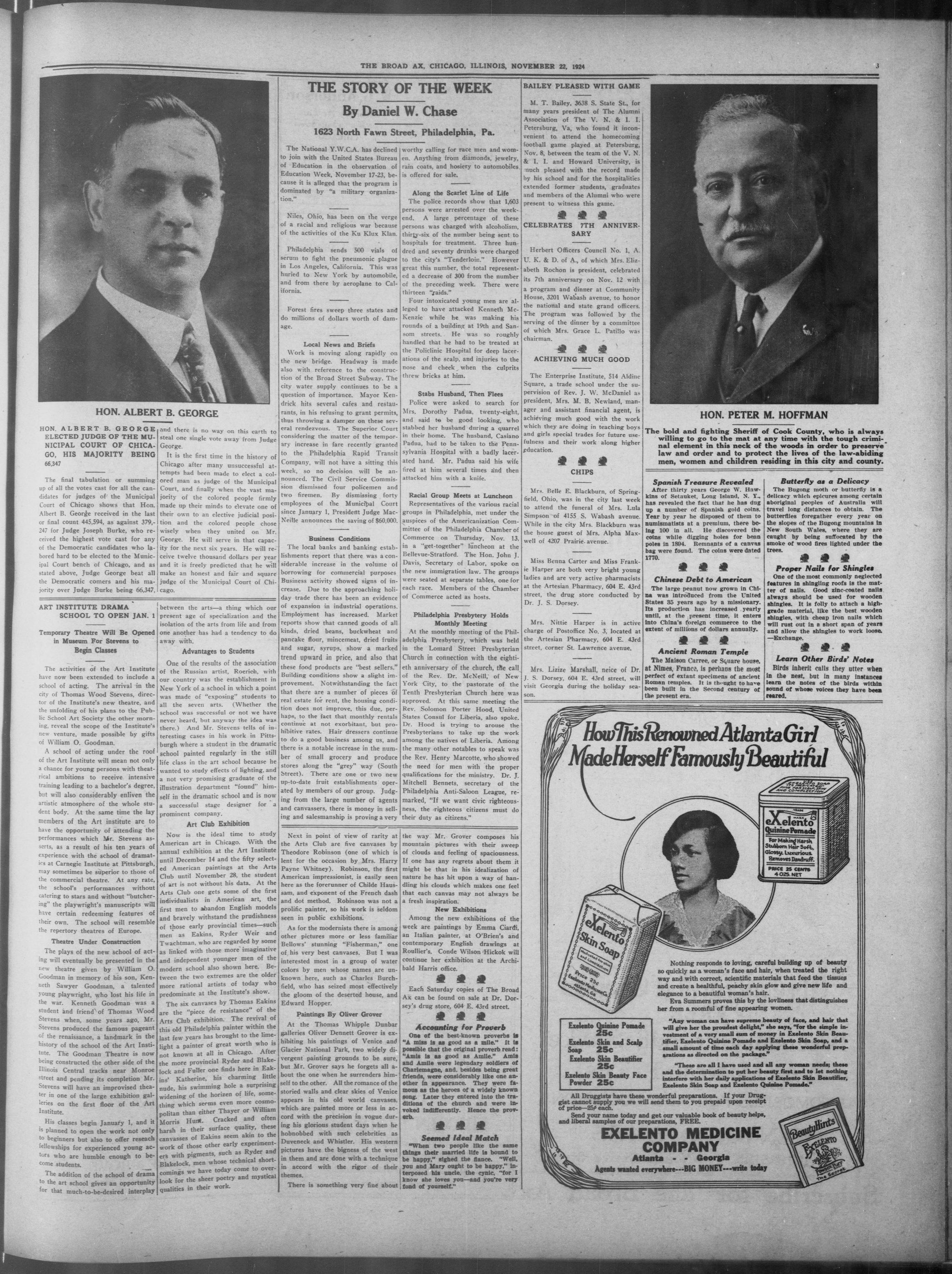
HON. ALBERT B. GEORGE
ELECTED JUDGE OF THE MU
NICIPAL COURT OF CHICAGO, HIS MAJORITY BEING
66347 and there is no wa
steal one single vote
George.
It is the first time
Chicago after man
The final tabulation or summing up all of the votes cast for all the candidates for judges of the Municipal Court of Chicago shows that Hon. Albert B. George received in the last or final court 445,594, as against 379,247 for Judge Joseph Burke, who received the highest vote cast for any of the Democratic candidates who labored hard to be elected to the Municipal Court bench of Chicago, and as stated above, Judge George beat all the Democratic comers and his majority over Judge Burke being 66,347.
ART INSTITUTE DRAMA
SCHOOL TO OPEN JAN. 1
Temporary Theatre Will Be Opened in Museum For Stevens to Begin Classes
The activities of the Art Institute have now been extended to include a school of acting. The arrival in the city of Thomas Wood Stevens, director of the Institute's new theatre, and the unfolding of his plans to the Public School Art Society the other morning, reveal the scope of the Institute's new venture, made possible by gifts of William O. Goodman.
A school of acting under the roof of the Art Institute will mean not only a chance for young persons with theatrical ambitions to receive intensive training leading to a bachelor's degree, but will also considerably enliven the artistic atmosphere of the whole student body. At the same time the lay members of the Art institute are to have the opportunity of attending the performances which Mr. Stevens asserts, as a result of his ten years of experience with the school of dramatics at Carnegie Institute at Pittsburgh, may sometimes be superior to those of the commercial theatre. At any rate, the school's performances without catering to stars and without "butchering" the playwright's manuscripts will have certain redeeming features of their own. The school will resemble the repertory theatres of Europe.
Theatre Under Construction
The plays of the new school of acting will eventually be presented in the new theatre given by William O. Goodman in memory of his son, Kenneth Sawyer Goodman, a talented young playwright, who lost his life in the war. Kenneth Goodman was a student and friend of Thomas Wood Stevens when, some years ago, Mr. Stevens produced the famous pageant of the renaissance, a landmark in the history of the school of the Art Institute. The Goodman Theatre is now being constructed the other side of the Illinois Central tracks near Monroe street and pending its completion Mr. Stevens will have an improvised theater in one of the large exhibition galleries on the first floor of the Art Institute.
His classes begin January 1, and it is planned to open the work not only to beginners but also to offer reseach fellowships for experienced young actors who are humble enough to become students.
The addition of the school of drama to the art school gives an opportunity for that much-to-be-desired interplay
and there is no way on this earth to steal one single vote away from Judge George.
It is the first time in the history of Chicago after many unsuccessful attempts had been made to elect a colored man as judge of the Municipal Court, and finally when the vast majority of the colored people firmly made up their minds to elevate one of their own to an elective judicial position and the colored people chose wisely when they united on Mr. George. He will serve in that capacity for the next six years. He will receive twelve thousand dollars per year and it is freely predicted that he will make an honest and fair and square judge of the Municipal Court of Chicago.
between the arts—a thing which our present age of specialization and the isolation of the arts from life and from one another has had a tendency to do away with.
Advantages to Students
One of the results of the association of the Russian artist, Roerich, with our country was the establishment in New York of a school in which a point was made of "exposing" students to all the seven arts. (Whether the school was successful or not we have never heard, but anyway the idea was there.) And Mr. Stevens tells of interesting cases in his work in Pittsburgh where a student in the dramatic school painted regularly in the still life class in the art school because he wanted to study effects of lighting, and a not very promising graduate of the illustration department "found" himself in the dramatic school and is now a successful stage designer for a prominent company.
Art Club Exhibition
Now is the ideal time to study American art in Chicago. With the annual exhibition at the Art Institute until December 14 and the fifty selected American paintings at the Arts Club until November 28, the student of art is not without his data. At the Arts Club one gets some of the first individualists in American art, the first men to abandon English models and bravely withstand the prudishness of those early provincial times—such men as Eakins, Ryder Weir and Twachtman, who are regarded by some as linked with those more imaginative and independent younger men of the modern school also shown here. Between the two extremes are the older more rational artists of today who predominate at the Institute's show.
The six canvases by Thomas Eakins are the "piece de resistance" of the Arts Club exhibition. The revival of this old Philadelphia painter within the last few years has brought to the limelight a painter of great worth who is not known at all in Chicago. After the more provincial Ryder and Blakelock and Fuller one finds here in Eakins' Katherine, his charming little nude, his swimming hole a surprising widening of the horizen of life, something which seems even more cosmopolitan than either Thayer or William Morris Hunt. Cracked and often harsh in their surface quality, these canvases of Eakins seem akin to the work of those other early experimenters with pigments, such as Ryder and Blakelock, men whose technical shortcomings we have today come to overlook for the sheer poetry and mystical qualities in their work.
THE BROAD AX, CHICAGO, ILLINOIS, NOVEMBER 22, 1924
THE STORY OF THE WEEK By Daniel W. Chase
1623 North Fawn Street, Philadelphia, Pa.
The National Y.W.C.A. has declined to join with the United States Bureau of Education in the observation of Education Week, November 17-23, because it is alleged that the program is dominated by "a military organization."
Niles, Ohio, has been on the verge of a racial and religious war because of the activities of the Ku Klux Klan.
Philadelphia sends 500 vials of serum to fight the pneumonic plague in Los Angeles, California. This was hurried to New York by automobile, and from there by aeroplane to California.
Forest fires sweep three states and do millions of dollars worth of damage.
Local News and Briefs
Work is moving along rapidly on the new bridge. Headway is made also with reference to the construction of the Broad Street Subway. The city water supply continues to be a question of importance. Mayor Kendrick hits several cafes and restaurants, in his refusing to grant permits, thus throwing a damper on these several rendezvous. The Superior Court considering the matter of the temporary increase in fare recently granted to the Philadelphia Rapid Transit Company, will not have a sitting this week, so no decision will be announced. The Civil Service Commission dismissed four policemen and two firemen. By dismissing forty employees of the Municipal Court since January 1, President Judge Mac Neille announces the saving of $60,000.
Business Conditions
The local banks and banking establishments report that there was a considerable increase in the volume of borrowing for commercial purposes. Business activity showed signs of increase. Due to the approaching holiday trade there has been an evidence of expansion in industrial operations. Employment has increased. Market reports show that canned goods of all kinds, dried beans, buckwheat and pancake flour, mincemeat, dried fruits and sugar, syrups, show a marked trend upward in price, and also that these food products are "best sellers." Building conditions show a slight improvement. Notwithstanding the fact that there are a number of pieces of real estate for rent, the housing condition does not improve, this due, perhaps, to the fact that monthly continue at not exorbitant, but prohibitive rates. Hair dressers continue to do a good business among us, and there is a notable increase in the number of small grocery and produce stores along the "grey" way (South Street). There are one or two new up-to-date fruit establishments operated by members of our group. Judging from the large number of agents and canvassers, there is money in selling and salesmanship is proving a very
Next in point of view of rarity at the Arts Club are five canvases by Theodore Robinson (one of which is lent for the occasion by Mrs. Harry Payne Whitney). Robinson, the first American impressionist, is easily seen here as the forerunner of Childe Haussam, and exponent of the French dash and dot method. Robinson was not a prolific painter, so his work is seldom seen in public exhibitions.
As for the modernists there is among other pictures more or less familiar Bellows' stunning "Fisherman," one of his very best canvases. But I was interested most in a group of water colors by men whose names are unknown here, such as Charles Burchfield, who has seized most effectively the gloom of the deserted house, and Edward Hopper.
Paintings By Oliver Grover
At the Thomas Whipple Dunbar galleries Oliver Dennett Grover is exhibiting his paintings of Venice and Glacier National Park, two widely divergent painting grounds to be sure, but Mr. Grover says he forgets all about the one when he surrenders himself to the other. All the romance of the storied walls and clear skies of Venice appears in his old world canvases, which are painted more or less in accord with the precision in vogue during his glorious student days when he hobnobbed with such celebrities as Duveneck and Whistler. His western pictures have the bigness of the west in them and are done with a technique in accord with the rigor of their themes.
There is something very fine about
worthy calling for race men and women. Anything from diamonds, jewelry, rain coats, and hosiery to automobiles is offered for sale.
Along the Scarlet Line of Life
The police records show that 1,603 persons were arrested over the weekend. A large percentage of these persons was charged with alcoholism, thirty-six of the number being sent to hospitals for treatment. Three hundred and seventy drunks were charged to the city's "Tenderloin." However great this number, the total represented a decrease of 300 from the number of the preceding week. There were thirteen "raids."
Four intoxicated young men are alleged to have attacked Kenneth McKenzie while he was making his rounds of a building at 19th and Sansom streets. He was so roughly handled that he had to be treated at the Policlinic Hospital for deep lacerations of the scalp, and injuries to the nose and cheek when the culprits threw bricks at him.
Stabs Husband. Then Flees
Police were asked to search for Mrs. Dorothy Padua, twenty-eight, and said to be good looking, who stabbed her husband during a quarrel in their home. The husband, Casiano Padua, had to be taken to the Pennsylvania Hospital with a badly lacerated hand. Mr. Padua said his wife fired at him several times and then attacked him with a knife.
Racial Group Meets at Luncheon Representatives of the various racial groups in Philadelphia, met under the auspices of the Americanization Committee of the Philadelphia Chamber of Commerce on Thursday, Nov. 13 in a "get-together" luncheon at the Bellevue-Stratford. The Hon. John J. Davis, Secretary of Labor, spoke on the new immigration law. The groups were seated at separate tables, one for each race. Members of the Chamber of Commerce acted as hosts.
Philadelphia Presbytery Holds
Monthly Meeting
At the monthly meeting of the Philadelphia Presbytery, which was held in the Lomard Street Presbyterian Church in connection with the eightieth anniversary of the church, the call of the Rev. Dr. McNeill, of New York City, to the pastorate of the Tenth Presbyterian Church here was approved. At this same meeting the Rev. Solomon Porter Hood, United States Consul for Liberia, also spoke. Dr. Hood is trying to arouse the Presbyterians to take up the work among the natives of Liberia. Among the many other notables to speak was the Rev. Henry Marcotte, who showed the need for men with the proper qualifications for the ministry. Dr. J. Mitchell Bennets, secretary of the Philadelphia Anti-Saloon League, remarked, "If we want civic righteousness, the righteous citizens must do their duty as citizens."
the way Mr. Grover composes his mountain pictures with their sweep of clouds and feeling of spaciousness. If one has any regrets about them it might be that in his idealization of nature he has hit upon a way of handling his clouds which makes one feel that each canvas may not always be a fresh inspiration.
New Exhibitions
Among the new exhibitions of the week are paintings by Emma Ciardi, an Italian painter, at O'Brien's and contemporary English drawings at Roulier's. Conde Wilson Hickok will continue her exhibition at the Archibald Harris office.
Each Saturday copies of The Broad Ax can be found on sale at Dr. Dorsey's drug store, 604 E. 43rd street.
Accounting for Proverb
Accounting for Proverb
One of the best-known proverbs is "A miss is as good as a mile." It is possible that the original proverb read: "Amis is as good as Amile." Amis and Amile are legendary soldiers of Charlemagne, and, besides being great friends, were considerably like one another in appearance. They were famous as the heroes of a widely known song. Later they entered into the traditions of the church and were invoked indifferently. Hence the proverb.
---
Seemed Ideal Match
"When two people like the same things their married life is bound to be happy," sighed the fiance. "Well, you and Mary ought to be happy," interposed his uncle, the cynic, "for I know she loves you—and you're very fond of yourself."
HowThisRenownedAtlantaGirl MadeHerselfFamouslyBeautiful
All Druggists have these wonderful preparations. If your Drug-
gist cannot supply you we will send them to you prepaid upon receipt
of price—25¥ each.
BAILEY PLEASED WITH GAME
M. T. Bailey, 3638 S. State St., for many years president of The Alumni Association of The V. N. & I. I. Petersburg, Va, who found it inconvenient to attend the homecoming football game played at Petersburg, Nov. 8, between the team of the V. N. & I. I. I. and Howard University, is much pleased with the record made by his school and for the hospitalities extended former students, graduates and members of the Alumni who were present to witness this game.
---
Herbert Officers Council No. 1, A. U. K. & D. of A., of which Mrs. Elizabeth Rochon is president, celebrated its 7th anniversary on Nov. 12 with a program and dinner at Community House, 3201 Wabash avenue, to honor the national and state grand officers. The program was followed by the serving of the dinner by a committee of which Mrs. Grace L. Patillo was chairman.
---
The Enterprise Institute, 514 Aldine Square, a trade school under the supervision of Rev. J. W. McDaniel as president, Mrs. M. B. Newland, manager and assistant financial agent, is achieving much good with the work which they are doing in teaching boys and girls special trades for future usefulness and their work along higher education.
---
CHIPS
Mrs. Belle E. Blackburn, of Springfield, Ohio, was in the city last week to attend the funeral of Mrs. Lula Simpson of 4155 S. Wabash avenue. While in the city Mrs. Blackburn was the house guest of Mrs. Alpha Maxwell of 4207 Prairie avenue.
---
Miss Benna Carter and Miss Frankie Harper are both very bright young ladies and are very active pharmacists at the Artesian Pharmacy, 604 E. 43rd street, the drug store conducted by Dr. J. S. Dorsey.
Mrs. Nittie Harper is in active charge of Postoffice No. 3, located at the Artesian Pharmacy, 604 E. 43rd street, corner St. Lawrence avenue.
Mrs. Lizize Marshall, neice of Dr. J. S. Dorsey, 604 E. 43rd street, will visit Georgia during the holiday season.
How This
MadeHers
eXelento
Skin Soap
Made for skin
and complexions
Price 25¢
eXelento Machina,
Atlanta, Ga.
Exelento Quinine Pomade
25c
Exelento Skin and Scalp
Soap 25c
Exelento Skin Beautifier
25c
Exelento Skin Beauty Face
Powder 25c
All Druggists have these
gist cannot supply you we will
of price—25¢ each.
Send your name today and
and liberal samples of our pre
EXELE
Atl
Agents wanted ev
[Name]
HON. PETER M. HOFFMAN
The bold and fighting Sheriff of Cook County, is willing to go to the mat at any time with the nal element in this neck of the woods in ord law and order and to protect the lives of the men, women and children residing in this ci
fighting Sheriff of Cook County, to go to the mat at any time with the mat in this neck of the woods in order and to protect the lives of the men and children residing in this city
The bold and fighting Sheriff of Cook County, who is always willing to go to the mat at any time with the tough criminal element in this neck of the woods in order to preserve law and order and to protect the lives of the law-abiding men, women and children residing in this city and county.
Spanish Treasure Revealed
Spanish Treasure Revealed
After thirty years George W. Hawkins of Setauket, Long Island, N. Y., has revealed the fact that he has dug up a number of Spanish gold coins.
Year by year he disposed of them to numismatists at a premium, there being 100 in all. He discovered the coins while digging holes for bean poles in 1894. Remnants of a canvas bag were found. The coins were dated 1770.
---
Chinese Debt to American
The large peanut now grown in China was introduced from the United States 35 years ago by a missionary. Its production has increased yearly until, at the present time, it enters into China's foreign commerce to the extent of millions of dollars annually.
The Maison Carree, or Square house, at Nimes, France, is perhaps the most perfect of extant specimens of ancient Roman temples. It is thought to have been built in the Second century of the present era.
used Atlanta Girl
mously Beautiful
eXelento
QuininePomade
For Making Harsh
Stubborn Hair Soft,
Glossy, Luxurious
Removes Dandruff.
PRICE 25 CENTS
4 OZS. NET
responds to loving, careful building up of hair
a woman's face and hair, when treated the
correct, scientific materials that feed the
healthful, peachy skin glow and give new life
beautiful woman's hair.
owners proves this by the lovliness that disting-
uous of fine appearing women.
man can have supreme beauty of face, and hair,
the proudest delight," she says, "for the sim-
a very small sum of money in Exelento Skin
eXelento Quinine Pomade and Exelento Skin Soap,
of time each day applying these wonderful
directed on the package."
are all I have used and all any woman neede-
termination to put her beauty first and to let me
hers daily applications of Exelento Skin Bea-
in Soap and Exelento Quinine Pomade."
Nothing responds to loving, careful building up of beauty so quickly as a woman's face and hair, when treated the right way and with correct, scientific materials that feed the tissues and create a healthful, peachy skin glow and give new life and elegance to a beautiful woman's hair.
Eva Summers proves this by the lovliness that distinguishes her from a roomful of fine appearing women.
"Any woman can have supreme beauty of face, and hair that will give her the proudest delight," she says, "for the simple investment of a very small sum of money in Exelento Skin Beautifier, Exelento Quinine Pomade and Exelento Skin Soap, and a small amount of time each day applying these wonderful preparations as directed on the package."
"These are all I have used and all any woman needs; these and the determination to put her beauty first and to let nothing interfere with her daily applications of Exelento Skin Beautifier, Exelento Skin Soap and Exelento Quinine Pomade."
```markdown
```
of Cook County, who is always many time with the tough crimi the woods in order to preserve act the lives of the law-abiding residing in this city and county.
Butterfly as a Delicacy
The Bugong moth or butterfly is a delicacy which epicures among certain aboriginal peoples of Australia will travel long distances to obtain. The butterflies foregather every year on the slopes of the Bugong mountains in New South Wales, where they are caught by being suffocated by the smoke of wood fires lighted under the trees.
---
Proper Nails for Shingles
One of the most commonly neglected features in shingling roofs is the matter of nails. Good zinc-coated nails always should be used for wooden shingles. It is folly to attach a high-grade material, like the best wooden shingles, with cheap iron nails which will rust out in a short span of years and allow the shingles to work loose.
—Exchange
Birds inherit calls they utter when in the nest, but in many instances learn the notes of the birds within sound of whose voices they have been reared.
eXelento
Quinine Pomade
For Making Harsh
Stubborn Hair Soft,
Glossy, Luxurious
Removes Dandruff.
PRICE 25 CENTS
4 OZS. NET
eful building up of beauty
hair, when treated the right
materials that feed the tissues
glow and give new life and
r.
lovliness that distinguishes
g women.
beauty of face, and hair that
she says, "for the simple in-
nery in Exelento Skin Beau-
d Exelento Skin Soap, and a
polying these wonderful prep-
all any woman needs; these
beauty first and to let nothing
of Exelento Skin Beautifier,
Quinine Pomade."
BeautyHirts
EXCELENTO
POWERFUL CRAFT
The Secret
Ernest Williamson
UNDERTAKER
Charles
C.Dawson
The Cathedral of Chapels
FREE.
Dependable Friendly Service
Very Moderate Prices
AUTOMOBILES FOR ALL OCCASIONS
KENWOOD 0455
5121-5123-5125 South State Street
Subscribe for The Broad Ax
Waterproofing Wood
The forest products laboratory knows of no treatment which will absolutely waterproof wood. Thorough treatment with coal-tar creosote will reduce the tendency to change moisture content to some extent, but will not prevent such changes. As a measure to prevent decay waterproofing is not necessary and thorough treatment with coal-tar creosote will be satisfactory.
```markdown
```
"Tickled to Death"
The expression "tickled to death," says the Literary Digest, is a Briticism, for away back in 1634, when characterizing the vices of the times, Bishop Hall wrote: "The flatterer-art is nothing but a delightful cozenage, whose rules are smoothing, and guarded with perjure; whose scope is to make men fooles, in teaching them to overvalue themselves, and to tickle his friends to death."
Flowers' Slumber Time
There are some flowers—the crocus, for instance—that sleep not only at night, but all the winter under the ground, in the form of a bulb. All early spring flowers are especially hardy, and most of them are protected by a touch sheath round the bud, which only bursts when the sun is strong enough to kiss the sleeping beauty into life.
Economy in Envelope
If you seal your letter and find you have left out the inclosure, take the small end of a wooden penholder and insert under the right-hand end of the flap of the envelope. Then start to roll the penholder carefully across until you reach the other end. It will usually work splendidly.
Experiences are stepping stones in life's progress, said Emerson, but he implied that one must profit from experiences in order to advance. The great trouble with most people who stand still is that they do not profit as they should.-Grit.
Cut out this Subscription Blank and Mail it to
Please enter my name as a subscriber to THE BROAD AX. I inclose herewith Two Dollars, the annual subscriptions to same, or One Dollar for six months.
Renovating Old Mirrors
The bureau of standards says nitrite acid should be used to remove the old mercury from old mirrors only if they were made in the days when tin amalgam was used. For the more modern mirrors it suggests trying one of the reducing solutions used in photography, such a solution of "hypo" and potassium ferricyanide (red prussiate of potash)—Washington Star.
---
Roman Roads in Britain
The Romans built four roads in Britain which are still in use. What is known now as Wattling street extended from Kent to Cardigan bay; Ikenell street from Saint Davids to Plymouth; Fosse way from Cornwall to Lincoln; Irvin street, from Saint Davids to Saint Hampton.
```markdown
```
Never Missed It
Two health enthusiasts were discussing methods when suddenly one of them said, "You still take your morning bath, I suppose?" "Never miss it, my boy!" cried the other, enthusiastically. "Sometimes I take it hot; sometimes I take it cold; and when I'm in a hurry to get off to business I take it for granted."
THE BROAD AX, CHICAGO, ILLINOIS, NOVEMBER 22, 1924
Odd Bequest Carried Out
A certain Sir John Salter must have been in a jovial mood when he directed in his will that on a certain night in October of each year a delegation of three from the company of Salters. a trade guild, were to go to his grave and say: "How do you do, Brother Salter? I hope you are well." Since this request carried a handsome bequest with it the provision was carried out for many years.
Bananas are imported chiefly from the West Indies and Central America, although some are produced in Hawaii, California and Florida. The banana is a great perennial herb. It grows from 10 to 30 feet tall and produces a bunch of fruit, after which the stalk dies or becomes weak. In the meantime suckers have arisen from the root stalk to take its place and bear in their turns.
Red Sea Unchanged
The Red sea at the present time is approximately the same width as it was at the time of the Israelites crossing. The breadth of the sea ranges from 100 to 200 miles.
$1.00 FOR 6 MONTHS
$2.00 PER YEAR
a subscriber to THE BROAD
dollars, the annual subscriptions
months.
Hot Radio-Active Water Furnished by the Government For All Baths. Sanitarium has 10 Rooms, Diet and Operating Rooms Hotel has 56 Rooms; Telephone, Hot and Cold Running Water in Every Room. Rates $1 to $3 per day BATH RATES:
RESOURCES
Loans and Discounts.....$1,929,166.99
(Inspected and approved by our Board of Directors)
Bonds and Securities.....1,062,182.02
Bank Building and Annex.....153,180.05
Furniture and Fixtures.....20,761.69
Cash on hand and due from Banks.....550,652.93
Other Resources.....66,162.53
Total.....$3,782,686.21
LIABILITIES
Capital Stock.....$ 400,000.00
Surplus.....50,000.00
Undivided Profits.....26,598.68
Reserved for Taxes and Interest.....9,185.64
Other Liabilities.....43,183.07
DEPOSITS.....3,253,712.82
Total.....$3,782,686.21
This Bank invites you to avail yourself of its complete facilities.
First Mortgage Gold Bonds—approved safe investments—yield 7% interest.
Boxes in our completely equipped Safety Deposit Vanits rent for $4.00 per year and upwards.
Interest at the rate of 3% is allowed on all savings accounts. Savings Department open from 9 a.m. to 8 p.m. Saturdays.
George F. Leibrandt.....President
Charles A. White.....Vice-President
George S. Campbell.....Cashier
L. A. Delavier.....Asst. Cashier
Maurice H. Wolpe.....Asst. Cashier
Addison E. Avery.....Mgr. Bond Dept.
LINCOLN STATE BANK OF CHICAGO Under State Government Supervision 31st and South State Streets Telephone Victory 4500
First Quartz Window
The first clear fused quartz window glass ever made will be used in the sunroom of the Johns Hopkins hospital at Baltimore, Md. It excels ordinary window glass in that it transmits ultraviolet or health-giving rays.
---
Quaint Pine Tree
The Torrey pine for the most part hugs the ground with its quaintly twisted branches, says Nature Magazine. It is remarkable for its needles, eight to twelve inches long. This vanishing tree is found only in the Monterey peninsula.
---
Little Meekman—I feel very elated this morning. Last night my wife mistook me for a burglar, and it's the only time in my life that she was actually afraid of me.—London Weekly Telegraph.
Oldest Test Station
The oldest agricultural experiment station in any English-speaking country is Rothamsted station at Harpenden, England. Some of its tests have been in progress since the middle of the Nineteenth century.
---
Must Not Be Overdone
Admonition must descend, as the dew upon the tender herb, or like melting flakes of snow; the softer it falls, the longer it dwells upon and keeps it sinks into the mind.—Seed
Finland Densely Wooded
Finland is the most thickly forested country in the world. Of her total surface 61.5 per cent is covered with dense forest and a further 30 per cent consists of sparsley wooded marshes.
Phone Main 2017
A. L. WILLIAMS
ATTORNEY AND
COUNSELOR AT LAW
Suite 706 Firmenich Building
184 W. Washington St.
CHICAGO
Residence 3685 Prairie Ave.
Phone Douglas 9133
Hot Radio-Active Water Furni For All Baths. Sanitarium has 10
Hotel has 56 Rooms; Telephone Water in Every Room. Rate
BATH RA
21 Baths $13.00----10
21 Baths to Pythians and
W.G.Anderson
Attorney At Law
17 North La Salle Street
CHICAGO
NOTARY PUBLIC
Suite 560 Watson Bldg.
Office Phones: Dearborn 7084-7088
Res. 3354 Vernon Avenue
Phone Douglas 6045
Residence, 1262 Macalister Place
Telephone Monroe 2714
ATTORNEY AT LAW
Suite 318-320 Reaper Block
Clark and Washington Sts.
CHICAGO
Telephone Central 1239
Notary Public
Phones: Office Main 4153; Residence,
4751 Champlain Avenue
Phone Kenwood 5611
Walter M. Farmer
ATTORNEY AND COUNSELOR
AT LAW
Suite 708—184 W. Washington St.
CHICAGO
PHONE MAIN 2814
A. D. GASH
ATTORNEY AT LAW
118 N. La Salle Street
CHICAGO
OFFICE TELEPHONE DOUGLAS 6351
J. GRAY LUCAS
Attorney-at-Law
204 East 35th Street
Chicago
Corner Indiana Ave., Second Floor
Res., 3646 Grand Boul. Tel. Douglas 4397
Pythian Bath House
and Sanitarium
Knights of Pythias of N.
A., S.A., E., A., A. and A.
(Operating Under Supervision of U. S. Government)
415½ Malvern Avenue
Hot Springs Nat. Park, Ark.
Finished by the Government
10 Rooms, Diet and Operating Rooms
One, Hot and Cold Running
rates $1 to $3 per day
RATES:
10 Baths . . . $6.50
and Calantheans, $8.50
26th St. and South Park, I. C. R. R.
18th and Canal Sts., C. B. & Q. R. R.
Root St, C. R. I. & P. R. R.
Roscoe and Pacific Aves., C. M. & St. P. R. R.
2556 COTTAGE GROVE AVENUE CHICAGO
JAS. B. McCAHEY, President PHILIP J. DUNN, Secretary FRANK J. DUNN, Vice-President H. X. COMERFORD, Treasurer
JOHN BAIN
President
MICHAEL MAISEL
Vice-President
EDW. G. BARRY
Vice-Pres. and Cashier
W. MERLE FISHER
Asst. Cash. and Trust Officer
Asst. Cashier
CARL O. SEBERG
Asst. Cashier
N. E. Corner 63rd and Marshfield Ave., Chicago, Ill. Telephone Republic 5000
Capital and Surplus $700,000.00
E. L. SCHWEDER W. MERLE FISHER J. F. JENSEN
MICHAEL MAISEL ARTHUR C. UTESCH HUGO S. HERTEL
MICHAEL MAISEL CASTLE GAMBLE GEOWETZ W. BLUEMER GEG. HERRMANN
DR. W. H. BUMLIG ROBT. C. KING JQNN BAIN
Affiliated Member Chicago Clearing House Ass'n.
3101 COTTAGE GROVE AVE. Corner 31st Street, Chicago
Chas. Krutekoff, Pres.
J. E. Ward, Vice-Pres.
Telephone Calumet 805
E-Ward Co.
YARDS AT
South Park, I. C. R. R.
Canal Sts., C. B. & Q. R. R.
, C. R. I. & P. R. R.
Coe and Pacific Aves., C. M.
COTTAGE GROVE AT
CHICAGO
President PHILIP J.
Vice-President H. X. COME
ESTABLISHED 1877
JOHN J. DUNN
COAL CO.
Telephone Oakland 1550
street
OFFICERS
EDW. C. BARRY
Vice-Pres. and Cashier
W. MERLE FISHER
Ast. Cash. and Trust Officer
First Englewood
and Savings
3rd and Marshfield Ave.
Telephone Republic 5000
and Surplus $700
DIRECTORS
W. MERLE FISHER J.
MATTHEW C. UTESCH HU
CARL HORAUS W
WM. BLUEMER GI
ROBT. C. KING JQ
ember Chicago Clearing
TELEPHONE DOUGLAS 1
E F. HARDIN REAL ESTATE or Modern Houses, and Stores to Rent
Hugh Norris, Treas.
Kirby Ward, Secy.