The Broad Ax
Saturday, February 7, 1925
Chicago, Illinois
Page text (machine-generated)
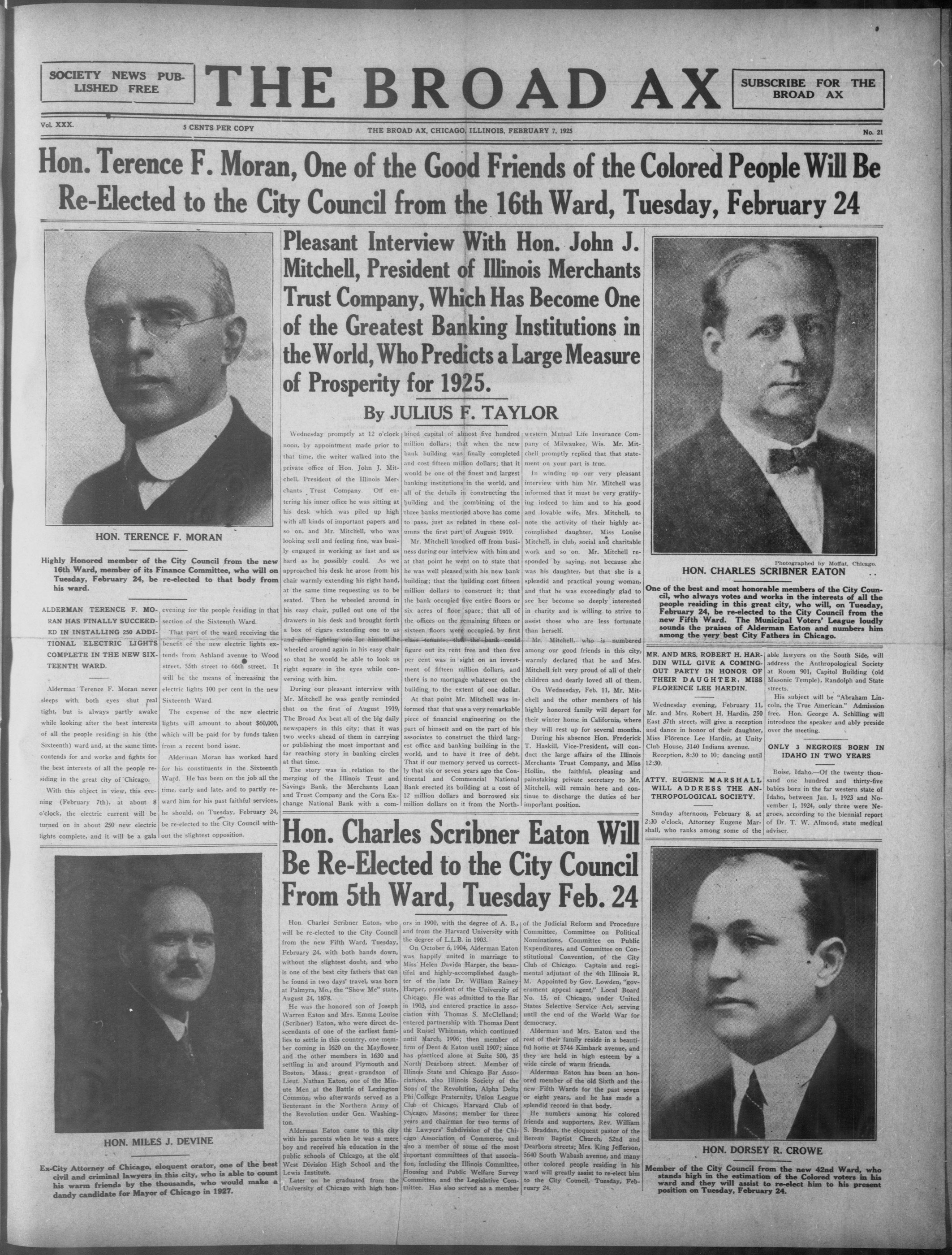
Hon. Terence F. Moran, One of the Good Friends of the Colored People Will Be Re-Elected to the City Council from the 16th Ward, Tuesday, February 24
SOCIETY NEWS PUBLISHED FREE
Vol. XXX.
Hon. Terence
Re-Elected
Terence F. Elected to t
[Name]
Highly Honored member of the City Council 16th Ward, member of its Finance Committee Tuesday, February 24, be re-elected to the his ward.
ed member of the City Council
, member of its Finance Committee
February 24, be re-elected to th
Highly Honored member of the City Council from the new 16th Ward, member of its Finance Committee, who will on Tuesday, February 24, be re-elected to that body from his ward.
ALDERMAN TERENCE F. MORAN HAS FINALLY SUCCEED IN INSTALLING 250 ADDITIONAL ELECTRIC LIGHTS COMPLETE IN THE NEW SIXTEENTH WARD.
evening for the people residing in that section of the Sixteenth Ward.
That part of the ward receiving the benefit of the new electric lights extends from Ashland avenue to Wood street. 55th street to 66th street. It
Alderman Terence F. Moran never sleeps with both eyes shut real tight, but is always partly awake while looking after the best interests of all the people residing in his (the Sixteenth) ward and, at the same time, contends for and works and fights for the best interests of all the people residing in the great city of Chicago. With this object in view, this evening (February 7th), at about 8 o'clock, the electric current will be turned on in about 250 new electric lights complete, and it will be a gala
D
M.
```markdown
```
Ex-City Attorney of Chicago, eloquent orator civil and criminal lawyers in this city, who his warm friends by the thousands, who dandy candidate for Mayor of Chicago in
hey of Chicago, eloquent orator, of criminal lawyers in this city, who is friends by the thousands, who v candidate for Mayor of Chicago in 19
Ex-City Attorney of Chicago, eloquent orator, one of the best civil and criminal lawyers in this city, who is able to count his warm friends by the thousands, who would make a dandy candidate for Mayor of Chicago in 1927.
Vol. XXX.
5 CENTS PER COPY
ce F. Moran
ed to the Ci
evening for the people residing in that section of the Sixteenth Ward.
That part of the ward receiving the benefit of the new electric lights extends from Ashland avenue to Wood street, 55th street to 66th street. It will be the means of increasing the electric lights 100 per cent in the new Sixteenth Ward.
The expense of the new electric lights will amount to about $60,000, which will be paid for by funds taken from a recent bond issue.
Alderman Moran has worked hard for his constituents in the Sixteenth Ward. He has been on the job all the time, early and late, and to partly reward him for his past faithful services, he should, on Tuesday, February 24 be re-elected to the City Council without the slightest opposition.
```markdown
```
olquent orator, one of the best in this city, who is able to count thousands, who would make a of Chicago in 1927.
THE BROAD AX
THE BROAD AX, CHICAGO, ILLINOIS, FEBRUARY 7, 1925
Pleasant Interview With Hon. John J. Mitchell, President of Illinois Merchants Trust Company, Which Has Become One of the Greatest Banking Institutions in the World, Who Predicts a Large Measure of Prosperity for 1925.
By JULIUS F. TAYLOR
Hon. Charles Scribner Eaton Will Be Re-Elected to the City Council From 5th Ward, Tuesday Feb.24
Wednesday promptly at 12 o'clock noon, by appointment made prior to that time, the writer walked into the private office of Hon. John J. Mitchell, President of the Illinois Merchants Trust Company. On entering his inner office he was sitting at his desk which was piled up high with all kinds of important papers and so on, and Mr. Mitchell, who was looking well and feeling fine, was busily engaged in working as fast and as hard as he possibly could. As we approached his desk he arose from his chair warmly extending his right hand, at the same time requesting us to be seated. Then he wheeled around in his easy chair, pulled out one of the drawers in his desk and brought forth a box of cigars extending one to us and after lighting one for himself he wheeled around again in his easy chair so that he would be able to look us right square in the eyes while conversing with him.
During our pleasant interview with Mr. Mitchell he was gently reminded that on the first of August 1919, The Broad Ax beat all of the big daily newspapers in this city; that it was two weeks ahead of them in carrying or publishing the most important and far reaching story in banking circles at that time.
The story was in relation to the merging of the Illinois Trust and Savings Bank, the Merchants Loan and Trust Company and the Corn Exchange National Bank with a com-
Hon. Charl
Be Re-Elec
From 5th W
Hon. Charles Scribner Eaton, who will be re-elected to the City Council from the new Fifth Ward, Tuesday, February 24, with both hands down, without the slightest doubt, and who is one of the best city fathers that can be found in two days' travel, was born at Palmyra, Mo., the "Show Me" state, August 24, 1878.
He was the honored son of Joseph Warren Eaton and Mrs. Emma Louise (Scribner) Eaton, who were direct descendants of one of the earliest families to settle in this country, one member coming in 1620 on the Mayflower and the other members in 1630 and settling in and around Plymouth and Boston, Mass.; great-grandson of Lieut. Nathan Eaton, one of the Minute Men at the Battle of Lexington Common, who afterwards served as a lieutenant in the Northern Army of the Revolution under Gen. Washington.
Alderman Eaton came to this city with his parents when he was a mere boy and received his education in the public schools of Chicago, at the old West Division High School and the Lewis Institute.
Later on he graduated from the University of Chicago with high hon-
bined capital of almost five hundred million dollars; that when the new bank building was finally completed and cost fifteen million dollars; that it would be one of the finest and largest banking institutions in the world, and all of the details in constructing the building and the combining of the three banks mentioned above has come to pass, just as related in these columns the first part of August 1919.
Mr. Mitchell knocked off from business during our interview with him and at that point he went on to state that he was well pleased with his new bank building; that the building cost fifteen million dollars to construct it; that the bank occupied five entire floors or six acres of floor space; that all of the offices on the remaining fifteen or sixteen floors were occupied by first class tenants; that the bank could figure out its rent free and then five per cent was in sight on an investment of fifteen million dollars, and there is no mortgage whatever on the building to the extent of one dollar.
At that point Mr. Mitchell was informed that that was a very remarkable piece of financial engineering on the part of himself and on the part of his associates to construct the third largest office and banking building in the world, and to have it free of debt. That if our memory served us correctly that six or seven years ago the Continental and Commercial National Bank erected its building at a cost of 12 million dollars and borrowed six million dollars on it from the North-
ors in 1900, with the degree of A. B. and from the Harvard University with the degree of L.L.B. in 1903.
On October 6, 1904, Alderman Eaton was happily united in marriage to Miss' Helen Davida Harper, the beautiful and highly-accomplished daughter of the late Dr. William Rainey Harper, president of the University of Chicago. He was admitted to the Bar in 1903, and entered practice in association with Thomas S. McChelland; entered partnership with Thomas Dent and Russel Whitman, which continued until March, 1906; then member of firm of Dent & Eaton until 1907; since has practiced alone at Suite 500, 35 North Dearborn street. Member of Illinois State and Chicago Bar Associations, also Illinois Society of the Sons of the Revolution, Alpha Delta Phi College Fraternity, Union League Club of Chicago, Harvard Club of Chicago, Masons; member for three years and chairman for two terms of the Lawyers' Subdivision of the Chicago Association of Commerce, and also a member of some of the most important committees of that association, including the Illinois Committee, Housing and Public Welfare Survey Committee, and the Legislative Committee. Has also served as a member
western Mutual Life Insurance Company of Milwaukee, Wis. Mr. Mitchell promptly replied that that statement on your part is true.
In winding up our very pleasant interview with him Mr. Mitchell was informed that it must be very gratifying indeed to him and to his good and lovable wife, Mrs. Mitchell, to note the activity of their highly accomplished daughter, Miss Louise Mitchell, in club, social and charitable work and so on. Mr. Mitchell responded by saying, not because she was his daughter, but that she is a splendid and practical young woman, and that he was exceedingly glad to see her become so deeply interested in charity and is willing to strive to assist those who are less fortunate than herself.
Mr. Mitchell, who is numbered among our good friends in this city, warmly declared that he and Mrs. Mitchell felt very proud of all of their children and dearly loved all of them. On Wednesday, Feb. 11, Mr. Mitchell and the other members of his highly honored family will depart for their winter home in California, where they will rest up for several months. During his absence Hon. Frederick T. Haskill, Vice-President, will conduct the large affairs of the Illinois Merchants Trust Company, and Miss Hollin, the faithful, pleasing and painstaking private secretary to Mr. Mitchell, will remain here and continue to discharge the duties of her important position.
Eaton Will City Council lay Feb. 24 of the Judicial Reform and Procedure Committee, Committee on Political Nominations, Committee on Public Expenditures, and Committee on Constitutional Convention, of the City Club of Chicago. Captain and regimental adjutant of the 4th Illinois R. M. Appointed by Gov. Lowden, "government appeal agent," Local Board No. 15, of Chicago, under United States Selective Service Act, serving until the end of the World War for democracy. Alderman and Mrs. Eaton and the rest of their family reside in a beautiful home at 5744 Kimbark avenue, and they are held in high esteem by a wide circle of warm friends.
Alderman Eaton has been an honored member of the old Sixth and the new Fifth Wards for the past seven or eight years, and he has made a splendid record in that body.
He numbers among his colored friends and supporters, Rev. William S. Braddan, the eloquent pastor of the Berean Baptist Church, 52nd and Dearborn streets; Mrs. King Jefferson, 5640 South Wabash avenue, and many other colored people residing in his ward will greatly assist to re-elect him to the City Council, Tuesday, February 24.
SUBSCRIBE FOR THE BROAD AX
ed People W
y, February
N. CHARLES SCRIBNER EA
t and most honorable members of
ways votes and works in the int
iding in this great city, who w
24, be re-elected to the City C
Ward. The Municipal Voters'
praises of Alderman Eaton and
very best City Fathers in Chica
People Will Be
February 24
Photographed by Moffat, Chicago.
LES SCRIBNER EATON
It honorable members of the City Coun-
s and works in the interests of all the
this great city, who will, on Tuesday,
selected to the City Council from the
The Municipal Voters' League loudly
of Alderman Eaton and numbers him
City Fathers in Chicago.
M. H.
HON. CHARLES SCRIBNER EATON
One of the best and most honorable members of the City Council, who always votes and works in the interests of all the people residing in this great city, who will, on Tuesday, February 24, be re-elected to the City Council from the new Fifth Ward. The Municipal Voters' League loudly sounds the praises of Alderman Eaton and numbers him among the very best City Fathers in Chicago.
MR. AND MRS. ROBERT H. HARDIN WILL GIVE A COMING-OUT PARTY IN HONOR OF THEIR DAUGHTER, MISS FLORENCE LEE HARDIN.
Wednesday evening, February 11, Mr. and Mrs. Robert H. Hardin, 250 East 37th street, will give a reception and dance in honor of their daughter, Miss Florence Lee Hardin, at Unity Club House, 3140 Indiana avenue.
Reception, 8:30 to 10; dancing until 12:30.
ATTY. EUGENE MARSHALL WILL ADDRESS THE ANTHROPOLOGICAL SOCIETY.
able lawyers on the South Side, will address the Anthropological Society at Room 901, Capitol Building (old Masonic Temple), Randolph and State streets.
His subject will be "Abraham Lincoln, the True American." Admission free. Hon. George A. Schilling will introduce the speaker and ably preside over the meeting.
ONLY 3 NEGROES BORN IN IDAHO IN TWO YEARS
Boise, Idaho.—Of the twenty thousand one hundred and thirty-five babies born in the far western state of Idaho, between Jan. 1, 1923 and No-
Sunday afternoon, February 8, at 2:30 o'clock, Attorney Eugene Marshall, who ranks among some of the
[Name]
[Image of a man in a suit with a tie].
1930
M.
Member of the City Council from the new 42 stands high in the estimation of the Colo ward and they will assist to re-elect him position on Tuesday, February 24.
the City Council from the new 42 in the estimation of the Colour they will assist to re-elect him Tuesday, February 24.
council from the new 42nd Ward, who estimation of the Colored voters in his assist to re-elect him to his present February 24.
Member of the City Council from the new 42nd Ward, who stands high in the estimation of the Colored voters in his ward and they will assist to re-elect him to his present position on Tuesday, February 24.
able lawyers on the South Side, will address the Anthropological Society at Room 901, Capitol Building (old Masonic Temple), Randolph and State streets.
His subject will be "Abraham Lincoln, the True American." Admission free. Hon. George A. Schilling will introduce the speaker and ably preside over the meeting.
ONLY 3 NEGROES BORN IN
IDAHO IN TWO YEARS
Boise, Idaho—Of the twenty thousand one hundred and thirty-five babies born in the far western state of Idaho, between Jan. 1, 1923 and November 1, 1924, only three were Negroes, according to the biennial report of Dr. T. W. Almond, state medical adviser.
THE BROAD AX
Published Every Saturday
In this city since July 15th, 1899,
without missing one single issue. Republicans, Democrats, Catholics, Protestants, Single Taxes, Priests, infidels or anyone else can have their say as long as their language is proper and responsibility is fixed.
The Broad Ax is a newspaper whose platform is broad enough for all, even claiming the editorial right to speak its own mind. It is neither Democratic nor Republican. It is strictly or absolutely independent in politics.
Local communications will receive attention. Write uply on one side of the paper.
Subscriptions must be paid in advance.
One Year ..... $2.00
Six Months ..... $1.00
Advertising rates made known on application.
Address all communications to
Vol. XXX No. 21
Chicago, February 7, 1924
Entered as Second-Class Matter, Aug.
19, 1902, at the Post office at Chicago.
III. Under Act of March 8, 1879.
COMMENCEMENT TIME
By Charles Stewart, Jr
Last week a group of young Americans, after less than half a score of years, left behind them the work of the elementary grades of the public schools throughout this county. This week they have taken up their task of entering into a four-year struggle in the various courses prepared by the departments of the Board of Education that their qualifications will fit them to measure equal distance while they mark time within the fields of opportunity covering these four years. Each course means more than can be described at this time.
The passing from year to year leads for each of you a new pathway which rests entirely upon yourself as to what constructive opportunities you shall build. The most careful consideration must be given to every subject chosen from the fact that if your capacity is not sufficiently developed to drink in the fundamental principles laid down in the subjects taken, the value of the time spent in the elementary departments would show misguided judgment and improper development to figure out a constructive pathway to concretely build the foundation that would better fit you for the advanced markets of life; thus, the sooner you discover as to whether the chosen subjects fit the full adaptation of your ability, the better it will be to relieve the mind of the burden that it is not able to carry.
"High School Education" is the cry throughout the nation; educational opportunities offered to you in this intellectual vineyard are equaled nowhere in America. The phrase "Better Education" should be a lamp to illuminate your pathway toward the goal of success. There cannot be too much stress laid upon the fact that tomorrow is your chance to studiously drink in every word that will lead to a broader sphere in the market of higher intelligence. The responsibility means nothing upon your entry but there stands a distant question mark which asks the question, "Has he or she been reliable?" If this responsibility pictures a new gateway, at the closing of each school year, you can write with a fullness of conscience "I have been reliable."
In the final summing up of the four years the question mark will remove itself and your reliability will have been of such character that each of your instructors can feel proud when the closing days of your labor has ended that their teachings have not been in vain.
The receiving of a diploma is but the beginning of the duties of the life that is to follow it. You have studies in the various branches that would best prepare you for the struggle in the competitive markets of men and women in the same branch of work, and this is your future hope. The diploma is only emblematic of the fact that you have finished the course prescribed in the institution from which you came.
Now you enter the field side by side with the man of practical experience against your theoretical knowledge. Here you will demonstrate as to your actual qualifications; all of your future in life depends completely upon one particular study. Life becomes a new arithmetic; your algebra, your latin, your Spanish and your German will all revert upon the tables of addition and subtraction: to find out whether your benefactors have been justified in the measurement of the time you so willingly gave to fit yourself for the com-
petition that will meet you in every sphere. Thus, it becomes necessary that the lessons of the past shall be each day kept on the daily scales of the times to find the fruits of your labor.
Draw your own model! Do not attempt to follow that of others; get out of yourself the best that's in you. Take out of yourself every, hindrance that you can observe and secure the best consultation of others, and this will give you a better light from an intellectual viewpoint. There is no stopping place in the field of learning. We can point with pride to the examples of Hucksley, who mastered Greek in less than six months, after he had passed the age of 60, and it was only yesterday that we read in the daily press of men and women graduating at the age of 60 and 70, which is sufficient incentive that a thought faithfully cherished will force its own way out.
Many who have long since laid down your certificates of graduation and have let the cells of your brain become clogged by not diging out the intellectual visions that were your nightly dreams during the time you were students—there is no reason for a pause—night schools have been provided, half-time colleges have been provided, technical and mechanical institutions likewise—paid for out of the taxes of all the people. You must pick up the torch and re-light it, and never permit it to grow dim until you have finished your cherished accomplishments, otherwise your time has been lost and it might have been better served.
As you give service to others, remember, that saving service to and for yourself must be developed in order that you become a citizen of substantial character in the community in which you live.
With our eyes ever fixed on an ideal, we must work with heart, hand and brain; with a faith that is clear-visioned; with a resolution that never yields; with a patience that is akin to genius, we must persevere unto the end; for, as we advance in life our ideals as steadily move upward.
FRIDAY, THE 13TH
Friday, the 13th, is considered by many as a very unlucky day, but Friday, February, the 13th, will mark an evening of great social achievement for the records of the Woodlawn High School Strollers' Club.
With one of Chicago's most popular orchestras rendering popular airs of the day the many guests will be witnesses to one of the season's greatest social events.
This organization is composed of high school young men, who conduct themselves with great pride and look forward to great achievements because of the social integrities that have been instilled into their organization by their sponsor, Mr. Charles W. Slaughter.
The club has enrolled about fifteen young men in the persons of: Henry Jones, president; Vernon Hutchinson, Charles Graham, Valdly Hutchinson; Alfred Gibson, Ernest Jackson, Cornelius White, Lewis Lindsey, Wilbert Rivers, William Tyler, Clifford Flannagan, Clark Trevan, and George Ballard.
AVERS RELIGION, RACE AND RADICALISM ARE CHAL- LENGES OF 1925
(Preston News Service)
Newark, N. J., Feb. 6.—"The Ku Klux Klan, in its practical effort, is an attempt to unite in one crusade Protestant religion and nationalism or the non-racial religion of Christianity and the ultra racial Nordicism," declared Dr. Glen Frank, editor of Century Magazine, speaking Thursday afternoon at a program of Women's Club of Orange.
"Christ would be the last person to connect with a movement impelled by race prejudice and dedicated to race persecution," the speaker continued. "I can understand religious fanaticism and can understand racial fanaticism and can think of them together in one crusade provided the religion were primitive and the God feudal, but I cannot understand Christianity and Nordicism together."
Dr. Frank brought up the klan in its dealing with the race problem in America, which he says is a vital question that all the theologians in Christendom can not theorize out of existence. His lecture was on the three challenges of 1925 and he characterized religion, race and radicalism as the three R's of the present day and the issues which thrown down to us the challenges for 1925. He asked for a pragmatic attitude toward religion, a Christian attitude toward race and a scientific attitude toward radicalism. "The question arises: Hoe Chris
THE BROAD AX, CHICAGO, ILLINOIS, FEBRUARY 7, 1925
12
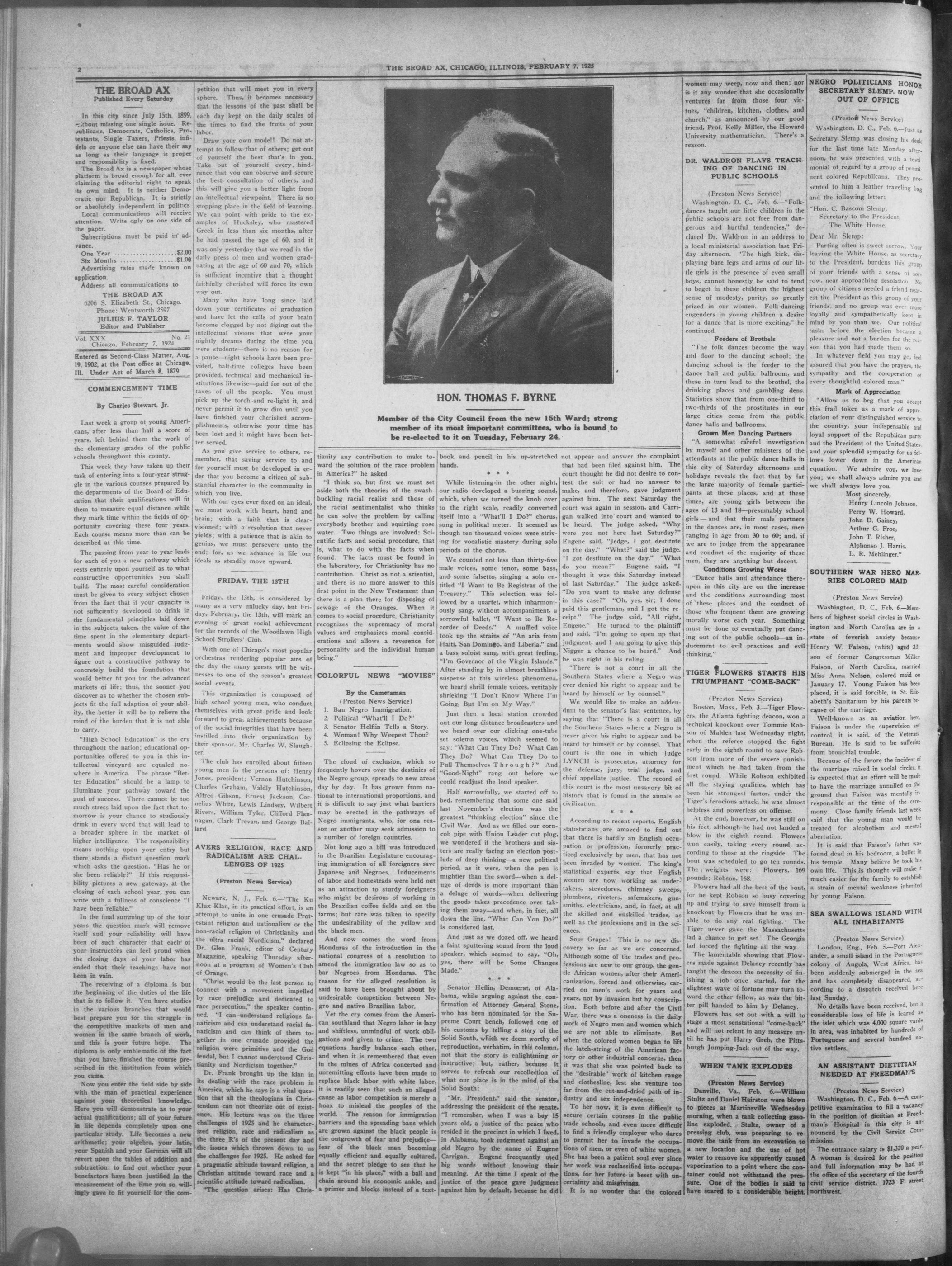
Member of the City Council from the new 15th Ward; strong member of its most important committees, who is bound to be re-elected to it on Tuesday, February 24.
tiannity any contribution to make toward the solution of the race problem in America?" he asked.
"I think so, but first we must set aside both the theories of the swash-buckling racial realist and those of the racial sentimentalist who thinks he can solve the problem by calling everybody brother and squirting rose water. Two things are involved: Scientific facts and social procedure, that is, what to do with the facts when found. The facts must be found in the laboratory, for Christianity has no contribution. Christ as not a scientist, and there is no more answer to this first point in the New Testament than there is a plan there for disposing of sewage of the Oranges. When it comes to social procedure, Christianity recognizes the supremacy of moral values and emphasizes moral considerations and allows a reverence for personality and the individual human being."
COLORFUL NEWS "MOVIES"
By the Cametaman
(Preston News Service)
1. Ban Negro Immigration.
2. Political "What'll I Do?"
3. Senator Helflin Tells a Story.
4. Woman! Why Weepest Thou?
5. Eclipsing the Eclipse.
The cloud of exclusion, which so frequently hovers over the destinies of the Negro group, spreads to new areas day by day. It has grown from national to international proportions, and it is difficult to say just what barriers may be erected in the pathways of Negro immigrants, who, for one reason or another may seek admission to a number of foreign countries.
Not long ago a bill was introduced in the Brazilian Legislature encouraging immigration of all foreigners save Japanese and Negroes. Inducements of labor and homesteads were held out as an attraction to sturdy foreigners who might be desirous of working in the Brazilian coffee fields and on the farms; but care was taken to specify the undesirability of the yellow and the black men.
And now comes the word from Honduras of the introduction in the national congress of a resolution to amend the immigration law so as to bar Negroes from Honduras. The reason for the alleged resolution is said to have been brought about by undesirable competition between Negro and native Brazilian labor.
Yet the cry comes from the American southland that Negro labor is lazy and shiftless, unmindful of work obligations and given to crime. The two equations hardly balance each other, and when it is remembered that even in the mines of Africa concerted and unremitting efforts have been made to replace black labor with white labor, it is readily seen that such an alleged cause as labor competition is merely a hoax to mislead the peoples of the world. The reason for immigration barriers and the spreading bans which are grown against the black people is the outgrowth of fear and prejudice, fear of the black man becoming equally efficient and equally cultured, and the secret pledge to see that he is kept "in his place," with a ball and chain around his economic ankle, and a primer and blocks instead of a text-
HON. THOMAS F. BYRNE
book and pencil in his up-stretched hands.
* * *
While listening-in the other night, our radio developed a buzzing sound, which, when we turned the knob over to the right scale, readily converted itself into a "What'll I Do?" chorus sung in political meter. It seemed as though ten thousand voices were striving for vocalistic mastery during solo periods of the chorus.
We counted not less than thirty-five male voices, some tenor, some bass, and some falsetto, singing a solo entitled "I Want to Be Registrar of the Treasury." This selection was followed by a quartet, which inharmoniously sang, without accompaniment, a sorrowful ballet, "I Want to Be Recorder of Deeds." A muffled voice took up the strains of "An aria from Haiti, San Domingo, and Liberia," and a bass soloist sang, with great feeling "I'm Governor of the Virgin Islands." After standing by in almost breathless suspense at this wireless phenomena we heard shrill female voices, veritably shrieking "I Don't Know Where I'm Going, But I'm on My Way."
Just then a local station crowded out our long distance broadcasters and we heard over our clicking one-tube set solemn voices, which seemed to say: "What Can They Do? What Can They Do? What Can They Do to Pull Themselves Through?" And "Good-Night" rang out before we could justadjust the loud speaker.
Half sorrowfully, we started off to bed, remembering that some one said last November's election was the greatest "thinking election" since the Civil War. And as we filled our corncob pipe with Union Leader cut plug, we wondered if the brothers and sisters are really facing an election postlude of deep thinking—a new political period, as it were, when the pen is mightier than the sword—when a deluge of deeds is more important than a deluge of words—when delivering the goods takes precedence over taking them away—and when, in fact, all down the line, "What Can You Do?" is considered last.
And just as we dozed off, we heard a faint sputtering sound from the loud speaker, which seemed to say, "Oh yes, there will be Some Changes Made."
* * *
Senator Heflin, Democrat, of Alabama, while arguing against the confirmation of Attorney General Stone, who has been nominated for the Supreme Court bench, followed one of his customs by telling a story of the Solid South, which we deem worthy of reproduction, verbatim, in this column, not that the story is enlightening or instructive; but, rather, because it serves to refresh our recollection of what our place is in the mind of the Solid South:
"Mr. President," said the senator, addressing the president of the senate, "I remember, when I was a boy 15 years old, a justice of the peace who resided in the precinct in which I lived, in Alabama, took judgment against an old Negro by the name of Eugene Carrigan. Eugene frequently used big words without knowing their meaning. At the time I speak of the justice of the peace gave judgment against him by default, because he did
not appear and answer the complaint that had been filed against him. The court thought he did not desire to contest the suit or had no answer to make, and therefore, gave judgment against him. The next Saturday the court was again in session, and Carrigan walked into court and wanted to be heard. The judge asked, "Why were you not here last Saturday?" Eugene said, "Jedge, I got destitute on the day." "What?" said the judge. "I got destitute on the day." "What do you mean?" Eugene said, "I thought it was this Saturday instead of last Saturday." The judge asked, "Do you want to make any defense in this case?" "Oh, yes, sir; I done paid this gentleman, and I got the receipt." The judge said, "All right, Eugene." He turned to the plaintiff and said, "I'm going to open up that judgment, and I am going to give this Nigger a chance to be heard." And he was right in his ruling.
"There is not a court in all the Southern States where a Negro was ever denied his right to appear and be heard by himself or by counsel."
We would like to make an addendum to the senator's last sentence, by saying that "There is a court in all the Southern States where a Negro is never given his right to appear and be heard by himself or by counsel. That court is the one in which Judge LYNCH is prosecutor, attorney for the defense, jury, trial judge, and chief appellate justice. The record of this court is the most unsavory bit of history that is found in the annals of civilization.
According to recent reports, English statisticians are amazed to find out that there is hardly an English occupation or profession, formerly practiced exclusively by men, that has not been invaded by women. The king's statistical experts say that English women are now working as undertakers, stevedores, chimney sweeps, plumbers, riveters, safemakers, gunsmiths, electricians, and, in fact, at all the skilled and unskilled trades, as well as the professions and in the sciences.
Sour Grapes! This is no new discovery so far as we are concerned. Although some of the trades and professions are new to our group, the gentle African women, after their Americanization, forced and otherwise, carried on men's work for years and years, not by invasion but by conscription. Both before and after the Civil War, there was a oneness in the daily work of Negro men and women which we are not able to eliminate. But when the colored women began to lift the latch-string of the American factory or other industrial concerns, then it was that she was pointed back to the "desirable" work of kitchen range and clothesline, lest she venture too far from the cut-and-dried path of industry and sex independence.
To her now, it is even difficult to secure certain courses in the public trade schools, and even more difficult to find a friendly employer who dares to permit her to invade the occupations of men, or even of white women. She has been a patient soul ever since her work was reclassified into occupations, for her future is beset with uncertainty and misgivings.
It is no wonder that the colored
women may weep, now and then; nor is it any wonder that she occasionally ventures far from those four virtues, "children, kitchen, clothes, and church," as announced by our good friend, Prof. Kelly Miller, the Howard University mathematician. There's a reason.
R. WALDRON FLAYS TEACHING OF DANCING IN PUBLIC SCHOOLS
(Preston News Service)
Washington, D. C., Feb. 6.—"Folk-dances taught our little children in the public schools are not free from dangerous and hurtful tendencies," declared Dr. Waldron in an address to a local ministerial association last Friday afternoon. "The high kick, displaying bare legs and arms of our little girls in the presence of even small boys, cannot honestly be said to tend to beget in these children the highest sense of modesty, purity, so greatly prized in our women. Folk-dancing engenders in young children a desire for a dance that is more exciting." he continued.
Feeders of Brothels
"The folk dances become the way and door to the dancing school; the dancing school is the feeder to the dance hall and public ballroom, and these in turn lead to the brothel, the drinking places and gambling dens. Statistics show that from one-third to two-thirds of the prostitutes in our large cities come from the public dance halls and ballrooms.
Grown Men Dancing Partners "A somewhat careful investigation by myself and other ministers of the attendants at the public dance halls in this city of Saturday afternoons and holidays reveals the fact that by far the large majority of female participants at these places, and at these times, are young girls between the ages of 13 and 18—presumably school girls—and that their male partners in the dances are, in most cases, men ranging in age from 30 to 60; and, if we are to judge from the appearance and conduct of the majority of these men, they are anything but decent.
Conditions Growing Worse "Dance halls and attendance thereupon in this city are on the increase and the conditions surrounding most of these places and the conduct of those who frequent them are growing morally worse each year. Something must be done to eventually put dancing out of the public schools—an inducement to evil practices and evil thinking."
TIGER FLOWERS STARTS HIS TRIUMPHANT "COME-BACK"
(Breston News Service)
Boston, Mass., Feb. 3. -Tiger Flowers, the Atlanta fighting deacon, won a technical knockout over Tommie Robson of Malden last Wednesday night, when the referee stopped the fight early in the eighth round to save Robson from more of the severe punishment which he had taken from the first round. While Robson exhibited all the staying qualities, which has been his strongest factor, under the Tiger's ferocious attack, he was almost helpless and powerless on offense.
At the end, however, he was still on his feet, although he had not landed a blow in the eighth round. Flowers won easily, taking every round, according to those at the ringside. The bout was scheduled to go ten rounds. The weights were: Flowers, 169 pounds; Robson, 168. Flowers had all the best of the bout, for he kept Robson so busy covering up and trying to save himself from a knockout by Flowers that he was unable to do any real fighting.* The Tiger never gave the Massachusetts lad a chance to get set. The Georgia lad forced the fighting all the way.
The lamentable showing that Flowers made against Delaney recently has taught the deacon the necessity of finishing a job once started, for the slightest wave of fortune may turn toward the other fellow, as was the bitter pill handed to him by Delaney. Flowers has set out with a will to stage a most sentimental "come-back" and will not relent in any measure until he has put Harry Greb, the Pittsburgh Jumping-Jack out of the way.
WHEN TANK EXPLODES
(Danville, Va., Feb. 6—William Stultz and Daniel Hairston were blown to pieces at Martinsville Wednesday morning, when a tank collecting gasoline exploded. Stultz, owner of a pressing club, was preparing to remove the tank from an excavation to a new location and the use of hot water to remove ice apparently caused vaporization to a point where the container could not withstand the pressure. One of the bodies is said to have soared to a considerable height.
NEGRO POLITICIANS HONOR
SECRETARY SLEMP. NOW
OUT OF OFFICE
Washington, D. C., Feb. 6—Just as Secretary Slemp was closing his desk for the last time late Monday afternoon, he was presented with a testimonial of regard by a group of prominent colored Republicans. They presented to him a leather traveling bag and the following letter: "Hon. C. Bascom Slemp.
Dear Mr. Slump:
Parting often is sweet sorrow. Your leaving the White House, as secretary to the President, burdens this group of your friends with a sense of sorrow, near approaching desolation. No group of citizens needed a friend nearest the President as this group of your friends, and no group was ever more loyally and sympathetically kept in mind by you than we. Our political tasks before the election became a pleasure and not a burden for the reason that you had made them so.
In whatever field you may go, feel assured that you have the prayers, the sympathy and the co-operation of every thoughtful colored man."
Mark of Appreciation
"Allow us to beg that you accept this frail token as a mark of appreciation of your distinguished service to the country, your indispensable and loyal support of the Republican party, and the President of the United States and your splendid sympathy for us follows lower down in the American equation. We admire you, we love you; we shall always admire you and we shall always love you.
Most sincerely,
Henry Lincoln Johnson.
Perry W. Howard,
John D. Gainey,
Arthur G. Froe,
John T. Risher,
Alphonso J. Harris,
L. R. Mehlinger."
SOUTHERN WAR HERO MAR-
RIES COLORED MAID
Washington, D. C., Feb. 6.—Members of highest social circles in Washington and North Carolina are in a state of feverish anxiety because Henry W. Faison, (white) aged 33, son of former Congressman Miller Faison, of North Carolina, married Miss Anna Nelson, colored maid on January 17. Young Faison has been placed, it is said forcible, in St. Elizabeth's Sanitarium by his parents because of the marriage.
Well-known as an aviation hero Faison is under the supervision and control, it is said, of the Veterans Bureau. He is said to be suffering from brouchial trouble.
Because of the furore the incident of the marriage raised in social circles, it is expected that an effort will be made to have the marriage annulled on the ground that Faison was mentally irresponsible at the time of the ceremony. Close family friends last week said that the young man would be treated for alcoholism and mental aberration.
It is said that Faison's father was found dead in his bedroom, a bullet in his temple. Many believe he took his own life. This is thought will make it much easier for the family to establish a strain of mental weakness inherited by young Faison.
SEA SWALLOWS ISLAND WITH
ALL INHABITANTS
(Preston News Service)
London, Eng., Feb. 5- Port Alexander, a small island in the Portuguese colony of Angola, West Africa, has been suddenly submerged in the sea and has completely disappeared, according to a dispatch received here last Sunday.
No details have been received, but a considerable loss of life is feared as the islet which was 4,000 square yards in area, was inhabited by hundreds of Portuguese and several hundred native settlers.
AN ASSISTANT DIETITIAN
NEEDED AT FREEDOM MANY
(Preston News Service)
(Preston News Service)
Washington, D. C., Feb. 6.—A competitive examination to fill a vacancy in the position of dietitian at Freedman's Hospital in this city is announced by the Civil Service Commission.
The entrance salary is $1,320 a year. A woman is desired for the position and full information may be had at the office of the secretary of the fourth civil service district, 1723 F street northwest.
COL. CHARLES E. STUMP, THE REGULAR TRAVELING CORRESPONDENT FOR THE BROAD AX, IS STILL TRAMPING AROUND IN ALABAMA AND TEXAS.
Montgomery, Ala.—When you observe where I was and where I am you will be inclined to say that is one more riding man, but then there will be something in the statement, for I have been going some and I am booked to go some more, and you just wait and murmur not.
When I wrote that other letter I had left Memphis, and then made my way to Indianapolis, Ind., and from there to Louisville, Ky., and there I had one more "Old Aunt Dolly Time" at the home of Mr. and Mrs. William H. Steward. If you will remember, he is editor of the American Baptist, and his wife is said to be one of the finest musicians in Kentucky. She has been teaching music at Simmons University, has been organist of Fifth Street Baptist Church over forty years, and she just continues in the good work. I am not prepared to tell you just how long she has been president of the Women's Baptist Educational convention of Kentucky, but she is full grown in that position, believe me honey.
In company with the Rev. Dr. Roscoe C. Henderson, pastor of Quinn Chapel, we went out to see that Simmons University, and we met Charles Stewart out there, and heard him make a speech. He used to go to school there. I was delighted to see this wonderful school at work. Dr. C. H. Parrish, the president, is a graduate from the school and a good one at that. It is a rare thing that you find a fellow who graduates from a big college and then becomes its president. These people have just finished a new building known as Boys' Dormitory. I don't know where they get such a big name for a mere building, but then I did not stop to ask the whys, for it is a big building, and they were all educated people and I was with the scholarly pastor and did not want to act a fool. I just looked wise and let one or two slip out about the building.
In talking to President Parrish about the building I said: "This domestitumitoriumli anklutimus." He looked wise without answering, but smiled as if he understood what I was saying. I was using sound, and if my life depended on bringing those sounds down to the United States, I would have to die, but I meant to say to him that they had a fine dormitory. Get your dictionary and see if I hit it in spots.
Back to the home of W. H. Steward, and for dinner went to the home of his daughter and son-in-law, Mr. and Mrs. W. H. Pickett. They had some turkey which I sent into eternity. Back to the Steward house and next morning from that place to Nashville. I made it to Nashville because I had been invited to stop over there by the Rev. Dr. A. M. Townsend, secretary of the Sunday School Publishing Board of the National Baptist convention. I was glad of this opportunity, for I wanted to see the building since they had moved in a part of it. I will have to tell you some of the things which happened.
I had been told by Dr. Townsend to send him a telespach when I was coming and he would meet me at the stable, but I did not do this, but decided to save that much money. Hence, when I got to town I stepped to the hello box speaking tube, paid five cents and got him at his home. It was a female woman's voice I heard, and I asked, "Are Old Man Townsend there?" It seemed that there was an extension and before she could answer my question, he answered himself, and said, "Colonel, remain in the stable and I will be there for you." It was not long before he walked in with a smile that would be a fair rival to the Gold Dust Twins. He shook my lily black hand and took up my trunks and told me to follow him. We went to his automobile car carriage which he had brought to tote me over.
I was surprised that instead of sending me to a boarding house he toted me to his palatial residence and told me to be at home. They gave me a great big front room, large enough for all my trunks and stomach. I soon had my little feet under the table sending breaking the fast into my food eternity. I was delighted to have met Mrs. Townsend, for she is a remarkable woman. She is one of those well educated musical women, and just think of it, the largest Baptist hymnal in use today was edited by her. It is the Baptist Standard Hymnal. It is suited for all times and all occasions. You can just read some of the hymns in this book and get happy. I want to thank God for this.
I would like to see this book in all of our churches. It was published by the Sunday School Publishing Board of the National Baptist convention. When we had been fed until we wanted no more, then a trip over to the new home of this Sunday School Publishing Board. I tell you it was all Dr. Townsend could do to keep the police from putting me up, declaring that I had rooms for rent or, in other words, I was crazy. I assured them that if I were crazy I was not a fool, for I was thinking back seventy years ago, when my people were sold in Nashville, perhaps on the public square, and now right in the heart of the business section we had erected such a building. "I will just shout all over Nashville," I declared, and they told me to keep on shouting. They thought that I should see the mayor and get a permit to shout.
Now through this building, step by step, commencing at the basement where we found them fixing the vaults for cuts and records, and it is so well constructed that the devil with all of his fire can't touch those books and records. Then they have a store room fore printing paper and supplies and all other things along that line.
Up to the first floor, and this is to be a dream, the west half is to be occupied by the People's Bank and Trust Company. This is the corner, and a fine place, and on the east hall will be the salesroom and merchandise mailing room. Now there will be a long, wide hall separating these departments, and that hall will be the Baptist Hall of Fame. It will contain a tablet and group picture of the Memorial 300, also a tablet containing the names of the pioneer ministers of the National Baptist convention. This made me shout more.
Now for the second floor is to be found the literature mailing room, and then the rest of that will be offices for rent. On the third floor will be fitted offices for the executive, administration, stenographic, clerical, bookkeeping and filing departments. On the fourth floor is the editorial departments, and they will have many editors. The library will be there, also, and I think the historian will have his office there. Step up to the fifth floor and you will find a recreation garden, cafateria, the finest of its kind in all this country. Do you blame me for shouting? Now this is only the main building and I have not touched the mechanical part of the building where are the presses, linotype and other machinery and I will not do so this week, but another time.
I just looked and looked until I was about to look my fool brains out, and then off for another part of the world.
The next day I went to the temples of knowledge, going first to the state school, where we found that wonderful educator, Prof. W. J. Hale, and then over to Walden to see Prof. Davis, and his teachers. I went back to the state school the next day and then the next morning I left. I was invited to visit Fisk University, but I could not do it, but they had me to promise that I would return some time and pay them a visit which I intend to do. I was invited to be the guest of the institution and I think I will do this.
Dr. Townsend got up early one morning, hitched up his automobile car carriage and toted me over to the I. & N. stable where I left for Birmingham. This is a wonderful age, because I was able to sit in Dr. Townsend's home and talk to Editor Oscar W. Adams, telling him that I was on my way, and, honey, he met me there. I mean at the stable, in his own automobile car carriage and toted me to his house.
Mrs. Adams, the queen of her home, was looking for me, and made me welcome. She soon had my little feet under the table, but I had half of the whole chicken which Mrs. Townsend had prepared for me. Mrs. Adams is a remarkable young women. They are happy to receive their friends, and they are constantly looking for guests. Others will follow, and I will tell you about it.
Editor Oscar W. Adams is doing a good work in this part of the world and I am proud of him. I was honored because Mrs. Fannie Cosby-Elevins, president of Tuggle Institute; Herbert H. Glover, endowment secretary of the Court of Calanthe of Alabama; the Misses Daisy Hill and Helen Sherman all called on me, paid their respects to me, and left. I talked with another educator, Mrs. Florence Coffee-Rownsnd, who is a
THE BROAD AX, CHICAGO, ILLINOIS, FEBRUARY 7, 1925
[Name]
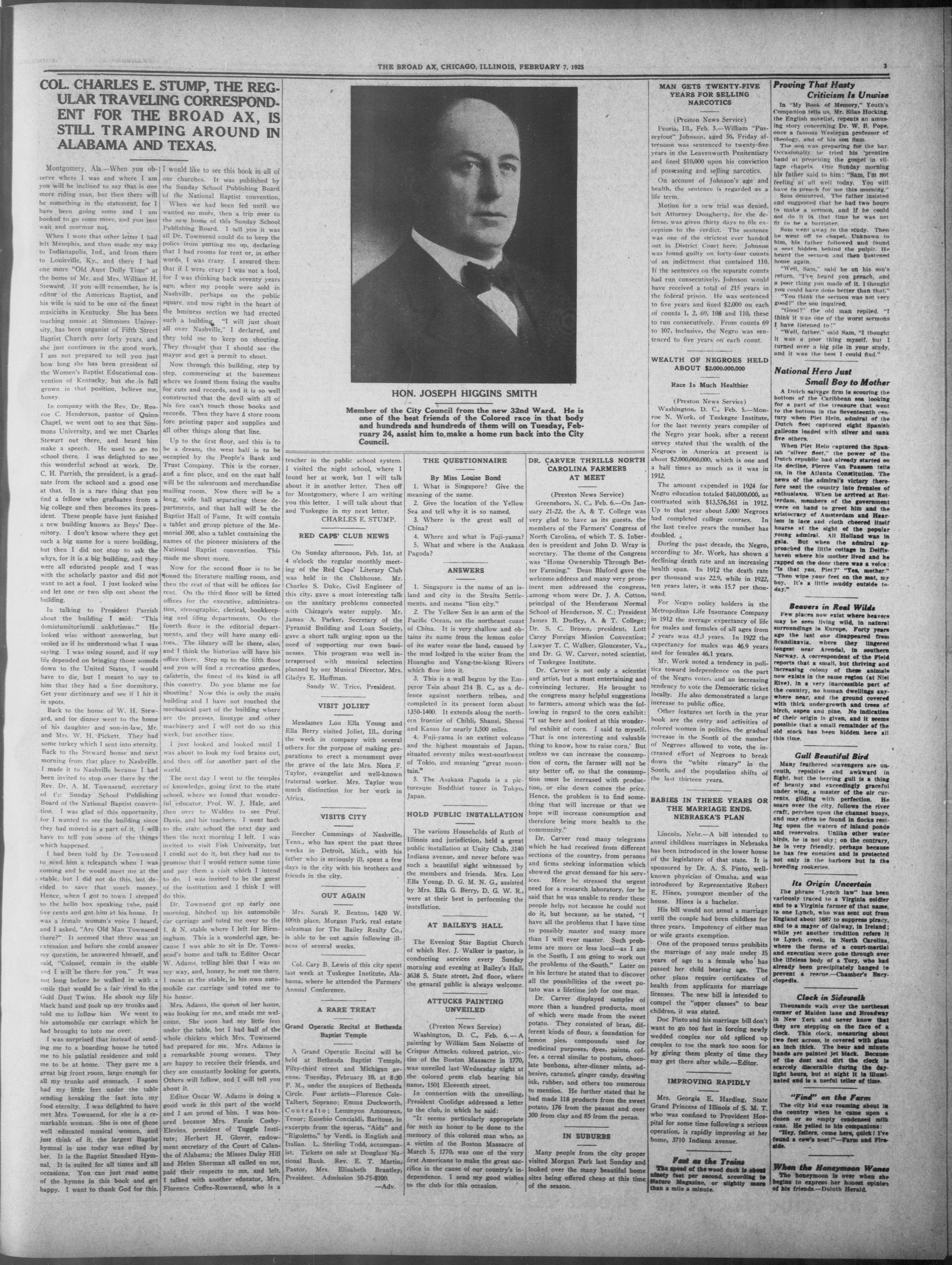
Member of the City Council from the new 32nd Ward. He is one of the best friends of the Colored race in that body and hundreds and hundreds of them will on Tuesday, February 24, assist him to make a home run back into the City Council.
teacher in the public school system. I visited the night school, where I found her at work, but I will talk about it in another letter. Then off for Montgomery, where I am writing you this letter. I will talk about that and Tuskegee in my next letter. CHARLES E. STUMP.
RED CAPS' CLUB NEWS
On Sunday afternoon, Feb. 1st, at 4 o'clock the regular monthly meeting of the Red Caps' Literary Club was held in the Clubhouse. Mr. Charles S. Duke, Civil Engineer of this city, gave a most interesting talk on the sanitary problems connected with Chicago's water supply. Mr. James A. Parker, Secretary of the Pyramid Building and Loan Society, gave a short talk urging upon us the need of supporting our own businesses. This program was well interspersed with musical selection planned by our Musical Director, Mrs. Gladys E. Hoffman. Sandy W. Trice, President.
VISIT JOLIET
Mesdames Lou Ella Young and Ella Berry visited Joliet, ILL, during the week in company with several others for the purpose of making preparations to erect a monument over the grave of the late Mrs. Nora F. Taylor, evangelist and well-known fraternal worker. Mrs. Taylor won much distinction for her work in Africa.
VISITS CITY
Beecher Cummings of Nashville, Tenn., who has spent the past three weeks in Detroit, Mich., with his father who is seriously ill, spent a few days in the city with his brothers and friends in the city.
OUT AGAIN
Mrs. Sarah R. Benton, 1420 W. 109th place, Morgan Park, real estate salesman for The Bailey Realty Co. is able to be out again following illness of several weeks.
Col. Cary B. Lewis of this city spent last week at Tuskegee Institute, Alabama, where he attended the Farmers' Annual Conference.
A RARE TREAT
Grand Operatic Recital at Bethesda Baptist Temple
A Grand Operatic Recital will be held at Bethesda Baptist Temple, Fifty-third street and Michigan avenue. Tuesday, February 10, at 8:30 P. M., under the auspices of Bethesda Circle. Four artists—Florence Cole-Talbert, Soprano; Emma Duckworth, Contralto; Lemmyon Amoureux, Tenor; Eusebio Conciadi, Baritone, in excerpts from the operas, "Aida" and "Rigoleto" by Verdi, in English and Italian. L. Sterling Todd, accompanist. Tickets on sale at Douglass National Bank. Rev. E. T. Martin, Pastor, Mrs. Elizabeth Brantley, President. Admission 50-75-$100.
—Adv.
HON. JOSEPH HIGGINS SMITH
the City Council from the new 32nd W
the best friends of the Colored race in
hundreds and hundreds of them will on T
, assist him to make a home run back
THE QUESTIONNAIRE
1. What is Singapore? Give the meaning of the name.
2. Give the location of the Yellow Sea and tell why it is so named.
3. Where is the great wall of China?
4. Where and what is Fuji-yama?
5. What and where is the Asakasa Pagoda?
ANSWERS
1. Singapore is the name of an island and city in the Straits Settlements, and means "lion city."
2. The Yellow Sea is an arm of the Pacific Ocean, on the northeast coast of China. It is very shallow and obtains its name from the lemon color of its water near the land, caused by the mud lodged in the water from the Hoangho and Yang-tse-kiang Rivers which flow into it.
3. This is a wall begun by the Emperor Tsin about 214 B. C., as a defence against northern tribes, and completed in its present form about 1350-1400. It extends along the northern frontier of Chihli, Shansi, Shensi and Kansu for nearly 1500 miles.
4. Fuji-yama is an extinct volcano and the highest mountain of Japan situated seventy miles west-southwest of Tokyo, and meaning "great mountain."
5. The Asakasa Pagoda is a picturesque Buddhist tower in Tokyo, Japan.
HOLD PUBLIC INSTALLATION
The various Households of Ruth of Illinois and jurisdiction, held a great public installation at Unity Club, 3140 Indiana avenue, and never before was such a beautiful sight witnessed by the members and friends. Mrs. Lou Ella Young, D. G. M. N. G., assisted by Mrs. Ella G. Berry, D. G. W. R., were at their best in performing the installation.
AT BAILEY'S HALL
The Evening Star Baptist Church of which Rev. J. Walker is pastor, is conducting services every Sunday morning and evening at Bailey's Hall. 3638 S. State street, 2nd floor, where the general public is always welcome.
ATTUCKS PAINTING
UNVEILED
Washington, D. C., Feb. 6.—A painting by William Sam Noisette of Crispus Attucks, colored patriot, victim of the Boston Massacre in 1770, was unveiled last Wednesday night at the colored press club bearing his name, 1501 Eleventh street.
In connection with the unveiling, President Coolidge addressed a letter to the club, in which he said:
"It seems particularly appropriate for such an honor to be done to the memory of this colored man who, as a victim of the Boston Massacre of March 5, 1770, was one of the very first Americans to make the great sacrifice in the cause of our country's independence. I send my good wishes to the club for this occasion.
---
DR. CARVER THRILLS NORTH
CAROLINA FARMERS
AT MEET
(Preston News Service)
Greensboro, N. C., Feb. 6. On January 21-22, the A. & T. College was very glad to have as its guests, the members of the Farmers' Congress of North Carolina, of which T. S. Inberdon is president and John D. Wray is secretary. The theme of the Congress was "Home Ownership Through Better Farming." Dean Bluford gave the welcome address and many very prominent men addressed the congress, among whom were Dr. J. A. Cotton, principal of the Henderson Normal School of Henderson, N. C.; President James B. Dudley, A. & T. College; Dr. S. C. Brown, president, Lott Carey Foreign Mission Convention; Lawyer T. C. Walker, Gloucester, Va., and Dr. G. W. Carver, noted scientist, of Tuskegee Institute.
Dr. Carver is not only a scientist and artist, but a most entertaining and convincing lecturer. He brought to the congress many helpful suggestions to farmers, among which was the following in regard to the corn exhibit: "I sat here and looked at this wonderful exhibit of corn. I said to myself, 'That is one interesting and valuable thing to know, how to raise corn.' But unless we can increase the consumption of corn, the farmer will not be any better off, so that the consumption must be increased with production, or else down comes the price. Hence, the problem is to find something that will increase or that we hope will increase consumption and therefore bring more health to the community."
Dr. Carver read many telegrams which he had received from different sections of the country, from persons and firms seeking information which showed the great demand for his services. Here he stressed the urgent need for a research laboratory, for he said that he was unable to render these people help, not because he could not do it, but because, as he stated, "I have all the problems that I have time to possibly master and many more than I will ever master. Such problems are more or less local—as I am in the South, I am going to work out the problems of the South." Later on in his lecture he stated that to discover all the possibilities of the sweet potato was a lifetime job for one man.
Dr. Carver displayed samples of more than a hundred products, most of which were made from the sweet potato. They consisted of bran, different kinds of flour, a foundation for lemon pies, compounds used for medicinal purposes, dyes, paints, coffee, a cereal similar to postum, chocolate bonbons, after-dinner mints, adhesive, caramel, ginger candy, drawing ink, rubber, and others too numerous to mention. He further stated that he had made 118 products from the sweet potato, 176 from the peanut and over 300 from clay and 85 from the pean.
IN SUBURBS
Many people from the city proper visited Morgan Park last Sunday and looked over the many beautiful home sites being offered cheap at this time of the season.
MAN GETS TWENTY-FIVE
YEARS FOR SELLING
NARCOTICS
Peoria, Ill., Feb. 5.—William "Pusseyfoot" Johnson, aged 56, Friday afternoon was sentenced to twenty-five years in the Leavenworth Penitentiary and fined $10,000 upon his conviction of possessing and selling narcotics.
On account of Johnson's age and health, the sentence is regarded as a life term.
Motion for a new trial was denied, but Attorney Dougherty, for the defense, was given thirty days to file exception to the verdict. The sentence was one of the strictest ever handed out in District Court here. Johnson was found guilty on forty-four counts of an indictment that contained 110. If the sentences on the separate counts had run consecutively, Johnson would have received a total of 215 years in the federal prison. He was sentenced to five years and fined $2,000 on each of counts 1, 2, 69, 108 and 110, these to run consecutively. From counts 69 to 107, inclusive, the Negro was sentenced to five years on each count.
WEALTH OF NEGROES HELD
ABOUT $2,000,000,000
Race Is Much Healthier
(Preston News Service)
Washington, D. C., Feb. 5.—Monroe N. Work, of Tuskegee Institute,
for the last twenty years compiler of the Negro year book, after a recent
survey stated that the wealth of the Negroes in America at present is
about $2,000,000,000, which is one and
a half times as much as it was in
1912.
The amount expended in 1924 for Negro education totaled $40,000,000, as
contrasted with $13,576,561 in 1912.
Up to that year about 5,000 Negroes
had completed college courses. In
the last twelve years the number has
doubled.
During the past decade, the Negro, according to Mr. Work, has shown a declining death rate and an increasing health span. In 1912 the death rate per thousand was 22.9, while in 1922, ten years later, it was 15.7 per thousand.
For Negro policy holders in the Metropolitan Life Insurance Company in 1912 the average expectancy of life for males and females of all ages from 2 years was 41.3 years. In 1922 the expectancy for males was 46.9 years and for females 46.1 years.
Mr. Work noted a tendency in politics toward independence on the part of the Negro voter, and an increasing tendency to vote the Democratic ticket locally. He also demonstrated a large increase to public office.
Other features set forth in the year book are the entry and activities of colored women in politics, the gradual increase in the South of the number of Negroes allowed to vote, the increased effort of Negroes to break down the "white primary" in the South, and the population shifts of the last thirteen years.
BABIES IN THREE YEARS OR
THE MARRIAGE ENDS.
NEBRASKA'S PLAN
Lincoln, Nebr.-A bill intended to annul childless marriages in Nebraska has been introduced in the lower house of the legislature of that state. It is sponsored by Dr. A. S. Pinto, well-known physician of Omaha, and was introduced by Representative Robert E. Hines, youngest member of the house. Hines is a bachelor. His bill would not annul a marriage until the couple had been childless for three years. Impotency of either man or wife grants exemption.
One of the proposed terms prohibits the marriage of any male under 35 years of age to a female who has passed her child bearing age. The other plans require certificates of health from applicants for marriage licenses. The new bill is intended to compel the "upper classes" to bear children, it was stated.
Doc Pinto and his marriage bill don't want to go too fast in forcing newly wedded couples nor old spliced up couples to toe the mark too soon for by giving them plenty of time they may get there after while—Editor
IMPROVING RAPIDLY
Mrs. Georgia E. Harding, State Grand Princess of Illinois of S. M. T. who was confined to Provident Hospital for some time following a serious operation, is rapidly improving at her home, 3710 Indiana avenue.
Fast as the Trains
The speed of the wood duck is about
almost feet per second, according to
Mature Magazine, or slightly more
than a mile a minute.
In "My Book of Memory," Youth's Companion tells us, Mr. Silas Hocking, the English novelist, repeats an amusing story concerning Dr. W. B. Pope, once a famous Wesleyan professor of theology, and of his son Sam.
The son was preparing for the bar. Occasionally he tried his "prentice hand at preaching the gospel in village chapels. One Sunday morning his father said to him: "Sam, I'm not feeling at all well today. You will have to preach for me this morning." Sam denounced. The father insisted and suggested that he had two hours to make a sermon, and if he could not do it in that time he was not fit to be a barrister.
Sam went away to the study. Then he went off to chapel. Unknown to him, his father followed and found a seat hidden behind the pulpit. He heard the sermon and then hastened home again.
"Well, Sam," said he on his son's return, "I've heard you preach, and a poor thing you made of it. I thought you could have done better than that." "You think the sermon was not very good" the son inquired. "Good!" the old man replied. "I think it was one of the worst sermons I have listened to." "Well, father," said Sam, "I thought it was a poor thing myself, but I turned over a big pile in your study, and it was the best I could find."
National Hero Just
Small Boy to Mother
A Dutch salvage firm is scouring the bottom of the Caribbean sea looking for a part of the treasure that went to the bottom in the Seventeenth century when Piet Hein, admiral of the Dutch fleet captured eight Spanish galleons loaded with silver and sank five others.
When Plet Hein captured the Spanish "silver feet," the power of the Dutch republic had already started on its decline, Pierre Van Paassen tells us, in the Atlanta Constitution. The news of the admiral's victory therefore sent the country into frenzies of enthusiasm. When he arrived at Rotterdam, members of the government were on hand to greet him and the aristocracy of Amsterdam and Hearlem in lace and cloth cheered itself hoarse at the sight of the popular young admiral. All Holland was in gala. But when the admiral approached the little cottage in Delfts-haven where his mother lived and he rapped on the door there was a voice: "Is that you, Plet? " "Yes, mother." Then wipe your feet on the mat, my boy. It's a little muddy outside today."
Beavers in Real Wilde
Few places now exist where beavers may be seen living wild, in natural surroundings in Europe. Forty years ago the last one disappeared from Scandinavia, where they lingered longest near Arendal, in southern Norway. A correspondent of the Field reports that a small, but thriving and increasing colony of these animals now exists in the same region (at Niel Elve), in a very inaccessible part of the country, no human dwellings anywhere near, and the ground covered with thick undergrowth and trees of birch, aspen and pine. No indication of their origin is given, and it seems possible that a small remainder of the old stock has been hidden here all this time.
Gull Beautiful Bird
Many feathered scavengers are uncouth, repulsive and awkward in flight, but the herring gull is a thing of beauty and exceedingly graceful under wing, a master of the air currents, gliding with perfection. He soars over the city, follows the river craft, perches upon the channel buoys, and may often be found in flocks resting upon the waters of inland ponds and reservoirs. Unlike other water birds, he is not shy; on the contrary, he is very friendly, perhaps because he has few enemies and is protected not only in the harbors but in the breeding rookeries.
Its Origin Uncertain
The phrase "Lynch law" has been variously traced to a Virginia soldier and to a Virginia farmer of that name, to one Lynch, who was sent out from England about 1687 to suppress piracy, and to a mayor of Galway, in Ireland; while yet another tradition refers it to Lynch creek, in North Carolina, where the forms of a court-martial and execution were gone through over the lifeless body of a Tory, who had already been precipitately hanged to prevent a rescue.—Chamber's Encyclopedia.
Clock in Sidewalk
Thousands walk over the northeast corner of Maiden lane and Broadway in New York and never know that they are stepping on the face of a clock. This clock, measuring about two feet across, is covered with glass an inch thick. The hour and minute hands are painted jet black. Because of the dust and dirt the clock is scarcely discernible during the daylight hours, but at night it is illuminated and is a useful teller of time.
"Find" on the Farm
The city kid was roaming about in the country when he came upon a dozen or so empty condensed milk cans. He yelled to his companions: "Hey, fellers, come here, quick! I've found a cow's nest!"—Farm and Fireside.
When the Honeymoon Wanes
The honeymoon is over when she
begins to express her honest opinion
of his friends.-Duluth Herald.
Ernest Williamson
UNDERTAKER
The Cathedral of Chapels
FREE.
Dependable Friendly Service
Very Moderate Prices
AUTOMOBILES FOR ALL OCCASIONS
KENWOOD 0455
5121-5123-5125 South State Street
Subscribe for The Broad Ax
A. B.
Beautiful Girl Reveals Secret
Once my hair was anything but long and silky soft as it is now, and my complexion was sallow, and there were often unsightly pimples on my face.
One day I heard of Exelento Quinine Pomade for the hair and purchased a jar. Almost immediately it stopped all dandruff, made my hair grow long, soft and fine, and gave it a delightful sheen.
Because of the perfectly wonderful results I obtained from Exelento Quinine Pomade, I purchased a jar of Exelento Skin Beautifully changed to a changed plexion to a dear lovely skin glowing with health. For pimples and other skin blemishes, it has no equal.
If I am as beautiful as people say, it is all due to Exelento preparations. Exelento Quinine Pomade and Exelento Skin Beautifier may be obtained for only 25¢ at most drug stores, or will be sent postpaid upon receipt of price by the
EXELENTO MEDICINE CO., Atlanta, Ga.
AGENTS WANTED EVERYWHERE
Write For Particulars
Pound Wheat Into Flour
Flour from native wheat in West Africa is made by pounding the grain on wooden mortars, there being no flour mills there.
Blind Use 120,000 Books
More than 10,000 blind people borrowed 120,000 books from the National Library for the Blind in London in the last year.
Cut out this Subscription Blank and Mail it to
Please enter my name as a subscriber to THE BROAD AX. I inclose herewith Two Dollars, the annual subscriptions to same, or One Dollar for six months.
Extensive College Course It has been computed that it would take 503 years to complete every course offered at Yale university.
Another good memory test is to try to remember. the things you worried about yesterday.
Important Knowledge
To be ignorant of the lives of the most celebrated men of antiquity is to continue in a state of childhood all our days — Plutarch.
Priceless Manuscripts
Old Hebrew inscriptions, said to be in the actual handwriting of Moses, have been found in the Sinai peninsula and translated.
Thought and Action
The greatest events of an age are its best thoughts. It is the nature of thought to find its way into action.— Bovee.
A Turn About
If every person who owns a suburban lot builds a home on it the next generation will be coming to the city for solitude.—Brooklyn Eagle.
Cut out this Subscriptic
THE BROAD AX
THE BROAD AX, CHICAGO, ILLINOIS, FEBRUARY 7, 1925
A Type Frequently Met
Then there is the fellow who never
puts off until tomorrow the thing he
should not do today.
That's Always Right
Everyone complains of the badness
of his memory, but nobody of his
judgment—Rochefoucault.
Getting a square deal isn't all that's necessary; you must know how to play your hand.—Boston Transcript.
Dull
The strange thing about a bore is that he never seems to get through.
Product of Silk Worm
Four thousand yards of thread is the spinning record of a silk worm.
Normal Cotton Crop
A normal world cotton crop is 22,
000,000 bales.
French Proverb
Men make laws, but women make
norals.
$1.00 FOR 6 MONTHS
$2.00 PER YEAR
a subscriber to THE BROAD
dollars, the annual subscriptions
months.
Hot Radio-Active Water Furnished by the Government For All Baths. Sanitarium has 10 Rooms, Diet and Operating Rooms
Hotel has 56 Rooms; Telephone, Hot and Cold Running Water in Every Room. Rates $1 to $3 per day
BATH RATES:
21 Baths . . . $13.00-10 Baths . . . $6.50
21 Baths to Pythians and Calantheans, $8.50
LINCOLN STATE BANK OF CHICAGO Under State Government Supervision 31st and South State Streets Telephone Victor
COLORED BARYTONE ON
RADIO PROGRAM
(Preston News Service)
New York City, Feb. 6.—Harry T.
Burleigh, writer of sixty Negro spirituals and other songs, including "O,
Perfect Love," gave, in connection with the Tuskegee-Hampton Quartet, two recitals last week in New York in the interest of the $5,000,000 endowment drive of the two institutions.
Burleigh, who resided in Washington for a brief time and who married Louise Alston of this city, known to the stage as "Princess Red Feather," has been thirty years barytone soloist at St. George's Church, New York City.
At the Brick Presbyterian Church, New York, in recital last week, Mr. Burleigh offered a program of Negro folk songs, the Hampton - Tuskegee Quartet presenting plantation melodies and spirituals. Opportunity is offered radio enthusiasts to listen-in on the program tonight and next Sunday night over the WJZ.
FORMER WASHINGTONIAN IS
BISHOP IN AFRICA
(Preston News Service)
Washington, D. C., Feb 6—S. M. Dudley, of John Wesley A. M. E. Zion Church, and Mrs. Ida V. Smith, of the Women's Foreign and Home Missions, in their reports to the meeting of the board of bishops of the A. M. E. Zion Convention in Charlotte, N. C., just closed, showed that the church has a
Phone Main 2017
A. L. WILLIAMS
ATTORNEY AND
COUNSELOR AT LAW
Suite 706 Firmenich Building
184 W. Washington St.
CHICAGO
Residence 3655 Prairie Ave.
Phone Douglas 9133
THE MUSEUM
Hot Radio-Active Water Furniture For All Baths. Santarium has 100
Hotel has 56 Rooms; Telephone Water in Every Room. Rate
BATH RA
21 Baths . . $13.00-10
21 Baths to Pythians and
resident bishop in Africa, the Rev. C. C. Alleyne, formerly of this city, assisted by more than a dozen trained workers.
Bishop W. L. Lee, of Brooklyn, N. Y., was succeeded as chairman of the board of bishops by Bishop George C. Clement.
W. G. Anderson
Attorney At Law
17 North La Salle Street
CHICAGO
NOTARY PUBLIC
Suite 560 Watson Bldg.
Office Phones: Dearborn 7094-7095
Res. 3354 Vernon Avenue
Phone Douglas 6045
Residence, 1262 Macalister Place
Telephone Monroe 2714
ATTORNEY AT LAW
Suite 318-320 Reaper Block
Clark and Washington Sts.
CHICAGO
Telephone Central 1239
Notary Public
Phones: Office Main 4153; Residence
4751 Champlain Avenue
Phone Kenwood 5611
ATTORNEY AND COUNSELOR
AT LAW
Suite 708—184 W. Washington St.
CHICAGO
PHONE MAIN 2234
A. D. GASH
ATTORNEY AT LAW
118 N. La Salle Street
CHICAGO
Pythian Bath House and Sanitarium
Knights of Pythias of N.
A., S.A., E., A., A. and A.
(Operating Under Supervision of U. S. Government)
415½ Malvern Avenue
Hot Springs Nat. Park, Ark.
Finished by the Government
10 Rooms, Diet and Operating Rooms
One, Hot and Cold Running
rates $1 to $3 per day
RATES:
10 Baths . . . . $6.50
and Calantheans, $8.50
The following Electric Shops carry a full line of Electrical Appliances and sell the Federal Washer on Easy Terms:
---
s-Ward Coal Co.
YARDS AT
South Park, I. C. R. R.
Canal Sts., C. B. & Q. R. R.
t, C. R. I. & P. R. R.
Miscoe and Pacific Aves., C. M. & St. P. R. R.
COTTAGE GROVE AVENUE
CHICAGO
Norris-Ward Coal Co.
26th St. and South Park, I. C. R. R.
18th and Canal Sts., C. B. & Q. R. R.
Root St, C. R. I. & P. R. R.
Roscoe and Pacific Aves., C. M. & St. P. R. R.
2556 COTTAGE GROVE AVENUE CHICAGO
Telephone Oakland 1550
street CHICAGO
OFFICERS
West Englewood
and Savings Bank
63rd and Marshfield Ave., Chicago, Ill.
Telephone Republic 5000
and Surplus $700,000.00
DIRECTORS
West Englewood
N. E. Corner 63rd and Marshfield Ave., Chicago, Ill.
Telephone Republic 5000
Capital and Surplus $700,000.00
ember Chicago Clearing House Ass'n.
Affiliated Member Chicago Clearing House Ass'n.
TELEPHONE DOUGLAS 1
E F. HARDING, JR.
REAL ESTATE
or Modern Houses, Apartments
and Stores to Rent
COTTAGE GROVE AVE.
oner 31st Street, Chicago
Up-to-Date or Modern Houses, Apartments and Stores to Rent
3101 COTTAGE GROVE AVE.
Corner 31st Street, Chicago
NORTHWEST
Art Lema Novelty & Gift
Company,
1809 Milwaukee Ave.
Heng E.
Gomez
3530 N.
Lexington
719 S.
Chas. Krutckoff, Pres.
J. E. Ward, Vice-Pres.
Norris-W
26th St. and South
18th and Canal
Root St, C.
Roscoe
2556 COTT
JAS. B. McCAHEY, Pres.
FRANK J. DUNN, Vice-
Te
5100 Federal Street
JOHN BAIN
President
MICHAEL MAISEL
Vice-President
West
Trust an
N. F. Corner 63rd
8550 B. Halted St.
8551 B. Halted St.
8414 B. Halted St.
8415 Ogden Ave.
8416 Ogden Ave.
4711% Cottage Grove Ave.
Berry & Co.
813 E. 47th St.
813 E. 47th St.
1728 W. 80th St.
Brighton Lighting Flx.
Brighton Lighting Flx.
3928 Archer Ave.
Brookline Electric Shop.
Brookline Electric Shop.
Calumet Electric Shop.
Calumet Electric Shop.
Chatham Electric Flx.
Flx. Co.
742 H. 47th St.
Colliemore Electric Co.
452 L. Haited St.
452 L. Haited St.
1081 E. 47th St.
Hugh Norris, Treas.
Kirby Ward, Secy.
Telephone Calumet 805
PHILIP J. DUNN, Secretary
H. X. COMERFORD, Treasurer
JOHN J. DUNN COAL CO.
EDW, C. BARRY
Vice-Pres., and Cashier
W. MERLE FISHER
Ast. Cash, and Trust Officer
Aust. Cashier
CARL O. SEBERG
Aust. Cashier
W. MERLE FISHER
ARTHUR C. G. UTESCH
W. MERLE FISHER
WM. BLUEMER
ROBT. C. KING