The Broad Ax
Saturday, March 21, 1925
Chicago, Illinois
Page text (machine-generated)
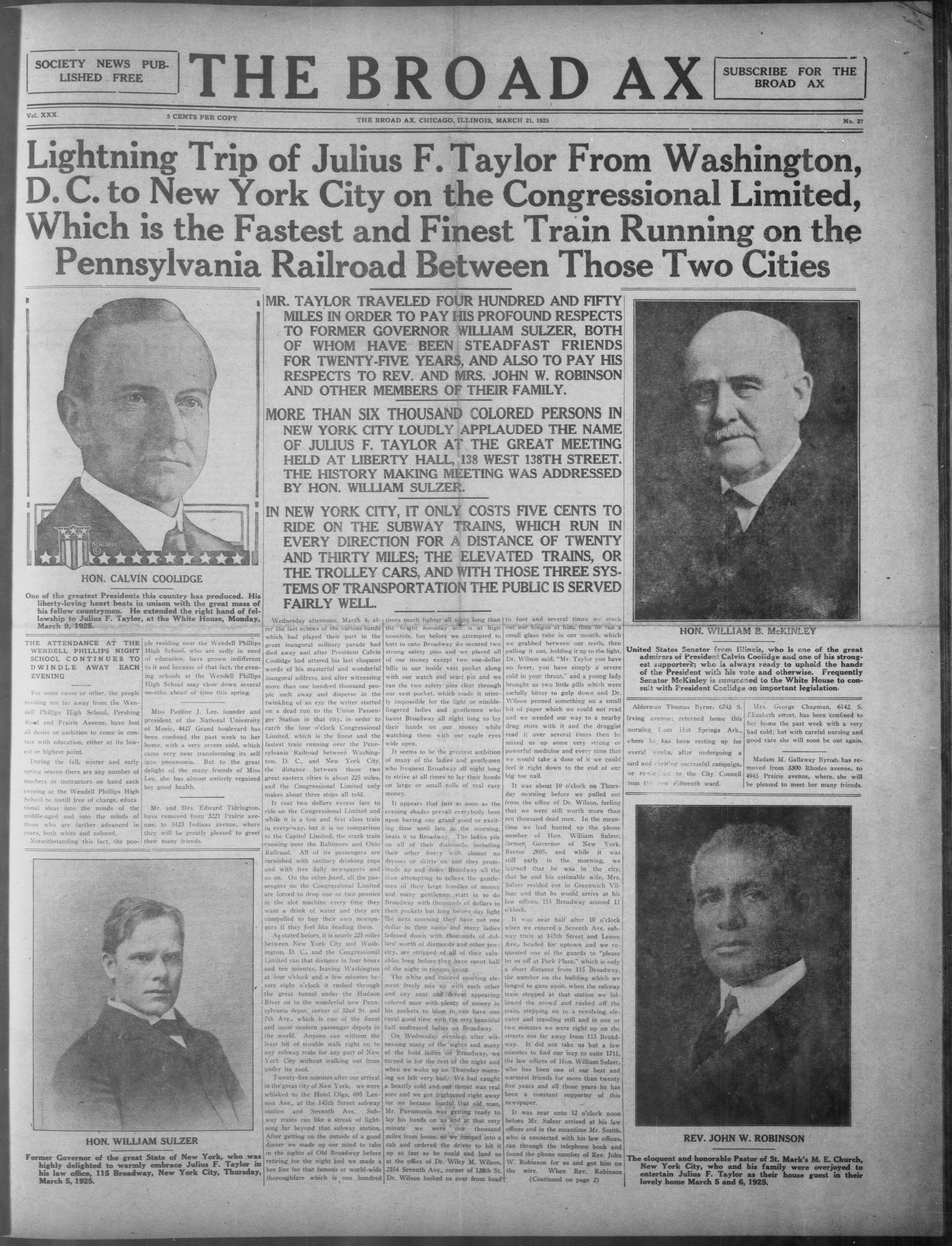
Lightning Trip of Julius F. Taylor From Washington, D.C. to New York City on the Congressional Limited, Which is the Fastest and Finest Train Running on the Pennsylvania Railroad Between Those Two Cities
SOCIETY NEWS PUBLISHED FREE
Vol. XXX.
Lightning
D. C. to N
Which is
Pennsy
htning T
C. to New
which is th
ennsylva
SCHERVLE
HON. CALVIN COOLIDGE
One of the greatest Presidents this country has liberty-loving heart beats in unison with the his fellow countrymen. He extended the rig lowship to Julius F. Taylor, at the White H March 9, 1925.
Great Presidents this country has
ing heart beats in unison with the
countrymen. He extended the rig
Julius F. Taylor, at the White H
1925.
One of the greatest Presidents this country has produced. His liberty-loving heart beats in unison with the great mass of his fellow countrymen. He extended the right hand of fellowship to Julius F. Taylor, at the White House, Monday, March 9, 1925.
THE ATTENDANCE AT THE WENDELL PHILLIPS NIGHT SCHOOL CONTINUES TO DWINDLE AWAY EACH EVENING
For some cause or other, the people residing not far away from the Wendell Phillips High School, Pershing Road and Prairie Avenue, have lost all desire or ambition to come in contact with education, either at its lowest or highest point.
During the fall, winter and early spring season there are any number of teachers or instructors on hand each evening at the Wendell Phillips High School to instill free of charge, educational ideas into the minds of the middle-aged and into the minds of those who are farther advanced in years, both white and colored.
Notwithstanding this fact, the peo-
ple residing near the Wendell Phillips High School, who are sadly in need of education, have grown indifferent to it and because of that fact, the evening schools at the Wendell Phillips High School may close down several months ahead of time this spring.
Miss Pauline J. Lee, founder and president of the National University of Music, 4427 Grand boulevard has been confined the past week to her home, with a very severe cold, which came very near transforming its self into pneumonia. But to the great delight of the many friends of Miss Lee, she has almost entirely regained her good health.
Mr. and Mrs. Edward Tidrington, have removed from 3221 Prairie avenue, to 5423 Indiana avenue, where they will be greatly pleased to greet their many friends.
```markdown
```
[Name]
HON. WILLIAM SULZER
Former Governor of the great State of New
highly delighted to warmly embrace Jul
his law office, 115 Broadway, New York
March 5, 1925.
nor of the great State of New York lighted to warmly embrace Juliusice, 115 Broadway, New York in 1925.
Former Governor of the great State of New York, who was highly delighted to warmly embrace Julius F. Taylor in his law office, 115 Broadway, New York City, Thursday, March 5, 1925.
Vol. XXX.
5 CENTS PER COPY
ng Trip
New Y
is the Fa
sylvania
this country has produced. His unison with the great mass of extended the right hand of fel- at the White House, Monday,
ple residing near the Wendell Phillips High School, who are sadly in need of education, have grown indifferent to it and because of that fact, the evening schools at the Wendell Phillips High School may close down several months ahead of time this spring.
Miss Pauline J. Lee, founder and president of the National University of Music, 4427 Grand boulevard has been confined the past week to her home, with a very severe cold, which came very near transforming its self into pneumonia. But to the great delight of the many friends of Miss Lee, she has almost entirely regained her good health.
Mr. and Mrs. Edward Tidrington, have removed from 3221 Prairie avenue, to 5423 Indiana avenue, where they will be greatly pleased to greet their many friends.
1910
State of New York, who was by embrace Julius F. Taylor in way, New York City, Thursday,
THE BROAD AX
THE BROAD AX, CHICAGO, ILLINOIS, MARCH 21, 1925
MR. TAYLOR TRAVELED FOUR HUNDRED AND FIFTY MILES IN ORDER TO PAY HIS PROFOUND RESPECTS TO FORMER GOVERNOR WILLIAM SULZER, BOTH OF WHOM HAVE BEEN STEADFAST FRIENDS FOR TWENTY-FIVE YEARS, AND ALSO TO PAY HIS RESPECTS TO REV. AND MRS. JOHN W. ROBINSON AND OTHER MEMBERS OF THEIR FAMILY.
MORE THAN SIX THOUSAND COLORED PERSONS IN NEW YORK CITY LOUDLY APPLAUDED THE NAME OF JULIUS F. TAYLOR AT THE GREAT MEETING HELD AT LIBERTY HALL, 138 WEST 138TH STREET. THE HISTORY MAKING MEETING WAS ADDRESSED BY HON. WILLIAM SULZER.
IN NEW YORK CITY, IT ONLY COSTS FIVE CENTS TO RIDE ON THE SUBWAY TRAINS, WHICH RUN IN EVERY DIRECTION FOR A DISTANCE OF TWENTY AND THIRTY MILES; THE ELEVATED TRAINS, OR THE TROLLEY CARS, AND WITH THOSE THREE SYSTEMS OF TRANSPORTATION THE PUBLIC IS SERVED FAIRLY WELL.
Wednesday afternoon, March 4, after the last echoes of the various bands which had played their part in the great inaugural military parade had died away and after President Calvin Coolidge had uttered his last eloquent words of his masterful and wonderful inaugural address, and after witnessing more than one hundred thousand people melt away and disperse in the twinkling of an eye the writer started on a dead run to the Union Passenger Station in that city, in order to catch the four o'clock Congressional Limited, which is the finest and the fastest train running over the Pennsylvania Railroad between Washington, D. C., and New York City, the distance, between those two great eastern cities is about 225 miles, and the Congressional Limited only makes about three stops all told.
It cost two dollars excess fare to ride on the Congressional Limited and while it is a fine and first class train in every way, but it is no comparison to the Capitol Limited, the crack train running over the Baltimore and Ohio Railroad. All of its passengers are furnished with sanitary drinking cups and with free daily newspapers and so on. On the other hand, all the passengers on the Congressional Limited are forced to drop one or two pennies in the slot machine every time they want a drink of water and they are compelled to buy their own newspapers if they feel like reading them.
As stated before, it is nearly 225 miles between New York City and Washington, D. C., and the Congressional Limited ran that distance in four hours and ten minutes, leaving Washington at four o'clock and a few minutes before eight o'clock it rushed through the great tunnel under the Hudson River on to the wonderful new Pennsylvania depot, corner of 32nd St. and 7th Ave., which is one of the finest and most modern passenger depots in the world. Anyone can without the least bit of trouble walk right on to any subway train for any part of New York City without walking out from under its roof.
Twenty-five minutes after our arrival in the great city of New York, we were whisked to the Hotel Olga, 695 Lennox Ave., at the 145th Street subway station and Seventh Ave. Subway trains ran like a streak of lightning far beyond that subway station. After getting on the outside of a good dinner we made up our mind to take in the sights of Old Broadway before retiring for the night and we made a bee line for that famous or world-wide thoroughfare which is one hundred
times much lighter all night long than the bright noonday sun is at high noontide, but before we attempted to butt in onto Broadway we secured two strong safety pins and we placed all of our money except two one-dollar bills in our inside vest pocket along with our watch and scarf pin and we ran the two safety pins clear through our vest pocket, which made it utterly impossible for the light or nimble-fingered ladies and gentlemen who haunt Broadway all night long to lay their hands on our money while watching them with our eagle eyes wide open.
It seems to be the greatest ambition of many of the ladies and gentlemen who frequent Broadway all night long to strive at all times to lay their hands on large or small rolls of real easy money.
It appears that just as soon as the evening shades prevail everybody bent upon having one grand good or exciting time until late in the morning, beats it to Broadway. The ladies pile on all of their diamonds, including their other finery with almost no dresses or skirts on and they prominade up and down Broadway all the time attempting to relieve the gentlemen of their large bundles of money and many gentlemen start in to do Broadway with thousands of dollars in their pockets but long before day light the next morning they have not one dollar to their name and many ladies ladened down with thousands of dollars' worth of diamonds and other jewelry, are stripped of all of their valuables long before they have spent half of the night in riotous living.
The white and colored sporting element freely mix up with each other and any neat and decent appearing colored man with plenty of money in his pockets to blow in can have one royal good time with the very beautiful half undressed ladies on Broadway.
On Wednesday evening, after witnessing many of the sights and many of the bold ladies on Broadway, we turned in for the rest of the night and when we woke up on Thursday morning we felt very bad. We had caught a beastly cold and our throat was real sore and we got frightened right away for we became fearful that old man, Mr. Pneumonia was getting ready to lay his hands on us and at that very minute we were one thousand miles from home, so we jumped into a cab and ordered the driver to hit it up as fast as he could and land us at the office of Dr. Wiley M. Wilson 2354 Seventh Ave., corner of 138th St Dr. Wilson looked us over from head
to foot and several times we stuck out our tongue at him, then he ran a small glass tube in our mouth, which we grabbed between our teeth, then pulling it out, holding it up to the light, Dr. Wilson said, "Mr. Taylor you have no fever, you have simply a severe cold in your throat," and a young lady brought us two little pills which were awfully bitter to gulp down and Dr. Wilson penned something on a small bit of paper which we could not read and we wended our way to a nearby drug store with it and the druggist read it over several times then he mixed us up some very strong or powerful medicine and every time that we would take a dose of it we could feel it right down to the end of our big toe nail.
It was about 10 o'clock on Thursday morning before we pulled out from the office of Dr. Wilson, feeling that we were still worth more than ten thousand dead men. In the meantime we had hunted up the phone number of Hon. William Sulzer, former Governor of New York, Rector 2805, and while it was still early in the morning, we learned that he was in the city, that he and his estimable wife, Mrs. Sulzer resided out in Greenwich Village and that he would arrive at his law offices, 115 Broadway around 11 o'clock.
It was near half after 10 o'clock when we entered a Seventh Ave. subway train at 145th Street and Lenox Ave., headed for uptown and we requested one of the guards to "please let us off at Park Place," which is only a short distance from 115 Broadway, the number on the building which we longed to gaze upon, when the subway train stopped at that station we followed the crowd and rushed off the train, stepping on to a revolving elevator and standing still and in one or two minutes we were right up on the streets not far away from 115 Broadway. It did not take us but a few minutes to find our way to suite 1711, the law offices of Hon. William Sulzer, who has been one of our best and warmest friends for more than twenty five years and all those years he has been a constant supporter of this newspaper.
It was near onto 12 o'clock noon before Mr. Sulzer arrived at his law offices and in the meantime Mr. Smith, who is connected with his law offices, ran through the telephone book and found the phone number of Rev. John W. Robinson for us and got him on the wire. When Rev. Robinson (Continued on page 2)
Washington
nal Limite
ning on t
wo Cities
HON. WILLIAM B. McKINLEY
United States Senator from Illinois, who is one of admirers of President Calvin Coolidge and one ofest supporters; who is always ready to uphold of the President with his vote and otherwise. Senator McKinley is summoned to the White Hsult with President Coolidge on important legisl
Senator from Illinois, who is one of President Calvin Coolidge and one of writers, who is always ready to uphold resident with his vote and otherwise. McKinley is summoned to the White H President Coolidge on important legis
United States Senator from Illinois, who is one of the great admirers of President Calvin Coolidge and one of his strongest supporters; who is always ready to uphold the hands of the President with his vote and otherwise. Frequently Senator McKinley is summoned to the White House to consult with President Coolidge on important legislation.
Alderman Thomas Byrne, 6743 S. Irving avenue; returned home this morning from Hot Springs Ark., where he has been resting up for several weeks, after undergoing a ward and exciting successful campaign, or re-election to the City Council from the new Fifteenth ward.
Mrs. George Chapman, 6142 S. Elizabeth street, has been confined to her home the past week with a very bad cold; but with careful nursing and good care she will soon be out again.
Madam M. Gallaway Byrne, has removed from 3300 Rhodes avenue, to 4945 Prairie avenue, where, she will be pleased to meet her many friends.
[Image of a man with white hair and a dark suit, facing slightly to the right].
[Name]
[Name]
REV. JOHN W. ROBINSON
The eloquent and honorable Pastor of St. Mark' New York City, who and his family were entertain Julius F. Taylor as their house lovely home March 5 and 6, 1925.
and honorable Pastor of St. Mark's M
City, who and his family were o
Julius F. Taylor as their house gu
me March 5 and 6, 1925.
The eloquent and honorable Pastor of St. Mark's M. E. Church, New York City, who and his family were overjoyed to entertain Julius F. Taylor as their house guest in their lovely home March 5 and 6. 1925.
SUBSCRIBE FOR THE BROAD AX
Washington,
A Limited,
ing on the
o Cities
from Illinois, who is one of the great Calvin Coolidge and one of his strong- is always ready to uphold the hands in his vote and otherwise. Frequently summoned to the White House to con- coolidge on important legislation.
Mrs. George Chapman, 6142 S. Elizabeth street, has been confined to her home the past week with a very bad cold; but with careful nursing and good care she will soon be out again.
Madam M. Gallaway Byron, has removed from 3300 Rhodes avenue, to 4945 Prairie avenue, where, she will be pleased to meet her many friends.
THE BEST MAN IN THE WORLD
able Pastor of St. Mark's M. E. Church, so and his family were overjoyed to Taylor as their house guest in their and 6, 1925.
THE BROAD AX
Published Every Saturday
In this city since July 15th, 1899, without missing one single issue. Republicans, Democrats, Catinolics, Protestants, Single Taxes, Priests, infidels or anyone else can have their say as long as their language is proper and responsibility is fixed.
The Broad Ax is a newspaper whose platform is broad enough for all, ever claiming the editorial right to speak its own mind. It is neither Democratic nor Republican. It is strictly or absolutely independent in politics. Local communications will receive attention. Write only on one side of the paper.
Subscriptions must be paid in advance.
One Year .....$2.00
Six Months .....$1.00
Advertising rates made known on
application.
Address all communications to
THE BROAD AX
6206 S. Elizabeth St., Chicago.
Phone: Wentworth 2597
JULIUS F. TAYLOR Editor and Publisher
Entered as Second-Class Matter, Aug
19, 1902, at the Post office at Chicago
Ill. Under Act of March 8, 1879.
SCHOLARS OF BOTH RACES TO
DISCUSS THE NEGRO
At Durham, N. C. April 1 and 2
Under the auspices of the Association for the Study of Negro Life and History, students and teachers from all parts of the country will meet in a spring conference at Durham, North Carolina, on the first and second of April to discuss the Negro. The day sessions will be held at the Durham State Teacher's College and the evening sessions at the White Rock Baptist Church. Schools, clubs, and co-operative organizations from the various parts of the country will be represented. What has been done in these fields will be reviewed and plans for further efforts will be worked out and put into execution.
The speakers will be representative of both races. There will appear Professor W. K. Boyd of Duke University, to speak on the Negro in Durham, Professor William T. LaPrade of the same institution to deliver an address on the "Negro Before the Civil War," Professor J. R. Hawkins to emphasize the "Importance of the Past of the Negro," and Professor R. H. Taylor of the University of North Carolina, to give a resume of "Plantation Economy."
A special session, at which Mr. W. A. Robinson will deliver the opening address, will be devoted to the teaching of Negro History. Professor D. M. Jarnagin of the State Colored Normal School, will read a paper on "Valid Claims for Teaching Negro History." Mr. N. C. Newbold, head of the Department of Negro Education in North Carolina, will follow with appropriate remarks.
The morning session of the first day will be devoted to a discussion of the present social and economic condition of the Negro. Professor T. E. McKinney of the Agricultural and Technical College, will read a paper on "Our Uniting Forces," and Dr. R. C. Brown of the North Carolina Mutual Life Insurance Company, will enlarge upon the present status of the Negro
The conference will close with the evening session of the second, when Dean W. S. Turner of Shaw University will deliver an address on "The Development of Negro Leadership" and Dr. C. G. Woodson will speak on the "Negro in History." Dr. James E. Shepard, president of the Durham State Teacher's College, is doing everything to advertise the meeting and to make the visitors comfortable. Professor E. E. Smith, Dr. James B. Dudley, Dr. S. G. Atkins, and President Frank Trigg are giving the effort their cordial co-operation
At this conference the Association will report unusual progress. The effort is now in the midst of its greatest achievement. During the last ten years, the Association has been collecting and publishing sociological and historical data to promote the study of Negro Life and history and to bring about harmony between the races by acquainting the one with the other.
Recently, throughout the Research Department, moreover, the Association has been able to develop certain valuable scientific studies of the Free Negro Prior to 1861 and Negro Reconstruction History. The results of these efforts are now assuming the form of works bearing the following titles: "The Negro in South Carolina During the Reconstruction," (1924). "The Virginia Negro During the Reconstruction" (available in 1925). "Free Negro Owners of Slaves in the
United States in 1830." (1924); "Free Negro Heads of Families in the United States in 1830." (1925); "Despatches of Spanish Officials Bearing on the Free Negro Settlement of Garcia de Santa Teresa de Mose, Florida." (1924); "The Mind of the Negro as Reflected in Letters Written During the Crisis," (1925); "The Social and Economic Status of the Free Negro" (available in 1925).
The Association for the Study of Negro Life and History was organized in Chicago, September 9, 1915, by Carter G. Woodson with five persons, four of whom are still living. At that time it was believed that the work of the organization should be altogether intensive so as to treat scientifically the neglected records of the Negro race.
The founder, however, had not advanced very far in the prosecution of this task before he discovered that such a movement, meeting a long-felt want, would immediately have popular support. The Association received a hearty welcome from other enterprises disseminating information and promoting the truth, and soon found coworkers in all ranks of life. The rapid rise of the Association and the wide extension of its work have surpassed the expectations of its founder.
The Association for the Study of Negro Life and History, however, is altogether altruistic. There has been no effort to make its publication popular in the sense of commercializing the enterprise, nor has anyone connected with the Association been permitted to use it for exploitation. Whatever income accrues from the donations, and fees, and the like, is used to pay the necessary expenses of the Association. If the income exceeds the amount thus required it is used to undertake neglected aspects of the work and to popularize it in other parts. Most of the officials connected with the Association, moreover, have thus attached themselves at a sacrifice to co-operate with the Director and his staff in the performance of what they considered one of the most important tasks hitherto undertaken.
The Association makes no effort to sell the Journal of Negro History at news-stands or to casual readers. This publication is rather regarded as an organ for the diffusion of knowledge among those who will appreciate its purpose and profit by reading its contents. This magazine appeals to intelligent households, philanthropic business men, progressive clubs, institutional churches, and liberal schools. Professor John R. Hawkins is the president of the Association, Mr. S. W. Rutherford is the secretary-treasurer, and Dr. C. G. Woodson is the director of The Journal of Negro History.
EDUCATIONAL RALLY FOR
GREATER BETHEL CHURCH
By Leora Bruce
Rev. T. L. Scott, of Allen Temple, at 30th and Dearborn Sts., threw open the doors of his church last Sunday afternoon, at 3 P. M., to Rev. C. M. Tanner and his congregation at Greater Bethel Church, (which edifice was devastated by fire some months ago) and gave a helping hand with his congregation to raise money for the educational rally, which was the object of this meeting. Hon. Wm. B. McKinley, United States Senator from Illinois, who was to have been the speaker of the evening, sent a telegram to Rev. Tanner, stating that he would not be able to leave Washington at that time.
However, the meeting proved to be one of inspiration, due to the fact that we had our own representative, Hon. Adelbert H. Roberts, State Senator, as master of ceremonies and Mr. Prescott, lawyer and orator, both of whom made wonderful addresses. Several selections by the choir, under the leadership of Dr. Offord and the bass solos rendered by Mr. Sidney Ragan, were greatly appreciated by all. In the absence of Hon. Warren B. Douglas, State Representative, Mr. Morris Lewis made a few timely remarks.
Since the word education means to lead out—out of the ruins of Bethel, led on as they are, by Rev Tanner, must arise "Greatest Bethel." Unless the spiritual development keeps pace with the educational development there can be no success. So its quota must be met and it is our duty to respond.
Greater Bethel is planning to rebuild, and they mean to have a building that will in every respect be able to render and reflect credit to the people of our group.
Mrs. Maude Bomar James, 3651 S. Michigan avenue, has been confined to her home the past week, with a very severe cold. She is somewhat improving at the present time.
THE BROAD AX, CHICAGO, ILLINOIS, MARCH 21, 1925
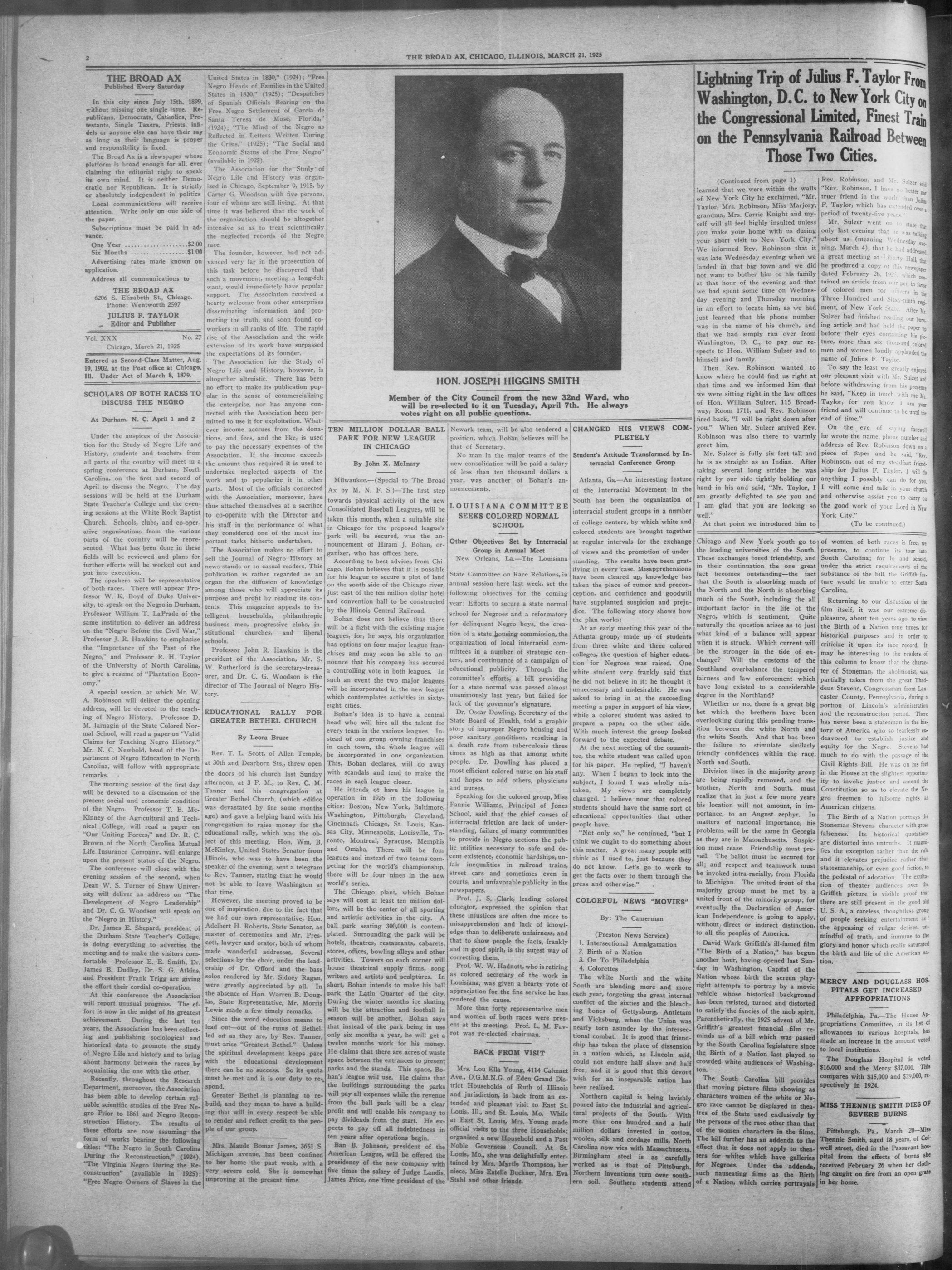
[Picture of a man in a suit and bow tie].
Member of the City Council from the new 32nd Ward, who will be re-elected to it on Tuesday, April 7th. He always votes right on all public questions.
TEN MILLION DOLLAR BALL
PARK FOR NEW LEAGUE
IN CHICAGO
By John X. McInary
Milwaukee.—(Special to The Broad Ax by M. N. F. S.)—The first step towards physical activity of the new Consolidated Baseball Leagues, will be taken this month, when a suitable site in Chicago for the proposed league's park will be secured, was the announcement of Hiram J. Bohan, organizer, who has offices here.
According to best advices from Chicago, Bohan believes that it is possible for his league to secure a plot of land on the south side of the Chicago river, just east of the ten million dollar hotel and convention hall to be constructed by the Illinois Central Railroad.
Bohan does not believe that there will be a fight with the existing major leagues, for, he says, his organization has options on four major league franchises and may soon be able to announce that his company has secured a controlling vote in both leagues. In such an event the two major leagues will be incorporated in the new league which contemplates activities in sixty-eight cities.
Bohan's idea is to have a central head who will hire all the talent for every team in the various leagues. Instead of one group owning franchises in each town, the whole league will be incorporated in one organization. This, Bohan declares, will do away with scandals and tend to make the races in each league closer.
He intends of have his league in operation in 1926 in the following cities: Boston, New York, Baltimore, Washington, Pittsburgh, Cleveland, Cincinnati, Chicago, St. Louis, Kansas City, Minneapolis, Louisville, Toronto, Montreal, Syracuse, Memphis and Omaha. There will be four leagues and instead of two teams competing for the world's championship, there will be four nines in the new world's series.
The Chicago plant, which Bohan says will cost at least ten million dollars, will be the center of all sporting and artistic activities in the city. A ball park seating 300,000 is contemplated. Surrounding the park will be hotels, theatres, restaurants, cabarets, stores, offices, bowling alleys and other activities. Towers on each corner will house theatrical supply firms, song writers and artists and sculptures. In short, Bohan intends to make his ball park the Latin Quarter of the city. During the winter months ice skating will be the attraction and football in season will be another. Bohan says that instead of the park being in use only six months a year, he will get a twelve months work for his money. He claims that there are acres of waste space between the entrances to present parks and the stands. This space, Bohan's league will use. He claims that the buildings surrounding the parks will pay all expenses while the revenue from the ball park will be a clear profit and will enable his company to pay dividends from the start. He expects to pay off all indebtedness in ten years after operations begin.
Ban B. Johnson, president of the American League, will be offered the presidency of the new company with five times the salary of Judge Landis. James Price, one time president of the
HON. JOSEPH HIGGINS SMITH
Newark team, will be also tendered a position, which Bohan believes will be that of Secretary. No man in the major teams of the new consolidation will be paid a salary of less than ten thousand dollars a year, was another of Bohan's announcements.
LOUISIANA COMMITTEE
SEEKS COLORED NORMAL
SCHOOL
Other Objectives Set by Interracial Group in Annual Meet
State Committee on Race Relations, in annual session here last week, set the following objectives for the coming year: Efforts to secure a state normal school for Negroes and a reformatory for delinquent Negro boys, the creation of a state housing commission, the organization of local interracial committees in a number of strategic centers, and continuance of a campaign of educational publicity. Through the committee's efforts, a bill providing for a state normal was passed almost unanimously last year, but failed for lack of the governor's signature.
Dr. Oscar Dowling, Secretary of the State Board of Health, told a graphic story of improper Negro housing and poor sanitary conditions, resulting in a death rate from tuberculosis three times as high as that among white people. Dr. Dowling has placed a most efficient colored nurse on his staff and hopes to add others, physicians and nurses.
Speaking for the colored group, Miss Fannie Williams, Principal of Jones School, said that the chief causes of interracial friction are lack of understanding, failure of many communities to provide in Negro sections the public utilities necessary to safe and decent existence, economic hardships, unfair inequalities in railroad trains, street cars and sometimes even in courts, and unfavorable publicity in the newspapers.
Prof. J. S. Clark, leading colored educator, expressed the opinion that these injustices are often due more to misapprehension and lack of knowledge than to deliberate unfairness, and that to show people the facts, frankly and in good spirit, is the surest way of correcting them.
Prof. W. W. Hadnott, who is retiring as colored secretary of the work in Louisiana, was given a hearty vote of appreciation for the fine service he has rendered the cause.
More than forty representative men and women of both races were present at the meeting. Prof. L. M. Favrot was re-elected chairman.
BACK FROM VISIT
Mrs. Lou Ella Young, 4114 Calumet Ave, D.G.M.N.G. of Eden Grand District Households of Ruth of Illinois and jurisdiction, is back from an extended and pleasant visit to East St. Louis, Ill., and St. Louis, Mo. While at East St. Louis, Mrs. Young made official visits to the three Households; organized a new Household and a Past Noble Governess Council. At St. Louis, Mo., she was delightfully entertained by Mrs. Myrtle Thompson, her niece, Miss Estelle Buckner, Mrs. Eva Stahl and other friends.
CHANGED HIS VIEWS COM- PLETELY
Student's Attitude Transformed by Interracial Conference Group
Atlanta, Ga.—An interesting feature of the Interracial Movement in the South has been the organization of interracial student groups in a number of college centers, by which white and colored students are brought together at regular intervals for the exchange of views and the promotion of understanding. The results have been gratifying in every case. Misapprehensions have been cleared up, knowledge has taken the place of rumor and preconception, and confidence and goodwill have supplanted suspicion and prejudice. The following story shows how the plan works:
At an early meeting this year of the Atlanta group, made up of students from three white and three colored colleges, the question of higher education for Negroes was raised. One white student very frankly said that he did not believe in it; he thought it unnecessary and undesirable. He was asked to bring in at the succeeding meeting a paper in support of his view, while a colored student was asked to prepare a paper on the other side. With much interest the group looked forward to the expected debate.
At the next meeting of the committee, the white student was called upon for his paper. He replied, "I haven't any. When I began to look into the subject, I found I was wholly mistaken. My views are completely changed. I believe now that colored students should have the same sort of educational opportunities that other people have.
"Not only so," he continued, "but I think we ought to do something about this matter. A great many people still think as I used to, just because they do not know. Let's go to work to get the facts over to them through the press and otherwise."
By: The Camerman
1. Intersectional Amalgamation
2. Birth of a Nation
The white North and the white South are blending more and more each year, forgetting the great internal conflict of the sixties and the bleaching bones of Gettysburg, Antietam and Vicksburg, when the Union was nearly torn asunder by the intersectional combat. It is good that friendship has taken the place of dissension in a nation which, as Lincoln said, could not endure half slave and half free; and it is good that this devout wish for an inseparable nation has been realized.
Northern capital is being lavishly poured into the industrial and agricultural projects of the South. With more than one hundred and a half million dollars invested in cotton, woolen, silk and cordage mills, North Carolina now vies with Massachusetts. Birmingham steel is as carefully worked as is that of Pittsburgh. Northern inventions turn over southern soil. Southern students attend
Lightning Trip of Julius F. Taylor From Washington, D.C. to New York City on the Congressional Limited, Finest Train on the Pennsylvania Railroad Between Those Two Cities.
(Continued from page 1)
learned that we were within the walls of New York City he exclaimed, "Mr. Taylor, Mrs. Robinson, Miss Marjory, grandma, Mrs. Carrie Knight and myself will all feel highly insulted unless you make your home with us during your short visit to New York City." We informed Rev. Robinson that it was late Wednesday evening when we landed in that big town and we did not want to bother him or his family at that hour of the evening and that we had spent some time on Wednesday evening and Thursday morning in an effort to locate him, as we had just learned that his phone number was in the name of his church, and that we had simply ran over from Washington, D. C., to pay our respects to Hon. William Sulzer and to himself and family.
Then Rev. Robinson wanted to know where he could find us right at that time and we informed him that we were sitting right in the law offices of Hon. William Sulzer, 115 Broadway, Room 1711, and Rev. Robinson fired back, "I will be right down after you." When Mr. Sulzer arrived Rev. Robinson was also there to warmly greet him.
Mr. Sulzer is fully six feet tall and he is as straight as an Indian. After taking several long strides he was right by our side tightly holding our hand in his and said, "Mr. Taylor, I am greatly delighted to see you and I am glad that you are looking so well."
At that point we introduced him to
Chicago and New York youth go to the leading universities of the South. These exchanges breed friendship, and in their continuation the one great fact becomes outstanding—the fact that the South is absorbing much of the North and the North is absorbing much of the South, including the all important factor in the life of the Negro, which is sentiment. Quite naturally the question arises as to just what kind of a balance will appear when it is struck. Which current will be the stronger in the tide of exchange? Will the customs of the Southland overbalance the tempered fairness and law enforcement which have long existed to a considerable degree in the Northland?
Whether or no, there is a great big bet which the brethern have been overlooking during this pending transition between the white North and the white South. And that has been the failure to stimulate similarly friendly confidences within the race, North and South.
Division lines in the majority group are being rapidly removed, and the brother, North and South, must realize that in just a few more years his location will not amount, in importance, to an August zephyr. In matters of national importance, his problems will be the same in Georgia as they are in Massachusetts. Suspicion must cease. Friendship must prevail. The ballot must be secured for all; and respect and teamwork must be invoked intra-racially, from Florida to Michigan. The united front of the majority group must be met by a united front of the minority group; for eventually the Declaration of American Independence is going to apply, without direct or indirect distinction, to all the peoples of America.
David Wark Griffith's ill-famed film "The Birth of a Nation," has begun another hour, having opened last Sunday in Washington, Capital of the Nation whose birth the screen playright attempts to portray by a movie vehicle whose historical background has been twisted, turned and distorted to satisfy the fancies of the mob spirit. Parenthetically, the 1925 advent of Mr. Griffith's greatest financial film reminds us of a bill which was passed by the South Carolina legislature since the Birth of a Nation last played to crowded white audiences of Washington.
The South Carolina bill provides that moving picture films showing as characters women of the white or Negro race cannot be displayed in theatres of the State used exclusively by the persons of the race other than that of the women characters in the films. The bill further has an addenda to the effect that it does not apply to theaters for whites which have galleries for Negroes. Under the addenda, such nauseating films as the Birth of a Nation, which carries portrayals
Rev. Robinson, and Mr. Sulzer said
"Rev. Robinson, I have no better more
truer friend in the world than Julius
F. Taylor, which has extended over a
period of twenty-five years."
Mr. Sulzer went on to state that only last evening that he was talking about us (meaning Wednesday evening, March 4), that he had addressed a great meeting at Liberty Hall, that he produced a copy of this newspaper dated February 28, 1925, which contained an article from our pen in favor of colored men for officers in the Three Hundred and Sixth-ninth regiment, of New York State. After Mr. Sulzer had finished reading our burglar article and had held the paper up before their eyes containing his picture, more than six thousand colored men and women loudly applauded the name of Julius F. Taylor.
To say the least we greatly enjoyed our pleasant visit with Mr. Sulzer and before withdrawing from his presence he said, "Keep in touch with me Mr. Taylor, for you know I am your friend and will continue to be until the end of time."
On the eve of saying farewell he wrote the name, phone number and address of Rev. Robinson down on a piece of paper and he said, "Rev Robinson, out of my steadfast friend ship for Julius F. Taylor, I will do anything I possibly can do for you I will come and talk in your church and otherwise assist you to carry on the good work of your Lord in New York City."
(To be continued.)
of women of both races is free, we presume, to continue its tour into South Carolina; for lo and behold, under the strict requirements of the substance of the bill, the Griffith feature would be unable to enter South Carolina.
Returning to our discussion of the film itself, it was our extreme displeasure, about ten years ago, to view the Birth of a Nation nine times, for historical purposes and in order to criticize it upon its face record. It may be interesting to the readers of this column to know that the character of Stoneman, the abolitionist, was partially taken from the great Thaddeus Stevens, Congressman from Lancaster County, Pennsylvania, during a portion of Lincoln's administration and the reconstruction period. There has never been a statesman in the history of America who so fearlessly endeavored to establish justice and equity for the Negro. Stevens had much to do with the passage of the Civil Rights Bill. He was on his feet in the House at the slightest opportunity to invoke justice and amend the Constitution so as to elevate the Negro freemen to fulsome rights as American citizens.
The Birth of a Nation portrays the Stoneman-Stevens character with gross falseness. Its historical quotations are distorted into untruths. It magnifies the exception rather than the rule and it elevates prejudice rather than statesmanship, or even good fiction, to the pedestal of adoration. The exultation of theater audiences over the Griffith picture is visible proof that there are still present in the good old U. S. A., a careless, thoughtless group of people seeking entertainment and the appeasing of vulgar desires, unmindful of truth, and immune to the glory and honor which really saturated the birth and life of the American nation.
MERCY AND DOUGLASS HOS
PITALS GET INCREASED
APPROPRIATIONS
Philadelphia, Pa.—The House Appropriations Committee, in its list of allowances to various hospitals, has made an increase in the amount voted to local institutions.
The Douglass Hospital is voted $16,000 and the Mercy $37,000. This compares with $15,000 and $29,000, respectively in 1924.
MISS THENNIE SMITH DIES OF
SEVERE BURNS
Pittsburgh, Pa., March 20—Miss Tennie Smith, aged 18 years, of Colwell street, died in the Passavant hospital from the effects of burns she received February 26 when her clothing caught on fire from an open grate in her home.
COL. CHARLES E. STUMP, THE REGULAR OLD-TIME TRAVELING CORRESPONDENT FOR THE BROAD AX, CONTINUES TO BASK IN THE BRIGHT SUNSHINE AWAY DOWN IN FLORIDA.
Jacksonville, Florida.—I was so free last week that I did not write to you, but believe me that John A. Andrew's Memorial Hospital at Tuskegee Institute, and Dr. Eugene H. Dibble Jr., and Miss Mary S. Booth, Mrs. J. L. Reed, and all the others are still on my mind, yet I am away from that part of the country, and will be away for sometime unless there happens to be some other trouble.
It strikes me that the last letter I sent you was in New Orleans, and I went from there to Houston, and back to New Orleans, and then I got myself together and stepped into Florida, the land of flowers and good time. It is down here where the wealthy people come from to keep away from the cold, and you see a few of us under wealthy people come down here too, for they must have their waiters, their servants, and the preachers must follow them with the light. Now what I am doing down here, you don't know and I think it is none of your business
In New Orleans I found the people getting ready for a legal battle, and it is to be fought out in Washington in the Supreme Court of the United States, from whose decision there is no appeal except to arms. The question has been decided once in the Kentucky case, but it seems that there are some mossbacks who are not satisfied, and they continue to hammer away at it.
Here comes that same damphule-ishness, "Segregation," trying to say where I shall and shall not live, or, at this high day of civilization trying to separate the races. I wish this had been done many years ago, but since it has not, and it is impossible by law or any other way to separate human beings, and I am a citizen of the United States and have helped to make it what it is, then why in the hen feathers don't they let me alone, and let me continue to help to build up this country? I do not carry around yellow fever, smallpox or any of them other death destroying diseases, and I have a fast color which God has guaranteed that it will neither run nor rub, and why should any man white or black object to me living next door to him, since I attend to my own business, select my own social friends, and invite into my home those I desire to have come in, and I do not go where I am not wanted? I have many colors from which I may select, from ebony to alabaster. I have no reason to worry, and even my brother in white has been very liberal in his contribution to me and mine.
I have been told to get education, get money, get culture and refinement, and the more of these civilizing things I get, the more humiliation is heaped upon me, but like the Christ, I accept it, and say "Father: forgive them." Now I am asking Father to give me courage to contend for a living chance, for an opportunity to educate, and enjoy the comforts of life. I want to live where I get light police protection, protection from fire, paved streets, good schools for my children, and then goes forth the inhuman cry, "He wants social equality." Why brutalize, inhumanize me and mine?
The ministers of the city of New Orleans are working, and this is one of the hardest cities in the world, but I am not going to discuss that now. I attended the meeting, heard some of the addresses, and made a few scattering remarks myself, and was on my way to see some more of the city.
I have told you before that while there I was the guest of the Porches, and had a fine time in their new home. But I did not go there to stay all the time. It was on Thursday morning that the Rev. B. G. Dawson drove up to the door in his automobile car carriage to tote me to the L. & N. stable where I was to start for Florida that very morning, leaving the city at 8:30. Mrs. Edwina Thomas, of Kentucky accompanied me to the station stable, and they delivered me to the L. & N. people, and off I was for Florida. It was a real good long ride, and I was able to make it. I had to make two changes, one at Flomaton, and the other at Pensacola, and then on to Tallahassee, where I alighted at 2 o'clock in the morning, and found the son of Rev. J. R. E. Lee awaiting my arrival. He had an automobile carriage to tote me up to the president's home. You see, Prof. J. R. E. Lee is president of the state school, but I am not going to discuss it in this letter as I am going to make another trip.
Now, about Prof. Lee. He was out of the city, but was on his way home. They gave me what they called a guest chamber, and I had my own bath room, and all, hence I did not do much sleeping for getting up bathing. I think I took a bath 20 times from 2:45 to 8 o'clock. From Atlanta, Georgia, came a wire from Prof. Lee, to have them arrange a special room in the hospital for me, and see that I got all attention. He heard I had been in Tuskegee hospital, and I suppose thought that I was doomed for hospital the rest of my days, but I declined with thanks. I had been in hospitals enough. He got home the next afternoon and I had a pleasant visit with him, but will talk about the school when I go back.
Saturday morning at 2 o'clock, I was on my way to Jacksonville, and then to St. Augustine, where I remained three or four days, with Prof. N. W. Collier, and this I am going to talk about later. He is a remarkable young man, and is doing great things in the Florida Normal and Industrial Institute. The school is growing in every particular.
Learning that I was on my way, Prof. Collier, got in his automobile car carriage and met me in Jacksonville, and toted me back home with him. He acted like he was just receiving his own brother, and I want to thank him for this. It was a nice ride of about 40 miles, and then Miss Carrie I. Felder, the clerk in the office seemed to be meeting a brother. All made me welcome.
I remained there until Tuesday, and then to this place and to the East over by Bishop John Hust, D. D., of Baltimore, Maryland, one of the most remarkable men of the race and a leader of men. He is accomplishing great things in Florida, and the people are highly elated over him. It is because he is doing something.
It cost a great deal to be something or somebody in this world, and if you do not watch they will murder you. As you advance, as you lift up the people and live an honest life, it is then that slander hurls her bitterest arrows at you, and if you are not careful will send it through your heart. Like Gulliver, he has the Lilliputians on him, in his pockets, on his hips, but he must just look forward, and in the command of the general "Forward march." He must be like the sun, for you will recall if you are among them high up people, that for centuries the astronomers have been saying that there are spots on the sun, but Old Sol has never stopped for a minute to deny or affirm the allegation, but has been going right on sending forth his rays to bless humanity. I would suggest to Bishop Hurst that it is the position he must take.
Some of the would-be assassins will be in the position of our old dog, Juno. She lived when I was a boy, and for some reason she formed a dislike for the moon, and all night long she would bark at the moon. One morning we came out and found Juno in her accustomed place with her head turned up, but she was dead, and still the moon continues to shine. So it will be with some of those who are barking at Bishop Hurst today, after while their heads will be turned up, and he will continue to shine.
They tell me that the African Methodist Episcopal Church is a great organization, but it is not sufficiently great to protect itself from itself, and there are within their rank man or men who are sapping at the very vitals of the church. I wish some of you will read and think of what I have said. Will stop here.
CHARLES E. STUMP.
LEAVES FOR THE EAST
Mrs. Ella G. Berry, 3329 S. State St., vice-national grand daughter ruler of the Lady Elks throughout its jurisdiction, left the city during the week for an extended trip east. While at New York, she will confer with the national grand daughter ruler on matters pertaining to the good of the order and also plans for the coming national grand lodge session in August to be held at Richmond, Va.
SERVE SPECIAL DINNER
Mr. and Mrs. Charles L. Burgess,
3718 Grand Blvd., entertained with a
special dinner on last Thursday evening,
March 12, to honor Attorney and
Mrs. Walter M. Farmer, Dr. and Mrs.
Chas. W. Bibb and Mrs. Bibb's sister.
THE BROAD AX, CHICAGO, ILLINOIS, MARCH 21, 1925
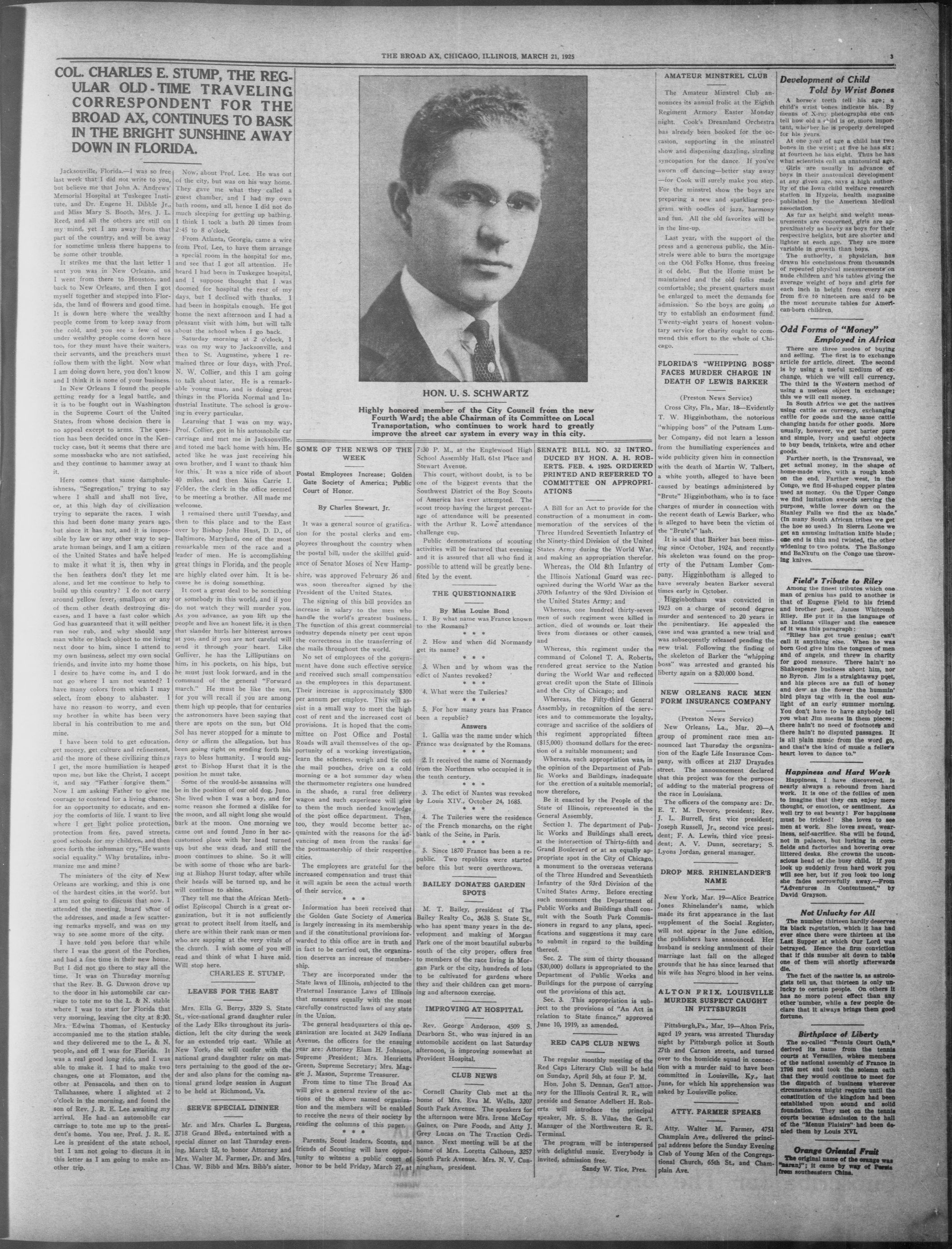
[Name]
Highly honored member of the City Council from the new Fourth Ward; the able Chairman of its Committee on Local Transportation, who continues to work hard to greatly improve the street car system in every way in this city.
By Charles Stewart, Jr.
It was a general source of gratification for the postal clerks and employees throughout the country when the postal bill, under the skillful guidance of Senator Moses of New Hampshire, was approved February 26 and was soon thereafter signed by the President of the United States. The signing of this bill provides an increase in salary to the men who handle the world's greatest business. The function of this great commercial industry depends ninety per cent upon the correctness in the transferring of the mails throughout the world.
No set of employees of the government have done such effective service and received such small compensation as the employees in this department. Their increase is approximately $300 per annum per employee. This will assist in a small way to meet the high cost of rent and the increased cost of provisions. It is hoped that the committee on Post Office and Postal Roads will avail themselves of the opportunity of a working investigation, learn the schemes, weigh and tie out the mail pouches, drive on a cold morning or a hot summer day when the thermometer registers one hundred in the shade, a rural free delivery wagon and such experience will give to them the much needed knowledge of the post office department. Then, too, they would become better acquainted with the reasons for the advancing of men from the ranks for the postmastership of their respective cities.
The employees are grateful for the increased compensation and trust that it will again be seen the actual worth of their service.
* * *
Information has been received that the Golden Gate Society of America is largely increasing in its membership and if the constitutional provisions forwarded to this office are in truth and in fact to be carried out, the organization deserves an increase of membership.
They are incorporated under the State laws of Illinois, subjected to the Fraternal Insurance Laws of Illinois that measures equally with the most carefully constructed laws of any state in the Union.
The general headquarters of this organization are located at 3429 Indiana Avenue, the officers for the ensuing year are: Attorney Elam H. Johnson, Supreme President; Mrs. Henrietta Green, Supreme Secretary; Mrs. Maggie J. Mason, Supreme Treasurer. From time to time The Broad Ax will give a general review of the actions of the above named organization and the members will be enabled to receive the news of their society by reading the columns of this paper.
Parents, Scout leaders, Scouts, and friends of Scouting will have opportunity to witness a public court of honor to be held Friday, March 27, at
HON. U. S. SCHWARTZ
and member of the City Council;
the able Chairman of its Con-
tion, who continues to work
the street car system in every way
7:30 P. M., at the Englewood High
School Assembly Hall, 61st Place and
Stewart Avenue.
This court, without doubt, is to be
one of the biggest events that the
Southwest District of the Boy Scouts
of America has ever attempted. The
scout troop having the largest per-
centage of attendance will be presented
with the Arthur R. Lowe attendance
challenge cup.
Public demonstrations of scouting activities will be featured that evening and it is assured that all who find it possible to attend will be greatly benefited by the event.
THE QUESTIONNAIRE
By Miss Louise Bond
1. By what name was France known to the Romans?
* * *
2. How and when did Normandy get its name?
* * *
3. When and by whom was the edict of Nantes revoked?
* * *
4. What were the Tuileries?
* * *
5. For how many years has France been a republic?
Answers
1. Gallia was the name under which France was designated by the Romans.
* * *
2. It received the name of Normandy from the Northmen who occupied it in the tenth century.
* * *
3. The edict of Nantes was revoked by Louis XIV., October 24, 1685.
* * *
4. The Tuileries were the residence of the French monarchs, on the right bank of the Seine, in Paris.
* * *
5. Since 1870 France has been a republic. Two republics were started before this but were overthrown.
M. T. Bailey, president of The Bailey Realty Co., 3638 S. State St., who has spent many years in the development and making of Morgan Park one of the most beautiful suburbs south of the city proper, offers free to members of the race living in Morgan Park or the city, hundreds of lots to be cultivated for gardens where they and their children can get morning and afternoon exercise.
IMPROVING AT HOSPITAL
Rev. George Anderson, 4509 S. Dearborn St., who was injured in an automobile accident on last Saturday afternoon, is improving somewhat at Provident Hospital.
CLUB NEWS
Cornell Charity Club met at the home of Mrs. Eva M. Wells, 3207 South Park Avenue. The speakers for the afternoon were Mrs. Irene McCoy Gaines, on Pure Foods, and Atty J. Grey Lucas on The Traction Ordinance. Next meeting will be at the home of Mrs. Loretta Calhoun, 3257 South Park Avenue. Mrs. N. V. Cunningham, president.
SENATE BILL NO. 32 INTRODUCED BY HON. A. H. ROBERTS. FEB. 4. 1925. ORDERED PRINTED AND REFERRED TO COMMITTEE ON APPROPRIATIONS
A Bill for an Act to provide for the construction of a monument in commemoration of the services of the Three Hundred Seventieth Infantry of the Ninety-third Division of the United States Army during the World War, and making an appropriation therefor.
Whereas, the Old 8th Infantry of the Illinois National Guard was recognized during the World War as the 370th Infantry of the 93rd Division of the United States Army; and
Whereas, one hundred thirty-seven men of such regiment were killed in action, died of wounds or lost their lives from diseases or other causes, and
Whereas, this regiment under the command of Colonel T. A. Roberts, rendered great service to the Nation during the World War and reflected great credit upon the State of Illinois and the City of Chicago; and
Whereas, the Fifty-third General Assembly, in recognition of the services and to commemorate the loyalty, courage and sacrifice of the soldiers of this regiment appropriated fifteen ($15,000) thousand dollars for the erection of a suitable monument; and
Whereas, such appropriation was, in the opinion of the Department of Public Works and Buildings, inadequate for the erection of a suitable memorial; now therefore,
Be it enacted by the People of the State of Illinois, represented in the General Assembly.
Section 1. The department of Public Works and Buildings shall erect, at the intersection of Thirty-fifth and Grand Boulevard or at an equally appropriate spot in the City of Chicago, a monument to the overseas veterans of the Three Hundred and Seventhth Infantry of the 93rd Division of the United States Army. Before erecting such monument the Department of Public Works and Buildings shall consult with the South Park Commissioners in regard to any plans, specifications and suggestions it may care to submit in regard to the building thereof.
Sec. 2. The sum of thirty thousand ($30,000) dollars is appropriated to the Department of Public Works and Buildings for the purpose of carrying out the provisions of this act.
Sec. 3. This appropriation is subject to the provisions of "An Act in relation to State finance;" approved June 10, 1919, as amended.
RED CAPS CLUB NEWS
The regular monthly meeting of the Red Caps Literary Club will be held on Sunday, April 5th, at four P. M. Hon. John S. Dennan, Gen'l attorney for the Illinois Central R. R., will preside and Senator Adelbert H. Roberts will introduce the principal speaker, Mr. S. B. Vilas, the Gen'l Manager of the Northwestern R. R. Terminal. The program will be interspersed with delightful music. Everybody is invited, admission free. Sandy W. Tice, Pres.
AMATEUR MINSTREL CLUB
The Amateur Minstrel Club announces its annual frolic at the Eighth Regiment Armory Easter Monday night. Cook's Dreamland Orchestra has already been booked for the occasion, supporting in the minstrel show and dispensing dazzling, sizzling syncopation for the dance. If you've sworn off dancing—better stay away—for Cook will surely make you step. For the minstrel show the boys are preparing a new and sparkling program with oodles of jazz, harmony and fun. All the old favorites will be in the line-up.
Last year, with the support of the press and a generous public, the Minstrels were able to burn the mortgage on the Old Folks Home, thus freeing it of debt. But the Home must be maintained and the old folks made comfortable; the present quarters must be enlarged to meet the demands for admission. So the boys are going to try to establish an endowment fund. Twenty-eight years of honest voluntary service for charity ought to commend this effort to the whole of Chicago.
FLORIDA'S "WHIPPING BOSS"
FACES MURDER CHARGE IN
DEATH OF LEWIS BARKER
Cross City, Fla., Mar, 18—Evidently T. W. Higginbotham, the notorious "whipping boss" of the Putnam Lumber Company, did not learn a lesson from the humiliating experiences and wide publicity given him in connection with the death of Martin W. Talbert, a white youth, alleged to have been caused by beatings administered by "Brute" Higginbotham, who is to face charges of murder in connection with the recent death of Lewis Barker, who is alleged to have been the victim of the "Brute's" lash.
It is said that Barker has been missing since October, 1924, and recently his skeleton was found on the property of the Putnam Lumber Company. Higginbotham is alleged to have severally beaten Barker several times early in October.
Higginbotham was convicted in 1923 on a charge of second degree murder and sentenced to 20 years in the penitentiary. He appealed the case and was granted a new trial and was subsequently released pending the new trial. Following the finding of the skeleton of Barker the "whipping boss" was arrested and granted his liberty again on a $20,000 bond.
NEW ORLEANS RACE MEN
FORM INSURANCE COMPANY
New Orleans, La., Mar. 20—A group of prominent race men announced last Thursday the organization of the Eagle Life Insurance Company, with offices at 2137 Drayades street. The announcement declared that this project was for the purpose of adding to the material progress of the race in Louisiana. The officers of the company are: Dr. E. T. M. Devore, president; Rev. J. L. Burrell, first vice president; Joseph Russell, Jr., second vice president; F. A. Lewis, third vice president; A. V. Dunn, secretary; S. Lyons Jordan, general manager.
DROP MRS. RHINELANDER'S NAME
New York, Mar. 19—Alice Beatrice Jones Rhinelander's name, which made its first appearance in the last supplement of the Social Register, will not appear in the June edition, the publishers have announced. Her husband is seeking annulment of their marriage last fall on the alleged grounds that he has since learned that his wife has Negro blood in her veins.
ALTON FRIX, LOUISVILLE
MURDER SUSPECT CAUGHT
IN PITTSBURGH
Pittsburgh,Pa., Mar. 19-Alton Frix, aged 19 years, was arrested Thursday night by Pittsburgh police at South 27th and Carson streets, and turned over to the homicide squad in connection with a murder said to have been committed in Louisville, Ky., last June, for which his apprehension was asked by Louisville police.
ATTY. FARMER SPEAKS
Atty. Walter M. Farmer, 4751 Champlain Ave., delivered the principal address before the Sunday Evening Club of Young Men of the Congregational Church, 65th St., and Champlain Ave.
Development of Child Told by Wrist Bones
A horse's teeth tell his age; a child's wrist bones indicate his. By means of X-ray photographs one can tell how old a child is or, more important, whether he is properly developed for his years.
At one year of age a child has two bones in the wrist; at five he has six; at fourteen he has eight. Thus he has what scientists call an anatomical age. Girls are usually in advance of boys in their anatomical development at any given age, says a high authority of the Iowa child welfare research station in Hygela, health magazine published by the American Medical association.
As far as height and weight measurements are concerned, girls are approximately as heavy as boys for their respective heights, but are shorter and lighter at each age. They are more variable in growth than boys.
The authority, a physician, has drawn his conclusions from thousands of repeated physical measurements on nude children and his tables giving the average weight of boys and girls for each inch in height from every age from five to nineteen are said to be the most accurate tables for American-born children.
Odd Forms of "Money" Employed in Africa
There are three modes of buying and selling. The first is to exchange article for article, direct. The second is by using a useful medium of exchange, which we will call currency. The third is the Western method of using a useless object in exchange; this we will call money. In South Africa we get the natives using cattle as currency, exchanging cattle for goods and the same cattle changing hands for other goods. More usually, however, we get barter pure and simple, ivory and useful objects to buy beads, trinkets, wire and other goods.
Further north, in the Transvaal, we get actual money, in the shape of home-made wire, with a rough knob on the end. Further west, in the Congo, we find h-shaped copper plates used as money. On the Upper Congo we find imitation swords serving the purpose, while lower down on the Stanley Falls we find the ax blade, (In many South African tribes we get the hoe so used.) In Sierra Leone we get an amusing imitation knife blade; one end is thin and twisted, the other widening to two points. The BaSongo and BaNkutu on the Congo use throwing knives.
Field's Tribute to Riley
Among the finest tributes which one man of genius has paid to another is that of Eugene Field to his friend and brother poet, James Whitcomb Riley. He put it in the language of an Indiana villager and the essence of it was this paragraph:
"Riley has got true genius; can't call it anything else. When he was born God give him the tongues of men and of angels, and threw in charity for good measure. There hain't no Shakespeare business about him, nor no Byron. Jim is a straightaway poet, and his pieces are as full of honey and dew as the flower the hummin' bird plays tag with in the cool sunlight of an early summer morning. You don't have to have anybody tell you what Jim means in them pieces; there hain't no need of footnotes and there hain't no disputed passages. It is all plain music from the word go, and that's the kind of music a feller's heart loves to dance to."
Happiness and Hard Work
Happiness, I have discovered, is nearly always a rebound from hard work. It is one of the follies of men to imagine that they can enjoy mere thought, or emotion, or sentiment. As well try to eat beauty! For happiness must be tricked! She loves to see men at work. She loves sweat, weariness, self-sacrifice. She will be found, not in palaces, but lurking in cornfields and factories and hovering over littered desks. She crowns the unconscious head of the busy child. If you look up suddenly from hard work you will see her, but if you look too long she fades sorrowfully away.—From "Adventures in Contentment," by David Grayson.
Not Unlucky for All
The number thirteen hardly deserves its black reputation, which it has had ever since there were thirteen at the Last Supper at which Our Lord was betrayed. Hence the firm conviction that if this number sit down to table one of them will shortly afterwards die.
The fact of the matter is, as astrologists tell us, that thirteen is only unlucky to certain people. On others it has no more potent effect than any other 'number', while a few people declare that it always brings them good fortune.
Birthplace of Liberty
The so-called "Tennis Court Oath," derived its name from the tennis courts at Versailles, where members of the national assembly of France in 1798 met and took the solemn oath that they would continue to meet for the dispatch of business wherever circumstances might require until the constitution of the kingdom had been established upon sound and solid foundation. They met on the tennis courts because admission to the hall of the "Menus Plaisirs" had been denied them by Louis XVI.
Orange Oriental Fruit
The original name of the orange was "maranj"; it came by way of Persia from southeastern China.
. e e
grnest,, Williamsor:
‘PEM openraxcn OOM
i Weas 4 8 ed
ah wa A
; If ng F - ; As fem
BU] Wea) en ieee earl | | hie
ae | ee
By) ee) Ne || BL
Bi i q eel eg (Et
Cc oe oo ta ee
at oe ==
= CheCathedral of Chapels=
> Sd FREE.
_ Dependable Friendly Service
_ VetyModeratePrices
_ AUTOMOBILES FOR ALL OCCASIONS
_. KENWOOD 0455
oe ae ee Senet State Street
ee
| PP
ey de
ot ey ad
OW
Beautiful Girl
Reveals Secret
Once my hair was thing but
Tong. and silky soft aoe is now,
‘my complexion was sallow,
and there were often unsightly
pimples on my face,
One day I heard of Exelento
‘Quinine Pomade for the hair and
purchased a jar. Almost imme-
diately it. stopped all dandruff,
‘made my hair grow long, soft and
fine, and gave it a delightful
sheen.
Because of the perfectly. won-
|derfal results I obtained from Ex-
elento Quinine Pomade, J purchas-
‘ed a jar of Exelento Skin Beauti-
fier. It changed my sallow com-
plexion to # clear, lovely skin,
glowing with health. For pim-
a and other skin blemishes, it’
mas no equal.
If 1 am as beautiful as people,
say, it is all due to Exelento prep-
arations. Exelento Quinine Po-||
made and Exelento Skin Beauti-|}
fier may be obtained for only 256
at most drug stores, or will be
sent postpaid upon receipt of|
price by the
|| ERELENTO MEDICINE CO, Atlanta, Ga.
prihdpiempearetnny
pene
“White House” Once Gray
John Adams was the first President
to occupy the White Housé in 1800. “In
those days it was gray, having been
built of Vir, nla freestoue. After the
British burned it, in 1814, white paint
Was used to cover the marks of the
fire, and since that time this paint has
been renewed regularly. The White
House grounds within the iron fence
contain 18 acres, while the adjoining
White lot has 70 acres.
Cut out this Subscription Blank and Mail it to
THE BROAD AX $1.00 FOR 6 MONTHS
6206 S, Elizabeth St., Chicago, Ill, $2.00 PER YEAR
Julius F. Taylor, 4
Please enter my name as a subscriber to THE BROAD
AX. Linclose herewith Two Dollars, the annual subscriptions
to same, or One Dollar for six months.
UII So oss esha castes eg ae |
TOW eeeeesneeeeeeeneeenseenneteneennteesenaeetssetneetassteeeeenees |
tient tabaci isnt Dances, SI Si cer ccc |
Always Good Follows Evil
The-bad luck of thirteen, in cases
where it Is definitely unlucky, bas this
redeeming feature: That out of its
evil, good always comes at last, and
People look back on their adversity as
& time that has taught them the best
things they know. So it is not really
& Dumber to be frightened of. Of
course the unknown is always alarm-
ing, and thirteen is particularly asso-
ciated with the unknown. But from
its clouds sunshine always emerges in
the end.—Exchange.
Great Forward Movement
Renaissance is the name given to
the great intellectual movement that
took place in Europe during the Fif-
teenth and Sixteenth centuries, and
marked the transition from the Middle
ages to the modern era. It was sub-
stantially a revolt against the ecclesi-
astical tradition and intellectual
tyranny of medievalism, and was char
acterized by a revival of philosophy,
letters, art, science and political and
Feligious thonght.
So
A homemiude fk was, in eartter,
days, sometimes made from the bark
Of red mapic by boiling it and adding|
sulphite of iron, says the American
Tree association. It contains consid
erable tannin, and, at one time, was
occasionally employed in dyeing. ”
THE BROAD AX, CHICAGO, ILLINOIS, MARCH 21, 1925
ap eer een enn nettles incl
ee
ee
Ancient Wigs Well Made
As far back as the time of Rameses W
T. momen were not content vith he | Phones: | Oftee Maia 41633 Residence,
crowning glory nature supplied, One 4751 Champlain Avenue
of America’s lending wigmakers tells Phone Kenwood S611
of examining a wig taken from = 1
Sarcophagus of an Egyptian mummy.
That vig was so wondronsly woos} Walter Ml. Farmer |
that one must conclude the art was |
highly developed in the civilization of | ATTORNEY AND COUNSELOR |
the ancients. | AT LAW |
| Suite 708—184 W. Washington St. |} ofc
Too Great Self-Esteem | CHICAGO |
“Enemies,” said Uncle Eben, “Ig
wists han Aste NAPSS EME ae
because he thinks he's more important | gee
dan he is."—Washington Star. es ee ee
eee ea [SSS I
The Highest Talent i Phone Main 2017 |
‘There is no higher talent than that }
of being able to maintain kindly and |
helpful relations with uncongenial hu- | ILLIAMS
tan: belean —Seactad. | A. L. WILLIA ns
MAIN 2214
A. D. GASH
ATTORNEY AT LAW
118 N. La Salle Street
CHICAGO
STRAIT-TEY
mj HAIR PREPARATIONS =
DF of these preparations in the cul- [i
R ture of your hair will give you best R
results. Start caring for your hair §
properly by using some of the follow-
Pal ing: mY
gf) STRAIT-TEXHAIR REFINING TONIC. .$1.00 f
STRAIT-TEX HERBS ................. 100 §
7 (Straightens and restores color to gray hair) ae
GLOSS-TEX BRILLIANTINE .......... 50
ge STRAIT-TEX HAIR GROWER......... 25 [ie
re If your hair dresser or druggist cannot supply you,
Ty order direct from us. Goods sent postpaid any: iil
5 where in the United States, ;
E AGENTS WANTED; WRITE FOR TERMS iz
ee, = STRAIT-TEX CHEMICAL CO.
BAG) cco rirrz AVENUE PITTSBURGH, PA. »
Su a
Brahe PES ag is a OG ae Saal a gee ee Tee
ica i
i > Prthian Bath House
ae ee
| ae, §— and Sanitarium
: eI | Knights of Pythias of N.
BE akewy My A,S.A,E.,A.,A.and A.
NG a eee) Se ge Sede, Some
ce 4 y ‘
ES SE 1 Shops Na Parks rk,
: Hot Radio-Active Water Furnished by the Government
; For All Baths. Sanitarium has 10 Rooms, Diet and Operating Rooms
Hotel has 56 Rooms; Telephone, Hot and Cold Running
: Water in Every Room. Rates $1 to $3 per day
= BATH RATES:
21 Baths . . . $13.0010 Baths . . . . $6.50
; 21 Baths to Pythians and Calantheans, $8.50
ede el op hbbbhbbebebanitntsit
i
axsconcas
V. Staternent | tes set vues... ...si01030000
bare ieee
sears sees
f Bank Building and Annex.. ‘153,760.05
oa Furniture and Fixtures... 20,761.69
caer aera
Seat ceases
Condition a aaa
ue iasritris
ee a eats
(RRR
At the Reserved for Taxes and In- ae
ee ee ec teats
ae diego uaa
ead roti SSIS SAR
Business —
ast OL Ls soca arcsec
ma re yt indie toe
nue Wands Sd ah oeicsee
eae oe ere ee
0c paces HEY sccnaly ete sume
t. 10, 1924 serene aceeer eee
Spe
SAORI os ay as skeet ow
wget eon pel mt
fem oee, mee Se
mn em
a4 George F. ibrandt..........-President
ae a eee eet ses
Poe leet a aera: eenatee
So oe ere ca he
(J Magnes BROS rea tied See
OF CHICAGO
; Telephone Victor,
Notary Publte
Phones: Office Main 4153; Residence,
4751 Champlain Avenue
Phone Kenwood 5611
Walter M. Farmer
ATTORNEY AND COUNSELOR
AT LAW
Suite 708—184 W. Washington St.
CHICAGO
| Phone Main 2017
ATTORNEY, AND
COUNSELOR AT LAW
Suite 706 Firmenich Building
184 W. Washington St.
CHICAGO
Residence 3655 Prairie Ave.
Phone Douglas 9133
W.G. Anderson
Attorney At Law
17 North La Salle Street
CHICAGO
NOTARY PUBLIC
Suite 560 Watson Bldg.
ee eee
ae
Be oe ca
Residence, 1262 Macalister Pince
Telephone Monroe 2714
MILES J. DEVINE
ATTORNEY AT LAW
Suite 318-320 Reaper Block
Clark and Washington Sts.
CHICAGO
Telephone Central 1239
SRY VURMRUE WGI LAMOUM VUMIDANY
72 W. ADAMS STREET
PHONE RANDOLPH 1280
The following Electrie Sh carry a full li if El
plianess and sell the Federal Washer pt Easy Tenuk: eee ae
megan Haga Shae
aie, = ae SEAR
‘3n43 Madiecs St 58 & one ee Coten atid
Chas. Krutckoff, Pres. Hugh Norris, Treas.
J. E. Ward, Vice-Pres. Kirby Ward, Seey.
Telephone Calumet 805
Norris-Ward Coal Co.
26th St. and South Park, I. C. R. R.
18th and Canal Sts., C. B. & QVRR. :
Root St, C. R. L. & P.R.R.
Roscoe and Pacific Aves., C. M. & St. P. R. R.
2556 COTTAGE GROVE AVENUE
CHICAGO
pi iieleietnininictonintelnininteiinietinieleioietednbebeteiebeteiebetebebeteeieteiefedeet
JAS. B. MeCAHEY, President PHILIP J. DUNN, Secretary j
FRANK J. DUNN, Vice-President H. X. COMERFORD, Treasurer
ESTABLISHED 1877
JOHN J. DUNN
? COAL CO.
Telephone Oakland 1550
- 5100 Federal Street CHICAGO
sl Na i a ae ta
Gi es Da eet ne ee a
OFFICERS
EE. SRE, since
aikido «| Wier
West Englewood _
‘
Trust and Savings Bank
N. E. Corner 63rd and Marshfield Ave., Chicago, Ill.
Telephone Republic 5000
Capital and Surplus $700,000.00
DIRECTORS
wiaeiie = aoe ee
How c saa Skit noxave "= $UCO 8 Menem,
Se ER NE
Affiliated Member Chicago Clearing House Ass'n.
roe neegiagy ee
GEORGE F. HARDING, JR.
REAL ESTATE
Up-to-Date or Modern Houses, Apartments
and Stores to Rent
3101 COTTAGE GROVE AVE.
Corner 31st Street, Chicago
NORTH SIDE
A
eo
et BEE on,
att
sat oe
ey ete
atte
ee
ee
one
nacre see
Panama lee. Light Co..
ree ee
ieee
ee
Se
Teena
Te ata
Teeraer
‘ess Brenden
sioacnweat
‘a ae ea
1908 Milwaukee Ave.
"oan ele
oegoe tee Ss,
oie fae
oa nee
“ma haste
‘Seat, Lawrence ‘Ave,
eee
3803 Elston Ave
seen
eon
neon
tat.
wast sme
ae gta
ae
Pete
oars wn
Oo raw nes st.
oat ie gh
a
et ee
=i 8
ps
Pg
salpeen, igi, Co
"3534 W. Chlcage A
ads Beeenege
liters “ietrte Shon.
oe,
an yeas
od Eom Sy
ee
BW Bohn w.
Radlent Electra Co
Ee a
whee
a ea a
matte state
‘mitia’ Elects” Shoe
Og a
Sy tees
ata ‘ar
org to
ora Ine So
Brighton Gatton Fixe
ieakline Ehecte shop,
rey 9
cag gees
ent lentes, fo
rk ia a
a ee
ome. ate
A
io DR ee
ms : im
nie &. Kode te,
:
aL.
ane
eo
re
Sk.
See
i Sees
“Sean
oa dana
meee
See,
Ss Gata
Vesa cc Sam
“Ese at.
rycen on
ee cee
tS et tens ek,