The Broad Ax
Saturday, August 1, 1925
Chicago, Illinois
Page text (machine-generated)
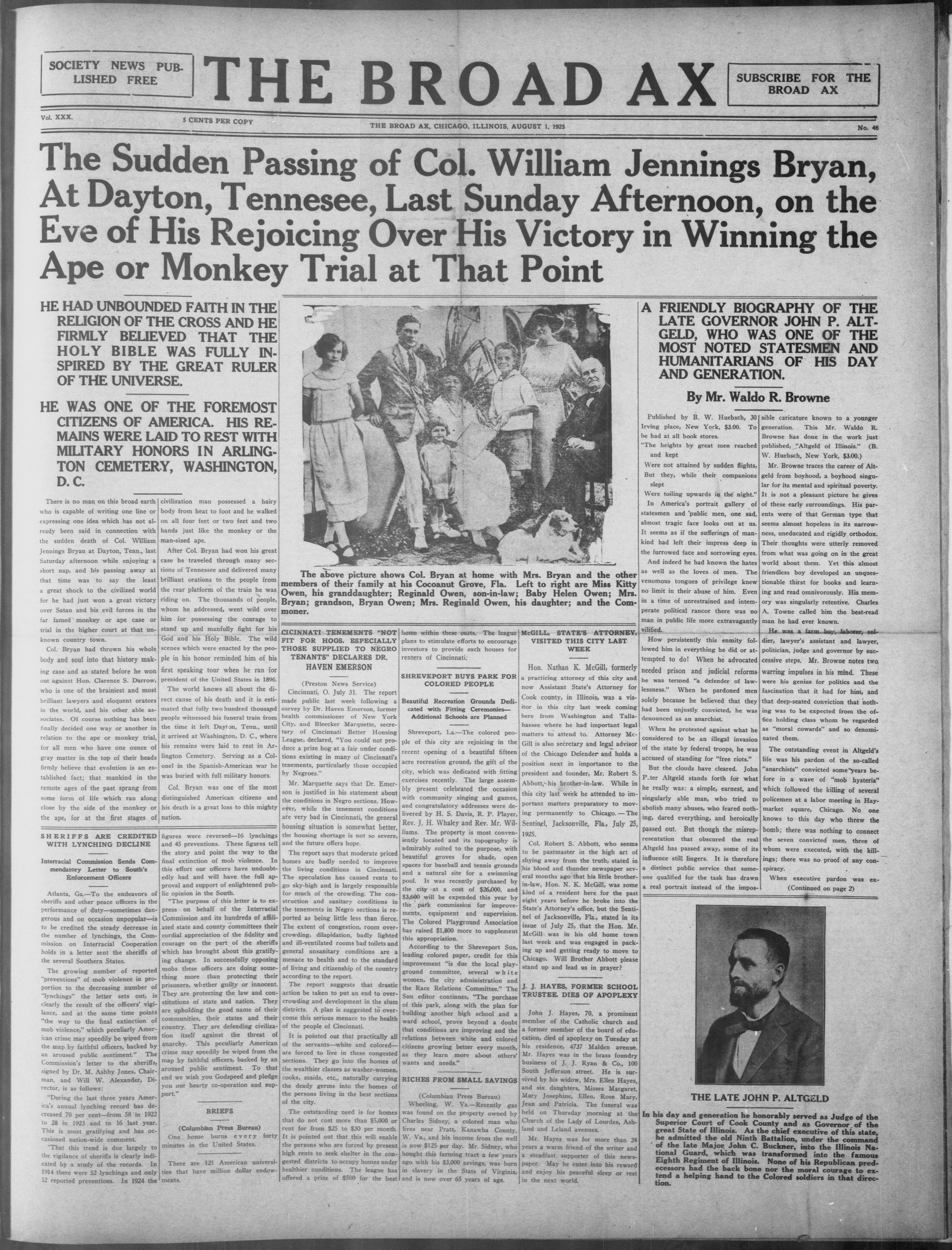
The Sudden Passing of Col. William Jennings Bryan, At Dayton, Tennesee, Last Sunday Afternoon, on the Eve of His Rejoicing Over His Victory in Winning the Ape or Monkey Trial at That Point
SOCIETY NEWS PUBLISHED FREE
Vol. XXX.
The Sudden At Dayton Eve of His Ape or M
HE HAD UNBOUNDED A RELIGION OF THE G FIRMLY BELIEVED HOLY BIBLE WA SPIRED BY THE G OF THE UNIVERSE.
HE WAS ONE OF THE CITIZENS OF AMER MAINS WERE LAID T MILITARY HONORS TON CEMETERY, D. C.
HE HAD UNBOUNDED FAITH IN THE RELIGION OF THE CROSS AND HE FIRMLY BELIEVED THAT THE HOLY BIBLE WAS FULLY INSPIRED BY THE GREAT RULER OF THE UNIVERSE.
HE WAS ONE OF THE FOREMOST CITIZENS OF AMERICA. HIS REMAINS WERE LAID TO REST WITH MILITARY HONORS IN ARLINGTON CEMETERY, WASHINGTON, D.C.
---
Vol. XXX.
There is no man on this broad earth who is capable of writing one line or expressing one idea which has not already been said in connection with the sudden death of Col. William Jennings Bryan at Dayton, Tenn., last Saturday afternoon while enjoying a short nap, and his passing away at that time was to say the least a great shock to the civilized world for he had just won a great victory over Satan and his evil forces in the far famed monkey or ape case or trial in the higher court at that unknown country town.
Col. Bryan had thrown his whole body and soul into that history making case and as stated before he won out against Hon. Clarence S. Darrow, who is one of the brainiest and most brilliant lawyers and eloquent orators in the world, and his other able associates. Of course nothing has been finally decided one way or another in relation to the ape or monkey trial, for all men who have one ounce of gray matter in the top of their heads firmly believe that evolution is an established fact; that mankind in the remote ages of the past sprang from some form of life which ran along close by the side of the monkey or the ape, for at the first stages of
SHERIFFS ARE CREDITED WITH LYNCHING DECLINE
Interracial Commission Sends Commendatory Letter to South's Enforcement Officers
Atlanta, Ga.—To the endeavors of sheriffs and other peace officers in the performance of duty—sometimes dangerous and on occasion unpopular—is to be credited the steady decrease in the number of lynchings, the Commission on Interracial Cooperation holds in a letter sent the sheriffs of the several Southern States.
The growing number of reported "preventions" of mob violence in proportion to the decreasing number of "lynchings" the letter sets out, is clearly the result of the officers' vigilance, and at the same time points "the way to the final extinction of mob violence," which peculiarly American crime may speedily be wiped from the map by faithful officers, backed by an aroused public sentiment." The Commission's letter to the sheriffs, signed by Dr. M. Ashby Jones, Chairman, and Will W. Alexander, Director, is as follows:
"During the last three years America's annual lynching record has decreased 70 per cent—from 58 in 1922 to 28 in 1923 and to 16 last year. This is most gratifying and has occasioned nation-wide comment."
That this trend is due largely to the vigilance of sheriffs is clearly indicated by a study of the records. In 1914 there were 52 lynchings and only 12 reported preventions. In 1924 the
THE BROAD AX
dden Pa
ton, Ten
His Rejo
Monkey
DED FAITH IN THE
HE CROSS AND HE
VED THAT THE
WAS FULLY IN-
E GREAT RULER
RSE.
IN THE FOREMOST
AMERICA. HIS RE-
AID TO REST WITH
NORS IN ARLING-
LY, WASHINGTON,
civilization man possessed a hairy body from heat to foot and he walked on all four feet or two feet and two hands just like the monkey or the man-sized ape.
After Col. Bryan had won his great case he traveled through many sections of Tennessee and delivered many brilliant orations to the people from the rear platform of the train he was riding on. The thousands of people, whom he addressed, went wild over him for possessing the courage to stand up and manfully fight for his God and his Holy Bible. The wild scenes which were enacted by the people in his honor reminded him of his first speaking tour when he ran for president of the United States in 1896. The world knows all about the direct cause of his death and it is estimated that fully two hundred thousand people witnessed his funeral train from the time it left Dayton, Tenn., until it arrived at Washington, D. C., where his remains were laid to rest in Arlington Cemetery. Serving as a Colonel in the Spanish-American war he was buried with full military honors.
Col. Bryan was one of the most distinguished American citizens and his death is a great loss to this mighty nation.
figures were reversed—16 lynchings and 45 preventions. These figures tell the story and point the way to the final extinction of mob violence. In this effort our officers have undoubtedly had and will have the full approval and support of enlightened public opinion in the South.
"The purpose of this letter is to express on behalf of the Interracial Commission and its hundreds of affiliated state and county committees their cordial appreciation of the fidelity and courage on the part of the sheriffs which has brought about this gratifying change. In successfully opposing mobs these officers are doing something more than protecting their prisoners, whether guilty or innocent. They are protecting the law and constitutions of state and nation. They are upholding the good name of their communities, their states and their country. They are defending civilization itself against the threat of anarchy. This peculiarly American crime may speedily be wiped from the map by faithful officers, backed by an aroused public sentiment. To that end we wish you Godspeed and pledge you our hearty co-operation and support."
BRIEFS
(Columbian Press Bureau)
One house burns every forty minutes in the United States.
There are 121 American universities that have million dollar endowments.
THE BROAD AX, CHICAGO, ILLINOIS, AUGUST 1, 1925
THE FAMILY OF MARY C. HARRIS
The above picture shows Col. Bryan at home with Mrs. Bryan and the other members of their family at his Cocoanut Grove, Fla. Left to right are Miss Kitty Owen, his granddaughter; Reginald Owen, son-in-law; Baby Helen Owen; Mrs. Bryan; grandson, Bryan Owen; Mrs. Reginald Owen, his daughter; and the Commoner.
CICINNATI TENEMENTS "NOT FIT FOR HOGS. ESPECIALLY THOSE SUPPLIED TO NEGRO TENANTS" DECLARES DR.
HAVEN EMERSON
Cincinnati, O. July 31. The report made public last week following a survey by Dr. Haven Emerson, former health commissioner of New York City, and Bleecker Marquette, secretary of Cincinnati Better Housing League, declared, "You could not produce a prize hog at a fair under conditions existing in many of Cincinnati's tenements, particularly those occupied by Negroes." Mr. Marquette says that Dr. Emerson is justified in his statement about the conditions in Negro sections. However, while the tenement conditions are very bad in Cincinnati, the general housing situation is somewhat better, the housing shortage is not so severe, and the future offers hope.
The report says that moderate priced homes are badly needed to improve the living conditions in Cincinnati. The speculation has caused rents to go sky-high and is largely responsible for much of the crowding. The construction and sanitary conditions in the tenements in Negro sections is reported as being little less than fierce. The extent of congestion, room overcrowding, dilapidation, badly lighted and ill-ventilated rooms bad toilets and general unsanitary conditions are a menace to health and to the standard of living and citizenship of the country according to the report.
The report suggests that drastic action be taken to put an end to overcrowding and development in the slum districts. A plan is suggested to overcome this serious menace to the health of the people of Cincinnati.
It is pointed out that practically all of the servants—white and colored—are forced to live in these congested sections. They go into the homes of the wealthier classes as washer-women, cooks, maids, etc., naturally carrying the deady germs into the homes of the persons living in the best sections of the city.
The outstanding need is for homes that do not cost more than $5,000 or rent for from $25 to $30 per month. It is pointed out that this will enable the persons who are forced by present high rents to seek shelter in the congested districts to occupy homes under healthier conditions. The league has offered a prize of $500 for the best
home within these costs. The league plans to stimulate efforts to encourage investors to provide such houses for renters of Cincinnati.
SHREVEPORT BUYS PARK FOR
COLORED PEOPLE
Beautiful Recreation Grounds Dedicated with Fitting Ceremonies—Additional Schools are Planned
Shreveport, La.—The colored people of this city are rejoicing in the recent opening of a beautiful fifteen acre recreation ground, the gift of the city, which was dedicated with fitting exercises recently. The large assembly present celebrated the occasion with community singing and games, and congratulatory addresses were delivered by H. S. Davis, R. P. Player, Rev. J. H. Whaley and Rev. Mr. Williams. The property is most conveniently located and its topography is admirably suited to the purpose, with beautiful groves for shade, open spaces for baseball and tennis grounds and a natural site for a swimming pool. It was recently purchased by the city at a cost of $26,000, and $3,600 will be expended this year by the park commission for improvements, equipment and supervision. The Colored Playground Association has raised $1,800 more to supplement this appropriation.
According to the Shreveport Sun, leading colored paper, credit for this improvement "is due the local playground committee, several white women, the city administration and the Race Relations Committee." The Sun editor continues, "The purchase of this park, along with the plan for building another high school and a ward school, prove beyond a doubt that conditions are improving and the relations between white and colored citizens growing better every month, as they learn more about others' wants and needs."
RICHES FROM SMALL SAVINGS
(Columbian Press Bureau)
Wheeling, W. Va.—Recently gas was found on the property owned by Charles Sidney, a colored man who lives near Pratt, Kanawha County, W. Va., and his income from the well is now $125 per day. Mr. Sidney, who bought this farm tract a few years ago with his $3,000 savings, was born in slavery in the State of Virginia, and is now over 65 years of age.
McGILL, STATE'S ATTORNEY, VISITED THIS CITY LAST WEEK
Hon. Nathan K. McGill, formerly a practicing attorney of this city and now Assistant State's Attorney for Cook county, in Illinois, was a visitor in this city last week coming here from Washington and Tallahassee where he had important legal matters to attend to. Attorney McGill is also secretary and legal advisor of the Chicago Defender and holds a position next in importance to the president and founder, Mr. Robert S. Abbott, his brother-in-law. While in this city last week he attended to important matters preparatory to moving permanently to Chicago. — The Sentinel, Jacksonville, Fla., July 25, 1925
Col. Robert S. Abbott, who seems to be pastmaster in the high art of shying away from the truth, stated in his blood and thunder newspaper several months ago that his little brother-in-law, Hon. N. K. McGill, was some kind of a resident here for the past eight years before he broke into the State's Attorney's office, but the Sentinel of Jacksonville, Fla., stated in its issue of July 25, that the Hon. Mr. McGill was in his old home town last week and was engaged in packing up and getting ready to move to Chicago. Will Brother Abbott please stand up and lead us in prayer?
J. HAYES, FORMER SCHOOL
TR. JUSTEE, DIES OF APOPLEXY
J. HAYES, FORMER SCHOOL
John J. Hayes, 70, a prominent member of the Catholic church and a former member of the board of education, died of apoplexy on Tuesday at his residence, 4737 Malden avenue. Mr. Hayes was in the brass foundry business of J. J. Ryan & Co., 100 South Jefferson street. He is survived by his widow, Mrs. Ellen Hayes, and six daughters, Misses Margaret, Mary Josephine, Ellen, Rose Mary, Jean and Patricia. The funeral was held on Thursday morning at the Church of the Lady of Lourdes, Ashland and Leland avenues.
Mr. Hayes was for more than 24 years a warm friend of the writer and a steadfast supporter of this newspaper. May he enter into his reward and enjoy his peaceful sleep or rest in the next world.
SUBSCRIBE FOR THE BROAD AX
BIGS Bryan,
on, on the
nning the
BIOGRAPHY OF THE
ERNOR JOHN P. ALT-
D WAS ONE OF THE
ED STATESMEN AND
RIANS OF HIS DAY
RATION.
A FRIENDLY BIOGRAPHY OF THE LATE GOVERNOR JOHN P. ALTGELD, WHO WAS ONE OF THE MOST NOTED STATESMEN AND HUMANITARIANS OF HIS DAY AND GENERATION.
By Mr. Waldo R. Browne
Published by B. W. Huebsch, 30 Irving place, New York, $3.00. To be had at all book stores.
"The heights by great men reached and kept
Were not attained by sudden flights,
But they, while their companions slept
Were toiling upwards in the night."
In America's portrait gallery of statesmen and 'public men, one sad, almost tragic face looks out at us. It seems as if the sufferings of mankind had left their impress deep in the furrowed face and sorrowing eyes.
And indeed he had known the hates as well as the loves of men. The venomous tongues of privilege knew no limit in their abuse of him. Even in a time of unrestrained and intemperate political rancor there was no man in public life more extravagantly vilified
How persistently this enmity followed him in everything he did or attempted to do! When he advocated needed prison and judicial reforms he was termed "a defender of lawlessness." When he pardoned men solely because he believed that they had been unjustly convicted, he was denounced as an archist. When he protested against what he considered to be an illegal invasion of the state by federal troops, he was accused of standing for "free riots."
But the clouds have cleared. John P.ter Altgeld stands forth for what he really was: a simple, earnest, and singularly able man, who tried to abolish many abuses, who feared nothing, dared everything, and heroically passed out. But though the misrepresentation that obscured the real Altgeld has passed away, some of its influence still lingers. It is therefore a distinct public service that someone qualified for the task has drawn a real portrait instead of the impos-
THE LATE JOHN P. ALTGELD
on he honorably served as Judge of the Cook County and as Governor of the as. As the chief executive of this state, Ninth Battalion, under the command John C. Buckner, into the Illinois Nath was transformed into the famous Illinois. None of his Republican predick bone nor the moral courage to ex- to the Colored soldiers in that direc-
In his day and generation he honorably served as Judge of the Superior Court of Cook County and as Governor of the great State of Illinois. As the chief executive of this state, he admitted the old Ninth Battalion, under the command of the late Major John C. Buckner, into the Illinois National Guard, which was transformed into the famous Eighth Regiment of Illinois. None of his Republican predecessors had the back bone nor the moral courage to extend a helping hand to the Colored soldiers in that direction.
sible caricature known to a younger generation. This Mr. Waldo R. Browne has done in the work just published, "Altgeld of Illinois." (B. W. Huebsch, New York, $3.00.) Mr. Browne traces the career of Altgeld from boyhood, a boyhood singular for its mental and spiritual poverty. It is not a pleasant picture he gives of these early surroundings. His parents were of that German type that seems almost hopeless in its narrowness, uneducated and rigidly orthodox. Their thoughts were utterly removed from what was going on in the great world about them. Yet this almost friendless boy developed an unquestionable thirst for books and learning and read omnivorously. His memory was singularly retentive. Charles A. Towne called him the best-read man he had ever known.
He was a farm boy, laborer, soldier, lawyer's assistant and lawyer, politician, judge and governor by successive steps. Mr. Browne notes two warring impulses in his mind. These were his genius for politics and the fascination that it had for him, and that deep-seated conviction that nothing was to be expected from the office holding class whom he regarded as "moral cowards" and so denominated them.
The outstanding event in Altgeld's life was his pardon of the so-called "anarchists" convicted some years before in a wave of "mob hysteria" which followed the killing of several policemen at a labor meeting in Haymarket square, Chicago. No one knows to this day who threw the bomb; there was nothing to connect the seven convicted men, three of whom were executed, with the killings; there was no proof of any conspiracy.
When executive pardon was ex-(Continued on page 2)
THE BROAD AX
Published Every Saturday
In this city since July 15th, 1899,
without missing one single issue. Republicans, Democrats, Catholics, Protestants, Single Taxers, Priests, infidels or anyone else can have their say as long as their language is proper and responsibility is fixed.
The Broad Ax is a newspaper whose platform is broad enough for all, ever claiming the editorial right to speak its own mind. It is neither Democratic nor Republican. It is strictly or absolutely independent in politics.
Local communications will receive attention. Write only on one side of the paper.
Subscriptions must be paid in advance.
One Year .....$2.00
Six Months .....$1.00
Advertising rates made known on application.
Address all communications to
THE BROAD AX
6206 S. Elizabeth St., Chicago.
Phone: Wentworth 2597
JULIUS F. TAYLOR
Editor and Publisher
Vol. XXX No. 46
Chicago, August 1, 1925
Entered as Second-Class Matter, Aug.
19, 1902, at the Post office at Chicago
Ill. Under Act of March 8, 1879.
NEW LIFE OF THE LATE JOHN
P. ALTGELD
(Continued from page 1) tended, it was not on the ground that sufficient punishment had been imposed, which would have satisfied the consciences of the uneasy, but that a great wrong had been committed. In a closely-reasoned document of many pages, he assailed the conduct of the trial, the police, the judge. What was it that made Altgeld the most reviled and hated figure in America? Not solely the events just cited. Long before that a steady stream of vituperation had set in.
That we may understand the abuse to which Altgeld was subjected for the advocacy of somewhat mild reforms, we must reflect that there was not in his time that so-called developed conscience which we see today in many of the well-to-do. It was a time of open and shameless corruption and bribery in legislative bodies. Altgeld was a pioneer. In his vigorous protests against these conditions he met with little popular response, while he did arouse the virulent hatreds of those who profited by these conditions.
Shy and reserved as Altgeld was to many, there were times when, even in his public utterances, he tore aside the mask of indifference and let the world see him as he was. When he retired from the governorship in 1897, he said, with a certain proud humility: "I have tried to further the best interests of my country, and while I erred in many cases they were errors of judgment, and I go forth with a peaceful conscience."
And from that stormy life to which he was so sorely buffeted by the furies that followed him as in some Greek tragedy, he "went forth" with what is, after all, the best thing in life and at the end of life, "a peaceful conscience."
The foregoing is a splendid review of the stormy and heroic career of John P. Altgeld, who had the courage to do what he thought was right, who was the most feared and hated as well as the most trusted and loved of any man in the public life of his time.
It may be of interest to the various turner societies to know that Altgeld in 1894, while Governor of Illinois, ordered the West Park Board to install a children's play grounds in that part of Douglas Park south of Ogden avenue, with all the necessary turning equipments. This order was given because the "Vorwaerts Turn-Verein" sent a committee, consisting of Nick Dahrn and Henry Kraft, who called on the superintendent of Douglas Park and requested it. When I told the governor of this request he at once ordered the West Park Board to grant it.
When this part of Douglas Park was dedicated, the turner societies of Chicago considered it of sufficient importance to join in the parade and participate in its ceremonies.
Since then children's playgrounds have been formed in every neighborhood of our city. Instead of the Chicago turners being despondent because of their dwindling membership, let them re-
joice that their activities have spread and become a part of the public life of our city, in which the "Vorwaerts" took the lead and to which the heroic Altgeld gave his official sanction and support.
While Governor, Altgeld also had the Lincoln Park Board appoint Edward Osgood Brown of the then firm of Peckham, Brown & Packard as its attorney and then began that long but successful legal fight for the judicial adjudication of the question of riparian rights which ever since enables the Lincoln Park Board to create new lands along the north shore and make it a part of Lincoln Park.
A copy of this book on the stormy life or career of former Governor John P. Altgeld was presented to us a few days ago by our highly esteemed friend, Hon. George A. Schilling, containing the following notation on the flyleaf:
"To my friend, Julius F. Taylor, I present this volume containing the story of the life of the greatest governor Illinois ever had.
'GEORGE A. SCHILLING.'
The book consists of 338 pages. It is printed on splendid paper with large clear type, beautiful blue cloth binding with gold letters and it deserves to be read by all classes of American citizens.
The highly interesting book on Altgeld of Illinois ends with the following lines:
"Sleep softly . . . eagle forgotten . . . under the stone.
Time has its way with you there, and the clay has its own.
Sleep on, O brave-hearted, O wise man, that kindled the flame→
To live in mankind is far more than to live in a name."
1. Away With War
2. Religious Education
3. Pretty Polly
4. Colorgrams
F. Britten, cool historical logician that he is, writes very disconsolately in "The Sunday Pictorial" of London, England, depicting in future years "an unparalleled war to the death between the white and colored races" of the world. Mr. Britten writes in an excited vien, saying: "The shadow of a war cloud in the East is falling darkly upon the hitherto sunny world supremacy of the white race, whose prestige will disappear when the savage, barbaric millions from Africa and Asia can defy the white man."
Even more disconsolately, Mr. Britten continues: "He (the white man) has committed the crowning folly of leading the colored races into battle against white men, and the colored races hate the white with a hate whereof we have no conception."
Friend Britten has wandered far from the pet theory of his race kinsmen, whose scientific satellites picture the darker races of the world, save the Japanese, as an indolent, half-civilized, but happy-go-lucky people, void of initiative and complacent even amid hardship imposed by alleged superior groups. He also wanders far from the psychological proofs, as adduced by his group, of alleged inferior mental equipoise among the dark human spots of the old globe. Lastly, Britten impliedly cast aspersions upon the civilization which his people have carried to the dark vales of Asia and Africa. Methinks, perchance, that FEAR may have guided his pen to portray a retaliation, by the world's darker races, for grave acts of injustice which it is roundly admitted the self-constituted "supremists" have heaped upon weaker races, usually dark, of the world.
Yet, we think—and we are glad so to think—that the calamities penned by friend Britten will never come to pass. That civilization and that Christianization which the darker races have imbibed from the white man's teachings have not yet, thank God, become sufficiently saturated with that master of the white world, "COMMERCIAL SUPREMACY AND ITS MONEY MARKET," to form an eclipse of the true types of idealistic life. While the white world is delving into finance, the dark world is plodding along hopefully, delving into religion, art, music, education and the refining products of honest-to-God civilization. The prospects of war are not, in general, disturbing the mind of the dark world. Rather, on the whole, "away with war" seems to be the hope of the dark world, content, which almost mutely wonders why, in the name of Jehovah, the white world forgets its financial mar-
THE BROAD AX, CHICAGO, ILLINOIS, AUGUST 1, 1925
PETER H.
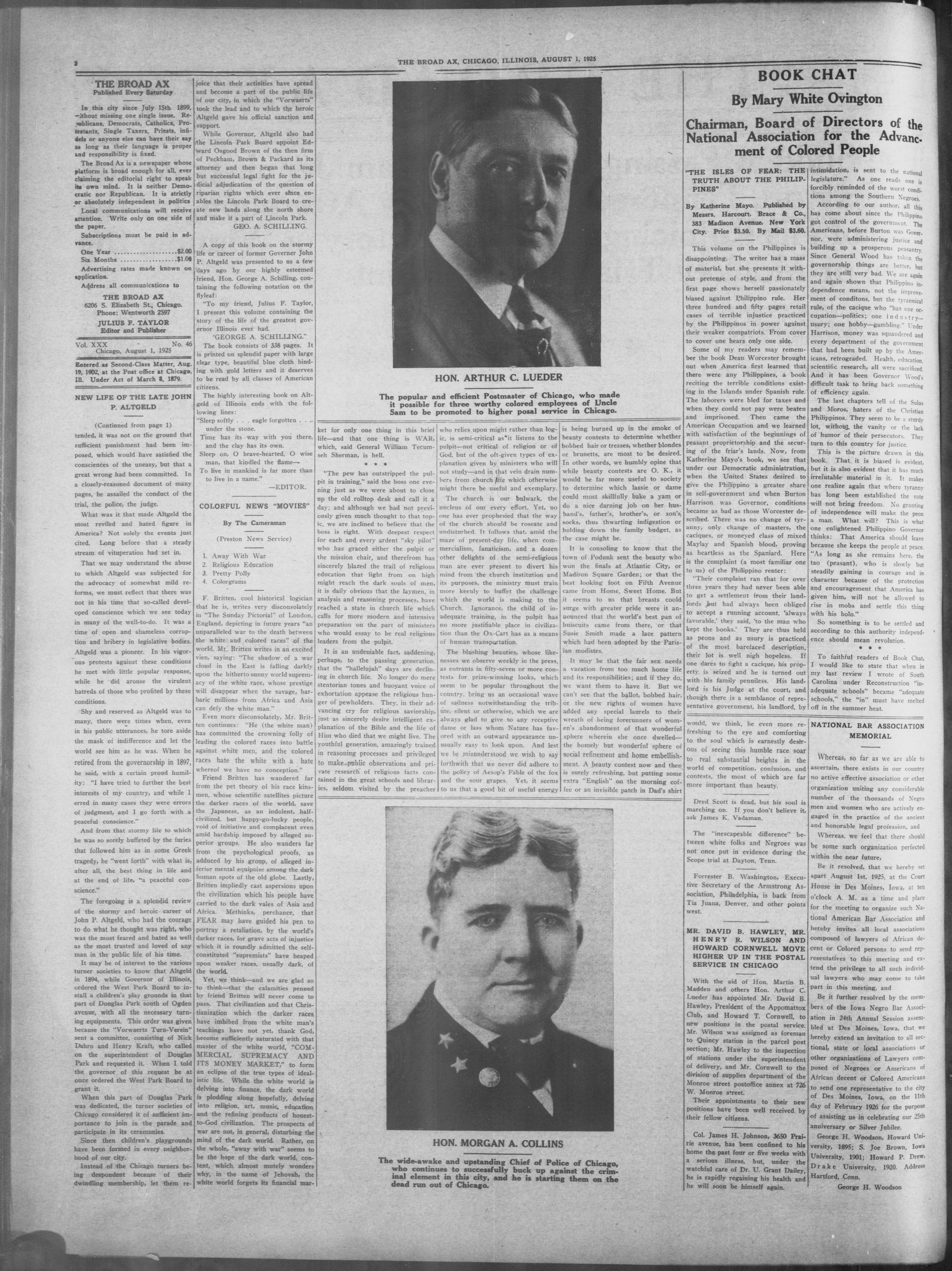
The popular and efficient Postmaster of Chicago, who made it possible for three worthy colored employees of Uncle Sam to be promoted to higher posal service in Chicago.
Sergeant
The wide-awake and upstanding Chief of Police of Chicago, who continues to successfully buck up against the criminal element in this city, and he is starting them on the dead run out of Chicago.
The wide-awake and upstanding Chief of Police of Chicago, who continues to successfully buck up against the criminal element in this city, and he is starting them on the dead run out of Chicago.
ket for only one thing in this brief life—and that one thing is WAR, which, said General William Tecumseh Sherman, is hell.
***
"The pew has outstripped the pulpit in training," said the boss one evening just as we were about to close up the old rolltop desk and call it a day; and although we had not previously given much thought to that topic, we are inclined to believe that the boss is right. With deepest respect for each and every ardent "sky pilot" who has graced either the pulpit or the mission chair, and therefrom has sincerely blazed the trail of religious education that light from on high might reach the dark souls of men, it is daily obvious that the laymen, in analysis and reasoning processes, have reached a state in church life which calls for more modern and intensive preparation on the part of ministers who would essay to be real religious leaders from the pulpit.
It is an undeniable fact, saddening perhaps, to the passing generation, that the "hallelujah" days are declining in church life. No longer do mere stentorian tones and buoyant voice of exhortation appease the religious hunger of pewholders. They, in their advancing cry for religious saviorship, just as sincerely desire intelligent explanation of the Bible and the life of Him who died that we might live. The youthful generation, amazingly trained in reasoning processes and privileged to make-public observations and private research of religious facts contained in the great schools and libraries, seldom visited by the preacher
HON. ARTHUR C. LUEDER and efficient Postmaster of Chica for three worthy colored employ promoted to higher posal servic
who relies upon might rather than logic, is semi-critical as it listens to the pulpit—not critical of religion or of God, but of the oft-given types of explanation given by ministers who will not study—and in that vein drain numbers from church life which otherwise might there be useful and exemplary. The church is our bulwark, the nucleus of our every effort. Yet, no one has ever prophesied that the way of the church should be roseate and undisturbed. It follows that, amid the maze of present-day life, when commercialism, fanaticism, and a dozen other delights of the semi-religious man are ever present to divert his mind from the church institution and its purposes, the ministry must train more keenly to buffet the challenge which the world is making to the Church. Ignorance, the child of inadequate training, in the pulpit has no more justifiable place in civilization than the Ox-Cart has as a means of human transportation.
The blushing beauties, whose likenesses we observe weekly in the press, as entrants in fifty-seven or more contests for prize-winning looks, which seem to be popular throughout the country, bring us an occasional wave of sadness notwithstanding the tribute, silent or otherwise, which we are always glad to give to any receptive dame or lass whom Nature has favored with an outward appearance unusually easy to look upon. And lest we be misunderstood we wish to say forthwith that we never did adhere to the policy of Aesop's Fable of the fox and the sour grapes. Yet, it seems to us that a good bit of useful energy
S.
HON. MORGAN A. COLLINS
take and upstanding Chief of Police
annues to successfully buck up aga-
ment in this city, and he is starting
out of Chicago.
is being burned up in the smoke of beauty contests to determine whether bobbed hair or tresses, whether blondes or brunettes, are most to be desired. In other words, we humbly opine that while beauty contests are O. K., it would be far more useful to society to determine which lassie or dame could most skillfully bake a yam or do a nice darning job on her husband's, father's, brother's, or son's socks, thus thwarting indigestion or holding down the family budget, as the case might be.
It is consoling to know that the town of Podunk sent the beauty who won the finals at Atlantic City, or Madison Square Garden; or that the best looking foot on Fifth Avenue came from Home, Sweet Home. But it seems to us that breasts could surge with greater pride were it announced that the world's best pan of buiscuits came from there, or that Susie Smith made a lace pattern which had been adopted by the Parisian modistes.
It may be that the fair sex needs a vacation from too much home life and its responsibilities; and if they do, we want them to have it. But we can't see that the ballot, bobbed hair, or the new rights of women have added any special laurels to their wreath of being forerunners of women's abandonment of that wonderful sphere wherein she once dwelled—the homely but wonderful sphere of social refinement and home embellishment. A beauty contest now and then is surely refreshing, but putting some extra "English" on the morning coffee or an invisible patch in Dad's shirt
BOOK CHAT
By Mary White Ovington
Chairman, Board of Directors of the National Association for the Advancement of Colored People
"THE ISLES OF FEAR: THE TRUTH ABOUT THE PHILIPPINES"
By Katherine Mayo. Published by Messrs. Harcourt, Brace & Co., 383 Madison Avenue, New York City. Price $3.50. By Mail $3.60.
This volume on the Philippines is disappointing. The writer has a mass of material, but she presents it without pretense of style, and from the first page shows herself passionately biased against Philippino rule. Her three hundred and fifty pages retail cases of terrible injustice practiced by the Philippines in power against their weaker compatriots. From cover to cover one hears only one side.
Some of my readers may remember the book Dean Worcester brought out when America first learned that there were any Philippines, a book reciting the terrible conditions existing in the Islands under Spanish rule. The laborers were bled for taxes and when they could not pay were beaten and imprisoned. Then came the American Occupation and we learned with satisfaction of the beginnings of peasant proprietorship and the securing of the friar's lands. Now, from Katherine Mayo's book, we see that under our Democratic administration, when the United States desired to give the Philippino a greater share in self-government and when Burton Harrison was Governor, conditions became as bad as those Worcester described. There was no change of tyranny, only change of masters, the caciques, or moneyed class of mixed Maylay and Spanish blood, proving as heartless as the Spaniard. Here is the complaint (a most familiar one to us) of the Philippino renter:
'Their complaint ran that for over three years they had never been able to get a settlement from their landlords but had always been obliged to accept a running account, 'always favorable,' they said, 'to the man who kept the books.' They are thus held as peons and as usury is practiced of the most barefaced description, their lot is well nigh hopeless. If one dares to fight a cacique, his property is seized and he is turned out with his family penniless. His landlord is his Judge at the court, and though there is a semblance of representative government, his landlord, by
would, we think, be even more refreshing to the eye and comforting to the soul which is earnestly desirous of seeing this humble race soar to real substantial heights in the world of competition, confusion, and contests, the most of which are far more important than beauty.
Dred Scott is dead, but his soul is marching on. If you don't believe it, ask James K. Vadaman.
The "inescapeable difference" between white folks and Negroes was not once put in evidence during the Scope trial at Dayton, Tenn.
Forrester B. Washington, Executive Secretary of the Armstrong Association, Philadelphia, is back from Tia Juana, Denver, and other points west.
MR. DAVID B. HAWLEY, MR.
HENRY R. WILSON AND
HOWARD CORNWELL MOVE
HIGHER UP IN THE POSTAL
SERVICE IN CHICAGO
With the aid of Hon. Martin B. Madden and others Hon. Arthur C. Lueder has appointed Mr. David B. Hawley, President of the Appomattox Club, and Howard T. Cornwell, to new positions in the postal service. Mr. Wilson was assigned as foreman to Quincy station in the parcel post section; Mr. Hawley to the inspection of stations under the superintendent of delivery, and Mr. Cornwell to the division of supplies department of the Monroe street postoffice annex at 726 W. Monroe street. Their appointments to their new positions have been well received by their fellow citizens.
Col. James H. Johnson, 3650 Prairie avenue, has been confined to his home the past four or five weeks with a serious illness, but, under the watchful care of Dr. U. Grant Dailey, he is rapidly regaining his health and he will soon be himself again.
of Directors of the for the Advancored People
intimidation, is sent to the national legislature." As one reads one is forcibly reminded of the worst conditions among the Southern Negroes. According to our author, all this has come about since the Philippine got control of the government. The Americans, before Burton was Governor, were administering justice and building up a prosperous peasantry. Since General Wood has taken the governorship things are better, but they are still very bad. We are again and again shown that Philippino independence means, not the improvement of conditions, but the tyrannical rule, of the cacique who "has one occupation—politics; one industry—usury; one hobby—gambling." Under Harrison, money was squandered and every department of the government that had been built up by the Americans, retrograded. Health, education, scientific research, all were sacrificed. And it has been Governor Wood's difficult task to bring back something of efficiency again.
The last chapters tell of the Sultan and Moros, haters of the Christian Philippines. They seem to be a sturdy lot, without the vanity or the lack of humor of their persecutors. They turn to this country for justice.
This is the picture drawn in this book. That it is biased is evident, but it is also evident that it has much irrefutable material in it. It makes one realize again that where tyranny has long been established the vote will not bring freedom. No granting of independence will make the peon a man. What will? This is what one enlightened Philippino Governor thinks: That America should leave because she keeps the people at peace. "As long as she remains here, the tao (peasant), who is slowly but steadily gaining in courage and in character because of the protection and encouragement that America has given him, will not be allowed to rise in mobs and settle this thing with his bolo."
So something is to be settled and according to this authority independence should mean revolution.
* * *
To faithful readers of Book Chat, I would like to state that when in my last review I wrote of South Carolina under Reconstruction "inadequate schools" became "adequate schools," the "in" must have melted off in the summer heat.
NATIONAL BAR ASSOCIATION
MEMORIAL
Whereas, so far as we are able to ascertain, there exists in our country no active effective association or other organization uniting any considerable number of the thousands of Negro men and women who are actively engaged in the practice of the ancient and honorable legal profession, and Whereas, we feel that there should be some such organization perfected within the near future.
Be it resolved, that we hereby set apart August 1st, 1925, at the Court House in Des Moines, Iowa, at ten o'clock A. M. as a time and place for the meeting to organize such National American Bar Association and hereby invites all local associations composed of lawyers of African decent or Colored persons to send representatives to this meeting and extend the privilege to all such individual lawyers who may come to take part in this meeting, and
Be it further resolved by the members of the Iowa Negro Bar Association in 24th Annual Session assembled at Des Moines, Iowa, that we hereby extend an invitation to all sectional, state or local associations or other organizations of Lawyers composed of Negroes or Americans of African decent or Colored Americans to send one representative to the city of Des Moines, Iowa, on the 11th day of February 1926 for the purpose of assisting us in celebrating our 25th anniversary or Silver Jubilee.
George H. Woodson, Howard University, 1895; S. Joe Brown, Iowa University, 1901; Howard P. Drew, Drake University, 1920. Address Hartford, Conn.
George H. Woodson
The Thirtieth Anniversary Edition of The Broad Ax Will Appear Saturday, September 12, 1925. It Has Been Published in Chicago for Twenty-Six Years, Without Missing One Single Issue
336 C520
HON. OSCAR HEBEL
One of the honorable and straightforward
Superior Court of Cook County, who n
enter the race as the United Republ
Mayor of Chicago in 1927.
THIS WEEK
By Ernest Rice McKinney
(Preston News Service)
is ashamed of he
feels peeved a
him by and tak
He doesn't wa
he wants our
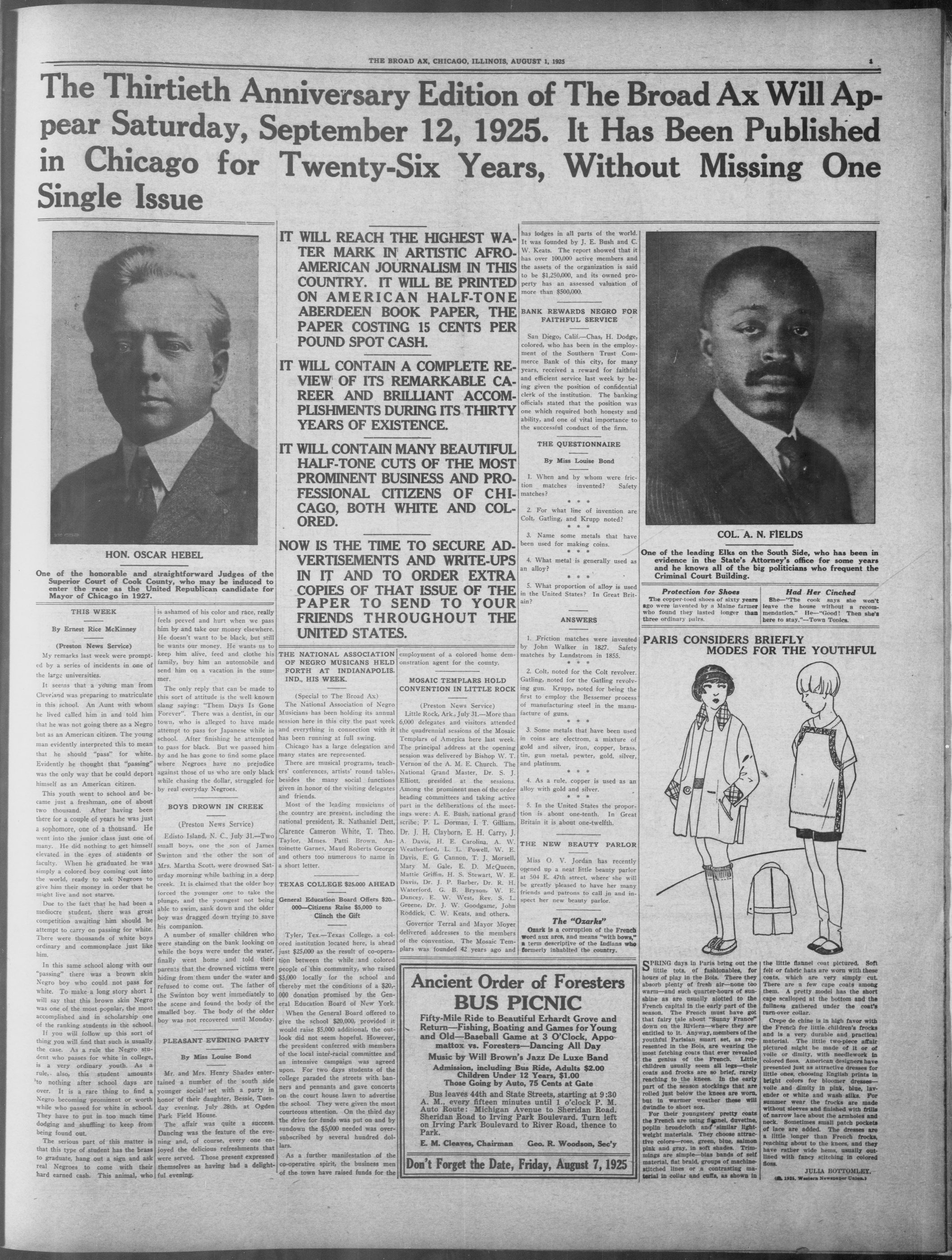
One of the honorable and straightforward Judges of the Superior Court of Cook County, who may be induced to enter the race as the United Republican candidate for Mayor of Chicago in 1927.
My remarks last week were prompted by a series of incidents in one of the large universities.
It seems that a young man from Cleveland was preparing to matriculate in this school. An Aunt with whom he lived called him in and told him that he was not going there as a Negro but as an American citizen. The young man evidently interpreted this to mean that he should "pass" for white. Evidently he thought that "passing" was the only way that he could deport himself as an American citizen.
This youth went to school and became just a freshman, one of about two thousand. After having been there for a couple of years he was just a sophomore, one of a thousand. He went into the junior class just one of many. He did nothing to get himself elevated in the eyes of students or faculty. When he graduated he was simply a colored boy coming out into the world, ready to ask Negroes to give him their money in order that he might live and not starve.
Due to the fact that he had been a mediocre student, there was great competition awaiting him should he attempt to carry on passing for white. There were thousands of white boys ordinary and commonplace just like him.
In this same school along with our "passing" there was a brown skin Negro boy who could not pass for white. To make a long story short I will say that this brown skin Negro was one of the most popular, the most accomplished and in scholarship one of the ranking students in the school. If you will follow up this sort of thing you will find that such is usually the case. As a rule the Negro student who passes for white in college, is a very ordinary youth. As a rule, also, this student amounts to nothing after school days are over. It is a rare thing to find a Negro becoming prominent or worth while who passed for white in school. They have to put in too much time dodging and shuffling to keep from being found out.
The serious part of this matter is that this type of student has the brass to graduate, hang out a sign and ask real Negroes to come with their hard earned cash. This animal, who
straightforward Judges of the unty, who may be induced to cited Republican candidate for is ashamed of his color and race, really feels peeved and hurt when we pass him by and take our money elsewhere. He doesn't want to be black, but still he wants our money. He wants us to keep him alive, feed and clothe his family, buy him an automobile and send him on a vacation in the summer.
The only reply that can be made to this sort of attitude is the well known slang saying: "Them Days Is Gone Forever". There was a dentist, in our town, who is alleged to have made attempt to pass for Japanese while in school. After finishing he attempted to pass for black. But we passed him by and he has gone to find some place where Negroes have no prejudice against those of us who are only black while chasing the dollar, struggled for by real everyday Negroes.
BOYS DROWN IN CREEK
(Preston News Service)
Edisto Island, N. C., July 31.—Two small boys, one the son of James Swinton and the other the son of Mrs. Martha Scott, were drowned Saturday morning while bathing in a deep creek. It is claimed that the older boy forced the younger one to take the plunge, and the youngest not being able to swim, sank down and the older boy was dragged down trying to save his companion.
A number of smaller children who were standing on the bank looking on while the boys were under the water, finally went home and told their parents that the drowned victims were hiding from them under the water and refused to come out. The father of the Swinton boy went immediately to the scene and found the body of the smalled boy. The body of the older boy was not recovered until Monday.
PLEASANT EVENING PARTY
Mr. and Mrs. Henry Shades entertained a number of the south side younger social set with a party in honor of their daughter, Bessie, Tuesday evening, July 28th, at Ogden Park Field House.
The affair was quite a success. Dancing was the feature of the evening and, of course, every one enjoyed the delicious refreshments that were served. Those present expressed themselves as having had a delightful evening.
---
THE BROAD AX, CHICAGO, ILLINOIS, AUGUST 1, 1925
IT WILL REACH THE HIGHEST WATER MARK IN ARTISTIC AFROAMERICAN JOURNALISM IN THIS COUNTRY. IT WILL BE PRINTED ON AMERICAN HALF-TONE ABERDEEN BOOK PAPER, THE PAPER COSTING 15 CENTS PER POUND SPOT CASH.
IT WILL CONTAIN A COMPLETE REVIEW OF ITS REMARKABLE CAREER AND BRILLIANT ACCOMPLISHMENTS DURING ITS THIRTY YEARS OF EXISTENCE. IT WILL CONTAIN MANY BEAUTIFUL HALF-TONE CUTS OF THE MOST PROMINENT BUSINESS AND PROFESSIONAL CITIZENS OF CHICAGO, BOTH WHITE AND COLORED.
NOW IS THE TIME TO SECURE AD-VERTISEMENTS AND WRITE-UPS IN IT AND TO ORDER EXTRA COPIES OF THAT ISSUE OF THE PAPER TO SEND TO YOUR FRIENDS THROUGHOUT THE UNITED STATES.
THE NATIONAL ASSOCIATION OF NEGRO MUSICANS HELD FORTH AT INDIANAPOLIS, IND., HIS WEEK.
employment of a colored home demonstration agent for the county.
MOSAIC TEMPLARS HOLD
(Special to The Broad Ax)
The National Association of Negro Musicians has been holding its annual session here in this city the past week and everything in connection with it has been running at full swing.
Chicago has a large delegation and many states are represented.
There are musical programs, teachers' conferences, artists' round tables, besides the many social functions given in honor of the visiting delegates and friends.
Most of the leading musicians of the country are present, including the national president, R. Nathaniel Dett, Clarence Cameron White, T. Theo Taylor, Mmes. Patti Brown, Antoinette Garnes, Maud Roberts George and others too numerous to name in a short letter.
TEXAS COLLEGE $25,000 AHEAD
Tyler, Tex.-Texas College, a colored institution located here, is ahead just $25,000 as the result of co-operation between the while and colored people of this community, who raised $5,000 locally for the school and thereby met the conditions of a $20,000 donation promised by the General Education Board of New York. When the General Board offered to give the school $20,000, provided it would raise $5,000 additional, the outlook did not seem hopeful. However, the president conferred with members of the local inter-racial committee and an intensive campaign was agreed upon. For two days students of the college paraded the streets with banners and pennants and gave concerts on the court house lawn to advertise the school. They were given the most courteous attention. On the third day the drive for funds was put on and by sundown the $5,000 needed was over-subscribed by several hundred dollars.
As a further manifestation of the co-operative spirit, the business men of the town have raised funds for the
Ancient Order of Foresters BUS PICNIC
Fifty-Mile Ride to Beautiful Erhardt Grove and Return—Fishing, Boating and Games for Young and Old—Baseball Game at 3 O'Clock, Appomattox vs. Foresters—Dancing All Day
Music by Will Brown's Jazz De Luxe Band
Admission, including Bus Ride, Adults $2.00
Children Under 12 Years, $1.00
Those Going by Auto, 75 Cents at Gate
Bus leaves 44th and State Streets, starting at 9:30
A. M., every fifteen minutes until 1 o'clock P. M.
Auto Route: Michigan Avenue to Sheridan Road.
Sheridan Road to Irving Park Boulevard. Turn left on Irving Park Boulevard to River Road, thence to Park.
E. M. Cleaves, Chairman Geo. R. Woodson, Sec'y
Don't Forget the Date, Friday, August 7, 1925
employment of a colored home demonstration agent for the county.
MOSAIC TEMPLARS HOLD
CONVENTION IN LITTLE ROCK
(Preston News Service)
Little Rock, Ark., July 31.—More than 6,000 delegates and visitors attended the quadrennial sessions of the Mosaic Templars of America here last week. The principal address at the opening session was delivered by Bishop W. T. Vernon of the A. M. E. Church. The National Grand Master, Dr. S. J. Elliott, presided at the sessions. Among the prominent men of the order heading committees and taking active part in the deliberations of the meetings were: A. E. Bush, national grand scribe; P. L. Dorman, I. T. Gilliam, Dr. J. H. Clayborn, E. H. Carry, J. A. Davis, H. E. Carola, A. W. Weatherford, L. L. Powell, W. E. Davis, E. G. Cannon, T. J. Morsell, Mary M. Gale, E. D. McQueen, Mattie Griffin, H. S. Stewart, W. E. Davis, Dr. J. P. Barber, Dr. R. H. Waterford, G. B. Bryson, W. E. Dancey, E. W. West, Rev. S. L. Greene, Dr. J. W. Goodgame, John Roddick, C. W. Keats, and others.
Governor Terral and Mayor Moyer delivered addresses to the members of the convention. The Mosaic Templars was founded 42 years ago and
has lodges in all parts of the world.
It was founded by J. E. Bush and C. W. Keats. The report showed that it has over 100,000 active members and the assets of the organization is said to be $1,250,000, and its owned property has an assessed valuation of more than $500,000.
BANK REWARDS NEGRO FOR
FAITHFUL SERVICE
San Diego, Calif.-Chas, H. Dodge, colored, who has been in the employment of the Southern Trust Commerce Bank of this city, for many years, received a reward for faithful and efficient service last week by being given the position of confidential clerk of the institution. The banking officials stated that the position was one which required both honesty and ability, and one of vital importance to the successful conduct of the firm.
THE QUESTIONNAIRE
By Miss Louise Bond
1. When and by whom were friction matches invented? Safety matches?
* * *
2. For what line of invention are Colt, Gatling, and Krupp noted?
* * *
3. Name some metals that have been used for making coins.
* * *
4. What metal is generally used as an alloy?
* * *
5. What proportion of alloy is used in the United States? In Great Britain?
ANSWERS
1. Friction matches were invented by John Walker in 1827. Safety matches by Landstrom in 1855.
* * *
2. Colt, noted for the Colt revolver. Gatling, noted for the Gatling revolving gun. Krupp, noted for being the first to employ the Bessemer process of manufacturing steel in the manufacture of guns.
* * *
3. Some metals that have been used in coins are electrom, a mixture of gold and silver, iron, copper, brass, tin, gun metal, pewter, gold, silver, and platinum.
* * *
4. As a rule, copper is used as an alloy with gold and silver.
5. In the United States the proportion is about one-tenth. In Great Britain it is about one-twelfth.
THE NEW BEAUTY PARLOR
Miss O. V. Jordan has recently opened up a neat little beauty parlor at 504 E. 47th street, where she will be greatly pleased to have her many friends and patrons to call in and inspect her new beauty parlor.
The "Ozarks"
Ozark is a corruption of the French word aux arcs, and means "with bows," a term descriptive of the Indians who formerly inhabited the country.
of Foresters
PICNIC
Fatiful Erhardt Grove and
ing and Games for Young
ne at 3 O'Clock, Appo-
s—Dancing All Day
's Jazz De Luxe Band
COL. A. N. FIELDS
One of the leading Elks on the evidence in the State's A and he knows all of the b Criminal Court Building.
Protection for Shoes
The copper-toed shoes of sixty years ago were invented by a Maine farmer who found they lasted longer than three ordinary pairs.
PARIS CONSIDERS MODES F
Elks on the South Side
State's Attorney's offi
all of the big politician
Building.
Shoes
of sixty years
Maine farmer
longer than
Had
She—"The
leave the h
mendation."
here to stay."
RIDERS BRIEFLY
ODES FOR THE
One of the leading Elks on the South Side, who has been in evidence in the State's Attorney's office for some years and he knows all of the big politicians who frequent the Criminal Court Building.
Protection for Shoes
The copper-toed shoes of sixty years ago were invented by a Maine farmer who found they lasted longer than three ordinary pairs.
Had Her Cinched
She—"The cook says she won't leave the house without a recommendation." He—"Good! Then she's here to stay."—Town Topics.
PARIS CONSIDERS BRIEFLY MODES FOR THE YOUTHFUL
1920s
SPRING days in Paris bring out the little tots, of fashionables, for hours of play in the Bois. There they absorb plenty of fresh air—none too warm—and such quarter-hours of sunshine as are usually alotted to the French capital in the early part of the season. The French must have got that fairy tale about "Sunny France" down on the Riviera—where they are entitled to it. Anyway, members of the youthful Parisian smart set, as represented in the Bois, are wearing the most fetching cats that ever revealed the genius of the French. Little children usually seem all legs—their coats and frocks are so brief, rarely reaching to the knees. In the early part of the season stockings that are rolled just below the knees are worn, but in warmer weather these will dwindle to short sox.
For their youngsters' pretty coats the French are using flannel, duvetine, poplin broadcloth and 'similar lightweight materials. They choose attractive colors—rose, green, blue, salmon pink and gray, in soft shades. Trimmings are simple—blas bands of self material, flat braid, groups of machine-stitched lines or a contrasting material in collar and cuffs, as shown in
```markdown
```
Had Her Cinched
She—"The cook says she won't leave the house without a recommendation." He—"Good! Then she's here to stay."—Town Topics.
BRIEFLY
FOR THE YOUTHFUL
the little fannel coat pictured. Soft felt or fabric hats are worn with these coats, which are very simply cut. There are a few cape coats among them. A pretty model has the short cape scalloped at the bottom and the fullness gathered under the coat's turn-over collar.
Crepe de chine is in high favor with the French for little children's frocks and is a very durable and practical material. The little two-piece affair pictured might be made of it or of volle or dimity, with needlework in colored floss. American designers have presented just as attractive dresses for little ones, choosing English prints in bright colors for bloomer dresses—volle and dimity in pink, blue, lavender or white and wash silks. For summer wear the frocks are made without sleeves and finished with frills of narrow lace about the armholes and neck. Sometimes small patch pockets of lace are added. The dresses are a little longer than French frocks, reaching about to the knees, and they have rather wide hems, usually outlined with fancy stitching in colored floss.
JULIA BOTTOMLEY.
1925. Western Newspaper Union.
```markdown
```
Ernest H.
WILLIAMSON
UNDERTAKER
ERnest H. WILLIAMSON
UNDERTAKER
5121-23-29
E. H. WILLIAMSON
Charlest. Dawson
"When you admire my hair and ask what I do to make it so soft and lovely, I tell them my experience."
"I used to have dandruff and it made my hair coarse and hard to manage. I wished with all my heart for soft, pretty hair but did not know how to have it until I learned of Exelento Quinine Pomade."
"With this wonderful preparation my hair soon become silky, long and lovely as it is today."
"Exelento Skin Soap too did wonders for me. It cleared my face of sallowness and pimples, leaving it velvety and admired by all who know me."
Any woman who wants beautiful hair and facial lovliness should get Exelento Quinine Pomade and Exelento Skin Soap at once. They can be obtained at all drugstores, only 25% each, or will be sent, postpaid, upon receipt of price.
Send your name today and get our valuable book of beauty help, and liberal advice.
EXELENTO MEDICINE CO., Atlanta, Ga
AGENTS WANTED EVERYWHERE
Write For Particular
Swore by the Beard
In the Middle ages the seal on documents of great importance contained three hairs from the sovereign's beard as a sign that matters of much moment were concerned.
Seats Once Land Animals?
Seals are probably of land origin, but have become almost perfectly adapted to life in the water. They seek land or ice floes only for breeding and rearing of young.
Municipalities
A municipality is an incorporated city, town, village or borough possessing a charter of incorporation conferring privileges of local self-government.
Use Wisdom in Giving
Liberality is not giving much but giving wisely. Benjamin Franklin.
GIRLS IN CHIC SUITS ANSWER CALL OF THE SANDS
CHRISTINE BLAIR
N A summer of gay apparel one would expect beach and bathing suits to outstrip all others in audacity of color and design and among them there are many that are vividly colored. But they are outnumbered by suits made up in black or dark blue, with touches of bright color in pipings of bands. There is considerable variety in design and much diversity in materials used for beach wear. Silks are represented by satin and by taffeta in plain and printed patterns including plaids, by cotton broadcloth, cretonne and terry cloth and wool by plain or figured knitted garments—the newest of the last in laquered patterns. In beach toggery rubber and rubberized silk is represented in caps, scarfs, capes and bags. Capes and robes of terry cloth are scheduled for much popularity and capes of gagly flowered cretonne may
THE BROAD AX, CHICAGO, ILLINOIS, AUGUST 1, 1925
dispute honors with them. Blazer stripes, in the strongest colors with white, are featured in coats of heavy twill cotton fabrics. The coole coat of flowered cretonne or satin, worn with black satin trousers, is a promising aspirant for favor as a beach costume. Then there are beach pajamas of flowered cretonne or a combination of cretonne coat and black satin trousers.
Black taffeta suits make the fate of long, gayly colored rubber scarfs very certain—they will be found in each other's company all summer. Rubber garters and cap to match the scarf lend much chic to the black costume. Bathing slippers are as varied as the suits and may be had in rubber, satin or terry cloth in many different patterns and in varied colors.
JULIA BOTTOMLEY.
( @ 1925, Western Newspaper Union.)
LINCOLN STATE BANK OF CHICAGO Under State Government Supervision 31st and South State Streets Telephone Victor
And Yet That "Roll"
The mind is capable of embracing almost any belief or conviction. And the psychoanalysts tell us some of these are revealed in dreams. Strangely, too, they claim we often forget our most important dreams. Perhaps some psychoanalyst can explain this story, which is vouchered for by Tim Crowley. A friend of Tim's had a failing for stuss. For two years his losses at this card game were the cause of a regular Saturday night squabble with his wife. But every tide turns some time, and one night Jim arrived home with a fine swagger and $1,800 in bills. His long-suffering spouse immediately seized the roll.
"I am going to keep this for all you have lost," she announced determinedly.
Jim had nothing to say, but noticed that she put the money under the pillow.
After they had retired Jim began to think how, instead of winning $1,800, he might have won $18,000 by playing his luck stronger. The idea gained such strength that he slipped the money from under the head of the sleeping Mrs. Jim and with it sneaked back to the game. A few hours later he returned, having lost all, and crawled into bed again without disturbing his mate.
He had been asleep only a short time when his wife shook him.
"Jim, get up!" she said.
"What for?" he asked.
"I want you to get up early to take that money to the bank for me."
"You're talking crazy, woman," said Jim, sitting up suddenly. "I didn't win any money last night. You've been dreamed."
Mrs. Jim strode to the bed, lifted her pillow and a strange look spread over her face. As she walked away she muttered: "Who would believe a dream could seem so true?"—New York World.
Tobacco Seed Smaller Than That of Mustard
the cultivation of the tobacco used in the making of cigarettes is a most interesting process, even to those who may disapprove of the habit of smoking the completed product. The tobacco seed is so tiny that a single tablespoonful will produce plants enough to cover ten acres. Certain growers whose crops are always of the highest excellence will not sell a single seed at any price. Every crop is kept in the warehouse from three to five years for the purpose of "melowing" or "sweating"—which occurs twice yearly—before the leaves are subject to "stemming." Sand and dust that have remained are shaken out by sieves, with the result that the tobacco is 25 to 30 per cent lighter because of the absence of the midrib and sand. Nimble-fingered girls can make 2,500 cigarettes a day, but machines can turn out 400 finished cigarettes a minute, or 190,000 in an ordinary working day.
JAS. B. McCAHEY, President
FRANK J. DUNN, Vice-President
ESTABLISHED
JOHN J.
COAH
Telephone O
5100 Federal Street
Statement of
Loan
Bond
Bank
Furnit
Cash
Bar
Other
Condition
At the
Close of
Business
on
April 6, 1925
LINCOLN S
OF CHI
Grant that not only the love of liberty, but a thorough knowledge of the rights of man may pervade all the nations of the earth, so that a philosopher may set his foot anywhere on its surface and say, "This is my country."—Benjamin Franklin.
Phones: Office Main 4153; Residence,
4751 Champlain Avenue
Phone Kenwood 5611
Walter M. Farmer
ATTORNEY AND COUNSELOR
AT LAW
Suite 708—184 W. Washington St.
CHICAGO
Phone Main 2017
A. L. WILLIAMS
ATTORNEY AND
COUNSELOR AT LAW
Suite 706 Firmenich Building
184 W. Washington St.
CHICAGO
Residence 3655 Prairie Ave.
Phone Douglas 9133
W. G. Anderson
Attorney At Law
17 North La Salle Street
CHICAGO
NOTARY PUBLIC
Suite 560 Watson Bldg.
Office Phones: Dearborn 7094-7088
Res. 3354 Vernon Avenue
Phone Douglas 6045
Residence, 1262 Macalister Place
Telephone Monroe 2714
MILES J. DEVINE
ATTORNEY AT LAW
Suite 318-320 Reaper Block
Clark and Washington Sts.
CHICAGO
Telephone Central 1239
Telephone: State 3278
A. D. GASH
ATTORNEY AT LAW
Suite 813, Ashland Block
155 N. Clark Street
CHICAGO, ILL.
PHILIP J. DUNN, Secretary
H. X. COMERFORD, Treasurer
BILISHED 1877
BEN J. DUNN
DAL CO.
me Oakland 1550
CHICAGO
RESOURCES
Loans and Discounts..... $2,002,602.57
Bonds and Securities..... 925,886.34
Bank Building and Annex..... 152,646.08
Furniture and Fixtures..... 18,886.62
Cash on Hand and Due from
Banks..... 550,558.71
Other Resources..... 77,916.27
Total..... $3,727,394.49
LIABILITIES
Capital Stock..... $ 400,000.00
Surplus..... 50,000.00
Undivided Profits..... 18,566.13
Reserved for Taxes and Inter-
est..... 6,208.58
Other Liabilities..... 44,438.85
Deposits..... 8,208,220.93
Total..... $3,727,394.49
This Bank invites you to avail yourself
of its complete facilities.
First Mortgage Gold Bonds—approved
safe investments — yield 7% interest.
Boxes in our completely equipped Safety Deposit Rentals rent for $4.00 per year and upwards.
Interest at the rate of 8% is allowed on Savings Department open from 9 a.m. to 8 p.m. Saturdays.
GEORGE F. LEIBRANDT, President
CHARLES A. WHITE, Vice-President
GEORGE S. CAMPBELL, Cashier
L A. DELLAURIER, Asst. Cashier
MAURICE H. WOLPE, Asst. Cashier
C. E. GILLELAND, Mgr. Savings Dept.
STATE BANK
CHICAGO
Government Supervision
South State Streets
26th St. and South Park, I. C. R. R.
18th and Canal Sts., C. B. & Q. R. R.
Root St, C. R. I. & P. R. R.
Roscoe and Pacific Aves., C. M. & St. P. R. R.
2556 COTTAGE GROVE AVENUE CHICAGO
STRAIT-TEX
HAIR PREPARATIONS
USE of these preparations in the cul-
ture of your hair will give you best
results. Start caring for your hair
properly by using some of the follow-
ing:
STRAIT-TEX HAIR REFINING TONIC... $1.00
STRAIT-TEX HERBS ... 1.00
(Straightens and restores color to gray hair)
GLOSS-TEX BRILLIANTINE ... .50
STRAIT-TEX HAIR GROWER... .25
If your hair dresser or druggist cannot supply you,
order direct from us. Goods sent postpaid any-
where in the United States.
AGENTS WANTED; WRITE FOR TERMS
STRAIT-TEX CHEMICAL CO.
600 FIFTH AVENUE PITTSBURGH, PA.
STRAIT-TEX
N. E. Corner 63rd and Marshfield Ave., Chicago, Ill.
Telephone Republic 5000
Capital and Surplus $700,000.00
Affiliated Member Chicago Clearing House Ass'n.
Up-to-Date or Modern Houses, Apartments and Stores to Rent
3101 COTTAGE GROVE AVE.
Corner 31st Street, Chicago
Please enter my name as a subscriber to THE BROAD AX. I inclose herewith Two Dollars, the annual subscriptions to same, or One Dollar for six months.
JOHN BAIN
President
MICHAEL MAISEL
Vice-President
Telephone Calumet 805
S-Ward Co.
YARDS AT
South Park, I. C. R. R.
Canal Sts., C. B. & Q. R. R.
t, C. R. I. & P. R. R.
Scoe and Pacific Aves., C. L.
COTTAGE GROVE AVE.
CHICAGO
STRAIT-TEX
HAIR PREPARATION
of these preparations in
care of your hair will give you
Start caring for you
by using some of the
-TEX HAIR REFINING TONES
-TEX HERBS ....
tens and restores color to gray h
-TEX BRILLIANTINE ....
-TEX HAIR GROWER....
hair dresser or druggist cannot a
fect from us. Goods sent post
the United States.
NTS WANTED; WRITE FOR THE
STRAIT-TEX CHEMICAL
TH AVENUE PITTSBURG
STRAIT-T
OFFICERS
EDW. C. BARRY
Vies-Pres. and Cashier
W. MERLE FISHER
Asst. Cash. and Trust Officer
Best Englewood
and Savings
3rd and Marshfield Ave.
Telephone Republic 5000
and Surplus $700
DIRECTORS
W. MERLE FISHER J.
ARTHUR C. UTESCH H
CARL HORAUG W
WM. BLUEMER G
ROBT. C. KING JC
ember Chicago Clearing
TELEPHONE DOUGLAS 1
E F. HARDIN REAL ESTATE or Modern Houses, and Stores to Rent
Hugh Norris, Treas.
Kirby Ward, Secy.