The Broad Ax
Saturday, September 19, 1925
Chicago, Illinois
Page text (machine-generated)
SOCIETY NEWS PUB LISHED FREE Vol. XXXI. Mr. Sandy W. Trice Chairman of the Tra Committee, Imper
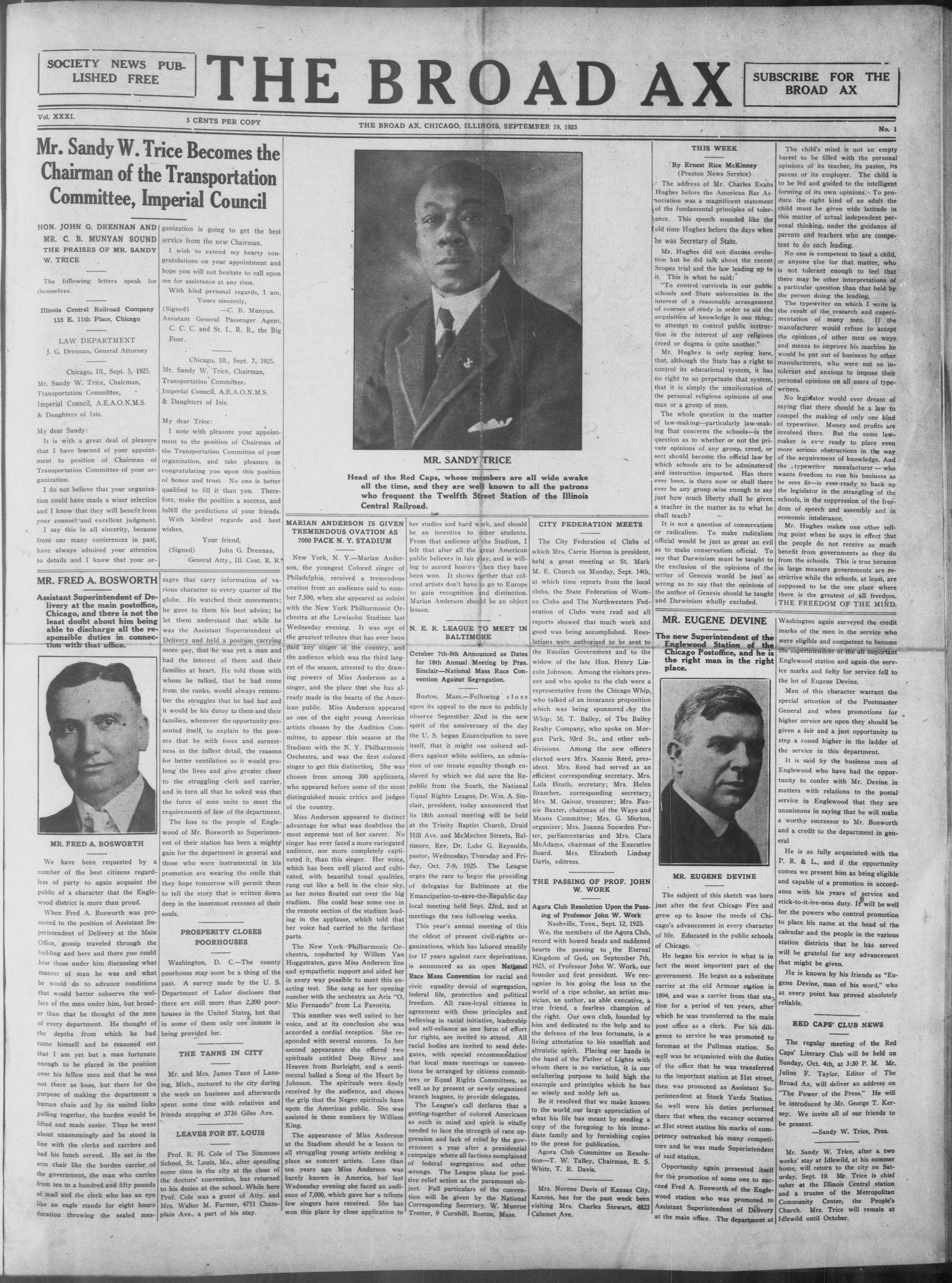
Mr. Sandy W. Trice Becomes the Chairman of the Transportation Committee, Imperial Council
---
Vol. XXXI.
HON. JOHN G. DRENNAN AND
MR. C. B. MUNYAN SOUND
THE PRAISES OF MR. SANDY
W. TRICE
The following letters speak for
themselves.
Illinois Central Railroad Company
135 E. 11th Place, Chicago
LAW DEPARTMENT
J. G. Drennan, General Attorney
Chicago, Ill., Sept. 5, 1925.
Mr. Sandy W. Trice, Chairman,
Transportation Committee,
Imperial Council, A.E.A.O.N.M.S.
& Daughters of Isis.
My dear Sandy:
It is with a great deal of pleasure that I have learned of your appointment to position of Chairman of Transportation Committee of your organization.
I do not believe that your organization could have made a wiser selection and I know that they will benefit from your counsel and excellent judgment.
I say this in all sincerity, because from our many conferences in past, have always admired your attention to details and I know that your or-
MR. FRED A. BOSWORTH
Assistant Superintendent of Delivery at the main postoffice, Chicago, and there is not the least doubt about him being able to discharge all the responsible duties in connection with that office.
MR. FRED A. BOSWORTH
We have been requested by a number of the best citizens regardless of party to again acquaint the public of a character that the Englewood district is more than proud.
When Fred A. Bosworth was promoted to the position of Assistant Superintendent of Delivery at the Main Office, gossip traveled through the building and here and there you could hear those under him discussing what manner of man he was and what he would do to advance conditions that would better subserve the welfare of the men under him, but broader than that he thought of the men of every department. He thought of the depths from which he had come himself and he reasoned out that I am yet but a man fortunate enough to be placed in the position over his fellow men and that he was not there as boss, but there for the purpose of making the department a human chain and by its united links pulling together, the burden would be lifted and made easier. Thus he went about unassumingly and he stood in line with the clerks and carriers and had his lunch served. He sat in the arm chair like the burden carrier of the government, the man who carries from ten to a hundred and fifty pounds of mail and the clerk who has an eye like an eagle stands for eight hours duration throwing the sealed mes-
THE BROAD AX
Price Becomes the
Transportation
Imperial Council
organization is going to get the best
service from the new Chairman.
I wish to extend my hearty congratulations on your appointment and
hope you will not hesitate to call upon
me for assistance at any time.
With kind personal regards, I am,
Yours sincerely,
(Signed) —C. B. Munyan.
Assistant General Passenger Agent,
C. C. C. and St. L. R. R., the Big
Four.
Chicago, Ill., Sept. 7, 1925. Mr. Sandy W. Trice, Chairman, Transportation Committee, Imperial Council, A.E.A.O.N.M.S. & Daughters of Isis.
My dear Trice:
I note with pleasure your appointment to the position of Chairman of the Transportation Committee of your organization, and take pleasure in congratulating you upon this position of honor and trust. No one is better qualified to fill it than you. Therefore, make the position a success, and fulfill the predictions of your friends. With kindest regards and best wishes,
Your friend,
(Signed) John G. Drennan,
General Atty., Ill. Cent. R. R.
sages that carry information of various character to every quarter of the globe. He watched their movements; he gave to them his best advice; he let them understand that while he was the Assistant Superintendent of Delivery and held a position carrying more pay, that he was yet a man and had the interest of them and their families at heart. He told those with whom he talked, that he had come from the ranks, would always remember the struggles that he had had and it would be his dutoy to them and their families, whenever the opportunity presented itself, to explain to the powers that be with force and earnestness in the fullest detail, the reasons for better ventilation as it would prolong the lives and give greater cheer to the struggling clerk and carrier, and in turn all that he asked was that the force of men unite to meet the requirements of law of the department.
The loss to the people of Englewood of Mr. Bosworth as Superintendent of their station has been a mighty gain for the department in general and those who were instrumental in his promotion are wearing the smile that they hope tomorrow will permit them to tell the story that is written down deep in the innermost recesses of their souls.
PROSPERITY CLOSES
POORHOUSES
Washington, D. C.-The county poorhouse may soon be a thing of the past. A survey made by the U. S. Department of Labor discloses that there are still more than 2,200 poorhouses in the United States, but that in some of them only one inmate is being provided for.
THE TANNS IN CITY
Mr. and Mrs. James Tann of Lansing, Mich., motored to the city during the week on business and afterwards spent some time with relatives and friends stopping at 3736 Giles Ave.
LEAVES FOR ST. LOUIS
Prof. R. H. Cole of The Simmons School, St. Louis, Mo., after spending some time in the city at the close of the doctors' convention, has returned to his duties at the school. While here Prof. Cole was a guest of Atty. and Mrs. Walter M. Farmer, 4751 Champlain Ave., a part of his stay.
THE BROAD AX, CHICAGO, ILLINOIS, SEPTEMBER 19, 1925
Head of the Red Caps, whose members are all wide awake all the time, and they are well known to all the patrons who frequent the Twelfth Street Station of the Illinois Central Railroad.
MARIAN ANDERSON IS GIVEN
TREMENDOUS OVATION AS
7000 PACK N. Y. STADIUM
New York, N. Y.—Marian Anderson, the youngest Colored singer of Philadelphia, received a tremendous ovation from an audience said to number 7,500, when she appeared as soloist with the New York Philharmonic Orchestra at the Lewisohn Stadium last Wednesday evening. It was one of the greatest tributes that has ever been paid any singer in the country, and the audience which was the third largest of the season, attested to the drawing powers of Miss Anderson as a singer, and the place that she has already made in the hearts of the American public. Miss Anderson appeared as one of the eight young American artists chosen by the Audition Committee, to appear this season at the Stadium with the N. Y. Philharmonic Orchestra, and was the first colored singer to get this distinction. She was chosen from among 300 applicants, who appeared before some of the most distinguished music critics and judges of the country.
Miss Anderson appeared to distinct advantage for what was doubtless the most supreme test of her career. No singer has ever faced a more variegated audience, nor more completely captivated it, than this singer. Her voice, which has been well placed and cultivated, with beautiful tonal qualities, rang out like a bell in the clear sky, as her notes floated out over the big stadium. She could hear one in the remote section of the stadium leading in the applause, which told that her voice had carried to the farthest parts.
The New York Philharmonic Orchestra, conducted by Willem Van Hoggstraten, gave Miss Anderson fine and sympathetic support and aided her in every way to meet this exacting test. She sang as her opening number with the orchestra an Aria "O, Mio Fernando" from La Favorita.
This number was well suited to her voice, and at its conclusion she was accorded a cordial reception. She responded with several encores. In her second appearance she offered two spirituals entitled Deep River and Heaven from Burleight, and a sentimental ballad a Song of the Heart by Johnson. The spirituals were finely received by the audience, and shows the grip that the Negro spirituals have upon the American public. She was assisted in these numbers by William King.
The appearance of Miss Anderson at the Stadium should be a lesson to all struggling young artists seeking a place as concert artists. Less than ten years ago Miss Anderson was barely known in America, but last Wednesday evening she faced an audience of 7,000, which gave her a tribute few singers have received. She has won this place by close application to
MR. SANDY TRICE
her studies and hard work, and should be an incentive to other students. From that audience at the Stadium, I felt that after all the great American public believes in fair play, and is willing to accord honors when they have been won. It shows further that colored artists don't have to go to Europe to gain recognition and distinction. Marian Anderson should be an object lesson.
N. E. R. LEAGUE TO MEET IN BALTIMORE
October 7th-9th Announced as Dates for 18th Annual Meeting by Press. Sinclair—National Mass Race Convention Against Segregation.
Boston, Mass.—Following close upon its appeal to the race to publicly observe September 22nd in the new spirit of the anniversary of the day the U. S. began Emancipation to save itself, that it might use colored soldiers against white soldiers, an admission of our innate equality though enslaved by which we did save the Republic from the South, the National Equal Rights League, Dr. Wm. A. Sinclair, president, today announced that its 18th annual meeting will be held at the Trinity Baptist Church, Druid Hill Ave. and McMechen Streets, Baltimore, Rev. Dr. Luke G. Reynolds, pastor, Wednesday, Thursday and Friday, Oct. 7-9, 1925. The League urges the race to begin the providing of delegates for Baltimore at the Emancipation-to-save-the-Republic day local meeting held Sept. 22nd, and at meetings the two following weeks.
This year's annual meeting of this the oldest of present civil-rights organizations, which has labored steadily for 17 years against race deprivations, is announced as an open National Race Mass Convention for racial and civic equality devoid of segregation, federal life, protection and political freedom. All race-loyal citizens in agreement with these principles and believing in racial initiative, leadership and self-reliance as one form of effort for rights, are invited to attend. All racial bodies are invited to send delegates, with special recommendation that local mass meetings or conventions be arranged by citizens committees or Equal Rights Committees, as well as by present or newly organized branch leagues, to provide delegates.
The League's call declares that a getting-together of colored Americans as such in mind and spirit is vitally needed to face the strength of race oppression and lack of relief by the government a year after a presidential campaign where all factions complained of federal segregation and other wrongs. The League plans for positive relief action as the paramount object. Full particulars of the convention will be given by the National Corresponding Secretary, W. Munroe Trotter, 9 Cornhill, Boston, Mass
CITY FEDERATION MEETS
The City Federation of Clubs of which Mrs. Carrie Horton is president, held a great meeting at St. Mark M. E. Church on Monday, Sept. 14th, at which time reports from the local clubs, the State Federation of Women Clubs and The Northwestern Federation of Clubs were read and all reports showed that much work and good was being accomplished. Resolutions were authorized to be sent to the Russian Government and to the widow of the late Hon. Henry Lincoln Johnson. Among the visitors present and who spoke to the club were a representative from the Chicago Whip, who talked of an insurance proposition which was being sponsored by the Whip; M. T. Bailey, of The Bailey Realty Company, who spoke on Morgan Park, 93rd St., and other subdivisions. Among the new officers elected were Mrs. Nannie Reed, president. Mrs. Reed had served as an efficient corresponding secretary. Mrs. Lula Heath, secretary; Mrs. Helen Brascher, corresponding secretary; Mrs. M. Gainor, treasurer; Mrs. Fannie Baxter, chairman of the Ways and Means Committee; Mrs. G. Morton, organizer; Mrs. Joanna Snowden Porter, parliamentarian and Mrs. Clara McAdams, chairman of the Executive Board. Mrs. Elizabeth Lindsay Davis, editress.
THE PASSING OF PROF. JOHN
W. WORK
Agora Club Resolution Upon the Passing of Professor John W. Work Nashville, Tenn., Sept. 12, 1925. We, the members of the Agora Club, record with bowed heads and saddened hearts the passing to the Eternal Kingdom of God, on September 7th, 1925, of Professor John W. Work, our founder and first president. We recognize in his going the loss to the world of a ripe scholar, an artist musician, an author, an able executive, a true friend, a fearless champion of the right. Our own club, founded by him and dedicated to the help and to the defence of the less fortunate, is a living attestation to his unselfish and altruistic spirit. Placing our hands in the hand of the Father of Lights with whom there is no variation, it is our unfaltering purpose to hold high the example and principles which he has so wisely and nobly left us. Be it resolved that we make known to the world, our large appreciation of what his life has meant by sending a copy of the foregoing to his immediate family and by furnishing copies to the press for publication. Agora Club Committee on Resolution—T. W. Talley, Chairman, R. S. White, T. R. Davis.
Mrs. Norene Davis of Kansas City, Kansas, has for the past week been visiting Mrs. Charles Stewart, 4823 Calumet Ave.
THIS WEEK
By Ernest Rice McKinney (Preston News Service)
The address of Mr. Charles Evans Hughes before the American Bar Association was a magnificent statement of the fundamental principles of tolerance. This speech sounded like the old time Hughes before the days when he was Secretary of State.
Mr. Hughes did not discuss evolution but he did talk about the recent Scopes trial and the law leading up to it. This is what he said:
"To control curricula in our public schools and State universities in the interest of a reasonable arrangement of courses of study in order to aid the acquisition of knowledge is one thing; to attempt to control public instruction in the interest of any religious creed or dogma is quite another."
Mr. Hughes is only saying here, that, although the State has a right to control its educational system, it has no right to so perpetuate that system, that it is simply the manifestation of the personal religious opinions of one man or a group of men.
The whole question in the matter of law-making—particularly law-making that concerns the schools—is the question as to whether or not the private opinions of any group, creed, or sect should become the official law by which schools are to be administered and instruction imparted. Has there ever been, is there now or shall there ever be any group wise enough to say just how much liberty shall be given a teacher in the matter as to what he shall teach?
It is not a question of conservatism or radicalism. To make radicalism official would be just as great an evil as to make conservatism official. To say that Darwinism must be taught to the exclusion of the opinions of the writer of Genesis would be just as wrong as to say that the opinions of the author of Genesis should be taught and Darwinism wholly excluded.
MR. EUGENE DEVINE
The new Superintendent of the Englewood Station of the Chicago Postoffice, and he is the right man in the right place.
MR. EUGENE DEVINE
The subject of this sketch was born just after the first Chicago Fire and grew up to know the needs of Chicago's advancement in every character of life. Educated in the public schools of Chicago.
He began his service in what is in fact the most important part of the government. He began as a substitute carrier at the old Armour station in 1894, and was a carrier from that station for a period of ten years, after which he was transferred to the main post office as a clerk. For his diligence to service he was promoted to foreman at the Pullman station. So well was he acquainted with the duties of the office that he was transferred to the important station at 51st street, then was promoted as Assistant Superintendent at Stock Yards Station. So well were his duties performed there that when the vacancy occurred at 51st street station his marks of competency outranked his many competitors and he was made Superintendent of said station.
Opportunity again presented itself for the promotion of some one to succeed Fred A. Bosworth of the Englewood station who was promoted to Assistant Superintendent of Delivery at the main office. The department at
SUBSCRIBE FOR THE BROAD AX
The child's mind is not an empty barrel to be filled with the personal opinions of its teacher, its pastor, its parent or its employer. The child is to be led and guided to the intelligent forming of its own opinions. To produce the right kind of an adult the child must be given wide latitude in this matter of actual independent personal thinking, under the guidance of parents and teachers who are competent to do such leading.
No one is competent to lead a child, or anyone else for that matter, who is not tolerant enough to feel that there may be other interpretations of a particular question than that held by the person doing the leading.
The typewriter on which I write is the result of the research and experimentation of many men. If the manufacturer would refuse to accept the opinions of other men on ways and means to improve his machine he would be put out of business by other manufacturers, who were not so intolerant and anxious to impose their personal opinions on all users of typewriters.
No legislator would ever dream of saying that there should be a law to compel the making of only one kind of typewriter. Money and profits are involved there. But the same lawmaker is ever ready to place even more serious obstructions in the way of the acquirement of knowledge. And the typewriter manufacturer — who wants freedom to run his business as he sees fit—is ever-ready to back up the legislator in the strangling of the schools, in the suppression of the freedom of speech and assembly and in economic intolerance.
Mr. Hughes makes one other telling point when he says in effect that the people do not receive as much benefit from governments as they do from the schools. This is true because in large measure governments are restrictive while the schools, at least, are supposed to be the one place where there is the greatest of all freedom, THE FREEDOM OF THE MIND
Washington again surveyed the credit marks of the men in the service who were eligible and competent to become the superintendent of the all important Englewood station and again the service marks and felty for service fell to the lot of Eugene Devine.
Men of this character warrant the special attention of the Postmaster General and when promotions for higher service are open they should be given a fair and a just opportunity to step a round higher in the ladder of the service in this department.
It is said by the business men of Englewood who have had the opportunity to confer with Mr. Devine in matters with relations to the postal service in Englewood that they are unanimous in saying that he will make a worthy successor to Mr. Bosworth and a credit to the department in general
He is as fully acquainted with the P. R. & L., and if the opportunity comes we present him as being eligible and capable of a promotion in accordance with his years of service and stick-to-it-ive-ness duty. It will be well for the powers who control promotion to place his name at the head of the calendar and the people in the various station districts that he has served will be grateful for any advancement that might be given.
He is known by his friends as "Eugene Devine, man of his word," who at every point has proved absolutely reliable.
RED CAPS' CLUB NEWS
The regular meeting of the Red Caps' Literary Club will be held on Sunday, Oct. 4th, at 3:30 P. M. Mr. Julius F. Taylor, Editor of The Broad Ax, will deliver an address on "The Power of the Press." He will be introduced by Mr. George T. Kersey. We invite all of our friends to be present.
—Sandy W. Trice, Pres.
Mr. Sandy W. Trice, after a two weeks' stay at Idlewild, at his summer home, will return to the city on Saturday, Sept. 19. Mr. Trice is chief usher at the Illinois Central station and a trustee of the Metropolitan Community Center, the People's Church. Mrs. Trice will remain at Idlewild until October.
THE BROAD AX
Published Every Saturday
In this city since July 15th 1899,
-althout missing one single issue. Re-
publicans, Democrats, Catholics, Protestants, Single Taxes, Priests, infidels or anyone else can have their say as long as their language is proper and responsibility is fixed.
The Broad Ax is a newspaper whose platform is broad enough for all, ever claiming the editorial right to speak its own mind. It is neither Democratic nor Republican. It is strictly or absolutely independent in politics.
Local communications will receive attention. Write only on one side of the paper.
Subscriptions must be paid in advance.
One Year .....$2.00
Six Months .....$1.00
Advertising rates made known on application.
Address all communications to
JULIUS F. TAYLOR
Editor and Publisher
Vol. XXXI No. 1
Chicago, September 19, 1925
Entered as Second-Class Matter, Aug
19, 1902, at the Post office at Chicago
III. Under Act of March 8, 1879.
COLORFUL NEWS "MOVIES"
(Preston News Service)
1. The School Bell Rings.
2. Negroes and Strikes.
3. Camp Meetin's Over.
4. Kweer Kapers.
These September morns are witnessing the annual event of the opening of school. More Negro children, middlers, grown-ups and elderly folks will cross' some class room door sill during the twenty-four hour day of the 1925-26 school period than ever before. This prophecy applies to entrants all the way from the little red school house on the hill to the great universities of the world. Just yesterday a Negro physician, whom we interviewed, had abandoned his practice in South Carolina and was enroute to the University of Edinburgh where he will study intricate surgery for several years. His place in South Carolina will be rapidly filled by some youthful graduate of Howard, Meharry, or some outstanding northern university. And as John P. Davis, the Bates College orator, returns from his European triumphs as a debator, dozens of other youth with latent talent will begin the slow course of preparation for the battle of brains a decade hence, which will doubtless unfold even a greater proportion of Negro scholars fit for world recognition.
What should the interracial transition from ignorance to knowledge mean to the world at large and to the Negro group entity? To the former it should mean that this dark tenth content will not, cannot permanently be denied a man's place in Art, Science, History, Music, and Religion, as well as in the trades and industries. A President of the United States once said of a down-trodden group: "These people have by force and ability pushed their heads and shoulders through the tough top crust; and I will not be a party to any movement to keep them down or make their way more difficult. Let them rise!"
To the Negro, the past decade's demonstrations of educational efficiency mean confidence, self-reliance, independence, and the ultimate emancipation from bigotry. They mean a greater sympathy for the weaknesses of the contra-group, and a stronger determination to help that group purge itself of the alloy of race hatred. The school bell is ringing for the ambitious Negro all the way from the humble trade school to the operating room where a Caesarian section is being performed. And while this harbinger of Knowledge is silent for the Negro at West Point and Annapolis, the other schools are grinding out graduates who are swelling the mighty ranks whose numbers are pledged to the pleasurable duty of throwing off ballast and making Negro education, yea, Negro life, universally acknowledged, respected, and acclaimed as one of the chief cornerstones of the builders of American democracy and civilization.
Strikes seldom do anyone much good, and where Negroes are involved, that group usually suffers the greatest hardships of the vexatious turmoil between Capital and Labor. This latter truth is due to the fact that Negro labor has only its head
in under the tent of organized labor, and is consequently bruised both from within, and without. When the western Kentucky coal strike was declared, more than a year ago, Negro union miners, although in a mixed local, were the first to meet with difficulties and the last to emerge therefrom. When colored girls were smilingly employed during the war by Chicago manufacturers, they were harshly dismissed the very instant white girls were available.
Chester, Pa., and East St. Louis, Ill., are still fresh in the minds of Negroes who remember the spectacle of their labor group at those points during the terrible controversies between Capital and Labor. Future organization, so far as the Negro is concerned, cannot as it has been in the past, be half-hearted. Either it must be of the one hundred per cent type or not at all, leaving the Negro free to bargain away his swarthy muscles and active brain under his own direction. Either the Negro must be given full protection, in and out of strike periods, or he must be left alone, free to work when and where he wishes and subject to strike only when he himself so decides.
The anthracite coalfields now under strike have been a closed corporation to Negro labor, while the bituminous field has been open to him upon fairly good terms. The South Carbon field of West Virginia was one of the most prosperous, healthful fields in the country, and the same can be said as to the Western Kentucky fields, filled with happy Negro miners up until the time they were ordered to strike. As between Capital and Labor, the Negro has even been a rubber ball, being batted from one group to another, as might suit convenience. With potential strength in numbers and proportion, Negro labor could happily deal with either Capital or Labor, or with both, were it to him a one hundred percent square deal attitude.
Heretofore, however, strikes as directed by others have been disastrous to Negro labor, whether an actor therein or a breaker thereof. And past experiences are clear enough, we think, to convince the Negro working group that until others evince an honest-to-goodness interest in his work welfare, it is up to him to grant, bargain and sell his productive worth upon a plan which will safeguard his work welfare, both in opportunities for profitable employment and in the peaceful participation therein, void of riots, starvation, and other disasters with which his work history so pathetically abounds.
"The weary ploughman homeward wends his way;
Leaving the world to darkness and to me."
Now that the Elks, the Eagles, the Masons and the Knights have wended their way homeward, where they may face, at least, a temporary shortage of bread, butter and coal, which were prematurely exchanged for excursion tickets, gasoline, and circular Good-year rubber, the fraternal brethren may well, in these few months which precede the homecoming of Mr. Winter and his hearty children, Snow, Ice and Cold, take inventory of their stock and see what's what and why. In the first place, bought brotherhood is somewhat like asbestos, which gets red hot in a minute and cools just as quickly. The social hour, when a brother would swim the English channel for his brother yields over night to the cold undeniable necessity of helping out with the rent or taking care of the insurance collector. The huzzaz of Camp Meetin' are supplanted by not a few "jolts" which are barren of fine fellowship so previously prevalent. In other words, we are slightly inclined to be pessimistic over the expended gusto, pump, and energy, to say nothing of the dollars and dimes, all of which might have been diverted to a great human brotherhood, or to Education, Industry, or Science. The humble writer thinks—and he is both a "Nod Fellow" and a "Nelk"—that fraternal gatherings should first promulgate some great constructive project having its aim racial endeavor and welfare, rather than a magnetic social session, following which there are naught but embers of what might have been. The Elks announce the establishment of a bureau of Education to foster and promote educational facilities of the Race. This project, if consummated, will bloom into concrete results of far-reaching worth. Similar efforts along lines of business, race fellowship, land development, and the like, we think, would go to fade the darkness which enshrows a struggling race. Fraternalism, it seems to us, means more than the lodge room
grasp and the mystic symbol of secret cohesion. Out in the open world it means furtherance of those things upon which the development of a nation depends. Nor are its objectives confined to the burial of the dead and the care of the sick. They strike down into every element of Christian advancement, supplemented by the necessities of a happy life and a contented populace for those without as well as those within.
A VISIT TO GENEVA STATE TRAINING SCHOOL FOR GIRLS By Rev. Theodore Stephens Member Negro Research Society of New York It was the beautiful morning of the 21st day of August—Friday. Friday is deemed "unlucky" to the superstitions of all classes. To Columbus, cises the 85 per line;" n school, —religion is not girl-inn School. The conduct clergym clusion
With Klansmen as pallbearers, says the white press, the funeral of Samuel Obrey, a West Virginia Negro miner, was recently conducted at Roderfield, near Welch. The report continues by saying that as the coffin was placed in a hearse to be taken to the cemetery, a Ku Klux Klan meeting, held in rooms over the undertaking establishment was dismissed. Noting the absence of mourners, several Klansmen boarded the hearse, while others fell in behind and marched to the cemetery, where they lifted the coffin from the hearse and lowered it into the ground. Each Klansman stood in silence while the funeral rites were concluded.
Just prior to this epocalyptic event a Klan preacher, during its Washington, D. C. festival, had advocated a Jim Crow car law for the District of Columbia, and a few days later, to the writer's personal knowledge, distaste for local Negroes had been manifested in the vicinity of a local Klan meeting. All of which points the fingers of curiosity at the multifarious acts of an organization which is so outspoken in its ideal. What, pray, is the motive of the Klan when it tenders a purse to a Negro church or designates pallbearers for attendance at a Negro funeral? Is it the attitude of throwing a dog a bone, or is it to try to veneer the true aims of this modern knighthood organization?
In case of the latter, the announcements of the Klan literature too plainly bespeak their estimate of a large proportion of our American constituency; and if it is the former, church purses and sympathies for the dead might more consistently be tendered to those whose idealistic alliances are more in harmony with the Klan than those of their colored brethren.
Altogether, the queer capers of the Klan indicate that realizing its axis is supporting naught but a lost world, it is swimming hither and thither searching for straws by which its crown might be preserved for a few months longer; for it was long ago evident that the modern world has no permanent place for such a curious anomaly, and that the last two-thirds of its titulat—"Here yesterday, here today, here tomorrow" may soon be wiped out. And when the time for those obsequies arrives, we'll gladly furnish some of the pallbearers, leaving a similar honor to the Jews, Catholics, and aliens.
COLUMBIAN BRIEFS
Colored lawyers of Virginia have organized a state bar association.
Building trade wages are at the highest peak they have ever been.
In our present stage of development, constructive work—and lots of it—is the crying need.
During the past two years 31 corporations have been organized by West Virginia colored business men.
Forty years ago there were forty divorces for every one hundred marriages in Japan. Now there are only ten.
The making of beautiful furniture from mahogany is rapidly becoming one of the crafts of West Africa.
Beans are an important staple food and the average yearly crop is worth $50,000,000 to the farmers of the United States.
The American public spent $300,000,000 last year for carbonated beverages and some of this income reached colored owners of bottling works.
The Liberian Government proposes to establish telephonic communication between Monrovia and Cape Palmas and the intervening coastal towns.
IN CITY
Mr. and Mrs. William Rice of Des Moines, Ia., are visiting in the city, stopping with friends at 3624 Cottage Grove Ave.
OPENS FALL TERM
The Enterprise Institute, 514 Aldine Square, of which Rev. J. W. McDaniels is president, has opened its fall term with a splendid enrollment.
To the committee of the Circle of King's Daughters and Sons, the day proved rather delightful, and the chronicles of the party, although he sought for "signs" with Argus' eyes and the tunneled car of a Dionysius, could register not a single omen.
Time was when men wore charms and amulets as preservatives against the "evil eyes," "evil spirits," "unlucky days," inopportune hours," etc. Knowledge, however, has increased, and light has been thrown on the supposed "evils," and except for the comparatively few, the Schamhamphras, the Pentagram, and the Clavicles of Solomon, are relics of a barbarous and superstitious age.
At 10:30 a.m. the bus of the Christian Endeavor Society of the Metropolitan Community Center, with about a dozen persons, members of the Golden Circle of King's Daughters and Sons, of which W. Webb, 3423 South Parkway, is President, Rev. Schomberger of South Park M. E. Church, Mrs. Schomberger and a few others who were with the Rev. and his wife in their car, started on the two-hour motor trip to Geneva (Geneva, III, not Geneva, Switzerland!), where we arrived after forty-two miles of road, at 12:45.
We entered "Hope Cottage," where we were received with the well-known cordiality of the matron-hostess, Mrs. Cordella H. Mercer.
General Description of the School
As is well-known, Geneva is a
A training School for Girls, maintained
by the State of Illinois. The grounds
cover an area of about fifty-five acres,
including the buildings, twenty in number.
Seventeen of these buildings are
for the girls, the other three include
Church, School, Matron Hall, Electric Light and Power Plant, and Gymnasium.
There are 498 girls on the premises;
of that number 75 are colored. This
per cent basis shows 85 per cent
white inmates and 15 per cent colored.
The colored girls occupy "Hope Cottage" and "Willow Cottage," the former with 38 girls and 2 matrons.
(Mrs. Bishop, managing matron of "Willow Cottage.")
The School Curriculum
The School Curriculum
School year is an all-the-year-round affair at Geneva. Vacation days at this school are of short duration, being only thirty in number. The class hours are from 9 a.m. to 4 p.m. All intermediate grades are taught, including domestic science, commercial and industrial training. Domestic Science, is, however, especially featured, and a deal of attention is given to the art of fruit canning, in which the girls show marked interest. Each matron has to report the preparation by her girls of so many jars of preserved fruit. There is a special domestic training room for this special branch of the school's activities.
The cost to the State for the maintenance of one girl, per annum, is maximum cost, $850; minimum cost, $650.
The school owns and operates its own farm, from which is recollected a variety of fruit, vegetables and fodder for 150 Holstein and which give 98 gallons of rich milk daily.
The Menu
The food is carefully supervised, and a week in advance the succeeding week's bill-of-fare is prepared by a food specialist, and handed over to the matron of each cottage who, so desiring, may add any special dish to this weekly course of wholesome food.
The Personnel
The Geneva Training School has an excellent staff of officers, at the head of which is Mrs. Lucie D. Ball, Manager. The School, in addition, carries a resident physician, Dr. Weber, three trained nurses, one electrician.
Divine Worship
The religious service of the school is held in the edifice consecrated to the worship of God every Sunday at 3 p. m. The services are interdenominational. During the religious exer-
cises the 15 per cent colored and the 85 per cent white know no "color line," nor is this line drawn in the day school, but beyond these two features—religious and educational—the writer is not cognizant of the fact that the girl-inmates of the Geneva Training School have any social intercourse. The religious service at Geneva is conducted, generally, by a white clergyman, not, however, to the exclusion of ministers of our race. From information secured by the writer, none of the ministers of our group, seemingly, ever think of visiting the girls of that school. Such would, doubtless, involve some sacrifice and inconvenience on Sunday (not every Sunday), but our girls would, sometimes, like to hear the gospel preached by one of our own. In this way all concerned would doubtless realize the truth proclaimed nearly 2,500 years ago by Malachi, the prophet: "Have we not all one Father, has not one God created us?" The writer has promised to preach for the Geneva girls some time in the near future. Colored preachers, says Mrs. Mercer, would be welcome.
Recreation at Geneva
The recreation program varies with the alternating seasons. A ball game was the out-of-door sport on the afternoon of the 21st ultimo. The Mission of the Kino Daughter
The Mission of the King's Daughters
Especially to cheer the sometimes lonely life of the colored girl, even though the State provides the comforts and conveniences necessary to their moral, intellectual and physical welfare, the King's Daughters and Sons undertook the voyage to Geneva. The members of the Committee in their sympathetic and winning manner encouraged the girls to obedience to their matrons whom they call by the affectionate and endearing name "Mother." They were given to feel that they are not miscreants who were being punished, but young girls in training to become the women and wives of tomorrow; these girls were told that the opportunity to fashion themselves into noble characters, so that on leaving their training school they would be better equipped, morally, intellectually and physically, to cope with life's difficult problems, is now theirs, that the Lord in His Divine Providence has thus ordered things for their welfare. They were also exhorted to a life of prayer and faith in God. Positive proof was given them to the effect that they are thought of and appreciated, despite the intervening distance between Chicago and Geneva, as was evidenced by the periodical tracts and other literature brought them by their visitors, as well as by the prayers offered on their behalf by one of the visiting ministers.
Luncheon and Departure
Time with us was rather precious; we therefore devoted this precious time to visiting "Hope" and "Willow" Cottages, and at both of these residences were given a hearty reception by both "Mother" matrons and girls. We, however, luncheoned in style at "Hope" Cottage, and the most refreshing menu that any city hostess could serve without notice was placed before us, or we were placed before the menu. Despite the latitude, and longitude, and meridian and equatorial distances, and minus the least coercion—the long ride having done its work of preparing an appetite—we were tabled, and after the Rev. Schomberger had "rendu grace" (said grace), with travelers' zest we partook most unstintingly of the appetizing "viandes," while converse with the matrons, in the form of queries and rejoinders enriched the happy hour through which ran a happy sense of wit and humor, and which made the time to be so delightfully profitable, charitably and missionarily spent and enjoyed by visited and visitors.
"Au Revoir"
After the informal exercises, we took leave of our hostesses. The girls manifested marked signs of emotion, and the breasts of many heaved heavy sighs, while their tear dimmed eyes told the story most eloquently of the deep impression made upon them by the visit of the Golden Circle of King's Daughters and Sons.
But The Greatest of These is America
Greece with her intellectual culture, her ethnic religion, and her love of the beautiful did not produce a Solon who was sufficiently interested in the individual citizen to vote a law purporting to protect the widow, care for the orphan, reform the wayward, educate the masses and erect eleemosynary societies for those whom the hand of misfortune had thrown upon the bounty of society.
The Institutes of Justinian contained no "proviso" for the moral and social welfare of the individual, and the ignorant slave, the morally in-
WALDEN COLLEGE
(Formerly the literary department of
Walden University)
An Approved School in an
Educational Center
Modern in methods and thorough in scholarship.
Throws Christian influence around the student.
Places emphasis upon development of the initiative
on part of the student.
EXPENSES SURPRISINGLY
MODERATE
Session Begins September 21
For further information, address
T. R. DAVIS, PRESIDENT
Nashville - - Tennessee
sane, the infirm, the decrepid, all were privileged to take care of themselves as best they could. The State had no interest in their welfare; the individual existed for the benefit of the State and the State for the benefit of the few.
But with Christianity came a new social order, and orphanages, asylums, hospitals, homes, reformatories, etc., trace their origin to the Christian religion. Christianity is responsible for the new social order. She has reversed "State Decrees," and "Statutory Enactments," and the individual as today an integral part of the State.
Yesterday a Borgia received the tiara and a Savonarola was martyred, a Paul decapitated and a Nero perched on the Seven Hills of Rome; the Christ was crucified, and an Augustus won the empire; a Jeanne D'Arc was cremated and a Charles became King of France.
America has in many respects caught the vision of what a sovereign State ought to be. Athens was great in the days of Pericles; Rome was mighty in the time of the Caesars, but America with her charities, America with her vast educational, industrial and reformatory systems of individual and social welfare, is by far the greater than either the Greece of King Philipp, or the city of which it was said, "Augustus found it brick, and he left it marble."
Illinois Queen of States
Illinois Queen of States
In making our estimate of the 48 States in the Union, we are cognizant of the fact that the other 47 are measuring up the standard of usefulness, industry, moral reform, etc. Special mention should, however, be made of Illinois as the Queen of States, and the great work which this State Queen is prosecuting with unrelenting fervor. Her elemosynary institutions, her reformatories, and her other branches of human endeavor cannot be too highly commended. The Geneva State Training School for Girls is but one of the State's many activities for the welfare of the social order.
"By thy rivers gently flowing, Illinois, Illinois, O'er thy prairies verdant growing
Illinois, Illinois,
Comes an echo on the breeze,
Rustling through the leafy threes,
And it's mellow tones are these,
GIRL SLASHED, STABED AND SHOT, ADMIRER ARRESTED
(Preston News Service)
Richmond, Va., Sept. 14. — Miss Alma Hayes, 22, was stabbed and slashed on the shoulders and arms as well as cut on the throat by her beau, Eugene Cheatham, according to the police, last Thursday night. Cheatham, it is alleged, cut her throat, stabbed her right shoulder, shot her through the same shoulder and then shot her in the mouth, according to notations made at St. Philip's Hospital, where Miss Hayes was taken at 9:50 o'clock last Thursday night. The attempted massacre and scalping expedition took place, according to reports, near Cheatham's home, the wielder of the knife and pistol having been arrested shortly afterwards by Third Station officers.
Love is the only motive assigned for the violence with which the Lothario expressed his regard for the girl. The poor girl may die.
WHITE CITIZENS OF LYNCH-
BURG, VA. UNDERWRITE NEGRO GIRLS SEMINARY TO BE LOCATED IN THAT CITY
(Preston News Service)
Lynchburg, Va., Sept. 17—At a conference in this city of the officials and leaders for Lynchburg and its Chamber of Commerce, Secretary I. Garland Penn, Cincinnati, Ohio, outlined the plans of the Woman's Home Missionary Society of the Methodist Episcopal Church for the establishment of a Seminary for Negro women at some point in the South, preferably Lynchburg.
As an inducement to locate the Seminary here, the City Council and Chamber of Commerce agreed to guarantees valued at $25,000.
Five years ago the Society at its National Council in Detroit, Mich., agreed upon Lynchburg. As the city and business interests are now ready to make good its guarantees, it is expected that the National Council at its meeting in the First Methodist Episcopal Church, Pasadena, Calif., in October, will reaffirm the action taken in Detroit.
The Seminary is to be a select college for Negro girls offering degrees and open to students from any section of the United States. Its main support will come from the Woman's Home Missionary Society which is the organization of leading white and colored women from the Methodist Episcopal Church. This organization had an income last year of over two million dollars.
Concerning the guarantees made by the business interests of Lynchburg, Secretary Penn, said on leaving the city for Cincinnati, that it was another evidence of the growing interest of white leaders in the South in the higher education of the Negro and another step in promoting more cordial and friendly inter-race relationships. The Seminary is to be known as the Carrie Barge Seminary after Miss Carrie Barge, a noted and Consecrated white woman and official of the Woman's Home Missionary Society, living in Delaware, Ohio.
One hundred thousand dollars will be expended on the first unit and the institution is expected to open for the scholastic year 1926-27. Already students have applied for entrance and are on the waiting list, as far away as Arizona.
RETURNS HOME
Hon. Luther H. Foster, treasurer and business manager of The Virginia Normal State College, Petersburg, Va., has returned to the school following several weeks of study at the University of Chicago where he took up several special subjects.
TO HAVE MEETNG
Hon. Wm. Herbert Fields, national grand master of A. U. K. & D. of A., in company with Dr. Geo. M. Cattrell, national grand secretary treasurer, both of St. Louis, Mo., will be in the city Sunday, Sept. 20th, for the purpose of organizing a committee at Bailey's Hall. 3638 S. State St., which committee is to put over the 19th annual session and national encampment to be held in Chicago in August, 1926.
"American for Flat"
In speaking of the moving of an actress a London newspaper says that she had "deserted hotel life for an 'apotment.'-American for flat—in Chelsea."
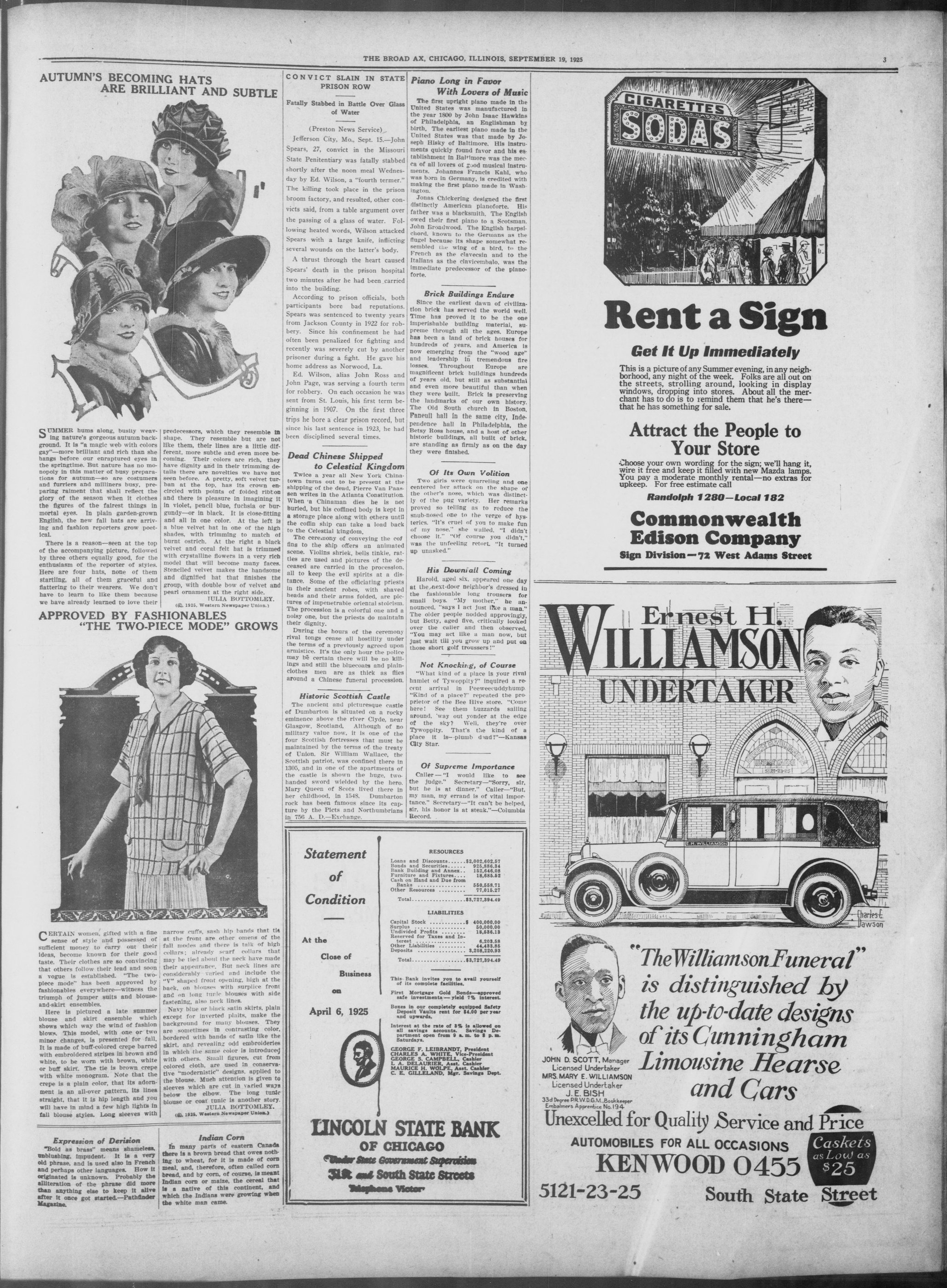
AUTUMN'S BECOMING HATS ARE BRILLIANT AND SUBTLE
5
APPROVED BY FASHIONABLES "THE TWO-PIECE MODE" GROWS
THE FASHION WEEKLY
SUMMER hums along, bushy weaving nature's gorgeous autumn background. It is "a magic web with colors gay"—more brilliant and rich than she hangs before our enraptured eyes in the springtime. But nature has no monopoly in this matter of busy preparations for autumn—so are costumers and furriers and milliners busy, preparing raiment that shall reflect the glory of the season when it clothes the figures of the fairest things in mortal eyes. In plain garden-grown English, the new fall hats are arriving and fashion reporters grow poetical.
There is a reason—seen at the top of the accompanying picture, followed by three others equally good, for the enthusiasm of the reporter of styles. Here are four hats, none of them startling, all of them graceful and flattering to their wearers. We don't have to learn to like them because we have already learned to love their
APPROVED BY FAS
"THE TWO-P
CERTAIN women, gifted with a fine sense of style and possessed of sufficient money to carry out their ideas, become known for their good taste. Their clothes are so convincing that others follow their lead and soon a vogue is established. "The twopiece mode" has been approved by fashionables everywhere - witness the triumph of jumper suits and blouse-and-skirt ensembles.
Here is pictured a late summer blouse and skirt ensemble which shows which way the wind of fashion blows. This model, with one or two minor changes, is presented for fall. It is made of buff-colored crepe barred with embroidered stripes in brown and white, to be worn with brown, white or buff skirt. The tie is brown crepe with white monogram. Note that the crepe is a plain color, that its adornment is an all-over pattern, its lines straight, that it is hip length and you will have in mind a few high lights in fall blouse styles. Long sleeves with
Expression of Derision
"Bold as brass" means shameless, unblushing, impudent. It is a very old phrase, and is used also in French and perhaps other languages. How it originated is unknown. Probably the alliteration of the phrase did more than anything else to keep it alive after it once got started.—Pathfinder Magazine.
predecessors, which they resemble in shape. They resemble but are not like them, their lines are a little different, more subtle and even more becoming. Their colors are rich, they have dignity and in their trimming details there are novelties we have not seen before. A pretty, soft velvet turban at the top, has its crown encircled with points of folded ribbon and there is pleasure in imagining it in violet, pencil blue, fuchsia or burgundy—or in black. It is close-fitting and all in one color. At the left is a blue velvet hat in one of the high shades, with trimming to match of burnt ostrich. At the right a black velvet and coral felt hat is trimmed with crystalline flowers in a very rich model that will become many faces. Stencled velvet makes the handsome and dignified hat that finishes the group, with double bow of velvet and pearl ornament at the right side.
IULIA BOTTOMLEY.
(@, 1925, Western Newspaper Union.)
FASHIONABLES
ECE MODE" GROWS
narrow cuffs, sash hip bands that tie at the front are other omens of the fall modes and there is talk of high collars; already scarf collars that may be tied about the neck have made their appearance. But neck lines are considerably varied and include the "V" shaped front opening, high at the back, on blouses with surplice front and on long tunic blouses with side fastening, also neck lines.
Navy blue or black satin skirts, plain except for inverted plains, make the background for many blouses. They are sometimes in contrasting color, bordered with bands of satin like the skirt, and revealing odd embroideries in which the same color is introduced with others. Small figures, cut from colored cloth, are used in conservative "modernist" designs, applied to the blouse. Much attention is given to sleeves which are cut in varied ways below the elbow. The long tunic blouse or coat tunic is another story. JULIA BOTTOMLEY.
(@ 1925, Western Newspaper Union.)
Indian Corn
In many parts of eastern Canada there is a brown bread that owes nothing to wheat, for it is made of corn meal, and, therefore, often called corn bread, and by corn, of course, is meant Indian corn or maize, the cereal that is a native of this continent, and which the Indians were growing when the white man came.
THE BROAD AX, CHICAGO, ILLINOIS, SEPTEMBER 19, 1925
Statement of Condition
At the Close of Business on April 6, 1925
RESOURCES
Loans and Discounts ... $2,002,602.57
Bonds and Securities ... 925,886.34
Bank Building and Annex ... 152,646.08
Furniture and Fittures ... 18,685.62
Cash on Hand and Due from Banks ... 550,558.71
Other Resources ... 77,015.27
Total ... $3,727,394.49
LIABILITIES
Capital Stock ... $ 400,000.00
Surplus ... 50,000.00
Undivided Profits ... 18,586.13
Reserved for Taxes and Interest ... 6,203.58
Other Liabilities ... 44,483.85
Deposits ... 3,208,220.98
Total ... $3,727,394.49
This Bank invites you to avail yourself of its complete facilities.
First Mortgage Gold Bonds—approved safe investments—yield 7% interest.
Boxes in our completely equipped Safety Deposit Vaults rent for $4.00 per year and upwards.
Interest at the rate of 8% is allowed on all savings accounts. Savings Department open from 9 a.m. to 8 p.m. Saturdays.
GEORGE F. LEIBRANDT, President
CHARLES A. WHITE, Vice-President
GEORGE S. CAMPBELLE, Cashier
L. A. DELAURIER, Asst. Cashier
MAURICE H. WOLPE, Asst. Cashier
C. E. GILLELAND, Mgr. Savings Dept.
LINCOLN STATE BANK
OF CHICAGO
Under State Government Supervision
Fifth and South State Streets
Milphee Victor
CONVICT SLAIN IN STATE
PRISON ROW
Fatally Stabbed in Battle Over Glass of Water
Jefferson City, Mo., Sept. 15.—John Spears, 27, convict in the Missouri State Penitentiary was fatally stabbed shortly after the noon meal Wednesday by Ed. Wilson, a "fourth termer." The killing took place in the prison broom factory, and resulted, other convicts said, from a table argument over the passing of a glass of water. Following heated words, Wilson attacked Spears with a large knife, inflicting several wounds on the latter's body. A thrust through the heart caused Spears' death in the prison hospital two minutes after he had been carried into the building.
According to prison officials, both participants bore bad reputations. Spears was sentenced to twenty years from Jackson County in 1922 for robbery. Since his confinement he had often been penalized for fighting and recently was severely cut by another prisoner during a fight. He gave his home address as Norwood, La. Ed. Wilson, alias John Ross and John Page, was serving a fourth term for robbery. On each occasion he was sent from St. Louis, his first term beginning in 1907. On the first three trips he bore a clear prison record, but since his last sentence in 1923, he had been disciplined several times.
Dead Chinese Shipped
to Celestial Kingdom
Twice a year all New York Chinatown turns out to be present at the shipping of the dead, Pierre Van Paasen writes in the Atlanta Constitution. When a Chinaman dies he is not buried, but his coffined body is kept in a storage place along with echels until the coffin ship can take a load back to the Celestial kingdom.
The ceremony of conveying the coffins to the ship offers an animated scene. Violins shriek, bells tinkle, rattles are used and pictures of the deceased are carried in the procession, all to keep the evil spirits at a distance. Some of the officiating priests in their ancient robes, with shaved heads and their arms folded, are pictures of impenetrable oriental stoicism. The procession is a colorful one and a noisy one, but the priests do maintain their dignity.
During the hours of the ceremony rival tongs cease all hostility under the terms of a previously agreed upon armistice. It's the only hour the police may be certain there will be no killings and still the bluecoats and plain-clothes men are as thick as flies around a Chinese funeral procession.
Historic Scottish Castle
The ancient and picturesque castle of Dumbarton is situated on a rocky eminence above the river Clyde, near Glasgow, Scotland. Although of no military value now, it is one of the four Scottish fortresses that must be maintained by the terms of the treaty of Union. Sir William Wallace, the Scottish patriot, was confined there in 1305, and in one of the apartments of the castle is shown the huge, two-handed sword wielded by the hero, Mary Queen of Scots lived there in her childhood, in 1548. Dumbarton rock has been famous since its capture by the Picts and Northumbrians in 756 A. D.-Exchange.
Piano Long in Favor
With Lovers of Music
The first upright piano made in the United States was manufactured in the year 1800 by John Isaac Hawkins of Philadelphia, an Englishman by birth. The earliest piano made in the United States was that made by Joseph Hisky of Baltimore. His instruments quickly found favor and his establishment in Baltimore was the meca of all lovers of good musical instruments. Johannes Francis Kahl, who was born in Germany, is credited with making the first piano made in Washington. Jonas Chickering designed the first distinctly American planoforte. His father was a blacksmith. The English owed their first piano to a Scotsman. John Broadwood. The English harpsichord, known to the Germans as the fugel because its shape somewhat resembled the wing of a bird, to the French as the clavecin and to the Italians as the clavicmbalo, was the immediate predecessor of the planoforte.
Brick Buildings Enqure
Since the earliest dawn of civilization brick has served the world well. Time has proved it to be the one imperishable building material, supreme through all the ages. Europe has been a land of brick houses for hundreds of years, and America is now emerging from the "wood age" and leadership in tremendous fire losses. Throughout Europe are magnificent brick buildings hundreds of years old, but still as substantial and even more beautiful than when they were built. Brick is preserving the landmarks of our own history. The Old South church in Boston, Faneuil hall in the same city, Independence hall in Philadelphia, the Betsy Ross house, and a host of other historic buildings, all built of brick, are standing as firmly as on the day they were finished.
Of Its Own Volition
Two girls were quarrelling and one centered her attack on the shape of the other's nose, which was distinctly of the pug variety. Her remarks proved so telling as to reduce the snub-nosed one to the verge of hysterics. "It's cruel of you to make fun of my nose," she wailed. "I didn't choose it." "Of course you didn't," was the unfeeling retort. "It turned up unasked."
His Downfall Coming
Harold, aged six, appeared one day at the next-door neighbor's dressed in the fashionable long trousers for small boys. "My mother," he announced, "says I act just like a man." The older noddled approvingly, but Betty, aged five, critically looked over the caller and then observed, "You may act like a man now, but just wait till you grow up and put on those short golf trousers!"
Not Knocking. of Course
"What kind of a place is your rival hamlet of Tywopwilly?" inquired a recent arrival in Peeweecuddyhump. "Kind of a place?" repeated the proprietor of the Bee Hive store. "Come here! See them buzzards sailing around, 'way out onder at the edge of the sky?' Well, they're over Tywopwilly. That's the kind of a place it is—plumb dad!"—Kansas City Star.
Of Supreme Importance
Caller—"I would like to see the judge." Secretary—"Sorry, sir, but he is at dinner." Caller—"But, my man, my errand is of vital importance." Secretary—"It can't be helped, sir, his honor is at steak."—Columbia Record
CIGARETTES
SODAS
Ernest H.
WILLIAMSON
UNDERTAKER
ERnest H. WILLIAMSON
UNDERTAKER
5121-23-25
E. H. WILLIAMSON
Charlest. Dawson
A. B.
Get It Up Immediately
This is a picture of any Summer evening, in any neighborhood, any night of the week. Folks are all out on the streets, strolling around, looking in display windows, dropping into stores. About all the merchant has to do is to remind them that he's there—that he has something for sale.
Choose your own wording for the sign; we'll hang it, wire it free and keep it filled with new Mazda lamps. You pay a moderate monthly rental—no extras for upkeep. For free estimate call Randolph 1280—Local 182 Commonwealth Edison Company Sign Division—72 West Adams Street
The Williamson Funeral is distinguished by the up-to-date designs of its Cunningham Limousine Hearse and Cars
4
Beautiful Girl Reveals Secret
Once my hair was anything but long and silky soft as it is now, and my complexion was sallow, and there were often unsightly pimples on my face.
One day I heard of Exelento Quinine Pomade for the hair and purchased a jar. Almost immediately it stopped all dandruff, made my hair grow long, soft and fine, and gave it a delightful sheen.
Because of the perfectly wonderful results I obtained from Exelento Quinine Pomade, I purchased a jar of Exelento Skin Beautifier. It changed my sallow complexion to a clear, lovely skin, with health. For pimples and other skin blemishes, it has no wear.
If I am as beautiful as people say, it is all due to Exelento preparations. Exelento Quinine Pomade and Exelento Skin Beautifier may be obtained for only 25% at most drug stores, or will be sent postpaid upon receipt of price by the
EXELENTO MEDICINE CO., Atlanta, Ga.
*AGENTS WANTED EVERYWHERE
Write For Particulars
Essence of Friendship
Friendship needs no proof. A man knows his real friends. A great sacrifice is not required to assure him of their steadfastness. Much is written of the heroic hardships undergone by one friend for another. Such glowing accounts are all very well, but they do not touch the essence of friendship, which is an unanalyzed adherence that knows not the meaning of reward or danger.
Good Guess, Anyway
The wives of two traveling salesmen were introduced. They settled down for a comfortable talk. Servants, the weather and children were discussed, and then one wife inquired: "And what is your husband's line?" The other wife considered before she replied: "I'm not entirely sure, but he is always talking about dotted line, so I suppose that it's, don't you?"
Gelatin Ingredients
Gelatin is a purified dried inodorous product of the hydrolysis, by treatment with boiling water, of certain tissue, as skin, ligaments and bones, from sound animals, and contains not more than 2 per cent of ash and not less than 15 per cent of nitrogen.
Notary Public
Phones: Office Main 4153; Residence, 4751 Champlain Avenue
Phone Kenwood 5611
Walter M. Farmer
ATTORNEY AND COUNSELOR
AT LAW
Suite 708—184 W. Washington St.
CHICAGO
Phone Main 2017
A. L. WILLIAMS
ATTORNEY AND
COUNSELOR AT LAW
Suite 706 Firmenich Building
184 W. Washington St.
CHICAGO
Residence 3655 Prairie Ava.
Phone Douglas 9133
W. G. Anderson
Attorney At Law
17 North La Salle Street
CHICAGO
NOTARY PUBLIC
Suite 560 Watson Bldg.
Office Phones: Dearborn 7004-7008
Rac. 3354 Vernon Avenue
Phone Douglas 6045
Residence, 1262 Macalister Place
Telephone Monroe 2714
ATTORNEY AT LAW
Suite 318-320 Reaper Block
Clark and Washington Sts.
CHICAGO
Telephone Central 1820
Telephone Central 1239
Telephone: State 3278
A. D. GASH
ATTORNEY AT LAW
Suite 813, Ashland Block
155 N. Clark Street
CHICAGO, ILL.
(©) 1925, Western Newspaper Union.)
"YOU of course understand," said Henry Hall severely, "that I am no coward, and that I am not given to magnifying trifles. This letter is similar to many others that I have received during my lifetime, and yet because I am almost certain who it is from, I have a feeling that—" Prentice, the young manager of a metropolitan detective agency, leaned forward and addressed the wealthy man in a tone almost of pleading. "Won't you tell me whom you think it is from, so that in case, in case—"
"So that in case," put in Hall calmly, "the man succeedes, you will know whom to look for. Well," he mused, "I don't think I will. Years ago I did a thing to this man that would justify his murderous design now, and I am going to be sport enough to refrain from naming him. If he succeeds in doing away with me, as he says he will, at 12 o'clock tomorrow night, well and good. I shall even give him an opportunity to escape by not naming him now, but I'm leaving it up to you, and the town police, to prevent it" Hall stopped talking and drummed nervously upon the table.
"The man is probably insane," put in the detective impatiently, "brooding over his fancied wrongs all of these years and—" Prentice rose.
"If you do as you have planned, stay right here in your room tomorrow evening, until after 12 o'clock, and, between my operative and the town police every foot of your grounds and the territory around and near the place is watched, there is no way on earth . . ." Hall smiled wanly.
At sundown the following night the operatives began to arrive silently. Not a shadow about the immense, gloomy old mansion but which had its human guardian. Across the street, in the village square, the town police had turned out to a man and were pacing up and down, eyeing everyone who passed. Eleven o'clock came and nothing untoward happened. Prentice knocked upon Hall's door.
"Come in!" called out the Croesus rather irritably. Prentice passed into the luxuriantly furnished room and stood opposite his employer, his hands resting upon the mahogany table as he leaned forward to speak.
"Well, sir, I'll guarantee that even a wraith couldn't get in or out of this house tonight without our seeting it; however, I do wish that you'd give me the name of the man who wrote that letter, just in case . . . "
"No," muscled Hall, taking the letter from the drawer and tossing it across to the detective. "I won't," Prentice took it up and read it through aloud.
Henry Hall:
You remember what I told you several days ago. Tomorrow night at precisely 12 o'clock I shall kill you; may God have mercy on your soul.
"Wanted to give me plenty of time to pray, I suppose," said Hall with a short laugh. "Don't know but what I would if I knew any prayers. Instead, I'm reading 'Treasure Island.' Between every line I recall how I felt when I was a boy and read it for the first time; and I wish to recall my childhood tonight; it, at least, was clean." The detective shrugged and took up the large revolver which lay upon the table to examine it minutely. He took out the cartridges and shook them, whirled the magazine, and snapped the hammer once or twice. Satisfied, he said good night and left the room.
At five minutes to 12 the town was as quiet as death itself. Eleven fifty-nine came, and nothing happened. As the clock in the city hall tower began to whirl, preparatory to striking 12 o'clock, several of the officers lolling about upon the green arose and stretched themselves.
The clock in the tower began to strike; "One," it toiled out, and not an untoward thing happened; "two, three, four, five, six," still everything was quiet as though perpetual sleep had visited the scene; "seven, eight, nine, ten, eleven . . ."
But no one ever heard the stroke of 12.
There was a terrific explosion, and a flash as of a bolt of lightning. Suddenly the light across the street went out. The frightful "Boom!" echoed and re-echoed between the hills surrounding the town. The officers ran around in circles, shouting excitedly; lights began to flash on in houses all over town.
It took them 20 minutes to discover that the old cannon upon the courthouse lawn had been thrown back 20 feet from its usual position. It was Prentice who found it.
"Last thing on earth I'd have suspected," he said ruefully to the town chief of the police.
"The fellow, whoever he was, evidently discovered that this old Spanish-American war weapon pointed directly at Hall's room, and so he sent that note, figuring that under the circumstances Hall would want to spend the last hours in his own room. Then, I suppose, he threw in a half dozen sacks of powder, and a clock mechanism to set it off, and finished up with shrapnel—poor Hall."
Men Scarce There
Many thousand English girls want to marry but can't because of the scarcity of young men in England, Dr. A. T. Schofield, noted nerve specialist, says
Wasted Energy
Few men suspect how much more talk fritters away spiritual energy—that which should be spent in action spends itself in words.—F. W. Robertson.
THE BROAD AX, CHICAGO, ILLINOIS, SEPTEMBER 19, 1925
Who Loses in the Hold-Up
BY OLE BURIN
(@, 1925, Western Newspaper Union.)
IT ALL happened to me because the
wife forgot to get a bottle of ketchup
for supper.
"Now, Bet," I railed, "You know
very well I can't eat beans without
ketchup. So forgetful, so negligent,
so—"
"Very well then, dear, it's only two
blocks to the chain grocery," she
suggested sweetly.
And that's how, a few minutes later,
I happened to find myself staring into
the muzzle of a six-shooter.
"Shove over next to the boss!"
snapped the masked artilleryman.
"Think I want to get cross-eyed trying
to cover you both at once?"
"The company's out just $345.48," said the grocer, looking rueful at his empty cash drawer.
"Yep," I sympathized. "That bottle of ketchup cost me just forty-two dollars."
What a nuisance it is to be a good citizen! Every evening for the next week or so I was called to various police stations to identify, if possible, among the recently arrested, our particular cannon-juggler.
"Dear," said my wife, when I had returned from my latest nightly failure, "I've a big surprise for you," and handed me my stolen wallet with not one of the forty-two dollars missing.
"Someone rang the bell; thrust it into my hand and disappeared before I had a chance to see who it was," she smiled.
"Plain as day," I said. "This hold-up artist is a wise little boy. He's afraid of being caught and identified by me, and so he thought he ought to buy me off. But that reminds me—I've never paid for that ketchup."
I was surprised, on entering the grocery store, to see my old ileutenant, Wolfert, in earnest conversation with the managers. After mutual greetings and inquiries, during which I learned that the ex-ileutenant was now a salesman for the Excelsior Burglary Insurance company, I told them of the return of my wallet.
"That's great stuff!" exclaimed Wolfert. "And I was just telling Mr. Schulz that he needn't worry about the loss of that money, because I've succeeded in convincing his corporation to take a blanket insurance policy on all their stores throughout the country. As part of the transaction we have agreed to make good their recent loss. It'll mean lots of publicity for us; plenty of advertising."
It was only after I had returned home and we had finished supper that I recalled having neglected to give the lieutenant my address. At this moment our doorbell rang, and before we had a chance to move we heard the door opened and banged shut, and a masked figure dashed into our room.
"Lieutenant!" I gasped. And in my excitement the only thing I could say was. "How did you find out my address?"
"Quick!" he snapped. "Get out your checkers. Lively now! Set 'em up." Just as if he was ordering "squashes right!"
And I obeyed without question.
The doorbell rang. Somebody knocked.
"Don't forget," said Wolfert, as I went to open the door. "I've been here a couple of hours."
When I opened that door and saw those two burly, determined-looking policemen before me, I almost lost all my nerve, and the lieutenant took command of the situation.
"Right this way, officers," he called. "If, as I imagine, you're chasing someone."
"Sure!" replied one of the policemen. "A gun-man."
"What was the yell in here? asked the other.
"The woman heard a noise at the kitchen window. Someone climbing down the fire escape," Wolfert answered promptly.
One of the officers dashed into the kitchen and out on the fire escape; the other ran out the door.
Of course the chase was unsuccessful and soon Wolfert and I were facing each other, in silence.
My musings were interrupted by the lieutenant taking out of his pocket a roll of bills. Calmy, deliberrately, he began counting. "These Hadden bakeries do a pretty good business, all right," he remarked.
good business, all right," he remarked.
"You have no kick coming yourself."
I joked. "But you might have gotten me into a fine mess." I added seriously. "You're the last person in the world I've have suspected of robbery." "Wait; not so fast!" he interrupted. "You can't say that."
"Didn't you hold up the Haddon place and take their money?" I asked my anger rising.
"Yes, he replied calmly. "And I held up Schulz and your ownself not so very long ago."
"Man! I exclaimed. "Are you mad?"
"What's the matter with you, anyhow? he snapped. "Didn't you, get your money back?"
"And just as soon as the Haddon people sign this policy covering all their stores, they're going to get theirs. You see, modern salesmanship methods are progressing all the time. Does anybody lose because of my unusual methods?" he asked.
"Yes," I replied for the third time, and added. "I do. I lose all chance of collecting that five hundred dollar reward."
When Will It Come?
The expression, "There is a good time coming," was probably originated by the first optimist, but it first occurs, in the literary sense, in Sir Walter Scott's "Rob Roy."
ESTABLISHED 1877
JOHN J. DUNN
COAL CO.
Telephone Oakland 1550
al Street CHICAGO
unwood 6309
COLN GARAGE
L. Johnston
GENERAL AUTOMOBILE STORAGE
AND REPAIRING
Day and Night Service
4621-23 So. State Street
---
GENERAL AUTOMOBILE STORAGE AND REPAIRING Day and Night Service 4621-23 So. State Street
M.
R. D. JONES
Your Photographer
James R. White, M.D.
PHYSICIAN AND SURGEON
Street TELEPHONE VICTORY 4842
Hours: 9 to 11 a. m., 2 to 4:30 and 7 to 8:30 p. m.
Sundays 11 a. m. to 1 p. m.
908 Michigan Ave. Phone Wentworth 1656
RY 4678
Spencer C. Dickerson
Eye, Ear, Nose, and Throat
13601 South State Street, Chicago
Office Hours: 11 to 3 p. m., 7 to 8:30 p. m.
James R.
PHYSICIA
3613 State Street
Office Hours: 9 to 11 a
Sunday
Residence 5908 Michigan
James R. White, M.D.
Dr. Spence
Eye, Ear,
3601 South
Office Hours: 1
Dr. Spencer C. Dickerson Eye, Ear, Nose, and Throat 3601 South State Street, Chicago Office Hours: 11 to 3 p.m., 7 to 8:30 p.m.
Phone Kenwood 6379 La Pro
Importers and Wholesale Dealers in
HUMAN
HAIR DRESSER
Accessories: Wi
4956 South
Public
INSURANCE
H
1400 Wash
Down
108 South
Brokers'
MAN HAIR GOODS
HIR DRESSERS AND BEAUTY PARLOR
Memories: Wigs, Toupees, Transformations
South State St., Chicago
Public Life
INSURANCE COMPANY
Home Office:
10 Washington Boulevard
Down Town Office:
8 South La Salle Street
Workers' Business Solicited
HUMAN HAIR GOODS
Accessories: Wigs, Toupees, Transformations 4956 South State St., Chicago
PublicLife INSURANCE COMPANY
Home Office: 1400 Washington Boulevard
Down Town Office: 108 South La Salle Street
Brokers' Business Solicited
Service Guaranteed
Standard Busin
Standard and Substandard Business Accepted
Standard and Substandard Business Accepted
PHONE VICTORY 4678
PHILIP J. DUNN, Secretary
H. X. COMERFORD, Treasurer
CHICAGO
Phone: Douglas 0964
Makers of Portraits That Please
3504 Grand Boulevard
CHICAGO, ILL.
Dr. Emily M. Scott
Chiropodist and Skin Specialist
26th St. and South Park, I. C. R. R.
18th and Canal Sts., C. B. & Q. R. R.
Root St, C. R. I. & P. R. R.
Roscoe and Pacific Aves., C. M. & St. P. R. R.
2556 COTTAGE GROVE AVENUE
CHICAGO
USE of these preparations in the culture of your hair will give you best results. Start caring for your hair properly by using some of the following:
If your hair dresser or druggist cannot supply you, order direct from us. Goods sent postpaid anywhere in the United States.
STRAIT-TEX
OFFICERS
JOHN BAIN
President
MICHAEL MAISEL
Vice-President
EDW. C. BARRY
Vice-Pres. and Cashier
W. MERLE FISHER
Asst. Cash. and Trust Officer
CARL O. SEBERG
Asst. Cashier
West Englewood
Trust and Savings Bank
N. E. Corner 63rd and Marshfield Ave., Chicago, Ill.
Telephone Republic 5000
Capital and Surplus $700,000.00
DIRECTORS
E. L. SCHWEDER
MICHAEL MAISEL
DUW. C. BARRY
GEO. WETKEL
DR. W. M. BURLIG
W. MERLE FISHER
ARTHUR C. UTESCH
CARL HORAUG
WM. BLUEMER
BOBT. C. KING
J. F. JENSEN
HUGO S. HERTEL
WM. P. KNOCHER
GEO. HERRMANN
JOHN BAIN
Affiliated Member Chicago Clearing House Ass'n.
Up-to-Date or Modern Houses, Apartments and Stores to Rent
3101 COTTAGE GROVE AVE.
Corner 31st Street, Chicago
Please enter my name as a subscriber to THE BROAD AX. I inclose herewith Two Dollars, the annual subscriptions to same, or One Dollar for six months.
Chas. Krutckoff, Pres.
J. E. Ward, Vice-Pres.
Telephone Calumet 805
S-Ward Co.
YARDS AT
South Park, I. C. R. R.
Canal Sts., C. B. & Q. R. R.
C. R. I. & P. R. R.
Cooe and Pacific Aves., C. R.
COTTAGE GROVE AVE.
CHICAGO
STRAIT-TEX
HAIR PREPARATION
of these preparations in
one of your hair will give you
Start caring for you
by using some of the
TEX HAIR REFINING TONES
TEX HERBS
ens and restores color to gray hair
TEX BRILLIANTINE
TEX HAIR GROWER
hair dresser or druggist cannot s
act from us. Goods sent post
the United States.
ITS WANTED; WRITE FOR TEX
STRAIT-TEX CHEMICAL
TH AVENUE PITTSBURG
STRAIT-TEX
OFFICERS
EDW. G. BARRY
Vice-Pres. and Cashier
W. MERLE FISHER
Asst. Cash. and Trust Officer
Best Englewood
and Savings
3rd and Marshfield Ave.
Telephone Republic 5000
and Surplus $700
DIRECTORS
W. MERLE FISHER
ANTHUER C. UTESCH
CARL HORAUG
WM. BLUEMER
ROBT. C. KING
Member Chicago Clearing
TELEPHONE DOUGLAS 1
E F. HARDIN REAL ESTATE or Modern Houses, and Stores to Rent
Hugh Norris, Treas.
Kirby Ward, Secy.