The Broad Ax
Saturday, October 3, 1925
Chicago, Illinois
Page text (machine-generated)
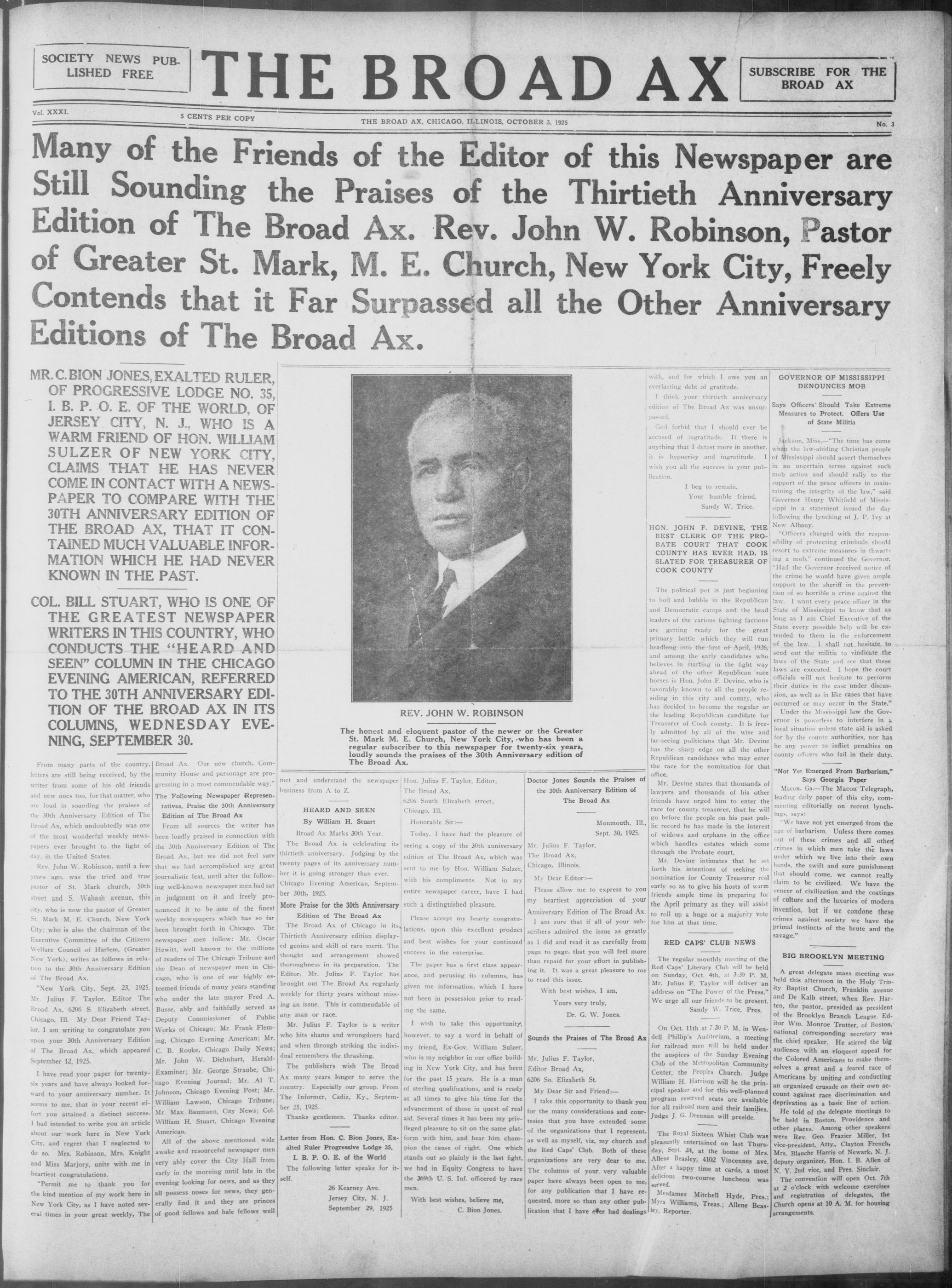
Many of the Friends of the Editor of this Newspaper are Still Sounding the Praises of the Thirtieth Anniversary Edition of The Broad Ax. Rev. John W. Robinson, Pastor of Greater St. Mark, M. E. Church, New York City, Freely Contends that it Far Surpassed all the Other Anniversary Editions of The Broad Ax.
SOCIETY NEWS PUBLISHED FREE
Many of the Still Sound Edition of Greater Contends of Editions of
MR. C. BION JONES, EXA OF PROGRESSIVE L I. B. P. O. E. OF THE JERSEY CITY, N. J. WARM FRIEND OF H SULZER OF NEW CLAIMS THAT HE COME IN CONTACT WITH PAPER TO COMPARE 30TH ANNIVERSARY THE BROAD AX, TRAINED MUCH VALUATION WHICH HE KNOWN IN THE PASS
COL. BILL STUART, WI THE GREATEST WRITERS IN THIS COLONDUCTS THE "H SEEN" COLUMN IN THE EVENING AMERICA TO THE 30TH ANNIVERSION OF THE BROAD COLUMNS, WEDNES NING, SEPTEMBER 3
MR.C.BION JONES,EXALTED RULER, OF PROGRESSIVE LODGE NO.35 I. B. P. O. E. OF THE WORLD, OF JERSEY CITY, N. J., WHO IS A WARM FRIEND OF HON. WILLIAM SULZER OF NEW YORK CITY, CLAIMS THAT HE HAS NEVER COME IN CONTACT WITH A NEWSPAPER TO COMPARE WITH THE 30TH ANNIVERSARY EDITION OF THE BROAD AX, THAT IT CONTAINED MUCH VALUABLE INFORMATION WHICH HE HAD NEVER KNOWN IN THE PAST.
COL. BILL STUART, WHO IS ONE OF THE GREATEST NEWSPAPER WRITERS IN THIS COUNTRY, WHO CONDUCTS THE "HEARD AND SEEN" COLUMN IN THE CHICAGO EVENING AMERICAN, REFERRED TO THE 30TH ANNIVERSARY EDITION OF THE BROAD AX IN ITS COLUMNS, WEDNESDAY EVENING. SEPTEMBER 30.
---
From many parts of the country, letters are still being received, by the writer from some of his old friends and new ones too, for that matter, who are loud in sounding the praises of the 30th Anniversary Edition of The Broad Ax, which undoubtedly was one of the most wonderful weekly newspapers ever brought to the light of day, in the United States.
Rev. John W. Robinson, until a few years ago, was the tried and true pastor of St. Mark church, 50th street and S. Wabash avenue, this city, who is now the pastor of Greater St. Mark M. E. Church, New York City; who is also the chairman of the Executive Committee of the Citizens Welfare Council of Harlem, (Greater New York), writes as follows in relation to the 30th Anniversary Edition of The Broad Ax.
"New York City, Sept. 23, 1925. Mr. Julius F. Taylor, Editor The Broad Ax, 6206 S. Elizabeth street, Chicago, Ill. My Dear Friend Taylor, I am writing to congratulate you upon your 30th Anniversary Edition of The Broad Ax, which appeared September 12, 1925.
I have read your paper for twenty-six years and have always looked forward to your anniversary number. It seems to me, that in your recent effort you attained a distinct success. I had intended to write you an article about our work here in New York City, and regret that I neglected to do so. Mrs. Robinson, Mrs. Knight and Miss Marjory, unite with me in heartiest congratulations.
"Permit me to thank you for the kind mention of my work here in New York City, as I have noted several times in your great weekly, The
THE BROAD AX
5 CENTS PER COPY
OF the Fri
unding t
of The B
ter St. M
is that it
of The l
EXALTED RULER,
IVE LODGE NO. 35,
OF THE WORLD, OF
N. J., WHO IS A
OF HON. WILLIAM
NEW YORK CITY,
HE HAS NEVER
ACT WITH A NEWS-
PARE WITH THE
SARY EDITION OF
AX, THAT IT CON-
VALUABLE INFOR-
HE HAD NEVER
PAST.
T, WHO IS ONE OF
BEST NEWSPAPER
IS COUNTRY, WHO
E "HEARD AND
IN THE CHICAGO
RICAN, REFERRED
ANNIVERSARY EDIBROAD AX IN ITS
DNESDAY EVE-
ER 30.
Broad Ax. Our new church, Community House and parsonage are progressing in a most commendable way." The Following Newspaper Representatives, Praise the 30th Anniversary Edition of The Broad Ax
From all sources the writer has been loudly praised in connection with the 30th Anniversary Edition of The Broad Ax, but we did not feel sure that we had accomplished any great journalistic feat, until after the following well-known newspaper men had sat in judgment on it and freely pronounced it to be one of the finest weekly newspapers which has so far been brought forth in Chicago. The newspaper men follow: Mr. Oscar Hewitt, well known to the millions of readers of The Chicago Tribune and the Dean of newspaper men in Chicago, who is one of our highly esteemed friends of many years standing who under the late mayor Fred A. Busse, ably and faithfully served as Deputy Commissioner of Public Works of Chicago; Mr. Frank Fleming, Chicago Evening American; Mr. C. B. Rouke, Chicago Daily News; Mr. John W. Dienhart, Herald-Examiner; Mr. George Straube, Chicago Evening Journal; Mr. Al T. Johnson, Chicago Evening Post; Mr. William Lawson, Chicago Tribune; Mr. Max Baumann, City News; Col. William H. Stuart, Chicago Evening American.
All of the above mentioned wide awake and resourceful newspaper men very ably cover the City Hall from early in the morning until late in the evening looking for news, and as they all possess noses for news, they generally find it and they are princes of good fellows and hale fellows well
THE BROAD AX, CHICAGO, ILLINOIS, OCTOBER 3, 1925
[Name]
The honest and eloquent pastor of the newer or the Greater St. Mark M. E. Church, New York City, who has been a regular subscriber to this newspaper for twenty-six years, loudly sounds the praises of the 30th Anniversary edition of The Broad Ax.
met and understand the newspaper business from A to Z.
Broad Ax Marks 30th Year. The Broad Ax is celebrating its thirtieth anniversary. Judging by the twenty pages of its anniversary number it is going stronger than ever. Chicago Evening American, September 30th, 1925.
More Praise for the 30th Anniversary
Edition of The Broad Ax
The Broad Ax of Chicago in its Thirtieth Anniversary edition displayed genius and skill of rare merit. The thought and arrangement showed thoroughness in its preparation. The Editor, Mr. Julius F. Taylor has brought out The Broad Ax regularly weekly for thirty years without missing an issue. This is commendable of any man or race.
Mr. Julius F. Taylor is a writer who hits shams and wrongdoers hard and when through striking the individual remembers the thrashing.
The publishers wish The Broad Ax many years longer to serve the country. Especially our group. From The Informer, Cadiz, Ky., September 25, 1925.
Thanks gentlemen. Thanks editor.
I. B. P. O. E. of the World
The following letter speaks for it-self.
26 Kearney Ave.
Jersey City, N. J.
September 29, 1925
REV. JOHN W. ROBINSON
and eloquent pastor of the newer
E. Church, New York City, wi
scriber to this newspaper for tw
is the praises of the 30th Anniver
Ax.
Hon. Julius F. Taylor, Editor,
The Broad Ax,
6206 South Elizabeth street.,
Chicago, Ill.
Honorable Sir:—
Today, I have had the pleasure of
seeing a copy of the 30th anniversary
edition of The Broad Ax, which was
sent to me by Hon. William Sulzer,
with his compliments. Not in my
entire newspaper career, have I had
Please accept my hearty congratulations, upon this excellent product and best wishes for your continued success in the enterprise.
The paper has a first class appearance, and perusing its columns, has given me information, which I have not been in possession prior to reading the same.
I wish to take this opportunity, however, to say a word in behalf of my friend, Ex-Gov. William Sulzer, who is my neighbor in our office building in New York City, and has been for the past 15 years. He is a man of sterling qualifications, and is ready at all times to give his time for the advancement of those in quest of real aid. Several times it has been my privileged pleasure to sit on the same platform with him, and hear him champion the cause of right. One which stands out so plainly is the last fight, we had in Equity Congress to have the 369th U. S. Inf. officered by race men.
With best wishes, believe me,
C. Bion Jones.
Doctor Jones Sounds the Praises of the 30th Anniversary Edition of The Broad Ax
Monmouth, Ill Sept. 30, 1925.
Mr. Julius F. Taylor,
The Broad Ax,
Chicago, Illinois.
My Dear Editor:—
Please allow me to express to you my heartiest appreciation of your Anniversary Edition of The Broad Ax.
I am sure that if all of your subscribers admired the issue as greatly as I did and read it as carefully from page to page, that you will feel more than repaid for your effort in publishing it. It was a great pleasure to me to read this issue.
With best wishes, I am,
Yours very truly,
Dr. G. W. Jones.
Sounds the Praises of The Broad Ax
Mr. Julius F. Taylor, Editor Broad Ax,
I take this opportunity to thank you for the many considerations and courtesies that you have extended some of the organizations that I represent as well as myself, viz, my church and the Red Caps' Club. Both of these organizations are very dear to me. The columns of your very valuable paper have always been open to me for any publication that I have requested, more so than any other publication that I have ever had dealings
with, and for which I owe you an everlasting debt of gratitude.
I think your thirtieth anniversary edition of The Broad Ax was unsurpassed.
God forbid that I should ever be accused of ingratitude. If there is anything that I detest more in another, it is hypocrisy and ingratitude. I wish you all the success in your publication.
I beg to remain,
Your humble friend,
Sandy W. Trice.
HON. JOHN F. DEVINE, THE BEST CLERK OF THE PROBATE COURT THAT COOK COUNTY HAS EVER HAD, IS SLATED FOR TREASURER OF COOK COUNTY
The political pot is just beginning to boil and bubble in the Republican and Democratic camps and the head leaders of the various fighting factions are getting ready for the great primary battle which they will run headlong into the first of April, 1926, and among the early candidates who believes in starting in the fight way ahead of the other Republican race horses is Hon. John F. Devine, who is favorably known to all the people residing in this city and county, who has decided to become the regular or the leading Republican candidate for Treasurer of Cook county. It is freely admitted by all of the wise and far-seeing politicians that Mr. Devine has the sharp edge on all the other Republican candidates who may enter the race for the nomination for that office.
Mr. Devine states that thousands of lawyers and thousands of his other friends have urged him to enter the race for county treasurer, that he will go before the people on his past public record he has made in the interest of widows and orphans in the office which handles estates which come through the Probate court.
Mr. Devine intimates that he see forth his intentions of seeking the nomination for County Treasurer real early so as to give his hosts of warm friends ample time in preparing for the April primary as they will assist to roll up a huge or a majority vote for him at that time.
RED CAPS' CLUB NEWS
The regular monthly meeting of the Red Caps' Literary Club will be held on Sunday, Oct. 4th, at 3:30 P. M. Mr. Julius F. Taylor will deliver an address on "The Power of the Press." We urge all our friends to be present. Sandy W. Trice, Pres.
On Oct. 11th at 7:30 P. M. in Wendell Phillip's Auditorium, a meeting for railroad men will be held under the auspices of the Sunday Evening Club of the Metropolitan Community Center, the Peoples Church. Judge William H. Harrison will be the principal speaker and for this well-planned program reserved seats are available for all railroad men and their families. Judge J. G. Drennan will preside.
The Royal Sixteen Whist Club was pleasantly entertained on last Thursday, Sept. 24, at the home of Mrs. Allene Beasley, 4102 Vincennes ave. After a happy time at cards, a most delicious two-course luncheon was served.
Mesdames Mitchell Hyde, Pres.; Myra Williams, Treas.; Allene Beasley, Reporter.
SUBSCRIBE FOR THE BROAD AX
spaper are anniversary on, Pastor city, Freely anniversary
GOVERNOR OF MISSISSIPPI
DENOUNCES MOB
Says Officers' Should Take Extreme
Measures to Protect. Offers Use
of State Militia
Jackson, Miss.—"The time has come
when the law-abiding Christian people
of Mississippi should assert themselves
in no uncertain terms against such
mob action and should rally to the
support of the peace officers in maintaining the integrity of the law," said
Governor Henry Whitfield of Mississippi in a statement issued the day
following the lynching of J. P. Ivy at
New Albany.
"Officers charged with the responsibility of protecting criminals should resort to extreme measures in thwarting a mob," continued the Governor. "Had the Governor received notice of the crime he would have given ample support to the sheriff in the prevention of so horrible a crime against the law. I want every peace officer in the State of Mississippi to know that as long as I am Chief Executive of the State every possible help will be extended to them in the enforcement of the law. I shall not hesitate to send out the militia to vindicate the laws of the State and see that these laws are executed. I hope the court officials will not hesitate to perform their duties in the case under discussion, as well as in like cases that have occurred or may occur in the State." Under the Mississippi law the Governor is powerless to interfere in a local situation unless state aid is asked for by the county authorities, nor has he any power to inflict penalties on county officers who fail in their duty
"Not Yet Emerged From Barbarism," Says Georgia Paper
Macon, Ga.—The Macon Telegraph, leading daily paper of this city, commenting editorially on recent lynchings, says:
"We have not yet emerged from the age of barbarism. Unless there comes out of these crimes and all other crimes in which men take the laws under which we live into their own hands, the swift and sure punishment that should come, we cannot really claim to be civilized. We have the veneer of civilization and the coatings of culture and the luxuries of modern invention, but if we condone these crimes against society we have the primal instincts of the brute and the savage."
BIG BROOKLYN MEETING
A great delegate mass meeting was held this afternoon in the Holy Trinity Baptist Church, Franklin avenue and De Kalb street, when Rev. Harten, the pastor, presided as president of the Brooklyn Branch League. Editor Wm. Monroe Trotter, of Boston, national corresponding secretary was the chief speaker. He stirred the big audience with an eloquent appeal for the Colored Americans to make themselves a great and a feared race of Americans by uniting and conducting an organized crusade on their own account against race discrimination and deprivation as a basic line of action.
He told of the delegate meetings to be held in Boston, Providence and other places. Among other speakers were Rev. Geo. Frazier Miller, 1st vice-president, Atty., Clayton French, Mrs. Blanche Harris of Newark, N. J. deputy organizer, Hon. I. B. Allen of N. Y. 2nd vice, and Pres. Sinclair.
The convention will open Oct. 7th at 2 o'clock with welcome exercises and registration of delegates, the Church opens at 10 A. M. for housing arrangements.
---
THE BROAD AX Published Every Saturday
In this city since July 15th, 1899,
without missing one single issue. Republicans, Democrats, Catholics, Protestants, Single Taxes, Priests, infidels or anyone else can have their say as long as their language is proper and responsibility is fixed.
The Broad Ax is a newspaper whose platform is broad enough for all, even claiming the editorial right to speak its own mind. It is neither Democratic nor Republican. It is strictly or absolutely independent in politics.
Local communications will receive attention. Write only on one side of the paper.
Subscriptions must be paid in advance.
One Year .....$2.00
Six Months .....$1.00
Advertising rates made known on application.
Address all communications to
THE BROAD AX
6206 S. Elizabeth St., Chicago
Phone: Wentworth 2597
JULIUS F. TAYLOR
Editor and Publisher
Entered as Second-Class Matter, Aug
19, 1902, at the Post office at Chicago
III. Under Act of March 8, 1879.
COLORFUL NEWS "MOVIES"
By: The Cameraman
1. Charles Sumner, of 1849.
2. In the Receiving Line.
3. Form and Substance.
4. The Floridian Stampede.
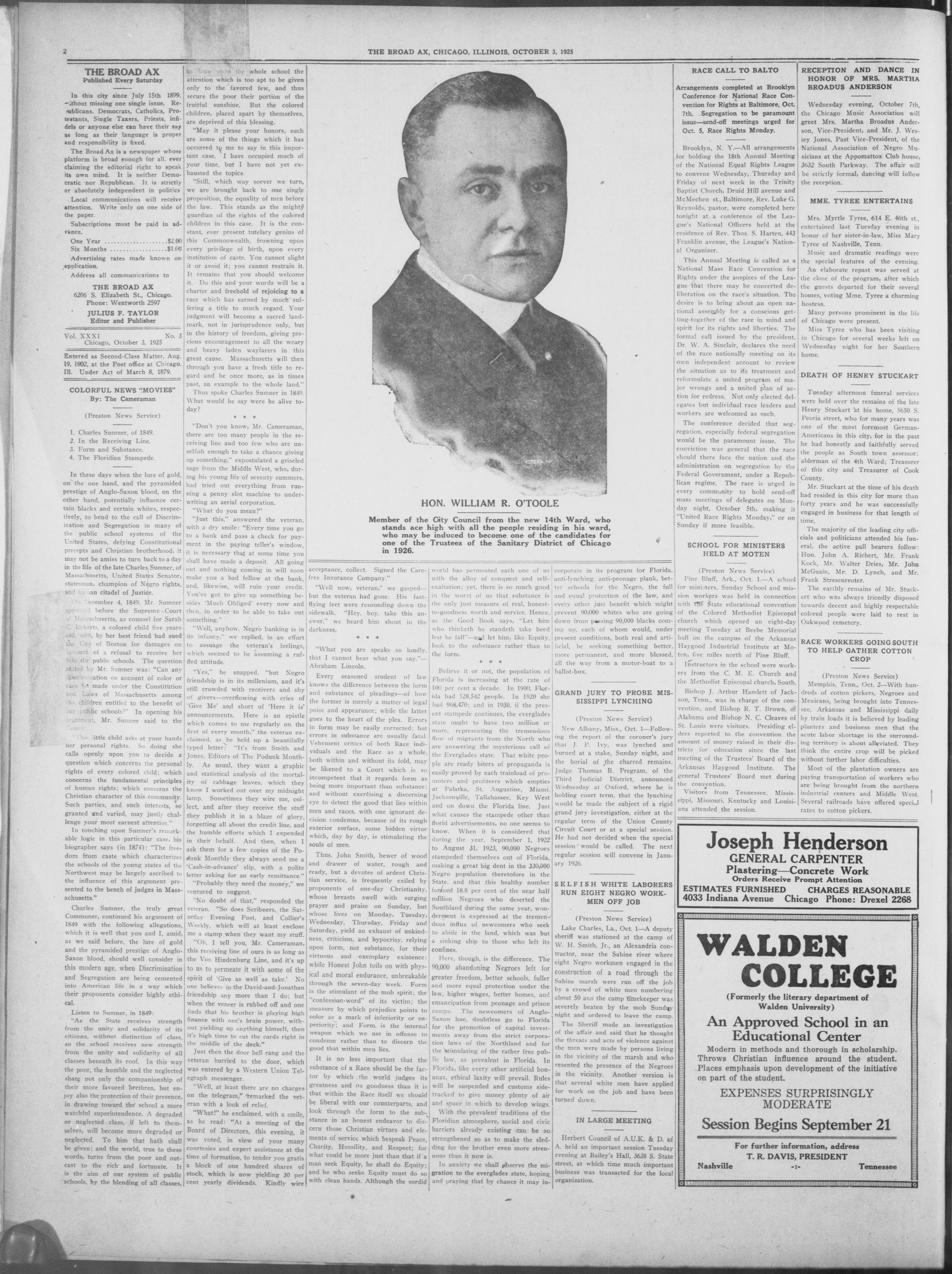
In these days when the lure of gold, on the one hand, and the pyramided prestige of Anglo-Saxon blood, on the other hand, potentially influence certain blacks and certain whites, respectively, to bend to the call of Discrimination and Segregation in many of the public school systems of the United States, defying Constitutional precepts and Christian brotherhood, it may not be amiss to turn back to a day in the life of the late Charles Sumner, of Massachusetts, United States Senator, statesman, champion of Negro rights, and human citadel of Justice.
On December 4, 1849, Mr. Sumner appeared before the Supreme Court of Massachusetts, as counsel for Sarah C. Roberts, a colored child five years old, who, by her best friend had sued the City of Boston for damages on account of a refusal to receive her into the public schools. The question stated by Mr. Sumner was: "Can any discrimination on account of color or race be made under the Constitution and Laws of Massachusetts among the children entitled to the benefit of our public schools?" In opening his argument, Mr. Sumner said to the Court:
The little child asks at your hands her personal rights. So doing she calls openly upon you to decide a question which concerns the personal rights of every colored child; which concerns the fundamental principles of human rights; which concerns the Christian character of this community. Such parties, and such interests, so granted and varied, may justly challenge your most earnest attention." In touching upon Sumner's remarkable logic in this particular case, his biographer says (in 1874): "The freedom from caste which characterizes the schools of the young states of the Northwest may be largely ascribed to the influence of this argument presented to the bench of judges in Massachusetts."
Charles Sumner, the truly great Commoner, continued his argument of 1849 with the following allegations, which it is well that you and L amid, as we said before, the lure of gold and the pyramided prestige of Anglo-Saxon blood, should well consider in this modern age, when Discrimination and Segregation are being cemented into American life in a way which their proponents consider highly ethical.
"As the State receives strength from the unity and solidarity of its citizens, without distinction of class, so the school receives new strength from the unity and solidarity of all classes beneath its roof. In this way the poor, the humble and the neglected sharg not only the companionship of their more favored brethren, but enjoy also the protection of their presence, in drawing toward the school a more watchful superintendence. A degraded or neglected class, if left to themselves, will become more degraded or neglected. To him that hath shall be given; and the world, true to these words, turns from the poor and outcast to the rich and fortunate. It is the aim of our system of public schools, by the blending of all classes
to draw upon the whole school the attention which is too apt to be given only to the favored few, and thus secure the poor their portion of the fruitful sunshine. But the colored children, placed apart by themselves, are deprived of this blessing.
"May it please your honors, such are some of the things which it has occurred to me to say in this important case. I have occupied much of your time, but I have not yet exhausted the topics.
"Still, which way soever we turn, we are brought back to one single proposition, the equality of men before the law. This stands as the mighty guardian of the rights of the colored children in this case. It is the constant, ever present tutelary genius of this Commonwealth, frowning upon every privilege of birth, upon every institution of caste. You cannot slight it or avoid it; you cannot restrain it. It remains that you should welcome it. Do this and your words will be a charter and freehold of rejoicing to a race which has earned by much suffering a title to much regard. Your judgment will become a sacred landmark, not in jurisprudence only, but in the history of freedom, giving precious encouragement to all the weary and heavy laden wayfarers in this great cause. Massachusetts will then through you have a fresh title to regard and be once more, as in times past, an example to the whole land." Thus spoke Charles Sumner in 1849. What would he say were he alive today?
***
"Don't you know, Mr. Cameraman, there are too many people in the receiving line and too few who are unselfish enough to take a chance giving up something," expostulated a griselled sage from the Middle West, who, during his young life of seventy summers, had tried out everything from running a penny slot machine to underwriting an aerial corporation.
"Just this," answered the veteran, with a dry smile; "Every time you go to a bank and pass a check for payment in the paying teller's window, it is necessary that at some time you shall have made a deposit. All going out and nothing coming in will soon make you a bad fellow at the bank, and, likewise, will ruin your credit. You've got to give up something besides 'Much Obliged' every now and then, in order to be able to take out something."
"Well, anyhow, Negro banking is in its infancy," we replied, in an effort to assuage the veteran's feelings, which seemed to be assuming a ruffled attitude.
"Yes," he snapped, "but Negro friendship is in its millenium, and it's still crowded with receivers and shy of givers—overflowing with cries of 'Give Me' and short of 'Here it is' announcements. Here is an epistle which comes to me regularly on the first of every month," the veteran exclaimed, as he held up a beautifully typed letter: "It's from Smith and Jones, Editors of The Podunk Monthly. As usual, they want a graphic and statistical analysis of the mortality of cabbage leaves, which they know I worked out over my midnight lamp. Sometimes they wire me, collect, and after they receive the stuff they publish it in a blaze of glory, forgetting all about the credit line, and the humble efforts which I expended in their behalf. And then, when I ask them for a few copies of the Podunk Monthly they always send me a 'Cash-in-advance' slip, with a polite letter asking for an early remittance." "Probably they need the money," we ventured to suggest.
"No doubt of that," responded the veteran. "So does Scribner, the Saturday Evening Post, and Collier's Weekly, which will at least enclose me a stamp when they want my stuff." "Oh, I tell you, Mr. Cameraman, this receiving line of ours is as long as the Von Hindenburg Line, and it's up to us to permeate it with some of the spirit of 'Give as well as take.' No one believes in the David-and-Jonathan friendship any more than I do; but when the veneer is rubbed off and one finds that his brother is playing high finance with one's brain power, without yielding up anything himself, then it's high time to cut the cards right in the middle of the deck."
Just then the door bell rang and the veteran hurried to the door, which was entered by a Western Union Telegraph messenger.
"Well, at least there are no charges on the telegram," remarked the veteran with a look of relief.
"What!" he exclaimed, with a smile, as he read: "At a meeting of the Board of Directors, this evening, it was voted, in view of your many courtesies and expert assistance at the time of formation, to tender you gratis a block of one hundred shares of stock, which is now yielding 30 per cent yearly dividends. Kindly wire
THE BROAD AX, CHICAGO, ILLINOIS, OCTOBER 3. 1925
591
Member of the City Council from the new 14th Ward, who stands ace high with all the people residing in his ward, who may be induced to become one of the candidates for one of the Trustees of the Sanitary District of Chicago in 1926.
acceptance, collect. Signed the Care-free Insurance Company."
"Well now, veteran," we gasped—but the veteran had gone. His fast-flying feet were resounding down the sidewalk. "Hey, boy, take this answer," we heard him shout in the darkness.
* * *
"What you are speaks so loudly that I cannot hear what you say." Abraham Lincoln.
Every seasoned student of law knows the difference between the form and substance of pleadings—of how the former is merely a matter of legal poise and appearance; while the latter goes to the heart of the plea. Errors in form may be easily corrected; but errors in substance are usually fatal. Vehement critics of both Race individuals and the Race as a whole, both within and without its fold, may be likened to a Court which is so incompetent that it regards form as being more important than substance; and without exercising a discerning eye to detect the good that lies within men and races, with one ignorant decision condemns, because of its rough exterior surface, some hidden virtue which, day by day, is stimulating the souls of men.
Thus, John Smith, hewer of wood and drawer of water, rough and ready, but a devotee of ardent Christian service, is frequently exiled by proponents of one-day Christianity, whose breasts swell with surging prayer and praise on Sunday, but whose lives on Monday, Tuesday, Wednesday, Thursday, Friday and Saturday, yield an exhaust of unkindness, criticism, and hypocrisy, relying upon form, not substance, for their virtuous and exemplary existence: while Honest John toils on with physical and moral endurance, unbreakable through the seven-day week. Form is the stimulant of the mob spirit; the "confession-word" of its victim; the measure by which prejudice points to color as a mark of inferiority or superiority; and Form is the internal weapon which we use in offense to condemn rather than to discern the good that within men lies.
It is no less important that the substance of a Race should be the factor by which the world judges its greatness and its goodness than it is that within the Race itself we should be liberal with our counterparts, and look through the form to the substance in an honest endeavor to discern those Christian virtues and elements of service which bespeak Peace, Charity, Humility, and Respect; for what could be more just than that if a man seek Equity, he shall do Equity; and he who seeks Equity must do so with clean hands. Although the sordid
HON. WILLIAM R. O'TOOLE
world has permeated each one of us with the alloy of conquest and self-exaltation; yet, there is so much good in the worst of us that substance is the only just measure of real, honest-to-goodness worth and service. Hence, as the Good Book says, "Let him who thinkketh he standeth take heed lest he fall"—and let him, like Equity, look to the substance rather than to the form.
Believe it or not, the population of Florida is increasing at the rate of 100 per cent a decade. In 1900, Florida had 528,542 people. In 1920 she had 968,470; and in 1930, if the present stampede continues, the everglades state ought to have two million or more, representing the tremendous flow of migrants from the North who are answering the mysterious call of the Everglades state. That white people are ready bitters of propaganda is easily proved by each trainload of promoters and profiteers which empties at Palatka, St. Augustine, Miami Jacksonville, Tallahassee, Key West and on down the Florida line. Just what causes the stampede other than florid advertisements, one seems to know. When it is considered that during the year, September 1, 1922 to August 31, 1923, 90,000 Negroes stamped themselves out of Florida, making a great big dent in the 330,000 Negro population theretofore in the State, and that this healthy number formed 18.8 per cent of the near half million Negroes who deserted the Southland during the same year, wonderment is expressed at the tremendous influx of newcomers who seek to abide in the land, which was but a sinking ship to those who left its confines.
Here, though, is the difference. The 90,000 abandoning Negroes left for greater freedom, better schools, fuller and more equal protection under the law, higher wages, better homes, and emancipation from peonage and prison camps. The newcomers of Anglo-Saxon hue, doubtless go to Florida for the promotion of capital investments away from the strict corporation laws of the Northland and for the stimulating of the rather free public law, as prevalent in Florida. In Florida, like every other artificial bonanza, ethical laxity will prevail. Rules will be suspended and customs sidetracked to give money plenty of air and space in which to develop wings. With the prevalent traditions of the Floridian atmosphere, social and civic barriers already existing can be so strengthened so as to make the sledding for the brother even more strenuous than it now is.
In anxiety we shall observe the migration to the everglades state, hoping and praying that by chance it may in-
corporate in its program for Florida, anti-lynching, anti-peonage plank, better schools for the Negro, the full and equal protection of the law, and every other just benefit which might prevent 90,000 whites who are going down from passing 90,000 blacks coming up, each of whom would, under present conditions, both real and artificial, be seeking something better more permanent, and more blessed all the way from a motor-boat to a ballot-box.
GRAND JURY TO PROBE MIS
SISSIPPI LYNCHING
New Albany, Miss., Oct. 1—Following the report of the coroner's jury that J. P. Ivy, was lynched and burned at a stake, Sunday night, and the burial of the charred remains, Judge Thomas B. Pregram, of the Third Judicial District, announced Wednesday at Oxford, where he is holding court term, that the lynching would be made the subject of a rigid grand jury investigation, either at the regular term of the Union County Circuit Court or at a special session. He had not decided when the special session would be called. The next regular session will convene in January 1926.
SELFISH WHITE LABORERS
RUN EIGHT NEGRO WORK-
MEN OFF JOB
(Preston News Service)
Lake Charles, La., Oct. 1—A deputy sheriff was stationed at the camp of W. H. Smith, Jr., an Alexandria contractor, near the Sabine river where eight Negro workmen engaged in the construction of a road through the Sabine marsh were run off the job by a crowd of white men numbering about 50 and the camp timekeeper was severely beaten by the mob Sunday night and ordered to leave the camp.
The Sheriff made an investigation of the affair and said that he thought the threats and acts of violence against the men were made by persons living in the vicinity of the marsh and who resented the presence of the Negroes in the vicinity. Another version is that several white men have applied for work on the job and have been turned down.
IN LARGE MEETING
Herbert Council of A.U.K. & D. of A. held an important session Tuesday evening at Bailey's Hall, 3638 S. State street, at which time much important business was transacted for the local organization.
Joseph Henderson
GENERAL CARPENTER
Plastering—Concrete Work
Orders Receive Prompt Attention
ESTIMATES FURNISHED CHARGES REASONABLE
4033 Indiana Avenue Chicago Phone: Drexel 2268
WALDEN COLLEGE
(Formerly the literary department of
Walden University)
An Approved School in an
Educational Center
Modern in methods and thorough in scholarship.
Throws Christian influence around the student.
Places emphasis upon development of the initiative
on part of the student.
EXPENSES SURPRISINGLY
MODERATE
Session Begins September 21
For further information, address
T. R. DAVIS, PRESIDENT
Nashville -- Tennessee
Arrangements completed at Brooklyn Conference for National Race Convention for Rights at Baltimore, Oct. 7th. Segregation to be paramount issue—send-off meetings urged for Oct. 5, Race Rights Monday.
Brooklyn, N. Y.—All arrangements for holding the 18th Annual Meeting of the National Equal Rights League to convene Wednesday, Thursday and Friday of next week in the Trinity Baptist Church, Druid Hill avenue and McMechen st., Baltimore, Rev. Luke G. Reynolds, pastor, were completed here tonight at a conference of the League's National Officers held at the residence of Rev. Thos. S. Harten, 443 Franklin avenue, the League's National Organizer.
This Annual Meeting is called as a National Mass Race Convention for Rights under the auspices of the League that there may be concerted deliberation on the race's situation. The desire is to bring about an open national assembly for a conscious getting-together of the race in mind and spirit for its rights and liberties. The formal call issued by the president, Dr. W. A. Sinclair, declares the need of the race nationally meeting on its own independent account to review the situation as to its treatment and reformulate a united program of major wrongs and a united plan of action for redress. Not only elected delegates but individual race leaders and workers are welcomed as such.
The conference decided that segregation, especially federal segregation, would be the paramount issue. The conviction was general that the race should there face the nation and the administration on segregation by the Federal Government, under a Republican regime. The race is urged in every community to hold send-off mass meetings of delegates on Monday night, October 5th, making it "United Race Rights Monday," or on Sunday if more feasible.
SCHOOL FOR MINISTERS
HELD AT MOTEN
(Preston News Service)
Pine Bluff, Ark., Oct. 1.—A school for ministers, Sunday School and mission workers was held in connection with the State educational convention of the Colored Methodist Episcopal church which opened an eight-day meeting Tuesday at Beeber Memorial hall on the campus of the Arkansas Haygood Industrial Institute at Moten, five miles north of Pine Bluff.
Instructors in the school were workers from the C. M. E. Church and the Methodist Episcopal church, South. Bishop J. Arthur Hamlett of Jackson, Tenn., was in charge of the convention, and Bishop R. T. Brown, of Alabama and Bishop N. C. Cleaves of St. Louis were visitors. Presiding elders reported to the convention the amount of money raised in their districts for education since the last meeting of the Trustees' Board of the Arkansas Haygood Institute. The general Trustees' Board met during the convention. Visitors from Tennessee, Mississippi, Missouri, Kentucky and Louisiana attended the session.
RECEPTION AND DANCE IN HONOR OF MRS. MARTHA BROADUS ANDERSON
Wednesday evening, October 7th, the Chicago Music Association will greet Mrs. Martha Broadus Anderson, Vice-President, and Mr. J. Wesiey Jones, Past Vice-President, of the National Association of Negro Musicians at the Appomattox Club house, 3632 South Parkway. The affair will be strictly formal, dancing will follow the reception.
MME. TYREE ENTERTAINS
Mrs. Myrtle Tyree, 614 E. 46th st., entertained last Tuesday evening in honor of her sister-in-law, Miss Mary Tyree of Nashville, Teen. Music and dramatic readings were the special features of the evening. An elaborate repast was served at the close of the program, after which the guests departed for their several homes, voting Mme. Tyree a charming hostess. Many persons prominent in the life of Chicago were present. Miss Tyree who has been visiting in Chicago for several weeks left on Wednesday night for her Southern home.
DEATH OF HENRY STUCKART
Tuesday afternoon funeral services were held over the remains of the late Henry Stuckart at his home, 5650 S. Peoria street, who for many years was one of the most foremost German-Americans in this city, for in the past he had honestly and faithfully served the people as South town assessor; alderman of the 4th Ward; Treasurer of this city and Treasurer of Cook County.
Mr. Stuckart at the time of his death had resided in this city for more than forty years and he was successfully engaged in business for that length of time.
The majority of the leading city officials and politicians attended his funeral, the active pall bearers follow: Hon. John A. Richert, Mr. Frank Kock, Mr. Walter Dries, Mr. John McGuain, Mr. D. Lynch, and Mr. Frank Stresenreuter.
The earthly remains of Mr. Stuck-art who was always friendly disposed towards decent and highly respectable colored people were laid to rest in Oakwood cemetery.
RACE WORKERS GOING SOUTH
TO HELP GATHER COTTON
CROP
Memphis, Tenn., Oct. 2-With hundreds of cotton pickers, Negroes and Mexicans, being brought into Tennessee, Arkansas and Mississippi daily by train loads it is believed by leading planters and business men that the acute labor shortage in the surrounding territory is about alleviated. They think the entire crop will be picked without further labor difficulties. Most of the plantation owners are paying transportation of workers who are being brought from the northern industrial centers and Middle West. Several railroads have offered speci. rates to cotton pickers.
When the Worm Turns
By M. and R. M. TERRELL
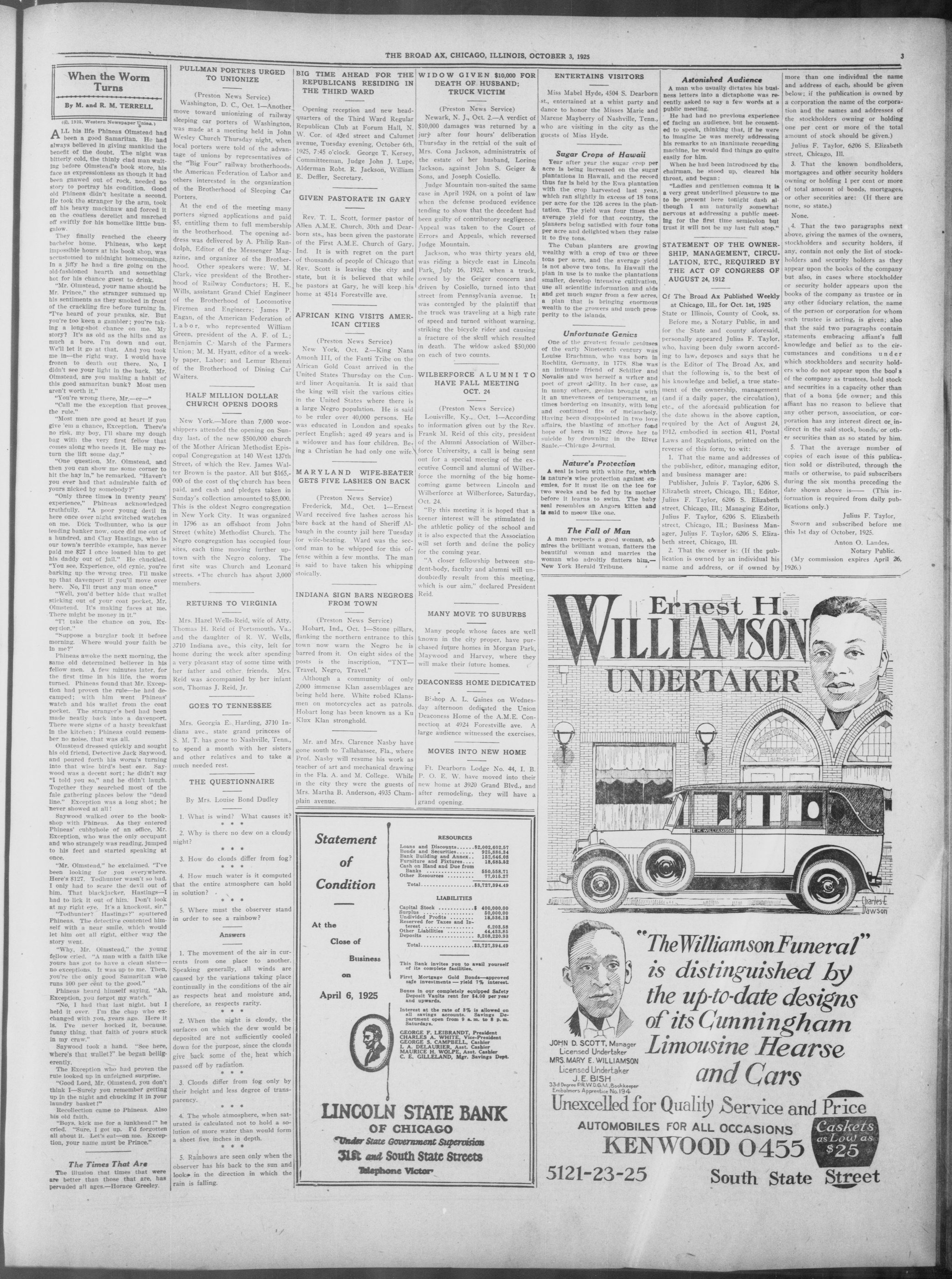
ALL his life Phineas Olmstead had been a good Samaritan. He had always believed in giving mankind the benefit of the doubt. The night was bitterly cold, the thinly clad man waiting before Olmstead's book store, his face as expressionless as though it had been grawn out of rock, needed no story to portray his condition. Good old Phineas didn't hesitate a second. He took the stranger by the arm, took off his heavy mackinaw and forced it on the coasties derelict and marched off swiftly for his homelike little bungeal. They finally reached the cheery bachelor home. Phineas, who kept impossible hours at his book shop, was accustomed to midnight homecomings. In a jiffy he had a fire going on the old-fashioned hearth and something hot for his chance guest to drink.
"Mr. Olmstead, your name should be Mr. Prince," the stranger summed up his sentiments as they smoked in front of the crackling fire before turning in. "I've heard of your pranks, sir. But you're too keen a gambler; you're taking a long-shot chance on me. My story? It's as old as the hills and as much a bore. I'm down and out, We'll let it go at that. And you took me in—the right way. I would have frozen to death out there. No. I didn't see your light in the back. Mr. Olmstead, are you making a habit of this good samaritan bunk? Most men aren't worth it."
"You're wrong there, Mr.-er—"
"Call me the exception that proves the rule."
"Most men are good at heart if you give 'em a chance, Exception. There's no risk, my boy, I'll share my dough bag with the very first fellow that comes along who needs it. He may return the lift some day."
"One question, Mr. Olmstead, and then you can show me some corner to hit the hay in," he remarked. "Haven't you ever had that admirable faith of yours nicked by somebody?"
"Only three times in twenty years' experience," Phineas acknowledged truthfully. "A poor young devil in once here over night switched watches on me. Dick Todhunter, who is our leading banker now, once did me out of a hundred, and Clay Hastings, who is our town's terrible example, has never paid me $27 I once loaned him to get his daddy out of jail." He chuckled. "You see, Experience, old cynic, you're barking up the wrong tree. I'll make up that davernport if you'll move over here. No, I'll trust any man once."
"Well, you'd better hide that wallet sticking out of your pocket coat, Mr. Olmstead. It's making faces at me. There might be money in it."
"I take the chance on you. Excertion."
"Suppose a burglar took it before morning. Where would your faith be in me?"
Phineas awoke the next morning, the same old determined believer in his fellow men. A few minutes later, for the first time in his life, the worm turned. Phineas found that Mr. Exception had proven the rule—he had decamped; with him went Phineas' watch and his wallet from the coat pocket. The stranger's bed had been made neatly back into a davenport. There were signs of a hasty breakfast in the kitchen; Phineas could remember no noise, that was all.
Omlstead dressed quickly and sought his old friend, Detective Jack Saywood, and poured forth his worm's turning into that wise bird's best ear. Saywood was a decent sort; he didn't say "I told you so," and he didn't laugh. Together they searched most of the fale gathering places below the "dead line." Exception was a long shot; he never showed at all.
Saywood walked over to the bookshop with Phineas. As they entered Phineas' cubbyhole of an office, Mr. Exception, who was the only occupant and who strangely was reading, jumped to his feet and started speaking at once.
"Mr. Olmstead," he exclaimed. "Tve been looking for you everywhere. Here's $127. Toddhunter wasn't so bad. I only had to scare the devil out of him. That blackjacker, Hastings—I had to lick it out of him. Don't look at my right eye. It's a knockout, sir." "Toddhunter? Hastings?" sputtered Phineas. The detective contented himself with a near smile, which would let him out all right, either way the story went.
"Why, Mr. Olmstead," the young fellow cried. "A man with a faith like yours has got to have a clean slate—no exceptions. It was up to me. Then, you're the only good Samaritan who runs 100 per cent to the good."
Phineas heard himself saying, "Ah, Exception, you forget my watch." "No, I had that last night, but I held it over. I'm the chap who exchanged with you, years ago. Here it is. Ive never hooked it, because, funny thing, that faith of yours stuck in my craw." Saywood took a hand. "See here, where's that wallet?" he began belligerently. The Exception who had proven the rule looked up in unfeigned surprise. "Good Lord, Mr. Olmstead, you don't think I—Surely you remember getting up in the night and chucking it in your laundry basket!" Recollection came to Phineas. Also his old faith. "Boys, kick me for a lunkhead!" he cried. "Sure, I got up. I'd forgotten all about it. Let's eat—on me. Exception, your name must be Prince."
The Times That Are
The Illusion that times that were are better than those that are, has pervaded all ages—Horace Greeley.
PULLMAN PORTERS URGED TO UNIONIZE
(Preston News Service)
Washington, D. C., Oct. 1—Another move toward unionizing of railway sleeping car porters of Washington, was made at a meeting held in John Wesley Church Thursday night, when local porters were told of the advantage of unions by representatives of the "Big Four" railway brotherhoods, the American Federation of Labor and others interested in the organization of the Brotherhood of Sleeping Car Porters.
At the end of the meeting many porters signed applications and paid $5, entitling them to full membership in the brotherhood. The opening address was delivered by A. Philip Randolph, Editor of the Messenger Magazine, and organizer of the Brotherhood. Other speakers were: W. M. Clark, vice president of the Brotherhood of Railway Conductors; H. E. Wills, assistant Grand Chief Engineer of the Brotherhood of Locomotive Firemen and Engineers; James P. Eagan, of the American Federation of Labor, who represented William Green, president of the A. F. of L.; Benjamin C. Marsh of the Farmers Union; M. M. Hyatt, editor of a weekly paper, Labor; and Lemur Rhenzi of the Brotherhood of Dining Car Waiters.
HALF MILLION DOLLAR
CHURCH OPENS DOORS
New York.—More than 7,000 worshippers attended the opening on Sunday last, of the new $500,000 church of the Mother African Methodist Episcopal Congregation at 140 West 137th Street, of which the Rev. James Walter Brown is the pastor. All but $165,000 of the cost of the church has been paid, and cash and pledges taken in Sunday's collection amounted to $5,000. This is the oldest Negro congregation in New York City. It was organized in 1796 as an offshoot from John Street (white) Methodist Church. The Negro congregation has occupied four sites, each time moving further uptown with the Negro colony. The first site was Church and Leonard streets. The church has about 3,000 members.
RETURNS TO VIRGINIA
Mrs. Hazel Wells-Reid, wife of Atty, Thomas H. Reid of Portsmouth, Va., and the daughter of R. W. Wells, 3710 Indiana ave., this city, left for home during the week after spending a very pleasant stay of some time with her father and other friends. Mrs. Reid was accompanied by her infant son, Thomas J. Reid, Jr.
GOES TO TENNESSEE
Mrs. Georgia E. Harding, 3710 Indiana ave., state grand princess of S. M. T. has gone to Nashville, Tenn., to spend a month with her sisters and other relatives and to take a much needed rest.
THE QUESTIONNAIRE
By Mrs. Louise Bond Dudley
1. What is wind? What causes it?
* * *
2. Why is there no dew on a cloudy night?
* * *
3. How do clouds differ from fog?
* * *
4. How much water is it computed that the entire atmosphere can hold in solution?
* * *
5. Where must the observer stand in order to see a rainbow?
1. The movement of the air in currents from one place to another.
Speaking generally, all winds are caused by the variations taking place continually in the conditions of the air as respects heat and moisture and, therefore, as respects rarity.
* * * *
2. When the night is cloudy, the surfaces on which the dew would be deposited are not sufficiently cooled down for the purpose, since the clouds give back some of the heat which passed off by radiation.
* * * *
3. Clouds differ from fog only by their height and less degree of transparency.
4. The whole atmosphere, when saturated is calculated not to hold a solution of more water than would form a sheet five inches in depth.
* * *
5. Rainbows are seen only when the observer has his back to the sun and looks in the direction in which the rain is falling.
THE BROAD AX, CHICAGO, ILLINOIS, OCTOBER 3, 1925
Statement of Condition
At the Close of Business on April 6, 1925
RESOURCES
Loans and Discounts ... $2,002,602.57
Bonds and Securities ... 925,886.34
Bank Building and Annex. 152,646.08
Furniture and Pictures ... 18,685.82
Cash on Hand and Due from Banks ... 550,558.71
Other Resources ... 77,015.27
Total ... $3,727,394.49
LIABILITIES
Capital Stock ... $ 400,000.00
Surplus ... 50,000.00
Undivided Profits ... 18,536.13
Reserved for Taxes and Interest ... 6,203.58
Other Liabilities ... 44,433.85
Deposits ... 3,208,220.93
Total ... $3,727,394.49
This Bank invites you to avail yourself of its complete facilities.
First Mortgage Gold Bonds—approved safe investments—yield 7% interest.
Boxes in our completely equipped Safety Deposit Vaults rent for $4.00 per year and upwards.
Interest at the rate of 3% is allowed on all savings accounts. Savings Department open from 9 a.m. to 8 p.m. Saturdays.
GEORGE F. LEIBRANDT, President
CHARLES A. WHITE, Vice-President
GEORGE S. CAMPBELL, Cashier
L A. DELAURIER, Asst. Cashier
MAURICE H. WOLPE, Asst. Cashier
C. E. GILLELAND, Mgr. Savings Dept.
LINCOLN STATE BANK
OF CHICAGO
Under State Government Supervision
31st and South State Streets
Telephone Victor
BIG TIME AHEAD FOR THE REPUBLICANS RESIDING IN THE THIRD WARD
Opening reception and new headquarters of the Third Ward Regular Republican Club at Forum Hall, N.W. Cor. of 43rd street and Calumet avenue, Tuesday evening, October 6th 1925, 7:45 o'clock. George T. Kersey Committeeman, Judge John J. Lupe, Alderman Robt. R. Jackson, William E. Deffler, Secretary.
GIVEN PASTORATE IN GARY
Rev. T. L. Scott, former pastor of Allen A.M.E. Church, 30th and Dearborn sts., has been given the pastorate of the First A.M.E. Church of Gary. Ind. It is with regret on the part of thousands of people of Chicago that Rev. Scott is leaving the city and state, but it is believed that while he pastors at Gary, he will keep his home at 4514 Forestville ave.
AFRICAN KING VISITS AMER.
ICAN CITIES
(Preston News Service)
New York, Oct. 2—King Nana Amonh III, of the Fanti Tribe on the African Gold Coast arrived in the United States Thursday on the Cunard liner Acquitania. It is said that the king will visit the various cities in the United States where there is a large Negro population. He is said to be ruler over 40,000 persons. He was educated in London and speaks perfect English; aged 49 years and is a widower and has four children. Being a Christian he had only one wife.
MARY LAND WIFE-BEATER
GETS FIVE LASHS ON BACK
Frederick, Md., Oct. 1—Ernest Ward received five lashes across his bare back at the hand of Sheriff Albaugh in the county jail here Tuesday for wife-beating. Ward was the second man to be whipped for this offense within a few months. The man is said to have taken his whipping stoically.
INDIANA SIGN BARS NEGROES
FROM TOWN
Hobart, Ind., Oct. 1—Stone pillars, flanking the northern entrance to this town now warn the Negro he is barred from it. On eight sides of the posts is the inscription, "TNT—Travel, Negro, Travel." Although a community of only 2,000 immense Klan assemblages are being held here. White robed Klan-smen on motorcycles act as patrols. Hobart long has been known as a Ku Klux Klan stronghold.
Mr. and Mrs. Clarence Nasby have gone south to Tallahassee, Fla., where Prof. Nasby will resume his work as teacher of art and mechanical drawing in the Fla. A. and M. College. While in the city they were the guests of Mrs. Martha B. Anderson, 4935 Champlain avenue.
Statement of Condition
WIDOW GIVEN $10,000 FOR
DEATH OF HUSBAND;
TRUCK VICTIM
Newark, N. J., Oct. 2.—A verdict of $10,000 damages was returned by a jury after four hours' deliberation Thursday in the retrial of the suit of Mrs. Cona Jackson, administratrix of the estate of her husband, Lorine Jackson, against John S. Geiger & Sons, and Joseph Cosiello. Judge Mountain non-suited the same case in April 1924, on a point of law when the defense produced evidence tending to show that the decedent had been guilty of contributory negligence. Appeal was taken to the Court of Errors and Appeals, which reversed Judge Mountain.
Jackson, who was thirty years old, was riding a bicycle east in Lincoln Park, July 16, 1922, when a truck, owned by the Geiger concern and driven by Cosiello, turned into that street from Pennsylvania avenue. It was contended by the plaintiff that the truck was traveling at a high rate of speed and turned without warning, striking the bicycle rider and causing a fracture of the skull which resulted in death. The widow asked $50,000 on each of two counts.
WILBERFORCE ALUMNI TO HAVE FALL MEETING
Louisville, Ky., Oct. 1-According to information given out by the Rev. Frank M. Reid of this city, president of the Alumni Association of Wilberforce University, a call is being sent out for a special meeting of the executive Council and alumni of Wilberforce the morning of the big homecoming game between Lincoln and Wilberforce at Wilberforce, Saturday, Oct. 24.
"By this meeting it is hoped that a keeper interest will be stimulated in the athletic policy of the school and it is also expected that the Association will set forth and define the policy for the coming year.
"A closer fellowship between student-body, faculty and alumni will undoubtedly result from this meeting, which is our aim," declared President Reid.
MANY MOVE TO SUBURBS
Many people whose faces are well known in the city proper, have purchased future homes in Morgan Park, Maywood and Harvey, where they will make their future homes.
DEACONESS HOME DEDICATED
Bishop A. L. Gaines on Wednesday afternoon dedicated the Union Deaconess Home of the A.M.E. Connection at 4924 Forestville ave. A large audience witnessed the exercises.
MOVES INTO NEW HOME
Ft. Dearborn Lodge No. 44, I. B.
P. O. E. W. have moved into their
new home at 3920 Grand Blvd., and
after remodeling, they will have a
grand opening.
Ernest H.
WILLIAMSON
UNDERTAKER
ERnest H. WILLIAMSON
UNDERTAKER
514-4944
E. H. WILLIAMSON
Charles E.
Dawson
ENTERTAINS VISITORS
Miss Mabel Hyde, 4504 S. Dearborn st., entertained at a whist party and dance to honor the Misses Marie and Marene Mayberry of Nashville, Tenn., who are visiting in the city as the guests of Miss Hyde.
Sugar Crops of Hawaii
Year after year the sugar crop per acre is being increased on the sugar plantations in Hawaii, and the record thus far is held by the Ewa plantation with the crop harvested last year, which ran slightly in excess of 18 tons per acre for the 126 acres in the plantation. The yield was four times the average yield for that country, the planters being satisfied with four tons per acre and delighted when they raise it to five tons. The Cuban planters are growing wealthy with a crop of two or three tons per acre, and the average yield is not above two tons. In Hawaii the plan in use is to make the plantations smaller, develop intensive cultivation, use all scientific information and aids and get much sugar from a few acres, a plan that is bringing enormous wealth to the growers and much prosperity to the islands.
Unfortunate Genius
One of the greatest female geniuses of the early Nineteenth century was Louise Brachman, who was born in Rochlitz, Germany, in 1778. She was an intimate friend of Schiller and Novalis and was herself a writer and poet of great ability. In her case, as in many others, genius brought with it an unevenness of temperament, at times bordering on insanity, with long and continued fits of melancholy. Having been disappointed in two love affairs, the blasting of another fond hope of hers in 1822 drove her to suicide by drowning in the River Saale.—Chicago Journal.
Nature's Protection
A seal is born with white fur, which is nature's wise protection against enemies, for it must lie on the ice for two weeks and be fed by its mother before it learns to swim. The baby seal resembles an Angora kitten and is said to meow like one.
The Fall of Man
A man respects a good woman, admires the brilliant woman, flatters the beautiful woman and marries the woman who adroitly flatters him. New York Herald Tribune.
WILLIE
UNI
A. B.
JOHN D. SCOTT, Manager
Licensed Undertaker
MRS. MARY E. WILLIAMSON
Licensed Undertaker
J.E. BISH
33d Degree PR.W.D.G.M., Bookkeeper
Embalmer Apprentice No.194
Unexcelled for
AUTOMOBILES
KEN
5121-23-25
Astonished Audience
A man who usually dictates his business letters into a dictaphone was recently asked to say a few words at a public meeting.
He had had no previous experience of facing an audience, but he consented to speak, thinking that, if he were to imagine he was merely addressing his remarks to an inanimate recording machine, he would find things go quite easily for him.
When he had been introduced by the chairman, he stood up, cleared his throat, and began:
"Ladies and gentlemen comma it is a very great underlined pleasure to me to be present here tonight dash although I am naturally somewhat nervous at addressing a public meeting for the first time semicolon but trust it will not be my last full stop."
STATEMENT OF THE OWNERSHIP, MANAGEMENT, CIRCULATION, ETC., REQUIRED BY THE ACT OF CONGRESS OF AUGUST 24, 1912
at Chicago, IL, for Oct. 18, 1925
State or Illinois, County of Cook, ss.
Before me, a Notary Public, in and
for the State and county aforesaid,
personally appeared Julius F. Taylor,
who, having been duly sworn according
to law, deposes and says that he is
the Editor of The Broad Ax, and
that the following is, to the best of
his knowledge and belief, a true statement of the ownership, management
(and if a daily paper, the circulation),
etc., of the aforesaid publication for
the date shown in the above caption,
required by the Act of August 24,
1912, embodied in section 411, Postal Laws and Regulations, printed on the reverse of this form, to wit:
1. That the name and addresses of the publisher, editor, managing editor,
and business manager are:
Publisher, Julius F. Taylor, 6206 S. Elizabeth street, Chicago, Ill.; Editor, Julius F. Taylor, 6206 S. Elizabeth street, Chicago, Ill.; Managing Editor, Julius F. Taylor, 6206 S. Elizabeth street, Chicago, Ill.; Business Manager, Julius F. Taylor, 6206 S. Elizabeth street, Chicago, Ill.
2. That the owner is: (If the publication is owned by an individual his name and address, or if owned by
more than one individual the name and address of each, should be given below; if the publication is owned by a corporation the name of the corporation and the names and addresses of the stockholders owning or holding one per cent or more of the total amount of stock should be given.)
Julius F. Taylor, 6206 S. Elizabeth street, Chicago, III.
3. That the known bondholders, mortgagees and other security holders owning or holding 1 per cent or more of total amount of bonds, mortgages, or other securities are: (If there are none, so state.)
4. That the two paragraphs next above, giving the names of the owners, stockholders and security holders, if any, contain not only the list of stockholders and security holders as they appear upon the books of the company but also, in cases where stockholder or security holder appears upon the books of the company as trustee or in any other fiduciary relation, the name of the person or corporation for whom such trustee is acting, is given; also that the said two paragraphs contain statements embracing affiant's full knowledge and belief as to the circumstances and conditions under which stockholders and security holders who do not appear upon the book's of the company as trustees, hold stock and securities in a capacity other than that of a bona fide owner; and this affiant has no reason to believe that any other person, association, or corporation has any interest direct or indirect in the said stock, bonds, or other securities than as so stated by him.
5. That the average number of copies of each issue of this publication sold or distributed, through the mails or otherwise, to paid subscribers during the six months preceding the date shown above is—— (This information is required from daily publications only.)
Julius F. Taylor,
Sworn and subscribed before me
this 1st day of October, 1925.
Anton O. Landes,
Notary Public.
(My commission expires April 26,
1926.)
4
---
Beautiful Girl Reveals Secret
Once my hair was anything but long and silky soft as it is now, and my complexion was sallow, and there were often unightly pimples on my face.
One day I heard of Exelento Quinine Pomade for the hair and purchased a jar. Almost immediately it stopped all dandruff, made my hair grow long, soft and fine, and gave it a delightful sheen.
Because of the perfectly wonderful results I obtained from Exelento Quinine Pomade, I purchased a jar of Exelento Skin Beautifier. My changed my lovely complexion to a clear, lovely skin, glowing with health. For pimples and other skin blemishes, it has no equal.
If I am as beautiful as people say, it is all due to Exelento preparations. Exelento Quinine Pomade and Exelento Skin Beautifier may be obtained for only 25% at most drug stores, or will be sent postpaid upon receipt of price by the
EXELENTO MEDICINE CO., Atlanta, Ga.
AGENTS WANTED EVERYWHERE
Write For Particulars
Oldtime Pocketbooks
Under Charles II of England purses were supplanted by flap-pockets, which were worn over the hips, and ladies favored quilted pockets which were perfumed. Years later, purses of netting again came into vogue, and were carried by men and women alike, even to the days of our grandparents. These were displaced once more by small, book-like cases made with several divisions, to each of which the coinage of the day was regulated—gold in one, silver in another, and bronze or copper in a third. When banknotes and bills became common the shape of the purse was modified. It was made larger, had more compartments, and became card case and purse combined, or what we know as the modern pocketbook.
London's Chief Charm
London owes much of its charm and fascination to its plan, or rather its lack of a plan. Much of it was built before the days of town planning and before the invention of the deadly "gridiron" which makes hideous so many American cities, and as London's streets, squares, places and lanes developed apparently by no fixed, plan, the buildings which face them were built with apparent defiance of all rules of architecture, and yet they possess charm and distinction which it would be difficult to secure today, when the world's building customs are changed, and design itself is in a state of flux.
Jenny Lind, Genial Friend
Jenny Lind came again and yet again to the Taylors' congenial homestead; her kindness, 'sensitive, capricious and restless as it is, her humanities and impetuosities' won the affections of mother and boy alike, says the Christian Science Monitor.
"Great impulses, a humble Christian heart watching and praying to bring her into subjection of God's will, she is a great addition to my life," wrote Alice Taylor. . . . Nor was it to him (James Speedding) only that the great canture of the world's worship brought her message of beauty and joy. In many a letter of that date we catch glimpses of her shining presence in that quiet home.
Handkerchief's History
In its earlier form the handkerchief was merely a cloth or towel with which to wipe the face or the hand. The modern name is derived from the "coverchief" or veil, formerly used by women for covering the head. In the Sixteenth century this article formed a part of woman's headaddress, and the word kerchief (corrupted from coverchief) lost its original meaning but retained its name as a cloth, and the term "handkerchief" was generally adopted. Its prefix, "pocket," came from the French, "mouchoir de poche," which, translated idiomatically, means pocket-handkerchief.
Day of Glory Gone
The Clinque Ports was the old collective name for the five English channel ports—Sandwich, Dover, Hythe, Romney and Hastings. They were enfranchised by Edward the Confessor, and granted special privileges by William the Conqueror. Up to the reign of Henry VII their chief duty was to supply the country's naval contingent. In the time of Edward I they provided 57 fully equipped ships and often extended their powers by equipping practical expeditions. Dating from the revolution of 1688, their privileges and powers waned.
Used Table Leaves
A resourceful man purchased for a very small sum a dozen oak table leaves which had not been taken by the purchaser when some banquet tables were closed out by a hotel going out of, business. He took these table leaves and in his spare time made out of them a fine and roomy china cabinet with lead glass fronts, thus giving his wife the additional cupboard room which she sadly needed.
All Ages Poetic
For my part, I can call no age absolutely unpoetic; how should it be so since there are always children to whom the acorns and the swallow's eggs are a wonder, always those human passions and fatalities through which Garrick as Hamlet in bob wig and knee breeches moved his audience more than some have since done in velvet tunic and plume? . . . To be quite fair toward the ages, a little ugliness as well as beauty must be allowed to each of them, a little implicit poetry even to those which echoed loudest with servile, pompous, and trivial prose—George Eliot.
Females Are Supreme
The ants are described as communists, because the individual is merged in the community. Thelrs is a female rights colony. The workers are females, the soldiers are females, the nurses are females, and there is one queen mother for them all who lays all the eggs for the colony. The males are but mates for the young queens.—Our Dumb Animals.
Primitive Bread Making
Perhaps the earliest form of bread, if that word may be used, was prepared from acorns and beechnuts. The Roman philosopher, Pliny, speaks of a similar crude process in connection with wheat. The grain was evidently pounded, and the crushed remnants soaked into a cake and dried in the sun.
Insinuation Here
"I'm sorry I kept you waiting so long, Harry, dear," murmured the wife as she appeared ready for the theater. "It took me so long to put on my coat." "Did you put on only one coat?" he asked, blandly. Turning quickly she found his gaze resting on her cheeks.
"Fool" as Epithet. Costly
Frederick Padden was called "a fool" publicly by one of his business competitors in London, England, and, highly indignant, he went to court about it. The result was a verdict for $15,000 awarded as damages by the court, which Padden believes is proof that he was not what he was called.
Our Two Bibles
There are two versions of the Bible in use today, and the one used principally dates back to the year 1011. This is known as the Authorized Version, but a much later Revised Version was issued in 1885. The later version is more correct, but the other version is preferred.
Mind Must Rule
The fountain of content must spring up in a man's own mind; and he who has so little knowledge of human nature as to seek happiness by changing anything but his own disposition will waste his life in fruitless efforts, and multiply the griefs which he proposes to remove—Samuel Johnson.
World's First Railway
The Stockton and Darlington railway in England was the first public railway in the world. It was opened for traffic September 27, 1825. George Stephenson's "Locomotive Number 1" was the first steam-driven locomotive introduced to work public traffic. Its speed was eight miles an hour.
Not Infallible
It was formerly believed that several species of eucalyptus, the castor oil plant, the Chinaberry tree and other would keep mosquitoes away. How ever, observations made by scientific men in different parts of the world negative their value.
Mere Sound and Fury
There are two sides to every question, but some of the questions now being windyly debated in this happy land are like the brass drum, of which it was said that after you had listened to both sides of it you haven't heard much.—Charleston News and Courier.
Tricks in All Trades
"How do you get so many subscribers?" asked the visitor to the office of the great magazine. "Just between you and me I'll tell you the secret. I answer the contributors and tell them the stuff will be used as soon as available. That makes them subscribe for life."-Indianapolis Star.
Thoughts' Influence
It is the habitual thought that frames itself into our life. It affects us even more than our intimate social relations do. Our confidential friends have not so much to do in shaping our lives as thoughts have which we harbor.—F. W. Teal.
Aiding the Realtors
The realtors have a powerful ally that has descended from the sky to aid them—the radio. Now that inventions have begun actually to attract people to their own homes, the men who sell houses have good reason to feel encouraged.-Chicago News.
Reward Worth While
Life is troublesome, full of care, disappointment and bitterness for those that carry responsibility and realize their shortcomings. But it has its reward as great as its worries.
Let Well Enough Alone
If you think you resemble a great man say nothing about it. The resemblance may cease the moment you open your mouth—Urbana Democrat.
THE BROAD AX, CHICAGO, ILLINOIS, OCTOBER 3, 1925
Just Plain Turtle Soup
Did you ever eat turtle soup? Not mock turtle soup, nor green turtle, nor sea turtle, nor terrapin a la Maryland, but plain turtle? You know; regular mud turtle—al fixed up with garlic and onions and small fresh carrots and petites pols and tiny new potatoes and just the right amount of seasoning and all that? What! Never did? Neithmer did I—Phill Moore, in Forest and Stream
First Canadian Railway
The first railway in Canada was built by the Champlain and St. Lawrence Railway company, incorporated by an act of the legislature of Lower Canada. The railway extended from Lapraille on the south bank of the St. Lawrence river, about eight miles above Montreal, to the town of St. Johns, on the Richelieu river, a distance of 16 miles. It was opened on July 23, 1836, by Earl Gosford, the governor-general.
Elk Skeleton Centaries Old
Aged 10,000 years the complete skeleton of an elk has been discovered near the town of Naestved, says a Copenhagen messenger. This is believed to be the oldest example of the animal yet brought to light. The discovery was made during the construction of a drain trench. The skeleton was in a remarkable state of preservation, only small portions of the skull and antlers being missing.
Simple Achievement
He was telling of his travels, and his young listeners were duly impressed, for he was a wonderful man, judging by his adventures. "But the real thriller was when I made sixty cannibals run," he said, and paused, waiting for encouragement. "How did you do that?" inquired a listener. "I ran and they all ran after me," was the reply.
Knows How to Fish
The kingfisher and great blue heron are both solitary fishers of the coastal waters, both knowing the art of fishing quietly, says Nature Magazine. The kingfisher has his regular watch towers above the marginal waters, and with his arrow-shaped body and strong wings he is equipped like a professional fisherman.
Heat and Humidity
High humidity makes heat more oppressive. Less vapor is evaporated from the lungs in warm damp air, thus humidity influences the processes of respiration. Perspiration is more readily perceived in warm damp air. Such air is a great deal less endurable than dry warm air.
Keeping Milk Sweet
During a hot dry spell particular care must be taken to prevent milk curdling. It is brought about by a variety of organisms or bacteria, which cause milk to coagulate without the production of a rennet-like enzyme, which acts directly on the albumen and casein in the milk.
Chinese Earthquakes
China's sufferings from earthquakes have been appalling. In 1731 there was a loss of 100,000 lives in Peking and vicinity. In 1830 Canton was shattered and 6,000 persons died. Lesser disasters have followed with great frequency till the death roll has become enormous.
What Really Matters
It does not much matter what our work may be; what, I think, does matter is that which we are putting into it. While our brains are busy with ideas and our hands with tools, we may be putting into our work something which is neither of brain nor of land—Exchange.
New England's First Poet
The first poet of New England was Anne Bradstreet, daughter of Governor Thomas Dudley of Massachusetts and wife of Governor Simon Bradstreet. The first collection of her poems was published in London in 1650
Would Test His Powers
We should like to see the scientist who says a person should abstain from food during an emotional crisis try to convince an emotional baby that the milk bottle should be postponed until the emotional crisis is passed.—New Orleans States.
Heels of Olive Wood
Olive wood is an admirable material for heel-making, because, whilst being exceedingly hard, its grain with its beautiful markings forms a beauty in itself. Olive wood heels are encircled with lines of gold or black enamel.
Indians Practice Massage
The Makah Indians of the northwest Pacific coast spend much time massaging their bodies and faces, and a native who neglects this duty and becomes wrinkled in old age is considered a fit subject for ridicule.
Scatter Good Deeds
We cannot render benefits to those from whom we receive them, or only seldom. But the benefit we receive must be rendered again line for line, deed for deed, to somebody. Beware of too much good staying in your hand. —Emerson.
"Spanish Moss" Isn't Moss
Spanish Moss isn't Moss
The so-called Spanish moss that
drains the trees in the South is not a
moss at all, but a close relative of
the pineapple.
There is a place for the pessimist,
a work for him to do. He must see
the evil in the present. He must cry
out against wrong. Let him paint it
black as night. Let him brand it as
he will, but his work is never to be
the ultimate.—Exchange.
Swedish Wedding Customs
Swedish Wedding Customs
In Sweden weddings formerly took place at night. One wedding superstition is that a bride, on leaving home, must step into the carriage with her right foot first, and do the same when she first enters her new home.
"From the earliest day you men have blamed woman for every evil." "Oh, I don't know. I notice that we invariably impute sin to 'the old Adam in us,' never to 'the old Eve.'"—Boston Transcript.
JAS. B. McCAHEY, President
FRANK J. DUNN, Vice-President
ESTABLISHED
JOHN J.
COA
IEY, President PHILIP J. DUNN, Secretary
IN, Vice-President H. X. COMERFORD, Treasurer
ESTABLISHED 1877
JOHN J. DUNN
COAL CO.
JAS. B. McCAHEY, President PHILIP J. DUNN, Secretary FRANK J. DUNN, Vice-President H. X. COMERFORD, Treasurer ESTABLISHED 1877
Telephone Oakland 1550
1 Street CHICAGO
enwood 6309
COLN GARAGE
L. Johnston
GENERAL AUTOMOBILE STORAGE
AND REPAIRING
Day and Night Service
4621-23 So. State Street
Phone: Kenwood 6309
LINCOLN
L. J.
GENERAL AUTOM
AND RE
Day and N
4621-23 So.
LINCOLN GARAGE
L. Johnston
GENERAL AUTOMOBILE STORAGE
AND REPAIRING
Day and Night Service
4621-23 So. State Street
A. H.
La Prov
Importers and Wholesale Dealers in
HUMAN HAIR DRESSERS AND
Accessories: Wigs, T
4956 South Sta
Public
INSURANCE
Home
1400 Washing
Down To
108 South L
Brokers' Busi
MAN HAIR GOODS
DRESSERS AND BEAUTY PARLOR
ories: Wigs, Toupees, Transformations
South State St., Chicago
Public Life
INSURANCE COMPANY
Home Office:
10 Washington Boulevard
Down Town Office:
8 South La Salle Street
kers' Business Solicited
4956 South State St., Chicago
PublicLife INSURANCE COMPANY
Home Office: 1400 Washington Boulevard
Down Town Office: 108 South La Salle Street
Service Guaranteed
Standard and Business
Standard and Substandard Business Accepted
Standard and Substandard Business Accepted
Work for Pessimist
One Case, at Least
5100 Federal Street
Phone Kenwood 6379
Early American Cunts
The first canal in the United States was built around the falls of the Connecticut river at South Hadley Falls, Mass., in 1793, but the first general canal for passengers and merchandise opened in the United States was Middlesex, around the falls at the mouth of the Concord, incorporated in 1793 and completed in 1804, at a cost of $700,000. It was 31 miles long, 24 feet wide and 4 feet deep.
Telephone: State 3278
A. D. GASH
ATTORNEY AT LAW
Suite 813, Ashland Block
155 N. Clark Street
CHICAGO, ILL.
Phone: Douglas 0964
R. D. JONES
Makers of Portraits That Please
3504 Grand Boulevard CHICAGO, ILL.
Dr. Emily M. Scott
Chiropodist and Skin Specialist
Phones: Office Main 4153; Residence,
4751 Champlain Avenue
Phone Kenwood 5611
Walter M. Farmer
ATTORNEY AND COUNSELOR
AT LAW
Suite 708—184 W. Washington St.
CHICAGO
Residence, 1262 Macalister Place
Telephone Monroe 2714
MILES J. DEVINE
ATTORNEY AT LAW
Suite 318-320 Reaper Block
Clark and Washington Sts.
CHICAGO
Telephone Central 1239
STRAIT-TEX
HAIR PREPARATIONS
USE of these pre-
ture of your ha
results. Start can
properly by using
ing:
STRAIT-TEX HAIR R
STRAIT-TEX HERBS
(Straightens and restores
GLOSS-TEX BRILLIA
STRAIT-TEX HAIR G
If your hair dresser or d
order direct from us. (C
where in the United Stat
USE of these preparations in the cure of your hair will give you big results. Start caring for your hair properly by using some of the following:
RAIT-TEX HAIR REFINING TONIC...$
RAIT-TEX HERBS ..... (straightens and restores color to gray hair)
BOSS-TEX BRILLIANTINE .....
RAIT-TEX HAIR GROWER......
Your hair dresser or druggist cannot supply or direct from us. Goods sent postpaid are in the United States.
USE of these preparations in the culture of your hair will give you best results. Start caring for your hair properly by using some of the following:
If your hair dresser or druggist cannot supply you,
order direct from us. Goods sent postpaid any-
where in the United States.
AGENTS WANTED; WRITE FOR TERMS
STRAIT-TEX CHEMICAL CO.
600 FIFTH AVENUE PITTSBURGH, PA.
STRAIT-TEX
OFFICERS
TRAIT-TEX CHEMICAL CO
FIFTH AVENUE PITTSBURGH
TRAIT-TE
STRAIT-TEX
OFFICERS
EDW. C. BARRY
Vice-Pres. and Cashier
W. MERLE FISHER
Ast. Cash, and Trust Officer
West End
Trust and Sa
N. E. Corner 63rd and Ma
Telephone R
Capital and Su
E. L. SCHWEDER
MICHAEL MAISEL
EDW. C. BARRY
GEO. WETZEL
DR. W. H. BUHLIG
DIRECT
W. MERLE
ARTHUR C
CARL HORN
WM. BLUE
ROBT. C. I
Affiliated Member Chicago
West Englewood
West and Savings B
mer 63rd and Marshfield Ave., Ch
Telephone Republic 5000
Capital and Surplus $700,000
DIRECTORS
DER
ISSEL
RY
L
UHLIG
W. MERLE FISHER
ARTHUR C. UTESCH
CARL HORAUG
WM. BLUEMER
ROBT. C. KING
J. F. JE
HUGO S.
WM. P. I
GEG. H
JOHN B
Member Chicago Clearing House
N. E. Corner 63rd and Marshfield Ave., Chicago, Ill.
Telephone Republic 5000
Capital and Surplus $700,000.00
Affiliated Member Chicago Clearing House Ass'n.
TELEPHONE DOUGLAS 1
GEORGE F. H.
REAL
Up-to-Date or Moden
and Store
3101 COTTAG
RGE F. HARDING
REAL ESTATE
Date or Modern Houses, Apa
and Stores to Rent
COTTAGE GROVE
GEORGE F. HARDING, JR.
Up-to-Date or Modern Houses, Apartments and Stores to Rent 3101 COTTAGE GROVE AVE. Corner 31st Street, Chicago
Please enter my name as a subscriber to THE BROAD AX. I inclose herewith Two Dollars, the annual subscriptions to same, or One Dollar for six months.
JOHN BAIN
President
MICHAEL MAISEL
Vice-President
W.G. Anderson
Attorney At Law
17 North La Salle Street
CHICAGO
NOTARY PUBLIC
Suite 560 Watson Bldg.
Office Phones: Dearborn 7094-7095
Res. 3354 Vernon Avenue
Phone Douglas 6045
Phone Main 2017
A. L. WILLIAMS
ATTORNEY AND
COUNSELOR AT LAW
Suite 706 Firmenich Building
184 W. Washington St.
CHICAGO
Residence 3655 Prairie Ave.
Phone Douglas 9133
AIRTIT
inations in the cul-
ter will give you best
ing for your hair
some of the follow-
FINING TONIC...$1.00
1.00
(color to gray hair)
TINE .50
POWER.25
aggist cannot supply you,
foods sent postpaid any-
CHEMICAL CO.
PITTSBURGH, PA.
-TEX
Eaglewood Savings Bank
Highfield Ave., Chicago, Ill.
Republic 5000
plus $700,000.00
ATORS
FISHER J. F. JENSEN
UTESCH HUGO S. HERTEL
WIGS W.M. P. ENOCHHE
ER GEO. HERRMANN
NG JOHN BAIN
Clearing House Ass'n.
ARDING, JR.
STATE
In Houses, Apartments
to Rent
GROVE AVE.
CARL O. SEBERG
Asst. Cashier