The Broad Ax
Saturday, December 26, 1925
Chicago, Illinois
Page text (machine-generated)
THE HOLIDAY EDITION OF THE BROAD AX "Still Looking Backward and Forward"
SOCIETY NEWS PUBLISHED FREE
Vol. XXXI.
THE HO
IE HOLIDY
"Still
The ever-popular and smiling Treasurer wishes to warmly thank his legion past support at all times, at the same the top of the morning for the remn season, and, he feels it deep down old-time and new friends will assist Sheriff's office in 1926.
popular and smiling Treasurer of Cook Office to warmly thank his legion of friends support at all times, at the same time we of the morning for the remainder of the day, he feels it deep down in his hee and new friends will assist to boost his office in 1926.
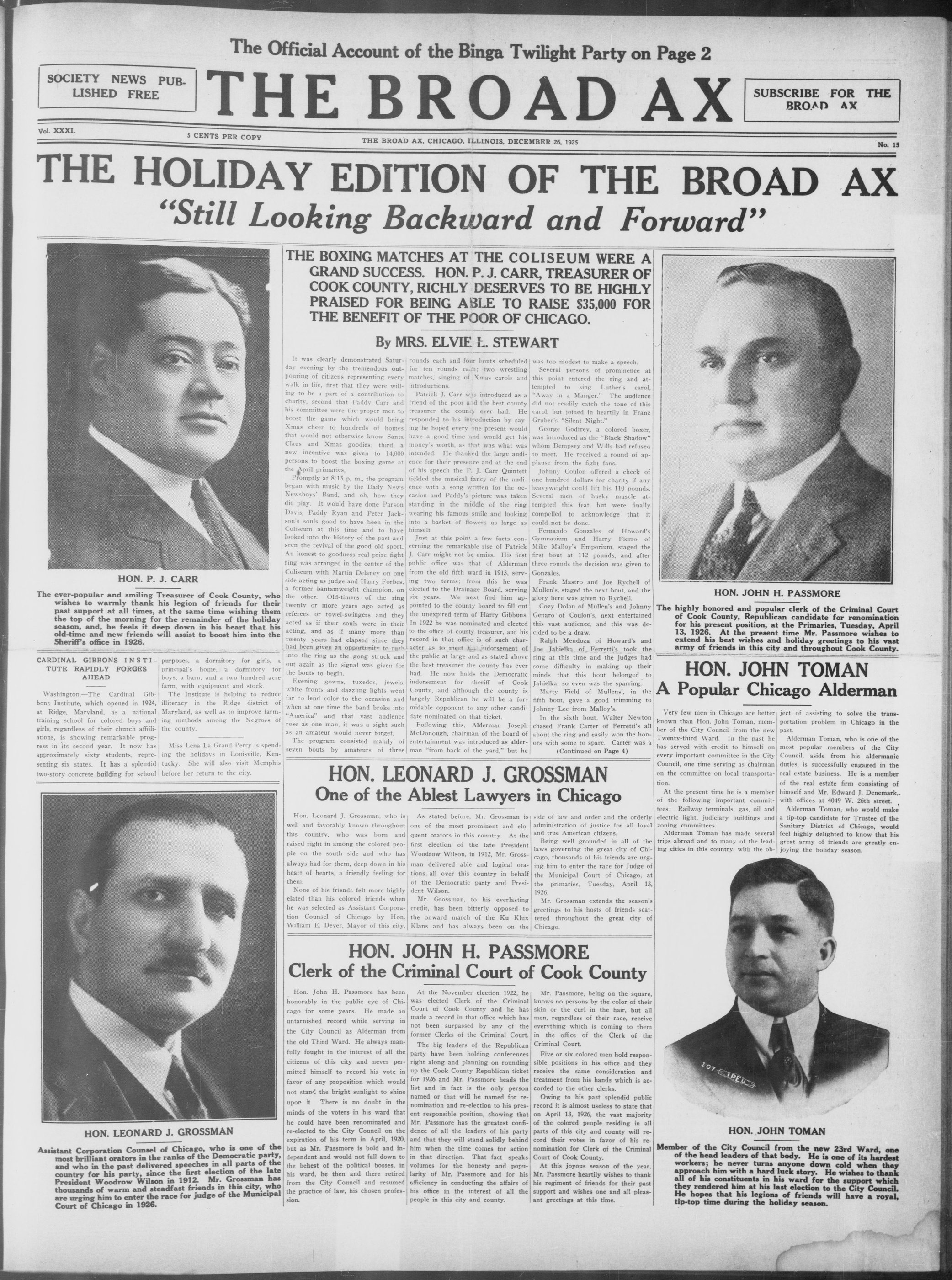
The ever-popular and smiling Treasurer of Cook County, who wishes to warmly thank his legion of friends for their past support at all times, at the same time wishing them the top of the morning for the remainder of the holiday season, and, he feels it deep down in his heart that his old-time and new friends will assist to boost him into the Sheriff's office in 1926.
CARDINAL GIBBONS INSTI
TUTE RAPIDLY FORGES
AHEAD
Washington.-The Cardinal Gibbons Institute, which opened in 1924, at Ridge, Maryland, as a national training school for colored boys and girls, regardless of their church affiliations, is showing remarkable progress in its second year. It now has approximately sixty students, representing six states. It has a splendid two-story concrete building for school
```markdown
```
Assistant Corporation Counsel of Chicago, who is most brilliant orators in the ranks of the Democ and who in the past delivered speeches in all country for his party, since the first election President Woodrow Wilson in 1912. Mr. G. thousands of warm and steadfast friends in the are urging him to enter the race for judge of the Court of Chicago in 1926.
corporation Counsel of Chicago, who is brilliant orators in the ranks of the Demo who in the past delivered speeches in all for his party, since the first election Woodrow Wilson in 1912. Mr. Gends of warm and steadfast friends in the ing him to enter the race for judge of the of Chicago in 1926.
Assistant Corporation Counsel of Chicago, who is one of the most brilliant orators in the ranks of the Democratic party, and who in the past delivered speeches in all parts of the country for his party, since the first election of the late President Woodrow Wilson in 1912. Mr. Grossman has thousands of warm and steadfast friends in this city, who are urging him to enter the race for judge of the Municipal Court of Chicago in 1926.
Vol. XXXI.
5 CENTS PER COPY
HOLIDAY
"Still Lo
Treasurer of Cook County, who his legion of friends for their at the same time wishing them the remainder of the holiday keep down in his heart that his will assist to boost him into the purposes, a dormitory for girls, a principal's home, a dormitory for boys, a barn, and a two hundred acre farm, with equipment and stock. The Institute is helping to reduce illiteracy in the Ridge district of Maryland, as well as to improve farming methods among the Negroes of the county.
Miss Lena La Grand Perry is spending the holidays in Louisville, Kentucky. She will also visit Memphis before her return to the city.
THE MAYOR OF BROOKLYN
of Chicago, who is one of the
ranks of the Democratic party,
grew speeches in all parts of the
the first election of the late
in 1912. Mr. Grossman has
readfast friends in this city, who
race for judge of the Municipal
The Official Account of the Binga Twilight Party on Page 2
THE BROAD AX
THE BROAD AX, CHICAGO, ILLINOIS, DECEMBER 26, 1925
THE BOXING MATCHES AT THE COLISEUM WERE A GRAND SUCCESS. HON. P. J. CARR, TREASURER OF COOK COUNTY, RICHLY DESERVES TO BE HIGHLY PRAISED FOR BEING ABLE TO RAISE $35,000 FOR THE BENEFIT OF THE POOR OF CHICAGO. By MRS. ELVIE L. STEWART
HON. LEONARD J. GROSSMAN One of the Ablest Lawyers in Chicago
HON. JOHN H. PASSMORE Clerk of the Criminal Court of Cook County
It was clearly demonstrated Saturday evening by the tremendous outpouring of citizens representing every walk in life, first that they were willing to be a part of a contribution to charity, second that Paddy Carr and his committee were the proper men to boost the game which would bring Xmas cheer to hundreds of homes that would not otherwise know Santa Claus and Xmas goodies; third, a new incentive was given to 14,000 persons to boost the boxing game at the April primaries.
Promptly at 8:15 p, m., the program began with music by the Daily News Newsboys' Band, and oh, how they did play. It would have done Parson Davis, Paddy Ryan and Peter Jackson's souls good to have been in the Coliseum at this time and to have looked into the history of the past and seen the revival of the good old sport. An honest to goodness real prize fight ring was arranged in the center of the Coliseum with Martin Delaney on one side acting as judge and Harry Forbes, a former bantamweight champion, on the other. Old-timers of the ring twenty or more years ago acted as referees or towel-swingers and they acted as if their souls were in their acting, and as if many more than twenty years had elapsed since they had been given an opportunity to rush into the ring as the gong struck and out again as the signal was given for the bouts to begin.
Evening gowns, tuxedos, jewels, white fronts and dazzling lights went far to lend color to the occasion and when at one time the band broke into "America" and that vast audience rose as one man, it was a sight such as an amateur would never forget.
The program consisted mainly of seven bouts by amateurs of three
Hon. Leonard J. Grossman, who is well and favorably known throughout this country, who was born and raised right in among the colored people on the south side and who has always had for them, deep down in his heart of hearts, a friendly feeling for them.
None of his friends felt more highly elated than his colored friends when he was selected as Assistant Corporation Counsel of Chicago by Hon. William E. Dever, Mayor of this city.
Hon. John H. Passmore has been honorably in the public eye of Chicago for some years. He made an untarnished record while serving in the City Council as Alderman from the old Third Ward. He always manfully fought in the interest of all the citizens of this city and never permitted himself to record his vote in favor of any proposition which would not stand the bright sunlight to shine upon it. There is no doubt in the minds of the voters in his ward that he could have been renominated and re-elected to the City Council on the expiration of his term in April, 1920, but as Mr. Passmore is bold and independent and would not fall down to the behest of the political bosses, in his ward, he then and there retired from the City Council and resumed the practice of law, his chosen profession.
rounds each and four bouts scheduled for ten rounds each; two wrestling matches, singing of Xmas carols and introductions.
Patrick J. Carr was introduced as a friend of the poor aid the best county treasurer the county ever had. He responded to his introduction by saying he hoped every one present would have a good time and would get his money's worth, as that was what was intended. He thanked the large audience for their presence and at the end of his speech the P. J. Carr Quintett tickled the musical fancy of the audience with a song written for the occasion and Paddy's picture was taken standing in the middle of the ring wearing his famous smile and looking into a basket of flowers as large as himself.
Just at this point a few facts concerning the remarkable rise of Patrick J. Carr might not be amiss. His first public office was that of Alderman from the old fifth ward in 1913, serving two terms; from this he was elected to the Drainage Board, serving six years. We next find him appointed to the county board to fill out the unexpired term of Harry Gibbons. In 1922 he was nominated and elected to the office of county treasurer, and his record in that office is of such character as to meet the indorsement of the public at large and as stated above the best treasurer the county has ever had. He now holds the Democratic indorsement for sheriff of Cook County, and although the county is largely Republican he will be a formidable opponent to any other candidate nominated on that ticket. Following this, Alderman Joseph McDonough, chairman of the board of entertainment was introduced as alderman "from back of the yard." but he
ONARD J. GR
Ablest Lawyers
As stated before, Mr. Grossman is one of the most prominent and eloquent orators in this country. At the first election of the late President Woodrow Wilson, in 1912, Mr. Grossman delivered able and logical orations all over this country in behalf of the Democratic party and President Wilson.
Mr. Grossman, to his everlasting credit, has been bitterly opposed to the onward march of the Ku Klux Klans and has always been on the
JOHN H. PASS
criminal Court or
At the November election 1922, he was elected Clerk of the Criminal Court of Cook County and he has made a record in that office which has not been surpassed by any of the former Clerks of the Criminal Court.
The big leaders of the Republican party have been holding conferences right along and planning on rounding up the Cook County Republican ticket for 1926 and Mr. Passmore heads the list and in fact is the only person named or that will be named for renomination and re-election to his present responsible position, showing that Mr. Passmore has the greatest confidence of all the leaders of his party and that they will stand solidly behind him when the time comes for action in that direction. That fact speaks volumes for the honesty and popularity of Mr. Passmore and for his efficiency in conducting the affairs of his office in the interest of all the people in this city and county.
---
was too modest to make a speech.
Several persons of prominence at this point entered the ring and attempted to sing Luther's carol, "Away in a Manger." The audience did not readily catch the tone of this carol, but joined in heartily in Franz Gruber's "Silent Night."
George Godfirey, a colored boxer, was introduced as the "Black Shadow" whom Dempsey and Wills had refused to meet. He received a round of applause from the fight fans.
Johnny Coulon offered a check of one hundred dollars for charity if any heavyweight could lift his 110 pounds. Several men of husky muscle attempted this feat, but were finally compelled to acknowledge that it could not be done.
Fernando Gonzales of Howard's Gymnasium and Harry Fierro of Mike Malloy's Emporium, staged the first bout at 112 pounds, and after three rounds the decision was given to Gonzales.
Frank Mastro and Joe Rychell of Mullen's, staged the next bout, and the glory here was given to Rychell.
Cozy Dolan of Mullen's and Johnny Genaro of Coulon's, next entertained this vast audience, and this was decided to be a draw.
Ralph Mendoza of Howard's and Joe Jahielka of Ferretti's took the ring at this time and the judges had some difficulty in making up their minds that this bout belonged to Jahielka, so even was the sparring.
Marty Field of Mullens', in the fifth bout, gave a good trimming to Johnny Lee from Malloy's.
In the sixth bout, Walter Newton chased Frank Carter of Ferretti's all about the ring and easily won the honors with some to spare. Carter was a (Continued on Page 4)
CROSSMAN in Chicago
side of law and order and the orderly administration of justice for all loyal and true American citizens.
Being well grounded in all of the laws governing the great city of Chicago, thousands of his friends are urging him to enter the race for Judge of the Municipal Court of Chicago, at the primaries, Tuesday, April 13, 1926.
Mr. Grossman extends the season's greetings to his hosts of friends scattered throughout the great city of Chicago.
SMORE
of Cook County
Mr. Passmore, being on the square, knows no persons by the color of their skin or the curl in the hair, but all men, regardless of their race, receive everything which is coming to them in the office of the Clerk of the Criminal Court.
Five or six colored men hold responsible positions in his office and they receive the same consideration and treatment from his hands which is accorded to the other clerks.
Owing to his past splendid public record it is almost useless to state that on April 13, 1926, the vast majority of the colored people residing in all parts of this city and county will record their votes in favor of his renomination for Clerk of the Criminal Court of Cook County.
At this joyous season of the year, Mr. Passmore heartily wishes to thank his regiment of friends for their past support and wishes one and all pleasant greetings at this time.
SUBSCRIBE FOR THE BROAD AX
ROAD
rd"
DAD AX
"
J. B.
HON. JOHN H. PASSMORE
The highly honored and popular clerk of the City of Cook County, Republican candidate for his present position, at the Primaries, 13, 1926. At the present time Mr. Passs extend his best wishes and holiday greeting army of friends in this city and throughout
HON. JOHN TOM
A Popular Chicago Alc
nored and popular clerk of the
County, Republican candidate for
present position, at the Primaries,
At the present time Mr. Passs
is best wishes and holiday greeting
friends in this city and throughout
ON. JOHN TOM
ular Chicago Alc
l popular clerk of the Criminal Court republican candidate for renomination tion, at the Primaries, Tuesday, April present time Mr. Passmore wishes tohes and holiday greetings to his vast this city and throughout Cook County.
OHN TOMAN
Chicago Alderman
The highly honored and popular clerk of the Criminal Court of Cook County, Republican candidate for renomination for his present position, at the Primaries, Tuesday, April 13, 1926. At the present time Mr. Passmore wishes to extend his best wishes and holiday greetings to his vast army of friends in this city and throughout Cook County.
HON. JOHN TOMAN A Popular Chicago Alderman
Very few men in Chicago are better known than Hon. John Toman, member of the City Council from the new Twenty-third Ward. In the past he has served with credit to himself on every important committee in the City Council, one time serving as chairman on the committee on local transportation.
At the present time he is a member of the following important committees: Railway terminals, gas, oil and electric light, judiciary buildings and zoning committees.
Alderman Toman has made several trips abroad and to many of the leading cities in this country, with the ob-
107 IPEU
LPEU
4
107 IPEU
HON. JOHN TOMAN
Member of the City Council of the head leaders of that workers; he never turns approach him with a hard all of his constituents in he they rendered him at his He hopes that his legion tip-top time during the he
the City Council from the new 23rd and leaders of that body. He is one of the never turns anyone down co him with a hard luck story. He w constituents in his ward for the ered him at his last election to the that his legions of friends will me during the holiday season.
council from the new 23rd Ward, one of that body. He is one of its hardest turns anyone down cold when they a hard luck story. He wishes to thank nts in his ward for the support which at his last election to the City Council. legions of friends will have a royal, the holiday season.
Member of the City Council from the new 23rd Ward, one of the head leaders of that body. He is one of its hardest workers; he never turns anyone down cold when they approach him with a hard luck story. He wishes to thank all of his constituents in his ward for the support which they rendered him at his last election to the City Council. He hopes that his legions of friends will have a royal, tip-top time during the holiday season.
ject of assisting to solve the transportation problem in Chicago in the past.
Alderman Toman, who is one of the most popular members of the City Council, aside from his aldermanic duties, is successfully engaged in the real estate business. He is a member of the real estate firm consisting of himself and Mr. Edward J. Denemark, with offices at 4049 W. 26th street.
Alderman Toman, who would make a tip-top candidate for Trustee of the Sanitary District of Chicago, would feel highly delighted to know that his great army of friends are greatly enjoying the holiday season.
No.15
[Name]
MR. JESSE BINGA President of the Binga State Bank of Chic on one million dollars' worth of Cook and he has become one of the best bar
the Binga State Bank of Chicago, w
million dollars' worth of Cook Count
s become one of the best bankers in
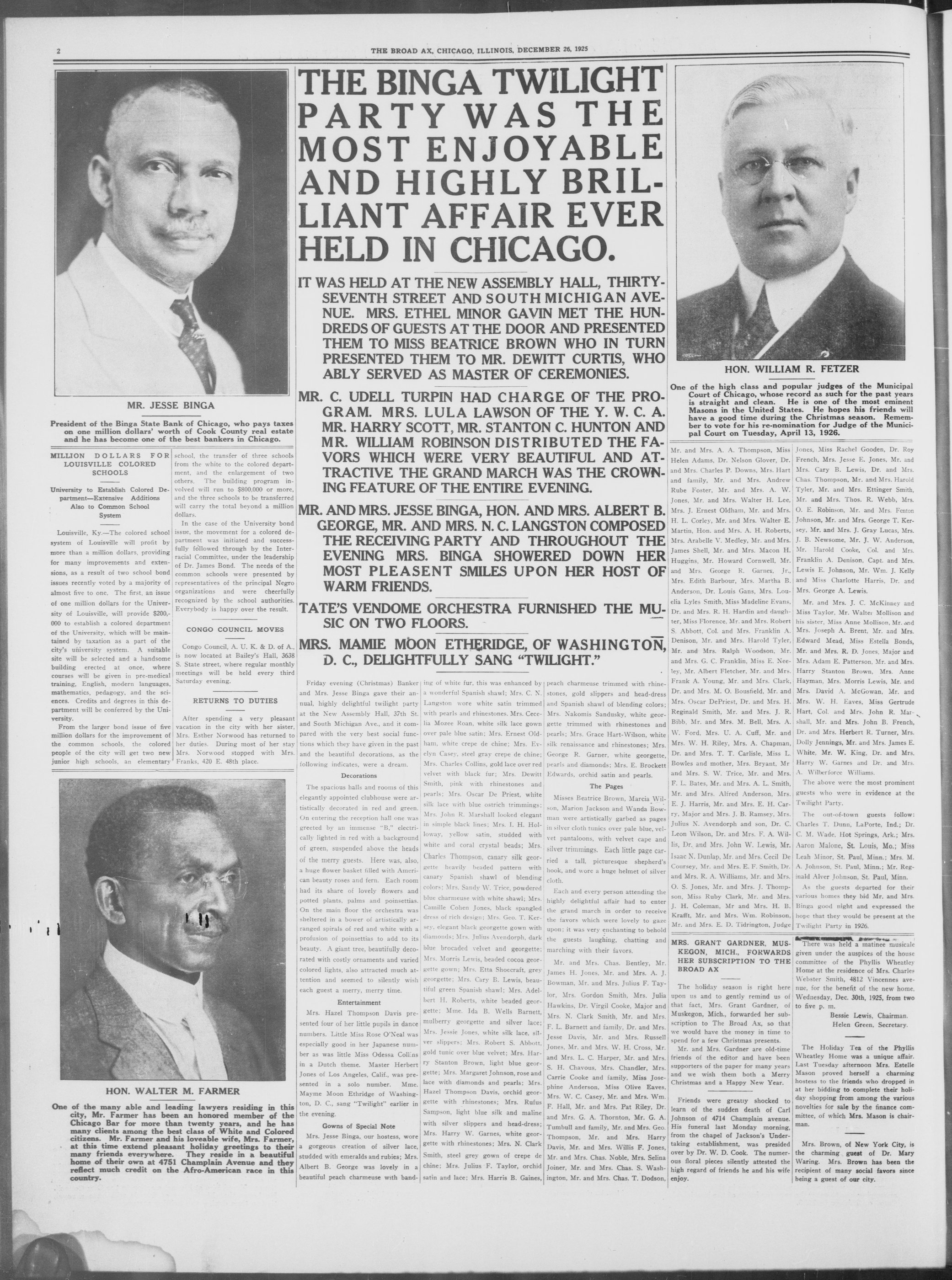
President of the Binga State Bank of Chicago, who pays taxes on one million dollars' worth of Cook County real estate and he has become one of the best bankers in Chicago.
MILLION DOLLARS FOR
LOUISVILLE COLORED
SCHOOLS
University to Establish Colored Department—Extensive Additions
Also to Common School System
school, the transfer of three schools from the white to the colored department, and the enlargement of two others. The building program involved will run to $800,000 or more, and the three schools to be transferred will carry the total beyond a million dollars.
Louisville, Ky.-The colored school system of Louisville will profit by more than a million dollars, providing for many improvements and extensions, as a result of two school bond issues recently voted by a majority of almost five to one. The first, an issue of one million dollars for the University of Louisville, will provide $200,000 to establish a colored department of the University, which will be maintained by taxation as a part of the city's university system. A suitable site will be selected and a handsome building erected at once, where courses will be given in pre-medical training, English, modern languages, mathematics, pedagogy, and the sciences. Credits and degrees in this department will be conferred by the University.
From the larger bond issue of five million dollars for the improvement of the common schools, the colored people of the city will get two new junior high schools, an elementary
```markdown
```
111
111
HON. WALTER M. FARMER
One of the many able and leading lawyers re city, Mr. Farmer has been an honored m Chicago Bar for more than twenty years many clients among the best class of White citizens. Mr. Farmer and his loveable wife, at this time extend pleasant holiday gree many friends everywhere. They reside in home of their own at 4751 Champlain Ave reflect much credit on the Afro-American country.
many able and leading lawyers rea. Farmer has been an honored m. Bar for more than twenty years.ents among the best class of White Mr. Farmer and his loveable wife, time extend pleasant holiday greet friends everywhere. They reside in their own at 4751 Champlain Ave much credit on the Afro-American
One of the many able and leading lawyers residing in this city, Mr. Farmer has been an honored member of the Chicago Bar for more than twenty years, and he has many clients among the best class of White and Colored citizens. Mr. Farmer and his loveable wife, Mrs. Farmer, at this time extend pleasant holiday greetings to their many friends everywhere. They reside in a beautiful home of their own at 4751 Champlain Avenue and they reflect much credit on the Afro-American race in this country.
2
bank of Chicago, who pays taxes th of Cook County real estate the best bankers in Chicago. school, the transfer of three schools from the white to the colored department, and the enlargement of two others. The building program involved will run to $800,000 or more, and the three schools to be transferred will carry the total beyond a million dollars.
In the case of the University bond issue, the movement for a colored department was initiated and successfully followed through by the Interracial Committee, under the leadership of Dr. James Bond. The needs of the common schools were presented by representatives of the principal Negro organizations and were cheerfully recognized by the school authorities. Everybody is happy over the result.
CONGO COUNCIL MOVES
Congo Council, A. U. K. & D. of A, is now located at Bailey's Hall, 3638 S. State street, where regular monthly meetings will be held every third Saturday evening.
RETURNS TO DUTIES
After spending a very pleasant vacation in the city with her sister, Mrs. Esther Norwood has returned to her duties. During most of her stay Mrs. Norwood stopped with Mrs. Franks. 420 E. 48th place.
111
reading lawyers residing in this
own an honored member of the
man twenty years, and he has
best class of White and Colored
this loveable wife, Mrs. Farmer,
ant holiday greetings to their
They reside in a beautiful
1 Champlain Avenue and they
be Afro-American race in this
THE BROAD AX, CHICAGO, ILLINOIS, DECEMBER 26, 1925
THE BINGA TWILIGHT PARTY WAS THE MOST ENJOYABLE AND HIGHLY BRILLIANT AFFAIR EVER HELD IN CHICAGO.
IT WAS HELD AT THE NEW ASSEMBLY HALL, THIRTY- SEVENTH STREET AND SOUTH MICHIGAN AVENUE. MRS. ETHEL MINOR GAVIN MET THE HUNDREDS OF GUESTS AT THE DOOR AND PRESENTED THEM TO MISS BEATRICE BROWN WHO IN TURN PRESENTED THEM TO MR. DEWITT CURTIS, WHO ABLY SERVED AS MASTER OF CEREMONIES.
MR. C. UDELL TURPIN HAD CHARGE OF THE PROGRAM. MRS. LULA LAWSON OF THE Y. W. C. A. MR. HARRY SCOTT, MR. STANTON C. HUNTON AND MR. WILLIAM ROBINSON DISTRIBUTED THE FAVORS WHICH WERE VERY BEAUTIFUL AND ATTRACTIVE THE GRAND MARCH WAS THE CROWNING FEATURE OF THE ENTIRE EVENING.
MR. AND MRS. JESSE BINGA, HON. AND MRS. ALBERT B. GEORGE, MR. AND MRS. N. C. LANGSTON COMPOSED THE RECEIVING PARTY AND THROUGHOUT THE EVENING MRS. BINGA SHOWERED DOWN HER MOST PLEASENT SMILES UPON HER HOST OF WARM FRIENDS.
TATE'S VENDOME ORCHESTRA FURNISHED THE MUSIC ON TWO FLOORS.
MRS. MAMIE MOON ETHERIDGE, OF WASHINGTON, D. C., DELIGHTFULLY SANG "TWILIGHT."
Friday evening (Christmas) Banker and Mrs. Jesse Binga gave their annual, highly delightful twilight party at the New Assembly Hall, 37th St. and South Michigan Ave., and it compared with the very best social functions which they have given in the past and the beautiful decorations, as the following indicates, were a dream.
Decorations
The spacious halls and rooms of this elegantly appointed clubhouse were artistically decorated in red and green. On entering the reception hall one was greeted by an immense "B," electrically lighted in red with a background of green, suspended above the heads of the merry guests. Here was, also, a huge flower basket filled with American beauty roses and fern. Each room had its share of lovely flowers and potted plants, palms and poinsettias. On the main floor the orchestra was sheltered in a bower of artistically arranged spirals of red and white with a profusion of poinsettias to add to its beauty. A giant tree, beautifully decorated with costly ornaments and varied colored lights, also attracted much attention and seemed to silently wish each guest a merry, merry time.
Entertainment
Mrs. Hazel Thompson Davis presented four of her little pupils in dance numbers. Little Miss Rose O'Neal was especially good in her Japanese number as was little Miss Odessa Collins in a Dutch theme. Master Herbert Jones of Los Angeles, Calif., was presented in a solo number. Mme Mayme Moon Ethridge of Washington, D. C., sang "Twilight" earlier in the evening.
Gowns of Special Note
Mrs. Jesse Binga, our hostess, wore a gorgeous creation of silver lace, studded with emeralds and rubies; Mrs. Albert B. George was lovely in a beautiful peach charmeuse with band-
ing of white fur, this was enhanced by a wonderful Spanish shawl; Mrs. C. N. Langston wore white satin trimmed with pearls and rhinestones. Mrs. Cecelia Mozee Roan, white silk lace gown over pale blue satin; Mrs. Ernest Oldham, white crepe de chine; Mrs. Evelyn Casey, steel gray crepe de chine; Mrs. Charles Collins, gold lace over red velvet with black fur; Mrs. Dewitt Smith, pink with rhinestones and pearls; Mrs. Oscar De Priest, white silk lace with blue ostrich trimmings; Mrs. John R. Marshall looked elegant in simple black lines; Mrs. I. H. Holloway, yellow satin, studded with white and coral crystal beads; Mrs. Charles Thompson, canary silk georgette heavily beaded pattern with canary Spanish shawl of blending colors; Mrs. Sandy W. Trice, powdered blue charmeuse with white shawl; Mrs. Camille Cohen Jones, black spangled dress of rich design; Mrs. Geo. T. Kersey, elegant black georgette gown with diamonds; Mrs. Julius Avendorph, dark blue brocaded velvet and georgette; Mrs. Morris Lewis, beaded cocoa georgette gown; Mrs. Etta Shoecraft, grey georgette; Mrs. Cary B. Lewis, beautiful green Spanish shawl; Mrs. Adelbert H. Roberts, white beaded georgette; Mme. Ida B. Wells Barnett, mulberry georgette and silver lace; Mrs. Jessie Jones, white silk lace, silver slippers; Mrs. Robert S. Abbott, gold tunic over blue velvet; Mrs. Harry Stanton Brown, light blue georgette; Mrs. Margaret Johnson, rose and lace with diamonds and pearls; Mrs. Hazel Thompson Davis, orchid georgette with rhinestones; Mrs. Rufus Sampson, light blue silk and maline with silver slippers and head-dress; Mrs. Harry W. Garnes, white georgette with rhinestones; Mrs. N. Clark Smith, steel grey gown of crepe de chine; Mrs. Julius F. Taylor, orchid satin and lace; Mrs. Harris B. Gaines,
peach charmeuse trimmed with rhinestones, gold slippers and head-dress and Spanish shawl of blending colors; Mrs. Nakomis Sandusky, white georgette trimmed with rhinestones and pearls; Mrs. Grace Hart-Wilson, white silk renaissance and rhinestones; Mrs. George R. Garner, white georgette pearls and diamonds; Mrs. E. Brockett Edwards, orchid satin and pearls.
The Pages
Misses Beatrice Brown, Marcia Wilson, Marion Jackson and Wanda Bowman were artistically garbed as pages in silver cloth tunics over pale blue, velvet pantaloons, with velvet cape and silver trimmings. Each little page carried a tall, picturesque shepherd's hook, and wore a huge helmet of silver cloth.
Each and every person attending the highly delightful affair had to enter the grand march in order to receive the favors which were lovely to gaze upon; it was very enchanting to behold the guests laughing, chatting and marching with their favors.
Mr. and Mrs. Chas. Bentley, Mr. James H. Jones, Mr. and Mrs. A. J. Bowman, Mr. and Mrs. Julius F. Taylor, Mrs. Gordon Smith, Mrs. Julia Hawkins, Dr. Virgil Cooke, Major and Mrs. N. Clark Smith, Mr. and Mrs. F. L. Barnett and family, Dr. and Mrs. Jesse Davis, Mr. and Mrs. Russell Jones, Mr. and Mrs. W. H. Cross, Mr. and Mrs. L. C. Harper, Mr. and Mrs. S. H. Chavous, Mrs. Chandler, Mrs. Carrie Cooke and family, Miss Josephine Anderson, Miss Olive Eaves Mrs. W. C. Casey, Mr. and Mrs. Wm F. Hall, Mr. and Mrs. Pat Riley, Dr. and Mrs. G. A. Thornton, Mr. G. A Tumbull and family, Mr. and Mrs. Geo Thompson, Mr. and Mrs. Harry Davis, Mr. and Mrs. Willis F. Jones Mr. and Mrs. Chas. Noble, Mrs. Selina Joiner, Mr. and Mrs. Chas. S. Washington, Mr. and Mrs. Chas. T. Dodson.
C. K. S.
HON. WILLIAM R. FETZER
One of the high class and popular judges of the Municipal Court of Chicago, whose record as such for the past years is straight and clean. He is one of the most eminent Masons in the United States. He hopes his friends will have a good time during the Christmas season. Remember to vote for his re-nomination for Judge of the Municipal Court on Tuesday, April 13, 1926.
Mr. and Mrs. A. A. Thompson, Miss Helen Adams, Dr. Nelson Glover, Dr. and Mrs. Charles P. Downs, Mrs. Hart and family, Mr. and Mrs. Andrew Rube Foster, Mr. and Mrs. A. W. Jones, Mr. and Mrs. Walter H. Lee, Mrs. J. Ernest Oldham, Mr. and Mrs. H. L. Corley, Mr. and Mrs. Walter E. Martin, Hon. and Mrs. A. H. Roberts, Mrs. Arabelle V. Medley, Mr. and Mrs. James Shell, Mr. and Mrs. Macon H. Huggins, Mr. Howard Cornwell, Mr. and Mrs. George R. Garney, Jr., Mrs. Edith Barbour, Mrs. Martha B. Anderson, Dr. Louis Gans, Mrs. Louelia Lyles Smith, Miss Madeline Evans, Dr. and Mrs. R. H. Hardin and daughter, Miss Florence, Mr. and Mrs. Robert S. Abbott, Col. and Mrs. Franklin A. Denison, Mr. and Mrs. Harold Tyler, Mr. and Mrs. Ralph Woodson, Mr. and Mrs. G. C. Franklin, Miss E. Neeley, Mr. Albert Fletcher, Mr. and Mrs. Frank A. Young, Mr. and Mrs. Clark, Dr. and Mrs. M. O. Bousfield, Mr. and Mrs. Oscar DePriest, Dr. and Mrs. H. Reginald Smith, Mr. and Mrs. J. R. Bibb, Mr. and Mrs. M. Bell, Mrs. A. W. Ford, Mrs. U. A. Cuff, Mr. and Mrs. W. H. Riley, Mrs. A. Chapman, Dr. and Mrs. T. T. Carlisle, Miss L. Bowles and mother, Mrs. Bryant, Mr. and Mrs. S. W. Trice, Mr. and Mrs. F. L. Bates, Mr. and Mrs. A. L. Smith, Mr. and Mrs. Alfred Anderson, Mrs. E. J. Harris, Mr. and Mrs. E. H. Carry, Major and Mrs. B. B. Ramsey, Mrs. Julius A. Avendorph and son, Dr. C. Leon Wilson, Dr. and Mrs. F. A. Willis, Dr. and Mrs. John W. Lewis, Mr. Isaac N. Dunlap, Mr. and Mrs. Cecil De Coursey, Mr. and Mrs. E. F. Smith, Dr. and Mrs. R. A. Williams, Mr. and Mrs. O. S. Jones, Mr. and Mrs. J. Thompson, Miss Ruby Clark, Mr. and Mrs. J. H. Coleman, Mr. and Mrs. H. B. Krafft, Mr. and Mrs. Wm. Robinson, Mr. and Mrs. E. D. Tidrington, Judge
MRS. GRANT GARDNER, MUSKEGON, MICH., FORWARDS
HER SUBSCRIPTION TO THE
BROAD AX
The holiday season is right here upon us and to gently remind us of that fact, Mrs. Grant Gardner, of Muskegon, Mich., forwarded her subscription to The Broad Ax, so that we would have the money in time to spend for a few Christmas presents. Mr. and Mrs. Gardner are old-time friends of the editor and have been supporters of the paper for many years and we wish them both a Merry Christmas and a Happy New Year.
Friends were greatly shocked to learn of the sudden death of Carl Johnson of 4714 Champlain avenue. His funeral last Monday morning, from the chapel of Jackson's Undertaking establishment, was presided over by Dr. W. D. Cook. The numerous floral pieces silently attested the high regard of friends he and his wife enjoy.
Jones, Miss Rachel Gooden, Dr. Roy French, Mrs. Jesse E. Jones, Mr. and Mrs. Cary B. Lewis, Dr. and Mrs. Chas. Thompson, Mr. and Mrs. Harold Tyler, Mr. and Mrs. Ettinger Smith, Mr. and Mrs. Thos. R. Webb, Mrs. O. E. Robinson, Mr. and Mrs. Fenton Johnson, Mr. and Mrs. George T. Kersey, Mr. and Mrs. J. Gray Lucas, Mrs. J. B. Newsome, Mr. J. W. Anderson, Mr. Harold Cooke, Col. and Mrs. Franklin A. Denison, Capt. and Mrs. Lewis E. Johnson, Mr. Wm. J. Kelly and Miss Charlotte Harris, Dr. and Mrs. George A. Lewis.
Mr. and Mrs. J. C. McKinney and Miss Taylor, Mr. Walter Mollison and his sister, Miss Anne Mollison, Mr. and Mrs. Joseph A. Brent, Mr. and Mrs. Edward Mead, Miss Estella Bonds, Mr. and Mrs. R. D. Jones, Major and Mrs. Adam E. Patterson, Mr. and Mrs. Harry Stanton Brown, Mrs. Anne Hayman, Mrs. Morris Lewis, Mr. and Mrs. David A. McGowan, Mr. and Mrs. W. H. Eaves, Miss Gertrude Hart, Col. and Mrs. John R. Marshall, Mr. and Mrs. John B. French, Dr. and Mrs. Herbert R. Turner, Mrs. Dolly Jennings, Mr. and Mrs. James E. White, Mr. W. King, Dr. and Mrs. Harry W. Garnes and Dr. and Mrs. A. Wilberforce Williams.
The above were the most prominent guests who were in evidence at the Twilight Party.
The out-of-town guests follow: Charles T. Dunn, LaPorte, Ind.; Dr. C. M. Wade, Hot Springs, Ark.; Mrs. Aaron Malone, St. Louis, Mo.; Miss Leah Minor, St. Paul, Minn.; Mrs. M. A. Johnson, St. Paul, Minn.; Mr. Reginald Alver Johnson, St. Paul, Minn.
As the guests departed for their various homes they bid Mr. and Mrs. Binga good night and expressed the hope that they would be present at the Twilight Party in 1926.
There was held a matinee musicale given under the auspices of the house committee of the Phyllis Wheatley Home at the residence of Mrs. Charles Webster Smith, 4812 Vincennes avenue, for the benefit of the new home, Wednesday, Dec. 30th, 1925, from two to five p. m.
Bessie Lewis, Chairman.
Helen Green, Secretary.
The Holiday Tea of the Phyllis Wheatley Home was a unique affair. Last Tuesday afternoon Mrs. Estelle Mason proved herself a charming hostess to the friends who dropped in at her bidding to complete their holiday shopping from among the various novelties for sale by the finance committee, of which Mrs. Mason is chairman.
Mrs. Brown, of New York City, is the charming guest of Dr. Mary Waring. Mrs. Brown has been the recipient of many social favors since being a guest of our city.
[Name]
Member of the City Council from the new 32nd W the useful and hard working members of that has every reason to believe that his friends and in his ward will roll in all kinds of pleasure un holiday season comes to an end.
the City Council from the new 32nd W ful and hard working members of that reason to believe that his friends and hard will roll in all kinds of pleasure un season comes to an end.
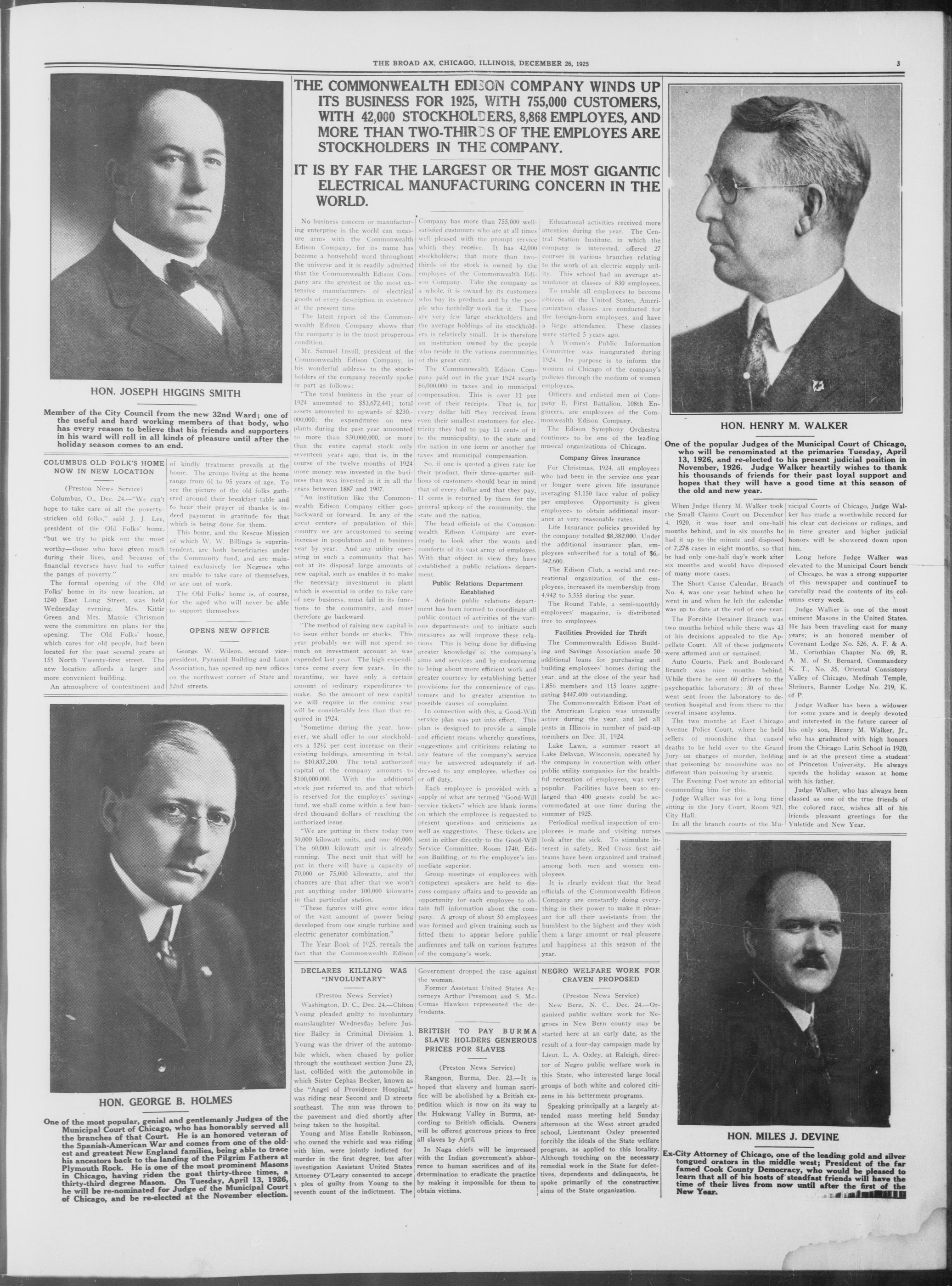
Member of the City Council from the new 32nd Ward; one of the useful and hard working members of that body, who has every reason to believe that his friends and supporters in his ward will roll in all kinds of pleasure until after the holiday season comes to an end.
COLUMBUS OLD FOLK'S HOME
NOW IN NEW LOCATION
Columbus, O., Dec. 24.—"We can't hope to take care of all the poverty-stricken old folks," said J. J. Lee, president of the Old Folks' home, "but we try to pick out the most worthy—those who have given much during their lives, and because of financial reverses have had to suffer the pangs of poverty."
The formal opening of the Old Folks' home in its new location, at 1240 East Long Street, was held Wednesday evening. Mrs. Kittie Green and Mrs. Mamie Chrismon were the committee on plans for the opening. The Old Folks' home, which cares for old people, had been located for the past several years at 155 North Twenty-first street. The new location affords a larger and more convenient building. An atmosphere of contentment and
```markdown
```
[Name]
[Name]
HON. GEORGE B. HOLMES
One of the most popular, genial and gentlemanly Municipal Court of Chicago, who has honora the branches of that Court. He is an honore the Spanish-American War and comes from est and greatest New England families, bein his ancestors back to the landing of the Pilg Plymouth Rock. He is one of the most pro in Chicago, having riden the goat thirty-thirty-third degree Mason. On Tuesday, A he will be re-nominated for Judge of the M of Chicago, and be re-elected at the Nove
most popular, genial and gentlemanly Jail
Capital Court of Chicago, who has honorably
ranches of that Court. He is an honored
Junish-American War and comes from one
of the greatest New England families, being
aesthetics back to the landing of the Pilgrim
Rock. He is one of the most prominent
cagge, having ridden the goat thirty-third degree Mason. On Tuesday, April
be re-nominated for Judge of the Murci
cagge, and be re-elected at the Novembe
One of the most popular, genial and gentlemanly Judges of the Municipal Court of Chicago, who has honorably served all the branches of that Court. He is an honored veteran of the Spanish-American War and comes from one of the oldest and greatest New England families, being able to trace his ancestors back to the landing of the Pilgrim Fathers at Plymouth Rock. He is one of the most prominent Masons in Chicago, having riden the goat thirty-three times, a thirty-third degree Mason. On Tuesday, April 13, 1926, he will be re-nominated for Judge of the Municipal Court of Chicago, and be re-elected at the November election.
am the new 32nd Ward; one of
ing members of that body, who
that his friends and supporters
inds of pleasure until after the
end.
of kindly treatment prevails at the
home. The groups living at the home
range from 61 to 95 years of age. To
see the picture of the old folks gathered
around their breakfast table and
to hear their prayer of thanks is indeed payment in gratitude for that
which is being done for them.
This home, and the Rescue Mission of which W. W. Billings is superintendent, are both beneficiaries under the Community fund, and are maintained exclusively for Negroes who are unable to take care of themselves, or are out of work.
The Old Folks' home is, of course, for the aged who will never be able to support themselves.
OPENS NEW OFFICE
George W. Wilson, second vice president, Pyramid Building and Loan Association, has opened up new offices on the northwest corner of State and 52nd streets.
and gentlemanly Judges of the
city, who has honorably served all
A. He is an honored veteran of
and comes from one of the old
and families, being able to trace
founding of the Pilgrim Fathers at
of the most prominent Masons
the goat thirty-three times, a
On Tuesday, April 13, 1926,
or Judge of the Municipal Court
acted at the November election.
THE BROAD AX, CHICAGO, ILLINOIS, DECEMBER 26, 1925
THE COMMONWEALTH EDISON COMPANY WINDS UP ITS BUSINESS FOR 1925,WITH 755,000 CUSTOMERS, WITH 42,000 STOCKHOLDERS,8,868 EMPLOYES, AND MORE THAN TWO-THIRDS OF THE EMPLOYES ARE STOCKHOLDERS IN THE COMPANY.
IT IS BY FAR THE LARGEST OR THE MOST GIGANTIC ELECTRICAL MANUFACTURING CONCERN IN THE WORLD.
No business concern or manufacturing enterprise in the world can measure arms with the Commonwealth Edison Company, for its name has become a household word throughout the universe and it is readily admitted that the Commonwealth Edison Company are the greatest or the most extensive manufacturers of electrical goods of every description in existence at the present time.
The latest report of the Commonwealth Edison Company shows that the company is in the most prosperous condition.
Mr. Samuel Insull, president of the Commonwealth Edison Company, in his wonderful address to the stockholders of the company recently spoke in part as follows:
"The total business in the year of 1924 amounted to $53,672,441; total assets amounted to upwards of $230,000,000; the expenditures on new plants during the past year amounted to more than $30,000,000, or more than the entire capital stock only seventeen years ago, that is, in the course of the twelve months of 1924 more money was invested in the business than was invested in it in all the years between 1887 and 1907.
"An institution like the Commonwealth Edison Company either goes backward or forward. In any of the great centers of population of this country we are accustomed to seeing increase in population and in business year by year. And any utility operating in such a community that has not at its disposal large amounts of new capital, such as enables it to make the necessary investment in plant which is essential in order to take care of new business, must fail in its functions to the community, and must therefore go backward.
"The method of raising new capital is to issue either bonds or stocks. This year probably we will not spend so much on investment account as was expended last year. The high expenditures come every few years. In the meantime, we have only a certain amount of ordinary expenditures to make. So the amount of new capital we will require in the coming year will be considerably less than that required in 1924.
"Sometime during the year, however, we shall offer to our stockholders a 12½ per cent increase on their existing holdings, amounting in total, to $10,837,200. The total authorized capital of the company amounts to $100,000,000. With the additional stock just referred to, and that which is reserved for the employees' savings fund, we shall come within a few hundred thousand dollars of reaching the authorized issue.
"We are putting in there today two 50,000 kilowatt units, and one 60,000. The 60,000 kilowatt unit is already running. The next unit that will be put in there will have a capacity of 70,000 or 75,000 kilowatts, and the chances are that after that we won't put anything under 100,000 kilowatts in that particular station.
"These figures will give some idea of the vast amount of power being developed from one single turbine and electric generator combination."
The Year Book of 1925, reveals the fact that the Commonwealth Edison
DECLARES KILLING WAS
"INVOLUNTARY"
(Preston News Service)
Washington, D. C., Dec. 24—Clifton Young pleaded guilty to involuntary manslaughter Wednesday before Justice Bailey in Criminal Division 1. Young was the driver of the automobile which, when chased by police through the southeast section June 23 last, collided with the automobile in which Sister Cephas Becker, known as the "Angel of Providence Hospital," was riding near Second and D streets southeast. The nun was thrown to the pavement and died shortly after being taken to the hospital.
Young and Miss Estelle Robinson, who owned the vehicle and was riding with him, were jointly indicted for murder in the first degree, but after investigation Assistant United States Attorney O'Leary consented to accept a plea of guilty from Young to the seventh count of the indictment. The
Company has more than 755,000 well-satisfied customers who are at all times well pleased with the prompt service which they receive. It has 42,000 stockholders; that more than two-thirds of the stock is owned by the employees of the Commonwealth Edison Company. Take the company as a whole, it is owned by its customers who buy its products and by the people who faithfully work for it. There are very few large stockholders and the average holdings of its stockholders is relatively small. It is therefore an institution owned by the people who reside in the various communities of this great city.
The Commonwealth Edison Company paid out in the year 1924 nearly $6,000,000 in taxes and in municipal compensation. This is over 11 per cent of their receipts. That is, for every dollar bill they received from even their smallest customers for electricity they had to pay 11 cents of it to the municipality, to the state and the nation in one form or another for taxes and municipal compensation. So, if one is quoted a given rate for their product, their three-quarter millions of customers should bear in mind that of every dollar and that they pay, 11 cents is returned by them for the general upkeep of the community, the state and the nation.
The head officials of the Commonwealth Edison Company are ever ready to look after the wants and comforts of its vast army of employees. With that object in view they have established a public relations department
Public Relations Department Established
A definite public relations department has been formed to coordinate all public contact of activities of the various departments and to initiate such measures as will improve these relations. This is being done by diffusing greater knowledge of the company's aims and services and by endeavoring to bring about more efficient work and greater courtesy by establishing better provisions for the convenience of customers and by greater attention to possible causes of complaint.
In connection with this, a Good-Will service plan was put into effect. This plan is designed to provide a simple and efficient means whereby questions, suggestions and criticisms relating to any feature of the company's service may be answered adequately if addressed to any employee, whether on or off duty. Each employee is provided with a supply of what are termed "Good-Will service tickets" which are blank forms on which the employee is requested to present questions and criticisms as well as suggestions. These tickets are sent in either directly to the Good-Will Service Committee, Room 1740, Edison Building, or to the employee's immediate superior.
Group meetings of employees with competent speakers are held to discuss company affairs and to provide an opportunity for each employee to obtain full information about the company. A group of about 50 employees was formed and given training such as fitted them to appear before public audiences and talk on various features of the company's work.
Government dropped the case against the woman.
Former Assistant United States Attorneys Arthur Presmont and S. McComas Hawken represented the defendants.
BRITISH TO PAY BURMA
SLAVE HOLDERS GENEROUS
PRICES FOR SLAVES
Rangoon, Burma, Dec. 23.—It is hoped that slavery and human sacrifice will be abolished by a British expedition which is now on its way to the Hukwang Valley in Burma, according to British officials. Owners will be offered generous prices to free all slaves by April.
In Naga chiefs will be impressed with the Indian government's abhorrence to human sacrifices and of its determination to eradicate the practice by making it impossible for them to obtain victims.
Educational activities received more attention during the year. The Central Station Institute, in which the company is interested, offered 27 courses in various branches relating to the work of an electric supply utility. This school had an average attendance at classes of 830 employees. To enable all employees to become citizens of the United States, Americanization classes are conducted for the foreign-born employees, and have a large attendance. These classes were started 5 years ago. A Women's Public Information Committee was inaugurated during 1924. Its purpose is to inform the women of Chicago of the company's policies through the medium of women employees.
Officers and enlisted men of Company B. First Battalion, 108th Engineers, are employees of the Commonwealth Edison Company. The Edison Symphony Orchestra continues to be one of the leading musical organizations of Chicago.
Company Gives Insurance
For Christmas, 1924, all employees who had been in the service one year or longer were given life insurance averaging $1.150 face value of policy per employee. Opportunity is given employees to obtain additional insurance at very reasonable rates. Life Insurance policies provided by the company totalled $8,382,000. Under the additional insurance plan, employees subscribed for a total of $6,342,600. The Edison Club, a social and recreational organization of the employees, increased its membership from 4,942 to 5,555 during the year. The Round Table, a semi-monthly employees' magazine, is distributed free to employees.
Facilities Provided for Thrift
The Commonwealth Edison Building and Savings Association made 50 additional loans for purchasing and building employees' homes during the year, and at the close of the year had 1,856 members and 115 loans aggregating $447,400 outstanding. The Commonwealth Edison Post of the American Legion was unusually active during the year, and led all posts in Illinois in number of paid-up members on Dec. 31, 1924. Lake Lawn, a summer resort at Lake Delavan, Wisconsin, operated by the company in connection with other public utility companies for the healthful recreation of employees, was very popular. Facilities have been so enlarged that 400 guests could be accommodated at one time during the summer of 1925.
Periodical medical inspection of employees is made and visiting nurses look after the sick. To stimulate interest in safety, Red Cross first aid teams have been organized and trained among both men and women employees.
It is clearly evident that the head officials of the Commonwealth Edison Company are constantly doing everything in their power to make it pleasant for all their assistants from the humblest to the highest and they wish them a large amount or real pleasure and happiness at this season of the year.
NEGRO WELFARE WORK FOR
CRAVEN PROPOSED
New Bern, N. C., Dec. 24.—Organized public welfare work for Negroes in New Bern county may be started here at an early date, as the result of a four-day campaign made by Lieut. L. A. Oxley, at Raleigh, director of Negro public welfare work in this State, who interested large local groups of both white and colored citizens in his betterment programs.
Speaking principally at a largely attended mass meeting held Sunday afternoon at the West street graded school, Lieutenant Oxley presented forcibly the ideals of the State welfare program, as applied to this locality. Although touching on the necessary remedial work in the State for defectives, dependents and delinquents, he spoke primarily of the constructive aims of the State organization.
[Name]
HON. HENRY M. WALKER
One of the popular Judges of the Municipal Co who will be renominated at the primaries 13, 1926, and re-elected to his present judi November, 1926. Judge Walker heartily his thousands of friends for their past loy hopes that they will have a good time at the old and new year.
One of the popular Judges of the Municipal Court of Chicago, who will be renominated at the primaries Tuesday, April 13, 1926, and re-elected to his present judicial position in November, 1926. Judge Walker heartily wishes to thank his thousands of friends for their past loyal support and hopes that they will have a good time at this season of the old and new year.
When Judge Henry M. Walker took the Small Claims Court on December 4, 1920, it was four and one-half months behind, and in six months he had it up to the minute and disposed of 7,278 cases in eight months, so that he had only one-half day's work after six months and would have disposed of many more cases.
The Short Cause Calendar, Branch No. 4, was one year behind when he went in and when he left the calendar was up to date at the end of one year.
nipal Courts of Chicago, Judge Walker has made a worthwhile record for his clear cut decisions or rulings, and in time greater and higher judicial honors will be showered down upon him.
Long before Judge Walker was elevated to the Municipal Court bench of Chicago, he was a strong supporter of this newspaper and continues to carefully read the contents of its columns every week.
Judge Walker is one of the most
The Forcible Detainer Branch was two months behind while there was 43 of his decisions appealed to the Appellate Court. All of these judgments were affirmed and or sustained. Auto Courts, Park and Boulevard Branch was nine months behind. While there he sent 60 drivers to the psychopathic laboratory; 30 of these went sent from the laboratory to detention hospital and from there to the several insane asylums. The two months at East Chicago Avenue Police Court, where he held sellers of moonshine that caused deaths to be held over to the Grand Jury on charges of murder, holding that poisoning by moonshine was no different than poisoning by arsenic. The Evening Post wrote an editorial commending him for this.
Judge Walker was for a long time sitting in the Jury Court, Room 921, City Hall. In all the branch courts of the Mu-
```markdown
```
Ireland
HON. MILES J. DEVINE
Ex-City Attorney of Chicago, one of the leading tongued orators in the middle west; Prefamed Cook County Democracy, who would learn that all of his hosts of steadfast friet time of their lives from now until after New Year.
Ex-City Attorney of Chicago, one of the leading gold and silver tongued orators in the middle west; President of the far famed Cook County Democracy, who would be pleased to learn that all of his hosts of steadfast friends will have the time of their lives from now until after the first of the New Year.
the Municipal Court of Chicago,
at the primaries Tuesday, April
his present judicial position in
walker heartily wishes to thank
for their past loyal support and
a good time at this season of
nicipal Courts of Chicago, Judge Walker has made a worthwhile record for his clear cut decisions or rulings, and in time greater and higher judicial honors will be showered down upon him.
Long before Judge Walker was elevated to the Municipal Court benci
of Chicago, he was a strong supporter of this newspaper and continue to carefully read the contents of its columns every week.
Judge Walker is one of the most eminent Masons in the United States. He has been traveling east for many years; is an honored member of Covenant Lodge No. 526, A. F. & A. M., Corinthian Chapter No. 69, R. A. M. of St. Bernard, Commandery K. T., No. 35, Oriental Consistory Valley of Chicago, Medinah Temple, Shriners, Banner Lodge No. 219, K. of P.
Judge Walker has been a widower for some years and is deeply devoted and interested in the future career of his only son, Henry M. Walker, Jr., who has graduated with high honors from the Chicago Latin School in 1920, and is at the present time a student of Princeton University. He always spends the holiday season at home with his father.
Judge Walker, who has always been classed as one of the true friends of the colored race, wishes all of his friends pleasant greetings for the Yuletide and New Year.
1920
of the leading gold and silver ville west; President of the farracy, who would be pleased to steadfast friends will have the new until after the first of the
3
P. M.
HON. ALEXANDER FLOWER
President of the Roosevelt State Bank of Chicago way and Thirty-Fifth Street; Chairman of the Directors of the Bankers' State Bank, north South Parkway and Forty-Seventh Street. borhood banks, thousands of Colored per their banking business at those two bank Flower has developed into one of the most suers on the South Side and he can rightful among the true friends of the Colored race.
at the Roosevelt State Bank of Chicago and Thirty-Fifth Street; Chairman of the Bankers' State Bank, north Parkway and Forty-Seventh Street. In banks, thousands of Colored per- banking business at those two banks has developed into one of the most suc- the South Side and he can rightful the true friends of the Colored race.
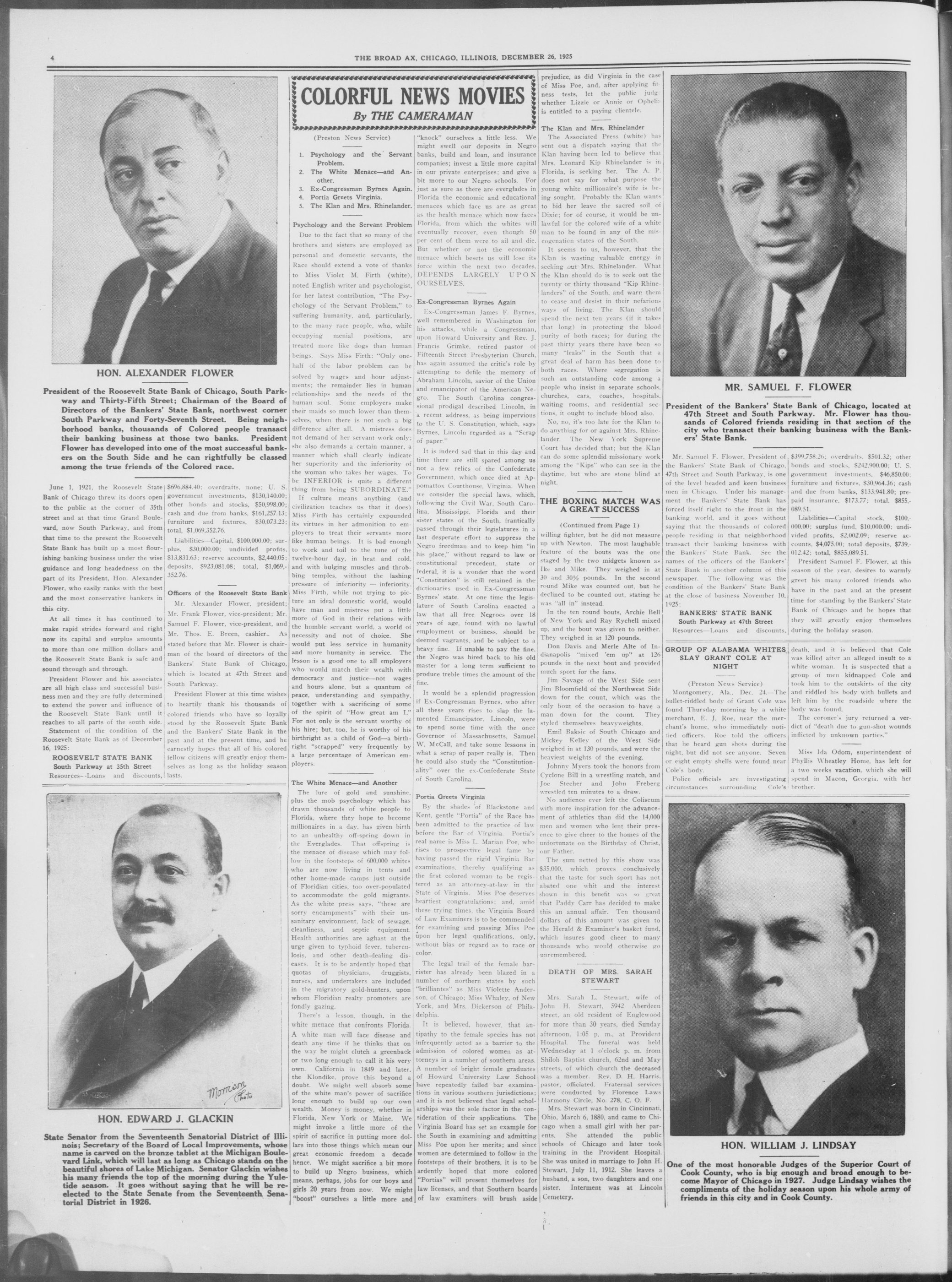
President of the Roosevelt State Bank of Chicago, South Parkway and Thirty-Fifth Street; Chairman of the Board of Directors of the Bankers' State Bank, northwest corner South Parkway and Forty-Seventh Street. Being neighborhood banks, thousands of Colored people transact their banking business at those two banks. President Flower has developed into one of the most successful bankers on the South Side and he can rightfully be classed among the true friends of the Colored race.
June 1, 1921, the Roosevelt State Bank of Chicago threw its doors open to the public at the corner of 35th street and at that time Grand Boulevard, now South Parkway, and from that time to the present the Roosevelt State Bank has built up a most flourishing banking business under the wise guidance and long headedness on the part of its President, Hon. Alexander Flower, who easily ranks with the best and the most conservative bankers in this city.
At all times it has continued to make rapid strides forward and right now its capital and surplus amounts to more than one million dollars and the Roosevelt State Bank is safe and sound through and through.
President Flower and his associates are all high class and successful business men and they are fully determined to extend the power and influence of the Roosevelt State Bank until it reaches to all parts of the south side.
Statement of the condition of the Roosevelt State Bank as of December 16, 1925:
ROOSEVELT STATE BANK
South Parkway at 35th Street
Resources--Loans and discounts,
76 DEU
Мотп
Morrison
Photo
HON. EDWARD J. GLACKIN
State Senator from the Seventeenth Senatorial Dnois; Secretary of the Board of Local Improver name is carved on the bronze tablet at the Mivard Link, which will last as long as Chicago beautiful shores of Lake Michigan. Senator C his many friends the top of the morning dur tide season. It goes without saying that he elected to the State Senate from the Seventeorial District in 1926.
from the Seventeenth Senatorial Dv
cretary of the Board of Local Improve
carved on the bronze tablet at the M
ink, which will last as long as Chicago
al shores of Lake Michigan. Senator C
y friends the top of the morning du
son. It goes without saying that he
to the State Senate from the Seve
district in 1926.
State Senator from the Seventeenth Senatorial District of Illinois; Secretary of the Board of Local Improvements, whose name is carved on the bronze tablet at the Michigan Boulevard Link, which will last as long as Chicago stands on the beautiful shores of Lake Michigan. Senator Glackin wishes his many friends the top of the morning during the Yuletide season. It goes without saying that he will be re-elected to the State Senate from the Seventeenth Senatorial District in 1926.
4
the Bank of Chicago, South Parket; Chairman of the Board of
State Bank, northwest corner
Seventh Street. Being neigh-
s of Colored people transact
at those two banks. President
one of the most successful bank-
d he can rightfully be classed
the Colored race.
$696,884.40: overdrafts, none; U. S.
government investments, $130,140.00;
other bonds and stocks, $50,998.00;
cash and due from banks, $161,257.13;
furniture and fixtures, $30,073.23;
total. $1,069,352.76.
Liabilities—Capital, $100,000.00; surplus, $30,000.00; undivided profits, $13,831.63; reserve accounts, $2,440.05; deposits, $923,018.08; total, $1,069,352.76.
Officers of the Roosevelt State Bank
Mr. Alexander Flower, president;
Mr. Frank Flower, vice-president; Mr. Samuel F. Flower, vice-president, and Mr. Thos. E. Breen, cashier. As stated before that Mr. Flower is chairman of the board of directors of the Bankers' State Bank of Chicago, which is located at 47th Street and South Parkway.
President Flower at this time wishes to heartily thank his thousands of colored friends who have so loyally stood by the Roosevelt State Bank and the Bankers' State Bank in the past and at the present time, and he earnestly hopes that all of his colored fellow citizens will greatly enjoy themselves as long as the holiday season lasts.
Morrison
Photo
eenth Senatorial District of Illid of Local Improvements, whose size tablet at the Michigan Boulevard as long as Chicago stands on the Michigan. Senator Glackin wishes of the morning during the Yulehout saying that he will be rete from the Seventeenth Sena-
THE BROAD AX, CHICAGO, ILLINOIS, DECEMBER 26, 1925
COLORFUL NEWS MOVIES By THE CAMERAMAN
(Preston News Service)
1. Psychology and the' Servant Problem.
2. The White Menace—and Another.
3. Ex-Congressman Byrnes Again.
4. Portia Greets Virginia.
5. The Klan and Mrs. Rhinelander.
Psychology and the Servant Problem
Due to the fact that so many of the brothers and sisters are employed as personal and domestic servants, the Race should extend a vote of thanks to Miss Violet M. Firth (white) noted English writer and psychologist for her latest contribution, "The Psychology of the Servant Problem," to suffering humanity, and, particularly, to the many race people, who, while occupying menial positions, are treated more like dogs than human beings. Says Miss Firth: "Only one-half of the labor problem can be solved by wages and hour adjustments; the remainder lies in human relationships and the needs of the human soul. Some employers make their maids so much lower than themselves, when there is not such a big difference after all. A mistress does not demand of her servant work only; she also demands a certain manner, a manner which shall clearly indicate her superiority and the inferiority of the woman who takes her wages. To be INFERIOR is quite a different thing from being SUBORDINATE."
If culture means anything (and civilization teaches us that it does) Miss Firth has certainly expounded its virtues in her admonition to employers to treat their servants more like human beings. It is bad enough to work and toil to the tune of the twelve-hour day, in heat and cold, and with bulging muscles and throbbing temples, without the lashing pressure of inferiority — inferiority. Miss Firth, while not trying to picture an ideal domestic world, would have man and mistress put a little more of God in their relations with the humble servant world, a world of necessity and not of choice. She would put less service in humanity and more humanity in service. The lesson is a good one to all employers who would match their wealth with democracy and justice—not wages and hours alone, but a quantum of peace, understanding and sympathy, together with a sacrificing of some of the spirit of "How great am I." For not only is the servant worthy of his hire; but, too, he is worthy of his birthright as a child of God—a birthright "scrapped" very frequently by a large percentage of American employers.
The White Menace—and Another
The lure of gold and sunshine, plus the mob psychology which has drawn thousands of white people to Florida, where they hope to become millionaires in a day, has given birth to an unhealthy off-spring down in the Everglades. That offspring is the menace of disease which may follow in the footsteps of 600,000 whites who are now living in tents and other home-made camps just outside of Floridian cities, too over-populated to accommodate the gold migrants. As the white press says, "these are sorry encampments" with their unsanitary environment, lack of sewage, cleanliness, and septic equipment. Health authorities are aghast at the urge given to typhoid fever, tuberculosis, and other death-dealing diseases. It is to be ardently hoped that quotas of physicians, druggists, nurses, and undertakers are included in the migratory gold-hunters, upon whom Floridian realty promoters are fondly gazing.
There's a lesson, though, in the white menace that confronts Florida. A white man will face disease and death any time if he thinks that on the way he might clutch a greenback or two long enough to call it his very own. California in 1849 and later, the Klondike, prove this beyond a doubt. We might well absorb some of the white man's power of sacrifice long enough to build up our own wealth. Money is money, whether in Florida, New York or Maine. We might invoke a little more of the spirit of sacrifice in putting more dollars into those things which mean our great economic freedom a decade hence. We might sacrifice a bit more to build up Negro business, which means, perhaps, jobs for our boys and girls 20 years from now. We might "boost" ourselves a little more and
"knock" ourselves a little less. We might swell our deposits in Negro banks, build and loan, and insurance companies; invest a little more capital in our private enterprises; and give a bit more to our Negro schools. For just as sure as there are everglades in Florida the economic and educational menaces which face us are as great as the health menace which now faces Florida, from which the whites will eventually recover, even though 50 per cent of them were to ail and die. But whether or not the economic menace which besets us will lose its force within the next two decades. DEPENDS LARGELY UPON OURSELVES
Ex-Congressman Byrnes Again
Ex-Congressman James F. Byrnes well remembered in Washington for his attacks, while a Congressman upon Howard University and Rev. J. Francis Grimke, retired pastor of Fifteenth Street Presbyterian Church has again assumed the critic's role by attempting to defile the memory of Abraham Lincoln, savior of the Union and emancipator of the American Negro. The South Carolina congressional prodigal described Lincoln, in a recent address, as being impervious to the U. S. Constitution, which, says Byrnes, Lincoln regarded as a "Scrap of paper."
It is indeed sad that in this day and time there are still spared among us not a few relics of the Confederate Government, which once died at Appomattox Courthouse, Virginia. When we consider the special laws, which, following the Civil War, South Carolina, Mississippi, Florida and their sister states of the South, irantically passed through their legislatures in a last desperate effort to suppress the Negro freedman and to keep him "in his place," without regard to law or constitutional precedent, state or federal, it is a wonder that the word "Constitution" is still retained in the dictionaries used in Ex-Congressman Byrnes' state. At one time the legislature of South Carolina enacted a law that all free Negroes over 18 years of age, found with no lawful employment or business, should be deemed vagrants, and be subject to a heavy fine. If unable to pay the fine, the Negro was hired back to his old master for a long term sufficient to produce treble times the amount of the fine.
It would be a splendid progression if Ex-Congressman Byrnes, who after all these years rises to slap the lamented Emancipator, Lincoln, were to spend some time with the once Governor of Massachusetts, Samuel W. McCall, and take some lessons in what a scrap of paper really is. Then he could also study the "Constitutionality" over the ex-Con federate State of South Carolina.
Portia Greets Virginia
By the shades of Blackstone and Kent, gentle "Portia" of the Race has been admitted to the practice of law before the Bar of Virginia. Portia's real name is Miss L. Marian Poe, who rises to prospective legal fame by having passed the rigid Virginia Bar examinations, thereby qualifying as the first colored woman to be registered as an attorney-at-law in the State of Virginia. Miss Poe deserves heartiest congratulations; and, amid these trying times, the Virginia Board of Law Examiners is to be commended for examining and passing Miss Poe upon her legal qualifications, only, without bias or regard as to race or color.
The legal trail of the female barrister has already been blazed in a number of northern states by such "brilliantes" as Miss Violette Anderson, of Chicago; Miss Whaley, of New York, and Mrs. Dickerson of Philadelphia.
It is believed, however, that antipathy to the female species has not infrequently acted as a barrier to the admission of colored women as attorneys in a number of southern areas. A number of bright female graduates of Howard University Law School have repeatedly failed bar examinations in various southern jurisdictions; and it is not believed that legal scholarships was the sole factor in the consideration of their applications. The Virginia Board has set an example for the South in examining and admitting Miss Poe upon her merits; and since women are determined to follow in the footsteps of their brothers, it is to be ardently hoped that more colored "Portias" will present themselves for law licenses, and that Southern boards of law examiners will brush aside
prejudice, as did Virginia in the case of Miss Poe, and, after applying fitness tests, let the public judge whether Lizzie or Annie or Opheli is entitled to a paying clientele.
The Klan and Mrs. Rhinelander
The Associated Press (white) has sent out a dispatch saying that the Klan having been led to believe that Mrs. Leonard Kip Rhinelander is in Florida, is seeking her. The A. P. does not say for what purpose the young white millionaire's wife is being sought. Probably the Klan wants to bid her leave the sacred soil of Dixie; for of course, it would be unlawful for the colored wife of a white man to be found in any of the miscogenation states of the South.
It seems to us, however, that the Klan is wasting valuable energy in seeking out Mrs. Rhinelander. What the Klan should do is to seek out the twenty or thirty thousand "Kip Rhinelanders" of the South, and warn them to cease and desist in their nefarious ways of living. The Klan should spend the next ten years (if it takes that long) in protecting the blood purity of both races; for during the past thirty years there have been so many "leaks" in the South that a great deal of harm has been done to both races. Where segregation is such an outstanding code among a people who insist in separate schools, churches, cars, coaches, hospitals, waiting rooms, and residential sections, it ought to include blood also.
No, no, it's too late for the Klan to do anything for or against Mrs. Rhinelander. The New York Supreme Court has decided that; but the Klan can do some splendid missionary work among the "Kips" who can see in the daytime, but who are stone blind at night.
THE BOXING MATCH WAS
A GREAT SUCCESS
(Continued from Page 1)
willing fighter, but he did not measure up with Newton. The most laughable feature of the bouts was the one staged by the two midgets known as Ike and Mike. They weighed in at 30 and 30% pounds. In the second round Mike was counted out, but he declined to be counted out, stating he was "all in" instead. In the ten round bouts, Archie Bell of New York and Ray Rychell mixed up, and the bout was given to neither. They weighed in at 120 pounds. Don Davis and Merle Alte of Indianapolis "mixed 'em up" at 126 pounds in the next bout and provided much sport for the fans.
Jim Savage of the West Side sent Jim Bloomfield of the Northwest Side down for the count, which was the only bout of the occasion to have a man down for the count. They styled themselves heavyweights. Emil Bakssic of South Chicago and Mickey Kelley of the West Side weighed in at 130 pounds, and were the heaviest weights of the evening. Johnny Myers took the honors from Cyclone Bill in a wrestling match, and Joe Stecher and John Freberg wrestled ten minutes to a draw. No audience ever left the Coliseum with more inspiration for the advancement of athletics than did the 14,000 men and women who lent their presence to give cheer to the homes of the unfortunate on the Birthday of Christ, our Father.
The sum netted by this show was $35,000, which proves conclusively that the taste for such sport has not abated one whit and the interest shown in this benefit was so great that Paddy Carr has decided to make this an annual affair. Ten thousand dollars of this amount was given to the Herald & Examiner's basket fund, which insures good cheer to many thousands who would otherwise go unremembered.
DEATH OF MRS. SARAH
STEWART
Mrs. Sarah L. Stewart, wife of John H. Stewart, 5942 Aberdeen street, an old resident of Englewood for more than 30 years, died Sunday afternoon, 1:05 p. m., at Provident Hospital. The funeral was held Wednesday at 1 o'clock p. m. from Shiloh Baptist church, 62nd and May streets, of which church the deceased was a member. Rev. D. H. Harris, pastor, officiated. Fraternal services were conducted by Florence Laws Harmony Circle, No. 278, C. O. F.
Mrs. Stewart was born in Cincinnati, Ohio, March 6, 1880, and came to Chicago when a small girl with her parents. She attended the public schools of Chicago and later took training in the Provident Hospital. She was united in marriage to John H. Stewart, July 11, 1912. She leaves a husband, a son, two daughters and one sister. Interment was at Lincoln Cemetery.
[Name]
MR. SAMUEL F. FLOWER
President of the Bankers' State Bank of Chicago 47th Street and South Parkway. Mr. F. sands of Colored friends residing in that city who transact their banking business ers' State Bank.
the Bankers' State Bank of Chicago
sreet and South Parkway. Mr. Flo
Colored friends residing in that
transact their banking business wi
the Bank.
President of the Bankers' State Bank of Chicago, located at 47th Street and South Parkway. Mr. Flower has thousands of Colored friends residing in that section of the city who transact their banking business with the Bankers' State Bank.
Mr. Samuel F. Flower, President of the Bankers' State Bank of Chicago, 47th Street and South Parkway, is one of the level headed and keen business men in Chicago. Under his management the Bankers' State Bank has forced itself right to the front in the banking world, and it goes without saying that the thousands of colored people residing in that neighborhood transact their banking business with the Bankers' State Bank. See the names of the officers of the Bankers State Bank in another column of this newspaper. The following was the condition of the Bankers' State Bank at the close of business November 10, 1925:
BANKERS' STATE BANK
GROUP OF ALABAMA WHITES
SLAY GRANT COLE AT
NIGHT
(Preston News Service)
Montgomery, Ala., Dec. 24.—The ballet-riddled body of Grant Cole was found Thursday morning by a white merchant, E. J. Roe, near the merchant's home, who immediately notified officers. Roe told the officers that he heard gun shots during the night, but did not see anyone. Seven or eight empty shells were found near Cole's body.
Police officials are investigating circumstances surrounding Cole's
1930
[Image of a man with a white hair and a dark suit, facing slightly to the right.]
[Name]
HON. WILLIAM J. LINDSAY
One of the most honorable Judges of the Super Cook County, who is big enough and broad come Mayor of Chicago in 1927. Judge Lind compliments of the holiday season upon his w friends in this city and in Cook County.
most honorable Judges of the Super
County, who is big enough and broad a
vior of Chicago in 1927. Judge Lind
ents of the holiday season upon his w
this city and in Cook County.
One of the most honorable Judges of the Superior Court of Cook County, who is big enough and broad enough to become Mayor of Chicago in 1927. Judge Lindsay wishes the compliments of the holiday season upon his whole army of friends in this city and in Cook County.
the Bank of Chicago, located atarkway. Mr. Flower has thouresiding in that section of the banking business with the Bank-
$399,758.26; overdrafts, $501.32; other bonds and stocks, $242,900.00; U. S. government investments, $46,850.00; furniture and fixtures, $30,964.36; cash and due from banks, $133,941.80; prepaid insurance, $173.77; total, $855,089.51.
Liabilities—Capital stock, $100,000.00; surplus fund, $10,000.00; undivided profits, $2,002.09; reserve accounts, $4,075.00; total deposits, $739,012.42; total, $855,089.51.
President Samuel F. Flower, at this season of the year, desires to warmly greet his many colored friends who have in the past and at the present time for standing by the Bankers' State Bank of Chicago and he hopes that they will greatly enjoy themselves during the holiday season.
death, and it is believed that Cole was killed after an alleged insult to a white woman. It is suspected that a group of men kidnapped Cole and took him to the outskirts of the city and riddled his body with bullets and left him by the roadside where the body was found.
The coroner's jury returned a verdict of "death due to gun-shot wounds inflicted by unknown parties."
Miss Ida Odom, superintendent of Phyllis Wheatley Home, has left for a two weeks vacation, which she will spend in Macon, Georgia, with her brother.
```markdown
```
judges of the Superior Court of
ought and broad enough to be
1927. Judge Lindsay wishes the
season upon his whole army of
ook County.
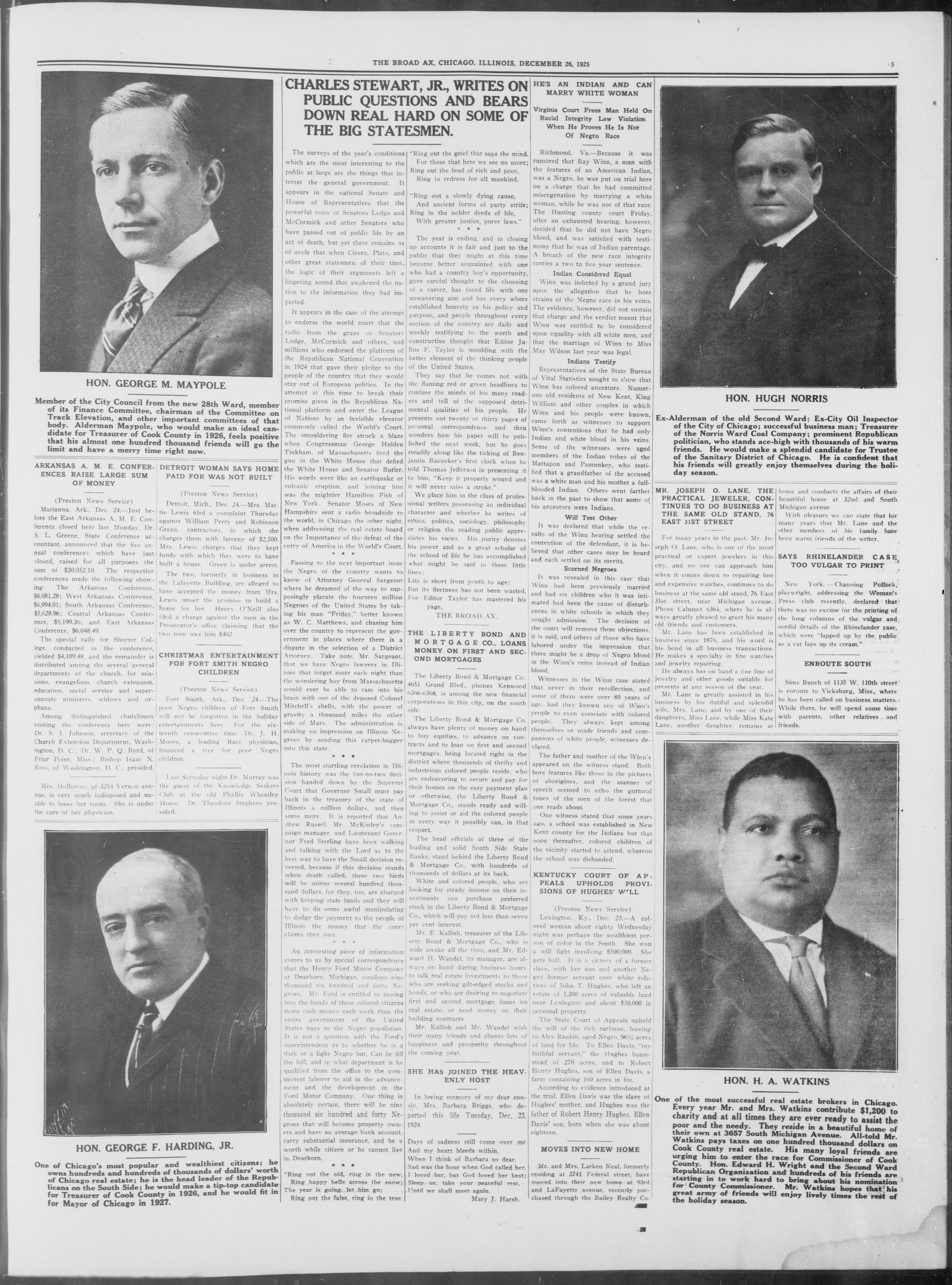
Member of the City Council from the new 28th W of its Finance Committee, chairman of the C Track Elevation, and other important comm body. Alderman Maypole, who would make a didate for Treasurer of Cook County in 1926, that his almost one hundred thousand friend limit and have a merry time right now.
Member of the City Council from the new 28th Ward, member of its Finance Committee, chairman of the Committee on Track Elevation, and other important committees of that body. Alderman Maypole, who would make an ideal candidate for Treasurer of Cook County in 1926, feels positive that his almost one hundred thousand friends will go the limit and have a merry time right now.
ARKANSAS A. M. E. CONFER
ENCES RAISE LARGE SUM
OF MONEY
The special rally for Shorter College, conducted in the conference, yielded $4,109.48, and the remainder is distributed among the several general departments of the church, for missions, evangelism, church extension, education, social service and super-annuate ministers, widows and orphans.
Among distinguished churchmen visiting the conference here were: Dr. S. J. Johnson, secretary of the Church Extension Department, Washington, D. C.; Dr. W. P. Q. Byrd, of Friar Point, Miss.; Bishop Isaac N. Ross, of Washington, D. C., presided.
Mrs. Holloway, of 3254 Vernon avenue, is very much indisposed and unable to leave her room. She is under the care of her physician.
---
M. J. H.
HON. GEORGE F. HARDING, JR.
One of Chicago's most popular and wealthiest citizens; he owns hundreds and hundreds of thousands of dollars' worth of Chicago real estate; he is the head leader of the Republicans on the South Side; he would make a tip-top candidate for Treasurer of Cook County in 1926, and he would fit in for Mayor of Chicago in 1927.
One of Chicago's most popular and wealthiest citizens; he owns hundreds and hundreds of thousands of dollars' worth of Chicago real estate; he is the head leader of the Republicans on the South Side; he would make a tip-top candidate for Treasurer of Cook County in 1926, and he would fit in for Mayor of Chicago in 1927.
from the new 28th Ward, member
chairman of the Committee on
important committees of that
who would make an ideal can-
k County in 1926, feels positive
and thousand friends will go the
right now.
DETROIT WOMAN SAYS HOME
PAID FOR WAS NOT BUILT
(Preston News Service)
Detroit, Mich., Dec. 24—Mrs. Matteie Lewis filed a complaint Thursday against William Perry and Robinson Green, contractors, in which she charges them with larceny of $2,500. Mrs. Lewis charges that they kept funds with which they were to have built a house. Green is under arrest. The two, formerly in business in the Lafayette Building, are alleged to have accepted the money from Mrs. Lewis under the promise to build a home for her. Henry O'Neill also filed a charge against the men in the Prosecutor's office claiming that the two men owe him $462.
CHRISTMAS ENTERTAINMENT
FOR FORT SMITH NEGRO
CHILDREN
Fort Smith, Ark., Dec. 24.—The poor Negro children of Fort Smith will not be forgotten in the holiday entertainments here. For the sixteenth consecutive time, Dr. J. H. Moore, a leading Race physician, financed a tree for poor Negro children.
Last Saturday night Dr. Murray was the guest of the Knowledge Seekers Club at the old Phyllis Wheatley Home. Dr. Theodore Stephens presided.
---
THE BROAD AX, CHICAGO, ILLINOIS, DECEMBER 26. 1925
CHARLES STEWART, JR., WRITES ON PUBLIC QUESTIONS AND BEARS DOWN REAL HARD ON SOME OF THE BIG STATESMEN.
The surveys of the year's conditions which are the most interesting to the public at large are the things that interest the general government. It appears in the national Senate and House of Representatives that the powerful voice of Senators Lodge and McCormick and other Senators who have passed out of public life by an act of death, but yet there remains as of avole that when Cicero, Plato, and other great statesmen of their time, the logic of their arguments left a lingering sound that awakened the nation to the information they had imparted.
It appears in the case of the attempt to endorse the world court that the radio from the grave of Senators Lodge, McCormick and others, and millions who endorsed the platform of the Republican National Convention in 1924 that gave their pledge to the people of the country that they would stay out of European politics. In the attempt at this time to break their promise given in the Republican National platform and enter the League of Nations by an invisible elevator commonly called the World's Court. The smouldering fire struck a blaze when Congressman George Holden Tinkham, of Massachusetts fired the gun in the White House that defied the White House and Senator Butler. His words were like an earthquake or volcanic eruption, and joining him was the mightier Hamilton Fish of New York. Senator Moses of New Hampshire sent a radio broadside to the world, in Chicago the other night, when addressing the real estate board on the Importance of the defeat of the entry of America in the World's Court.
Passing to the next important issue the Negro of the country wants to know of Attorney General Sargeant where he dreamed of the way to supposedly placate the fourteen million Negroes of the United States by taking his man "Friday," better known as W. C. Matthews, and chasing him over the country to represent the government in places where there is a dispute in the selection of a District Attorney. Take note, Mr. Sargeant, that we have Negro lawyers in Illinois that forget more each night than the wondering boy from Massachusetts would ever be able to ram into his brain with one of the deposed Colonel Mitchell's shells, with the power of gravity a thousand miles the other side of Mars. The administration is making no impression on Illinois Negroes by sending this carpet-bagger into this state.
***
The most startling revelation in Illinois history was the five-to-two decision handed down by the Supreme Court that Governor Small must pay back in the treasury of the state of Illinois a million dollars, and then some more. It is reported that Andrew Russel, Mr. McKinley's campaign manager, and Lieutenant Governor Fred Sterling have been walking and talking with the Lord as to the best way to have the Small decision reversed, because if this decision stands when death called, these two birds will be minus several hundred thousand dollars, for they, too, are charged with keeping state funds and they will have to do some awful manipulating to dodge the payment to the people of Illinois the money that the court claims they owe.
An interesting piece of information comes to us by special correspondence that the Henry Ford Motor Company at Dearborn, Michigan, employs nine thousand six hundred and forty Negroes. Mr. Ford is entitled to paying into the hands of these colored citizens more cash money each week than the entire government of the United States pays to the Negro population. It is not a question with the Ford's superintendent as to whether he is a dark or a light Negro but, Can he fill the bill, and in what department is he qualified from the office to the commonest laborer to aid in the advancement and the development in the Ford Motor Company. One thing is absolutely certain, there will be nine thousand six hundred and forty Negroes that will become property owners and have an average bank account, carry substantial insurance, and be a worth while citizen or he cannot live in Dearborn.
"Ring out the old, ring in the new,
Ring happy bells across the snow;
The year is going, let him go;
Ring out the false, ring in the true
"Ring out the grief that saps the mind For those that here we see no more Ring out the feud of rich and poor, Ring in redress for all mankind.
"Ring out a slowly dying cause.
And ancient forms of party strife Ring in the nobler deeds of life,
The year is ending, and in closing up accounts it is fair and just to the public that they might at this time become better acquainted with one who had a country boy's opportunity gave careful thought to the choosing of a career, has faced life with one unwavering aim and has every where established honesty as his policy and purpose, and people throughout every section of the country are daily and weekly testifying to the worth and constructive thought that Editor Julius F. Taylor is moulding with the better element of the thinking people of the United States.
They say that he comes not with the flaming red or green headlines to confuse the minds of his many readers and tell of the supposed detrimental qualities of his people. He presents not twenty or thirty pages of personal correspondence and then wonders how his paper will be published the next week, but he goes steadily along like the ticking of Benjamin Banneker's first clock when he told Thomas Jefferson in presenting it to him, "Keep it properly wound and it will never miss a stroke."
We place him in the class of professional writers possessing an individual character and whether he writes of ethics, politics, sociology, philosophy or religion the reading public appreciates his views. His purity denotes his power and as a great scholar of the school of life he has accomplished what might be said in these little lines:
Life is short from youth to age;
But its fleetness has not been wasted.
For Editor Taylor has mastered his page,
THE BROAD AX.
THE LIBERTY BOND AND
MORT GAGE CO., LOANS
MONEY ON FIRST AND SECOND MORTGAGES
The Liberty Bond & Mortgage Co., 4651 Grand Blvd., phones Kenwood 6360-6368, is among the new financial corporations in this city, on the south side.
The Liberty Bond & Mortgage Co. always have plenty of money on hand to buy equities, to advance on contracts and to loan on first and second mortgages, being located right in the district where thousands of thrity and industrious colored people reside, who are endeavoring to secure and pay for their homes on the easy payment plan or otherwise, the Liberty Bond & Mortgage Co., stands ready and willing to assist or aid the colored people in every way it possibly can, in that respect.
The head officials of three of the leading and solid South Side State Banks, stand behind the Liberty Bond & Mortgage Co., with hundreds of thousands of dollars at its back. White and colored people, who are looking for steady income on their investments can purchase preferred stock in the Liberty Bond & Mortgage Co., which will pay not less than seven per cent interest.
Mr. E. Kallish, treasurer of the Liberty Bond & Mortgage Co., who is wide awake all the time, and Mr. Edward H. Wandel, its manager, are always on hand during business hours to talk real estate investments to those who are seeking gilt-edged stocks and bonds, or who are desiring to negotiate first and second mortgage loans on real estate, or need money on their building contracts.
Mr. Kallish and Mr. Wandel wish their many friends and clients lots of happiness and prosperity throughout the coming year.
SHE HAS JOINED THE HEAV
ENLY HOST
In loving memory of my dear cousin. Mrs. Barbara Briggs, who departed this life Tuesday, Dec. 23, 1924.
Days of sadness still come over me And my heart bleeds within. When I think of Barbara so dear. Sad was the hour when God called her. I loved her, but God loved her best; Sleep on, take your peaceful rest, Until we shall meet again.
Mary J. Harsh
HE'S AN INDIAN AND CAN
MARRY WHITE WOMAN
Virginia Court Frees Man Held On
Racial Integrity Law Violation
When He Proves He Is Not
Of Negro Race
Richmond, Va.—Because it was rumored that Ray Winn, a man with the features of an American Indian, was a Negro, he was put on trial here on a charge that he had committed miscegenation by marrying a white woman, while he was not of that race. The Husting county court Friday, after an exhausted hearing, however, decided that he did not have Negro blood, and was satisfied with testimony that he was of Indian parentage. A breach of the new race integrity carries a two to five year sentence.
Indian Considered Equal
Indian Considered Equal Winn was indicted by a grand jury upon the allegation that he bore strains of the Negro race in his veins. The evidence, however, did not sustain that charge and the verdict meant that Winn was entitled to be considered upon equality with all white men, and that the marriage of Winn to Miss May Wilson last year was legal.
Indians Testify
Representatives of the State Bureau of Vital Statistics sought to show that Winn has colored ancestors. Numerous old residents of New Kent, King William and other couples in which Winn and his people were known, came forth as witnesses to support Winn's contentions that he had only Indian and white blood in his veins. Some of the witnesses were aged members of the Indian tribes of the Mattapon and Pamunkey, who testified that a grandfather of the accused was a white man and his mother a full-blooded Indian. Others went farther back in the past to show that some of his ancestors were Indians.
Will Test Other
It was declared that while the results of the Winn hearing settled the contention of the defendant, it is believed that other cases may be heard and each settled on its merits.
Scorned Negroes
It was revealed in this case that Winn had been previously married and had six children who it was intimated had been the cause of disturbances in white schools in which they sought admission. The decision of the court will remove these objections, it is said, and others of those who have labored under the impression that there might be a drop of Negro blood in the Winn's veins instead of Indian blood.
Witnesses in the Winn case stated that never in their recollection, and some of them were over 80 years of age, had they known any of Winn's people to even associate with colored people. They always kept among themselves or made friends and companions of white people, witnesses declared.
The father and mother of the Winn's appeared on the witness stand. Both bore features like those in the pictures of aborigines, and the manner of speech seemed to echo the guttural tones of the men of the forest that one reads about.
One witness stated that some years ago, a school was established in New Kent county for the Indians but that soon thereafter, colored children of the vicinity started to attend, whereon the school was disbanded.
KENTUCKY COURT OF AP
PEALS UPHOLDS PROVI
SIONS OF HUGHES' WILL
(Preston News Service)
Lexington, Ky., Dec. 23.—A colored woman about eighty Wednesday night was perhaps the wealthiest person of color in the South. She won a will fight involving $500,000. She gets half. It is a victory of a former slave, with her son and another Negro former servant over white relatives of John T. Hughes, who left an estate of 1,300 acres of valuable land near Lexington and about $30,000 in personal property.
The State Court of Appeals upheld the will of the rich turfman, leaving to Alex Rankin, aged Negro, $96½ acres of land for life. To Ellen Davis, "my faithful servant," the Hughes home-stead of 270 acres, and to Robert Henry Hughes, son of Ellen Davis, a farm containing 160 acres in fee.
According to evidence introduced at the trial, Ellen Davis was the slave of Hughes' mother, and Hughes was the father of Robert Henry Hughes, Ellen Davis' son, born when she was about eighteen.
MOVES INTO NEW HOME
Mr. and Mrs. Larken Neal, formerly residing at 3741 Federal street, have moved into their new home at 93rd and LaFayette avenue, recently purchased through the Bailey Realty Co.
[Name not provided]
HON. HUGH NORRIS
Ex-Alderman of the old Second of the City of Chicago; suce of the Norris Ward Coal C politician, who stands acefriends. He would make a of the Sanitary District of his friends will greatly end day season.
the old Second Ward; Ex-Of Chicago; successful business in Ward Coal Company; promo who stands ace-high with thou would make a splendid canary District of Chicago. He will greatly enjoy themselves
Ex-Alderman of the old Second Ward; Ex-City Oil Inspector of the City of Chicago; successful business man; Treasurer of the Norris Ward Coal Company; prominent Republican politician, he stands ace-high with thousands of his warm friends. He would make a splendid candidate for Trustee of the Sanitary District of Chicago. He is confident that his friends will greatly enjoy themselves during the holiday season.
MR. JOSEPH O. LANE, THE PRACTICAL JEWELER. CONTINUES TO DO BUSINESS AT THE SAME OLD STAND, 76 EAST 31ST STREET
home and conducts the affairs of their beautiful home at 32nd and South Michigan avenue.
With pleasure we can state that for many years that Mr. Lane and the
For many years in the past, Mr. Joseph O. Lane, who is one of the most practical or expert jewelers in this city, and no one can approach him when it comes down to repairing fine and expensive watches, continues to do business at the same old stand, 76 East 31st street, near Michigan avenue. Phone Calumet 6364, where he is always greatly pleased to greet his many old friends and customers.
Mr. Lane has been established in business since 1876, and his word is his bond in all business transactions. He makes a specialty in fine watches and jewelry repairing.
He always has on hand a fine line of jewelry and other goods suitable for presents at any season of the year.
Mr. Lane is greatly assisted in his business by his dutiful and splendid wife, Mrs. Lane, and by one of their daughters, Miss Lane, while Miss Kate Lane, another daughter, remains at
[Image of a man in a suit with a tie].
M.
M. S. S.
HON. H. A. WATKINS
One of the most successful r
Every year Mr. and Mrs.
charity and at all times the
poor and the needy. The
their own at 3657 South
Watkins pays taxes on on
Cook County real estate.
urging him to enter the r
County. Hon. Edward H.
Republican Organization a
starting in to work hard
for County Commissioner.
in successful real estate brok
Mr. and Mrs. Watkins con-
tat all times they are ever re-
needy. They reside in a b
3657 South Michigan Aven-
tues taxes on one hundred thou-
sly real estate. His many
to enter the race for Commi-
n. Edward H. Wright and a
Organization and hundreds
to work hard to bring abo-
Commissioner. Mr. Watkins
One of the most successful real estate brokers in Chicago. Every year Mr. and Mrs. Watkins contribute $1,200 to charity and at all times they are ever ready to assist the poor and the needy. They reside in a beautiful home of their own at 3657 South Michigan Avenue. All-told Mr. Watkins pays taxes on one hundred thousand dollars on Cook County real estate. His many loyal friends are urging him to enter the race for Commissioner of Cook County. Hon. Edward H. Wright and the Second Ward Republican Organization and hundreds of his friends are starting in to work hard to bring about his nomination for County Commissioner. Mr. Watkins hopes that his great army of friends will enjoy lively times the rest of the holiday season.
d Ward; Ex-City Oil Inspector successful business man; Treasurer company; prominent Republican high with thousands of his warm splendid candidate for Trustee Chicago. He is confident that joy themselves during the holi- home and conducts the affairs of their beautiful home at 32nd and South Michigan avenue. With pleasure we can state that for many years that Mr. Lane and the other members of his family have been warm friends of the writer.
SAYS RHINELANDER CASE
TOO VULGAR TO PRINT
New York. — Channing Pollock, playwright, addressing the Woman's Press club recently, declared that there was no excuse for the printing of the long columns of the vulgar and sordid details of the Rhinelander case, which were "lapped up by the public as a cat laps up its cream."
ENROUTE SOUTH
Sims Bunch of 1135 W. 110th street is enroute to Vicksburg, Miss., where he has been called on business matters. While there, he will spend some time with parents, other relatives, and friends.
A.
real estate brokers in Chicago. Watkins contribute $1,200 to they are ever ready to assist the my reside in a beautiful home of Michigan Avenue. All-told Mr. the hundred thousand dollars on His many loyal friends are ace for Commissioner of Cook Wright and the Second Ward and hundreds of his friends are to bring about his nomination Mr. Watkins has been
5
[Name]
HON. WILLIAM SULZER
ELOQUENT TRIBU
MEMORY OF THE
ALTGELD, AS T
OR LOYALTY T
FLAG AND HIS
PATHY AND F
STRUGGLING H
By HON. WILLI
New Yo
ELOQUENT TRIBUTE PAID TO THE MEMORY OF THE LATE JOHN P. ALTGELD, AS TO HIS PATRIOTISM OR LOYALTY TO THE AMERICAN FLAG AND HIS UNSWAYING SYMPATHY AND FRIENDSHIP FOR STRUGGLING HUMANITY.
It is a real pleasure for me to comply with the request of the veteran and distinguished Editor of The Broad Ax—the Hon. Julius F. Taylor—for a tribute to the memory of John P. Altgeld.
Suffice it to say I knew him well for many years. We were personal and political friends, and in several important campaigns closely associated in the political affairs of the United States.
Governor Altgeld was a true man; a great man; a great leader; versatile and original; and in his tragic and tempestuous life he played an important part in the politics of his city, his State, and his Country.
He was a man of the plain people, and championed the cause of the oppressed. He loved Truth, and Justice, and Liberty. He stood for Freedom for all. He believed in his fellowman. He could not tolerate class, or caste, or special privilege. He had no bigotry, and no prejudice, except a deep-seated prejudice against the wrongs and the injustices of his time.
He was a myriad minded man. He was honest in all things. He had no fear. He had the rectitude of the rocks. He saw the right. He searched for the truth, and when he found the truth he was brave enough to proclaim it regardless of personal consequences. He served his City, and his State, and his Country well. His sterling manhood recognized his duty, and he grasped the opportunity to render great public service for every cause that lacked assistance. He was a student of public affairs, a tireless
[Name]
Ex-Governor of the great State of Illinois, whose not for many years to come grow dim in the fellow countrymen.
Ex-Governor of the great State of Illinois, whose memory will not for many years to come grow dim in the hearts of his fellow countrymen.
Ex-Governor of the great State of Illinois, whose memory will not for many years to come grow dim in the hearts of his fellow countrymen.
UTE PAID TO THE
THE LATE JOHN P.
TO HIS PATRIOTISM
TO THE AMERICAN
UNSWAYING SYM-
RIENDSHIP FOR
HUMANITY.
LIAM SULZER
ork City
worker, and he fought every wrong,
and every crime, of his time.
He was a loving husband, a sterling friend, and a faithful servant. He was a direct man. He spoke simply, and truthfully, and honestly, and sincerely, and that made him one of the great orators of his day.
He was a poor politician, because he refused to compromise with the right as he saw the light; but he was a great Statesman—far-seeing, sagacious, constructive, and liberal minded.
He was abused and misjudged; villified and misrepresented; especially by the enemies of the plain people, and the advocates of private monoply.
Governor Altgeld will live! As the years come and go his heroic figure as a jurist, an orator, a Statesman, and an humanitarian, will loom larger and larger on the horizon of man, and the time is coming when he will stand out in American history—Lincoln-like—as one of the great men of his time and generation.
His maligners and detractors are dead and forgotten; but Altgeld lives in the hearts of those who knew him, and of those who loved him, and in the decades to come countless thousands, who never knew him, but who will read about him, will bless his memory, because his life was a benefaction and a benediction to all mankind.
"The memory of his deeds will ever stay."
A lamp to light us on our darkened way.
A music to the ear on clamoring street.
A cooling well amid the noonday heat.
A scent of green boughs blown thru narrow walls.
A feel of rest when quiet evening falls."
of Illinois, whose memory will e grow dim in the hearts of his
THE BROAD AX. CHICAGO. ILLINOIS. DECEMBER 26, 1925
TWO VALUABLE WORKS ON
THE NEGRO
Free Negro Heads of Families in the
United States in 1830, $5.00; Free
Negro Owners of Slaves in the
United States in 1830, $1.00
By Carter Godwin Woodson These works are the product of the well known editor of the Journal of Negro History and author of various interesting and valuable works on the Negro. As he has devoted the last 15 years of his life to the special study of this neglected group, he is now publishing at a rapid rate numerous books treating the various aspects of Negro life and history. These two publications are brought out by the Research Department of the Association for the Study of Negro Life and History, which the author founded 10 years ago and has directed up to the present time.
The aim of this work is to facilitate the further study of this neglected group. Most of the people of this country have forgot that about half a million, almost one seventh of the Negroes in this country, were free prior to the emancipation in 1865. These were leaders of this despised class, toiling up sometimes against the teeth of opposition into positions of ease and culture. Many were prosperous farmers and efficient mechanics. A few of them were printers, editors, teachers, ministers, physicians, and lawyers prior to the Civil War.
The statistical report on Free Negro Heads of Families is introduced by a valuable discussion of the free Negro from various points of view. The author therein ably discusses the origin of the free Negro, the prevention of the increase of this class, the free Negro before the law, economic achievement, and social distinctions. Probably the most interesting part of the treatise is the development of early race admixture as the origin of the free Negro. The study is well documented by references to incontrovertible sources which inspire confidence in the author's production and enhance the value of the work.
The facts of the statistical part of the work were extracted from the manuscript schedules returned by those who took the census of the United States in 1830. After the editor had first copied the record of one state to acquaint himself in detail with the information given in these census reports, the statistics were then copied under his direction by three persons. The matter thus collected was then verified by the editor and one of his assistants.
Accompanying tables give the names of about 50,000 heads of families, showing in each case the district, the county and state in which each lived. In some cases even the streets of the cities on which some resided are given. There appear also the approximate age of the head of the family and the total number of persons in the family including the slaves. Some one has referred to this as a veritable blue book on the Negro aristocracy a century ago.
The study of FREE NEGRO OWNERS OF SLAVES is of unusual interest because of the opportunity it offers for understanding the Negro himself. The records show, however, that the Negro owners of slaves were such largely from the point of view of philanthropy. In many instances the husband purchased the wife or vice versa. The slaves belonging to such families were few compared with the large numbers found among the whites on the well-developed plantations. Slaves of Negroes were in some cases the children of a free father who had purchased his wife. If he did not thereafter emancipate the mother, as so many such husbands could not do without becoming separated from them, his own children were born his slaves and were thus reported by the enumerators. Some of these husbands were not anxious to liberate their wives immediately. They considered it advisable to put them on probation for a few years, and if they did not find them satisfactory they would sell their wives as other slaveholders disposed of Negroes. For example, a Negro shoemaker in Charleston, South Carolina, purchased his wife for $700; but, on finding her hard to please, he sold her a few months thereafter for $750, gaining $50 by the transaction. Benevolent Negroes often purchased slaves to make their lot easier by granting them their freedom for a nominal sum, or by permitting them to work it out on liberal terms. John Barry Meachum, a Negro Baptist minister of St. Louis, thus came into possession of as many as twenty slaves by 1836. The exploitation type
FARRER
The Appomattox Club was organized in 1900, the certificate of incorporation being issued on December 14 of that year. The first president was the Hon. Edw. H. Wright. Succeeding presidents were Maj. Robt. R. Jackson, Louis B. Anderson, F. L. Barnett, Beauregard Moseley, Frank Hamilton, Prof. Wm. Emanuel, Wm. R. Cowan, Col. John R. Marshall, Col. J. H. Johnson and S. A. T. Watkins. David B. Hawley is the present president. The club is social in nature but maintains an active interest in civic affairs and quietly but constantly exerts its influence for the welfare of the community. It is non-political. Its club house is the gathering place for most of the representative citizens of Chicago. It is also the meeting place for many smaller organizations of civic nature. It owns the building. Most of the distinguished men of the day have been entertained within its walls and it is one of the points of
of Negro slaveholder, moreover, sometimes feeling the sting of conscience, liberated his slaves. Thus did Samuel Gibson, a Negro of Mississippi, in 1844, when he brought his six slaves to Cincinnati, Ohio, and settled them on free territory.
Having economic interests in common with the white slaveholders, the Negro owners of slaves often enjoyed the same social standing. It was not exceptional for them to attend the same church, to educate their children in the same private school, and to frequent the same places of amusement Under such circumstances miscogenation easily followed. While those taking the census of 1830 did not generally record such facts, the few who did, as in the case of Nasemond County, Virginia, reported a situation which today would be considered alarming. In this particular county there appeared among the slaveholders free Negroes designated as Jacob of Read and white wife and Syphe of Matthews and white wife. Others reported with white wives were not slaveholders.
Copies of these highly interesting books can be secured from the Associated Publishers, Inc., 1538 Ninth street, Northwest, Washington, D. C.
TO HOLD PUBLIC INSTALLATION
The various lodges and temples of United Brothers of Friendship and Sisters of the Mysterious Tens of Chicago and jurisdiction are preparing for a grand public installation and reception to members and the general public at the 8th Regiment Armory Giles avenue at 35th street, Wednesday evening, Jan. 6, 1926. The State Grand Master, Rev. I. S. Stone of Peoria, Ill.; Rev. H. W. Jamison, past national grand master; Mrs. Georgia E. Harding, state grand princess, and other national and state officers are expected to be present and take part in these exercises, which are expected to be very largely attended.
MEMORIAL RITES HELD FOR
NEGRO STATESMAN
Washington, D. C., Dec. 23.—A memorial service for John Wesley Langston, former member of the House of Representatives from Virginia and the only Negro to serve as president of Howard University, was held last Tuesday night under the auspices of the Colored American Forward Movement Club of Frelinghuysen University, at the John Wesley A. M. E. Zion Church. The service was in commemoration of the
interest for nearly all visitors to the city. The active membership is over 450. The new officers of the Appomattox lub follows:
Officers
David B. Hawley, president.
David H. Hawley, president
Louis E. Johnson, first vice-president.
Claud Barnett, second vice-president.
David A. McGowan, treasurer.
Frank S. Stephens, secretary.
Benjamin F. Mitchem, corresponding secretary.
Directors
Henry Cole, Howard T. Cornwell,
Henry F. Daniels, Dr. S. C. Dickerson,
Chas. H. Johnson, David Manson,
Oscar Randall, Charles W. Settles,
John H. Weaver.
As stated before that many of the most prominent white and colored men in this country have been entertained in the parlorists of the Appomattox Club.
ninety-sixth anniversary of the birth of the statesman.
Dean Kelly Miller of Howard University lauded Mr. Langston as a model for our race, and praised him as an outstanding constructive statesman.
Jesse Lawson, president of Frelinghuysen University, who acted as master of ceremonies, also eulogized the Negro leader. Other speakers, who discussed phases of the life and character of Langston, were Thomas W. Walker, William Wallace McCary, S. W. Rutherford, Rev. John H. Burke, Rev. F. W. Dixon, Rev. B. T. Medford and E. E. Peace. A musical program also was given.
WASHINGTON WOMAN SAYS
SHE WAS ROBED BY $195
(Preston News Service)
Washington, D. C., Dec. 23—Mrs. Lucy Banks, 606 Blair Court northeast, told police that a man stole $195 from her when she responded to his request for change of a $100 bill at Eighth and H streets northeast, Wednesday. She had just drawn the money out of a bank.
BAILEY ON THE JOB
M. T. Bailey, president the Bailey Realty Co., 3638 S. State street, who has done much in opening up various avenues for homes and better living conditions for members in and around the city, is working hard for further and greater developments in suburban towns for the increased population which is destined to come with the early spring.
Qualities of Magnet
The coast and geodetic survey says that every magnet possesses two kinds of magnetism, that in one end being different from what is in the other if the magnet is hung up on a thread so that it is free to turn and a second magnet is brought up to it, it may be noticed that the near end of the second magnet draws one end of the suspended magnet and repels the other. The repulsion is exerted between like kinds of magnetism and the attraction between unlike kinds. The earth has all the characteristics of a permanent magnet, and for this reason a suspended magnet, when allowed to come to rest, will take up a definite position, which is determined by the direction of the earth's magnetism at the place. The end of the magnet which points in a northerly direction in this vicinity is frequently called the north pole of the magnet, but the term north-seeking pole is better, as it distinguishes the magnetism of the north end of the magnet from that of the magnetic North pole of the earth which is opposite in kind, as attraction is only exerted between poles of opposite character.
Directors
THE PRENTISS NORMAL AND INDUSTRIAL INSTITUTE (Inc.) for the Training of Colored Young Men and Women Prentiss, Miss.
"DOWN AMONG THE PINES"
(This article was prepared by Jesse O. Thomas, Secretary, Southern Urban League, Atlanta, Georgia).
Eighteen years ago, a young man by the name of J. E. Johnson, and his wife, both a product of Pike, Mississippi, and a young woman who had been blessed by the benediction of Booker T. Washington, whose spirit she had imbibed, went to a little place called Prentiss and founded what is known as the Prentiss Normal and Industrial Institute, Incorporated.
The eighteenth session of this Institution began September 29th last. These two young people were pioneers in the accepted sense of that term, going into that benighted, undeveloped, crude interior section of the state of Mississippi, whose population's completion in terms of racial ratio designated as a part of the
PROF. J. E. JOHNSON
Principal of Prentiss Institute,
Prentiss. Miss.
"Black Belt" of the state, began a work in total obscurity that has gradually found its way to the recognition of educators throughout the nation and public spirited citizens in all sections of the country. In recognition of the sacrificial labors of Mrs. Bertha La Branche Johnson, the co-founder of the institution, a goodly lady of California, of wealth and culture, who after having read of the school's activity and of its struggles in its early stages has provided for Mrs. Johnson a fund with which to take an annual vacation. The interesting feature of this act and manifestation of peculiar concern is in the fact that this benefactor rather diplomatically, no less positively, impels Mrs. Johnson to take this vacation in this wise. She sends Mrs. Johnson the money and extracts from her an itemized statement as to the distance covered on her vacation, and of the points of interest visited.
Professor Johnson is a graduate of Alcorn College, a state institution of Mississippi. From this obscure position in the educational life of the state he has elevated himself to that to which he has been recently elected, President of the Teachers' Association for the State of Mississippi. Thus from obscurity he has pushed his way forward until he now stands at the head of the Negro Educators of his state. He has worked out a front rank, so far as organic control is concerned, of the program, for his state association, recommendation number two on his program, providing for 4,000 Negro teachers of his state in attendance upon the annual meeting of the association at Vicksburg, Mississippi, during the month of April, 1925. Every county in the state is to have a county teachers' association, whose membership is to comprise every teacher in the county, whose annual fee for membership is $5.00. Through this method funds will be raised with which to carry out the program of the newly elected president. Professor Johnson made a program embracing seventeen recommendations of which he has already set in motion activities to in a large measure carry out. We hope the other states may follow this example of developing county units and affiliate them with the state-wide organizations.
Hundreds of Negro boys and girls in this section of the state have gotten their first educational opportunity as well as their first real vision from Prentiss. This school is truly serving the county in which it is located from a spiritual, inspirational, as well as from an educational standpoint. Prof. Wm. H. Holtzclaw, Principal
of the Utica Normal and Industrial Institute, remarked to the writer a few days ago, "Professor Johnson, to my mind, is doing the biggest piece of educational work that is being done in the state of Mississippi for our people when all things have been considered." Holtzclaw himself is the principal of the largest educational institute for our group in the state of Mississippi. He honestly speaks his own convictions. We are still to hear more marvelous things coming out of Prentiss.
Professor J. E. Johnson is the principal of the school who is greatly assisted by his wife, Mrs. B. L. Johnson. R. C. Williams, cashier, Bank of Blountville, Prentiss, Miss., treasurer, and the following prominent citizens speak in the highest terms of Prof. and Mrs. Johnson, who have been receiving The Broad Ax, free of charge at their school since May 1, 1907, and we feel confident that they are accomplishing a great work among the colored people in that section of the south.
Special references: Mr. Leon Tyrone, Cashier, State Bank, Silver Creek, Mississippi; Hon. W. H. Linvingston, Prentiss, Mississippi; Tuskegee Institute, Tuskegee, Alabama; Rev. Jas. M. Lewis, Pastor M. E. Church, South, Tylertown, Mississippi; Prof. Jas. W. Garner, University of Illinois, Urbana, Illinois; Dean W. G. Hastings, Omaha, Nebraska; Mr. V. M. Scanlan, Lumberman, Hattiesburg, Mississippi; Hon. A. H. Longino, Ex-Governor, Jackson, Mississippi; C. L. Martin, Superintendent of Education, Prentiss, Mississippi.
Founded in 1907 by present Principal. Located in a new and undeveloped section of the state, where colored people outnumber the whites.
Plant consists of 400 acres, a large farm, sixteen buildings, team and trade equipments.
Enrollment last session 325 with 15 teachers. Good English course. Trade and Bible training offered.
Non-sectarian but Christian.
HON. WRIGHT ADDRESSES
CLUB
Hon. Edward H. Wright, second ward Republican committeeman, member of the Illinois State Commerce Commission and past exalted ruler of Ft. Dearborn Lodge No. 44, Elks addressed the 1926 Marching Club of Ft. Dearborn Lodge No. 44 Sunday afternoon in their new club house, 3920 South Parkway. Hon. Wright spoke on civic betterment among members of the race and among the general public. Among others to speak at this time were J. C. Martin, exalted ruler of Ft. Dearborn Lodge; Jas. M. Brooks, S. J. Fountain, F. W. Henry, Wm. Boyd and others.
[Name]
MRS. B. LILLIAN JOHNSON Assistant Principal of Prentiss Institute, Prentiss, Miss., who is greatly assisting her husband to accomplish a lasting educational work in the South.
"Easy Terms"
The man who invented "Easy Terms" has made millions happy. To him we are indebted for many things in our homes which bring joy and comfort to our daily lives.
Why, even the greatest and latest of all modern advantages, a Central House Heating Furnace, Hot Water, Steam Vapor or Warm Air—automatically operated by city gas, can be purchased on "Easy Terms." No great outlay of money at any one time—two years to pay if you wish.
YOU CAN AFFORD TO HEAT WITH GAS. If you live in Chicago, we will give you figures showing the actual cost of heating other Chicago homes similar to yours.
If it's done with Heat—
YOU CAN DO IT BETTER WITH GAS
Phone or write for book on House Heating with Gas
House Heating Department
The Peoples Gas Light and Coke Company
122 So. Michigan Avenue, CHICAGO
TELEPHONE WABASH 6000
THE BROAD AX Published Every Saturday
In this city since July 15th, 1899, without missing one single issue. Republicans, Democrats, Catholics, Protestants, Single Taxes, Priests, infidels or anyone else can have their say as long as their language is proper and responsibility is fixed.
The Broad Ax is a newspaper whose platform is broad enough for all, ever claiming the editorial right to speak its own mind. It is neither Democratic nor Republican. It is strictly or absolutely independent in politics.
Local communications will receive attention. Write only on one side of the paper.
Subscriptions must be paid in advance.
One Year .....$2.00
Six Months .....$1.00
Advertising rates made known on
application.
Address all communications to
THE BROAD AX
6206 S. Elizabeth St., Chicago.
Phone: Wentworth 2597
JULIUS F. TAYLOR
Editor and Publisher
Entered as Second-Class Matter, Aug
19, 1902, at the Post office at Chicago
III. Under Act of March 8, 1879.
Small Village Mother
Far to the north on the southeastern coast of Newfoundland is a little village called Ferryland, says a writer in the Baltimore Sun. This small, windblown town of some sparse five hundred inhabitants is in a way the mother of a buxom, prosperous daughter to the south, the city of Baltimore.
In 1628 George Calvert, Lord Baltimore, arrived in North America with a charter which gave him most of the island of Newfoundland, called the province of Avalon. He founded his first colony in the new country on the site of this village of Ferryland and settled there with his family.
But finding the climate more rigorous than he thought comfortable, he asked Charles I for a grant of land north of the Potomac river and planned to move to warmer regions. His request was granted, but before the final negotiations were completed he died.
His son, Cecilius Calvert, second baron of Baltimore, completed the transaction in 1632 and named his colony Maryland in compliance to the queen, Henrietta Maria. And so it was that Ferryland was left to struggle with the bleak winds blowing off the rugged coast where it clung up on the hillside. But though small, it was wiry, and today it still is alive, not a great deal larger than it was in the days of its early youth several hundred years ago, but still sound and hearty.
English Trade-Marks
English legislation trending toward the authorization of trade-marks began in 1286. In that year parliament provided that "every baker shall have a mark of his own for every sort of bread." This was followed in 1363 by Edward III's provision that every master goldsmith have a mark.
Under Henry V appears an ordinance for marking barrels; and one of these early signs, dating back to 1420, is still used by the London Cooper's company. By 1688 Randle Holmes, writing of his investigations throughout the kingdom, reported Chester to be full of merchant marks. And shortly thereafter the practice became the institution.
Many of the present British companies hold devices dating back to the Seventeenth century—Exchange.
"Easy
The man who invented made millions happy debted for many thin bring joy and comfort
Why, even the great modern advantages, ing Furnace, Hot W
Genius Not Overcome
by Distasteful Toil
"You can take your choice—go back to Cheshire tomorrow or go to work in the clock factory."
These were the alternatives offered to young Bronson Alcott by his father, Alcott, who was to become the father of Louisa May Alcott, had returned from the home of his uncle, where he had been sent to go to school. Honore Willis Morrow, writing in McCall's has told of the early life of this neglected man of letters. He relates:
"I'll go to the clock factory," said Bronson quickly. And so it was decided.
"The sort of work required of him made no demands on his brain, and by carrying one of his precious borrowed books always with him, he did not stagnate, though at the time he thought he did and was terribly unhappy. Yet, rather than go back to Cheshire, he clung to the factory work for nearly two years. His mother watching him start off each morning along the lonely and precipitous pathway that led the two miles from the farm to the factory, yearned over him, wondered at his gentle, obstinacy, worried over him but never, evidently lost her faith or understanding."
Live Snails Kept in Cold Storage Vaults
At the beginning of the autumn season 20,000,000 snails are usually reposing in cold storage in France ready to be taken out and served up to the epicures of the nation. The snails are eaten only in the colder months of the year. It goes into seclusion under the shelter of stones and wood piles and spreads a shield across the opening of its shell and spends the winter in comfortable seclusion and safety. But they are forestalled by the snail hunters who gather them in the spring and summer months and put them in cold storage until the restaurant demand starts in. They sleep away the summer months under the impression that they are hibernating. If it were not for this the Frenchman would be compelled to forego his diet of snails. There are two kinds of snails which are in demand for consumption, a form of the common garden snail and the Roman or Burgundy, which is by far the favorite on account of its delicious flavor and its size—Chicago Journal.
Purple Royal Emblem
From Earliest Days
Purple became associated with kings in the early days because it was the finest and most costly dye of the ancients. It was obtained from two kinds of shells found in the Mediterranean sea. The ancients attribute its discovery to the Phoenicians and the story is that it was first discovered by a dog biting a purple fish. It is stated that in Caesar's time a pound of Tyrian purple wool cost above 1,000 denaril, which is, roughly speaking, equal to $217.50. Purple robes were used at an early date by the Greeks as a mark of dignity. Tyrian purple was introduced into Rome in the middle of the First century, B. C., and from that time it became a luxury. Its use was checked by imperial decree. A complete robe of "blatta," the finest kind of purple, was reserved as an imperial privilege, and any private person wearing it was punished as being guilty of high treason.
Many Kinds of Oaks
There are 300 kinds of oak trees having vastly different characteristics, but they have one common feature, and that is they all produce acorns. The white oak is so called because it has a rather white bark, while the black oak's bark is quite dark, black to all intents and purposes during the "wood age." Live oak was always preferred for shipbuilding and for heavy duty, but just why it was named "live" is a matter of doubt.
At one time the island of Nantucket was covered with live oaks, but the land was denuded of this timber years ago during the whaling activities, when several shipbuilding yards flourished on the island and a great fleet of whalers was built there.
THE BROAD AX, CHICAGO, ILLINOIS, DECEMBER 26, 1925
Ernest H.
WILLIAMSON
UNDERTAKER
E. H. WILLIAMSON
Charles E. Dawson
Unhappiness in Wake
The thing which causes us to worry is either something that can be remedied, or can't. The thing to do is to look it squarely in the face. Swallow an unpleasant truth or so if necessary, but get down to the issue, is the advice of the Montreal Family Herald. If the cause cannot be changed, there is only one thing to do—don't think about it. Force yourself to shut it out of your consciousness. Just close your mind to it, and let the blow fall when and where it will. Since you can't stop it, you might at least save your strength for the finish.
But most of our worries are avoidable. We worry because we suddenly think, two hours after we left the house, that we maybe didn't turn off the electric iron in the kitchen, or because we have a house full of company in the evening and nothing seems ready, or because the children won't eat their vegetables, but will fill up on candy, or any number of small things that are the result of our own carelessness or our inattention to duty.
Larvae Unburt by Cold
The bureau of entomology says that well-grown larvae of moths in fur and wool were held in commercial storage at a temperature said to fluctuate between 24 degrees and 48 degrees Fahrenheit, but held mostly at 40 degrees Fahrenheit, and were found to be alive after storage for 6, 8, 10, 11 and 12 months. Larvae in fur helmets placed in storage during February, removed the following December, and held in a steam-heated building, transformed in considerable numbers into active adults by the middle of January. These adults showed no effects of the refrigeration of the larvae from which they had developed, but held many eggs that hatched normally. Refrigeration for six months had no noticeable effect upon the larvae, except to hold them inactive and incapable of causing injury.
Wattle and Dab
Wattle and dab is a term of architecture applied to a wall made with upright stakes with withes twisted between them and then plastered over. It is probably one of the oldest systems of construction. The Egyptians employed the stem of maize, or Indian corn, for the upright stakes. These were secured together with withes and covered over with mud, the upper portion of the maize stems being left uncut at the top to increase the height of the enclosure. In the Middle ages in England wattle and dab was used as a framework for clay chinneys.
WILLI
UNI
PETER
JOHN D. SCOTT, Manager
Licensed Undertaker
MRS. MARY E. WILLIAMSON
Licensed Undertaker
J. E. BISH
33d Degree PRWD.G.M.,Bookkeeper
Embalmer's Apprentice No.194
Unexcelled for
AUTOMOBILES
KEN
5121-23-25
GIVE
SOMETHING
ELECTRICAL
COMMONWEALTH EDISON
ELECTRIC SHOPS
72 West Adams Street and Branchet
Nap, Invented Billiards
The guides that show tourists around Paris, says a Paris dispatch, display remarkable ingenuity in replying to every question, and can always be relied on to supply interesting details regarding great men of the past which have been overlooked in history.
An American traveler who was being shown over Malmison, one of Napoleon's residences on the outskirts of Paris, had his curiosity aroused by certain white ornaments appearing at the end of the arms of the throne in a painting in which the first emperor is shown standing by his imperial seat. He asked the guide what these knobs were.
"Napoleon," his cicerone explained, with pompous alacrity, "was not merely a great soldier and statesman, but also a great inventor. These round white balls commemorate the fact that Napoleon invented billiards."
Narrow Escape
The professor was lecturing to the medical class and stopped occasionally to ask a question. "Suppose," he said, "a young woman in walking on a slippery pavement fell and dislocated her ankle, and you happened to be on the spot, what would you do?" "Rubber," answered the flippant and unthinking young man. The rest of the class held it breath till the professor went on: "Quite right. A vigorous rubbing would serve to keep down the swelling until remedies could be procured and applied." And the students breathed again.—Brooklyn Eagle.
Tungsten of Great Value
Tungsten or wolfram is a metallic element isolated by the brothers d'Eliujart in 1783, after Scheele had, in 1771, isolated tungstic acid. Tungsten is not found native, but occurs as the tungstate of iron and manganese in the mineral wolframite, as the calcium tungstate or scheelite, as the trioxide or wolfram ochre, and in small quantities in other minerals. Tungsten minerals are almost invariably found in tn ores. It is used to increase the hardness and tenacity of steel and thus improve it as a material for hard tools. Coolidge has succeeded in rendering tungsten malleable and ductile, and at present tungsten wire is widely used for making incandescent lamp filaments.
Ancient Mortgage Laws
Explorers on the site of ancient Babylon have dug up clay tablets on which were recorded agreements from borrower to lender whereby the harvest of certain fields or vineyards was pledged as security for loans. Modern mortgage law is traced back to the Anglo-Saxons. Records show two forms of mortgages—the vif-gage or life pledge and the mort-gage or dead pledge. Under the life pledge the lender took title to the property and managed it until such time as the earnings of the property paid off the debt. Under the dead pledge the borrower paid off the debt in full at a specified time when the mortgage was canceled. In case of failure to pay he forfeited the property.
JOIN OUR NEW
Christ
Clu
We Take Pleasure in
Enroll as
Have Money When
Joining Our
FIRST PAYMENT MA
You May Joint
Christmas Club
Take Pleasure in Inviting Everybody
Enroll as Members
Use Money When You Need It More
Joining Our Christmas Club
FIRST PAYMENT MAKES YOU A MEMBER
You May Joint One or More Clubs
We Take Pleasure in Inviting Everybody to Enroll as Members Have Money When You Need It Most By Joining Our Christmas Club FIRST PAYMENT MAKES YOU A MEMBER You May Joint One or More Clubs
EVEN AMOUNT PLAN
At the End
$ .25 Club amounts
.50 Club amounts
1.00 Club amounts
2.00 Club amounts
5.00 Club amounts
10.00 Club amounts
20.00 Club amounts
At the End of 50 Weeks
Club amounts to.....$
Club amounts to.....
Club amounts to.....
Club amounts to.....
Club amounts to.....
Club amounts to.....
INCREASING PLAN
Deposit 1c the first week—2
crease your deposit 1c each
weeks you have ...
Deposit 2c the first week—4
crease your deposit 2c each
weeks you have ...
5
Deposit 5c the first week—10
crease your deposit 5c each
weeks you have ...
1
Deposit 10c the first week—20
crease your deposit 10c each
weeks you have ...
DECREAS
Deposit the largest amount fin
each
1c
c the first week—2c the second week.
your deposit 1c each week—at the end of
you have
2c
c the first week—4c the second week.
your deposit 2c each week—at the end of
you have
5c
c the first week—10c the second week.
your deposit 5c each week—at the end of
you have
10c
c the first week—20c the second week.
your deposit 10c each week—at the end of
you have
DECREASING PLAN
the largest amount first and decrease your
each week.
1c
Deposit 1c the first week—2c the second week. Increase your deposit 1c each week—at the end of 50 weeks you have $ 12.75
2c
Deposit 2c the first week—4c the second week. Increase your deposit 2c each week—at the end of 50 weeks you have $ 25.50
5c
Deposit 5c the first week—10c the second week. Increase your deposit 5c each week—at the end of 50 weeks you have $ 63.75
10c
Deposit 10c the first week—20c the second week. Increase your deposit 10c each week—at the end of 50 weeks you have $ 127.50
DECREASING PLAN
Deposit the largest amount first and decrease your payments each week.
You Will Receive 3% Interest
BIN
STATE
Jesse Binga, President
South State at T
CHICAGO
Christ
SAVING
Open Your Christmas
JOIN
The Club will continue for
be mailed to all members for
with 3% interest added when
according to schedule.
Join our Christmas Savin
mas financial problem for a
Payments may be made
the accompanying schedule
BINGA
STATE BANK
Binga, President
South State at Thirty-Fifth Street
CHICAGO, ILLINOIS
Christmas
SAVINGS CLUB
Your Christmas Savings Club
JOIN NOW!
Job will continue for 50 weeks, when
to all members for the amount of the
interest added where payments have
to schedule.
Christmas Savings Club and solve
a special problem for next year.
It may be made in varying sums ac
companying schedule:
Jesse Binga, President N. C. Langston, Cashier South State at Thirty-Fifth Street CHICAGO, ILLINOIS
The Club will continue for 50 weeks, when checks will be mailed to all members for the amount of their deposits with 3% interest added where payments have been made according to schedule.
Join our Christmas Savings Club and solve the Christmas financial problem for next year.
Payments may be made in varying sums according to the accompanying schedule:
CLASS 5 — First week 5c, second week 10c. Increase each weekly payment 5c and receive in 50 weeks. $63.75
CLASS 50 — Pay 50c straight each week for 50 weeks and receive. $25.00
CLASS 100 — Pay $1.00 straight each week for 50 weeks and receive. $50.00
CLASS 5A — First week $2.50, second week $4.50. Decrease each weekly payment 5c and receive in 50 weeks. $63.75
CLASS 200 — Pay $2.00 straight each week for 50 weeks. $40.00
CLASS 10—First week 10c, second week 50c. Increase each weekly payment 10c and receive in 50 weeks... $127.50
CLASS 10-A—First week $5.00, second week $4.00. Decrease each weekly payment 10c and receive in 50 weeks... $127.50
Plus 3% Interest for
Bankers S
NORTHEAST CORNER GRE
CHIC
OFF
ALEXANDER FLOWER, Chairman of
SAMUEL F. FLOWER, Pre
CHARLES H. IRE
LOUIS
The Men Behind the Bank
Over $5,
Plus 3% Interest for Prompt Paymen
Bankers State Bank
EAST CORNER GRAND BLVD. AT
CHICAGO
OFFICERS
FLOWER, Chairman of the Board of Directors
MUEL F. FLOWER, President
CHARLES H. IRISH, Vice-President
LOUIS W. FRANK, Cashier
LEWIS MARKS, Ac
Behind the Bank Show an Aggregate
Over $5,000,000.00
Plus 3% Interest for Prompt Payment
NORTHEAST CORNER GRAND BLVD. AT 47TH ST.
CHICAGO
The Men Behind the Bank Show an Aggregate Worth of
Over $5,000,000.00
TELEPHONE DOUGLAS 1
GEORGE F.
RGE F. HARDING REAL ESTATE
Up-to-Date or Modern
and Store
3101 COTTAG
Corner 31st S
Date or Modern Houses, Apa
and Stores to Rent
COTTAGE GROVE
Corner 31st Street, Chicago
Up-to-Date or Modern Houses, Apartments and Stores to Rent
3101 COTTAGE GROVE AVE.
Corner 31st Street, Chicago
stmas
club
Inviting Everybody to
Members
You Need It Most By
Christmas Club
MKES YOU A MEMBER
One or More Clubs
of 50 Weeks
$ 12.50
25.00
50.00
100.00
250.00
500.00
1,000.00
C
the second week. In-
week—at the end of 50
..... $ 12.75
C
the second week. In-
week—at the end of 50
..... 25.50
C
the second week. In-
week—at the end of 50
..... 63.75
C
the second week. In-
week—at the end of 50
..... 127.50
NG PLAN
at and decrease your payments
week.
NGA BANK
N. C. Langston, Cashier
Nirty-Fifth Street
ILLINOIS
Christmas
S CLUB
Savings Club for 1926
NOW!
150 weeks, when checks will
the amount of their deposits
the payments have been made
s Club and solve the Christ-
ture year.
varying sums according to
CLASS 50 — Pay 50c straight each
week for 50 weeks and
receive..... $25.00
CLASS 100 — Pay $1.00 straight each
week for 50 weeks and
receive..... $50.00
CLASS 200 — Pay $2.00 straight each
week for 50 weeks and
receive..... $100.00
CLASS 500 — Pay $5.00 straight each
week for 50 week and
receive..... $250.00
SPECIAL CLASS—Join this class by agreeing to pay any certain amount each week for 50 weeks, and receive at the end of 50 weeks the full amount deposited.
State Bank
AND BLVD. AT 47TH ST.
MAGO
ERS
The Board of Directors
ment
SH, Vice-President
W. FRANK, Cashier
LEWIS MARKS, Assistant Cashier
now an Aggregate Worth of
100,000.00
ARDING, JR.
n Houses, Apartments to Rent
E GROVE AVE.
reet, Chicago
7
A
R
How Wily Cameraman
Got Screen Pictures
"In darkest Africa, in a village called Kimbaebal, a cameraman found a tribe of savages who had never before seen but one white man. He had been a French officer, as they reminiscently remarked through an interpreter. However, the cameraman who found this tribe received permission from the chief to film his people. Naturally he didn't care to cross the cannibals. Yet neither did he wish to spoil the chances of having his pictures reach the screen.
"The tribe wore the proverbial smile all right, but the sash in every instance had been left at home. There seemed to be no chance in the world of getting over his idea of modesty on the American plan.
"While he was trying to figure out the solution he spied a pile of ostrich feathers gayly colored with native dye. He selected a sturdy young buck as his model. The cannibals crowded about him and in no time at all he had a steady stream of animated feather dusters issuing from his swiftly moving hands. The pictures which he brought back with him were eminently respectable."-Pell Mitchell in Everybody's Magazine.
Tom McNeal knew a deaf man who had an account against another deaf man and brought suit before a justice of the peace who was deaf. When the J. P. called on the plaintiff to state his case the plaintiff guessed what the J. P. was saying from the movement of his lips. "This defendant," said the plaintiff. "owes me $11 for groceries and refuses to pay me." The J. P. seeing the plaintiff's mouth had quit working, turned to the defendant, asking what he had to say. Not hearing what either had said but guessing it was up to him to say something, he stated his side of the case. "Your honor, it wasn't my dog. If a dog bit this man I'm sorry, but he ought to get after the owner of the dog, not me." The J. P. didn't hear what either man said, but as both had quit talking felt it was his duty to render judgment. After pondering a few minutes and apparently weighing the evidence, he said, "Well there's a good deal to be said on both sides of this case, but, (turning to the defendant), she is your mother and you will have to support her."—Capper's Weekly.
Testing Gold
The ordinary and simplest method of testing gold consists in touching the metal with a glass stopper wetted with nitric acid. This will leave gold untouched, while base alloys will take a blue color from the formation of nitrate of copper. It's a better idea, though, to take the piece to a jeweler and have him tell you whether it is pure.
Telephone: State 3278
A. D. GASH
ATTORNEY AT LAW
Suite 813, Ashland Block
155 N. Clark Street
CHICAGO, ILL.
Residence, 1262 Macalister Place
Telephone Monroe 2714
MILES J. DEVINE
ATTORNEY AT LAW
Suite 318-320 Reaper Block
Clark and Washington Sts.
CHICAGO
Telephone Central 1239
Phone Main 2017
A. L. WILLIAMS
ATTORNEY AND
COUNSELOR AT LAW
Suite 706 Firmenich Building
184 W. Washington St.
CHICAGO
Residence 3655 Prairie Ave.
Phone Douglas 9133
W. G. Anderson
Attorney At Law
17 North La Salle Street
CHICAGO
NOTARY PUBLIC
Suite 560 Watson Bldg.
Office Phones: Dearborn 7094-7098
Res. 3354 Vernon Avenue
Phone Douglas 6045
Notary Public
Phones: Office Main 4153; Residence,
4751 Champlain Avenue
Phone Kenwood 5611
Walter M. Farmer
ATTORNEY AND COUNSELOR
AT LAW
Suite 708—184 W. Washington St.
CHICAGO
Antarctic Land Part
of America's Domain
The United States has an Antarctic domain as great as the holdings in the Arctic region of Alaska. Indeed, if we were to deem it advisable, we could register a sound title to a vast area near the South pole discovered by Commander Charles Wilkes, of the United States navy, in 1840. This region, known as Wilkes Land, has an area equal to almost half that of continental United States.
The national congress was so impressed and elated by reason of this discovery that it authorized the publication, in 22 volumes, of the expedition's complete report, with all charts and surveys. But although so many years have intervened since Wilkes discovered the territory which now bears his name on all the standard charts, no effort has been made firmly to nail down the heritage. So far as we have been able to learn, no American flag has ever been hoisted there. Certainly we know that no colony ever has been established in that dreary domain, nor has any hardy exploring party followed in Wilkes' footsteps to make a detailed examination of this snow region and its possible opportunities.—Fort Wayne News-Sentinel.
"Busted" Toe Got No
Uncle Eph Jackson, an old-time colored field hand, was hoeing cotton one hot day. He was barefooted, as he wanted to save his one pair of shoes for Sunday. While he was hoeing he noticed a mole sticking its head out of the dirt. As moles had been making themselves a nuisance he gave this fellow a hard rap with his hoe.
At that instant Uncle Eph jumped and howled with pain—for it was his own big toe that he had whacked, instead of a mole. The toe bled considerably and Eph knew it would be bore for some time to come. But he was a sensible old fellow and he always put the blame where it belongs. He frequently carried on long conversations with himself and so, addressing his wounded toe, he called out: "You needn't think you is gwine git no impafy fum me; it's younh own fault an' you knows it."—Pathfinder Magazine.
Best Floor Bleach
Oxalic acid is recommended for bleaching an oak floor, using the acid at the rate of one pound to the gallon of water, and adding to the solution a little spirits of niter. Apply the acid hot. When the bleached portions are dry they must be well washed to remove the acid from the wood. Oxalic acid is a poison and should not be applied with a rag held in the fingers, but should be brushed on.
Phone Kenwood
Liberty Bond & Bond Company
Real Estate
1st and 2nd
E. KALLISI
EDW. H. WAN
4651 Grand Boulevard
LINCOLN ST.
OF CH
Under State Govern
31st and South
Capital and Surf
South State Street
First Mortgage
Approved Safe Inv
interest. $100 B
payment
See our Mr. Avery of
LOANS MADE O
Approved Safe Investments yield 7% interest. $100 Bonds sold on easy payment plan See our Mr. Avery of the Bond Department
Savings Department open from
9 A.M. to 8 P.M. Saturdays
SAFETY DEPOSIT BOXES for less than
a day. Protect your Valuable Papers, Jew
SAFETY DEPOSIT BOXES for less than one cent a day. Protect your Valuable Papers, Jewelry, etc.
Honor to Those Who
Grow Old Gracefully
Everywhere about us are to be observed young and middle-aged men and women who painfully exhibit the imminence of age and its infirmities. They present sorry spectacles. They excite our wonder, but they inspire no emotion of sympathy within us. They have bowed to the indictment of age without presenting any defense. They become old in fact while yet the years of age are far from them. They have not the will to live life as it should be lived. They have permitted the spirit of youth to atrophy within them.
How altogether inspiring and encouraging it is to consider those who have learned "how to grow old gracefully," how to keep in touch with the tides of life, functioning constructively, winning from existence the priceless boon of contentment by an unswerving devotion to rational living, that living which is based upon rational and constructive work.
Pity the wretched old young men—the pathetic flotsam of this rushing age—Cincinnati Enquirer.
Arizona Grand Canyon
But it is no mere cleft or chasm or simple gorge or canyon—it contains unnumbered hundreds of these mazes. It is a terrific trough, 6,000 to 7,000 feet deep, at some places nearly fifteen miles wide, more than 300 miles long, peopled with hundreds of peaks taller than any mountain east of the Rockies—yet not one of them with its head so high as your foot upon the rim—and all ablaze with such color as no Eastern or European landscape ever knew, even in its apunglow. It is a condensed river system, with this tremendous mountain system counter-sunk and imprisoned in its deep-cut channels. If you take a big palmate leaf, and look at its reticulations, taking the midrib for the main channel of of the river, you will have a plan resembling it.
Designating Red Indian
The word Amerind is composed of the first syllables of "American Indian," suggested in 1899 by an American lexicographer as a substitute for the inappropriate terms used to designate the race of man inhabiting the New world before its occupancy by Europeans. The use of the word Amerind occasioned a discussion in which it was supported by some and attacked by others. The name, nevertheless, has found its way into both scientific and popular literature.
Ruined by Malaria
Ruined by Malaria
The lost cities of Ceylon, the ruins of which are one of the wonders of the world, are believed to have been abandoned on account of malaria.
Property Mortgage Company
Investments
Mortgages
H, Treasurer
DEL, Manager
CHICAGO
STATE BANK
CHICAGO
Comment Supervision
On State Streets
plus $460,000.00
It's Largest Bank
The Gold Bonds
Investments yield 7%
Bonds sold on easy
plan
in the Bond Department
IN REAL ESTATE
ES for less than one cent able Papers, Jewelry, etc.
THE BROAD AX, CHICAGO, ILLINOIS, DECEMBER 19, 1925
Hardest Known Wood
Lignum-vitae, the vital wood, or wood of life, which is found in the West Indies and some other parts of the tropical Americas, is id to be the hardest wood nature produces. The reason why this wood is so tough is in the arrangement of its fibers. Instead of being straight, they weave back and forth, crossing and recrossing, like the weave of an automobile tree. Another peculiar feature in this wood is that when the tree is cut, the sap cells fill up with a very heavy rosin, which causes it to weigh about eighty pounds to the cubical foot. It is one-third heavier than water, and so, it is excellent for many uses, it would not make a good raft. It is used for carpenter's mallets, as it is so tough that it will not split from hard usage, and it is also employed for tool handles.
Mere attention to words is not enough; for real style is not a matter of showiness. Solicitude over verbal niceties quenches the ardour of imagination. But no appropriate word will be lost, if one . . . by prolonged and judicious reading acquires a plentiful stock of words and applies thereto skill in arrangement, and, further, strengthens the whole by abundant practice, so that all is constantly at hand and before one's eyes. When our words are sound Latin, significant, elegant, and fittingly arranged, why should we labor for anything more?—Quintillian.
Many-Sided Mule
Those who are supporters of the mule say, in comparison with the horse, he lives longer, endures more work and hardship, requires less attention and feed, and is less liable to digestive disorders, lameness and disease. The difficulty is to know how to handle the mule because of the fact of a combination of stubbornness and willingness, temper and sullenness, slyness and docility, faithfulness and waywardness. The mule must be understood, and gently but firmly persuaded to do things out of the ordinary.
WALDEN
COR
(Formerly the liter
Walden U
An Approved
Education
Modern in methods and
Throws Christian influence
Places emphasis upon dev
on part of the student.
EXPENSES SU
MODE
Session Begins
For further info
T. R. DAVIS,
Nashville
WEST ENGLE
AND SAVI
Cor. 63rd Street and
JOHN BAIN, President
Vice-President; EDWA
President and Cashier;
Assistant Cashier and T
ALDEN COLLEGE
(formerly the literary department at Walden University)
Approved School in Educational Center
in methods and thorough in sc
Christian influence around the
phasis upon development of the
of the student.
EXPENSES SURPRISING
MODERATE
On Begins September
For further information, address:
T. R. DAVIS, PRESIDENT
T ENGLEWOOD TR
ND SAVINGS BAN
d Street and Marshfield
AIN, President; MICHAEL
Student; EDWARD C. BARR
and Cashier; W. MERLE
Cashier and Trust Officer.
WALDEN COLLEGE
(Formerly the literary department of
Walden University)
An Approved School in an
Educational Center
Modern in methods and thorough in scholarship.
Throws Christian influence around the student.
Places emphasis upon development of the initiative
on part of the student.
EXPENSES SURPRISINGLY
MODERATE
Session Begins September 21
For further information, address
T. R. DAVIS, PRESIDENT
Nashville -- Tennessee
WEST ENGLEWOOD TRUST AND SAVINGS BANK
Cor. 63rd Street and Marshfield Avenue
JOHN BAIN, President; MICHAEL MAISEL, Vice-President; EDWARD C. BARRY, Vice-President and Cashier; W. MERLE FISHER, Assistant Cashier and Trust Officer.
TELEPHONE REPUBLIC 5000
JAS. B. McCAHEY, President
FRANK J. DUNN, Vice-President
ESTABLIS
KEY, President PHILIP J. D.
IN, Vice-President H. X. COMERFO
ESTABLISHED 1877
JOHN J. DUNN
COAL CO.
Telephone
5100 Federal Street
Phone: Kenwood 6309
LINCOLN
L. Jo
GENERAL AUTOM
AND RE
Day and N
4621-23 So.
Telephone Oakland 1550
1 Street
enwood 6309
COLN GARA
L. Johnston
GENERAL AUTOMOBILE STOR
AND REPAIRING
Day and Night Service
4621-23 So. State Street
On Style
Famed in Legend
Merlin was a famous British prophet and enchanter supposed to have flourished during the time of King Arthur, about 450 A. D. He was said to have been the son of a Welsh princess and a demon, and early displayed the gifts of prophecy and divination. He is said to have made King Arthur's round table with seats for 150 knights, and to have brought from Ireland the stones found at Stonehenge. Spenser refers to him in the "Faerle Queene," and Tennyson relates some of his adventures in the "Idol's of the King." The manner of his death is variously given, and his grave is s. in at Drummelzier on the Tweed—Kansas City Star.
Thrift Not Mere Saving
It is well to understand that thrift means much more than the mere saving of money, says Thrift Magazine. It is unfortunate that so much of our current thrift educational effort is directed solely along lines of money saving. Many people, through great patience and self-denial, are able to lay by a comfortable sum, only to lose it in the end through ill-advised investment. Thrift education should be conducted along broad lines. How to spend and invest is as important as how to save.
Needed Help
A young woman of Brookline and her little daughter sat in an elevated train. Opposite them was a man who was fond of children and he looked across at the little one and winked. She smiled back and tried to imitate him, but only succeeded in squinting with both eyes. Evidently thinking the nice stranger deserved better recognition, the child turned to her mother and said in a loud whisper, "Mother, please wink at that man, I can't."—Boston Transcript.
Gave Name to Fabric
Damascus was famous in the Middle ages for its silk and linen fabrics; hence the name "damask."
DEN COLLEGE
Library department of
university)
School in an
onal Center
and thorough in scholarship.
once around the student.
development of the initiative
URPRISINGLY
ERATE
September 21
formation, address
PRESIDENT
Tennessee
WOOD TRUST
INGS BANK
d Marshfield Avenue
t; MICHAEL MAISEL,
ARD C. BARRY, Vice-
W. MERLE FISHER,
trust Officer.
PHILIP J. DUNN, Secretary
H. X. COMERFORD, Treasurer
HED 1877
Oakland 1550
CHICAGO
GARAGE
Johnston
MOBILE STORAGE
PAIRING
Light Service
State Street
Christmas SAVINGS CLUB
Open Your Christmas Savings Club for 1926 JOIN NOW!
The Club will continue for 50 weeks, when checks will be mailed to all members for the amount of their deposits with 3% interest added where payments have been made according to schedule. Join our Christmas Savings Club and solve the Christmas financial problem for next year. Payments may be made in varying sums according to the accompanying schedule:
Plus 3% Interest for Prompt Payment
Roosevelt State Bank
Phones:
Calumet 6164, Victory 0110, Michigan 1010
STRAIT-TEX
HAIR PREPARATIONS
USE of these preparations in the cult-
ture of your hair will give you best
results. Start caring for your hair
properly by using some of the follow-
ing:
STRAIT-TEX HAIR REFINING TONIC...$1.00
STRAIT-TEX HERBS ...1.00
(Straightens and restores color to gray hair)
GLOSS-TEX BRILLIANTINE ...50
STRAIT-TEX HAIR GROWER ...25
If your hair dresser or druggist cannot supply you,
order direct from us. Goods sent postpaid any-
where in the United States.
AGENTS WANTED; WRITE FOR TERMS
STRAIT-TEX CHEMICAL CO.
600 FIFTH AVENUE PITTSBURGH, PA.
STRAIT-TEX
Cut out this Subscription Blank and Mail it to
Please enter my name as a subscriber to THE BROAD AX. I inclose herewith Two Dollars, the annual subscriptions to same, or One Dollar for six months.
CLASS 5 — First week 5c, second week
10c. Increase each weekly payment
5c and receive in 50 weeks. $63.75
CLASS 5-A — First week 2.50, second
week $2.45. Decrease each weekly
payment 5c and receive in 50 weeks. $63.75
CLASS 10 — First week 10c, second
week 20c. Increase each weekly
payment 10c and receive in 50 weeks. $127.50
CLASS 10-A — First week $5.00, second
week $4.90. Decrease each weekly
payment 10c and receive in 50 weeks. $127.50
ALEXANDER FLOWER, President
SAMUEL P. FLOWER, Vice-President
THOMAS E. BREEN, Cashier
FRANK FLOWER, Vice-President