The Broad Ax
Saturday, January 30, 1926
Chicago, Illinois
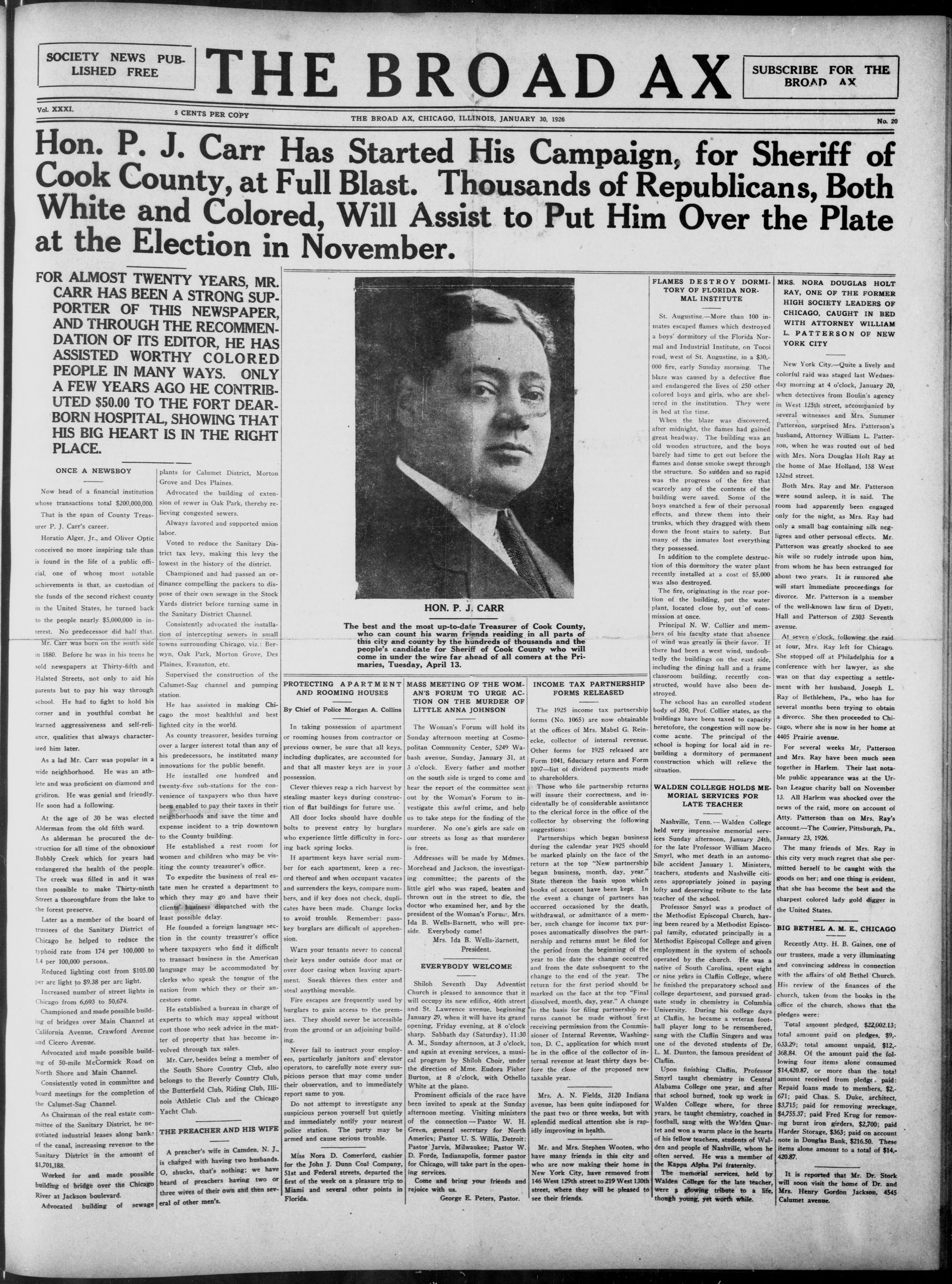
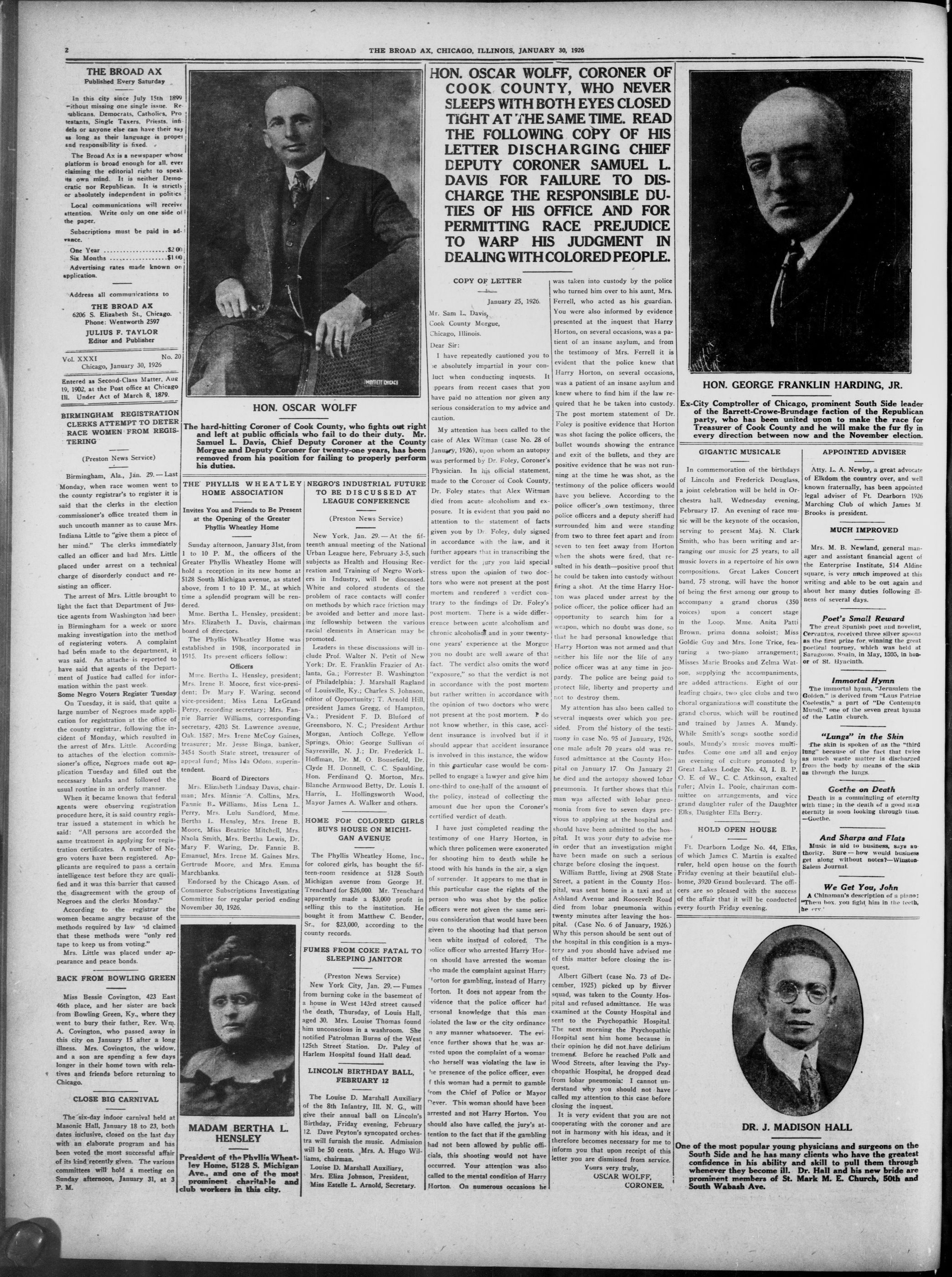
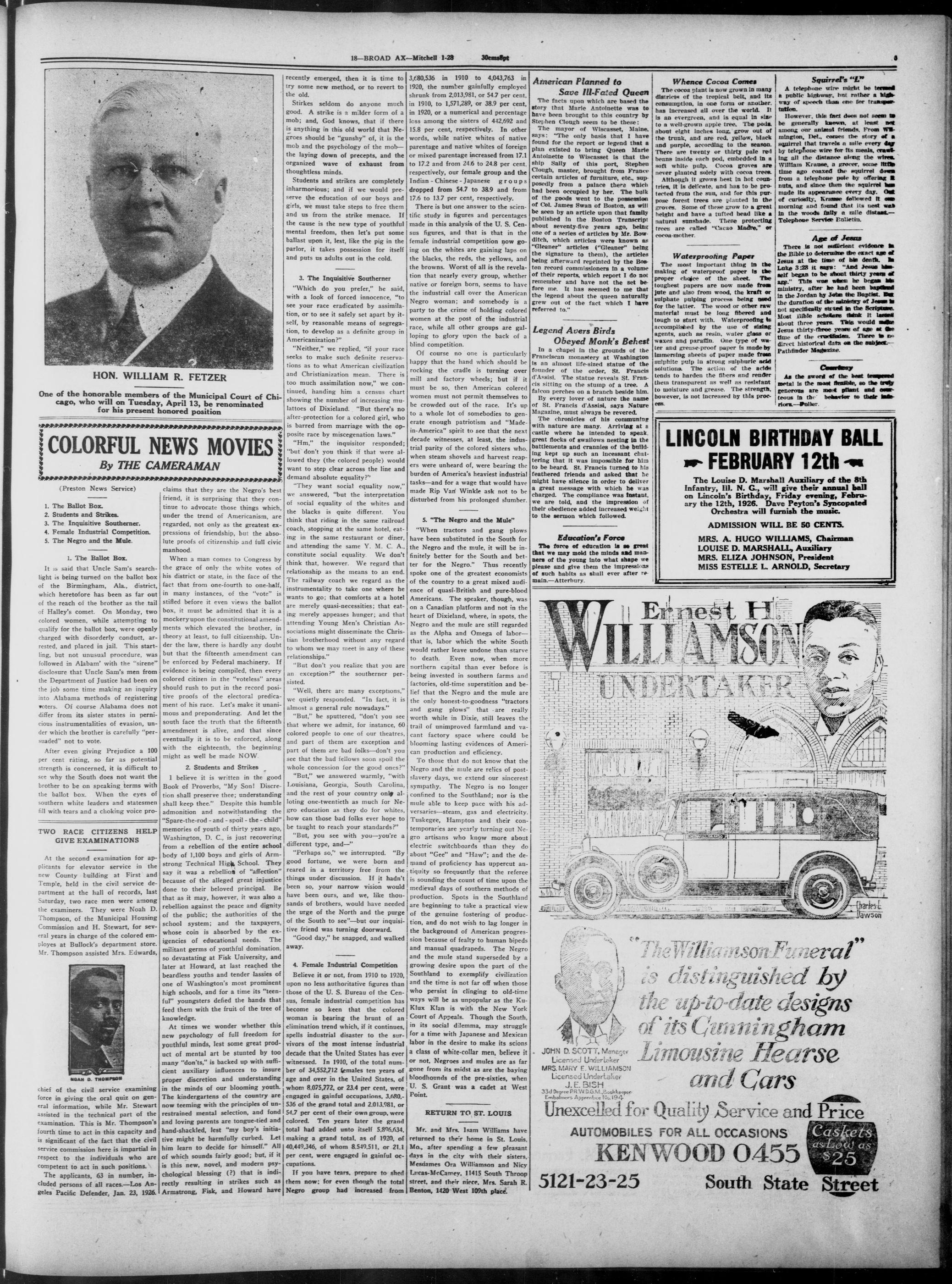
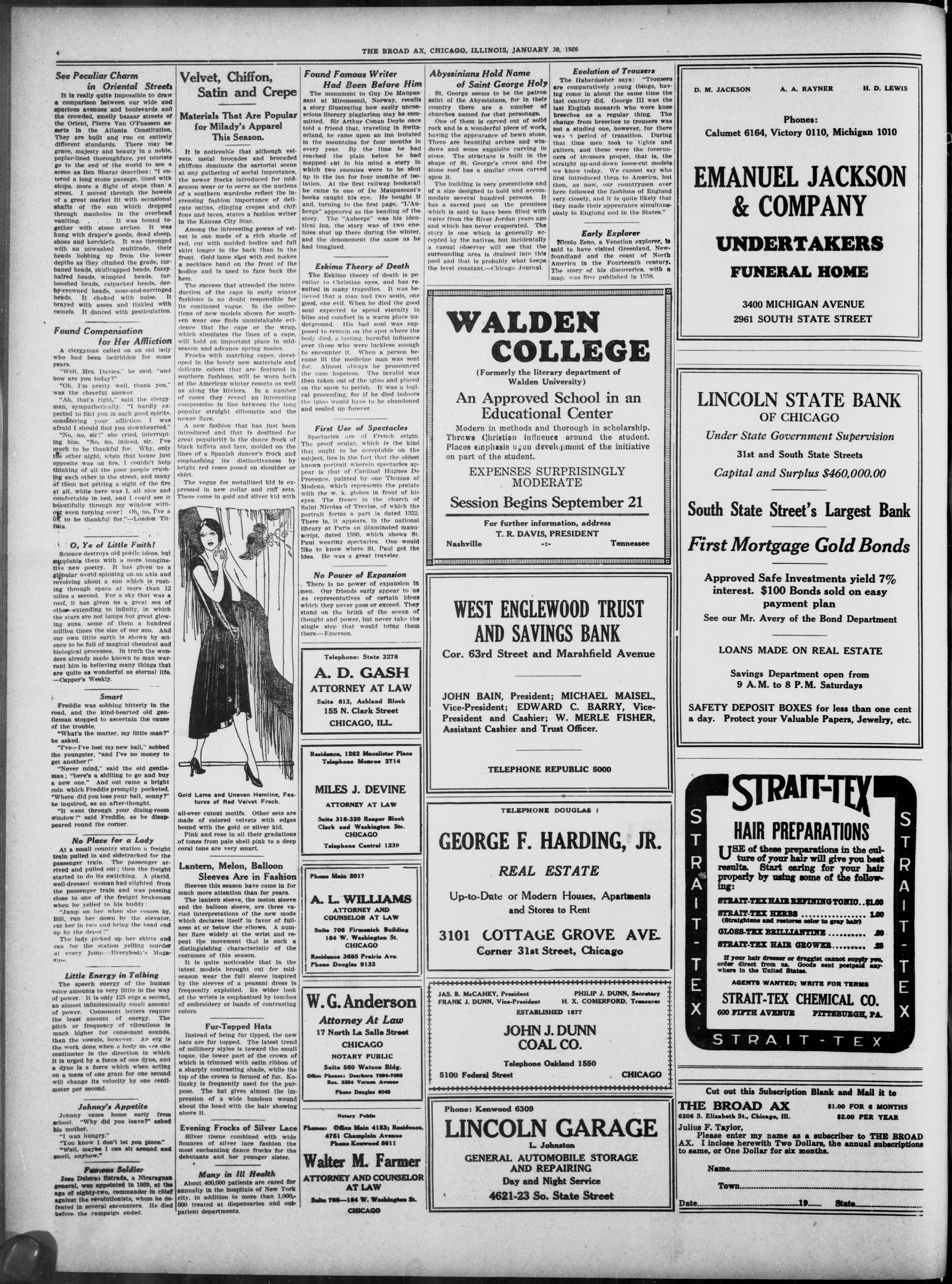
Page text (machine-generated)
Hon. P. J. Carr Has Started His Campaign, for Sheriff of Cook County, at Full Blast. Thousands of Republicans, Both White and Colored, Will Assist to Put Him Over the Plate at the Election in November.
SOCIETY NEWS PUBLISHED FREE
Vol. XXXI. 5 C
Hon. P. J.
Cook Coun
White and
at the Elec
FOR ALMOST TWENTY
CARR HAS BEEN A
PORTER OF THIS
AND THROUGH THE
DATION OF ITS EDIF
ASSISTED WORTHY
PEOPLE IN MANY W
A FEW YEARS AGO
UTED $50.00 TO THE
BORN HOSPITAL, SH
HIS BIG HEART IS I
PLACE.
FOR ALMOST TWENTY YEARS, MR. CARR HAS BEEN A STRONG SUPPORTER OF THIS NEWSPAPER, AND THROUGH THE RECOMMENDATION OF ITS EDITOR, HE HAS ASSISTED WORTHY COLORED PEOPLE IN MANY WAYS. ONLY A FEW YEARS AGO HE CONTRIBUTED $50.00 TO THE FORT DEARBORN HOSPITAL, SHOWING THAT HIS BIG HEART IS IN THE RIGHT PLACE.
---
ONCE A NEWSBOY
Now head of a financial institution whose transactions total $200,000,000.
That is the span of County Treasurer P. J. Carr's career.
Horatio Alger, Jr., and Oliver Optic conceived no more inspiring tale than is found in the life of a public official, one of whose most notable achievements is that, as custodian of the funds of the second richest county in the United States, he turned back to the people nearly $5,000,000 in interest. No predecessor did half that.
Mr. Carr was born on the south side in 1880. Before he was in his teens he sold newspapers at Thirty-fifth and Halsted Streets, not only to aid his parents but to pay his way through school. He had to fight to hold his corner and in youthful combat he learned aggressiveness and self-reliance, qualities that always characterized him later.
As a lad Mr. Carr was popular in a wide neighborhood. He was an athlete and was proficient on diamond and gridiron. He was genial and friendly. He soon had a following.
At the age of 30 he was elected Alderman from the old fifth ward.
As alderman he procured the destruction for all time of the obnoxious Bubbly Creek which for years had endangered the health of the people. The creek was filled in and it was then possible to make Thirty-ninth Street a thoroughfare from the lake to the forest preserve.
Later as a member of the board of trustees of the Sanitary District of Chicago he helped to reduce the typhoid rate from 174 per 100,000 to 1.4 per 100,000 persons. Reduced lighting cost from $105.00 per arc light to $9.38 per arc light. Increased number of street lights in Chicago from 6,693 to 50,674. Championed and made possible building of bridges over Main Channel at California Avenue, Crawford Avenue and Cicero Avenue. Advocated and made possible building of 50-mile McCormick Road on North Shore and Main Channel. Consistently voted in committee and board meetings for the completion of the Calumet-Sag Channel. As Chairman of the real estate committee of the Sanitary District, he negotiated industrial leases along banks of the canal, increasing revenue to the Sanitary District in the amount of $1,701,188.
Worked for and made possible building of bridge over the Chicago River at Jackson boulevard. Advocated building of sewage
THE BROAD AX
5 CENTS PER COPY
J. Carr
county, at
and Color
lection in
ENTY YEARS, MR.
WEN A STRONG SUP-
THIS NEWSPAPER,
IN THE RECOMMEN-
S EDITOR, HE HAS
RTHY COLORED
MY WAYS. ONLY
AGO HE CONTRIB-
THE FORT DEAR-
L, SHOWING THAT
IT IS IN THE RIGHT
plants for Calumet District, Morton Grove and Des Plaines.
Advocated the building of extension of sewer in Oak Park, thereby relieving congested sewers.
Always favored and supported union labor.
Voted to reduce the Sanitary District tax levy, making this levy the lowest in the history of the district.
Championed and had passed an ordinance compelling the packers to dispose of their own sewage in the Stock Yards district before turning same in the Sanitary District Channel.
Consistently advocated the installation of intercepting sewers in small towns surrounding Chicago, viz.: Berwyn, Oak Park, Morton Grove, Des Plaines, Evanston, etc.
Supervised the construction of the Calumet-Sag channel and pumping station.
He has assisted in making Chicago the most healthful and best lighted city in the world.
As county treasurer, besides turning over a larger interest total than any of his predecessors, he instituted many innovations for the public benefit.
He installed one hundred and twenty-five sub-stations for the convenience of taxpayers who thus have been enabled to pay their taxes in their neighborhoods and save the time and expense incident to a trip downtown to the County building.
He established a rest room for women and children who may be visiting the county treasurer's office.
To expedite the business of real estate men he created a department to which they may go and have their clients' business dispatched with the least possible delay.
He founded a foreign language section in the county treasurer's office where taxpayers who find it difficult to transact business in the American language may be accommodated by clerks who speak the tongue of the nation from which they or their ancestors come.
He established a bureau in charge of experts to which may appeal without cost those who seek advice in the matter of property that has become involved through tax sales. Mr. Carr, besides being a member of the South Shore Country Club, also belongs to the Beverly Country Club, the Butterfield Club, Riding Club, Illinois Athletic Club and the Chicago Yacht Club.
THE PREACHER AND HIS WIFE
A preacher's wife in Camden, N. J., is charged with having two husbands. O. shucks, that's nothing; we have heard of preachers having two or three wives of their own and then several of other men's.
THE BROAD AX, CHICAGO, ILLINOIS, JANUARY 30, 1926
M.
The best and the most up-to-date Treasurer of Cook County, who can count his warm friends residing in all parts of this city and county by the hundreds of thousands and the people's candidate for Sheriff of Cook County who will come in under the wire far ahead of all comers at the Primaries, Tuesday, April 13.
PROTECTING APARTMENT AND ROOMING HOUSES
By Chief of Police Morgan A. Collins
In taking possession of apartment or rooming houses from contractor or previous owner, be sure that all keys, including duplicates, are accounted for and that all master keys are in your possession.
Clever thieves reap a rich harvest by stealing master keys during construction of flat buildings for future use.
All door locks should have double bolts to prevent entry by burglarls who experience little difficulty in forcing back spring locks.
MASS MEETING OF THE WOMAN'S FORUM TO URGE ACTION ON THE MURDER OF LITTLE ANNA JOHNSON
The Woman's Forum will hold its Sunday afternoon meeting at Cosmopolitan Community Center, 5249 Wabash avenue, Sunday, January 31, at 3 o'clock. Every father and mother on the south side is urged to come and hear the report of the committee sent out by the Woman's Forum to investigate this awful crime, and help us to take steps for the finding of the murderer. No one's girls are safe on our streets as long as that murderer is free.
INCOME TAX FORMS I
The 1925 income forms (No. 1065) at the offices of M. Kecke, collector of Other forms for Form 1041, fiduciary 1097—list of dividend to shareholders.
Those who file will insure their incidentally be of course to the clerical force collector by obsebsuggestions:
Partnerships will during the calendar
If apartment keys have serial number for each apartment, keep a record thereof and when occupant vacates and surrenders the keys, compare numbers, and if key does not check, duplicates have been made. Change locks to avoid trouble. Remember: pass-key burglars are difficult of apprehension.
Warn your tenants never to conceal their keys under outside door mat or over door casing when leaving apartment. Sneak thieves then enter and steal anything movable.
Fire escapes are frequently used by burglars to gain access to the premises. They should never be accessible from the ground or an adjoining building.
Never fail to instruct your employees, particularly janitors and elevator operators, to carefully note every suspicious person that may come under their observation, and to immediately report same to you.
Do not attempt to investigate any suspicious person yourself but quietly and immediately notify your nearest police station. The party may be armed and cause serious trouble.
Miss Nora D. Comerford, cashier for the John J. Dunn Coal Company, 1st and Federal streets, departed the first of the week on a pleasure trip to Miami and several other points in Florida.
HON. P. J. CARR
the most up-to-date Treasurer orunt his warm friends residing county by the hundreds of the candidate for Sheriff of Cook Center the wire far ahead of all conday, April 13.
MASS MEETING OF THE WOMAN'S FORUM TO URGE ACTION ON THE MURDER OF LITTLE ANNA JOHNSON
The Woman's Forum will hold its Sunday afternoon meeting at Cosmopolitan Community Center, 5249 Wabash avenue, Sunday, January 31, at 3 o'clock. Every father and mother on the south side is urged to come and hear the report of the committee sent out by the Woman's Forum to investigate this awful crime, and help us to take steps for the finding of the murderer. No one's girls are safe on our streets as long as that murderer is free.
Addresses will be made by Mdmes. Morehead and Jackson, the investigating committee; the parents of the little girl who was raped, beaten and thrown out in the street to die, the doctor who examined her, and by the president of the Woman's Forum, Mrs. Ida B. Wells-Barnett, who will preside. Everybody come! Mrs. Ida B. Wells-Barnett, President.
EVERYBODY WELCOME
Shiloh Seventh Day Adventist Church is pleased to announce that it will occupy its new edifice, 46th street and St. Lawrence avenue, beginning January 29, when it will have its grand opening, Friday evening, at 8 o'clock sharp. Sabbath day (Saturday), 11:30 A. M., Sunday afternoon, at 3 o'clock, and again at evening services, a musical program by Shiloh Choir, under the direction of Mme. Eudora Fisher Burton, at 8 o'clock, with Othello White at the piano.
Prominent officials of the race have been invited to speak at the Sunday afternoon meeting. Visiting ministers of the connection—Pastor W. H. Green, general secretary for North America; Pastor U. S. Willis, Detroit; Pastor Jarvis, Milwaukee; Pastor W. D. Forde, Indianapolis, former pastor for Chicago, will take part in the opening services.
Come and bring your friends and rejoice with us.
George E. Peters, Pastor.
```markdown
```
INCOME TAX PARTNERSHIP FORMS RELEASED
The 1925 income tax partnership forms (No. 1065) are now obtainable at the offices of Mrs. Mabel G. Reinecke, collector of internal revenue. Other forms for 1925 released are Form 1041, fiduciary return and Form 1097—list of dividend payments made to shareholders.
Those who file partnership returns will insure their correctness, and incidentally be of considerable assistance to the clerical force in the office of the collector by observing the following suggestions:
Partnerships which began business during the calendar year 1925 should be marked plainly on the face of the return at the top "New partnership began business, month, day, year." State thereon the basis upon which books of account have been kept. In the event a change of partners has occurred occasioned by the death, withdrawal, or admittance of a member, such change for income tax purposes automatically dissolves the partnership and returns must be filed for the period from the beginning of the year to the date the change occurred and from the date subsequent to the change to the end of the year. The return for the first period should be marked on the face at the top "Final dissolved, month, day, year." A change in the basis for filing partnership returns cannot be made without first receiving permission from the Commissioner of Internal Revenue, Washington, D. C., application for which must be in the office of the collector of internal revenue at least thirty days before the close of the proposed new taxable year.
Mrs. A. N. Fields, 3120 Indiana avenue, has been quite indisposed for the past two or three weeks, but with splendid medical attention she is rapidly improving in health.
Mr. and Mrs. Stephen Wooten, who have many friends in this city and who are now making their home in New York City, have removed from 146 West 129th street to 219 West 130th street, where they will be pleased to see their friends.
FLAMES DESTROY DORMI-
TORY OF FLORIDA NOR-
MAL INSTITUTE
St. Augustine.—More than 100 in-
mates escaped flames which destroyed
a boys' dormitory of the Florida Nora-
mal and Industrial Institute, on Tocor
road, west of St. Augustine, in a $30,-
000 fire, early Sunday morning. The
blaze was caused by a defective flue
and endangered the lives of 250 other
colored boys and girls, who are sheltered in the institution. They were in bed at the time.
When the blaze was discovered, after midnight, the flames had gained great headway. The building was an old wooden structure, and the boys barely had time to get out before the flames and dense smoke swept through the structure. So sudden and so rapid was the progress of the fire that scarcely any of the contents of the building were saved. Some of the boys snatched a few of their personal effects, and threw them into their trunks, which they dragged with them down the front stairs to safety. But many of the inmates lost everything they possessed.
In addition to the complete destruction of this dormitory the water plant recently installed at a cost of $5,000 was also destroyed.
The fire, originating in the rear portion of the building, put the water plant, located close by, out of commission at once.
Principal N. W. Collier and members of his faculty state that absence of wind was greatly in their favor. If there had been a west wind, undoubtedly the buildings on the east side, including the dining hall and a frame classroom building, recently constructed, would have also been destroyed. The school has an enrolled student body of 350, Prof. Collier states, as the buildings have been taxed to capacity heretofore, the congestion will now become acute. The principal of the school is hoping for local aid in rebuilding a dormitory of permanent construction which will relieve the situation.
WALDEN COLLEGE HOLDS ME
MORIAL SERVICES FOR
LATE TEACHER
Nashville, Tenn.—Walden College held very impressive memorial services Sunday afternoon, January 24th, for the late Professor William Maceo Smyrl, who met death in an automobile accident January 1. Ministers, teachers, students and Nashville citizens appropriately joined in paying lofty and deserving tribute to the late teacher of the school.
Professor Smyrl was a product of the Methodist Episcopal Church, having been reared by a Methodist Episcopal family, educated principally in a Methodist Episcopal College and given employment in the system of schools operated by the church. He was a native of South Carolina, spent eight or nine years in Claflin College, where he finished the preparatory school and college department, and pursued graduate study in chemistry in Columbia University. During his college days at Claflin, he became a veteran football player long to be remembered, sang with the Claflin Singers and was one of the devoted students of Dr. L. M. Dunton, the famous president of Claflin.
Upon finishing Claflin, Professor Smyrli taught chemistry in Central Alabama College one year, and after that school burned, took up work in Walden College where, for three years, he taught chemistry, coached in football, sang with the Walden Quartet and won a warm place in the hearts of his fellow teachers, students of Walden and people of Nashville, whom he often served. He was a member of the Kappa Alpha Psi fraternity. The memorial services, held by Walden College for the late teacher, were a glowing tribute to a life, though young, yet worth while.
SUBSCRIBE FOR THE BROAD AX No. 20 Sheriff of cans, Both the Plate
No. 20
MRS. NORA DOUGLAS HOLT
RAY, ONE OF THE FORMER
HIGH SOCIETY LEADERS OF
CHICAGO, CAUGHT IN BED
WITH ATTORNEY WILLIAM
L. PATTERSON OF NEW
YORK CITY
New York City.—Quite a lively and
colorful raid was staged last Wednes-
day morning at 4 o'clock, January 20,
when detectives from Boulin's agency
in West 125th street, accompanied by
several witnesses and Mrs. Summer
Patterson, surprised Mrs. Patterson's
husband, Attorney William L. Patterson,
when he was routed out of bed
with Mrs. Nora Douglas Holt Ray at
the home of Mae Holland, 158 West
132nd street.
Both Mrs. Ray and Mr. Patterson were sound asleep, it is said. The room had apparently been engaged only for the night, as Mrs. Ray had only a small bag containing silk negligees and other personal effects. Mr. Patterson was greatly shocked to see his wife so rudely intrude upon him, from whom he has been estranged for about two years. It is rumored she will start immediate proceedings for divorce. Mr. Patterson is a member of the well-known law firm of Dyett, Hall and Patterson of 2303 Seventh avenue.
At seven o'clock, following the raid at four, Mrs. Ray left for Chicago. She stopped off at Philadelphia for a conference with her lawyer, as she was on that day expecting a settlement with her husband, Joseph L. Ray of Bethlehem, Pa., who has for several months been trying to obtain a divorce. She then proceeded to Chicago, where she is now in her home at 4405 Prairie avenue.
For several weeks Mr. Patterson and Mrs. Ray have been much seen together in Harlem. Their last notable public appearance was at the Urban League charity ball on November 13. All Harlem was shocked over the news of the raid, more on account of Atty. Patterson than on Mrs. Ray's account—The Courier, Pittsburgh, Pa., January 23, 1926.
The many friends of Mrs. Ray in this city very much regret that she permitted herself to be caught with the goods on her; and one thing is evident, that she has become the best and the sharpest colored lady gold digger in the United States.
BIG BETHEL A. M. E., CHICAGO
Recently Atty. H. B. Gaines, one of our trustees, made a very illuminating and convincing address in connection with the affairs of旧 Bethel Church. His review of the finances of the church, taken from the books in the office of the church, shows that the pledges were:
Total amount pledged, $22,002.13; total amount paid on pledges, $9,-633.29; total amount unpaid, $12,-368.84. Of the amount paid the following four items alone consumed $14,420.87, or more than the total amount received from pledge. paid: Repaid loans made to members, $2,-671; paid Chas. S. Duke, architect, $3,715; paid for removing wreckage, $4,755.37; paid Fred Krug for removing burnt iron girders, $2,700; paid Harder Storage, $363; paid on account note in Douglas Bank, $216.50. These items alone amount to a total of $14,-420.87.
It is reported that Mr. Dr. Stork will soon visit the home of Dr. and Mrs. Henry Gordon Jackson, 4545 Calumet avenue.
```markdown
```
2
In this city since July 15th 1899 without missing one single issue. Republicans, Democrats, Catholics, Protestants, Single Taxers, Priests, infidels or anyone else can have their say as long as their language is proper and responsibility is fixed.
The Broad Ax is a newspaper whose platform is broad enough for all, ever claiming the editorial right to speak its own mind. It is neither Democratic nor Republican. It is strictly or absolutely independent in politics.
Local communications will receive attention. Write only on one side of the paper.
Subscriptions must be paid in advance.
One Year ..... $2.00
Six Months ..... $1.00
Advertising rates made known on application.
Address all communications to
Vol. XXXI No. 2
Chicago, January 30, 1926
Entered as Second-Class Matter, Aug
19, 1902, at the Post office at Chicago
Ill. Under Act of March 8, 1879.
BIRMINGHAM REGISTRATION
CLERKS ATTEMPT TO DETER
RACE WOMEN FROM REGISTERING
Birmingham, Ala., Jan. 29. — Last Monday, when race women went to the county registrar's to register it is said that the clerks in the election commissioner's office treated them in such uncouth manner as to cause Mrs. Indiana Little to "give them a piece of her mind." The clerks immediately called an officer and had Mrs. Little placed under arrest on a technical charge of disorderly conduct and resisting an officer.
The arrest of Mrs. Little brought to light the fact that Department of Justice agents from Washington had been in Birmingham for a week or more making investigation into the method of registering voters. A complaint had been made to the department, it was said. An attache is reported to have said that agents of the Department of Justice had called for information within the past week.
Some Negro Voters Register Tuesday
On Tuesday, it is said, that quite a large number of Negroes made application for registration at the office of the county registrar, following the incident of Monday, which resulted in the arrest of Mrs. Little. According to attaches of the election commissioner's office, Negroes made out application Tuesday and filled out the necessary blanks and followed the usual routine in an orderly manner.
When it became known that federal agents were observing registration procedure here, it is said country registrar issued a statement in which he said: "All persons are accorded the same treatment in applying for registration certificates. A number of Negro voters have been registered. Applicants are required to pass a certain intelligence test before they are qualified and it was this barrier that caused the disagreement with the group of Negroes and the clerks Monday." According to the registrar the women became angry because of the methods required by law and claimed that these methods were "only red tape to keep us from voting." Mrs. Little was placed under appearance and peace bonds.
BACK FROM BOWLING GREEN
Miss Bessie Covington, 423 East 46th place, and her sister are back from Bowling Green, Ky., where they went to bury their father, Rev. Wm. A. Covington, who passed away in this city on January 15 after a long illness. Mrs. Covington, the widow, and a son are spending a few days longer in their home town with relatives and friends before returning to Chicago.
CLOSE BIG CARNIVAL
The six-day indoor carnival held at Masonic Hall, January 18 to 23, both dates inclusive, closed on the last day with an elaborate program and has been voted the most successful affair of its kind recently given. The various committees will hold a meeting on Sunday afternoon, January 31, at 3 P.M.
MOTLETT DREAKS
HON. OSCAR WOLFF
The hard-hitting Coroner of Co and left at public officials Samuel L. Davis, Chief I Morgue and Deputy Coroner removed from his position his duties.
The hard-hitting Coroner of Cook County, who fights out right and left at public officials who fail to do their duty. Mr. Samuel L. Davis, Chief Deputy Coroner at the County Morgue and Deputy Coroner for twenty-one years, has been removed from his position for failing to properly perform his duties.
THE PHYLLIS WHEATLEY HOME ASSOCIATION
Invites You and Friends to Be Present at the Opening of the Greater Phyllis Wheatley Home
NEGRO'S INDUSTRIAL FUTURE TO BE DISCUSSED AT LEAGUE CONFERENCE
(Preston News Service)
Sunday afternoon, January 31st, from 1 to 10 P. M., the officers of the Greater Phyllis Wheatley Home will hold a reception in its new home at 5128 South Michigan avenue, as stated above, from 1 to 10 P. M., at which time a splendid program will be rendered. Mme. Bertha L. Hensley, president; Mrs. Elizabeth L. Davis, chairman board of directors. The Phyllis Wheatley Home was established in 1908, incorporated in 1915. Its present officers follow:
Mine. Bertha L. Hensley, president
Mrs. Irene B. Moore, first vice-president; Dr. Mary F. Waring, second vice-president; Miss Lena LeGrand Perry, recording secretary; Mrs. Fannie Barrier Williams, corresponding secretary, 4203 St. Lawrence avenue Oak. 1587; Mrs. Irene McCoy Gaines, treasurer; Mr. Jesse Binga, banker 3454 South State street, treasurer of appeal fund; Miss 1da Odom, superintendent.
Mrs. Elizabeth Lindsay Davis, chairman; Mrs. Minnie A. Collins, Mrs. Fannie B. Williams, Miss Lena L. Perry, Mrs. Lulu Sandford, Mme Bertha L. Hensley, Mrs. Irene B. Moore, Miss Beatrice Mitchell, Mrs. Naola Smith, Mrs. Bertha Lewis, Dr. Mary F. Waring, Dr. Fannie B. Emanuel, Mrs. Irene M. Gaines Mrs. Gertrude Moore, and Mrs. Emma Marchbanks.
Endorsed by the Chicago Assn. of Commerce Subscriptions Investigating Committee for regular period ending November 30, 1926.
A. B.
MADAM BERTHA L.
HENSLEY
President of the Phyllis Wheatley Home, 5128 S. Michigan Ave., and one of the most prominent charitable and club workers in this city.
Officers
Board of Directors
Look County, who fights out right who fail to do their duty. Mr Deputy Coroner at the County for twenty-one years, has been for failing to properly perform
NEGRO'S INDUSTRIAL FUTURE TO BE DISCUSSED AT LEAGUE CONFERENCE
New York, Jan. 29.—At the fifteenth annual meeting of the National Urban League here, February 3-5, such subjects as Health and Housing Recreation and Training of Negro Workers in Industry, will be discussed. White and colored students of the problem of race contacts will confer on methods by which race friction may be avoided and better and more lasting fellowship between the various racial elements in American may be promoted.
Leaders in these discussions will include Prof. Walter N. Petit of New York; Dr. E. Franklin Frazier of Atlanta, Ga.; Forrester B. Washington of Philadelphia; J. Marshall Ragland of Louisville, Ky.; Charles S. Johnson, editor of Opportunity; T. Arnold Hill president James Gregg, of Hampton Va.; President F. D. Bluford of Greensboro, N. C.; President Arthur Morgan, Antioch College, Yellow Springs, Ohio; George Sullivan of Sayresville, N. J.; Dr. Frederick L. Hoffman, Dr. M. O. Bousefield, Dr. Clyde H. Donnell, C. C. Spaulding, Hon. Ferdinand Q. Morton, Mrs. Blanche Armwood Betty, Dr. Louis I. Harris, L. Hollingsworth Wood, Mayor James A. Walker and others.
HOME FOR COLORED GIRLS
BUVS HOUSE ON MICHI-
GAN AVENUE
The Phyllis Wheatley Home, Inc. for colored girls, has bought the fifteen-room residence at 5128 South Michigan avenue from George H. Trenchard for $26,000. Mr. Trenchard apparently made a $3,000 profit in selling this to the institution. He bought it from Matthew C. Bender, Sr., for $23,000, according to the county records.
FUMES FROM COKE FATAL TO
SLEEPING IANITOR
(Preston News Service)
New York City, Jan. 29.—Fumes from burning coke in the basement of a house in West 143rd street caused the death, Thursday, of Louis Hall, aged 30. Mrs. Louise Thomas found him unconscious in a washroom. She notified Patrolman Burns of the West 125th Street Station. Dr. Paley of Harlem Hospital found Hall dead.
LINCOLN BIRTHDAY BALL,
FEBRUARY 12
The Louise D. Marshall Auxiliary of the 8th Infantry, Ill. N. G., will give their annual ball on Lincoln's Birthday, Friday evening, February 12. Dave Peyton's syncopated orchestra will furnish the music. Admission will be 50 cents. Mrs. A. Hugo Williams, chairman.
Louise D. Marshall Auxiliary,
Mrs. Eliza Johnson, President,
Miss Estelle L. Arnold, Secretary.
THE BROAD AX. CHICAGO. ILLINOIS. JANUARY 30. 1926
HON. OSCAR WOLFF, CORONER OF COOK COUNTY, WHO NEVER SLEEPS WITH BOTH EYES CLOSED TIGHT AT THE SAME TIME. READ THE FOLLOWING COPY OF HIS LETTER DISCHARGING CHIEF DEPUTY CORONER SAMUEL L. DAVIS FOR FAILURE TO DISCHARGE THE RESPONSIBLE DUTIES OF HIS OFFICE AND FOR PERMITTING RACE PREJUDICE TO WARP HIS JUDGMENT IN DEALING WITH COLORED PEOPLE.
COPY OF LETTER
January 25, 1926.
Mr. Sam L. Davis,
Cook County Morgue,
Chicago, Illinois.
Dear Sir:
I have repeatedly cautioned you to
be absolutely impartial in your con-
duct when conducting inquests. It
appears from recent cases that you
have paid no attention nor given any
serious consideration to my advice and
caution.
My attention has been called to the case of Alex Witman (case No. 28 of January, 1926), upon whom an autopsy was performed by Dr. Foley, Coroner's Physician. In his official statement, made to the Coroner of Cook County, Dr. Foley states that Alex Witman died from acute alcoholism and exposure. It is evident that you paid no attention to the statement of facts given you by Dr. Foley, duly signed in accordance with the law, and it further appears that in transcribing the verdict for the jury you laid special stress upon the opinion of two doctors who were not present at the post mortem and rendered a verdict contrary to the findings of Dr. Foley's post mortem. There is a wide difference between acute alcoholism and chronic alcoholism and in your twenty-one years' experience at the Morgue you no doubt are well aware of that fact. The verdict also omits the word "exposure," so that the verdict is not in accordance with the post mortem but rather written in accordance with the opinion of two doctors who were not present at the post mortem. I do not know whether, in this case, accident insurance is involved but if it should appear that accident insurance is involved in this instance, the widow in this particular case would be compelled to engage a lawyer and give him one-third to one-half of the amount of the policy, instead of collecting the amount due her upon the Coroner's certified verdict of death.
I have just completed reading the testimony of one Harry Horton, in which three policemen were exonerated for shooting him to death while he stood with his hands in the air, a sign of surrender. It appears to me that in this particular case the rights of the person who was shot by the police officers were not given the same serious consideration that would have been given to the shooting had that person been white instead of colored. The police officer who arrested Harry Horton should have arrested the woman who made the complaint against Harry Horton for gambling, instead of Harry Horton. It does not appear from the evidence that the police officer had personal knowledge that this man violated the law or the city ordinance in any manner whatsoever. The evidence further shows that he was arrested upon the complaint of a woman who herself was violating the law in the presence of the police officer, even if this woman had a permit to gamble from the Chief of Police or Mayor Dever. This woman should have been arrested and not Harry Horton. You should also have called the jury's attention to the fact that if the gambling had not been allowed by public officials, this shooting would not have occurred. Your attention was also called to the mental condition of Harry Horton. On numerous occasions he
was taken into custody by the police who turned him over to his aunt, Mrs. Ferrell, who acted as his guardian. You were also informed by evidence presented at the inquest that Harry Horton, on several occasions, was a patient of an insane asylum, and from the testimony of Mrs. Ferrell it is evident that the police knew that Harry Horton, on several occasions, was a patient of an insane asylum and knew where to find him if the law required that he be taken into custody. The post mortem statement of Dr Foley is positive evidence that Horton was shot facing the police officers, the bullet wounds showing the entrance and exit of the bullets, and they are positive evidence that he was not running at the time he was shot, as the testimony of the police officers would have you believe. According to the police officer's own testimony, three police officers and a deputy sheriff had surrounded him and were standing from two to three feet apart and from seven to ten feet away from Horton when the shots were fired, that resulted in his death—positive proof that he could be taken into custody without firing a shot. At the time Harry Horton was placed under arrest by the police officer, the police officer had an opportunity to search him for a weapon, which no doubt was done, so that he had personal knowledge that Harry Horton was not armed and that neither his life nor the life of any police officer was at any time in jeopardy. The police are being paid to protect life, liberty and property and not to destroy them.
My attention has also been called to several inquests over which you presided. From the history of the testimony in case No. 95 of January, 1926, one male adult 70 years old was refused admittance at the County Hospital on January 17. On January 21 he died and the autopsy showed lobar pneumonia. It further shows that this man was affected with lobar pneumonia from five to seven days previous to applying at the hospital and should have been admitted to the hospital. It was your duty to advise me in order that an investigation might have been made on such a serious charge before closing the inquest.
William Battle, living at 2908 State Street, a patient in the County Hospital, was sent home in a taxi and at Ashland Avenue and Roosevelt Road died from lobar pneumonia within twenty minutes after leaving the hospital. (Case No. 6 of January, 1926.) Why this person should be sent out of the hospital in this condition is a mystery and you should have advised me of this matter before closing the inquest.
Albert Gilbert (case No. 73 of December, 1925) picked up by fliver squad, was taken to the County Hospital and refused admittance. He was examined at the County Hospital and sent to the Psychopathic Hospital. The next morning the Psychopathic Hospital sent him home because in their opinion he did not have delirium tremens. Before he reached Polk and Wood Streets, after leaving the Psychopathic Hospital, he dropped dead from lobar pneumonia: I cannot understand why you should not have called my attention to this case before closing the inquest.
It is very evident that you are not cooperating with the coroner and are not in harmony with his ideas, and it therefore becomes necessary for me to inform you that upon receipt of this letter you are dismissed from service.
Yours very truly,
OSCAR WOLFF,
CORONER.
MATTHEW L. WILSON
HON. GEORGE FRANKLIN HARDING, JR. Ex-City Comptroller of Chicago, prominent South Side leader of the Barrett-Crowe-Brundage faction of the Republican party, who has been united upon to make the race for Treasurer of Cook County and he will make the fur fly in every direction between now and the November election.
GIGANTIC MUSICALE
In commemoration of the birthdays of Lincoln and Frederick Douglass, a joint celebration will be held in Orchestra hall, Wednesday evening February 17. An evening of race music will be the keynote of the occasion serving to present Maj. N. Clark Smith, who has been writing and arranging our music for 25 years, to all music lovers in a repertoire of his own compositions. Great Lakes Concert band, 75 strong, will have the honor of being the first among our group to accompany a grand chorus (350 voices) upon a concert stage in the Loop. Mme. Anita Patti Brown, prima donna soloist; Miss Goldie Guy and Mrs. Ione Trice, featuring a two-piano arrangement; Miss Marie Brooks and Zelma Watson, supplying the accompaniments, are added attractions. Eight of our leading choirs, two glee clubs and two choral organizations will constitute the grand chorus, which will be routed and trained by James A. Mundy. While Smith's songs soothe sordid souls, Mundy's music moves multitudes. Come one and all and enjoy an evening of culture promoted by Great Lakes Lodge No. 43, I. B. P. O. E. of W., C. C. Atkinson, exalted ruler; Alvin L. Poole, chairman committee on arrangements, and vice grand daughter ruler of the Daughter Elks, Daughter Ella Berry.
HOLD OPEN HOUSE
Ft. Dearborn Lodge No. 44, Elks of which James C. Martin is exalted ruler, held open house on the fourth Friday evening at their beautiful clubhome, 3920 Grand boulevard. The officers are so pleased with the success of the affair that it will be conducted every fourth Friday evening.
[Name]
DR. J. MADISON HALL One of the most popular young physicians and surgeons on the South Side and he has many clients who have the greatest confidence in his ability and skill to pull them through whenever they become ill. Dr. Hall and his new bride are prominent members of St. Mark M. E. Church, 50th and South Wabash Ave.
APPOINTED ADVISER
Atty. L. A. Newby, a great advocate of Elkdom the country over, and well known fraternally, has been appointed legal adviser of Ft. Dearborn 1926 Marching Club of which James M. Brooks is president.
MUCH IMPROVED
Mrs. M. B. Newland, general manager and assistant financial agent of the Enterprise Institute, 514 Aldine square, is very much improved at this writing and able to be out again and about her many duties following illness of several days.
Poet's Small Reward
The great Spanish poet and novelist, Cervantes, received three silver spoons as the first prize for winning the great poetical tourney, which was held at Saragosso, Spain, in May, 1595, in honor of St. Huyacinth.
Immortal Hymn
The immortal hymn, "Jerusalem the Golden," is derived from "Laus Patriae Coelestis" a part of "De Contempit Mundi," one of the seven great hymns of the Latin church.
"Lungs" in the Skin
The skin is spoken of as the "third lung" because of the fact that twice as much waste matter is discharged from the body by means of the skin as through the lungs.
Goethe on Death
Death is a commingling of eternity with time; in the death of a good man eternity is soon looking through time. —Goethe.
And Sharps and Flats
Music is aid to business, says authority. Sure—how would business get along without notes?—Winston-Salem Journal.
We Get You. John
A Chinaman's description of a piano:
'Them box, you fight him in the teeth,
be cry.'
physicians and surgeons on the clients who have the greatest skill to pull them through Dr. Hall and his new bride are Mark M. E. Church, 50th and
C. R.
HON. WILLIAM R. FETZER
One of the honorable members of the Municipal cago, who will on Tuesday, April 13, be rem for his present honored position
COLORFUL NEWS MO
By THE CAMERAMAN
One of the honorable members of the Municipal Court of Chicago, who will on Tuesday, April 13, be renominated for his present honored position
COLORFUL NEWS MOVIES By THE CAMERAMAN
(Preston News Service)
1. The Ballot Box.
2. Students and Strikes.
3. The Inquisitive Southerner.
4. Female Industrial Competition.
5. The Negro and the Mule.
1. The Ballot Box
It is said that Uncle Sam's searchlight is being turned on the ballot box of the Birmingham, Ala., district, which heretofore has been as far out of the reach of the brother as the tail of Halley's comet. On Monday, two colored women, while attempting to qualify for the ballot box, were openly charged with disorderly conduct, arrested, and placed in jail. This startling, but not unusual procedure, was followed in Alabam' with the "sirene" disclosure that Uncle Sam's men from the Department of Justice had been on the job some time making an inquiry into Alabama methods of registering voters. Of course Alabama does not differ from its sister states in pernicious instrumentalities of evasion, under which the brother is carefully "persuaded" not to vote.
After even giving Prejudice a 100 per cent rating, so far as potential strength is concerned, it is difficult to see why the South does not want the brother to be on speaking terms with the ballot box. When the eyes of southern white leaders and statesmen fill with tears and a choking voice pro
TWO RACE CITIZENS HELP
GIVE EXAMINATIONS
At the second examination for applicants for elevator service in the new County building at First and Temple, held in the civil service department at the hall of records, last Saturday, two race men were among the examiners. They were Noah D. Thompson, of the Municipal Housing Commission and H. Stewart, for several years in charge of the colored employees at Bullock's department store. Mr. Thompson assisted Mrs. Edwards,
M.
chief of the civil service examining force in giving the oral quiz on general information, while Mr. Stewart assisted in the technical part of the examination. This is Mr. Thompson's fourth time to act in this capacity and is significant of the fact that the civil service commission here is impartial in respect to the individuals who are competent to act in such positions. The applicants, 63 in number, included persons of all races.-Los Angeles Pacific Defender. Jan. 23, 1926.
```markdown
```
claims that they are the Negro's best friend, it is surprising that they continue to advocate those things which under the trend of Americanism, are regarded, not only as the greatest expressions of friendship, but the absolute proofs of citizenship and full civic manhood.
When a man comes to Congress by the grace of only the white votes of his district or state, in the face of the fact that from one-fourth to one-half in many instances, of the "vote" is stifled before it even views the ballot box, it must be admitted that it is a mockery upon the constitutional amendments which elevated the brother, in theory at least, to full citizenship. Under the law, there is hardly any doubt but that the fifteenth amendment can be enforced by Federal machinery. If evidence is being compiled, then every colored citizen in the "voteless" areas should rush to put in the record positive proofs of the electoral predicament of his race. Let's make it unanimous and preponderating. And let the south face the truth that the fifteenth amendment is alive, and that since eventually it is to be enforced, along with the eighteenth, the beginning might as well be made NOW.
2. Students and Strikes
1 believe it is written in the good Book of Proverbs, "My Son! Discretion shall preserve the tree; understanding shall keep thee." Despite this humble admonition and notwithstanding the "Spare-the-rod - and - spoil - the - child" memories of youth of thirty years ago, Washington, D. C., is just recovering from a rebellion of the entire school body of 1,100 boys and girls of Armstrong Technical High School. They say it was a rebellion of "affection" because of the alleged great injustice done to their beloved principal. Be that as it may, however, it was also a rebellion against the peace and dignity of the public; the authorities of the school system; and the taxpayers, whose coin is absorbed by the exigencies of educational needs. The militant germs of youthful domination, so devastating at Fisk University, and later at Howard, at last reached the beardless youths and tender lassies of one of Washington's most prominent high schools, and for a time its "teenful" youngsters defied the hands that feed them with the fruit of the tree of knowledge.
At times we wonder whether this new psychology of full freedom for youthful minds, lest some great product of mental art be stunted by too many "don'ts," is backed up with sufficient auxiliary influences to insure proper discretion and understanding in the minds of our blooming youth. The kindergarten of the country are now teeming with the principles of unrestrained mental selection, and fond and loving parents are tongue-tied and hand-shackled, lest "my boy's initiative might be harmfully curbed. Let him learn to decide for himself." All of which sounds fairly good; but, if it is this new, novel, and modern psychological blessing (?) that is indirectly resulting in strikes such as Armstrong, Fisk, and Howard have
18—BROAD AX—Mitchell 1-28 30ems8pt
recently emerged, then it is time to try some new method, or to revert to the old.
Stirkes seldom do anyone much good. A strike is a milder form of a mob; and, God knows, that if there is anything in this old world that Negroes should be "gunsy" of it, the mob and the psychology of the mob—the laying down of precepts, and the organized wave of exhaust from thoughtless minds.
Students and strikes are completely inharmonious; and if we would preserve the education of our boys and girls, we must take steps to free them and us from the strike menace. If the cause is the new type of youthful mental freedom, then let's put some ballast upon it, lest, like the pig in the parlor, it takes possession for itself and puts us adults out in the cold.
3. The Inquisitive Southerner
"Which do you prefer," he said, with a look of forced innocence, "to see your race eradicated by assimilation, or to see it safely set apart by itself, by reasonable means of segregation, to develop as a definite group in Americanization?"
"Neither," we replied, "if your race seeks to make such definite reservations as to what American civilization and Christianization mean. There is too much assimilation now," we continued, handing him a census chart showing the number of increasing mulattoes of Dixieland. "But there's no after-protection for a colored girl, who is barred from marriage with the opposite race by miscegenation laws."
"Hm," the inquisitor responded,
"but don't you think if that were allowed they (the colored people) would want to step clear across the line and demand absolute equality?"
"They want social equality now," we answered, "but the interpretation of social equality of the whites and the blacks is quite different. You think that riding in the same railroad coach, stopping at the same hotel, eating in the same restaurant or diner, and attending the same Y. M. C. A. constitute social equality. We don't think that, however. We regard that relationship as the means to an end. The railway coach we regard as the instrumentality to take one where he wants to go; that comforts at a hotel are merely quasi-necessities; that eating merely appeases hunger; and that attending Young Men's Christian Associations might disseminate the Christian brotherhood without any regard to whom we may meet in any of these relationships."
"But don't you realize that you are an exception?" the southerner persisted.
"Well, there are many exceptions," we quietly responded. "In fact, it is almost a general rule nowadays."
"But," he sputtered, "don't you see that where we admit, for instance, 60 colored people to one of our theaters, and part of them are exception and part of them are bad folks—don't you see that the bad fellows soon spoil the whole concession for the good ones?" "But," we answered warmly, "with Louisiana, Georgia, South Carolina, and the rest of your country only alloting one-twentieth as much for Negro education as they do for whites, how can those bad folks ever hope to be taught to reach your standards?" "But, you see with you—you're a different type, and—"
"Perhaps so," we interrupted. "By good fortune, we were born and reared in a territory free from the things under discussion. If it hadn't been so, your narrow vision would have been ours, and we, like thousands of brothers, would have needed the urge of the North and the purge of the South to see"—but our inquisitive friend was turning doorward. "Good day," he snapped, and walked away.
4. Female Industrial Competition
4. Female Industrial Competition
Believe it or not, from 1910 to 1920, upon no less authoritative figures than those of the U. S. Bureau of the Census, female industrial competition has become so keen that the colored woman is bearing the brunt of an elimination trend which, if it continues, spells industrial disaster to the survivors of the most intense industrial decade that the United States has ever witnessed. In 1910, of the total number of 34,552,712 females ten years of age and over in the United States, of whom 8,075,772, or 23.4 per cent, were engaged in gainful occupations, 3,680,-536 of the grand total and 2,013,981, or 54.7 per cent of their own group, were colored. Ten years later the grand total had added unto itself 5,896,634, making a grand total, as of 1920, of 40,449,346, of whom 8,549,511, or 21.1 per cent, were engaged in gainful occupations.
If you have tears, prepare to shed them now; for even though the total Negro group had increased from
3,680,536 in 1910 to 4,043,763 in 1920, the number gainfully employed shrunk from 2,013,981, or 54.7 per cent, in 1910, to 1,571,289, or 38.9 per cent, in 1920, or a numerical and percentage loss among the sisters of 442,692 and 15.8 per cent, respectively. In other words, while native whites of native parentage and native whites of foreign or mixed parentage increased from 17.1 to 17.2 and from 24.6 to 24.8 per cent, respectively, our female group and the Indian - Chinese - Japanese groups dropped from 54.7 to 38.9 and from 17.6 to 13.7 per cent, respectively.
There is but one answer to the scientific study in figures and percentages made in this analysis of the U. S. Census figures, and that is that in the female industrial competition now going on the whites are gaining laps on the blacks, the reds, the yellows, and the browns. Worst of all is the revelation that nearly every group, whether native or foreign born, seems to have the industrial call over the American Negro woman; and somebody is a party to the crime of holding colored women at the post of the industrial race, while all other groups are galloping to glory upon the back of a blind competition.
Of course no one is particularly happy that the hand which should be rocking the cradle is turning over mill and factory wheels; but if it must be so, then American colored women must not permit themselves to be crowded out of the race. It's up to a whole lot of somebodies to generate enough patriotism and "Made-in-America" spirit to see that the next decade witnesses, at least, the industrial parity of the colored sisters who when steam shovels and harvest reapers were unheard of, were bearing the burden of America's heaviest industrial tasks—and for a wage that would have made Rip Van Winkle ask not to be disturbed from his prolonged slumber.
5. "The Negro and the Mule"
"When tractors and gang plows have been substituted in the South for the Negro and the mule, it will be infinitely better for the South and better for the Negro." Thus recently spoke one of the greatest economists of the country to a great mixed audience of quasi-British and pure-blood Americans. The speaker, though, was on a Canadian platform and not in the heart of Dixieland, where, in spots, the Negro and the mule are still regarded as the Alpha and Omega of labor—that is, labor which the white South would rather leave undone than starve to death. Even now, when more northern capital than ever before is being invested in southern farms and factories, old-time superstition and belief that the Negro and the mule are the only honest-to-goodness "tractors and gang plows" that are really worth while in Dixie, still leaves the trail of unimproved farmland and vacant factory space where could be blooming lasting evidences of American production and efficiency.
To those that do not know that the Negro and the mule are relics of post-slavery days, we extend our sincerest sympathy. The Negro is no longer confined to the Southland; nor is the mule able to keep pace with his adversaries—steam, gas and electricity. Tuskegee, Hampton and their contemporaries are yearly turning out Negro artisans who know more about electric switchboards than they do about "Gee" and "Haw"; and the demand of proficiency has uppercut antiquity so frequently that the referee is sounding the count of time upon the medieval days of southern methods of production. Spots in the Southland are beginning to take a practical view of the genuine fostering of production, and do not wish to lag longer in the background of American progression because of fealty to human bipeds and manual quadrapeds. The Negro and the mule stand superseded by a growing desire upon the part of the Southland to exemplify civilization and the time is not far off when those who persist in clinging to old-time ways will be as unpopular as the Kuklux Klan is with the New York Court of Appeals. Though the South, in its social dilemma, may struggle for a time with Japanese and Mexican labor in the desire to make its scions a class of white-collar men, believe it or not. Negroes and mules are as far gone from its midst as are the baying bloodhounds of the pre-sixties, when U. S. Grant was a cadet at West Point.
RETURN TO ST. LOUIS
Mr. and Mrs. Isam Williams have returned to their home in St. Louis, Mo., after spending a few pleasant days in the city with their sisters, Mesdames Ora Williamson and Nicy Lucas-MeCamey, 11415 South Throop street, and their niece, Mrs. Sarah R. Benton, 1420 West 109th place.
Ernest H.
WILLIAMSON
UNDERTAKER
Charles L.
Dawson
American Planned to
Save Ill-Fated Queen
The facts upon which are based the story that Marle Antoinette was to have been brought to this country by Stephen Clough seem to be these:
The mayor of Wiscasset, Maine, says: "The only basis that I have found for the report or legend that a plan existed to bring Queen Marie Antoinette to Wiscasset is that the ship Sally of this port, Stephen Clough, master, brought from France certain articles of furniture, etc., supposedly from a palace there which had been occupied by her. The bulk of the goods went to the possession of Col. James Swan of Boston, as will be seen by an article upon that family published in the Boston Transcript about seventy-five years ago, being one of a series of articles by Mr. Bowlitch, which articles were known as "Gleaner" articles ("Gleaner" being the signature to them), the articles being afterward reprinted by the Boston record commissioners in a volume of their reports, which report I do not remember and have not the set before me. It has seemed to me that the legend about the queen naturally grew out of the fact which I have referred to."
Legend Avers Birds
Obeyed Monk's Behest
In a chapel in the grounds of the
Franciscan monastery at Washington
is an almost life-sized statue of the
founder of the order, St. Francis
d'Assisi. The statue reveals St. Francis
sitting on the stump of a tree. A
falcon perches on a branch beside him.
By every lover of nature the name
of St. Francis d'Assisi, says Nature
Magazine, must always be revered.
The chronicles of his communing with nature are many. Arriving at a castle where he intended to speak great flocks of swallows nesting in the battlements and crannies of the building kept up such an incessant chattering that it was impossible for him to be heard. St. Francis turned to his feathered friends and asked that he might have silence in order to deliver a great message with which he was charged. The compliance was instant, we are told, and the impression of their obedience added increased weight to the sermon which followed.
Education's Force
The force of education is so great that we may mold the minds and manners of the young into what shape we please and give them the impressions of such habits as shall ever after remain—Atterbury.
WILL
UNI
PETER H.
JOHN D. SCOTT, Manager
Licensed Underbaker
MRS. MARY E. WILLIAMSON
Licensed Underbaker
J.E. BISH
33d Degree PR W.D.G.M. Bookkeeper
Embalmers Apprentice No.194
Unexcelled for
AUTOMOBILES
KEN
5121-23-25
LINCOLN BIRTHDAY BALL
FEBRUARY 12th
The Louise D. Marshall Auxiliary of the 8th Infantry, Ill. N. G., will give their annual ball on Lincoln's Birthday, Friday evening, February the 12th, 1926. Dave Peyton's Syncopated Orchestra will furnish the music.
ADMISSION WILL BE 50 CENTS.
MRS. A. HUGO WILLIAMS, Chairman
LOUISE D. MARSHALL, Auxiliary
MRS. ELIZA JOHNSON, President
MISS ESTELLE L. ARNOLD, Secretary
"TheWilliamsonFuneral" is distinguished by the up-to-date designs of its Cunningham Limousine Hearse and Cars
Whence Cocoa Comes
The cocoa plant is now grown in many districts of the tropical belt, and its consumption, in one form or another, has increased all over the world. It is an evergreen, and is equal in size to a well-grown apple tree. The pods, about eight inches long, grow out of the trunk, and are red, yellow, black and purple, according to the season. There are twenty or thirty pale red beans inside each pod, embedded in a soft white pulp. Cocoa groves are never planted solely with cocoa trees. Although it grows best in hot countries, it is delicate, and has to be protected from the sun, and for this purpose forest trees are planted in the groves. Some of these grow to a great height and have a tuffed head like a natural sunshade. These protecting trees are called "Cacao Madre," or cocoa-mother.
Waterproofing Paper
Waterproofing Paper
The most important thing in the making of waterproof paper is the proper choice of the sheet. The toughest papers are now made from jute and also from wood, the kraft or sulphate pulping process being used for the latter. The wood or other raw material must be long fibered and tough to start with. Waterproofing is accomplished by the use of sizing agents, such as resin, water glass or waxes and paraffin. One type of water and grease-proof paper is made by immersing sheets of paper made from sulphite pulp in strong sulphuric acid solutions. The action of the acides tends to harden the fibers and render them transparent as well as resistant to moisture and grease. The strength, however, is not increased by this process.
3
SquirreKs "L"
A telephone wire might be termed a public highway, but rather a highway of speech than one for transportation.
However, this fact does not seem to be generally known, at least not among our animal friends. From Wilmington, Del., comes the story of a squirrel that travels a mile every day by telephone wire for its meals, crawling all the distance along the wires. William Krause, a grocer, some little time ago coaxed the squirrel down from a telephone pole by offering it nuts, and since then the squirrel has made its appearance every day. Out of curiosity, Krause followed it one morning and found that its nest was in the woods fully a mile distant.—Telephone Service Bulletin.
Age of Jesus
There is not sufficient evidence in the Bible to determine the exact age of Jesus at the time of his death. In Luke 3:22 it says: "And Jesus himself began to be about thirty years of age." This was when he began his ministry, after he had been baptised in the Jordan by John the Baptist. But the duration of the ministry of Jesus is not specifically stated in the Scripture. Most Bible scholars think it lasted about three years. This would make Jesus thirty-three years of age at the time of the crucifixion. There is no direct historical data on the subject—Pathfinder Magazine.
Courtesy
As the sword of the best tempered metal is the most flexible, so the truly generous are most plant and oustune in the behavior to their interior - puller.
BIRTHDAY BALL
MARY 12th
Ball Auxiliary of the 8th
will give their annual ball
Friday evening, February
Peyton's Syncopated
urnish the music.
ILL BE 50 CENTS.
WILLIAMS, Chairman
BALL, Auxiliary
SON, President
ARNOLD, Secretary
"Funeral"
wished by
designs
Bingham
earse
ers
e and Price
Caskets as Low as $25
state Street
See Peculiar Charm
It is really impossible to draw a comparison between our wide and spacious avenues and boulevards and the crowded, smelly bazaar streets of the Orient, Pierre Van O'Paassen asserts in the Atlanta Constitution. They are built and run on entirely different standards. There may be grace, majesty and beauty in a noble, poplined thoroughfare, yet tourists go to the end of the world to see a scene as Ben Sharar describes: "I entered a long stone passage, lined with shops, more a flight of steps than a street. I moved through the bowels of a great market lit with occasional shafts of the sun which dropped through manholes in the overhead vaulting. It was bound together with stone arches. It was hung with draper's goods, dead sheep, shoes and kerchiefs. It was thronged with an unwashed multitude, their heads bobbing up from the lower depths as they climbed the grade, turbaned heads, skullcapped heads, fuzzy-haired heads, wimped heads, taro-shoed heads, calpacked heads, derby-crowned heads, nose-and-earringed heads. It choked with noise. It brayed with asses and tinkled with camels. It danced with gesticulation.
Found Compensation
for Her Affliction
A clergyman called on an old lady who had been bedridden for some years.
"Well, Mrs. Davies," he said, "and how are you today?"
"Oh, I'm pretty well, thank you," was the cheerful answer.
"Ah, that's right," said the clergyman, sympathetically. "I hardly expected to find you in such good spirits, considering your affliction. I was afraid I should find you downhearted."
"No, no, sir!" she cried, interrupting him. "No, no, indeed, sir. I've much to be thankful for. Why, only the other night, when that house just opposite was on fire, I couldn't help thinking of all the poor people crushing each other in the street, and many of them not getting a sight of the fire at all, while here was I, all nice and comfortable in bed, and I could see it beautifully through my window without even turning over! Oh, no, I've a lot to be thankful for." -London Tit-Bits.
O. Ye of Little Faith!
Science destroys old pothic ideas, but supplants them with a more imaginative new poetry. It has given us a globular world spinning on an axis and revolving about a sun which is rushing through space at more than 12 miles a second. For a sky that was a roof, it has given us a great sea of ether-extending to infinity, in which the stars are not lamps but great glowing suns, some of them a hundred million times the size of our sun. And our own little earth is shown by science to be full of magical chemical and biological processes. In truth the wonders already made known to man warrants him in believing many things that are quite as wonderful as eternal life. —Canner's Weekly.
Smart
Freddie was sobbing bitterly in the road, and the kind-hearted old gentleman stopped to ascertain the cause of the trouble.
"What's the matter, my little man?" he asked.
"I've-I've lost my new ball," sobbed the youngster, "and I've no money to get another."
"Never mind," said the old gentleman; "here's a shilling to go and buy a new one." And out came a bright coin which Freddie promptly pocketed. "Where did you lose your ball, sonny?" he inquired, as an after-thought.
"It went through your dining-room window!" said Freddie, as he disappeared round the corner.
No Place for a Lady
At a small country station a freight train pulled in and sidetracked for the passenger train. The passenger arrived and pulled out; then the freight started to do its switching. A placid, well-dressed woman had alighted from the passenger train and was passing close to one of the freight brakemen when he yelled to his buddy:
"Jump on her when she comes by. Bill, run her down by the elevator, cut her in two and bring the head end up by the depot."
The lady picked up her skirts and ran for the station yelling murder at every Jump.—Everybody's Magazine
Little Energy in Talking
The speech energy of the human voice amounts to very little in the way of power. It is only 125 ergs a second, an almost infinitesimally small amount of power. Consonant letters require the least amount of energy. The pitch or frequency of vibrations is much higher for consonant sounds than the vowels, however. An erg is the work done when a body moves one centimeter in the direction in which it is urged by a force of one dyne, and a dyne is a force which when acting on a mass of one gram for one second will change its velocity by one centimeter per second.
Johnny's Appetite
Johnny came home early from school. "Why did you leave?" asked his mother.
"I was hungry."
"You know I don't let you piece."
"Well, maybe I can sit around and smell, anyhow."
Famous Soldier
Jose Dolores Estrada, a Nicaraguan general, was appointed in 1808, at the age of eighty-two, commander in chief against the revolutionists, whom he defeated in several encounters. He died before the campaign ended.
Velvet, Chiffon, Satin and Crepe
It is noticeable that although velvets, metal broaches and brocaded chiffons dominate the sartorial scene at any gathering of social importance, the newer frocks introduced for mid-season wear or to serve as the nucleus of a southern wardrobe reflect the increasing fashion importance of delicate satins, clinging crepes and chiffons and laces, states a fashion writer in the Kansas City Star.
Among the interesting gowns of velvet is one made of a rich shade of red, cut with molded bodice and full skirt longer in the back than in the front. Gold lame shot with red makes a necklace band on the front of the bodice and is used to face back the hem.
The success that attended the introduction of the cape in early winter fashions is no doubt responsible for its continued vogue. In the collections of new models shown for southern wear one finds unmistakable evidence that the cape or the wrap, which simulates the lines of a cape, will hold an important place in midseason and advance spring modes. Frocks with matching capes, developed in the lovely new materials and delicate colors that are featured in southern fashions, will be worn both at the American winter resorts as well as along the Riviera. In a number of cases they reveal an interesting compromise in line between the long popular straight silhouette and the newer flare.
A new fashion that has just been introduced and that is destined for great popularity is the dance frock of black taffeta and lace, molded on the lines of a Spanish dancer's frock and emphasizing its distinctiveness by bright red roses posed on shoulder or skirt.
The vogue for metallized kid is expressed in new collar and cuff sets. These come in gold and silver kid with
A
Gold Lame and Uneven Hemline, Features of Red Velvet Frock.
all-over cutout motifs. Other sets are made of colored velvets with edges bound with the gold or silver kid.
Pink and rose in all their gradations of tones from pale shell pink to a deep coral tone are very smart.
Lantern. Melon. Balloon
Sleeves Are in Fashion
Sleeves this season have come in for much more attention than for years.
The lantern sleeve, the melon sleeve and the balloon sleeve, are three varied interpretations of the new mode which declares itself in favor of fullness at or below the elbows. A number flare widely at the wrist and repeat the movement that is such a distinguishing characteristic of the costumes of this season.
It is quite noticeable that in the latest models brought out for midseason wear the full sleeve inspired by the sleeves of a peasant dress is frequently exploited. Its wider look at the wrists is emphasized by touches of embroidery or bands of contrasting colors.
Fur-Topped Hats
Instead of being fur tipped, the new hats are fur topped. The latest trend of millinery styles is toward the small toque, the lower part of the crown of which is trimmed with satin ribbon of a sharply contrasting shade, while the top of the crown is formed of fur. Kolinsky is frequently used for the purpose. The hat gives almost the impression of a wide bandeau wound about the head with the hair showing above it.
Evening Frocks of Silver Lace
Silver tissue combined with wide flouces of silver lace fashion the most enchanting dance frocks for the debutante and her younger sister.
Many in Ill Health
About 400,000 patients are cared for annually in the hospitals of New York city, in addition to more than 1,000,000 treated at dispensaries and outpatient departments.
THE BROAD AX. CHICAGO. ILLINOIS; JANUARY 30, 1926
Found Famous Writer
Had Been Before Him
Had Been Before Him
The monument to Guy D Maupassant at Miromesnil, Norway, recalls a story illustrating how easily unconscious literary plagiarism may be committed. Sir Arthur Conan Doyle once told a friend that, traveling in Switzerland, he came upon an inn isolated in the mountains for four months in every year. By the time he had reached the plain below he had mapped out in his mind a story in which two enemies were to be shut up in the inn for four months of isolation. At the first railway bookstall he came to one of Maupassant's books caught his eye. He bought it and, turning to the first page, "LA-berge" appeared as the heading of the story. The "Auberge" was his identical inn, the story was of two enemies shut up there during the winter, and the denouement the same as he had imagined.
Eskimo Theory of Death
The Eskimo theory of death is peculiar to Christian eyes, and has resulted in many tragedies. It was believed that a man had two souls, one good, one evil. When he died the good soul expected to spend eternity in bliss and comfort in a warm place underground. His bad soul was supposed to remain on the spot where the body died, a lasting, harmful influence over those who were luckless enough to encounter it. When a person became ill the medicine man was sent for. Almost always he pronounced the case hopeless. The invalid was then taken out of the igloo and placed on the snow to perish. It was a logical proceeding, for if he died indoors the igloo would have to be abandoned and sealed up forever.
First Use of Spectacles
First Use of Speeches
Speeches are of French origin.
The proof ocular, which is the kind that ought to be acceptable on the subject, lies in the fact that the oldest known portrait wherein speeches appear is that of Cardinal Hugues De Provence, painted by one Thomas of Modena, which represents the prelate with the w. k globes in front of his eyes. The fresco in the church of Saint Nicolas of Treise, of which the portrait forms a part is dated 1352. There is, it appears, in the national library at Paris an illuminated manuscript, dated 1380, which shows St. Paul wearing speeches. One would like to know where St. Paul got the idea. He was a great traveler.
No Power of Expansion
There is no power of expansion in men. Our friends early appear to us as representatives of certain ideas which they never pass or exceed. They stand on the brink of the ocean of thought and power, but never take the single step that would bring them there.—Emerson.
Telephone: State 3278
A. D. GASH
ATTORNEY AT LAW
Suite 813, Ashland Block
155 N. Clark Street
CHICAGO, ILL.
Residencia, 1262 Macalister Place
Telephone Monroe 2714
MILES J. DEVINE
ATTORNEY AT LAW
Suite 318-320 Reaper Block
Clark and Washington Sts.
CHICAGO
Telephone Central 1238
Phone Main 2017
A. L. WILLIAMS
ATTORNEY AND
COUNSELOR AT LAW
Suite 706 Firmenich Building
184 W. Washington St.
CHICAGO
Residence 3685 Prairie Ave.
Phone Douglas 9133
W.G.Anderson
Attorney At Law
17 North La Salle Street
CHICAGO
NOTARY PUBLIC
Suite 560 Watson Bldg.
Office Phones: Dearbern 7094-7095
Res. 3354 Verenon Avenue
Phone Douglas 6048
Phones: Office Main 4153) Residence
4751 Champlain Avenue
Phone Kenwood 5611
ATTORNEY AND COUNSELOR
AT LAW
Suite 708—184 W. Washington St.
CHICAGO
Abyssinians Hold Name
of Saint George Holy
St. George seems to be the patron
saint of the Abyssinians, for in their
country there are a number of
churches named for that personage.
One of them is carved out of solid
rock and is a wonderful piece of work,
having the appearance of hewn stone.
There are beautiful arches and
windows and some exquisite carving in
stone. The structure is built in the
shape of St. George's cross and the
stone roof has a similar cross carved
upon it.
The building is very pretentious and of a size designed to hold and accommodate several hundred persons. It has a sacred pool on the premises which is said to have been filled with water from the River Jordan years ago and which has never evaporated. The story is one which is generally accepted by the natives, but incidentally a casual observer will see that the surrounding area is drained into this pool and that is probably what keeps the level constant.—Chicago Journal.
WALDEN COB
(Formerly the liter
Walden U
An Approved
Education
Modern in methods and
Throws Christian influen
Places emphasis upon dev
on part of the student.
EXPENSES SU
MODE
Session Begins
For further info
T. R. DAVIS,
Nashville
WEST ENGLE
AND SAVI
Cor. 63rd Street and
JOHN BAIN, President
Vice-President; EDWA
President and Cashier;
Assistant Cashier and T
WALDEN COLLEGE
(formerly the literary department at
Walden University)
Approved School in
Educational Center
in methods and thorough in sc
Christian influence around the
phasis upon development of the
of the student.
EXPENSES SURPRISINGLY
MODERATE
On Begins September
For further information, address
T. R. DAVIS, PRESIDENT
T ENGLEWOOD TR
ND SAVINGS BAN
d Street and Marshfield
AIN, President; MICHAEL
Instudent; EDWARD C. BARR
and Cashier; W. MERLE
Cashier and Trust Officer.
WALDEN COLLEGE
Session Begins September 21
```markdown
```
WEST ENGLEWOOD TRUST AND SAVINGS BANK
Cor. 63rd Street and Marshfield Avenue
JOHN BAIN, President; MICHAEL MAISEL, Vice-President; EDWARD C. BARRY, VicePresident and Cashier; W. MERLE FISHER, Assistant Cashier and Trust Officer.
TELEPHONE REPUBLIC 5000
TELEPHONE DOUGLAS
GEORGE F. H
GE F. HARDING
GEORGE F. HARDING, JR.
REAL ESTATE
Up-to-Date or Moder
and Store
3101 COTTAG
Corner 31st S
JAS. B. McCAHEY, President
FRANK J. DUNN, Vice-President
ESTABLIS
Date or Modern Houses, Ap-
and Stores to Rent
COTTAGE GROVE
Corner 31st Street, Chicago
HEY, President
ANN, Vice-President
PHILIP J. D.
H. X. COMERFO
Up-to-Date or Modern Houses, Apartments and Stores to Rent
3101 COTTAGE GROVE AVE.
Corner 31st Street, Chicago
ESTABLISHED 1877
JOHN J. DUNN
COAL CO.
Telephone Oakland 1550
5100 Federal Street
Al Street
Phone: Kenwood 6309
LINCOLN
L. J.
GENERAL AUTOMOTIVE
AND RE
Day and N
4621-23 So
COLN GARA
L. Johnston
GENERAL AUTOMOBILE STOR
AND REPAIRING
Day and Night Service
4621-23 So. State Street
LINCOLN GARAGE
GENERAL AUTOMOBILE STORAGE AND REPAIRING Day and Night Service 4621-23 So. State Street
Evolution of Trousers
The Haberdasher says: "Trousers are comparatively young things, having come in about the same time the last century did. George III was the last English monarch who wore knee breeches as a regular thing. The change from breeches to trousers was not a studied one, however, for there was a period of transition. During that time men took to tights and gaiters, and these were the forerunners of trousers proper, that is, the straight up-and-down loose-cut models we know today. We cannot say who first introduced them to America, but then, as now, our countrymen over here followed the fashions of England very closely, and it is quite likely that they made their appearance simultaneously in England and in the States."
Early Explorer
Nicolo Zeno, a Venetian explorer, is said to have visited Greenland, Newfoundland and the coast of North America in the Fourteenth century. The story of his discoveries, with a map, was first published in 1558.
DEN
COLLEGE
inary department of
university)
School in an
Central Center
thorough in scholarship.
ace around the student.
development of the initiative
URPRISINGLY
RATE
September 21
information, address
PRESIDENT
WOOD TRUST
INGS BANK
d Marshfield Avenue
; MICHAEL MAISEL,
RD C. BARRY, Vice-
W. MERLE FISHER,
trust Officer.
IARDING, JR.
Barn Houses, Apartments
to Rent
E GROVE AVE.
street, Chicago
PHILIP J. DUNN, Secretary
H. X. COMERFORD, Treasurer
HED 1877
GARAGE
Johnston
MOBILE STORAGE
REPAIRING
Light Service
State Street
Tennessee
Phones:
Calumet 6164, Victory 0110, Michigan 1010
FUNERAL HOME
3400 MICHIGAN AVENUE
2961 SOUTH STATE STREET
COLN STATE BANK
OF CHICAGO
Super State Government Supervise
31st and South State Streets
Capital and Surplus $460,000.
State Street's Largest
Mortgage Gold B
Proved Safe Investments yield
interest. $100 Bonds sold on ea-
payment plan
Our Mr. Avery of the Bond Depart
DANS MADE ON REAL ESTATE
Under State Government Supervision
31st and South State Streets
Capital and Surplus $460,000.00
South State Street's Largest Bank
First Mortgage Gold Bonds
Approved Safe Investments yield 7% interest. $100 Bonds sold on easy payment plan See our Mr. Avery of the Bond Department
LOANS MADE ON REAL ESTATE Savings Department open from 9 A.M. to 8 P.M. Saturdays
DEPOSIT BOXES for less than
protect your Valuable Papers, Jewelry
STRAIT-TEX
HAIR PREPARATIONS
USE of these preparations in the care of your hair will give you be
ulta. Start caring for your hair
operly by using some of the followi:
STRAIT-TEX HAIR REFINING TONIC...$1
STRAIT-TEX HERBS ...1
(straightens and restores color to gray hair)
GOSS-TEX BRILLIANTINE ....
STRAIT-TEX HAIR GROWER ....
your hair dresser or druggist cannot supply you
direct from us. Goods sent postpaid a
re in the United States.
AGENTS WANTED; WRITE FOR TERMS
STRAIT-TEX CHEMICAL CO.
FIFTH AVENUE PITTSBURGH, H
STRAIT-TEX
but this Subscription Blank and Mail
SAFETY DEPOSIT BOXES for less than one cent a day. Protect your Valuable Papers, Jewelry, etc.
STRAIT-TEX
HAIR PREPARATIONS
USE of these preparations in the culture of your hair will give you best results. Start caring for your hair properly by using some of the following:
STRAIT-TEX HAIR REFINING TONIC...$1.00
STRAIT-TEX HERBS ...1.00
(Straightens and restores color to gray hair)
GLOSS-TEX BRILLIANTINE ...80
STRAIT-TEX HAIR GROWER ...25
If your hair dresser or druggist cannot supply you, order direct from us. Goods sent postpaid anywhere in the United States.
AGENTS WANTED; WRITE FOR TERMS
STRAIT-TEX CHEMICAL CO.
600 FIFTH AVENUE PITTSEURGH, PA.
STRAIT-TEX
Cut out this Subscription Blank and Mail it to
Color,
enter my name as a subscriber to T
one herewith Two Dollars, the annual
One Dollar for six months.
0.....
Own.....
19.... State....
Please enter my name as a subscriber to THE BROAD AX. I inclose herewith Two Dollars, the annual subscriptions to same, or One Dollar for six months.
D. M. JACKSON
Calumet 61
EMAN
&
UNI
LINCOLN
Under St
31st
Capital
South Sta
First Me
Approved
interest
See our Mr
LOANS
SAFETY DEPENDA day. Protect
TE BANK
MIGO
Inst Supervision
The Streets
$460,000.00
Largest Bank
Cold Bonds
ents yield 7%
sold on easy
plan
Second Department
REAL ESTATE
TEX
ATIONS
ions in the cul-
give you best
for your hair
of the follow-
G TONIC...$1.00
1.00
(gray hair)
50
B...$5
cannot supply you,
not postpaid any-
FOR TERMS
NICAL CO.
STSBURGH, PA.
TEX
ink and Mail it to
$1.00 FOR 6 MONTHS
$2.00 PER YEAR
Subscriber to THE BRO
of the annual subscript
State.....