The Broad Ax
Saturday, February 6, 1926
Chicago, Illinois
Page text (machine-generated)
SOCIETY NEWS PUBLISHED FREE
Vol. XXXI. 5 C
THE FIRST ANNUAL BAY AT THE VINCENNESS THURSDAY EVENING OF COL. OTIS B. I THE OTHER OFFICIAL EIGHTH REGIMENT TIONAL GUARD ABLE AND PLEASA
MR. JULIUS F. TAYLOR VITED GUEST OF DUNCAN AT THE B
THE FIRST ANNUAL BANQUET HELD AT THE VINCENNES HOTEL LAST THURSDAY EVENING IN HONOR OF COL. OTIS B. DUNCAN AND THE OTHER OFFICERS OF THE EIGHTH REGIMENT ILLINOIS NATIONAL GUARD WAS A NOTABLE AND PLEASANT EVENT.
MR. JULIUS F. TAYLOR WAS THE INVITED GUEST OF COL. OTIS B. DUNCAN AT THE BANQUET.
---
Vol. XXXI.
Last Thursday evening the officers of the Eighth Regiment, Illinois National Guard and many of their friends were highly honored with a stag banquet at the Vincennes Hotel, and from the beginning to the end it was a lively and pleasant affair. The writer, on that occasion, was the guest of Col. Otis B. Duncan, commanding the famous Eighth Regiment.
The following gentlemen occupied seats around the long banquet tables:
Hon. Geo. T. Kersey, Mr. Julius F. Taylor, T. L. Jefferson, Colonel S. M. Murdock, Major James H. Smith, H. Rube Forster, Wm. Maddock, Walter H. Lee, Captain Harry Jones, Robert H. Harper, Major James R. White, Captain Wm. Middleton, Lucius C. Harper, Wilbur M. Peyton, Franklin McFarland, Captain Jack Harris, Walter W. Burton, Lieutenant Durana Harding, Walter Claypool, Lieutenant Polk G. Johnson, Gilbert G. Faustin, David J. Malarcher, Thomas E. Foster, Lieutenant James Hensley, W. D. Crawley, Walter Richardson, C. Harding, O. B. Johnson, Lieutenant M. R. Johnson, Lieutenant M. H. Browning, Walter L. Young, Captain F. W. Bates, A. A. Thompson, V. H. Harvey, Captain Anderson Pitts, J. M. Deas, Captain George L. Amos, Morris L. Caldwell, Oscar W. Price, Butler Coleman, Harry Womack, R. J Frerson, Lilburn Jackson, Major R. R Jackson, Daniel M. Jackson, Hon Adolph Marks, Hon. Edward H.
ING MESSENGERS
Never send a messenger carrying money or securities from your place of business without a proper escort.
If the messenger is on foot always have the escort follow at a distance of not less than ten feet where he can observe the movements of suspicious persons.
Messengers should carry money or securities in a pouch suspended from the left shoulder concealed under the coat or garment.
Instruct escorts to change route every day and to double back occasionally to observe whether or not they are being shadowed.
Payrolls should always be guarded by an escort. Always remember that the police department will furnish on request suitable escort to protect money, securities or valuable property.
Escorts and guards should be proficient in the use of firearms. If inexperienced, instruction will be given at police revolver ranges without cost.
Help us to protect you. We are always at your service. An ounce of prevention is worth a pound of cure.
30,000 CINCINNATI COLORED PEOPLE LIVE IN 6,500 TENEMENT HOUSES
Cincinnati, Ohio.—The Better Housing League is making a strenuous effort to improve housing and sanitary conditions in Cincinnati. The league's surveys have shown that the cause of such poor health conditions being prevalent in Cincinnati is due to the fact that colored people here live in the poorest houses and in the most unsanitary sections of the city.
The main point contained in the last report submitted by the league are:
"There are 30,000 colored people living in 6,500 tenements in Cincinnati."
"The worst housing conditions exists among colored people."
"The Better Housing League has combined with the Associated Char-
THE BROAD AX
Wright, Captain James C. Hall, Colonel Otis B. Duncan, Lieutenant Colonel Rufus M. Stokes, Captain and Chaplain, Rev. William S. Braddan, Senator A. H. Roberts, Leo T. Holiday, Grover C. Lutherford, Hon. Warren B. Douglas, Colonel Robert S. Abbott, Walter Robinson, William P. Miller, A. F. Tervalon, Walter Willis, Ernest E. Young, S. G. Harris, Sammy Stewart, George Wheatley, Albert Wheatley, John Espy, H. B. Pocter, Emmett Andrews, Frank S. Stephens, David B. Hawley, Claude A. Barnett, James F. Phillips, C. A. Taylor, T. T. Carlisle, Julian H. Lewis, F. W. Childs, Cary B. Lewis, Ed. W. Battes, Wm. Doty, H. E. Evans, Franklin Sykes, Lieutenant Russell Elliott, Lieutenant Albert Smith, Claude E. Wilson, Lieutenant John Harris, Hon. William E. King, Dr. Walter S. Grant, Lieutenant William Bourne, William E. Lilly, John F. Koker, Thomas B. Chapman, Captain George Allen, Earl Green, Lieutenant Rufus Henderson, King H. Byrd, E. B. Curry, James Wells, Lester Milsap, William J. Johnson, and Lieutenant George Christy.
Hon. George T. Kersey, Hon. Robert R. Jackson, Senator A. H. Roberts, Hon. Edward H. Wright, Hon. Warren B. Douglas, Hon. Adolph Marks, Rev. and Chaplain W. S. Braddan and Hon. William E. King were among the speakers. Miss May Alix was the entertainer and Compton Grover, pianist.
ities to improve living conditions in colored quarters."
"A complete housing survey of Cincinnati has been made to locate the worst sections of the city."
"Bootlegging, gambling, race prejudice, ignorance and lack of legitimate recreation are the stumbling blocks to progress in these sections."
"Our work is merely palliative and will not solve the problem. The real constructive work lies in safeguarding the future."
MR. THOMAS J. COURTNEY,
WHO IS CONNECTED WITH
THE CITY COUNCIL, HAS ENTERED THE RACE FOR STATE
SENATOR FROM THE 11TH
SENATORIAL DISTRICT
The various senatorial candidates in the various Senatorial Districts throughout this city and the state of Illinois are waking up, lining up and getting good and ready to enter the Senatorial fights, in their respective districts.
It will be recalled that within the past month that State Senator Frank J. Ryan, in the 11th Senatorial District arrived at the end of the road in this life, whose death will bring about the election of his successor in the State Senate.
The strongest candidate appearing above the horizon to succeed him is Mr. Thomas J. Courtney, who is officially connected with the City Council, who stands ace high with all of the aldermen and the big politicians who frequent the City Hall.
Aldermen Thomas F. Byrne, Terence F. Moran, Patrick F. Ryan and the other big political chiefs, residing in the 11th Senatorial District, are booming Mr. Courtney for State Senator.
BACK FROM THE WEST
R. W. Wells, president of The Wells Fraternal Book Concern, 3710 Indiana Ave., returned to the city from several weeks stay in Los Angeles and Pasadena, Calif., and is feeling much improved in health.
THE BROAD AX, CHICAGO, ILLINOIS, FEBRUARY 6, 1926
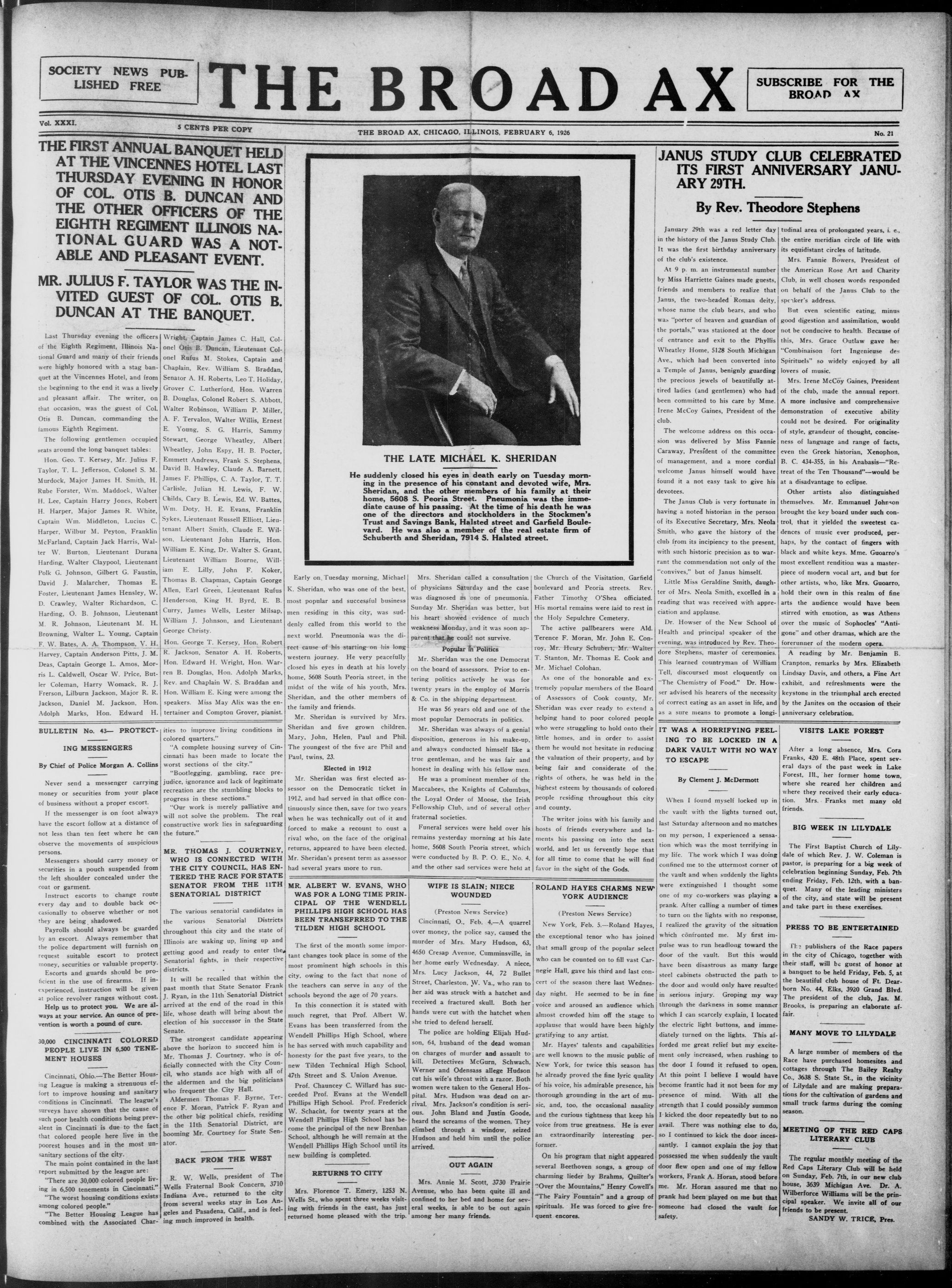
[Picture of a man in a suit, seated in a chair, with his hands resting on his knees.]
THE LATE MICHAEL K. SHERIDAN He suddenly closed his eyes in death early on Tuesday morning in the presence of his constant and devoted wife, Mrs. Sheridan, and the other members of his family at their home, 5608 S. Peoria Street. Pneumonia was the immediate cause of his passing. At the time of his death he was one of the directors and stockholders in the Stockmen's Trust and Savings Bank, Halsted street and Garfield Boulevard. He was also a member of the real estate firm of Schuberth and Sheridan, 7914 S. Halsted street.
Early on Tuesday morning, Michael K. Sheridan, who was one of the best, most popular and successful business men residing in this city, was suddenly called from this world to the next world. Pneumonia was the direct cause of his starting on his long western journey. He very peacefully closed his eyes in death at his lovely home, 5608 South Peoria street, in the midst of the wife of his youth, Mrs. Sheridan, and the other members of the family and friends.
Mr. Sheridan is survived by Mrs. Sheridan and five grown children, Mary, John, Helen, Paul and Phil. The youngest of the five are Phil and Paul, twins, 23.
Elected in 1912
Mr. Sheridan was first elected assessor on the Democratic ticket in 1912, and had served in that office continuously since then, save for two years when he was technically out of it and forced to make a recount to oust a rival who, on the face of the original returns, appeared to have been elected. Mr. Sheridan's present term as assessor had several years more to run.
MR. ALBERT W. EVANS, WHO
WAS FOR A LONG TIME PRINCIPAL
OF THE WENDELL
PHILLIPS HIGH SCHOOL HAS
BEEN TRANSEFRRED TO THE
TILDEN HIGH SCHOOL
The first of the month some important changes took place in some of the most prominent high schools in this city, owing to the fact that none of the teachers can serve in any of the schools beyond the age of 70 years.
In this connection it is stated with much regret, that Prof. Albert W. Evans has been transferred from the Wendell Phillips High School, where he has served with much capability and honesty for the past five years, to the new Tilden Technical High School, 47th Street and S. Union Avenue.
Prof. Chauncey C. Willard has succeeded Prof. Evans at the Wendell Phillips High School. Prof. Frederick W. Schacit, for twenty years at the Wendell Phillips High School has become the principal of the new Brennhan School, although he will remain at the Wendell Phillips High School until its new building is completed.
RETURNS TO CITY
Mrs. Florence T. Emery, 1253 N. Wells St., who spent three weeks visiting with friends in the east, has just returned home pleased with the trip.
Mrs. Sheridan called a consultation of physicians Saturday and the case was diagnosed as one of pneumonia, Sunday Mr. Sheridan was better, but his heart showed evidence of much weakness Monday, and it was soon apparent that he could not survive.
Popular in Politics
Mr. Sheridan was the one Democrat on the board of assessors. Prior to entering politics actively he was for twenty years in the employ of Morris & Co. in the shipping department.
He was 56 years old and one of the most popular Democrats in politics.
Mr. Sheridan was always of a genial disposition, generous in his make-up, and always conducted himself like a true gentleman, and he was fair and honest in dealing with his fellow men.
He was a prominent member of the Maccabees, the Knights of Columbus, the Loyal Order of Moose, the Irish Fellowship Club, and of several other fraternal societies.
Funeral services were held over his remains yesterday morning at his late home, 5608 South Peoria street, which were conducted by B. P. O. E., No. 4, and the other sad services were held at
WIFE IS SLAIN; NIECE
WOUNDED
Cincinnati, O., Feb. 4.—A quarrel over money, the police say, caused the murder of Mrs. Mary Hudson, 63, 4650 Cresap Avenue, Cumminsville, in her home early Wednesday. A niece, Mrs. Lucy Jackson, 44, 72 Bullet Street, Charleston, W. Va., who ran to her aid was struck with a hatchet and received a fractured skull. Both her hands were cut with the hatchet when she tried to defend herself.
The police are holding Elijah Hudson, 64, husband of the dead woman on charges of murder and assault to kill. Detectives McGurn, Schwach, Werner and Odensass allege Hudson cut his wife's throat with a razor. Both women were taken to the General Hospital. Mrs. Hudson was dead on arrival. Mrs. Jackson's condition is serious. John Bland and Justin Goode, heard the screams of the women. They climbed through a window, seized Hudson and held him until the police arrived.
OUT AGAIN
Mrs. Annie M. Scott, 3730 Prairie Avenue, who has been quite ill and confined to her bed and home for several weeks, is able to be out again among her many friends.
the Church of the Visitation. Garfield boulevard and Peoria streets. Rev. Father Timothy O'Shea officiated. His mortal remains were laid to rest in the Holy Sepulchre Cemetery. The active pallbearers were Ald. Terence F. Moran, Mr. John E. Conroy, Mr. Henry Schubert, Mr. Walter T. Stanton, Mr. Thomas E. Cook and Mr. Michael Colohan. As one of the honorable and extremely popular members of the Board of Assessors of Cook county, Mr. Sheridan was ever ready to extend a helping hand to poor colored people who were struggling to hold onto their little homes, and in order to assist them he would not hesitate in reducing the valuation of their property, and by being fair and considerate of the rights of others, he was held in the highest esteem by thousands of colored people residing throughout this city and county.
The writer joins with his family and hosts of friends everywhere and laments his passing on into the next world, and let us fervently hope that for all time to come that he will find favor in the sight of the Gods.
ROLAND HAYES CHARMS NEW
YORK AUDIENCE
(Preston News Service)
New York, Feb. 5.—Roland Hayes, the exceptional tenor who has joined that small group of the popular select who can be counted on to fill vast Carnegie Hall, gave his third and last concert of the season there last Wednesday night. He seemed to be in fine voice and aroused an audience which almost crowded him off the stage to applause that would have been highly gratifying to any artist.
Mr. Hayes' talents and capabilities are well known to the music public of New York, for twice this season has he already proved the fine lyric quality of his voice, his admirable presence, his thorough grounding in the art of music, and, too, the occasional nasality and the curious tightness that keep his voice from true greatness. He is ever an extraordinarily interesting performer.
On his program that night appeared several Beethoven songs, a group of charming lieder by Brahms, Quitter's "Over the Mountains," Henry Cornell's "The Fairy Fountain" and a group of spirituals. He was forced to give frequent encores.
SUBSCRIBE FOR THE
BROAD AX
No. 21
Y CLUB CELEBRATED
ANNIVERSARY JANU-
Theodore Stephens
JANUS STUDY CLUB CELEBRATED ITS FIRST ANNIVERSARY JANUARY 29TH.
By Rev. Theodore Stephens
---
January 29th was a red letter day in the history of the Janus Study Club. It was the first birthday anniversary of the club's existence.
At 9 p.m. an instrumental number by Miss Harriette Gaines made guests, friends and members to realize that Janus, the two-headed Roman deity, whose name the club bears, and who was "porter of heaven and guardian of the portals," was stationed at the door of entrance and exit to the Phyllis Wheatley Home, 5128 South Michigan Ave., which had been converted into a Temple of Janus, benignly guarding the precious jewels of beautifully attired ladies (and gentlemen) who had been committed to his care by Mme. Irene McCoy Gaines, President of the club.
The welcome address on this occasion was delivered by Miss Fannie Caraway, President of the committee of management, and a more cordial welcome Janus himself would have found it a not easy task to give his devotees.
The Janus Club is very fortunate in having a noted historian in the person of its Executive Secretary, Mrs. Neola Smith, who gave the history of the club from its incipiency to the present, with such historic precision as to warrant the commendation not only of the "convives," but of Janus himself.
Little Miss Geraldine Smith, daughter of Mrs. Neola Smith, excelled in a reading that was received with appreciation and applause.
Dr. Howser of the New School of Health and principal speaker of the evening, was introduced by Rev. Theodore Stephens, master of ceremonies. This learned countryman of William Tell, discoursed most eloquently on "The Chemistry of Food." Dr. Howser advised his hearers of the necessity of correct eating as an asset in life, and as a sure means to promote a longi-
IT WAS A HORRIFYING FEELING TO BE LOCKED IN A DARK VAULT WITH NO WAY TO ESCAPE
By Clement J. McDermott
When I found myself locked up in the vault with the lights turned out, last Saturday afternoon and no matches on my person, I experienced a sensation which was the most terrifying in my life. The work which I was doing confined me to the uttermost corner of the vault and when suddenly the lights were extinguished I thought some one of my co-workers was playing a prank. After calling a number of times to turn on the lights with no response, I realized the gravity of the situation which confronted me. My first impulse was to run headlong toward the door of the vault. But this would have been disastrous as many large steel cabinets obstructed the path to the door and would only have resulted in serious injury. Groping my way through the darkness in some manner which I can scarcely explain, I located the electric light buttons, and immediately turned on the lights. This afforded me great relief but my excitement only increased, when rushing to the door I found it refused to open. At this point I believe I would have become frantic had it not been for my presence of mind. With all the strength that I could possibly summon I kicked the door repeatedly but to no avail. There was nothing else to do, so I continued to kick the door incessantly. I cannot explain the joy that possessed me when suddenly the vault door flew open and one of my fellow workers, Frank A. Horan, stood before me. Mr. Horan assured me that no prank had been played on me but that someone had closed the vault for safety.
No.21
tudinal area of prolongated years, i.e., the entire meridian circle of life with its equidistant circles of latitude.
Mrs. Fannie Bowers, President of the American Rose Art and Charity Club, in well chosen words responded on behalf of the Janus Club to the speaker's address.
But even scientific eating, minus good digestion and assimilation, would not be conducive to health. Because of this, Mrs. Grace Outlaw gave her "Combinaison fort Ingenieuse des Spirituels" so widely enjoyed by all lovers of music.
Mrs. Irene McCoy Gaines, President of the club, made the annual report. A more inclusive and comprehensive demonstration of executive ability could not be desired. For originality of style, grandeur of thought, conciseness of language and range of facts, even the Greek historian, Xenophon, B. C. 434-355, in his Anabasis—"Retreat of the Ten Thousand"—would be at a disadvantage to eclipse.
Other artists also distinguished themselves. Mr. Emmanuel Johnson brought the key board under such control, that it yielded the sweetest cadences of music ever produced, perhaps, by the contact of fingers with black and white keys. Mme. Guoarro's most excellent rendition was a masterpiece of modern vocal art, and but for other artists, who, like Mrs. Guoarro, hold their own in this realm of fine arts the audience would have been stirred with emotion, as was Athens over the music of Sophocles" "Antigone" and other dramas, which are the forerunner of the modern opera.
A reading by Mr. Benjamin B. Cranpton, remarks by Mrs. Elizabeth Lindsay Davis, and others, a Fine Art exhibit, and refreshments were the keystone in the triumphal arch erected by the Janites on the occasion of their anniversary celebration.
VISITS LAKE FOREST
After a long absence, Mrs. Cora Franks, 420 E. 48th Place, spent several days of the past week in Lake Forest, Ill., her former home town, where she reared her children and where they received their early education. Mrs. Franks met many old friends.
BIG WEEK IN LILYDALE
The First Baptist Church of Lily- dale of which Rev. J. W. Coleman is pastor, is preparing for a big week of celebration beginning Sunday, Feb. 7th ending Friday, Feb. 12th, with a banquet. Many of the leading ministers of the city, and state will be present and take part in these exercises.
PRESS TO BE ENTERTAINED
The publishers of the Race papers in the city of Chicago, together with their staff, will be guest of honor at a banquet to be held Friday, Feb. 5, at the beautiful club house of Ft. Dearborn No. 44, Elks, 3920 Grand Blvd. The president of the club, Jas. M. Brooks, is preparing an elaborate affair.
MANY MOVE TO LILYDALE
A large number of members of the Race have purchased homesites and cottages through The Bailey Realty Co., 3638 S. State St., in the vicinity of Lilydale and are making preparations for the cultivation of gardens and small truck farms during the coming season.
MEETING OF THE RED CAPS
LITERARY CLUB
The regular monthly meeting of the Red Caps Literary Club will be held on Sunday, Feb. 7th, in our new club house, 3639 Michigan Ave. Dr. A. Wilberforce Williams will be the principal speaker. We invite all of our friends to be present. SANDY W. TRICE, Pres.
a
THE BROAD AX
Published Every Saturday
In ‘this city since July 15th 1899,
without missing one single issue. Re-
sblicans, Democrats, Catholics, Pro-
testants, Single Taxers, Priests, infi-
dels or anyone else can have their say
ss long as their language is proper
and responsibility is fixed.
The Broad Ax is a newspaper whose
platform is broad enough for all, ever
claiming the editorial right to speak
its own mind. It is neither Demo-
‘exatic nor Republican. It is strictly
‘or absolutely independent in politics
Local communications will receive
attention. Write only on one side of
the paper.
Subscriptions must be paid in ad-
vance. -
One Year .....22c00cecee + $2.00
Six Months .........-..---.-.$100
‘Advertising rates mare known on
«pplication.
Address all communications to
THE BROAD AX
6206 S. Elizabeth St, Chicago.
Phone: Wentworth 2597
JULIUS F. TAYLOR
Editor and Publisher
SSS
Vol. XXXI No. 21
Chicago, February 6, 1926
SSS a
Entered as Second-Class Matter, Aug.
19, 1902, at the Post office at Chicago.
Ill Under Act of March 8, 1879.
COLORFUL NEWS “MOVIES”
By the Cameraman
1. Singing Souls.
2. Objection Overruled.
3. Mid-Winter in Washington
4. Strawgrabbers.
5. Judge Edward W. Henry.
6. Colorgrams.
| ‘Stentne Souls
It seems to us that the versatile
Cleveland C. Allen is unduly alarmed
when he says: “The Negro spirituals
are now being overdone, and are being
sung by persons who have no concep-
tion of their social background or their
religious significance. It will be un-
fortunate if these songs lose their
proper value.” Brother Allen is evi-
dently looking at the hole in the
doughnut and is be¢oming musically
pessimistic. It is quite true that some
dross is now found in the golden tones
of soulful Negro music. The same,
too, is true of the German, Italian
and Russian schools of music. And
what could be more painful to one of
soul music declensions than to listen
to a clumsy, soulless rendition of
Beethoven's “Moonlight Sonata” or
Mendelssohn's Violin Concerto? And,
lest Mr. Allen forget, commercialism
must to some degree, enter into the
broadcasting of Negro spirituals and
all other spirituals in order that they
may be brought ear to ear and soul
to soul into contact with respondents
who know and appreciate the soul mu-
sic of a race.
However, we would like to ask
Brother Allen to look at the credit
side of the Negro spirituals ledger. On
it he will hear Fritz Kreisler’s violin
interpreting Clarence Cameron White's
arrangement of “Nobody Knows de
Trouble I've Seen.” He will recall
the night when the New York Hip-
podrome Theatre went frantic over
John McCormack’s rendition of Harry
Burleigh's “Little Mother of Mine.”
He will remember the urge which Miss
Maud Powell, famed American violin-
iste, gave to the works of S. Coleridge
Taylor. Allen will hear one hundred
artists of the New York Symphony
Orchestra accompanying Roland
Hayes and augment his vocal sou! with
the instrumental souls of the strings
horns and woodwinds.
No, No! There's no cause for gloom
over the future of the Negro spirituals
which are more truthfully interpreted
today by more artists to more audi.
ences than ever before. The singing
soul of the Negro is in America to
stay; and if a few imitations and com
mercialistic vehicles, here and there, de
it an occasional injustice, that is no
more than what is true in other fields
and is no reason for becoming blin¢
to the roseate side of Negro music
spiritualistie or otherwise:
2 Objection Overruled
The United States Senate passed the
World Court protocol by a vote of 76
to 17; but don't think for a moment
that the administration senators had an
easy time in putting over the approval
of this country to become an integral
part of a plan for the promotion of
world peace. Just listen to the follow-
ing-quoted “gem” of dissent, coming
from a democratic senator from the
Palmetto State:
“I call the attention of Senators
from the South, while they are voting
on this reservation, to the fact that
they are voting for a court where we
are to ait side by side with a full-
DS eS
ri
2
:
a.
| my ~
i —
Bee j
ea. ef) : '
le se eee ee a) 5
% Se, Se ge cca has Part oe
RAS. eae oan
Bes 8
BS hat are capmtuanle eta)
ee SS ee 5
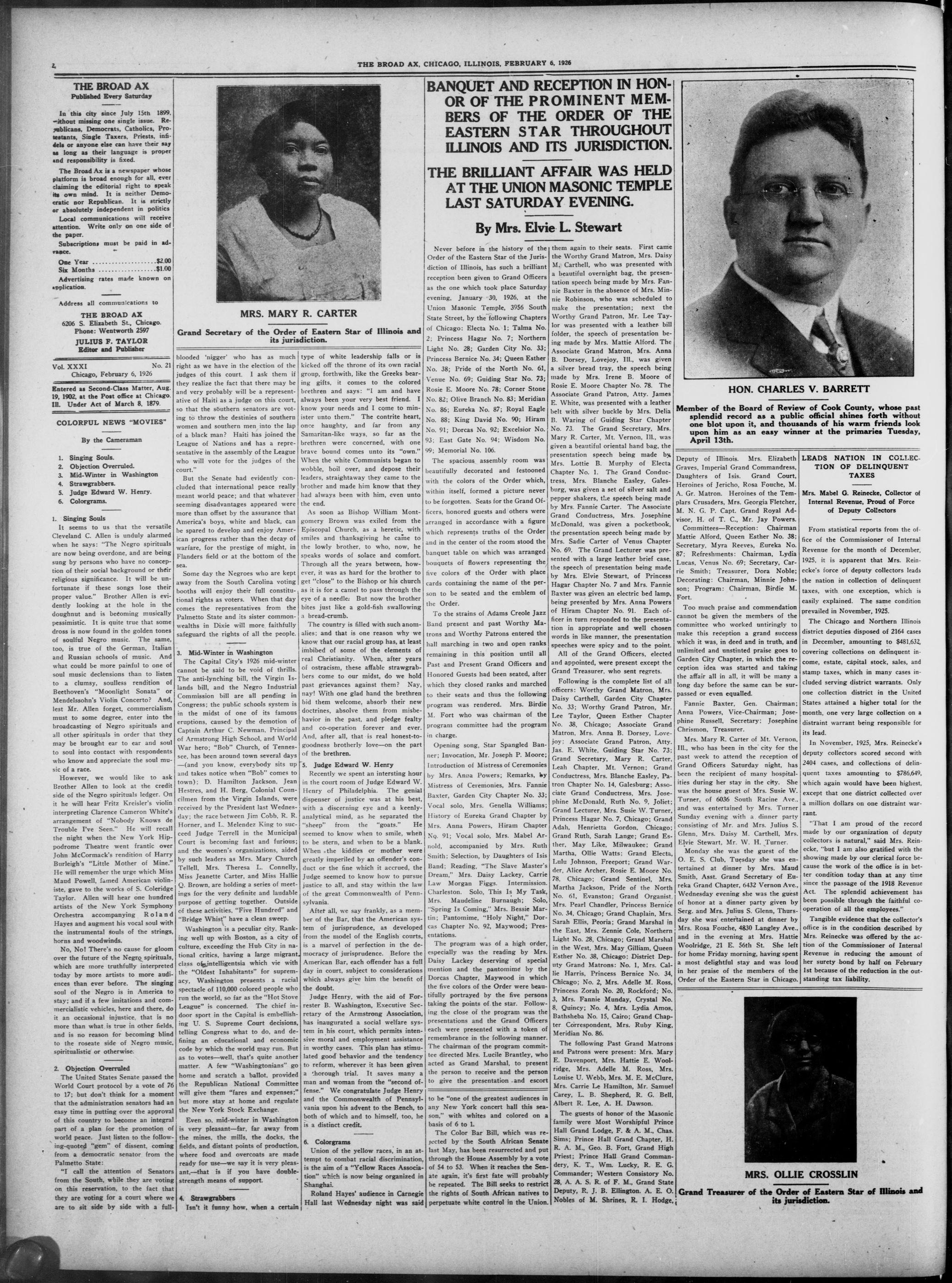
MRS. MARY R. CARTER
Grand Secretary of the Order of Eastern Star of Illinois and
its jurisdiction.
blooded ‘nigger’ who has as much
right as we have in the election of the
judges of this court. I ask them if
they realize the fact that there may be
and very probably will be a represent-
ative of Haiti as a judge on this court,
so that the sOuthern senators are vot-
ing to throw the destinies of southern
women and southern men into the lap
of a black man? Haiti has joined the
League of Nations and has a repre-
sentative in the assembly of the League
who will vote for the judges of the
court.”
But the Senate had evidently con-
cluded that international peace really
meant world peace; and that whatever
seeming disadvantages appeared were
more than offset by the assurance that
America’s boys, white and black, can
be spared to develop and enjoy Amer-
ican progress rather than the decay of
warfare, for the prestige of might, in
Flanders field or at the bottom of the
sea.
Some day the Negroes who are kept
away from the South Carolina voting
booths will enjoy their full constitu-
tional rights as voters. When that day
comes the representatives from the
Palmetto State and its sister common-
wealths in Dixie will more faithfully
safeguard the rights of all the people.
_ Mid-Winter in Washington
The Capital City’s 1926 mid-winter
cannot be said to be void of thrills.
The anti-lynching bill, the Virgin Is-
lands bill, and the Negro Industrial
Commission bill are all pending in
Congress; the public schools system is
in the midst of one of its famous
eruptions, caused by the demotion of
Captain Arthur C. Newman, Principal
of Armstrong High School, and World
War hero; “Bob” Church, of Tennes-
see, has been around town several days
—(and you know, everybody sits up
and takes notice when “Bob” comes to
town); D. Hamilton Jackson, Jean
Hestres, and H. Berg, Colonial Coun-
cilmen from the Virgin Islands, were
‘received by the President last Wednes-
‘day; the race between Jim Cobb, R. R.
Horner, and L. Melendez King to suc-
ceed Judge Terrell in the Municipal
Court is becoming fast and furious;
and the women’s organizations, aided
by such leaders as Mrs. Mary Church
Tellell, Mrs. Theresa L. Connelly,
Miss Jeanette Carter, and Miss Hallie
Q. Brown, are holding a series of meet-
ings for the very definite and laudable
purpose of getting together. Outside
of these activities, “Five Hundred” and
“Bridge ‘Whist” have a clean sweep.
Washington is a peculiar city, Rank-
ing well up with Boston, as a city of
culture, exceeding the Hub City in na-
tional critics, having a large migrant
class ofgintelligentsia which vie with
the “Oldest Inhabitants” for suprem-
acy, Washington presents racial
spectacle of 110,000 colored people whe
run the world, so far as the “Hot Stove
League” is concerned. The chief in-
door sport in the Capital is embellish-
ing U. S. Supreme Court decisions,
telling Congress what to do, and de-
fining an educational and economic
code by which the world may run. But
as to votes—well, that’s quite another
matter. A few “Washingtonians” go
home and scratch a ballot, provided
the Republican National Committee
will give them “fares and expenses;’
but more stay at home and regulate
the New York Stock Exchange.
| Even so, mid-winter in Washingtor
is very pleasant—far, far away from
the mines, the mills, the docks, the
fields, and distant points of production
where food and overcoats are mad
ready for use—we say it is very pleas
ant—that is if you have double
strength means of support. :
‘. Strawgrabbers
Isn't it funny how, when a certain
type of white leadership falls or is
kicked off the throne of its own racial
group, forthwith, like the Greeks bear-
ing gifts, it comes to the colored
brethren and says: “I am and have
always been your very best friend. I
know your needs and I come to min-
ister unto them.” The contrite heart,
once haughty, and far from any
Samaritan-like ways, so far as the
brethren were concerned, with one
brave bound comes unto its “own.”
When the white Communists began to
wobble, boil over, and depose their
leaders, straightaway they came to the
brother and made him know that they
had always been with him, even unto
the end.
As soon as Bishop William Mont-
gomery Brown was exiled from the
Episcopal Church, as a heretic, with
smiles and thanksgiving he caine to
the lowly brother, to who, now, he
speaks words of solace and comfort.
‘Through all the years between, how-
ever, it was as hard for the brother to
get “‘close” to the Bishop or his church
as it is for a camel to pass through the
eye of a needle: But now the brother
bites just like a gold-fish swallowing
a bread-crumb.
‘The country is filled with such anom-
alies; and that is one reason why we
know that our racial group has, at least
imbibed of some of the elements of
real Christianity. When, after years
of ostracism, these affable strawgrab-
bers come to our midst, do we hold
past grievances against them? Nay,
nay! With one glad hand the brethrer
bid them welcome, absorb their new
doctrines, absolve them from misbe
havior in the past, and pledge fealty
and co-operation forever and ever
And, after all, that is real honest-to-
goodness brotherly love—on the par
of the Beethren:
5. Judge Edward W. Henry
Recently we spent an intersting hour
jin the court room of Judge Edward W.
Henry of Philadelphia. The genial
dispenser of justice was at his best,
‘with a discerning eye and a keenly-
‘analytical mind, as he separated the
. “sheep” from the “goats.” He
seemed to know when to smile, when
to be stern, and when to be a blank.
When «the kiddies or mother were
greatly imperiled by an offender's con-
duct or the fine which it accrued, the
Judge seemed to know how to pursue
justice to all, and stay within the law
of the great Commonwealth of Penn-
sylvania.
Aftet all, we say frankly, as a mem-
ber of the Bar, that the American sys-
tem of jurisprudence, as developed
from the model of the English courts,
is a marvel of perfection in the de-
mocracy of jurisprudence. Before the
American Bar, each offender has a full
day in court, subject to considerations
which always give him the benefit of
the doubt. i
Judge Henry, with the aid of For-
rester B. Washington, Executive Sec-
retary of the Armstrong Association,
has inaugurated a social welfare sys-
tem in his court, which permits inten-
sive moral and employment assistance
in worthy cases. This plan has stimu-
lated good behavior and the tendency
to reform, wherever it has been given
a thorough trial. It saves many a
man and woman from the “second of-
fense.” We congratulate Judge Henry
and the Commonwealth of Pennsyl-
vania upon his advent to the Bench, to
both of which and to himself, too, he
is a distinct credit.
6. Colorgrams
Union of the yellow races, in an at-
tempt to combat racial discrimination,
is the aim of a “Yellow Races Associa-
tion” which is now being organized in
Shanghai.
Roland Hayes’ audience in Carnegie
Hall last Wednesday night was said
THE BROAD AX, CHICAGO, ILLINOIS, FEBRUARY 6, 1926
ae BANQUET AND RECEPTION IN HON-
OR OF THE PROMINENT MEM-
BERS OF THE ORDER OF THE
| EASTERN STAR THROUGHOUT
ILLINOIS AND ITS JURISDICTION.
THE BRILLIANT AFFAIR WAS HELD
AT THE UNION MASONIC TEMPLE
ee | LAST SATURDAY EVENING.
pest | By Mrs. Elvie L. Stewart
Never before in the history of the
Order of the Eastern Star of the Juris-
diction of Illinois, has such a brilliant
reception been given to Grand Officers
as the one which took place Saturday
evening, January 30, 1926, at the
Union Masonic Temple, 3956 South
State Street, by the following Chapters
of Chicago: Electa No. 1; Talma No.
2; Princess Hagar No. 7; Northern
Light No. 28; Garden City No. 33;
Princess Bernice No. 34; Queen Esther
No, 38; Pride of the North No. 61,
Venue No. 69; Guiding Star No. 73;
Rosie E. Moore No. 78; Corner Stone
No. 82; Olive Branch No. 83; Meridian
No. 86; Eureka No. 87; Royal Eagle
No. 88; King David No. 90; Hiram
No. 91; Doreas No. 92; Excelsior No.
93; East Gate No. 94; Wisdom No.
99; Memorial No. 106.
The spacious assembly room was
beautifully decorated and festooned
with the colors of the Order which,
within itself, formed a picture never
, to be forgotten. Seats for the Grand Of-
‘ficers, honored guests and others were
arranged in accordance with a figure
which represents truths of the Order
and in the center of the room stood the
banquet table on which was arranged
bouquets of flowers representing the
five colors of the Order with place
cards containing the name of the per-
son to be seated and the emblem of
the Order.
To the strains of Adams Creole Jaz
Band present and past Worthy Ma-
trons and Worthy Patrons entered the
hall marching in two and open ranks
remaining in this position until all
Past and Present Grand Officers and
Honored Guests had been seated, after
which they closed ranks and marched
to their seats and thus the following
program was rendered. Mrs. Birdie
M. Fort who was chairman of the
program committee had the program
in charge.
Opening song, Star Spangled Ban-
ner; Invocation, Mr. Joseph P. Moore;
Introduction of Mistress of Ceremonies
by Mrs, Anna Powers; Remarks, by
Mistress of Ceremonies, Mrs. Fannie
Baxter, Garden City Chapter No. 33;
Vocal solo, Mrs. Genella Williams;
History of Eureka Grand Chapter by
Mrs. Anna Powers, Hiram Chapter
Ng. 91; Vocal solo, Mrs. Mabel Ar-
nold, accompanied by Mrs. Ruth
Smith; Selection, by Daughters of Isis
Band; Reading, “The Slave Master's
Dream,” Mrs. Daisy Lackey, Carrie
Law Morgan Figgs. Intermission.
Charleston. Solo, This Is My Task
Mrs. Maudeline Burnaugh; Solo,
“Spring Is Coming,” Mrs. Bessie Mar-
tin; Pantomime, “Holy Night,” Dor-
cas Chapter No. 92, Maywood; Pres-
entations.
The program was of a high order
especially was the reading by Mrs
Daisy Lackey deserving of special
mention and the pantomime by the
Dorcas Chapter, Maywood in which
the five colors of the Order were beau
tifully portrayed by the five person:
taking the points of the star. Follow:
ing the close of the program was th
presentations and the Grand Officer
each were presented with a token o
remembrance in the following manner
The chairman of the program commit
tee directed Mrs. Lucile Brantley, whe
E as Grand Marshal, to presen
the person to receive and the persor
to give the presentation .and escor
ae eee ee
to be “one of the greatest audiences in
any New York concert hall this sea-
son,” with whites and colored on a
basis of 6 to 1.
The Color Bar Bill, which was re-
sected by the South African Senate
last May, has been resurrected and put
through the House Assembly by a vote
of S4 to 53. When it reaches the Sen-
ate again, it's first fate will probably
be repeated. The Bill seeks to restrict
the rights of South African natives to
perpetuate white control in the Union.
Se ee ee
tation speech being made by Mrs. Fan-
nie Baxter in the absence of Mrs. Min:
nie Robinson, who was scheduled ta
make the presentation; next the
Worthy Grand Patron, Mr. Lee Tay-
lor was presented with a leather bill
folder, the speech of presentation be-
ing made by Mrs. Mattie Alford. The
Associate Grand Matron, Mrs. Anna
B. Dorsey, Lovejoy, Ill, was given
a silver bread tray, the speech being
made by Mrs. Irene B. Moore of
Rosie E. Moore Chapter No. 78. The
Associate Grand Patron, Atty. James
E. White, was presented with a leather
belt with silver buckle by Mrs. Delia
B. Waring of Guiding Star Chapter
No. 73. The Grand Secretary, Mrs.
Mary R. Carter, Mt. Vernon, TIL, was
given a beautiful oriental hand bag, the
presentation speech being made bx
Mrs. Lottie B. Murphy of Electa
Chapter No. 1. The Grand Conduc-
tress, Mrs, Blanche Easley, Gales-
burg, was given a set of silver salt and
| pepper shakers, tle speech being made
by Mrs. Fannie Carter. The Associate
Grand Conductress, Mrs. Josephine
McDonald, was given a pocketbook,
the presentation speech being made by
Mrs, Sadie Carter of Venus Chapter
No. 69. The Grand Lecturer was pre-
sented with a large leather brief case,
| the speech of presentation being made
by Mrs. Elvie Stewart, of Princess
Hagar Chapter No. 7 and Mrs, Fannie
Baxter was given an electric bed lamp,
being presented by Mrs. Anna Powers
of Hiram Chapter No. 91. Each of-
ficer in turn responded to the presenta-
tion in appropriate and well chosen
words in like manner, the presentation
speeches were spicy and to the point.
All of the Grand Officers, elected
and appointed, were present except the
Grand Treasurer, who sent regrets.
Following is the complete list of all
officers: Worthy Grand Matron, Mrs.
Daisy Carthell, Garden City Chapter
No. 33; Worthy Grand Patron, Mr.
Lee Taylor, Queen Esther Chapter
No. 38, Chicago; Associate Grand
Matron, Mrs. Anna B. Dorsey, Love-
joy: Associate Grand Patron, Atty.
Jas. E, White, Guiding Star No. 73:
Grand Secretary, Mary R. Carter
Leah Chapter, Mt. Vernon; Grand
Conductress, Mrs. Blanche Easley, Pa
tron Chapter No. 14, Galesburg; Asso-
ciate Grand Conductress, Mrs. Jose-
phine McDonald, Ruth No. 9, Joliet
Grand Lecturer, Mrs. Susie W. Turner
Princess Hagar No. 7, Chicago; Gran¢
Adah, Henrietta Gordon, Chicago:
Grand Ruth, Sarah Lange; Grand Es
ther, May Like, Milwaukee; Grané
Martha, Ollie Watts; Grand Electa
Lulu Johnson, Freeport; Grand War-
der, Alice Archer, Rosie E. Moore No
78, Chicago; Grand Sentinel, Mrs
Martha Jackson, Pride of the North
No. 61, Evanston; Grand Organist
Mrs. Pearl Chandler, Princess Bernic
No. 34, Chicago; Grand Chaplain, Mrs
Sarah Ellis, Peoria; Grand Marshal ir
the East, Mrs. Zennie Cole, Northerr
Light No. 28, Chicago; Grand Marsha
in the West, Mrs. May Gilliam, Queer
Esther No. 38, Chicago: District Dep
uty Grand Matrons: No. 1, Mrs. Cal
lie Harris, Princess Bernice No. 34
Chicago; No. 2, Mrs. Adelle M. Ross
Princess Zorah No. 20, Rockford; No:
3, Mrs. Fannie Munday, Crystal No
8, Quincy; No. 4, Mrs. Lydia Amos
Bathsheba No. 15, Cairo; Grand Chap
|ter Correspondent, Mrs. Ruby King
Meridian No. 86.
The following Past Grand Matron
and Patrons were present: Mrs. Mars
E. Davenport, Mrs. Hattie E. Wool
| ridge, Mrs. Adelle M. Ross, Mrs
| Louise U. Webb, Mrs. M. E. McClure
|| Mrs. Carrie Le Hamilton, Mr. Samue
| Carey, L. B. Shepherd, R. G. Bell
| Albert R. Lee, A. H, Dawson.
| The guests of honor of the Masoni
family were Most Worshipful Princ
| Hall Grand Lodge, F. & A. M., Chas
.| Sims; Prince Hall Grand Chapter, H
| R.A. M., Geo. B. Fort, Grand Hig!
,| Priest; Prince Hall Grand Comman
|dery, K. T., Wm. Lucky, R. E. G
| Commander; Western Consistory No
| 28, A. A. S. R. of F. M., Grand Stat
,| Deputy, R. J. B. Ellington. A. E. O
| Nobles of M. Shrines, R. I. Hodge
. a so .
3 .. ..¢
eer
oe a ¢ .
4 ee
ee
- -_ —
7 i
——
> — :
HON. CHARLES V. BARRETT
Member of the Board of Review of Cook County, whose past
splendid record as a public official shines forth without
one blot upon it, and thousands of his warm friends look
upon him as an easy winner at the primaries Tuesday,
April 13th.
Deputy of Illinois. Mrs. Elizabeth
Graves, Imperial Grand Commandress,
Daughters of Isis. Grand Court,
Heroines of Jericho, Rosa Fouche, M.
A. Gr. Matron. Heroines of the Tem-
plars Crusaders, Mrs. Georgia Fletcher,
M. N. G. P. Capt. Grand Royal Ad-
visor, H. of T. C., Mr. Jay Powers.
Committees—Reception: Chairman
Mattie Alford, Queen Esther No. 38;
Secretary, Myra Reeves, Eureka No.
87; Refreshments: Chairman, Lydia
Lucas, Venus No. 69; Secretary, Car-
rie Smith; Treasurer, Dora Noble;
Decorating: Chairman, Minnie John-
son; Program: Chairman, Birdie M.
Fort. .
Too much praise and commendation
cannot be given the members of the
committee who worked untiringly to
make this reception a grand success
which it was, in deed and in truth, and
unlimited and unstinted praise goes to
Garden City Chapter, in which the re-
ception idea was started and taking
the affair all in all, it will be many a
long day before the same can be sur-
passed or even equalled.
Fannie Baxter, Gen. Chairman;
Anna Powers, Vice-Chairman; Jose-
phine Russell, Secretary; Josephine
Chrismon, Treasurer.
Mrs. Mary R. Carter of Mt. Vernon,
Ill, who has been in the’ city for the
past week to attend the reception of
Grand Officers Saturday night, has
been the recipient of many hospital-
ities during her stay in the city. She
was the house guest of Mrs. Susie W.
Turner, of 6036 South Racine Ave.,
and was entertained by Mrs. Turner
Sunday evening with a dinner party
consisting of Mr. and Mrs. Julius S.
Glenn, Mrs. Daisy M. Carthell, Mrs.
Elvie Stewart, Mr. W. H. Turner.
Monday she was the guest of the
0. E. S. Club, Tuesday she was en-
tertained at dinner by Mrs. Maud
‘Smith, Asst. Grand Secretary of Eu-
‘reka Grand Chapter, 6432 Vernon Ave,
Wednesday evening she was the guest
of honor at a dinner party given by
Serg. and Mrs. Julius S. Glenn, Thurs-
day she was entertained at dinner by
Mrs, Rosa Fouche, 4830 Langley Ave.
and in the evening at Mrs. Hattie
Woolridge, 21 E. S6th St. She left
for home Friday morning, having spent
a most delightful stay and was loud
in her praise of the members of the
Order of the Eastern Star in Chicago.
MRS. OLLIE CROSSLIN
Grand Treasurer of the Order of Eastern Star of Mlinois and
| its jurisdicti
LEADS NATION IN COLLEC.
TION OF DELINQUENT
TAXES
Mrs. Mabel G. Reinecke, Collector of
Internal Revenue, Proud of Force
of Deputy Collectors
From statistical reports from the of
fice of the Commissioner of Internal
Revenue for the month of December,
1925, it is apparent that Mrs. Rein-
ecke’s force of deputy collectors leads
the nation in collection of delinquent
taxes, with one exception, which is
easily explained. The same condition
prevailed in November, 1925.
The Chicago and Northern Illinois
district deputies disposed of 2164 cases
in December, amounting to $481,632,
covering collections on delinquent in-
come, estate, capital stock, sales, and
stamp taxes, which in many cases in-
cluded serving district warrants. Only
one collection district in the United
States attained a higher total for the
month, one very large collection on a
distraint warrant being responsible for
its lead.
In November, 1925, Mrs. Reinecke’s
deputy collectors scored second with
0s cases, and collections of delin-
quent taxes amounting to $786,649,
which again would have been highest,
except that one district collected over
a million dollars on one distraint war-
rant.
“That I am proud of the record
made by our organization of deputy
collectors is natural,” said Mrs. Rein-
ecke, “but I am also gratified with the
showing made by our clerical force be-
‘cause the work of the office is in bet-
ter condition today than at any time
since the passage of the 1918 Revenue
Act. The splendid achievement has
been possible through the faithful co-
operation of all the employees.”
‘Tangible evidence that the collector's
office is in the condition described by
Mrs. Reinecke was offered by the ac-
tion of the Commissioner of Internal
Revenue in reducing the amount of
her surety bond by half on February
Ist because of the reduction in the out-
standing tax liability.
[Name]
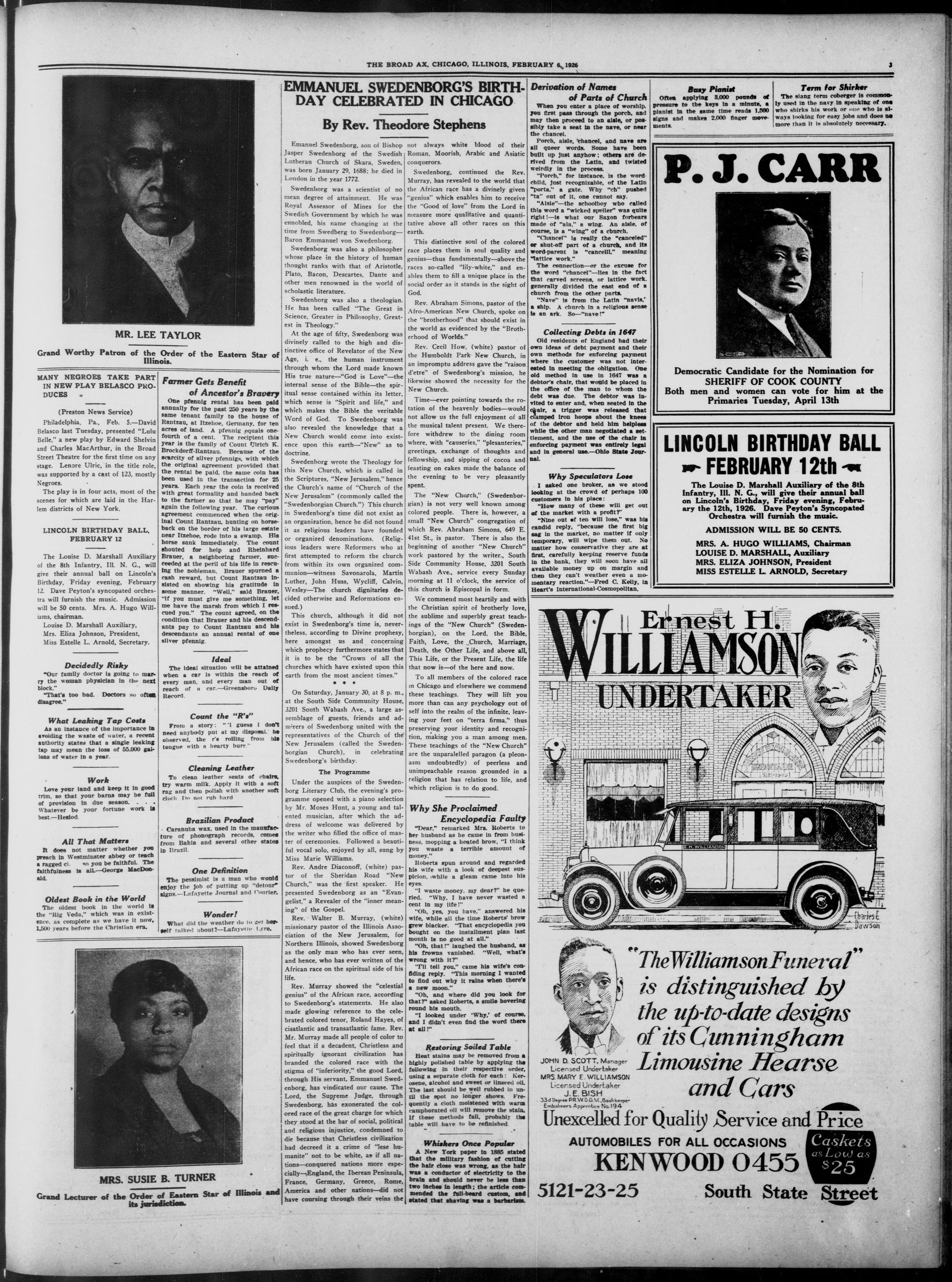
MR. LEE TAYLOR
MANY NEGROES TAKE PART
IN NEW PLAY BELASCO PRODUCES
(Preston News Service)
Philadelphia, Pa., Feb. 5—David Belasco last Tuesday, presented "Lulu Belle," a new play by Edward Shelvin and Charles MacArthur, in the Broad Street Theatre for the first time on any stage. Lenore Ulric, in the title role, was supported by a cast of 123, mostly Negroes. The play is in four acts, most of the scenes for which are laid in the Harlem districts of New York.
LINCOLN BIRTHDAY BALL,
FEBRUARY 12
The Louise D. Marshall Auxiliary of the 8th Infantry, Ill. N. G., will give their annual ball on Lincoln's Birthday, Friday evening, February 12. Dave Peyton's syncopated orchestra will furnish the music. Admission will be 50 cents. Mrs. A. Hugo Williams, chairman.
Louise D. Marshall Auxiliary,
Mrs. Eliza Johnson, President,
Miss Estelle L. Arnold, Secretary.
Decidedly Risky
"Our family doctor is going to marry the woman physician in the next block."
"That's too bad. Doctors so often disagree."
What Leaking Tap Costs
What Leaking Tap Costs
As an instance of the importance in avoiding the waste of water, a recent authority states that a single leaking tap may mean the loss of 55,000 gallons of water in a year.
Love your land and keep it in good trim, so that your barns may be full of provision in due season. . . . Whatever be your fortune work is best—Heatol
All That Matters
It does not matter whether you preach in Westminster abbey or teach a ragged cl. so you be faithful. The faithfulness is all—George MacDonald.
Oldest Book in the World
The oldest book in the world is the "Big Veda," which was in existence, as complete as we have it now, 1500 years before the Christian era.
[Image of a woman with dark hair and a serious expression].
Mary E.
MRS. SUSIE B. TURNER
Grand Lecturer of the Order its juris
Grand Lecturer of the Order of Eastern Star of Illinois and its jurisdiction.
Work
the Order of the Eastern Star of Illinois.
Farmer Gets Benefit
of Ancestor's Bravery
One pfennig rental has been paid annually for the past 250 years by the same tenant family to the house of Rantzau, at Itzehoe, Germany, for ten acres of land. A pfennig equals one-fourth of a cent. The recipient this year is the family of Count Ultrich K. Brockdoft-Rantzau. Because of the scarcity of silver pfennigs, with which the original agreement provided that the rental be paid, the same coin has been used in the transaction for 25 years. Each year the coin is received with great formality and handed back to the farmer so that he may "pay" again the following year. The curious agreement commenced when the original Count Rantzau, hunting on horseback on the border of his large estate near Itzehoe, rode into a swamp. His horse sank immediately. The count shouted for help and Rhelnhard Brauer, a neighboring farmer, succeeded at the peril of his life in rescuing the nobleman. Brauer spurned a cash reward, but Count Rantzau insisted on showing his gratitude in some manner. "Well," said Brauer, "if you must give me something, let me have the marsh from which I rescued you." The count agreed, on the condition that Brauer and his descendants pay to Count Rantzau and his descendants an annual rental of one silver pfennig.
The ideal situation will be attained when a car is within the reach of every man, and every man out of reach of a car—Greensboro Dally Record.
Count the "R's"
From a story: "I guess I don't need anybody put at my disposal. he observed, the r's rolling from his tongue with a hearty burr."
Cleaning Leather
To clean leather seats of chairs,
try warm milk. Apply it with a soft
rag and then polish with another soft
cloth. Do not rub hard
Brazilian Product
- Carnanuba wax, used in the manufacture of phonograph records, comes from Bahia and several other states in Brazil.
One Definition
The pessimist is a man who would enjoy the job of putting up "detour" signs. -Lafayette Journal and Courier.
What did the weather do to get her
talked about? -Lafayette Lyre.
THE WEEKLY NEWS
der of Eastern Star of Illinois and Jurisdiction.
Ideal
Wonder!
THE BROAD AX, CHICAGO, ILLINOIS, FEBRUARY 6, 1926
EMMANUEL SWEDENBORG'S BIRTHDAY CELEBRATED IN CHICAGO
By Rev. Theodore Stephens
Emanuel Swedenborg, son of Bishop Jasper Swedenborg of the Swedish Lutheran Church of Skara, Sweden, was born January 29, 1688; he died in London in the year 1772.
Swedenborg was a scientist of no mean degree of attainment. He was Royal Assessor of Mines for the Swedish Government by which he was ennobled, his name changing at the time from Swedberg to Swedenborg—Baron Emmanuel von Swedenborg.
Swedenborg was also a philosopher whose place in the history of human thought ranks with that of Aristotle, Plato, Bacon, Descartes, Dante and other men renowned in the world of scholastic literature.
Swedenborg was also a theologian. He has been called "The Great in Science, Greater in Philosophy, Greatest in Theology." At the age of fifty, Swedenborg was divinely called to the high and distinctive office of Revelator of the New Age, i.e., the human instrument through whom the Lord made known His true nature—"God is Love"—the internal sense of the Bible—the spiritual sense contained within its letter, which sense is "Spirit and life," and which makes the Bible the veritable Word of God. To Swedenborg was also revealed the knowledge that a New Church would come into existence upon this earth—"New" as to doctrine.
Swedenborg wrote the Theology for this New Church, which is called in the Scriptures, "New Jerusalem," hence the Church's name of "Church of the New Jerusalem" (commonly called the "Swedenborgian Church.") This church in Swedenborg's time did not exist as an organization, hence he did not found it as religious leaders have founded or organized denominations. (Religious leaders were Reformers who at first attempted to reform the church from within its own organized communion—witness Savonarola, Martin Luther, John Huss, Wycliff, Calvin, Wesley—The church dignitaries decided otherwise and Reformations ensued.)
This church, although it did not exist in Swedenborg's time is, nevertheless, according to Divine prophesy, here amongst us and concerning which prophecy furthermore states that it is to be the "Crown of all the churches which have existed upon this earth from the most ancient times."
***
On Saturday, January 30, at 8 p. m., at the South Side Community House, 3201 South Wabash Ave., a large assemblage of guests, friends and admirers of Swedenborg united with the representatives of the Church of the New Jerusalem (called the Swedenborgian Church), in celebrating Swedenborg's birthday.
The Programme
Under the auspices of the Swedenborg Literary Club, the evening's programme opened with a piano selection by Mr. Moses Hunt, a young and talented musician, after which the address of welcome was delivered by the writer who filled the office of master of ceremonies. Followed a beautiful vocal solo, enjoyed by all, sung by Miss Marie Williams.
Rev. Andre Diaconoff, (white) pastor of the Sheridan Road "New Church," was the first speaker. He presented Swedenborg as an "Evangelist," a Revealer of the "inner meaning" of the Gospel.
Rev. Walter B. Murray, (white) missionary pastor of the Illinois Association of the New Jerusalem, for Northern Illinois, showed Swedenborg as the only man who has ever seen, and hence, who has ever written of the African race on the spiritual side of his life.
Rev. Murray showed the "celestial genius" of the African race, according to Swedenborg's statements. He also made glowing reference to the celebrated colored tenor, Roland Hayes, of cisatlantic and transatlantic fame. Rev. Mr. Murray made all people of color to feel that if a decadent, Christless and spiritually ignorant civilization has branded the colored race with the stigma of "inferiority," the good Lord, through His servant, Emmanuel Swedenborg, has vindicated our cause. The Lord, the Supreme Judge, through Swedenborg, has exonerated the colored race of the great charge for which they stood at the bar of social, political and religious injustice, condemned to die because that Christless civilization had decreed it a crime of "fese humanite" not to be white, as if all nations—conquered nations more especially—England, the Iberian Peninsula, France, Germany, Greece, Rome, America and other nations—did not have coursing through their veins the
not always white blood of their Roman, Moorish, Arabic and Asiatic conquerors.
Swedenborg, continued the Rev. Murray, has revealed to the world that the African race has a divinely given "genius" which enables him to receive the "Good of love" from the Lord in measure more qualitative and quantitative above all other races on this earth.
This distinctive soul of the colored race places them in soul quality and genius—thus fundamentally—above the races so-called "lily-white," and enables them to fill a unique place in the social order as it stands in the sight of God.
Rev. Abraham Simons, pastor of the Afro-American New Church, spoke on the "brotherhood" that should exist in the world as evidenced by the "Brotherhood of Worlds."
Rev. Cecil How, (white) pastor of the Humboldt Park New Church, in an impromptu address gave the "raison d'etre" of Swedenborg's mission, he likewise showed the necessity for the New Church.
Time—ever pointing towards the rotation of the heavenly bodies—would not allow us the full enjoyment of all the musical talent present. We therefore withdrew to the dining room where, with "causeries," "plesanteries," greetings, exchange of thoughts and fellowship, and sipping of cocoa and feasting on cakes made the balance of the evening to be very pleasantly spent.
The "New Church," (Swedenborgian) is not very well known among colored people. There is, however, a small "New Church" congregation of which Rev. Abraham Simons, 649 E. 41st St., is pastor. There is also the beginning of another "New Church" work pastored by the writer., South Side Community House, 3201 South Wabash Ave., service every Sunday morning at 11 o'clock, the service of this church is Episcopal in form.
We commend most heartily and with the Christian spirit of brotherly love, the sublime and superbly great teachings of the "New Church" (Swedenborgian), on the Lord, the Bible, Faith, Love, the Church, Marriage, Death, the Other Life, and above all, This Life, or the Present Life, the life that now is—of the here and now.
To all members of the colored race in Chicago and elsewhere we commend these teachings. They will lift you more than can any psychology out of self into the realm of the infinite, leaving your feet on "terra firma," thus preserving your identity and recognition, making you a man among men. These teachings of the "New Church" are the unparalleled paragon (a pleonasm undoubtedly) of peerless and unimpeachable reason grounded in a religion that has relation to life, and which religion is to do good.
Why She Proclaimed
Encyclopedia Faulty
"Dear," remarked Mrs. Roberts to her husband as he came in from business, mopping a heated brow, "I think you waste a terrible amount of money."
Roberts spun around and regarded his wife with a look of deepest suspicion, while a gleam came into his eyes.
"I waste money, my dear?" he queried. "Why, I have never wasted a cent in my life."
"Oh, yes, you have," answered his wife, while all the time Roberts' brow grew blacker. "That encyclopedia you bought on the installment plan last month is no good at all."
"Oh, that!" laughed the husband, as his frowns vanished. "Well, what's wrong with it?"
"I'll tell you," came his wife's confiding reply. "This morning I wanted to find out why it rains when there's a new moon."
"Oh, and where did you look for that?" asked Roberts, a smile hovering round his mouth.
"I looked under 'Why,' of course, and I didn't even find the word there at all!"
Restoring Spiled Table
Heat stains may be removed from a highly polished table by applying the following in their respective order, using a separate cloth for each: Kerosene, alcohol and sweet or linseed oil. The last should be well rubbed in until the spot no longer shows. Frequently a cloth moistened with warm camphorated oil will remove the stain. If these methods fail, probably the table will have to be refinished.
Whiskers Once Popular
A New York paper in 1885 stated that the military fashion of cutting the hair close was wrong, as the hair was a conductor of electricity to the brain and should never be less than two inches in length; the article commended the full-bearer custom, and stated that shaving was a barbarism.
Ernest H.
WILLIAMSON
UNDERTAKER
E. H. WILLIAMSON
Charles E.
Dawson
Derivation of Names
When you enter a place of worship, you first pass through the porch, and may then proceed to an aisle, or possibly take a seat in the nave, or near the chancel. Porch, aisle, chancel, and nave are all queer words. Some have been built up just anyhow; others are derived from the Latin, and twisted weirdly in the process. "Porch," for instance, is the word-child, just recognizable, of the Latin "porta," a gate. Why "ch" pushed "ta" out of it, one cannot say. "Aisle"—the schoolboy who called this word a "wicked speller" was quite right!—is what our Saxon forbears made of "ala," a wing. An aisle, of course, is a "wing" of a church. "Chancel" is really the "canceled" or shut-off part of a church, and its word-parent is "cancelll," meaning "lattice work."
The connection—or the excuse for the word "chancel"—lies in the fact that carved screens, or lattice work, generally divided the east end of a church from the other parts. "Nave" is from the Latin "navis," a ship. A church in a religious sense is an ark. So—"nave!"
Collecting Debts in 1647
Old residents of England had their own ideas of debt payment and their own methods for enforcing payment where the customer was not interested in meeting the obligation. One old method in use in 1647 was a debtor's chair, that would be placed in the office of the man to whom the debt was due. The debtor was invited to enter and, when seated in the chair, a trigger was released that clamped iron hoops about the knees of the debtor and held him helpless while the other man negotiated a settlement, and the use of the chair in enforcing payment was entirely legal and in general use.—Ohio State Journal.
Why Speculators Lose
I asked one broker, as we stood looking at the crowd of perhaps 100 customers in his place:
"How many of these will get out of the market with a profit?"
"Nine out of ten will lose," was his candid reply, "because the first big sag in the market, no matter if only temporary, will wipe them out. No matter how conservative they are at first, carefully keeping reserve funds in the bank, they will soon have all available money up on margin and then they can't weather even a momentary reaction."—Fred C. Kelly, in Heart's International-Cosmopolitan.
WILLIE
UNI
JOHN D. SCOTT, Manager
Licensed Undertaker
MRS. MARY E. WILLIAMSON
Licensed Undertaker
J.E. BISH
33d Degree PR.W.D.G.M. Bookkeeper
Embalmers Apprentice No.194
Unexcelled for
AUTOMOBILES
KEN
5121-23-25
Busy Pianist
Often applying 3,000 pounds of pressure to the keys in a minute, a pianist in the same time reads 1,500 signs and makes 2,000 finger movements.
J. CAR
B. W. H.
Democratic Candidate
SHERIFF OF C
Both men and women
Primaries Tues
LINCOLN BIR
FEBRUARY
The Louise D. Marsh
Infantry, Ill. N. G., will
on Lincoln's Birthday,
ary the 12th, 1926. D
Orchestra will
RATIC Candidate for the Nominat-
HERIFF OF COOK COUNTY
men and women can vote for his
Primaries Tuesday, April 13th
OLN BIRTHDAY
FEBRUARY 12th
The Louise D. Marshall Auxiliary of the
Entry, Ill. N. G., will give their annual
Lincoln's Birthday, Friday evening, I
the 12th, 1926. Dave Peyton's Synco
Orchestra will furnish the music.
Democratic Candidate for the Nomination for SHERIFF OF COOK COUNTY Both men and women can vote for him at the Primaries Tuesday, April 13th
The Louise D. Marshall Auxiliary of the 8th Infantry, Ill. N. G., will give their annual ball on Lincoln's Birthday, Friday evening, February the 12th, 1926. Dave Peyton's Syncopated Orchestra will furnish the music.
ADMISSION WILL BE 50 CENTS.
MRS. A. HUGO WILLIAMS, Chairman
LOUISE D. MARSHALL, Auxiliary
MRS. ELIZA JOHNSON, President
MISS ESTELLE L. ARNOLD, Secretary
ARS. A. HUGO WILLIAMS, Chairman
DUISE D. MARSHALL, Auxiliary
ARS. ELIZA JOHNSON, President
ISS ESTELLE L. ARNOLD, Secretar
MRS. A. HUGO WILLIAMS, Chairman
LOUISE D. MARSHALL, Auxiliary
MRS. ELIZA JOHNSON, President
MISS ESTELLE L. ARNOLD, Secretary
"The Williamson Funeral" is distinguished by the up-to-date designs of its Cunningham Limousine Hearse and Cars
Term for Shirker
The slang term cooberger is commonly used in the navy in speaking of one who shirks his work or one who is always looking for easy jobs and does no more than it is absolutely necessary.
for the Nomination for
BOOK COUNTY
can vote for him at the
day, April 13th
BIRTHDAY BALL
RY 12th
Ball Auxiliary of the 8th
all give their annual ball
Friday evening, Febru-
ave Peyton's Syncopated
urnish the music.
ILLIAMS, Chairman
ALL, Auxiliary
SON, President
ARNOLD, Secretary
3
4
fn
*
Soldiers Willing to
Share Glories of War
‘4 scrap of conversation just before
the Blanc Mont action shows the atti-
tude of the men in the trenches to
ward the war.
Tt was the last day of September,
and as the forenoon went by an in-
termittent drizzle sent the battalion
to such miserable shelters as the men
could improvise. Company command-
ers and second in command went up
toward ruined Somme-Py for recon-
naissance and returned to profane the
prospect to their platoon leaders.
“I do not like this place.” declared
the captain of the Forty-ninth com-
pany to his juniors. “It looks like it
‘was just built for calamities to hap-
en in.”
“Yep, and all the division is around
here for calamities to happen to . . .
A sight more of us will go In than will
‘ever come out of it.”
Meantime it was wet and cold in
the dripping shelters. Winter cloth-
ing had not been issued, and the bat-
talfon shivered and was not cheerful.
“Wish to God we could go up an’
get this fight over with”
“Yes, ‘n then go back somewhere for
the winter. Let some of these here
noble national army outfits we've heen
hearin’ about do some of the fightin’!
‘There's us and there's the First dl-
vision, and the Thirty-second—H—I!
we ain't hogs! Let some of them oth-
er fellows have the glory—"
“Gawd help the boche when we
‘meets him this time! Somebody's got
to pay for keepin’ us out in this wet
an’ cold.”"—Capt. John W. Thomason
‘Ir. of the United States Marines, tn
Scribner's.
Teat Duck Swiftest
of All Flying Things
An old controversy hangs around the
subject of the fastest bird. ‘The prize
used to belong, at least in the opinion
of sportsmen, to that little and most
typical duck, the teal. So far as I
have been able to collate the evidence
and compare it with personal expert-
ence, the very fastest birds belong to
the classes which come between the
gulls und ducks.
‘The peregrine fulcons and some of
the swifts compete for the head of
the list; and it ts worth notice that
the swifts, which people in general
¢lass with the swallow tribe, thanks
to several real and obvious likenesses,
fare put by the classifiers as cousins
‘of the hawks. However this may be.
tt remains that the ducks attain a daz-
aling speed and can defy the winds
Detter than any bird that flies, though
thelr momentum exaggerates their dit
ficulty in changing direction.
But so much depends on the engine
that when it is in the least out of gear,
when it is not tuned up, as happens
at the early moult, they cannot fly at
all; they become into the state of
their primeval ancestor.—Sir W. Beach
‘Thomas in the Atlantic Monthly.
Wrong Kind of Cushien
4 camel has its limit of endurance
‘as the old saw concerning the ultl-
mate straw and the broken back will
testify. Mrs. North aiso had her lim-
it, which was finally reached when an
‘argument, about which little could be
understood, continued with unabated
fury for two hours in the Smith house-
hold next door.
Calling to Willie Smith, who was
playing in the back yard, Mrs. North
asked the seven-year-old shining light
of the warring Smiths:
“What is all the row about, Willie?’
“Oh, mamma put her cushion on
daddy's chair and he sat down on It,”
replied the small lad.
“Why, that Is no cause for such an
argument, is it?”
“Sure it is! It was mamma's pin
eushion !”
Swimming to Work
Pacific islanders are probably the
cleanest people on earth, for they
‘spend a good part of every day in the
water, and m.y he said to be almost
as amphibious as seals. The children
Jearn to swim almost as soon as they
Jearn to walk. If the village bappens
to be at some distance from the shore,
‘a swimming pool is formed in a near.
by stream, and there mixed bathing is
indulged in several times every day.
With the skin constantly greased
with coconut oll, the pulp of the bit-
ter green orange makes « good soap
and lathers freely. Dame Nature also
supplies them with scrubbers, the
husks of the coconut, and this they
‘apply to their shining bodies very vig-
crously. Their towel is provided by
the sun and wind.
Mataclity
‘It was but this present morning, as
he rode on the omnibus from Rich-
mond; while it changed horses, this
present chronicler, being on the roof,
marked three little children playing
tm a puddle below, very dirty, and
friendly, and happy. To chese three
presently came another little one.
“Polly,” says she, “your sister's got a
penny.” At which the chidren got up
from the puddle instantly, and ran off
to pay their court to Peggy. And as
the omnibus drove off I saw Peggy
with the infantine procession at her
tail, marching with great dignity
toward the stall of a neighboring lolll-
pop woman. — Thackeray, “Vanity
Pair.”
Has Increased in Value
In the last year of the Eighteenth
century 20 acres of land from Thirty-
second to Thirty-fourth street on Fifth
‘avenue, New York city, were sold to
‘one John Thompson for the sum of
$2,500.
Unfortunate Stutter
A municipal candidate get up to
make a' speech in Liverpool, England.
He was slightly aMficted with a stut-
ter. Everything went nicely until he
tried to tell bis listeners that they
‘must do away with the s-e-spenders.
Charming Sports Frock
to Be in Spring Mode
re
Amie |
= “te ere B
ae A dl
te
\a | i ;
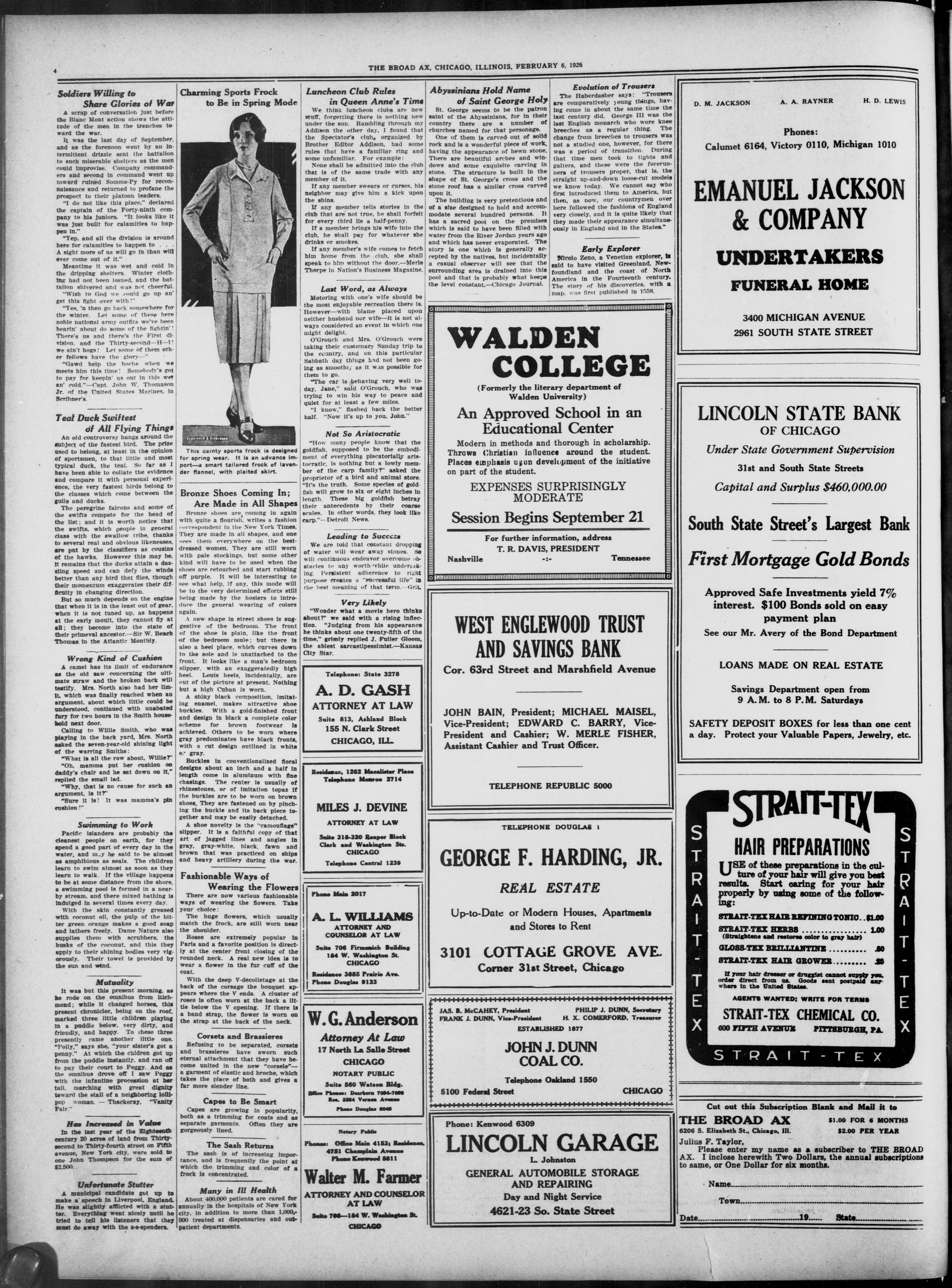
This dainty sports frock is designed
for spring wear. It is an advance im-
port—a smart tailored frock of laven-
der flannel, with plaited skirt.
Bronze Shoes Coming In;
Are Made in All Shapes
Bronze shoes are, coming in again
with quite a flourisit, writes a fashion
correspondent in the New York Times.
They are made in all shapes, and one
sees them everywhere on the best-
dressed women. They are still worn
with pale stockings. but some other
kind will have to be used when the
shoes are retouched and start rubbing
off purple. It will be interesting to
see what help, if any, this mode will
be to the very determined efforts still
being made by the hosters to intro-
duce the general wearing of colors
again.
‘A new shape in street shoes is sug-
gestive of the bedroom. The front
of the shoe ts plain, like the front
‘of the bedroom mule; but there is
also a heel place, which curves down
to the sole and is unattached to the
front. It looks Iike a man's bedroom
slipper, with an exaggeratediy high
heel. “Louis heels, incidentally, are
out of the picture at present. Nothing
but a high Cuban is worn.
‘A shiny black composition, imitat-
ing enamel, makes attractive shoe
buckles. With a gold-finished front
‘and design in black a complete color
scheme for brown footwear is
achieved. Others to be worn where
gray predominates have black fronts,
with a cut design outlined in white
o> gray.
Buckles in conventionalized floral
designs about an inch and a half in
length come in aluminum with fine
chasings. ‘The center Is usually of
rhinestones, or of {mitation topaz if
the buckles are to be worn on brown
shoes, They are fastened on by pinch-
ing the buckle and its back piece to-
gether and may be easily detached.
A shoe novelty is the “camouflage”
slipper. It is a faithful copy of that
art of jagged lines and angles in
gray, gray-white, black, fawn and
brown that was practiced on ships
and heavy artillery during the war.
Fashionable Ways of
Wearing the Flowers
‘There are now various fashionable
ways of wearing the flowers. Take
your chotce:
The huge flowers, which usually
match the frock, are still worn near
the shoulder.
Roses are extremely popular in
Paris and a favorite position is direct-
ly at the center front closing of the
rounded neck. A real new idea is to
wear a flower in the fur cuff of the
coat.
With the deep V-decolletage at the
back of the corsage the bouquet ap-
Dears where the V ends. A cluster of
roses is often worn at the back a It-
tle below the V opening. If there Is
a band strap, the flower is worn on
the strap at the back of the neck.
Corsets and Brassieres
Refusing to be separated, corsets
and brassieres have sworn such
eternal attachment that they have be-
come united in the new “corsele”—
& garment of elastic and broche, which
takes the place of both and gives a
far more slender line.
Capes to Be Smart
Capes are growing in popularity,
both as a trimming for coats and as
Separate garments. Often they are
gorgeously lined.
The Sash Returns
‘The sash Is of Increasing tm
tance, and Is frequently the point at
which the trimming and color of @
frock is concentrated.
Many in Il! Health
About 400,000 patients are cared for
annually in the hospitals of New York
city. in addition to more than 1,000-
000 treated at dispensaries and out
patient departments.
THE BROAD AX, CHICAGO, ILLINOIS, FEBRUARY 6, 1926
i a
ee
Luncheon Club Rales Abyssinians Hold Name pegs
in Queen Anne’s Time of Saint George Hol¥) gre compar
We think luncheon clubs are new St. George seems to be the patron | ing come in
muff, forgetting there is nothing new) saint of the Abyssinians, for in thelr | jast century
under the sun. Rambling through my| country there are a number Of} last English
‘Addison the other day, {found that| churches named for that personage. | breeches a
the Spectator’s club, organized by One of them is carved out of solid change frou
Brother Editor Addison, had some) rock and is a wonderful plece of work, | not a studi
rules that have a familiar ring and| having the appearance of hewn stone. | was a peri
some unfamiliar. For example: There are beautiful arches and win-| that time
None shall be admitted into the club| dows and some exquisite carving in| gatters, and
that is of the same trade with any| stone. The structure is built in the} ners of tro
member of it. shape of St. George’s cross and the/ straight up-
If any member swears or curses, his) stone roof has a similar cross carved | we know to
neighbor may give him a kick upon| upon it. first introdu
the shins. ‘The building is very pretentious and | then, as u
‘If any member tells stories in the) of a size designed to hold and accom-| here follows
club that are not true, he shall forfeit) modate several hundred persons. It| yery closely
for every third le a half-penny. has a sacred pool on the premises| they made t
If a member brings his wife into the) which {s said to have been filled with | ously in Eu;
lub, he shall pay for whatever she! water from the River Jordan years ago Ag
érinks or smokes. and which has never evaporated. The
If any member's wife comes to fetch| story is one which is generally ac- Ee
him home from the club, she shall| cepted by the natives, but incidentally | guyeolo Zer
speak to him without the door.—Merle| a casual observer will see that the |saig to hav
‘Thorpe in Nation's Business Magazine. | surrounding area is drained into thi8|foundiand 5
pool and that is probably what keeps | america in
Word acAlwaye | the Hevel constant—Chicago Journal. | The story. «
Motoring with one’s wife should be
the most enjoyable recreation there is.
However—with blame placed upon
nelther husband nor wife—it is not al-
ways considered an event in which one
might delight.
O'Grouch and Mrs, O'Grouch were
taking their customary Sunday trip to
the country, and on this particular
Sabbath day things had not been go-
Ing as smoothis as it was possible for
them to go.
“The car is behaving very well to-
das, Jane,” said O'Grouch, who was
trying to win his way to peace and
qulet for at least a few miles.
“1 know,” flashed back the better
half. “Now it’s up to you, Jobn.”
Not So Aristocratic
“How many people know that the
goldfish, supposed to be the embodl-
ment of everything piscatorially arin-
tocratic, {s nothing but a lowly mem-
ber of the carp family?” asked the
proprietor of a bird and animal store
“it’s the truth. Some species of gold-
fish will grow to six or eight Inches in
length. These big goldfish betray
their antecedents by thelr coarse
scales. In other words, they look like
carp.” —Detrolt News.
Leading to Succccs
We are told that constant dropping
of water will wear away stones. So
will continuous endeavor overcome ibe
ftaclen te any worthrhile undertake
ing. Persistent adherence to rizht
purpose creates a “eucceasful life” im
the best meaning of that term.—Grit,
Very Likely
“Wonder what a movie hero thinks
about? we said with a rising inflec-
tion. “Judging from his appearance
he thinks about one twenty-fifth of the
time,” grimly replied J. Fuller Gloom,
the ablest sarcastipessimist.—Kansas
City Star.
Telephone: State 3278
A. D. GASH
ATTORNEY AT LAW
Suite 813, Ashland Block
155 N. Clark Street
CHICAGO, ILL.
Residence, 1262 Macalister Place
Telephone Monroe 2714
MILES J. DEVINE
ATTORNEY AT LAW
Suite 318-320 Reaper Block
Clark and Washington Sta.
CHICAGO
Telephone Central 1239
Phone Main 2017
A. L. WILLIAMS
ATTORNEY AND
COUNSELOR AT LAW
Suite 706 Firmenich Building
184 W. Washington St.
CHICAGO
Residence 3685 Prairie Ave.
| Phone Douglas 9133
W.G. Anderson
Attorney At Law
17 North La Salle Street
CHICAGO
NOTARY PUBLIC
Suite 560 Watson Bldg.
(Gilice Phones: Dearborn 7084-7008
=e
Phone Douglas 6045
ae
Phones: Office Main 4153; Residence,
(4751 Champlain Avenue
Phone Kenwood 5611
Walter M. Farmer
ATTORNEY AND COUNSELOR
AT LAW
Suite 708—184 W. Washington Se.
cHIcAGcO
WALDEN
|
| COLLEGE
(Formerly the literary department of
| Walden University)
| An Approved School in an —
| Educational Center
Modern in methods and thorough in scholarship.
Throws Christian influence around the student.
Places emphasis ugon development of the initiative
on part of the student.
EXPENSES SURPRISINGLY
MODERATE
Session Begins September 21
For further information, address
T. R. DAVIS, PRESIDENT
Nashville ot Tennessee
a TT
WEST ENGLEWOOD TRUST
AND SAVINGS BANK
Cor. 63rd Street and Marshfield Avenue
JOHN BAIN, President; MICHAEL MAISEL,
Vice-President; EDWARD C. BARRY, Vice-
President and Cashier; W. MERLE FISHER,
Assistant Cashier and Trust Officer.
TELEPHONE REPUBLIC 5000
GEORGE F. HARDING, JR.
REAL ESTATE
Up-to-Date or Modern Houses, Apartments
and Stores to Rent
3101 COTTAGE GROVE AVE.
Corner 31st Street, Chicago
TT eee
JAS. B. MeCAHEY, President PHILIP J. DUNN, Secretary
- FRANK J. DUNN, Vice-President H. X. COMERFORD, Treasurer
ESTABLISHED 1877
JOHN J. DUNN
COAL CO.
Telephone Oakland 1550
; 5100 Federal Street CHICAGO |
Meee it
Phone: Kenwood 6309
LINCOLN GARAGE
LL. Johnston
GENERAL AUTOMOBILE STORAGE
AND REPAIRING
Day and Night Service
4621-23 So. State Street
Abyssinians Hold Name
of Saint George Holy
St. George seems to be the patron
saint of the Abyssinians, for in thelr
country there are a number of
churches named for that personage.
One of them Is carved out of solid
rock and is a wonderful piece of work,
having the appearance of hewn stone.
‘There are beautiful arches and win-
dows and some exquisite carving in
stone. The structure is built in the
shape of St. George's cross and the
stone roof has a similar cross carved
upon it,
The building is very pretentious and
of a size designed to hold and accom-
modate several hundred persons. It
has a sacred pool on the premises
which is said to have been filled with
water from the River Jordan years ago
and which has never evaporated. The
story is one which is generally ac-
cepted by the natives, but incidentally
a casual observer will see that the
surrounding area is drained into this
pool and that Is probably what keeps
the level constant.—Chicago Journal.
Evolution of Trousers
Phones:
Calumet 6164, Victory 0110, Michigan 1010
EMANUEL JACKSON
& COMPANY
UNDERTAKERS
FUNERAL HOME
3400 MICHIGAN AVENUE
2961 SOUTH STATE STREET
‘The Haberdasher says: “Trousers
are comparatively young things, bav-
ing come in about the same time the
last century did. George III was the
last English monarch who wore knee
breeches as a reguiur thing. The
change from breeches to trousers was
not a studied one, however, for there
was a period of transition. During
that time men took to tights and
gaiters, and these were the forerun-
ners of trousers proper, that fs, the
straight up-und-down loose-cut models
we know today. We cannot say who
first introduced them to America, but
then, as now, our countrymen over
here followed the fashions of England
very closely, and it Is quite likely that
they made their appearance simultane-
ously in Englund and in the States.”
Early Explorer
‘Nicolo Zeno, a Venetian explorer, is
said to have visited Greenland, New-
foundland and the coast of North
America in the Fourteenth century.
The story of his discoveries, with a
man. wan firat published ip 1558.
|
LINCOLN STATE BANK
OF CHICAGO
Under State Government Supervision
31st and South State Streets
Capital and Surplus $460,000.00
South State Street’s Largest Bank
First Mortgage Gold Bonds
Approved Safe Investments yield 7%
interest. $100 Bonds sold on easy
payment plan
See our Mr. Avery of the Bond Department
LOANS MADE ON REAL ESTATE
Savings Department open from
9 A.M. to 8 P.M. Saturdays
SAFETY DEPOSIT BOXES for less than one cent
aday. Protect your Valuable Papers, Jewelry, etc.
= | S
mS] =sOHAIR PREPARATIONS =
USE of these preparations in the cul-
R ture of your hair will give you best >)
results. Start caring for oo hair
A Ee by using some of follow- nN
| STRAIT-TEX HAIR REFINING TONIC. .$1.00 |
7 (Btraightens and restores color to gray hair) ai
GLOSS-TEX BRILLIANTINE .......... 50
‘Eas STRAIT-TEX HAIR GROWER......... 25 ®
yee ses FF
3 AGENTS WANTED; WRITE FOR TERMS iz
STRAIT-TEX CHEMICAL CO.
Xx 600 FIFTH AVENUE PITTSBURGH, PA. D4
gee
Cut out this Subscription Blank and Mail it to
THE BROAD AX $1.00 FOR 6 MONTHS
6206 S. Elizabeth St., Chicago, Ill. $2.00 PER YEAR
Julius F. Taylor,
Please enter my name as a subscriber to THE BROAD
AX. Linclose herewith Two Dollars, the annual subscriptions
to same, or One Dollar for six months.
© ED ehhh bi etneddiliedid onsite a ciladasenidanncenemem
DI spc ep oescniooipecace aig es aisaateasitiaslpattsioes
Date________.19.. State
SOMIRB.---------~--nsown=--soosowoncovonnnccsunenesccecs SEED eserewasscossaiessensnncoreoe-