The Broad Ax
Saturday, July 10, 1926
Chicago, Illinois
Page text (machine-generated)
SOCIETY NEWS PUB-
LISHED FREE
Vol. XXXI. 5 C
HON. ANTON J. CERMAK
Successful real estate dealer, baseball the County Board, and the head a County Hospital and the other puing to this county. President Co of Dr. Harry S. Gradle, chief of the Eye Ward of the Cook County He
Successful real estate dealer, baseball magnate, President of the County Board, and the head and the front of the Cook County Hospital and the other public institutions belonging to this county. President Cermak is a warm friend of Dr. Harry S. Gradle, chief of the operating staff of the Eye Ward of the Cook County Hospital.
DR. JOHNSON CHOSEN HOWARD UNIVERSITY HEAD OF INSTITUTION
(Preston News Service)
Washington, D. C., July 9.—Dr. Mordecai W. Johnson of Charleston, W. Va., was unanimously elected president of Howard University at a special meeting of the board of trustees, held late Wednesday afternoon. Dr. Johnson will be the first colored man to serve as president of Howard. The vote was taken after the board was formally advised that Bishop John A. Gregg had declined its presidency.
plars," and graduated from Howard University with degree of master of science and theology.
The new president will be not only the first colored man to serve in this capacity, but the youngest. He is but 36 years old. It is expected he will come promptly to the university, although he is now in Paris, France, traveling with the Sherwood Eddy seminar.
Justice Peele Presides
In the absence of Dr. Charles R. Brown, president of the board, Justice Stanton J. Peele, former member of the United States Court of Claims, presided. It was declared after the meeting Wednesday that Dr. Johnson will
Dr. Johnson, it was stated, has indicated his intention to accept the presidency and comes to the post with the unanimous backing of the trustees, with the support of a large group of the general alumni, faculty and student body, to whom he has annually lectured for a number of years. He is married and has three children.
Atlanta College Graduate.
Graduated in 1911 from Morehouse College, Atlanta, Ga., with the degree of bachelor of arts, Dr. Johnson was retained for two years as professor of economics and history. In 1913 he received the degree of bachelor of arts from the University of Chicago; graduated from the Rochester Theological Seminary in 1919, later becoming pastor of the First Baptist Church of Charleston, W. Va. He received the degree of bachelor of divinity from Rochester Theological Seminary for the writing of a historical thesis entitled "The Rise of the Knights Tem-
74-1821
Morrison
Photo
HON. EDWARD J. GLACKIN Secretary of the Local Board of Improvements, improving after a long spell of illness. He candidate for member of Congress from thegressional District of Illinois, and his hosts rallying to his support in good shape at th
Secretary of the Local Board of Improvements, who is rapidly improving after a long spell of illness. He is the People's candidate for member of Congress from the Third Congressional District of Illinois, and his hosts of friends are rallying to his support in good shape at this time.
Vol. XXXI.
5 CENTS PER COPY
baseball magnate, President of a head and the front of the Cook other public institutions belong-ident Cermak is a warm friendief of the operating staff of the unty Hospital. plars," and graduated from Howard University with degree of master of science and theology. The new president will be not only the first colored man to serve in this capacity, but the youngest. He is but 36 years old. It is expected he will come promptly to the university, although he is now in Paris, France, traveling with the Sherwood Eddy seminar.
Justice Peele Presides
In the absence of Dr. Charles R. Brown, president of the board, Justice Stanton J. Peele, former member of the United States Court of Claims, presided. It was declared after the meeting Wednesday that Dr. Johnson will command strong financial support for the university.
The recommendation that Dr. Johnson be appointed was made by a special committee of which Col. Theodore Roosevelt of New York City is chairman. The other members were Dr. Charles R. Brown, Dr. M. O. Dumas, John R. Hawkins, Dr. Albert Bushnell Hart, Dr. Sara W. Brown, and Dr. Ulysses G. B. Pierce.
A session of several hours followed said to have been devoted entirely to consideration of qualifications of various candidates. It was said great weight was given indorsement of Dr. Johnsop by Judge Julian W. Mack, Julius Rosenwald and other public philanthropists.
VISIT IN NASHVILLE
Mrs. Mary Hunt and her grandson, Herbert Proctor, 5130 Indiana Ave., visited with relatives in Nashville, Tenn., over the week-end.
Morrison
Photo
If Improvements, who is rapidly ill of illness. He is the People's Congress from the Third Conis, and his hosts of friends are good shape at this time.
THE BROAD AX
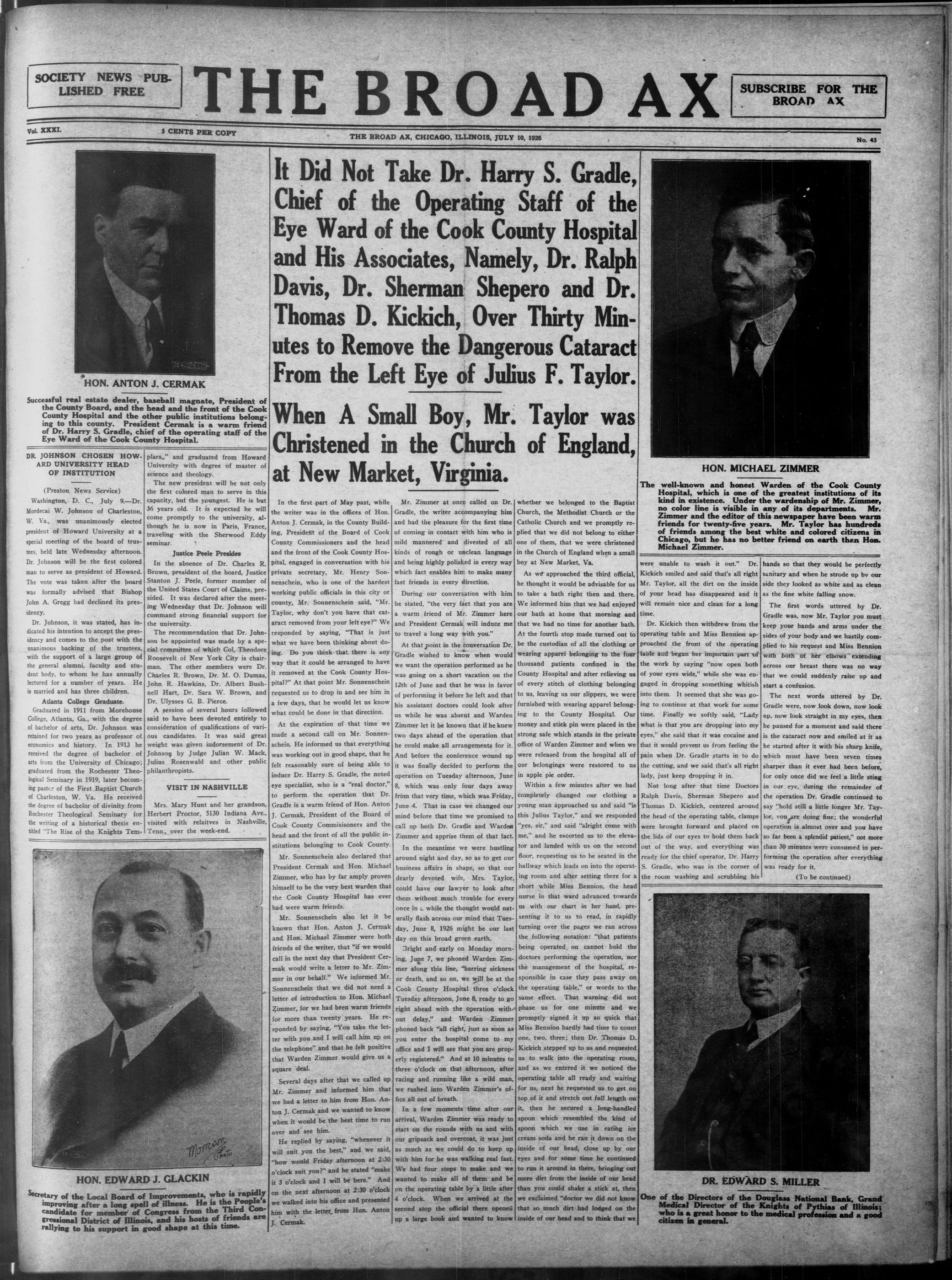
It Did Not Take Dr. Harry S. Gradle, Chief of the Operating Staff of the Eye Ward of the Cook County Hospital and His Associates, Namely, Dr. Ralph Davis, Dr. Sherman Shepero and Dr. Thomas D. Kickich, Over Thirty Minutes to Remove the Dangerous Cataract From the Left Eye of Julius F. Taylor.
When A Small Boy, Mr. Taylor was Christened in the Church of England, at New Market, Virginia.
In the first part of May past, while the writer was in the offices of Hon. Anton J. Cermak, in the County Building, President of the Board of Cook County Commissioners and the head and the front of the Cook County Hospital, engaged in conversation with his private secretary, Mr. Henry Sonnenschein, who is one of the hardest working public officials in this city or county, Mr. Sonnenschein said, "Mr. Taylor, why don't you have that cataract removed from your left eye?" We responded by saying, "That is just what we have been thinking about doing. Do you think that there is any way that it could be arranged to have it removed at the Cook County Hospital?" At that point Mr. Sonnenschein requested us to drop in and see him in a few days, that he would let us know what could be done in that direction.
At the expiration of that time we made a second call on Mr. Sonnenschein. He informed us that everything was working out in good shape, that he felt reasonably sure of being able to induce Dr. Harry S. Gradle, the noted eye specialist, who is a "real doctor," to perform the operation that Dr. Gradle is a warm friend of Hon. Anton J. Cermak, President of the Board of Cook County Commissioners and the head and the front of all the public institutions belonging to Cook County. Mr. Sonnenschein also declared that President Cermak and Hon. Michael Zimmer, who has by far amply proven himself to be the very best warden that the Cook County Hospital has ever had were warm friends.
Mr. Sonnenschein also let it be known that Hon. Anton J. Cermak and Hon. Michael Zimmer were both friends of the writer, that "if we would call in the next day that President Cermak would write a letter to Mr. Zimmer in our behalf." We informed Mr. Sonnenschein that we did not need a letter of introduction to Hon. Michael Zimmer, for we had been warm friends for more than twenty years. He responded by saying, "You take the letter with you and I will call him up on the telephone" and that he felt positive that Warden Zimmer would give us a square deal.
Several days after that we called up Mr. Zimmer and informed him that we had a letter to him from Hon. Anton J. Cermak and we wanted to know when it would be the best time to run over and see him.
He replied by saying, "whenever it will suit you the best," and we said, "how would Friday afternoon at 2:30 o'clock suit you?" and he stated "make it 3 o'clock and I will be here." And on the next afternoon at 2:30 o'clock we walked into his office and presented him with the letter from Hon. Anton J. Cermak.
Mr. Zimmer at once called on Dr. Gradle, the writer accompanying him and had the pleasure for the first time of coming in contact with him who is mild mannered and divested of all kinds of rough or unclean language and being highly polished in every way which fact enables him to make many fast friends in every direction.
During our conversation with him he stated, "the very fact that you are a warm friend of Mr. Zimmer here and President Cermak will induce me to travel a long way with you."
At that point in the conversation Dr. Gradle wished to know when would we want the operation performed as he was going on a short vacation on the 12th of June and that he was in favor of performing it before he left and that his assistant doctors could look after us while he was absent and Warden Zimmer let it be known that if he knew two days ahead of the operation that he could make all arrangements for it. And before the conference wound up it was finally decided to perform the operation on Tuesday afternoon, June 8, which was only four days away from that very time, which was Friday, June 4. That in case we changed our mind before that time we promised to call up both Dr. Gradle and Warden Zimmer and apprise them of that fact.
In the meantime we were hustling around night and day, so as to get our business affairs in shape, so that our dearly devoted wife, Mrs. Taylor could have our lawyer to look after them without much trouble for every once in a while the thought would naturally flash across our mind that Tuesday, June 8, 1926 might be our last day on this broad green earth.
Bright and early on Monday morning, June 7, we phoned Warden Zimmer along this line, "barring sickness or death, and so on, we will be at the Cook County Hospital three o'clock Tuesday afternoon, June 8, ready to go right ahead with the operation without delay," and Warden Zimmer phoned back "all right, just as soon as you enter the hospital come to my office and I will see that you are properly registered." And at 10 minutes to three o'clock on that afternoon, after racing and running like a wild man, we rushed into Warden Zimmer's office all out of breath.
In a few moments time after our arrival, Warden Zimmer was ready to start on the rounds with us and with our gripsack and overcoat, it was just as much as we could do to keep up with him for he was walking real fast. We had four stops to make and we wanted to make all of them and be on the operating table by a little after 4 o'clock. When we arrived at the second stop the official there opened up a large book and wanted to know
whether we belonged to the Baptist Church, the Methodist Church or the Catholic Church and we promptly replied that we did not belong to either one of them, that we were christened in the Church of England when a small boy at New Market, Va.
As we approached the third official, he thought it would be advisable for us to take a bath right then and there. We informed him that we had enjoyed our bath at home that morning and that we had no time for another bath. At the fourth stop made turned out to be the custodian of all the clothing or wearing apparel belonging to the four thousand patients confined in the County Hospital and after relieving us of every stitch of clothing belonging to us, leaving us our slippers, we were furnished with wearing apparel belonging to the County Hospital. Our money and stick pin were placed in the strong safe which stands in the private office of Warden Zimmer and when we were released from the hospital all of our belongings were restored to us in apple pie order.
Within a few minutes after we had completely changed our clothing a young man approached us and said "is this Julius Taylor," and we responded "yes, sir," and said "alright come with me," and he escorted us to the elevator and landed with us on the second floor, requesting us to be seated in the hallway which leads on into the operating room and after setting there for a short while Miss Bennion, the head nurse in that ward advanced towards us with our chart in her hand, presenting it to us to read, in rapidly turning over the pages we ran across the following notation: "that patients being operated, on cannot hold the doctors performing the operation, nor the management of the hospital, responsible in case they pass away on the operating table," or words to the same effect. That warning did not phase us for one minute and we promptly signed it up so quick that Miss Bennion hardly had time to count one, two, three; then Dr. Thomas D. Kickich stepped up to us and requested us to walk into the operating room, and as we entered it we noticed the operating table all ready and waiting for us, next he requested us to get on top of it and stretch out full length on it, then he secured a long-handled spoon which resembled the kind of spoon which we use in eating ice cream soda and he ran it down on the inside of our head, close up by our eyes and for some time he continued to run it around in there, bringing out more dirt from the inside of our head than you could shake a stick at, then we exclaimed "doctor we did not know that so much dirt had lodged on the inside of our head and to think that we
M.
M. B.
HON. MICHAEL ZIMMER
The well-known and honest Hospital, which is one of kind in existence. Under no color line is visible in Zimmer and the editor of the friends for twenty-five year of friends among the best Chicago, but he has no be Michael Zimmer.
n and best Warden of the which is one of the greatest in instance. Under the wardenship one is visible in any of its dep and the editor of this newspaper he twenty-five years. Mr. Taylor among the best white and col but he has no better friend on e ammer.
The well-known and honest Warden of the Cook County Hospital, which is one of the greatest institutions of its kind in existence. Under the wardenship of Mr. Zimmer, no color line is visible in any of its departments. Mr. Zimmer and the editor of this newspaper have been warm friends for twenty-five years. Mr. Taylor has hundreds of friends among the best white and colored citizens in Chicago, but he has no better friend on earth than Hon. Michael Zimmer.
were unable to wash it out." Dr. Kickich smiled and said that's all right Mr. Taylor, all the dirt on the inside of your head has disappeared and it will remain nice and clean for a long time.
hands so that they would be perfectly sanitary and when he strode up by our side they looked as white and as clean as the fine white falling snow.
The first words uttered by Dr. Gradle was now Mr. Taylor you must
Dr. Kickich then withdrew from the operating table and Miss Bennion approached the front of the operating table and began her important part of the work by saying "now open both of your eyes wide," while she was engaged in dropping something whitish into them. It seemed that she was going to continue at that work for some time. Finally we softly said, "Lady what is that you are dropping into my eyes," she said that it was cocaine and that it would prevent us from feeling the pain when Dr. Gradle starts in to do the cutting, and we said that's all right lady, just keep dropping it in.
Not long after that time Doctors Ralph Davis, Sherman Shepero and Thomas D. Kickich, centered around the head of the operating table, clamps were brought forward and placed on the lids of our eyes to hold them back out of the way, and everything was ready for the chief operator, Dr. Harry S. Gradle, who was in the corner of the room washing and scrubbing his
1930
P.
DR. EDWARD S. MILLER
One of the Directors of the I Medical Director of the who is a great honor to the citizen in general.
directors of the Douglass Nationa director of the Knights of Pyth great honor to the medical profes general.
One of the Directors of the Douglass National Bank, Grand Medical Director of the Knights of Pythias of Illinois; who is a great honor to the medical profession and a good citizen in general.
One of the Directors of the Douglass National Bank, Grand Medical Director of the Knights of Pythias of Illinois; who is a great honor to the medical profession and a good citizen in general.
SUBSCRIBE FOR THE BROAD AX
No. 43
honest Warden of the Cook County one of the greatest institutions of its under the wardenship of Mr. Zimmer, in any of its departments. Mr. or of this newspaper have been warm five years. Mr. Taylor has hundreds the best white and colored citizens in no better friend on earth than Hon.
Dr. all right inside and it a long from the ion ap- perating part of both was en- whitish hands so that they would be perfectly sanitary and when he strode up bv our side they looked as white and as clean as the fine white falling snow.
The first words uttered by Dr. Gradle was, now Mr. Taylor you must keep your hands and arms under the sides of your body and we hastily complied to his request and Miss Bennion with both of her elbows extending across our breast there was no way that we could suddenly raise up and start a confusion.
The next words uttered by Dr. Gradle were, now look down, now look up, now look straight in my eyes, then he paused for a moment and said there is the cataract now and smiled at it as he started after it with his sharp knife, which must have been seven times sharper than it ever had been before, for only once did we feel a little sting in our eye, during the remainder of the operation Dr. Gradle continued to say "hold still a little longer Mr. Taylor, von are doing fine; the wonderful operation is almost over and you have so far been a splendid patient," not more than 30 minutes were consumed in performing the operation after everything was ready for it.
(To be continued)
1930
the Douglass National Bank, Grand the Knights of Pythias of Illinois; to the medical profession and a good
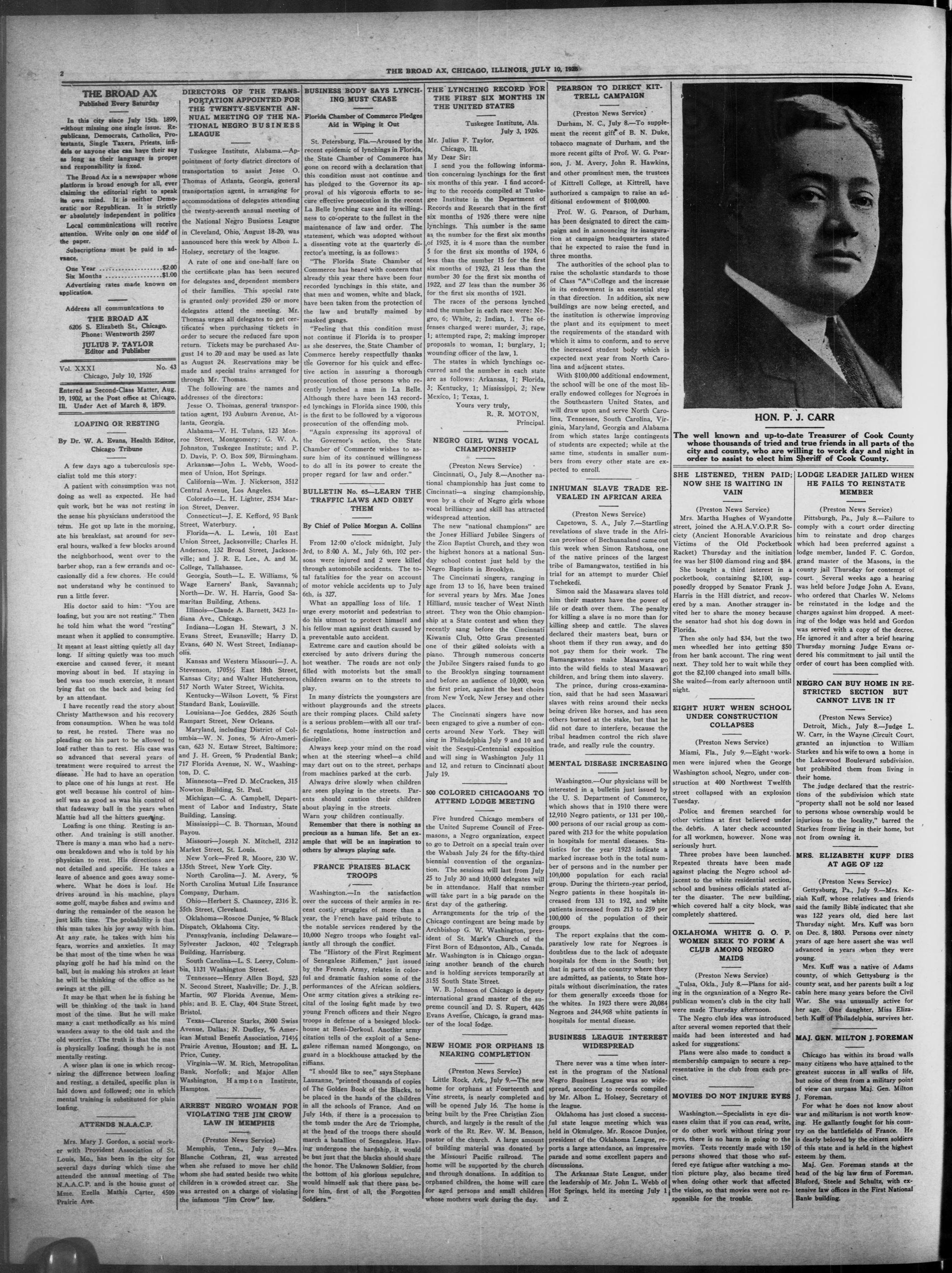
THE BROAD AX Published Every Saturday
In this city since July 15th, 1899, without missing one single issue. Republicans, Democrats, Catholics, Protestants, Single Taxes, Priests, infidels or anyone else can have their say as long as their language is proper and responsibility is fixed.
The Broad Ax is a newspaper whose platform is broad enough for all, ever claiming the editorial right to speak its own mind. It is neither Democratic nor Republican. It is strictly or absolutely independent in politics Local communications will receive attention. Write only on one side of the paper.
Subscriptions must be paid in advance.
Vol. XXXI No. 43
Chicago, July 10, 1926
Entered as Second-Class Matter, Aug.
19, 1902, at the Post office at Chicago.
Ill. Under Act of March 8, 1879.
LOAFING OR RESTING
By Dr. W. A. Evans, Health Editor Chicago Tribune
A few days ago a tuberculosis specialist told me this story:
A patient with consumption was not doing as well as expected. He had quit work, but he was not resting in the sense his physicians understood the term. He got up late in the morning, ate his breakfast, sat around for several hours, walked a few blocks around the neighborhood, went over to the barber shop, ran a few errands and occasionally did a few chores. He could not understand why he continued to run a little fever.
His doctor said to him: "You are loafing, but you are not resting." Then he told him what the word "resting" meant when it applied to consumptive. It meant at least sitting quietly all day long. If sitting quietly was too much exercise and caused fever, it meant moving about in bed. If staying in bed was too much exercise, it meant lying flat on the back and being fed by an attendant.
I have recently read the story about Christy Matthewson and his recovery from consumption. When he was told to rest, he rested. There was no pleading on his part to be allowed to loaf rather than to rest. His case was so advanced that several years of treatment were required to arrest the disease. He had to have an operation to place one of his lungs at rest. He got well because his control of himself was as good as was his control of that fadeaway ball in the years when Mattie had all the hitters guessing.
Loafing is one thing. Resting is another. And training is still another. There is many a man who had a nervous breakdown and who is told by his physician to rest. His directions are not detailed and specific. He takes a leave of absence and goes away somewhere. What he does is loaf. He drives around in his machine, plays some golf, maybe fishes and swims and during the remainder of the season he just kills time. The probability is that this man takes his joy away with him. At any rate, he takes with him his fears, worries and anxieties. It may be that most of the time when he was playing golf he had his mind on the ball, but in making his strokes at least he will be thinking of the office as he swings at the pill.
It may be that when he is fishing he will be thinking of the task in hand most of the time. But he will make many a cast methodically as his mind wanders away to the old task and the old worries. The truth is that the man is physically loafing, though he is not mentally resting. A wiser plan is one in which recognizing the difference between loafing and resting, a detailed, specific plan is laid down and followed; one in which mental training is substituted for plain loafing.
ATTENDS N.A.A.C.P
Mrs. Mary J. Gordon, a social worker with Provident Association of St. Louis, Mo., has been in the city for several days during which time she attended the annual meeting of The M.A.A.C.P. and is the house guest of Mme. Ezella Mathis Carter, 4509 Prairie Ave.
DIRECTORS OF THE TRANSPORTATION APPOINTED FOR THE TWENTY-SEVENTH ANNUAL MEETING OF THE NATIONAL NEGRO BUSINESS LEAGUE
Tuskegee Institute, Alabama.—Appointment of forty district directors of transportation to assist Jesse O. Thomas of Atlanta, Georgia, general transportation agent, in arranging for accommodations of delegates attending the twenty-seventh annual meeting of the National Negro Business League in Cleveland, Ohio, August 18-20, was announced here this week by Albon L. Holsey, secretary of the league.
A rate of one and one-half fare on the certificate plan has been secured for delegates and dependent members of their families. This special rate is granted only provided 250 or more delegates attend the meeting. Mr. Thomas urges all delegates to get certificates when purchasing tickets in order to secure the reduced fare upon return. Tickets may be purchased August 14 to 20 and may be used as late as August 24. Reservations may be made and special trains arranged for through Mr. Thomas.
The following are the names and addresses of the directors:
Jesse O. Thomas, general transportation agent, 193 Auburn Avenue, Atlanta, Georgia.
Alabama—V. H. Tulans, 123 Monroe Street, Montgomery; G. W. A. Johnston, Tuskegee Institute; and P. D. Davis, P. O. Box 509, Birmingham. Arkansas—John L. Webb, Woodmen of Union, Hot Springs. California—Wm. J. Nickerson, 3512 Central Avenue, Los Angeles. Colorado—L. H. Lighter, 2534 Marion Street, Denver.
Connecticut—J. E. Kefford, 95 Bank Street, Waterbury. Florida—A. L. Lewis, 101 East Union Street, Jacksonville; Charles H. Anderson, 132 Broad Street, Jacksonville; and J. R. E. Lee., A. and M. College, Tallahassee. Georgia, South—L. E. Williams, % Wage Earners' Bank, Savannah; North—Dr. W. H. Harris, Good Samaritan Building, Athens. Illinois—Claude A. Barnett, 3423 Indiana Ave., Chicago. Indiana—Logan H. Stewart, 3 N. Evans Street, Evansville; Harry D. Evans, 640 N. West Street, Indianapolis. Kansas and Western Missouri—J. A. Stevenson, 1705% East 18th Street, Kansas City; and Walter Hutcherson, 517 North Water Street, Wichita.
Louisiana—Joe Geddes, 2826 South Rampart Street, New Orleans.
Maryland, including District of Columbia—W. N. Jones, % Afro-American, 623 N. Eutaw Street, Baltimore; and J. H. Green, % Prudential Bank; 717 Florida Avenue, N. W., Washington, D. C.
Minnesota—Fred D. McCracken, 315 Newton Building, St. Paul.
Michigan—C. A. Campbell, Department of Labor and Industry, State Building, Lansing.
Mississippi—C. B. Thorman, Mound Bayou.
New York—Fred R. Moore, 230 W.
135th Street, New York City.
North Carolina—J. M. Avery, %
North Carolina Mutual Life Insurance
Company, Durham.
Ohio—Herbert S. Chauncey, 2316 E.
55th Street, Cleveland.
Oklahoma—Roscoe Dunjee, % Black
Dispatch, Oklahoma City.
Pennsylvania, including Delaware—
Sylvester Jackson, 402 Telegraph
Building, Harrisburg.
South Carolina—L. S. Leevy, Columbia,
1131 Washington Street.
Tennessee—Henry Allen Boyd, 523
N. Second Street, Nashville; J. B. J.
Martin, 907 Florida Avenue, Memphis; and B. E. Clay, 404 State Street, Bristol.
Texas—Clarence Starks, 2600 Swiss Avenue, Dallas; N. Dudley, % American Mutual Benefit Association, 714% Prairie Avenue, Houston; and H. L. Price, Cuney.
Virginia—W. M. Rich, Metropolitan Bank, Norfolk; and Major Allen Washington, Hampton Institute, Hampton.
ARREST NEGRO WOMAN FOR VIOLATING THE JIM CROW LAW IN MEMPHIS
(Preston News Service)
Memphis, Tenn., July 9—Mrs. Blanche Cothran, 21, was arrested when she refused to move her child whom she had seated beside two white children in a crowded street car. She was arrested on a charge of violating the infamous "Jim Crow" law.
THE BROAD AX, CHICAGO, ILLINOIS, JULY 10, 1928
BUSINESS BODY SAYS LYNCHING MUST CEASE
St. Petersburg, Fla.—Aroused by the recent epidemic of lynchings in Florida, the State Chamber of Commerce has gone on record with a declaration that this condition must not continue and has pledged to the Governor its approval of his vigorous efforts to secure effective prosecution in the recent La Belle lynching case and its willingness to co-operate to the fullest in the maintenance of law and order. The statement, which was adopted without a dissenting vote at the quarterly director's meeting, is as follows:
"The Florida State Chamber of Commerce has heard with concern that already this year there have been four recorded lynchings in this state, and that men and women, white and black, have been taken from the protection of the law and brutally maimed by masked gangs.
"Feeling that this condition must not continue if Florida is to prosper as she deserves, the State Chamber of Commerce hereby respectfully thanks the Governor for his quick and effective action in assuring a thorough prosecution of those persons who recently lynched a man in La Belle. Although there have been 143 recorded lynchings in Florida since 1900, this is the first to be followed by a vigorous prosecution of the offending mob.
"Again expressing its approval of the Governor's action, the State Chamber of Commerce wishes to assure him of its continued willingness to do all in its power to create the proper regard for law and order."
BULLETIN No. 65—LEARN THE
TRAFFIC LAWS AND OBEY
THEM
By Chief of Police Morgan A. Collins
From 12:00 o'clock midnight, July 3rd, to 8:00 A. M., July 6th, 102 persons were injured and 2 were killed through automobile accidents. The total fatalities for the year on account of motor vehicle accidents up to July 6th, is 327.
What an appalling loss of life. I urge every motorist and pedestrian to do his utmost to protect himself and his fellow man against death caused by a preventable auto accident.
Extreme care and caution should be exercised by auto drivers during the hot weather. The roads are not only filled with motorists but the small children swarm on to the streets to play.
In many districts the youngsters are without playgrounds and the streets are their romping places. Child safety is a serious problem—with all our traffic regulations, home instruction and discipline.
Always keep your mind on the road when at the steering wheel—a child may dart out on to the streets, perhaps from machines parked at the curb.
Always drive slowly when children are seen playing in the streets. Parents should caution their children about playing in the streets.
Warn your children continually.
Remember that there is nothing as precious as a human life. Set an example that will be an inspiration to others by always playing safe.
FRANCE PRAISES BLACK
TROOPS
Washington.—In the satisfaction over the success of their armies in recent costly struggles of more than a year, the French have paid tribute to the notable services rendered by the 10,000 Negro troops who fought valiantly all through the conflict.
The "History of the First Regiment of Senegalese Riflemen," just issued by the French Army, relates in colorful and dramatic fashion some of the performances of the African soldiers. One army citation gives a striking recital of the losing fight made by two young French officers and their Negro troops in defense of a besieged blockhouse at Beni-Derkoul. Another army citation tells of the exploit of a Senegalese rifleman named Mongongo, on guard in a blockhouse attacked by the riffians.
"I should like to see," says Stephane Lauzanne, "printed thousands of copies of The Golden Book of the Blacks, to be placed in the hands of the children in all the schools of France. And on July 14th, if there is a procession to the tomb under the Arc de Triomphe, at the head of the troops there should march a batallion of Senegalese. Having undergone the hardship, it would be but just that the blacks should share the honor. The Unknown Soldier, from the bottom of his glorious sepulchre, would himself ask that there pass before him, first of all, the Forgotten Soldier."
THE LYNCHING RECORD FOR
THE FIRST SIX MONTHS IN
THE UNITED STATES
Tuskegee Institute, Ala.
July 3, 1926.
Mr. Julius F. Taylor,
The races of the persons lynched and the number in each race were: Negro, 6; White, 2; Indian, 1. The offenses charged were: murder, 3; rape, 1; attempted rape, 2; making improper proposals to woman, 1; burglary, 1; wounding officer of the law, 1.
The states in which lynchings occurred and the number in each state are as follows: Arkansas, 1; Florida, 3; Kentucky, 1; Mississippi, 2; New Mexico, 1; Texas, 1.
NEGRO GIRL WINS VOCAL
CHAMPIONSHIP
(Preston News Service)
Cincinnati, O., July 8.—Another national championship has just come to Cincinnati—a singing championship, won by a choir of Negro girls whose vocal brilliance and skill has attracted widespread attention.
The new "national champions" are the Jones Hilliard Jubilee Singers of the Zion Baptist Church, and they won the highest honors at a national Sunday school contest just held by the Negro Baptists in Brooklyn.
The Cincinnati singers, ranging in age from 13 to 16, have been trained for several years by Mrs. Mae Jones Hilliard, music teacher of West Ninth street. They won the Ohio championship at a State contest and when they recently sang before the Cincinnati Kiwanis Club, Otto Grau presented one of their gifted soloists with a piano. Through numerous concerts the Jubilee Singers raised funds to go to the Brooklyn singing tournament and before an audience of 10,000, won the first prize, against the best choirs from New York, New Jersey and other places.
The Cincinnati singers have now been engaged to give a number of concerts around New York. They will sing in Philadelphia July 9 and 10 and visit the Sesqui-Centennial exposition and will sing in Washington July 11 and 12, and return to Cincinnati about July 19.
500 COLORED CHICAGOANS TO
ATTEND LODGE MEETING
Five hundred Chicago members of the United Supreme Council of Freemasons, a Negro organization, expect to go to Detroit on a special train over the Wabash July 24 for the fifty-third biennial convention of the organization. The sessions will last from July 25 to July 30 and 10,000 delegates will be in attendance. Half that number will take part in a big parade on the first day of the gathering.
Arrangements for the trip of the Chicago contingent are being made by Archbishop G. W. Washington, president of St. Mark's Church of the First Born of Edmonton, Alb., Canada. Mr. Washington is in Chicago organizing another branch of the church and is holding services temporarily at 3155 South State Street.
W. B. Johnson of Chicago is deputy international grand master of the supreme council and D. S. Rupert, 4426 Evans Avenue, Chicago, is grand master of the local lodge.
NEW HOME FOR ORPHANIS
NEARING COMPLETION
[Pastor News Service]
Little Rock, Ark, July 19.—The new home for orphans at Fourteenth and Vine streets, is nearly completed and will be opened July 16. The home is being built by the Free Christian Zion church, and largely is the result of the work of the Rt. Rev. W. M. Benson, pastor of the church. A large amount of building material was donated by the Missouri Pacific railroad. The home will be supported by the church and through donations. In addition to orphaned children, the home will care for aged persons and small children whose mothers work during the day.
PEARSON TO DIRECT KIT-
TRELL CAMPAIGN
Durham, N. C., July 8.—To supplement the recent gift of B. N. Duke, tobacco magnate of Durham, and the more recent gifts of Prof. W. G. Pearson, J. M. Avery, John R. Hawkins, and other prominent men, the trustees of Kittrell College, at Kittrell, have authorized a campaign to raise an additional endowment of $100,000.
Prof. W. G. Pearson, of Durham, has been designated to direct the campaign and in announcing its inauguration at campaign headquarters stated that he expected to raise the fund in three months.
The authorities of the school plan to raise the scholastic standards to those of Class "A" College and the increase in its endowment is an essential step in that direction. In addition, six new buildings are now being erected, and the institution is otherwise improving the plant and its equipment to meet the requirements of the standard with which it aims to conform, and to serve the increased student body which is expected next year from North Carolina and adjacent states.
With $100,000 additional endowment, the school will be one of the most liberally endowed colleges for Negroes in the Southeastern United States, and will draw upon and serve North Carolina, Tennessee, South Carolina, Virginia, Maryland, Georgia and Alabama from which states large contingents of students are expected; while at the same time, students in smaller numbers from every other state are expected to enroll.
INHUMAN SLAVE TRADE REVEALED IN AFRICAN AREA
(Preston News Service)
Capetown, S. A., July 7.—Startling revelations of slave trade in the African province of Bechuanaland came out this week when Simon Ratshosa, one of the native princes of the largest tribe of Bamangwatos, testified in his trial for an attempt to murder Chief Tschekedi.
Simon said the Masawara slaves told him their masters have the power of life or death over them. The penalty for killing a slave is no more than for killing sheep and cattle. The slaves declared their masters beat, burn or shoot them if they run away, and do not pay them for their work. The Bamangawatos make Masawara go into the wild fields to steal Masawari children, and bring them into slavery. The prince, during cross-examination, said that he had seen Masawari slaves with reins around their necks being driven like horses, and has seen others burned at the stake, but that he did not dare to interfere, because the tribal headmen control the rich slave trade, and really rule the country.
MENTAL DISEASE INCREASING
Washington.—Our physicians will be interested in a bulletin just issued by the U. S. Department of Commerce, which shows that in 1910 there were 12,910 Negro patients, or 131 per 100,000 persons of our racial group as compared with 213 for the white population in hospitals for mental diseases. Statistics for the year 1923 indicate a marked increase both in the total number of persons and in the number per 100,000 population for each racial group. During the thirteen-year period, Negro patients in these hospitals increased from 131 to 192, and white patients increased from 213 to 259 per 100,000 of the population of their groups.
The report explains that the comparatively low rate for Negroes is doubtless due to the lack of adequate hospitals for them in the South; but that in parts of the country where they are admitted, as patients, to State hospitals without discrimination, the rates for them generally exceeds those for the whites. In 1923 there were 20,084 Negroes and 244,968 white patients in hospitals for mental disease.
BUSINESS LEAGUE INTEREST
WIDESPREAD
There never was a time when interest in the program of the National Negro Business League was so widespread, according to records compiled by Mr. Albon L. Holsey, Secretary of the league.
Oklahoma has just closed a successful state league meeting which was held in Okmulgee, Mr. Roscoe Dunjee, president of the Oklahoma League, reports a large attendance, an impressive parade and some excellent papers and discussions.
The Arkansas State League, under the leadership of Mr. John L. Webb of Hot Springs, held its meeting July 1 and 2.
PETER H. HARRIS
HON. P. J. CARR
The well known and up-to-date whose thousands of tried an city and county, who are w order to assist to elect him
SHE LISTENED, THEN PAID; NOW SHE IS WAITING IN VAIN
(Preston News Service)
Mrs. Martha Hughes of Wyandotte street, joined the A.H.A.V.O.P.R Society (Ancient Honorable Avaricious Victims of the Old Pocketbook Racket) Thursday and the initiation fee was her $100 diamond ring and $84.
She bought a third interest in a pocketbook, containing $2,100, supposedly dropped by Senator Frank J. Harris in the Hill district, and recovered by a man. Another stranger invited her to share the money because the senator had shot his dog down in Florida.
The well known and up-to-date Treasurer of Cook County whose thousands of tried and true friends in all parts of the city and county, who are willing to work day and night in order to assist to elect him Sheriff of Cook County.
Then she only had $24, but the two men wheedled her into getting $50 from her bank account. The ring went next. They told her to wait while they got the $2,100 changed into small bills. She waited—from early afternoon until night.
EIGHT HURT WHEN SCHOOL
UNDER CONSTRUCTION
COLLAPSES
Miami, Fla., July 9.—Eight workmen were injured when the George Washington school, Negro, under construction at 400 Northwest Twelfth street collapsed with an explosion Tuesday.
Police and firemen searched for other victims at first believed under the debris. A later check accounted for all workmen, however. None was seriously hurt.
Three probes have been launched. Repeated threats have been made against placing the Negro school adjacent to the white residential section, school and business officials stated after the disaster. The new building, which covered half a city block, was completely shattered.
OKLAHOMA WHITE G. O. P WOMEN SEEK TO FORM A CLUB AMONG NEGRO MAIDS
(Preston News Service)
Tulsa, Okla., July 8.—Plans for aiding in the organization of a Negro Republican women's club in the city hall were made Thursday afternoon.
The Negro club idea was introduced after several women reported that their maids had been interested and had asked for suggestions.
Plans were also made to conduct a membership campaign to secure a representative in the club from each precinct.
MOVIES DO NOT INJURE EYES
Washington.—Specialists in eye diseases claim that if you can read, write, or do other work without tiring your eyes, there is no harm in going to the movies. Tests recently made with 150 persons showed that those who suffered eye fatigue after watching a motion picture play, also became tired when doing other work that affected the vision, so that movies were not responsible for the trouble.
ate Treasurer of Cook County
and true friends in all parts of the
tilling to work day and night in
Sheriff of Cook County.
LODGE LEADER JAILED WHEN
HE FAILS TO REINSTATE
MEMBER
(Preston News Service)
Pittsburgh, Pa., July 8.—Failure to comply with a court order directing him to reinstate and drop charges which had been preferred against a lodge member, landed F. C. Gordon, grand master of the Masons, in the county jail Thursday for contempt of court. Several weeks ago a hearing was held before Judge John A. Evans, who ordered that Charles W. Neloms be reinstated in the lodge and the charges against him dropped. A meeting of the lodge was held and Gordon was served with a copy of the decree. He ignored it and after a brief hearing Thursday morning Judge Evans ordered his commitment to jail until the order of court has been complied with.
NEGRO CAN BUY HOME IN RE
STRICTED SECTION BUT
CANNOT LIVE IN IT
Detroit, Mich., July 8.—Judge L. W. Carr, in the Wayne Circuit Court, granted an injunction to William Starkes and his wife to own a home in the Lakewood Boulevard subdivision, but prohibited them from living in their home.
The judge declared that the restrictions of the subdivision which state "property shall not be sold nor leased to persons whose ownership would be injurious to the locality," barred the Starkes from living in their home, but not from owning it.
MRS. ELIZABETH KUFF DIES
AT AGE OF 122
Gettysburg, Pa., July 9.—Mrs. Keziah Kuff, whose relatives and friends said the family Bible indicated that she was 122 years old, died here last Thursday night. Mrs. Kuff was born on Dec. 8, 1803. Persons over ninety years of age here assert she was well advanced in years when they were young.
Mrs. Kuff was a native of Adams county, of which Gettysburg is the county seat, and her parents built a log cabin here many years before the Civil War. She was unusually active for her age. One daughter, Miss Elizabeth Kuff of Philadelphia, survives her.
MAJ. GEN. MILTON J. FOREMAN
Chicago has within its broad walls many citizens who have attained to the greatest success in all walks of life, but none of them from a military point of view can surpass Maj. Gen. Milton J. Foreman. For what he does not know about war and militarism is not worth knowing. He gallantly fought for his country on the battlefields of France. He is dearly beloved by the citizen soldiers of this state and is held in the highest esteem by them. Maj. Gen. Foreman stands at the head of the big law firm of Foreman, Blunford, Steele and Schultz, with extensive law offices in the First National Bank building.
```markdown
```
New York, July 9.—Alice Jones Rhinelander has at last made reservations for her long-contemplated trip to Europe. She plans to sail July 17 on the Majestic. In view of the fact that her aristocratic young husband, Leonard Kip Rhinelander, who tried in vain to obtain an annulment is aboard, his friends fear they see in this a move toward reconciliation.
Mrs. Rhinelander could not be reached Thursday, but friends prophesied a romantic reunion in Paris as the next big adventure in the lives of these two young Americans.
REV. R. D. BROWN JAILED ON
IMMORALITY CHARGE
(Preston News Service)
Greenville, N. C., July 8—Rev. R. D. Brown, pastor of a Holiness church on the outskirts of Greenville, is being held in the county jail here in default of bond on a charge of immorality. Brown is alleged to have had improper relations with a 17-year-old member of his congregation. He vigorously denied the charge when arrested by county officials a few days ago. He was given preliminary hearing before Magistrate Tyson, being remanded to jail in default of $250 bond.
ALFRED JONES COMMITS SUIT
CIDE BY SHOOTING SELF
(Preston News Service)
Pittsburgh, Pa., July 8.—Alfred Jones, 39 years old, died in Passavant Hospital, last night as the result of attempting to end his life shortly before 3 o'clock Thursday afternoon in a rooming house at 608 Protector place. The man, police said, shot himself in the right temple with a .22 caliber revolver. Ill health is believed to have been the motive of the shooting.
GREAT SUCCESS WITH OUTING
Ft. Dearborn Elks, No. 44, under the auspices of The Marching Club, had one of the greatest three days' outings ever held at Golden Gate Park, Robbins, Ill., on July 3rd, 4th and 5th. The people came from Chicago and almost every suburban town from Indianapolis, Ind., and Milwaukee, Wis. On Monday, the crowd was so great, the eats and drinks ran out before evening.
BAILEY ENTERTAINS FRIENDS
M. T. Bailey, president of The Bailey Realty Co., 3638 S. State St., had as his guest at the picnic at Golden Gate Park, Robbins, Ill., on Monday, July 5th, Miss Mary E. Branch, Mesdames Vita Copeling and P. J. Brown; Mr. and Mrs. H. A. Robinson. A most delightful day was spent by the party.
NEGRO MAKES A PARACHUTE
DROP FROM PLANE NEAR
STUTTGART
(Preston News Service)
Stuttgart, Ark., July 8.—A large crowd saw the parachute drop of John Williams, on the north pike near here Sunday from the plane of H. W. Owens. Williams landed safely in a near-by rice field.
Read
ALL over the then-known wives messengers of ancient edicts of their rulers. Trained these message bearers of a w posts, stripped for the task, p whatever was given them to so
The universal message bear nation-wide range has come all of wires, cables, switchboards. Through the co-operation of it daily transmits the thought.
It is because of unceasing in nation and all else that makes icans to-day, anywhere, can
ALL over the then-known world the runners and mounted messengers of ancient Assyria bore the decrees and edicts of their rulers. Trained for fleetness and endurance, these message bearers of a vanished empire stood at their posts, stripped for the task, prepared for instant dispatch of whatever was given them to speed to distant points.
It is because of unceasing inspection, watchfulness, co-ordination and all else that makes for instant readiness that Americans to-day, anywhere, can talk to one another, any time.
ILLINOIS BELL TELEPHONE COMPANY
BELL SYSTEM
One Policy • One System • Universal Service
1876—THE TELEPHONE'S FIFTIETH YEAR—1976
1876—THE TELEPHONE'S FIFTIETH YEAR—1926
BEST BUILDING
IN THE WORLD
1956
SUNDAY EVENING CLUB
Mr. Anthony Overton will be the principal' speaker at the Sunday Evening Club of Metropolitan Community Center on Sunday, July 11th, at 7:45 P. M. The program promises to be most interesting and we invite all of our friends to be present—Sandy W. Trice, Com.
Don't forget the Red Caps' Picnic on Tuesday, July 27th.
MR. BAILEY IN CITY
Jacob Bailey of Clayton, Mo., a member of The Harmony Eight of St Louis, Mo., is in the city filling a week engagement with the singer. While here, Mr. Bailey is the house guest of William Anthony, 3146 Prairie Ave.
RETURNS FROM FLORIDA
Miss Edwina Streeter, 5828 Indiana Ave., who spent ten months at Daytona, Fla., with relatives, has returned to the city. En route Miss Streeter spent a week in Nashville, Tenn., with relatives.
IN WAUKEGAN
Atty. Walter M. Farmer, 184 W. Washington St., and M. T. Bailey, president of The Bailey Realty Co., 3638 S. State St., spent the first of the week in Waukegan, Ill., where they were called on legal matters.
TO MEET IN ATLANTA
The 10th annual session of The Carter Hairdressers Association, of which Mme. Ezella Mathis Carter is president, will be held in Atlanta, Ga., August 11th to 13th.
VISITS NASHVILLE
Miss Etta McGavock, 4425 S. Dearborn St., and her son spent the week end in Nashville, Tenn., as the guest of her friend, Mrs. Pauline Jones.
Dr. and Mrs. Walter N. Thomas have removed from 439 E. 45th Place into their beautiful new home at 5233 S. Michigan Avenue.
Mr. John M. Blackshear, who has been one of the efficient and straightforward clerks in the Local Board of Improvements for many years past, may spend his vacation this summer with some of his friends at Miami, Fla. For more than twenty years Mr. Blackshear has been a constant subscriber to this newspaper.
Windows Placed High
The best light comes from the upper part of the room, not the lower and is needed on a level with the eyes rather than below. This fact makes it possible for an architect to plan his window spaces six or eight inches higher than usual, about two and a half feet from the floor. This extra space in turn gives the housewife an opportunity to make use of the space beneath the window for bookcases, desks, etc.
There You Have It
"Oh, yes," said Donald. "I ken well enqghq what metaphepsics is. When the party wha listens disna ken what the party what speaks means, and when the party wha speaks disna ken what he means himsel", that's metaphepsics."
business
world the runners and mounted
Assyria bore the decrees and
and for fleetness and endurance,
nished empire stood at their
prepared for instant dispatch of
speed to distant points.
Now now is the telephone. Its
about through a far-flung system
and supplementary apparatus.
A vast army of men and women
and desires of millions.
Inspection, watchfulness, co-ordi-
or instant readiness that Amer-
alk to one another, any time.
CHIPS
THE BROAD AX, CHICAGO, ILLINOIS, JULY 10, 1926
SPITE BLAST DESTROYS NEW $400,000 FLA. NEGRO SCHOOL
Eight Workmen Hurt, Bombing Follows the Threats Against Constructing a Building Adjacent to the White Neighborhood
Miami, Fla.—Eight workmen were injured, two perhaps fatally, when the $400,000 three-story George Washington School building for colored under construction at N. W. Fifth avenue and Twelfth street was dynamited and collapsed. The bombing is thought to have been the sequel to numerous threats by whites against the construction of the school, which lies adjacent to the white residential section.
Blast Wrecks Building
The explosion occurred about 10:15 a. m. The injured workmen were pouring concrete into the forms on the third floor. The steel and concrete skeleton of the building gave way and crashed to the earth carrying them with it. They were taken from the twisted wreckage and rushed to the Jackson Memorial Hospital. The seriously injured men were Joe Davis and John Jackson, colored. Four of the other men hurt were colored. They were Lester Rumph, Nathaniel Delancy, Percy Grant and Stepheny Buckman.
Tells of Threats
Ray L. Hamon, white building director, stated that a petition against the construction of the school, signed by many of the white residents in an adjoining neighborhood, had been forwarded to the constructors. A telephone message warning that the building would be dynamited had been received at the headquarters of the construction company during the first week of work on the structure.
No Arrests Made
The building is being built in a center which is the boundary line of colored district and the white district.
Rich Quartz Crystals
Transparent rock crystals are highly valued, and Riverside county, California, gives us some very fine ones, usually from its gem mines. Formerly the world's demand for these pure crystals was supplied mainly from Brazil and Madagascar, until a large and fine supply of them was discovered in the Golden state. In the old Green Mountain mine, in Calaveras county, amidst the gold-bearing gravel of its ancient lava-capped river bed, were found in 1897 a huge lot of enormous quartz crystals, 12 tons of which were sold in one year alone. One titanic crystal found here was surrounded with 47 smaller crystals and weighed over a ton. Some weighed 90 pounds each, and one was 19 by 15 by 14 inches. Most of the larger ones were sent to New York and there cut by special machinery. One of them, cut into a perfect sphere, without a flaw in it, is valued at $3,000. Another is in the Morgan collection in that city. Those from El Dorado county are sometimes prized more highly because they have "phantom"s in them—various enclosed minerals, often of fantastic form.
Trail of Small Change
A Westerner recently spent a week in a New York hotel. He tipped the boy who carried in his grips; then tipped the elevator man, then the water boy, then the chambermaid, then the head waiter for getting him a table, then the waiter who took his order. He paid the hat girl a dime for his hat three times a day after meals; he tipped the bell boy who brought him a paper, the barber who shaved him, the shine artist who gave a lick and a promise to his shoes, the boy who helped him put on his coat and handed him his hat, and the doorman who called a taxi for him. He wound up by tipping the scales and found he had lost five pounds.—Capper's Weekly.
Properly Placed
Miss Eliza Leslie, the sister of the noted artist, had a relative who was a sea captain. He was on his way to the Orient, and suggested to Miss Leslie that he should bring her back a dinner service, painted to her design. She agreed with pleasure, and proceeded to draw a magnificent coat of arms to go on every piece. In order that there should be no mistake, under the design she printed in large letters, "This goes in the middle." Eighteen months later the captain sailed into port with the dinner service. And on every piece, below the gorgeous crest was printed indelibly: "This goes in the middle."
Architect Had Long
Sir Christopher Wren, the famous English architect, died in his sleep on February 23, 1723, during a short nap he was accustomed to take daily after his dinner. He was in his uncley-first year.
Age of the Earth
According to Des Vignoles, there are 200 different computations as to the creation to date. A remarkable calculation was that of Doctor Lightfoot, who gave the actual time of the creation as at 9 a. m. on October 23, 4004 B. C.
Made White Horse Idol
Hernando Cortez, in the year 1525, entered Peten, the northernmost department of Guatemala, on his way from Mexico to Honduras, Eugene Cunningham relates, in Adventure Magazine. He is credited with being the first white man to penetrate those dense jungles and reach Lake Peten-Itza, which in the Mayan tongue was "Haltunna," or "Lake With House," and look upon the busy island city of the Itzae, an offshoot of the advanced Mayas who then peopled Yucatan and Guatemala.
The canek, or lord of the Izae, received the Spaniard with courtesy. He embraced Christianity and pledged allegiance to the Spanish king. Cortez remained for a time at Haltunna, letting his force recover from the hard journey, and when he went on to Honduras he left behind a lame white horse. This animal has furnished the flexible imaginations of Spanish historians with one of their most picturesque myths of "Mysterious Peten."
For the Indians, so the story runs, having never before seen a horse and, understanding only that it was sick, fed it as they would have fed a human invalid of more than ordinary importance. The poor brute did not long survive a diet of cooked meat, fish and birds.
Upon its death the poor Itzae, who had worshiped it as something rather more than mortal, were fearful of Cortez' wrath. So they thought to be fool the conquistadore. They carved from white stone a replica and set it up in their chief temple against Cortez' return.
Even today, say some inhabitants of Flores—the modern town on the site of Ancient Haltunna—the image may be seen at certain times in the waters of Lake Peten-Itza, near the uninhabited island of Santa Barbara, where it sank when the raft transporting it was wrecked. This image, reported by two Franciscans as in the temple in 1618, is often termed the "Sacred White Horse of Peten" and the "Sacred Horse of Guatemala."
Veracity of Witness
Put to Severe Test
The courts in countries of the Far East would not dream of accepting the evidence that satisfies us, yet condemn men to death for reasons that we should consider trifling, according to Rosita Forbes, who tells how the mysterious East solves its crime problem, in an article in Liberty. In Arabia, for instance, Miss Forbes says: "In any important case, the testimony of two eye-witnesses is necessary and these may be tested in a most unpleasant manner. The local imam, or some holy man connected with the mosque, heats a long strip of metal in a brazier. When the end is white-hot, it is laled on the tongue of the witness. If it burns him, he is a lair. If it has no effect, he is speaking the truth.
"I have seen this test justify its existence," writes Miss Forbes, "for the metal rests on the tongue for only the fraction of a second. The truthful man is not afraid and the saliva in his mouth saves him from a burn. The false witness is terrified and his mouth goes so dry that the first touch scalds his tongue!"
Mind Is a Garden
Your mind is not at all like a machine—all ready-made and automatic. Ask any doctor and he will make this plain to you.
No, your mind is more like a garden. It is the use you make of it that counts.
You can grow these fine plants in your mind-garden—courage, initiative, imagination, will-power, kindness, knowledge.
You can have a garden of ideas and skills and efficiencles. What a garden Newton must have had! Or Darwin, or Huxley, or Leverhulme, or Pasteur, or Carnegie!
If you let your garden alone it will go to weeds and grass. That is the usual crop—Efficiency Magazine.
Friendship
Perfect friendship is that of good men who resemble each other in virtue; for these, as good themselves, are equal in their desire of good things for one another, and they desire good things for their friends, love them especially for the sake of these things. For they value them for what they are and not for something accidental: The friendship, therefore, of these men endures as long as they are good, for virtue is something stable. And each of them is good in himself and also in relation to his friend, for good men are both good absolutely and useful to each other.—Aristotle.
Qualified
The animal trainer having been taken ill, his wife reported for duty in his stead.
"Have you had any experience in this line?" asked the proprietor of the circus, doubtfully.
"Not exactly in this line," replied the woman; "but my husband manages the beasts all right, doesn't he?"
"He certainly does."
"Well, you ought to see how easily I manage him!"
Business Proposition
As Rastus was reading the sport news in the paper he was interrupted by his husky wife, thus: "Listen, heah, yo! Ah didn't buy you dat paper for entertainment. Jest confine yoself to dem help wanted ads, niggh."
Pone Started a Fashion
Pope Julius II is said to have been the first pope to let his beard grow, and the fashion set by him was soon followed by the Emperor Charles V and many other European rulers.
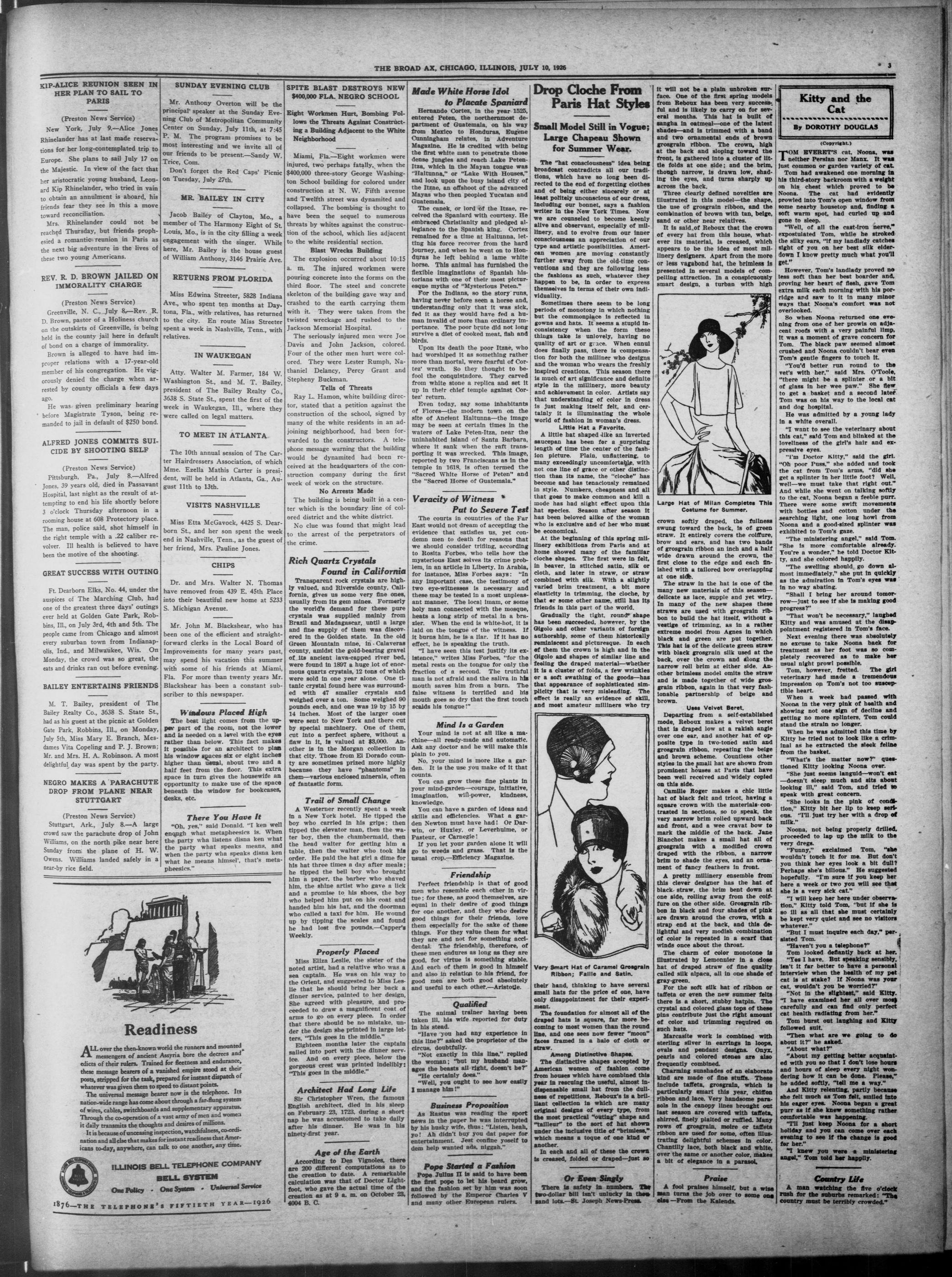
Drop Cloche From Paris Hat Styles
Small Model Still in Vogue; Large Chapeau Shown for Summer Wear.
The "hat consciousness" idea being broadcast contradicts all our traditions, which have so long been directed to the end of forgetting clothes and of being either sincerely or at least politely unconscious of our dress, including our bonnet, says a fashion writer in the New York Times. Now we are counselled to be keenly alive and observant, especially of millinery, and to evolve from our inner consciousness an appreciation of our type and artistic possibilities. American women are moving constantly further away from the old-time conventions and they are following less the fashions as such, whatever they happen to be, in order to express themselves in terms of their own individuality.
Sometimes there seem to be long periods of monotony in which nothing but the commonplace is reflected in gowns and hats. It seems a stupld inconsistency when the form these things take is unlovely, having no quality of art or grace. When ennul does finally pass, there is compensation for both the milliner who designs and the woman who wears the freshly inspired creations. This season there is much of art significance and definite style in the millinery, more beauty and achievement in color. Artists say that understanding of color in dress is just making itself felt, and certainly it is illuminating the whole world of fashion in woman's dress.
Little Hat a Favorite.
A little hat shaped like an inverted saucepan has been for a surprising length of time the center of the fashion picture. Plain, unflattering, to many exceedingly uncomfortable, with not one line of grace or other distinction than its name, the "cloche" has become and has tenaciously remained in style. Numbers, cheapness and all that goes to make common and kill a mode has had slight effect upon this hat species. Season after season it has been beloved alike of the woman who is exclusive and of her who must be economical.
At the beginning of this spring millinery exhibitions from Paris and at home showed many of the familiar cloche shapes. The first were in felt, in beaver, in fitted satin, silk or cloth, and later in straw, or straw combined with silk. With a slightly varied brim treatment, a bit more elasticity in trimming, the cloche, by that or some other name, still has its friends in this part of the world.
Gradually the tight, round shape has been succeeded, however, by the Gigolo and other variants of foreign authorship, some of them historically reminiscent and picturesque. In each of them the crown is high and in the Gigolo and shapes of similar line and feeling the draped material—whether it is a cluster of folds, a few wrinkles or a soft swathing of the goods—has that appearance of sophisticated simplicity that is very misleading. The effect is really an evidence of skill, and most amateur milliners who try
THE HAT
Very Smart Hat of Caramel Grosgrain Ribbon; Faille and Satin.
their hand, thinking to have several small hats for the price of one, have only disappointment for their experiment.
The foundation for almost all of the draped hats is square, far more becoming to most women than the round line, and one sees now fewer "moon" faces framed in a halo of cloth or straw.
Among Distinctive Shapes.
The distinctive shapes accepted by American women of fashion come from houses which have combined this year in rescuing the useful, almost indispensable small hat from the dullness of repetitions. Reboux's is a brilliant collection in which are many original designs of every type, from the most practical "outing" shape and "talleur" to the sort of hat shown under the inclusive title of "brimless," which means a toque of one kind or another. In each and all of these the crown is creased, folded or draped—just so
Or Even Singly
There is safety in numbers. The two-dollar bill isn't unlucky in these sand lots. -St. Joseph News-Press.
it will not be a plain unbroken surface. One of the first spring models from Reboux has been very successful and is likely to carry on for several months. This hat is built of sangha in oatmeal—one of the latest shades—and is trimmed with a band and two ornamental ends of brown grosgrain ribbon. The crown, high at the back and sloping toward the front, is gathered into a cluster of little folds at one side; and the brim, though narrow, is drawn low, shading the eyes, and turns sharply up across the back.
Three clearly defined novelties are illustrated in this model—the shape, the use of grosgrain ribbon, and the combination of brown with tan, beige, sand or other near relatives.
It is said, of Reboux that the crown of every hat from this house, whatever its material, is creased, which appears to be the idea of most millinery designers. Apart from the more or less vagabond hat, the brimless is presented in several models of compelling attraction. In a conspicuously smart design, a turban with high
THE FASHION WEEK
Large Hat of Milan Completes This Costume for Summer.
crown softly draped, the fullness swung toward the back, is of green straw. It entirely covers the colfur, brow and ears, and has two bands of grograin ribbon an inch and a half wide drawn around the crown, the first close to the edge and each finished with a tailored bow overlapping at one side.
The straw in the hat is one of the many new materials of this season—delicate as lace, supple and yet wiry. In many of the new shapes these straws are used with grosgrain ribbon to build the hat itself, without a vestige of trimming, as in a rather extreme model from Agnes in which black and green are put together. This hat is of the delicate green straw with black grosgrain silk used at the back, over the crown and along the narrow roll brim at either side. Another brimless model omits the straw and is made together of wide grosgrain ribbon, again in that very fashionable partnership of beige and brown.
Uses Velvet Beret.
Departing from a self-established mode, Reboux makes a velvet beret that is draped low at a rakish angle over one ear, and another hat of opposite type in two-toned satin and grosgrain ribbon, repeating the beige and brown scheme. Countless other styles in the small hat are shown from prominent houses at Paris that have been well received and widely copied on this side.
Camille Roger makes a chic little hat of black felt and tricolor, having a square crown with the materials contrasted in sections, so to speak, the very narrow brim rolled upward back and front, and a wee cravat how to mark the middle of the back. Jane Blanchot makes a small hat all of grosgrain with a modified crown draped with the ribbon, a narrow brim to shade the eyes, and an ornament of fancy feathers in front.
A pretty millinery ensemble from this clever designer has the hat of black straw, the brim bent down at one side, rolling away from the coifure on the other side. Grosgrain ribbon in black and four shades of pink are drawn around the crown, with a strap end at the back, and this delightful and very modish combination of color is repeated in a scarf that winds once about the throat.
The charm of color monotone is illustrated by Lemonnier in a close hat of draped straw of fine quality called silk alpaca, all in one shade of gray-green.
For the soft silk hat of ribbon or taffeta or even the new summer felts there is a short, stubby hatpin. The crystal and colored glass tops of these pins contribute just the right amount of color and trimming required on such hats.
Marcasite work is combined with sterling silver in earrings in loops, ovals and pendant designs. Onxy, pearls and colored stones are also frequently combined.
Charming sunshades of an elaborate kind are made of fine stuffs. These include taffeta, grosgrain, which is particularly smart this year, chiffon ribbon and lace. Very handsome parasols in the canopy lines brought out last season are covered with taffeta, shredded, finely plaited or ruffled. Many rows of grosgrain, moire or taffeta ribbon are used for some, often illustrating delightful schemes in color. Chantilly lace, both black and white, over the same or another color, makes a bit of elegance in a parasol.
Praise
A fool praises himself, but a wise man turns the job over to some one else—From the Kalends.
By DOROTHY DOUGLAS
TOM EVERET'S cat, Noona, was neither Persian nor Manx. It was just common or garden variety of cat.
"Well, of all the cast-iron nerve," expostulated Tom, while he stroked the silky ears, "if my landlady catches sight of you on her best silk elderdown I know pretty much what you'll get."
However, Tom's landlady proved no less soft than her best boarder and, proving her heart of flesh, gave Tom extra milk each morning with his porridge and saw to it in many minor ways that Noona's comfort was not overlooked.
So when Noona returned one evening from one of her prowis on adjacent roofs with a very painful limp, it was a moment of grave concern for Tom. The black paw seemed almost crushed and Noona couldn't bear even Tom's gentle fingers to touch it.
"You'd better run round to the vet's with her," said Mrs. O'Toole, "there might be a splinter or a bit of glass in her wee paw." She flew to get a basket and a second later Tom was on his way to the local cat and dog hospital.
He was admitted by a young lady in a white overall.
"I want to see the veterinary about this cat," said Tom and blinked at the loveliness of the girl's hair and expressive eyes.
"I'm Doctor Kitty," said the girl. "Oh poor Puss," she added and took the cat from Tom's arms, "did she get a splinter in her little foot? Well, well—we must take that right out." And while she went on talking softly to the cat, Noona began a feeble purr. There were some swift movements with bottles and cotton under the searching light, one long howl from Noona and a good-sized splinter was exhibited to Tom's gaze.
"The ministering angel," said Tom. "She is more comfortable already. You're a wonder," he told Doctor Kitty, and she colored happily.
"The swelling should, go down almost immediately," she put in quickly as the admiration in Tom's eyes was in no way abating.
"Shall I bring her around tomorrow—just to see if she is making good progress?"
"That won't be necessary," laughed Kitty and was amused at the disappointment registered in Tom's face.
Next evening there was absolutely no excuse to take Noona back for treatment as her foot was so completely recovered as to make her usual night prowl possible.
Tom, however, fretted. The girl veterinary had made a tremendous impression on Tom's not too susceptible heart.
When a week had passed with Noaina in the very pink of health and showing not one sign of decline and getting no more splinters, Tom could stand the strain no longer. When he was admitted this time by Kitty he tried not to look like a criminal as he extracted the sleek feline from the basket. "What's the matter now?" questioned Kitty looking Noaina over. "She just seems languid—won't eat—doesn't sleep much and sits about looking ill," said Tom, and tried to speak with great concern. "She looks in the pink of condition." Kitty bit her lip to keep serious. "Till I just try her with a drop of milk." Noaina, not being properly drilled, proceeded to lap up the milk to the very dregs.
"Funny," exclaimed Tom, "she wouldn't touch it for me. But don't you think her eyes look a bit dull? Perhaps she's billious." He suggested hopefully, "I'm sure if you keep her here a week or two you will see that she is a very sick cat."
"I will keep her here under observation." Kitty told Tom, "but if she is so ill as all that she must certainly be kept very quiet and see no visitors whatever."
"But I must inquire each day," persisted Tom.
"Haven't you a telephone?" Tom looked defiantly back at her.
"Yes I have. But speaking sensibly, isn't it far better to have a personal interview when the health of my pet cat is at stake? If Noaona was your cat, wouldn't you be worried?"
"Not in the slightest," said Kitty, "I have examined her all over most carefully and can find only perfect cat health radiating from her."
Tom burst out laughing and Kitty followed suit.
"Then what are we going to do about it?" he asked.
"About what?"
"About my getting better acquainted with you so that I don't lose hours and hours of sleep every night wondering how it can be done. Please," he added softly, "tell me a way."
And Kitty relenting, partly because she felt much as Tom felt, smiled into his eager eyes. Noona began a great purr as if she knew something rather comfortable was happening.
"Til just keep Noona for a short holiday and you can come over each evening to see if the change is good for her."
"I knew you were a ministering angel." Tom told her happily.
A man watching the five o'clock rush for the suburbs remarked: "The country must be terribly crowded."
Ernest H.
WILLIAMSON
UNDERTAKER
ERnest H. WILLIAMSON
UNDERTAKER
5121-23-25
Charlest. Dawson
Jumble of Treasures
The imperial treasury of Teheran, Persia, in which is kept the peacock throne, once the property of the grand mogul, is an enormous room on the upper floor of the shah's palace. The room is lined with mirrors and probably contains the most heterogeneous collection of articles ever assembled. It is literally crammed with the objects of one sort or another which have been acquired by Persian monarchs on the "visits" to Europe. Also, there are many articles which have been presented to these monarchs by contemporary rulers.
The collection includes pieces of Sevres and Dresden porcelain, inlaid furniture, elephant tusks, Spanish shawls, Italian mosaic work, a variety of walking sticks, embroidered sofa pillows, steamship models, talking dolls, mechanical toys, a set of solid gold cuspidors, jewelled weapons and even a life-size marble copy of the Venus de Millo with a large gilt clock set in her abdomen. There are hundreds of other unusual and commonplace articles.
The peacock throne, which was taken to Teheran from Dahlby by the Persian conqueror, is estimated to be worth $20,000,000 though its canopy long since disappeared. It resembles a four-post bed and every inch of its surface is encrusted with diamonds, emeralds and rubles—E. Alexander Powell, in American Magazine.
Perversity
Have you ever had 7:30 roll around and you decide it is about time to get ready for your date and you are tired and sleepy and you wish you could go to bed early at least one evening in the week, and you wonder what made you get the date anyway and you are yawning so wide you can't get your neckite on, and then suddenly the phone rings and the girl breaks the date, and so the whole evening is ruined? Have you ever had that happen? So have I—Northwestern Purple Parrot.
Railway Run by Dogs
The only railway operated entirely by dog-power runs northward from Nome, Alaska, for 90 miles. It is known as the Dogmobile road. Eight dogs can haul a quarter of a ton of freight from 40 to 50 miles a day.
Compelled to Do Penance
Compelled to Do Penance As the result of a fight with Oxford students on the feast of St. Scholastica, February 10, 1354, in the reign of Edward III, the citizens of the town of Oxford were compelled to do annual penance.
TheWilliamsonFuneral is distinguished by the up-to-date designs of its Cunningham Limousine Hearse and Cars
South State Street
Philadelphia Home of
First American Bible
The first Bible printed in America came from the press of Robert Alken, a Philadelphia patriot who emigrated from Scotland in 1763. The original issue appeared in 1777 and consisted of the books of the New Testament. At that time there was a scarcity of Bibles in the Colonies due to the break with Great Britain. Subsequent issues of the edition were made in 1779 and 1781, and in the latter year Alken referred it to congress in the hope that that body, moved by the feeling of patriotism which was high during the Revolution, would buy the printed Bibles and distribute them among the soldiers.
Congress approved the idea and agreed to buy a quantity of the Testaments, and also recommended their purchase to the citizens of the United States. Alken, however, never received a cent from the government, says the Philadelphia Public Ledger, and, although he lost considerable money on his undertaking, never pressed his claim, believing that as long as the treasury was in such a condition that the government could not afford even to clothe its soldiers properly, he should not insist on payment.
Movies and the Eyes
If you can read, write or do other work without tiring your eyes, there is no harm in going to the movies, specialists in eye diseases say. Tests with 150 persons showed that those who suffered eye fatigue after watching a motion-picture film, also became tired when doing other work that affected the vision, so that the movies were not responsible for the trouble. —Popular Mechanics Magazine.
Ancient Doll Theaters
Greek marionettes, like those of Egypt, were made of terra cotta ivory or of wood and leather. Even tragedies were presented at the doll theater, and there is some reason to believe that farce, as a distinct type of dramatic entertainment, grew out of the unskilled efforts of amateur showmen to make their miniature actors play the classic tragedies—Century Magazine.
Gather Seaweeds
Various kinds of seaweeds are gathered and mounted by a New York woman, who has found that the waters of some of the ocean beaches are little-known wonderlands filled with many interesting and beautiful forms of plant life. She has an extensive collection of the weeds.-Popular Mechanics Magazine.
THE BROAD AX, CHICAGO, ILLINOIS, JULY 10, 1926
North Pole Sees Only
One Sunrise Each Year
At the North pole there is but one sunrise and one sunset a year, says the San Francisco Chronicle, using data from the United States naval observatory.
"Within a distance of about four minutes of arc from the North pole the sun rises and sets once a year. At a slightly greater distance the sun's upper line can be seen to rise above the horizon and then shortly disappear before it rises to stay up for six months, and at a distance of about 22 minutes of arc from the pole the entire sun can be seen to rise above the horizon and then entirely disappear below it 12 hours later, before rising to stay.
"The number of sunrises in a year varies from 365 at a short distance south of the Arctic circle to one at the pole, increasing with the distance from the pole. At the pole there is twilight from sunset at the autumn equinox to about November 14, and again from January 29 to sunrise at the vernal equinox.
"At a short distance from the pole there are a number of days between the continuous darkness and the continuous twilight on which there is twilight for part of each 24 hours, the number of such days increasing with the distance from the pole."
Solving the Problem
Twelve-year-old Jimmy finally reached what threatened to be his limit of expansion, when dessert was served. Jimmy stared but found the solution. He reached for his belt buckle and on the tide of a long-drawn sigh exclaimed: "Guess I'll have to move the decimal point two places."
Combating Poison Ivy
Thorough washing soon after exposure to poison ivy reduces the danger of injury. Even after inflammation has developed thorough washing should be tried in order to remove from exposed surfaces of the skin all traces of the poison that can still be reached.
Some Caution Necessary
Some Caution Necessary It is said that an American has four chances in 100,000 of living a century. Don't spoil your own prospect of being one of the four by racing your car against the locomotive at the grade crossing.
Fairy Tale
Once upon a time there was a chorus girl who was not hungry after the show.
Speed of Trains
Speed of Trains
The modern express passenger locomotive can run 112 miles an hour on a straight, heavy-rail track if the engine is ballasted by a train behind it to prevent its jumping the track. In actual practice 50 miles an hour is not often exceeded.
An Easy Way Out
The hardest thing is to say no, but we find that we can accomplish the same end by taking the matter under advisement—Ohio State Journal.
A. D. GASH
ATTORNEY AT LAW
Suite 813, Ashland Block
155 N. Clark Street
CHICAGO, ILL.
Residence, 1262 Macallister Place
Telephone Monroe 2714
ATTORNEY AT LAW
Suite 318-320 Reaper Block
Clark and Washington Sts.
CHICAGO
Telephone Central 1239
P.J.
Central 1239 Suite 708-184 W CHIC J. CAR
M. B. H.
Democratic Candidate
SHERIFF OF C
Vote for him at the
WEST ENGLE
AND SAVI
Cor. 63rd Street and
JOHN BAIN, President
Vice-President; EDWA
President and Cashier;
Assistant Cashier and T
ATIC Candidate for the Nomina
HERIFF OF COOK COUNTY
for him at the November elec
T ENGLEWOOD TR
ND SAVINGS BAN
d Street and Marshfield
AIN, President; MICHAEL
ident; EDWARD C. BARR
and Cashier; W. MERLE
Cashier and Trust Officer.
Democratic Candidate for the Nomination for SHERIFF OF COOK COUNTY Vote for him at the November election
WEST ENGLEWOOD TRUST AND SAVINGS BANK
Cor. 63rd Street and Marshfield Avenue
JOHN BAIN, President; MICHAEL MAISEL, Vice-President; EDWARD C. BARRY, VicePresident and Cashier; W. MERLE FISHER, Assistant Cashier and Trust Officer.
TELEPHONE REPUBLIC 5000
TELEPHONE DOUGLAS 1
GEORGE F. H
REAL
Up-to-Date or Mode
and Stor
3101 COTTAG
AGE F. HARDING REAL ESTATE Date or Modern Houses, Ap and Stores to Rent COTTAGE GROVE
3101 COTTAGE GROVE AVE. Corner 31st Street, Chicago
What Americans Eat
The average American, according to recent statistics, eats 150 pounds of meat a year. In the same space he consumes 200 pounds of potatoes, and 150 eggs. He eats, however, less wheat than the Frenchman.
Parliament's Lifetime
The life of a British parliament is now limited to five years. Originally seven years was the limit, but a few years ago this was reduced to five.
Phone Main 2017
A. L. WILLIAMS
ATTORNEY AND
COUNSELOR AT LAW
Residence 3646 Michigan Ave.
Phone Douglas 9133
Phones: Office Main 4153; Residence
4751 Champlain Avenue
Phone Kenwood 5611
ATTORNEY AND COUNSELOR
AT LAW
Suite 708—184 W. Washington St.
CHICAGO
WOOD TRUST
INGS BANK
Marshfield Avenue
; MICHAEL MAISEL,
RD C. BARRY, Vice-
W. MERLE FISHER,
Trust Officer.
HARDING, JR.
ESTATE
Corn Houses, Apartments
to Rent
E GROVE AVE.
(Formerly the literary department of Walden University)
In Approved School in the Educational Center
women in methods and thorough in school
has Christian influence around the s
emphasis upon development of the in
t of the student.
EXPENSES SURPRISINGLY
MODERATE
An Approved School in an Educational Center
Modern in methods and thorough in scholarship. Throws Christian influence around the student. Places emphasis upon development of the initiative on part of the student.
EXPENSES SURPRISINGLY MODERATE
For further information, address
T. R. DAVIS, PRESIDENT
NCOLN STATE BANK
OF CHICAGO
Under State Government Supervise
31st and South State Streets
Capital and Surplus $460,000.00
State Street's Largest
Mortgage Gold B
Approved Safe Investments yield
interest. $100 Bonds sold on ea-
payment plan
our Mr. Avery of the Bond Depart
LOANS MADE ON REAL ESTATE
Under State Government Supervision
31st and South State Streets
Capital and Surplus $460,000.00
Approved Safe Investments yield 7% interest. $100 Bonds sold on easy payment plan See our Mr. Avery of the Bond Department
LOANS MADE ON REAL ESTATE
Savings Department open from
9 A.M. to 8 P.M. Saturdays
TY DEPOSIT BOXES for less than or
Protect your Valuable Papers, Jewelr
SAFETY DEPOSIT BOXES for less than one cent a day. Protect your Valuable Papers, Jewelry, etc.
STRAIT-TEX
HAIR PREPARATIONS USE of these preparations in the culture of your hair will give you best results. Start caring for your hair properly by using some of the following:
TRAIT-TEX HAIR REFINING TONIC...$1.99
TRAIT-TEX HERBS...1.99