The Broad Ax
Saturday, July 17, 1926
Chicago, Illinois
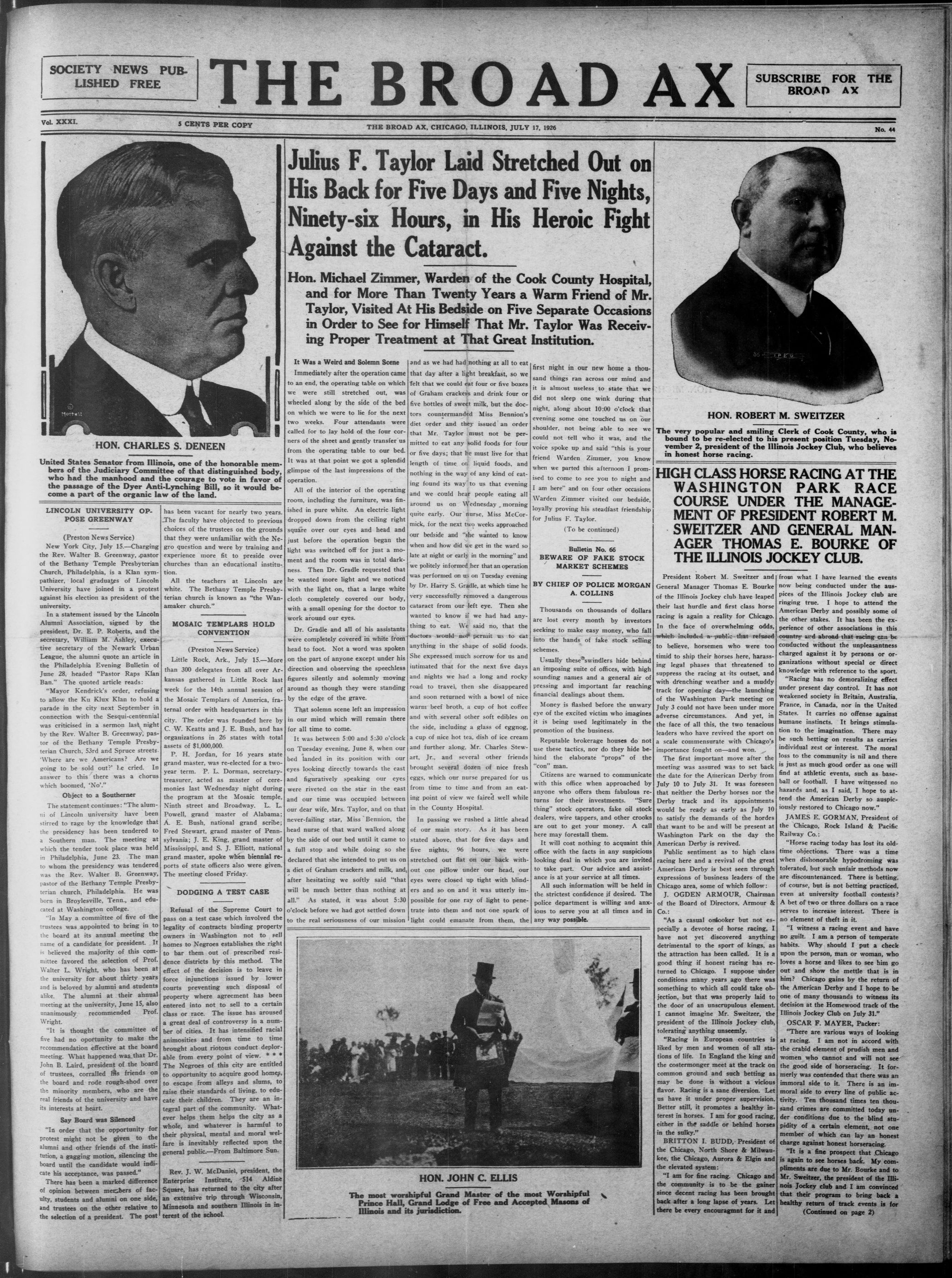
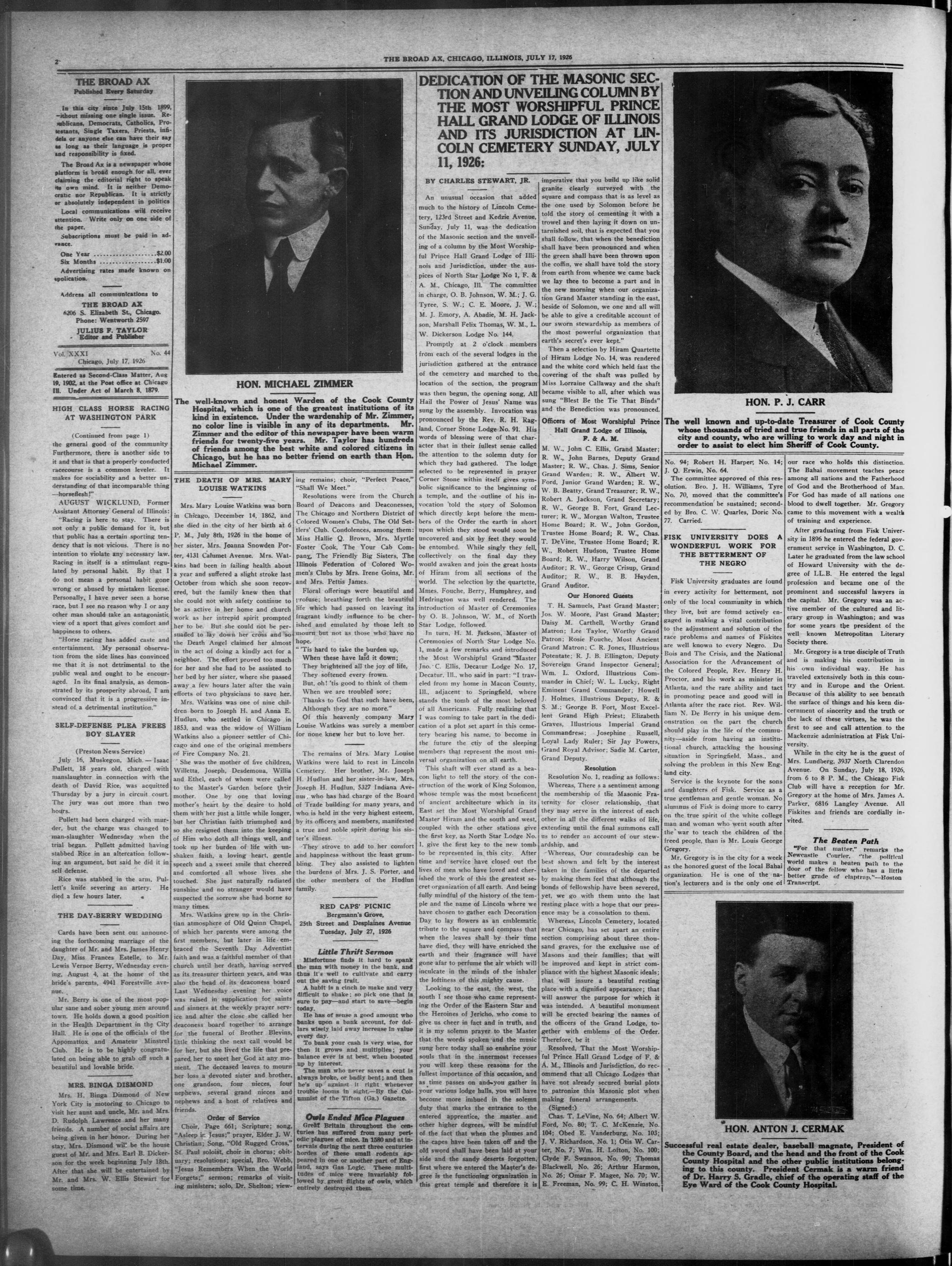
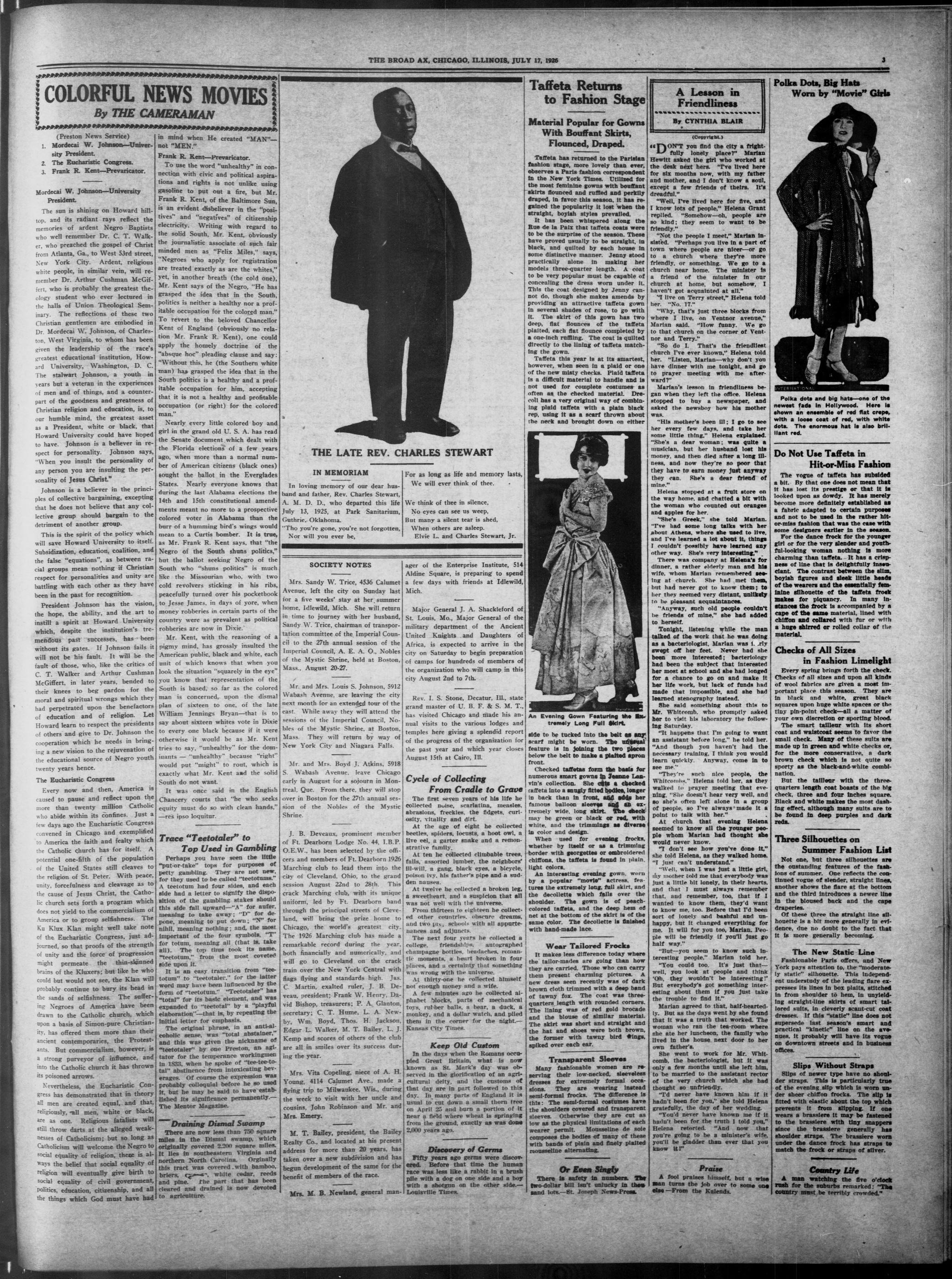
Page text (machine-generated)
SOCIETY NEWS PUBLISHED FREE
Vol. XXXI. 5 C
Mortell
Mortell
United States Senator from Illinois, one of the herssers of the Judiciary Committee of that distin who had the manhood and the courage to ve the passage of the Dyer Anti-Lynching Bill, s come a part of the organic law of the land.
United States Senator from Illinois, one of the honorable members of the Judiciary Committee of that distinguished body, who had the manhood and the courage to vote in favor of the passage of the Dyer Anti-Lynching Bill, so it would become a part of the organic law of the land.
LINCOLN UNIVERSITY
POSE GREENWAY
New York City, July 15—Charging the Rev. Walter B. Greenway, pastor of the Bethany Temple Presbyterian Church, Philadelphia, is a Klan sympathizer, local graduates of Lincoln University have joined in a protest against his election as president of the university.
In a statement issued by the Lincoln Alumni Association, signed by the president, Dr. E. P. Roberts, and the secretary, William M. Ashley, executive secretary of the NewM Urban League, the alumni quote an article in the Philadelphia Evening Bulletin of June 28, headed "Pastor Raps Klan Ban." The quoted article reads:
"Mayor Kendrick's order, refusing to allow the Ku Klux Klan to hold a parade in the city next September in connection with the Sesqui-centenennial was criticised in a sermon last night by the Rev. Walter B. Greenway, pastor of the Bethany Temple Presbyterian Church, 53rd and Spruce streets. 'Where are we Americans? Are we going to be sold out?' le cried. In answer to this there was a chorus which boomed. 'No.'
Object to a Southerner
The statement continues: "The alumni of Lincoln university have been stirred to rage by the knowledge that the presidency has been tendered to a Southern man. The meeting at which the tender took place was held in Philadelphia, June 23. The man to whom the presidency was tendered was the Rev. Walter B. Greenway, pastor of the Bethany Temple Presbyterian church, Philadelphia. He was born in Broylesville, Tenn., and educated at Washington college.
"In May a committee of five of the trustees was appointed to bring in to the board at its annual meeting the name of a candidate for president. It is believed the majority of this committee favored the selection of Prof. Walter L. Wright, who has been at the university for about thirty years and is beloved by alumni and students alike. The alumni at their annual meeting at the university, June 15, also unanimously recommended Prof. Wright.
"It is thought the committee of five had no opportunity to make the recommendation effective at the board meeting. What happened was that Dr. John B. Laird, president of the board of trustees, corralled his friends on the board and rode rough-shod over the minority members, who are the real friends of the university and have its interests at heart.
Sav Board was Silenced
"In order that the opportunity for protest might not be given to the alumni and other friends of the institution, a gagging motion, silencing the board until the candidate would indicate his acceptance, was passed."
There has been a marked difference of opinion between members of faculty, students and alumni on one side, and trustees on the other relative to the selection of a president. The post whole, their phare is general
Rev. J Enterpris Square, an extern Minnesota terest of
Vol. XXXI.
5 CENTS PER COPY
!
nois, one of the honorable mem-
tee of that distinguished body,
the courage to vote in favor of
i-Lynching Bill, so it would beow
of the land.
has been vacant for nearly two years. The faculty have objected to previous choices of the trustees on the grounds that they were unfamiliar with the Negro question and were by training and experience more fit to preside over churches than an educational institution.
All the teachers at Lincoln are white. The Bethany Temple Presbyterian church is known as "the Wanamaker church."
MOSAIC TEMPLARS HOLD CONVENTION
Little Rock, Ark., July 15.—More than 300 delegates from all over Arkansas gathered in Little Rock last week for the 14th annual session of the Mosaic Templars of America, fraternal order with headquarters in this city. The order was founded here by C. W. Keatts and J. E. Bush, and has organizations in 26 states with total assets of $1,000,000.
P. H. Jordan, for 16 years state grand master, was re-elected for a two-year term. P. L. Dorman, secretary-treasurer, acted as master of ceremonies last Wednesday night during the program at the Mosaic temple, Ninth street and Broadway. L. L. Powell, grand master of Alabama; A. E. Bush, national grand scribe; Fred Stewart, grand master of Pennsylvania; J. E. King, grand master of Mississippi; and S. J. Elliott, national grand master, spoke when biennial reports of state officers also were given. The meeting closed Friday.
DODGING A TEST CASE
Refusal of the Supreme Court to pass on a test case which involved the legality of contracts binding property owners in Washington not to sell homes to Negroes establishes the right to bar them out of prescribed residence districts by this method. The effect of the decision is to leave in force injunctions issued by lower courts preventing such disposal of property where agreement has been entered into not to sell to a certain class or race. The issue has aroused a great deal of controversy in a number of cities. It has intensified racial animosities and from time to time brought about riotous conduct deplorable from every point of view. * * * The Negroes of this city are entitled to opportunity to acquire good homes, to escape from alleys and slums, to raise their standards of living, to educate their children. They are an integral part of the community. Whatever helps them helps the city as a whole, and whatever is harmful to their physical, mental and moral welfare is inevitably reflected upon the general public.—From Baltimore Sun.
Rev. J. W. McDaniel, president, the Enterprise Institute, 514 Aldine Square, has returned to the city after an extensive trip through Wisconsin, Minnesota and southern Illinois in interest of the school.
THE BROAD AX
THE BROAD AX, CHICAGO, ILLINOIS, JULY 17, 1926
Julius F. Taylor Laid Stretched Out on His Back for Five Days and Five Nights, Ninety-six Hours, in His Heroic Fight Against the Cataract.
Hon. Michael Zimmer, Warden of the Cook County Hospital, and for More Than Twenty Years a Warm Friend of Mr. Taylor, Visited At His Bedside on Five Separate Occasions in Order to See for Himself That Mr. Taylor Was Receiving Proper Treatment at That Great Institution.
THE FIRST OF THE FOURTH OF JULY 1895
It Was a Weird and Solemn Scene
Immediately after the operation came to an end, the operating table on which we were still stretched out, was wheeled along by the side of the bed on which we were to lie for the next two weeks. Four attendants were called for to lay hold of the four corners of the sheet and gently transfer us from the operating table to our bed. It was at that point we got a splendid glimpse of the last impressions of the operation.
All of the interior of the operating room, including the furniture, was finished in pure white. An electric light dropped down from the ceiling right square over our eyes and head and just before the operation began the light was switched off for just a moment and the room was in total darkness. Then Dr. Gradle requested that he wanted more light and we noticed with the light on, that a large white cloth completely covered our body, with a small opening for the doctor to work around our eyes.
Dr. Gradie and all of his assistants were completely covered in white from head to foot. Not a word was spoken on the part of anyone except under his direction and observing the speechless figures silently and solemnly moving around as though they were standing by the edge of the grave.
That solemn scene left an impression in our mind which will remain there for all time to come.
It was between 5:00 and 5:30 o'clock on Tuesday evening, June 8, when our bed landed in its position with our eyes looking directly towards the east and figuratively speaking our eyes were riveted on the star in the east and our time was occupied between our dear wife, Mrs. Taylor, and on that never-failing star, Miss' Bennion, the head nurse of that ward walked along by the side of our bed until it came to a full stop and while doing so she declared that she intended to put us on a diet of Graham crackers and milk, and after hesitating we softly said "that will be much better than nothing at all." As stated, it was about 5:30 o'clock before we had got settled down to the real seriousness of our mission
and as we had had nothing at all to eat that day after a light breakfast, so we felt that we could eat four or five boxes of Graham crackers and drink four or five bottles of sweet milk, but the doctors countermanded Miss Bennion's diet order and they issued an order that Mr. Taylor must not be permitted to eat any solid foods for four or five days; that he must live for that length of time or liquid foods, and nothing in the way of any kind of eating found its way to us that evening and we could hear people eating all around us on Wednesday morning quite early. Our nurse, Miss McCormick, for the next two weeks approached our bedside and "she wanted to know when and how did we get in the ward so late at night or early in the morning" and we politely informed her that an operation was performed on us on Tuesday evening by Dr. Harry S. Gradle, at which time he very successfully removed a dangerous cataract from our left eye. Then she wanted to know if we had had anything to eat. We said no, that the doctors would not permit us to eat anything in the shape of solid foods. She expressed much sorrow for us and intimated that for the next five days and nights we had a long and rocky road to travel, then she disappeared and soon returned with a bowl of nice warm beef broth, a cup of hot coffee and with several other soft edibles on the side, including a glass of eggnog, a cup of nice hot tea, dish of ice cream and further along, Mr. Charles Stewart, Jr., and several other friends brought several dozen of nice fresh eggs, which our nurse prepared for us from time to time and from an eating point of view we faired well while in the County Hospital.
In passing we rushed a little ahead of our main story. As it has been stated above, that for five days and five nights, 96 hours, we were stretched out flat on our back without one pillow under our head, our eyes were closed up tight with blinders and so on and it was utterly impossible for one ray of light to penetrate into them and not one spark of light could emanate from them, the
HON. JOHN C. ELLIS
shipful Grand Master of the m Grand Lodge of Free and Access jurisdiction.
first night in our new home a thousand things ran across our mind and it is almost useless to state that we did not sleep one wink during that night, along about 10:00 o'clock that evening some one touched us on our shoulder, not being able to see we could not tell who it was, and the voice spoke up and said "this is your friend Warden Zimmer, you know when we parted this afternoon I promised to come to see you to night and I am here" and on four other occasions Warden Zimmer visited our bedside, loyally proving his steadfast friendship for Julius F. Taylor.
(To be continued)
Bulletin No. 66
BEWARE OF FAKE STOCK
MARKET SCHEMES
BY CHIEF OF POLICE MORGAN
A. COLLINS
Thousands on thousands of dollars are lost every month by investors seeking to make easy money, who fall into the hands of fake stock selling schemes.
Usually these swindlers hide behind an imposing suite of offices, with high sounding names and a general air of pressing and important far reaching financial dealings about them.
Money is flashed before the unwary eye of the excited victim who imagines it is being used legitimately in the promotion of the business.
Reputable brokerage houses do not use these tactics, nor do they hide behind the elaborate "props" of the "con" man.
Citizens are warned to communicate with this office when approached by anyone who offers them fabulous returns for their investments. "Sure thing" stock operators, fake oil stock dealers, wire tappers, and other crooks are out to get your money. A call here may forestall them.
It will cost nothing to acquaint this office with the facts in any suspicious looking deal in which you are invited to take part. Our advice and assistance is at your service at all times.
All such information will be held in the strictest confidence if desired. The police department is willing and anxious to serve you at all times and in any way possible.
86 IPEU
HON. ROBERT M. SWEITZER
The very popular and smiling Clerk of Cook County to be re-elected to his present position vember 2, president of the Illinois Jockey Club, in honest horse racing.
HIGH CLASS HORSE RACING AT WASHINGTON PARK COURSE UNDER THE MENT OF PRESIDENT ROB SWEITZER AND GENERAL AGER THOMAS E. BOUR THE ILLINOIS JOCKEY CLU
The very popular and smiling Clerk of Cook County, who is bound to be re-elected to his present position Tuesday, November 2, president of the Illinois Jockey Club, who believes in honest horse racing.
HIGH CLASS HORSE RACING AT THE WASHINGTON PARK RACE COURSE UNDER THE MANAGEMENT OF PRESIDENT ROBERT M. SWEITZER AND GENERAL MANAGER THOMAS E. BOURKE OF THE ILLINOIS JOCKEY CLUB.
President Robert M. Swetitzer and General Manager Thomas E. Bourke of the Illinois Jockey club have leaped their last hurdle and first class horse racing is again a reality for Chicago. In the face of overwhelming odds, which included a public that refused to believe, horsemen who were too timid to ship their horses here, harassing legal phases that threatened to suppress the racing at its outset, and with drenching weather and a muddy track for opening day—the launching of the Washington Park meeting on July 3 could not have been under more adverse circumstances. And yet, in the face of all the two, this tenacious leaders who have revived the sport on a scale commensurate with Chicago's importance fought on—and won.
The first important move after the meeting was assured was to set back the date for the American Derby from July 10 to July 31. It was foreseen that neither the Derby horses nor the Derby track and its appointments would be ready as early as July 10 to satisfy the demands of the hordes that want to be and will be present at Washington Park on the day the American Derby is revived.
Public sentiment as to high class racing here and a revival of the great American Derby is best seen through expressions of business leaders of the Chicago area, some of which follow: J. OGDEN ARMOUR, Chairman of the Board of Directors, Armour & Co: "As a casual onlooker but not especially a devotee of horse racing, I have not yet discovered anything detrimental to the sport of kings, as the attraction has been called. It is a good thing if honest racing has returned to Chicago. I suppose under conditions many years ago there was something to which all could take objection, but that was properly laid to the door of an unscrupulous element. I cannot imagine Mr. Sweitzer, the president of the Illinois Jockey club, tolerating anything unseemly.
"Racing in European countries is liked by men and women of all stations of life. In England the king and the costermonger meet at the track on common ground and such betting as may be done is without a vicious flavor. Racing is a sane diversion. Let us have it under proper supervision. Better still, it promotes a healthy interest in horses. I am for good racing, either in the saddle or behind horses in the sulky."
BRITTON I. BUDD, President of the Chicago, North Shore & Milwaukee, the Chicago, Aurora & Elgin and the elevated system:
"I am for fine racing. Chicago and the community is to be the gainer since decent racing has been brought back after a long lapse of years. Let there be every encouragmnt for it and
SUBSCRIBE FOR THE BROAD AX
No. 44
miling Clerk of Cook County, who is to his present position Tuesday, No. the Illinois Jockey Club, who believes
HORSE RACING AT THE TON PARK RACE UNDER THE MANAGE-RESIDENT ROBERT M. AND GENERAL MAN-MAS E. BOURKE OF IS JOCKEY CLUB.
from what I have learned the events now being conducted under the auspices of the Illinois Jockey club are ringing true. I hope to attend the American Derby and possibly some of the other stakes. It has been the experience of other associations in this country and abroad that racing can be conducted without the unpleasantness charged against it by persons or organizations without special or direct knowledge with reference to the sport.
"Racing has no demoralizing effect under present day control. It has not weakened society in Britain, Australia, France, in Canada, nor in the United States. It carries no offense against humane instincts. It brings stimulation to the imagination. There may be such betting on results as carries individual zest or interest. The moral loss to the community is nil and there is just as much good order as one will find at athletic events, such as baseball or football. I have witnessed no hazards and, as I said, I hope to attend the American Derby so auspiciously restored to Chicago now."
JAMES E. GORMAN, President of the Chicago, Rock Island & Pacific Railway Co:
"Horse racing today has lost its old-time objections. There was a time when dishonorable hypodroming was tolerated, but such unfair methods now are discountenanced. There is betting, of course, but is not betting practiced, even at university football contests? A bet of two or three dollars on a race serves to increase interest. There is no element of theft in it.
"I witness a racing event and have no guilt. I am a person of temperate habits. Why should I put a check upon the person, man or woman, who loves a horse and likes to see him go out and show the mettle that is in him? Chicago gains by the return of the American Derby and I hope to be one of many thousands to witness its decision at the Homewood track of the Illinois Jockey Club on July 31."
OSCAR F. MAYER, Packer:
There are various ways of looking at racing. I am not in accord with the crabid element of prudish men and women who cannot and will not see the good side of horseracing. It formerly was contended that there was an immoral side to it. There is an immoral side to every line of public activity. Ten thousand times ten thousand crimes are committed today under conditions due to the blind stupidity of a certain element, not one member of which can lay an honest charge against honest horseracing.
"It is a fine prospect that Chicago is again to see horses back. My compliments are due to Mr. Bourke and to Mr. Sweitzer, the president of the Illinois Jockey club and I am convinced that their program to bring back a healthy return of track events is for
(Continued on page 2)
No. 44
In this city since July 15th, 1899—without missing one single issue. Republicans, Democrats, Catholics, Protestants, Single Taxes, Priests, infidels or anyone else can have their say as long as their language is proper and responsibility is fixed.
The Broad Ax is a newspaper whose platform is broad enough for all, even claiming the editorial right to speak its own mind. It is neither Democratic nor Republican. It is strictly or absolutely independent in politics.
Local communications will receive attention. Write only on one side of the paper.
Subscriptions must be paid in advance.
One Year .....$2.00
Six Months .....$1.00
Advertising rates made known on application.
Address all communications to
THE BROAD AX
6206 S. Elizabeth St., Chicago.
Phone: Wentworth 2597
Entered as Second-Class Matter, Aug
19, 1902, at the Post office at Chicago
Ill. Under Act of March 8, 1879.
HIGH CLASS HORSE RACING
AT WASHINGTON PARK
(Continued from page 1)
the general good of the community
Furthermore, there is another side to it and that is that a properly conducted racecourse is a common leveler. It makes for sociability and a better understanding of that incomparable thing—horseflesh!"
AUGUST WICKLUND, Former Assistant Attorney General of Illinois
"Racing is here to stay. There is not only a public demand for it, but that public has a certain sporting tendency that is not vicious. There is no intention to violate any necessary law. Racing in itself is a stimulant regulated by personal habit. By that I do not mean a personal habit gone wrong or abused by mistaken license. Personally, I have never seen a horse race, but I see no reason why I or any other man should take an antagonistic view of a sport that gives comfort and happiness to others.
"Horse racing has added caste and entertainment. My personal observation from the side lines has convinced me that it is not detrimental to the public weal and ought to be encouraged. In its final analysis, as demonstrated by its prosperity abroad, I am convinced that it is a progressive instead of a detrimental institution."
SELF-DEFENSE PLEA FREES
BOY SLAYER
July 16, Muskegon, Mich. — Isaac Pullett, 18 years old, charged with manslaughter in connection with the death of David Rice, was acquitted Thursday by a jury in circuit court. The jury was out more than two hours. Pullett had been charged with murder, but the charge was changed to man-slaughter Wednesday when the trial began. Pullett admitted having stabbed Rice in an altercation following an argument, but said he did it in self defense. Rice was stabbed in the arm, Pullett's knife severing an artery. He died a few hours later.
THE DAY-BERRY WEDDING
Cards have been sent out announcing the forthcoming marriage of the daughter of Mr. and Mrs. James Henry Day, Miss Frances Estelle, to Mr. Lewis Vernor Berry, Wednesday evening, August 4, at the home of the bride's parents, 4941 Forestville avenue.
Mr. Berry is one of the most popular sane and sober young men around town. He holds down a good position in the Health Department in the City Hall. He is one of the officials of the Appomattox and Amateur Minstrel Club. He is to be highly congratulated on being able to grab off such a beautiful and lovable bride.
MRS. BINGA DISMOND
Mrs. H. Binga Dismond of New York City is motoring to Chicago to visit her aunt and uncle, Mr. and Mrs. D. Rudolph Lawrence and her many friends. A number of social affairs are being given in her honor. During her stay, Mrs. Dismond will be the house guest of Mr. and Mrs. Earl B. Dickerson for the week beginning July 18th. After that she will be entertained by Mr. and Mrs. W. Ellis Stewart for some time.
M.
The well-known and honest Warden of the Cook County Hospital, which is one of the greatest institutions of its kind in existence. Under the wardenship of Mr. Zimmer, no color line is visible in any of its departments. Mr. Zimmer and the editor of this newspaper have been warm friends for twenty-five years. Mr. Taylor has hundreds of friends among the best white and colored citizens in Chicago, but he has no better friend on earth than Hon. Michael Zimmer.
Mrs. Mary Louise Watkins was born in Chicago, December 14, 1862, and she died in the city of her birth at 6 P. M., July 8th, 1926 in the home of her sister, Mrs. Joanna Snowden Porter, 4131 Calumet Avenue. Mrs. Watkins had been in failing health about a year and suffered a slight stroke last October from which she soon recovered, but the family knew then that she could not with safety continue to be as active in her home and church work as her intrepid spirit prompted her to be. But she could not be persuaded to lay down her cross and so the Death Angel claimed her almost in the act of doing a kindly act for a neighbor. The effort proved too much for her and she had to be assisted to her bed by her sister, where she passed away a few hours later after the vain efforts of two physicians to save her. Mrs. Watkins was one of nine children born to Joseph H. and Anna E. Hudlun, who settled in Chicago in 1853, and was the widow of William Watkins also a pioneer settler of Chicago and one of the original members of Fire Company No. 21.
She was the mother of five children, Willetta, Joseph, Desdemona, Willia and Ethel, each of whom were called to the Master's Garden before their mother. One by one that loving mother's heart by the desire to hold them with her just a little while longer, but her Christian faith triumphed and so she resigned them into the keeping of Him who doth all things well, and took up her burden of life with unshaken faith, a loving heart, gentle speech and a sweet smile that cheered and comforted all whose lives she touched. She just naturally radiated sunshine and no stranger would have suspected the sorrow she had borne so many times.
Mrs. Watkins grew up in the Christian atmosphere of Old Quinn Chapel, of which her parents were among the first members, but later in life embraced the Seventh Day Adventist faith and was a faithful member of that church until her death, having served as its treasurer thirteen years, and was also the head of its deacons board. Last Wednesday evening her voice was raised in supplication for saints and sinners at the weekly prayer service and after the close she called her deaconess board together to arrange for the funeral of Brother Blevins, little thinking the next call would be for her, but she lived the life that prepared her to meet her God at any moment. The deceased leaves to mourn her loss a devoted sister and brother, one grandson, four nieces, four nephews, several grand nieces and nephews and a host of relatives and friends.
Choir, Page 661; Scripture; song,
"Asleep ir. Jesus;" prayer, Elder J. W.
Christian; Song, "Old Rugged Cross",
St. Paul soloist, choir in chorus; obi-
nary; resolutions; special, Bro. Webb,
"Jesus Remembers When the World
Forgets;" sermon; remarks of visiting
ministers; solo, Dr. Shelton; view
THE BROAD AX, CHICAGO, ILLINOIS, JULY 17, 1926
ing remains; choir, "Perfect Peace," "Shall We Meet."
Resolutions were from the Church Board of Deacons and Deaconesses, The Chicago and Northern District of Colored Women's Clubs, The Old Settlers' Club. Condolences, among them: Miss Hallie Q. Brown, Mrs. Myrtle Foster Cook, The Your Cab Company, The Friendly Big Sisters, The Illinois Federation of Colored Women's Clubs by Mrs. Irene Goins, Mr. and Mrs. Pettis James.
Floral offerings were beautiful and profuse; breathing forth the beautiful life which had passed on leaving its fragrant kindly influence to be cherished and emulated by those left to mount but not as those who have no hope.
"Tis hard to take the burden up,
When these have laid it down;
They brightened all the joy of life,
They softened every frown.
But, oh! 'tis good to think of them
When we are troubled sore;
Thanks to God that such have been,
Although they are no more."
Of this heavenly company Mary
Louise Watkins was surely a member
for none knew her but to love her.
The remains of Mrs. Mary Louise Watkins were laid to rest in Lincoln Cemetery. Her brother, Mr. Joseph H. Hudlun and her sister-in-law, Mrs. Joseph H. Hudlun, 5327 Indiana Avenue, who has had charge of the Board of Trade building for many years, and who is held in the very highest esteem, by its officers and members, manifested a true and noble spirit during his sister's illness.
They strove to add to her comfort and happiness without the least grumbling. They also assisted to lighten the burdens of Mrs. J. S. Porter, and the other members of the Hudlun family.
RED CAPS' PICNIC
Bergmann's Grove,
25th Street and Desplaines Avenue
Tuesday, July 27, 1926
Little Thrift Sermon
Mistfortune finds it hard to spank the man with money in the bank, and thus it's well to cultivate and carry out the saving trait.
A habit is a clinch to make and very difficult to shake; so pick one that is sure to pay—and start to save—begin today.
He has of sense a good amount who banks upon a bank account, for dollars wisely laid away increase in value every day.
To bank your cash is very wise, for then it grows and multiplies; your balance ever is at best, when boosted up by interest.
The man who never saves a cent is always broke, or badly bent; and then he's up against it right whenever trouble looms in sight—By the Columnist of the Tifton (Ga.) Gazette.
Owls Ended Mice Plagues
Great Britain throughout the centuries has suffered from many periodic plagues of mice. In 1580 and at intervals during the next three centuries hordes of these small rodents appeared in one or another part of England, says Gas Logic. These multitudes of mice were invariably followed by great flights of owls, which entirely destroyed them.
DEDICATION OF THE MASONIC SECTION AND UNVEILING COLUMN BY THE MOST WORSHIPFUL PRINCE HALL GRAND LODGE OF ILLINOIS AND ITS JURISDICTION AT LINCOLN CEMETERY SUNDAY, JULY 11, 1926:
An unusual occasion that added much to the history of Lincoln Cemetery, 123rd Street and Kedzie Avenue, Sunday, July 11, was the dedication of the Masonic section and the unveiling of a column by the Most Worshipful Prince Hall Grand Lodge of Illinois and Jurisdiction, under the auspices of North Star Lodge No 1, F. & A. M., Chicago, Ill. The committee in charge, O. B. Johnson, W. M.; J. G. Tyree, S. W.; C. E. Moore, J. W. M. J. Emory, A. Abadie, M. H. Jackson, Marshall Felix Thomas, W. M., L. W. Dickerson Lodge No. 144.
Promptly at 2 o'clock members from each of the several lodges in the jurisdiction gathered at the entrance of the cemetery and marched to the location of the section, the program was then begun, the opening song, All Hail the Power of Jesus' Name was sung by the assembly. Invocation was pronounced by the Rev. R. H. Ragland, Corner Stone Lodge No. 91. His words of blessing were of that character that in their fullest sense called the attention to the solemn duty for which they had gathered. The lodge selected to be represented in prayer Corner Stone within itself gives symbolic significance to the beginning of a temple, and the outline of his invocation 'told the story of Solomon which directly kept before the members of the Order the earth in short upon which they stood would soon be uncovered and six by feet they would be entombed. While singly they fell, collectively on the final day they would awaken and join the great hosts of Hiram from all sections of the world. The selection by the quartette, Mmes. Fouche, Berry, Humphrey, and Hedrington was well rendered. The introduction of Master of Ceremonies by O. B. Johnson, W. M., of North Star Lodge, followed.
In turn, H. M. Jackson, Master of Ceremonies of North Star Lodge No. 1, made a few remarks and introduced the Most Worshipful Grand Master Jno. C. Ellis, Decatur Lodge No. 17, Decatur, Ill., who said in part: "I traveled from my home in Macon County, Ill., adjacent to Springfield, where stands the tomb of the most beloved of all Americans. Fully realizing that I was coming to take part in the dedication of a plot set apart in this cemetery bearing his name, to become in the future the city of the sleeping members that represent the most universal organization on all earth.
This shaft will ever stand as a beacon light to tell the story of the construction of the work of King Solomon, whose temple was the most beneficent of ancient architecture which in its East set the Most Worshipful Grand Master Hiram and the south and west, coupled with the other stations give the first key, as North Star Lodge No.1, give the first key to the new tomb to be represented in this city. After time and service have closed out the lives of men who have loved and cherished the work of this the greatest secret organization of all earth. And being fully mindful of the history of the temple and the name of Lincoln where we have chosen to gather each Decoration Day to lay flowers as an emblematic tribute to the square and compass that when the leaves shall by their time have died, they will have enriched the earth and their fragrance will have gone afar to perfume the air which will inculcate in the minds of the inhaler the loftiness of this mighty cause.
Looking to the east, the west, the south I see those who came representing the Order of the Eastern Star and the Heroines of Jericho, who come to give us cheer in fact and in truth, and it is my solemn prayer to the Master that the words spoken and the music sung here today shall so enshrine your souls that in the innermost recesses you will keep these reasons for the fullest importance of this occasion, and as time passes on and you gather in your various lodge halls, you will have become more imbued in the solemn duty that marks the entrance to the entered apprentice, the master and other higher degrees, will be mindful of the fact that when the plumes and the capes have been taken off and the old sword shall have been laid at your side and the sandy deserts forgotten, first where we entered the Master's degree is the functioning organization in this great temple and therefore it is
imperative that you build up like solid granite clearly surveyed with the square and compass that is as level as the one used by Solomon before he told the story of cementing it with a trowel and then laying it down on untarnished soil, that is expected that you shall follow, that when the benediction shall have been pronounced and when the green shall have been thrown upon the coffin, we shall have told the story from earth from whence we came back we lay thee to become a part and in the new morning when our organization Grand Master standing in the east, beside of Solomon, we one and all will be able to give a creditable account of our sworn stewardship as members of the most powerful organization that earth's secret's ever kept."
Then a selection by Hiram Quartette of Hiram Lodge No. 14, was rendered and the white cord which held fast the covering of the shaft was pulled by Miss Lorraine Callaway and the shaft became visible to all, after which was sung "Blest Be the Tie That Binds" and the Benediction was pronounced.
Officers of Most Worshipful Prince Hall Grand Lodge of Illinois, F. & A. M.
M. W., John C. Ellis, Grand Master; R. W., John Barnes, Deputy Grand Master; R. W., Chas. J. Sims, Senior Grand Warden; R. W., Albert W. Ford, Junior Grand Warden; R. W., W. B. Beatty, Grand Treasurer; R. W., Robert A. Jackson, Grand Secretary; R. W., George B. Fort, Grand Lecturer; R. W., Morgan Walton, Trustee Home Board; R. W., John Gordon, Trustee Home Board; R. W., Chas. T. DeVine, Trustee Home Board; R. W., Robert Hudson, Trustee Home Board; R. W., Harry Wilson, Grand Auditor; R. W., George Crisup, Grand Auditor; R. W., B. B. Hayden, Grand Auditor.
Our Honored Guests
T. H. Samuels, Past Grand Master;
Jos. W. Moore, Past Grand Master;
Daisy M. Cartell, Worthy Grand
Matron; Lee Taylor, Worthy Grand
Patron; Rosie Fouche, Most Ancient
Grand Matron; C. R. Jones, Illustrious
Potentate; R. J. B. Ellington, Deputy
Sovereign Grand Inspector General;
Wm. L. Oxford, Illustrious Commander in Chief; W. L. Lucky, Right
Eminent Grand Commander; Howell
J. Holmes, Illustrious Deputy, R. & S. M.; George B. Fort, Most Excellent Grand High Priest; Elizabeth Graves, Illustrious Imperial Grand Commandress; Josephine Russell,
Loyal Lady Ruler; Sir Jay Powers,
Grand Royal Advisor; Sadie M. Carter,
Grand Deputy.
Resolution
Resolution No. 1, reading as follows: Whereas, There's a sentiment among the membership of the Masonic Fraternity for closer relationship, that they may serve in the interest of each other in all the different walks of life, extending until the final summons call us to render an account of our stewardship, and Whereas, Our comradeship can be best shown and felt by the interest taken in the families of the departed by making them feel that although the bonds of fellowship have been severed, yet, we go with them unto the last resting place with a hope that our presence may be a consolation to them.
Whereas, Lincoln Cemetery, located near Chicago, has set apart an entire section comprising about three thousand graves, for the exclusive use of Masons and their families; that will be improved and kept in strict compliance with the highest Masonic ideals; that will insure a beautiful resting place with a dignified appearance; that will answer the purpose for which it was intended. A beautiful monument will be erected bearing the names of the officers of the Grand Lodge, together with emblems of the Order. Therefore, be it
Resolved, That the Most Worshipful Prince Hall Grand Lodge of F. & A. M., Illinois and Jurisdiction, do recommend that all Chicago Lodges that have not already secured burial plots to patronize this Masonic plot when making funeral arrangements.
(Signed:)
Chas. T. LeVine, No. 64; Albert W. Ford, No. 80; T. C. McKenzie, No. 104; Obed E. Vanderburg, No. 103; J. V. Richardson, No. 1; Otis W. Carter, No. 7; Wm. H. Lofton, No. 100; Clyde F. Swanson, No. 90; Thomas Blackwell, No. 26; Arthur Harmon, No. 26; Omar F. Magee, No. 70; W. E. Freeman, No. 99; C. H. Winston,
HON. P. J. CARR
The well known and up-to-date Treasurer of Cook County whose thousands of tried and true friends in all parts of the city and county, who are willing to work day and night in order to assist to elect him Sheriff of Cook County.
No. 94; Robert H. Harper; No. 14; J. Q. Erwin, No. 64.
The committee approved of this resolution. Bro. J. H. Williams, Tyre No. 70, moved that the committee's recommendation be sustained; seconded by Bro. C. W. Quarles, Doric No. 77. Carried.
our race who holds this distinction. The Bahai movement teaches peace among all nations and the Fatherhood of God and the Brotherhood of Man. For God has made of all nations one blood to dwell together. Mr. Gregory came to this movement with a wealth of training and experience.
FISK UNIVERSITY DOES A WONDERFUL WORK FOR THE BETTERMENT OF THE NEGRO
Fisk University graduates are found in every activity for betterment, not only of the local community in which they live, but are found actively engaged in making a vital contribution to the adjustment and solution of the race problems and names of Fiskites are well known to every Negro. Du Bois and The Crisis, and the National Association for the Advancement of the Colored People, Rev. Henry H. Proctor, and his work as minister in Atlanta, and the rare ability and tact in promoting peace and good will in Atlanta after the race riot. Rev. William N. De Berry in his unique demonstration on the part the church should play in the life of the community—aside from having an institutional church, attacking the housing situation in Springfield, Mass., and solving the problem in this New England city.
Service is the keynote for the sons and daughters of Fisk. Service as a true gentleman and gentle woman. No alumnus of Fisk is doing more to carry on the true spirit of the white college man and woman who went south after the war to teach the children of the freed people, than is Mr. Louis George Gregory.
Mr. Gregory is in the city for a week as the honored guest of the local Bahai organization. He is one of the nation's lecturers and is the only one of
74
Successful real estate dealer, baseball magnate, President of the County Board, and the head and the front of the Cook County Hospital and the other public institutions belonging to this county. President Cermak is a warm friend of Dr. Harry S. Gradle, chief of the operating staff of the Eye Ward of the Cook County Hospital.
our race who holds this distinction. The Bahai movement teaches peace among all nations and the Fatherhood of God and the Brotherhood of Man. For God has made of all nations one blood to dwell together. Mr. Gregory came to this movement with a wealth of training and experience.
After graduating from Fisk University in 1896 he entered the federal government service in Washington, D. C. Later he graduated from the law school of Howard University with the degree of LL.B. He entered the legal profession and became one of the prominent and successful lawyers in the capital. Mr. Gregory was an active member of the cultured and literary group in Washington; and was for some years the president of the well known Metropolitan Literary Society there.
Mr. Gregory is a true disciple of Truth and is making his contribution in his own individual way. He has traveled extensively both in this country and in Europe and the Orient. Because of this ability to see beneath the surface of things and his keen discernment of sincerity and the truth or the lack of these virtues, he was the first to see and call attention to the Mackenzie administration at Fisk University. While in the city he is the guest of Mrs. Lundberg, 3937 North Clarendon Avenue. On Sunday, July 18, 1926, from 6 to 8 P. M., the Chicago Fisk Club will have a reception for Mr. Gregory at the home of Mrs. James A. Parker, 6816 Langley Avenue. All Fiskites and friends are cordially invited.
The Beaten Path
"For that matter," remarks the Newcastle Courier, "the political world makes a beaten path to the door of the fellow who has a little better grade of claptrap."—Boston Transcript.
COLORFUL NEWS MOVIES By THE CAMERAMAN
1. Mordecai W. Johnson—University President.
The sun is shining on Howard hilltop, and its radiant rays reflect the memories of ardent Negro Baptists who well remember Dr. C. T. Walker, who preached the gospel of Christ from Atlanta, Ga., to West 53rd street, New York City. Ardent, religious white people, in similar vein, will remember Dr. Arthur Cushman McGiffert, who is probably the greatest theology student who ever lectured in the halls of Union Theological Seminary. The reflections of these two Christian gentlemen are embodied in Dr. Mordecai W. Johnson, of Charleston, West Virginia, to whom has been given the leadership of the race's greatest educational institution, Howard University, Washington, D. C. The stalwart Johnson, a youth in years but a veteran in the experiences of men and of things, and a counterpart of the goodness and greatness of Christian religion and education, is, to our humble mind, the greatest asset as a President, white or black, that Howard University could have hoped to have. Johnson is a believer in respect for personality. Johnson says, "When you insult the personality of any person you are insulting the personality of Jesus Christ."
Johnson is a believer in the principles of collective bargaining, excepting that he does not believe that any collective group should bargain to the detriment of another group.
This is the spirit of the policy which will save Howard University to itself. Subsidization, education, coalition, and the false "equations", as between racial groups mean nothing if Christian respect for personalities and unity are battling with each other as they have been in the past for recognition.
President Johnson has the vision, the hope, the ability, and the art to instill a spirit at Howard University which, despite the institution's tremendous past successes, has been without its gates. If Johnson fails it will not be his fault. It will be the fault of those, who, like the critics of C. T. Walker and Arthur Cushman McGiffert, in later years, bended to their knees to beg pardon for the moral and spiritual wrongs which they had perpetrated upon the benefactors of education and of religion. Let Howard learn to respect the presidents of others and give to Dr. Johnson the cooperation which he needs in bringing a new vision to the rejuvenation of the educational source of Negro youth twenty years hence.
The Eucharistic Congress
Every now and then, America is caused to pause and reflect upon the more than twenty million Catholic who abide within its confines. Just a few days ago the Eucharistic Congress convened in Chicago and exemplified to America the faith and fealty which the Catholic church has for itself. A potential one-fifth of the population of the United States still cleaves to the religion of St. Peter. With peace, unity, forcefulness and cleavage as to the cause of Jesus Christ, the Catholic church sets forth a program which does not yield to the commercialism of America or to group selfishness. The Ku Klux Klan might well take note of the Eucharistic Congress, just adjourned, so that proofs of the strength of unity and the force of progression might permeate the thin-skinned brains of the Kluxers; but like he who could but would not see, the Klan will probably continue to bury its head in the sands of selfishness. The suffering Negroes of America have been drawn to the Catholic church, which upon a basis of Simon-pure Christianity, has offered them more than their ancient contemporaries, the Protestants. But commercialism, however, is a strong purveyor of influence, and into the Catholic church it has thrown its poisoned arrows.
Nevertheless, the Eucharistic Congress has demonstrated that in theory all men are created equal, and that, religiously, all men, white or black, are as one. Religious fatalists will still throw darts at the alleged weaknesses of Catholicism; but so long as Catholicism will welcome the Negro to social equality of religion, there is always the belief that social equality of religion will eventually give birth to social equality of civil government, politics, education, citizenship, and all the things which God must have had
in mind when He created "MAN"—
not "MEN."
Frank R. Kent—Prevaricator.
To use the word "unhealthy" in connection with civic and political aspirations and rights is not unlike using gasoline to put out a fire, but Mr. Frank R. Kent, of the Baltimore Sun, is an evident disbeliever in the "positives" and "negatives" of citizenship electricity. Writing with regard to the solid South, Mr. Kent, obviously the journalistic associate of such fair minded men as "Felix Miles," says, "Negroes who apply for registration are treated exactly as are the whites," yet, in another breath (the cold one), Mr. Kent says of the Negro, "He has grasped the idea that in the South, politics is neither a healthy nor a profitable occupation for the colored man." To revert to the beloved Chancellor Kent of England (obviously no relation Mr. Frank R. Kent), one could apply the homely doctrine of the "absque hoc" pleading clause and say: "Without this, he (the Southern white man) has grasped the idea that in the South politics is a healthy and a profitable occupation for him, accepting that it is not a healthy and profitable occupation (or right) for the colored man."
Nearly every little colored boy and girl in the grand old U. S. A. has read the Senate document which dealt with the Florida elections of a few years ago, when more than a normal number of American citizens (black ones) sought the ballot in the Everglades States. Nearly everyone knows that during the last Alabama elections the 14th and 15th constitutional amendments meant no more to a prospective colored voter in Alabama than the burr of a humming bird's wings would mean to a Curtis bomber. It is true, as Mr. Frank R. Kent says, that "the Negro of the South shuns politics," but the ballot seeking Negro of the South who "shuns politics" is much like the Missouriian who, with two cold revolvers sticking in his ribs, peacefully turned over his pocketbook to Jesse James, in days of yore, when money robberies in certain parts of the country were as prevalent as political robberies are now in Dixie.
Mr. Kent, with the reasoning of a pigmy mind, has grossly insulted the American public, black and white, each unit of which knows that when you look the situation "squarely in the eye" you know that representation of the South is based; so far as the colored man is concerned, upon the dismal plan of sixteen to one, of the late William Jennings Bryan—that is to say about sixteen whites vote in Dixie to every one black because if it were otherwise it would be as Mr. Kent tries to say, "unhealthy" for the dominants — "unhealthy" because "right" would put "might" to rout, which is exactly what Mr. Kent and the solid South do not want.
It was once said in the English Chancery courts that "he who seeks equity must do so with clean hands,"—res inso loquitur.
Trace "Teetotaler" to
Top Used in Gambling
Top Used in Gambling
Perhaps you have seen the little "put-or-take" tops for purposes of petty gambling. They are not new, for they used to be called "teetotums." A teetotum had four sides, and side side had a letter to signify the disposition of the gambling stakes should this side fall upward—"A" for aufer, meaning to take away; "D" for depe, meaning to put down; "N" for nihil, meaning nothing; and, the most important of the four symbols, "T" for totum, meaning all (that is, take all). The top thus took its name, "teetotum," from the most coveted side upon it.
It is an easy transition from "teetotum" to "teetotaler," for the latter word may have been influenced by the form of "teetotum." "Teetotaler" has "total" for its basic element, and was expanded to "teetotal" by a "playful elaboration"—that is, by repeating the initial letter for emphasis.
The original phrase, in an anti-alcoholic sense, was "total abstainer," and this was given the nickname of "teetotaler" by one Preston, an agitator for the temperance workers in 1833, when he spoke of "tee-tee-total" abstinence from intoxicating beverages. Of course the expression was probably colloquial before he so used it, but he may be said to have established its significance permanently.—The Mentor Magazine.
Draining Dismal Swamp
Drumming Dismal Swamp
There are now less than 750 square miles in the Dismal swamp, which originally covered 2,200 square miles. It lies in southeastern Virginia and northern North Carolina. Originally this tract was covered with bamboo, briers, white cedar, reeds and pine. The part that has been cleared and drained is now devoted to agriculture.
THE BROAD AX. CHICAGO, ILLINOIS, IULY 17, 1926
THE LATE REV. CHARLES STEWART
In loving memory of our dear husband and father, Rev. Charles Stewart, A. M. D. D., who departed this life July 13, 1925, at Park Sanitarium, Guthrie, Oklahoma.
"Tho you're gone, you're not forgotten."
"Tho you're gone, you're not forgotten
Nor will you ever be.
SOCIETY NOTES
Mrs. Sandy W. Trice, 4536 Calumet Avenue, left the city on Sunday last for a five weeks' stay at her summer home, Idlewild, Mich. She will return in time to journey with her husband, Sandy W. Trice, chairman of transportation committee of the Imperial Council to the 27th annual session of the Imperial Council, A. E. A. O., Nobles of the Mystic Shrine, held at Boston, Mass., August 20-27.
Mr. and Mrs. Louis S. Johnson, 5912 Wabash Avenue, are leaving the city next month for an extended tour of the east. While away they will attend the sessions of the Imperial Council, Nobles of the Mystic Shrine, at Boston, Mass. They will return by way of New York City and Niagara Falls.
Mr. and Mrs. Boyd J. Atkins, 5918 S. Wabash Avenue, leave Chicago early in August for a sojourn in Montreal, Que. From there, they will stop over in Boston for the 27th annual session of the Nobles of the Mystic Shrine.
J. B. Deveaux, prominent member of Ft. Dearborn Lodge No. 44, I.B.P. O.E.W., has been selected by the officers and members of Ft. Dearborn 1926 Marching club to lead them into the city of Cleveland, Ohio, to the grand session August 22nd to 28th. This crack Marching club, with its unique uniform, led by Ft. Dearborn hand through the principal streets of Cleveland, will bring the prize home to Chicago, the world's greatest city. The 1926 Marching club has made a remarkable record during the year, both financially and numerically, and will go to Cleveland on the crack train over the New York Central with flags flying and standards high. Jas. C. Martin, exalted ruler, J. B. Deveau, president; Frank W. Henry, David Bishop, treasurers; P. A. Glanton, secretary; C. T. Hume, L. A. Newby, Wm. Boyd, Thos. H. Jackson, Edgar L. Walker, M. T. Bailey, L. J. Kemp and scores of others of the club are all in smiles over its success during the year.
Mrs. Vita Copeling, niece of A. H. Young, 4114 Calumet Ave., made a flying trip to Milwaukee, Wis., during the week to visit with her uncle and cousins, John Robinson and Mr. and Mrs. Emery.
M. T. Bailey, president, the Bailey Realty Co., and located at his present address for more than 20 years, has taken over a new subdivision and has begun development of the same for the benefit of members of the race.
Mrs. M. B. Newland, general man-
For as long as life and memory lasts,
We will ever think of thee.
We think of thee in silence,
No eyes can see us weep.
But many a silent tear is shed,
When others are asleep.
Elvie L. and Charles Stewart, Jr.
ager of the Enterprise Institute, 514 Aldine Square, is preparing to spend a few days with friends at Idlewild, Mich.
Major General J. A. Shackleford of St. Louis, Mo., Major General of the military department of the Ancient United Knights and Daughters of Africa, is expected to arrive in the city on Saturday to begin preparation of camps for hundreds of members of the organization who will camp in this city August 2nd to 7th.
Rev. I. S. Stone, Decatur, Ill., state grand master of U. B. F. & S. M. T., has visited Chicago and made his annual visits to the various lodges and temples here giving a splendid report of the progress of the organization for the past year and which year closes August 15th at Cairo, Ill.
Cycle of Collecting
From Cradle to Grave
The first seven years of his life he
collected noise, scratling, measles,
abrasions, freckles, the fidgets, curiosity, vitality and dirt.
At the age of eight he collected beetles, spiders, locusts, a hoot owl, a live eel, a garter snake and a demonstrative family.
At ten he collected climbable trees, falls, assorted lumber, the neighbors' ill-will, a gang, black eyes, a bicycle, poison ivy, his father's pipe and a sudden nausea.
At twelve he collected a broken leg, a sweetheart, and a suspicion that all was not well with the universe.
From thirteen to eighteen he collected other countries, obscure dreams, and two priests, schools with all appurtenances and adjuncts.
The next four years he collected a college, friendships, autographed champagne bottles, headaches, romantic moments, a heart broken in four places, and a certainty that something was wrong with the universe.
At thirty-one he collected himself not enough money and a wife.
A few minutes ago he collected alphabet blocks, parts of mechanical toys, rubber balls, a bear, a duck, a monkey, and a dollar watch, and piled them in the corner for the night.—Kansas City Times.
Keep Old Custom
In the days when the Romans occupied Great Britain, what is now known as St. Mark's day was observed in the glorification of an agricultural deity, and the customs of that day are in part followed to this day. In many parts of England it is usual to cut down a small thorn tree on April 25 and burn a portion of it near a field where wheat is springing from the ground, exactly as was done 2,000 years ago.
Discovery of Germs
Fifty years ago germs were discovered. Before that time the human race was less like a rabbit in a brush plie with a dog on one side and a boy with a shotgun on the other side.—Louisville Times.
Material Popular for Gowns With Bouffant Skirts, Flounced, Draped.
Taffeta has returned to the Parisian fashion stage, more lovely than ever, observes a Paris fashion correspondent in the New York Times. Utilized for the most feminine gowns with bouffant skirts flounced and ruffled and perky draped, in favor this season, it has regained the popularity it lost when the straight, boyish styles prevailed.
It has been whispered along the Rue de la Palix that taffeta coats were to be the surprise of the season. These have proved usually to be straight, in black, and quilted by each house in some distinctive manner. Jenny stood practically alone in making her models three-quarter length. A coat to be very popular must be capable of concealing the dress worn under it. This the coat designed by Jenny cannot do, though she makes amends by providing an attractive taffeta gown in several shades of rose, to go with it. The skirt of this gown has two deep, flat flouches of the taffeta plaited, each flat flouce completed by a one-inch ruffling. The coat is quilted directly to the lining of taffeta matching the gown.
Taffeta this year is at its smartest, however, when seen in a plaid or one of the new misty checks. Plaid taffeta is a difficult material to handle and is not used for complete costumes as often as the checked material. Drecoll has a very original way of combining plaid taffeta with a plain black rep, using it as a scarf thrown about the neck and brought down on either
THE FASHION OF THE TWENTIES
An Evening Gown Featuring the Extremely Long Full Skirt.
side to be tucked into the belt as any scarf might be worn. The unusual feature is in joining the two pieces below the belt to make a plaited apron front.
Checked taffetas form the basis for numerous smart gowns in Jeanne Lenvin's collection. She cuts a checked raffeta into a snugly fitted bodice, longer in back than in front, and adds her famous balloon sleeves and an extremely wide, long skirt. The check may be green or black or red, with white, and the trimmings as diverse in color and design.
When used for evening frocks, whether by itself or as a trimming border with georgettes or embroidered chiffons, the taffeta is found in plain, light colors.
An interesting evening gown, worn by a popular "movie" actress, features the extremely long, full skirt, and the decollette which falls over the shoulder. The gown is of peach-colored taffet, and the deep hem of net at the bottom of the skirt is of the same color. The decollette is finished with hand-made lace.
Wear Tailored Frocks
It makes less difference today where the tailor-mades are going than how they are carried. Those who can carry them present charming pictures. A new dress seen recently was of dark brown cloth trimmed with a deep band of tawny fox. The coat was three-quarters length with rounded corners. The lining was of red gold brocade and the blouse of similar material. The skirt was short and straight and the hat and shoes were both brown, the former with tawny bird *rings*, spiked over each ear.
Transparent Sleeves
Many fashionable women are reserving their low-necked, sleeveless dresses for extremely formal occasions. They are wearing instead semi-formal frocks. The difference is this: The semi-formal costumes have the shoulders covered and transparent sleeves. Otherwise they are cut as low as the physical limitations of each wearer permit. Mousseline de sole composes the bodies of many of these with bands of plain and finely plaited mousseline alternating.
Or Even Singly
There is safety in numbers. The two-dollar bill isn't unlucky in these sand lots.—St. Joseph News-Press.
DON'T you find the city a frightfully lonely place?" Marian Hewitt asked the girl who worked at the desk next hers. "I've lived here for six months now, with my father and mother, and I don't know a soul, except a few friends of theirs. It's dreadful."
"Well, I've lived here for five, and I know lots of people." Helena Grant replied. "Somehow—oh, people are so kind; they seem to want to be friendly."
"Not the people I meet." Marian insisted. "Perhaps you live in a part of town where people are nlcer—or go to a church where they're more friendly, or something. We go to a church near home. The minister is a friend of the minister in our church at home, but somehow, I haven't got acquainted at all."
"I live on Terry street," Helena told her. "No. 17."
"Why, that's just three blocks from where I live, on Ventnor avenue," Marian said. "How funny. We go to that church on the corner of Ventnor and Terry."
"So do I. That's the friendliest church I've ever known," Helena told her. "Listen, Marian—why don't you have dinner with me tonight, and go to prayer meeting with me afterward?"
Marian's lesson in friendliness began when they left the office. Helena stopped to buy a newspaper, and asked the newsboy his mother was.
"His mother's been all; I go to see her every few days, and take her some little thing." Helena explained.
"She's a dear woman; was quite a musician, but her husband lost his money, and then died after a long illness, and now they're so poor that they have to earn money just anyway they can. She's a dear friend of mine."
Helena stopped at a fruit store on the way home, and chatted a bit with the woman who counted out oranges and apples for her.
"She's Greek," she told Marian. "I've had some long talks with her about Athens, where she used to live, and I've learned a lot about it, things I couldn't possibly have learned any other way. She's very interesting."
There was company at Helena's for dinner, a rather elderly man and his wife, whom Marian remembered seeing at church. She had met them, but had never got to know them; to her they seemed very distant, unlikely to be pleasant acquaintances.
"Anyway, such old people couldn't be friends of mine," she had added to herself.
Tonight, listening while the man talked of the work that he was doing as a bacteriologist, Marlan was 1. rly swept off her feet. Never had she been more interested; bacteriology had been the subject that interested her most at school and she had longed for a chance to go on and make it her life work, but lack of funds had made that impossible, and she had learned stenography instead.
She said something about this to Mr. Whitecomb, who promptly asked her to visit his laboratory the following Saturday.
"It happens that I'm going to want an assistant before long," he told her.
"And though you haven't had the necessary training, I think you would learn quickly. Anyway, come in to see me."
"They're such nice people, the Whitcoms." Helena told her, as they walked to prayer meeting that evening. "She doesn't hear very well, and so she's often left alone in a group of people, so I've always made it a point to talk with her."
At church that evening Helena seemed to know all the younger people whom Marian had thought she would never know.
"I don't see how you've done it," she told Helena, as they walked home. "I just can't understand."
"Well, when I was just a little girl, my mother told me that everybody was just a little bit lonely, in their hearts, and that I must always remember that, and remember, too, that if I wanted to know them, they'd want to know me, too. Before that I'd been sort of lonely and bashful and unhappy, but it changed everything for me. It will for you too, Marian. People will be friendly if you'll just go half way."
"But—you seem to know such interesting people." Marian told her, "You could too. It's just that—well, you look at people and think 'Oh, they wouldn't be interesting!' But everybody's got something interesting about them if you just take the trouble to find it."
Marian agreed to that, half-heartedly. But as the days went by she found that it was a truth that worked. The woman who ran the tea-room where she ate her luncheon, the family who lived in the house next door to her own father's.
She went to work for Mr. Whitcomb, the bacteriologist, but it was only a few months until she left him, to be married to the assistant rector of the very church which she had thought so unfriendly.
"Td never have known him if it hadn't been for you," she told Helena gratefully, the day of her wedding.
"You'd never have known me if it hadn't been for the truth I told you." Helena retorted. "And now that you're going to be a minister's wife, you'll be gladder than ever that you know it!"
Praise
A fool praises himself, but a wise man turns the job over to some one else—From the Kalends.
INTERNET ONLINE
Polka dots and big hats—one of the newest fades in Hollywood. Here is shown an ensemble of red flat crepe, with a loose coat of red, with white dots. The enormous hat is also brilliant red.
Do Not Use Taffeta in Hit-or-Miss Fashion
The vogue of taffeta has subsided a bit. By that one does not mean that it has lost its prestige or that it is looked upon as dowdy. It has merely become more definitely established as a fabric adapted to certain purposes and not to be used in the rather hit-or-miss fashion that was the case with some designers earlier in the season. For the dance frock for the younger girl or for the very slender and youthful-looking woman nothing is more charming than taffeta. It has a crispness of line that is delightfully insuicient. The contrast between the slim, boyish figures and sleek little heads of the wearers and the essentially feminine silhouette of the taffeta frock makes for piquancy. In many instances the frock is accompanied by a cape of the same material, lined with chiffon and collared with fur or with a huge shirred or rolled collar of the material.
Checks of All Sizes
Every spring brings forth the check. Checks of all sizes and upon all kinds of wool fabrics are given a most important place this season. They are in black and white, great black squares upon huge white spaces or the tiny pin-point check—all a matter of your own discretion or sporting blood. The smart tailleur with its short coat and waistcoat seems to favor the small check. Many of these suits are made up in green and white checks or, for the more conservative, a dark brown check which is not quite so sparty as the black-and-white combination. But the tailleur with the three-quarters length coat boasts of the big check, three and four inches square. Black and white makes the most dashing effect, although many suits are to be found in deep purples and dark reds.
Three Silhouettes on
Not one, but three silhouettes are the outstanding features of the fashions of summer. One reflects the continued vogue of slender, straight lines, another shows the flare at the bottom and the third introduces a newer line in the bloused back and the cape draperies. Of these three the straight line silhouette is a bit more generally in evidence, due no doubt to the fact that it is more generally becoming.
The New Static Line
Fashionable Paris offers, and New York pays attention to, the "moderately static" silhouette. This independent understudy of the leading flare expresses its lines in box plaits, stitched in from shoulder to hem, in unyielding straight-line skirts of smart tailored suits, in cleverly scant-cut coat dresses. If this "static" line does not supersede last season's smart and practical "kinetic" line on the avenues, it probably will have its vogue on downtown streets and in business offices.
Slips Without Straps
Slips of newer type have no shoulder straps. This is particularly true of the evening slip which is worn under sheer chiffon frocks. The slip is fitted with elastic about the top which prevents it from slipping. If one wears a brassiere it may be fastened to the brassiere with tiny snappers since the brassiere generally has shoulder straps. The brassiere worn under the dance frock has straps to match the frock or straps of silver.
Country Life
A man watching the five o'clock rush for the suburbs remarked: "The country must be terribly crowded."
Ernest H.
WILLIAMSON
UNDERTAKER
ERnest H. WILLIAMSON
UNDERTAKER
512-24-75
Ernest H. WILLIAMSON
Charleston
Dawson
Test of Environment
A scientific professor, seeking to satisfy himself as to how much monkeys are affected by their environment, placed a monkey in a children's hospital, not allowing it to associate with other monkeys until it was four years old. This monkey, isolated from its kind, cannot laugh or cry. Even when freshly cut onions are held under his nose he will not cry. Neither can he scream, as wild monkeys do. Nevertheless, he has all the movements and gestures of the ordinary monkey, and also the same disposition to cut capers, such as ringing bells, tearing things to pieces and generally making a nuisance of himself. This monkey sucks his thumb, just as many children do, and scientists say wild monkeys never have been known to do this.
From a West Window
"We have a liking for a house that faces the west," says E. E. Kelly, in the Garden City (Ga.) Herald, and he gives his reasons, as follows:
"East fronts may have their advantages, but with the coming of twilight there is a feeling that a happy or a contented day has ended all too soon. To sit on an east porch in the twilight is for those to enjoy who live in memories; but the home that faces the sunset has about it a pervading atmosphere of youth and hope. The fading sunset light and the slow coming night shortens the hours of darkness for one who is full of the joy of living. And, too, however prosalc or even sordid the events of the day have been, almost any evening the soul may be exalted as nature paints her cloud pictures above the western horizon."
Founder of Quebec
A beautiful monument to Samuel De Champlain, the French navigator who founded Quebec in 1608, has been erected on the shore of Lake Couchching at Orillia, Ont. That town is near the site of Cahigne, the village of the Huron Indians, where the great explorer passed the fall and winter of 1615. The monument is erected to mark the spot where the white race first entered what is now the province of Ontario, and to serve as a "symbol of good will between the French and English-speaking people of Canada." It was not many years ago that another memorial to De Champlain was erected on the shore of the beautiful lake that bears his name, at Crown Point, N. Y.
Exception to the Rule
Exception to the Rule
Other folks dislike to get into hot water, but the housekeeper hates to get out of it.
WILL
UND
JOHN D. SCOTT, Manager
Licensed Undertaker
MRS. MARY E. WILLIAMSON
Licensed Undertaker
J.E. BISH
33d Degree PR.W.D.G.M. Bookkeeper
Unexcelled for
AUTOMOBILES
KEN
5121-23-25
The Williamson Funeral is distinguished by the up-to-date designs of its Cunningham Limousine Hearse and Cars
South State Street
Universities Have Long
The university, in the modern sense, dates to the Twelfth and Thirteenth centuries as an outgrowth of earlier schools in connection with cathedrals and monasteries. This despite the fact that a number of European universities have legends carrying their origin considerably farther back—as for instance Oxford, whose tradition is that it was founded by King Alfred about 872.
Oxford dates, however, to early in the Twelfth century. The universities of Paris and Bologna, which exercised the greatest influence upon the later institutions, were founded about 1200. The oldest Spanish university is that of Salamanca, dating to 1240. The earliest Italian universities, besides Bologna, were Padua, 1222; Naples, 1224; Genoa, 1243, and Perugia, 1276. About ten others were founded in that country before 1550, and Italy was the greatest resort of students for the higher education during those times.
The University of Prague was established in 1348; the first college at Cambridge in 1257, and the University of Jaggle, in Cracow, Poland, in 1364. The University of Copenhagen dates to 1470, and of Edinburgh to 1582.
Telescopic Power
To determine the power of a telescope, focus it on a brick wall. With a little practice one can keep both eyes open, in which case one sees the wall directly with one eye, and sees the wall through the instrument with the other. If the magnified brick is as large as ten unmagnified, the power of the telescope is ten. The telescope should be at least 100 feet from the wall.
Strength of Animals
It is impossible to name the strongest animal, since some of the smallest insects have more strength in proportion to their weight than the very largest animals. An ant, for instance, may carry a load fifteen or twenty times its own weight, while an elephant could scarcely drag its weight.
Old Jewish Historian
Flavius Josephus, whose Jewish name was Josephus Ben Mathhias, was born in 37 A. D. "The History of the Jewish War," "Jewish Antiquities," an "Apology of the Jews Against Apion" and an autobiography seem to have occupied him from about the year 70 until the time of his death.
Humility Comes First
Be very sure that no man will learn anything at all unless he learn at first humility—Owen Meredith.
THE BROAD AX, CHICAGO, ILLINOIS, JULY 17, 1926
Scientists Plan War
In an effort to combat the ravages of ants in tropical regions, scientists of the bureau of agriculture are studying various preparations for the extermination of the pests. The white ants, which travel in great armies, exist on wood and heavy roots and devour fence posts, house pinning and even totally destroy small buildings, says Popular Mechanics Magazine. Not only are structures attacked, but cultivated vegetation by the acre is consumed by the cutleaf or umbrella ants. These insects often clean out an entire garden in a night, leaving nothing but the bare stalks of the plants. In Colombia, where great colonies of these ants are found, they build large, cone-shaped mounds of a white claylike substance, which in many cases rise to a height of 20 feet and at a distance look like Indian tepees. Once started on a building, or piece of furniture, it is said the wood-eating species cannot be stopped by any method now known until the material is completely destroyed.
Technical Conversation
"I want some consecrated lye."
"You mean concentrated lye." "It does nutmeg any difference. That's what I camphor. What does it sulphur?" "Fifteen cents! I never chnamon with so much witt." "Well, I should myrrh-myrrh. Yet I ammonsi novice at it."-Progressive Grocer.
Thrushes Long Singers
Among birds the thrush has perhaps the greatest singing endurance. A thrush has been known to sing 16 hours a day. A blackbird, however, has been found to have the best rhythm and sense of time, and his tone is said to be the best also.
To Absorb Ink Stains
One of the best methods of removing fresh ink from rugs is to apply ammonia. It should be rubbed lightly over the spot to be removed and this can be done by taking a soft cloth and saturating it with the solution. It will immediately absorb the ink.
Kansas Discovery
It has been discovered that an Atchison woman talks constantly because she was vaccinated with a phonograph needle.-Atchison Globe.
All the Difference
Money dishonestly acquired is never worth its cost, while a good conscience never costs as much as it is worth.—J. Pett-Senn.
Early American Settlers
England shipped many political prisoners to the United States in the Colonial times. Some of these were sent over here for life, others for a few years. The majority of these spent their sentences in Virginia and Georgia.
Bless the Child!
Elsie—Mamma, if the kittens really must be drowned, shall I ask the Baptist minister to do it?—Boston Transcript.
Telephone: State 3278
A. D. GASH
ATTORNEY AT LAW
Suite 813, Ashland Block
155 N. Clark Street
CHICAGO, ILL.
Residence, 1262 Macallister Place
Telephone Monroe 2714
ATTORNEY AT LAW
Suite 318-320 Reaper Block
Clark and Washington Sts.
CHICAGO
Telephone Central 1239
P. J.
J. CAR
P.J.CARR
B. H.
Democratic Candidate
SHERIFF OF C
Vote for him at the
WEST ENGLE
AND SAVI
Cor. 63rd Street and
JOHN BAIN, President
Vice-President; EDWA
President and Cashier;
Assistant Cashier and T
RATIC Candidate for the Nominal
HERIFF OF COOK COUNTY
for him at the November elec
T ENGLEWOOD TR
ND SAVINGS BAN
d Street and Marshfield
AIN, President; MICHAEL
ident; EDWARD C. BARR
and Cashier; W. MERLE
Cashier and Trust Officer.
Democratic Candidate for the Nomination for SHERIFF OF COOK COUNTY Vote for him at the November election
WEST ENGLEWOOD TRUST AND SAVINGS BANK
Cor. 63rd Street and Marshfield Avenue
JOHN BAIN, President; MICHAEL MAISEL, Vice-President; EDWARD C. BARRY, VicePresident and Cashier; W. MERLE FISHER, Assistant Cashier and Trust Officer.
TELEPHONE REPUBLIC 5000
TELEPHONE DOUGLAS 1
GEORGE F. H.
REAL
Up-to-Date or Modern
and Store
3101 COTTAG
Corner 31st S
JAS. B. McCAHEY, President
FRANK J. DUNN, Vice-President
ESTABLISHED
AGE F. HARDING
REAL ESTATE
Date or Modern Houses, Ap-
and Stores to Rent
COTTAGE GROVE
Corner 31st Street, Chicago
HEY, President
MIN, Vice-President
PHILIP J. D.
H. X. COMERFO
ESTABLISHED 1877
Up-to-Date or Modern Houses, Apartments and Stores to Rent 3101 COTTAGE GROVE AVE. Corner 31st Street, Chicago
JOHN J. DUNN COAL CO.
Telephone 0
5100 Federal Street
Telephone Oakland 1550
d Street
"Ise been hearin'," said Uncle Eben. "dat dar's trouble ahead to his country ever since Tse been old enough to listen. But I never yit seen any trouble so bad dat de danger didn' all 'pear to cl'ar away right after 'lection."—Washington, Star.
Beauty in Truth
After all, the most natural beauty in the world is honesty and moral truth, for all beauty is truth.—Shaftesbury.
Phone Main 2017
A. L. WILLIAMS
ATTORNEY AND
COUNSELOR AT LAW
Suite 706 Firmenich Building
184 W. Washington St.
CHICAGO
Residence 3646 Michigan Ave.
Phone Douglas 9133
Phones: Office Main 4153; Residence 4751 Champlain Avenue Phone Kenwood 5611
Walter M. Farmer
ATTORNEY AND COUNSELOR
AT LAW
Suite 708—184 W. Washington St.
CHICAGO
or the Nomination for
BOOK COUNTY
November election
WOOD TRUST
INGS BANK
Marshfield Avenue
; MICHAEL MAISEL,
RD C. BARRY, Vice-
W. MERLE FISHER,
Just Officer.
WARDING, JR.
ESTATE
In Houses, Apartments
to Rent
E GROVE AVE.
Street, Chicago
PHILIP J. DUNN, Secretary
H. X. COMERFORD, Treasurer
MED 1877
Berkland 1560
CHICAGO
Uncle Eben
(Formerly the literary department of Walden University)
An Approved School in the Educational Center
cern in methods and thorough in schools
Christian influence around the state
emphasis upon development of the in-
fusion of the student.
EXPENSES SURPRISINGLY MODERATE
For further information, address
T. R. DAVIS, PRESIDENT
ville -:- Ten
LINCOLN STATE BANK
OF CHICAGO
Super State Government Supervisory
31st and South State Streets
Capital and Surplus $460,000.00
State Street’s Largest
Mortgage Gold Bond
Proved Safe Investments yield
interest. $100 Bonds sold on eas-
payment plan
Our Mr. Avery of the Bond Depart
DANS MADE ON REAL ESTATE
An Approved School in an Educational Center
Modern in methods and thorough in scholarship.
Throws Christian influence around the student.
Places emphasis upon development of the initiative on part of the student.
EXPENSES SURPRISINGLY MODERATE
For further information, address
T. R. DAVIS, PRESIDENT
Nashville Tennessee
LINCOLN STATE BANK OF CHICAGO
Under State Government Supervision
31st and South State Streets
Capital and Surplus $460,000.00
First Mortgage Gold Bonds
Approved Safe Investments yield 7% interest. $100 Bonds sold on easy payment plan See our Mr. Avery of the Bond Department
LOANS MADE ON REAL ESTATE
Savings Department open from
9 A.M. to 8 P.M. Saturdays
TY DEPOSIT BOXES for less than one
Protect your Valuable Papers, Jewels
SAFETY DEPOSIT BOXES for less than one cent a day. Protect your Valuable Papers, Jewelry, etc.
STRAIT-TEX
HAIR PREPARATIONS
USE of these preparations in the cul-
ture of your hair will give you best
results. Start caring for your hair
properly by using some of the follow-
ing:
STRAIT-TEX HAIR REFINING TONIC...$1.00
STRAIT-TEX HERBS ...1.00
(Straightens and restores color to gray hair)
GLOSS-TEX BRILLIANTINE ...50
STRAIT-TEX HAIR GROWER ...25
If your hair dresser or druggist cannot supply you,
order direct from us. Goods sent postpaid any-
where in the United States.
AGENTS WANTED; WRITE FOR TERMS
STRAIT-TEX CHEMICAL CO.
600 FIFTH AVENUE PITTSBURGH, PA.
STRAIT-TEX