The Broad Ax
Saturday, July 31, 1926
Chicago, Illinois
Page text (machine-generated)
SOCIETY NEWS PUBLISHED FREE
Vol. XXXI. 5 C
[Name]
[Picture of a man in a suit with a tie].
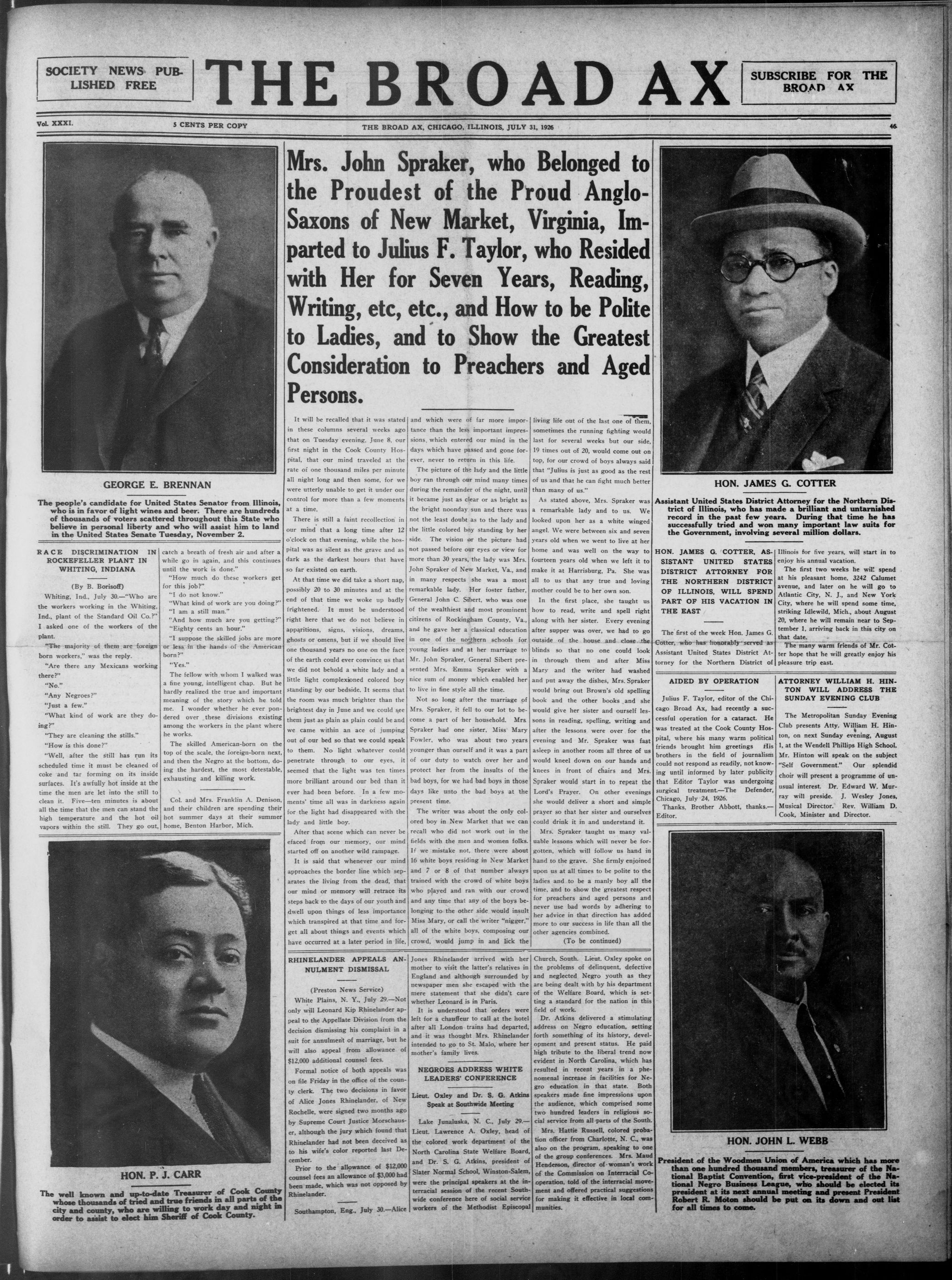
The people's candidate for United States Sen who is in favor of light wines and beer. The of thousands of voters scattered through believe in personal liberty and who will in the United States Senate Tuesday, Nov
Candidate for United States Senator from Illinois, or of light wines and beer. There are hundreds of voters scattered throughout this State who personal liberty and who will assist him to land States Senate Tuesday, November 2.
The people's candidate for United States Senator from Illinois, who is in favor of light wines and beer. There are hundreds of thousands of voters scattered throughout this State who believe in personal liberty and who will assist him to land in the United States Senate Tuesday, November 2.
RACE DISCRIMINATION IN ROCKEFELLER PLANT IN WHITING, INDIANA
Whiting, Ind., July 30.—"Who are the workers working in the Whiting, Ind., plant of the Standard Oil Co." I asked one of the workers of the plant. "The majority of them are foreign born workers," was the reply. "Are there any Mexicans working there?"
"What kind of work are they doing?"
"They are cleaning the stills."
"How is this done?"
"Well, after the still has run its scheduled time it must be cleaned of coke and tar forming on its inside surfaces. It's awfully hot inside at the time the men are let into the still to clean it. Five—ten minutes is about all the time that the men can stand the high temperature and the hot oil vapors within the still. They go out,
```markdown
```
M.
The well known and up-to-date Treasurer whose thousands of tried and true friend city and county, who are willing to w order to assist to elect him Sheriff of
in and up-to-date Treasurer of Cook County friends of tried and true friends in all parts of the county, who are willing to work day and night in best to elect him Sheriff of Cook County.
The well known and up-to-date Treasurer of Cook County whose thousands of tried and true friends in all parts of the city and county, who are willing to work day and night in order to assist to elect him Sheriff of Cook County.
Vol. XXXI.
(By B. Borisoff)
"Any Negroes?"
"Just a few."
"How is this done?"
THE BROAD AX
5 CENTS PER COPY
catch a breath of fresh air and after a while go in again, and this continues until the work is done."
"How much do these workers get for this job?"
"I do not know."
"What kind of work are you doing?"
"I am a still man."
"And how much are you getting?"
"Eighty cents an hour."
"I suppose the skilled jobs are more or less in the hands of the American born?"
"Yes."
The fellow with whom I walked was a fine young, intelligent chap. But he hardly realized the true and important meaning of the story which he told me. I wonder whether he ever pondered over these divisions existing among the workers in the plant where he works.
The skilled American-born on the top of the scale, the foreign-born next, and then the Negro at the bottom, doing the hardest, the most detestable, exhausting and killing work.
Col. and Mrs. Franklin A. Denison, and their children are spending their hot summer days at their summer home, Benton Harbor, Mich.
THE BROAD AX, CHICAGO, ILLINOIS, JULY 31, 1926
Mrs. John Spraker, who Belonged to the Proudest of the Proud AngloSaxons of New Market, Virginia, Imparted to Julius F. Taylor, who Resided with Her for Seven Years, Reading, Writing, etc, etc., and How to be Polite to Ladies, and to Show the Greatest Consideration to Preachers and Aged
It will be recalled that it was stated in these columns several weeks ago that on Tuesday evening, June 8, our first night in the Cook County Hospital, that our mind traveled at the rate of one thousand miles per minute all night long and then some, for we were utterly unable to get it under our control for more than a few moments at a time.
There is still a faint recollection in our mind that a long time after 12 o'clock on that evening, while the hospital was as silent as the grave and as dark as the darkest hours that have so far existed on earth.
At that time we did take a short nap, possibly 20 to 30 minutes and at the end of that time we woke up badly frightened. It must be understood right here that we do not believe in apparitions, signs, visions, dreams, ghosts or omens, but if we should live one thousand years no one on the face of the earth could ever convince us that we did not behold a white lady and a little light complexioned colored boy standing by our bedside. It seems that the room was much brighter than the brightest day in June and we could see them just as plain as plain could be and we came within an ace of jumping out of our bed so that we could speak to them. No light whatever could penetrate through to our eyes, it seemed that the light was ten times more brilliant around our bed than it ever had been before. In a few moments' time all was in darkness again for the light had disappeared with the lady and little boy.
After that scene which can never be efaced from our memory, our mind started off on another wild rampage. It is said that whenever our mind approaches the border line which separates the living from the dead, that our mind or memory will retrace its steps back to the days of our youth and dwell upon things of less importance which transpired at that time and forget all about things and events which have occurred at a later period in life,
RHINELANDER APPEALS AN
NULMUN DISMISSAL
(Preston News Service)
White Plains, N. Y., July 29.—Not only will Leonard Kip Rhinelander appeal to the Appellate Division from the decision dismissing his complaint in a suit for annulment of marriage, but he will also appeal from allowance of $12,000 additional counsel fees.
Formal notice of both appeals was on file Friday in the office of the county clerk. The two decisions in favor of Alice Jones Rhinelander, of New Rochelle, were signed two months ago by Supreme Court Justice Morschauser, although the jury which found that Rhinelander had not been deceived as to his wife's color reported last December.
Prior to the allowance of $12,000 counsel fees an allowance of $3,000 had been made, which was not opposed by Rhinelander.
Southampton, Eng., July 30.—Alice
and which were of far more importance than the less important impressions, which entered our mind in the days which have passed and gone forever, never to return in this life.
The picture of the lady and the little boy ran through our mind many times during the remainder of the night, until it became just as clear or as bright as the bright noonday sun and there was not the least doubt as to the lady and the little colored boy standing by her side. The vision or the picture had not passed before our eyes or view for more than 30 years, the lady was Mrs. John Spraker of New Market, Va., and in many respects she was a most remarkable lady. Her foster father, General John C. Sibert, who was one of the wealthiest and most prominent citizens of Rockingham County, Va., and he gave her a classical education in one of the northern schools for young ladies and at her marriage to Mr. John Spraker, General Sibert presented Mrs. Emma Spraker with a nice sum of money which enabled her to live in fine style all the time.
Not so long after the marriage of Mrs. Spraker, it fell to our lot to become a part of her household. Mrs. Spraker had one sister, Miss Mary Fowler, who was about two years younger than yourself and it was a part of our duty to watch over her and protect her from the insults of the bad boys, for we had bad boys in those days like unto the bad boys at the present time.
The writer was about the only colored boy in New Market that we can recall who did not work out in the fields with the men and women folks. If we mistake not, there were about 16 white boys residing in New Market and 7 or 8 of that number always trained with the crowd of white boys who played and ran with our crowd and any time that any of the boys belonging to the other side would insult Miss Mary, or call the writer "nigger," all of the white boys, composing our crowd, would jump in and lick the
Jones Rhinelander arrived with her mother to visit the latter's relatives in England and although surrounded by newspaper men she escaped with the mere statement that she didn't care whether Leonard is in Paris.
It is understood that orders were left for a chauffeur to call at the hotel after all London trains had departed, and it was thought Mrs. Rhinelander intended to go to St. Malo, where her mother's family lives.
NEGROES ADDRESS WHITE
LEADERS' CONFERENCE
Lieut. Oxley and Dr. S. G. Atkins Speak at Southwide Meeting
Lake Junaluska, N. C., July 29.—Lieut. Lawrence A. Oxley, head of the colored work department of the North Carolina State Welfare Board, and Dr. S. G. Atkins, president of Slater Normal School, Winston-Salem, were the principal speakers at the interracial session of the recent Southwide conference here of social service workers of the Methodist Episcopal
living life out of the last one of them, sometimes the running fighting would last for several weeks but our side, 19 times out of 20, would come out on top, for our crowd of boys always said that "Julius is just as good as the rest of us and that he can fight much better than many of us."
As stated above, Mrs. Spraker was a remarkable lady and to us. We looked upon her as a white winged angel. We were between six and seven years old when we went to live at her home and was well on the way to fourteen years old when we left it to make it at Harrisburg, Pa. She was all to us that any true and loving mother could be to her own son.
In the first place, she taught us how to read, write and spell right along with her sister. Every evening after supper was over, we had to go outside of the house and close the blinds so that no one could look in through them and after Miss Mary and the writer had washed and put away the dishes, Mrs. Spraker would bring out Brown's old spelling book and the other books and she would give her sister and ourself lessons in reading, spelling, writing and after the lessons were over for the evening and Mr. Spraker was fast asleep in another room all three of us would kneel down on our hands and knees in front of chairs and Mrs. Spraker would start in to repeat the Lord's Prayer. On other evenings she would deliver a short and simple prayer so that her sister and ourselves could drink it in and understand it.
Mrs. Spraker taught us many valuable lessons which will never be forgotten, which will follow us hand in hand to the grave. She firmly enjoined upon us at all times to be polite to the ladies and to be a manly boy all the time, and to show the greatest respect for preachers and aged persons and never use bad words by adhering to her advice in that direction has added more to our success in life than all the other agencies combined.
(To be continued)
Church, South. Lieut. Oxley spoke on the problems of delinquent, defective and neglected Negro youth as they are being dealt with by his department of the Welfare Board, which is setting a standard for the nation in this field of work. Dr. Atkins delivered a stimulating address on Negro education, setting forth something of its history, development and present status. He paid high tribute to the liberal trend now evident in North Carolina, which has resulted in recent years in a phenomenal increase in facilities for Negro education in that state. Both speakers made fine impressions upon the audience, which comprised some two hundred leaders in religious social service from all parts of the South. Mrs. Hattie Russell, colored probation officer from Charlotte, N. C., was also on the program, speaking to one of the group conferences. Mrs. Maud Henderson, director of woman's work of the Commission on Interracial Cooperation, told of the interracial movement and offered practical suggestions for making it effective in local communities.
SUBSCRIBE FOR THE BROAD AX
THE NEW YORK TIMES
46
THE BROOKLYN BANKING CORPORATION
Assistant United States District Attorney for the trict of Illinois, who has made a brilliant a record in the past few years. During the successfully tried and won many important the Government, involving several million c
and States District Attorney for the
hois, who has made a brilliant as
the past few years. During the
tried and won many important
ment, involving several million c
District Attorney for the Northern Dishes has made a brilliant and untarnished few years. During that time he has won many important law suits for solving several million dollars.
Assistant United States District Attorney for the Northern District of Illinois, who has made a brilliant and untarnished record in the past few years. During that time he has successfully tried and won many important law suits for the Government, involving several million dollars.
HON. JAMES G. COTTER, ASSISTANT UNITED STATES DISTRICT ATTORNEY FOR THE NORTHERN DISTRICT OF ILLINOIS, WILL SPEND PART OF HIS VACATION IN THE EAST
The first of the week Hon. James G. Cotter, who has honorably served as Assistant United States District Attorney for the Northern District of Illinois for five years, will start in to enjoy his annual vacation.
The first two weeks he will spend at his pleasant home, 3242 Calumet avenue, and later on he will go to Atlantic City, N. J., and New York City, where he will spend some time, striking Idlewild, Mich., about August 20, where he will remain near to September 1, arriving back in this city on that date.
The many warm friends of Mr. Cotter hope that he will greatly enjoy his pleasure trip east.
AIDED BY OPERATION
Julius F. Taylor, editor of the Chicago Broad Ax, had recently a successful operation for a cataract. He was treated at the Cook County Hospital, where his many warm political friends brought him greetings. His brothers in the field of journalism could not respond as readily, not knowing until informed by later publicity that Editor Taylor was undergoing surgical treatment—The Defender, Chicago, July 24, 1926. Thanks, Brother Abbott, thanks.—Editor.
M.
M.
M.
HON. JOHN L. WEBB
President of the Woodmen Un-
than one hundred thousand
tional Baptist Convention,
tional Negro Business Lea-
president at its next annual
Robert R. Moton should
for all times to come.
The Woodmen Union of America is hundred thousand members, treat
ist Convention, first vice-president
o Business League, who should
it its next annual meeting and p
Moton should be put on its de
tes to come.
men Union of America which has more than thousand members, treasurer of the Naval Association, first vice-president of the Naval Press League, who should be elected its annual meeting and present President should be put on its down and out list one.
President of the Woodmen Union of America which has more than one hundred thousand members, treasurer of the National Baptist Convention, first vice-president of the National Negro Business League, who should be elected its president at its next annual meeting and present President Robert R. Moton should be put on its down and out list for all times to come.
Illinois for five years, will start in to enjoy his annual vacation.
The first two weeks he will spend at his pleasant home, 3242 Calumet avenue, and later on he will go to Atlantic City, N. J., and New York City, where he will spend some time, striking Idlewild, Mich., about August 20, where he will remain near to September 1, arriving back in this city on that date.
The many warm friends of Mr. Cotter hope that he will greatly enjoy his pleasure trip east.
ATTORNEY WILLIAM H. HIN-
TON WILL ADDRESS THE
SUNDAY EVENING CLUB
The Metropolitan Sunday Evening Club presents Atty. William H. Hinton, on next Sunday evening, August 1, at the Wendell Phillips High School. Mr. Hinton will speak on the subject "Self Government." Our splendid choir will present a programme of unusual interest. Dr. Edward W. Murray will preside. J. Wesley Jones, Musical Director. Rev. William D. Cook, Minister and Director.
THE BROAD AX
Published Every Saturday
THE BROAD AX
Published Every Saturday
In this city since July 15th, 1899, without missing one single issue. Republicans, Democrats, Catholics, Protestants, Single Taxers, Priests, infidels or anyone else can have their say as long as their language is proper and responsibility is fixed.
The Broad Ax is a newspaper whose platform is broad enough for all, ever claiming the editorial right to speak its own mind. It is neither Democratic nor Republican. It is strictly or absolutely independent in politics Local communications will receive attention. Write only on one side of the paper.
Subscriptions must be paid in advance.
One Year .....$2.00
Six Months .....$1.00
Advertising rates made known on
application.
Address all communications to
THE BROAD AX
6206 S. Elizabeth St., Chicago.
Phone: Wentworth 2597
JULIUS F. TAYLOR
Editor and Publisher
Entered as Second-Class Matter, Aug.
19, 1902, at the Post office at Chicago,
Ill. Under Act of March 8, 1879.
THE WEEK'S EDITORIAL: THE
WHITE PRESS
(From The Labor World, Duluth,
Minn.
A NEW ABOLITION MOVEMENT
America has a new abolition movement which should be encouraged by every humanitarian and by every lover of justice, freedom and democracy. That movement is represented by the National Association for the Advancement of Colored People. It is doing a great work among the American Negroes and for them in the nation at large. The Association is organized to emancipate America from caste prejudice, to set the Negro free from the barriers which now confront him and to open to America the large gifts of this great group of her population. This is the ambitious task of this new abolition movement.
It has already achieved considerable success in state legislatures and in Congress. It has aroused the nation—north and south—to condemn lynching as the shame of America. It has stirred southern women to organize to fight lynching, and out of it has come southern inter-racial commissions to promote the welfare of the Negro and to protect him in his civil rights.
This new abolition society has been no less efficient in the courts of law. It has a long list of legal victories to its credit. It is seeing to it that no Negro shall be unjustly punished because of prejudice against his race.
The Association co-operates with other agencies in stimulating Negro workingmen to organize and to enter unions when they are received on a plane of equality. It advises them, however, when white unions will not receive them, to use their power to break down such opposition. It works for the cultural advancement of the race. It has conducted campaigns for better schools in the south and has won fights against segregated schools in the north. It seeks to stimulate the arts among Negroes.
Such an organization is rendering a truly patriotic service. Membership in it is not limited to Negroes. People of other races may join and cooperate in promoting its worthy purposes. The old abolition movement sought to free the Negro from chattel slavery; the new abolition seeks to free him from caste slavery. Is not that real Americanism?
MRS. MARTHA B. ANDERSON
AND A PARTY OF FRIENDS
ARE TOURING THE EAST
Mrs. Martha B. Anderson, 4935 Champlain avenue, Mr. and Mrs. George Hutchinson, Prof. J. Wesley Jones, and Mrs. Maude Roberts George, are visiting Buffalo, N. Y., New York City and Philadelphia, Pa., where they will attend the sessions of the National Negro Musicians Association. They will be absent about fifteen days.
ON VACATION
Jas. A. Parker, secretary of The Pyramid Building and Loan Association, 6816 Langley avenue, is spending a two weeks' vacation in Canada and Michigan.
NORFOLK JUDGE DECLARES
SEGREGATION ORDINANCE
INVALID FOR SECOND
TIME
Declaring the residential segregation ordinance passed recently by the City of Norfolk invalid and without effect, Judge Spindle of the police court on July 15, ruled against efforts to herd the Negroes of Norfolk in restricted areas. This decision was rendered in the case of Samuel Costen, a colored man, who recently sought to move his family into a house located at Mapleton and Majestic avenues, a so-called white district. A warrant was issued against Costen on the complaint of white neighbors, charging violation of the segregation ordinance.
David H. Edwards, attorney and president of the Norfolk branch of the National Association for the Advancement of Colored People, appeared for Mr. Costen. Mr. Edwards was assisted by B. J. Barnes. For the plaintiffs appeared John B. Jenkins and J. Louis Broudy who contended that the Norfolk law was not affected by the United States Supreme Court decision of 1917 in the Louisville Case, as the law under consideration was identical with the one in New Orleans which the Supreme Court of Louisiana has upheld, which case is now pending in the U. S. Supreme Court through the work of the New Orleans Branch of the N.A. A.C.P.
Mr. Edwards made a brilliant argument, contending that the law did not differ in its essentials from the Louisville ordinance; that it did abridge the constitutional rights of citizens; and that the provision which allows the occupancy of a home in a white neighborhood by a colored family on the consent of the majority of white residents of that section and vice versa, were an improper exercising of legislative authority.
Following the submission of briefs by attorneys on both sides, Judge Spindle rendered his decision declaring the law invalid, unconstitutional and without effect.
Judge Spindle's previous decision was rendered when Mr. Edwards prosecuted a white merchant who moved into a Negro neighborhood. The case was dismissed on the ground that the law was invalid. It is believed the two adverse decisions will end attempts at segregation in Norfolk by this means.
ENGLISH MAGAZINE PUB
LISHES ARTICLE ON ALEX-
ANDRE DUMAS
The London Bookman for June publishes as the feature article of that issue a study of Alexandre Dumas by Alfred Tresidder Sheppard. Mr. Sheppard in the first paragraph of the three page article quotes Robert Louis Stevenson who called the novelist "the ventripotent mulatto, the great eater, worker, earner, waster, the man of much and witty laughter, the man of the great heart. . ." Mr. Sheppard then gives a critical estimate of the great Negro writer, closing with an interesting story which reveals one of Dumas' traits. Thus Mr. Sheppard tells it.
"Would you rather be called Davy de la Pailleterie like your grandfather the Marquis,' his mother asked him once, or simply Alexandre Dumas like your father? If the first you could be a page; if the second, no career opens before you.' "I will be called Alexandre Dumas and nothing else,' he replied proudly.' And Mr. Sheppard comments, "It is that name, that image, that superscription, which gives its value to the bounty flung so lavishly. We owe the magnificent old prodigal so very much."
Not only does the Bookman publish Alexandre Dumas' photograph with the article but the same picture appears on the cover.
COLORED NURSE EMPLOYED
IN GEORGIA COUNTY
Thomasville, Ga.-Mrs. Turner Bloe has recently been employed as a public health nurse for the colored people of Thomasville and the surrounding county, and a car has been presented her to facilitate her work. Her employment was due to the efforts of the local interracial committee, led by Rev. Robb White. The program is financed jointly by the welfare fund of the city and by federal appropriations under the Shepherd-Towner bill. Mrs. Bloe is a thoroughly competent registered nurse, and great results are expected from her work.
VISITS ON BUSINESS
David Bishop, 518 E. 35th street, and M. T. Bailey, 3638 S. State street, spent some time in Harvey, III, during the week on important business matters. They made the trip by motor.
THE BROAD AX, CHICAGO, ILLINOIS, JULY 31, 1926
THE WEEKLY NEWS
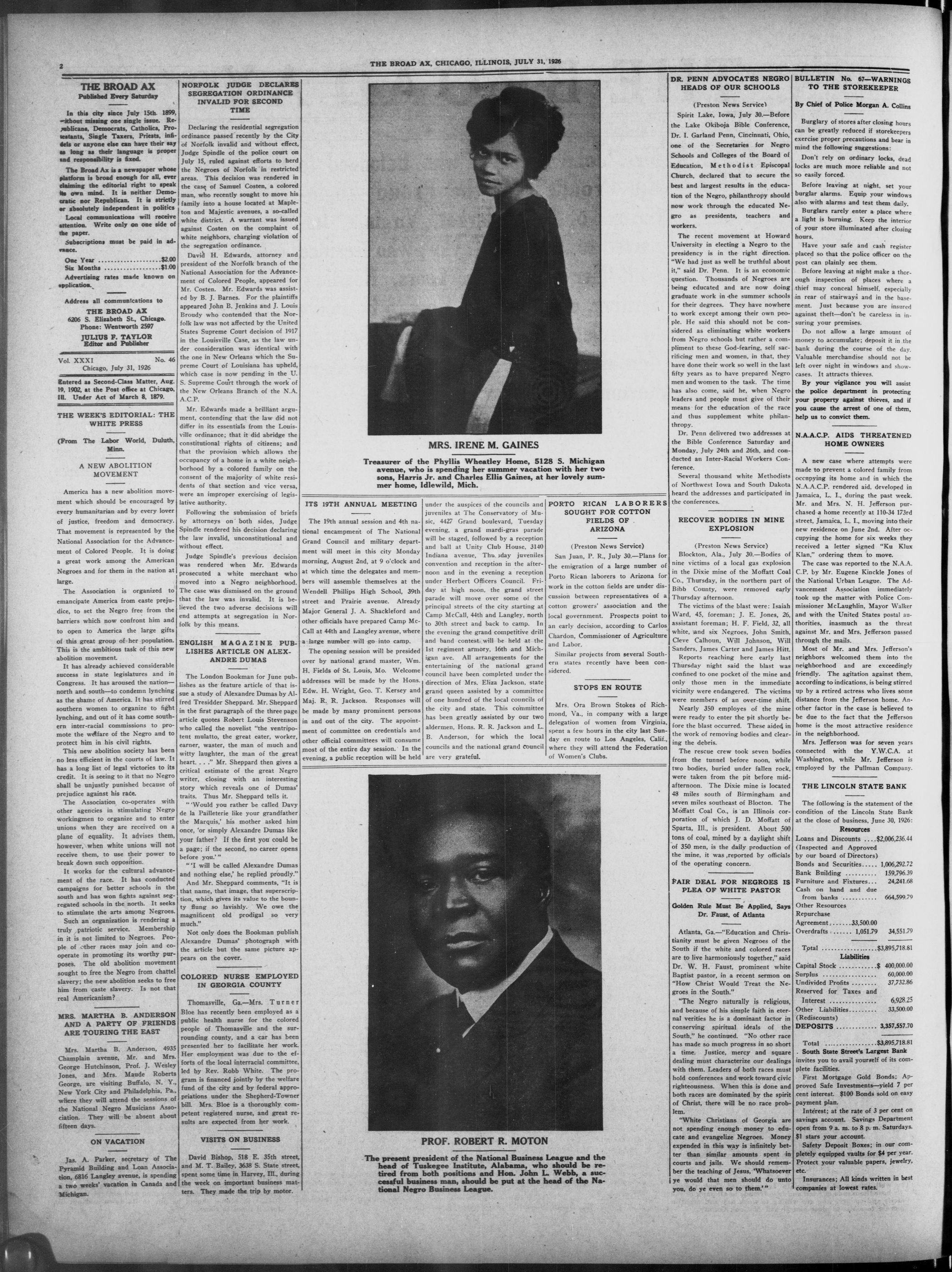
Treasurer of the Phyllis Wheatley Home, 5128 S. Michigan avenue, who is spending her summer vacation with her two sons, Harris Jr. and Charles Ellis Gaines, at her lovely summer home, Idlewild, Mich.
[Name]
The present president of the National Business League and the head of Tuskegee Institute, Alabama, who should be retired from both positions and Hon. John L. Webb, a successful business man, should be put at the head of the National Negro Business League.
The present president of the National Business League and the head of Tuskegee Institute, Alabama, who should be retired from both positions and Hon. John L. Webb, a successful business man, should be put at the head of the National Negro Business League.
ITS 19TH ANNUAL MEETING
The 19th annual session and 4th national encampment of The National Grand Council and military department will meet in this city Monday morning, August 2nd, at 9 o'clock and at which time the delegates and members will assemble themselves at the Wendell Phillips High School, 39th street and Prairie avenue. Already Major General J. A. Shackleford and other officials have prepared Camp McCall at 44th and Langley avenue, where a large number will go into camp.
The opening session will be presided over by national grand master, Wm. H. Fields of St. Louis, Mo. Welcome addresses will be made by the Hons. Edw. H. Wright, Geo. T. Kersey and Maj. R. R. Jackson. Responses will be made by many prominent persons in and out of the city. The appointment of committee on credentials and other official committees will consume most of the entire day session. In the evening, a public reception will be held
MRS. IRENE M. GAINES
the Phyllis Wheatley Home, 512
so is spending her summer vacation
Jr. and Charles Ellis Gaines, at B
Idlewild, Mich.
under the auspices of the councils and juveniles at The Conservatory of Music, 4427 Grand boulevard, Tuesday evening, a grand mardi-gras parade will be staged, followed by a reception and ball at Unity Club House, 3140 Indiana avenue, Thu.sday juveniles convention and reception in the afternoon and in the evening a reception under Herbert Officers Council. Friday at high noon, the grand street parade will move over some of the principal streets of the city starting at Camp McCall, 44th and Langley, north to 30th street and back to camp. In the evening the grand competitive drill and band contest will be held at the 1st regiment armory, 16th and Michigan ave. All arrangements for the entertaining of the national grand council have been completed under the direction of Mrs. Eliza Jackson, state grand queen assisted by a committee of one hundred of the local councils of the city and state. This committee has been greatly assisted by our two aldermen, Hons. R. R. Jackson and L. B. Anderson, for which the local councils and the national grand council are very grateful.
M.
PROF. ROBERT R. MOTON
president of the National Business I
buskegee Institute, Alabama, who
is both positions and Hon. John L.
business man, should be put at the h
ro Business League.
PORTO RICAN LABORERS
SOUGHT FOR COTTON
FIELDS OF
ARIZONA
San Juan, P. R., July 30.—Plans for the emigration of a large number of Porto Rican laborers to Arizona for work in the cotton fields are under discussion between representatives of a cotton growers' association and the local government. Prospects point to an early decision, according to Carlos Chardon, Commissioner of Agriculture and Labor. Similar projects from several Southern states recently have been considered.
STOPS EN ROUTE
Mrs. Ora Brown Stokes of Richmond, Va., in company with a large delegation of women from Virginia spent a few hours in the city last Sunday en route to Los Angeles, Calif. where they will attend the Federation of Women's Clubs.
DR. PENN ADVOCATES NEGRO HEADS OF OUR SCHOOLS
Spirit Lake, Iowa, July 30.—Before the Lake Okiboja Bible Conference, Dr. I. Garland Penn, Cincinnati, Ohio, one of the Secretaries for Negro Schools and Colleges of the Board of Education, Methodist Episcopal Church, declared that to secure the best and largest results in the education of the Negro, philanthropy should now work through the educated Negro as presidents, teachers and workers.
The recent movement at Howard University in electing a Negro to the presidency is in the right direction. "We had just as well be truthful about it," said Dr. Penn. It is an economic question. Thousands of Negroes are being educated and are now doing graduate work in the summer schools for their degrees. They have nowhere to work except among their own people. He said this should not be considered as eliminating white workers from Negro schools but rather a compliment to these God-fearing, self sacrificing men and women, in that, they have done their work so well in the last fifty years as to have prepared Negro men and women to the task. The time has also come, said he, when Negro leaders and people must give of their means for the education of the race and thus supplement white philanthropy.
Dr. Penn delivered two addresses at the Bible Conference Saturday and Monday, July 24th and 26th, and conducted an Inter-Racial Workers Conference. Several thousand white Methodists of Northwest Iowa and South Dakota heard the addresses and participated in the conferences.
RECOVER BODIES IN MINE
EXPLOSION
Blockton, Ala., July 30.—Bodies of nine victims of a local gas explosion in the Dixie mine of the Moffatt Coal Co., Thursday, in the northern part of Bibb County, were removed early Thursday afternoon.
The victims of the blast were: Isaiah Ward, 45, foreman; J. E. Jones, 26, assistant foreman; H. F. Field, 32, all white, and six Negroes, John Smith, Cleve Calhoun, Will Johnson, Will Sanders, James Carter and James Hitt. Reports reaching here early last Thursday night said the blast was confined to one pocket of the mine and only those men in the immediate vicinity were endangered. The victims were members of an over-time shift. Nearly 350 employees of the mine were ready to enter the pit shortly before the blast occurred. These aided in the work of removing bodies and clearing the debris.
The rescue crew took seven bodies from the tunnel before noon, while two bodies, buried under fallen rock, were taken from the pit before mid-afternoon. The Dixie mine is located 48 miles south of Birmingham and seven miles southeast of Blocton. The Moffatt Coal Co., is an Illinois corporation of which J. D. Moffatt of Sparta, Ill., is president. About 500 tons of coal, mined by a daylight shift of 350 men, is the daily production of the mine, it was reported by officials of the operating concern.
FAIR DEAL NEGROES IS
PLEA OF WHITE PASTOR
Golden Rule Must Be Applied, Says Dr. Faust, of Atlanta
Atlanta, Ga.—"Education and Christianity must be given Negroes of the South if the white and colored races are to live harmoniously together," said Dr. W. H. Faust, prominent white Baptist pastor, in a recent sermon on "How Christ Would Treat the Negroes in the South."
"The Negro naturally is religious, and because of his simple faith in eternal verities he is a dominant factor in conserving spiritual ideals of the South," he continued. "No other race has made so much progress in so short a time. Justice, mercy and square dealing must characterize our dealings with them. Leaders of both races must hold conferences and work toward civic righteousness. When this is done and both races are dominated by the spirit of Christ, there will be no race problem.
"White Christians of Georgia are not spending enough money to educate and evangelize Negroes. Money expended in this way is infinitely better than similar amounts spent in courts and jails. We should remember the teaching of Jesus, 'Whatsoever ye would that men should do unto you, do ye even so to them.'"
BULLETIN No. 67-WARNINGS
TO THE STOREKEEPER
By Chief of Police Morgan A. Collins
Burglary of stores after closing hours can be greatly reduced if storekeepers exercise proper precautions and bear in mind the following suggestions:
Don't rely on ordinary locks, dead locks are much more reliable and not so easily forced.
Before leaving at night, set your burglar alarms. Equip your windows also with alarms and test them daily.
Burglaries rarely enter a place where a light is burning. Keep the interior of your store illuminated after closing hours.
Have your safe and cash register placed so that the police officer on the post can plainly see them.
Before leaving at night make a thorough inspection of places where a thief may conceal himself, especially in rear of stairways and in the basement. Just because you are insured against theft—don't be careless in insuring your premises.
Do not allow a large amount of money to accumulate; deposit it in the bank during the course of the day. Valuable merchandise should not be left over night in windows and showcases. It attracts thieves.
By your vigilance you will assist the police department in protecting your property against thieves, and if you cause the arrest of one of them, help us to convict them.
N.A.A.C.P. AIDS THREATENED
HOME OWNERS
A new case where attempts were made to prevent a colored family from occupying its home and in which the N.A.A.C.P. rendered aid. developed in Jamaica, L. I., during the past week. Mr. and Mrs. N. H. Jefferson purchased a home recently at 110-34 173rd street, Jamaica, L. I., moving into their new residence on June 2nd. After occupying the home for six weeks they received a letter signed "Ku Klux Klan." ordering them to move.
The case was reported to the N.A.A. C.P. by Mr. Eugene Kinckle Jones of the National Urban League. The Advancement Association immediately took up the matter with Police Commissioner McLaughlin, Mayor Walker and with the United States postal authorities, inasmuch as the threat against Mr. and Mrs. Jefferson passed through the mails.
Most of Mr. and Mrs. Jefferson's neighbors welcomed them into the neighborhood and are exceedingly friendly. The agitation against them, according to indications, is being stirred up by a retired actress who lives some distance from the Jefferson home. Another factor in the case is believed to be due to the fact that the Jefferson home is the most attractive residence in the neighborhood.
Mrs. Jefferson was for seven years connected with the Y.W.C.A. at Washington, while Mr. Jefferson is employed by the Pullman Company.
THE LINCOLN STATE BANK
The following is the statement of the condition of the Lincoln State Bank at the close of business, June 30, 1926: Resources
Resources
Loans and Discounts ..... $2,006,236.44
(Inspected and Approved
by our board of Directors)
Bonds and Securities ..... 1,006,292.72
Bank Building ..... 159,796.39
Furniture and Fixtures ..... 24,241.68
Cash on hand and due
from banks ..... 664,599.79
Other Resources
Repurchase
Agreement ..... 33,500.00
Overdrafts ..... 1,051.79 ..... 34,551.79
Total ..... $3,895,718.81
Liabilities
Capital Stock ..... $ 400,000.00
Surplus ..... 60,000.00
Undivided Profits ..... 37,732.86
Reserved for Taxes and
Interest ..... 6,928.25
Other Liabilities ..... 33,500.00
(Rediscounts)
DEPOSITS ..... 3,357,557.70
Total ..... $3,895,718.81
South State Street's Largest Bank invites you to avail yourself of its complete facilities.
First Mortgage Gold Bonds; Approved Safe Investments—yield 7 per cent interest. $100 Bonds sold on easy payment plan.
Interest; at the rate of 3 per cent on savings account. Savings Department open from 9 a. m. to 8 p. m. Saturdays. $1 stars your account.
Safety Deposit Boxes; in our completely equipped vaults for $4 per year.
Protect your valuable papers, jewelry, etc.
Insurances; All kinds written in best companies at lowest rates.
```markdown
```
COLORFUL NEWS MOVIES By THE CAMERAMAN
1. Interstate Commerce Law.
2. My Brother! My Brother!
3. The Shoe Pinches.
4. Evolution in Honolulu (and else where).
(Preston News Service)
1. Interstate Commerce Law:
The written opinion of the Interstate Commerce Commission No. 15553, in the case of E. Crosby vs. St. Louis-San Francisco Railway Company, commented upon in this column some weeks ago, contains several points which the colored people of America need to note, along with their reflections over the Interstate Commerce Law and the history of the several Jim Crow cases, tried before the Interstate Commerce Commission since its creation by Congress in 1887. The Crosby decision said: "Complaint offered no proof in support of his claims for damages. It should be said that before any party can recover damages under the Interstate Commerce Act he must allege and show not merely the wrong of the carrier but that the wrong has in fact operated to his injury. It seems clear that our jurisdiction is limited to an award of damages capable of definite ascertainment and not to damages of the nature complainant SEEMS to seek."
Thus, if a thousand crates of strawberries perish in interstate commerce by reason of mishandling or misrouting by the interstate carrier, the same must be compensated for by the negligent carrier, because of the DEFINITE ASCERTAINMENT of their market value. But if a thousand Negro interstate passengers are grievously discriminated against, unless there is a definite ascertainment of the cash value of the damages they sustain, then there is no remedy. Yet the Commission said, in Edwards vs. Nashville, Chattanooga & St. Louis Ry. Co., 12 I. C. C., 247, that "It by no means follows that carriers may discriminate between white and colored passengers in the accommodations which they furnish to each." If a railroad provides certain facilities and accommodations for first-class passengers of the white race, it is COMMANDED BY THE LAW that like accommodations shall be provided for colored passengers of the same class. The principle that must govern is that carriers must serve equally well all passengers, whether white or colored, paying the same fare. Failure to do this is discrimination and subjects the passenger to undue and unreasonable prejudice and disadvantage."
Mereiy a cursory review of the Interstate Commerce Act reveals the fact that the Commission has power to order a recalcitrant carrier to cease and desist from creating undue and unreasonable prejudices and disadvantages as against shippers or passengers. And in the event such carrier refuses to obey the mandate of the Commission, there are cash penalties provided for by law, which the Commission has the power to levy.
Every student of interstate transportation problems knows that the Interstate Commerce clause is primarily intended to equalize freight and passenger facilities prescribed and furnished by interstate carriers; and every Negro who has ever traveled South knows that the rank and file of southern rail lines laugh up their sleeves at the revolting discriminations in the way of facilities furnished to colored travelers.
There have been numerous Jim Crow cases before the Commission for trial, but every one has fallen down in the intrinsic remedy it sought, either because of lack of formality of pleadings or some breach in prayer or proof. There are ample remedies at hand under the Commerce clause of the Constitution and under the Commerce Act to cause discriminating carriers to spend thousands to comply with the dormant orders of the Interstate Commerce Commission—dormant because the carriers ignore them when they apply to our group, and our group frequently prefers to hire a hall and engage in oratory than to pledge an ample fund to insure accuracy of procedure and pleading in fighting Jim Crowism.
It is to be hoped that the next case involving Jim Crow questions will be 100 per cent perfect in attack and in follow-up methods. An economic draught blowing precision and accuracy against interstate commerce law evasions is worth more than ten thousand platform blasts on Jim Crowism.
* * *
2. My Brother! My Brother!
"It's no use, you can't buy brotherhood," said the philosophical barber,
as he prepared to give my burning head a cooling hair cut.
"The brother has been the greatest imitator the world ever saw," the barber continued; "but in fraternalism, he's missed the point, trying to make personal gains at group expense."
"Oh, you're all wrong," I responded. "Our fraternities are among the strongest assets the race has. Take them and the church groups away from us," I insisted, vigorously, "and we wouldn't get anywhere."
"Sure," the haircuter replied, with a laugh. "The numerical and financial strength is all right on the books; but how are you going to buy brotherhood at the price of fifty cents a month when the Grand United Dictator is figuring on forty-nine cents of it for his own personal use"
"Oh, I guess you're just one of those malcontents whom the lodge dropped for nonpayment of dues," I shot at him with some feeling.
"Nope," I'm paid up to December, 1930, he snapped back quickly, clicking the scissors with precision. "You see, it's like this," he continued: "The open gunning season is on in full right now. And there's Brother Jones calling Brother Smith a liar, and Brother Johnson and Brother Coates had a bad scrap last night; and Brother Turner blackballed Brother Mason because he wasn't made deacon down at the church last Sunday. Meanwhile, the Committee's investigating the Secretary's books. Oh, don't tell me," the barber shouted, almost excitedly, you can't buy brotherhood; and I know it."
"But those are just little petty matters that might arise anywhere among any people," I ventured soothingly.
"Yes, but I'm through," the barber insisted. "I'm tired of all this brick-batting, and I ain't going to spare a one of 'em. I'm going to quit now, and get my affidavits ready."
"But what have you to do with any affidavits" I inquired, in wonderment.
"Well, you see, I'm treasurer, and — don't you need a shampoo, sir?" stuttered the barber.
3. The Shoe Pinches:
Negro migration of close to a million black souls, stretching over the so-called "dry" or Volstead period, during which old King Alcohol was bottled in bondage by the Eighteenth amendment, has been a silent accelerant to the economic dilemma which is enshrouding the farmers of the South and the West. Here are the equations which the farmer has faced and is facing, now. Negro labor plus a low farmer wage permitted extraordinary profits on barley, rye, wheat and the other agricultural members of King Alcohol's lusty family, permitting an experiment a la Volstead to make the country bone dry, on paper at least. But the experiment brought forth the enigmatic conclusion that decreasing Negro labor, due to migration, plus the soaring wage which farmers are now being compelled to pay the substitutes of the sons of Ham, magnified by a steadily decreasing output of rye, barley and wheat, despite the popularity of corn, are giving the farmers an economic chill which will undoubtedly develop into a frost when Congress convenes for its next session.
The fact remains that the rural and farm districts, more than any others, contributed to the alcoholic drouth of today; and now, with millions of bushels of rye, wheat and barley unnecessary because of the wane of whiskey, and with the farmers paying top wages for planters, harvesters, and other workers, in the stead of the wage of bare existence which Negro farmers and operators formerly received, prior to seeking the steel furnaces and automobile plants of the urban districts, the shoe is pinching the farmers, who, in their cries for the profits of yester-year, forget that in a large measure they shaped the background of the present situation, which is menacing their future for many moons to come.
4. Evolution in Honolulu (and else where)
Yaka Hulo, Hickey Dula will be the swan song of Hawaii, according to Dr. Romanso Adams, Director of the Department of Sociology at the University of Hawaii, who is quoted as saying that "if inter-racial marriages in Hawaii continue at the present rate, it will be a wise child after a few generations who even knows to what race his ancestors belonged." Dr. Adams continues his interesting observations with the startling announcement that "thirty-five per cent of the marriages of white men in the islands are with women of other races. The pure-blooded Hawaiians and Portu-
guese are disappearing, while the part-Hawaiian and part-Portuguese groups are growing."
Thus the conquest and absorption of blood continue in far-off Hawaii, as they have in the Philippines and elsewhere where might and right meet at the social crossroads, with the stronger absorbing the weaker. Even the American Indians, who made the strongest fight that has ever been made against the absorption processes of the advance guard of Civilization as set up by the white man, succumbed now and then and lost a birthright in the maze of blood admixture.
The U. S. Census figures show plainly what has happened to the Negro in the racial battle against absorption. Startling figures from states, which in their statute books, bar intermarriage between whites and blacks, show that even the law does not suppress the call of the wild. Vaunted superiority falls when the acid test of dominating association comes.
The vanishing Hawaiian, the vanishing blacks, and all other vanishing prototypes, along with the vanishing American (the Indian) at least have a just grievance against that wing of Civilization which continues to thrive upon the blood of the weaker rates, with whom it comes into dominating contact as a "Missionary."
COOLIDGE REFERS MURDER OF COLORED SOLDIER TO WAR SECRETARY
Everett Sanders, Secretary to President Coolidge, has written Walter White, Assistant Secretary of the National Association for the Advancement of Colored People, it was announced today, advising that "by the President's direction, the matters to which you refer (in your letter of July 14th) are at once being brought to the attention of the Secretary of War."
The N.A.A.C.P., in the letter to which Mr. Sanders refers, requested of the President that steps be taken at once to punish E. J. Fulbright, a white night watchman, who murdered in cold blood at Americus, Georgia, last September, Private M. Smith of the 24th Infantry. Fulbright was later acquitted in a farcical trial in which, according to the Advancement Association's letter, "irrelevant and prejudicial matter was injected into the case by the defense attorneys with the result that Fulbright was acquitted."
The Association's letter also requested that the 24th Infantry be removed at once from Fort Benning, Georgia, to a more civilized section of the community. The N.A.A.C.P. cited indignities and brutalities which had been heaped upon the colored troops in Georgia ever since they were sent there in 1921.
In making public the communication from the President, the Advancement Association announced that it intended to follow up this case without letup in an effort to relieve the men of the 24th Infantry from the present intolerable conditions.
HEALTH NOTES
The Chicago Tuberculosis Institute conducts a ten minute health talk every Wednesday morning over radio station WGN on the Drake Hotel, by courtesy of the Chicago Tribune. These talks are on prevention and treatment of tuberculosis and are given by specialists.
The talks were discontinued June 30, for the summer months only, and will be resumed again early in September.
The Institute can supply pamphlets on any phase of tuberculosis, on child health education, and on general health topics. Some of these are free and only postage is charged. For others, the cost price is asked,—usually five or ten cents. One excellent little book is thirty cents.
Titles and prices will be furnished on request. Please pass this information on to anyone who may be interested.
HOMESTEAD MAN DROWNS IN . RIVER
(Preston News Service)
Homestead, Pa., July 30.—William Compsen, aged 25 years of Gold Way, employed as a laborer by McCrady Brothers, contractors of McClure street, Homestead, was drowned in the Monongahela river at the foot of McClure street at 11 o'clock Friday morning. The man was working on a barge when he fell into the river. His body was recovered Saturday afternoon.
VISITS
Mrs. Charlotte Hawkins Brown of Sedalia, N. C., president of The City Federation of Women's Club of North Carolina, was among the visitors in the city en route to Los Angeles, to attend the Federation of Women Clubs.
THE BROAD AX. CHICAGO. ILLINOIS. JULY 31. 1926
Odd Buildings Traced
to Roman Occupation
Efforts have been made for centuries to bare the mystery that hangs over the unique "Rows" at Chester, England, but their efforts have been in val. These rows consist of street lengths of covered arcade, not on the street level but several feet above it. One walks in front of shops and on the roofs of shops at once, looking down upon the traffic in the street and upon pedestrians. Visitors say that the mystery of the origin of these structures causes them to give a pleasant, creepy feeling to those who walk through them and that buying a collar stud in the rows is almost like buying a bronze or picture on pavement level. Chester was the great Roman military station of Deva. The central point of the Roman station was exactly where the rows now converge. The principal streets of the modern city were the principal streets of Deva and the principal streets of all subsequent towns on that site.
The Romans left Deva about 400 A. D. and for two centuries afterward burning Chester was a favorite game with the powers of the time.—London Times.
Almost from the hour when Columbus, the first European to see rubber, observed it used as a plaything by the Indians, who bounced it back and forth—hence the original name of India rubber—the substance has been bound up in romance and fiscal adventure, writes Isaac F. Marcosson in the Saturday Evening Post. In every sense it is another black Golconda, because it has affected the economic destiny of nations and individuals.
It was not until the discovery of vulcanization in 1839 by Charles Goodyear, a Connecticut hardware merchant, that the commercial era of rubber began. It is worth noting that Goodyear's only reference to tires was a suggestion that they might be used to lessen the noise of barrows used for wheeling luggage at railway stations.
Rubber got its name in business because it was originally used to rub out pencil marks. In London half a cubic inch of it once cost the equivalent of 75 cents. This is said to be the highest known price recorded for raw rubber.
Old Travel Maps
Motorists who use the ingenious strip maps of today, which are a cross between a map and a picture, probably imagine that the idea is an extremely modern thing, invented in response to an equally modern demand, says the Wall Street Journal. But one user thereof was startled the other day on coming across an exactly identical treatment of important highways in Great Britain, dating back some two or three hundred years. Instead of being in any wise crude or incomplete, the older strip maps were more detailed and explicit than the modern Each milepost was indicated by figures and landmarks along the route were noted in such useful phrases as: "A large stone," "An oak tree," "Narrow gate into a meadow," etc. Nor were any of the inns or branch roads omitted.
Inherited Mentality
According to a new theory on the mode of inheritance of mental traits there are at least five pairs of hereditary characters that have to do with the passing on of intelligence. If both parents are persons of high intelligence and possessed of all five pairs of these characters, their children will also average very high. If they are idiots, having none of the pairs of characters, their children also will be idiots. Intermediate conditions representing people of good average intelligence, but not geniuses, will produce a mixture of offspring types, with occasional exceptional children, and once in a while also offspring of low mentality.
Cave Men's Arsenal
In the neighborhood of the great naval port of Chatham, England, cavemen, millions of years ago, had an arsenal on the Medway, when that river's course ran close to where Frindsbury is now.
Two local men made the discovery about 16 months ago, and since then about 4,000 hammer stones, flint axes and scrapers, and other worked flints, have been taken out of the dump.
The tools and weapons, although they belong to the earliest period of the Stone age, are wonderfully efficient. Some of the edges are still almost as keen as razors.
Birds Follow Icebergs
Each season when the icebergs break away from Greenland and start to the south in the Atlantic they are followed by ever-increasing flocks of sea birds.
Officers of the coast guard cutters, on duty near the icebergs to warn shipping, report the bird life with the bergs is much greater this year than in the past. Fulmars, shearwaters, murre, kittiwakes and doveties are there in large numbers, apparently to get the food supply that is provided when the waves dash against the bergs and disable the little people of the water or the melting of the ice releases food imprisoned in the far north ages ago. -Ohio State Journal.
Truly Surprising
Elderly Hostess—So you are the daughter of my old friend, Margaret Blank. I was at your christening eighteen years ago—but how you have changed!—Boston Transcript.
(Copyright.)
THERE! That settles Jim forever!" And Dixie Blair sealed the monogrammed flap of the blue-gray envelope and pounded it with her little fist. Then she bowed her head on her arms and burst into tears.
The contents of the note spoke for themselves: "My dear James, I hear from perfectly reliable sources that you had dinner with that old flame of yours, Genevieve Bixby, at the Blue Parrot inn last night. If you want G. B. instead of me, you're ever so welcome, and I'm breaking our engagement. Dixie."
The wee small hours found her weighing every scrap of the evidence and the worth of its origin. To begin with, there was brother Chris who had tossed out a careless: "Nearly smashed to pieces your beloved Jim's car last night, Dix. Parked without lights in front of the Blue Parrot. How'd I know it was his? I was so mad I hoped out to get the number."
Then there was naive little Mrs. Smith, her employer's wife, who must always have her little joke. On her way to her husband's inner office, she had paused a minute at the desk where Dixie's nimble fingers were flying over the keys. "You want to watch that handsome young man of yours!" she had chuckled. "Rather risky letting him dine with Titian-haired beauties, even under the circumstances!" Circumstances, of course, to Dixie meant their engagement and the Titian-haired beauty could be but one person.
Yet when—and where had he seen her recently? Then Dixie recalled what her brother had said about seeing Jim's car at the Blue Parrot. And later in the day, her suspicions were confirmed by hearing her employer, as she went in to take his dictation, telling somebody over the telephone of the well-served, splendid dinner he and his wife had had last night at the Blue Parrot.
Yet, even with all of this, Dixie was rather loyal and would have thought it kinder to go straight to Jim for confirmation had not Jim himself made that difficult. For Jim had broken a promise to take her out to supper and a play afterwards by sending her a brief mysterious note. "Dixie, my dear, am having trouble with car. Cancel tonight's date. Will call you as soon as I can." But Jim hadn't telephoned that evening, and by the following afternoon Dixie was in no mood to answer the jingle of the telephone bell. Surely there was no explanation possible.
On the following evening, Dixie, feeling altogether downcast, sat sorting out all the little souvenirs of the good times she and Jim had had together—menu cards and ticket stubs, notes and letters. Suddenly she heard some one fumbling at the knob of the front door. Botheration! She had forgotten that Chris was out and had slipped the night latch on. Jumping up, she threw her lap full of favors on the cold ashes in the grate and run to the door.
Chris it was, but not only Chris; for behind him loomed a pair of familiar broad shoulders. Chris brushed by with a careless word of greeting and went straight on to his room upstairs, leaving his sister stunned, indignant and altogether at the mercy of the man who stood looking grimly down upon her.
"Oh," said Dixie in a tiny voice, hoping the villain couldn't hear the beating of her heart. "Please don't ask me to forgive you on top of the unmistakable evidence.
"You—you little goose!" cried Jim, and his voice wasn't altogether kind. "What do you mean—unmistakable? I've half a mind to let you believe what you want to, if you are not loyal enough to come to me before throwing me down!"
Yet he relented enough to put his arm about her.
Dixie, ineffectively, tried to draw away, and then looked up at him wistfully.
"D—didn't you go to the Blue Parrot inn?" she asked.
"Yes," said Jim. "I did."
"Was your car broken down?"
"Not at all," retorted her captor.
"D—didn't you dine with Genevieve Bixby?"
"I did," said Jim, without hesitation.
"Then let me go, Jim Barnard. You—you simply can't explain now!"
Jim laughed, released his hold, but did not seem nonplussed. "I did all of those dreadful things" he admitted. "None of them very remiss at that. I didn't say the car was broken down. Merely that I was having trouble with it. The fact was, it was stolen. The police telephoned me it had been found near the entrance of the Blue Parrot inn. Friends of mine took me there to recover it. I found the starter had been fooled with and had to send for a garage man to fix it. Meanwhile, the aforesaid friends asked me to have supper with them. Inside we met Miss Bixby and her fiance and her sister and sister's husband and we joined tables and dined together. And—there you are!"
Dixie sat silent for a moment. "Who were the friends that you speak of?" she asked finally. "John B. Smith and his wife," said Jim. "Your employer, you know." "Yes, I know," said Dixie. "The—the old villainess!" And some time later, together, Jim and Dixie picked the fragments of dance cards and what-not out of the ashes.
Needless Advice
New Prison Doctor (absent mindedly)—And whatever you do, don't attempt to go out in this bad weather.
Three and Four-Piece Combinations Are in Favor for Sports Wear.
There is nothing to which the Parisienne pays closer attention than the dress of her debutante daughter. This, observes a fashion writer in the New York Herald-Tribune, is easily understood. For the well-brought-up young girl in France is allowed little or no freedom until she has been led to the altar, and the family makes many sacrifices to provide her with the necessary dot without which she will not easily find a marl.
The vogue for sport has been the salvation of the French jeune fille. It has emancipated her from frocks that were almost nun-like in their simplicity. Now, like her mother, she has the smartest two-piece dresses, and three or four-piece ensembles. As she is usually athletic and glad
INTERNATIONAL
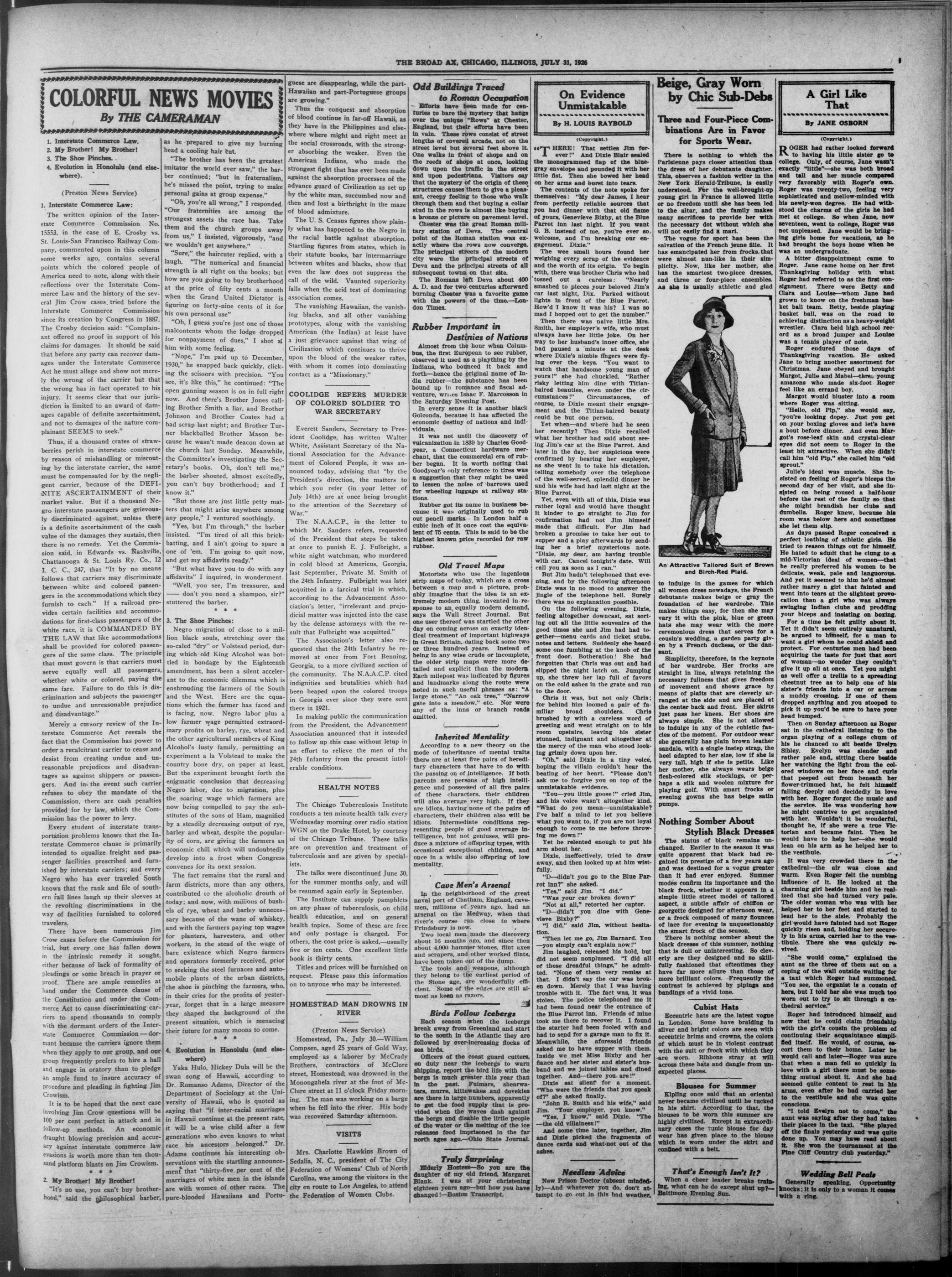
An Attractive Tailored Suit of Brown and Birch-Red Plaid.
to indulge in the games for which all women dress nowadays, the French debutante makes belge or gray the foundation of her wardrobe. This makes things easy, for then she may vary it with the pink, blue or green hats she may wear with the more ceremonial dress that serves for a cousin's wedding, a garden party given by a French duchess, or the dansant.
Simplicity, therefore, is the keynote of her wardrobe. Her frocks are straight in line, always retaining the necessary fullness that gives freedom of movement and shows grace by means of plaits that are cleverly arranged at the side and are placed at the center back and front. Her skirts just pass her knees. Her shoes are always simple. She is not allowed to indulge in any of the cubistic fancies of the moment. For outdoor wear she generally has plain brown leather sandals, with a single instep strap, the heel adapted to her size, low if she is very tall, high if she is petite. Like her mother, she always wears beige flesh-colored silk stockings, or perhaps a silk and woolen mixture for playing golf. With smart frocks or evening gowns she has beige satin pumps.
Nothing Somber About
The status of black remains unchanged. Earlier in the season it was quite apparent that black had regained its prestige of a few years ago and was destined for a vogue greater than it had ever enjoyed. Summer modes confirm its importance and the black frock, whether it appears in a simple little street model of tailored aspect, a subtle affair of chiffon or georgette designed for afternoon wear, or a frock composed of many flouces of lace for evening is unquestionably the smart frock of the season.
There is nothing somber about the black dresses of this summer, nothing that is dull or uninteresting. So cleverly are they designed and so skillfully fashioned that oftentimes they have far more allure than those of more brilliant colors. Frequently the contrast is achieved by pipings and bandings of a vivid tone.
Cubist Hats
Eccentric hats are the latest vogue in London. Some have braiding in silver and bright colors are seen with eccentric brims and crowns, the colors of which must be in violent contrast with the suit or frock with which they are worn. Ribbons stray at will across these hats and dangle from unexpected places.
Blouses for Summer
Kipling once said that an oriental never became civilized until he tucked in his shirt. According to that, the blouses to be worn this summer are highly civilized. Except in extraordinarily cases the tunic blouse for day wear has given place to the blouse which is worn under the skirt and confined with a belt.
That's Enough isn't it?
When a cheer leader breaks training, what can he do except shut up?—Baltimore Evening Sun.
A Girl Like That
By JANE OSBORN
(Copyright.)
ROGER had rather looked forward to having his little sister go to college. Only, of course, Jane wasn't exactly "little"-she was both broad and tall and her muscle compared very favorably with Roger's own. Roger was twenty-two, feeling very sophisticated and mellow-minded with his newly-won degree. He had withstood the charms of the girls he had met at college. So when Jane, now seventeen, went to college, Roger was not unpleased. Jane would be bringing girls home for vacations, as he had brought the boys home when he was an undergraduate.
A bitter disappointment came to Roger. Jane came home on her first Thanksgiving holiday with what Roger had referred to as the first consignment. There were Betty and Clara and Louise—whom Jane had grown to know on the freshman basket ball team. Betty, beside playing basket ball, was on the road to achieving distinction as a heavy-weight wrestler. Claire held high school record as a broad jumper and Louise was a tennis player of note.
Roger endured those days of Thanksgiving vacation. He asked Jane to bring another assortment for Christmas. Jane obeyed and brought Margul, Julie and Mabel—three young amazones who made six-foot Roger feel like an errand boy.
Margul would bluster into a room where Roger was sitting.
"Hello, old Pip," she would say, "you're looking dopey. Just you get on your boxing gloves and let's have a bout before dinner. And even Margot's rose-leaf skin and crystal-clear eyes did not seem to Roger in the least bit attractive. When she didn't call him "old Pip," she called him "old sprout." Julie's ideal was muscle. She insisted on feeling of Roger's biceps the second day of her visit, and she insisted on being roused a half-hour before the rest of the family so that she might brandish her clubs and dumbles. Roger knew, because his room was below hers and sometimes she let them slip.
As days passed Roger conceived a perfect loathing of athletic girls. He tried to reason things out for himself. He hated to admit that he clung to a mid-Victorian ideal of women—that he really preferred his women to be delicate, weak, pale and languorous. And yet it seemed to him he'd almost rather marry a girl that fainted and went into tears at the slightest provocation than a girl who was always swinging Indian clubs and prodding his biceps and insisting on boxing.
For a time he felt guilty about it. Yet it didn't seem entirely unnatural, he argued to himself, for a man to want a girl whom he could shield and protect. For centuries men had been acquiring the taste for just that sort of woman—no wonder they couldn't give it up all at once. Yet you might as well offer a trellis to a spreading chestnut tree as to help one of his sister's friends into a car or across a muddy crossing. If one of them dropped anything and you stooped to pick it up you'd be sure to have your head bumped.
Then on Sunday afternoon as Roger sat in the cathedral listening to the organ playing of a college chum of his he chanced to sit beside Evelyn Sibley. Evelyn was slender and rather pale and, sitting there beside her watching the light from the colored windows on her face and curls that peeped out from beneath her flower-trimmed hat, he felt himself falling deeply and decidedly in love with her. Roger forgot the music and the service. He was wondering how he might contrive to get acquainted with her. Wouldn't it be wonderful, thought he, if she were a true Victorian and became faint. Then he would have to help her—she would lean on his arm as he helped her to the vestibule.
It was very crowded there in the cathedral—the air was close and warm. Even Roger felt the numbing influence of it. He looked at the charming girl beside him and he realized that she had turned very pale. The older woman who was with her helped her to her feet and started to lead her to the aisle. Probably the girl would have fainted had not Roger quickly risen and, holding her securely in his arms, carried her to the vestibule. There she was quickly revived.
"She would come," explained the aunt as the three of them sat on a coping of the wall outside waiting for a taxi which Roger had summoned. "You see, the organist is a cousin of hers, but I told her she was much too worn out to try to sit through a cathedral service."
Roger had introduced himself and now that he could claim friendship with the girl's cousin the problem of continuing their acquaintance simplified itself. He would, of course, escort them to their home. Later he would call and later—Roger was sure that when a man fell so quickly in love with a girl there must be something mutual about it. And she had seemed quite content to rest in his arms, even after he had carried her to the vestibule and she was quite conscious.
"I told Evelyn not to come," the aunt was saying after they had taken their places in the taxi. "She played off the finals yesterday and was quite done up. You may have read about it. She won the tournament at the Pine Cliff Country club yesterday."
Wedding Bell Peals Generally speaking, Opportunity knocks; it is only to a woman it comes with a ring.
Ernest H.
WILLIAMSON
UNDERTAKER
ERnest H. WILLIAMSON
UNDERTAKER
5121-23-29
E. H. WILLIAMSON
Charlest. Dawson
FIVE MOTHERS OF 1861 GET
PENSIONS FROM GOV-
ERNMENT
(Preston News Service)
Washington, D. C., July 30.—On the United States pension rolls are five mothers of Civil War veterans drawing pensions, and they range in age from 96 to 102 years. One of them is Mrs. Samantha Farrer of Athens, Ga., who does not know how many years over 98 she is.
LEAVES HOSPITAL
B. J. Mitchem, 3629 Prairie avenue, has been removed to his home from Provident Hospital where he had been confined for two weeks on account of Illness.
Foolish Despair
Despair is like forward children who, when you take away one of their playthings, throw the rest into the fire for madness. It grows angry with itself, turns its own executioner, and revenges its misfortunes on its own head. It refuses to live under disappointments and crosses, and chooses rather not to be at all, than to be without the thing which it hath once imagined necessary to its happiness.—Charron.
Famous Scottish Town
Many are the claims of Dunfermline, Scotland, upon the attention of visitors, says the Christian Science Monitor. Malcolm Cannore and Margaret, Scotland's Saxon queen, founded nearly 1,000 years ago its beautiful abbey, and the tomb of the Bruce is in its shade. It is the birthplace of Andrew Carnegie, to whom the town owes its library, baths, institute and schools, also its beautiful natural park—Pittencrief glen.
Obelisk a Landmark
The Nelson obelisk at Portsdown hill outside Portsmouth, England, is a landmark for all ships approaching Spithead from the Needles, on the one side, to Selsea hill on the other. It was erected by Nelson's companions at Trafalgar, each survivor of the feet contributing two days' pay for it. The ridge on which it stands is 300 feet above sea level, and the monument is 150 feet high.
Knew Human Nature
I mistrust the judgment of every man in a case where his own wishes are concerned.—Wellington.
WILL
UND
A. B.
JOHN D. SCOTT, Manager
Licensed Undertaker
MRS. MARY E. WILLIAMSON
Licensed Undertaker
J.E. BISH
33d Degree PR.W.D.G.M, Bookkeeper
Embalmer's Apprentice No.19-4
Unexcelled for
AUTOMOBILES
KEN
5121-23-25
The Williamson Funeral is distinguished by the up-to-date designs of its Cunningham Limousine Hearse and Cars
Use for Phonograph Needle
Use for Phonograph Needle
The discarded phonograph needle will do nicely to clean bottles, cruets, flower vases, etc. Fill receptacles with warm water, to which a little ammonia has been added. Let soak a few hours, then pour off about four-fifths of the water, drop in the old needles and shake until all the sediment disappears.
Official Water-Mark
The Post-Office department says that all United States postage stamps were issued on water-marked paper until 1916. The water-mark consisted of the letters "U. S. P. S." The earlier water marks consisted of double line letters, which were later changed to single line.
Food Value of Sugar
It has been shown by experiments that, as a part of a simple mixed diet, five ounces of sugar a day can be consumed by a healthy adult and 98.9 per cent of its total energy becomes available in the body. The main function of the sugar is to furnish heat and energy.
Unlucky English Inventor
John Kay, the inventor of the "flyshuttle" and "powerloom" for narrow goods, realized only destitution on his inventions. A mob wrecked his house, his parents were stolen and he fled to France to die in poverty.
World's Fastest Game
The Spanish game of pelota is said to be the fastest game in the world, much faster than ice hockey. Only players of keen sight, great speed and agility can hope to excel in it.
Light Causes Coloring
The green coloring often seen on potatoes is caused by the action of light on the tuber. The potato belongs to the night shade family, and green parts of these plants often contain poison.
Drops on Water Make Music
Splashes of water are said to form small pockets in the water surfaces on which they fall, and these pockets act as resonating chambers, making a musical note whose pitch depends on the size of the pocket.
A Novel Remark
"The plot thickens," said the old lady as she sowed grass seed for the third time.
THE BROAD AX, CHICAGO, ILLINOIS, JULY 31, 1926
Greeley Wanted the Money
In his life of Edgar Allan Poe, Joseph Wood Krutch tells of a youth who wrote to Horace Greeley asking klim if he did not own an autograph of Poe. To this request Greeley responded: "Among my literary treasures there happens to be exactly one autograph of Edgar Allan Poe. It is his note of hand for fifty dollars with my indorsement across the back. It cost me exactly $50.75 (including protest) and you may have it for half that amount."
Earliest German Poetess
A nun named Hroswitha has been acclaimed the first poetess of Germany by historians. She flourished about 950-1000 A. D., and was an inmate of the Benedictine convent at Gandersheim, where she wrote legends, epigrams and dramas which carried her fame beyond the confines of her native country. The people of Gandersheim have set aside June 11-13 for special memorial exercises in her honor.
School Again Army Post
The Indian office says the Carliste Indian school was originally an old army post which the War department turned over as a school in the East for Indians. The agreement was that when needed the Indian office would give back the post to the War department. This was done in the latter part of the war and the school was used for rehabilitation work.
Interpreted at Last
A teacher conducting her pupils through an art museum stopped in front of Rodin's famous statue, "The Thinker." She asked them what they thought he was thinking about. "Oh, I know," replied one little girl. "He lost his clothes and he's wondering where he's going to get some more." -Boston Transcript.
Collected "Spare Parts"
A man came so frequently under the surgeon's knife at a London hospital that he made a hobby of collecting himself in glass jars and bottles. Starting with tonsils, he went on with molars and such components, until he had filled a shelf with "spare parts," carefully dated and described.
NICELY FURNISHED ROOM TO RENT TO MARRIED COUPLE
Rooms to rent, all conveniences; first class neighborhood; married couple preferred. Phone Kenwood 0006.
Early American Settlers
Early American Settlers England shipped many political prisoners to the United States in the Colonial times. Some of these were sent over here for life, others for a few years. The majority of these spent their sentences in Virginia and Georgia.
Bless the Child!
Elsie—Mamma, if the kittens really must be drowned, shall I ask the Baptist minister to do it?—Boston Transcript.
A. D. GASH
ATTORNEY AT LAW
Suite 813, Ashland Block
155 N. Clark Street
CHICAGO, ILL.
Residence, 1262 Macalister Place Telephone Monroe 2714
ATTORNEY AT LAW
Suite 318-320 Reaper Block
Clark and Washington Sts.
CHICAGO
Telephone Central 1239
P. J.
J. CA
P.J.CARR
S. H.
Democratic Candidate
SHERIFF OF C
Vote for him at the
WEST ENGLEY
AND SAVI
Cor. 63rd Street and
JOHN BAIN, President
Vice-President; EDWA
President and Cashier;
Assistant Cashier and T
ATIC Candidate for the Nominat
HERIFF OF COOK COUNTY
for him at the November elec
ST ENGLEWOOD TR
ND SAVINGS BAN
d Street and Marshfield
AIN, President; MICHAEL
ident; EDWARD C. BARR
and Cashier; W. MERLE
Cashier and Trust Officer.
Democratic Candidate for the Nomination for SHERIFF OF COOK COUNTY Vote for him at the November election
WEST ENGLEWOOD TRUST AND SAVINGS BANK
Cor. 63rd Street and Marshfield Avenue
JOHN BAIN, President; MICHAEL MAISEL, Vice-President; EDWARD C. BARRY, VicePresident and Cashier; W. MERLE FISHER, Assistant Cashier and Trust Officer.
TELEPHONE REPUBLIC 5000
TELEPHONE DOUGLAS 1
GEORGE F. H.
REAL
Up-to-Date or Moder
and Store
3101 COTTAG
Corner 31st S
JAS. B. McCAHEY, President
FRANK J. DUNN, Vice-President
ESTABLISHED
AGE F. HARDING
REAL ESTATE
Date or Modern Houses, Ap-
and Stores to Rent
COTTAGE GROVE
Corner 31st Street, Chicago
KEY, President
IN, Vice-President
PHILIP J. D.
H. X. COMERF
ESTABLISHED 1877
Up-to-Date or Modern Houses, Apartments and Stores to Rent
3101 COTTAGE GROVE AVE.
Corner 31st Street, Chicago
JOHN J. DUNN COAL CO.
Telephone 0
5100 Federal Street
Telephone Oakland 1850
and Street
"Tse been hearin'," said Uncle Eben, "dat dar's trouble ahead foh dis country ever since Tse been old enough to listen. But I never yit seen any trouble so bad dat de danger didn' all 'pear to cl'ar away right after 'lection.'"—Washington Star.
Beauty in Truth
Beauty in Truth After all, the most natural beauty in the world is honesty and moral truth, for all beauty is truth.— Shaftesbury.
Phone Main 2017
A. L. WILLIAMS
ATTORNEY AND
COUNSELOR AT LAW
Suite 706 Firmenich Building
184 W. Washington St.
CHICAGO
Residence 3646 Michigan Ave.
Phone Douglas 9133
Phones: Office Main 4153; Residence,
4751 Champlain Avenue
Phone Kenwood 5611
Walter M. Farmer
ATTORNEY AND COUNSELOR
AT LAW
Suite 708—184 W. Washington St.
CHICAGO
For the Nomination for
BOOK COUNTY
November election
WOOD TRUST
NGS BANK
Marshfield Avenue
; MICHAEL MAISEL,
RD C. BARRY, Vice-
W. MERLE FISHER,
Trust Officer.
HARDING, JR.
ESTATE
Barn Houses, Apartments
to Rent
E GROVE AVE.
Street, Chicago
PHILIP J. DUNN, Secretary
H. X. COMERFORD, Treasurer
HED 1877
CHICAGO
Notary Public
WALDEN COLLEGE
(Formerly the literary department of Walden University)
An Approved School in the Educational Center
Inern in methods and thorough in schools Christian influence around the state emphasis upon development of the in- of the student.
EXPENSES SURPRISINGLY MODERATE
For further information, address
T. R. DAVIS, PRESIDENT
ville -:- Ter
LINCOLN STATE BANK
OF CHICAGO
Under State Government Supervise
31st and South State Streets
Capital and Surplus $460,000.00
State Street's Largest
Mortgage Gold B
Proved Safe Investments yield
interest. $100 Bonds sold on ea-
payment plan
Our Mr. Avery of the Bond Depart
DANS MADE ON REAL ESTATE
An Approved School in an Educational Center
Modern in methods and thorough in scholarship.
Throws Christian influence around the student.
Places emphasis upon development of the initiative on part of the student.
EXPENSES SURPRISINGLY MODERATE
For further information, address
T. R. DAVIS, PRESIDENT
Nashville Tennessee
LINCOLN STATE BANK OF CHICAGO
Under State Government Supervision
31st and South State Streets
Capital and Surplus $460,000.00
First Mortgage Gold Bonds
Approved Safe Investments yield 7% interest. $100 Bonds sold on easy payment plan See our Mr. Avery of the Bond Department
LOANS MADE ON REAL ESTATE
Savings Department open from
9 A.M. to 8 P.M. Saturdays
TY DEPOSIT BOXES for less than or
Protect your Valuable Papers, Jewell
SAFETY DEPOSIT BOXES for less than one cent a day. Protect your Valuable Papers, Jewelry, etc.
STRAIT-TEX
HAIR PREPARATIONS
USE of these preparations in the culture of your hair will give you best results. Start caring for your hair properly by using some of the following:
STRAIT-TEX HAIR REFINING TONIC...$1.00
STRAIT-TEX HERBS ...1.00
(Straightens and restores color to gray hair)
GLOSS-TEX BRILLIANTINE ....50
STRAIT-TEX HAIR GROWER ....25
If your hair dresser or druggist cannot supply you, order direct from na. Goods sent postpaid anywhere in the United States.
AGENTS WANTED; WRITE FOR TERMS
STRAIT-TEX CHEMICAL CO.
600 FIFTH AVENUE PITTSBURGH, PA.
Please enter my name as a subscriber to THE BROAD AX. I inclose herewith Two Dollars, the annual subscriptions to same, or One Dollar for six months.