The Broad Ax
Saturday, August 7, 1926
Chicago, Illinois
Page text (machine-generated)
SOCIETY NEWS PUBLISHED FREE
Vol. XXXI. 5 C
[Name]
[Picture of a man in a suit with a tie].
HON. GEORGE E. BRENNAN The people's candidate for United States Senator who is in favor of light wines and beer. There of thousands of voters scattered throughout to believe in personal liberty and who will assist in the United States Senate Tuesday, November
candidate for United States Senator flavor of light wines and beer. There ends of voters scattered throughout the personal liberty and who will assisted States Senate Tuesday, November
The people's candidate for United States Senator from Illinois who is in favor of light wines and beer. There are hundreds of thousands of voters scattered throughout this State who believe in personal liberty and who will assist him to land in the United States Senate Tuesday, November 2. DR. ALAIN LOCKE PRAISES DR. CARTER G. WOODSON'S BOOK, "NEGRO ELOQUENCE," IN THE NATION value. The volume becomes, therefore a somewhat unique source-book for the history of the various social and political problems of the Negro.
(Preston News Service)
New York, Aug. 6.—In his review of Dr. Carter G. Woodson's book, "Negro Orators and Their Orations," in a recent issue of The Nation, Dr. Alain Locke says:
This compilation of orations and addresses by Negro leaders, from as early a date as the first pamphlet broadside against slavery in 1788—by a Negro who wisely chose a pseudonym—to race leaders recently dead or still living is a brave and on the whole, quite successful attempt to make oratory interpret social and historical issues. Ordinarily oratory is an unreliable weather-vane of social opinion, but for most of the period covered by this particular study the issues were so vitally serious in the mind of the Negro as to give an unusual sobriety and seriousness even to his oratorical pointings. Careful historical comment upon the issues under discussion has given the collection unusual "interpretative
11.12.1932
M.
71
HON. FRANK L. SMITH
Republican candidate for United States Senate
It is claimed that some of his friends made
ing too much money for him at the April
for reason of that fact thousands of Repu-
out this State will support and vote for a
Brennan, the people's candidate for Unite
from Illinois, that under all the present
Brennan would be the best man to represen
Illinois in the United States Senate.
candidate for United States Senators and that some of his friends made a "much money for him at the April p of that fact thousands of Republic state will support and vote for H the people's candidate for United Nois, that under all the present o would be the best man to represent the United States Senate.
Republican candidate for United States Senator from Illinois. It is claimed that some of his friends made a "bull" of spending too much money for him at the April primaries, that for reason of that fact thousands of Republicans throughout this State will support and vote for Hon. George E. Brennan, the people's candidate for United States Senator from Illinois, that under all the present conditions Mr. Brennan would be the best man to represent the people of Illinois in the United States Senate.
Vol. XXXI.
5 CENTS PER COPY
1930
United States Senator from Illinois, is and beer. There are hundreds ered throughout this State who and will assist him to land Tuesday, November 2.
value. The volume becomes, therefore, a somewhat unique source-book for the history of the various social and political problems of the Negro.
Comparatively little eulogistic and occasional oratory has been included and though there are many selections which are not brilliant examples of oratorical style and form, few of the selections fail to qualify as important social documents. And when figures as significant as Garrison, Wendell Phillips, Sumner, Frederick Douglass, and Booker Washington are eulogized by contemporaries and co-workers, there is more than transitory value to what was said. Perhaps the most illuminating and valuable sections are those dealing with the early protests, which are surprising in their advanced tone and competent character, with the Negro anti-slavery orators, and with the speeches of the Negro Senators and Representatives during the period of congressional representation. But the outstanding virtue of the book is after all, that it is comprehensive—that it gives a vivid and yet reliable panoramic view both of representative Negro thought and of the whole Negro question.
1920
United States Senator from Illinois, his friends made a "bull" of spendm at the April primaries, that thousands of Republicans through and vote for Hon. George E. Aidate for United States Senator all the present conditions Mr. Roman to represent the people of Senate.
THE BROAD AX
THE BROAD AX, CHICAGO, ILLINOIS, AUGUST 7, 1926
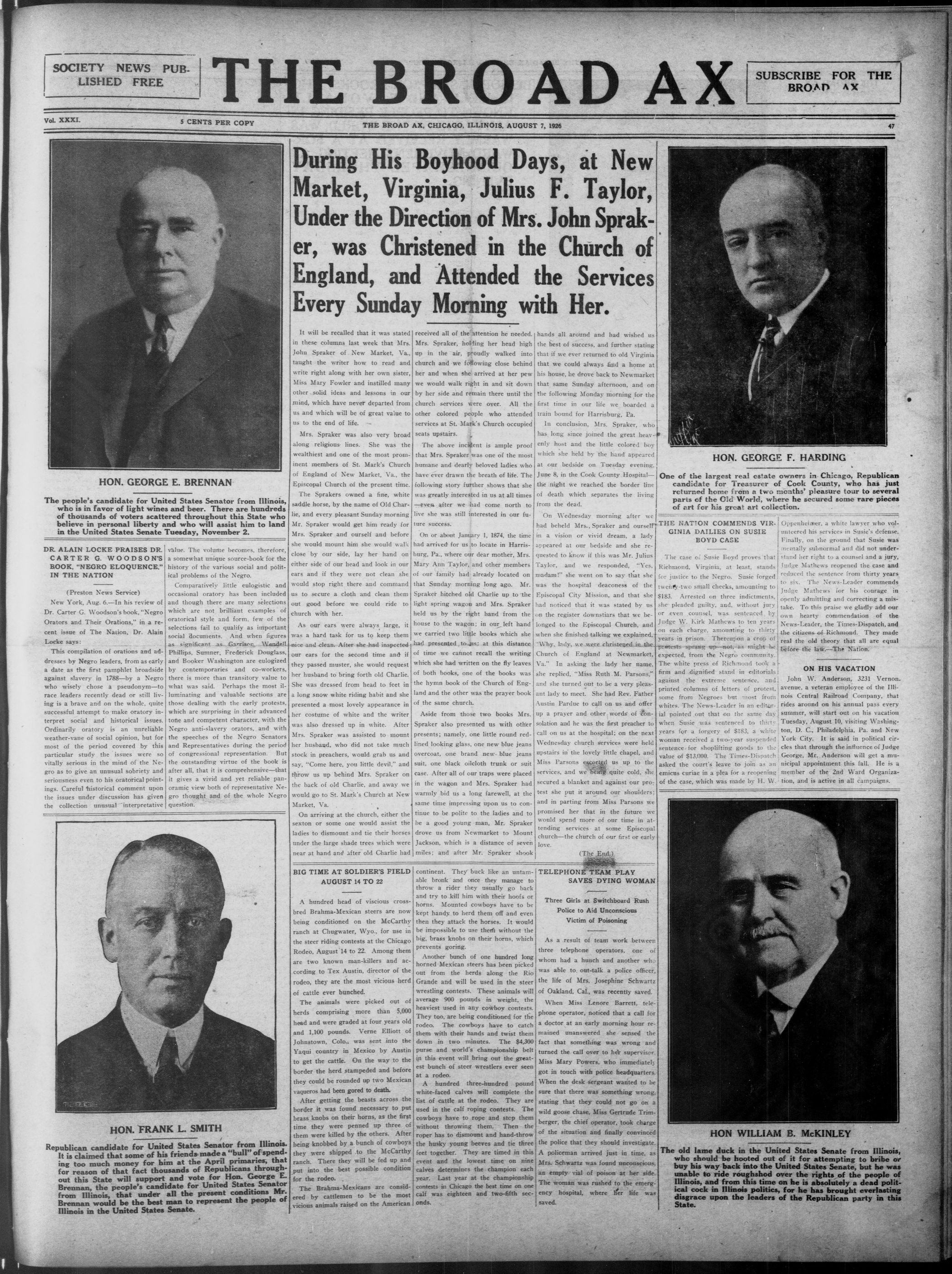
During His Boyhood Days, at New Market, Virginia, Julius F. Taylor, Under the Direction of Mrs. John Spraker, was Christened in the Church of England, and Attended the Services Every Sunday Morning with Her.
It will be recalled that it was stated in these columns last week that Mrs. John Spraker of New Market, Va., taught the writer how to read and write right along with her own sister, Miss Mary Fowler and instilled many other solid ideas and lessons in our mind, which have never departed from us and which will be of great value to us to the end of life.
Mrs. Spraker was also very broad along religious lines. She was the wealthiest and one of the most prominent members of St. Mark's Church of England of New Market, Va., the Episcopal Church of the present time.
The Sprakers owned a fine, white saddle horse, by the name of Old Charlie, and every pleasant Sunday morning Mr. Spraker would get him ready for Mrs. Spraker and ourself and before she would mount him she would walk close by our side, lay her hand on either side of our head and look in our ears and if they were not clean she would stop right there and command us to secure a cloth and clean them out good before we could ride to church with her.
As our ears were always large, it was a hard task for us to keep them nice and clean. After she had inspected our ears for the second time and if they passed muster, she would request her husband to bring forth old Charlie. She was dressed from head to feet in a long snow white riding habit and she presented a most lovely appearance in her costume of white and the writer was also dressed up in white. After Mrs. Spraker was assisted to mount her husband, who did not take much stock in preachers, would grab us and say, "Come here, you little devil," and throw us up behind Mrs. Spraker on the back of old Charlie, and away we would go to St. Mark's Church at New Market, Va.
On arriving at the church, either the sexton or some one would assist the ladies to dismount and tie their horses under the large shade trees which were near at hand and after old Charlie had
BIG TIME AT SOLDIER'S FIELD
AUGUST 14 TO 22
A hundred head of viscous crossbred Brahma-Mexican steers are now being conditioned on the McCarthy ranch at Chugwater, Wyo., for use in the steer riding contests at the Chicago Rodeo, August 14 to 22. Among them are two known man-killers and according to Tex Austin, director of the rodeo, they are the most vicious herd of cattle ever bunched.
The animals were picked out of herds comprising more than 5,000 head and were graded at four years old and 1,100 pounds. Verne Elliott of Johnstown, Colo., was sent into the Yaqui country in Mexico by Austin to get the cattle. On the way to the border the herd stamped up and before they could be rounded up two Mexican vaqueros had been gored to death.
After getting the beasts across the border it was found necessary to put brass knobs on their horns, as the first time they were penned up three of them were killed by the others. After being knobbed by a bunch of cowbys they were shipped to the McCarthy ranch. There they will be fed up and put into the best possible condition for the rodeo.
The Brahma-Mexicans are considered by cattlemen to be the most vicious animals raised on the American
received all of the attention he needed. Mrs. Spraker, holding her head high up in the air, proudly walked into church and we following close behind her and when she arrived at her pew we would walk right in and sit down by her side and remain there until the church services were over. All the other colored people who attended services at St. Mark's Church occupied seats upstairs.
The above incident is ample proof that Mrs. Spraker was one of the most humane and dearly beloved ladies who have ever drawn the breath of life. The following story further shows that she was greatly interested in us at all times—even after we had come north to live she was still interested in our future success.
On or about January 1, 1874, the time had arrived for us to locate in Harrisburg, Pa., where our dear mother, Mrs. Mary Ann Taylor, and other members of our family had already located on that Sunday morning long ago. Mr. Spraker hitched old Charlie up to the light spring wagon and Mrs. Spraker held us by the right hand from the house to the wagon; in our left hand we carried two little books which she had presented to us: at this distance of time we cannot recall the writing which she had written on the fly leaves of both books, one of the books was the hymn book of the Church of England and the other was the prayer book of the same church.
Aside from those two books Mrs. Spraker also presented us with other presents; namely, one little round red-lined looking glass, one new blue jeans overcoat, one brand new-blue jeans suit, one black oilcloth trunk or suit case. After all of our traps were placed in the wagon and Mrs. Spraker had warmly bid us a long farewell, at the same time impressing upon us to continue to be polite to the ladies and to be a good young man, Mr. Spraker drove us from Newmarket to Mount Jackson, which is a distance of seven miles; and after Mr. Spraker shook continent. They buck like an untamable bronk and once they manage to throw a rider they usually go back and try to kill him with their hoofs or horns. Mounted cowboys have to be kept handy to herd them off and even then they attack the horses. It would be impossible to use them without the big, brass knobs on their horns, which prevents goring.
Another bunch of one hundred long horned Mexican steers has been picked out from the herds along the Rio Grande and will be used in the steer wrestling contests. These animals will average 900 pounds in weight, the heaviest used in any cowboy contests. They too, are being conditioned for the rodeo. The cowboys have to catch them with their hands and twist them down in two minutes. The $4,300 purse and world's championship belt in this event will bring out the greatest bunch of steer wrestlers ever seen at a rodeo.
A hundred three-hundred pound white-faced calves will complete the list of cattle at the rodeo. They are used in the calf roping contests. The cowboys have to rope and step them without throwing them. Then the roper has to dismount and hand-throw the husky young bees and tie three feet together. They are timed in this event and the lowest time on nine calves determines the champion each year. Last year at the championship contests in Chicago the best time on one calf was eighteen and two-fifth seconds.
hands all around and had wished us the best of success, and further stating that if we ever returned to old Virginia that we could always find a home at his house, he drove back to Newmarket that same Sunday afternoon, and on the following Monday morning for the first time in our life we boarded a train bound for Harrisburg, Pa.
In conclusion, Mrs. Spraker, who has long since joined the great heavenly host and the little colored boy which she held by the hand appeared at our bedside on Tuesday evening, June 8, in the Cook County Hospital—the night we reached the border line of death which separates the living from the dead.
On Wednesday morning after we had beheld Mrs., Spraker and ourself in a vision or vivid dream, a lady appeared at our bedside and she requested to know if this was Mr. Julius Taylor, and we responded, "Yes, madam!" she went on to say that she was the hospital deaconess of the Episcopal City Mission, and that she had noticed that it was stated by us on the register downstairs that we belonged to the Episcopal Church, and when she finished talking we explained, "Why, Lady, we were christened in the Church of England at Newmarket, Va." In asking the lady her name, she replied, "Miss Ruth M. Parsons," and she turned out to be a very pleasant lady to meet. She had Rev. Father Austin Pardue to call on us and offer up a prayer and other words of consolation and he was the first preacher to call on us at the hospital; on the next Wednesday church services were held upstairs in the lovely little chapel, and Miss Parsons escorted us up to the services, and we being quite cold, she secured a blanket and against our protest she put it around our shoulders and in parting from Miss Parsons we promised her that in the future we would spend more of our time in attending services at some Episcopal church—the church of our first or early love.
As a result of team work between three telephone operators, one of whom had a hunch and another who was able to out-talk a police officer, the life of Mrs. Josephine Schwartz of Oakland, Cal., was recently saved.
When Miss Lenore Barrett, telephone operator, noticed that a call for a doctor at an early morning hour remained unanswered she sensed the fact that something was wrong and turned the call over to her supervisor. Miss Mary Powers, who immediately got in touch with police headquarters. When the desk sergeant wanted to be sure that there was something wrong, stating that they could not go on a wild goose chase, Miss Gertrude Trimberger, the chief operator, took charge of the situation and finally convinced the police that they should investigate.
A policeman arrived just in time, as Mrs. Schwartz was found unconscious, an empty vial of poison at her side. The woman was rushed to the emergency hospital, where her life was saved.
A.
MILTON LYNE
HON. GEORGE F. HARDING
One of the largest real estate owners in Chicago candidate for Treasurer of Cook County, returned home from a two months' pleasure parts of the Old World, where he secured son of art for his great art collection.
largest real estate owners in Chicago, we for Treasurer of Cook County, we home from a two months' pleasure to the Old World, where he secured some his great art collection.
One of the largest real estate owners in Chicago, Republican candidate for Treasurer of Cook County, who has just returned home from a two months' pleasure tour to several parts of the Old World, where he secured some rare pieces of art for his great art collection.
THE NATION COMMENDS VIRGINIA DAILIES ON SUSIE BOYD CASE
Oppenheimer, a white lawyer who volunteered his services in Susie's defense. Finally, on the ground that Susie was
The case of Susie Boyd proves that Richmond, Virginia, at least, stands for justice to the Negro. Susie forged twenty-two small checks, amounting to $183. Arrested on three indictments, she pleaded guilty, and, without jury or even counsel, was sentenced by Judge W. Kirk Mathews to ten years on each charge, amounting to thirty years in prison. Thereupon a crop of protests sprang up—not, as might be expected, from the Negro community. The white press of Richmond took a firm and dignified stand in editorials against the extreme sentence, and printed columns of letters of protest, some from Negroes but most from whites. The News-Leader in an editorial pointed out that on the same day when Susie was sentenced to thirty years for a forgery of $183, a white woman received a two-year suspended sentence for shoplifting goods to the value of $13,000. The Times-Dispatch asked the court's leave to join as an emicus curiae in a plea for a reopening of the case, which was made by H. W.
1910
[Name]
HON WILLIAM B. McKINLEY
The old lame duck in the United States Senate who should be hooted out of it for attempting buy his way back into the United States Senate unable to ride roughshod over the rights of the Illinois, and from this time on he is absolutely cock in Illinois politics, for he has brought disgrace upon the leaders of the Republican State.
he duck in the United States Senate he could be hooted out of it for attempting away back into the United States Senate to ride roughshod over the rights of the land from this time on he is absolutely in Illinois politics, for he has brought upon the leaders of the Republican
The old lame duck in the United States Senate from Illinois, who should be hooted out of it for attempting to bribe or buy his way back into the United States Senate, but he was unable to ride roughshod over the rights of the people of Illinois, and from this time on he is absolutely a dead political cock in Illinois politics, for he has brought everlasting disgrace upon the leaders of the Republican party in this State.
SUBSCRIBE FOR THE BROAD AX
47
reserve owners in Chicago, Republican
currier of Cook County, who has just
a two months' pleasure tour to several
fold, where he secured some rare pieces
art collection.
S VIR-
USIE
lives that
stands
forged
intending
to
treatments,
but jury
secured
by
on years
to thirty
crop of
might be
Oppenheimer, a white lawyer who vol-
unteered his services in Susie's defense.
Finally, on the ground that Susie was
meantly subnormal and did not under-
stand her right to a counsel and a jury,
Judge Mathews reopened the case and
reduced the sentence from thirty years
to six. The News-Leader commends
Judge Mathews for his courage in
openly admitting and correcting a mis-
take. To this praise we gladly add our
own hearty commendation of the
News-Leader, the Times-Dispatch, and
the citizens of Richmond. They made
real the old theory that all are equal
before the law. The Nation.
ON HIS VACATION
John W. Anderson, 3231 Vernon avenue, a veteran employee of the Illinois Central Railroad Company, that rides around on his annual pass every summer, will start out on his vacation Tuesday, August 10, visiting Washington, D. C., Philadelphia, Pa. and New York City. It is said in political circles that through the influence of Judge George, Mr. Anderson will get a municipal appointment this fall. He is a member of the 2nd Ward Organization, and is active in all campaigns.
M.
the United States Senate from Illinois, led out of it for attempting to bribe or to the United States Senate, but he was ashod over the rights of the people of his time on he is absolutely a dead politic politics, for he has brought everlasting leaders of the Republican party in this
1930
Honorable Member of Congress from the First Congressional District of Illinois, who is held in the highest estimation by all the voters residing in his Congressional district, who will have no trouble on his hands Tuesday, November 2, for his thousands of warm friends will deem it a high honor to march on to victory with him on that date.
THE BROAD AX
Published Every Saturday
In this city since July 15th, 1899, without missing one single issue. Republicans, Democrats, Catholics, Protestants, Single Taxers, Priests, infidels or anyone else can have their say as long as their language is proper and responsibility is fixed.
The Broad Ax is a newspaper whose platform is broad enough for all, ever claiming the editorial right to speak its own mind. It is neither Democratic nor Republican. It is strictly or absolutely independent in politics Local communications will receive attention. Write only on one side of the paper.
Subscriptions must be paid in advance.
One Year ..... $2.00
Six Months ..... $1.00
Advertising rates made known on
application.
Address all communications to
THE BROAD AX
6206 S. Elizabeth St., Chicago.
Phone: Wentworth 2597
JULIUS F. TAYLOR
Editor and Publisher
Vol. XXXI No. 47
Chicago, August 7, 1926
Entered as Second-Class Matter, Aug.
19, 1902, at the Post office at Chicago
III. Under Act of March 8, 1879.
PITTSBURGH URBAN LEAGUE'S WORK FOR NEGROES EXPANDS
(Preston News Service)
Pittsburgh, Pa., Aug. 6.—Miss Grace S. Lowndes, of the staff of the Urban League of Pittsburgh, who for the past eight years has acted as social worker among Negroes at Morals Court, has been transferred by the league from her work at court to a larger field, that of general work among delinquent Negroes in the city. The Urban League, organized for social work among colored people, maintained Miss Lowndes at the Morals Court for the purpose of demonstration and experimentation. Miss Lowndes this month, in co-operation with the Morals Court, has begun a
A. H.
HON. P. J. CARR
The well known and up-to-date Treasu whose thousands of tried and true friend city and county, who are willing to w order to assist to elect him Sheriff of
up-to-date Treasurer of tried and true fries who are willing to w elect him Sheriff of
The well known and up-to-date Treasurer of Cook County whose thousands of tried and true friends in all parts of the city and county, who are willing to work day and night in order to assist to elect him Sheriff of Cook County.
study of causes contributing to Negro delinquency, court procedure and treatment, and results obtained. It is hoped that her new work will ultimately be adopted in co-operation not only with Morals Court, but with other courts in the city dealing with Negro problems. On the basis of the study Miss Lowndes is now making, the Urban League proposes to build up a city-wide program for constructive efforts to decrease crime among Negroes and to facilitate court procedure.
CHILD HYGIENE SPECIALIST DELIVERS ADDRESS AT NEGRO TEACHERS' MEETING
(Preston News Service)
Hot Springs, Ark., Aug. 6—Dr. Margaret Koenig of the State Bureau of Child Hygiene was one of the speakers at the meeting of the National Association of Teachers in Colored Schools, which was held in Hot Springs, Wednesday and Friday. Mrs. Koenig spoke Thursday afternoon on
The Urban League is now under new management and has taken on new life with increased activities. The work done in the past has demonstrated the need of such an institution.
THE BEST SELLER
```markdown
```
HON. MARTIN B. MADDEN
passes from the First Congressional D
y all the voters residing in his Co
ords Tuesday, November 2, for his
to march on to victory with him on
Congressional District of
being in his Congression
over 2, for his thousand
with him on that date
State Treasurer of Cook County
and true friends in all parts of the
telling to work day and night in
Sheriff of Cook County.
CHILD HYGIENE SPECIALIST
DELIVERS ADDRESS AT NEGRO TEACHERS' MEETING
(Preston News Service)
Hot Springs, Ark., Aug. 6.—Dr. Margaret Koenig of the State Bureau of Child Hygiene was one of the speakers at the meeting of the National Association of Teachers in Colored Schools, which was held in Hot Springs, Wednesday and Friday. Mrs. Koenig spoke Thursday afternoon on "Health Conditions in a Transplanted Race." Miss Earl Chambers, secretary of the Arkansas Tuberculosis Association, also spoke Thursday afternoon on the prevention of tuberculosis.
THE BROAD AX, CHICAGO, ILLINOIS, AUGUST 7, 1926
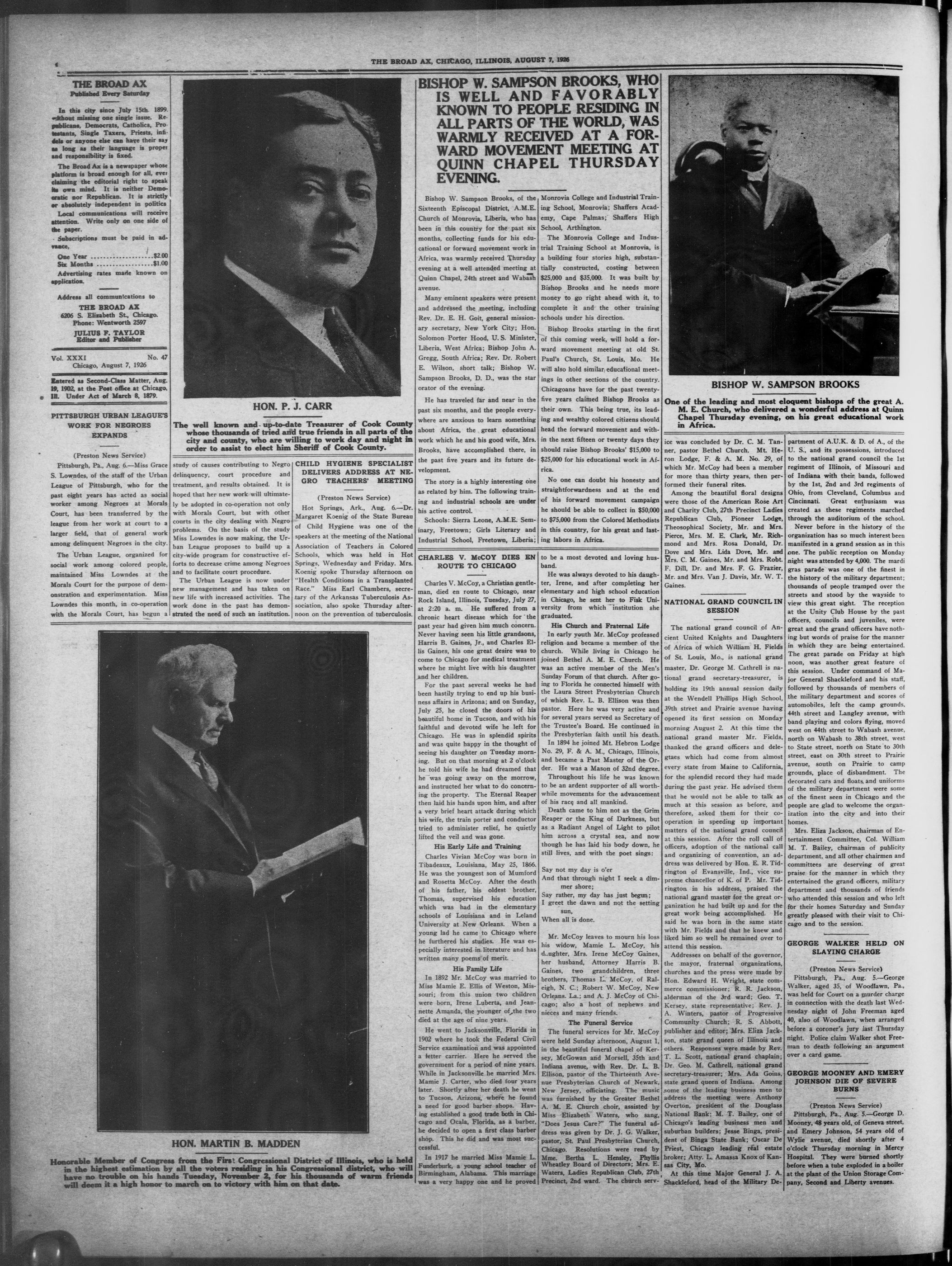
BISHOP W. SAMPSON BROOKS, WHO IS WELL AND FAVORABLY KNOWN TO PEOPLE RESIDING IN ALL PARTS OF THE WORLD, WAS WARMLY RECEIVED AT A FORWARD MOVEMENT MEETING AT QUINN CHAPEL THURSDAY EVENING.
Bishop W. Sampson Brooks, of the Sixteenth Episcopal District, A.M.E. Church of Monrovia, Liberia, who has been in this country for the past six months, collecting funds for his educational or forward movement work in Africa, was warmly received Thursday evening at a well attended meeting at Quinn Chapel, 24th street and Wabash avenue.
Many eminent speakers were present and addressed the meeting, including Rev. Dr. E. H. Goit, general missionary secretary, New York City; Hon. Solomon Porter Hood, U.S. Minister, Liberia, West Africa; Bishop John A. Gregg, South Africa; Rev. Dr. Robert E. Wilson, short talk; Bishop W. Sampson Brooks, D. D., was the star orator of the evening.
He has traveled far and near in the past six months, and the people everywhere are anxious to learn something about Africa, the great educational work which he and his good wife, Mrs. Brooks, have accomplished there, in the past five years and its future development.
The story is a highly interesting one as related by him. The following training and industrial schools are under his active control. Schools: Sierra Leone, A.M.E. Seminary, Freetown; Girls Literary and Industrial School, Freetown, Liberia;
CHARLES V. M.CoCY DIES EN
ROUTE TO CHICAGO
Charles V. McCoy, a Christian gentleman, died en route to Chicago, near Rock Island, Illinois, Tuesday, July 27, at 2:20 a. m. He suffered from a chronic heart disease which for the past year had given him much concern. Never having seen his little grandson, Harris B. Gaines, Jr., and Charles Ellis Gaines, his one great desire was to come to Chicago for medical treatment where he might live with his daughter and her children.
For the past several weeks he had been hastily trying to end up his business affairs in Arizona; and on Sunday, July 25, he closed the doors of his beautiful home in Tucson, and with his faithful and devoted wife he left for Chicago. He was in splendid spirits and was quite happy in the thought of seeing his daughter on Tuesday morning. But on that morning at 2 o'clock he told his wife he had dreamed that he was going away on the morrow, and instructed her what to do concerning the property. The Eternal Reaper then laid his hands upon him, and after a very brief heart attack during which his wife, the train porter and conductor tried to administer relief, he quietly lifted the veil and was gone.
His Early Life and Training
Charles Vivian McCoy was born in Tibadeaux, Louisiana, May 25, 1866. He was the youngest son of Mumford and Rosetta McCoy. After the death of his father, his oldest brother, Thomas, supervised his education which was had in the elementary schools of Louisiana and in Leland University at New Orleans. When a young lad he came to Chicago where he furthered his studies. He was especially interested in literature and has written many poems of merit.
His Family Life
In 1892 Mr. McCoy was married to Miss Mamie E. Ellis of Weston, Missouri; from this union two children were born, Irene Luberta, and Jeannette Amanda, the younger of the two died at the age of nine years.
He went to Jacksonville, Florida in 1902 where he took the Federal Civil Service examination and was appointed a letter carrier. Here he served the government for a period of nine years. While in Jacksonville he married Mrs. Mamie J. Carter, who died four years later. Shortly after her death he went to Tucson, Arizona, where he found a need for good barber shops. Having established a good trade both in Chicago and Ocala, Florida, as a barber, he decided to open a first class barber shop. This he did and was most successful.
In 1917 he married Miss Mamie L. Funderburk, a young school teacher of Birmingham, Alabama. This marriage was a very happy one and he proved
Monrovia College and Industrial Training School, Monrovia; Shaffers Academy, Cape Palmas; Shaffers High School, Arthington.
The Monrovia College and Industrial Training School at Monrovia, is a building four stories high, substantially constructed, costing between $25,000 and $35,000. It was built by Bishop Brooks and he needs more money to go right ahead with it, to complete it and the other training schools under his direction.
Bishop Brooks starting in the first of this coming week, will hold a forward movement meeting at old St. Paul's Church, St. Louis, Mo. He will also hold similar, educational meetings in other sections of the country. Chicagoans have for the past twenty-five years claimed Bishop Brooks as their own. This being true, its leading and wealthy colored citizens should head the forward movement and within the next fifteen or twenty days they should raise Bishop Brooks' $15,000 to $25,000 for his educational work in Africa.
No one can doubt his honesty and straightforwardness and at the end of his forward movement campaign he should be able to collect in $50,000 to $75,000 from the Colored Methodists in this country, for his great and lasting labors in Africa.
to be a most devoted and loving husband.
He was always devoted to his daughter, Irene, and after completing her elementary and high school education in Chicago, he sent her to Fisk University from which institution she graduated.
His Church and Fraternal Life
In early youth Mr. McCoy professed religion and became a member of the church. While living in Chicago he joined Bethel A. M. E. Church. He was an active member of the Men's Sunday Forum of that church. After going to Florida he connected himself with the Laura Street Presbyterian Church of which Rev. L. B. Ellison was then pastor. Here he was very active and for several years served as Secretary of the Trustee's Board. He continued in the Presbyterian faith until his death. In 1894 he joined Mt. Hebron Lodge No. 29, F. & A. M., Chicago, Illinois, and became a Past Master of the Order. He was a Mason of 32nd degree. Throughout his life he was known to be an ardent supporter of all worthwhile movements for the advancement of his race and all mankind.
Death came to him not as the Grim Reaper or the King of Darkness, but as a Radiant Angel of Light to pilot him across a crystal sea, and now though he has laid his body down, he still lives, and with the poet sings:
Say not my day is o'er
And that through night I seek a dimmer shore:
mer shore;
Say rather, my day has just begun;
I greet the dawn and not the setting
sun.
Mr. McCoy leaves to mourn his loss his widow, Mamie L. McCoy, his daughter, Mrs. Irene McCoy Gaines, her husband, Attorney Harris B. Gaines, two grandchildren, three brothers, Thomas L. McCoy, of Raleigh, N. C.; Robert W. McCoy, New Orleans. La.; and A. J. McCoy of Chicago; also a host of nephews and nieces and many friends.
The Funeral Service
The Funeral Service
The funeral services for Mr. McCoy were held Sunday afternoon, August 1, in the beautiful funeral chapel of Kersey, McGowan and Morsell, 35th and Indiana avenue, with Rev. Dr. L. B. Ellison, pastor of the Thirteenth Avenue Presbyterian Church of Newark, New Jersey, officiating. The music was furnished by the Greater Bethel A. M. E. Church choir, assisted by Miss Elizabeth Waters, who sang, "Does Jesus Care?" The funeral address was given by Dr. J. G. Walker, pastor, St. Paul Presbyterian Church, Chicago. Resolutions were read by Mme. Bertha L. Hensley, Phyllis Wheatley Board of Directors; Mrs. E. Waters, Ladies Republican Club, 27th Precinct, 2nd ward. The church serv-
PRESIDENT
BISHOP W. SAMPSON BROOKS
One of the leading and most eloquent bishops of the great A. M. E. Church, who delivered a wonderful address at Quinn Chapel Thursday evening, on his great educational work in Africa.
ice was concluded by Dr. C. M. Tanner, pastor Bethel Church. Mt. Heron Lodge, F. & A. M. No. 29, of which Mr. McCoy had been a member for more than thirty years, then performed their funeral rites.
department of A.U.K. & D. of A., of the U. S., and its possessions, introduced to the national grand council the 1st regiment of Illinois, of Missouri and of Indiana with their bands, followed by the 1st, 2nd and 3rd regiments of
Among the beautiful floral designs were those of the American Rose Art and Charity Club, 27th Precinct Ladies Republican Club, Pioneer Lodge, Theosophical Society, Mr. and Mrs. Pierce, Mrs. M. E. Clark, Mr. Richmond and Mrs. Rosa Donald, Dr. Dove and Mrs. Lida Dove, Mr. and Mrs. C. M. Gaines, Mr. and Mrs. Robt. F. Dill, Dr. and Mrs. F. G. Frazier, Mr. and Mrs. Van J. Davis, Mr. W. T. Gaines.
NATIONAL GRAND COUNCIL IN
SESSION
The national grand council of Ancient United Knights and Daughters of Africa of which William H. Fields of St. Louis, Mo., is national grand master, Dr. George M. Cathrell is national grand secretary-treasurer, is holding its 19th annual session daily at the Wendell Phillips High School, 39th street and Prairie avenue having opened its first session on Monday morning August 2. At this time the national grand master Mr. Fields, thanked the grand officers and delegates which had come from almost every state from Maine to California, for the splendid record they had made during the past year. He advised them that he would not be able to talk as much at this session as before, and therefore, asked them for their cooperation in speeding up important matters of the national grand council at this session. After the roll call of officers, adoption of the national call and organizing of convention, an address was delivered by Hon. E. R. Tidrington of Evansville, Ind., vice supreme chancellor of K. of P. Mr. Tidrington in his address, praised the national grand master for the great organization he had built up and for the great work being accomplished. He said he was born in the same state with Mr. Fields and that he knew and liked him so well he remained over to attend this session.
Addresses on behalf of the governor, the mayor, fraternal organizations, churches and the press were made by Hon. Edward H. Wright, state commerce commissioner; R. R. Jackson, alderman of the 3rd ward; Geo. T. Kersey, state representative; Rev. J. A. Winters, pastor of Progressive Community Church; R. S. Abbott, publisher and editor; Mrs. Eliza Jackson, state grand queen of Illinois and others. Responses were made by Rev. T. L. Scott, national grand chaplain; Dr. Geo. M. Cathrell, national grand secretary-treasurer; Mrs. Ada Goins, state grand queen of Indiana. Among some of the leading business men to address the meeting were Anthony Overton, president of the Douglass National Bank; M. T. Bailey, one of Chicago's leading business men and suburban builders; Jesse Binga, president of Binga State Bank; Oscar Dear Priest, Chicago leading real estate broker; Atty. L. Amassa Knox of Kansas City, Mo.
At this time Major General J. A. Shackleford, head of the Military De-
partment of A.U.K. & D. of A., of the U. S., and its possessions, introduced to the national grand council the 1st regiment of Illinois, of Missouri and of Indiana with their bands, followed by the 1st, 2nd and 3rd regiments of Ohio, from Cleveland, Columbus and Cincinnati. Great enthusiasm was created as these regiments marched through the auditorium of the school. Never before in the history of the organization has so much interest been manifested in a grand session as in this one. The public reception on Monday night was attended by 4,000. The mardi gras parade was one of the finest in the history of the military department; thousands of people tramped over the streets and stood by the wayside to view this great sight. The reception at the Unity Club House by the past officers, councils and juveniles, were great and the grand officers have nothing but words of praise for the manner in which they are being entertained. The great parade on Friday at high noon, was another great feature of this session. Under command of Major General Shackleford and his staff, followed by thousands of members of the military department and scores of automobiles, left the camp grounds, 44th street and Langley avenue, with band playing and colors flying, moved west on 44th street to Wabash avenue, north on Wabash to 38th street, west to State street, north on State to 30th street, east on 30th street to Prairie avenue, south on Prairie to camp grounds, place of disbandment. The decorated cars and floats, and uniforms of the military department were some of the finest seen in Chicago and the people are glad to welcome the organization into the city and into their homes.
Mrs. Eliza Jackson, chairman of Entertainment Committee, Col. William M. T. Bailey, chairman of publicity department, and all other chairmen and committees are deserving of great praise for the manner in which they entertained the grand officers, military department and thousands of friends who attended this session and who left for their homes Saturday and Sunday greatly pleased with their visit to Chicago and to the session.
GEORGE WALKER HELD ON
SLAYING CHARGE
Pittsburgh, Pa., Aug. 5—George Walker, aged 35, of Woodlawn, Pa., was held for Court on a murder charge in connection with the death last Wednesday night of John Freeman aged 40, also of Woodlawn, when arranged before a coroner's jury last Thursday night. Police claim Walker shot Freeman to death following an argument over a card game.
GEORGE MOONEY AND EMERY
JOHNSON DIE OF SEVERE
BURNS
Pittsburgh, Pa., Aug. 5—George D. Mooney, 48 years old, of Geneva street, and Emery Johnson, 54 years old of Wylie avenue, died shortly after 4 o'clock Thursday morning in Mercy Hospital. They were burned shortly before when a tube exploded in a boiler at the plant of the Union Storage Company, Second and Liberty avenues.
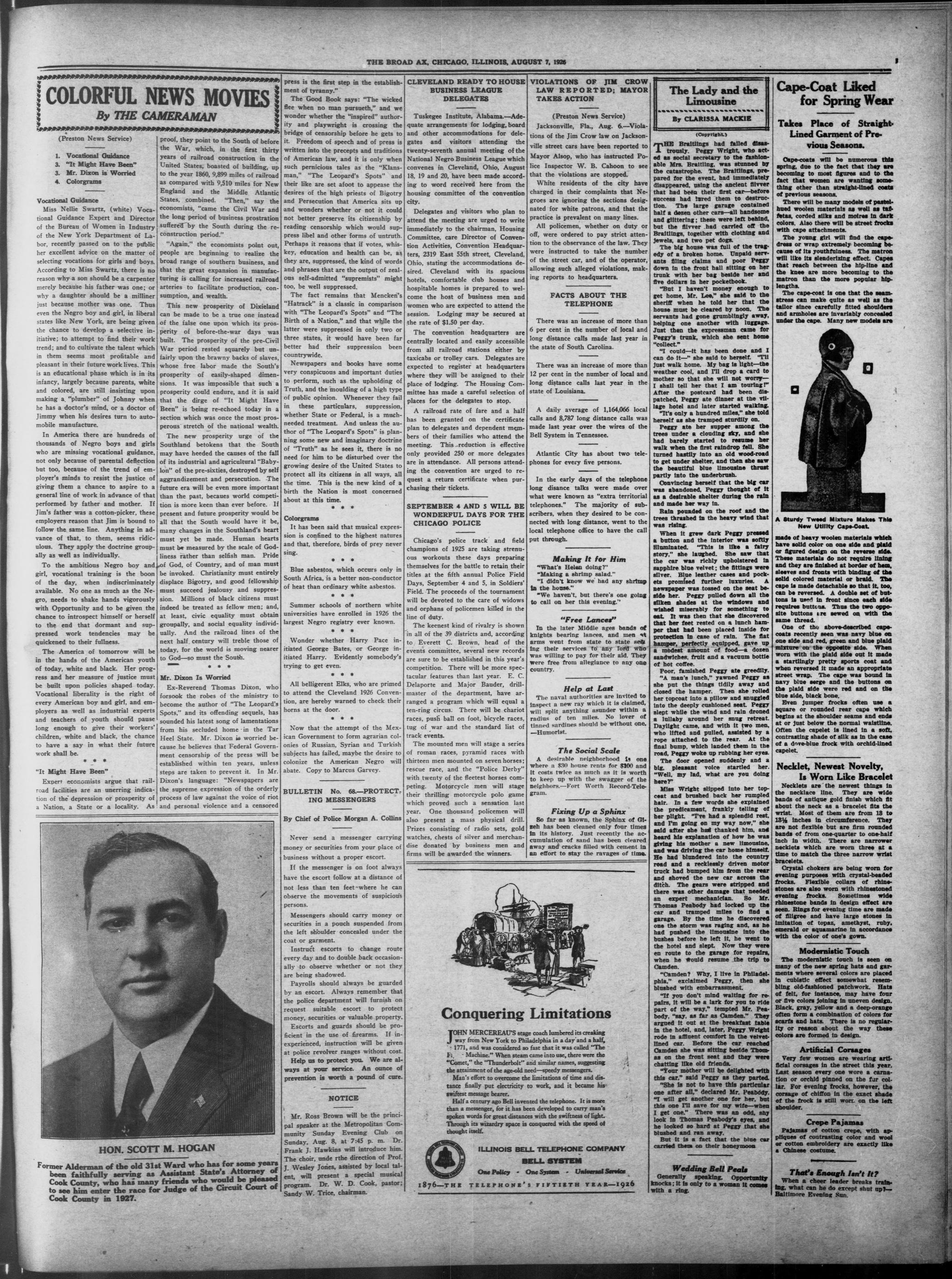
COLORFUL NEWS MOVIES By THE CAMERAMAN
(Preston News Service)
1. Vocational Guidance
2. "It Might Have Been"
3. Mr. Dixon is Worried
4. Colograms
Miss Nellie Swartz, (white) Vocational Guidance Expert and Director of the Bureau of Women in Industry of the New York Department of Labor, recently passed on to the public her excellent advice on the matter of selecting vocations for girls and boys. According to Miss Swartz, there is no reason why a son should be a carpenter merely because his father was one; or why a daughter should be a milliner just because mother was one. Thus even the Negro boy and girl, in liberal states like New York, are being given the chance to develop a selective initiative; to attempt to find their work trend; and to cultivate the talent which in them seems most profitable and pleasant in their future work lives. This is an educational phase which is in its infancy, largely because parents, white and colored, are still insisting upon making a "plumber" of Johnny when he has a doctor's mind, or a doctor of Jimmy when his desires turn to automobile manufacture.
In America there are hundreds of thousands of Negro boys and girls who are missing vocational guidance, not only because of parental deflection but too, because of the trend of employer's minds to resist the justice of giving them a chance to aspire to a general line of work in advance of that performed by father and mother. If Jim's father was a cotton-picker, these employers reason that Jim is bound to follow the same line. Anything in advance of that, to them, seems ridiculous. They apply the doctrine groupally as well as individually.
To the ambitious Negro boy and girl, vocational training is the boom of the day, when indiscriminately available. No one as much as the Negro, needs to shake hands vigorously with Opportunity and to be given the chance to introspect himself or herself to the end that dormant and suppressed work tendencies may be quickened to their fullness.
The America of tomorrow will be in the hands of the American youth of today, white and black. Her progress and her measure of justice must be built upon policies shaped today. Vocational liberality is the right of every American boy and girl, and employers as well as industrial experts and teachers of youth should pause long enough to give their workers' children, white and black, the chance to have a say in what their future work shall be.
Expert economists argue that railroad facilities are an unnering indication of the depression or prosperity of a Nation, a State or a locality. As
[Image of a man in a suit with a tie].
[Name]
HON. SCOTT M. HOGAN
Former Alderman of the old 312 been faithfully serving as Cook County, who has many to see him enter the race for Cook County in 1927.
Former Alderman of the old 31st Ward who has for some years been faithfully serving as Assistant State's Attorney of Cook County, who has many friends who would be pleased to see him enter the race for Judge of the Circuit Court of Cook County in 1927.
Vocational Guidance
"It Might Have Been"
proof, they point to the South of before the War, which, in the first thirty years of railroad construction in the United States, boasted of building, up to the year 1860, 9,899 miles of railroad as compared with 9,510 miles for New England and the Middle Atlantic States, combined. "Then," say the economists, "came the Civil War and the long period of business prostration suffered by the South during the reconstruction period."
"Again," the economists point out, people are beginning to realize the broad range of southern business, and that the great expansion in manufacturing is calling for increased railroad arteries to facilitate production, consumption, and wealth.
This new prosperity of Dixieland can be made to be a true one instead of the false one upon which its prosperity of before-the-war days was built. The prosperity of the pre-Civil War period rested squarely but unfairly upon the brawny backs of slaves, whose free labor made the South's prosperity of easily-shaped dimensions. It was impossible that such a prosperity could endure, and it is said that the dirge of "It Might Have Been" is being re-echoed today in a section which was once the most prosperous stretch of the national wealth.
The new prosperity urge of the Southland betokens that the South may have heeded the causes of the fall of its industrial and agricultural "Babylon" of the pre-sixties, destroyed by self aggrandizement and persecution. The future era will be even more important than the past, because world competition is more keen than ever before. If present and future prosperity would be all that the South would have it be, many changes in the Southland's heart must yet be made. Human hearts must be measured by the scale of Godliness rather than selfish man. Pride of God, of Country, and of man must be invoked. Christianity must entirely displace Bigotry, and good fellowship must succeed jealousy and suppression. Millions of black citizens must indeed be treated as fellow men; and, at least, civic equality must obtain groupally, and social equality individually. And the railroad lines of the next half, century will treble those of today, for the world is moving nearer to God—so must the South.
Mr. Dixon Is Worried
Ex-Reverend Thomas Dixon, who forsook the robes of the ministry to become the author of "The Leopard's Spots," and its offending sequels, has sounded his latest song of lamentations from his secluded home in the Tar Heel State. Mr. Dixon is worried because he believes that Federal Government censorship of the press will be established within ten years, unless steps are taken to prevent it. In Mr. Dixon's language: "Newspapers are the supreme expression of the orderly process of law against the voice of riot and personal violence and a censored
By Chief of
Never seize money or seize business wi
If the man have the esse not less the observe the persons.
Messenger securities in the left shirt coat or garry
Instruct every day and ally to observe being sh
Payrolls by an escort the police or request su
money, security
Escorts aficient in the experienced at police re
Help us ways at your prevention
Mr. Ross pal speaker munity Su
Sunday A
At Ward who has for some years
the Assistant State's Attorney of
my friends who would be pleased
or Judge of the Circuit Court of
The choir, J. Wesley J.
ent, will t
program.
Sandy W. T.
press is the first step in the establishment of tyrann."
The Good Book says: "The wicked flee when no man pursueth," and we wonder whether the "inspired" authority and playwright is crossing the bridge of censorship before he gets to it. Freedom of speech and of press is written into the precepts and traditions of American law, and it is only when such pernicious tales as the "Klansman," "The Leopard's Spots" and their like are set afoot to appease the desires of the high priests of Bigotry and Persecution that America sits up and wonders whether or not it could not better preserve its citizenship by reading censorship which would suppress libel and other forms of untruth. Perhaps it reasons that if votes, whiskey, education and health can be, as they are, suppressed, the kind of words and phrases that are the output of zealous self-admitted "supremists" might too, be well suppressed.
The fact remains that Mencken's "Hatrack" is a classic in comparison with "The Leopard's Spots" and "The Birth of a Nation," and that while the latter were suppressed in only two or three states, it would have been far better had their suppression been countrywide.
Newspapers and books have some very conspicuous and important duties to perform, such as the upholding of Truth, and the moulding of a high type of public opinion. Whenever they fail in these particulars, suppression, whether State or Federal, is a much-needed treatment. And unless the author of "The Leopard's Spots" is planning some new and imaginary doctrine of "Truth" as he sees it, there is no need for him to be disturbed over the growing desire of the United States to protect all its citizens in all ways, all the time. This is the new kind of a birth the Nation is most concerned about at this time.
Colorgrams
It has been said that musical expression is confined to the highest natures and that, therefore, birds of prey never sing.
* * *
Blue asbestos, which occurs only in South Africa, is a better non-conductor of heat than ordinary white asbestos.
* * *
Summer schools of northern white universities have enrolled in 1926 the largest Negro registry ever known.
* * *
Wonder whether Harry Pace initiated George Bates, or George initiated Harry. Evidently somebody's trying to get even.
All belligerent Elks, who are primed to attend the Cleveland 1926 Convention, are hereby warned to check their horns at the door.
* * *
Now that the attempt of the Mexican Government to form agrarian colonies of Russian, Syrian and Turkish subjects has failed, maybe the desire to colonize the American Negro will abate. Copy to Marcus Garvey.
BULLETIN No. 68--PROTECT
MESSENGERS
By Chief of Police Morgan A. Collins
Never send a messenger carrying money or securities from your place of business without a proper escort.
If the messenger is on foot always have the escort follow at a distance of not less than ten feet - where he can observe the movements of suspicious persons.
Messengers should carry money or securities in a pouch suspended from the left shoulder concealed under the coat or garment.
Instruct escorts to change route every day and to double back occasionally to observe whether or not they are being shadowed.
Payrolls should always be guarded by an escort. Always remember that the police department will furnish on request suitable escort to protect money, securities or valuable property. Escorts and guards should be proficient in the use of firearms. If inexperienced, instruction will be given at police revolver ranges without cost. Help us to protect you. We are always at your service. An ounce of prevention is worth a pound of cure.
Mr. Ross Brown will be the principal speaker at the Metropolitan Community Sunday Evening Club on Sunday, Aug. 8, at 7:45 p. m. Dr. Frank J. Hawkins will introduce him. The choir, under rd the direction of Prof. J. Wesley Jones, assisted by local talent, will present a special musical program. Dr. W. D. Cook, pastor; Sandy W. Trice, chairman.
THE BROAD AX. CHICAGO. ILLINOIS. AUGUST 7. 1926
NOTICE
1
Conquering Limitations
JOHN MERCEREAU'S stage coach lumbered its creaking way from New York to Philadelphia in a day and a half, 1771, and was considered so fast that it was called "The Fi. Machine." When steam came into use, there were the "Comet," the "Thunderbolt" and similar names, suggesting the attainment of the age-old need—speedy messengers.
Man's effort to overcome the limitations of time and distance finally put electricity to work, and it became his swiftest message bearer.
Half a century ago Bell invented the telephone. It is more than a messenger, for it has been developed to carry man's spoken words for great distances with the swiftness of light. Through its wizardry space is conquered with the speed of thought itself.
ILLINOIS BELL TELEPHONE COMPANY
BELL SYSTEM
One Policy • One System • Universal Service
1876—THE TELEPHONE'S FIFTIETH YEAR—1926
CLEVELAND READY TO HOUSE BUSINESS LEAGUE DELEGATES
Tuskegee Institute, Alabama.—Adequate arrangements for lodging, board and other accommodations for delegates and visitors attending the twenty-seventh annual meeting of the National Negro Business League which convenes in Cleveland, Ohio, August 18, 19 and 20, have been made according to word received here from the housing committee of the convention city.
Delegates and visitors who plan to attend the meeting are urged to write immediately to the chairman, Housing Committee, care Director of Convention Activities, Convention Headquarters, 2319 East 55th street, Cleveland, Ohio, stating the accommodations desired. Cleveland with its spacious hotels, comfortable club houses and hospitable homes is prepared to welcome the host of business men and women who are expected to attend the session. Lodging may be secured at the rate of $1.50 per day.
The convention headquarters are centrally located and easily accessible from all railroad stations either by taxicabs or trolley cars. Delegates are expected to register at headquarters where they will be assigned to their place of lodging. The Housing Committee has made a careful selection of places for the delegates to stop. A railroad rate of fare and a half has been granted on the certificate plan to delegates and dependent members of their families who attend the meeting. This _reduction is effective only provided 250 or more delegates are in attendance. All persons attending the convention are urged to request a return certificate when purchasing their tickets.
SEPTEMBER 4 AND 5 WILL BE WONDERFUL DAYS FOR THE CHICAGO POLICE
Chicago's police track and field champions of 1925 are taking strenuous workouts these days preparing themselves for the battle to retain their titles at the fifth annual Police Field Days, September 4 and 5, in Soldiers' Field. The proceeds of the tournament will be devoted to the care of widows and orphans of policemen killed in the line of duty.
The keenest kind of rivalry is shown in all of the 39 districts and, according to Everett C. Brown, head of the events committee, several new records are sure to be established in this year's competition. There will be more spectacular features than last year. E. C. Delaporte and Major Bauder, drill-master of the department, have arranged a program which will equal a ten-ring circus. There will be chariot races, push ball on foot, bicycle races, tug of war and the standard list of track events.
The mounted men will stage a series of roman races, pyramid races with thirteen men mounted on seven horses; rescue race, and the "Police Derby" with twenty of the fleetest horses competing. Motorcycle men will stage their thrilling motorcycle polo game which proved such a sensation last year. One thousand policemen will also present a mass physical drill. Prizes consisting of radio sets, gold watches, chests of silver and merchandise donated by business men and firms will be awarded the winners.
Conquering
JOHN MERCEREAU'S start
way from New York to Philadelphia
1771, and was considered a
Fi. Machine." When steamer
"Comet," the "Thunderbolt" the attainment of the age-old
Man's effort to overcome the
tance finally put electricity
swiftest message bearer.
Half a century ago Bell invented
than a messenger, for it has b
spoken words for great distance.
Through its wizardry space it
thought itself.
ILLINOIS BE
One Policy -
1876—THE TELEPHONE'
VIOLATIONS OF JIM CROW
LAW REPORTED; MAYOR
TAKES ACTION
(Preston News Service)
Jacksonville, Fla., Aug. 6.—Violations of the Jim Crow law on Jacksonville street cars have been reported to Mayor Alsop, who has instructed Police Inspector W. B. Cahoon to see that the violations are stopped. White residents of the city have charged in their complaints that Negroes are ignoring the sections designated for white patrons, and that the practice is prevalent on many lines. All policemen, whether on duty or off, were ordered to pay strict attention to the observance of the law. They were instructed to take the number of the street car, and of the operator, allowing such alleged violations, making reports to headquarters.
FACTS ABOUT THE TELEPHONE
There was an increase of more than 6 per cent in the number of local and long distance calls made last year in the state of South Carolina.
There was an increase of more than 12 per cent in the number of local and long distance calls last year in the state of Louisiana.
A daily average of 1,164,066 local calls and 8,787 long distance calls was made last year over the wires of the Bell System in Tennessee.
Atlantic City has about two telephones for every five persons.
In the early days of the telephone long distance talks were made over what were known as "extra territorial telephones." The majority of subscribers, when they desired to be connected with long distance, went to the local telephone office to have the call put through.
Making It for Him
"What's Helen doing?"
"Making a shrimp salad."
"I didn't know we had any shrimp in the house."
"We haven't, but there's one going to call on her this evening."
"Free Lances"
In the later Middle ages bands of knights bearing lances, and men arms went from state to state selling their services to any lord who was willing to pay for their ally. They were free from allegiance to any one country.
Help at Last
The naval authorities are invited to inspect a new ray which it is claimed, will split anything asunder within a radius of ten miles. No lover of tinned sardines should be without one. -Humorist.
The Social Scale
A desirable neighborhood is one where a $30 house rents for $100 and it costs twice as much as it is worth to keep up with the swagger of the neighbors.—Fort Worth Record-Telegram
Fixing Up a Sphinx
So far as known, the Sphinx of Glzeh has been cleaned only four times in its history. Just recently the accumulation of sand has been cleared away and cracks filled with cement in an effort to stay the ravages of time.
(Copyright.)
THE Braitlings had failed disastrously. Peggy Wright, who acted as social secretary to the fashionable Mrs. Braitling, was stunned by the catastrophe. The Braitlings, prepared for the event, had immediately disappeared, using the ancient fliver that had been their first car—before success had lared them to destruction. The large garage contained half a dozen other cars—all handsome and glittering; these were left behind, but the fliver had carried off the Braitlings, together with clothing and jewels, and two pet dogs. The big house was full of the tragedy of a broken home. Unpaid servants filing claims and poor Peggy down in the front hall sitting on her trunk with her bag beside her and five dollars in her pocketbook.
"But I haven't money enough to get home, Mr. Lee," she said to the sheriff when he told her that the house must be cleared by noon. The servants had gone grumblingly away, helping one another with luggage. Just then the expressman came for Peggy's trunk, which she sent home "collect."
"I could—it has been done and I can do it—" she said to herself. "I'll just walk home. My bag is light—the weather cool, and I'll drop a card to mother so that she will not worry—I shall tell her that I am touring!" After the postcard had been dispatched, Peggy ate dinner at the village hotel and later started walking.
"It's only a hundred miles," she told herself as she tramped sturdily on.
herself.
Peggy ate her supper among the trees under a clouding sky, and she had barely started to resume her walk when the first raindrop fell. She turned hastily into an old wood-road to get under shelter, and then she saw the beautiful blue limousine thrust partly into the underbrush.
Convincing herself that the big car was abandoned, Peggy thought of it as a desirable shelter during the rain and made her way in.
Rain pounded on the roof and the trees thrashed in the heavy wind that was rising.
When it grew dark Peggy pressed a button and the interior was softly illuminated. "This is like a fairy story," she laughed. She saw that the car was richly upholstered in sapphire blue velvet; the fittings were silver. Blue leather cases and pockets promised further luxuries. A newspaper was tossed on the seat beside her. Peggy pulled down all the shinades at the windows and wished miserably for something to eat. It was then that she discovered that her feet rested on a lunch hamper that had been placed inside for protection in case of rain. The flat hamper, perfectly equipped, gave up a modest amount of food—a dozen sandwiches, fruit and a vacuum bottle of hot coffee.
Poor, famished Peggy ate greedily.
"A man's lunch," yawned Peggy as she put the things tidily away and closed the hamster. Then she rolled her topcake into a pillow and snugged into the deeply cushioned seat. Peggy slept while the wind and rain droned a lullaby around her snug retreat. Daylight came, and with it two men, who lifted and pulled, assisted by a rope attached to the rear. At the final bump, which landed them in the road, Peggy woke up rubbing her eyes. The door opened suddenly and a big, pleasant voice startled her. "Well, my lad, what are you doing here?"
Miss Wright slipped into her topcast and brushed back her rumped hair. In a few words she explained the predicament, frankly telling of her plight. "I've had a splendid rest, and I'm going on my way now," she said after she had thanked him, and heard his explanation of how he was giving his mother a new limousine, and was driving the car home himself. He had blundered into the country road and a recklessly driven motor truck had bumped him from the rear and shoved the new car across the ditch. The gears were stripped and there was other damage that needed an expert mechanician. So Mr. Thomas Peabody had locked up the car and tramped miles to find a garage. By the time he discovered one the storm was raging and, as he had pushed the limousine into the bushes before he left it, he went to the hotel and slept. Now they were en route to the garage for repairs, when he would resume the trip to Camden.
"Camden? Why. I live in Philadelphia." exclaimed Peggy, then she blushed with embarrassment.
"If you don't mind waiting for repairs, it will be a lark for you to ride part of the way," tempted Mr. Peabody, "say, as far as Camden." They argued it out at the breakfast table in the hotel, and, later, Peggy Wright rode in affluent comfort in the velvet-lined car. Before the car reached Camden she was sitting beside Thomas on the front seat and they were chatting like old friends.
"Your mother will be delighted with this car," said Peggy as they parted.
this car," said Peggy as they parted.
"She is not to have this particular one after all," declared Mr. Peabody.
"I will get another one for her, but this one I'll save for my wife—when I get one." There was an odd, shy look in Thomas Peabody's eyes, and he looked so hard at Peggy that she blushed and ran away.
But it is a fact that the blue car carried them on their honeymoon
Wedding Bell Peals
Wedding Bell Peals Generally speaking, Opportunity knocks; it is only to a woman it comes with a ring.
Cape-Coat Liked for Spring Wear
Cape-coats will be numerous this spring, due to the fact that they are becoming to most figures and to the fact that women are wanting something other than straight-lined coats of previous seasons.
There will be many models of pastel-hued woolen materials as well as taffetas, corded silks and moins in dark colors. Also there will be street frocks with cape attachments.
The young girl will find the capedress or wrap extremely becoming because of its youthfulness. The matron will like its slenderizing effect. Capes that reach between the hip-line and the knee are more becoming to the matron than the more popular hip-lengths.
The cape-coat is one that the seam-stress can make quite as well as the tailor since carefully fitted shoulders and armholes are invariably concealed under the cape. Many new models are
```markdown
```
A Sturdy Tweed Mixture Makes This New Utility Cape-Coat.
made of heavy woolen materials which have solid color on one side and plaid or figured design on the reverse side. These materials do not require lining and they are finished at border of ham, sleeves and fronts with binding of the solid colored material or braid. The cape is made detachable so that it, too, can be reversed. A double set of buttons is used in front since each side requires buttons. Thus the two opposite buttons are sewn on with the same thread.
One of the above-described capcoats recently seen was navy blue on one side and red, green and blue plaid mixture on the opposite side. When worn with the plaid side out it made a startlingly pretty sports coat and when reversed it made an appropriate street wrap. The cape was bound in navy blue serge and the buttons on the plaid side were red and on the blue side, black bone.
Even jumper frocks often use a square or rounded rear cape which begins at the shoulder seams and ends at or just below the normal waltlite. Often the capetel is lined in a soft, contrasting shade of silk as in the case of a dove-blow frock with orchid-lined capetel.
Necklet. Newest Novelty.
Necklaces are the newest things in the necklace line. They are wide bands of antique gold finish which fit about the neck as a bracelet fits the wrist. Most of them are from 18 to $13\frac{1}{2}$ inches in circumference. They are not flexible but are firm rounded bands of from one-quarter to one-half inch in width. There are narrow necklaces which are worn three at a time to match the three narrow wrist bracelets. Crystal chokers are being worn for evening purposes with crystal-beaded frocks. Flexible collars of rhinestones are also worn with rhinestoned evening frocks. Sometimes wide rhinestone bands in design effect are seen. Rings for evening time are made of filgree and have large stones in imitation of topaz, amethyst, ruby, emerald or aquamarine in accordance with the color of one's gown.
Modernistic Touch
The modernistic touch is seen on many of the new spring hats and garments where several colors are placed in cubic effect somewhat resembling old-fashioned patchwork. Hats of felt, for instance, may have four or five colors joining in uneven design. Black, gray, yellow and a deep-orange often form a combination of colors for scarfs and hats. There is no regularity or reason about the way these colors are formed in design.
Artificial Corsages
Very few women are wearing artificial corsages in the street this year. Last season every one wore a carnation or orchid pinned on the fur collar. For evening frocks, however, the corsage of chiffon in the exact shade of the frock is still worn on the left shoulder.
Crepe Pajamas
Pajamas of cotton crepe, with appliques of contrasting color and wool or cotton embroidery are exactly like a Chinese costume.
That's Enough isn't it?
When a cheer leader breaks training, what can he do except shut up? Baltimore Evening Sun.
Ernest H.
WILLIAMSON
UNDERTAKER
ERnest H. WILLIAMSON
UNDERTAKER
5181-2479
E. H. WILLIAMSON
Charles E. Dawson
Patron of the Crippled
St. Giles was chosen patron of cripples because he refused to be cured of lameness. He was a Greek who came to France in the Seventh century, and became the head of a monastic establishment.
Poetic Masterpiece
It took Dante about eighteen years, from 1300 to 1318, to write his celebrated epic poem, "The Divine Comedy." It is called a comedy because its end is not tragic and divine, but because it is so wonderful.
Ale Their Breakfast
In the days of Queen Elizabeth and of her successor, Edward VI, and also of James I, English gentlemen seldom ate a hearty breakfast. Most of them never took anything except a draft of ale.
Foolish Despair
Despair is like forward children, who, when you take away one of their playthings, throw the rest into the fire for madness. It grows angry with itself, turns its own executioner, and reenges its misfortunes on its own head. It refuses to live under disappointments and crosses, and chooses rather not to be at all, than to be without the thing which it hath once imagined necessary to its happiness—Charron.
Famous Scottish Town
Many are the claims of Dunfermline, Scotland, upon the attention of visitors, says the Christian_Science Monitor. Malcolm Cannore and Margaret, Scotland's Saxon queen, founded nearly 1,000 years ago its beautiful abbey, and the tomb of the Bruce is in its shade. It is the birthplace of Andrew Carnegie, to whom the town owes its library, baths, institute and schools, also its beautiful natural park-Pittencrief glen.
Obelisk a Landmark
The Nelson obelisk at Portsdown hill outside Portsmouth, England, is a landmark for all ships approaching Spithead from the Needles, on the one side, to Selsea hill on the other. It was erected by Nelson's companions at Trafalgar, each survivor of the fleet contributing two days' pay for it. The ridge on which it stands is 300 feet above sea level, and the monument is 150 feet high.
Knew Human Nature
I mistrust the judgment of every man in a case where his own wishes are concerned.—Wellington.
The Williamson Funeral is distinguished by the up-to-date designs of its Cunningham Limousine Hearse and Cars
Use for Phonograph Needle
The discarded phonograph needle will do nicely to clean bottles, cruets, flower vases, etc. Fill receptacles with warm water, to which a little ammonia has been added. Let soak a few hours, then pour off about four-fifths of the water, drop in the old needles and shake until all the sediment disappears.
Official Water-Mark
The Post-Office department says that all United States postage stamps were issued on water-marked paper until 1916. The water-mark consisted of the letters "U. S. P. S." The earlier water marks consisted of double line letters, which were later changed to single line.
Food Value of Sugar
It has been shown by experiments that, as a part of a simple mixed diet, dive ounces of sugar a day can be consumed by a healthy adult and 98.9 per cent of its total energy becomes available in the body. The main function of the sugar is to furnish heat and energy.
Uplucky English Inventor
John Kay, the inventor of the "dyshuttle" and "powerloom" for narrow goods, realized only destination on his inventions. A mob wrecked his house, his parents were stolen and he fled to France to die in poverty.
World's Fastest Game
The Spanish game of pelota is said to be the fastest game in the world, much faster than ice hockey. Only players of keen sight, great speed and agility can hope to excel in it.
Light Causes Coloring
The green coloring often seen on potatoes is caused by the action of light on the tuber. The potato belongs to the night shade family, and green parts of these plants often contain poison.
Drops on Water Make Music
Drops on Water Make Music
Splashes of water are said to form small pockets in the water surfaces on which they fall, and these pockets act as resonating chambers, making a musical note whose pitch depends on the size of the pocket.
A Novel Remark
"The plot thickens," said the old lady as she sowed grass seed for the third time.
THE BROAD AX, CHICAGO, ILLINOIS, AUGUST 7, 1926
Greeley Wanted the Money
In his life of Edgar Allan Poe,
Joseph Wood Krutch tells of a youth
who wrote to Horace Greeley asking
him if he did not own an autograph
of Poe. To this request Greeley
responded: "Among my literary treasures there happens to be exactly one autograph of Edgar Allan Poe. It is his note of hand for fifty dollars with my indorsement across the back. It cost me exactly $50.75 (including protest) and you may have it for half that amount."
Earliest German Poetess
Earlest German Poetess
A nun named Hroswilson has been acclaimed the first poetess of Germany by historians. She flourished about 950-1000 A. D., and was an inmate of the Benedictine convent at Gandersheim, where she wrote legends, epigrams and dramas which carried her fame beyond the confines of her native country. The people of Gandersheim have set aside June 11-13 for special memorial exercises in her honor.
School Again Army Post
The Indian office says the Carlisle Indian school was originally an old army post which the War department turned over as a school in the East for Indians. The agreement was that when needed the Indian office would give back the post to the War department. This was done in the latter part of the war and the school was used for rehabilitation work.
Interpreted at Last
A teacher conducting her pupils through an art museum stopped in front of Rodin's famous statue, "The Thinker." She asked them what they thought he was thinking about, "Oh, I know," replied one little girl. "He lost his clothes and he's wondering where he's going to get some more." -Boston Transcript.
Collected "Spare Parts"
A man came so frequently under the surgeon's knife at a London hospital that he made a hobby of collecting himself in glass jars and bottles, Starting with tonsils, he went on with melars and such components, until he had filled a shelf with "spare parts," carefully dated and described.
NICELY FURNISHED ROOM TO RENT TO MARRIED COUPLE
Rooms to rent, all conveniences; first class neighborhood; married couple preferred. Phone Kenwood 0006
Early American Settlers England shipped many political prisoners to the United States in the Colonial times. Some of these were sent over here for life, others for a few years. The majority of these spent their sentences in Virginia and Georgia.
Bless the Child!
Elsie—Mamma, if the kittens really must be drowned, snail I ask the Baptist minister to do it?—Boston Transcript.
Telephone: State 3278
A. D. GASH
ATTORNEY AT LAW
Suite 813, Ashland Block
155 N. Clark Street
CHICAGO, ILL.
Residence, 1262 Macalister Place
Telephone Monroe 2714
ATTORNEY AT LAW
Suite 318-320 Reaper Block
Clark and Washington Sts.
CHICAGO
Telephone Central 1239
P. J. C
J. CAR
P.J.CARR
T. F. H. H.
Democratic Candidate
SHERIFF OF C
Vote for him at the
WEST ENGLE
AND SAVI
Cor. 63rd Street and
JOHN BAIN, President
Vice-President; EDWA
President and Cashier;
Assistant Cashier and T
ATIC Candidate for the Nomina
HERIFF OF COOK COUNTY
for him at the November elec
ET ENGLEWOOD TR
ND SAVINGS BAN
d Street and Marshfield
AIN, President; MICHAEL
ident; EDWARD C. BARR
and Cashier; W. MERLE
Cashier and Trust Officer.
Democratic Candidate for the Nomination for SHERIFF OF COOK COUNTY Vote for him at the November election
WEST ENGLEWOOD TRUST AND SAVINGS BANK
Cor. 63rd Street and Marshfield Avenue
JOHN BAIN, President; MICHAEL MAISEL, Vice-President; EDWARD C. BARRY, VicePresident and Cashier; W. MERLE FISHER, Assistant Cashier and Trust Officer.
TELEPHONE REPUBLIC 5000
TELEPHONE DOUGLAS 1
GEORGE F. H.
REAL
Up-to-Date or Modern
and Store
3101 COTTAG
Corner 31st S
JAS. B. McCAHEY, President
FRANK J. DUNN, Vice-President
ESTABLISHED
AGE F. HARDING
REAL ESTATE
Date or Modern Houses, Ap-
and Stores to Rent
COTTAGE GROVE
Corner 31st Street, Chicago
HEY, President
ANN, Vice-President
PHILIP J. D.
H. X. COMERFO
ESTABLISHED 1877
Up-to-Date or Modern Houses, Apartments and Stores to Rent 3101 COTTAGE GROVE AVE. Corner 31st Street, Chicago
JOHN J. DUNN COAL CO.
Telephone 6
5100 Federal Street
Telephone Oakland 1550
al Street
"Ise been hearin'." said Uncle Eben, "dat dar's trouble ahead fob dis country ever since Ise been old enough to listen. But I never yit seen any trouble so bad dat de danger didn't all 'pear to clar away right after 'lection."—Washington Star.
Beauty in Truth
After all, the most natural beauty in the world is honesty and moral truth, for all beauty is truth.— Shaftesbury.
Phone Main 2017
A. L. WILLIAMS
ATTORNEY AND
COUNSELOR AT LAW
Suite 706 Firmenich Building
184 W. Washington St.
CHICAGO
Residence 3646 Michigan Ave.
Phone Douglas 9133
Notary Public
Phones: Office Main 4153; Residence,
4751 Champlain Avenue
Phone Kenwood 5611
ATTORNEY AND COUNSELOR
AT LAW
Suite 708-184 W. Washington St.
CHICAGO
WOOD TRUST
INGS BANK
al Marshfield Avenue
; MICHAEL MAISEL,
RD C. BARRY, Vice-
W. MERLE FISHER,
trust Officer.
HARDING, JR.
ESTATE
Corn Houses, Apartments
to Rent
E GROVE AVE.
Street, Chicago
PHILIP J. DUNN, Secretary
H. X. COMERFORD, Treasurer
HED 1877
Oakland 1550
CHICAGO
Date....
Uncle Eben
S T R A I T - T E X
WALDEN COLLEGE
(Formerly the literary department of Walden University)
An Approved School in the Educational Center
Earn in methods and thorough in schools Christian influence around the state emphasis upon development of the interest of the student.
EXPENSES SURPRISINGLY MODERATE
For further information, address
T. R. DAVIS, PRESIDENT
ville ::- Ten
LINCOLN STATE BANK
OF CHICAGO
Under State Government Supervise
31st and South State Streets
Capital and Surplus $460,000.00
State Street's Largest
Mortgage Gold B
Approved Safe Investments yield interest. $100 Bonds sold on each payment plan
Our Mr. Avery of the Bond Depart
LOANS MADE ON REAL ESTATE
An Approved School in an Educational Center
Modern in methods and thorough in scholarship.
Throws Christian influence around the student.
Places emphasis upon development of the initiative on part of the student.
EXPENSES SURPRISINGLY MODERATE
For further information, address
T. R. DAVIS, PRESIDENT
Nashville Tennessee
LINCOLN STATE BANK OF CHICAGO
Under State Government Supervision
31st and South State Streets
Capital and Surplus $460,000.00
First Mortgage Gold Bonds
Approved Safe Investments yield 7% interest. $100 Bonds sold on easy payment plan See our Mr. Avery of the Bond Department
LOANS MADE ON REAL ESTATE
Savings Department open from
9 A.M. to 8 P.M. Saturdays
TY DEPOSIT BOXES for less than or
Protect your Valuable Papers, Jewel
SAFETY DEPOSIT BOXES for less than one cent a day. Protect your Valuable Papers, Jewelry, etc.
Please enter my name as a subscriber to THE BROAD AX. I inclose herewith Two Dollars, the annual subscriptions to same, or One Dollar for six months.