The Broad Ax
Saturday, August 21, 1926
Chicago, Illinois
Page text (machine-generated)
SOCIETY NEWS PUBLISHED FREE
Vol. XXXI. 5
```markdown
```
```markdown
```
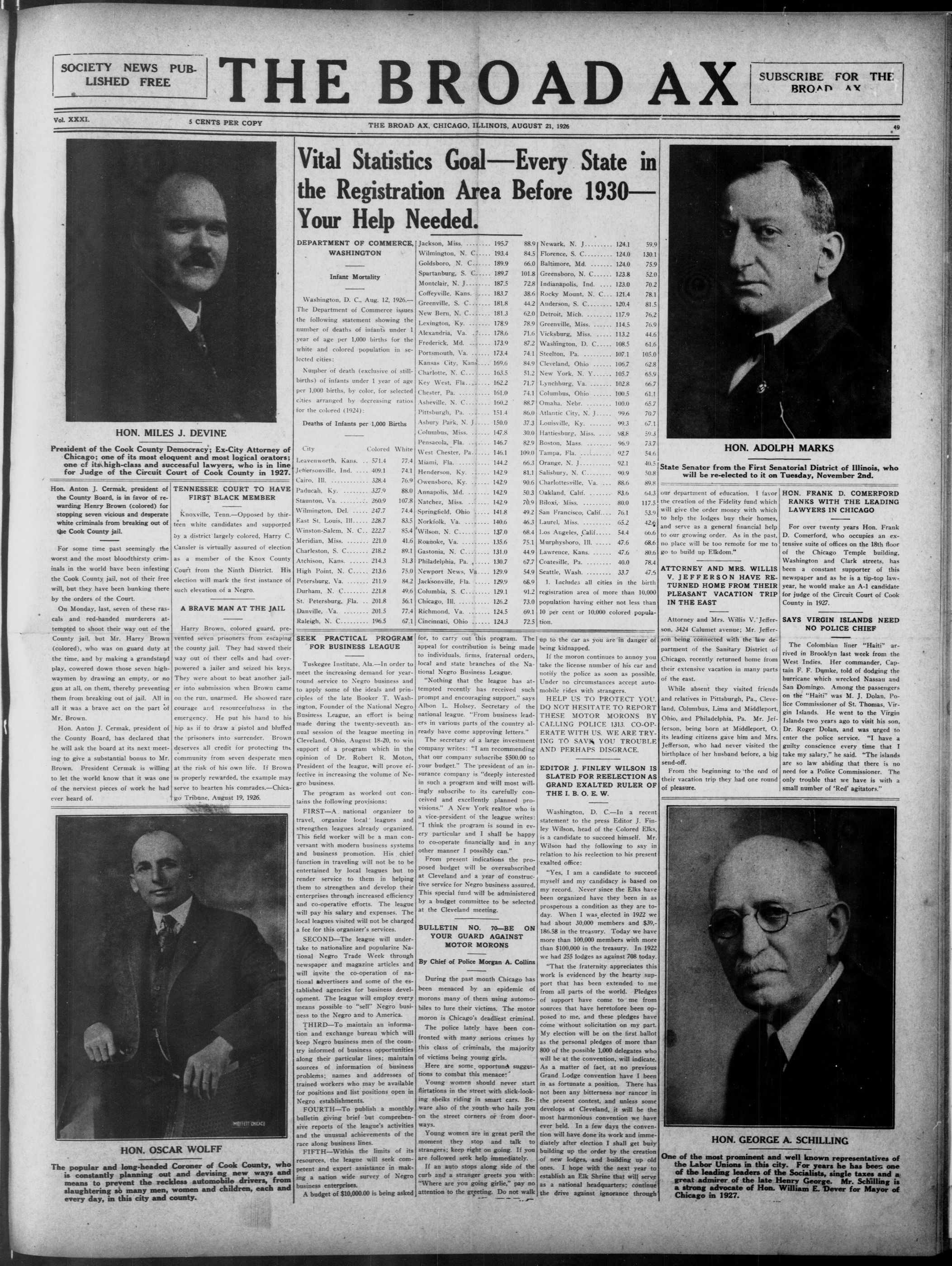
HON. MILES J. DEVINE President of the Cook County Democracy; Ex Chicago; one of its most eloquent and most one of its high-class and successful lawyer for Judge of the Circuit Court of Cook
Cook County Democracy; Exce of its most eloquent and most high-class and successful lawyer of the Circuit Court of Cook
President of the Cook County Democracy; Ex-City Attorney of Chicago; one of its most eloquent and most logical orators; one of its high-class and successful lawyers, who is in line for Judge of the Circuit Court of Cook County in 1927.
Hon. Anton J. Cermak, president of the County Board, is in favor of rewarding Henry Brown (colored) for stopping seven vicious and desperate white criminals from breaking out of the Cook County jail.
For some time past seemingly the worst and the most bloodthirsty criminals in the world have been infesting the Cook County jail, not of their free will, but they have been bunking there by the orders of the Court.
TENNESSEE COURT TO HAVE FIRST BLACK MEMBER
Knoxville, Tenn.—Opposed by thirteen white candidates and supported by a district largely colored, Harry C. Cansler is virtually assured of election as a member of the Knox County Court from the Ninth District. His election will mark the first instance of such elevation of a Negro.
On Monday, last, seven of these rascals and red-handed murderers attempted to shoot their way out of the County jail, but Mr. Harry Brown (colored), who was on guard duty at the time, and by making a grandstand play, cowered down those seven highwaymen by drawing an empty, or no gun at all, on them, thereby preventing them from breaking out of jail. All in all it was a brave act on the part of Mr. Brown.
Hon. Anton J. Cermak, president of the County Board, has declared that he will ask the board at its next meeting to give a substantial bonus to Mr. Brown. President Cermak is willing to let the world know that it was one of the nerviest pieces of work he had ever heard of.
Ireland
M. B.
MERFETT CHECKS
The popular and long-headed Coroner of C is constantly planning out and devising means to prevent the reckless automob slaughtering so many men, women and c every day, in this city and county.
and long-headed Coroner of Co. planning out and devising to prevent the reckless automobiles so many men, women and ch in this city and county.
The popular and long-headed Coroner of Cook County, who is constantly planning out and devising new ways and means to prevent the reckless automobile drivers, from slaughtering so many men, women and children, each and every day, in this city and county.
Vol. XXXI.
5 CENTS PER COPY
```markdown
```
democracy; Ex-City Attorney ofquent and most logical orators; successful lawyers, who is in line court of Cook County in 1927.
TENNESSEE COURT TO HAVE
FIRST BLACK MEMBER
Knoxville, Tenn.-Opposed by thirteen white candidates and supported by a district largely colored, Harry C. Cansler is virtually assured of election as a member of the Knox County Court from the Ninth District. His election will mark the first instance of such elevation of a Negro.
A BRAVE MAN AT THE JAIL
Harry Brown, colored guard, prevented seven prisoners from escaping the county jail. They had sawed their way out of their cells and had overpowered a jailer and seized his keys. They were about to beat another jailer into submission when Brown came on the run, unarmed. He showed rare courage and resourcefulness in the emergency. He put his hand to his hip as if to draw a pistol and bluffed the prisoners into surrender. Brown deserves all credit for protecting the community from seven desperate men at the risk of his own life. If Brown is properly rewarded, the example may serve to hearten his comrades.—Chicago Tribune, August 19, 1926.
MERFERT DHEACE
Coroner of Cook County, who and devising new ways and less automobile drivers, from women and children, each and county.
THE BROAD AX
THE BROAD AX, CHICAGO, ILLINOIS, AUGUST 21, 1926
Vital Statistics Goal-Every State in the Registration Area Before 1930 Your Help Needed.
DEPARTMENT OF COMMERCE
WASHINGTON
Infant Mortality
Washington, D. C., Aug. 12, 1926.—The Department of Commerce issues the following statement showing the number of deaths of infants under 1 year of age per 1,000 births for the white and colored population in selected cities:
Number of death (exclusive of still-births) of infants under 1 year of age per 1,000 births, by color, for selected cities arranged by decreasing ratios for the colored (1924):
City Colored White
Leavenworth, Kans. 571.4 77.4
Jeffersonville, Ind. 409.1 74.1
Cairo, Ill. 328.4 76.9
Paducah, Ky. 327.9 88.0
Staunton, Va. 260.9 107.8
Wilmington, Del. 247.7 74.4
East St. Louis, Ill. 228.7 83.5
Winston-Salem, N. C. 222.7 85.4
Meridian, Miss. 221.0 41.6
Charleston, S. C. 218.2 89.1
Atchison, Kans. 214.3 51.3
High Point, N. C. 213.6 75.0
Petersburg, Va. 211.9 84.2
Durham, N. C. 221.8 49.6
St. Petersburg, Fla. 201.8 56.1
Danville, Va. 201.5 77.4
Raleigh, N. C. 196.5 67.1
SEEK PRACTICAL PROGRAM
FOR BUSINESS LEAGUE
Tuskegee Institute, Ala.—In order to meet the increasing demand for year-round service to Negro business and to apply some of the ideals and principles of the late Booker T. Washington, Founder of the National Negro Business League, an effort is being made during the twenty-seventh annual session of the league meeting in Cleveland, Ohio, August 18-20, to win support of a program which in the opinion of Dr. Robert R. Moton, President of the league, will prove effective in increasing the volume of Negro business.
The program as worked out contains the following provisions:
FIRST—A national organizer to travel, organize local' leagues and strengthen leagues already organized. This field worker will be a man conversant with modern business systems and business promotion. His chief function in traveling will not be to be entertained by local leagues but to render service to them in helping them to strengthen and develop their enterprises through increased efficiency and co-operative efforts. The league will pay his salary and expenses. The local leagues visited will not be charged a fee for this organizer's services.
SECOND—The league will undertake to nationalize and popularize National Negro Trade Week through newspaper and magazine articles and will invite the co-operation of national advertisers and some of the established agencies for business development. The league will employ every means possible to "sell" Negro business to the Negro and to America.
THIRD—To maintain an information and exchange bureau which will keep Negro business men of the country informed of business opportunities along their particular lines; maintain sources of information of business problems; names and addresses of trained workers who may be available for positions and list positions open in Negro establishments.
FOURTH—To publish a monthly bulletin giving brief but comprehensive reports of the league's activities and the unusual achievements of the race along business lines.
FIFTH—Within the limits of its resources, the league will seek competent and expert assistance in making a nation wide survey of Negro business enterprises.
A budget of $10,000.00 is being asked
for, to carry out this program. The appeal for contribution is being made to individuals, firms, fraternal orders, local and state branches of the National Negro Business League.
"Nothing that the league has attempted recently has received such prompt and encouraging support," says Albon L. Holsey. Secretary of the national league. "From business leaders in various parts of the country already have come approving letters."
The secretary of a large investment company writes: "I am recommending that our company subscribe $500.00 to your budget." The president of an insurance company is "deeply interested in such a program and will most willingly subscribe to its carefully conceived and excellently planned provisions." A New York realtor who is a vice-president of the league writes: "I think the program is sound in every particular and I shall be happy to co-operate financially and in any other manner I possibly can."
From present indications the proposed budget will be oversubscribed at Cleveland and a year of constructive service for Negro business assured. This special fund will be administered by a budget committee to be selected at the Cleveland meeting.
BULLETIN NO. 70-BE ON
YOUR GUARD AGAINST
MOTOR MORONS
By Chief of Police Morgan A. Collins
During the past month Chicago has been menaced by an epidemic of morons many of them using automobiles to lure their victims. The motor moron is Chicago's deadliest criminal.
Here are some opportunity suggestions to combat this menace:
Young women should never start flirtations in the street with slick-looking sheiks riding in smart cars. Beware also of the youth who hails you on the street corners or from doorways.
Young women are in great peril the moment they stop and talk to strangers; keep right on going. If you are followed seek help immediately.
If an auto stops along side of the curb and a stranger greets you with: "Where are you going girlie," pay no attention to the greeting. Do not walk
up to the car as you are in danger of being kidnapped.
If the moron continues to annoy you take the license number of his car and notify the police as soon as possible. Under no circumstances accept automobile rides with strangers.
HELP US TO PROTECT YOU
DO NOT HESITATE TO REPORT THESE MOTOR MORONS BY CALLING POLICE 1313. CO-OPERATE WITH US. WE ARE TRYING TO SAVI YOU TROUBLE AND PERHAPS DISGRACE.
EDITOR J. FINLEY WILSON IS SLATED FOR REELECTION AS GRAND EXALTED RULER OF THE I. B. O. E. W.
Washington, D. C.—In a recent statement to the press Editor J. Finley Wilson, head of the Colored Elks, is a candidate to succeed himself. Mr. Wilson had the following to say in relation to his reelection to his present exalted office:
"Yes, I am a candidate to succeed myself and my candidacy is based on my record. Never since the Elks have been organized have they been in as prosperous a condition as they are today. When I was elected in 1922 we had about 30,000 members and $39,-186.58 in the treasury. Today we have more than 100,000 members with more than $100,000 in the treasury. In 1922 we had 255 lodges as against 708 today.
"That the fraternity appreciates this work is evidenced by the hearty support that has been extended to me from all parts of the world. Pledges of support have come to me from sources that have heretofore been opposed to me, and these pledges have come without solicitation on my part. My election will be on the first ballot as the personal pledges of more than 800 of the possible 1,000 delegates who will be at the convention, will indicate. As a matter of fact, at no previous Grand Lodge convention have I been in as fortunate a position. There has not been any bitterness nor rancor in the present contest, and unless some develops at Cleveland, it will be the most harmonious convention we have ever held. In a few days the convention will have done its work and immediately after election I shall get busy building up the order by the creation of new lodges, and building up old ones. I hope with the next year to establish an Elk Shrine that will serve as a national headquarters; continue the drive against ignorance through
X
P. A.
HON. ADOLPH MARKS
State Senator from the First Se will be re-elected to it on
from the First Senatorial District of re-elected to it on Tuesday, November
our department of education. I favor the creation of the Fidelity fund which will give the order money with which to help the lodges buy their homes, and serve as a general financial help to our growing order. As in the past, no place will be too remote for me to go to build up Elkdom."
ATTORNEY AND MRS. WILLIS V. JEFFERSON HAVE RETURNED HOME FROM THEIR PLEASANT VACATION TRIP IN THE EAST
Attorney and Mrs. Willis V. Jefferson, 3424 Calumet avenue; Mr. Jefferson being connected with the law department of the Sanitary District of Chicago, recently returned home from their extensive vacation in many parts of the east.
HON. FRANK D. COMERFORD RANKS WITH THE LEADING LAWYERS IN CHICAGO
For over twenty years Hon. Frank D. Comerford, who occupies an extensive suite of offices on the 18th floor of the Chicago Temple building, Washington and Clark streets, has been a constant supporter of this newspaper and as he is a tip-top law-year, he would make an A-1 candidate for judge of the Circuit Court of Cook County in 1927.
SAYS VIRGIN ISLANDS NEED NO POLICE CHIEF
The Colombian liner "Haiti" arrived in Brooklyn last week from the West Indies. Her commander, Captain F. F. Dumke, told of dodging the hurricane which wrecked Nassau and
While absent they visited friends and relatives in Pittsburgh, Pa., Cleveland, Columbus, Lima and Middleport Ohio, and Philadelphia, Pa. Mr. Jefferson, being born at Middleport, O, its leading citizens gave him and Mrs. Jefferson, who had never visited the birthplace of her husband before, a big send-off. From the beginning to the end of their vacation trip they had one round of pleasure.
[Image of a man with a bald head and glasses, wearing a suit and tie. The background is a plain, light-colored wall. There is no text or additional details in the image.]
---
[Name]
HON. GEORGE A. SCHILLING
One of the most prominent and well known repre
the Labor Unions in this city. For years he
of the leading leaders of the Socialists, single
great admirer of the late Henry George. M
a strong advocate of Hon. William E. Dever
Chicago in 1927.
most prominent and well known repre-
tor Unions in this city. For years he
leading leaders of the Socialists, single
mirer of the late Henry George. Mr
advocate of Hon. William E. Dever
in 1927.
One of the most prominent and well known representatives of the Labor Unions in this city. For years he has been one of the leading leaders of the Socialists, single taxes and a great admirer of the late Henry George. Mr. Schilling is a strong advocate of Hon. William E. Dever for Mayor of Chicago in 1927.
SUBSCRIBE FOR THE BROAD AX
49
First Senatorial District of Illinois, who be it on Tuesday, November 2nd.
I favor which homes, alal help the past, me to WILLIS RE HEIR TRIP
HON. FRANK D. COMERFORD RANKS WITH THE LEADING LAWYERS IN CHICAGO
For over twenty years Hon. Frank D. Comerford, who occupies an extensive suite of offices on the 18th floor of the Chicago Temple building, Washington and Clark streets, has been a constant supporter of this newspaper and as he is a tip-top law-year, he would make an A-1 candidate for judge of the Circuit Court of Cook County in 1927.
SAYS VIRGIN ISLANDS NEED
NO POLICE CHIEF
The Colombian liner "Haiti" arrived in Brooklyn last week from the West Indies. Her commander, Captain F. F. Dumke, told of dodging the hurricane which wrecked Nassau and San Domingo. Among the passengers on the "Haiti" was M. J. Dolan, Police Commissioner of St. Thomas, Virgin Islands. He went to the Virgin Islands two years ago to visit his son, Dr. Roger Dolan, and was urged to enter the police service. "I have a guilty conscience every time that I take my salary," he said. "The islands are so law abiding that there is no need for a Police Commissioner. The only trouble that we have is with a small number of 'Red agitators.'
ent and well known representatives of this city. For years he has been one of the Socialists, single taxes and a late Henry George. Mr. Schilling is Hon. William E. Dever for Mayor of
In this city since July [5th 1899.
ithout missing one single issue Re-
gublicans, Democrats, Catholics, Pro
testants, Single Taxers, Priests, infi
dels or anyone else can have their say
as long as their language is prope:
and responsibility is fixed.
The Broad Ax is a newspaper whos:
platform is broad enough for all. ever
claiming the editorial right to speak
its own mind. It is neither Demo
eratic nor Republican. It is strictly
‘or absolutely independent in politics
Local communications will receive
attention. Write only on one side o!
the paper.
Subscriptions must be paid m ad-
vance.
One Year ...-..ececeeceee S200
Six Months ................-.$100
Advertising rates made known or
spplication.
Address all communications to
THE BROAD AX
6206 S. Elizabeth St. Chicago.
Phone: Wentworth 2597
JULIUS F. TAYLOR
Editor and Publisher
a
Vol. XXXI No. 49
Chicago, August 21, 1926
a
Entered as Second-Class Matter, Aug.
19, 1902, at the Post office at Chicago,
UL Under Act of March 8, 1879.
pti deguiuor, braces
ELAN WOULD SCARE COL-
ORED POSTMAN FROM LONG
ISLAND HOME
N. A. A, C. P. Asks Full Police
Protection
A letter signed with initials of the
Klu Klux Klan ordering him to re-
move from his home in Hollis, Long
Island, because of his race, has been
received by Thomas B. Harper, Negro
postal clerk, who purchased a home in
this community on May Ist.
Mr. Harper and his wife are fair
colored people, but when darker
friends came to visit them the agent
who sold the home, together with the
president of the local civic league,
sought to have them accept back their
equity and move.
On Mr. Harper refusing to be run
out of a community because of preju-
dice, he received a letter ordering him
to move within a month and sell to
the agent.
A few nights thereafter a fiery cross
‘was burned opposite his house. Mr.
Harper appealed to the lieutenant in
charge of the precinct for protection
‘and sought a permit to have arms in
his house. The last was denied.
The National Association for the
Advancement of Colored People has
written to George McLaughlin, New
York Commissioner of Police, urging
that instructions be given the lieuten-
ant of the precinct to see that ample
police protection is granted Mr. Har-
vey in case needed.
fe
5?
7 Yo
es pe
‘fn 2
se Ce oe
8 : Pee
3 ys
The people’s candidate for United States Senator from Illinois,
who is in favor of light wines and beer. There are hundreds
of thousands of voters scattered throughout this State who
believe in personal liberty and who will assist him to land
in the United States Senate Tuesday, November 2.
THE BROAD AX
Published Every Saturday
- -
ee ..
ee ee eS
CR ee oe a
ee ee a
z HON. P. J. CARR
'G!The well known and up-to-date Treasur
whose thousands of tried and true frien
city and county, who are willing to wo
order to assist to elect him Sheriff of
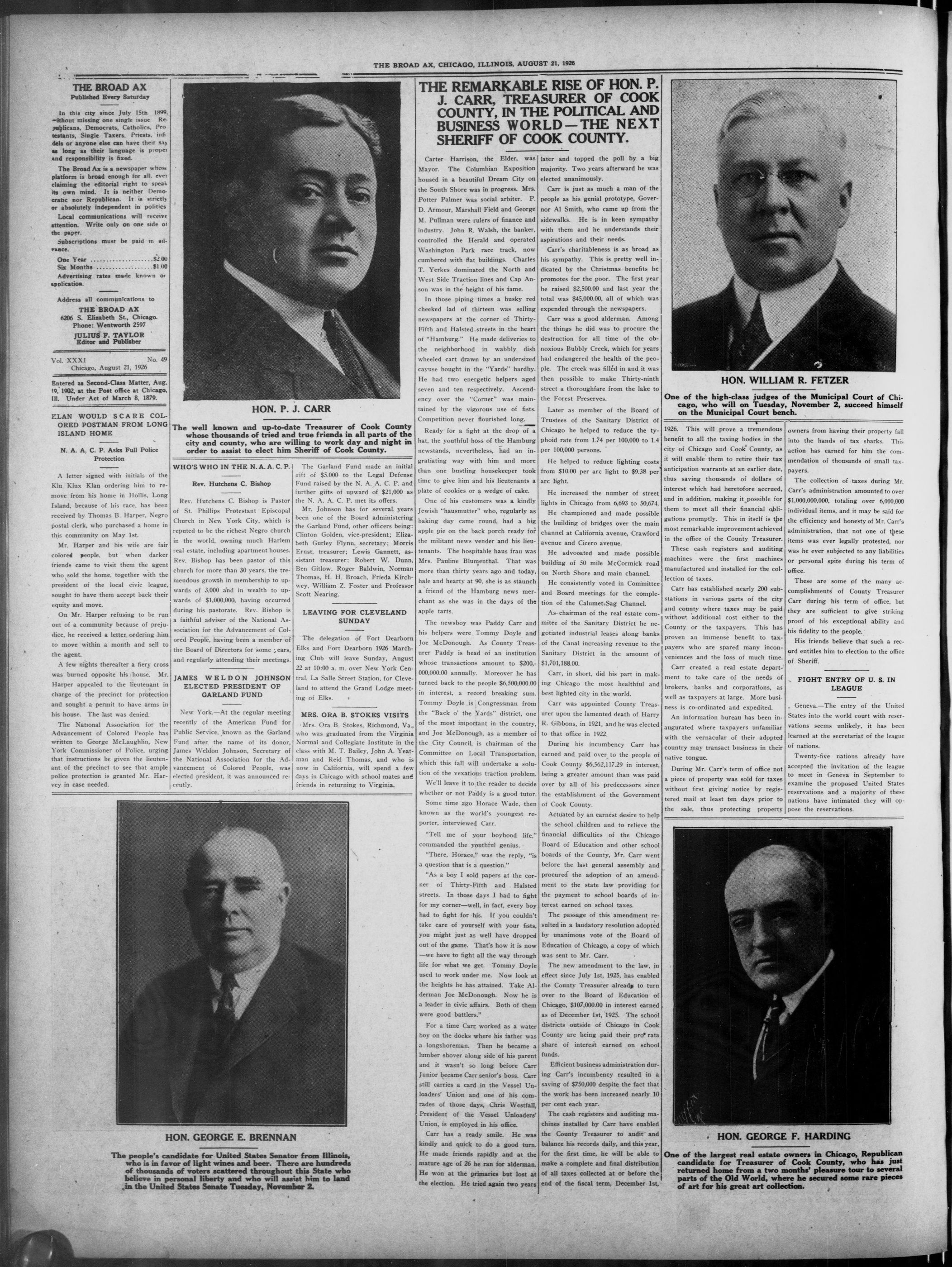
The well known and up-to-date Treasurer of Cook County
whose thousands of tried and true friends in all parts of the
city and county, who are willing to work day and night in
order to assist to elect him Sheriff of Cook County.
WHO'S WHO IN THE N.A.A.C.P.|/ The Garland Fund made an initial
a aift of $5,000 to the Legal Defense
Rev. Hutchens C. Bishop Fund raised by the N. A. A. C. P. and
aan further gifts of upward of $21,000 a:
Rev. Hutchens C. Bishop is Pastor| the N. A. A.C. P. met its offers.
of St. Phillips Protestant Episcopal] Mr. Johnson has for several years
Church in New York City, which is agi ore pa aa —
i : the Garland Fund, other officers being
reputed to be the richest Negro church! Ciinton Golden, vice-president; Elles
in the world, owning much Harlem! yeh Gurley Flynn, secretary; Morri
real estate, including apartment houses.| Ernst, treasurer; Lewis Gannett, as
Rev, Bishop has been pastor of this| sistant treasurer; Robert W. Dunn
church for more than 30 years, the tre-| Ben Gitlow, Roger Baldwin, Normar
mendous growth in membership to up-| Thomas, H. H. Broach, Frieda Kirch
a wey, William Z. Foster and Professo
wards of 3,000 and in wealth to up-| 0°")
Scott Nearing.
wards of $1,000,000, having occurred
during his pastorate. Rev. Bishop is] [RAVING FOR CLEVELAND
a faithful adviser of the National As- SUNDAY
sociation foF the Advancement of Col- —
ored People, having been a member of] The delegation of Fort Dearbort
the Board of Directors for some years,| Elks and Fort Dearborn 1926 March
and regularly attending their meetings.| ing Club will leave Sunday, Augus
JAMES WELDON JOHNSON
ELECTED PRESIDENT OF
GARLAND FUND
New York.—At the regular meeting
recently of the American Fund for
Public Service, known as the Garland
Fund after the name of its donor,
James Weldon Johnson, Secretary of
the National Association for the Ad-
vancement of Colored People, was
elected president, it was announced re-
conte.
HON. GEORGE E. BRENNAN
candidate for United States Senator |
favor of light wines and beer. There
nds of voters scattered throughout th
“personal liberty and who will assist
ited States Senate Tuesday, Novembe:
Ns
The delegation of Fort Dearborn
Elks and Fort Dearborn 1926 March-
ing Club will leave Sunday, August
22 at 10:00 a. m. over New York Cen-
tral, La Salle Street Station, for Cleve-
land to attend the Grand Lodge meet-
ing of Elks. +
MRS. ORA B. STOKES VISITS
Mrs. Ora B. Stokes, Richmond, Va.,
who was graduated from the Virginia
Normal and Collegiate Institute in the
class with M. T. Bailey, John A, Yeat-'
man and Reid Thomas, and who is:
now in California, will spend a few.
days in Chicago with school mates ané
friends in returning to Virginia.
|
|
THE BROAD AX, CHICAGO, ILLINOIS, AUGUST 21, 1926
THE REMARKABLE RISE OF HON. P.
J. CARR, TREASURER OF COOK
COUNTY, IN THE POLITICAL AND
BUSINESS WORLD— THE NEXT
| SHERIFF OF COOK COUNTY.
housed in « beautifal Dream City e
the South Shore was in progress. a
Potter Palmer was social arbiter. P.
D, Armour, Marshall Field and George
M. Pullman were rulers of finance and
‘industry. John R. Walsh, the banker,
controlled the Herald and operated
Washington Park race track, now
‘cumbered with flat buildings. Charles.
T. Yerkes dominated the North and
‘West Side Traction lines and Cap An-
‘son was in the height of his fame.
/ In those piping times a husky red
checked lad of thirteen was selling
newspapers at the corner of Thirty-
Fifth and Halsted-streets in the heart
‘of “Hamburg.” He made deliveries to
pe neighborhood in wabbly dish
wheeled cart drawn by an undersized
‘cayuse bought in the “Yards” hardby.
He had two energetic helpers aged
seven and ten respectively. Ascend-
ency over the “Corner” was main-
tained by the vigorous use of fists.
Competition never flourished long.
Ready for a fight at the drop of a
hat, the youthful boss of the Hamburg
/newstands, nevertheless, tad an in-
gratiating way with him and more
‘than one bustling housekeeper took
time to give him and his lieutenants a
plate of cookies or a wedge of cake.
One of his customers was a kindly
Jewish “hausmutter” who, regularly as
baking day came round, had a big
apple pie on the back porch ready for
the militant news vender and his lieu-
tenants. The hospitable haus frau was
Mrs. Pauline Blumenthal. That was
more than thirty years ago and today,
hale and hearty at 90, she is as staunch
a friend of the Hamburg news mer-
chant as she was in the days of the
apple tarts.
The newsboy was Paddy Carr and
his helpers were Tommy Doyle and
Joe McDonough. As County Treas-
urer Paddy is head of an institution
whose transactions amount to $200,-
000,000.00 annually. Moreover he has
turned back to the people $6,500,000.00
in interest, a record breaking sum.
Tommy Doyle is Congressman from
the “Back o” the Yards” district, one
of the most important in the country,
and Joe McDonough, as a member of
the City Council, is chairman of the
Committee on Local Transportation,
which this fall will undertake a solu-
tion of the vexatious traction problem.
We'll leave it to the reader to decide
whether or not Paddy is a good tutor.
Some time ago Horace Wade, then
known as the world’s youngest re-
porter, interviewed Carr.
“Tell me of your boyhood life,”
commanded the youthful genius.
“There, Horace,” was the reply, “is
@ question that is a question.”
“As a boy I sold papers at the cor-
ner of Thirty-Fifth and . Halsted
streets. In those days I had to fight
for my corner—well, in fact, every boy
had to fight for his. If you couldn't
take care of yourself with your fists,
you might just as well have dropped
out of the game. That's how it is now
—we have to fight all the way through
life for what we get. Tommy Doyle
used to work under me. Now look at
the heights he has attained. Take Al-
derman Joe McDonough. Now he is
a leader in civic affairs. Both of them
were good battlers.”
For a time Carr worked as a water
boy on the docks where his father was
a longshoreman. Then he became a
lumber shover along side of his parent
and it wasn't so long before Carr
Junior became Carr senior’s boss. Carr
still carries a card in the Vessel Un-
loaders’ Union and one of his com-
rades of those days, Chris Westfall,
President of the Vessel Unloaders’
elected unanimously.
Carr is just as much a man of the
‘people as his genial prototype, Gover-
‘nor Al Smith, who came up from the
‘sidewalks. He is in keen sympathy
with them and he understands their
aspirations and their needs.
Carr's charitableness is as broad as
his sympathy, This is pretty well in-
‘dicated by the Christmas benefits he
Promotes for the poor. The first year
he raised $2,500.00 and last year the
total was $45,000.00, all of which was
expended through the newspapers.
Carr was a good alderman, Among
the things he did was to procure the
destruction for all time of the ob-
noxious Bubbly Creek, which for years
had endangered the health of the peo-
ple. The creek was filléd in and it was
then possible to make Thirty-ninth
street a thoroughfare from the lake to
the Forest Preserves.
Later as member of the Board of
Trustees of the Sanitary District of
Chicago he helped to reduce the ty-
phoid rate from 1.74 per 100,000 to 1.4
per 100,000 persons. ”
He helped to reduce lighting costs
from $10.00 per arc light to $9.38 per
are light.
He increased the number of street
lights in Chicago from 6,693 to 50,674.
He championed and made possible
the building of bridges over the main
channel at California avenue, Crawford
avenue and Cicero avenue.
He advocated and made possible
building of 50 mile McCormick road
on North Shore and main channel.
He consistently voted in Committee
and Board meetings for the comple-
tion of the Calumet-Sag Channel.
As-chairman of the real estate com-
mitee of the Sanitary District he ne-
gotiated industrial leases along banks
of the Canal increasing revenue to the
Sanitary District in the amount of
$1,701,188.00.
Carr, in short, did his part in mak-
ing Chicago the most healthful and
best lighted city in the world.
Carr was appointed County Treas-
urer upon the lamented death of Harry
R. Gibbons, in 1921, and he was elected
to that office in 1922,
During his incumbency Carr has
earned and paid over to the people of
Cook County $6,562,117.29 in interest,
being a greater amount than was paid
over by all of his predecessors since
the establishment of the Government
of Cook County.
Actuated by an earnest desire to help
the school children and to relieve the
financial difficulties of the Chicago
Board of Education and other school
boards of the County, Mr. Carr went
before the last general assembly and
procured the adoption of an amend-
ment to the state law providing for
the payment to school boards of in-
terest earned on school taxes.
The passage of this amendment re-
sulted in a laudatory resolution adopted
by unanimous vote of the Board of
Education of Chicago, a copy of which
was sent to Mr. Carr. :
‘The new amendment to the law, in
effect since July Ist, 1925, has enabled
the County Treasurer already to turn
over to the Board of Education of
Chicago, $107,000.00 in interest earned
as of December Ist, 1925. The school
districts outside of Chicago in Cook
County are being paid their pro? rata
share of interest earned on school
funds.
Efficient business administration dur-
ing Carr’s incumbency resulted in a
saving of $750,000 despite the fact that
the work has been increased nearly 10
per cent each year.
‘The cash registers and auditing ma-
Pee. * $6)
jor |
ase Se
| er |
| a hg |
. “ |
: 4 34 ~~ |
’ aie
* °° e
HON. WILLIAM R. FETZER
One of the high-class judges of the Municipal |
cago, who will on Tuesday, November 2, su
on the Municipal Court bench.
pe ee eS
One of the high-class judges of the Municipal Court of Chi-
cago, who will on Tuesday, November 2, succeed himself
on the Municipal Court bench.
1926. This will prove a tremendous
benefit to all the taxing bodies in the
city of Chicago and Cook’ County, as
it will enable them to retire their tax
anticipation warrants at an earlier date,
thus saving thousands of dollars of
interest which had heretofore accrued,
and in addition, making it possible for
them to meet all their financial abli-
gations promptly. This in itself is the
‘most remarkable improvement achieved
in the office of the County Treasurer.
These cash registers and auditing
machines were the first machines
manufactured and installed for the col-
lection of taxes.
Carr has established nearly 200 sub-
Stations in various parts of the city
and county where taxes may be paid
without ‘additional cost either to the
County or the taxpayers. This has
proven an immense benefit to tax-
payers who are spared many incon-
veniences and the loss of much time.
Carr created a real estate depart-
ment to take care of the needs of
brokers, banks and corporations, as
well as taxpayers at large. More busi-
ness is co-ordinated and expedited.
An information bureau has been in-
augurated where taxpayers unfamiliar
with the vernacular of their adopted
country may transact business in their
native tongue.
During Mr. Carr's term of office not
a piece of property was sold for taxes
without first giving notice by regis-
tered mail at least ten days prior to
the sale, thus protecting property
+ HON. GEORGE F. HARDING
One of the largest real estate owners in Chicago
candidate for Treasurer of Cook County, w
returned home from a two months’ pleasure to
parts of the Old World, where he secured som:
of art for his great art collection.
Eo re sai “1+ apni aii
Ine of the largest real estate owners in Chicago, Republican
candidate for Treasurer of Cook County, who has just
returned home from a two months’ pleasure tour to several
parts of the Old World, where he secured some rare pieces
of art for his great art collection. i:
owners from having their property fall
into the hands of tax sharks. This
action has earned for him the com-
mendation of thousands of small tax-
Payers.
The collection of taxes during Mr.
Carr's administration amounted to over
$1,000,000,000, totaling over 6,000,000
individual items, and it may be said for
the efficiency and honesty of Mr. Cart’s
administration, that not one of these
items was ever legally protested, nor
was he ever subjected to any liabilities
or personal spite during his term of
office.
These are some pf the many ac-
complishments of County Treasurer
Carr during his term of office, but
they are sufficient to give striking
proof of his exceptional ability and
his fidelity to the people.
His friends believe that such a rec-
ord entitles him to election to the office
of Sheriff.
. FIGHT ENTRY OF U. S. IN
LEAGUE
. Geneva—The entry of the United
States into the world court with reser-
vations seems unlikely, it has been
learned at the secretariat of the league
of nations.
Twenty-five nations already have
accepted the invitation of the league
to meet in Geneva in September to
examine the proposed United States
reservations and a majority of these
nations have intimated they will op-
pose the reservations.
[Name]
HON. GEORGE B. HOLMES
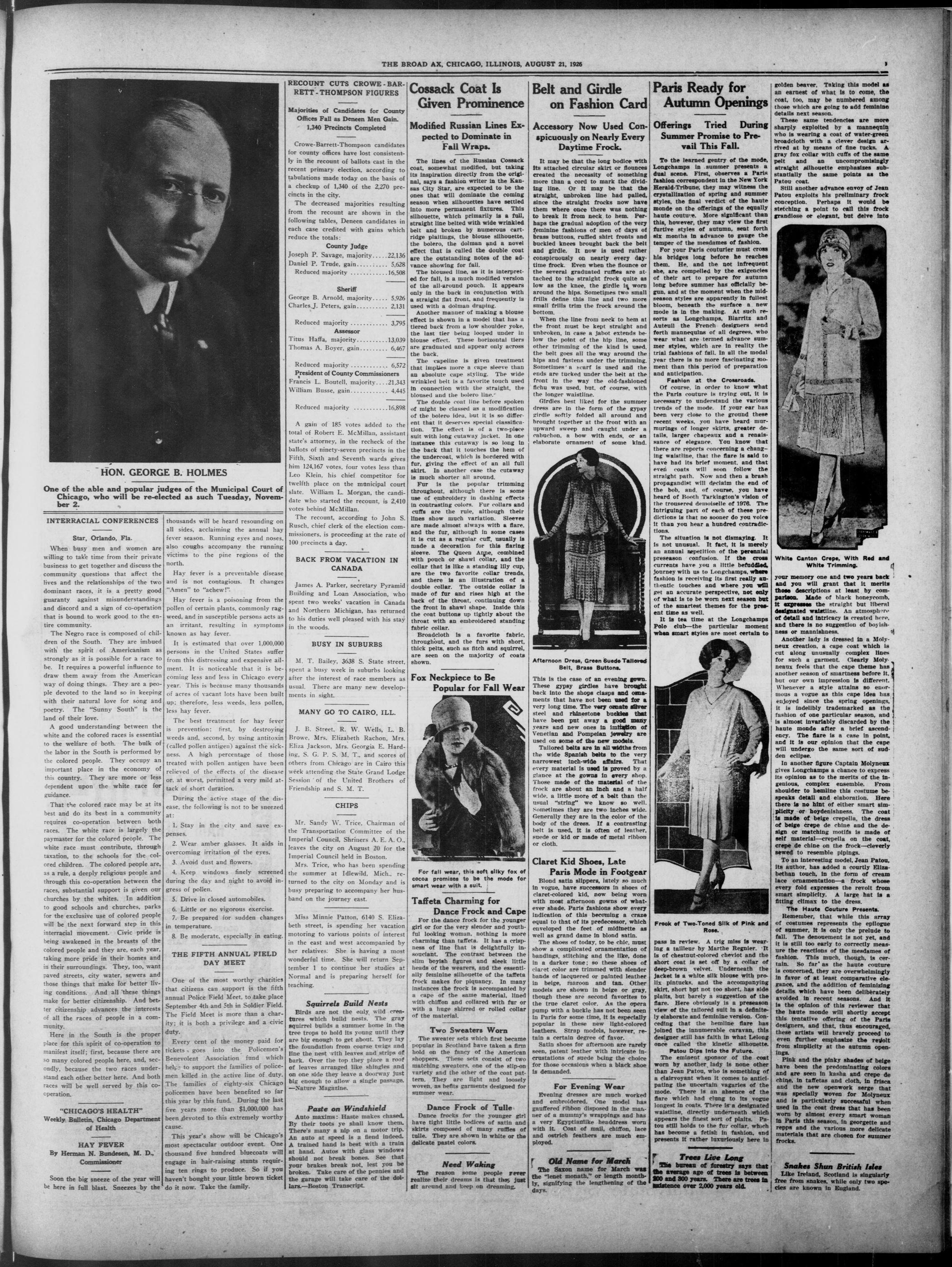
One of the able and popular judges of the Municipal Court of Chicago, who will be re-elected as such Tuesday, November 2.
INTERRACIAL CONFERENCES thousands will be heard resounding on
Star. Orlando. Fla.
When busy men and women are willing to take time from their private business to get together and discuss the community questions that affect the lives and the relationships of the two dominant races, it is a pretty good guaranty against misunderstandings and discord and a sign of co-operation that is bound to work good to the entire community.
The Negro race is composed of children of the South. They are imbued with the spirit of Americanism as strongly as it is possible for a race to be. It requires a powerful influence to draw them away from the American way of doing things. They are a people devoted to the land so in keeping with their natural love for song and poetry. The "Sunny South" is the land of their love.
A good understanding between the white and the colored races is essential to the welfare of both. The bulk of the labor in the South is performed by the colored people. They occupy an important place in the economy of this country. They are more or less dependent upon the white race for guidance.
That the colored race may be at its best and do its best in a community requires co-operation between both races. The white race is largely the paymaster for the colored people. The white race must contribute, through taxation, to the schools for the colored children. The colored people are, as a rule, a deeply religious people and through this co-operation between the races, substantial support is given our churches by the whites. In addition to good schools and churches, parks for the exclusive use of colored people will be the next forward step in this interracial movement. Civic pride is being awakened in the breasts of the colored people and they are, each year, taking more pride in their homes and in their surroundings. They, too, want paved streets, city water, sewers and those things that make for better living conditions. And all these things make for better citizenship. And better citizenship advances the interests of all the races of people in a community.
Here in the South is the proper place for this spirit of co-operation to manifest itself; first, because there are so many colored people here, and, secondly, because the two races understand each other better here. And both races will be well served by this co-operation.
"CHICAGO'S HEALTH"
Weekly Bulletin, Chicago Department of Health
HAY FEVER
By Herman N. Bundesen, M. D., Commissioner
Soon the big sneeze of the year will be here in full blast. Sneezes by the
thousands will be heard resounding on all sides, acclaiming the annual hay fever season. Running eyes and noses, also coughs accompany the running victims to the pine regions of the north.
Hay fever is a preventable disease and is not contagious. It changes "Amen" to "achew!"
Hay fever is a poisoning from the pollen of certain plants, commonly ragweed, and in susceptible persons acts as an irritant, resulting in symptoms known as hay fever.
It is estimated that over 1,000,000 persons in the United States suffer from this distressing and expensive ailment. It is noticeable that it is becoming less and less in Chicago every year. This is because many thousands of acres of vacant lots have been built up; therefore, less weeds, less pollen, less hay fever.
The best treatment for hay fever is prevention; first, by destroying weeds and, second, by using antitoxin (called pollen antigen) against the sickness. A high percentage of those treated with pollen antigen have been relieved of the effects of the disease or, at worst, permitted a very mild attack of short duration.
During the active stage of the disease, the following is not to be sneezed at:
1. Stay in the city and save expenses.
2. Wear amber glasses. It aids in overcoming irritation of the eyes.
3. Avoid dust and flowers.
4. Keep windows finely screened during the day and night to avoid ingress of pollen.
5. Drive in closed automobiles.
6. Little or no vigorous exercise.
7. Be prepared for sudden changes in temperature.
8. Be moderate, especially in eating.
THE FIFTH ANNUAL FIELD DAY MEET
One of the most worthy charities that citizens can support is the fifth annual Police Field Meet, to take place September 4th and 5th in Soldier Field. The Field Meet is more than a charity; it is both a privilege and a civic duty. Every cent of the money paid for tickets goes into the Policemen's Benevolent Association fund which helps to support the families of policemen killed in the active line of duty. The families of eighty-six Chicago policemen have been benefited so far this year by this fund. During the last five years more than $1,000,000 has been devoted to this extremely worthy cause.
This year's show will be Chicago's most spectacular outdoor event. One thousand five hundred bluecoats will engage in hair-raising stunts requiring ten rings to produce. So if you haven't bought your little brown ticket do it now. Take the family.
THE BROAD AX. CHICAGO. ILLINOIS. AUGUST 21. 1926
RECOUNT CUTS CROWE-BARRETT-THOMPSON FIGURES
Majorities of Candidates for County Offices Fall as Deneen Men Gain. 1,340 Precincts Completed
Crowe-Barrett-Thompson candidates for county offices have lost consistently in the recount of ballots cast in the recent primary election, according to tabulations made today on the basis of a checkup of 1,340 of the 2,270 precincts in the city.
The decreased majorities resulting from the recount are shown in the following tables, Deneen candidates in each case credited with gains which reduce the totals:
County Judge
Joseph P. Savage, majority.....22,136
Daniel P. Trude, gain.....5,628
Reduced majority.....16,508
Sheriff
George B. Arnold, majority.....5,926
Charles J. Peters, gain.....2,131
Reduced majority.....3,795
Assessor
Titus Haffa, majority.....13,039
Thomas A. Boyer, gain.....6,467
Reduced majority.....6,572
President of County Commissioners
Francis L. Boutell, majority.....21,343
William Busse, gain.....4,445
Reduced majority.....16,898
A gain of 185 votes added to the total of Robert E. McMillan, assistant state's attorney, in the recheck of the ballots of ninety-seven precincts in the Fifth, Sixth and Seventh wards gives him 124,167 votes, four votes less than Leo Klein, his chief competitor for twelfth place on the municipal court slate. William L. Morgan, the candidate who started the recount, is 2,410 votes behind McMillan. The recount, according to John S. Rusch, chief clerk of the election commissioners, is proceeding at the rate of 100 precincts a day.
BACK FROM VACATION IN
CANADA
James A. Parker, secretary Pyramid Building and Loan Association, who spent two weeks' vacation in Canada and Northern Michigan, has returned to his duties well pleased with his stay in the woods.
BUSY IN SUBURBS
M. T. Bailey, 3638 S. State street spent a busy week in suburbs looking after the interest of race members as usual. There are many new developments in sight.
MANY GO TO CAIRO, ILL
J. B. Street, R. W. Wells, L. B. Browe, Mrs. Elizabeth Rachon, Mrs. Eliza Jackson, Mrs. Georgia E. Harding, S. G. P. S. M. T., and scores of others from Chicago are in Cairo this week attending the State Grand Lodge Session 'of the United Brothers of Friendship and S. M. T.
CHIPS
Mr. Sandy W. Trice, Chairman of the Transportation Committee of the Imperial Council, Shriners A. E. A. O., leaves the city on August 20 for the Imperial Council held in Boston.
Mrs. Trice, who has been spending the summer at Idlewild, Mich., returned to the city on Monday and is busy preparing to accompany her husband on the journey east.
Miss Minnie Patton, 6140 S. Elizabeth street, is spending her vacation motoring to various points of interest in the east and west accompanied by her relatives. She is having a most wonderful time. She will return September 1 to continue her studies at Normal and is preparing herself for teaching.
Squirrels Build Nests
Birds are not the only, wild creatures which build nests. The gray squirrel builds a summer home in the tree traps to hold its young until they are big enough to get about. They lay the foundation from coarse twigs and line the nest with leaves and strips of bark. Over the top they place a roof of leaves arranged like shingles and on one side they leave a doorway just big enough to allow a single passage. —Nature Magazine.
Paste on Windshield
Auto maxims: Haste makes chased. By their toots ye shall know them. There's many a nip on a motor trip. An auto at speed is a fiend indeed. A trained hand is best with a train at hand. Autos with glass windows should not break bones. See that your brakes break not, lest you be broken. Take care of the pennies and the garage will take care of the dollars.—Boston Transcript.
Modified Russian Lines Expected to Dominate in Fall Wraps.
The lines of the Russian Cossack coat, somewhat modified, but taking its inspiration directly from the original, says a fashion writer in the Kansas City Star, are expected to be the ones that will dominate the coming season when silhouettes have settled into more permanent fixtures. This silhouette, which primarily is a full, straight line belted with wide wrinkled belt and broken by numerous cartridge plaitings, the blouse silhouette, the bolero, the dolman and a novel effect that is called the double coat are the outstanding notes of the advance showing for fall. The bloused line, as it is interpreted for fall, is a much modified version of the all-around pouch. It appears only in the back in conjunction with a straight flat front, and frequently is used with a dolman draping.
Another manner of making a blouse effect is shown in a model that has a tiered back from a low shoulder yoke, the last tier being looped under in blouse effect. These horizontal tiers are graduated and appear only across the back.
The capeline is given treatment that implies more a cape sleeve than an absolute cape styling. The wide wrinkled belt is a favorite touch used in connection with the straight, the bloused and the bolero line."
The double coat line before spoken of might be classed as a modification of the bolero idea, but it is so different that it deserves special classification.
The effect is of a two-piece suit with long cutaway jacket. In one instance this cutaway is so long in the back that it touches the hem of the undercoat, which is bordered with fur, giving the effect of an all full skirt. In another case the cutaway is much shorter all around.
Fur is the popular trimming throughout, although there is some use of embroidery in dashing effects in contrasting colors. Fur collars and cuffs are the rule, although their lines show much variation. Sleeves are made almost always with a flare, and the fur, although in some cases it is cut as a regular cuff, usually is made a decoration for this flaring sleeve. The Queen Arpe, combined with pouch or shawl collar, and the collar that is like a standing illy cup, are the two favorite collar trends, and there is an illustration of a double collar. The outside collar is made of fur and rises high at the back of the throat, continuing down the front in shawl shape. Inside this the coat buttons up tightly about the throat with an embroidered standing fabric collar.
Broadcloth is a favorite fabric, throughout, and the furs with short, thick pelts, such as fitch and squirrel, are seen on the majority of coats shown.
A
For fall wear, this soft silky fox of cocoa promises to be the mode for smart wear with a suit.
Taffeta Charming for
Dance Frock and Cape
For the dance frock for the younger girl or for the very slender and youthful looking woman, nothing is more charming than taffeta. It has a crispness of line that is delightfully insouciant. The contrast between the slim boyish figures and sleek little heads of the wearers, and the essentially feminine silhouette of the taffeta frock makes for piquancy. In many instances the frock is accompanied by a cape of the same material, lined with chiffon and collared with fur or with a huge shirred or rolled collar of the material.
Two Sweaters Worn
The sweater sets which first became popular in Scotland have taken a firm hold on the fancy of the American shoppers. These sets consist of two matching sweaters, one of the slip-on variety and the other of the coat pattern. They are light and loosely woven, as befits garments designed for summer wear.
Dance Frock of Tulle
Dance frocks for the younger girl have tight little bodies of satin and skirts composed of many ruffles of tulle. They are shown in white or the delicate pastel colors.
Need Waking
The reason some people never realize their dreams is that they just sit around and keep on dreaming.
Accessory Now Used Conspicuously on Nearly Every Daytime Frock.
It may be that the long bodice with its attached circular skirt or floures created the necessity of something more than a cord to mark the dividing line. Or it may be that the straight, unbroken line had palled, since the straight frocks now have them where once there was nothing to break it from neck to hem. Perhaps the gradual adoption of the very feminine fashions of men of days of brass buttons, ruffled shirt fronts and buckled knees brought back the belt and girdle. It now is used rather conspicuously on nearly every daytime frock. Even when the flounce or the several graduated ruffles are attached to the straight frock quite as low as the knee, the girdle is worn around the hips. Sometimes two small frills define this line and two more small frills trim the frock around the bottom.
When the line from neck to hem at the front must be kept straight and unbroken, in case a jabot extends below the point of the hip line, some other trimming of the kind is used, the belt goes all the way around the hips and fastens under the trimming. Sometimes a scarf is used and the ends are tucked under the belt at the front in the way the old-fashioned fichu was used, but, of course, with the longer waistline. Girdles best liked for the summer dress are in the form of the gypsy girdle softly folded all around and brought together at the front with an upward sweep and caught under a cabuchon, a bow with ends, or an elaborate ornament of some kind.
THE FASHION OF THE TWENTIETH CENTURY
Afternoon Dress, Green Suede Tailored Belt, Brass Buttons. This is the case of an evening gown. These gypsy girdles have brought back into the shops clasps and ornaments that have not been used for a very long time. The very omate silver steel and rhinstone buckles that have been put away a good many years and new ones in imitation of Venetian and Pompeian jewelry are used on some of the new models.
Tailored belts are in all widths from the wide Spanish belts to the very narrowest inch-wide afrafa. That every material is used is proved by a glance at the gowns in every shop. Those made of the material of the frock are about an inch and a half wide, a little more of a belt than the usual "string" we know so well. Sometimes they are two inches wide. Generally they are in the color of the body of the dress. If a contrasting belt is used, it is often of leather, suede or kid or made of metal ribbon or cloth.
Claret Kid Shoes. Late
Paris Mode in Footgear
Blond satin slippers, lately so much in vogue, have successors in shoes of claret-colored kid, now being worn with most afternoon gowns of whatever shade. Paris fashions show every indication of this becoming a craze equal to that of its predecessor, which enveloped the feet of midnette as well as grand dame in blond satin.
The shoes of today, to be chic, must show a complicated ornamentation of bandings, stitching and the like, done in a darker tone; so these shoes of claret color are trimmed with slender bands of lacquered or painted leather in beige, maroon and tan. Other models are shown in beige or gray, though these are second favorites to the true claret color. As the opera pump with a buckle has not been seen in Paris for some time, it is especially popular in these new light-colored leathers. Strap models, however, retain a certain degree of favor.
Satin shoes for afternoon are rarely seen, patent leather with intricate incrustations of suede being the choice for those occasions when a black shoe is demanded.
For Evening Wear
Evening dresses are much worked and embroidered. One model has gauffered ribbon disposed in the manner of a mummy's wrappings and has a very Egyptianlike headdress worn with it. Cof of mail, chiffon, lace and ostrich feathers are much employed.
The Saxon name for March was the "lenet monath," or length monthly, signifying the lengthening of the days.
Paris Ready for Autumn Openings
Offerings Tried During Summer Promise to Prevail This Fall.
To the learned gentry of the mode, Longchamps in summer presents a dual scene. First, observes a Paris fashion correspondent in the New York Herald-Tribune, they may witness the crystallization of spring and summer styles, the final verdict of the haute monde on the offerings of the equally haute couture. More significant than this, however, they may view the first furtive styles of autumn, sent forth six months in advance to gauge the temper of the mesdames of fashion.
For your Paris couturier must cross his bridges long before he reaches them. He, and the not infrequent she, are compelled by the exigencies of their art to prepare for autumn long before summer has officially begun, and at the moment when the mid-season styles are apparently in fullest bloom, beneath the surface a new mode is in the making. At such resorts as Longchamps, Biarritz and Auteuil the French designers send forth mannequins of all degrees, who wear what are termed advance summer styles, which are in reality the trial fashions of fall. In all the modal year there is no more fascinating moment than this period of preparation and anticinchon.
Fashion at the Crossroads.
Of course, in order to know what the Paris couture is trying out, it is necessary to understand the various trends of the mode. If your ear has been very close to the ground these recent weeks, you have heard murmurings of longer skirts, greater details, larger chapeaux and a renaisance of elegance. You know that there are reports concerning a changing waistline, that the flare is said to have had its brief moment, and that even coats will soon follow the straight path. Now and then a brash propagandist will declaim the end of the bob, and, of course, you have heard of Booth Tarkington's vision of the trousered demoiselle of 1976. The intriguing part of each of these predictions is that no sooner do you voice it than you hear a hundred contradictions.
The situation is not dismaying. It is not unusual. It fact, it is merely an annual repetition of the perennial preseason confusion. If the cross currents have you a little befuddled, journey with us to Longchamps, where fashion is receiving its first really authentic touches and where you will get an accurate perspective, not only of what is to be worn next season but of the smartest themes for the present time as well.
It is tea time at the Longchamps Polo club—the particular moment when smart styles are most certain to
THE FASHION WEEKLY
Frock of Two-Toned Silk of Pink and Rose.
pass in review. A trig miss is wearing a tailleur by Martine Regnier. It is of chestnut-colored cheviot and the short coat is set off by a collar of deep-brown velvet. Underneath the jacket is a white silk blouse with prolix pintucks, and the accompanying skirt, short but not too short, has side plaits, but barely a suggestion of the flare. Here obviously is a preseason view of the tailored suit in a definitely elaborate and feminine version. Conceding that the hemline flare has joined the innumerable caravan, this designer still has faith in what Lelong once called the kinetic silhouette.
Patou Dips Into the Future.
The eminent sponsor of the coat worn by another lady is none other than Jean Patou, who is something of a clairvoyant when it comes to anticipating the uncertain vagaries of the mode. There is an absence of the flare which had clung to its vogue longest in coats. There is a designated waistline, directly underneath which appears the finest sort of plaits. Patou still holds to the fur collar, which has become a fetish in fashion, and presents it rather luxuriously here in
Trees Live Long
The bureau of forestry says that the average age of trees is between 200 and 300 years. There are trees in residence over 2,000 years old.
golden beaver. Taking this model as an earnest of what is to come, the coat, too, may be numbered among those which are going to add feminine details next season.
These same tendencies are more sharply exploited by a mannequin who is wearing a coat of water-green broadcloth with a clever design arrived at by means of fine tucks. A gray fox collar with cuffs of the same pelt and an uncompromisingly straight silhouette emphasizes substantially the same points as the Patou coat.
Still another advance envoy of Jean Patou exploits his preliminary frock conception. Perhaps it would be stetching a point to call this frock grandiose or elegant, but delve into
THE FASHION OF THE TWENTIES
White Canton Crepe, With Red and White Trimming.
your memory one and two years back and you will grant that it merits those descriptions at least by comparison. Made of black honeycomb, it expresses the straight but liberal designated waistline. An atmosphere of detail and intricacy is created here, and there is no suggestion of boyishness or mannishness.
Another lady is dressed in a Molyneux creation, a cape coat which is cut along unusually complex lines for such a garment. Clearly Molyneux feels that the cape theme has another season of smartness before it, but our own impression is different. Whenever a style attains so enormous a vogue as this cape idea has enjoyed since the spring openings, it is indelibly trademarked as the fashion of one particular season, and is almost invariably discarded by the haute monde after a brief ascendency. The flare is a case in point, and it is our opinion that the cape will undergo the same sort of sudden eclipse.
In another figure Captain Molynexe gives Longchamps a chance to express its opinion as to the merits of the ingenious, complex ensemble. From shoulder to bemiline this costume bespeaks detail and elaboration. Here there is no hint of either smart simplicity or hoydenishness. The coat is made of beige crepella, the dress of beige crepe de chine and the design or matching motifs is made of self material—crepella on the coat, crepe de chine on the frock—cleverly sewed to resemble plings.
To an interesting model, Jean Patou, its author, has added a courtly Elizabeth touch, in the form of cream lace ornamentation—a frock whose every fold expresses the revolt from smart simplicity. A large hat is a fitting climax to the dress.
The Haute Couture Presents.
Remember, that while this array of costumes represents the epilogue of summer, it is only the prelude to fall. The denouement is not yet, and it is still too early to correctly measure the reactions of the mesdames of fashion. This much, though, is certain. So far as the haute couture is concerned, they are overwhelmingly in favor of at least comparative elegance, and the addition of feminizing details which have been deliberately avoided in recent seasons. And it is the opinion of this reviewer that the haute monde will shortly accept this tentative offering of the Paris designers, and that, thus encouraged, these artists will bravely proceed to even further emphasize the result from simplicity at the autumn openings.
Pink and the pinky shades of beige have been the predominating colors and are seen in kasha and crepe de chine, in taffetas and cloth, in frisca and the new openwork serge that was specially woven for Molynexon and is particularly successful when used in the coat dress that has been worn by almost every smart woman in Paris this season, in georgette and repps and the various more delicate materials that are chosen for summer frocks.
Snakes Shun British Isles Like Ireland, Scotland is singularly free from snakes, while only two species are known in England.
Ernest H.
WILLIAMSON
UNDERTAKER
ERnest H. WILLIAMSON
UNDERTAKER
1521-23-25
ERnest H. WILLIAMSON
Charlest E.
Dawson
Historic Trees
In the Botanic garden at Washington is the Crittenden oak, planted in 1863 by J. S. Crittenden. The tree marks the spot of a debate between several statesmen, in which John Crittenden made a splendid, though unavailing, effort for peace between the North and South. A short distance south of this tree stands the Beck-Washington elm, "a scion of the elm planted by Washington at the west front of the capitol."
Making Progress
Marion was a flirtations young woman, and had been engaged many times, but at the age of thirty she was still unmarried. Two of her feminine friends were discussing her case. "It looks as if Marion is not making a very good running in the matrimonial race," one said. "Oh, I don't know about that," the other remarked. "I passed by her house last night, and looking in her living-room window I noticed that she is on her twelfth lap."
Pygmy Peoples
Three types of pygmies are now recognized: the African pygmies; the island pygmies of the Philippines, Andaman and the Tapiros, probably of African, origin, and the Asiatic pygmies of the southern portion of the Malay peninsula, of Celebes, and of some of the jungles of India.
He Had Heard It Used
A teacher on the East side in New York says that she once put this question to a pupil, whose nativity may be easily guessed: "Can you make a sentence with the word cavort in it?" Whereupon the answer came glibly: "I want a cavort of milk."
Concerning Patents
There is no set period which must elapse between the filing of an application and the issuance of a patent. It varies with the amount of work the application involves. The patent office is always months behind in its work, so that, not infrequently, a year or more elapses before letters patent are issued.
In Training
Children at Meavy, Devon, are called to school by the beating of a drum. They complain that the exercise doesn't seem to fire teacher's arm. —Passing Show (London).
Music for Nerves
A European organist says that discipline and schooling of the nerves is one of the important advantages accruing from a study of music.
The Williamson Funeral is distinguished by the up-to-date designs of its Cunningham Limousine Hearse and Cars
A Human Quadruped
Jennie Marie, age four, fell into a fish pond but fortunately was rescued without injury. Later, in telling of the incident, she wound up her vivid description by exclaiming gleefully: "And only my hind feet were sticking out of the water."
Look Ahead Wisely
Taking things as they come may avoid some trouble, but shaping things that are coming will avoid less. To the man who anticipates and exercises his best judgment there is no question that foresight pays better dividends than hindsight.—Grit.
Life's Obligations
Such help as we can give to each other in this world is a debt to each other; and the man who perceives a superiority or a capacity in a subordinate, and neither confesses nor assists it, is not merely the withholder of kindness but the committee of injury. —Ruskin.
Not Apt Description
Many a person who is a small eater has feelingly been described as having "a bird's appetite." How inaccurate this designation is may be gleaned when one learns that many birds eat several times their own weight each day.
To Weld the Happy Pair
Leading the bridal procession were the vested choir boys of the Church of the Advent, and one of their number as they came in singing an old bridal hymn, carried aloft before all a gleaming crucible—Cincinnati paper.
Jud Tunkin's Philosophy
Jud Tunkins says money "makes the mare go," is one of those sayings that sound good, but don't mean anything. A big bet never yet made a hoss win unless the race was crooked.
—Washington Star.
Composition of Flame
A simple flame, as that of a candle, consists of a luminous envelope surrounding a body of unburned vapor and itself surrounded by an invisible layer of gases produced by the burning.
Dumdum Prohibited
The dumdum bullet is a soft-nosed or expanding bullet, so named after Dumdum arsenal, the place near Calcutta, India, where it was first made. Its use was prohibited in warfare by the Hague conference.
THE BROAD AX, CHICAGO, ILLINOIS, AUGUST 21, 1926
Resembles Mirage
The bureau of standards says that the phenomenon of pools of water seen on the road ahead, only to disappear upon approach, and appear farther on is the same as the mirage seen over hot, sandy plains. The air next to the roadbed becomes hotter than that above and the lower layer consequently reflects just as a body of water does.
Explaining Lightning
Lightning is nothing more than a gigantic electric spark, the passage of millions of volts of electricity between an overhead cloud charged with atmospheric electricity and the earth current of an opposite charge. The atmosphere being a poor conductor of electricity resists the discharge through it, and on account of this resistance the path of the discharge is made white hot—what we see as a bolt of lightning.
Freak of Nature
The so-called "Baths of the Damned" are situted about 80 miles from Constantinople. Boiling water gushes from a rock formation and turns to stone on striking the air. Various superstitions surround this phenomenon.
Supply Always on Hand
"How does that fellow manage to keep in politics?" "Well, he runs on a platform of discontent, and always manages to find plenty of that."—Louisville Courier-Journal.
Honor's Refulgence
Honor is but the reflection of a man's own actions shining bright in the face of all about him, and from thence rebounding upon himself.—South.
Lotus Symbol of Death
An article with a lotus blossom carved upon it is never given as a present by the Japanese, for the lotus is the flower of Buddha, and signifies death.
Woman's Weapon Passes
Women have scrapped tears as an "obsolete weapon," says a writer in the London Mail, largely because the young man of today, instead of being moved sympathetically, begs her "not to make an ass of herself."
That's Where It's Harvested
Funny, but they never grow wild oats on prison farms.—Jacksonville Times-Union.
Sage Reflection
It's better to be dumb, but with enough sense to get some pleasure out of life, than be intelligent enough to understand higher mathematics, yet too dumb to get any joy out of living. —Cincinnati Enquirer.
Properly Punished
She—"If I'd known when we were courting that you were so ill-tempered, I never would have married you." He—"That's what I get for being a hypocrite."-Boston Transcript.
Probably Not
A gardener in England says he can grow vegetables by wireless. But can he destroy the weeds, mow the grass or turn on the hose in the same simple fashion?—New York Post.
NICELY FURNISHED ROOM TO RENT TO MARRIED COUPLE
Rooms to rent, all conveniences; first class neighborhood; married couple preferred. Phone Kenwood 0906.
Telephone: State 3278
A. D. GASH
ATTORNEY AT LAW
Suite 813, Ashland Block
155 N. Clark Street
CHICAGO, ILL.
J. CAF
P.J.CARR
B. K. H.
Democratic Candidate
SHERIFF OF C
Vote for him at the
WEST ENGLEY
AND SAVI
Cor. 63rd Street and
JOHN BAIN, President
Vice-President; EDWA
President and Cashier;
Assistant Cashier and T
ATIC Candidate for the Nominat
HERIFF OF COOK COUNTY
for him at the November ele
ET ENGLEWOOD TRE
ND SAVINGS BAN
d Street and Marshfield
AIN, President; MICHAEL
ident; EDWARD C. BARR
and Cashier; W. MERLE
Cashier and Trust Officer.
Democratic Candidate for the Nomination for SHERIFF OF COOK COUNTY Vote for him at the November election
WEST ENGLEWOOD TRUST AND SAVINGS BANK
Cor. 63rd Street and Marshfield Avenue
JOHN BAIN, President; MICHAEL MAISEL, Vice-President; EDWARD C. BARRY, VicePresident and Cashier; W. MERLE FISHER, Assistant Cashier and Trust Officer.
TELEPHONE REPUBLIC 5000
TELEPHONE DOUGLAS 1
GEORGE F. H.
REAL
Up-to-Date or Modern
and Store
3101 COTTAG
Corner 31st S
JAS. B. McCAHEY, President
FRANK J. DUNN, Vice-President
ESTABLISHED
AGE F. HARDING
REAL ESTATE
Date or Modern Houses, Ap-
and Stores to Rent
COTTAGE GROVE
Corner 31st Street, Chicago
HEY, President
IN, Vice-President
PHILIP J. D.
H. X. COMERF
ESTABLISHED 1877
Up-to-Date or Modern Houses, Apartments and Stores to Rent 3101 COTTAGE GROVE AVE. Corner 31st Street, Chicago
JOHN J. DUNN COAL CO.
Telephone 0
5100 Federal Street
Telephone Oakland 1550
d Street
Residence, 1262 Macalister Place
Telephone Monroe 2714
MILES J. DEVINE
ATTORNEY AT LAW
Suite 318-320 Reaper Block
Clark and Washington Sts.
CHICAGO
Telephone Central 1239
Phone Main 2017
A. L. WILLIAMS
ATTORNEY AND
COUNSELOR AT LAW
Suite 706 Firmenich Building
184 W. Washington St.
CHICAGO
Residence 3646 Michigan Ave.
Phone Douglas 9133
Phones: Office Main 4153; Residence
4751 Champlain Avenue
Phone Kenwood 5611
Walter M. Farmer
ATTORNEY AND COUNSELOR
AT LAW
Suite 708—184 W. Washington St.
CHICAGO
for the Nomination for
BOOK COUNTY
November election
WOOD TRUST
INGS BANK
Marshfield Avenue
; MICHAEL MAISEL,
RD C. BARRY, Vice-
W. MERLE FISHER,
Just Officer.
HARDING, JR.
ESTATE
In Houses, Apartments
to Rent
E GROVE AVE.
Street, Chicago
PHILIP J. DUNN, Secretary
H. X. COMERFORD, Treasurer
MED 1877
Oakland 1550
CHICAGO
Notary Public
(Formerly the literary department of Walden University)
An Approved School in the Educational Center
cern in methods and thorough in scho-
ers Christian influence around the scho-
emphasis upon development of the in-
st of the student.
EXPENSES SURPRISINGLY MODERATE
For further information, address
T. R. DAVIS, PRESIDENT
ville -:- Ten
LINCOLN STATE BANK
OF CHICAGO
Under State Government Supervise
31st and South State Streets
Capital and Surplus $460,000.00
State Street's Largest
Mortgage Gold B
Amproved Safe Investments yield
interest. $100 Bonds sold on ea-
payment plan
our Mr. Avery of the Bond Depart
DOANS MADE ON REAL ESTATE
An Approved School in an Educational Center
Modern in methods and thorough in scholarship.
Throws Christian influence around the student.
Places emphasis upon development of the initiative on part of the student.
EXPENSES SURPRISINGLY MODERATE
For further information, address
T. R. DAVIS, PRESIDENT
Nashville Tennessee
LINCOLN STATE BANK OF CHICAGO
Under State Government Supervision
31st and South State Streets
Capital and Surplus $460,000.00
First Mortgage Gold Bonds
Approved Safe Investments yield 7% interest. $100 Bonds sold on easy payment plan See our Mr. Avery of the Bond Department
LOANS MADE ON REAL ESTATE
Savings Department open from
9 A.M. to 8 P.M. Saturdays
TY DEPOSIT BOXES for less than or
Protect your Valuable Papers, Jewel
SAFETY DEPOSIT BOXES for less than one cent a day. Protect your Valuable Papers, Jewelry, etc.
STRAIT-TEX
HAIR PREPARATIONS
USE of these preparations in the culture of your hair will give you best results. Start caring for your hair properly by using some of the following:
STRAIT-TEX HAIR REFINING TONIO...$1.00
STRAIT-TEX HERBS ...1.00
(Straightens and restores color to gray hair)
GLOSS-TEX BRILLIANTINE ...5.00
STRAIT-TEX HAIR GROWER ...9.50
If your hair dries or dripsist cannot supply you, order direct from us. Goods sent postpaid anywhere in the United States.
AGENTS WANTED; WRITE FOR TERMS
STRAIT-TEX CHEMICAL CO.
600 FIFTH AVENUE PITTSBURGH, PA.
Please enter my name as a subscriber to THE BROAD AX. I inclose herewith Two Dollars, the annual subscriptions to same, or One Dollar for six months.