The Broad Ax
Saturday, September 11, 1926
Chicago, Illinois
Page text (machine-generated)
SOCIETY NEWS PUBLISHED FREE
Vol. XXXI.
[Name]
[Name]
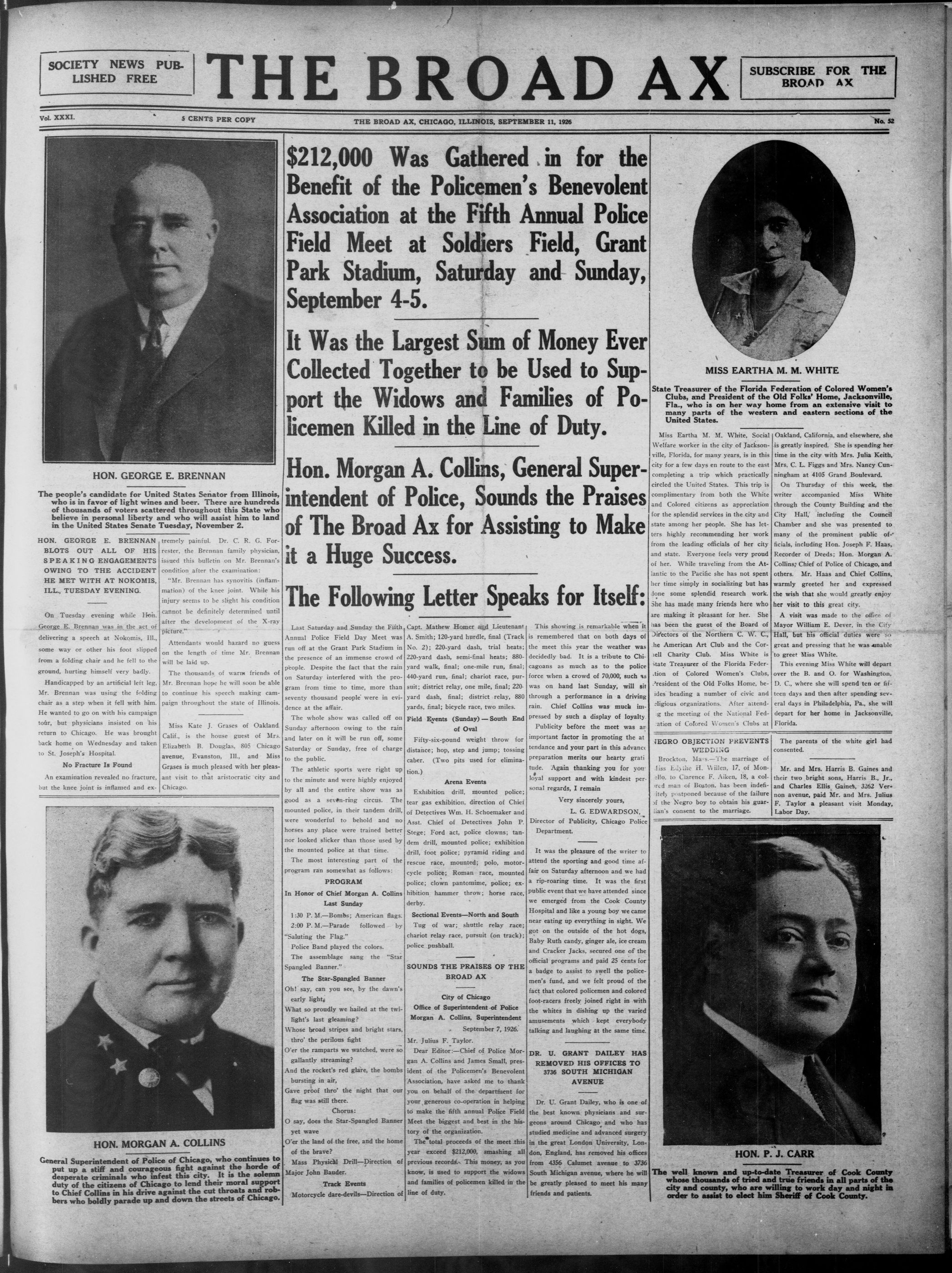
HON. GEORGE E. BRENNAN
The people's candidate for United States Senator who is in favor of light wines and beer. There of thousands of voters scattered throughout believe in personal liberty and who will assist in the United States Senate Tuesday, November
candidate for United States Senator flavor of light wines and beer. There ends of voters scattered throughout personal liberty and who will assisted States Senate Tuesday, November
The people's candidate for United States Senator from Illinois, who is in favor of light wines and beer. There are hundreds of thousands of voters scattered throughout this State who believe in personal liberty and who will assist him to land in the United States Senate Tuesday, November 2.
HON. GEORGE E. BRENNAN
BLOTS OUT ALL OF HIS
SPEAKING ENGAGEMENTS
OWING TO THE ACCIDENT
HE MET WITH AT NOKOMIS,
ILL., TUESDAY EVENING.
tremely painful. Dr. C. R. G. Forrester, the Brennan family physician, issued this bulletin on Mr. Brennan's condition after the examination:
"Mr. Brennan has synovitis (inflammation) of the knee joint. While his
On Tuesday evening while Hon. George E. Brennan was in the act of delivering a speech at Nokomis, Ill., some way or other his foot slipped from a folding chair and he fell to the ground, hurting himself very badly.
Handicapped by an artificial left leg, Mr. Brennan was using the folding chair as a step when it fell with him. He wanted to go on with his campaign tour, but physicians insisted on his return to Chicago. He was brought back home on Wednesday and taken to St. Joseph's Hospital.
No Fracture Is Found
An examination revealed no fracture but the knee joint is inflamed and ex-
S.
S. H.
S.
General Superintendent of Police of Chicago, who put up a stiff and courageous fight against desperate criminals who infest this city. Its duty of the citizens of Chicago to lend their to Chief Collins in his drive against the cut the bers who boldly parade up and down the street
intendent of Police of Chicago, who stiff and courageous fight against criminals who infest this city. It the citizens of Chicago to lend their collins in his drive against the cut the boldly parade up and down the street
General Superintendent of Police of Chicago, who continues to put up a stiff and courageous fight against the horde of desperate criminals who infest this city. It is the solemn duty of the citizens of Chicago to lend their moral support to Chief Collins in his drive against the cut throats and robbers who boldly parade up and down the streets of Chicago.
5 CENTS PER COPY
[Name]
ted States Senator from Illinois, s and beer. There are hundreds ered throughout this State who and who will assist him to land Tuesday, November 2.
tremely painful. Dr. C. R. G. Forrester, the Brennan family physician, issued this bulletin on Mr. Brennan's condition after the examination:
"Mr. Brennan has synovitis (inflammation) of the knee joint. While his injury seems to be slight his condition cannot be definitely determined until after the development of the X-ray picture."
Attendants would hazard no guess on the length of time Mr. Brennan will be laid up.
The thousands of warm friends of Mr. Brennan hope he will soon be able to continue his speech making campaign throughout the state of Illinois.
Miss Kate J. Grases of Oakland Calif., is the house guest of Mrs Elizabeth B. Douglas, 805 Chicago avenue, Evanston, Ill., and Miss Grases is much pleased with her pleasant visit to that aristocratic city and Chicago.
THE NEW YORK TIMES
ce of Chicago, who continues to
ous fight against the horde of
fest this city. It is the solemn
ago to lend their moral support
against the cut throats and rob
down the streets of Chicago.
THE BROAD AX
THE BROAD AX, CHICAGO, ILLINOIS, SEPTEMBER 11, 1926
$212,000 Was Gathered in for the Benefit of the Policemen's Benevolent Association at the Fifth Annual Police Field Meet at Soldiers Field, Grant Park Stadium, Saturday and Sunday, September 4-5.
It Was the Largest Sum of Money Ever Collected Together to be Used to Support the Widows and Families of Policemen Killed in the Line of Duty.
Hon. Morgan A. Collins, General Superintendent of Police, Sounds the Praises of The Broad Ax for Assisting to Make it a Huge Success.
The Following Letter Speaks for Itself:
Last Saturday and Sunday the Fifth Annual Police Field Day Meet was run off at the Grant Park Stadium in the presence of an immense crowd of people. Despite the fact that the rain on Saturday interfered with the program from time to time, more than seventy thousand people were in evidence at the affair.
The whole show was called off on Sunday afternoon owing to the rain and later on it will be run off, some Saturday or Sunday, free of charge to the public.
The athletic sports were right up to the minute and were highly enjoyed by all and the entire show was as good as a seven-ring circus. The mounted police, in their tandem drill, were wonderful to behold and no horses any place were trained better nor looked slicker than those used by the mounted police at that time.
The most interesting part of the program ran somewhat as follows:
PROGRAM
In Honor of Chief Morgan A. Collins
Last Sunday
1:30 P.M.—Bombs; American flags.
2:00 P.M.—Parade followed by
"Saluting the Flag."
Police Band played the colors.
The assemblage sang the "Star
Spangled Banner."
The Star-Spangled Banner
Oh! say, can you see, by the dawn's
early light,
What so proudly we hailed at the twi-
light's last gleaming?
Whose broad stripes and bright stars,
thro' the perilous fight
O'er the ramparts we watched, were so
gallantly streaming?
And the rocket's red glare, the bombs
bursting in air,
Gave proof thro' the night that our
flag was still there.
Chorus:
O say, does the Star-Spangled Banner
yet wave
O'er the land of the free, and the home
of the brave?
Mass Physical Drill—Direction of
Major John Bauder.
Track Events Motorcycle dare-devils—Direction of
Capt. Matthew Homer and Lieutenant A. Smith; 120-yard hurdle, final (Track No. 2); 220-yard dash, trial heats; 220-yard dash, semi-final heats; 880-yard walk, final; one-mile run, final; 440-yard run, final; chariot race, pursuit; district relay, one mile, final; 220-yard dash, final; district race, 880 yards, final; bicycle race, two miles.
Fifty-six-pound weight throw for distance; hop, step and jump; tossing caber. (Two pits used for elimination.)
Arena Events
Exhibition drill, mounted police; tear gas exhibition, direction of Chief of Detectives Wm. H. Schoemaker and Asst. Chief of Detectives John P. Stege; Ford act, police clowns; tandem drill, mounted police; exhibition drill, foot police; pyramid riding and rescue race, mounted; polo, motorcycle police; Roman race, mounted police; clown pantomime, police; exhibition hammer throw; horse race, derby.
Sectional Events—North and South
Tug of war; shuttle relay race; chariot relay race, pursuit (on track); police pushball.
SOUNDS THE PRAISES OF THE
BROAD AX
City of Chicago
Office of Superintendent of Police Morgan A. Collins, Superintendent September 7, 1926. Mr. Julius F. Taylor. Dear Editor:—Chief of Police Morgan A. Collins and James Small, president of the Policemen's Benevolent Association, have asked me to thank you on behalf of the department for your generous co-operation in helping to make the fifth annual Police Field Meet the biggest and best in the history of the organization. The total proceeds of the meet this year exceed $212,000, smashing all previous records. This money, as you know, is used to support the widows and families of policemen killed in the line of duty.
This showing is remarkable when it is remembered that on both days of the meet this year the weather was decidedly bad. It is a tribute to Chicagoans as much as to the police force when a crowd of 70,000, such as was on hand last Sunday, will sit through a performance in a driving rain. Chief Collins was much impressed by such a display of loyalty. Publicity before the meet was an important factor in promoting the attendance and your part in this advance preparation merits our hearty gratitude. Again thanking you for your loyal support and with kindest personal regards, I remain
Very sincerely yours.
L. G. EDWARDSON. Director of Publicity, Chicago Police Department.
It was the pleasure of the writer to attend the sporting and good time affair on Saturday afternoon and we had a rip-roaring time. It was the first public event that we have attended since we emerged from the Cook County Hospital and like a young boy we came near eating up everything in sight. We got on the outside of the hot dogs, Baby Ruth candy, ginger ale, ice cream and Cracker Jacks, secured one of the official programs and paid 25 cents for a badge to assist to swell the policemen's fund, and we felt proud of the fact that colored policemen and colored foot-racers freely joined right in with the whites in dishing up the varied amusements which kept everybody talking and laughing at the same time.
DR. U. GRANT DAILEY HAS
REMOVED HIS OFFICES TO
3236 SOUTH MICHIGAN
Dr. U. Grant Dailey, who is one of the best known physicians and surgeons around Chicago and who has studied medicine and advanced surgery in the great London University, London, England, has removed his offices from 4356 Calumet avenue to 3736 South Michigan avenue, where he will be greatly pleased to meet his many friends and patients.
X
MISS EARTHA M. M. WHITE
State Treasurer of the Florida Clubs, and President of the Fla., who is on her way h many parts of the wester United States.
er of the Florida Federation of Colo-
ral President of the Old Folks' Homes
is on her way home from an exte-
tors of the western and eastern se-
ates.
State Treasurer of the Florida Federation of Colored Women's Clubs, and President of the Old Folks' Home, Jacksonville, Fla., who is on her way home from an extensive visit to many parts of the western and eastern sections of the United States.
Miss Eartha M. M. White, Social Welfare worker in the city of Jacksonville, Florida, for many years, is in this city for a few days en route to the east completing a trip which practically circled the United States. This trip is complimentary from both the White and Colored citizens as appreciation for the splendid services in the city and state among her people. She has letters highly recommending her work from the leading officials of her city and state. Everyone feels very proud of her. While traveling from the Atlantic to the Pacific she has not spent her time simply in socializing but has done some splendid research work. She has made many friends here who are making it pleasant for her. She has been the guest of the Board of Directors of the Northern C. W. C., the American Art Club and the Corell Charity Club. Miss White is State Treasurer of the Florida Federation of Colored Women's Clubs, President of the Old Folks Home, besides heading a number of civic and religious organizations. After attending the meeting of the National Federation of Colored Women's Clubs at
JEGRO OBJECTION PREVENTS
WEDDING
Brockton, Mass. The marriage of Miss Edytie H. Willen, 17, of Monello, to Clarence F. Aiken, 18, a colored man of Boston, has been indefinitely postponed because of the failure of the Negro boy to obtain his guardian's consent to the marriage.
```markdown
```
M.
THE MAYOR OF BROOKLYN
HON. P. J. CARR
The well known and up-to-date whose thousands of tried and city and county, who are w order to assist to elect him
own and up-to-date Treasurer of thousands of tried and true friends in a county, who are willing to work day assist to elect him Sheriff of Cook
The well known and up-to-date Treasurer of Cook County whose thousands of tried and true friends in all parts of the city and county, who are willing to work day and night in order to assist to elect him Sheriff of Cook County.
The well known and up-to-date Treasurer of Cook County whose thousands of tried and true friends in all parts of the city and county, who are willing to work day and night in order to assist to elect him Sheriff of Cook County.
SUBSCRIBE FOR THE BROAD AX
No. 52
Florida Federation of Colored Women's of the Old Folks' Home, Jacksonville, way home from an extensive visit to western and eastern sections of the
Oakland, California, and elsewhere, she is greatly inspired. She is spending her time in the city with Mrs. Julia Keith, Mrs. C. L. Figgs and Mrs. Nancy Cunningham at 4105 Grand Boulevard.
On Thursday of this week, the writer accompanied Miss White through the County Building and the City Hall, including the Council Chamber and she was presented to many of the prominent public officials, including Hon. Joseph F. Haas, Recorder of Deeds; Hon. Morgan A. Collins; Chief of Police of Chicago, and others. Mr. Haas and Chief Collins, warmly greeted her and expressed the wish that she would greatly enjoy her visit to this great city.
A visit was made to the office of Mayor William E. Dever, in the City Hall, but his official duties were so great and pressing that he was unable to greet Miss White.
This evening Miss White will depart over the B. and O. for Washington, D. C., where she will spend ten or fifteen days and then after spending several days in Philadelphia, Pa., she will depart for her home in Jacksonville, Florida.
The parents of the white girl had consented.
Mr. and Mrs. Harris B. Gaines and their two bright sons, Harris B., Jr., and Charles Ellis Gaines, 3262 Veron avenue, paid Mr. and Mrs. Julius F. Taylor a pleasant visit Monday, Labor Day.
.
up-to-date Treasurer of Cook County
ried and true friends in all parts of the
are willing to work day and night in
act him Sheriff of Cook County.
No. 52
THE BROAD AX Published Every Saturday
In this city since July 15th, 1899
without missing one single issue. Republicans, Democrats, Catholics, Protestants, Single Taxers, Priests, infidels or anyone else can have their say as long as their language is proper and responsibility is fixed.
The Broad Ax is a newspaper whose platform is broad enough for all, ever claiming the editorial right to speak its own mind. It is neither Democratic nor Republican. It is strictly or absolutely independent in politics.
Local communications will receive attention. Write only on one side of the paper.
Subscriptions must be paid in advance.
One Year ..... $2.00
Six Months ..... $1.00
Advertising rates made known on application.
Chicago, September 11, 1926
Entered as Second-Class Matter, Aug
19, 1902, at the Post office at Chicago
Ill. Under Act of March 8, 1879.
"HAUNTED BY A FEAR OF CANCER"
By a Christmas Seal Doctor
There is an ancient Roman ghost story of a haunted house. It is said that spacious and rich as the mansion was it was of evil report and dangerous to health. In the dead of night a clanking or cams was heard, first of all in the distance, and afterwards hard by. A spectre appeared, an emaciated old man wearing shackles on his legs and fetters on his hands. The inmates of the house, by reason of their fears, passed miserable and horrible nights in sleeplessness. This want of sleep was followed by disease and, their terrors increasing, by death. Finally a tenant more courageous than the rest, followed the ghost who beckoned him, into the courtyard and there the oppressed spectre suddenly vanished. Marking the spot for identification, the man retired but early in the morning he reported the occurrence to the authorities and had the place dug up. The investigation resulted in the discovery of bones "intermingled with chains." These were collected and given proper burial and thenceforth the house was free from haunting spirits and the owners and tenants lived therein free from fear and in good health.
In a family in which there has been a member who suffered from the enshackling disease known as "cancer," how often have you noticed that fear makes the well first ill, then worried, and often at last actually sick!
And how often such fearful people lack the courage to investigate whatever of suspicious nature exists! They find many excuses for not doing so. They plead being too busy; they urge the fact that the suspicious signs are too indefinite and unimportant; that they believe science has not yet sufficient knowledge regarding cancer; that they should prefer to remain in ignorance of the existence of the disease rather than submit to the torture of knowing for sure that they had it.
It is true that physicians do not know everything that there is to be known about cancer. Neither do scientists know everything about electricity but they do know enough to make life more comfortable and less arduous by the use of electricity. So also does the medical profession know enough about cancer not only to lessen the suffering of those who have the condition in hopeless form but to save many thousands of lives.
The saving of lives and the prevention of the development of the disease depend entirely at present upon the courage of the individual who has reason to suspect the possibility of it. Any person who, at middle age or after, will ask for regular yearly investigation of his or her general health to find any early sign of cancer, is taking out peace insurance. The chances are all in favor of his finding that either there is no evidence of cancer or that a suspicious condition eliminated, at once relieves him of danger and doubt.
Fliny (the author of the ghost story) wrote to a friend, "I beg that you will apply your great learning to the subject. You may argue on both sides provided you argue more forcibly on one side than the other, so as not to dismiss me in suspense and anxiety, when the very cause of my consulting
MORRISON
Photo
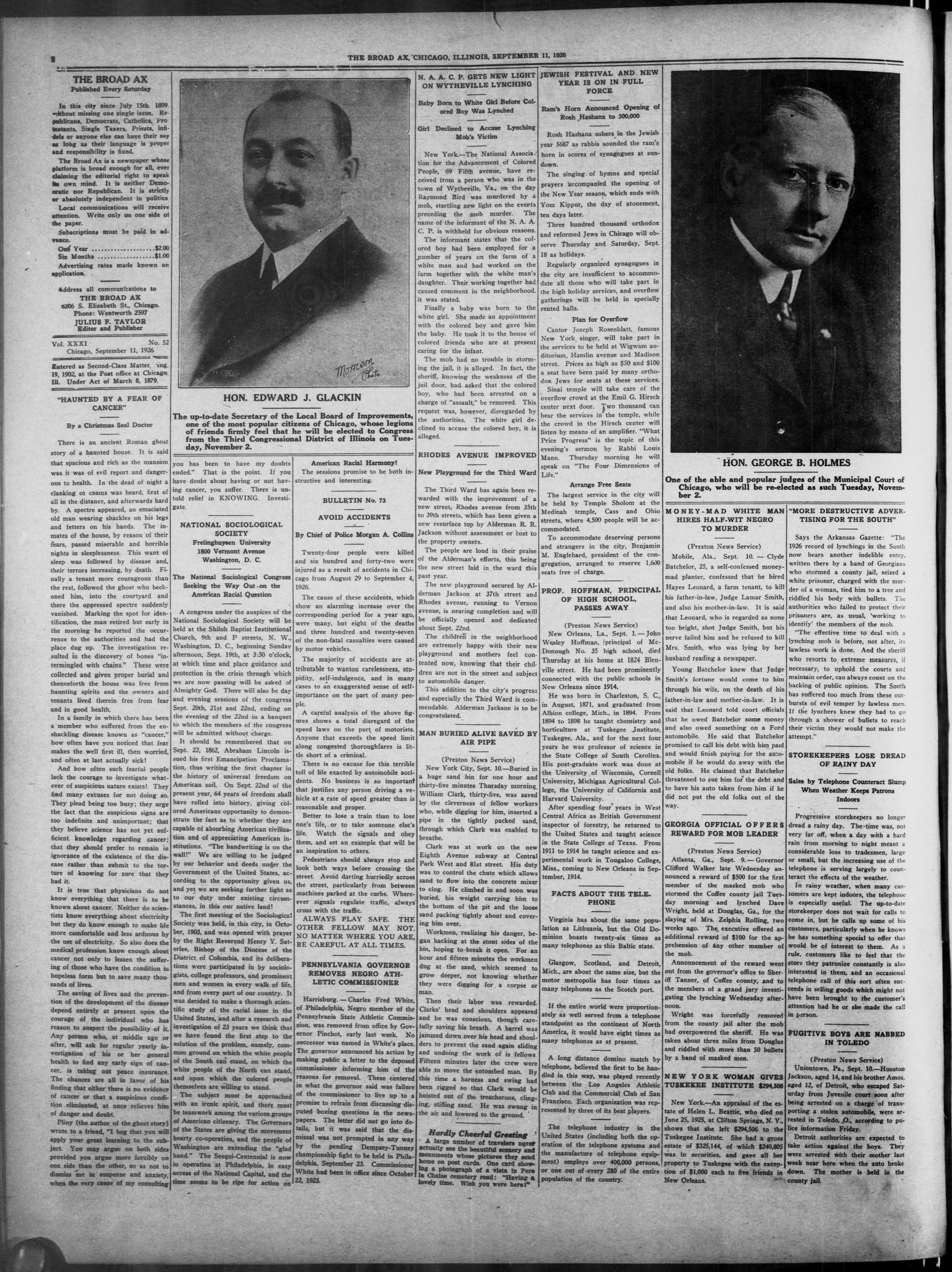
HON. EDWARD J. GLACKIN
The up-to-date Secretary of the Local Board of Improvements, one of the most popular citizens of Chicago, whose legions of friends firmly feel that he will be elected to Congress from the Third Congressional District of Illinois on Tuesday, November 2.
you has been to have my doubts ended." That is the point. If you have doubt about having or not having cancer, you suffer. There is untold relief in KNOWING. Investigate.
American Racial Harmony!
The sessions promise to be both instructive and interesting.
BULLETIN No. 73
NATIONAL SOCIOLOGICAL SOCIETY
Frelinghuysen University 1800 Vermont Avenue Washington, D.C.
The National Sociological Congress Seeking the Way Out.on the American Racial Question
A congress under the auspices of the National Sociological Society will be held at the Shiloh Baptist Institutional Church, 9th and P streets, N. W., Washington, D. C., beginning Sunday afternoon, Sept. 19th, at 3:30 o'clock, at which time and place guidance and protection in the crisis through which we are now passing will be asked of Almighty God. There will also be day and evening sessions of the congress Sept. 20th, 21st and 22nd, ending on the evening of the 22nd in a banquet to which the members of the congress will be admitted without charge.
It should be remembered that on Sept. 22, 1862, Abraham Lincoln issued his first Emancipation Proclamation, thus writing the first chapter in the history of universal freedom on American soil. On Sept. 22nd of the present year, 64 years of freedom shall have rolled into history, giving colored Americans opportunity to demonstrate the fact as to whether they are capable of absorbing American civilization and of appreciating American institutions. "The handwriting is on the wall!" We are willing to be judged by our behavior and deeds under the Government of the United States, according to the opportunity given us, and yet we are seeking further light as to our duty under existing circumstances, in this our native land!
The first meeting of the Sociological Society was held, in this city, in October, 1903, and was opened with prayer by the Right Reverend Henry Y. Saterlee, Bishop of the Diocese of the District of Columbia, and its deliberations were participated in by sociologists, college professors, and prominent men and women in every walk of life, and from every part of our country. It was decided to make a thorough scientific study of the racial issue in the United States, and after a research and investigation of 23 years we think that we have found the first step to the solution of the problem, namely, common ground on which the white people of the South can stand, on which the white people of the North can stand, and upon which the colored people themselves are willing to stand.
The subject must be approached with an irenic spirit, and there must be teamwork among the various groups of American citizenry. The Governors of the States are giving the movement hearty co-operation, and the people of Washington are extending the "glad hand." The Sesqui-Centennial is now in operation at Philadelphia, in easy access of the National Capital, and the time seems to be ripe for action on
Local Board of Improvements, citizens of Chicago, whose legions the will be elected to Congress.ural District of Illinois on Tues- American Racial Harmony! The sessions promise to be both instructive and interesting.
BULLETIN No. 73
AVOID ACCIDENTS
By Chief of Police Morgan A. Collins
Twenty-four people were killed and six hundred and forty-two were injured as a result of accidents in Chicago from August 29 to September 4, 1926.
The cause of these accidents, which show an alarming increase over the corresponding period for a year ago, were many, but eight of the deaths and three hundred and twenty-seven of the non-fatal casualties were caused by motor vehicles.
The majority of accidents are attributable to wanton carelessness, stupidity, self-indulgence, and in many cases to an exaggerated sense of self-importance on the part of many people.
A careful analysis of the above figures shows a total disregard of the speed laws on the part of motorists. Anyone that exceeds the speed limit along congested thoroughfares is little short of a criminal. There is no excuse for this terrible toll of life exacted by automobile accidents. No business is so important that justifies any person driving a vehicle at a rate of speed greater than is reasonable and proper. Better to lose a train than to lose one's life, or to take someone else's life. Watch the signals and obey them, and set an example that will be an inspiration to others.
Pedestrians should always stop and look both ways before crossing the street. Avoid darting hurriedly across the street, particularly from between machines parked at the curbs. Wherever signals regulate traffic, always cross with the traffic.
ALWAYS PLAY SAFE. THE OTHER FELLOW MAY NOT. NO MATTER WHERE YOU ARE, BE CAREFUL AT ALL TIMES.
PENNSYLVANIA GOVERNOR
REMOVES NEGRO ATH-
LETIC COMMISSIONER
Harrisburg. — Charles Fred White, of Philadelphia, Negro member of the Pennsylvania State Athletic Commission, was removed from office by Governor Pinchot, early last week. No successor was named in White's place. The governor announced his action by making public a letter to the deposed commissioner informing him of the reasons for removal. These centered in what the governor said was failure of the commissioner to live up to a promise to refrain from discussing disputed boxing questions in the newspapers. The letter did not go into details, but it was said that the dismissal was not prompted in any way by the pending Dempsey-Tunney championship fight to be held in Philadelphia, September 23. Commissioner White had been in office since October 22, 1923.
---
THE BROAD AX, CHICAGO, ILLINOIS, SEPTEMBER 11, 1926
N. A. A. C. P. GETS NEW LIGHT
ON WYTHEVILLE LYNCHING
JEWISH
YI
Baby Born to White Girl Before Colored Boy Was Lynched
Girl Declined to Accuse Lynching Mob's Victim
New York.-The National Association for the Advancement of Colored People, 69 Fifth avenue, have received from a person who was in the town of Wytheville, Va., on the day Raymond Bird was murdered by a mob, startling new light on the events preceding the mob murder. The name of the informant of the N. A. A. C. P. is withheld for obvious reasons. The informant states that the colored boy had been employed for a number of years on the farm of a white man and had worked on the farm together with the white man's daughter. Their working together had caused comment in the neighborhood, it was stated.
Finally a baby was born to the white girl. She made an appointment with the colored boy and gave him the baby. He took it to the house of colored friends who are at present caring for the infant.
The mob had no trouble in storming the jail, it is alleged. In fact, the sheriff, knowing the weakness of the jail door, had asked that the colored boy, who had been arrested on a charge of "assault," be removed. This request was, however, disregarded by the authorities. The white girl declined to accuse the colored boy, it is alleged.
RHODES AVENUE IMPROVED
New Playground for the Third Ward
The Third Ward has again been rewarded with the improvement of a new street, Rhodes avenue from 35th to 39th streets, which has been given a new resurface top by Alderman R. R. Jackson without assessment or cost to the property owners. The people are loud in their praise of the Alderman's efforts, this being the new street laid in the ward this past year. The new playground secured by Alderman Jackson at 37th street and Rhodes avenue, running to Vernon avenue, is nearing completion and will be officially opened and dedicated about Sept. 22nd.
The children in the neighborhood are extremely happy with their new playground and mothers feel contented now, knowing that their children are not in the street and subject to automobile danger.
This addition to the city's progress and especially the Third Ward is commendable. Alderman Jackson is to be congratulated.
MAN BURIED ALIVE SAVED BY
AIR PIPE
New York City, Sept. 10.—Buried in a huge sand bin for one hour and thirty-five minutes Thursday morning, William Clark, thirty-five, was saved by the cleverness of fellow workers who, while digging for him, inserted a pipe in the tightly packed sand, through which Clark was enabled to breathe.
Clark was at work on the new Eighth Avenue subway at Central Park West and 81st street. His duty was to control the chute which allows sand to flow into the concrete mixer to clog. He climbed in and soon was buried, his weight carrying him to the bottom of the pit and the loose sand packing tightly about and covering him over.
Workmen, realizing his danger, began hacking at the stout sides of the bin, hoping to break it open. For an hour and fifteen minutes the workmen dug at the sand, which seemed to grow deeper, not knowing whether they were digging for a corpse or man.
Then their labor was rewarded. Clarks' head and shoulders appeared and he was conscious, though carefully saving his breath. A barrel was jammed down over his head and shoulders to prevent the sand again sliding and undoing the work of is fellows. Fifteen minutes later the crew were able to move the entombed man. By this time a harness and swing had been rigged so that Clark would be hoisted out of the treacherous, clinging, stifling sand. He was swung in the air and lowered to the ground.
Hardly Cheerful Greeting
Hardy Cheerful Greeting
A large number of travelers never actually see the beautiful scenery and monuments whose pictures they send home on post cards. One card showing a photograph of a vista in Pere Chaise cemetery read: "Having a lovely time. Wish you were heral"
JEWISH FESTIVAL AND NEW YEAR IS ON IN FULL FORCE
Ram's Horn Announced Opening of Rosh Hashana to 300,000
Rosh Hashana ushers in the Jewish year 5687 as rabbis sounded the ram's horn in scores of synagogues at sundown.
The singing of hymns and special prayers accompanied the opening of the New Year season, which ends with Yom Kippur, the day of atonement, ten days later.
Three hundred thousand orthodox and reformed Jews in Chicago will observe Thursday and Saturday, Sept. 18 as holidays.
Regularly organized synagogues in the city are insufficient to accommodate all those who will take part in the high holiday services, and overflow gatherings will be held in specially rented halls.
Cantor Joseph Rosenblatt, famous New York, singer, will take part in the services to be held at Wigwam auditorium, Hamlin avenue and Madison street. Prices as high as $50 and $100 a seat have been paid by many orthodox Jews for seats at these services. Sinai temple will take care of the overflow crowd at the Emil G. Hirsch center next door. Two thousand can hear the services in the temple, while the crowd in the Hirsch center will listen by means of an amplifier. "What Price Progress" is the topic of this evening's sermon by Rabbi Louis Mann. Thursday morning he will speak on "The Four Dimensions of Life."
Arrange Free Seats
The largest service in the city will be held by Temple Sholom at the Medinah temple, Cass and Ohio streets, where 4,500 people will be accommodated.
To accommodate deserving persons and strangers in the city, Benjamin M. Englehard, president of the congregation, arranged to reserve 1,600 seats free of charge.
PROF. HOFFMAN, PRINCIPAL OF HIGH SCHOOL, PASSES AWAY
(Preston News Service)
New Orleans, La., Sept. 1.—John Wesley Hoffman, principal of McDonough No. 35 high school, died Thursday at his home at 1824 Blenville street. He had been prominently connected with the public schools in New Orleans since 1914.
He was born in Charleston, S. C., in August, 1871, and graduated from Albion college, Mich., in 1894. From 1894 to 1898 he taught chemistry and horticulture at Tuskegee Institute, Tuskegee, Ala., and for the next four years he was professor of science in the State College of South Carolina. His post-graduate work was done at the University of Wisconsin, Cornell University, Michigan Agricultural College, the University of California and Harvard University.
After spending four years in West Central Africa as British Government inspector of forestry, he returned to the United States and taught science in the State College of Texas. From 1911 to 1914 he taught science and experimental work in Tougaloo College, Miss., coming to New Orleans in September, 1914.
FACTS ABOUT THE TELEPHONE
Virginia has about the same population as Lithuania, but the Old Dominion boasts twenty-six times as many telephones as this Baltic state.
Glasgow, Scotland, and Detroit, Mich., are about the same size, but the motor metropolis has four times as many telephones as the Scotch port.
If the entire world were proportionately as well served from a telephone standpoint as the continent of North America, it would have eight times as many telephones as at present.
A long distance domino match by telephone, believed the first to be handled in this way, was played recently between the Los Angeles Athletic Club and the Commercial Club of San Francisco. Each organization was represented by three of its best players.
The telephone industry in the United States (including both the operation of the telephone systems and the manufacture of telephone equipment) employs over 400,000 persons, or one out of every 280 of the entire population of the country.
[Portrait of a man in a suit with a tie and a lapel pin. The background is dark, and the man's face is clearly visible.]
HON. GEORGE B. HOLMES
One of the able and popular judges of the Municipal Court of Chicago, who will be re-elected as such Tuesday, November 2.
MONEY-MAD WHITE MAN
HIRES HALF-WIT NEGRO
TO MURDER
"MORE DESTRUCTIVE ADVERTISING FOR THE SOUTH"
Mobile, Ala., Sept. 10. — Clyde Batchelor, 25, a self-confessed money-mad planter, confessed that he hired Hayes Leonard, a farm tenant, to kill his father-in-law, Judge Lamar Smith, and also his mother-in-law. It is said that Leonard, who is regarded as none too bright, shot Judge Smith, but his nerve failed him and he refused to kill Mrs. Smith, who was lying by her husband reading a newspaper.
Young Batchelor knew that Judge Smith's fortune would come to him through his wife, on the death of his father-in-law and mother-in-law. It is said that Leonard told court officials that he owed Batchelor some money and also owed something on a Ford automobile. He said that Batchelor promised to call his debt with him paid and would finish paying for the automobile if he would do away with the old folks. He claimed that Batchelor threatened to sue him for the debt and to have his auto taken from him if he did not put the old folks out of the way.
GEORGIA OFFICIAL OFFERS
REWARD FOR MOB LEADER
Atlanta, Ga., Sept. 9.—Governor Clifford Walker late Wednesday announced a reward of $500 for the first member of the masked mob who stormed the Coffee county jail Tuesday morning and lynched Dave Wright, held at Douglas, Ga., for the slaying of Mrs. Zelphia Rolling, two weeks ago. The executive offered an additional reward of $100 for the apprehension of any other member of the mob.
Announcement of the reward went out from the governor's office to Sheriff Tanner, of Coffee county, and to the members of a grand jury investigating the lynching Wednesday afternoon.
Wright was forcefully removed from the county jail after the mob had overpowered the sheriff. He was taken about three miles from Douglas and riddled with more than 50 bullets by a band of masked men.
NEW YORK WOMAN GIVES
TUSKEKEE INSTITUTE $294,506
New York-An appraisal of the estate of Helen L. Beattie, who died on June 25, 1925, at Clifton Springs, N.Y., shows that she left $294,506 to the Tuskegee Institute. She had a gross estate of $325,144, of which $240,805 was in securities, and gave all her property to Tuskegee with the exception of $1,000 each to five friends in New Orleans.
"MORE DESTRUCTIVE ADVERTISING FOR THE SOUTH"
Says the Arkansas Gazette: "The 1926 record of lynchings in the South now bears another indelible entry, written there by a band of Georgians who stormed a county jail, seized a white prisoner, charged with the murder of a woman, tied him to a tree and riddled his body with bullets. The authorities who failed to protect their prisoners are, as usual, 'working to identify' the members of the mob.
"The effective time to deal with a lynching mob is before, not after, its lawless work is done. And the sheriff who resorts to extreme measures, if necessary, to uphold the courts and maintain order, can always count on the backing of public opinion. The South has suffered too much from these outbursts of evil temper by lawless men. If the lynchers knew they had to go through a shower of bullets to reach their victim they would not make the attempt."
STOREKEEPERS LOSE DREAD OF RAINY DAY
Sales by Telephone Counteract Slump
When Weather Keeps Patrons
Progressive storekeepers no longer dread a rainy day. The time was, not very far off, when a day with a hard rain from morning to night meant a considerable loss to tradesmen, large or small, but the increasing use of the telephone is serving largely to counteract the effects of the weather.
In rainy weather, when many customers are kept indoors, the telephone is especially useful. The up-to-date storekeeper does not wait for calls to come in, but he calls up some of his customers, particularly when he knows he has something special to offer that would be of interest to them. As a rule, customers like to feel that the store they patronize constantly is also interested in them, and an occasional telephone call of this sort often succeeds in selling goods which might not have been brought to the customer's attention had he or she made the call in person.
FUGITIVE BOYS ARE NABBED
IN TOLEDO
(Preston News Service)
Uniontown, Pa., Sept. 10—Houston Jackson, aged 14, and his brother Amos, aged 12, of Detroit, who escaped Saturday from Juvenile court soon after being arrested on a charge of transporting a stolen automobile, were arrested in Toledo, O., according to police information Friday.
Detroit authorities are expected to take action against the boys. They were arrested with their mother last week near here when the auto broke down. The mother is held in the county jail.
```markdown
```
[Name]
HON. WILLIAM R. FETZER
One of the high-class judges of the Municipal cago, who will on Tuesday, November 2, sit on the Municipal Court bench.
COLORFUL NEWS MO
By THE CAMERAMAN
One of the high-class judges of the Municipal Court of Chicago, who will on Tuesday, November 2, succeed himself on the Municipal Court bench.
COLORFUL NEWS MOVIES By THE CAMERAMAN
(Preston News Service)
1. Back to the Farm
2. Pot Shots at Africa
3. Foreign Unskilled Labor Gains
Writing in the Manufacturer's Record, issue of August 5, 1926, Kelly Miller says: "The farm is the Negro's best CHANCE," but the beloved Howard University sociologist did not describe minutely just the kind of a "chance" he had in mind. He pointed out with glowing logic the opportunities of the rich rural sections of Maryland, Kentucky, and Missouri, for which the heart of the Negro worker does not beat with as much warmth as that which was once "inspired" by the baying bloodhounds and the angry lash. The professor decried farm desertions and the "ownerless" life which urban Negroes live in the metropolitan centers of America, and concluded with the admission that "a much larger proportion of Negroes than of whites will find their best CHANCE in the country."
With a question-mark about the elasticity of the word "CHANCE," here are a few truths which the zealous writer-professor overlooked in his grief over the fleeting farm life of the Negro world of America.
Despite the trailing miles which separate the majority of the Negroes of America from the lecture halls of Howard University, not a few of them have long since learned that their honest labor is merely the tool of Capital, trained in the business universities of
The Comm
IN the American constitution achievement: they provide equipped to perform national left to local governing bodies. The people's need, as manifested this governmental.
The Bell System is a sim visioned from a forecast of the when the telephone was your Companies are specialists in loc operating forces identified and communities they serve. The solution of the problems that America to-day has a telep and unified. A backward look shows that this could not haveization paralleling that of the expanding with the growth of
4
IN the American constitution its makers attained a two-fold achievement: they provided a central form of government equipped to perform national functions adequately, and they left to local governing bodies the responsibility of local affairs. The people's need, as manifest even in the nation's babyhood, determined this governmental structure. The Bell System is a similar division of responsibility visioned from a forecast of the nation's communication needs when the telephone was young in service. The Associated Companies are specialists in local service problems, with local operating forces identified and familiar with the needs of the communities they serve. The parent company undertakes the solution of the problems that are common to all. America to-day has a telephone service that is nation-wide and unified. A backward look to the beginnings of the telephone shows that this could not have come about without an organization paralleling that of the American Union, capable of expanding with the growth of the nation.
1876—THE TELEPHONE
1876-THE TELEPHONE'S FIFTIETH YEAR-1926
Back to the Farm?
BEST BUILT IN MICHIGAN
BEST BUILT IN MICHIGAN
BEST BUILT IN MICHIGAN
of the Municipal Court of Chi-
November 2, succeed himself
EWS MOVIES
MERAMAN
America. They found out that their labor has long been subject to the same inexorable control of Capital, whether they perspired in the burning fields of Arkansas or in the automobile plants of Detroit. Even when they owned and operated their own farms they discovered that the clutching hand of Capital was ever ready to thrust a mortgage pen into their hands, and that, in general, there has always been the same uneven break on the farm, so far as they were concerned, as in Harlem or the Chicago South Side.
The "CHANCE" to which Professor Miller refers was just the objective they were seeking—the chance along with other groups to become capitalists and have a greater say in their own work government. They learned that concentrated wealth had more power than concentrated labor, for they had observed New York capital operate and control the farms upon which they were employed in Georgia and Mississippi. They had seen the Jewish, the German, the Italian, and other immigrants qualify for the capitalistic domain of the big city, and they felt the call to the newly discovered chance. Thus the Negro migrated, not in hysterical groups; neither in full accordance with the law of demand and supply, but partially because of personal motivations. He has entered the watch factories of Ohio. He is holding virtually every occupation with the Brooklyn Rapid Transit Company of New York. Last, but not least, he has sent his emissaries, in small but growing numbers,
---
THE THIRTY-FIRST ANNIVERSARY EDITION OF THE BROAD AX WILL APPEAR SATURDAY, OCTOBER 23, 1926. ON THAT DATE IT WILL HAVE BEEN PUBLISHED IN THIS CITY FOR TWENTY-SEVEN YEARS WITHOUT MISSING ONE SINGLE ISSUE, A FEAT WHICH HAS NOT BEEN ACCOMPLISHED BY ANY OTHER WEEKLY NEWSPAPER PUBLISHED IN THE INTEREST OF THE COLORED RACE IN CHICAGO.
AS USUAL, NO TIME OR EXPENSE WILL BE SPARED TO MAKE IT REACH THE VERY HIGHEST WATER MARK IN ARTISTIC AFRO-AMERICAN JOURNALISM IN THE UNITED STATES.
IT WILL BE PRINTED ON THE BEST AND THE MOST EXPENSIVE AMERICAN HALF-TONE ABERDEEN BOOK PAPER. THE PAPER WILL BE FURNISHED BY BRADNER, SMITH & CO., WHOLSALE PAPER DEALERS, 333 S. DESPLAINES STREET. IT WILL COST 15 CENTS PER POUND. 120 POUNDS TO THE REAM.
IT WILL CONTAIN MANY BEAUTIFUL HALF-TONE CUTS OF THE LEADING CANDIDATES, BOTH REPUBLICANS AND DEMOCRATS, WHO ARE SEEKING ELECTION AT THE HANDS OF THE CITIZENS OF THIS CITY AND COUNTY, TUESDAY, NOVEMBER 2. THIS NEWSPAPER SUPPORTED TWENTY-SIX CANDIDATES THROUGH ITS COLUMNS AT THE PRIMARIES TUESDAY, APRIL 13, 1926. BOTH DEMOCRATS AND REPUBLICANS, AND TWENTY-FOUR OUT OF THE TWENTY-SIX CANDIDATES SUPPORTED BY IT, WON OUT AT THE PRIMARIES.
NOW IS THE TIME TO SECURE WRITEUPS AND ADVERTISING SPACE IN THE THIRTY-FIRST ANNIVERSARY EDITION OF THE BROAD AX.
into the municipal, the State, and the Federal governments, from whence they can begin to influence the policies laid down for both farmer and urbanite; and in the wake of which an "eased" existence can eventually be brought about, not only for the farmer but for EVERYBODY.
There is nothing strange about the advent of the Negro in the city; nor is there any reason why the farm dweller, inherently adaptable by choice and otherwise to agricultural spheres, should pack up and move cityward. Nor has this been the case, as is apparent from agricultural observations the country over. Yet they who have become urbanized have done so for good cause. They wanted to touch the hem of the garment of the forces which held them under control, and having done this they crave the opportunity of absorbing the ways and means of a greater economic and civic freedom, until farm or factory, as the case might be, with any group, has evolved into an elimination proposition, leaving the man free to follow the dictates of his own heart, and, if he would, at least select the forces which he would have influenced him and his children in their considerations of and preparation for the future. This is the CHANCE the Negro is seeking. It is a chance which flows from the city to the country, despite Prof. Miller's inverse ratio.
Pot Shots at Africa:
Some one has said that Greed is one of mankind's most mortal sins; but if W. G. Landes, Secretary of the World Sunday School Alliance, was correctly quoted just a few days ago, when he lectured in New York City upon "Race Problems in Africa," Greed and Gluttony are merely virtues, when the interests of African whites and blacks are being weighed in the balance.
"In the opinion of the whites," said Mr. Landes, "missionaries are making a mistake in trying to educate the Negro and bring him closer to the white man's level. The Negro is inferior in every way to the white man and the further he is removed the better off he will be. OF THE SEVEN MILLION POPULATION OF AFRICA, NEARLY SIX ARE NEGROES.
Dr. Landes concluded his "thoughtful" application to the race problem in Africa by saying: "The only sound solution is in co-operation, a working agreement between the two races which will be beneficial to both"; but the "good" Sunday School Secretary
forgot to add, "In the opinion of the whites."
Eighth grade youngsters know of the ruthless exploitation of Africa and her people by the civilized whites of the world. They recall the days of King Leopold of Belgium. They visualize the ravishing of the African mines. They remember the toiling African blacks, women and men, who even now, for penurious wages and amid trying conditions, are piling up wealth for the people who, as Dr. Landes says, believe it is a mistake to educate the Negro; but that it is a virtuous undertaking to use him as a pack horse until death do us part.
And now comes the suggestion and from the church world to elevate the heel of one million whites of Africa upon the necks of six million blacks, in their own homeland, beneath their own sun, and amid the resources which God for them provided. Not satisfied with the "problem" in America, evidently the World Sunday School Alliance wishes to accelerate it in Africa, where the social reform of the civilized world has not yet become thoroughly acclimated. This is indeed an ambitious program and one compared with which the program of Captain Kidd was a mere miniature form of gentlemanly courtesy.
Foreign Unskilled Labor Gains
Of significance to Negro labor in America, which is making a determined bid for permanent inclusion in the country's industry, is the fact that during the fiscal year 1925-26, there was a net gain of 10,436 unskilled laborers who came in as immigrants and were at once absorbed into industry. The gain in unskilled labor resulted from a total immigration of 43,543 of the foreign classes who entered American ports, while only 33,107 departed for their former homelands. In the case of Canada and Mexico, neither of which is restricted to the quota regulations promulgated for the protection of domestic labor, there is no way of knowing accurately just how many subjects came in and displaced American workers, white and black.
The fact remains that close observations from New Jersey and New York westward through Pennsylvania, Ohio, Indiana, and Illinois, reveal hundreds of Mexicans working principally on the railroads, on highway construction projects, and in the steel mills. The foreign worker, good man though he is, when coupled with antipathies which a percentage of American employers have for Negro workers, has become a distinct menace to the Ne-
gro laborer, skilled and unski'led. The greatest obstacles which the Negro laborer finds today are inclusion, permanency, and advancement, all of which are subject to the ill or good will of the employing classes, many of whom have the "don't care" spirit when the colored man knocks at the gate of employment.
The protective tariff is all right, and the restrictive immigration policy has been the saving grace of the Negro worker who, during the past five years, has come into greater opportunities and better pay. Vigilance, though, is essential to insure the consummation of the Negro worker's hopes, frequently contested, as they are, by the labor backwash of Europe. America does not need to be unduly selfish. It is a nation of democracy, and democracy is charitable and kind. Yet America must conserve herself and her sons and daughters, white and black from any menace to her economic prosperity, one of the chief contributors to which is full protection to the American worker. Employers must stir their pride and render unto the American worker the things that are his, giving work opportunities and advancement to his own, regardless of blood heritage. Black man and women should be cared for in employment, even before the Americanization of the foreigner is completed, and for which the Negro has no need, being an American himself, who has absorbed Americanization both before and since the Civil War. Surely charity and love, even in labor, should first be practiced at home.
SUNDAY EVENING CLUB NEWS
Alderman Louis B. Anderson will be the principal speaker at the Sunday Evening Club of Metropolitan Community Center on Sunday evening. September 12th, at 7:45 o'clock. Prof J. Wesley Jones has prepared special music for the occasion. Come out and spend an enjoyable evening. SANDY W. TRICE, Chrmn.
THE CHICAGO AND NORTHERN
DISTRICT FEDERATION
will hold its fourth quarterly meeting at Quinn Chapel, Monday, September 13th, at 9:30 A. M. Reports of the year's work, echoes of the National Association of Colored Women at Oakland, Calif., and election of officers, and a report of the state meeting at Quincy will be given.
(Copyright)
"BUT Edit Horn," said Tessie, exasperatedly, "it's silly to say that you don't know whether you like Hal or Jim better. It sounds feeble-minded, and anyway I never could see how you could think of Jim when Hal is around.
"Well, I don't care, I don't know," answered Edith. stubbornly. "I know Hal is better looking and lots more fun in some ways—and he certainly spends more money than Jim, but I always feel that you can depend on Jim through thick and thin."
The two girls were waiting for the boys to take them to a football game. When they appeared in Hal's car there could be no doubt which boy was the one to attract a girl's eye. Hal in his fur coat and with his hat at a slightly rakish angle exhaled gayety and success. Jim had no fur coat and the sweater under his overcoat did not give his somewhat stocky figure any added grace. Hal claimed Edith as a matter of course, and Tessie listened to their merry talk and frequent laughter with a pang of envy. Edith was a lucky girl.
The huge throngs of enthusiastic people, the excitement of the game and the brisk and sunny day put them all in a merry mood. They cheered and laughed and enjoyed themselves thoroughly.
Jim bought sandwiches made of the plebeian "hot dog" and Tessie looked disgusted until Hal seized his and ate it with avidity and then topped it off with a sip of lemonade for everybody from a nearby stand.
Hal's dashing generalship showed itself later when he took them out on the crawling line of cars on the main highway by a side road where they could speed up and save time. Dusk had come and the road was empty. As they passed a little house a tiny figure ran out. There was a screeching of brakes as Hail wrenched at the wheel, but when they stopped a child lay motionless in the road behind them.
"Oh, my God," gronned Hal, and Tessie prepared to faint against Jim until she discovered that he was no longer there. So she gave up the idea.
Jim had already reached the child and Edith was close behind him. "He is not dead," he said; "I can feel his heart beat." A man ran out of the house and pulled distractedly at the child in Jim's arms while tears ran down his face. "De mudder is gone," he repeated helplessly again and again. Jim carried the limp and piteous little form into the house and Hal thankfully took his suggestion to take the father in the car and hunt a doctor and the child's mother. This was a situation in which Hal's leadership seemed to fall him. Tessie went with him to supply feminine aid and comfort and Hal needed it.
Jim and Edith took off the baby's clothes and wrapped him in a blanket they found on a bed, and they got a few drops of stimulant between the little lips. Suddenly he stirred and opened his eyes. "Want my ball," he said, and then feeling another lack that touched his masculine pride—"Want my pants." Edith laughd softly, with tears running down her cheeks. She wrapped him closer in the blanket, and after a moment's drowsy contemplation of her he fell asleep.
Jim found some wood out of doors and built up the fire in the stove until the red light from the open door filled the room and made giant shadows on the ceiling.
The warm bundle in her arms and the baby hand under her chin stirred strange thoughts in Edith and many things became clear to her. Women have yearned over warm, living bundles in the firelight since the days when the fire was a campfire. Jim bent down to put another stick in the stove and Edith noticed the powerful line of his shoulder under the sweater and the thick, smooth line of his hair against his neck. She would have liked to put her hand on it and there was something thrilling in the thought.
Jim and she in the firelight—and the baby—she flushed at the thought. Jim turned just then. "I've been saving up for a long time, and I've got enough to buy a house," he said with apparent irrelevance. They were silent after that, and the firelight and shadows w spell around them.
There was an abrupt sound of brakes and Hal and Tessie burst in with the doctor and the baby's mother. The doctor woke the baby and made him cry, and after a careful examination Hal heard with huge relief that the child was not hurt at all. Hal's gayey returned suddenly and he insisted on leaving a generous sum of money for the parents. To Tessie's surprise Jim gave an equal sum. "Td like to," he said quietly in answer to Hal's protests.
Hal and Tessie sat together on the front seat going home and sang and laughed and were wildly happy. Edith and Jim were very quiet, and presently she slipped her little fist into his overcoat pocket and found his hand. "It's all right about you and me," she said shyly.
But Jim wasn't surprised. "I knew it when I saw you with the child," he said happily.
A London doctor says that many cases of neurasthenia are really cases of eye-strain.
The Common Cause
The holler-thou-thou attitude may be caused by virtue, but usually it is caused by a poor memory.—Vancouver Province.
The Dinner for Four
By DOROTHY DOUGLAS
(Copyright.)
THEY were both a trifle peevish as they made their way out with the throng. First, because it always annoyed Alice when the man she was engaged to admired so openly a girl so utterly different from herself. And secondly, George had come along to the matinee in his business car, a small delivery wagon, George being a traveling salesman. Which meant that Alice would drive back to Long island in the front seat of the car—the inside was filled with George's samples—a thing which she detested, especially when she was all dolled up in her new white fur and powder blue hat.
"Dear, I don't see why you always make such a fuss about the car. I would have to go out to Long Island with it and come in again by train and that's a deuce of a bother—just to come in to the theater. And besides—if you took any interest in driving at all—you could be learning right now."
"And I've told you a thousand times that I haven't the slightest desire to drive."
To make matters worse the self-starter refused to do its duty. Being in just the slightest temper himself, he gave the crank handle a forceful jerk and a second later was holding his wrist while his face paled.
George might have made another attempt but for a girl who had watched the whole scene and who sprang forward to assist.
"Let me crank her," she said swiftly. "Please, I'm quite used to it. Here, let me see your wrist--nasty wrench, isn't it?" Quick as a flash, the strange girl had whipped out a great handkerchief and bound the wrist firmly.
George smiled into the girl's eyes. "You're a peach," he said fervently. "I don't know what I'm to do about driving. I hardly dare risk this city traffic with this stupid ache in my arm."
"I'm at your disposal if you need me. I've been a bit fed up without anything to drive since my boss is away on his vacation. I'm like a fish on Broadway without my hands on a wheel."
"Are you quite sure you're not saying this just to help a fellow out?" George searched her face, but she assured him it would be a great joy to drive him to Long Island.
After informal introductions all round George turned to Alice.
"Would you rather drive back with Miss Weller and let me go by train, or—"
"Id far rather go by train—if you don't mind," said Alice, and dragging her feminine garments, in the way of white fox, about her slender neck she made off for the railroad station. She first, however, made certain that the fine diamond ring on Miss Weller's finger indicated that she had already found the man of her choice.
"This is the first time I ever been driven in my own car. By jove, it seems funny—but rather a nice change," George said as he watched the girl awing neatly in and out of the vast line of traffic. "I don't know what I can do for the next week or two while this wrist's mending. I've got to drive my car and I can't very well do it. Is there a chance that you would be free for a while yet?"
"Delighted. But will the little lady not object?"
"Can't help it if she does—business is business and I am not in a position to lose customers—at this stage of the game. What about your flame."
"Tom doesn't interfere in anything I want to do. He spouts to me about the moon and all I'm thinking about at those moments is how long it would take to get there in a sixty-mile-an-hour car. Tom doesn't know a magnet from a steering wheel.
"Neither does Alice," laughed George and edged just the least bit closer to the firm arm that guided his car.
"What about a cup of tea?"
"Far rather have coffee," laughed Miss Weller and drew up at the next tiny tea room that dotted the roadway.
"We have spent just one hour and a half having coffee," said Miss Weller as they emerged to take up the trail.
"And a good thing, too—it's done my wrist a world of good. I wouldn't mind stopping at another a few miles on." Again he turn frankly toward her. "Business is going to be a grand and glorious pleasure while you drive for me. 'Til bert I'll sell more than I have during the past ten months. I say, 'he burst out suddenly, "what are we going to do about this?"
"About what?" she asked, and her heart gave a great thump.
"You know very well what," he said tenderly, and also a bit desperately. "You and I are engaged to the wrong ones. Do you think there's a chance in the world that if we arrange a little dinner for that four your Tom and my Alice would forget us and take to each other? From what you've said of Tom I fancy he's exactly the type of man to make Alice supremely happy."
"I like that. What about me?"
"I'm the type to do that, and what's more ten Alices and fifteen Toms aren't going to keep me from doing it."
Miss Weller very nearly swerved into the ditch, but being of a decidedly level-headed nature all she said was, "If we turn sharp right at this crossing it will take us seven miles out of our way and there's an adorable tea room—"
"Turn sharp right," said George.
Worse Than Triangle
The triangle probably causes fewer divorces than the lack of old-fashioned square meals.—Baltimore Sun.
.
Ernest H.
WILLIAMSON
UNDERTAKER
ERnest H. WILLIAMSON
UNDERTAKER
15121-2325
S.H. WILLIAMSON
Charlest. Dawson
New York, Sept. 10.—Six persons lost their lives when flames swept a five-story apartment house in which ten families of Negroes lived here Thursday morning. Firemen were held back from getting to the fire on account of open cavities in St. Nicholas avenue. The blaze is said to have started in the basement of the building. It was about 5 o'clock in the morning when a patrolman discovered the flames and turned in the alarm. A woman is said to have jumped from the fourth floor, landing on her head in one of the cavities in the street and was killed instantly.
THE PHYLLIIS WHEATLEY
WOMAN'S CLUB
will hold its first meeting of the season at the home, 5128 South Michigan boulevard, Wednesday, September 15th, at 2 P. M.
WILLA WEBB, Cor. Sec.
STAR MANNING KILLED BY
LIGHTNING
(Preston News Service)
Magnolia, Ark., Sept. 10. — Star
Manning was instantly killed Thursday
afternoon when a bolt of lightning
struck a tree under which he had
taken shelter from the rain.
PERSONALS
Mesdames F. O. Morgan Perkins, Elizabeth Lindsay Davis, Minnie A. Collins; Misses Lena L. Perry, Adele Collins, and Mildred Ware, delegates to the N. A. C. W. convention, returned from their delightful trip to California last week after stopping at Albuquerque, N. M., Denver, Colo., Kansas City, and Quincy en route home.
Power From Rubbish
If all London's refuse were burned in modern destructors, it is estimated that electricity worth $10,000,000 a year could be produced.
"TheWilliamsonFuneral" is distinguished by the up-to-date designs of its Cunningham Limousine Hearse and Cars
Orchids With Your Bread
The mold you see on unhurried cheese and deferred bread—did you know it was a flower you look at? We scarcely can notice the mold plant until it blossoms. Under the microscope we then see as rich a display as a bouquet of orchids might fumish if they were done in black and white instead of color. The plant proper takes root and spreads a mass of fine filaments deep into its soil before it is ready to send flowering stalks toward the night and air. The seeds, invisible pollen, are shred dustlike into the atmosphere, so numberless that you cannot expose a disk of warm gelatin anywhere for one minute without a dozen spores taking root and sprouting on this superilliputian garden plot.—Mentor.
The Explanation
"My dear," said Mr. Hemmandhaw, "I hope you are not planning to buy a lot of new furniture."
"I am not," replied Mrs. Hemmandhaw, "and I don't know what gives you the idea."
"This shopping list gives me the idea."
"What shopping list?"
On this paper which I just picked up on the floor is written, "wash stand, parlor chairs, dining-room table, writing desk, refrigerator, tabouret, piano stool, pedestal, step ladder, cedar chest, music cabinet and garbage can."
"Oh, that is just a record I was keeping of the things the baby has fallen from this week."
Old Idea Overruled
The old maxim that "silence gives consent" is not accepted by English law, under a recent ruling of the court of criminal appeals in England. A prisoner, accused of receiving stolen goods, had remained silent when asked whether guilty or not guilty, and his silence was taken as a plea of guilty. He was sentenced by the lower courts to five years of penal servitude. But the court of appeals ruled that his silence was not adequate evidence of a plea of guilty by the prisoner, and discharged the convicted man.
Remarkable Resemblance
Feature for feature, inch for inch and ounce for ounce, Kazno Kaneko and Tsugo Kaneko, twins, in Tokyo, are so much alike that even their parents were unable to distinguish between them. In voice, manner, likes and dislikes they are duplicates. Called to the colors recently, the examining officers could find no identifying marks so were forced to affix marks to their ear lobes so that commanding officers might know to which one they were giving orders.
THE BROAD AX, CHICAGO, ILLINOIS, SEPTEMBER 11, 1926
Old Longfellow Home
Saved by Sentiment
The old Longwell house, in Pittsfield, Mass., had a narrow escape from destruction lately. The high school commission endeavored to secure possession of the land on which the old mansion stands, in which case the structure would have been demolished.
The city council refused to adopt the suggestion. The high school commission announced, however, that if the house had been demolished it was prepared to salvage the staircase and incorporate it into the new school building on account of the special historic interest surrounding the stairway.
Longfellow wrote many poems during his residence here and among them was "The Old Clock on the Stairs." The clock stood on the stairs long before he occupied the house and when it was owned by a relative of his wife. Longfellow and his bride spent part of their honeymoon in this house and afterward acquired it by purchase.-Chicago Journal.
Unshaved Saints
English artists in stained glass have been perturbed by the complaint of the chancellor of the diocese of Chester that ecclesiastical windows do the saints sparse justice in presenting these holy men wearing beards. Artists in stained glass retort that they aspire to present their subjects with as much accuracy as possible, and that history shows most of the saints wore beards, especially as they labored in countries where conditions rendered shaving difficult and unusual. Thus, despite protests of the offended chancellor, stained glass windows in churches will in future, as in the past, present views of saints "bearded like the pard."
She Got His Number
Binks bought a new shirt, and on a slip pinned to the inside found the name and address of a girl, with the words, "Please write, and send photograph."
"Ah!" beathed Binks, "here is romance."
And forthwith he wrote the girl, and sent her a picture of himself. In due course of time an answer came, and with heart a dutter Binks opened it. It was only a note.
"I was just curious to see," it read, "what kind of looking gink would such a cheap shirt."—New Orleans Times-Picayune.
French Superstition
In some parts of France the country people, upon the approach of a thunderstorm, adorn their hats with sprays of hawthorn leaves to protect them from lightning.
Ravages of Epidemics
"Four and five centuries ago, the Black plague ravaged mankind with a severity and a ferociousness unparalleled today. During one great epidemic one-fourth of the world's populace was depleted in the short space of two years.
Like a great festering, miasmic wave, periodically the foul tentacles of plague have swept over the world. Centuries ago it was leprosy, then syphilis, then the Bubonic or Black plague, then smallpox and later the great respiratory plagues of influenza, pneumonia and sometimes infantile paralysis.
Famous Peace Monument
Upon the initiative of Senora de Costa, president of the Christian Mothers' association of Buenos Aires, the women of the city undertook the raising of funds for the peace monument, "Christ of the Andes," and had the statue made.
Value of a Good Home
One of the most satisfying reactions to life is that of having a comfortable home to go to when there is no place else to go.—Toledo Blade.
A. D. GASH
ATTORNEY AT LAW
Suite 813, Ashland Block
155 N. Clark Street
CHICAGO, ILL.
J. CAR
P.J.CARR
BENNETT
Democratic Candidate
SHERIFF OF C
Vote for him at the
WEST ENGLE
AND SAVI
Cor. 63rd Street and
JOHN BAIN, President
Vice-President; EDWA
President and Cashier;
Assistant Cashier and T
ATIC Candidate for the Nomina
HERIFF OF COOK COUNTY
for him at the November elec
ET ENGLEWOOD TR
ND SAVINGS BAN
d Street and Marshfield
AIN, President; MICHAEL
ident; EDWARD C. BARR
and Cashier; W. MERLE
Cashier and Trust Officer.
Democratic Candidate for the Nomination for SHERIFF OF COOK COUNTY Vote for him at the November election
WEST ENGLEWOOD TRUST AND SAVINGS BANK
Cor. 63rd Street and Marshfield Avenue
JOHN BAIN, President; MICHAEL MAISEL, Vice-President; EDWARD C. BARRY, Vice-President and Cashier; W. MERLE FISHER, Assistant Cashier and Trust Officer.
TELEPHONE REPUBLIC 5000
TELEPHONE DOUGLAS 1
GEORGE F. H.
REAL
Up-to-Date or Modern
and Store
3101 COTTAGE
Corner 31st S
JAS. B. McCAHEY, President
FRANK J. DUNN, Vice-President
ESTABLIS
AGE F. HARDING
REAL ESTATE
Date or Modern Houses, Ap-
and Stores to Rent
COTTAGE GROVE
Corner 31st Street, Chicago
MEY, President
IN, Vice-President
PHILIP J. D.
H. X. COMERFO
ESTABLISHED 1877
Up-to-Date or Modern Houses, Apartments and Stores to Rent 3101 COTTAGE GROVE AVE. Corner 31st Street, Chicago
JAS. B. McCAHEY, President PHILIP J. DUNN, Secretary
FRANK J. DUNN, Vice-President H. X. COMERFORD, Treasurer
ESTABLISHED 1877
JOHN J. DUNN
COAL CO.
Telephone Oakland 1550
5100 Federal Street CHICAGO
Telephone Oakland 1560
1 Strest.
Residence, 1262 Macalister Place
Telephone Monroe 2714
ATTORNEY AT LAW
Suite 318-320 Reaper Block
Clark and Washington Sta.
CHICAGO
Telephone Central 1239
Phone Main 2017
A. L. WILLIAMS
ATTORNEY AND
COUNSELOR AT LAW
Suite 706 Firmenich Building
184 W. Washington St.
CHICAGO
Residence 3646 Michigan Ave.
Phone Douglas 9133
Phones: Office Main 4153; Residence 4751 Champlain Avenue Phone Kanwood 5611
Walter M. Farmer
ATTORNEY AND COUNSELOR
AT LAW
Suite 708—184 W. Washington St.
CHICAGO
for the Nomination for
BOOK COUNTY
November election
WOOD TRUST
INGS BANK
Marshfield Avenue
; MICHAEL MAISEL,
RD C. BARRY, Vice-
W. MERLE FISHER,
Just Officer.
HARDING, JR.
RESTATE
On Houses, Apartments
to Rent
E GROVE AVE.
Street, Chicago
PHILIP J. DUNN, Secretary
H. X. COMERFORD, Treasurer
ED 1877
Berkland 1560
CHICAGO
Notary Public
(Formerly the literary department of Walden University)
An Approved School in the Educational Center
cern in methods and thorough in schoo
is Christian influence around the s
emphasis upon development of the in
t of the student.
EXPENSES SURPRISINGLY MODERATE
For further information, address
T. R. DAVIS, PRESIDENT
ville ::-
N COLN STATE BANK
OF CHICAGO
Under State Government Supervise
31st and South State Streets
capital and Surplus $460,000.
State Street's Largest
Mortgage Gold B
Approved Safe Investments yield
interest. $100 Bonds sold on ea
payment plan
our Mr. Avery of the Bond Depart
LOANS MADE ON REAL ESTATE
An Approved School in an Educational Center
Modern in methods and thorough in scholarship.
Throws Christian influence around the student.
Places emphasis upon development of the initiative on part of the student.
EXPENSES SURPRISINGLY MODERATE
For further information, address
T. R. DAVIS, PRESIDENT
Nashville Tennessee
LINCOLN STATE BANK OF CHICAGO
Under State Government Supervision
31st and South State Streets
Capital and Surplus $460,000.00
South State Street's Largest Bank
Approved Safe Investments yield 7% interest. $100 Bonds sold on easy payment plan See our Mr. Avery of the Bond Department
LOANS MADE ON REAL ESTATE
Savings Department open from
9 A.M. to 8 P.M. Saturdays
TY DEPOSIT BOXES for less than one
Protect your Valuable Papers, Jewel
SAFETY DEPOSIT BOXES for less than one cent a day. Protect your Valuable Papers, Jewelry, etc.
ONE WEEK'S SUPPLY
BROZENE BEAUTY Face Powder is made by a new French process, and is not affected by perspiration. Used satisfactorily on dry or oily skin. Makes the complexion soft and velvety—and stays on until removed. Three tints which blend with any complexion: High Brown, Bronze Glow and Flesh. Fill out and mail the coupon below and we will send you a whole week's supply free.
STRAIT-TEX CHEMICAL CO., 569 Sixth Avenue, Pittsburgh, Pa.
Please enter my name as a subscriber to THE BROAD AX. I inclose herewith Two Dollars, the annual subscriptions to same, or One Dollar for six months.