The Broad Ax
Saturday, September 18, 1926
Chicago, Illinois
Page text (machine-generated)
SOCIETY NEWS PUBLISHED FREE
Vol. XXXI. 5 C
5 CENTS PER
C. W.
The chances are ten to one that Hon. George Democratic candidate for United States Senois, must submit to an operation on his knee to rest without so much pain, which fell making campaign speeches out in the state la thousands of warm friends of Mr. Brenna hope that he will soon be in good health a he will be able to continue his winning fight States Senate. P. S. Mr. Brennan rests well eration has been performed.
We are ten to one that Hon. George P. Brennan is candidate for United States Senate to submit to an operation on his knee without so much pain, which fell campaign speeches out in the state laws of warm friends of Mr. Brennan he will soon be in good health and able to continue his winning fight to state. P. S. Mr. Brennan rests well has been performed.
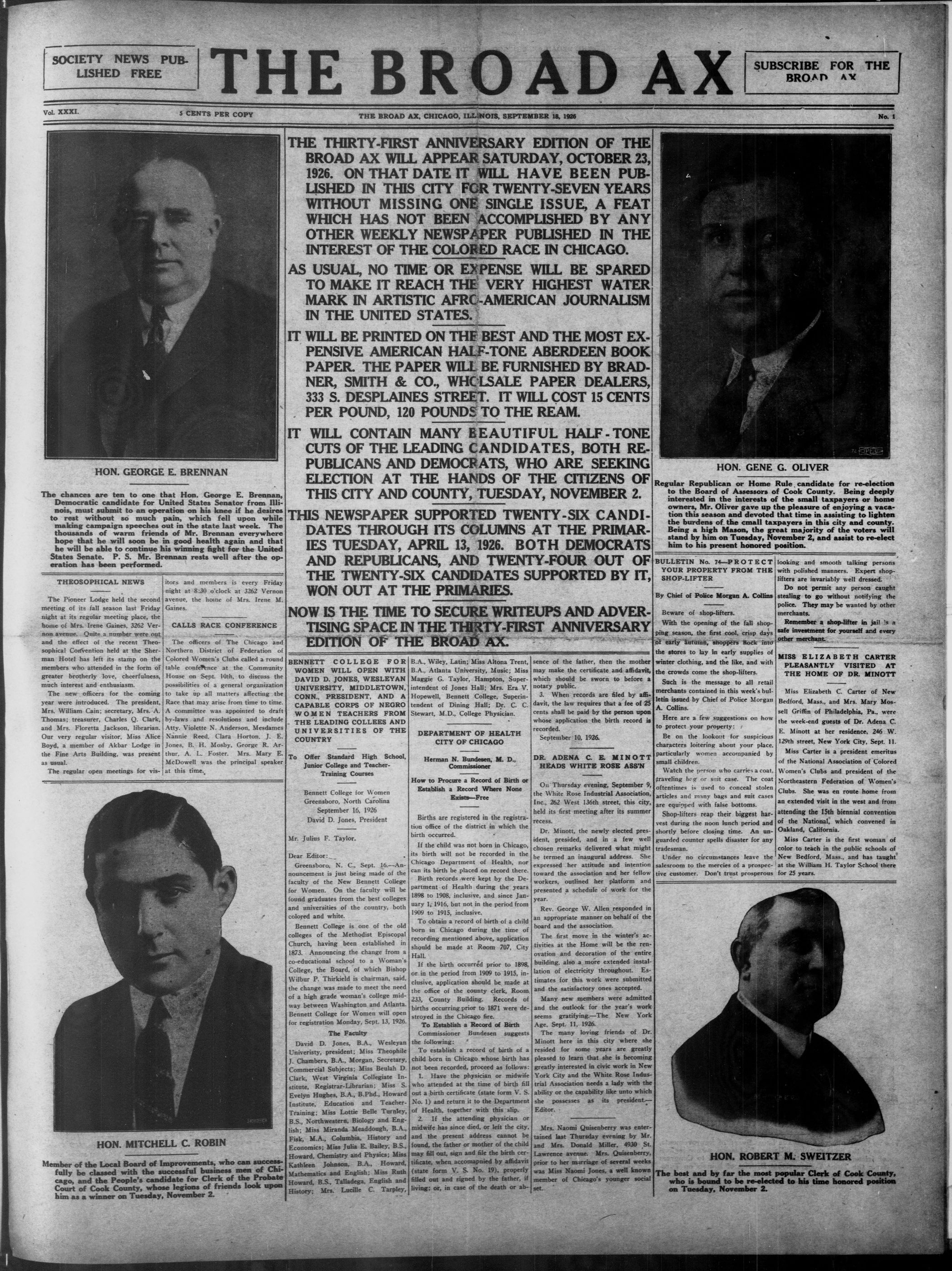
The chances are ten to one that Hon. George E. Brennan, Democratic candidate for United States Senator from Illinois, must submit to an operation on his knee if he desires to rest without so much pain, which fell upon while making campaign speeches out in the state last week. The thousands of warm friends of Mr. Brennan everywhere hope that he will soon be in good health again and that he will be able to continue his winning fight for the United States Senate. P. S. Mr. Brennan rests well after the operation has been performed.
THEOSOPHICAL NEWS
The Pioneer Lodge held the second meeting of its fall season last Friday night at its regular meeting place, the home of Mrs. Irene Gaines, 3262 Vernon avenue. Quite a number were out and the effect of the recent Theosophical Convention held at the Sherman Hotel has left its stamp on the members who attended in the form of greater brotherly love, cheerfulness, much interest and enthusiasm.
The new officers for the coming year were introduced. The president, Mrs. William Cain; secretary, Mrs. A. Thomas; treasurer, Charles Q. Clark, and Mrs. Floretta Jackson, librarian. Our very regular visitor, Miss Alice Boyd, a member of Akbar Lodge in the Fine Arts Building, was present as usual.
The regular open meetings for vis-
A.
2408024
Member of the Local Board of Improvements, who fully be classed with the successful business cago, and the People's candidate for Clerk Court of Cook County, whose legions of fries him as a winner on Tuesday, November 2.
the Local Board of Improvements, who classed with the successful business in the People's candidate for Clerk of Cook County, whose legions of flier winner on Tuesday, November 2.
Member of the Local Board of Improvements, who can successfully be classed with the successful business men of Chicago, and the People's candidate for Clerk of the Probate Court of Cook County, whose legions of friends look upon him as a winner on Tuesday, November 2.
that Hon. George E. Brennan, United States Senator from Illinion on his knee if he desires pain, which fell upon while out in the state last week. The is of Mr. Brennan everywhere in good health again and that his winning fight for the United Brennan rests well after the op-
itors and members is every Friday night at 8:30 o'clock at 3262 Vernon avenue, the home of Mrs. Irene M. Gaines.
CALLS RACE CONFERENCE
The officers of The Chicago and Northern District of Federation of Colored Women's Clubs called a round table conference at the Community House on Sept. 10th, to discuss the possibilities of a general organization to take up all matters affecting the Race that may arise from time to time. A committee was appointed to draft by-laws and resolutions and include Atty, Violette N. Anderson, Mesdames Nannie Reed, Clara Horton. J. E. Jones, B. H. Mosby, George R. Arthur, A. L. Foster. Mrs. Mary E. McDowell was the principal speaker at this time.
3408121
improvements, who can success- successful business men of Chidate for Clerk of the Probate use legions of friends look upon November 2.
THE BROAD AX
THE THIRTY-FIRST ANNIVERSARY EDITION OF THE BROAD AX WILL APPEAR SATURDAY, OCTOBER 23, 1926. ON THAT DATE IT WILL HAVE BEEN PUBLISHED IN THIS CITY FOR TWENTY-SEVEN YEARS WITHOUT MISSING ONE SINGLE ISSUE, A FEAT WHICH HAS NOT BEEN ACCOMPLISHED BY ANY OTHER WEEKLY NEWSPAPER PUBLISHED IN THE INTEREST OF THE COLORED RACE IN CHICAGO.
AS USUAL, NO TIME OR EXPENSE WILL BE SPARED TO MAKE IT REACH THE VERY HIGHEST WATER MARK IN ARTISTIC AFRC-AMERICAN JOURNALISM IN THE UNITED STATES.
IT WILL BE PRINTED ON THE BEST AND THE MOST EXPENSIVE AMERICAN HALF-TONE ABERDEEN BOOK PAPER. THE PAPER WILL BE FURNISHED BY BRADNER, SMITH & CO., WHOLSALE PAPER DEALERS, 333 S. DESPLAINES STREET. IT WILL COST 15 CENTS PER POUND, 120 POUNDS TO THE REAM.
IT WILL CONTAIN MANY BEAUTIFUL HALF-TONE CUTS OF THE LEADING CANDIDATES, BOTH REPUBLICANS AND DEMOCRATS, WHO ARE SEEKING ELECTION AT THE HANDS OF THE CITIZENS OF THIS CITY AND COUNTY, TUESDAY, NOVEMBER 2.
THIS NEWSPAPER SUPPORTED TWENTY-SIX CANDIDATES THROUGH ITS COLUMNS AT THE PRIMARIES TUESDAY, APRIL 13, 1926. BOTH DEMOCRATS AND REPUBLICANS, AND TWENTY-FOUR OUT OF THE TWENTY-SIX CANDIDATES SUPPORTED BY IT, WON OUT AT THE PRIMARIES.
NOW IS THE TIME TO SECURE WRITEUPS AND ADVERTISING SPACE IN THE THIRTY-FIRST ANNIVERSARY EDITION OF THE BROAD AX.
BENNETT COLLEGE FOR WOMEN WILL OPEN WITH DAVID D. JONES, WESLEYAN UNIVERSITY, MIDDLETOWN, CONN., PRESIDENT, AND A CAPABLE CORPS OF NEGRO WOMEN TEACHERS FROM THE LEADING COLLEES AND UNIVERSITIES OF THE COUNTRY
B.A., Wiley, Latin; Miss Altona Trent, B.A., Atlanta University, Music; Miss Maggie G. Taylor, Hampton, Superintendent of Jones Hall; Mrs. Era V. Hopewell, Bennett College, Superintendent of Dining Hall; Dr. C. C. Stewart, M.D., College Physician.
DEPARTMENT OF HEALTH CITY OF CHICAGO
sence of the father, then the mother may make the certificate and affidavit, which should be sworn to before a notary public.
3. When records are filed by affidavit, the law requires that a fee of 25 cents shall be paid by the person upon whose application the birth record is recorded.
September 10, 1926.
To Offer Standard High School, Junior College and Teacher- Training Courses
Bennett College for Women
Greensboro, North Carolina
September 16, 1926
David D. Jones, President
Mr. Julius F. Taylor.
Greensboro, N. C., Sept. 16.—Announcement is just being made of the faculty of the New Bennett College for Women. On the faculty will be found graduates from the best colleges and universities of the country, both colored and white. Bennett College is one of the old colleges of the Methodist Episcopal Church, having been established in 1873. Announcing the change from a co-educational school to a Woman's College, the Board, of which Bishop Wilbur P. Thirkield is chairman, said, the change was made to meet the need of a high grade woman's college midway between Washington and Atlanta. Bennett College for Women will open for registration Monday, Sept. 13, 1926.
David D. Jones, B.A., Wesleyan University, president; Miss Theophile J. Chambers, B.A., Morgan, Secretary, Commercial Subjects; Miss Beulah D. Clark, West Virginia Collegiate Institute, Registrar-Librarian; Miss S. Evelyn Hughes, B.A., B.Phd, Howard Institute, Education and Teacher Training; Miss Lottie Belle Turnley, B.S., Northwestern, Biology and English; Miss Miranda Meaddough, B.A., Fisk, M.A., Columbia, History and Economics; Miss Julia E. Bailey, B.S., Howard, Chemistry and Physics; Miss Kathleen Johnson, B.A., Howard, Mathematics and English; Miss Ruth Howard, B.S., Talladega, English and History; Mrs. Lucille C. Tarpley,
B.A., Wiley, Latin; Miss Altona Trent
B.A., Atlanta University, Music; Miss
Maggie G. Taylor, Hampton, Super-
intendent of Jones Hall; Mrs. Era V.
Hopewell, Bennett College, Super-
intendent of Dining Hall; Dr. C. C.
Stewart, M.D., College Physician.
DEPARTMENT OF HEALTH CITY OF CHICAGO
Herman N. Bundesen, M. D., Commissioner
How to Procure a Record of Birth or Establish a Record Where None Exists—Free
Births are registered in the registration office of the district in which the birth occurred.
If the child was not born in Chicago, its birth will not be recorded in the Chicago Department of Health, nor can its birth be placed on record there.
Birth records were kept by the Department of Health during the years 1898 to 1908, inclusive, and since January 1, 1916, but not in the period from 1909 to 1915, inclusive.
To obtain a record of birth of a child born in Chicago during the time of recording mentioned above, application should be made at Room 707, City Hall.
If the birth occurred prior to 1898, or in the period from 1909 to 1915, inclusive, application should be made at the office of the county clerk, Room 233, County Building. Records of births occurring prior to 1871 were destroyed in the Chicago fire.
To Establish a Record of Birth Commissioner Bundesen suggests the following:
To establish a record of birth of a child born in Chicago whose birth has not been recorded, proceed as follows:
1. Have the physician or midwife who attended at the time of birth fill out a birth certificate (state form V. S. No. 1) and return it to the Department of Health, together with this slip.
2. If the attending physician or midwife has since died, or left the city, and the present address cannot be found, the father or mother of the child may fill out, sign and file the birth certificate, when accompanied by affidavit (state form V. S. No. 19), properly filled out and signed by the father, if living; or, in case of the death or ab-
sence of the father, then the mother may make the certificate and affidavit, which should be sworn to before a notary public.
3. When records are filed by affidavit, the law requires that a fee of 25 cents shall be paid by the person upon whose application the birth record is recorded.
DR. ADENA C. E. MINOTT HEADS WHITE ROSE ASS'N
On Thursday evening, September 9, the White Rose Industrial Association, Inc., 262 West 136th street, this city, held its first meeting after its summer recess.
Dr. Minott, the newly elected president, presided, and in a few well chosen remarks delivered what might be termed an inaugural address. She expressed her attitude and intention toward the association and her fellow workers, outlined her platform and presented a schedule of work for the year.
Rev. George W. Allen responded in an appropriate manner on behalf of the board and the association.
The first move in the winter's activities at the Home will be the renovation and decoration of the entire building, also a more extended installation of electricity throughout. Estimates for this work were submitted and the satisfactory ones accepted.
Many new members were admitted and the outlook for the year's work seems gratifying.—The New York Age. Sept. 11, 1926.
The many loving friends of Dr. Minott here in this city where she resided for some years are greatly pleased to learn that she is becoming greatly interested in civic work in New York City and the White Rose Industrial Association needs a lady with the ability or the capability like unto which she possesses as its president—Editor.
Mrs. Naomi Quisenberry was entertained last Thursday evening by Mr. and Mrs. Donald Miller, 4930 St. Lawrence avenue. Mrs. Quisenberry, prior to her marriage of several weeks was Miss Naomi Jones, a well known member of Chicago's younger social set.
X
72
HON. GENE G. OLIVER Regular Republican or Home Rule candidate to the Board of Assessors of Cook County interested in the interests of the small tax owners, Mr. Oliver gave up the pleasure of tion this season and devoted that time in as the burdens of the small taxpayers in this Being a high Mason, the great majority o stand by him on Tuesday, November 2, and him to his present honored position.
publican or Home Rule candidate for ward of Assessors of Cook County. Be in the interests of the small taxpayer. Oliver gave up the pleasure of enjoy season and devoted that time in assisting us of the small taxpayers in this city a high Mason, the great majority of the him on Tuesday, November 2, and assist present honored position.
Regular Republican or Home Rule candidate for re-election to the Board of Assessors of Cook County. Being deeply interested in the interests of the small taxpayers or home owners, Mr. Oliver gave up the pleasure of enjoying a vacation this season and devoted that time in assisting to lighten the burdens of the small taxpayers in this city and county. Being a high Mason, the great majority of the voters will stand by him on Tuesday, November 2, and assist to re-elect him to his present honored position.
BULLETIN No. 74—PROTECT YOUR PROPERTY FROM THE SHOP-LIFTER
By Chief of Police Morgan A. Collins
Beware of shop-lifters.
With the opening of the fall shopping season, the first cool, crisp days of early autumn, shoppers lock into the stores to lay in early supplies of winter clothing, and the like, and with the crowds come the shop-lifters.
Such is the message to all retail merchants contained in this week's bulletin issued by Chief of Police Morgan A. Collins.
Here are a few suggestions on how to protect your property:
looking and smooth talking persons with polished manners. Expert shop-lifters are invariably well dressed.
Do not permit any person caught stealing to go without notifying the police. They may be wanted by other merchants.
Remember a shop-lifter in jail is a safe investment for yourself and every other merchant.
MISS ELIZABETH CARTER PLEASANTLY VISITED AT THE HOME OF DR. MINOTT
Miss Elizabeth C. Carter of New Bedford, Mass., and Mrs. Mary Mossell Griffin of Philadelphia, Pa., were the week-end guests of Dr. Adena C.
Be on the lookout for suspicious characters loitering about your place, particularly women accompanied by small children.
Watch the person who carries a coat, traveling bag or suit case. The coat oftentimes is used to conceal stolen articles and many bags and suit cases are equipped with false bottoms.
Shop-lifters reap their biggest harvest during the noon lunch period and shortly before closing time. An unguarded counter spells disaster for any tradesman.
Under no circumstances leave the salesroom to the mercies of a prospective customer. Don't trust prosperous
```markdown
```
DEV
M. P. P.
HON. ROBERT M. SWEITZER
The best and by far the most popular Clerk of Co who is bound to be re-elected to his time honor on Tuesday, November 2.
by far the most popular Clerk of Court to be re-elected to his time honour day, November 2.
The best and by far the most popular Clerk of Cook County, who is bound to be re-elected to his time honored position on Tuesday, November 2.
SUBSCRIBE FOR THE BROAD AX
No. 1
Home Rule candidate for re-election
assessors of Cook County. Being deeply
rests of the small taxpayers or home
live up the pleasure of enjoying a vaca-
evoted that time in assisting to lighten
small taxpayers in this city and county.
In the great majority of the voters will
day, November 2, and assist to re-elect
mored position.
PECT
M THE
Collins
looking and smooth talking persons
with polished manners. Expert shop-
lifters are invariably well dressed.
Do not permit any person caught
stealing to go without notifying the
police. They may be wanted by other
merchants.
Remember a shop-lifter in jail is a
safe investment for yourself and every
other merchant.
MISS ELIZABETH CARTER
PLEASANTLY VISITED AT
THE HOME OF DR. MINOTT
Miss Elizabeth C. Carter of New Bedford, Mass., and Mrs. Mary Mossell Griffin of Philadelphia, Pa., were the week-end guests of Dr. Adena C. E. Minott at her residence, 246 W. 129th street, New York City, Sept. 11. Miss Carter is a president emeritus of the National Association of Colored Women's Clubs and president of the Northeastern Federation of Women's Clubs. She was en route home from an extended visit in the west and from attending the 15th biennial convention of the National, which convened in Oakland, California. Miss Carter is the first woman of color to teach in the public schools of New Bedford, Mass., and has taught at the William H. Taylor School there for 25 years.
1910
most popular Clerk of Cook County, re-elected to his time honored position after 2.
THE BROAD AX Published Every Saturday
In this city since July 15th 1899,
without missing one single issue. Republicans, Democrats, Catholics, Protestants, Single Taxers, Priests, infidels or anyone else can have their say as long as their language is proper and responsibility is fixed.
The Broad Ax is a newspaper whose platform is broad enough for all, ever claiming the editorial right to speak its own mind. It is neither Democratic nor Republican. It is strictly or absolutely independent in politics.
Local communications will receive attention. Write only on one side of the paper.
Subscriptions must be paid in advance.
One Year ... $2.00
Six Months ... $1.00
Advertising rates made known on application.
Address all communications to
THE BROAD AX
oz06 S. Elizabeth St., Chicago.
Phone: Wentworth 2597
JULIUS F. TAYLOR
Editor and Publisher
Vol. XXXII No. 1
Chicago September 18, 1926
Entered as Second-Class Matter aug
19, 1902, at the Post office at Chicago
III. Under Act of March 8, 1879.
FREQUENT FORMS OF CANCER
By a Christmas Seal Doctor
Cancer of the breast is one of the common forms of cancer and it may occur in men and women, though of course more frequently in women over the age of forty. It is somewhat less common in women who have nursed their babies than in women who have had no children. Many women have lost their lives from cancer of this structure, but there is reason to think that, with the spreading of the knowledge there are ways the development of cancer of the breast can be avoided. Any lump in this organ, any abnormal discharge, any sore should be investigated at once by the physician and treated.
Common as this form of cancer is, however, cancer of the uterus (womb) is more common and is particularly the menace of women in the late child-bearing period and during the menopause.
As any cancerous development is favored by injury, and as it takes place readily in old scars, it is not difficult to see why women who have borne children, and who have suffered from laceration and who have old ragged scars resulting from the not infrequent tearing of the mouth of the uterus during delivery, have more cancer of this organ than those who have not been subjected to these dangers.
Cancer of the uterus often exists before the patient is aware of any symptoms of any unusual condition. That is unfortunate and is the cause of this emphatic warning: After child-birth there should be careful examination and any injury to the tissue should be repaired; a woman who has had children should insist upon a yearly examination especially as she nears the
A. J. B.
Mormon
Photo
The up-to-date Secretary of the Local Board of In one of the most popular citizens of Chicago, of friends firmly feel that he will be elected from the Third Congressional District of Illin day, November 2.
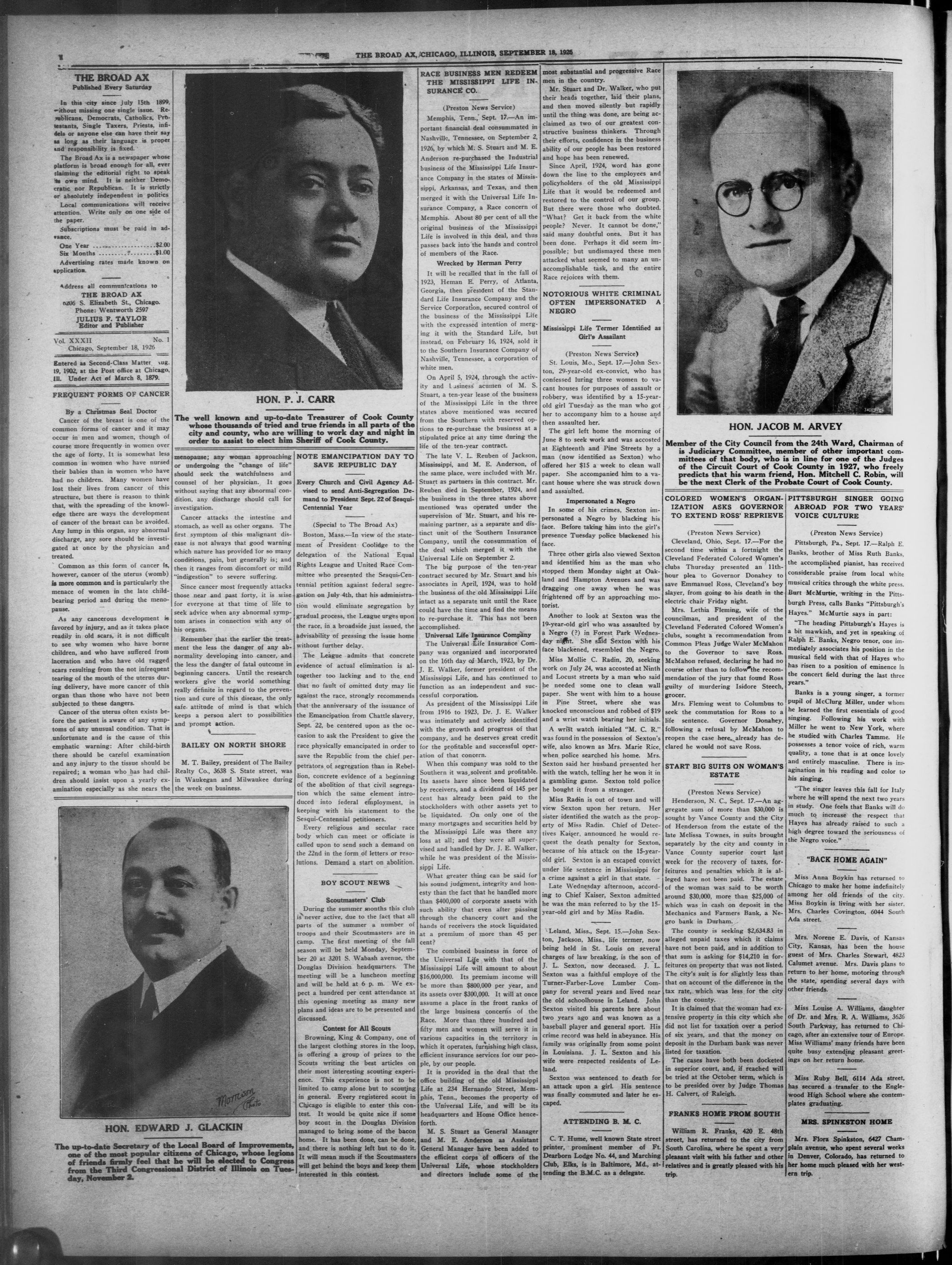
The up-to-date Secretary of the Local Board of Improvements, one of the most popular citizens of Chicago, whose legions of friends firmly feel that he will be elected to Congress from the Third Congressional District of Illinois on Tuesday, November 2.
The well known and up-to-date whose thousands of tried an city and county, who are w order to assist to elect him
The well known and up-to-date Treasurer of Cook County, whose thousands of tried and true friends in all parts of the city and county, who are willing to work day and night in order to assist to elect him Sheriff of Cook County.
menopause; any woman approaching or undergoing the "change of life" should seek the watchfulness and counsel of her physician. It goes without saying that any abnormal condition, any discharge should call for investigation.
Cancer attacks the intestine and stomach, as well as other organs. The first symptom of this malignant disease is not always that good warning which nature has provided for so many conditions, pain, but generally is; and then it ranges from discomfort or mild "indigestion" to severe suffering.
Since cancer most frequently attacks those near and past forty, it is wise for everyone at that time of life to seek advice when any abnormal symptom arises in connection with any of his organs.
NOTE EMANCIPATION DAY TO SAVE REPUBLIC DAY
Every Church and Civil Agency Advised to send Anti-Segregation Demand to President Sept. 22 of Sesqui-Centennial Year
(Special to The Broad Ax)
Boston, Mass.—In view of the statement of President Coolidge to the delegation of the National Equal Rights League and United Race Committee who presented the Sesqui-Centennial petition against federal segregation on July 4th, that his administration would eliminate segregation by gradual process, the League urges upon the race, in a broadside just issued, the
Remember that the earlier the treatment the less the danger of any abnormality developing into cancer, and the less the danger of fatal outcome in beginning cancers. Until the research workers give the world something really definite in regard to the prevention and cure of this disease, the only safe. attitude of mind is that which keeps a person alert to possibilities and prompt action.
BAILEY ON NORTH SHORE
M. T. Bailey, president of The Bailey Realty Co., 3638 S. State street, was in Waukegan and Milwaukee during the week on business.
Morrison
Photo
The Local Board of Improvements citizens of Chicago, whose legions he will be elected to Congress. National District of Illinois on Tuesday.
HON. P. J. CARR
NOTE EMANCIPATION DAY TO
SAVE REPUBLIC DAY
Every Church and Civil Agency Advised to send Anti-Segregation Demand to President Sept. 22 of Sesqui-Centennial Year
Boston, Mass.—In view of the statement of President Coolidge to the delegation of the National Equal Rights League and United Race Committee who presented the Sesqui-Centennial petition against federal segregation on July 4th, that his administration would eliminate segregation by gradual process, the League urges upon the race, in a broadside just issued, the advisability of pressing the issue home without further delay.
The League admits that concrete evidence of actual elimination is altogether too lacking and to the end that no fault of omitted duty may lie against the race, strongly recommends that the anniversary of the issuance of the Emancipation from Chattle slavery, Sept. 22, be centered upon as the occasion to ask the President to give the race physically emancipated in order to save the Republic from the chief perpetrators of segregation than in Rebellion, concrete evidence of a beginning of the abolition of that civil segregation which the same element introduced into federal employment, in keeping with his statement to the Sesqui-Centennial petitioners. Every religious and secular race body which can meet or officiate is called upon to send such a demand on the 22nd in the form of letters or resolutions. Demand a start on abolition.
During the summer months this club is never active, due to the fact that all parts of the summer a number of troops and their Scoutmasters are in camp. The first meeting of the fall season will be held Monday, September 20 at 3201 S. Wabash avenue, the Douglas Division headquarters. The meeting will be a luncheon meeting and will be held at 6 p.m. We expect a hundred per cent attendance at this opening meeting as many new plans and ideas are to be presented and discussed.
Contest for All Scouts
Browning, King & Company, one of the largest clothing stores in the loop, is offering a group of prizes to the Scouts writing the best articles on their most interesting scouting experience. This experience is not to be limited to camp alone but to scouting in general. Every registered scout in Chicago is eligible to enter this contest. It would be quite nice if some boy scout in the Douglas Division managed to bring some of the bacon home. It has been done, can be done, and there is nothing left but to do it. It will mean much if the Scoutmasters will get behind the boys and keep them interested in this contest.
THE BROAD AX, CHICAGO, ILLINOIS, SEPTEMBER 18, 1925
BOY SCOUT NEWS
Scoutmasters' Club
RACE BUSINESS MEN REDEEM
THE MISSISSIPPI LIFE INSURANCE CO.
(Preston News Service)
Memphis, Tenn., Sept. 17.—An important financial deal consummated in Nashville, Tennessee, on September 2, 1926, by which M. S. Stuart and M. E. Anderson re-purchased the Industrial business of the Mississippi Life Insurance Company in the states of Mississippi, Arkansas, and Texas, and then merged it with the Universal Life Insurance Company, a Race concern of Memphis. About 80 per cent of all the original business of the Mississippi Life is involved in this deal, and thus passes back into the hands and control of members of the Race.
Wrecked by Herman Perry
It will be recalled that in the fall of 1923, Heman E. Perry, of Atlanta, Georgia, then president of the Standard Life Insurance Company and the Service Corporation, secured control of the business of the Mississippi Life with the expressed intention of merging it with the Standard Life, but instead, on February 16, 1924, sold it to the Southern Insurance Company of Nashville, Tennessee, a corporation of white men.
On April 5, 1924, through the activity and business acumen of M. S. Stuart, a ten-year lease of the business of the Mississippi Life in the three states above mentioned was secured from the Southern with reserved options to re-purchase the business at a stipulated price at any time during the life of the ten-year contract.
The late V. L. Reuben of Jackson, Mississippi, and M. E. Anderson, of the same place, were included with Mr. Stuart as partners in this contract. Mr. Reuben died in September, 1924, and the business in the three states above mentioned was operated under the supervision of Mr. Stuart, and his remaining partner, as a separate and distinct unit of the Southern Insurance Company, until the consummation of the deal which merged it with the Universal Life on September 2. The big purpose of the ten-year contract secured by Mr. Stuart and his associates in April, 1924, was to hold the business of the old Mississippi Life intact as a separate unit until the Race could have the time and find the means to re-purchase it. This has not been accomplished.
Universal Life Insurance Company
The Universal Life Insurance Company was organized and incorporated on the 16th day of March, 1923, by Dr. J. E. Walker, former president of the Mississippi Life, and has continued to function as an independent and successful corporation.
As president of the Mississippi Life from 1916 to 1923, Dr. J. E. Walker was intimately and actively identified with the growth and progress of that company, and he deserves great credit for the profitable and successful operation of that concern.
When this company was sold to the Southern it was solvent and profitable. Its assets have since been liquidated by receivers, and a dividend of 145 percent has already been paid to the stockholders with other assets yet to be liquidated. On only one of the many mortgages and securities held by the Mississippi Life was there any loss at all; and they were all supervised and handled by Dr. J. E. Walker, while he was president of the Mississippi Life.
What greater thing can be said for his sound judgment, integrity and honesty than the fact that he handled more than $400,000 of corporate assets with such ability that even after passing through the chancery court and the hands of receivers the stock liquidated at a premium of more than 45 per cent?
The combined business in force of the Universal Life with that of the Mississippi Life will amount to about $16,000,000. Its premium income will be more than $800,000 per year, and its assets over $300,000. It will at once assume a place in the front ranks of the large business concerns of the Race. More than three hundred and fifty men and women will serve it in various capacities in the territory in which it operates, furnishing high class, efficient insurance services for our people, by our people.
It is provided in the deal that the office building of the old Mississippi Life at 234 Hernando Street, Memphis, Tenn., becomes the property of the Universal Life, and will be its headquarters and Home Office hence forth.
M. S. Stuart as General Manager and M. E. Anderson as Assistant General Manager have been added to the efficient corps of officers of the Universal Life, whose stockholders and directors include some of the
most substantial and progressive Race men in the country.
Mr. Stuart and Dr. Walker, who put their heads together, laid their plans, and then moved silently but rapidly until the thing was done, are being acclaimed as two of our greatest constructive business thinkers. Through their efforts, confidence in the business ability of our people has been restored and hope has been renewed.
Since April, 1924, word has gone down the line to the employees and policyholders of the old Mississippi Life that it would be redeemed and restored to the control of our group. But there were those who doubted. "What? Get it back from the white people? Never. It cannot be done," said many doubtful ones. But it has been done. Perhaps it did seem impossible; but undismayed these men attacked what seemed to many an unaccomplishable task, and the entire Race rejoices with them.
NOTORIOUS WHITE CRIMINAL OFTEN IMPERSONATED A NEGRO
Mississippi Life Termer Identified as Girl's Assailant
(Preston News Service)
St. Louis, Mo., Sept. 17.—John Sexton, 29-year-old ex-convict, who has confessed luring three women to vacant houses for purposes of assault or robbery, was identified by a 15-year-old girl Tuesday as the man who got her to accompany him to a house and then assaulted her.
The girl left home the morning of June 8 to seek work and was accosted at Eighteenth and Pine Streets by a man (now identified as Sexton) who offered her $15 a week to clean wall paper. She accompanied him to a vacant house where she was struck down and assaulted.
Impersonated a Negro
In some of his crimes, Sexton impersonated a Negro by blacking his face. Before taking him into the girl's presence Tuesday police blackened his face.
Three other girls also viewed Sexton and identified him as the man who stopped them Monday night at Oakland and Hampton Avenues and was dragging one away when he was frightened off by an approaching motorist.
Another to look at Sexton was the 19-year-old girl who was assaulted by a Negro (?) in Forest Park Wednesday night. She said Sexton with his face blackened, resembled the Negro.
Miss Mollie C. Radin, 20, seeking work on July 24, was accosted at Ninth and Locust streets by a man who said he needed some one to clean wall paper. She went with him to a house in Pine Street, where she was knocked unconscious and robbed of $19 and a wrist watch bearing her initials.
A wrist watch initialed "M. C. R." was found in the possession of Sexton's wife, also known as Mrs. Marie Rice, when police searched his home. Mrs. Sexton said her husband presented her with the watch, telling her he won it in a gambling game. Sexton told police he bought it from a stranger.
Miss Radin is out of town and will view Sexton upon her return. Her sister identified the watch as the property of Miss Radin. Chief of Detectives Kaiser, announced he would request the death penalty for Sexton, because of his attack on the 15-year-old girl. Sexton is an escaped convict under life sentence in Mississippi for a crime against a girl in that state.
Late Wednesday afternoon, according to Chief Kaiser, Sexton admitted he was the man referred to by the 15-year-old girl and by Miss Radin.
Leland, Miss., Sept. 15.—John Sexton, Jackson, Miss., life termer, now being held in St. Louis on several charges of law breaking, is the son of J. L. Sexton, now deceased. J. L. Sexton was a faithful employee of the Turner-Farber-Love Lumber Company for several years and lived near the old schoolhouse in Leland. John Sexton visited his parents here about two years ago and was known as a baseball player and general sport. His crime record was held in abeyance. His family was originally from some point in Louisiana. J. L. Sexton and his wife were respected residents of Leland. Sexton was sentenced to death for an attack upon a girl. His sentence was finally commuted and later he escaped.
ATTENDING B. M. C.
C. T. Hume, well known Street street printer, prominent member of Ft. Dearborn Lodge No. 44, and Marching Club, Elks, is in Baltimore, Md., attending the B.M.C. as a delegate.
34054725
HON. JACOB M. ARVEY
Member of the City Council from is Judiciary Committee, memittees of that body, who of the Circuit Court of Co predicts that his warm frien be the next Clerk of the Pr
Member of the City Council from the 24th Ward, Chairman of is Judiciary Committee, member of other important committees of that body, who is in line for one of the Judges of the Circuit Court of Cook County in 1927, who freely predicts that his warm friend, Hon. Mitchell C. Robin, will be the next Clerk of the Probate Court of Cook County.
COLORED WOMEN'S ORGANIZATION ASKS GOVERNOR ABROAD FOR TWO YEARS TO EXTEND ROSS' REPRIEVE VOICE CULTURE
Cleveland, Ohio, Sept. 17.—For the second time within a fortnight the Cleveland Federated Colored Women's clubs Thursday presented an 11th-hour plea to Governor Donahey to save Emmanuel Ross, Cleveland's boy slayer, from going to his death in the electric chair Friday night.
Mrs. Lethia Fleming, wife of the councilman, and president of the Cleveland Federated Colored Women's clubs, sought a recommendation from Common Pleas Judge Waler McMahon to the Governor to save Ross. McMahon refused, declaring he had no course other than to follow the recommendation of the jury that found Ross guilty of murdering Isidore Steech, grocer.
Mrs. Fleming went to Columbus to seek the commutation for Ross to a life sentence. Governor Donahey, following a refusal by McMahon to reopen the case here, already has declared he would not save Ross.
START BIG SUITS ON WOMAN'S ESTATE
(Preston News Service)
Henderson, N. C., Sept. 17.—An aggregate sum of more than $30,000 is sought by Vance County and the City of Henderson from the estate of the late Melissa Townes, in suits brought separately by the city and county in Vance County superior court last week for the recovery of taxes, forfeitures and penalties which it is alleged have not been paid. The estate of the woman was said to be worth around $30,000, more than $25,000 of which was in cash on deposit in the Mechanics and Farmers Bank, a Negro bank in Durham.
The county is seeking $2,634.83 in alleged unpaid taxes which it claims have not been paid, and in addition to that sum is asking for $14,210 in forfeitures on property that was not listed. The city's suit is for slightly less than that on account of the difference in the tax rate, which was less for the city than the county.
It is claimed that the woman had extensive property in this city which she did not list for taxation over a period of six years, and that the money on deposit in the Durham bank was never listed for taxation.
The cases have both been docketed in superior court, and, if reached will be tried at the October term, which is to be presided over by Judge Thomas H. Calvert, of Raleigh.
FRANKS HOME FROM SOUTH
William R. Franks, 420 E. 48th street, has returned to the city from South Carolina, where he spent a very pleasant visit with his father and other relatives and is greatly pleased with his trip.
from the 24th Ward, Chairman of
member of other important com-
s in line for one of the Judges
Cook County in 1927, who freely
ad, Hon. Mitchell C. Robin, will
obate Court of Cook County.
PITTSBURGH SINGER GOING
ABROAD FOR TWO YEARS'
VOICE CULTURE
Pittsburgh, Pa., Sept. 17.—Ralph E. Banks, brother of Miss Ruth Banks, the accomplished pianist, has received considerable praise from local white musical critics through the white press. Burt McMurtie, writing in the Pittsburgh Press, calls Banks "Pittsburgh's Hayes." McMurtie says in part: "The heading Pittsburgh's Hayes is a bit mawkish, and yet in speaking of Ralph E. Banks, Negro tenor, one immediately associates his position in the musical field with that of Hayes who has risen to a position of eminence in the concert field during the last three years."
Banks is a young singer, a former pupil of McClurg Miller, under whom he learned the first essentials of good singing. Following his work with Miller he went to New York, where he studied with Charles Tamme. He possesses a tenor voice of rich, warm quality, a tone that is at once lovely and entirely masculine. There is imagination in his reading and color to his singing.
"The singer leaves this fall for Italy where he will spend the next two years in study. One feels that Banks will do much to increase the respect that Hayes has already raised to such a high degree toward the seriousness of the Negro voice."
"BACK HOME AGAIN"
Miss Anna Boykin has returned to Chicago to make her home indefinitely among her old friends of the city. Miss Boykin is living with her sister, Mrs. Charles Covington, 6044 South Ada street.
Mrs. Norene E. Davis, of Kansas City, Kansas, has been the house guest of Mrs. Charles Stewart, 4823 Calumet avenue. Mrs. Davis plans to return to her home, motoring through the state, spending several days with other friends.
Miss Louise A. Williams, daughter of Dr. and Mrs. R. A. Williams, 3626 South Parkway, has returned to Chicago, after an extensive tour of Europe. Miss Williams' many friends have been quite busy extending pleasant greetings on her return home.
Miss Ruby Bell, 6114 Ada street, has secured a transfer to the Englewood High School where she contemplates graduating.
MRS. SPINKSTON HOME
Mrs. Flora Spinkston, 6427 Champlain avenue, who spent several weeks in Denver, Colorado, has returned to her home much pleased with her western trip.
[Name]
HON. WILLIAM R. FETZER
One of the high-class judges of the Municipal
cago, who will on Tuesday, November 2, sit
on the Municipal Court bench.
MURDERER BROUGHT BACK
headquarters telepho
retary W. M. Trott
high-class judges of the Municipal so will on Tuesday, November 2, suciipal Court bench.
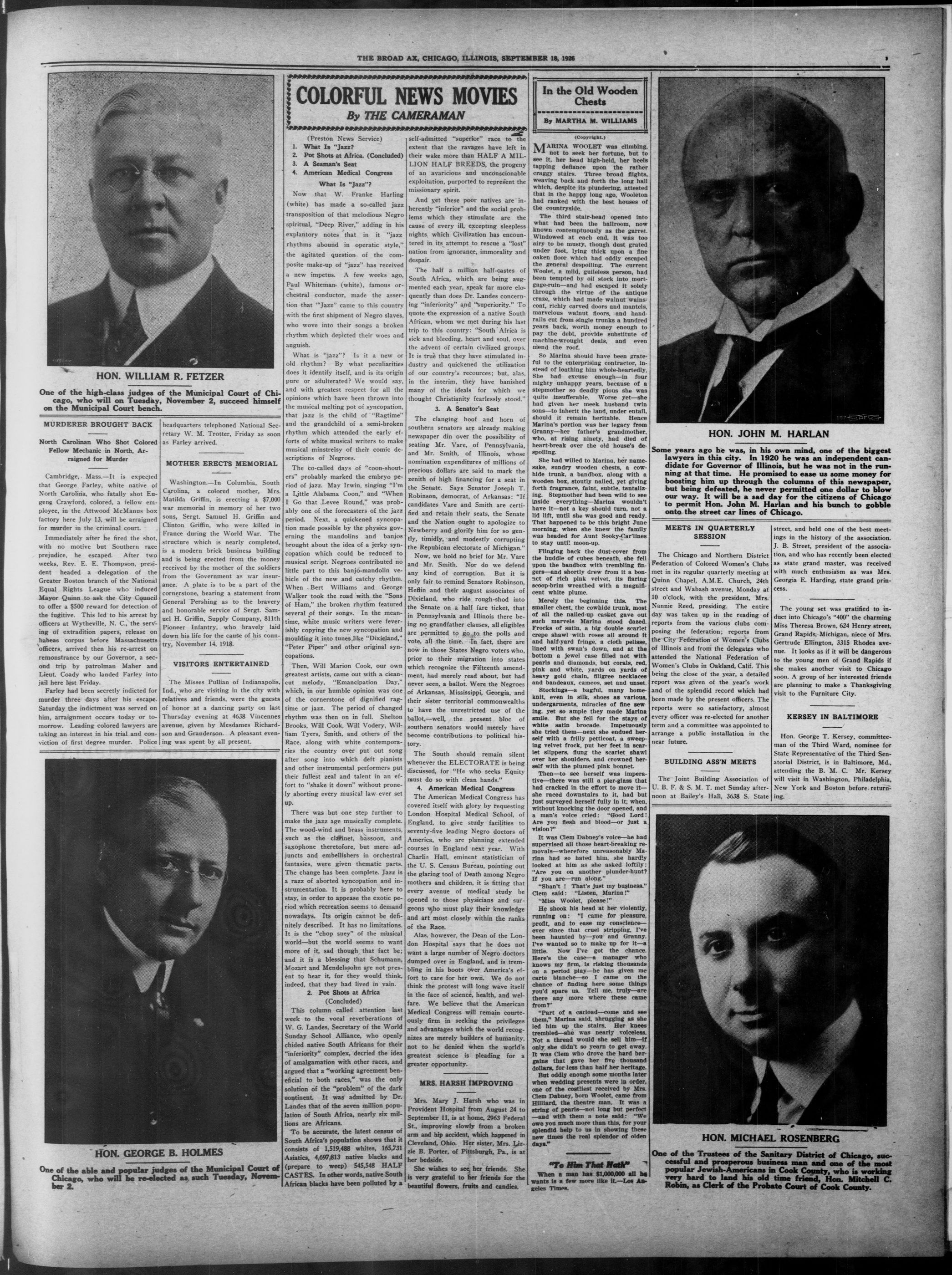
One of the high-class judges of the Municipal Court of Chicago, who will on Tuesday, November 2, succeed himself on the Municipal Court bench.
North Carolinan Who Shot Colored Fellow Mechanic in North, Arraigned for Murder
Cambridge, Mass.-It is expected that George Farley, white native of North Carolina, who fatally shot Eugeng Crawford, colored, a fellow employee, in the Attwood McManus box factory here July 13, will be arraigned for murder in the criminal court.
Immediately after he fired the shot, with no motive but Southern race prejudice, he escaped. After two weeks, Rev. E. E. Thompson, president headed a delegation of the Greater Boston branch of the National Equal Rights League who induced Mayor Quinn to ask the City Council to offer a $500 reward for detection of the fugitive. This led to his arrest by officers at Wytheville, N. C., the serving of extradition papers, release on habeas corpus before Massachusetts officers, arrived then his re-arrest on remonstrance by our Governor, a second trip by patrolman Maher and Lieut. Coady who landed Farley into jail here last Friday.
Farley had been secretly indicted for murder three days after his escape. Saturday the indictment was served on him, arraignment occurs today or tomorrow. Leading colored lawyers are taking an interest in his trial and conviction of first degree murder. Police
```markdown
```
[Image of a man in a suit with a tie and a badge on his lapel].
[Name]
HON. GEORGE B. HOLMES
One of the able and popular judges of the Mun Chicago, who will be re-elected as such Tuber 2.
sole and popular judges of the Munich who will be re-elected as such Tue
One of the able and popular judges of the Municipal Court of Chicago, who will be re-elected as such Tuesday, November 2.
One of the able and popular judges of the Municipal Court of Chicago, who will be re-elected as such Tuesday, November 2.
of the Municipal Court of Chi
, November 2, succeed himself
headquarters telephoned National Secre
retary W. M. Trotter, Friday as soon
as Farley arrived.
MOTHER ERECTS MEMORIAL
Washington.—In Columbia, South Carolina, a colored mother, Mrs Matilda Griffin, is erecting a $7,000 war memorial in memory of her two sons, Sergt. Samuel H. Griffin and Clinton Griffin, who were killed in France during the World War. The structure is which is nearly completed is a modern brick business building and is being erected from the money received by the mother of the soldiers from the Government as war insurance. A plate is to be a part of the cornerstone, bearing a statement from General Pershing as to the bravery and honorable service of Sergt. Samuel H. Griffin, Supply Company, 811th Pioneer Infantry, who bravely laid down his life for the cause of his country, November 14, 1918.
VISITORS ENTERTAINED
The Misses Pullian of Indianapolis Ind., who are visiting in the city with relatives and friends, were the guests of honor at a dancing party on last Thursday evening at 4638 Vincennes avenue, given by Mesdames Richardson and Granderson. A pleasant evening was spent by all present.
THE NEW YORK TIMES
edges of the Municipal Court of
acted as such Tuesday, Novem-
THE BROAD AX. CHICAGO. ILLINOIS. SEPTEMBER 18. 1926
COLORFUL NEWS MOVIES By THE CAMERAMAN
2. Pot Shots at Africa. (Concluded)
3. A Seaman's Seat
4. American Medical Congress
Now that W. Franke Harling (white) has made a so-called jazz transposition of that melodious Negro spiritual, "Deep River," adding in his explantory notes that in it "jazz rhythms abound in operatic style," the agitated question of the composite make-up of "jazz" has received a new impetus. A few weeks ago, Paul Whiteman (white), famous orchestral conductor, made the assertion that "Jazz" came to this country with the first shipment of Negro slaves, who wove into their songs a broken rhythm which depicted their woes and anguish.
What is "jazz"? Is it a new or old rhythm? By what peculiarities does it identify itself, and is its origin pure or adulterated? We would say and with greatest respect for all the opinions which have been thrown into the musical melting pot of syncopation, that jazz is the child of "Ragtime" and the grandchild of a semi-broken rhythm which attended the early efforts of white musical writers to make musical minstrelsy of their comic descriptions of Negroes.
The to-called days of "coon-shouters" probably marked the embryo period of jazz. May Irwin, singing "I'm a Little Alabama Coon," and "When I Go that Levee Round," was probably one of the forecasters of the jazz period. Next, a quickened syncopation made possible by the physics governing the mandolins and banjos brought about the idea of a jerky syncopation which could be reduced to musical script. Negroes contributed no little part to this banjo-mandolin vehicle of the new and catchy rhythm. When Bert Williams and George Walker took the road with the "Sons of Ham," the broken rhythm featured several of their songs. In the meantime, white music writers were feverishly copying the new syncopation and moulding it into tunes like "Dixieland," "Peter Piper" and other original syncopations.
Then, Will Marion Cook, our own greatest artists, came out with a clean-cut melody, "Emancipation Day," which, in our humble opinion was one of the cornerstone of dignified ragtime or jazz. The period of changed rhythm was then on in full. Shelton Brooks, Will Cook, Will Vodery, William Tyers, Smith, and others of the Race, along with white contemporaries the country over put out song after song into which deft pianists and other instrumental performers put their fullest zeal and talent in an effort to "shake it down" without pronely aborting every musical law ever set up.
There was but one step further to make the jazz age musically complete. The wood-wind and brass instruments, such as the clarinet, bassoon, and saxophone theretofore, but mere adjuncts and embellishers in orchestral fantasies, were given thematic parts. The change has been complete. Jazz is a razz of aborted syncopation and instrumentation. It is probably here to stay, in order to appease the exotic period which recreation seems to demand nowadays. Its origin cannot be definitely described. It has no limitations. It is the "chop suey" of the musical world—but the world seems to want more of it, sad though that fact be; and it is a blessing that Schumann, Mozart and Mendelssohn are not present to hear it, for they would think, indeed, that they had lived in vain.
This column called attention last week to the vocal reverberations of W. G. Landes, Secretary of the World Sunday School Alliance, who openly chided native South Africans for their "inferiority" complex, decried the idea of amalgamation with other races, and argued that a "working agreement beneficial to both races," was the only solution of the "problem" of the dark continent. It was admitted by Dr. Landes that of the seven million population of South Africa, nearly six millions are Africans.
To be accurate, the latest census of South Africa's population shows that it consists of 1,519,488 whites, 165,731 Asiatics, 4,697,813 native blacks and (prepare to weep) 545,548 HALF CASTES. In other words, native South African blacks have been polluted by a
self-admitted "superior" race to the extent that the ravages have left in their wake more than HALF A MILLION HALF BREEDS, the progeny of an avaricious and unconscionable exploitation, purported to represent the missionary spirit.
And yet these poor natives are inherently "inferior" and the social problems which they stimulate are the cause of every ill, excepting sleepless nights, which Civilization has encountered in its attempt to rescue a "lost" nation from ignorance, immorality and despair.
The half a million half-castes of South Africa, which are being augmented each year, speak far more eloquently than does Dr. Landes concerning "inferiority" and "superiority." To quote the expression of a native South African, whom we met during his last trip to this country: "South Africa is sick and bleeding, heart and soul, over the advent of certain civilized groups. It is true that they have stimulated industry and quickened the utilization of our country's recourses; but, alas, in the interim, they have banished many of the ideals for which we thought Christianity fearlessly stood."
3. A Senator's Seat
The clanging hoof and horn of southern senators are already making newspaper diir on the possibility of seating Mr. Vare, of Pennsylvania, and Mr. Smith, of Illinois, whose nomination expenditures of millions of precious dollars are said to mark the zenith of high financing for a seat in the Senate. Says Senator Joseph T. Robinson, democrat, of Arkansas: "If candidates Vare and Smith are certified and retain their seats, the Senate and the Nation ought to apologize to Newberry and glorify him for so gently, timidly, and modestly corrupt the Republican electorate of Michigan." Now, we hold no brief for Mr. Vare and Mr. Smith. Nor do we defend any kind of corruption. But it is only fair to remind Senators Robinson, Heflin and their august associates of Dixieland, who ride rough-shod into the Senate on a half fare ticket, that in Pennsylvania and Illinois there being no grandfather clauses, all eligibles are permitted to go to the polls and vote, all the time. In fact, there are now in those States Negro voters who, prior to their migration into states which recognize the Fifteenth amendment, had merely read about, but had never seen, a ballot. Were the Negroes of Arkansas, Mississippi, Georgia, and their sister territorial commonwealths to have the unrestricted use of the ballot,—well, the present bloc of southern senators would merely have become contributions to political history.
The South should remain silent whenever the ELECTORATE is being discussed, for "He who seeks Equity must do so with clean hands."
4. American Medical Congress
The American Medical Congress has covered itself with glory by requesting London Hospital Medical School, of England, to give study facilities to seventy-five leading Negro doctors of America, who are planning extended courses in England next year. With Charlie Hall, eminent statistician of the U. S. Census Bureau, pointing out the glaring tool of Death among Negro mothers and children, it is fitting that every avenue of medical study be opened to those physicians and surgeons who must play their knowledge and art most closely within the ranks of the Race.
Alas, however, the Dean of the London Hospital says that he does not want a large number of Negro doctors dumped over in England, and is trembling in his boots over America's effort to care for her own. We do not think the protest will long wave itself in the face of science, health, and welfare. We believe that the American Medical Congress will remain courteously firm in seeking the privileges and advantages which the world recognizes are merely builders of humanity, not to be denied when the world's greatest science is pleading for a greater opportunity.
MRS. HARSH IMPROVING
Mrs. Mary J. Harsh who was in Provident Hospital from August 24 to September 11, is at home, 2963 Federal St., improving slowly from a broken arm and hip accident, which happened in Cleveland, Ohio. Her sister, Mrs. Lizzie B. Porter, of Pittsburgh, Pa., is at her bedside.
She wishes to see her friends. She is very grateful to her friends for the beautiful flowers, fruits and candies.
By MARTHA M. WILLIAMS
MARINA WOOLET was climbing, not to seek her fortune, but to see it, her head high-held, her heels tapping defiance upon the rather craggy stairs. Three broad flights, weaving back and forth the long hall which, despite its plundering, attested that in the happy long ago, Wooleton had ranked with the best houses of the countryside.
The third stair-head opened into what had been the ballroom, now known contemptuously as the garret. Windowed at each end, it was too airy to be musty, though dust grated under foot, lying thick upon a fine oaken floor which had oddly escaped the general despilling. The current Woolet, a mild, guileless person, had been tempted by oil stock into mortgage-ruin—and had escaped it solely through the virtue of the antique craze, which had made walnut walnsecoat, richly carved doors and mantels, marvelous walnut floors, and handrails cut from single trunks a hundred years back, worth money enough to pay the debt, provide substitute of machine-wrought deals, and even mend the roof.
So Marina should have been grateful to the enterprising contractor, instead of loathing him whole-heartedly. She had excuse enough—in four mighty unhappy years, because of a stepmother so deadly pious she was quite insufferable. Worse yet—she had given her meek husband twin sons—to inherit the land, under entail, should it remain heritable. Hence Marina's portion was her legacy from Granny—her father's grandmother, who, at rising ninety, had died of heart-break over the old house's despoiling.
She had willed to Marina, her name sake, sundry wood chests, a cowhide trunk, a bandbox, along with a wooden box, stoutly nailed, yet giving forth fragrance, faint, subtle, tantalizing. Stepmother had been wild to see inside everything—Marina wouldn't have it—not a key should turn, not a lid lift, until she was good and ready. That happened to be this bright June morning, when she knew the family was headed for Aunt Sooky-Car lines to stay until moon-up.
Flinging back the dust-cover from the huddle of cubes beneath, she fell upon the bandbox with trembling fingers—and shortly drew from it a bonnet of rich pink velvet, its faring scoop-brim wreathed with a magnificent white plume.
Merely the beginning this. The smaller chest, the cowhide trunk, most of all the nailed-up casket gave out such marvels Marina stood dazed. Prockes of satin, a big double scarlet crepe shawl with roses all around it and half-yard fringe, a cloth pelisse, lined with swan's down, and at the bottom a jewel case filled not with pearls and diamonds, but corals, red, pink and white, yards on yards of heavy gold chain, filigree necklaces and bandeaux, cameos, set and unset. Stockings—a bagful, many home-knit, even in silk, shoes as various, undergarments, miracles of fine sewing, yet so ample they made Marina smile. But she fell for the stays of white satin brocade. Impetuously she tried them—next she endured herself with a frilly petticoat, a sweeping velvet frock, put her feet in scarlet slippers, flung the scarlet shawl over her shoulders, and crowned herself with the plumed pink bonnet.
Then—to see herself was imperative—there was still a pier-glass that had cracked in the effort to move it—she raced downstairs to it, had but just surveyed herself fully in it; when, without knocking the door opened, and a man's voice cried: "Good Lord! Are you flesh and blood—or just a vision?"
It was Clem Dabney's voice—he had supervised all those heart-breaking removals—wherefore unreasonably Marina had so hated him, she hardly looked at him as she asked loftily: "Are you on another plunder-hunt? If you are—run along."
"Shan't! That! That's just my business." Clem said: "Listen, Marina!"
"Miss, Woollet, please."
He shook his head at her violently, running on: "I came for pleasure, profit, and to ease my conscience—ever since that cruel stripping, I've been haunted by—you and Granny. I've wanted to make up for it—a little. Now I've got the chance. Here's the case—a manager who knows my firm, is risking thousands on a period play—he has given me carte blanche—so I came on the chance of finding here some things you'd spare us. Tell me, truly—are there any more where these came from"
"Part of a carload—come and see them," Marina said, shrugging as she led him up the stairs. Her knees trembled—she was nearly volceless. Not a thread would she sell him—if only she didn't so yearn to get away. It was Clem who drove the hard bargains that gave her five thousand dollars, for less than half her heritage.
But oddly enough some months later when wedding presents were in order, one of the costliest received by Mrs. Clem Dabney, born Wooloet, came from Hilliard, the theatre man. It was a string of pearls—not long but perfect—and with them a note said: "We owe you much more than this, for your splendid help to us in showing these new times the real splendor of olden days."
"To Him That Math"
When a man has $1,000,000 all he wants is a few more like it.—Los Angeles Times.
107 LPF2
HON. JOHN M. HARLAN
Some years ago he was, in his own mind, one lawyers in this city. In 1920 he was an inidate for Governor of Illinois, but he was ning at that time. He promised to ease us boosting him up through the columns of but being defeated, he never permitted one our way. It will be a sad day for the citics to permit Hon. John M. Harlan and his b onto the street car lines of Chicago.
icago he was, in his own mind, one o
on this city. In 1920 he was an inde
er Governor of Illinois, but he was no
that time. He promised to ease us son
him up through the columns of this
defeated, he never permitted one d
It will be a sad day for the citizen
Hon. John M. Harlan and his bum
street car lines of Chicago.
Some years ago he was, in his own mind, one of the biggest lawyers in this city. In 1920 he was an independent candidate for Governor of Illinois, but he was not in the running at that time. He promised to ease us some money for boosting him up through the columns of this newspaper, but being defeated, he never permitted one dollar to blow our way. It will be a sad day for the citizens of Chicago to permit Hon. John M. Harlan and his bunch to gobble onto the street car lines of Chicago.
MEETS IN QUARTERLY
SESSION
The Chicago and Northern District Federation of Colored Women's Clubs met in its regular quarterly meeting at Quinn Chapel, A.M.E. Church, 24th street and Wabash avenue, Monday at 10 o'clock, with the president, Mrs. Nannie Reed, presiding. The entire day was taken up in the reading of reports from the various clubs composing the federation; reports from the City Federation of Women's Clubs of Illinois and from the delegates who attended the National Federation of Women's Clubs in Oakland, Calif. This being the close of the year, a detailed report was given of the year's work and of the splendid record which had been made by the present officers. The reports were so satisfactory, almost every officer was re-elected for another term and a committee was appointed to arrange a public installation in the near future.
BUILDING ASS'N MEETS
The Joint Building Association of U. B. F. & S. M. T. met Sunday afternoon at Bailey's Hall, 3638 S. State
THE NEW YORK TIMES
M.
M.
HON. MICHAEL ROSENBERG
One of the Trustees of the Sanitary District of the
cessful and prosperous business man and one
popular Jewish-Americans in Cook County, w
very hard to land his old time friend, Hon
Robin, as Clerk of the Probate Court of Cook
Trustees of the Sanitary District of and prosperous business man and one Jewish-Americans in Cook County, wi d to land his old time friend, Hon Clerk of the Probate Court of Cook
One of the Trustees of the Sanitary District of Chicago, successful and prosperous business man and one of the most popular Jewish-Americans in Cook County, who is working very hard to land his old time friend, Hon. Mitchell C. Robin, as Clerk of the Probate Court of Cook County.
---
own mind, one of the biggest 20 he was an independent canois, but he was not in the runsised to ease us some money for the columns of this newspaper, or permitted one dollar to blow lay for the citizens of Chicago arlan and his bunch to gobble Chicago.
street, and held one of the best meetings in the history of the association. J. B. Street, president of the association, and who has recently been elected as state grand master, was received with much enthusiasm as was Mrs. Georgia E. Harding, state grand princess.
The young set was gratified to induct into Chicago's "400" the charming Miss Theresa Brown, 624 Henry street, Grand Rapids, Michigan, niece of Mrs. Gertrude Ellington, 3315 Rhodes avenue. It looks as if it will be dangerous to the young men of Grand Rapids if she makes another visit to Chicago soon. A group of her interested friends are planning to make a Thanksgiving visit to the Furniture City.
KERSEY IN BALTIMORE
Hon. George T. Kersey, committeeman of the Third Ward, nominee for State Representative of the Third Senatorial District, is in Baltimore, Md., attending the B. M. C. Mr. Kersey will visit in Washington, Philadelphia, New York and Boston before returning.
1
Unitary District of Chicago, success man and one of the most in Cook County, who is working time friend, Hon. Mitchell C. State Court of Cook County.
Ernest H.
WILLIAMSON
UNDERTAKER
ERnest H. WILLIAMSON
UNDERTAKER
5121-22-23
E. H. WILLIAMSON
Charles E. Dawson
AGED EX-SLAVE FIGHTS TO HOLD OLD HOMESTEAD
Washington, D. C., Sept. 8.—A suit has been filed in the District Supreme Court by Robert E. Lee, aged colored citizen, to retain title to his home at 2017 Vermont avenue northwest, which his relatives claim.
In his bill of particulars, Lee states that he cannot read nor write and that he bought the house with his earnings from the barber trade. He left the details of procuring the deed to his wife, believing that both their names appeared thereon in 1886.
Later he found at his wife's death that she had placed her own name on the deed and had failed to have his placed on it. He is now asking the court to set aside the rights as heirs of his wife's sisters, Marie B. Taylor and Martha Monroe.
GOV. PEAY ISSUES PARDON TO
TANSIL ALLEN
Nashville, Tenn., Sept. 16.—Gov. Peay issued a pardon Wednesday to Tansil Allen, Weakley County, convicted of assault on a brakeman of the Illinois Central Railroad.
Exacting
To amuse his young son a North side father was requested to draw. After drawing an engine and cars the young hopeful wished something else. His father then drew a stick picture of a boy running. After gravely considering the picture the youngster remarked: "Put the meat on him, daddy."-Indianapolis News.
Remark Inspired Morse
The idea for a telegraph was born aboard the packet ship Sullay, on which Morse was riding from Havre to New York. A group of passengers discussed electricity and a chance remark fired the spark that kindled in Morse the ambition to work out a device for sending messages over long distances—Popular Science Service.
Italian Poetic Genius
Maria Margarita Costa was an Italian poetess, whose works were published at Paris; she was born at Rome in 1716. She was a woman of deep learning, and wrote successfully in different styles of literature. She wrote also, the librettos of several operas.
WILL
UND
JOHN D. SCOTT, Manager
Licensed Undertaker
MRS. MARY E. WILLIAMSON
Licensed Undertaker
J. E. BISH
33d Degree PR.W.D.G.M. Bookkeeper
Unexcelled for
AUTOMOBILES
KENY
5121-23-25
"TheWilliamsonFuneral" is distinguished by the up-to-date designs of its Cunningham Limousine Hearse and Cars
South State Street
Pride is the noblest impulse of the human heart. It is at the very foundation. the very root, of all living. Pride keeps a man going. Pride keeps a man on the level. Pride keeps a man jealous of his personal appearance, of his tongue, of his conduct and of his character. Pride keeps a man's footsteps in the pathway he should go. Pride keeps his soul clean and his spirit sparkling.—Berkshire Eagle.
Different Species of Fish
The jack salmon and muskellunge are two distinct species. In many insances they are similar in appearance. The muskellunge belongs to the pike family (scientific name, "uicidae") and belong to the subgenus lucus masquinongy. The jack salmon belongs to the perch family (scientific name, "percidae") and to the vitreum stizosevion.
Character in Business
Character is playing more and more importance in business, both from the side of the management and the side of the employee. Once every effort was made to obtain efficiency. While efficiency is an end of business today, the realization of the need for character has come to be a foremost thought of corporation leaders.—Thrift Magazine.
Old Guns for Lamp Posts
Many of London's old lamp posts are made from ancient guns. Old Admiral Boscawen was one of the originators of the fashion, for he erected outside his residence, two posts, the bases of which were cannon he had captured. A number of such old guns, planted upright, are still in use as curb posts.
"Family of Nations"
In international law the phrase "Family of Nations" refers to an assemblage of states claiming a common civilization and a political and moral equality; specifically, the nations of Christendom in Europe and the New world, also the Ottoman empire (since the Treaty of Paris in 1850) and, more recently, Japan.
Wesley Made Rock Famous
Westey Made Rock Famous
There is a rock near Land's End
which is called "Wesley's Rock," for
it is said that it was there he wrote a
famous hymn which contains the
lines: "Lo, on a narrow neck of land
twixt two unbounded seas I stand."
Anyone who has stood on this point
of rock will feel the force of those
lines—London Tit-Bits.
THE BROAD AX, CHICAGO, ILLINOIS, SEPTEMBER 18, 1926
Blondin at Niagara
Sixty-seven years ago the great Blondin walked a rope stretched between the falls and the whirlpool rapids, across the gorge at Niagara, carrying a balancing pole 40 feet long and weighing 45 pounds. Later on he trundled a barrow across, and later on a man, H. Colcord, his manager. In 1800 Blondin walked across on stilts, this performance being witnessed by the prince of Wales, afterward King Edward VII.
Her Capering Mind
W. B. S. writes that while passing by a flock of sheep and lambs with his little daughter recently he remarked: "We could have a leg of mutton now from one of those sheep, if we had some capers." "Perhaps, daddy, the lambs will supply the capers," came the ready reply.—New Haven Register.
Taberculosis Germs in All
Tuberculosis Germs in Air
Physicians declare that practically everybody contains in his or her system some tuberculosis germs. A recent examination of 500 adults who had died of many different causes showed that 97 per cent of them had the tuberculosis germ in their bodies.
Varieties of Clams
As a result of a study of clams made by two professors at the University of Oregon 31 varieties have been found. The same scientists have found 58 kinds of snails and 20 varieties of crabs. All of them have been classified and officially listed.
Famous Harps
Some of the oldest harps are the so-called harps of Brian Born, preserved at Trinity college, Dublin, having 30 strings; that of Robin Adair at Hollybrooke, having 37 strings, and the Dallway harp of 52 strings, dating from 1621.
Health in Light's Rays
Electric light is considered by medical authorities a good, healthful substitute for sunlight. In an experiment it restored a collection of apes in a murky London zoo to normal vigor, Lamps were installed in the cages.
Family Medicine Cabinet
An alphabetically arranged list of drugs on hand in the medicine cabinet can be tacked inside, and when a bottle or box is emptied, it can be replaced immediately and the ordinary emergencies met.
Patrol Iceberg "Lanes"
From March 1 to July 1, during the heavy flow period of the Labrador current, the danger from icebergs in the north Atlantic is greatest. During this time the cutters patrol this area vigilantly.
from icebergs in the greatest. During
ars patrol this area
Speak for Themselves
Speak for themselves
Honest and courageous people have very little to say about either their courage or their honesty. The sun has no need to boast of his brightness, nor the moon of her effulgence.— Hosea Ballou.
Not Frail Creatures
"Man is the frail creature, woman the strong." is a recent pronouncement of Sir Abuthotn Lane, surgeon of worldwide repute. "Nature has endowed them with greater powers of resistance and endurance than men."
Radiator Treatment
Radiation Treatment The bureau of standards says that bronze is not an insulator, but is a poor radiator of heat energy. If a bronzed radiator is afterward painted it would radiate heat as well as though it had not been bronzed.
A. D. GASH
ATTORNEY AT LAW
Suite 813, Ashland Block
155 N. Clark Street
CHICAGO, ILL.
J. CAI
M. B.
Democratic Candidate for
SHERIFF OF CO
Vote for him at the
WEST ENGLEW
AND SAVING
Cor. 63rd Street and
JOHN BAIN, President;
Vice-President; EDWARD
President and Cashier;
Assistant Cashier and Tr
TELEPHONE R
PUBLIC Candidate for the Nomin
MERIFF OF COOK COUNTY
for him at the November el
AT ENGLEWOOD TRE
ND SAVINGS BAN
al Street and Marshfield
AIN, President; MICHAEL
client; EDWARD C. BAR
and Cashier; W. MERLE
Cashier and Trust Officer.
TELEPHONE REPUBLIC 5000
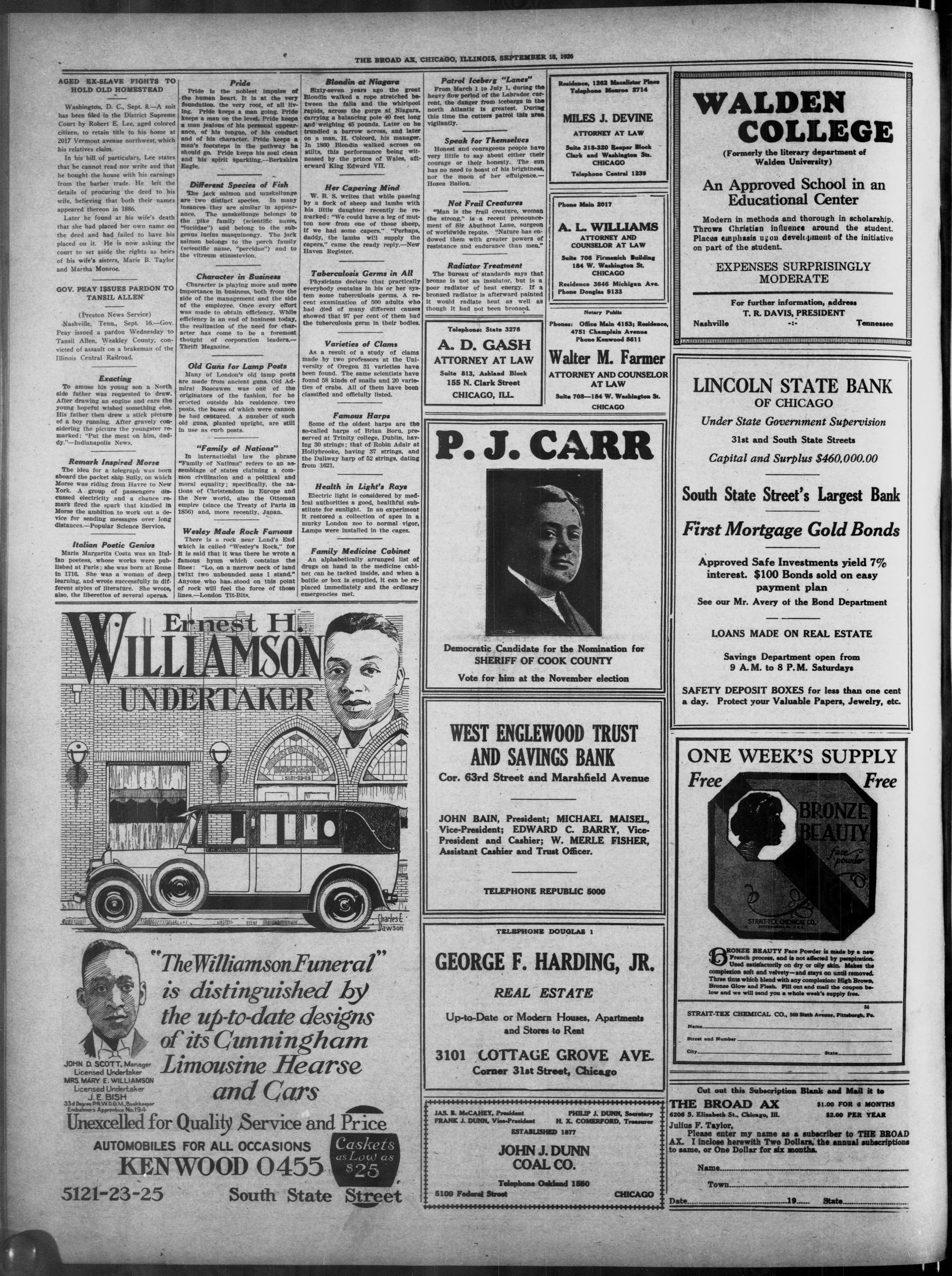
Democratic Candidate for the Nomination for SHERIFF OF COOK COUNTY Vote for him at the November election
WEST ENGLEWOOD TRUST AND SAVINGS BANK
Cor. 63rd Street and Marshfield Avenue
JOHN BAIN, President; MICHAEL MAISEL, Vice-President; EDWARD C. BARRY, VicePresident and Cashier; W. MERLE FISHER, Assistant Cashier and Trust Officer.
TELEPHONE DOUGLAS 1
GEORGE F. H.
REAL E
Up-to-Date or Modern
and Store
3101 COTTAGE
Corner 31st St
JAS. B. McCAHEY, President
FRANK J. DUNN, Vice-President
ESTABLISH
AGE F. HARDIN
REAL ESTATE
State or Modern Houses, A
and Stores to Rent
CLOTTAGE GROVE
Corner 31st Street, Chicago
KEY, President
IL, Vice-President
PHILIP J. B.
H. X. COMERR
ESTABLISHED 1877
3101 COTTAGE GROVE AVE. Corner 31st Street, Chicago
JOHN J. DUNN
COAL CO.
Telephone Oakland 1550
5100 Federal Street
Telephone Oakland 1580
Street
Residence, 1262 Macalister Place
Telephone Monroe 2714
MILES J. DEVINE
ATTORNEY AT LAW
Suite 318-320 Reaper Block
Clark and Washington Sts.
CHICAGO
Telephone Central 1239
Phone Main 2017
A. L. WILLIAMS
ATTORNEY AND
COUNSELOR AT LAW
Suite 706 Firmenich Building
184 W. Washington St.
CHICAGO
Residence 3646 Michigan Ave.
Phone Douglas 9133
Phone: Office Main 4153; Residence,
4751 Champlain Avenue
Phone Kenwood 5611
Walter M. Farmer
ATTORNEY AND COUNSELOR AT LAW
Suite 708—184 W. Washington St.
CHICAGO
FOR the Nomination for
BOOK COUNTY
November election
WOOD TRUST
BINGS BANK
Marshfield Avenue
MICHAEL MAISEL,
BARD C. BARRY, Vice-
W. MERLE FISHER,
Just Officer.
REPUBLIC 5000
ARDING, JR.
STATE
In Houses, Apartments
to Rent
GROVE AVE.
Street, Chicago
PHILIP J. DUNN, Secretary
H. X. COMERFORD, Treasurer
ED 1877
Berkland 1580
CHICAGO
(Formerly the literary department of Walden University)
An Approved School in the Educational Center
certain in methods and thorough in schools
his Christian influence around the state
emphasis upon development of the in-
stitution of the student.
EXPENSES SURPRISINGLY MODERATE
For further information, address
T. R. DAVIS, PRESIDENT
ville -:- Ten
LINCOLN STATE BANK
OF CHICAGO
Under State Government Supervise
31st and South State Streets
Capital and Surplus $460,000.00
State Street's Largest
Mortgage Gold Bond
Proved Safe Investments yield
interest. $100 Bonds sold on eas-
payment plan
our Mr. Avery of the Bond Depart-
DANS MADE ON REAL ESTATE
An Approved School in an Educational Center
Modern in methods and thorough in scholarship.
Throws Christian influence around the student.
Places emphasis upon development of the initiative on part of the student.
EXPENSES SURPRISINGLY MODERATE
For further information, address
T. R. DAVIS, PRESIDENT
Nashville Tennessee
LINCOLN STATE BANK OF CHICAGO
Under State Government Supervision
31st and South State Streets
Capital and Surplus $460,000.00
South State Street's Largest Bank
Approved Safe Investments yield 7% interest. $100 Bonds sold on easy payment plan See our Mr. Avery of the Bond Department
LOANS MADE ON REAL ESTATE
Savings Department open from
9 A.M. to 8 P.M. Saturdays
TY DEPOSIT BOXES for less than or
Protect your Valuable Papers, Jewel
SAFETY DEPOSIT BOXES for less than one cent a day. Protect your Valuable Papers, Jewelry, etc.
ONE WEEK'S SUPPLY
Free Free
BRONZE
BEAUTY
face
powder
STRATE-TEX CHEMICAL CO.
BROZENE BEAUTY Face Powder is made by a new French process, and is not affected by perspiration. Used satisfactorily on dry or oily skin. Makes the complexion soft and velvety and stays on until removed. Three tints which blend with any complexion: High Brown, Bronze Glow and Flesh. Fill out and mail the coupon below and we will send you a whole week's supply free.
Cut out this Subscription Blank and Mail it to
THE BROAD AX
$1.00 FOR 6 MONTHS
6206 S. Elizabeth St., Chicago, Ill.
$2.00 PER YEAR
Julius F. Taylor,
Please enter my name as a subscriber to THE BROAD AX. I inclose herewith Two Dollars, the annual subscriptions to same, or One Dollar for six months.
Name.....
Town.....
Date....19 State....