The Broad Ax
Saturday, October 23, 1926
Chicago, Illinois
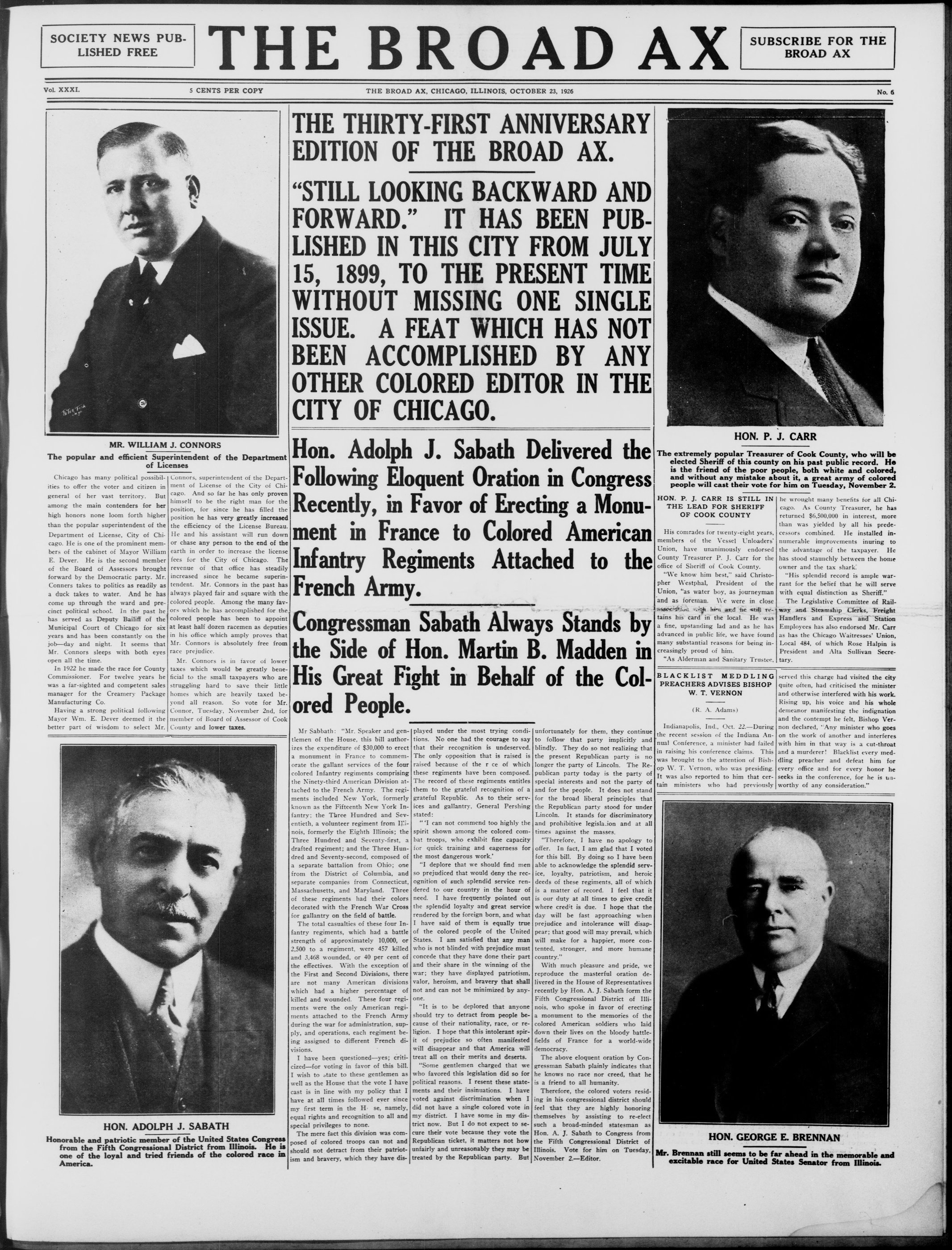
Page text (machine-generated)
SOCIETY NEWS PUBLISHED FREE
Vol. XXXI.
[Name]
William T.
MR. WILLIAM J. CONNORS
The popular and efficient Superintendent of the Department of Licenses
Chicago has many political possibilities to offer the voter and citizen in general of her vast territory. But among the main contenders for her high honors none loom forth higher than the popular superintendent of the Department of License, City of Chicago. He is one of the prominent members of the cabinet of Mayor William E. Dever. He is the second member of the Board of Assessors brought forward by the Democratic party. Mr. Conners takes to politics as readily as a duck takes to water. And he has come up through the ward and precinct political school. In the past he has served as Deputy Bailiff of the Municipal Court of Chicago for six years and has been constantly on the job—day and night. It seems that Mr. Connors sleeps with both eyes open all the time. In 1922 he made the race for County Commissioner. For twelve years he was a far-sighted and competent sales manager for the Creamery Package Manufacturing Co.
Having a strong political following Mayor Wm. E. Dever deemed it the better part of wisdom to select Mr. Conno member Count
Having a strong political following Connor, Tuesday, November 2nd, for Mayor Wm. E. Dever deemed it the member of Board of Assessor of Cook better part of wisdom to select Mr. County and lower taxes.
[Image of a man with a mustache and a suit]
[Name]
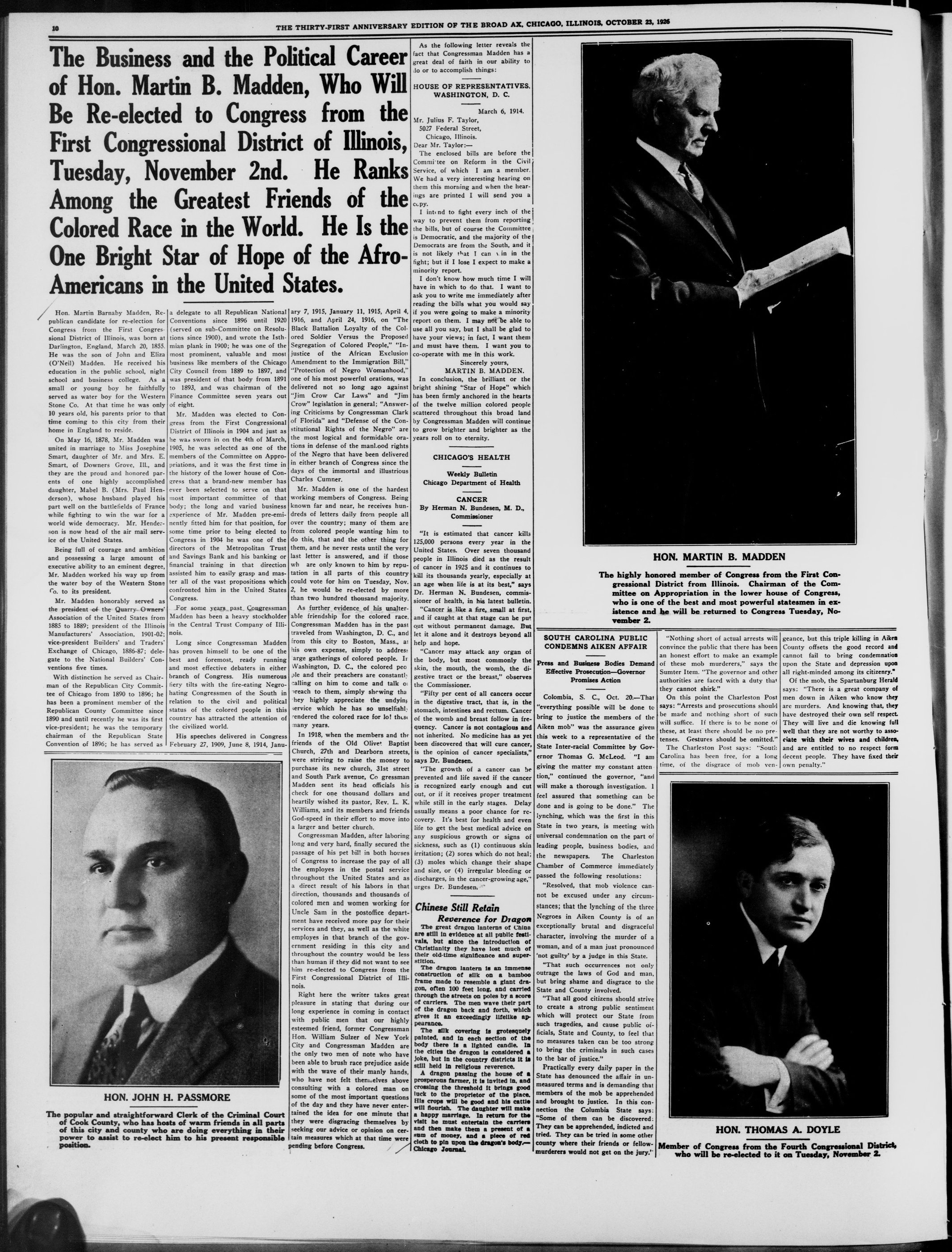
HON. ADOLPH J. SABATH
Honorable and patriotic member of the United States from the Fifth Congressional District from one of the loyal and tried friends of the o America.
patriotic member of the United S
fifth Congressional District from
loyal and tried friends of the c
Honorable and patriotic member of the United States Congress from the Fifth Congressional District from Illinois. He is one of the loyal and tried friends of the colored race in America.
Honorable and patriotic member of the United States Congress from the Fifth Congressional District from Illinois. He is one of the loyal and tried friends of the colored race in America.
Vol. XXXI.
5 CENTS PER COPY
```markdown
```
Connors, superintendent of the Department of License of the City of Chicago. And so far he has only proven himself to be the right man for the position, for since he has filled the position he has very greatly increased the efficiency of the License Bureau. He and his assistant will run down or chase any person to the end of the earth in order to increase the license fees for the City of Chicago. The revenue of that office has steadily increased since he became superintendent. Mr. Connors in the past has always played fair and square with the colored people. Among the many favors which he has accomplished for the colored people has been to appoint at least half dozen racemen as deputies in his office which amply proves that Mr. Connors is absolutely free from race prejudice.
Mr. Connors is in favor of lower taxes which would be greatly beneficial to the small taxpayers who are struggling hard to save their little homes which are heavily taxed beyond all reason. So vote for Mr. Connor, Tuesday, November 2nd, for member of Board of Assessor of Cook County and lower taxes.
of the United States Congressal District from Illinois. He is friends of the colored race in
THE BROAD AX
THE BROAD AX, CHICAGO, ILLINOIS, OCTOBER 23, 1926
THE THIRTY-FIRST ANNIVERSARY EDITION OF THE BROAD AX.
"STILL LOOKING BACKWARD AND FORWARD." IT HAS BEEN PUBLISHED IN THIS CITY FROM JULY 15, 1899, TO THE PRESENT TIME WITHOUT MISSING ONE SINGLE ISSUE. A FEAT WHICH HAS NOT BEEN ACCOMPLISHED BY ANY OTHER COLORED EDITOR IN THE CITY OF CHICAGO.
Hon. Adolph J. Sabath Delivered the Following Eloquent Oration in Congress Recently, in Favor of Erecting a Monument in France to Colored American Infantry Regiments Attached to the French Army.
Congressman Sabath Always Stands by the Side of Hon. Martin B. Madden in His Great Fight in Behalf of the Colored People.
Mr Sabbath: "Mr. Speaker and gentlemen of the House, this bill authorizes the expenditure of $30,000 to erect a monument in France to commemorate the gallant services of the four colored Infantry regiments comprising the Ninety-third American Division attached to the French Army. The regiments included New York, formerly known as the Fifteenth New York Infantry; the Three Hundred and Seventieth, a volunteer regiment from Illinois, formerly the Eighth Illinois; the Three Hundred and Seventy-first, a drafted regiment; and the Three Hundred and Seventy-second, composed of a separate battalion from Ohio; one from the District of Columbia, and separate companies from Connecticut, Massachusetts, and Maryland. Three of these regiments had their colors decorated with the French War Cross for gallantry on the field of battle.
The total casualties of these four Infantry regiments, which had a battle strength of approximately 10,000, or 2,500 to a regiment, were 457 killed and 3,468 wounded, or 40 per cent of the effects. With the exception of the First and Second Divisions, there are not many American divisions which had a higher percentage of killed and wounded. These four regiments were the only American regiments attached to the French Army during the war for administration, supply, and operations, each regiment being assigned to different French divisions.
I have been questioned—yes; criticized—for voting in favor of this bill. I wish to state to these gentlemen as well as the House that the vote I have cast is in line with my policy that I have at all times followed ever since my first term in the H. se, namely, equal rights and recognition to all and special privileges to none.
The mere fact this division was composed of colored troops can not and should not detract from their patriotism and bravery, which they have dis-
played under the most trying conditions. No one had the courage to say that their recognition is undeserved. The only opposition that is raised is raised because of the rce of which these regiments have been composed. The record of these regiments entitles them to the grateful recognition of a grateful Republic. As to their services and gallantry, General Pershing stated: "I can not commend too highly the spirit shown among the colored combat troops, who exhibit fine capacity for quick training and eagerness for the most dangerous work."
"I deplore that we should find men so prejudiced that would deny the recognition of such splendid service rendered to our country in the hour of need. I have frequently pointed out the splendid loyalty and great service rendered by the foreign born, and what I have said of them is equally true of the colored people of the United States. I am satisfied that any man who is not blinded with prejudice must concede that they have done their part and their share in the winning of the war; they have displayed patriotism, valor, heroism, and bravery that shall not and can not be minimized by anyone.
"It is to be deplored that anyone should try to detract from people because of their nationality, race, or religion. I hope that this intolerant spirit of prejudice so often manifested will disappear and that America will treat all on their merits and deserts.
"Some gentlemen charged that we who favored this legislation did so for political reasons. I resent these statements and their insinuations. I have voted against discrimination when I did not have a single colored vote in my district. I have some in my district now. But I do not expect to secure their vote because they vote the Republican ticket, it matters not how unfairly and unreasonably they may be treated by the Republican party. But
unfortunately for them, they continue to follow that party implicitly and blindly. They do so not realizing that the present Republican party is no longer the party of Lincoln. The Republican party today is the party of special interests and not the party of and for the people. It does not stand for the broad liberal principles that the Republican party stood for under Lincoln. It stands for discriminatory and prohibitive legislation and at all times against the masses.
"Therefore, I have no apology to offer. In fact, I am glad that I voted for this bill. By doing so I have been able to acknowledge the splendid service, loyalty, patriotism, and heroic deeds of these regiments, all of which is a matter of record. I feel that it is our duty at all times to give credit where credit is due. I hope that the day will be fast approaching when prejudice and intolerance will disappear; that good will may prevail, which will make for a happier, more contented, stronger, and more humane country."
With much pleasure and pride, we reproduce the masterful oration delivered in the House of Representatives recently by Hon. A. J. Sabath form the Fifth Congressional District of Illinois, who spoke in favor of erecting a monument to the memories of the colored American soldiers who laid down their lives on the bloody battlefields of France for a world-wide democracy.
The above eloquent oration by Congressman Sabath plainly indicates that he knows no race nor creed, that he is a friend to all humanity.
Therefore, the colored voters residing in his congressional district should feel that they are highly honoring themselves by assisting to re-elect such a broad-minded statesman as Hon. A. J. Sabath to Congress from the Fifth Congressional District of Illinois. Vote for him on Tuesday, November 2.—Editor.
SUBSCRIBE FOR THE BROAD AX
Y
No. 6
HON. P. J. CARR
The extremely popular Treasurer elected Sheriff of this county is the friend of the poor p and without any mistake a people will cast their vote for
HON. P. J. CARR IS STILL IN THE LEAD FOR SHERIFF OF COOK COUNTY
my popular Treasurer of Cook County
meriff of this county on his past publ
end of the poor people, both white
but any mistake about it, a great au
all cast their vote for him on Tuesday
Treasurer of Cook County, who will be is county on his past public record. He poor people, both white and colored, stake about it, a great army of colored vote for him on Tuesday, November 2.
The extremely popular Treasurer of Cook County, who will be elected Sheriff of this county on his past public record. He is the friend of the poor people, both white and colored, and without any mistake about it, a great army of colored people will cast their vote for him on Tuesday, November 2.
His comrades for twenty-eight years, members of the Vessel Unloaders' Union, have unanimously endorsed County Treasurer P. J. Carr for the office of Sheriff of Cook County.
"We know him best," said Christopher Westphal, President of the Union, "as water boy, as journeyman and as foreman. We were in close association with him and he still retains his card in the local. He was a fine, upstanding lad and as he has advanced in public life, we have found many substantial reasons for being increasingly proud of him.
"As Alderman and Sanitary Trustee,
BLACKLIST MEDDLING
PREACHERS ADVISES BISHOP
W. T. VERNON
Indianapolis, Ind., Oct. 22.—During the recent session of the Indiana Annual Conference, a minister had failed in raising his conference claims. This was brought to the attention of Bishop W. T. Vernon, who was presiding. It was also reported to him that certain ministers who had previously
[Name]
M.
[Picture of a man in a suit and tie].
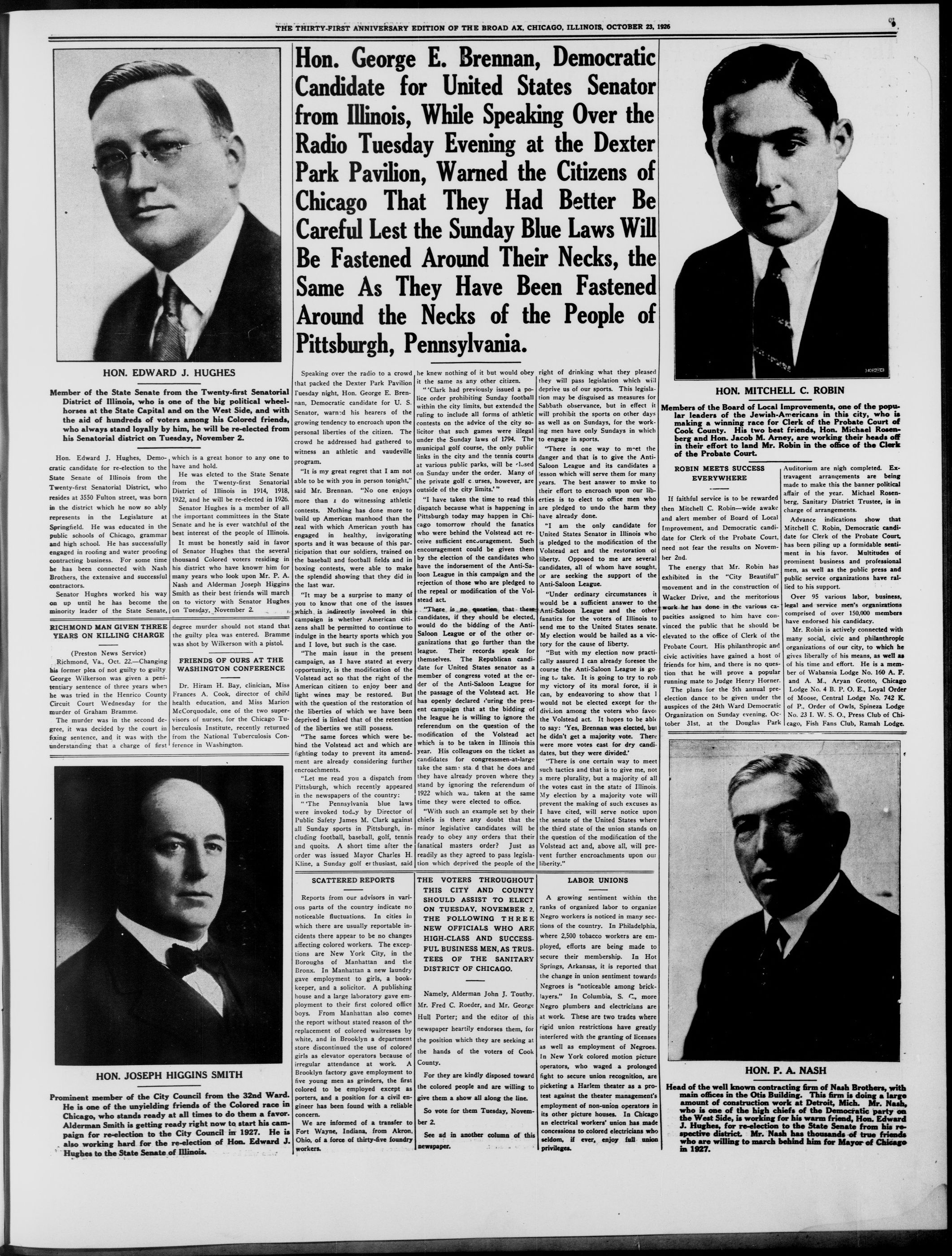
HON. GEORGE E. BRENNAN
Mr. Brennan still seems to be far ahead in the n excitable race for United States Senator fro
still seems to be far ahead in the m race for United States Senator from
to be far ahead in the memorable and United States Senator from Illinois.
Mr. Brennan still seems to be far ahead in the memorable and excitable race for United States Senator from Illinois.
he wrought many benefits for all Chicago. As County Treasurer, he has returned $6,500,000 in interest, more than was yielded by all his predecessors combined. He installed innumerable improvements inuring to the advantage of the taxpayer. He has stood staunchly between the home owner and the tax shark:
"His splendid record is ample warrant for the belief that he will serve with equal distinction as Sheriff."
The Legislative Committee of Railway and Steamship Clerks, Freight Handlers and Express and Station Employees has also endorsed Mr. Carr as has the Chicago Waitresses' Union, Local 484, of which Rose Halpin is President and Alta Sullivan Secretary.
served this charge had visited the city quite often, had criticised the minister and otherwise interfered with his work. Rising up, his voice and his whole demeanor manifesting the indignation and the contempt he felt, Bishop Vernon declared, "Any minister who goes on the work of another and interferes with him in that way is a cut-throat and a murderer! Blacklist every meddling preacher and defeat him for every office and for every honor he seeks in the conference, for he is unworthy of any consideration."
M. H.
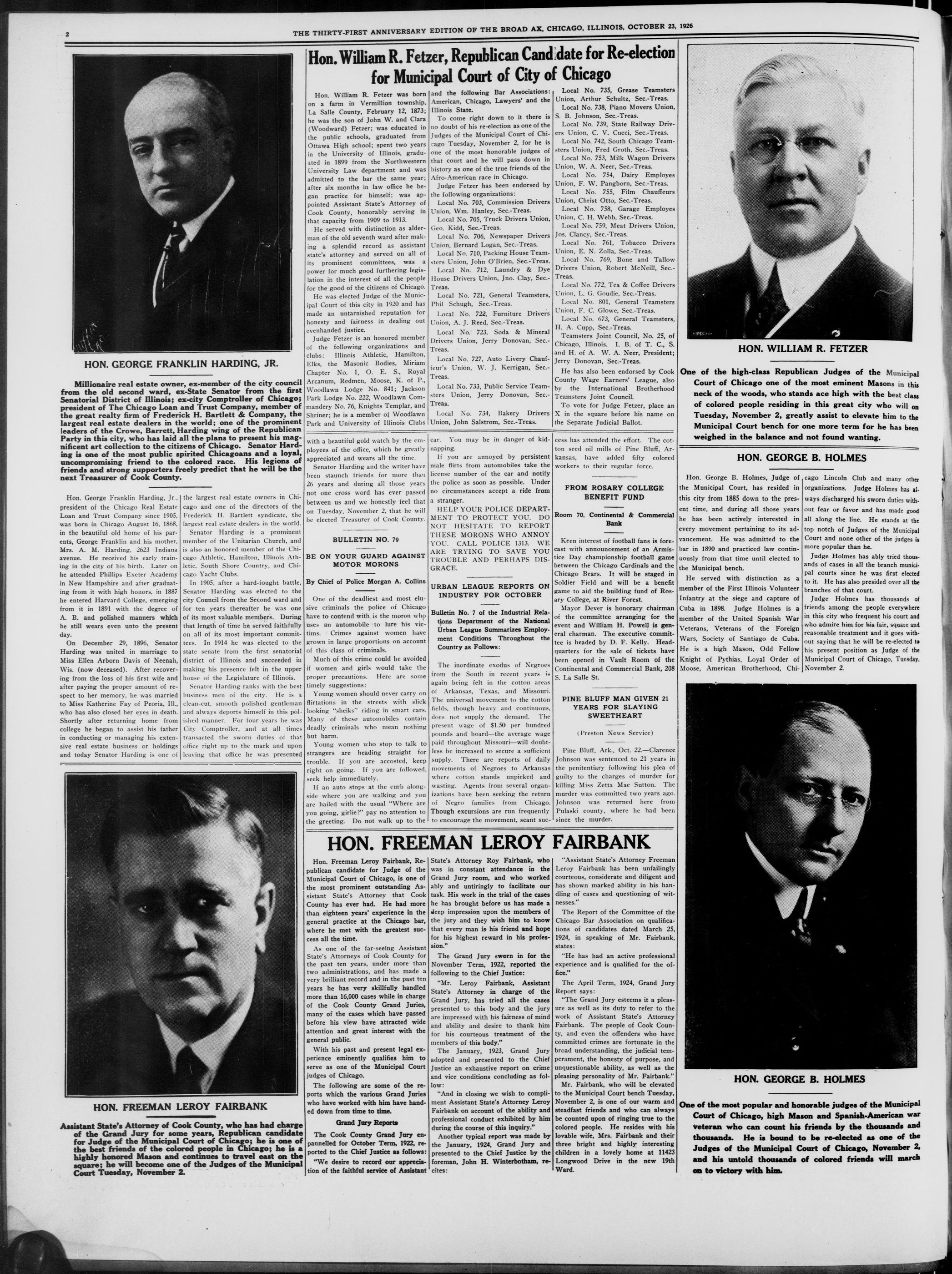
HON. GEORGE FRANKLIN HARDING, JR.
Millionaire real estate owner, ex-member of the city council from the old second ward, ex-State Senator from the first Senatorial District of Illinois; ex-city Comptroller of Chicago; president of The Chicago Loan and Trust Company, member of the great realty firm of Frederick H. Bartlett & Company, the largest real estate dealers in the world; one of the prominent leaders of the Crowe, Barrett, Harding wing of the Republican Party in this city, who has laid all the plans to present his magnificent art collection to the citizens of Chicago. Senator Harding is one of the most public spirited Chicagoans and a loyal, uncompromising friend to the colored race. His legions of friends and strong supporters freely predict that he will be the next Treasurer of Cook County.
M. B.
HON. FREEMAN LEROY FAIRBANK Assistant State's Attorney of Cook County, who has had charge of the Grand Jury for some years, Republican candidate for Judge of the Municipal Court of Chicago; he is one of the best friends of the colored people in Chicago; he is a highly honored Mason and continues to travel east on the square; he will become one of the Judges of the Municipal Court Tuesday, November 2.
2
Hon. George Franklin Harding, Jr., president of the Chicago Real Estate Loan and Trust Company since 1905, was born in Chicago August 16, 1868, in the beautiful old home of his parents, George Franklin and his mother, Mrs. A. M. Harding, 2623 Indiana avenue. He received his early training in the city of his birth. Later on he attended Phillips Exeter Academy in New Hampshire and after graduating from it with high honors, in 1887 he entered Harvard College, emerging from it in 1891 with the degree of A. B. and polished manners which he still wears even unto the present day.
On December 29, 1896, Senator Harding was united in marriage to Miss Ellen Arborn Davis of Neenah, Wis. (now deceased). After recovering from the loss of his first wife and after paying the proper amount of respect to her memory, he was married to Miss Katherine Fay of Peoria, Ill., who has also closed her eyes in death. Shortly after returning home from college he began to assist his father in conducting or managing his extensive real estate business or holdings and today Senator Harding is one of
the largest real estate owners in Chicago and one of the directors of the Frederick H. Bartlett syndicate, the largest real estate dealers in the world. Senator Harding is a prominent member of the Unitarian Church, and is also an honored member of the Chicago Athletic, Hamilton, Illinois Athletic, South Shore Country, and Chicago Yacht Clubs.
In 1905, after a hard-iought battle, Senator Harding was elected to the city Council from the Second ward and for ten years thereafter he was one of its most valuable members. During that length of time he served faithfully on all of its most important committees. In 1914 he was elected to the state senate from the first senatorial district of Illinois and succeeded in making his presence felt in the upper house of the Legislature of Illinois. Senator Harding ranks with the best business men of the city. He is a clean-cut, smooth polished gentleman and always deports himself in this polished manner. For four years he was City Comptroller, and at all times transacted the sworn duties of that office right up to the mark and upon leaving that office he was presented
THE THIRTY-FIRST ANNIVERSARY EDITION OF THE BROAD AX, CHICAGO, ILLINOIS, OCTOBER 23, 1926
Hon. William R. Fetzer, Republican Candidate for Re-election for Municipal Court of City of Chicago
HON. FREEMAN LEROY FAIRBANK
Hon. William R. Fetzer was born on a farm in Vermillion township, La Salle County, February 12, 1873; he was the son of John W. and Clara (Woodward) Fetzer; was educated in the public schools, graduated from Ottawa High school; spent two years in the University of Illinois, graduated in 1899 from the Northwestern University Law department and was admitted to the bar the same year; after six months in law office he began practice for himself; was appointed Assistant State's Attorney of Cook County, honorably serving in that capacity from 1909 to 1913.
He served with distinction as alderman of the old seventh ward after making a splendid record as assistant state's attorney and served on all of its prominent committees, was a power for much good furthering legislation in the interest of all the people for the good of the citizens of Chicago. He was elected Judge of the Municipal Court of this city in 1920 and has made an unfarnished reputation for honesty and fairness in dealing out evenhanded justice.
Judge Fetzer is an honored member of the following organizations and clubs: Illinois Athletic, Hamilton, Elks, the Masonic Bodies, Miriam Chapter No. 1, O. E. S., Royal Arcanum, Redmen, Moose, K. of P., Woodlawn Lodge No. 841; Jackson Park Lodge No. 222, Woodlawn Commandery No. 76, Knights Templar, and Shriner; he is a member of Woodlawn Park and University of Illinois Clubs with a beautiful gold watch by the employees of the office, which he greatly appreciated and wears all the time.
Senator Harding and the writer have been staunch friends for more than 26 years and during all those years not one cross word has ever passed between us and we honestly feel that on Tuesday, November 2, that he will be elected Treasurer of Cook County
BULLETIN NO. 79
BE ON YOUR GUARD AGAINST
MOTOR MORONS
By Chief of Police Morgan A. Collins
One of the deadliest and most elusive criminals the police of Chicago have to contend with is the moron who uses an automobile to lure his victims. Crimes against women have grown in large proportions on account of this class of criminals.
Much of this crime could be avoided if women and girls would take the proper precautions. Here are some timely suggestions:
Young women should never carry on flirtations in the streets with slick looking "sheiks" riding in smart cars. Many of these automobiles contain deadly criminals who mean nothing but harm.
Young women who stop to talk to strangers are heading straight for trouble. If you are accosted, keep right on going. If you are followed, seek help immediately.
If an auto stops at the curb alongside where you are walking and you are hailed with the usual "Where are you going, girlie?" pay no attention to the greeting. Do not walk up to the
Hon. Freeman Leroy Fairbank, Republican candidate for Judge of the Municipal Court of Chicago, is one of the most prominent outstanding Assistant State's Attorney that Cook County has ever had. He had more than eighteen years' experience in the general practice at the Chicago bar, where he met with the greatest success all the time.
As one of the far-seeing Assistant State's Attorneys of Cook County for the past ten years, under more than two administrations, and has made a very brilliant record and in the past ten years he has very skillfully handled more than 16,000 cases while in charge of the Cook County Grand Juries, many of the cases which have passed before his view have attracted wide attention and great interest with the general public.
With his past and present legal experience eminently qualifies him to serve as one of the Municipal Court judges of Chicago.
The following are some of the reports which the various Grand Juries who have worked with him have handed down from time to time.
Grand Jury Reports
The Cook County Grand Jury ennalleled for October Term, 1922, reported to the Chief Justice as follows: "We desire to record our appreciation of the faithful service of Assistant
and the following Bar Associations: American, Chicago, Lawyers' and the Illinois State.
To come right down to it there is no doubt of his re-election as one of the Judges of the Municipal Court of Chicago Tuesday, November 2, for he is one of the most honorable judges of that court and he will pass down in history as one of the true friends of the Afro-American race in Chicago.
Judge Fetzer has been endorsed by the following organizations:
Local No. 703, Commission Drivers Union, Wm. Hanley, Sec.-Treas.
Local No. 705, Truck Drivers Union, Geo. Kidd, Sec.-Treas.
Local No. 734, Bakery Drivers Union, John Salstrom, Sec.-Treas.
car. You may be in danger of kidnapping.
If you are annoyed by persistent male flirts from automobiles take the license number of the car and notify the police as soon as possible. Under no circumstances accept a ride from a stranger.
HELP YOUR POLICE DEPARTMENT TO PROTECT YOU. DO NOT HESITATE TO REPORT THESE MORONS WHO ANNOY YOU. CALL POLICE 1313. WE ARE TRYING TO SAVE YOU TROUBLE AND PERHAPS DISGRACE.
URBAN LEAGUE REPORTS ON INDUSTRY FOR OCTOBER
Bulletin No. 7 of the Industrial Relations Department of the National Urban League Summarizes Employment Conditions Throughout the Country as Follows:
The inordinate exodus of Negroes from the South in recent years is again being felt in the cotton areas of Arkansas, Texas, and Missouri. The universal movement to the cotton fields, though heavy and continuous, does not supply the demand. The present wage of $1.50 per hundred pounds and board—the average wage paid throughout Missouri—will doubtless be increased to secure a sufficient supply. There are reports of daily movements of Negroes to Arkansas where cotton stands unpicked and wasting. Agents from several organizations have been seeking the return of Negro families from Chicago. Though excursions are run frequently to encourage the movement, scant suc-
State's Attorney Roy Fairbank, who was in constant attendance in the Grand Jury room, and who worked ably and untiringly to facilitate our task. His work in the trial of the cases he has brought before us has made a deep impression upon the members of the jury and they wish him to know that every man is his friend and hope for his highest reward in his profession."
The Grand Jury sworn in for the November Term, 1922, reported the following to the Chief Justice:
"Mr. Leroy Fairbank, Assistant State's Attorney in charge of the Grand Jury, has tried all the cases presented to this body and the jury are impressed with his fairness of mind and ability and desire to thank him for his courteous treatment of the members of this body."
The January, 1923, Grand Jury adopted and presented to the Chief Justice an exhaustive report on crime and vice conditions concluding as follow:
"And in closing we wish to compliment Assistant State's Attorney Leroy Fairbank on account of the ability and professional conduct exhibited by him during the course of this inquiry."
Another typical report was made by the January, 1924, Grand Jury and presented to the Chief Justice by the foreman, John H. Winterbotham, recites:
To vote for Judge Fetzer, place an X in the square before his name on the Separate Judicial Ballot.
cess has attended the effort. The cotton seed oil mills of Pine Bluff, Arkansas, have added fifty colored workers to their regular force.
FROM ROSARY COLLEGE
BENEFIT FUND
Room 70, Continental & Commercial Bank
Keen interest of football fans is forecast with announcement of an Armistice Day championship football game between the Chicago Cardinals and the Chicago Bears. It will be staged in Soldier Field and will be a benefit game to aid the building fund of Rosary College, at River Forest.
Mayor Dever is honorary chairman of the committee arranging for the event and William H. Powell is general charman. The executive committee is headed by D. F. Kelly. Headquarters for the sale of tickets have been opened in Vault Room of the Continental and Commercial Bank, 208 S. La Salle St.
PINE BLUFF MAN GIVEN 21
YEARS FOR SLAYING
SWEETHEART
(Preston News Service)
Pine Bluff, Ark., Oct. 22.—Clarence Johnson was sentenced to 21 years in the penitentiary following his plea of guilty to the charges of murder for killing Miss Zetta Mae Sutton. The murder was committed two years ago. Johnson was returned here from Pulaski county, where he had been since the murder.
"Assistant State's Attorney Freeman Leroy Fairbank has been unfailingly courteous, considerate and diligent and has shown marked ability in his handling of cases and questioning of witnesses."
The Report of the Committee of the Chicago Bar Association on qualifications of candidates dated March 25, 1924, in speaking of Mr. Fairbank, states:
"He has had an active professional experience and is qualified for the office."
The April Term, 1924, Grand Jury Report says:
"The Grand Jury esteems it a pleasure as well as its duty to refer to the work of Assistant State's Attorney Fairbank. The people of Cook County, and even the offenders who have committed crimes are fortunate in the broad understanding, the judicial temperament, the honesty of purpose, and unquestionable ability, as well as the pleasing personality of Mr. Fairbank." Mr. Fairbank, who will be elevated to the Municipal Court bench Tuesday, November 2, is one of our warm and steadfast friends and who can always be counted upon of ringing true to the colored people. He resides with his lovable wife, Mrs. Fairbank and their three bright and highly interesting children in a lovely home at 11423 Longwood Drive in the new 19th Ward.
```markdown
```
CORRECTED
HON. WILLIAM R. FETZER
One of the high-class Republican Judges of the Court of Chicago one of the most eminent neck of the woods, who stands ace high with of colored people residing in this great city Tuesday, November 2, greatly assist to elevate Municipal Court bench for one more term for weighed in the balance and not found want
high-class Republican Judges of the Chicago one of the most eminent in the woods, who stands ace high with all people residing in this great city. November 2, greatly assist to elevate Court bench for one more term for in the balance and not found wanti
One of the high-class Republican Judges of the Municipal Court of Chicago one of the most eminent Masons in this neck of the woods, who stands ace high with the best class of colored people residing in this great city who will on Tuesday, November 2, greatly assist to elevate him to the Municipal Court bench for one more term for he has been weighed in the balance and not found wanting.
HON. GEORGE B. HOLMES
Hon. George B. Holmes, Judge of the Municipal Court, has resided in this city from 1885 down to the present time, and during all those years he has been actively interested in every movement pertaining to its advancement. He was admitted to the bar in 1890 and practiced law continuously from that time until elected to the Municipal bench.
He served with distinction as a member of the First Illinois Volunteer Infantry at the siege and capture of Cuba in 1898. Judge Holmes is a member of the United Spanish War Veterans, Veterans of the Foreign Wars, Society of Santiago de Cuba. He is a high Mason, Odd Fellow Knight of Pythias, Loyal Order of Moose, American Brotherhood, Chi-
```markdown
```
[Name]
[Name]
HON. GEORGE B. HOLMES
One of the most popular and honorable judges of Court of Chicago, high Mason and Spanish veteran who can count his friends by the thousands. He is bound to be re-elected Judges of the Municipal Court of Chicago and his untold thousands of colored friend on to victory with him.
most popular and honorable judges of Chicago, high Mason and Spanish- who can count his friends by the time. He is bound to be re-elected at the Municipal Court of Chicago, untold thousands of colored friend- story with him.
One of the most popular and honorable judges of the Municipal Court of Chicago, high Mason and Spanish-American war veteran who can count his friends by the thousands and thousands. He is bound to be re-elected as one of the Judges of the Municipal Court of Chicago, November 2, and his untold thousands of colored friends will march on to victory with him.
American Judges of the Municipal the most eminent Masons in this lands ace high with the best class in this great city who will onlly assist to elevate him to the one more term for he has been not found wanting.
cago Lincoln Club and many other organizations. Judge Holmes has always discharged his sworn duties without fear or favor and has made good all along the line. He stands at the top notch of Judges of the Municipal Court and none other of the judges is more popular than he. Judge Holmes has ably tried thousands of cases in all the branch municipal courts since he was first elected to it. He has also presided over all the branches of that court.
Judge Holmes has thousands of friends among the people everywhere in this city who frequent his court and who admire him for his fair, square and reasonable treatment and it goes without saying that he will be re-elected to his present position as Judge of the Municipal Court of Chicago, Tuesday, November 2.
THE FEDERAL NATIONAL PARKS AND WATERWAYS AUTHORITY
amorable judges of the Municipal Jison and Spanish-American war friends by the thousands and to be re-elected as one of the Court of Chicago, November 2, of colored friends will march
```markdown
```
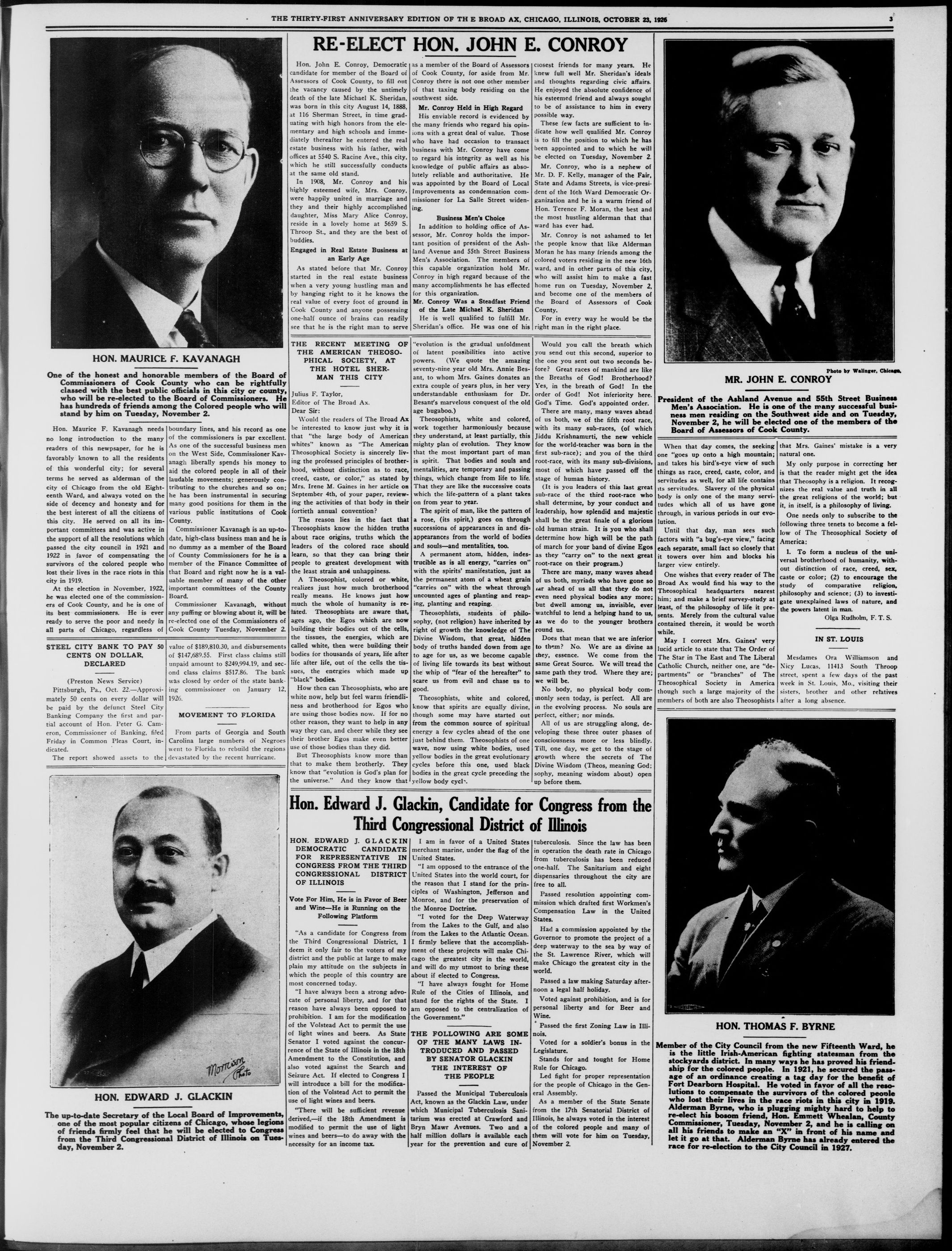
HON. MAURICE F. KAVANAGH
One of the honest and honorable members of the Commissioners of Cook County who can be classed with the best public officials in this city who will be re-elected to the Board of Commis has hundreds of friends among the Colored peo stand by him on Tuesday, November 2.
In honest and honorable members of the missioners of Cook County who can be with the best public officials in this city be re-elected to the Board of Commissieds of friends among the Colored peo him on Tuesday, November 2.
One of the honest and honorable members of the Board of Commissioners of Cook County who can be rightfully classed with the best public officials in this city or county, who will be re-elected to the Board of Commissioners. He has hundreds of friends among the Colored people who will stand by him on Tuesday, November 2.
Hon. Maurice F. Kavanagh needs no long introduction to the many readers of this newpsaper, for he is favorably known to all the residents of this wonderful city; for several terms he served as alderman of the city of Chicago from the old Eighteenth Ward, and always voted on the side of decency and honesty and for the best interest of all the citizens of this city. He served on all its important committees and was active in the support of all the resolutions which passed the city council in 1921 and 1922 in favor of compensating the survivors of the colored people who lost their lives in the race riots in this city in 1919.
At the election in November, 1922, he was elected one of the commissioners of Cook County, and he is one of its best commissioners. He is ever ready to serve the poor and needy in all parts of Chicago, regardless of
STEEL CITY BANK TO PAY 50
CENTS ON DOLLAR,
DECLARED
(Preston News Service)
Pittsburgh, Pa., Oct. 22.—Approximately 50 cents on every dollar will be paid by the defunct Steel City Banking Company the first and partial account of Hon. Peter G. Cameron, Commissioner of Banking, filed Friday in Common Pleas Court, indicated.
The report showed assets to the
The report showed assets to the devastated by the recent hurricane.
Morrison
Morrison
Photo
HON. EDWARD J. GLACKIN
The up-to-date Secretary of the Local Board of In one of the most popular citizens of Chicago, y of friends firmly feel that he will be elected from the Third Congressional District of Illin day, November 2.
State Secretary of the Local Board of Imp
the most popular citizens of Chicago, wh
is firmly feel that he will be elected to
Third Congressional District of Illinois
member 2.
The up-to-date Secretary of the Local Board of Improvements, one of the most popular citizens of Chicago, whose legions of friends firmly feel that he will be elected to Congress from the Third Congressional District of Illinois on Tuesday, November 2.
table members of the Board of County who can be rightfully officials in this city or county, the Board of Commissioners. Heong the Colored people who will November 2.
boundary lines, and his record as one of the commissioners is par excellent. As one of the successful business men on the West Side, Commissioner Kavanagh liberally spends his money to aid the colored people in all of their laudable movements; generously contributing to the churches and so on he has been instrumental in securing many good positions for them in the various public institutions of Cook County.
Commissioner Kavanagh is an up-to-date, high-class business man and he is no dummy as a member of the Board of County Commissioners for he is a member of the Finance Committee of that Board and right now he is a valuable member of many of the other important committees of the County Board.
Commissioner Kavanagh, without any puffing or blowing about it, will be re-elected one of the Commissioners of Cook County Tuesday, November 2.
value of $189,810.30, and disbursements of $147,689.55. First class claims still unpaid amount to $249,994.19, and second class claims $517.86. The bank was closed by order of the state banking commissioner on January 12, 1926.
MOVEMENT TO FLORIDA
From parts of Georgia and South Carolina large numbers of Negroes went to Florida to rebuild the regions devastated by the recent hurricane.
Morrison
Photo
Local Board of Improvements, citizens of Chicago, whose legions we will be elected to Congress Local District of Illinois on Tues-
THE THIRTY-FIRST ANNIVERSARY EDITION OF THE BROAD AX, CHICAGO, ILLINOIS, OCTOBER 23, 1926
RE-ELECT HON. JOHN E. CONROY
Hon. Edward J. Glackin, Candidate for Congress from the Third Congressional District of Illinois
Hon. John E. Conroy, Democratic candidate for member of the Board of Assessors of Cook County, to fill out the vacancy caused by the untimely death of the late Michael K. Sheridan, was born in this city August 14, 1888, at 116 Sherman Street, in time graduating with high honors from the elementary and high schools and immediately thereafter he entered the real estate business with his father, with offices at 5540 S. Racine Ave., this city, which he still successfully conducts at the same old stand.
In 1908, Mr. Conroy and his highly esteemed wife, Mrs. Conroy, were happily united in marriage and they and their highly accomplished daughter, Miss Mary Alice Conroy, reside in a lovely home at 5659 S. Throop St., and they are the best of buddies.
Engaged in Real Estate Business at an Early Age
As stated before that Mr. Conroy started in the real estate business when a very young hustling man and by hanging right to it he knows the real value of every foot of ground in Cook County and anyone possessing one-half ounce of brains can readily see that he is the right man to serve
THE RECENT MEETING OF
THE AMERICAN THEOSO-
PHICAL SOCIETY, AT
THE HOTEL SHER-
MAN THIS CITY
Julius F. Taylor,
Editor of The Broad Ax.
Dear Sir:
Would the readers of The Broad Ax
be interested to know just why it is
that "the large body of American
whites" known as "The American
Theosophical Society is sincerely living
the professed principles of brotherhood,
without distinction as to race,
creed, caste, or color," as stated by
Mrs. Irene M. Gaines in her article
on September 4th, of your paper, reviewing
the activities of that body in their
fortieth annual convention?
The reason lies in the fact that Theosophists know the hidden truths about race origins, truths which the leaders of the colored race should learn, so that they can bring their people to greatest development with the least strain and unhappiness. A Theosophist, colored or white, realizes just how much brotherhood really means. He knows just how much the whole of humanity is related. Theosophists are aware that, ages ago, the Egos which are now building their bodies out of the cells, the tissues, the energies, which are called white, then were building their bodies for thousands of years, life after life after life, out of the cells the tissues, the energies which made up "black" bodies.
How then can Theosophists, who are white now, help but feel warm friendliness and brotherhood for Egos who are using those bodies now. If for no other reason, they want to help in any way they can, and cheer while they see their brother Egos make even better use of those bodies than they did.
But Theosophists know more than that to make them brotherly. They know that "evolution is God's plan for the universe." And they know that
HON. EDWARD J. GLACKIN
DEMOCRATIC CANDIDATE
FOR REPRESENTATIVE IN
CONGRESS FROM THE THIRD
CONGRESSIONAL DISTRICT
OF ILLINOIS
Vote For Him, He is in Favor of Beer
and Wine—He is Running on the
Following Platform
"As a candidate for Congress from
the Third Congressional District,
I deem it only fair to the voters of my
district and the public at large to make
plain my attitude on the subjects in
which the people of this country are
most concerned today.
"I have always been a strong advocate of personal liberty, and for that reason have always been opposed to prohibition. I am for the modification of the Volstead Act to permit the use of light wines and beers. As State Senator I voted against the concurrence of the State of Illinois in the 18th Amendment to the Constitution, and also voted against the Search and Seizure Act. If elected to Congress I will introduce a bill for the modification of the Volstead Act to permit the use of light wines and beers.
"There will be sufficient revenue derived,—if the 18th Amendment is modified to permit the use of light wines and beers—to do away with the necessity for an income tax.
as a member of the Board of Assessors of Cook County, for aside from Mr. Conroy there is not one other member of that taxing body residing on the southwest side.
Mr. Conroy Held in High Regard
His enviable record is evidenced by the many friends who regard his opinions with a great deal of value. Those who have had occasion to transact business with Mr. Conroy have come to regard his integrity as well as his knowledge of public affairs as absolutely reliable and authoritative. He was appointed by the Board of Local Improvements as condemnation commissioner for La Salle Street widening.
Business Men's Choice
In addition to holding office of Assessor, Mr. Conroy holds the important position of president of the Ashland Avenue and 55th Street Business Men's Association. The members of this capable organization hold Mr. Conroy in high regard because of the many accomplishments he has effected for this organization.
Mr. Conroy Was a Steadfast Friend of the Late Michael K. Sheridan He is well qualified to fulfill Mr. Sheridan's office. He was one of his
"evolution is the gradual unfoldment of latent possibilities into active powers. (We quote the amazing seventy-nine year old Mrs. Annie Besant, to whom Mrs. Gaines donates an extra couple of years plus, in her very understandable enthusiasm for Dr. Besant's marvelous conquest of the old age bugaboo.) Theosophists, white and colored, work together harmoniously because they understand, at least partially, this mighty plan of evolution. They know that the most important part of man is spirit. That bodies and souls and mentalities, are temporary and passing things, which change from life to life. That they are like the successive coats which the life-pattern of a plant takes on from year to year.
The spirit of man, like the pattern of a rose, (its spirit,) goes on through successions of appearances in and disappearances from the world of bodies and souls—and mentalities, too.
A permanent atom, hidden, indestructible as is all energy, "carries on" with the spirits manifestation, just as the permanent atom of a wheat grain "carries on" with the wheat through uncounted ages of planting and reaping, planting and reaping.
Theosophists, students of philosophy, (not religion) have inherited by right of growth the knowledge of The Divine Wisdom, that great, hidden body of truths handed down from age to age for us, as we become capable of living life towards its best without the whip of "fear of the hereafter" to scare us from evil and chase us to good.
Theosophists, white and colored, know that spirits are equally divine, though some may have started out from the common source of spiritual energy a few cycles ahead of the one just behind them. Theosophists of one wave, now using white bodies, used yellow bodies in the great evolutionary cycles before this one, used black bodies in the great cycle preceding the yellow body cycle.
I am in favor of a United States merchant marine, under the flag of the United States.
"I am opposed to the entrance of the United States into the world court, for the reason that I stand for the principles of Washington, Jefferson and Monroe, and for the preservation of the Monroe Doctrine.
"I voted for the Deep Waterway from the Lakes to the Gulf, and also from the Lakes to the Atlantic Ocean. I firmly believe that the accomplishment of these projects will make Chicago the greatest city in the world, and will do my utmost to bring these about if elected to Congress.
"I have always fought for Home Rule of the Cities of Illinois, and stand for the rights of the State. I am opposed to the centralization of the Government."
THE FOLLOWING ARE SOME OF THE MANY LAWS INTRODUCED AND PASSED BY SENATOR GLACKIN THE INTEREST OF THE PEOPLE
Passed the Municipal Tuberculosis Act, known as the Glackin Law, under which Municipal Tuberculosis Sanitarium was erected at Crawford and Bryn Mawr Avenues. Two and a half million dollars is available each year for the prevention and cure of
closest friends for many years. He knew full well Mr. Sheridan's ideals and thoughts regarding civic affairs. He enjoyed the absolute confidence of his esteemed friend and always sought to be of assistance to him in every possible way. These few facts are sufficient to indicate how well qualified Mr. Conroy is to fill the position to which he has been appointed and to which he will be elected on Tuesday, November 2. Mr. Conroy, who is a nephew of Mr. D. F. Kelly, manager of the Fair, State and Adams Streets, is vice-president of the 16th Ward Democratic Organization and he is a warm friend of Hon. Terence F. Moran, the best and the most hustling alderman that that ward has ever had.
Mr. Conroy is not ashamed to let the people know that like Alderman Moran he has many friends among the colored voters residing in the new 16th ward, and in other parts of this city, who will assist him to make a fast home run on Tuesday, November 2, and become one of the members of the Board of Assessors of Cook County.
For in every way he would be the right man in the right place.
Would you call the breath which you send out this second, superior to the one you sent out two seconds before? Great races of mankind are like the Breaths of God! Brotherhood? Yes, in the breath of God! In the order of God! Not inferiority here. God's Time. God's appointed order.
There are many, many waves ahead of us both, we of the fifth root race, with its many sub-races, (of which Jiddu Krishnamurti, the new vehicle for the world-teacher was born in the first sub-race); and you of the third root-race, with its many sub-divisions, most of which have passed off the stage of human history.
(It is you leaders of this last great sub-race of the third root-race who shall determine, by your conduct and leadership, how splendid and majestic shall be the great finale of a glorious old human strain. It is you who shall determine how high will be the path of march for your band of divine Egos as they "carry on" to the next great root-race on their program.)
There are many, many waves ahead of us both, myriads who have gone so far ahead of us all that they do not even need physical bodies any more; but dwell among us, invisible, ever watchful to lend a helping hand to us, as we do to the younger brothers round us.
Does that mean that we are inferior to them? No. We are as divine as they, essence. We come from the same Great Source. We will tread the same path they trod. Where they are; we will be.
No body, no physical body commonly seen today, is perfect. All are in the evolving process. No souls are perfect, either; nor minds.
All of us are struggling along, developing these three outer phases of consciousness more or less blindly. Till, one day, we get to the stage of growth where the secrets of The Divine Wisdom (Theos, meaning God; sophy, meaning wisdom about) open up before them.
tuberculosis. Since the law has been in operation the death rate in Chicago from tuberculosis has been reduced one-half. The Sanitarium and eight dispensaries throughout the city are free to all.
Passed resolution appointing commission which drafted first Workmen's Compensation Law in the United States.
Had a commission appointed by the Governor to promote the project of a deep waterway to the sea by way of the St. Lawrence River, which will make Chicago the greatest city in the world.
Passed a law making Saturday afternoon a legal half holiday.
Voted against prohibition, and is for personal liberty and for Beer and Wine.
* Passed the first Zoning Law in Illinois.
Voted for a soldier's bonus in the Legislature.
Stands for and taught for Home Rule for Chicago.
Led fight for proper representation for the people of Chicago in the General Assembly.
As a member of the State Senate from the 17th Senatorial District of Illinois, he always voted in the interest of the colored people and many of them will vote for him on Tuesday, November 2.
M. B.
MR. JOHN E. CONROY
President of the Ashland Avenue and 55th Street Business Men's Association. He is one of the many successful business men residing on the Southwest side and on Tuesday, November 2, he will be elected one of the members of the Board of Assessors of Cook County.
When that day comes, the seeking one "goes up onto a high mountain; and takes his bird's-eye view of such things as race, creed, caste, color, and servitudes as well, for all life contains its servitudes. Slavery of the physical body is only one of the many servitudes which all of us have gone through, in various periods in our evolution.
that Mrs. Gaines' mistake is a very natural one.
My only purpose in correcting her is that the reader might get the idea that Theosophy is a religion. It recognizes the real value and truth in all the great religions of the world; but it, in itself, is a philosophy of living.
One needs only to subscribe to the following three to become a fel
Until that day, man sees such factors with "a bug's-eye view," facing each separate, small fact so closely that it towers over him and blocks his larger view entirely.
One wishes that every reader of The Broad Ax would find his way to the Theosophical headquarters nearest him; and make a brief survey-study at least, of the philosophy of life it presents. Merely from the cultural value contained therein, it would be worth while.
May I correct Mrs. Gaines' very lucid article to state that The Order of The Star in The East and The Liberal Catholic Church, neither one, are "departments" or "branches" of Theosophical Society in America though such a large majority of the members of both are also Theosophists
2. A. H.
1930
2
Member of the City Council from the new Fifth is the little Irish-American fighting state stockyards district. In many ways he has pr ship for the colored people. In 1921, he so age of an ordinance creating a tag day for Fort Dearborn Hospital. He voted in favor lutions to compensate the survivors of the who lost their lives in the race riots in the Alderman Byrne, who is plugging mighty re-elect his bosom friend. Hon. Emmett W
City Council from the new Fifth Irish-American fighting state district. In many ways he has pre colored people. In 1921, he s ordinance creating a tag day form Hospital. He voted in favor to compensate the survivors of the their lives in the race riots in the yrne, who is plugging mighty bosom friend. Hon. Emmett W
Member of the City Council from the new Fifteenth Ward, he is the little Irish-American fighting statesman from the stockyards district. In many ways he has proved his friendship for the colored people. In 1921, he secured the passage of an ordinance creating a tag day for the benefit of Fort Dearborn Hospital. He voted in favor of all the resolutions to compensate the survivors of the colored people who lost their lives in the race riots in this city in 1919. Alderman Byrne, who is plugging mighty hard to help to re-elect his bosom friend, Hon. Emmett Whealan, County Commissioner, Tuesday, November 2, and he is calling on all his friends to make an "X" in front of his name and let it go at that. Alderman Byrne has already entered the race for re-election to the City Council in 1927.
that Mrs. Gaines' mistake is a very natural one.
My only purpose in correcting her is that the reader might get the idea that Theosophy is a religion. It recognizes the real value and truth in all the great religions of the world; but it, in itself, is a philosophy of living.
One needs only to subscribe to the following three tenets to become a fellow of The Theosophical Society of America:
1. To form a nucleus of the universal brotherhood of humanity, without distinction of race, creed, sex, caste or color; (2) to encourage the study of comparative religion, philosophy and science; (3) to investigate unexplained laws of nature, and the powers latent in man.
Mesdames Ora Williamson and Nicy Lucas, 11413 South Throop street, spent a few days of the past week in St. Louis, Mo., visiting their sisters, brother and other relatives after a long absence.
LATE A. KING DIRECTOR
from the new Fifteenth Ward, he fighting statesman from the ways he has proved his friend- In 1921, he secured the pass- a tag day for the benefit of voted in favor of all the resourvivors of the colored people race riots in this city in 1919. Jugging mighty hard to help to Jon Emmett Whealan. County
Olga Rudholm, F. T. S.
IN ST. LOUIS
[Name]
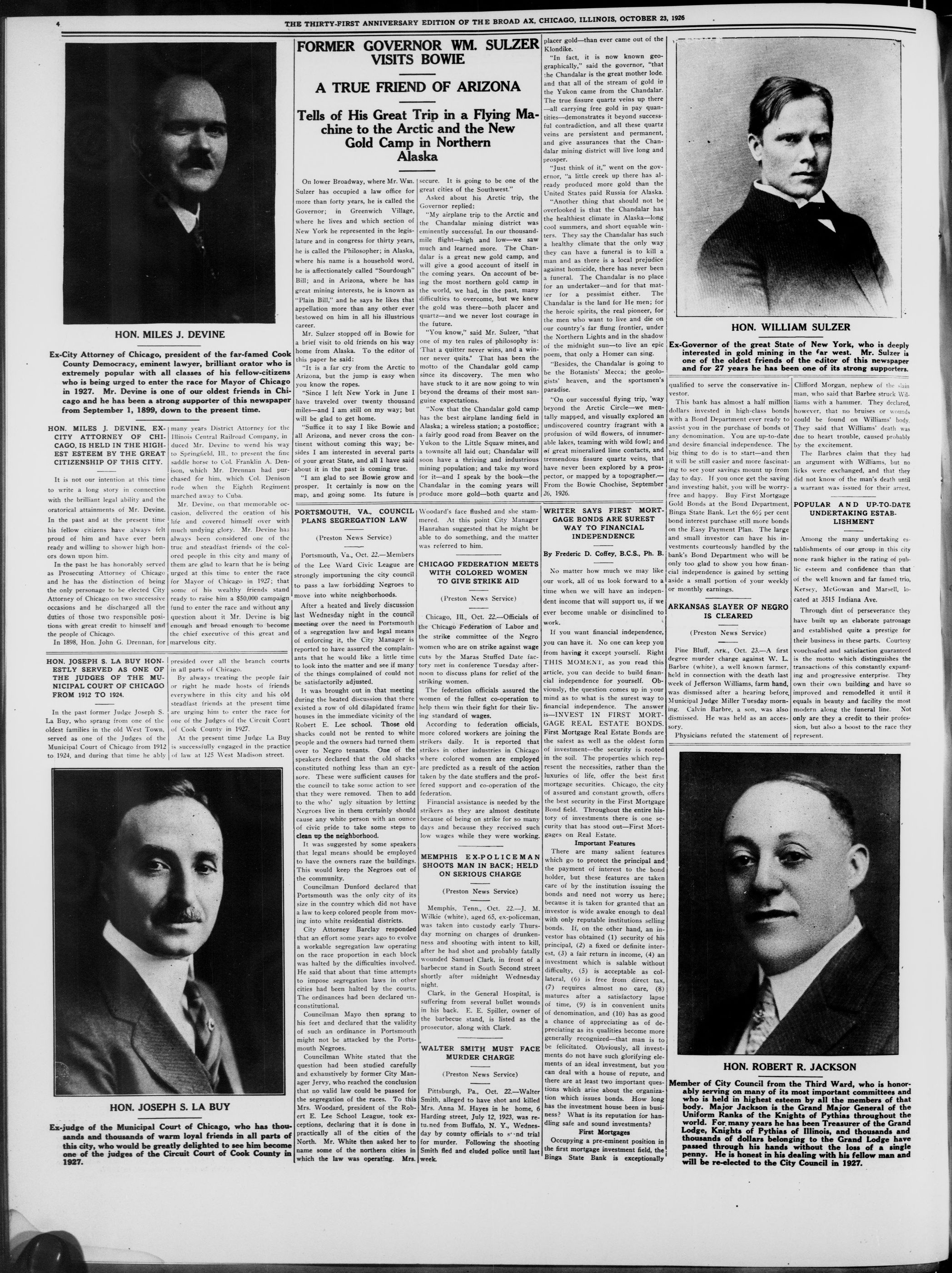
HON. MILES J. DEVINE
Ex-City Attorney of Chicago, County Democracy, eminent extremely popular with a who is being urged to enter in 1927. Mr. Devine is of cago and he has been a str from September 1, 1899, d
ey of Chicago, president of the
nocracy, eminent lawyer, brilliant
popular with all classes of his
urged to enter the race for Ma
Mr. Devine is one of our oldest
he has been a strong supporter of
number 1, 1899, down to the presen
Ex-City Attorney of Chicago, president of the far-famed Cook County Democracy, eminent lawyer, brilliant orator who is extremely popular with all classes of his fellow-citizens who is being urged to enter the race for Mayor of Chicago in 1927. Mr. Devine is one of our oldest friends in Chicago and he has been a strong supporter of this newspaper from September 1, 1899, down to the present time.
HON. MILES J. DEVINE, EXCITY ATTORNEY OF CHICAGO, IS HELD IN THE HIGHEST ESTEEM BY THE GREAT CITIZENSHIP OF THIS CITY. many years District Attorney for the Illinois Central Railroad Company, induced Mr. Devine to wend his way to Springfield, Ill., to present the fine saddle horse to Col. Franklin A. Den-
It is not our intention at this time to write a long story in connection with the brilliant legal ability and the oratorical attainments of Mr. Devine. In the past and at the present time his fellow citizens have always felt proud of him and have ever been ready and willing to shower high honors down upon him. In the past he has honorably served as Prosecuting Attorney of Chicago and he has the distinction of being the only personage to be elected City Attorney of Chicago on two successive occasions and he discharged all the duties of those two responsible positions with great credit to himself and the people of Chicago. In 1898, Hon. John G. Drennan, for chased for his rode when marched away Mr. Devine, casion, deliver life and cove much undying always been true and stead ored people in them are glad urged at this for Mayor of some of his ready to raise fund to enter t question about enough and be the chief exec marvelous city.
HON. JOSEPH S. LA BUY HONESTLY SERVED AS ONE OF THE JUDGES OF THE MUNICIPAL COURT OF CHICAGO FROM 1912 TO 1924.
In the past former Judge Joseph S. La Buy, who sprang from one of the oldest families in the old West Town, served as one of the Judges of the Municipal Court of Chicago from 1912 to 1924, and during that time he ably
[Image of a man with a mustache and a suit].
[Name]
HON. JOSEPH S. LA BUY
Ex-judge of the Municipal C sands and thousands of w this city, who would be gre one of the judges of the C 1927.
The Municipal Court of Chicago, thousands of warm loyal friends so would be greatly delighted to judges of the Circuit Court of
Ex-judge of the Municipal Court of Chicago, who has thousands and thousands of warm loyal friends in all parts of this city, who would be greatly delighted to see him become one of the judges of the Circuit Court of Cook County in 1927.
president of the far-famed Cook it lawyer, brilliant orator who is in all classes of his fellow-citizens, in the race for Mayor of Chicago, one of our oldest friends in Chicago supporter of this newspaper, own to the present time.
many years District Attorney for the Illinois Central Railroad Company, induced Mr. Devine to wend his way to Springfield, Ill., to present the fine saddle horse to Col. Franklin A. Denison, which Mr. Drennan had purchased for him, which Col. Denison rode when the Eighth Regiment marched away to Cuba.
Mr. Devine, on that memorable occasion, delivered the oration of his life and covered himself over with much undying glory. Mr. Devine has always been considered one of the true and steadfast friends of the colored people in this city and many of them are glad to learn that he is being urged at this time to enter the race for Mayor of Chicago in 1927; that some of his wealthy friends stand ready to raise him a $50,000 campaign fund to enter the race and without any question about it Mr. Devine is big enough and broad enough to become the chief executive of this great and marvelous city.
By always treating the people fair or right he made hosts of friends everywhere in this city and his old steadfast friends at the present time are urging him to enter the race for one of the Judges of the Circuit Court of Cook County in 1927. At the present time Judge La Buy is successfully engaged in the practice of law at 125 West Madison street.
[Name]
court of Chicago, who has thou
arm loyal friends in all parts of
tally delighted to see him become
Circuit Court of Cook County in
THE THIRTY-FIRST ANNIVERSARY EDITION OF THE BROAD AX, CHICAGO, ILLINOIS, OCTOBER 23, 1926
FORMER GOVERNOR WM. SULZER VISITS BOWIE
A TRUE FRIEND OF ARIZONA
Tells of His Great Trip in a Flying Machine to the Arctic and the New Gold Camp in Northern Alaska
On lower Broadway, where Mr. Wm. Sulzer has occupied a law office for more than forty years, he is called the Governor; in Greenwich Village, where he lives and which section of New York he represented in the legislature and in congress for thirty years, he is called the Philosopher; in Alaska, where his name is a household word, he is affectionately called "Sourdough" Bill; and in Arizona, where he has great mining interests, he is known as "Plain Bill," and he says he likes that appellation more than any other ever bestowed on him in all his illustrious career.
Mr. Sulzer stopped off in Bowie for a brief visit to old friends on his way home from Alaska. To the editor of this paper he said:
"It is a far cry from the Arctic to Arizona, but the jump is easy when you know the ropes.
"Since I left New York in June I have traveled over twenty thousand miles—and I am still on my way; but will be glad to get home.
"Suffice it to say I like Bowie and all Arizona, and never cross the continent without coming this way; besides I am interested in several parts of your great State, and all I have said about it in the past is coming true.
"I am glad to see Bowie grow and prosper. It certainly is now on the map, and going some. Its future is
PORTSMOUTH, VA., COUNCIL
PLANS SEGREGATION LAW
Portsmouth, Va., Oct. 22.—Members of the Lee Ward Civic League are strongly importing the city council to pass a law forbidding Negroes to move into white neighborhoods.
After a heated and lively discussion last Wednesday night in the council meeting over the need in Portsmouth of a segregation law and legal means of enforcing it, the City Manager is reported to have assured the complainants that he would like a little time to look into the matter and see if many of the things complained of could not be satisfactorily adjusted.
It was brought out in that meeting during the heated discussion that there existed a row of old dilapidated frame houses in the immediate vicinity of the Robert E. Lee school. Those old shacks could not be rented to white people and the owners had turned them over to Negro tenants. One of the speakers declared that the old shacks constituted nothing less than an eyesore. These were sufficient causes for the council to take some action to see that they were removed. Then to add to the who' ugly situation by letting Negroes live in them certainly should cause any white person with an ounce of civic pride to take some steps to clean up the neighborhood.
It was suggested by some speakers that legal means should be employed to have the owners raze the buildings. This would keep the Negroes out of the community.
Councilman Dunford declared that Portsmouth was the only city of its size in the country which did not have a law to keep colored people from moving into white residential districts.
City Attorney Barclay responded that an effort some years ago to evolve a workable segregation law operating on the race proportion in each block was halted by the difficulties involved. He said that about that time attempts to impose segregation laws in other cities had been halted by the courts. The ordinances had been declared unconstitutional.
Councilman Mayo then sprang to his feet and declared that the validity of such an ordinance in Portsmouth might not be attacked by the Portsmouth Negroes. Councilman White stated that the question had been studied carefully and exhaustively by former City Manager Jervy, who reached the conclusion that no valid law could be passed for the segregation of the races. To this Mrs. Woodard, president of the Robert E. Lee School League, took exceptions, declaring that it is done in practically all of the cities of the North. Mr. White then asked her to name some of the northern cities in which the law was operating. Mrs.
secure. It is going to be one of the great cities of the Southwest."
Asked about his Arctic trip, the Governor replied:
"My airplane trip to the Arctic and the Chandalar mining district was eminently successful. In our thousand-mile flight—high and low—we saw much and learned more. The Chandalar is a great new gold camp, and will give a good account of itself in the coming years. On account of being the most northern gold camp in the world, we had, in the past, many difficulties to overcome, but we knew the gold was there—both placer and quartz—and we never lost courage in the future.
"You know," said Mr. Sulzer, "that one of my ten rules of philosophy is: 'That a quitter never wins, and a winner never quits.' That has been the motto of the Chandalar gold camp since its discovery. The men who have stuck to it are now going to win beyond the dreams of their most sanguine expectations.
"Now that the Chandalar gold camp has the best airplane landing field in Alaska; a wireless station; a postoffice; a fairly good road from Beaver on the Yukon to the Little Squaw mines, and a townsite all laid out; Chandalar will soon have a thriving and industrious mining population; and take my word for it—and I speak by the book—the Chandalar in the coming years will produce more gold—both quartz and
Woodard's face flushed and she stammered. At this point City Manager Hanrahan suggested that he might be able to do something, and the matter was referred to him.
CHICAGO FEDERATION MEETS WITH COLORED WOMEN TO GIVE STRIKE AID
(Preston News Service)
Chicago, Ill., Oct. 22.—Officials of the Chicago Federation of Labor and the strike committee of the Negro women who are on strike against wage cuts by the Maras Stuffed Date factory met in conference Tuesday afternoon to discuss plans for relief of the striking women.
The federation officials assured the women of the fullest co-operation to help them win their fight for their living standard of wages.
According to federation officials, more colored workers are joining the strikers daily. It is reported that strikes in other industries in Chicago where colored women are employed are predicted as a result of the action taken by the date stuffers and the profered support and co-operation of the federation.
Financial assistance is needed by the strikers as they are almost destitute because of being on strike for so many days and because they received such low wages while they were working.
MEMPHIS EX-POLICEMAN
SHOOTS MAN IN BACK; HELD
ON SERIOUS CHARGE
(Preston News Service)
Memphis, Tenn., Oct. 22.-J. M. Wilkie (white), aged 65, ex-policeman, was taken into custody early Thursday morning on charges of drunkenness and shooting with intent to kill, after he had shot and probably fatally wounded Samuel Clark, in front of a barbecue stand in South Second street shortly after midnight Wednesday night. Clark, in the General Hospital, is suffering from several bullet wounds in his back. E. E. Spiller, owner of the barbecue stand, is listed as the prosecutor, along with Clark.
WALTER SMITH MUST FACE
MURDER CHARGE
(Preston News Service)
Pittsburgh, Pa., Oct. 22.—Walter Smith, alleged to have shot and killed Mrs. Anna M. Hayes in he home, 6 Harding street, July 12, 1923, was retu. ned from Buffalo, N. Y., Wednesday by county officials to s'end trial for murder. Following the shooting Smith fled and eluded police until last week.
placer gold—than ever came out of the Klondike.
"In fact, it is now known geographically," said the governor, "that the Chandalar is the great mother lode, and that all of the stream of gold in the Yukon came from the Chandalar. The true fissure quartz veins up there—all carrying free gold in pay quantities—demonstrates it beyond successful contradiction, and all these quartz veins are persistent and permanent, and give assurances that the Chandalar mining district will live long and prosper.
"Just think of it," went on the governor, "a little creek up there has already produced more gold than the United States paid Russia for Alaska.
"Another thing that should not be overlooked is that the Chandalar has the healthiest climate in Alaska—long cool summers, and short equable winters. They say the Chandalar has such a healthy climate that the only way they can have a funeral is to kill a man and as there is a local prejudice against homicide, there has never been a funeral. The Chandalar is no place for an undertaker—and for that matter for a pessimist either. The Chandalar is the land for He men; for the heroic spirits, the real pioneer, for the men who want to live and die on our country's far flung frontier, under the Northern Lights and in the shadow of the midnight sun—to live an epic poem, that only a Homer can sing.
"Besides, the Chandalar is going to be the Botanists' Mecca; the geologists' heaven, and the sportsmen's paradise."
"On our successful flying trip, 'way beyond the Arctic Circle—we mentally mapped, and visually explored an undiscovered country fragrant with a profusion of wild flowers, of innumerable lakes, teaming with wild fowl; and of great mineralized lime contacts, and tremendous fissure quartz veins, that have never been explored by a prospector, or mapped by a topographer.—From the Bowie Chochise, September 26, 1926.
WRITER SAYS FIRST MORT
GAGE BONDS ARE SUREST
WAY TO FINANCIAL
INDEPENDENCE
By Frederic D. Coffey, B.C.S., Ph. B
No matter how much we may like our work, all of us look forward to a time when we will have an independent income that will support us, if we ever become unable or disinclined to work.
If you want financial independence, you can have it. No one can keep you from having it except yourself. Right THIS MOMENT, as you read this article, you can decide to build financial independence for yourself. Obviously, the question comes up in your mind as to what is the surest way to financial independence. The answer is—INVEST IN FIRST MORTGAGE REAL ESTATE BONDS. First Mortgage Real Estate Bonds are the safest as well as the oldest form of investment—the security is rooted in the soil. The properties which represent the necessities, rather than the luxuries of life, offer the best first mortgage securities. Chicago, the city of assured and constant growth, offers the best security in the First Mortgage Bond field. Throughout the entire history of investments there is one security that has stood out—First Mortgages on Real Estate.
Important Features
There are many salient features which go to protect the principal and the payment of interest to the bond holder, but these features are taken care of by the institution issuing the bonds and need not worry us here; because it is taken for granted that an investor is wide awake enough to deal with only reputable institutions selling bonds. If, on the other hand, an investor has obtained (1) security of his principal, (2) a fixed or definite interest, (3) a fair return in income, (4) an investment which is salable without difficulty, (5) is acceptable as collateral, (6) is free from direct tax, (7) requires almost no care, (8) matures after a satisfactory lapse of time, (9) is in convenient units of denomination, and (10) has as good a chance of appreciating as of depreciating as its qualities become more generally recognized—that man is to be felicitated. Obviously, all investments do not have such glorifying elements of an ideal investment, but you can deal with a house of repute, and there are at least two important questions which arise about the organization which issues bonds. How long has the investment house been in business? What is its reputation for handling safe and sound investments?
Occupying a pre-eminent position in the first mortgage investment field, the Binga State Bank is exceptionally
J.
HON. WILLIAM SULZER
Ex-Governor of the great State interested in gold mining one of the oldest friends and for 27 years he has be
Ex-Governor of the great State of New York, who is deeply interested in gold mining in the far west. Mr. Sulzer is one of the oldest friends of the editor of this newspaper and for 27 years he has been one of its strong supporters.
qualified to serve the conservative investor.
This bank has almost a half million dollars invested in high-class bonds with a Bond Department ever ready to assist you in the purchase of bonds of any denomination. You are up-to-date and desire financial independence. The big thing to do is to start—and then it will be still easier and more fascinating to see your savings mount up from day to day. If you once get the saving and investing habit, you will be worry-free and happy. Buy First Mortgage Gold Bonds at the Bond Department, Binga State Bank. Let the $6 \frac{1}{2} $ per cent bond interest purchase still more bonds on the Easy Payment Plan. The large and small investor can have his investments courteously handled by the bank's Bond Department who will be only too glad to show you financial independence is gained by setting aside a small portion of your weekly or monthly earnings.
ARKANSAS SLAYER OF NEGRO
IS CLEARED
Pine Bluff, Ark., Oct. 23—A first degree murder charge against W. L. Barbre (white), a well known farmer, held in connection with the death last week of Jefferson Williams, farm hand, was dismissed after a hearing before Municipal Judge Miller Tuesday morning. Calvin Barbre, a son, was also dismissed. He was held as an accessory. Physicians refuted the statement of
1920
[Name]
Member of City Council from the Third Ward, ably serving on many of its most important co who is held in highest esteem by all the me body. Major Jackson is the Grand Major Uniform Ranks of the Knights of Pythias the world. For many years he has been Treasurer Lodge, Knights of Pythias of Illinois, and the thousands of dollars belonging to the Grand passed through his hands without the loss penny. He is honest in his dealing with his f will be re-elected to the City Council in 192
Member of City Council from the Third Ward, who is honorably serving on many of its most important committees and who is held in highest esteem by all the members of that body. Major Jackson is the Grand Major General of the Uniform Ranks of the Knights of Pythias throughout the world. For many years he has been Treasurer of the Grand Lodge, Knights of Pythias of Illinois, and thousands and thousands of dollars belonging to the Grand Lodge have passed through his hands without the loss of a single penny. He is honest in his dealing with his fellow man and will be re-elected to the City Council in 1927.
e of New York, who is deeply in the far west. Mr. Sulzer is if the editor of this newspaper en one of its strong supporters. Clifford Morgan, nephew of the slain man, who said that Barbre struck Williams with a hammer. They declared, however, that no bruises or wounds could be found on Williams' body. They said that Williams' death was due to heart trouble, caused probably by the excitement. The Barbres claim that they had an argument with Williams, but no licks were exchanged, and that they did not know of the man's death until a warrant was issued for their arrest.
POPULAR AND UP-TO-DATE
UNDERTAKING ESTABLISHMENT
Among the many undertaking establishments of our group in this city none rank higher in the rating of public esteem and confidence than that of the well known and far famed trio, Kersey, McGowan and Marsell, located at 3515 Indiana Ave.
Through dint of perseverance they have built up an elaborate patronage and established quite a prestige for their business in these parts. Courtesy vouchsafed and satisfaction guaranteed is the motto which distinguishes the transactions of this constantly expanding and progressive enterprise. They own their own building and have so improved and remodelled it until it equals in beauty and facility the most modern along the funeral line. Not only are they a credit to their profession, but also a boost to the race they represent.
```markdown
```
the Third Ward, who is honor- most important committees and them by all the members of that the Grand Major General of the rights of Pythias throughout the has been Treasurer of the Grand of Illinois, and thousands and going to the Grand Lodge have without the loss of a single dealing with his fellow man and by Council in 1927.
109
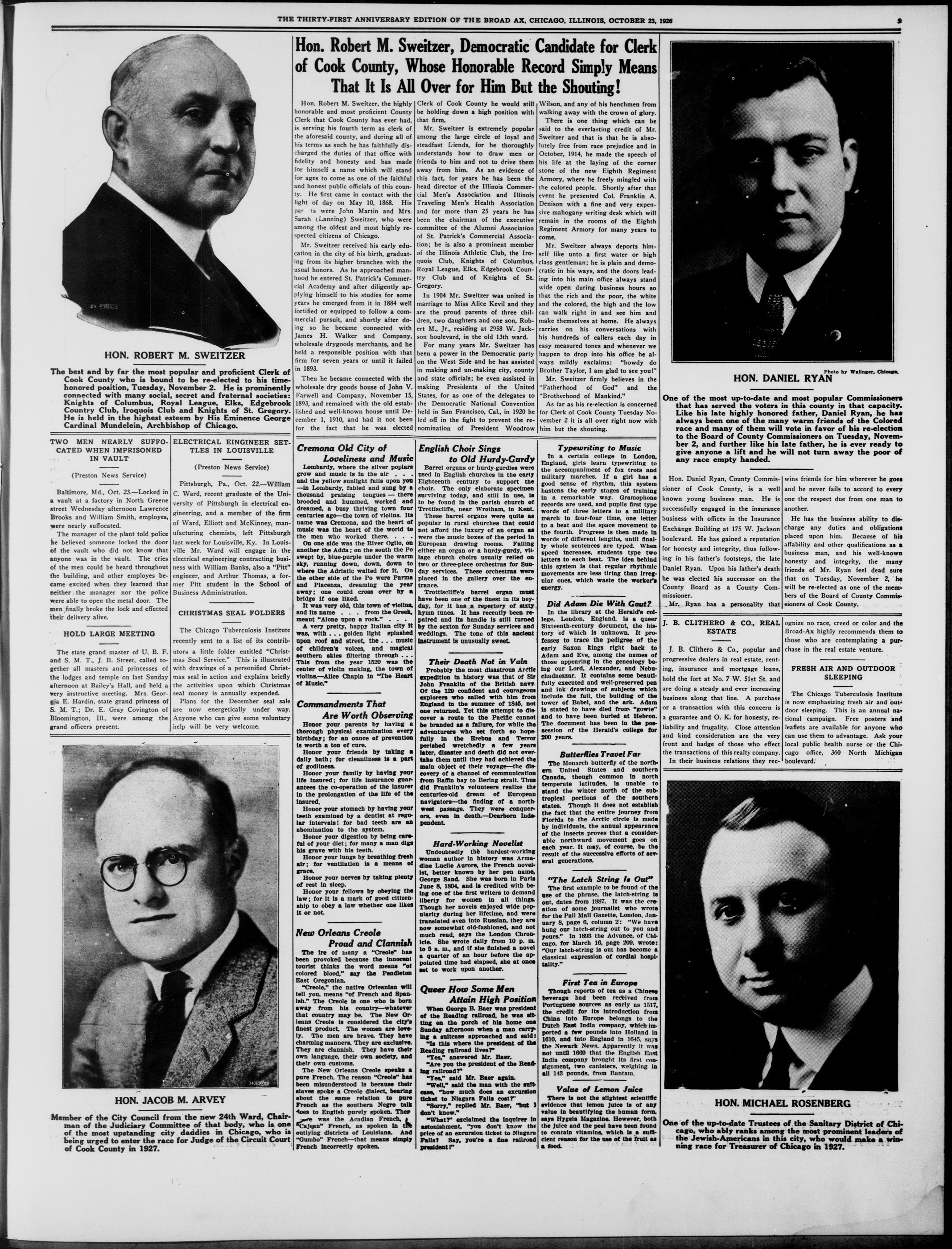
HON. ROBERT M. SWEITZER
The best and by far the most popular and proficient Cook County who is bound to be re-elected to honored position, Tuesday, November 2. He is a connected with many social, secret and fraternities Knights of Columbus, Royal League, Elks, Country Club, Iroquois Club and Knights of S He is held in the highest esteem by His Eminent Cardinal Mundelein, Archbishop of Chicago.
by far the most popular and proficient
enty who is bound to be re-elected to
position, Tuesday, November 2. He is a
with many social, secret and fratern
of Columbus, Royal League, Elks,
Club, Iroquois Club and Knights of S
al in the highest esteem by His Emin
Mundelein, Archbishop of Chicago.
The best and by far the most popular and proficient Clerk of Cook County who is bound to be re-elected to his time-honored position, Tuesday, November 2. He is prominently connected with many social, secret and fraternal societies: Knights of Columbus, Royal League, Elks, Edgebrook Country Club, Iroquois Club and Knights of St. Gregory. He is held in the highest esteem by His Eminence George Cardinal Mundelein, Archbishop of Chicago.
TWO MEN NEARLY SUFFOCATED WHEN IMPRISONED IN VAULT
ELECTRICAL EINGINEER SET-TLES IN LOUISVILLE
Baltimore, Md., Oct. 23.—Locked in a vault at a factory in North Greene street Wednesday afternoon Lawrence Brooks and William Smith, employees, were nearly suffocated.
The manager of the plant told police he believed someone locked the door of the vault who did not know that anyone was in the vault. The cries of the men could be heard throughout the building, and other employees became excited when they learned that neither the manager nor the police were able to open the metal door. The men finally broke the lock and effected their delivery alive.
HOLD LARGE MEETING
The state grand master of U. B. F. and S. M. T., J. B. Street, called together all masters and princesses of the lodges and temple on last Sunday afternoon at Bailey's Hall, and held a very instructive meeting. Mrs. Georgia E. Hardin, state grand princess of S. M. T.; Dr. E. Gray Covington of Bloomington, Ill., were among the grand officers present.
12
M.
34053753
HON. JACOB M. ARVEY
Member of the City Council from man of the Judiciary Com of the most upstanding city being urged to enter the raid of Cook County in 1927.
The City Council from the new 24th W
the Judiciary Committee of that body,
most upstanding city daddies in Chic
ed to enter the race for Judge of the C
County in 1927.
Member of the City Council from the new 24th Ward, Chairman of the Judiciary Committee of that body, who is one of the most upstanding city daddies in Chicago, who is being urged to enter the race for Judge of the Circuit Court of Cook County in 1927.
popular and proficient Clerk of Id to be re-elected to his time-November 2. He is prominently a secret and fraternal societies: Royal League, Elks, Edgebrook Eb and Knights of St. Gregory, esteem by His Eminence George bishop of Chicago.
ELECTRICAL EINGINEER SET-TLES IN LOUISVILLE
(Preston News Service)
Pittsburgh, Pa., Oct. 22.—William C. Ward, recent graduate of the University of Pittsburgh in electrical engineering, and a member of the firm of Ward, Elliott and McKinney, manufacturing chemists, left Pittsburgh last week for Louisville, Ky. In Louisville Mr. Ward will engage in the electrical engineering contracting business with William Banks, also a "Pitt" engineer, and Arthur Thomas, a former Pitt student in the School of Business Administration.
CHRISTMAS SEAL FOLDERS
The Chicago Tuberculosis Institute recently sent to a list of its contributors a little folder entitled "Christmas Seal Service." This is illustrated with drawings of a personified Christmas seal in action and explains briefly the activities upon which Christmas seal money is annually expended. Plans for the December seal sale are now energetically under way. Anyone who can give some voluntary help will be very welcome.
3405225
from the new 24th Ward, Chair-
mittee of that body, who is one
by daddies in Chicago, who is
for Judge of the Circuit Court
---
THE THIRTY-FIRST ANNIVERSARY EDITION OF THE BROAD AX. CHICAGO, ILLINOIS, OCTOBER 23, 1926
Hon. Robert M. Sweitzer, Democratic Candidate for Clerk of Cook County, Whose Honorable Record Simply Means That It Is All Over for Him But the Shouting!
Hon. Robert M. Sweitzer, the highly honorable and most proficient County Clerk that Cook County has ever had, is serving his fourth term as clerk of the aforesaid county, and during all of his terms as such he has faithfully discharged the duties of that office with fidelity and honesty and has made for himself a name which will stand for ages to come as one of the faithful and honest public officials of this county. He first came in contact with the light of day on May 10, 1868. His par ts were John Martin and Mrs. Sarah (Lanning) Sweitzer, who were among the oldest and most highly respected citizens of Chicago.
Mr. Sweitzer received his early education in the city of his birth, graduating from its higher branches with the usual honors. As he approached manhood he entered St. Patrick's Commercial Academy and after diligently applying himself to his studies for some years he emerged from it in 1884 well fortified or equipped to follow a commercial pursuit, and shortly after doing so he became connected with James H. Walker and Company, wholesale drygoods merchants, and he held a responsible position with that firm for seven years or until it failed in 1893.
Then he became connected with the wholesale dry goods house of John V. Farwell and Company, November 15, 1893, and remained with the old established and well-known house until December 1, 1910, and had it not been for the fact that he was elected
Cremona Old City of
Lombardy, where the silver poplars grow and music is in the air . . . and the yellow sunlight fails upon you—in Lombardy, fabled and sung by a thousand praising tongues — there brooded and hummed, worked and dreamed, a busy thriving town four centuries ago—the town of violins. Its name was Cremona, and the heart of music was the heart of the world to the men who worked there . . .
On one side was the River Oglo, on another the Adda; on the south the Po swept by, blue-purple under the warm sky, running down, down, down to where the Adratic waited for it. On the other side of the Po were Parma and Placenza, dreaming the year away; one could cross over by a bridge if one liked.
It was very old, this town of violins, and its name . . . from the Greek, meant "Alone upon a rock."
A very pretty, happy Italian city it was, with . . . golden light splashed upon roof and street, the . . . music of children's voices, and magical southern skies filtering through . . . This from the year 1520 was the center of violin making, the town of violins.—Alice Chapin in "The Heart of Music."
Commandments That
Honor your parents by having a thorough physical examination every birthday; for an ounce of prevention is worth a ton of cure.
Honor your friends by taking a daily bath; for cleanliness is a part of godliness.
Honor your family by having your life insured; for life insurance guarantees the co-operation of the insurer in the prolongation of the life of the insured.
Honor your stomach by having your teeth examined by a dentist at regular intervals! for bad teeth are an abomination to the system.
Honor your digestion by being careful of your diet; for many a man digs his grave with his teeth.
Honor your lungs by breathing fresh air; for ventilation is a means of grace.
Honor your nerves by taking plenty of rest in sleep.
Honor your fellows by obeying the law; for it is a mark of good citizenship to obey a law whether one likes it or not.
New Orleans Creole
The ire of many a "Creole" has been provoked because the innocent tourist thinks the word means "of colored blood," say the Pendleton East Gregorian.
"Creole," the native Orleanian will tell you, means "of French and Spanish." The Creole is one who is born away from his country—whatever that country may be. The New Orleans Creole is considered the city's finest product. The women are lovely. The men are brave. They have charming manners. They are exclusive. They are clannish. They have their own language, their own society, and their own customs.
The New Orleans Creole speaks a pure French. The reason "Creole" has been misunderstood is because their slaves spoke a Creole dialect, bearing about the same relation to pure French as the southern Negro talks does to English purely spoken. They were was the Acadian French, Cajaean" French, as spoken in the outlying districts of Louisiana. And "Gumbo" French—that means simply French incorrectly spoken.
Clerk of Cook County he would still be holding down a high position with that firm.
Mr. Sweitzer is extremely popular among the large circle of loyal and steadfast friends, for he thoroughly understands how to draw men or friends to him and not to drive them away from him. As an evidence of this fact, for years he has been the head director of the Illinois Commercial Men's Association and Illinois Traveling Men's Health Association and for more than 25 years he has been the chairman of the executive committee of the Alumni Association of St. Patrick's Commercial Association; he is also a prominent member of the Illinois Athletic Club, the Iroquois Club, Knights of Columbus, Royal League, Elks, Edgebrook Country Club and of Knights of St. Gregory.
In 1904 Mr. Sweitzer was united in marriage to Miss Alice Kevil and they are the proud parents of three children, two daughters and one son, Robert M., Jr., residing at 2958 W. Jackson boulevard, in the old 13th ward. For many years Mr. Sweitzer has been a power in the Democratic party on the West Side and he has assisted in making and un-making city, county and state officials; he even assisted in making Presidents of the United States, for as one of the delegates to the Democratic National Convention held in San Francisco, Cal., in 1920 he led off in the fight to prevent the renomination of President Woodrow
English Choir Sings
to Old Hurdy-Gurdy Barrel organs or hurdy-gurdies were used in English churches in the early Eighteenth century to support the choir. The only elaborate specimen surviving today, and still in use, is to be found in the parish church of Trottiscliffe, near Wrotham, in Kent. These barrel organs were quite as popular in rural churches that could not afford the luxury of an organ as were the music boxes of the period in European drawing rooms. Falling either an organ or a hurdy-gurdy, village church choirs usually relied on two or three-piece orchestras for Sunday services. These orchestras were placed in the gallery over the entrance.
Trottiscliffe's barrel organ must have been one of the finest in its heyday, for it has a repertory of sixty hymn tunes. It has recently been repaired and its handle is still turned by the sexton for Sunday services and weddings. The tone of this ancient instrument is unusually sweet.
Their Death Not in Vain
Their Death Not in Vain
Probably the most disastrous Arctic expedition in history was that of Sir John Franklin of the British navy. Of the 129 confident and courageous explorers who sailed with him from England in the summer of 1845, not one returned. Yet this attempt to discover a route to the Pacific cannot be branded as a failure, for while the adventurers who set forth so hopefully in the Erebus and Terror perished wretchedly a few years later, disaster and death did not overtake them until they had achieved the main object of their voyage—the discovery of a channel of communication from Baffin bay to Bering strait. Thus did Franklin's volunteers realize the centuries-old dream of European navigators—the finding of a northwest passage. They were conquerors, even in death.—Dearborn Independent.
Hard-Working Novelist
Undoubtedly the hardest-working woman author in history was Armadine Lucie Aurere, the French novelist, better known by her pen name, George Sand. She was born in Paris June 8, 1804, and is credited with being one of the first writers to demand liberty for women in all things. Though her novels enjoyed wide popularity during her lifetime, and were translated even into Russian, they are now somewhat old-fashioned, and not much read, says the London Chronicle. She wrote daily from 10 p. m. to 5 a. m., and if she finished a novel a quarter of an hour before the appointed time had elapsed, she at once set to work upon another.
Queer How Some Men
When George B. Beer was president of the Reading railroad, he was sitting on the porch of his home one Sunday afternoon when a man carrying a suitcase approached and said:
"Is this where the president of the Reading railroad lives?"
"Yes," answered Mr. Baer.
"Are you the president of the Reading railroad?"
"Yes," said Mr. Baer again.
"Well," said the man with the suitcase, "how much does an excursion ticket to Niagara Falls cost?"
"Sorry," replied Mr. Baer, "but I don't know."
"What?" exclaimed the inquirer in astonishment, "you don't know the price of an excursion ticket to Niagara Falls? Say, you're a fine railroad president!"
Wilson, and any of his henchmen from walking away with the crown of glory. There is one thing which can be said to the everlasting credit of Mr. Sweitzer and that is that he is absolutely free from race prejudice and in October, 1914, he made the speech of his life at the laying of the corner stone of the new Eighth Regiment Armory, where he freely mingled with the colored people. Shortly after that event he presented Col. Franklin A. Denison with a fine and very expensive mahogany writing desk which will remain in the rooms of the Eighth Regiment Armory for many years to come.
Mr. Sweitzer always deports himself like unto a first water or high class gentleman; he is plain and democratic in his ways, and the doors leading into his main office always stand wide open during business hours so that the rich and the poor, the white and the colored, the high and the low can walk right in and see him and make themselves at home. He always carries on his conversations with his hundreds of callers each day in easy measured tones and whenever we happen to drop into his office he always mildly exclaims: "howdy do Brother Taylor, I am glad to see you!" Mr. Sweitzer firmly believes in the "Fatherhood of God" and the "Brotherhood of Mankind."
As far as his re-election is concerned for Clerk of Cook County Tuesday November 2 it is all over right now with him but the shouting.
Typewriting to Music
In a certain college in London, England, girls learn typewriting to the accompaniment of fox trots and military marches. If a girl has a good sense of rhythm, this system hastens the early stages of training in a remarkable way. Gramophone records are used, and pupils first type words of three letters to a military march in four-four time, one letter to a beat and the space movement to the fourth. Progress is then made in words of different lengths, until finally whole sentences are typed. When speed increases, students type two letters to each beat. The idea behind this system is that regular rhythmic movements are less tiring than irregular ones, which waste the worker's energy.
Did Adam Die With Gout?
In the library at the Herald's college, London, England, is a queer Sixteenth-century document, the history of which is unknown. It professes to trace the pedigree of the early Saxon kings right back to Adam and Eve, among the names of those appearing in the genealogy being our Lord, Alexander, and Nebuchadnezzar. It contains some beautifully executed and well-preserved pen and ink drawings of subjects which include the fall, the building of the tower of Babel, and the ark. Adam is stated to have died from "gowte" and to have been buried at Hebron. The document has been in the possession of the Herald's college for 200 years.
Butterflies Travel Far
The Monarch butterfly of the northern United States and southern Canada, though common in north temperate latitudes, is unable to stand the winter north of the subtropical portions of the southern states. Though it does not establish the fact that the entire journey from Florida to the Arctic circle is made by individuals, the annual appearance of the insects proves that a considerable northward movement goes on each year. It may, of course, be the result of the successive efforts of several generations.
"The Latch String Is Out"
The first example to be found of the use of the phrase, the latch-string is out, dates from 1887. It was the creation of some journalist who wrote for the Pall Mall Gazette, London, January 8, page 6, column 2: "We have hung our latch-string out to you and yours." In 1883 the Advance, of Chicago, for March 16, page 209, wrote: "Our latch-string is out has become a classical expression of cordial hospitality."
First Tea in Europe
Though reports of tea as a Chinese beverage had been received from Portuguese sources as early as 1517, the credit for its introduction from China into Europe belongs to the Dutch East India company, which imported a few pounds into Holland in 1610, and into England in 1645, says the Newark News. Apparently it was not until 1609 that the English East India company brought its first consignment, two canisters, weighing in all 143 pounds, from Bantam.
Value of Lemon Juice
There is not the alightest scientific evidence that lemon juice is of any value in beautifying the human form, says Hygela Magazine. However, both the juice and the peel have been found to contain vitamins, which is a sufficient reason for the use of the fruit as a food.
[Name]
HON. DANIEL RYAN
One of the most up-to-date and most popular Commissioners that has served the voters in this county in that capacity. Like his late highly honored father, Daniel Ryan, he has always been one of the many warm friends of the Colored race and many of them will vote in favor of his re-election to the Board of County Commissioners on Tuesday, November 2, and further like his late father, he is ever ready to give anyone a lift and he will not turn away the poor of any race empty handed.
Hon. Daniel Ryan, County Commissioner of Cook County, is a well known young business man. He is successfully engaged in the insurance business with offices in the Insurance Exchange Building at 175 W. Jackson boulevard. He has gained a reputation for honesty and integrity, thus following in his father's footsteps, the late Daniel Ryan. Upon his father's death he was elected his successor on the County Board as a County Commissioner. Mr. Ryan has a personality that
J. B. CLITHERO & CO., REAL ESTATE
J. B. Clithero & Co., popular and progressive dealers in real estate, renting, insurance and mortgage loans, hold the fort at No. 7 W. 51st St. and are doing a steady and ever increasing business along that line. A purchase or a transaction with this concern is a guarantee and O. K. for honesty, reliability and frugality. Close attention and kind consideration are the very front and badge of those who effect the transactions of this realty company.
In their business relations they rec-
THE NEW YORKER
M. J.
HON. MICHAEL ROSENBERG
One of the up-to-date Trustees of the Sanitary De cago, who ably ranks among the most promine the Jewish-Americans in this city, who would ning race for Treasurer of Chicago in 1927.
One of the up-to-date Trustees of the Sanitary District of Chicago, who ably ranks among the most prominent leaders of the Jewish-Americans in this city, who would make a winning race for Treasurer of Chicago in 1927.
wins friends for him wherever he goes and he never fails to accord to every one the respect due from one man to another.
He has the business ability to discharge any duties and obligations placed upon him. Because of his affability and other qualifications as a business man, and his well-known honesty and integrity, the many friends of Mr. Ryan feel dead sure that on Tuesday, November 2, he will be re-elected as one of the members of the Board of County Commissioners of Cook County.
ognize no race, creed or color and the Broad-Ax highly recommends them to those who are contemplating a purchase in the real estate venture.
FRESH AIR AND OUTDOOR
SLEEPING
The Chicago Tuberculosis Institute is now emphasizing fresh air and outdoor sleeping. This is an annual national campaign. Free posters and leaflets are available for anyone who can use them to advantage. Ask your local public health nurse or the Chicago office, 360 North Michigan boulevard.
A
of the Sanitary District of Chicago the most prominent leaders of this city, who would make a win- Chicago in 1927.
[Name]
HON. PATRICK H. O'DONNELL
One of the most eloquent Irish-American lawyers in States. There is no question about his uncle friendship for the Afro-American race. He is a Lloyd Garrison or Wendell Phillips of the press generation, for he is always ready to thunder for injustice and the brutal treatment which con showered down upon the Colored people in this
One of the most eloquent Irish-American lawyers in the United States. There is no question about his uncompromising friendship for the Afro-American race. He is the William Lloyd Garrison or Wendell Phillips of the present day and generation, for he is always ready to thunder forth against injustice and the brutal treatment which continues to be showered down upon the Colored people in this country.
Hon. Patrick H. O'Donnell, who is one of the most resourceful criminal and civil lawyers in the United States, and who has tried many important cases in the courts of Cook County and in the Supreme Court of the United States at Washington, makes the following statement in reference to the substantial progress of the Colored people residing in Chicago.
Mr. O'Donnell assumed a bold stand in behalf of the Colored people at the time that U. S. Senator Benjamin R. Tillman invaded this city with his shot gun policy speech, which he delivered at Orchestra Hall in November, 1906. Mr. O'Donnell batted his murderous policy of shooting down innocent and law-abiding Colored men and women and advocat-
For the past thirty years he has keenly noted evidences everywhere in connection with their progress in Chicago. It is safe to say that Mr. O'Donnell is personally acquainted with more of the better element among the Colored people than any other person of his race in this city. He has on numerous occasions delivered notable addresses to large gatherings of them and they always enthusiastically accord him a wonderful consideration. His eloquent talks on these occasions have invariably enthused his audiences to such an extent that they are always loath to have him cease talking.
SEASON CLOSING
M. T. Bailey, president the Bailey Realty Co., 3638 South State street, together with other representatives, are busily engaged in accommodating members of the race coming into the suburbs of the city and securing home sites before the closing of the season, after which special attention will be given to city accommodations. Through the efforts of M. T. Bailey, a world of good is being accomplished for members of the race in the city and state.
1930
76
JUDGE HENRY HORNER
The most honorable Judge of County. He has always been affecting the unfortunate fortunate motherless and f the least doubt about it, he Probate Court on Tuesday,
The most honorable Judge of the Probate Court of Cook County. He has always been fair and square in his rulings affecting the unfortunate men and women and the unfortunate motherless and fatherless children, and without the least doubt about it, he will be re-elected Judge of the Probate Court on Tuesday. November 2nd.
6
American lawyers in the United ion about his uncompromising erican race. He is the William Phillips of the present day and ready to thunder forth against treatment which continues to be colored people in this country.
Mr. O'Donnell assumed a bold stand in behalf of the Colored people at the time that U. S. Senator Benjamin R. Tillman invaded this city with his shot gun policy speech, which he delivered at Orchestra Hall in November, 1906. Mr. O'Donnell combatted his murderous policy of shooting down innocent and law-abiding Colored men and women and advocating mob and lynch law. Mr. O'Donnell at that time delivered the most notable oration that ever fell from the lips of man at the Bethel Church peace meeting when Bishop Fallows presided.
During the race riots in this city, in 1919, Mr. O'Donnell offered himself and his money to assist the colored people in every way, and it was his manly stand that greatly assisted to restore law and order among the citizens of Chicago. As far as the colored people are concerned, they will always feel grateful to him for the invaluable services which he rendered them at that time.
TO HOLD FORUM
The Ft. Dearborn Forum, under the auspices of the 1927 Marching Club, of which J. B. Deveaux is president; M. B. Rogers, chairman, and Jas. C. Martin, exalted ruler, ex-officio, will convene in its bi-monthly forum Sunday afternoon, Oct. 24th, at 6 o'clock at the club home, 3920 South Parkway. The public is cordially invited to these meetings and some of the best talent in the city is always presented. At this meeting, Judge William H. Harrison will appear on the program.
76
If the Probate Court of Cooke in fair and square in his rulings men and women and the un-otherless children, and without will be re-elected Judge of the November 2nd.
THE THIRTY-FIRST ANNIVERSARY EDITION OF THE BROAD AX, CHICAGO, ILLINOIS, OCTOBER 23, 1926
FAMOUS PHYSICIANS VISIT
CHICAGO
Dr. Edouard Rist, of the Pasteur Institute, Paris, has just been in Chicago as the guest of the Chicago Tuberculosis Institute. He spoke under the joint auspices of the Chicago Tuberculosis Institute and the Institute of Medicine of Chicago on the evening of October 11th at the City Club on the subject: "Diagnostic Pitfalls in Pulmonary Tuberculosis." Preceding the meeting, a dinner was held in Dr. Rist's honor at Grayling's in the North Wrigley Building.
The Chicago Tuberculosis Institute is expecting another foreign visitor, Dr Ernst Loewenstein, Professor of Experimental Pathology, University of Vienna. Dr. Loewenstein will speak on the subject: "The Facts Upon Which Specific Treatment of Tuberculosis Is Based," on the evening of October 27th, in the Men's Grill, 7th floor Marshall Field Annex, under the auspices of the Chicago Tuberculosis Institute with the co-operaton of the Chicago Medical Society.
This meeting will be preceded by a dinner at the Hamilton Club, 20 South Dearborn street. The only charge will be that for the dinner. Physicians, nurses, and all others interested are cordially invited. Reservations may be made at the office of the Chicago Tuberculosis Institute, 360 North Michigan boulevard; telephone Central 8316.
These two gentlemen recently came to the United States to attend the International Tuberculosis Conference in Washington, D. C. They are among the world's most distinguished specialists.
CONGRESSMAN MORTON D.
HULL
Honorable Morton Denison Hull who has been one of the wide awake members of the Lower House of Congress for several years past has become a great power in the House of Representatives and the voters residing in the Second Congressional District should on Tuesday, November 2, see to it that he may continue to serve them at the capital of the nation.
HON. HENRY HORNER WILL BE RE-ELECTED JUDGE OF THE PROBATE COURT ON TUESDAY, NOVEMBER 2.
The November election is fast approaching and the people are beginning to pay close attention to the various candidates who are seeking their suffrage. And it seems to be the universal opinion that the Hon. Henry Horner, Democratic candidate for Probate Judge will be re-elected November 2nd. In discharging the duties of the Probate Court since his election twelve years ago, Judge Horner has displayed legal ability, judicial qualifications and such fairness, intelligence and industry that this court has been accorded the approval of the Bar and the admiration of the community.
He has applied efficiency and business methods to the dispatch of the Court's work, disposing of it expeditiously and yet with just and fair consideration of the cases which have come before him and in accordance with the splendid traditions of that court.
Judges of this character are not easily found. The benefit of Judge Horner's service and his years of experience must not be lost to Cook County Every consideration demands his reelection.
Address to Chicago Bar Ass'n, October 11, 1926.
By the vote of the Chicago Bar Association held in June, 1926, endorsing Judge Henry Horner for re-election as Judge of the Probate Court of Cook County, Illinois, he received 2020 votes; his two opponents received a total of 369.
It must be said to the everlasting credit that he is one of the most friendly disposed and human judges who has ever presided over the Probate Court. He is highly cultured in his manners and it would be very bad indeed for all the people of Cook County if he failed to be-elected, for with him on the Probate bench the colored people of this city can always depend upon it of having a true friend at court. So mark an X on the ballot in front of his name Tuesday, November 2nd and assist to re-elect him to his exalted position.
1928
MR. THOS J. COURTNEY Democratic candidate for State Senator from the 11th Senatorial District of Illinois, who is making a strenuous and active campaign for his election. Mr. Courtney has many friends among the colored people residing in his senatorial district who will assist him to win out at the Polls, Tuesday, November 2.
Mr. Courtney is at present council committee secretary and sergeant-at-arms of the city council. His candidacy has been endorsed by many business and improvement organizations also by the former service men's association, of which he is a member. He is a lawyer, is 35 years of age was born, reared and educated in the district he seeks to represent, and lives with his wife and family at 763. South Loomis street.
He is strongly in favor of home rule for Chicago and strenuously advocates the passage of a reapportionment bill so that Chicago may have the full number of representatives in the state legislature to which it is entitled under the state constitution. He pledged himself to strict economy in the appropriation of state funds and further states his chief concern while in public office will be to reduce taxes when ever and wherever possible. He is in favor of deep waterways, and more and wider roads leading into and out of Chicago. It is his belief that Cool County has been deprived of its fair share of state automobile license fees long enough.
It must be said to the great credit of Mr. Courtney that he adhered to his labors during the daytime and studied law in the evening, never missing one single session or evening from his law school. No one wishes him greater success in the world of law than the writer.
Not Hard to Protect
Trees From Rodents
Rabbits and mice destroy thousands of dollars' worth of young trees annually, according to the observations of a well-known fruit specialist, who recommends the use of some scheme of protecting the growths. Several kinds of protectors are commonly used for this purpose, namely heavy roofing paper which does not contain tar, or wood veneer protector as sold by nurseries and fruit supply houses. However, a galvanized wire of one-quarter of an inch mesh is said to be the best. While it is more expensive than the other two, it will last for many years and does not have to be removed from the tree in the spring, as should be done with the paper and wood protections. The protectors should be placed around the trees in such a way that mice cannot get in from underneath and at a height of about 30 inches so that the entire trunk may be protected. If the wire mesh is used, cutting the wire is advised in order that the protection formed will be four or five inches in diameter to allow for several years' growth of the trunk.
Accounts for Fools' Day
Account for Fools Day
But for the changing of the calendar in 1564, April 1 might never have become All Fools' day. Several explanations have been offered as to the fixing of April 1 as the date for perpetrating practical jokes, but the changed calendar appears to be most probable. In 1564 New Year's day was shifted from March 25 to January 1. Before the alteration, the New Year festivities lasted eight days, ending on April 1. This final day was one set apart for paying visits and making gifts. When the alteration was made, muddle-headed folk became confused and were easy prey for the sophisticated, who sent them out on fool's errands, making calls and carrying gifts, on the day of the discarded celebration. Thus the custom became the seed from which April Fool sprang—New York Times.
Planted by Machinery
A machine that cabbage seedlings with considerable speed has been invented by Abbe Bacle, the parish priest of the village of Treize Venta, near Nantes, France. It consists of a moving arm that places each seedling in a hole and another attachment that covers it with earth. It saves nine-tenths of the time usually employed in planting cabbages.
(Copyright.)
"NOW Sis. If you like that little bungalow we looked at in Glen Cove, I'm strong for taking it. You know, you need some real country air to sleep in since you're in a stuffy office all day—"
"But Polly, there will be lots more housekeeping and work for you in a place like that than in our tiny apartment."
"I should just love it. And even if a lot of the furniture is moth-eaten we can soon brighten it up. And I do think it's a bargain."
"It's a very good way of spending the small amount of money we have and we will at least have a house of our own," the elder sister said happily, and hugged little Polly. "You're a duck to take such good care of your big sister."
So they signed the deeds and became the owners of a truly charming little bungalow of timber and stucco with its furniture thrown in. There was one big airy living room, a nice bedroom, a tiny kitchen and bath. When Polly and Elsie stepped over the threshold with their few personal belongings and stood in the bungalow that was really their own, they almost wept on each other's necks. so glad were they to have a home to do exactly as they liked with and make cozy. When Polly had decided that the rug in the bedroom should come up and be well beaten, she got down on her knees with her tools to pull out the tacks and discovered heaps of manuscript used as padding.
Polly had a queer feeling of something big happening in her house-wifely day. For on the manuscripts, so as not to be overlooked, the writer had scribbed, "These stories are the property of whoever buys the bungalow. They're welcome. I've shopping them all over the country and, as you see, there are hundreds of printed return slips to help pad out the old rug, Jerry Westlake." Polly burst out laughing, but a sharp little twinge of pity also gripped her heart. Jerry Westlake was the man from whom they had got the house, but they had not come in personal contact with him, the transaction being entirely through an agent.
The brainy side of Polly getting temporary mastery over the domestic, she stayed on the floor and read any number of the short stories. If they had been complete piffle Polly would not have wasted her time on them, but they were not. The plots were fine, the writing poor and the characters badly drawn. It was no wonder the editors had been unable to use them. Polly worked hard. During the long days alone in the bungalow she had plenty of time for concentration, and while her first effort did not meet with acceptance, her second did. It was comparatively easy after that. Polly might never have developed writing ability had she not penetrated immediately into the heart of Jerry's very fine plots. They had stirred her imagination and her brain.
She signed the stories "Two Of Us, and it was not until the first one was published that she told Elsie all about it. Then Polly wrote a letter to Jerry Westlake and wrapped a magazine with the story to post to him.
"Dear Mr. Westlake," wrote Polly, "if you have any more plots as good as the ones under the rug, please send them along by first mail. Several of the ones found have been accepted and I send along the first published as well as half the check. I could not possibly have written stories without the exciting plots, and hope you will continue collaborating with me." The letter was signed "Two of Us, this half being Polly Palmer."
Next day Polly answered a ring at the door.
The man on the step grinned. "I'm the other half, Jerry Wristake."
"Oh," exclaimed Polly, "how lovely." And as they two shook hands Polly ushered him into the bungalow that for so long had been his own home.
"What a difference a woman's taste makes," said Jerry and not without a shade of longing. "But what a peach you are with stories. I never thought of my old plot as working out so thrillingly. I've got heaps more jotted down."
"If we start talking plots now," laughed Polly, strangely very happy. "I won't have the supper ready for Sls, so I'll just set the table for three—you will stay, won't you?"
"I certainly will," said Jerry and they progressed so swiftly into the heart of harmony that when Elsie arrived home she found a strange man in the kitchen with Polly and round his big frame was an apron. He was very intent on making popovers while Polly, flushed and bright eyed, simmered a chicken and prepared a dainty salad for three.
Dolly flew into Elsie's arms with a breathlessness that told Elsie much more than words could have done, and she smiled happily. All of a sudden she knew that Polly had met the man to whom her faithful heart would cling for the rest of her life and Elsie was glad with a gladness that did not at first make her realize that now she could say the word to Donald Gray that he had been waiting for so long.
"The two halves of Two Of Us have met," said Polly, introducing Jerry, "und we seem to hit it off well—to together."
The Truly Happy
The only person really happy is the one who gets enjoyment out of being miserable.—Miami (Fla.) Herald.
340
HON. JOHN A. CERVENKA
Ex-Clerk of the Probate Court of Cook County, the straightforward Treasurer of Chicago, who most popular and affable citizens of this city would make an ideal candidate for Mayor in 1927.
Ex-Clerk of the Probate Court of Cook County, the honest and straightforward Treasurer of Chicago, who is one of the most popular and affable citizens of this great city, who would make an ideal candidate for Mayor of Chicago in 1927.
Among the progressive and impressive personalities who occupy the limelight in the political arena and play an important role in the drama of the life of this great city, Hon. John A. Cervenka takes second place to none. He entered active politics in the old 9th Ward which later became the 10th Ward but now known as the 26th Ward. In recognition of his political activities, he was selected in 1912 by the Harmony Committee as a running mate to such candidates as Hons. Robert M. Sweitzer, Michael Zimmer, William L. O'Connell, Frank J. Walsh and William E. Dever, who was then a sitting alderman. He was elected as Clerk of the Probate Court for the term of 1910-1914 and was re-elected for the term 1914-1918.
It was he, who upon the resignation of Judge Cutting from the Probate Court in 1913, was entrusted with the responsibility of filling that office and he selected Judge Gregg, who was then County Judge of Marshall County. Judge Gregg retained the office of Probate Judge until the election of Judge Henry Horner in 1914.
[Picture of a man with a bald head and glasses, wearing a dark suit and a white shirt with a high collar. The background is plain white.]
[The caption reads: "A portrait of a man in a dark suit and white shirt with a high collar."]
Member of the City Council from the new 16th one of the big leaders of that body. He is a Finance Committee and he will be returned to election in 1927.
Member of the City Council from the new 16th Ward, who is one of the big leaders of that body. He is a member of the Finance Committee and he will be returned to it at the April election in 1927.
of Cook County, the honest and of Chicago, who is one of the citizens of this great city, who didate for Mayor of Chicago
To him belongs the honor of appointing Geroge B. Gray (colored) Clerk of the Probate Court, a position the latter still retains.
Mr. Cervenka has held many positions of trust and responsibility among which are Chicago Plan Commission, speaker of Foreign Language Division during the World War, president of the Citizens' Committee of the 83rd Division, State Council of Defense. He is President of the Czecho-Slovak Council of America, Chairman of the Czecho-Slovak Democratic League of Cook County; member Iroquois Club, Art Institute, Arts Club, Lawndale Auto Club, President of Bohemian-American Hospital and Director of Charitable Associations.
Mr. Cervenka is married and resides at 2438 South Lawndale avenue with his charming wife and two children. He is reliable and can be found lined up on the side of right and justice at all times. Upright in his attitude and just and fair in his dealings with his constituents, Mr. Cervenka would make an ideal and forceful candidate for the nomination and election as mayor of Chicago in 1927.
1910
from the new 16th Ward, who is at body. He is a member of the will be returned to it at the April
PEU
HON. EMMET WHEALAN
Chairman of the Finance Com Commissioners; one of the cratic party of this city and stood loyally by the side of will stand by him and vot
the Finance Committee of the Bakers; one of the big wheel horses of this city and Cook County, only by the side of the Colored p by him and vote for him on T
Chairman of the Finance Committee of the Board of County Commissioners; one of the big wheel horses of the Democratic party of this city and Cook County, who has always stood loyally by the side of the Colored people and they will stand by him and vote for him on Tuesday, Nov. 2.
Odd but Proper Names
Divi divi, and ager agar, sound like eastern versions of Walla Walla, but they are, in reality, tropical imports used respectively for tanning processes and germ cultures. Jelutong is the basic component of chewing gum, while the mysterious sounding shuayu, from Yokohama, turns out to be a humble soy bean, used in this country for forage, but used in its indigenous habitat as food.
Made Appeal to Painters
The life of the mother and child in the real home has appealed to great artists of every age and country, according to Catherine Beach Ely writing in Hyeela Magazine. The healthy atmosphere of the normal home in which the mother personally supervises every detail of the care of her child's body and mind has furnished themes for many of the world's famous pictures.
Short Sermon
"The wages of sin is death; I give you notice that the wages of sin have not been reduced." This was the whole sermon of Rev. H. V. Eardley-Willmot, vicar of Coggeshall, Essex, England, at the parish church.
Currency Jawbreakers
Among the new currencies in Europe are the chervonetz, the pengo and the zloty. Money talks, but sometimes it needs an interpreter.—New York Evening Post.
THE BEST MAN IN THE WORLD
THE FEDERAL NATIONAL HISTORY SOCIETY
[Name]
Assistant United States District Attorney for the trict of Illinois, who has made an untarm such, for in the past he has won some of tant cases for the United States Governmen of this country. Mr. Cotter is a great hone million Colored people in this country.
United States District Attorney for the
Minois, who has made an unattain-
ment the past he has won some of the
for the United States Government
entry. Mr. Cotter is a great hono-
ered people in this country.
Assistant United States District Attorney for the Northern District of Illinois, who has made an untarnished record as such, for in the past he has won some of the most important cases for the United States Government in the history of this country. Mr. Cotter is a great honor to the twelve million Colored people in this country.
committee of the Board of County big wheel horses of the Demo- Cook County, who has always of the Colored people and they be for him on Tuesday, Nov. 2.
"Channel Fever"
Seasickness has a strange counterpart in what is now called "channel fever"—a set of distressing symptoms that sometimes strike passengers when a ship, after a rough ocean voyage, enters a landlocked harbor where there is very smooth water. The effects are something like that of real seasickness, and evidently are a result of the sudden change of environment equilibrium.
What Americans Eat
The average American, according to recent statistics, eats 150 pounds of meat a year. In the same space, he consumes 200 pounds of potatoes and 150 eggs. He eats, however, less wheat that the Frenchman.
Fit Into Conversation
Anecdotes and maxims are rich treasures to the man of the world, for he knows how to introduce the former at fit places in conversation, and to recollect the latter on proper occasions.—Goethe.
The Kid and the Goat
"A fresh kid," said Uncle Eben, "is allus dependin' on some older person to be de goat." - Washington Star.
Saves a Stain
Fruit acids will stain the finest porcelain table top, if allowed to stand. Always wipe up immediately with warm water.
```markdown
```
Attorney for the Northern Disade an untarnished record as won some of the most imporates Government in the history is a great honor to the twelve is country.
THE THIRTY-FIRST ANNIVERSARY EDITION OF THE BROAD AX. CHICAGO, ILLINOIS, OCTOBER 23, 1926
Fad of Modern Girls
Costs Mothers Money
Costs Mothers Money
"I'm glad my daughter is so small," said the mother of the college girl, "because that gives her a chance to wear out her own clothes. What do I mean? Why, didn't you know that college girls borrow one another's clothes as easily and boldly as a youth takes a cigarette off of a friend? Yes, that's the custom now, and many a mother fairly bubbles over with rage when she sees her daughter's apparel going to pieces through some one's wearing it besides daughter. It does no use to protest, for daughter snaps back: 'You're old-fashioned and very stingy. All girls lend their clothes nowadays.' The mothers wall back; 'But I bought and paid for those clothes; you didn't. What right have you to lend them?' And daughter reproves: 'How frightfully ungenerous you are, mother!' Yes, I know about this clothes-lending business and I'm glad enough that my daughter is unusually small so that there'll be less chance for lending." — Springfield Union.
Locomotive's Breathing
The puffing of a railway engine is a common-enough sound, but few people know by what it is regulated. Actually the number of pulls made by a locomotive in the course of a journey depends on the circumference of its driving wheels.
No matter what the speed of the train may be, the engine will give four puffs for every complete turn of the driving wheels. The wheels may vary in circumference, but the average is 20 feet.
With the average driving wheels and a speed of fifty miles an hour, a locomotive will give 880 puffs a minute, or 52,800 puffs an hour, the driving wheels performing 13,200 complete revolutions in the sixty minutes.
Inspiration for Hymns
Quite a number of holiday haunts in England are associated with hymns. For instance, it is said that the view of the coast of England as seen across the Solent by char-a-bans riders on their way round the Isle of Wight suggested to Doctor Watts his hymn, "There is a land of pure delight." The well-known lines: "Sweet fields beyond the swelling flood stand dressed in living green" present a perfect picture of the scene on a bright summer day, and the image of "Death, like a narrow sea," dividing this world from the next seems to point the same way.
The Tots
Betty had been invited to her little friend Margaret's birthday party. When it was over, Betty said as she was leaving for home, "mother said I had a lovely time."
"Daddy," said the motorist's little boy, "when bees hum have they touched a little lever in their bodies and gone on low gear?"
Small Jackie, on the verge of three, surprised his mother one evening recently by adding to his evening prayer, "please God, send August a little sooner this year, 'cause Ise tired of waltin' for my birfday."—Boston Transcript.
He Understood
A young man fell in love with a girl who did not return his affection. After he had proposed to her several times she lost her temper and replied:
"Look here, I ain't going to marry you—never. I wouldn't marry you, not if you was the last man on earth, and I don't want nothing to do with you. Is that plain English?" "It is plain enough," replied the unabashed sutor, "but it isn't English, you know."
Encouraging
Herbert was confiding his troubles to a friend.
"Yes, she refused me," he said, with a curious smile, "but she did it in a most encouraging way."
"How was that?" asked the friend.
"It doesn't seem to worry you much."
"As I went away she pointed to my footprints on the linoleum in the hall and said: 'Next time you come to propose to me I hope you'll remember to wipe your shoes on the mat!'"
Tiny Testaments
The smallest Testament in the world is owned by a lady at Hemel Hempstead, Herts, England. It measures only % of an inch square and % of an inch thick. The next smallest is % by 1/2 inch. The owner states that her New Testament, dated 1895, and published by David Bryce of Glasgow, contains 540 pages, and is printed "on the very thinnest Oxford paper ever made. It is inclosed in a small metal case fitted with a magnifying glass in the lid."
Roman Roads Expensive
The old Roman method of road building is not employed today because the expense would be too great. The Applan way was built of solid masonry, sometimes several feet thick, and recent rough estimates have shown that it would cost about $250,000 per mile to reproduce such highways under present costs and conditions.
Squelched
"Would you get mad if I kissed you?" asked the fresh guy. "No," sweetly replied the young married woman. "I would rather enjoy it, I think, for I'd just love to see a smart sleek like you get what was coming to you. And my husband, who is watching us, is perfectly able to hand it to you. What, going?"—Cincinnati Enquirer.
Her Garden of Dreams
By CLARISSA MACKIE
(Copyright.)
THE family laughed at Joan's garden—they called it Joan's garden of dreams," and they teased her about it in a kindly way. They all loved it and sat in it when they could, but Joan Worth was the one who loved it best, who worked in it, and dreamed over it, always seeing beauty in it at any season of the year.
"Joan's children have gone to bed under a white blanket," smiled Mrs. Worth when the first snow came. The others looked out, seeing the arbor a great hump of snow, and garden benches misshapen oblongs. Every bush and vine wore a bridal veil of white, or sparkled with icy diamond drops. The sun shone wanly.
"Well, Joan, my dear," said Nan briskly, "what has your garden to offer today? A bouquet of icicles?"
"I believe I can get a winter bouquet—there are some dried clematis seeds and downy fluff, the barberry bushes are full and red."
"Is there any romance in your garden of dreams?" asked Nan gently. Joan's thin face flushed and her eyes were very soft.
"I am sure it must flower there, Nan! You remember your Stephen used to sit there with you—" she smiled as Nan looked down at her engagement ring.
"That is true," said Nan softly. "Stephen always said the garden had a great deal to do with his courtship! But, my dear girl, I am not talking about us; I am speaking about a romance for you in your garden! Are you sure there is not a root somewhere?"
Joan laughed. "There's 'love in a mist'—and 'love lies bleeding,' and bride roses," she said mischievously.
bride roses," she said mischievously.
Nan looked up shrewdly. "Those flowers are all asleep—like you, Joan Worth!" she declared, and stopped teasing Joan. She felt sorry for her younger sister who was so timid and retiring that only a very bold and persistent lover could win her love. "And where is such a man?" Nan asked herself—"Stephen was the last eligible man in Little River—" And then she thought of Stephen's cousin, Mark Raymond—she had only met him once but he was a large, blond young man with an aggressive nose and chin and persistent blue eyes. "I must ask Stephen to bring him over the next time Mark comes to Little River," she thought, and planned some pretty frocks for the unsuspecting Joan.
The afternoon that Stephen brought Mark Raymond was a Saturday half-holiday. Nan had persuaded Joan to wear a vivid orange dannel frock which made the girl look like some brilliant-plumaged bird. Donning an old russet cloak, she prowled around the garden, seeing it sometimes as it would be when the first buds pushed through.
She was planning the garden for another summer, when a quiet voice spoke, "Any room for weeds in your garden, Miss Joan?" She turned quickly to meet the admiring eyes of Mark Raymond—she had not seen him for several years—she had been a small girl then at her first grown-up dance, and Mark had taken pity on her mortification at being a wallflower, and had given her the most delightful evening of her quiet life. She was glad to see him.
"There is always room for friendly weeds, Mr. Raymond," she said. "I will have to explain—right along here is the place where my dahilas stand, all in a row like soldiers, and as I raised them all myself for several years, I have named the different varieties after the twelve disciples—see the stakes with the labels!"
Mark went down the row, glancing at the labels—he read them aloud, "Matthew, Mark, Luke, John—" and so on. "So I am not a weed after all," said Mark Raymond. "I am a nice dahlia in a lady's garden!"
"You are named for a saint," said Joan primly.
"Of course, I am only a humble namesake," he said meekly, his blue eyes never leaving her vivid face, wondering why he had ever called this child plain! "Seems only last week that you and I had our famous evening at the charity ball," he went on.
"It is ten years ago," Joan said, and when he did not answer she looked up to find him regarding her with the queerest expression—mingled admiration, wonder, amazement, as if he had just discovered a great treasure. Perhaps he had—for Joan was twenty-two, and the sweetest girl he had ever seen. What had he been doing all those years while she was growing up? Perhaps she was engaged, as well as Nan! He must find out. His aggressive chin was not there for nothing at all! "So it is you that are engaged to old Steve," he murmured mendaciously.
"Mercy no!" said Joan briskly. "It is Nan—and we must go in now and have some tea."
They came up the garden path together, talking, and Nan, waiting for them, turned away from the window, while Stephen stirred the fire. "How about it?" asked Stephen, grinning.
"It will be all right—I saw his eyes—we will have a double wedding. Steve!" "In the rose garden," added Stephen.
More than a quarter of a billion dollars was handled last year by the money transfer service of one of the telegraph companies.
Highway Need
Highway traffic calls for fewer of the headlong and more of the long headed.-W. Street Journal
East Can Teach West
Proper Use of Time
Time, the most precious thing in the western world, and particularly in America, is, in the Orient, given its proper value in relation to living in countries like China that have endured for centuries time is not measured off in ruthless blocks, so many years of irresponsible childhood, so many years of frantic work in a great furnace of competition, pitifully few years in which to prepare for the dread specter of old age and then, oblivion. Time in the Far East is a motionless procession of days gliding soundlessly one into the other, all of them precious, but none of them to be regarded as one's last chance.
A man works. He does his best. His business is never too pressing for him to welcome the stranger. And when he lunches or dines he does just that, making a pleasurable accomplishment out of a necessary function instead of resenting the necessity and satisfying it in a 15-minute series of gulpa—From Japan.
Lesson in Spelling
Ralph Waldo Emerson got a lesson in spelling-as-she-is-spoke from R. E. Richardson of the Electric Bond and Share company, a globe-trotter, who has laid up a vast store of varied information and philosophy.
Young Richardson, when a little lad, attended school at Concord, Mass. Emerson was then head of the school board. The members appeared at school at certain intervals and put the pupils through more or less of an oral examination.
The sage, pointing to Richardson, asked: "How do you spell horse?" "H-o-s-a," came the instantaneous reply.
Even the grave Emerson had to smile.—Forbes Magazine (New York).
Village Transported
Dwellers on the eastern shores of the Caspian sea known as the Turcomans are famous for the custom of carrying their villages with them wherever they go. Their settlements are not merely camps, but real villages, the units composing them being portable houses and not tents. These traveling houses are constructed with remarkable skill and ingenuity and are so light and compact when packed for a journey that they are easily carried by a camel. The Indians of North America are known to have carried their villages also, but these were not as elaborate as the towns of the Turcomans—London Tit-Bits.
Strict Dietetic Rules
Followers of the Buddhist religion give attention to a strict regulation in their eating and drinking habits. Intoxicating beverages are expressly forbidden and the eating of meat is permissible only under the following restrictions: One must have killed the animal himself, he must not have ordered any one to kill it, it must not have been killed by any one with the intention of supplying it to him, and he must not suspect that the animal has been killed. However, meat eaters among the Buddhists of Ceylon, Burma, and Siam get around these laws.
Not Guilty
At a parade of a company of newly called men, the drill instructor's face turned scarlet with rage as he seated a new recruit for his awkwardness.
"Now, Rafferty," he roared, "you'll spoil the line with those feet. Draw them back at once, man, and get them in line."
Rafferty's dignity was hurt.
"Flalize, Sargint," he said, "they're not mine; they're Mickey Doolan's in the rear rank."—Western Machinery World.
Postgraduate Diploma
"When one of my feminine friends asks how old I am," said the resourceful woman, "I always put the burden of the fib on the questioner." "How do you mean?" "I just say lightly: 'Oh, I'm a year or two older than you, you know, my dear—at least a year older. Let me see now, how old are you?' And then she always knocks more off my age than I should ever have the courage to do myself.-Boston Transcript.
Seemed Like Home
A little girl was crossing the Atlantic with her mother. It was her first ocean trip. The sea was as smooth as the proverbal mill-pond for the first three days; then the ship began rolling and pitching heavily. The child could not understand what had happened. "Mamma," she said, "what's the matter? Are we on a detour?"—American Boy.
Wild Animals I Have Known
Wild Animals I Have Known
The Pacific Sportman calls attention to this remarkable natural history note from summer resort folder:
"Grumbling, gray tree squirrels come down upon the moss-grown fence and growl their disapproval, while brown crickets, hiding under a rock, defiantly tell you to cheer up."
Calls Nightcap Necessary
Sir James Cantile, the well-known surgeon who died recently in London, declared that when nightcaps were worn men kept their hair to an old age. A nightcap, he said, was as necessary in a damp climate as clothing.
Old Age in True Light
A comfortable old age is the reward of a well-spent youth; therefore, instead of its introducing dismal and melancholy prospects of decay, it should give us hopes of eternal youth in a better world. - Palmer.
H. H.
HON. ANTON J. CERMAK
President of the Board of County Commissioners re-elected to it Tuesday, November 2. In the possessed the manhood and the courage to swerving friendship for the colored people many of them to responsible positions at the Hospital and other places and it is safe to dreds of them will vote in favor of his re-ection day.
President of the Board of County Commissioners who will be re-elected to it Tuesday, November 2. In the past he has possessed the manhood and the courage to display his unswerving friendship for the colored people by appointing many of them to responsible positions at the Cook County Hospital and other places and it is safe to say that hundreds of them will vote in favor of his re-election on election day.
Hon. Anton J. Cermak, present president of the Board of County Commissioners, who will be re-elected as such on Tuesday, November 2, has become one of the best and most far-sighted business men of this far famed city.
county jail with a $4,500,000 bond issue voted, the care of dependent and border line children, increase in the nursing service at the county hospital, great reduction in the labor costs for the forest preserves, making the forest preserves more attractive, improving
He is ever interested in all the affairs which will redound to the benefit of all the citizens of Chicago.
Mr. Cermak is a most remarkable figure in politics, expressing in character those traits of industry, patience, good sense, mastery of detail which come from his Czecho-Slovakian ancestry, plus vision which has led him through the greatest constructive program in the history of Cook county.
He is particularly anxious, it is said, to carry out the superhighway and wider roads program which has just been launched by the county board, a great regional plan which will place Chicago as the first city in traffic movement.
Credited with Money Saving
During his four year term Cook county has expended $43,134,250 in its various activities. Through close watching of vouchers and placing the county on a cash basis, Mr. Cermak is credited with saving nearly $2,000,-000 to the taxpayers during his term. He finished the last fiscal year with all bills paid.
The installation of labor saving machines is said to have brought another great saving, which was applied to the mothers' pension fund.
Among the achievements credited to his regime are the dental clinic for poor children, a $2,525,000 annex to the county hospital, provision for a new
```markdown
```
[Name]
HON. JAMES W. BREEN
Ex-First Assistant Corporation make a splendid candidate of Cook County in 1927.
Ex-First Assistant Corporation Counsel of Chicago, who would make a splendid candidate for Judge of the Circuit Court of Cook County in 1927.
Ex-First Assistant Corporation Counsel of Chicago, who would make a splendid candidate for Judge of the Circuit Court of Cook County in 1927.
enty Commissioners who will be November 2. In the past he has the courage to display his un- colored people by appointing the positions at the Cook County and it is safe to say that hun- favor of his re-election on elec-
county jail with a $4,500,000 bond issue voted, the care of dependent and border line children, increase in the nursing service at the county hospital, great reduction in the labor costs for the forest preserves, making the forest preserves more attractive, improving the care and food at the county hospital and poor farm, and the building of new hard roads.
Worked as Coal Miner
Mr. Cermak was born in Bohemia in 1873. He was brought to America when an infant. He was educated in the schools at Braidwood, Ill., and was a coal miner there until 1892, when he removed to Chicago to enter the coal and wood business. He started the real estate firm of Cermak and Serhaut. He has been secretary of the United Societies for Local Self-Government and of the Liberty league since 1906. He served four terms in the legislature and three years in the city council. In 1912 he was made chief bailiff of the municipal court. He was elected to the county board in 1922.
Mr. Cermak has always been true in his friendship for the colored people, as the head and front of the county hospital he has employed many colored men and women in all parts of it, and as the head of the municipal court of Chicago he placed two colored men in that office. Being a high Mason, Mr. Cermak feels that inasmuch as he received 30 per cent of the votes of the colored people residing on the south side an din other parts of this city in 1922, that they will greatly assist to re-elect him to his present position Tuesday, November 2.
```markdown
```
Counsel of Chicago, who would for Judge of the Circuit Court
9
Jaffe
HON. JOHN J. MITCHELL
One of the greatest and most He is president of the Illi Its twenty-two story buildi boulevard, LaSalle street, is the third largest building ages to come, it will stan memory and accomplishme
latest and most successful banker
ident of the Illinois Merchants T
two story building which is boun
LaSalle street, Quincy street and
largest building of its kind in the
one, it will stand as a living mea
accomplishments of Mr. Mitch
One of the greatest and most successful bankers in the world. He is president of the Illinois Merchants Trust Company. Its twenty-two story building which is bounded by Jackson boulevard, LaSalle street, Quincy street and Clark street, is the third largest building of its kind in the world and for ages to come, it will stand as a living monument to the memory and accomplishments of Mr. Mitchell.
HON. WILLIAM D. MEYERING, WHO WILL BE RE-ELECTED TO THE CITY COUNCIL, FROM THE NEW EIGHTH WARD, IN THE SPRING OF 1927. ing been cited for bravery on the battlefields of France. He arrived home permanently battle-scarred, having lost his right arm in the cause of his country, for a world-wide democracy.
Hon. William D. Meyering is one of the far-famed favorite sons of Chicago and one of the best and most influential members of the City Council. He is a member of the following important committees: Local Transportation, Railway Terminals, Public Health, City Planning, Parks and Athletics. Alderman Meyering always records his vote in the City Council in the interest of all the citizens of this great city.
He firmly believes that the affairs of this city should always be conducted along economical lines and in a business-like manner. He at all times stands ready to join hands with those who are in favor of a greater and a more beautiful Chicago. Alderman Meyering is a highly honored veteran of the World War, hav-
[Image of a man with white hair and a mustache, wearing a suit and tie. The background is a plain, dark color.]
1910
The quick brown fox jumps over the lazy dog.
HON. JOSEPH F. HAAS
The extremely popular and p Cook County, who has un urging him to enter the ra Mayor of Chicago in 1927. if he decided to jump into
a popular and proficient Record- ly, who has untold legions of fi- to enter the race as the people of Chicago in 1927. He would easil- ed to jump into the fighting in
The extremely popular and proficient Recorder of Deeds of Cook County, who has untold legions of friends, who are urging him to enter the race as the people's candidate for Mayor of Chicago in 1927. He would easily win the prize if he decided to jump into the fighting in that direction.
8
successful bankers in the world. Nois Merchants Trust Company, ing which is bounded by Jackson Quincy street and Clark street, of its kind in the world and for as a living monument to the arts of Mr. Mitchell. ing been cited for bravery on the battlefields of France. He arrived home permanently battle-scarred, having lost his right arm in the cause of his country, for a world-wide democracy.
Alderman Meyering stands exceedingly well in the estimation of the colored people residing in his ward and he is always ready to do them a favor when it is within his power to do so. Alderman Meyering, who is joined by his lovable wife, Mrs. Meyering, has the honor of being the only member of the City Council to forward to the writer a beautiful Christmas card, December, 1925, which we still highly prize. Alderman Meyering is successfully engaged in the real estate business at 7341 Cottage Grove avenue and he always has on hand some choice bargains in good income property.
It is almost useless to state that Alderman Meyering will be returned to the City Council from the Eighth ward at the next aldermanic election; for he has been a good and faithful city father.
THE BANK OF NEW YORK
Proficient Recorder of Deeds of old legions of friends, who are once as the people's candidate for He would easily win the prize to the fighting in that directions
Hon. John J. Mitchell, the Dean of the Bankers of Chicago, President of the Illinois Merchants Trust Company, which has become one of the greatest Financial Institutions in the world, imparts sound advice to the colored people of this city. Mr. Mitchell urges them to work early and late, save their money, invest it in high grade industrial bonds, first class real estate mortgages and real estate itself, which in time will enable them to become rich and independent.
Wednesday, November 3, Mr. Mitchell will celebrate his 70th birthday anniversary. His private offices will be banked with many rare and beautiful flowers and many of his oldtime friends and business associates will call to pay their respects to him. On that date Julius F. Taylor will be present and pay his most profound respects to Mr. Mitchell.
Hon. Joseph F. Haas, the Honorable Recorder of Deeds of Cook County, Who Is Being Importuned on All Sides to Become an Independent Candidate for Mayor of Chicago in 1927
It will be recalled that the 30th Anniversary Edition of The Broad Ax made its appearance Sept. 12, 1925, and from that time to the present it has attracted widespread attention. Many people are still striving to secure a copy of that issue of the paper for they have been eager to read our article on Hon. John J. Mitchell, and as all of the copies have been disposed of and as there is still a demand for them, and in order to supply that demand we decided to reproduce the article, which follows:
Hon. John J. Mitchell, who has gradually worked his way on up until he has become one of the greatest bankers in the world, was not born with a silver or with a golden spoon in his mouth (as the old saying goes), but on the contrary his parents did not represent the very wealthiest class of American citizens, but on the other hand they highly represented the best class of Americans.
Mr. Mitchell first came in contact with the light of day at Alton, Ill. November 3, 1853. He was the dutiful son of Mr. William H. and Mrs. Mary Mitchell. Mr. Mitchell has always said that the greatest of all of the blessings were showered upon him by his far-seeing parents in providing him with a common and a classical education, for he received his early education in the public schools of his home town, finishing it up at Union Wesleyan Seminary, at Kent's Hill, Me., and finally winding it up at the Waterville Classical Institute. Thus it will be easily observed that he was well fortified with an all-around education, which is more valuable than ten tons of gold.
"In 1873 Mr. Mitchell arrived in Chicago fully determined to earn an honorable livelihood some way or other and after highly resolving to work out his future destiny here on these beautiful shores of Lake Michigan, and the first seven years of his career in this city, which was but a side station in the business or the commercial world to what it is at the present time, he faithfully served as one of the honest bank messengers for the Illinois Trust and Savings Bank.
"Being perfectly willing to work overtime and to extend a helping hand at any time for the benefit of the bank, the result was that seven years after he entered the bank as its mes-
Hon. Joseph F. Haas, whose honorable name has become a household word throughout the city of Chicago, the state of Illinois and the county of Cook, was born in Chicago, November 13th, 1857, and educated in the public schools of this city. His first employment was with the firm of Jamesen & Morse Printing Company; in 1873-74 he ent-red the employ of J. S. Barnes & Company, hatters and furriers, as errand boy and became a partner in 1890. He was elected clerk of the Sanitary District in 1898 and stepped aside from his business in 1900 on account of the illness of his partner.
In 1902 Mr. Haas was elected state
senger, or the first part of 1880, by hard work and faithful service on his part, Mr. Mitchell was elevated to the presidency of the Illinois Trust and Savings Bank and very ably served in that capacity up until a few years ago at which time he was elected chairman of its board of directors, and under his very wise and conservative management the old Illinois Trust and Savings Bank soon became one of the largest banks in the United States.
The wonderful career of Mr. Mitchell in the buisness or banking world should be full of hope and encouragement or a star of hope to young men and young women, especially to those who have seemingly lost hope and have almost fallen by the wayside.
"On the 11th of February, 1890, Mr. Mitchell was happily or delightfully united in marriage to Miss Mary Louise Jewett, who was at that time the beautiful and the reigning belle of Bristol, R. I., and Mr. and Mrs. Mitchell are the highly honored parents of five highly interesting and well educated children, namely: Gwendolyn (Mrs. Robert E. Hunter), Mr. William H., Mr. John J., Jr., Mr. Clarence B., and lastly their very charming daughter, Miss Louise B. Mitchell. Mr. and Mrs. Mitchell are extremely fond of all of their children, for all of them have reflected much credit and honor upon their parents who are among the foremost citizens of this great city.
"Mr. Mitchell has for some years served as one of the directors of the following vast business enterprises, being a heavy stockholder in all of them, namely: the old Illinois Trust and Savings Bank, the Corn Exchange National Bank, president of the Illinois Merchants Trust Company, which has become one of the greatest banking institutions in the world; also one of its directors, one of the directors of the Pullman Palace Car Company, the International Harvester Co., the Peoples Gas Light and Coke Co., the Illinois Bell Telephone Co., the American Telephone and Telegraph Co., the Commonwealth Edison Co., the Trust and Safe Deposit Co., Kansas City, Kansas City Southern Railway Co., Chicago and Alton Railroad Co., the Pittsburgh, Fort Wayne and Chicago Railroad Co., trustee and member of the advisory committee American Surety Co., New York, the Chase National and the First National Banks of New York City, New York Trust Co., the Audit Co. of New York, trustee of the Mutual Life Insurance Co., of New stock, and one of the heavy stock-
senator from the 25th senatorial district and as such he was instrumental in passing many important measures. Among the important bills which he introduced and are now laws are the bill creating the municipal courts of Chicago; this abolished the old police justice system; the bill creating forest preserves which makes possible the conservation of the woodlands in the country for public parks system, and several other bills giving to the park boards the power to maintain and control the boulevards and parks; a bill which fixes the time limit under which persons could sue a municipality for personal injuries, a law which saved Chicago and other cities several hundred thousand dollars. In 1906 Mr. Haas was elected county clerk and filled that responsible office with great
holders of the State Bank of Chicago, one of the directors of the Art Institute, Chicago, member of the Chicago Historical Society, one of the directors of the Illinois Safe Deposit Company, Manhattan Trust Company of New York, Western Union Telegraph Company and last, but not the least, Mr. Mitchell is one of the directors of the Chicago, Rock Island and Pacific Railway Co. "It can be truly said that the rise of Mr. Mitchell in the banking and in the business world, from a humble bank messenger, reads like a fairy story.
"Mr. Mitchell is a prominent and a highly honored member of the following clubs: Chicago Union League, Chicago Automobile, University, MidDay, Lake Geneva Country, Lake Shore Country, Metropolitan and Banks (New York), Mid-Week (Los Angeles, Calif.).
"Mr. Mitchell, who always conducts himself like a highly cultured gentleman, is a high-grade farmer, for he owns a two hundred and ten acre farm near Geneva, Wis., which is a dream to behold, and it is one of the great show places in that section of the country.
Mr. and Mrs. Mitchell and the other members of his household reside in one of the finest homes in Chicago at 1550 State Parkway. They also have a lovely home at Santa Barbara, Calif." It must be said to the credit of Miss Hollin, his more than efficient private secretary, that she has most business enterprises so well in hand that she is able to relieve him of much of his hard labor in conducting them.
In conclusion, many years ago when there were many wildcat banks in this city, the colored people started to deposit their hard-earned money in the old Illinois Trust and Savings Bank, and many of them have never changed, and it is estimated that at the present time the colored people have between five and seven million dollars in the vaults of the Illinois Merchants Trust Company.
On our last visit to Mr. Mitchell to learn that many of the colored people are working hard and saving money, he imparted the above sound advice to them in relation to investing their money in first class stocks, bonds, high grade real estate mortgages and in homes of their own, that by doing so they will become more law abiding and better citizens in every way.
On Wednesday, November 3, some of the many friends of Mr. Mitchell will assist him to celebrate his 70th birthday and it will be one of the big events in his life.
Lastly, the writer feels extremely proud to be able to number Mr. Mitchell among our many good friends residing in the marvelous city of Chicago.
credit to himself and to the people in general.
Mr. Haas is a member of the following fraternal organizations: Maplewood Council No. 1024, Royal Arcanum; Enterprise Council No. 50, Royal League; Kilwinning Lodge No. 411, A. F. & A. M.
To the everlasting credit of Mr. Haas it must be said that he employs more colored clerks and stenographers in the county recorder's office than all of his predecessors combined.
If Mr. Haas should decide to become an independent people's candidate for mayor of Chicago in 1927, he would stir up the political waters as they have never been stirred before and start the big and small fry politicians on the dead run in every direction.
[Picture of a man in a suit and bow tie].
HON. CHARLES S. EATON
One of the head members of the City Council Fifth Ward, he is one of the most conscient ful public servants of the people. Alderman to his great and brilliant legal ability, shou to one of the Circuit Court judgeships of C 1927.
head members of the City Council, he is one of the most conscientious servants of the people. Alderman seat and brilliant legal ability, shows the Circuit Court judgeships of C
One of the head members of the City Council from the new Fifth Ward, he is one of the most conscientious and faithful public servants of the people. Alderman Eaton, owing to his great and brilliant legal ability, should be elevated to one of the Circuit Court judgeships of Cook County in 1927.
Hon. Charles Scribner Eaton, member of the City Council from the new Fifth Ward and who is one of the best City Fathers that can be found in two days' travel, was born at Palmyra, Mo., the "show me" state, August 24, 1878.
Eaton was happily united in marriage to Miss Helen Davida Harper, the beautiful and highly accomplished daughter of the late Dr. William Rainey Harper, President of the University of Chicago. He was admitted to the Bar in 1903, and entered practice in association with Thomas S.
He was the honored son of Joseph Warren Eaton and Mrs. Emma Louise (Scribner) Eaton who were direct descendants of one of the earliest families to settle in this country, one member coming in 1620 on the Mayflower and the other members in 1630 and settling in and around Plymouth and Boston, Mass.; he was the great-grandson of Lieut. Nathan Eaton, one of the Minute Men at the Battle of Lexington Common, who afterwards served as a lieutenant in the Northern Army of the Revolution under General Washington.
Alderman Eaton came to this city with his parents when he was a mere boy and received his education in the public schools of Chicago at the old West Division High School and the Lewis Institute; later on he graduated from the University of Chicago with high honors, with the degree of A. B. and from the Harvard University with the degree of L.L. B., in 1903. On October 6. 1904. Alderman
1930
```markdown
```
[Name]
HON. WILLIAM J. LINDSAY
The most honorable Chief Justice of the Criminal Law County, who has a vast army of lasting friend be greatly delighted to see him enter the race Chicago in 1927. Judge Lindsay has for many noted for his friendship for the Colored people
portable Chief Justice of the Criminal J who has a vast army of lasting friend delighted to see him enter the race in 1927. Judge Lindsay has for many his friendship for the Colored people
The most honorable Chief Justice of the Criminal Court of Cook County, who has a vast army of lasting friends who would be greatly delighted to see him enter the race for Mayor of Chicago in 1927. Judge Lindsay has for many years been noted for his friendship for the Colored people.
the City Council from the new the most conscientious and faith-people. Alderman Eaton, owing legal ability, should be elevated judgeships of Cook County in
Eaton was happily united in marriage to Miss Helen Davida Harper, the beautiful and highly accomplished daughter of the late Dr. William Rainey Harper, President of the University of Chicago. He was admitted to the Bar in 1903, and entered practice in association with Thomas S. McClelland; entered partnership with Thomas Bent and Russell Whitman, which continued until March, 1906.
Alderman Eaton is a member of the Illinois State and Chicago Bar Associations, Illinois Society of the Sons of the Revolution, Alpha Delta Phi fraternity, Union Laegue Club of Chicago, Harvard Club of Chicago, high Mason. Alderman Eaton is chairman of committee on efficiency, economy and rehabilitation, member of judiciary, police and municipal institutions and railway terminals. Alderman and Mrs. Eaton and the rest of the family reside in a beautiful home at 5744 Kimbark avenue and are held in high esteem by a wide circle of warm friends.
He is a warm friend of the editor of this newspaper and one of its strongest supporters and with pleasure it can be truthfully stated that he will be re-elected to the city council from the First ward in 1927.
THE MAYOR OF BROOKLYN
of the Criminal Court of Cook County of lasting friends who would aim enter the race for Mayor of Landsay has for many years been a the Colored people.
[Name]
Member of the State Senate from the Twenty-fifth District of Illinois, who is one of the big horses at the State Capital and on the West by the aid of hundreds of voters among his C who always stand loyally by him, he will be r his Senatorial district on Tuesday, November
in the State Senate from the Twenty-first of Illinois, who is one of the big polls in the State Capital and on the West Side of hundreds of voters among his Colo- rays stand loyally by him, he will be rectorial district on Tuesday, November 22
Member of the State Senate from the Twenty-first Senatorial District of Illinois, who is one of the big political wheelhorses at the State Capital and on the West Side, and with the aid of hundreds of voters among his Colored friends, who always stand loyally by him, he will be re-elected from his Senatorial district on Tuesday, November 2.
Hon. Edward J. Hughes, Democratic candidate for re-election to the State Senate of Illinois from the Twenty-first Senatorial District, who resides at 3550 Fulton street, was born in the district which he now so ably represents in the Legislature at Springfield. He was educated in the public schools of Chicago, grammar and high school. He has successfully engaged in roofing and water proofing contracting business. For some time he has been connected with Nash Brothers, the extensive and successful contractors.
Senator Hughes worked his way on up until he has become the minority leader of the State Senate,
RICHMON MAN GIVEN THREE
YEARS ON KILLING CHARGE
Richmond, Va., Oct. 22.—Changing his former plea of not guilty to guilty George Wilkerson was given a penitentiary sentence of three years where he was tried in the Henrico County Circuit Court Wednesday for the murder of Graham Bramme.
The murder was in the second degree, it was decided by the court in fixing sentence, and it was with the understanding that a charge of first
```markdown
```
M. J.
[Picture of a man in a suit and bow tie].
HON. JOSEPH HIGGINS SMITH
Prominent member of the City Council from the He is one of the unyielding friends of the Cold Chicago, who stands ready at all times to do the Alderman Smith is getting ready right now to stpaign for re-election to the City Council in I also working hard for the re-election of Hom Hughes to the State Senate of Illinois.
A member of the City Council from the city of the unyielding friends of the Colonel who stands ready at all times to do the man Smith is getting ready right now to st. for re-election to the City Council in 18 working hard for the re-election of Hon. to the State Senate of Illinois.
Prominent member of the City Council from the 32nd Ward. He is one of the unyielding friends of the Colored race in Chicago, who stands ready at all times to do them a favor. Alderman Smith is getting ready right now to start his campaign for re-election to the City Council in 1927. He is also working hard for the re-election of Hon. Edward J. Hughes to the State Senate of Illinois.
from the Twenty-first Senatorial one of the big political wheel-land on the West Side, and withers among his Colored friends, him, he will be re-elected from Tuesday, November 2. which is a great honor to any one to have and hold.
He was elected to the State Senate from the Twenty-first Senatorial District of Illinois in 1914, 1918, 1922, and he will be re-elected in 1926. Senator Hughes is a member of all the important committees in the State Senate and he is ever watchful of the best interest of the people of Illinois. It must be honestly said in favor of Senator Hughes that the several thousand Colored voters residing in his district who have known him for many years who look upon Mr. P. A. Nash and Alderman Joseph Higgins Smith as their best friends will march on to victory with Senator Hughes on Tuesday, November 2.
degree murder should not stand that the guilty plea was entered. Bramme was shot by Wilkerson with a pistol.
FRIENDS OF OURS AT THE
WASHINGTON CONFERENCE
Dr. Hiram H. Bay, clinician, Miss Frances A. Cook, director of child health education, and Miss Marion McCorquodale, one of the two supervisors of nurses, for the Chicago Tuberculosis Institute, recently returned from the National Tuberculosis Conference in Washington.
1920
Council from the 32nd Ward. Friends of the Colored race in that all times to do them a favor. Ready right now to start his cam- City Council in 1927. He is pre-election of Hon. Edward J. of Illinois.
THE THIRTY-FIRST ANNIVERSARY EDITION OF THE BROAD AX, CHICAGO, ILLINOIS, OCTOBER 23, 1926
Hon. George E. Brennan, Democratic Candidate for United States Senator from Illinois, While Speaking Over the Radio Tuesday Evening at the Dexter Park Pavilion, Warned the Citizens of Chicago That They Had Better Be Careful Lest the Sunday Blue Laws Will Be Fastened Around Their Necks, the Same As They Have Been Fastened Around the Necks of the People of Pittsburgh, Pennsylvania.
Speaking over the radio to a crowd that packed the Dexter Park Pavilion Tuesday night, Hon. George E. Brennan, Democratic candidate for U. S. Senator, warned his hearers of the growing tendency to encroach upon the personal liberties of the citizen. The crowd he addressed had gathered to witness an athletic and vaudeville program.
"It is my great regret that I am not able to be with you in person tonight," said Mr. Brennan. "No one enjoys more than 1 do witnessing athletic contests. Nothing has done more to build up American manhood than the zeal with which American youth has engaged in healthy, invigorating sports and it was because of this participation that our soldiers, trained on the baseball and football fields and in boxing contests, were able to make the splendid showing that they did in the last war.
"It may be a surprise to many of you to know that one of the issues which is indirectly involved in this campaign is whether American citizens shall be permitted to continue to indulge in the hearty sports which you and I love, but such is the case.
"The main issue in the present campaign, as I have stated at every opportunity, is the modification of the Volstead act so that the right of the American citizen to enjoy beer and light wines may be restored. But with the question of the restoration of the liberties of which we have been deprived is linked that of the retention of the liberties we still possess.
"The same forces which were behind the Volstead act and which are fighting today to prevent its amendment are already considering further encroachments.
"Let me read you a dispatch from Pittsburgh, which recently appeared in the newspapers of the country:
"The Pennsylvania blue laws were invoked today by Director of Public Safety James M. Clark against all Sunday sports in Pittsburgh, including football, baseball, golf, tennis and quoits. A short time after the order was issued Mayor Charles H. Kline, a Sunday golf enthusiast, said
SCATTERED REPORTS
Reports from our advisors in various parts of the country indicate no noticeable fluctuations. In cities in which there are usually reportable incidents there appear to be no changes affecting colored workers. The exceptions are New York City, in the Boroughs of Manhattan and the Bronx. In Manhattan a new laundry gave employment to girls, a bookkeeper, and a solicitor. A publishing house and a large laboratory gave employment to their first colored office boys. From Manhattan also comes the report without stated reason of the replacement of colored waitresses by white, and in Brooklyn a department store discontinued the use of colored girls as elevator operators because of irregular attendance at work. A Brooklyn factory gave employment to five young men as grinders, the first colored to be employed except as porters, and a position for a civil engineer has been found with a reliable concern.
We are informed of a transfer to Fort Wayne, Indiana, from Akron, Ohio, of a force of thirty-five foundry workers.
he knew nothing of it but would obey it the same as any other citizen. "Clark had previously issued a police order prohibiting Sunday football within the city limits, but extended the ruling to include all forms of athletic contests on the advice of the city solicitor that such games were illegal under the Sunday laws of 1794. The municipal golf course, the only public links in the city and the tennis courts at various public parks, will be -Lased on Sunday under the order. Many of the private golf c.urses, however, are outside of the city limits."
"I have taken the time to read this dispatch because what is happening in Pittsburgh today may happen in Chicago tomorrow should the fanatics who were behind the Volstead act receive sufficient encouragement. Such encouragement could be given them by the election of the candidates who have the endorsement of the Anti-Saloon League in this campaign and the rejection of those who are pledged to the repeal or modification of the Volstead act.
"There is no question that these candidates, if they should be elected, would do the bidding of the Anti-Saloon League or of the other organizations that go further than the league. Their records speak for themselves. The Republican candidate for United States senator as a member of congress voted at the order of the Anti-Saloon League for the passage of the Volstead act. He has openly declared during the present campaign that at the bidding of the league he is willing to ignore the referendum on the question of the modification of the Volstead act which is to be taken in Illinois this year. His colleagues on the ticket as candidates for congressmen-at-large take the same stand that he does and they have already proven where they stand by ignoring the referendum of 1922 which was taken at the same time they were elected to office.
"With such an example set by their chiefs is there any doubt that the minor legislative candidates will be ready to obey any orders that their fanatical masters order? Just as readily as they agreed to pass legislation which deprived the people of the
THE VOTERS THROUGHOUT
THIS CITY AND COUNTY
SHOULD ASSIST TO ELECT
ON TUESDAY, NOVEMBER 2.
THE FOLLOWING THREE
NEW OFFICIALS WHO ARE
HIGH-CLASS AND SUCCESSFUL BUSINESS MEN, AS TRUSTEES OF THE SANITARY
DISTRICT OF CHICAGO.
Namely, Alderman John J. Touthy. Mr. Fred C. Roeder, and Mr. George Hull Porter; and the editor of this newspaper heartily endorses them, for the position which they are seeking at the hands of the voters of Cook County.
For they are kindly disposed toward the colored people and are willing to give them a show all along the line.
So vote for them Tuesday, November 2.
See ad in another column of this newspaper.
right of drinking what they pleased they will pass legislation which will deprive us of our sports. This legislation may be disguised as measures for Sabbath observance, but in effect it will prohibit the sports on other days as well as on Sundays, for the working men have only Sundays in which to engage in sports.
"There is one way to meet the danger and that is to give the Anti-Saloon League and its candidates a lesson which will serve them for many years. The best answer to make to their effort to encroach upon our liberties is to elect to office men who are pledged to undo the harm they have already done.
"I am the only candidate for United States Senator in Illinois who is pledged to the modification of the Volstead act and the restoration of liberty. Opposed to me are several candidates, all of whom have sought, or are seeking the support of the Anti-Saloon League.
"Under ordinary circumstances it would be a sufficient answer to the Anti-Saloon League and the other fanatics for the voters of Illinois to send me to the United States senate. My election would be hailed as a victory for the cause of liberty."
"But with my election now practically assured I can already foresee the course the Anti-Saloon League is going to take. It is going to try to rob my victory of its moral force, if it can, by endeavoring to show that I would not be elected except for the division among the voters who favor the Volstead act. It hopes to be able to say: 'Yes, Brennan was elected, but he didn't get a majority vote. There were more votes cast for dry candidates, but they were divided.'
"There is one certain way to meet such tactics and that is to give me, not a mere plurality, but a majority of all the votes cast in the state of Illinois. My election by a majority vote will prevent the making of such excuses as I have cited, will serve notice upon the senate of the United States where the third state of the union stands on the question of the modification of the Volstead act and, above all, will prevent further encroachments upon our liberty."
LABOR UNIONS
A growing sentiment within the ranks of organized labor to organize Negro workers is noticed in many sections of the country. In Philadelphia, where 2,500 tobacco workers are employed, efforts are being made to secure their membership. In Hot Springs, Arkansas, it is reported that the change in union sentiment towards Negroes is "noticeable among brick-layers." In Columbia, S. C., more Negro plumbers and electricians are at work. These are two trades where rigid union restrictions have greatly interfered with the granting of licenses as well as employment of Negroes. In New York colored motion picture operators, who waged a prolonged fight to secure union recognition, are picketing a Harlem theater as a protest against the theater management's employment of non-union operators in its other picture houses. In Chicago an electrical workers' union has made concessions to colored electricians who seldom, if ever, enjoy full union privileges.
340F0053
HON. MITCHELL C. ROBIN
Members of the Board of Local Improvements, or lar leaders of the Jewish-Americans in this making a winning race for Clerk of the ProCook County. His two best friends, Hon. Bberg and Hon. Jacob M. Arney, are working in their effort to land Mr. Robin in the office of the Probate Court.
the Board of Local Improvements, on
s of the Jewish-Americans in this
winning race for Clerk of the Pro-
tity. His two best friends, Hon. N.
Hon. Jacob M. Arney, are working
fort to land Mr. Robin in the office
obate Court.
Members of the Board of Local Improvements, one of the popular leaders of the Jewish-Americans in this city, who is making a winning race for Clerk of the Probate Court of Cook County. His two best friends, Hon. Michael Rosenberg and Hon. Jacob M. Arney, are working their heads off in their effort to land Mr. Robin in the office of the Clerk of the Probate Court.
ROBIN MEETS SUCCESS
EVERYWHERE
If faithful service is to be rewarded then Mitchell C. Robin—wide awake and alert member of Board of Local Improvement, and Democratic candidate for Clerk of the Probate Court, need not fear the results on November 2nd.
The energy that Mr. Robin has exhibited in the "City Beautiful" movement and in the construction of Wacker Drive, and the meritorious work he has done in the various capacities assigned to him have convinced the public that he should be elevated to the office of Clerk of the Probate Court. His philanthropic and civic activities have gained a host of friends for him, and there is no question that he will prove a popular running mate to Judge Henry Horner. The plans for the 5th annual pre-election dance to be given under the auspices of the 24th Ward Democratic Organization on Sunday evening, October 31st, at the Douglas Park
THE NEW YORK TIMES
M.
M. B.
HON. P. A. NASH
Head of the well known contract main offices in the Otis Buil amount of construction we who is one of the high ch the West Side, is working f J. Hughes, for re-election spective district. Mr. Nas who are willing to march in 1927.
well known contracting firm of Nassau
places in the Otis Building. This firm
of construction work at Detroit, M
one of the high chiefs of the Demo
Side, is working for his warm friend
es, for re-election to the State Sen
district. Mr. Nash has thousands
willing to march behind him for M
Head of the well known contracting firm of Nash Brothers, with main offices in the Otis Building. This firm is doing a large amount of construction work at Detroit, Mich. Mr. Nash, who is one of the high chiefs of the Democratic party on the West Side, is working for his warm friend, Hon. Edward J. Hughes, for re-election to the State Senate from his respective district. Mr. Nash has thousands of true friends who are willing to march behind him for Mayor of Chicago in 1927.
Head of the well known contracting firm of Nash Brothers, with main offices in the Otis Building. This firm is doing a large amount of construction work at Detroit, Mich. Mr. Nash, who is one of the high chiefs of the Democratic party on the West Side, is working for his warm friend, Hon. Edward J. Hughes, for re-election to the State Senate from his respective district. Mr. Nash has thousands of true friends who are willing to march behind him for Mayor of Chicago in 1927.
Improvements, one of the popuAmericans in this city, who is Clerk of the Probate Court of it friends, Hon. Michael Roseney, are working their heads off Robin in the office of the Clerk Auditorium are nigh completed. Extravagent arrangements are being made to make this the banner political affair of the year. Michael Rosenberg, Sanitary District Trustee, is in charge of arrangements.
Advance indications show that Mitchell C. Robin, Democratic candidate for Clerk of the Probate Court, has been piling up a formidable sentiment in his favor. Multitudes of prominent business and professional men, as well as the public press and public service organizations have rallied to his support. Over 95 various labor, business, legal and service men's organizations comprised of over 150,000 members have endorsed his candidacy.
Mr. Robin is actively connected with many social, civic and philanthropic organizations of our city, to which he gives liberally of his means, as well as of his time and effort. He is a member of Wabansia Lodge No. 160 A. F. and A. M., Aryan Grotto, Chicago Lodge No. 4 B. P. O. E., Loyal Order of Moose, Central Lodge No. 742 K. P., Order of Owls, Spineza Lodge No. 23 I. W. S. O., Press Club of Chicago, Fish Fans Club, Ramah Lodge.
THE BROADWAY
acting firm of Nash Brothers, with
adding. This firm is doing a large
work at Detroit, Mich. Mr. Nash
briefs of the Democratic party on
or his warm friend, Hon. Edward
to the State Senate from his re-
th has thousands of true friends
behind him for Mayor of Chicago
The Business and the Political Career of Hon. Martin B. Madden, Who Will Be Re-elected to Congress from the First Congressional District of Illinois, Tuesday, November 2nd. He Ranks Among the Greatest Friends of the Colored Race in the World. He Is the One Bright Star of Hope of the Afro-Americans in the United States.
Hon. Martin Barnaby Madden, Republican candidate for re-election for Congress from the First Congressional District of Illinois, was born at Darlington, England, March 20, 1855. He was the son of John and Eliza (O'Neil) Madden. He received his education in the public school, night school and business college. As a small or young boy he faithfully served as water boy for the Western Stone Co. At that time he was only 10 years old, his parents prior to that time coming to this city from their home in England to reside.
On May 16, 1878, Mr. Madden was united in marriage to Miss Josephine Smart, daughter of Mr. and Mrs. E. Smart, of Downers Grove, Ill., and they are the proud and honored parents of one highly accomplished daughter, Mabel B. (Mrs. Paul Henderson), whose husband played his part well on the battlefields of France while fighting to win the war for a world wide democracy. Mr. Henderson is now head of the air mail service of the United States.
Being full of courage and ambition and possessing a large amount of executive ability to an eminent degree, Mr. Madden worked his way up from the water boy of the Western Stone Co. to its president.
Mr. Madden honorably served as the president of the Quarry Owners Association of the United States from 1885 to 1889; president of the Illinois Manufacturers' Association, 1901-02; vice-president Builders' and Traders' Exchange of Chicago, 1886-87; delegate to the National Builders' Conventions five times.
With distinction he served as Chairman of the Republican City Committee of Chicago from 1890 to 1896; he has been a prominent member of the Republican County Committee since 1890 and until recently he was its first vice-president; he was the temporary chairman of the Republican State Convention of 1896; he has served as
[Name]
[Picture of a man in a suit with a tie].
The popular and straightforward Clerk of the C of Cook County, who has hosts of warm friend of this city and county who are doing every power to assist to re-elect him to his presen position.
The popular and straightforward Clerk of the Criminal Court of Cook County, who has hosts of warm friends in all parts of this city and county who are doing everything in their power to assist to re-elect him to his present responsible position.
10
a delegate to all Republican National Conventions since 1896 until 1920 (served on sub-Committee on Resolutions since 1900), and wrote the Isthmian plank in 1900; he was one of the most prominent, valuable and most business like members of the Chicago City Council from 1898 to 1897, and was president of that body from 1891 to 1893, and was chairman of the Finance Committee seven years out of eight.
Mr. Madden was elected to Congress from the First Congressional District of Illinois in 1904 and just as he was sworn in on the 4th of March, 1905, he was selected as one of the members of the Committee on Appropriations, and it was the first time in the history of the lower house of Congress that a brand-new member has ever been selected to serve on that most important committee of that body; the long and varied business experience of Mr. Madden pre-eminently fitted him for that position, for some time prior to being elected to Congress in 1904 he was one of the directors of the Metropolitan Trust and Savings Bank and his banking or financial training in that direction assisted him to easily grasp and master all of the vast propositions which confronted him in the United States Congress. For some years past Congressman Madden has been a heavy stockholder in the Central Trust Company of Illinois.
Long since Congressman Madden has proven himself to be one of the best and foremost, ready running and most effective debaters in either branch of Congress. His numerous fiery tilts with the fire-eating Negrohating Congressmen of the South in relation to the civil and political status of the colored people in this country has attracted the attention of the civilized world.
His speeches delivered in Congress February 27, 1909, June 8, 1914, Janu-
```markdown
```
rd Clerk of the Criminal Court
ests of warm friends in all parts
are doing everything in their
him to his present responsible
THE THIRTY-FIRST ANNIVERSARY EDITION OF THE BROAD AX, CHICAGO, ILLINOIS, OCTOBER 23, 1926
ary 7, 1915, January 11, 1915, April 4, 1916, and April 24, 1916, on "The Black Battalion Loyalty of the Colored Soldier Versus the Proposed Segregation of Colored People," "Injustice of the African Exclusion Amendment to the Immigration Bill," "Protection of Negro Womanhood," one of his most powerful orations, was delivered not so long ago against "Jim Crow Car Laws" and "Jim Crow" legislation in general; "Answering Criticisms by Congressman Clark of Florida" and "Defense of the Constitutional Rights of the Negro" are the most logical and formidable orations in defense of the manl.ood rights of the Negro that have been delivered in either branch of Congress since the days of the immortal and illustrious Charles Cumner.
Mr. Madden is one of the hardest working members of Congress. Being known far and near, he receives hundreds of letters daily from people all over the country; many of them are from colored people wanting him to do this, that and the other thing for them, and he never rests until the very last letter is answered, and if those who are only known to him by reputation in all parts of this country could vote for him on Tuesday, Nov. 2, he would be re-elected by more than two hundred thousand majority.
As further evidence of his unalterable friendship for the colored race, Congressman Madden has in the past traveled from Washington, D. C., and from this city to Boston, Mass., at his own expense, simply to address large gatherings of colored people. In Washington, D. C., the colored people and their preachers are constantly calling on him to come and talk or preach to them, simply showing that they highly appreciate the undying service which he has so unselfishly rendered the colored race for lo! these many years.
In 1918, when the members and the friends of the Old Olivev Baptist Church, 27th and Dearborn streets, were striving to raise the money to purchase its new church, 31st street and South Park avenue, Co gressman Madden sent its head officials his check for one thousand dollars and heartily wished its pastor, Rev. L. K. Williams, and its members and friends God-speed in their effort to move into a larger and better church.
Congressman Madden, after laboring long and very hard, finally secured the passage of his pet bill in both houses of Congress to increase the pay of all the employees in the postal service throughout the United States and as a direct result of his labors in that direction, thousands and thousands of colored men and women working for Uncle Sam in the postoffice department have received more pay for their services and they, as well as the white employees in that branch of the government residing in this city and throughout the country would be less than human if they did not want to see him re-elected to Congress from the First Congressional District of Illinois.
Right here the writer takes great pleasure in stating that during our long experience in coming in contact with public men that our highly esteemed friend, former Congressman Hon. William Sulzer of New York City and Congressman Madden are the only two men of note who have been able to brush race prejudice aside with the wave of their manly hands, who have not felt themselves above consulting with a colored man on some of the most important questions of the day and they have never entertained the idea for one minute that they were disgracing themselves by seeking our advice or opinion on certain measures which at that time were pending before Congress.
As the following letter reveals the fact that Congressman Madden has a great deal of faith in our ability to do or to accomplish things:
HOUSE OF REPRESENTATIVES, WASHINGTON, D. C.
March 6, 1914.
Mr. Julius F. Taylor,
5027 Federal Street,
Chicago, Illinois.
Dear Mr. Taylor:—
The enclosed bills are before the Committee on Reform in the Civil Service, of which I am a member. We had a very interesting hearing on them this morning and when the hearings are printed I will send you a copy.
I intend to fight every inch of the way to prevent them from reporting the bills, but of course the Committee is Democratic, and the majority of the Democrats are from the South, and it is not likely that I can win in the fight; but if I lose I expect to make a minority report.
I don't know how much time I will have in which to do that. I want to ask you to write me immediately after reading the bilts what you would say if you were going to make a minority report on them. I may not be able to use all you say, but I shall be glad to have your views; in fact, I want them and must have them. I want you to co-operate with me in this work.
Sincerely yours,
MARTIN B. MADDEN.
In conclusion, the brilliant or the bright shining "Star of Hope" which has been firmly anchored in the hearts of the twelve million colored people scattered throughout this broad land by Congressman Madden will continue to grow brighter and brighter as the years roll on to eternity.
CHICAGO'S HEALTH
By Herman N. Bundesen, M. D., Commissioner
"It is estimated that cancer kills 125,000 persons every year in the United States. Over seven thousand people in Illinois died as the result of cancer in 1925 and it continues to kill its thousands yearly, especially at an age when life is at its best," says Dr. Herman N. Bundesen, commissioner of health, in his latest bulletin.
"Cancer is like a fire, small at first, and if caught at that stage can be put out without permanent damage. But let it alone and it destroys beyond all help and hope.
"Cancer may attack any organ of the body, but most commonly the skin, the mouth, the womb, the digestive tract or the breast," observes the Commissioner.
"Fifty per cent of all cancers occur in the digestive tract, that is, in the stomach, intestines and rectum. Cancer of the womb and breast follow in frequency. Cancer is not contagious and not inherited. No medicine has as yet been discovered that will cure cancer, is the opinion of cancer specialists," says Dr. Bundesen.
"The growth of a cancer can be prevented and life saved if the cancer is recognized early enough and cut out, or if it receives proper treatment while still in the early stages. Delay usually means a poor chance for recovery. It's best for health and even life to get the best medical advice on any suspicious growth or signs of sickness, such as (1) continuous skin irritation; (2) sores which do not heal; (3) moles which change their shape and size, or (4) irregular bleeding or discharges, in the cancer-growing age," urges Dr. Bundesen.
Chinese Still Retain
Reverence for Dragon
The great dragon lanterns of China are still in evidence at all public festivals, but since the introduction of Christianity they have lost much of their old-time significance and superstition.
The dragon lantern is an immense construction of silk on a bamboo frame made to resemble a giant dragon, often 100 feet long, and carried through the streets on poles by a score of carriers. The men wave their part of the dragon back and forth, which gives it an exceedingly lifelike appearance.
The silk covering is grotesquely painted, and in each section of the body there is a lighted candle. In the cities the dragon is considered a joke, but in the country districts it is still held in religious reverence.
A dragon passing the house of a prosperous farmer, it is invited in, and crossing the threshold it brings good luck to the proprietor of the place. His crops will be good and his cattle will flourish. The daughter will make a happy marriage. In return for the visit he must entertain the carriers and then make them a present of a sum of money, and a piece of red cloth to pin upon the dragon's body—Chicago Journal.
The image shows a man in a suit holding a document. He appears to be reading or reviewing the document. The background is dark, and the man is the focal point of the image.
The highly honored member of Congress from the First Congressional District from Illinois. Chairman of the Committee on Appropriation in the lower house of Congress, who is one of the best and most powerful statesmen in existence and he will be returned to Congress Tuesday, November 2.
SOUTH CAROLINA PUBLIC CONDEMNS AIKEN AFFAIR
Press and Business Bodies Demand Effective Prosecution—Governor Promises Action
Colombia, S. C., Oct. 20.—That "everything possible will be done to bring to justice the members of the Aiken mob" was the assurance given this week to a representative of the State Inter-racial Committee by Governor Thomas G. McLeod. "I am giving the matter my constant attention," continued the governor, "and will make a thorough investigation. I feel assured that something can be done and is going to be done." The lynching, which was the first in this State in two years, is meeting with universal condemnation on the part of leading people, business bodies, and the newspapers. The Charleston Chamber of Commerce immediately passed the following resolutions:
"Resolved, that mob violence cannot be excused under any circumstances; that the lynching of the three Negroes in Aiken County is of an exceptionally brutal and disgraceful character, involving the murder of a woman, and of a man just pronounced 'not guilty' by a judge in this State.
"That such occurrences not only outrage the laws of God and man, but bring shame and disgrace to the State and County involved.
"That all good citizens should strive to create a strong public sentiment which will protect our State from such tragedies, and cause public officials, State and County, to feel that no measures taken can be too strong to bring the criminals in such cases to the bar of justice."
Practically every daily paper in the State has denounced the affair in unmeasured terms and is demanding that members of the mob be apprehended and brought to justice. In this connection the Columbia State says: "Some of them can be discovered: They can be apprehended, indicted and tried. They can be tried in some other county where their friends or fellow-murders would not get on the jury."
HON. MARTIN B. MADDEN
honored member of Congress from the
District from Illinois. Chairman
Appropriation in the lower house
of the best and most powerful sta
d he will be returned to Congress
nored member of Congress from the First Con-District from Illinois. Chairman of the Com-Appropriation in the lower house of Congress, of the best and most powerful statesmen in ex- he will be returned to Congress Tuesday, No-
"Nothing short of actual arrests will convince the public that there has been an honest effort to make an example of these mob murderers," says the Sumter Item. "The governor and other authorities are faced with a duty that they cannot shirk."
On this point the Charleston Post says: "Arrests and prosecutions should be made and nothing short of such will suffice. If there is to be none of these, at least there should be no pretenses. Gestures should be omitted."
The Charleston Post says: "South Carolina has been free, for a long time, of the disgrace of mob ven-
geance, but this tri- County offsets the cannot fail to be upon the State and all right-minded and Of the mob, the i says: "There is a men down in Aiken are murders. And have destroyed the They will live and well that they are ciate with their w and are entitled to decent people. The own penalty."
e t n - t g s
e - t d - :
[Image of a man with arms crossed, wearing a suit and tie.]
O.
HON. THOMAS A. DOYLE
Member of Congress from the Fourth Congress who will be re-elected to it on Tuesday, No
congress from the Fourth Congress be re-elected to it on Tuesday, No
Member of Congress from the Fourth Congressional District, who will be re-elected to it on Tuesday, November 2.
geance, but this triple killing in Aiken County offsets the good record and cannot fail to bring condemnation upon the State and depression upon all right-minded among its citizenry." Of the mob, the Spartanburg Herald says: "There is a great company of men down in Aiken who know they are murders. And knowing that, they have destroyed their own self respect. They will live and die knowing full well that they are not worthy to associate with their wives and children and are entitled to no respect form decent people. They have fixed their own penalty."
[Image of a man with a serious expression, wearing a suit and tie, with his arms crossed.]
Fourth Congressional District, on Tuesday, November 2.
THE WOMEN'S HERITAGE
MRS. IRENE M. GAINES
Graduate of Fisk University, N
ful mother of two fine and i
of much force and originali
womanhood of any race o
JUNGLE DREAMS
By Irene M. Gaines
Bark University, Nashville, Tenn. of two fine and interesting boys. Race and originality. She is a girl of any race of people on ear
DREAMS mother her grandma personal charge of queen.
M. Gaines
Graduate of Fisk University, Nashville, Tenn.; she is the dutiful mother of two fine and interesting boys. She is a writer of much force and originality. She is a great honor to the womanhood of any race of people on earth.
Nana was a little Mandingo maiden. Her real name was Orchis, for her father, the chief of a powerful tribe, thought that the wonderfully colored orchis was the most beautiful flower of the African forest. Her mother had paid the supreme sacrifice that she might live. Her father varying from the custom of his tribe had had only one wife, so upon the death of Nana's
MR. JESSE BINGA, THE SUCCES
FUL BANKER
That we have the brawn, brain and intellectual acumen to wield the banner of success along the higher and honorable lines of business is exemplified and set forth in the brilliant career of Mr. Jesse Binga, real estate dealer and banker and one of the first citizens of our race and the city of Chicago at large. His rapid and steady rise to fame and commercial leadership has been both permanent and spectacular. He is indeed an outstanding figure, revealing the hidden opportunities and latent possibilities of the new business man in the modern business world. He is also an admirable example of how one can hew his own pathway in a fruitful and free country like ours. For notwithstanding caste and prejudice of race, notwithstanding the numerous
[Image of a man with a white suit and a black tie, looking directly at the camera. The background is a dark, indistinct area. There are no visible texts or other elements in the image.]]
A. S. S.
[Name]
MR. JESSE BINGA
Founder and President of the Binga State
resident of the Binga State Bank
Founder and President of the Binga State Bank of Chicago.
rashville, Tenn.; she is the duti- interesting boys. She is a writer y. She is a great honor to the people on earth.
mother her grandmother came to take personal charge of this little jungle queen.
The streets of the little village over which her father ruled all led to the dark jungle which held for Nana many fascinations. When a babe her grandmother crooned her to sleep with jungle lullabies and told her stories of little monkeys, soft golden cubs, and wonderfully brilliant birdies that were being rocked to sleep in the trees and tall grasses of the forest. Little wonder that when Nana grew from in-
barriers thrown across the Negro's march in his endeavor to prove there be no Alpha, Mr. Binga has risen from a poor street fruit peddler to a man of prestige, fame and affluence. Mr. Binga was the first to make it possible for the colored people to live anywhere from State to the Lake, for he bought buildings and houses that were occupied by the citizens of his race and changed the racial complexion of that community. He is the founder and president of the Binga State Bank, 35th and State, the statement of its financial status appears in another column of this newspaper. Mr. Binga pays taxes on more than $1,000,000 worth of Cook County real estate and he also owns more frontage on State St. south of 12th St. than any other single individual in Chicago. As banker and business man he stands at the top notch among the chief leaders in the banking world of the city of Chicago.
A.
Binga State Bank of Chicago.
fancy to childhood she possessed a wonderful love for the forest. She knew just where to find the flying squirrel, the golden cat, the little brother of the big leopard that lived in the high places, but sometimes found his way into the village.
SHUFFLE 'LONG
By King Jefferson.
When vicissitudes confound you, Shuffle 'long. shuffle 'long.
And discouragements surround you, Shuffle 'long shuffle 'long.
sand sighs, what is happiness to the sweet pain of love?
What is this his men are bringing from out the jungle? They have boxed it with many boards and carry it with great care. They now stand before your door and present it to you
On this wonderful night as she entered the jungle her little slender figure danced in delight to the loud notes of the tom-tom, that her father was having sounded to call together all the elders of her tribe. She knew that on this night her father was to council with the elders concerning a dispute he had had with the chieftan of a neighboring tribe. Would their decision change her love for the son of this enemy? Was she a traitor to her tribe now that she made her way through the jungle to the little bamboo trysting place where she was joined by Dualu, her tall, bronze prince of the forest?
Dualu was now holding her in his arms. She feels his hot kisses on her bare arms, her throat, her face, her lips. She laughs in wild glee as he pleads with her not to let their tribal differences interfere with their plans. She is to be his bride. She is to come to him with the rising of the new moon. The elephants will be ready and Dualu will be waiting to take you as his bride to Basa. Little fire-fly of the night, little blossom of the jungle, you are a woman and as the missionary said, you have a right to choose her husband. What does it matter if your fathers differ? It makes no difference with you and Dualu. This will prove your love for him.
Swift, silent feet stealthily took back her decision to the chief and his elders, and when she finally emerged from the jungle and reached the large open space of her village her father and they still sat in council with troubled faces. She called to them, she waved them her kisses. But they returned them not. Oh, little fluttering butterfly without a mother, speak to your father, he will hear you. Little darling of the village, go to the elders and tell them of your love—they will forgive you. Ah, your father is waving you back and the elders are stirring something in their big, green bowls. Is it a potion of love for you and Dualu? No, little brown winged plover of the night, it is a potion of bitterness that they mix for you. Slowly they take off their bright colored robes and throw them on the ground, and sit in tunics of black.
Ah, the big new moon is rising over the forest. Tonight, little maiden of the dusk, your lover is waiting. The elephants are ready for your flight. Once more the tom-tom is sounded and the war-bedecked elders gather around your father in the big open space for council. Perhaps when you are gone to Basa they will not wage war on the father of your lover. Did not the missionary who was permitted to live in the big house, tell you of the strong love that made all nations kin? Did he not tell you of a maiden who had left her people, her country, her God for the sake of a beloved one? Now that Nana was leaving her people and their land, she had the consolation of knowing that the Allah whom she worshipped was the same Allah whom Dualu served. Would He not protect her?
Nana anointed he. body with costly oils, and dusted her hair with seed pearls. She donned her prettiest robe of crimson silk. Her arms were encircled at the wrists and elbows by wide gold bands. Drawing her silken garments about her slender form she crept softly out of her father's house for none must witness her solitary flight. Swiftly she ran toward the forest. Her little brown sandalled feet barely touched the ground.
This was a wonderful night, and a wonderful love was hers. She wanted to laugh or sing, or to cry aloud. But she must not for the elders would hear and call her back. Now she has reached the forest; she sees the huge dark forms of the elephants, and oh happy one, there is your tall, bronze king! He is waiting for you, little darling of the jungle. Fly more swiftly little dove of the night, and make yourself his queen. When you greet him his words are few; but you fancy that his eyes are saying, "Draw close, and quick, my love, for who knows what your father and his elders will do?" How sweet it is to flee along in the thick gloom of the jungle, with fear on your right and Dualu on your left. What do tribal differences and angry fathers matter? Are you not this night the bride of a Basa king? Ah, little trembling blossom of orchis, your heart is beating so loudly Dualu must hear it's cry: "Are you the bride of a Basa king or the daughter of a Mandingo chief?"
At the end of the journey a little bamboo hut is waiting. Its rooms are sweet and cool. The guests are sing-
By King Jefferson.
When vicissitudes confound you,
Shuffle 'long, shuffle 'long.
And discouragements surround you
Shuffle 'long shuffle 'long.
Don't be prone to make retreat;
Go the circuit of your beat:
Just keep cool and hold your feet
And shuffle 'long, shuffle long.
When things get you on the rack,
Shuffle 'long, shuffle 'long.
And misfortune sets you back,
Shuffle 'long, shuffle 'long.
Clouds that hover in dismay
Spilling fog above the way
Soon give place to sunny day,
So shuffle 'long, shuffle 'long.
When the world seems to forget you
Shuffle 'long' shuffle 'long'.
And entanglements upset you,
Shuffle 'long', shuffle 'long'.
Life is not a ballet dance,
Nor a volatile romance,
But a truth, we must advance,
So shuffle 'long', shuffle 'long'.
MR. KING JEFFERSON
Put in practice what you preach,
And shuffle 'long, shuffle 'long,
Live the text of all you teach,
And shuffle 'long, shuffle 'long.
In your measure don't short weight
Toe the mark and master fate;
Onward, upward and create;
And shuffle 'long, shuffle 'long.
ing and dancing and the slaves are
preparing the wedding feast. Ah, little
Nana, why tremble now? 'Tis
foolish! Walk straight to your father-
in-law and give yourself as an offering
of peace. He smiles but his eyes are
fierce and cold. He is talking now.
He says to the wedding guests that he
gives you a year to prove yourself in
the house of his son.
Little daughter without a mother, what can he mean? Will he send you away from Dualu at the end of a year if you do not bare him a son? Her mind went painfully over the story she had heard in the missionary school of the romance of that ivory white empress who loved and adored her lord but who put her away for a younger bride because she bore him no son. It was a story of love, flight, sorrow and death. But that would also mean death for Dualu. There was a quick heart beat of pain as she looked at the terrible old man with the accusing eyes. Little daughter of a thousand fears, why should you now grieve? Have you not a year in which to prove yourself? Laugh and be gaysing for the dancers till morn. You do not know what your father and his elders are mixing in their little green bowls!
One moon went by—then twelve! Nana, little love, you are now alone in Dualu's bamboo hut. Where is Dualu and why are his men building another hut with rooms that are sweet and cool, in the open space before your door? Your mother was the only wife of your father. But you are not your mother, little broken blossom of the forest. Your mother was sold to your father for a bag of gold; yet she was happier than you. The price that should have been paid for you will go to purchase another and younger bride for Dualo. Did not the terrible old chief warn you on your wedding night? Ah, little daughter of a thou-
sand sighs, is happiness to the sweet pain of love?
What is this his men are bringing from out the jungle? They have boxed it with many boards and carry it with great care. They now stand before your door and present it to you in the name of Dualu. A gift from your lord! He loves you still and sends a gift—a beautiful golden cat, or—Horrors! what hissing, evil thing is that lashes itself against its cage with such fury? Ah, Dualu wishes you to know he has captured for you the terror of the jungle and claims it or you. Keep it, little broken twig of orchis, it may be Dualu's last gift!
What makes you so still, little for-saken one? Were you not dreaming when you saw the elephants disappear in the jungle with Dualu and his men? Did he not have on a crimson robe? Why do all of the servants come in and out of the hut before your door? What things do they carry in those huge vessels? Your heart tells you sad one, that they are preparing for a wedding feast for your lord. Dualu will bring back another bride! Tonight the new moon is shining. It is a wonderful night. But the laughter has gone from your lips and tears are in your eyes. Alas, Allah's will is your fate. Put on your silken robe, dust your hair with pearls, prepare for the wedding feast! When the dancers begin he will send for you to greet his bride.
Ah! she is as lovely as a fresh blown water lily on the forest stream. See how she clings to him, your lord! He tells her that her eyes are as lovely as the night. She is laughing now. He is sending for you—his men approach. They ass your door and do not even look in. Stifle the loudness of your heart beats, little daughter of a Mandingo chief, your father, his tribe and his daughter shall be aveng d! You could forgive him his new bride—that is fate, but you can not forgive his neglect. This humiliation is more than you can stand. You hate this yellow faced beauty of the forest who has changed him so!
Nana crouched down in the darkness of the hut, and with dark, mournful eyes watched the merry dancers and the well gorged feasters until morning. At last they fell asleep exhausted by their wild revelry. Dualu and his bride must be sleeping, too. A swift resolve came that made Nana's heart beats quicken. She smiled sadly. Mandingo would not wage war against the Basas for the wrong deeds of their king, but Allah has sent you, little brown princess, to avenge the wrongs of your people. "Allah, give me the strength to do it," she murmured. Softly and carefully she crept to the rear of the hut and seized the cage in which slept that hated, poisonous monster—her gift from Dualu on his wedding day! Ah, it was not too heavy—she must carry it back—it was to be her gift to the bride.
The pale, tropical moon is still shining as she sands in the rear of Dualu's new hut. Through the open window she sees them peacefully sleeping in each other's arms. She does not weep nor lament now. Softly she presses the spring that brings release to this venomous thing. Swiftly with a bound and a hiss it drops into the rooms and coils its huge body around the sleeping forms of the Basa prince and his bride. Their agonized faces tell Nana they have felt its poisonous kiss, and she knows that Mandingo has been avenged! Swiftly she turns her steps to the jungle, a trembling leaf and a broken twig of Orchis.
NIGHT SCHOOLS REVEAL ENTHUSIASM OF RACE FOR LEARNING IN NEW ORLEANS
New Orleans, La., Oct. 23.—Night school education provided by the Orleans parish school board, is becoming more popular with Negroes, according to action taken recently at a mass meeting in the Bienville School. Speakers, among them George Labat. George Doyle, Rev. E. Ford, Z. E. Smith, I. M. Augustine, and Albert Wicker, addressed a large crowd Sunday night and urged that the pupils be encouraged to fill the two night schools established for Negroes. A resolution thanking the school board for enlarging facilities in that line was unanimously adopted.
A PART OF CHRISTMAS SEAL
SERVICE
Dr. Rachelle Yarros, Director Social Hygiene Council, 308 North Michigan Boulevard, is giving a series of four talks on social hygiene to the nurses of the Chicago Tuberculosis Institute. The nurses meet every Saturday morning at 10 o'clock, at the office of the Institute, 360 North Michigan boulevard.
M.
MRS. MARIE JEFFERSON
Among the many progressive their time and talent for none surpass in the laudable
many progressive women of Chicago and talent for the upbuilding of a bass in the laudable work of Mrs. Mar
Among the many progressive women of Chicago who devote their time and talent for the upbuilding of womanhood, none surpass in the laudable work of Mrs. Marie Jefferson.
Mrs. Marie Jefferson was born in Zenia, Ohio, and attended the public schools of Kenton and Findlay. She is a thoroughbred daughter of the Buckeye State, imbued with all the characteristics and traditions of that central eastern commonwealth. In 1904 she emigrated to Illinois and established her residence in this city, and rapidly assimilated her activities with the progressive method of this middle west metropolis. She is known to be quite a patroness of the liberal art and a promoter of uplift, especially among those of the younger generation. Mr. and Mrs. Jefferson own a lovely 4-flat apartment at 5640 Wabash Ave., and drive their own Jewett Six. She is a member of the Knights of Tabor, The Amity Club, The Phyllis Wheatley,
COL. CHARLES E. CIAL MESSEN DEVER, IS WEL LARGE CIRCLE CHICAGO.
CHARLES E. MORRISON. E. MESSENGER TO BE EER, IS WELL KNOWN GE CIRCLE OF FRIEN CAGO.
COL. CHARLES E. MORRISON, SPECIAL MESSENGER TO MAYOR DEVER, IS WELL KNOWN TO A LARGE CIRCLE OF FRIENDS IN CHICAGO.
COL. CHARLES E. MORRISON, SPECIAL MESSENGER TO MAYOR DEVER, IS WELL KNOWN TO A LARGE CIRCLE OF FRIENDS IN CHICAGO.
Col. Charles E. Morrison, who has faithfully served as special messenger to all the mayors of this city, including Mayor Dever from Carter H. Harrison. He was first employed in the street department under the late M. J. Dorety, superintendent of streets, and after making good he was appointed special messenger by the Hon. Carter H. Harrison, serving until the end of his term and also served the two full terms under the Hon. Wm. Hale
[Name]
[Name]
[Name not visible]
COL. CHARLES E. MORRISON
Special messenger to His Honor, Mayor Willis member of the Appomattox Club, who is one known Colored men in this city.
senger to His Honor, Mayor Willis of the Appomattox Club, who is one colored men in this city.
Special messenger to His Honor, Mayor William E. Dever, member of the Appomattox Club, who is one of the best known Colored men in this city.
women of Chicago who devote the upbuilding of womanhood, the work of Mrs. Marie Jefferson.
Club, The Urban League, Easter Lilly, The Chicago Neighborhood Improvement Protective Association, being the supervisor of the unit of her district. She and a coterie of her feminine coworkers are now planning the establishment of a community club house to be located somewhere in the 17th or 5th ward. She is also captain of the 29th precinct of the 5th ward. Working hand in hand with Hon. Chas. S. Eaton, Alderman from the same ward, she has been instrumental in bringing about numerous reforms and improvements for her own and the adjacent neighborhood. And we feel it but fair to award her a place in the front rank of those who sacrificed for civic, social and cultural betterment.
MORRISON, SPEGER TO MAYOR ALL KNOWN TO A FRIENDS IN
Thompson, and serving the full term to the Hon. Wm. Dever. Well known by all the big men of the country, all alike, rich and poor. Courteous to all. High in Masonic Circles and also belonging to the Old Settlers Club and well known by the Potter-Palmers. Raised on Monroe street and State street before the great Chicago fire in 1871, has a son in the Health Department and a grandson a well known violinist.
[Name not provided]
nor, Mayor William E. Dever, Club, who is one of the best city.
11
12
Drastic Changes in New Chapeaux
Backward Draped Crown and Embroidered Trimmings Are Important
The Paris openings, displaying fall and winter headgear have been in progress for some time and from among a tremendous variety of new themes one fact stands out sharply—the utility garonne chapean, for many seasons the dominant millinery type, has been relegated to a position of minor importance. What is far more important, however, this fall it will remain in eclipse, asserts a Paris fashion correspondent in the New York Herald-Tribune.
It is an old, old story, this neglect of the cloche and its variations at the openings. Season after season Reboux, Agnes and Rose Descat have bravely launched a campaign intended to shatter the hardy cloche tradition. At each new millinery showing in recent years every conceivable type of elaborate hat was exhibited, not only by this eminent Paris triumvirate but by their minor satellites throughout the various continents as well. Simplicity was carefully shunned; the all-occasion garonne chapeau, mannish to the point of severity, was deliberately slighted, partly in the interests of art and partly for reasons economic. And then, as each new season rose to its height, the high crowns and the broad brims, the feathered models and the flowered models, would fade from the landscape while the disdained cloche rode high on the crest of the mode—an inevitable item in every smart woman's wardrobe. The fashionables had pointed thumbs down on the valiant efforts of the Paris modistes.
This season the characteristic prologue of elaborate millinery was once more offered by the Paris modistes. More than that, deliberate campaigns were launched, their purposes being to foster orate millinery and to replace the utility hat with the occasion chapeau. Hat consciousness, meaning the discriminating selection of different hats for different functions, was broadcast throughout the land in a final concerted attempt to wean milady from the lure of the simple all-occasion chapeau. Yet, despite these splendidly organized efforts, in the early months of the present season it appeared as though the Paris
$\textcircled{1}$
$\textcircled{2}$
$\textcircled{3}$
1—Hat, Jacket, Purse and Parasol All Developed in Marron Velvet. 2—Hat of Rose-Colored Velvet With Flat Ostrich Tips in Two Tones of Rose. 3—High Draped Hat With Tiny Poke Brim, in Black Velvet.
haute monde were once more going to cold-shoulder elaborate millinery into the limbo of the demode.
The Couture Decides.
Unconciously the haute couture—the dress and coat creators of Paris—stepped into the breach and saved the day for ornate chapeaux, revealing, incidentally, one of the secrets of changing styles. In the present autumn openings elaboration has been the keynote of almost every showing. Severity, mannishness and all the rest of the garconne attributes have been scrupulously avoided in a collection of fall frocks, suits and coats which hark back to the gallant eleganterie of the mauve decade. In the face of this movement, strongly seconded by fashionable society from Deauville to the Lido, in Paris, in London and in New York, even so deeply rooted a custom as the cloche must be compelled to retreat. It is no mirage this time, and with the crisp days of autumn the mesdames of the mode, venturing blithely forth in fanciful frocks and elaborate coats, wear hats that synchronize with this sartorial elegance, whose charm is in a deft manipulation and intricate styling rather than in unalloyed boyish simplicity. Where in earlier seasons the anticloche crusade failed because the couturiers were not in sympathy, this autumn all the forces of fashion are marching in regal unison toward the new elegance, with millinery leading the way.
Chosen from the fall showings of such notable modistes as Caroline Re-
Latest Fashions for Women
boux, Agnes, Marla Guy, Elliane, Alex and Le Monnier, the fall hats unmistakably demonstrate the new spirit of millinery. As you glance through the illustrated models you will be struck by the diversity of types shown—indeed, one cannot point definitely to this or that characteristic of an individual hat and indicate a general trend. There are high square crowns and low draped crowns, feathered trimmings and no trimmings, broad brims and hairline brims. Feminine elaboration, of course, is the keynote, but it is arrived at in as many and diverse ways as you might wish—at least there will be no running to type in the millinery of this particular autumn.
Velvet and felt are favored hat fabrics of autumn, and they are far in advance of all others. Velvet is an excellent material with which to achieve decorous effects. Felt is often used in combination with contrasted fabrics—as often it is used alone, but in several different tints
$\textcircled{4}$
$\textcircled{6}$
$\textcircled{5}$
4—Fawn-Colored Felt, of Grosgrain Ribbon. 5—Tam With Earmuff Effect, Velvet. 6—Tam, Two Tones of Lilac Velvet Rolled Into Tiny Strips and Joined Together in Circular Fashion.
not too far apart. Hatters' plush is particularly favored by Marla Guy, while soell is featured by several other modistes.
Reboux is making a particular fetish of the high, square crown, while Agnes, with a backward draped crown, has achieved an effect which is decidedly more youthful. Save among certain types, this high Reboux crown cannot be easily worn. It does not lack in youth, but it is a little too regal, coming after a long succession of boyish hats. When the season is well advanced indications point to a predominance of rounded and draped crowns.
Brims are more diverse and complicated than last season, and there is a decided increase in the number of wider brimmed hats being shown. The maturing season will not witness any sweeping return to picture types, but it will account for more medium brimmed models than in any autumn since the war.
Black and the Wine Range.
Black once more stands first among colors, but it is by no means prescribed. The wine shades are next in frequency, after which come blue and the belge range. It will not be a particularly colorful hat season as far as the hues themselves are concerned, but it will be made striking by the use of unusual ornamentations on sober backgrounds.
For one thing, embroidery is profusely employed on the autumn hats. Paradise plumes, too, are featured, though not so lavishly. Aigrettes and striking ornaments are also used to embellish the new models. Such novel treatments as that of Rose Descat, pasting velvet on the facing of felt hats, are more the rule than the exception. Even feathers—now that the Reboux feather boa is enjoying such a vogue—are used to trim hats, and they emphasize the ensemble note; that is, the boa should be of the same color orstrich as the chapeau trimming.
In summation, elaborate hats have finally been launched successfully, and you need no longer fear that one of these luxuriously trimmed affairs will single you out as behind the mode, or, what is just as bad, awkwardly in advance of it. You may choose freely from among a most diversified assortment, and when you select, have in mind the frock or coat with which this particular hat is to be worn. A formal frock requires a formal hat this season—for sports there are the garconne models. But it is certain the twain should never be mixed.
The varying shades of tan are still the most seen in gloves, since tan is a sufficiently neutral shade to blend with any costume. As in the case of handbags, however, gray gloves are selected for the gray costume, and occasionally one sees a very striking and attractive match between dress and gloves of some more vivid color. White is, of course, worn with the very light ensemble, and it is assured that fall will bring a return, of popularity for both the white and the black glove.
THE THIRTY-FIRST ANNIVERSARY EDITION OF THE BROAD AX, CHICAGO, ILLINOIS, OCTOBER 23, 1926
Changes Are in Detail and Coloring—What Will
Be Accepted?
The edicts of the Paris openings settle all questions of color and fabric, but open endless speculation as to what will be accepted, observes a Paris fashion writer in the Kansas City Star. Will the greater sophistication in dress prevail over the simplicity that has reigned so long? Will the elaborate sleeve so difficult for the manufacturer to manipulate prove a best seller in America? Is the higher waistline anything more than a tendency? How great is the glory of color in dress, or the profit?
Worth exhibited more than four hundred models to an audience that has reviewed the fashions of the past decade.
The silhouette in the Worth collection remains unchallenged, being slim, short and straight, with the waistline placed moderately low.
There are occasional flat bloused effects, and also some long inconspicuous bolero treatments.
A noticeable tendency, especially in coats, is to slit the center back, making the sides hang straight loosely over a foundation.
Seaming treatments are frequently used, in many cases replacing the waistline in both coats and dresses, giving diagonal effects, but leaving the lines of the silhouette unbroken.
A great number of neat morning dresses are shown, frequently in two-piece models with no fullness.
These dresses are often accompanied by slim, beltless coat, either of fabric or of flat furs, such as shaved lamb. The fabrics used are chiefly velvetteens, kashas and light novelty woolens. Some combinations of leather with fabric are seen.
The velvetteen dresses trimmed only with self-seaming are very effective.
Afternoon dresses for the most part are of dull crepe, chiffon and velvet. The coats worn with them are slightly fuller and bloued or straightline in effect. Velvet, fine silky wool and rayon velours are the fabrics most frequently used for the coats.
These afternoon coats are richly trimmed with fur, especially with fox scarfs.
A large collection of evening gowns is shown, including stately models of draped brocades, always designed on slim lines.
Chiffon velvets are noteworthy in the evening gown fabrics, and also colored silk laces and chiffons.
Chanel, in her opening promenade of fall fashions, presents a collection of youthful types which, in their one-color themes and higher waistline treatments, are characteristic of the Chanel genre.
The bolero, which was introduced last spring in some of her most successful models, again is exploited frequently throughout the fall collection.
In the sports group, both one and two-piece versions are sponsored in which the skirts usually are plaited, sometimes in small all-around plaits, and again featuring wide plaits posed at front only.
Jersey and crepella stand out conspicuously among sports fabrics, and in the novelty weave, shaded woolens and for the afternoon types, georgette, crepe de chine and velvets share honors, while in the latter fabric small printed checks are introduced.
Several models in auubergine, or egg-plant purple, add interest to this shade, especially as it has been shown at several other openings.
Royal blue is another color that is in evidence, and like the purple just mentioned, is seen in daytime models of a house which made "chanel red" a household word.
Autumn Blouse Flaunts Colorful, Cunning Belts
T
For early autumn the two-piece mode is taking on a very charming styling. The ensemble usually consists of a blower of novelty fabric which contrasts a skirt of solid coloring. The newest blouse preserves a very slim silhouette. Little round turnover collars and long sleeves, either very snug-fitting or of fanciful construction about the wrist, are stressed. It is, however the belt which is the chief source of delight to the designer. Of gold kid, or silver, or very colorful cloth, or of material matching the skirt is the belt, and it boasts clever decorative schemes, climaxed with buckles unique and whimsical.
International
Here is a charming coat for the youthful miss. It is in red wool velours, incrusted with rose-colored wool velours.
Wearing Gloves Like
Harmonizing the gloves with the costume is a new style note recently originated in Paris. Until now, observes a fashion correspondent, gloves have either matched the tan or gray hosiery or they have been black or white or a combination of black and white.
Women travelers returning from Paris have given an inking as to what's what in glovedom in Paris. Their gloves match exactly the shade of their suits or frocks, being such shades as lanvin green, red, boils de rose or royal blue. Often they are trimmed in contrasting embroidery or stitchery. The turn-down cuff type is the one invariably stressed by smart women both abroad and in America and although we may not turn directly to bright colored gloves we are beginning to get away from solid blond effects by combining contrasting colored stitchery on blond gloves. Thus a bisque colored suede glove may be stitched in plaid effect on the turn-down cuff in yellow, green and rose.
One smart young buyer returning from Paris wore royal blue glazed kid gloves stitched in gray with a royal blue taffeta dress trimmed in gray. Another woman wore persimmon red suede gloves with a red sports hat and tan topcoat. Several bols de rose gloves in both suede and heavy silk have been worn by women returning from abroad, in every case they matched the frock exactly.
Black gloves are very smart when worn with the black costume. They are far more important abroad, however, than in America. Black and white combinations are again becoming popular with smart women. White glazed kid with gold or silver cuffs are among the novelties. A dressy type of glove recently shown in New York is made of white kid with a wrist-fitting cuff studded in white, amber and green stones to simulate a wide jeweled bracelet.
The trend in women's gloves this fall will be to fancy types. Cuffs are invariably fancy, being embroidered with colors, trimmed with velvet appliques or faced with plaid taffeta.
Black and Pink Liked
Few frocks give more general satisfaction than those made of black satin. As a rule they are simple enough for almost any occasion and at the same time are smart enough for the most important daytime social event. It is quite noticeable that with few exceptions the new black frocks show touches of color. Occasionally the color is vivid, as in two extremely smart models which feature tones of lacquer red and green. As a general thing, however, the color introduced is more apt to be a delicate shade. Pastel tones frequently are combined with black and a pale tone of beige is often used successfully.
One of the smartest color combinations is seen in a dress of black crepe back satin combined with pale pink crepe de chine.
Shawls That Have Only
Three Sides Fringed
Metallic brocaded shawls having but three sides fringed are now being shown as fall items. In either gold or silver, two or more brilliant colors are combined. Instead of the colors being worked in the weave of the fabric, they are used in solid form as follage or geometric figures. The fringe is made up of the same colorings, with metallic strands predominating. With these shawls are shown narrow scarfs; they are long, plainly finished throw varieties, without fringe or decoration of any kind, and are worn knotted simply at the side of the neck.
Sport Frocks and Wraps Specially Designed, Are Varied in Styles.
A few models have the gored or flaring skirt. One especially chie model is a sports dress designed by Vionnet for a tall girl of the fashionable boyish figure. It is made of chartreuse jersey, the skirt gored to flare perceptibly, the bodice joined with stitching at a low waistline. A novel detail is the deep-pointed yoke-shaped inset on the bodice, beginning under the arm and extending almost to the waist in front. A small, close, turnover collar with soft cravat tie and pockets and cuffs are worn with this frock, and hat of the vagabond shape has an unusually high crown, rippling brim and band of grosgrain ribbon, all in the same shade of chartreuse.
Several of the most prominent Paris contourers, says a fashion correspondent in the New York Times, are designing with much success clothes for misses and young girls. Paquin has done some uncommon nice things in coats, using the soft woolens in shades of brown and green and making much of side flares and plaitings. A lovely coat done for a ten-year-old girl is in sage green velours de lair with bands stitched on the front from the shoulder to the bottom of the garment, each overlapping a strip of narrow tucking. Madelaine des Gayus, Callot Soeurs, Molynneux, Lauvin and Cheruit are among the French designers who, with others prominent in America, are establishing new and attractive styles for girls and young women, using a wide variety of materials and colors.
But it is the girl of the "awkward age" whose clothes present the real problem, and they must be selected
M
Frock in Blue Wool; Collar and Cuffs
Add Tailored Effect.
Frock in Blue Wool; Collar and Cuffs
Add Tailored Effect.
with great care. There is in this the consideration of the wearer's own taste and feeling as well as the desire to be in the mode, all of which is greatly simplified by the large assortment of designs and materials. From these, both American and French, it is possible, with judgment and even a moderate investment, to fit the type of any very young lady whose individual preference in these matters early begins to develop. In these most of the new points in women's dress are reflected. Sleeves for the daytime are both long and short. For evening they are either very short or altogether ignored. The plain slightly bloused bodice and the bolero in different forms are equally good. Tiered skirts are arranged in either flat bands or flounces, and a few among the new skirts in models for misses are shirred all around the waist or in sections to form flaring panels.
A new detail is that of combining two materials, or the same material, in contrasting colors—joined in sections between the top and bottom of the dress. The blouse in nearly all of the late models is seldom trimmed, but many of the skirts are ruffled or overlaid with petals of the material or ribbon loops. Fringed taffeta ruching in rows on the skirt of a frock of georgette, with one row on the sleeves, is a happy treatment for an afternoon frock for a girl of fifteen. The apron front is shown on some of the new models, plaited floures are good and most of the dresses of the supple frabrics are belted in some way.
Sheepskin Coats Lata Vogue
Even a black sheep is not all black when his skin is turned into a suede coat. The newest examples of such garments arrived from England have as many colors as Joseph's coat. They are mottled in both bright and subdued effects, not the least of their attractiveness lies in the fact that these colors are guaranteed not to run. These coats are knee length, lined with satin and are wind and weather-proof.
DRESS FOR FUN WEAR
UNDERWEAR & BADGERS
This charming afternoon dress is of valencia blue chiffon and is trimmed with cream colored chiffon yoke, a long cream colored grosgrain ribbon tie which is held together with a rhinestone buckle, and tiny buttons down the cape back.
Panel Skirt May Win
Favor as Fall Mode
The panel skirt is an innovation which may come into popularity. Some have short panels on the left side with a full-length panel at the right; other panels are set on across the back of the skirt, giving the effect of a long coat slashed down the center. Woolen mixtures developed with the capetel are especially good.
In afternoon types there are many velvet coats worn with crepe dresses, sometimes of a higher shade. The coats are slashed.
In separate dresses black velvet, black crepe satin, as well as velvet faconnes, are very good.
The contrast of entirely embroidered skirts and simple bodices is a feature of evening frocks.
Much embroidery is done on panels. Another evidence of velvet in combination appears in boiler treatments posed over velvet ribbon girdles, with velvet incrustations on the skirt. Occasionally this decoration is outlined with bead embroidery, giving the skirt importance.
Monogram Shoe Buckles
Promise to Be in Fashion
Shoe buckles in a range of sizes from the short and narrow plin styles to the large colonial designs are being shown for fall wear in monograms. These buckles are made either of sterling silver or an unnishable white metal. Some have a border and open initials, while others are solid with finely cut-out initials; these are called "shadow monograms." Rhinestones in various sizes are used in these buckles; in some of the larger ones sapphires or other stones are introduced to lend contrast.
Iridescent glace kid is one of the novelties among accessories. It is of the nature of white patent leather, with prism tints, and is made into charming bags of different sizes and also into belts. Other smart bags are made of calf, the natural pelt of Holsteln, with its smart black-and-white markings, and both Alderney and Jersey. These were first shown in bags of generous size and now are offered in several types.
New Two-Piece Models
Smart, youthful and almost universally becoming, the two-piece frock shows no sign of being cast out so far as fashion is concerned. It seems incredible that any new variation of this long popular mode could be introduced, but early collections of fall models prove that fashion designers have lost none of their skill or inventiveness. In almost every group of models one finds several developed on two-piece lines. These are distinguished by subtle changes of silhouette and by details of decoration that give them a different and more interesting aspect.
Earrings Conspicuous
Earrings are a conspicuous part of the Parisian woman's scheme of self-decoration. The long pendants which disappeared for a time are back in more exaggerated form than ever. Long drops of chased crystal, jade or coral, nearly touching the shoulders, are seen at the race courses where Paris' smartest women congregate. Jet earrings the size of bracelets were worn recently at Auteuil. Their size and weight made suspension in the ears impossible. The ornaments were fixed at the edge of a close-fitting turban of black silk, the effect being almost identical with that of rings in the ears.
"I T'S exactly what I've always wanted to do," exclaimed Hope Chandler when she had been called to the office of the department store where she had been working. The manager had offered her an opportunity to try her hand at window decorating.
"You show some aptitude in that line and we like to give our employees a chance in their own direction. It is better for us—and better for you," said the manager.
The beginners in this line were usually given a chance to try their ability on the small windows that faced the underground arcade leading from one street to another.
"I'm going to do a perfume window tomorrow," she cried, gladly, to one of her co-workers.
"Oh—for the big drug sale!" asked her friend. "Great! Step on it, kid. You're coming on, all right."
She worked hard on the window that would display all the varieties of pet fume that the shop was to have on sale. She laughed at the silly names on the fragrant powders and essences and yet she knew that in the marketing of this kind of ware there was much in a name. "Kiss Me" and "Flowers of Love" sold by their names, no doubt.
She was arranging a pyramid of ornately formed bottles in a lower corner of the window when the top bottle tumbled off its precarious perch. Fortunately, it did not break, but it tapped rather sharply the glass-pane.
"Dear me—how lucky!" breathed Hope as she bent to see if the pane had been scratched.
As she did so, she observed, for the first time, the slender figure of a young man dressing a window opposite her in the narrow tunneled passageway. He had heard the knock on the glass and was looking at her. He, too, had seen Hope for the first time.
Hope was embarrassed. Did he think she had tapped at the window to attract his attention? She continued her work with only an occasional surreptitious glance at the man in the window. She had seen enough of his face to know she liked him.
He was arranging cigars, cigarettes, tubes, pipes, ash trays. Hope had never seen him in the store. She wondered who he was.
That night when she left the shop she saw him swinging along the street. She liked him the more for his easy, graceful manner of moving.
The next morning she looked at his window. It was as artistic as anyone could have made it and there was something about the colorful schemes in which he had arranged the slender cigarette holders with the trays that matched them that gave the casual eye a sense of harmony. Hope decided that the young man was an artist.
Without seeming pointed in her purpose, she inquired about some of the other window dressers.
"Oh-you know we are having a good deal of work done just now by students from the commercial art school uptown. They want the practical experience and we—well, we get it done free, gratis, for nothing," a fellow worker told her. "The lad that did the cigar window yesterday in the subway store is one of them. Notice it?"
Nearly a month later she was standing looking at the first outside window she had ever been assigned to. She had put a great deal of thought and effort on it and had raised the shade on a stunning rainbow window of silks arranged according to the new science of color. It was an original idea. She had taken groups of colors from a book on this subject and had made charts in the window and labeled them as such so that passersby might choose and study their own colors, their influence, vibrations, etc. The window was attracting much attention.
"Pardon me," said a voice at her elbow.
"O—" said Hope, looking up into the face of the young artist.
"I must congratulate you on this window," he was saying. "I have asked about it from the management and they told me you were outside, now, they believed and they gave me permission to tell you in person."
"You—you like it?" asked Hope, timidly.
"It's splendid, both in conception and execution," he said.
Hope was adding admiration for his deep, rich tones to the already succinctly large list of things she liked about this man.
"I am a director in a commercial art school and am, therefore, perhaps, not an ordinary judge of such work. I do an occasional window just to demonstrate to the students that it is an absorbing profession and one that is far from insignificant—even in its early stages."
"Yes—I saw you in the subway windows, did I not? I had dropped a perfume bottle and it tapped the glass. I—"
"Yes—I knew you were embarrassed because you thought I believed you had done it deliberately."
Then they both laughed.
It was not three months later that they admitted to each other that that perfume bottle, toppling from its pinnacle, had been merely an instrument of fate tapping to them both to take
COLORFUL NEWS MOVIES By THE CAMERAMAN
(Preston News Service)
1. Suffixing Sherwood Anderson's "The South."
2. Sugar-Coated Salvation.
3. Is Mr. Handy "Blue"? No Sir! ons, Rev. Plummer said, in a recently written letter: "The black man does not have to go to Harvard to understand that he is not of the Anglo-Saxon race, and that he is not the
1. Suffixing Sherwood Anderson's "The South"
Writing in the September "Vanity Fair," Sherwood Anderson clumsily describes what he terms "Problems Below the Mason and Dixon Line," prefixed with the prelude that "The white race is one great family, the black race another." The fair vanity which pervades Anderson's talkagraph is well understood and the explanation made by the race problem anaesthetist that "no one will take what I say seriously," is certainly an essential intervener of "The South." It is in the hope of adding a few narrative suffixes to Anderson's "Vanity Fair" essay that we point out the omissions which would give seriousness to the cursory study of the monograph.
Writes Anderson: "The Negro race in the South is so apparently getting lighter. How does that happen? What's going on? White blood constantly creeping in from somewhere. Northern travellers can't do it all."
A study of figures of the U. S. Bureau of the Census on "Mulattoes During the Past Thirty Years" would have aided the Vanity Fair artist. Sure, white blood is creeping in in Dixie; and in the states which most rigidly enforce miscegenation laws, it is not creeping in; it is walking in with hobnail boots on. No, don't blame it upon either northerners or Negroes; for in states like Massachusetts, New York, etc., where Negroes LIVE, vote and are given non-discriminatory training in Religion, Health, Art, and Science, there is no marked INCREASE in mulattoes such as is found in Tennessee, Arkansas, and Florida.
"As for the Negro," again says Anderson: "I am sure he is better off in the South than in the North. There at least injustice is often tempered by real affection." Probably Mr. Anderson would not have made such a reckless prophecy if he had written his article in Aiken, S. C., at the time some of its "sturdy" citizens recently lynched three Negroes (one a woman) on trial for, but not convicted of, murder. If Negroes can be made to see that they are better off without courts, without school funds, without protection, and without a semblance of citizenship, save a spade, a hoe and a hovel, then, yes, they are better off in the South.
"Real affection!" What is it, as measured by Anderson? We do not know; but we do know what it is NOT. It is not votes; it is not fair wages; it is not good schools; it is not civic equality. By elimination, therefore, it must be a MESS OF POTTAGE.
"The Negro does the work," writes Mr. Anderson; "the dust of the fields and the water of the rivers and swamps run through his fingers." Yes, and at wages and under conditions which are intolerable in the annals of a so-called Christian section of the country.
"The puzzle remains—two races that when they meet to produce blood mixture must meet in secret, in shame," writes Anderson., who should have added, "and with the dominant one, social highwayman that it has been, continuing to rob the sub-dominant one of all it holds sacred and dear, giving it nothing in return but TEARS."
Finally, Mr. Anderson writes of petty thefts of foodstuffs by Negro employees. He did not explain the terrific economic pressure that low wages and intolerable circumstances exert upon the poor black man of Dixie. However, he could have remembered, had he half tried, that white American bankers, brokers, and financiers—the bad ones—embezzle and steal enough money in one year to pay all the Negroes of the South a living wage for one week—a preventive which would estop them from stealing hams and eggs during that period. So much for Sherwood Anderson's "The South."
2. Sugar-Coated Salvation
2. Sugar-Coated Salvation
A "prominent" preacher of Washington, D. C., Rev. Charles H. Plummer, local Negro representative of the Lowery Institute and Industrial School of Mayesville, S. C., is reported as just having doled out some sugar-coated pills of salvation to the "North Capital Citizen," official organ of the Bloomingdale segregationists of Washington. According to the "North Capital Citizen," which is largely dedicated to the task of preventing Negroes from purchasing and occupying properties in Bloomingdale and its envir-
ons, Rev. Plummer said, in a recently-written letter: "The black man does not have to go to Harvard to understand that he is not of the Anglo-Saxon race, and that he is not the background of Anglo-Saxon civilization. As much as some southern people may declaim against the Negro as a race, any colored man in the South who is worth while, has a white friend. Why should any colored man want to MOVE OUT FROM HIS OWN PEOPLE and into a white community, only to stir up antagonism?"
And so on goes this man of God who is satisfied to continue to remain just half a man. It is a pity that there still remain among us, as ballast, as it were, not a few remnants of ante-bellum days who are happy in assuming the inferiority complex, and thus so banefully hamper our struggling race in its search for independence and peace.
The days of inferiority complex ought to be at an end in America. The colored residential tenant seeks merely a home where, like a bird, he may rear his young. He seeks the quiet and repose described in the Thirteenth, Fourteenth and Fifteenth Constitutional amendments. He seeks the liberty and freedom which make America the land of the free and the home of the brave. He aspires to free himself from the social bondage so sugar-coated described by Rev. Plummer. He wants his children to be full red-blooded Americans, the kind who helped to make America safe for Democracy. He wants no tyrannous and intolerable inequalities around his neck, already bruised by the heel of centuries of oppression. He does not seek to leave his own people, for with his understanding of the word of God, all people are his people, and in order to meet them as such when he faces his Maker, he wants to begin the practice here below.
And if in this search for liberty and freedom, this Negro seeker of peace upon earth, and good will toward men should chance to become the indirect cause of savage antagonism, such as the "North Capital Citizen" and Rev. Plummer describe, what does it matter? Not half as much as it did at Boston Commons, Lake Erie, Vicksburg, Carrizal, and the Argonne Forest, all in one.
3. Is Mr. Handy "Blue"? No, Sir!
The musical world notes with consolation, pleasure, and congratulations the rehabilitation of the beloved W. C. Handy, originator of the "Blues."
It was in 1909 that Handy put out his celebrated number, "The Memphis Blues," which captivated the country from coast to coast as the vehicle of a new musical rhythm, and purported to set forth heart throbs of Negro grief.
From the Memphis Blues came many a collateral air, both by Handy and him imitators, with funereal trend and dying syncopation.
Following arduous work, Mr. Handy broke down, and for some time despaired of regaining his health and musical poise. This month, however, finds the blues originator himself as of old. Is Mr. Handy blue now? No, sir. With an orchestra of artists and with his baton in hand, Mr. Handy is again facing eager audiences, dispensing "blues" that are not blue, and short symphonies which only Handy can interpret. Starting out "on the air," Handy has contracted with the Lincoln Theatre of Washington, D. C., to drive the blues away. With Andrew Copeland, a lyric artist and tenor, and a group of musicians (not jazzers), who are worthy of entering any political musical society, Handy is himself again. New York, Memphis, Washington, and the country at large welcomes again the delightful presence and artistry of the undisputed originator of the blue "Blues."
BISHOP M. W. CLAIR TO WED
WASHINGTON SCHOOL
TEACHER
(Preston News Service)
Washington, D. C., Oct. 23.—The engagement of Miss Eva F. Wilson, teacher of Domestic Art at the Lucretia Mott School, to Bishop Matthew Walker Clair of the M. E. Church, area of Covington, Ky., was announced last Tuesday by Mrs. Nannie Bruce Wilson, Miss Wilson's mother.
It was also announced that the wedding will take place in Washington some time in November. It is said that elaborate preparations are being made for the occasion. Many persons, prominent in various lines of professions and from all parts of the country are expected to attend.
THE THIRTY-FIRST ANNIVERSARY EDITION OF THE BROAD AX, CHICAGO, ILLINOIS, OCTOBER 23, 1926
Odd Rain-Making Device
As a pendant to the reaction of plants to weather the curious Seventeenth century belief in the weather's reaction to plants might be mentioned. Then it was the common practice to set fire to growing ferns in the belief that rain would follow. Such in pliett faith was placed in this expedient that when Charles I. arranged to visit Staffordshire, the earl of Pembroke and Montgomery wrote to the high sheriff of the county commanding him to stop the burning of ferns as his majesty was "desirous that the country and himself should enjoy fair weather as long as he remains in these parts." In this custom, by the way, the Devonshire practice of "firing the bracken" took its rise.—London Mall.
Hoarding Not Thrift
There are people who enjoy saving money for no other reason than the pleasure of saving money. It is a passion like drink, and a hobby like collecting china. This is the old-fashioned view of thrift. Such saving is at best no more than a defense against life's uncertainties, but it provides nothing for a richer and more fruitful living that money wisely saved and wisely spent can give. Mere hoarding is not enough. It is as unproductive as reckless spending. Between the two extremes lives the course that is profitable to the individual and the state equally. Every act of spending encourages some form of human activity—Glasgow Herald.
Calculated Remark
A carver at the head of a table in an Irish inn, noticing the large number of guests, remarked audibly that the goose set before him might have been eaten a week ago.
Those who heard him ordered cuts from the joint, while he helped himself liberally to goose. A diner, noticing this, remarked that he had understood him to say that the goose was not good.
"Oh, no," he replied.
"But you said that it might have been eaten a week ago."
"Yes, and so it might, but it wasn't."
—London Tit-Bits.
Wyoming Fossil Land
Wyoming may become the Gobl desert of the United States. In search of the fossils of the gigantic mammals and reptiles of prehistoric ages, five universities have sent scientists and students to delve into the rocks of practically every part of the state. Wyoming was once a huge sea and recently there were uncovered a dozen fossils of huge prehistoric eels, fifty to seventy-five feet long. They resembled the fabled sea serpents. Huge fossils of animals of the Jurassic period in the Mesozoic era have been discovered in central, northern and southeastern Wyoming.
Royalty Rebuked
The phrase "There is no royal road to learning" is merely a modified form of Euclid's famous reply to King Ptolemy I of Egypt. It is said that Euclid founded the school of mathematics at Alexandria when that city was just becoming a center of learning. According to tradition, Ptolemy once asked the great mathematician whether there was not some easier way for him to learn geometry than by studying the "Elements," a work prepared by Euclid himself. Euclid replied: "There is no royal road to geometry."—Pathfinder Magazine.
Road Signs Old Idea
Road signs date back to the early history of the world. Many monuments have been unearthed by archeological expeditions in Crete, Asia Minor and the Greek Peloponnesus which show that the directional signs were in use even in the time of the legendary heroes of the Hellenic world. In the Roman forum is still preserved the "golden milestone," a pillar which was erected by Augustus, on which were carved the names of roads together with distances from Rome.
Rolls Up Like a Bait
A queer little animal from Australia is known as the echidna. Scientists claim that this curious creature is a link between the birds and true mammals. As an anteater it is a fine specimen of a porcupine, being completely covered with a coat of large spines, which serves as an armor. When the echidna is attacked where digging is impossible, it immediately tucks in its head and feet and rolls itself into a ball. If the ground is soft the echidna disappears rapidly and suddenly.
Hair Tells Nationality
Scientists place a high value on hair as a guide to racial characteristics, the hairs having numerous variations of structure under the microscope, which can be clearly defined and classified like finger and other skin prints.
The hairs of a negro, a Chinese, an American Indian, and a Caucasian differ in quantity, color, structure, and growing habits, and so we are enabled to tell a man's nationality simply by studying his hair.
Cut Magellan's Time
Magellan's ship made the first journey around the world in 12 days less than three years (1519-1522). The record made by Evans and Wells on arriving in New York on July 14, 1922, was 28 days, 14 hours, 36 minutes, 5 seconds. The Evans-Wells mileage schedule was: By rail (and motor car), 4,100; by plane, 6,300; by steamer, 8,000.
Old Problem Leaves
The question of whether the bachelor or the married man lives the longer is one which has been discussed for a long time, but the problem today is still unsolved. After weighing the arguments of all investigators and comparing the bewildering array of statistics gathered in many countries under varying conditions, it is impossible to reach a conclusive answer. Many statisticians and other investigators who may qualify as experts on the subject hold views diametrically opposed to one another.
The answer to this question has a general and far-reaching influence. If it is established that the chances of long life are greater for bachelors than for the married, both men and women will naturally be influenced in choosing between the two states. The moralist finds such statistics the basis for argument. For the insurance companies the question is a very practical one. Before millions of dollars are risked upon the expectation of life, the most reliable figures obtainable are gathered, regardless of trouble or expense.
Famous Garden Pride
The greatest garden in America is the Arnold arboretum at New Bedford, Mass., says the Pathfinder Magazine. Not only is it America's greatest, but it ranks among the most famous and important gardens of the world. James Arnold, a New Bedford merchant, died in 1860 and left a part of his estate to three trustees. They were instructed to apply the funds to the promotion and continuance of agriculture or horticulture improvement, or philosophical or philanthropic purposes, at their discretion. Two of these men were interested in trees and thought it important that knowledge of that subject be disseminated in America. So a scientific station for the study and cultivation of trees was decided on.
Of course this garden is a baby in years when compared with the great gardens of other nations. Its future, however, is assured. At present it consists of 250 acres of varied natural features of hill, valley, meadow and woodland. On this tract are growing over 300 genera of shrubs and trees. They include between 5,000 and 6,000 species and varieties.
A CROSS
THE
DECRATIC
CYCLE
and
FOR
S. Brennan
and
DECRATIC
CYCLE
DATES
NUMBER 2nd
and for
CIVIL LIBERTY
the
FICATION OF THE
TON LAW
at these broadminded, liberal
betray your trust.
MAN AND THE DEMO-
IS A VOTE FOR
DEMOCRATIC CIRCLE
VOTE FOR
ALL DEMOCRATIC CANDIDATES ON NOVEMBER 2nd
They stand for PERSONAL AND CIVIL LIBERTY
REPEAL OR MODIFICATION OF THE
PROHIBITION LAW
Their records guarantee that these broadminded, liberal
Democrats will not betray your trust.
A VOTE FOR BRENNAN AND THE DEMO-
CRATIC TICKET IS A VOTE FOR
FREEDOM
RECT
Mary Horner
candidate for
THE JUDGE
November 2nd, 1926
Few Women Without
Hunger for Romance
Women crave the ideal in seeking a mate. But to a woman in love the roseate halo which she herself placed about the head of the adored one may make the most commonplace man seem a very Parsifal before marriage. And even with a quickening sense of the mistake she has made the woman seeks to justify her own belief in her ideal.
That, in reality, is at the bottom of most of the nagging in marriage. The woman hopes that somewhere in the man are those glowing qualities she believes exist, though they may be latent.
With repeated failure to arouse them, she grows restless, impatient; is discouraged—not with mankind, but with her man. She is still seeking; still believes. For a time she may be able to see in some other man the qualities she desires. But once she has entered into a new relationship, how often does her disillusion repeat itself!
The sort of hero worship one sees at the crowded matinees of favorite artists—actors, violinists, planists—is to be explained, not only by the love of the arts, but often by the fact that women who flock to these performances are hungry for romance.—Jane Cowl in Liberty.
Memento of Covenants
An historic document recalling the struggles of the Covenanters was recently sold in Edinburgh. The document in question is signed by such historical figures as Rothes, Montrose, Cassillis, Lothian, Wemyss, Yester, Boyd, Elcho, Lindsay, and Melville. The Linlithgowshire copy of the Covenant remained in the hands of the descendants of the laird of Dundas until 1924 when the document was purchased by Messers. Baxendine from the late Sir Charles Dundas. The document, which is written on old parchment, is in a wonderful state of preservation. The owner has presented this framed copy to St. Giles' cathedral, and it has been accepted by the board of management.
Its Only Chance
The letter "b" expressed the hope that phonetic spelling would be generally alopted. "It's the only way I can get out of debt," it remarked plaintively.-Boston Transcript.
and
RE-ELECT
BINGA STATE BANK
BINGA STATE BANK
As Made to the Auditor of Public Accounts at the Close of Business, October 11, 1926
Gain in deposits since last call, June 30th, 1926----$123,854.69
OFFICERS
JESSE BINGA, President
JOHN R. MARSHALL, Vice President
C. N. LANGSTON, Cashier
JESSE BINGA
U. G. DAILEY
OSCAR DE PRIEST
JOHN R. MARSHALL
W. A. ROBINSON
C. H. CLARK
A. W. WILLIAMS
C. N. LANGSTON
A Chicago Clearing House Bank
SOUTH STATE AT THIRTY-FIFTH STREET CHICAGO
RESOURCES
$1
Securities, etc.
Ins.
Discounts.
Lifts
and Fixtures.
Interest
$7
LIABILITIES
$1
Profits.
Discount.
For Interest.
Unpaid
1
$7
in deposits since late
80th, 1926—$123,
OFFICERS
President
JOHN R. MARSHALL,
C. N. LANG
DIRECTORS
LEY
R DE PRIEST
JOHN R. MARSHALL
W. A. ROBINSON
C. H. CLAR
A. W. W.
C.
Chicago Clearing House
BINGA
ATE BA
ATE AT THIRTY-FIFT
CHICAGO
Safety Vaults
13
406,077.61
270,943.03
75,000.00
895,429.96
165,260.00
3,579.89
10,733.98
ELECT THREE NEW OFFICIALS
ALD. J. TOUHY
FRANK F. ROEDER
GEORGE HULL PORTER
SANITARY DISTRICT TRUSTEES
DEMOCRATIC CANDIDATES
ELECTION NOV. 2, 1926
14
Ald. John J. Touhy in City Council 10 years—on all important committees. Always indorsed by all Civic organizations. A man of good standing in Real Estate Business.
98
Congressman Morton D. Hull, Republican candidate for re-election in the Second Congressional District, presents his candidacy on a record extending over a quarter of a century. He was 14 years a State representative 6 years a State senator and is serving his second term in Congress.
Several years ago the Chicago Tribune said: "A State which might attract the services of a number of men like him (Mr. Hull) would be a notable exhibit of the worth and value of Representative Government." Two years ago The Chicago Daily News said: "His Public Record is uniformly excellent." Vote for Hull and Faithful Representation
Frank F. Roeder, former alderman, now city purchasing agent for city under Mayor Dever. Not one word of scandal in his office. A business man of standing.
George Hull Porter, general manager R. R. Dept. of Western Electric Co., doing millions of dollars of business each year. A real big business man for a business office.
THE THIRTY-FIRST ANNIVERSARY EDITION OF THE BROAD AX, CHICAGO, ILLINOIS, OCTOBER 23, 1926
VOTE FOR
LIAM J. CONN
DEMOCRATIC CANDIDATE FOR
ASSESSOR
WILLIAM J. CONNORS
Election, November 2, 1926
WILLIAM D. MEYER
Real Estate and Investm
7341 COTTAGE GROVE AVENUE
WILLIAM D. MEYER Real Estate and Investment 1 COTTAGE GROVE AVENUE
WILLIAM D. MEYERING
Real Estate and Investments
7341 COTTAGE GROVE AVENUE
Phone Triangle 7026 Chicago
TELEPHONE KENWOOD 1233
J. B. CLITH
REAL I
RENTING, INSURANCE
7 WEST 512
CLITHERO &
REAL ESTATE
INSURANCE, MORTGAGE
7 WEST 51ST STREET
BLIC
TCHELL C. R
REAL ESTATE
RENTING, INSURANCE, MORTGAGE LOANS
7 WEST 51ST STREET
NOTARY PUBLIC CHICAGO
MITTCHELL C. ROBIN
MITTCHELL C. ROBIN
Democratic Candidate for Clerk of the Probate Court of Co Election Day, Tuesday, November
The Probate Court of Co
ction Day, Tuesday, November
Clerk of the Probate Court of Cook County Election Day, Tuesday, November 2
RE-ELECT
METT WHEAL
Democratic Candidate
COUNTY COMMISSION
on Day, Tuesday, November 2,
rolls Open From 6 A.M. to 4 P.M.
EMMETT WHEALAN
Democratic Candidate
COUNTY COMMISSIONER
Election Day, Tuesday, November 2, 1926
Polls Open From 6 A.M. to 4 P.M.
NOTARY PUBLIC
CHICAGO, Ill.
CO.
GE LOANS
CHICAGO
THE FAN
"Gee,but that feels GOOD!"
YOUNGSTERS love the bright glow and ruddy warmth of electric heat. It feels so good at bath time . . . is so comfortable to dress by . . . And mothers know that warm floors and rooms that are cosy instead of chilly and damp help to avoid the Autumn succession of coughs and colds. For health's sake—
50c
DOWN—Balance monthly with your
light bills. [Small carrying charge.]
Heaters priced as low as $2.98.
Phone orders: RANDOLPH 1280
4562 Broadway
852 West 63rd St.
11116 S.Michigan
Avenue
COMMONWEALTH EDISON
ELECTRIC SHOPS
72 West Adams Street—Federal Coupons Given
2618 Milwaukee
3935 West M
Street
2950 East 92nd
THIS WEEK
By Ernest Rice McKinney (For Preston News Service)
Steel City Bank and J. C. Austin The announcement from the State Department of Banking that 50 percent of their deposits will be returned to the faithful who had money in the Steel City Bank calls to mind the role of Rev. J. C. Austin in this latest race commercial tragedy. Austin said more than once in Pittsburgh-after the failure of the bank-that he had no connection with the bank officially and that he was in no way responsible for its failure. It is true that Austin was ONLY a vice-president and director of the bank. And while I don't have the documentary proof, it is a matter of general knowledge that this man was paid a salary by the bank and that he received compensation for any special services that he rendered the bank in its numerous campaigns for new depositors.
REMEMBER IN NO
RE-ELECT
ANTON J. CEN
President and Men
COOK COUNTY
Election, Tuesday, Novem
REMEMBER IN NOVEMBER RE-ELECT
OFFICE PHONES: DOUGLAS 8285-5230
KERSEY, McGOWAN
UNDERTAKEN
Most Beautiful
KERSEY,McGOWAN & MORSELL UNDERTAKERS
3515 INDIANA AVENUE
---
```markdown
```
the prime mover and the guiding spirit in the conduct of the affairs of the bank and of all other businesses and enterprises with which he and his group were identified. By virtue of the fact that he was pastor of the largest congregation in the city, raising the largest amount of money he was in good position to hold the club over the heads of his co-workers and co-grafters. This he did most effectively to his own advantage but to the serious disadvantage of the public in general and his own church in particular. While it is true that we Pittsburghers have no desire to wish evil or calamity on a sister city, nevertheless, we are glad Dr. J. C. is in Chicago. There, Negroes are perhaps wiser and know bunk when they hear it. And too, in Chicago they have a way of keeping men in check even to calling in the undertaker.
Harry Wills Eliminated
And so Harry Wills has been eliminated. The hopes of the great Negro race have been dashed in the mire. The Nordics—although Sharkey is a Lithuanian who may or may not be Nordic--have once more asserted their
IN NOVEMBER
PECT
CERMAK
and Member
UNTY BOARD
November 2, 1926
85-5230
VAN & MORSELL
TAKERS
Faithful Chapel
---
CHICAGO
2618 Milwaukee Ave.
3935 West Madison
Street
2950 East 92nd Street
supremacy. Now, we Negroes will have to begin all over and rear up another mauler to prove that we are as intelligent and as fit physically, and as progressive as the great blond Nordic. For who determines the superiority of a race if not its prize fighters, its crap shooters, its stevedores, its gin vendors, and its women who live in luxury off the surplus wealth of men of the other race? At least this is what many Negroes seem to think.
Detroit White Churches Pull a Bone
The white churches of Detroit have given themselves a black eye. It isn't hard now to determine who runs the churches and organized Christianity—that is, Christianity "as she is spoke." Detroit is an "open shop" town. That is, the automobile barons there decide—without any assistance from their employees or anyone else—just what wages shall be paid and just how long the working hours shall be. Everybody in Detroit does not agree with this policy and some of these bolshevists go to church. Now the American Federation of Labor was in session and had arranged for some of its officials to fill various pulpits one Sabbath morning. Invitations that had been extended were later withdrawn. The preachers had heard the voices of their masters. Yet there is no reason to be too hard on Detroit. The same situation—in some measure—exists all over the land. One wealthy man in a church, be it black or white, has more power than the rest of the membership combined. HE WHO PAYS THE FIDDLER CALLS THE TUNE.
The Desser of Two Evils
The Anti-Saloon League is supporting Frank Smith for senator in Illinois. Smith is the man who will be seated next to William S. Vare of Pennsylvania, in the Senate, if they both are elected and seated. The Republicans seem to feel that two fifth sheets may be able to clean each other. The Anti-Saloon League wild men know that Smith is dirty, but they say that he is "dry." He isn't wet and dirty. That does make a difference somehow. Mr. Smith has been in the gutter, but no hooch was there; only mud. Therefore, the solemn and holy prohibitionists give him their blessing and approval.
15
THE THIRTY-FIRST ANNIVERSARY EDITION OF THE BROAD AX, CHICAGO, ILLINOIS, OCTOBER 23, 1926
FINAL INSTRUCTIONS TO VOTERS
To cast a ballot in favor of the proposition submitted upon this ballot, place a cross (X) mark in the square opposite the word "Yes."
To vote against the proposition submitted upon this ballot place a cross (X) mark opposite the word "No."
Shall the following be adopted:
YES
NO
Proposition to issue bonds of South Park Commissioners to the amount of Five Million ($5,000,000) Dollars for the purpose of paying one-half the cost of constructing a bridge across the Chicago River and the entire cost of constructing the approach or approaches to the south end of said bridge and the boulevard and thoroughfare leading thereto from Grant Park, thus forming a boulevard and thoroughfare connecting Grant Park, one of the public parks under the control and supervision of South Park Commissioners, with Lincoln Park in the City of Chicago (the other half of the cost of said bridge and the entire cost of the approach or approaches to the north end thereof and necessary boulevard and driveway thereto from the north side of said River to be paid for by The Commissioners of Lincoln Park).
INSTRUCTIONS TO VOTERS:
To cast a ballot in favor of the proposition submitted upon this ballot, place a cross (X) mark in the square opposite the word "Yes."
To vote against the proposition submitted upon this ballot place a cross (X) mark opposite the word "No."
Shall the following be adopted:
Proposition to issue bonds of South Park Commissioners to the amount of Five Hundred Thousand ($500,000) Dollars for the purpose of obtaining the funds necessary for acquiring, improving and completing parks upon lands which it has control of and has selected for the purpose of creating a public park and parks thereon. YES NO
Ernest H.
WILLIAMSON
UNDERTAKER
ERnest H. WILLIAMSON
UNDERTAKER
E. H. WILLIAMSON
Charleston
Dawson
16
A. D. GASH
ATTORNEY AT LAW
Suite #13, Ashland Block
156 N. Clark Street
CHICAGO, ILL.
THE THIRTY-FIRST ANNIVERSARY EDITION OF THE BROAD AX, CHICAGO, ILLINOIS, OCTOBER 23, 1926
ATTORNEY AND COUNSELOR AT LAW
Suite 706 Firmenich Building
184 W. Washington St.
CHICAGO
Residence 3646 Michigan Ave.
Phone Douglas 9133
MILES J. DEVINE
ATTORNEY AT LAW
Suite 318-320 Reaper Block
Clark and Washington Sts.
CHICAGO
Telephone Central 1239
RE-ELECT
RE-ELECT
WILLIAM F. FETZER
REPUBLICAN JUDGE OF THE
MUNICIPAL COURT OF CHICAGO
Election Tuesday, November 2, 1926
FOR BEER AND WINE
Vote for EDW. J. GLACKIN
DEMOCRATIC CANDIDATE FOR
REPRESENTATIVE IN CONGRESS, 3RD CONGRESSIONAL
DISTRICT
EDWARD J. GLACKIN
Re-elect JOHN E. CONROY
DEMOCRATIC CANDIDATE FOR
ASSESSOR
(M. K. SHERIDAN VACANCY)
ELECTION NOVEMBER 2ND, 1926
VOTE FOR
VOTE FOR
Freeman Le Roy Fairbank
Republican Candidate
FOR JUDGE
of the Municipal Court of Chicago
ELECTION TUESDAY, NOVEMBER 2, 1926
Ernest H.
WILLIAMSON
UNDERTAKER
ERnest H. WILLIAMSON
UNDERTAKER
E. H. WILLIAMSON
Charles E.
Dawson
chartest
Dawson
"TheWilliamsonFuneral" is distinguished by the up-to-date designs of its Cunningham Limousine Hearse and Cars
for Quality Service and Price
LES FOR ALL OCCASIONS
NWOOD 0455
Caskets
as Low as
$25
5 South State Street
Caskets as Low as $25
MAURICE F. KAVANAGH Democratic Candidate for COMMISSIONER OF COOK COUNTY Election Day, Tuesday, November 2
ROBERT M. SWEITZER
Democratic Candidate for Re-election for
CLERK OF COOK COUNTY
Election Tuesday, November 2, 1926
RE-ELECT
DANIEL RYAN
Democratic Candidate for
COMMISSIONER OF COOK COUNTY
Election Tuesday, November 2
GEORGE B. HOLMES
Republican Candidate for
JUDGE OF THE MUNICIPAL COURT
OF CHICAGO
Election Tuesday, November 2, 1926
P. J. CARR
By J. H. H.
Democratic Candidate for the Nomination for
SHERIFF OF COOK COUNTY
Vote for him at the November election
WEST ENGLEWOOD TRUST AND SAVINGS BANK
Cor. 63rd Street and Marshfield Avenue
JOHN BAIN, President; MICHAEL MAISEL, Vice-President; EDWARD C. BARRY, Vice-President and Cashier; W. MERLE FISHER, Assistant Cashier and Trust Officer.
TELEPHONE REPUBLIC 5000
TELEPHONE DOUGLAS 1
GEORGE F. HARDING, JR.
REAL ESTATE
Up-to-Date or Modern Houses, Apartments and Stores to Rent
3101 COTTAGE GROVE AVE.
Corner 31st Street, Chicago
JAS. B. McCAHEY, President
FRANK J. DUNN, Vice-President
PHILIP J. DUNN, Secretary
H. X. COMERFORD, Treasurer
ESTABLISHED 1877
JOHN J. DUNN
COAL CO.
Telephone Oakland 1550
5100 Federal Street CHICAGO
(Formerly the literary department of Walden University)
An Approved School in an Educational Center
Modern in methods and thorough in scholarship. Throws Christian influence around the student. Places emphasis upon development of the initiative on part of the student.
EXPENSES SURPRISINGLY MODERATE
For further information, address
T. R. DAVIS, PRESIDENT
Nashville -:- Tennessee
LINCOLN STATE BANK OF CHICAGO
Under State Government Supervision
31st and South State Streets
Capital and Surplus $460,000.00
South State Street's Largest Bank
First Mortgage Gold Bonds
Approved Safe Investments yield 7% interest. $100 Bonds sold on easy payment plan See our Mr. Avery of the Bond Department
LOANS MADE ON REAL ESTATE
Savings Department open from
9 A.M. to 8 P.M. Saturdays
SAFETY DEPOSIT BOXES for less than one cent
a day. Protect your Valuable Papers, Jewelry, etc.
ONE WEEK'S SUPPLY
Free Free
BRONZE
BEAUTY
face powder
STRAIT-TEX CHEMICAL CO.
PITTSBURGH, PA U.S.A.
BROZEN BEAUTY Face Powder is made by a new French process, and is not affected by perspiration. Used satisfactorily on dry or oily skin. Makes the complexion soft and velvety—and stays on until removed. Three tints which blend with any complexion: High Brown, Bronze Glow and Flesh. Fill out and mail the coupon below and we will send you a whole week's supply free.
STRAIT-TEX CHEMICAL CO., 569 Sixth Avenue, Pittsburgh, Pa.
Name___
Street and Number___
City___ State___
Cut out this Subscription Blank and Mail it to
THE BROAD AX
6206 S. Elizabeth St., Chicago, Ill.
$1.00 FOR 6 MONTHS
$2.00 PER YEAR
Julius E. Taylor
Please enter my name as a subscriber to THE BROAD AX. I inclose herewith Two Dollars, the annual subscriptions to same, or One Dollar for six months.
Name.....
Town.....
Date....19.... State....