The Broad Ax
Saturday, November 20, 1926
Chicago, Illinois
Page text (machine-generated)
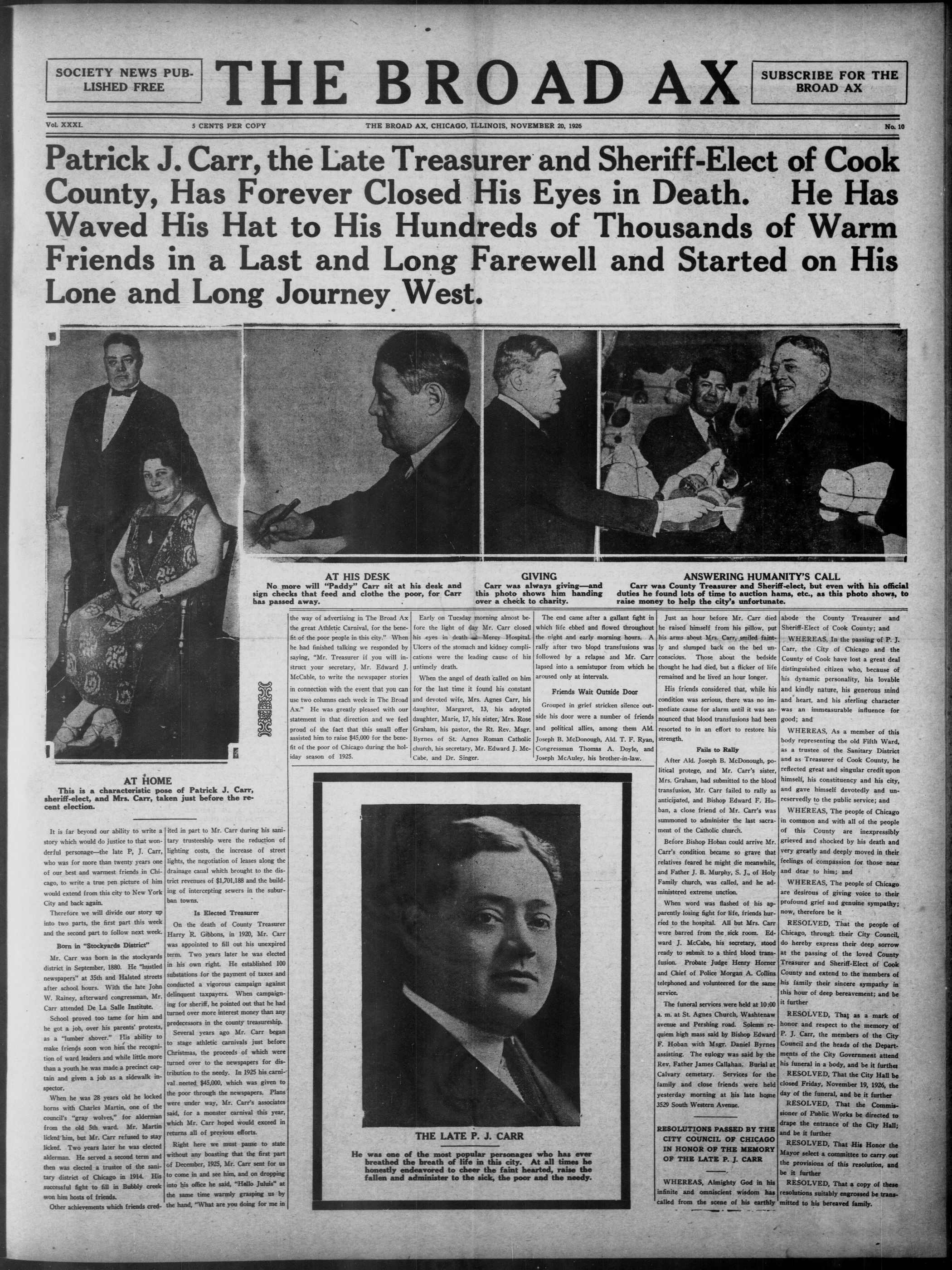
Patrick J. Carr, the Late Treasurer and Sheriff-Elect of Cook County, Has Forever Closed His Eyes in Death. He Has Waved His Hat to His Hundreds of Thousands of Warm Friends in a Last and Long Farewell and Started on His Lone and Long Journey West.
SOCIETY NEWS PUBLISHED FREE
Patrick J. County, H Waved Hi Friends in Lone and
AT HOME
This is a characteristic pose of P sheriff-elect, and Mrs. Carr, taken just cent election.
1
---
Vol. XXXI.
It is far beyond our ability to write a story which would do justice to that wonderful personage—the late P, J. Carr, who was for more than twenty years one of our best and warmest friends in Chicago, to write a true pen picture of him would extend from this city to New York City and back again.
Therefore we will divide our story up into two parts, the first part this week and the second part to follow next week.
Born in "Stockyards District"
Mr. Carr was born in the stockyards district in September, 1880. He "hustled newspapers" at 35th and Halsted streets after school hours. With the late John W. Rainey, afterward congressman, Mr. Carr attended De La Salle Institute.
School proved too tame for him and he got a job, over his parents' protests, as a "lumber shover." His ability to make friends soon won him the recognition of ward leaders and while little more than a youth he was made a precinct captain and given a job as a sidewalk inspector.
When he was 28 years old he locked horns with Charles Martin, one of the council's "gray wolves," for alderman from the old 5th ward. Mr. Martin licked him, but Mr. Carr refused to stay licked. Two years later he was elected alderman. He served a second term and then was elected a trustee of the sanitary district of Chicago in 1914. His successful fight to fill in Bubbly creek won him hosts of friends.
Other achievements which friends cred-
THE BROAD AX
1
AT HIS DESK No more will "Paddy" Carr sit at his desk and sign checks that feed and clothe the poor, for Carr has passed away.
5 CENTS PER COPY
J. Carr, the Has For His Hat in a Lashed Long J
No sign chee has pass
E
se of Patrick J. Carr, taken just before the re-
ited in part to Mr. Carr during his sanitary trusteeship were the reduction of lighting costs, the increase of street lights, the negotiation of leases along the drainage canal which brought to the district revenues of $1,701,188 and the building of intercepting sewers in the suburban towns.
Is Elected Treasurer
On the death of County Treasurer Harry R. Gibbons, in 1920, Mr. Carr was appointed to fill out his unexpired term. Two years later he was elected in his own right. He established 100 substations for the payment of taxes and conducted a vigorous campaign against delinquent taxpayers. When campaigning for sheriff, he pointed out that he had turned over more interest money than any predecessors in the county treasureship.
Several years ago Mr. Carr began to stage athletic carnivals just before Christmas, the proceeds of which were turned over to the newspapers for distribution to the needy. In 1925 his carnival nected $45,000, which was given to the poor through the newspapers. Plans were under way, Mr. Carr's associates said, for a monster carnival this year, which Mr. Carr hoped would exceed in returns all of previous efforts.
Right here we must pause to state without any boasting that the first part of December, 1925, Mr. Carr sent for us to come in and see him, and on dropping into his office he said, "Hello Juluis" at the same time warmly grasping us by the hand. "What are you doing for me in
---
THE BROAD AX, CHICAGO, ILLINOIS, NOVEMBER 20, 1926
[Picture of a man in a suit with a tie].
He was one of the most popular personages who has ever breathed the breath of life in this city. At all times he honestly endeavored to cheer the faint hearted, raise the fallen and administer to the sick, the poor and the needy.
the way of advertising in The Broad Ax the great Athletic Carnival, for the benefit of the poor people in this city." When he had finished talking we responded by saying, "Mr. Treasurer if you will instruct your secretary, Mr. Edward J. McCable, to write the newspaper stories in connection with the event that you can use two columns each week in The Broad Ax." He was greatly pleased with our statement in that direction and we feel proud of the fact that this small offer assisted him to raise $45,000 for the benefit of the poor of Chicago during the holiday season of 1925.
1930
GIVING
Carr was always giving—and
this photo shows him handing
over a check to charity.
Early on Tuesday morning almost before the light of day Mr. Carr closed his eyes in death at Mercy Hospital. Ulcers of the stomach and kidney complications were the leading cause of his untimely death.
When the angel of death called on him for the last time it found his constant and devoted wife, Mrs. Agnes Carr, his daughter, Margaret, 13, his adopted daughter, Marie, 17, his sister, Mrs. Rose Graham, his pastor, the Rt. Rev. Msgr. Byrnes of St. Agnes Roman Catholic church, his secretary, Mr. Edward J. McCabe, and Dr. Singer.
M.
THE MAYOR OF BROOKLYN
THE LATE P. J. CARR
If the most popular personages
the breath of life in this city.
leavored to cheer the faint he
administer to the sick, the poor
alar personages who has ever in this city. At all times he over the faint hearted, raise the sick, the poor and the needy.
The end came after a gallant fight in which life ebbed and flowed throughout the night and early morning hours. A rally after two blood transfusions was followed by a relapse and Mr. Carr lapsed into a semistupor from which he aroused only at intervals.
Friends Wait Outside Door
Grouped in grief stricken silence outside his door were a number of friends and political allies, among them Ald. Joseph B. McDonough, Ald. T. F. Ryan, Congressman Thomas A. Doyle, and Joseph McAuley, his brother-in-law.
THE MAYOR OF BROOKLYN, N.Y., WAS IN AWARDS OF THE MAYOR OF BROOKLYN, N.Y., FOR A SUCCESSFUL YEAR. HE WAS RECEIVED THE MAYOR OF BROOKLYN, N.Y., FOR A SUCCESSFUL YEAR. HE WAS RECEIVED THE MAYOR OF BROOKLYN, N.Y., FOR A SUCCESSFUL YEAR.
Carr was County Treasurer and Sheriff-elect, but even with his official duties he found lots of time to auction hams, etc., as this photo shows, to raise money to help the city's unfortunate.
Just an hour before Mr. Carr died he raised himself from his pillow, put his arms about Mrs. Carr, smiled faintly and slumped back on the bed unconscious. Those about the bedside thought he had died, but a flicker of life remained and he lived an hour longer.
His friends considered that, while his condition was serious, there was no immediate cause for alarm until it was announced that blood transfusions had been resorted to in an effort to restore his strength.
abode the County Treasurer and Sheriff-Elect of Cook County; and
WHEREAS, In the passing of P. J. Carr, the City of Chicago and the County of Cook have lost a great deal distinguished citizen who, because of his dynamic personality, his lovable and kindly nature, his generous mind and heart, and his sterling character was an immeasurable influence for good; and
WHEREAS, As a member of this body representing the old Fifth Ward.
Fails to Rally
After Ald. Joseph B. McDonough, political protege, and Mr. Carr's sister, Mrs. Graham, had submitted to the blood transfusion, Mr. Carr failed to rally as anticipated, and Bishop Edward F. Hoban, a close friend of Mr. Carr's was summoned to administer the last sacrament of the Catholic church.
Before Bishop Hoban could arrive Mr. Carr's condition became so grave that relatives feared he might die meanwhile, and Father J. B. Murphy, S. J., of Holy Family church, was called, and he administered extreme unction.
When word was flashed of his apparently losing fight for life, friends hurried to the hospital. All but Mrs. Carr were barred from the sick room. Edward J. McCabe, his secretary, stood ready to submit to a third blood transfusion. Probate Judge Henry Horner and Chief of Police Morgan A. Collins telephoned and volunteered for the same service.
The funeral services were held at 10:00 a. m. at St. Agnes Church, Washtenaw avenue and Pershing road. Solemn requiem high mass said by Bishop Edward F. Hoban with Msgr. Daniel Byrnes assisting. The eulogy was said by the Rev. Father James Callahan. Burial at Calvary cemetary. Services for the family and close friends were held yesterday morning at his late home 3529 South Western Avenue.
RESOLUTIONS PASSED BY THE
CITY COUNCIL OF CHICAGO
IN HONOR OF THE MEMORY
OF THE LATE P. J. CARR
WHEREAS, Almighty God in his
infinite and omniscient wisdom has
called from the scene of his earthly
SUBSCRIBE FOR THE BROAD AX
ct of Cook
He Has
of Warm
ed on His
HUMANITY'S CALL
Sheriff-elect, but even with his office
on hams, etc., as this photo shows,
retunate.
abode the County Treasurer and Sheriff-Elect of Cook County; and WHEREAS, In the passing of P. J. Carr, the City of Chicago and the County of Cook have lost a great deal distinguished citizen who, because of his dynamic personality, his lovable and kindly nature, his generous mind and heart, and his sterling character was an immeasurable influence for good; and WHEREAS, As a member of this body representing the old Fifth Ward, as a trustee of the Sanitary District and as Treasurer of Cook County, he reflected great and singular credit upon himself, his constituency and his city, and gave himself devotedly and unreservedly to the public service; and
WHEREAS, The people of Chicago in common and with all of the people of this County are inexpressibly grieved and shocked by his death and very greatly and deeply moved in their feelings of compassion for those near and dear to him; and
WHEREAS, The people of Chicago are desirous of giving voice to their profound grief and genuine sympathy; now, therefore be it
RESOLVED, That the people of Chicago, through their City Council, do hereby express their deep sorrow at the passing of the loved County Treasurer and Sheriff-Elect of Cook County and extend to the members of his family their sincere sympathy in this hour of deep bereavement; and be it further
tenaw
comm re-
ward
dyynes
the marial at
or the
held
home
THE
CAGO
MORY
R
in his
has
earthly
RESOLVED, That as a mark of
honor and respect to the memory of
P. J. Carr, the members of the City
Council and the heads of the Depart-
ments of the City Government attend
his funeral in a body, and be it further
RESOLVED, That the City Hall be
closed Friday, November 19, 1926, the
day of the funeral, and be it further
RESOLVED, That the Commis-
sioner of Public Works be directed to
drape the entrance of the City Hall;
and be it further
RESOLVED, That His Honor the
Mayor select a committee to carry out
the provisions of this resolution, and
be it further
RESOLVED, That a copy of these
resolutions suitably engrossed be trans-
mitted to his bereaved family.
M. H.
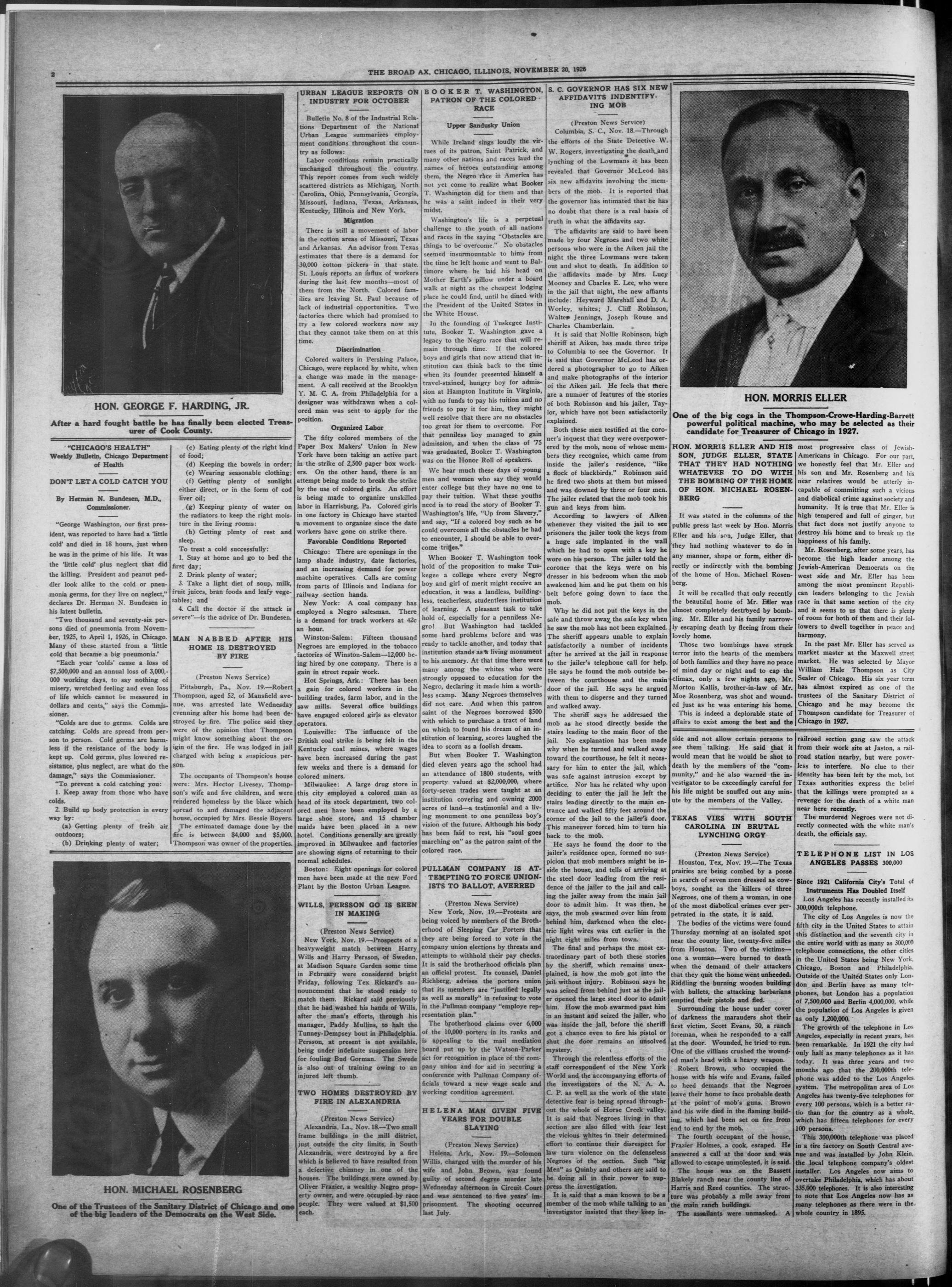
HON. GEORGE F. HARDING, JR.
After a hard fought battle he has finally been elected Treasurer of Cook County.
"CHICAGO'S HEALTH"
Weekly Bulletin, Chicago Department of Health
DON'T LET A COLD CATCH YOU
(c) Eating plenty of the right kind of food;
(d) Keeping the bowels in order;
(e) Wearing seasonable clothing;
(f) Getting plenty of sunlight
"George Washington, our first president, was reported to have had a 'little cold' and died in 18 hours, just when he was in the prime of his life. It was the 'little cold' plus neglect that did the killing. President and peanut peddler look alike to the cold or pneumonia germs, for they live on neglect," declares Dr. Herman N. Bundesen in his latest bulletin.
"Two thousand and seventy-six persons died of pneumonia from November, 1925, to April 1, 1926, in Chicago. Many of these started from a 'little cold that became a big pneumonia.'
"Each year 'colds' cause a loss of $7,500,000 and an annual loss of 3,000,-000 working days, to say nothing of misery, wretched feeling and even loss of life which cannot be measured in dollars and cents," says the Commissioner.
"Colds are due to germs. Colds are catching. Colds are spread from person to person. Cold germs are harmless if the resistance of the body is kept up. Cold germs, plus lowered resistance, plus neglect, are what do the damage," says the Commissioner.
"To prevent a cold catching you:
1. Keep away from those who have colds.
2. Build up body protection in every way by:
(a) Getting plenty of fresh air outdoors;
(b) Drinking plenty of water;
THE NEW YORK TIMES
M.
HON. MICHAEL ROSENBERG
One of the Trustees of the Sanitary District of Chi of the big leaders of the Democrats on the W
One of the Trustees of the Sanitary District of Chicago and one of the big leaders of the Democrats on the West Side.
(c) Eating plenty of the right kind of food;
(d) Keeping the bowels in order;
(e) Wearing seasonable clothing;
(f) Getting plenty of sunlight either direct, or in the form of cod liver oil;
(g) Keeping plenty of water on the radiators to keep the right moisture in the living rooms:
(h) Getting plenty of rest and sleep.
To treat a cold successfully:
1. Stay at home and go to bed the first day;
2. Drink plenty of water;
3. Take a light diet of soup, milk, fruit juices, bran foods and leafy vegetables; and
4. Call the doctor if the attack is severe"—is the advice of Dr. Bundesen.
MAN NABBED AFTER HIS HOME IS DESTROYED BY FIRE
(Preston News Service)
Pittsburgh, Pa., Nov. 19.—Robert Thompson, aged 52, of Mansfield avenue, was arrested late Wednesday evening after his home had been destroyed by fire. The police said they were of the opinion that Thompson might know something about the origin of the fire. He was lodged in jail charged with being a suspicious person.
The occupants of Thompson's house were: Mrs. Hector Livesey, Thompson's wife and five children, and were rendered homeless by the blaze which spread to and damaged the adjacent house, occupied by Mrs. Bessie Boyers.
The estimated damage done by the fire is between $4,000 and $5,000. Thompson was owner of the properties.
1930
tary District of Chicago and one democrats on the West Side.
THE BROAD AX, CHICAGO, ILLINOIS, NOVEMBER 20, 1926
URBAN LEAGUE REPORTS ON INDUSTRY FOR OCTOBER
Bulletin No. 8 of the Industrial Relations Department of the National Urban League summarizes employment conditions throughout the country as follows: Labor conditions remain practically unchanged throughout the country. This report comes from such widely scattered districts as Michigan, North Carofina, Ohio, Pennsylvania, Georgia, Missouri, Indiana, Texas, Arkansas, Kentucky, Illinois and New York.
Migration
There is still a movement of labor in the cotton areas of Missouri, Texas and Arkansas. An advisor from Texas estimates that there is a demand for 30,000 cotton pickers in that state. St. Louis reports an influx of workers during the last few months—most of them from the North. Colored families are leaving St. Paul because of lack of industrial opportunities. Two factories there which had promised to try a few colored workers now say that they cannot take them on at this time.
Discrimination
Colored waiters in Pershing Palace, Chicago, were replaced by white, when a change was made in the management. A call received at the Brooklyn Y. M. C. A. from Philadelphia for a designer was withdrawn when a colored man was sent to apply for the position.
Organized Labor
The fifty colored members of the Paper Box Makers' Union in New York have been taking an active part in the strike of 2,500 paper box workers. On the other hand, there is an attempt being made to break the strike by the use of colored girls. An effort is being made to organize unskilled labor in Harrisburg, Pa. Colored girls in one factory in Chicago have started a movement to organize since the date workers have gone on strike there.
Favorable Conditions Reported
Chicago: There are openings in the lamp shade industry, date factories, and an increasing demand for power machine operatives. Calls are coming from parts of Illinois and Indiana for railway section hands.
New York: A coal company has employed a Negro salesman. There is a demand for track workers at 42c an hour.
Winston-Salem: Fifteen thousand Negroes are employed in the tobacco factories of Winston-Salem—12,000 being hired by one company. There is a gain in street repair work.
Hot Springs, Ark.: There has been a gain for colored workers in the building trades, farm labor, and in the saw mills. Several office buildings have engaged colored girls as elevator operators.
Louisville: The influence of the British coal strike is being felt in the Kentucky coal mines, where wages have been increased during the past few weeks and there is a demand for colored miners. Milwaukee: A large drug store in this city employed a colored man as head of its stock department, two colored men have been employed by a large shoe store, and 15 chamber maids have been placed in a new hotel. Conditions generally are greatly improved in Milwaukee and factories are showing signs of returning to their normal schedules. Boston: Eight openings for colored men have been made at the new Ford Plant by the Boston Urban League.
WILLS, PERSSON GO IS SEEN
IN MAKING
New York, Nov. 19.—Prospects of a heavyweight match between Harry Wills and Harry Persson, of Sweden, at Madison Square Garden some time in February were considered bright Friday, following Tex Rickard's announcement that he stood ready to match them. Rickard said previously that he had washed his hands of Wills, after the man's efforts, through his manager, Paddy Mullins, to halt the Tunney-Dempsey bout in Philadelphia. Persson, at present is not available, being under indefinite suspension here for fouling Bud Gorman. The Swede is also out of training owing to an injured left thumb.
TWO HOMES DESTROYED BY
FIRE IN ALEXANDRIA
(Preston News Service)
Alexandria, La., Nov. 18.—Two small frame buildings in the mill district, just outside the city limits, in South Alexandria, were destroyed by a fire which is believed to have resulted from a defective chimney in one of the houses. The buildings were owned by Oliver Frazier, a wealthy Negro property owner, and were occupied by race people. They were valued at $1,500 each.
BOOKER T. WASHINGTON
PATRON OF THE COLORED
PACE
Upper Sandusky Union
While Ireland sings loudly the virtues of its patron, Saint Patrick, and many other nations and races laud the names of heroes outstanding among them, the Negro race in America has not yet come to realize what Booker T. Washington did for them and that he was a saint indeed in their very midst.
Washington's life is a perpetual challenge to the youth of all nations and races in the saying "Obstacles are things to be overcome." No obstacles seemed insurmountable to him from the time he left home and went to Baltimore where he laid his head on Mother Earth's pillow under a board walk at night as the cheapest lodging place he could find, until he dined with the President of the United States in the White House.
In the founding of Tuskegee Institute, Booker T. Washington gave a legacy to the Negro race that will remain through time. If the colored boys and girls that now attend that institution can think back to the time when its founder presented himself a travel-stained, hungry boy for admission at Hampton Institute in Virginia, with no funds to pay his tuition and no friends to pay it for him, they might well resolve that there are no obstacles too great for them to overcome. For that penniless boy managed to gain admission, and when the class of '75 was graduated, Booker T. Washington was on the Honor Roll of speakers.
We hear much these days of young men and women who say they would enter college but they have no one to pay their tuition. What these youths need is to read the story of Booker T. Washington's life, "Up from Slavery," and say, "If a colored boy such as he could overcome all the obstacles he had to encounter, I should be able to overcome trifles."
When Booker T. Washington took hold of the proposition to make Tuskegee a college where every Negro boy and girl of merit might receive an education, it was a landless, buildingless, teacherless, studentless institution of learning. A pleasant task to take hold of, especially for a penniless Negro! But Washington had tackled some hard problems before and was ready to tackle another, and today that institution stands as living monument to his memory. At that time there were many among the whites who were strongly opposed to education for the Negro, declaring it made him a worthless scamp. Many Negroes themselves did not care. And when this patron saint of the Negroes borrowed $500 with which to purchase a tract of land on which to found his dream of an institution of learning, scores laughed the idea to scorn as a foolish dream.
But when Booker T. Washington died eleven years ago the school had an attendance of 1800 students, with property valued at $2,000,000, where forty-seven trades were taught at an institution covering and owning 2000 acres of land—a testimonial and a living monument to one penniless boy's vision of the future. Although his body has been laid to rest, his "soul goes marching on" as the patron saint of the colored race.
PULLMAN COMPANY IS AT TEMPTING TO FORCE UNIONISTS TO BALLOT, AVERED
New York, Nov. 19.-Protests are being voiced by members of the Brotherhood of Sleeping Car Porters that they are being forced to vote in the company union elections by threats and attempts to withhold their pay checks. It is said the brotherhood officials plan an official protest. Its counsel, Daniel Richberg, advises the porters union that its members are "justified legally as well as morally" in refusing to vote in the Pullman company "employe representation plan."
The brotherhood claims over 6,000 of the 10,000 porters in its ranks and is appealing to the mail mediation board put up by the Watson-Parker act for recognition in place of the company union and for aid in securing a conference with Pullman Company officials toward a new wage scale and working condition agreement.
HELENA MAN GIVEN FIVE
YEARS FOR DOUBLE
(Preston News Service)
Helena, Ark, Nov. 19.—Solomon Willis, charged with the murder of his wife and John Brown, was found guilty of second degree murder late Wednesday afternoon in Circuit Court and was sentenced to five years' imprisonment. The shooting occurred last July.
Columbia, S. C., Nov. 18.—Through the efforts of the State Detective W. W. Rogers, investigating the death and lynching of the Lowmans it has been revealed that Governor McLeod has six new affidavits involving the members of the mob. It is reported that the governor has intimated that he has no doubt that there is a real basis of truth in what the affidavits say.
The affidavits are said to have been made by four Negroes and two white persons who were in the Aiken jail the night the three Lowmans were taken out and shot to death. In addition to the affidavits made by Mrs. Lucy Mooney and Charles E. Lee, who were in the jail that night, the new affiants include: Heyward Marshall' and D. A. Worley, whites; J. Cliff Robinson, Walter Jennings, Joseph Rouse and Charles Chamberlain.
It is said that Nollie Robinson, high sheriff at Aiken, has made three trips to Columbia to see the Governor. It is said that Governor McLeod has ordered a photographer to go to Aiken and make photographs of the interior of the Aiken jail. He feels that there are a numoer of features of the stories of both Robinson and his jailer, Taylor, which have not been satisfactorily explained.
Both these men testified at the coroner's inquest that they were overpowered by the mob, none of whose members they recognize, which came from inside the jailer's residence, "like a flock of blackbirds." Robinson said he fired two shots at them but missed and was downed by three or four men. The jailer related that the mob took his gun and keys from him.
According to lawyers of Alken whenever they visited the jail to see prisoners the jailer took the keys from a huge safe implanted in the wall which he had to open with a key he wore on his person. The jailer told the coroner that the keys were on his dresser in his bedroom when the mob awakened him and he put them on his belt before going down to face the mob.
Why he did not put the keys in the safe and throw away the safe key when he saw the mob has not been explained. The sheriff appears unable to explain satisfactorily a number of incidents after he arrived at the jail in response to the jailer's telephone call for help. He says he found the mob outside between the courthouse and the main door of the jail. He says he argued with them to disperse and they turned and walked away.
The sheriff says he addressed the mob as he stood directly beside the stairs leading to the main floor of the jail. No explanation has been made why when he turned and walked away toward the courthouse, he felt it necessary for him to enter the jail, which was safe against intrusion except by artifice. Nor has he related why upon deciding to enter the jail he left the stairs leading directly to the main entrance and walked fifty feet around the corner of the jail to the jailer's door. This maneuver forced him to turn his back to the mob.
He says he found the door to the jailer's residence open, formed no suspicion that mob members might be inside the house, and tells of arriving at the steel door leading from the residence of the jailer to the jail and calling the jailer away from the main jail door to admit him. It was then, he says, the mob swarmed over him from behind him, darkened when the electric light wires was cut earlier in the night eight miles from town.
The final and perhaps the most extraordinary part of both these stories by the sheriff, which remains unexplained, is how the mob got into the jail without injury. Robinson says he was seized from behind just as the jailer opened the large steel door to admit him. How the mob swarmed past him in an instant and seized the jail, who was inside the jail, before the sheriff got a chance even to fire his pistol or shut the door remains an unsolved mystery.
Through the relentless efforts of the staff correspondent of the New York World and the accompanying efforts of the investigators of the N. A. A. C. P. as well as the work of the state detective fear is being spread throughout the whole of Horse Creek valley. It is said that Negroes living in that section are also filled with fear lest the vicious whites in their determined effort to continue their disrespect for law turn violence on the defenseless Negroes of the section. Such "big Men" as Quinby and others are said to be doing all in their power to suppress the investigation.
It is said that a man known to be a member of the mob while talking to an investigator insisted that they keep in-
[Name]
HON. MORRIS ELLER
One of the big cogs in the Thompson-Crowe-Harding-Barrett powerful political machine, who may be selected as their candidate for Treasurer of Chicago in 1927.
HON. MORRIS ELLER AND HIS SON, JUDGE ELLER, STATE THAT THEY HAD NOTHING WHATEVER TO DO WITH THE BOMBING OF THE HOME OF HON. MICHAEL ROSENBERG
most progressive class of Jewish Americans in Chicago. For our part, we honestly feel that Mr. Eller and his son and Mr. Rosenberg and his near relatives would be utterly incapable of committing such a vicious and diabolical crime against society and
It was stated in the columns of the public press last week by Hon. Morris Eller and his son, Judge Eller, that they had nothing whatever to do in any manner, shape or form, either directly or indirectly with the bombing of the home of Hon. Michael Rosenberg.
It will be recalled that only recently the beautiful home of Mr. Eller was almost completely destroyed by bombing. Mr. Eller and his family narrowly escaping death by fleeing from their lovely home.
Those two bombings have struck terror into the hearts of the members of both families and they have no peace of mind day or night and to cap the climax, only a few nights ago, Mr. Morton Kallis, brother-in-law of Mr. Moe Rosenberg, was shot and wounded just as he was entering his home. This is indeed a deplorable state of affairs to exist among the best and the side and not allow certain persons to see them talking. He said that it would mean that he would be shot to death by the members of the "community," and he also warned the investigator to be exceedingly careful for his life might be snuffed out any minute by the members of the Valley.
TEXAS VIES WITH SOUTH
CAROLINA IN BRUTAL
LYNCHING ORGY
(Preston News Service)
Houston, Tex, Nov. 19.—The Texas prairies are being combed by a posse in search of seven men dressed as cowboys, sought as the killers of three Negroes, one of them a woman, in one of the most diabolical crimes ever perpetrated in the state, it is said.
The bodies of the victims were found Thursday morning at an isolated spot near the county line, twenty-five miles from Houston. Two of the victims—one a woman—were burned to death when the demand of their attackers that they quit the home went unheeded. Riddling the burning wooden building with bullets, the attacking barbarians emptied their pistols and fled.
Surrounding the house under cover of darkness the marauders shot their first victim, Scott Evans, 50, a ranch foreman, when he responded to a call at the door. Wounded, he tried to run. One of the villains crushed the wounded man's head with a heavy weapon. Robert Brown, who occupied the house with his wife and Evans, failed to heed demands that the Negroes leave their home to face probable death at the point of mob's guns. Brown and his wife died in the flaming building, which had been set on fire from end to end by the mob.
The fourth occupant of the house, Frazier Holmes, a cook, escaped. He answered a call at the door and was allowed to escape unmolested, it is said. The house was on the Bassett Blakely ranch near the county line of Harris and Reed counties. The structure was probably a mile away from the main ranch buildings. The appliances were unmasked. A
most progressive class of Jewish-Americans in Chicago. For our part, we honestly feel that Mr. Eller and his son and Mr. Rosenberg and his near relatives would be utterly incapable of committing such a vicious and diabolical crime against society and humanity. It is true that Mr. Eller is high tempered and full of ginger, but that fact does not justify anyone to destroy his home and to break up the happiness of his family.
Mr. Rosenberg, after some years, has become the high leader among the Jewish-American Democrats on the west side and Mr. Eller has been among the most prominent Republican leaders belonging to the Jewish race in that same section of the city and it seems to us that there is plenty of room for both of them and their followers to dwell together in peace and harmony.
In the past Mr. Eller has served as market master at the Maxwell street market. He was selected by Mayor William Hale Thompson as City Sealer of Chicago. His six year term has almost expired as one of the trustees of the Sanitary District of Chicago and he may become the Thompson candidate for Treasurer of Chicago in 1927.
railroad section gang saw the attack from their work site at Jaston, a railroad station nearby, but were powerless to interfere. No clue to their identity has been left by the mob, but Texas authorities express the belief that the killings were prompted as a revenge for the death of a white man near here recently.
The murdered Negroes were not directly connected with the white man's death, the officials say.
TELEPHONE LIST IN LOS
ANGELES PASSES 300,000
Since 1921 California City's Total of Instruments Has Doubled Itself Los Angeles has recently installed its 300,000th telephone. The city of Los Angeles is now the fifth city in the United States to attain this distinction and the seventh city in the entire world with as many as 300,000 telephone connections, the other cities in the United States being New York, Chicago, Boston and Philadelphia. Outside of the United States only London and Berlin have as many telephones, but London has a population of 7,500,000 and Berlin 4,000,000, while the population of Los Angeles is given as only 1,200,000.
The growth of the telephone in Los Angeles, especially in recent years, has been remarkable. In 1921 the city had only half as many telephones as it has today. It was three years and two months ago that the 200,000th telephone was added to the Los Angeles system. The metropolitan area of Los Angeles has twenty-five telephones for every 100 persons, which is a better ratio than for the country as a whole, which has fifteen telephones for every 100 persons.
This 300,000th telephone was placed in a tire factory on South Central avenue and was installed by John Klein, the local telephone company's oldest installer. Los Angeles now aims to overtake Philadelphia, which has about 335,000 telephones. It is also interesting to note that Los Angeles now has as many telephones as there were in the whole country in 1895.
America Is a Nation of Travelers
ILLINOIS BELL TELEPHONE COMPANY
BELL SYSTEM
One Policy . One System . Universal Service
BULLETIN No.83—THE MENACE OF THE MORON TO WOMEN
By Chief of Police Morgun A. Collins
With the coming of the holiday season, the danger to women and small children from morons and other perverted persons becomes greater. Many of the victims of those terrible crimes by this class of criminals result from housewives not exercising due caution in admitting strangers to the home.
Here are a few suggestions to combat this menace:
Mothers should guard their children from being approached by strangers on the outside. Particularly warn them to beware of men they do not know.
Beware of bogus peddlers. Before admitting telephone collectors, gas and electric inspectors, delivery boys and messengers be sure they identify themselves with proper credentials. Many revolting crimes have been committed by morons representing themselves as peddlers and collectors.
Use extreme caution before admitting strangers. Safeguard yourself by equipping your door with a chain and lock or safety catch, so that you can find out who the stranger is before you open it.
The holiday season is harvest time for the fake beggar. These impostors are exceedingly dangerous. The law forbids this practice. Worthy dependent persons can obtain help from the county.
Help us to protect you. Call the police Main 1313 if you have reason to believe that any criminal of the type mentioned above is in your vicinity. Co-operate with us—we are trying to protect you.
ABYSSINIA HAS ONE NEWS- PAPER
Washington.—The Empire of Abyssinia, whose sovereign is the Negua Negusti, or King of Kings, possesses but one newspaper. It is called Berhanena Salem, which means "light and peace," and has been published as a weekly for the last two years at Addis-Abeba. It is printed in the massive Ethiopian script, and each number bears the signature of the Emperor. Its contents comprise the inevitable "Chronique Scandaleuse," elaborate descriptions of court and church celebrations on the 150 holidays from the various provinces of the empire and, of course, all the imperial rescripts. To the rest of the world, the four-page journal seems to pay little attention. Possibly this is explained in part by the fact that all news from outside has to pass through the censorship of the Italian Embassy, which boasts of the only radio outfit in the realm.
LABOR LEADERS ORGANIZE COLORED FACTORY GIRLS
Chicago, Nov. 18.—President Fitzpatrick and other officers of the Federation of Labor are aiding colored girls whose low wages at a date and fig factory forced them to strike. As beginners they were paid $4 to $5 a week. After one year, they make $9 a week. There is no dressing room and work and sanitary conditions are bad. The girls have been organized and the trade unionists are directing them how to conduct their fight for better conditions.
America Is
Nation of
TO meet the demand for new telephones moreplant must be built-at costs greater than the cost of the average of our present plant. To do this we must obtain capital and to attract this we must pay satisfactory returns. This we cannot do without adequate rates.
ILLINOIS BELL TECH
BELL S
One Policy - One System
BEST BUILT BUILDING
CONDEMNED TO DIE, FRIENDS
SECURE RETRIALS AND
ULTIMATE ACQUITTAL
Houston, Texas, Nov. 18.—An interesting case of interracial cooperation, in which the life of an innocent Negro was saved, culminated here a few days ago. Some months back a grave crime was committed against a woman in this city, who declared that a tall Negro was the offender. A colored boy, fresh from the country, who answered the description in a general way, was arrested, tried, and sentenced to death. The Negroes of Houston believed him innocent and brought the case to the attention of the Interracial Commission.
The Commission also had doubts about the matter and took action at once. They delegated two colored men to go to the jail and interview the boy. On receipt of the report of these men, which convinced them that there was grave doubt as to the prisoner's guilt, the Commission employed a lawyer, went into court, and asked a rehearing and change of venue. Their plea was granted and in the second trial the boy was sentenced to ninety-nine years of imprisonment. Still the Commission was not satisfied as to his guilt and secured another trial, making bond for the prisoner in the sum of $2,500. A few days ago the third trial took place and the boy was declared not guilty and was set free.
This is but one illustration of many helpful activities of the Commission in this city.
DEDICATE MONUMENT IN HONOR OF MEMORY OF COLONEL YOUNG
Washington, D. C. A monument was dedicated to the late Colonel Charles Young, United States Army, Thursday, scores of citizens journeying to the grave in Arlington Cemetery, where a program was under the direction of the James E. Walker Post, American Legion. Eulogistic addresses, paying tribute to the life and character of Colonel Young and calling attention to the fact that he held the highest rank ever attained by a member of the race in the Regular Army were delivered by Maj. O. J. W. Scott, retired, former Army chaplain; Col. John T. Axton, chief of the Chapplain's Corps, and Dr. Emmett J. Scott, Secretary-Treasurer of Howard University. The program served the double purpose of according honor to Colonel Young and marking an appropriate observance of Armistice day. "Through the years of the future; Charles Young will be recalled as the officer who made it possible, by his high character, patriotism and devotion, for other men of his race to achieve high station as officers of the United States Army," declared Dr. Scott, "and we shall only venture to hope that the youth of his race may catch some portion of his undaunted spirit." Col. Young's son and other members of his family were guests of honor at the ceremonies, which were attended also by Col. Benjamin O. Davis, Maj. John E. Green, Harry E. Davis, of Cleveland, and members of the Walker Legion Post. Frank Coleman, chairman of the Young Memorial Committee, presided.
OUR splendid railroad service, our wonderful highway system, our convenient electric lines and automobiles have made Americans the greatest travelers in the world. Those who have no definite place to go take the road and become joyous vagabonds.
Those who travel know that they need not be out of touch with home or business. While they may actually be thousands of miles away they are yet no further from home than the nearest telephone. Speedily and at low cost they can be in conversation with home or business from any distance. Bell telephone lines reach everywhere.
THE BROAD AX. CHICAGO, ILLINOIS, NOVEMBER 20, 1926
(Preston News Service)
Philadelphia, Pa., Nov. 18.—On Saturday evening a banquet was held at Pheidel's catering establishment here in honor of I. B. (Buck) Fletcher, who retired November 1. after 42 years of service on the Pennsylvania Railroad system. The principal speaker of the evening was Judge Edward Henry, of the Municipal Court here. Judge Henry urged the audience to emulate the example of Mr. Fletcher and plead with the men to try and benefit as had Mr. Fletcher by the wonderful contacts his work enabled him to make.
The other speakers included Harry Ratcliffe, retired, of Philadelphia and Atlantic City; John (Jack) Childress, W. W. Jackson, Harry Duitrielle, D. A. Woodyard, James B. Johnson, William B. Rozier, Pressley Baker, Edward Wilson, Robert Pearce and Charles Allen. Mr. Allen made the presentation speech.
The tokens of respect given to Mr. Fletcher included a large traveling bag, boxes of favorite cigars and numerous articles of personal uses. Among those attending the banquet were: I. N. Lee, Trenton; M. Baltimore, Camden; James Hardy, New York; William Rozier, John Childress, H. Edwards, J. A. Johnson, James B. Johnson, D. A. Woodyard, Mackey Brown and John Wilson, from Pittsburgh. From Philadelphia were Messrs. Griffin, Hurd, Jackson, Pierce, Reed, Potts, Baker, Wilson, Tyson, Green, Allen, Duitrielle and Smith. From Cleveland were Messrs. Pearce, Neal and Johnson; George W. Elliott, Robert Pearce, E. H. Hill of Pittsburgh, sent letters of regret.
Mr. Fletcher had the honor of serving three presidents of the Pennsylvania System—J. A. McCrea, A. J. Cassati and Frank Thompson. At the last meeting of the Board of Directors of the Company the board voted four shares of P. R. R. stock to Mr. Fletcher on his retirement.
SIX HELD IN $23,500 WHEELING
GEM THEFT
(Preston News Service)
(Preston News Service)
Pittsburgh, Pa., Nov. 18.—With the arrest of three men and three women, detectives say they have solved the robbery of the home of H. F. Behrens in Wheeling, W. Va., several weeks ago, in which jewels valued at $23,500 were stolen. A search is being made for three others. The prisoners being held here were arrested Thursday night. They gave their names as Henry Givens, 22, of Wheeling, "Slim" Cain, a well known Homestead gamble, Maude Anderson, 28, and Dovey Jackson, 25, both of Fullerton St. They are being held in Central Station as suspicious persons. Late Friday night, police arrested William Buckner and another woman whose name they refused to divulge, all of Wheeling. Detectives recovered $10,000 worth of unset diamonds hidden in a fur neckpiece in the rear of the Anderson woman's home. The neckpiece had been hidden under the seat of an automobile truck.
According to detectives, Givens, who has been under police surveillance here for several days and who was taken after leaving a house in the Hill district, has confessed to the robbery. He implicated another man.
The prisoner, in his confession, told the detectives, they say, that he sold a $1,500 diamond ring in Wheeling a short time after the robbery. The remainder of the goods, he said, he turned over to Cain. According to detectives, Cain admitted selling the jewels through a Pittsburgh "fence" for $1,500. A search is being made for the alleged "fence." Word also has been wired to police in Mingo Junction, O., Wheeling and Parkersburg for the arrest of three others. Two additional arrests are expected here within a few days. The loot consisted of a diamond ring valued at $1,500, diamond ring valued at $2,500; a diamond bar pin, $4,000; a pendant (diamond), $9,500; a diamond bracelet, $4,000.
ONE-LEGGED MAN PROBABLY
A SUICIDE
(Preston News Service)
Kingston, N. C., Nov. 18—The body of John Tolbert, one-legged log woods worker, was found in Nense River near the Norfolk Southern Railroad bridge southeast of the city Wednesday morning. It was nude. The man's clothing and wooden leg was found on the banks of the river last week. The body had been in the water about ten days. There was no inquest, Coroner Garner holding that Tolbert suicided after removing his clothing and gum leg. Reports were heard shortly after his disappearance that he had been despondent over ill health.
The House That Larry Built
By JANE OSBORN
NEARLY all the other teachers in Polly's school had gone abroad for the summer vacation, but Polly had bought a little roadster instead. And now it was nearly the first of September and she felt somehow as if she hadn't had quite such a satisfactory vacation as she had hoped. Now she stood in Larry Bialr's garage while a mechanic crept under her trim little car to see just why it was that the engine had begun to pound so hard that she had stopped here for help. An idle-looking young man waiting for his car was talking to the six-foot, gray-eyed man in overalls whom the others referred to as "boss." "Nice house you're building next door," observed the waiting young man. "What's your idea?"
Polly's eyes suddenly met those of the gray-eyed young man. He smiled in a most friendly manner and Polly smiled back. "I don't know just what I shall do," said he. "If my girl'll have me, then I'll marry and settle down. But if my girl won't have me, then ill sell it."
"Asked her?" queried the other. "Not in so many words," returned Larry, the boss, "but—oh, she won't want me, so I won't need the house. What do you want to offer me for it?" The idling one made no offer and the subject of conversation was changed. Just then the mechanic got out from under Polly's car and told her he thought everything was all right and she could pay the boss. She started to pay Larry.
"Wait," said Larry, handing back the money. "Maybe I'd better try that car myself." Larry was in the car and had driven it a few feet out of the garage when it stopped and appeared to jump. With difficulty Larry backed it into the garage. "There's something special that car needs," he said. "It won't cost any more—but it needs a new part." Polly was distressed. "Dear me," she said. "I'm ten miles away from home."
"It happens that I am going along that way," said Larry. "Maybe you'd let me drive you home."
So it was that Polly drove ten miles over the highway with Larry. Larry never spent so much time on ten miles before in his life. He apologized, saying that there was something the matter with his car. "I don't mind in the least," said Polly. "I have been enjoying the scenery."
"So have I," said the bold Larry, looking into Polly's pretty face.
The next morning Larry brought back Polly's car.
"How are you going to get back?" Polly answered and Larry told her that he'd stand on the highway and get a lift from some truck or other. That is why she felt it was her real duty to take Larry back again to his garage.
"The scenery is even more beautiful to look at today than it was yesterday," said Larry. Then said Polly: "It will be very convenient for you, living there right beside your garage. The house is nearly done--you'll soon be moving in, I suppose."
"That depends on the girl," said Larry wistfully.
"I'm sure you and she ought to be very happy," sighed Polly. "That is to say—the house looks so convenient, and I'm sure it would be very nice living so near one's place of business. I cannot imagine a girl changing her mind after she had once given you her word, or at least made you think she'd marry you. You see I overheard what you were telling that man in the garage yesterday."
"Is that so?" exclaimed Larry. "Well, I oughtn't to be so careless about how I tell secrets." They had reached the garage and Larry could think of no excuse to detain the little school teacher. But the teacher detained herself.
"You don't mind my looking through the house," she asked. "I'm so food of new houses."
Larry insisted on accompanying her. "It is a neat little place, isn't it?" he said, looking down at Polly as they stood in the middle of the perfectly equipped little kitchen. "But I'm not going to let the girl I marry wear herself out working. I'm going to keep a cook for her."
"If she really loved you she wouldn't mind cooking for you," said Polly. "If she didn't really love me!" repeated Larry, looking sadly about. "How I wish I knew!"
"Why don't you ask her?" ventured Polly, and then the realization that this big man, Larry, was trying to make love to her came rushing upon her. She didn't have time to think it all out—whether it would be possible for her—well-bred school teacher—to marry a man who befriended him with the grease of automobiles. But when Larry went toward her with pleading, outstretched arms she met blim half way.
"But, Larry," she said, looking up to him as he held her. "I don't like to feel that I've taken some other girl's place."
"You don't suppose there ever was any other girl," accused Larry. "I liked-liked you a lot—first time I saw you. I was building this house for speculation—but when I saw you standing there and the question came up, I felt possessed to say what I did—and you know there wasn't anything more the matter with your car. I just said there was to get an excuse to take you home."
An inventor in Switzerland has developed a process of making strong cloth from the grindings of old leather.
The Real Burden
Idleness and pride tax with a heavier hand than kings and parliaments.—Benjamin Franklin.
GUN SHOT WOUND IS FOUND
IN BOY'S BACK
(Preston News Service)
Asheboro, N. C., Nov. 18.—Mystery shrouds the death of Leslies Patterson, 18-year-old youth who died about two weeks ago at the home of his parents several miles east of Seagrove, Randolph county, from what was termed pneumonia. White men called in to prepare the body for burial told of holes in the back apparently made by gunshot. News of it reached the county officers who had the body exhumed. Examination disclosed that a load of buckshot had penetrated the spinal column and the back. Patterson's brother and two other men were arrested on suspicion but were released at a preliminary hearing in Asheboro before Squire J. S. Ridge. The three denied any knowledge of the dead boy's wounds, holding to the version of death from pneumonia. Officers are still investigating the case.
For That Tired Feeling
Meat seems to be almost at the head of the list of iron foods; oysters are not far behind; spinach is as valuable as we have been taught to regard it; other leafy vegetables, such as cabbage, lettuce and chard, cannot compare with spinach. Many of the fruits and vegetables are low in iron, much lower than some of us have believed. Prunes and raisins, however, deserve a high rank, just as we have supposed. Potatoes are surprisingly good; indeed, they are better than many of the other vegetables, that is, if they are not depleted by careless preparation. Eggs are valuable. Whole cereals and bread made from the entire grain are important sources of iron. Dried beans are good iron foods. Although the glass of milk does not contain much iron, if taken in customary large amounts milk becomes quite important as a source of iron. Cane molasses is a much better source of iron than sugar.—The Dellneator.
Desire to Own Land
The instinct to acquire and own land is as deep rooted in human beings as almost anything about them. History offers innumerable texts for sermons on the wisdom of land ownership and proves the foresight of the founders of our nation in acquiring great territories for unlimited expansion.
Land ownership, mistaken for national pride, has caused the majority of the world's great conflicts. William the Conqueror, in establishing the feudal system, founded the law of primogeniture so that great estates might be preserved intact, and the holders obligated to the crown in terms of men and money.
The effect it had was to send forth adventurous younger sons in search of lands of their own. Even feudalism could not successfully combat the instinct to acquire and own land.
Last of Aztec Rulers
Montezuma was the last ruler of the Aztecs of Mexico, whose fame is due chiefly to his conflict with the Spanish conqueror, Hernando Cortez. Montezuma had been ruling 17 years in Mexico when the Spaniards arrived. His rule was so weak, however, that the invaders, a mere handful in numbers compared to the native population, soon established themselves securely. Montezuma was taken prisoner, and when the Aztecs could no longer tolerate the overbearing conduct of the Spanish they called on Montezuma's brother to lead a revolt. While this rebellion was in progress Montezuma died. Some say he was killed by the Spaniards, and the invaders themselves gave out the story that he was killed by a stone hurled by one of the revolters, while he was attempting to quiet them from the room of the palace.
At Least One Improvement
The phrase "Neither rhyme nor reason" has a very interesting historic origin.
A pompous and pedantic author took his ponderous book to Sir Thomas More, author of "Utopia," and asked his opinion of it. The chancellor of "Buff King Hal" is one of the most attractive characters in our history, so gentle and sweet-tempered was he, and he let this pedantic upstart down gently by suggesting to him that he might with advantage turn his book into rhyme.
It is related that the author went away highly pleased, and, on completing his task, returned to Sir Thomas for a final verdict. "Aye, aye," said the witty satirist, "that's better." His rhyme at least now, and before it was neither rhyme nor reason."
The World Too Much
It seems to me that everybody needs occasionally to get away from people and things. They crowd in on you, so that you can't think things out, quietly and surely. Life gets all muddled up. You can't see where you are going. You don't know whether you are thinking your own thoughts or merely thinking the echoes of other people's.
I believe a place of escape keeps you from losing yourself. If you get away and find out whether the thing you are doing is what you really intended to do—Glenn Hunter, in the American Magazine.
Universal Vice
Selfishness is that detestable vce
which no one will forgive in others,
and no one is without it himself—
Henry Ward Beecher.
Dainty Flower Designs Are Favored by Paris; Metal for Decorations.
Perhaps the most striking detail of the Ducharnie fall fabric collection is the wonderful quality of the chiffon velvet, which might pass through a wedding ring with the greatest ease. Some of these, notes a Paris fashion writer in the Louisville Courier-Journal, are made in a small check that is destined to be immensely popular during the winter.
Another novelty that arouses much admiration is a chiffon with a wide velvet border. Sometimes the velvet is plain and sometimes embossed.
Velvet embossed on volle in a small flower design is yet another favorite. This embossed velvet is even made for lingerie and negleiges in the paleest colors, such as pink, ciel blue and yellow.
Quite remarkable is a lame crepe that is printed with a flower design after it has been woven with gold. Another beautiful novelty is lame crepe de chine with scattered flowers and butterflies in gold and silver on lovely pastel colors.
There is a satin broche, metal flecked, with tiny stars of silver and gold. A whole series of lames and extraordinarily supple velvets are made in small flower designs that are adaptable to afternoon or evening gowns. Then there is a series just the opposite, with large scattered designs that are repeated each yard in a wide panel.
One* of the most beautiful of these is a pattern of butterflies and bullrushes on a ground of pale crepe de
UNDERWOOD
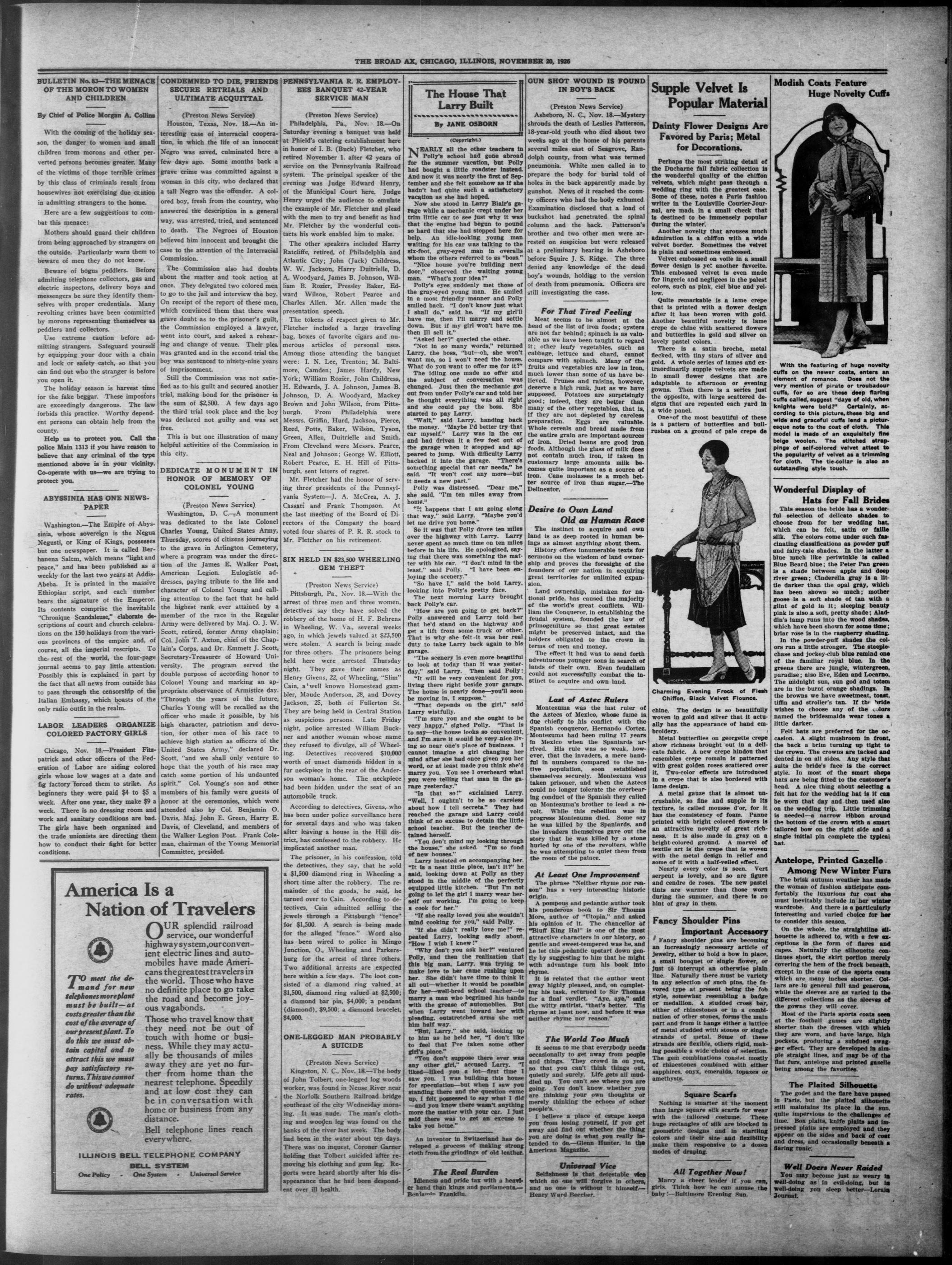
Charming Evening Frock of Flesh Chiffon, Black Velvet Flounce.
chine. The design is so beautifully woven in gold and silver that it actually has the appearance of hand embroidery.
Metal butterflies on georgette crepe show richness brought out in a delicate fabric. A new crepe hindou that resembles crepe romain is patterned with great golden roses scattered over it. Two-color effects are introduced in a crepe that is also bordered with lame design.
A metal gauze that is almost uncrushable, so fine and supple is its texture, is called mousse d'or, for it has the consistency of foam. Panne printed with bright colored flowers is an attractive novelty of great richness. It is also made in gray on a bright-colored ground. A marvel of textile art is the crepe that is woven with the metal design in relief and some of it with a half-velled effect.
Nearly every color is seen. Vert serpent is lovely, and so are figure and cendre de roses. The new pastel tints are warmer than those worn during the summer, and there is no hint of gray in them.
Fancy Shoulder Pins
Important Accessory
Fancy shoulder pins are becoming an increasingly necessary article of jewelry, either to hold a bow in place, a small bouquet or single flower, or just to interrupt an otherwise plain line. Naturally there must be variety in any selection of such pins, the favored type at present being the fob style, somewhat resembling a badge or medallion. A studded cross bar, either of rhinestones or in a combination of other stones, forms the main part and from it hangs either a lattice of metal studded with stones or single strands of metal. Some of these strands are flexible, others rigid, making possible a wide choice of selection. The gem combinations consist mostly of rhinestones combined with either sapphires, onyx, emeralds, topazes or amethysts.
Square Scarfs
Nothing is smarter at the moment than large square silk scarfs for wear with the tailored costume. These huge rectangles of silk are blocked in geometric designs and in startling colors and their size and flexibility make them responsive to a dozen modes of draping.
All Together Now!
Marry a cheer leader if you can, girls. Think how he can amuse the baby!—Baltimore Evening Sun.
I
With the featuring of huge novelty cuffs on the newer coats, enters an element of romance. Does not the very mention of pirate or troubadour cuffs, for so are these deep flaring cuffs called, suggest "days of old, when knights were bold?" Certainly, according to this picture, these big and wide and graceful cuffs lend a picture-seque note to the coat of cloth. This model is made of an exquisitely fine beige woolen. The stitched strappings of self-colored velvet attest to the popularity of velvet as a trimming for cloth. The tie-collar is also an outstanding style touch.
Wonderful Display of
This season the bride has a wonderful selection of delicate shades to choose from for her wedding hat, which can be felt, satin or fallish silk. The colors come under such fascinating classifications as powder puff and fairy-tale shades. In the latter a blue much like periwinkle is called Blue Beard blue; the Peter Pan green is a shade between apple and deep river green; Cinderella gray is a little darker than the opal gray, which has been shown so much; mother goose is a soft shade of tan with a glint of gold in it; sleeping beauty pink is also a soft, pretty shade; Aladdin's lamp runs into the wood shades, which have been shown for some time; brarar rose is in the raspberry shading.
In the powder-puff shades the colors run a little stronger. The steeper-chase and jockey-club blue remind one of the familiar royal blue. In the greens there are jungle, wintergreen, paradise; also Eve, Eden and Locarno. The midnight sun, sun god and totem are in the burnt orange shadings. in the browns we have sweetmeat, toast, tiffin and stroller's tan. If the bride wishes to choose any of the colors named the bridesmalls wear tones a little darker.
Felt hats are preferred for the occasion. A slight mushroom in front, the back a brim turning up tight to the crown. The crowns are tacked and dented in on all sides. Any style that suits the bride's face is the correct style. In most of the smart shops hats are being fitted to the customer's head. A nice thing about selecting a felt hat for the wedding hat is it can be worn that day and then used also on the wedding trip. Little trimming is needed—a narrow ribbon around the bottom of the crown with a smart tailored bow on the right side and a single initial pin complete the typical hat.
Antelope, Printed Gazelle.
Among New Winter Furs
The brisk autumn weather has made the woman of fashion anticipate comfortably the luxurious fur coat she must inevitably include in her winter wardrobe. And there is a particularly interesting and varied choice for her to consider this season.
On the whole, the straightline silhouette is adhered to, with a few exceptions in the form of flares and capes. Naturally the silhouette continues short, the skirt portion merely covering the hem of the frock beneath, except in the case of the sports coats which are many inches shorter. Collars are in general full and generous, while the sleeves are as varied in the different collections as the sleeves of the gowns they will cover.
Most of the Paris sports coats seen at the football games are slightly shorter than the dresses with which they are worn, and have large, high pockets, producing a subdued swagger effect. They are developed in simple straight lines, and may be of the flat furs, antelope and printed gazelle being among the favorites.
The Plaited Silhouette
The godet and the flare have passed in Paris, but the plaited silhouette still maintains its place in the sun, quite impervious to the challenges of time. Box plaits, knife plaits and impressed plaits are employed and they appear on the sides and back of coat and dress, and occasionally beneath a flaring tunic.
Well Doers Never Raided
You may become just as weary in well-doing as in evil-doing, but in well-doing you sleep better—Lorain Journal.
Ernest H.
WILLIAMSON
UNDERTAKER
ERnest H. WILLIAMSON
UNDERTAKER
5121-23-25
E.H. WILLIAMSON
Charleston
Dawson
THE BROAD AX
Published Every Saturday
In this city since July 15th, 1899,
without missing one single issue. Rep-
ublicans, Democrats, Catholics, Pro-
testants, Single Taxes, Priests, infid-
els or anyone else can have their say
as long as their language is proper
and responsibility is fixed.
The Broad Ax is a newspaper whose
platform is broad enough for all, ever
claiming the editorial right to speak
his own mind. It is neither Democ-
ratic nor Republican. It is strictly
or absolutely independent in politics.
Local communications will receive
attention. Write only on one side of
the paper.
Subscriptions must be paid in ad-
vance.
One Year .....$2.00
Six Months .....$1.00
Advertising rates made known on application.
Address all communications to
THE BROAD AX
0206 S. Elizabeth St. Chicago.
Phone: Wentworth 2597
JULIUS F. TAYLOR
Editor and Publisher
Vol. XXXII No. 10
Chicago, November 20, 1926
Entered as Second-Class Matter, aug.
19, 1902, at the Post office at Chicago,
III. Under Act of March 8, 1879.
Phone: Office Main 4153; Residence
4751 Champlain Avenue
Phone Kenwood 6111
ATTORNEY AND COUNSELOR
AT LAW
Suite 708—184 W. Washington St.
CHICAGO
Telephone: State 3278
A. D. GASH
ATTORNEY AT LAW
Suite 813, Ashland Block
155 N. Clark Street
CHICAGO, ILL.
WILL
UND
JOHN D. SCOTT, Manager
Licensed Undertaker
MRS.MARY E. WILLIAMSON
Licensed Undertaker
J.E. BISH
33d Degree PR.W.D.G.M. Bookkeeper
Unexcelled for
AUTOMOBILES
KEN
5121-23-25
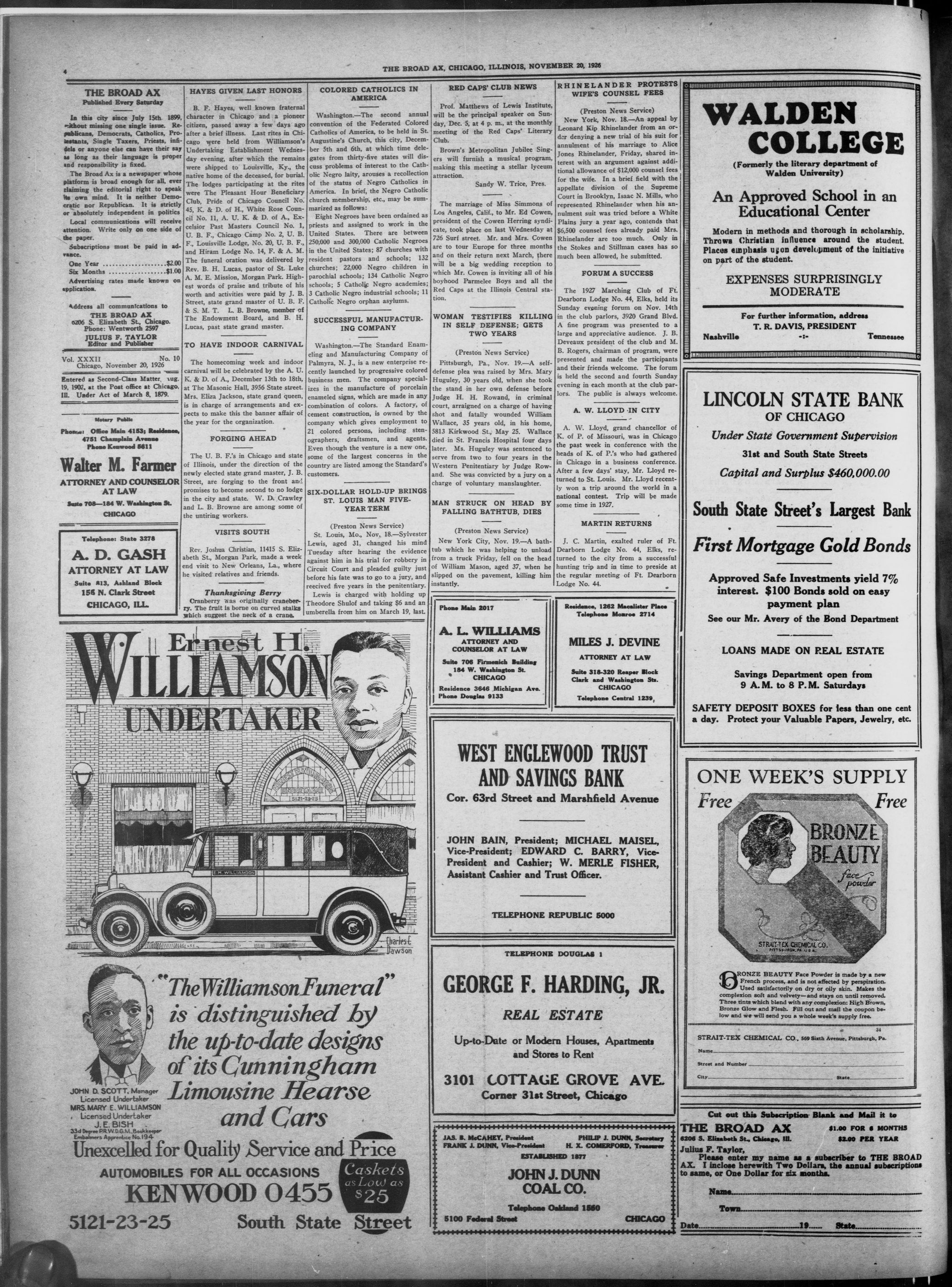
"TheWilliamsonFuneral is distinguished by the up-to-date designs of its Cunningham Limousine Hearse and Cars
HAYES GIVEN LAST HONORS
B. F. Hayes, well known fraternal character in Chicago and a pioneer citizen, passed away a few days ago after a brief illness. Last rites in Chicago were held from Williamson's Undertaking Establishment Wednesday evening, after which the remains were shipped to Louisville, Ky., the native home of the deceased, for burial. The lodges participating at the rites were The Pleasant Hour Beneficiary Club, Pride of Chicago Council No. 45, K. & D. of H., White Rose Council No. 11, A. U. K. & D. of A., Excelsior Past Masters Council No. 1, U. B. F., Chicago Camp No. 2, U. B. F., Louisville Lodge, No. 20, U. B. F., and Hiram Lodge No. 14, F. & A. M. The funeral oration was delivered by Rev. B. H. Lucas, pastor of St. Luke A. M. E. Mission, Morgan Park. Highest words of praise and tribute of his worth and activities were paid by J. B. Street, state grand master of U. B. F. & S. M. T. L. B. Browne, member of The Endowment Board, and B. H. Lucas, past state grand master.
TO HAVE INDOOR CARNIVAL
The homecoming week and indoor carnival will be celebrated by the A. U. K. & D. of A, December 13th to 18th, at the Masonic Hall, 3956 State street. Mrs. Eliza Jackson, state grand queen, is in charge of arrangements and expects to make this the banner affair of the year for the organization.
FORGING AHEAD
The U. B. F.'s in Chicago and state of Illinois, under the direction of the newly elected state grand master, J. B. Street, are forging to the front and promises to become second to no lodge in the city and state. W. D. Crawley and L. B. Browne are among some of the uniring workers.
VISITS SOUTH
Rev. Joshua Christian, 11415 S. Elizabetht St., Morgan Park, made a week end visit to New Orleans, La., where he visited relatives and friends.
Thanksgiving Berry
Cranberry was originally cranberry. The fruit is borne on curved stalks which suggest the neck of a crane.
THE BROAD AX, CHICAGO, ILLINOIS, NOVEMBER 20, 1926
COLORED CATHOLICS IN AMERICA
Washington.—The second annual convention of the Federated Colored Catholics of America, to be held in St. Augustine's Church, this city, December 5th and 6th, at which time delegates from thirty-five states will discuss problems of interest to the Catholic Negro laity, arouses a recollection of the status of Negro Catholics in America. In brief, the Negro Catholic church membership, etc., may be summarized as follows:
Eight Negroes have been ordained as priests and assigned to work in the United States. There are between 250,000 and 300,000 Catholic Negroes in the United States; 87 churches with resident pastors and schools; 132 churches; 22,000 Negro children in parochial schools; 134 Catholic Negro schools; 5 Catholic Negro academies; 3 Catholic Negro industrial schools; 11 Catholic Negro orphan asylums.
SUCCESSPUL MANUFACTURING COMPANY
Washington.-The Standard Enameling and Manufacturing Company of Palmyra, N. J., is a new enterprise recently launched by progressive colored business men. The company specializes in the manufacture of porcelain enameled signs, which are made in any combination of colors. A factory, of cement construction, is owned by the company which gives employment to 21 colored persons, including stenographers, draftsmen, and agents. Even though the venture is a new one, some of the largest concerns in the country are listed among the Standard's customers.
SIX-DOLLAR HOLD-UP BRINGS
ST. LOUIS MAN FIVE-
YEAR TERM
(Preston News Service)
St. Louis, Mo., Nov, 18—Sylvester Lewis, aged 31, changed his mind Tuesday after hearing the evidence against him in his trial for robbery in Circuit Court and pleaded guilty just before his fate was to go to a jury, and received five years in the penitentiary. Lewis is charged with holding up Theodore Shulof and taking $6 and an umbrella from him on March 19, last.
RED CAPS' CLUB NEWS
Prof. Matthews of Lewis Institute will be the principal speaker on Sunday, Dec. 5, at 4 p. m., at the monthly meeting of the Red Caps' Literary Club. Brown's Metropolitan Jubilee Singers will furnish a musical program making this meeting a stellar lyceum attraction. Sandy W. Trice, Pres.
The marriage of Miss Simmons of Los Angeles, Calif., to Mr. Ed Cowen, president of the Cowen Herring syndicate, took place on last Wednesday at 726 Surf street. Mr. and Mrs. Cowen are to tour Europe for three months and on their return next March, there will be a big wedding reception to which Mr. Cowen is inviting all of his boyhood Parmelee Boys and all the Red Caps at the Illinois Central station.
WOMAN TESTIFIES KILLING
IN SELF DEFENSE; GETS
TWO YEARS
(Preston News Service)
Pittsburgh, Pa., Nov. 19.—A self-defense plea was raised by Mrs. Mary Huguley, 30 years old, when she took the stand in her own defense before Judge H. H. Rowand, in criminal court, arraigned on a charge of having shot and fatally wounded William Wallace, 35 years old, in his home, 5813 Kirkwood St., May 25. Wallace died in St. Francis Hospital four days later. Ms. Huguley was sentenced to serve from two to four years in the Western Penitentiary by Judge Rowand. She was convicted by a jury on a charge of voluntary manslaughter.
MAN STRUCK ON HEAD BY
FALLING BATHTUR. DIES
(Preston News Service)
New York City, Nov. 19.—A bath-tub which he was helping to unload from a truck Friday, fell on the head of William Mason, aged 37, when he slipped on the pavement, killing him instantly.
Phone Main 2017
A. L. WILLIAMS
ATTORNEY AND
COUNSELOR AT LAW
Suite 706 Firmenich Building
184 W. Washington St.
CHICAGO
Residence 3646 Michigan Ave.
Phone Douglas 9133
WEST ENGLEW
AND SAVI
Cor. 63rd Street and
JOHN BAIN, President
Vice-President; EDWA
President and Cashier;
Assistant Cashier and T
WEST ENGLEWOOD TRUST AND SAVINGS BANK
Cor. 63rd Street and Marshfield Avenue
JOHN BAIN, President; MICHAEL MAISEL, Vice-President; EDWARD C. BARRY, VicePresident and Cashier; W. MERLE FISHER, Assistant Cashier and Trust Officer.
TELEPHONE REPUBLIC 5000
TELEPHONE DOUGLAS 1
GEORGE F. H
REAL
Up-to-Date or Moden
and Store
3101 COTTAGE
Up-to-Date or Modern Houses, Apartments and Stores to Rent
3101 COTTAGE GROVE AVE.
Corner 31st Street, Chicago
JAS. B. McCAHEY, President PHILIP J. DUNN, Secretary
FRANK J. DUNN, Vice-President H. X. COMERFORD, Treasurer
ESTABLISHED 1877
JOHN J. DUNN
COAL CO.
Telephone Oakland 1860
5100 Federal Street CHICAGO
RHINELANDER PROTESTS
WIFE'S COUNSEL FEES
(Preston News Service)
New York, Nov. 18.—An appeal by Leonard Kip Rhinelander from an order denying a new trial of his suit for annulment of his marriage to Alice Jones Rhinelander, Friday, shared interest with an argument against additional allowance of $12,000 counsel fees for the wife. In a brief field with the appellate division of the Supreme Court in Brooklyn, Isaac N. Mills, who represented Rhinelander when his annulment suit was tried before a White Plains jury a year ago, contends that $6,500 counsel fees already paid Mrs. Rhinelander are too much. Only in the Stokes and Stillman cases has so much been allowed, he submitted.
FORUM A SUCCESS
The 1927 Marching Club of Ft. Dearborn Lodge No. 44, Elks, held its Sunday evening forum on Nov. 14th in the club parlors, 3920 Grand Blvd. A fine program was presented to a large and appreciative audience. J. B. Deveaux president of the club and M. B. Rogers, chairman of program, were presented and made the participants and their friends welcome. The forum is held the second and fourth Sunday evening in each month at the club parlors. The public is always welcome.
A. W. LLOYD·IN CITY
A. W. Lloyd, grand chancellor of K. of P. of Missouri, was in Chicago the past week in conference with the heads of K. of P.'s who had gathered in Chicago in a business conference. After a few days' stay, Mr. Lloyd returned to St. Louis. Mr. Lloyd recently won a trip around the world in a national contest. Trip will be made some time in 1927.
MARTIN RETURNS
J. C. Martin, exalted ruler of Ft. Dearborn Lodge No. 44, Elks, returned to the city from a successful hunting trip and in time to preside at the regular meeting of Ft. Dearborn Lodge No. 44.
Residence, 1282 Macalister Place
Telephone Monroe 2714
ATTORNEY AT LAW
Suite 318-320 Reaper Block
Clark and Washington Sts.
CHICAGO
Telephone Central 1239
WOOD TRUST
NGS BANK
Marshfield Avenue
; MICHAEL MAISEL,
RD C. BARRY, Vice-
W. MERLE FISHER,
Trust Officer.
HARDING, JR.
ESTATE
Corn Houses, Apartments
to Rent
E GROVE AVE.
WALDEN COLLEGE
(Formerly the literary department of Walden University)
An Approved School in the Educational Center
form in methods and thorough in school
its Christian influence around the state
emphasis upon development of the in-
st of the student.
EXPENSES SURPRISINGLY MODERATE
For further information, address
T. R. DAVIS, PRESIDENT
ville -:- Ten
LINCOLN STATE BANK
OF CHICAGO
Under State Government Supervise
31st and South State Streets
Capital and Surplus $460,000.0
State Street's Largest
Mortgage Gold B
Proved Safe Investments yield
interest. $100 Bonds sold on ea-
payment plan
Our Mr. Avery of the Bond Depart
LOANS MADE ON REAL ESTATE
An Approved School in an Educational Center
Modern in methods and thorough in scholarship. Throws Christian influence around the student. Places emphasis upon development of the initiative on part of the student.
EXPENSES SURPRISINGLY MODERATE
For further information, address
T. R. DAVIS, PRESIDENT
Nashville Tennessee
LINCOLN STATE BANK OF CHICAGO
Under State Government Supervision
31st and South State Streets
Capital and Surplus $460,000.00
South State Street's Largest Bank
Approved Safe Investments yield 7% interest. $100 Bonds sold on easy payment plan See our Mr. Avery of the Bond Department
LOANS MADE ON REAL ESTATE
Savings Department open from 9 A.M. to 8 P.M. Saturdays
7 DEPOSIT BOXES for less than one
Protect your Valuable Papers, Jewel
SAFETY DEPOSIT BOXES for less than one cent a day. Protect your Valuable Papers, Jewelry, etc.
ONE WEEK'S SUPPLY
BROZENE BEAUTY Face Powder is made by a new French process, and is not affected by perspiration. Used satisfactorily on dry or oily skin. Makes the complexion soft and velvety—and stays on until removed. Three tints which blend with any complexion: High Brown, Bronze Glow and Flesh. Fill out and mail the coupon below and we will send you a whole week's supply free.
STRAIT-TEX CHEMICAL CO., 569 Sixth Avenue, Pittsburgh, Pa.
Please enter my name as a subscriber to THE BROAD AX. I inclose herewith Two Dollars, the annual subscriptions to same, or One Dollar for six months.