The Broad Ax
Saturday, November 27, 1926
Chicago, Illinois
Page text (machine-generated)
SOCIETY NEWS PUBLISHED FREE
Vol. XXXI. The Funeral of the Largest Ever Chicago. There timate the Vast Attended It, The Tears of Sorrow Thousands and rowing Friends Floral Offering After the Funeral Other Hospitals Three or Four Loaded Down
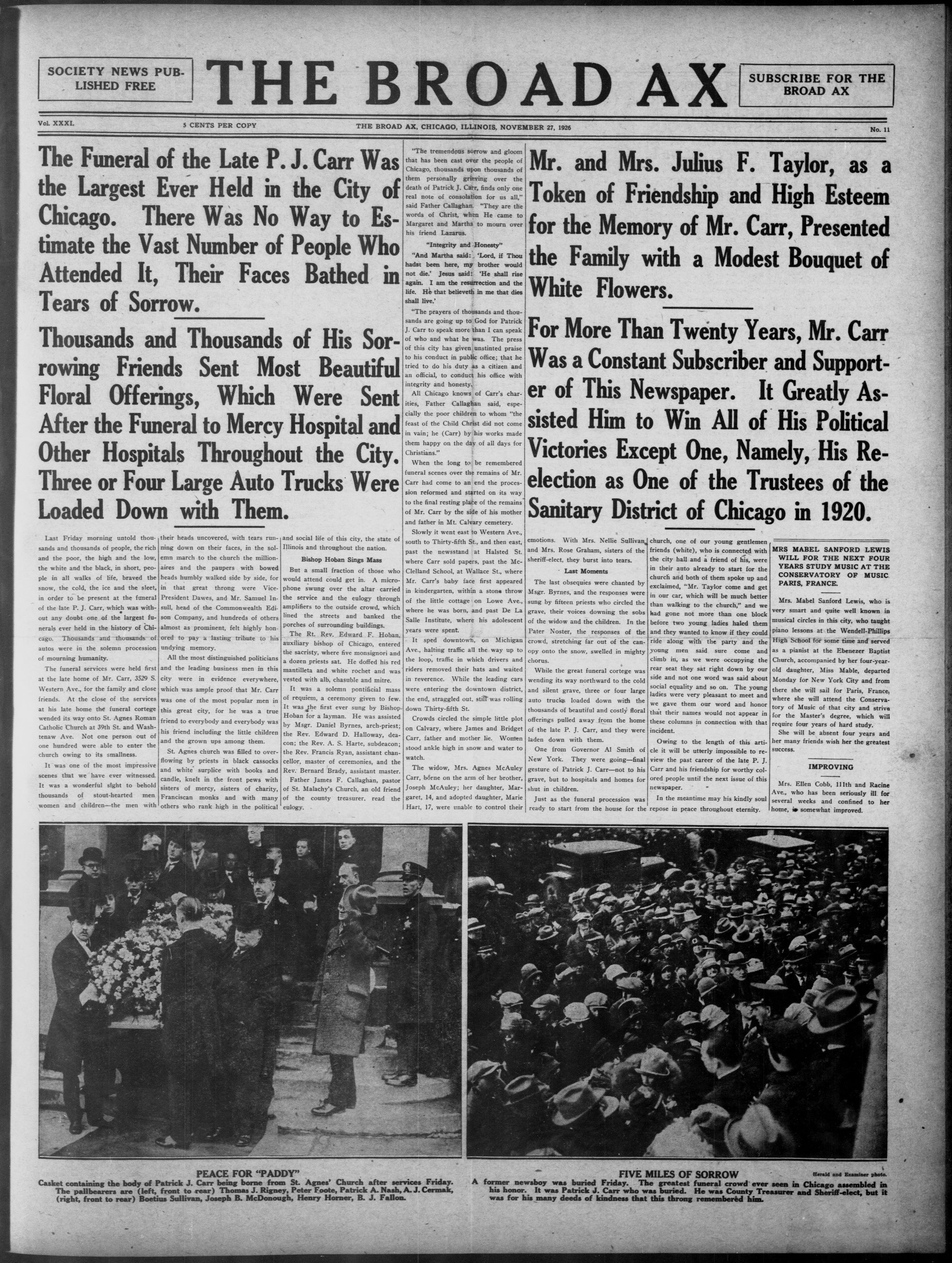
The Funeral of the Late P.J. Carr Was the Largest Ever Held in the City of Chicago. There Was No Way to Estimate the Vast Number of People Who Attended It, Their Faces Bathed in Tears of Sorrow.
Thousands and Thousands of His Sorrowing Friends Sent Most Beautiful Floral Offerings, Which Were Sent After the Funeral to Mercy Hospital and Other Hospitals Throughout the City. Three or Four Large Auto Trucks Were Loaded Down with Them.
THE FIRST FILM OF THE NEW YORK CINEMA
THE FUNERAL
Casket containing the body of Patrick J. Carr being borne from St. Agnes' Church after services Friday. The pallbearers are (left, front to rear) Thomas J. Rigney, Peter Foote, Patrick A. Nash, A. J. Cermak, (right, front to rear) Boetius Sullivan, Joseph B. M. McDonough, Henry Horner, B. J. Fallon.
Vol. XXXI.
Last Friday morning untold thousands and thousands of people, the rich and the poor, the high and the low, the white and the black, in short, people in all walks of life, braved the snow, the cold, the ice and the sleet, in order to be present at the funeral of the late P. J. Carr, which was without any doubt one of the largest funerals ever held in the history of Chicago. Thousands and thousands of autos were in the solemn procession of mourning humanity.
The funeral services were held first at the late home of Mr. Carr, 3529 S. Western Ave., for the family and close friends. At the close of the services at his late home the funeral cortège wended its way onto St. Agnes Roman Catholic Church at 39th St. and Washtenaw Ave. Not one person out of one hundred were able to enter the church owing to its smallness.
It was one of the most impressive scenes that we have ever witnessed. It was a wonderful sight to behold thousands of stout-hearted men women and children—the men with
THE BROAD AX
5 CENTS PER COPY
of the Late P Ever Held in there Was No last Number of Their Face row. and Thousands bands Sent Me sings, Which general to Mercy detals Through our Large Auto n with Them
their heads uncovered, with tears running down on their faces, in the solemn march to the church the millionaires and the paupers with bowed heads humbly walked side by side, for in that great throng were Vice-President Dawes, and Mr. Samuel Insull, head of the Commonwealth Edison Company, and hundreds of others almost as prominent, felt highly honored to pay a lasting tribute to his undying memory.
All the most distinguished politicians and the leading business men in this city were in evidence everywhere, which was ample proof that Mr. Carr was one of the most popular men in this great city, for he was a true friend to everybody and everybody was his friend including the little children and the grown ups among them.
St. Agnes church was filled to overflowing by priests in black cassocks and white surplice with books and candle, knelt in the front pews with sisters of mercy, sisters of charity, Franciscan monks and with many others who rank high in the political
THE BROAD AX, CHICAGO, ILLINOIS, NOVEMBER 27, 1926
and social life of this city, the state of Illinois and throughout the nation.
Bishop Hoban Sings Mass
But a small fraction of those who would attend could get in. A microphone swung over the altar carried the service and the eulogy through amplifiers to the outside crowd, which lined the streets and banked the porches of surrounding buildings.
The Rt. Rev. Edward F. Hoban, auxiliary bishop of Chicago, entered the sacristy, where five monsignori and a dozen priests sat. He doffed his red mantilleta and white rochet and was vested with alb, chasuble and mitre.
It was a solemn pontificial mass of requiem, a ceremony given to few. It was the first ever sung by Bishop Hoban for a layman. He was assisted by Msgr. Daniel Byrnes, arch-priest; the Rev. Edward D. Halloway, deacon; the Rev. A. S. Harte, subdeacon; the Rev. Francis Ryan, assistant chancellor, master of ceremonies, and the Rev. Bernard Brady, assistant master.
Father James F. Callaghan, pastor of St. Malachy's Church, an old friend of the county treasurer, read the eulogy.
THE CITY OF NEW YORK
FIVE MILES OF SORROW Herald and Examiner photo.
A former newsboy was buried Friday. The greatest funeral crowd ever seen in Chicago assembled in his honor. It was Patrick J. Carr who was buried. He was County Treasurer and Sheriff-elect, but it was for his many deeds of kindness that this throng remembered him.
"The tremendous sorrow and gloom that has been cast over the people of Chicago, thousands upon thousands of them personally grieving over the death of Patrick J. Carr, finds only one real note of consolation for us all," said Father Callaghan. "They are the words of Christ, when He came to Margaret and Martha to mourn over his friend Lazarus.
"Integrity and Honesty"
"And Martha said: 'Lord, if Thou hadst been here, my brother would not die.' Jesus said: 'He shall rise again. I am the resurrection and the life. He that believeth in me that dies shall live.'
"The prayers of thousands and thousands are going up to God for Patrick J. Carr to speak more than I can speak of who and what he was. The press of this city has given unstinted praise to his conduct in public office; that he tried to do his duty as a citizen and an official, to conduct his office with integrity and honesty.
All Chicago knows of Carr's charities, Father Callaghan said, especially the poor children to whom "the feast of the Child Christ did not come in vain; he (Carr) by his works made them happy on the day of all days for Christians."
When the long to be remembered funeral scenes over the remains of Mr. Carr had come to an end the procession reformed and started on its way to the final resting place of the remains of Mr. Carr by the side of his mother and father in Mt. Calvary cemetery. Slowly it went east to Western Ave., south to Thirty-fifth St., and then east, past the newsstand at Halsted St. where Carr sold papers, past the McClelland School, at Wallace St., where Mr. Carr's baby face first appeared in kindergarten, within a stone throw of the little cottage on Lowe Ave., where he was born, and past De La Salle Institute, where his adolescent years were spent.
It sped downtown, on Michigan Ave., halting traffic all the way up to the loop, traffic in which drivers and riders removed their hats and waited in reverence. While the leading cars were entering the downtown district, the end, straggled out, still was rolling down Thirty-fifth St.
Crowds circled the simple little plot on Calvary, where James and Bridget Carr, father and mother lie. Womens stood akle high in snow and water to watch.
The widow, Mrs. Agnes McAuley Carr, borne on the arm of her brother, Joseph McAuley; her daughter, Margaret, 14, and adopted daughter, Marie Hart, 17, were unable to control their
Mr. and Mrs. Julius F. Taylor, as a Token of Friendship and High Esteem for the Memory of Mr. Carr, Presented the Family with a Modest Bouquet of White Flowers.
For More Than Twenty Years, Mr. Carr Was a Constant Subscriber and Supporter of This Newspaper. It Greatly Assisted Him to Win All of His Political Victories Except One, Namely, His Reelection as One of the Trustees of the Sanitary District of Chicago in 1920.
emotions. With Mrs. Nellie Sullivan and Mrs. Rose Graham, sisters of the sheriff-elect, they burst into tears.
**Last Moments**
The last obsequies were chanted by Msgr. Byrnes, and the responses were sung by fifteen priests who circled the grave, their voices downing the sobs of the widow and the children. In the Pater Noster, the responses of the crowd, stretching far out of the canopy onto the snow, swelled in mighty chorus.
While the great funeral cortege was wending its way northward to the cold and silent grave, three or four large auto trucks loaded down with the thousands of beautiful and costly floral offerings pulled away from the home of the late P. J. Carr, and they were laden down with them.
One from Governor Al Smith of New York. They were going—final gesture of Patrick J. Carr—not to his grave, but to hospitals and homes for shut in children.
Just as the funeral procession was ready to start from the house for the
church, one of our young gentlemen friends (white), who is connected with the city hall and a friend of his, were in their auto already to start for the church and both of them spoke up and exclaimed, "Mr. Taylor come and get in our car, which will be much better than walking to the church," and we had gone not more than one block before two young ladies haled them and they wanted to know if they could ride along with the party and the young men said sure come and climb in, as we were occupying the rear seat they sat right down by our side and not one word was said about social equality and so on. The young ladies were very pleasant to meet and we gave them our word and honor that their names would not appear in these columns in connection with that incident.
Owing to the length of this article it will be utterly impossible to review the past career of the late P. J. Carr and his friendship for worthy colored people until the next issue of this newspaper.
In the meantime may his kindly soul
repose in peace throughout eternity.
SUBSCRIBE FOR THE BROAD AX
F. Taylor, as a and High Esteem Carr, Presented the Best Bouquet of
Years, Mr. Carr per and Support- It Greatly As of His Political Namely, His Re- Trustees of the cago in 1920.
MRS MABEL SANFORD LEWIS WILL FOR THE NEXT FOUR YEARS STUDY MUSIC AT THE CONSERVATORY OF MUSIC PARIS, FRANCE.
Mrs. Mabel Sanford Lewis, who is very smart and quite well known in musical circles in this city, who taught piano lessons at the Wendell-Phillips High School for some time and served as a pianist at the Ebenezer Baptist Church, accompanied by her four-year-old daughter, Miss Mable, departed Monday for New York City and from there she will sail for Paris, France, where she will attend the Conservatory of Music of that city and striva for the Master's degree, which will require four years of hard study.
She will be absent four years and
She will be absent four years and her many friends wish her the greatest success.
IMPROVING
Mrs. Ellen Cobb, 111th and Racine Ave., who has been seriously ill for several weeks and confined to her home, is somewhat improved.
; U
CHICAGO MASONIC EXPOSITION TO
MARK DISTINCT ADVANCE FOR
RACE IN MERCANTILE FIELD. IT
WILL BE THE MOST STUDENDOUS
EVENT EVER ATTEMPTED BY A
MASONIC FRATERNITY. IT WILL
HOLD FORTH AT THE EIGHTH
REGIMENT ARMORY FROM DE-
CEMBER 11TH TO 18TH.
‘The Mardi Gras and Midwinter Ex-
position to be held in the Eighth Regi-
‘ment Armory under the auspices of
the Masonic Temple Association gives
promise of being the most gigantic en-
terprise of the sort ever sponsored by
colored people.
Robert W. Maxwell, president of the
organization, and attache of the Cook
County courts in his private capacity,
and one of the leaders of race life in
the Lakeside city, declared at the close
of a meeting of his general committee
that “the exposition promotion staff
has already sold enough of the booth
units, and advertising space to assure
‘the success of the commercial phases
of our affair. The space has been
about equally taken up by ad-
vertisers of nationally known com-
modities and by local merchants’ many
of whom are colored. Thus for the
first time the Negro in commercial.
life is being presented in direct asso-
ciation with the demonstrations of the
American business concerns that are
regarded as standard.
“Another feature worthy of careful
observation for its extreme value to
both the race and the distributor of
commodities,” continued Mr. Maxwell,
“is that we are, in this project, pro-
viding a means of educating our vis-
itors in the workings of the most mod-
ern appliances. True, said he, we at-
tend all sorts of trade shows, but very
often, in fact almost always, our peo-
ple are hesitant about asking questions
at these places. Hence they are not
fully informed. The exhibitor is to
- THIS WEEK
By Ernest Rice McKinney
DON’T FORGET PITTSBURGH
ROLAND HAYES
QUEEN MARIE
MR COOLIDGE EXPLAINS.
(Preston News Service)
The Kansas City Call—in a recent
issue—laments that “Just any old towr
can beat Kansas City electing Negroes
to public office. Editor Franklin has
perhaps never heard “of Pittsburgh
‘As far as I have heard Pittsburgh has
elected only one Negro to an office
of any importance and these same Ne-
groes turned out joyously and mali-
ciously and defeated this same Negro
when he came up for re-election.
This town of ours is a most dis-
tinguished place. We have no political
organization, strength or future. We
banquet our enemies and vote against
our friends. We war among ourselves
over white men who are runing for
office and slash every Negro who an-
nounces his ¢andidacy. Each of us is
determined that if we personally can-
not get the office no other Negro
shall. We are loud in our praises of
common white politicians who reward
our loyalty only with a mop, cuspidor
or window rag, while at the same time
we are refusing to support any forward
movement that is for all of the Ne-
groes.
And°I forgot to mention that our
political loyalty to the gang is also re-
warded with the privilege to run baudy
houses, crap games and hooch joints
I, therefore, enjoin Mr. Franklin from
being too hard on his home-town.
Just remember, dear editor, that Pitts-
burgh is still in the U.S.A. >
eee
‘A great commotion has been raiseé
‘over the rumor that Roland Hayes is
to marry a white -woman. Why
shouldn't he if he wants to. Why
should Negroes become so furious
‘ever what Mr. Hayes does and whom
he marries? Didn't we keep him hun.
gry and lean and unsuccessful for
years and years? Wasn't it difficult fo
him to muster a good house at a Negre
recital, even though the charge for
admission was only fifty cents?
Did_we appreciate Mr. Hayes ant
his efforts to. make himself a grea
tenor and a worthy member of th
group? il-say we did NOT. But
now, that he has arrived—oni th
‘is of white promoters ané
‘Bite cuiiecsree we fly
ee wife, his socks
and the place where he shail live.
_ There is also another side to this
can use aahpee
than all the races, clans, tribes. a
“groups of the world about “our rights
that extent the loser of a prospective
customer. =
“There is a small margin between
the fully informed prospect and_ the
selling of a commodity. That differ-
ence, however, is vital to the seller.
There are many merchants handling
standard articles who are wondering
how to reach the Negro market, We
have probably solved the problem for
them, for in a demonstration at this
exposition many of them are going to
learn for the first time the enormous
purchasing power bf the race group
in a modern city. Once learned this
lesson is going to rebound to the bene-
fit of all concerned,
“Newspapers are going to be better
able to sell space to concerns that
heretofore have not realized this big
truth; our people are going to be bet-
ter informed and the manufacturers
will have widened their markets. All
of this is but typical “of the Masonic
manner of constructive service, "Once
done in Chicago, this combination of
entertainment and education cannot
but become a gerferal practice through-
out the country.” x
Ticket distribution, the sale of space,
the program arrangements have been
organized, and largely completed. The
committee and its staff is now address-
ing themselves to the matter of cre-
ating a program of events that will
include as many colored novelty acts
as are available, the cream of vaude-
ville talent, and some startling circus
aéts, December I1th-18th will mark a
great week at the Eighth Regiment
Atmary.in Chicago.
(whatever that means). We raise the
devil, hold indignation meetings and
storm state capitols whenever an anti-
intermarriage bill is proposed. And
yet, immediately when someone whis-
pers that some Negro is about to
marry a white woman, a whirling
black hell is unleashed on this Negro's
head. It will take a very wise man to
tell just what we Negroes do want.
At any rate I hope Mr: Hayes will
marry a white woman.
pans
Queen Marie—of Roumania and
Ponds’ Two Creams—is to cut short
her international loan tour, her hand
kissing side-show and the rest of the
asiniinities and inanities of her Amter-
ican journey to get back to her
diminutive kingdom. I suppose she
will get the money. A pretty woman
can get most anything from an Amer-
ican billionaire. Since our capitalists
have bought several little countries
with United States marines perhaps
they wouldn’t mind buying little Rou-
mania with its castles, paverty and tra-
ditions. The great ones in the world
of fiance, might use this little coun-
try for a pleasure resort where they
could bask in the smiles of beautiful
royalty.
sas
The President says, in effect, that
the Republicans lost nothing in the
fast election. This despite the fact that
seven Republican senators -were de-
feated including the President's dear
friend, Mr. Butler. This man Butler
—who is a Massachusetts cotton man-
ufacturer—must be terribly unpopular:
in places where his mills are located
/and where he is best known he suffered
[the worst. The textile world had some
awful things to say about these. humble
‘voters who: retired Butler, to private
life,
‘These voters were dumb-headed and
ignorant, somewhat after the manner
‘of the voters of Pennsylvania, whom
Senator David A. Reed called “dunder-
heads” when they defeated his brother
jaristocrat, Mr. Pepper.
But, as to the President not losing
anything we prefer to wait until the
regulir Congress meets and then watch
the presidential measure be defeated.
MESSENGER TO GOVERNOR
VISITS DAUGHTER IN
PITTSBURGH
Pittsburgh, Pa, Nov. 26—Col
James M, Auter, who for more than 30
years has held the position of essen-
ger to the various Governors of Penn-
sylvania at Harrisburg, spent the week
end in Pittsburgh visiting. Mis daugh-
ter, Mrs. H, Alda Lucas at 2600 Wylie
avenue. Mr. Auter is widely known in
fraternal and religious circles and for
many years has been chairman of and
chief director of the Masonic Farm at
Linglestown, Pa.
“THE BROAD AX, CHICAGO, ILLINOIS, NOVEMBER 27, 1926 _
bos es a
he
pk. <a E| ON ge &Y
ae. ’ y sh , ore: }
wwe? 7 7
ot Bs, Sa Be
f¥ik a
. BS 5 | ‘i
| ao | a: —T
SS eee
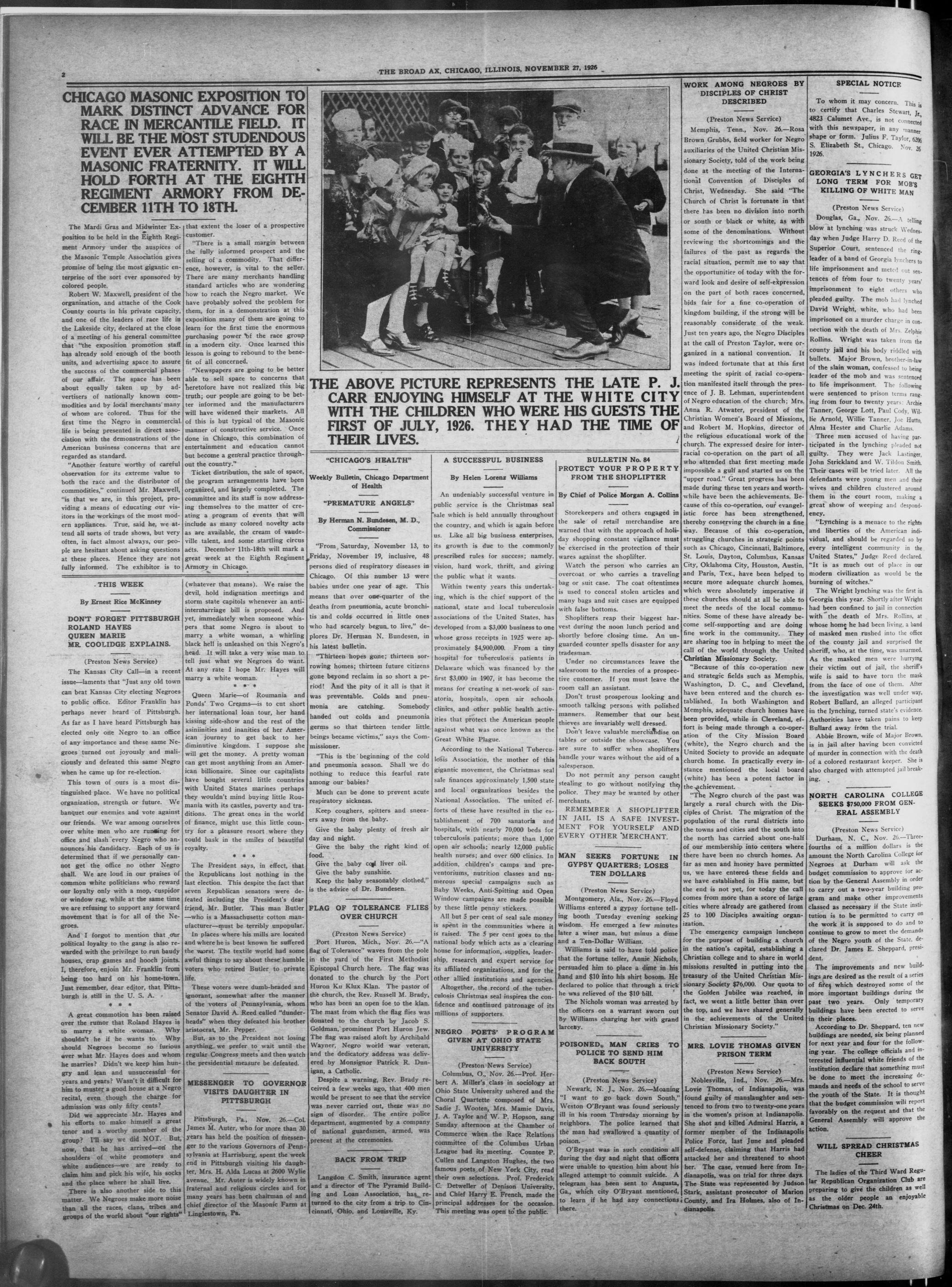
THE ABOVE PICTURE REPRESENTS THE LATE P. J.
CARR ENJOYING HIMSELF AT THE WHITE CITY
WITH THE CHILDREN WHO WERE HIS GUESTS THE
FIRST OF JULY, 1926. THEY HAD THE TIME OF
THEIR LIVES. /
“CHICAGO'S HEALTH” A SUCCESSFUL BUSINESS BULLETIN No. 84
— — PROTECT YOUR PROPERTY
Weekly Bulletin, Chicago Department By Helen Lorenz Williams FROM THE SHOPLIFTER
of Health — a
— An undeniably successful venture in] By Chief of Police Morgan A. Collins
“PREMATURE ANGELS” public service is the Christmas seal ——
Et sr ‘sale which is held annually throughout} Storekeepers and others engaged in
“From, Saturday, November 13, to
Friday, November 19, inclusive, 48
persons died of respiratory diseases in
Chicago, Of this number 13. were
babies under one year of age. This
means that over one-quarter of the
deaths from pneumonia, acute bronchi-
tis and colds occurred in little ones
who had scarcely begun to live,” de-
plores Dr. Herman N. Bundesen, in
his latest bulletin,
“Thirteen “hopes gone; thirteen sor-
rowing homes; thirteen future citizens
gone beyond reclaim in so short a pe-
riod! And the pity of it all is that it
was preventable. Colds and pneu-
monia are catching. © Somebody
handed out colds and pneumonia
germs so that thirteen tender little
beings became victims,” says the Com-
‘missioner.
“This is the’ beginning of the cold
and pneumonia season. Shall we dc
nothing to reduce this fearful rate
among our babies?
‘Much can be done to prevent acute
respiratory sickness.
Keep coughers, spitters and sneez-
ers away from the baby.
Give the baby plenty of fresh air
day and night.
Give the baby the right kind of
food.
Give the baby cogl liver oil.
Give the baby sunshitie.
Keep the baby seasonably clothed,"
is the advice of Dr. Bundesen.
FLAG OF TOLERANCE FLIES
OVER CHURCH
(Preston News Service)
Port Huron, Mich, Nov. 26.—“A
flag of Tolerance” waves from the pole
in the yard of the First Methodist
Episcopal Church here. The flag was
donated to the church by the Port
Huron Ku Klux Klan. The pastor of
the church, the Rev. Russell M. Brady,
‘who has been an open foe to the klan.
‘The mast from which the flag flies wa:
donated to the church by Jacob S.
Goldman,’ prominent Port Huron Jew
‘The flag was raised aloft by Archibald
Wayner, Negro world war veteran
jand the dedicatory address was deliv-
ered by Monsignor Patrick R. Dun
jigan, a Catholic.
Despite a warning, Rev. Brady re
ceived a few weeks ago, that 400 mer
‘would be present to see that the servic
jwas never carried ont, there was nc
sign of disorder. The entire polic
department, augmented by a company
fof national guardsmen, armed, wa:
it _at the ceremonies.
‘BACK FROM TRIP
Langdon. C. Smith, insurance agent
and a director of The Pyramid Build-
ing and Loan Association, hag_ re-
turned to the city from a trip to Cin-
‘cinnati, Olio, and Louisville, Ky.
A SUCCESSFUL BUSINESS
By Helen. Lorenz Williams
An undeniably successful venture in
public service is the Christmas seal
‘sale which is held annually throughout
the country, and which is again before
us. Like all big business enterprises,
its growth is due to the commonly
prescribed rules for success; namely.
vision, hard work, thrift, and giving
the public what it wants.
Within twenty years this undertak-
ing, which is the chief support of the
national, state and local tuberculosis
associations of the United States, has
developed from a $3,000 business to one
whose gross receipts in 1923 were ap-
proximately $4,900,000. From a tins
hospital for tuberculosis patients in
Delaware which was financed by the
first $3,000 in 1907, it has become the
means for creating a net-work of san-
atoria, hospitals, open air schools
clinics, and other public health activ.
ities that protect the American peopl
against what was once known as the
Great White Plague.
According to the National Tubercu-
lo$is Association, the mother of this
gigantic movement, the Christmas seal
sale finances approximately 1,500 state
and local organizations besides the
National Association. The united ef.
forts of these have resulted in the es-
tablishment of 700 sanatoria and
hospitals, with nearly 70,000 beds for
tuberculosis patients; more than 1,000
‘open air schools; nearly 12,000. public
health nurses; and over 600 clinics. In
addition, children’s camps and pre-
ventoriums, nutrition classes and nw-
merous special campaigns such as
Baby Weeks, Anti-Spitting and Open
Window campaigns are made possible
by these little penny’ stickers.
All but 5 per cent of seal sale money
is spent in the communities where it
is raised. The $ per cent goes to the
national body which acts as a clearing
house for information, supplies, leader-
ship, research and expert service for
its affiliated organizations, and for the
other allied institutions and agencies
Altogether, the record of the tuber-
culosis Christmas seal inspires the con-
fidence and continued patronage of its
millions of supporters. -
NEGRO POETS’ PROGRAM
GIVEN AT OHIO STATE
UNIVERSITY
(Preston'News Service)
Columbus, O,,’ Nov. 26—Prof. Her-
bert A. Miller's class in sociology at
Ohio State University ushered and the
Choral Quartette composed of Mrs.
Sadie J. Wooten, Mrs. Mamie Davis
J. A. Taylor and W. P, Hopson, sang
Sunday afternoon at the Chamber of
Commerce when the Race Relations
committee of the Columbus Urban
League had its meeting. Countee P.
Cullen and Langston Hughes, the two
famous poets.of New York City, read
their own selections. Prof. Frederick
C. Detweller of Denison University,
and Chief Harry E. French, made the
principal addresses for the occasion.
‘This meeting was open to the public.
BULLETIN No. 84
PROTECT YOUR PROPERTY
FROM THE SHOPLIFTER
By Chief of Police Morgan A. Collins
| Storekeepers and others engaged ir
the sale of retail merchandise are
warned that with the approach of holi
day shopping constant vigilance must
be’ exercised in the protection of theit
wares against the shoplifter.
Watch the person who carries ar
overcoat or who carries a traveling
bag or suit case. The coat oftentimes
is used to conceal stolen articles anc
many bags and suit cases are equippeé
with false bottoms.
Shoplifters reap their biggest har
vest during the noon lunch period an¢
shortly before closing time. An un.
guarded counter spells disaster for any
tradesman.
Under no circumstances leave the
salesroom to the mercies of a prospec
tive customer. If you must leave th
room call an assistant.
Don't trust prosperous looking ané
smooth talking persons with polishec
manners. Remember that our bes
thieves are invariably well dressed.
Don't leave valuable merclidhdise or
tables or outside the showcase. You
are sure to suffer when shoplifter
handle your wares without the aid of
salesperson.
Do not permit any person caugh
stealing to go without notifying the
police. They may be wanted by othe
‘merchants.
REMEMBER A SHOPLIFTER
IN JAIL IS A SAFE INVEST.
MENT FOR YOURSELF AND
EVERY OTHER “MERCHANT.
MAN SEEKS FORTUNE IN
GYPSY QUARTERS; LOSES
TEN DOLLARS
(Preston News Service)
Montgomery, Ala., Nov. 26—Floyd
Williams entered a gypsy fortune tell-
ing booth Tuesday evening sceking
wisdom. He emerged a few minutes
later a wiser man, but minus a dime
and a Ten-Dollar William,
Williams is said to-have told police
that the fortune teller, Annie Nichols,
persuaded him to place a dime in-his
hand and $10 into his shirt bosom. He
declared to police that through a trick
he was relieved of the $10 bill. f
‘The Nichols woman was arrested by
the officers on a warrant sworn out
by Williams charging her with grand
larcemy.
POISONED, MAN CRIES TO
POLICE TO SEND HIM
BACK SOUTH
(Preston News Servicey
Newark, N. J., Nov. 26—Moaning
“I want to go back down South,’
Weston O’Bryant was found seriously
ill in his room Thursday morning by
neighbors. The police learned that
the man had swallowed a quantity of
poison. 2
O'Bryant was in such condition all
during the day and night that officers
were unable to question him about his
alleged attempt-to commit suicide. A
telegram has been sent to Augusta,
Ga, which city O'Bryant mentioned,
to learn if he had any connections
there. is
WORK AMONG NEGROES BY
DISCIPLES OF CHRIST
DESCRIBED
; (Preston News Service)
Memphis, Tenn. Nov. 26.—Rosa
Brown Grubbs, field worker for Negro
auxiliaries of the United Christian Mis-
sionary Society, told of the work being
done at the meeting of the Interna-
tional Convention of Disciples of
Christ, Wednesday. She said “The
Church of Christ is fortunate in that
there has been no division into north
or south or black or white, as with
some of the denominations. Without
reviewing the shortcomings and the
failures of the past as regards the
racial situation, permit me to say that
the opportunities of today with the for-
ward look and desire of self-eXpression
‘on the part of both races concerned,
bids fair for a fine co-operation of
kingdom building, if the strong will be
reasonably considerate of the weak.
Just ten years ago, the Negro Disciples
at the call of Preston Taylor, were or-
‘ganized in a national convention. It
was indeed fortunate that at this first
meeting the spirit of racial co-opera-
tion manifested itself through the pres-
ence of J, B, Lehman, superintendent
of Negro education of the church; Mrs,
Anna R. Atwater, president of the
Christian Women’s Board of Missions,
and Robert M. Hopkins, director of
the religious educational work of the
church. The expressed desire for inter-
racial co-operation on the part of all
who attended that first meeting made
impossible a gulf and started us on the
“upper road.” Great progress has been
made during these ten years and worth-
while have been the achievements. Be-
cause of this co-operation, our evangel-
istic force has been strengthened,
thereby conserving the church in a fine
way. Because of this co-operation,
struggling churches in strategic points
such as Chicago, Cincinnati, Baltimore,
St. Louis, Dayton, Columbus, Kansas
City, Oklahoma City, Houston, Austin,
and Paris, Tex. have been helped to
secure more adequate church homes,
which were absolutely imperative if
these churches should at all be able to
meet the needs of the local commu-
nities. Some of these have already be-
come self-supporting and are doing
fine work in the community. They
are sharing too in helping to meet the
call of the world through the United
Christian Missionary Society.
“Because of this co-operation new
and strategic fields such as Memphis,
Washington, D. C., and Cleveland,
have been entered and the church es-
tablished. In both Washington and
Memphis, adequate church homes have
been provided, while in Cleveland, ef-
fort is being made through a co-oper-
ation of the City Mission Board
(white), the Negro church and the
United Society to provide an adequate
church home. In practically every in-
stance mentioned the local board
(white) has been a potent factor in
the achievement. ‘
“The Negro church of the past was
largely a rural church with the Dis-
ciples of Christ. The migration of the
population of the rural districts. into
the towns and cities and the south into
the north has carried about one-half
‘of our membership into centers where
there have been no church homes. As
far as men and money have permitted
tus, we have entered these fields and
we have established in His name, but
the end is not yet, for today the call
comes from more than a score of large
‘cities where already are gathered from
25 to 100 Disciples awaiting organ-
ization, 7
‘The emergency campaign luncheon
for the purpose of building a church
jin the nation’s capital, establishing a
Christian college and to share in world
missions resulted in putting into the
jtreasury of the United Christian Mis-
sionary Society $76,000. Our quota to
the Golden Jubilee was reached, in
fact, we went a little better than over
the top, and we have shared generally
in the achievements of the United
Christian Missionary Society.”
MRS, LOVIE THOMAS GIVEN
PRISON TERM
(Preston News Service)
Noblesville, Ind, Nov. 26—Mrs
Lovie Thomas, of Indianapolis, was
found guilty of manslaughter and sen-
tenced to from two to twenty-one years
in the women's prison at Indianapolis.
She shot and killed Admiral Hatris, a
former member of the Indianapolis
Police Force, last June and pleaded
self-defense, claiming that Harris had
attacked her and threatened to shoot
her. The case, venued here from In-
dianapolis, was on trial for three days
The State was represented by Judson
Stark, assistant prosecutor of Marion
County, and Ira Holmes, also of In-
dianapolis.
SPECIAL NOTICE
To whom it may concern. This
to certify that Charles Stewar, Jp
4823 Calumet Ave., is not cineca
with this newspaper, in any svar
shape or form. Julius F. Taylor gay
S. Elizabeth St, Chicago. Noy, 2
1926.
GEORGIA'S LYNCHERS cp
LONG TERM FOR MOBS
KILLING OF WHITE Maw
CPiton Mews Secvice
Douglas, Ga, Nov. 26—\ teting
blow at lynching was struct: Wednes.
day when Judge Harry D. Revd of the
Superior Court, sentenced the ring.
leader of a band of Georgia tysichers p
life imprisonment and mete ox: sen.
tences of from four to twenty yeary
imprisonment to eight others who
pleaded guilty. The mob havi Iyncheg
David Wright, white, who had been
imprisoned on a murder chars” in con.
nection with the death of Mrs Zelphie
Rollins, Wright was taken irom the
county jail and his body riddled with
bullets. Major Brown, brotlver-intaw
of the slain woman, confessed \o being
leader of the mob and was sentenced
to life imprisonment, The following
were sentenced to prison terms rang.
ing from four to twenty years: Archie
Tanner, George Lott, Paul Cody, Wit
lie Arnold, Willie Tanner, Joc Hutto,
Alma Hester and Charlie Adams.
‘Three men accused of having par-
ticipated in the lynching pleaded not
guilty. They were Jack Lastinger,
John Strickland and W, Tildon Smith,
Their cases will be tried later. All the
defendants were young men and their
wives and children clustered around
them in the court room, making a
great show of weeping and despond-
ency.
“Eynching is a menace to the rights
and liberties of the American indi-
vidual, and should be regarded so by
every intelligent community in the
United States,” Judge Reed declared.
“It is as much out of place in our
modern civilization as would be the
burning of witches.”
The Wright lynching was the frst in
Georgia this year. Shortly aiter Wright
had been confined to jail in connection
with the death of Mrs. Rollins, at
‘whose homg he had been living, a band
‘of masked men rushed into the office
of the county jail and surprised the
sheriff, who, at the time, was unarmed,
‘As the masked men were hurrymg
their victim out of jail, the sheriffs
wife is said to have torn the mask
from the face of one of them. After
the investigation was well under way,
Robert Bullard, an alleged participant
in the lynching, turned state's evidence.
Authorities have taken pains to keep
Bullard away from the trial
Abbie Brown, wife of Major Brown,
is in jail after having been convicted
‘of murder in connection with the death
of a colored restaurant keeper. She is
also charged with attempted jail break
NORTH CAROLINA COLLEGE
SEEKS $750,000 FROM GEN-
: ERAL ASSEMBLY
(Preston News Service)
| Durham, N. C., Nov. 26.—Tbree-
fourths of a million dollars is the
amount the North Carolina College for
Negroes at Durham will ask the
budget commission to approve ior a
tion by the General Assembly in order
to carry out a two-year building pro-
gram and make other improvements
classed as necessary if the State insti-
tution is to be permitted to carry on
the work it is supposed to do and t
continue to grow to meet the demands
of the Negro youth of the State, de
clared Dr. James E. Sheppard, pres
dent.
The improvements and new build-
ings are desired as the result of a series
of thes which destroyed some of the
more important buildings during the
past two years. Only temporary
buildings have been erected to serve
in their places.
According to Dr. Sheppard, ten nev!
buildings are needed, six being planned
for next year and four for the fotlow-
jing year. The college officials and in-
terested Mises white friends of the
institution that something must
be done to meet the increasing 4
mands and needs of the schoo! to seve
the youth of the State. It is thought
that the budget commission will repo"!
favorably on the request and that the
General Assembly will approve the
action.
| WILL SPREAD CHRISTMAS
. CHEER
The ladies of the Third Ward Resu-
lar Republican Organization Club are
preparing to give the children as well
as the older people an enjoyable
‘Christmas on Dec. 24th.
COLORFUL NEWS MOVIES By THE CAMERAMAN
1. Paul Laurence Dunbar
2. Who's Loony Now?
3. Chicago Date-Workers Strike
4. Engineers Versus Doctors
"Twenty years have passed since Paul Laurence Dunbar, America's foremost Negro poet, died," says the Wilmington, Del., "Every Evening" daily paper, which adds that "Paul Dunbar would be startled were he to awaken and read today the stuff that passes for poetry; for, as Madame Roland said of Liberty, how many crimes are committed in poetry's name! He (Dunbar) gave to the Negro race a heritage that remains a high mark for the singers of the race—or singers of any race, for that matter."
Dr. Alain Leroy Locke, former professor of Philosophy at Howard University, says, however, in the October, 1926 issue of "The Palms," edited in Mexico by Countee Cullen: "Dunbar was the showman of the Negro masses; but here (Langston Hughes) is their spokesman." Dr. Locke says, further, "nor would I style Langston Hughes a race poet merely because he writes in many instances of Negro Life, and consciously as a Negro."
We strongly doubt if even Dr. Locke himself can explain just what a poetic "showman" is. Too, so-called race poets are on the wane. They that are now singing their songs in poetry, with but few exceptions, are looking for inspiration from the background of cultural intelligence.
Paul Laurence Dunbar was more than a race poet, and more than a "showman" of the Negro masses, which had little to yield up, inspirationally or otherwise, when Dunbar's songs had reached their sweetest vein. Dunbar was a believer and an actor in the highest form of social service. He put forth many a biting piece of wisdom, many a bitter thrust, and much philosophy. He was even more than a spokesman. Yea, he was a poetic prophet; yet full of tender, passionate love for mankind.
They who seek to develop inspiration and poise sufficient to take up the trail which Dunbar blazed need, first, to absorb those human lines of his, in which he sang:
"For human wants and human needs Are more to me than prophets' deeds; And human tears and human cares Affect me more than human prayers."
As quiet as it's being kept, consternation is beginning to pervade the mental poise of Nordic civilization in America, which, upon perusing a preliminary bulletin of the U. S. Department of Commerce, dealing with the depressing topic, "Feeble-Minded and Epileptics in Institutions," has just discovered that "The rate of feeble-minded patients in institutions per 100,000 of population rose from 17.5 in 1904 to 39.3 in 1923," a tremendous advance in weak-mindedness. The rate of epileptics reported was 8 per 100,000 of population.
And now comes the sad disclosure that in both groups about 98 per cent of the patients were white and only 2 per cent Negro, with a small group of individuals of other races. Another disclosure is that the rate of feeble-minded patients among the foreignborn white population as 13.6 or less than one-third of the rate among the native white population, which led the depressing mental scale with a grand percentage of 47.3.
It is a sad truth that the Nordics are becoming so loony, and it is equally consoling, despite all our woes and cares, to be assured that the Negroes comprised only two per cent of the crazy throng which is swelling America's feeble-minded institutions. Our racial proportion is about 10 per cent of the whole, and rightly, we are entitled to have 10 non compos mentis representatives in each 100 of the same. The rate, though, is only two, which makes the white folks just forty-nine times as crazy as we are.
This explains the Loebs, Leopolds and the Thaws; and while we subscribe a healthy contribution to crazy mobs, to jails, and to other demented consumers of life and liberty, there is some comfort in the knowledge that our representation is almost zero in the ranks of the unfortunates whose brains have become worn and threadbare beneath the terrible strain of American life, intensified partially because of needless worry about who is to be permanently superior in this land of Democracy.
The Windy City is witnessing the unusual spectable of a Negro strike. More than 100 female workers of the Maras Stuffed Date Company recently
walked out in protest against working conditions and wages. They allege that the maximum was approximataely $16 per week, and that the average wage was approximately $11 per week, both of which are obviously far below a living wage in such a metropolitan center as Chicago. About 40 workers refused to join the strikers, and have remained on the job, thus permitting the company to continue its operations without marked embarrassment. Late reports indicate a picketing movement and the arrest of several strikers upon charges growing out of picketing activities.
Several significant results have followed the strike. It is said that the Chicago Federation of Labor has shown willingness to aid the strikers. This, the strikers aver, means that industrial race prejudice is breaking up in Chicago, a cause for rejoicing the country over. If the time has come when the trade union movement is ready to clasp sincere hands with Negro labor, then it is time to hail a new and promising day in the matter of industrial race relations.
Verbal reports state that in addition to the low wage, which stimulated the strike, other conditions of labor were highly unfavorable at the plant. In fact, the leading Chicago paper says: "The women were working under miserable conditions. No dressing room is provided; nor is there a place to eat lunch. Other facilities are considered dangerous and harmful to the best interest of the workers' health." The right to strike, of course, has long since been morally and industrially within the discretion of all workers. The Negro, often a strike-breaker, is seldom a strike; and the Chicago outburst will be watched with concern by Negro employees and their employers the country over.
Strike or work, there is one truth that cannot be denied. Every worker is entitled to a fair wage and, at least, tolerable conditions of employment. He is entitled to health conveniences, to a wage which will enable him to meet the standards of American living, and to a peaceful and harmonious day of labor. On the other hand, he should yield back efficiency, permanency, and a protectorate of his employers' interests,—that is, when he can protect his employers' interests without jeopardizing his own.
A bulletin of the U. S. Bureau of Education has just pointed out that at present more white youths are studying mechanical, civil and electrical engineering than are pursuing courses in Medicine and its allied subjects. In other words, the white brethren are sticking to the soil, the air, the water, and the mountains, gifts of God, for the almighty dollar which is making them so groupally forceful in the world's commerce and business. They prefer those assets as money-makers to delving into the creations of man's mind and body.
Within the Race, engineers are as scarce as hen's teeth. In fact, it has only been within the last decade that an engineering course in a Negro school was available to ambitious colored youths who had caught the vision of digging wealth out of the ground. Such courses in white schools were unavailable, and practice work building culverts, bridges, spans, etc., has heretofore been highly inaccessible. The brother, rather, has sought Medicine, Law, and the like applied among his own people, to climb the golden ladder to financial success.
FT. DEARBORN GIVES SMOKER
The Fort Dearborn Lodge No. 44, Elks, gave a smoker on last Saturday evening in the parlors of their home, 3920 Grand Blvd., for the officers, members and invited guests and to which about 500 responded. Dr. W. H. Davis acted as master of ceremonies and a very excellent program was rendered. Among the speakers were James C. Martin, exalted ruler; Col. John R. Marshall, grand trustee; Dr. Thornton, Attorneys Wilson, C. F. Stradford, A. E. Patterson, S. A. T. Watkins; David Hawley and J. B. Debeaux. Solos were rendered by Grace Davis and Mrs. Geneva Douglass. Scores of persons present handed in their names to become members of the lodge. A campaign for new members is about to be launched by the lodge. Plans are now being made for the dedication of the home, at which time the life-size portrait of the late Dt. Henriett P. Lee (mother of Ft. Dearborn Lodge No. 44) will be unveiled.
THE BROAD AX. CHICAGO, ILLINOIS, NOVEMBER 27, 1926
BIGGEST MOMENT OF MY
BIGGEST FIGHT
By Tiger Flowers
(Philadelphia Public Ledger)
One would think that the biggest moment of my fistic life must have come when I won the middleweight championship from Harry Greb in Madison Square Garden. It really was not, though. That big moment flashed the first time I fought Greb in Fremont, Ohio, August 21, 1924.
It was a ten-round, no decision bout, and I was training to make the middleweight limit, despite the fact that the only way I could win the title under those conditions was a knockout. Mr. Walk Miller, my manager, informed me that I must come in over the limit of the class.
"Tiger," he said to me, "I want you to win this fight, but not by too much of a margin. The big thing is to get a bout to a decision, with the championship at stake, and if you go too far ahead tonight we'll never get it." I could see this point, and it was well taken. But I wasn't sure I would be able to win by a great margin, even if I wanted to, for Mr. Greb was one of the fistic marvels of the game, and had lost only two or three decisions in some 300 fights.
It was in the second round that my big moment came—a moment that I'll never forget as long as I live. We were mixing it up in a lively way when I shifted, and shot a right under the heart.
Mr. Greb tumbled into a clinch, and said, "Take it easy, boy, take it easy." I knew that I had hurt him. Whatever doubts I had entertained about beating the marvelous Harry Greb vanished. I felt in my heart that if I could get a fight to a decision with him I would be the next world's middleweight champion. I did not only feel it. At that instant I was sure of it as though the victory were already mine.
It wasn't that I underestimated Mr. Greb, it was simply that I had found myself, and that is an experience that comes only once in a lifetime. It was a flash of keenest joy; of certainty of my abilities; of the feeling that the reward of my years of struggle and obscurity had come at last. I breathed a little prayer of thanks under my breath, and then went on fighting.
It was a year and a half later that my reward really came—when Joe Humphries lifted my right hand, and迎了 the crowd, "The Winner and New Champ—" but it was an anticlimax to that moment of glory in the little Ohio town.
SOUTH CAROLINA OFFICIALS
STRIVE TO PREVENT
ANOTHER LYNCHING
(Preston News Service)
Columbia, S. C., Nov. 26—Robert Bentley, aged 20 years, was placed in the state penitentiary here Friday, having been brought here, it is said, for safe keeping from Florence, where he is alleged to have shot and seriously wounded E. R. Johnson, (white), plain clothes officer, late Thursday. Bentley was wounded, but his injuries are said not to be serious.
$15,000 ASKED AS JUDGES' PAY
Increase of salaries of Probate Court and county judges from $12,000 to $15,000 a year was provided for in a resolution introduced before the county board Monday and referred to the finance committee. The Legislature recently increased Superior and Circuit court judges' salaries to $15,000, but did not mention Probate or County courts. Resolutions to increase the salary of the president of the county board from $9,000 to $12,000 and of the fourteen members from $5,000 to $7,500 also were referred to the committee.
FORUM TO HAVE PROGRAM
The second Sunday evening program of the Forum of Ft. Dearborn 1927 Marching Club will be held Nov. 28th at the home, 3920 Grand Blvd. M. B. Rogers, chairman of the program, has assembled together some of the best talents in the city and they will be presented Sunday afternoon. Public always welcome. J. B. Deveaux is president of the club.
Magpie Under Ban
Ancient legend has it that the magpie still lies under Noah's curse, because, when all the other birds came into the ark of their own accord, the magpie alone gave trouble, and had to be caught.
Patron of the Crinppled
St. Giles was chosen patron of cripples because he refused to be cured of lameness. He was a Greek who came to France in the Seventh century, and became the head of a monastic government.
(Copyright.)
ELLEN BURKE, sitting in her chair of the pulman as the long train drew into the station at Philadelphia, tucked Peggy O'Connell's letter safely in her handbag. Ellen and Peggy had met on shipboard going to Europe a few months before with their respective parents, and had formed an enthusiastic friendship. This was helped along because Mr. and Mrs. Burke and Mr. and Mrs. O'Connell found each other congenial. On the way home—for the Burkes and O'Connells had purposely returned to America by the same ship—Peggy had exacted a promise from Ellen to visit her as soon as she had unpacked her trunks. Ellen lived in a New York apartment. Peggy lived in a country house outside Philadelphia. And the two girls planned many good times in exchanged visits.
"As soon as you reach Broad Street station," Peggy had written, "you telephone my brother, Bob." And then she had given his telephone number and his office address. "He'll be expecting you and will pick you up at the station and bring you out home." Ellen had heard much from Peggy, in their many talks together that summer, about her brother, John. And it must be admitted that part of her excitement at again seeing Peggy was that she would meet this paragon of a brother who, according to his sister, was as good as he was handsome, as popular as he was charming.
Ellen knew something of Philadelphia. And when there was some delay in getting John's office telephone, she realized that she was only a few steps from his office.
"I'll just pop around and wait there," she thought. "It will save him trouble, and I'm early. I'd rather wait these than here."
So, carrying her small gray suitcase and matching hatbox, Peggy walked the square or two to John O'Connell's office. She hesitantly opened the door labeled "John O'Connell, lawyer," opened and entered a small waiting room. The room was full—full of girls, girls about her own age, girls younger, and girls a good old dealer.
"I'll just wait here until Mr. O'Connell is free," she said to an office boy, who grinned in answer.
Ellen wore, of course, sheer, light silk stockings. She wore gray suede shoes, trimmed with bands of snake-skin. Her hat was of soft gray velvet, that was lovely above her fair hair and blue eyes. Her frock was of gray crepe de chine, not elaborate, but yet unmistakably expensive. She and Peggy had shipped for it together in Paris.
Just as she had taken in all her surroundings a door marked private opened, and a homely, thirty-year-old woman, dressed in blue serge, serviceable and plain, emerged.
Behind her came a young man. Elenen's heart skipped a beat. It was John—she knew from a photograph Peggy always carried with her.
"You can all go, now," he said to the other waiting girls. "The position is filled."
The other girls went out of the room. Ellen flushed and half smiled at John.
"What are you waiting for?" he asked crisply. "Here, come in here a minute."
"But," stammered Ellen, "Tm—" She followed him into his office.
"I know, I know. But the job is filled. And just for your own good, let me tell you that you'll never get the kind of job a nice girl like you wants if you dress in duds like those. Did you see that girl I hired? Plain and reliable. The kind of woman a man likes to have around all day. Not ugly, but just not noticeable, and sure to have her mind on something besides clothes. Now you—anybody'd know you were thinking more about your looks than your work—and that doesn't do in an office." "Don't feel offended," said the young man. "I'm just trying to give you a bit of advice."
"But you're so stupid," said Ellen, as the door marked "Private" closed. And she picked up her two pretty little gray bags and walked back to the station. There she boarded the next local train to Peggy's home and explained to Peggy, when she got there, that she hadn't been able to get her brother on the telephone. So Peggy promptly telephoned her brother not to wait.
When Ellen and John met that evening, John's eyes were openly admiring. Ellen, in pink tulle, with bare arms and no hat, did not at first recall the vision of gray that had disturbed his office calm that afternoon.
Ellen, by this time sure that John was all that Peggy had claimed for him—and more—smiled shyly.
"Well, what I thought then—doesn't matter—any more than what you did, does it."
And then they both laughed and told Peggy the joke. And all three knew, though they said nothing of the knowledge, that Ellen and John would laugh all their lives together over their first meeting.
Inflammatory Reading
The high spot in this issue is what causes fires in grocery stores.—Trade Paper.
Potato Relieves Burns
Freshly scraped Irish potato is credited with being one of the best treatments for burns, says the Pathfinder Magazine. The potato is scraped to a pulp and the burn covered over with the wet pulp. When this has dried another application is made. The moist potato pulp is said to exclude the air, relieve the pain and promote healing.
Fur From Japan
An authority says that Japanese mink comes from Japan. It is a dyed fur, and naturally will not wear as well as fur that has not been dyed. In many cases, however, people who have had coats made from a good grade of this fur have been well satisfied with its wearing qualities. Before being dyed it is a pale yellowish color.
Willed Teeth to Sister
When one of two aged sisters died recently in Australia it was learned that though neither had any of their natural teeth, the deceased did possess a set of artificial teeth. These she bequeathed to her sister, who took possession of them after the funeral. She was indignant when she discovered the teeth did not fit her.
Varieties of Jinxes
The natives of Galway consider the fox unlucky. If they meet a fox on their way to fish, they turn back for that day. If Irishmen or Italians pronounce the names of certain animals while they are fishing they are certain to have ill luck. In some sections of Scotland there are old women whose names are unlucky and such persons must be spoken of in an indirect way.
College Fraternities
The first American college fraternity of which there is a record was the "Flat Hat club" that appeared at the College of William and Mary in 1750 and continued in existence until after 1772. It was secret, literary and social. The oldest Greek letter fraternity in this country now in existence is the Phi Beta Kappa, organized in 1776.
Washington's Greatness
"Who was the greatest of American statesmen?" "George Washington," answered Senator Sorghum, without a moment's hesitation. "You must admit that he had wonderful advisers." "What made him great was the fact that he knew where to look for advice and how to take it."—Washington Star.
We Don't Need Them
Girard, in the Philadelphia Inquirer, says we get "hurricane from the Carib Indian," and that "tornado was Latin, and it means to turn, while typhoon and cyclone were borrowed from the Greeks." It's about time we returned them to where they came from.—Detroit Free Press.
Fish's Many Names
The crabpie is commonly called bachelor, camp-bellite, new light, sac-a-lait, tinmouth, carpet and chenqu瞒. Its range is from New York and Vermont westward through the Great Lakes region and the Mississippi valley to the Dakota's and south to Texas.
Pan-American Conference
The first Pan-American conference opened at Washington on October 2, 1889. It was originated and planned by James G. Blaine, secretary of state under President Harrison. Ten republics of the two countries signed an arbitration treaty.
Ancient American Relic
The exhibit of the Smithsonian institution at the Philadelphia sesquicentennial exposition includes a statuette of jade from Tuxilla, Mex., a center of ancient Maya civilization, and on it in Maya characters is inscribed a date corresponding to 36 B. C. It is the oldest dated object of any kind on this continent.
Humming Birds
There are said to be some 500 species of humming birds, which have their origin mostly in the Amazon and Orinoco valley. The birds are entirely American, in the summer migrating far North, even as far as southern portions of Alaska.
Hoaxed French Scientists
A French adventurer, Jean Baptiste Douville, received the gold medal of the Paris Geographical society for the most important discovery in 1830. The award was based on his book on the Congo—a fabrication.
Didn't Know Electricity
In the early days of experiment with electricity, it was generally believed by the public that electricity would flow down a perpendicular wire, but not up it.
Too Late
An essayist writes that "the world never realizes what a poet has done until after he is dead," and then, of course, the fellow is safe.—Vancouver Province.
Not to Be Expected
"Ah, sir," said Mrs. Higgins plain- tively to the vicar, "since my 'nsband 'ad two parallel strokes, we 'avent been able to make both ends meet."— The Boston Transcript.
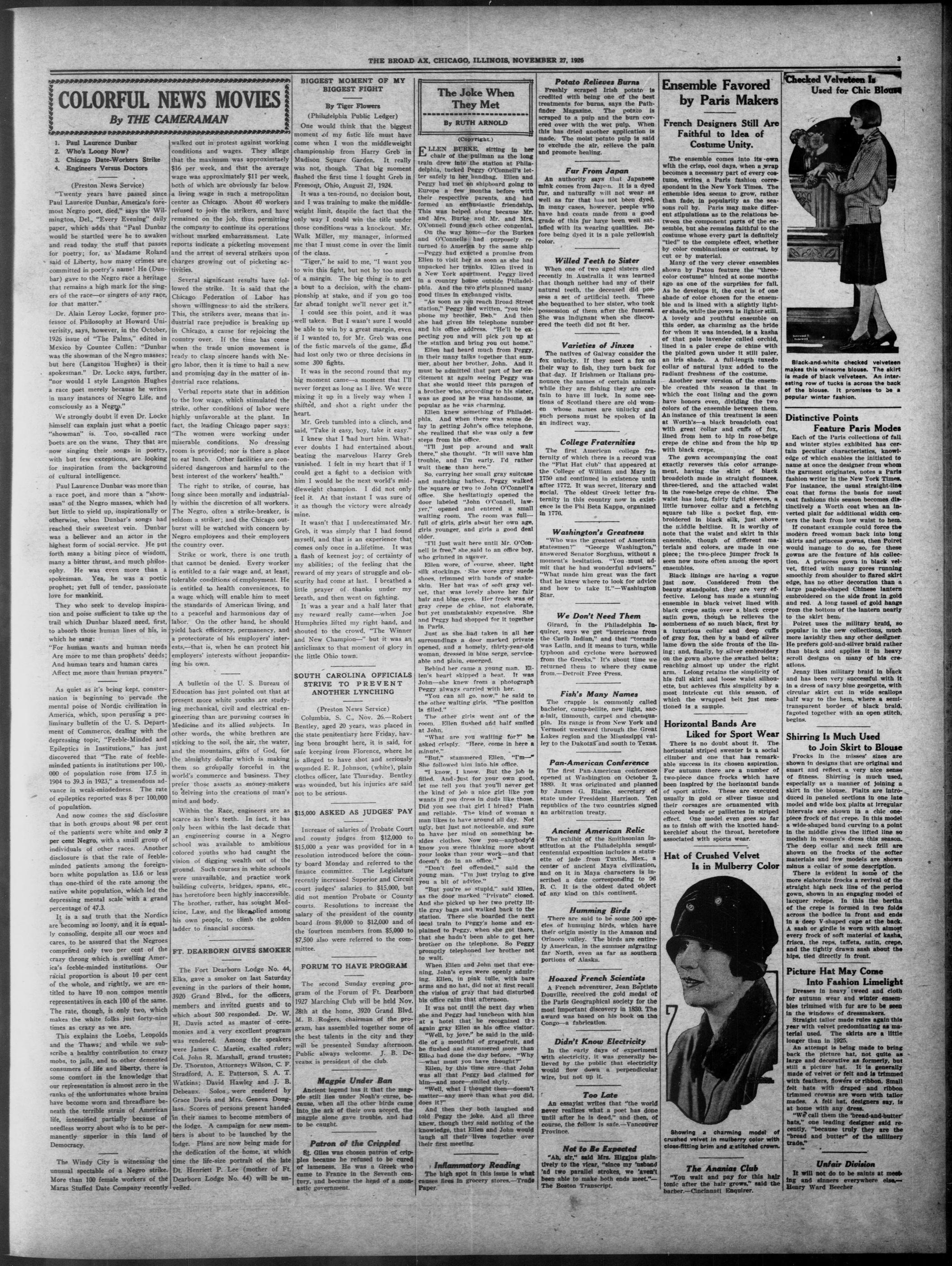
The ensemble comes into its own with the crisp, cool days, when a wrap becomes a necessary part of every costume, writes a Paris fashion correspondent in the New York Times. The ensemble idea seems to grow, rather than fade, in popularity as the seasons roll by. Paris may make different stipulations as to the relations between the component parts of the ensemble, but she remains faithful to the costume whose every part is definitely "tied" to the complete effect, whether by color combinations or contrast, by cut or by material.
Many of the very clever ensembles shown by Paton feature the "three-color costume" hinted at some months ago as one of the surprises for fall. As he develops it, the coat is of one shade of color chosen for the ensemble and is lined with a slightly lighter shade, while the gown is lighter still. A lovely and youthful ensemble on this order, as charming as the bride for whom it was intended, is a kasha of that pale lavender called orchid, lined in a paler crepe de chine with the plaited gown under it still paler, an iris shade. A full-length tuxedo collar of natural lynx added to the radiant freshness of the costume.
Another new version of the ensemble created this season is that in which the coat lining and the gown have honors even, dividing the two colors of the ensemble between them. An instance of this treatment is seen at Worth's—a black broadcloth coat with great collar and cuffs of fox, lined from hem to hip in rose-beige crepe de chine and from the hip up with black crepe.
The gown accompanying the coat exactly reverses this color arrangement, having the skirt of black broadcloth made in straight flounces, three-tiered, and the attached waist in the rose-belge crepe de chine. The waist has long, fairly tight sleeves, a little turnover collar and a fetching square tab like a pocket flap, embroidered in black silk, just above the middle beltline. It is worthy of note that the waist and skirt in this ensemble, though of different materials and colors, are made in one piece; the two-piece jumper frock is seen now more often among the sport ensembles.
Black linings are having a vogue just now. Considered from the beauty standpoint, they are very effective. Lelong has made a stunning ensemble in black velvet lined with black crepe satin over a black crepe satin gown, though he relieves the sorbness of so much black, first by a luxurious collar and deep cuffs of gray fox, then by a band of silver lame down the side fronts of the lining; and, finally, by silver embroidery on the gown above the swathed belts; reaching almost up under the right arm. Lelong retains the simplicity of hfs full skirt and loose waist silhouette, but achieves this simplicity by a most intricate cut this season, of which the wrapped belt just mentioned is a sample.
Horizontal Bands Are
Liked for Sport Wear
Liked for Sport Wear
There is no doubt about it. The horizontal striped sweater is a social climber and one that has remarkable success in its chosen aspiration. For autumn there are a number of two-piece dance frocks which have been inspired by the horizontal bands of sport attire. These are executed usually in gold or silver tissue and their corsages are ornamented with colored beads or paillettes in striped effect. One model even goes so far as to finish off with the knotted handkerchief about the throat, heretofore associated with sports wear.
7
Showing a charming model of crushed velvet in mulberry color with close-fitting brim and a stitched crown.
The Ananias Club
"You wait and pay for this hair tonic after the hair grows," said the barber—Cincinnati Enquirer.
Deterioral 3
Deterioral
Black-and-white checked velvetleen makes this winsome blouse. The skirt is made of black velvetleen. An interesting row of tucks is across the back of the blouse. It promises to be a popular winter fashion.
Distinctive Points
Feature Paris Modes
Each of the Paris collections of fall and winter styles exhibited has certain peculiar characteristics, knowledge of which enables the initiated to name at once the designer from whom the garment originates, notes a Paris fashion writer in the New York Times. For instance, the usual straight-line coat that forms the basis for most coat fashions this season becomes distinctively a Worth coat when an inverted plait for additional width centers the back from low waist to hem.
If constant example could force the modern freed woman back into long skirts and princess gowns, then Poiret would manage to do so, for these gowns are the feature of his collection. A princess gown in black velvet, fitted with many gores running smoothly from shoulder to flared skirt edge, has no other decoration than a large pagoda-shaped Chinese lantern embroidered on the side front in gold and red. A long tassel of gold hangs from the bottom of the lantern nearly to the skirt hem.
Poiret uses the military braid, so popular in the new collections, much more lavishly then any other designer. He prefers gold-and-silver braid rather than black and applies it in heavy scroll designs on many of his creations.
Jenny likes military braid in black and has been very successful with it in a dress of navy blue georgette, with circular skirt cut in wide scalpops half way to the hem, where a semi-transparent border of black braid, fagoted together with an open stitch, begins.
Shirring Is Much Used
to Join Skirt to Blouse
Frocks in the misses' sizes are shown in designs that are original and smart and reflect a very nice sense of fitness. Shirring is much used, especially as a manner of joining a skirt in the blouse. Plaits are introduced in paneled sections in one late model and wide box plaits at irregular intervals are shown in a chic one piece frock of flat crepe. In this model a wide-shaped band curving to a point in the middle gives the lifted line so modish in women's dress this season. The deep collar and neck frill are shown on the frocks of the softer materials and few models are shown minus a collar of some description.
There is evident in some of the more elaborate frocks a revival of the straight high neck line of the period gown, shown in an engaging model of lacquer redepe. In this the bertha of the crepe is formed in two folds across the bodice in front and ends in a deep V-shaped cape at the back. A sash or girdle is worn with almost every frock of soft material of kasha, frisca, the reps, taffeta, satin, crepe, and the tightly drawn sash about the hips, tied directly in front.
Picture Hat May Come
Into Fashion Limelight
Dresses in heavy tweed and cloth for autumn wear and winter ensembles trimmed with fur are to be seen in the windows of dressmakers.
Straight tailor made rules again this year with velvet predominating as material used. The skirts are a little longer than in 1925.
An attempt is being made to bring back the picture hat, not quite as large and decorative as formerly, but still a picture hat. It is generally made of velvet or felt and is trimmed with feathers, flowers or ribbon. Small felt hats with draped and ribbon trimmed crowns are worn with tailor mades. A felt hat, designers say, is at home with any dress.
"We call them the 'bread-and-butter' hats," one leading designer said recently, "because truly they are the "bread and butter" of the millinery trade."
Unfair Division
It will not do to be saints at meeting and sinners everywhere else—
Henry Ward Beecher
Ernest H.
WILLIAMSON
UNDERTAKER
ERnest H. WILLIAMSON
UNDERTAKER
5121-23-26
E. H. WILLIAMSON
Charles & Dawson
THE BROAD AX
Published Every Saturday
In this city since July 15th 1899, without missing one single issue. Republicans, Democrats, Catholics, Protestants, Single Taxers, Priests, infidels or anyone else can have their say as long as their language is proper and responsibility is fixed.
The Broad Ax is a newspaper whose platform is broad enough for all, ever claiming the editorial right to speak its own mind. It is neither Democratic nor Republican. It is strictly or absolutely independent in politics. Local communications will receive attention. Write only on one side of the paper.
Subscriptions must be paid in advance.
One Year .....$2.00
Six Months .....$1.00
Advertising rates made known on
application.
Address all communications to
THE BROAD AX
0206 S. Elizabeth St., Chicago.
Phone: Wentworth 2597
JULIUS F. TAYLOR
Editor and Publisher
Entered as Second-Class Matter aug
19, 1902, at the Post office at Chicago
Ill. Under Act of March 8, 1879.
Notary Public
Phon: Office Main 4153; Residence
4751 Champlain Avenue
Phone Kenwood 5611
ATTORNEY AND COUNSELOR
AT LAW
Suke 708—184 W. Washington St.
CHICAGO
A. D. GASH
ATTORNEY AT LAW
Suite 813, Ashland Block
158 N. Clark Street
CHICAGO, ILL.
The Williamson Funeral is distinguished by the up-to-date designs of its Cunningham Limousine Hearse and Cars
South State Street
Something in the Line
or Real Salesmanship
“Salesmanship is a great game, but you got to have the personality,” said the man in the window near seat of the smoker. “I just sold $125,000 worth of gravies ladies to an Omaha hotel company, and now I'm going to be made a vice president of our concern and get a nice fat bonus as well.”
“That's good,” said his a-vis. “I'm always glad to see a fellow doing well. I sold half a million dollars' worth in my line this trip. Now I'm going to retire and see the world. Guess I do Rome and Paris first.” “Excuse me, gents,” apologized the passenger in the corner near the cuspidor. “I couldn't help overhearing your conversations, because when I hears salesmanships being talked on I got to listen, and I see as how you gents is perfect salesmen in your own way. But I now tell you what is real honest-to-Good salesmanship, like as what I got to know in my business; which I tell you now is just a small retail, good-as-new, mitsur parlor, second-handed garments on Hester street; maybe you know the place, already, eh? Well, last week she come to me, Mrs. Elkelstein, what her husband died of being killed by an automobile, and she says she's a widow but that Elkelstein wasn't much good; but all the same, if she gets it cheap, she likes maybe to buy a new suit for to bury him in. Well, gents, I tell you I sell her the extra pair of pants with that suit. “—What that's I calls salesmanship.”—San Francisco Argonaut.
Government and Liberty
The people who exercise the power are not always the same people over whom it is exercised; and the self-government spoken of is not the government of each by himself, but of each by all the rest. The will of the people, moreover, practically means the will of the most numerous or the most active part of the people; the majority, or those who succeed in making themselves accepted as the majority; the people, consequently, may desire to oppress a part of their number; and precautions are as much needed against this as against any other abuse of power.—John Stuart Mill.
Mended "Busted" Egg
What the old story-book legend declares "all the king's horses and all the king's men" could not do by way of repairing "Humpty Dumpty," has been accomplished by an expert of the Field museum of natural history in assembling the fragments of an ostrich egg believed to be some 6,000 years old. It was found in the ancient ruins of Kish—Popular Mechanics Magazine.
THE BROAD AX, CHICAGO, ILLINOIS, NOVEMBER 27, 1926
Botanist Recalled as
Ben Franklin's Friends When Benjamin Franklin returned from his long stay in England, where he had spent much time with Peter Collinson, the English botanist, he became highly unpopular with the Americans for a time, and his treatment caused Collinson to write warning letters to the English government, expressing the belief that America might attempt a revolution for independence from the mother country. It was Collinson's information and encouragement that first induced Franklin to interest himself in electricity and Collinson published his friend's experiments to the Royal society, defended him against their criticism, and secured his election as a fellow, says a writer in the Christian Science Monitor. As a botanist Collinson obtained many native plants from the early colonists in America and distributed them among landowners in England.
Sailors' Gold
One of the most curious treasures hunted by sailors in tropical waters is ambergris.
This has nothing to do with amber. It is a secretion shed into the water by certain sperm whales, and is, metaphorically speaking, worth its weight in gold.
Curiously enough, although when taken from the whale it has a most unpleasant smell, when exposed to the air its odor becomes pleasant, and it is used largely in the perfumery trade.
By old tradition, ambergris is treasure trove, and the skipper and crew who have the luck to find it may divide the proceeds of its sale.
Fabulous tales are told of beachcombers who dozed in rags on tropical seashores to find on awakening a lump of ambergris washed to their feet by the waves.
Monarch Put Above Law
"The king can do no wrong," is a legal axiom that still holds good in England. James I so firmly believed in this principle that he carried it to the extent of claiming divine right for everything he did. Even now the king's person is absolutely exempt from arrest. He never can be sued in a court of law, nor is he required to attend and give evidence, says the Montreal Family Herald. As he is above the judges, he has the power of remitting any punishment imposed on a subject.
A curious result of the king's legal position is that he is debarred from arresting or giving information that will lead to the arrest of a criminal, since nobody can be both judge and prosecutor.
Pretty Legends Told
About "Fairy Crosses"
"Fairy crosses" are natural crosses formed of iron pyrites, aluminum silicate or other minerals and are supposed by some people to bring more good luck than the proverbial rabbit's foot. They are found in great abundance in certain parts of Virginia, Georgia and other states. The mountaineers of the Blue Ridge mountains have an interesting myth as to the origin of these "fairy stones." They say that in the dim past, when the red men were masters of America, the Great Spirit showered down these crosses as a sign of coming salvation to the savage race. Another legend, the one which gives the crosses their name, says that when Christ was crucified messengers carried the sad news to all parts of the world. When the tidings reached the fairies in the mountains they ceased their merry pranks and began to make these crosses as mementoes of the event.—Exchange.
One of Oldest Games
The game of lawn tennis, as played today, is not particularly old, but tennis is ancient, for it was played by kings and nobles of old times. However, the king's game was what today is called court tennis, an indoor game, requiring an expensive building. Lawn tennis was an outgrowth of a game of 1873, called sphalristike, but this clumsy title was soon dropped and by 1877 the game had emerged in its modern form.
In that year the first championship was established at Wimbledon, under rules that approximate those of today. The game was brought to the United States early and the keen rivalry between the United States and England began and has continued without interruption. From that rivalry has sprung international competition at first compassed within narrow limits, but ultimately extended to cover the world.
Mysterious Spleen
There is still one bulky organ in the human body about which we know little—concerning what its function is, at least. That organ is the spleen. The English physiologist, Barcroft, pointed out recently that its use is a mystery to us even now.
The ancient Greeks, he said, are said to have improved their athletic prowess by cutting out the spleen, their argument being it was the cause of the stitch in the side that sometimes stops the best runners. This, however, does not appear to be justified by the records.
Phone Main 2017
A. L. WILLIAMS
ATTORNEY AND
COUNSELOR AT LAW
Residence 3646 Michigan Ave.
Phone Douglas 9133
WEST ENGLEY
AND SAVI
Cor. 63rd Street and
JOHN BAIN, President
Vice-President; EDWA
President and Cashier;
Assistant Cashier and T
Cor. 63rd Street and Marshfield Avenue
JOHN BAIN, President; MICHAEL MAISEL, Vice-President; EDWARD C. BARRY, VicePresident and Cashier; W. MERLE FISHER, Assistant Cashier and Trust Officer.
TELEPHONE REPUBLIC 5000
TELEPHONE DOUGLAS 1
GEORGE F. H.
REAL
Up-to-Date or Modern
and Store
3101 COTTAGE
Corner 31st S
JAS. B. McCAHEY, President
FRANK J. DUNN, Vice-President
ESTABLISHED
Up-to-Date or Modern Houses, Apartments and Stores to Rent
3101 COTTAGE GROVE AVE.
Corner 31st Street, Chicago
JOHN J. DUNN COAL CO.
Telephone 0
5100 Federal Street
Hoop Skirt Furnished
The Empress Eugenie's hoop skirts made a contribution to the advancement of electricity, according to Frank H. Stewart, a Philadelphia veteran of the electrical industry. The beautiful consort of Napoleon III, just prior to the birth of the prince imperial, created the new-fangled fashion in skirts. At once the fashion spread all over the civilized world. But the wire frames for these skirts rusted and stained the cloth. It thereupon became necessary for these frames to be wrapped in some sort of protective textile. The machinery designed to wrap this wire was at hand and was converted to a new use when electrical men decided that copper wire for carrying electric current ought to be insulated. So the insulating industry evolved out of the hoop-skirt industry.
Neuter Possessive
Originally the pronoun "his" served as the neuter singular possessive. About the Sixteenth century this began to be replaced with "it." Thus Ben Jonson wrote, "It shall fright all it friends with borrowing letters," and Shakespeare, "Go to it grandam, child." About 1600 this form, in turn, began to be replaced by "It's" with the apostrophe. Rare in Shakespeare, and not to be found in the King James Bible of 1611, this form became the common literary one by 1623. Later in the same century the apostrophe was dropped, conforming to the possessives of the other personal pronouns, and since then it has almost always been written "its."
Turnpike Road
"Turnpike" in this connection is only another name for tollgate or tollbar. A turnpike road was originally a toll road, a road which had turnpikes or tollgates to collect tolls from persons passing over the road. The term is now applied to roads which formerly collected tolls—Exchange.
Pathetic Sights
The slowest thing in the world is not a man who has just been dragged out of a river, but a girl trying to cry and chew gum at the same time.— Cleburne (Ala.) News.
Nine Lives a Second
Not the cat's nine lives, but the lives of nine sardines are ended in a second by a machine that sorts, scales, beheads and cleans sardines all in one second.
Residence, 1262 Macalister Place
Telephone Monroe 2714
ATTORNEY AT LAW
Suite 318-320 Reaper Block
Clark and Washington Sts.
CHICAGO
WOOD TRUST
INGS BANK
Marshfield Avenue
; MICHAEL MAISEL,
RD C. BARRY, Vice-
W. MERLE FISHER,
Trust Officer.
HARDING, JR.
ESTATE
Corn Houses, Apartments
to Rent
E GROVE AVE.
Street, Chicago
PHILIP J. DUNN, Secretary
H. X. COMERFORD, Treasurer
HED 1877
CHICAGO
(Formerly the literary department of Walden University)
An Approved School in the Educational Center
cern in methods and thorough in scho-
len Christian influence around the scho-
emphasis upon development of the in-
of the student.
EXPENSES SURPRISINGLY MODERATE
For further information, address
T. R. DAVIS, PRESIDENT
le
Ter
LINCOLN STATE BANK
OF CHICAGO
Super State Government Supervise
31st and South State Streets
capital and Surplus $460,000.0
State Street's Largest
Mortgage Gold B
proved Safe Investments yield
interest. $100 Bonds sold on ea-
payment plan
our Mr. Avery of the Bond Depart
DOANS MADE ON REAL ESTATE
An Approved School in an Educational Center
Modern in methods and thorough in scholarship.
Throws Christian influence around the student.
Places emphasis upon development of the initiative on part of the student.
EXPENSES SURPRISINGLY MODERATE
For further information, address
T. R. DAVIS, PRESIDENT
Nashville Tennessee
LINCOLN STATE BANK OF CHICAGO
Under State Government Supervision
31st and South State Streets
Capital and Surplus $460,000.00
Approved Safe Investments yield 7% interest. $100 Bonds sold on easy payment plan See our Mr. Avery of the Bond Department
LOANS MADE ON REAL ESTATE
Savings Department open from
9 A.M. to 8 P.M. Saturdays
TY DEPOSIT BOXES for less than or
Protect your Valuable Papers, Jewel
SAFETY DEPOSIT BOXES for less than one cent a day. Protect your Valuable Papers, Jewelry, etc.
ONE WEEK'S SUPPLY
BRONZE BEAUTY Face Powder is made by a new French process, and is not affected by perspiration. Used satisfactorily on dry or oily skin. Makes the complexion soft and velvety and stays on until removed. Three tints which blend with any complexion: High Brown, Bronze Glow and Flesh. Fill out and mail the coupon below and we will send you a whole week's supply free.
Please enter my name as a subscriber to THE BROAD AX. I inclose herewith Two Dollars, the annual subscriptions to same, or One Dollar for six months.