The Broad Ax
Saturday, January 1, 1927
Chicago, Illinois
Page text (machine-generated)
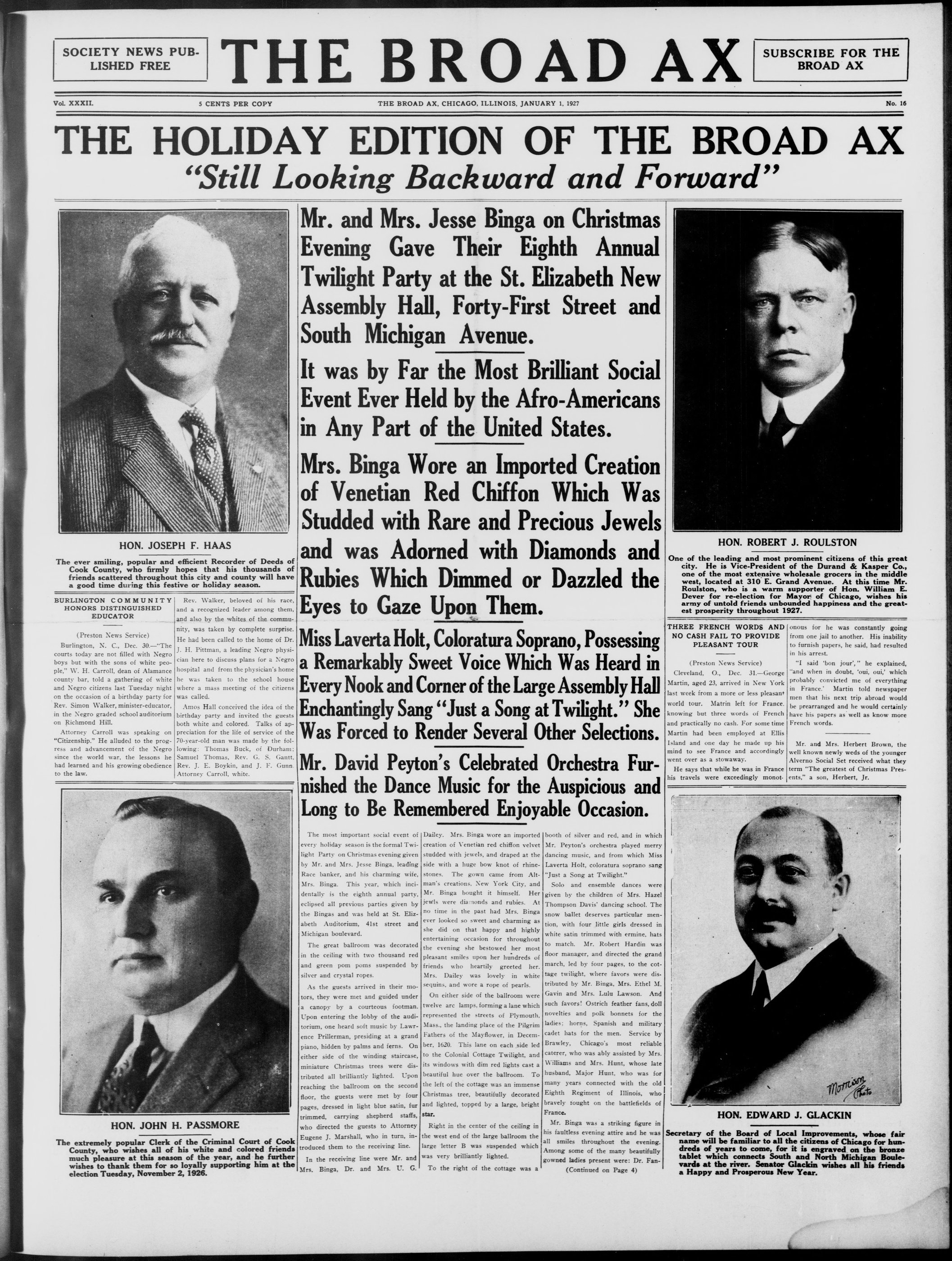
THE HOLIDAY EDITION OF THE BROAD AX "Still Looking Backward and Forward"
SOCIETY NEWS PUBLISHED FREE
Vol. XXXII. THE HOUSE
E HOLL
"Sti
[Name]
HON. JOSEPH F. HAAS The ever smiling, popular and efficient Recor Cook County, who firmly hopes that his friends scattered throughout this city and a good time during this festive or holiday
ing, popular and efficient Recorder, who firmly hopes that his lettered throughout this city and come during this festive or holiday se
The ever smiling, popular and efficient Recorder of Deeds of Cook County, who firmly hopes that his thousands of friends scattered throughout this city and county will have a good time during this festive or holiday season.
BURLINGTON COMMUNITY HONORS DISTINGUISHED EDUCATOR Rev. Walker, beloved of his race, and a recognized leader among them, and also by the whites of the com
Burlington, N. C., Dec. 30—"The courts today are not filled with Negro boys but with the sons of white people," W. H. Carroll, dean of Alamance county bar, told a gathering of white and Negro citizens last Tuesday night on the occasion of a birthday party for Rev. Simon Walker, minister-educator, in the Negro graded school auditorium on Richmond Hill.
Attorney Carroll was speaking on "Citizenship." He alluded to the progress and advancement of the Negro since the world war, the lessons he had learned and his growing obedience to the law.
[Portrait of a man in a suit and tie].
PETER H.
[Picture of a man in a suit with a tie].
The extremely popular Clerk of the Criminal O County, who wishes all of his white and of much pleasure at this season of the year, a wishes to thank them for so loyally support election Tuesday, November 2, 1926.
my popular Clerk of the Criminal who wishes all of his white and of secure at this season of the year, and thank them for so loyally supporting Tuesday, November 2, 1926.
The extremely popular Clerk of the Criminal Court of Cook County, who wishes all of his white and colored friends much pleasure at this season of the year, and he further wishes to thank them for so loyally supporting him at the election Tuesday, November 2, 1926.
The extremely popular Clerk of the Criminal Court of Cook County, who wishes all of his white and colored friends much pleasure at this season of the year, and he further wishes to thank them for so loyally supporting him at the election Tuesday, November 2, 1926.
Vol. XXXII.
5 CENTS PER COPY
HOLIDAY
"Still L
efficient Recorder of Deeds of hopes that his thousands of it this city and county will have tive or holiday season.
Rev. Walker, beloved of his race, and a recognized leader among them, and also by the whites of the community, was taken by complete surprise. He had been called to the home of Dr. J. H. Pittman, a leading Negro physician here to discuss plans for a Negro hospital and from the physician's home he was taken to the school house where a mass meeting of the citizens was called.
Amos Hall conceived the idea of the birthday party and invited the guests both white and colored. Talks of appreciation for the life of service of the 70-year-old man was made by the following: Thomas Buck, of Durham; Samuel Thomas, Rev. G. S. Gantt, Rev. J. E. Boykin, and J. F. Gunn. Attorney Carroll, white.
```markdown
```
of the Criminal Court of Cook
his white and colored friends
on of the year, and he further
loyally supporting him at the
2, 1926.
THE BROAD AX
THE BROAD AX, CHICAGO, ILLINOIS, JANUARY 1, 1927
Mr. and Mrs. Jesse Binga on Christmas Evening Gave Their Eighth Annual Twilight Party at the St. Elizabeth New Assembly Hall, Forty-First Street and South Michigan Avenue. It was by Far the Most Brilliant Social Event Ever Held by the Afro-Americans in Any Part of the United States.
Mrs. Binga Wore an Imported Creation of Venetian Red Chiffon Which Was Studded with Rare and Precious Jewels and was Adorned with Diamonds and Rubies Which Dimmed or Dazzled the Eyes to Gaze Upon Them.
Miss Laverta Holt, Coloratura Soprano, Possessing a Remarkably Sweet Voice Which Was Heard in Every Nook and Corner of the Large Assembly Hall Enchantingly Sang "Just a Song at Twilight." She Was Forced to Render Several Other Selections. Mr. David Peyton's Celebrated Orchestra Furnished the Dance Music for the Auspicious and Long to Be Remembered Enjoyable Occasion.
The most important social event of every holiday season is the formal Twilight Party on Christmas evening given by Mr. and Mrs. Jesse Binga, leading Race banker, and his charming wife, Mrs. Binga. This year, which incidentally is the eighth annual party, eclipsed all previous parties given by the Bingas and was held at St. Elizabeth Auditorium, 41st street and Michigan boulevard.
The great ballroom was decorated in the ceiling with two thousand red and green pom poms suspended by silver and crystal ropes.
As the guests arrived in their motors, they were met and guided under a canopy by a courteous footman. Upon entering the lobby of the auditorium, one heard soft music by Lawrence Prillerman, presiding at a grand piano, hidden by palms and ferns. On either side of the winding staircase, miniature Christmas trees were distributed all brilliantly lighted. Upon reaching the ballroom on the second floor, the guests were met by four pages, dressed in light blue satin, fur trimmed, carrying shepherd staffs, who directed the guests to Attorney Eugene J. Marshall, who in turn, introduced them to the receiving line.
In the receiving line were Mr. and Mrs. Binga, Dr. and Mrs. U. G.
Dailey. Mrs. Binga wore an imported creation of Venetian red chiffon velvet studded with jewels, and draped at the side with a huge bow knot of rhinestones. The gown came from Altman's creations, New York City, and Mr. Binga bought it himself. Her jewels were diamonds and rubies. At no time in the past had Mrs. Binga ever looked so sweet and charming as she did on that happy and highly entertaining occasion for throughout the evening she bestowed her most pleasant smiles upon her hundreds of friends who heartily greeted her. Mrs. Dailey was lovely in white sequins, and wore a rope of pearls.
On either side of the ballroom were twelve arc lamps, forming a lane which represented the streets of Plymouth, Mass., the landing place of the Pilgrim Fathers of the Mayflower, in December, 1620. This lane on each side led to the Colonial Cottage Twilight, and its windows with dim red lights cast a beautiful hue over the ballroom. To the left of the cottage was an immense Christmas tree, beautifully decorated and lighted, topped by a large, bright star.
Right in the center of the ceiling in the west end of the large ballroom the large letter B was suspended which was very brilliantly lighted.
To the right of the cottage was a
booth of silver and red, and in which Mr. Peyton's orchestra played merry dancing music, and from which Miss Laverta Holt, coloratura soprano sang "Just a Song at Twilight."
Solo and ensemble dances were given by the children of Mrs. Hazel Thompson Davis' dancing school. The snow ballet deserves particular mention, with four little girls dressed in white satin trimmed with ermine, hats to match. Mr. Robert Hardin was floor manager, and directed the grand march, led by four pages, to the cottage twilight, where favors were distributed by Mr. Binga, Mrs. Ethel M. Gavin and Mrs. Lulu Lawson. And such favors! Ostrich feather fans, doll novelties and polk bonnets for the ladies; horns, Spanish and military cadet hats for the men. Service by Brawley, Chicago's most reliable caterer, who was ably assisted by Mrs. Williams and Mrs. Hunt, whose late husband, Major Hunt, who was for many years connected with the old Eighth Regiment of Illinois, who bravely tought on the battlefields of France.
Mr. Binga was a striking figure in his faultless evening attire and he was all smiles throughout the evening. Among some of the many beautifully gowned ladies present were: Dr. Fan- (Continued on Page 4)
SUBSCRIBE FOR THE BROAD AX
ROAD
ard"
DAD AX
"
[Picture of a man in a suit with a tie, looking directly at the camera. The background is black. The man's face is clearly visible, with a serious expression. The image is in black and white. There are no visible texts or distinguishing features.]]
HON. ROBERT J. ROULSTON
One of the leading and most prominent citizens in city. He is Vice-President of the Durand & one of the most extensive wholesale grocers in west, located at 310 E. Grand Avenue. At t Roulston, who is a warm supporter of Hon Dever for re-election for Mayor of Chicago army of untold friends unbounded happiness a est prosperity throughout 1927.
leading and most prominent citizens is Vice-President of the Durand & the most extensive wholesale grocers is located at 310 E. Grand Avenue. At t, who is a warm supporter of Home for re-election for Mayor of Chicago untold friends unbounded happiness a verity throughout 1927.
most prominent citizens of this great president of the Durand & Kasper Co., intensive wholesale grocers in the middle E. Grand Avenue. At this time Mr. warm supporter of Hon. William E. on for Mayor of Chicago, wishes his unbounded happiness and the great- hout 1927.
One of the leading and most prominent citizens of this great city. He is Vice-President of the Durand & Kasper Co., one of the most extensive wholesale grocers in the middle west, located at 310 E. Grand Avenue. At this time Mr. Roulston, who is a warm supporter of Hon. William E. Dever for re-election for Mayor of Chicago, wishes his army of untold friends unbounded happiness and the greatest prosperity throughout 1927.
THREE FRENCH WORDS AND NO CASH FAIL TO PROVIDE PLEASANT TOUR onous for he was constantly going from one jail to another. His inability to furnish papers, he said, had resulted
Cleveland, O., Dec. 31.—George Martin, aged 23, arrived in New York last week from a more or less pleasant world tour. Matrin left for France knowing but three words of French and practically no cash. For some time Martin had been employed at Ellis Island and one day he made up his mind to see France and accordingly went over as a stowaway.
He says that while he was in France his travels were exceedingly monot-
Morrison
Photo
777 - EB 3
Mortis
Morrison
Photo
HON. EDWARD J. GLACKIN
Secretary of the Board of Local Improvement, name will be familiar to all the citizens of Chiddes of years to come, for it is engraved on tablet which connects South and North Mivards at the river. Senator Glackin wishes a Happy and Prosperous New Year.
in the Board of Local Improvements, be familiar to all the citizens of Chicago years to come, for it is engraved on which connects South and North Michi the river. Senator Glackin wishes all and Prosperous New Year.
of Local Improvements, whose fair to all the citizens of Chicago for hun- me, for it is engraved on the bronze its South and North Michigan Boule- senator Glackin wishes all his friends vrous New Year.
Secretary of the Board of Local Improvements, whose fair name will be familiar to all the citizens of Chicago for hundreds of years to come, for it is engraved on the bronze tablet which connects South and North Michigan Boulevards at the river. Senator Glackin wishes all his friends a Happy and Prosperous New Year.
onous for he was constantly going from one jail to another. His inability to furnish papers, he said, had resulted in his arrest.
"I said 'bon jour'," he explained, "and when in doubt, 'oui, oui', which probably convicted me of everything in France.' Martin told newspaper men that his next trip abroad would be prearranged and he would certainly have his papers as well as know more French words.
Mr. and Mrs. Herbert Brown, the well known newly weds of the younger Alverno Social Set received what they term "The greatest of Christmas Presents," a son, Herbert, Jr.
No.16
[Name]
Newly elected Judge of the Municipal Court of C can never thank the voters enough for nobly him at the election last November and assisted a home run at the polls. He honestly hopes the enjoy themselves the remainder of the holiday
Newly elected Judge of the Municipal Court of Chicago, who can never thank the voters enough for nobly standing by him at the election last November and assisted him to make a home run at the polls. He honestly hopes that they will enjoy themselves the remainder of the holiday season.
Trachoma Blamed on
Trachoma, that dangerous disease which so often ends in blindness, may be caused by inadequate diet, like scurvy, rickets and similar deficiency diseases, according to a statement from the National Committee for the Prevention of Blindness. While trachoma is spread all over the world, the highest incidence is among people who have faulty food habits.
The apparent contagiousness of trachoma may be due to another eye disease that is associated with it. On Ellis island, where there is always trachoma and where hundreds of cases of it are handled each year, no doctor, nurse or orderly has ever contracted the disease. Similarly, in long steerage trips from eastern Mediterranean ports, passengers with trachoma never caused outbreaks of this disease during the voyage, although the conditions for the transmission of a contagious disease were most favorable—Hyeja Magazine.
Mountain Elevator
The great "lift" to carry aspiring tourists who would eschew the combined joys and labors of the mountain climber to the top of the rugged Wetterhorn, in Switzerland, is one of the most interesting devices in the world. It goes up by two stages, each about 2,000 feet high. The passenger cages are lifted by a drum-wound rope and guided by two pairs of steel cables, each about an inch and three-quarters in diameter, and possessing a tensile strength of 330 tons, 10 times the maximum put upon them. The cars are attached to these cables in such a manner as to avert a fall in case of the breaking of one of the lifting ropes. The cars, weighing $5\frac{1}{2}$ tons, and carrying 20 passengers apiece, are lifted vertically at a speed of about five feet a second.
1.
```markdown
```
HON. MILES J. DEVINE
Prominent civil and criminal law orators in this neck of the by the thousands and thou top candidate for Judge County in 1927.
Prominent civil and criminal lawyer who is one of the greatest orators in this neck of the woods, who can count his friends by the thousands and thousands, who would make a tiptop candidate for Judge of the Circuit Court of Cook County in 1927.
2.
municipal Court of Chicago, who is enough for nobly standing by member and assisted him to make the honestly hopes that they will under of the holiday season.
Black Phosphorus
Black phosphorus, hitherto supposed to be pure phosphorus turned black as result of sudden cooling, is produced by the contact of phosphorus with mercury on which it can react at the moment when it passes from the liquid to the solid state. Molten phosphorus dissolves mercury, giving a colorless solution. When cooled the saturated solution remains colorless in all low temperatures, but if the phosphorus solidifies the solidification is very weak and the mercury leaves the solidified phosphorus and colors it black. If black phosphorus is melted, the mercury is easily redissolved in the surrounding phosphorus and the whole body becomes colorless. This is the correct explanation of the phenomenon.
One "Bad Egg"
A school teacher relates that she was giving her small pupils a lesson on birds, and after telling about the hatching of the eggs, the care of the mother bird and the first lessons in flying, she said: "Now, children, I am the mother bird and are the little bird nestled in your cozy nest. I want you all to spread your wings and fly away." Each child, waving arms to the music she beat, skipped to the dressing room, with the exception of one little fellow who remained motionless in his seat. Turning to him, she said: "Donald, why didn't you fly away with all the other little birds?" "Cause," came the prompt and unexpected reply, "Cause I was a bad egg"—Boston Transcript.
Financial Matters
Miss A.—"Last summer we visited Italy." Mrs. B.—"Did you touch Florence?" Miss A.—"No, but I borrowed from Helen once when I ran short."—Boston Transcript.
1
lawyer who is one of the greatest woods, who can count his friends islands, who would make a tip of the Circuit Court of Cook
THE BROAD AX, CHICAGO, ILLINOIS, JANUARY 1, 1927
By SUSAN GIBBS
(Copyright)
IT ISN'T often that romance may be traced to its roots. Usually it is not recognized until it bursts into bloom.
So, when Ned Christie told Helen Gage that she was made for him she did not believe it.
"How do you know?" she asked, saucly.
"Has your mother never told you about our earliest days—yours and mine, dear?" he asked.
Helen shook the head that would have been a riot of curls if she had permitted them to grow long enough.
Ned was thoughtful for a moment. He was wondering why Helen's mother had withheld the wonderful story from her daughter.
"Well—is it such a deep-dyed secret that one can tell me?" asked Helen, still frivolously. She was very happy, very much in love and nothing else mattered.
"No-o. It's just—beautiful," said her serious lover.
"As beautiful as our romance?" asked Helen.
"It is our romance," he told her.
Helen cuddled up under the shelter of his big arm as they sat together in the big chintz-covered swing.
"Then—tell me, please, Ned-die," she implored.
Ned stroked her fair, shinged head.
He did not tell her, but he looked forward to the day when Dame Fashion would permit the golden curls to grow again.
"Well?" urged the girl at his side.
He laughed. "It seems funny—my telling you this."
"I don't want to know it—if it's funny. I don't feel like listening to anything humorous." she pouted. "You said it was romance." "It is—the most beautiful romance in the whole world," he said, solemnly. "You were a tiny girl—a wee baby in arms and—your mother had wanted you to be a boy." Helen sat up and was about to protest when he soothed her into acquiescence again.
"My mother had been disappointed because I was a mere boy when she had always wanted a daughter. Our mothers had been friends since college days. They had confided in each other and when each one was frustrated in her wish for a child of another sex—they still confided. I don't know just how it all came about, dear, but little by little you and I were exchanged. I would go to your mother for a week. You would come to mine and so both mothers learned to love us almost equally, it was good for us both, as I see it now. You remember when we went to the village school how you used to visit at our house when I was at yours?"
"Yes—and the fun I used to have with all your things" added Helen.
with all you things, added Helen.
"Then we went away to college and—well, you know we seemed to grow apart. Your mother, for the first time, appreciated the value of a lovely daughter—"
"I bow," interrupted Helen, in mock humbleness.
"And my blessed mother began to be proud of a big son. There was a certain, well-controlled jealousy in her attitude when I used to want to go to your house so much during vacation, and I noticed that when you came to visit us, your mother came along. It was amusing—then."
"But what happened after mother took me to Europe? Did they quarrel—or what?" asked Helen, serious now.
"Yes—I never knew exactly how it came about but my mother must have said something about your belonging to her eventually, after all. Meaning of course, that you'd marry me—"
"The idea." began Helen with asperity.
"Walt a minute, dear," consoled Ned. "It has all come out right, hasn't it?"
Helen had moved away and was wearing a disturbed expression. "If I'd known that—that—that my own darling mother didn't want me to marry you I never would have promised. I was just going against her."
Ned was several minutes trying to tell her to wait until he could explain.
tell her to wait until he could explain.
"Before you came back from abroad, your mother and mine had written many letters that cleared the situation for them and they fell into each others' arms when you returned. Each one declared that we—you and I—were made for each other and that a kindly and wise Providence had arranged it all—that we had been brought up with the same background, received the same sort of education and been given the same vision from home. They decided that they were selfish to have quarreled and—well, that each of them had gained, at last, her heart's desire. Your mother was to have her son and mine was to have a daughter. I don't mind saying that I think my mother is getting the best of the bargain, dear."
"I can't subscribe to that, but I do think mother might have told me all about it."
"I believe she was afraid, deep down in her heart, Helen, that if you believed she had picked out a husband for you while you were still in your cradle, you would have none of him. She was wise in keeping her secret wishes from you until it was too late for you to boil," laughed Ned. "And it is—too late—isn't it?"
"Alas—it is," answered Helen.
Butters No Parsnips
Pitty costs nothing—and ain't wuth nothing.—Josh. Billings.
MRS. BROOKINS, PUT OFF
PULLMAN, JAILED, SHE
SEEKS $25,000 DAMAGES
Darrow to Aid Hays in Case Against Railway and Pullman Co.
Fined $500 by Florida Judge
(Preston News Service)
New York City, Dec. 31.—In an effort to seek redress for being forcefully ejected from a Pullman car last July 18 by police officers at Palatka, Fla., Mrs. Blanche S. Brookins, of this city, through her attorneys, Garfield Arthur Hays and Clarence Darrow, is suing the Pullman Company and the Atlantic Coast Line Railway for damages aggregating $25,000.
N.A.A.C.P. Back of Suit
The case is being handled by the N.A.A.C.P. Mrs. Brookins, in her complaint charges that on July 18, at Palatka, Fla., she was on a Pullman sleeper, on which she had purchased through accommodations from New York to Orlando, Fla., when a conductor forced her to leave the train because of Florida's Jim Crow law. The Jim Crow law prohibits the use by Negroes of railway accommodations set apart for whites within the state, but other Pullman accommodations are provided for Negroes. On this train no such accommodations had been provided. Mrs. Brookins charges, and she was told to ride in a day coach.
Ejected. Imprisoned. Fined
Her Pullman was attached to the Atlantic Coast Line, Mrs. Brookins says, and when the train reached Jacksonville, Fla., a conductor demanded that she leave the Pullman. She refused to do so, and the following day, at Palatka, police officers were summoned who forcibly ejected her from the train.
Mrs. Brookins charges in her complaint that she was then imprisoned in the county jail at Paltaka, fined $500 and costs amounting to $18.17 and told by the Florida judge that he "was sorry he could not double her fine for violating the 'Jim Crow' law."
Passenger in Inter-State Commerce "We will charge that since Mrs. Brookins was a passenger in inter-state commerce and therefore not subject to the provisions of the Florida Jim Crow law," Attorney Hays stated; "the defendants violated their contracts as common carriers, with Mrs. Brookins, subjecting her to insult, mortification and injury to her nervous system and general health; that their agents acted carelessly, negligently, forcibly and unlawfully, and that they caused her to be unlawfully imprisoned, with great expense and personal injury. This is a case of inhuman treatment." Mr. Hays declared.
Attracting Widespread Interest
This case is designed to attract widespread interest because of the many new angles and phases involved. The fact that such able counsel as Hays and Darrow will handle it presages a new era in legal and judicial contentions and interpretations of the laws governing inter-state travel, and the intent and meaning of passenger accommodations. Members of the National Association for the Advancement of Colored People indicate that this will be a supreme effort to trash out this much mooted question. Every effort will be made to prosecute this case to the limit.
Look With Suspicion
On Too-Good Youth
Poor little good boy! Nobody believes in him; everybody distrusts him. All the wise educators and psychologists peer at him suspiciously and solemnly announce that he can't possibly be approved of. If he is tractable and obedient they shake their heads dolorously and prophesy that it won't last, that he'll do something dreadful later in life to make up for it and he'd much better be getting his allowance of original sin out of his system while he's young, ingrowing sin being a serious complaint. Well, maybe. But somehow, we can't help wondering if it's quite as bad as all that. We always had a sneaking idea that the boys and girls who did as they were told and got into no serious mischief grew up to be the dependable, conscientious, industrious men and women who do the bulk of the world's work and do it quietly and efficiently, without ringing any bells or blowing any horns to call attention to themselves and that one or two of them may even have become presidents of banks or railroads or something. Probably we're wrong, but it's a comfortable theory, anyway.—Cleveland Plain Dealer.
Old English "Harvest Home"
Bloomfield gives us a fine picture of Harvest Home in Suffolk, England, where the foremost man in the field was honored with the title of "lord." and at the Horkey or Harvest home feast he collected money from farmers and visitors to make a frolic afterwards, which was termed the "largest spending." Even in Bloomfield's time this quaint custom was on the wane.
Put Faith in Image
Motoring along a country road in India, the attention of tourists was called to a curious-looking object by the roadside. It was a roughly carved little image, mounted on a small stool, with three legs.
The image betrayed no signs of expert workmanship and was quite clearly the handwork of some rough village carpenter. They eyes and mouth were roughly carved, and vermillion paint brought these into prominence. The little creature had also two wooden arms.
Stopping the car, the tourists waited until some villager came along the road, and questioned him as to the reason why this image had been left by the roadside. He pointed out that it had been placed a few yards over the boundary line of the village, and that it had been there since the early hours of the morning.
It was an image of the goddess of the village temple, so common in south India, and represented the deity who controls smallpox. The scourge had broken out and had laid low a number of people, and it was felt that unless the goddess could be persuaded to transfer the evil more would fall sick. So the little image was made and removed outside the bounds of the village. Naturally the people in the next village did not appreciate this attention, and the custom is to move it from village to village. Then sometimes it is possible to get a Mohammedan, for a small fee, to destroy it completely. Thus does the Indian villager deal with the troublesome disease.
Ears Become Attuned to Familiar Noises
That both women and men of this generation are more subject than their forebears to nervous breakdowns is the claim of most experts. On the other hand, it is denied by a few whose opinions carry weight. The effect of the noise of modern life is being very carefully studied by the Institute of Industrial Psychology, and Doctor Miles, a member of the staff, has reached the conclusion that the bad effect of noise on human nerves is far less than it has been supposed to be.
Investigation seems to indicate that one can adjust to the increasing noises of modern cities with great rapidity and ease and that little or no harm is done.
Typists placed at work for hours in the most infernal uprear—steam whistles, crashing tinaware, pistol shots and intermittent groats and screams—are troubled only until the novelty wears off. Then nerves quiet down and the noises cease to be impressed. The woman who is excessively annoyed by noise should be examined by a physician, for there usually is something of serious importance giving rise to the "nerves."—Kansas City Star.
Two Counties Honored
Virginia is known as the mother of Presidents because eight Presidents of the United States were born within her borders, says the Pathfinder Magazine. Washington, Jefferson, Madison, Monroe, William H. Harrison, Tyler, Taylor and Wilson first saw the light of the day in the Old Dominion. Two counties had the honor of giving birth to four of these distinguished men. Washington and Monroe were born in Westmoreland and Harrison and Tyler, born in the same county. It is an interesting fact that Harrison and Tyler, born in the same county were elected President and vice-president, respectively, at the same time. So it happened that when Harrison died a month after taking oath of office he was succeeded by a man born in the same county.
BULLETIN No. 89—PROTECTING INDUSTRIAL PLANTS
By Chief of Police Morgan A. Collins
Always have two locks on front doors to premises, one mortise lock with double bolt and one strong padlock with staples fastened on inside with nut and washer.
If double doors are used be sure that one is properly bolted top and bottom with stout spring bolts, and that the sockets are of sufficient depth to hold the bolts securely.
If rear doors are made of wood, have them faced with sheet iron inside. Have the doors secured from inside by two locks and a cross bar.
Protect skylight with openings on the inside by steel rods, placed not more than four inches apart and firmly secured to roof timbers by strong lag screws.
Windows or openings in front of fire escapes or accessible therefrom should be amply protected by iron rods on the inside but not in violation of fire regulations.
Install electric alarms on every floor that will give an alarm in case of entry by door or window. Never occupy a building previously occupied without changing locks.
Safes should be located in plain view of policemen on duty, and a light should be burning in front of them sunset to sunrise. Money and securities should not be left in safe overnight.
Aid and assist us to protect your property. Remember an unprotected building encourages a thief.
[Name]
HON. JOHN E. TRAEGER
Ex-Sheriff of Cook County, ex-Treasurer of Cook Collector of Chicago, ex-Coroner of Cook Comptroller of Chicago; one of the highly lovers of the Zoning Commission of Chicago; of the Stockmen's Trust and Savings Bank, its own modern bank building at Halsted Field Boulevard. Mr. Traeger takes pride many of the Colored people in his neighborhood their banking business with the Stockmen'sings Bank. Honest John E. Traeger wishes of friends a Happy New Year and thousand would be delighted to see him enter the room of Cook County right now.
In Cook County, ex-Treasurer of Chicagof Chicago, ex-Coroner of Cook County of Chicago; one of the highly held the Zoning Commission of Chicago; Stockman's Trust and Savings Bank, womodern bank building at Halsted St.levard. Mr. Traeger takes pride in the Colored people in his neighborhood business with the Stockman's T. Honest John E. Traeger wishes a Happy New Year and thousands delighted to see him enter the ra County right now.
Ex-Sheriff of Cook County, ex-Treasurer of Chicago, ex-City Collector of Chicago, ex-Coroner of Cook County, ex-City Comptroller of Chicago; one of the highly honorable members of the Zoning Commission of Chicago; Vice-President of the Stockmen's Trust and Savings Bank, which occupies its own modern bank building at Halsted Street and Garfield Boulevard. Mr. Traeger takes pride in stating that many of the Colored people in his neighborhood transact their banking business with the Stockmen's Trust and Savings Bank. Honest John E. Traeger wishes his thousands of friends a Happy New Year and thousands of his friends would be delighted to see him enter the race for Sheriff of Cook County right now.
Ski Travel Made History
Messengers on skis provided a turning point in Sweden's history in the Sixteenth century. When King Gustav Vasa called for men to repel the Danish invaders, the cautious phlegmatic men of Darlecarlia, the ancient Swedish province, took counsel and were not sure whether they should respond. Bereft of support, the king started for the Norwegian border, but had not been on his way long till the Darlecarlians decided to throw in their lot with him against the foreigner and messengers raced after him on skis and brought him back. To that event and those men modern Sweden owes her renaissance. To this day an annual ski race is held in winter to commemorate this turning point in the country's history. -London Sphere.
The Ideal Life
Sacha Guilry, the most famous living French actor, gave this recipe for a happy life during his recent visit to London: "Meet at thirty with a woman of twenty; marry her if you love her; make her happy, never deceive her, never be deceived; and die before her, very old."
S.
Sergeant
Sergeant
The head chief of the Police Department of the Chicago, who continues to fight to the death element in this city who have become so perate lately. Chief Collins should be furnishing the police he needs to start the criminals on out of town. He wishes to warmly thank a are aiding him with their moral support and the citizens of this city a Happy New Year.
Chief of the Police Department of the city who continues to fight to the death in this city who have become so likely. Chief Collins should be thanked for the needs to start the criminals on the town. He wishes to warmly thank him with their moral support and thanks of this city a Happy New Year.
The head chief of the Police Department of the great city of Chicago, who continues to fight to the death the criminal element in this city who have become so bold and desperate lately. Chief Collins should be furnished with all the police he needs to start the criminals on the dead run out of town. He wishes to warmly thank all those who are aiding him with their moral support and he wishes all the citizens of this city a Happy New Year.
Treasurer of Chicago, ex-City
Croner of Cook County, ex-City
of the highly honorable mem-
ion of Chicago; Vice-President
of Savings Bank, which occupies
ing at Halsted Street and Gar-
ger takes pride in stating that
he in his neighborhood transact
the Stockmen's Trust and Sav-
. Traeger wishes his thousands
car and thousands of his friends
him enter the race for Sheriff
Explaining Military Salute
There have been several ideas advanced as to the origin of the military salute. It was supposed to have been the practice in Rome at the time of Julius Caesar for inforiors to raise the palm of their hand to the front of their caps in order to show that it contained no dagger. This was on account of the fact that assassinations were so common in those days. It has been suggested that time and custom have modified this to the military salute. Another idea suggested was that in the British army during the American Revolution it was customary for inferiors to uncover before superiors and equals in acknowledgment of their presence. On account of the clumsy headgear, this custom degenerated into saluting without removing the cap.
Two Viewpoints
Sometimes the man who insists his wife is his "right hand" never lets his right hand know what his left does. Such consideration may be prompted by the best of motives and then again by another reason. -Grit.
1930
department of the great city of
night to the death the criminals
have become so bold and des-
sirs should be furnished with al-
the criminals on the dead run
we warmly thank all those who
oral support and he wishes al-
happy New Year.
[Name]
HON. GEORGE B. HOLMES
One of the oldest and best Judges of the Muni Chicago, simply wishes to thank the voters rallying to his support on election day, Nove and made it possible for him to serve the period of six years.
dest and best Judges of the Muni simply wishes to thank the voters his support on election day, Nov it possible for him to serve the six years.
One of the oldest and best Judges of the Municipal Court of Chicago, simply wishes to thank the voters in this city for rallying to his support on election day, November 2, 1926, and made it possible for him to serve them for another period of six years.
Cropnetic Plant
A plant which is said to be able to predict earthquakes and volcanic eruptions bears the scientific name of Abrus precatorius. It is a native of Cuba, has no flowers, and consists of a long stalk from which branch numerous twigs containing rows of delicate-looking leaves. The leaves frequently change color or close, while the twigs bend themselves into curious positions. This plant is highly sensitive to electric and magnetic influences, and by being able to interpret the movements of the plant in response to electric currents the scientist is enabled to predict great convulsions of nature.
Nurich's Great Idea
"Now let's see about this portrait you're to make of my wife," said Nurich. "Water colors rub out easily, don't they?" "Oh, yes," said D'Auber; "It must be in oil—" "Wait a minute. Just make the head and neck in oil and the dress in water color. Then it'll be easy to bring it up to date every time the style changes."
Inflammatory Reading
The high spot in this issue is what causes fires in grocery stores.—Trade Paper.
```markdown
```
[Name]
[Name]
President of the old reliable John J. Dunn Coat most extensive coal company on the So office 51st Street and Federal Street. It by the late John J. Dunn in 1877 and its pri desires to thank its many patrons for their for the past years and wishes them the top throughout the holiday season.
The old reliable John J. Dunn Coal
passive coal company on the South
Street and Federal Street. It w
wrote John J. Dunn in 1877 and its pres
t thank its many patrons for their h
et years and wishes them the top o
t the holiday season.
President of the old reliable John J. Dunn Coal Company, the most extensive coal company on the South Side, main office 51st Street and Federal Street. It was established by the late John J. Dunn in 1877 and its president heartily desires to thank its many patrons for their hearty support for the past years and wishes them the top of the morning throughout the holiday season.
dges of the Municipal Court of thank the voters in this city for election day, November 2, 1926, him to serve them for another
Firns Once Powerful
The Finns are descendants of a western branch of the great racial family of which the Mongolians are the modern representatives in the Far East. But there is evidence that the Finns, or a closely allied race, were at a prehistoric time spread over a large area of Europe. In the course of time they mixed with other races to such an extent that some of their original characteristics have been modified or lost, while some of those of other races have become Finnish. The original stock is now represented in Europe in a good many other places than Finland. The Hungarians, the Lapps, the Samoyeds, the Estonians, and various people of Russia may be numbered among these representatives.
Given String of Names
The longest name yet wished on a defenseless infant has been bestowed on a daughter of Arthur Pepper, Liverpool (Eng.) laundryman. The child's initials exhaust the alphabet. Taking the letters in order, omitting p, which is provided by Pepper, the child was christened Anna Bertha Ceelia Diana Emily Fanny Gertrude Hypatia Inez Jane Kate Louise Maud Nora Ophelia Quince Rebecca Starkey Terest Ulysis Venus Winfred Xenophon Yetzo Zeo Pepper. She is sometimes called Miss Alphabet Pepper for short.
```markdown
```
John J. Dunn Coal Company, the many on the South Side, mainural Street. It was established 1877 and its president heartily atrons for their hearty support es them the top of the morning son.
THE BROAD AX, CHICAGO, ILLINOIS, JANUARY 1, 1927
COLORFUL NEWS MOVIES By THE CAMERAMAN
be heeded. With such favorable action on their desires, there should not of necessity follow unlimited franchise without at least an educational qualification. Conditions in the Virgin Islands bear little or no resemblance to those in the States.'
That the Virgin Islands children are hampered in their educational equipment by the lack of money is emphasized in the Governor's report. It appears that repairs to many of the public school buildings in which 113 teachers are instructing 3,107 children are urgent; while the extensions of manual training facilities, including an
1. Thaddeus Stevens—Patriot
2. Virgin Island Governor's Report
3. Senator Ernst of Kentucky
4. Christmas Stockings
Thaddeus Stevens—Patriot
American readers who are following the "Inside Story of the U. S. A." as narrated in the daily press by William E. Dodd, Professor of American History in the University of Chicago, would do well to peruse "The Statesmen Series" of Ex-Governor Samuel W. McCall, of Massachusetts, before absorbing the excretions of the Chicago professor upon the immortal Thaddeus Stevens of Lancaster, Pa. the man who, along with Abraham Lincoln and Senator Charles Sumner, did more to alleviate the civic suffering and pain which the Negro has endured in America than any other patriot, living or dead.
Of Stevens, Prof. Dodd says, in a non-historical style: "Thaddeus Stevens, stern, stubborn, ill of health, his unruly hair unkempt upon his vindictive head, an old man nurtured upon hatred, an equalitarian, quoting the gentle Jefferson, dragging his deformed foot after him, shaking his rough fist and scowling at any who dared befriend the south."
Such metaphores and hyperboles are highly non-essentially nor historically instructive in depicting what Prof. Dodd says was the most "dangerous moment in American history." On the other hand, however, those Americans, white and black, who are today revering the story of the new democracy shaped by Lincoln, Sumner and Stevens, should be taught the truth, namely, that Thaddeus Stevens hated not seridom, but LOVED LIBERTY. Stevens laid his life upon the altar of liberty. It is true that he was an equalitarian of the unalloyed type. It was this temperament which caused him to force through Congress the Civil Rights Bills for Negroes. He chafed at the half-slave, half-free spirit which so many others in Congress were willing to conde for the Negro freedmen. Stevens' memory and acts reverted to the Declaration of Independence for the strength and will to dare and do. He eschewed "bob-tailed" Americanism, and taught nobly for a full emancipation.
Americans, white and black, should love the memory of Stevens. They should fondle the truthful documents which men like Governor McCall have left, telling of the great Pennsylvania abolitionist whom his constituents returned to Congress again and again. They should lament over the deformation which modern historians attempt to make of the civic impetus given to Negro rights, following the Civil War, and should deplore that that wave of full freedom now appears to have dashed away its strength upon the sands of apathy.
Virgin Island Governor's Reports
The Honorable Martin E. Trench, Governor of the Virgin Islands, has submitted to the President of the United States his annual report for the fiscal year ended June 30, 1926, and the same has been presented to the U. S. Senate and printed as Senate Document No. 170, Sixty-Ninth Congress, Second Session, by Senator Bingham, Republican. Matters of citizenship, education, and the bay rum industry in the Virgin Islands constitute, in the opinion of this column, the most important points in Governor Trench's report. The Governor openly states "that these islands should be governed by laws purely American." In further reasoning upon this assertion, the Governor says:
"It is believed that the inhabitants of the Virgin Islands should be given United States citizenship. They expected it with the purchase of the islands and it would appear that their expectations were translated into favorable terms in the treaty of cession. This interpretation was later decided to be erroneous so that they are now 'inhabitants of the Virgin Islands entitled to the protection of the United States.' If this small outpost in the West Indies is to be a credit to the nation their aspirations to citizenship and naturalization should
be heeded. With such favorable action on their desires, there should not of necessity follow unlimited franchise without at least an educational qualification. Conditions in the Virgin Islands bear little or no resemblance to those in the States.
That the Virgin Islands children are hampered in their educational equipment by the lack of money is emphasized in the Governor's report. It appears that repairs to many of the public school buildings in which 113 teachers are instructing 3,107 children are urgent; while the extensions of manual training facilities, including an agricultural school, are most needed The Governor recommends the construction, and opening of a trade and agricultural school, in order that apprentices, anxious to learn a trade may enjoy that privilege within the confines of their homeland.
Contrary to the general belief in the United States, that Prohibition has crippled the bay rum industry of the Virgin Islands, the tabulation in Governor Trench's report shows that during the past year 85,148 gallons of bay rum were manufactured, sold and exported. This is the highest mark since 1919, and is nearly three times as much bay rum as was placed in commerce during the years prior to the purchase of the islands by the United States.
The Governor urges annual financial assistance from Congress, to stimulate the economic and political possibilities of the islands. He expresses the regret, however, that complete self-help cannot be expected in the islands for many years.
Senator Ernst of Kentucky
Negroes, not only of Kentucky, but of the country at large, may well mourn the future passing, from the U. S. Senate, of Senator Richard P. Ernst, of Kentucky.
As a semi-final evidence of his good old-fashioned American good will and love for justice, Senator Ernst, on last Monday in a meeting of the Judiciary Committee, moved to extend the scope of the proposed inquiry into the alleged barter and sale of public offices in southern states to include alleged disfranchisement of Negroes in certain states of that section. It was a brave
455
HON. THOMAS J.
COURTNEY
Recently elected to the State Senate from the 11th Senatorial District of Illinois.
Mr. Courtney is well and favorably known in the city hall to all the leading politicians and statesmen; he stands high with the former service men and he is an honored member of the service men's association.
He is a lawyer, is 35 years of age, was born, reared and educated in the district which he will represent, and lives with his wife and family at 7632 South Loomis street.
He is strongly in favor of home rule for Chicago and strenuously advocates the passage of a reapportionment bill so that Chicago may have the full number of representatives in the state legislature to which it is entitled under the state constitution. He pledges himself to strict economy in the appropriation of state funds and further states his chief concern while in public office will be to reduce taxes when ever and wherever possible. He is in favor of deep waterways, and more and wider roads leading into and out of Chicago. It is his belief that Cook County has been deprived of its fair share of state automobile license fees long enough.
It must be said to the great credit of Mr. Courtney that he adhered to his labors during the daytime and studied law in the evening, never missing one single session or evening from his law school. No one wishes him greater success in the world of law than the writer.
He is bound to let the big statesmen at Springfield know that Chicago is on the map of Illinois.
act, particularly when the oftimes questionable prejudice of Kentucky is considered, for Senator Ernst to exert his fleeting moments in the Senate to such a worthy effort. It was an honest offense launched at the evasive practices of the south to suppress Negro suffrage.
It was Senator Ernst who fought nobly in committee to bring out the anti-lynching measure. It has been Senator Ernst who has been first to champion the confirmation of Negro appointees to office. It has been Senator Ernst who was always easy to see and kind of approach in his office at Washington, eager to dare and do for the masses of the country's people, without question as to race or religion. Senator Ernst has been temporarily shunted aside, effective next March, by the democratic wave which swept Kentucky last November. It is to be sincerely hoped that his splendid good will and honesty of purpose may continue to be available in some capacity to the struggling masses, and particularly the colored people who need so much, but who have so few to champion their cause.
Christmas Stockings
Good old Saint Nicholas outdid himself this year in generosity and good will; and, believe it or not, here are a few of the Yuletide gifts which he meted out among some of the notable members of the Grand League of Good Brotherhood:
To Ben Davis and "Webb" Porter, Santa brought eternal peace.
To Nahum Daniel Brascher, of the Associated Negro Press, he brought a brand new cane, with a concealed radio wire to the Capitol.
To Charlie Anderson, Collector of Internal Revenue, New York, St. Nick brought restoration of good health, and Charlie's grand old smile of yore.
"Moll" Chisum isn't worrying now that Christmas is over. Didn't St. Nick present him with a national and an international transportation pass. Santa Claus did not forget Perry W. Howard, whom he presented with a life membership in the Brotherhood of Sleeping Car Porters. Judge Ed Henry, of Philadelphia, is happy. His Christmas stocking contained a golden emblem saying "Well Done, Ed." Claude A. Barnett was so glad that he had an attack of the Heebie Jee-bies when he discovered that good old Santa had put a muffler on Claude's "noiseless" Remington.
To Clarence Matthews, Santa Claus gave a prescription that would reduce weight without impairing the appetite. Oscar DePriest is also happy, because St. Nicholas showed him a way to reduce his income tax, without curtailing the receipts.
Charlie E. Hall, the mortality statistician of the U. S. Census Bureau, was given a letter of introduction to Ed. Wright's tailor.
Recorder of Deeds, Arthur G. Froe, who serves on many fraternal sick and visiting committees, was all smiles. Santa Claus told him he could have a whole week off.
Dr. Emmett J. Scott was pleasantly informed by St. Nick that a new set of books awaited him at the Post Office, upon which to make the financial program for the next "Football Classic of the Year." John D. Gainey! Oh, yes, he was really "at home" for the first time in many years, due to the courtesy of Santa.
Oda Guirk of Nature
in Recognized Genius
The annals of literary forgery have no more pathetic instance than the so-called Rowley poems of Thomas Chatterton. When Chatterton, perhaps the most shining example of precocity to be found in literary history, was twelve years old, he conceived the idea of fabricating the literary relics of a moket to whom he gave the name Rowley and whom he ascribed to the Fifteenth century. By the time he was seventeen he had aroused some interest in the poems of Rowley but not enough to satisfy his imagination. So he wrote to Horace Walpole, inclosing some pages of manuscript and inferring he had other papers and poems. Walpole wrote, asking to see whatever documents he might have and Chatterton sent so many as to arouse Walpole's suspicion and cause him to call in the poets, Mason and Gray. They pronounced the poems a forgery. Walpole dispatched a letter of admonition to Chatterton. Three months later he returned the manuscripts, which, with the exception of one poem, never saw print until after Chatterton had taken his life in a moment of despair. He was not yet eighteen when he died. So brilliant, so versatile was he that even those contemporaries who condemned him conceded that in many respects he was a greater genius. By some queer quirk of nature he had chosen to act the imposter, where he might with every prospect of renown have produced his work as his own.—Dearborn Independent.
[Picture of a man with a bald head and glasses, wearing a dark suit and a white shirt with a cowl. The background is plain white.]
[The caption reads: "A portrait of a man in a dark suit and white shirt with a cowl. The background is plain white."]
HON. T. F. MORAN
Highly honored member of the Ward, who wishes to thank for their past support, and fully stand by him at the e
Highly honored member of the City Council from the 16th Ward, who wishes to thank his many friends and neighbors for their past support, and he feels sure that they will manfully stand by him at the election this coming spring.
Jackson by No Means
John Quincy Adams declined to attend the ceremonies at Harvard college in 1833 when the honorary degree of doctor of laws was conferred upon Andrew Jackson, then President of the United States.
His reason, according to his diary, was that "as an affectionate child of our alma mater, I would not be present to witness her disgrace in conferring her highest literary honors upon a barbarian who could not write a sentence of grammar and hardly could spell his own name."
Adams' estimate of Jackson has been challenged by Dr. Archibald Henderson, who tells in the Raleigh (N.C.) News and Observer, the result of his exhaustive researches regarding Jackson's early life. He finds that Jackson, as a boy, received a better education than the average child of his station in life.
Later he attended Waxhaw academy. He continued his studies in that part of Carolina known then as New Acquisition. An account of the life of Rev. Francis Cummins, once a teacher at Bethel, S. C., shows that Jackson was one of his pupils and there is evidence that for a short time Jackson attended Queen's museum in Charlotte, N. C.
Giant Among Stars
The naval observatory says, according to George Ellery Hale, the diameter of Betelgeuse is certainly more than 100,000,000 miles and probably as much as 215,000,000. The diameter of the sun being 864,000 miles, Betelgeuse is therefore roughly of 250 times greater diameter and 15,000,000 times greater volume. However, it is supposed to consist of matter in an extremely attenuated condition. Though the weight of Betelgeuse is now known, the fact that no star whose weight has been determined is as much as 100 times as heavy as the sun makes it unlikely that Betelgeuse is heavy in proportion to its volume.
1920
M. H.
Warden of the Cook County Hospital, one of the German-Americans in this city or county, was an ideal candidate for Sheriff of Cook Coun
Warden of the Cook County Hospital, one of the most popular German-Americans in this city or county, who would make an ideal candidate for Sheriff of Cook County in 1927.
Warden of the Cook County Hospital, one of the most popular German-Americans in this city or county, who would make an ideal candidate for Sheriff of Cook County in 1927.
the City Council from the 16th this many friends and neighbors he feels sure that they will man-ection this coming spring.
Visitor Surely Had
There was great excitement in the Jones home out on Long island. A real lord was paying them a visit. He was now sitting at the dinner table and Mrs. Jones fluttered as she urged my lord to eat this and that.
Mr. Jones, swollen with a sense of the great honor bestowed upon his household, began each sentence with lord and ended it the same way with a worshipful not to say reverential, alr.
As a special privilege—thinking that he might talk about it in his maturer years—little Willie Jones, aged five, had been permitted to attend the function on condition that he refrain from talking unless spoken to. Mindful of this pledge, the little fellow sat in silence, his large round eyes fixed in a stare upon the face and form of the stranger.
But when he saw the visitor's eye roaming hither and yon across the laden table as though seeking something, an innate sense of hospitality moved him to speak. "Mom! Oh, mom!" said Willie.
"What is it, Willie?" asked the mother,
"God wents a pickle."—Everybody's Magazine.
The Big Thrill
It was the ninth inning with a nothing to nothing score. There were two outs against the home team, and the umbread had called two strikes and three balls against the redoubtable Canavan. The pitcher calculated his distance, drew back his arm, and hurled—his favorite in-curve. Canavan measured its approach with a keen eye and swung, putting all his strength behind it. Right on the nose! It sped toward the left field fence. The left fielder was running backwards. Would he make it, would he make it? The grandstand watched with open eyes and mouths.
"Look!" Myrtle grabbed her escort's arm and pointed a trembling finger. "Look at that pink and purple hat!"—Exchange
[Image of a man in a suit with a tie, facing slightly to the right].
capital, one of the most popular city or county, who would make off of Cook County in 1927.
3
83
HON. WILLIAM HALE THOMPSON
Ex-Mayor of Chicago, whose large army of loyal s and workers feel that he will be the next Mayo cago, and he is standing Mr. Harvey A. Watk race for Alderman of the Second Ward.
COLORED WOMEN IN BUSINESS
Washington.—When Mrs. Maggie L. Walker, who for ten years has been at the head of the St. Luke Savings Bank and Trust Company, of Richmond, Va., recently made an address in this city, she emphasized the need of a greater development of business interests in each community where there is a considerable colored population.
By reason of her being the only colored woman in the United States at the head of a banking institution attention was directed to some of the business activities of our women throughout the country. Of the nearly 12,000 engaged in trade, approximately 3,200 of them are retail dealers, 1,300 of whom own and conduct grocery stores. Other retail dealers among our group of business women specialize in such articles of merchandise as books, candy and confectionery, cigars and tobacco, clothing and men's furnishing goods, coal and wood, coffee and tea, crockery and glassware, curios, antiques and novelties, drugs and medicines, dry goods and fancy goods, flowers, fruit, furniture, jewelry, meats, milk, musical instruments, newspapers and magazines, shoes, etc.
An increasing number of colored business women find employment as insurance agents and real estate agents and nearly 200 have qualified as undertakers. Fully 2,500 are clerks and salesmen in stores, and others are making a livelihood and gaining busi-
109
109
HON. ROBERT M. SWEITZER
With pleasant smiles on his manly face Mr. Sweiting with the Christmas spirit, desires to hearti voters of this city and county for re-electing Cook County.
With pleasant smiles on his manly face Mr. Sweitzer, in keeping with the Christmas spirit, desires to heartily thank the voters of this city and county for re-electing him Clerk of Cook County.
4
large army of loyal supporters will be the next Mayor of ChiMr. Harvey A. Watkins in his Second Ward.ness experience as commercial travelers, decorators, drapers, and window dressers, as demonstrators and floorwalkers in stores, and as employment office keepers. We have several opticians and nearly 400 female hucksters and peddlers, a number of junk dealers, and a dozen or more dealers in rags. All of which indicates a decided improvement in the economic status of our Race.
RACE PREJUDICE BARS JUROR
New York—Appearing in court as a prospective juror, in the trial of a Negro, before a Jewish judge and an Irish-Catholic attorney, and having a national reputation as a bitter antagonist of Jews and Catholics, was more than the Court could countenance, when Franklin Ford, a radio announcer, admitted his prejudice in open court.
Declaring that such antipathies were foreign to the form of government of this country, Judge Rosalsky promptly excused Mr. Ford from jury service and suggested that his name be permanently stricken from the jury lists of New York County.
John W. Robinson of Milwaukee, Wis., in company with his son, Ambrose H. Robinson, his little granddaughter, Miss Embry, spent the holiday week-end with Mr. Robinson's brother-in-law, A. H. Young, 4114 Calumet avenue.
1930
anly face Mr. Sweitzer, in keep-rit, desires to heartily thank the unity for re-electing him Clerk of
IN CITY
THE BROAD AX, CHICAGO, ILLINOIS, JANUARY 1, 1927
THE BINGA TWILIGHT PARTY WAS THE FINEST SOCIAL AFFAIR EVER HELD IN THE UNITED STATES.
(Continued from Page 1)
nie Emanuel, light blue georgette heavily beaded with crystal beads; Miss Juanita Emanuel, orchid taffeta, silver lace and silver slippers; Mrs. Mable Washington, gray georgette; Mrs. Bertha Moseley Lewis, gold sequins, Spanish shawl; Mrs. I. H. Holloway, gold lace, gold slippers; Mrs. Camille Cohen Jones, black sequins, coral ostrich fan; Mrs. Ida B. Wells Barnett, mulberry georgette, silver lace; Mrs. B. W. Fitts, black silk lace over satin; Mrs. A. Wilberforce Williams, black lace over old rose; Mrs. Harris B. Gaines, brocaded black and gold satin with gold georgette trimmed with black, satin slippers, Spanish shawl; Mrs. Bessie Scott Thornton, black velvet, rhinestones; Mrs. Adelbert Roberts, pink georgette with pearls; Mrs. Grace Hart Wilson, white silk rennaissance X with rhinestones; Mrs. P. Hyman, black georgette over white satin trimmed with imported applique; Mrs. Cora Young, orchid chiffon encrusted with rhinestones; Mrs. Edw. Tiderington, henna crepe with crystal beads; Mrs. Irene Lewis, peach georgette, pearl beaded with shawl; Mrs. Hazel Thompson Davis, orchid taffetta; Mrs. C. N. Langston, blue satin; Mrs. Margaret Johnson, peach georgette with rhinestones; Mrs. Bessie Bryant Crews, mulberry georgette silk lace; Mrs. Bryant, black georgette with silk lace and jet beads; Mrs. Cecelia Johnson, peach satin with rhinestones; Mrs. Benj. H. Martin, light blue chiffon velvet brocaded in pastel shades, fur trimmed, ostrich fan; Miss Gertrude Hart, orchid georgette trimmed elaborately with rhinestones and pearls, silver slippers with rhinestone buckles, Spanish shawl; Miss Pauline McDowell, pink velvet, silver slippers; Dorothy Lewis, light blue taffeta; Mrs. Ethyl Gavin, pink georgette crystal beads and rhinestones; Mrs. Lulu Lawson, black velvet; Miss Billie Lawson, peach georgette; Mrs. Minnie Adams, white chiffon; Mrs. Sadie Adams, orchid georgette; Mrs. M. Collins, black lace; Mrs. Franklin Collins, light blue taffetta. The Pages were picturesquely gowned in blue and silver, with high silver hats with blue ostrich plume; each of the four young Misses carried a tall crook. Their names follow: Misses Vivian Henderson, Marcia Wilson, Beatrice Brown and Marion Jackson. Mrs. Albert B. George imported white velvet trimmed in coral and pearls, diamonds and emerald jewels.
Among the guests present were: Mr. and Mrs. Alfred Anderson, Mr. W. J. Aughtry, Mr. and Mrs. Joseph Brent, Dr. Ned Beasley and mother, Mrs. O. Bush-Banks, Mr. and Mrs. Wm. Bell, Mr. and Mrs. John Brown, Mr. and Mrs. James Cotillier, Dr. and Mrs. T. T. Carlisle, Mr. T. W. Champion, Dr. and Mrs. Charles Downs, Mr. and Mrs. Cecil DeCoursey, Mrs. Sam Evans and family, Dr. and Mrs. Wm. Emanuel, Dr. and Mrs. Ahrue Feaman, Mr. and Mrs. Arthur Falls, Mr. and Mrs. Wendell Green, Dr. and Mrs. Harry W. Garnes, Dr. and Mrs. Wm. Glover, Dr. Lewis H. Gans, Mr. and Mrs. Macon Huggins, Mr. and Mrs. David Hawley, Mrs. Charlotte Jefferson, Mr. and Mrs. O. D. Jones, Mr. and Mrs. Fenton Johnson, Attorney Violet Anderson, Mr. and Mrs. George T. Kersey, Mr. and Mrs. C. N. Langston, Mr. and Mrs. Morris Lewis, Mr. and Mrs. Cary B. Lewis, Colonel and Mrs. John R. Marshall, Mr. and Mrs. Ben Martin, Mr. and Mrs. Edward Mead, Mr. and Mrs. David McGowan, Mr. and Mrs. Frank Hackley, Mr. and Mrs. Enock Oddrick, Mr. and Mrs. W. H. Riley, Dr. and Mrs. I. H. Holloway, Mr. James H. Jones, Senator and Mrs. Adelbert H. Roberts, Mr. and Mrs. M. Proffitt, Mr. Wm. Robinson, Dr. and Mrs. Reginald H. Smith, Dr. and Mrs. Troy Smith, Dr. and Mrs. Norword Thorne, Dr. and Mrs. Herbert R. Turner, Dr. and Mrs. James Lawson, Mrs. Ethel Gavin, Miss Audry Davis, Dr. and Mrs. Charles Thornton, Mrs. Evelyn Casey, Mr. Edward D. Green, Dr. C. J. Tefford, Mr. and Mrs. Charles Washington, Dr. and Mrs. Floyd G. Willis, Dr. and Mrs. R. A. Williams, Dr. and Mrs. A. Wilberforce Williams, Mr. and Mrs. Frank A. Young, Mr. and Mrs. F. L. Barnett and family, Mr. and Mrs. Dewitt Curtis, Mr. and Mrs. Rudolph Glover, Mr. and Mrs. Thomas E. Webb, Mr. and Mrs. Henry
Proctor, Mr. W. J. Kelly, Mr. and Mrs. David R. Lawrence, Mr. and Mrs. David R. Sampson, Mr. and Mrs. Richard Mickel, Mr. Harry Scott, Miss Marvel Clinkscale, Mr. B. T. McGraw, Mr. Julius F. Taylor, Mr. and Mrs. Edward Tiderington, Dr. Virgil Cooke Major A. E. Patterson, Mr. and Mrs. Sandy W. Trice and Dr. and Mrs. John W. Lewis.
Out-of-town guests were Dr. H. Binga Dismond, New York City; Mrs. Flournoy Miller and daughter, Miss Olivet Miller, also of New York, and Mrs. Baylor, Milwaukee, Wis.
MR. AND MRS. JESSE BINGA DEIGHTFULLY ENTERTAINED THE INMATES OF THE OLD FOLKS' HOME LAST THURSDAY AFTERNOON AND SEVEN HUNDRED CHILDREN WERE ENTERTAINED BY THEM, MONDAY AFTERNOON, DEC. 27, AT ST. ELIZABETH ASSEMBLY HALL
Not only do Mr. and Mrs. Jesse Binga plan and look forward each year to entertaining their adult friends at their formal Twilight Party on Christmas evening, but they also bring cheer and happiness to the children and the members of the Old Folks' Home.
On last Thursday afternoon, twenty-three aged men and women of the Old Folks' Home were entertained by Mrs. Binga at her sixteenth annual Christmas Party for them. And what a glorious occasion it was! A large Christmas tree, beautifully decorated and laden with gifts for everyone. Each inmate had written a letter to Santa Claus a month ago, stating what he or she wished, and each received the desired gift. There were dresses, warm under garments, shoes, shirts, aprons, and stockings.
A splendid program, under the direction of Mrs. Laura Bradford, was rendered. Musical numbers were furnished by the quartette from Berean Baptist Church, accompanied by Miss Estella Bonds; selections by Harrison Ferrell's orchestra; piano solo, Miss Margaret Bonds; reading, by little Alvin Cannon. Talks were made by Attorney Eugene J. Marshall and Mrs. Horace Bronston.
Each guest was also given a box of candy and ice cream and cake served in abundance. One dear old lady, seventy-seven years old, gratefully exclaimed that this was the happiest Christmas she had ever spent. Assisting Mrs. Binga were Mrs. Lulu Lawson and the Misses Helen and Margaret Bonds.
And continuing the Binga spirit of good will, was the children's party at St. Elizabeth Auditorium on Monday afternoon, Dec. 27. More than eight hundred children had the time of their lives. There were toys of every description for all. Dolls, and toilet sets for the girls; mechanical inventions for the boys, such as aeroplanes, automobiles, electric trains, horns and whistles. Ice cream and cake. Such a riot of fun.
Dances by Hazel Thompson Davis' pupils, violin solo by Nelmatilda Ritchie and recitation by Alvin Cannon. Mr. Binga personally presented each child with a gift. We thank God for Christmas, but we also thank Him for Mr. and Mrs. Jesse Binga, whose charity and philanthropy knows no end, and who delight in creating happiness, not only at the Yuletide season, but throughout the entire year.—"N. C."
NOTICE OF ANNUAL MEETING
Chicago, Illinois, December 10, 1926
Binga State Bank
3452 S. State Street, Chicago
You are hereby notified that the seventh annual meeting of the shareholders of Binga State Bank will be held at the assembly room of the Binga State Bank, Chicago, Illinois, on Monday, January 3, 1927, at 10 o'clock a.m., for the election of directors and for the transaction of such other business as may come before the meeting.
For the purposes of this meeting the stock transfer books will be closed at the close of business on Wednesday, December 15, 1926, and will be reopened on the morning of Monday, January 3, 1927.—C. N. Langston, Secretary.
MR. HARVEY A. WATKINS IS ONE OF THE FRIENDS OF THE POOR PEOPLE RESIDING IN THE SECOND WARD
Mr. Watkins is one of the biggest-hearted members of the colored race in Chicago. He has been successfully engaged in the real estate business in the Second Ward for some time. His rise in his business in the last ten years offers one of the most romantic stories of success against difficulties to be found in this city of amazing achievements. Twelve years ago a small trader in the little town of Harvey, he is today one of the wealthy Negroes of Chicago, owning a fine home on Michigan boulevard, much other valuable property, and being in every way a credit to the community.
He has a long and creditable record in public and fraternal life, beginning some years before he came to Chicago. One of his outstanding accomplishments in the last few years, outside his business, has been the founding and the building up of the Sunday Evening club of the Metropolitan Community Church, a forum to which he brought some of the brightest minds in America. He has been active in politics and was for several years a prominent member of the regular Republican organization of the Second Ward. Last year, however, he withdrew, and a few weeks ago, he announced to the public that he is a candidate for alderman of the Second Ward, flying the banner of William Hale Thompson.
Perhaps his most helpful work, however, outside his business, his church and politics, has been done in the aid of worthy causes. He is a member of the committee of management of the Young Men's Christian Association, to which he contributes liberally annually, and his wife is a member of the committee of management of the Young Women's Christian Association, to which he also contributes. There is practically no creditable organization in our midst that has not felt the bounty of his good hand. For the last four years he has given the poor children of the district a picnic, and each summer has found him cooperating with the Salvation army in an outing for nearly two thousand children held at 127th and Michigan. In addition to the party which he gave for poor children on Christmas eve day this year, he has maintained his annual custom of giving baskets to needy families, and this year more than 75 baskets have been sent out. It is for such efforts as these, he explains, that he does all his other work. "I am happiest when making others happy," he declares. "I wish Christmas did come every day!"
HEAR HONORABLE WM. HALE
THOMPSON
In address "On Our Opportunities for a Greater Prosperity," Sunday, January 9, 1927, 3:00 p. m. at Pilgrim Baptist Church, 33rd St. and Indiana Ave. Rev. J. C. Austin, Pastor, H. A. Watkins, Master of Ceremonies.
SHOW THE K N E E S, BUT
NOTHING MORE, SAYS
PARISIENNE
New York.—"Certainment; dresses will get shorter and shorter and less will be worn beneath them—but not by the real ladee-ee. To her knees only for her."
So attested Mme. Germaine de Cassagnac-Very at the Ambassador.
Unable to speak much English, Mme. Very, "a lady of France, traveling here with her companion, Mme. Louis Drouet, and anxious to see Florida and two night clubs." Mme. Very added:
"The era of feminine frills is passe. They will wear less and less, and be more comfortable. Your flappers wear less than we do in Paris—but their legs are not all nice.
"I was only joking when I said the skirt would disappear. You reporters speak such abominable French. Women will always wear skirts. But the lady of culture and refinement will show only her knees, no matter what fashion may dictate."
So be very careful, dear sweet ladies and do not wear your dresses below your knees.—Editor.
THE PHYLLIIS WHEATLEY
WOMAN'S CLUB WILL RECEIVE ON NEW YEAR'S DAY
The Board of Directors of the Phyllis Wheatley Woman's Club, 5128 S. Michigan avenue, cordially invite its many friends and the public in general to attend the reception to be held in the parliars of the home, from 2 to 10 p. m., Saturday, New Year's Day.
M.
MR. H. A. WATKINS
Successful real estate broker, resides with his good wife home of their own at 3657 surer of the Metropolitan Cdent of the Metropolitan Su the Masons, Elks, Knights other orders. He wishes h of the season.
Successful real estate broker, extensive property holder, who resides with his good wife, Mrs. Watkins, in a beautiful home of their own at 3657 S. Michigan Avenue; also treasurer of the Metropolitan Community Center Church; president of the Metropolitan Sunday Evening Club; member of the Masons, Elks, Knights of Pythias, Odd Fellows and other orders. He wishes his many friends the best wishes of the season.
MME. BERTHA MONTGOMERY BANQUETTED THE MEMBERS OF THE COOK COUNTY WOMAN'S PERMANENT REPUBLICAN CLUB
tached, through her speaking a good word. Would it not be a wonderful thing if more of our women with money would put it to some good use toward helping our needy, getting
The Women's Cook County Permanent Republican Club were entertained at their annual banquet on the main floor of the beautiful Real Estate Mortgage and Bond Building at 3522 Michigan avenue last Tuesday evening. The tables were arranged the full length of the spacious building and the charming guests in their holiday attire made a beautiful picture. This club has a very large membership but only a part of them could be present at this affair, which the president, Mrs. Bertha Montgomery, has given her members each year. About one hundred persons enjoyed the turkey with all that goes with it and a most enjoyable evening was spent Too much praise cannot be given to Mrs. Montgomery for her untiring efforts in doing all she can to uplift the women of her race; not in words but in deeds. Nothing is too much for her to do for the women of her own organization, and she is known to us as the "lady bountiful," for she goes about in her own quiet way, doing all the good she can with her influence and money.
Many a good position has been given to our women with good salaries at
M. P. L. 2000
P. L.
HON. WILLIAM RAY FETZER
Popular Judge of the Municipal Court of Chicago sounding the praises of his white and colored so bravely stood by him at the late November of will ever feel grateful to them and wishes blessings of the holiday season.
Popular Judge of the Municipal Court of Chicago, who is still sounding the praises of his white and colored friends who so bravely stood by him at the late November election. He will ever feel grateful to them and wishes them all the blessings of the holiday season.
extensive property holder, who
is Mrs. Watkins, in a beautiful
S. Michigan Avenue; also treas-
community Center Church; presi-
nday Evening Club; member of
of Pythias, Odd Fellows and
is many friends the best wishes
tached, through her speaking a good word. Would it not be a wonderful thing if more of our women with money would put it to some good use toward helping our needy, getting positions for the girls and boys coming out of school, with nothing to do. We could see the real good that the many women's organizations in this city are doing. Mrs. Montgomery stands in a class by herself, for she has the largest political working organization in the city and when an election comes off, you know this group of workers had a hand in it. Long live our leader and may this year find our numbers increasing to help her do the work she is planning. A rising vote and cheer for the happy New Year to our beloved president. A Member.
AMOS JOHNSON KILLED IN
FALL FROM OIL TRUCK
(Preston News Service)
Ruston, La., Dec. 31.—Amos Johnson, aged 22, employed by the Louisiana Oil Refining Company, was killed instantly Saturday when he attempted to step from the running board of an oil truck, driven by Thomas Colvin.
Johnson's foot slipped and he was thrown under the rear wheels of the truck. His neck was broken when the wheels passed over him. The accident happened near Cypress Creek on the Ruston-DuBach highway.
C
d Court of Chicago, who is still white and colored friends who the late November election. He them and wishes them all their son.
M. H.
HON. GEORGE F. HARDING, JR.
One of the head leaders of the political combination, Messrs. Crowe, Barrett and Harding, and as Treasurer of Cook County he has become one of the most powerful leaders of the Republican party in Illinois. He is in favor of his old friend, Hon. William Hale Thompson for Mayor of Chicago, and Senator Harding continues to drop a good word for Mr. Harvey A. Watkins for Alderman of the Second Ward.
McCORKLE AND WITHERS AC- QUITTED FOR A SECOND TIME
Davidson, N. C., Dec. 30.—Kenneth McCorkle and Edward Withers for the second time were acquitted Thursday of a charge of murder in connection with the death of Charles Morton, a barber, whose charred body was found in his barber shop here Nov. 21. The barber shop had been destroyed by fire and it was alleged that Morton had met with foul play. McCorkle and Withers were first acquitted after a hearing before Magistrate Mangum at Charlotte on December 6. Later new murder warrants were sworn out by the widow of the barber.
Witnesses who examined the body of the dead barber testified that his skull had been crushed. The state attempted to prove that Withers and McCorkle were the last persons seen with Morton on the night of the fire. Defense attorneys contended that the state failed to show a murder had been committed and that no evidence had been introduced to show that the defendants had been with the barber for more than two hours before the fire. Testimony was introduced that another person, whose identity was not
```markdown
```
[Image of a man with white hair and a suit and tie].
[Picture of a man in a suit with a tie].
HON. JOHN E. CONROY
Member of the Board of Assessors of Cook County season wishes to heartily thank his voters in general for so successfully voting Tuesday, November 2, 1926.
Board of Assessors of Cook County wishes to heartily thank his general for so successfully voting November 2, 1926.
Member of the Board of Assessors of Cook County, at this holiday season wishes to heartily thank his friends and the voters in general for so successfully voting for his election Tuesday, November 2, 1926.
known was in the barber shop with Morton when McCorkle and Withers left.
SIX UNDER ARREST IN PROBE
OF MURDER
Wilson, N. C., Dec. 30.—Nash county at rities have six persons under arrest in connection with the killing of Charley Farmer late Saturday night. The murdered man was found lying in the Nashville-Wilson highway by a group of basketball players who notified the police. Officers think they have a good clue as to the identity of the slayer of Farmer and believe they have the right persons lodged in jail.
SANTO DOMINGO JOINS THE
WORLD COURT
(Preston News Service)
Geneva, Dec. 31.—According to a report notification has been sent to the League of Nations by the Republic of Santo Domingo that its constituent assembly has authorized the signing of the statutes of the Permanent Court of International Justice. The optional clause dealing with compulsory arbitration is reported to have been signed by the Republic.
[Image of a man with white hair and a dark suit, looking directly at the camera. The background is black. There is no text or additional information present in the image.]
ers of Cook County, at this holi-ily thank his friends and the successfully voting for his election
THE BROAD AX, CHICAGO, ILLINOIS, JANUARY 1, 1927
The Commonwealth Edison Company Has Become the Greatest Electrical Manufacturing Concern in the World for Its Name is Known All Around the Earth.
The Commonwealth Edison Company continues to grow or expand by leaps and bounds and as an evidence of that fact, there are at the present time more than 42,486 stockholders and over two-thirds of the employees of the company are stockholders in the company and they can subscribe and pay for their stock on the easy monthly payment plan, which plainly indicates that the head officials of the Commonwealth Edison Company are deeply interested in the present and the future welfare of its employees and that they are perfectly willing and stand ready to extend a helping hand to them while they are honestly endeavoring to climb to the top round of the ladder, which leads on up to the greatest success.
The Commonwealth Edison Company, at the present time, has more than 811,366 customers right in this community which amply proves that it is a home institution and that the
Weekly Bulletin, Chicago Department of Health—The Moron—by Herman N. Bundesen, M. D., Commissioner
"The menace of the moron is constantly with us and since so often a death is involved it becomes a problem of public health as well as of public safety.
Despite the vigilance of the police, horrible crimes of the moron will occur. Much of the blame must be laid at the door of the public," says Dr. Bundesen, in his latest bulletin.
"On the whole, the public is ignorant of the perils of the unchecked moron, or the fellow with a child's mind and full-grown lusts. Misguided pity and concealment seem to bar all efforts toward controlling the mental defective until a terrible sex crime arouses the people to the danger and need for action," states the Commissioner.
"We need a farm school and work colony for the moron, where he may be taught useful work. That is one way to reclaim him to useful citizenship. We need more social service in the homes to help better conditions for the moron; more interest in mental hygiene on the part of parents, so that as much care is given to the development of well minds as is given to the development of well bodies.
"Fear of punishment does not deter morons from committing crimes. It is not a problem of the law, but of preventive medicine. We must get rid of this condition just as we would any communicable disease. But to do this successfully there must be co-operation between parents, guardians and the medical profession," advises Dr. Bundesen.
BLIND POKER PLAYER IS LET
OFF BY IUDGE
Lynchburg, Va., Dec. 31.—Judge F. W. Whitaker was more than puzzled when Robert Cook, blind, was arraigned before him on a gambling charge following his arrest with a number of others in a raid on a poker game here Thursday night.
Cook, who could have easily claimed that he was not implicated, stood with his fellow friends and admitted that he had been playing poker and to back it up proceeded to call a number of cards picked at random from the deck. He explained to the judge that he had carefully marked the cards with pin pricks. He told the judge that he knew and trusted the ones playing with him. Cook did not draw a fine.
HOME FROM TRIP
Dr. Wm. H. Carter, 4509 Prairie avenue, has returned to his home and professional duties after a very pleasant trip and stay of several weeks in the south with relatives and friends.
great bulk of its stockholders reside right here in Chicago.
Again returning to the 811,366 customers, it must be said that 679,497 are residential customers, 129,708 are owners of small stores and offices and 2,161 are wholesale and industrial customers.
The total business of the Commonwealth Edison Company for the past year amounted to over $581,691,584. These figures crudely thrown together, makes it just as plain as the bright shiny sun at noontide that the Commonwealth Edison Company is one of the greatest electrical manufacturing concerns in the wide world.
The Commonwealth Edison Company continues to occupy the front ranks in the electrical world and a few remarkable achievements for the past year were that it produced 3,091,424,000 kilowatt-hours of electrical energy. 304,334,000 more than in any other year. This increase, about 11 per cent over the previous year, is about equal
COLORED WOMAN SUES PULL-
MAN COMPANY AND ATLANT-
TIC COAST LINE FOR $25,000
Arthur G. Hays with Clarence S Darrow Associated Retained by Negro Advancement Association
Damages Asked for Expulsion Las
July from Sleeper at Palma, Fla.
New York.—Suit for damages aggregating $25,000 against the Pullman Company and the Atlantic Coast Line Railway has been started by the National Association for the Advancement of Colored People, 69 Fifth avenue, in behalf of Blanche S. Brookins, a colored woman who was ejected on July 18, at Palatka, Florida, from a Pullman sleeper on which she had purchased through accommodation from New York to Orlando, and by a Palatka Court, was fined $500 and costs after a night in the county jail for alleged violation of Florida's "Jim Crow" law which prohibits use of railway accommodations set apart for whites within the state by Negroes.
Arthur Garfield Hays has been retained as attorney in the case by the National Association for the Advancement of Colored People with Clarence Darrow as associate. Damages are asked in the sum of $25,000 each on four separate causes of action. Papers in the case were served on December 21, by Hays, St. John and Buckley, 43 Exchange Place.
The complaint drawn by Mr. Hays recites that Mrs. Brookins on July 16 purchased a through ticket for Pullman accommodation from New York to Orlando, Florida, on a car attached to the Havana Special, operated by the Atlantic Coast Line Railroad Company. Mrs. Brookins, the complaint continues, began her journey south on July 17, and when the train reached Jacksonville, a railroad ticket collector demanded that she leave the Pullman because she was riding in a car with white persons in violation of the Jim Crow Law of the State of Florida.
This Mrs. Brookins declined to do being a passenger in interstate commerce, not subject to the provisions of the Florida law. The following day, July 18, the complaint recites, Mrs. Brookins was "violently, forcibly and rudely ejected" from the Pullman car by order of and at the request of railway and Pullman employees by Florida law officers summoned for the purpose, was asked to ride in a day coach, and upon declining to do so was forcibly taken and imprisoned in the county jail at Palatka, Florida. After being compelled to spend the night in the Palatka jail, Mrs. Brookins was found guilty under sections 4555 and 4556 of the Florida statutes, known as the Jim Crow law, of riding in a car set apart for whites with no accommodation for colored people and was fined $500 and costs amounting to $18.17, which was paid under protest. Damages of $25,000 are asked for on
to the total electric central station output for an entire year in a city like Washington, D. C. The total is more than the energy produced in the first eighteen years of the company's history. Took care of highest maximum demand in company's history, 792,000 kilowatts on December 23, between 4:30 and 5 o'clock p. m. The corresponding figure was 697,000 kilowatts. The increase was 13.6 per cent.
The next interesting thing in connection with the Commonwealth Edison Company is a visit to its sales and display rooms, Adams and Clark streets and with an entrance on Dearborn street, it is one of the greatest sights in the world to behold the greatest display of all kinds of electrical goods for every need and purpose, and it is time well spent to spend several hours in inspecting them with its face turned towards the rising sun. The Commonwealth Edison Company will transact more business in 1927 than it has at any other period in the history of its existence.
the grounds that the defendants violated their contracts as common carriers, with Mrs. Brookins, thereby subjecting her to insult, mortification and injury to her nervous system and general health; that their agents acted "carelessly, negligently, forcibly and unlawfully" in having her ejected from the through accommodation she had purchased as an interstate passenger; and that they caused her to be unlawfully imprisoned causing her inconvenience, expense and injury.
NEGRO POPULATION OUTGROWS WHITE IN RURAL EDGECOMBE. N. C.
(Preston News Service)
Tarboro, N. C., Dec. 31.—According to a report made by W. H. Pittman, superintendent of schools in Edgecombe county, the rural Negro population in Edgecombe county is increasing more than twice as rapidly as the rural white population.
"How are our farms to feed and clothe this ever increasing rural population?" Mr. Pittman asks. "Can we hope to do this through the growing of cotton?"
"To solve this problem," he says, "necessarily involves the making of more food and foodstuffs at home in the future, and the growing of less cotton. This seems to me to mean that the plan for farm crop diversification, cotton acreage reduction and conscious co-operation in these matters are absolutely necessary. The plan proposed by State College and the Farm Demonstration Service is the best possible plan I believe we should adopt it in our county.
"The application of intelligence to our life problems is vital to our welfare. We must make possible the spread of intelligence and understanding among our people, both adult farmers and farm-bred children."
HENRY ELEY, AGED 106 YEARS
IS DROWNED IN CREEK
(Preston News Service)
Suffolk, Va., Dec. 28.—Henry Eley, said to be aged 106, perhaps the oldest resident of Nansemond county, and one of the best known men in the Chuckatuck community, was accidentally drowned Wednesday morning in the Chuckatuck creek.
Mr. Eley was walking the banks of the creek and is supposed to have slipped in. He was born in 1820, and his age is verified by some of the leading people of that section whose ancestors told them of Henry Eley in "days gone by." He had lived to see practically every great modern improvement come into use.
Frequently he would entertain groups of people at the corner store by telling them of the times when he was a boy and the people cooked in fire places, rode in coaches and worked by candle light. He told of corduroy roads and of when the now fertile fields were heavily wooded forests; and how wild animals would kill the stock.
M.
HON. ALEXANDER FLOWER
President of the Roosevelt State Bank of Chicago way and 35th Street; Chairman of the Board of the Bankers' State Bank, northeast corner of way and 47th Street. Many colored men and act their banking business at these two bank Flower wishes that all of his colored friend enjoy the coming New Year.
President of the Roosevelt State Bank of Chicago, South Parkway and 35th Street; Chairman of the Board of Directors of the Bankers' State Bank, northeast corner of South Parkway and 47th Street. Many colored men and women transact their banking business at these two banks. President Flower wishes that all of his colored friends will greatly enjoy the coming New Year.
The first part of June, 1921, the Roosevelt State Bank threw its doors open to the public at their present location, corner of 35th street and South Parkway, and from that time to the present the bank has transacted a most flourishing business, under the wise or the foreseeing management of its president, Hon. Alexander Flower. At all times it has continued to make rapid strides forward and right now its capital and surplus amounts to hundreds of thousands of dollars and the Roosevelt State Bank is safe and sound through and through.
President Flower and his associates are all high class and successful business men and they are fully determined to extend the power and influence of the Roosevelt State Bank until it reaches to all parts of the south side.
President Flower at this time wishes to heartily thank the thousands of colored people who have so loyally stood by the Roosevelt State Bank for more than five years.
Mr. Flower earnestly hopes that all of his colored friends will greatly enjoy themselves during the holiday season.
1930
J. B.
President of the Bankers' State Bank, 47th St Parkway, where he is ever ready to warmly white and colored friends and assist them to banking business.
President of the Bankers' State Bank, 47th Street and South Parkway, where he is ever ready to warmly greet his many white and colored friends and assist them to transact their banking business.
the Bank of Chicago, South Park-
erman of the Board of Directors
northeast corner of South Park-
colored men and women trans-
at these two banks. President
his colored friends will greatly
As stated elsewhere. Mr. Flower is
chairman of the Board of Directors of
the Bankers' State Bank at 47th street
and South Parkway, which is positive
proof that he is wide awake and one
of the most successful bankers in Chicago.
Join the Christmas Club for 1927. Read about it in another column.
Mr. Samuel F. Flower, president of the Bankers' State Bank, 47th street and South Parkway, has ran far to the front in the banking world, and under his direct management the Bankers' State Bank continues to fill a long-felt want in the neighborhood where it is located.
The Bankers' State Bank is well grounded on a solid financial foundation and with millions of dollars behind it, the Bankers' State Bank is fast becoming one of the leading banks on the south side.
Its president wishes his thousands of colored customers and friends much joy and happiness during the whole year of 1927. See Christmas Club announcement in another column of this newspaper.
1950
e Bank, 47th Street and South Ready to warmly greet his many and assist them to transact their
5
[Name]
HON. EDWARD J. HUGHES
Prominent State Senator of Illinois and le
Democratic forces in that body. Senator Hu
the most popular gentlemen in the grand
Illinois.
MEETING OF THE RED CAPS'
LITERARY CLUB
ROBERT R. CHU
A $17,000 NOTE
state Senator of Illinois and lec forces in that body. Senator Hu popular gentlemen in the grand
Prominent State Senator of Illinois and leader of the Democratic forces in that body. Senator Hughes is one of the most popular gentlemen in the grand old State of Illinois.
Prominent State Senator of Illinois and leader of the Democratic forces in that body. Senator Hughes is one of the most popular gentlemen in the grand old State of Illinois.
Sunday afternoon, January 2, at 4:30 p. m., the Red Caps' Literary Club will hold their meeting at their club house, 3639 S. Michigan avenue. The principal speaker will be Prof. Samuel Ball, author and lecturer. He will be introduced by Mr. A. L. Isabel, president of the Negro Labor Congress.
GOES TO NASHVILLE
Mrs. Alberta Keeble, 535 E. 42nd place, was called to Nashville, Tenn., Christmas eve on account of the death of her father, J. W. Lyda, who passed away Christmas eve morning after many months of illness. Mr. Lyda was an old citizen of Nashville and was proprietor of a barber shop for many years.
GETS $7,333.33 DAMAGES
St. Clairsville, O., Dec. 3L—A motorist is entitled to one-half of the road while repairing a tire. The Ohio courts so ruled in awarding the estate of Rev. Stewart S. Cochrane $7,333.33 from Charles McCay, of Steubenville, whose auto struck Rev. Cochrane while he was changing tires on his automobile along the highway.
Plea for Sleep
Abolish sleep, as suggested, and destroy the only few hours man lives above reproach.—Toledo Blade.
THE BROADWAY
1914
HON. R. A. NASH
HON. P. A. NASH
Head of the big contracting one of Chicago's successful make an ideal candidate for
big contracting firm of Nash Broi Chicago's successful business men, an ideal candidate for Mayor of Chicago
Head of the big contracting firm of Nash Brothers, who is one of Chicago's successful business men, and who would make an ideal candidate for Mayor of Chicago this spring.
6
Illinois and leader of the body. Senator Hughes is one of
men in the grand old State of
ROBERT R. CHURCH SUED ON
A $17,000 NOTE PAST DUE
Memphis, Tenn., Dec. 30.—Suit to collect a $17,000 promissory note made on July 10, 1926, and due Nov. 1, 1926, was filed in Chancery Court here Wednesday by attorneys for the Bank of Commerce and Trust Company against Robert R. Church, the maker, and Anna S. Church, the endorser.
Great Engineering Feat
The construction of 600 miles of the Canadian Pacific railway through the Rocky mountains in British Columbia constituted an exceedingly difficult engineering feat. The syndicate building the road actually constructed the line from Montreal to Calgary, 100 miles from the mountains, before an available route through the ranges was discovered. The men who overcame the multitudinous engineering problems of those 600 miles of mountain construction erected a monument to themselves for all time. Before the work was started, the syndicate was granted terms considered over-generous by political opponents of the government and there was much opposition to the project. One statesman predicted that the road never would earn enough to pay for axle grease—Dearborn Independent.
Standard Gauge
The standard gauge in Europe is not the same as in the United States and Canada—4 feet $8\frac{1}{2}$ inches. But it is in Great Britain, France, Germany, Austria, Holland, Belgium, Denmark, Hungary, Italy, Switzerland Sweden, European Turkey, and some other places. Russia favors five feet; Spain and Portugal. 5 feet 6 inches.
80
firm of Nash Brothers, who is a business men, and who would be Mayor of Chicago this spring.
THE BROAD AX, CHICAGO, ILLINOIS, JANUARY 1, 1927
COMMENT AND OTHER LINE NEWS ITEMS WHICH MAKE HIGHLY INTERESTING READING FOR THE HOLIDAY SEASON.
By CHARLES STEWART
The government of the United States, in its most busy department representing over a half million of men, has a representative in Chicago, a servant who has given to all the people the class of labor never before rendered from that department. Wisely he saw the future, when he dug out of his own vocabulary the rich thought "Don't bury your live ideas in our dead letter office." This raised the educational chirography of the group of people who simply scribed any old thing as an address and forgot that Newton ever wrote calculations. Thus he has enabled thousands of people in every section of the country to receive that which the sender intended he should have.
In every other branch he has sought to make it efficient. Whatever might have been the avenue that gave to our group the standing of foreman and special clerks it can be said without fear or contradiction that the department at Washington would not have O'K'd the promotions unless Postmaster Arthur C. Lueder acquiesced in its entirety. Thus, the "I" bigo who takes all the credit should have recognized the executive power of the Postmaster of Chicago.
When Postmaster Lueder refused to accept the pledges of seventy-five thousand or more of our best citizens to become a candidate for Mayor of this great commonwealth upon the desire to complete his term as Postmaster and give to the people things of his mind that will give broader and better service to the Postal Department of Chicago.
His friends look at a distant but short when they will again call upon him to fill a public office, which requires a man of the broadest type and highest character for the fulfilment of law and order. He was a soldier in the Spanish-American War and he well understands the instruction to men that means what it says. It may be a little premature but when the election to be called by Governor Small gives notice for the successor by the people of the best loved Irishman ever elected to office in this County, the late Patrick J. Carr, a group representing a large component part of the republicans of this county will present to the voters of Chicago and Cook County this stalwart soldier, Arthur C. Lueder, for the shrievalty.
The Public wishes its Chicago Postmaster renewed strength to give wider vision for a superior service in the remaining days of his term as Postmaster.
Our Christmas and Yuletide season has a charm of distinction of its own. There is no holiday throughout the entire year which thrills us all with its events, of dancing, luncheons, card-parties, dinners, and the pleasant memories of the chat of friends of auol lang syne. The contagion of the Christmas spirit has seemed to be irresistible this year. Every one has seemed to grasp the opportunity to cast off their worries, vexations, and complexities of our modern life, and again become children in spirit, generosity, a prove to the world that they are not a hard-hearted Scrooge. It is only to be regretted that space will not permit the readers to know of all the eventful things that have been brought to our attention.
The Literary and Dramatic Club of the Hope Presbyterian Church, 61st Street and Loomis Blvd., presented to the Congregation and Community friends "Nativity," a pageant, which was so well portrayed that the many attendants who left their holly decorated homes at the wee hour Christmas morning expressed nothing other than that of the great entertainment.
Captain Frances Lawrence and Lieutenant Ethyle Guevarra, of Girl Scout Troop 109, Hope Presbyterian Church are to be congratulated for their untiring efforts for the holiday entertainment of the Scouts. More than two hundred of the younger social set of Englewood and neighboring communities gathered Tuesday evening at the Ogden Park Field House, 65th Street and Racine Avenue, to enjoy the long to be remembered Christmas Frolic. The features of the evening were a supervised Recreational Program, games and dancing.
Mrs. Hannibal R. Scurlock, Sr., entertained a few friends at their Annual Christmas Dinner, Christmas day. Among those present were: Mr. and Mrs. Hannibal Scurlock, Jr., Mr. and Mrs. Frances E. Cook, Jr., Mr.
Henry Cook, Mr. and Mrs. Al Thomas, Mrs. Bowling, Mr. Ralph Anderson, Miss Dorothy Scurlock and Mr. Charles Stewart, Jr. On departing from the beautiful decorated festive board the guests were assembled around the Christmas tree and presents were presented.
* * *
Mrs. Marguerite Ingram has had quite a bit of trouble with Santa Claus, for many friends not knowing, sent her remembrances as Miss Marguerite Stratford. But between her week old marriage and the merry season she could not be much happier.
The Imps Social Club entertained the cream of Chicago society Wednesday evening at their Christmas Ball, which was given at the Vincennes hotel.
* * * *
The young men of the Maroon Club will again step forth and entertain their company and friends New Year's eve at the home of Mr. Leonard Ball, 4812 Vincennes Avenue. Mrs. Louis Armstrong will see to it that their dancing toes will be tripping to some of the popular airs.
Many of the young married men received from the yet single friends, Combination Key-Hole Finder and Atomizer, which is absolutely guaranteed to find any key hole no matter how dark, and at the same time throws throughout the room a magic powder which renders the maddest wife in the world, harmless. If you haven't a friend who has presented you with one any near-by dealer will be glad to supply you. Special offer to big Butter and Egg Men.
BOY SCOUT NEWS
Scout Exposition and Merit Badge Show
A Scout Merit Badge Exhibit will be staged February 3rd, 4th and 5th, 1927, at the Armory, 16th street and Michigan avenue. There will be booths exhibiting every merit badge in scouting. A few of our troops will be given the privilege of manning a booth. Mr. Ted Shearer of our central office, who has general charge of the exhibit, will get in touch with the troops who are to man our booths.
Board of Review
The Board of Review for the Douglas Division will be held the second Friday of each month hereafter. The next meeting in January will be the 14th, at 7:30 p. m. This Board of Review will be the last one before the awarding of the Binga Bank Trophy. The meeting place is the Douglas Division Headquarters, 3201 Wabash avenue.
Scout Leaders Training Course
The Douglas Division of the Chicago Council will conduct a scout leaders training course beginning February 2nd, 1927. The course will be every Wednesday night for eight weeks, lasting from seven until nine o'clock. The course will be open to scoutmasters, assistant scoutmasters, junior assistant scoutmasters, senior patrol leaders and all who are interested in work with boys. We expect to have an overflow attendance.
Swimming Swimming
Glad tidings for the Christmas season for scouts of the Douglas Division. At last we have swimming privileges and a first class swimming instructor in the person of Mr. Foster R. Branch. All second class scouts interested in passing their swimming tests get in touch with the Douglas Division headquarters, Michigan 1327 and we will give you the details.
Mr. James E. West Will Speak
On January 13th, Mr. James E. West will speak at the Chicago Kiwanis Club in the Bal Tabrin Room of the Hotel Sherman at 12:15 noon. All scoutmasters and scout leaders invited
FOUR WOMEN AND SMALI
BOY RESCUED IN APART-
MENT FIRE
(Preston News Service)
Washington, D. C., Dec. 31.—Four women and a little boy were taken down a ladder to safety early Thursday when fire cut off their escape from the second floor of an apartment house at 249 Florida avenue.
The rescued were: Mrs. Helen Jones, aged 26; Hugh Jones, aged 5; Mrs. Margaret Bachelor, 33 years old; Mrs. Elizabeth Dyson, 58 years old; and Miss Emily Dyson, aged 25. Firemen soon got the flames under control. The damage was estimated at about $3,000.
By Ernest Rice McKinney
(Preston News Service)
Those B. & O. Conductors:
The conductors of the Baltimore and Ohio Railroad recently got into a dispute with the road and the matter was laid before a board of arbiters, in New York for adjustment. Mr. Sheppard—representing the conductors—after telling a long and heart rending story of the hardships of the men for whom he spoke, ended up one sob with the following: "He (the conductor) has to be a diplomat and a pugilist; in fact, some of our men in the southern territory are officers of the law and wear a star. They use their authority, almost entirely perhaps, in arresting drunken Negroes, but they have to be prepared to protect the public in every conceivable manner, and they do that to this day." There you have it kind friend. These most ordinary and half intelligent white men need more money because they have an excruciatingly painful job keeping order among drunken Negroes on southern trains. This is where they use their pugilism. I presume the diplomacy is left for the drunken whites.
\* \* \*
North Carolina's Introspection:
There is at least one State in the South that is beginning to tell the truth about itself. This state is North Carolina. They have found out that North Carolina has more illiterate white women than any state in the union; 44,053. That is, there are that many white females in the State who have reached the age of ten and can neither read nor write. The report says nothing about Mississippi. This makes me doubt that North Carolina is in the lead in female illiteracy. At any rate I feel pretty certain that the per cent of illiteracy in Mississippi is higher than in any other state in America.
Next to North Carolina comes Kentucky with it barefoot mountaineers and corn whisky experts. Then come Tennessee with its "Cumberland Valley primates," Louisiana of the canebacks, Alabama and Tom Heflin Georgia with rope and torch, Texas the steer country, Virginia with F. F V's and 24,340 illiterate white women South Carolina next to Mississippi the most savage community on earth, Arkansas where they "don't know nothin' and don't want to know nothin'."
I doubt that the average white man in the South wants the white women to be intelligent and literate. For if these women learn to read and think they may have some uncomplimentary things to say about the male and his grandiose ideas of chivalry as it relates to white women and Negro men. And too, the men don't know much themselves. With their inherent energy it is probable that in a few years the intelligence of the South will be in the possession of the women. That is, if the wise men of the legislature permit the women to get rid of their illiteracy.
Cardinal Hays Complains:
Cardinal Hays of New York says that the American stage is "sex smeared." Well, what about it? Isn't everything smeared with sex? For instance, take the covers of our magazines, the offices of many business men, the church including the pulpit, schools and every other activity in our national life. What does the good cardinal expect us to do? It may be that some of the smear has a bad odor and in need of a moral deodorant, but sex is the strongest of the instincts next to that of nutrition. Perhaps the good cardinal would like for us all to become nuns and priests. But would that rid the world of the "sex smear?"
PREPARES CALL
M. T. Bailey, 3638 S. State street, class of 1900 of The Virginia Normal and Collegiate Institute, Petersburg, Va., who has served for many years as president of The Alumni Association of the said institute, is preparing a call to 2,500 students and members of the Association throughout the United States to raise $50,000 to build an Alumni building on the Alumni field of their dear Alma Mater which has already been planned in previous meetings. The graduates of this school have made themselves known the world over by their unparalleled success i every walk of life and the school under the administration of Dr. Gandy has increased its faculty and official from 26 to more than 100; its buildings from 12 to a city within itself; appropriations from a small amount to about $250,000 annually.
HON. JOSEPH HIGGINS SMITH Member of the City Council from the 32nd Ward all of his friends the high compliments of season.
Member of the City Council from the 32nd Ward, who wishes all of his friends the high compliments of the holiday season.
TEXAN, FATHER OF 34, BURIES
HIS FIFTH WIFE
(Preston News Service)
Dallas, Tex., Dec. 31—Henry Plummer, aged 106 years, father of 34 children, rail-splitter with Abraham Lincoln, maker of medicine and now alone in his vine-shaded cottage here since the death of his fifth wife, is considered the oldest resident in Dallas.
According to Mr. Plummer his father now aged 133 years, is living in Georgetown, District of Columbia. Plummer said that he last heard from his father in October. He said that his mother lived to be 73 years of age, and that she bore twenty-nine children, he being one of them.
Rocking away slowly in his old-fashioned cane bottom rocker, Plummer said that two of his brothers, James and Thomas, went to Africa in one of the ships that carried slaves, soon after the close of the Civil War. He said both of them are in their nineties, and are still living. Plummer has survived all of his wives, his fifth one having died seventeen years ago in Dallas at the age of 53. Of his 34 children 22 are living; the oldest being Nicholas Plummer, aged 84 and residing in Los Angeles, Calif.
It seems almost uncredible, but Plummer tells of the remarkable developments he has seen take place in Dallas since he settled here years ago. He tells a vivid story of his trip west in a covered wagon and the long time which it took him to reach Dallas from
[Name]
Stands at the head of the Bishops in the great A. M. for as an eloquent orator he has no superior in the country. He continues to accomplish a greeting work in Liberia for the upbuilding of his K his Lord.
Stands at the head of the Bishops in the great A. M. E. Church, for as an eloquent orator he has no superior in any part of the country. He continues to accomplish a great and lasting work in Liberia for the upbuilding of his Kingdom for his Lord.
Stands at the head of the Bishops in the great A. M. E. Church, for as an eloquent orator he has no superior in any part of the country. He continues to accomplish a great and lasting work in Liberia for the upbuilding of his Kingdom for his Lord.
from the 32nd Ward, who wishes in compliments of the holiday the East. He told of many encounters with the Indians on his way west. When asked how he accounts for his long life and good health he said: "Well, I take a good drink of good whiskey each morning; I have smoked and chewed since a small boy. I never get drunk. I never work too hard. In fact, I never overdo anything. People cut their lives short by overdoing things. They rush here and there. They eat too much, they drink too much, some work too much, but few do that. They just live too fast."
FT. DEARBORN ELKS TO ENTERTAIN
The 1927 Marching Club and Ft. Dearborn Lodge No. 44, Elks, will hold open house and a cabaret party Friday evening, Dec. 31st, New Year's eve, in their beautiul club rooms at 3920 Grand boulevard, at which time their many members and friends will be highly entertained. Reservations are in order. J. B. Deveaux, president; Jas. C. Martin, exalted ruler; Arthur J. White, chairman; Harry J. Brown, secretary; Col. John R. Marshall, Robert L. Potts, Drs. W. H. Davis, Geo. W. Lacey, Geo. W. Thornton, M. T. Bailey, chairman of publicity. Thos. H. Jackson, Edgar L. Walker, E. J. Poyer, David Bishop, C. T. Hume, John A. Yeatman and many other prominent Elks will be on hand to welcome their many friends to say farewell to the old year and to welcome the New Year. The Christmas ball, given by the Marching Club at the million dollar west side auditorium was a great success and the officers and members are elated.
```markdown
```
us in the great A. M. E. Church has no superior in any part o no accomplish a great and last upbuilding of his Kingdom for
Tan, Brown, Red Striped Flannel Sport Outfit
BROAD LINEN
Stripes accentuate the beauty of this dress. It is of tan, brown and red striped flannel combined with plain tan flannel, supplying an outfit that will appeal to many women.
Late Fashion Bulletins
From Paris and New York
The new geometric influence is assuming increasing importance. Many of the latest Paris creations, not only in sport wear and daytime frocks but in evening gowns by Vionnet, Chanel and other leading French houses, are sharply geometric both in cut and design, according to advises from the Paris bureau of Harper's Bazar. The New York shops this season show widely varied examples of this mode. Many of the imaginative beaded motifs used on the new evening gowns are applied in geometric configuration.
The sport ensemble is being featured both in Paris and New York, and may be expected to continue. Paton, Vionnet and Chanel are among the Paris houses emphasizing this most serviceable costume. In fact, the sport movement continues to be an important fashion factor, affecting all phases of the daytime mode.
The top-heavy silhouette, in its many manifestations, is claiming an important place in this season's mode. Martial and Armand achieve this shoulder accent in a sleeveless gown by means of a short cape. Low-backed evening gowns, recently introduced from leading Paris salons, have become a definite note in the mode, according to Harper's Bazar. All important New York stores are preparing to show low-backed models through the season. Bonfant skirts for the evening gown are meeting occasional favor. A wide, draped hip-girdle is being sometimes used. The sport influence that has so strongly dominated daytime apparel is beginning to show itself here and there in evening wear. Several authoritative New York houses are showing evening gowns suggestive of the two-piece sport frock.
A new version of the bolero is rapidly gaining in popularity for the coming season and is considered extremely important. Drecoll sponsors the long bolero which is favored for daytime wear.
Why Europeans Dress
Better Than Americans
Why is the average American woman better dressed than the average American woman?
In the opinion of Baron de Meyer, world-famous fashion authority, it is because American women dress for their men while European women dress chiefly for other women.
Writing from Paris for Harper's Bazaar, Baron de Meyer says:
"American women principally dress to please their men. American men, however, never analyze a woman's gown. They are not interested in why a dress is smart if the general appearance is smart.
"The majority of Paris women do not dress to court masculine admiration only, but principally to be appreciated (shall we say envied?) by other well-dressed women. Women being more difficult to satisfy than men, the ladies of Paris are consequently living up to much higher standards. Therefore, they are much better dressed."
Another reason given by De Meyer for the European woman's superior elegance is that while American women "only actively think of new clothes twice a year, European women order few clothes at a time but replenish their wardrobe all the year round. They are, therefore, always up to the mark."
Favor Stole Collars
Many of the cloth coats are provided with collars which give exactly the same appearance as a stole composed of two fox furs. Naturally the silver fox skins are the most choice for this purpose, but cross foxes are becoming tremendously popular owing to their soft blending of brown hues.
Laugh Reveals Character
Men show their character in nothing more clearly than by what they think laughable-Goethe.
Blending or Contrasting Colors Make Deep Collars and Panels.
The difference between a cloth coat this season and a fur coat is that the cloth coat has a little less fur than the all-fur coat, observes a fashion writer in the Kansas City Star. The long stole collars, the deep shawl collar, cavailer cuffs, and panels of fur on the skirts all bring the quota of fur (and let it also be said the price) of a fur-trimmed cloth coat very close to that of the fur coat. The beauty of the cloth coat trimmed in fur has been brought almost to a state of perfection by the designers. Greens trimmed with rich brown fur, red coats with collars of skunk, fox scarfs on slim wrap-around coats, black scarf on black broadcloth all testify to the perfection of blended furs and fabrics or to the use of contrasting effects.
The coat silhouette is by no means confined to the wrap-around effects; the cape coat is smart. So is the coat that has fullness above the waistline and confined at snugly fitted hips.
The black coat and the red dress is a smart ensemble, so is that which takes contrast into consideration. The green coat, green dress and green hat are perfectly blended in this season's mode, so are the brown and the tans and other fashionable shades.
Natural lynx, pastel and white foxes, wolverine, leopard,ermine, mink and sable are accented. Evening wraps of metallic brocades or velvet also added their quota of furs, some elaborate styles being augmented by rich all-over embroideries and borders of fringe.
Fur wraps are often on dolman lines. Long stoles of sable, wrapped several times around the throat, are interesting additions to several of the costumes.
Fringe, often used in sections headed by squares of embroidery, was important, and jeweled pins, bookknots, or ornaments added brilliance to many gowns, posed at hip, shoulder, or at the center front. Flowers, large
THE COAT
Coat of Henna Wool With Nutria Collar and Cuffs.
crushed roses, dotted the generous skirts of tule and chiffon dance dresses. Lace was used sparingly, in collars, cuffs and in slender draperies to mark skirt slashes. It also is for yokes, chiffon being another material to provide yoke effects, particularly in evening dresses. A happy example of this in pale pink had three yokes posed one after the other in tone-on-tone effect and in battlement cut, being carried out the underarm in a deep square.
The two-piece idea persists, either in actual presentations, or in simulated effects, both blouses and short jackets contributing to this, and evidenced in one or two types as well.
Slender contours, occasionally relieved by the introduction of circular and flared skirt lines, or uneven hems achieved by draped and pointed effects, and plaits provided an animated silhouette. Blouse and bolero themes in extrem. moderation represent some of the most interesting models in the collection, always placing accent upon exceedingly youthful themes.
Separate Blouse Is Good
In many of the new costumes the separate blouse is the important half. Made of softer material than the skirt, it falls in graceful lines from shoulder to hips. Usually it has a bloused back, and most often it boasts of loose dolman sleeves. The more elaborate ones are made of metal brocade, printed velvet, or embroidered metallic lace.
Flowered Chiffon
A charming dance or dinner dress is of simple basque lines, with a black lace bodice and a skirt composed of richly colored flowered chiffon, set on a yoke of the same lace.
Laggard Science
Science is laggard. It hasn't yet told us the number of vitamins in a hot dog—Baltimore Sun.
THE BROAD AX. CHICAGO. ILLINOIS. JANUARY 1. 1927
By ROSE MEREDITH
(Copyright.)
JIM WARBURKTON stood on the hill where the dividing line separated the Hinman property from the land of his ancestors, now his own. The Warburton acres had taken on a new value when the great motor highway had cut through part of the property only to swerve aside and diverge from the Hinman acres and cross the bridge, leaving the latter property marooned amid its rich pastures and woodlands. The Hinmans and Warburtons had been unfriendly for some years—owing to a marriage that ended in divorce between two members of the families.
“There was only one Hinman worth looking at in this world,” gloomed Jim Warburton, “and that was Sylvia—and she turned me down flat for that Meade fellow. Don't know as I blame her for I'm not much account and he has barrels of coin.”
He walked along the imaginary boundary line, remembered something about white birches and, finding them, scratched the mossy turf and found an ancient landmark—a small square of white stone on which small lettering was chiseled. It proved to mark the property of James Warburton, in the "yr. 1850." He walked down to the highway but could not find the other marker. He knew that the line was a straight one "east from white marker."
If the new highway had only run on for another fifteen feet some of the Hinman property would have bordered on it—but what difference would that make to the Hinmans—Sytia and her aunt were the only ones left, and they lived in New York. A week later, Jim, coming back home from the county seat for a weekend in his lonely house, heard strange news from his man of all work, Hanson.
"Yes, sir, Mr. Warburton, there be squatters on your property," declared Hanson. "Such a nerve—"
"Squatters? Gypsies?" asked Jim, frowning.
"Nothing like that! Two wimmin be building a little bungalow—all themselves, one of them portable things, and the outside is nailed with silver birch logs and there's a sign a-swinging—The Green Ladies' Tea House—Shucks, to be trespassin' and all."
"Thank you, Hanson, I'll take a look around after dinner, whenever you wife has it prepared."
After the early dinner, Jim, cool, satisfied that Hanson's story was somewhat exaggerated, walked down the long garden, through the rustic gate and across the old orchard of dead trees to the open hillside where scattered birches marched down the hill to the new highway.
The new bungalow, all silvery white where it wasn't stained green or brown, was there, and from the kitchen in the rear, came the aroma of good things to eat—fried chicken, new asparagus, strawberry shortcake—Jim's mouth watered. Mrs. Hanson's cooking was below par. He frowned again and walked up to the white birches, to look at the boundary mark. He could see the little bungalow, built just inside the Warburton property, so as to take advantage of the coveted position on the motor road, and he could see a number of cars parked on the private road on the other side that led to the Hinman house.
Inside the little house it was cozy enough. Green tables set with worn but exquisite damask, and dainty old china and silver. In the background was a tall, silver-haired woman in a green dress, and waiting on a group of prosperous-looking motorists was a pretty waitress, also wearing a short green frock and a crisp organdie apron. She did not see Jim Warburton until she had brought dessert to the large table, then she came to him with a tumbler of cold water and a napkin.
"Jim Warburton:" she exclaimed with a guilty blush.
"Sylvia—Mrs. Meade?" he stammered awkwardly. "I never dreamed it could be you or your aunt."
"Why not?" she asked lightly, still with that blush of embarrassment. "Auntie and I must live—and the old house is too far back from the road to be profitable—and we even plan to sleep here, because it is so lonely down there in the woods."
"The old place has been closed too long. Sylvia. Now, why can't you and Miss Hinman come over to Warburton and stay in the south wing until you are settled here."
"I will bring Aunt Winifred," said Sylvia, and departed without taking his order at all. Later on, the three dined amicably together, and Jim told them that he had come there intending to oust them from his land. "Your land?" repeated Sylvia's thrilling voice. "Why, Jim, we have the old deeds, you know, and the line is a curve from the white mark up above to the three white birches opposite the magnolia tree on your south lawn! So we are on Hinman property and your garden trespasses a bit—but what is that between neighbors?"
Jim blushed. "You said Meade did not come with you?"
Sylvia laughed. "Why should he? When I refused him, he married a charming actress and lives in Hollywood."
"Then," exclaimed Jim, "suppose we go outside and discuss the boundary line?"
Simpler Days
When Ug and Ogg fought in prehistoric times, ringside seats were not at a premium.
Musical Genius Gave
Piano to the World
Johann Sebastian Bach, one of the greatest of musical geniuses, was at one time a piano tuner, and it was through his efforts that music reached its present range, a writer in the Kansas City Star informs us. Before Bach's time musicians had only a limited number of keys in which to write music, as they could not time their instruments to other keys, and as a result all music written prior to 1700 is very much alike in tune. Bach labored ceaselessly on the harpsichord, foreruner of the piano, until he discovered the lo. notes hidden in the strings. Then he began to write music in keys hitherto unknown to his compatriots. At first they did not take kindly to his variations of chords and intermixing of many strange sounds and called him a musical fanatic. Later, however, Mozart, upon hearing one of Bach's pieces, exclaimed: "Thank Heaven! here at last is something new that I can learn from." Then followed such great masters as Chopin, Schumann, Liszt and Rubenstein who adored and played Bach.
of Colonial Remnant
About a half acre of colonial New York survives on the west bank of the Harlem river, just north of the University Heights bridge that connects West Forlham road with West Two Hundred and Seventh street. A long, low house covers a goodly portion of this plot that smacks so obviously of a more roony past. The dwelling droops wearily as if under its staggering weight of years. It was erected when the Harlem was a picturesque stream with some pretense to scenic attractions.
The loneliness of this colonial survival is emphasized by the present commercial and industrial character of the locality as a whole. The river is lined at this point by bricky yards, coal pockets and other similar effects not connected with exclusive society. The trim little craft that can be pictured as once pausing at the landing below the house have been supplanted by squat scows, riding low beneath the burdens of rugged merchandise they ferry to and from the yards. The silence of the section, that was once broken only by the natural notes of birds and insects, is now shattered by the snorts of straining tugboats and the clamorous horns of motor cars—New York Times.
Gauls and Celts
Caesar and subsequent historians identify the Gauls with the Celts of northern Gaul, but some ethnologists now distinguish the two peoples at least so far as to make the Belgic Gauls of Caesar's time only one type or branch of the Celtic-speaking population of Gaul.
Phone: Kenw
Lib
Bond & B
Com
Liberty Bond & Mortgage Company
Real Estate Investments
1st and 2nd Mortgages
E. KALLISH, Treasurer
EDW. H. WANDELL, Manage
4651 South Parkway
THE
Poisoned Dart From
Blowgun Not Deadly
The blowgun, in which a poisoned dart is driven by the breath of the operator to its victim, is used by various savage tribes in South America, but the Jamamadys, a tribe of Indians in Brazil, use it with paralyzing poison to numb their game temporarily so that they can capture it with ease and keep it and fatten it until wanted. So says J. B. Steere of the National museum.
A young Indian hunter showed Mr. Steere how this blowgun, a weapon 11 feet long, is used. A monkey in the top of a tall tree was used as a target. The Indian selected a tiny arrow from the quiver that hung by his side and dipped the tip in poison he carried in a small native flask. Then he aimed his long wooden gun, sighting by means of a lump of beeswax stuck at the tip and with a powerful blast from his lung expelled the arrow. The monkey stopped his chattering almost instantaneously and tumbled down through the thick branches which broke his fall.
The little animal seemed quite dead. The Indian hold the body in one hand and took a pinch of something white from a pouch he carried and rubbed it into the wound. Then he put the monkey into a bag and started for home. He had gone but a little way when the creature revived and became as lively as ever inside the bag. This method is used to trap many other small animals, Mr. Steere explained. They are not killed but are paralyzed and are taken home, where they are fattened and kept until they are used for food.
Sign of the Cross
One of the astonishing sights to the average American tourist in Europe, is the frequent sight which can be had in very small villages of wealthy and massive churches. I can think of several English hamlets which have churches that American cities might be glad to call cathedrals. On an automobile trip to Paris recently, it was true in several places. At Bonny, for example, I noticed a fine gray ancient church, which would have looked in its proper setting in Chicago or Boston. How could such a small village have a million-dollar edifice? I suppose the local nobility in older days were largely responsible. It had also a fine marble statue of Joan of Arc—Detroit Free Press.
Controlling Ostriches
Ostriches are difficult to control. A man shipping several of them used a pole with two metal prongs arranged in V-shape at its end and storage batteries in the handle to control the ostriches. He could energize the metal fork by pressing a button just as he caught the neck of one of the big birds between the tines.
od 6366-6368
erty
Mortgage
pany
H, Treasurer
DELL, Manager
HE
CHICAGO
Christmas SAVINGS CLUB
The Club will continue for 50 weeks, when checks will be mailed to all members for the amount of their deposits with 3% interest added where payments have been made according to schedule.
Join our Christmas Savings Club and solve the Christmas financial problem for next year.
Payments may be made in varying sums according to the accompanying schedule:
Open Your Christmas Savings Club for 1927 Regular Payments Began December 11th, 1926. JOIN NOW!
The Club will continue for 50 weeks, when checks will be mailed to all members for the amount of their deposits with 3% interest added where payments have been made according to schedule.
Join our Christmas Savings Club and solve the Christmas financial problem for next year.
Payments may be made in varying sums according to the accompanying schedule:
NORTHEAST COR. SOUTH PARKWAY AT 47TH ST.
CH I C A G O
Trial Not Necessary
After the Election
President Roosevelt never turned a deaf ear to his Spanish war rough riders when they appealed to him for help. On one occasion a rough rider was indicted for killing a man in a western state and he wrote to the President, asking for a loan of $200 to hire a lawyer to defend him. The crime had taken place in some sort of ranch brawl. In keeping with his custom, the President sent the requested $200, never expecting to see it again, James Amos, former family servant of the Roosevelt, relates in an article in Collier's Weekly. However, a short time later, much to his surprise, he got another letter from the same man, returning the $200. The letter said in substance:
"Dear Teddy: I'm sending back the money I borrowed to help at my trial. We didn't need to have no trial, as we elected our district attorney."
No Pink Sheep
A new pair of pink and white-striped woolen blankets had been bought for the home. Harriett, age six, was the proud possessor of them. A few nights ago, after tucking her warmly in her bed, the mother spoke of how the sheep had given the wool to make the blankets. Harriett listened attentively, then said seriously: "Yes, mother, they gave the wool for the white part, but not for the pink part, because there are no pink sheep."
Whales Not Real Fish
Whales have to come to the surface of the ocean to breathe. They are not really fish, and cannot breathe as the ordinary fish does. Their ability to stay long under water is due to their vast lung capacity.
21
104
Ancient Iron Mine
The United States bureau of mines says that the Cornwall Iron Mountain ore banks, near Lebanon, Pa., have been in operation since about 1740. This is an open-pit operation, and it is mined by steam shovels. There are numerous pit mines in Lake Superior districts. Two of the large ore pits are the Hull-Rust, at Hibbing, Minn., which produces more ore in a year than the Cornwall pit; also the Mahoning pit, which produces more, and adjoins the Hull-Rust pit. The Hull-Rust and Mahoning pits give hematite ore, while the Cornwall pit gives magnetite.
Dworce Statistics
Statistics show that women have been the plaintiffs in more divorce sult cases. In 1923 they constituted 67.8 per cent of plaintiffs. The ratio has scarcely changed since 1887. Cruelty is the chief cause of action, followed by desertion and unfaithfulness. Divorces have increased 31 per cent since 1916, but at no time have the divorces in a year outnumbered the marriages in the United States as a whole. The ratio was, in 1925, 1 divorce to 7.2 marriages.
Flowers and Coins
Plenty of money has always gone into floral exhibitions, and this is literally true in England, where a florist has succeeded in getting delicate tints with the aid of silver coins. He drops silver coins in water in which the flowers are standing. Silver hydroxide is formed and the action of the chemical changes the natural color of the blossoms, giving them shadings not possible under natural conditions. After the coloring has proceeded to a satisfactory degree, the coins are removed and a few crumbs of slaked lime or mortar are added to fix the tint.
Ernest H.
WILLIAMSON
UNDERTAKER
ERnest H. WILLIAMSON
UNDERTAKER
5121-28-201
E. H. WILLIAMSON
Charleston
Dawson
8
THE BROAD AX
Published Every Saturday
In this city since July 15th, 1899,
without missing one single issue. Rep-
ublicans, Democrats, Catholics, Pro-
testants, Single Taxes, Priests, infid-
els or anyone else can have their say
as long as their language is proper
and responsibility is fixed.
The Broad Ax is a newspaper whose
platform is broad enough for all, for
claiming the editorial right to speak
its own mind. It is neither Democ-
ratic nor Republican. It is strictly
or absolutely independent in politics.
Local communications will receive
attention. Write only on one side of
the paper.
Subscriptions must be paid ir ad-
vance.
One Year ..... $2.00
Six Months ..... $1.00
Advertising rates made known on
application.
Address all communications to
THE BROAD AX
0206 S. Elizabeth St., Chicago.
Phone: Wentworth 2597
JULIUS F. TAYLOR
Editor and Publisher
Vol. XXXII No. 16
Chicago, January 1, 1926
Entered as Second-Class Matter, augu
19, 1902, at the Post office at Chicago,
III. Under Act of March 8, 1879.
Phonist: Office Main 4153; Residence
4751 Champlain Avenue
Phone Kenwood 5611
ATTORNEY AND COUNSELOR
AT LAW
Suite 708—184 W. Washington St.
CHICAGO
Telephone: State 3278
A. D. GASH
ATTORNEY AT LAW
Suite #13, Ashland Block
155 N. Clark Street
CHICAGO, ILL.
WILL
UND
A. E.
JOHN D. SCOTT, Manager
Licensed Undertaker
MRS. MARY E. WILLIAMSON
Licensed Undertaker
J. E. BISH
33d Degree PR WDG.M. Bookkeeper
Embalmer's Apprentice No.194
Unexcelled for
AUTOMOBILES
KEN
5121-23-25
"TheWilliamsonFuneral is distinguished by the up-to-date designs of its Cunningham Limousine Hearse and Cars
Just Why One Mother
It gives one to think, as the French say. The happening was this: The youngest and prettiest of a group of cliff dwellers in a certain apartment house was giving a farewell card party to her most intimate friends just before moving into a small and unpretentious suburban home. There was an insistent chorus of "Why do you do it?"
"For Patricia's sake," replied the youngest and prettiest. "But Patricia's only a baby. What will country life mean to her?" came the response from the others, who had agreed that to move to an unfashionable suburb was to commit social suicide in a very unpicturesque way.
"Patricia is four," explained her mother, "and I thought it didn't matter where she lived, so long as I followed all the newest rules for making better babies, until one day by chance I took her with me on an errand that required going a little way into the suburbs.
"We passed some snug little houses with snug little lawns, utterly uninteresting except for groups of youngsters tumbling about on the grass, playing tag, hide and seek—all the things real live children do. I heard a long sigh from Patsey and a pathetic little voice with a tone of premature patience said: 'Mother, I wish we could live in a house that grows on the ground.'"—New York Sun.
Affectations of Beauty
It was a certain affection becoming to his beauty that made Alexander carry his head on one side, and Alei blades to lisp; Julius Caesar scratched his head with one finger, which was the fashion of a man full of troublesome thoughts; and Cicero, as I take it, was wont to wrinkle up his nose, as a sign of a man given to scoffing. Amongst irregular countenances, let us not forget that severe one of Emperor Constantius, who always in public held his head quite upright, without bending or turning on either side, not so much as to look upon those who saluted him on one side, planting his body in a stiff, immovable posture, without suffering it to yield to the motion of the coach; not daring so much as to spit, blow his nose, or wipe his face before people.—Montagne.
Record Price for Rug
An Ispahan of the Sixteenth century brought recently $78,000, which is said to be the highest price paid for a rug in the United States and probably in the world. The Sixteenth century was the high period of Persian rug weaving.
THE BROAD AX, CHICAGO, ILLINOIS, JANUARY 1, 1927
Toys Aid Formation
A toy! That's what we think of as soon as we plan to give a present to a child, because all children love toys. To many people the mere pleasure is reason enough for giving whatever the child desires most without any further thought in the matter—unless it is, of course, the expense.
Yet these unconsidering givers are numerous among those who find the greatest fault with the young people of today because they are extravagant and wasteful, because they have no resources for entertainment within themselves. They little realize that what they deplore in the present generation of young people had its beginnings in wrong training during the first years of these children's lives. Toys have a direct bearing not only upon young people's amusements, but upon the development of their character as well.
The first consideration, of course, in selecting playthings is the question of pleasure for the child. But what sort of pleasure—momentary, overexcitement or permanent contribution to his interests and resources?—Children, the magazine for Parents.
Strange Race of People
There is an ancient race in India, the Todas, nearly extinct now, that resembles the gypsies. Its members speak a strange tongue, make hovels out of mud topped with a kind of pyramid, in the hills. They are sullen, savage, chary of approach. They worship dark, occult gods, who preside over death and life. They do not wander like the gypsies. In their isolation one supposes that the wolves and the vultures and the jackals are their familiars—fear being on neither side. They worship stones and stars, the grass, the dawn and the moon. —Grit.
London's Soot
Two million five hundred thousand tons of soot go into the air of London annually. This is supposed to increase London's laundry bill by many million pounds. Old-fashioned fireplaces produce five times as much soot as do industrial furnaces. Country people get 20 per cent more sunlight than do dwellers in London.
Golfer's Hard Luck
Golfers never will be satisfied with their game. A fellow made a world's record—drove a ball that rang in a fire alarm. A wild hook went out of bounds, broke the glass of a box, hit the lever and brought engines on the run. "The longest shot of my career," moaned the golfer. "If it only had gone straight!"
Jackdaws Made Homes
In the town of St. John's church, Spalding, Ehland, the jackdaws have been keeping up their old reputation as disturbers of the church's peace. The jackdaw of Relims hopped off with the archbishop's ring; the jackdaws of Spalding have stopped the church clock. When the great bell of St. John's should have been booming out the hour across the Lincolnshire fens there was silence, and silence at the quarters and the half hour. The clock had rone on a strike.
When the anxious churchwardens searched the belfry for the cause, they found that the jackdaws which fluttered in and out of the church tower's windows had extended their nesting operations to the clock. They had not purloined any of the works, but had imported enough twigs to three wheelbarrow loads. The most resolute clock could not hold out against this stuffing, which had so impeded the hammer that it could not fall and mark the flight of time.
Dancing Birds
Many of the birds of South America have the regularly formed habit of meeting periodically in the same place for the purpose of dancing. Some sing as they dance, others accompany the refrain by something unquestionably like instrumental music. The rupicola dances alone. Birds of this species range themselves in a circle around level, mossy or soft ground, and one of them, bright with orange and vivid scarlet plumage, leaves the circle and advances to the center of the space with the dignity of a courter dancing a minuet, his wings spread and tail like a fan. He begins slowly, then gradually increasing speed, terminates his performances by leaping and whirling until he falls from exhaustion.
Freshmen on Job Early
Freshmen of about forty colleges and universities report a week in advance of the formal opening in order to receive preliminary instruction intended to acquaint them with the life they are to lead in the institution, according to School Life.
Synthetic Pain-Duller
A German scientist has discovered a new local anesthetic which may be used in place of cocaine. It is prepared from some of the intermediate products of rubber and its commercial name is "totokain."
A. L. WILLIAMS
ATTORNEY AND
COUNSELOR AT LAW
Suite 706 Firmenich Building
184 W. Washington St.
CHICAGO
Residence 3646 Michigan Ave.
Phone Douglas 9133
WEST ENGLEY
AND SAVI
Cor. 63rd Street and
JOHN BAIN, President
Vice-President; EDWA
President and Cashier;
Assistant Cashier and T
Cor. 63rd Street and Marshfield Avenue
JOHN BAIN, President; MICHAEL MAISEL, Vice-President; EDWARD C. BARRY, VicePresident and Cashier; W. MERLE FISHER, Assistant Cashier and Trust Officer.
TELEPHONE REPUBLIC 5000
TELEPHONE DOUGLAS 1
GEORGE F. H
REAL ESTATE
Up-to-Date or Modern
and Store
3101 COTTAGE
Corner 31st S
JAS. B. McCAHEY, President
FRANK J. DUNN, Vice-President
ESTABLIS
Up-to-Date or Modern Houses, Apartments and Stores to Rent 3101 COTTAGE GROVE AVE. Corner 31st Street, Chicago
JOHN J. DUNN COAL CO.
Telephone
5100 Federal Street
Phone Main 2017
Were William Penn to come back to his province few changes would impress him more than the complete alteration that has taken place in the hours for meals, and what is consumed at them.
My lord proprietor ate his heavy meal at noon, and a heavy meal it was. Little or nothing was eaten before that sacred hour, though in those "good old days" many began the day with a drink of some very strong beverage. You would never guess the other "breakfast food." Radishes. "They procured appetite and helped digestion."
By noon the table was set with knife and spoon; forks were very rarely used then. Meats of all kinds comprised most of the food. There seems to have been very few vegetables, and we must remember there were no cold-storage facilities of any kind.
Why Penn's father did not die of apoplexy or liver trouble has puzzled many historians. On January 6, 1662, he gave a dinner at which, in addition to a "chine of beef and other good cheer," they had "18 mince pies in a dish."—From the Corn Exchange.
Citizens Called to War
There were three drawings made for the draft during the World war. One was made for each registration. The first and second drawings were made by the secretary of war, Newton D. Baker. The number drawn in the first drawing was 258, on July 20, 1917. The number in the second drawing was 246, on June 27, 1918. In the third drawing, President Wilson drew the number, which was 322. This was September 30, 1918. The first man to be selected for the draft in the United States was Harry C. Gilbert of the District of Columbia.
According to the latest dictionaries and sources of information, the seven deadly sins are listed as pride, covetousness, lust, anger, gluttony, envy, sloth. The seven chief virtues are faith, hope, charity, prudence, temperance, chastity and fortitude.
Art of Revealing
"Do not the cleverest people always keep something in reserve?" a correspondent asks. No, the cleverest people give out all the brains they've got. As a rule, people who pretend they are keeping something in reserve have merely the space to keep it in!
Residence, 1262 Macalister Place
Telephone Monroe 2714
MILES J. DEVINE
ATTORNEY AT LAW
Suite 318-320 Reaper Block
Clark and Washington Sts.
CHICAGO
Telephone Central 1239
WOOD TRUST
INGS BANK
H Marshfield Avenue
; MICHAEL MAISEL,
RD C. BARRY, Vice-
W. MERLE FISHER,
trust Officer.
IARDING, JR.
Barn Houses, Apartments
to Rent
E GROVE AVE.
Street, Chicago
PHILIP J. DUNN, Secretary
H. X. COMERFORD, Treasurer
HED 1877
Oakland 1560
CHICAGO
Deadly Sins
```markdown
```
WALDEN COLLEGE
(Formerly the literary department of Walden University)
An Approved School in the Educational Center
Eastern in methods and thorough in schools. Christian influence around the area emphasizes upon development of the interest of the student.
EXPENSES SURPRISINGLY MODERATE
For further information, address
T. R. DAVIS, PRESIDENT
Title ::- Text
LINCOLN STATE BANK
OF CHICAGO
Under State Government Supervise
31st and South State Streets
Capital and Surplus $460,000.
State Street's Largest
Mortgage Gold B
Proved Safe Investments yield interest. $100 Bonds sold on easy payment plan
Our Mr. Avery of the Bond Department
LOANS MADE ON REAL ESTATE
School in an
Center
rough in scholarship.
ground the student.
ment of the initiative
RISINGLY
STE
en, address
PRESIDENT
Tennessee
STE BANK
MIGO
nt Supervision
ate Streets
$460,000.00
Largest Bank
Gold Bonds
ents yield 7%
sold on easy
lan
Bond Department
REAL ESTATE
An Approved School in an Educational Center
Modern in methods and thorough in scholarship.
Throws Christian influence around the student.
Places emphasis upon development of the initiative on part of the student.
EXPENSES SURPRISINGLY MODERATE
For further information, address
T. R. DAVIS, PRESIDENT
Nashville Tennessee
Under State Government Supervision
31st and South State Streets
Capital and Surplus $460,000.00
South State Street's Largest Bank
First Mortgage Gold Bonds
Approved Safe Investments yield 7% interest. $100 Bonds sold on easy payment plan See our Mr. Avery of the Bond Department
LOANS MADE ON REAL ESTATE
Savings Department open from 9 A.M. to 8 P.M. Saturdays
DEPOSIT BOXES for less than one
Protect your Valuable Papers, Jewelry
THE WEEK'S SUPPLEMENT
BRONZE BEAUTY
face powder
STRAIT-TEX CHEMICAL CO.
PITTSBURGH, U.S.A.
BRONZE BEAUTY Face Powder is made by a new French process, and is not affected by perspirant. Used satisfactorily on dry or oily skin. Makes a complexion soft and velvety—and stays on until removal. Free tints which blend with any complexion: High Bronze Glow and Flesh. Fill out and mail the coupon and we will send you a whole week's supply free.
STRAIT CHEMICAL CO., 569 Sixth Avenue, Pittsburgh,
Number
State
Out this Subscription Blank and Mail
SUPPLY
Free
BRONZE
BEAUTY
face
powder
er is made by a new
fected by perspiration.
bily skin. Makes the
eyes on until removed.
lexion: High Brown,
mail the coupon be-
k's supply free.
34
Avenue, Pittsburgh, Pa.
State
ink and Mail it to
SAFETY DEPOSIT BOXES for less than one cent a day. Protect your Valuable Papers, Jewelry, etc.
ONE WEEK'S SUPPLY
BRONZE
BEAUTY
face powder
STRAIT-TEX CHEMICAL CO.
PITTSBURGH, N. U.S.
BRONZE BEAUTY Face Powder is made by a new French process, and is not affected by perspiration. Used satisfactorily on dry or oily skin. Makes the complexion soft and velvety—and stays on until removed. Three tints which blend with any complexion: High Brown, Bronze Glow and Flesh. Fill out and mail the coupon below and we will send you a whole week's supply free.
Cut out this Subscription Blank and Mail it to
E BROAD AX
Elizabeth St., Chicago, Ill.
$1.00 FOR 6 MONTHS
$2.00 PER YEAR
F. Taylor,
please enter my name as a subscriber to THE BRO
I inclose herewith Two Dollars, the annual subscript
e, or One Dollar for six months.
Name.....
Town.....
19.... State....
describer to THE BRO
the annual subscript
State.....
Please enter my name as a subscriber to THE BROAD AX. I inclose herewith Two Dollars, the annual subscriptions to same, or One Dollar for six months.