The Broad Ax
Saturday, January 15, 1927
Chicago, Illinois
Page text (machine-generated)
SOCIETY NEWS PUBLISHED FREE
Vol. XXXII.
Mortell
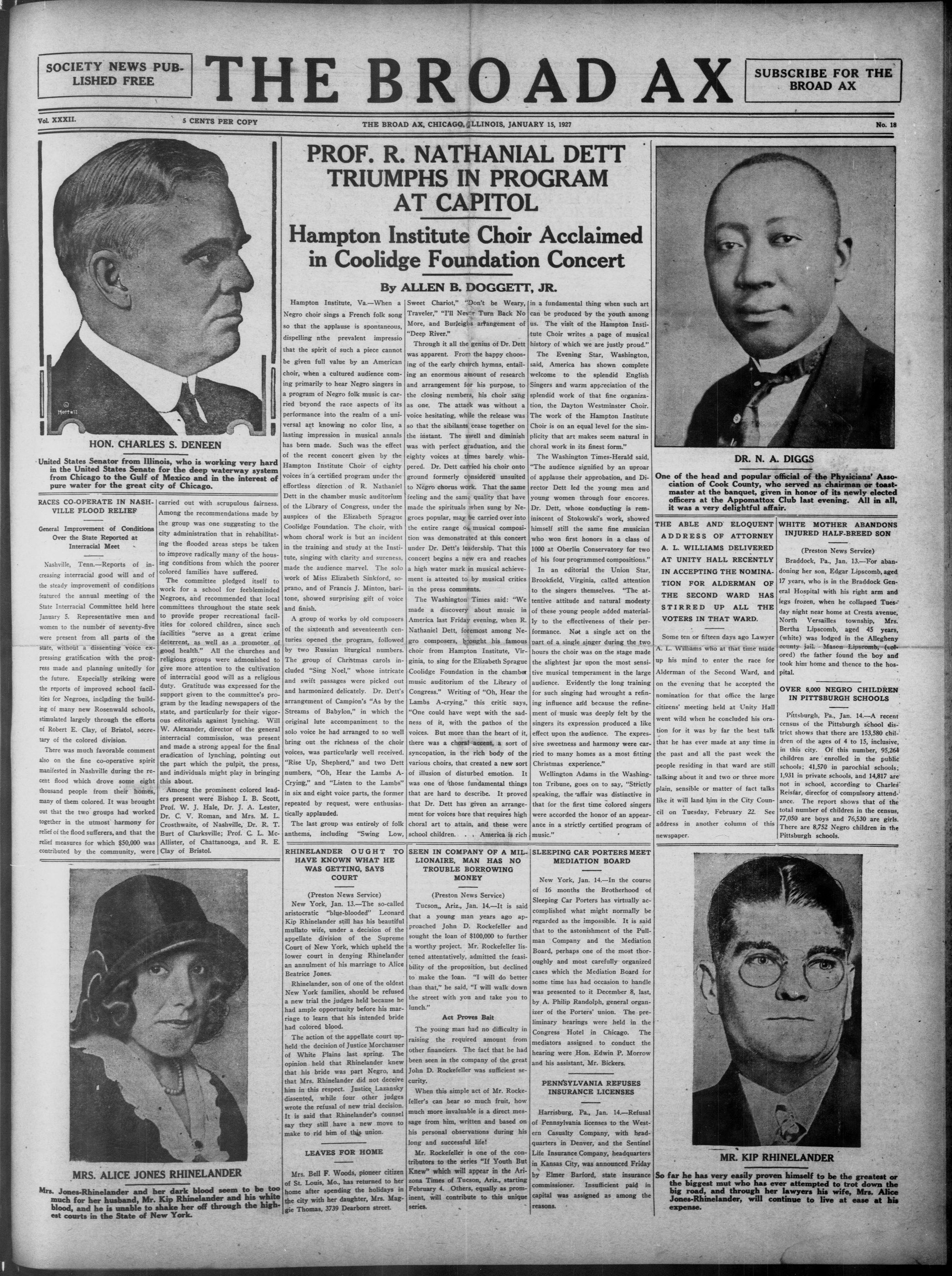
HON. CHARLES S. DENEEN
United States Senator from Illinois, who is work in the United States Senate for the deep wa from Chicago to the Gulf of Mexico and in pure water for the great city of Chicago.
United States Senator from Illinois, who is working very hard in the United States Senate for the deep waterway system from Chicago to the Gulf of Mexico and in the interest of pure water for the great city of Chicago.
RACES CO-OPERATE IN NASH-VILLE FLOOD RELIEF
General Improvement of Conditions Over the State Reported at Interracial Meet
carried out with scrupulous fairness. Among the recommendations made by the group was one suggesting to the city administration that in rehabilitating the flooded areas steps be taken to improve radically many of the hous-
Nashville, Tenn.-Reports of increasing interracial good will and of the steady improvement of conditions featured the annual meeting of the State Interracial Committee held here January 5. Representative men and women to the number of seventy-five were present from all parts of the state, without a dissenting voice expressing gratification with the progress made and planning unitedly for the future. Especially striking were the reports of improved school facilities for Negroes, including the building of many new Rosenwald schools, stimulated largely through the efforts of Robert E. Clay, of Bristol, secretary of the colored division.
There was much favorable comment also on the fine co-operative spirit manifested in Nashville during the recent flood which drove some eight thousand people from their homes, many of them colored. It was brought out that the two groups had worked together in the utmost harmony for relief of the flood sufferers, and that the relief measures for which $50,000 was contributed by the community, were
Mary
MRS. ALICE JONES RHINELANDER Mrs. Jones-Rhinelander and her dark blood seem to be too much for her husband, Mr. Kip Rhinelander and his white blood, and he is unable to shake her off through the highest courts in the State of New York.
Mrs. Jones-Rhinelander and her dark blood seem to be too much for her husband, Mr. Kip Rhinelander and his white blood, and he is unable to shake her off through the highest courts in the State of New York.
Vol. XXXII.
5 CENTS PER COPY
2
nois, who is working very hard for the deep waterway system of Mexico and in the interest of city of Chicago. carried out with scrupulous fairness. Among the recommendations made by the group was one suggesting to the city administration that in rehabilitating the flooded areas steps be taken to improve radically many of the housing conditions from which the poorer colored families have suffered.
The committee pledged itself to work for a school for feebleminded Negroes, and recommended that local committees throughout the state seek to provide proper recreational facilities for colored children, since such facilities "serve as a great crime deterrent, as well as a promoter of good health." All the churches and religious groups were admonished to give more attention to the cultivation of interracial good will as a religious duty. Gratitude was expressed for the support given to the committee's program by the leading newspapers of the state, and particularly for their vigorous editorials against lynching. Will W. Alexander, director of the general interracial commission, was present and made a strong appeal for the final eradication of lynching, pointing out the part which the pulpit, the press, and individuals might play in bringing this about.
Among the prominent colored leaders present were Bishop I. B. Scott, Prof. W. J. Hale, Dr. J. A. Lester, Dr. C. V. Roman, and Mrs. M. L. Crosthwaite, of Nashville, Dr. R. T. Burt of Clarksville; Prof. C. L. McAllister, of Chattanooga, and R. E. Clay of Bristol.
THE BROAD AX
THE BROAD AX, CHICAGO, LLINOIS, JANUARY 15, 1927
PROF. R. NATHANIAL DETT TRIUMPHS IN PROGRAM AT CAPITOL Hampton Institute Choir Acclaimed in Coolidge Foundation Concert
By ALLEN B. DOGGETT, JR.
Hampton Institute, Va.—When a Negro choir sings a French folk song so that the applause is spontaneous, dispelling nthe prevalent impressio that the spirit of such a piece cannot be given full value by an American choir, when a cultured audience coming primarily to hear Negro singers in a program of Negro folk music is carried beyond the race aspects of its performance into the realm of a universal art knowing no color line, a lasting impression in musical annals has been made. Such was the effect of the recent concert given by the Hampton Institute Choir of eighty voices in a certified program under the effortless direction of R. Nathaniel Dett in the chamber music auditorium of the Library of Congress, under the auspices of the Elizabeth Sprague Coolidge Foundation. The choir, with whom choral work is but an incident in the training and study at the Institute, singing with clarity and sureness, made the audience marvel. The solo work of Miss Elizabeth Sinkford, soprano, and of Francis J. Minton, baritone, showed surprising gift of voice and finish.
A group of works by old composers of the sixteenth and seventeenth centuries opened the program, followed by two Russian liturgical numbers. The group of Christmas carols included "Sing Noel," whose intricate and swift passages were picked out and harmonized delicately. Dr. Dett's arrangement of Campion's "As by the Streams of Babylon," in which the original lute accompaniment to the solo voice he had arranged to so well bring out the richness of the choir voices, was particularly well received. "Rise Up, Shepherd," and two Dett numbers, "Oh, Hear the Lambs A-Crying," and "Listen to the Lambs" in six and eight voice parts, the former repeated by request, were enthusiastically applauded.
The last group was entirely of folk anthems, including "Swing Low,
RHINELANDER OUGHT TO
HAVE KNOWN WHAT HE
WAS GETTING, SAYS
COURT
New York, Jan. 13.—The so-called aristocratic "blue-blooded" Leonard Kip Rhinelander still has his beautiful mullato wife, under a decision of the appellate division of the Supreme Court of New York, which upheld the lower court in denying Rhinelander an annulment of his marriage to Alice Beatrice Jones.
Rhinelander, son of one of the oldest New York families, should be refused a new trial the judges held because he had ample opportunity before his marriage to learn that his intended bride had colored blood.
The action of the appellate court upheld the decision of Justice Morchauser of White Plains last spring. The opinion held that Rhinelander knew that his bride was part Negro, and that Mrs. Rhinelander did not deceive him in this respect. Justice Lazansky dissented, while four other judges wrote the refusal of new trial decision. It is said that Rhinelander's counsel say they still have a new move to make to rid him of this union.
LEAVES FOR HOME
Mrs. Bell F. Woods, pioneer citizen of St. Louis, Mo., has returned to her home after spending the holidays in the city with her daughter, Mrs. Maggie Thomas, 3739 Dearborn street.
Sweet Chariot," "Don't be Weary, Traveler," "I'll Never Turn Back No More, and Burleighs arrangement of "Deep River."
Through it all the genius of Dr. Dett was apparent. From the happy choosing of the early church hymns, entailing an enormous amount of research and arrangement for his purpose, to the closing numbers, his choir sang as one. The attack was without a voice hesitating, while the release was so that the sibilants cease together on the instant. The swell and diminish was with perfect graduation, and the eighty voices at times barely whispered. Dr. Dett carried his choir onto ground formerly considered unsuited to Negro chorus work. That the same feeling and the same quality that have made the spirituals when sung by Negroes popular, may be carried over into the entire range of musical composition was demonstrated at this concert under Dr. Dett's leadership. That this concert begins a new era and reaches a high water mark in musical achievement is attested to by musical critics in the press comments.
The Washington Times said: "We made a discovery about music in America last Friday evening, when R. Nathaniel Dett, foremost among Negro composers, brought his famous choir from Hampton Institute, Virginia, to sing for the Elizabeth Sprague Coolidge Foundation in the chamber music auditorium of the Library of Congress." Writing of "Oh, Hear the Lambs A-crying," this critic says, "One could have wept with the sadness of it, with the pathos of the voices. But more than the heart of it, there was a choral accent, a sort of syncopation, in the rich body of the various choirs, that created a new sort of illusion of disturbed emotion. It was one of those fundamental things that are hard to describe. It proved that Dr. Dett has given an arrangement for voices here that requires high choral art to attain, and these were school children. . . America is rich
Tucson, Ariz., Jan. 14. It is said that a young man years ago approached John D. Rockefeller and sought the loan of $100,000 to further a worthy project. Mr. Rockefeller listened attentatively, admitted the feasibility of the proposition, but declined to make the loan. "I will do better than that," he said, "I will walk down the street with you and take you to lunch."
Act Proves Bait
The young man had no difficulty in raising the required amount from other financiers. The fact that he had been seen in the company of the great John D. Rockefeller was sufficient security.
When this simple act of Mr. Rockefeller's can bear so much fruit, how much more invaluable is a direct message from him, written and based on his personal observations during his long and successful life!
Mr. Rockefeller is one of the contributors to the series "If Youth But Knew" which will appear in the Arizona Times of Tucson, Ariz., starting February 4. Others, equally as prominent, will contribute to this unique series.
in a fundamental thing when such art can be produced by the youth among us. The visit of the Hampton Institute Choir writes a page of musical history of which we are justly proud." The Evening Star, Washington, said, America has shown complete welcome to the splendid English Singers and warm appreciation of the splendid work of that fine organization, the Dayton Westminster Choir. The work of the Hampton Institute Choir is on an equal level for the simplicity that art makes seem natural in choral work in its finest form."
The Washington Times-Herald said, "The audience signified by an uproar of applause their approbation, and Director Dett led the young men and young women through four encores. Dr. Dett, whose conducting is reminiscent of Stokowski's work, showed himself still the same fine musician who won first honors in a class of 1000 at Oberlin Conservatory for two of his four programmed compositions." In an editorial the Union Star, Brookfield, Virginia, called attention to the singers themselves. "The attentive attitude and natural modesty of these young people added materially to the effectiveness of their performance. Not a single act on the part of a single singer during the two hours the choir was on the stage made the slightest jar upon the most sensitive musical temperament in the large audience. Evidently the long training for such singing had wrought a refining influence aid because the refinement of music was deeply felt by the singers its expression produced a like effect upon the audience. The expressive sweetness and harmony were carried to many homes as a most fitting Christmas experience."
Wellington Adams in the Washington Tribune, goes on to say, "Strictly speaking, the affair was distinctive in that for the first time colored singers were accorded the honor of an appearance in a strictly certified program of music."
SLEEPING CAR PORTERS MEET
MEDIATION BOARD
New York, Jan. 14.—In the course of 16 months the Brotherhood of Sleeping Car Porters has virtually accomplished what might normally be regarded as the impossible. It is said that to the astonishment of the Pullman Company and the Mediation Board, perhaps one of the most thoroughly and most carefully organized cases which the Mediation Board for some time has had occasion to handle was presented to it December 8, last, by A. Philip Randolph, general organizer of the Porters' union. The preliminary hearings were held in the Congress Hotel in Chicago. The mediators assigned to conduct the hearing were Hon. Edwin P. Morrow and his assistant, Mr. Bickers.
PENNSYLVANIA REFUSES
INSURANCE LICENSES
Harrisburg, Pa., Jan. 14.-Refusal of Pennsylvania licenses to the Western Casualty Company, with headquarters in Denver, and the Sentinel Life Insurance Company, headquarters in Kansas City, was announced Friday by Elmer Barford, state insurance commissioner. Insufficient paid in capital was assigned as among the reasons.
THE NEW YORK TIMES
[Name]
DR. N. A. DIGGS
One of the head and popular official of ciation of Cook County, who served a master at the banquet, given in honor officers at the Appomattox Club last it was a very delightful affair.
and popular official of the Hook County, who served as chie the banquet, in honor of I the Appomattox club last even delightful affair.
One of the head and popular official of the Physicians' Association of Cook County, who served as chairman or toastmaster at the banquet, given in honor of its newly elected officers at the Appomattox Club last evening. All in all, it was a very delightful affair.
THE ABLE AND ELOQUENT ADDRESS OF ATTORNEY A. L. WILLIAMS DELIVERED AT UNITY HALL RECENTLY IN ACCEPTING THE NOMINATION FOR ALDERMAN OF THE SECOND WARD HAS STIRRED UP ALL THE VOTERS IN THAT WARD.
WHITE MOTHER ABANDONS INJURED HALF-BREED SON
(Preston News Service)
Braddock, Pa., Jan. 13.—For abandoning her son, Edgar Lipscomb, aged 17 years, who is in the Braddock General Hospital with his right arm and legs frozen, when he collapsed Tuesday night near home at Cresta avenue North Versailles township, Mrs
Some ten or fifteen days ago Lawyer A. L. Williams who at that time made up his mind to enter the race for Alderman of the Second Ward, and on the evening that he accepted the nomination for that office the large citizens' meeting held at Unity Hall went wild when he concluded his oration for it was by far the best talk that he has ever made at any time in the past and all the past week the people residing in that ward are still talking about it and two or three more plain, sensible or matter of fact talks like it will land him in the City Council on Tuesday, February 22. See address in another column of this newspaper.
1
M.
M.
MR. KIP RHINELANDER
So far he has very easily proved the biggest mut who has e big road, and through her Jones-Rhinelander, will co expense.
very easily proven himself to be mut who has ever attempted and through her lawyers his sander, will continue to live
So far he has very easily proven himself to be the greatest or the biggest mut who has ever attempted to trot down the big road, and through her lawyers his wife, Mrs. Alice Jones-Rhinelander, will continue to live at ease at his expense.
So far he has very easily proven himself to be the greatest or the biggest mut who has ever attempted to trot down the big road, and through her lawyers his wife, Mrs. Alice Jones-Rhinelander, will continue to live at ease at his expense.
SUBSCRIBE FOR THE BROAD AX
No. 18
popular official of the Physicians' Asso-
tity, who served as chairman or toast-
t, given in honor of its newly elected
mattox Club last evening. All in all,
ful affair.
QUENT
ORNEY
WHITE MOTHER ABANDONS
INJURED HALF-BREED SON
Braddock, Pa., Jan. 13.—For abandoning her son, Edgar Lipscomb, aged 17 years, who is in the Braddock General Hospital with his right arm and legs frozen, when he collapsed Tuesday night near home at Cresta avenue, North Versailles township, Mrs. Bertha Lipscomb, aged 45 years, (white) was lodged in the Allegheny county jail. Mason Lipscomb, (colored) the father found the boy and took him home and thence to the hospital.
OVER 8,000 NEGRO CHILDREN
IN PITTSSURGH SCHOOLS
Pittsburgh, Pa., Jan. 14.—A recent census of the Pittsburgh school district shows that there are 153,580 children of the ages of 4 to 15, inclusive, in this city. Of this number, 95,264 children are enrolled in the public schools; 41,570 in parochial schools; 1,931 in private schools, and 14,817 are not in school, according to Charles Reisfar, director of compulsory attendance. The report shows that of the total number of children in the census, 77,050 are boys and 76,530 are girls. There are 8,752 Negro children in the Pittsburgh schools.
THE NEW YORK TIMES
y proven himself to be the greatest or has ever attempted to trot down the high her lawyers his wife, Mrs. Alice will continue to live at ease at his
14
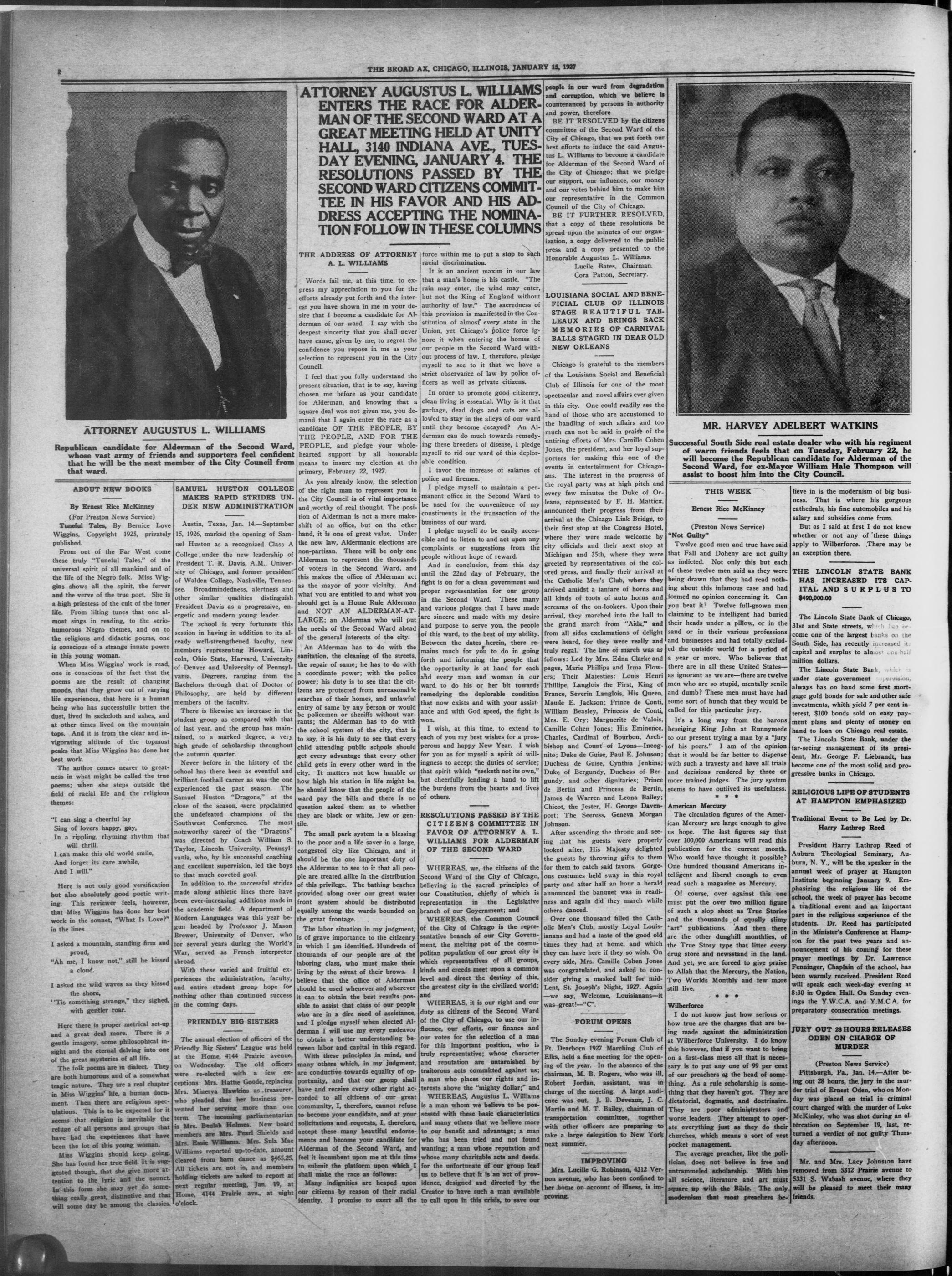
ATTORNEY AUGUSTUS L. WILLIAMS
Republican candidate for Alderman of the Second Ward, whose vast army of friends and supporters feel confident that he will be the next member of the City Council from that ward.
ABOUT NEW BOOKS
Tuneful Tales, By Bernice Love Wiggins, Copyright 1925, privately published.
From out of the Far West come these truly "Tuneful Tales," of the universal spirit of all mankind and of the life of the Negro folk. Miss Wiggins shows all the spirit, the ferver and the verve of the true poet. She is a high priestess of the cult of the inner life. From litling tunes that one almost sings in reading, to the seriohumorous Negro themes, and on to the religious and didactic poems, one is conscious of a strange innate power in this young woman.
When Miss Wiggins' work is read, one is conscious of the fact that the poems are the result of changing moods, that they grow out of varying life experiences, that here is a human being who has successfully bitten the dust, lived in sackcloth and ashes, and at other times lived on the mountain tops. And it is from the clear and invigorating altitude of the topmost peaks that Miss Wiggins has done her best work.
The author comes nearer to greatness in what might be called the true poems; when she steps outside the field of racial life and the religious themes:
"I can sing a cheerful lay
In a rippling, rhyming rhythm that will thrill
Here is not only good versification but also absolutely good poetic writing. This reviewer feels, however, that Miss Wiggins has done her best work in the sonnet, "What Is Love?" in the lines
I asked a mountain, standing firm and proud,
"Ah me, I know not," still he kissed a cloud.
I asked the wild waves as they kissed the shore,
"Tis something strange," they sighed, with gentler roar.
Here there is proper metrical set-up and a great deal more. There is a gentle imagery, some philosophical insight and the eternal delving into one of the great mysteries of all life.
The folk poems are in dialect. They are both humorous and of a somewhat tragic nature. They are a real chapter in Miss Wiggins' life, a human document. Then there are religious speculations. This is to be expected for it seems that religion is inevitably the refuge of all persons and groups that have had the experiences that have been the lot of this young woman. Miss Wiggins should keep going. She has found her true field. It is suggested though, that she give more attention to the lyric and the sonnet. In this form she may yet do something really great, distinctive and that will some day be among the classics.
Austin, Texas, Jan. 14.—September 15, 1926, marked the opening of Samuel Huston as a recognized Class A College, under the new leadership of President T. R. Davis, A.M., University of Chicago, and former president of Walden College, Nashville, Tennessee. Broadmindedness, alertness and other similar qualities distinguish President Davis as a progressive, energetic and modern young leader.
The school is very fortunate this session in having in addition to its already well-strengthened faculty, new members representing Howard, Lincoln, Ohio State, Harvard, University of Denver and University of Pennsylvania. Degrees, ranging from the Bachelors through that of Doctor of Philosophy, are held by different members of the faculty. There is likewise an increase in the student group as compared with that of last year, and the group has maintained, to a marked degree, a very high grade of scholarship throughout the autumn quarter.
Never before in the history of the school has there been as eventful and brilliant football career as was the one experienced the past season. The Samuel Huston "Dragons," at the close of the season, were proclaimed the undefeated champions of the Southwest Conference. The most noteworthy career of the "Dragons" was directed by Coach William S. Taylor, Lincoln University, Pennsylvania, who, by his successful coaching and excellent supervision, led the boys to that much coveted goal.
In addition to the successful strides made along athletic lines there have been ever-increasing additions made in the academic field. A department of Modern Languages was this year begun headed by Professor J. Mason Brewer, University of Denver, who for several years during the World's War, served as French interpreter abroad. With these varied and fruitful experiences the administration, faculty, and entire student group hope for nothing other than continued success in the coming days.
FRIENDLY BIG SISTERS
The annual election of officers of the Friendly Big Sisters' League was held at the Home, 4144 Prairie avenue, on Wednesday. The old officers were re-elected with a few exceptions: Mrs. Hattie Goode, replacing Mrs. Minerva Hawkins as treasurer, who pleaded that her business prevented her serving more than one term. The incoming parliamentarian is Mrs. Beulah Holmes. New board members are Mrs. Pearl Shields and Mrs. Essie Williams. Mrs. Sula Mae Williams reported up-to-date, amount cleared from barn dance as $465.25. All tickets are not in, and members holding tickets are asked to report at next regular meeting, Jan. 19, at Home, 4144 Prairie ave., at eight o'clock.
THE BROAD AX, CHICAGO, ILLINOIS, JANUARY 15, 1927
ATTORNEY AUGUSTUS L. WILLIAMS ENTERS THE RACE FOR ALDERMAN OF THE SECOND WARD AT A GREAT MEETING HELD AT UNITY HALL, 3140 INDIANA AVE., TUESDAY EVENING, JANUARY 4. THE RESOLUTIONS PASSED BY THE SECOND WARD CITIZENS COMMITTEE IN HIS FAVOR AND HIS ADDRESS ACCEPTING THE NOMINATION FOLLOW IN THESE COLUMNS
THE ADDRESS OF ATTORNEY
A. L. WILLIAMS
Words fail me, at this time, to express my appreciation to you for the efforts already put forth and the interest you have shown in me in your desire that I become a candidate for Alderman of our ward. I say with the deepest sincerity that you shall never have cause, given by me, to regret the confidence you repose in me as your selection to represent you in the City Council.
I feel that you fully understand the present situation, that is to say, having chosen me before as your candidate for Alderman, and knowing that a square deal was not given me, you demand that I again enter the race as a candidate OF THE PEOPLE, BY THE PEOPLE, AND FOR THE PEOPLE, and pledge your whole-hearted support by all honorable means to insure my election at the primary, February 22, 1927.
As you already know, the selection of the right man to represent you in the City Council is of vital importance and worthy of real thought. The position of Alderman is not a mere make-shift of an office, but on the other hand, it is one of great value. Under the new law, Aldermanic elections are non-partisan. There will be only one Alderman to represent the thousands of voters in the Second Ward, and this makes the office of Alderman act as the mayor of your vicinity. And what you are entitled to and what you should get is a Home Rule Alderman and NOT AN ALDERMAN-AT-LARGE; an Alderman who will put the needs of the Second Ward ahead of the general interests of the city.
An Alderman has to do with the sanitation, the cleaning of the streets, the repair of same; he has to do with a coordinate power; with the police power; his duty is to see that the citizens are protected from unreasonable searches of their homes, and unlawful entry of same by any person or would be policemen or sheriffs without warrants; the Alderman has to do with the school system of the city, that is to say, it is his duty to see that every child attending public schools should get every advantage that every other child gets in every other ward in the city. It matters not how humble or how high his station in life might be, he should know that the people of the ward pay the bills and there is no question asked them as to whether they are black or white, Jew or gentile.
The small park system is a blessing to the poor and a life saver in a large, congested city like Chicago, and it should be the one important duty of the Alderman to see to it that all people are treated alike in the distribution of this privilege. The bathing beaches provided along over our great water front system should be distributed equally among the wards bounded on the great frontage.
The labor situation in my judgment, is of grave importance to the citizenry in which I am identified. Hundreds of thousands of our people are of the laboring class, who must make their living by the sweat of their brows. I believe that the office of Alderman should be used whenever and wherever it can to obtain the best results possible to assist that class of our people who are in a dire need of assistance, and I pledge myself when elected Alderman I will use my every endeavor to obtain a better understanding between labor and capital in this regard. With these principles in mind, and many others which, in my judgment, are conductive towards equality of opportunity, and that our group shall have and receive every other right accorded to all citizens of our great community, I, therefore, cannot refuse to become your candidate, and at your solicitations and requests, I, therefore, accept these many beautiful endorsements and become your candidate for Alderman of the Second Ward, and feel it incumbent upon me at this time to submit the platform upon which I shall make the race as follows:
Many indignities are heaped upon our citizens by reason of their racial identity. I promise to exert all the
force within me to put a stop to such racial discrimination.
It is an ancient maxim in our law that a man's home is his castle. "The rain may enter, the wind may enter, but not the King of England without authority of law." The sacredness of this provision is manifested in the Constitution of almost every state in the Union, yet Chicago's police force ignore it when entering the homes of our people in the Second Ward without process of law. I, therefore, pledge myself to see to it that we have a strict observance of law by police officers as well as private citizens.
In order to promote good citizenry, clean living is essential. Why is it that garbage, dead dogs and cats are allowed to stay in the alleys of our ward until they become decayed? An Alderman can do much towards remedying these breeders of disease, I pledge myself to rid our ward of this deplorable condition.
I favor the increase of salaries of police and firemen.
I pledge myself to maintain a permanent office in the Second Ward to be used for the convenience of my constituents in the transaction of the business of our ward.
I pledge myself to be easily accessible and to listen to and act upon any complaints or suggestions from the people without hope of reward.
And in conclusion, from this day until the 22nd day of February, the fight is on for a clean government and proper representation for our group in the Second Ward. These many and various pledges that I have made are sincere and made with my desire and purpose to serve you, the people of this ward, to the best of my ability. Between the dates herein, there remains much for you to do in going forth and informing the people that the opportunity is at hand for each and every man and woman in our ward to do his or her bit towards remedying the deplorable condition that now exists and with your assistance and with God speed, the fight is won.
I wish, at this time, to extend to each of you my best wishes for a prosperous and happy New Year. I wish for you as for myself a spirit of willingness to accept the duties of service; that spirit which "seeketh not its own," but cheerfully lending a hand to lift the burdens from the hearts and lives of others.
RESOLUTIONS PASSED BY THE CITIZENS COMMITTEE IN FAVOR OF ATTORNEY A. L. WILLIAMS FOR ALDERMAN OF THE SECOND WARD
WHEREAS, we, the citizens of the Second Ward of the City of Chicago, believing in the sacred principles of our Constitution, chiefly of which is representation in the Legislative branch of our Government; and WHEREAS, the Common Council of the City of Chicago is the representative branch of our City Government, the melting pot of the cosmopolitan population of our great city in which representatives of all groups, kinds and creeds meet upon a common level and direct the destiny of this, the greatest city in the civilized world; and
WHEREAS, it is our right and our duty as citizens of the Second Ward of the City of Chicago, to use our influence, our efforts, our finance and our votes for the selection of a man for this important position, who is truly representative; whose character and reputation are untarnished by traitorous acts committed against us; a man who places our rights and interests above the "mighty dollar;" and WHEREAS, Augustus L. Williams is a man whom we believe to be possessed with these basic characteristics and many others that we believe more to our benefit and advantage; a man who has been tried and not found wanting; a man whose reputation and whose many charitable acts and deeds, for the unfortunate of our group lead us to believe that it is an act of providence, designed and directed by the Creator to have such a man available to call upon in this crisis, to save our
people in our ward from degradation and corruption, which we believe is countenanced by persons in authority and power, therefore BE IT RESOLVED by the citizens committee of the Second Ward of the City of Chicago, that we put forth our best efforts to induce the said Augustus L. Williams to become a candidate for Alderman of the Second Ward of the City of Chicago; that we pledge our support, our influence, our money and our votes behind him to make him our representative in the Common Council of the City of Chicago. BE IT FURTHER RESOLVED, that a copy of these resolutions be spread upon the minutes of our organization, a copy delivered to the public press and a copy presented to the Honorable Augustus L. Williams.
Lucile Bates, Chairman.
Cora Patton, Secretary.
LOUISIANA SOCIAL AND BENEFICIAL CLUB OF ILLINOIS
STAGE BEAUTIFUL TABLEAUX AND BRINGS BACK
MEMORIES OF CARNIVAL
BALLS STAGED IN DEAR OLD
NEW ORLEANS
Chicago is grateful to the members of the Louisiana Social and Beneficial Club of Illinois for one of the most spectacular and novel affairs ever given in this city. One could readily see the hand of those who are accustomed to the handling of such affairs and too much can not be said in praise of the untiring efforts of Mrs. Camille Cohen Jones, the president, and her loyal supporters for making this one of the events in entertainment for Chicagoans. The interest in the progress of the royal party was at high pitch and every few minutes the Duke of Orleans, represented by F. H. Matticx, announced their progress from their arrival at the Chicago Link Bridge, to their first stop at the Congress Hotel, where they were made welcome by city officials and their next stop at Michigan and 35th, where they were greeted by representatives of the colored press, and finally their arrival at the Catholic Men's Club, where they arrived amidst a fanfare of horns and all kinds of toots of auto horns and screams of the on-lookers. Upon their march from "Aida," and from all sides exclamations of delight were heard, for they were really and truly regal. The line of march was as follows: Led by Mrs. Edna Clarke and pages, Marie Phillips and Irma Flowers; Their Majesties: Louis Henri Phillipe, Langlois the First, King of France, Severin Langlois, His Queen, Maude E. Jackson; Prince de Conti, William Beasley, Princess de Conti, Mrs. E. Ory; Marguerite de Valois, Camille Cohen Jones; His Eminence, Charles, Cardinal of Bourbon, Archbishop and Count of Lyons—Incognito; Duke de Guise, Paul E. Johnson; Duchess de Guise, Cynthia Jenkins; Duke of Bergundy, Duchess of Bergundy, and other dignitaries; Prince de Bertin and Princess de Bertin, James de Warren and Leona Bailey; Chicot, the Jester, H. George Davenport; The Seeress, Geneva Morgan Johnson
After ascending the throne and seeing that his guests were properly looked after, His Majesty delighted the guests by throwing gifts to them for them to catch said favors. Gorgeous costumes held sway in this royal party and after half an hour a herald announced the banquet was in readiness and again did they march while others danced. Over one thousand filled the Catholic Men's Club, mostly Loyal Louisians and had a taste of the good old times they had at home, and which they can have here if they so wish. On every side, Mrs. Camille Cohen Jones was congratulated, and asked to consider giving a masked ball for mid-Lent, St. Joseph's Night, 1927. Again—we say, Welcome, Louisians—it was great!—"C".
FORUM OPENS
The Sunday evening Forum Club of Ft. Dearborn 1927 Marching Club of Elks, held a fine meeting for the opening of the year. In the absence of the chairman, M. B. Rogers, who was ill, Robert Jordan, assistant, was in charge of the meeting. A large audience was out. J. B. Deveaux, J. C. Martin and M. T. Bailey, chairman of transportation committee, together with other officers are preparing to take a large delegation to New York next summer.
Mrs. Lucille G. Robinson, 4312 Vernon avenue, who has been confined to her home on account of illness, is improving.
M.
MR. HARVEY ADELBERT WATKINS Successful South Side real estate dealer who with his regiment of warm friends feels that on Tuesday, February 22, he will become the Republican candidate for Alderman of the Second Ward, for ex-Mayor William Hale Thompson will assist to boost him into the City Council.
Twelve good men and true have said that Fall and Doheny are not guilty as indicted. Not only this but each of these twelve men said as they were being drawn that they had read nothing about this infamous case and had formed no opinion concerning it. Can you beat it? Twelve full-grown men claiming to be intelligent had buried their heads under a pillow, or in the sand or in their various professions and businesses and had totally excluded the outside world for a period of a year or more. Who believes that there are in all these United States—as ignorant as we are—there are twelve men who are so stupid, mentally senile and dumb? These men must have had some sort of hunch that they would be called for this particular jury.
It's a long way from the barons beseiging King John at Runnymede to our present trying a man by a "jury of his peers." I am of the opinion that it would be far better to dispense with such a travesty and have all trials and decisions rendered by three or more trained judges. The jury system seems to have outlived its usefulness. * * *
American Mercury
The circulation figures of the American Mercury are large enough to give us hope. The last figures say that over 100,000 Americans will read this publication for the current month. Who would have thought it possible? One hundred thousand Americans intelligent and liberal enough to even read such a magazine as Mercury.
Of course, over against this one must put the over two million figure of such a slop sheet as True Stories and the thousands of equally slimy "art" publications. And then there are the other dunghill months, of the True Story type that litter every drug store and newsstand in the land. And yet, we are forced to give praise to Allah that the Mercury, the Nation, Two Worlds Monthly and few more still live.
Wilberforce
I do not know just how serious or how true are the charges that are being made against the administration at Wilberforce University. I do know this however, that if you want to bring on a first-class mess all that is necessary is to put any one of 99 per cent of our preachers at the head of something. As a rule scholarship is something that they haven't got. They are dictatorial, dogmatic, and doctrinaire. They are poor administrators and worse leaders. They attempt to operate everything just as they do their churches, which means a sort of vest pocket management.
The average preacher, like the politician, does not believe in free and untrammeled scholarship. With him all science, literature and art must square up with the Bible. The only modernism that most preachers be-
lieve in is the modernism of big business. That is where his gorgeous cathedrals, his fine automobiles and his salary and subsidies come from.
But as I said at first I do not know whether or not any of these things apply to Wilberforce. There may be an exception there.
THE LINCOLN STATE BANK HAS INCREASED ITS CAPITAL AND SURPLUS TO $490,000.00
The Lincoln State Bank of Chicago, 31st and State streets, which has become one of the largest banks on the South Side, has recently increased its capital and surplus to almost one-half million dollars.
The Lincoln State Bank, which is under state government supervision, always has on hand some first mortgage gold bonds for sale and other safe investments, which yield 7 per cent interest, $100 bonds sold on easy payment plans and plenty of money on hand to loan on Chicago real estate. The Lincoln State Bank, under the far-seeing management of its president, Mr. George F. Liebrandt, has become one of the most solid and progressive banks in Chicago.
RELIGIOUS LIFE OF STUDENTS
AT HAMPTON EMPHASIZED
Traditional Event to Be Led by Dr. Harry Lathrop Reed
President Harry Lathrop Reed of Auburn Theological Seminary, Auburn, N. Y., will be the speaker in the annual week of prayer at Hampton Institute beginning January 9. Emphasizing the religious life of the school, the week of prayer has become a traditional event and an important part in the religious experience of the students. Dr. Reed has participated in the Minister's Conference at Hampton for the past two years and announcement of his coming for these prayer meetings by Dr. Lawrence Fenninger, Chaplain of the school, has been warmly received. President Reed will speak each week-day evening at 8:30 in Ogden Hall. On Sunday evenings the Y.W.C.A. and Y.M.C.A. for preparatory consecration meetings.
JURY OUT 28 HOURS RELEASES
ODEN ON CHARGE OF
MURDER
Pittsburgh, Pa., Jan. 14. After being out 28 hours, the jury in the murder trial of Ernest Oden, who on Monday was placed on trial in criminal court charged with the murder of Luke McKinley, who was shot during an altercation on September 19, last, returned a verdict of not guilty Thursday afternoon.
Mr. and Mrs. Lacy Johnston have removed from 5312 Prairie avenue to 5331 S. Wabash avenue, where they will be pleased to meet their many friends.
Mary
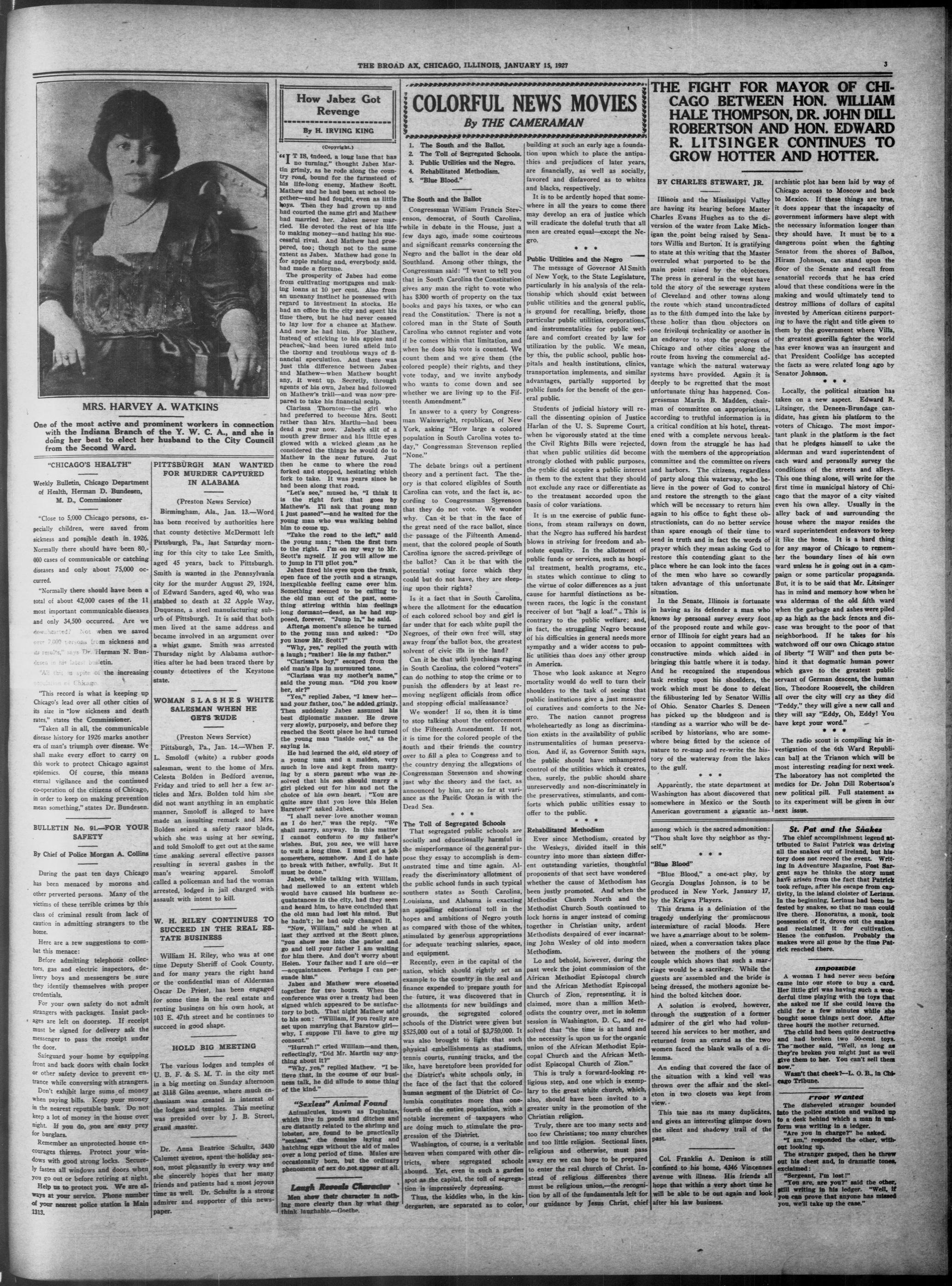
MRS. HARVEY A. WATKINS One of the most active and prominent workers in connection with the Indiana Branch of the Y. W. C. A., and she is doing her best to elect her husband to the City Council from the Second Ward.
"CHICAGO'S HEALTH"
Weekly Bulletin, Chicago Department of Health, Herman D. Bundesen, M. D., Commissioner
"Close to 5,000 Chicago persons, especially children, were saved from sickness and possible death in. 1926. Normally there should have been 80,000 cases of communicable or catching diseases and only about 75,000 occurred.
"Normally there should have been a total of about 42,000 cases of the 11 most important communicable diseases and only 34,500 occurred. Are we downhearted? Not when we saved over 7,000 persons from sickness and its results," says Dr. Herman N. Bun-desen in his latest bulletin.
"All this in spite of the increasing association of Chicago.
"This record is what is keeping up Chicago's lead over all other cities of its size in "low sickness and death rates" states the Commissioner.
"Taken all in all, the communicable disease history for 1926 marks another era of man's triumph over disease. We shall make every effort to carry on this work to protect Chicago against epidemics. Of course, this means eternal vigilance and the continued co-operation of the citizens of Chicago, in order to keep on making prevention mean something," states Dr. Bundesen.
BULLETIN No. 91.—FOR YOUR SAFETY
By Chief of Police Morgan A. Collins
During the past ten days Chicago has been menaced by morons and other perverted persons. Many of the victims of these terrible crimes by this class of criminal result from lack of caution in admitting strangers to the home.
Here are a tew suggestions to combat this menace:
Before admitting telephone collectors, gas and electric inspectors, delivery boys and messengers be sure they identify themselves with proper credentials.
For your own safety do not admit strangers with packages. Insist packages are left on doorstep. If receipt must be signed for delivery ask the messenger to pass the receipt under the door.
Safeguard your home by equipping front and back doors with chain locks or other safety device to prevent entrance while conversing with strangers. Don't exhibit large sums of money when paying bills. Keep your money in the nearest reputable bank. Do not keep a lot of money in the house over night. If you do, you are easy prey for burglars. Remember an unprotected house encourages thieves. Protect your windows with good strong locks. Securely fasten all windows and doors when you go out or before retiring at night. Help us to protect you. We are always at your service. Phone number of your nearest police station is Main 1313.
ominent workers in connection of the Y. W. C. A., and she is husband to the City Council
PITTSBURGH MAN WANTED
FOR MURDER CAPTURED
IN ALABAMA
(Preston News Service)
Birmingham, Ala., Jan. 13.—Word has been received by authorities here that county detective McDermott left Pittsburgh, Pa., last Saturday morning for this city to take Lee Smith, aged 45 years, back to Pittsburgh. Smith is wanted in the Pennsylvania city for the murder August 29, 1924, of Edward Sanders, aged 40, who was stabbed to death at 32 Apple Way, Duquesne, a steel manufacturing suburb of Pittsburgh. It is said that both men lived at the same address and became involved in an argument over a whist game. Smith was arrested Thursday night by Alabama authorities after he had been traced there by county detectives of the Keystone state.
WOMAN S L A S H E S WHITE
SALESMAN WHEN HE
GETS RUDE
(Preston News Service)
Pittsburgh, Pa., Jan. 14—When F. L. Smoloff (white) a rubber goods salesman, went to the home of Mrs. Celesta Bolden in Bedford avenue, Friday and tried to sell her a few articles and Mrs. Bolden told him she did not want anything in an emphatic manner, Smoloff is alleged to have made an insulting remark and Mrs. Bolden seized a safety razor blade, which she was using at her sewing, and told Smoloff to get out at the same time making several effective passes resulting in several gashes in the man's wearing apparel. Smoloff called a policeman and had the woman arrested, lodged in jail charged with assault with intent to kill.
W. H. RILEY CONTINUES TO SUCCEED IN THE REAL ESTATE BUSINESS
William H. Riley, who was at one time Deputy Sheriff of Cook County, and for many years the right hand or the confidential man of Alderman Oscar De Priest, has been engaged for some time in the real estate and renting business on his own hook, at 103 E. 47th street and he continues to succeed in good shape.
HOLD BIG MEETING
The various lodges and temples of U. B. F. & S. M. T. in the city met in a big meeting on Sunday afternoon at 3118 Giles avenue, where much enthusiasm was created in interest of the lodges and temples. This meeting was presided over by J. B. Street, grand master.
Dr. Anna Beatrice Schultz, 3430 Calumet avenue, spent the holiday season, most pleasantly in every way and she sincerely hopes that her many friends and patients had a most joyous time as well. Dr. Schultz is a strong admirer and supporter of this newspaper.
```markdown
```
THE BROAD AX, CHICAGO, ILLINOIS, JANUARY 15, 1927
"I T IS, indeed, a long lane that has no turning," thought Jabez Martin grimly, as he rode along the country road, bound for the farmstead of his life-long enemy, Mathew Scott. Mathew and he had been at school together—and had fought, even as little boys. Then they had grown up and had courted the same girl and Mathew had married her. Jabez never married. He devoted the rest of his life to making money—and hating his successful rival. And Mathew had prospered, too; though not to the same extent as Jabez. Mathew had gone in for apple raising and, everybody said, had made a fortune.
The prosperity of Jabez had come from cultivating mortgages and making loans at 10 per cent. Also from an uncanny instinct he possessed with regard to investment in stocks. He had an office in the city and spent his time there, but he had never ceased to lay low for a chance at Mathew. And now he had him. For Mathew, instead of sticking to his apples and peaches, had been iured afield into the thorny and troublous ways of financial speculation. And there was just this difference between Jabez and Mathew—when Mathew bought any, it went up. Secretly, through agents of his own, Jabez had followed on Mathew's trail—and was now prepared to take his financial scape.
Clarissa Thornton—the girl who had preferred to become Mrs. Scott rather than Mrs. Martin—had been dead a year now. Jabez's slit of a mouth grew firmer and his little eyes glowed with a wicked gleam as he considered the things he would do to Mathew in the near future. Just then he came to where the road forked and stopped, hesitating which fork to take. It was years since he had been along that road.
"Let's see," mused he, "I think it is the right fork that goes by Mathew's. I'll ask that young man I just passed"—and he waited for the young man who was walking behind him to come up.
"Take the road to the left," said the young man; "then the first turn to the right. I'm on my way to Mr. Scott's myself. If you will allow me to jump in I will pilot you."
Jabez fixed his eyes upon the frank, open face of the youth and a strange, inexplicable feeling came over him. Something seemed to be calling to the old man out of the past, something stirring within him feelings long dormant—dead, as he had supposed, forever. "Jump in," he said. After a moment's silence he turned to the young man and asked: "Do you know Mr. Scott?"
"Why, yes," replied the youth with a laugh; "rather! He is my father." "Clarissa's boy," escaped from the old man's lips in murmured tone. "Clarissa was my mother's name," said the young man. "Did you know her, sir?"
"Yes," replied Jabez, "I knew her—and your father, too," he added grimly. Then suddenly Jabez assumed his best diplomatic manner. He drove very slowly, purposely, and before they reached the Scott place he had turned the young man "inside out," as the saving is.
He had learned the old, old story of a young man and a maiden, very much in love and kept from marrying by a stern parent who was resolved that his son should marry a girl picked out for him and not the choice of his own heart. "You are quite sure that you love this Helen Barstow?" asked Jabez.
"I shall never love another woman as I do her," was the reply. "We shall marry, anyway. In this matter I cannot conform to my father's wishes. But, you see, we will have to wait a long time. I must get a job somewhere, somehow. And I do hate to break with father, awfully. But it must be done."
Jabez, while talking with William, had mellowed to an extent which would have caused his business acquaintances in the city, had they seen and heard him, to have concluded that the old man had lost his mind. But he hadn't; he had only changed it.
"Now, William," said he when at last they arrived at the Scott place, "you show me into the parlor and go and tell your father I am waiting for him there. And don't worry about Helen. Your father and I are old—er—acquaintances. Perhaps I can persuade him."
Jabez and Mathew were eloseted together for two hours. When the conference was over a treaty had been signed which appeared to be satisfactory to both. That night Mathew said to his son: "William, if you really are set upon marrying that Barstow girl—why, I suppose I'll have to give my consent."
"Hurrah!" cried William—and then, reflectingly, "Did Mr. Martin say anything about it?"
"Why, yes," replied Mathew. "I be believe that, in the course of our business talk, he did allude to some thing of the kind."
"Sexless" Animal Found
Animales, known as Daphnias, which live in ponds and ditches and are distantly related to the shrimp and lobster, are found to be practically "sexless," the females laying andatching eggs without the aid of males over a long period of time. Males are occasionally born, but the ordinary phenomena of sex do not appear at all.
Laugh Rescue Character
Men show their character in nothing more clearly than by what they think laughable—Goethe.
COLORFUL NEWS MOVIES By THE CAMERAMAN
1. The South and the Ballot.
2. The Toll of Segregated Schools
3. Public Utilities and the Negro.
4. Rehabilitated Methodism.
5. "Blue Blood."
The South and the Ballot
Congressman William Francis Stevenson, democrat, of South Carolina, while in debate in the House, just a few days ago, made some courteous and significant remarks concerning the Negro and the ballot in the dear old Southland. Among other things, the Congressman said: "I want to tell you that in South Carolina the Constitution gives any man the right to vote who has $300 worth of property on the tax books and pays his taxes, or who can read the Constitution." There is not a colored man in the State of South Carolina who cannot register and vote if he comes within that limitation, and when he does his vote is counted. We count them and we give them (the colored people) their rights, and they vote today, and we invite anybody who wants to come down and see whether we are living up to the Fifteenth Amendment."
In answer to a query by Congressman Wainwright, republican, of New York, asking "How large a colored population in South Carolina votes today," Congressman Stevenson replied "None."
The debate brings out a pertinent theory and a pertinent fact. The theory is that colored eligibles of South Carolina can vote, and the fact is, according to Congressman Stevenson that they do not vote. We wonder why. Can it be that in the face of the great need of the race ballot, since the passage of the Fifteenth Amendment, that the colored people of South Carolina ignore the sacred-privillege of the ballot? Can it be that with the potential voting force which they could but do not have, they are sleeping upon their rights?
Is it a fact that in South Carolina where the allotment for the education of each colored school boy and girl is far under that for each white pupil the Negroes, of their own free will, stay away from the ballot box, the greatest solvent of civic ills in the land? Can it be that with lynchings raging in South Carolina, the colored "voters" can do nothing to stop the crime or to punish the offenders by at least removing negligent officials from office and stopping official malfeasance?
We wonder! If so, then it is time to stop talking about the enforcement of the Fifteenth Amendment. If not, it is time for the colored people of the south and their friends the country over to fill a plea to Congress and to the country denying the allegations of Congressman Stevenson and showing just why the theory and the fact, as announced by him, are so far at variance as the Pacific Ocean is with the Dead Sea.
The Toll of Segregated Schools
That segregated public schools are socially and educationally harmful in the misperformance of the general purpose they essay to accomplish is demonstrated time and time again. Already the discriminatory allotment of the public school funds in such typical southern states as South Carolina, Louisiana, and Alabama is exacting an appalling educational toll in the hopes and ambitions of Negro youth as compared with those of the whites, stimulated by generous appropriations for adequate teaching salaries, space, and equipment.
Recently, even in the capital of the nation, which should rightly set an example to the country in the zeal and finance expended to prepare youth for the future, it was discovered that in the allotments for new buildings and grounds, the segregated colored schools of the District were given but $25,000 out of a total of $3,750,000. It was also brought to light that such physical embellishments as stadiums, tennis courts, running tracks, and the like, have heretofore been provided for the District's white schools only, in the face of the fact that the colored human segment of the District of Columbia constitutes more than one-fourth of the entire population, with a notable increment of taxpayers who are doing much to stimulate the progression of the District.
Washington, of course, is a veritable heaven when compared with other districts, where segregated school abound. Yet, even in such a garden spot as the capital, the toll of segregation is impressively depressing.
Thus, the kiddies who, in the kindergarten, are separated as to color,
THE FIGHT FOR MAYOR OF CHICAGO BETWEEN HON. WILLIAM HALE THOMPSON, DR. JOHN DILL ROBERTSON AND HON. EDWARD R. LITSINGER CONTINUES TO GROW HOTTER AND HOTTER.
BY CHARLES STEWART, JR.
Illinois and the Mississippi Valley are having its hearing before Master Charles Evans Hughes as to the diversion of the water from Lake Michigan the point being raised by Senators Willis and Burton. It is gratifying to state at this writing that the Master overruled what purported to be the main point raised by the objectors. The press in general in the west have told the story of the sewerage system of Cleveland and other towns along the route which stand uncontradicted as to the fifth dumped into the lake by these holier than thou objectors on one frivilous technicality or another in an endeavor to stop the progress of Chicago and other cities along the route from having the commercial advantage which the natural waterway systems have provided. Again it is deeply to be regretted that the most unfortunate thing has happened. Congressman Martin B. Madden, chairman of committee on appropriations, according to truthful information is in a critical condition at his hotel, threatened with a complete nervous breakdown from the struggle he has had with the members of the appropriation committee and the committee on rivers and harbors. The citizens, regardless of party along this waterway, who believe in the power of God to control and restore the strength to the giant which will be necessary to return him again to his office to fight these obstructionists, can do no better service than spare enough of their time to send in truth and in fact the words of prayer which they mean asking God to restore this contending giant to the place where he can look into the faces of the men who have so cowardly taken advantage of this unfortunate situation.
In the Senate, Illinois is fortunate in having as its defender a man who knows by personal survey every foot of the proposed route and while governor of Illinois for eight years had an occasion to appoint committees with constructive minds which aided in bringing this battle where it is today. And he recognized the stupendous task resting upon his shoulders, the work which must be done to defeat the filibustering led by Senator Willis of Ohio. Senator Charles S. Deneen has picked up the bludgeon and is standing as a warrior who will be described by historians, who are somewhere being fitted by the science of nature to re-map and re-write the history of the waterway from the lakes to the gulf.
Apparently, the state department at Washington has about discovered that somewhere in Mexico or the South American government a gigantic an-
among which is the sacred admonition:
"Thou shalt love thy neighbor as thy-self."
"Blue Blood"
"Blue Blood," a one-act play, by Georgia Douglas Johnson, is to be produced in New York, January 17, by the Krigwa Players. This drama is a deliniation of the tragedy underlying the promiscuous intermixture of racial bloods. Here we have a marriage about to be solemnized, when a conversation takes place between the mothers of the young couple which shows that such a marriage would be a sacrilege. While the guests are assembled and the bride is being dressed, the mothers agonize behind the bolted kitchen door.
A solution is evolved, however, through the suggestion of a former admirer of the girl who had volunteered his services to her mother, and returned from an erard as the two women faced the blank walls of a dilemma.
Col. Franklin A. Denison is still confined to his home, 4346 Vincennes avenue with illness. His friends all hope that within a very short time he will be able to be out and look after his law business.
building at such an early age a foundation upon which to place the antipathies and prejudices of later years, are financially, as well as socially, favored and disfavored as to whites and blacks, respectively.
It is to be ardently hoped that somewhere in all the years to come there may develop an era of justice which will eradicate the doleful truth that all men are created equal—except the Negro.
Public Utilities and the Negro
The message of Governor Al Smith of New York, to the State Legislature, particularly in his analysis of the relationship which should exist between public utilities and the general public, is ground for recalling, briefly, those particular public utilities, corporations, and instrumentalities for public welfare and comfort created by law for utilization by the public. We mean by this, the public school, public hospitals and health institutions, clinics, transportation implements, and similar advantages, partially supported by public funds for the benefit of the general public.
Students of judicial history will recall the dissenting opinion of Justice Harlan of the U. S. Supreme Court, when he vigorously stated at the time the Civil Rights Bills were rejected, that when public utilities did become strongly clothed with public purposes, the public did acquire a public interest in them to the extent that they should not exclude any race or differentiate as to the treatment accorded upon the basis of color variations.
It is in the exercise of public functions, from steam railways on down, that the Negro has suffered his hardest blows in striving for freedom and absolute equality. In the allotment of public funds or services, such as hospital treatment, health programs, etc., in states which continue to cling to the virtue of color differences as a just cause for harmful distinctions as between races, the logic is the constant receiver of but "half a loaf." This is contrary to the public welfare; and, in fact, the struggling Negro because of his difficulties in general needs more sympathy and a wider access to public utilities than does any other group in America.
Those who look askance at Negro mortality would do well to turn their shoulders to the task of seeing that public institutions give a just measure of curatives and comforts to the Negro. The nation cannot progress wholeheartedly as long as discrimination exists in the availability of public instrumentalities of human preservation. And if, as Governor Smith says, the public should have unhampered control of the utilities which it creates, then, surely, the public should share unreservedly and non-discriminately in the preservatives, stimulants, and comforts which public utilities essay to offer to the public.
Rehabilitated Methodism
Ever since Methodism, created by the Wesley's, divided itself in this country into more than sixteen different outstanding varieties, thoughtful proponents of that sect have wondered whether the cause of Methodism has been justly promoted. And when the Methodist Church North and the Methodist Church South continued to lock horns in anger instead of coming together in Christian unity, ardent Methodists despaired of ever incarnating John Wesley of old into modern Methodism.
Lo and behold, however, during the past week the joint commission of the African Methodist Episcopal church and the African Methodist Episcopal Church of Zion, representing, it is claimed, more than a million Methodists the country over, met in solemn session in Washington, D. C., and resolved that "the time is at hand and the necessity is upon us for the organic union of the African Methodist Episcopal Church and the African Methodist Episcopal Church of Zion." This is truly a forward-looking religious step, and one which is exemplary to the great white church, which, also, should have been invited to a greater unity in the promotion of the Christian religion.
Truly, there are too many sects and too few Christians; too many churches and too little religion. Sectional lines, religious and otherwise, must pass away ere we can hope to be prepared to enter the real church of Christ. Instead of religious differences there must be religious union—the recognition by all of the fundamentals left for our guidance by Jesus Christ, chief
archistic plot has been laid by way of Chicago across to Moscow and back to Mexico. If these things are true, it does appear that the incapacity of government informers have slept with the necessary information longer than they should have. It must be to a dangerous point when the fighting Senator from the shores of Balboa, Hiram Johnson, can stand upon the floor of the Senate and recall from senatorial records that he has cried aloud that these conditions were in the making and would ultimately tend to destroy millions of dollars of capital invested by American citizens purporting to have the right and title given to them by the government where Villa, the greatest guerilla fighter the world has ever known was an insurgent and that President Coolidge has accepted the facts as were related long ago by Senator Johnson.
***
Locally, the political situation has taken on a new aspect. Edward R. Litsinger, the Deneen-Brundage candidate, has given his platform to the voters of Chicago. The most important plank in the platform is the fact that he pledges himself to take the alderman and ward superintendent of each ward and personally survey the conditions of the streets and alleys. This one thing alone, will write for the first time in municipal history of Chicago that the mayor of a city visited even his own alley. Usually in the alley back of and surrounding the house where the mayor resides the ward superintendent endeavors to keep it like the home. It is a hard thing for any mayor of Chicago to remember the boundary lines of his own ward unless he is going out in a campaign or some particular propaganda. But, it is to be said that Mr. Litsinger has in mind and memory how when he was alderman of the old fifth ward when the garbage and ashes were piled up as high as the back fences and disease was brought to the poor of that neighborhood. If he takes for his watchword off our own Chicago statue of liberty "I Will" and then puts behind it that dogmatic human power which gave to the greatest public servant of German descent, the human lion, Theodore Roosevelt, the children all over the city will cry as they did "Teddy," they will give a new call and they will say "Eddy, Oh, Eddy! You have kept your word."
The radio scout is compiling his investigation of the 6th Ward Republican ball at the Trianon which will be most interesting reading for next week. The laboratory has not completed the medics for Dr. John Dill Robertson's new political pill. Full statement as to its experiment will be given in our next issue.
St. Pat and the Snakes
The chief accomplishment legend attributed to Saint Patrick was driving all the snakes out of Ireland, but history does not record the event. Writing in Adventure Magazine, Post Sargent says he thinks the story must have arisen from the fact that Patrick took refuge, after his escape from captivity, in the island cloister of Lerinus. In the beginning, Lerinus had been infested by snakes, so that no man could live there. Honoratus, a monk, took possession of it, drove out the snakes and reclaimed it for cultivation. Hence the confusion. Probably the snakes were all gone by the time Patrick reached there.
impossible
A woman I had never seen before came into our store to buy a card. Her little girl was having such a wonderful time playing with the toys that she asked me if she could leave the child for a few minutes while she bought some things next door. After three hours the mother returned. The child had been quite destructive and had broken two 50-cent toys. The mother said, "Well, as long as they're broken you might just as well give them to her. You can't sell them now." Wasn't that cheek?—L. O. B., in Chicago Tribune.
The disheveled stranger bounded into the police station and walked up to a desk behind which a man in uniform was writing in a ledger.
"Are you in charge?" he asked.
"I am," responded the other, without looking up.
The stranger gasped, then he threw out his chest and, in dramatic tones, exclaimed:
"Sergeant, I lost!"
"You are, are you?" said the other, still writing in his ledger. "Well, if you can prove that anyone has missed you, we'll take up the case."
Ernest H.
WILLIAMSON
UNDERTAKER
ERNEST H. WILLIAMSON
UNDERTAKER
5121-29-291
E. H. WILLIAMSON
Charles E. Dawson
In this city since July 15th, 1899, rikhout missing one single issue. Republicans, Democrats, Catholics, Protestants, Single Taxers, Priests, infidels or anyone else can have their say as long as their language is proper and responsibility is fixed.
The Broad Ax is a newspaper whose platform is broad enough for all, ever claiming the editorial right to speak its own mind. It is neither Democratic nor Republican. It is strictly or absolutely independent in politics. Local communications will receive attention. Write only on one side of the paper.
Subscriptions must be paid in advance.
One Year .....$2.00
Six Months .....$1.00
Advertising rates made known on application.
Address all communications to
THE BROAD AX
0z06 S. Elizabeth St. Chicago.
Phone: Wentworth 2597
JULIUS F. TAYLOR
Editor and Publisher
Vol. XXXII No. 18
Chicago, January 15, 1927
Entered as Second-Class Matter, aug.
19, 1902, at the Post office at Chicago,
Ill. Under Act of March 8, 1879.
Notary Public
Phones: Office Main 4183; Residence
4751 Champlain Avenue
Phone Kenwood 6811
ATTORNEY AND COUNSELOR
AT LAW
Suke 708—184 W. Washington St.
CHICAGO
A. D. GASH
ATTORNEY AT LAW
Suite 813, Ashland Block
155 N. Clark Street
CHICAGO, ILL.
WILLIE
UNLE
JOHN D. SCOTT, Manager
Licensed Undertaker
MRS. MARY. E. WILLIAMSON
Licensed Undertaker
J. E. BISH
33d Degree PR W.D.G.M. Bookkeeper
Unexcelled for
AUTOMOBILES
KEN
5121-23-25
The Williamson Funeral is distinguished by the up-to-date designs of its Cunningham Limousine Hearse and Cars
Musical Genius Gave
Piano to the World
Johann Sebastian Bach, one of the greatest of musical geniuses, was an one time a piano tuner, and it was through his efforts that music reached its present range, a writer in the Kansas City Star informs us. Before Bach's time musicians had only a limited number of keys in which to write music, as they could not time their instruments to other keys, and as a result all music written prior to 1700 is very much alike in tune. Bach labored ceaselessly on the harpsichord, foreruner of the piano, until he discovered the los, notes hidden in the strings. Then he began to write music in keys hitherto unknown to his compatriots. At first they did not take kindly to his variations of chords and intermixing of many strange sounds and called him a musical fanatic. Later, however, Mozart, upon hearing one of Bach's pieces, exclaimed: "Thank Heaven! here at last is something new that I can learn from." Then followed such great masters as Chopin, Schumann, Liszt and Rubenstein who adored and played Bach.
Old Economic Theory
labor theory of value, as expounded chiefly by Adam Smith, David Ricardo and Karl Marx, is the economic theory that the value of a commodity depends, in the long run, on the amount of labor expended in its production. "It is natural," says Adam Smith, "that what is usually the produce of two days' labor or two hours' labor should be worth double what is usually the produce of one day's or one hour's labor."
"Forbidden Island"
The island of Fernando, Noronha, in the South Atlantic ocean, off the coast of Brazil, in latitude 3 degrees 50 minutes south and longitude 32 degrees 25 minutes west is known as the Forbidden island. No women are allowed on this island and no one is permitted to own a boat. All intercourse with shipping is strictly regulated. The island belongs to Brazil, and is a place of exile and imprisonment for male convicts.
The Bright Side
The seventh girl baby had recently arrived in the family, much to the disappointment of the parents, who were anxious for a son.
One day the parents were lamenting the fact that the new baby was not a boy. The little six-year-old daughter, who was present and heard the conversation, said: "Now, mamma, I would not worry as the baby may turn out to be a boy yet."
THE BROAD AX, CHICAGO, ILLINOIS, JANUARY 15, 1927
Bad Enough at That
Huckleberry Pendleton is a well-known character in Wisconsin, Maine. Not long since, shortly after dark, an acquaintance found him prone by the roadside, moaning, "What's the matter, Huck?" he inquired.
"I'm ruptured." replied the unfortunate one. "Heard it snap. Get me somewhere so's I kin be taken care of."
He was assisted home and a doctor called. The next day the samaritan met the physician.
"How's Huck's rupture?" he queried.
"Rupture, nothing" was the response. "Huck only busted off a suspender button."—Outlook.
Best Way to Apply Wax
The best method of applying the wax to floors is to take cheesecloth and double it to get added thickness, then fold into a sort of bag. Put a handful of wax inside and go over the floor thoroughly. It will be found that the wax works through the meshes of cheesecloth and gives an even coating over the floor. This prevents waste and excessive wax in spots.
After the floor has been gone over with the wax and allowed to dry about 20 minutes it is ready for polishing. Rub to a polish with a weighted floor brush, first across the grain of the wood, then with it.
Ancient Iron Mine
The United States bureau of mines says that the Cornwall Iron Mountain ore banks, near Lebanon, Pa., have been in operation since about 1740. This is an open-pit operation, and it is mined by steam shovels. There are numerous pit mines in Lake Superior districts. Two of the large ore pits are the Hull-Rust, at Hibbing, Minn., which produces more ore in a year than the Cornwall pit; also the Mahoning pit, which produces more, and adjoins the Hull-Rust pit. The Hull-Rust and Mahoning pits give hematite ore, while the Cornwall pit gives magnetite.
Flowers and Coins
Plenty of money has always gone into floral exhibitions, and this is literally true in England, where a florist has succeeded in getting delicate tints with the aid of silver coins. He drops silver coins in water in which the flowers are standing. Silver hydroxide is formed and the action of the chemical changes the natural color of the blossoms, giving them shadings not possible under natural conditions. After the coloring has proceeded to a satisfactory degree, the coins are removed and a few crumbs of slaked lime or mortar are added to fix the tint.
Upset "Divine Sarah"
It is generally believed, and the Encyclopedia Britannica records, that Sarah Bernhardt, the noted actress, was born in Paris and that her parents were a mixture of French and Dutch and of Jewish descent, but the most recent version of her origin says she was born in Amsterdam, Holland, of Jew parents. The authority for this version is Lyon van Lyer of Amsterdam, who revealed the purported true story of the actress' birth at a dinner in Amsterdam not long after Sarah Bernhardt's death. He claimed that her father was his brother. Van Lyer related that once when the Divine Sarah visited Amsterdam, she sought him and asked to be shown the place where she was born. It was a squall, underground room, and when they arrived, a blind, decrepit beggar lay on a bed of rags in one corner. The actress collapsed on a rickety chair and burst into tears. Suddenly she leaped up, flung a 1,000-franc note on the table in the center of the room and fled up the steps and out into the street. New York Evening Post.
Early Head Covering
The earliest form of hat known, according to some historians, was the circular, close-fitting cap, worn either plain or braided. Ancient pictures show that it was worn by captives from Palestine in Assyria, and it appeared also on the heads of the picture deities and sculptured deities among the heathen tribes. The Greeks in early times wore two kinds of hat, the "pileus" and the "petasus." The former had no brim, while the latter was made of felt and had a wide brim to protect the wearer from the sun. It is believed that the present-day felt hat is its direct descendant—New York Times.
Desirable Margin
The passengers in the big car speeding toward the railroad crossing began arguing whether or not they could beat the train.
"Don't get excited," said the driver, "I can easily make it."
"And I say you can't," shouted the front-seat passenger. "The train will beat us by 20 seconds."
"Gwan!" said the driver, who kept increasing his speed while the argument continued.
Finally a passenger in the rear seat, who had said nothing so far, remarked as he clutched the sides of the rushing car: "For my part, I don't care a hang who wins this race, but I hope it won't be a tie."—Boston Transcript.
Phone Main 2017
A. L. WILLIAMS
ATTORNEY AND
COUNSELOR AT LAW
Suite 706 Firmenich Building
184 W. Washington St.
CHICAGO
Residence 3646 Michigan Ave.
Phone Douglas 9133
WEST ENGLE
AND SAVI
Cor. 63rd Street and
JOHN BAIN, President
Vice-President; EDWA
President and Cashier;
Assistant Cashier and T
WEST ENGLEWOOD TRUST AND SAVINGS BANK
Cor. 63rd Street and Marshfield Avenue
JOHN BAIN, President; MICHAEL MAISEL, Vice-President; EDWARD C. BARRY, VicePresident and Cashier; W. MERLE FISHER, Assistant Cashier and Trust Officer.
TELEPHONE REPUBLIC 5000
TELEPHONE
GEORGE F. H.
REAL
Up-to-Date or Moder
and Store
3101 COTTAGE
Corner 31st S
JAS. B. McCAHEY, President
FRANK J. DUNN, Vice-President
ESTABLISHED
Up-to-Date or Modern Houses, Apartments and Stores to Rent
3101 COTTAGE GROVE AVE.
Corner 31st Street, Chicago
JOHN J. DUNN COAL CO.
Telephone
5100 Federal Street
Visit to Birthplace
Dogs of St. Bernard
Find Snow Handicap
The dogs to be found today in the great and little St. Bernard passes in Switzerland are of a smaller and less striking type than formerly. They are a cross between the Newfoundland and the sheep dog of the Pyrenees. They have been credited, moreover, with rather more than they can perform, says Charles Lincoln Freeston in the Motor Travel Magazine.
A Swiss professor of Geneva, given to making adventurous cross-country journeys on skis, relates that on one occasion, when he was within sight of the great St. Bernard hospice, the dogs came rushing out, but were unable to reach him through the soft snow, in which they floundered hopelessly. He is of the opionon that the uses of the famous dogs are more limited than is popularly supposed. One can conceive them as being highly serviceable in tracking a weary wayfairer overcome by a sudden blizzard on the road itself, but even St. Bernard dogs cannot walk over snow that is both deep and soft.
"Plantation of Ulster"
The Ulster plantation was the colonization of a large part of Ulster, Ireland, by English and Scottish settlers, 1609-11. The troubles of the early Seventeenth century resulted in the forfeiture of a large part of Ulster to the crown. In 1608 a commission was appointed to determine what to do with the lands. It was proposed to colonize the whole district with retired civil and military servants and colonists from England and Scotland. The lands were divided into portions of 1,000, 1,500 and 2,000 acres, and each large proprietor was bound to build a castle on his estate and forbidden to alienate the land to Irishmen.
They Know It All
Fully half of the questions that the average person asks can be answered with two volumes—a dictionary and a newspaper almanac. This is the opinion of a book salesman who for four years was in charge of a library information department. "The average person fails to realize the wealth of information that these and similar reference works contain," he said, "although some questions often require special research."
Laggard Science
Science is laggard. It hasn't yet told us the number of vitamins in a hot dog—Baltimore Sun.
Residence, 1262 Macalister Place
Telephone Monroe 2714
MILES J. DEVINE
ATTORNEY AT LAW
Suite 318-320 Reaper Block
Clark and Washington Sts.
CHICAGO
Telephone Central 1239
WOOD TRUST
INGS BANK
H Marshfield Avenue
; MICHAEL MAISEL,
RD C. BARRY, Vice-
W. MERLE FISHER,
trust Officer.
HARDING, JR.
ESTATE
Barn Houses, Apartments
to Rent
E GROVE AVE.
Street, Chicago
PHILIP J. DUNN, Secretary
H. X. COMERFORD, Treasurer
HED 1877
Oakland 1850
CHICAGO
THE COMMONWEALTH EDISON COMPANY
72 WEST ADAMS STREET Phone: Randolph 1280
LINCOLN STATE BANK
OF CHICAGO
Super State Government Supervise
31st and South State Streets
Capital and Surplus $490,000
State Street's Largest
Mortgage Gold B
Proved Safe Investments yield
interest. $100 Bonds sold on e-
payment plan
Our Mr. Avery of the Bond Depa
DANS MADE ON REAL ESTATE
LINCOLN STATE BANK OF CHICAGO Under State Government Supervision 31st and South State Streets Capital and Surplus $490,000.00
South State Street's Largest Bank
First Mortgage Gold Bonds
Approved Safe Investments yield 7% interest. $100 Bonds sold on easy payment plan See our Mr. Avery of the Bond Department
LOANS MADE ON REAL ESTATE
Savings Department open from
9 A.M. to 8 P.M. Saturdays
TY DEPOSIT BOXES for less than on
Protect your Valuable Papers, Jewelr
SAFETY DEPOSIT BOXES for less than one cent a day. Protect your Valuable Papers, Jewelry, etc.
ONE WEEK'S SUPPLY
BRONZE BEAUTY Face Powder is made by a new French process, and is not affected by perspiration. Used satisfactorily on dry or oily skin. Makes the complexion soft and velvety and stays on until removed. Three tints which blend with any complexion: High Brown, Bronze Glow and Flush. Fill out and mail the coupon below and we will send you a whole week's supply free.
Please enter my name as a subscriber to THE BROAD AX. I inclose herewith Two Dollars, the annual subscriptions to same, or One Dollar for six months.