The Broad Ax
Saturday, January 29, 1927
Chicago, Illinois
Page text (machine-generated)
Vol. XXXII. 5 CENTS PE
5 CENTS PER COPY
```markdown
```
M. S. S.
MR. HARVEY A. WATKINS
successful real estate dealer who has thousand of friends scattered throughout the Second War working very hard for his success at the polls in February 22, and they feel it away down deep dry bones that Mr. Watkins will run over Alderson and break into the City Council.
INGLE TUB OF WATER
WASHES 6, COUNCIL
TOLD
The fact that some families bathe and six children in one tubful of water in order to save on water bills was charged before the city council Wednesday by Ald. E. M. Cross (90th).
The charge was made in a debate during the roll call on a meter ordinance amendment which would eliminate fixed charges for sill cocks and garden hose connections.
The amendment was passed, after five aldermen, led by Wiley Mills (7th) fought the proposal on the ground that it should carry with it a cut in the minimum charge, which now 60 cents per thousand cubic feet. These five charged the purpose of meters, which was to prevent the use of water for cooling purposes,
was being thwarted, as to keep pipes from free.
Ald. R. A. Woodhull leader for Mayor Devon a smaller minimum charge in lowering many cents per month, "too the cost of meter reading.
After passage of the a 28 to 5 vote, Ald. his bloc would continue lower the minimum charge another amendment meeting.
Will the Hon. Louis Demo-Republican boss Council, please stand to in prayer?—Editor.
Miss Luretta M. Bea Ave., who has been on bed for the past week, tonsilitis, is now able to teaching at the John D. 112th and Bishop Street.
was thousands of wives Second Ward, who sat the polls on Tuesday down deep in their arm over Alderman Anselm Hill.
ing thwarted, as it is now, pipes from freezing.
R. A. Woodhull (7th), a Mayor Mayor Dever, replied for minimum charge would lowering many bills below one month, "too little to pay of meter reading."
passage of the amendment 5 vote, Ald. Mills decided would continue the fight the minimum charge by another amendment at a firing the Hon. Louis B. Ande Republican boss of the city please stand up and learner?—Editor.
Luretta M. Beaty, 5326 P.O. who has been confined to the past week suffering, is now able to resume at the John D. Shoop School and Bishop Street.
Successful real estate dealer who has thousands of warm friends scattered throughout the Second Ward, who are working very hard for his success at the polls on Tuesday, February 22, and they feel it away down deep in their old dry bones that Mr. Watkins will run over Alderman Anderson and break into the City Council.
SINGLE TUB OF WATER WASHES 6, COUNCIL TOLD
The fact that some families bathe five and six children in one tubful of water in order to save on water bills was charged before the city council Wednesday by Ald. E. M. Cross (10th).
The charge was made in a debate during the roll call on a meter ordinance amendment which would eliminate fixed charges for sill cocks and garden hose connections.
The amendment was passed, after five aldermen, led by Wiley Mills (37th) fought the proposal on the ground that it should carry with it a cut in the minimum charge, which is now 60 cents per thousand cubic feet. These five charged the purpose of meters, which was to prevent the use of water for cooling purposes, was being thwarted, as it is now used to keep pipes from freezing.
Ald. R. A. Woodhull (7th), a floor leader for Mayor Dever, replied that a smaller minimum charge would result in lowering many bills below 60 cents per month, "too little to pay the cost of meter reading."
After passage of the amendment by a 28 to 5 vote, Ald. Mills declared his bloc would continue the fight to lower the minimum charge by introducing another amendment at a future meeting.
Will the Hon. Louis B. Anderson, Demo-Republican boss of the City Council, please stand up and lead us in prayer?—Editor.
Miss Luretta M. Beaty, 5326 Prairie Ave., who has been confined to her bed for the past week suffering with tonsilitis, is now able to resume her teaching at the John D. Shoop School, 112th and Bishop Street.
BISHOP W. SAMPSON BROOKS
In February 10, he will depart from New York Oceania, West Africa, where he will resume his law its natives. He has been in this country almo engaged in a drive to raise funds to carry on tional work in Africa. He wanted $50,000, received about $16,000, and that amount will pay back debts and very little money will be enable Bishop Brooks to move forward in his work.
New York City for a resume his labors am country almost one yd to carry on his edd $50,000, but he a amount will be used money will be in sigh award in his educatic
On February 10, he will depart from New York City for Liberia, West Africa, where he will resume his labors among its natives. He has been in this country almost one year engaged in a drive to raise funds to carry on his educational work in Africa. He wanted $50,000, but he only received about $16,000, and that amount will be used to pay back debts and very little money will be in sight to enable Bishop Brooks to move forward in his educational work.
SOCIETY NEWS PUBLISHED FREE
Vol. XXXII.
THE BROAD AX
THE BROAD AX, CHICAGO, ILLINOIS, JANUARY 29, 1927
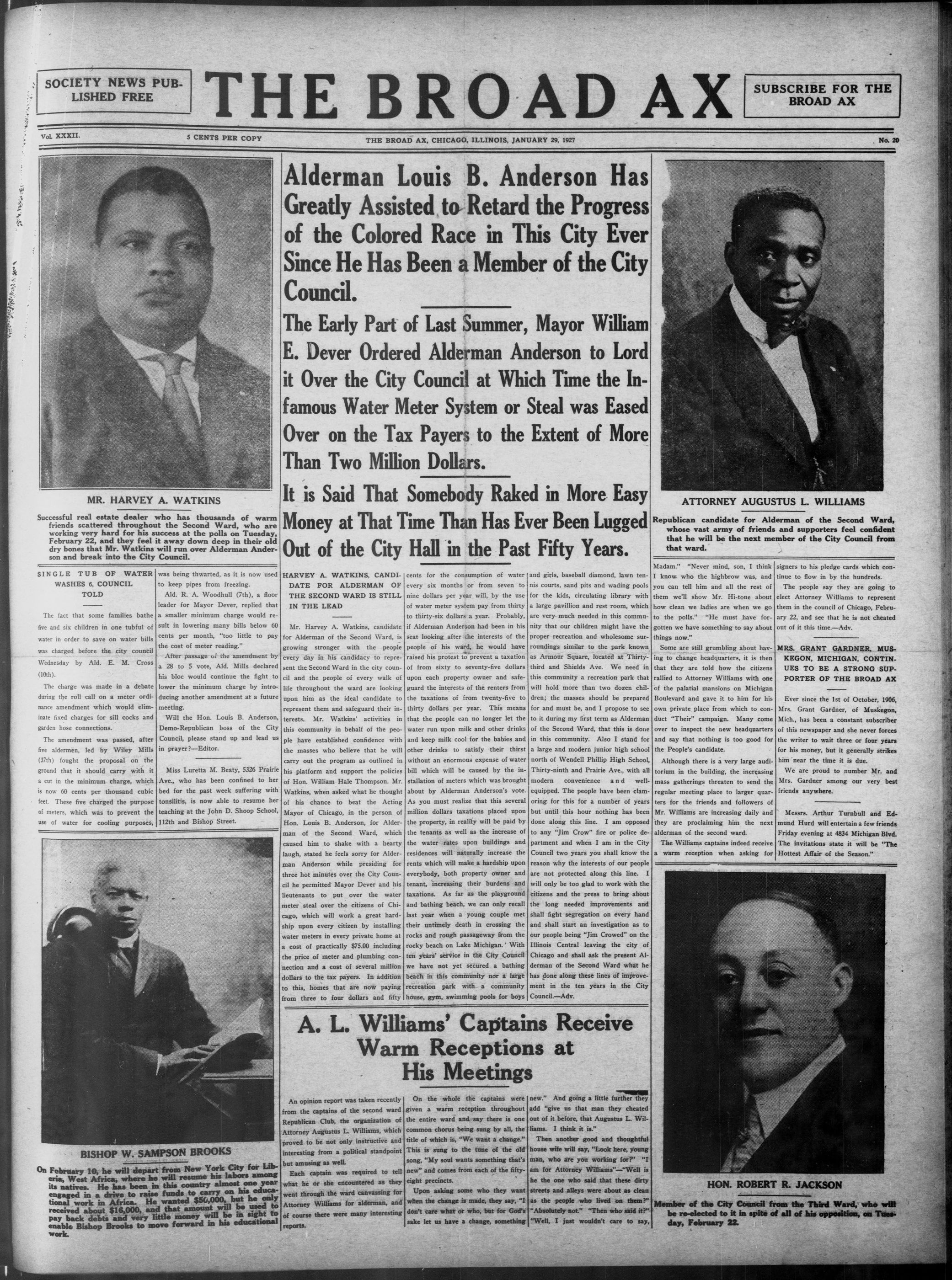
Alderman Louis B. Anderson Has Greatly Assisted to Retard the Progress of the Colored Race in This City Ever Since He Has Been a Member of the City Council.
The Early Part of Last Summer, Mayor William E. Dever Ordered Alderman Anderson to Lord it Over the City Council at Which Time the Infamous Water Meter System or Steal was Eased Over on the Tax Payers to the Extent of More Than Two Million Dollars. It is Said That Somebody Raked in More Easy Money at That Time Than Has Ever Been Lugged Out of the City Hall in the Past Fifty Years.
A. L. Williams' Captains Receive Warm Receptions at His Meetings
HARVEY A. WATKINS, CANDIDATE FOR ALDERMAN OF THE SECOND WARD IS STILL IN THE LEAD
Mr. Harvey A. Watkins, candidate for Alderman of the Second Ward, is growing stronger with the people every day in his candidacy to represent the Second Ward in the city council and the people of every walk of life throughout the ward are looking upon him as the ideal candidate to represent them and safeguard their interests. Mr. Watkins' activities in this community in behalf of the people have established confidence with the masses who believe that he will carry out the program as outlined in his platform and support the policies of Hon. William Hale Thompson. Mr. Watkins, when asked what he thought of his chance to beat the Acting Mayor of Chicago, in the person of Hon. Louis B. Anderson, for Alderman of the Second Ward, which caused him to shake with a hearty laugh, stated he feels sorry for Alderman Anderson while presiding for three hot minutes over the City Council he permitted Mayor Dever and his lieutenants to put over the water meter steal over the citizens of Chicago, which will work a great hardship upon every citizen by installing water meters in every private home at a cost of practically $75.00 including the price of meter and plumbing connection and a cost of several million dollars to the tax payers. In addition to this, homes that are now paying from three to four dollars and fifty
A. L. Willi
War
An opinion report was taken recently from the captains of the second ward Republican Club, the organization of Attorney Augustus L. Williams, which proved to be not only instructive and interesting from a political standpoint but amusing as well.
Each captain was required to tell what he or she encountered as they went through the ward canvassing for Attorney Williams for alderman, and of course there were many interesting reports.
cents for the consumption of water every six months or from seven to nine dollars per year will, by the use of water meter system pay from thirty to thirty-six dollars a year. Probably, if Alderman Anderson had been in his seat looking after the interests of the people of his ward, he would have raised his protest to prevent a taxation of from sixty to seventy-five dollars upon each property owner and safeguard the interests of the renters from the taxations of from twenty-five to thirty dollars per year. This means that the people can no longer let the water run upon milk and other drinks and keep milk cool for the babies and other drinks to satisfy their thirst without an enormous expense of water bill which will be caused by the installation of meters which was brought about by Alderman Anderson's vote. As you must realize that this several million dollars taxations placed upon the property, in reality will be paid by the tenants as well as the increase of the water rates upon buildings and residences will naturally increase the rents which will make a hardship upon everybody, both property owner and tenant, increasing their burdens and taxations. As far as the playground and bathing beach, we can only recall last year when a young couple met their untimely death in crossing the rocks and rough passageway from the rocky beach on Lake Michigan. 'With ten years' service in the City Council we have not yet secured a bathing beach in this community nor a large recreation park with a community house, gym, swimming pools for boys
On the whole the captains were given a warm reception throughout the entire ward and say there is one common chorus being sung by all, the title of which is, "We want a change." This is sung to the tune of the old song, "My soul wants something that's new" and comes from each of the fifty-eight precincts.
Upon asking some who they want when the change is made, they say, "I don't care what or who, but for God's sake let us have a change, something
and girls, baseball diamond, lawn tennis courts, sand pits and wading pools for the kids, circulating library with a large pavilion and rest room, which are very much needed in this community that our children might have the proper recreation and wholesome surroundings similar to the park known as Armour Square, located at Thirty-third and Shields Ave. We need in this community a recreation park that will hold more than two dozen children; the masses should be prepared for and must be, and I propose to see to it during my first term as Alderman of the Second Ward, that this is done in this community. Also I stand for a large and modern junior high school north of Wendell Phillip High School, Thirty-ninth and Prairie Ave., with all modern convenience and well-equipped. The people have been clamoring for this for a number of years but until this hour nothing has been done along this line. I am opposed to any "Jim Crow" fire or police department and when I am in the City Council two years you shall know the reason why the interests of our people are not protected along this line. I will only be too glad to work with the citizens and the press to bring about the long needed improvements and shall fight segregation on every hand and shall start an investigation as to our people being "Jim Crowed" on the Illinois Central leaving the city of Chicago and shall ask the present Alderman of the Second Ward what he has done along these lines of improvement in the ten years in the City Council.—Adv.
new." And going a little further they add "give us that man they cheated out of it before, that Augustus L. Williams. I think it is."
Then another good and thoughtful house wife will say, "Look here, young man, who are you working for?" "I am for Attorney Williams"—"Well is he the one who said that these dirty streets and alleys were about as clean as the people who lived on them?" "Absolutely not." "Then who said it?" "Well, I just wouldn't care to say,
DRNEY AUGUSTUS L. WILLE
Candidate for Alderman of the S
st army of friends and supporters
will be the next member of the City
A.
ATTORNEY AUGUSTUS L. WILLIAMS
Republican candidate for Alderman of the Second Ward, whose vast army of friends and supporters feel confident that he will be the next member of the City Council from that ward.
Madam." "Never mind, son, I think I know who the highbrow was, and you can tell him and all the rest of them we'll show Mr. Hi-tone about how clean we ladies are when we go to the polls." "He must have forgotten we have something to say about things now."
Some are still grumbling about having to change headquarters, it is then that they are told how the citizens rallied to Attorney Williams with one of the palatial mansions on Michigan Boulevard and gave it to him for his own private place from which to conduct "Their" campaign. Many come over to inspect the new headquarters and say that nothing is too good for the People's candidate.
signers to his pledge cards which continue to flow in by the hundreds.
The people say they are going to elect Attorney Williams to represent them in the council of Chicago, February 22, and see that he is not cheated out of it this time.—Adv.
MRS. GRANT GARDNER, MUSKEGON, MICHIGAN, CONTINUES TO BE A STRONG SUPPorter OF THE BROAD AX
Ever since the 1st of October, 1906 Mrs. Grant Gardner, of Muskegon Mich., has been a constant subscriber of this newspaper and she never forces the writer to wait three or four years for his money, but it generally strikes
Although there is a very large auditorium in the building, the increasing mass gatherings threaten to send the regular meeting place to larger quarters for the friends and followers of Mr. Williams are increasing daily and they are proclaiming him the next alderman of the second ward.
The Williams captains indeed receive a warm reception when asking for
1920
1
M. B.
HON. ROBERT R. JACKSON
Member of the City Council from the Third W
be re-elected to it in spite of all of his opposi
day, February 22.
the City Council from the Third W
ted to it in spite of all of his opposi
uary 22.
Member of the City Council from the Third Ward, who will be re-elected to it in spite of all of his opposition, on Tuesday, February 22.
SUBSCRIBE FOR THE BROAD AX
UGUSTUS L. WILLIAMS
for Alderman of the Second Ward, friends and supporters feel confident next member of the City Council from
signers to his pledge cards which continue to flow in by the hundreds.
The people say they are going to elect Attorney Williams to represent them in the council of Chicago, February 22, and see that he is not cheated out of it this time.—Adv.
MRS. GRANT GARDNER, MUSKEGON, MICHIGAN, CONTINUES TO BE A STRONG SUPPORTER OF THE BROAD AX
Ever since the 1st of October, 1906, Mrs. Grant Gardner, of Muskegon, Mich., has been a constant subscriber of this newspaper and she never forces the writer to wait three or four years for his money, but it generally strikes him near the time it is due.
We are proud to number Mr. and Mrs. Gardner among our very best friends anywhere.
Messrs. Arthur Turnbull and Edmund Hurd will entertain a few friends Friday evening at 4834 Michigan Blvd. The invitations state it will be "The Hottest Affair of the Season."
1
council from the Third Ward, who will apite of all of his opposition, on Tues-
J.
HON. WILLIAM SULZER
Ex-Congressman from the old New York; Ex-Governor lawyer, who is extensive Alaska, has herewith set f.
HON. WILLIAM SULZER'S TEN RULES OF LIFE
Hon. Wm. Sulzer is called the Philosopher of Greenwich Village—and he is a real philosopher to those who know him best—especially to the people in Greenwich Village, where Mr. Sulzer has lived nearly all his life.
Recently a reporter of the New York World asked Mr. Sulzer to give him his ten rules of life, from a philosophical viewpoint, and Mr. Sulzer promptly gave the newspaperman the following rules, viz.:
1. Live and let live.
2. Be honest in all things.
3. Don't worry; don't hurry.
4. Get married, and stay married.
Ex-Congressman from the old Tenth Congressional District of New York; Ex-Governor of the Empire State; eminent lawyer, who is extensively engaged in gold mining in Alaska, has herewith set forth.
HON. WILLIAM SULZER'S TEN RULES OF LIFE
Hon. Wm. Sulzer is called the Philosopher of Greenwich Village—and he is a real philosopher to those who know him best—especially to the people in Greenwich Village, where Mr. Sulzer has lived nearly all his life. Recently a reporter of the New York World asked Mr. Sulzer to give him his ten rules of life, from a philosophical viewpoint, and Mr. Sulzer promptly gave the newspaperman the following rules, viz.:
1. Live and let live.
2. Be honest in all things.
3. Don't worry; don't hurry.
4. Get married, and stay married.
5. Read much; think more; talk little.
6. Tell the truth regardless of consequences.
7. Get rid of fear; of prejudice; and of superstition.
8. Have a purpose, keep working; be constructive.
9. Have few friends, and fewer principles, but adhere to them ten-actiously.
10. Strive for success. Make progress. Remember a quitter never wins, and a winner never quits.
These rules of life, by one of the real men and thinkers of our time, are worthy of careful perusal and consideration.
Who can formulate a better set of philosophical principles?—The Editor.
"CHICAGO'S HEALTH"
Weekly Bulletin, Chicago Department of Health—Typhoid Fever—by Herman N. Bundesen, M. D.,
"In 1926 Chicago had but 149 cases of and 24 deaths from typhoid fever. This makes a death rate for the disease of 0.79 per 100,000 persons; a record never before equaled in the history of the city. It is the lowest rate of any city over 500,000 population in the United States for 1926.
Chicago, 079; Milwaukee, 1.35; Cleveland, 1.46; Boston, 1.77; New York, 1.86; Philadelphia, 1.89; Detroit, 2.27; St. Louis, 2.29; San Francisco, 2.47; Washington, 2.5; Pittsburgh, 2.67; Buffalo, 4.96; Baltimore, 5.2.
"It beats the Chicago 1922 rate of 1.1 typhoid fever deaths per 100,000 persons by 28 per cent," says Dr. Bundesen in his latest bulletin.
"Chicago is proud of its typhoid fever record because this former scourge is reaching the vanishing point and is a triumph of modern public health. Moreover this is the second consecutive year that Chicago leads the cities of the United States in the low number of typhoid cases and in a still greater reduction in the death rate," says the Commissioner.
1. More careful and more exact chlorination of our drinking water supply. For this, great credit is due to the effective co-operation of Col. A. A. Sprague, commissioner of public works, and Mr. A. E. Gorman, engineer in charge of chlorination.
2. More effective and efficient pasteurization of the milk supply.
3. More careful work in the discovery and supervision of typhoid fever carriers, that is, persons who are well but carry the typhoid germs about with them," concludes the Commissioner.
SOCIETY FOLKS ARE STILL
MOVING AROUND
Miss Carrie C. Stewart, 5942 Aberdeen Street, daughter of J. H. Stewart, through diligent application of mind, completed her prescribed course at the Englewood High School last Wednesday evening and was among the many who were the proud recipients of a high school diploma. It was very much regretted that her father was unable to attend the class exercises but very urgent business called him to Frankfort, Kentucky.
Tenth Congressional District of of the Empire State; eminently engaged in gold mining in north.
5. Read much; think more; talk little.
6. Tell the truth regardless of consequences.
7. Get rid of fear; of prejudice; and of superstition.
8. Have a purpose, keep working; be constructive.
9. Have few friends, and fewer principles, but adhere to them tenaciously.
10. Strive for success. Make progress. Remember a quitter never wins, and a winner never quits.
These rules of life, by one of the real men and thinkers of our time, are worthy of careful perusal and consideration.
Who can formulate a better set of philosophical principles?—The Editor.
LINCOLN-DOUGLASS NATION
AL OBSERVANCE
Announced for National Lincoln-Douglass Observances and Race Conference at Washington, Feb. 12-14—Congress and President to Be Petitioned
Boston, Mass.—As one of first steps in the Post-Sesquicentennial Race Crusade for Rights with which the Colored Americans are urged to signalize the beginning of the nation's 4th half-century, the National Equal Rights League announces a race patriotic literary prize contest in honor of Abraham Lincoln, the Emancipator, and Frederick Douglass, the fugitive slave abolitionist, whose birthdays, 12 and 14 the race everywhere are asked to observe separately or jointly.
There are to be three contests, to consist of race petitions to Congress, also to the President, in the spirit and memory of Lincoln and of Douglass for redress of the race's just and vital grievances, and one for the best equality quotations from Lincoln and Douglass contestants to select two quotations from Lincoln and two from Douglass.
Papers in Before Feb. 11
All members of the race are invited to contest. Manuscripts must be in the hands of the Recording Secretary of the League, Jas. L. Neill, Esq. 906 T St., Northwest, Washington, D. C. on or before Feb. 11, 1927, for examination by a board of judges from several national race bodies, the board to meet at Washington on Feb. 12 in connection with a National Lincoln-Douglass 3 days observance and race conference. Feb. 12 to 14.
The race are asked to arrange to send delegates from every place to this race assembly from Lincoln-Douglass sub-committees of existing race bodies or from Lincoln-Douglass or Equal Rights Leagues or Citizens' Committees formed for the purpose, which also arrange local observances and remain permanent. On Feb. 14, delegations from the race conference will present petitions to both branches of Congress and to President Coolidge in memory of Lincoln and Douglass, based on the prize winning petitions. Prizes will be awarded at the night meeting.
VISITING IN NEW ORLEANS
Miss Juanita Emanuel, 6350 Rhodes Ave.; is spending a few days in New Orleans.
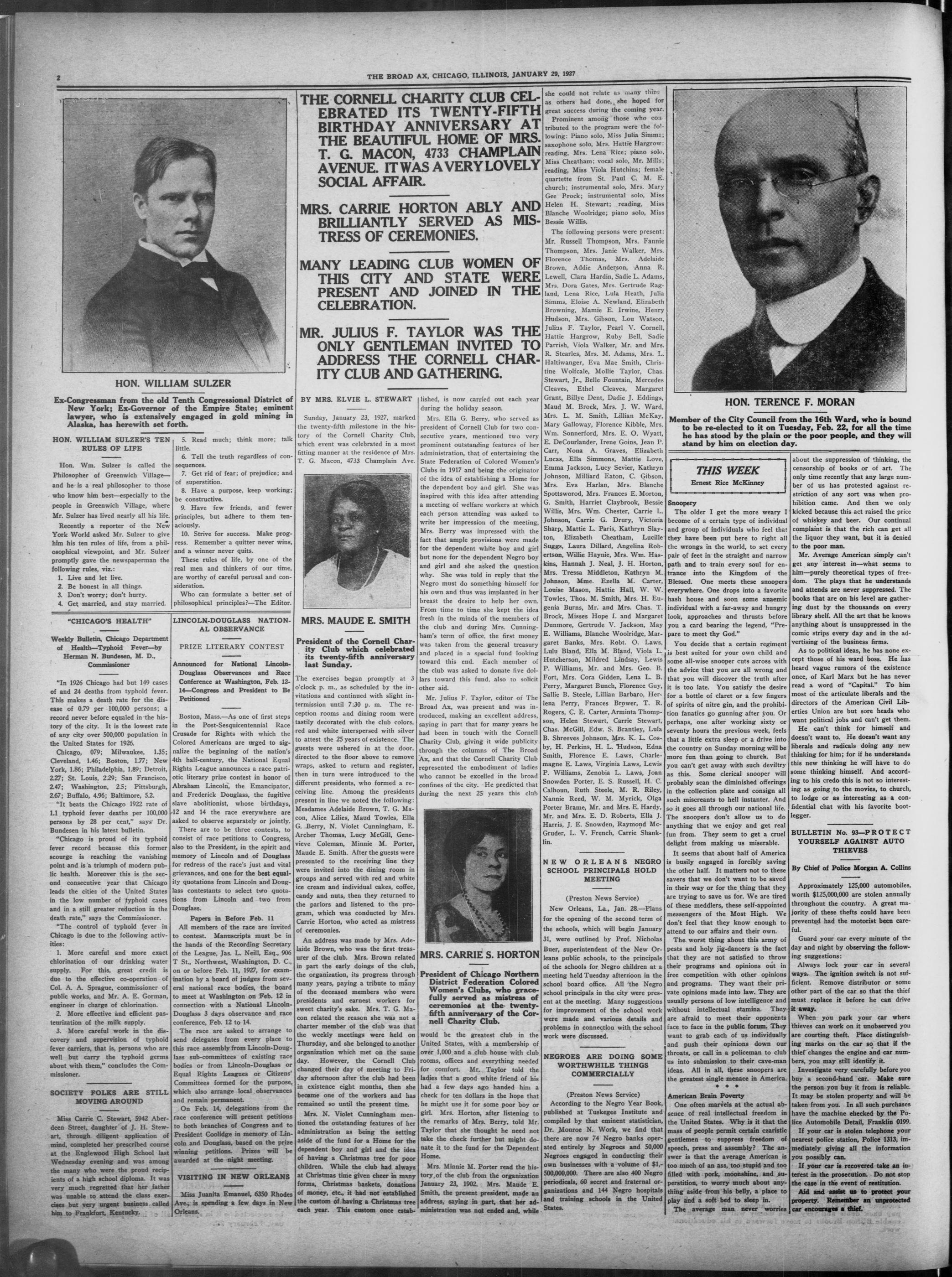
THE CORNELL CHARITY CLUB CLEBRATED ITS TWENTY-FIFTH BIRTHDAY ANNIVERSARY AT THE BEAUTIFUL HOME OF MRS. T. G. MACON, 4733 CHAMPLAIN AVENUE. IT WAS AVERYLOVELY SOCIAL AFFAIR.
MRS. CARRIE HORTON ABLY AND BRILLIANTLY SERVED AS MISTRESS OF CEREMONIES.
MANY LEADING CLUB WOMEN OF THIS CITY AND STATE WERE PRESENT AND JOINED IN THE CELEBRATION.
MR. JULIUS F. TAYLOR WAS THE ONLY GENTLEMAN INVITED TO ADDRESS THE CORNELL CHARITY CLUB AND GATHERING.
BY MRS. ELVIE L. STEWART
Sunday, January 23, 1927, marked the twenty-fifth milestone in the history of the Cornell Charity Club, which event was celebrated in a most fitting manner at the residence of Mrs. T. G. Macon, 4733 Champlain Ave.
Mrs.
MRS. MAUDE E. SMITH
President of the Cornell Charity Club which celebrated its twenty-fifth anniversary last Sunday.
The exercises began promptly at 3 o'clock p. m., as scheduled by the invitations and continued with slight intermission until 7:30 p. m. The reception rooms and dining room were tastily decorated with the club colors, red and white interspersed with silver to attest the 25 years of existence. The guests were ushered in at the door, directed to the floor above to remove wraps, asked to return and register, then in turn were introduced to the different presidents, who formed a receiving line. Among the presidents present in line we noted the following: Mesdames Adelaide Brown, T. G. Macon, Alice Lilies, Maud Towles, Ella G. Berry, N. Violet Cunningham, E. Archer Thomas, Lucy McGill, Genevieve Coleman, Minnie M. Porter, Maude E. Smith. After the guests were presented to the receiving line they were invited into the dining room in groups and served with red and white ice cream and individual cakes, coffee, candy and nuts, then they returned to the parlors and listened to the program, which was conducted by Mrs. Carrie Horton, who acted as mistress of ceremonies.
An address was made by Mrs. Adelaide Brown, who was the first treasurer of the club. Mrs. Brown related in part the early doings of the club, the organization, its progress through many years, paying a tribute to many of the deceased members who were presidents and earnest workers for sweet charity's sake. Mrs. T. G. Macon related the reason she was not a charter member of the club was that the weekly meetings were held on Thursday, and she belonged to another organization which met on the same day. However, the Cornell Club changed their day of meeting to Friday afternoon after the club had been in existence eight months, then she became one of the workers and has remained so until the present time.
Mrs. N. Violet Cunningham mentioned the outstanding features of her administration as being the setting aside of the fund for a Home for the dependent boy and girl and the idea of having a Christmas tree for poor children. While the club had always at Christmas time given cheer in many forms, Christmas baskets, donations of money, etc., it had not established the custom of having a Christmas tree each year. This custom once estab-
lished, is now carried out each year during the holiday season.
Mrs. Ella G. Berry, who served as president of Cornell Club for two consecutive years, mentioned two very prominent outstanding features of her administration, that of entertaining the State Federation of Colored Women's Clubs in 1917 and being the originator of the idea of establishing a Home for the dependent boy and girl. She was inspired with this idea after attending a meeting of welfare workers at which each person attending was asked to write her impression of the meeting. Mrs. Berry was impressed with the fact that ample provisions were made for the dependent white boy and girl but none for the dependent Negro boy and girl and she asked the question why. She was told in reply that the Negro must do something himself for his own and thus was implanted in her breast the desire to help her own. From time to time she kept the idea fresh in the minds of the members of the club and during Mrs. Cunningham's term of office, the first money was taken from the general treasury and placed in a special fund looking toward this end. Each member of the club was asked to donate five dollars toward this fund, also to solicit other aid.
Mr. Julius F. Taylor, editor of The Broad Ax, was present and was introduced, making an excellent address, saying in part that for many years he had been in touch with the Cornell Charity Club, giving it wide publicity through the columns of The Broad Ax, and that the Cornell Charity Club represented the embodiment of ladies who cannot be excelled in the broad confines of the city. He predicted that during the next 25 years this club
MRS. CARRIE S. HORTON
President of Chicago Northern District Federation Colored Women's Clubs, who gracefully served as mistress of ceremonies at the twenty-fifth anniversary of the Cornell Charity Club.
would be the greatest club in the United States, with a membership of over 1,000 and a club house with club rooms, offices and everything needed for comfort. Mr. Taylor told the ladies that a good white friend of his had a few days ago handed him a check for ten dollars in the hope that he might use it for some poor boy or girl. Mrs. Horton, after listening to the remarks of Mrs. Berry, told Mr. Taylor that she thought he need not take the check further but might donate it to the fund for the Dependent Home.
Mrs. Minnie M. Porter read the history, of the club from the organization January 23, 1902. Mrs. Maude E. Smith, the present president, made an address, saying in part, that her administration was not ended and, while
she could not relate as many things as others had done, she hoped for great success during the coming year. Prominent among those who contributed to the program were the following: Piano solo, Miss Julia Simms; saxophone solo, Mrs. Hattie Hargrow; reading, Mrs. Lena Rice; piano solo, Miss Cheatham; vocal solo, Mr. Mills; reading, Miss Viola Hutchins; female quartette from St. Paul C. M. E. church; instrumental solo, Mrs. Mary Gee Prock; instrumental solo, Miss Helen H. Stewart; reading, Miss Blanche Woolridge; piano solo, Miss Bessie Willis.
The following persons were present: Mr. Russell Thompson, Mrs. Fannie Thompson, Mrs. Janie Walker, Mrs. Florence Thomas, Mrs. Adelaide Brown, Addie Anderson, Anna R. Lewell, Clara Hardin, Sadie L. Adams, Mrs. Dora Gates, Mrs. Gertrude Ragland, Lena Rice, Lula Heath, Julia Simms, Eloise A. Newland, Elizabeth Browning, Mamie E. Irwine, Henry Hudson, Mrs. Gibson, Lou Watson, Julius F. Taylor, Pearl V. Cornell Hattie Hargray, Ruby Bell, Sadie Parrish, Viola Walker, Mr. and Mrs. R. Stearles, Mrs. M. Adams, Mrs. L. Haltiwanger, Eva Mae Smith, Christine Wolfcale, Mollie Taylor, Chas. Stewart, Jr., Belle Fountain, Mercedes Cleaves, Ethel Cleaves, Margaret Grant, Billyye Dent, Dadie J. Eddings, Maud M. Brock, Mrs. J. W. Ward, Mrs. L. M. Smith, Lillian McKay, Mary Galloway, Florence Kibble, Mrs. Wm. Sonnerford, Mrs. E. O. Wyatt, E. De Courlander, Irene Goins, Jean P. Carr, Nona A. Graves, Elizabeth Lucas, Ella Simmons, Mattie Love, Emma Jackson, Lucy Sevier, Kathryn Johnson, Milliard Eaton, C. Gibson, Mrs. Eva Harlan, Mrs. Blanche Spotsworod, Mrs. Frances E. Morton, G. Smith, Harriet Claybrook, Bessie Willis, Mrs. Wm. Chester, Carrie L. Johnson, Carrie G. Drury, Victoria Sharp, Mattie L. Paris, Kathryn Slayton, Elizabeth Cheatham, Lucille Suggs, Laura Dillard, Angelina Robertson, Willie Haynie, Mrs. Wm. Haskins, Hannah J. Neal, H. Horton, Mrs. Tressa Middleton, Kathryn M. Johnson, Mme. Ezella M. Carter, Louise Mason, Mattie Hall, W. W. Towles, Thos. M. Smith, Mrs. H. Eugenia Burns, Mr. and Mrs. Chas. T. Brock, Misses Hope I. and Margaret Dunmore, Gertrude V. Jackson, May E. Williams, Blanche Woolridge, Margaret Banks, Mrs. Robt. O. Laws, Lulu Bland, Ella M. Bland, Viola L. Hutcherson, Mildred Lindsay, Lewis P. Williams, Mr. and Mrs. Geo B. Fort, Mrs. Cora Gidden, Lena L. B. Perry, Margaret Bunch, Florence Guy, Sallie B. Steele, Lillian Barbaro, Herlane Perry, Frances Brower, T. R Rogers, C. E. Carter, Arminta Thompson, Helen Stewart, Carrie Stewart, Chas. McGill, Edw. S. Brantley, Lula B. Shreeves Johnson, Mrs. K. L. Cosby, H. Perkins, H. L. Hudson, Edna Smith, Florence E. Laws, Charlemagne E. Laws, Virginia Laws, Lewis P. Williams, Zenobia L. Laws, Joan Snowden Porter, E. S. Russell, H. C. Calhoun, Ruth Steele, M. R. Riley, Nannie Reed, W. M. Myrick, Olga Porter Brame, Mr. and Mrs. E. Hardy, Mr. and Mrs. E. D. Roberts, Ella J. Harris, J. E. Snowden, Raymond McGruder, L. V. French, Carrie Shanklin.
NEW ORLEANS NEGRO
SCHOOL PRINCIPALS HOLD
MEETING
New Orleans, La., Jan. 28.—Plans for the opening of the second term of the schools, which will begin January 31, were outlined by Prof. Nicholas Buer, superintendent of the New Orleans public schools, to the principals of the schools for Negro children at a meeting held Tuesday afternoon in the school board office. All the Negro school principals in the city were present at the meeting. Many suggestions for improvement of the school work were made and various details and problems in connection with the school work were discussed.
NEGROES ARE DOING SOME
WORTHWHILE THINGS
COMMERCIALLY
(Preston News Service)
According to the Negro Year Book, published at Tuskegee Institute and compiled by that eminent statistician, Dr. Monroe N. Work, we find that there are now 74 Negro banks operated entirely by Negroes and 50,000 Negroes engaged in conducting their own businesses with a volume of $1,500,000,000. There are also 400 Negro periodicals, 60 secret and fraternal organizations and 144 Negro hospitals and training schools in the United States.
W. H.
HON. TERENCE F. MORAN Member of the City Council from the 16th Ward, who is bound to be re-elected to it on Tuesday, Feb. 22, for all the time he has stood by the plain or the poor people, and they will stand by him on election day.
The older I get the more weary I become of a certain type of individual and group of individuals who feel that they have been put here to right all the wrongs in the world, to set every pair of feet in the straight and narrow path and to train every soul for entrance into the Kingdom of the Blessed. One meets these snopers everywhere. One drops into a favorite hash house and soon some anaemic individual with a far-away and hungry look, approaches and thrusts before you a card bearing the legend, "Prepare to meet thy God."
You decide that a certain regiment is best suited for your own child and some all-wise snooper cuts across with the advice that you are all wrong and that you will discover the truth after it is too late. You satisfy the desire for a bottle of claret or a few fingers of spirits of nitre gin, and the prohibition fanatics go gunning after you. Or perhaps, one after working sixty on seventy hours the previous week, feels that a little extra sleep or a drive into the country on Sunday morning will be more fun than going to churek. But you can't get away with such devilty as this. Some clerical snooper will probably scan the diminished offerings in the collection plate and consign all such miscreants to hell instanter. And so it goes all through our national life. The snoopers don't allow us to do anything that we enjoy and get real fun from. They seem to get a cruel delight from making us miserable.
It seems that about half of America is busily engaged in forcibly saving the other half. It matters not to these savers that we don't want to be saved in their way or for the thing that they are trying to save us for. We are tired of these meddlers, these self-appointed messengers of the Most High. We don't feel that they know enough to attend to our affairs and their own.
The worst thing about this army of pests and holy jig-dancers is the fact that they are not satisfied to throw their programs and opinions out in free competition with other opinions and programs. They want their private opinions made into law. They are usually persons of low intelligence and without intellectual stamina. They are afraid to meet their opponents face to face in the public forum. They want to grab each of us individually and push their opinions down our throats, or call in a policeman to club us into submission to their cave-man ideas. All in all, these snoopers are the greatest single menace in America.
American Brain Poverty
One often marvels at the actual absence of real intellectual freedom in the United States. Why is it that the mass of people permit certain caaristic gentlemen to suppress freedom of speech, press and assembly? The answer is that the average American is too much of an ass, too stupid and too filled with pork, moonshine, and superstition, to worry much about anything aside from his belly, a place to play and a soft bed to sleep in.
The average man never worries
about the suppression of thinking, the censorship of books or of art. The only time recently that any large number of us has protested against restriction of any sort was when prohibition came. And then we only kicked because this act raised the price of whiskey and beer. Our continual complaint is that the rich can get all the liquor they want, but it is denied to the poor man.
Mr. Average American simply can't get any interest in—what seems to him—purely theoretical types of freedom. The plays that he understands and attends are never suppressed. The books that are on his level are gathering dust by the thousands on every library shelf. All the art that he knows anything about is unsuppressed in the comic strips every day and in the advertising of the business firms.
As to political ideas, he has none except those of his ward boss. He has heard vague rumors of the existence once, of Karl Marx but he has never read a word of "Capital." To him most of the articulate liberals and the directors of the American Civil Liberties Union are but sore heads who want political jobs and can't get them. He can't think for himself and doesn't want to. He doesn't want any liberals and radicals doing any new thinking for him; for if he understands this new thinking he will have to do some thinking himself. And according to his credo this is not so interesting as going to the movies, to church, to lodge or as interesting as a confidential chat with his favorite boot-legger.
BULLETIN No. 93—PROTECT
YOURSELF AGAINST AUTO
THIEVES
By Chief of Police Morgan A. Collins
Approximately 125,000 automobiles, worth $125,000,000 are stolen annually throughout the country. A great majority of these thefts could have been prevented had the motorist been careful.
Guard your car every minute of the day and night by observing the following suggestions:
Always lock your car in several ways. The ignition switch is not sufficient. Remove distributor or some other part of the car so that the thief must replace it before he can drive it away.
When you park your car where thieves can work on it unobserved you are courting theft. Place distinguishing marks on the car so that if the thief changes the engine and car numbers, you may still identify it.
Investigate very carefully before you buy a second-hand car. Make sure the person you buy it from is reliable. It may be stolen property and will be taken from you. In all such purchases have the machine checked by the Police Automobile Detail, Franklin 0199. If your car is stolen telephone your nearest police station, Police 1313, immediately giving all the information you possibly can.
If your car is recovered take an interest in the prosecution. Do not stop the case in the event of restitution. Aid and assist us to protect your property. Remember an unprotected car encourages a thief.
COL. NOAH D. THOMPSON,
WELL KNOWN TO THE OLD
TIME CHICAGOANS, HAS RE-
MOVED FROM LOS ANGELES,
CALIFORNIA TO NEW YORK
CITY, WHERE HE WILL BE
COME THE BUSINESS MAN-
AGER OF THE OPPORTUNITY
MAGAZINE
Monday, Col. Noah D. Thompson
struck Chicago from Los Angeles,
Calif., on his way to New York City,
where he and his wife, Mrs. Thompson,
who preceded him, will reside for
some time in the future.
Mr. Thompson spent Tuesday and
Wednesday in scouting among
V
his many old time friends in this city. On February 1, Mr. Thompson will become business manager of the Opportunity Magazine, the official organ of the National Urban League.
The following is from the Los Angeles Evening Express:
"Coming to this city in 1911, Mr. Thompson won a place of high regard among both his own and the white people for his efforts in behalf of his race. Until recently he was a member of the Municipal Housing Commission and had been mentioned as a candidate for a place on the State Labor Commission.
"For more than 15 years Mr. Thompson was employed by the United States Express Company in Chicago. Subsequently, he was a coworker of Booker T. Washington at Tuskegee Institute for four years. Since coming to Los Angeles he has been a leader in the cultural and political life of the Negro race. He has also contributed to several magazines.
"He was suggested by the late Congressman H. Z. Osborne to be minister to Liberia, but declined before the nomination was acted upon, owing to ill health in his family.
"Opportunity is the organ of the National Urban League. He has been an active member of Los Angeles Urban League for a long time.
"He formerly was on the staff of the Evening Express."
Mr. Thompson, being wide awake all the time, was not to occupy his new post of duty on the Opportunity, until February 1, but he expended some of his time in frequenting the news stands and stores in this city and urging the agents for Opportunity Magazine to make an extraordinary effort to increase its sale, from month to month.
BURY MOTHER IN MICHIGAN
Mrs. Charlotte A. Thompson, 3752 Rhodes Ave., passed away on last Thursday after an illness of more than six weeks. Mrs. Thompson was born in New York, but resided in Lansing, Mich., for a number of years, coming to Chicago fourteen years ago. Mrs. Thompson is the mother of Mesdames Gladys Thompson and Cora Thompson and Leona Dixon McKinney; the sister of Mrs. Sarah Davis of Ann Arbor, Mich. Short funeral services were conducted at the home by the G. A. R., of which the deceased was a member, on Sunday afternoon, after which the body was shipped to Lansing for burial.
PREPARING
Great preparations are being made for the 5th annual informal ball, which is to be given the earlier part of next month by the young men of the Alverno Social Club.
THE RED CAPS LITERARY CLUB
The Red Caps Club will hold forth at their regular meeting Sunday afternoon at 4:30 p.m., February 6, at 3639 Michigan avenue. Mr. T. S. Saby of S. W. Straus & Co., will be the principal speaker. His subject will be "The Easiest Way to Do the Hardest Thing in the World." Miss Rosie Lee Robinson, our musical director has arranged a wonderful musical program, and a rare treat is in store for all who attend. Everyone is welcome.
Sandy W. Trice, Pres.
Washington, D. C., Jan. 27.—If the Federal Government has the authority to declare martial law in Herrin, Ill., because of a riotous uprising in that community, why cannot similar action be taken in the various communities where lynchings occur and mob violence exists, is the unique question President Coolidge has promised to submit to the United States Attorney General, according to Dr. S. R. Williams and Mrs. Ruth W. Whaley, of New York, who called on President Coolidge last Tuesday and had a twenty minute talk with him about the horrible disgrace that the numerous lynchings bring upon the fair name of the United States.
The President is reported to have deplored the fact that justice has not been allowed to take its regular and orderly course, and spoke especially of the Lowman case in South Carolina as well as the one in Texas. He intimated that those two recent outbursts of savagery were the most conspicuous lynching blots on this country's history. He said if we can't protect our Negro citizens, then we can't protect any citizens, according to the report of the visitors.
The difficulty of securing passage of an anti-lynching law was cited by the President, who recalled that, while he was Vice-President, senators opposing the Dyer bill filibustered four days.
Mrs. Whaley, who is a lawyer, raised the point of invoking the same power and authority the Government used at Herrin, Ill., in quelling the devastating uprising and mob rule. President Coolidge is reported to have admitted the suggestion was a new one, never before considered in connection with lynchings by him.
The resolution presented to the President was adopted at a mass meeting held in New York City, December 19, last, and called on the President "to enforce the Thirteenth, Fourteenth and Fifteenth Amendments to the Constitution with the same vigor as the Eighteenth Amendment, and that protection be given Negro citizens as the exigencies of the circumstances demand, making it impossible for a Negro's life to be taken with impunity to satisfy the whims of a blood-thirsty group of fiends."
OURNAL OF PROGRESS ISSUES
NATIONAL EXPOSITION
NUMBER
(Preston News Service)
New York City, Jan. 28.—The first issue of the Journal of Progress, the official magazine of the National Negro Exposition, which will be held in New York City from June 1 to October 1, 1927, has been released by the exposition authorities with offices at 664 Lenox Ave. This issue gives a detailed account of the purpose of the coming affair, dealing mainly with the problems and industries of New York. A national issue is promised for next month, taking in the accomplishments of the Negro all over the United States.
The expbsition will celebrate the sixty-fifth anniversary of the emancipation of the Negro. It is claimed that this will be the first big opportunity for the race to adequately assemble their various achievements in literature, art, and industry under one large roof. It is planned to make this affair fully representative of the progress of the race. Plans are on foot to arouse interest among Negroes in all parts of the country and insist on every possible exhibit being placed in the exposition so that the race can fully become aware of what it is actually doing.
It is believed that the results from this exposition will prove of considerable inspiration to the race. It is said that the race has never had ample opportunity to take full account of itself. The limited knowledge Negroes have of what the race is accomplishing as a whole in this country does not serve to stimulate or arouse ambition. But it is felt that this one big exposition in which it is planned to give full account of the racial achievements abundant good will come in the way of making history and making the race prouder of itself as a whole.
HOMECOMING WITH FT.
DEARBORN
There was a homecoming with Ft. Dearborn Lodge Wednesday evening, when Jas. M. Brooks, who had been absent from the lodge for the past six months returned and took his active place among the 2,500 members of Ft. Dearborn Lodge No. 44, I. B. P. O. E. W.
THE BROAD AX, CHICAGO, ILLINOIS, JANUARY 29, 1927
(Copyright.)
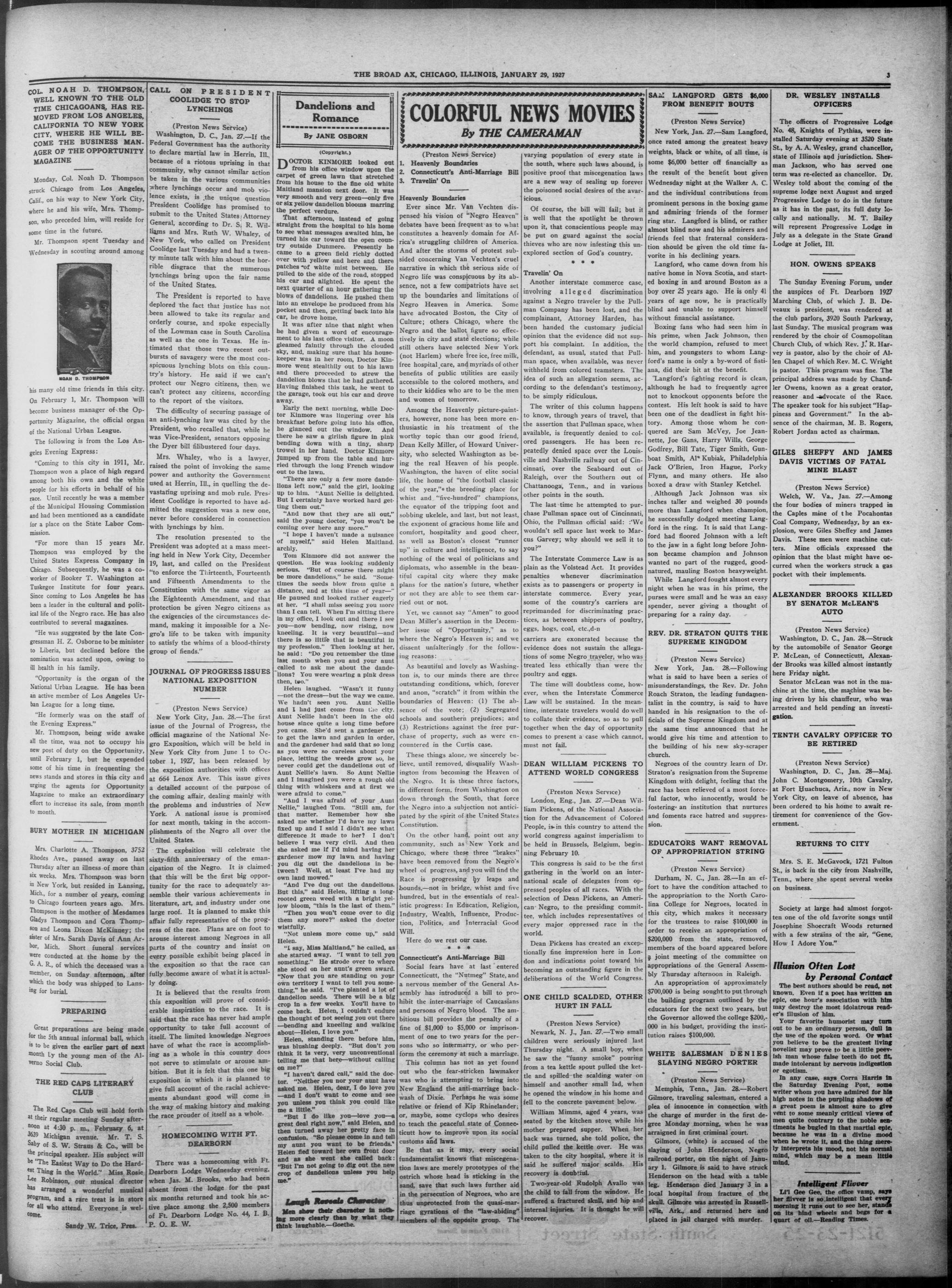
DOCTOR KINMORE looked out from his office window upon the carpet of green lawn that stretched from his house to the fine old white Maitland mansion next door. It was very smooth and very green—only five or six yellow dandelion blooms marring the perfect verdure.
That afternoon, instead of going straight from the hospital to his home to see what messages awaited him, he turned his car toward the open country outside Dunmere. Presently he came to a green field richly dotted over with yellow and here and there patches "of white mist between. He pulled to the side of the road, stopped his car and alighted. He spent the next quarter of an hour gathering the blows of dandelions. He pushed them into an envelope he produced from his pocket and then, getting back into his car, he drove home.
It was after nine that night when he had given a word of encouragement to his last office visitor. A moon gleamed faintly through the clouded sky, and, making sure that his house-keeper was in her room, Doctor Kinmore went stealthily out to his lawn and there proceeded to strew the dandelion blows that he had gathered. Having finished this task, he went to the garage, took out his car and drove away.
Early the next morning, while Doctor Kinmore was lingering over his breakfast before going into his office, he glanced out the window. And there he saw a girlish figure in pink bending down with a tiny, sharp trowel in her hand. Doctor Kinmore jumped up from the table and hurried through the long French window out to the lawn.
"There are only a few more dandelions left now," said the girl, looking up to him. "Aunt Nellie is delighted. But I certainly have worked hard getting them out."
"And now that they are all out," said the young doctor, "you won't be coming over here any more."
"I hope I haven't made a nuisance of myself," said Helen Maltland, archly.
Tom Klimmore did not answer the question. He was looking suddenly serious. "But of course there might be more dandelions," he said. "Sometimes the seeds blow from quite a distance, and at this time of year—" He paused and looked rather eagerly at her. "I shall miss seeing you more than I can tell. When I'm sitting there in my office, I look out and I see you—now bending, now rising, now kneeling. It is very beautiful—and there is so little that is beautiful in my profession." Then looking at her, he said: "Do you remember the time last month when you and your aunt called to ask me about the dandelions? You were wearing a pink dress then, too."
Helen laughed. "Wasn't it funny—not the dress—but the way we came. We hadn't seen you. Aunt Nellie and I had just come from the city. Aunt Nellie hadn't been in the old house since quite a long time before you came. She'd sent a gardener on to get the lawn and garden in order, and the gardener had said that so long as you were so careless about your place, letting the weeds grow so, he never could get the dandelions out of Aunt Nellie's lawn. So Aunt Nellie and I imagined you were a rough old thing with whiskers and at first we were afraid to come."
"And I was afraid of your Aunt Nellie," laughed Tom. "Still am, for that matter. Remember how she asked me whether I'd have my lawn fixed up and I said I didn't see what difference it made to her? I don't believe I was very civil. And then she asked me if I'd mind having her gardener mow my lawn and having you dig out the dandelions in between? Well, at least I've had my own land mowed."
"And I've dug out the dandelions. But this," said Helen, lifting a long-rooted green weed with a bright yellow bloom, "this is the last of them."
"Then you won't come over to dig them any more?" asked the doctor wistfully.
"Not unless more come up," said Helen.
"I say, Miss Maltland," he called, as she started away. "I want to tell you something." He strode over to where she stood on her aunt's green sward. "Now that you are standing on your own territory I want to tell you something," he said. "I've planted a lot of dandelion seeds. There will be a big crop in a few weeks. You'll have to come back. Helen, I couldn't endure the thought of not seeing you out there—bending and kneeling and walking about—Helen, I love you."
Helen, standing there before him, was blushing deeply. "But don't you think it is very, very unconventional telling me that here—without calling on me?"
"I haven't dared call," said the doctor. "Neither you nor your aunt have asked me. Helen, dear, I do love you—and I don't want to come and see you unless you think you could like me a little."
"But I do like you—love you—a great deal right now," said Helen, and then turned away her pretty face in confusion. "So please come in and tell my aunt you want to be friends." Helen fled toward her own front door and as she went she called back: "But I'm not going to dig out the new crop of dandelions unless you help me."
Men show their character in nothing more clearly than by what they think laughable.—Goethe.
COLORFUL NEWS MOVIES By THE CAMERAMAN
varying population of every state in the south, where such laws abound, is positive proof that miscegenation laws are a new way of sealing up forever the poisoned social desires of the avaricious.
Of course, the bill will fail; but it is well that the spotlight be thrown upon it, that conscientious people may be put on guard against the social thieves who are now infesting this unexplored section of God's country.
Travelin' On
Another interstate commerce case, involving alleged discrimination against a Negro traveler by the Pullman Company has been lost, and the complainant, Attorney Harden, has been handed the customary judicial opinion that the evidence did not support his complaint. In addition, the defendant, as usual, stated that Pullman space, when available, was never withheld from colored teamsters. The idea of such an allegation seems, according to the defendant's testimony, to be simply ridiculous.
The writer of this column happens to know, through years of travel, that the assertion that Pullman space, when available, is frequently denied to colored passengers. He has been repeatedly denied space over the Louisville and Nashville railway out of Cincinnati, over the Seaboard out of Raleigh, over the Southern out of Chattanooga, Tenn., and in various other points in the south.
The last time he attempted to purchase Pullman space out of Cincinnati Ohio, the Pullman official said: 'We wouldn't sell space last week to Marcus Garvey; why should we sell it to you?'
The Interstate Commerce Law is as plain as the Volstead Act. It provides penalties whenever discrimination exists as to passengers or property in interstate commerce. Every year, some of the country's carriers are reprimanded for discriminating practices, as between shippers of poultry, eggs, hogs, coal, etc.d-n carriers are exonerated because the evidence does not sustain the allegations of some Negro traveler, who was treated less ethically than were the poultry and eggs.
The time will doubtless come, however, when the Interstate Commerce Law will be sustained. In the meantime, interstate travelers would do well to collate their evidence, so as to pull together when the day of opportunity comes to present a case which cannot must not fail.
DEAN WILLIAM PICKENS TO
ATTEND WORLD CONGRESS
London, Eng., Jan. 27.—Dean William Pickens, of the National Association for the Advancement of Colored People, is in this country to attend the world congress against imperialism to be held in Brussels, Belgium, beginning February 10.
This congress is said to be the first gathering in the world on an international scale of delegates from oppressed peoples of all races. With the selection of Dean Pickens, an American Negro, to the presiding committee, which includes representatives of every major oppressed race in the world.
Dean Pickens has created an exceptionally fine impression here in London and indications point toward his becoming an outstanding figure in the deliberations of the World Congress
ONE CHILD SCALLED, OTHER
HURT IN FALL
Newark, N. J., Jan. 27.—Two small children were seriously injured last Thursday night. A small boy, when he saw the "funny smoke" pouring from a tea kettle spout pulled the kettle and spilled the scalding water on himself and another small lad, when he opened the window in his home and fell to the concrete pavement below.
William Mimms, aged 4 years, was seated by the kitchen stove while his mother prepared supper. When her back was turned, she told police, the child pulled the kettle over. He was taken to the city hospital, where it is said he suffered major scalds. His recovery is doubtful.
Two-year-old Rudolph Avallo was the child to fall from the window. He suffered a fractured skull, and hip and internal injuries. It is thought he will recover.
1. Heavenly Boundaries
2. Connecticut's Anti-Marriage Bill
3. Travelin' On
Heavenly Boundaries
Ever since Mr. Van Vechten dispensed his vision of "Negro Heaven" debates have been frequent as to what constitutes a heavenly domain for Africa's struggling children of America. And after the storms of protest subsided concerning Van Vechten's cruel narrative in which the serious side of Negro life was conspicuous by its absence, not a few compatriots have set up the boundaries and limitations of Negro Heaven in America. Some have advocated Boston, the City of Culture; others Chicago, where the Negro and the ballot figure so effectively in city and state elections; while still others have selected New York (not Harlem) where free ice, free milk free hospital care, and myriads of other benefits of public utilities are easily accessible to the colored mothers, and to their kiddies who are to be the men and women of tomorrow.
Among the Heavenly picture-painters, however, none has been more enthusiastic in his treatment of the worthy topic than our good friend, Dean Kelly Miller, of Howard University, who selected Washington as being the real Heaven of his people, Washington, the haven of elite social life, the home of "the football classic of the year," the breeding place for whist and "five-hundred" champions, the equator of the tripping foot and sobbing ukelele, and last, but not least, the exponent of gracious home life and comfort, hospitality and good cheer, as well as Boston's closest "runner up" in culture and intelligence, to say nothing of the weal of politicians and diplomats, who assemble in the beautiful capital city where they make plans for the nation's future, whether or not they are able to see them carried out or not.
Yet, we cannot say "Amen" to good Dean Miller's assertion in the December issue of "Opportunity," as to where the Negro's Heaven is; and we dissent unfalteringly for the following reasons:
As beautiful and lovely as Washington is, to our minds there are three outstanding conditions, which, forever and anon, "scratch" it from within the boundaries of Heaven: (1) The absence of the vote; (2) Segregated schools and southern prejudices; and (3) Restrictions against the free purchase of property, such as were encountered in the Curtis case.
These things alone, we sincerely believe, until removed, disqualify Washington from becoming the Heaven of the Negro. It is these three factors, in different form, from Washington on down through the South, that force the Negro into a subjection not anticipated by the spirit of the United States Constitution.
On the other hand, point out any community, such as New York and Chicago, where these three "brakes" have been removed from the Negro's wheel of progress, and you will find the Race is progressing by leaps and bounds,—not in bridge, whist and five hundred, but in the essentials of realistic progress: In Education, Religion, Industry, Wealth, Influence, Production, Politics, and Interracial Good Will.
Here do we rest our case.
Connecticut's Anti-Marriage Bill
Social fears have at last entered Connecticut, the "Nutmeg" State, and a nervous member of the General Assembly has introduced a bill to prohibit the inter-marriage of Caucasians and persons of Negro blood. The ambitious bill provides the penalty of a fine of $1,000 to $5,000 or imprisonment of one to two years for the persons who so intermary, or who perform the ceremony at such a marriage.
This column has not as yet found out who the fear-strecken lawmaker was who is attempting to bring into New England the anti-marriage backwash of Dixie. Perhaps he was some relative or friend of Kip Rhinelander; or, maybe, some cyclops who desires to teach the peaceful state of Connecticut how to improve upon its social customs and laws.
Be that as it may, every social fundamentalist knows that miscegenation laws are merely prototypes of the ostrich whose head is sticking in the sand, save that such laws further aid in the persecution of Negroes, who are thus unprotected from the quasi-marriage gyrations of the "law-abiding" members of the opposite group. The
(Preston News Service)
New York, Jan. 27.—Sam Langford, once rated among the greatest heavy weights, black or white, of all time, is some $6,000 better off financially as the result of the benefit bout given Wednesday night at the Walker A. C. and the individual contributions from prominent persons in the boxing game and admiring friends of the former ring star. Langford is blind, or rather almost blind now and his admirers and friends feel that fraternal consideration should be given the old time favorite in his declining years.
Langford, who came down from his native home in Nova Scotia, and started boxing in and around Boston as a boy over 25 years ago. He is only 41 years of age now, he is practically blind and unable to support himself without financial assistance. Boxing fans who had seen him in his prime, when Jack Johnson, then the world champion, refused to meet him, and youngsters to whom Langford's name is only a by-word of fistiana, did their bit at the benefit.
Langford's fighting record is clean, although he had to frequently agree not to knockout opponents before the contest. His left hook is said to have been one of the deadliest in fight history. Among those whom he conquered are Sam McVey, Joe Jeanette, Joe Gans, Harry Wills, George Godfrey, Bill Tate, Tiger Smith, Gunboat Smith, Al* Kubiak, Philadelphia Jack O'Brien, Iron Hague, Porky Flynn, and many others. He also boxed a draw with Stanley Ketchel.
Although Jack Johnson was six inches taller and weighed 30 pounds more than Langford when champion, he successfully dodged meeting Langford in the ring. It is said that Langford had floored Johnson with a left to the jaw in a fight long before Johnson became champion and Johnson wanted no part of the rugged, good-natured, mauling Boston heavyweight. While Langford fought almost every night when he was in his prime, the purses were small and he was an easy spender, never giving a thought of preparing for a rainy day.
REV. DR. STRATON QUITS THE
SUPREME KINGDOM
New York, Jan. 28.—Following what is said to have been a series of misunderstandings, the Rev. Dr. John Roach Straton, the leading fundamentalist in the country, is said to have handed in his resignation to the officials of the Supreme Kingdom and at the same time announced that he would give his time and attention to the building of his new sky-scraper church.
Negroes of the country learn of Dr. Straton's resignation from the Supreme Kingdom with delight, feeling that the race has been relieved of a most forceful factor, who innocently, would be fostering an institution that nurtures and foments race hatred and suppression.
EDUCATORS WANT REMOVAL OF APPROPRIATION STRING
Durham, N. C., Jan. 28.—In an effort to have the condition attached to the appropriation to the North Carolina College for Negroes, located in this city, which makes it necessary for the trustees to raise $100,000 in order to receive an appropriation of $200,000 from the state, removed, members of the board appeared before a joint meeting of the committee on appropriations of the General Assembly Thursday afternoon in Raleigh.
An appropriation of approximately $700,000 is being sought to put through the building program outlined by the educators for the next two years, but the Governor allowed the college $200,000 in his budget, providing the institution raises $100,000.
WHITE SALESMAN DENIES
SLAYING NEGRO PORTER
(Preston News Service)
Memphis, Tenn., Jan. 28—Robert Gilmore, traveling salesman, entered a plea of innocence in connection with the charge of murder in the first degree Monday morning, when he was arraigned in first criminal court.
Gilmore, (white) is accused of the slaying of John Henderson, Negro railroad porter, on the night of January 1. Gilmore is said to have struck Henderson on the head with a table leg. Henderson died January 3 in a local hospital from fracture of the skull. Gilmore was arrested in Russellville, Ark., and returned here and placed in jail charged with murder.
3
DR. WESLEY INSTALLS OFFICERS
The officers of Progressive Lodge No. 48, Knights of Pythias, were installed Saturday evening at 3520 State St., by A.A. Wesley, grand chancellor, state of Illinois and jurisdiction. Sherman Jackson, who has served one term was re-elected as chancellor. Dr. Wesley told about the coming of the supreme lodge next August and urged Progressive Lodge to do in the future as it has in the past, its full duty locally and nationally. M. T. Bailey will represent Progressive Lodge in July as a delegate in the State Grand Lodge at Joliet, Ill.
HON. OWENS SPEAKS
The Sunday Evening Forum, under the auspices of Ft. Dearborn 1927 Marching Club, of which J. B. Deveaux is president, was rendered at the club parlors, 3920 South Parkway, last Sunday. The musical program was rendered by the choir of Cosmopolitan Church Club, of which Rev. J. R. Harvey is pastor, also by the choir of Allen Chapel of which Rev. M. C. Wright is pastor. This program was fine. The principal address was made by Chandler Owens, known as a great orator, reasoner and advocate of the Race. The speaker took for his subject "Happiness and Government." In the absence of the chairman, M. B. Rogers, Robert Jordan acted as chairman.
GILES SHEFFY AND JAMES
DAVIS VICTIMS OF FATAL
MINE BLAST
(Preston News Service)
Welch, W. Va., Jan. 27.—Among the four bodies of miners trapped in the Caples mine of the Pocahontas Coal Company, Wednesday, by an explosion, were Giles Sheffey and James Davis. These men were machine cutters. Mine officials expressed the opinion that the blast might have occurred when the workers struck a gas pocket with their implements.
ALEXANDER BROOKS KILLED BY SENATOR McLEAN'S AUTO
(Preston News Service)
Washington, D. C., Jan. 28.—Struck by the automobile of Senator George P. McLean, of Connecticut, Alexander Brooks was killed almost instantly here Friday night.
Senator McLean was not in the machine at the time, the machine was being driven by his chauffeur, who was arrested and held pending an investigation.
TENTH CAVALRY OFFICER TO BE RETIRED
(Preston News Service)
Washington, D. C., Jan. 28—Maji John C. Montgomery, 10th Cavalry, at Fort Huachuca, Ariz., now in New York City, on leave of absence, has been ordered to his home to await retirement for convenience of the Government.
RETURNS TO CITY
Mrs. S. E. McGavock, 1721 Fulton St., is back in the city from Nashville, Tenn., where she spent several weeks on business.
Society at large had almost forgotten one of the old favorite songs until Josephine Shoecraft Woods returned with a few strains of the air, "Gene, How I Adore You."
Illusion Often Lost
by Personal Contact
The best authors should be read, not known. Even if a poet has written an epic, one hour's association with him may destroy the most idolatrous reader's illusion of him.
Your favorite humorist may turn out to be an ordinary person, dull in the use of the spoken word. Or what you believe to be the greatest living novelist may prove to be a little peevish man whose false teeth do not fit, made intolerant by nervous indigestion or egotism.
In any case, says Corra Harris in the Saturday Evening Post, some writer whom you have admired for his high notes in the purpling shadows of a great poem is almost sure to give vent to some meanly critical views of men quite contrary to the noble sentiments he bugled in that martial epi, because he was in a divine mood when he wrote it, and the thing merely interprets his mood, not his normal mind, which may be a mean little mind.
Intelligent Fliver
Lil' Gee Gee, the office vamp, says her flivver is so intelligent that every morning it runs out to see her, stands on its bind wheels and begs for a quart of oil—Reading Times.
Ernest H.
WILLIAMSON
UNDERTAKER
ERnest H. WILLIAMSON
UNDERTAKER
5121-28-201
E. H. WILLIAMSON
Charlest E.
Dawson
THE BROAD AX
Published Every Saturday
In this city since July 15th, 1899, without missing one single issue. Republicans, Democrats, Catholics, Protestants, Single Taxers, Priests, infidels or anyone else can have their say as long as their language is proper and responsibility is fixed. The Broad Ax is a newspaper whose platform is broad enough for all, ever claiming the editorial right to speak its own mind. It is neither Democratic nor Republican. It is strictly or absolutely independent in politics. Local communications will receive attention. Write only on one side of the paper.
Subscriptions must be paid in advance.
One Year .....$2.00
Six Months .....$1.00
Advertising rates made known on application.
Address all communications to
THE BROAD AX
0206 S. Elizabeth St., Chicago.
Phone: Wentworth 2597
JULIUS F. TAYLOR
Editor and Publisher
Vol. XXXII No. 20
Chicago, January 29, 1927
Entered as Second-Class Matter, aug.
19, 1902, at the Post office at Chicago,
Ill. Under Act of March 8, 1879.
Notary Public
Phones: Office Main 4153; Residence,
4751 Champlain Avenue
Phone Kenwood 5611
ATTORNEY AND COUNSELOR
AT LAW
Suite 708—184 W. Washington St.
CHICAGO
A. D. GASH
ATTORNEY AT LAW
Suite #13, Ashland Block
155 N. Clark Street
CHICAGO, ILL.
WILL
UND
JOHN D. SCOTT, Manager
Licensed Undertaker
MRS. MARY E. WILLIAMSON
Licensed Undertaker
J. E. BISH
33d Degree PR.W.D.G.M. Bookkeeper
Embolmers Apprentice No. 194
Unexcelled for
AUTOMOBILES
KEN
5121-23-25
"TheWilliamsonFuneral" is distinguished by the up-to-date designs of its Cunningham Limousine Hearse and Cars
South State Street
Find Ample Proof of
Scientists interested in the prehistoric animals that roamed the North American continent in times too remote to calculate offhand have now and then resurrected from their beds of rock and debris the skeletons of mammoths and mastodons, those strange creatures akin to the elephant. That the elephant species was known to the civilizations of Central America not so many thousands of years ago seems to be proved conclusively by recent excavations made in Panama. A. Hyatt Verrill, writing in World's Work, describes the strange sculptures of an ancient people, dug up from the volcanic soil of the little isthmian republic showing the degree of artistic advancement achieved by that vanished race.
Perhaps the most interesting and remarkable find of all, writes Mr. Verrill, was a large sculptured stone figure thoroughly elephantine in form and detail. Hitherto the so-called "elephants" found in prehistoric (and modern) American ceramics and stone work have been generally accepted as conventionalized anbears or tapirs with exaggerated snouts. But in this case it is scarcely possible to account for the creature on this hypothesis. Not only is the body elephantine, but the large leaf-like ears could belong to no other known creature, while the hind knees bend forward, a character peculiar to the elephant. It is difficult to believe that any man unfamiliar with the elephant could have conventionalized a tapir or an antbear to the extent of adding broad fan-shaped ears and legs bending forward, while, as a final touch, the creature is represented carrying a load or burden upon its back.
Rattlesnake's Rings
The rings on a rattlesnake do not tell exactly the age of the snake. The biological survey says that the rattlesnake acquires from two to four rings a year, usually three. Under normal conditions one ring is added each time the snake sheds its skin. The young rattler is provided with a single button at birth, and within a few days it sheds its skin and commences feeding. In about two months it sheds its skin for the second time and then the first ring of the rattle is uncovered or added. This has been growing under the old skin, and its pressure was apparent in the swollen appearance of the tail at the base of the original button. The last seven or eight vertebrae fuse together shortly after birth and form a composite bone known as the "shaker," and it is around this bone that each cap or ring of the rattle forms.
THE BROAD AX, CHICAGO, ILLINOIS, JANUARY 29, 1927
Not Much of a Meal
For Real Hungry Man
Uncle Lile Waters was accustomed to seeing good-sized squares of sponge cake or gingerbread on the upper table, and when he had his first plate of ice cream in a city cafe, he looked with some disfavor on the macarons and small sponge drops which accompanied it.
"How do you like it?" asked the niece, who was doing the honors of the city for her uncle.
"The ice cream is certainly first rate," said Uncle Lile. "I call it extra good; but when you come to these things, he added, lifting one of the lady fingers and surveying it doubtfully. "I presume to say they're right enough, what there is of 'em, but there isn't enough of 'em—just nothing but gape and swallow."
Seek Synthetic Rubber
The Amazon district of Brazil is the great rubber-producing country of the world, for more than half of the total supply comes from there. The federated Malay states, the Congo region, Portuguese West Africa, the east coast of tropical Africa, Rangoon, Penang, Borneo and Mexico, the West Indies and Central America are the other rubber-producing districts. About one-tenth of the total yield comes from the Congo.
The rapidly increasing cost of the article has arused experimenters, who have produced substances that have some of the qualities of rubber. It is not improbable that they may ultimately succeed, as the chemicals did in producing artificial indigo, in making real rubber by synthesis.
Early Altars Ablaze
With Human Sacrifices
Throughout the ages men have made human sacrifices whenever they were under adversity and felt that the gods were athirst. H. G. Wells paints a graphic picture of a scene that may have occurred in the dawn of a prehistoric day about the vast stone altars on the Wiltshire uplands at Stonehenge, in England—the Druld priests with horribly painted masks, the people who have come wearing their very best skin garments for the occasion and the helpless victims gazing toward the distant smoking altars upon which they are to die.
As time went on, the practice of human sacrifice became more elaborate. The reasons and occasions for human sacrifice were codified. The most civilized races decided that an entire community might be cleansed of an epidemic or saved from other calamity by this barbarous means.
Nation's Faith in God
Expressed on Coinge
"In God We Trust" first appeared on the coins of this country in 1864, and owes its presence very largely to the increased religious sentiment in the dreaded crisis of the Civil war. S. P. Chase, then secretary of the treasury, having received a number of appeals from devout persons throughout the country suggesting and urging that the deity be recognized suitably on our coins in a manner similar to that commonly found on the coins of other nations, addressed a letter to the director of the mint, at Philadelphia, stating that "no nation would be strong except in the strength of God or safe except in His defense. The trust of our people in God should be declared on our national coins." He ordered that a device be prepared without unnecessary delay, with a motto expressing in the fewest words possible this national recognition. Various mottoes were placed on coins in 1862 and 1863. The first ones bearing "In God We Trust," however, were coined in 1864.
Seemed Something of
He didn't really want to bring the two cats home from Colorado, but what good is the argument of a mere man against those of a wife, three children, and a mother-in-law? So the family started home last week with the cats enthroned in a box on the back seat of the car.
He was somewhat ashamed of the ugly yellow pets anyway, and his mortification was complete when he was forced to ask a garage owner, in the town where they spent the first night, for cellar space in which to park his charges.
"I suppose," he said to the garage man, "I suppose you don't see many tourists crazy enough to be taking common alley cats with them, do you?" "Oh, yes I do," replied the garage man. "They come in here every day with all sorts of pets. But," he added as an afterthought, "by George, you're the first feller I've seen that was toot'n cats and a mother-in-law both."—Los Angeles Times.
Easy to Fix Clock
A commercial traveler staying at a small hotel wished to catch an early morning train, and asked the proprietress for the loan of an alarm clock.
"We don't often use it, sir, and sometimes it sticks a bit, but if it doesn't go off just touch the little hammer and it'll ring all right."—London Tit-Bits.
MILES J. DEVINE
ATTORNEY-AT-LAW
SUITE 318-320 REAPER BLOCK
CLARK AND WASHINGTON STS.
Telephone CENTRAL 1239
WEST ENGLEW
AND SAVI
Cor. 63rd Street and
JOHN BAIN, President
Vice-President; EDWA
President and Cashier;
Assistant Cashier and T
WEST ENGLEWOOD TRUST AND SAVINGS BANK
Cor. 63rd Street and Marshfield Avenue
JOHN BAIN, President; MICHAEL MAISEL, Vice-President; EDWARD C. BARRY, Vice-President and Cashier; W. MERLE FISHER, Assistant Cashier and Trust Officer.
TELEPHONE REPUBLIC 5000
TELEPHONE DOUGLAS 1
GEORGE F. H.
REAL
Up-to-Date or Moderate
and Store
3101 COTTAGE
Corner 31st S
JAS. B. McCAHEY, President
FRANK J. DUNN, Vice-President
ESTABLISHED
GEORGE F. HARDING, JR.
Up-to-Date or Modern Houses, Apartments and Stores to Rent
3101 COTTAGE GROVE AVE.
Corner 31st Street, Chicago
JOHN J. DUNN COAL CO.
Telephone
5100 Federal Street
A classic example of what popular imagination applied to the common spider can do is told in Hygela Magazine. Italy in the Middle ages was swept by a dancing mania or tarantism.
Persons bitten by a spider called the European tarantula suddenly became extremely sensitive to music, dancing in a frenzy of excitement until they sank to the ground, exhausted and almost lifeless. Certain forms of music were considered good for the afflicted and bore the name trantella. The cause was not a spider's bite but a hysteria due to the depleted mental and physical condition of the people as a result of the frequent wars and plagues. The same sort of thing was seen in the craze for long-distance dancing in this country a few years after the World war.
Columbus Promised Much
Columbus Promised Much
In a letter to Columbus on the discovery of America, fascilem edition, 1892, of the four Latin editions belonging to the Lenox library, is the following passage: "Finally, that I may compress in a few words the brief account of our departure and quick return, and the gain, I promise this, that if I am supported by our most invincible sovereigns with a little of their help, as much gold can be supplied as they will need, indeed, as much of spices, of cotton, of chewing gum (which is only found in Chios), also as much of aleswood, and as many slaves for the navy of their majesties will wish to demand." The date of this letter is March 14, 1493—more than 400 years ago.
Alcohol in the Seas
The ancient seas were huge alcohol wells. The primeval ocean, with its huge masses of sugar-containing seaweed, was a fermentation vat. So says a Berlin scientist, Professor Lindner. These immense alcoholic seas stimulated delicate forms of early life, he explains, and adds that the plants today which produce sugar, later to be converted into alcohol, are marked by their splendid coloration and intricate structure.
Phone Main 2017
A. L. WILLIAMS
ATTORNEY AND COUNSELOR AT LAW
Suite 706 Firmenich Building
184 W. Washington St.
CHICAGO
Residence 3646 Michigan Ave.
Phone Douglas 9133
Res. Phone: Mansfield 5436
Ave., Phone Monroe 2714
WOOD TRUST
INGS BANK
Marshfield Avenue
; MICHAEL MAISEL,
RD C. BARRY, Vice-
W. MERLE FISHER,
Trust Officer.
HARDING, JR.
ESTATE
Corn Houses, Apartments
to Rent
E GROVE AVE.
Street, Chicago
PHILIP J. DUNN, Secretary
H. X. COMERFORD, Treasurer
HED 1877
CHICAGO
CHICAGO
THE COMMONWEALTH EDISON COMPANY
72 WEST ADAMS STREET Phone: Randolph 1280
LINCOLN STATE BANK
OF CHICAGO
Her State Government Superv
31st and South State Streets
Capital and Surplus $490,000
State Street's Largest
Mortgage Gold B
Proved Safe Investments yield
interest. $100 Bonds sold on e-
payment plan
Our Mr. Avery of the Bond Depa
DANS MADE ON REAL ESTATE
TE BANK
MAGO
nt Supervision
ate Streets
$490,000.00
Largest Bank
Gold Bonds
ements yield 7%
sold on easy
lan
Bond Department
REAL ESTATE
Under State Government Supervision
31st and South State Streets
Capital and Surplus $490,000.00
South State Street's Largest Bank
First Mortgage Gold Bonds
Approved Safe Investments yield 7% interest. $100 Bonds sold on easy payment plan See our Mr. Avery of the Bond Department
LOANS MADE ON REAL ESTATE Savings Department open from 9 A.M. to 8 P.M. Saturdays
DEPOSIT BOXES for less than
protect your Valuable Papers, Jewel
E WEEK'S SUPP
BRONZE
BEAUTY
face powder
STRAIT TEX CHEMICAL CO.
PITTSBURGH, U.S.A.
BRONZE BEAUTY Face Powder is made by a
French process, and is not affected by perspiration.
Used satisfactorily on dry or oily skin. Makes
dexion soft and velvety—and stays on until remo-
ne the unts which blend with any complexion: High Br
ize Glow and Flesh. Fill out and mail the coupon
and we will send you a whole week's supply free.
EX CHEMICAL CO., 569 Sixth Avenue, Pittsburgh
number
State
at this Subscription Blank and Mail
SUPPLY
Free
BRONZE
BEAUTY
face
powder
er is made by a new
ected by perspiration.
pily skin. Makes the
eyes on until removed.
plexion: High Brown,
mail the coupon be-
k's supply free.
34
Avenue, Pittsburgh, Pa.
State
SAFETY DEPOSIT BOXES for less than one cent a day. Protect your Valuable Papers, Jewelry, etc.
ONE WEEK'S SUPPLY
BRONZE BEAUTY Face Powder is made by a new French process, and is not affected by perspiration. Used satisfactorily on dry or oily skin. Makes the complexion soft and velvety—and stays on until removed. Three tints which blend with any complexion: High Brown, Bronze Glow and Flesh. Fill out and mail the coupon below and we will send you a whole week's supply free.
ROAD AX
High St., Chicago, Ill.
$1.00 FOR 6 MONTHS
$2.00 PER YEAR
for,
enter my name as a subscriber to THE BRO
is herewith Two Dollars, the annual subscrip-
tion Dollar for six months.
OWN
19 State
subscriber to THE BRO
the annual subscription
State.....
Please enter my name as a subscriber to THE BROAD AX. I inclose herewith Two Dollars, the annual subscriptions to same, or One Dollar for six months.