The Broad Ax
Saturday, March 5, 1927
Chicago, Illinois
Page text (machine-generated)
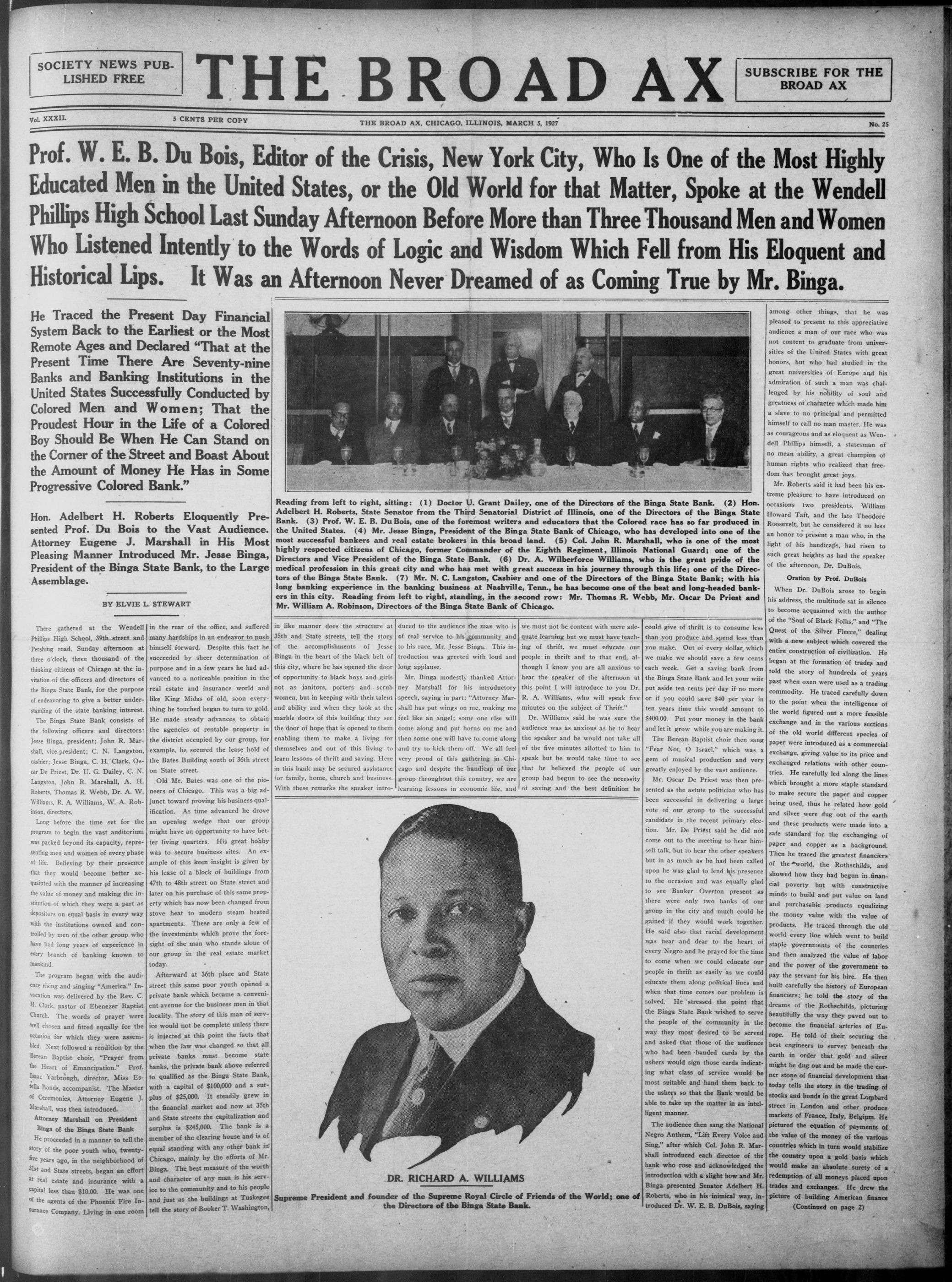
Prof. W. E. B. Du Bois, Editor of the Crisis, New York City, Who Is One of the Most Highly Educated Men in the United States, or the Old World for that Matter, Spoke at the Wendell Phillips High School Last Sunday Afternoon Before More than Three Thousand Men and Women Who Listened Intently to the Words of Logic and Wisdom Which Fell from His Eloquent and Historical Lips. It Was an Afternoon Never Dreamed of as Coming True by Mr. Binga.
SOCIETY NEWS PUBLISHED FREE
Prof. W. E. B. D. Educated Men in Phillips High School Who Listened In Historical Lips.
He Traced the Present System Back to the Early Remote Ages and Declared Present Time There Are Banks and Banking Institution United States Successfully Colored Men and Women Proudest Hour in the Lil Boy Should Be When He the Corner of the Street at the Amount of Money He Progressive Colored Bank
Hon. Adelbert H. Roberts sented Prof. Du Bois to the Attorney Eugene J. Marsh Pleasing Manner Introduced President of the Binga State Assemblage.
He Traced the Present Day Financial System Back to the Earliest or the Most Remote Ages and Declared "That at the Present Time There Are Seventy-nine Banks and Banking Institutions in the United States Successfully Conducted by Colored Men and Women; That the Proudest Hour in the Life of a Colored Boy Should Be When He Can Stand on the Corner of the Street and Boast About the Amount of Money He Has in Some Progressive Colored Bank."
Hon. Adelbert H. Roberts Eloquently Presented Prof. Du Bois to the Vast Audience. Attorney Eugene J. Marshall in His Most Pleasing Manner Introduced Mr. Jesse Binga, President of the Binga State Bank, to the Large Assemblage.
BY ELVIE L. STEWART
There gathered at the Wendell Phillips High School, 39th street and Pershing road, Sunday afternoon at three o'clock, three thousand of the thinking citizens of Chicago at the invitation of the officers and directors of the Binga State Bank, for the purpose of endeavoring to give a better understanding of the state banking interest. The Binga State Bank consists of the following officers and directors: Jesse Binga, president; John R. Marshall, vice-president; C. N. Langston, cashier; Jesse Binga, C. H. Clark, Oscar De Priest, Dr. U. G. Dailey, C. N. Langston, John R. Marshall, A. H. Roberts, Thomas R. Webb, Dr. A. W. Williams, R. A. Williams, W. A. Robinson, directors.
Long before the time set for the program to begin the vast auditorium was packed beyond its capacity, representing men and women of every phase of life. Believing by their presence that they would become better acquainted with the manner of increasing the value of money and making the institution of which they were a part as depositors on equal basis in every way with the institutions owned and controlled by men of the other group who have had long years of experience in every branch of banking known to mankind.
The program began with the audience rising and singing "America." Invocation was delivered by the Rev. C. H. Clark, pastor of Ebenezer Baptist Church. The words of prayer were well chosen and fitted equally for the occasion for which they were assembled. Next followed a rendition by the Berean Baptist choir, "Prayer from the Heart of Emancipation." Prof. Isaac Yarbrough, director, Miss Estella Bonds, accompanist. The Master of Ceremonies, Attorney Eugene J. Marshall, was then introduced.
Attorney Marshall on President Binga of the Binga State Bank
He proceeded in a manner to tell the story of the poor youth who, twenty-five years ago, in the neighborhood of 31st and State streets, began an effort at real estate and insurance with a capital less than $10.00. He was one of the agents of the Phoenix Fire Insurance Company. Living in one room
---
Vol. XXXII.
5 CENTS PER COPY
B. Du Bois, Ed. in the United School Last Suit Intently to theses. It Was a present Day Financial Earliest or the Most declared "That at the time Are Seventy-nine Institutions in theressfully Conducted by Women; That the life Life of a Colored in He Can Stand on street and Boast About they He Has in Some Bank."
Roberts Eloquently Preto the Vast Audience. Marshall in His Mostuced Mr. Jesse Binga, State Bank, to the Large
in the rear of the office, and suffered many hardships in an endeavor to push himself forward. Despite this fact he succeeded by sheer determination of purpose and in a few years he had advanced to a noticeable position in the real estate and insurance world and like King Midas of old, soon everything he touched began to turn to gold. He made steady advances to obtain the agencies of rentable property in the district occupied by our group, for example, he secured the lease hold of the Bates Building south of 36th street on State street.
Old Mr. Bates was one of the pioneers of Chicago. This was a big adjunct toward proving his business qualification. As time advanced he drove an opening wedge that our group might have an opportunity to have better living quarters. His great hobby was to secure business sites. An example of this keen insight is given by his lease of a block of buildings from 47th to 48th street on State street and later on his purchase of this same property which has now been changed from stove heat to modern steam heated apartments. These are only a few of the investments which prove the foresight of the man who stands alone of our group in the real estate market today.
Afterward at 36th place and State street this same poor youth opened a private bank which became a convenient avenue for the business men in that locality. The story of this man of service would not be complete unless there is injected at this point the facts that when the law was changed so that all private banks must become state banks, the private bank above referred to qualified as the Binga State Bank, with a capital of $100,000 and a surplus of $25,000. It steadily grew in the financial market and now at 35th and State streets the capitalization and surplus is $245,000. The bank is a member of the clearing house and is of equal standing with any other bank in Chicago, mainly by the efforts of Mr. Binga. The best measure of the worth and character of any man is his service to the community and to his people and just as the buildings at Tuskegee tell the story of Booker T. Washington,
---
THE BROAD AX
THE BROAD AX. CHICAGO. ILLINOIS. MARCH 5. 1927
DR. RICHARD A. WILLIAMS
President and founder of the Supreme Royal Circle of Friends of the World; one of the Directors of the Binga State Bank.
in like manner does the structure at 35th and State streets, tell the story of the accomplishments of Jesse Binga in the heart of the black belt of this city, where he has opened the door of opportunity to black boys and girls not as janitors, porters and scrub women, but in keeping with their talent and ability and when they look at the marble doors of this building they see the door of hope that is opened to them enabling them to make a living for themselves and out of this living to learn lessons of thrift and saving. Here in this bank may be secured assistance for family, home, church and business. With these remarks the speaker intro-
duced to the audience the man who is of real service to his community and to his race, Mr. Jesse Binga. This introduction was greeted with loud and long applause.
Mr. Binga modestly thanked Attorney Marshall for his introductory speech, saying in part: "Attorney Marshall has put wings on me, making me feel like an angel; some one else will come along and put horns on me and then some one will have to come along and try to kick them off. We all feel very proud of this gathering in Chicago and despite the handicap of our group throughout this country, we are learning lessons in economic life, and
THE NEW YORK TIMES
DR. RICHARD A. WILLIAMS
President of the Supreme Royal Circle of
the Directors of the Binga State Bank
we must not be content with mere adequate learning but we must have teaching of thrift, we must educate our people in thrift and to that end, although I know you are all anxious to hear the speaker of the afternoon at this point I will introduce to you Dr. R. A. Williams, who will speak five minutes on the subject of Thrift." Dr. Williams said he was sure the audience was as anxious as he to hear the speaker and he would not take all of the five minutes allotted to him to speak but he would take time to see that he believed the people of our group had begun to see the necessity of saving and the best definition he
could give of thrift is to consume less than you produce and spend less than you make. Out of every dollar, which we make we should save a few cents each week. Get a saving bank from the Binga State Bank and let your wife put aside ten cents per day if no more or if you could save $40 per year in ten years time this would amount to $400.00. Put your money in the bank and let it grow while you are making it.
The Berean Baptist choir then sang "Fear Not, O Israel," which was a gem of musical production and very greatly enjoyed by the vast audience.
Mr. Oscar De Priest was then presented as the astute politician who has been successful in delivering a large vote of our group to the successful candidate in the recent primary election. Mr. De Priest said he did not come out to the meeting to hear himself talk, but to hear the other speakers but in as much as he had been called upon he was glad to lend his presence to the occasion and was equally glad to see Banker Overton present as there were only two banks of our group in the city and much could be gained if they would work together. He said also that racial development was near and dear to the heart of every Negro and he prayed for the time to come when we could educate our people in thrift as easily as we could educate them along political lines and when that time comes our problem is solved. He stressed the point that the Binga State Bank wished to serve the people of the community in the way they most desired to be served and asked that those of the audience who had been handed cards by the ushers would sign those cards indicating what class of service would be most suitable and hand them back to the ushers so that the Bank would be able to take up the matter in an intelligent manner.
The audience then sang the National Negro Anthem, "Lift Every Voice and Sing," after which Col. John R. Marshall introduced each director of the bank who rose and acknowledged the introduction with a slight bow and Mr. Binga presented Senator Adelbert H. Roberts, who in his imminent way, introduced Dr. W. E. B. DuBois, saying
SUBSCRIBE FOR THE BROAD AX
No. 25
the Most Highly at the Wendell Men and Women His Eloquent and Mr. Binga.
among other things, that he was pleased to present to this appreciative audience a man of our race who was not content to graduate from universities of the United States with great honors, but who had studied in the great universities of Europe and his admiration of such a man was challenged by his nobility of soul and greatness of character which made him a slave to no principal and permitted himself to call no man master. He was as courageous and as eloquent as Wendell Phillips himself, a statesman of no mean ability, a great champion of human rights who realized that freedom has brought great joys.
Mr. Roberts said it had been his extreme pleasure to have introduced on occasions two presidents, William Howard Taft, and the late Theodore Roosevelt, but he considered it no less an honor to present a man who, in the light of his handicaps, had risen to such great heights as had the speaker of the afternoon, Dr. DuBois.
Oration by Prof. DuBois
When Dr. DuBois arose to begin his address, the multitude sat in silence to become acquainted with the author of the "Soul of Black Folks," and "The Quest of the Silver Fleece," dealing with a new subject which covered the entire construction of civilization. He began at the formation of trades and told the story of hundreds of years past when oxen were used as a trading commodity. He traced carefully down to the point when the intelligence of the world figured out a more feasible exchange and in the various sections of the old world different species of paper were introduced as a commercial exchange, giving value to its price and exchanged relations with other countries. He carefully led along the lines which brought a more staple standard to make secure the paper and copper being used, thus he related how gold and silver were dug out of the earth and these products were made into a safe standard for the exchanging of paper and copper as a background. Then he traced the greatest financiers of the world, the Rothschilds, and showed how they had begun in financial poverty but with constructive minds to build and put value on land and purchasable products equalizing the money value with the value of products. He traced through the old world every line which went to build staple governments of the countries and then analyzed the value of labor and the power of the government to pay the servant for his hire. He then built carefully the history of European financiers; he told the story of the dreams of the Rothschilds, picturing beautifully the way they paved out to become the financial arteries of Europe. He told of their securing the best engineers to survey beneath the earth in order that gold and silver might be dug out and he made the corner stone of financial development that today tells the story in the trading of stocks and bonds in the great Lombard street in London and other produce markets of France, Italy, Belgium. He pictured the equation of payments of the value of the money of the various countries which in turn would stabilize the country upon a gold basis which would make an absolute surety of a redemption of all moneys placed upon trades and exchanges. He drew the picture of building American finance (Continued on page 2)
```markdown
```
President of the famous Cook County Democracy, with their
high silk hats and its wonderful band, have joined hands,
bag and baggage with Hon. William Hale Thompson and
will assist to elect him Mayor of Chicago.
i
THE SIXTH ANNUAL RECEP- |“CHICAGO’S HEALTH"—ADDING
TION AND DANCE OF THE| YEARS TO THE OTHER END
APPOMATTOX CLUB, 3632 —
SOUTH PARKWAY Weekly Bulletin, Chicago Department
Last Thursday evening, the far
famed Appomattox Club, which has
become the highest class social and
civic club in the United States, held its
sixth annual reception and dance at
St. Elizabeth Assembly Hall, 4100 S.
Michigan avenue.~
So far it was the very finest func-
tion given by it. It was attended by
fully five hundred club members and
invited guests; guests being present
from New York City, Washington,
D. C.; Philadelphia, Pa; St. Louis,
Mo; Atlanta, Ga; and other points.
All the ladies were handsomely and
expensively costumed and they looked
ever so swéet and charming. With one
or two exceptions, all the gentlemen
appeared in full dress evening suits and
looked right up-to-date in the minutest
detail.
President David B. Hawley and
Secretary Frank S. Stephens assisted
by the other members of the club,
made it very pleasant for their honored
guests.
Cooling refreshments were served
free throughout the evening. and no
one was called upon to spend one cent
to contribute to the pleasures of the
evening. The dancing music was live-
‘ly and snappy and was greatly enjoyed
by the dancers and it scemed that
everybody danced and regretted to
strike out for their homes when the
orchestra struck. up “Home Sweet
“Home.”
DEMISE OF MRS. BEATRICE
MOORE
Mrs. Beatrice Moore, the wife
of Dr. Edw. W. Moore of 3655 South
Parkway. Services were held at South
Park Methodist Episcopal Church,
30th street and Prairie avenue, Mon-
day, February 28, 1927, at eleven
o'clock A.M. The funeral sermon was
preached by the Rev, Carroll, pastor
of the South Park M. E. Church, of
which Mrs. Moore had been a mem-
ber during her residence in Chicago.
She was a devoted member and an
ardent supporter of every cause for
which she had strength to lend aid. It
will be a task to find some one to pick
up the burden which she has laid down.
There was a large attendance from the
Medical Association of which Dr
Moore is a part and out of respect
for Herman Moore, an attorney of th
firm of Moore, Dawson & Wilkins
the Bar Association was present it
large numbers. The floral tributes fille
two autos and more than twenty car
of friends followed the remains to Oak
wood Cemetery, where Mrs. Moor
was interred in the family plot. Six
is survived by a husband, Dr. Edw. W
Moore; a son, Attorney Hermar
Moore and two daughters, Mrs. Frec
Williams and Mrs. Flowers.
The funerat was under the direction
“of Ernest H. Williamson, who hadi
service what is known to the craft hi
entire fleet of Cunninghams, Hei
the only. funeral director in Chicag
who is ablé to furnish autos of thi
HON. MILES J. DEVINE
“CHICAGO'S HEALTH"—ADDING
YEARS TO THE OTHER END
Weekly Bulletin, Chicago Department
of Health, by Herman N. Bunde-
sen, M. D., Commissioner
“A ten years’ sentence and $25,000.00
in fines is a severe punishment. Ten
years out of one’s life, being deprived
of the things we love and, in addition,
paying a sum of money in reduced
earning capacity is the penalty of
breaking health laws.
“This happens every day of the
year,” says Dr. Herman N. Bundesen,
in his latest bulletin.
“There are many persons who just
feel ‘middlin’, as they say: not bad,
nor really sick, but simply not fit.
They blame everything under the sun
but themselves for their failures. The
battle of life is a success or failure de-
pending on the exercise of right health
habits,”* says the Commissioner.
“Many persons do their exercising
about three months in the year; that is,
during the summer. Of course the
warm weather itivites outdoor life. This
means walking, rowing, baseball, golf.
ing, and a number of outdoor game:
and recreation. - Then follows nine
months of inactivity and reduced exer.
cise.
“During the cold weather, exercise is
also necessary because it is during this
time indoor living leads to overeating
‘and lessened activity. To offset this
condition, there are many gymnasium
and health clubs tiat offer a variety o
health-promoting. recreational sport:
and exercises,” is the advice of Dr
Bundesen.
“Right food, rightly eaten, enough
rest and sleep, plenty of fresh air an¢
sunshine, enough play, freedom fron
worry, and cleanliness both inside ané
‘out, are the prime factors which key
us out of the sickness prison, increase
‘our earning capacity, and enable us t
‘enjoy life as we go along,” says th
Commissioner.
NEW YORK WOMEN HELD ON
SHOPLIFTING CHARGE
(Prseton News Service)
Pittsburgh, Pa. Mar. 4.—After dé-
tectives of a large department store
here testified that they had seen two
women each take a dress from a
hanger and stuff it beneath their outer
garments Thursday afternoon, Rose
Gilbert, aged 25, and Evelyn Pritchard,
aged 34, who gave their addresses as
New York City, were held for court
by Magistrate Brandon’ in Morals
court Friday morning charged with
larceny. The women admitted the
thefts and testified that they had ar-
rived in Pittsburgh only Thursday
morning.
|SCHOOL BOY DIES IN SWIM.
MING POOL
anit Bane Dae’
Pittsburgh, Pa, Mar. 4—David A.
Fulton, Jr., aged 16 years, was taken
from the swimming pool in South
Hills High Schoo! Tuesday afternoon,
during the period for the swimming
class, by the director of athletics in a
dying condition. All efforts to resusi
tate him failed. Physicians say he died
x ‘a heart attack witch he suffered
when he dived itito the pool.
‘THE BROAD AX, CHICAGO, ILLINOIS, MARCH 5, 1927
a
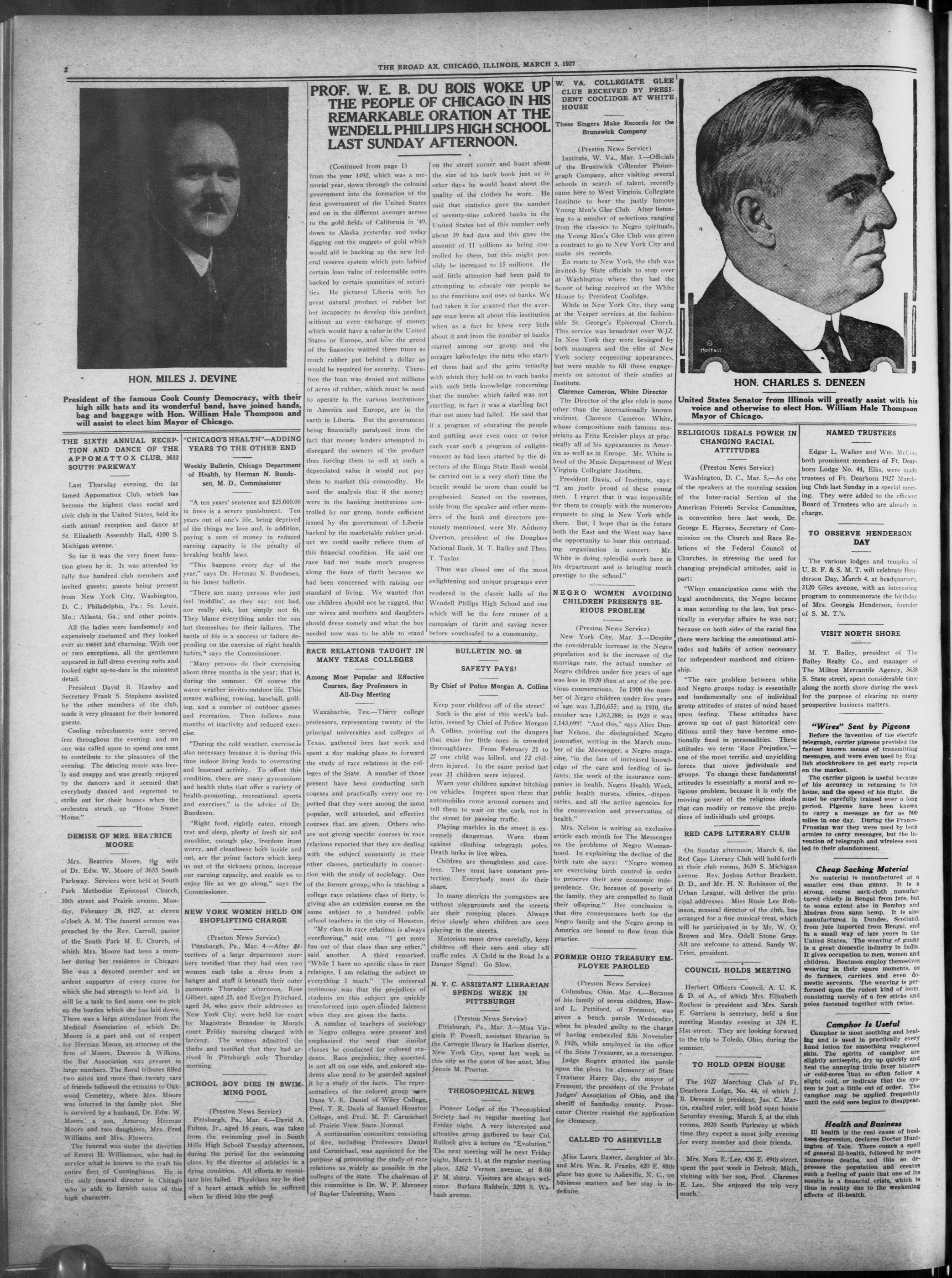
PROF. W. E. B. DU BOIS WOKE UP|™...>°
THE PEOPLE OF CHICAGO IN HIS) 27,
REMARKABLE ORATION AT THE
WENDELL PHILLIPS HIGH SCHOOL |"~ *3
LAST SUNDAY AFTERNOON. =
(Continued from page 1)
from the year 1492, which was a me-
morial year, down through the colonial
government into the formation of the
first government of the United States
and on in the different avenues across
to the gold fields of California in "49,
down to Alaska yesterday and today
digging ont the nuggets of gold which
would aid in packing up the new fed-
‘eral reserve system which puts behind
certain loan value of redeemable notes
backed by certain quantities of securi-
ties. He pictured Liberia with het
great natural product of rubber but
her incapacity to develop this product
without an even exchange of money
which would have a value in the United
States or Europe, and how the greed
of the financier wanted three times as
much rubber put behind a dollar as
would be required for security. ‘There-
fore the Toan was denied and millions
of acres of rubber, which must be used
to operate in the various institutions
in America and Europe, are in the
earth in Liberia. But the government
being financially paralyzed from the
fact that money lenders attempted to
disregard the owners of the product
thus forcing them to sell at such a
depreciated value it would not pay
them to market this commodity. He
used the analysis that if the money
were in the banking institutions con-
trolled by our group, bonds sufficient
issued by the government of Liberia
packed by the marketable rubber prod-
uct we could easily relieve them of
this financial condition, He said our
ace had not made much progress
along the Hines of thrift because we
had been concerned with raising our
standard of living. We wanted that
our children should not be ragged, that
our wives and mothers and daughters
should dress comely and what the boy
needed now was to be able to stand
RACE RELATIONS TAUGHT IN
MANY TEXAS COLLEGES
Among Most Popular and Effective
Courses, Say Professors in
All-Day Meeting
Waxahachie, Tex—Thirty college
professors, representing twenty of the
principal universities and colleges of
Texas, gathered here last week and
spent a day making plans to forward
the study of race relations in the col-
leges of the State. A number of those
present have been conducting such
courses and practically every one re-
ported that they were among the most
popular, well attended, and effective
courses that. are given. Others who
are not giving specific courses in race
relations reported that they are dealing
with the subject constantly in. their
other classes, particularly in connec-
tion with the study of sociology. One
of the former group,;who is teaching a
college race relations class of forty, is
giving also an extension course on the
same subject to a hundred public
school teachers in the city of Houston,
“My class in race relations is always
overflowing,” said one. “I get more
fun out of that class than any other,”
said’ another. A third remarked,
“While I have no specific class in race
relations, I am relating the subject to
everything I teach.” The universal
testimony was that the prejudices of
students on this subject gre quickly
transformed into open-finded fairness
when they are given the facts.
A number of teachers of sociology
in Negro colleges were present and
emphasized the need that similar
classes be conducted for colored stu.
dents. Race prejudice, they asserted
is not all on one side, and colored stu-
dents also need to be guarded agains
jt by a study of the facts. The repre
sentatives of the colored group wer
Dane V. E. Daniel of Wiley College
Prof. T. R. Davis of Samuel Houstor
College, and. Prof. M. P. Carmichae
of Prairie View. State-Normal.
A continuation ‘committee consistin;
of five, including Professors Danie
and Carmichael, was appointed for th
[purpose of promoting the study of rac
relations as widely as possible in th
‘colleges of the state. The chairman o
| this committee is Dr. W. P. Merone:
‘of Baylor University, Waco. -
‘on the street corner and boast about
the size of his bank book just as in
other days he would boast about the
quality of the clothes he wore. He
said that statistics gave the number
of seventy-nine colored banks in the
United States but of this number only
about 39 had data and this gave the
amount of 11 millions as being con-
trolled by them, but this might pos-
sibly be increased to 15 millions. He
said little attention had been paid to
attempting to educate our people as
to the functions and uses of banks. We
had taken it for granted that the aver-
age man knew all about this institution
when as a fact he knew very: little
about it and from the number of banks
started among our group and the
meagre knowledge the men who start-
ed them had and the grim tenacity
with which they held on to such banks
with such little knowledge concerning
that the number which failed was not
startling, in fact it was a stariling fact
that not more had failed. He said that
if a program of educating the people
and putting over even once or twice
each year such a program of enlight-
enment as had been started by the di-
rectors of the Binga State Bank would
be carried out in a very short time the
benefit would be more than could be
prophesied. Seated on the rostrum,
aside from the speaker and other mem-
bers of the bank and directors pre-
viously mentioned, were Mr. Aitthony
Overton, president of the Douglass
National Bank, M. T. Bailey and Theo.
T. Taylor. |
‘Thus was closed one of the most
enlightening and unique programs ever
rendered in the classic halls of the
Wendell Philips High School and one
which will be the fore runner of a
campaign of thrift and saving never
before vouchsafed to & €ominunity,
BULLETIN NO. 98
SAFETY PAYS!
By Chief of Police Morgan A. Collins
Keep your children off of the street!
Such is the gist of this week's bul-
letin, issued by Chief of Police Morgan
A. Collins, pointing out the dangers
that exist for little ones in crowded
thoroughfares, From February 21 to
2 one child was killed, and 72 chil-
dren injured. In the same period last
year 31 children were injured.
Warn your children against hitching
on vehicles. Impress upon them that
automobiles come around corners and
tell them to wait on the curb, not in
the street for passing traffic.
Playing marbles in the street is ex-
tremely dangerous. Warn them
against climbing telegraph _poles.
Death lurks in live wires.
Children are thoughtless and_care-
free. They must have constant pro-
tection. Everybody must do their
share.
In many districts the youngsters are
without playgrounds and the streets
are their romping places. Always
‘drive slowly when children are seen
playing in the streets.
Motorists must drive carefully, keep
children off their cars and obey all
traffic rules. A Child in the Road Is a
Danger Signal: Go Slow. =
N. Y. C. ASSISTANT LIBRARIAN
SPENDS WEEK IN
PITTSBURGH
(Preston News Service)
Pittsburgh, Pa., Mar. 3—Miss Vir-
ginia P. Powell, assistant librarian in
the Carnegie library in Harlem district,
New York City, spent last week in
this city as the guest of her aunt, Miss
Jennie M. Proctor.
THEOSOPHICAL NEWS
Pioneer Lodgé of the Theosophical
Society had its regular meeting last
Friday night. A very interested and
attentive group gathered to hear Col.
Bullock give a fecture on “Evolution.”
‘The next meeting will be next Friday
night, March 11, at the regular meeting
place, 3262 Vernon avenue, at 8:00
P.M. sharp. Visitors are always wel-
come. Barbara Baldwin, 3201 S. Wa-
‘bath aioe:
W. VA. COLLEGIATE GLEE
CLUB RECEIVED BY PRESI-
DENT COOLIDGE AT WHITE
HOUSE
These Singers Make Records for the
Brunswick Company
(Preston News Service).
Institute, W. Va., Mar. 3.—Officials
of the Brunswick Collender Phono-
graph Company, after visiting several
schools in search of talent, recently
came here to West Virginia Collegiate
Institute to hear the justly famous
Young Men's Glee Club. After listen-
ing to a number of selections ranging
from the classics to Negro spirituals,
the Young Men’s Glee Club was given
a contract to go to New York City and
make six records.
En route to New York, the club was
invited by State officials to stop over
at Washington where they had the
honor of being received at the White
House by President Coolidge.
While in New York City, they sang
at the Vesper services at the fashion-
able St. George's Episcopal Church.
This service was broadcast over WJZ.
In New York they were besieged by
both managers and the elite of New
York society requesting appearances,
but were unable to fill these engage-
ments on account of their studies at
Institute.
Clarence Cameron, White Director
The Director of the glee club is none
other than the internationally known
violinist, Clarence Cameron White,
whose Compositions such famous mu-
sicians as Fritz Kreisler plays at prac-
tically all of his appearances in Amer-
iea as well as in Europe. Mr. White is
head of the Music Department of West
Virginia Collegiate Institute.
President Davis, of Institute, says:
“I am justly proud of these young
men. I regret that it was impossible
for them to comply with the numerous
requests to sing in New York while
there. But, I hope that in the future
both the East and the West may have
the opportunity to hear this outstand-
ing organization in concert. Mr.
White is doing splendid. work here in
his department and is bringing much
prestige to the school.”
NEGRO WOMEN AVOIDING
CHILDREN PRESENTS SE-
RIOUS PROBLEM
(freston News Service)
New York City, Mar. 3—Despite
the considerable increase in the Negro
population and in the increase of the
marriage rate, the actual number of
Negro children under five years of age
was less in 1920 than at any of the pre-
vious enumerations. In 1900 the num-
ber of Negro children under five years
of ‘age was 1,216,655; and in 1910, the
number was 1,263,288; in 1920 it was
1,143,699! “And this,” says Alice Dun-
bar Nelson, the distinguished Negro
journatist, writing in the March num-
ber of the Messenger, a Negro maga-
zine, “in the iace of increased knowl-
edge of the care and feeding of in-
fants; the work of the insurance com-
panies in health, Negro Health Week,
public health nurses, clinics, -dispen-
saries, and all the active agencies for
the conservation and preservation of
health.”
Mrs. Nelson is writing an exclusive
article each month for The Messenger
on the problems of Negro Woman-
hood. In explaining the decline of the
birth rate she says: “Negro women
are exercising birth control in ordet
to preserve their new economic inde-
pendence. Or, because of poverty of
the family, they are compelled to limit
their offspring.” Her conclusion is
that dire consequences both for the
Negro family and the Negro group in
America are bound to flow from this
‘Seaction:.
FORMER OHIO TREASURY EM-
PLOYEE PAROLED
(Preston News Service)
Columbus, Ohio, Mar. 4.—Because
of his family of seven children, How-
ard L. Pettiford, of Fremont, was
given a bench parole Wednesday,
when he pleaded guilty to the charge
of having embezzled $36 November
9, 1926, while employed in the office
of the State Treasurer, as a messenger,
Judge Rogers granted the parole
upon the pleas for clemency of State
Treasurer Harry Day, the mayor of
Fremont, the president of the Probate
Judges’ Association of Ohio, and the
sheriff of Sandusky county. Prose-
‘cutor Chester resisted the application
for clemency.
CALLED TO ASHEVILLE
Miss Laura Baxter, daughter of Mr.
and Mrs. Wm. R. Franks, 420 E. 48th
place has gone to Asheville, N. C., on
bisiness matters and her stay. is in~
‘Gelinite,
: LG L)
VE LOFS fie
iin Ore
ee
EN A
eo 0h—6hlUmUUCCUS
i
f |
Bee |
| Reret a |
HON. CHARLES S. DENEEN
United States Senator from Illinois will greatly assist with his
voice and otherwise to elect Hon. William Hale Thompson
Mayor of Chicago.
RELIGIOUS IDEALS POWER IN NAMED TRUSTEES
CHANGING RACIAL —
ATTITUDES Edgar L. Walker and Wm. M
—— both prominent members of Ft. Dear-
(Preston News Service) iene distee e 44> Bike were made
Washington, D. C., Mar. 5—As one
of the speakers at the morning session
of the Inter-racial Section of the
American Friends Service Committee,
in convention here last week, Dr.
George E. Haynes, Secretary of Com-
mission on the Church and Race Re-
lations of the Federal Council of
Churches, in stressing the need for
changing prejudicial attitudes, said in
part:
“When emancipation came with the
legal amendments, the Negro became
‘a man according to the law, but prac-
tically in everyday affairs he was not;
cause on both sides of the racial line
there were lacking the emontional atti-
tudes and habits of action necessary
for independent manhood and citizen-
ship.
“The race problem between white
and Negro groups today is essentially
and fundamentally one of individual
group attitudes of states of mind based
upon feeling. ‘These attitudes have
grown up out of past historical con-
ditions until they have -become emo-
tionally fixed in personalities. These
attitudes we term ‘Race Prejudice,—
‘one of the most terrific and unyielding
forces that move jndividuals and
groups. To change these fundamental
attitudes is essentially a moral and re-
ligious problem, because it is only the
moving power of the religious ideals
that can modify or remove the preju-
dices of individuals and groups.
RED CAPS LITERARY CLUB
On Sunday afternoon, March 6, the
Red Caps Literary Club will hold forth
at their club rooms, 3639 S. Michigan
avenue. Rev. Joshua Arthur Brackett,
D. D., and Mr. H. N. Robinson of, the
Urban League, will deliver the prin-
cipal addresses. Miss Rosie Lee Rob-
inson, musical director of the club, has
arranged for a fine musical treat, which
will be participated in by Mr. W. O.
Brown and Mrs. Odell Stone Gray.
All are welcome to attend. Sandy W.
Trice, president.
COUNCIL HOLDS MEETING
Herbert Officers Council; A. U. K.
& D. of A, of which Mrs. Elizabeth
Rochon is president and Mrs. Sarah
E. Garrison is secretary, held a fine
meeting Monday evening at 324 E.
Sst street. They are looking forward
to the trip to Toledo, Ohio, during the
summer.
TO HOLD OPEN HOUSE
‘The 1927 Marching Club of Ft.
Dearborn Lodge, No. 44, of which J.
B. Deveaux is president, Jas. C. Mar-
tin, exalted ruler, will hold open honse
Saturday evening, March 5, at the club
rooms, 3920 South Parkway at which
time they expect a most jolly evening
for every member and their friends.
Mrs. Nora E.-Lee, 436 E. 49th street,
spent the past week in Detroit, Mich.,
visiting with her son, Prof. Clarence
E. Lee. She enjoyed the trip very
much.
NAMED TRUSTEES
Edgar L. Walker and Wm. McC
both prominent members of Ft, Dear-
born Lodge No. 44, Elks, were made
trustees of Ft. Dearborn 1927 Marci:
ing Club last Sunday in a special meet
ing. They were added to the efficient
Board of Trustees who are already in
charge.
TO OBSERVE HENDERSON
DAY
The various lodges and temples of
U. B. F. & S. M. T. will celebrate Hen.
derson Day, March 4, at headquarters,
3120 Giles avenue, with an interesting
Program to commemorate the birthday
of Mrs. Georgia Henderson, founder
of S. M. Ts.
VISIT NORTH SHORE
M. T. Bailey, president of The
Bailey Realty Co., and manager of
The Milton Mercantile Agency, 3638
S. State street, spent considerable time
along the north shore during the week
for the purpose of clearing up many
prospective business matters.
“Wires” Sent by Pigeons
Before the invention of tie electric
telegraph, carrier pigeons provided the
fastest known means of transmitting
messages, and were even used by Hng-
lish stockbrokers to get early reports
on the market.
The carrier pigeon is useful because
of his accuracy in returning to his
home, and the speed of his flight. He
must be carefully trained over « long
period. Pigeons have been known
to carry a message as far as 500
miles in one day. During the Franco-
Prussian war they were used by both
armies to carry messages, but the !n-
vention of telegraph and wireless soon
led to their abandonment.
Cheap Sacking Material
‘No material 's manufactured at &
smaller cost than gunny. It is &
strong, coarse sack-cloth , manufac-
tured chiefly in Bengal from jute, but
to some extent also in Bombay and
Madras from sunn hemp. It is also
manufactured in Dundee, Scotland,
from jute imported trom Bengal, and
im a small way of late years in the
United States, The weaving of cunny
is a great domestic industry in India.
It gives occupation to men, women and
children. Boatmen employ themselves
weaving in their spare moments, a5
do farmers, carriers and even do-
mestie servents, The weaving is per-
formed upon the rudest kind of loom
consisting merely of a few sticks and
poles fastened together with twine.
Camphor Is Useful
‘Camphor is most soothing and heal-
fng and is used in practically every
hand lotion for smoothing roughened
skin. The spirits of camphor are
slightly antiseptic, dry up quickly and
heal the annoying little fever blisters
vr cold-sores ‘that so often follow &
slight cold, or indicate that the ss*
tem is just a little out of order. The
camphor may be applied frequently
‘until the cold sore begins to disappea'-
Health and Business
Til Bealth is the real cause of ous”
ness depression, declares Doctor Hunt-
ington of Yale. There comes a spel!
of general ill-health, followed by more
Humerous deaths, and this so de-
presses the population and creates
such a feeling of punic that one of its
results is a financial crisis, which (s
thus in reality due to the weakening
effects of ill-health.
THIS WEEK
Emest Rice McKinney
ee
sreston News Service)
ss. Phuc fer Colienuiene:
and bolt MAR ae ae
that this company has five employees
‘yhose years of service total 235 years.
‘The ollest in point of service has been
‘pith the company 70 years. No one of
the five bas worked for the company:
jess than 50 years. This must be a
prewy good company to work for.
‘There isn't much chance for the Com~
nonists to get in any effective prop-
jeands around this company's back
yard. This and other organizations
jych as Dennison Manufacturing Com-
pany and Procter and Gamble are
proving that it is possible for employer
ind employee to get along together in
peace, contentment and to their mutual
benefit.
This struggle in an industrial jungle
is not really necessary. All the fault
docs not lie with the employers nor
wholly with the workers. Each of
these groups has a duty and-respon-
sibility to the other and they both
certainly owe something to the con-
comers, potential and actual. Tt may
tea long time coming, hut if this con-
inves and costly industrial strife does
not cease something is going to hap-
pen. Who knows; we may end up
with a Lenin or we may go the other
way and set up a Mussolini.
Employer and Employee
It is particularly important now, that
we are beginning to expand commer-
cially, that Negro business men and
corporations give some thought and at
tention to their employees as well as
profits. Satisfied employees are the
foundation pillars of profits and a
stable growing business.
It is my experience that Negro em-
ployers, as a group, have paid no at-
tention at all to this most important
phase of business development. In the
first place Negro employers have not
earned yet, that nothing takes the
place of real money as the reward for
ficient service. They haven't learned
‘that a worker will not be efficient un-
less he is contented. He will not be
contented unless he is paid adequately,
regularly and PROMPTLY. There
are far too many Negro business men
‘who feel that they have done the em-
ployee a favor when the worker has
teen handed his pay envelope on time
for the full amount. T have known
Negro business men to. brag lustily
over the fact that they met their pay
roll promptly each week.
It seems to me, also, that there is a
large group of Negro business men
who deliberately refuse to employ the
more intelligent and better trained
young men and women of our race.
Even where trained men are hired they
are usually cramped and not allowed
to make experiments that are abso-
Intely necessary for the growth of the
business and of the man. It is not
enough for these employers to reply
that these young men and women are
inexperienced and that they have
“wild” ideas. Of course, they are in-
experienced. What man, old or young,
fresh from an engineering school or a
medical <chool or a business school is
tot inexperienced?
Young white men are inexperienced
and filled with “wild” ideas, and yet,.
ten, fifteen or twenty years later they
are at the head of the business. About
the only way for a young Negro. to
become president of the corporation
'8 to go out and set up his own busi-
tess. The older Negroes at the head
of our businesses just don’t seem to
et the point at all.
We have never produced a man of
the type of Edison. It isn’t because
we have no potential Edisons, It isn't
due to innate mental poverty. We
hare as much inherent mental capacity
3 any other race. This seems to be
‘ruc from the unbiased investigations:
of competent scientists. The reason
fies in one of our peculiar men-
fal twists, It will be remembered that
Efison is and was a genius at invent-
ing and d-vising new machines and ap-
Pliances. Some of these inventions call
for very intricate mathematical calea~
Khtions and certain knowledge of ab-
Sruce technical procedure. Edison did
fot and does not now have the meces~
Sty theoretical equipment to make
many of these calculations and. experi-
ment: Hut he did have sense and fore-
‘Public Of-.
Harvey A. Watkins of the Second
ward, Chicago, was a candidate in the
primaries for the City Council from
that ward on the Republican ticket. At
‘the time this is being written T do not
know whether or not Mr, Watkins
‘won out. I do know, however, that he
should not have been the choice of the
voters. The foundation of Mr. Wat.
kins’ candidacy was the most ancient
kind of political bunk combined with
the most glaring “pork barrell” con-
ception of public office.
Here is the first reason, given by
Watkins, why the electors should vote
for Watkins instead of Louis Ander-
son, the present incumbent. Says
Watkins in his political advertising—
“Alderman Anderson has been on the
Public payrool for 31 years. Give
another man a chance.” This is the
primary reason why Anderson should
be kicked out and Watkins put in, ac-
cording to Watkins. What does Wat-
Kins mean by “give another man a
chance.” A chance to get what and to
do what?
Do Watkins and all his kind conceive
of public office as a chance to get
something: for themselves, to do some-
thing for themselves? Is it wrong, or
inefficient or undesirable to retain an
individual in public office for 31 years?
Would Watkins, himself, refuse to re-
main on the pfiblic payroll for 31 years
if he got the opportunity?
No emphasis is put on ability or fit-
ness, only the suggestion that one man
be put out so that another man may
get his nose in the trough for a while.
This is a conception of public office all
too prevalent. It is the starting point
for graft, bribery, incompetency in ad-
ministration and all the other evils that
attend our entire political organization.
Practice of Kissing
Not Universal Custom
The idea of the kiss being an in-
stinctive gesture.is negatived by its
being unknown over half the world,
where the prevailing salute is that by
smelling or sniffing (often called by
travelers “rubbing noses”). . .
‘The kiss appears constantly in Semitic
and Aryan antiquity.
In Greece in the classic period it be-
came customary to kiss the hand,
breast or knee of a superior. In
Rome the kisses of inferlors became
a burdensome civility. The early
Christians made it the sign of fellow-
ship. It early passed into more cere-
monial form in the kiss of peace given
to the newly baptized and in the cele-
bration of the eucharist.
While the kiss has been adopted as
a religious rite, its original social use
has continued. Among men, however,
it has become less effusive. Court cer-
‘emontal keeps up the kiss on the cheek
between sovereigns and the kissing of
the hand by subjects, and the pope,
like a Roman emperor, receives the
kiss on his fdot—Encyelopedia Bri-
tannica.
Waring Candlous
Henry Drummond, author of “The
Greatest Thing in the World,” in bis
lighter moments (and he had many)
was full of gayety, frequently dis-
playing @ unique and versatile form
of wit. He was one of a group assem-
bled one night at the home of Drum-
mond’s minister, Dr. Marcus Dods.
During the supper, which had to
be taken by candle light, one of the
candles began to droop. One of the
young men set it upright, then it
drooped to the other side. Finally it
became a subject of remark.
Someone called it a most wicked
candle; another said it should be
sent to Greece, and sundry other
jokes were leveled at the unfortunate
light giver. Finally Drummond said,
very earnestly, he thought the conver-
sation was beginning to wax scan-
dalous.
Ancient Farm Rales
A Greek inscription of the Fifth cen-
tury, recently discovered near the
aqueduct which conveyed water into
‘Jerusalem, contains a warning, both
‘against trespass and planting crops
within fifteen “polos” (fifteen feet) of
the conduit. To make sure the peasant
‘should not plead ignorance of the dis-
tance, the “foot” 12 1-16 inches long,
‘was engraved on the stone.
Shattering Joy
“an astronomer,” said Hi Ho, 16
sage of Chinatown, “looks into the
skies and discovers beautiful things
so distant that they must be measured
by light years. ‘The Joy of mathemat-
jes is rudely interrapted when he is
notified that his bank account 1s
four dollars overdrawn.”—Washington
Star.
Medieval Flowers
‘The cultivation of flowers in the
Middle ages was not merely a delight
in beauty; superstition led to some
peculiarly mundane uses. Flowers
were charms to keep away evil spir-
its; they were prized for medicinal
value, made into love philters and
adopted as emblems of rival camps
and factions.
Forest Destruction
‘The virgin forests in prehistoric
times were not entirely destroyed by
fires started from lightning, because
‘they were cool, dark, moist-and very
dense, ‘This made them much less in-
fiammable than the present-day
thinned-out forests.
THE BROAD AX, CHICAGO, ILLINOIS, MARCH 5, 1927
; 2
‘COLORFUL NEWS MOVIES
By THE CAMERAMAN
PPDDPPLLLLDD OPPLDIDLDDIDDLDDPLDPDPLODIDIPIPIIDIOLD
(Preston News Service) Contee Cullen
— We as a group must be ever co
1. Land Grant College Survey. nizant of the achievements of one
2. Archbishop Curley’s Plea. our own, lest in this maelstrom
3. Sailor, Beware! hatred, discrimination and_ prejudi
4. Contee Cullen. we became discouraged and almo
5. Fanning the Flames. lose heart. Contee Cullen, poet
6. Tuning in on Kentucky. colour, has received the recognition
= one of the oldest and best known ma
Seca Gece ae ea azines in America. The February i
Congress has appropriated $110,000
for the purpose of surveying the land
grant colleges of the United States, in-
cluded in which there are a number of
Negro colleges. In fact, the southern
states boast of seventeen land grant
colleges, devoted -exclusively to. the
training of Negro students. In the
northern states, where, of course, there
are no Jim Crow school laws, Negro
students have access to any land grant
college which they may select.
Tt is estimated that the survey,
which is to be conducted by the U. S.
Bureau of Education, will require two
years of itensive ‘work to complete
the survey task. Since the Civil War,
Congress has appropriated $60,000,000
to the support of the land grant col-
leges, and it is said that the prospec-
tive survey is to reveal whether or not
they are fully carrying out the inten-
tions of Congress.
Negroes are intensejy interested in
the work of their students, whether in
segregated or non-segregated land
grant colleges—and they have a right
to be so, as contributors to and de-
fenders of the parent Government. It
may not be amiss to refresh the race's
recollection of the survey of Negro
schools made more than,a decade ago
by Dr. Thomas Jesse Jones (white)
and the two-volume report which Dr.
Jones made, showing veiled but gross
discriminations in the cooperative sup-
port of the Negro schools, as between
State and Federal governments. These
conditions, though somewhat im-
proved, will probably be revealed again
in the prospective survey.
In view of the peculiar conditions
confronting the solid bloc of Negro
schools in the Southland, it is partieu-
larly desirable that educational experts
of the Negro race be assigned to some
‘of the survey work. There are ample
race men and women available. Let
them be appointed to this survey, so as
to secure both the racial and the bi-
racial view of the entire situation con-
fronting the Negro land grant colleges.
Archbishop Curley’s Plea
Believe it or not, the Church ot
Rome has gone as far, if not further
than any contemporary church, in
sounding the cry of “One God, One
Church, One Creed,” loud enough to
be heard, without amplifiers, by the
struggling black people of America.
In fact, the Roman Catholic Church
has repeatedly challenged the Protes-
tant Church to meet its standards of
religious fairplay.
Recently, in Washington, D. C., be-
fore an audience of twe thousand
whites, Archbishop Micheal J. Curley
urged that the colored people of the
country be extended the same educa-
tional advantages as the white people.
If the country would but hear this cry,
what a Heaven on earth would come
to pass. The Archbishop doubtless
had in mind spiritual as much as se-
cular education—a spiritual education
reaching from St. Peter's Cathedral, in
New York, to the lowliest parish house
of New Orleans—irom the Salvation
Army barracks to the Y. M. C. A—
from ‘colorful education to colorless
education, save in the internal essence
‘of “Go thou and preach the gospel to
the whole world.” and in so doing,
“Love thy neighbor as thyself.” God
bless Archbishop Curley.
Sailor, Beware!
It is to be hoped that the Negro
group of American citizens will not be
easily misled into “something” of
which they know “nothing.” That the
Communist clan—the latest radical or-
ganization—is willing to include Ne-
groes into their midst may look 100
‘per cent on the surface, but the fact
that there “will be a colored section
‘of the: klan known as the Touissant
‘L’Ouveurture Auxiliary” has the same
‘Contee Cullen
nizant of the achievements of one of
our own, lest in this maelstrom of
hatred, discrimination and prejudice
we became discouraged and almost
lose heart. Contee Cullen, poet of
colour, has received the recognition of
one of the oldest and best known mag-
azines in America, The February is-
sue of Harper's Magazine has pub-
lished two of Mr. Cullen's sonnets.
This is, indeed, quite an honor for any
young man; and it comes asa most
singular honor to one of our group
who must always measure a_ little
above the grade in order to reach the
standard set by Nordic culture dnd
prejudice.
It is needless to say that these two
little verses are beautiful. They re-
verberate the true style and spirit of
Cullen. It is of most importance that
this young man’s poetic achievement
may serve as an inspiration to other
young people and encourage them in
whatever field of endeavor they may
be laboring—knowing that true worth
will finally be recognized and rewarded
regardless of racial handicaps. ”
Fanning the Flames
Mare Anthony said “The evil that
men do lives after them, the good is
oft interred with their bones; so let it
be with Caesar.’ And so it is ever and
anon with the Negro. Hatred and
prejudice makes it even worse than
this, for the evil, that some poor er-
ring Negro, who has never had one-
half a chance, has done lives not only
after him but lives with the whole
race as a stigma branding it as
“inieriro.” 5
The good done by fifty or one hun-
dred ambitious, seli-respecting Ne-
groes is interred in a grave dug by
hatred, discrimination and prejudice,
upon which is erected a monument
with K. K. K. engraved thereon.
Will the Anglo-Saxon newspapers
ever serve as a firebrand to keep alive
atrocious sparks of hatred and prej-
udice by “broadcasting,” in glaring
headlines on.their front pages, “news”
of Negro crime? Perhaps such papers
find it advantageous from an economic
standpoint, to flaunt Negro crime to
that class of white population which is
kept busy trying to keep the Negro
down, regardless of the bitter feeling
thus aroused which often leads to race
riots and take its toll in both whites
and blacks.
Probably in the Millennium we will
read on the front pages of Nordic
newspapers such news items as “How-
ard University Graduate is Awarded a
Fellow in Zoology by Harvard Univer-
sity,” or “Booker T. Washington's
autobiography “Up from Slavery’ has
been translated into the Turkish lan-
guage for use in the libraries and
schools in Turkey.”—Real News.
‘Tuning in on Kentucky
Last Saturday night we had. the
pleasure of tuning in on Station
WFIW, Hopkinsville, Ky., from
whence, a thousand miles o'er the air,
came the melodious voices of Mrs. M.
L. Copeland and her trained choir,
singing Negro songs of brightness and
hope, with, now and then, a plaintive
note which white critics would say was
modulant with the sorrow of before-
the-war days.
The radio, at least, has one Godlike
virtue. “It is no respecter of persons,
and those who listened to Madame
Copeland and her choir were probably
as much inspired as they would have
been had they listened in upon strains
of non-colorful origin.
Hopkinsville, quaint Kentucky town
that it is, is ever agleam with Charity,
Faith and Hope; and Mrs. Copeland
and her choir, as well as other public-
spirited and sincere citizens of Ken-
tucky’s “Little Bethlehem” have made
it so. We thank Station WFIW for
its magnanimous treatment of one of
our own; and wé are grateful to her
and to her associates for their songs
of hope, far away and yet so near, via
radio.
LANG JONES’ DEATH HELD
(Preston News Service)
Washington, D..C., Mar. 3—An in-
quest conducted at the morgue Fri-
day by Coroner Nevitt in the éase of
Lang Jones, who was injured in an
automobile accident at Lincoln Road
and T. street, northeast, late Saturday
night and died at Freedmen’s hospital
Monday after he had undergone an
operation, resulted in a verdict of acci-
dental death. The machine in which
Jones was a passenger was overturned
as a result of a collison with another
a“
Winter Resorters
Are Lightly Clad
Vivid Colors Dominate; Gay
Ensembles Conspicuous,
Paris Writer Says.
As the frosty days arrive the smart
‘continental world turns with Tellef to
‘the warmth and distractions of the
‘Riviera, observes a Paris fashion
writer in the Loutsvitle Courier-Jour-
‘nal, Along the numerous promenades
‘vivid colors dominate, gay ensembles
and jaunty sports costumes rival one
another for the first place. Naturally
‘enough the smart winter resorters are
‘lightly clad, while the rest of the
world suffers from cold and bulk. At
Nice and Cannes the slim tines are
carried out in filmy cexcures, whethc=
it be in the realm of sportswear, af-
ternoon or evening frocks. Colors,
while brilliant, are for the most part
consistent with fabrics in that they
are light and soft.
‘The sports type of clothing seen
along the Riviera fspingenious and at-
tractive. Patou suggests an ensemble
composed of a dark-red crepella coat
lined with pink jersey to match the
revers and cuffs, and a frock or skirt
with little plaits let in the center
front.
Another Patou offering 1s in the
form of a clear colored striped jersey
Jumper piped in clear colors in the
Same tones, accompanied by a plain
skirt.
There is a little cardigan frock by
Drecoll in black sweater pink “chine”
banded with pink “chine” and trimmed
with a black patent leather belt and
a searf to match the edging.
Woolen Mixtures,
‘The vogue for woolen mixtures is
indulged in by Chantal, who designs
& Jacket in reddish wool to wear over
a skirt of beige or natural kasha,
which has yellowish stripe bands over
the box plaits.
Lelong follows with several ensem-
bles consisting of dark woolen coats,
often navy blue, lined with foulard to
match the accompanying frock.
Martial et Armand offer a striking
sports costume of white crepe de
chine—the frock is made with a close
collar and lavishly embroidered in
red, and is worn with a white geor-
gette fichu and a red jacket.
Premet's sleeveless velvet Jacket,
worn with the simple frock, is her-
alded as among the popular themes
of short coats and little frocks; there
4s one in green crepella with a green
coatee, one in banana crepella with
paletot in beige velvet, and another in
blue Jersey with a blue velvet coat.
Patou gives advance notes of a Ilt-
tle casaqua and “chemise” in white
embroidered in black and green.
At luncheon one may wear Patou's
Diack stiff satin frock or peau de sole,
as the material is generally called.
‘One of Heim's coats may be chosen,
Such as a model which looks like a
frock in black “chine” with vertical
black silk stitches over extremely fine
plaits. The broad belt is inset and
the lining is in grege georgette,
Chantal’s pour Ia pluie is a fascl-
ating coat in changeable green and
¢} *
fl 4 .
Mas
(EAs
yp ; J
cu
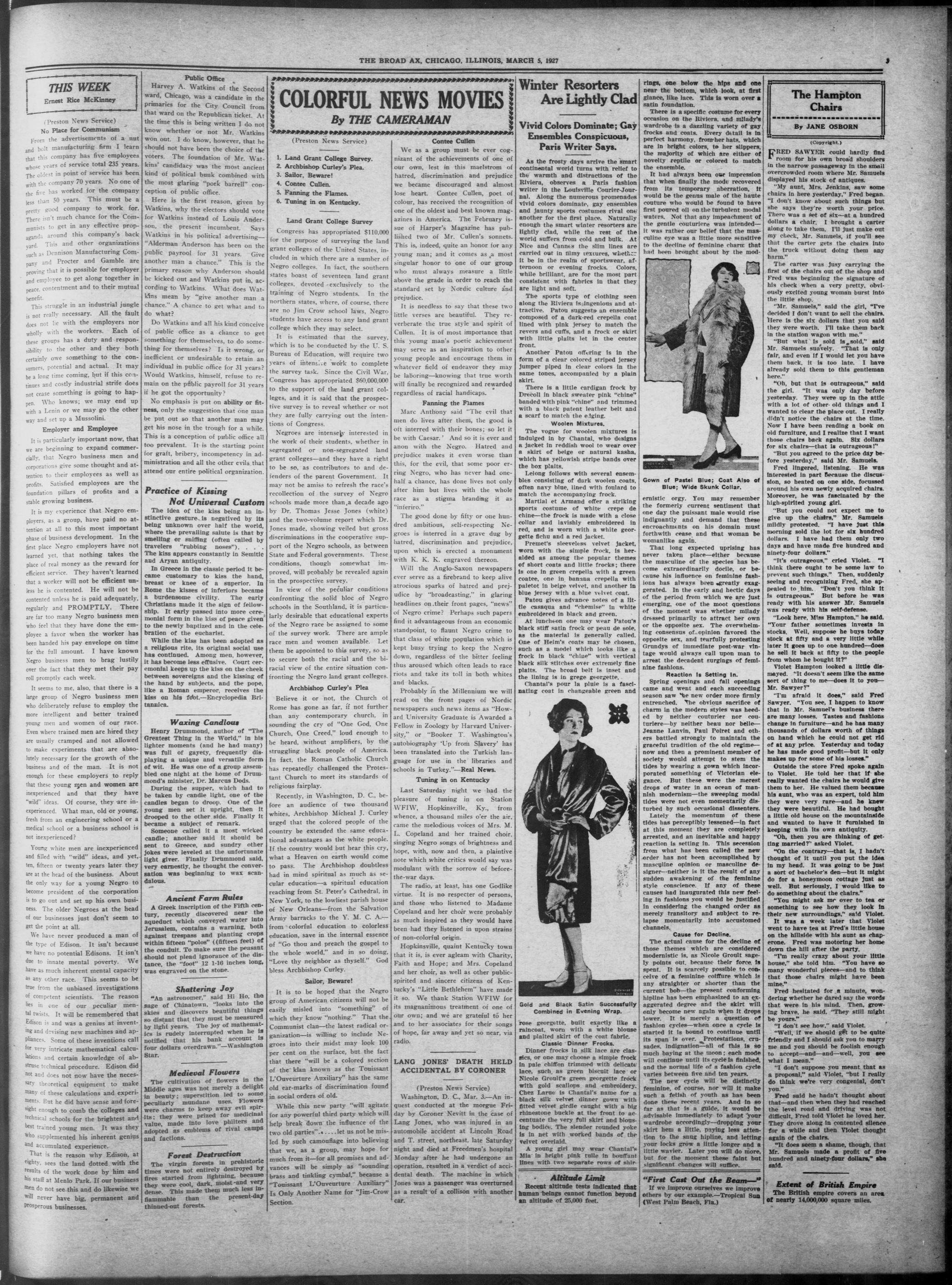
Gold and Black Satin Successfully
Combined in Evening Wrap.
Tose georgette, built exactly tke «
raincoat, worn with a white blouse
and plalted skirt of the cout fabric,
Classic “Dinner Frocks.
Dinner frocks in silk Ice are clas-
sics, or one may choose a simple frock
In pale chiffon trimmed with delicate
Ince, such, as green biscuit lace’ or
Nicole Groult's green georgette frock
with gold scallops and embroidery.
Chez Larue is Chantal's name for a
Diack silk velvet dinner gown with
fitted velvet girdle caught with a big
rhinestone buckle at the front to ac-
centuate the very full skirt and bious-
ing bodice. The slender rounded yoke
fs in net with worked bands of the
velvet overlatd.
A young girl may wear Chantal’s
Mia: in bright pink tulle tn bouffant
Hines with two separate rows of shir-
ee
Recent altitude tests indicated that
human ‘beings cannot function beyond
‘an altitude of 25,000 feet.
rings, one below the hips and one
near the bottom, which look, at first
glance, like lace. ‘This is worn over a
‘satin foundation.
‘There is a specific costume for every
occasion on the Rivicra. and milady’s
wardrobe is a dazzling variety of gay
frocks and coats. Every detail is in
perfect harmony, fronrher hats, which
are in bright colors, to her slippers,
the majority of which are either of
novelty reptile or colored to match
the ensemble.
Tt had always been ovr impression
that when finally the mode recovered
from its temporary aberration, {tt
would be the genus male of the haute
couture who would be found to bave
first poured ofl on.the turbulent modal
waters, Not that any impeachment of
the gentle couturiere was intended—
it was rather our belief that the mas-
culine eye was a little more sensitive
to the decline of feminine charm that
had been brought about by the mod-
eee
| =
VES
F we
i, a
fs
*
ae a Ose
cow ‘oe Poet wyosy coer alee. of
se Peel eer come
ee ee
ernistic orgy. You may remember
the formerly current sentiment that
‘one day the puissant male would rise
indignantly and demand that these
encroachments on his domain must
forthwith cease and that woman be
womanlike again.
That long expected uprising has
never taken place—elther because
the masculine of the species has be-
come extraordinarily docile, or be-
cause his influence on feminine tash-
ions has always been sgreatly exag-
gerated. In the carly and hectic days
of the period from which we are just
emerging, one of the moot questions
of the moment was whether milady
dressed primarily to attract her own
‘or the opposite sex. The overwhelm-
ing consensus of-opinion favored the
opposite sex, and teurfully protesting
Grundys of immediate post-war vin-
tage would always call upon man to
arrest the decadent surgings of femi-
nine fashions.
Reaction Is Setting In.
Spring openings and fall openings
came and went and each succeeding
season saw “te new order more firmly
entrenched. ‘he obvious saerifice of
charm in the modern styles was heed-
ed by neither couturier nor cou-
turlere—by neither beau nor belle—
Jeanne Lanvin, Paul Potret and oth-
ers battled strongly to maintain the
kraceful tradition of the old regime—
now and then @ prominent member of
soclety would attempt to stem the
tides by wearing a gown which incor-
porated something of Victorian ele-
gance, But these were the merest
drops of water in an ocean of man-
‘nish modernism—the sweeping modal
‘tides were not even momentarily dis-
turbed by such occasional dissenters.
Lately the momentum of these
tides has perceptibly lessened—in fact
at this moment they are completely
arrested, and an inevitable and happy
reaction is setting fn. ‘This secession
from what has been called the new
order has not been accomplished by
mascyline opinion or masculine de-
signer—neither is it the result of any
sudden awakening of the feminine
style conscience. If any of these
causes had Inaugurated this new feel-
ing in fashions you would be Justified
in considering the changed order as
merely transitory and subject to re-
lapse momentarily into accustomed
channels,
Cause for Decline.
‘The actual cause for the decline of
those themes which are considered
modernistic is, as Nicole Groult sage-
Ty polnts out, because their force, 1s
spent. It Is scarcely possible to com
celve of a feminine colffure which is
any straighter or shorter than the
current bob—the present conforming
“hipline has been emphasized to an ¢x-
aggerated degree and the skirt will
‘only become new again when it drops
lower. It is merely a question of
fashion cycles—when once a cycle is
‘Started it ig bound to continue until
‘its span Is over. _Protestations, eru-
sades, indignation™all of this 1s s0
much baying at the moon; each mode
‘will continue until its cycle ts finished,
‘and the normal life of a fashion cycle
‘varies between five and ten years.
‘The new cycle will be distinctly
feminine, of course, nor will it make
such a fetish of youth as has been
done these recent years. And tn $0
far as that fs a gulde, it would be
advisable immediately to adapt ‘your
wardrobe accordingly—dropping your
skirt hem a little, paying less atten-
tion to the snug hipline, and letting
your locks grow a little longer and
little wavier. Later you will do niore,
but for the moment these faint but
significant changes will suffice.
—
If we improve ourselves we improve
others by our example—Tropical Sun
(West Palm Beach, Fla.)
’
The Hampton
: Chairs
“By JANE OSBORN
Sen Se Roe Or ARtgees:
“My aunt, Mrs. Jenkins, saw some
chairs in here yesterday,” Fred began.
“I don't kuow about such things but
she says they're worth your. price.
‘There was a set of six—at a hundred
dollars a chair, I brought a carter
along to take them, T'll Just make out
my check, Mr. Samuels, if you'll see
that the carter gets the chairs Into
the truck without doing them any
harm.”
The carter was Jusy carrying the
first of the chairs out of the shop and
Fred was beginning the signature of
his check when a yery pretty, obvi-
ously exelted young woman burst into
the little shop,
“Mr, Samuels,” sald the girl, “ve
decided T don't want to sell the chairs.
Here ts the six dollars that you sald
they were worth. I'll take them back
in the station wagon with me.”
“But what ts sold Is,sold,” said
Mr. Samuels suavely. “That ts only
fair, and even if I would let you have
them back, it 1s too late. I have
already sold them to this gentleman
here.”
“Oh, but that is outrageous,” sald
the girl. “It was only day before
yesterday. They were up in the attle
with a lot of other: old things and I
wanted to clear the place out. I really
didn’t notice the chairs at the time.
Now I have been reading a book on
old furniture, and I realize that I want
those chairs back again. Six dollars
for six chairs—that is outrageous!”
“But you agreed to the price day be-
fore yesterday,” sald Mr. Samuels.
Fred lingered, listening. He was
Interested in part Because the discus-
sion, 80 heated on one side, focussed
around his own newly acquired chairs.
Moreover, he was fascinated by the
high-spirited young girl.
“But you could not expect me to
sive up the chitrs,” Mr. Samuels
mildly protested. “I have just this
morning sold the lot for six hundred
dollars, T have had them only two
days and have made five hundred and
ninety-four dollars.”
“It's outrageous,” erled Violet. “I
think there ought to be some law to
prevent such things.” Then, suddenly
seeing and recognizing Fred, she ap-
pealed to him. “Don't you think It
fs outrageous.” But before he was
ready with his answer Mr. Samuels
was ready with his self-defense.
“Look here, Miss Hampton,” he sald.
“Your father sometimes invests in
stocks, Well, suppose he buys today
stock at fifty and a very little while
later {t goes up to one hundred—does
he sell ft back at fifty to the people
from whom he bought it?”
Violet Hampton looked a little dis-
mayed. “It doesn't seem Uke the same
sort of thing to me—does It to you—
Mr. Sawyer?”
“Pm afraid it does,” sald Fred
Sawyer. “You see, I happen to know
that In Mr, Samuel's business there
are many losses. Tastes and fashions
change in furniture—and he has many
thousands of dollars worth of things
on hand which he could not get rid
of at any price. Yesterday and today
he has made good profit—but It only
makes up for some of his losses.”
Outside the store Fred spoke again
to Violet. He told her that if she
really wanted the chairs he would give
them to her. He valued them because
his aunt, who was an expert, told him
they were very rare—and he knew
they were beautiful. He had bought
a little old house on the mountainside
and wanted to have it furnished in
Keeping with Its own antiquity.
“Oh, then you are thinking of get-
ting married?” asked Violet.
“On the contrary—that is, I hadn't
thought of it until you put the idea
in my head. It was going to be Just
‘& sort of bachelor’s den—but It might
o for a honeymoon cottage just as
well. But seriously, I would lke to
do something about the chatrs.”
“You might ask me over to tea or
something to see how they look in
thelr new surroundings,” sald Violet.
It was a week later that Violet
went to have tea at Fred’s little house
on the hillside with his aunt as chap-
erone. Fred was motoring her home
down the hill after the party.
“I'm really crazy about your ttle
house,” she told him. “You have so
many wonderful pleces—and to think
that those chairs might have been
mine”
Fred hesitated fora minute, won-
dering whether he dared say the words
that were in his mind. Then, grow-
ing brave, he sald, “They still might
be yours.”
“I don't see how.” sald Violet.
“Well, if we should g@ to be quite
frtendly and I should ask you to marry
‘me and you should be foolish enough
to accept—and—and—well, you see
what I mean.”
“I don’t suppose you meant, that as
“a proposal,” sald Violet, “but T really
do think we're very congenial, don't
you.”
Fred sald he hadn't thought about
that—and then when they had reached
the level road and driving was not
difficult, Fred told Violet he loved her.
‘They drove along in contented silence
for @ while and then Violet thought
caichi ab Cin ie .
' Extent of British Empire
‘The British empire covers an area
of nearly 14,000,000 square miles,
Ernest H.
WILLIAMSON
UNDERTAKER
ERnest H. WILLIAMSON
UNDERTAKER
1914-1926
ERnest H. WILLIAMSON
Charles E. Dawson
THE BROAD AX
Published Every Saturday
In this city since July 15th, 1899, without missing one single issue. Republicans, Democrats, Catholics, Protestants, Single Taxes, Priests, infidels or anyone else can have their say as long as their language is proper and responsibility is fixed.
The Broad Ax is a newspaper whose platform is broad enough for all, ever claiming the editorial right to speak its own mind. It is neither Democratic nor Republican. It is strictly or absolutely independent in politics.
Local communications will receive attention. Write only on one side of the paper.
Subscriptions must be paid in advance.
One Year ..... $2.00
Six Months ..... $1.00
Advertising rates made known on application.
Address all communications to
THE BROAD AX
0206 S. Elizabeth St., Chicago.
Phone: Wentworth 2597
JULIUS F. TAYLOR
Editor and Publisher
Vol. XXXII No. 25
Chicago, March 5, 1927
Entered as Second-Class Matter, Aug.
19, 1902, at the Post office at Chicago.
III. Under Act of March 8, 1879.
Notary Public
Phone: Office Main 4153; Residence,
4751 Champlain Avenue
Phone Kenwood 5611
ATTORNEY AND COUNSELOR
AT LAW
Suite 708—184 W. Washington St.
CHICAGO
A. D. GASH
ATTORNEY AT LAW
Suite 813, Ashland Block
155 N. Clark Street
CHICAGO, ILL.
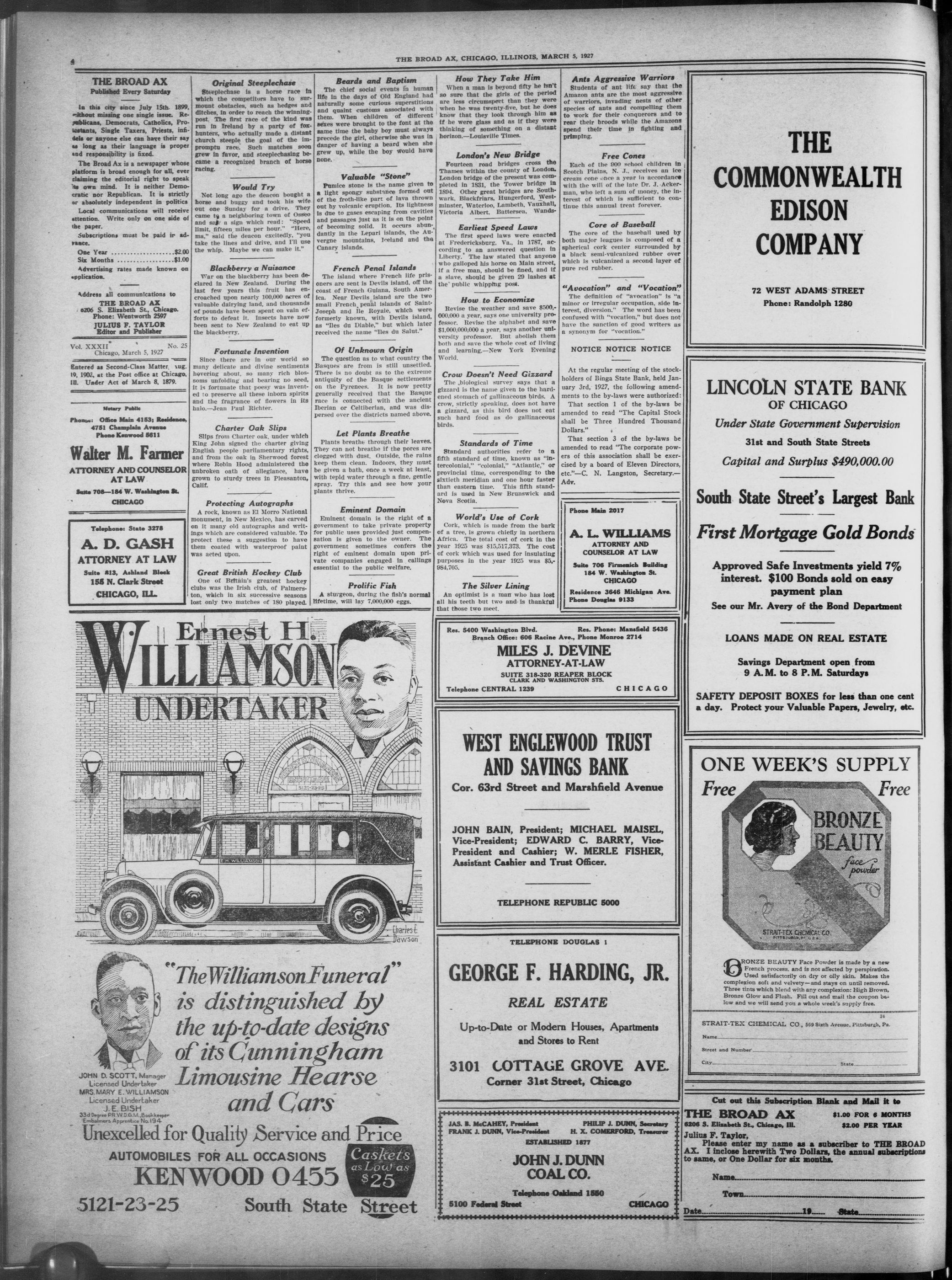
The Williamson Funeral is distinguished by the up-to-date designs of its Cunningham Limousine Hearse and Cars
Original Steeplechase
Steeplechase is a horse race in which the competitors have to surmount obstacles, such as hedges and ditches, in order to reach the winning-post. The first race of the kind was run in Ireland by a party of fox hunters, who actually made a distant church steeple the goal of the impromptu race. Such matches soon grew in favor, and steeplechasing became a recognized branch of horse racing.
Would Try
Not long ago the deacon bought a horse and buggy and took his wife out one Sunday for a drive. They came to a neighboring town of Osseo and say a sign which read: "Speed limit, fifteen miles per hour." "Here, ma" said the deacon excited, "you take the lines and drive, and I'll use the whip. Maybe we can make it."
Blackberry a Nuisance
War on the blackberry has been declared in New Zealand. During the last few years this fruit has encroached upon nearly 100,000 acres of valuable dairying land, and thousands of pounds have been spent on vain efforts to defeat it. Insects have now been sent to New Zealand to eat up the blackberry.
Fortunate Invention
Since there are in our world so many delicate and divine sentiments hovering about, so many rich blossoms unfolding and bearing no seed, it is fortunate that poesy was invented to preserve all these inborn spirits and the fragrance of flowers in its haul.—Jean Paul Richter.
Charter Oak Slips
Slips from Charter oak, under which King John signed the charter giving English people parliamentary rights, and from the oak in Sherwood forest where Robin Hood administered the unbroken oath of allegiance, have grown to sturdy trees in Pleasanton, Calif.
Protecting Autographs
A rock, known as El Morro National monument, in New Mexico, has carved on it many old autographs and writings which are considered valuable. To protect these a suggestion to have them coated with waterproof paint was acted upon.
Great British Hockey Club
One of Britain's greatest hockey clubs was the Irish club, of Palmerston, which in six successive seasons lost only two matches of 180 played.
THE BROAD AX, CHICAGO, ILLINOIS, MARCH 5, 1927
Beards and Baptism
The chief social events in human life in the days of Old England had naturally some curious superstititions and quaint customs associated with them. When children of different sexes were brought to the font at the same time the baby boy must always precede the girl, otherwise she was in danger of having a beard when she grew up, while the boy would have none.
Valuable "Stone"
Punice stone is the name given to a light spongy substance formed out of the froth-like part of lava thrown out by volcanic eruption. Its lightness is due to gases escaping from cavities and passages just as it is on the point of becoming solid. It occurs abundantly in the Leparl islands, the Auvergne mountains, Iceland and the Canary islands.
French Penal Islands
The island where French life prisoners are sent is Devils Island, off the coast of French Guiana, South America. Near Devils Island are the two small French, penal islands of Saints Joseph and Ile Royale, which were formerly known, with Devils Island, as "Iles du Diable," but which later received the name "Iles du Salut."
Of Unknown Origin
The question as to what country the Basques are from is still unsettled. There is no doubt as to the extreme antiquity of the Basque settlements on the Pyrenees. It is now pretty generally received that the Basque race is connected with the ancient Iberian or Celtiberian, and was dispersed over the districts named above,
Let Plants Breathe
Plants breathe through their leaves. They can not breathe if the pores are clogged with dust. Outside, the rains keep them clean. Indoors, they must be given a bath, once a week at least, with tepid water through a fine, gentle spray. Try this and see how your plants thrive.
Eminent Domain
Eminent domain is the right of a government to take private property for public uses provided just compensation is given to the owner. The government sometimes confers the right of eminent domain upon private companies engaged in callings essential to the public welfare.
Prolific Fish
A stungeon, during the fish's normal lifetime, will lay 7,000,000 eggs.
How They Take Him
When a man is beyond fifty he isn't so sure that the girls of the period are less circumspact than they were when he was twenty-five, but he does know that they look through him as if he were glass and as if they were thinking of something on a distant horizon.—Louisville Times.
London's New Bridge
Fourteen road bridges cross the Thames within the county of London. London bridge of the present was completed in 1831, the Tower bridge in 1894. Other great bridges are Southwinter, Blackfriars, Hungerford, Westminster, Waterloo, Lambeth, Vauxhall, Victoria Albert, Battersea, Wands-
Earliest Speed Laws
The first speed laws were enacted at Fredericksburg, Va., in 1787, according to an answered question in Liberty. The law stated that anyone galloped his horse on Main street, if a free man, should be fined, and if a slave, should be given 29 lashes at the public whipping post.
How to Economize
Revise the weather and save $500,
000,000 a year, say one university
professor. Revise the alphabet and save
$1,000,000 a year, say another uni-
versity professor. But abolish them
both and save the whole cost of living
and learning.—New York Evening
World.
Crow Doesn't Need Gizzard
Crow Doesn't Need Gizzard
The biological survey says that a gizzard is the name given to the hardened stomach of gallinaceous birds. A crow, strictly speaking, does not have a gizzard, as this bird does not eat such hard food as do gallinaceous birds.
Standards of Time
Standard authorities refer to a fifth standard of time, known as "intercolonial," "colonial," "Atlantic," or provincial time, corresponding to the sixtieth meridian and one hour faster than eastern time. This fifth standard is used in New Brunswick and Nova Scotia.
World's Use of Cork
Cork, which is made from the bark of a tree, is grown chiefly in northern Africa. The total cost of cork in the year 1925 was $15,517,373. The cost of cork which was used for insulating purposes in the year 1925 was $5,844,705.
The Silver Lining
An optimist is a man who has lost all his teeth but two and is thankful that those two meet.
Res. 5400 Washington Blvd.
Branch Office: 606 Racine
MILES J.
ATTORNEY
SUITE 318-320 B
CLARK AND WA
Telephone CENTRAL 1239
WEST ENGLEY
AND SAVIL
Cor. 63rd Street and
JOHN BAIN, President
Vice-President; EDWA
President and Cashier;
Assistant Cashier and T
Washington Blvd. Res. Phone: B
Office: 606 Racine Ave., Phone Monro
MILES J. DEVINE
ATTORNEY-AT-LAW
SUITE 318-320 REAPER BLOCK
CLARK AND WASHINGTON STS.
ENTRAL 1239
AT ENGLEWOOD TR
ND SAVINGS BAN
d Street and Marshfield
AIN, President; MICHAEL
President; EDWARD C. BARR
and Cashier; W. MERLE
Cashier and Trust Officer.
Res. 5400 Washington Blvd. Res. Phone: Mansfield 5436
Branch Office: 606 Racine Ave., Phone Monroe 2714
MILES J. DEVINE
ATTORNEY-AT-LAW
SUITE 318-320 REAPER BLOCK
CLARK AND WASHINGTON STS.
Telephone CENTRAL 1239 CHICAGO
Cor. 63rd Street and Marshfield Avenue
JOHN BAIN, President; MICHAEL MAISEL, Vice-President; EDWARD C. BARRY, VicePresident and Cashier; W. MERLE FISHER, Assistant Cashier and Trust Officer.
TELEPHONE REPUBLIC 5000
TELEPHONE DOUGLAS 1
GEORGE F. H.
REAL
Up-to-Date or Modern
and Store
3101 COTTAGE
Corner 31st S
JAS. B. McCAHEY, President
FRANK J. DUNN, Vice-President
ESTABLISHED
AGE F. HARDING
REAL ESTATE
Date or Modern Houses, Ap-
and Stores to Rent
COTTAGE GROVE
Corner 31st Street, Chica-
HEY, President
IN, Vice-President
PHILIP J. D.
H. X. COMERFO
ESTABLISHED 1877
Up-to-Date or Modern Houses, Apartments and Stores to Rent
3101 COTTAGE GROVE AVE.
Corner 31st Street, Chicago
JOHN J. DUNN COAL CO.
Telephone C
5100 Federal Street
Telephone Oakland 1550
1 Street
Ants Aggressive Warriors
Ants Aggressive Warriors Students of ant life say that the Amazon ants are the most aggressive of warriors, invading nests of other species of ants and compelling them to work for their conquerors and to rear their broods while the Amazons spend their time in fighting and primping.
Each of the 900 school children in Scotch Plains, N. J., receives an ice cream cone once a year in accordance with the will of the late Dr. J. Ackerman, who left a sum of money, the interest of which is sufficient to continue this annual treat forever.
Core of Baseball
The core of the baseball used by both major leagues is composed of a spherical cork center surrounded by a black semi-vulcanized rubber over which is vulcanized a second layer of pure red rubber.
"Avocation" and "Vocation"
The definition of "avocation" is "a minor or irregular occupation, side interest, diversion." The word has been confused with "vocation," but does not have the sanction of good writers as a synonym for "vocation."
NOTICE NOTICE NOTICE
At the regular meeting of the stockholders of Binga State Bank, held January 3rd, 1927, the following amendments to the by-laws were authorized:
That section 1 of the by-laws be amended to read "The Capital Stock shall be Three Hundred Thousand Dollars."
That section 3 of the by-laws be amended to read "The corporate powers of this association shall be exercised by a board of Eleven Directors, etc."—C. N. Langston, Secretary.—Adv.
Phone Main 2017
A. L. WILLIAMS
ATTORNEY AND
COUNSELOR AT LAW
Suite 706 Firmenich Building
184 W. Washington St.
CHICAGO
Residence 3646 Michigan Ave.
Phone Douglas 9133
Res. Phone: Mansfield 5436
Ave., Phone Monroe 2714
DEVINE
Y-AT-LAW
LEAPER BLOCK
WASHINGTON STS.
CHICAGO
WOOD TRUST
INGS BANK
Marshfield Avenue
; MICHAEL MAISEL,
RD C. BARRY, Vice-
W. MERLE FISHER,
Trust Officer.
HARDING, JR.
ESTATE
Corn Houses, Apartments
to Rent
E GROVE AVE.
Street, Chicago
PHILIP J. DUNN, Secretary
H. X. COMERFORD, Treasurer
HED 1877
CHICAGO
Free Cones
THE COMMONWEALTH EDISON COMPANY
72 WEST ADAMS STREET Phone: Randolph 1280
LINCOLN STATE BANK
OF CHICAGO
Superior State Government Supervise
31st and South State Streets
Capital and Surplus $490,000
State Street's Largest
Mortgage Gold B
Proved Safe Investments yield
interest. $100 Bonds sold on e-
payment plan
Our Mr. Avery of the Bond Depa
DANS MADE ON REAL ESTATE
LINCOLN STATE BANK OF CHICAGO
Under State Government Supervision
31st and South State Streets
Capital and Surplus $490,000.00
South State Street's Largest Bank
First Mortgage Gold Bonds
Approved Safe Investments yield 7% interest. $100 Bonds sold on easy payment plan See our Mr. Avery of the Bond Department
LOANS MADE ON REAL ESTATE
Savings Department open from
9 A.M. to 8 P.M. Saturdays
TY DEPOSIT BOXES for less than one
Protect your Valuable Papers, Jewelr
SAFETY DEPOSIT BOXES for less than one cent a day. Protect your Valuable Papers, Jewelry, etc.
ONE WEEK'S SUPPLY
BRONZE BEAUTY Face Powder is made by a new French process, and is not affected by perspiration. Used satisfactorily on dry or oily skin. Makes the complexion soft and velvety—and stays on until removed. Three tints which blend with any complexion: High Brown, Bronze Glow and Flesh. Fill out and mail the coupon below and we will send you a whole week's supply free.